
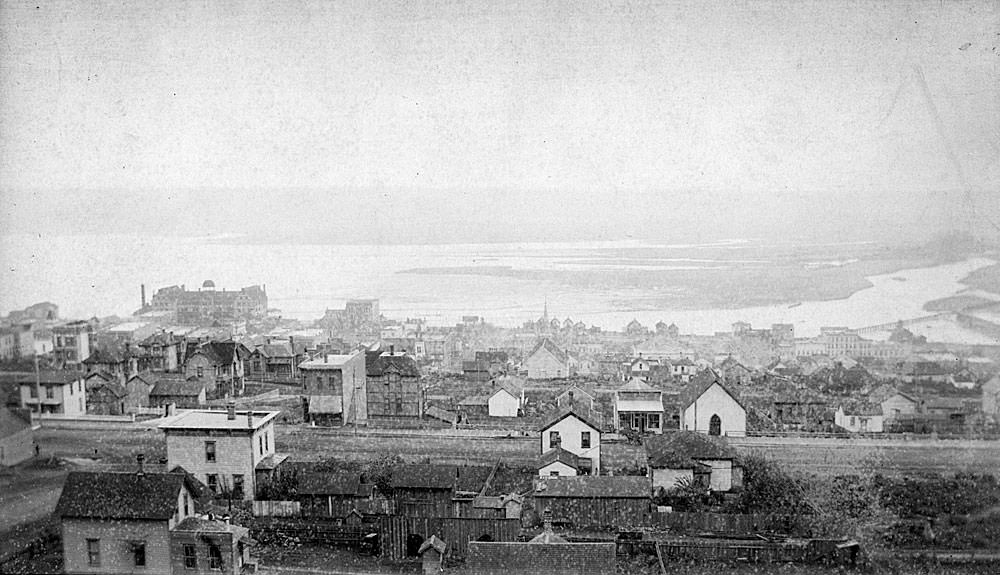
During the 1890s, Tacoma’s role in the Pacific Northwest was firmly established, but its residents’ dreams of dominating the region were dashed. The Panic of 1893 hit the city hard — banks failed, homes were repossessed, and businesses closed. The city’s population fell by 30 percent between 1893 and 1900, while Seattle rose to become the region’s dominant city. The photos below offer a rare look at Tacoma during this transformative decade.
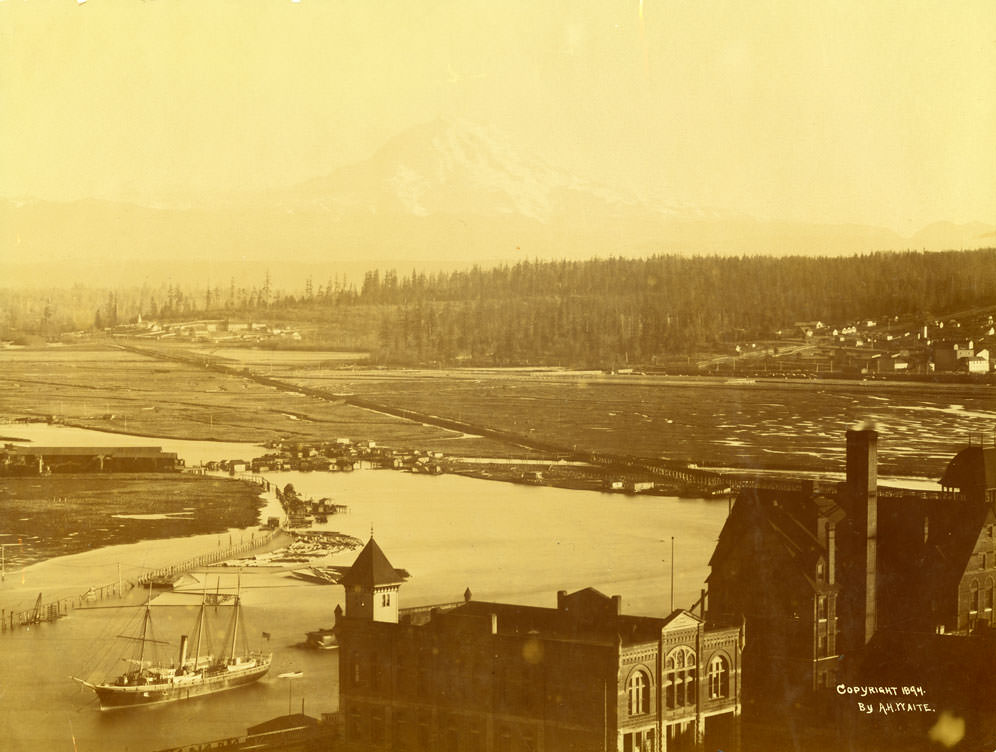
The upper story of Tacoma Fire Department Station no. 6 on A Street is at the corner lower edge. Part of the Tacoma Hotel is in the lower right corner, and a sailing ship is in the lower left. A road across the tideflats cuts diagonally through the center.
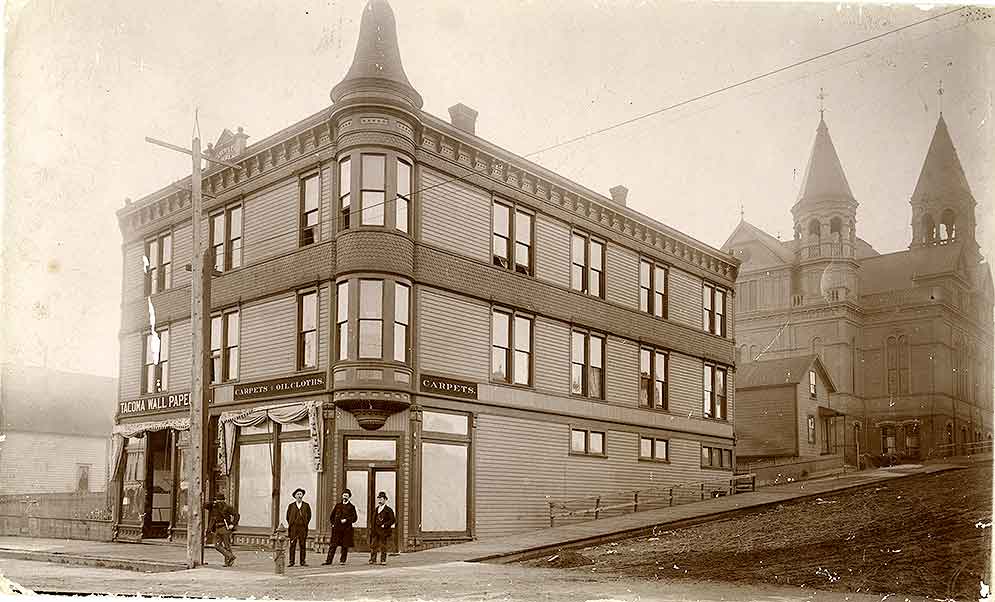
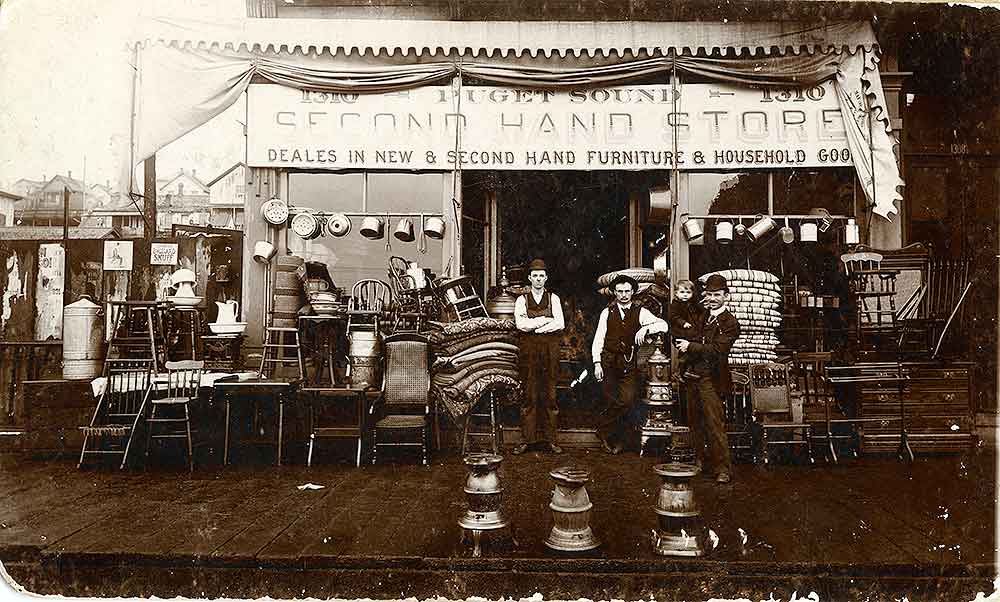
The business owners are S.H. Norton, H. Minor, A.J. Loranger, and A. Faucher. Additional signs above the storefront read: Carpets, Oilcloths. A large Presbyterian Church is in the photo’s right background.
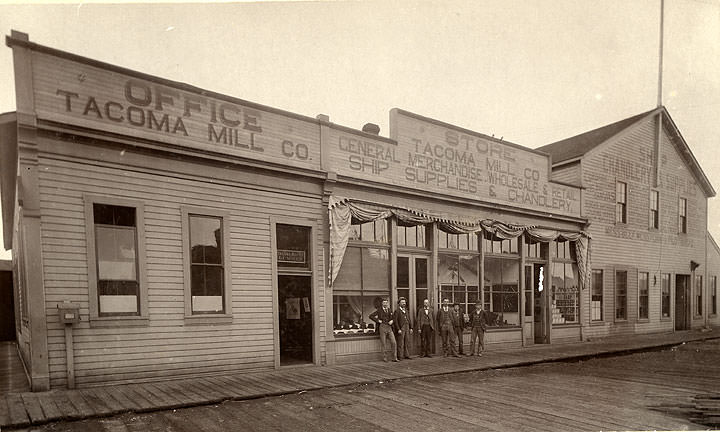
Six men pose in front of an adjacent storefront with the sign: Store, Tacoma Mill Co., General Merchandise — Wholesale & Retail, Ship Supplies & Chandlery. Mr. Smith, the store manager, is on the far left. Men’s hats are displayed in one of the windows.
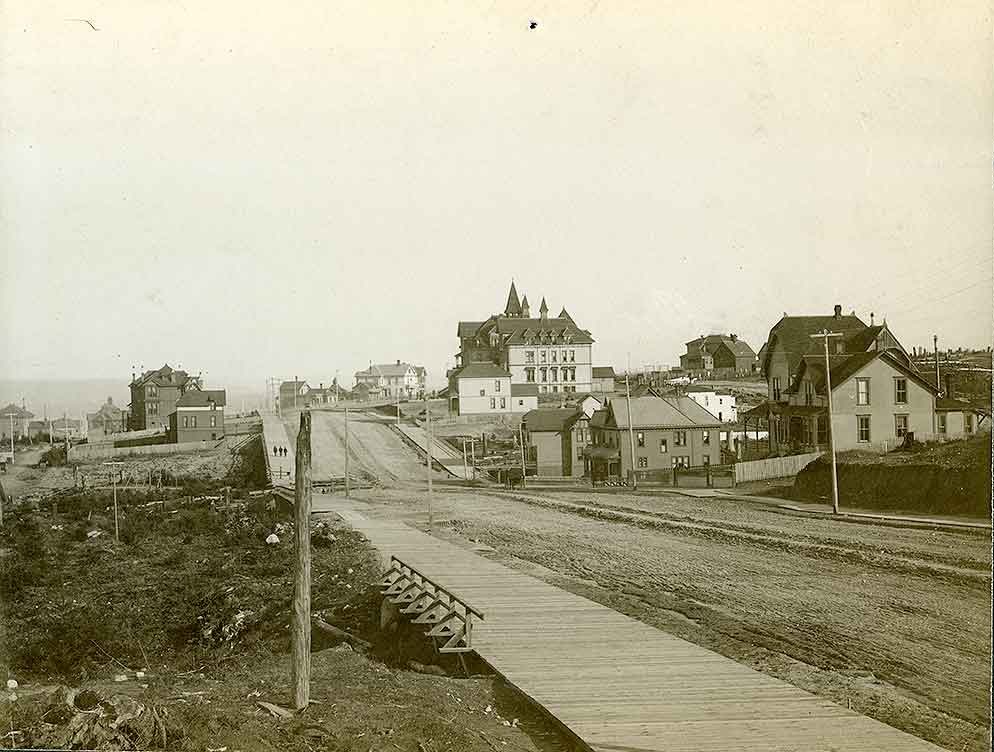
In the photo center distance, Annie Wright Seminary on Tacoma Avenue North, taken from Third Street near the site of the present-day Dorothy and Vista del Rey apartments. A wooden sidewalk along Tacoma Avenue, a dirt road, is in the foreground.
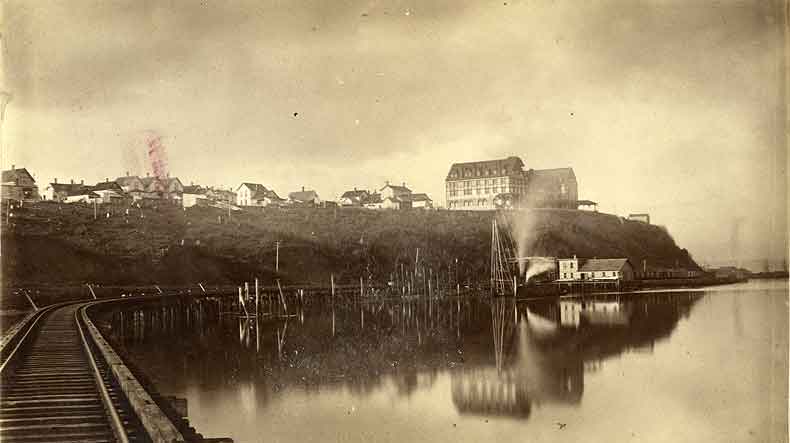
Commencement Bay is in the lower right foreground, with a commercial building adjacent to the water. The reflection of the hotel and commercial building is visible in the water.
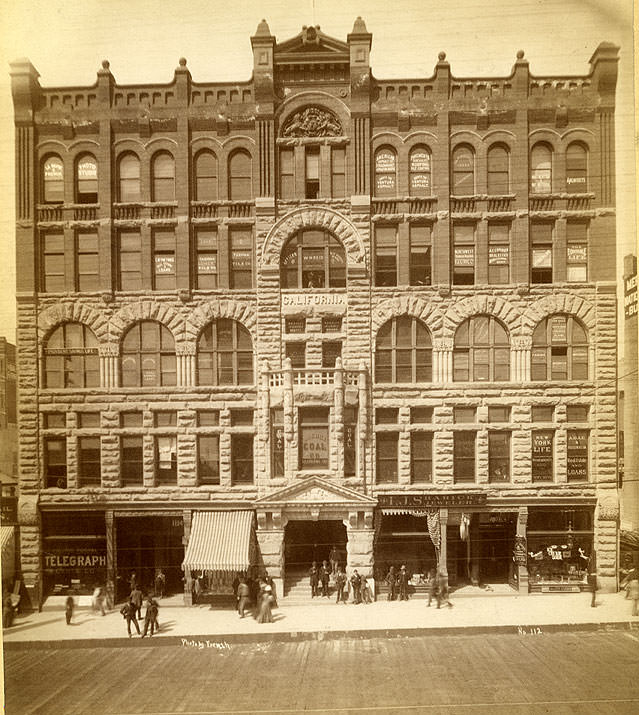
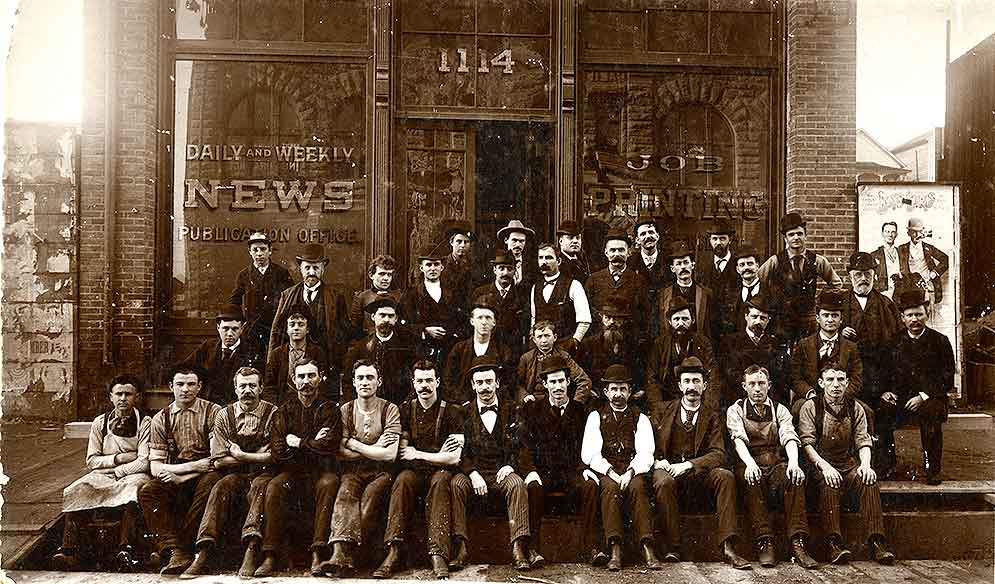
The photo shows a massive five-story stone and brick building located at 1110–1116 Pacific Avenue in Tacoma. It was built in 1890 on Pacific Avenue, about 100 feet south of 11th Street. Later this was the site of the Publix garage. People can be seen walking and standing in front of the building.
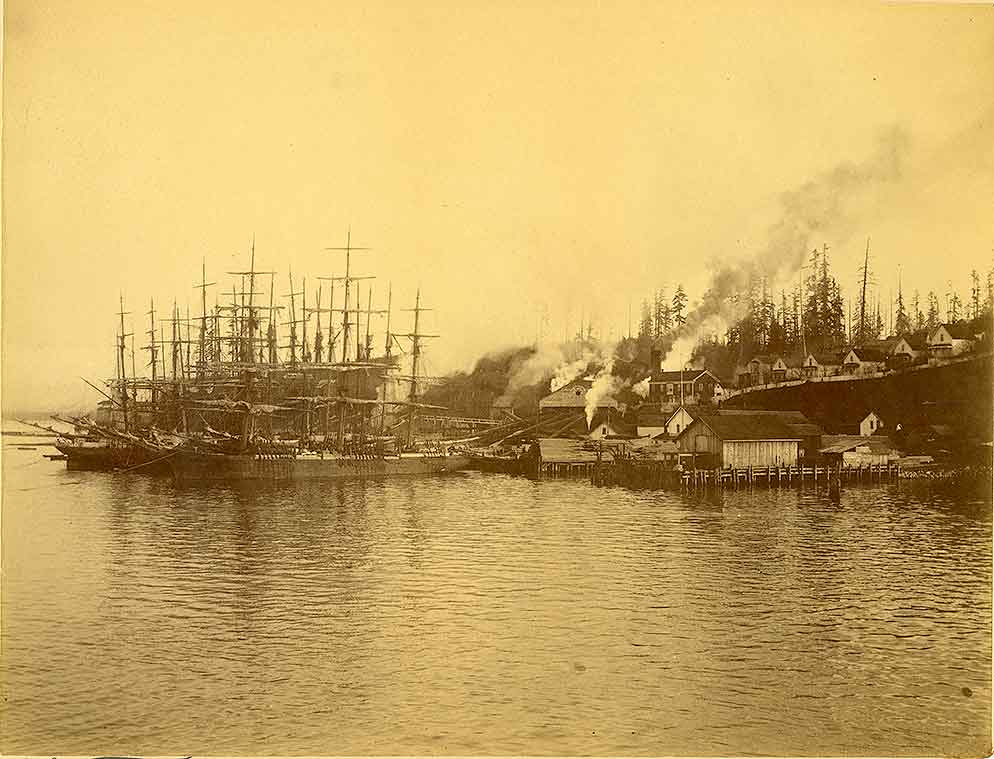
The mill moors several sailing ships.
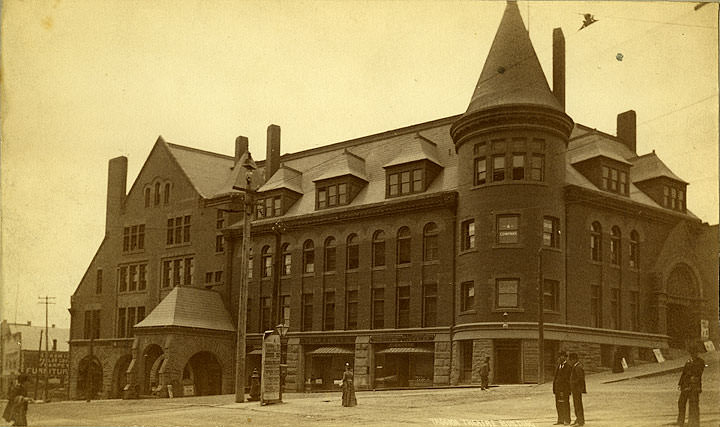
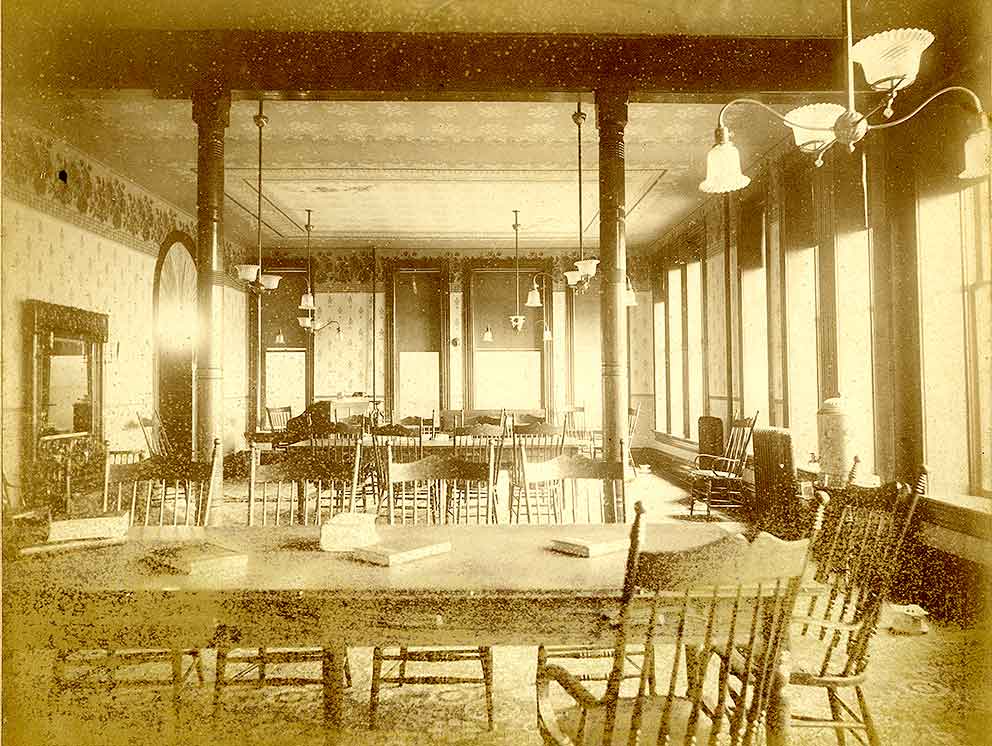
Two long tables with chairs are in the foreground. A few books are placed on the closest tabletop. A desk is on the back wall. A beverage urn is next to a wall with windows on the right side of the image. Two spittoons are visible.
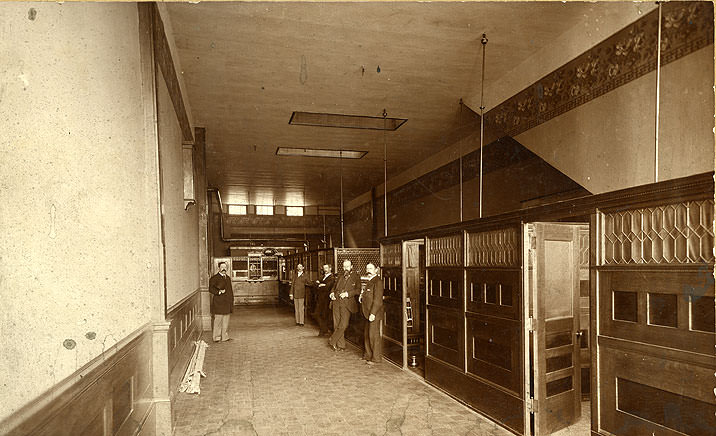
They are standing in a long, narrow room outside the individual office. A teller’s window is at the back of the room.
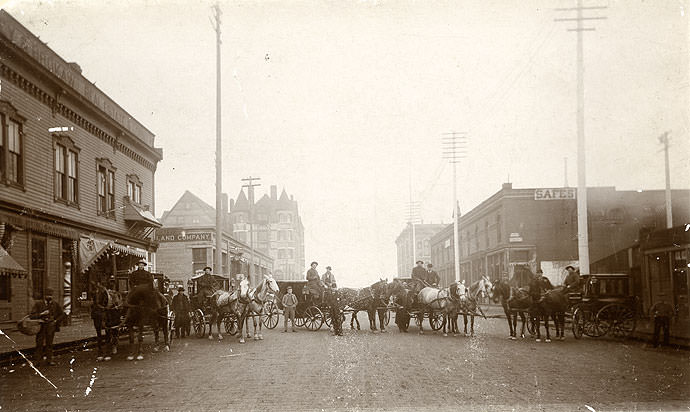
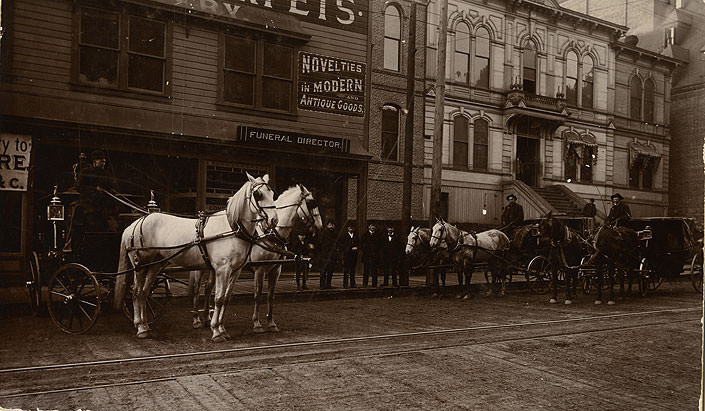
Tenth Street, looking towards the Tacoma Hotel, located on A Street between Ninth and Tenth Streets, in the left-center background. Five horse-drawn carriages, with drivers, and three men standing near them, pose across the middle of the street in the foreground.
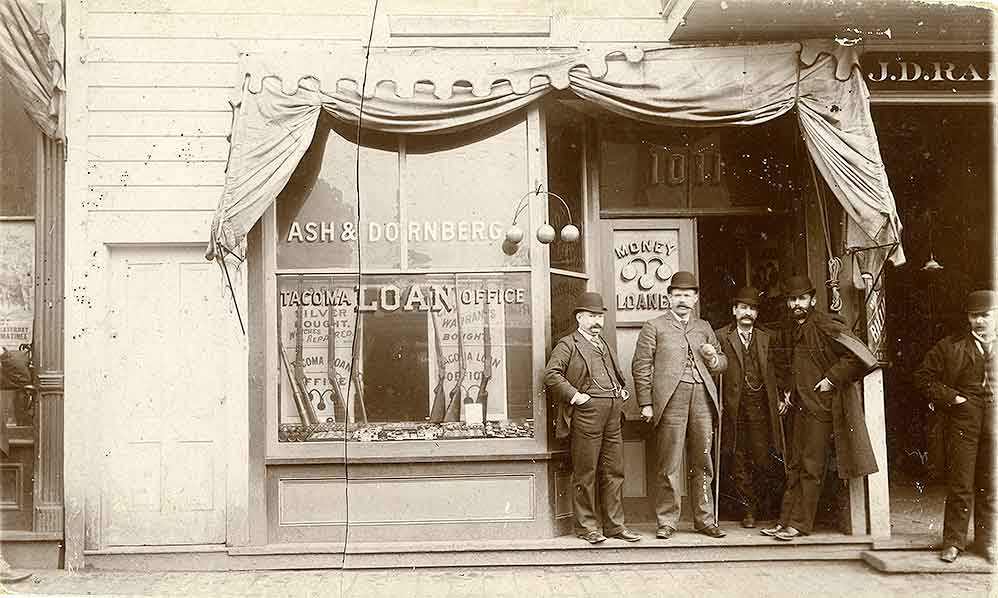
Four men wearing suits and hats stand in the doorway of the Tacoma Loan Office, owned by Archie S. Ash and Isaac Dornberg, 1011 Pacific Avenue. One man wears an overcoat with a short cape over the shoulders.
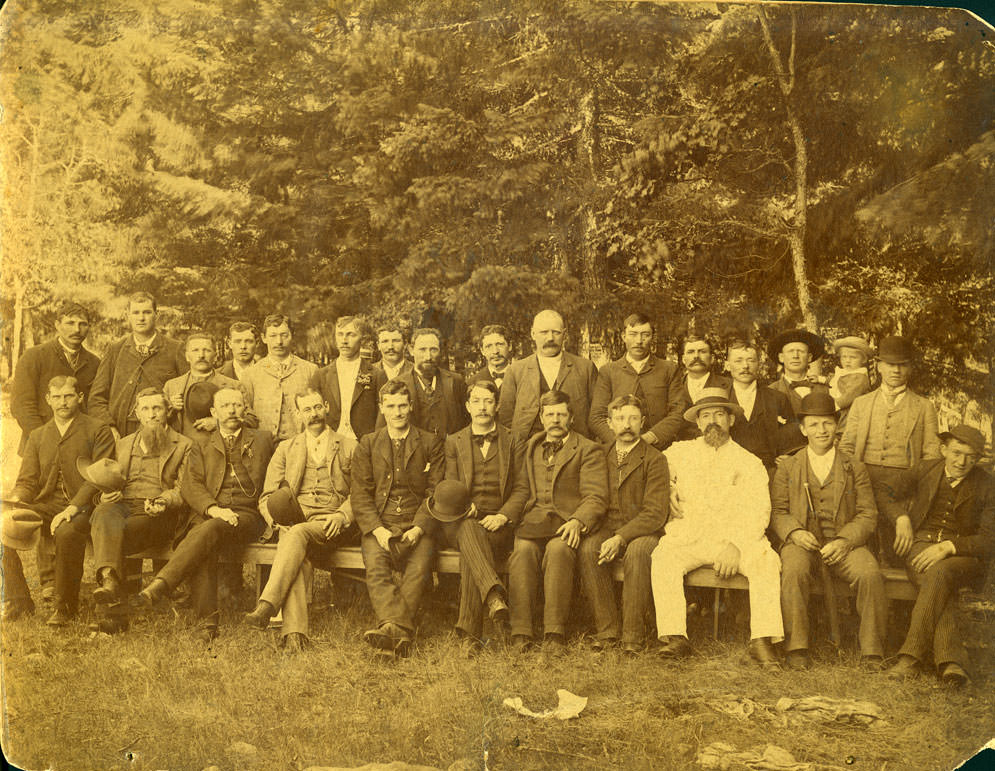
An informal group portrait was taken at the Tacoma Butcher Association Picnic. Members are posed wearing their Sunday best.
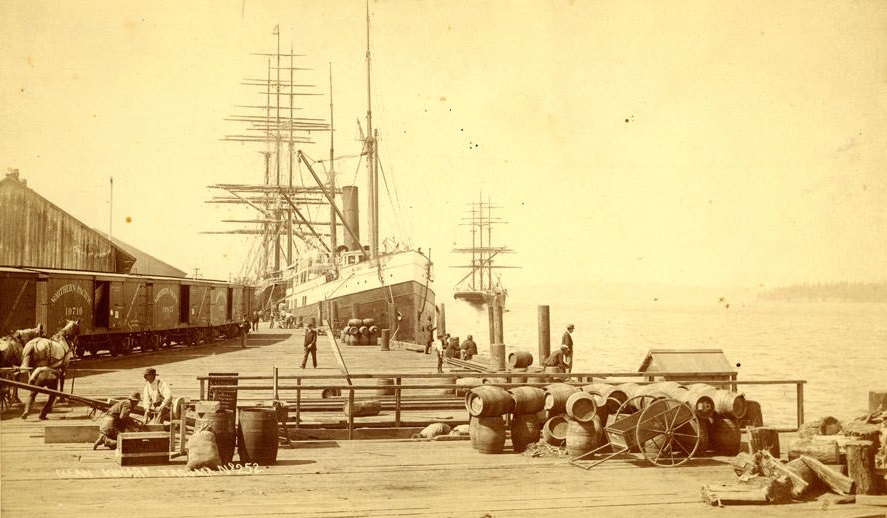
On the pier are wooden casks and Northern Pacific boxcars.
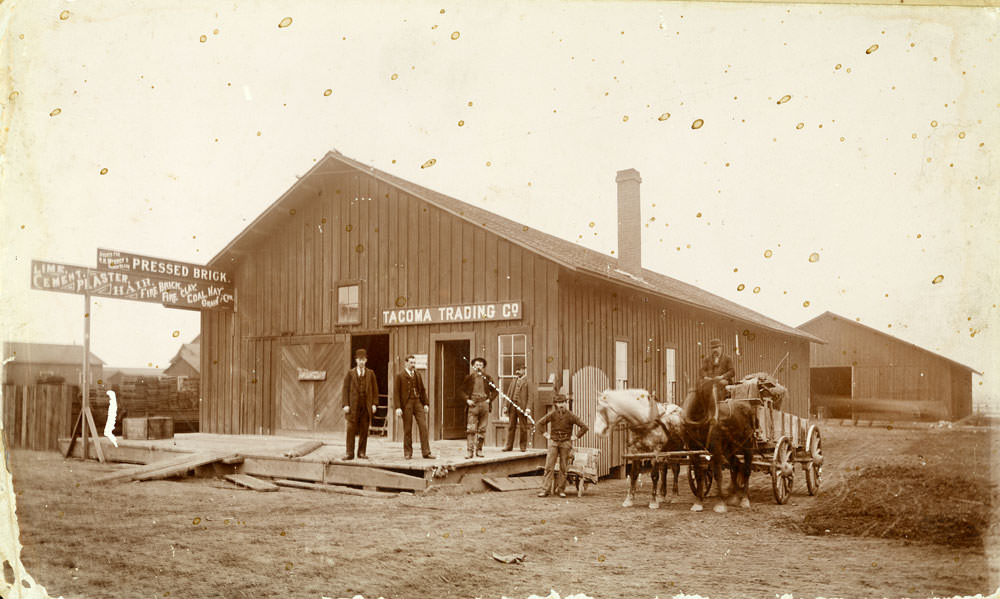
Four men stand on the building’s porch looking at the photographer, and a man sits on a wagon drawn by two horses beside the building.
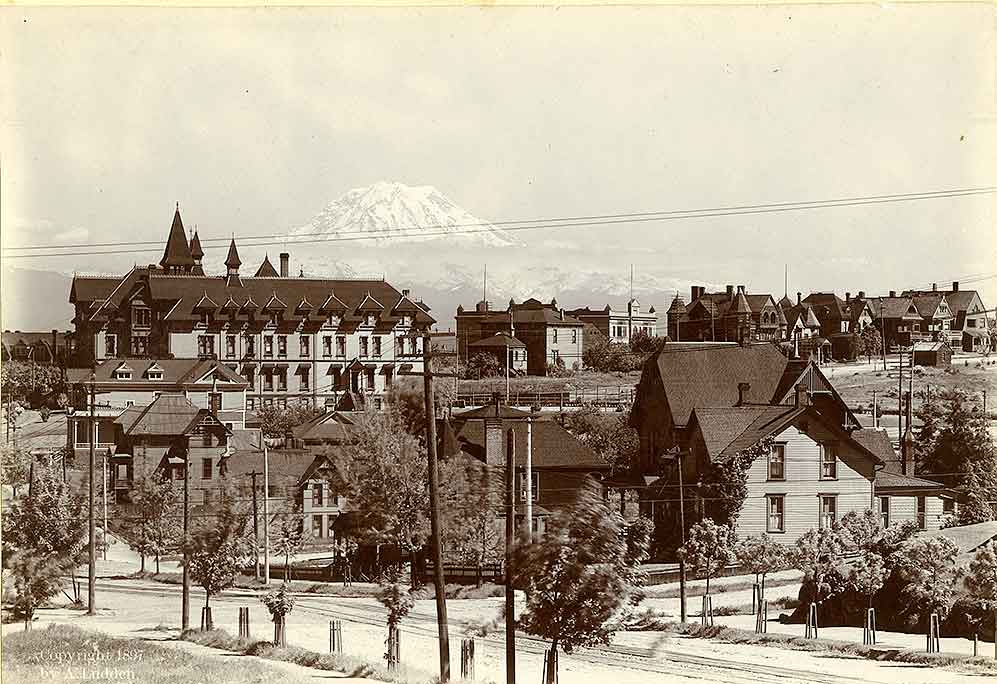
The photo was taken from the current site of the Vista del Rey apartments, located between Third and Fourth Streets on Tacoma Ave. North. The seminary is a large building in the left photo background. Mount Rainier is in the center-left background.
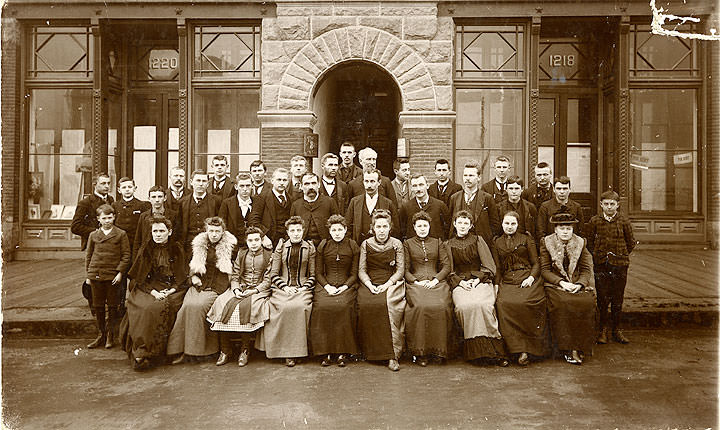
Ten women of various ages, two of them wearing fur-trimmed coats, sit in the front row. About twice that many men of various ages are standing behind them. A boy stands at each end of the group. Storefront no. 1220, in the left background, is possibly a photography studio.
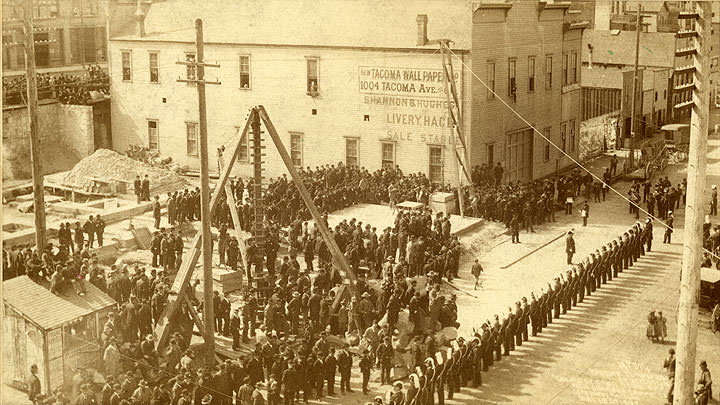
Laying the cornerstone for the Tacoma Chamber of Commerce building at the Ninth Street, Broadway, and Commerce Street intersection. With only a few women present, crowds surround the site, where a tall wooden tripod will lay the stone. A row of men in a fraternal organization uniform stands at attention, facing the site.
A sailing ship and barge are on the other side of the dock. Part of another ship and warehouses are in the right background, and in the distance is the top of the Northern Pacific Railroad Headquarters Building.
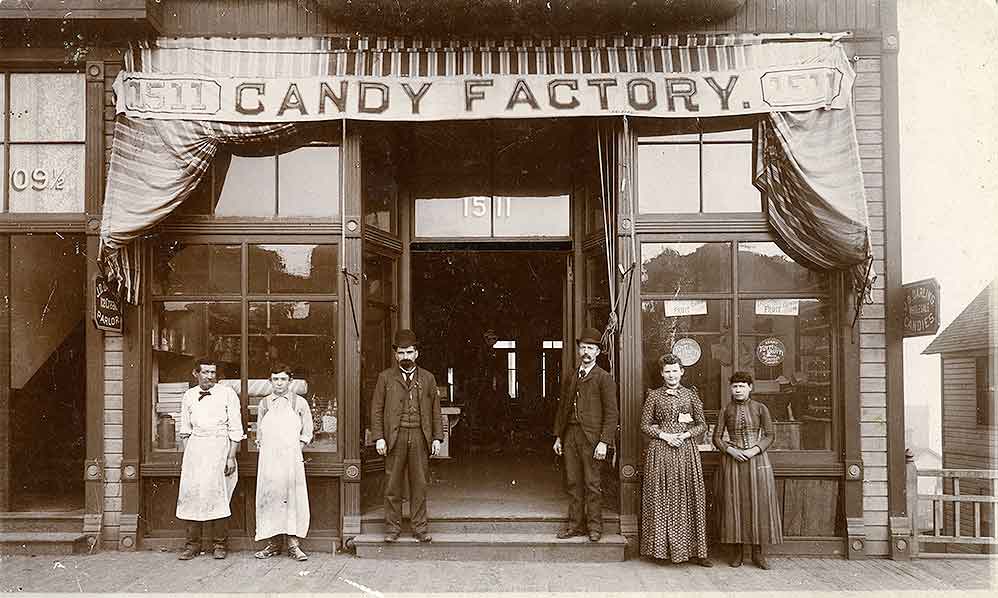
Black and white image of two men wearing suits and hats, two women, and two men wearing long aprons standing in front of the Candy Factory, a business owned by John D. Darling, 1511 Tacoma Avenue South.
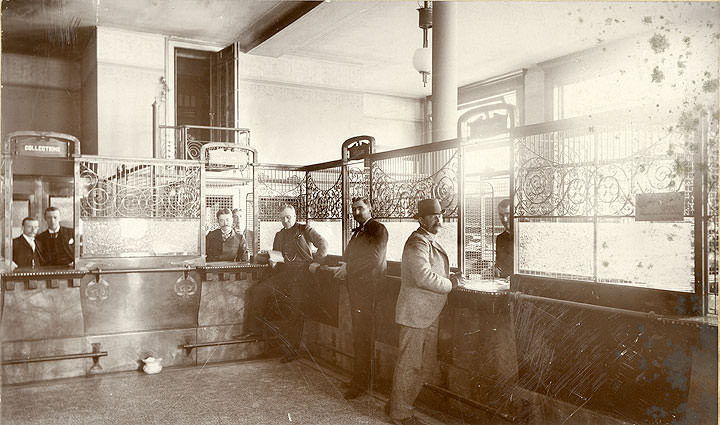
Five bank employees are standing and posing behind the four visible teller windows. Two men wearing suits, possibly employees, and a man wearing a suit and hat, stand in front of the windows. A spittoon is on the floor at the left of the image.
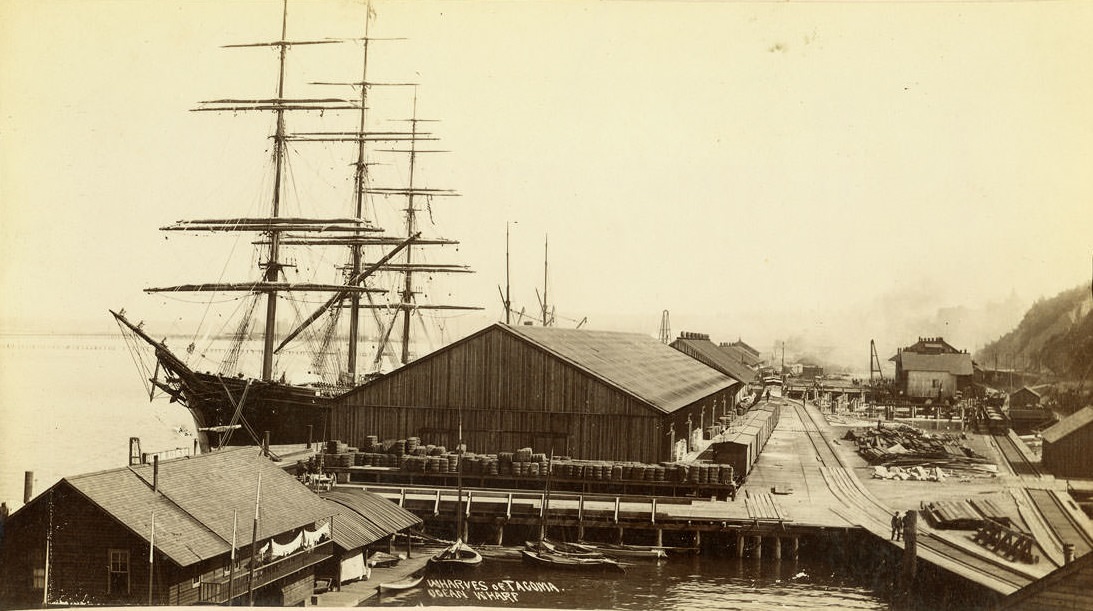
Ocean Wharf in Tacoma, Washington, on Commencement Bay. Bales of unidentified goods, possibly tea from the Orient, are stacked on the dock. The Northern Pacific Freight Office is located on the dock.
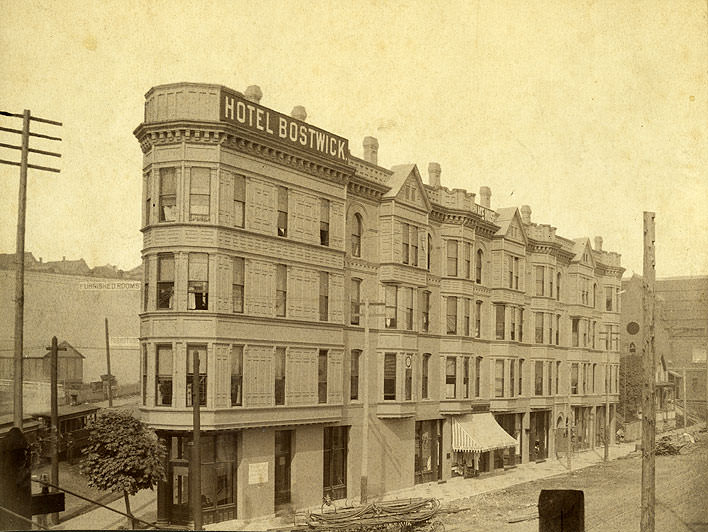
Two streetcars are partially visible at the left edge of the image. In the foreground, a wagon with hoses is partially visible on the dirt road.
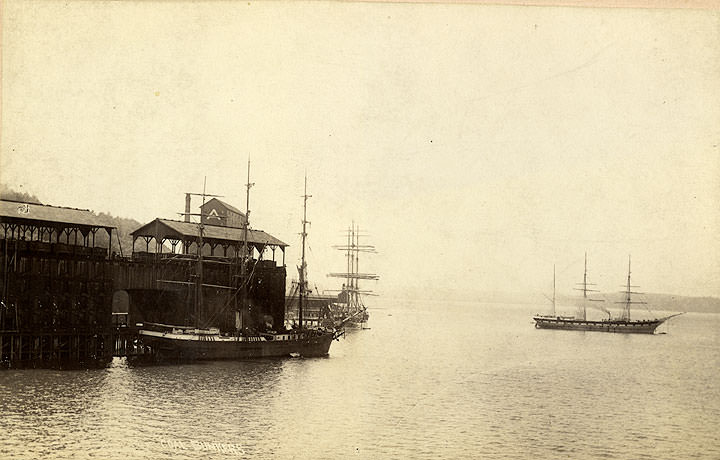
Another sailing ship is next to a partially visible harbor behind it. Another sailing ship is in open water at the right of the image.
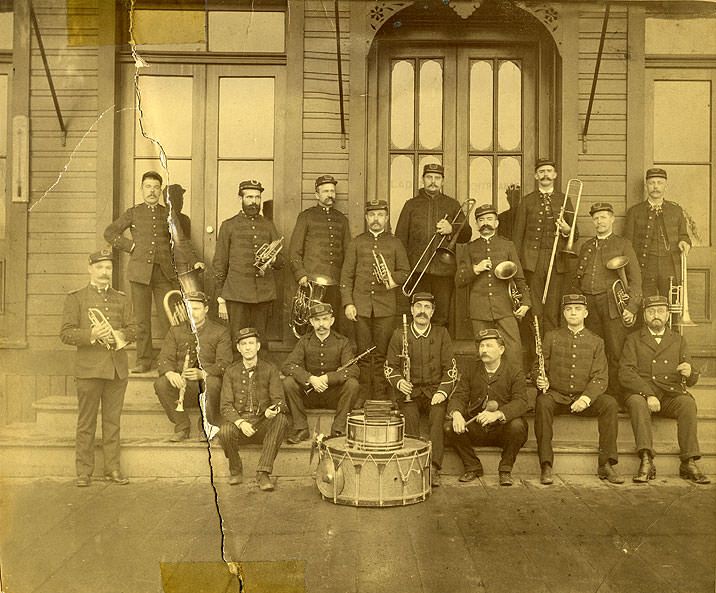
Holding a bass horn, William Price is in the back row, left. Each of the other men holds a musical instrument, including the trombone, clarinet, tuba, euphonium, piccolo, flute, cornet, possibly a French horn, and mellophone. A bass drum with an attached cymbal lies on its side in front of the group, with a snare drum and woodblock on top.
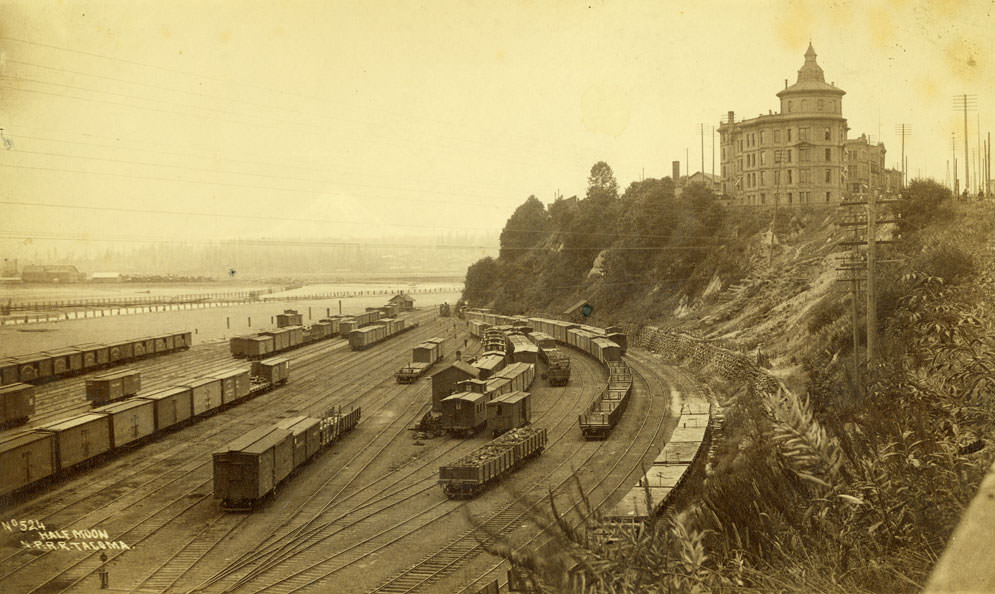
The Northern Pacific Headquarters building is visible on the bluff overlooking the yard. Many boxcars and flatcars are in the yards.
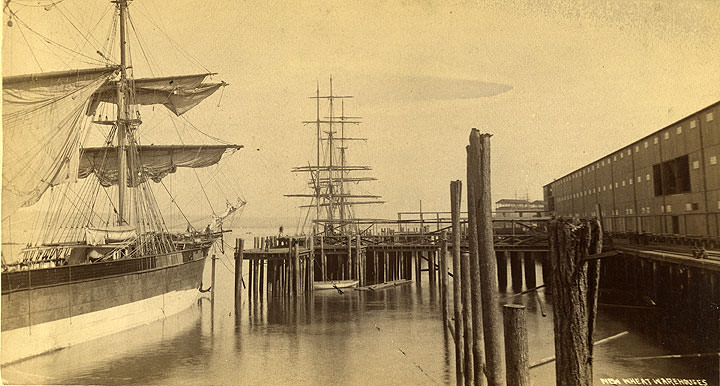
A loading pier on pilings extends towards the center of the image. Two sailing ships are partially visible at the center, leaving the image.
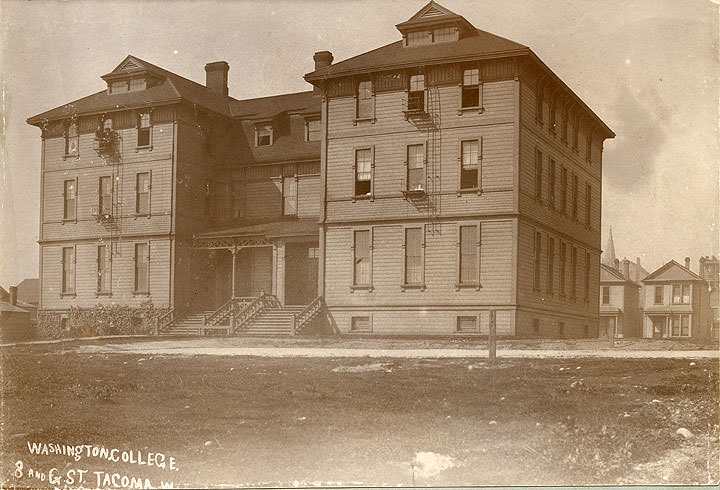
A three-story building on South Tacoma Avenue, between Seventh and Eighth Streets. The small figures of two people are posing on a fire escape outside a third-story window at the left of the image.
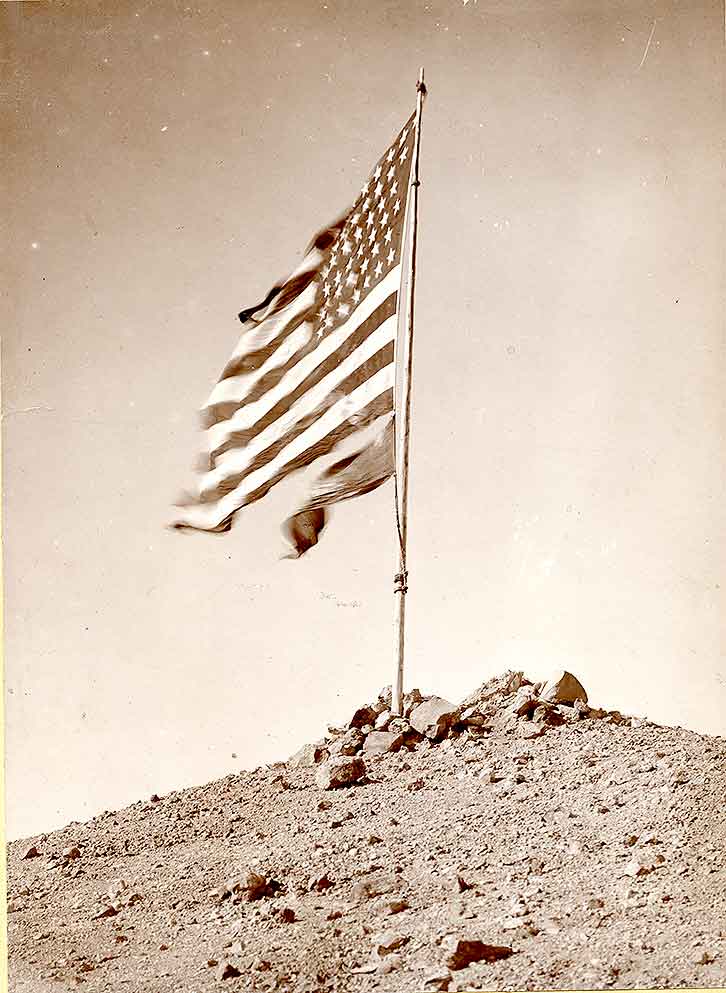
This flag was raised on top of Mount Tacoma in 1891. In 1893, members of the French Drug Co. were up there and found the staff broken and down.
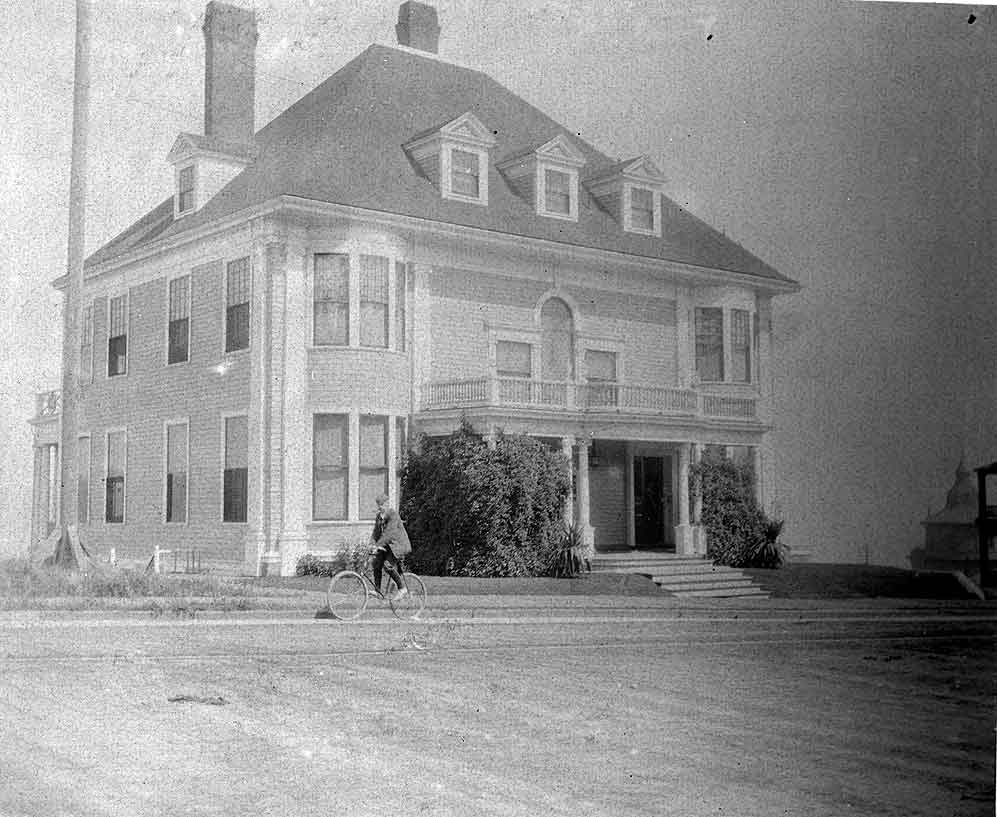
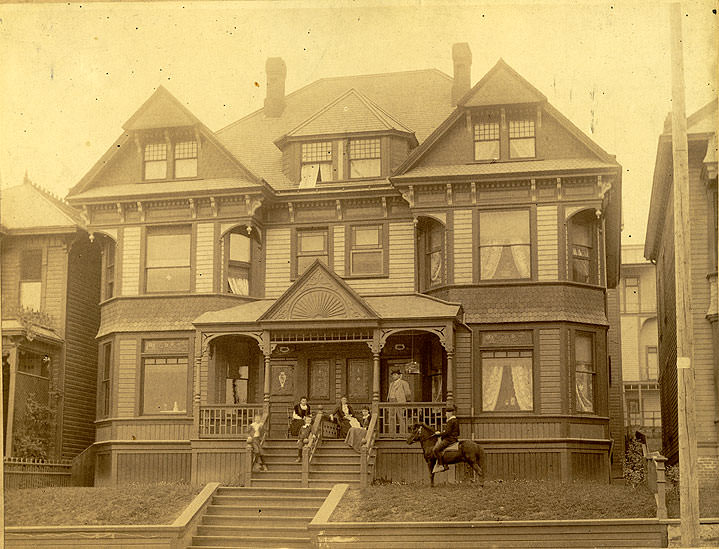
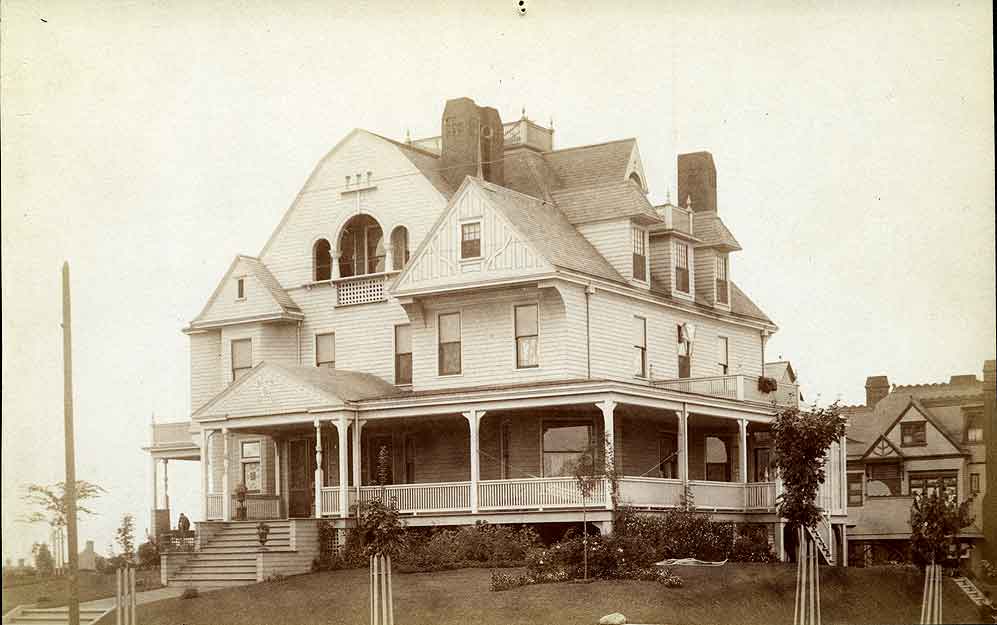
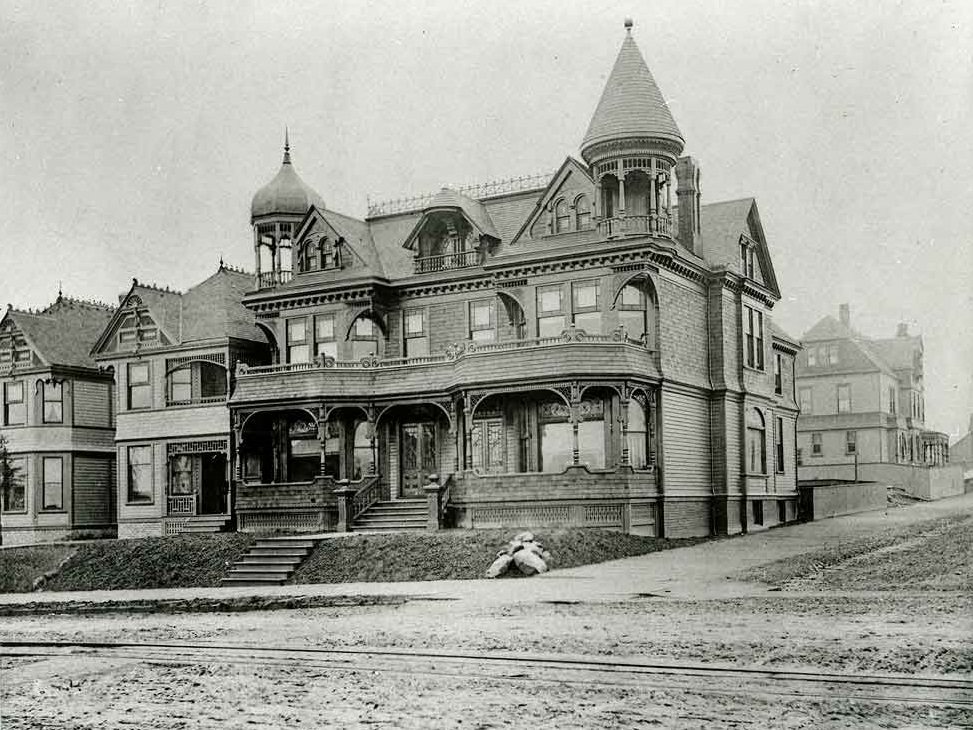
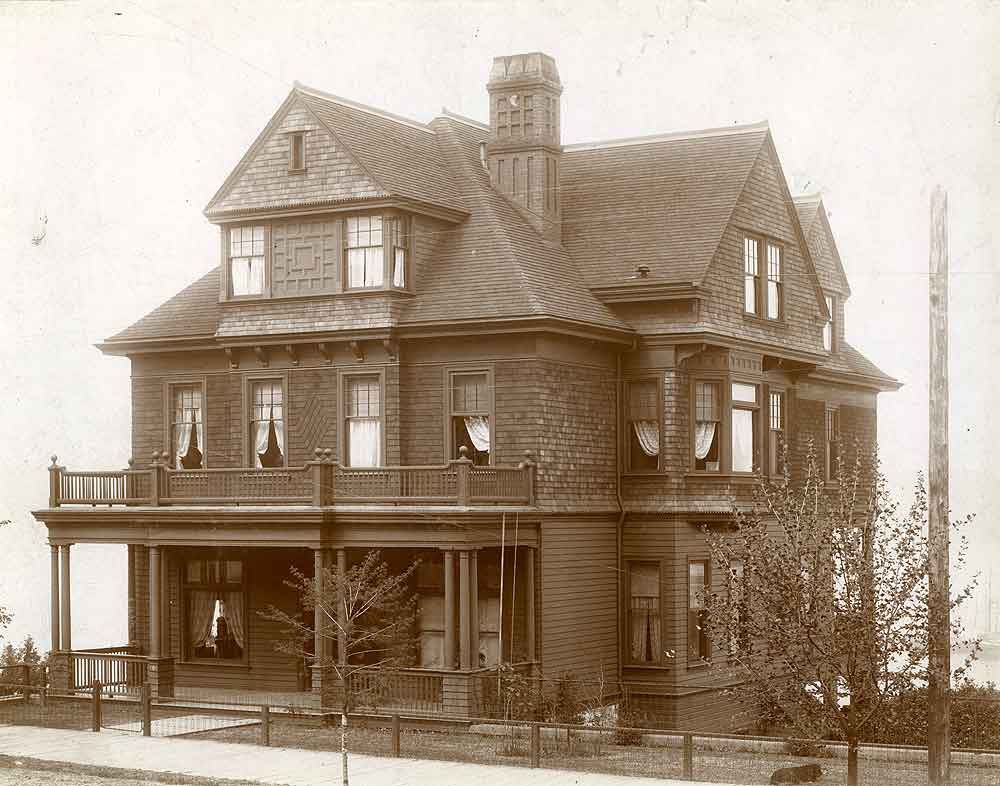
Large three-story house on the street. The building is wood frame with a large entrance, dormers, and a large Palladian window over the entry.
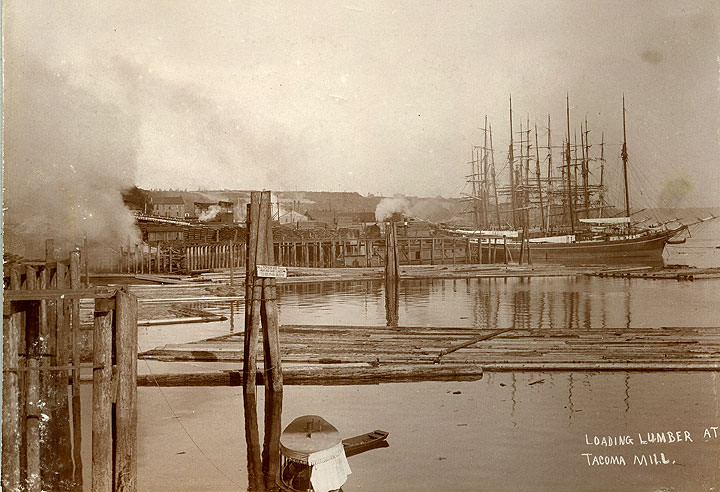
Smoke obscures some of the buildings at the left of the image. Water, a log raft, and pilings are in the foreground.
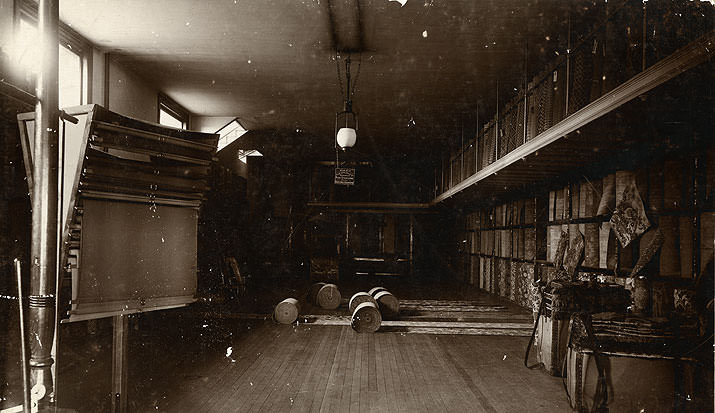
Rolls of carpet runners are partially open on the large display floor. Stacks of rolled carpet runners are on the wall, and rolls of larger-width carpets are above them.
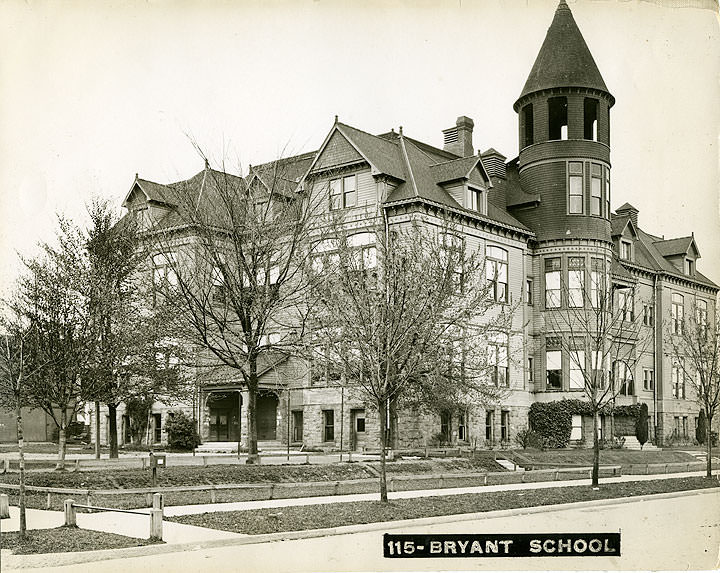
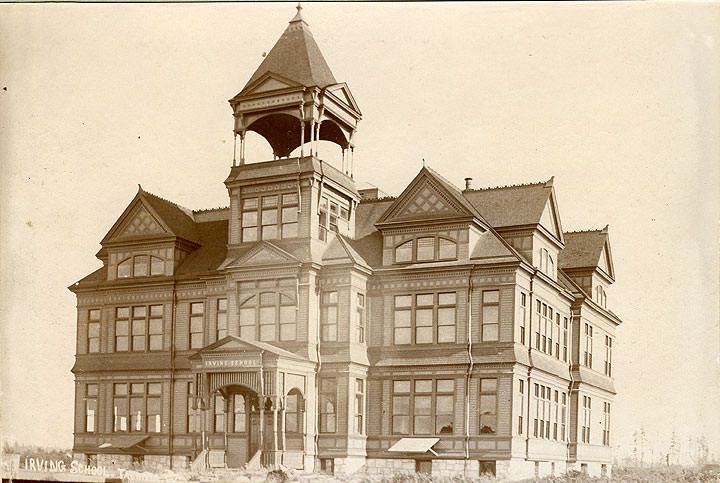
A tower is on one side of the building. The school was built in 1890 by Bullard & Bullard, architects, and was possibly demolished in 1961. A post office collection box is near the lower-left corner of the image.
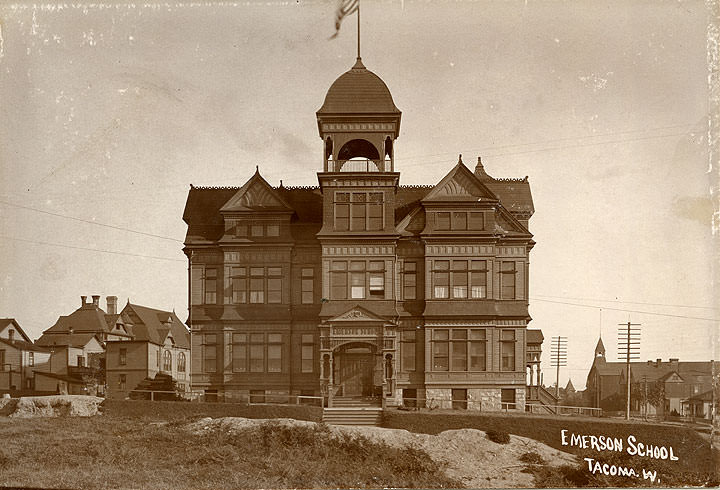
The name is on the front of the school. A church with a bell tower is probably in the right background.
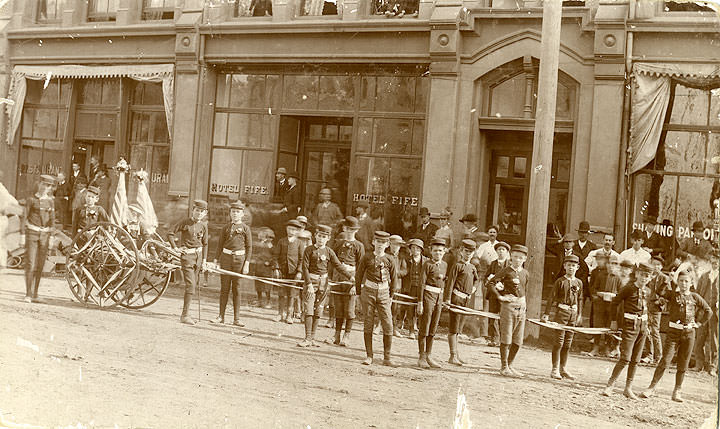
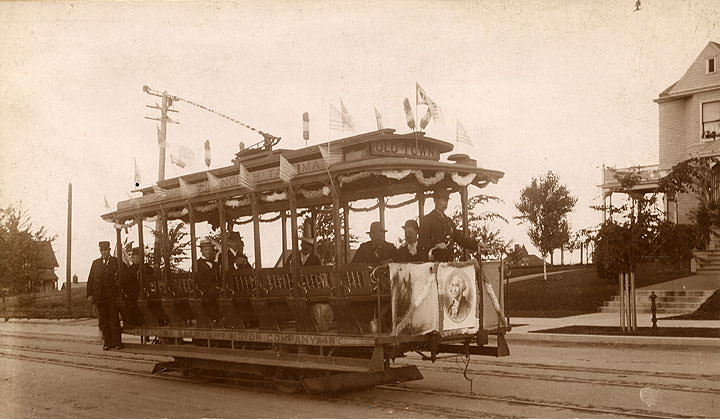
Some of the boys wear ribbon badges. Two U.S. flags with flowers on top of the poles are mounted on the horse wagon. The Hotel Fife is in the center background. Several men are standing on the sidewalk watching the parade.
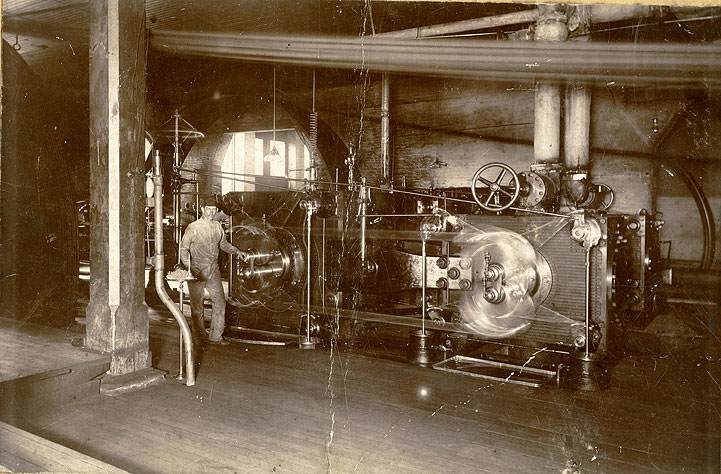
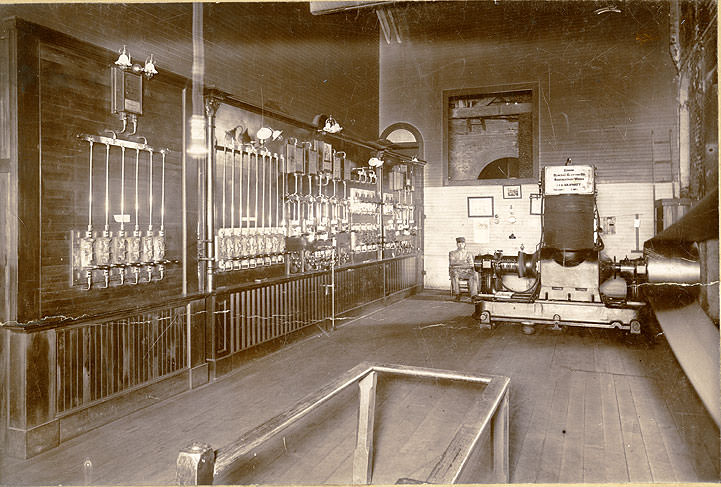
Andersen is standing beside a large machine inside the Tacoma Railway & Power Company powerhouse, possibly Tacoma’s steam-generated electrical power plant.
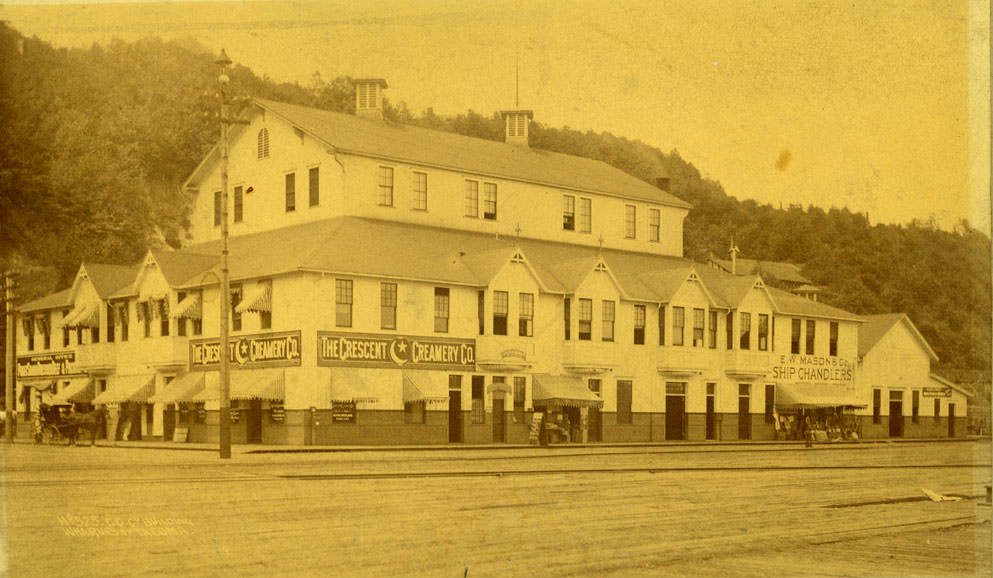
The building corner has a sign for The Crescent Creamery Co. Another sign is for E.W. Mason & Co., Ship Chandlers.
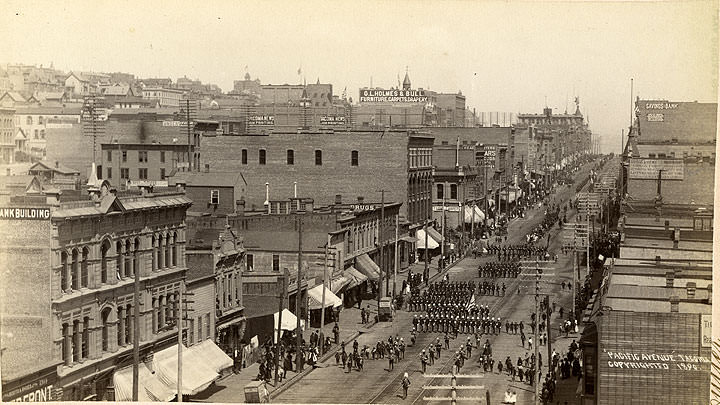
A parade extends the length of the street, including a uniformed marching band, ranks of uniformed marchers, and a long line of indistinguishable figures and possibly vehicles. Some pedestrians are on the street, and a few, including children, are by the band.
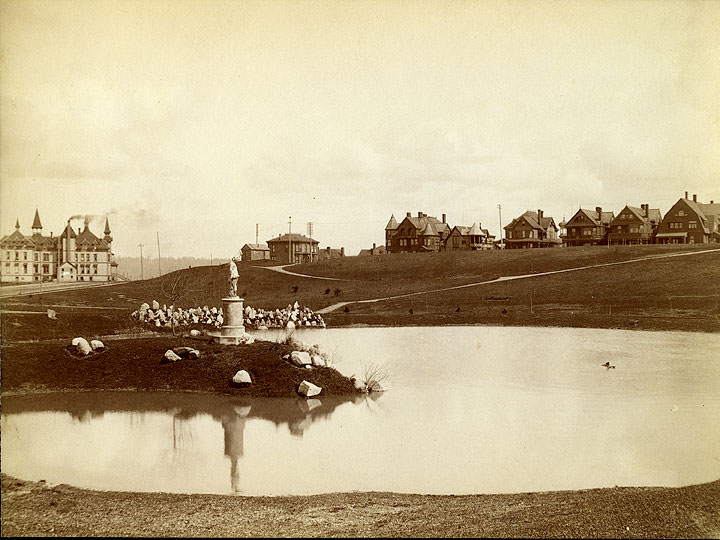
A statue on a pedestal is at the edge of the pond to the left of the image’s lower center. The statue’s reflection is visible in the pond. A grass-covered area extends towards buildings on the horizon line across the image center. Near the left image edge, the large building is Annie Wright Seminary, at Tacoma Avenue and South First Street. Houses on South G Street extend from image center to the right image edge.
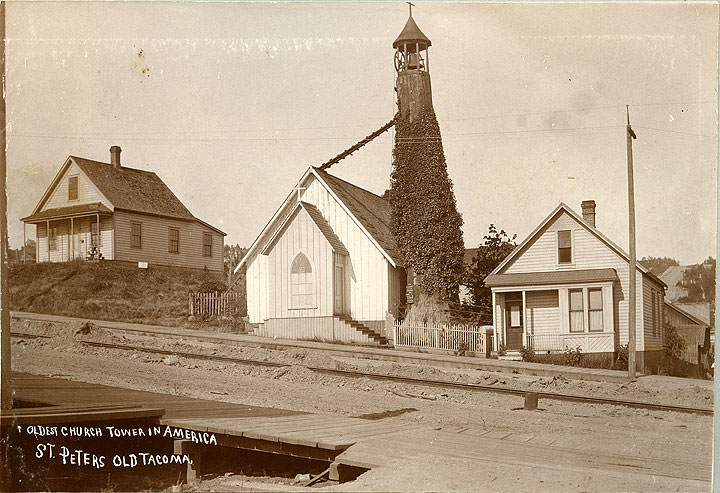
The church has a greenery-covered bell tower with a visible bell. A plank sidewalk is in the foreground.
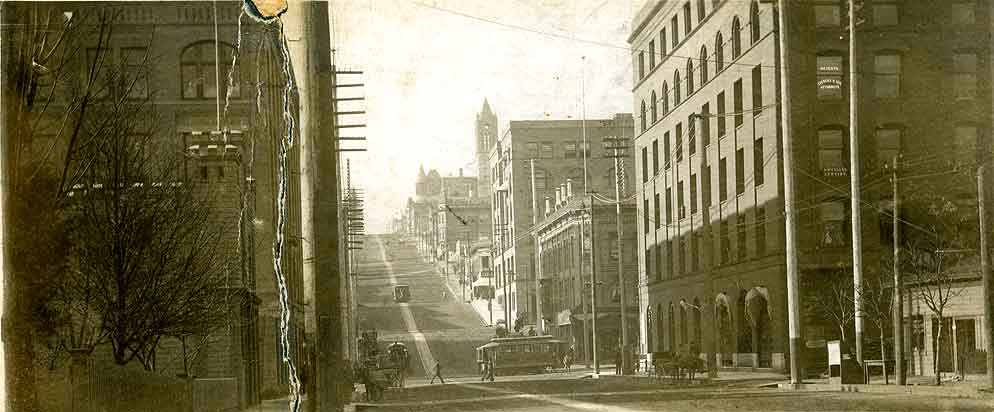
The photo was taken on 11th Street, looking west up the hill. Streetcars can be seen crossing the intersection at Pacific and coming down 11th. A couple of wagons are parked on either side of 11th Street. The Pierce County courthouse can be seen in the distance on the right.
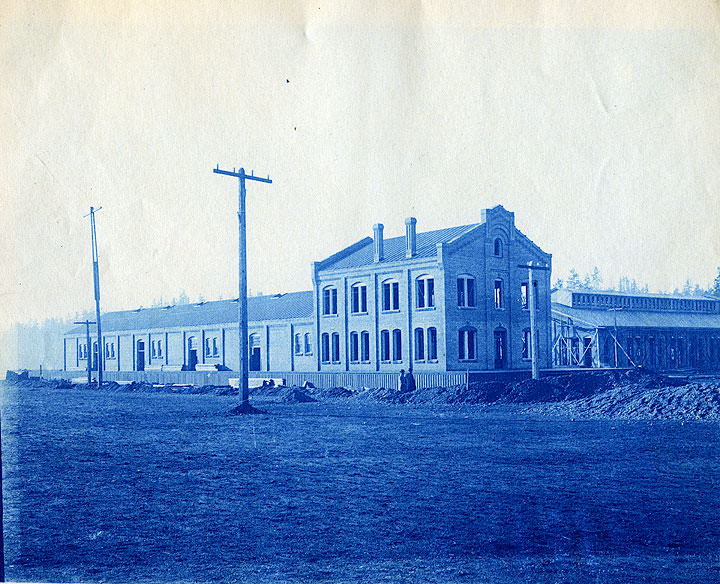
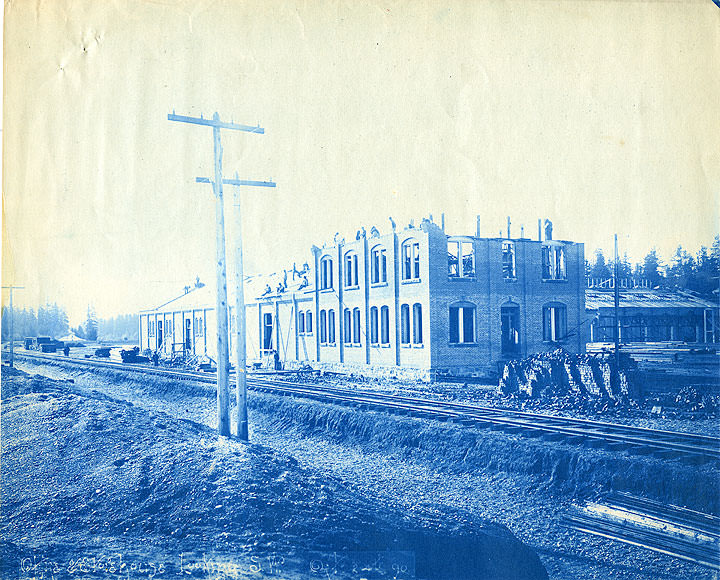
Workers are completing the roofing on the buildings. Railroad tracks run in front of the buildings.
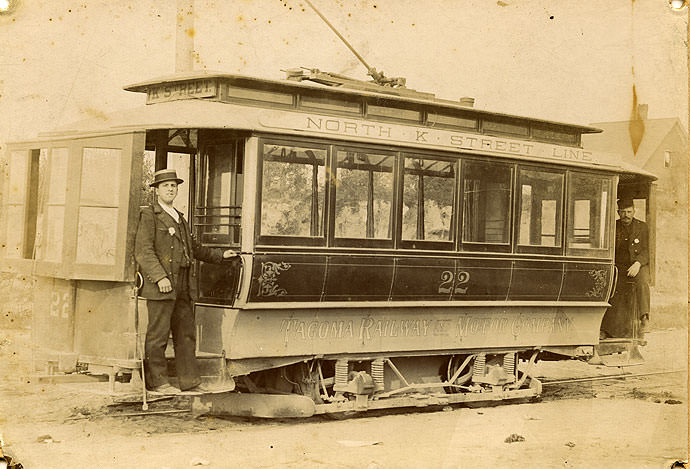
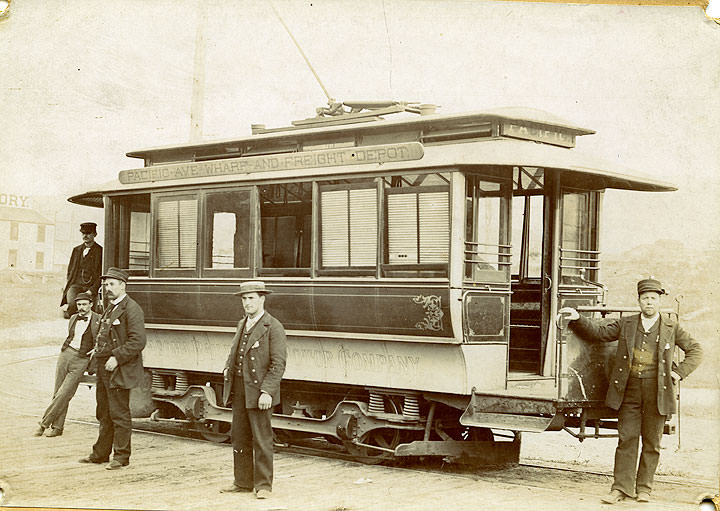
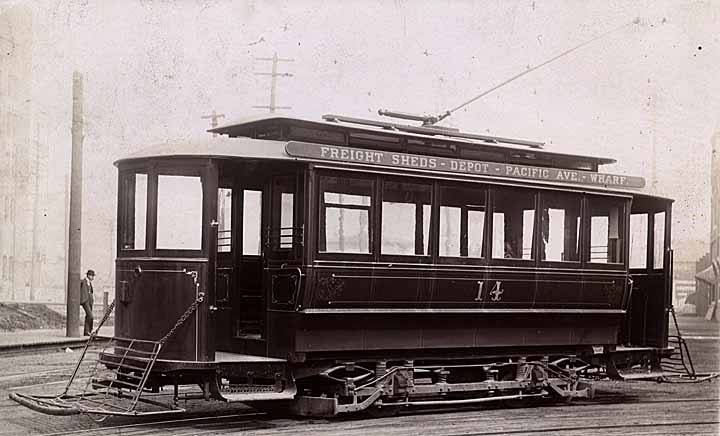
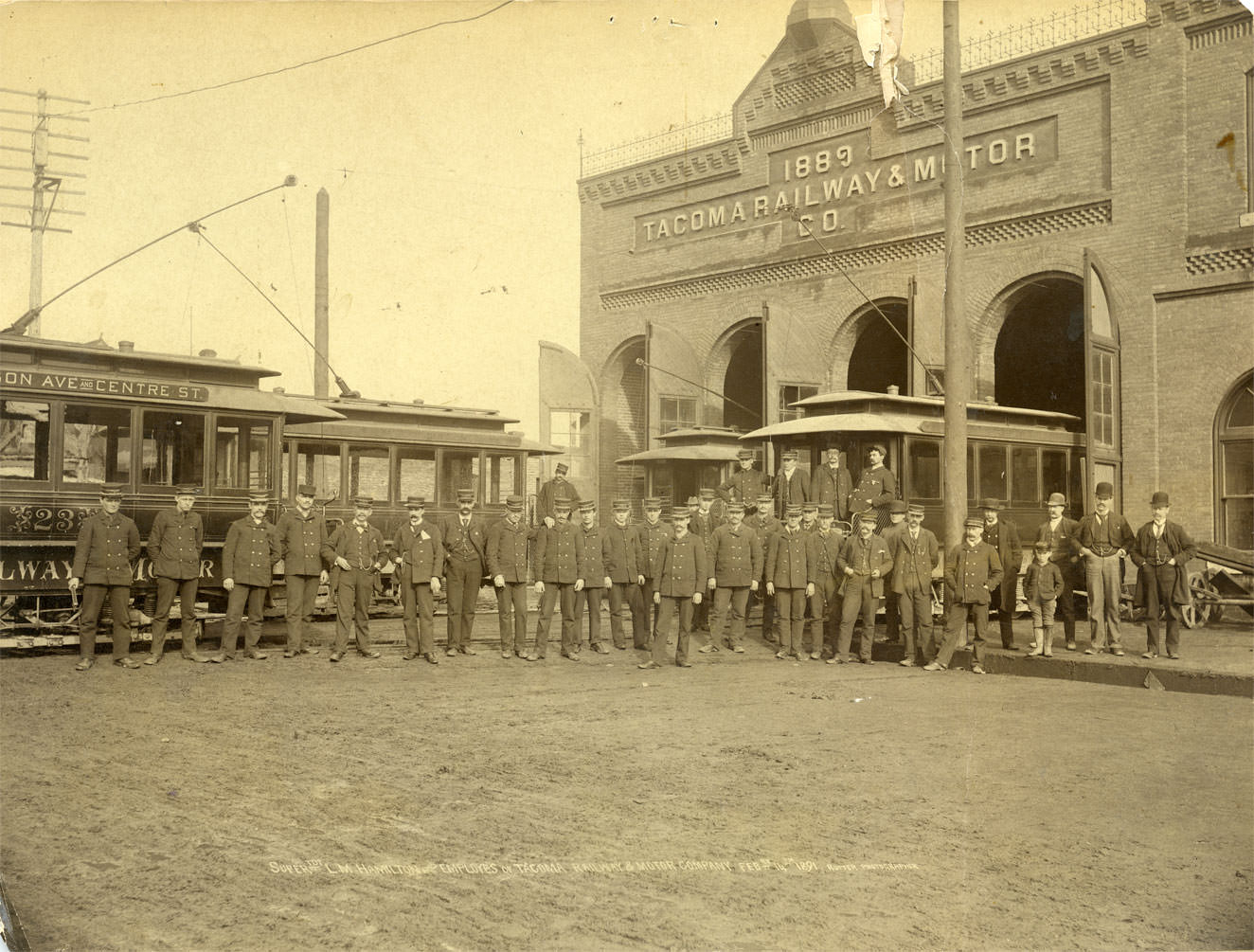
The photo shows an electric-powered streetcar/trolley with “North K Street Line” printed along the top, the number 22 below the windows, and “Tacoma Railway Motor Company” below that. A conductor stands on a step on the left, and the driver is at the controls.
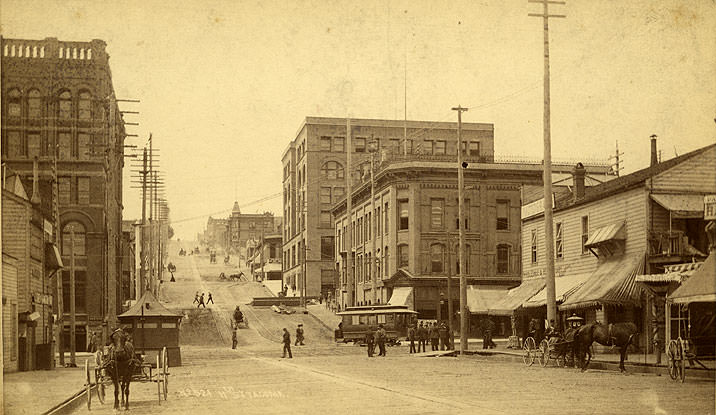
Two horse-drawn buggies are in the foreground. The old Merchants National Bank building is behind a streetcar below image center, at Eleventh Street and Pacific Avenue. The new Merchants National Bank building is across the street at the left of the image. Some pedestrians are crossing the street.
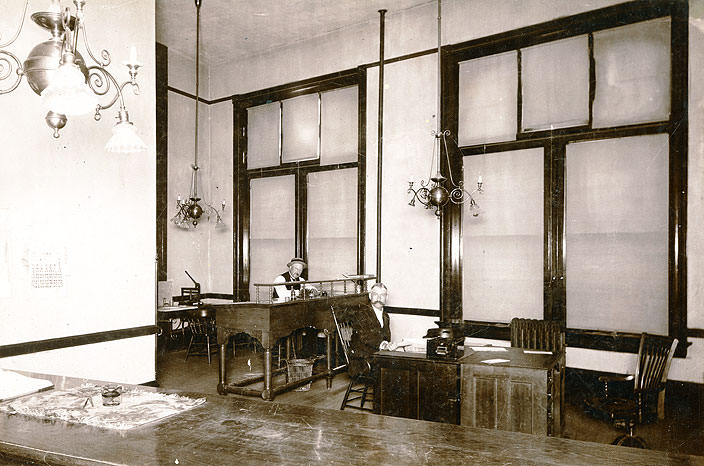
Another man sits at a desk behind him. An inkwell sits on the counter in the foreground.
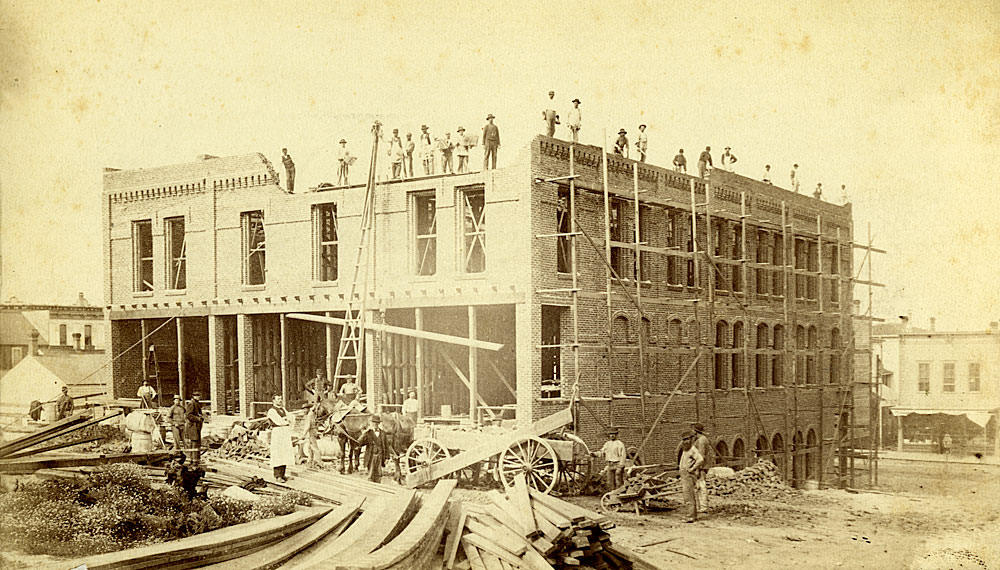
Several men pose on the roof of the building while other men pose on the ground. There is scaffolding along the right wall. In the front, a crane is hoisting a piece of lumber. Stacks of lumber are in the foreground. To the right of the crane, two horses are pulling a wagon. To the left and right, men are pushing wheelbarrows of bricks.
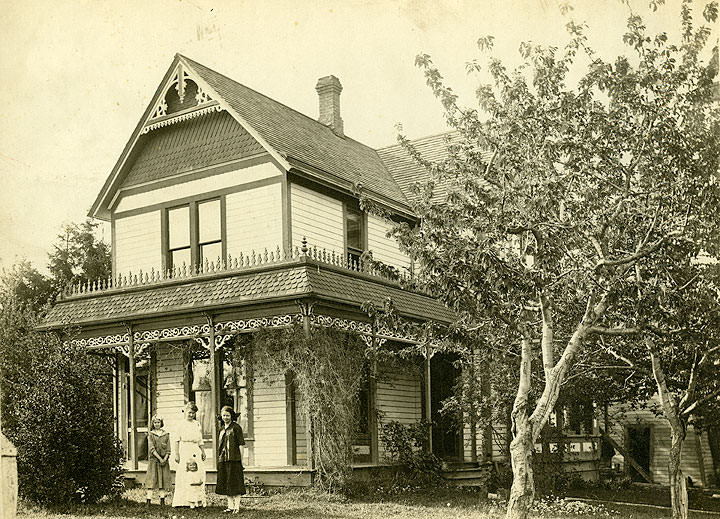
The two-story house in Gingerbread style was built in 1890.
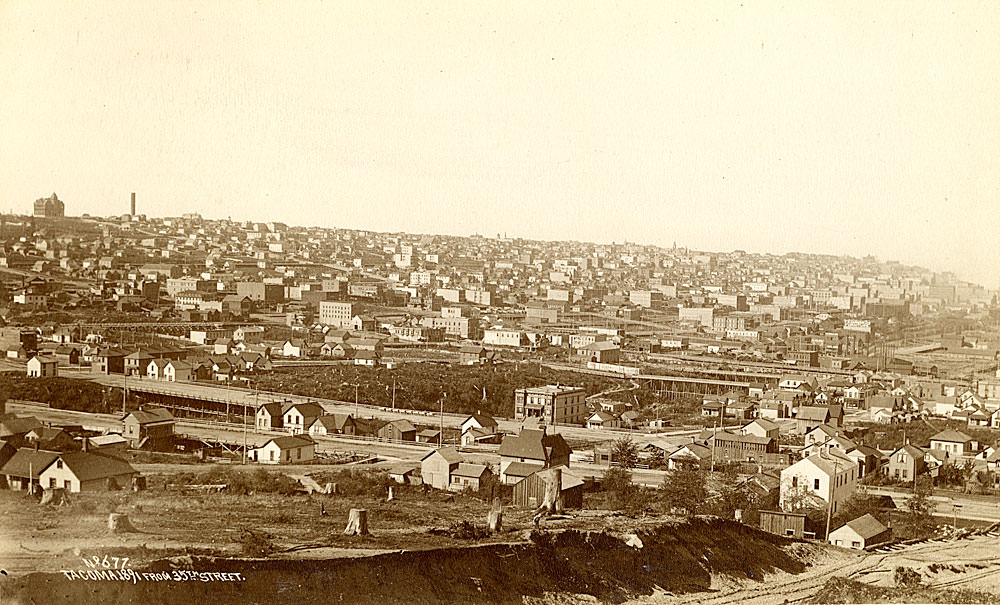
The photograph shows a panoramic view of the city. F.S. Harmon Furniture Company, located at 2001–2013 A Street, is visible near the right edge center. Large tree stumps are visible in the foreground.
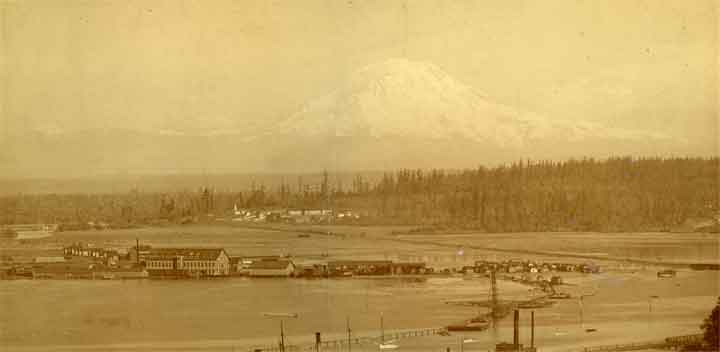
Tacoma Commencement Bay and Puyallup River tideflats, looking east towards Mount Rainier and Cushman Indian School, with the Wheeler Osgood Sash and Blind Co. factory near the water’s edge in the photo center. Mount Rainier is visible in the distance. A boarding house and company houses are at the factory left, and shacks of Chinese workers are at right.
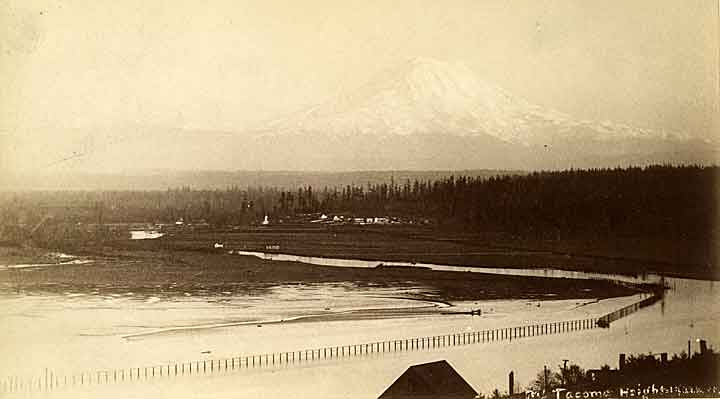
Mount Rainier dominates the center of the view. The Cushman Indian School is visible in the far distance.
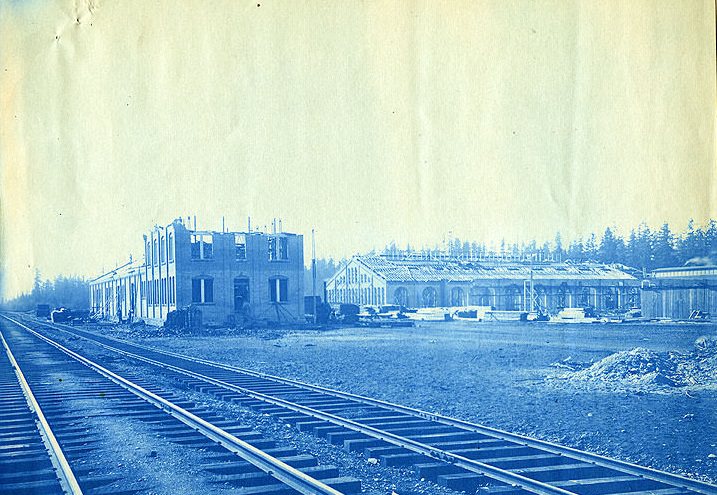
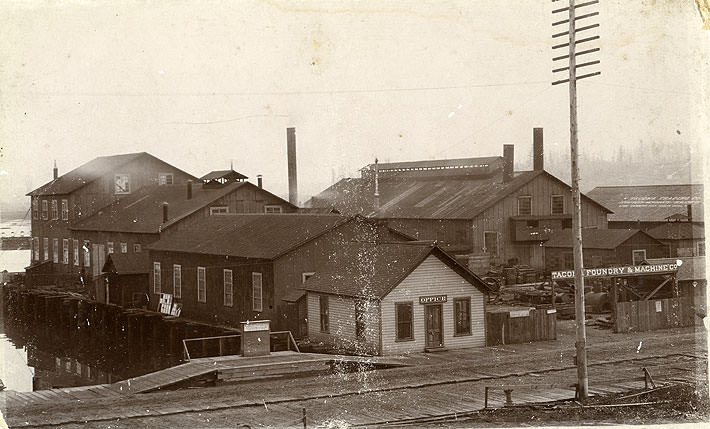
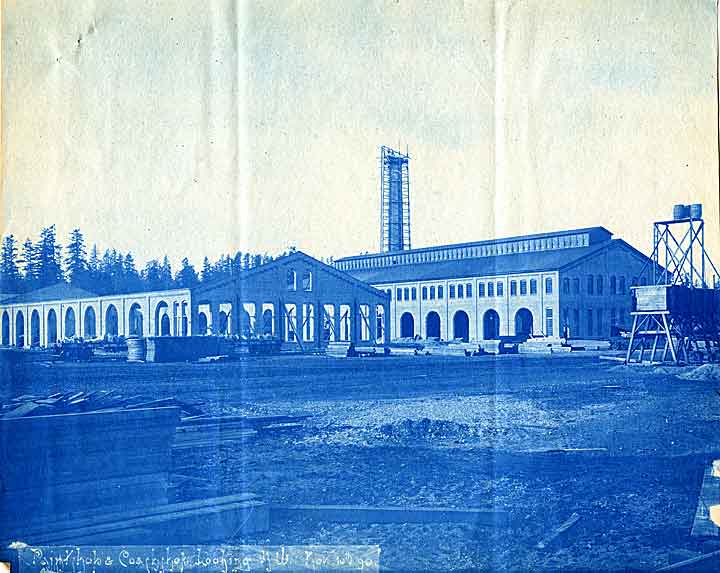
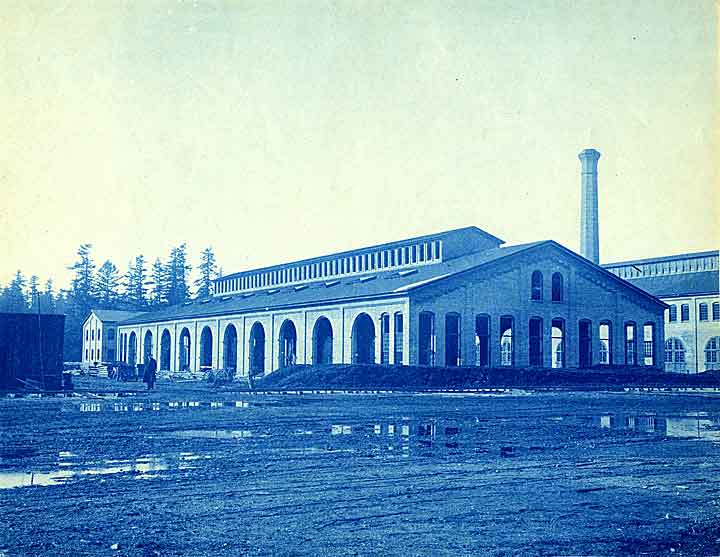
The photo shows the office and machine shop looking S.W., Oct 24, 1890. Railroad tracks are in the foreground.
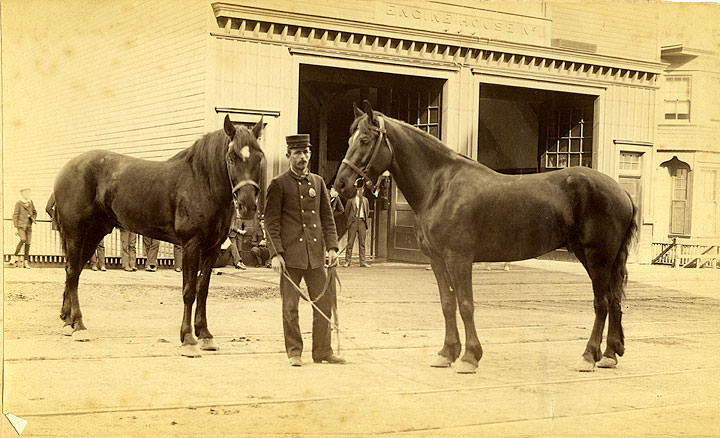
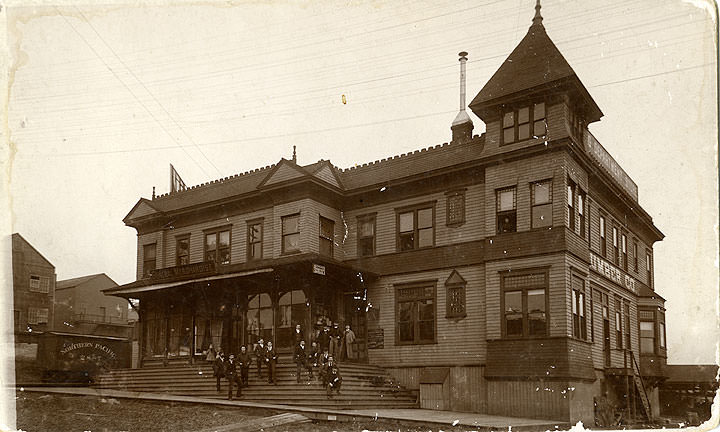
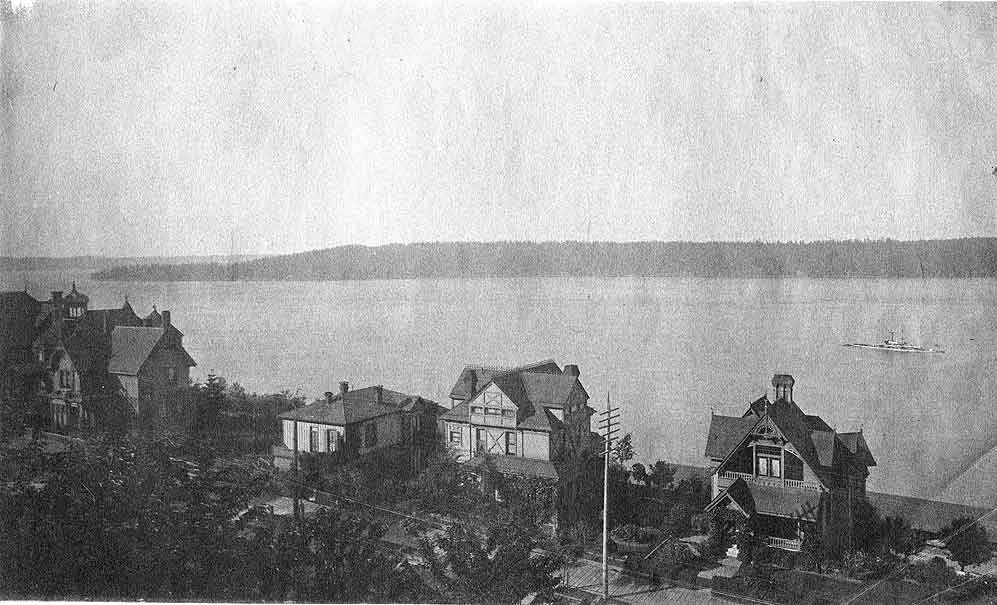
Large homes, a telephone pole, and one steamship in Commencement Bay are visible. One of a series of cyanotype photographs attributed to the Northern Pacific Railroad.
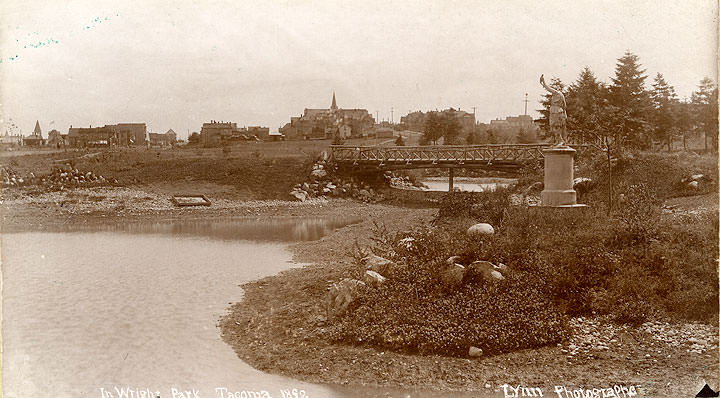
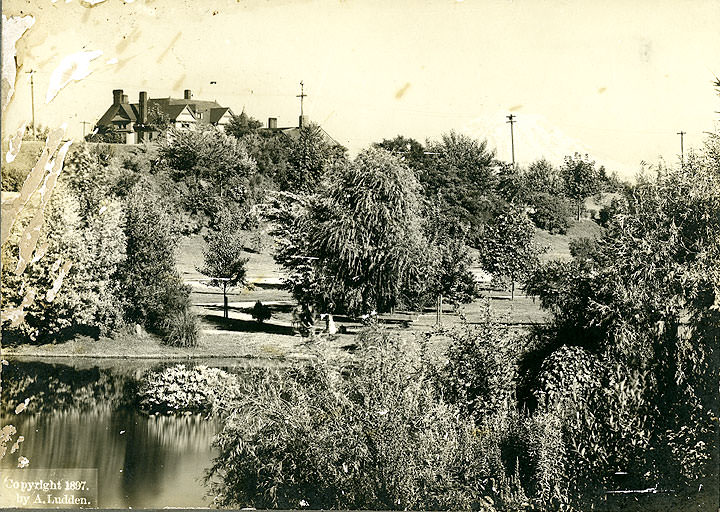
A pond is in the left foreground of the image. A statue on a pedestal, “The Fisherman’s Daughter,” given by Col. Ferry, is in a planted area in the right foreground, at the edge of the pond. A pedestrian bridge is in the center-right background. Houses are beyond the park, across the upper left and center of the image.
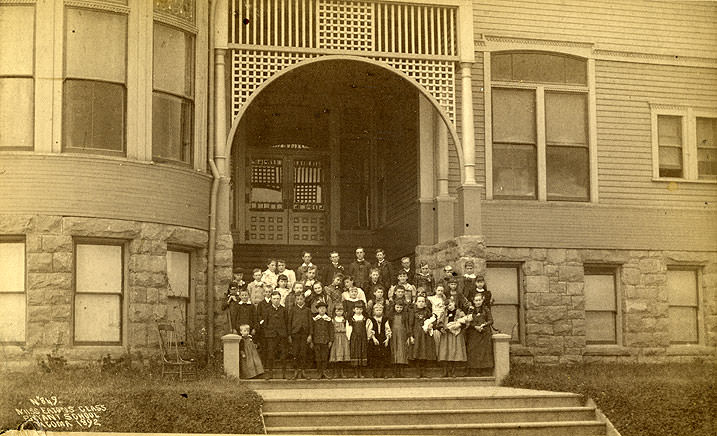
Two of the girls cradle dolls in their arms. A tiny child stands at one side of the group.
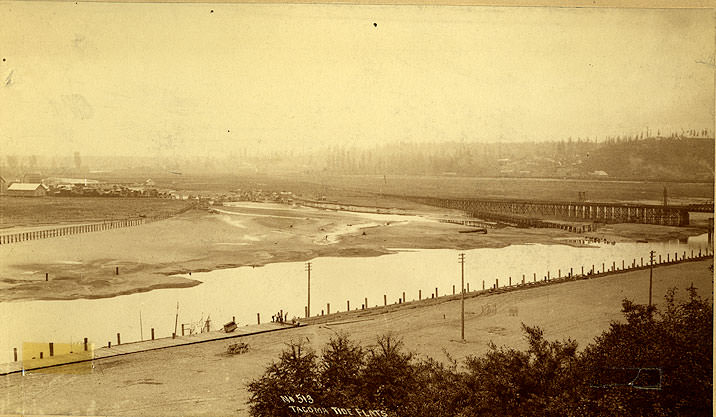
Treetops are in the lower right foreground. The Puyallup River is running diagonally across the lower half of the image. An elevated plank walkway is being constructed along the near side of the waterway. Workers are laying the planks in the lower image, to the left of center. A gate with an illegible sign is on the waterside of the walkway near this area, and the tops of two sails are possibly visible behind it. A wagon is on the flat ground adjacent to the walkway.
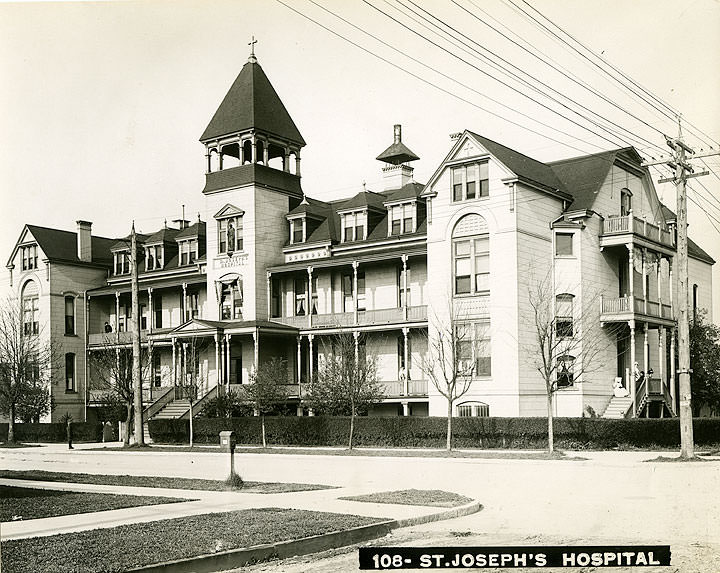
The three-story building has a tower above the front entrance. It was built in 1891 by Ruehr & Bergfeld, architects, and demolished in 1976. Two nurses in uniform and another woman are sitting on a first-story side staircase near the right image edge.
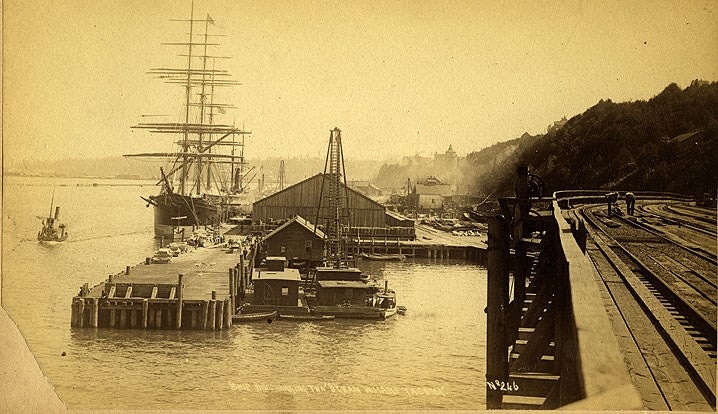
Construction barges are moored at the land side of the harbor. Commencement Bay is at the left of the image. Elevated railroad tracks are in the lower right foreground.
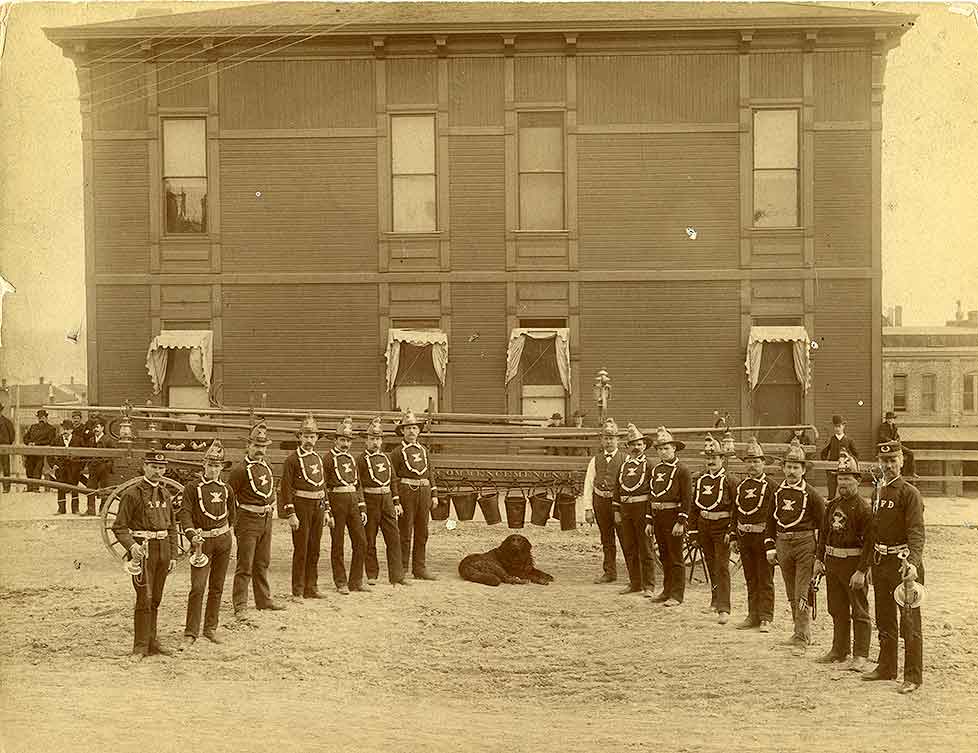
Four of the men hold fire horns. Partially visible behind the men is a ladder on a fire truck, with fire buckets hanging from the side.
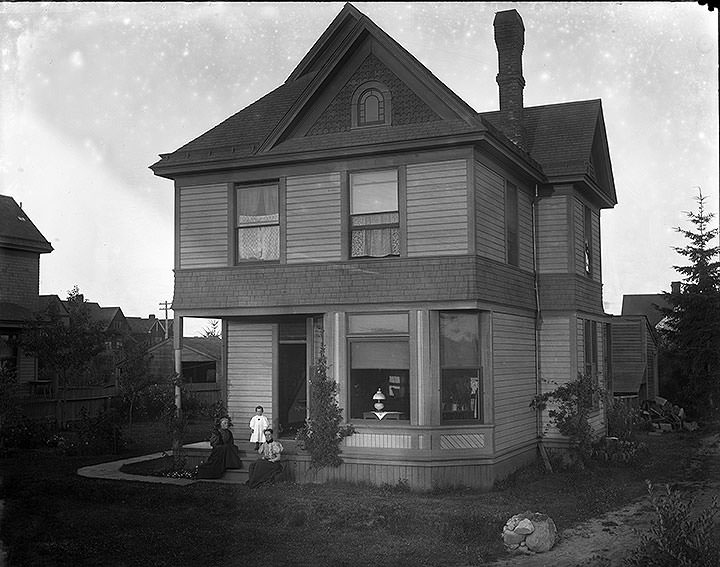
Two women are sitting on the front steps. A small girl stands on the porch between them. A lamp is visible on a table through the front window.
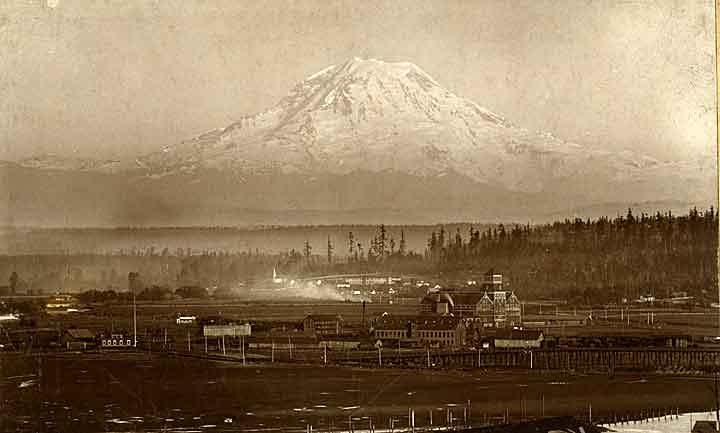
Mount Rainier dominates the center of the view. The railroad bridge for the Puyallup branch line of the Northern Pacific Railroad is also visible in the foreground. The Cushman Indian School is visible in the distance.
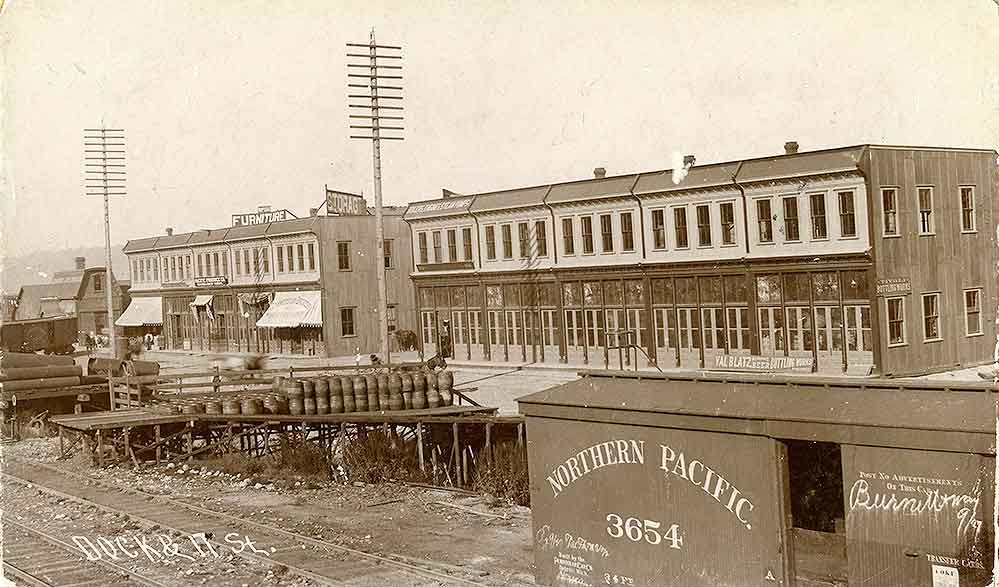
From left to right, the businesses are Pacific Produce Co., near Fifteenth Street, and the Tivoli Bottling Works, possibly near Seventeenth Street. A sign in front of the latter business reads: Val Blatz Milwaukee Beer; Bottling Works, Wholesale. Railroad tracks are in the foreground. Several barrels are stacked on a railroad car loading ramp in the photo center.
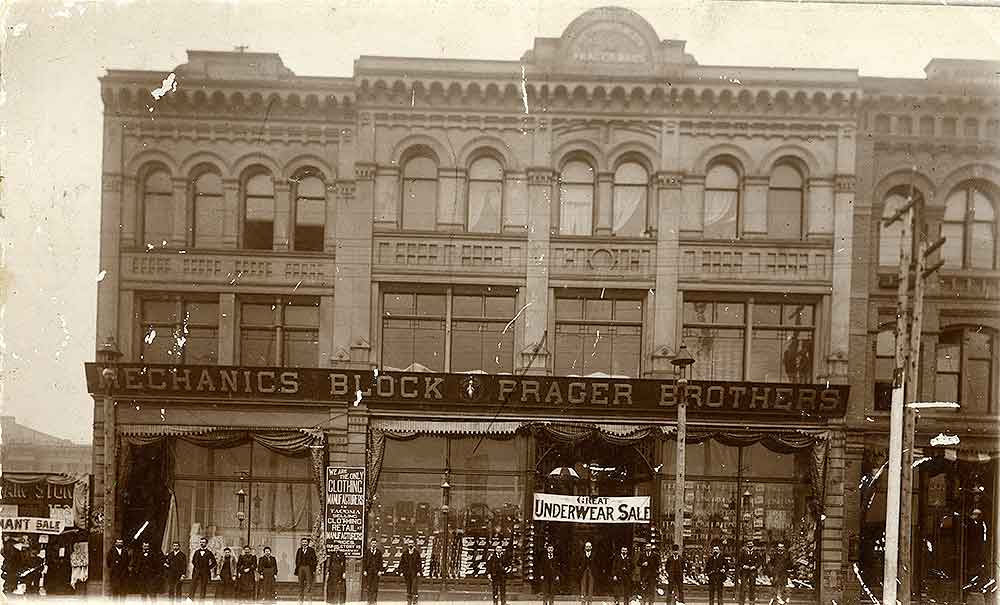
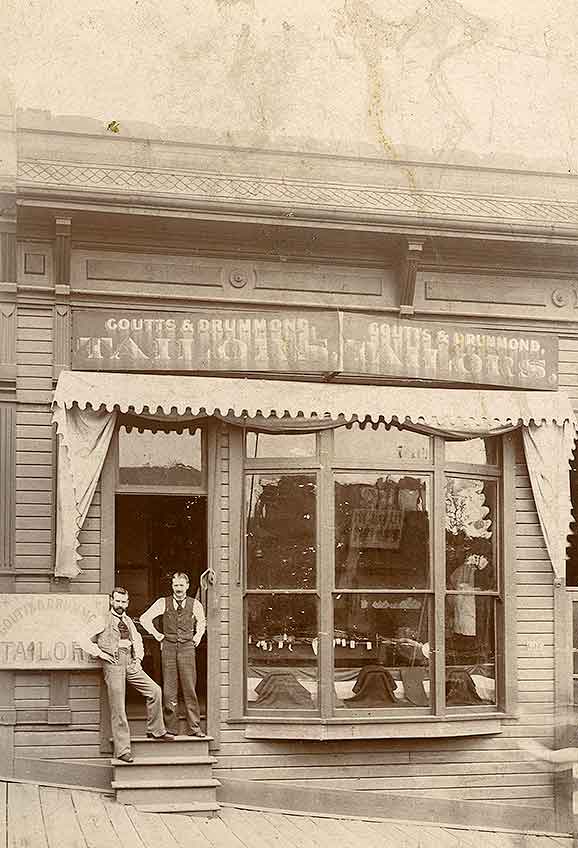
The business owners are Louis Prager, Hyman M. Prager, and William Prager. A permanent sign on the storefront reads: We Are the Only Clothing Manufacturers in Tacoma Selling Clothing Retail at Manufacturers Prices.
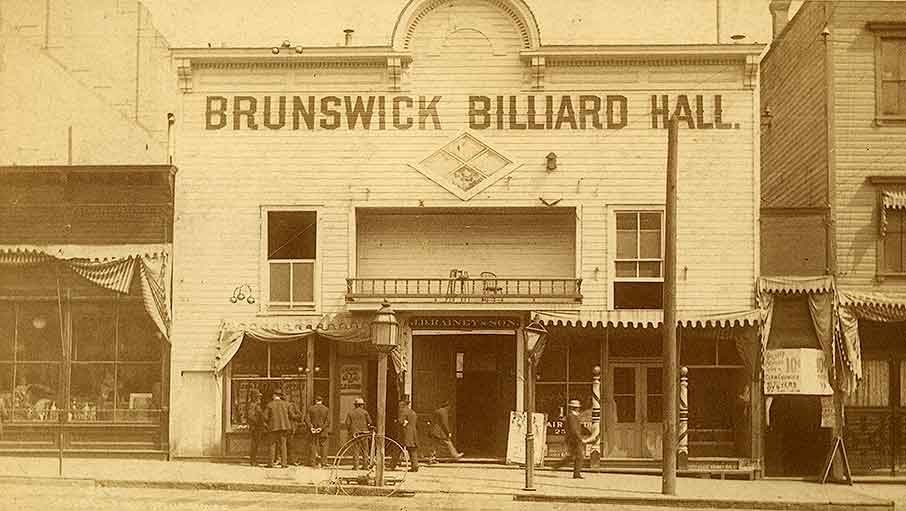
Two men converse on the street in front of the building, others face the storefront, and one man enters the building. A high-wheel bicycle leans against a lamp post in front of the building.
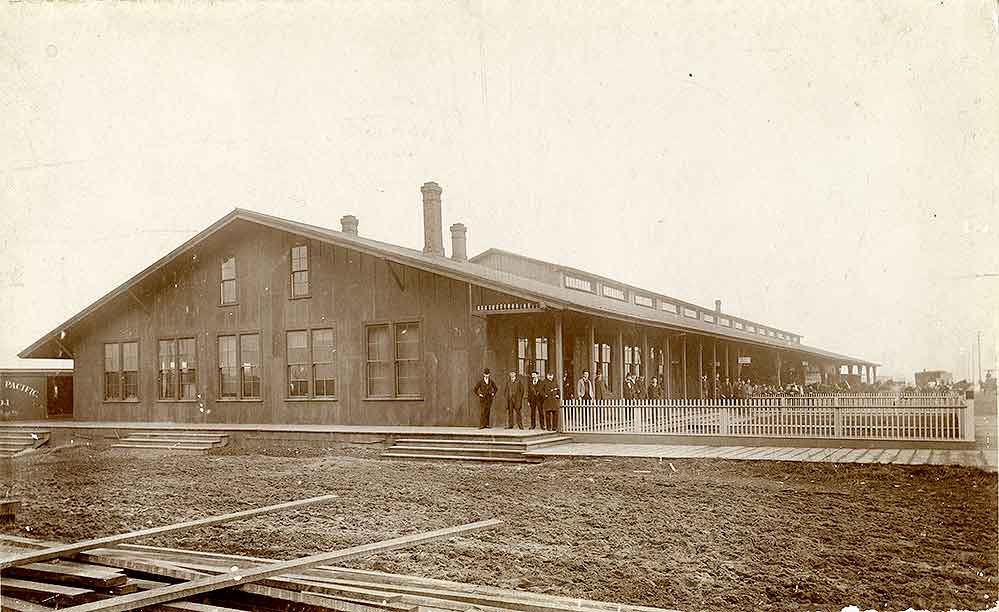
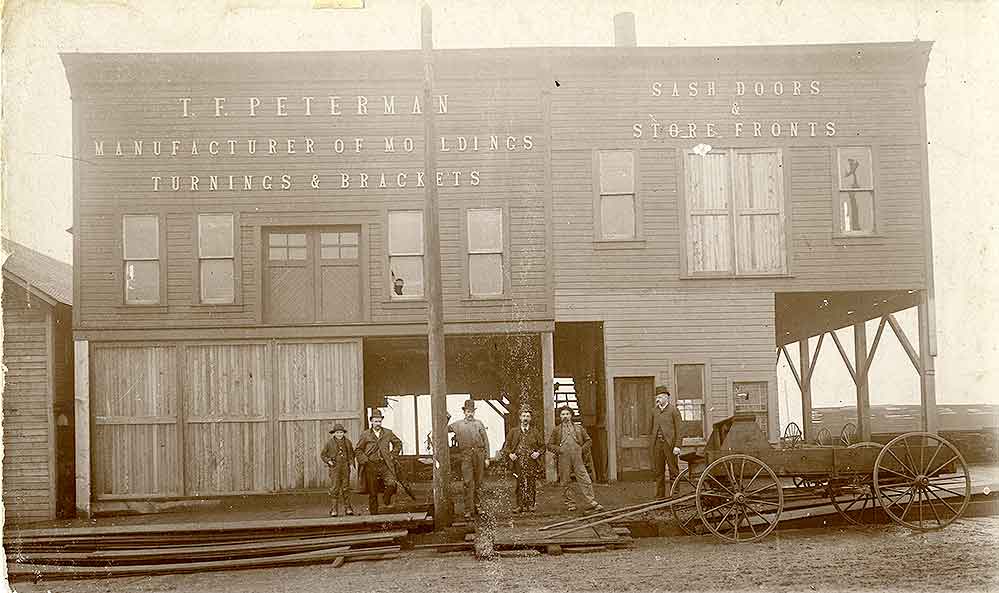
In the background, a fence extending from one side of the building partially obscures horse-drawn wagons at the far end of the building. A pile of lumber and open ground are in the foreground.
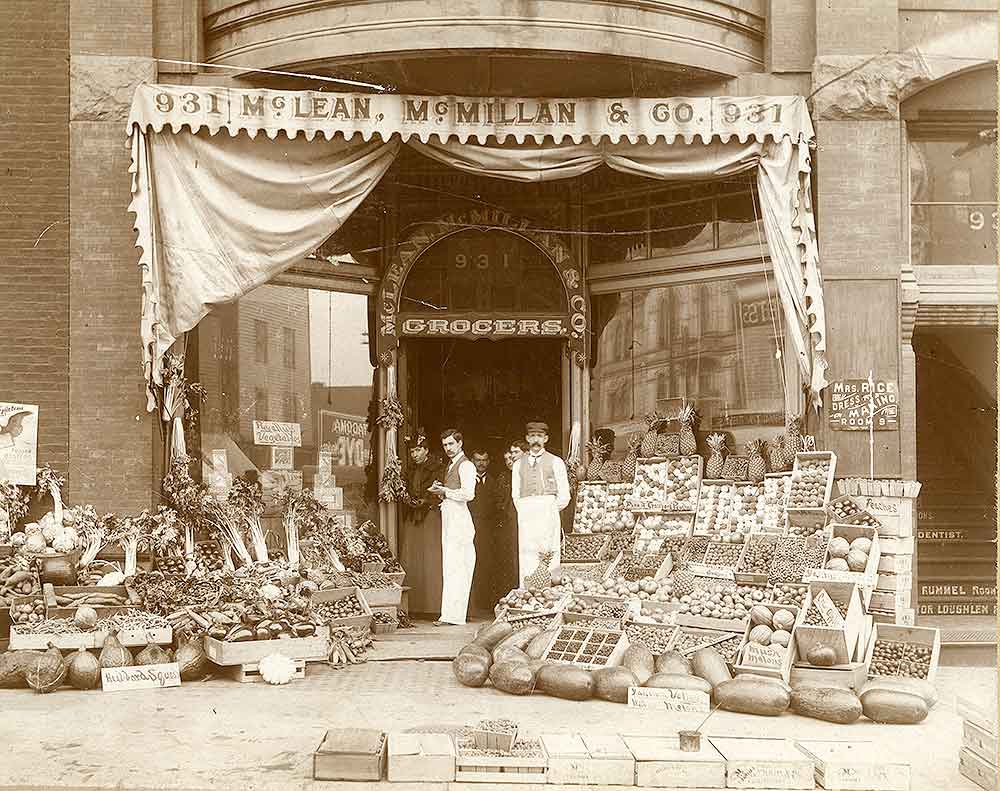
Boxes of fruits and vegetables are displayed outside the store, including eggplants and pineapples. Handwritten labels identify these items as Hubbard Squash, Yakima Valley Water Melons, Yakima Valley Concord Grapes, Puyallup Vegetables, Mush Melons, etc. Posing for the photographer in the store doorway are two men in long, white aprons, a woman, and three men partially visible behind them.
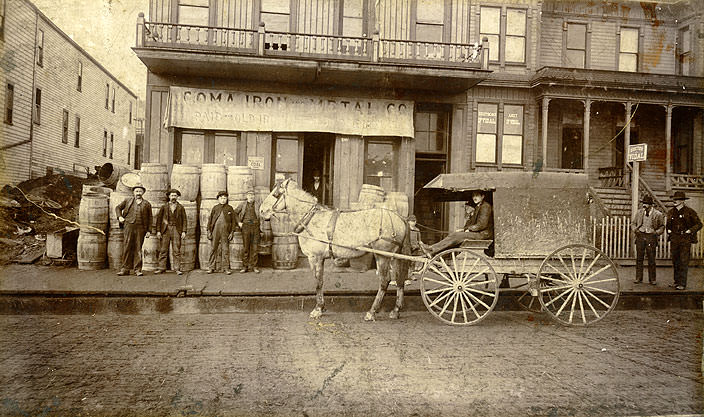
Two men sit in a small, covered horse-drawn delivery wagon on the plank street in front of the business. The office of Dr. Vidal, 1316 South C Street, is in the adjacent building at the right of the image, and two men are standing on the sidewalk.
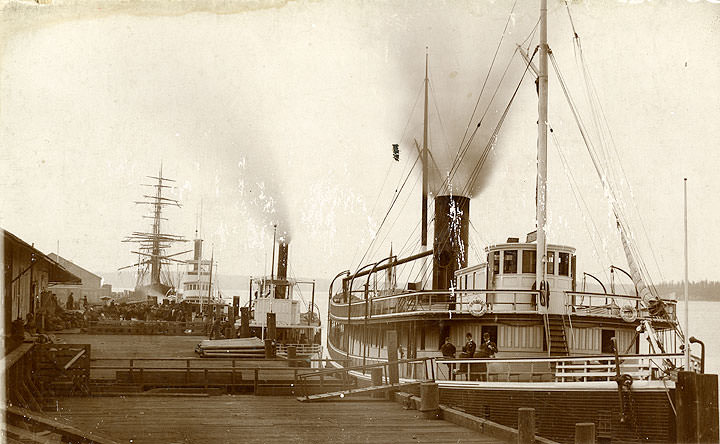
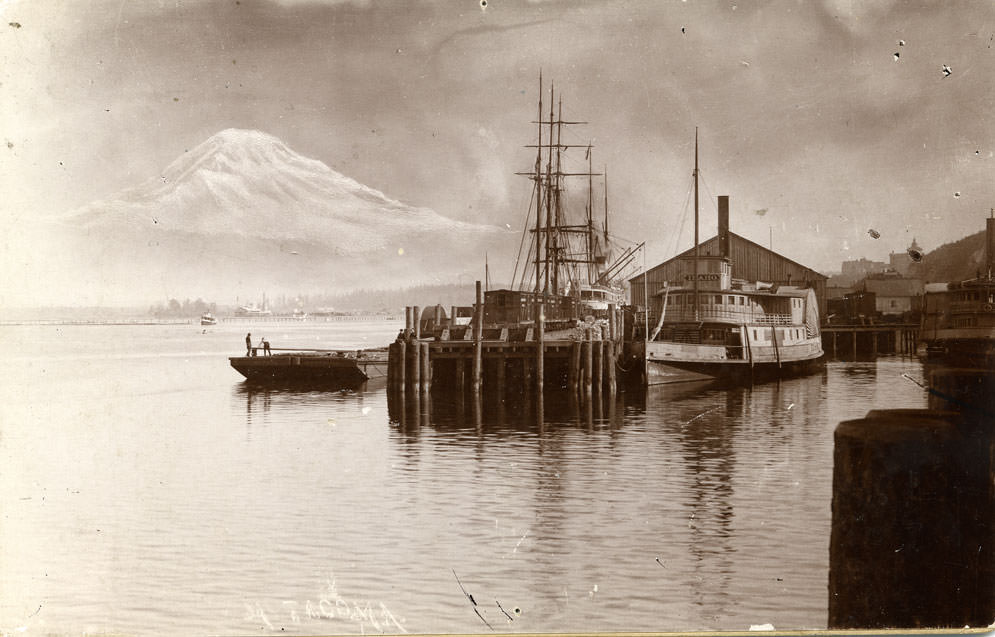
The ship is visible from the starboard side of the bow end. The dock is in the left foreground of the image. Three or four passengers are standing on the ship’s lower deck. The S.S. Washington is at the dock in the image center. The S.S. State of Washington is in the left image background at the dock. The masts of a sailing ship are visible behind the latter ship. The S.S. Premier was built in 1887 in San Francisco for the Canadian Pacific Nav. Co. and ran to northwest coast ports. Her name was changed in 1894 to the S.S. Charmer.
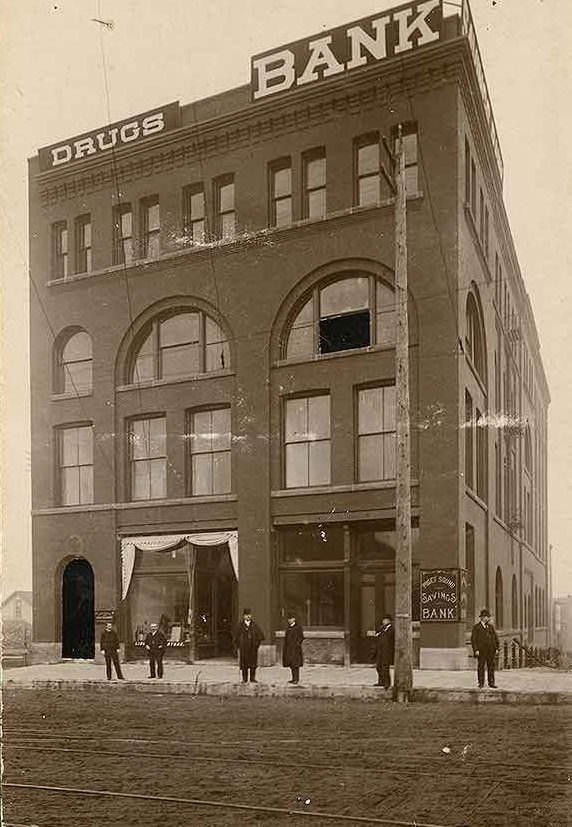
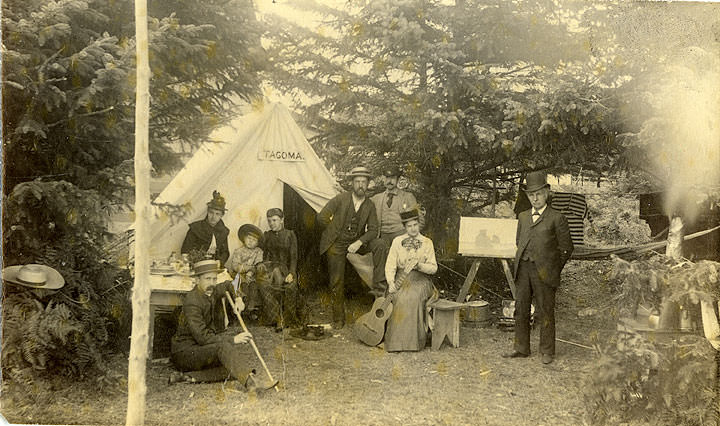
Two of the women and the boy are sitting by a table in front of the tent, with eating dishes stacked on it, in the image center-left. One of the men, holding a long stick, sits on the ground by the table. Another woman sits on a bench in the image center, holding the end of the guitar, with its body resting on the ground. Two men stand behind her. A painted canvas sits on a painting easel nearby. Another man stands at the image center-right.
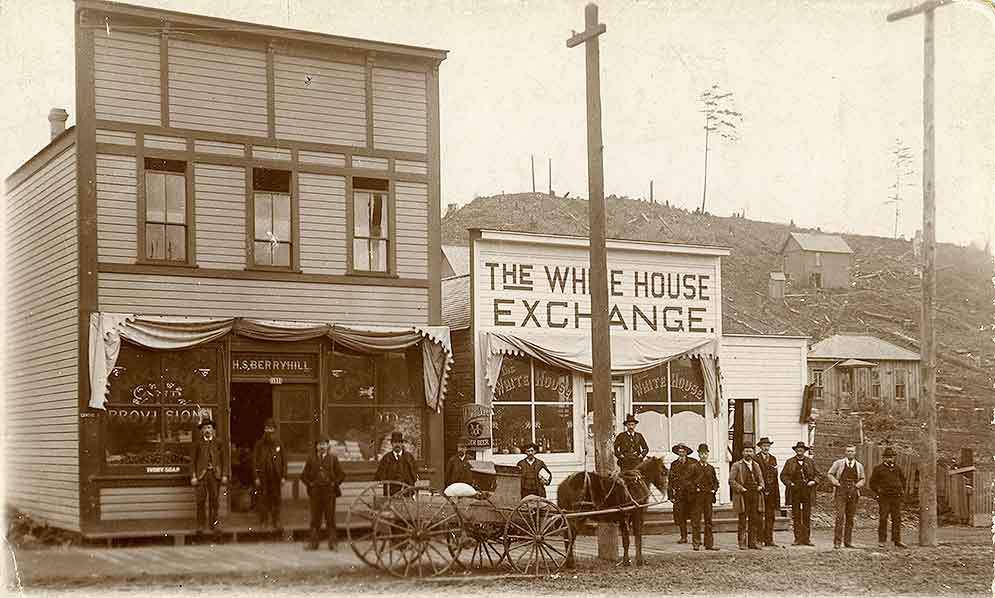
The White House Exchange, ca. 1890. A horse-drawn wagon is on the street. Two small wooden structures, one a house and possibly an adjacent outhouse, are on the logged hill behind the stores.
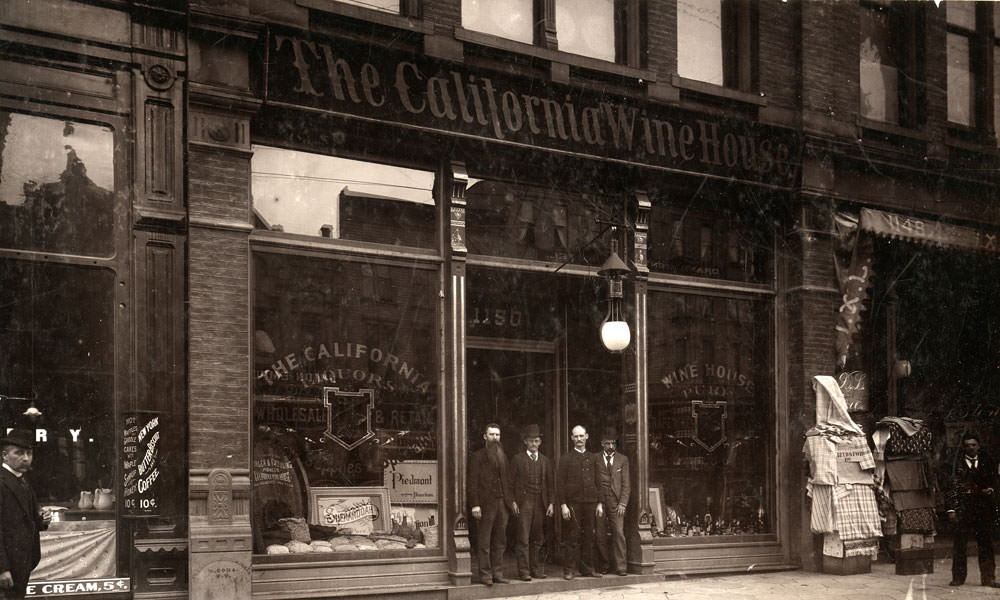
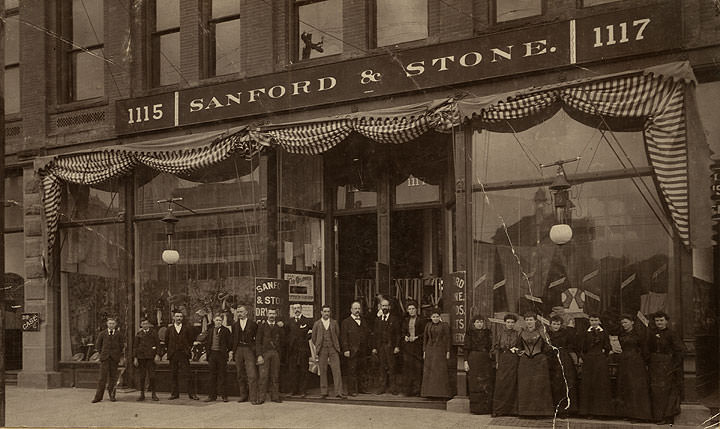
The store name is on the show windows and on a sign above the doors and windows. An outdoor light hangs from a pole in front of the entrance. Four men stand in the doorway, and the one on the left appears to be Frederick Williams. Small parts of the businesses on either side are visible.
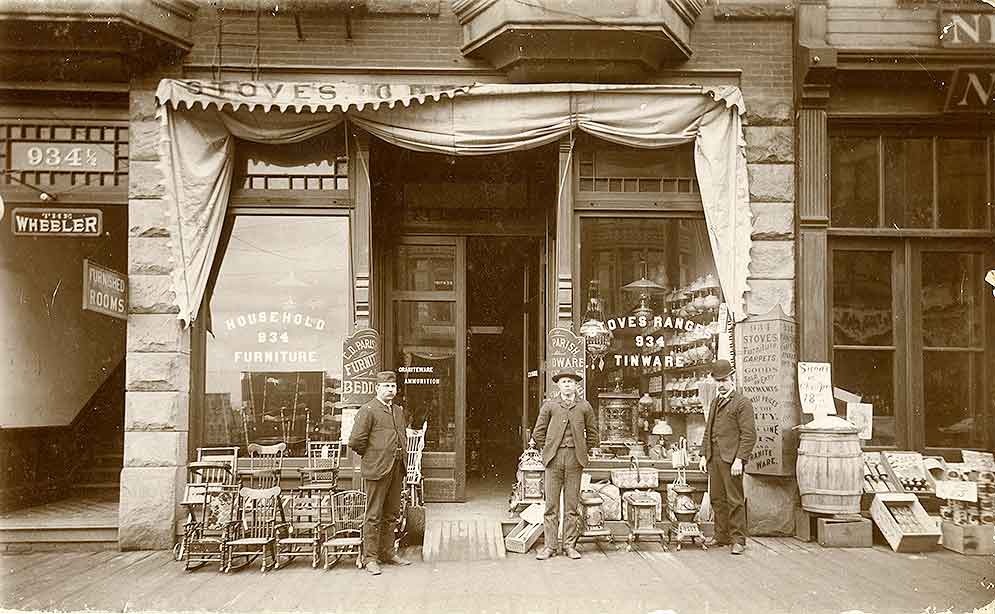
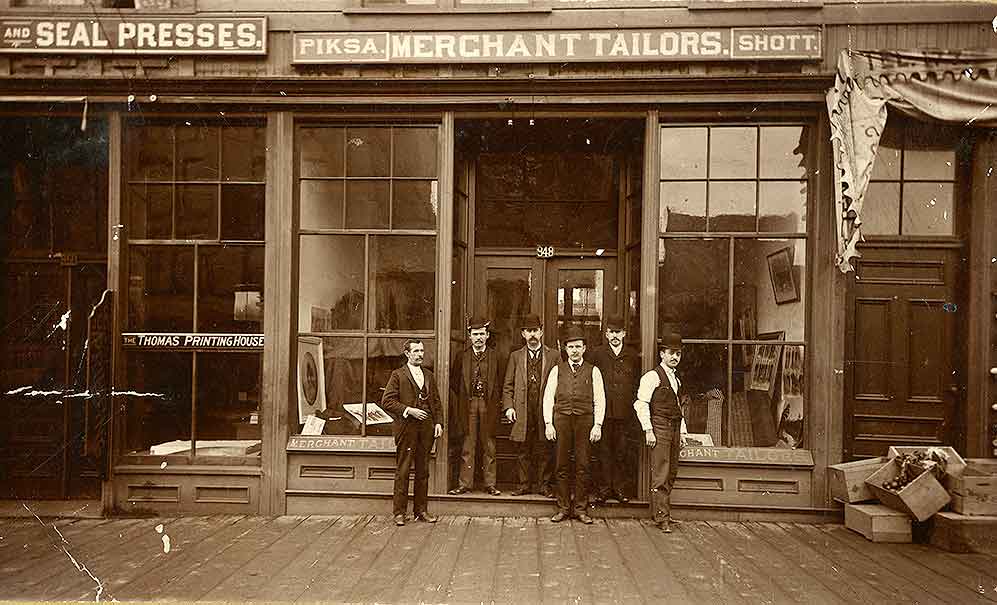
Bolts of fabric are displayed in the window. Thomas Bros., a printing business, is at the photo left. A sign in the window reads: The Thomas Printing House.
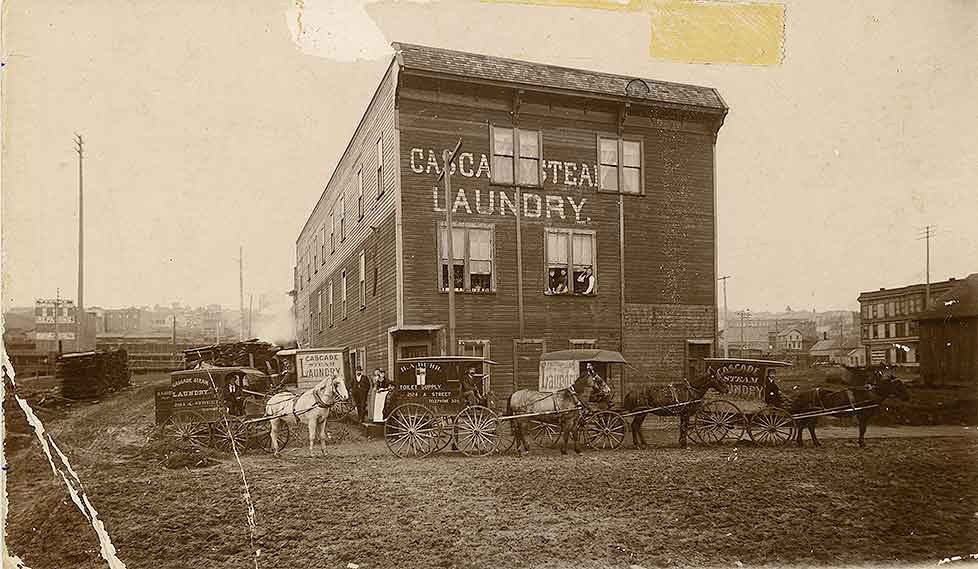
Three women sit in a second-story window of the three-story building, and two women stand at the building’s corner.
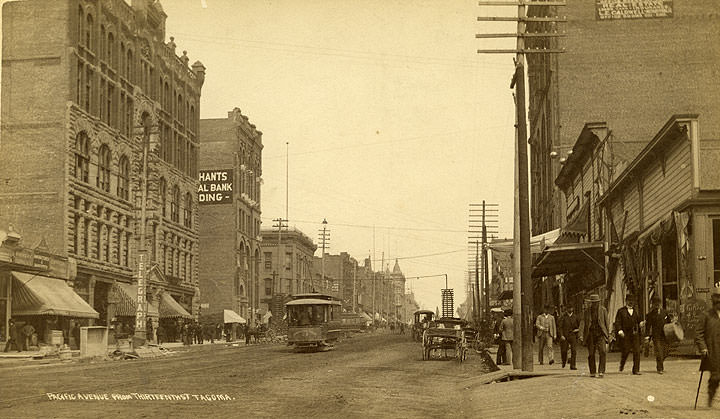
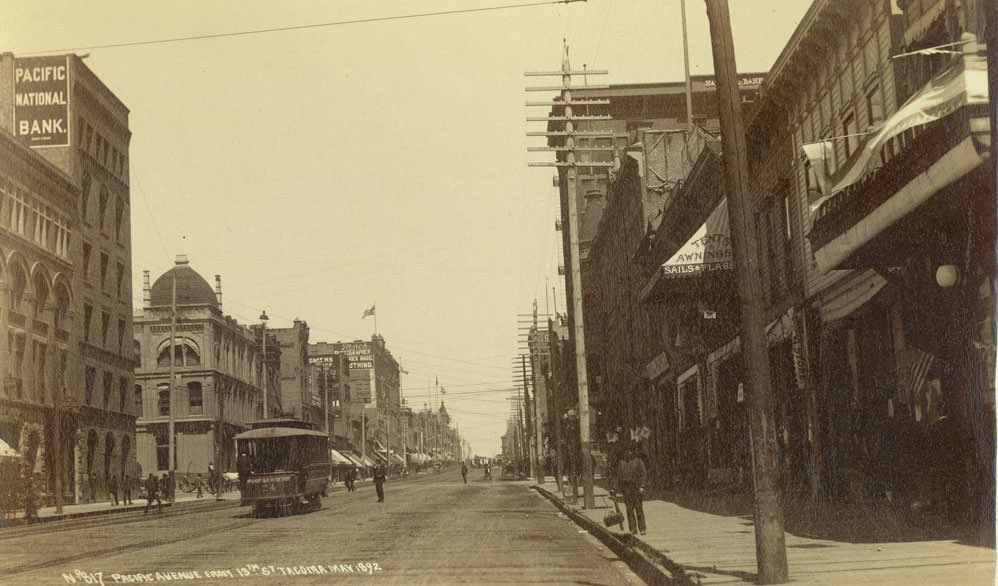
Commercial buildings, some with awnings, line the street, and some pedestrians are on the sidewalks. A vertical sign is on the telephone pole at the left of the image.
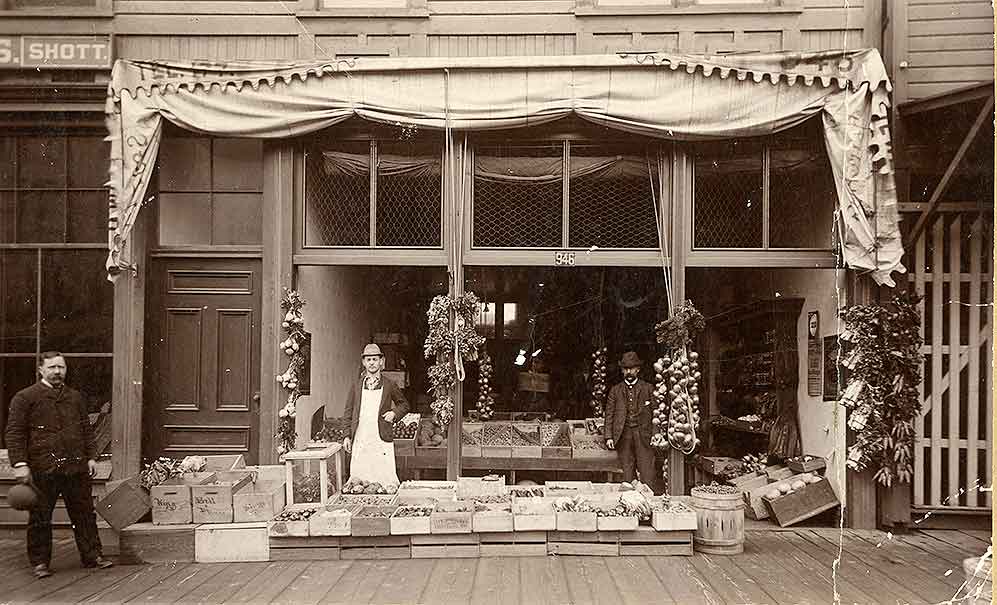
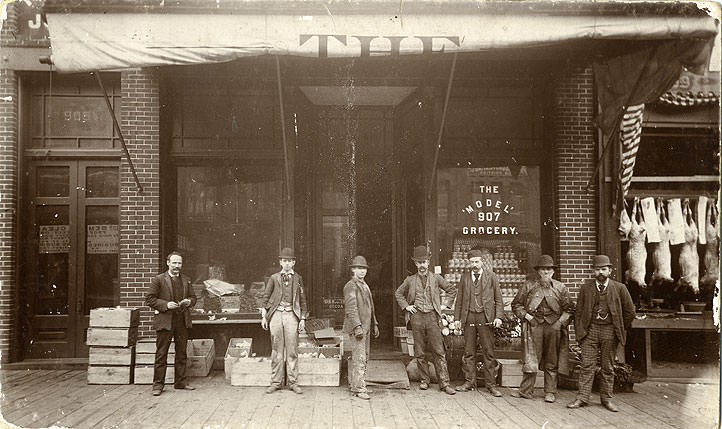
Wooden crates and a low shelf hold produce in front of the store. At the right of the image, an adjacent butcher shop has four animal carcasses hanging from hooks in front of the shop.
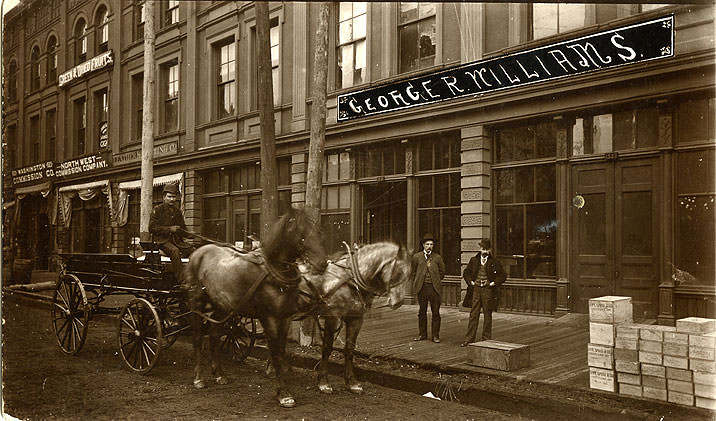
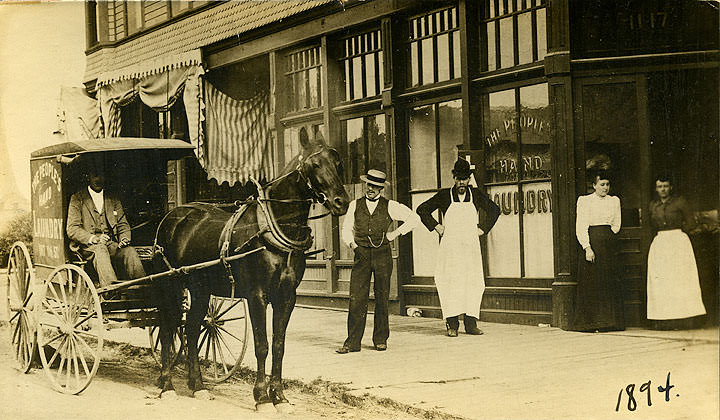
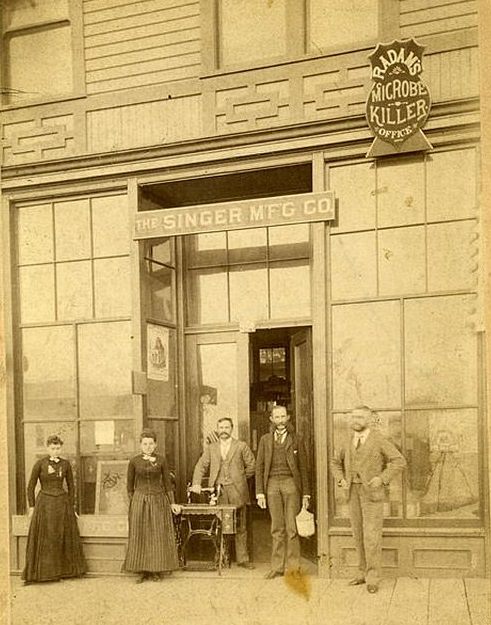
One man wears a straw hat, shirt, tie, and vest, and the other wears a bowler hat and an apron over his suit coat. One of the women wears an apron. A covered, horse-drawn delivery buggy for the business, with a driver, is at the left of the image in front of the business.
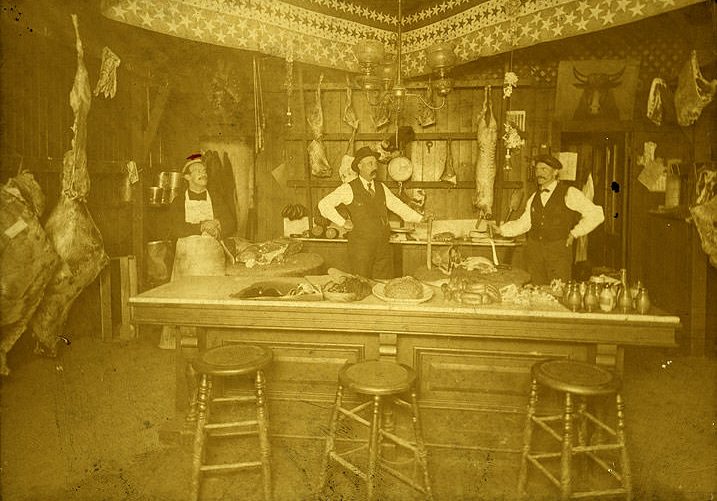
Frank Glass, on the left, wears an apron. Three high stools are in front of the counter. Two carcasses hang at the left of the image. Pieces of meat hang on the back walls.
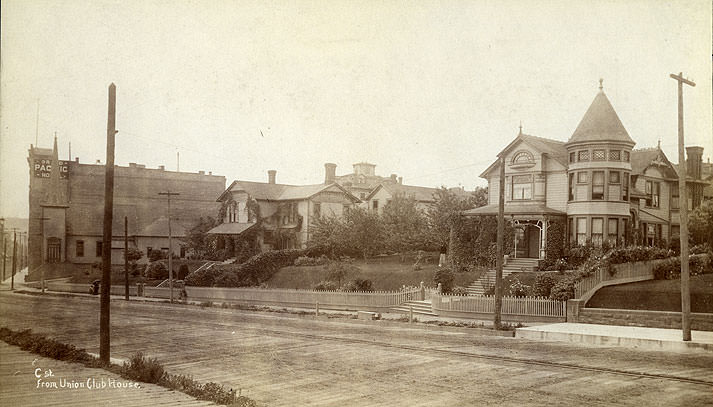
The First Methodist Episcopal Church, at the southwest corner of C Street and S. Seventh Street, is near the left edge of the image, and the Grand Pacific Hotel is partially visible behind it. The residence of Samuel Wilkeson, 626 C Street, is at the right edge of the image.
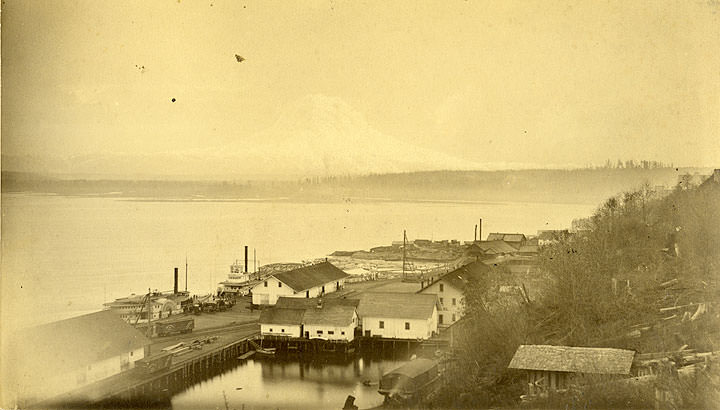
A logged hillside is in the lower right foreground of the image, with a small log building above the lower right. The S.S. George E. Starr, a sidewheeler steamship, is docked at the lower left of the image. Another steamship is also docked nearby. A railroad freight car is near them on the dock. Buildings are on pilings in the water in the lower center of the image and near the lower-left corner.
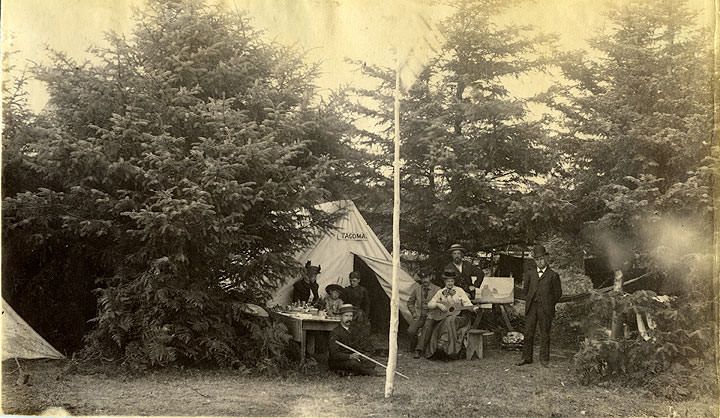
Two of the women and the boy are sitting by a table in front of the tent, with eating dishes stacked on it, in the image center-left. One of the men, holding a long stick, sits on the ground by the table. Another woman sits on a bench in the image center right, holding a guitar on her lap. A man sits beside her. Two men stand nearby, near a painting easel. A painted canvas sits on the easel.
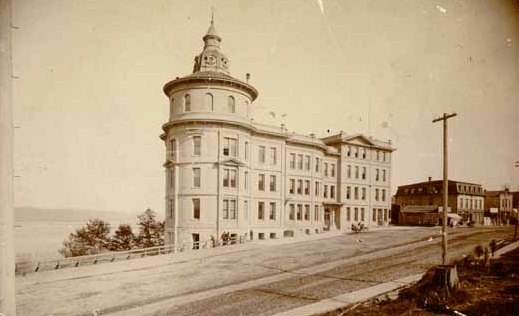
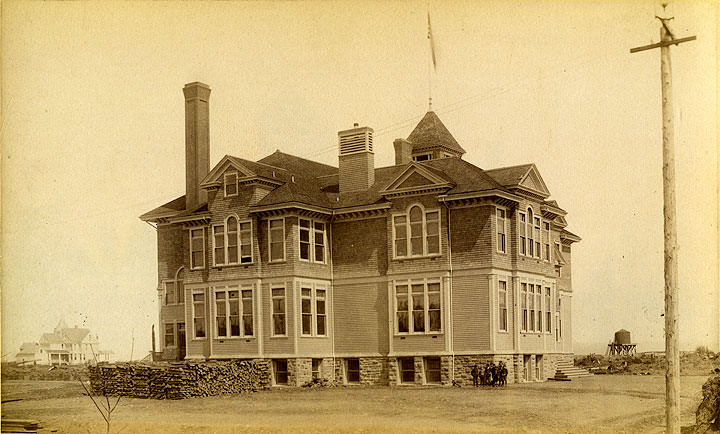
In the left foreground of the image, a large pile of cut wood is next to the building. A few school children stand by the corner of the building at the right of the image. A water tower is visible in the right background. A large building is in the left background.
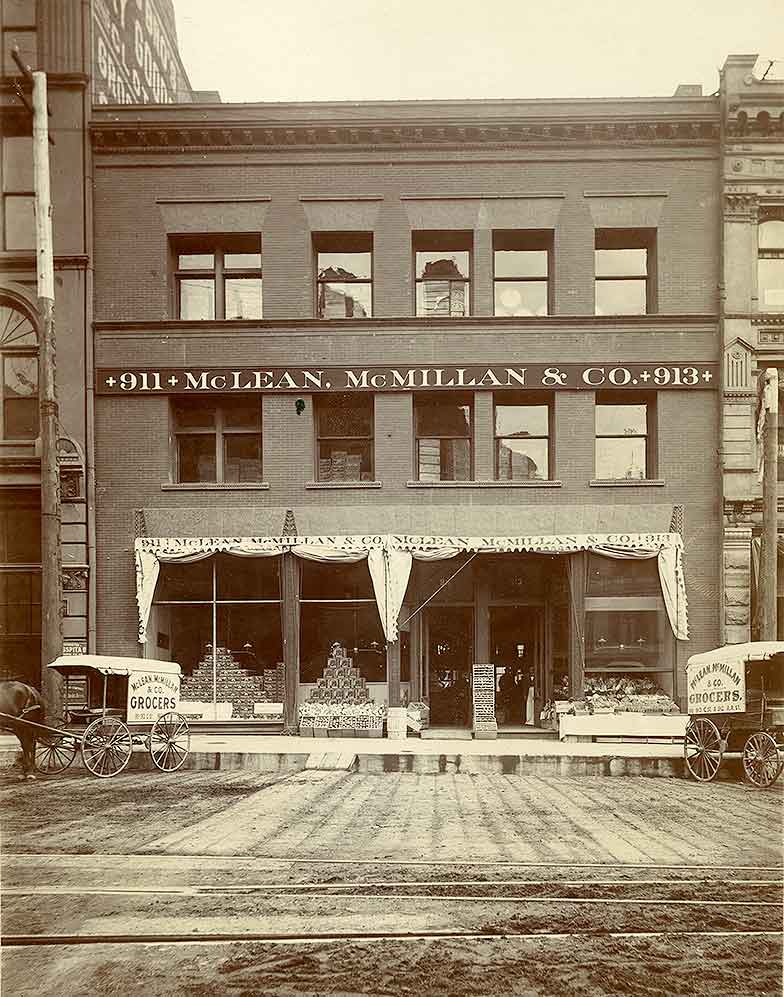
A few crates of produce are on the sidewalk in front of the store. Pyramids of canned items are in two store windows. Two horse-drawn delivery wagons are partially visible on the street.
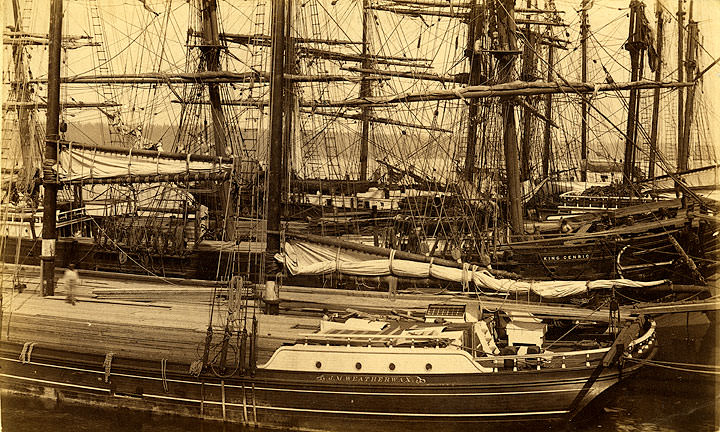
The ship J.M. Weatherwax, a three-masted schooner loaded with lumber, is in the foreground, viewed from the port side. She was built in Aberdeen. The ship King Cedric, a Norwegian bark, is in the image center.
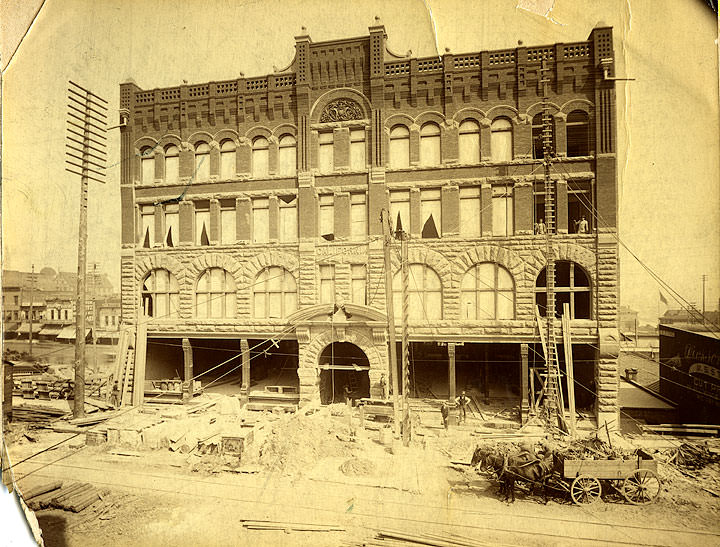
David Wilson built the building. A ladder extends from the ground to the top of the building at the right of the image. It appears to be stabilized by ropes or cables extending out of the image on both sides. Two workers stand in one of the upper-story windows. Building supplies are on the ground in front of the building, with workers standing by them.
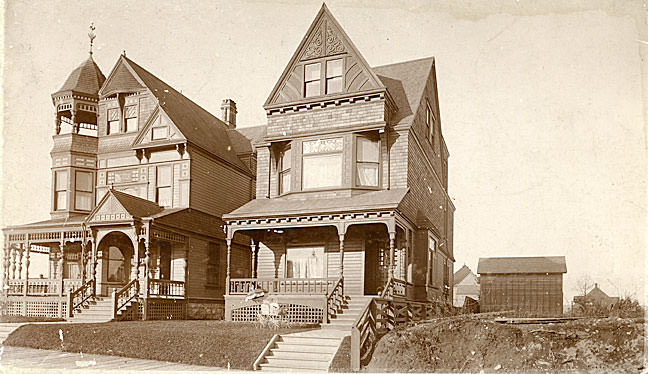
Pictured is the former home of Hon. Williams H. Calkins at 323 North J Street, now owned by Mrs. Emil Kleise, and the former home of LeRoy Pratt, former People’s Store manager, at 329 North J Street. The houses’ positions are not indicated in the image. Both were built in 1890.
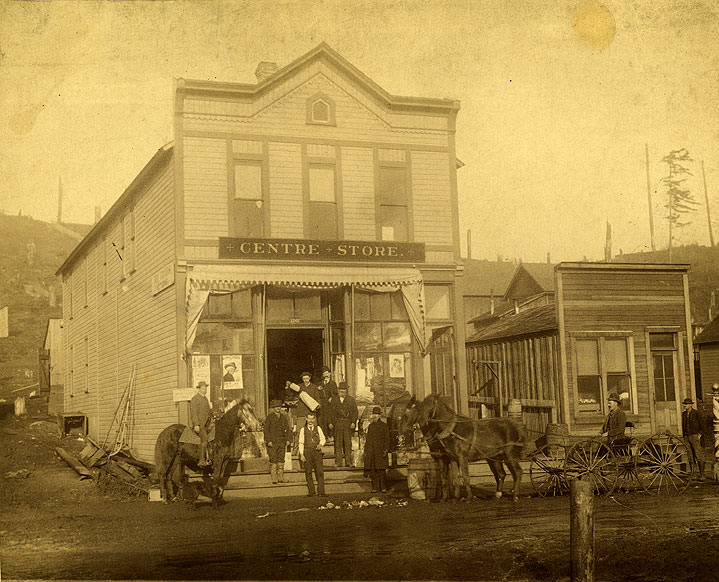
Centre Street later became Center Street. Two illegible posters, one with a man’s head and possibly a woman’s, are in the store windows. A man sits on a horse-team-drawn wagon in front of the store, and another man sits astride a horse nearby.
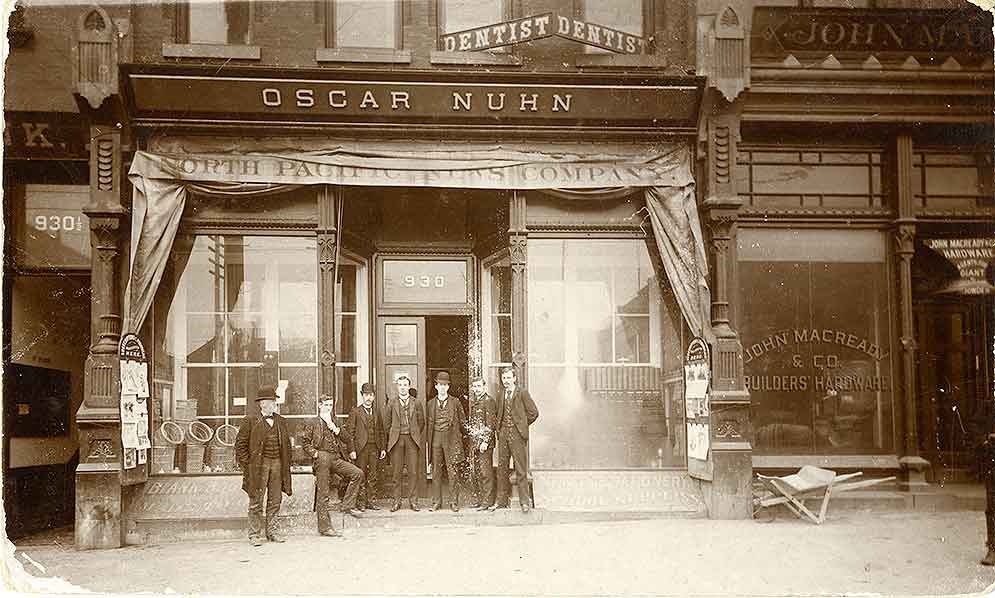
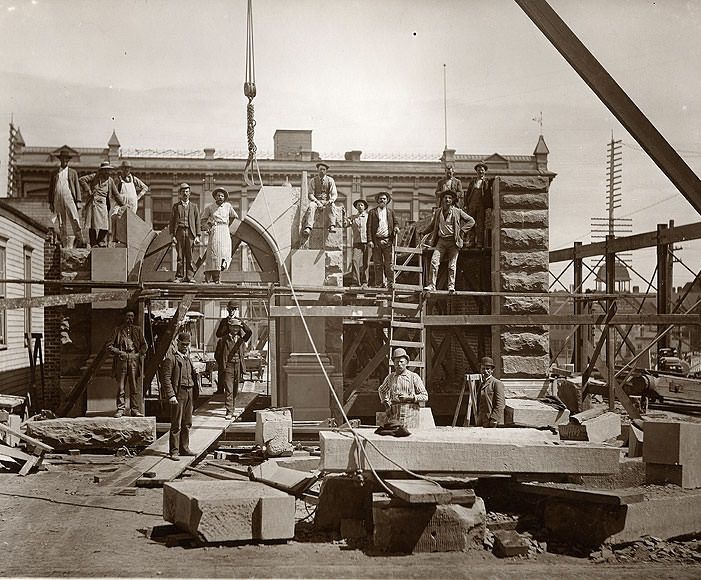
A first-floor stone arch is being constructed at the left of the image. Four men wearing aprons pose on scaffolding erected across the building front, arch, and standing on the adjacent partially constructed stone wall. A few other workers pose nearby on the scaffolding at the right of the image. A man wearing an apron stands behind a long stone slab on the ground in front of the building, amidst other stone pieces, some partially carved.
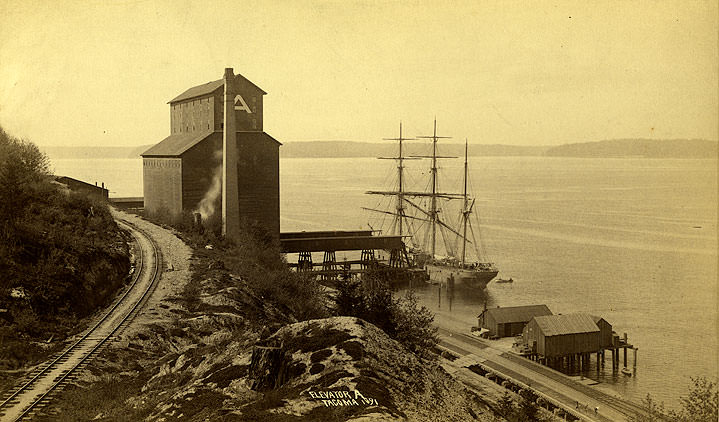
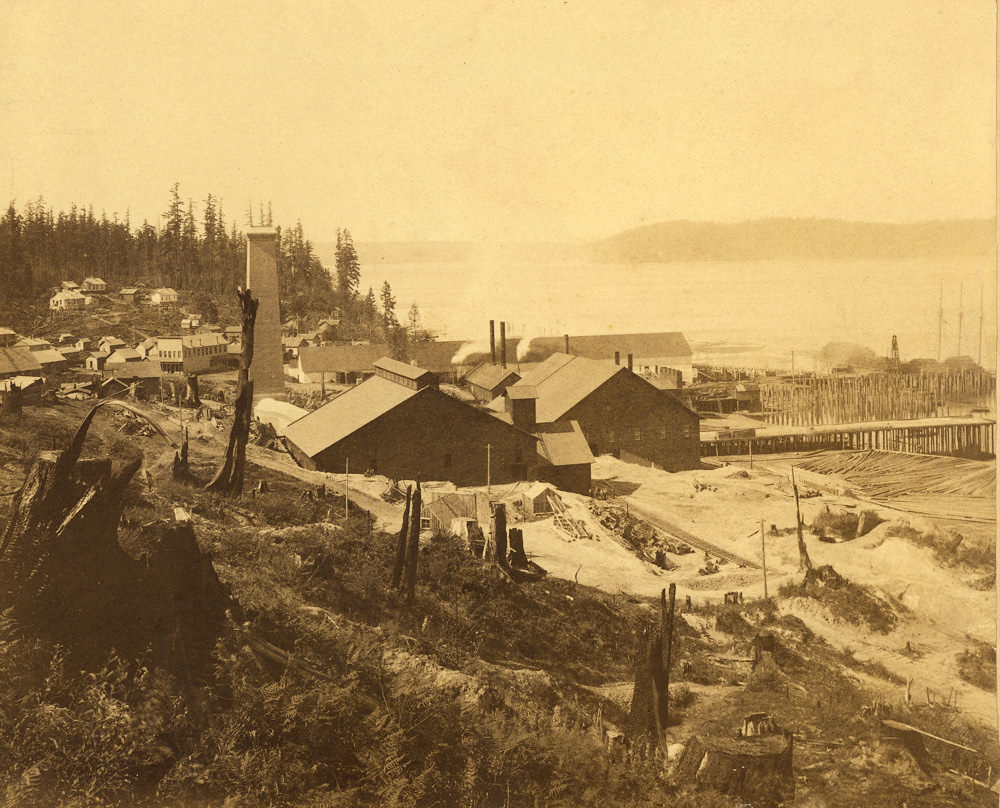
A railroad track curves from the lower-left corner of the image along the hillside base above the hill. A sailing ship is in the water next to loading areas on the waterside of the mill. Railroad tracks are visible next to the water above the lower right edge of the image, and two small buildings on piers over the water are nearby.
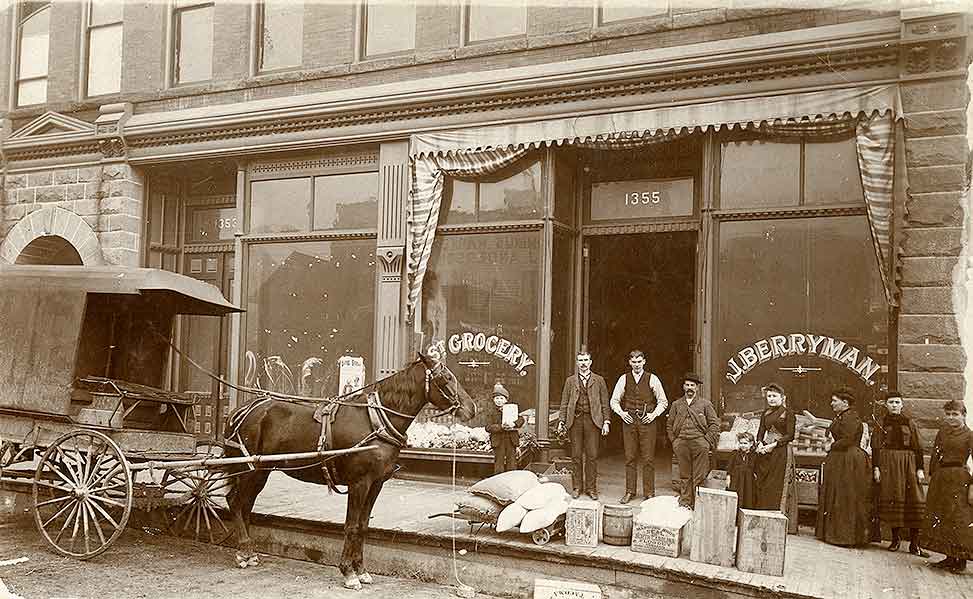
The small boy holds a package in his arms. A few full sacks lie on a hand truck at the sidewalk’s edge, along with a barrel and a few wooden boxes. A horse hitched to a covered wagon, which is partially visible, is at the left of the photo.
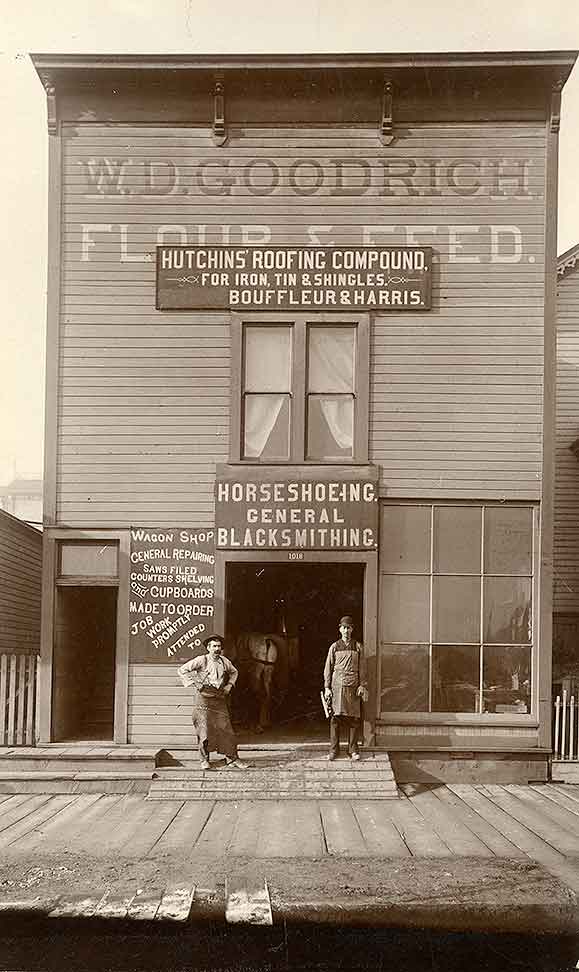
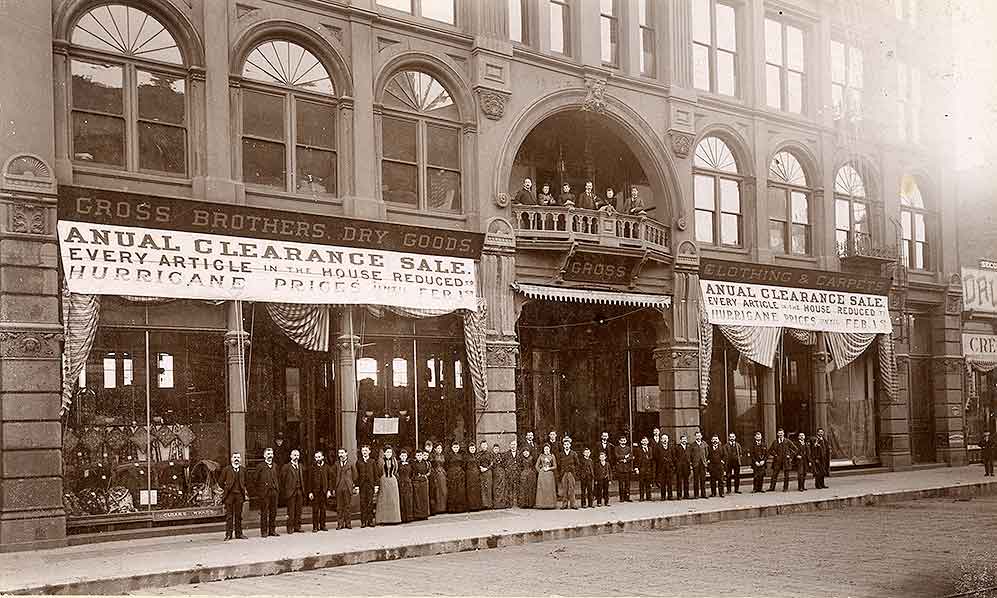
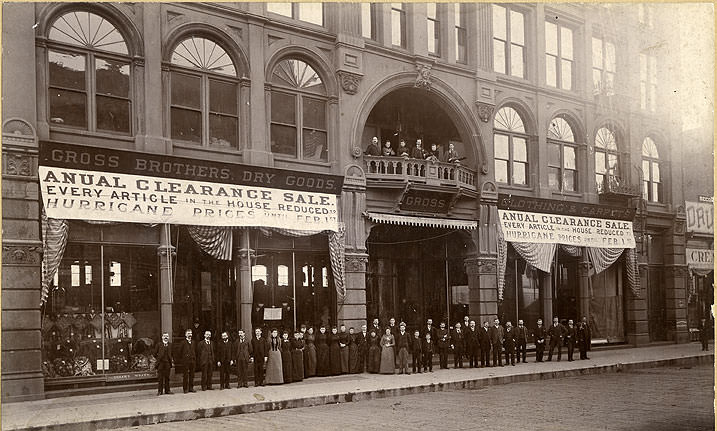
The store was owned by Dave, Morris, Abe, and Ellis Gross. The many store employees, including some women and two small boys, stand in a row in front of the store. Three men and three women stand on a balcony above the entrance. A permanent sign on the store reads: Gross Brothers Dry Goods, Clothing & Carpets.
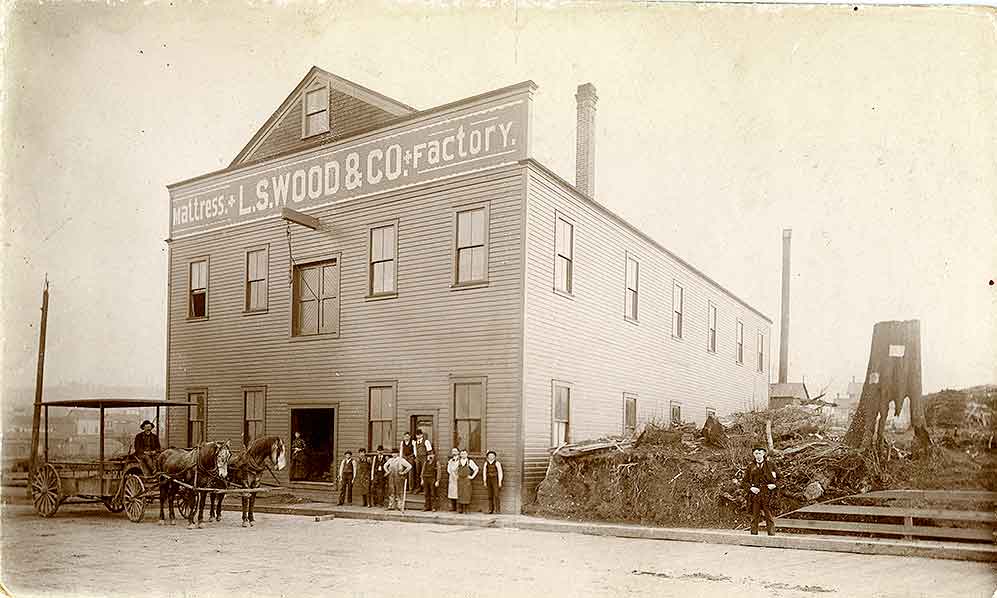
At the left of the photo, a woman stands in the building’s doorway, and a driver sits on a two-horse team drawn wagon with a top and open sides, probably a delivery wagon. A burned-out tree stump is visible on the right. Some type of printed material is posted on it.
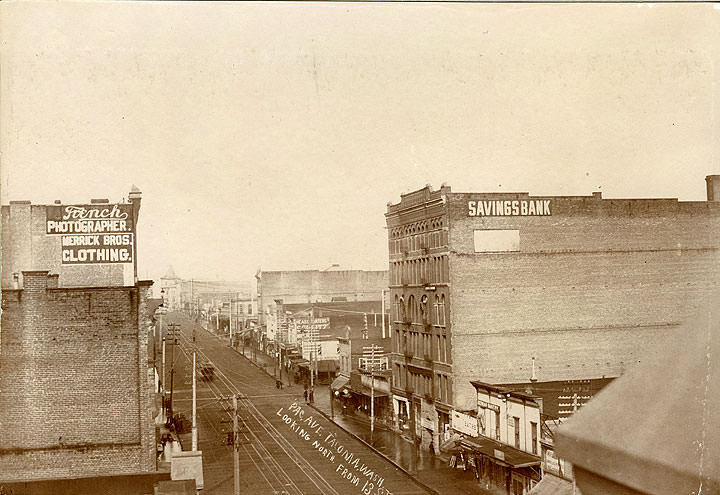
A streetcar in the image center and the Northern Pacific Railroad Headquarters Building in the left-center background are barely visible. Painted signs on the building side at the left of the image read: French, Photographer; Merrick Bros.
A streetcar in the image center and the Northern Pacific Railroad Headquarters Building in the left-center background are barely visible. Painted signs on the building side at the left of the image read: French, Photographer; Merrick Bros.
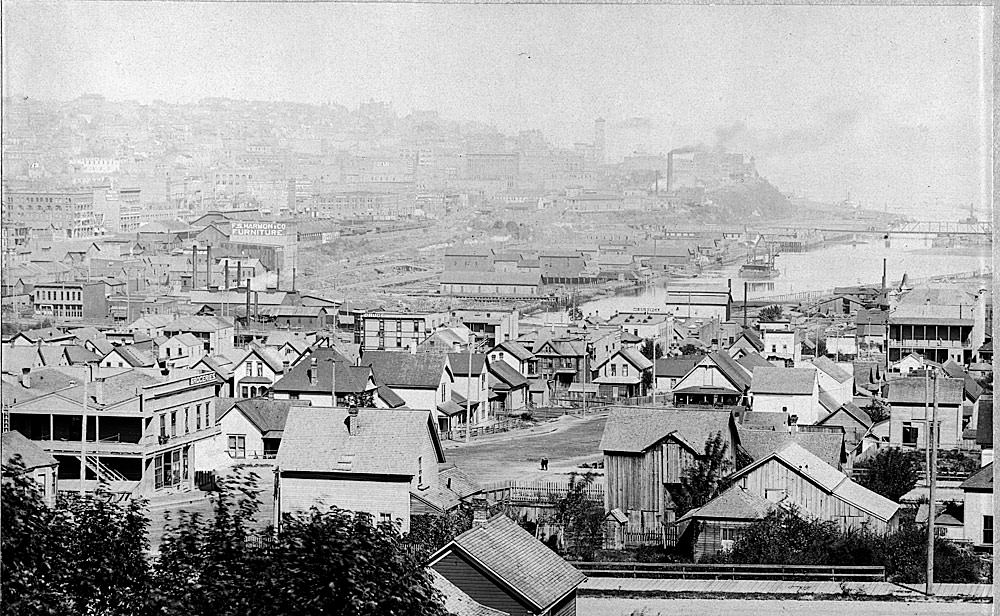
The image looks north from 30th and D Streets across Foss Waterway. Several houses are in the foreground. To the left is a two-story wooden structure.
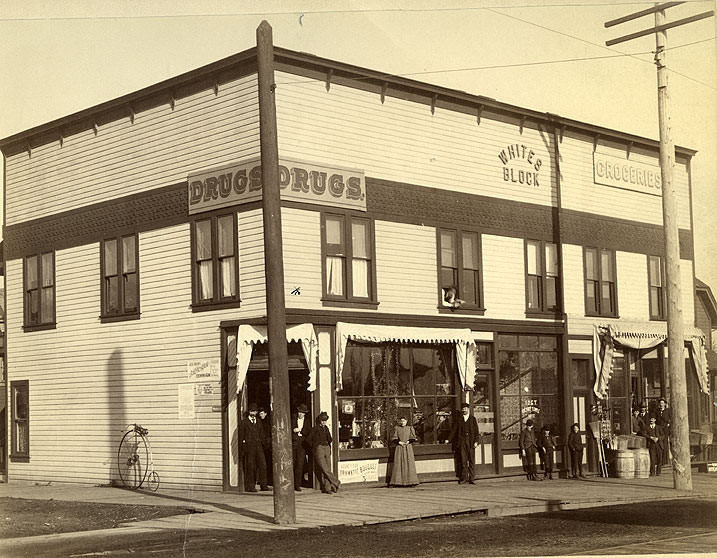
Roice and his wife are posing in front of the store’s large window. Four men stand in the drugstore’s doorway. Adjacent to the drugstore at the right of the image is a storefront sign for the Independent Order of Good Templars: I.O.G.T. Victory Temple. Three boys stand in front. The grocery store of Noah D. Pollom is also in the Whites Block near the right edge of the image. Pollom is one of four men standing behind barrels in front of the store, and two brooms are beside them. After their marriage, Mr. and Mrs. Pollom lived in the second-floor corner of the building.
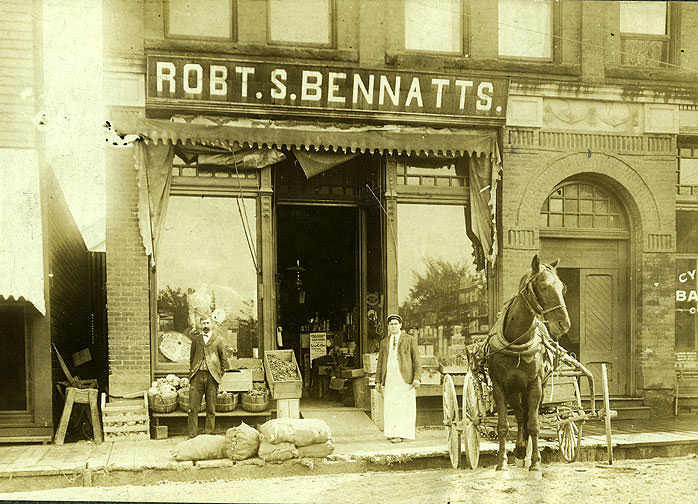
Bennetts lived at 3902 North Thirty-fourth Street. A man wearing a suit, possibly Bennetts, and a man wearing a long apron under a suit coat pose in front of the store. Produce is in baskets and boxes on tables in front of the store, and full sacks lie on the plank sidewalk.
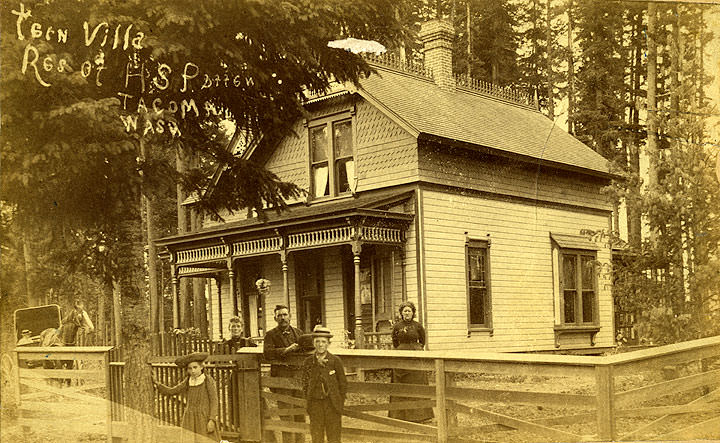
Patten and his wife Ethel are standing inside the fence gate. Mr. Patten’s sister stands away from the gate, closer to the house. Children Ethel and Harry are standing in front of the gate. A small child sits in a horse-drawn buggy in the left background of the image.
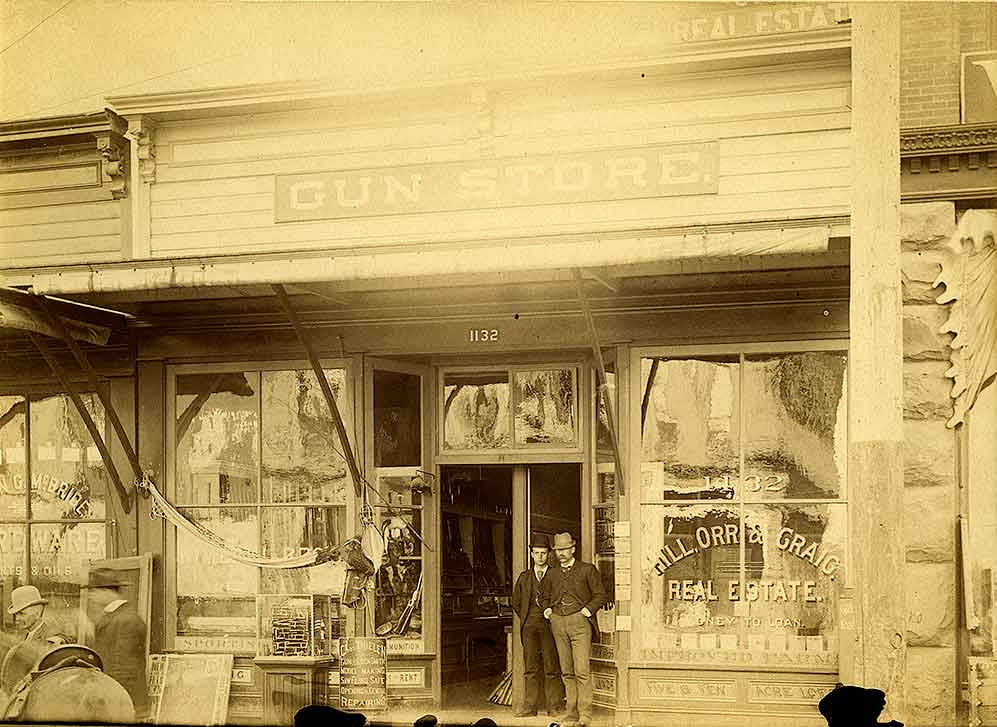
The doorway also serves a gun and sporting goods store, whose storefront is at the left of the photo. Several long-barrel guns are visible through the door. A pair of boots, a hammock, and other items hang outside the store window.
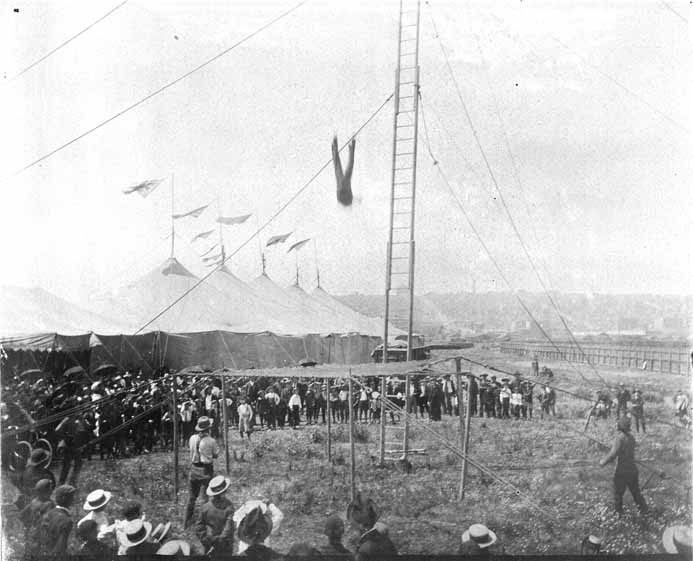
He appears to be falling from a high-wire that is out of sight. One of a series of photographs in an album showing various Tacoma and Pierce County views.
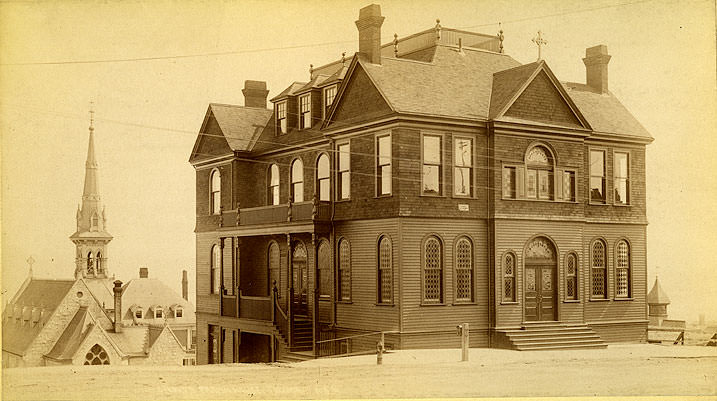
There are two separate entrances, and all the windows on the main floor and some on the second floor have stained glass. On the left side of the photo is a church, presumably St. Luke’s.
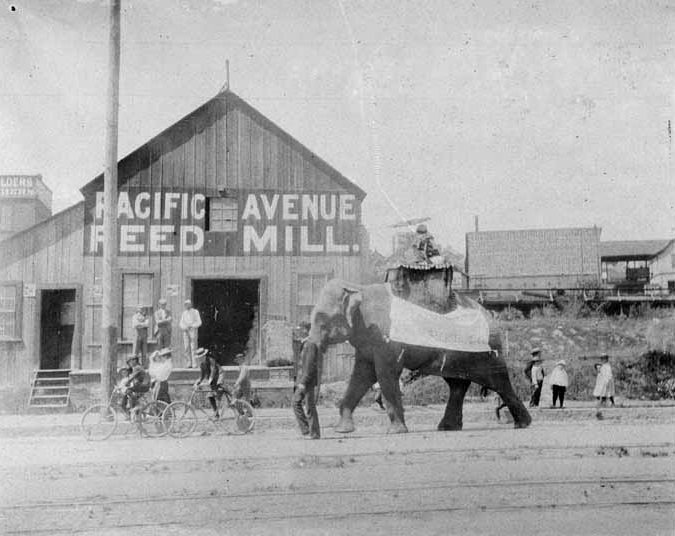
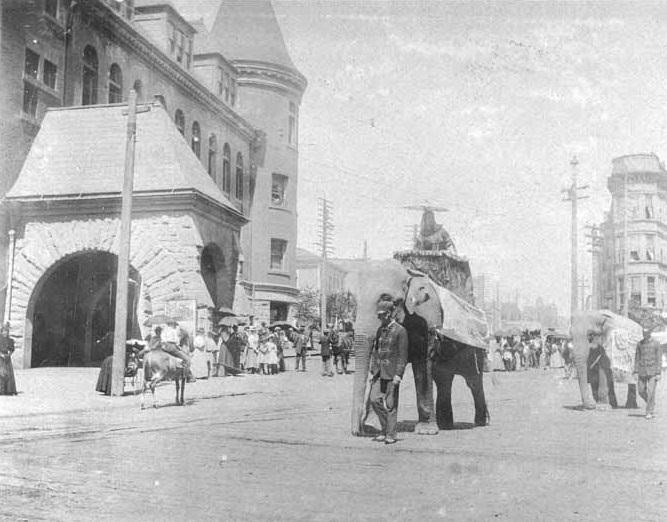
Two boys riding bicycles appear to be riding along with the elephant, and several people are watching it pass by from the sidewalk. One of the spectators is a woman holding an infant. One of a series of photographs in an album showing various Tacoma and Pierce County views.
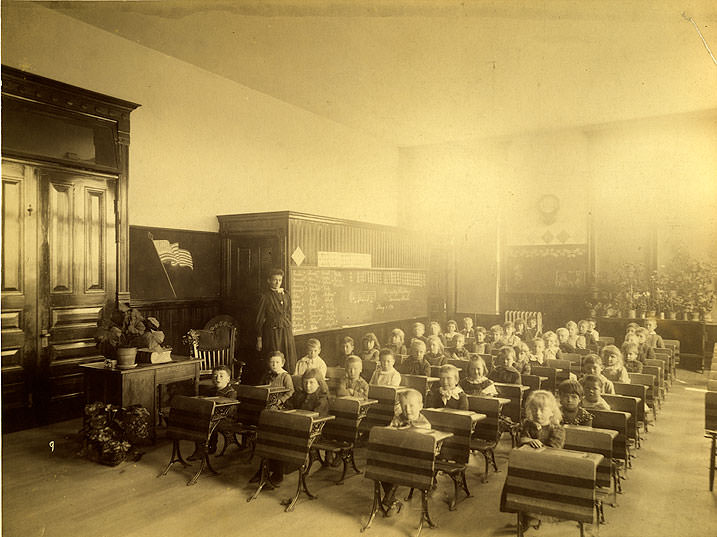
The photo shows a class of 40 boys and girls sitting at traditional desks. Their teacher, identified as Miss Mary Bovell, is standing to one side between her desk and the chalkboard.
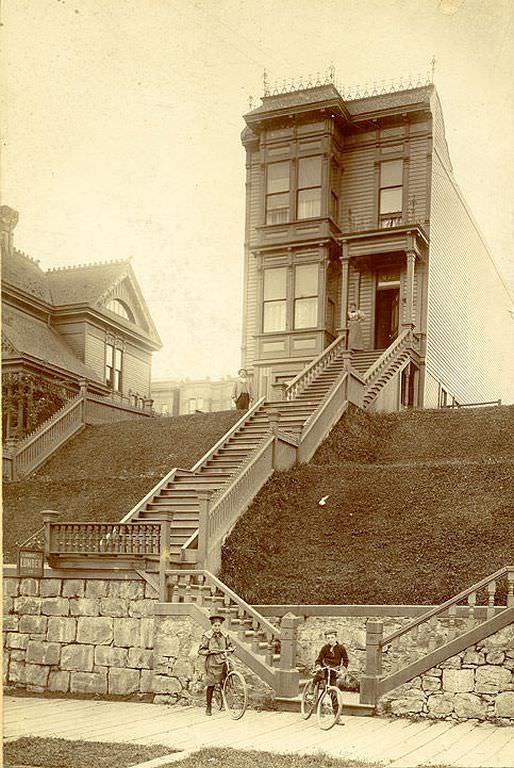
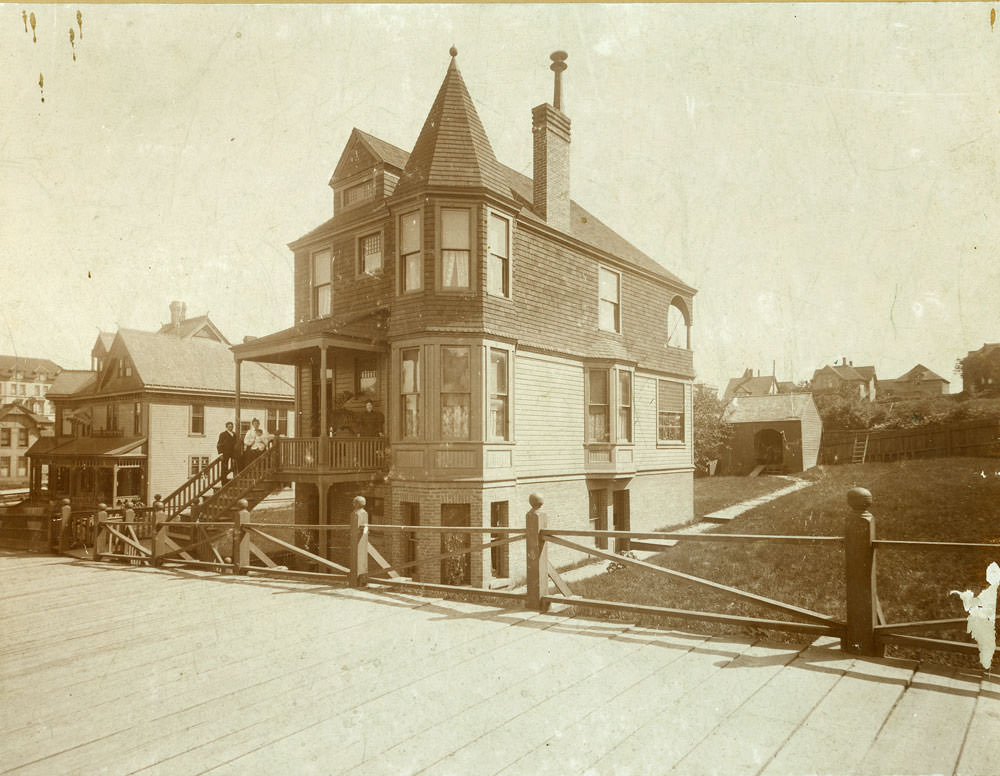
The view of the narrow two-story house with a basement, sitting atop a terraced lot accessed by three long tiers of stairs, is from the plank sidewalk level in the foreground. There are no windows on the visible side of the house. Mrs. Hannah Lawler poses on the small front porch, George Lawler stands on the top terrace by the basement level, and children Ellen and George Ward pose on their bicycles on the sidewalk.
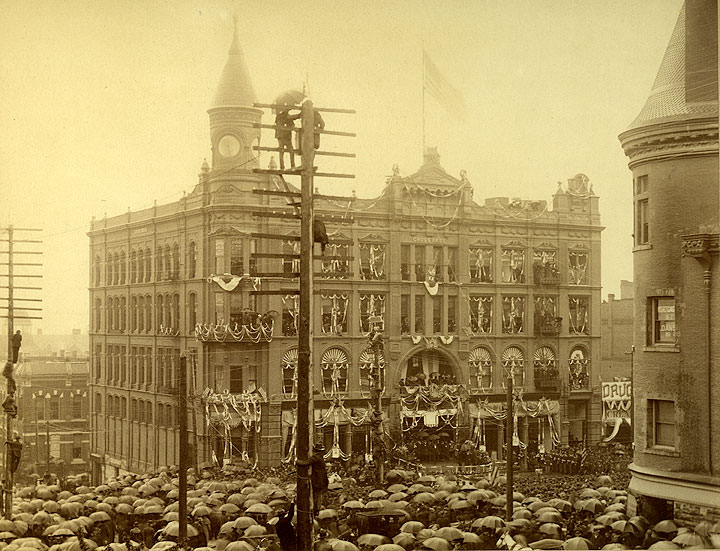
A speaker’s stand is erected in front of the Gross Bros. Department Store, 901 Broadway, in the image center. The building was built in 1889 and demolished in 1916. Bunting decorates the front of the building, and people are watching from the windows. The people standing on the speaker’s platform are unidentifiable. A crowd stands in the lower foreground of the image, most of them holding umbrellas.
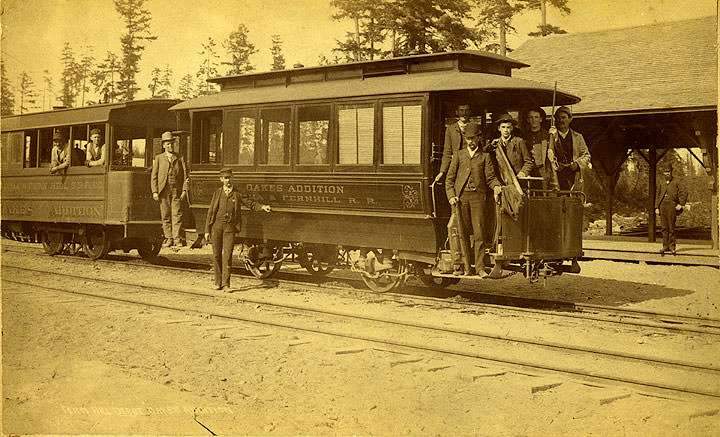
Five male passengers are standing at the end of the railroad car at the right of the image. Mr. Bosworth, the conductor, stands by the car in the image center-left. Three more passengers are visible at the left of the image. A man stands on the covered railroad platform near the right edge background.
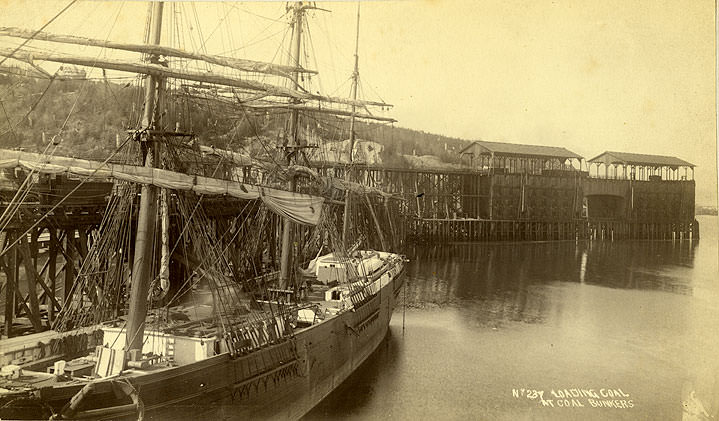
A sailing ship, viewed from the stern end of the starboard side, is in the foreground in the lower left quadrant. Details of the top deck are visible. The trestle for the coal bunker is partially hidden behind the ship. A building is near the left edge of the image, on top of the hill behind the ship and the bunkers. No coal loading is visible.
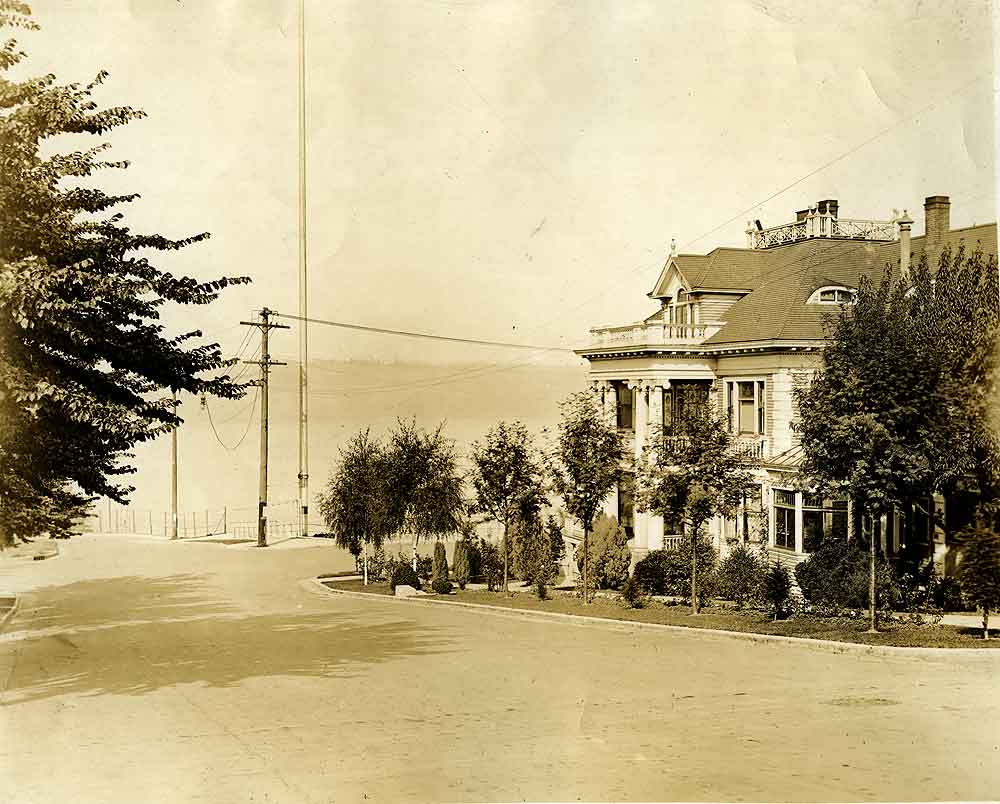
The home was located at N. 3rd and Stadium Way and was built after 1890. It is a two-and-a-half-story home with a widow’s walk.
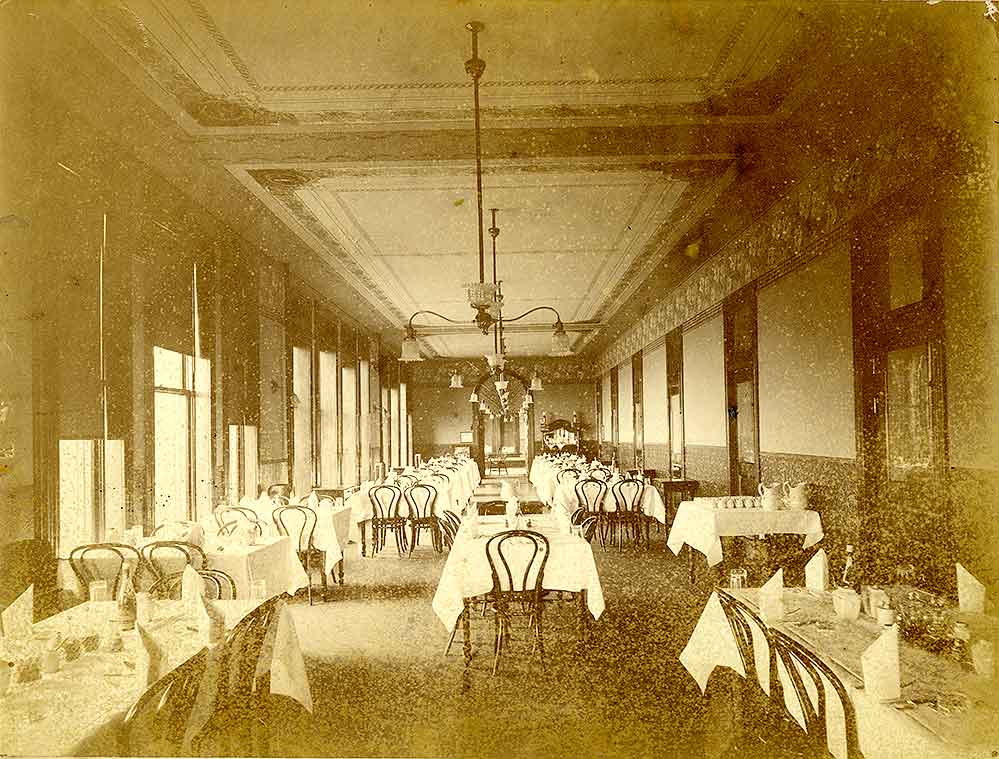
The photo shows a large dining room with many tables set with white tablecloths. The room is identified as the Commercial Club Rooms in the California Building.
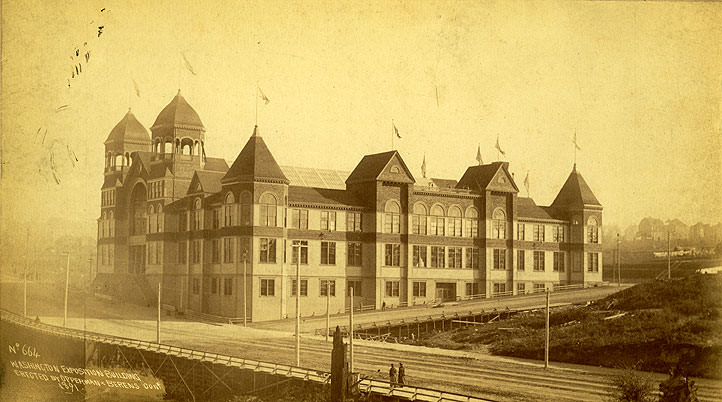
Two visible streets adjacent to the building are elevated. The text below a newspaper image of the building attached to the image reverse reads: Above is pictured the Washington Exposition Building, home of Tacoma’s first home products shows.
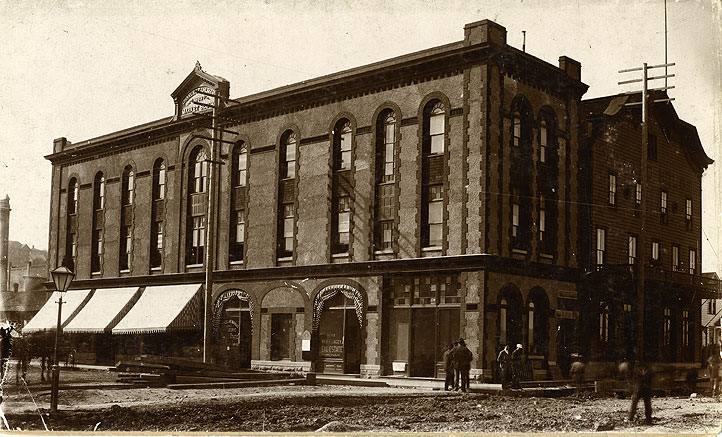
Business signs in street-front windows include Fred F. Lacey, Real Estate, 103 South Ninth Street; and Bethell, McManus, & Gillespie, 105 South Ninth Street.
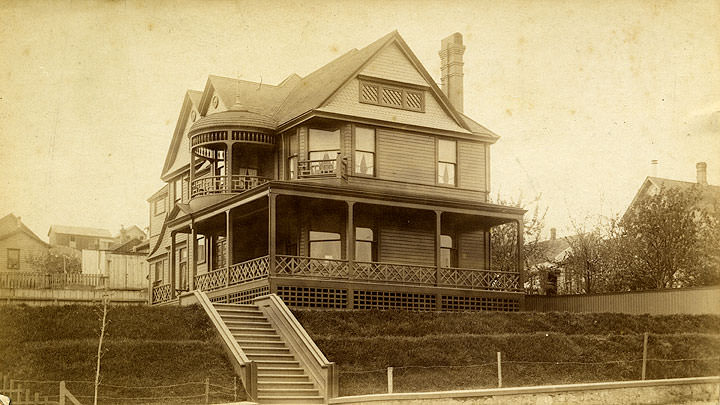
A covered porch extends across the front and part of the visible side of the house. A covered, circular porch protrudes from the side of the second story over the lower story porch.
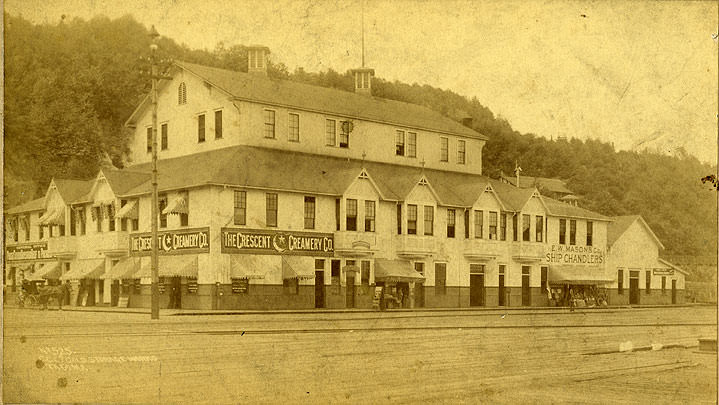
The Crescent Creamery was located on the Tacoma waterfront near where the road to Ruston went under the railroad tracks. Most of the building appears to have been used by the creamery and its cold storage facility.
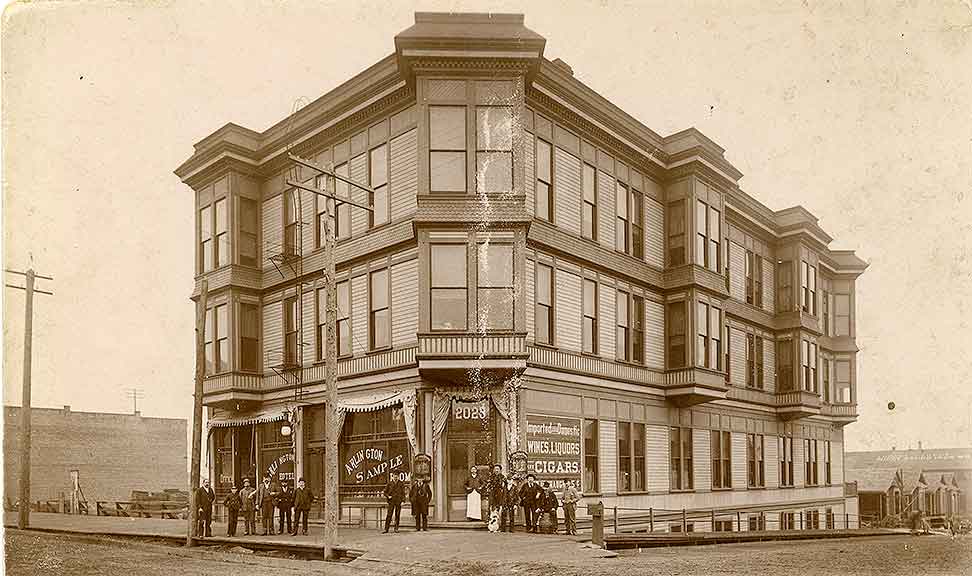
Several staff members pose for the photographer. One man wears a long apron. A dog sits on its hind legs in front of another man. A sign on the side of the building reads: Imported and Domestic Wines, Liquors, and Cigars. The Arlington Hotel was built in 1889 and later named the Hotel Rhein. It was an impressive sight on Pacific Avenue for forty years. Built by Jim Dorsey with architectural plans by C. Langlois, the four-story structure was built primarily of wood and contained multiple windows.
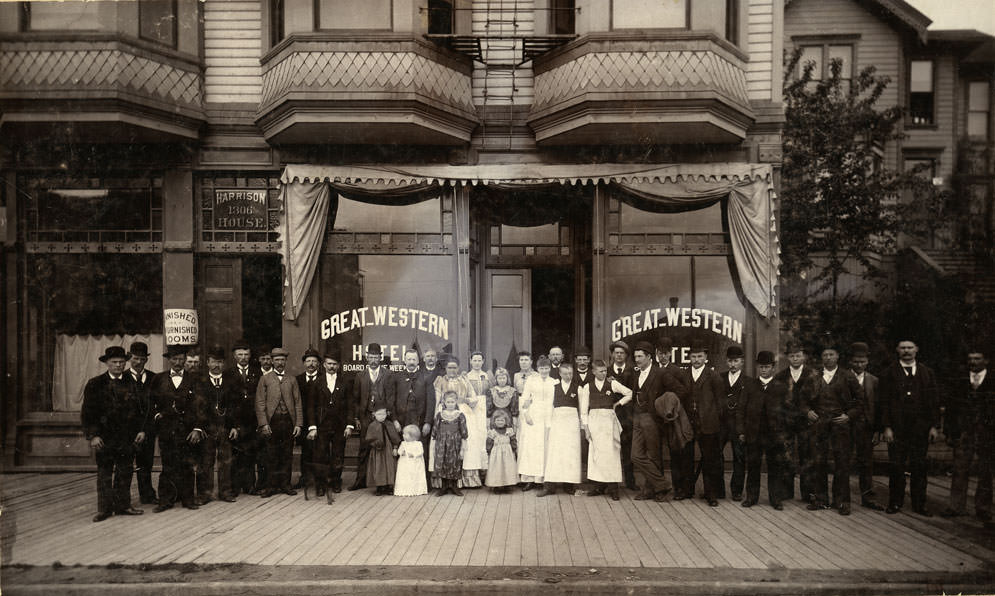
A fire ladder appears to hang between the bay windows on the second floor. The men all wear suits and hats. Two teenage boys wear vests over shirts and light-colored aprons as hotel employees. Four women also wear aprons. The hotel entrance looks like a storefront with double doors between glass windows. An entrance to the side has a sign reading “Harrison 1306 House” above the door, advertising rooms at the side.
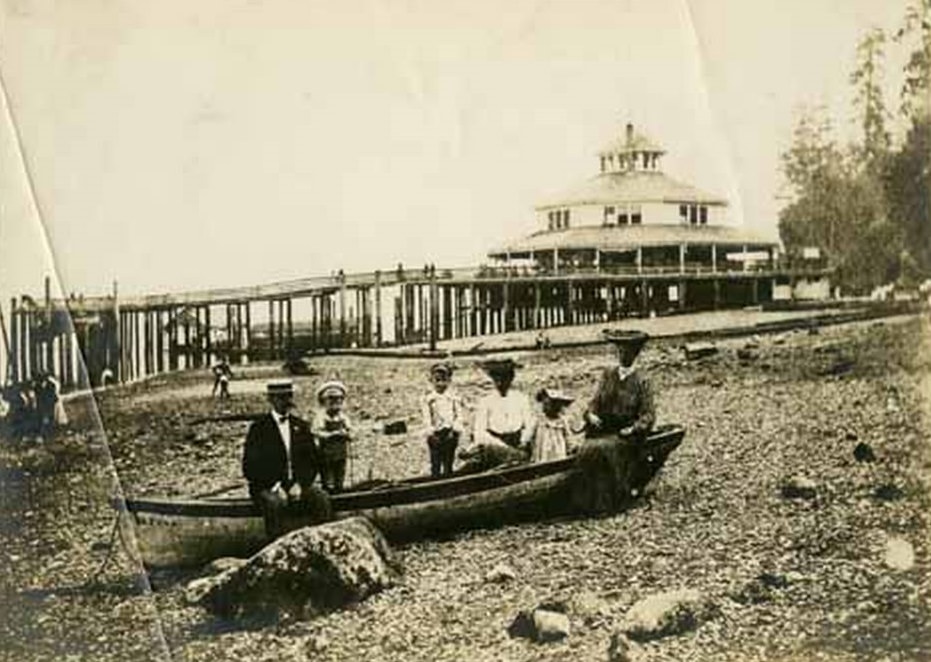
The group includes three children (two young boys and one young girl), two women, and one man. A long dock and a large beach pavilion are present in the background. Many rocks and shells are visible.
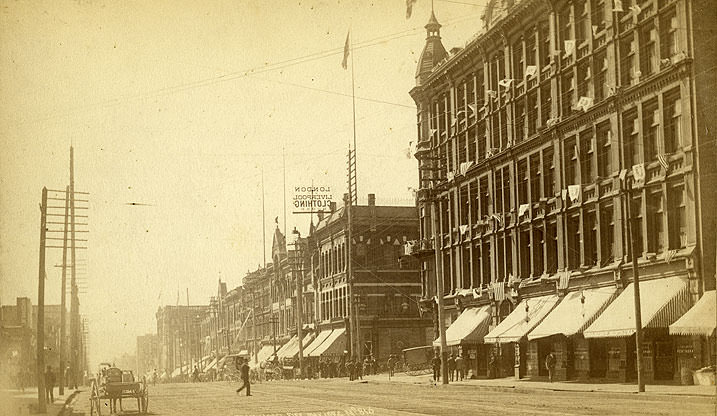
The Hotel Fife is the five-story brick building at the right of the image, with open awnings at street level. Pacific Avenue extends into the left background. Three-story commercial buildings, on the same side of the street as the hotel, many with open awnings at street level, extend into the background. A sign on top of one, seen in reverse, reads: London Liverpool Clothing.
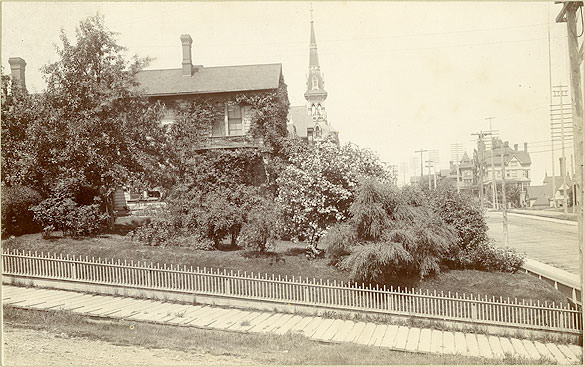
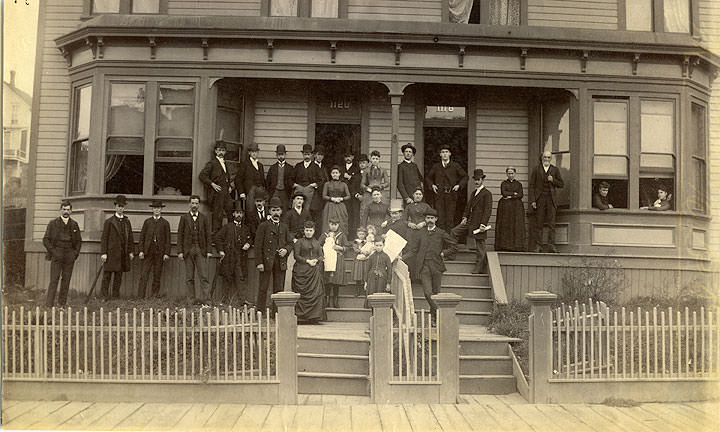
The front of the building shows two identical entrance doors with steps leading up to them, with front windows the same on both sides of the entrances. Numbers above the doors, from left to right: 1120, 1118. A wooden fence and plank sidewalk are in front of the building.
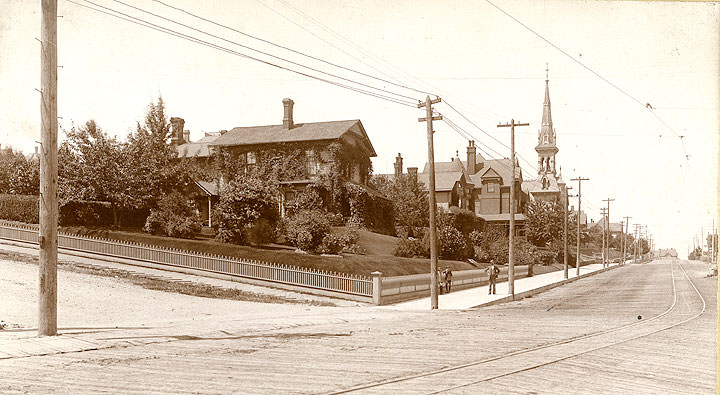
The house is on a corner and partially hidden by trees and shrubs. In the lower foreground and lower right of the image, Broadway appears to be a plank road. A single trolley track is in the middle of the street. In the lower center-left of the image, the intersecting street appears to be a dirt road. A man and two boys are standing on the sidewalk near the street corner.
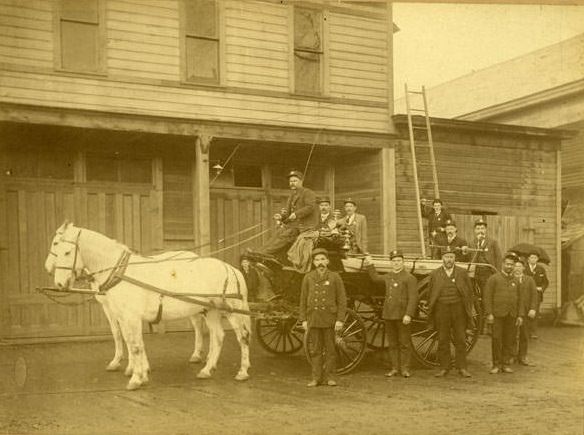
The building is a two-story clapboard building with three sashed windows at the second story and two bays for the ground-level fire engines (this building was located on Columbia St between Fourth and Fifth avenues). A fire team is pulled out with crews posing for a photograph. One firefighter is sitting in the driver’s seat of the engine, which is hitched to two white horses. Eleven other men are posing in front of, behind, and to the side of the engine. One is mounted partway up a ladder leaning on an annex to the fire station.
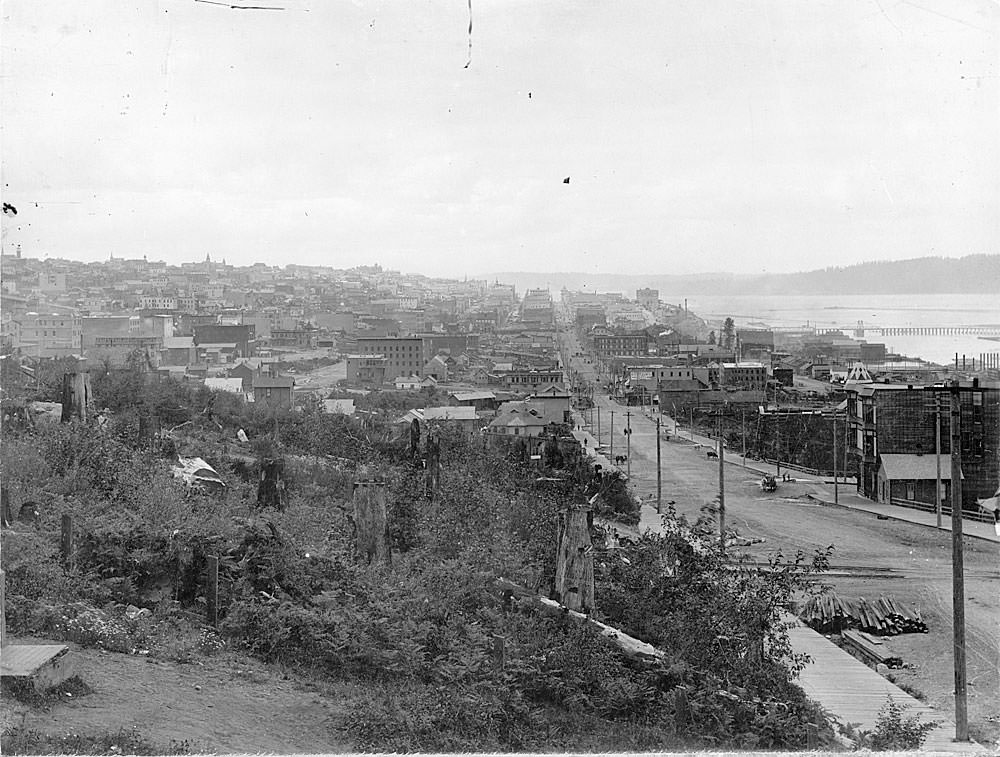
The area in the foreground is uncleared with heavy underbrush and some tree stumps. Looking farther down Pacific Avenue, the houses and buildings become denser to the north. The headquarters of the Northern Pacific Railroad, with its circular tower, can be seen in the far distance at the end of Pacific Avenue.




