
In the early 1980s, Japanese photographer and traveler Doi Kuro made his way through several countries in Southeast Asia. When he reached Bangkok, Thailand’s capital, he turned his camera on the streets and let everyday life fill his frame. What he documented was a city in full motion — vendors, students, tuk-tuks, temples, and traffic — all caught in vivid color before Bangkok’s rapid modernization changed its face forever.
Bangkok in that era was a dense, layered city. Its main roads were already thick with cars and motorcycles, but its side streets and neighborhoods still moved at a slower pace. Doi Kuro photographed both worlds — the wide commercial arteries and the quiet human moments tucked between them.
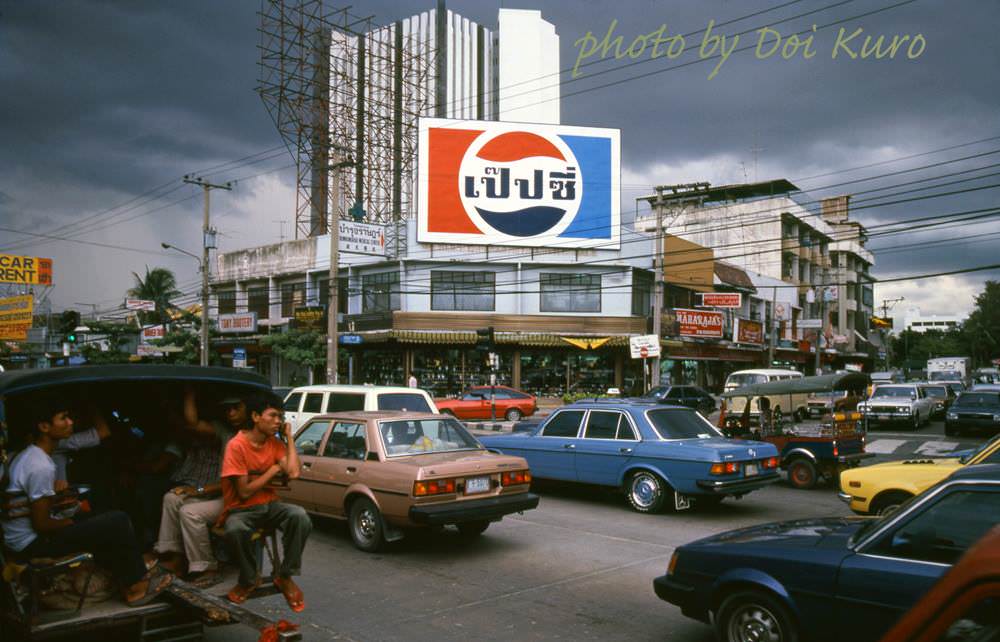
Sukhumvit Road was one of Bangkok’s longest and most important streets. Even in the early 1980s, it showed signs of the commercial sprawl that would later make it one of the city’s busiest corridors. Doi Kuro’s shot of it captures the road during a period when it still held a mix of local shops and modest storefronts alongside newer development.
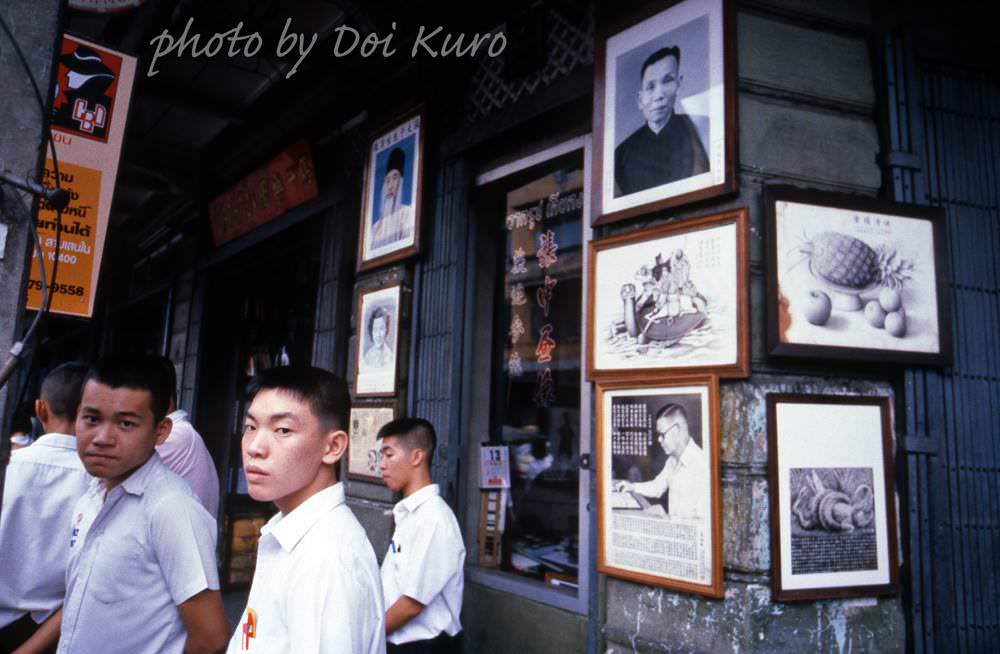
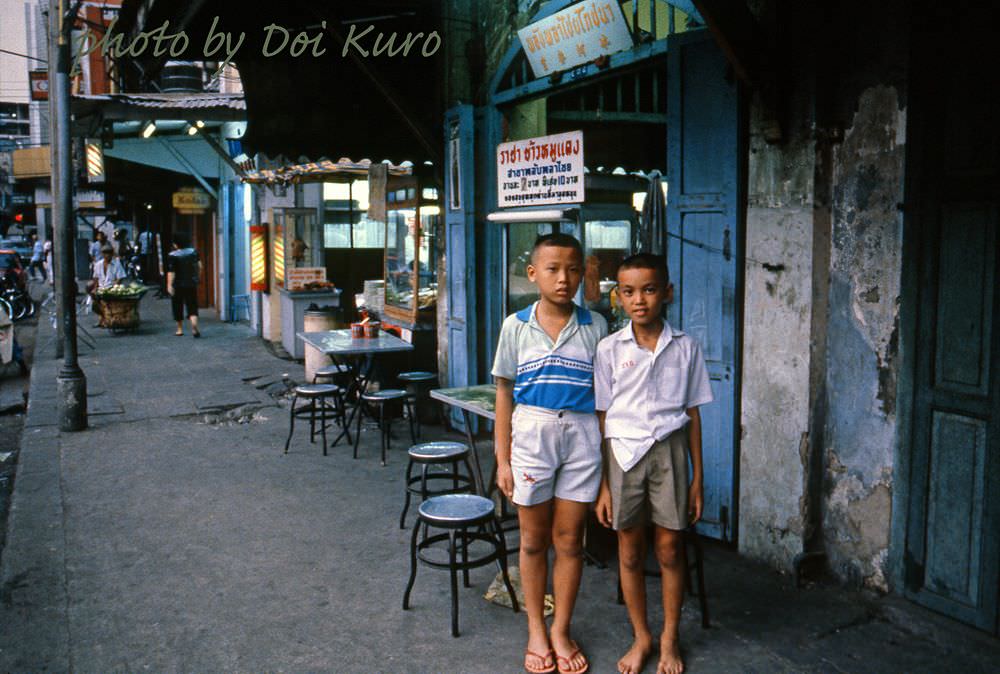
Yaowarat Road, Bangkok’s Chinatown, appeared repeatedly through Doi Kuro’s lens. It was one of the city’s oldest commercial districts, packed with gold shops, restaurants, and street stalls. Schoolboys in uniform walking along Yaowarat were a common sight — the area’s dense population meant schools and markets existed side by side.
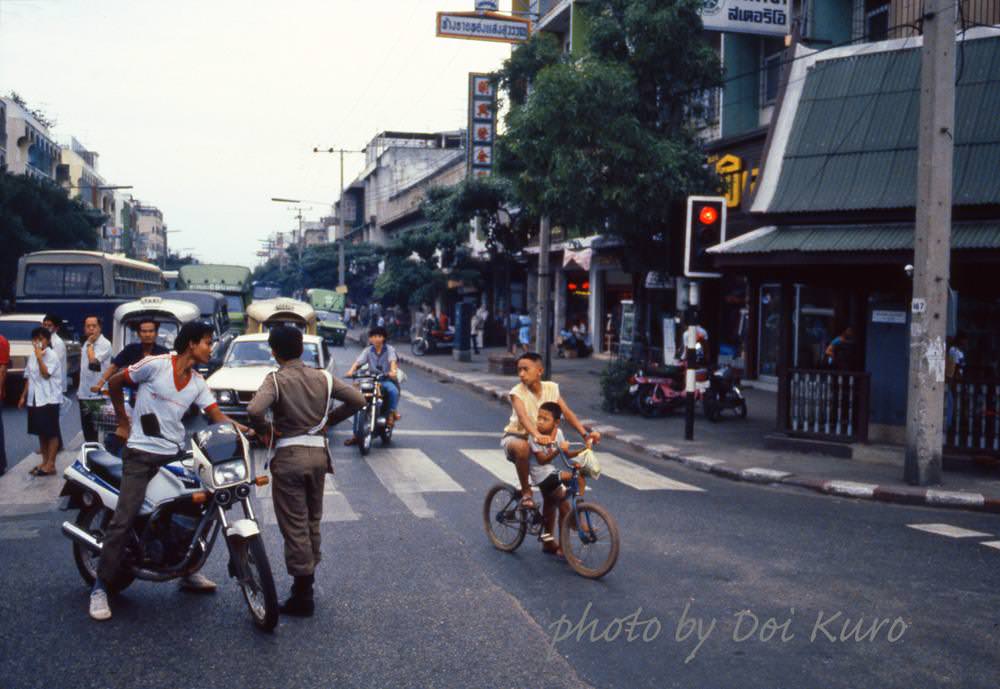
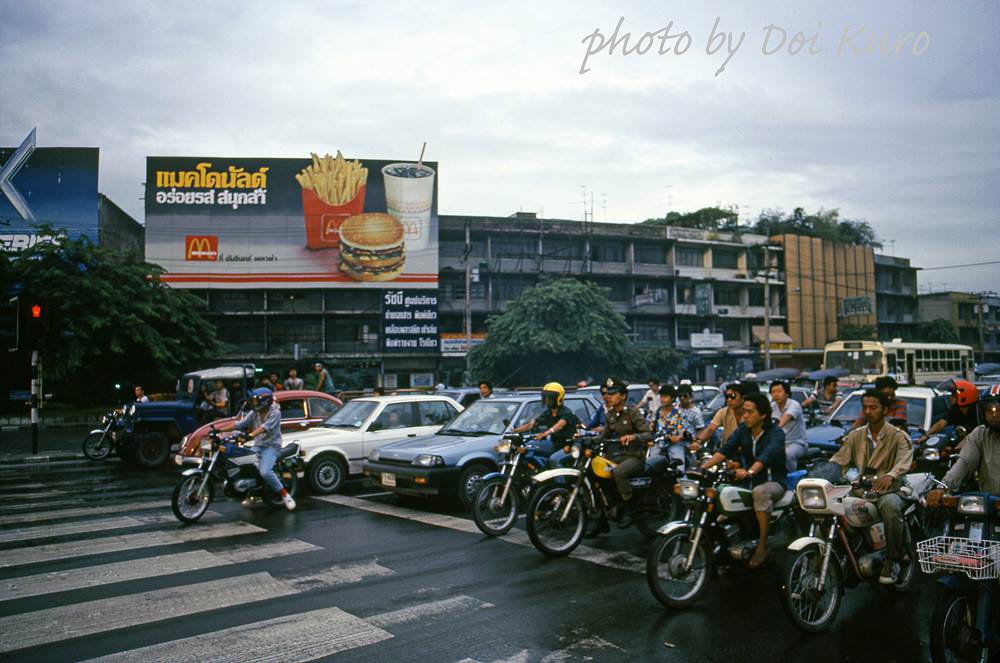
Traffic management in 1980s Bangkok was a visible and physically demanding job. Officers stationed at key intersections directed vehicles by hand, often standing in the middle of busy roads. The city’s road network was struggling to keep up with its growing number of cars, trucks, and motorcycles, and human traffic controllers were a regular feature at major junctions.
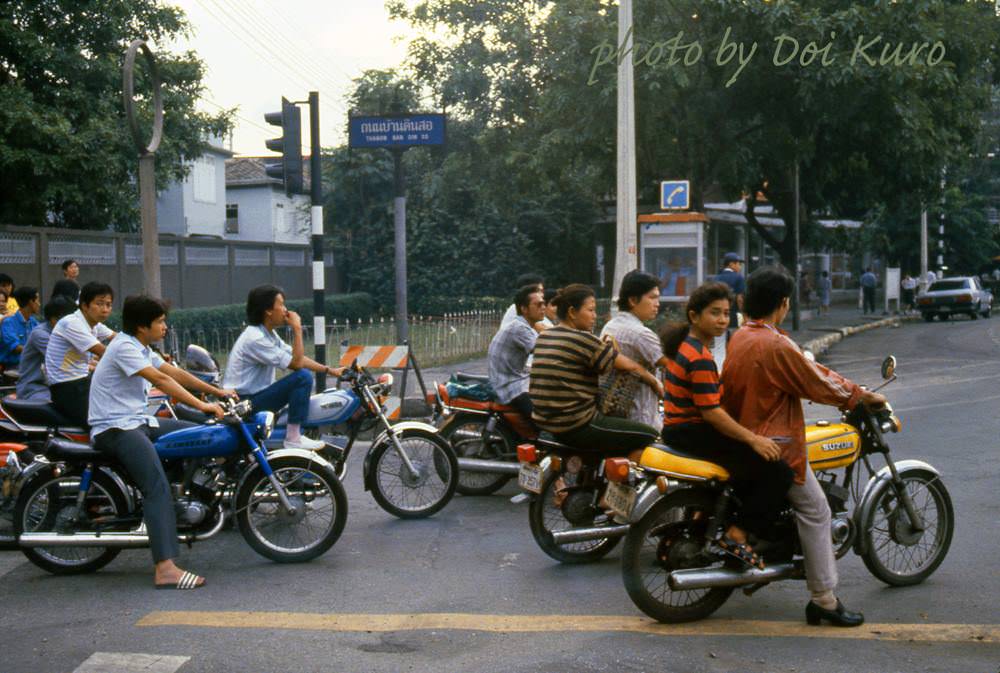
Motorcycles were essential to Bangkok life. They weaved through traffic jams that left larger vehicles at a standstill, and they served as the primary transport for many working-class residents. Doi Kuro’s street-level shots caught riders in everyday situations — no helmets, no gear, just the practical hustle of getting from one place to another.
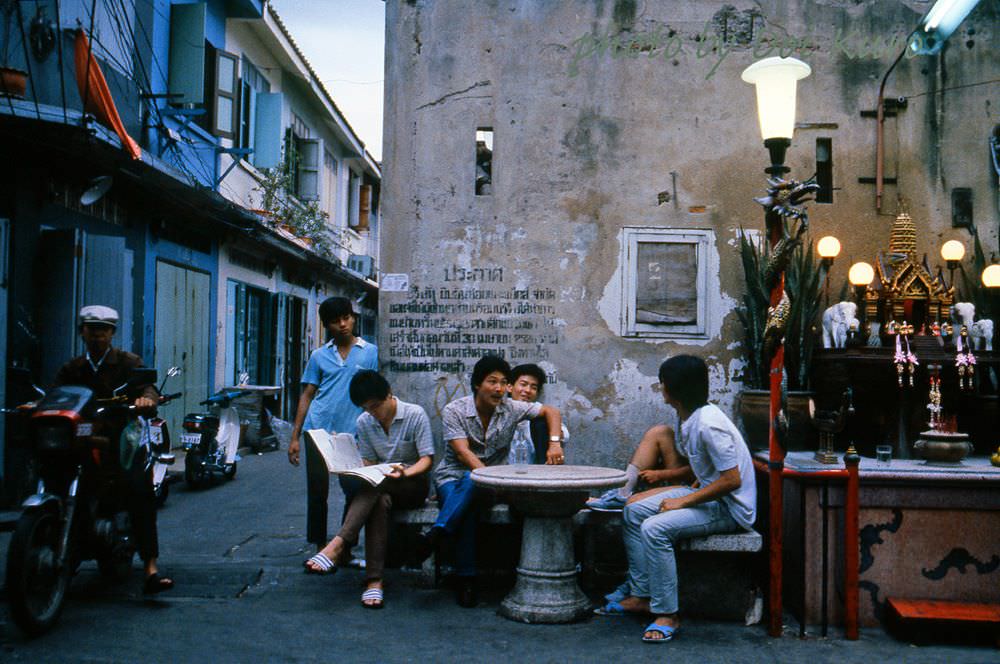
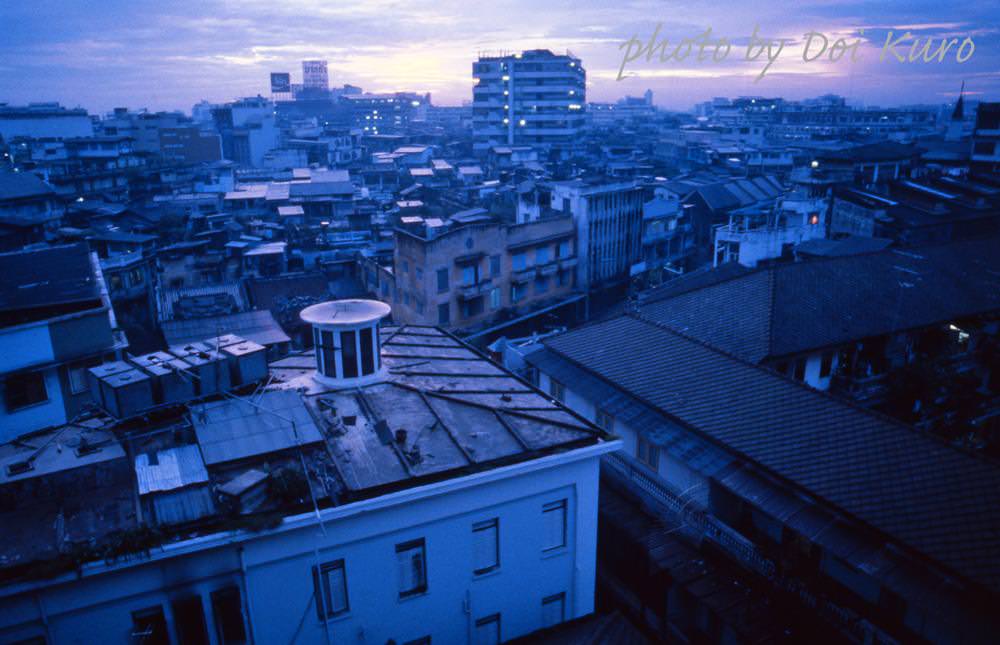
From a higher vantage point at the Krungkasem Srikrung Hotel, the full scale of Yaowarat comes into view. The road stretches ahead lined with signboards in Chinese and Thai, with the rooftops of shop-houses packed tightly on either side. This elevated perspective shows just how dense the district was — a continuous wall of commerce from one end to the other.
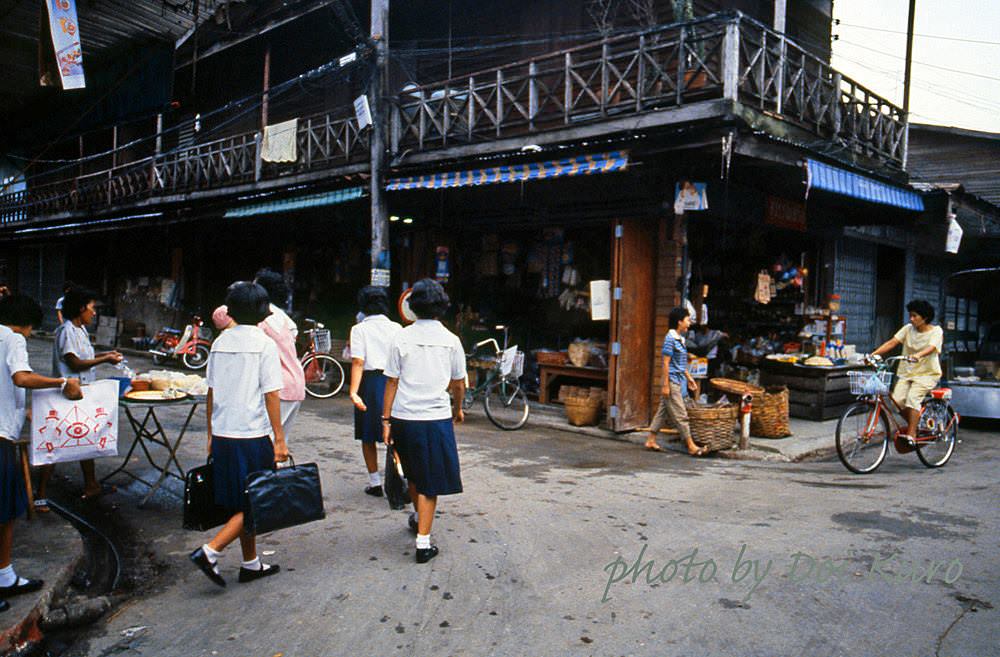
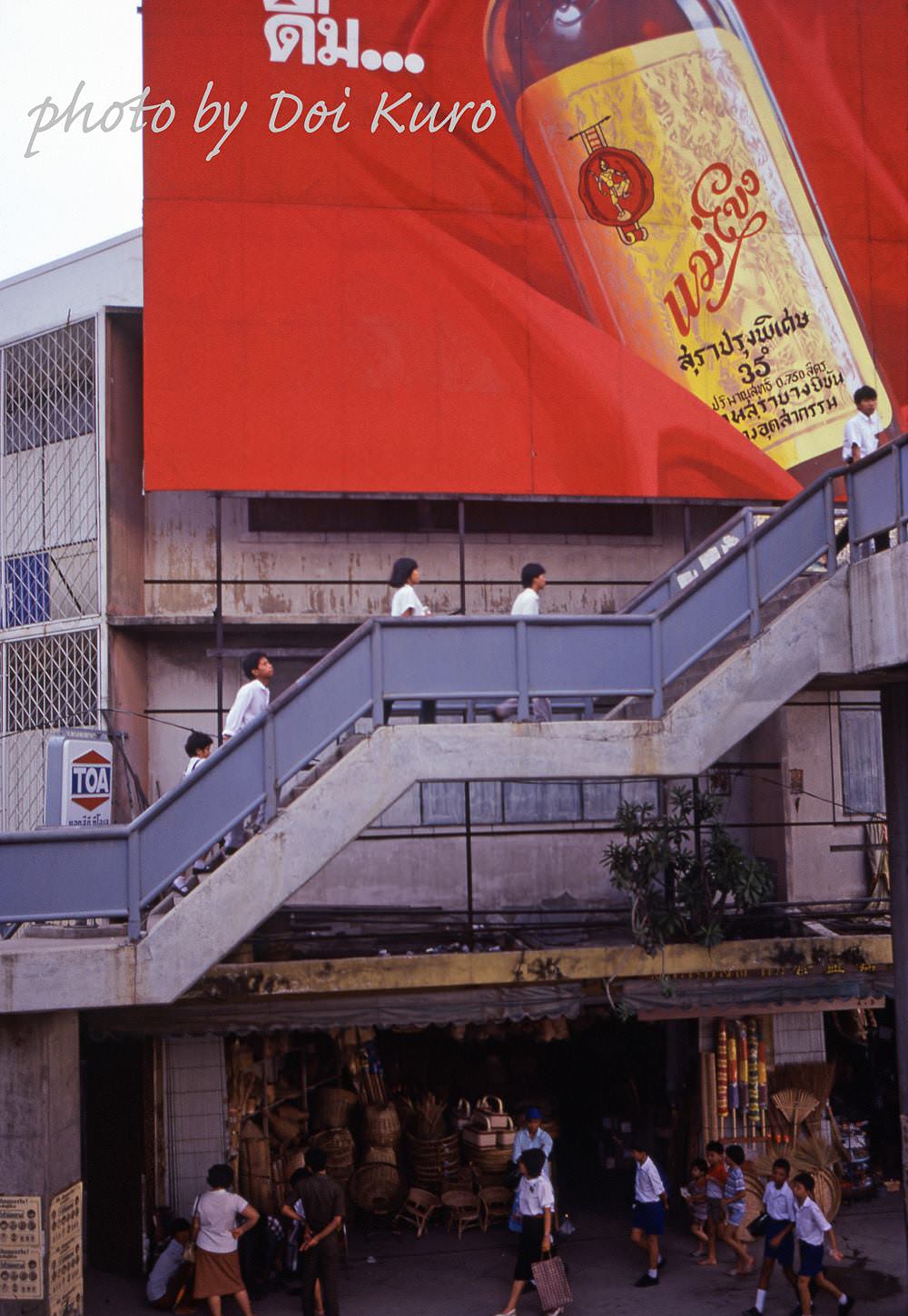
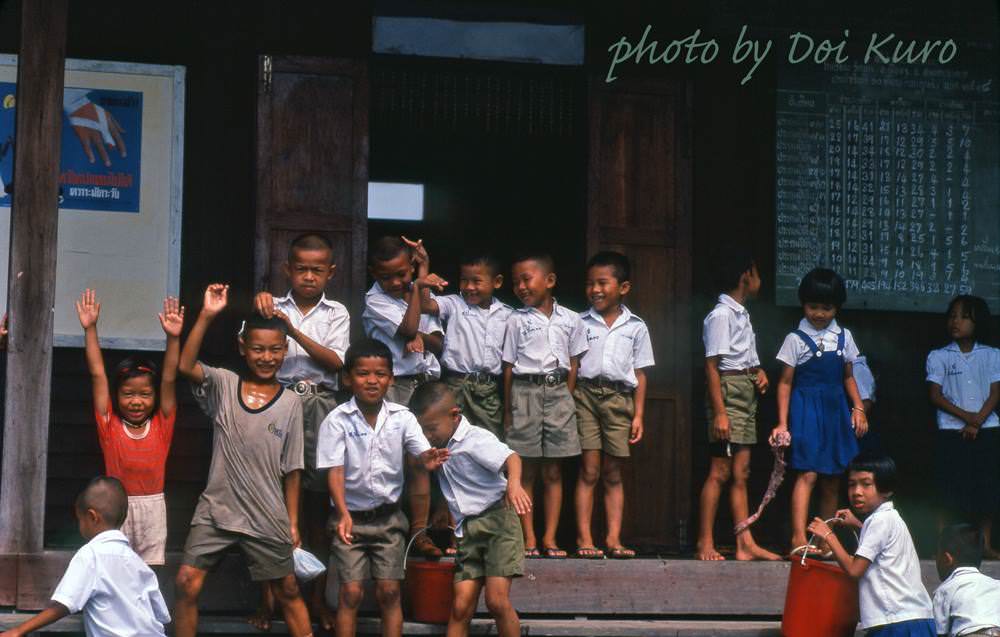
School uniforms were — and still are — mandatory in Thai public schools. Girls wore white blouses with dark skirts, and boys wore white shirts with dark trousers. Seeing uniformed students on the streets of Bangkok was a constant backdrop to the city’s daily rhythm, from early morning until the afternoon hours when schools let out.
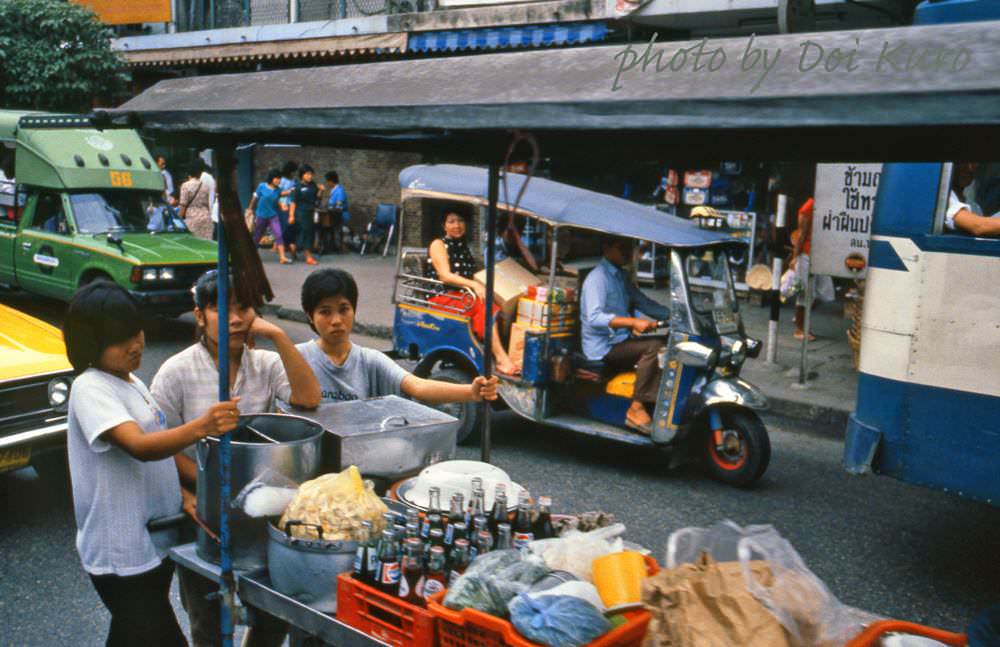
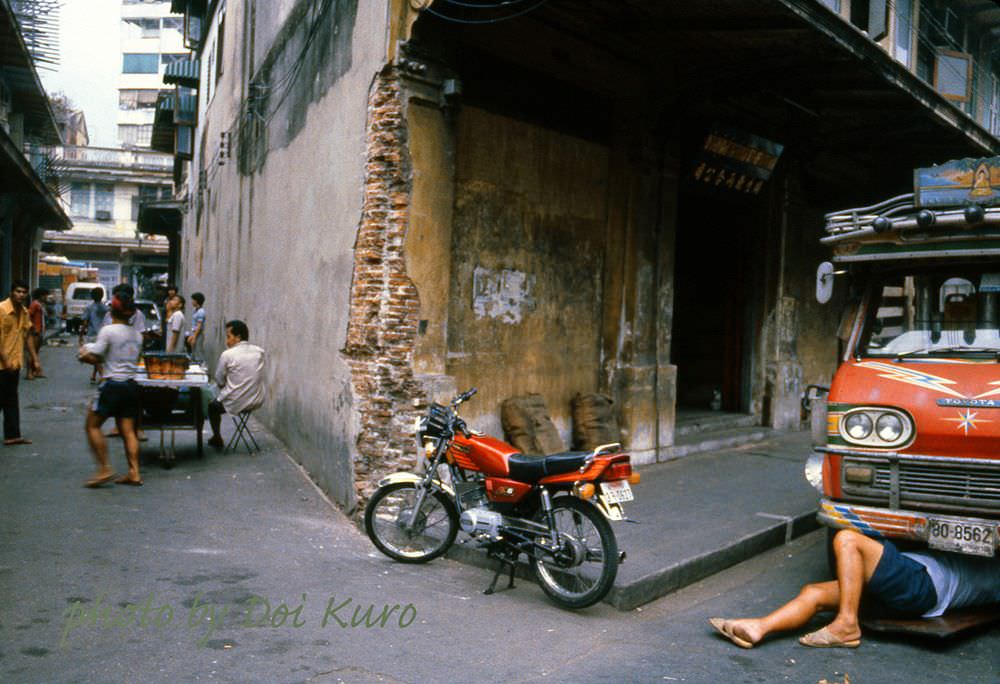
Roadside mechanics were a fixture of Bangkok’s streets. With workshops scarce and repair costs at formal garages steep for working-class residents, many mechanics set up directly on the pavement. Tools, spare parts, and oil-stained concrete were the workspace. Cars and motorcycles were serviced in the open air, often just feet from passing traffic.
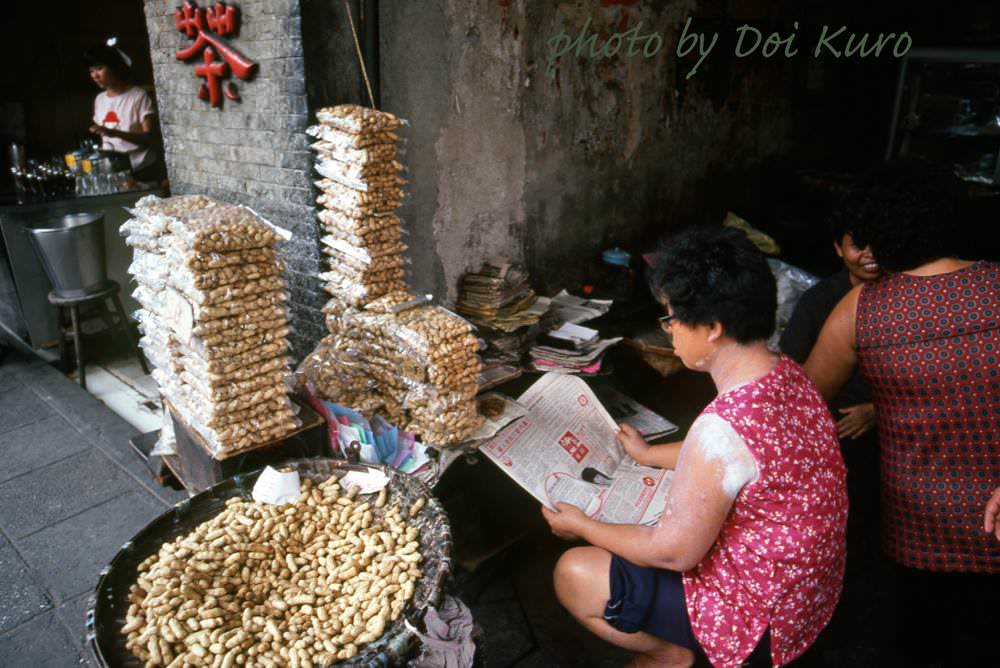
Street food vendors filled Bangkok’s sidewalks at every hour. A peanuts vendor required little more than a cart, a heat source, and a busy corner. These small operators were part of the city’s informal economy — selling affordable snacks to pedestrians, workers, and students passing by throughout the day.
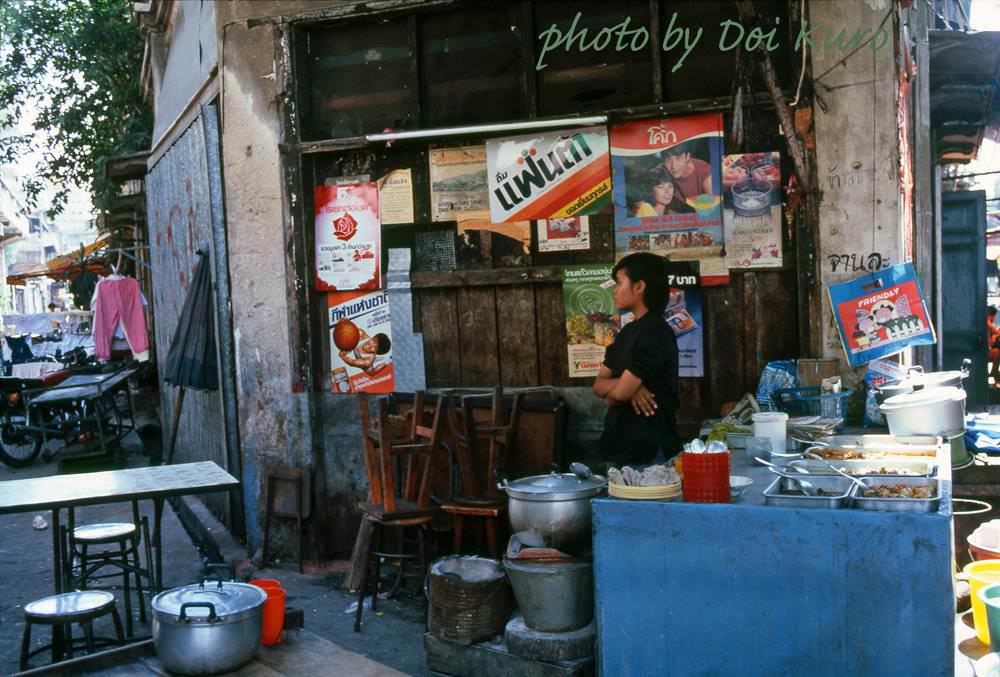
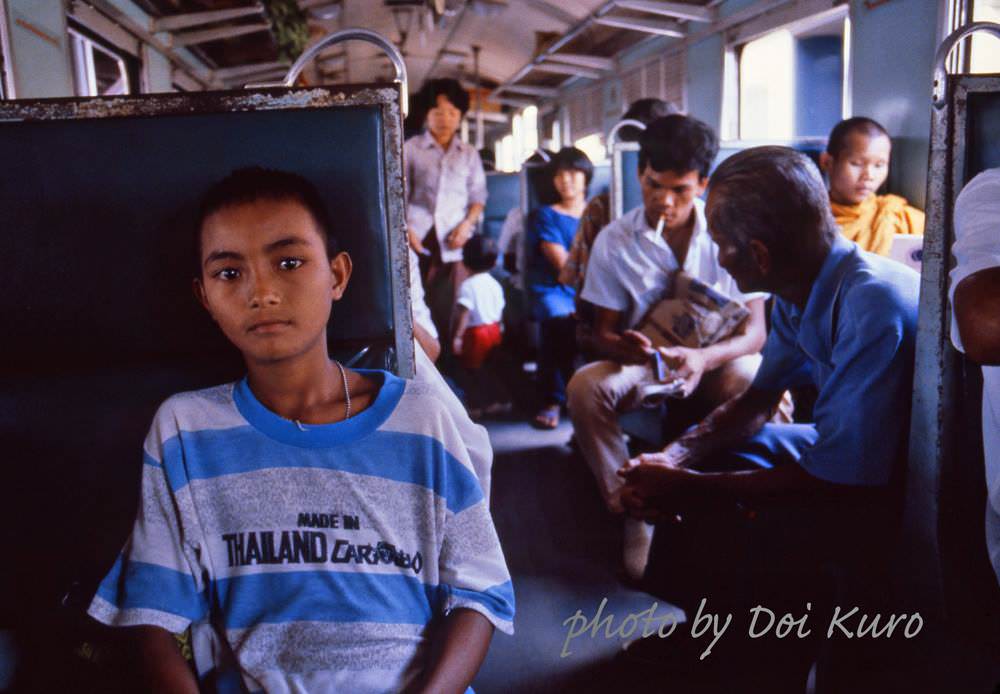
Bangkok’s rail connections in the early 1980s relied on the State Railway of Thailand, which ran through Hua Lamphong Station. Trains were an affordable way to travel within and beyond the city, and their carriages carried a cross-section of Bangkok’s population — commuters, families, and children like the boy Doi Kuro photographed mid-journey.
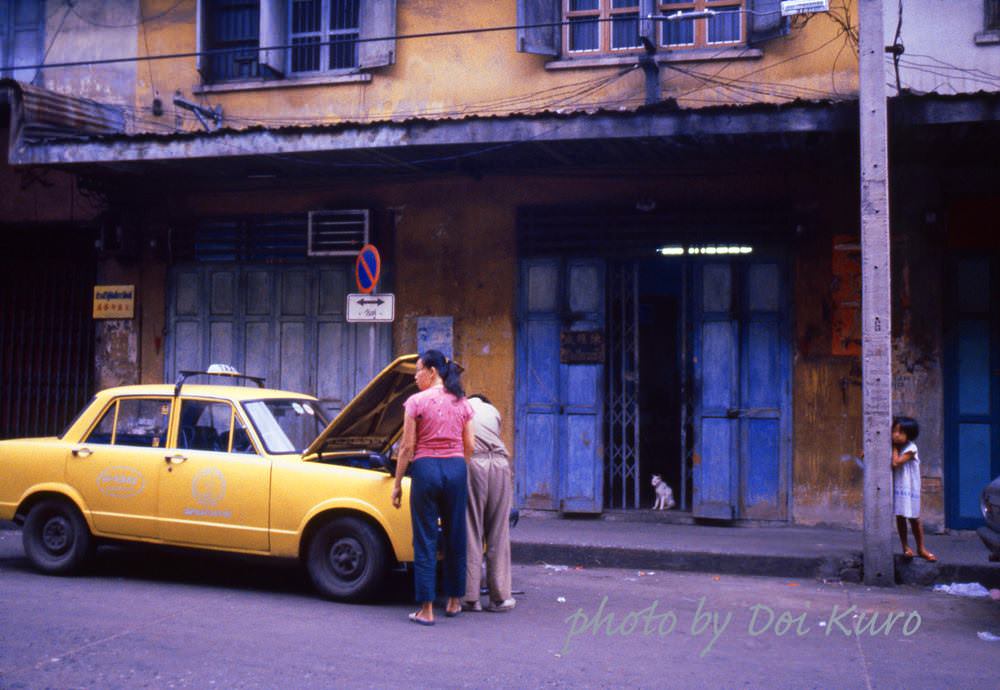
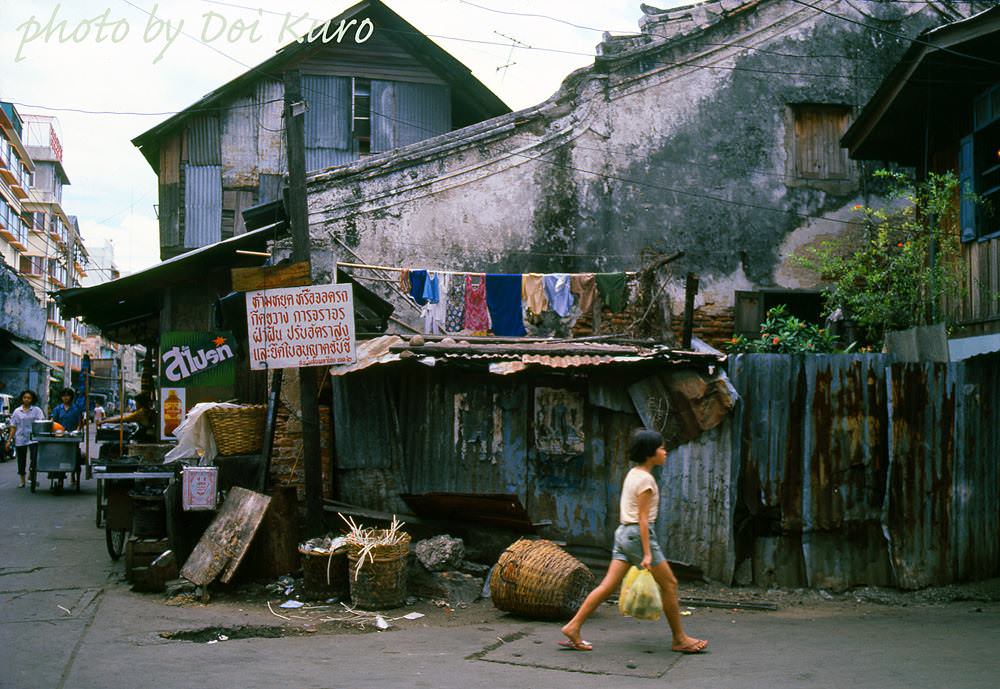
Ordinary errands made up much of what Doi Kuro captured. A girl carrying items home from a shop, a taxi being repaired at the curb — these were not staged moments. They were the unremarkable routines of city life that, when photographed with care, become a precise record of how people actually lived.
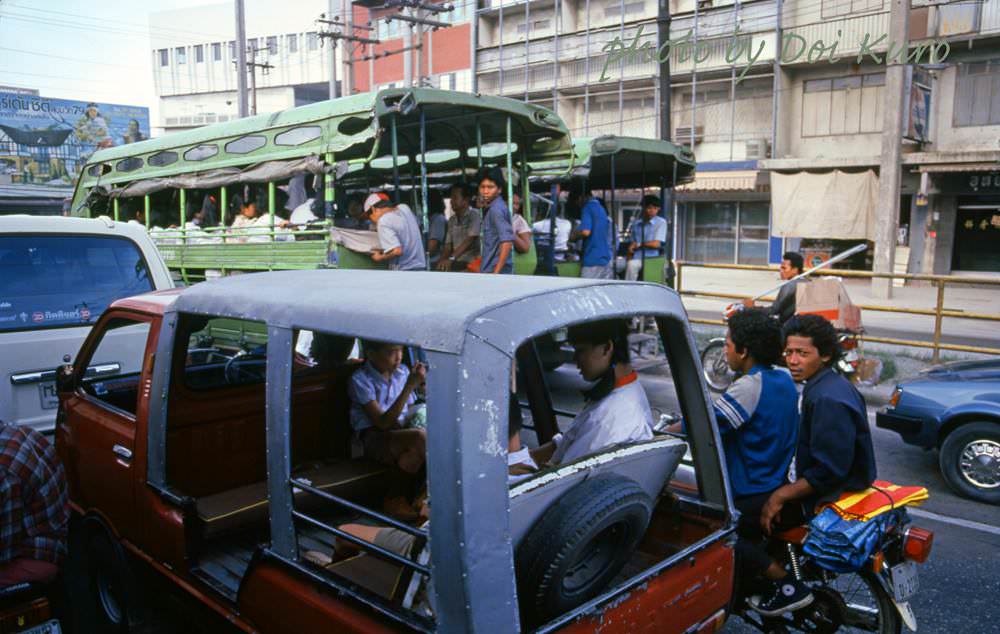
Traffic congestion was already a defining problem in 1980s Bangkok. The city’s infrastructure had not kept pace with its population growth, and the number of registered vehicles was climbing rapidly. Long backups during peak hours were routine, stretching across major roads and spilling into side streets. This was a daily reality for Bangkok residents long before the city became internationally associated with gridlock.
Bangkok’s movie theater culture was still thriving in the early 1980s, but some older cinemas were already being torn down to make way for new developments. The demolition of a theater was a small but visible sign of the city changing — old entertainment venues giving way to commercial buildings as Bangkok’s economy expanded.
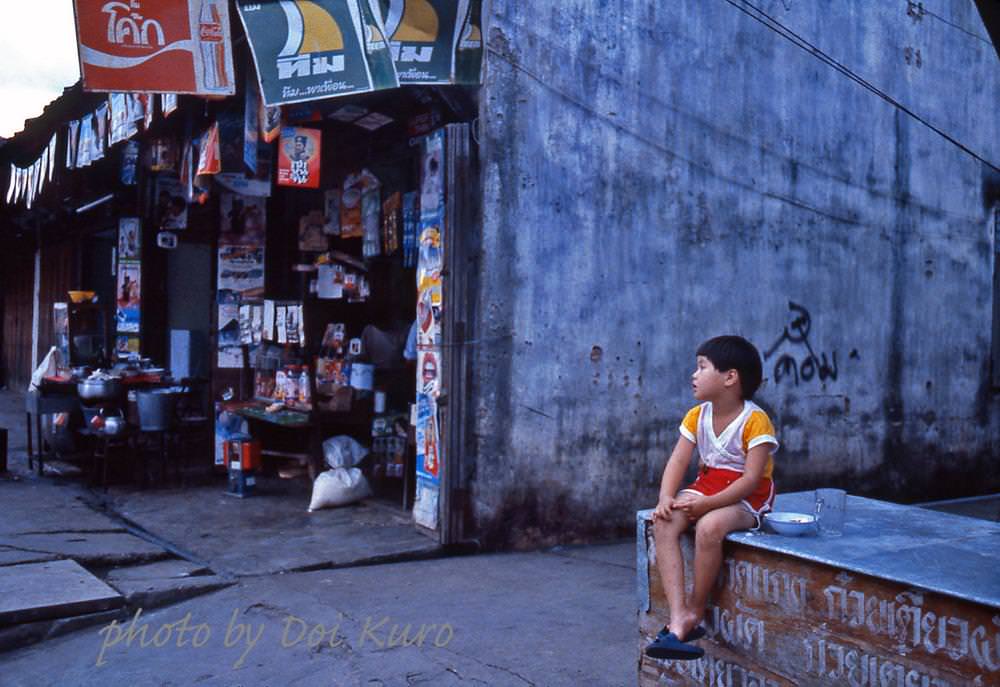
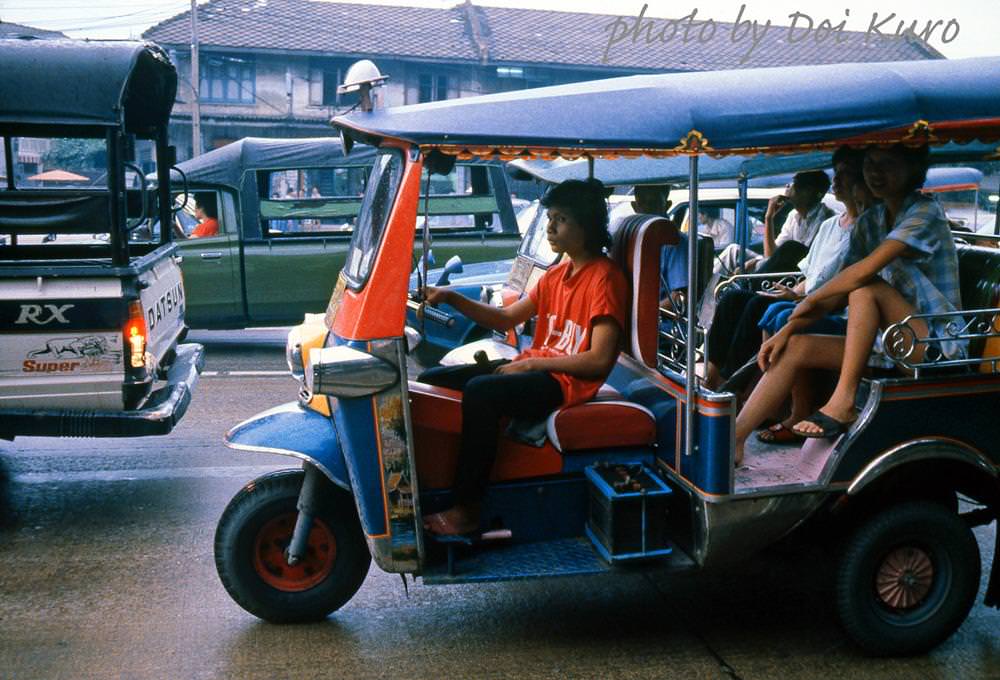
The tuk-tuk — a three-wheeled motorized vehicle — was one of Bangkok’s most recognizable forms of transport. Louder and faster than a bicycle rickshaw, it could navigate narrow lanes that larger taxis could not. Drivers typically negotiated fares directly with passengers, and the vehicles were a constant, noisy presence throughout the city’s streets.
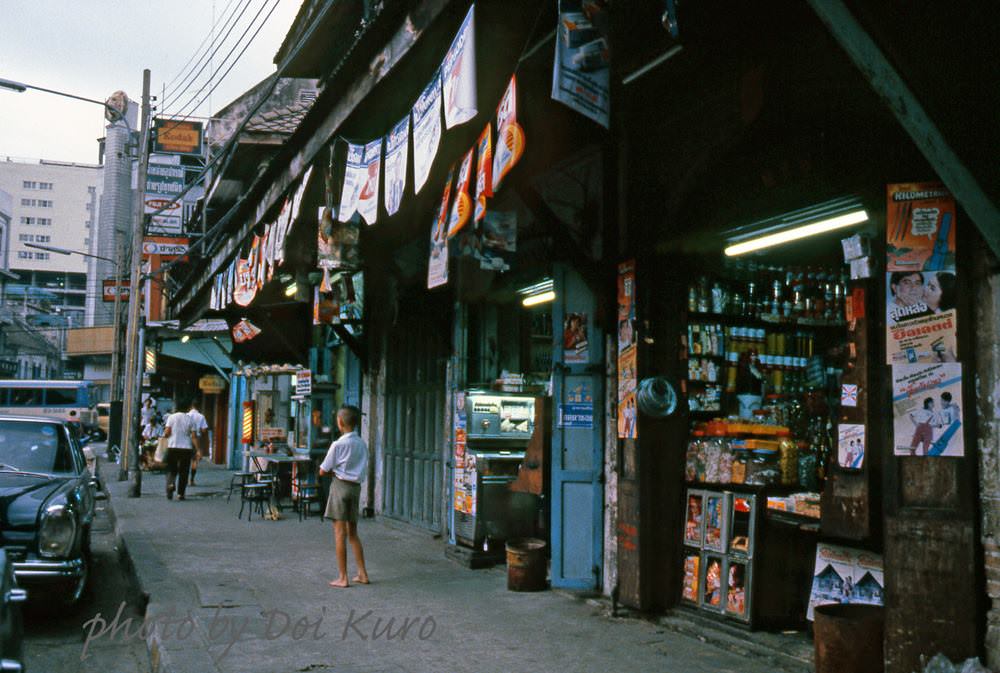
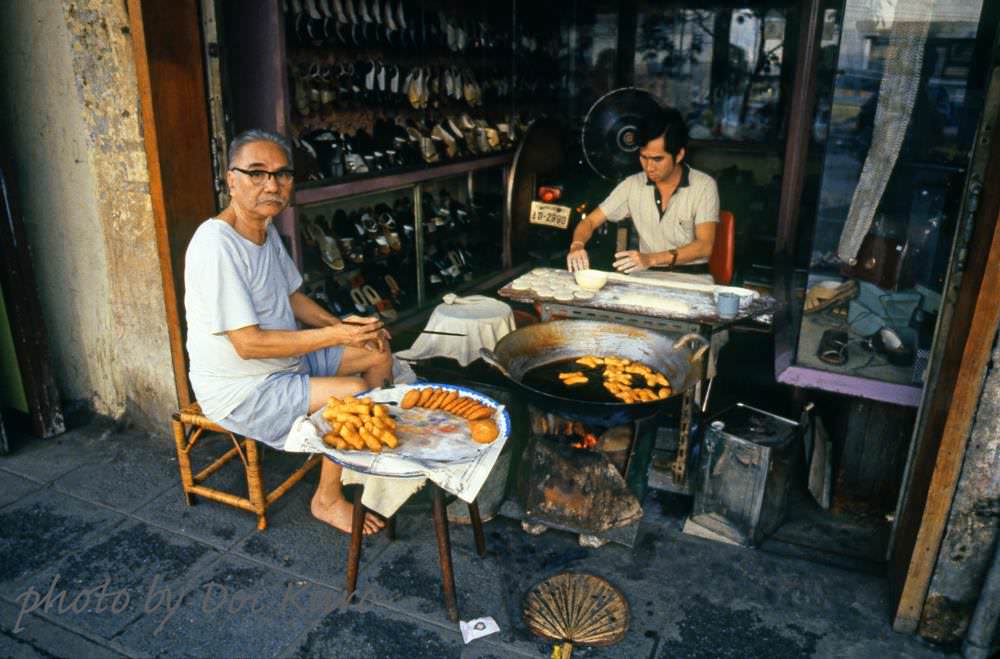
Fried dough sticks, known in Thai as patongko — borrowed from the Chinese youtiao — were a popular breakfast item sold at street stalls across Bangkok. Vendors fried them fresh and served them alongside hot soy milk or congee. The stalls were a morning fixture near markets, schools, and transit stops, drawing long lines of early risers before the workday began.
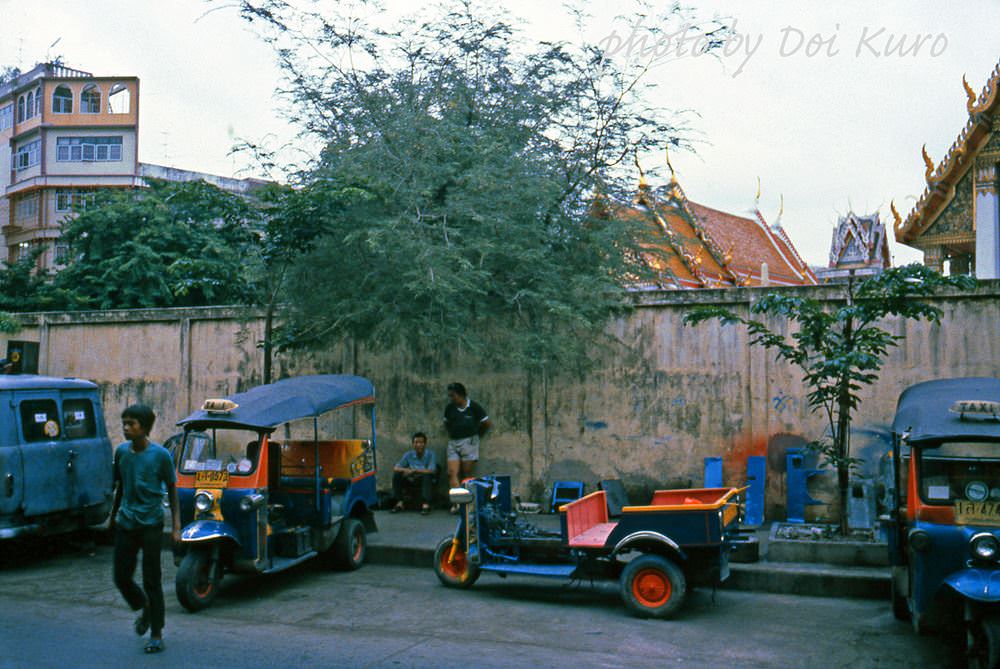
Tuk-tuks required frequent maintenance, and small garages dedicated to their repair were scattered across Bangkok’s neighborhoods. These workshops handled everything from engine work to bodywork on the distinctive three-wheelers. Like the roadside car mechanics, tuk-tuk repair shops operated in simple, open settings — often just a covered space on a narrow lane.
Siam Square in the early 1980s was already emerging as a hub for Bangkok’s younger population. Built in the 1960s on land owned by Chulalongkorn University, the area’s grid of small lanes held shops, restaurants, and cinemas. In this period it had a distinct student and youth culture, setting it apart from the older commercial districts elsewhere in the city.
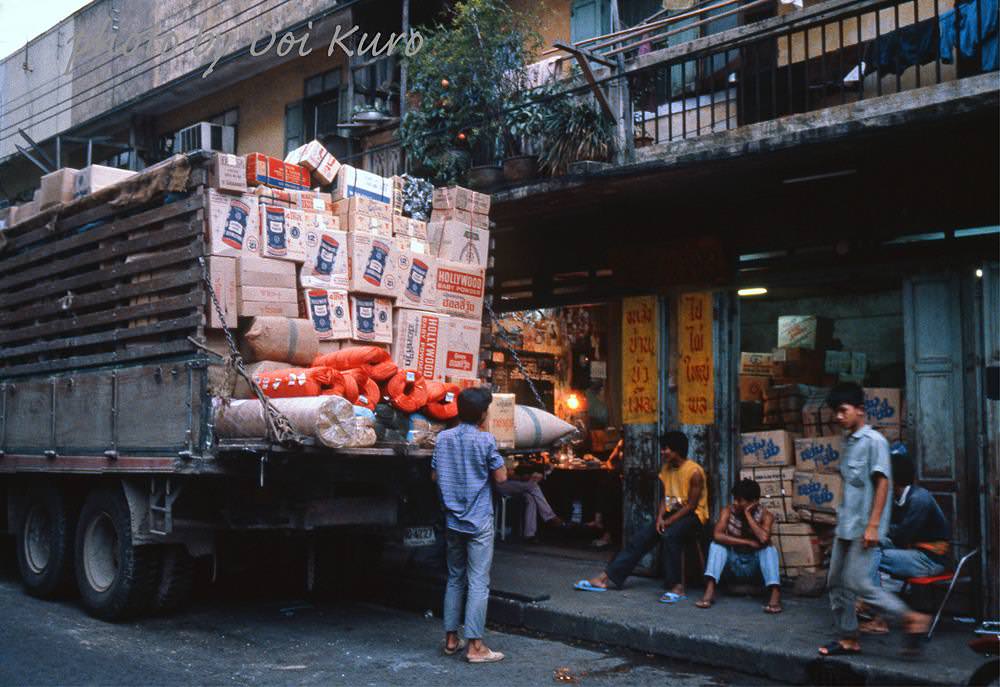
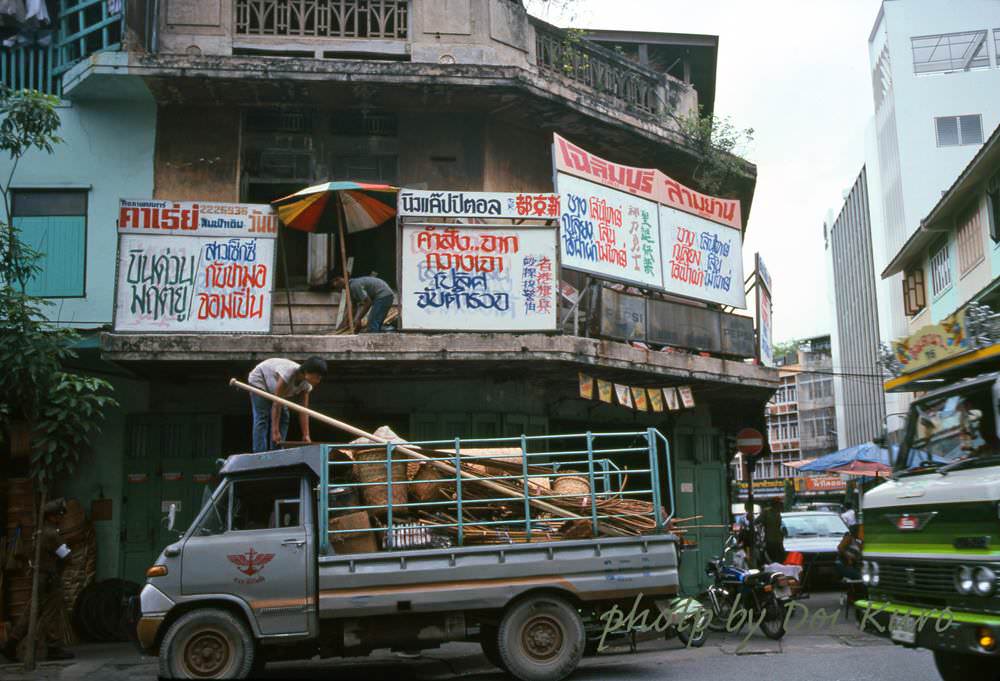
Goods moved through Bangkok by truck, and overloaded vehicles were a common sight on the roads. Trucks carried building materials, produce, manufactured goods, and just about everything else the city needed to function. The sight of a fully loaded truck navigating Bangkok’s congested streets illustrated the sheer volume of commerce flowing through the city every day.
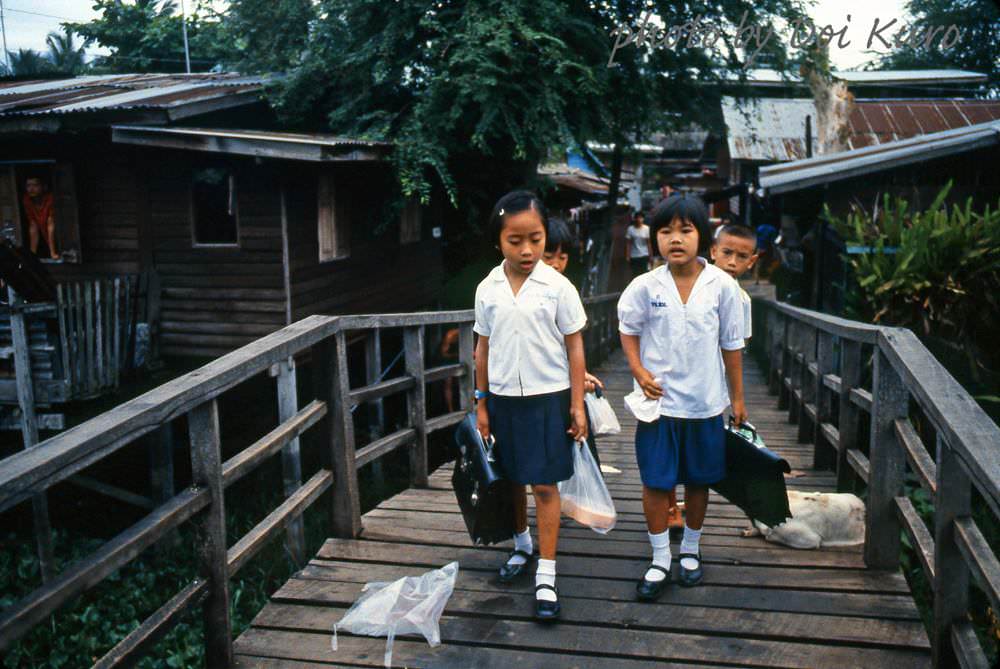
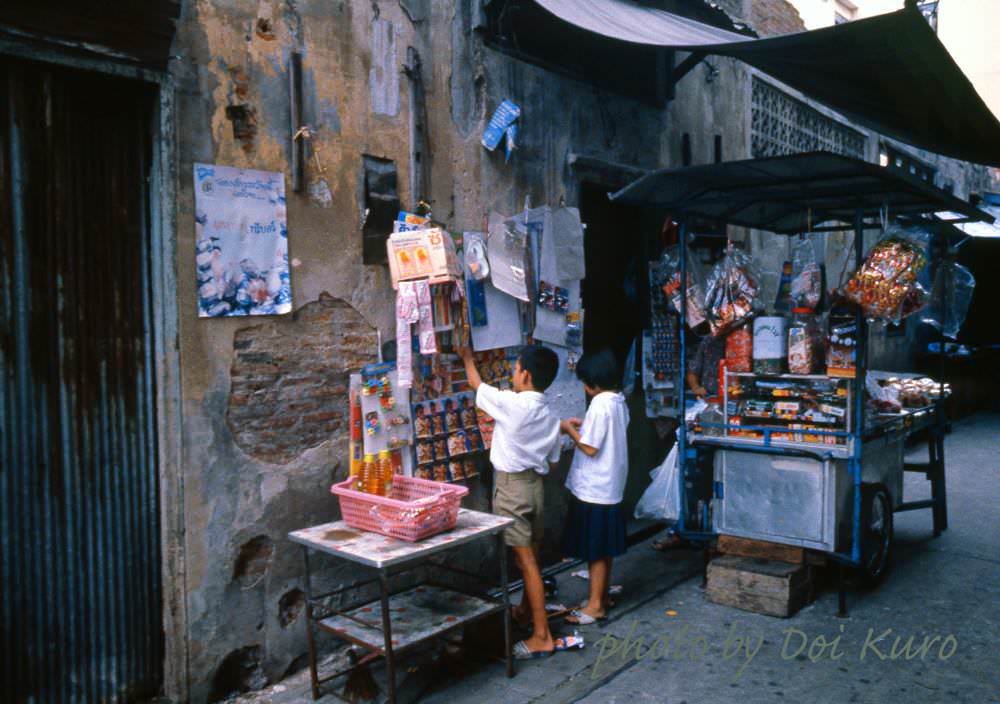
Many children in Bangkok walked to school in groups, navigating busy streets and crowded sidewalks. The morning walk to school was a shared routine across the city’s neighborhoods, from the shophouse districts of Chinatown to the quieter residential lanes further from the center.
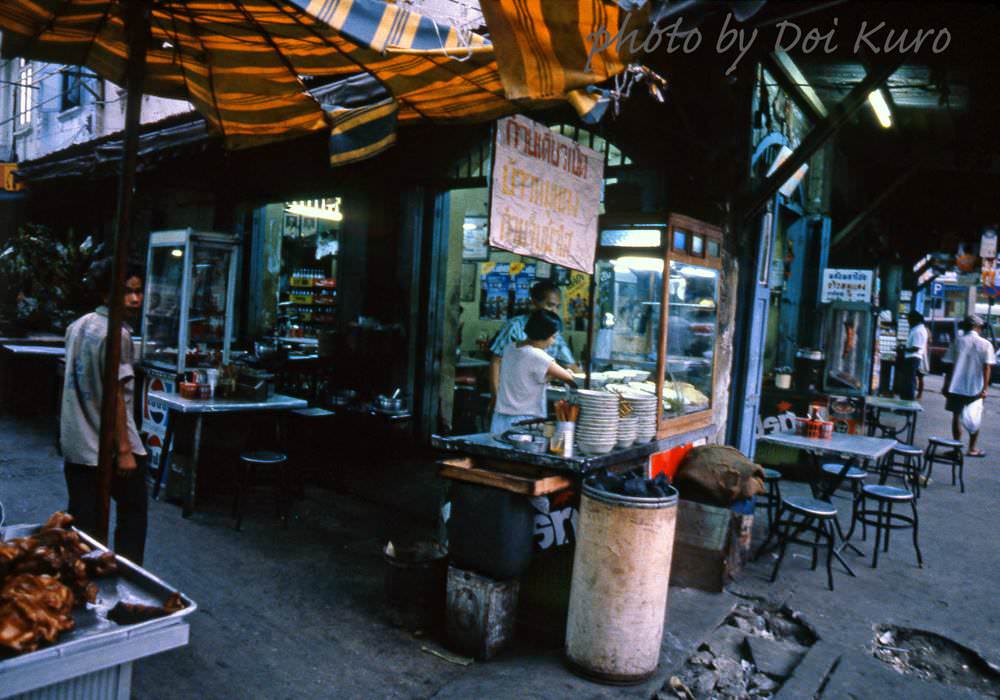
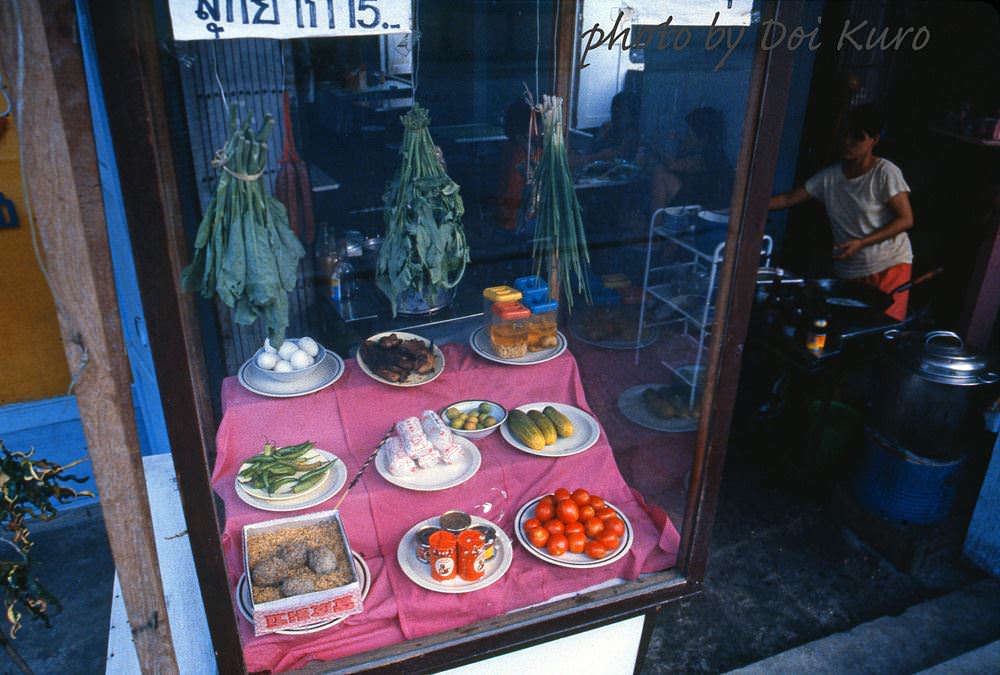
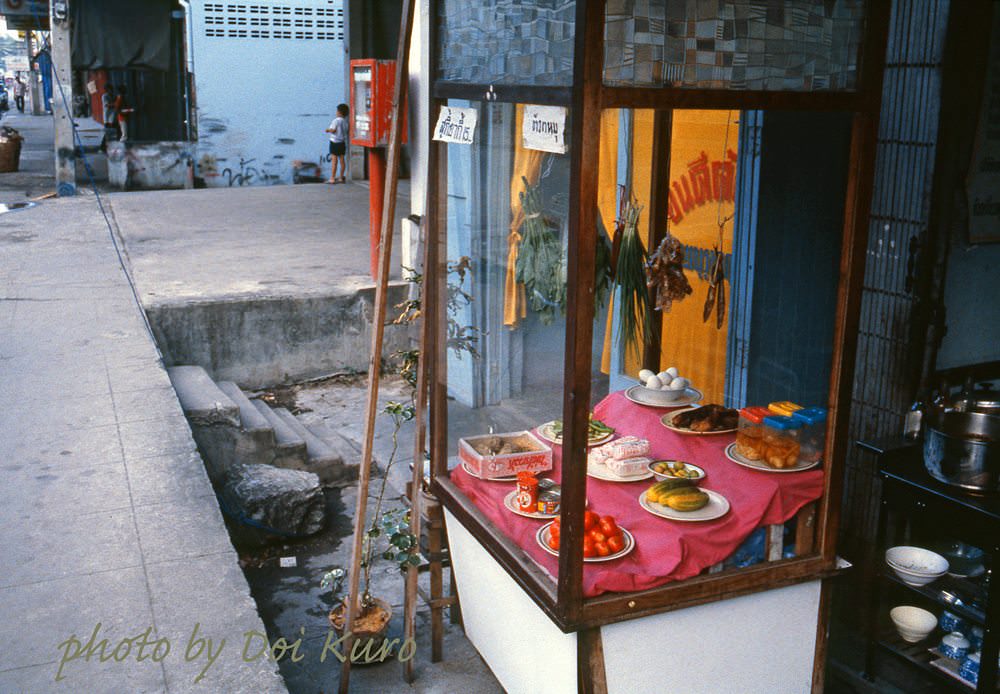
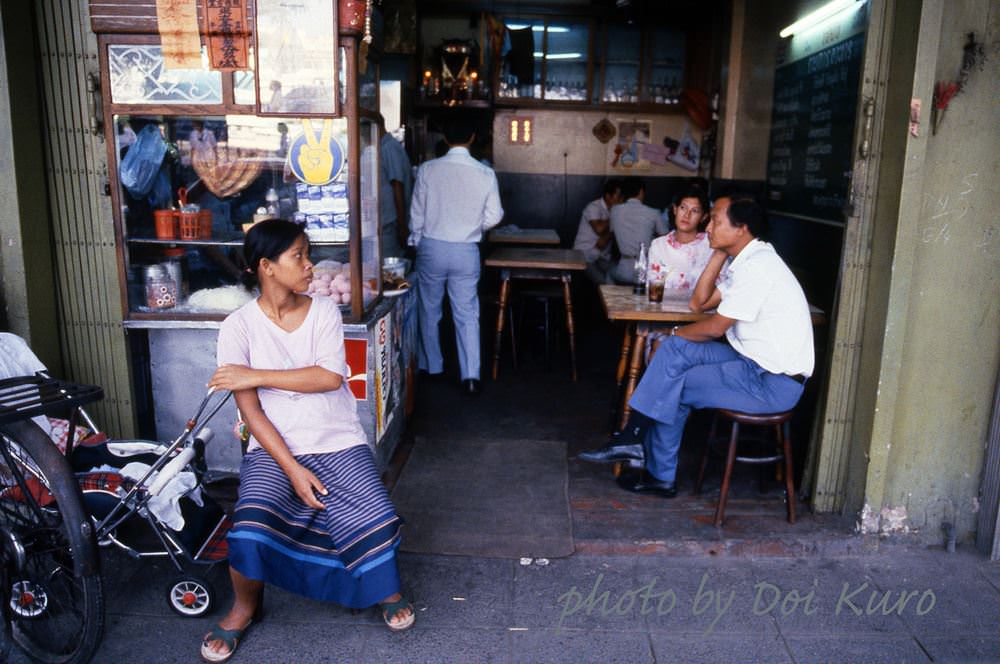
Food displays outside restaurants and stalls were a standard way of attracting customers in Bangkok. Rather than printed menus, many establishments placed prepared dishes or raw ingredients in glass cases at the front, letting diners see exactly what was on offer before they sat down. It was a practical and direct form of advertising that required no literacy to understand.
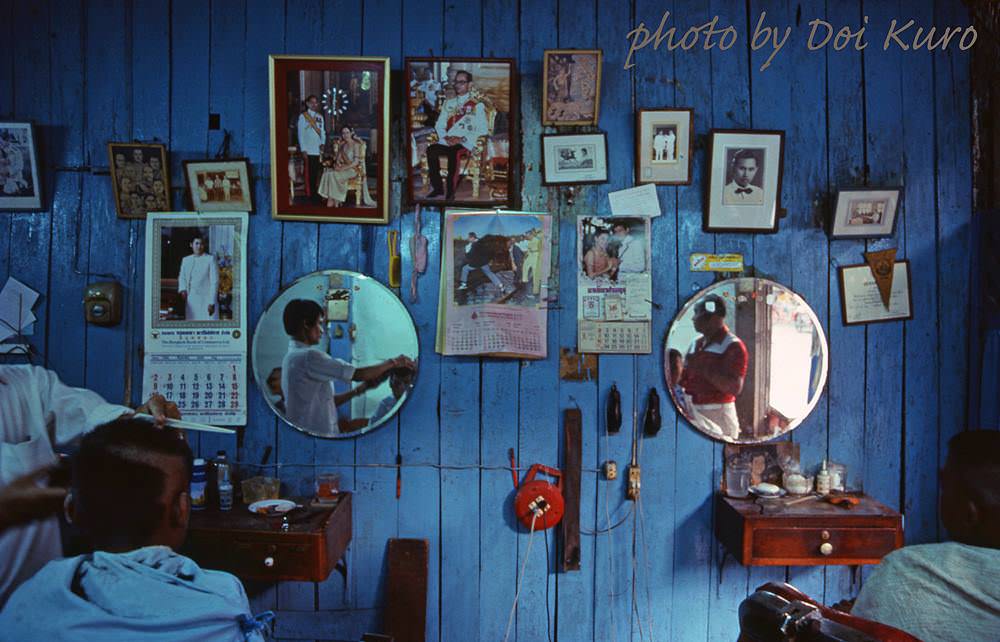
Barbershops in 1980s Bangkok were neighborhood institutions. Modest storefronts with a single chair and a large mirror, they served as gathering points as much as grooming stops. A haircut was inexpensive and fast, and the barber often knew his regular customers by name. Doi Kuro’s photograph captures the shop in its working environment — simple, functional, and well-used.
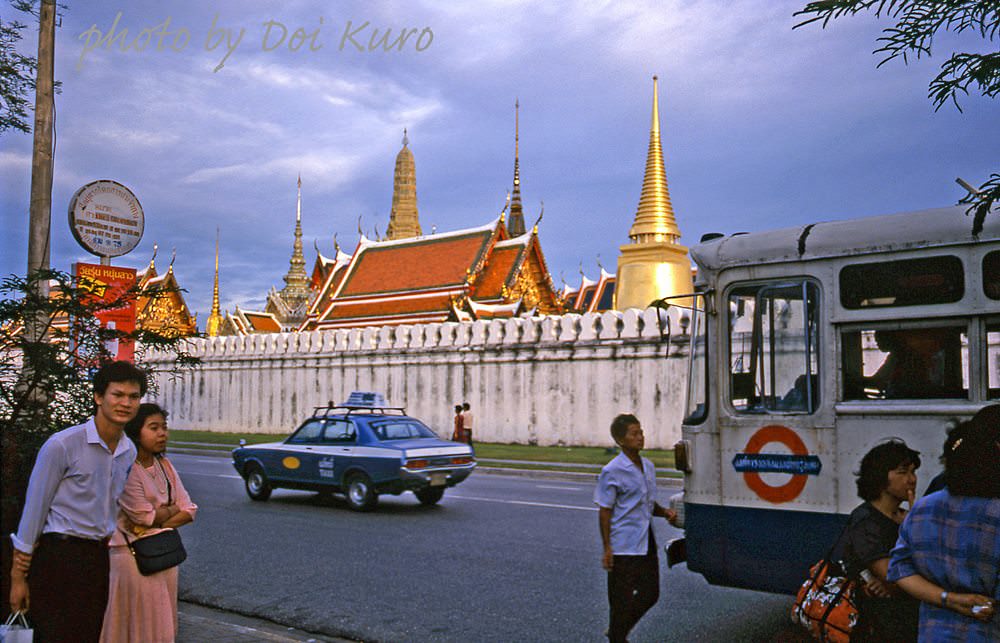
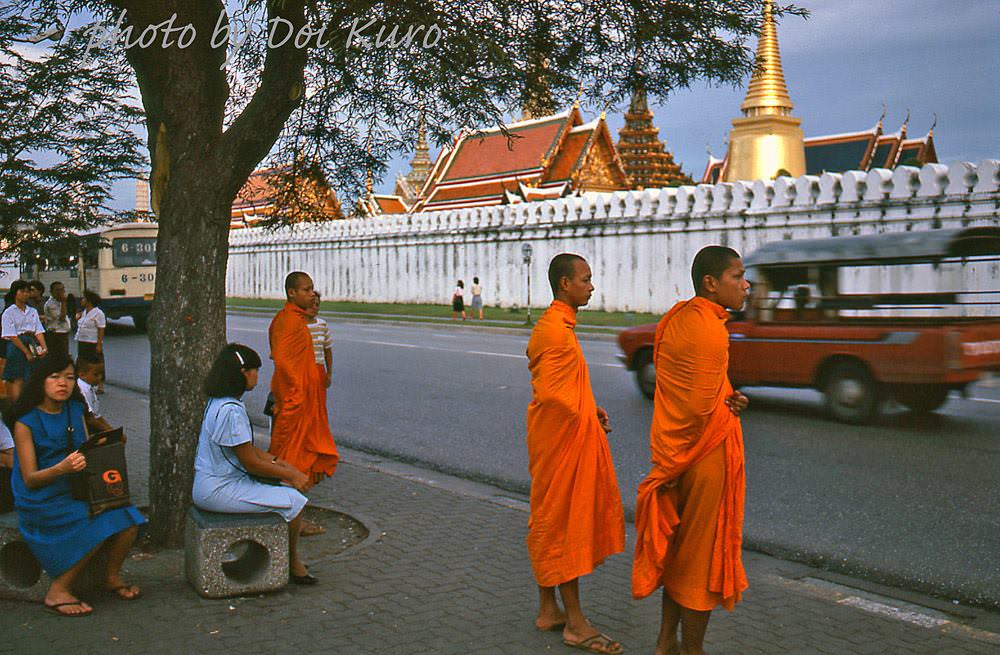
Wat Phra Kaeo — the Temple of the Emerald Buddha — sits within the Grand Palace complex in the historic heart of Bangkok. The bus stop near its walls placed one of Thailand’s most sacred sites directly alongside the ordinary workings of city transit. Commuters and temple visitors waited at the same stop, the ancient walls rising above the everyday scene.
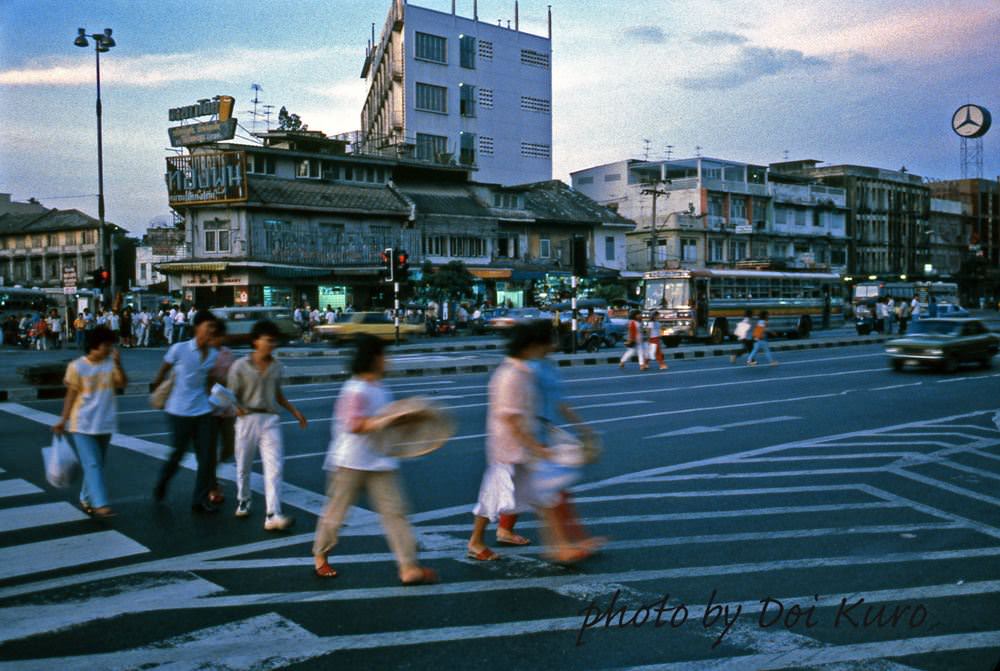
Hua Lamphong Station, Bangkok’s main railway terminal, was built in the early twentieth century and remained the city’s central rail hub throughout the 1980s. The street crossing in front of it was one of the busiest pedestrian areas in the city, with passengers arriving and departing alongside locals who used the surrounding streets daily.
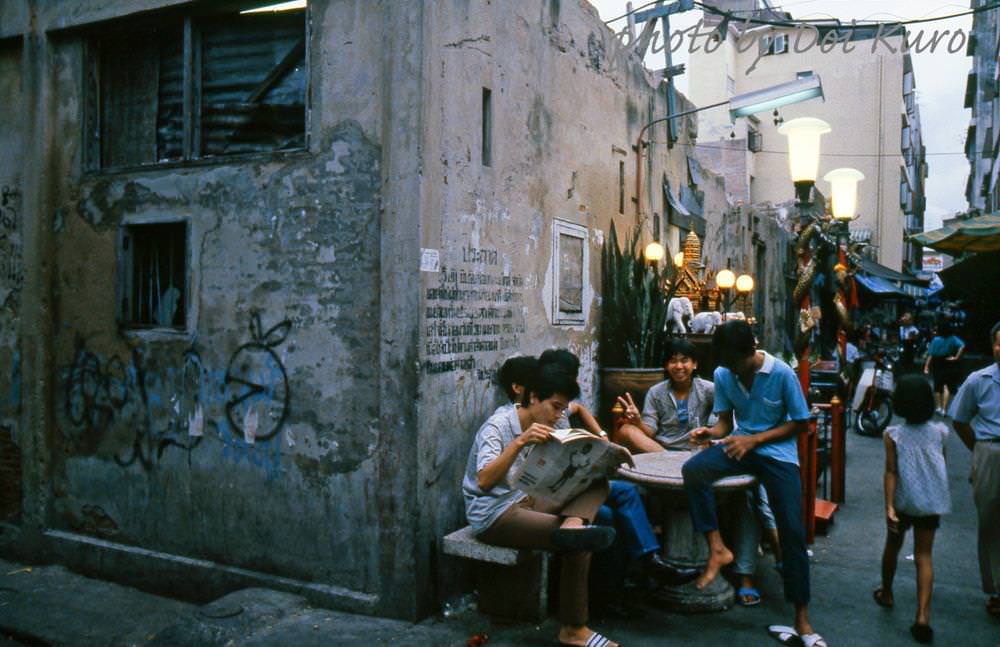
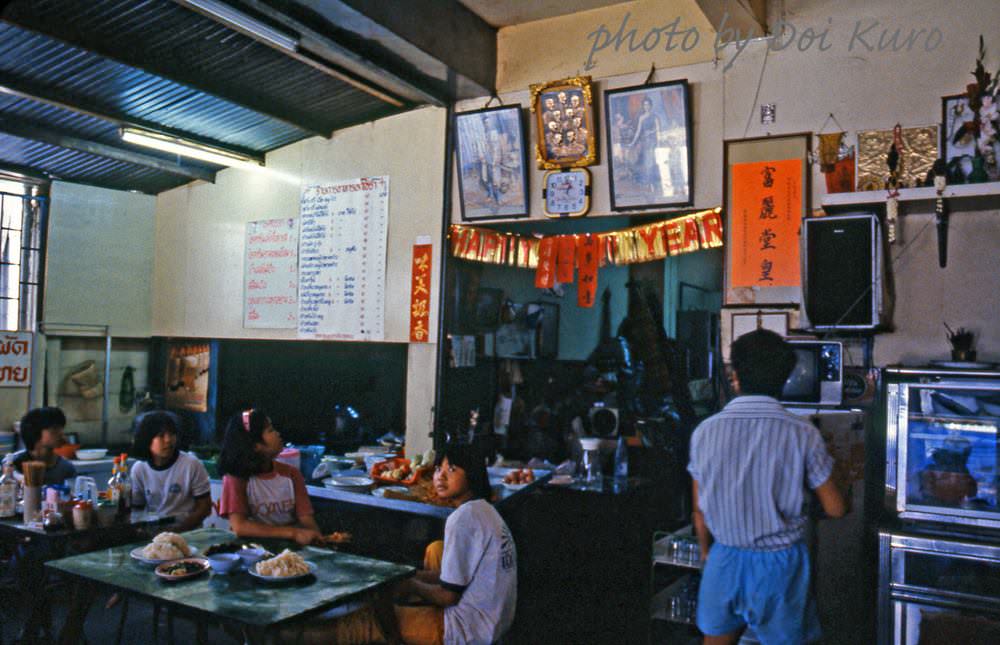
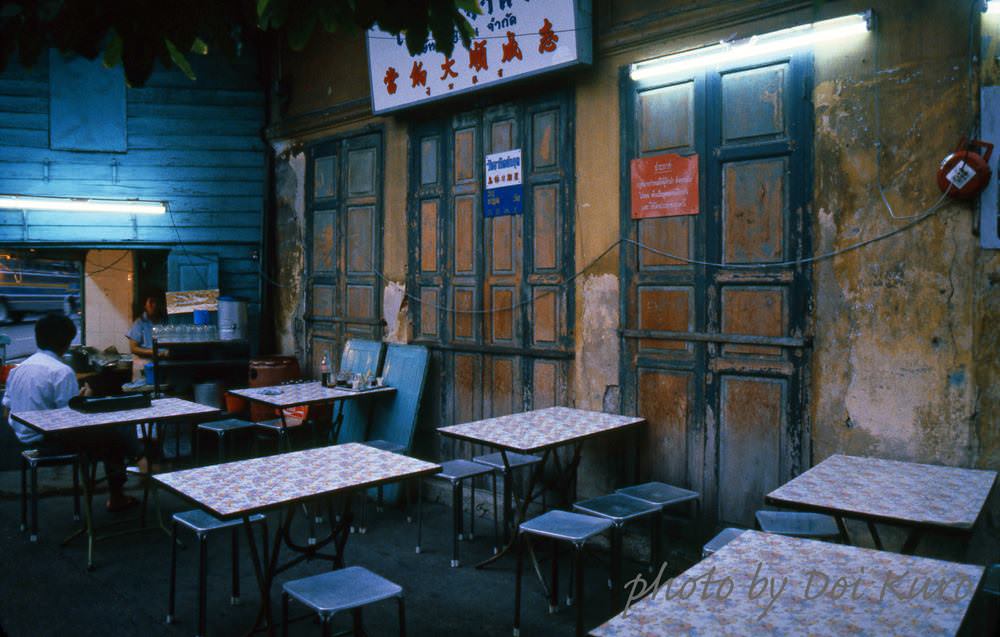
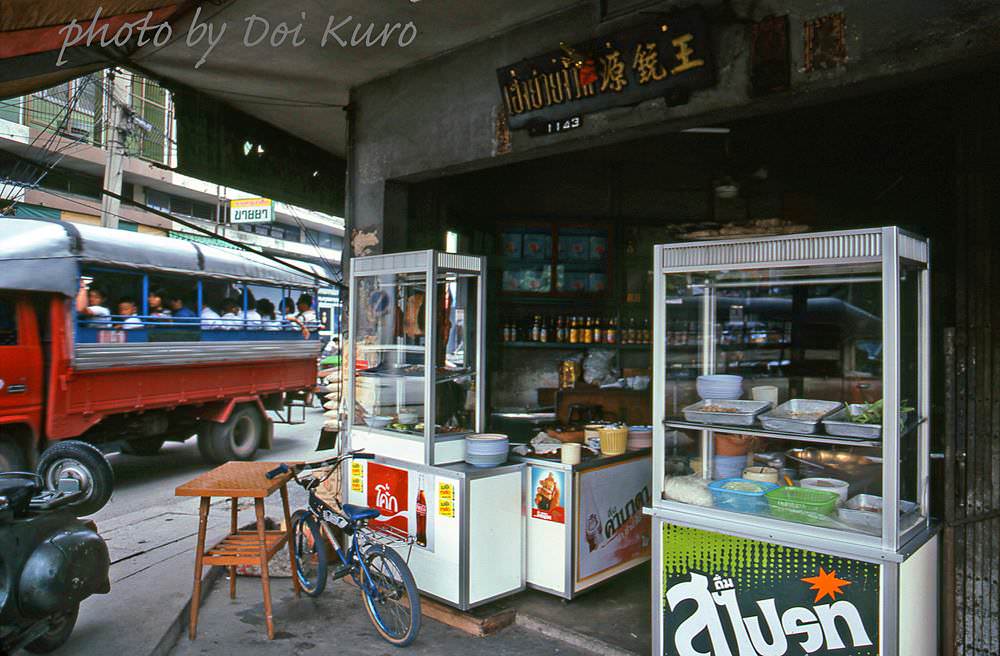
Yaowarat’s restaurants ranged from large, well-lit establishments serving Cantonese and Teochew dishes to simple open-front eateries with folding tables on the pavement. The district’s food scene drew both locals and visitors, and many of its restaurants operated late into the night. Doi Kuro photographed the street’s dining culture at multiple points throughout his time in Bangkok.
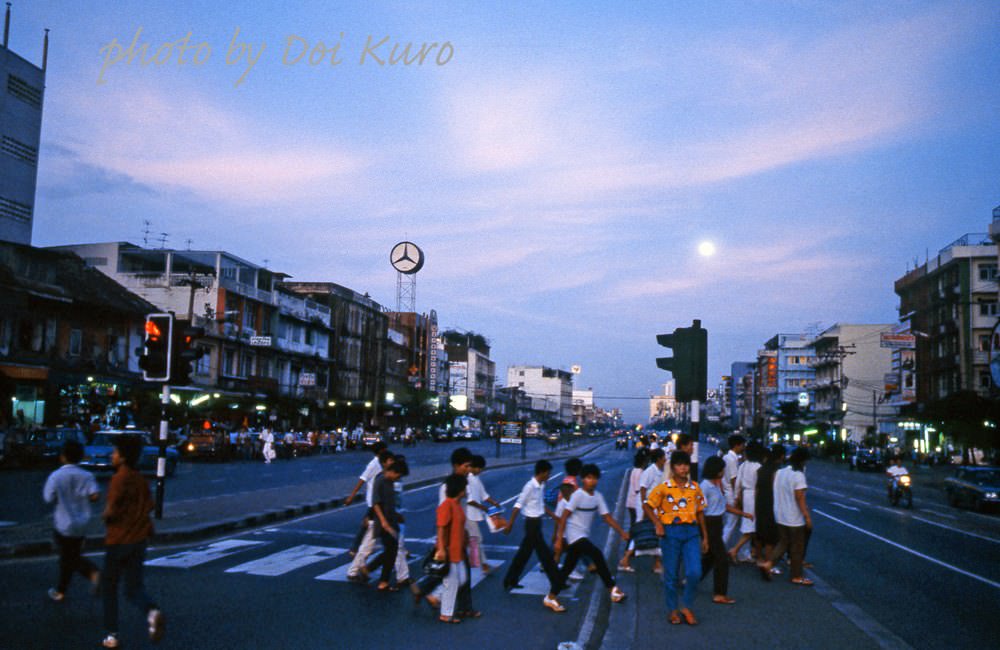
Rama IV Road ran through the southern part of Bangkok’s urban core, connecting several key districts. Doi Kuro’s shot of the moon rising over it shifts the tone of the collection — away from the daytime bustle and into the quieter hours when the city’s pace slowed slightly and its streets took on a different character under low light.
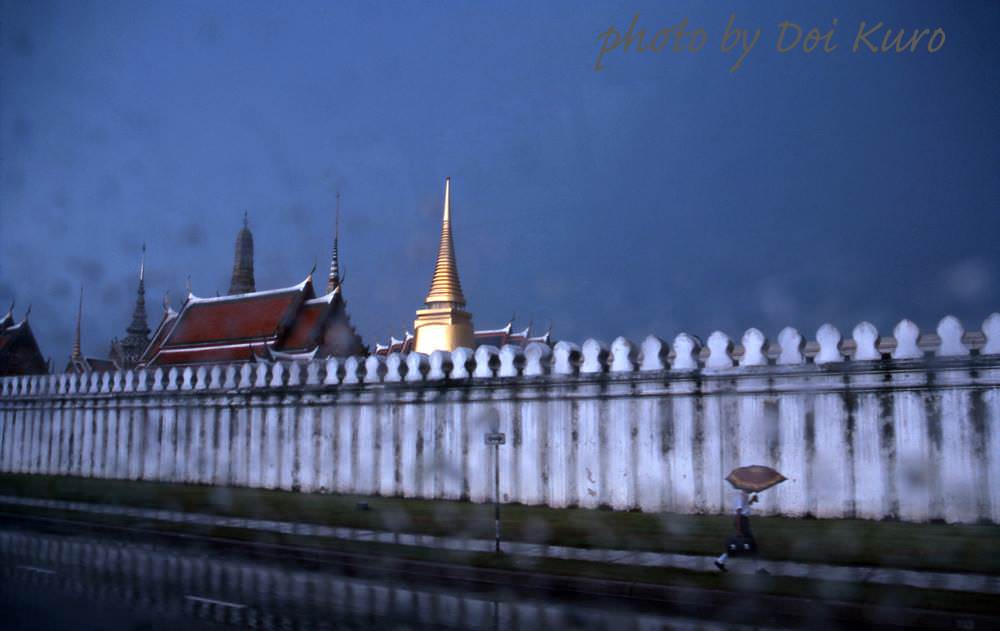
Bangkok’s rainy season runs from roughly May through October, and heavy downpours were a regular feature of city life. Wat Phra Kaeo photographed in the rain presents a different view of one of Thailand’s most-visited landmarks — the gold and mosaic surfaces of the temple complex gleaming under wet skies, the surrounding area emptied of the usual crowds.
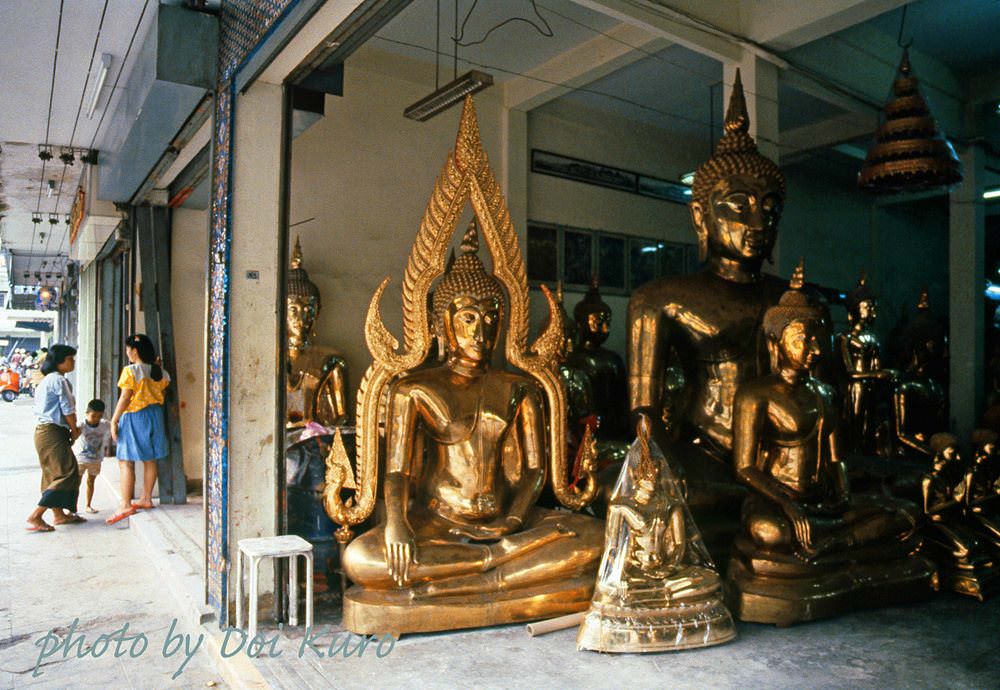
Shops selling Buddha statues and religious items were common throughout Bangkok, particularly in districts near major temples. These stores supplied homes, businesses, and temples with statues in a range of sizes and materials — from small brass figures for household shrines to large stone pieces for temple grounds. Religion was woven into the commercial fabric of the city at every level.
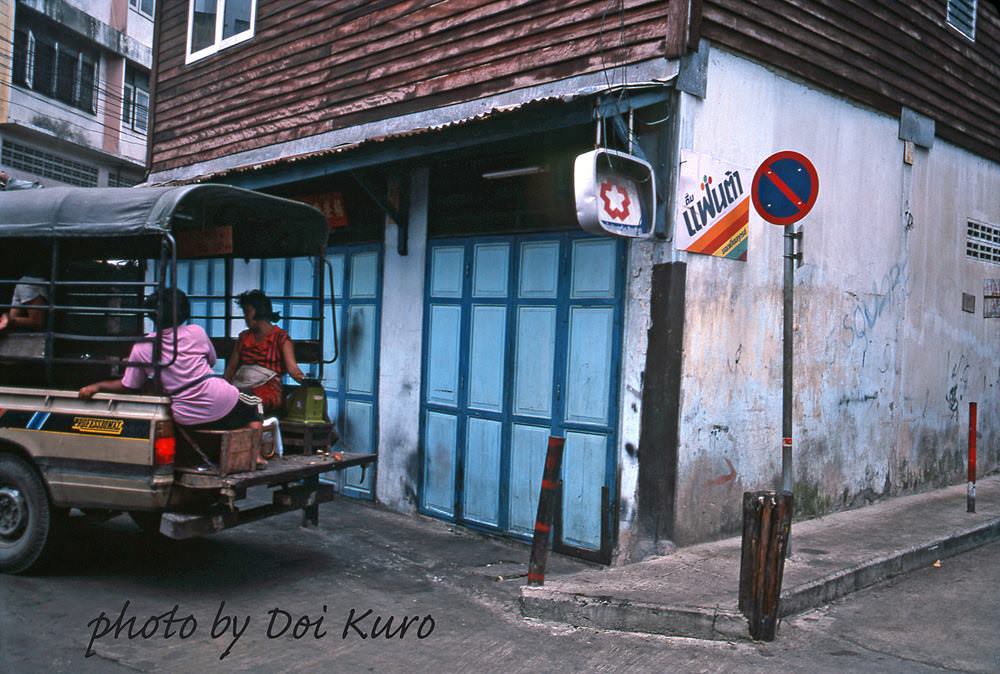
The songthaew — a pickup truck modified with two bench seats in the back — served as shared public transport across Bangkok and the wider region. Passengers climbed in from the rear and paid a flat fare for their journey. It was cheaper than a taxi and more flexible than a fixed bus route, making it a practical option for short trips across the city’s neighborhoods.
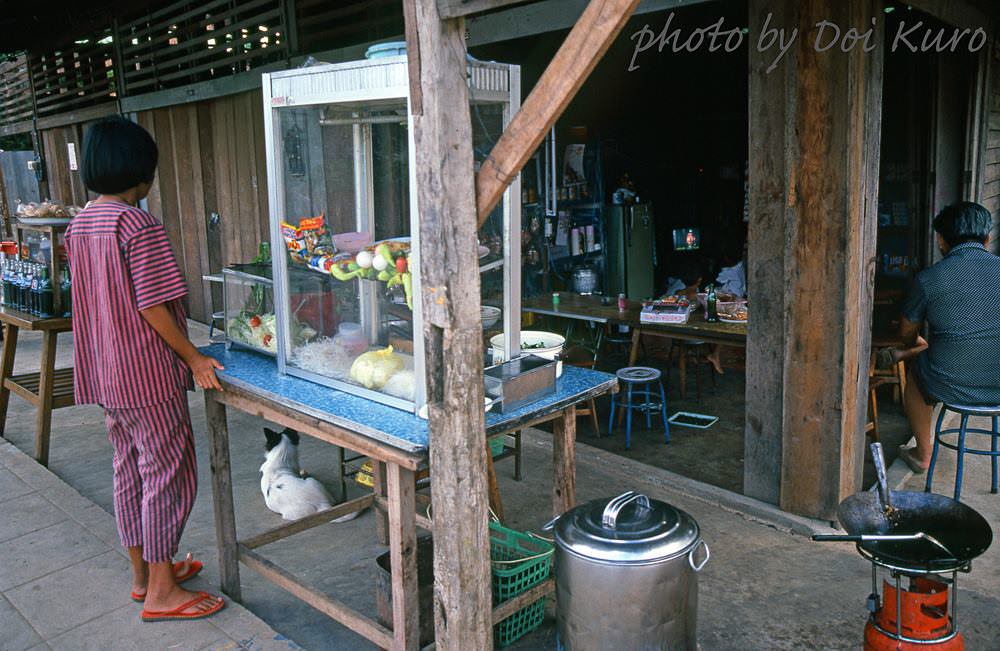
Sidewalk kitchens were the backbone of Bangkok’s street food culture. A cook, a cart, a gas burner, and a handful of ingredients were enough to run a full operation from the pavement. These setups fed office workers, laborers, students, and residents throughout the day, offering hot meals at prices that few sit-down restaurants could match.
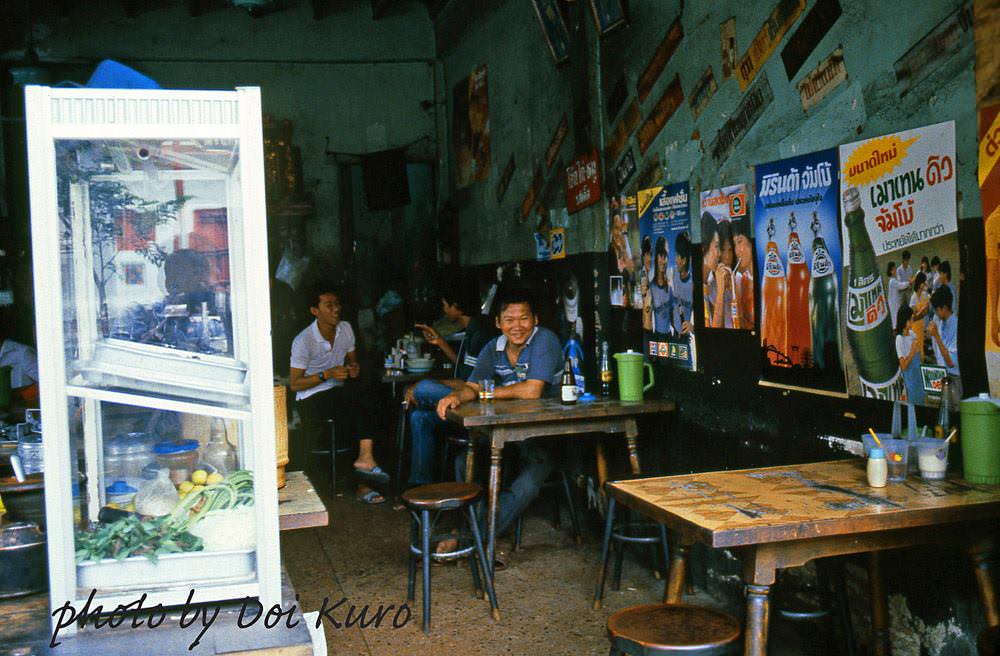
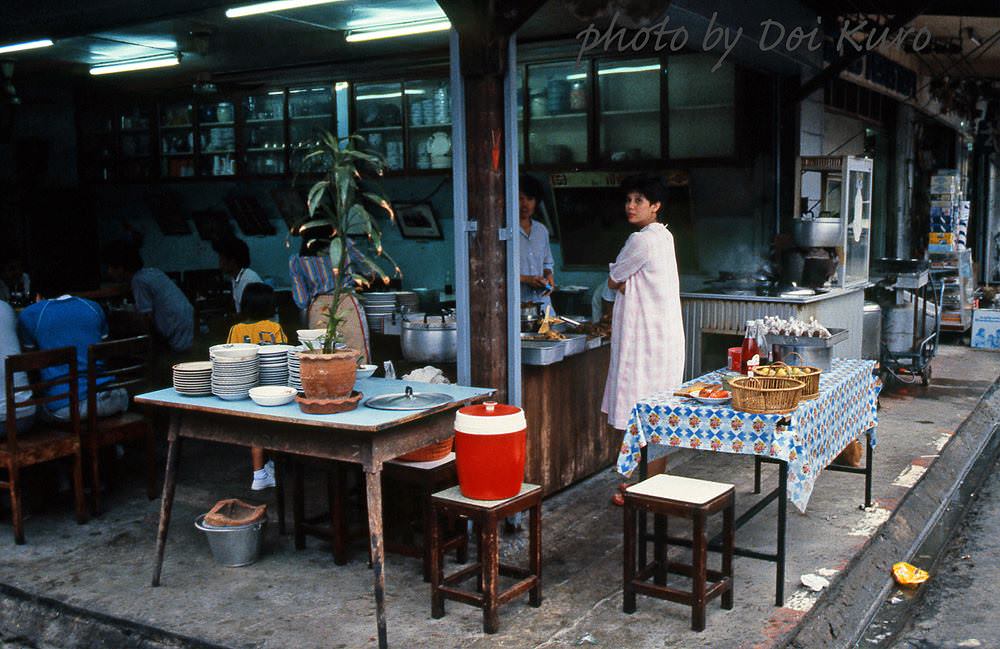
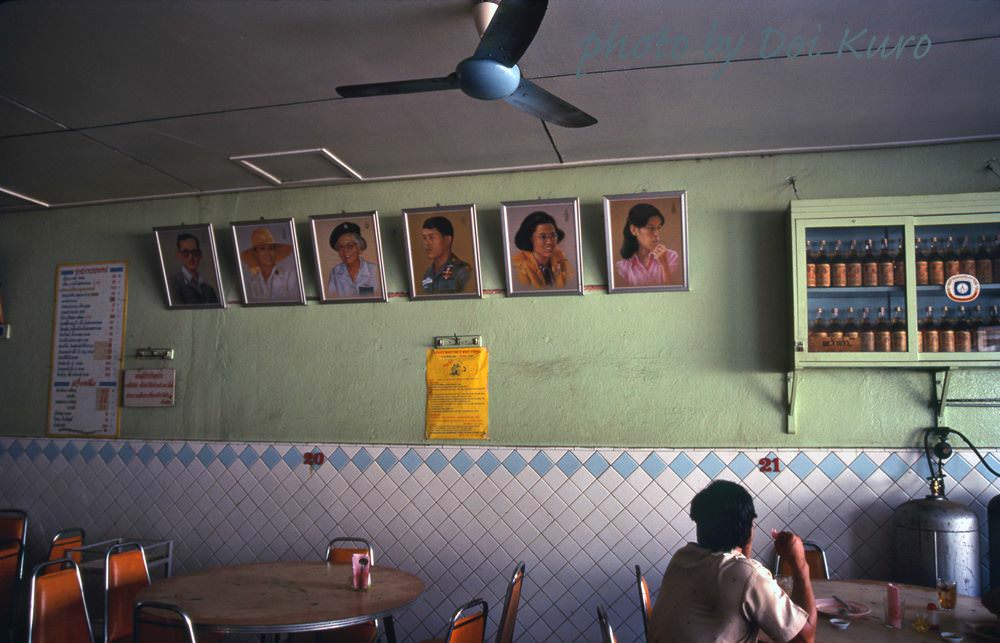
Not every restaurant in Bangkok aimed for efficiency. Some establishments operated at a relaxed pace — open-air seating, unhurried service, ceiling fans turning overhead. These laid-back dining spots were common in residential areas and near markets, offering a place to sit, eat slowly, and spend time without pressure.
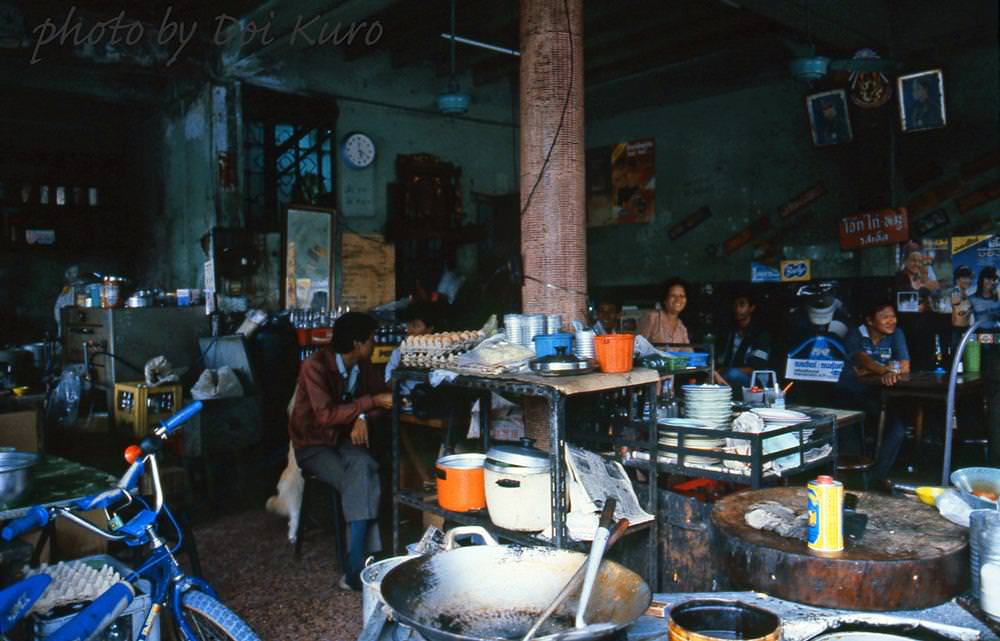
Doi Kuro’s photographs of Bangkok span more than just the picturesque. He documented the city’s working infrastructure — its kitchens, its repair shops, its traffic officers, its school runs — with the same attention he gave to its temples and markets. Taken together, his images form a detailed street-level record of Bangkok at a specific moment in time, before the skyline changed and the city’s older rhythms gave way to new ones.





Is it just me, or do these photos look pretty much like my part of town today, allowing for the slightly soft focus and film color saturation?
They say Japan is in 2000s for the last 50 years.
Thailand is in 1980s for the last 40.
Idk what you are talking about. Sure some pictures look the same but for example the Sukhumvit and Rama 4 one is completely unrecognisable.
Go outside to any non-recently-redone area of Bangkok and you’ll understand what I’m talking about. Pick up an old camera and you can take the same pictures today. The buildings look all the same
For me, I would agree with that sentiment when I moved into Northern Bangkok in the early 2000s. At that point, the whole area was very sleepy and reminiscent of this. But progress has surged and now my whole area is unrecognizable from 20 years ago.
Nice photos. Not criticizing, just an observation, but other than the older vehicles and the lack of tall buildings, this doesn’t really look that much different than today. You can still find those same train carriages in use, tuk tuks still roam the streets, little girls still wear those exact same school uniforms and carry those same bags, and Yaowarat is still full of old Chinese shops, etc.
Hardware looks the same in places, but I feel that the “software” of the city has changed massively since the 2000s or even early 2010s, let alone 1980s.
For example: everyone glued to their cellphones instead of looking at people, fewer spontaneous smiles, more rushed and consumerist, plastic surgery and masks (people’s faces look different!), plenty of other stuff.
Looked very much like this when I arrived in the early 90s
Nostalgia factor, but the photos themselves are pretty un-spectacular and uninteresting.
‘Spectacular’? Nice photos, but honestly the content of these shots isnt too far from what parts of Bkk still look like today
So much less plastic.
“$10 dollar, too boku.”
“ok, $5 dollar den.”
I was there and I think Bangkok has changed a lot mood-wise. The energy is really unrecognizable.
There are entire sets of these photos floating online in various forums. Wasn’t “Doi Kuro” a Japanese photographer? The linked post basically cherry-picked what’s similar to today, but What they can’t fill out for you are the details, the mood with those architecture back then.
Jesus Christ are we stuck in the 80s???
I don’t think these are at all “spectacular.” It’s above average. The color grading is drab and doesn’t really reflect the vibrance of the city. I found it depressing.
Bangkok is so much more livable and less congested today.
Photo number 7, we had that Toyota but in yellow.
I love those old pictures, there used to be a American guy that had a old WordPress blog and he had collections of old pictures he had taken from his time in Bangkok during the Vietnam war on R&R up until maybe 2010
I don’t know if he passed away or something happened but one day it just got taken offline. He had some awesome pictures
Side comment taken from a discussion of Mark Fisher’s The Slow Cancellation of the Future (2014), its relevance to the movie Blade Runner, and why most of us see few surprises in the photographs of the 1980s Bangkok, while others seem to be very disappointed that the city has not been stripped down to its studs and rebuilt
The starting brief of Blade Runner’s design, set in 2019, was that the future does not arrive by demolition. Existing buildings survive, are re-clad, are colonized by new signage, new wiring, new advertising, new services. The visual result is temporal geology: 1920s masonry underneath, 1970s ductwork bolted on, 2019 neon on top, all inhabited simultaneously. The argument was that high-modernist urbanism — the tabula-rasa city of Le Corbusier or Brasília — was itself the historical anomaly, and that actual cities always accrete. The film’s future is realistic because it refuses the modernist premise that the city can be started over.
Bangkok is the perfected case. It never had the modernist demolition moment on a large scale. The Skytrain runs above soi-level chaos, wiring hangs in visible bundles, temples sit next to malls sit next to street food, the accretion is continuous and unfinished. Singapore chose the other path, comprehensive planning that reads as slightly uncanny in its coherence.
Bangkok reads as Blade Runner because Bangkok is what cities look like when accretion is not fought. I’m not talking about the alley that used to run up from FoodLand to the Beer Garden. I mean Bangkok as a whole, even in the daytime and even when it’s not raining.
And this is what many of us (who avoid the shinier parts) enjoy about the city.
I strongly disagree with this:
.It never had the modernist demolition moment on a large scale.
Bangkok has torn down probably 95% of its historical architecture pre-1960s. Outside of religious buildings, there’s not a hell of a lot left.
What is your 95% figure based on? For that matter, what do you mean by “historical” architecture?
I do not have this book, but I suspect that Koditek may be the best current resource. I do not know if there is a current survey of the 300-odd buildings it documents:
Bangkok Modern: Architecture of the 1950s–1970s Walter Koditek, Bangkok, River Books, 2025, 520 pp., 300 color and 1,000+ b/w illus. $80 (cloth), ISBN 9786164511019
A long lecture by the author at The Siam Society, May 8 2025: https://www.youtube.com/watch?v=wPk5pTlB_Yo
That said, my point wasn’t about the survival of old buildings. It was about why the photos from the 1980s are so familiar, and about the way the new buildings have arrived — grafted, bolted-on, unplanned, accreting; 1970s shophouse next to a 1990s condo next to a 2010 townhouse next to a 2020 mall, with no coherent plan, no shared design language, no assumption that the next building will match the last. That is not a modernist demolition moment.
Bangkok had no Haussmann, no Robert Moses, no LCC comprehensive redevelopment areas, no Brasília, no Chandigarh, no Pruitt-Igoe. Buildings came down and went up piecemeal, developer by developer, plot by plot, without a unified planning imagination organizing the result. That is why the outcome is chaotic accretion rather than modernist coherence. The pre-1960 fabric can be hanging in tatters, but the mode of replacement remains anti-modernist.
And the proof is in the traffic, the roads that are never built because they’d run over somebody’s lawn, the ghost buildings that keep standing, the sois that dead-end into klongs, the “Stonehenge” Hopewell support towers, the elevated expressway that shadows the shophouse block that fronts the temple wall, the wiring bundled overhead, the drainage that fails every rainy season, the sidewalk that narrows to nothing where the next lot’s owner declined to align, the pedestrian bridge that lands in front of a shop whose owner treats it as a nuisance rather than an asset, the 7-Eleven wedged into what used to be a garage, the condo tower rising directly behind a row of two-story shophouses whose owners refused to sell. Yes, there are shiny new parts, but they’re easy enough to avoid.
Bangkok rebuilds itself constantly and incoherently, with minimal cleanup of anything unfinished or in the way. Nothing is taking aim at the old, except when a building here or there is in the way. This is the opposite of the modernist agenda, and precisely the Blade Runner one.
Buildings and the trains look exactly the same now, almost as if the myth of Thailand not renovating ever was true.
That looks depressing. Hallelujah for the modern version of Bangkok.