Inspired by 1950s horror film advertisements, NASA’s Galaxy of Horrors posters bring to life the fascinating and frightening worlds of exoplanets — planets that orbit stars other than our Sun. Thalia Rivera, the outreach specialist at NASA’s Jet Propulsion Laboratory (JPL) who led the development of these posters, explains that while many people are most interested in finding Earth-like planets, the Galaxy of Horrors campaign showcases the incredible diversity and extreme conditions found on far more mysterious worlds. From scorching hot planets with molten surfaces to worlds where glass shards rain from the sky, these posters take us to the darkest corners of the cosmos.
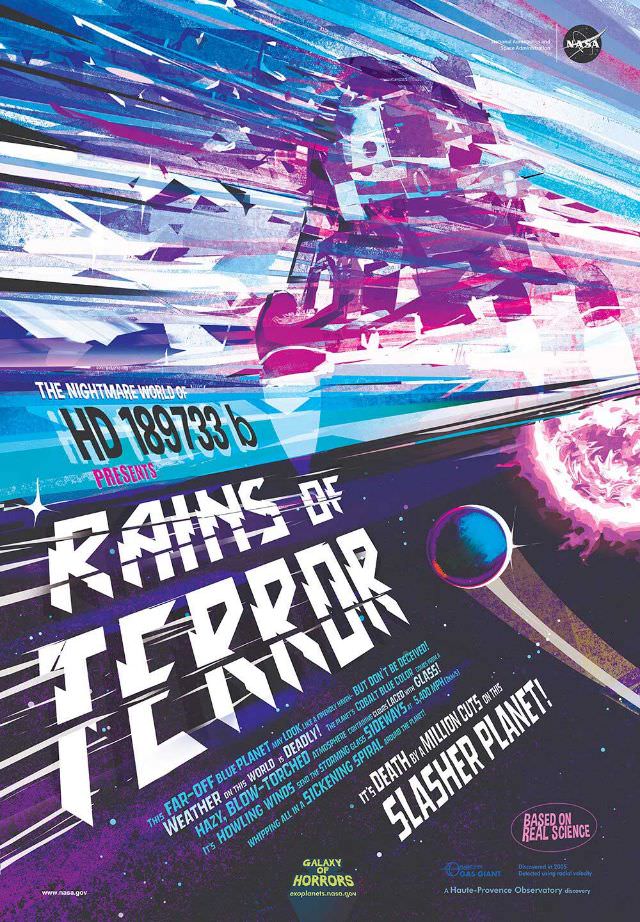
This far-off blue planet may look like a friendly haven — but don’t be deceived! Weather here is deadly. The planet’s cobalt blue color comes from a hazy, blow-torched atmosphere containing clouds laced with glass. Howling winds send the storming glass sideways at 5,400 mph (2 km/s), whipping all in a sickening spiral. It’s death by a million cuts on this slasher planet!
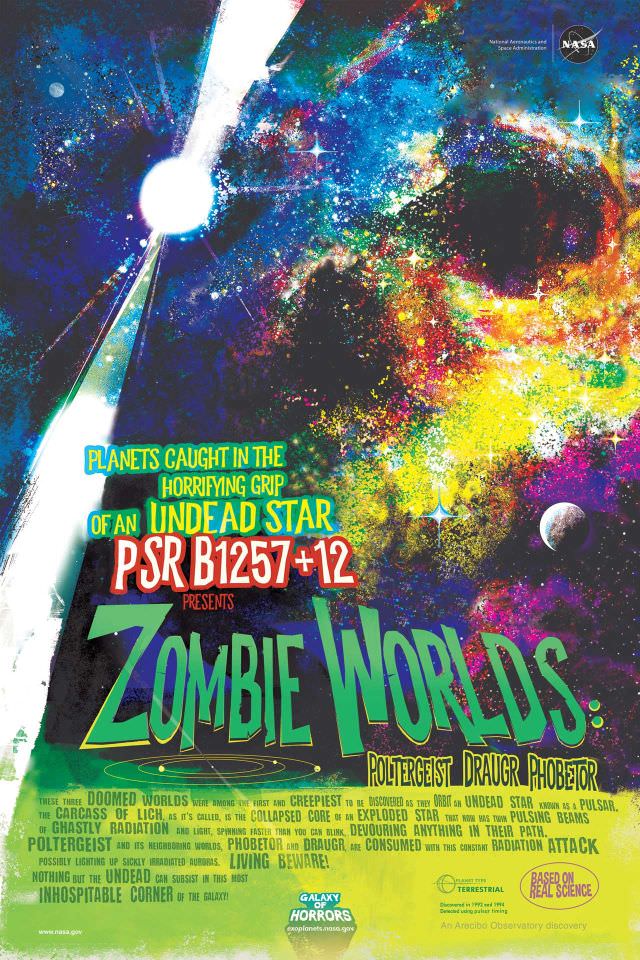
These doomed worlds were among the first and creepiest to be discovered, as they orbit an undead star known as a pulsar. Pulsar planets like Poltergeist and its neighboring worlds, Phobetor and Draugr, are consumed with constant radiation from the star’s core. Nothing but the undead can subsist in this most inhospitable corner of the galaxy.

You’ve heard of the “terrible twos”? Well, AU Mic is in the midst of its terrible 22 … millions! This devilish young system holds planet AU Mic b captive inside a looming disk of ghostly dust and ceaselessly torments it with deadly blasts of X-rays and other radiation, thwarting any chance of life… as we know it! Beware! There is no escaping the stellar fury of this system. The monstrous flares of AU Mic will have you begging for eternal darkness.
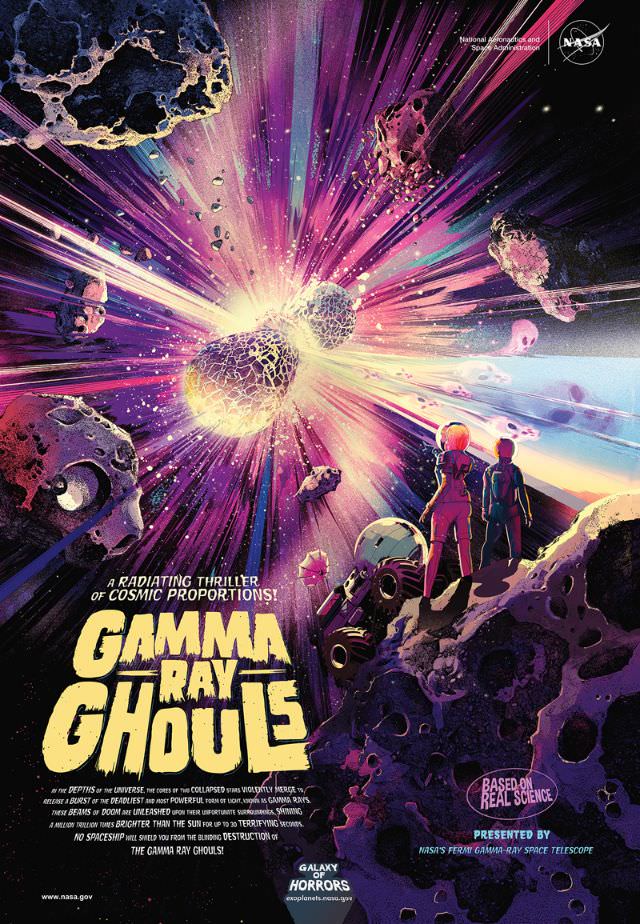
In the depths of the universe, the cores of two collapsed stars violently merge to release a burst of the deadliest and most powerful form of light, known as gamma rays. These beams of doom are unleashed upon their unfortunate surroundings, shining a million trillion times brighter than the Sun for up to 30 terrifying seconds. No spaceship will shield you from the blinding destruction of the gamma ray ghouls!

Something strange and mysterious creeps throughout the cosmos. Scientists call it dark matter. It is scattered in an intricate web that forms the skeleton of our universe. Dark matter is invisible, only revealing its presence by pushing and pulling on objects we can see. NASA’s Roman Space Telescope will investigate its secrets. What will be revealed?

This chillingly haunted galaxy mysteriously stopped making stars only a few billion years after the Big Bang! It became a cosmic cemetery, illuminated by the red glow of decaying stars. Dare to enter, and you might encounter the frightening corpses of exoplanets or the final death throes of once-mighty stars.
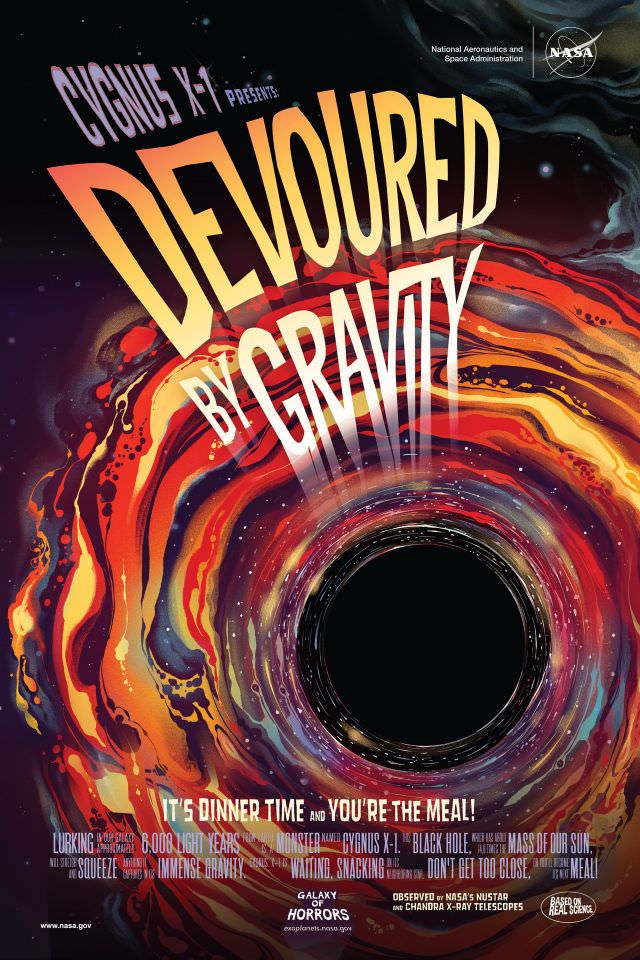
Cygnus X-1 Presents: It’s Dinner Time and You’re The Meal! Lurking in our galaxy, approximately 6,000 light-years from Earth, is a monster named Cygnus X-1. This black hole, which has about 14.8 times the mass of our Sun, will stretch and squeeze anything it captures in its immense gravity. Cygnus X-1 is waiting, snacking on its neighboring star. Don’t get too close, or you’ll become its next meal! Observed by NASA’s NuSTAR and Chandra X-Ray Telescopes.
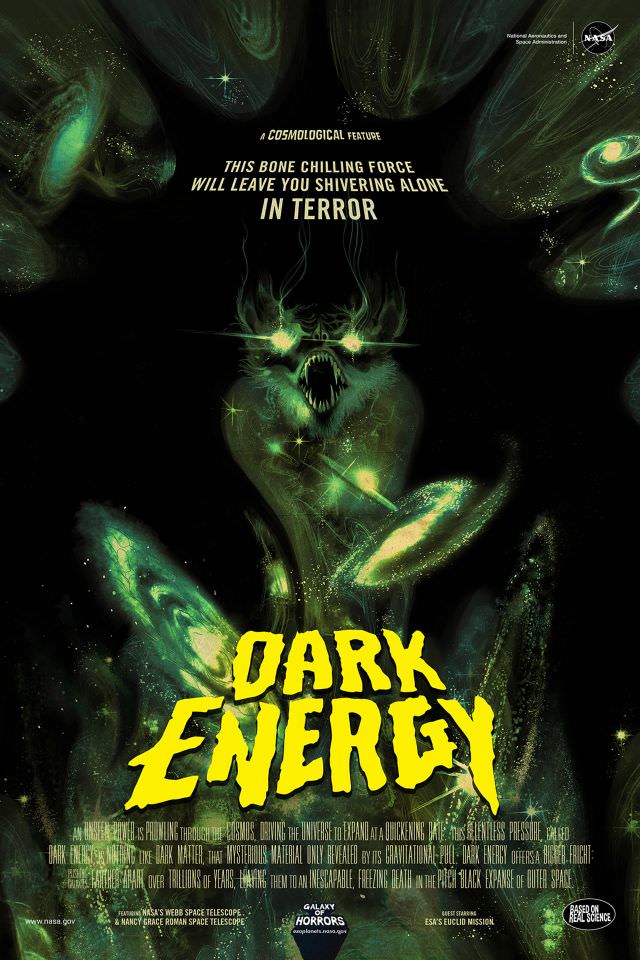
This bone-chilling force will leave you shivering alone in terror! An unseen power is prowling throughout the cosmos, driving the universe to expand at a quickening rate. This relentless pressure, called dark energy, is nothing like dark matter, that mysterious material only revealed by its gravitational pull. Dark energy offers a bigger fright: pushing galaxies farther apart over trillions of years, leaving the universe to an inescapable, freezing death in the pitch black expanse of outer space.
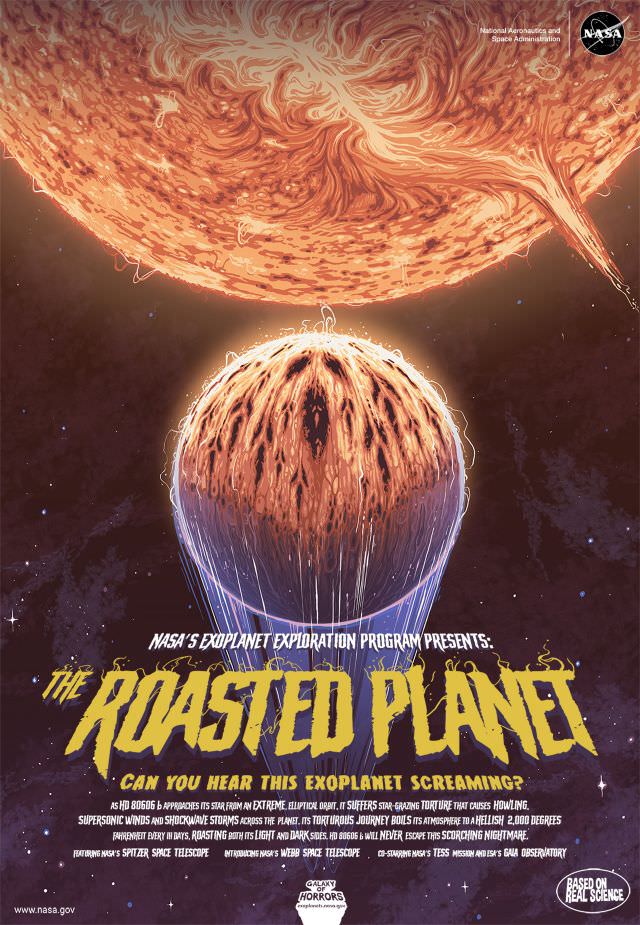
Can you hear this exoplanet screaming? As HD 80606 b approaches its star from an extreme, elliptical orbit, it suffers star-grazing torture that causes howling, supersonic winds and shockwave storms across the planet. Its torturous journey boils its atmosphere to a hellish 2,000 degrees Fahrenheit every 111 days, roasting both its light and dark sides. HD 80606 b will never escape this scorching nightmare.