
Karen Carpenter had one of the most recognizable voices in American music. As one half of the sibling duo The Carpenters, she rose to fame in the early 1970s with a warm, clear contralto voice that set her apart from nearly every other singer of her era. Songs like “Close to You,” “We’ve Only Just Begun,” and “Rainy Days and Mondays” became defining records of the decade. Yet behind the polished recordings and sold-out performances, Carpenter was quietly fighting a battle that would end her life long before her time.
On February 4, 1983, Karen Carpenter died of heart failure brought on by anorexia nervosa. She was 32 years old. Her death sent shockwaves through the music world and forced a broader public conversation about a disorder that, at the time, most people barely understood. The circumstances surrounding her final weeks — including a photo session that produced what would become her last known public image — tell a stark story of how severely the disorder had ravaged her body.
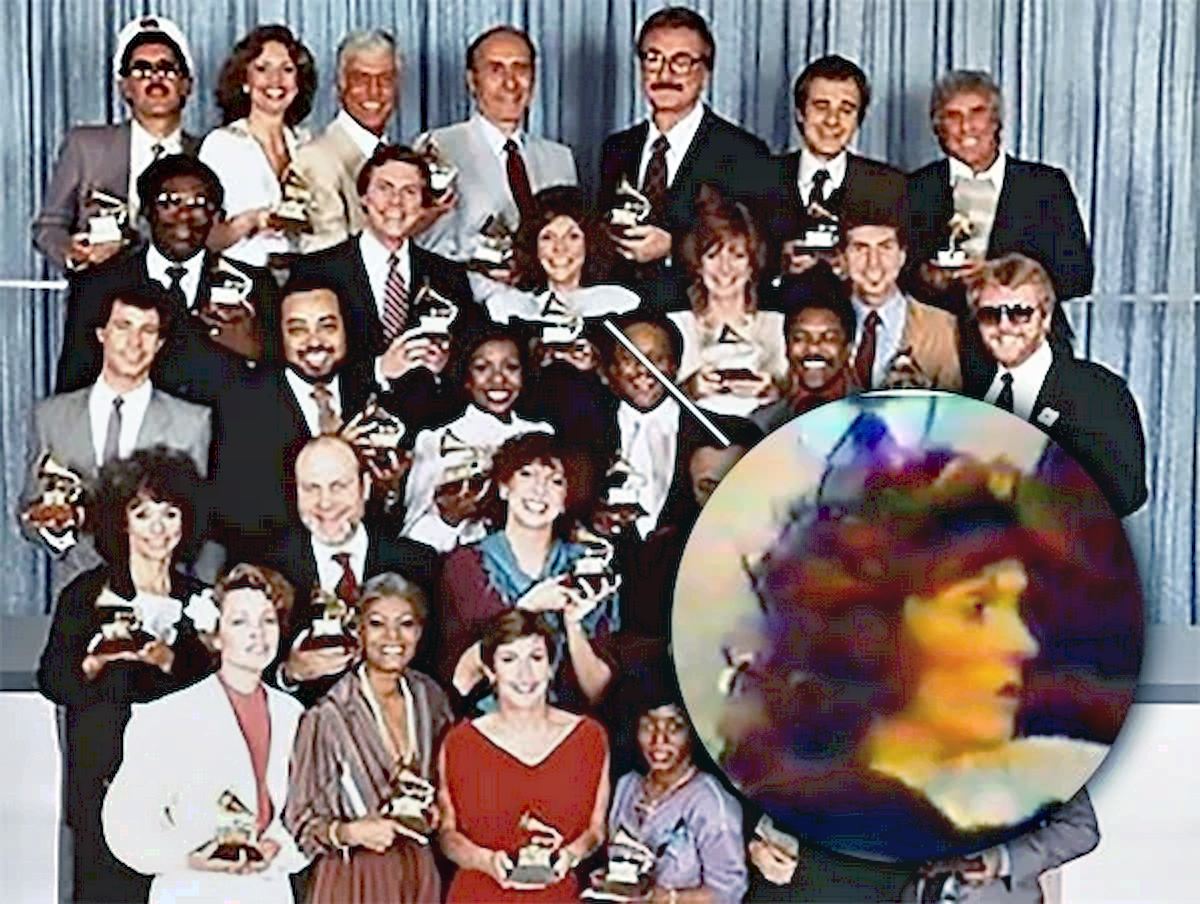
On January 11, 1983 — just 24 days before her death — Carpenter attended a promotional photo shoot for the 25th Annual Grammy Awards. The photographs taken that day show a woman who is visibly thin and physically fragile. Her face is gaunt, her frame strikingly small beneath her clothing. To those who had followed her career, the images were alarming. They stand today as the last professionally taken photos of her life.
Carpenter’s struggle with anorexia nervosa had been going on for years before that photo was taken. She first began severely restricting her food intake in the early 1970s, reportedly after a reviewer described her as “chubby” in print. That comment, combined with the intense pressures of being a public performer, triggered a pattern of disordered eating that would define much of her adult life. At various points, her weight dropped to dangerously low levels. She became highly dependent on laxatives and thyroid medication, both of which she used in excess and without medical supervision, causing serious internal damage over time.
Those close to her watched the decline with growing alarm. Her brother and musical partner Richard Carpenter, along with other family members and friends, repeatedly urged her to get help. By the late 1970s and into the early 1980s, her condition had become difficult to hide. Concert appearances sometimes had to be canceled or postponed. Her weight loss was visible to audiences and journalists alike, and speculation about her health appeared frequently in entertainment coverage of the time.
In 1982, Carpenter took a significant step and sought treatment in New York City under Dr. Steven Levenkron, a psychotherapist who specialized in eating disorders. She spent several months in treatment, and by the time she returned to California in late 1982, she had regained some weight. Her family and doctors expressed cautious optimism. The Grammy photo shoot in January 1983 was part of a planned return to public life. It was meant to signal a comeback. Instead, it captured the last images the world would see of her alive.
On the morning of February 4, 1983, Carpenter collapsed at her parents’ home in Downey, California. Paramedics were called, but she could not be revived. The official cause of death listed by the medical examiner was “emetine cardiotoxicity due to or as a consequence of anorexia nervosa.” In plain terms, years of ipecac syrup abuse — a substance used to induce vomiting — had caused irreversible damage to her heart muscle. The damage had been accumulating for years. Even the weight she had regained during treatment had come too late to reverse what the disorder had already done to her cardiovascular system.
The medical details of her death were significant. In 1983, anorexia nervosa was not widely discussed in mainstream culture. Many people still viewed it as a lifestyle choice rather than a serious, potentially fatal psychiatric condition. Carpenter’s death forced that understanding to change. Physicians, mental health professionals, and journalists all pointed to her case as proof that anorexia was not a vanity issue but a life-threatening illness with measurable, physical consequences. Her death became a turning point in how the disorder was discussed in both medical circles and the general public.
Anorexia nervosa has the highest mortality rate of any psychiatric disorder. It kills through multiple mechanisms — cardiac failure, organ shutdown, and complications from malnutrition. The heart, which depends on electrolytes and adequate nutrition to function, is particularly vulnerable. In Carpenter’s case, years of purging behaviors had depleted her body’s potassium levels and introduced a toxic substance directly harmful to cardiac tissue. Her heart simply gave out.
In 1985, Richard Carpenter established the Karen Carpenter Foundation to promote awareness of eating disorders and fund research into their causes and treatments. The foundation provided resources for people struggling with these conditions at a time when public understanding of them was still limited. Its creation reflected both a personal response to grief and a recognition that Karen’s death carried a broader warning that needed to be heard.
The Grammy photo from January 11, 1983 remains one of the most widely circulated images of Karen Carpenter. It is not remembered as a glamorous promotional image. It is remembered as a document of what anorexia nervosa looks like in its late stages — and as a portrait of a woman who, by all accounts, was trying to find her way back to health just weeks before her body finally gave out. She was 32 years old, with a voice that millions of people loved, and a disease that gave her no more time.



What a voice; what a waste.
Sadly, I believe she was so far along with her illness that she probably wasn’t even aware of the damage she was causing. In the end, she passed away.
Is that Harry Nilsson, second row, all the way to the right?
Karen Carpenter was one of the clearest voices in the industry. It is so sad that she passed away at such a young age.
Anorexia and bulimia
Her death shed light on anorexia as a serious and widespread medical condition. It became okay to talk about it openly, and so treatment began.
It wasn’t understood back then, in the early 1980s.
Her bio mentioned she went to an expensive therapist in NYC, as a last ditch effort, and one of the sessions included wearing a bikini in a mirror and assessing how she looked
You’re joking right?
Here’s the quote “Returning to Levenkron the following day, Karen was asked to change into the bikini and stand in front of the office mirror. He urged her to survey and evaluate her body. “She didn’t really see any problem with how she looked,” Itchie [a friend] recalls. “In fact, she thought she was gaining a little weight. But she was seventy-nine pounds. That was one of the times where I would go home and lock myself in my bathroom and cry.”
It’s so messed up. The complete opposite of help. The worst thing you can do to someone with an eating disorder is to make them do this.
Back then, people didn’t know that, but now we know. In the early 1990s, we thought telling our anorexic high school classmate to gain weight was “helpful”. Perhaps we just exacerbated her fixation. It’s still unclear to me what we could have done to help.
Wow. The history of therapy is dark, and it has only improved marginally
Your therapist’s training and understanding of modern practices are definitely important factors. The person you are putting your trust in, really, must be a health care worker.
Although I’m not a fan of The Carpenters’ music, I absolutely adore her voice. It’s just perfect.
I hated vinyl records because my mom used to play the shit out of them when I was a kid. I have learned to appreciate them over the years, and think she had one of the most beautiful voices ever recorded.
I read that her heart had been damaged by taking ipecac syrup in order to induce vomiting in order to lose weight. Since she was eating more again, she thought she could get away with doing that. In the end, the long-term damage to the heart led to its failure.
When you run out of body fat to burn, it then turns on the muscles. This includes the heart. Karen Carpenter and Elvis are probably the earliest celebrity deaths I remember. Despite completely opposite types of abuse, the outcome is the same.
Yes, I know, having been anorexic (sometimes bulimic, and using ipecac) for twenty years. People couldn’t believe that I hadn’t died in that time, and my family was told to purchase a burial plot. Fortunately, I was able to quickly and fully recover after those 20 years.
The autopsy did show emetine toxicity(abuse of substances to induce vomiting). So there was some use of Ipecac or other vomit inducing substance. Fun fact, Ipecac is in the same family as the poison Ricin(made popular on the show Breaking Bad)
It’s sad she passed from starvation.
I feel so sorry that she felt she had to do these things to be loved or to feel valuable. Her mother drove her to do this, wasn’t it?
Based on the movie, it was her mother (not demonstrative; seemed to favor Richard) AND Richard (seemed to hold her back at times). However, I don’t like to speculate. Regardless of the cause, she felt she had little control over her life, and her eating disorder/weight was something she could control
In my opinion, she is one of the most tragic victims of fame.
Karen, however, is not a celebrity and suffers the same struggles few people are aware of that few celebrities do. Somehow, I feel more sympathy for those who have 20 friends than those who have a million followers.
Karen Carpenter was a very famous singer prior to her untimely death. She was on stage and scrutinized at a time where everyone wanted to look like the model Twiggy and no one wanted to look like Mama Cass.
I don’t know that this had a lot to do with fame at all.
Her anorexia was not just caused by fame, but also by perceived pressure to be thin. Fame exacerbated all of that. My understanding at the time was that she probably wouldn’t have felt nearly as much pressure if she had lived a “normal” life, so I’m not sure fame had a major impact on her.
During a therapy session, the doctor wanted the family to tell her how much they loved her… but her mother refused and didn’t say anything.
Although I won’t speculate on the mitigating factors for her eating disorder, I will say that there is something about Richard that I never liked. I feel very uneasy just looking at him, as if something is hidden. I wouldn’t want to be locked in a room with him, and I’m a guy.
The repeated use of ipecac syrup to induce vomiting caused her heart failure.
Her body finally gave up after years of anorexia/bulimia.
Her voice always stops me cold, and I take in the moment. The day I heard she had passed, I only remember crying all afternoon.
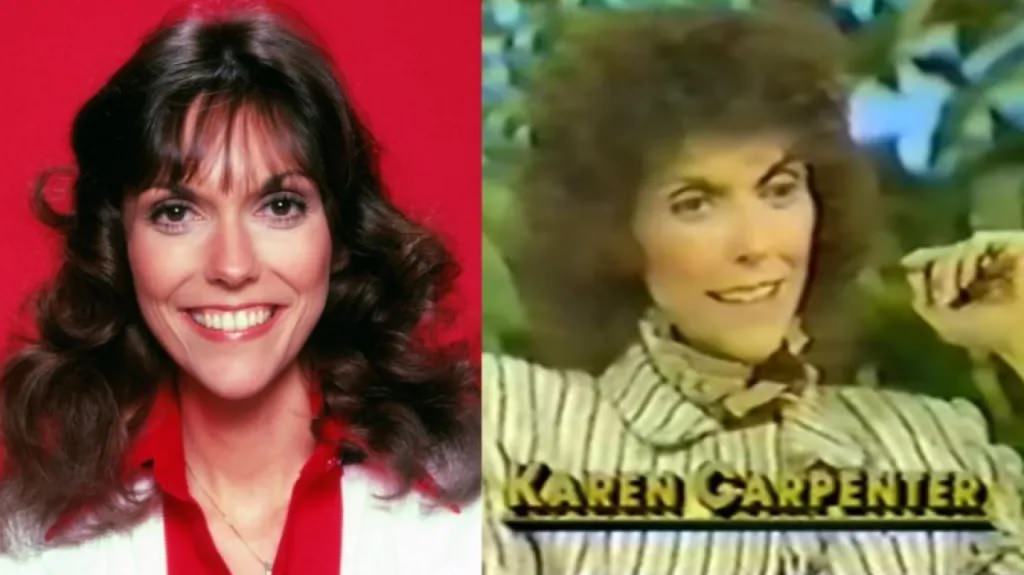
Wow, she was only 32 yo in the right pic. Unbelievable and tragic.
She looks like my grandma before she died. I believe she was in her late 70s. That’s crazy
Oh my god 😭
So malnourished that her body lacked the calcium to carry the electric impulses needed to sustain a heartbeat. Tragic
She was a phenomenal drummer.
Her voice was pretty damn good as well.
Sonic Youth – Song for Karen
Todd Haynes’ short film Superstar: The Karen Carpenter Story is a very interesting take on her biography.
A beautiful singer, amazing drummer and a great loss.
I had a teacher play this for us in high school and it fucked me up for years
Yeah a friend gave me a copy on VHS years ago and it is disturbing.
Disturbing how?
It is disturbing to watch a beautiful and talented young woman destroyed by self starvation, ironically in a time and place when food is abundant and in many ways excessive. The contrasts in the film are stark and affecting, and I remember after seeing it the first time thinking this weird little film had me riveted for the last 43 minutes.
The stiff movements and frozen expressions of the characters paired with emotional voice overs, the claustrophobic and disorienting first person scenes interspersed with snippets of television shows and violent news footage.
The television is the main source of images of “real” people in the film, along with the documentary-like scenes of descriptions of anorexia nervosa and individual impressions of the Carpenters music. It’s an interesting collage of techniques.
The pressures of her family and professional life are crushing but her own pathological self control is inescapable.
you have an amazing way with words!
and to think they were only gonna leave the description at “it is disturbing”!
todd haynes has made many great films over the years and I still think he hasn’t topped that
I just pulled this up on YT. I can’t seem to get passed the Barbies. Sitting here wondering if I should just keep it as audio and ignore the screen…..
The Barbies (I think) are a comment on the American idealization of women and the tragic self destruction that results. It may also represent the abstract reality experienced by celebrities. It is surreal and unsettling but an integral part of the film.
Practically, it was easier to make the film with dolls and small manufactured sets versus the cost and complications of actors and actual sets.
Interesting perspective! Thanks for your feedback!
Sonic Youth – Superstar
Her voice was liquid gold.
A voice like being stroked by a velvet glove
I still listen to her voice nearly every day…
One of my favorite childhood memories is listening to Yesterday Once More while my mom did dishes in the kitchen.
I loved Rainy Days snd Mondays ❤️
Love Solitaire
She does not look 32 in that last picture.
I remember this. I read that her manager (or some other authority figure) told her she needed to lose weight because she looked plump. Back in those days, there was a lot of pressure to be extremely thin, and many people regularly took diet pills. Thankfully, our society has changed (a bit) – and although I’m sickened by all the Ozempic commercials – there is much more acceptance of “normal” bodies now, thankfully.
It’s crazy how much it was in people’s heads back then, I work with seniors in nursing homes and very often the women don’t finish everything on their plate and only take a few bites of desert because they’re still trying to watch their figure. Even though their body literally needs those nutrients and everything is the correct portions
Yeah, everyone, myself included were taking some sort of diet pills back in the day. Being that thin isn’t normal.
It was a journalist early in the Carpenter’s career. He called her “plump” in an article.
Supposedly her mother treated her poorly too.
Yeah her mother apparently was a POS
Twiggy was the beauty standard.
Twiggy was before that time
That doesn’t meant she couldn’t still be a beauty standard.
The press actually referred to her as “chubby” many times in the 70’s. Then factor in that she’d gone her entire life with no control over anything but her weight. Her mother strongly favored her brother, Richard, and Karen’s whole life and career revolved around him. She was raised to feel like her entire existence was made to glorify her brother and his music. Her family was genuinely astonished when they realized she was the most popular Carpenter, they thought it should’ve been Richard. And then they made sure she could never leave him and launch her own solo career, because he wasn’t going to make it without her. So she focused her energy on controlling the one thing she could: her weight. Her story was so sad.
She brought so much joy and happiness to the world (and continues to do so) but tragically was never able to achieve that for herself.
In a cruel twist of fate, her death became the fodder of tasteless jokes.
She deserved better.
Her death became the fodder of tasteless jokes;
No it didn’t. I’ve never heard a single derogatory word against Karen Carpenter. She was beloved.
eye roll You are one person and your statement is a false equivalency. Just because YOU have not heard does not mean their statement is untrue. In fact Bette Midler famously made multiple jokes about Ms. Carpenter. I loathe when people act as if their singular world view is the only acceptable reality.
She was so talented and amazing. Her family and the people around her sucked. Karen deserved so much better.
She was amazing with her artistry. Her songs just pulled you into a different world. Superstar, We’ve Only Just Begun, Yesterday Once More…whatever she sang it just pulled you in. I listen to her all the time. Such a great loss.
I was anorexic at the age of 17. At 5’8 I went down to 90 lbs. While beauty standards to be thin were an issue, it was much more about control and perfectionism for me personally. Knowing what happened to her helped me know that my path could lead to death. She is an example for women who want to get better, of what can happen.
I’m currently living in her and her brother’s old house in Vegas. Kind of off-topic, I know, but gawd what a beautiful voice she had.
it was heartbreaking at the time
You’re Wrong About podcast does a good episode about her.
She was so talented. What a waste.
I grew up on her beautiful voice and sad melodies. I didn’t realize she was my age when she died. What an incredible loss.
Absolutely saddening. Who is next? Eugenia Cooney. Millions are watching her slowly die.
That voice
TIL Karen Carpenter died the day I was born
To be fair this was during a 1981 or 1982 interview when they were promoting the Made in America album. Her final public picture was for the 25th anniversary Grammy luncheon in January 1983, weeks before her death.
One of my favorite voices of all time. If they ever make a movie about Kate, I think Jodi Balfour would be a great actress for the role. Based on looks alone (when Karen was healthy).
Great drummer brought a lot of joy! I just wonder who told her to keep losing weight?
Someone may have told her to lose weight initially, but once anorexia reaches those fatal levels, there is a lot more going on internally. It is a disorder of control. Her reasons were almost certainly more deep and complex than that.
That’s true I’m just saying who put it in her head to lose weight.
When the Carpenters were starting out, the press referred to her as “Richard’s chubby sister.” So that stuck. She’d also spent her entire life being over-controlled by her mother, and to some extent her brother. Richard Carpenter was a child musical prodigy and his mother especially believed he was the true star. She was shocked when Karen turned out to be the most popular one, and she let Karen know it. As Karen’s popularity grew and she wanted to go solo, Richard and their mother thwarted her because they knew he couldn’t make it without her. So she could only control one thing in her life, her weight, and that’s what she did. Anorexia is less about body image and more about power and control of one’s body.
Damn thank u for that I watch/listen to her videos she amazing when I heard she died in the 80’s was kind of stunned n what from so I figured people would push her in way, still sad to see that her own family doubted her star power I would have been proud brother if my sister outshined me in music be like good I don’t have to do this anymore😅.
Yeah, her life was so sad. She married a guy she barely knew in order to escape her family, but the guy used her for her money. She was actually supposed to sign her divorce papers on the day she died. She was stuck living with her parents yet again at 32. And prior to that, when they were just getting big in music, her mother would only let her move out if she lived with Richard. Richard himself really bought his own hype because he was raised as the family’s golden child, and he was stunned that Karen eclipsed his fame. He loved his sister very much, but he needed her for his career, so he also kept tight control of her. It was just such a sad situation for her. And she never wanted any of it. She wanted to be a drummer, and then get married and have a family. She never wanted to be a superstar singer, she was very shy and quiet, and liked to hide behind her drum kit when she first started singing. But again, she had zero control over anything except for her body.
Didn’t she used to eat a lot of carrots and change her colour, or am I thinking of someone else
That was Susan Dey partridge Family.
I think that was Mary Anne from Gillian’s Island.
All this because of an article in a newspaper stating that she was fat?
You clearly don’t know anything about anorexia nervosa. It’s causes are much deeper than an article called someone fat. Otherwise the disorder would be even more prevalent than it already is.
Yes, but I read that media was on her and that was like kind of ”the start”.
May her beautiful soul rest in peace.
I grew up singing Carpenters songs. Karen’s voice was/is so soulful, rich, clear and melodic. After all of these years I find I STILL know most if not all of the words to her songs! She was brilliant, IMO and probably a perfectionist – which is why she was so good – yet so tragic. Something about her seemed so familiar, yet she was very special. I hope she is in Heaven – I would love to have a talk someday.