

Long before Halloween became a retail giant and costume stores lined every strip mall, people across Britain and America were already deeply devoted to the art of fancy dress. In the early 20th century, costume parties, concert halls, and theatrical events gave ordinary people a chance to transform themselves into something extraordinary. The results were captured on film — stiff-backed studio portraits and candid snapshots that have survived more than a century. These photographs reveal just how creative, elaborate, and personal costume culture was during that era.
The costumes ranged widely. Some people dressed as fictional characters or playing card symbols. Others chose national identities, mythological figures, or cultural caricatures that reflected the attitudes and global fascinations of the time. Children were dressed up just as carefully as adults, often posing for formal studio portraits in full costume. The photos below span roughly 1900 to the late 1920s and offer a vivid window into how people expressed themselves through dress.
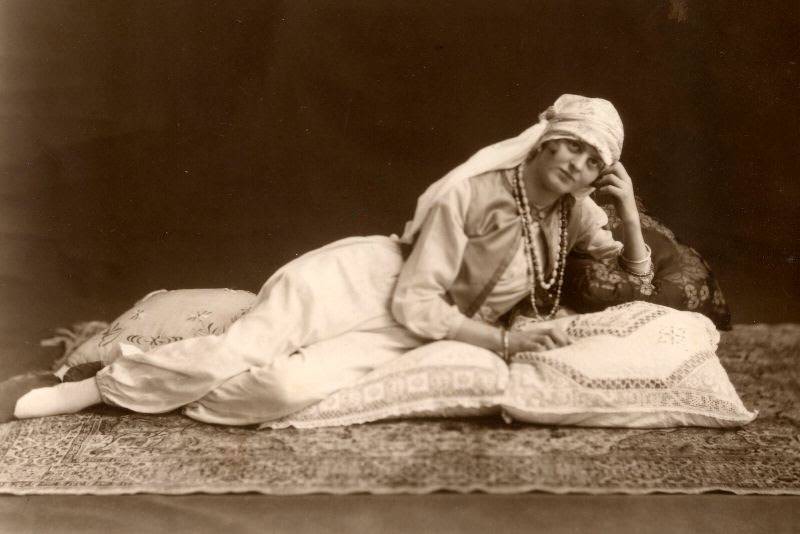
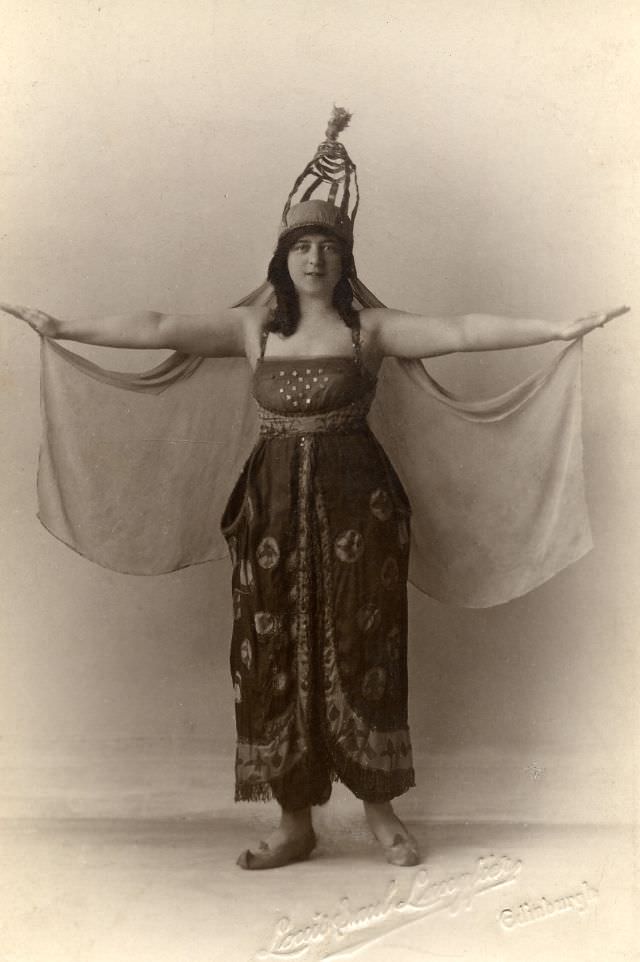
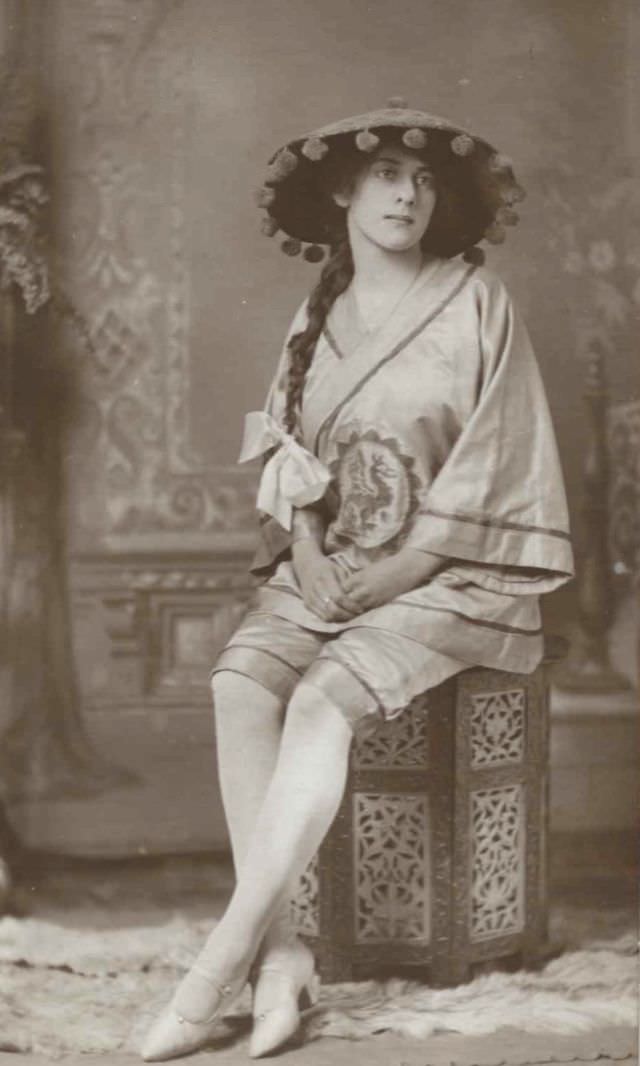
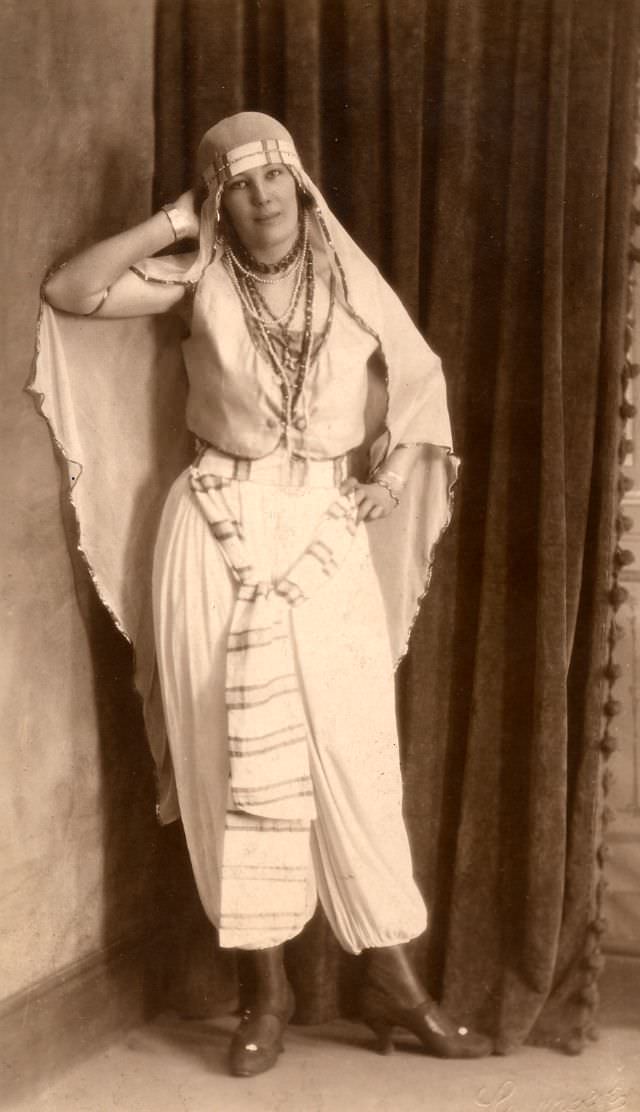
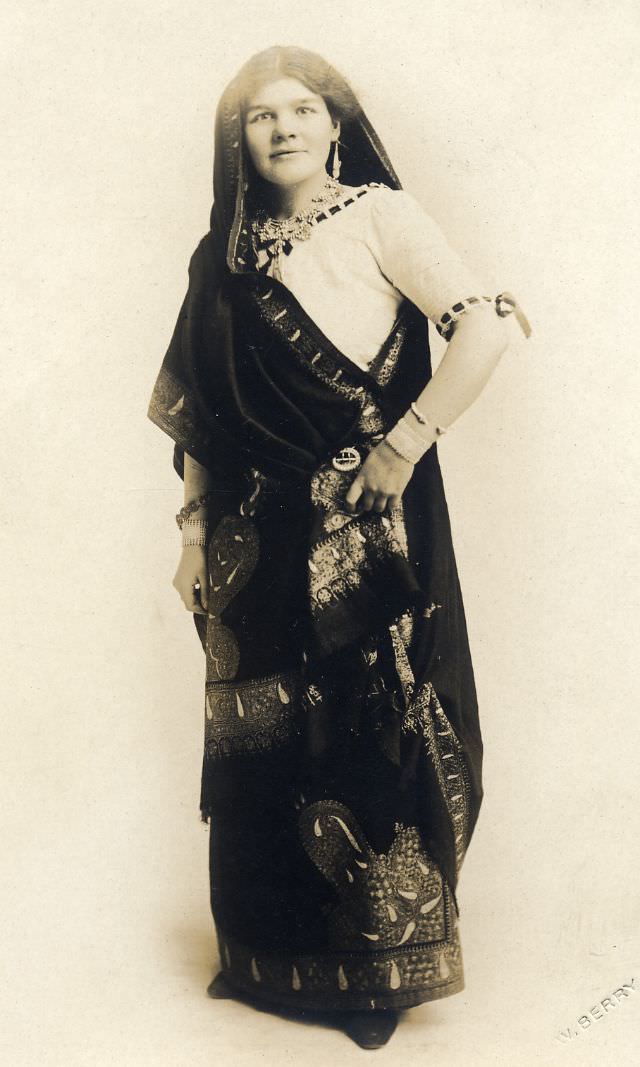
Eastern and oriental themes were extremely popular in early 20th-century fancy dress. Costumes inspired by Arab, Japanese, Chinese, and broadly “Eastern” aesthetics appeared at parties and theatrical events throughout Britain. This reflected a widespread cultural fascination — sometimes called Orientalism — with the Middle East and Asia. Costumes in this style were often elaborate, featuring richly decorated fabrics, veils, fans, and accessories meant to evoke distant lands.
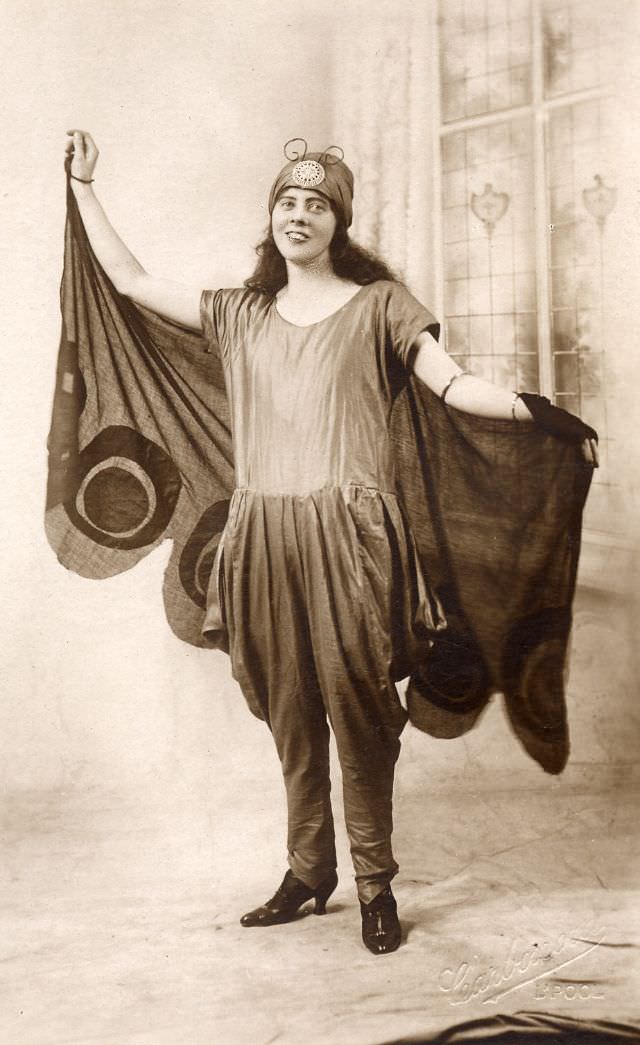
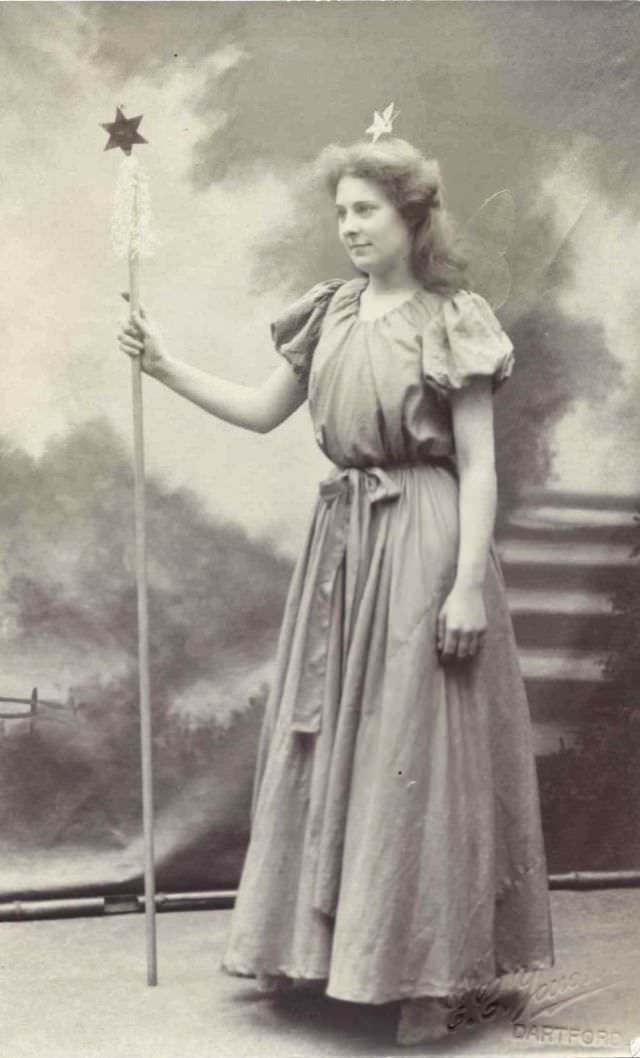
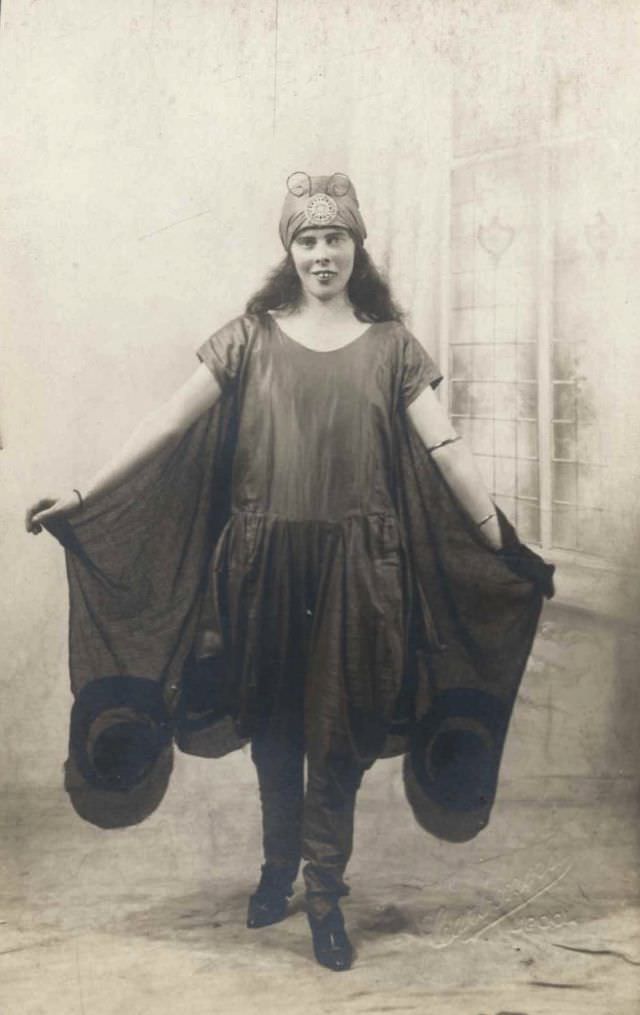
Nature and fantasy were equally popular choices. Butterflies, fairies, and flowers appeared again and again in fancy dress photos from this period. These costumes were especially common for women and young girls, who were often encouraged toward delicate, whimsical themes. The craftsmanship involved was impressive — wings were carefully constructed, headpieces were decorated with stars or petals, and full outfits were sewn at home or commissioned from dressmakers.
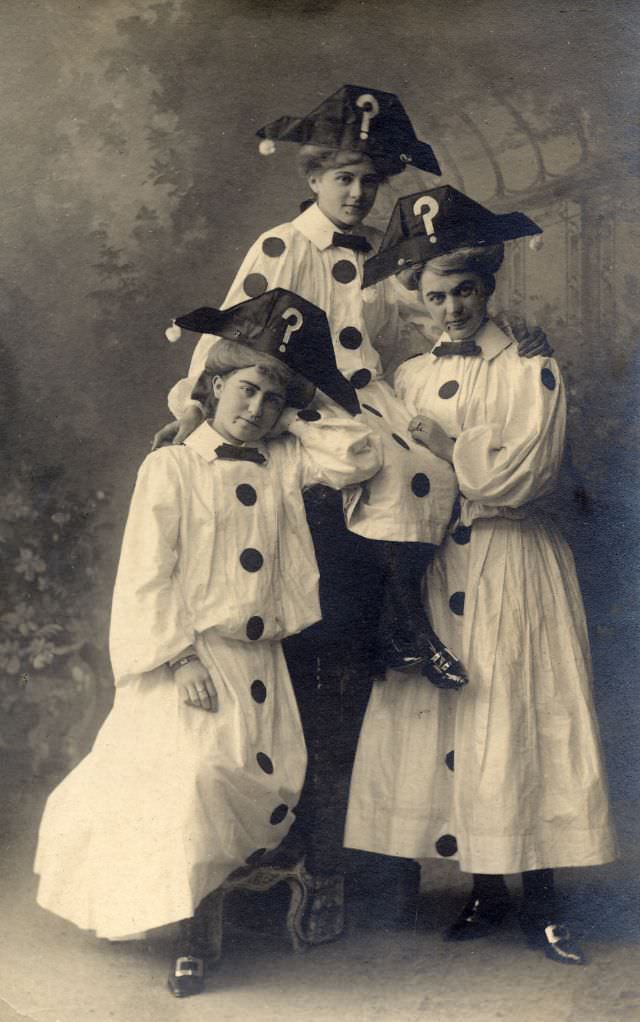
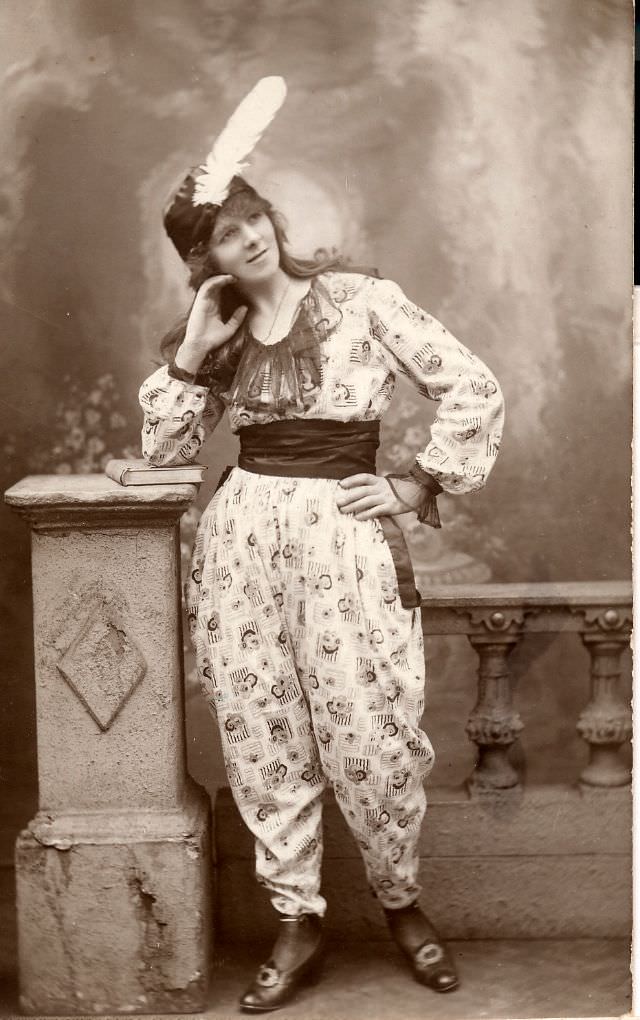
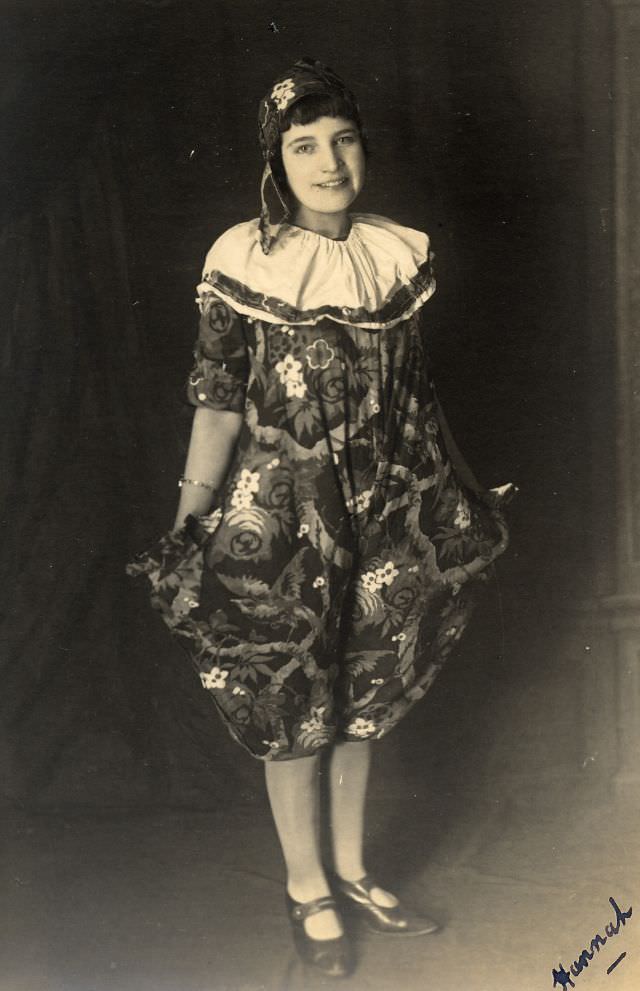
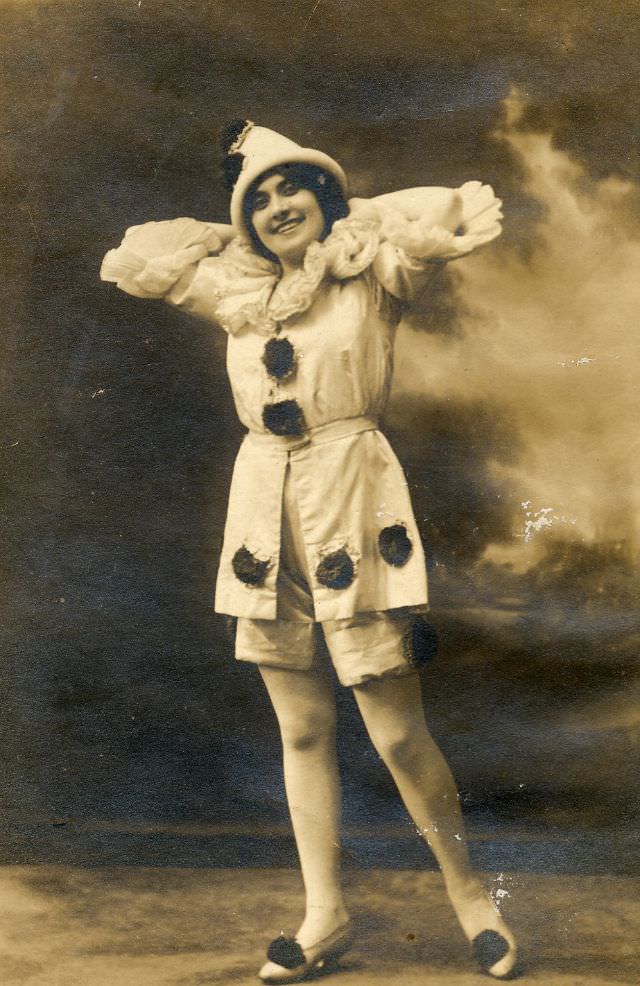
The Pierrot — a sad-faced clown figure from French pantomime — became one of the most recognizable fancy dress characters of the Edwardian era. Pierrot troupes performed at seaside resorts and public entertainments across Britain, and the costume filtered into mainstream fancy dress culture. Groups of friends and performers dressed as Pierrots together, wearing the iconic white costume with black pom-poms and painted faces. Hannah, pictured below, put her own spin on the look with a floral variation.
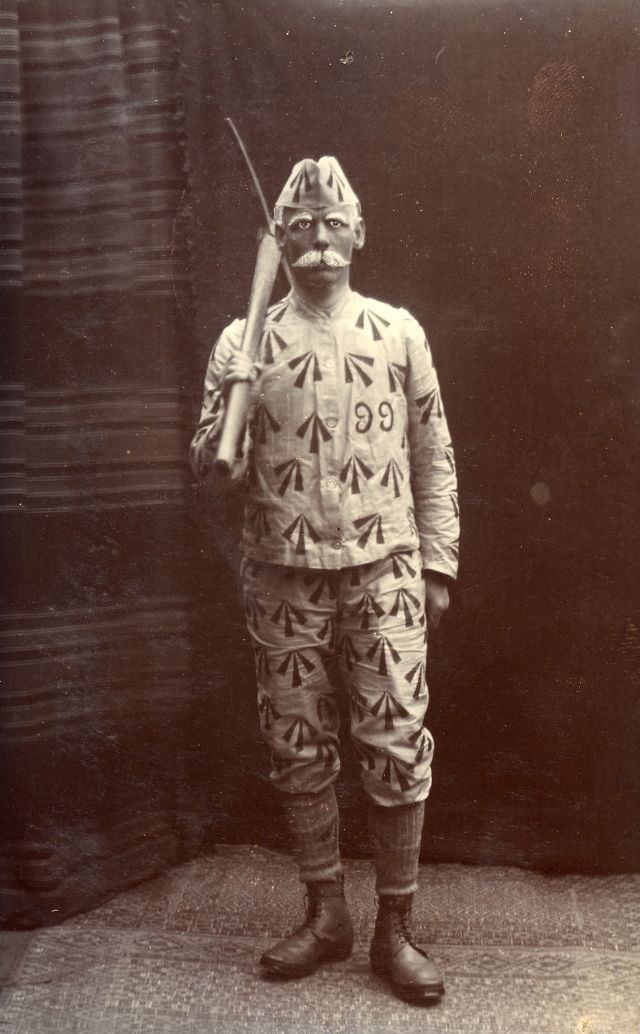
Not every costume leaned toward the glamorous. “Convict 99” shows that humor and novelty had a place in fancy dress culture too. Dressing as a prisoner — complete with a numbered uniform — was a bold and playful choice, particularly for a woman at a time when such themes were considered edgy. Costume parties rewarded originality, and some events held formal competitions with prizes for the most creative entries.
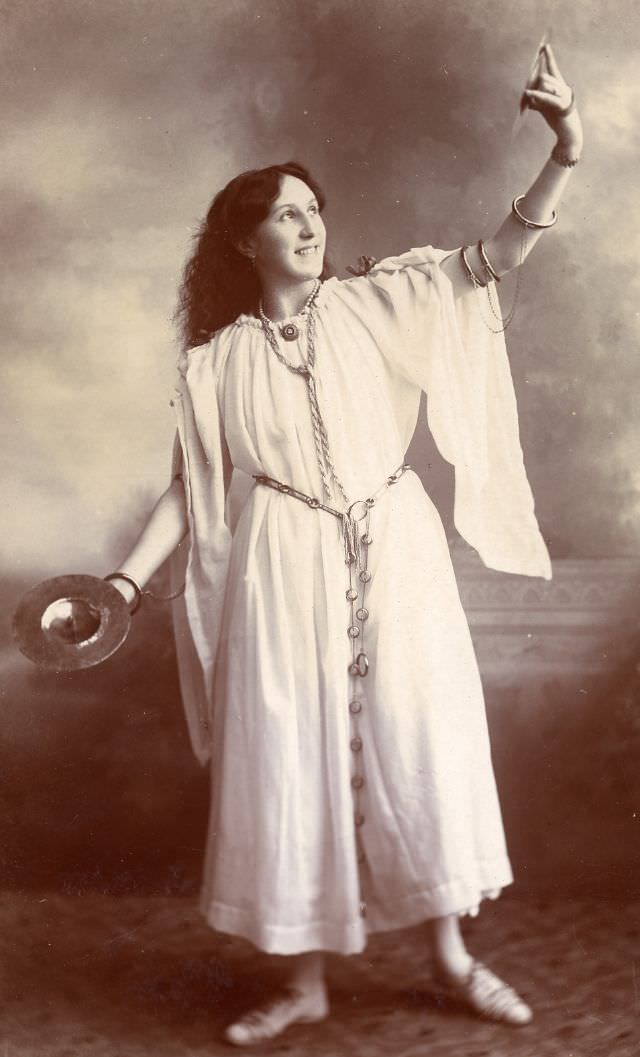
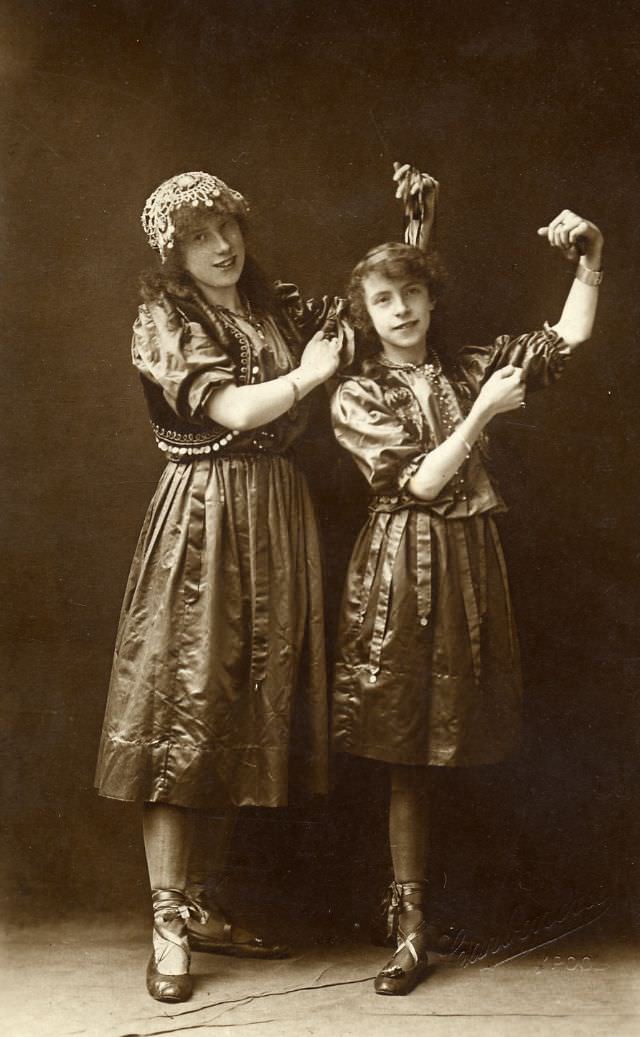
Performance and dance heavily influenced fancy dress choices. Spanish-style costumes — featuring ruffled skirts, dramatic poses, and bold accessories — were a favorite at costume balls. The theatricality of flamenco and the romance associated with Spain made it an appealing identity to adopt for an evening. Similarly, costumes featuring cymbals or other instruments suggested a character in motion, one who didn’t just wear a costume but inhabited it.
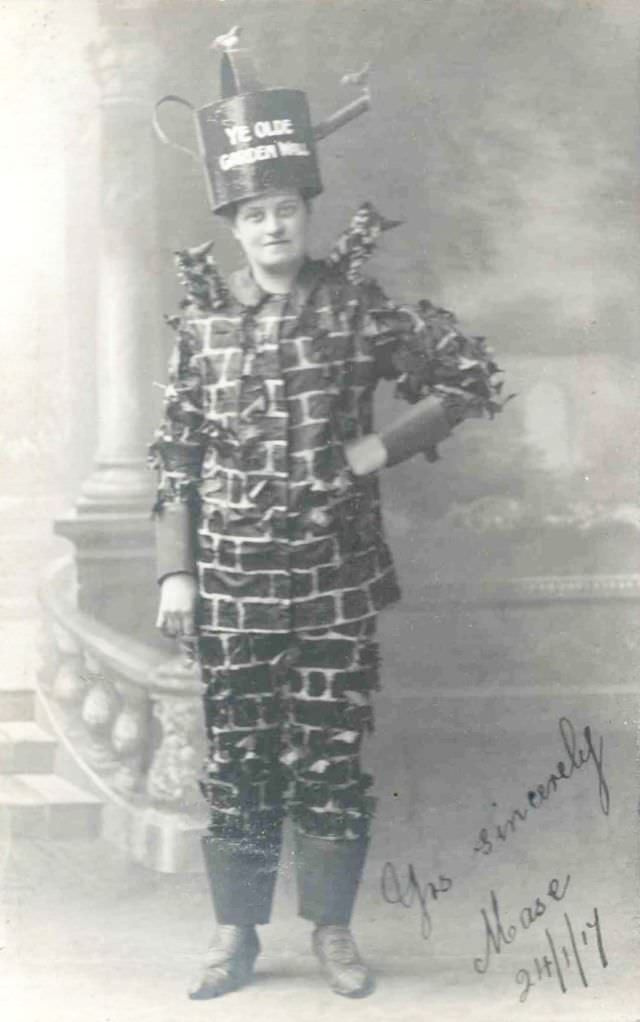
Some costumes were simply inventive. Dressing as a garden wall — a literal, structural object — required imagination and construction skills far beyond draping fabric over oneself. This kind of costume showed that early 20th-century party-goers weren’t just following trends; some were competing to come up with the most unexpected concept possible. These novelty costumes were a fixture at competition events and drew just as much attention as the more polished theatrical looks.
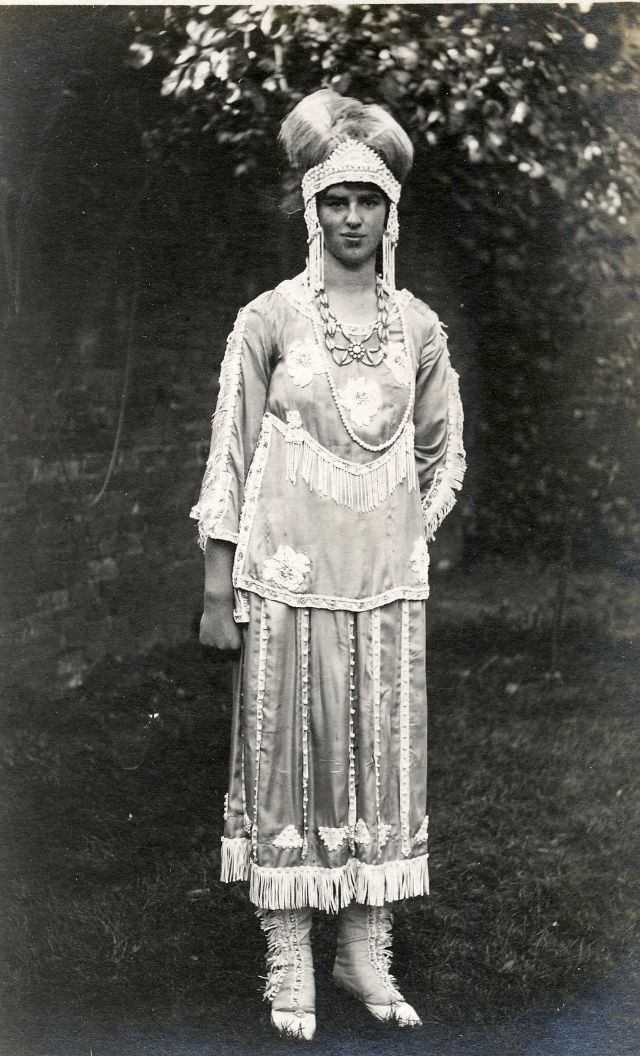
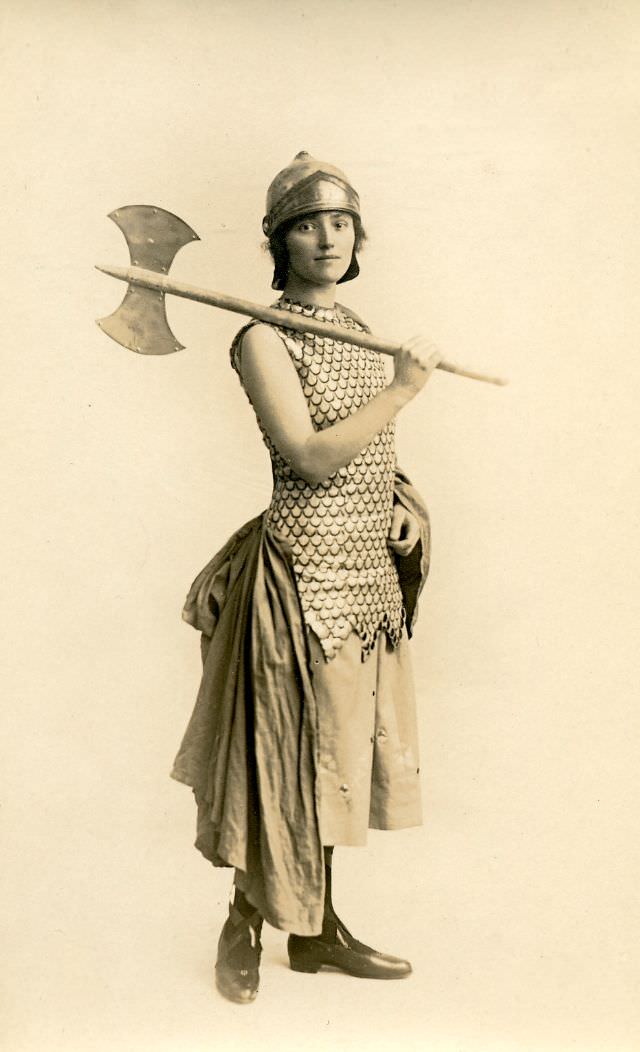
Warrior and heroine archetypes gave women in particular a way to step outside their everyday social roles — at least for an evening. The female warrior costume, full of armor-like details and strong posture, stood in sharp contrast to the delicate fairy and flower costumes that were also common. National and indigenous costumes were widespread at the time, though they were almost always filtered through a romanticized or theatrical lens rather than any attempt at accuracy.
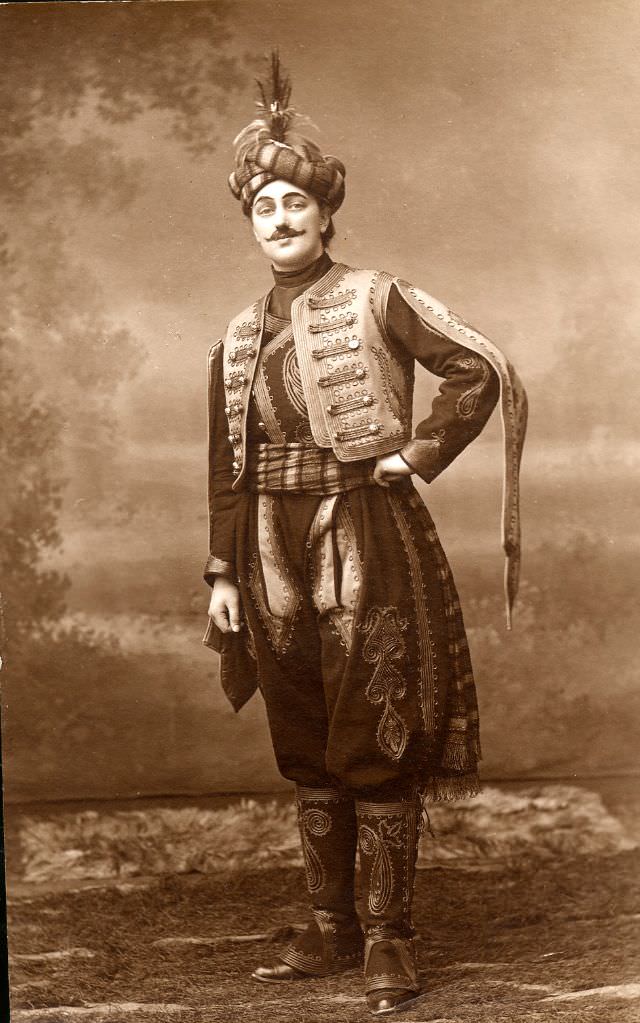
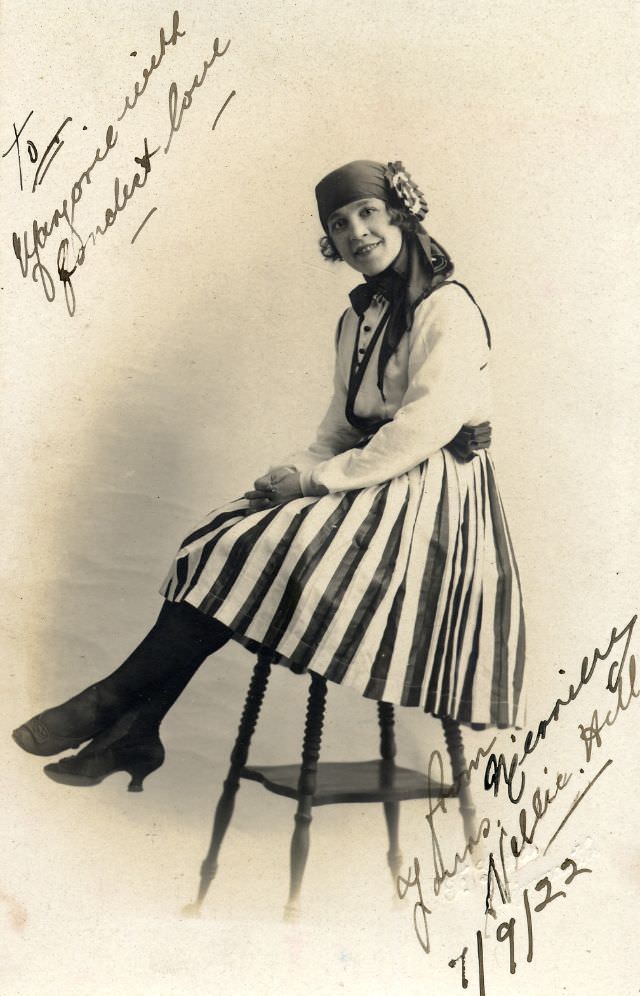
Many of these photographs were taken in professional studios, which tells us that people took their fancy dress seriously enough to pay for a formal sitting. Studio photographers in Edwardian Britain and early 20th-century America often photographed subjects in costume for keepsakes, calling cards, or theatrical promotional purposes. Gertie Holt is one of the named individuals who left behind such a record — her full name written on the photograph, preserving her identity across more than a hundred years.
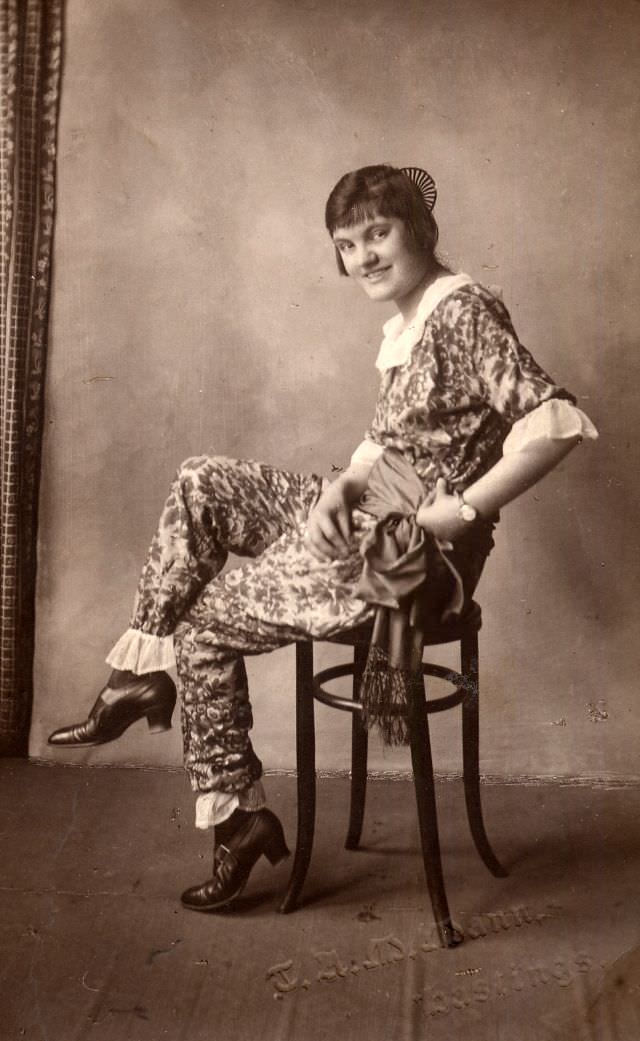
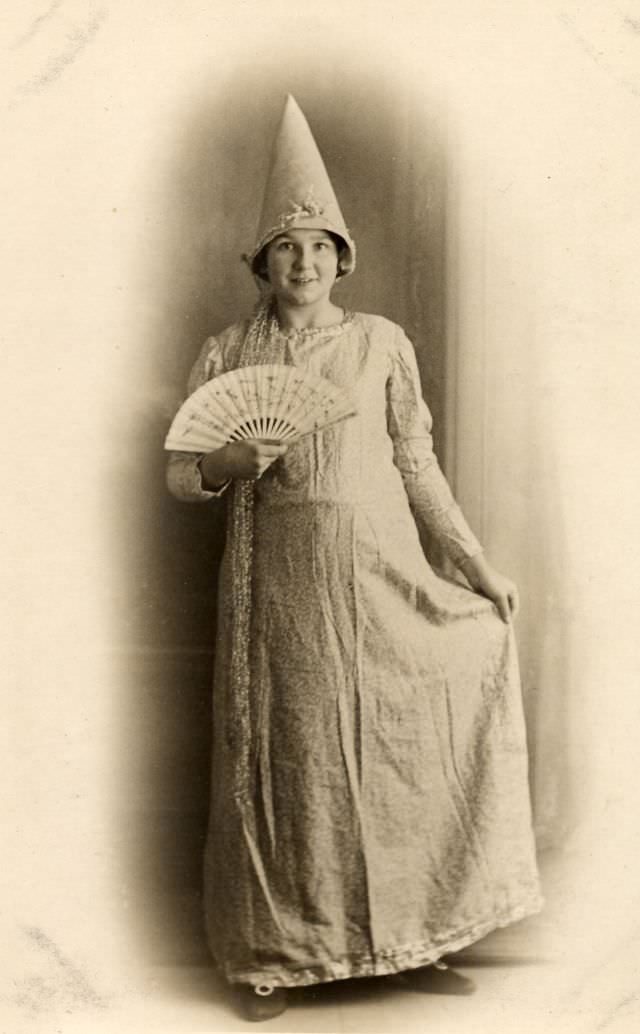
Concert parties were a popular form of entertainment in the early 1900s, and participants — both performers and audience members — often dressed in costume. Medieval dress was another recurring theme, connecting wearers to a romanticized vision of British history. These costumes typically featured floor-length gowns, structured bodices, and period-appropriate headwear, all carefully assembled to suggest a specific historical era.
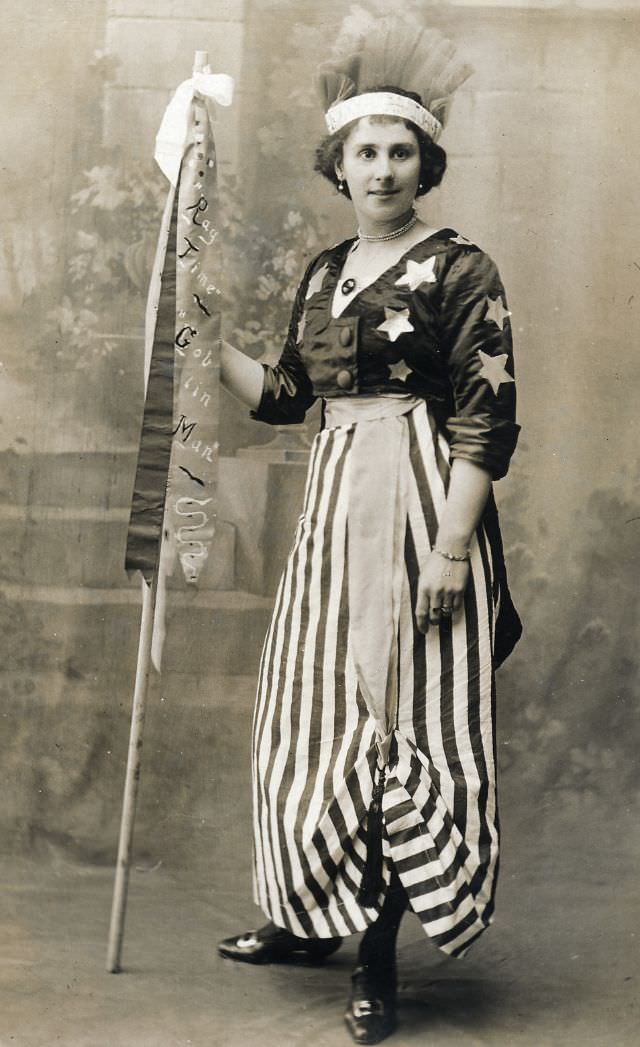
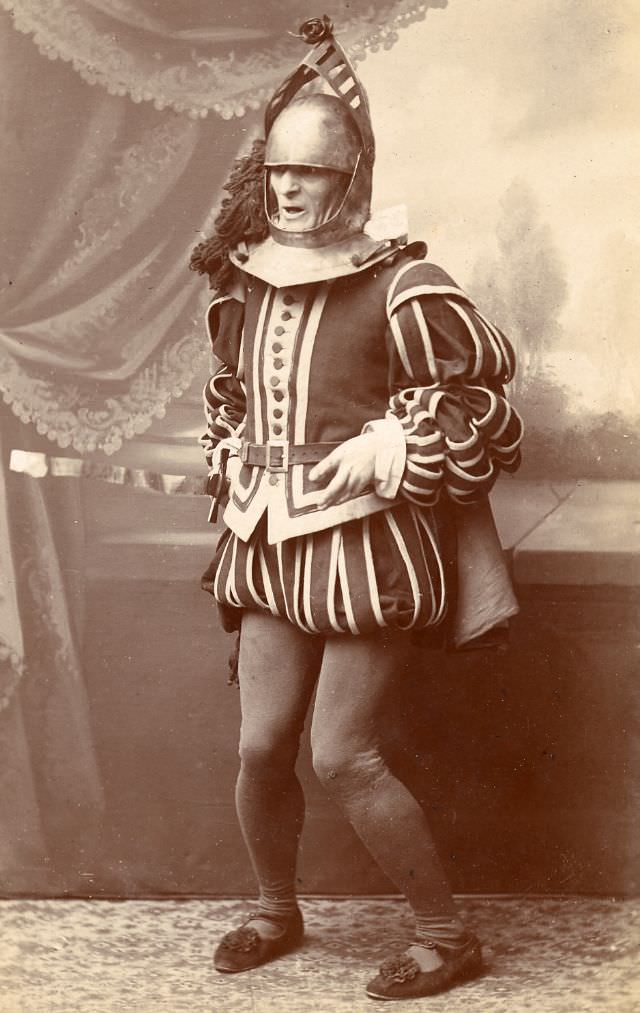
Dressing as a country or nation was a distinct genre within fancy dress. Costumes representing America, France, and Britain each carried specific visual codes — particular colors, symbols, and accessories that an audience would immediately recognize. Tudor dress, meanwhile, drew on the imagery of 16th-century England and was associated with grandeur and historical prestige. These looks required significant research or at least access to popular prints and illustrations of the era.
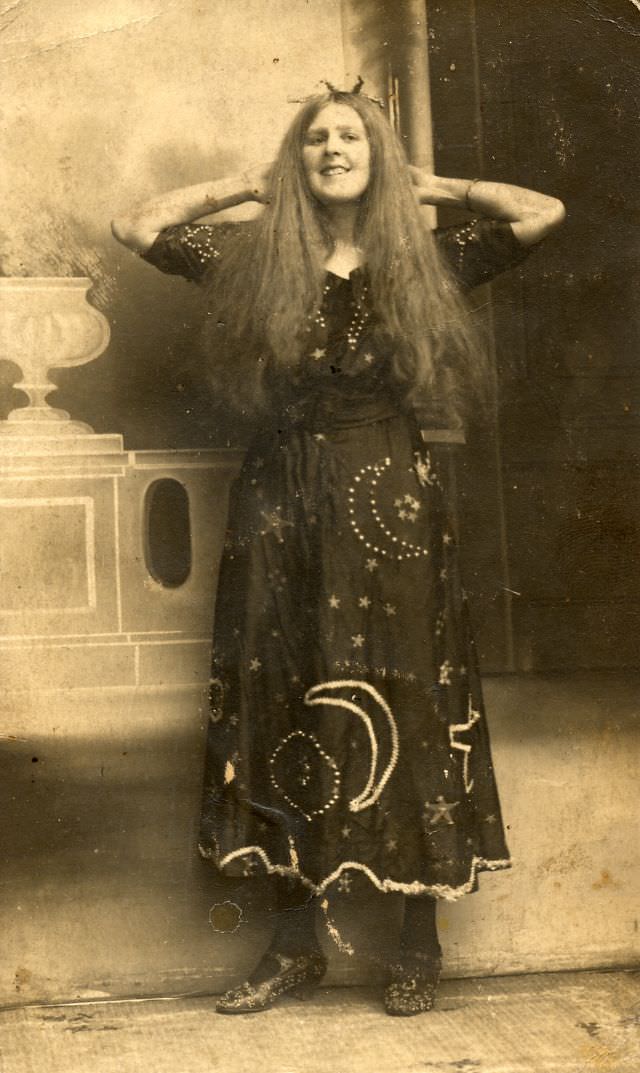
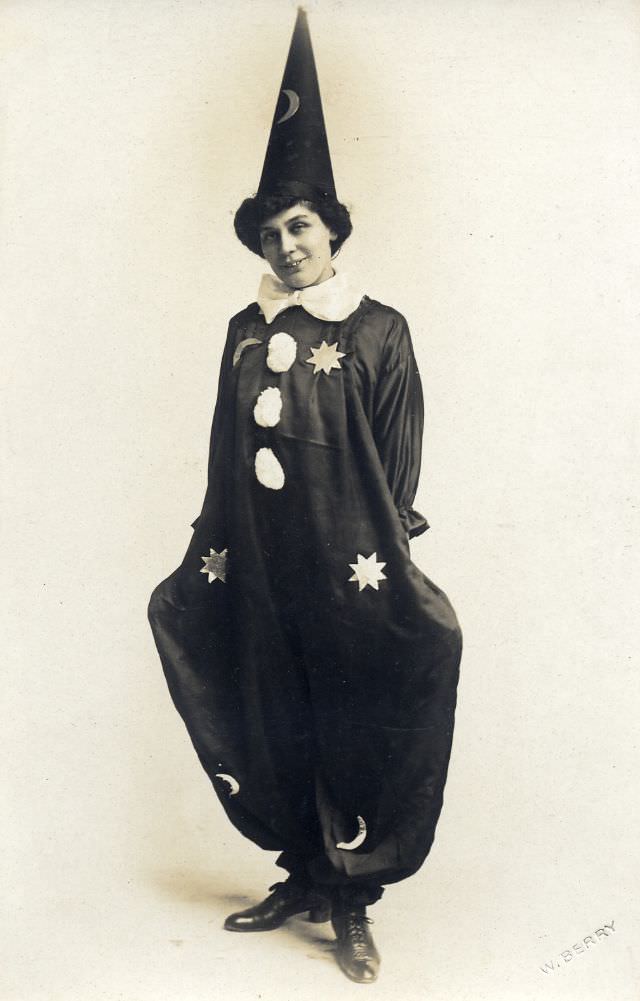
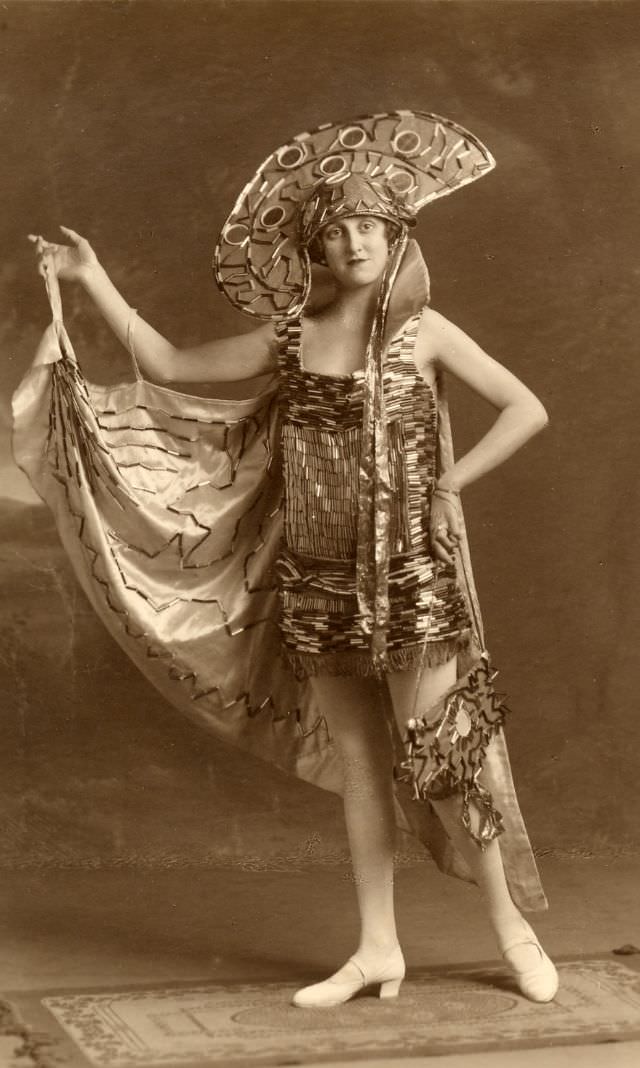
Abstract and celestial costumes were among the most ambitious. Dressing as the moon and the stars required a concept well beyond picking a character from a story or a figure from history. Costumes like this one were built around an idea — using fabric, decoration, and headwear to represent something vast and symbolic. They were theatrical statements as much as costumes.
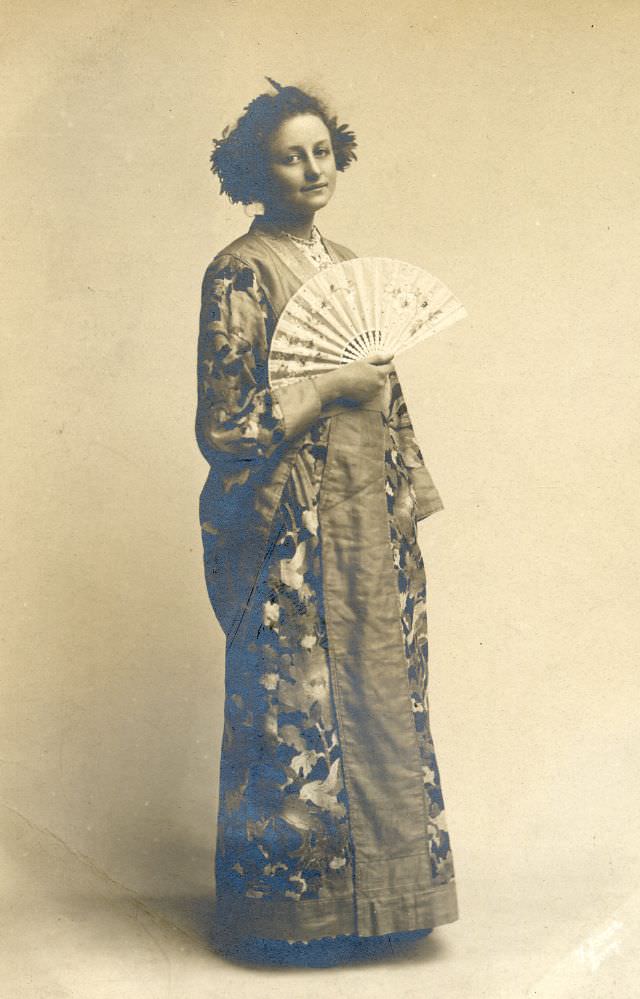
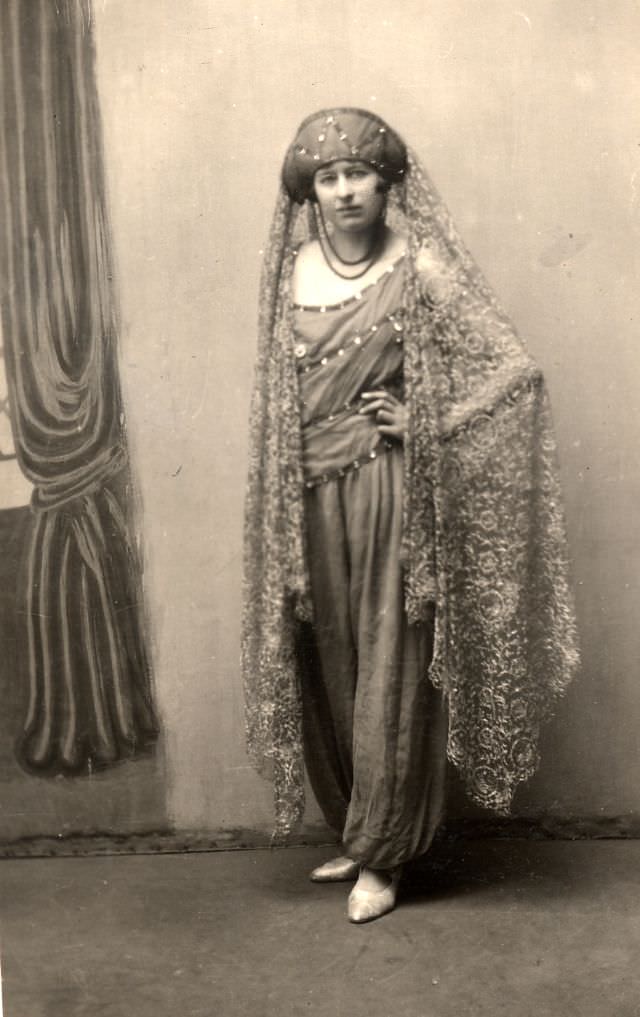
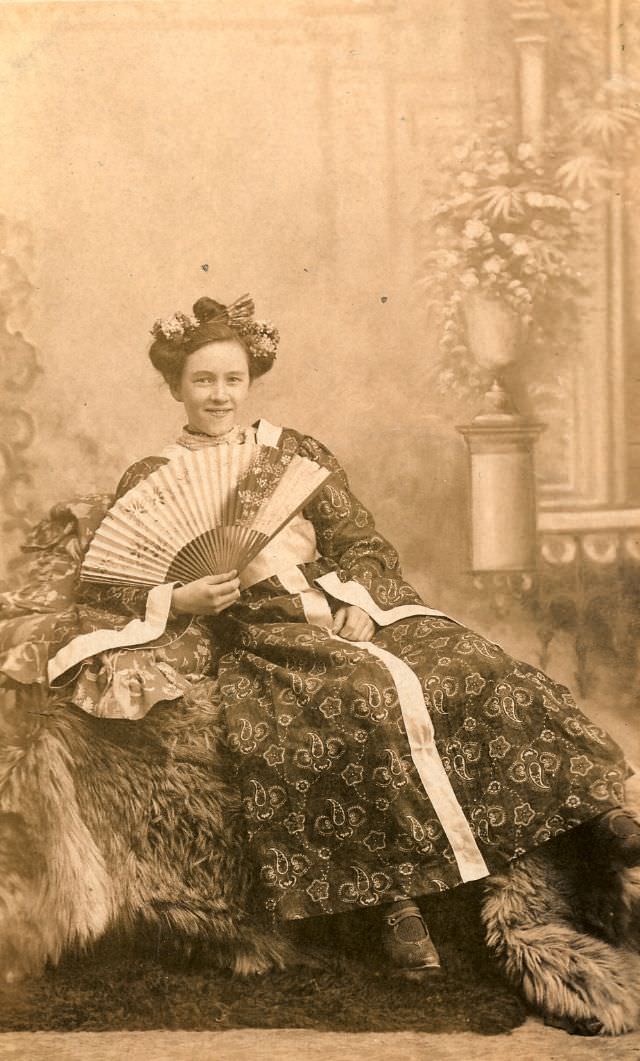
Japanese-inspired costumes were especially fashionable during this period, fueled in part by the popularity of Gilbert and Sullivan’s opera The Mikado, which had been performed repeatedly since its 1885 debut. Kimonos, fans, and ornate hair accessories became recognizable costume staples. Alice Morris, who dressed in a kimono to perform in The Mikado in 1907, is one of the most specifically documented subjects in this collection.
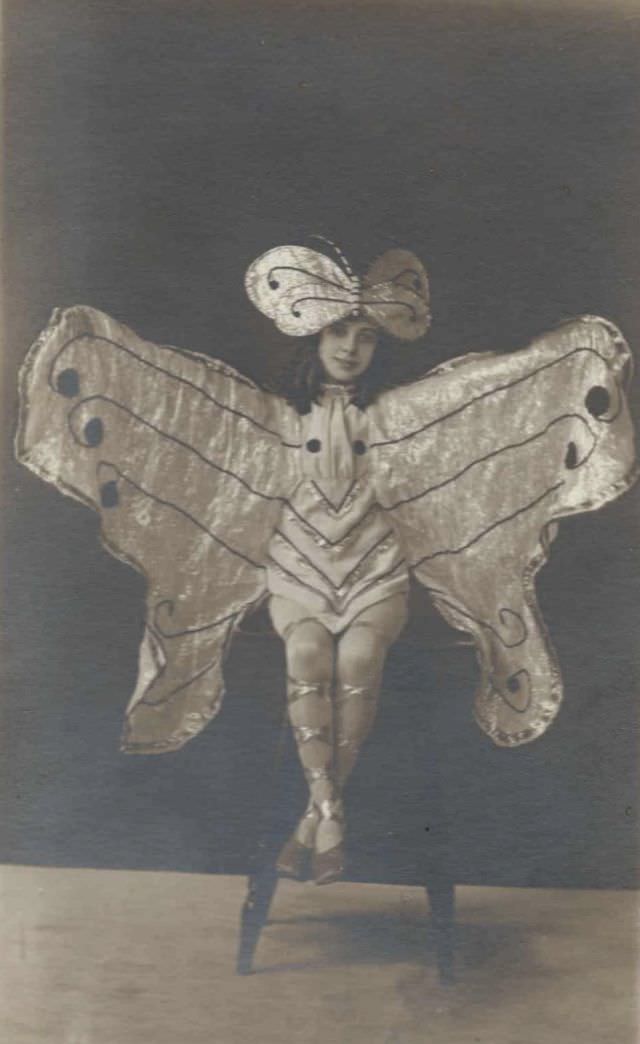
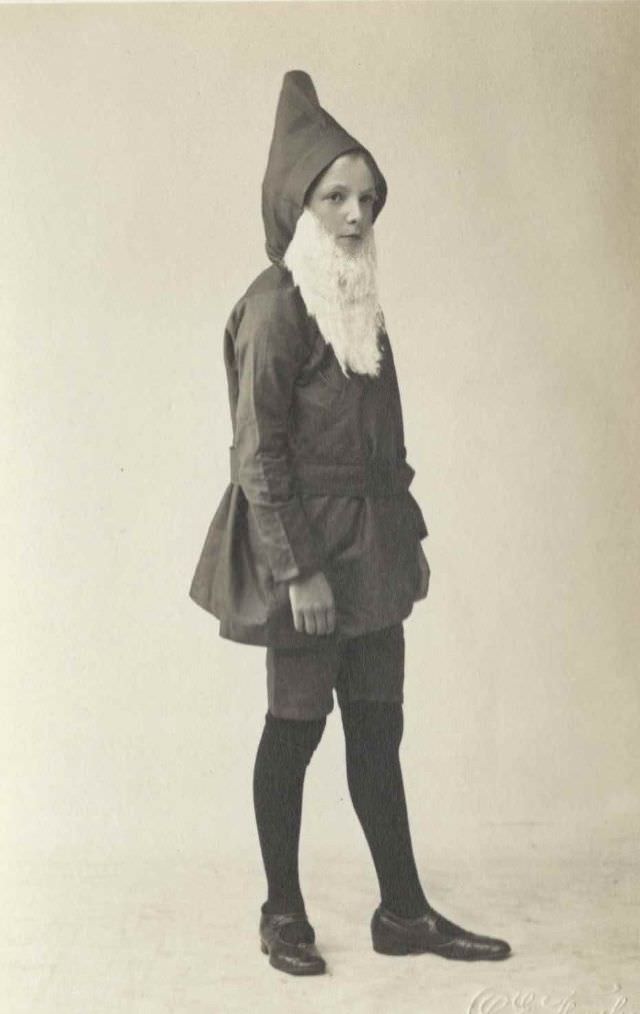
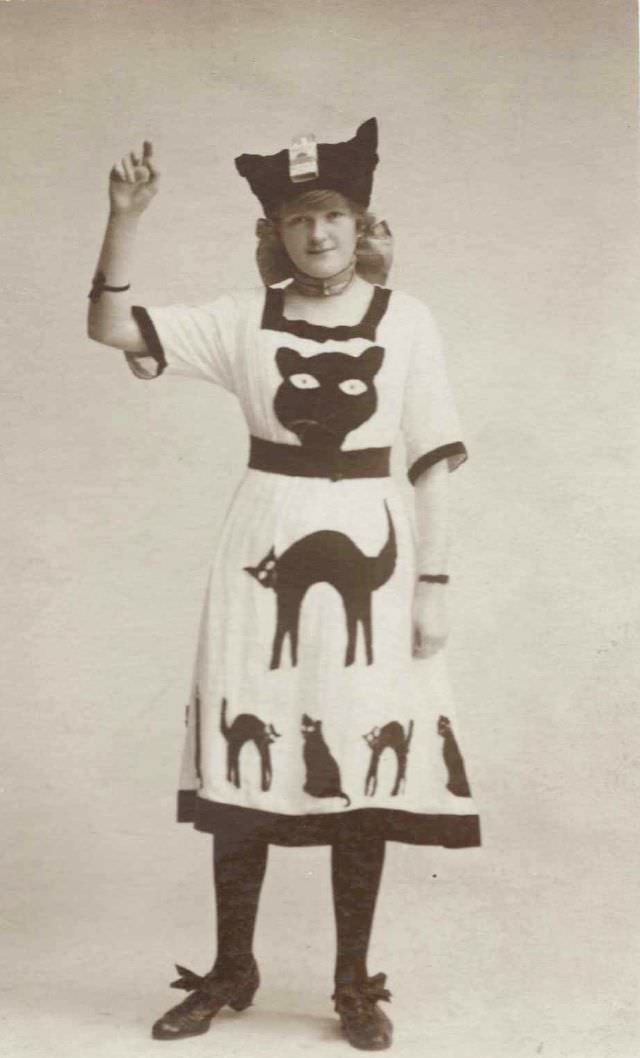
Children featured prominently in early 20th-century fancy dress culture. Their costumes ranged from the expected — butterflies, elves, and fairies — to the surprisingly commercial. One young girl was dressed to advertise Black Cat cigarettes, a brand that was very much part of mainstream British life at the time. Using a child as a walking advertisement, even in a costume context, reflected the era’s entirely different relationship with tobacco marketing.
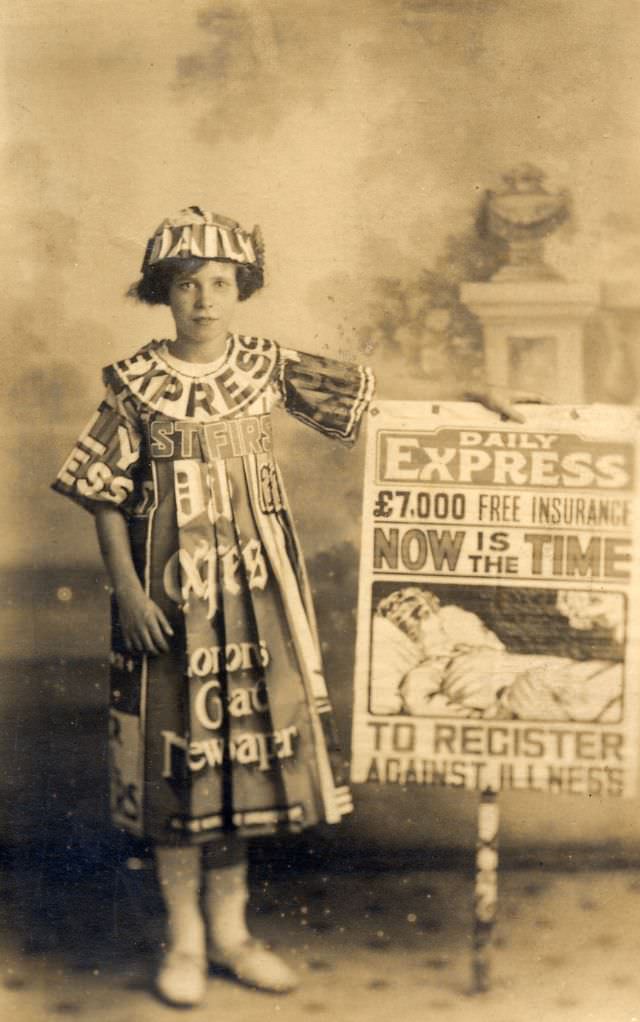
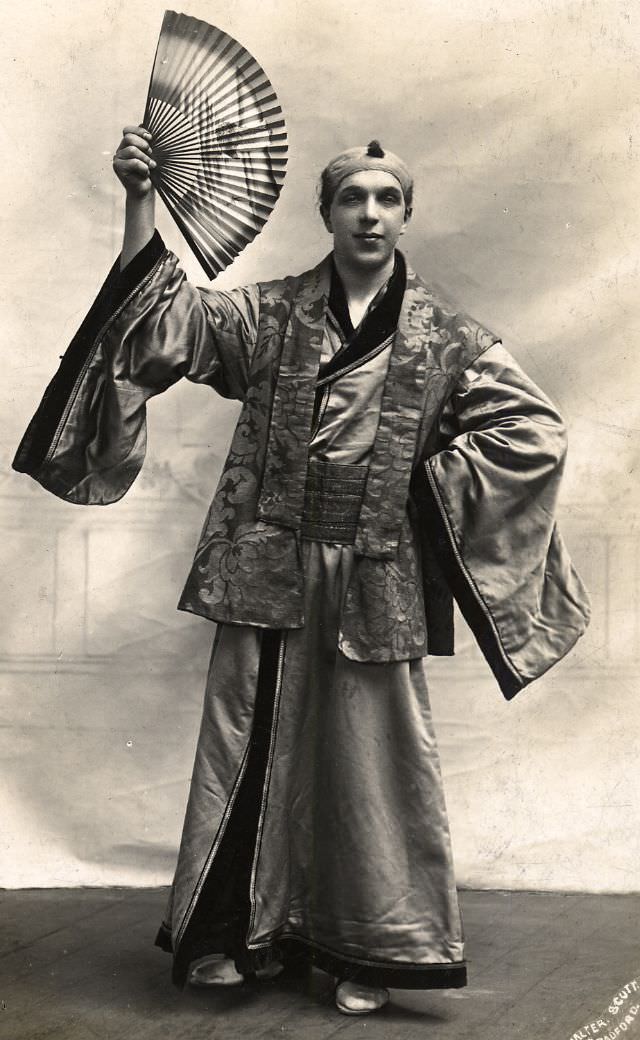
Another child was dressed as the Daily Express — Britain’s national newspaper — turning herself into a walking headline board. This kind of topical, satirical costume was typically seen at adult events, making its appearance on a young girl all the more striking. Meanwhile, men also participated in Eastern-themed costumes, with “Chinaman” dress appearing in several photographs. These costumes were standard fare at the time, though they were built entirely on caricature.
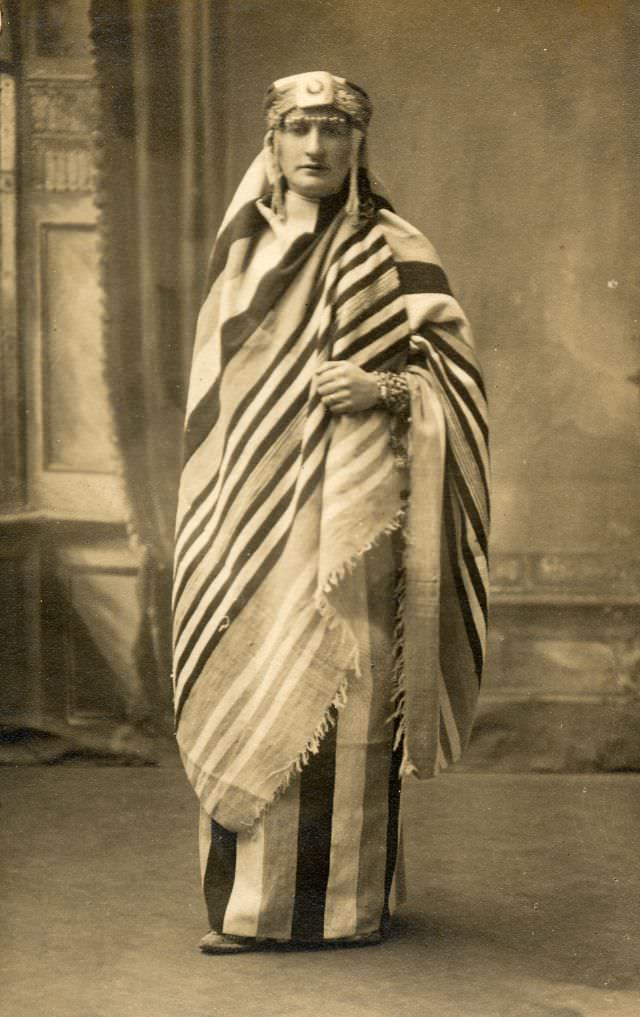
Some photographs carry handwritten inscriptions on the back that add a personal layer to the image. The note on this 1913 photograph — “Cissie Hamilton (and very nice too)” — suggests it was written by someone who knew her, possibly a friend or admirer. These informal annotations turn archival photographs into something more intimate, connecting us directly to the people who once held and wrote on them.
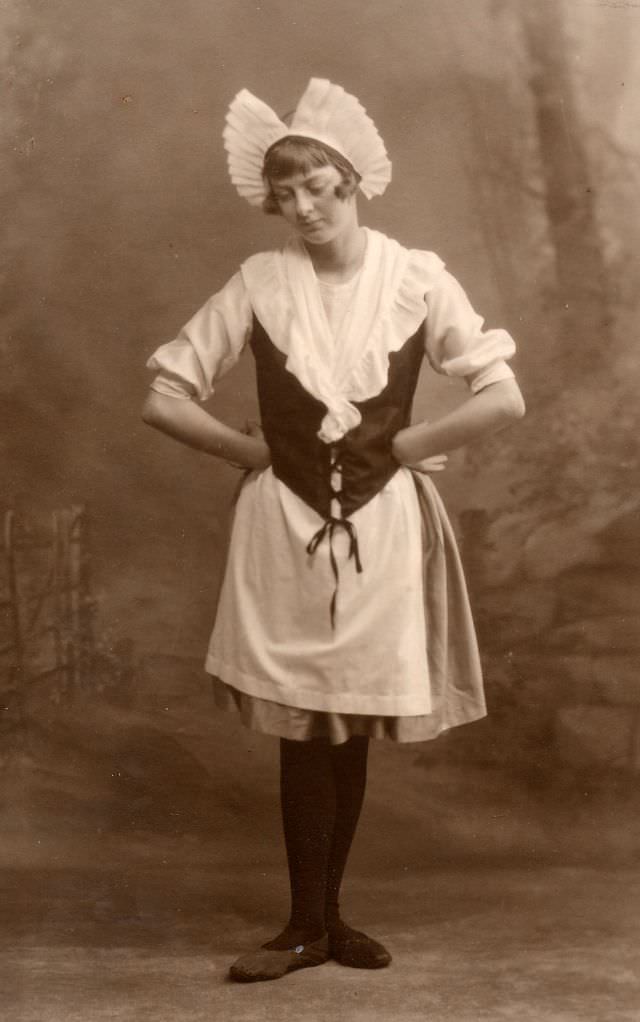
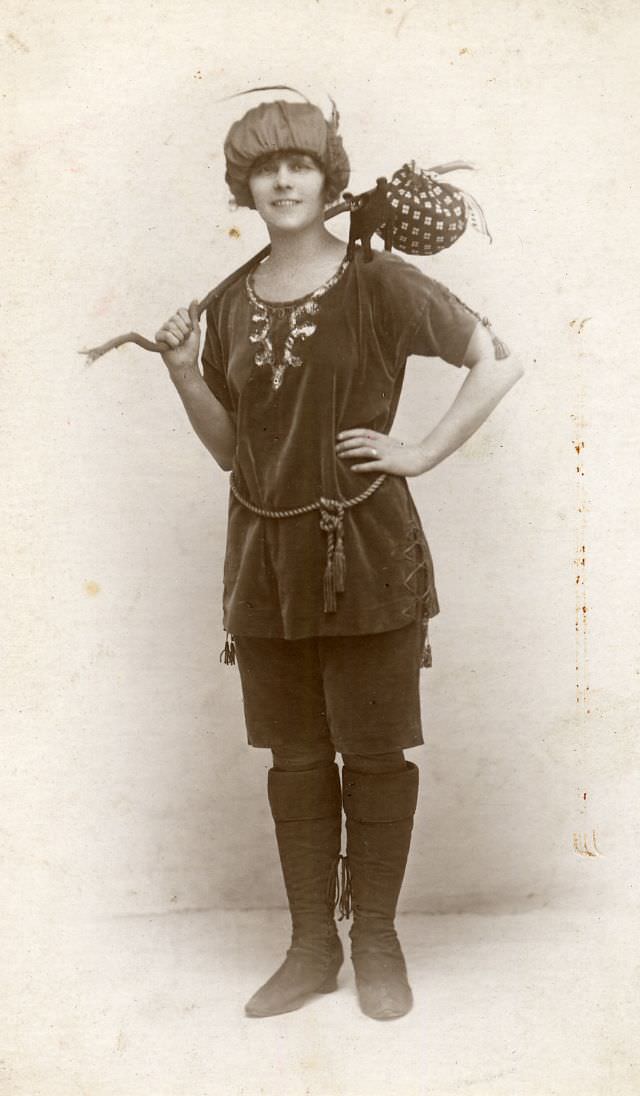
Another inscription identifies a fourteen-year-old girl named Alicia, photographed in 1926. Details like these are rare in photographic archives. Most people in these images are anonymous — faces without names, costumes without context. When a name and date survive, they transform the photograph from a generic historical artifact into a record of a specific person on a specific day.
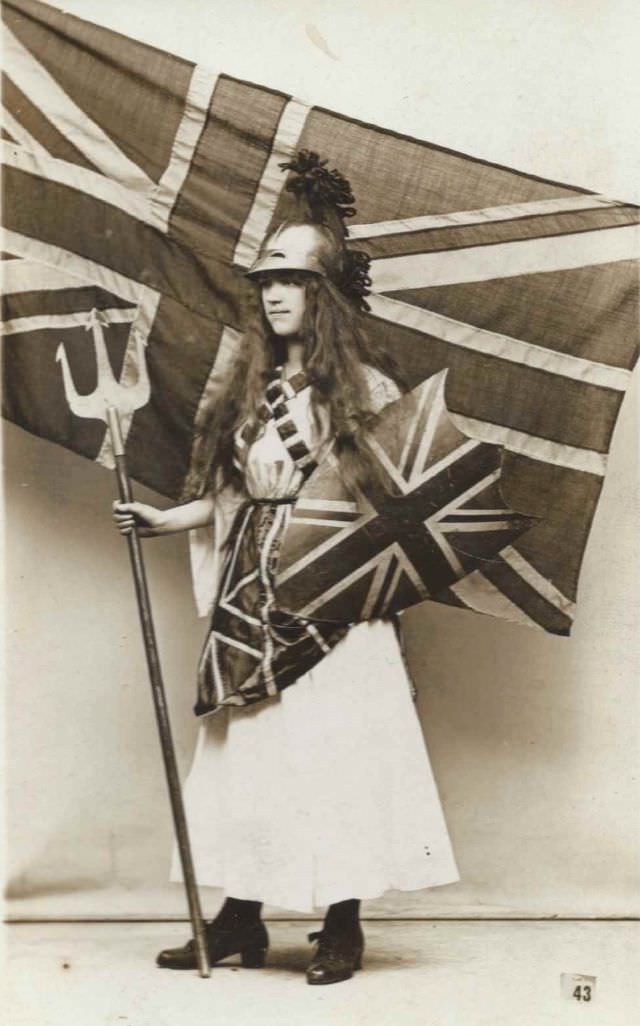
National costume remained a consistent theme throughout the early 20th century. “Rule Britannia” and “Representing France” both drew on patriotic imagery — helmets, tridents, tricolors, and Union Jacks — to embody a nation in costume form. In the years surrounding World War One, these national identity costumes took on added weight. Dressing as Britain or France wasn’t simply festive; it carried an explicit sense of national pride and solidarity.
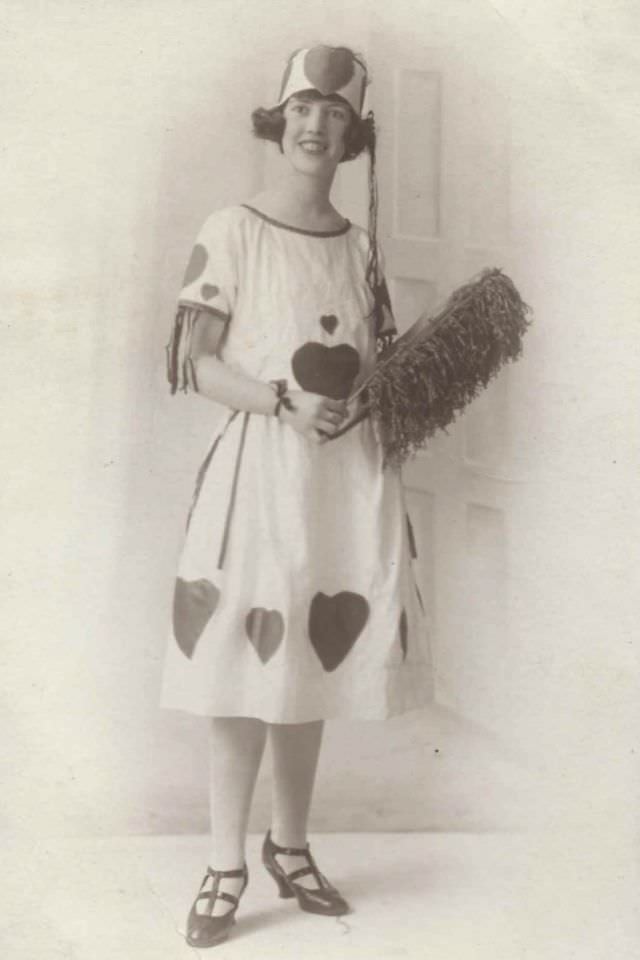
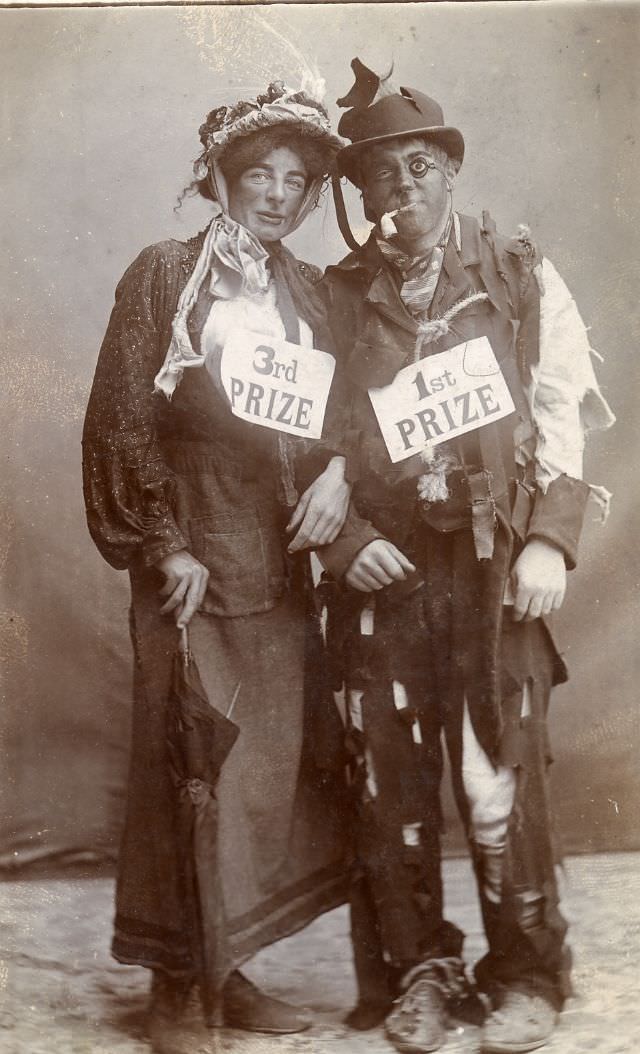
Playing card costumes — like the Ace of Hearts — were a clever novelty that translated a flat, familiar image into a three-dimensional wearable. Fancy dress competitions were a genuine institution at this time, and the photograph captioned “The prize winners” confirms that competitive events with formal judging took place. Winners were recognized publicly, and their photographs were sometimes kept as proof of their achievement.
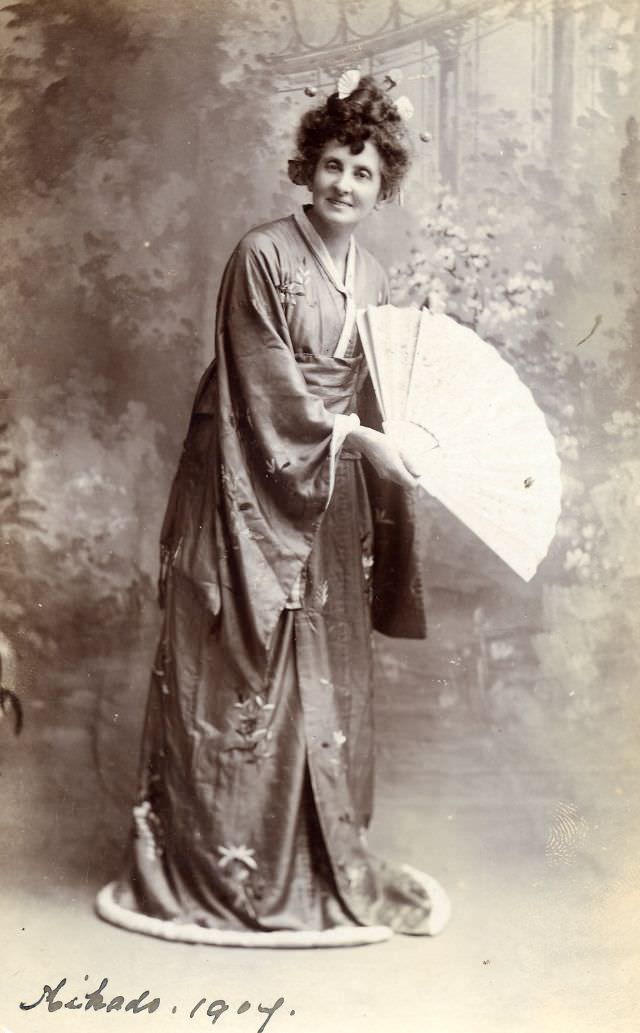
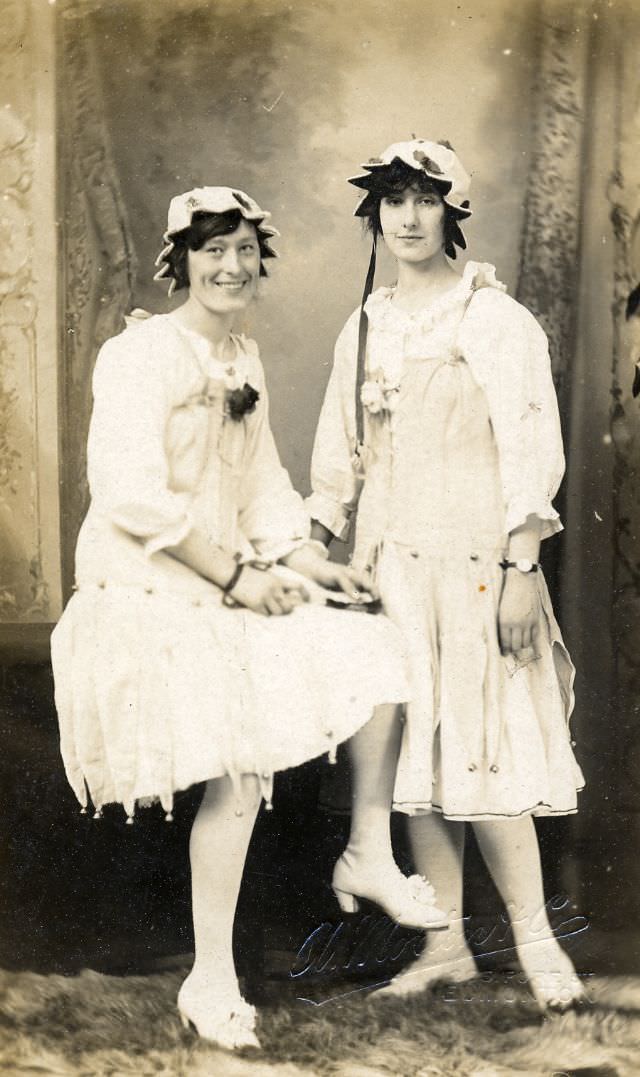
Alice Morris’s 1907 Mikado photograph is one of the most precisely dated and identified images in this collection. She dressed in a full kimono for a theatrical production — part of the long-running amateur and professional tradition of staging Gilbert and Sullivan operas across Britain. Rose bud costumes, like those worn by the two girls in the next photograph, belonged to a gentler tradition — sweetly decorative, crafted to look like flowers in bloom.
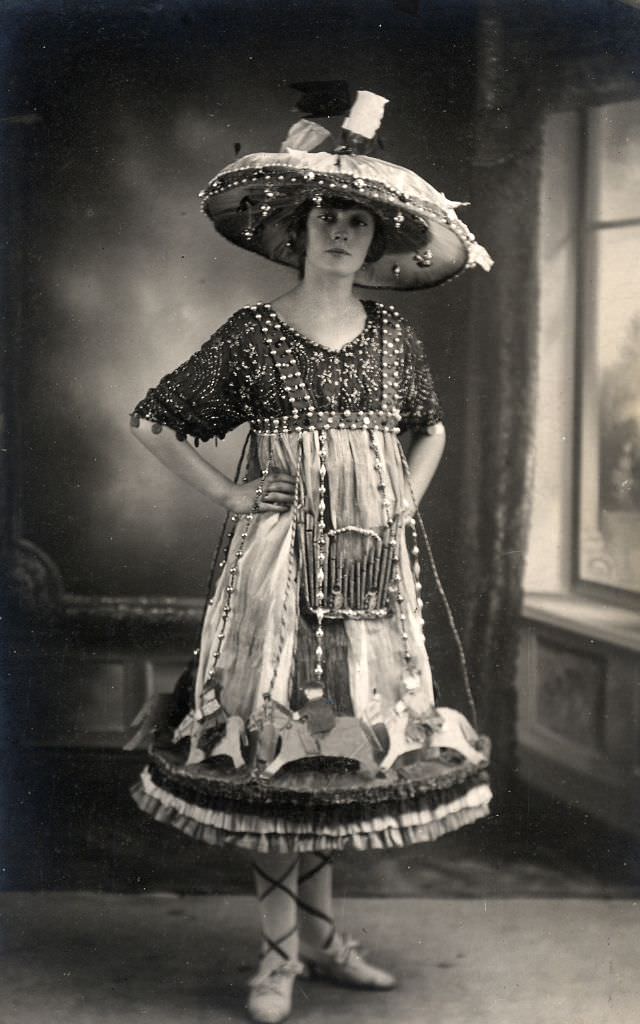
The carousel costume is one of the most technically ambitious in this collection. Constructing a wearable carousel — complete with horses and a rotating structure suggested by the costume’s framework — required significant effort and ingenuity. It sits alongside the garden wall costume as evidence that early 20th-century fancy dress was, for some people, a serious creative pursuit rather than a casual afterthought.
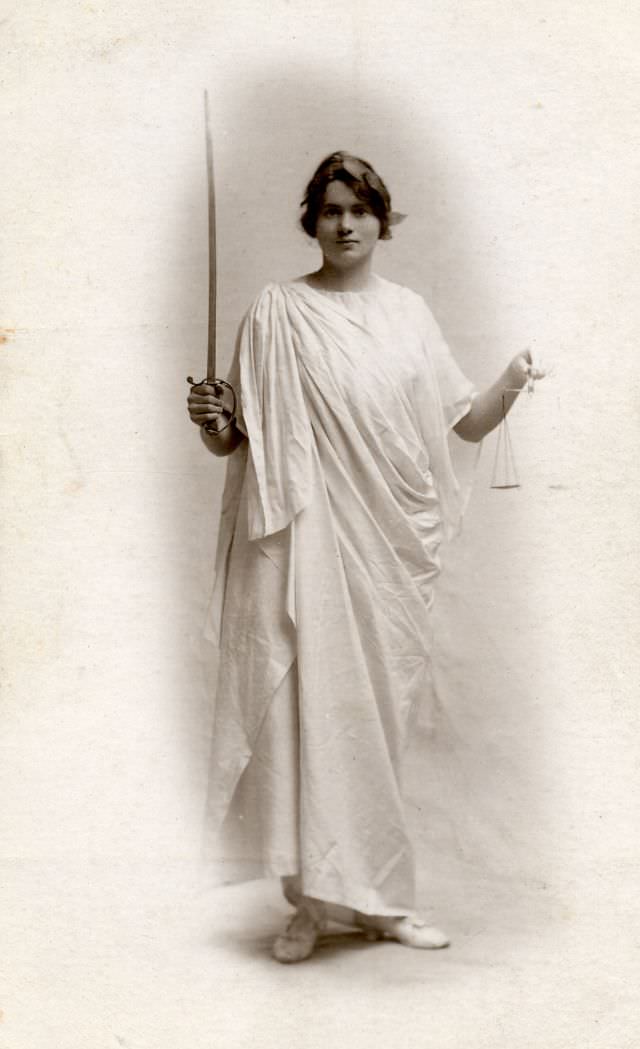
The final image in this collection was taken at the Curzon Studios in London, where a young woman posed as Justice — the blindfolded figure of Roman law, typically depicted with scales and a sword. The fact that this was a professional studio portrait underlines how seriously some subjects treated their fancy dress. Across all 45 photographs, what emerges is a picture of a society that used costume to explore identity, geography, history, and imagination — one carefully constructed outfit at a time.