During the early 1900s, warehouses and grain terminals lined Tacoma’s Thea Foss Waterway. Various railroads made transcontinental connections to Commencement Bay, including the Great Northern Railway, Union Pacific Railroad, and Milwaukee Road. Tacoma Land Company set aside land for parks and handed property management over to the city, while real estate speculators used federal laws to take almost three-fourths of the Puyallup Reservation for industrial development. These fascinating historical photos show Tacoma in the 1900s.
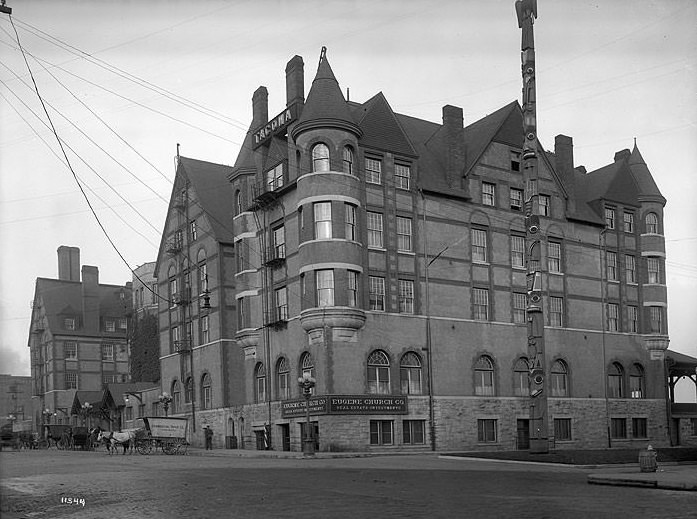
Sign on the first-floor corner of the hotel: Eugene Church Co., Real Estate-Investments. A tall totem pole is at the image right. Horse-drawn delivery wagons are in front of the hotel.
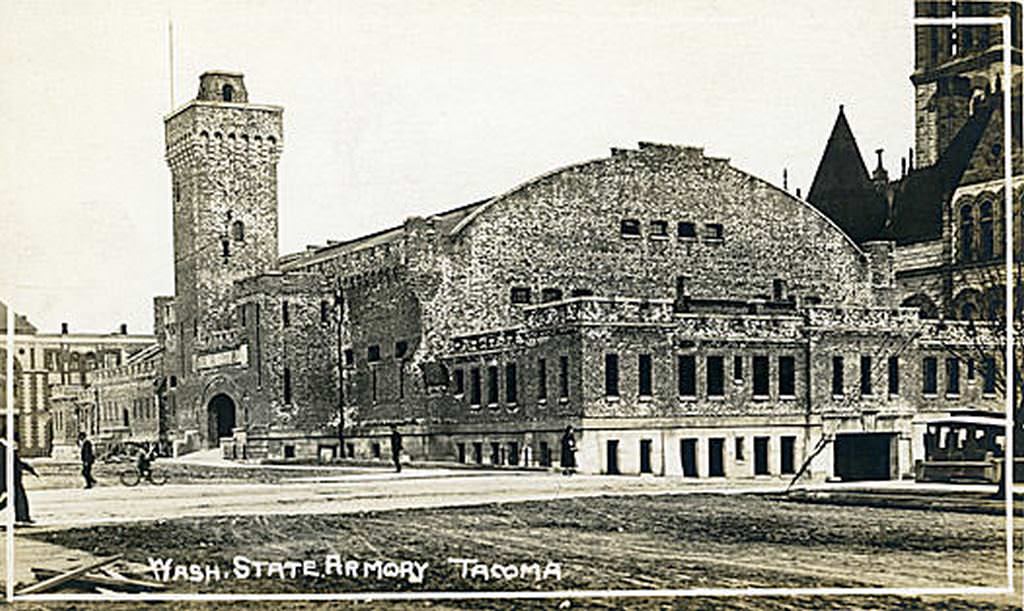
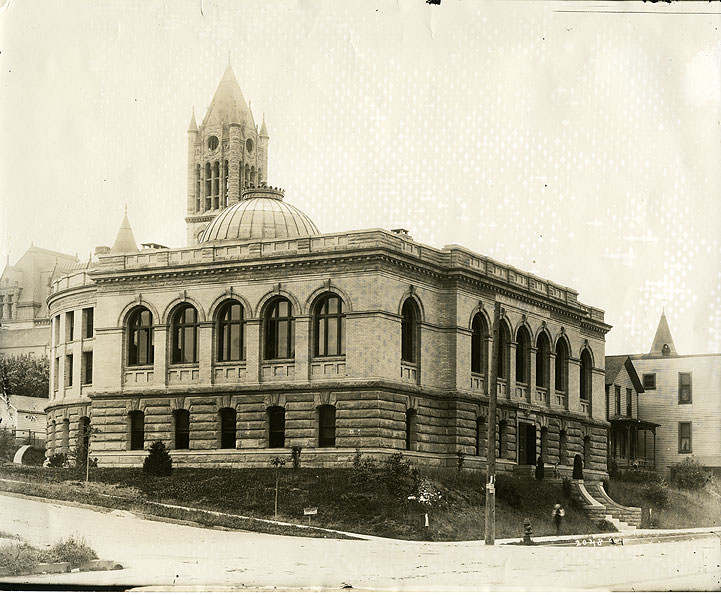
It is located on Tacoma Avenue South and Eleventh Street, facing Tacoma Avenue. A sign on the grass adjacent to the building reads: Keep Off. The Pierce County Courthouse is partially visible behind the building.
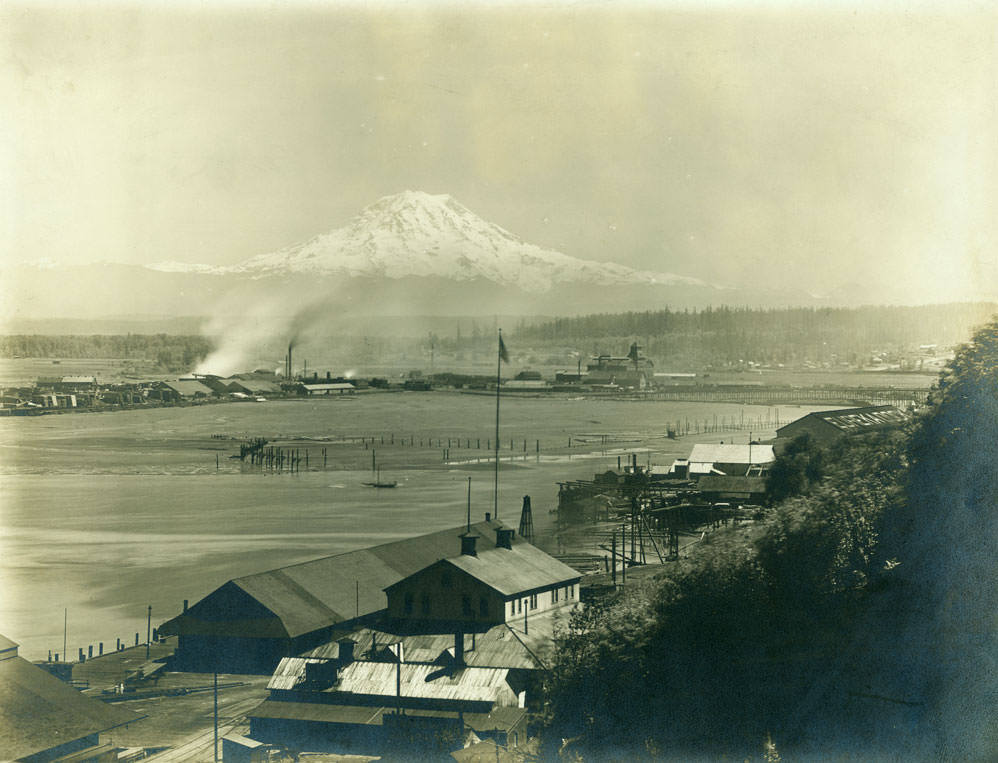
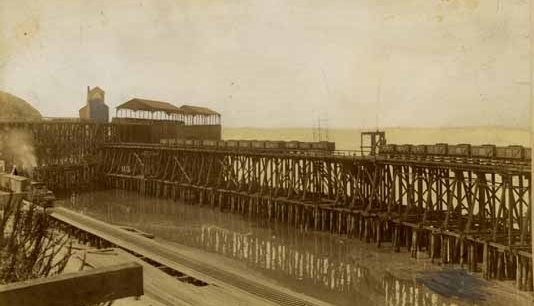
A view of the Tacoma tideflats with Eureka Dock and other structures in the foreground. Mills are visible across the flats, with Mt. Rainier in the background.
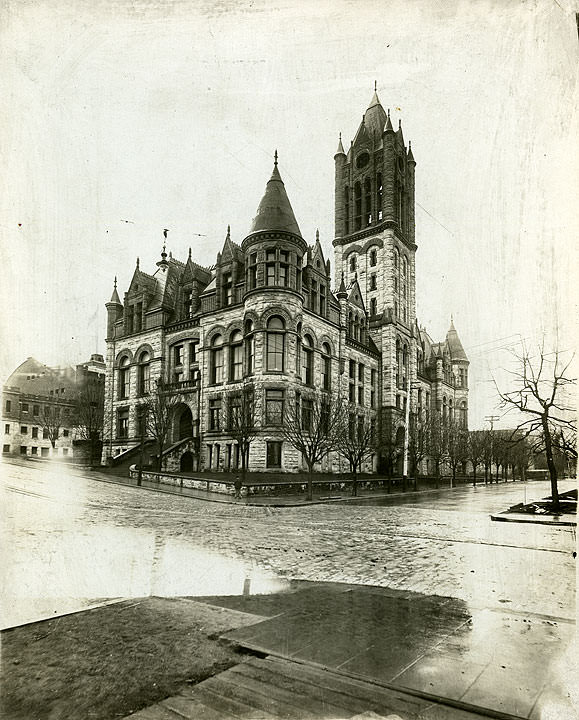
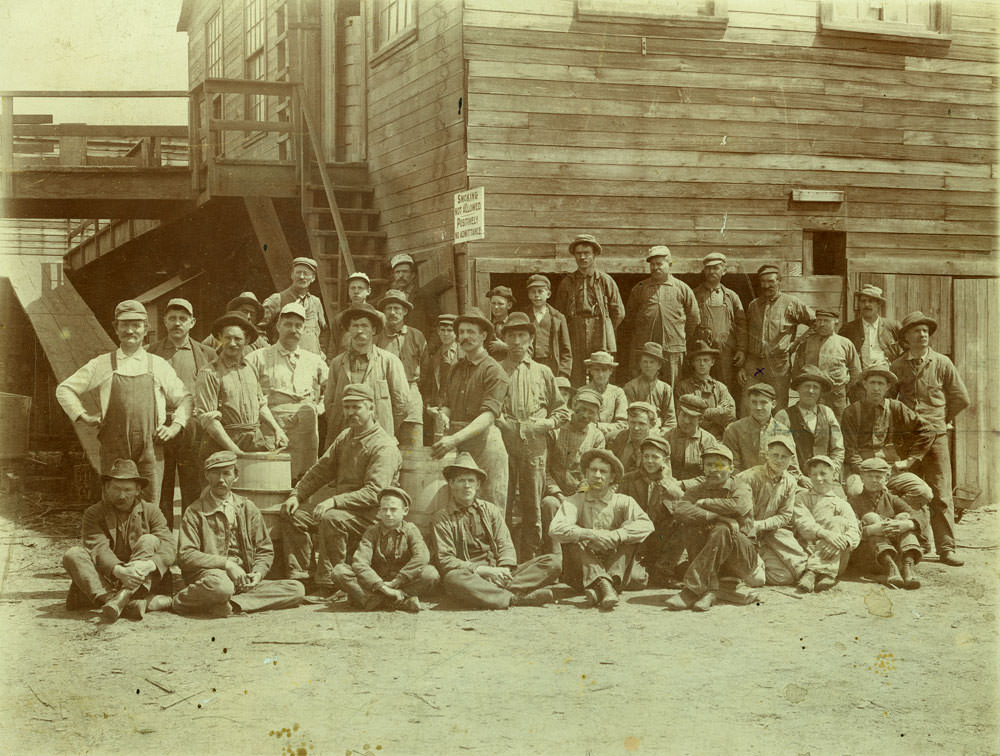
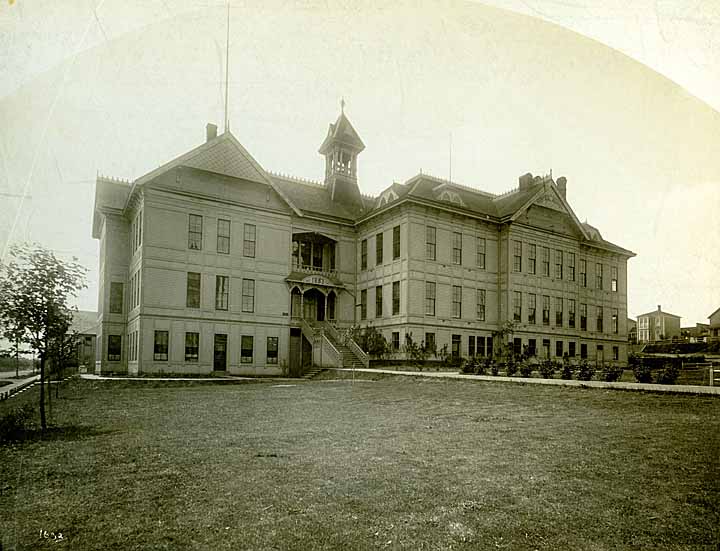
The building was built in 1883 and demolished in 1914.
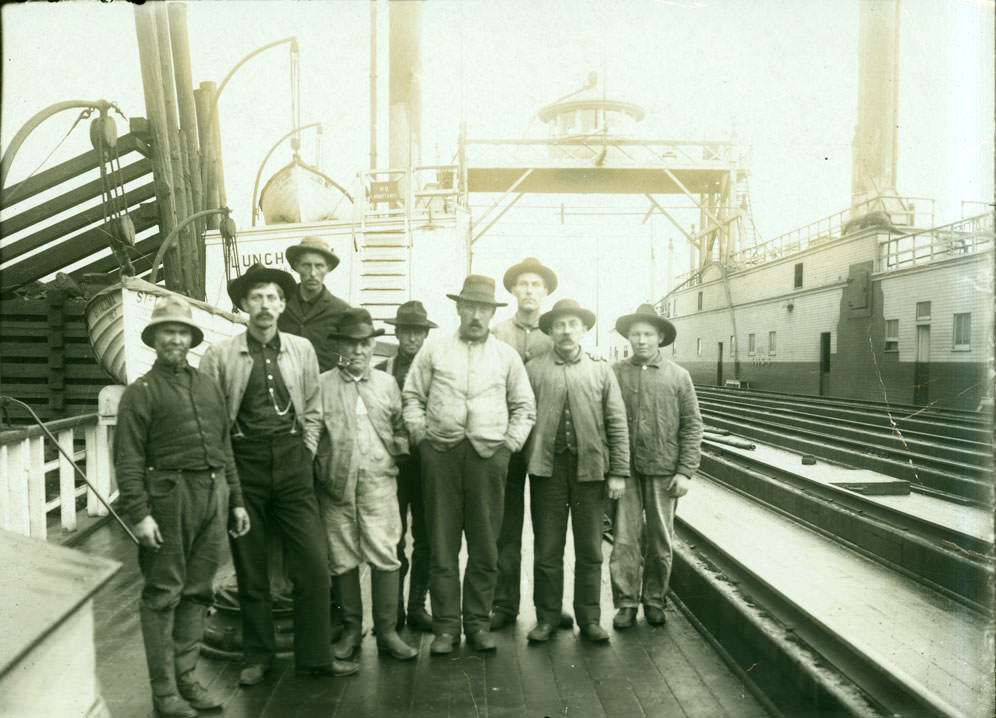
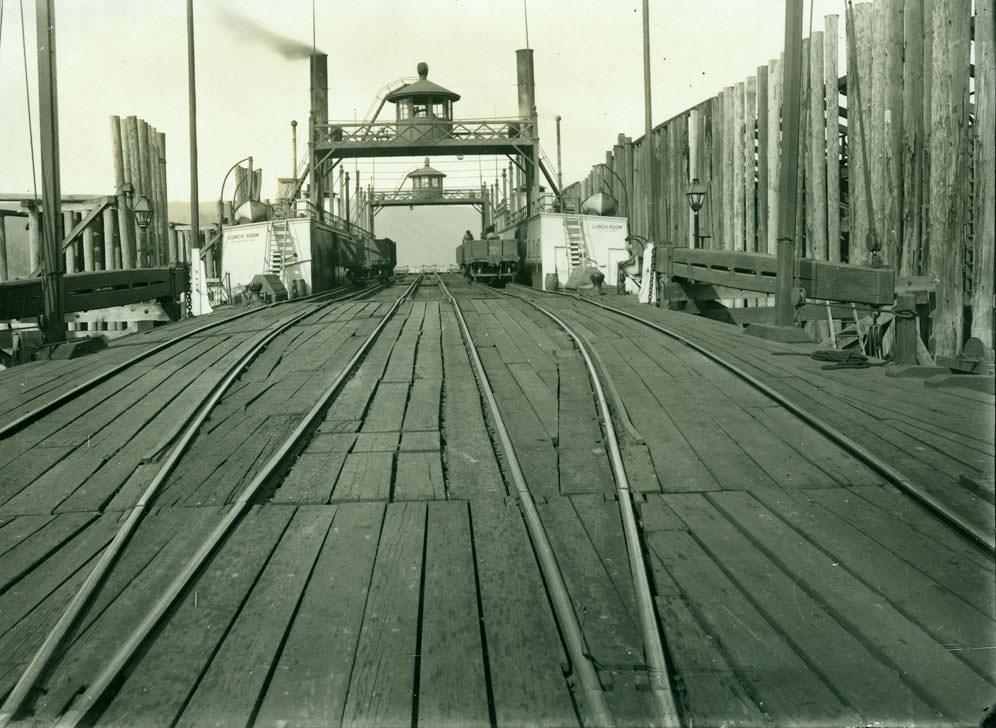
The view shows boarding the ship by the lifeboats and lunchroom.
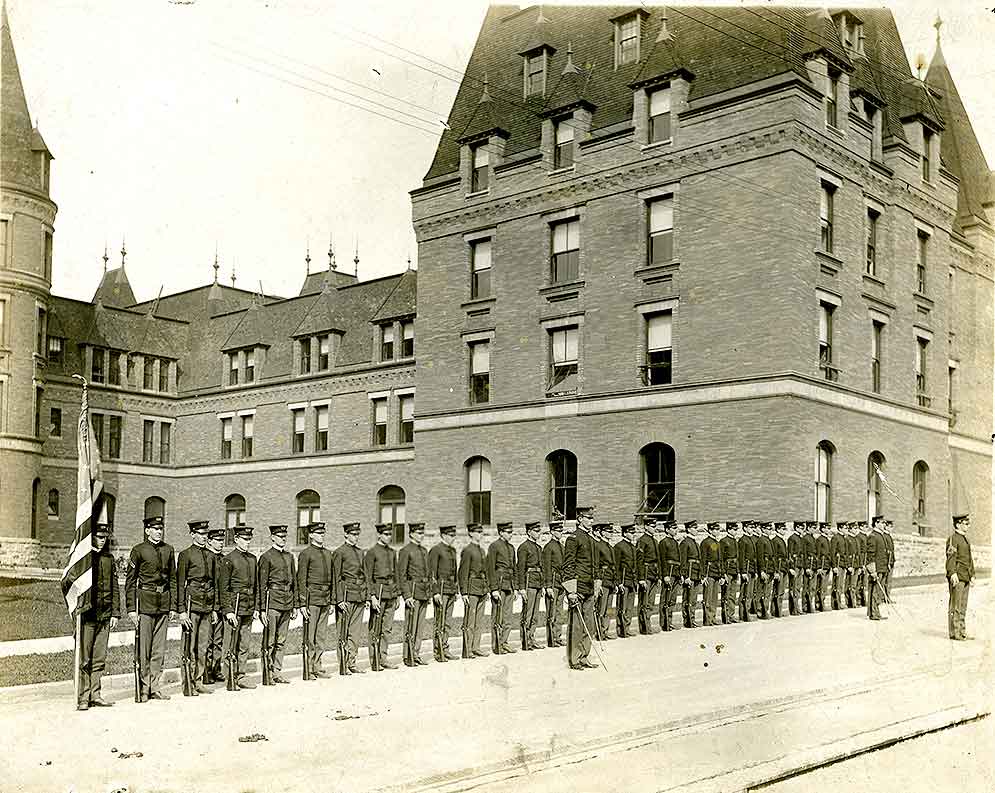
The uniformed cadets are standing in a line at attention in order arms formation.
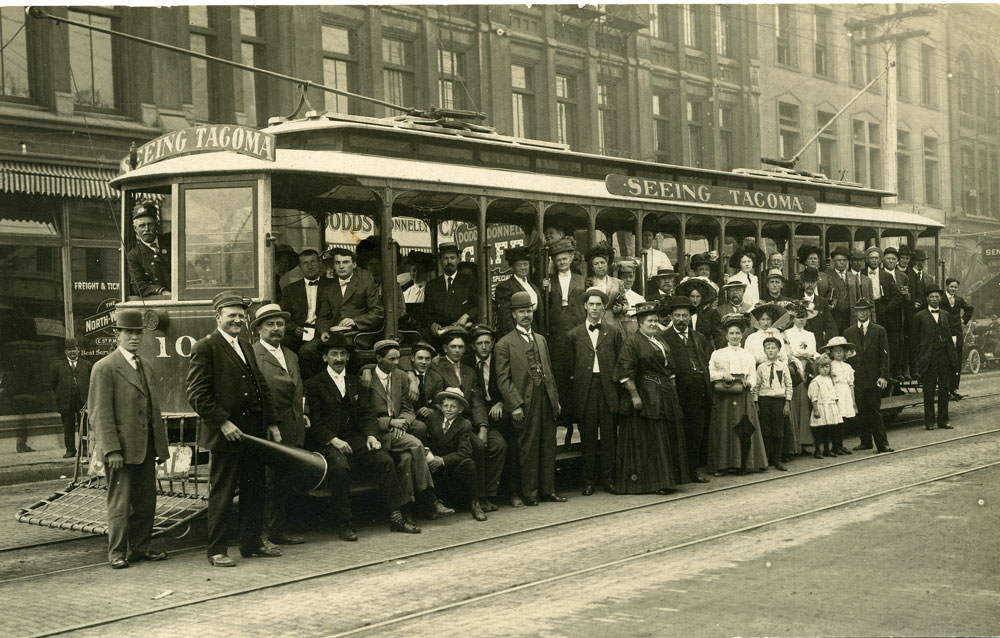
The streetcar has two signs on the top saying “Seeing Tacoma”. The driver is leaning out the front window, and the tour guide stands near the front of the group with a megaphone. More than 30 men, women, and children are seated on the streetcar and standing alongside it.
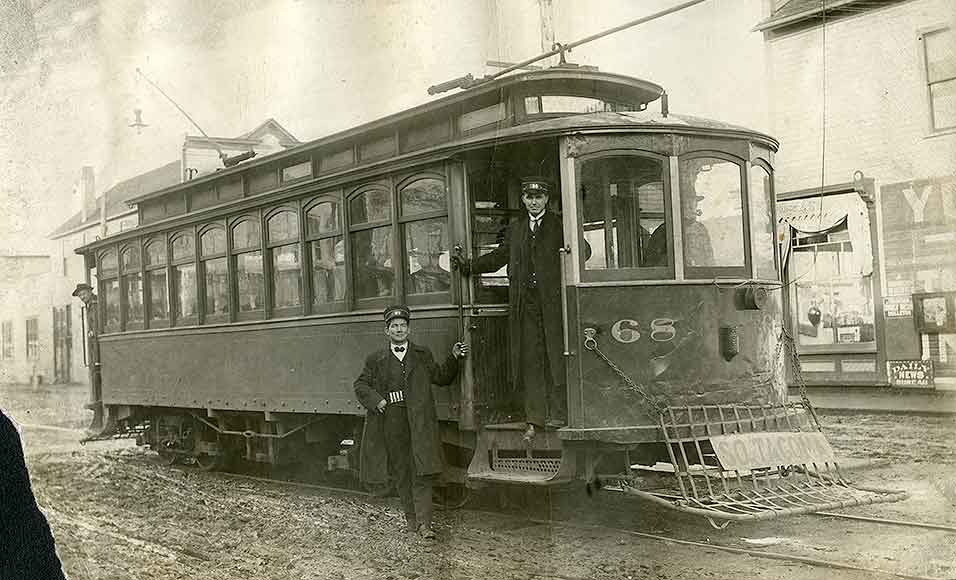
There are two uniformed men in the picture: one standing on the ground next to the front step of the streetcar and the other at the top of the front step. There is another man with a pipe standing near the controls of the streetcar and one standing on the back steps. Other people are barely visible inside the car. Behind the streetcar is a corner drugstore. On the outside wall of the drugstore building is a possible waiting area for the streetcar, which has several advertisements on its side.
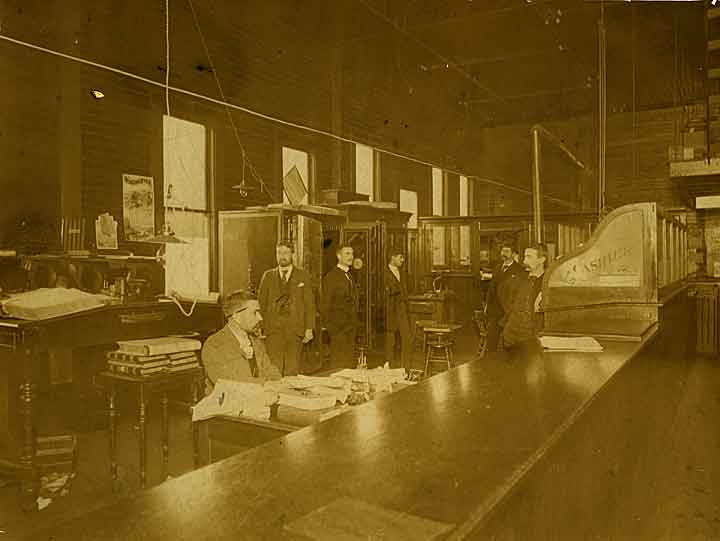
Six men wearing suits, standing and sitting, pose behind a long counter in the Tacoma Mill Co. office. One of them is seated behind the counter at a desk with papers on top. Ledgers are stacked on a table behind him.
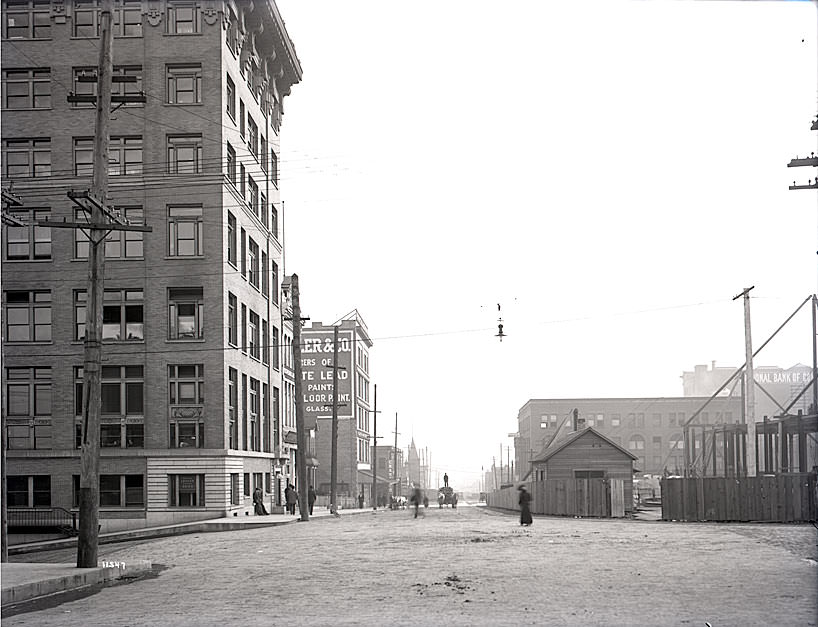
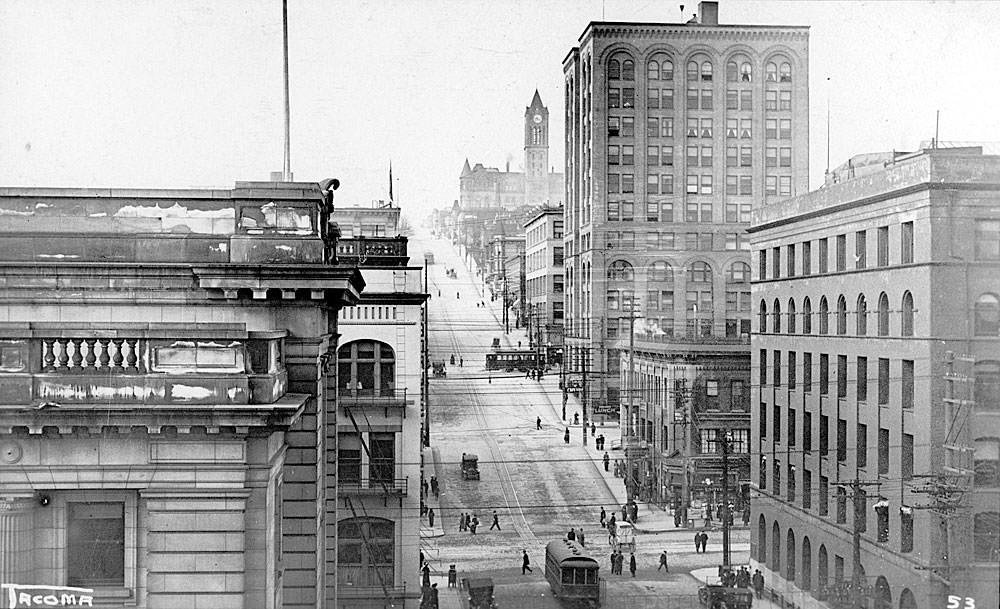
View looking south on A Street. The Perkins Building, which formerly housed the Tacoma Ledger and Daily News office, is at left. The Federal Building and Post Office is under construction on the right. Pedestrians are visible on the sidewalk to the left and crossing the street. A man stands on top of a horse-drawn wagon in the distance.
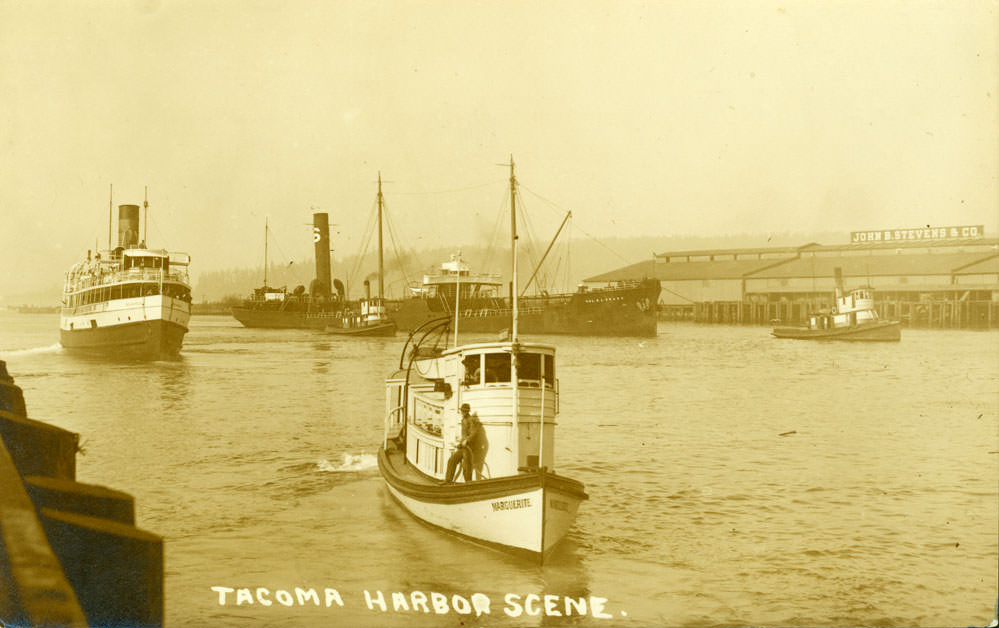
The scene in the Tacoma, WA harbor on Commencement Bay shows a small ship, Marguerite, in the foreground and two steamships and two tugboats in the background.
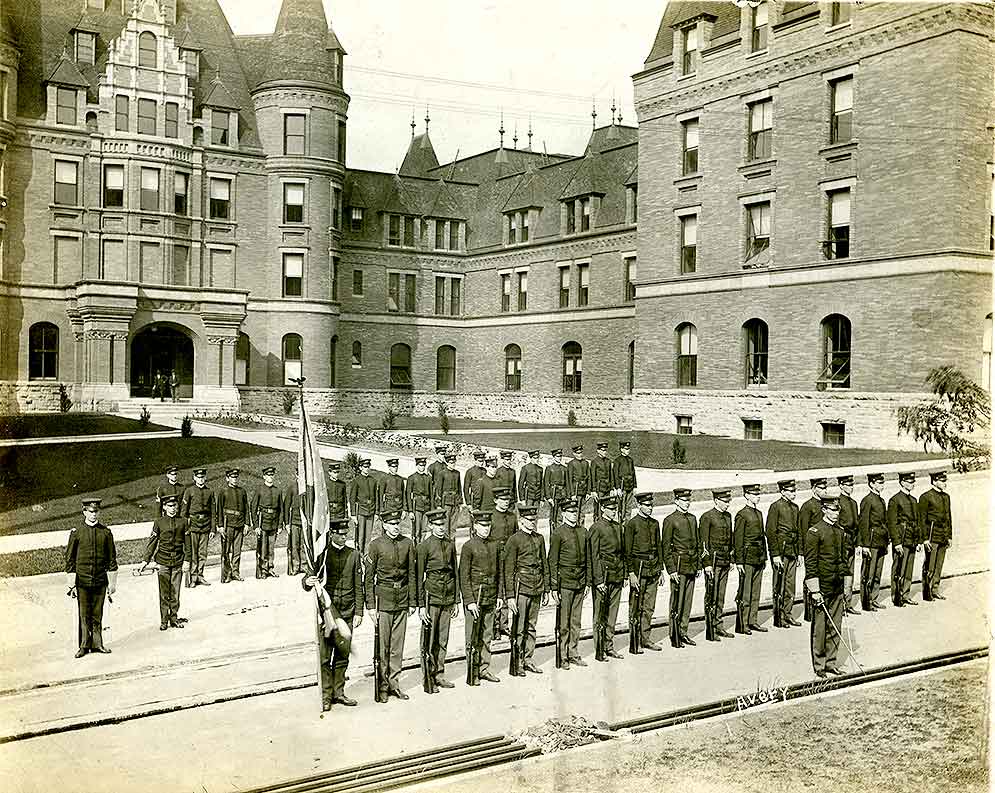
Black and white image of a group of cadets in front of Tacoma High School (now Stadium High School), Tacoma, Pierce County, WA. The uniformed cadets stand in two lines at attention in order arms formation. A note on the back indicates that Henry Foss is seventh from the right in the second section.
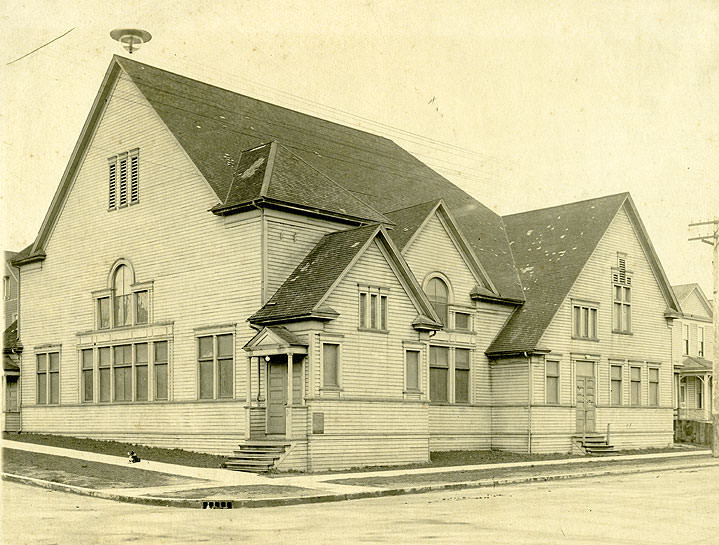
Black and white image of a church in Tacoma, Pierce County, WA. First Methodist Church was located on South G at the N.W. corner of 8th in Tacoma. The church was a large wooden building with two separate entrances. A dog can be seen resting on the sidewalk.
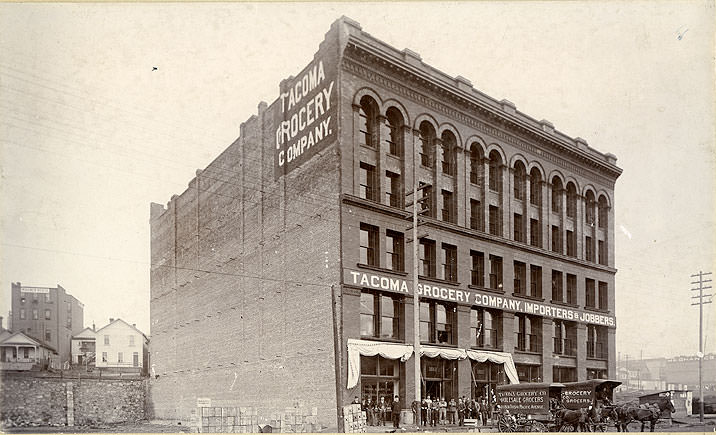
The street numbers are possibly 1531 to 1541 or 2106 to 2110. Two horse-team drawn delivery wagons are in front of the store with the business name and 1531 to 1541 Pacific Avenue on the side. Several men pose in front of the store, probably owners and employees.
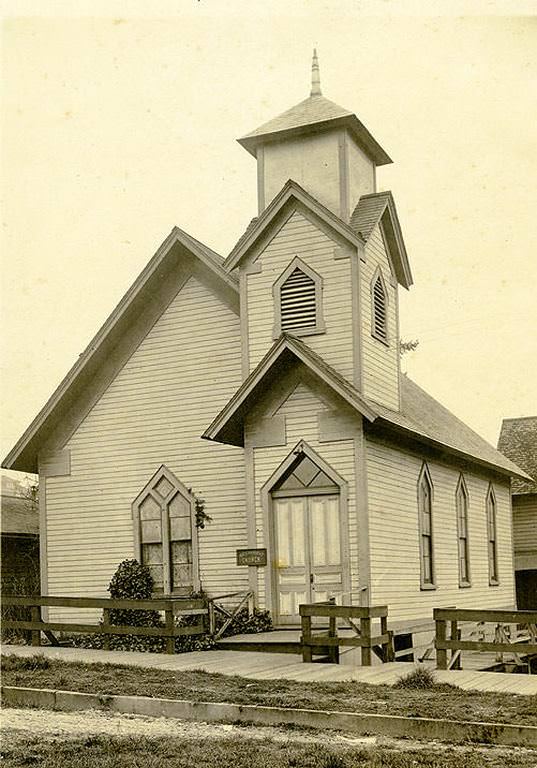
Second Methodist Episcopal Church was located at 2232 No. 28th Street in Tacoma. The church is a small one-and-a-half-story wooden building with a steeple. There was a wooden sidewalk in the front.
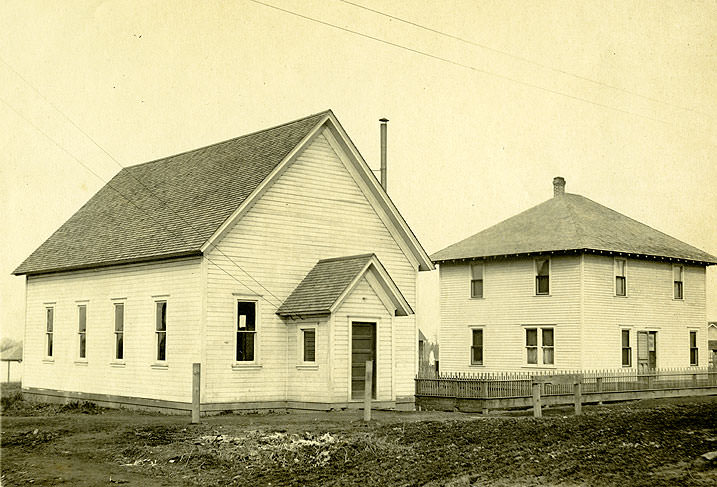
The church was located in Tacoma at East F and the N.W. corner of 64th Streets. The church is a small one-and-a-half-story plain wooden building.
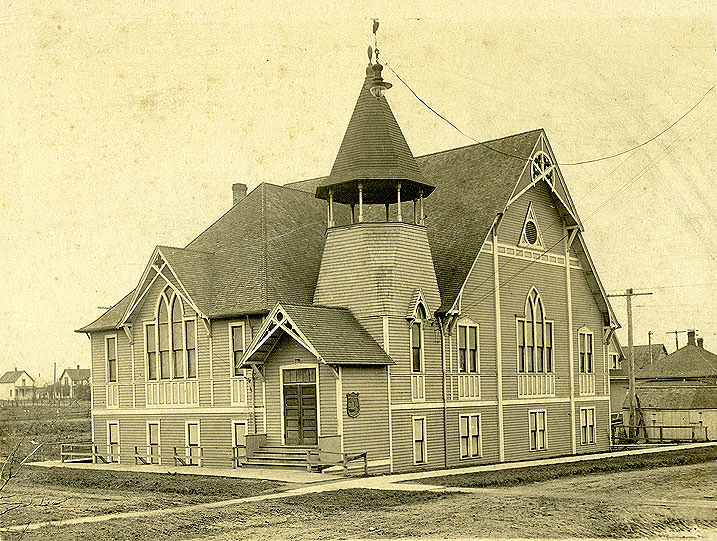
Epworth Methodist Episcopal Church was located on South 7th at the S.W. corner of Anderson in Tacoma. The church was a relatively large square wooden church with a conical steeple.
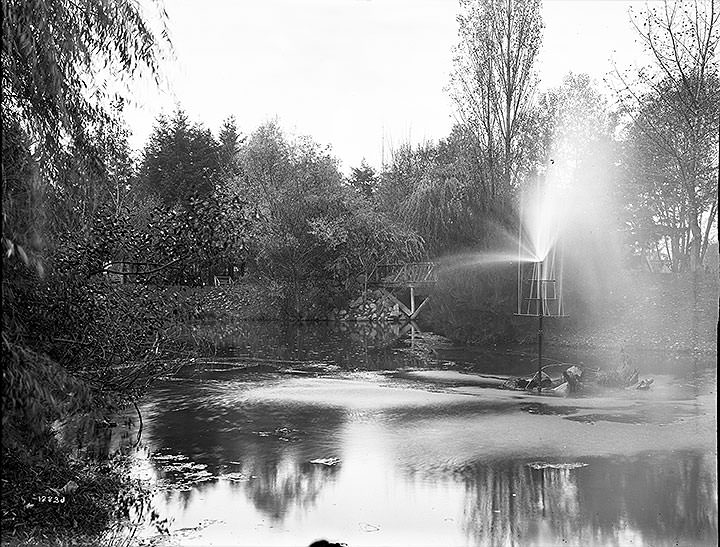
Black and white glass plate negative image of a pond in Wright Park, Tacoma, Pierce County, WA, surrounded by trees and foliage. An elevated device spraying water in the pond is at the image right. Asahel Curtis.
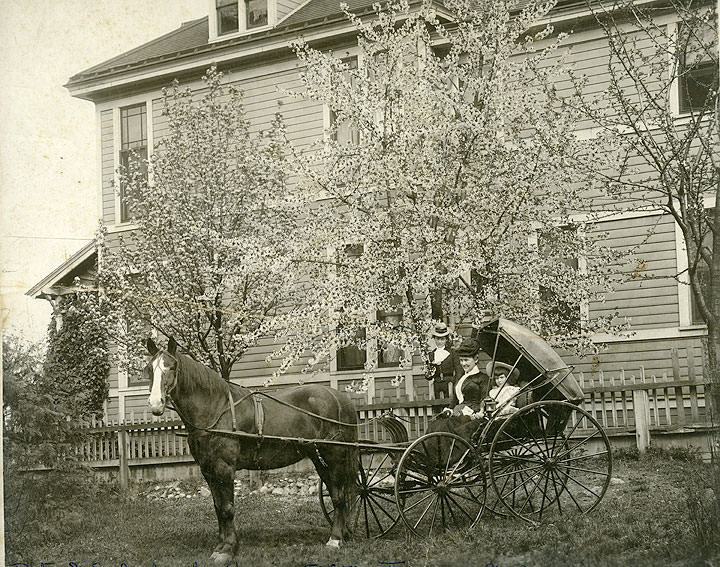
Mary Salscheider, the wife of Peter J. Salscheider, sits in a horse-drawn buggy with her granddaughter Florida Louise Weiss Byrne beside her. Mary’s daughter, Fannie May Salscheider Weiss, stands near the buggy on the grass beside the Peter J. Salscheider home at 508 N.
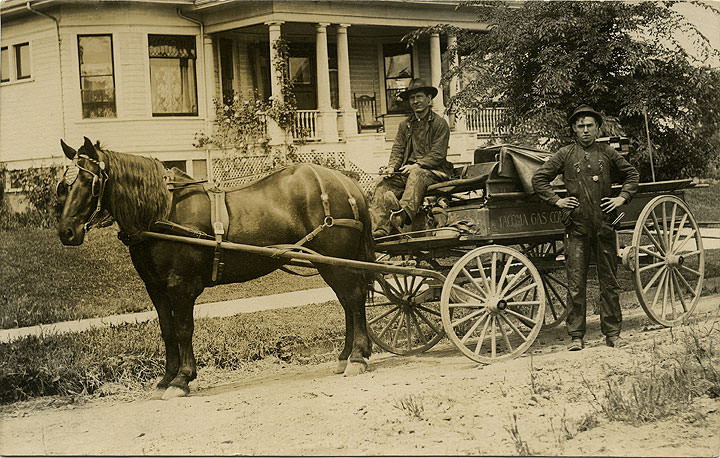
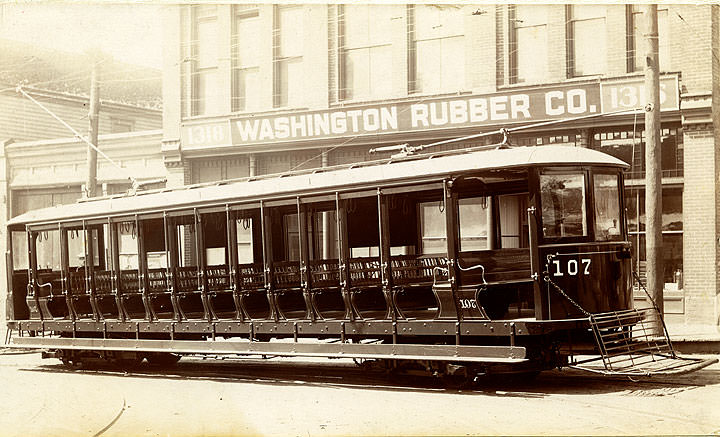
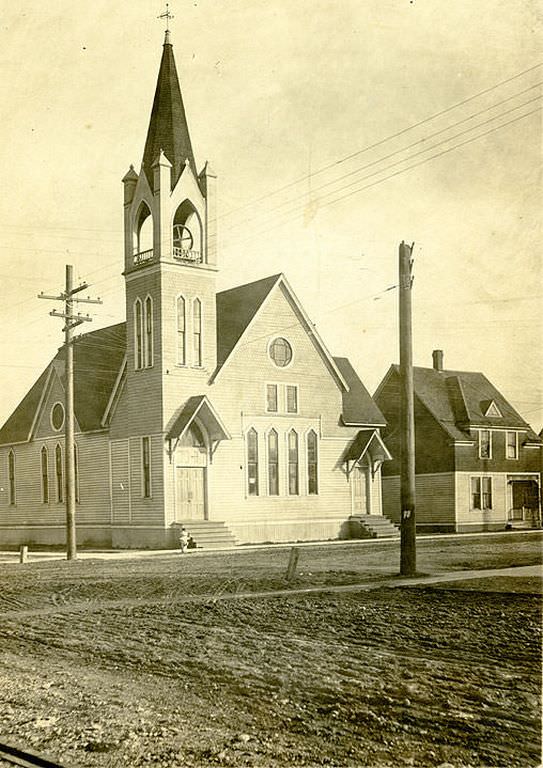
Asbury Methodist Episcopal Church was located on the S.E. corner of Puget Sound Avenue and South 56th Street in Tacoma. It was a one-and-a-half-story church with a tall bell tower.
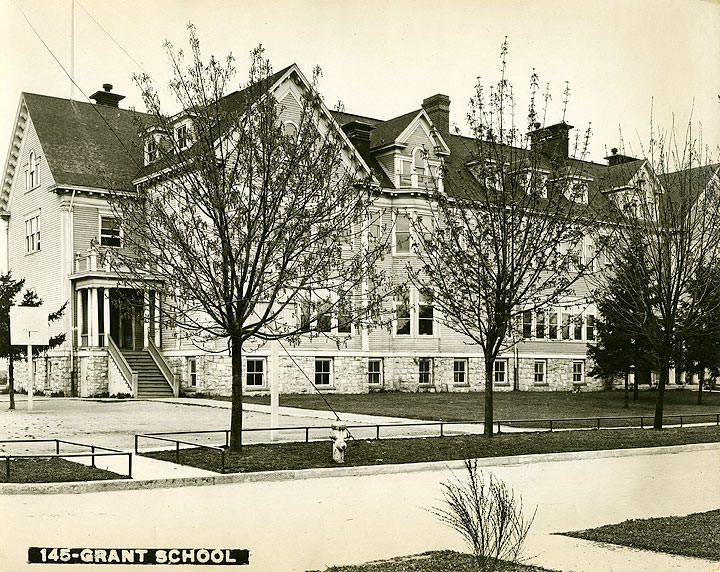
The school was built in 1900 by G.W. Bullard, architect, and demolished in 1955. A basketball hoop is at the image left edge.
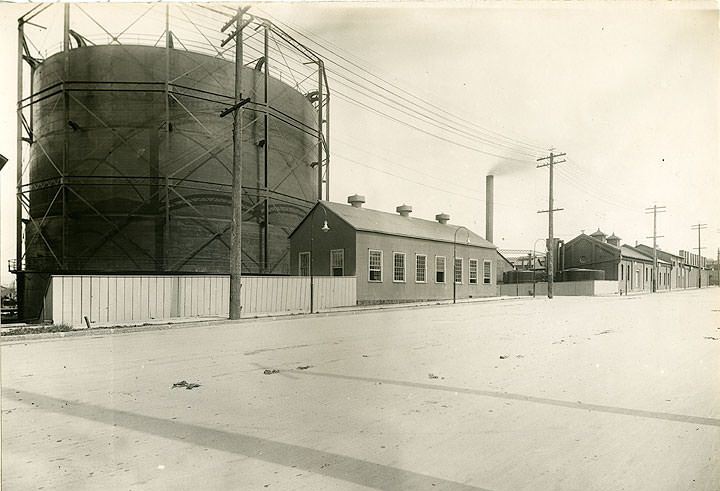
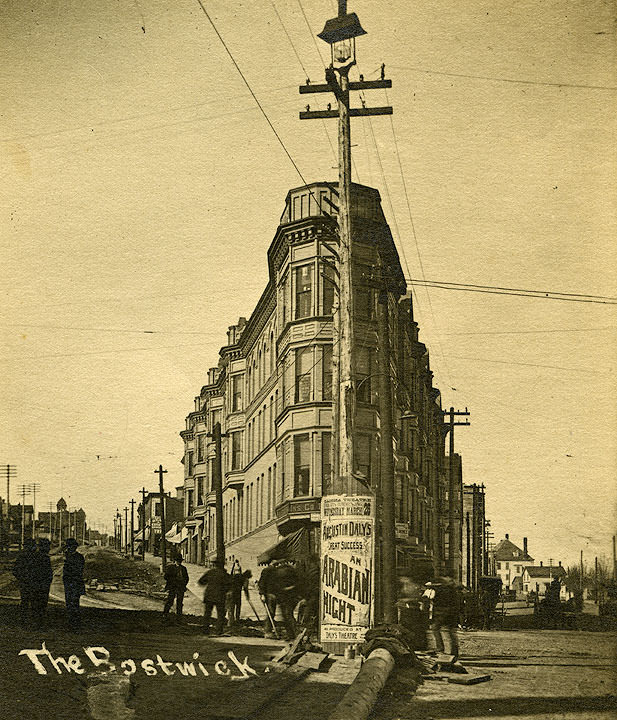
It is viewed from its narrowest point, at 755-751 St. Helens Avenue, the intersection of St. Helens Avenue, Ninth Street, and C Street. The building was built in 1889 by Proctor & Dennis, architects. A poster advertising a performance of Arabian Nights is visible by a utility pole in the foreground.
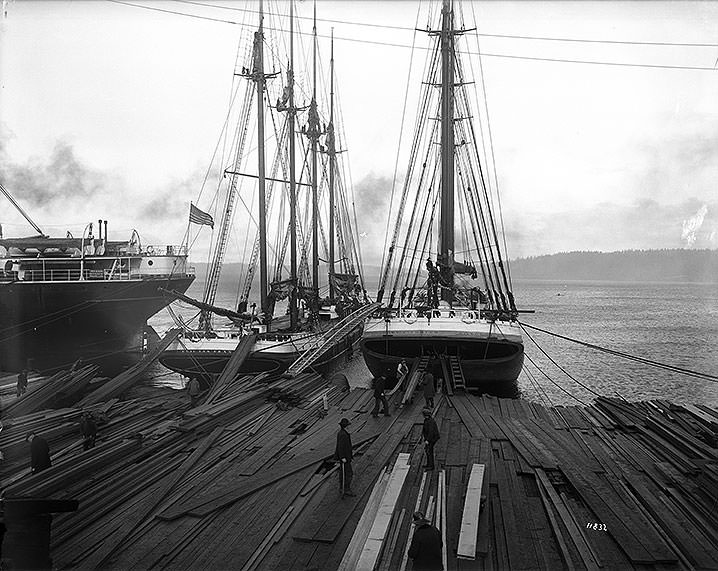
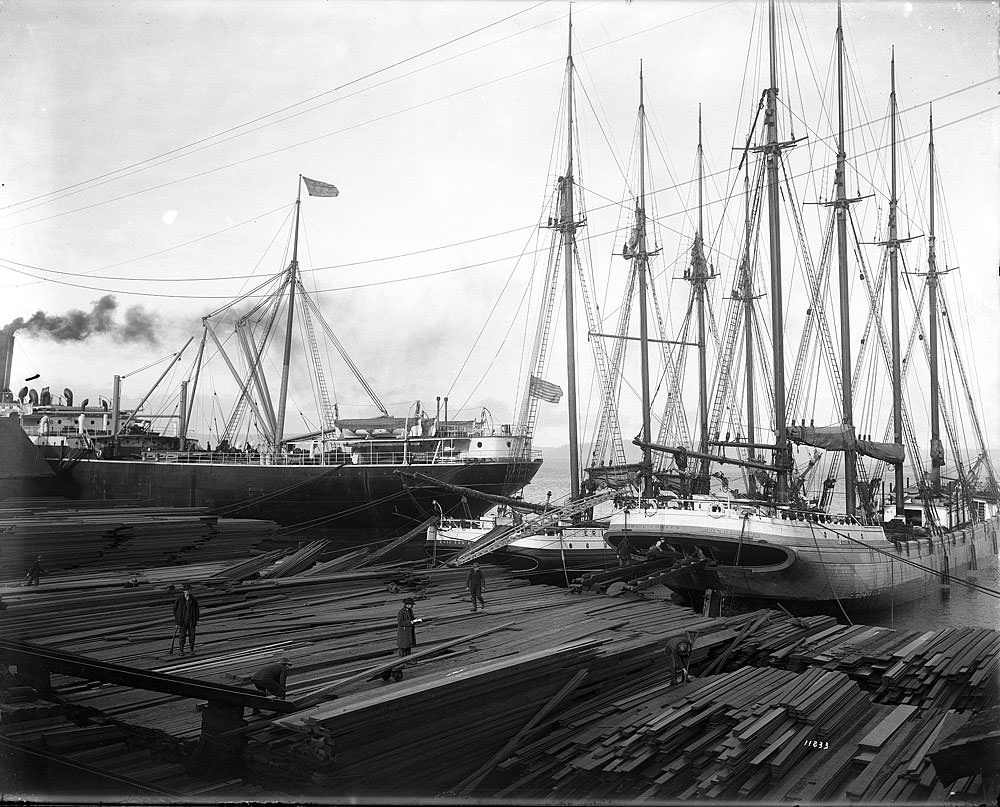
Two lumber sailing ships, the Eric of San Francisco and the Mary E. Foster of Honolulu, are loading lumber at a Tacoma mill. A steamship is partially visible to the left. Lumber covers the dock.
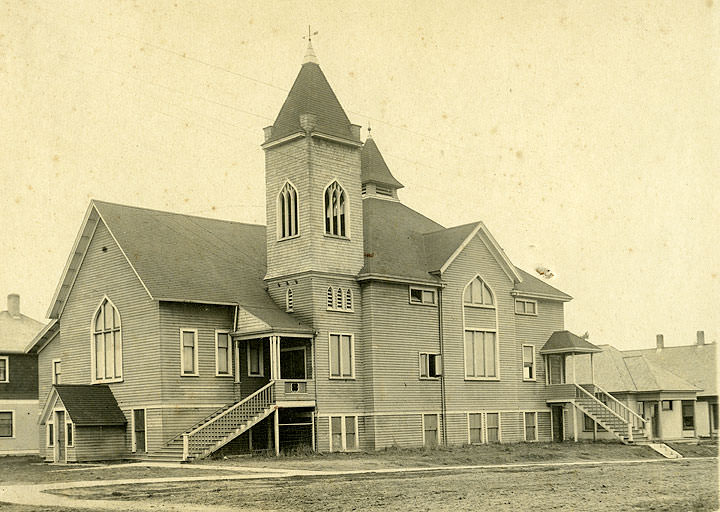
The church was a moderately large wooden building with a steeple and a bell tower.
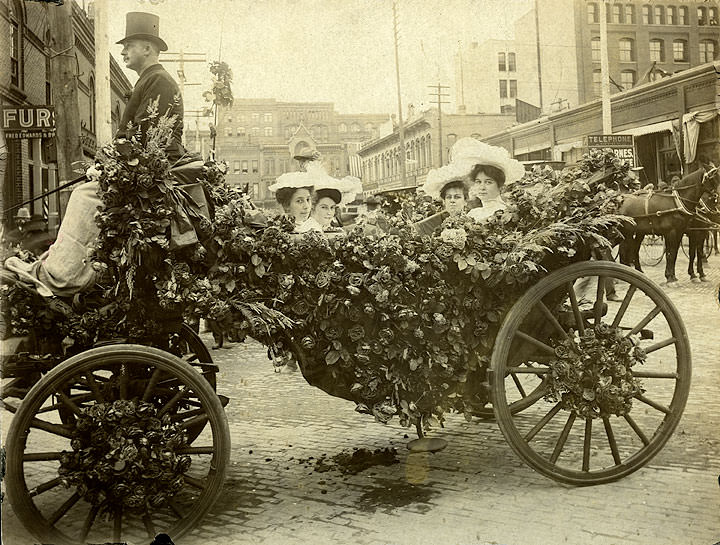
Four women and one male driver are seated in an open carriage decorated with roses. The following names of the women are written on the back of the mounted photograph: Marie Bourgaize, Mary Thomson, Suzy Garrettson, Julia Harris. The women all wear elaborate hats, and the driver wears a top hat.
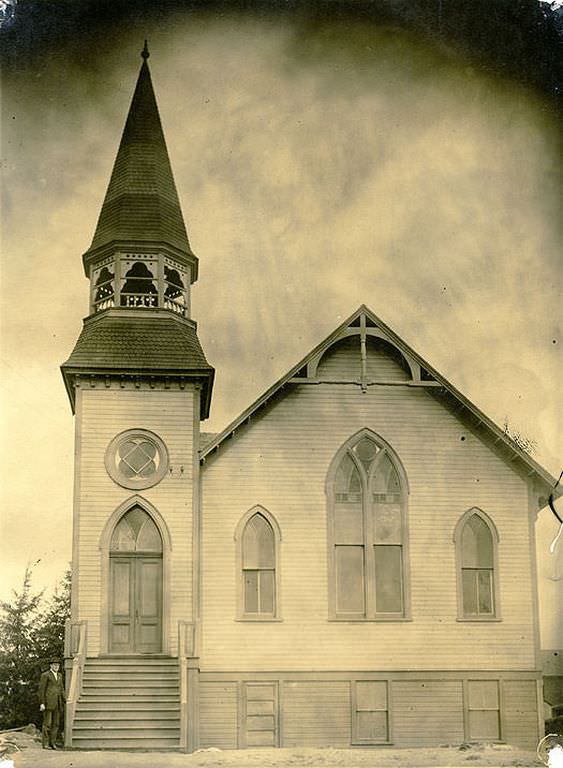
The church was a wooden building with the main floor raised above the street. There was a steeple directly over the entrance area. A man is standing at the base of the steps.
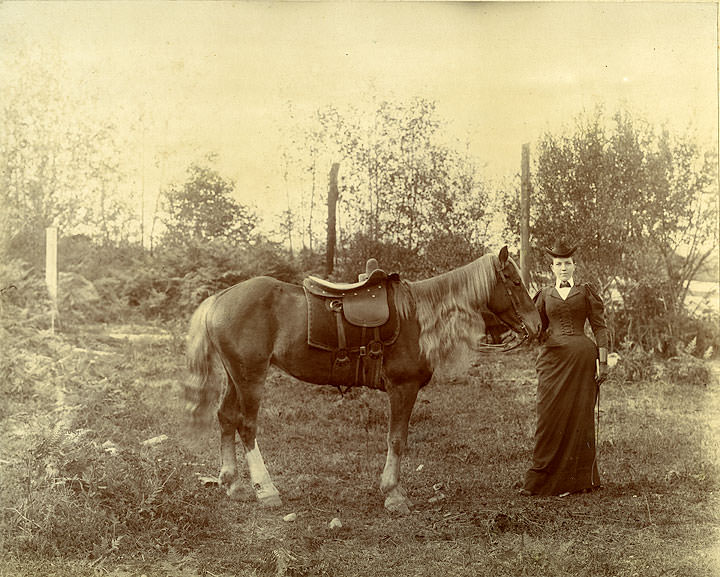
The horse is standing in profile, and the saddle details are visible. The woman stands by the horse’s head. She holds a quirt and is wearing a riding habit.
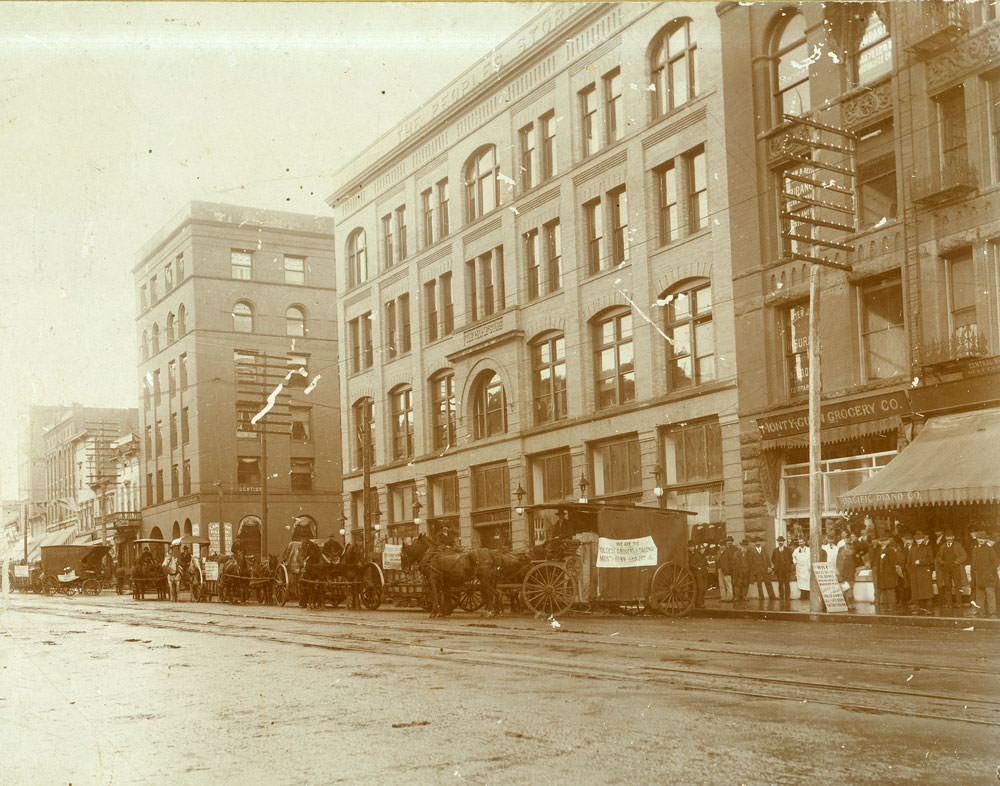
Horse-drawn covered and uncovered wagons are against the sidewalk curb. A row of brick and stone buildings, 2 to 6 stories high, including one with “The Peoples Store” in stone relief. Adjacent stores are the “Monty Gunn Grocery Co.” and “Pacific Piano Co.”
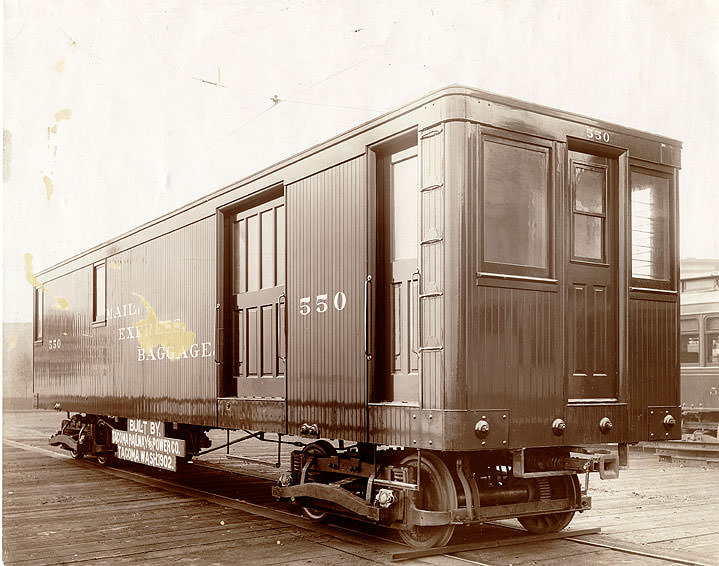
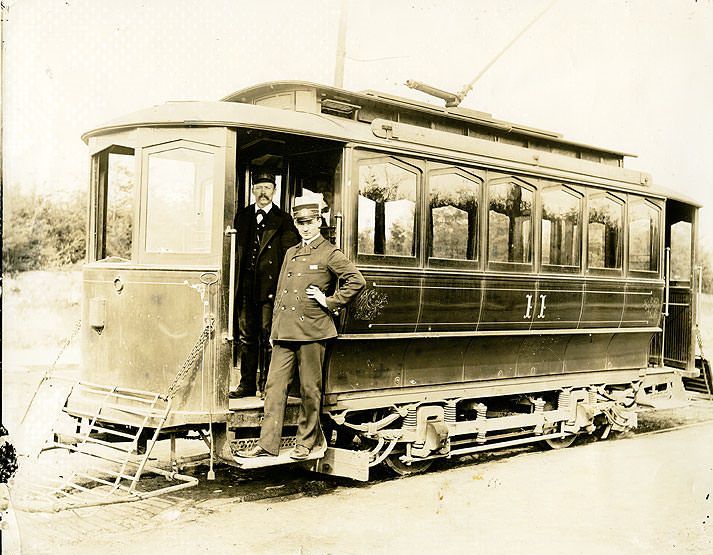
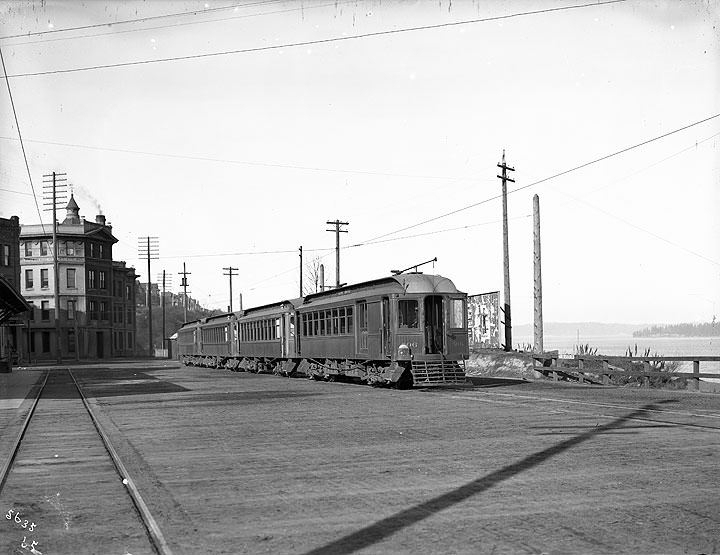
The railway operated an interurban train between Tacoma and Seattle. The station is not visible. Commencement Bay is visible at the image right.
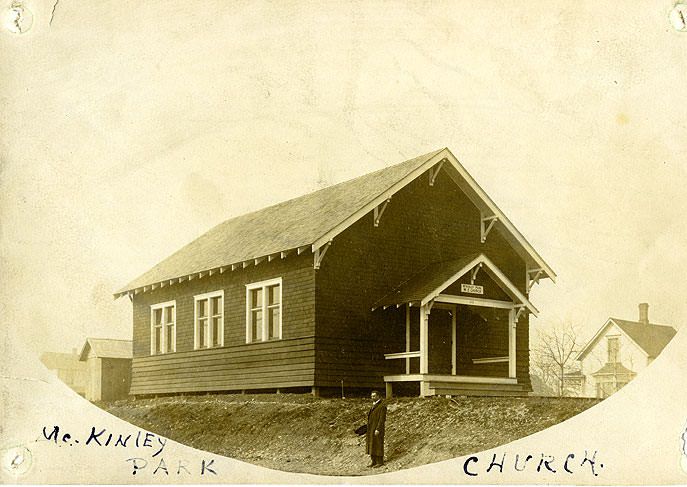
The church was a small wooden building. A sign on the front of the building says McKinley Park M. E. Church. A man is seen standing near the front entrance to the church.
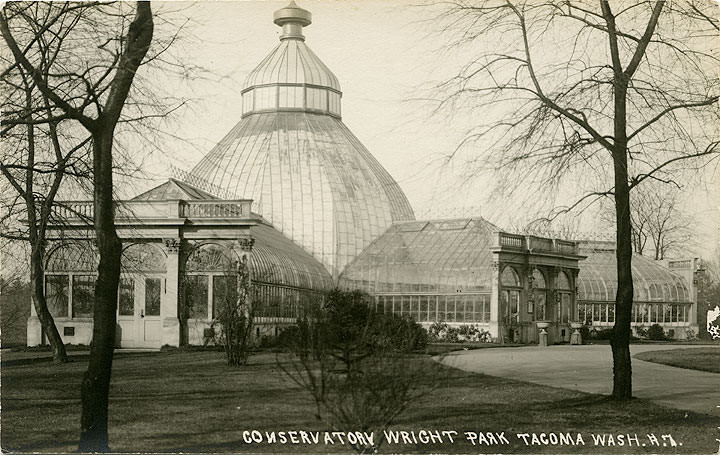
The curved driveway in front of the building is visible at the image right.
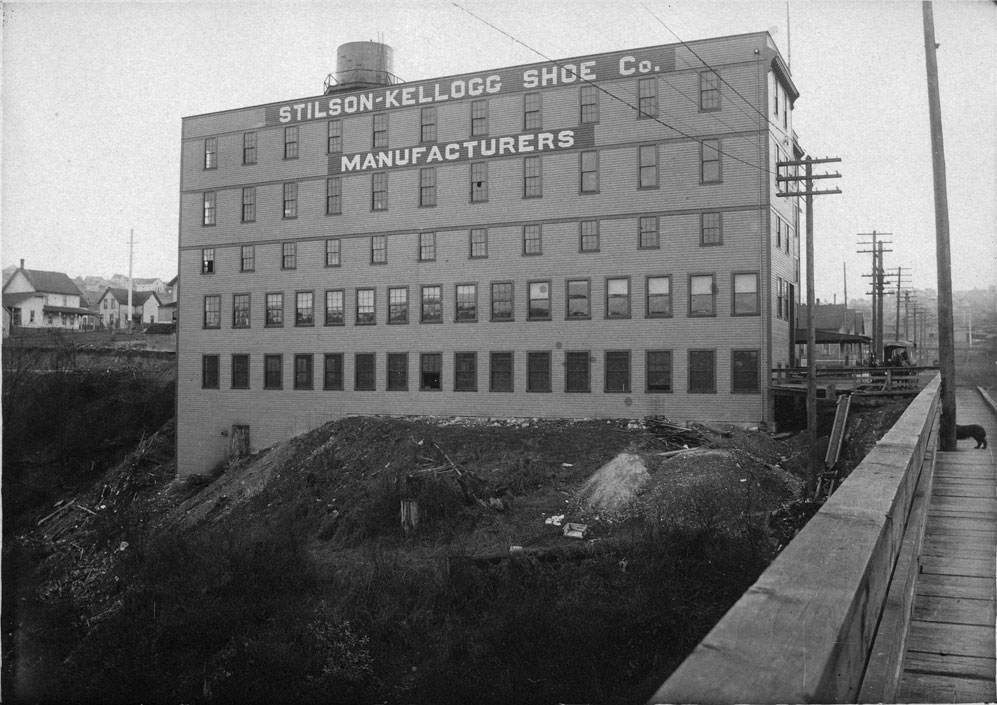
It sits on the top edge of a hill, which is in the lower part of the photo. The name is on the side of the building.
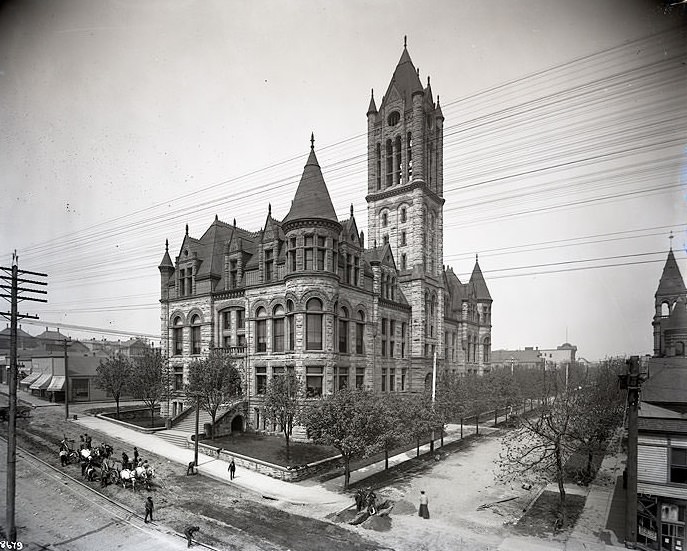
Two horse-drawn delivery wagons are stopped on the dirt road in the foreground. Two men are digging a hole in the road at the intersection of two streets. Asahel Curtis.
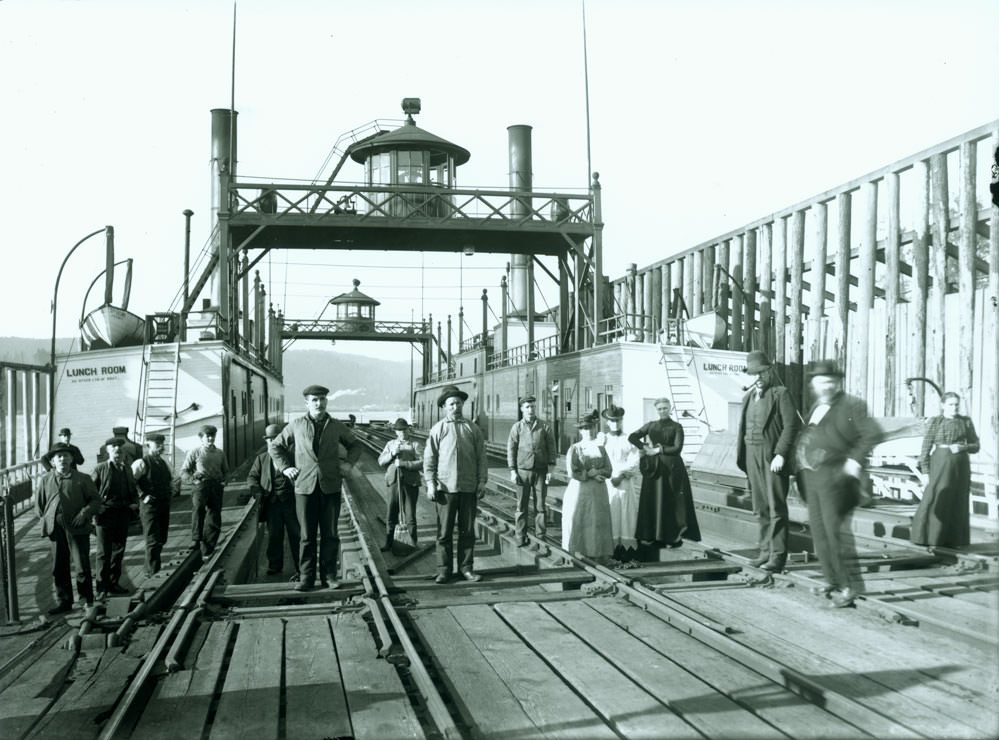
Includes twelve men and four women in an unorganized group shot. The passengers appear to be both workers and travelers.
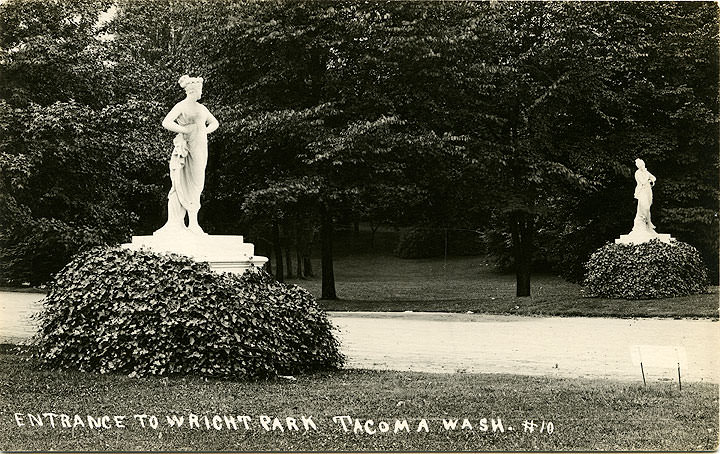
The statues of two women on pedestals flank the entrance.
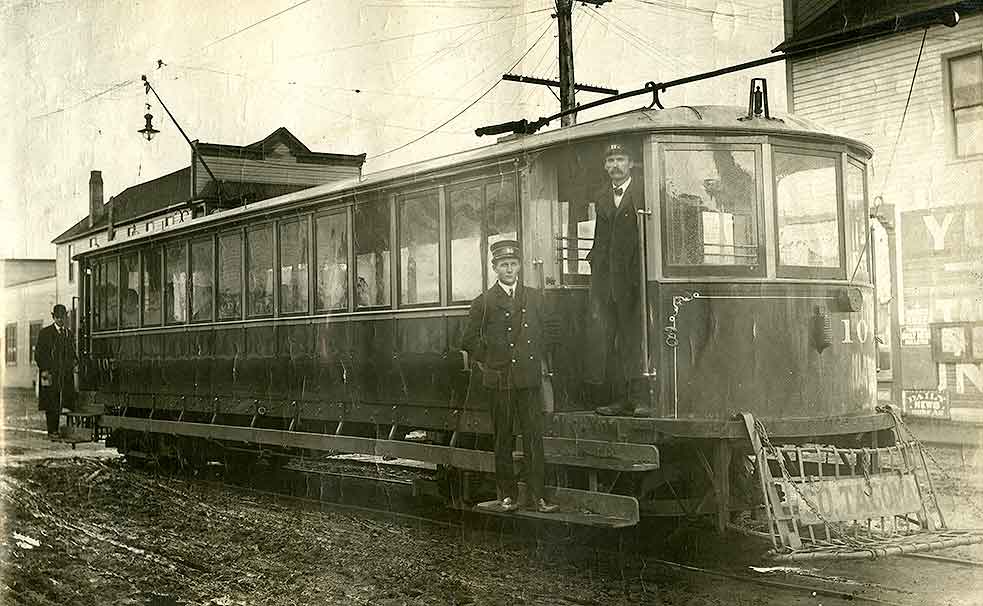
There are two uniformed men at the front of the car. One is on the lower step and one above the steps. The individual in uniform with a handlebar mustache standing above the steps has a name written on the black mounting paper above him indicating that he is “Chas. Daniels”. A man in a bowler hat is standing on the bottom step of the rear entrance to the streetcar, and there are other people inside. Wooden buildings are located behind the streetcar.
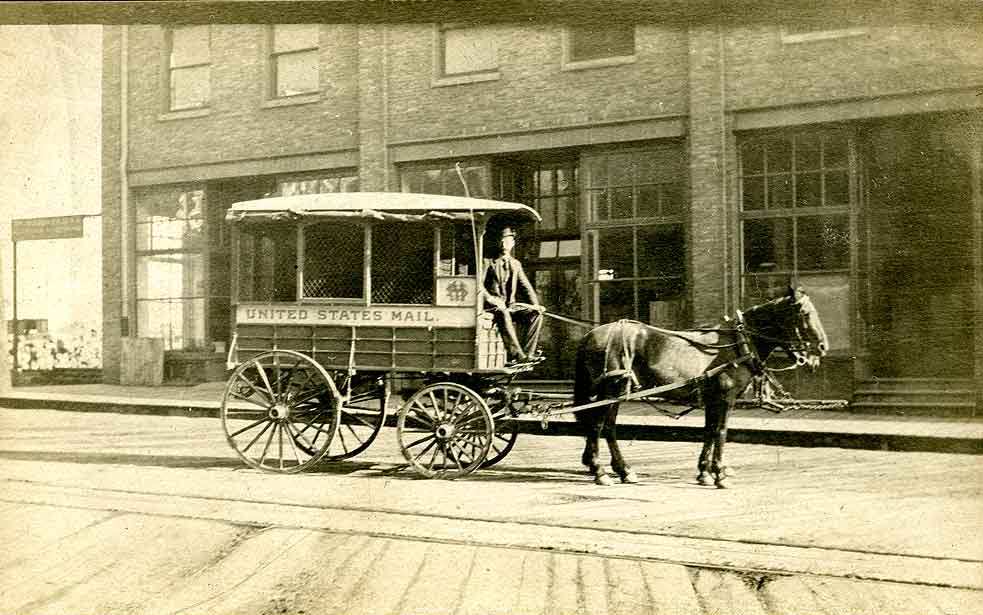
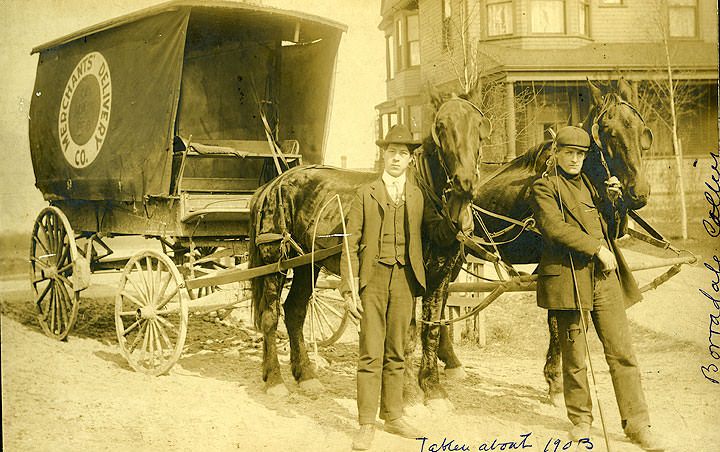
The top portion of the wagon sides is enclosed with wire panels. The bottom part is wood with “United States Mail” written along the sides. A man in a suit and hat is driving the wagon, drawn by two horses.
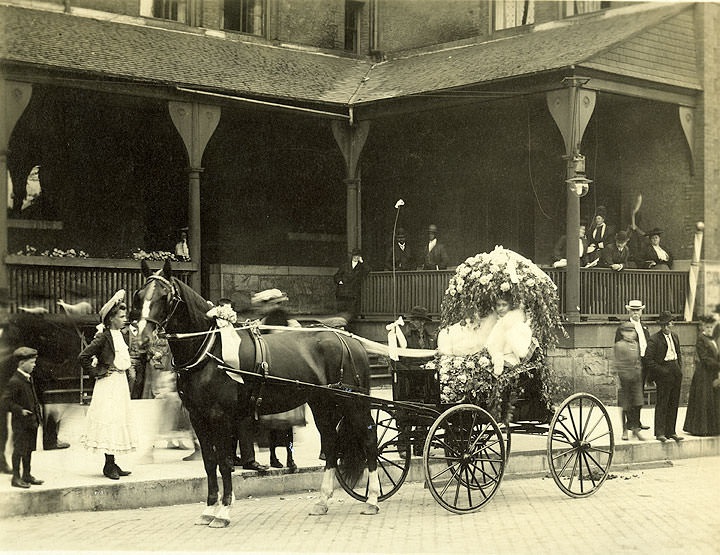
She appears to have white fur around her shoulders and over the seat. An umbrella canopy of flowers and foliage covers her head and feet. A girl and a small boy are standing on the curb by the horse’s head. Three women and three men stand on the hotel veranda by the street.
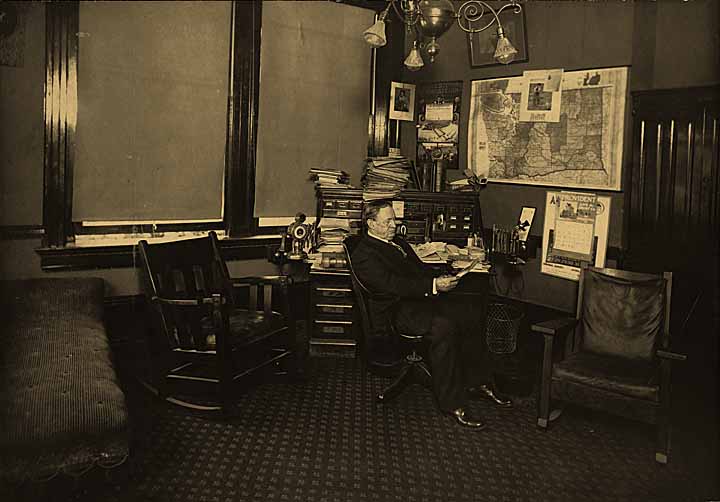
He is sitting in profile, reading a piece of paper, in front of a rolltop desk piled with papers, in the image center. Two rocking chairs flank the desk. A map of Washington State is on the wall behind the desk.
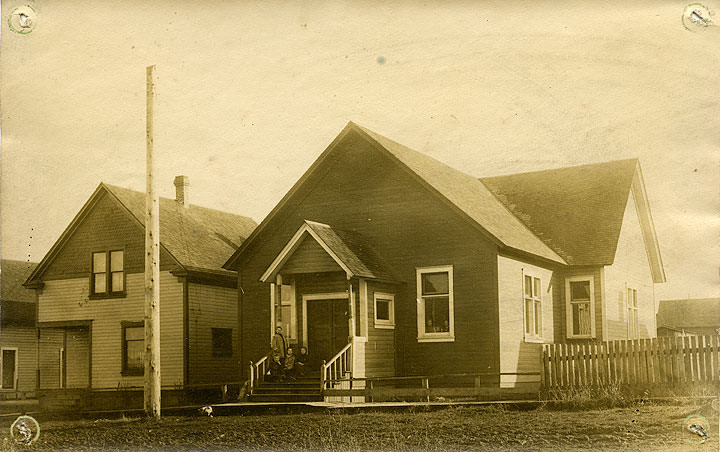
Grace Methodist Episcopal Church and parsonage were located on East 30th between Portland Avenue and R. The church was a small one-story L-shaped building. A woman and three children are on the steps leading to the church entrance. Other children are looking out the front window.
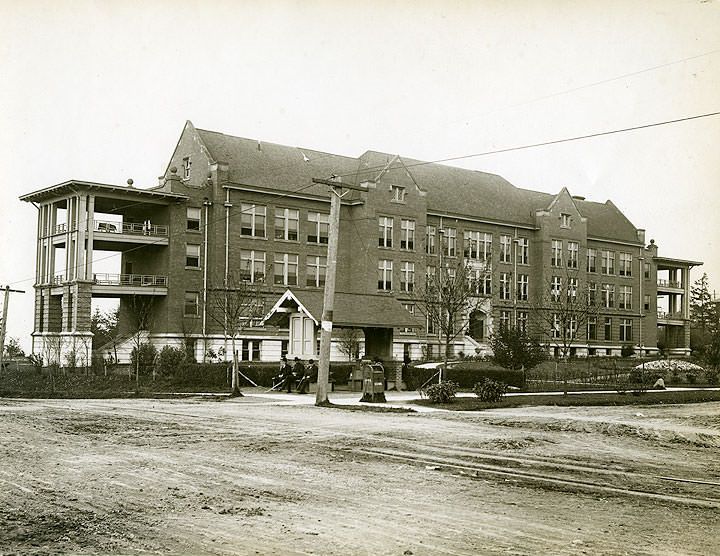
The building was built in 1905 by A.H. Stem, architect of Reed & Stem, and demolished in 1973. Three men are sitting by a small covered, open-sided structure in front of the hospital, in the image center. A United States Postal Service collection box is nearby. Dirt roads are in the foreground.
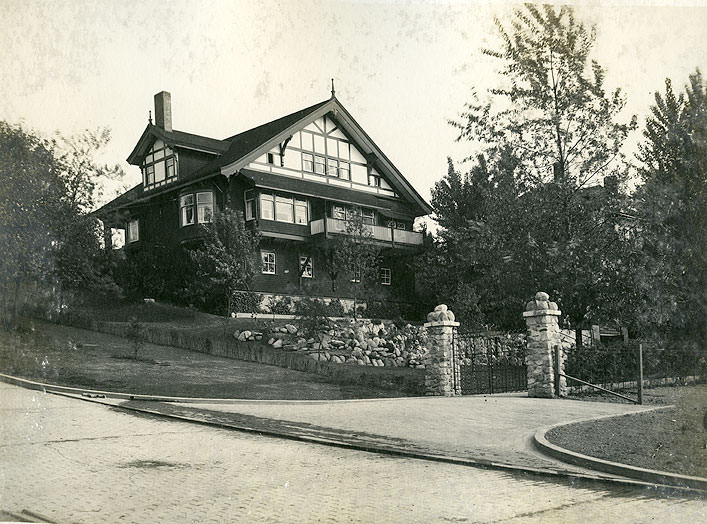
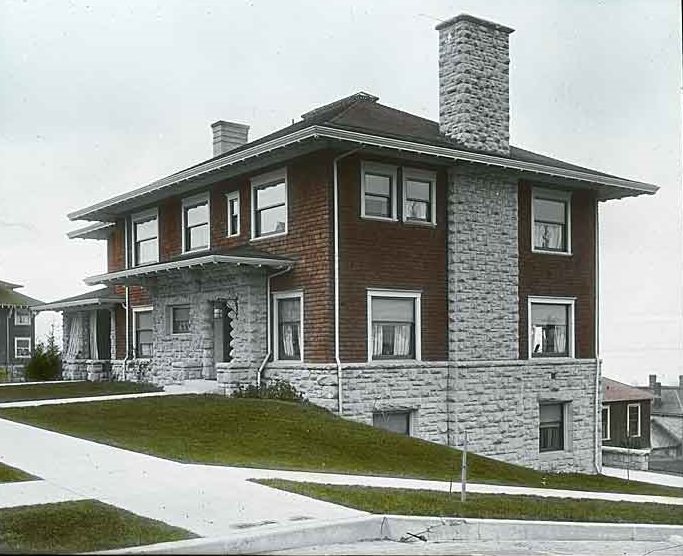
The large three-story home, built in 1904 by George Bullard, architect, sits on a large yard behind a stone gate.
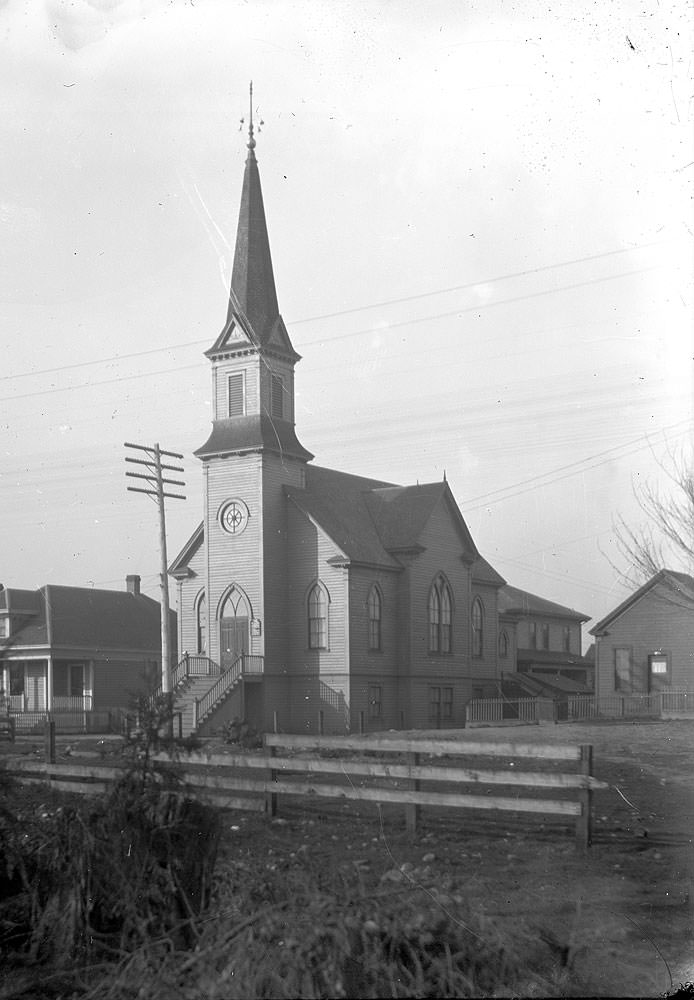
The church was built in 1904 and later demolished. The church is a wooden building with a tall bell tower in the front. Steps lead up to a pointed arch entryway. Houses are visible on either side of the church.
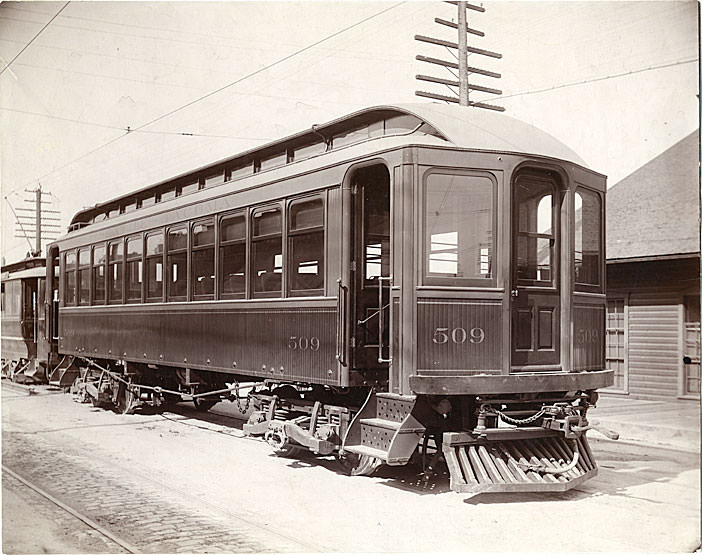
The car is no. 509. Part of a streetcar directly behind it is visible at the image left edge.
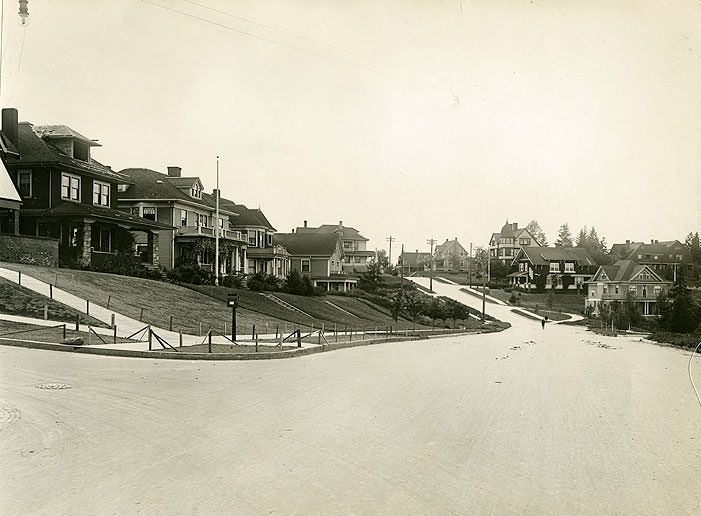
From an oblique angle, house fronts are visible across the image center. A flagpole rises in front of one of them at the image left. No trees obscure the house details, except at the image right edge.
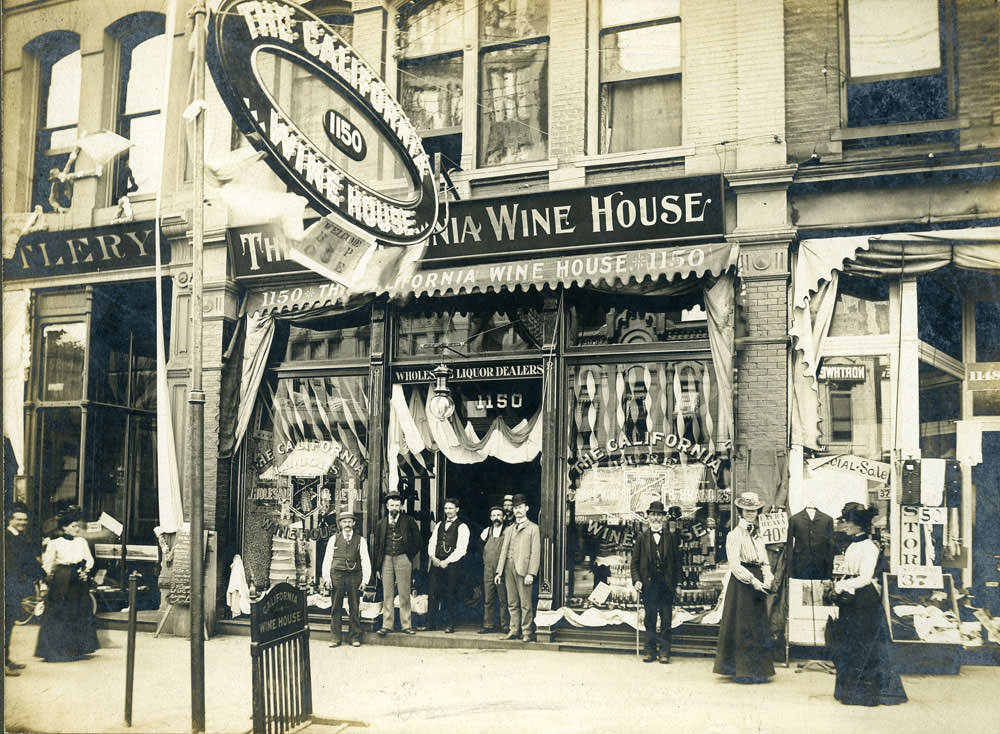
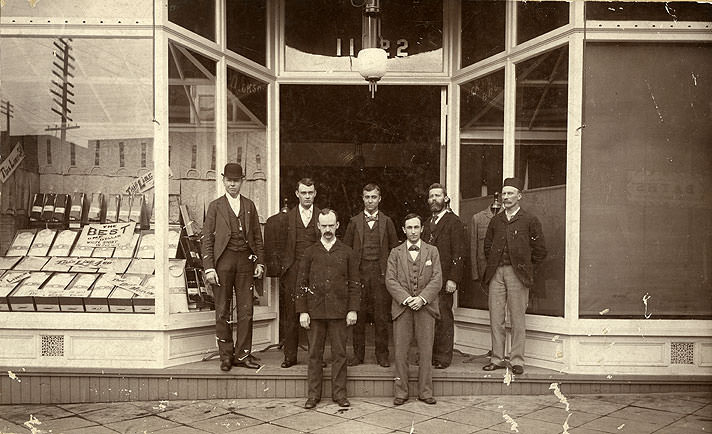
The store name is on both show windows, on the awning above the storefront, above the storefront, on a sign above the sidewalk, and on a bicycle rack on the sidewalk. Above the door: Wholesale Liquor Dealers. Six men stand in the doorway.
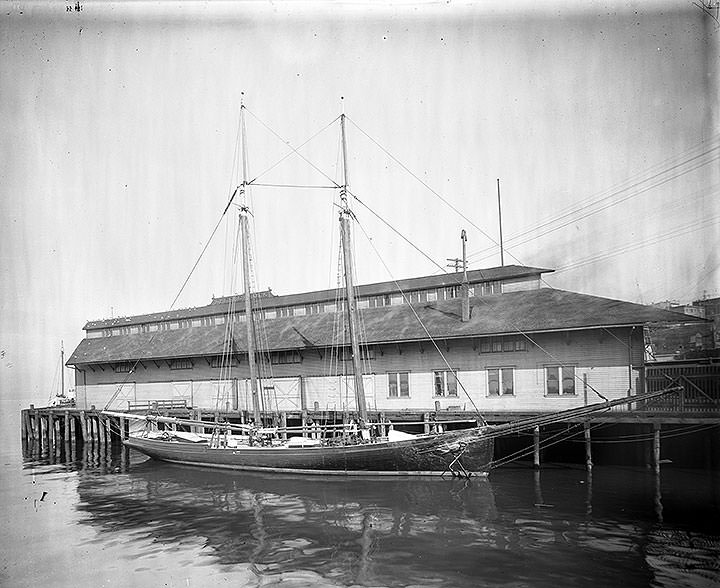
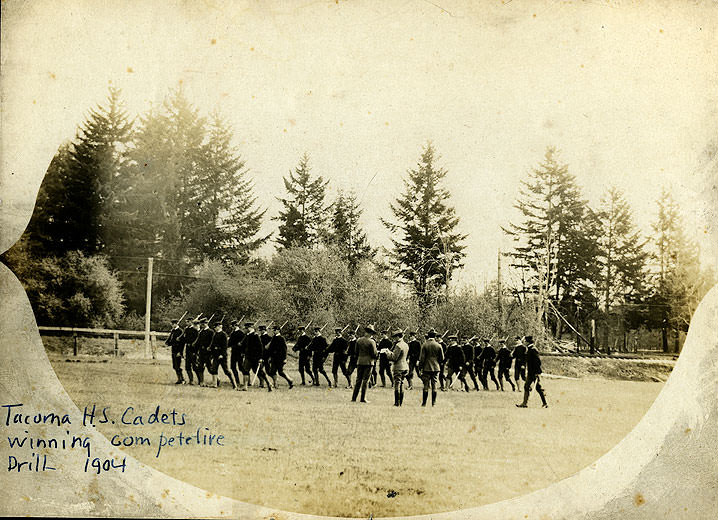
The photo shows the cadets marching with rifles over their shoulders as uniformed soldiers look on.
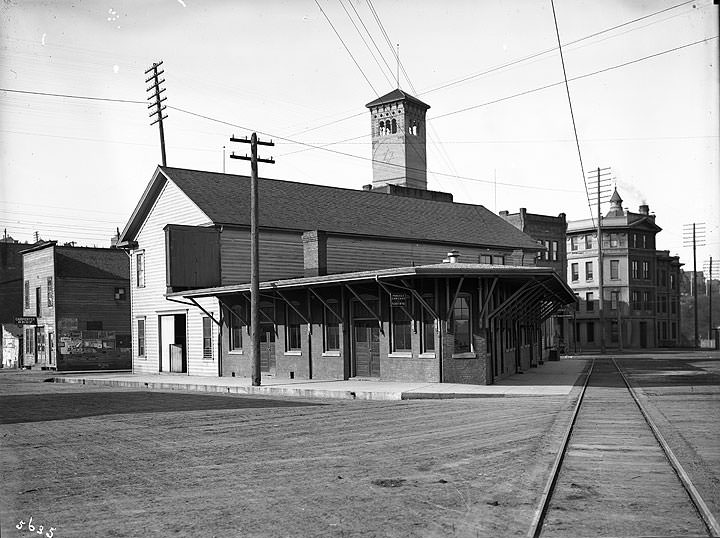
The railway operated an interurban train between Tacoma and Seattle. The depot is a small corner building attached to a larger two-story building. The tower of Old City Hall rises in the background behind the building.
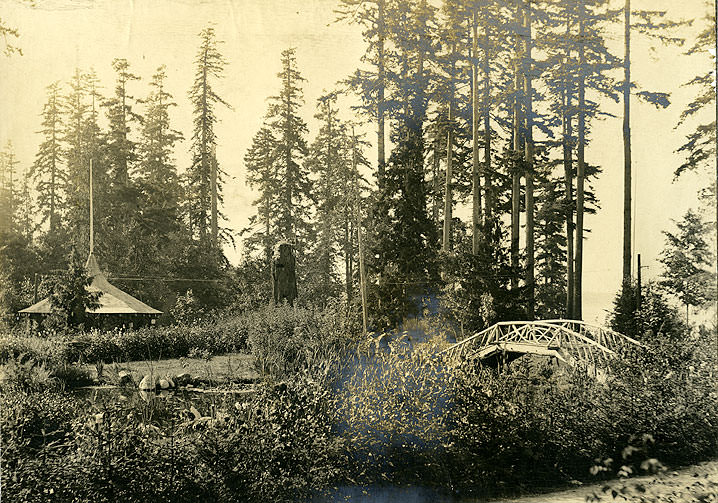
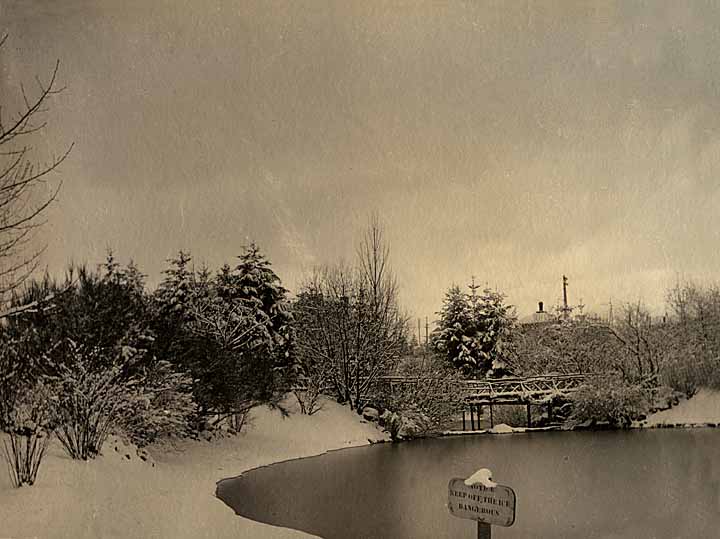
A curved footbridge is partially visible at the image right. A building with a circular roof is at the left behind a row of foliage. The roof rises in the center, and a tall spire extends.
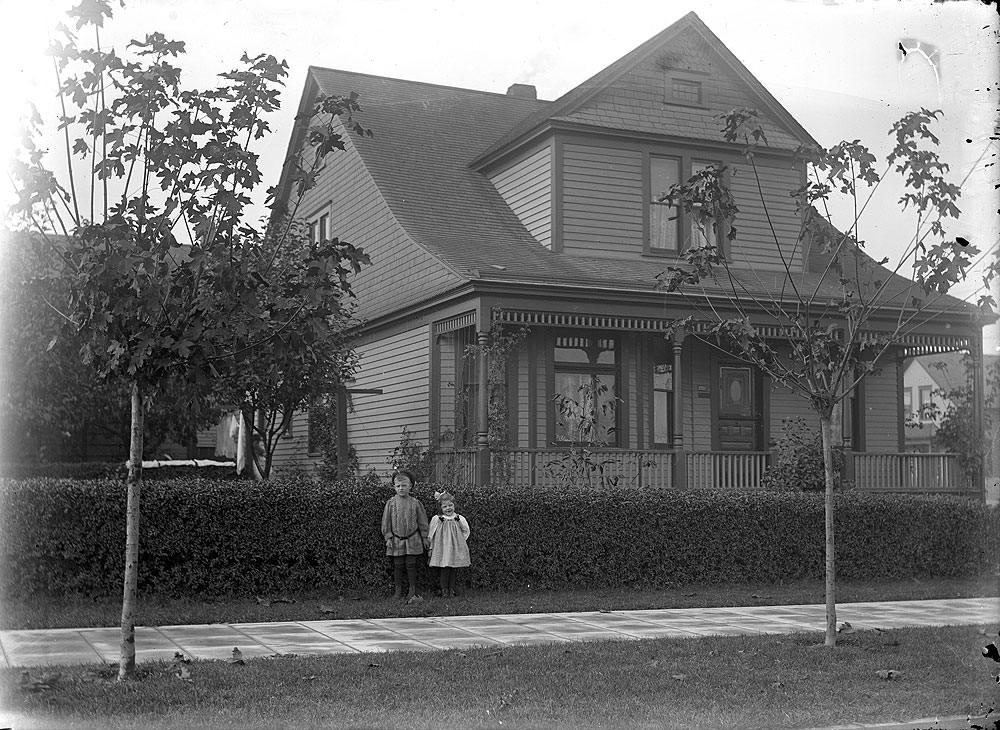
Two small children, a boy and a girl, are standing in front of the hedge. Noted: “Grandmother and Grandfather’s house on So. L St about 16th or 17th (a corner house).”
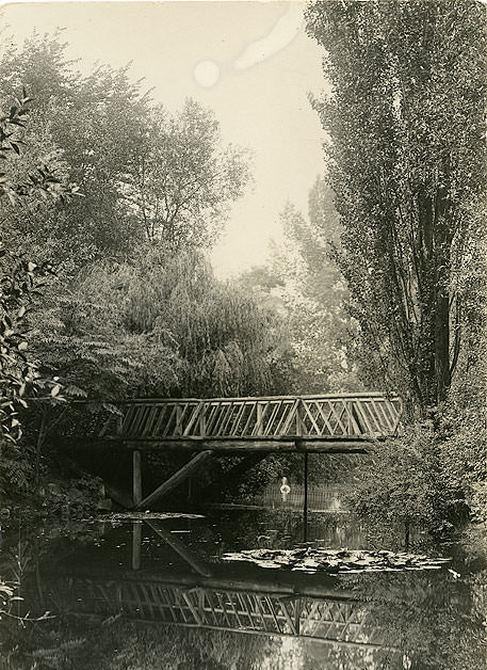
Dense trees appear at both ends of the bridge, and the reflection of the bridge and trees is in the water in the foreground.
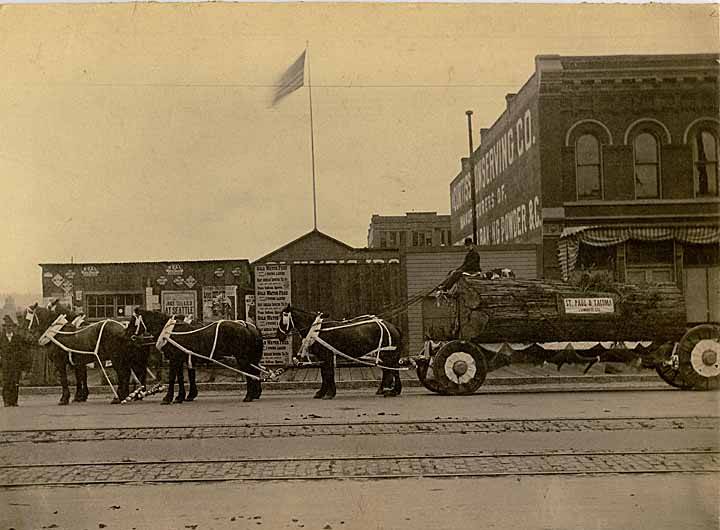
The wagon driver is sitting on a large-diameter log. Bunting decorates the wagon tires and wagon body. Advertising posters are on the walls of a shed and garage behind the horses.
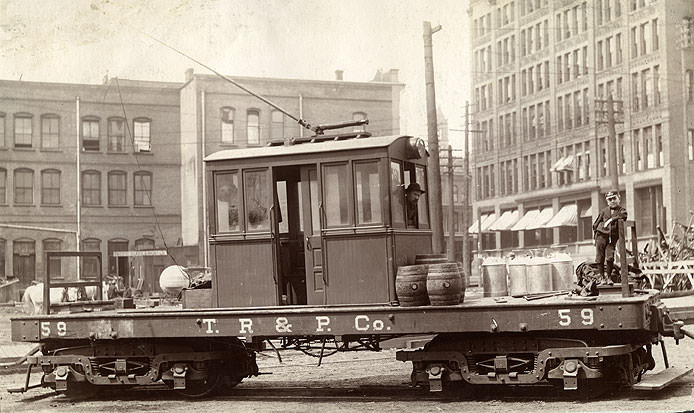
Standing on one end of the car is a young boy with a cap. A man with his head leaning out of the operating cabin is in the middle of the vehicle. Loaded on the front part of the car is what appears to be four milk canisters and four kegs.
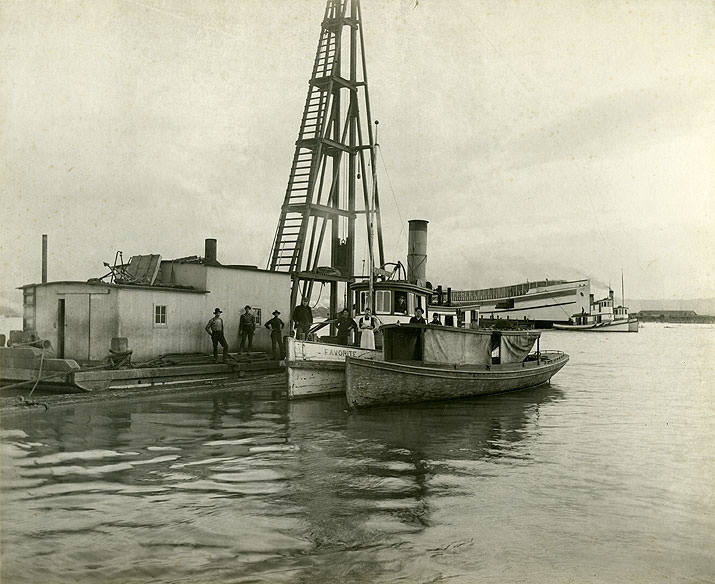
Crew members standing on the barge and tugboat, including a cook and the captain in the tug pilothouse, face the photographer. Two tugboats are at the bow of what appears to be a large ship in the background.
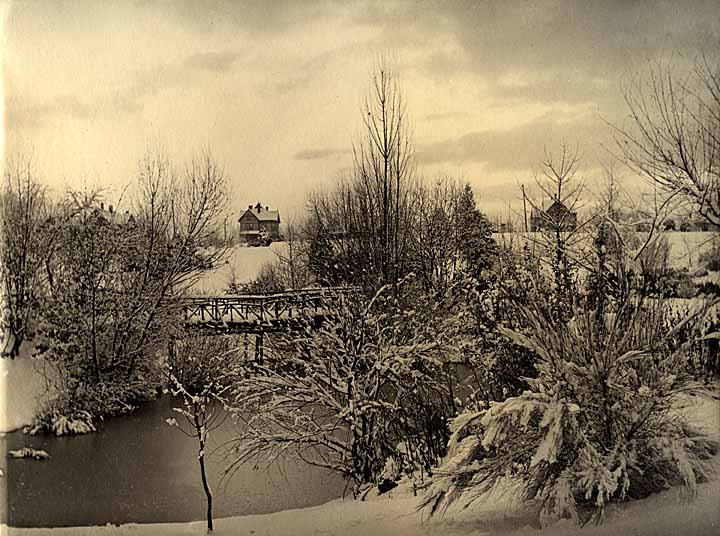
Snow clings to the branches of relatively low plants in the snow-covered foreground at the image right. A pond is in the image lower left foreground. A footbridge and trees on the pond’s edge are in the image center left background. Two houses are visible on the horizon line above the image center.
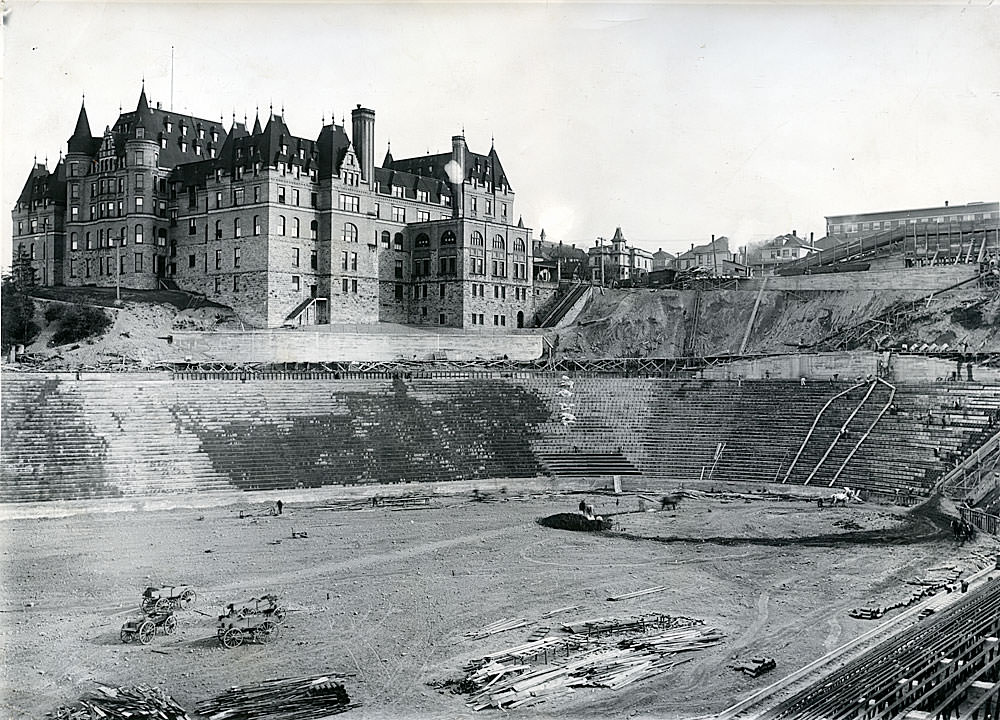
Stadium High School is visible to the left. Behind the high school to the right is a church tower, several homes, and an apartment building. Down in the stadium construction site, four wagons stand in the lower left edge of the field. Piles of lumber and other building materials are scattered around the building site. Toward the upper edge of the area are men and horses.
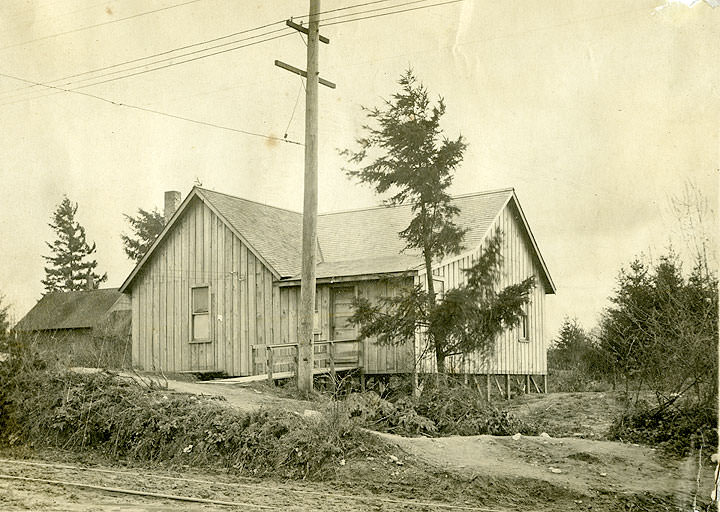
This was a one-story building with vertical wooden slats and an exposed foundation. It sits in a partially cleared area with unimproved sidewalks and streets.
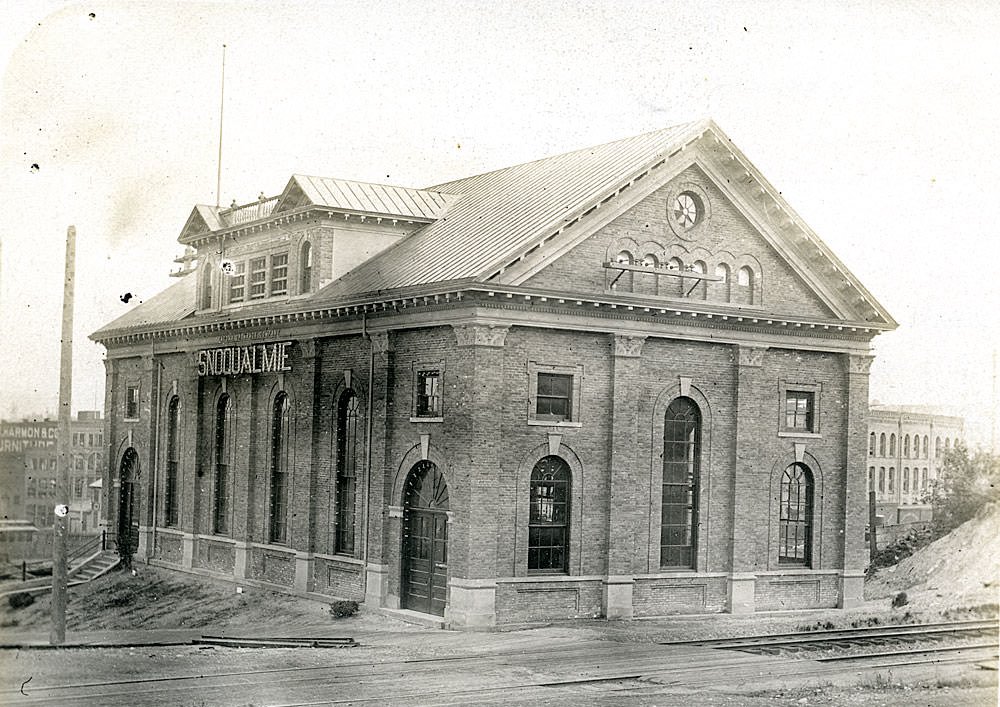
It is a three-story brick building with arched windows along the sides, a Classical-style pediment at the roofline, and a roof running along the long side. The windows are tall and arched, with panes and sashes. Entryways on either end are reached by stairs at the lower back and are at street level at the upper end. Over the center of the building is the word Snoqualmie.
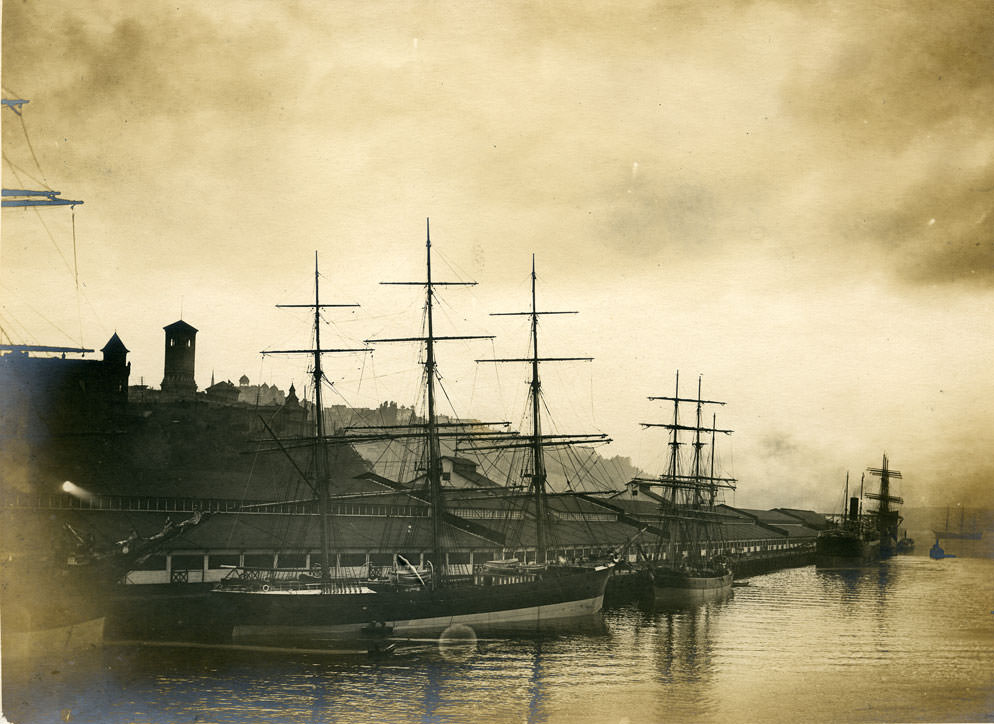
A steamboat and sailing ship are in the right background. Towers of the Old City Hall and the Northern Pacific Railroad Headquarters Building are visible on the skyline.
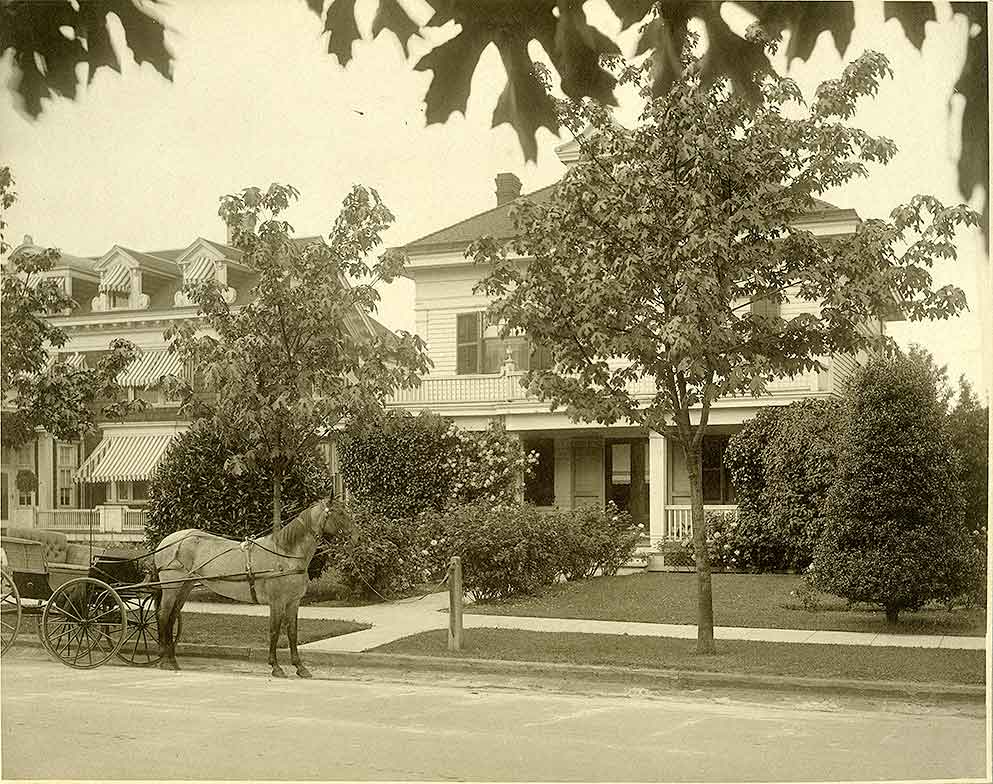
A horse-drawn open buggy stands in front of the house, with the reins tied to a hitching post. At the image left, the partially visible three-story house has striped awnings on all the visible windows.
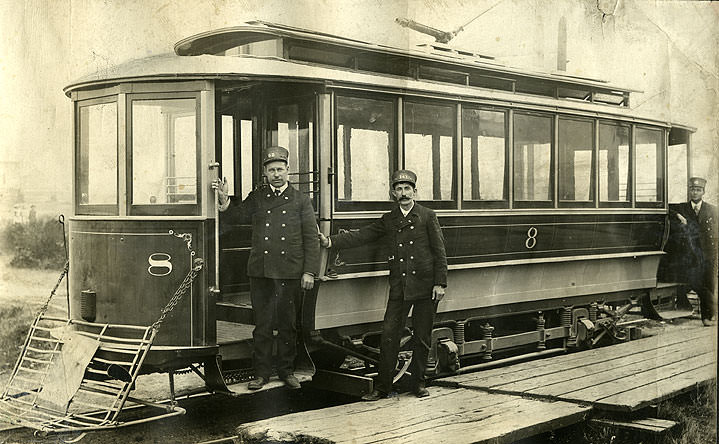
The streetcar is stopped at a loading area, and there are two streetcar operators in uniform standing on the front and rear steps and another operator standing alongside.
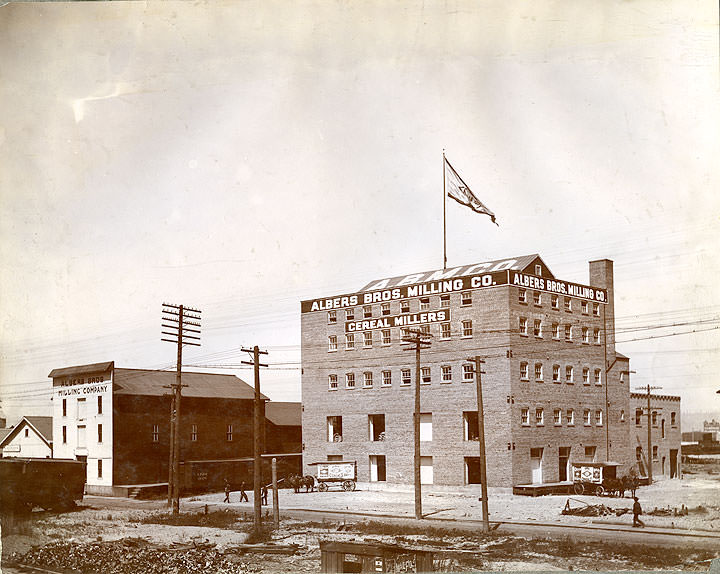
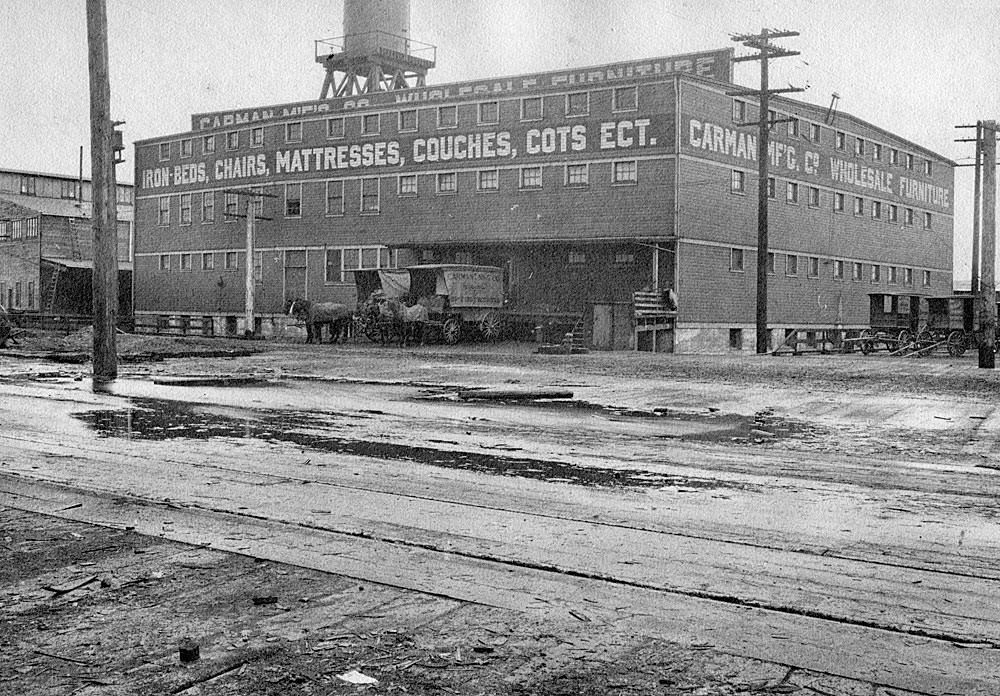
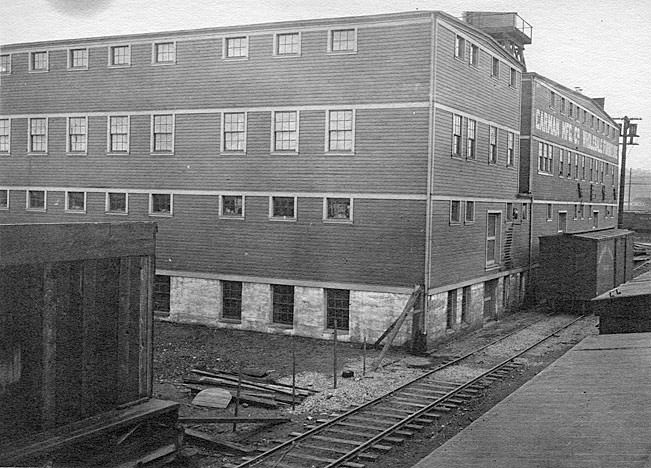
The mill was built in 1904 by John J. Donnellan, architect. Two horse-team drawn delivery wagons are by the main building. A large flag, probably with the company logo, flies from the top of the main building. Two railroad freight cars are partially visible at the image left, next to the main building.
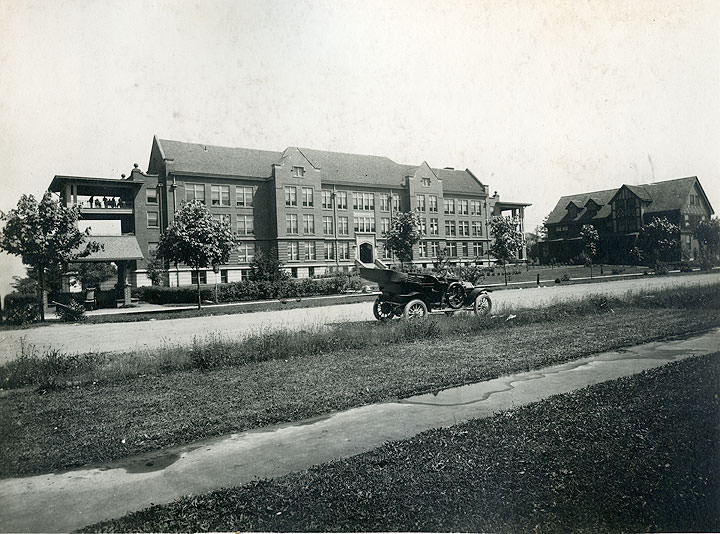
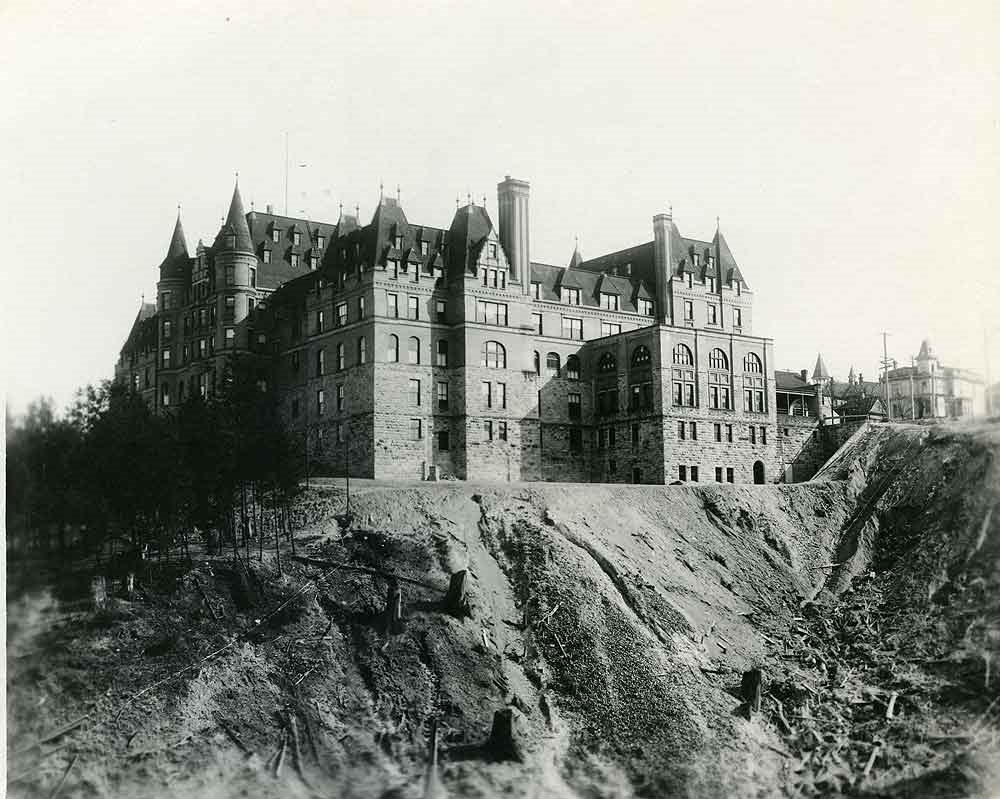
The hospital was built in 1904 by Reed & Stem, Architects, and demolished in 1973. It was a large three-story brick or stone building with porches on both ends and a central entryway.
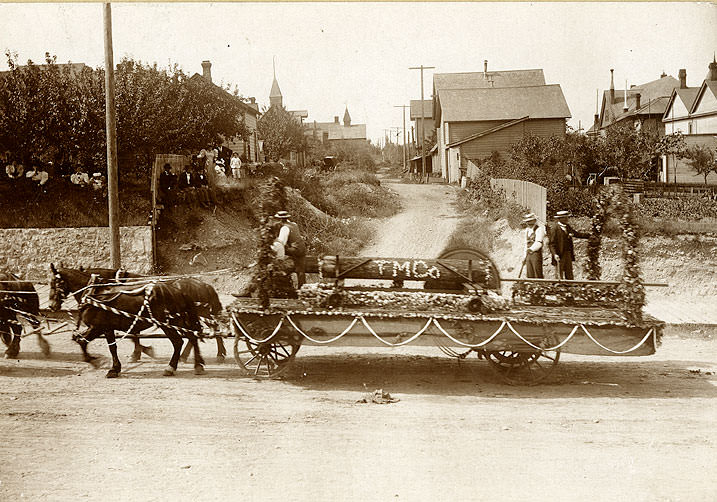
The float consists of a horizontal log with TMCo rendered in flowers on the side of the log, on a flatbed wagon. Flowers decorate the area below the log. Two men stand behind the log, and a floral arch is at the end of the float. Horse teams pulling the float are partially visible at the image left edge. The float passes the entrance to a crooked dirt alley in the image center. The backs of a few houses and fences border the alley, and a church steeple rises in the left background.
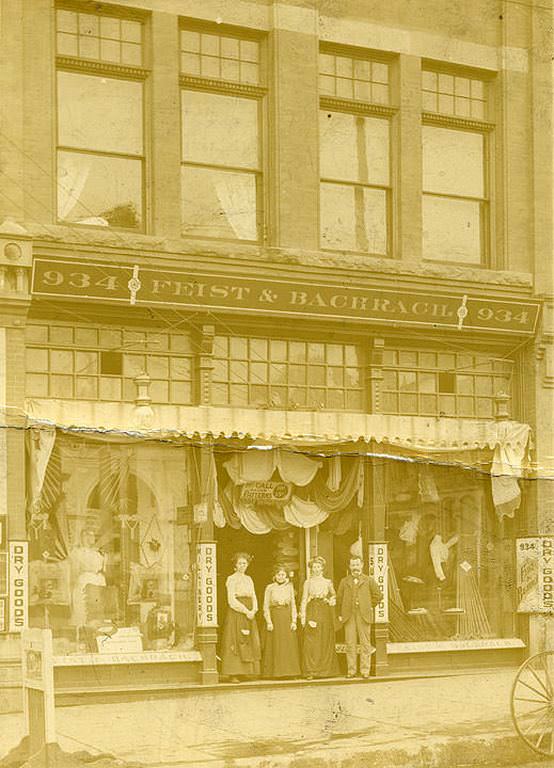
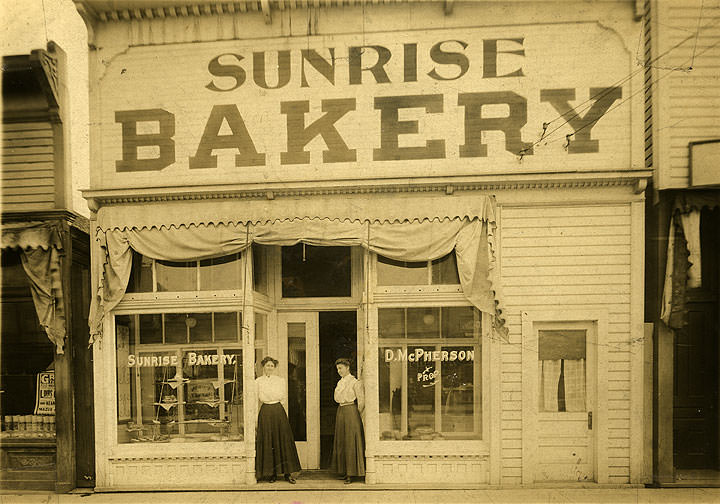
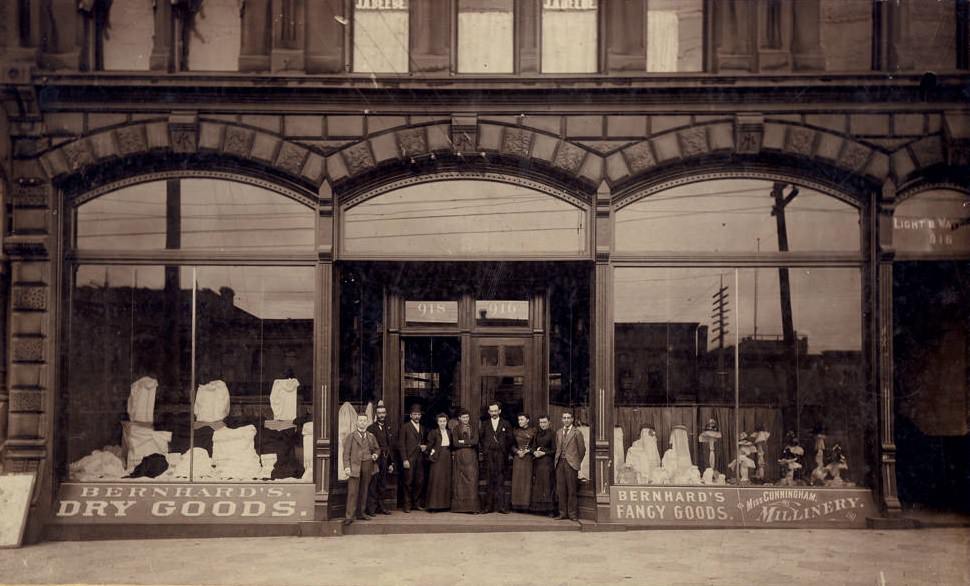
Three women wearing blouses and skirts, possibly saleswomen, and a man are posing in the store entrance. Clothing items are displayed in store windows, and fabric or clothing appears to be draped above the door.
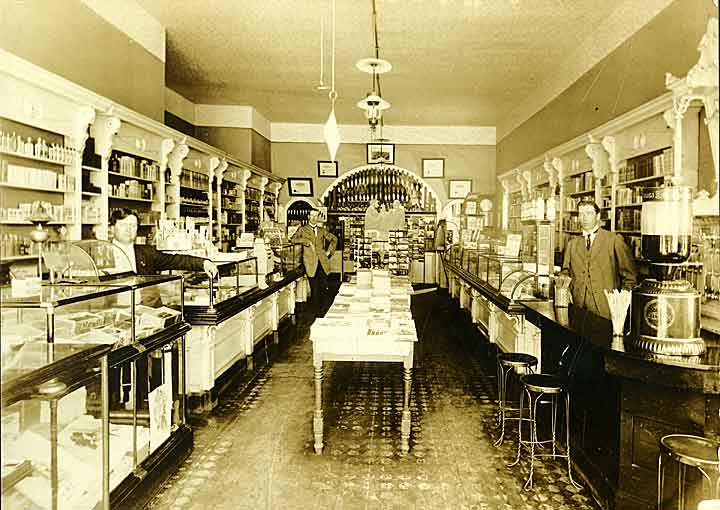
Three men wearing suits stand posing: one behind a soda fountain in the image right foreground, and the other two at the image left. A table with merchandise is in the image center, in the store aisle. A rack of postcards is in the image center background. A counter with glass display cases on top extends the length of the store at the image left and in the rear at the image right. A large beverage dispenser sits on the counter near the right image edge, with a container of drinking straws next to it.
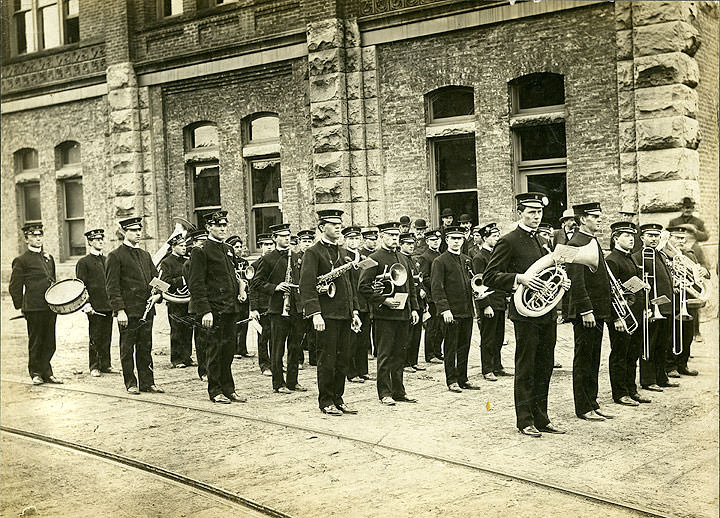
Kelly’s Band — uniformed men of various ages standing in five rows of possibly five men each — pose at Ninth Street and A Street, Tacoma. Their musical instruments are visible, including a saxophone, trombones, a clarinet, and a snare drum.
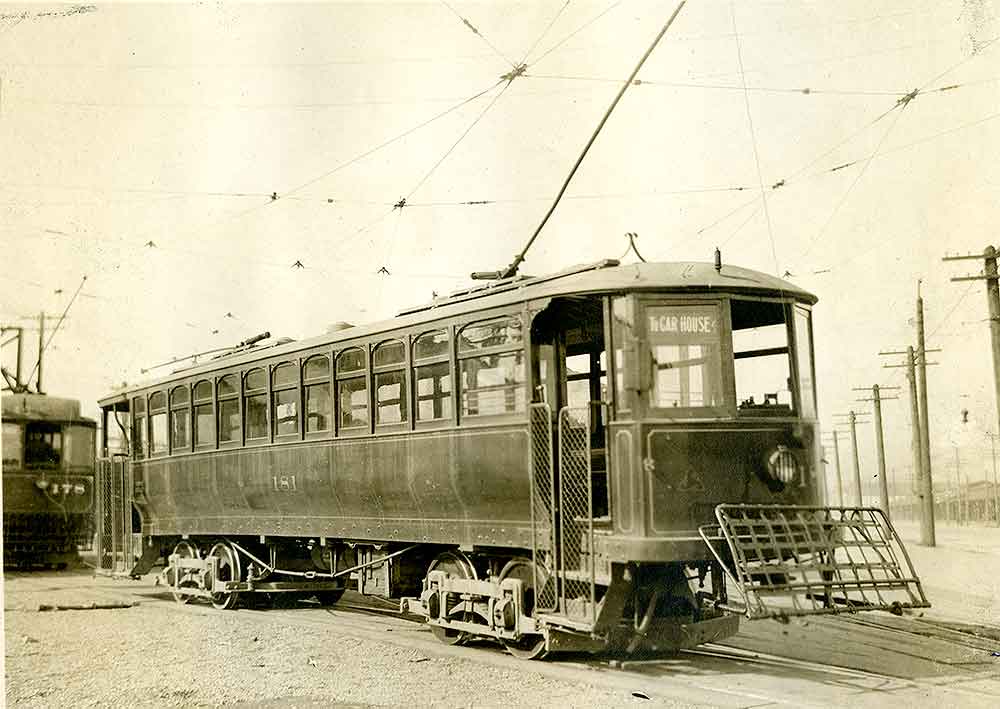
The streetcar is empty of riders and sits on a track just ahead of streetcar #178, seen in the distance. On streetcar #181 are the words “To Car House”.
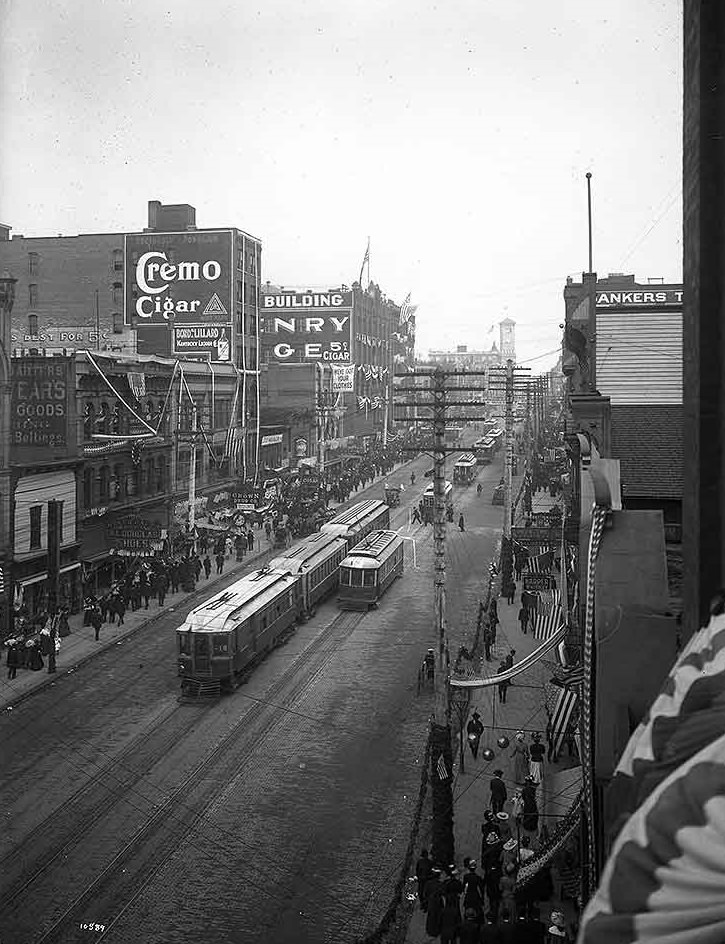
Several pedestrians are on the sidewalks, and U.S. flags are displayed on several buildings.
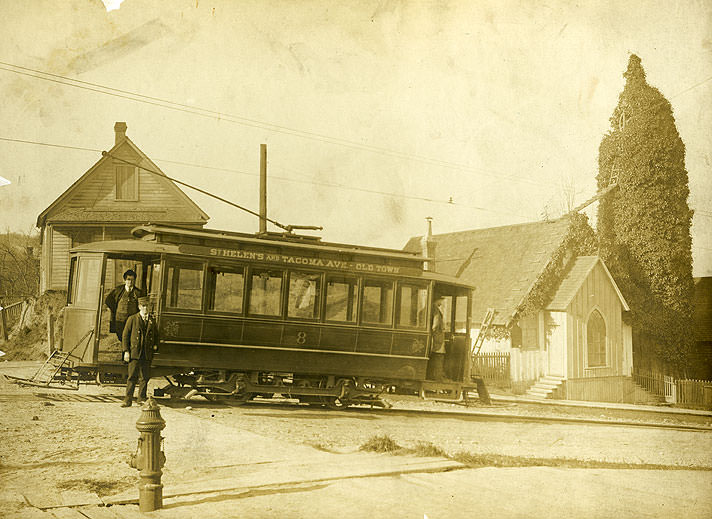
A passenger stands on the streetcar’s stairs behind him. Another passenger stands inside the car at the front, looking toward the image right. Sign on top of streetcar: St. Helen’s and Tacoma Ave. – Old Town. A fire hydrant is at the lower left image corner. St. Peter’s Episcopal Church, with vines almost wholly covering the bell tower, is at the image right edge.
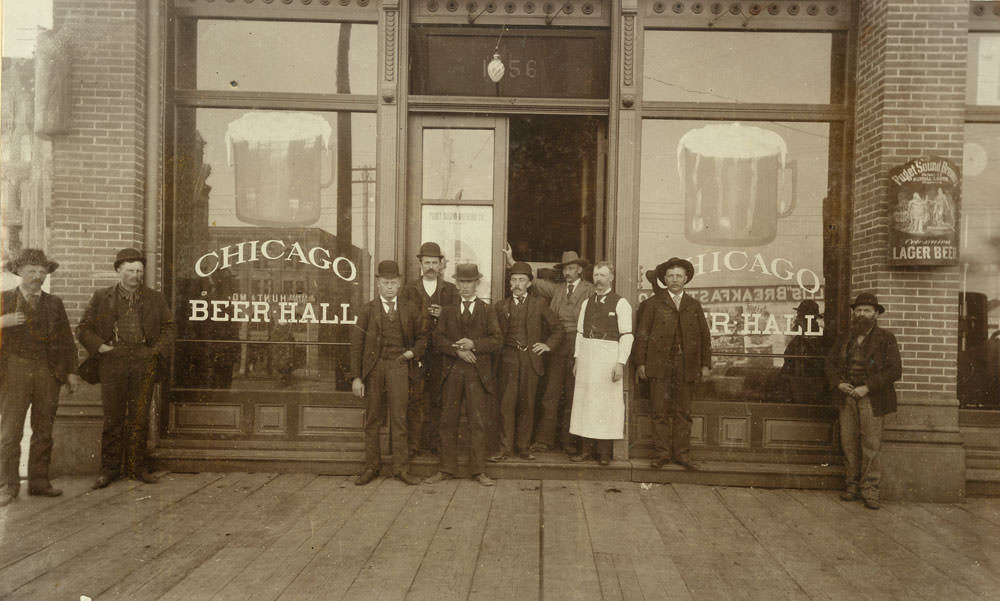
The name is on both front windows, with a foaming mug above the name in both. Several men stand in front of the door, including Oluf Melby, wearing a barkeeper’s apron.
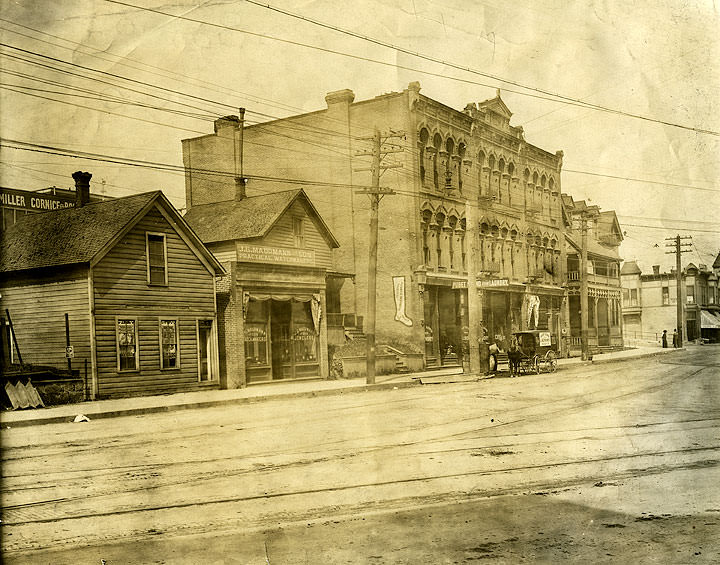
To the left of center, a one-story brick building has a sign: J.G. Maurmann and Son, Practical Watchmakers, Jewelers. Frame structures possibly used as houses flank this building. The three-story business building to the right of center has a sign: Puget Sound Steam Laundry. A horse-drawn delivery wagon for the business is in front. Other frame buildings are near the image right edge.
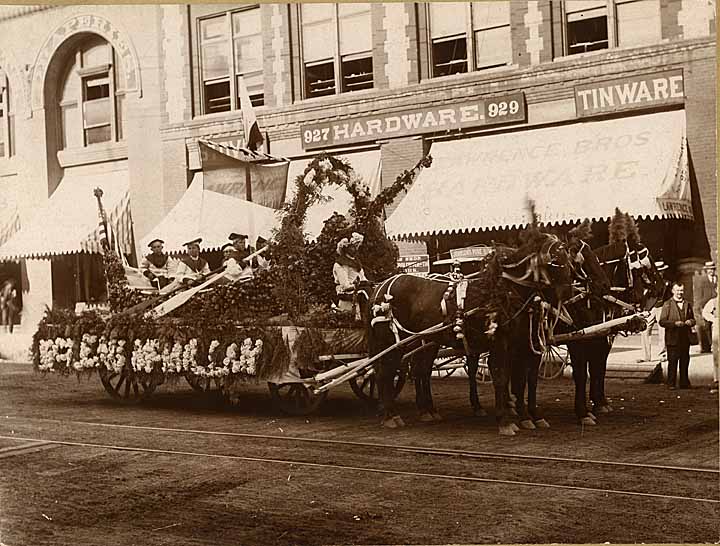
Five men pose in a boat with a square sail, two of them holding oars, on a floral-decorated flatbed wagon. The men and a driver wear Middle Ages-style costumes, with large hats and dark yokes over white shirts.
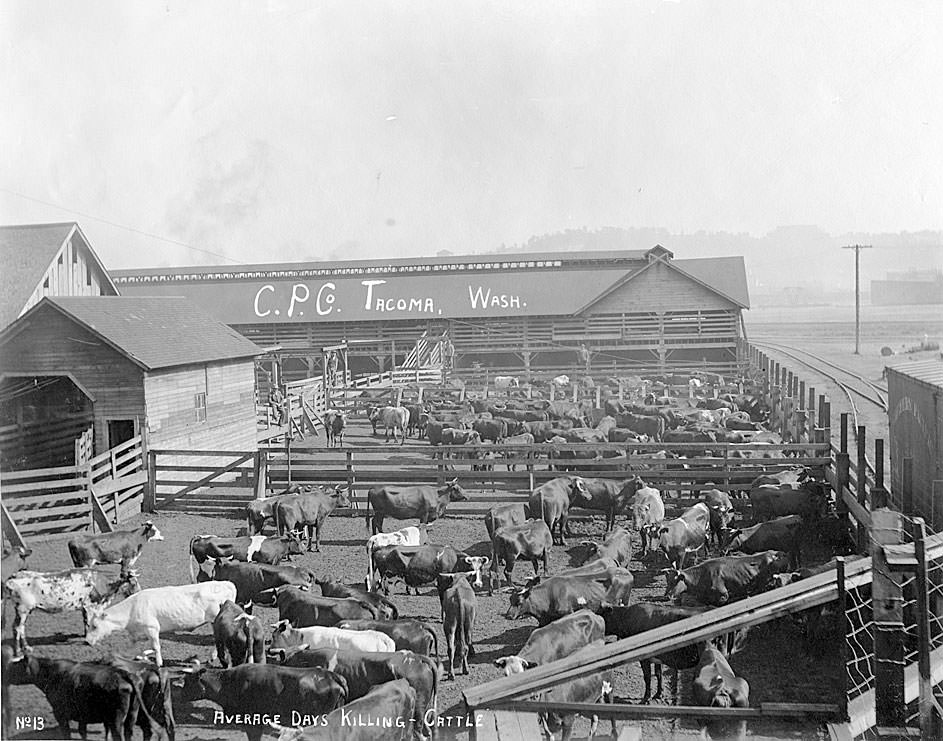
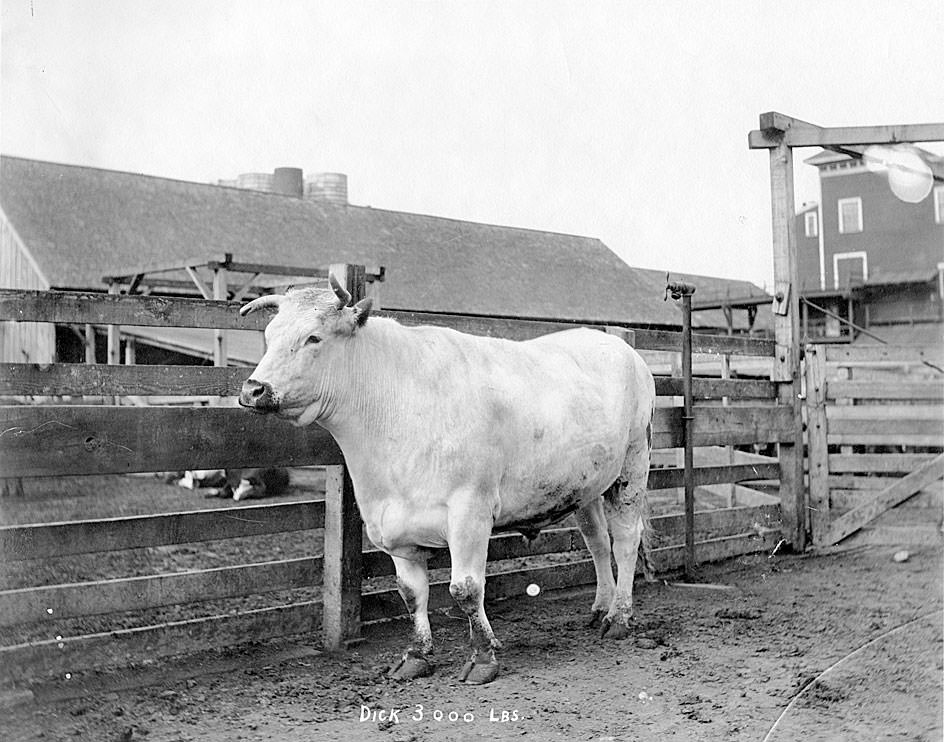
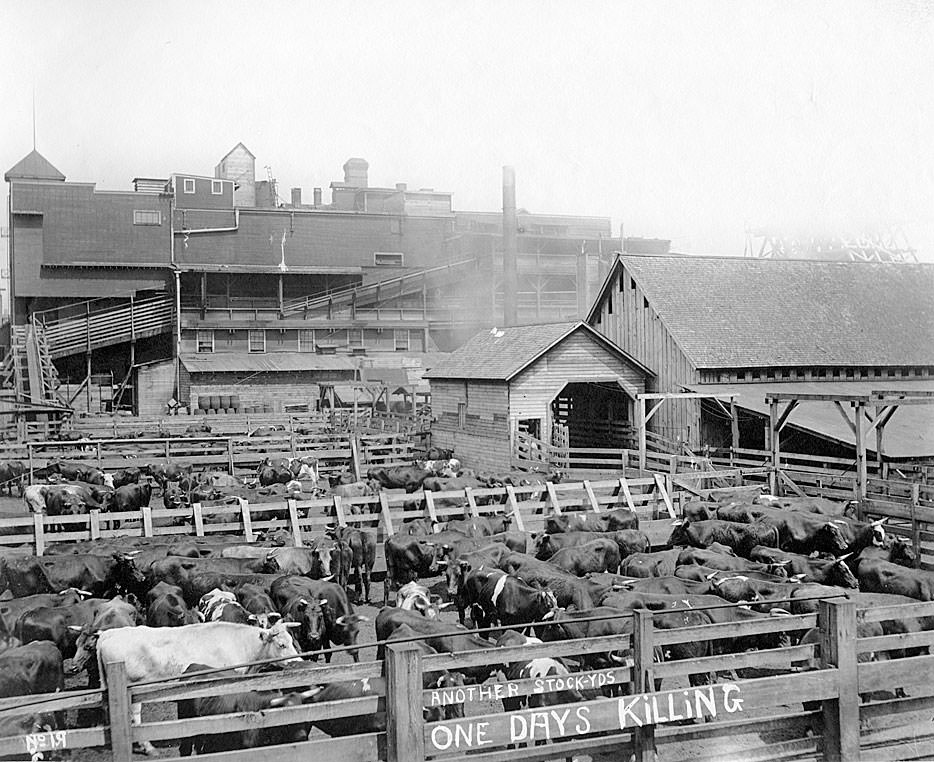
The image shows cattle in the stockyards of the packing plant. Railroad tracks and a Northern Pacific boxcar are visible on the right.
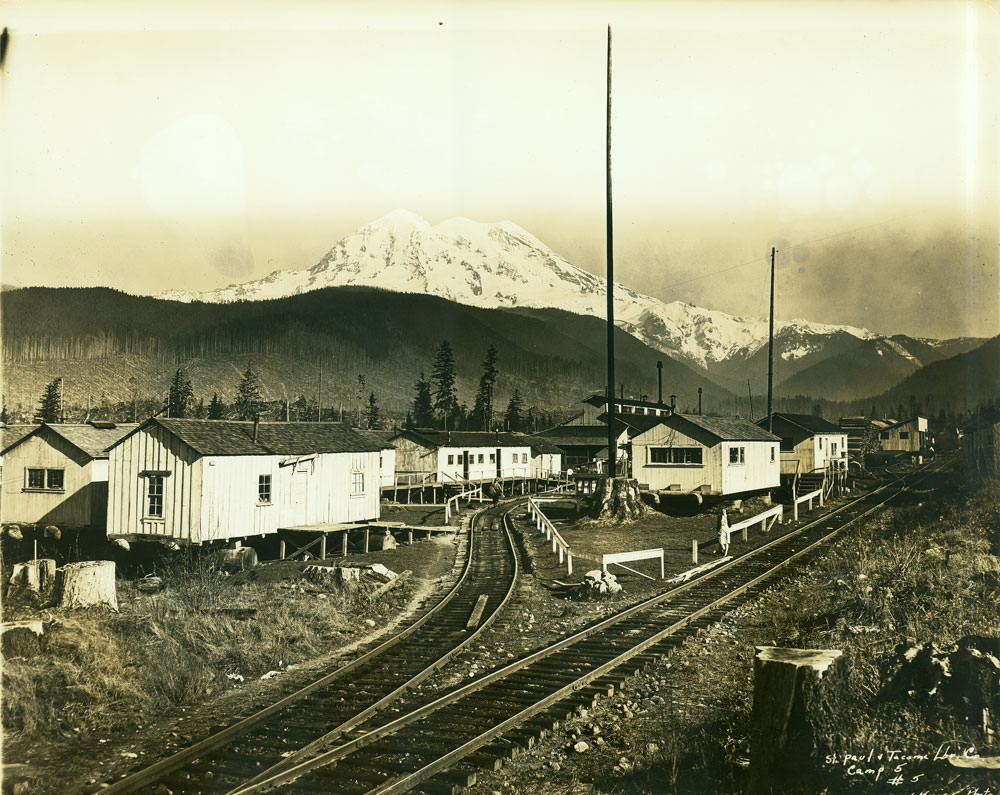
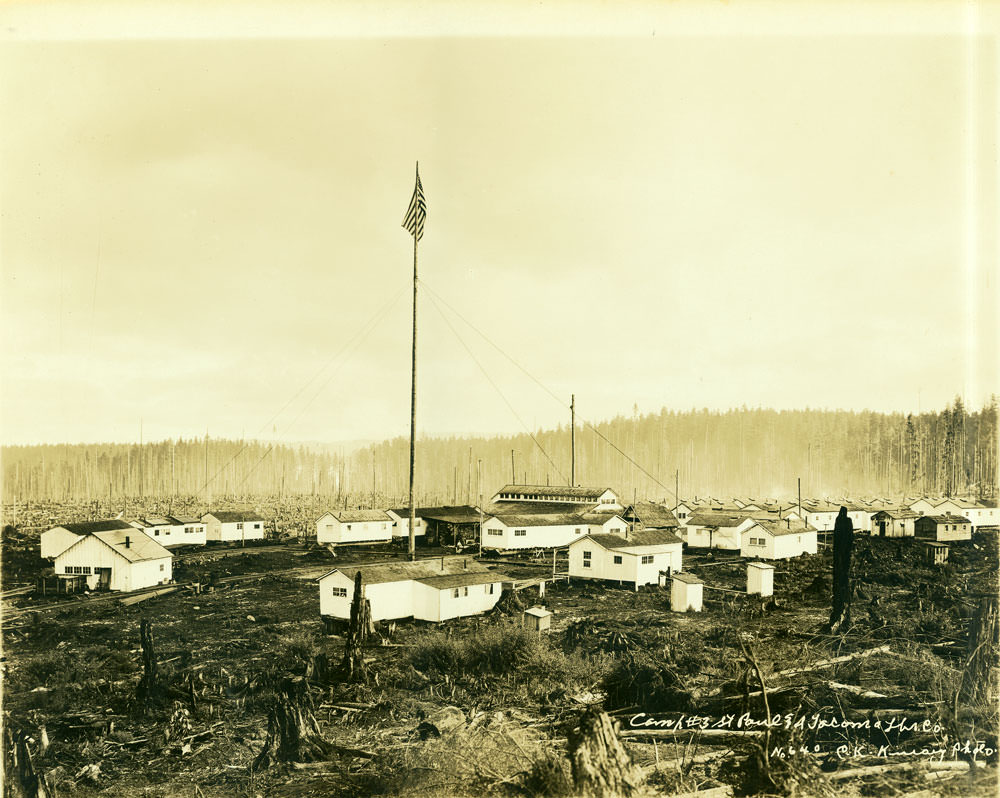
The image includes a view of Mt. Rainier in the background. The camp contains several small cabins constructed on top of extensive logs. There are several tree stumps in the area. Running through the camp, there are two sets of railway tracks.
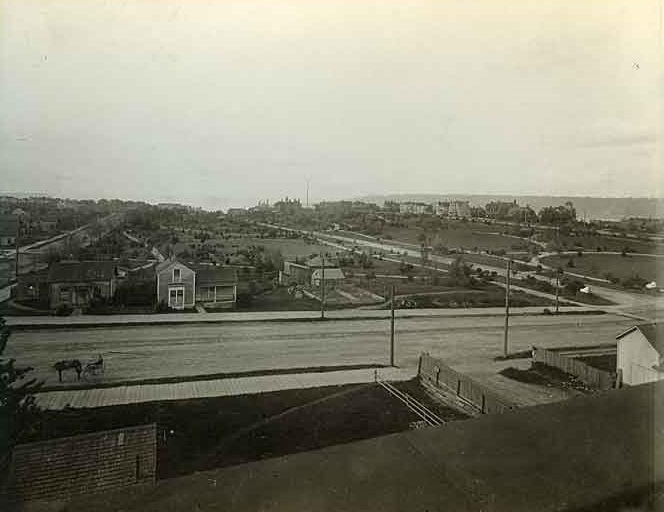
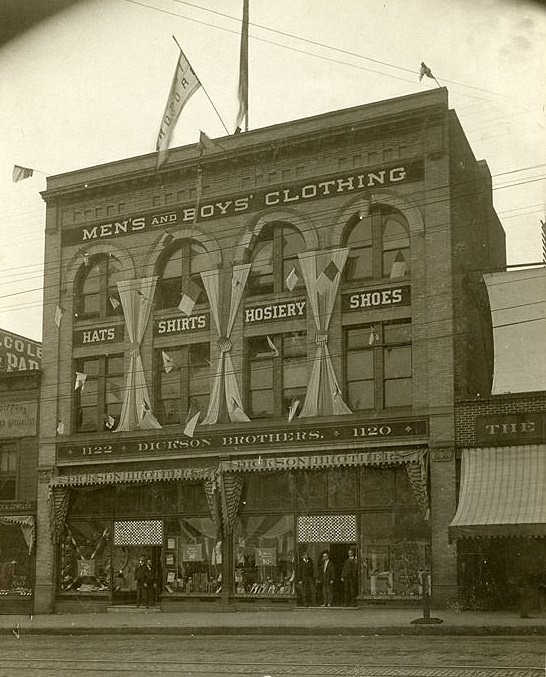
Sixth Avenue is a dirt road. A man in a horse-drawn buggy is on the street near the image left edge.
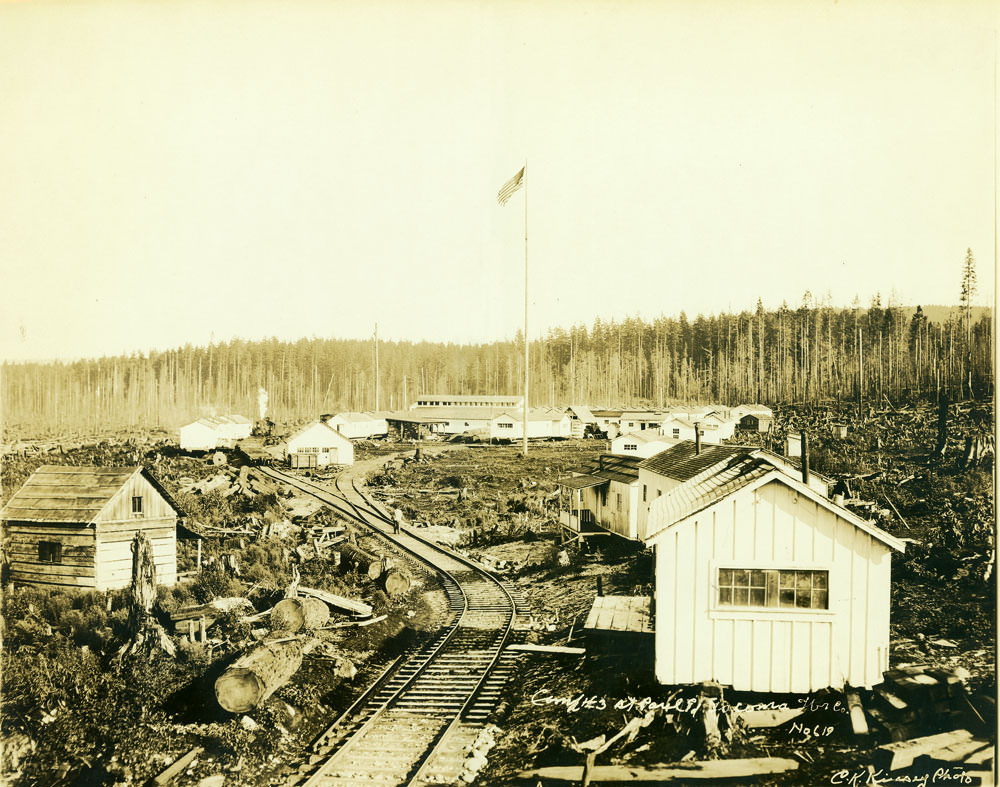
They are grouped along the railway tracks that cut through the camp’s center. On this track, in the distance, a train is approaching. One man is standing on the tracks. In the center, there is a tall flagpole with a United States flag flying from it.
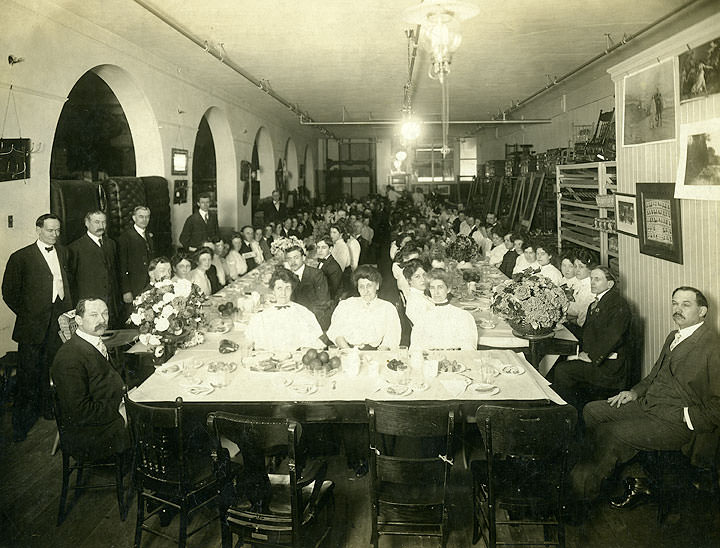
Floyd Worlds is probably in the group. The room appears to be a storage room, with some houseware items pushed against the walls.
Bunches of onions, carrots, and other products are displayed on the posts between the open storefront windows. Two men with hats stand near the displays.
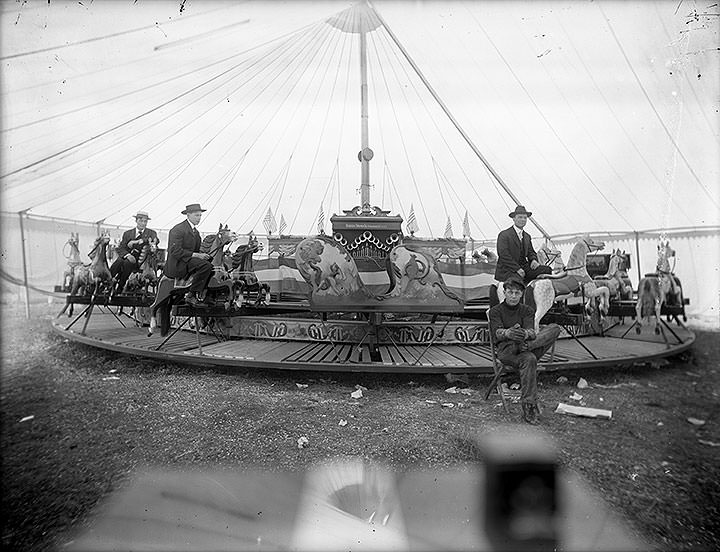
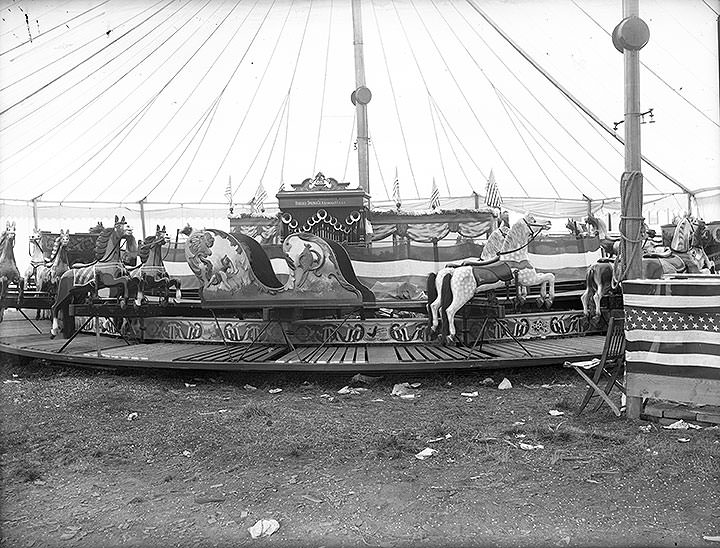
The carousel is enclosed in a tent. Three men wearing suits are sitting on horses on the carousel. All the visible animals are horses. A man in work clothes sits on a folding chair in front of the carousel, looking at the photographer.
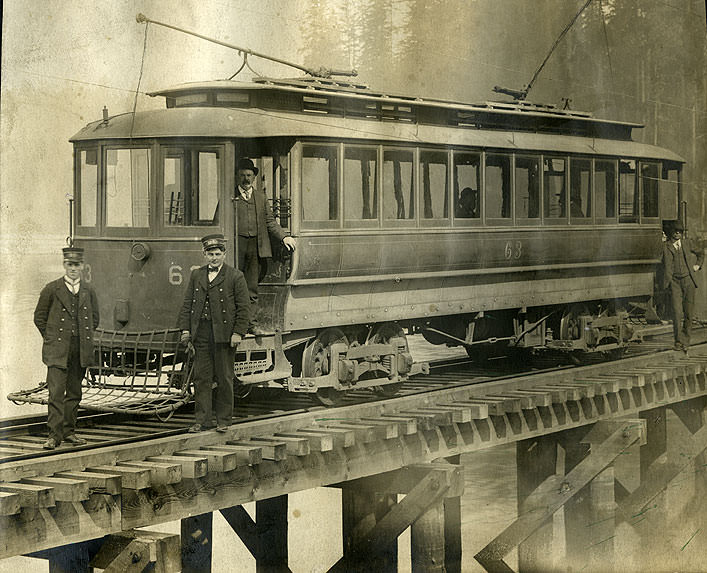
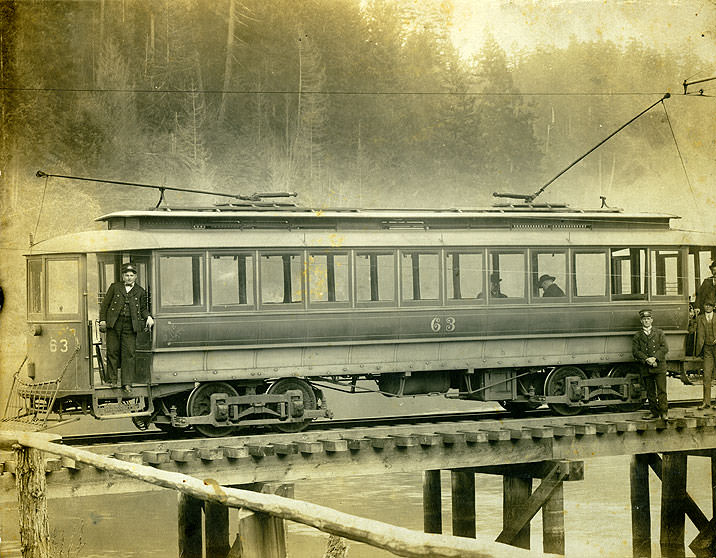
The photograph shows the streetcar stopped on a trestle above water, with two streetcar operators out and in front of the car and one man standing near the back step. Another man in a suit and derby hat stands at the top of the front step.
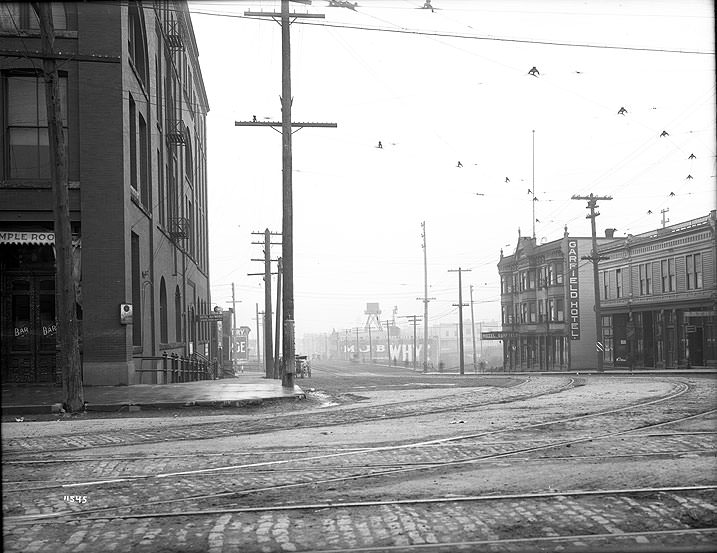
The three-story Hotel Garfield, 108-111 Puyallup Avenue, is at the image right, next to a building advertising a tailor, shoes, and baths. Across the street at the image left, a sign reads Hotel Raymond. A sign in the distance reads: M.J.B. Why? The streets are empty except for a partially visible horse-drawn wagon in the center distance.
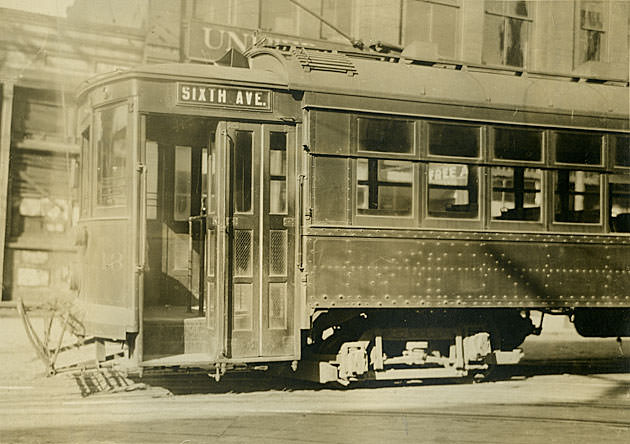
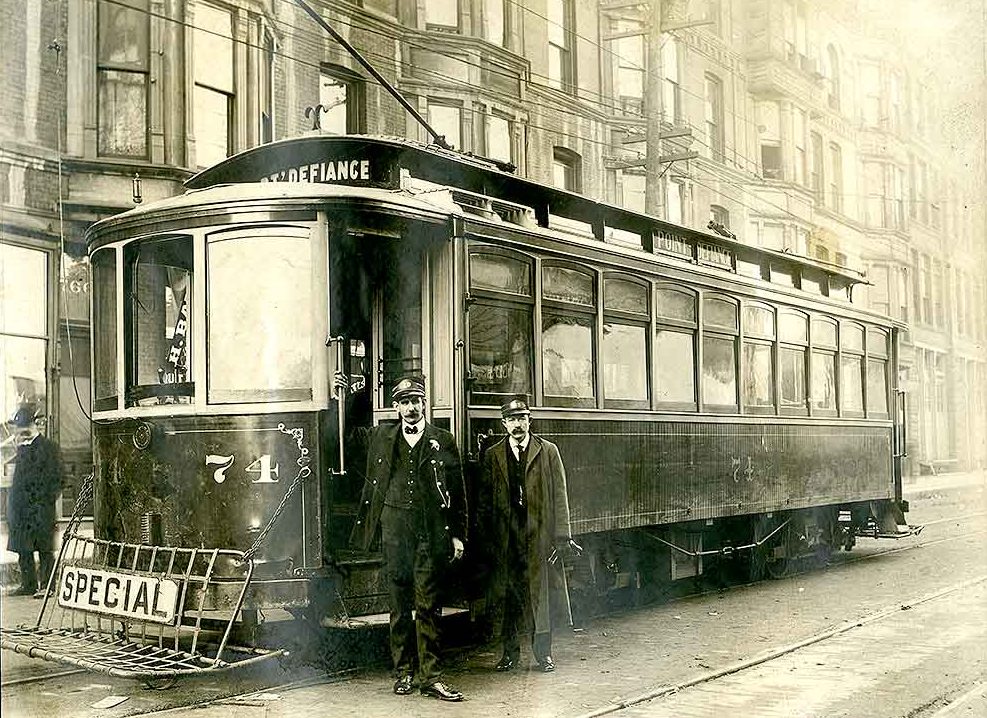
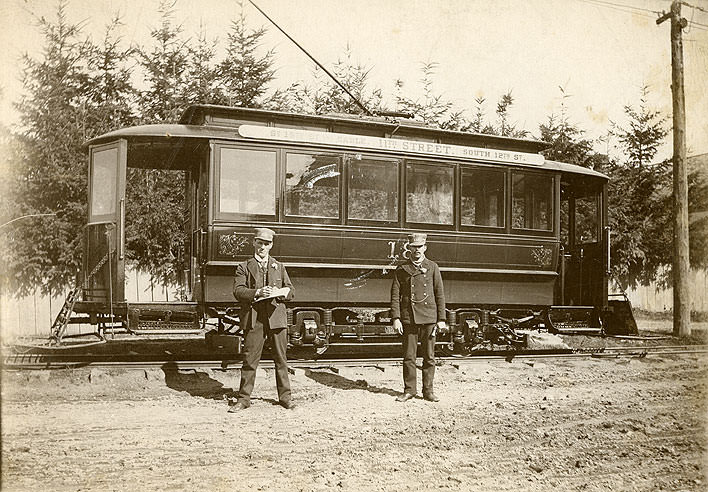
Two uniformed individuals are posing in front of the entrance steps to the streetcar. On the front of the streetcar near the bottom are the words “SPECIAL”.
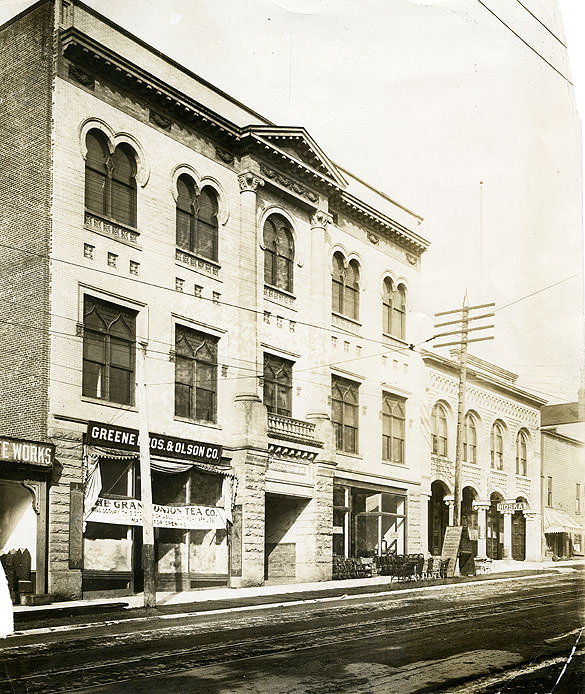
Businesses on the ground floor of the building include The Grand Union Tea Co., 736 St. Helen’s, in the site formerly occupied by Green Bros. & Olson Co., and an auctioneer with an illegible sign in front and several chairs outside the business.
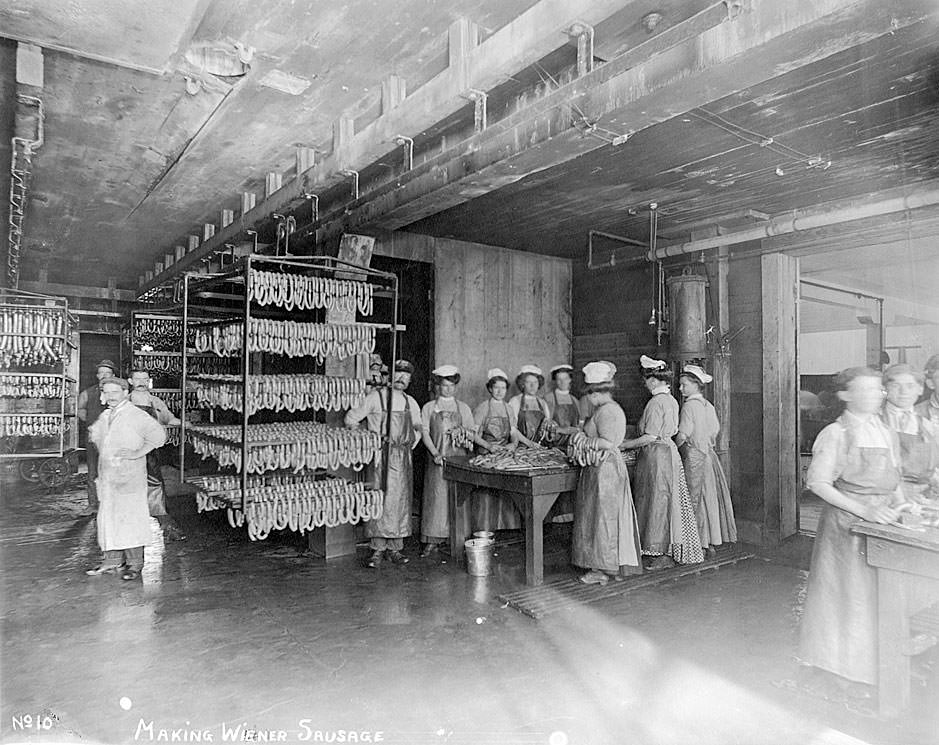
Workers wear white caps on their heads and long aprons. They are making sausages. The finished links hang from metal frames from the ceiling to the left. Men pose to the left and right of the structures. Three additional people are partially visible at another table making sausage on the far right.
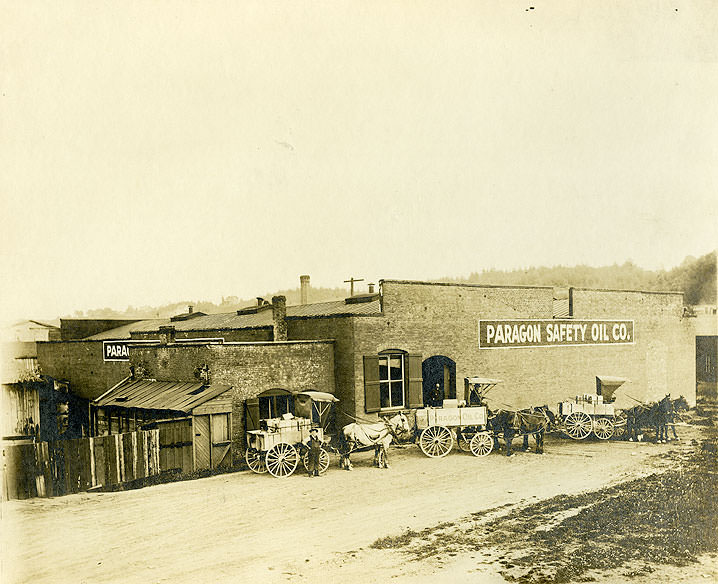
Three horse-team drawn delivery wagons are alongside the building. The driver’s seat has a canopy, and the wagon’s rear is open. A driver sits on one of the wagons by a loading window. Boxes are in the backs of the wagons.
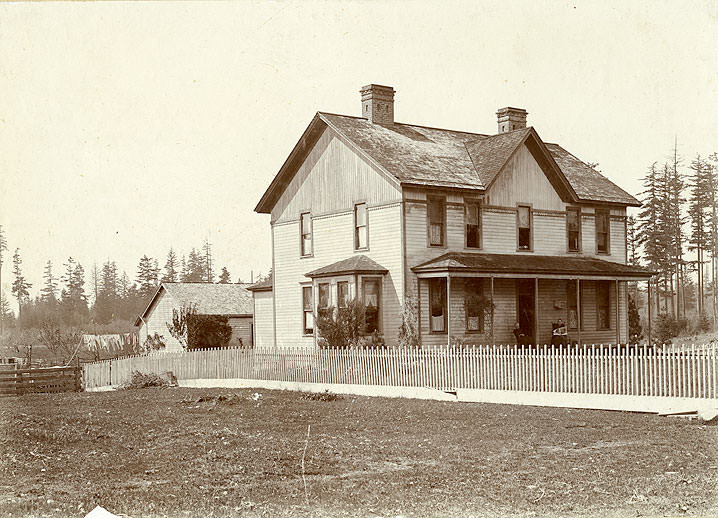
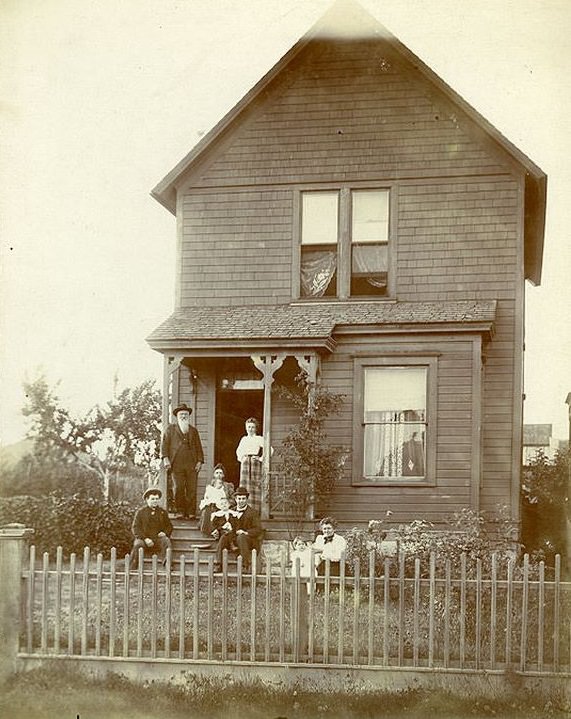
A man and woman are sitting and posing on the covered front porch of the two-story home, and the woman appears to be holding a newspaper. Laundry is hanging from a clothesline near a shed at the image left. In the image foreground, a wooden fence is along the side of the house. Information written on the reverse and a piece of paper with the image includes: The Byrd family occupied the place until ca. 1920. A few years after Mr. Byrd’s death, it was sold to Mrs. Olson, who later sold it to be used as St. Ann’s Home, a Catholic children’s home.
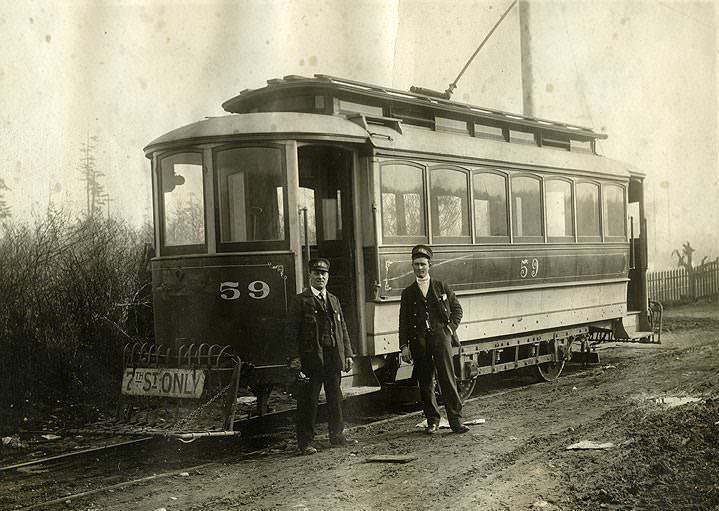
The streetcar is car 59 with the sign “7th St. only” at the front. There are two streetcar operators in uniform standing next to the stationary streetcar. One has a cap with 95 on it, and the other, in gloves with a hammer in his right hand, has the number 62 on his hat.
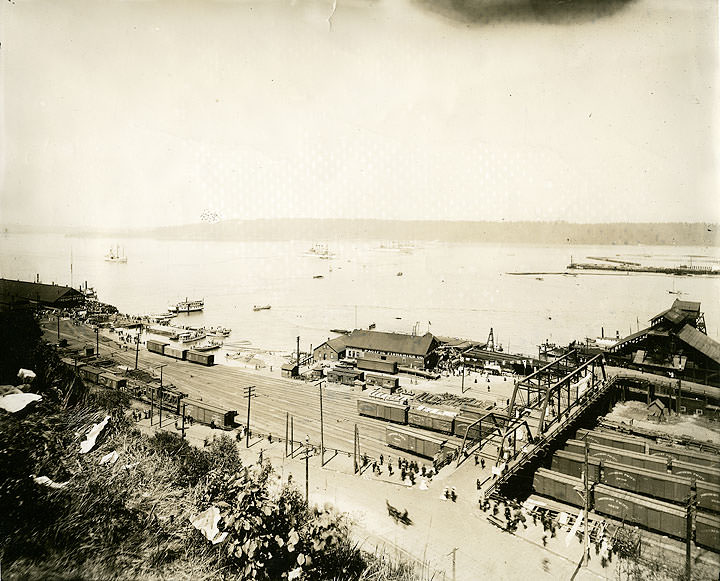
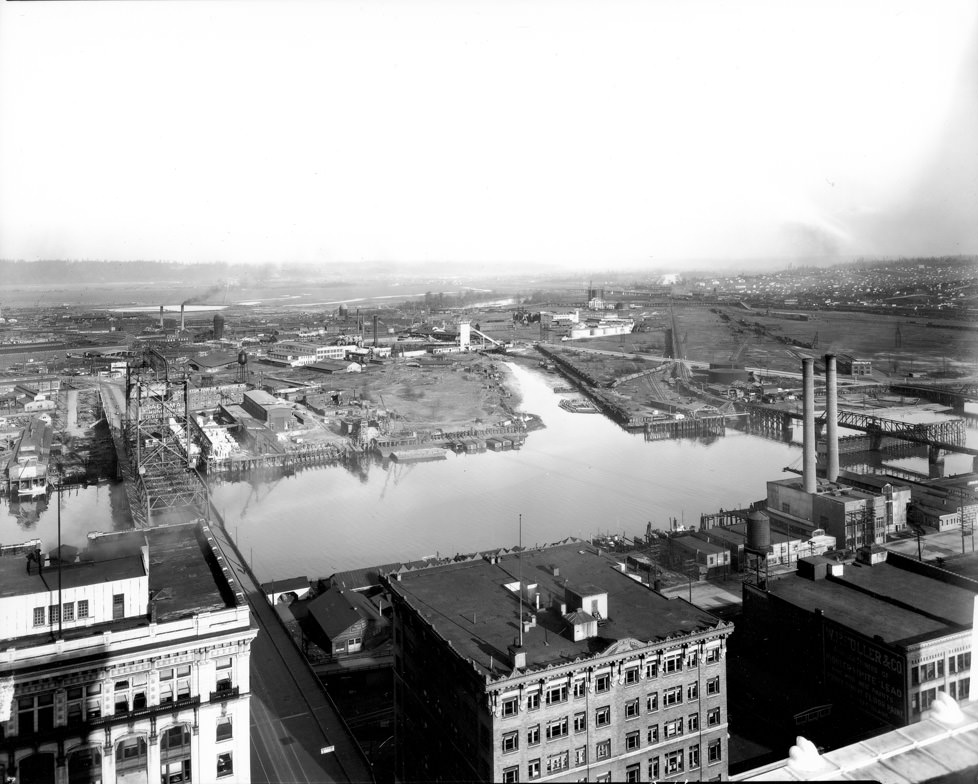
The Foss Boat House is not identified, but it may be the large building south of the Puyallup River at the image center right edge, or a long building at the image left edge with the sign: Freight Office. Foliage at the top of the hill from which the photo was taken is in the lower left foreground. Freight cars are on four parallel railroad tracks running below the image center. A bridge with pedestrians walking across is in the lower right image.
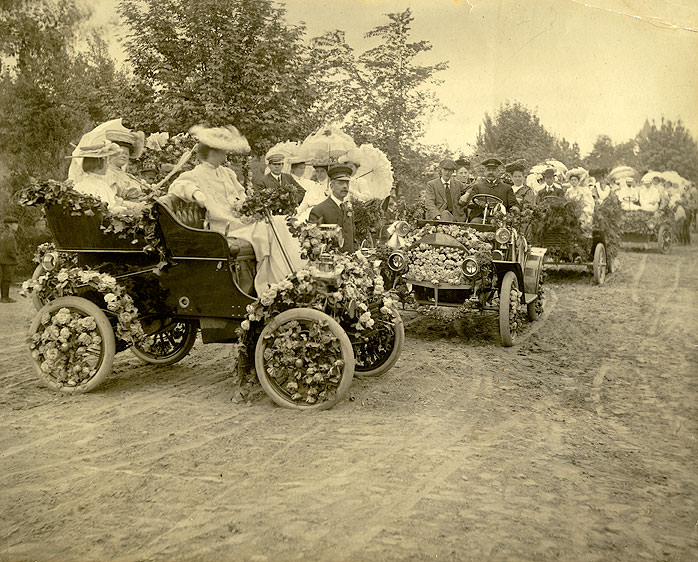
Three women with large hats, one with a parasol, sit in the vehicle, whose wheels, fenders, front, and steering wheel are densely decorated with roses. A man stands beside the car, looking at the photographer. Three other similarly decorated automobiles are seen at the image right, from the front, in a row.
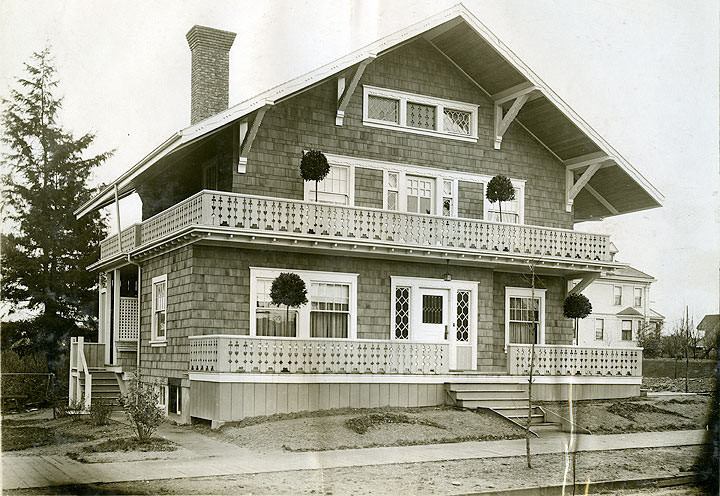
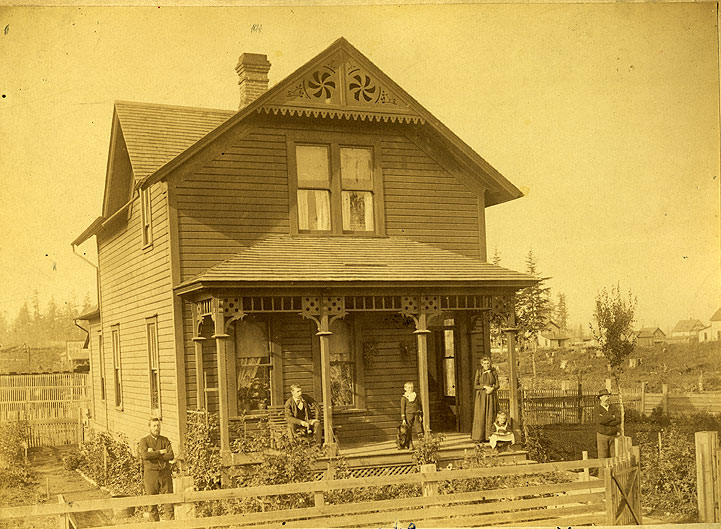
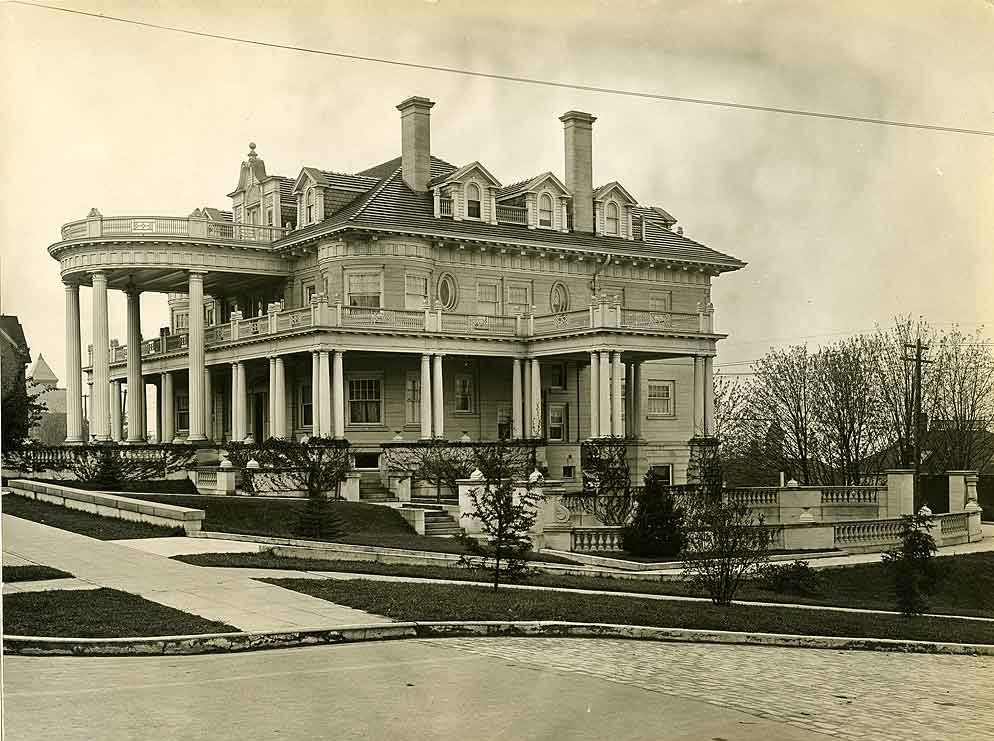
An open porch with a low railing and vertical carved wood boards extends across the front. A balcony with a similar railing extends around two visible sides of the second story. Two topiary plants sit on each level at the front of the house.
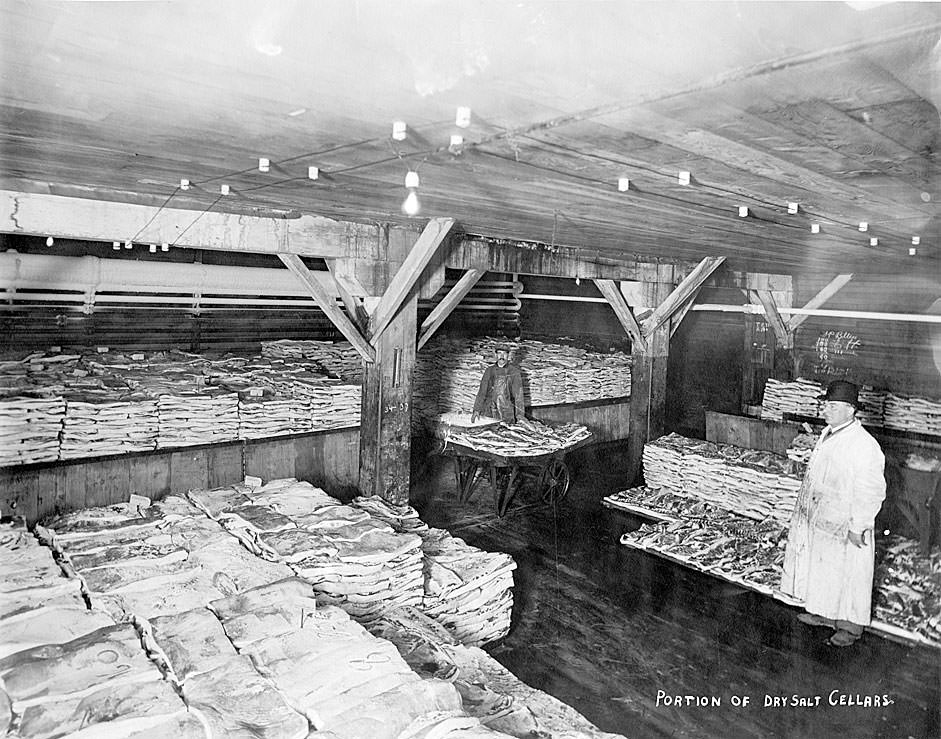
A caption below the image reads “Portion of Dry Salt Cellars”. Slabs of salted meat are stacked all over the room. A man wearing a bowler hat and long white coat poses at the right. A man with a dark mustache and a cap and long apron stands near a cart holding more slabs of meat in the center of the image.
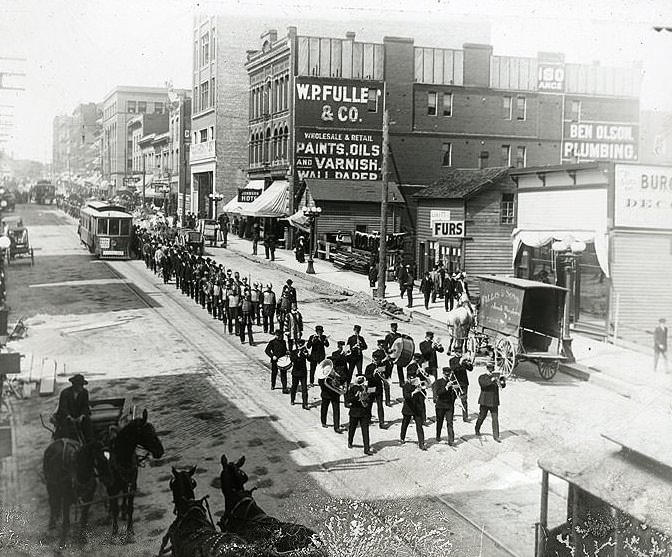
Those behind the band may be wearing a fraternal organization uniform, including helmets. A few pedestrians are on the sidewalks, but not all are watching the parade. Two streetcars and horse-team drawn delivery wagons are on the street. Sign on the side of the delivery wagon in the image right foreground: Wallis & Sons, junk dealers.
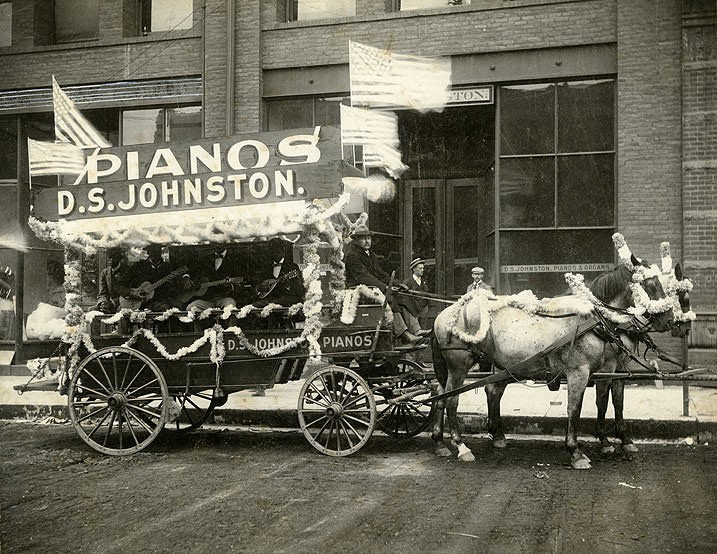
The company name is on the top and side of the wagon. The horses and wagon are decorated with garlands, and U.S. flags fly from the top of the wagon, possibly for an Independence Day parade. Three musicians sit sideways in the wagon, with their faces hidden: two are playing guitars, and one plays the mandolin.
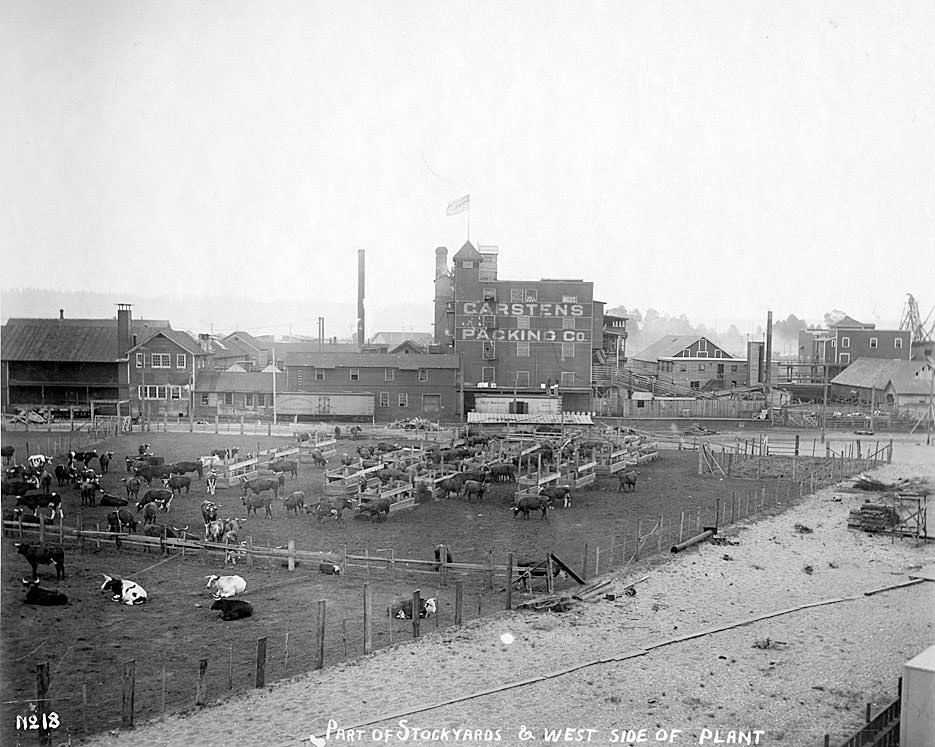
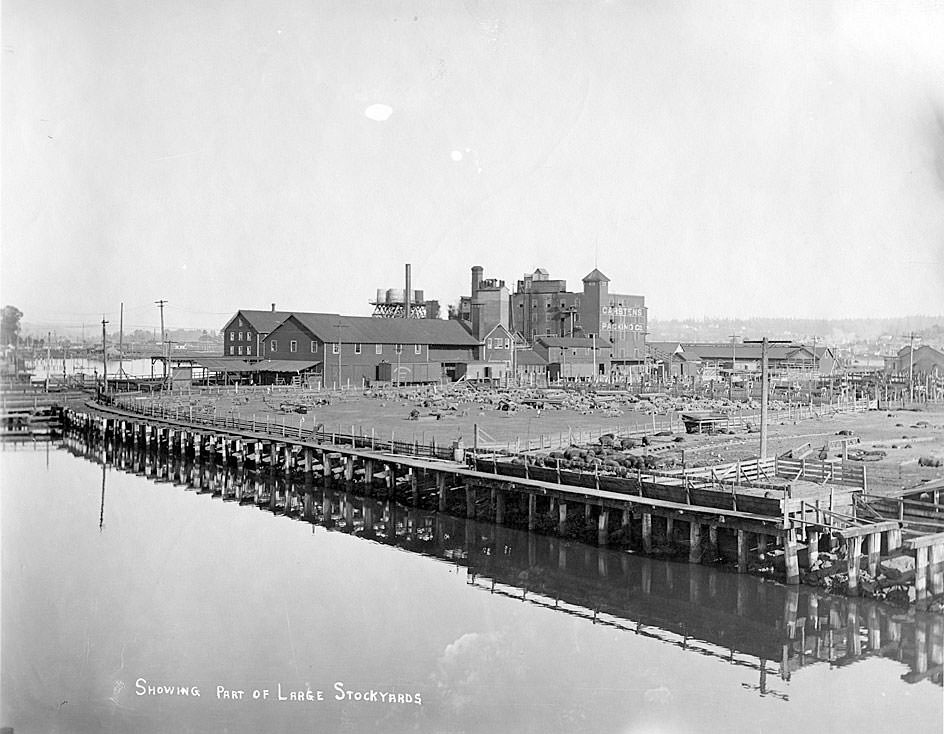
Large white lettering reading “Carstens Packing Co.” is visible on the large building in the center of the image. An American flag flies from a tower of the same building. Two refrigerator cars — one belonging to Great Northern and the other to Pacific Northern — stand outside the packing plant.
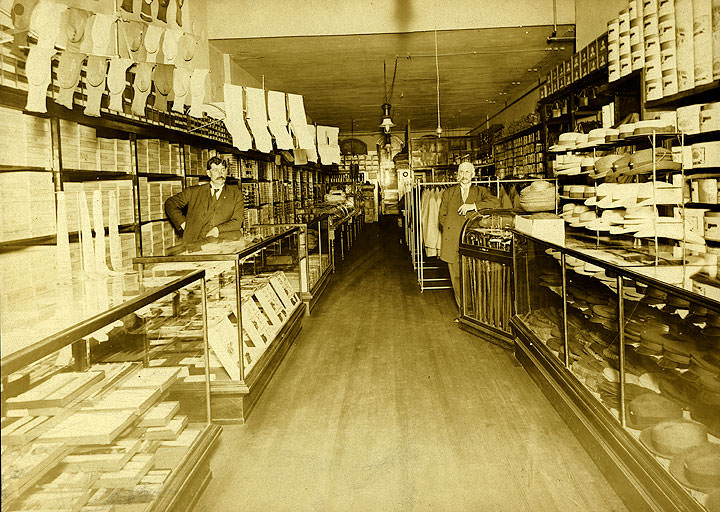
From left to right, salespeople posing by the merchandise are Mr. L. Benjamin and Mr. Barclay. Covered glass cases display boxed items at the image left and hats and caps at the image right. Socks hang from racks above the counter in the image left foreground. Hats are displayed on top of the counter at the image right. Boxes of merchandise are on shelves on both walls extending to the rear of the store.
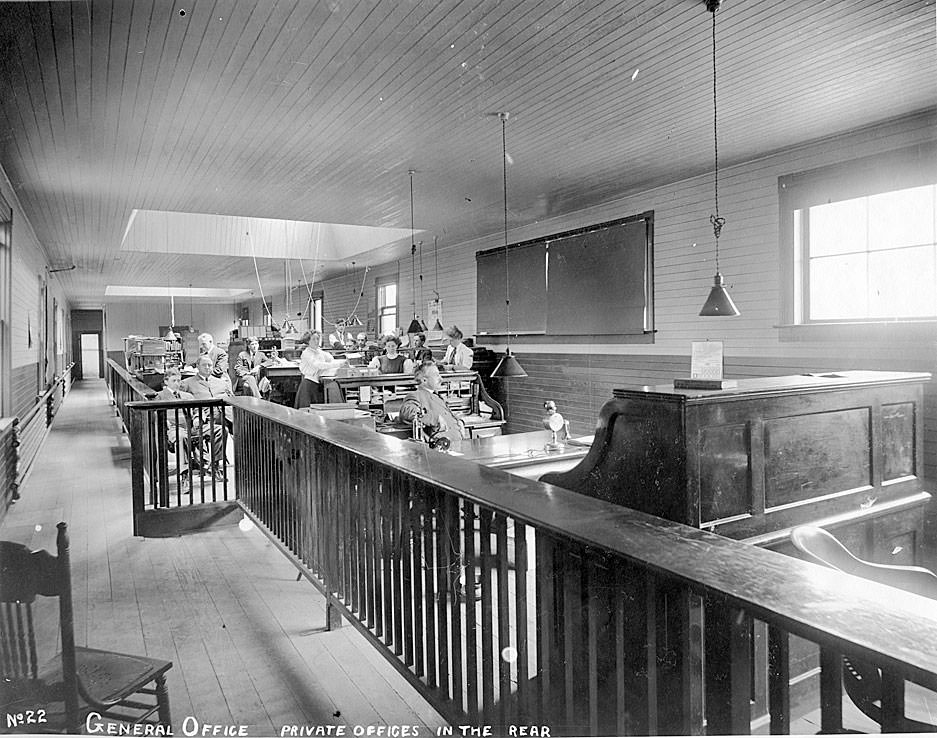
The office is a large open room with two skylights. A long corridor runs along the left side of the room. A calendar from June 1909 stands on top of the rolltop desk on the right. Several office workers — ten men and three women — sit in chairs or stand near desks.
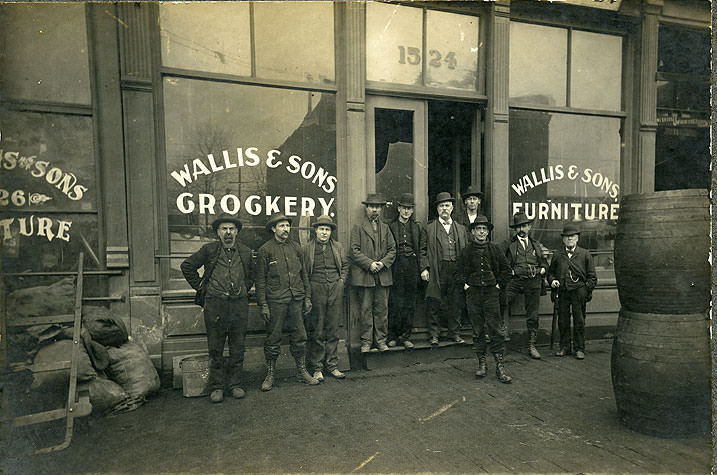
Two barrels are stacked on the sidewalk at the right image edge. Some full sacks are piled against the storefront at the image left edge.
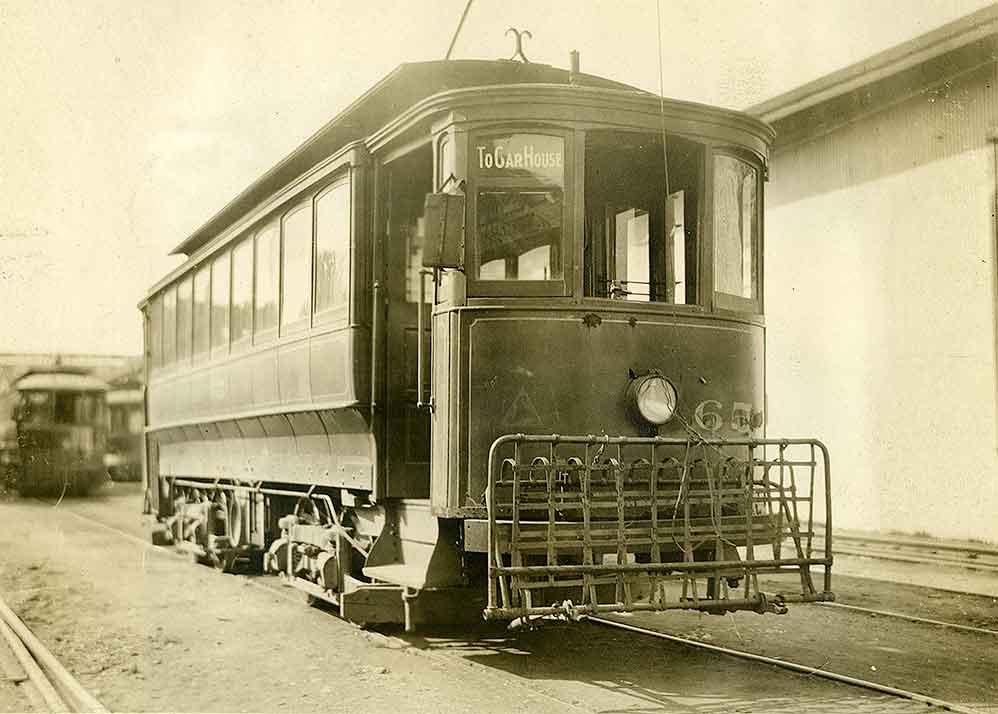
The streetcar is shown from the front right, and there is a sign on the car saying “To Car House”. The cattle guard on the front is drawn up.
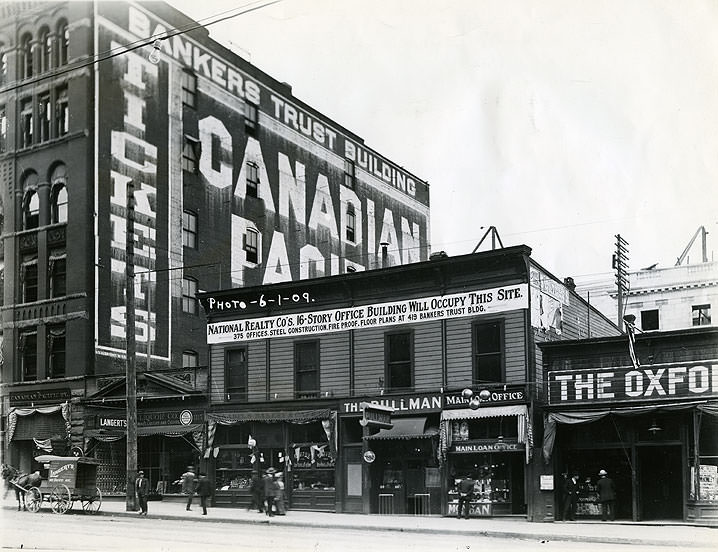
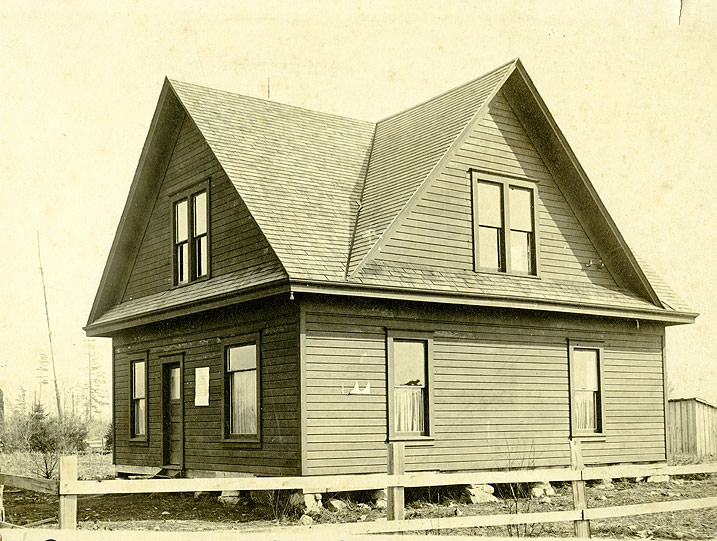
LeSourd Memorial Mission was located at North Cheyenne at the N.W. corner of 15th in Tacoma. It was a one-and-a-half-story wooden building.
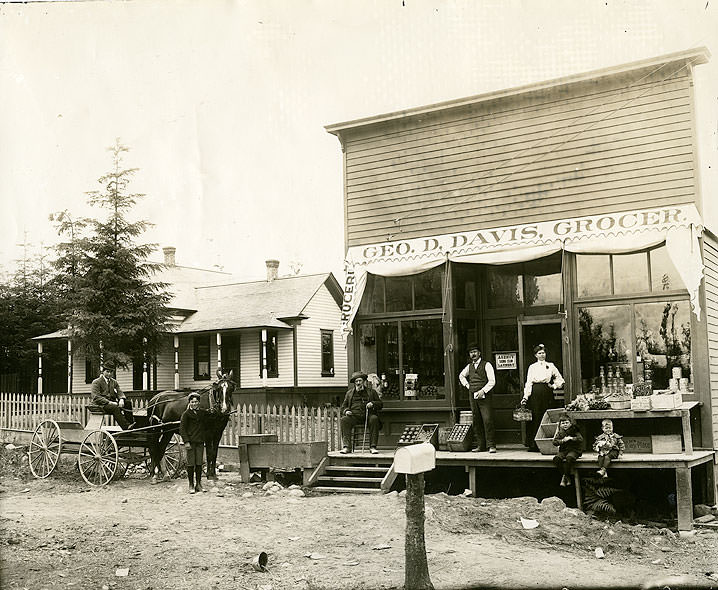
A man wearing a vest over his shirt and a hat, holding a small piece of paper in his hand, poses standing at the store entry door. A woman wearing a blouse and skirt, carrying a small basket, stands nearby. With a pipe in his mouth and a cane in his hand, an older man sits on a chair on the porch in front of the store. Two small boys sit on the edge of the porch, one holding a dog in his arms and the other possibly holding a cabbage, with their legs dangling off the edge. Produce is displayed on a shelf outside the store window and in boxes on the shelf. Stacked food cans and bottles are visible inside the store window, along with a box of apples.
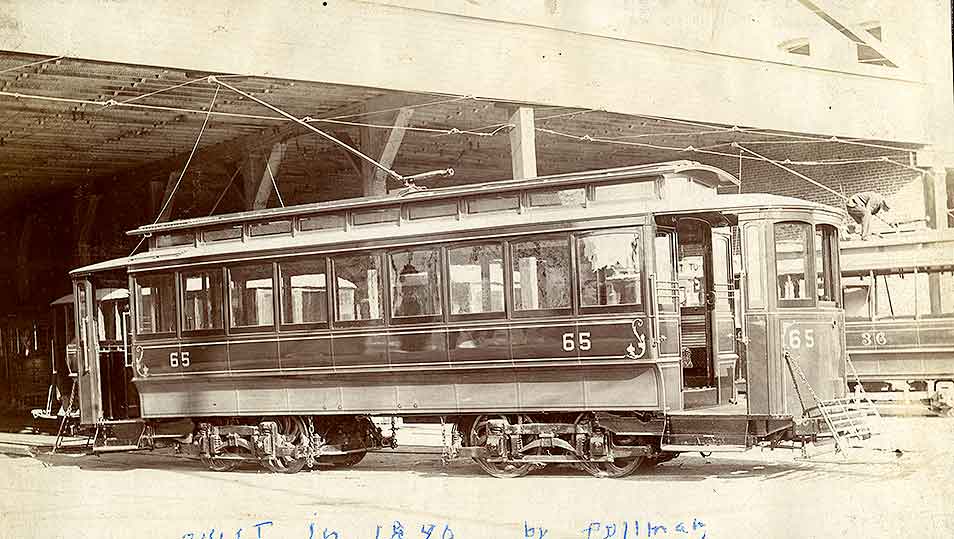
The streetcar is in the car house, empty, and has its cattle guard down. Behind streetcar No. 65 is streetcar No. 36, which has a workman on top engaged in repairs or maintenance. Written at the bottom of the photograph: Built in 1890 by Pullman.
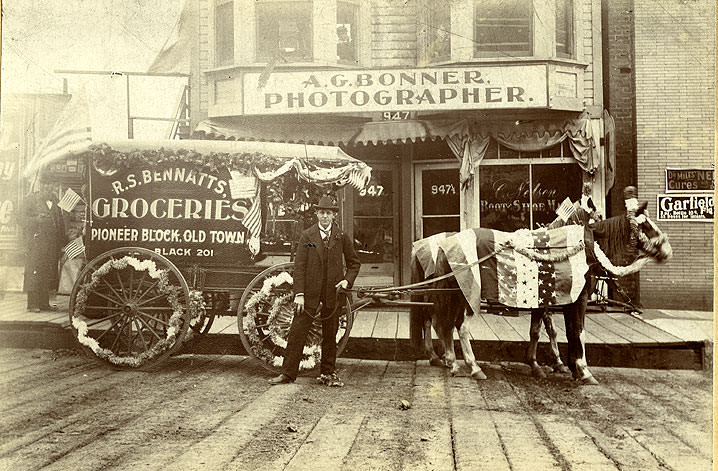
The covered, horse-team drawn delivery wagon for Robert C. Bennetts, Grocer, Pioneer Block, Old Town, obscures Bonner’s storefront window. A man poses beside the wagon, holding the horses’ reins. The wagon and wheels are decorated with bunting and flags, probably for Independence Day.
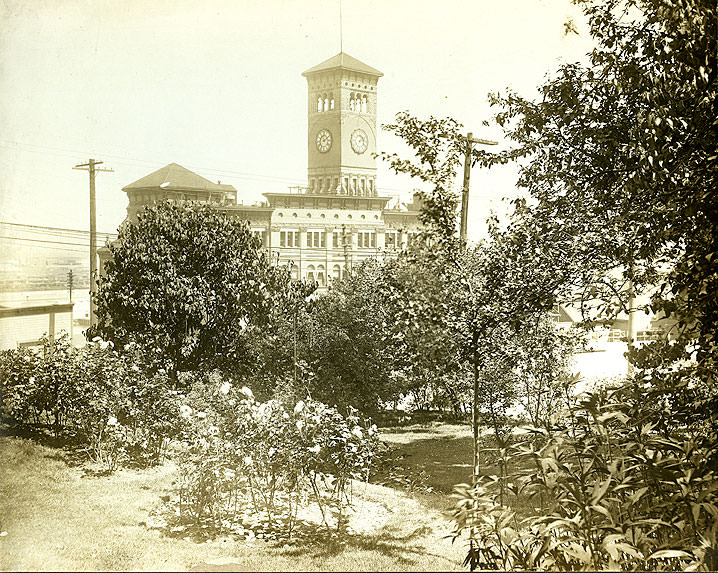
The view appears to be from the house’s yard. Rose bushes and other shrubs are in the image lower foreground and partially hide the buildings in the background.
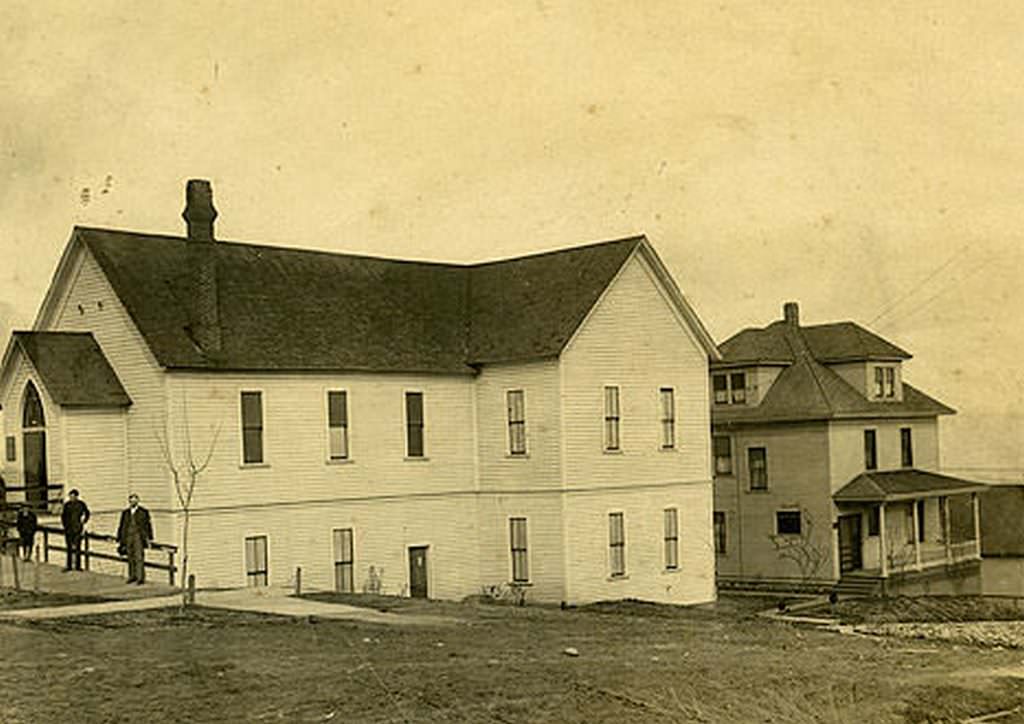
The church is a one-story building with a complete above-ground basement. The parsonage is a two-and-a-half-story house with a porch. Two men and a boy are standing on the walkway leading to the church’s entrance.
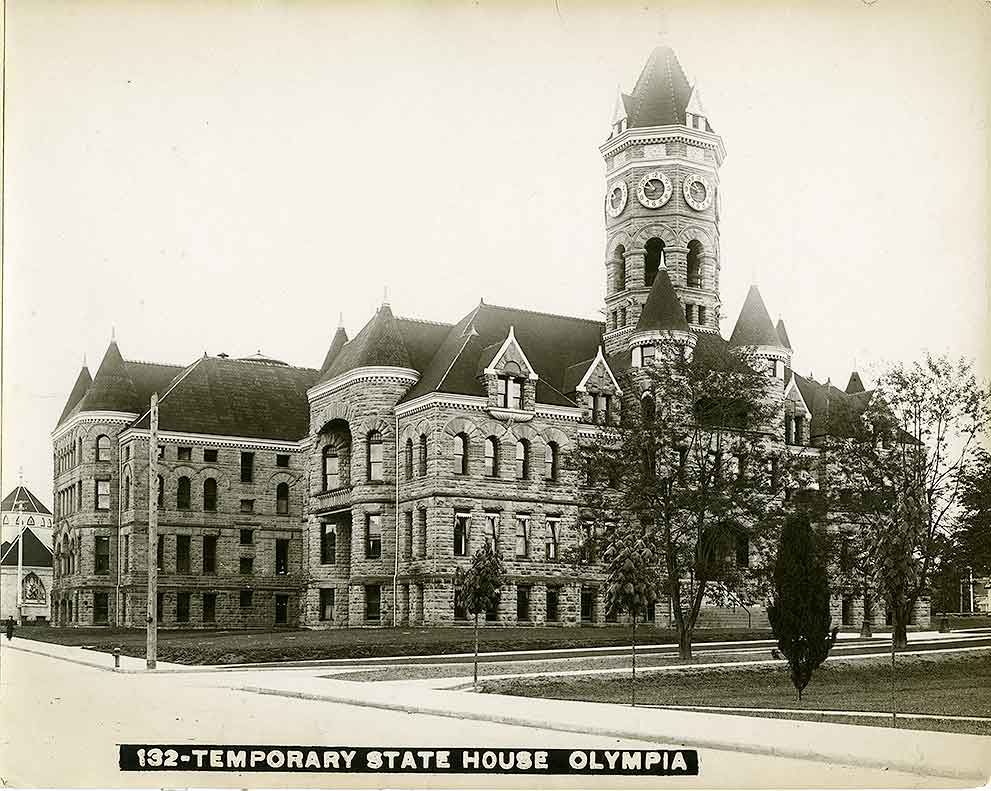
It is a three-story sandstone building with a clock tower. It has numerous conical towers and arched windows. To the right of the building, the corner of Sylvester Park is visible; behind it, the First Presbyterian Church. The photo has been mounted on a linen page with three holes cut for insertion into an album.
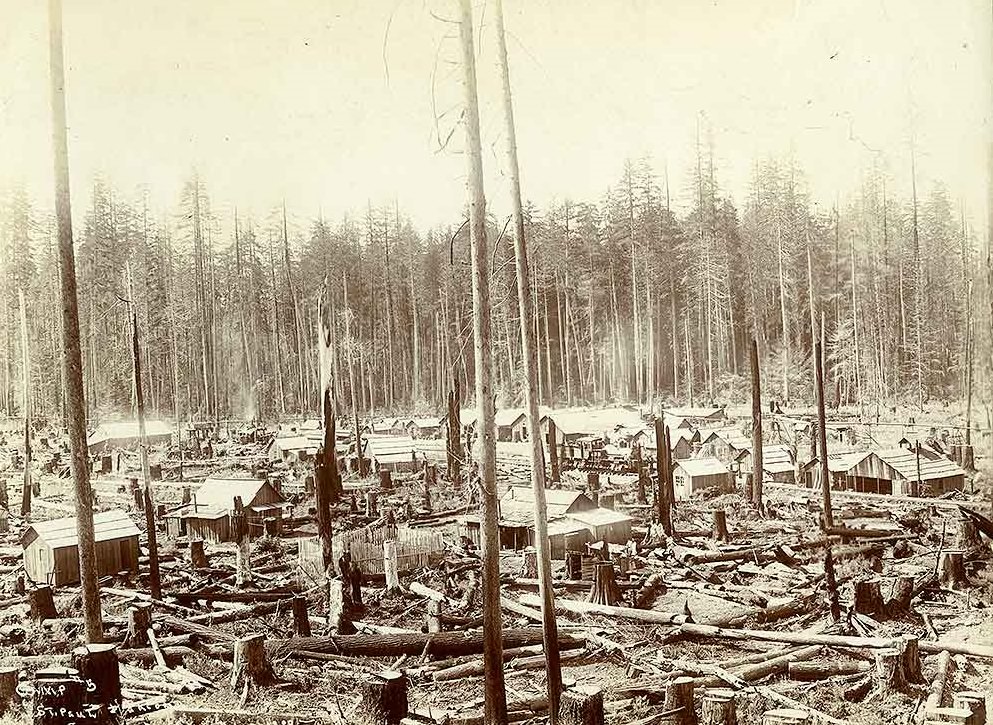
The camp buildings are set among tree stumps and a few snag trees, with thick trees in the background. A Shay locomotive is at the right of center.
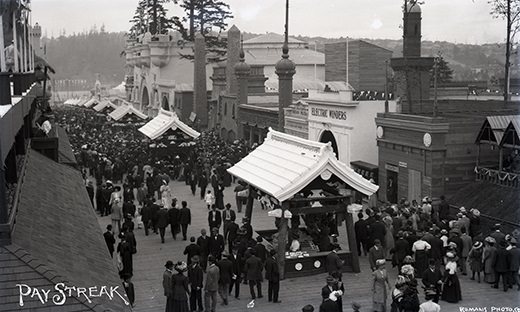
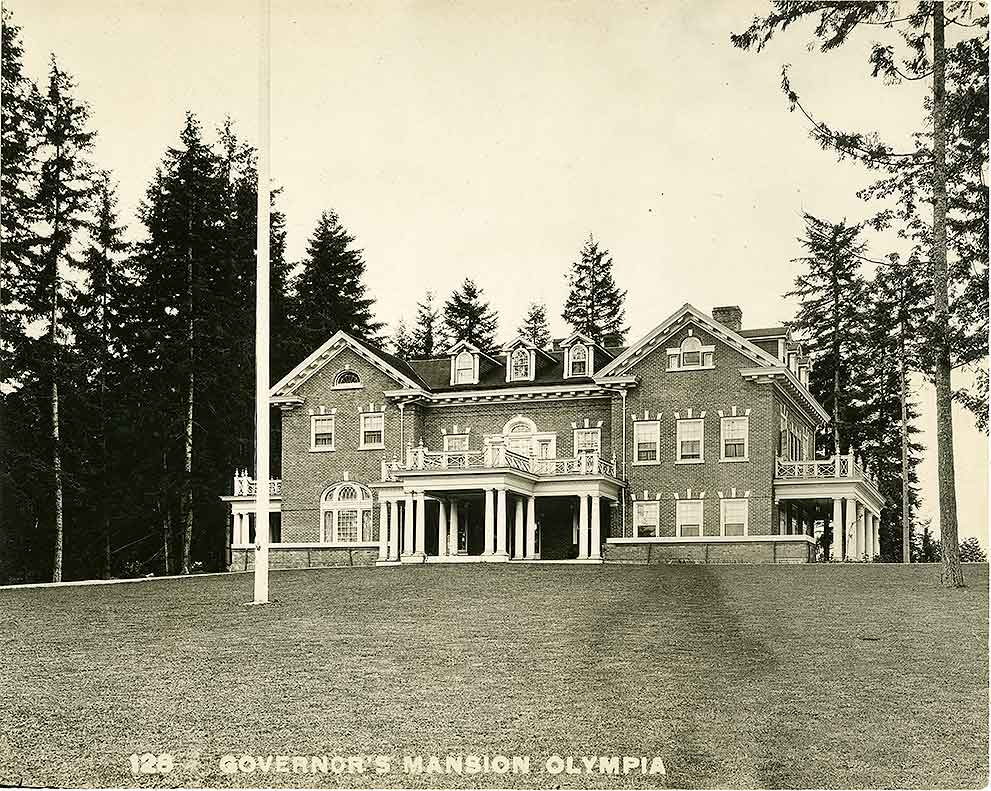
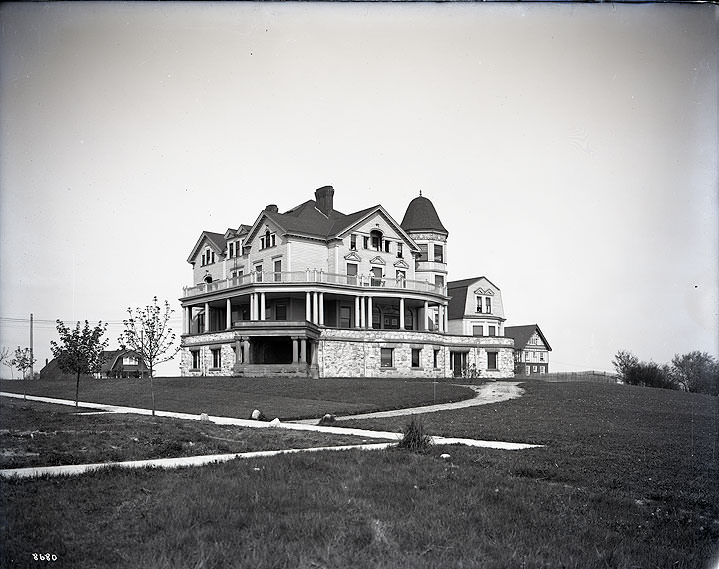
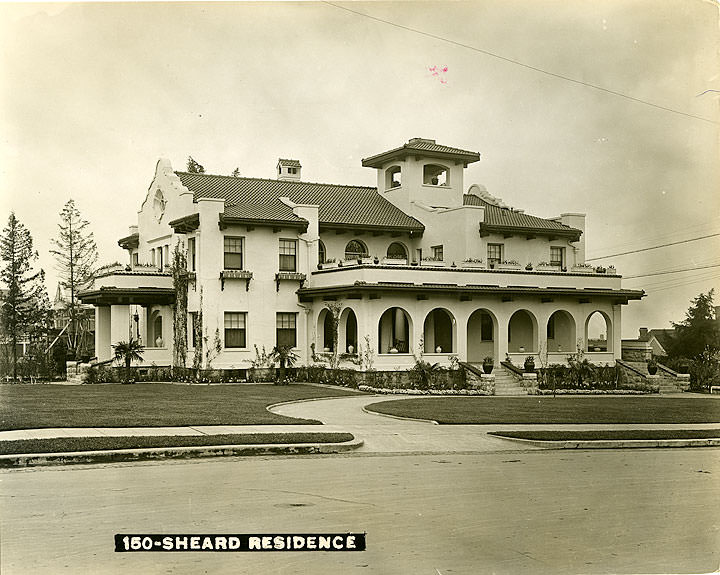
There are several roof levels in the roofline. The mansion sits on top of a grassy lawn. A flagpole is in the middle of the lawn. Evergreen trees are in the background. This print has been mounted onto a linen page with three holes punched in the side as part of an album.
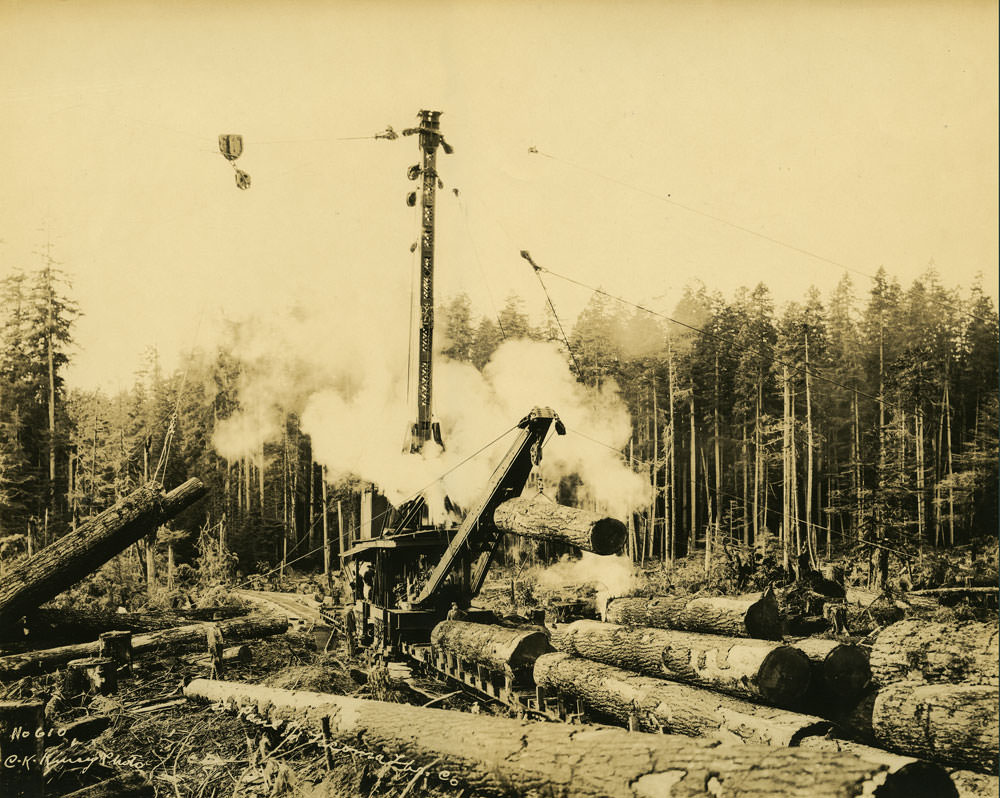
The arm of this engine is lifting a log onto the cars, two of which are already loaded.
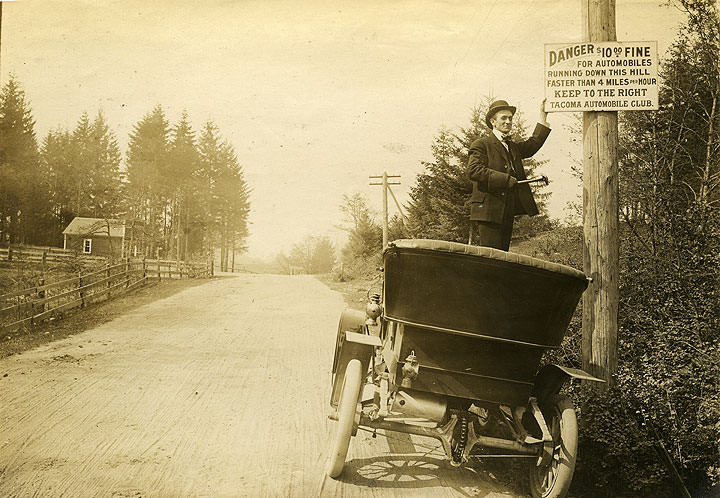
A man is standing on the automobile seat with a hammer in his right hand. His left hand is holding up a sign which he is nailing to a utility pole. The sign reads: “Danger $10.00 Fine / for automobiles / running down this hill / faster than 4 miles per hour / Keep to the Right / Tacoma Automobile Club.”
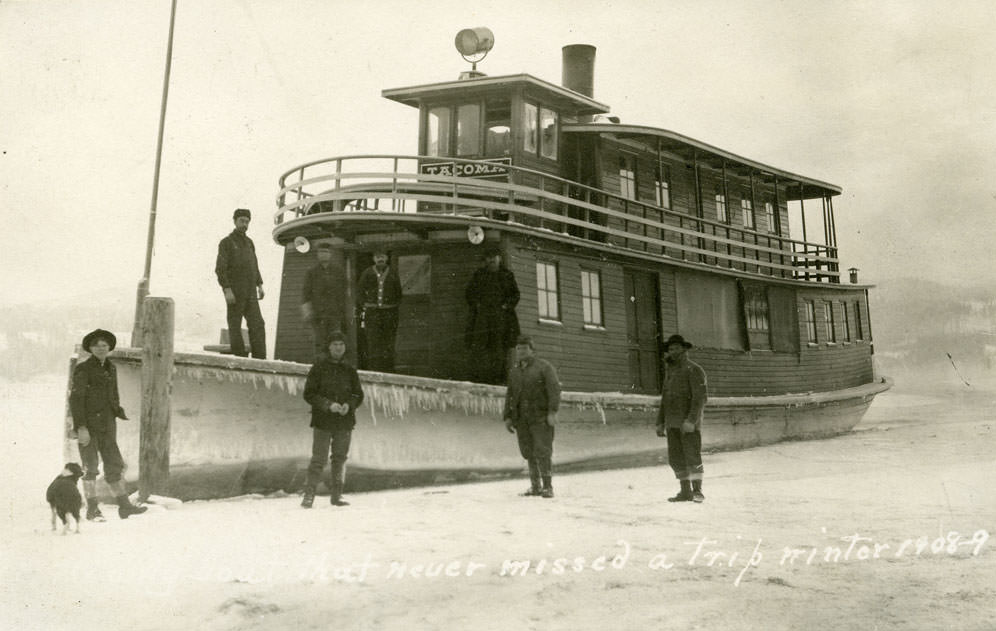
Four men stand on the deck, and four men and a dog stand on the ice in front of the boat. All are dressed for winter.
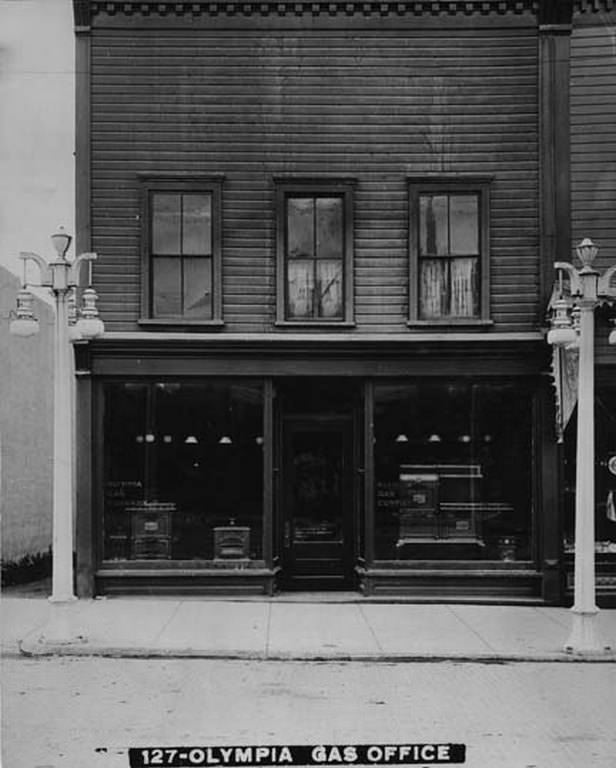
It is a two-story clapboard structure with three sashed windows at the second story. In the display windows on the ground floor are displays of cooking and heating stoves and lamps. Outside the office are two ornate lampposts with gas lamps hanging from them.
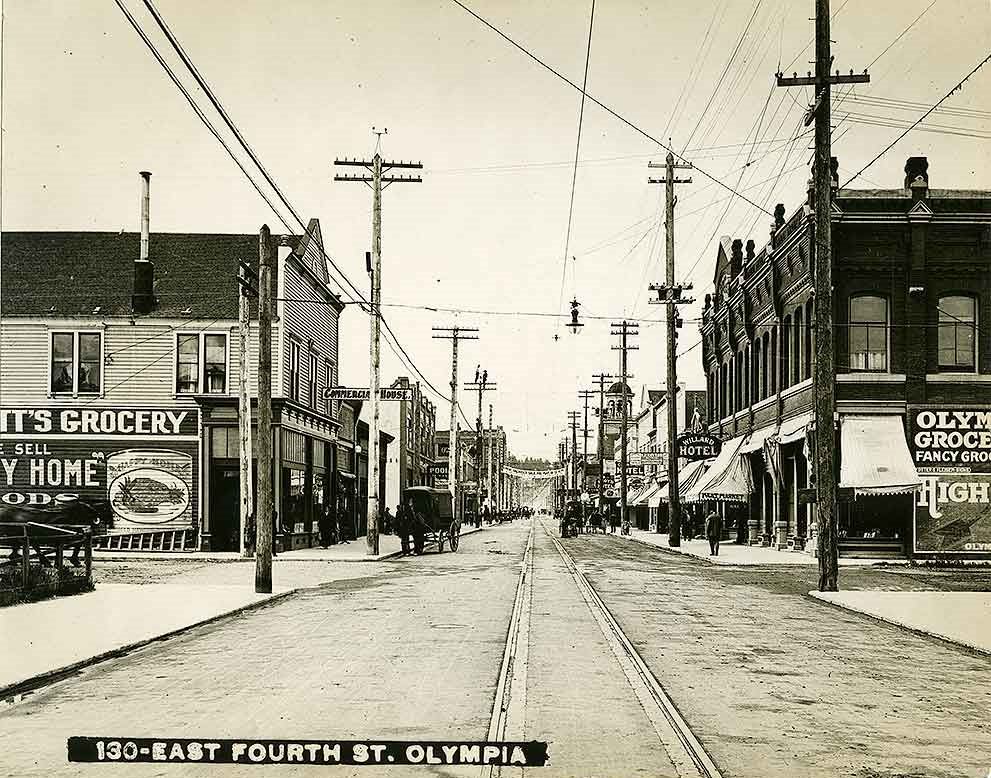
Utility poles line both sides of the street. Commercial establishments are on both sides, including the Commercial House, the Willard Hotel, the Olympic Hotel, the Carlton Hotel, and Taylor’s Music Shop. A clapboard building with a bell tower, Columbia Hall, is visible about halfway down the street.
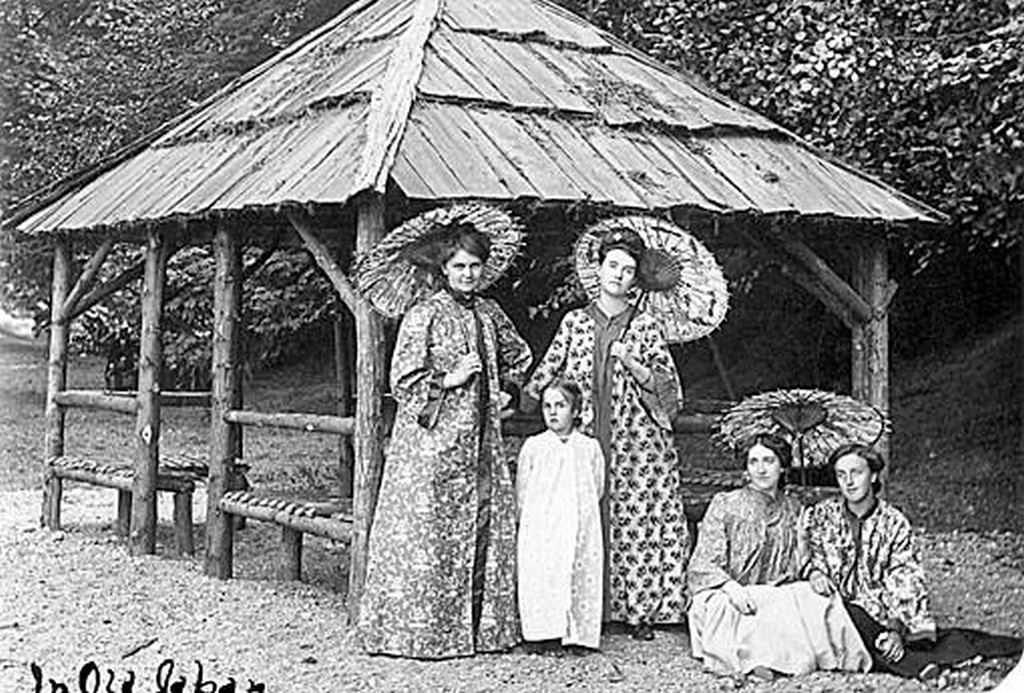
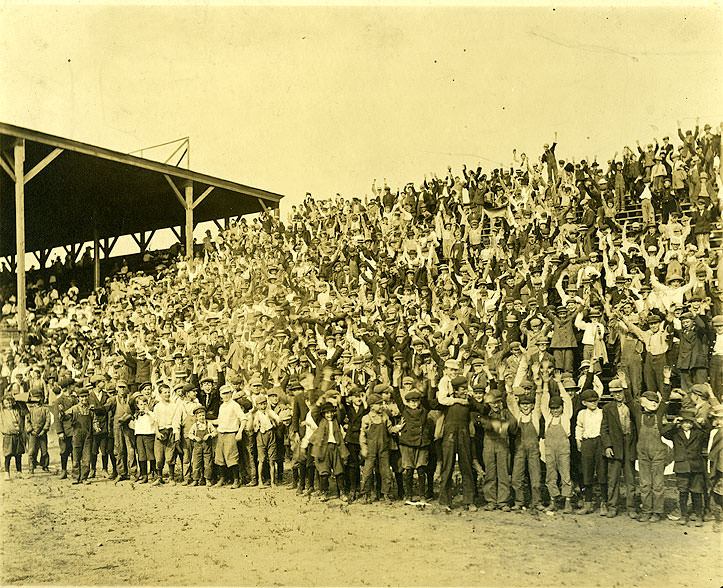
Many of them have their hands raised and are smiling. In the distance, in a covered portion of the stadium, some women are seated.
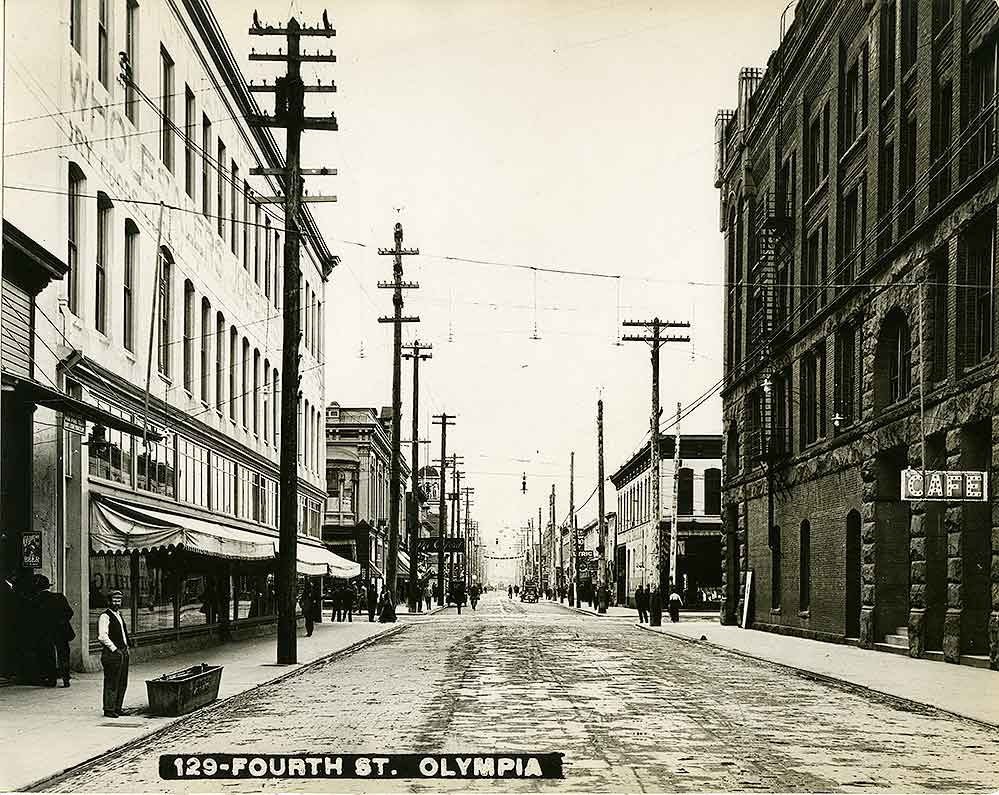
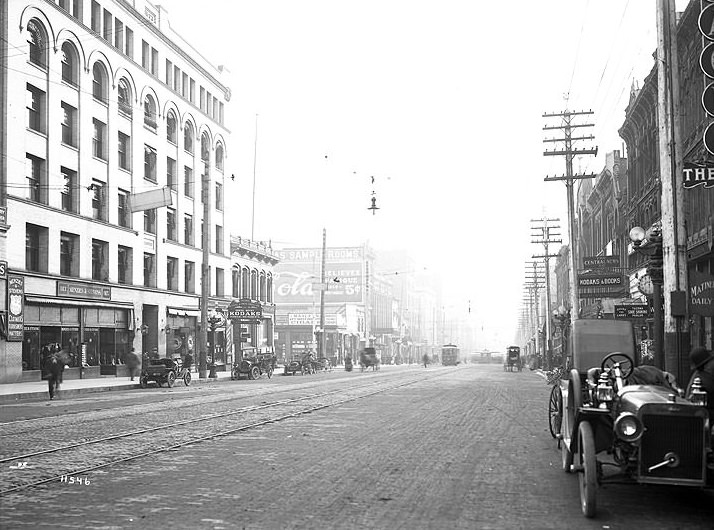
The street is paved with bricks. One block further down, trolley tracks enter the street and extend down the middle. A trolley car can be seen in the distance. Utility poles line both sides of the street. Commercial establishments are on both sides, including the Mottman Building, the Chambers Block, and the Oxford Hotel. A clapboard building with a bell tower, Columbia Hall, is about halfway down on the left.
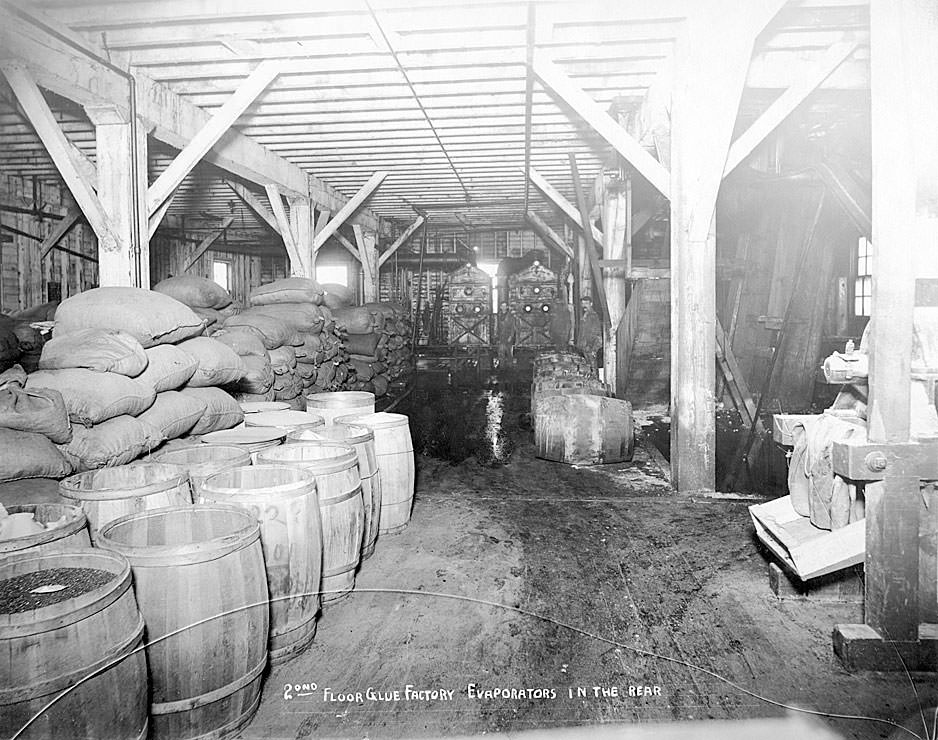
Two evaporators are visible in the rear center. Cloth sacks are piled in a long row on the left, along with several barrels. Barrels also lie on their sides on the right. A man stands behind the barrels on the right. Another man is visible between the two evaporators.
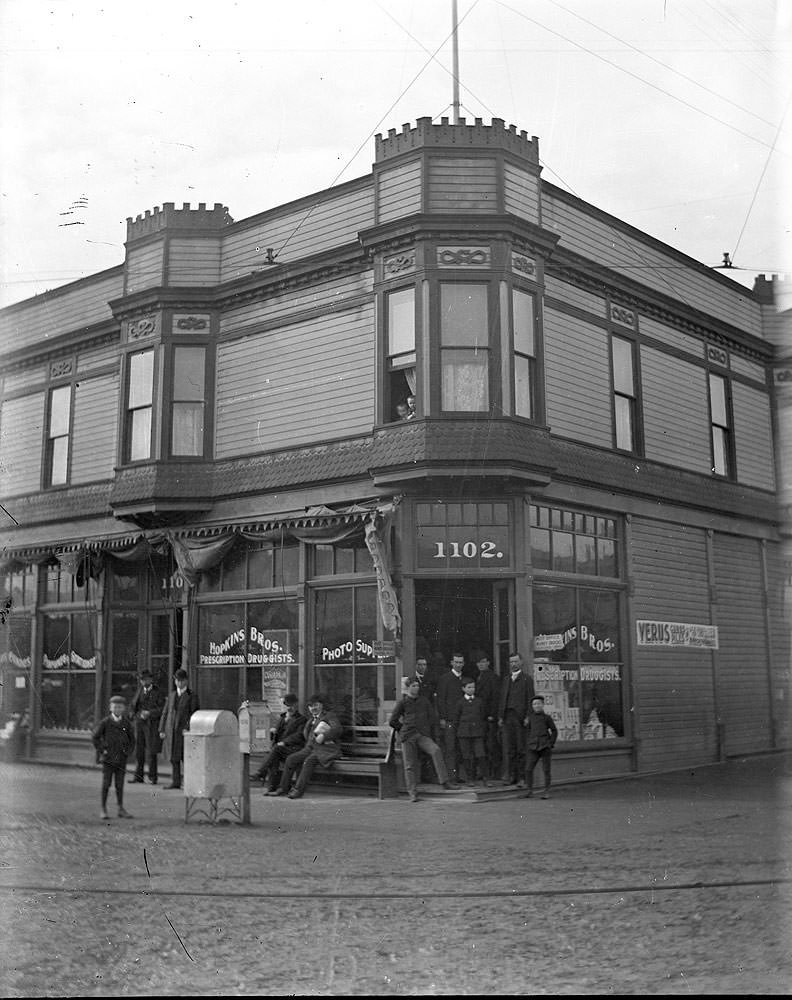
Nine men and four young men stand around the front of the building. There is a U.S. Post Office mailbox next to a receptacle that may be a trash can. Large advertising signs are in the building’s left- and right-hand windows.
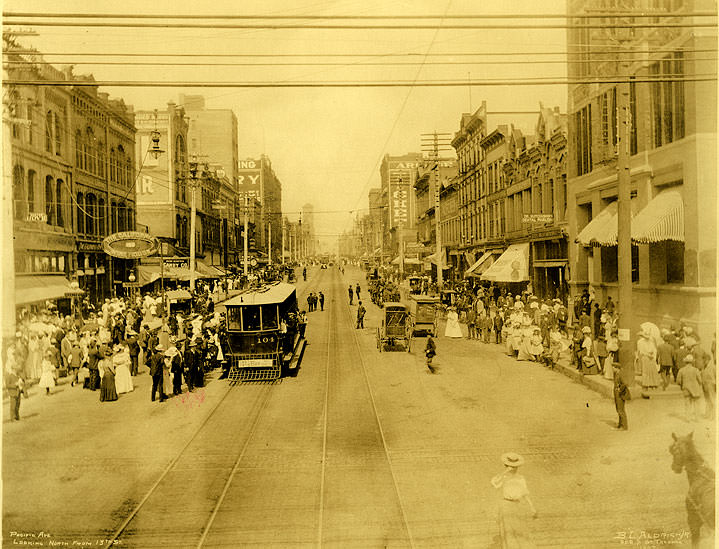
Many pedestrians are on the sidewalks, including women, girls, and boys. No. 104 streetcar is stopped in the image left center, and people are clustered nearby on the street. Another cluster of people is by the curb at the image right, waiting for a streetcar. Several delivery wagons are on the street.
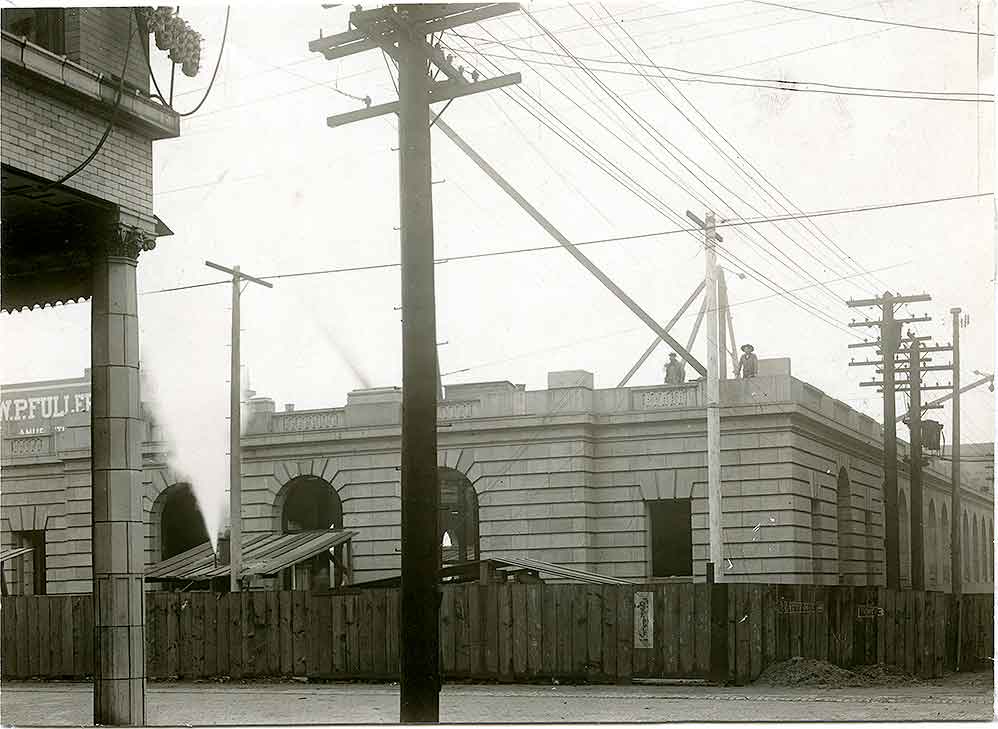
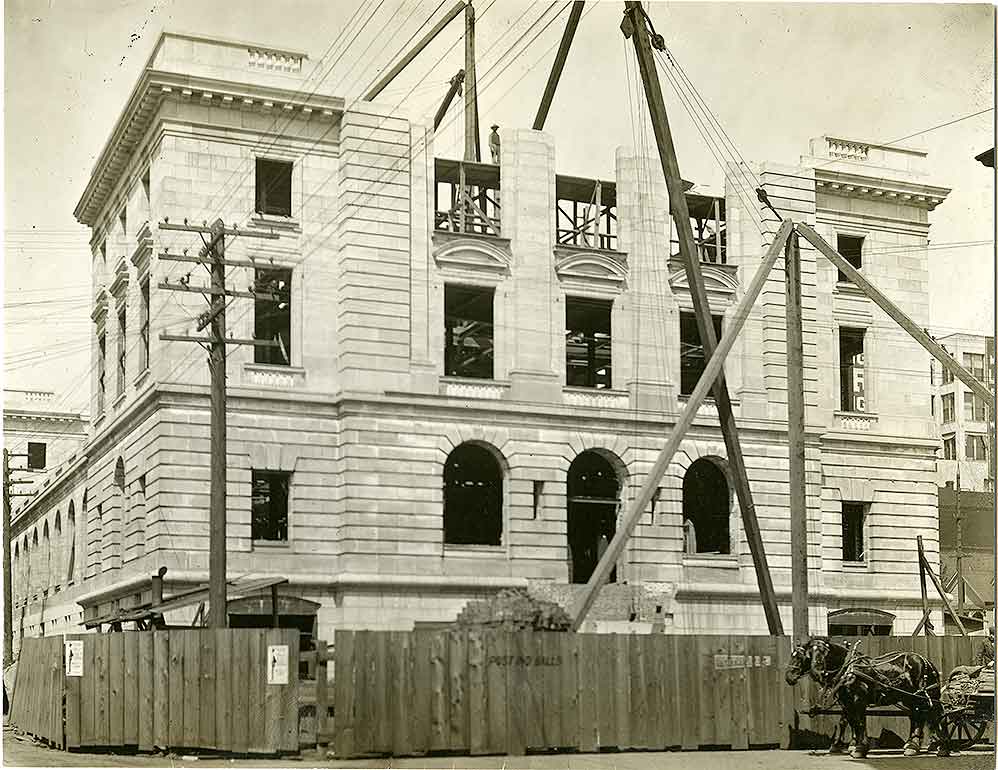
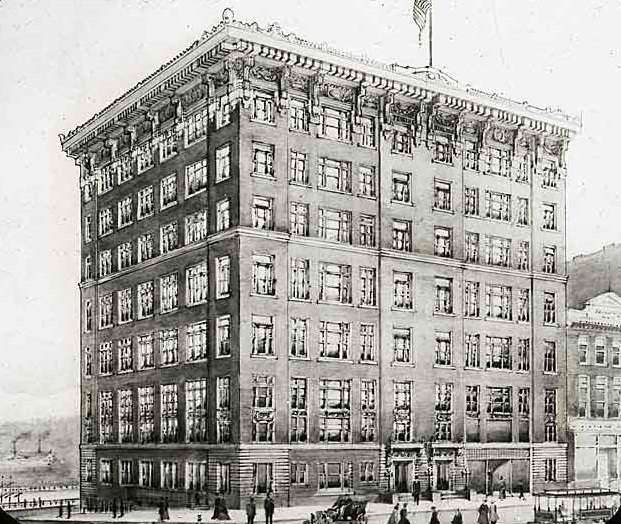
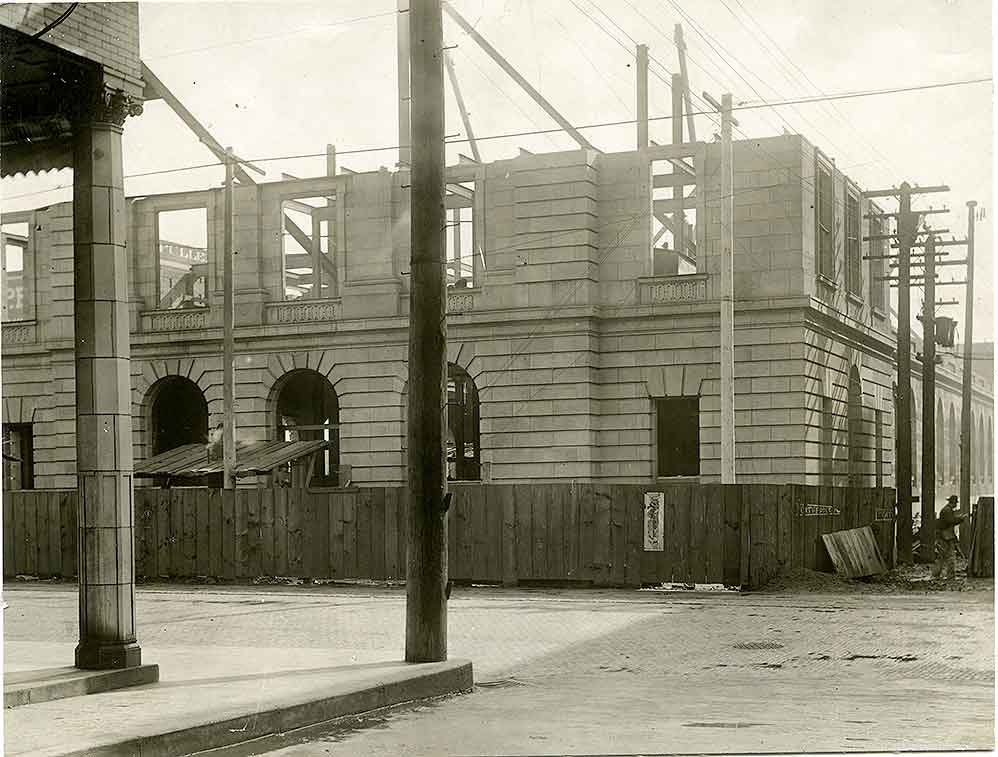
This view from the south shows that construction has reached the fourth floor, and the cornice on top of the building is being put in place. A message is written on the wooden fence surrounding the construction site that says “Post No Bills”, and close to this are what appear to be two playbills glued to the wall.
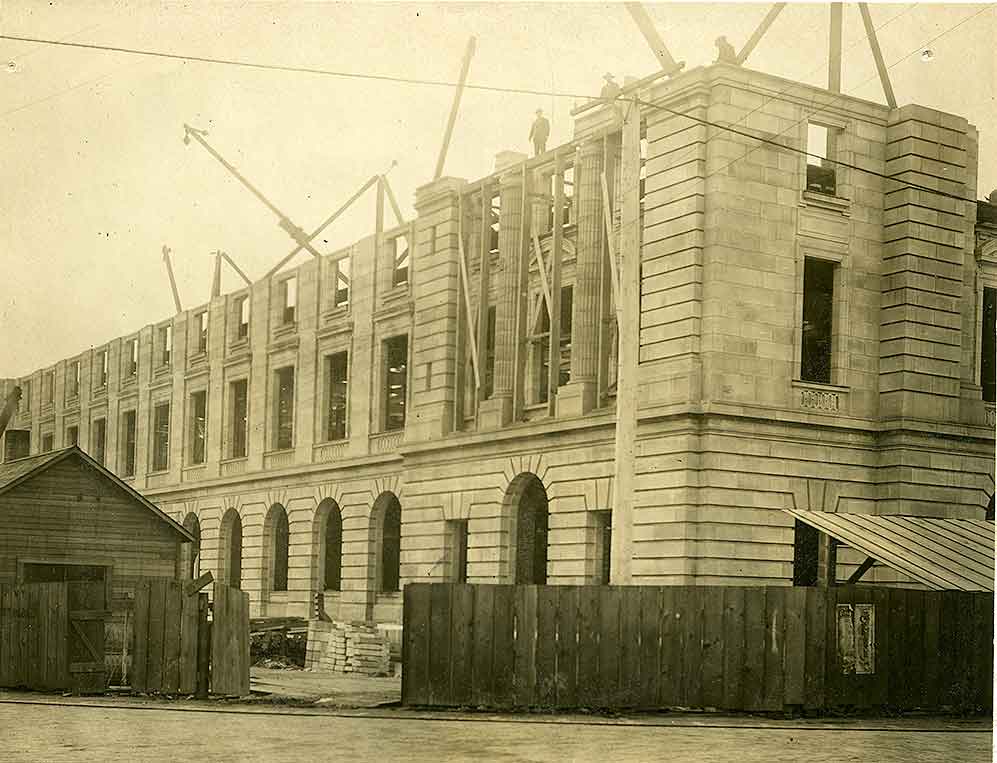
This view from the northeast shows construction from the ground. The stonework on the building is now up to the third story.
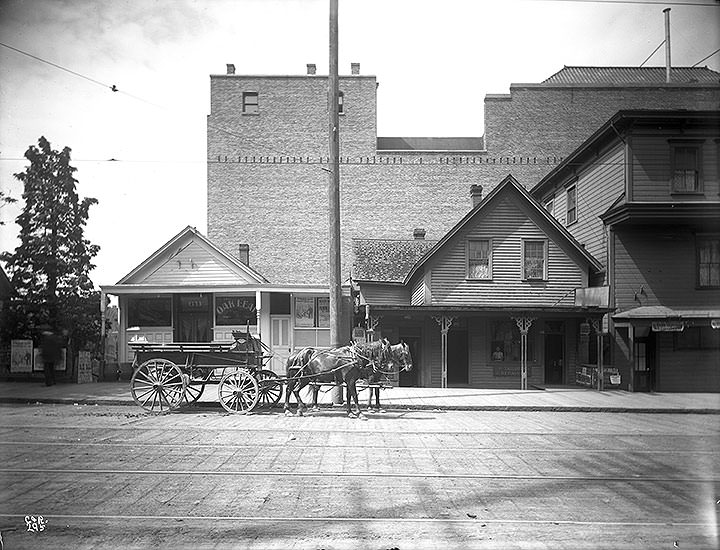
The Oak Leaf Saloon, located at 611 3rd Avenue, is at the left. Posters on the far end and to the right of the saloon advertise a baseball game to be played between Seattle and Tacoma on July 4 at the Athletic Field. Another poster advertises the Madison Park appearance of Pawnee Jim’s Wild West Show, a competitor of Buffalo Bill Cody’s shows. The building farthest right also has a Pawnee Jim advertisement.