In the early twentieth century, a young Romanian woman named Loana Constantinescu became the subject of one of Eastern Europe’s most disturbing and enduring stories. Known today as Loana the Bloodthirster — sometimes spelled Leona — she lived in Timișoara, the second-largest city in Romania. Her life ended in October 1909 under circumstances that were equal parts brutal, mysterious, and deeply tragic. More than a hundred years later, the details of her death still circulate online, attached to a single haunting photograph.
Loana practiced Zoroastrianism, one of the world’s oldest religions, which originated in ancient Persia. While the faith has millions of followers, it was virtually unknown in Timișoara, where Christianity dominated every aspect of daily life. Her neighbors viewed her rituals and beliefs with fear and hostility. Rumors spread quickly. People accused her of witchcraft, of drinking the blood of local children, and of communicating with evil spirits. None of these accusations were ever proven, but in a tightly-knit community driven by superstition, proof was not required.
Two local ministers played a direct role in turning the neighborhood against her. They spread word that Loana was in league with Satan and posed a danger to the community. The campaign worked. In October 1909, a group of vigilantes forced their way into her home, dragged her into the street, and beat her severely. The attack left her with serious injuries, and she was taken to a hospital. After two days, she discharged herself and returned home. She died the following day.
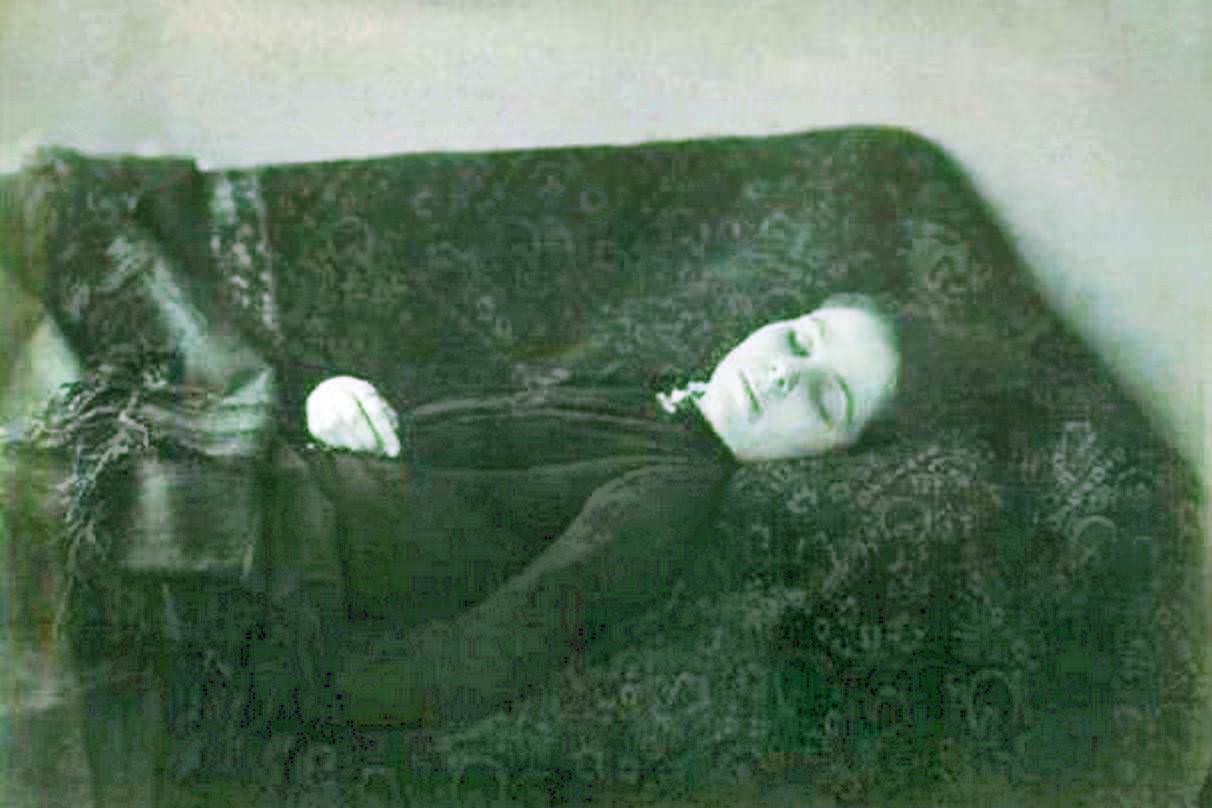
The photograph above is said to have been taken shortly after her death in 1909. At that time, postmortem photography was a widely accepted practice. Families and communities would arrange and photograph the deceased as a formal way of marking their passing. The staging of such images was considered respectful, not morbid. Dozens of these photographs exist from that era, though the stories behind most of them have faded with time. Loana’s image is one of the rare exceptions — the story attached to it has only grown stranger over the decades.
When authorities examined her body, they found cuts on both her arms and legs. A significant amount of blood was also found in her stomach. According to the account attributed to the medical examiner — no official death certificate has ever surfaced — Loana had deliberately cut herself multiple times, draining a large quantity of blood into a goblet before drinking it. The cause of death was recorded as a combination of massive blood loss and cardiac arrest brought on by the shock of ingesting that volume of her own blood. Her apartment contained an altar, occult symbols, effigies, and various herbs, consistent with ritual practice.
Whether her death was a direct response to the attack, an act of ritual intent, or both, is not entirely clear from surviving accounts. What is documented is that her body showed signs of deliberate, repeated self-cutting rather than injuries caused by the vigilante beating alone. The attack injured her, but the medical examiner’s findings pointed to self-inflicted blood loss as the primary cause of death.
What followed Loana’s death added another layer to an already disturbing story. The two ministers who had led the campaign against her both died from a rare blood-borne illness less than a year after her suicide. Members of the vigilante group who had beaten her also met early deaths. One man was crushed by a falling tree. Another died in a fire that also killed his wife and child. Whether these deaths were coincidence, the kind of grim fate that often befalls people in hard times, or something else entirely, locals connected them directly to Loana.
In more recent years, reports have emerged from people who shared her postmortem photograph online. Some claimed to have experienced severe bruising and recurring nightmares that stopped only after they deleted the image. These accounts are unverified and exist entirely in the realm of online folklore. It is also worth noting that the identity of the woman in the photograph has never been officially confirmed. No documentation definitively links the image to Loana Constantinescu.
What can be said with reasonable confidence is this: a woman named Loana Constantinescu lived in Timișoara in the early 1900s, practiced a minority religion in a deeply Christian city, was persecuted by her neighbors, suffered a violent attack, and died shortly afterward under unusual circumstances. The rest — the curse, the ministers’ deaths, the online phenomena — belongs to the long tradition of stories that attach themselves to figures who die violently and without justice.