Cuba in the 1970s was a country in motion. Under Fidel Castro’s revolutionary government, the island was firmly aligned with the Soviet Union, which provided substantial economic support throughout the decade. That assistance funded social programs in education, healthcare, and housing — services that reached millions of Cubans who had little access to them before the revolution. The changes were visible on every street corner, in every schoolroom, and across the countryside.
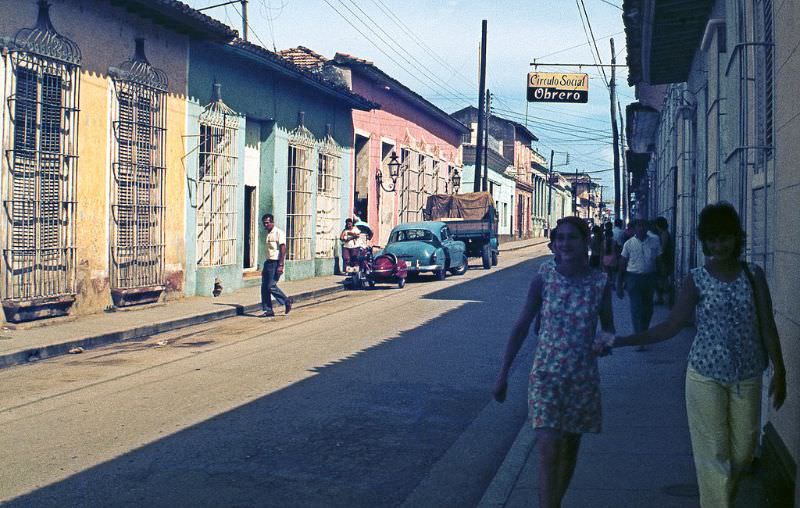
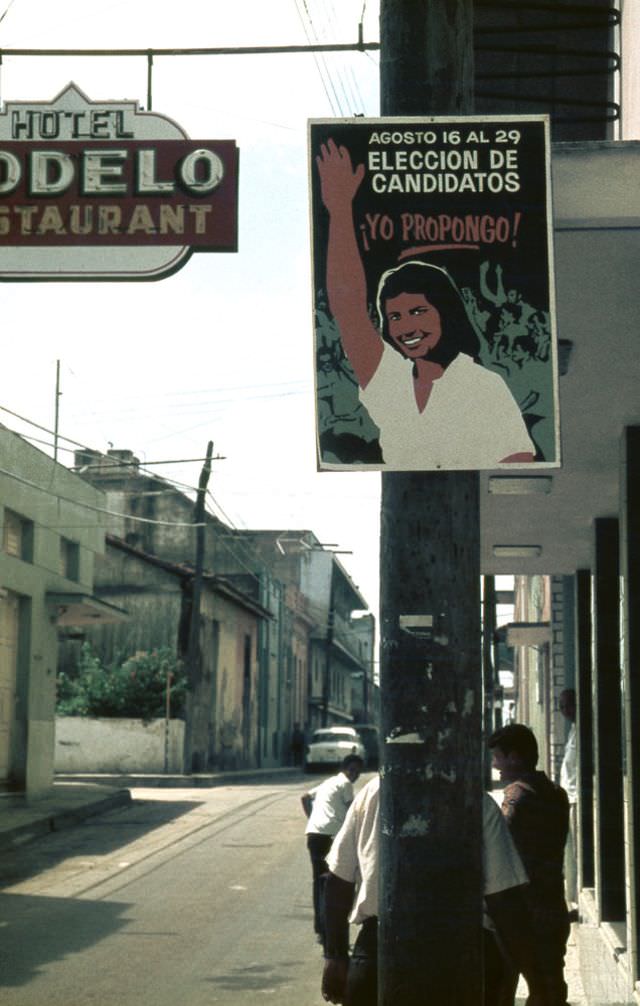
An old colonial street of Santa Clara. A sign marks the headquarters of the Workers’ Social Circle, Matanzas, Cuba, 1976
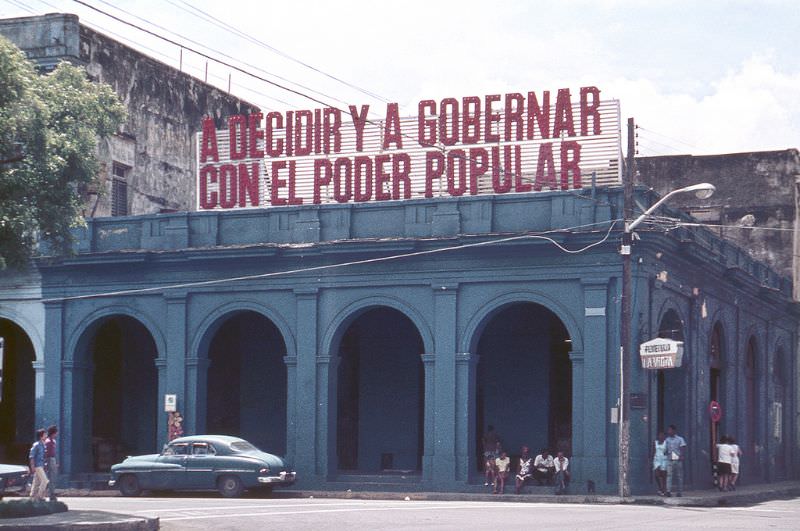
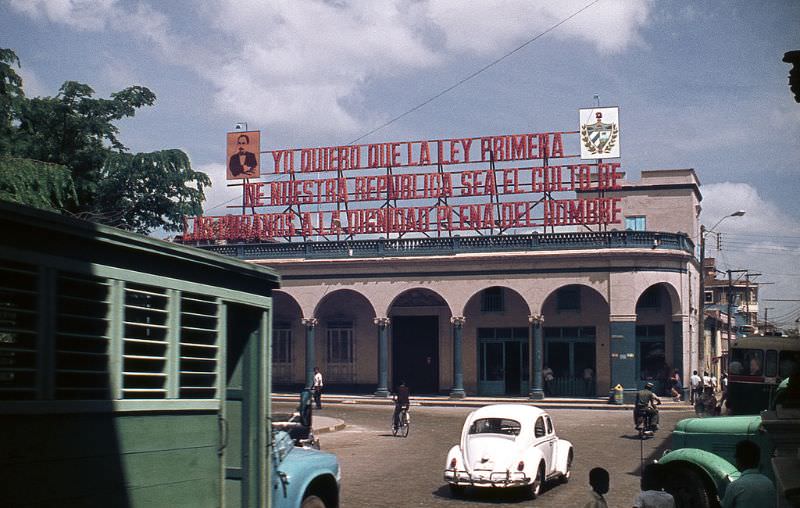
Cities like Matanzas and Santa Clara carried the weight of Cuba’s colonial past on their facades while displaying the markings of its revolutionary present. Government slogans painted on building walls and organizational headquarters housed in century-old structures told the story of a society being reshaped from the top down — even as its physical bones remained rooted in the Spanish colonial era.
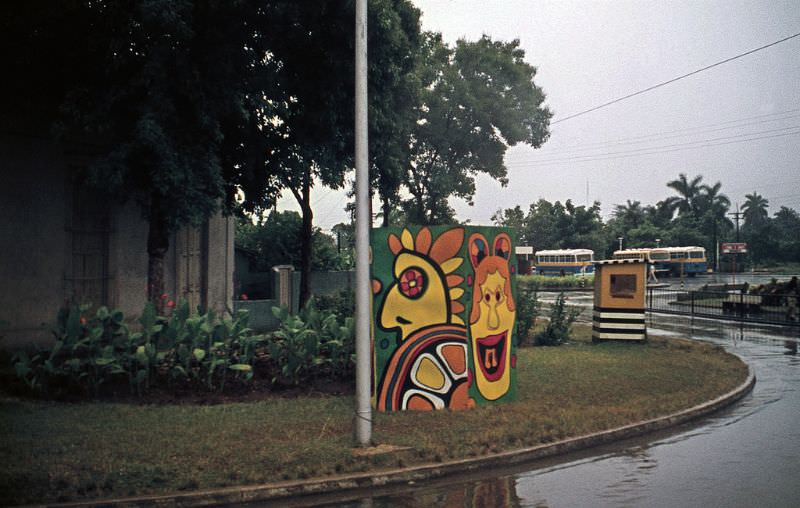
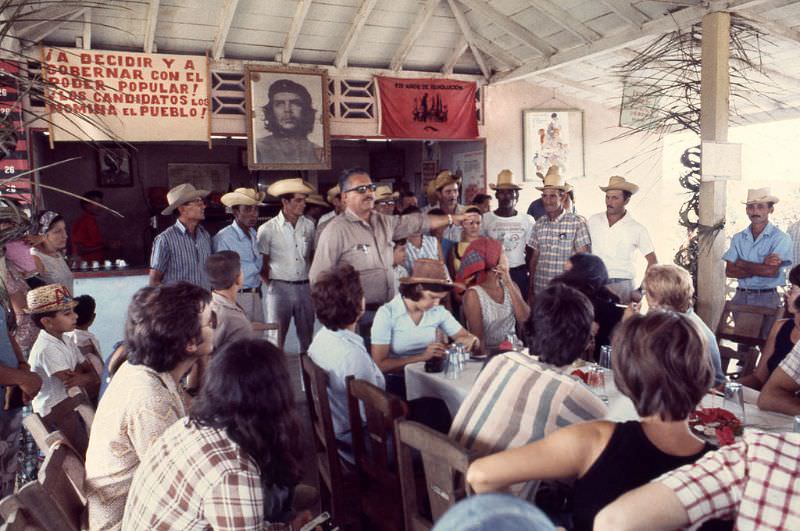
Colorful masks announcing the Carnival in a square, Matanzas, Cuba, 1976Political slogan ‘To decide and govern with the people’s power’ on top of a colonial building, Matanzas, Cuba, 1976
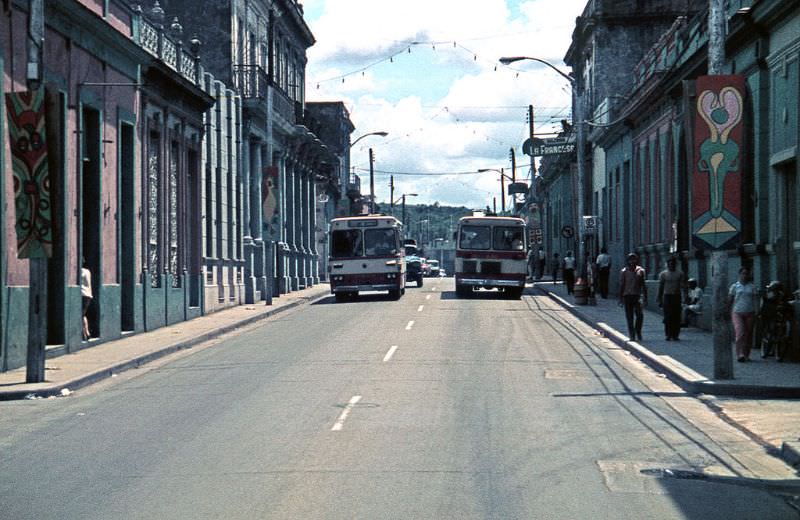
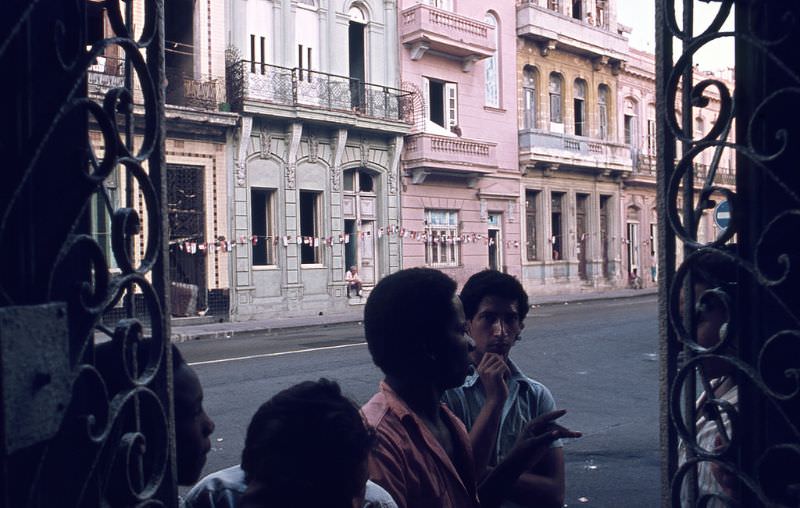
Street life in these cities moved at its own pace. Buses rolled down avenues lined with colonial buildings, horse-drawn carts shared roads with old American trucks left over from before the revolution, and neighbors gathered on stoops beneath ornate iron lattices. The urban rhythm was slow but alive.
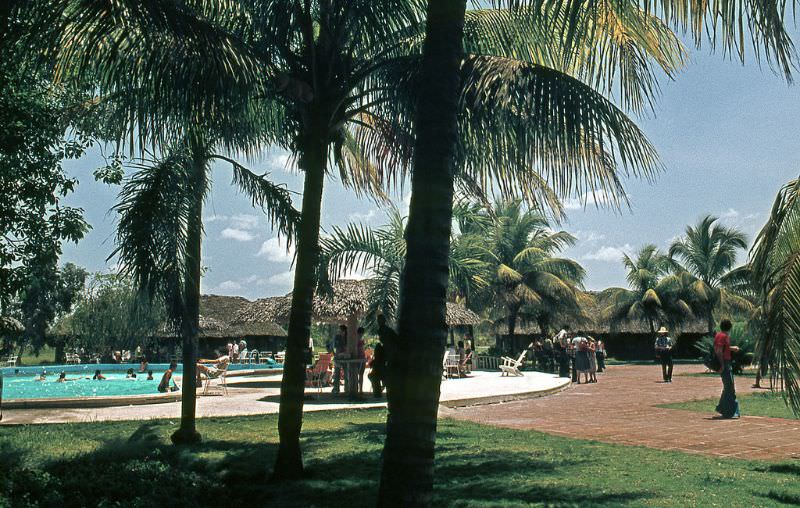
Two buses at avenue with colonial buildings, Matanzas, Cuba, 1976Pool and garden of a national tourism resort, Matanzas, Cuba, 1976
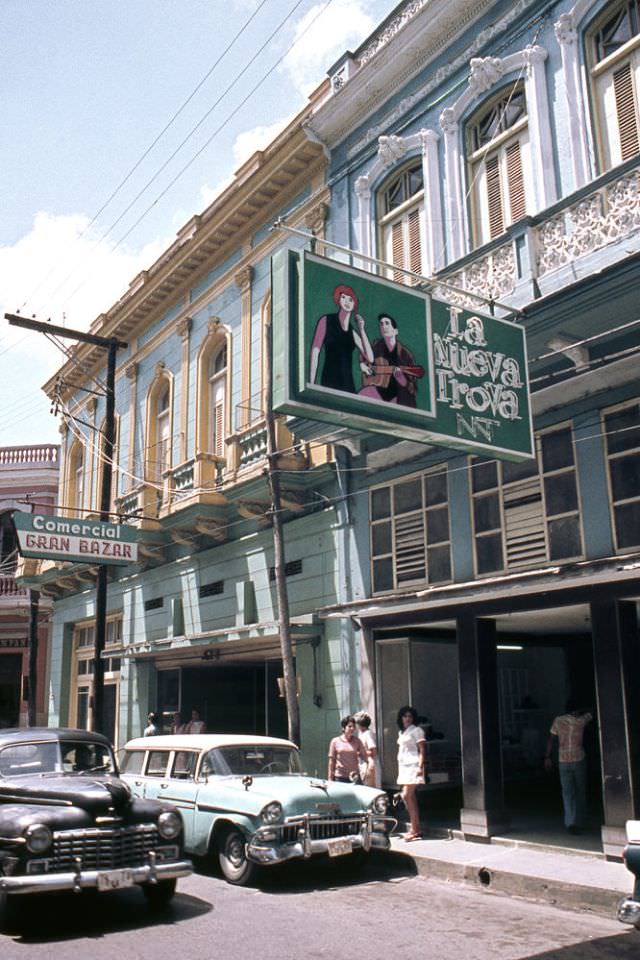
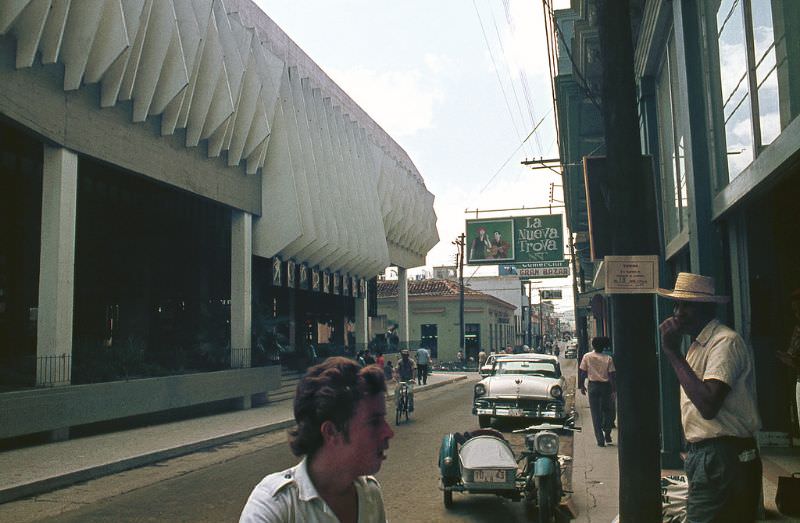
Santa Clara was home to institutions that reflected the government’s cultural priorities. The Nueva Trova movement — a genre of politically conscious folk music — had its own building in the city, a sign of how seriously the state took artistic expression as a tool of national identity. Around Parque Vidal, colonial architecture housed museums and cultural spaces that drew both locals and visitors.
Building of the Nueva Trova of Cuba, Santa Clara, 1970sColonial building at Parque Vidal, esquina del Museo de Artes Decorativas, Santa Clara, 1970sLattice of a house and boys talking in the neighborhood of the ancient Havana, Santa Clara, 1970sMaceo street, Santa Clara, 1970s
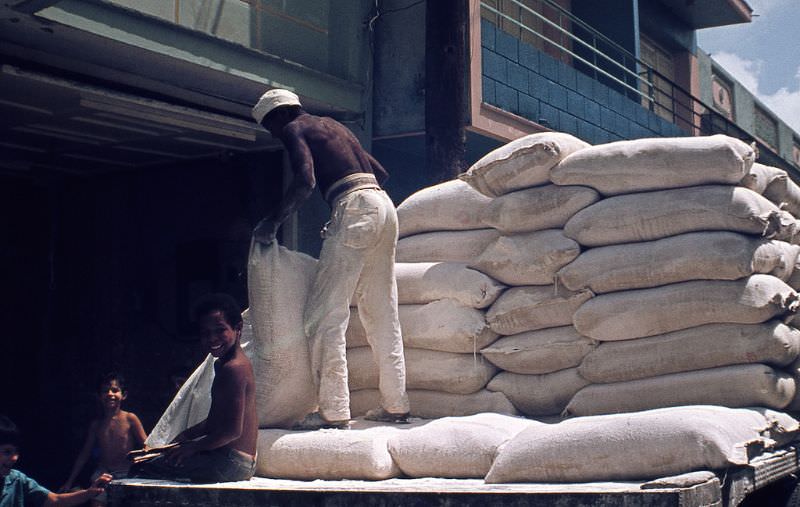
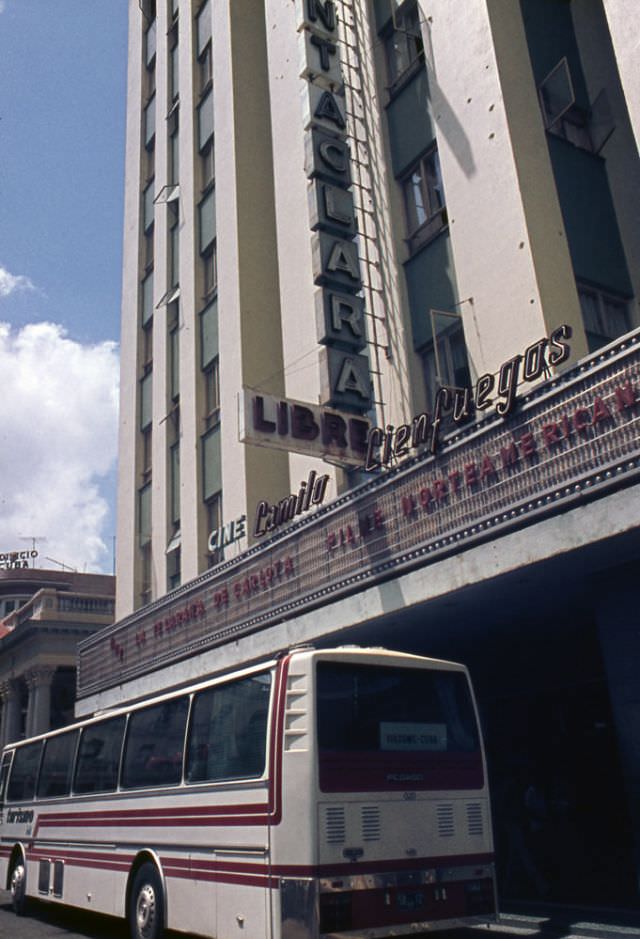
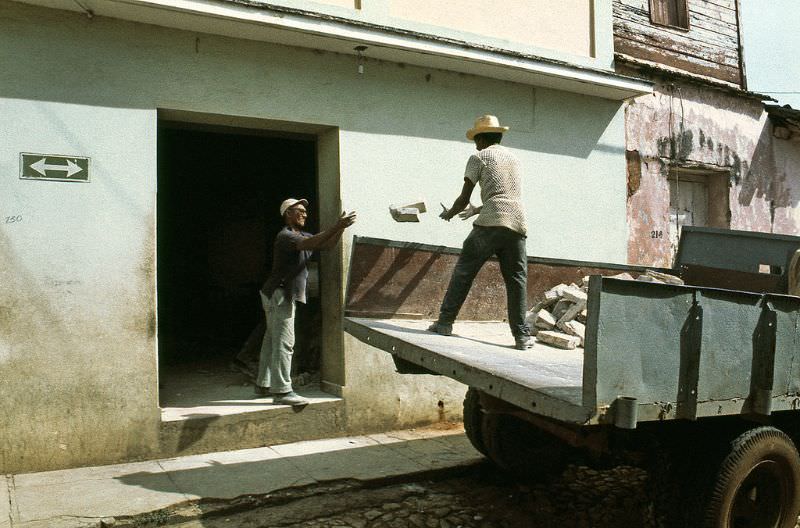
Everyday work in Santa Clara looked much the same as it had for generations. Men unloaded sacks of flour from trucks by hand, goods moved through town on the backs of workers, and the hotel at the center of city life — the Santa Clara Libre — stood as one of the few modern structures among the older buildings.
Man unloading flour sacks from his truck, Santa Clara, 1970sSanta Clara Libre Hotel, Santa Clara, 1970s
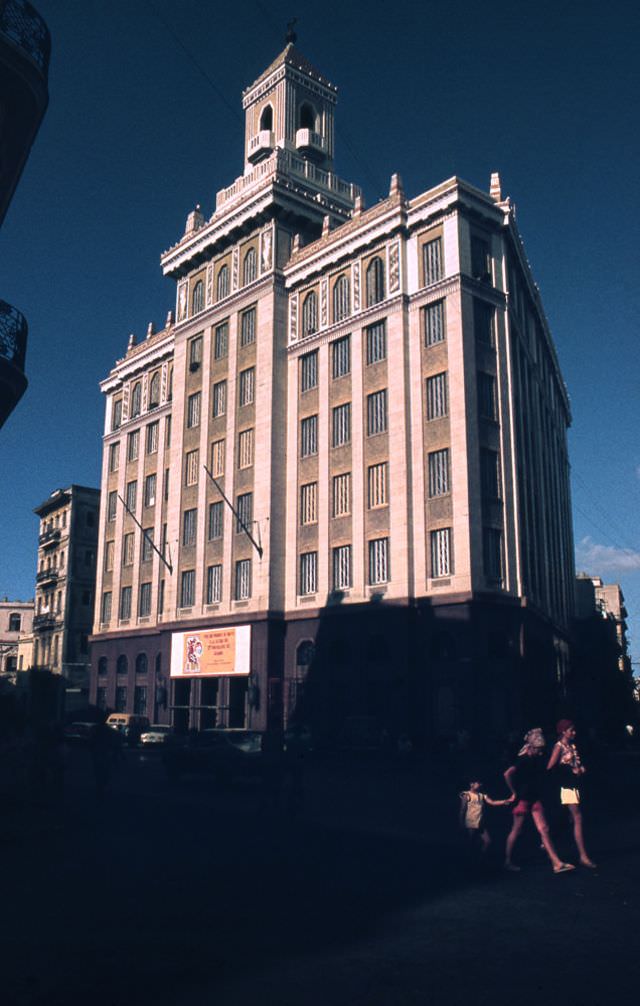
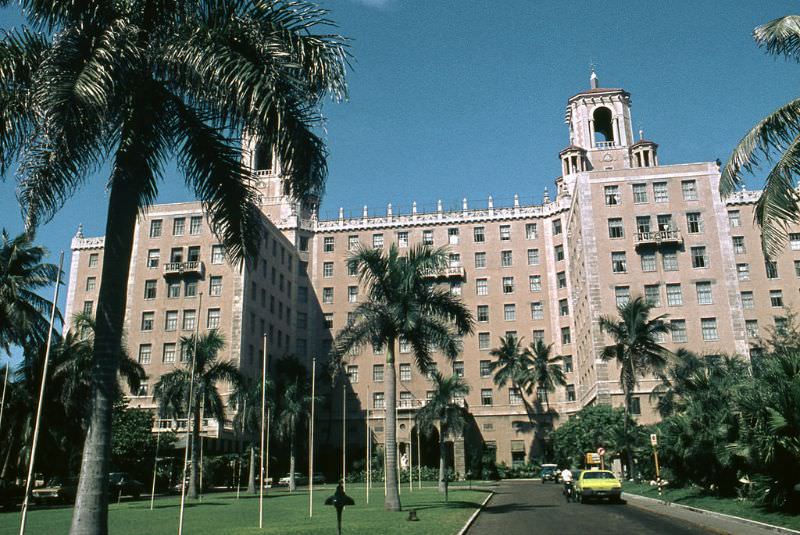
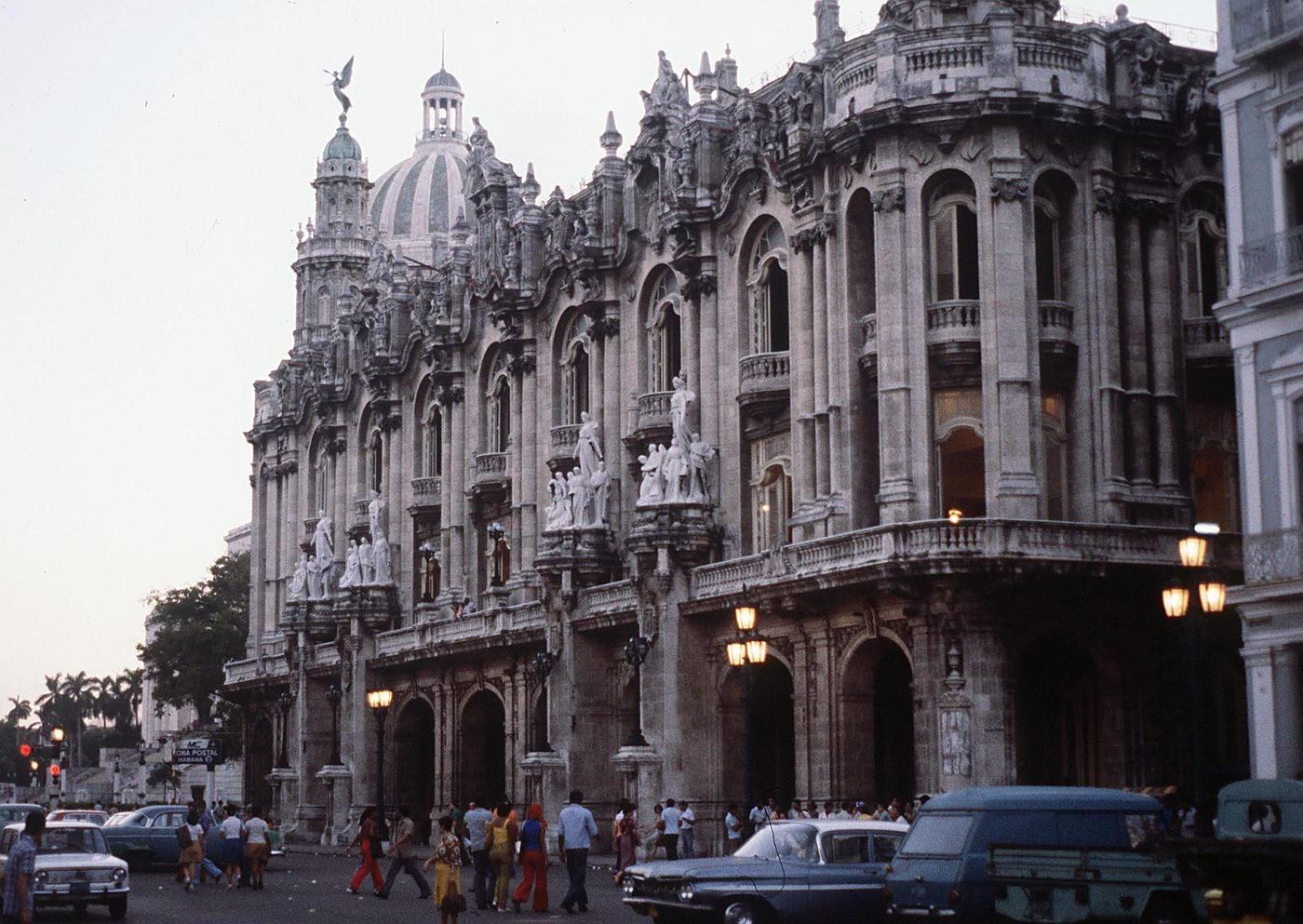
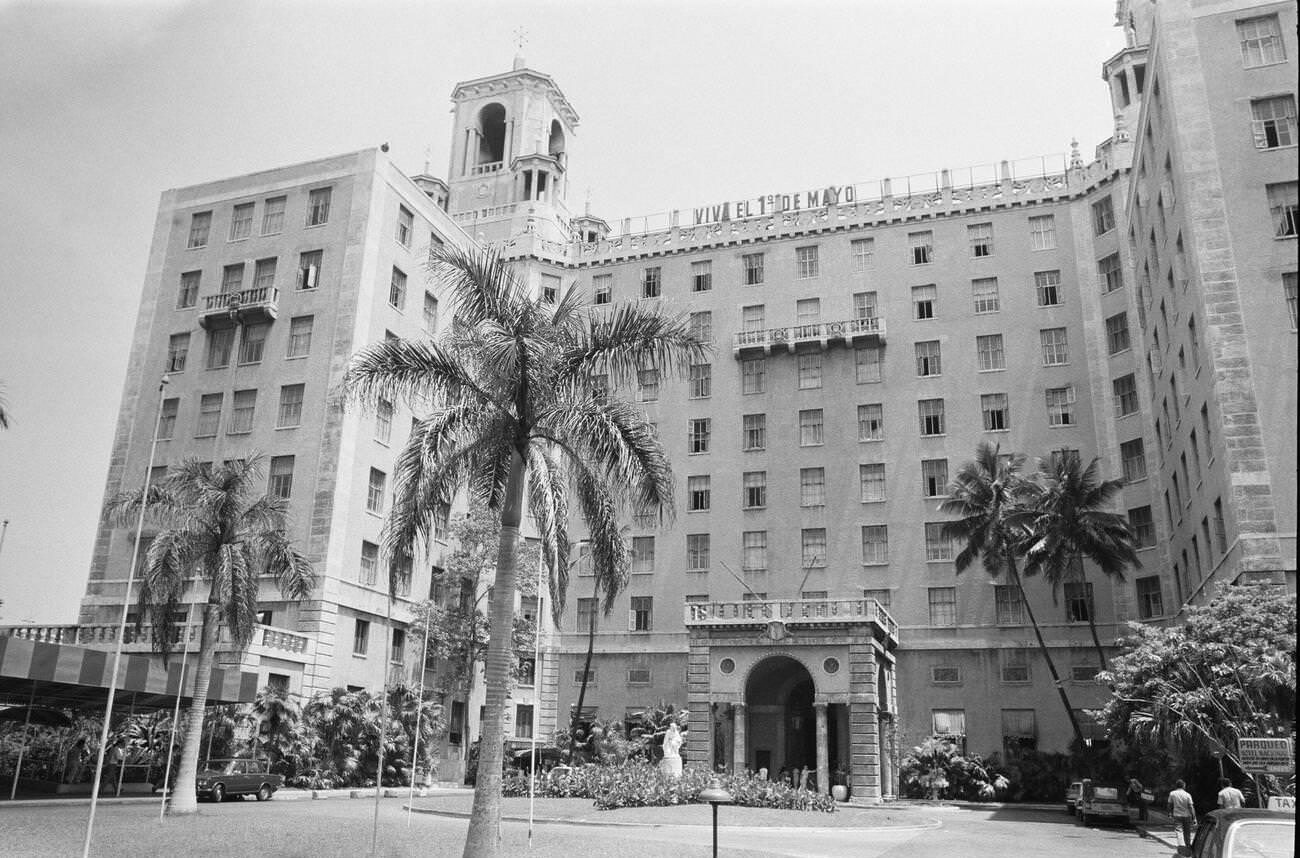
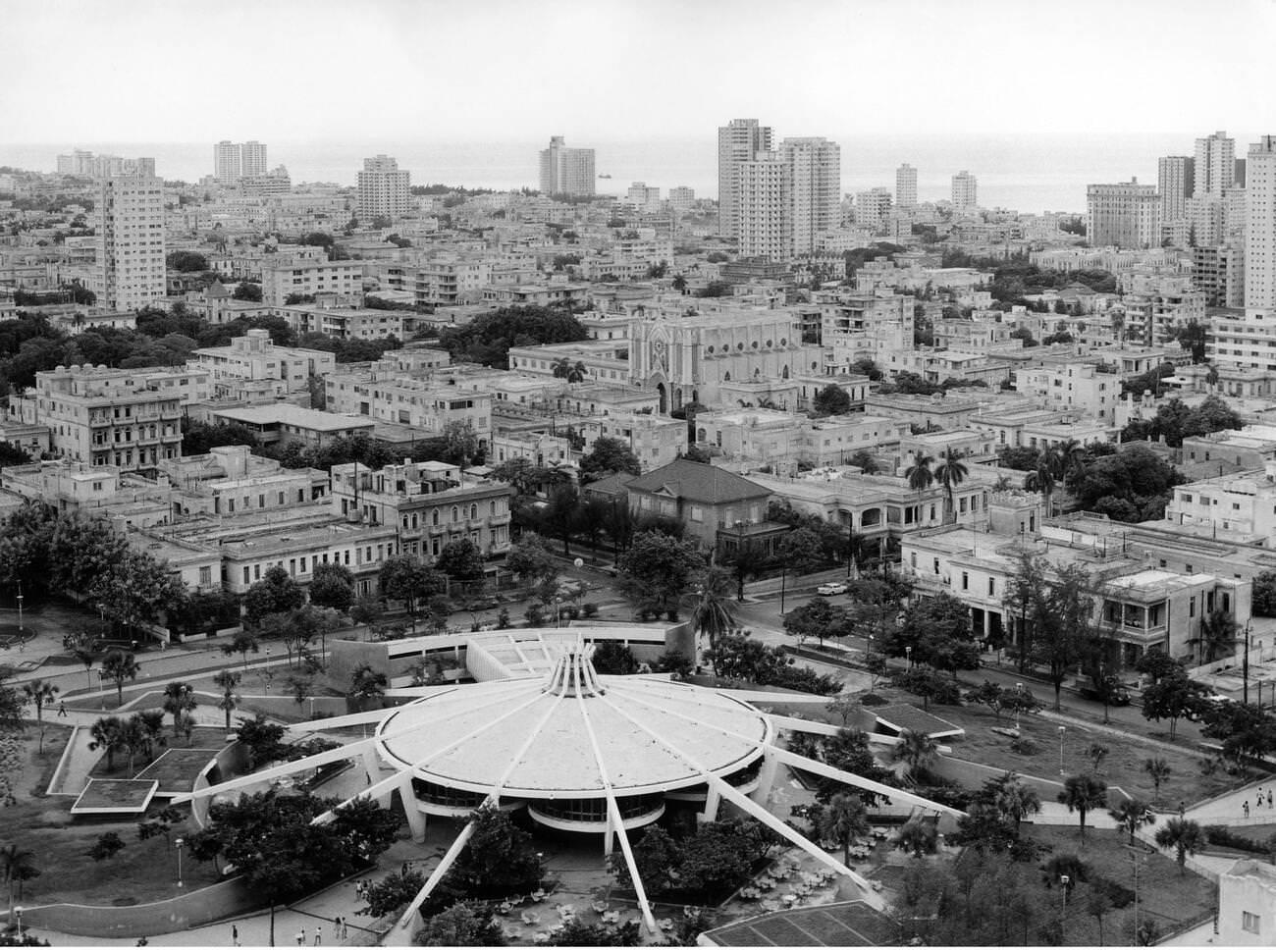
In Havana, the contrast between old and new was sharpest. The Coppelia ice cream parlor on La Rampa in Vedado could seat a thousand people at once — a state-run institution that became a cultural landmark. Meanwhile, the grand Hotel Nacional, the neo-baroque Gran Teatro, and the Bacardí Building stood as relics of a pre-revolutionary Havana that the government had repurposed rather than demolished.
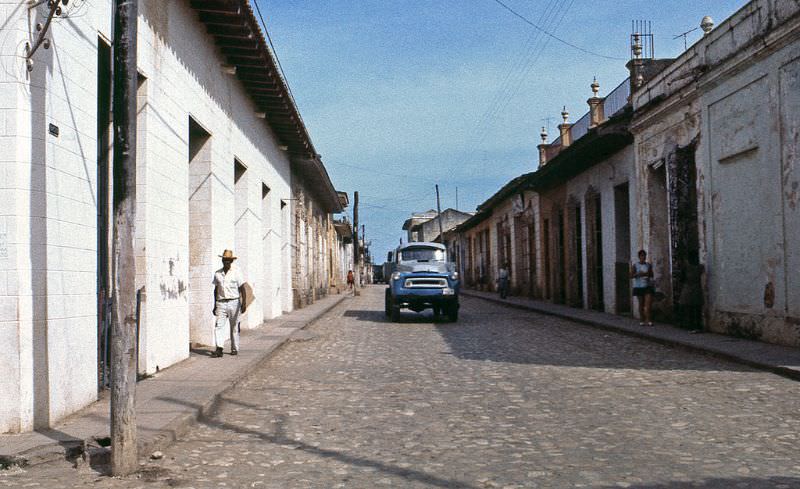
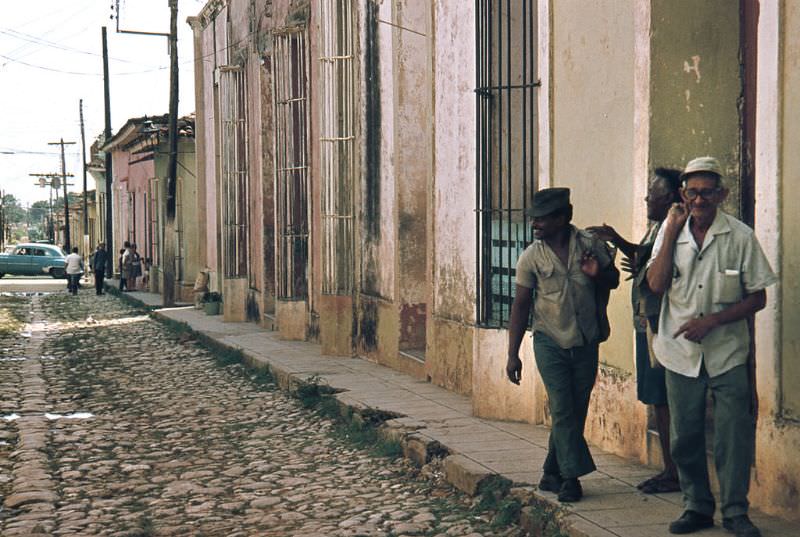
Havana’s Coppelia building (left) is one of the largest ice cream parlors in the world. Holding 1000 guests, it is located on the part of Calle 23 known as La Rampa in the Vedado district, 1970sA man walking and old truck, Trinidad, 1976Three men on the street, Trinidad, 1976
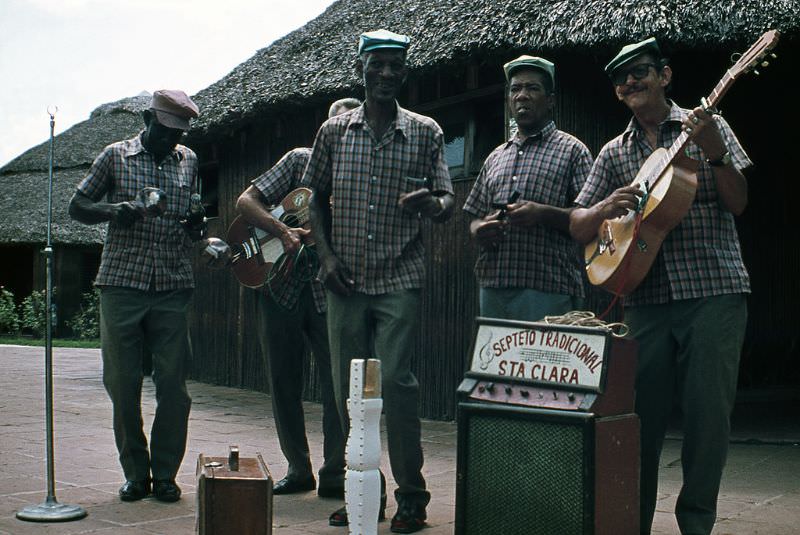
Cuban music was one of the decade’s defining forces. Groups like the Septeto Tradicional de Santa Clara kept older son traditions alive at a time when new sounds were also emerging. Ensembles like Irakere and Los Van Van were fusing Afro-Cuban rhythms with jazz and rock, producing music that spread far beyond the island’s shores. The government supported this cultural output as a point of national pride.
Group of traditional musicians ‘Septeto Tradicional de Santa Clara’
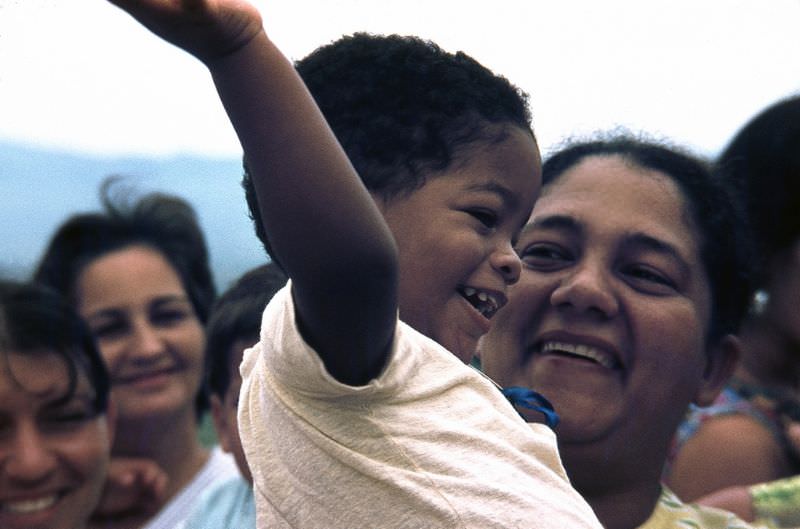
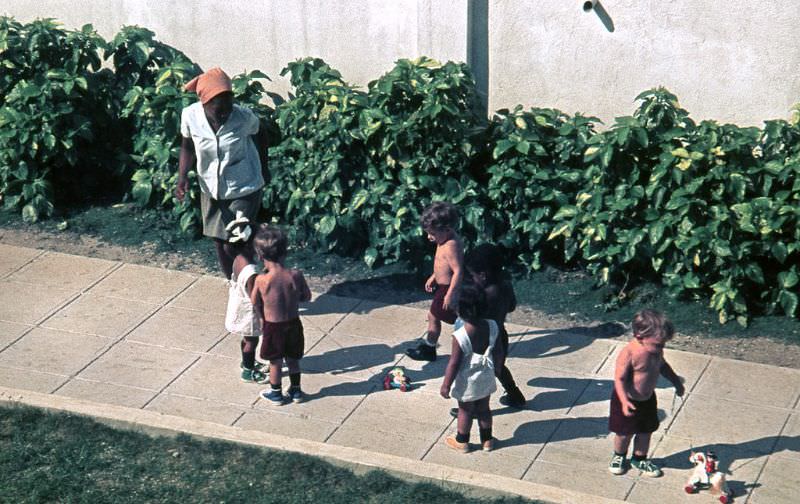
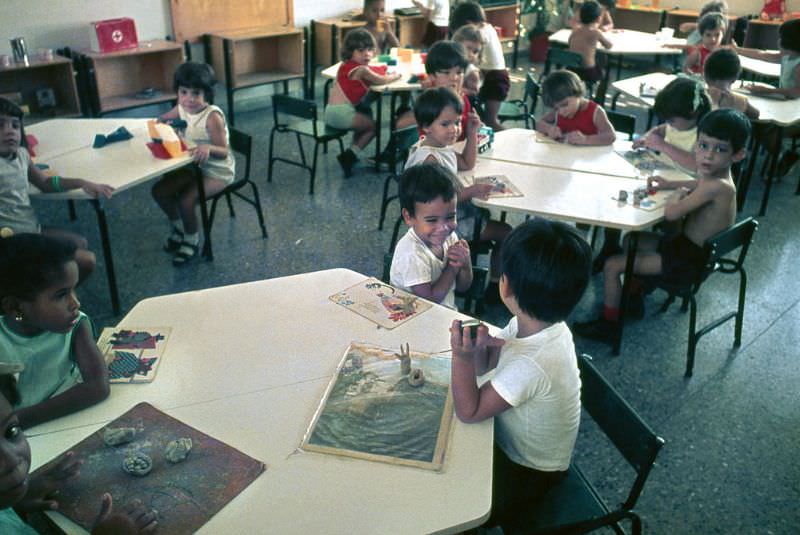
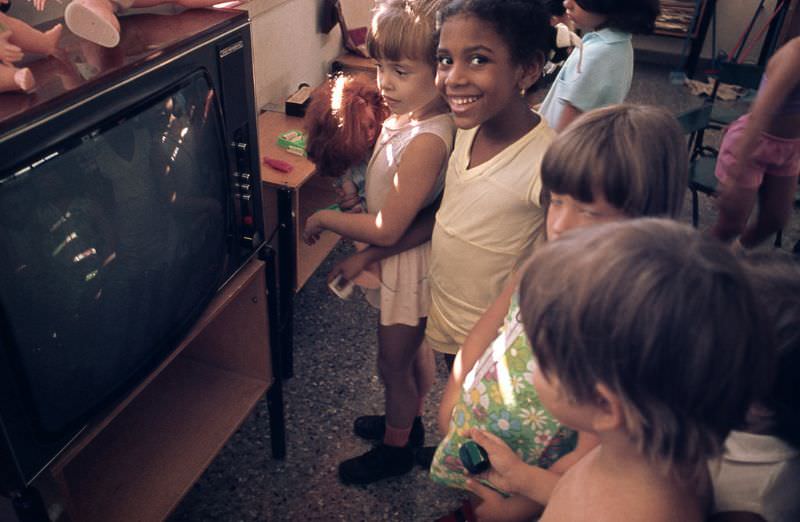
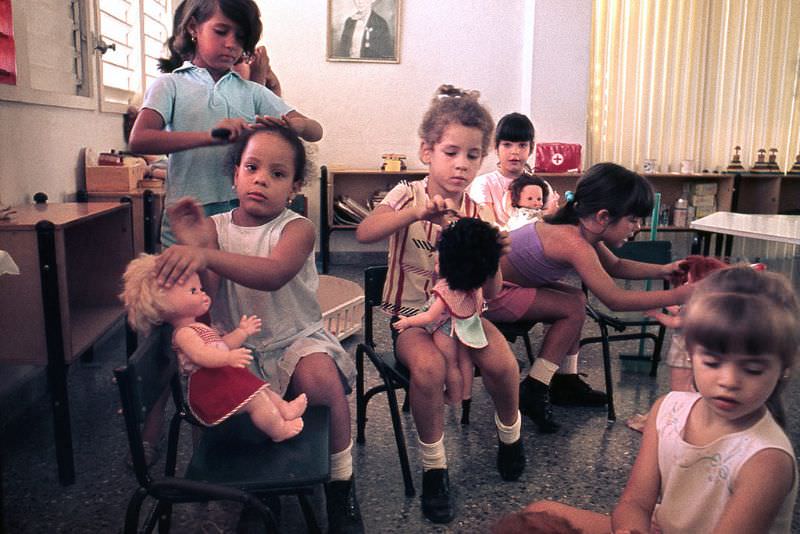
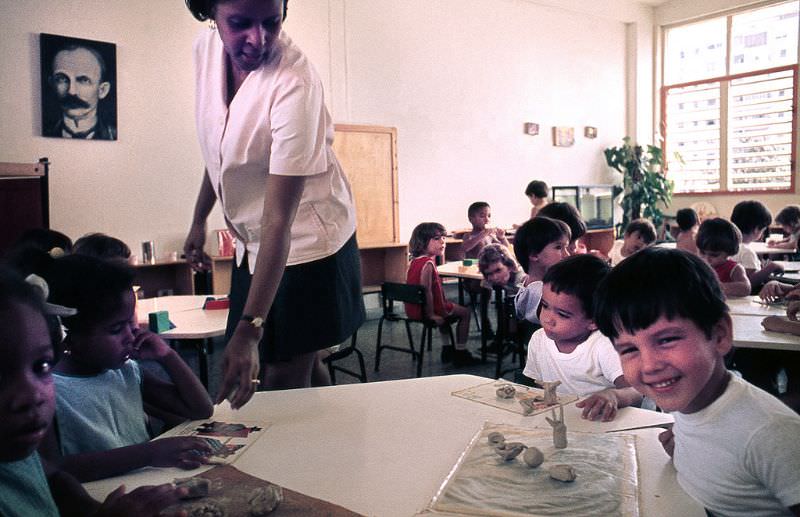
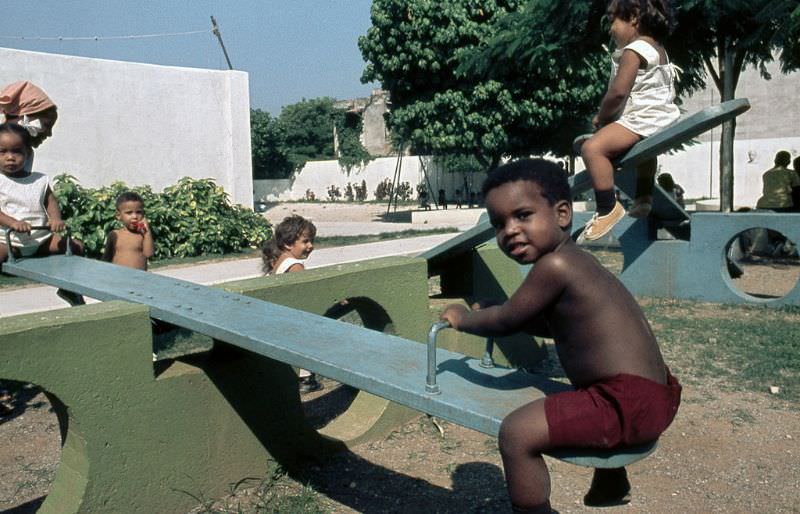
Children were central to the revolution’s vision for Cuba’s future. Education was a top priority — schools were built across the island, and attendance was mandatory. In kindergartens and classrooms, children did schoolwork, watched television as part of their lessons, and played together during recess. Mothers gathered with infants at community centers supported by state health programs.
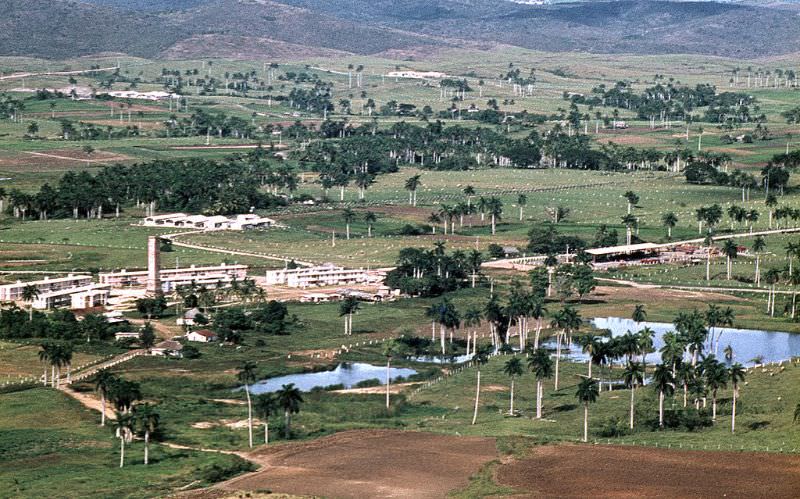
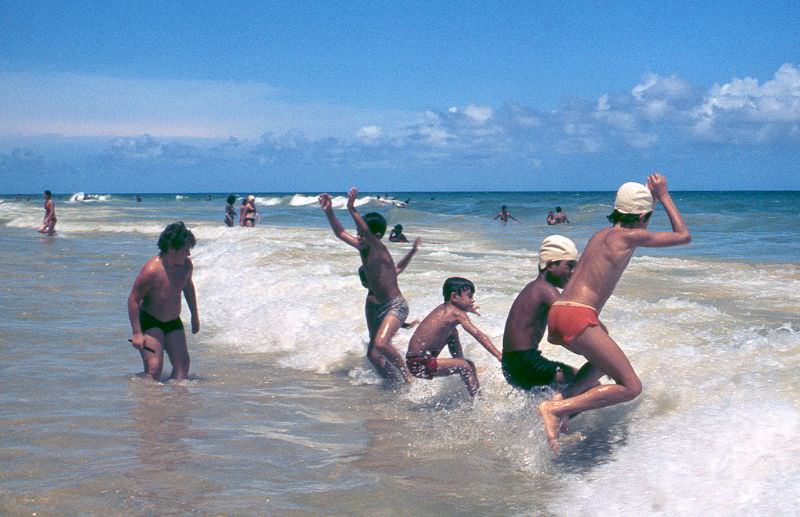
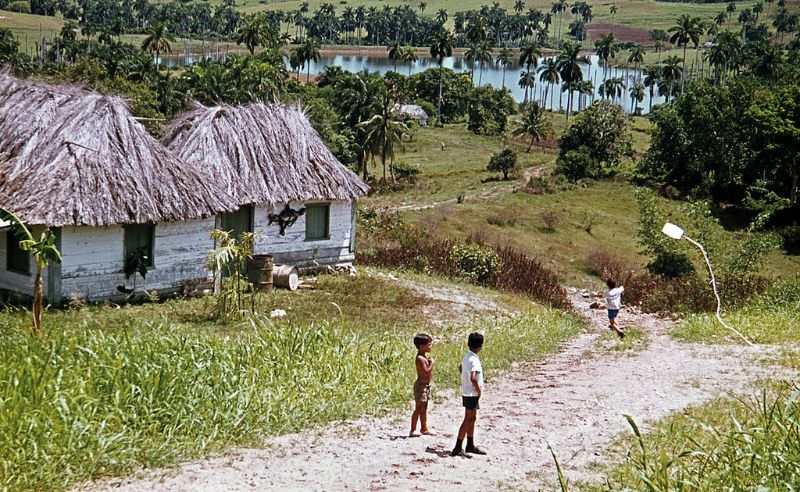
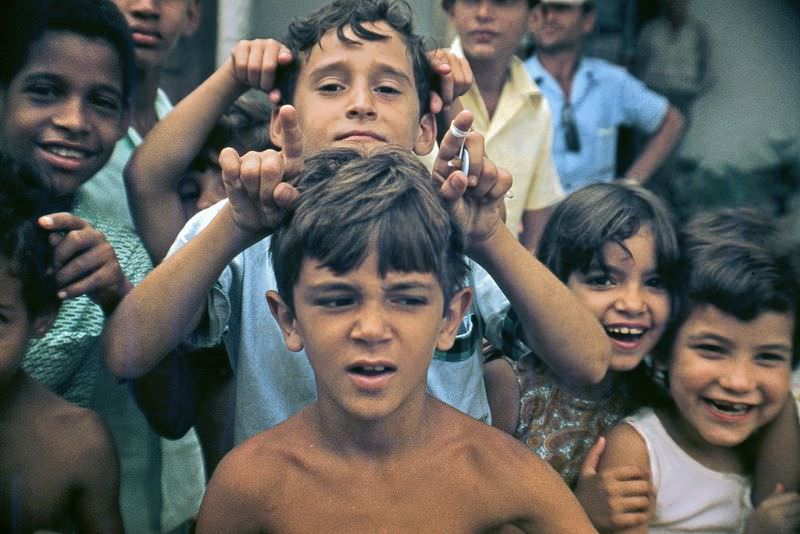
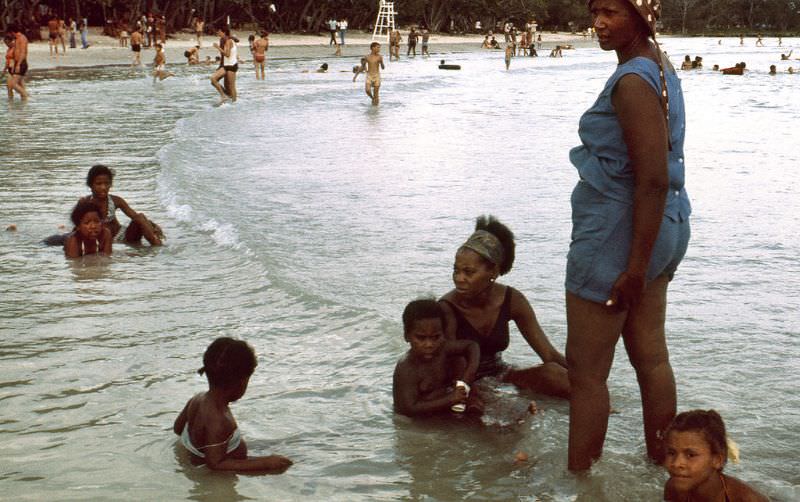
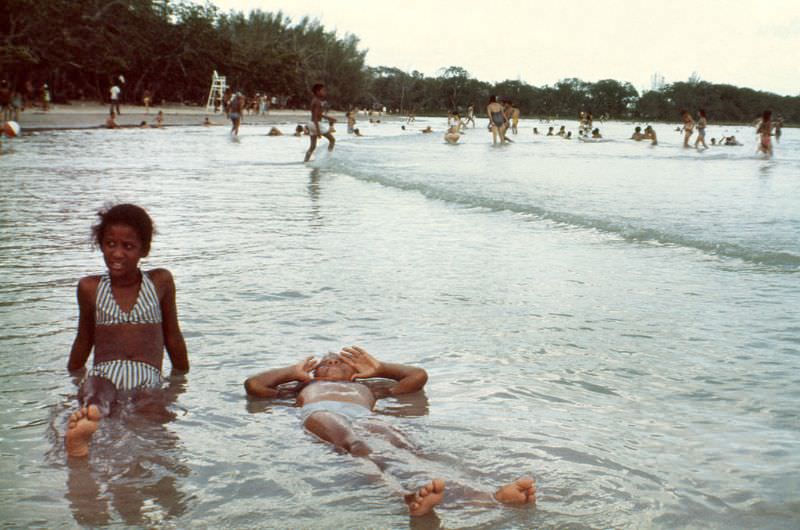
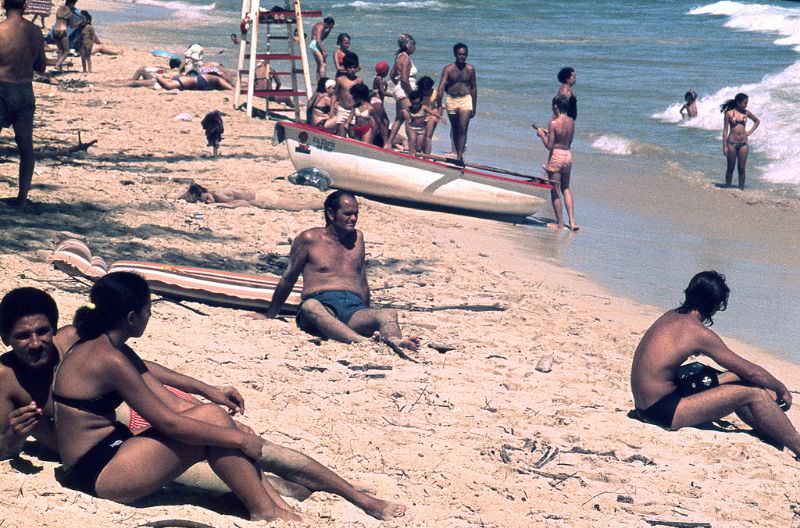
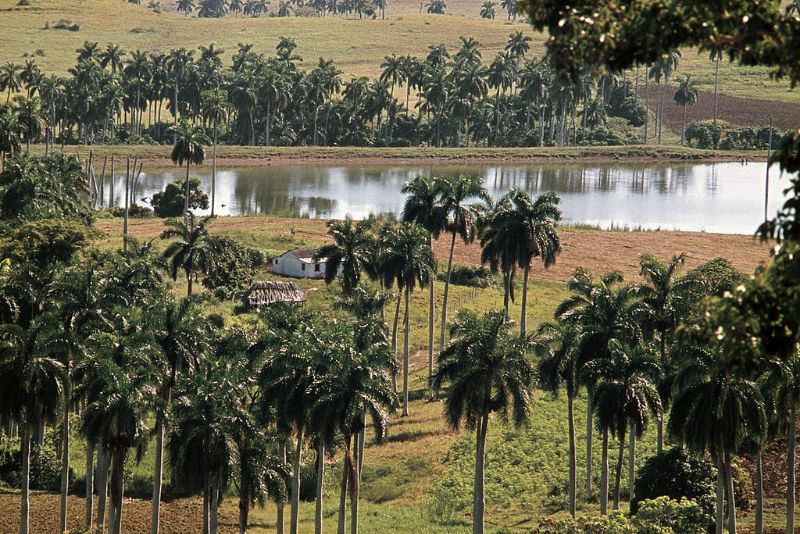
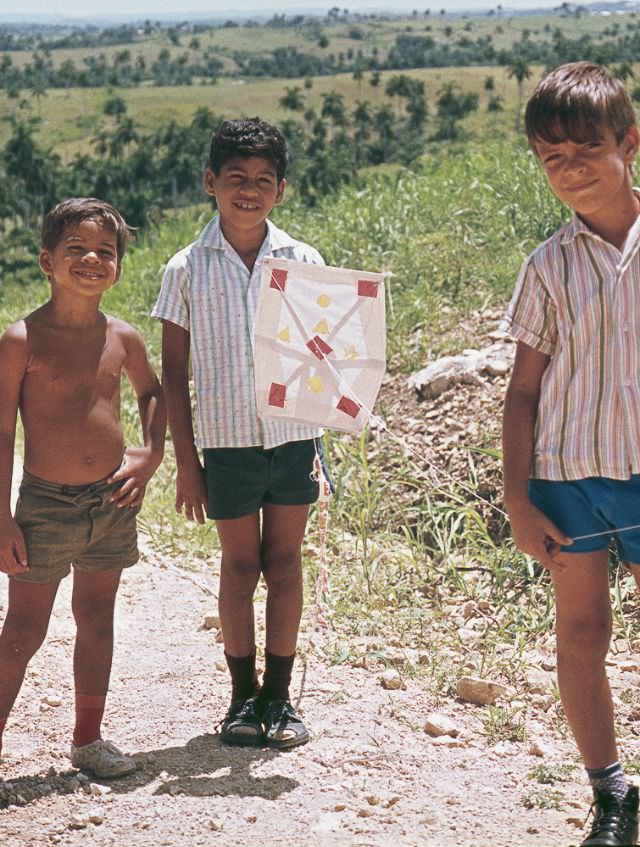
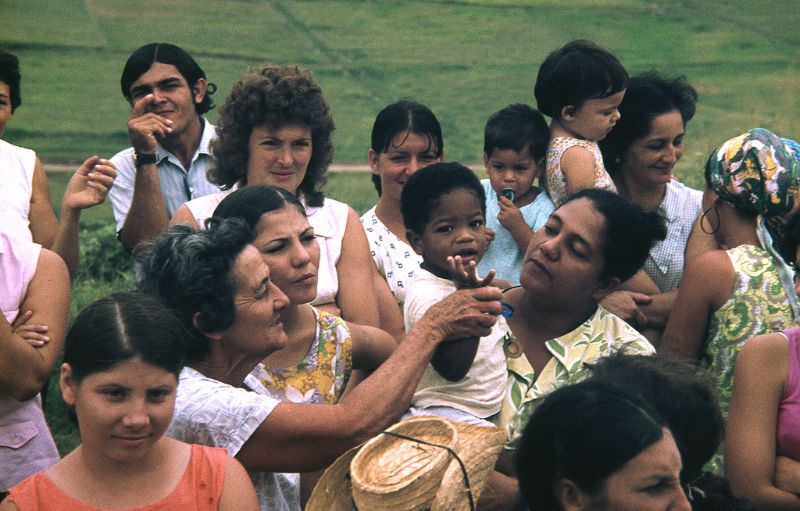
A group of happy mothers with a child, Cuba, 1976A teacher taking care of children playing with their toys, Cuba, 1976Area with a processing agricultural products plant and workers’ housing, Cuba, 1976Boys playing in the waves on a beach, Cuba, 1976Boys playing with a kite in an agricultural region with farmers’ houses and palm trees along the lake, Cuba, 1976Children doing school work, Cuba, 1976Children having fun in front of the camera, Cuba, 1976Children in a kindergarten in front of TV, Cuba, 1976
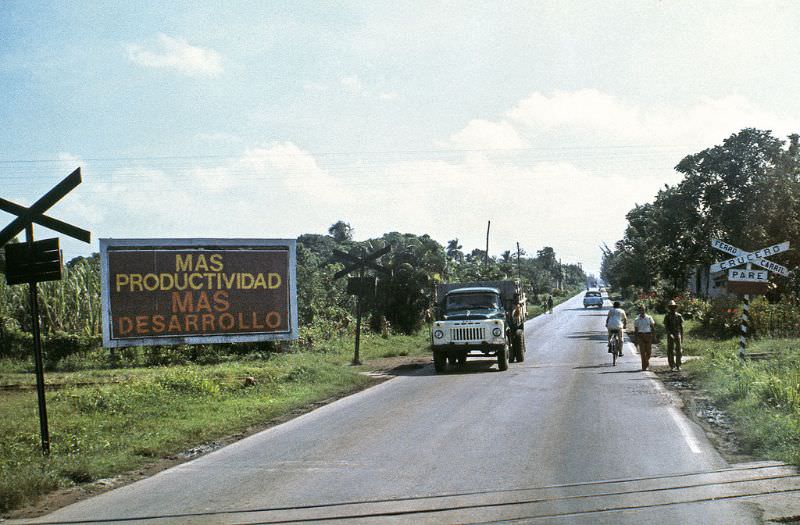
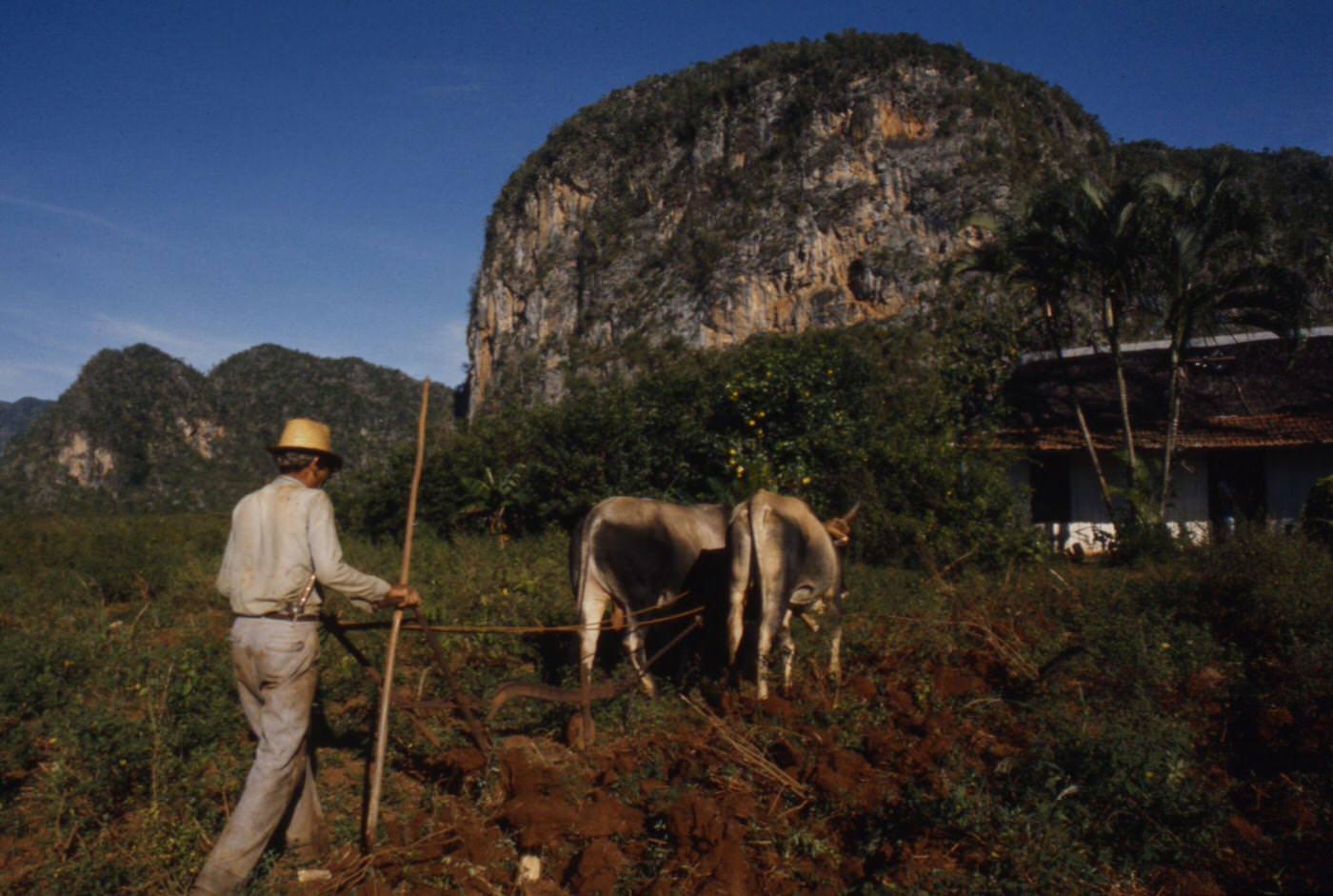
Outside the cities, the Cuban countryside told a different story. Billboards along country roads pushed socialist productivity slogans. Farmers plowed fields with oxen in the Viñales Valley. Sugarcane workers — known as zafreros — performed some of the hardest labor on the island during harvest season. Agriculture, particularly sugar, remained the backbone of Cuba’s economy, and the state pushed farmers and cooperatives hard to meet production targets.
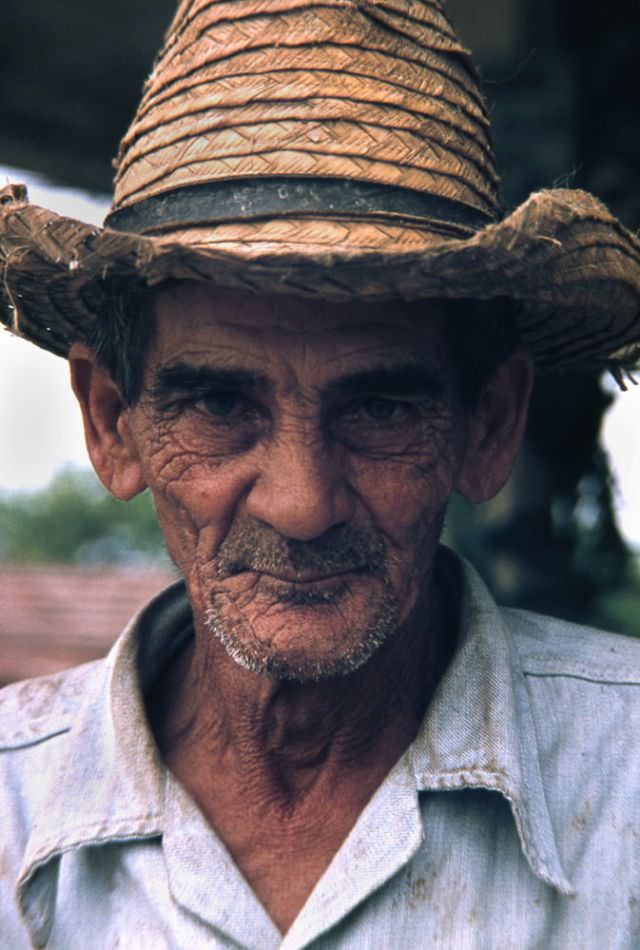
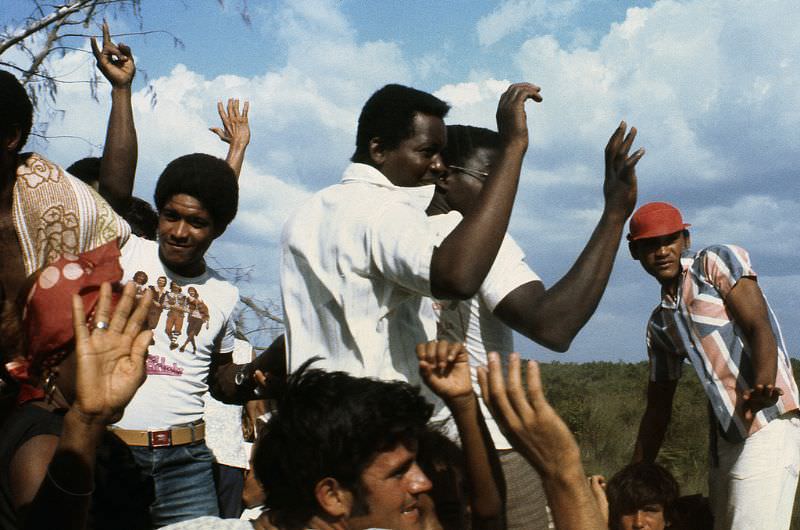
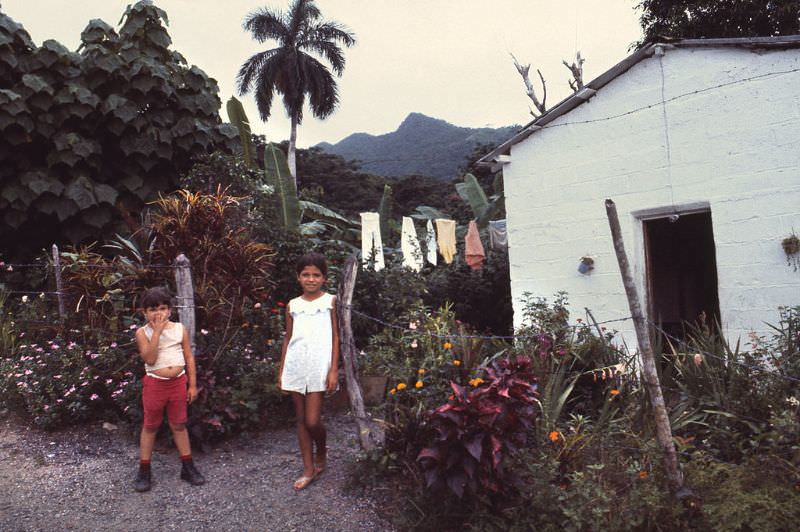
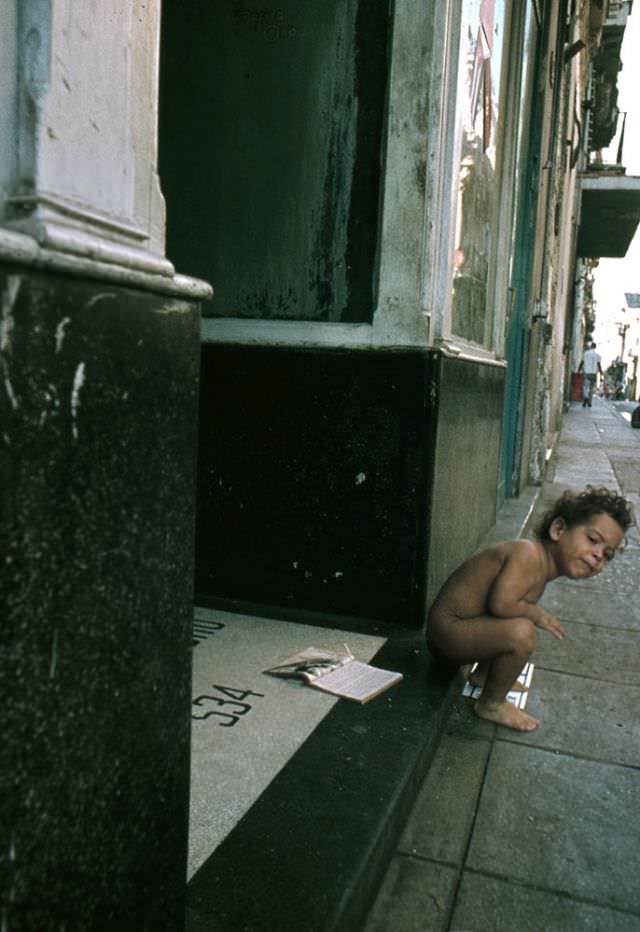
Country road in the interior of the island. Warning over rail crossing, truck and people passing. A billboard recommends “More productivity and More development”, Cuba, 1976Cuban families on holidays having fun at the beach, Cuba, 1976Cuban families on holidays having fun at the beach, Cuba, 1976Cuban farmer, Cuba, 1976Cuban men waving good-bye, Cuba, 1976Cubans on holiday at the beach. Santa María del Mar beach, near Guanabo and Havana, Cuba, 1976Farmers home and two young girls in their garden, Cuba, 1976Girls playing combing dolls during recess at a nursery, Cuba, 1976Interior of a school with children doing school work, Cuba, 1976Little girl at the entrance to her home, Cuba, 1976
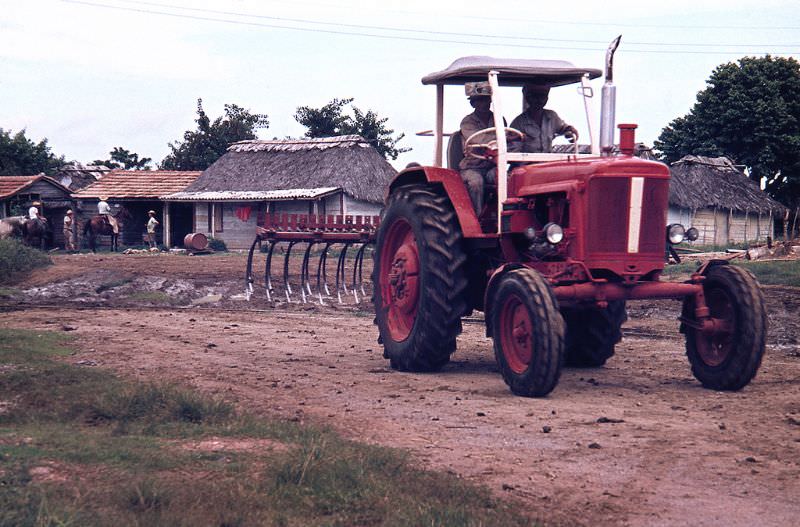
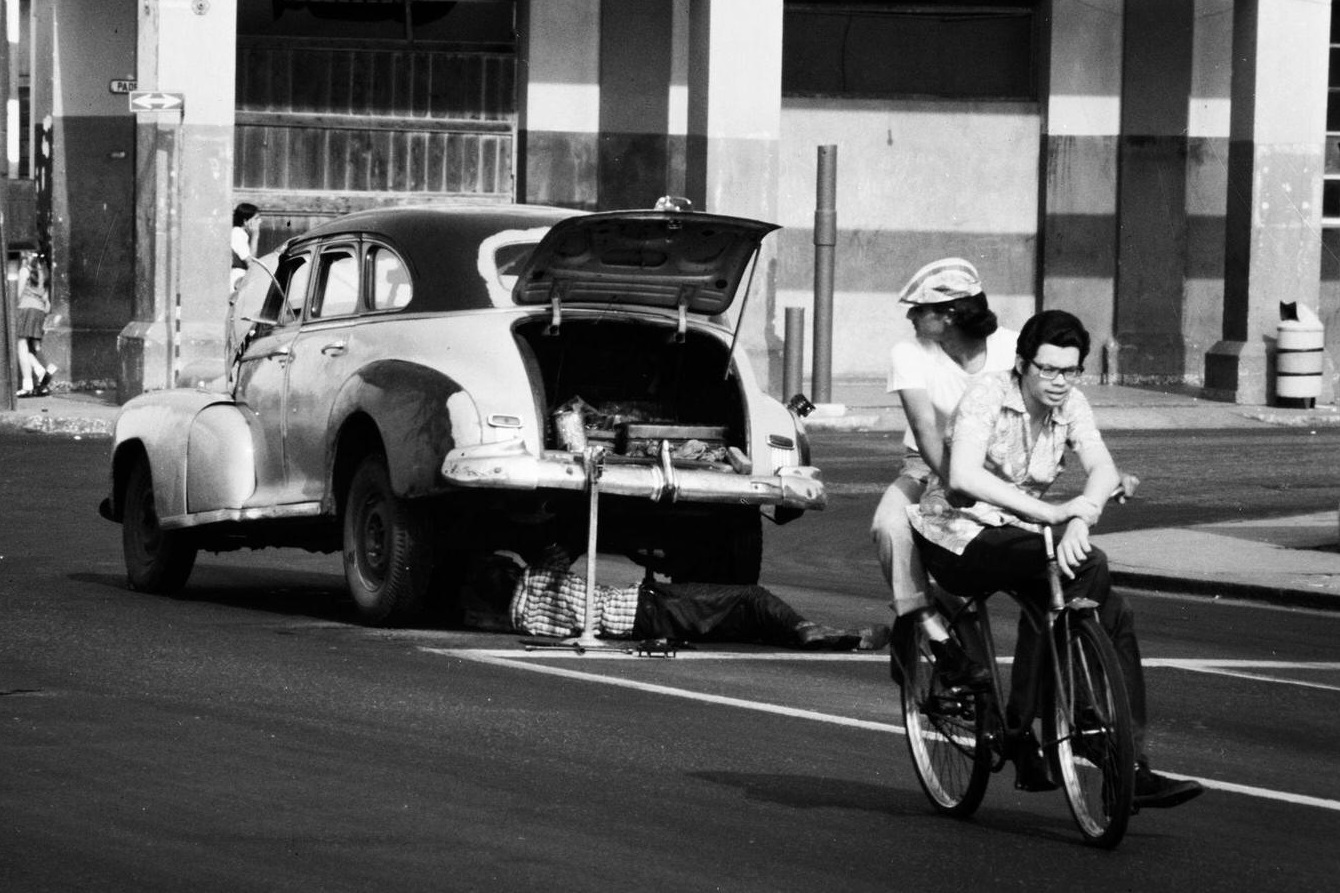
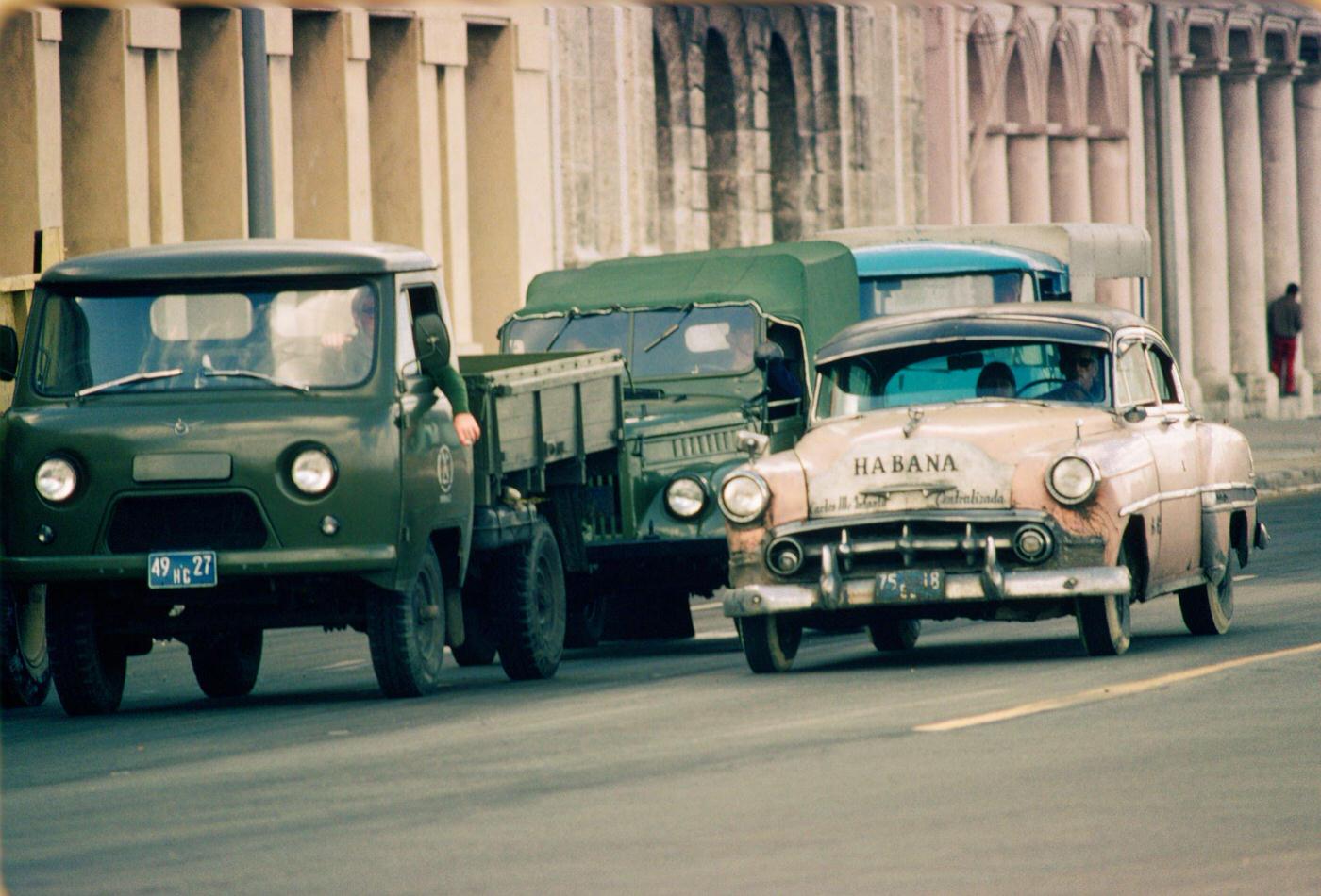
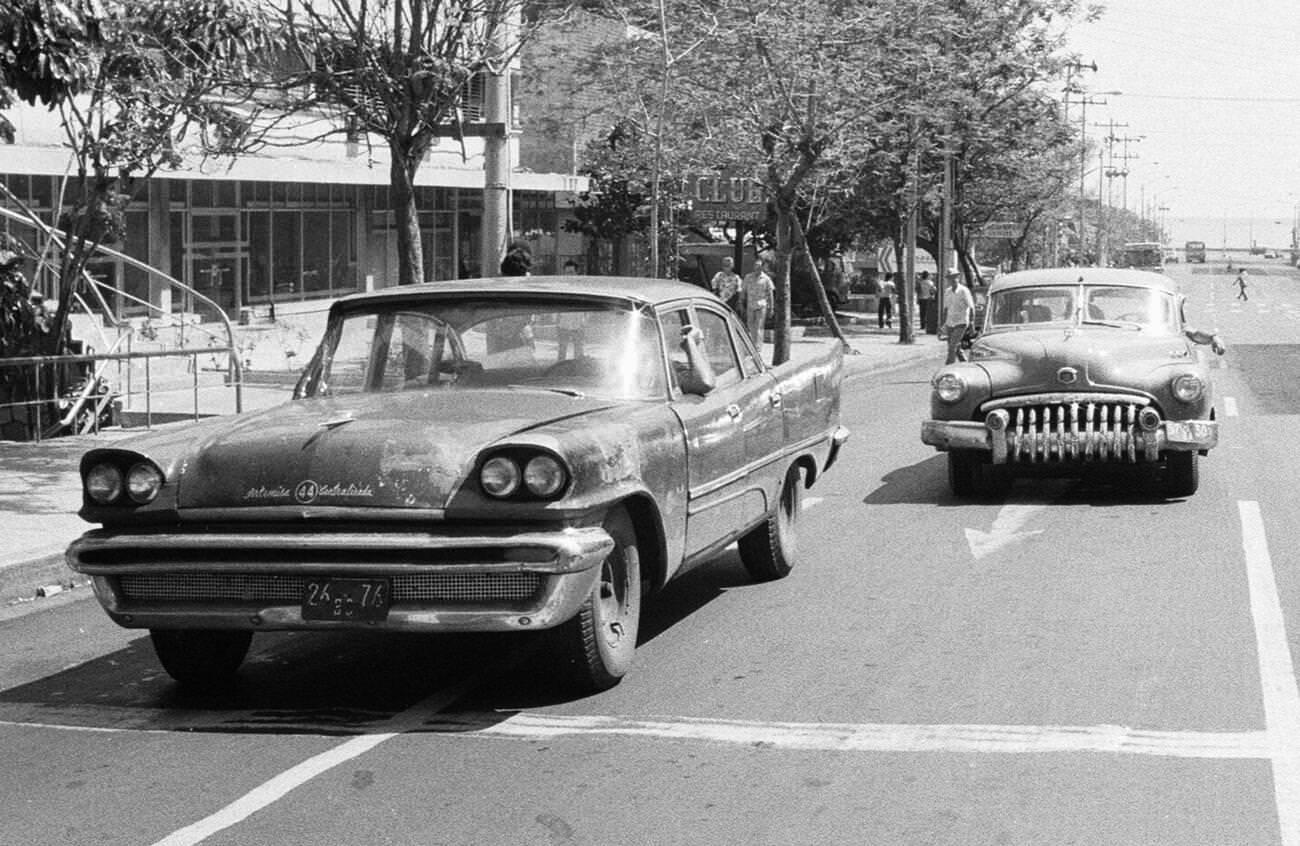
Transport across the island was a patchwork of eras. Horse-drawn wagons, Soviet-era tractors, American cars from the 1950s, and state-run bus lines all shared the same roads. The American cars — left behind after diplomatic ties with the U.S. were severed — were kept running through improvised repairs and homemade parts. On Havana’s streets in 1979, mechanics worked on these cars right at the curb, doing what they could with what was available.
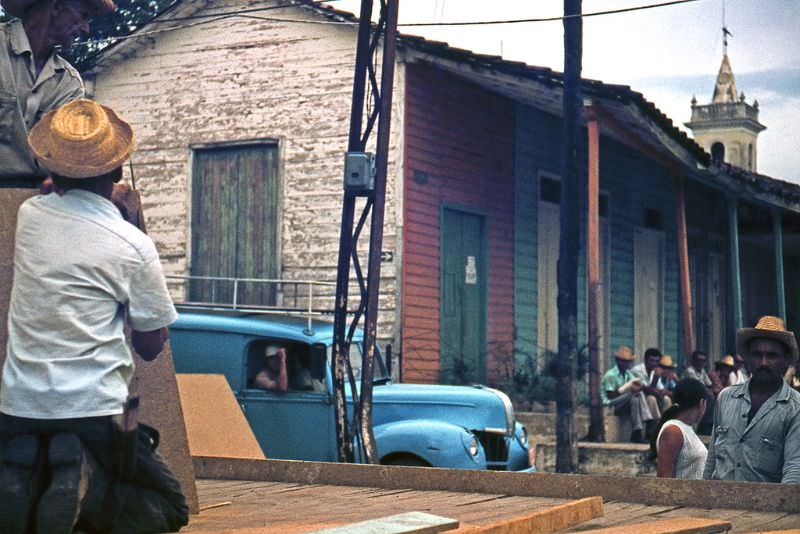
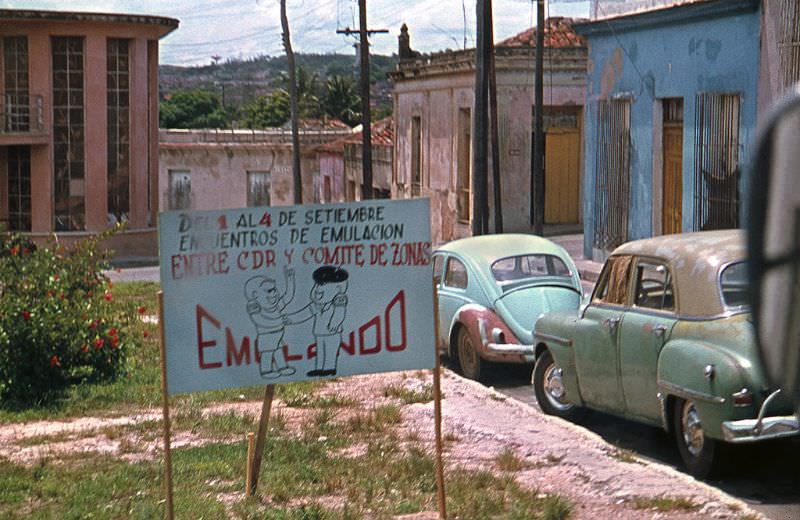
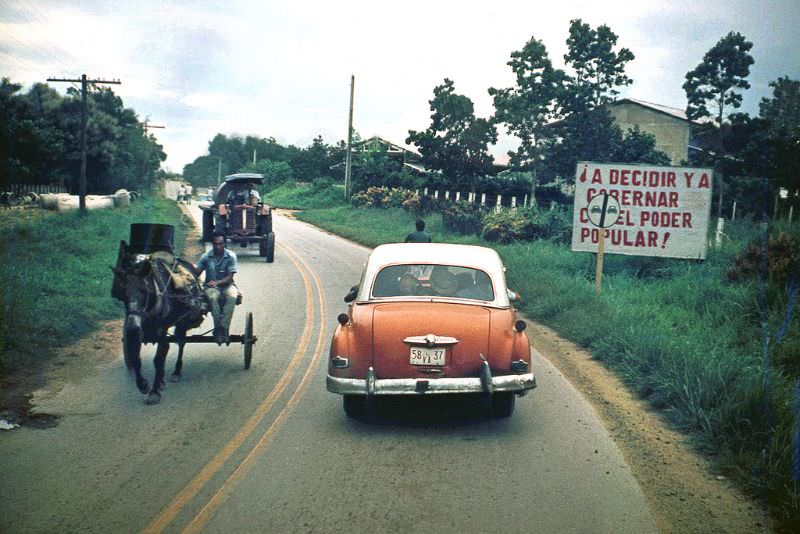
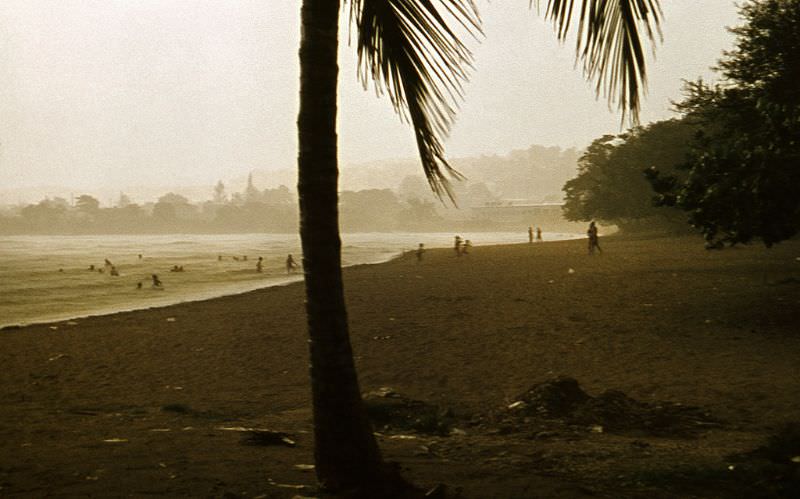
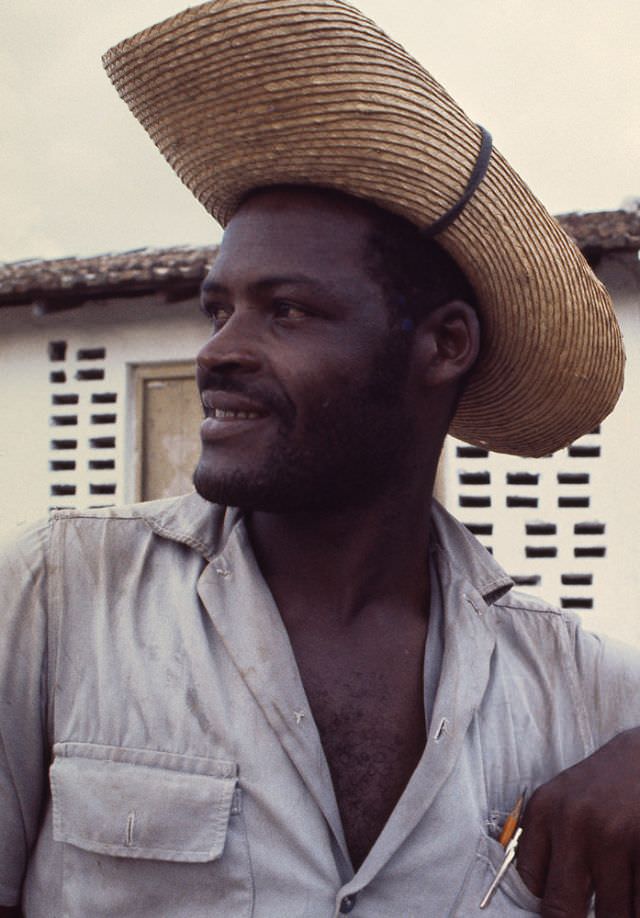
Man sitting in his green wagon pulled by a horse, laughing and pointing a direction with his arm, Cuba, 1976Man with a straw hat and a blue truck, Cuba, 1976Members of ANAP (Asociación Nacional de Agricultores Pequeños) in a informative session with professors and journalists from Barcelona, Spain, Cuba, 1976Oasis with palm trees in the interior of Cuba, Cuba, 1976Old American cars parked on a street with old houses. In a sign at the street: “Emulation Meetings between CDR and Zoning Committee announced”, Cuba, 1976On the road, an old American car, a horse and cart and a tractor. Sign near the road of socialist government message: “To decide and govern with the people’s power”, Cuba, 1976People bathing in the sea and children running while the wind announces the arrival of a storm, Cuba, 1976Red tractor in a Cuban farm, Cuba, 1976Swinging in the playground of the nursery, Cuba, 1976Three boys with a kite, Cuba, 1976Two men unload a truck in the traditional way, Cuba, 1976Women group with their child, Cuba, 1976Zafrero (man who works in the Zafra harvesting sugarcane), Cuba, 1976
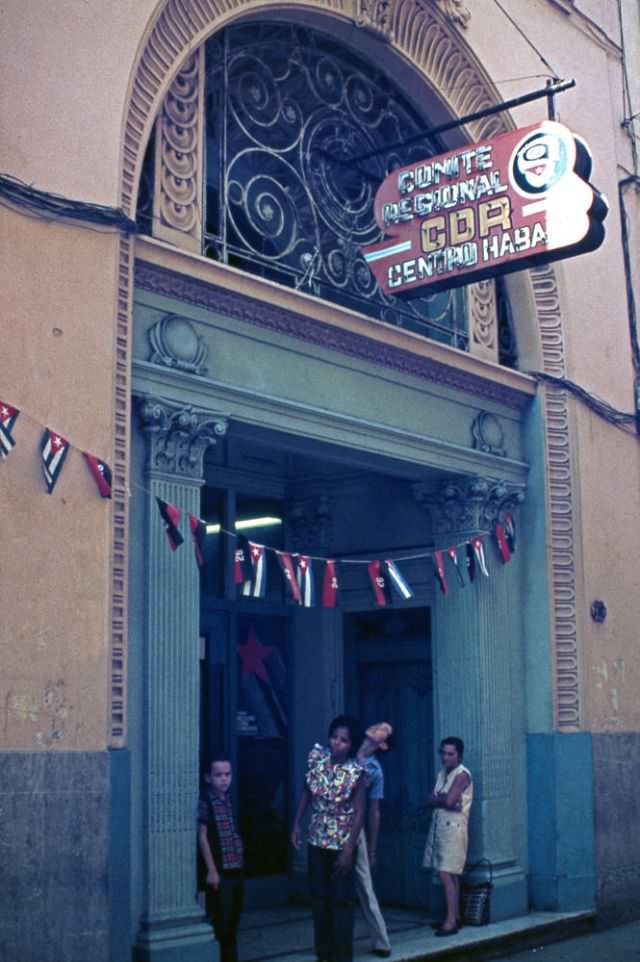
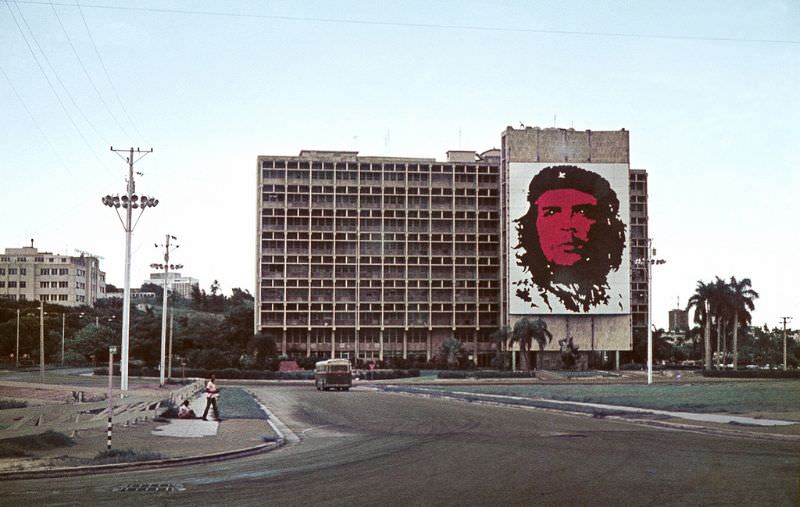
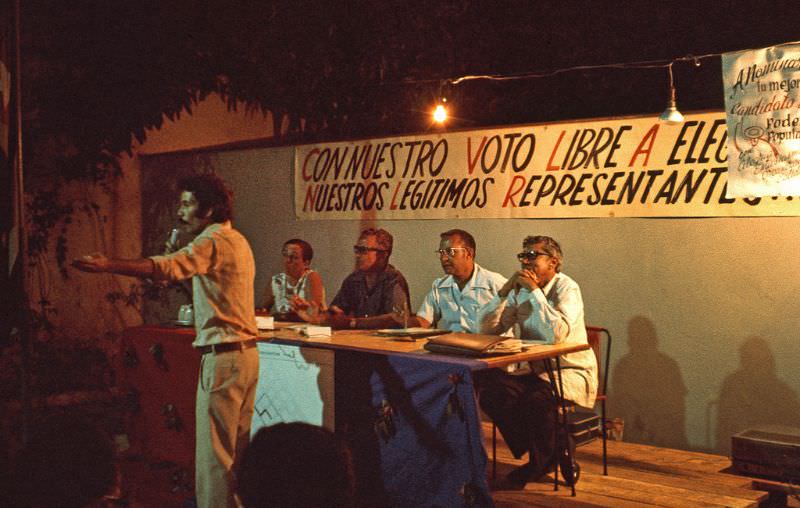
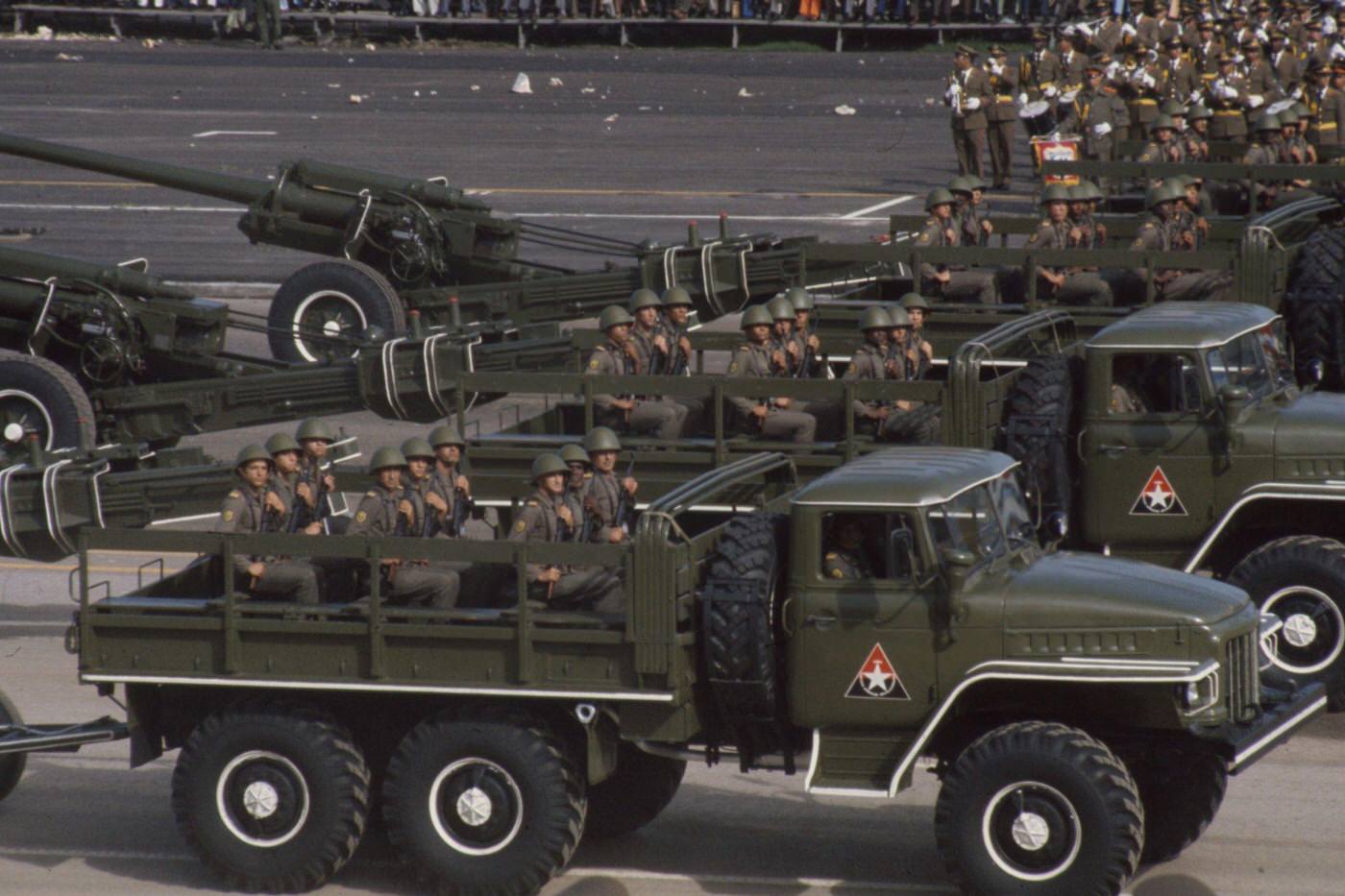
The government’s presence was woven into daily life through organizations like the Committees for the Defense of the Revolution (CDR), which operated at the neighborhood level. Posters on walls announced school programs and harvests. Voting took place in district elections. Military vehicles moved through Havana’s streets, and parades filled the Plaza de la Revolución. The large mural of Che Guevara on the Interior Ministry building watched over it all.
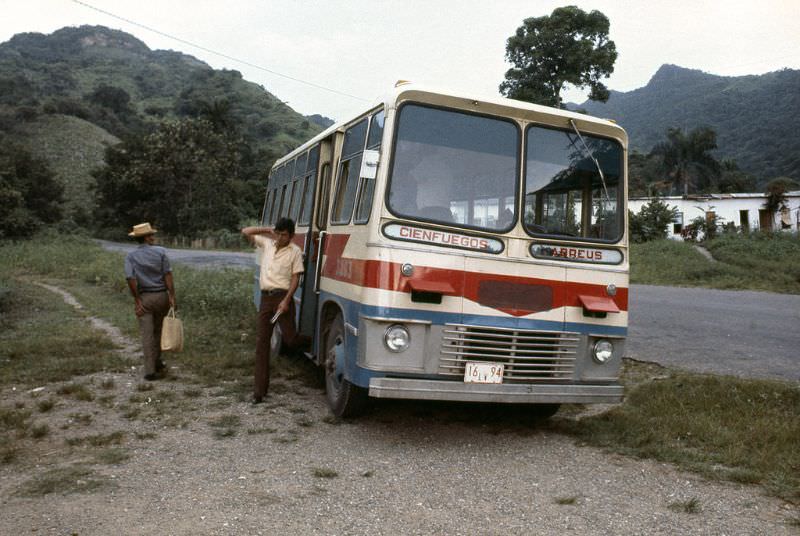
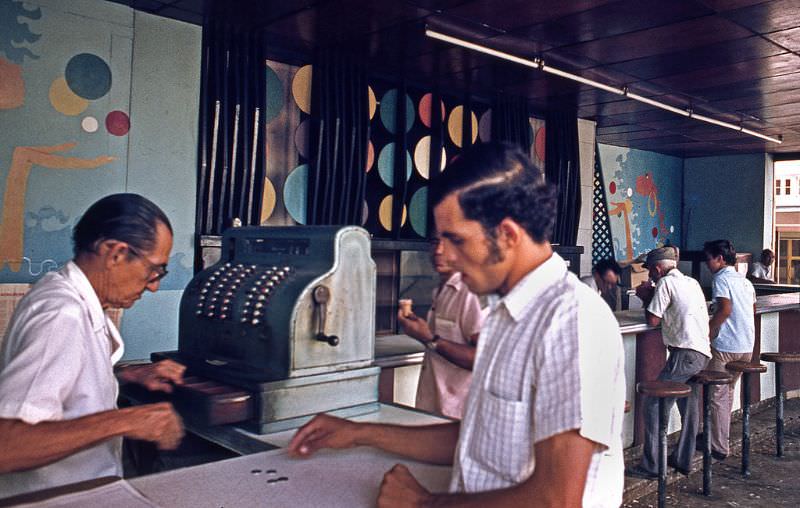
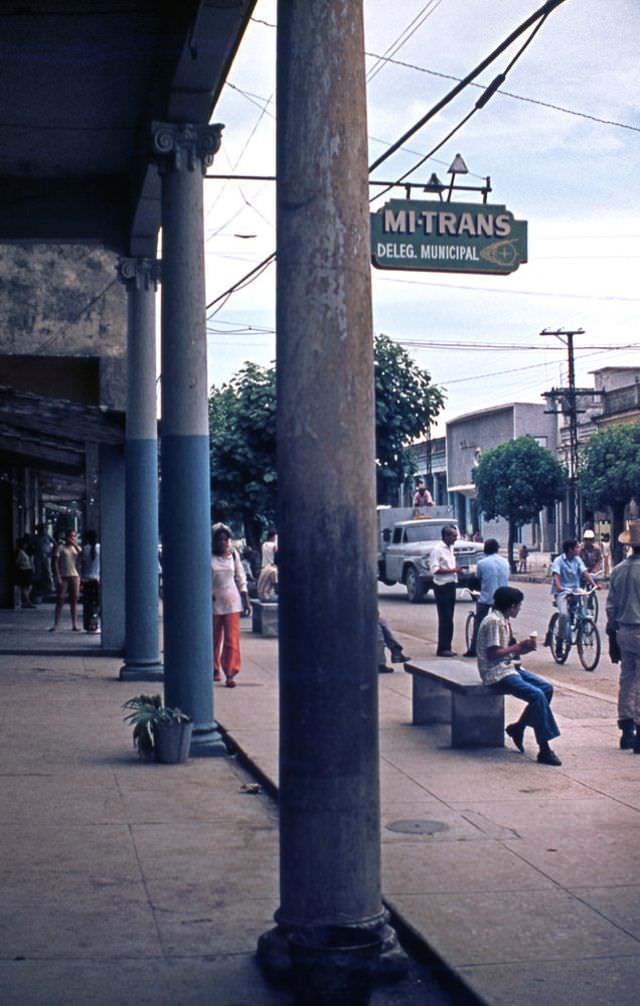
Cuba, Escambray Mountains, 1976. Public transport, bus lineCuba, Habana Vieja, 1976. Headquarters building of Regional Committee Centro-Habana del C.D.RCuba, Havana, 1976. In a bar, a customer pays their consumption to the cashier who works with an old cash machine
Bacardí Building (ancient US Embassy in Havana), 1976
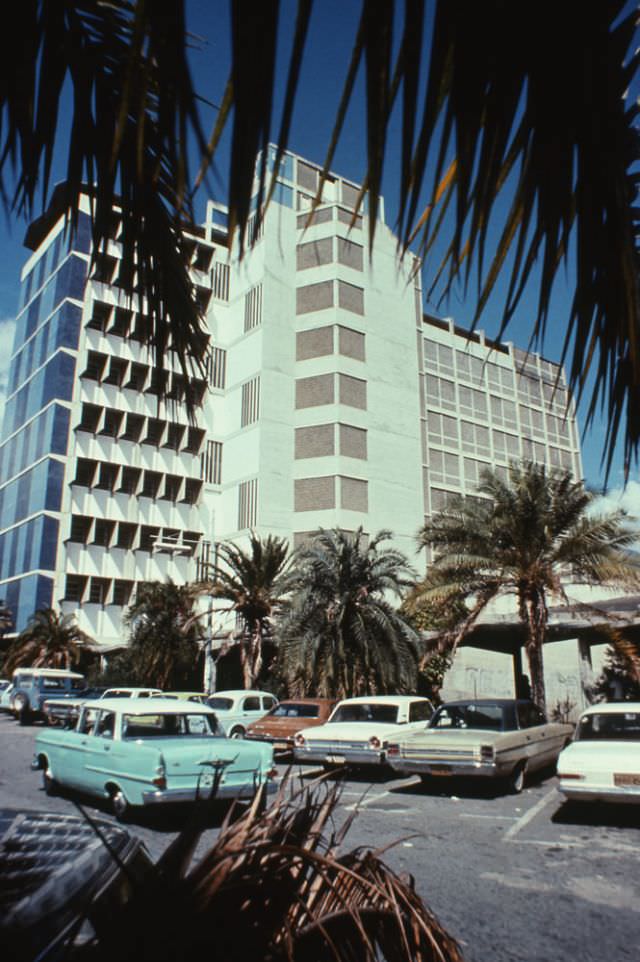
Hotel in a touristic area, Havana, 1976
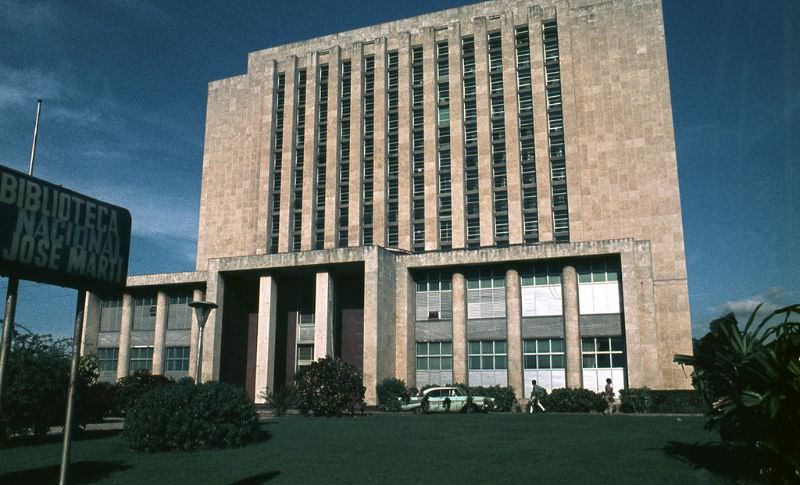
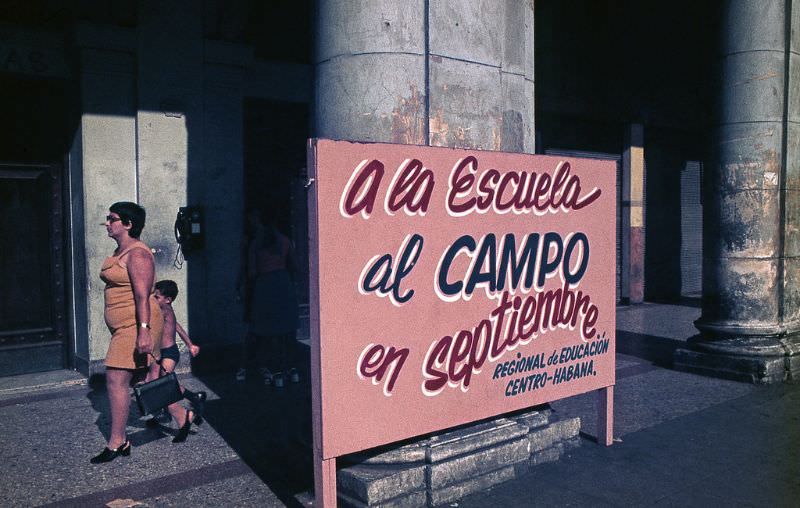
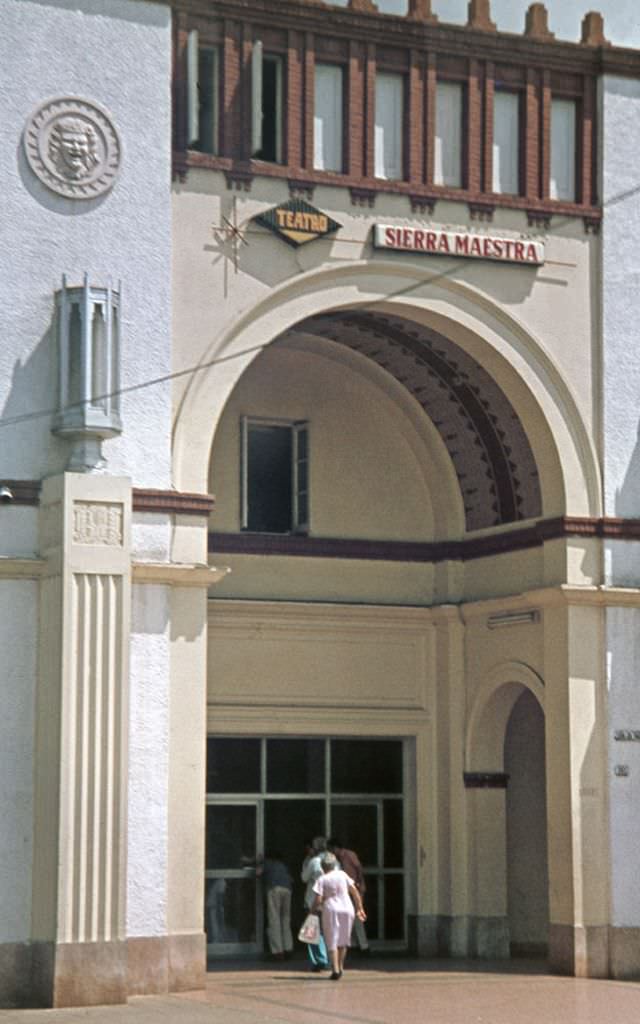
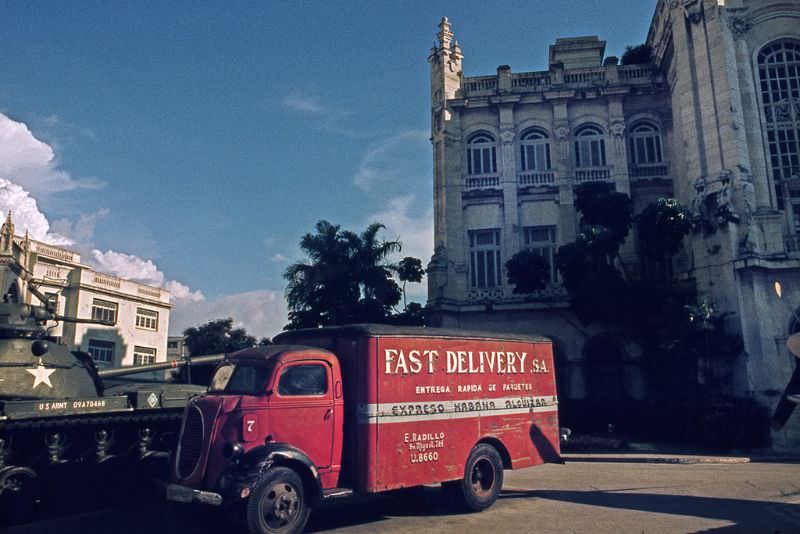
Hotel Nacional, Havana, 1976Large mural with the image of revolutionary Che Guevara on the facade of a building in the Plaza de la Revolución, Havana, 1976National Library José Martí, Havana, 1976People on the street of a neighborhood of Havana, Havana, 1976Popular votations to elect a representative of the District, Havana, 1976Poster announcing the return to school and to countryside in September, Havana, 1976Sierra Maestra Theater, Havana, 1976US tank and American truck confiscated during the Cuban Revolution, displayed in a square in Havana, Havana, 1976
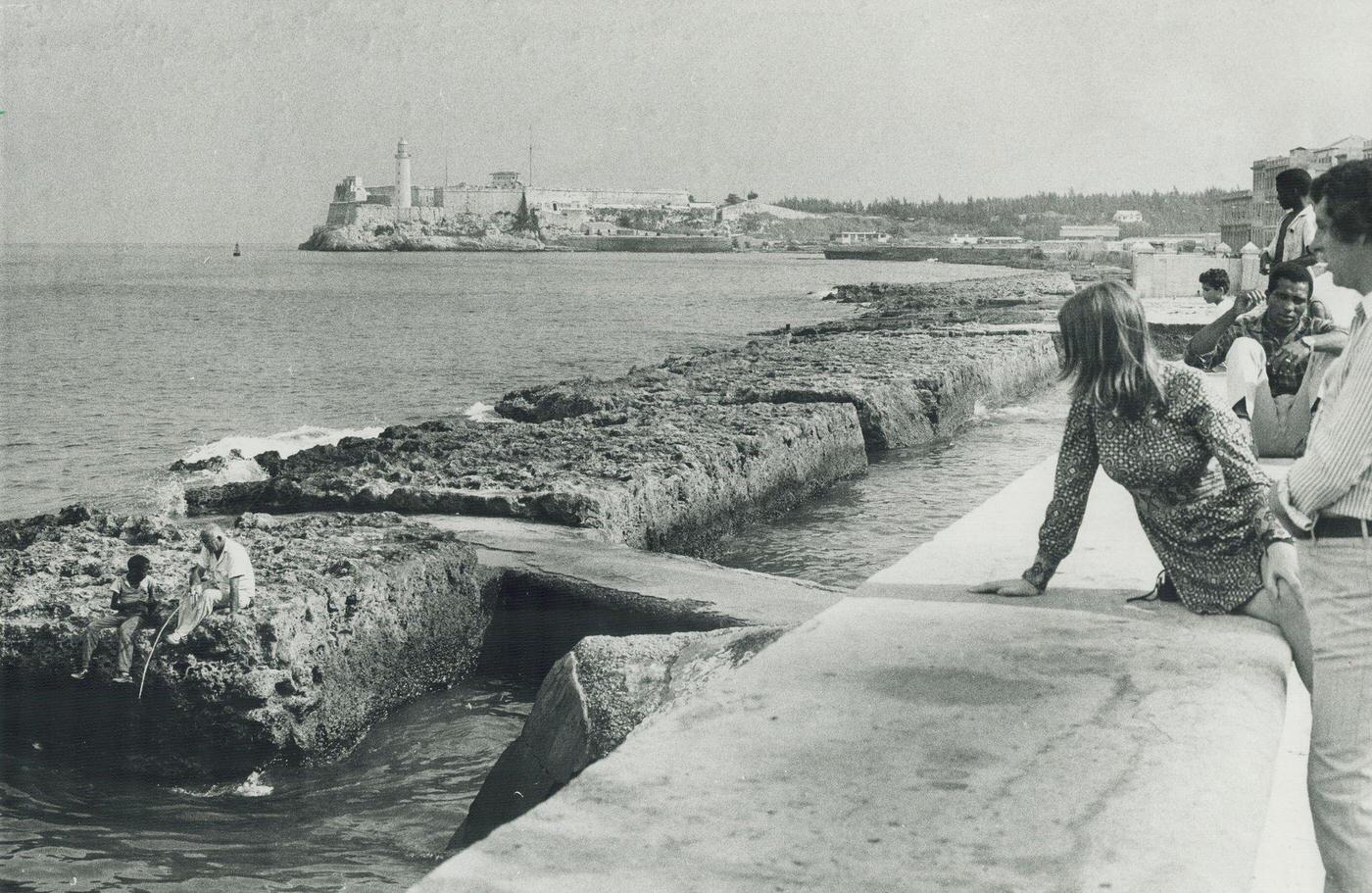
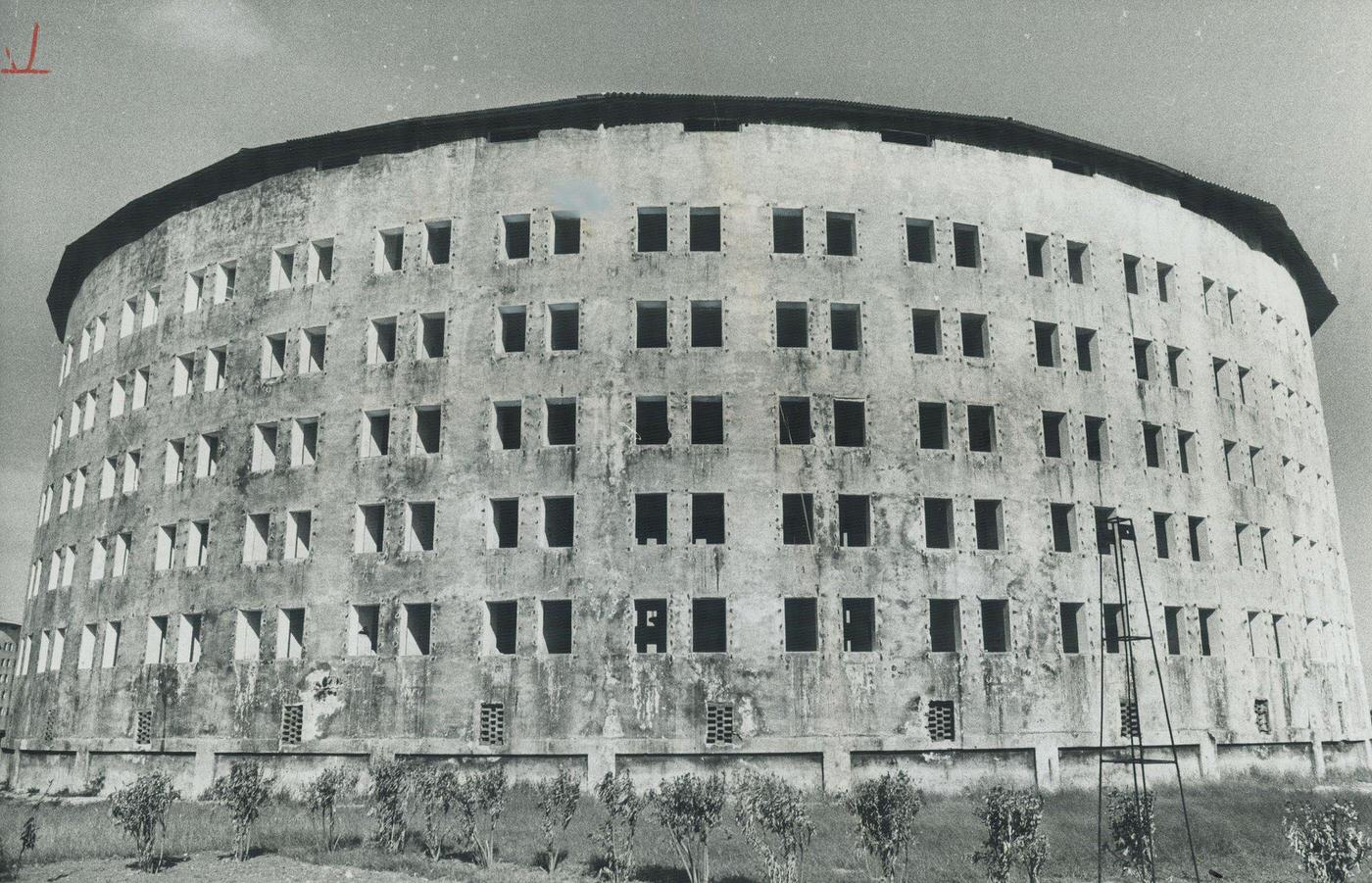
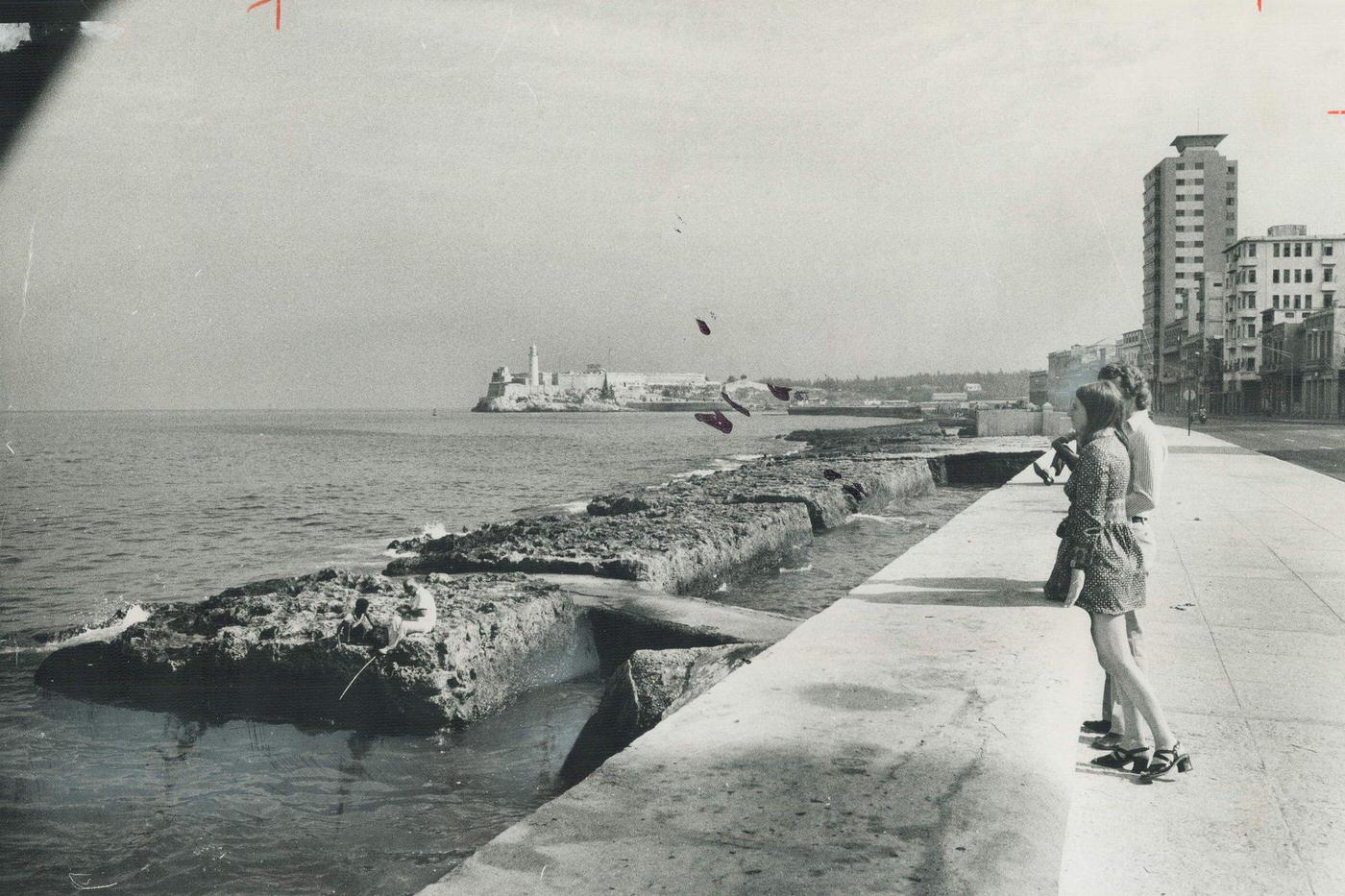
Havana’s waterfront — the Malecón — was a gathering point for residents and a draw for Canadian tourists who made up a significant share of visitors during a decade when American travel to Cuba was effectively blocked. The Castillo del Morro, a fortification built by the Spanish centuries earlier, stood at the harbor entrance as it always had. Nearby, the former prison on the Isle of Pines — used by Batista to hold political prisoners before the revolution — remained a stark reminder of the era the new government defined itself against.
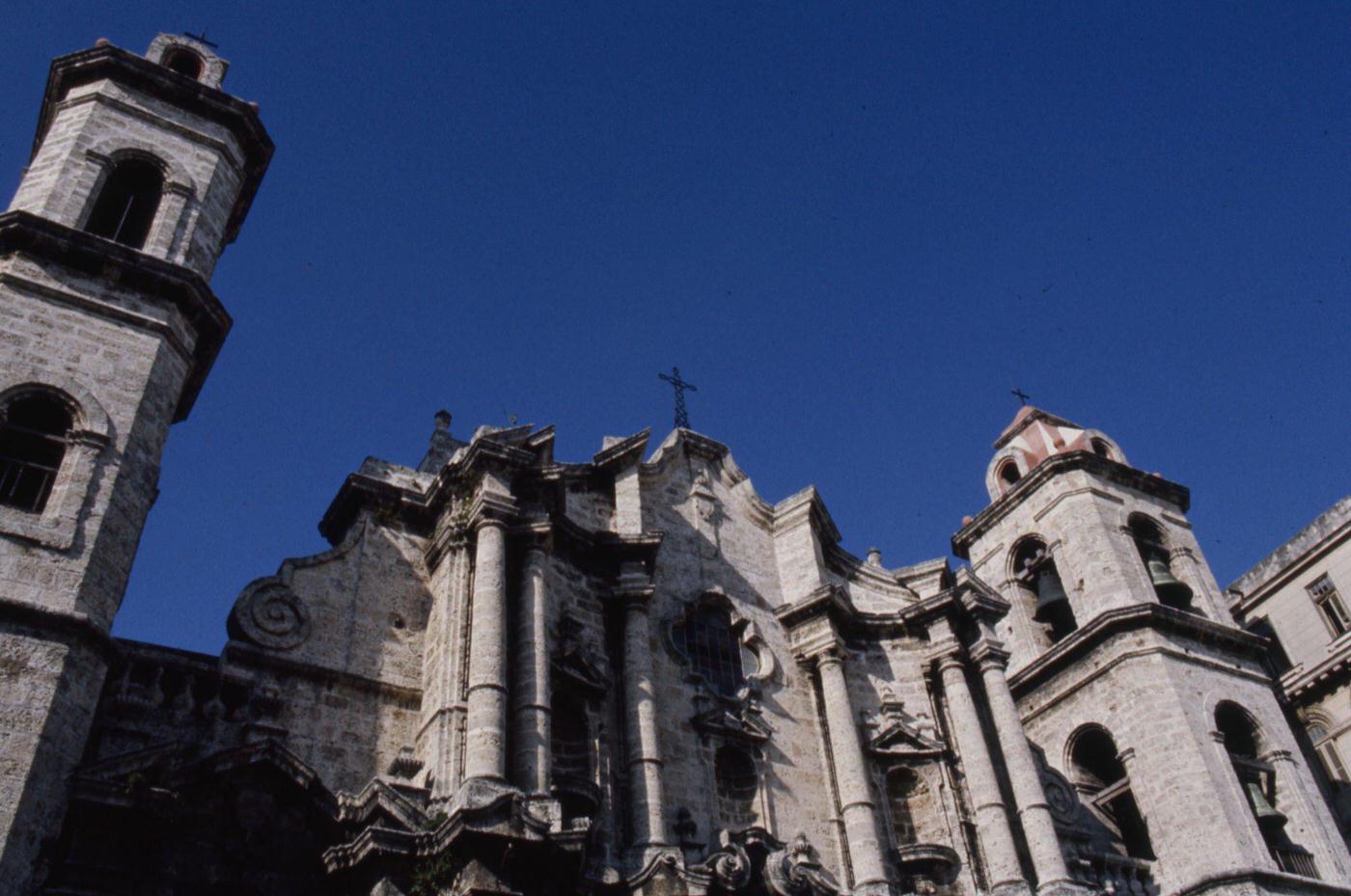
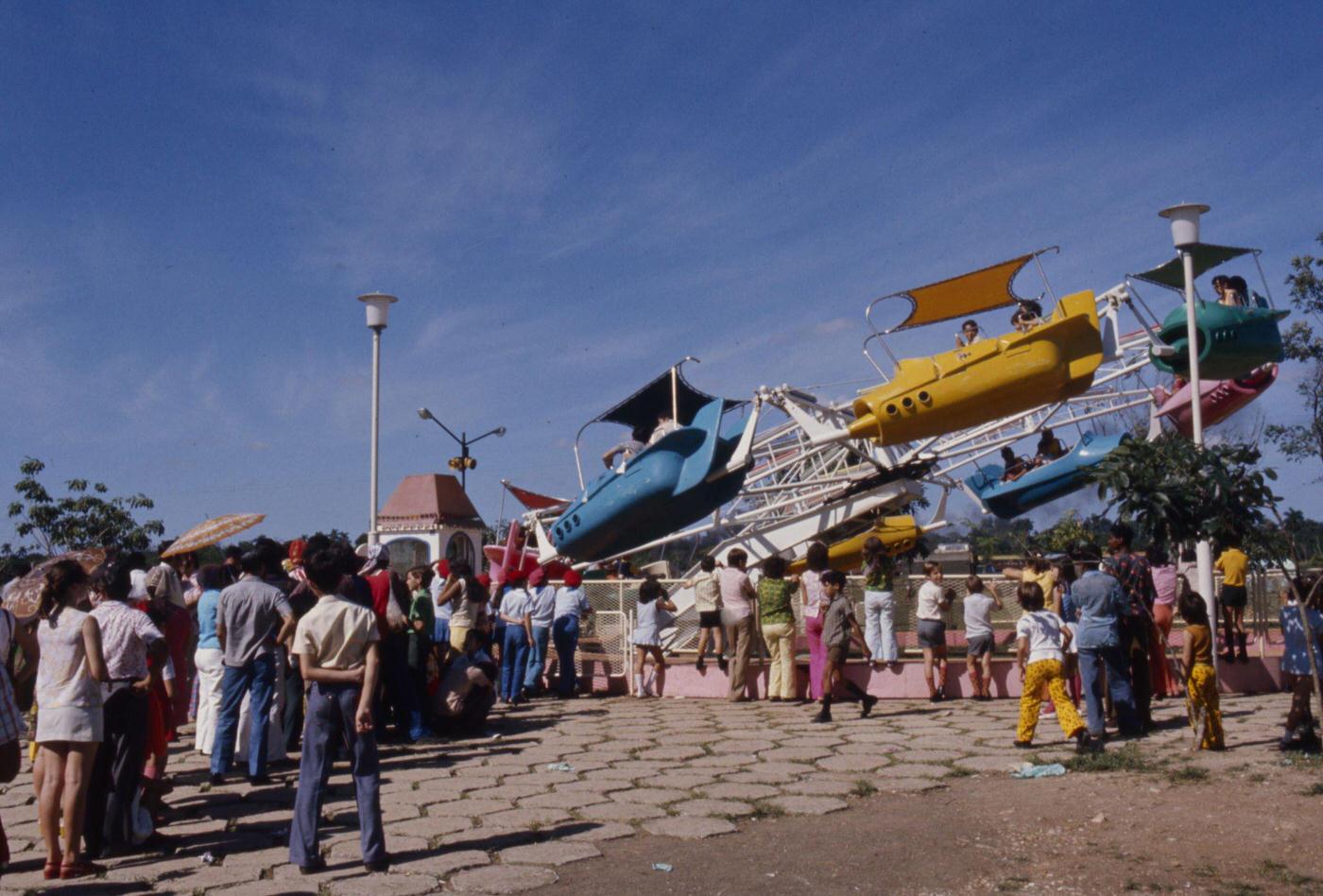
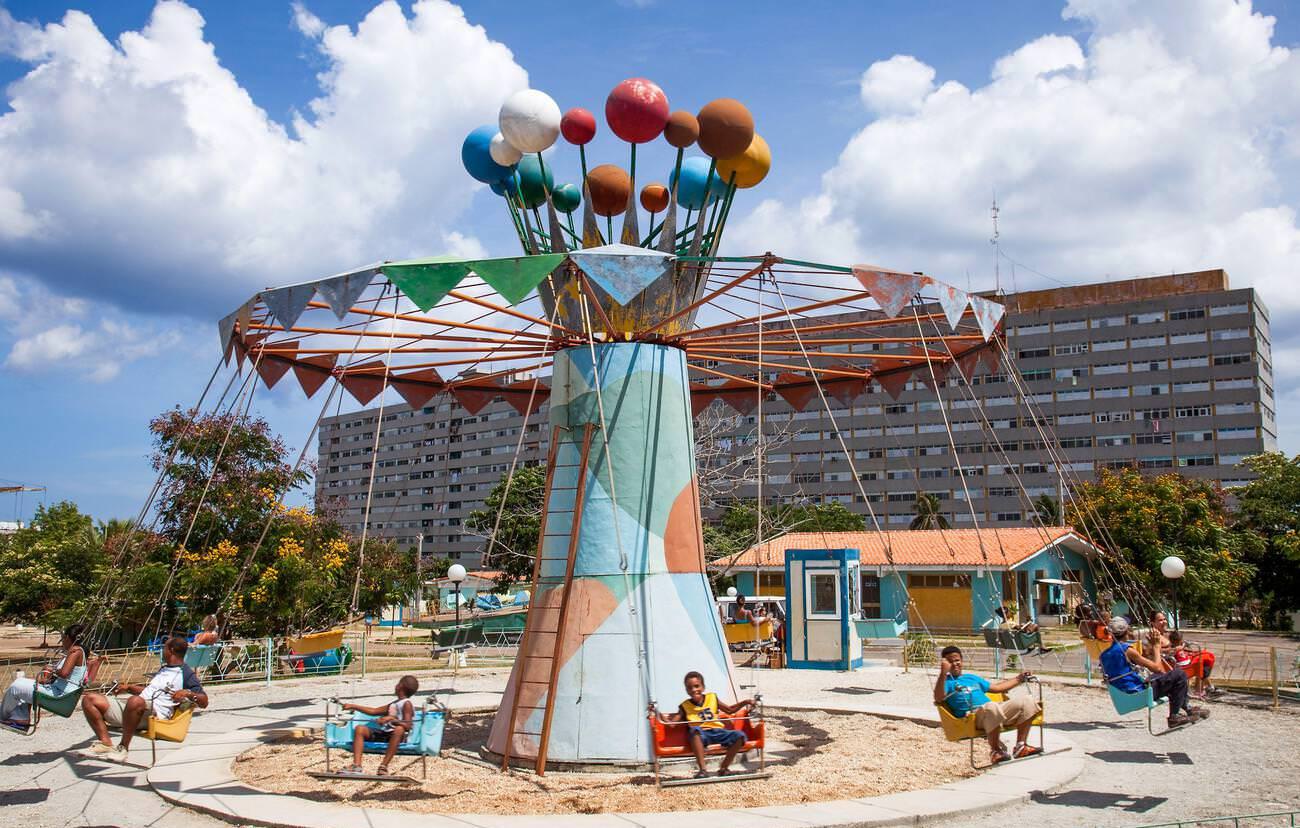
Castillo del Morro, once a prison for English pirates, Havana waterfront, Cuba, 1978.The Old Cuba: Huge prison on Isle of Pines, used by Cuban dictator Fulgencia Batista for political prisoners and criminals, Cuba, 1978.Cathedral Square in Old Havana, featured in ‘Closeup: Cuba – The Castro Generation’, Havana, Cuba, 1977.Japanese Amusement park in Lenin Park, featured in ‘Closeup: Cuba – The Castro Generation’, Havana, Cuba, 1977.
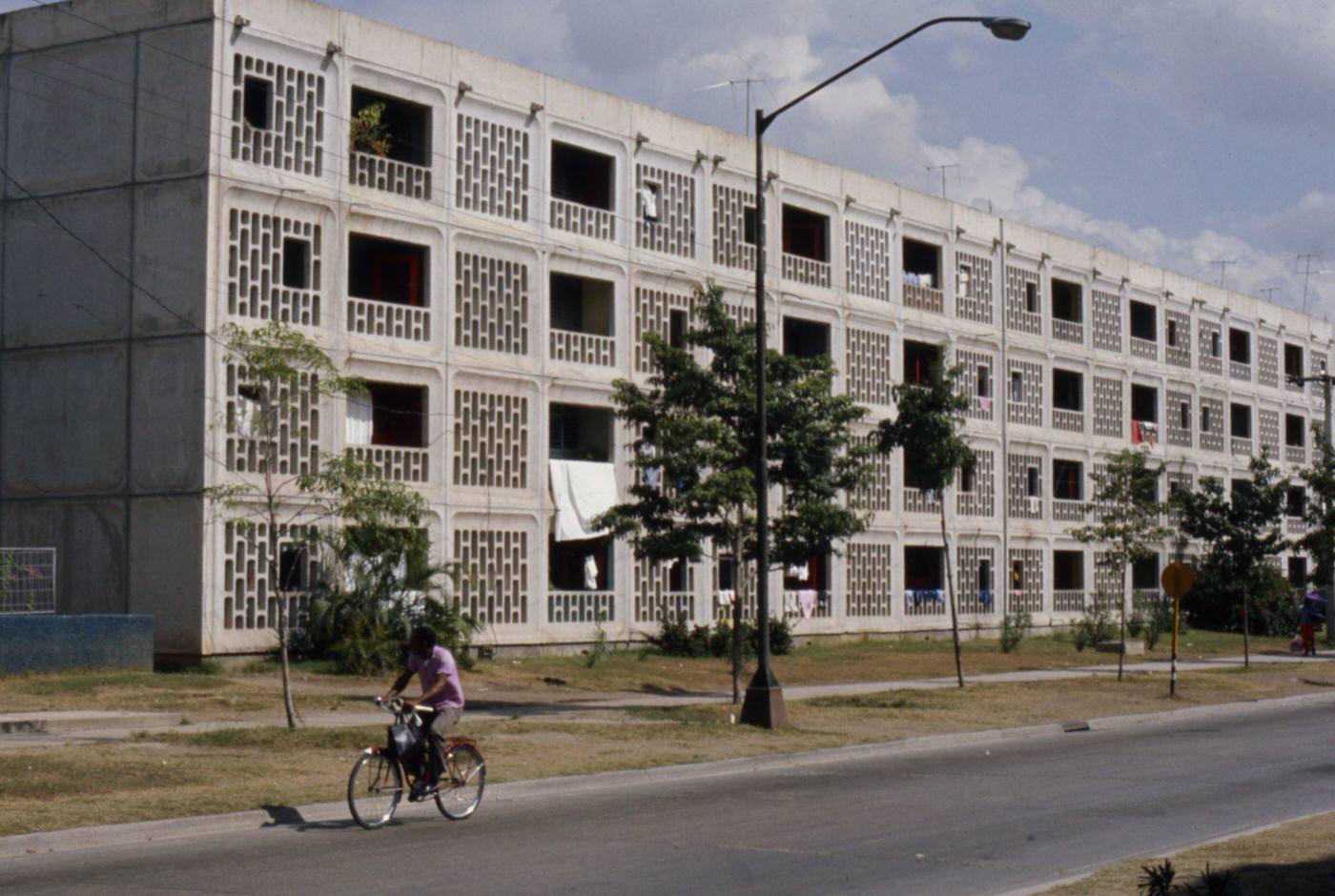
New housing was going up across Havana. The suburb of Alamar, built on land that had belonged to wealthy families who left after the revolution, became one of the largest residential construction projects in Cuba’s history. The José Martí housing project was another example of the state’s push to address the severe shortage of urban housing. Slums still sat within sight of these new developments, visible proof of the gap between policy and reality.
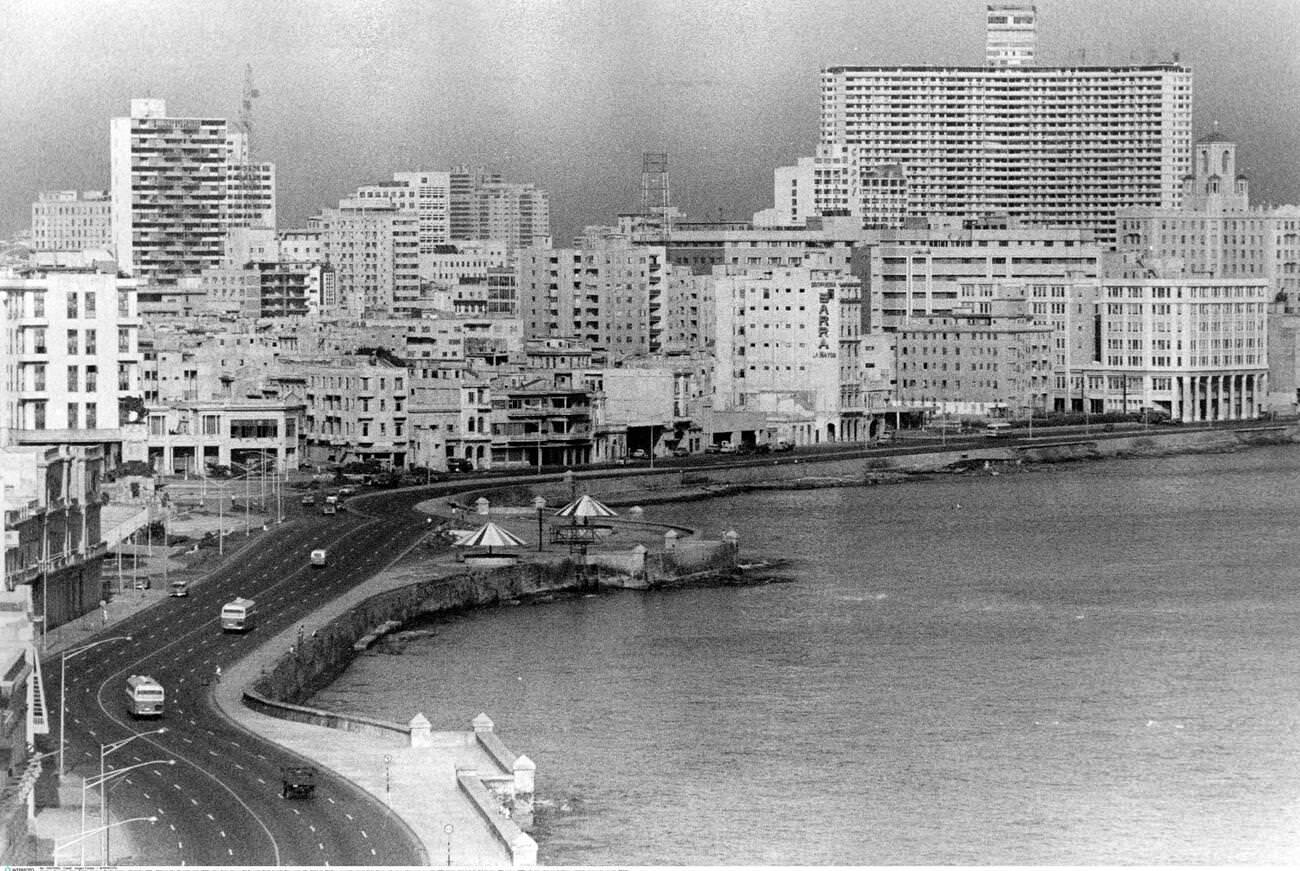
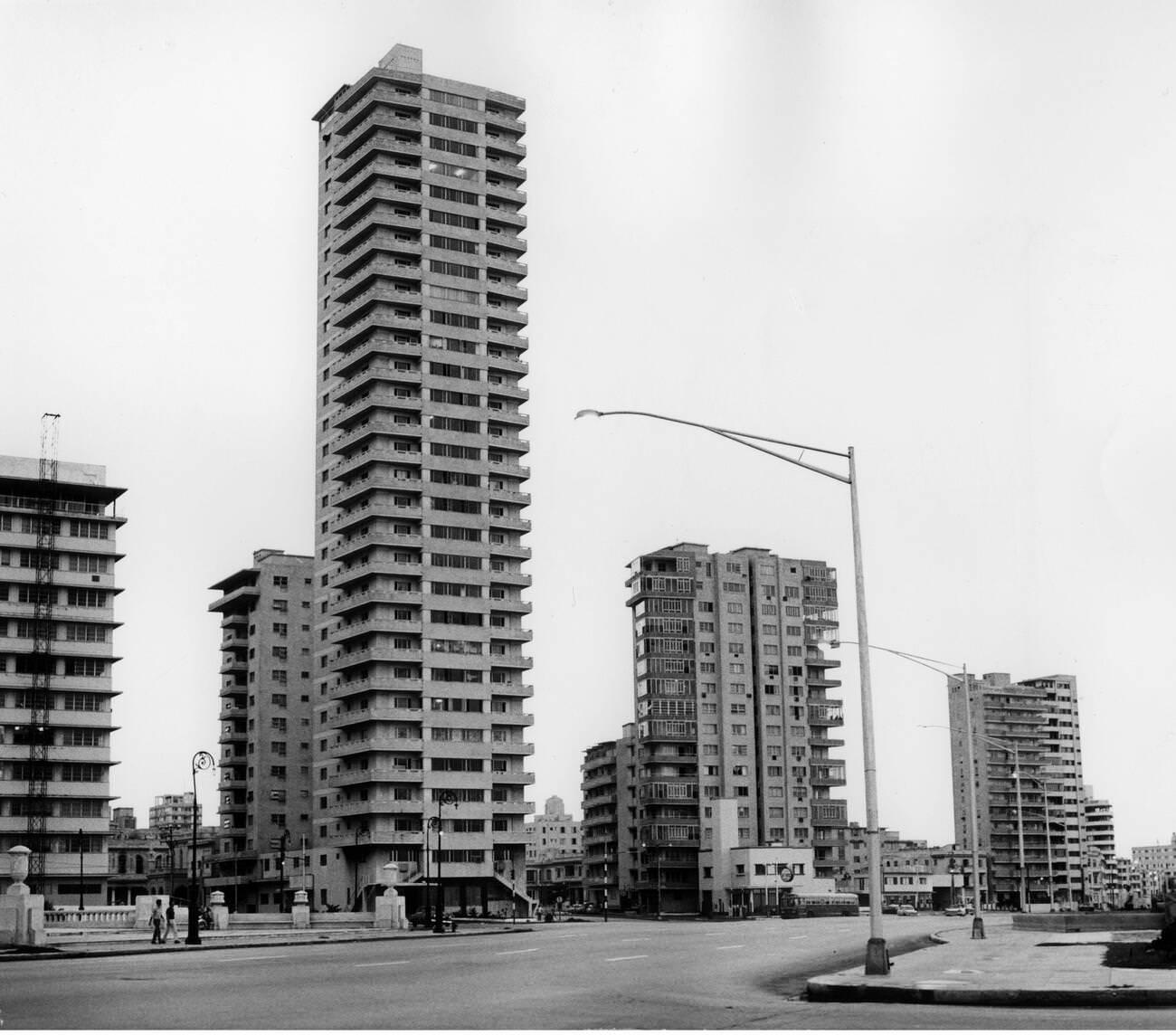
José Martí housing project, featured in ‘Closeup: Cuba – The Castro Generation’, Havana, Cuba, 1977.Varadero Beach, Varadero, Cuba, 1979.Car repair on the streets of Havana, Cuba, 1979.Cuban military vehicles on the streets of Havana, Cuba, 1979.Neo-baroque Gran Teatro, Havana, Cuba, December 1979.Havana Waterfront scenery, popular among Canadian tourists, Havana, Cuba, 1978.Military parade at Plaza De La Revolucion, featured in ‘Closeup: Cuba – The Castro Generation’, Havana, Cuba, 1977.
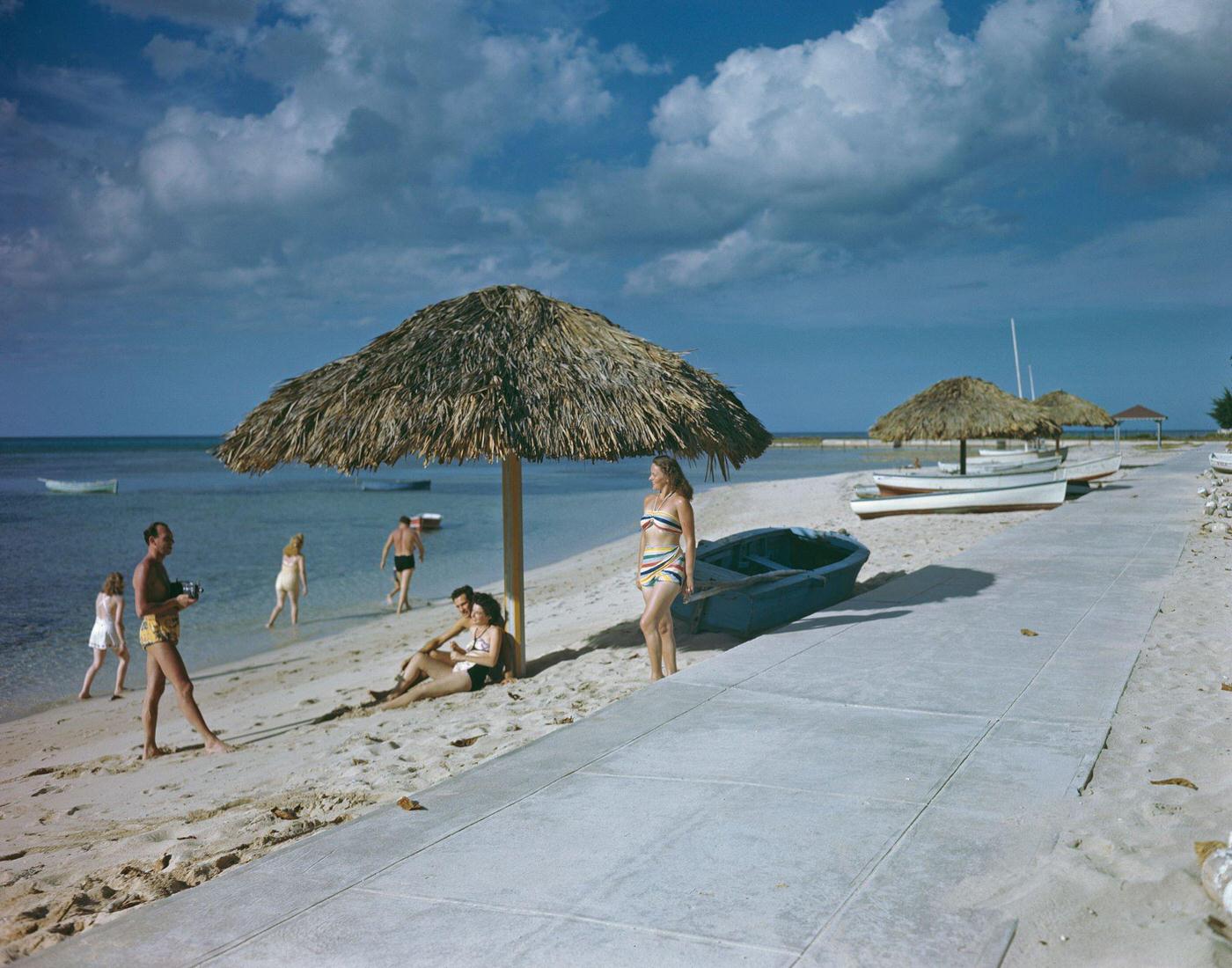
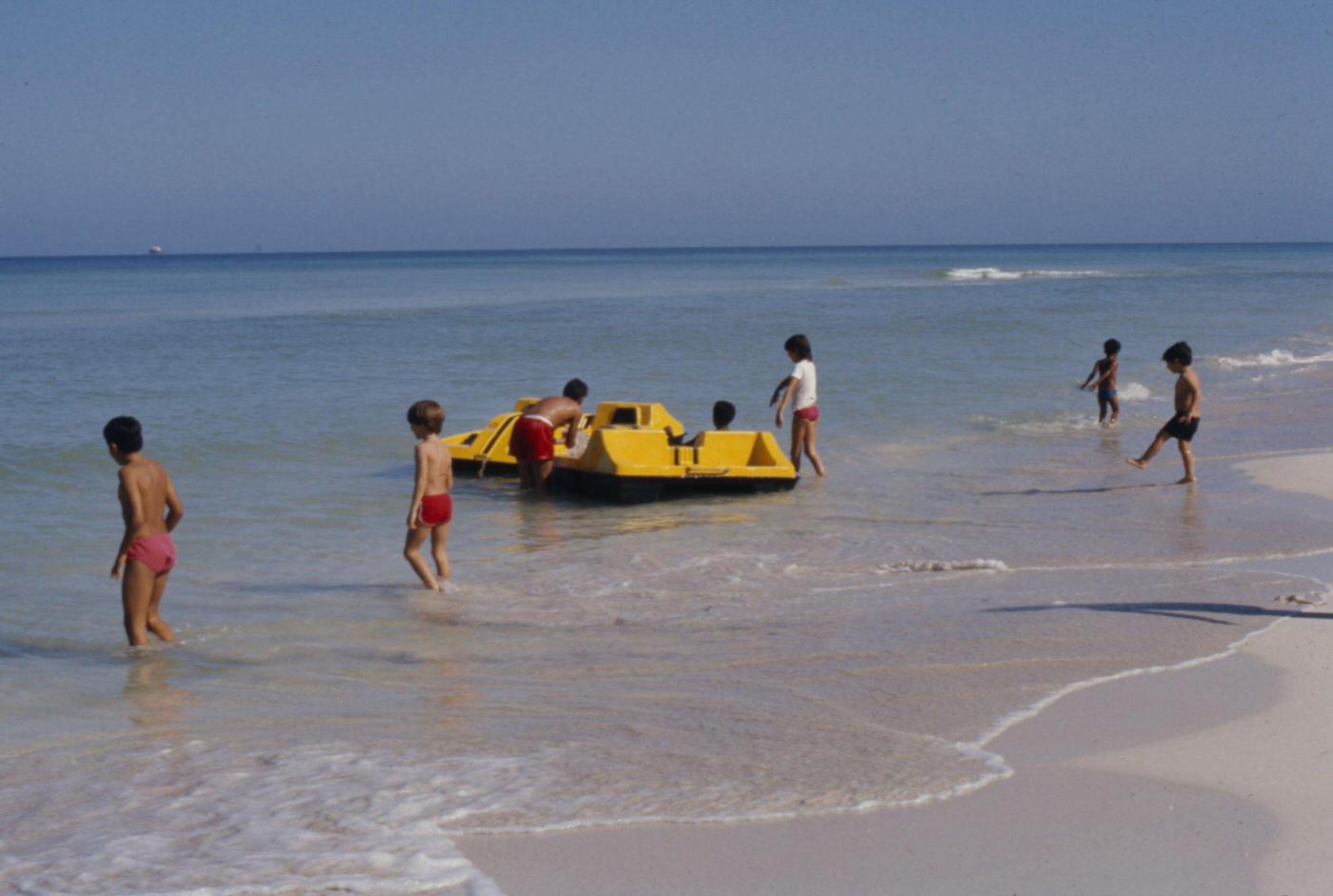
Sports gave Cubans some of their brightest moments on the world stage. At the 1976 Montreal Olympics, boxer Teófilo Stevenson won gold in the heavyweight division, and sprinter Alberto Juantorena took gold in both the 400m and 800m — a feat no man had ever achieved before. These victories were celebrated loudly by the state and embraced just as enthusiastically by ordinary Cubans. Varadero’s white-sand beaches, meanwhile, offered a contrast to the political drama — families and tourists alike enjoying the water’s edge.
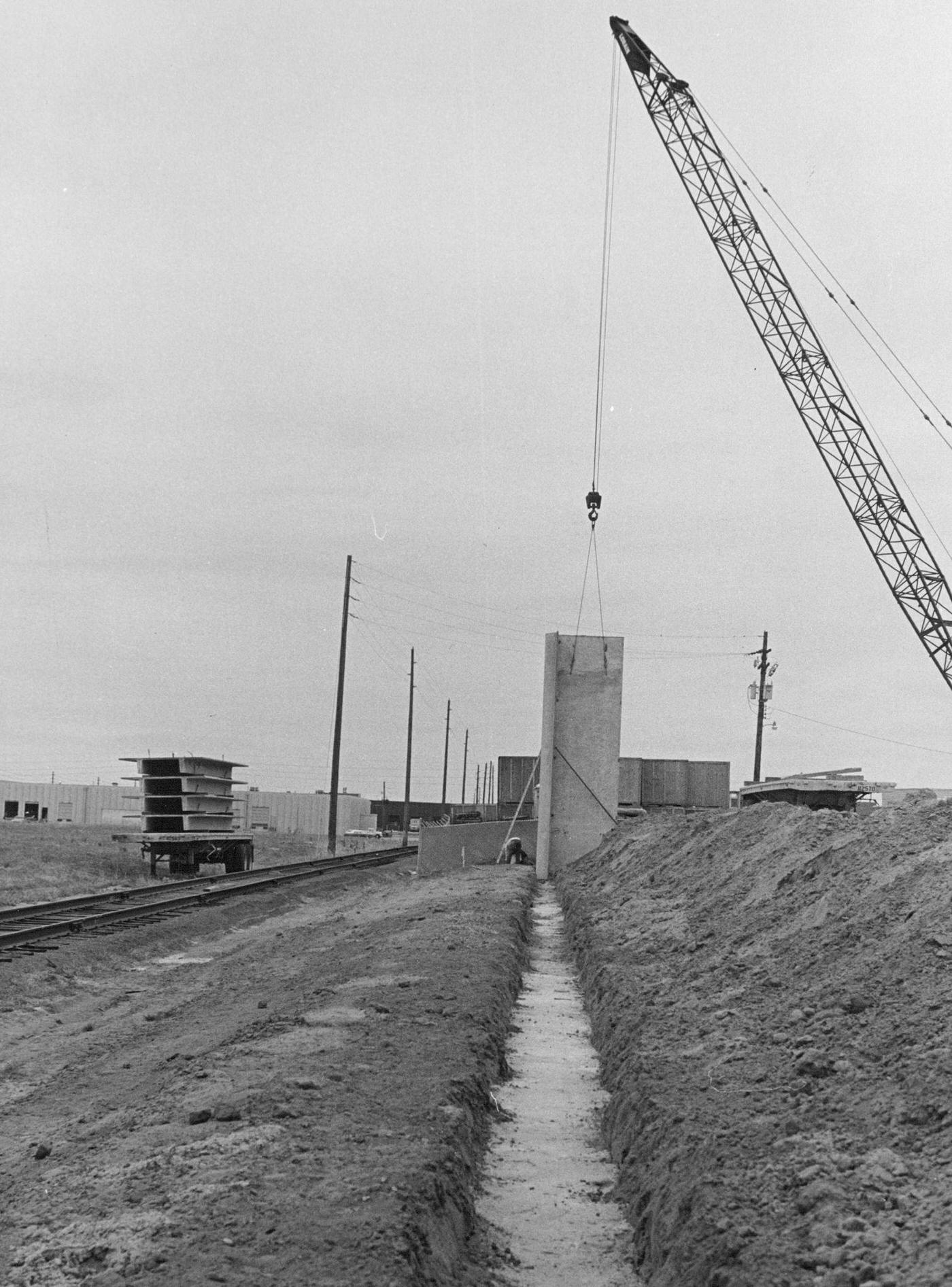
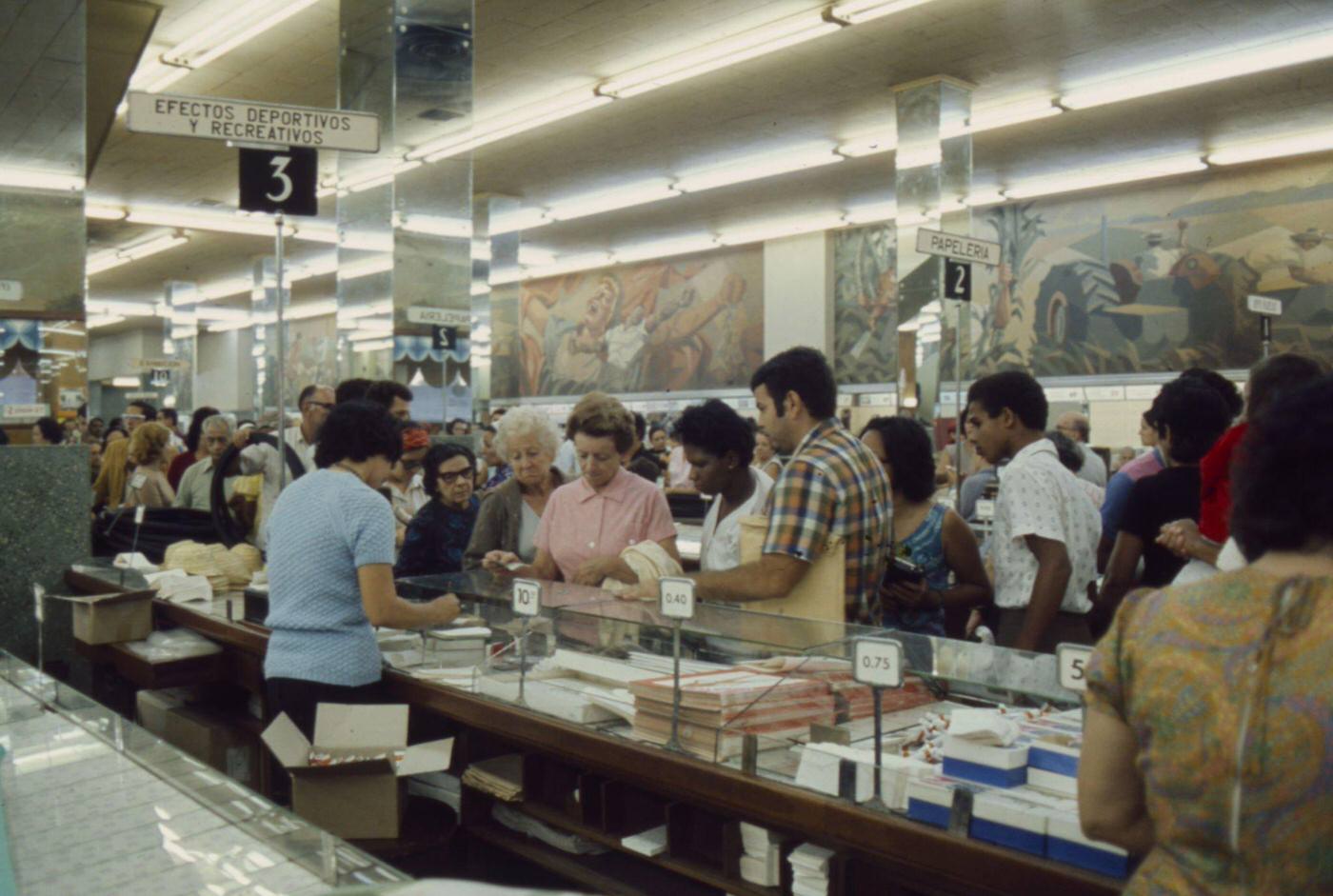
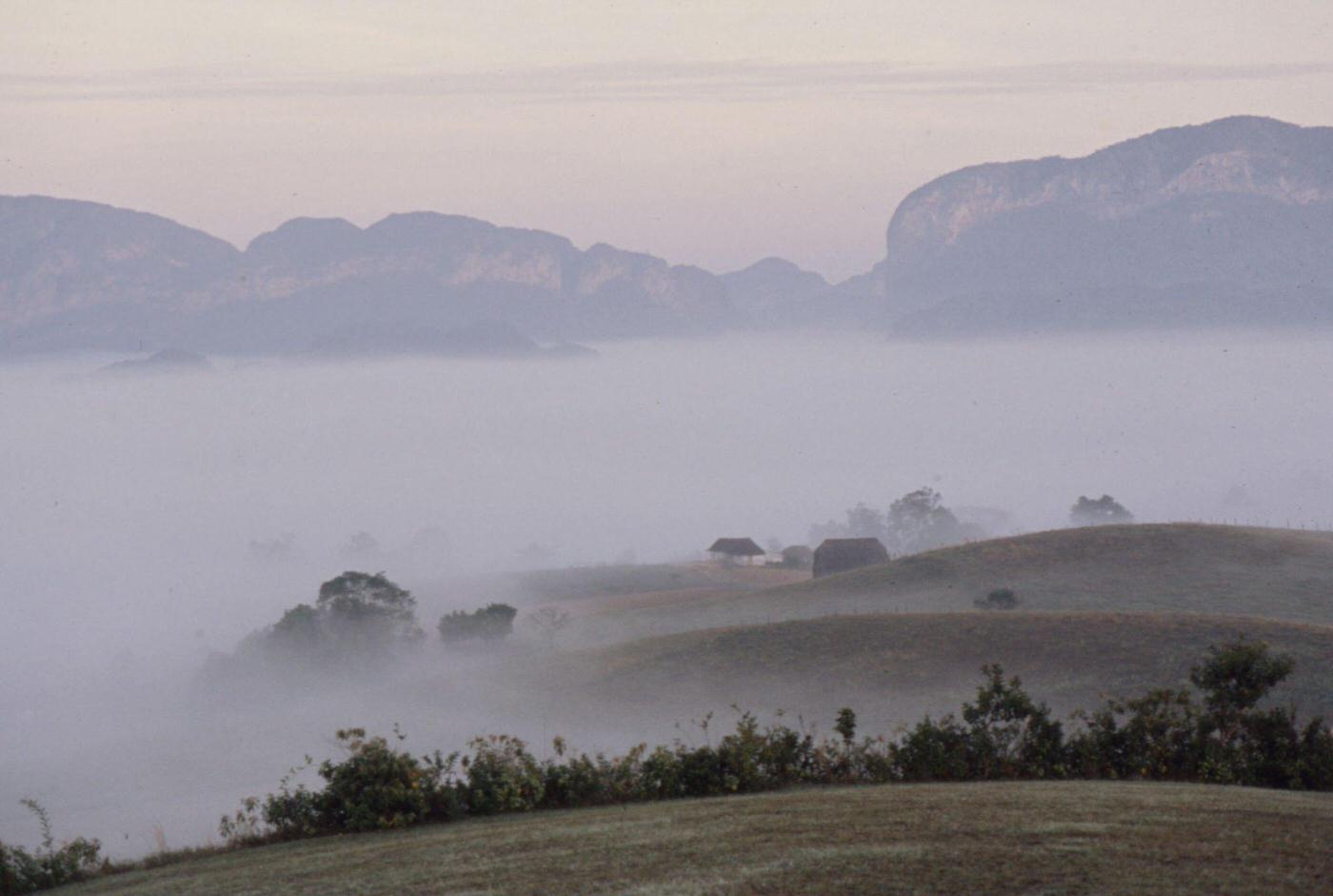
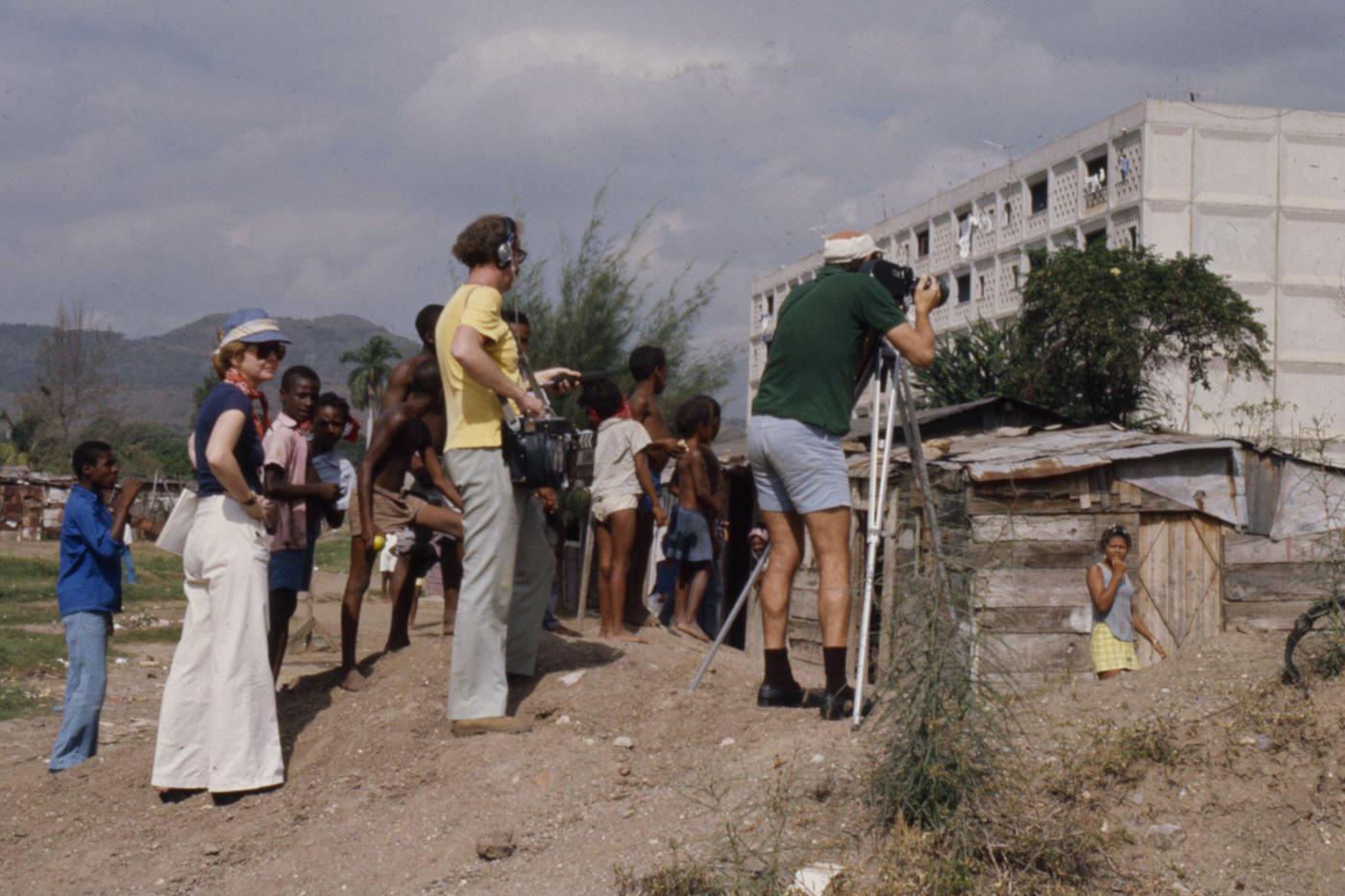
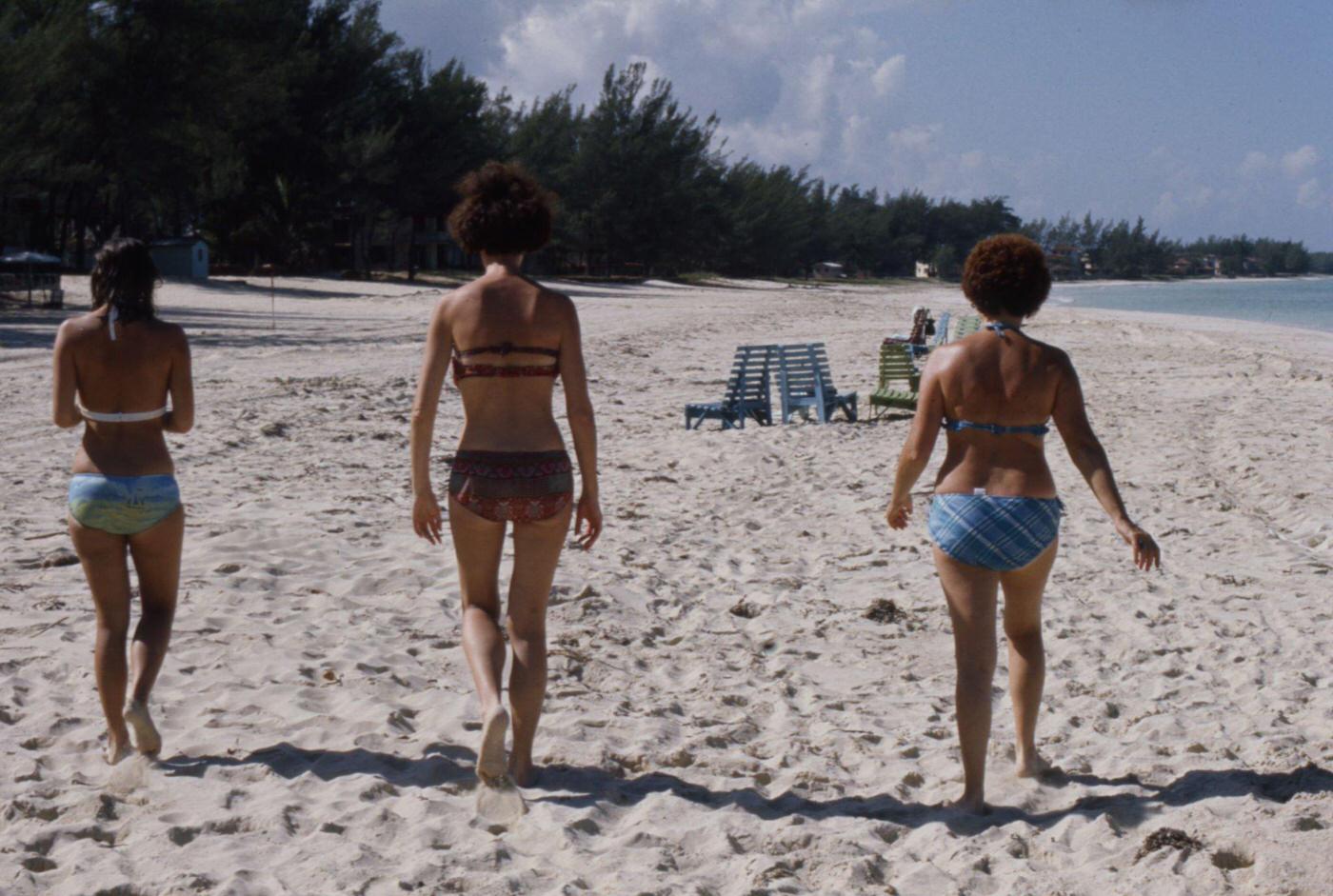
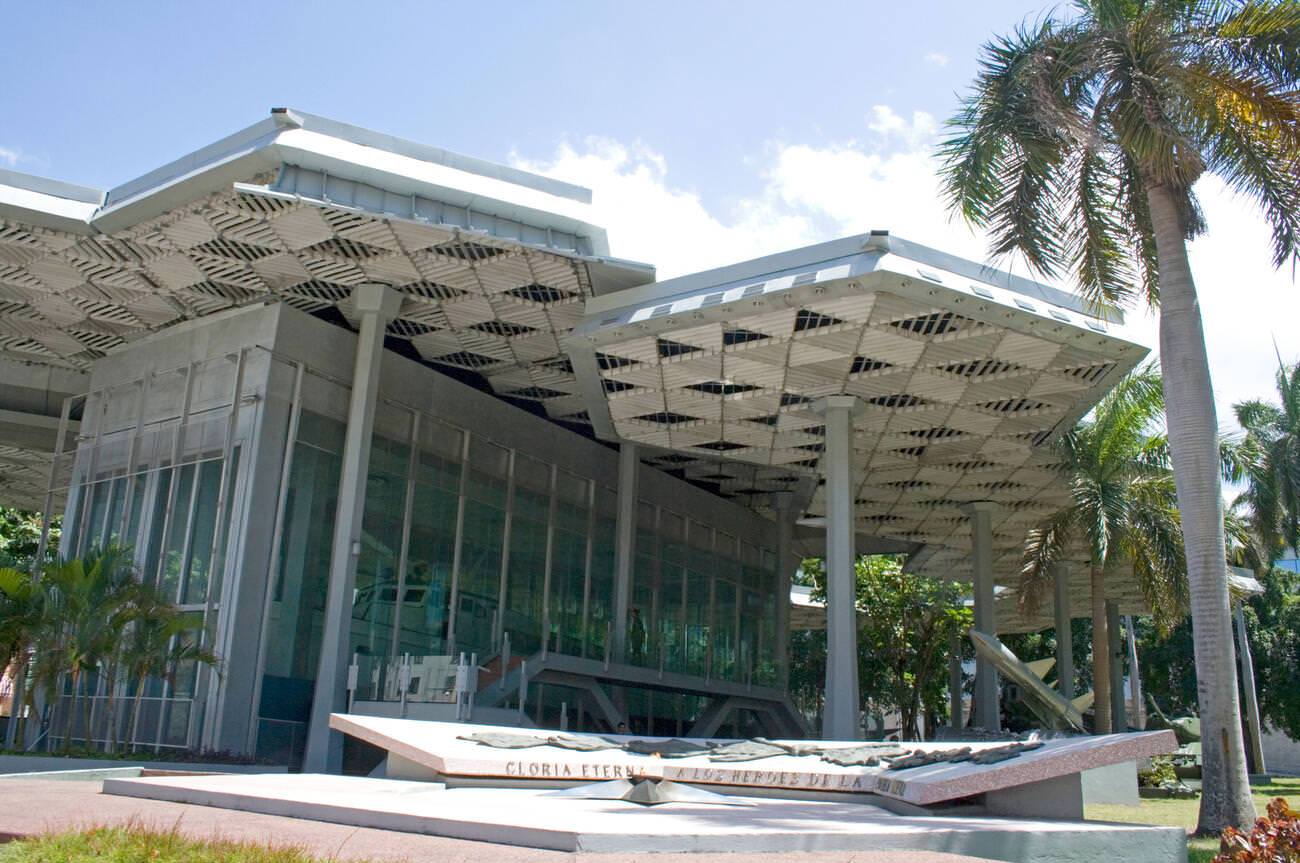
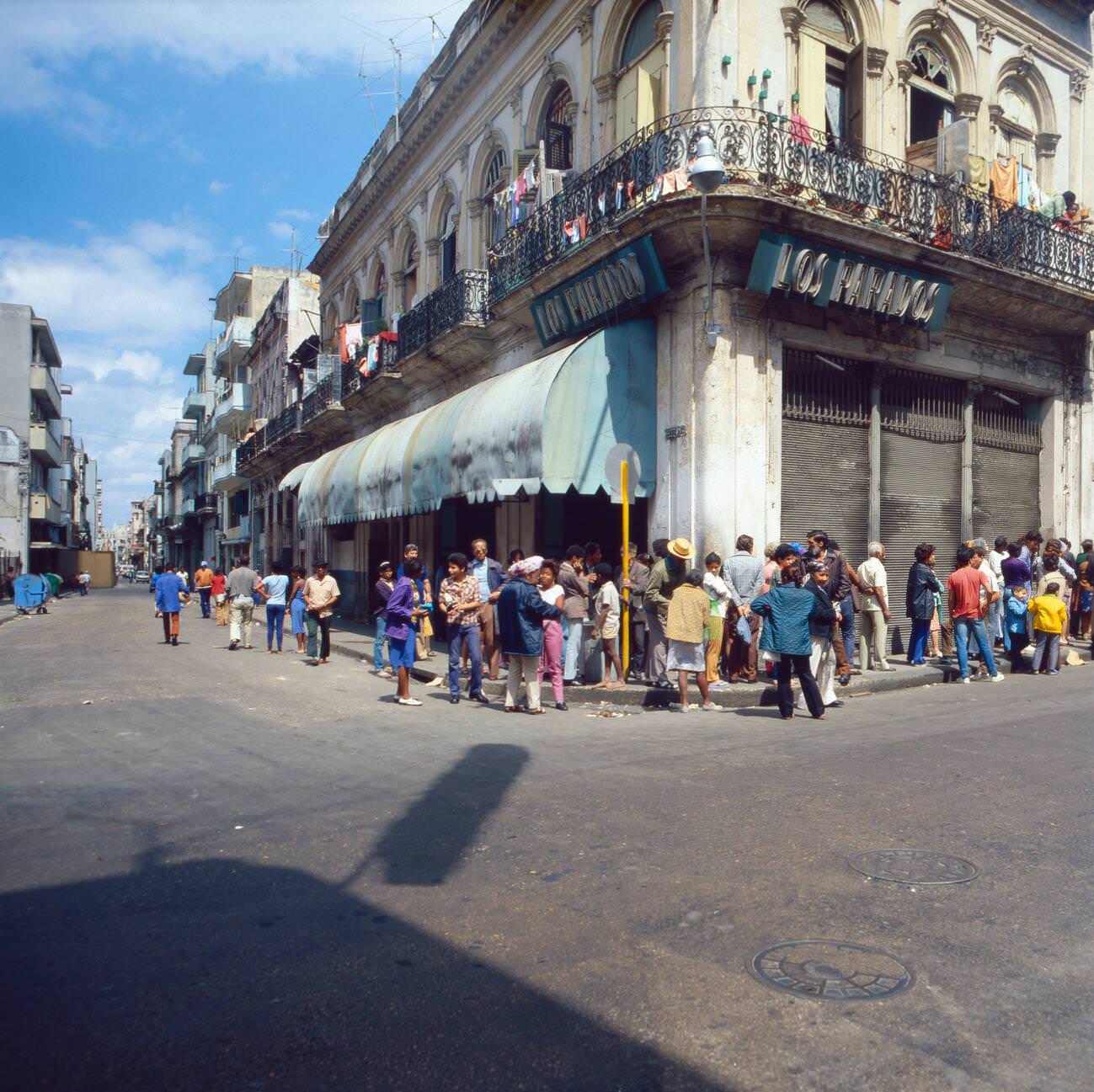
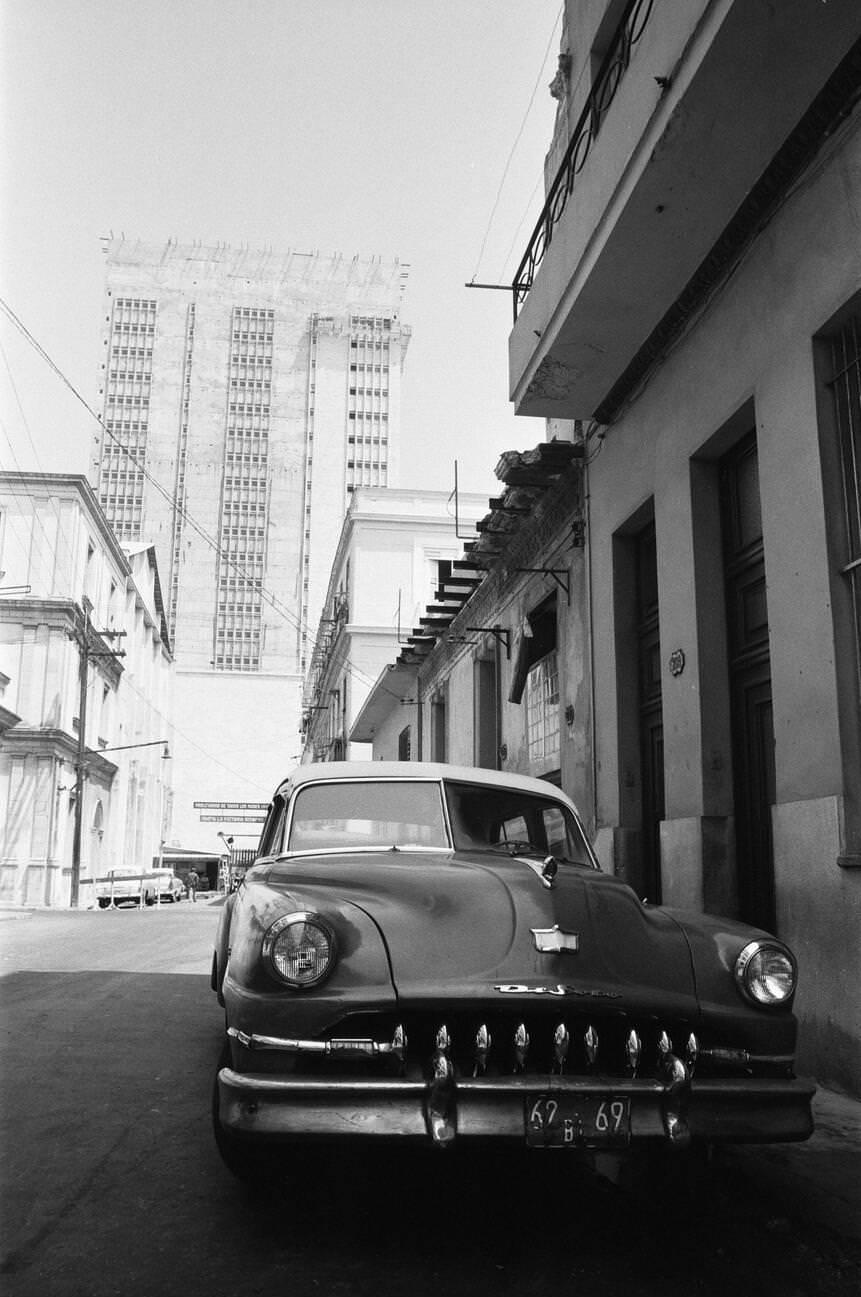
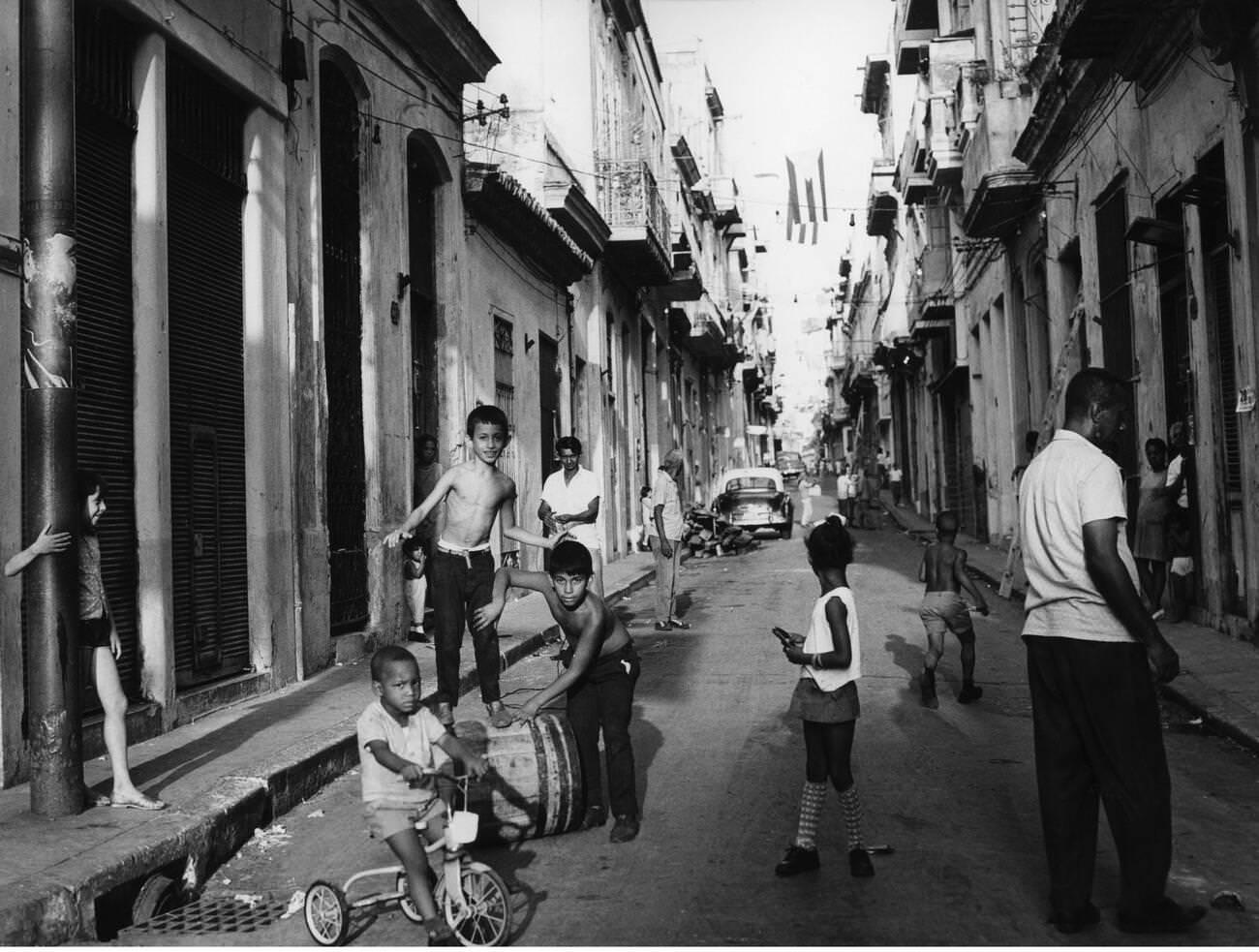
Kids with paddle boat on Varadero Beach, featured in ‘Closeup: Cuba – The Castro Generation’, Havana, Cuba, 1977.Montbelio’s Growth Necessitatis Construction at 45th and Havana, October-November 1972.Farmer plowing with oxen in the Vinales Valley, featured in ‘Closeup: Cuba – The Castro Generation’, Cuba, 1977.Galiano department store, featured in ‘Closeup: Cuba – The Castro Generation’, Havana, Cuba, 1977.Foggy dawn in the Vinales Valley, featured in ‘Closeup: Cuba – The Castro Generation’, Cuba, 1977.Camera crew at José Martí housing project, slums in the foreground, featured in ‘Closeup: Cuba – The Castro Generation’, Havana, Cuba, 1977.Women on Varadero Beach, featured in ‘Closeup: Cuba – The Castro Generation’, Havana, Cuba, 1977.Hotel Nacional de Cuba, popular with American tourists, headquarters during Cuban missile crisis, Havana, Cuba, May 1978.Pavillon Granma, Museo de la Revolucion, Havana, CubaCuba,Havana, suburb Alamar was newly built in the 1970’s.The land was owned by maybe 20 rich families that left the country in 1958 after the revolutinClassic American cars on the streets of Havana , Cuba 21st May 1978Eine Reise nach Havanna, Kuba, Karibik 1970er Jahre. A trip to Havanna, Cuba, Caribean 1970s.A classic American De Soto car seen here in the back streets of Havana, Cuba 21st May 1978Cityscapes, quayside, 1972, Additional-Rights-Clearences-Not AvailableStreet scene with playing children in the Old Town of Havana, August 1971,View of the district Vedado with the ice cream palace in the foreground, August 1971,Cuba, Havana, buildings, modern residential houses, Malecon, August 1971,
Kevin Clark is a historian and writer who is passionate about sharing the stories and significance behind historical photos. He loves to explore hidden histories and cultural contexts behind the images, providing a unique insight into the past.
Soviet investment in Cuba was about 11 million dollars a day. 25 percent of domestic income at the time. And what does Cuba have to show? A bunch of rotting fields and factories? A bunch of amputees, veterans of wars in Africa? They would have squandered and stolen any economic gains made by dropping the embargo. Que se jodan!
1970 was the year when every kid had to march before entering their classroom saying:
“Pin-Pon-Pan Los 10 millones van”
1970 was also the year when small businesses owners after being expropriated, were sent as slaves (literally) to work cortando caña, away from their families.
Back they still had the billions they stole from the Cuban middle class, plus were subsidized by the Soviets in exchange for being their putas in the Caribbean. But even then there was scarcity, the state controlled media just used to hide it better.
So if American issues are related to the government, how it gets away with it? Corruption? That is capitalism, a bunch of dudes making sure they amass wealth to the point where is breaking anyone else in the process. They use their money to bend the rules and own the means of production. THAT is capitalism, there is no distinction.
Capitalism works when the government has the means to tax and limit rich ppl power and influence while distributing the wealth to the majority. The rich can be rich but not filthy rich. Think Norway. The same applies to socialism. Think China.
In Cuba’s case the blockade is a political pawn for Miami cuban diaspora. Look how they vote every time republican because they fear socialism and they always get screwed. The blockade is not needed for a regime change. It has not worked in years
Yes, if the wealth is too imbalanced then it leads to the same outcome: poverty for everyone. Doesn’t matter if the wealth is held by the government (socialism) or individual citizens/corporations (capitalism).
You mean to tell me that when Cuba had a way to get around the blockade , life in Cuba was not as bad as is now? As opposed to anyone claiming that the blockade is not a big part of the economic crisis in Cuba?
So why wasn’t the government fucking them back in the 70’s (as per these pictures)? What could have possibly changed? Maybe access to other markets globally, regular international trading and banking options. So is the government or the limitations, you have to pick a lane.
If it’s meant to fail why does the Us invests so much time, money and energy in making it fall? Coups, blockades, etc.
Let me ask you, isn’t capitalism failing right now? 1% of the population holding 99% of the wealth? Can we compare the US at the same time in the 70’s Vs now? How is it better? How is not rotten to the core with corporations writing policy while 80% of Americans cannot save enough money to face and extra expense of 700$ . Education? Down the drain, life expectancy? Higher o closer to Cuba. Please explain that
The Cuban diaspora is causing the harm to the regime beyond the blockade. Non Cubans never think of Cuba nor care. The blockade exists because Cuba refuses to drop communism. Same agreement since it was put in place.
America’s problems have nothing to do with capitalism. It’s caused by an extremely corrupt federal government that is quite literally occupied by Israel and global corporations.
If the government does its job correctly, capitalism and socialism work just fine. History has shown us that capitalistic markets work better on average.
Blockade doesn’t exist. Cuba has nothing to sell and make money as a country. They relied on the USSR and once it failed. Cuba was done. They can trade with Mexico and Europe, china and Russia.
You saying the only reason why they are a failed country is bc of the USA. Don’t give us all the credit.
Not true. The pictures show a different reality, back in 1970 Cuba had a fairly good economy based of their agriculture. The only thing you said correctly is: once the URRS was gone, their whole commerce base was lost and then the blockade caused huge damage but before that it was perfect fine.
Fine enough to keep the US sending airplanes with viruses to kill all livestock and crops during the years after 1959 and even in the 1980’s.
You can claim that the government is useless and that is fine but do you realize that the US is doing worst than we were in 1970? Why is that? Why is that under the most capitalist (and arguably richest) country in the world, the vast majority of the population is doing worst than in 1970? No house ownership, everyone is in debt, HC and collage are impossible to access for a lot of people unless they die paying loans? Why is this system crumbling and how are you here claiming of a failed cuban system that has been for years blocked from the world’s economy as if capitalism wasn’t failing on its own without any help?
Cuba was working in that moment bc the properties they stole from the previous owners were still functioning and in relatively good conditions, but, since the communist model is not sustainable in the long term, everything starts to rot, and given a couple of decades nothing works. That’s like saying you can live without working just bc you’ve been two days without a job. Two days after losing your job you could still have some savings, but eventually you’re gonna run out of money if you don’t make some more, the same happened in Cuba
So according to you after the revolution won and nationalized farms in 1959…,20 yrs later those same farms were giving the same results as before?? How? Who managed that? How in the world after 20 YEARS you think a farm will produce anything without proper management?
If you are in the US, you must think we are now in the Biden’s economy and not in the circus caused by 5 months of terrible leadership at the white house. Good lord!
First of all, I’m gonna need numbers backing up those claims. Second, if, as you say, they were giving the same results that means a regression, since the population increased in number and the technology advanced. Other thing, you’re kinda forgetting the Soviet Union were buying our sugar at a even higher price compared to international markets and we were basically existing bc we were “chupando de la teta de los rusos”, we incurred in a lot of debt with them that we never really paid, and not gonna do it since we don’t have anything to pay with. You have to take into account also that people were basically forced to go to the countryside and work in farms and stuff so the goverment could achieve those numbers, but analyzing only that metric you won’t get the full picture, it’s like only checking my kids teeth to know if I as a father I’m good a parenting, I could easily just funnel all my money to their dental health and not take care of their education, clothes, abusing them and stuff, and still be considered a good parent since my kid’s teeth are fine. When the goverment did that it had to hoard the resources from other parts of the economy and concentrate them in that specific one, that’s why “La zafra de los 10 millones” was considered a failure, bc even if they achieved a 8.5 million, they couldn’t get the expected result and numerous disasters on other parts of the economy emerged since people that didn’ have to be on farms were there neglecting other services they were best at taking care of. About the Biden and whatnot, I’m living in Cuba, and I’m against Trump, I dunno what the hell a thing as to do with the other, I try to be very consistent, and that includes any wannabe dictator, unlike you
La Zafra de los 10 millones fell short and it affected other areas and needed people from other jobs to support that goal. That is all true.
But as you said, is not just about one thing.It’s also true that during the ’70s, Cuba made real progress in areas like healthcare and education. Infant mortality dropped, life expectancy went up, and almost everyone had access to free schooling. Those things made a difference in people’s lives, even if the economy overall was struggling.
So yeah, the government did move resources into those areas, sometimes at the expense of others but still people in Cuba were not as bad as today. So yes, the blockade had even more impact causing economic damage than just the fall of the URRS, having access to other economies could have helped keeping agriculture and other activities afloat specially tourism producing more income and jobs for a lot of cubans.
We have access to other economies, especially to the Chinese, tourism was indeed affected by the embargo, since US citizens are the most generous tourists you could think of, in that regard, yes, the embargo affected us. But now, Fidel dismantled a lot of sugar mills just because, he thought we could forever live from the free stuff the Soviet Union was providing us and he started to neglect basically everything in our economy, including sugar cane production, once the basically one country that was keeping us alive fell, we fell with it, we never really diversified our industry, we rely solely on the Soviet Union to give us everything, the waste of money was so uncontrolled that we even bought snowplows from them, SNOWPLOWS, in a tropical country where the most the temperature can drop is like 5 Celsius degree in a specific zone in Matanzas. And yes, it’s easy to give everything free when a huge country the size of Australia give you resources “a precio de cochino enfermo”, lends you money, that you don’t plan to return and so on. But we could focus on current policies to “incentivize production on the countryside”:
1- You can only sell a minimum part of your production to private companies (very small ones, btw), the rest you have to sell it to the goverment at less than 1/5 of its actual price
2- The government doesn’t pay you or pay you whenever they want to, with months, even years of delay
3- You can’t sue them, cuz this is a dictatorship so they can basically rob you all they want and if you try to sell whatever you make to private companies, you can go to jail
4- You can’t defend your crops or animals from intruders and thieves since you can’t possess firearms, you can’t even use a knife bc then the one who is gonna go to jail is you, not the thief
5- You can’t eat your own animals, for example, if you have a cow, you can’t kill it to eat it or to sell it, since all cows belong to the goverment
6- If a thief steals your cow, you’re the one paying for it to the goverment, even if the cow was yours to begin with
7- If you try to rent a piece of land to farm you’re gonna face a Dark Souls III level monster of bureaucracy and obstacles to do it
8- Police won’t do sh*t if you are victim of a robbery
9- You have to buy everything you need from abroad through state owned importing companies, which have very abusive fees: you could easily avoid this allowing privates to import directly, but then Raúl Castro’s grandchildren would lose their monopolistic businesses
10- They force the whole country to go through a banking system that completely relies on telecommunications to work, things that usually don’t even work in cities, let alone in the countryside where they don’t tend to have strong signal and along with the continuous outages makes impossible for farmes to pay to their workers
None of those stuff are related to the embargo at all, you can easily fix them if you wanted to. Maybe I couldn’t say the same about tourism since US citizens can’t come so easily to Cuba as they do to other countries (they still do since I have friends that are tour guides and they have a ton of US citizens as clients here), but they don’t do sh*t, since allowing people to thrive is a threat to them, they need to control everything, they prefer people dying than to lose control. Can you enlight me as why these things can’t be solved due to the infamous “blockade”?
Vibrancy for who? Because… People kept their head down because of censorship, surveillance, and punishments.
Political organizing were banned, criticism of the system was prosecuted as “counterrevolutionary.”
CDRs on almost every block as neighborhood surveillance monitoring political loyalty, reporting dissent, and social pressure against “diversionism” or ideological deviance.
Revolutionary tribunals and political courts imprisoned thousands for being “counterrevolutionary”.
Heavy censorship of writers, artists, and intellectuals.
Artists deemed ideologically suspect were banned from publishing, exhibiting, or traveling or reassigned to low‑status manual or clerical work as punishment.
Cubans were forbidden to listen to or play jazz even while the state used it to entertain foreign guests.
Forced labor for being “politically deficient”, an arbitrary accusation, ex: if somebody in the state targeted your residence as desirable to them and wanted you & yours out. Just make up a lie that you spoke against the revolution.
Forced labor for being gay, a religious believer, Catholics, Jehovah’s Witnesses, some Protestants and practitioners of Afro‑Cuban religions, harassment, discrimination to all.
State sanctioned attacks on gay men and gender‑nonconforming people demonized in state speeches, barred from certain professions, and subject to social and workplace persecution.
Racial inequality while there was official lip service rhetoric of unity. Specifically targeted were practicioners of Santeria and Palo
Ration books regulated food and basic staples.
Small private enterprises, and private commerce treated as criminal activity.
Civic groups banned. Your group had to align with state goals.
The irony in your post is that much of that is pervasive in the U.S. and even Canada today. Gender discrimination? Yes. Religious hate and Cultural discrimination? Oh geez, it’s huge up here. Forced labour? We have our own issues with cost of living and no living wages so poverty is rampant and people stand in line at Food Banks waiting for anything to eat. Youth unemployment and disenchantment is right up there as dreams of owning anything are far fetched. Homelessness and slums (we like to deflect that term and call them Tent encampments up in these parts though), drug use and organized crime, extortion? We are run over. Taxation that will break your back when you work all week and after expenses you bring home far less than general revenue.
Look, I get it, problems. Problems everywhere. It’s fascinating you want help from others who can’t even fix their own homes thinking they can fix yours.
In the end, those you think will save you will just flip the tables and the same system where the rich get richer on the backs of the poor continues. Instead of making a mojito for less, the same person will flip burgers at a McDonald’s for a wage that can’t keep up.
Political repression? We got that too, it’s just handled differently. In Canada we had a group protesting the government, they ended up freezing their bank accounts and those that donated to them, and prosecuted the people that led the effort. So much for freedom of speech and general protest. I’m the U.S.ook.up I.C.E. and Minnesota etc.
Freedom of elections? Our elected mean nothing when the government can sway the elected officials to cross the floor and switch parties basically stealing your vote. Oops…
Irony…
Anyways, that’s the failure of capitalism and trickle down economics ++++ Caveat Emptor.
leftist here! when i was living in Cuba all i could think about was how familiar the economic inequality, racism, police brutality, etc. was. (but comparing the forced labor in Cuba to cost of living issues and shit wages in Canada is laughable.)
but here’s the thing: imagine if you lived under a government that claimed to be solving all these things, while being an active participant in maintaining or even worsening some of these things, and you’re not allowed to say anything about it. you can’t organize, you can’t have unauthorized journalism, you can’t create studies, if you are caught saying things you’ll be dragged in for citations and threatened, even if you’ve supported the CCP previously.
It’s easy to compare apples to apples and remove the debate based on who is more tired except when you realize it’s based on perspectives. The guy living in a tent encampment (slum) in Canada being forcibly kicked out and evicted by police can have a different tune of words. It easy to say no, it’s still better here depending on your life of privilege but many in Canada are struggling daily living paycheck to paycheck.
Yes the political clout about freedom of speech is there, but if they are opening up reforms then why dwell on the negative instead of nurturing a more pragmatic approach towards betterment for all Cubans.
What’s the other option? Another war? Permanent blockade and sanctions?
you’ve just said exactly the point… it’s about perspectives. the Cuban living in Cuba or exiled from their home forever is the one who has the perspective on what it’s like, and are the people who should be most at the forefront of discussions about their own country. so why not let them? you were the one who made it about comparisons when a Cuban was simply listing out the repressions felt in their own country.
Cubans are not a monolith, but economic reforms mean nothing to the Cuban that 1) has died, been imprisoned, been exiled, or wakes up every day hoping for political democracy, 2) is currently imprisoned as a political prisoner, 3) is currently exiled and still can’t come home, 4) is being threatened by imprisonment right now as we hang out on Reddit, 5) has seen the Cuban government make reforms before (literally in 90s, 00s, and the 10s) and then go back on them, and 6) knows that these reforms will most benefit the Cuban 1% and their military.
want a thorough analysis of the different options there are? read Cuban sources: https://www.cubaxcuba.com
You’re absolutely right that Cubans are not a monolith, and the perspectives of those who have faced exile, imprisonment, or repression absolutely belong at the forefront. I’m not trying to minimize that or pretend that economic reforms automatically erase political trauma. But the core of the issue is:
where do we go from here?
Pointing out that the state has walked back reforms in the 90s, 00s, and 10s is a fair historical critique. But if we dismiss every potential reform as a hollow gesture that only benefits the 1% or the military, we trap the discussion in absolute stasis. If internal incremental reform is entirely impossible, then what is the alternative path to bettering daily life for the people on the ground right now? Total economic collapse? External intervention? A continuation of a permanent embargo that history shows hurts the population far more than the ruling elite? Engaging with pragmatic economic openings—even with a deeply flawed government—isn’t about ignoring the political prisoners or the lack of democracy. It’s about recognizing that for the average Cuban trying to survive today, a flawed economic opening that provides material relief is a more immediate life raft than waiting for a perfect political revolution that may not come tomorrow.
This was back when USSR was still supporting the economy well and life back then was okay. People still believed in revolution. Life was alright. Compared to now… many probably wish they could go back to this era.
I left in 1971 and life was not easy then, very regimented, few things to buy and many people relied on black market food, which was a crime, but people did it. Things improved after I left, they told me, particularly during the 1980s, when there was more abundance, more items of all types available and salaries were enough to meet people’s needs. Soviet subsidies played a big part, but I did not live there during that time nor did I visit. However, I had a neighbor who visited Cuba at the time and reported things had “changed a lot” compared to the time when she left, back in the 1970s. Medical care was good, hospitals were built in the interior of the country, electricity was taken to places where there was none before 1959, life expectancy improved to levels compared to that of developed countries, infant mortality was drastically reduced and Cubans had access to universities and other educational facilities. Cuba became the country with the most doctors per capita in the world, plus many other Cubans chose other professions. Many Cubans at that time went to the Eastern Bloc countries to study.
Interesting photos. My great-grandmother, my grandmother’s siblings, and my cousins left in the 70s, mostly towards the middle and end of the decade. In photo #57 the sign makes it sound like going to the countryside and the school were two different things. What they really meant is that in September it’s time to go back to las escuelas de campo, to work in the countryside in order to go to school. The prison in the 61st photo was also used by Fidel, that’s where Huber Matos and Armando Valladares were held.







Soviet investment in Cuba was about 11 million dollars a day. 25 percent of domestic income at the time. And what does Cuba have to show? A bunch of rotting fields and factories? A bunch of amputees, veterans of wars in Africa? They would have squandered and stolen any economic gains made by dropping the embargo. Que se jodan!
Yep … the only time Cuba was doing well was when it was being influenced by foreign powers: the USA during Batista and then the USSR.
1970 was the year when every kid had to march before entering their classroom saying:
“Pin-Pon-Pan Los 10 millones van”
1970 was also the year when small businesses owners after being expropriated, were sent as slaves (literally) to work cortando caña, away from their families.
Correct me if I’m wrong but pic 14 is Santa Clara’s Coppelia
It’s not Havana. I also thought #71 was strange. Popular among Canadian Tourists. ”
Que tristeza
Back they still had the billions they stole from the Cuban middle class, plus were subsidized by the Soviets in exchange for being their putas in the Caribbean. But even then there was scarcity, the state controlled media just used to hide it better.
So if American issues are related to the government, how it gets away with it? Corruption? That is capitalism, a bunch of dudes making sure they amass wealth to the point where is breaking anyone else in the process. They use their money to bend the rules and own the means of production. THAT is capitalism, there is no distinction.
Capitalism works when the government has the means to tax and limit rich ppl power and influence while distributing the wealth to the majority. The rich can be rich but not filthy rich. Think Norway. The same applies to socialism. Think China.
In Cuba’s case the blockade is a political pawn for Miami cuban diaspora. Look how they vote every time republican because they fear socialism and they always get screwed. The blockade is not needed for a regime change. It has not worked in years
Yes, if the wealth is too imbalanced then it leads to the same outcome: poverty for everyone. Doesn’t matter if the wealth is held by the government (socialism) or individual citizens/corporations (capitalism).
You mean to tell me that when Cuba had a way to get around the blockade , life in Cuba was not as bad as is now? As opposed to anyone claiming that the blockade is not a big part of the economic crisis in Cuba?
Why can’t the Cuban gov stop fucking the people without the blockade? The government will steal less from the people if the blockage is lifted?
So why wasn’t the government fucking them back in the 70’s (as per these pictures)? What could have possibly changed? Maybe access to other markets globally, regular international trading and banking options. So is the government or the limitations, you have to pick a lane.
Because communism rots over time. The parasitic government destroys its host eventually.
Please give me an example in human history where that has not happened.
If it’s meant to fail why does the Us invests so much time, money and energy in making it fall? Coups, blockades, etc.
Let me ask you, isn’t capitalism failing right now? 1% of the population holding 99% of the wealth? Can we compare the US at the same time in the 70’s Vs now? How is it better? How is not rotten to the core with corporations writing policy while 80% of Americans cannot save enough money to face and extra expense of 700$ . Education? Down the drain, life expectancy? Higher o closer to Cuba. Please explain that
The Cuban diaspora is causing the harm to the regime beyond the blockade. Non Cubans never think of Cuba nor care. The blockade exists because Cuba refuses to drop communism. Same agreement since it was put in place.
America’s problems have nothing to do with capitalism. It’s caused by an extremely corrupt federal government that is quite literally occupied by Israel and global corporations.
If the government does its job correctly, capitalism and socialism work just fine. History has shown us that capitalistic markets work better on average.
Blockade doesn’t exist. Cuba has nothing to sell and make money as a country. They relied on the USSR and once it failed. Cuba was done. They can trade with Mexico and Europe, china and Russia.
You saying the only reason why they are a failed country is bc of the USA. Don’t give us all the credit.
It’s the stupid government not willing to change.
it would be nice to buy pharmaceutical products from cuba. but gusanos wont let it happen and will tell us that cuba has nothing to offer.
Not true. The pictures show a different reality, back in 1970 Cuba had a fairly good economy based of their agriculture. The only thing you said correctly is: once the URRS was gone, their whole commerce base was lost and then the blockade caused huge damage but before that it was perfect fine.
Fine enough to keep the US sending airplanes with viruses to kill all livestock and crops during the years after 1959 and even in the 1980’s.
You can claim that the government is useless and that is fine but do you realize that the US is doing worst than we were in 1970? Why is that? Why is that under the most capitalist (and arguably richest) country in the world, the vast majority of the population is doing worst than in 1970? No house ownership, everyone is in debt, HC and collage are impossible to access for a lot of people unless they die paying loans? Why is this system crumbling and how are you here claiming of a failed cuban system that has been for years blocked from the world’s economy as if capitalism wasn’t failing on its own without any help?
Cuba was working in that moment bc the properties they stole from the previous owners were still functioning and in relatively good conditions, but, since the communist model is not sustainable in the long term, everything starts to rot, and given a couple of decades nothing works. That’s like saying you can live without working just bc you’ve been two days without a job. Two days after losing your job you could still have some savings, but eventually you’re gonna run out of money if you don’t make some more, the same happened in Cuba
So according to you after the revolution won and nationalized farms in 1959…,20 yrs later those same farms were giving the same results as before?? How? Who managed that? How in the world after 20 YEARS you think a farm will produce anything without proper management?
If you are in the US, you must think we are now in the Biden’s economy and not in the circus caused by 5 months of terrible leadership at the white house. Good lord!
First of all, I’m gonna need numbers backing up those claims. Second, if, as you say, they were giving the same results that means a regression, since the population increased in number and the technology advanced. Other thing, you’re kinda forgetting the Soviet Union were buying our sugar at a even higher price compared to international markets and we were basically existing bc we were “chupando de la teta de los rusos”, we incurred in a lot of debt with them that we never really paid, and not gonna do it since we don’t have anything to pay with. You have to take into account also that people were basically forced to go to the countryside and work in farms and stuff so the goverment could achieve those numbers, but analyzing only that metric you won’t get the full picture, it’s like only checking my kids teeth to know if I as a father I’m good a parenting, I could easily just funnel all my money to their dental health and not take care of their education, clothes, abusing them and stuff, and still be considered a good parent since my kid’s teeth are fine. When the goverment did that it had to hoard the resources from other parts of the economy and concentrate them in that specific one, that’s why “La zafra de los 10 millones” was considered a failure, bc even if they achieved a 8.5 million, they couldn’t get the expected result and numerous disasters on other parts of the economy emerged since people that didn’ have to be on farms were there neglecting other services they were best at taking care of. About the Biden and whatnot, I’m living in Cuba, and I’m against Trump, I dunno what the hell a thing as to do with the other, I try to be very consistent, and that includes any wannabe dictator, unlike you
La Zafra de los 10 millones fell short and it affected other areas and needed people from other jobs to support that goal. That is all true.
But as you said, is not just about one thing.It’s also true that during the ’70s, Cuba made real progress in areas like healthcare and education. Infant mortality dropped, life expectancy went up, and almost everyone had access to free schooling. Those things made a difference in people’s lives, even if the economy overall was struggling.
So yeah, the government did move resources into those areas, sometimes at the expense of others but still people in Cuba were not as bad as today. So yes, the blockade had even more impact causing economic damage than just the fall of the URRS, having access to other economies could have helped keeping agriculture and other activities afloat specially tourism producing more income and jobs for a lot of cubans.
We have access to other economies, especially to the Chinese, tourism was indeed affected by the embargo, since US citizens are the most generous tourists you could think of, in that regard, yes, the embargo affected us. But now, Fidel dismantled a lot of sugar mills just because, he thought we could forever live from the free stuff the Soviet Union was providing us and he started to neglect basically everything in our economy, including sugar cane production, once the basically one country that was keeping us alive fell, we fell with it, we never really diversified our industry, we rely solely on the Soviet Union to give us everything, the waste of money was so uncontrolled that we even bought snowplows from them, SNOWPLOWS, in a tropical country where the most the temperature can drop is like 5 Celsius degree in a specific zone in Matanzas. And yes, it’s easy to give everything free when a huge country the size of Australia give you resources “a precio de cochino enfermo”, lends you money, that you don’t plan to return and so on. But we could focus on current policies to “incentivize production on the countryside”:
1- You can only sell a minimum part of your production to private companies (very small ones, btw), the rest you have to sell it to the goverment at less than 1/5 of its actual price
2- The government doesn’t pay you or pay you whenever they want to, with months, even years of delay
3- You can’t sue them, cuz this is a dictatorship so they can basically rob you all they want and if you try to sell whatever you make to private companies, you can go to jail
4- You can’t defend your crops or animals from intruders and thieves since you can’t possess firearms, you can’t even use a knife bc then the one who is gonna go to jail is you, not the thief
5- You can’t eat your own animals, for example, if you have a cow, you can’t kill it to eat it or to sell it, since all cows belong to the goverment
6- If a thief steals your cow, you’re the one paying for it to the goverment, even if the cow was yours to begin with
7- If you try to rent a piece of land to farm you’re gonna face a Dark Souls III level monster of bureaucracy and obstacles to do it
8- Police won’t do sh*t if you are victim of a robbery
9- You have to buy everything you need from abroad through state owned importing companies, which have very abusive fees: you could easily avoid this allowing privates to import directly, but then Raúl Castro’s grandchildren would lose their monopolistic businesses
10- They force the whole country to go through a banking system that completely relies on telecommunications to work, things that usually don’t even work in cities, let alone in the countryside where they don’t tend to have strong signal and along with the continuous outages makes impossible for farmes to pay to their workers
None of those stuff are related to the embargo at all, you can easily fix them if you wanted to. Maybe I couldn’t say the same about tourism since US citizens can’t come so easily to Cuba as they do to other countries (they still do since I have friends that are tour guides and they have a ton of US citizens as clients here), but they don’t do sh*t, since allowing people to thrive is a threat to them, they need to control everything, they prefer people dying than to lose control. Can you enlight me as why these things can’t be solved due to the infamous “blockade”?
Look at the main source of that so-called progress… Soviet assistance in all its forms.
left in 79. don’t recall the vibrancy.
Vibrancy for who? Because… People kept their head down because of censorship, surveillance, and punishments.
Political organizing were banned, criticism of the system was prosecuted as “counterrevolutionary.”
CDRs on almost every block as neighborhood surveillance monitoring political loyalty, reporting dissent, and social pressure against “diversionism” or ideological deviance.
Revolutionary tribunals and political courts imprisoned thousands for being “counterrevolutionary”.
Heavy censorship of writers, artists, and intellectuals.
Artists deemed ideologically suspect were banned from publishing, exhibiting, or traveling or reassigned to low‑status manual or clerical work as punishment.
Cubans were forbidden to listen to or play jazz even while the state used it to entertain foreign guests.
Forced labor for being “politically deficient”, an arbitrary accusation, ex: if somebody in the state targeted your residence as desirable to them and wanted you & yours out. Just make up a lie that you spoke against the revolution.
Forced labor for being gay, a religious believer, Catholics, Jehovah’s Witnesses, some Protestants and practitioners of Afro‑Cuban religions, harassment, discrimination to all.
State sanctioned attacks on gay men and gender‑nonconforming people demonized in state speeches, barred from certain professions, and subject to social and workplace persecution.
Racial inequality while there was official lip service rhetoric of unity. Specifically targeted were practicioners of Santeria and Palo
Ration books regulated food and basic staples.
Small private enterprises, and private commerce treated as criminal activity.
Civic groups banned. Your group had to align with state goals.
TLDR: Repression felt at the everyday level.
The irony in your post is that much of that is pervasive in the U.S. and even Canada today. Gender discrimination? Yes. Religious hate and Cultural discrimination? Oh geez, it’s huge up here. Forced labour? We have our own issues with cost of living and no living wages so poverty is rampant and people stand in line at Food Banks waiting for anything to eat. Youth unemployment and disenchantment is right up there as dreams of owning anything are far fetched. Homelessness and slums (we like to deflect that term and call them Tent encampments up in these parts though), drug use and organized crime, extortion? We are run over. Taxation that will break your back when you work all week and after expenses you bring home far less than general revenue.
Look, I get it, problems. Problems everywhere. It’s fascinating you want help from others who can’t even fix their own homes thinking they can fix yours.
In the end, those you think will save you will just flip the tables and the same system where the rich get richer on the backs of the poor continues. Instead of making a mojito for less, the same person will flip burgers at a McDonald’s for a wage that can’t keep up.
Political repression? We got that too, it’s just handled differently. In Canada we had a group protesting the government, they ended up freezing their bank accounts and those that donated to them, and prosecuted the people that led the effort. So much for freedom of speech and general protest. I’m the U.S.ook.up I.C.E. and Minnesota etc.
Freedom of elections? Our elected mean nothing when the government can sway the elected officials to cross the floor and switch parties basically stealing your vote. Oops…
Irony…
Anyways, that’s the failure of capitalism and trickle down economics ++++ Caveat Emptor.
leftist here! when i was living in Cuba all i could think about was how familiar the economic inequality, racism, police brutality, etc. was. (but comparing the forced labor in Cuba to cost of living issues and shit wages in Canada is laughable.)
but here’s the thing: imagine if you lived under a government that claimed to be solving all these things, while being an active participant in maintaining or even worsening some of these things, and you’re not allowed to say anything about it. you can’t organize, you can’t have unauthorized journalism, you can’t create studies, if you are caught saying things you’ll be dragged in for citations and threatened, even if you’ve supported the CCP previously.
take a gander reading the Cuban critical left. here’s some essays in English for you: https://newpol.org/issue_post/introduction-to-marginalized-discourse-voices-from-the-critical-left-in-cuba/
It’s easy to compare apples to apples and remove the debate based on who is more tired except when you realize it’s based on perspectives. The guy living in a tent encampment (slum) in Canada being forcibly kicked out and evicted by police can have a different tune of words. It easy to say no, it’s still better here depending on your life of privilege but many in Canada are struggling daily living paycheck to paycheck.
Yes the political clout about freedom of speech is there, but if they are opening up reforms then why dwell on the negative instead of nurturing a more pragmatic approach towards betterment for all Cubans.
What’s the other option? Another war? Permanent blockade and sanctions?
you’ve just said exactly the point… it’s about perspectives. the Cuban living in Cuba or exiled from their home forever is the one who has the perspective on what it’s like, and are the people who should be most at the forefront of discussions about their own country. so why not let them? you were the one who made it about comparisons when a Cuban was simply listing out the repressions felt in their own country.
Cubans are not a monolith, but economic reforms mean nothing to the Cuban that 1) has died, been imprisoned, been exiled, or wakes up every day hoping for political democracy, 2) is currently imprisoned as a political prisoner, 3) is currently exiled and still can’t come home, 4) is being threatened by imprisonment right now as we hang out on Reddit, 5) has seen the Cuban government make reforms before (literally in 90s, 00s, and the 10s) and then go back on them, and 6) knows that these reforms will most benefit the Cuban 1% and their military.
want a thorough analysis of the different options there are? read Cuban sources: https://www.cubaxcuba.com
You’re absolutely right that Cubans are not a monolith, and the perspectives of those who have faced exile, imprisonment, or repression absolutely belong at the forefront. I’m not trying to minimize that or pretend that economic reforms automatically erase political trauma. But the core of the issue is:
where do we go from here?
Pointing out that the state has walked back reforms in the 90s, 00s, and 10s is a fair historical critique. But if we dismiss every potential reform as a hollow gesture that only benefits the 1% or the military, we trap the discussion in absolute stasis. If internal incremental reform is entirely impossible, then what is the alternative path to bettering daily life for the people on the ground right now? Total economic collapse? External intervention? A continuation of a permanent embargo that history shows hurts the population far more than the ruling elite? Engaging with pragmatic economic openings—even with a deeply flawed government—isn’t about ignoring the political prisoners or the lack of democracy. It’s about recognizing that for the average Cuban trying to survive today, a flawed economic opening that provides material relief is a more immediate life raft than waiting for a perfect political revolution that may not come tomorrow.
This was back when USSR was still supporting the economy well and life back then was okay. People still believed in revolution. Life was alright. Compared to now… many probably wish they could go back to this era.
The Soviet support was keeping things afloat
A look at a country spiraling to its own demise
Ah yes the peak of stolen fortune and USSR puppet subsidies, funny how even then you could see the beginnings of misery.
Do the 30s or 40s next, and see an actual 1st world country
But everyone has the same shirt and shoes.
Right? Everyone knows monotony is a clear indicator of joy
I left in 1971 and life was not easy then, very regimented, few things to buy and many people relied on black market food, which was a crime, but people did it. Things improved after I left, they told me, particularly during the 1980s, when there was more abundance, more items of all types available and salaries were enough to meet people’s needs. Soviet subsidies played a big part, but I did not live there during that time nor did I visit. However, I had a neighbor who visited Cuba at the time and reported things had “changed a lot” compared to the time when she left, back in the 1970s. Medical care was good, hospitals were built in the interior of the country, electricity was taken to places where there was none before 1959, life expectancy improved to levels compared to that of developed countries, infant mortality was drastically reduced and Cubans had access to universities and other educational facilities. Cuba became the country with the most doctors per capita in the world, plus many other Cubans chose other professions. Many Cubans at that time went to the Eastern Bloc countries to study.
Interesting photos. My great-grandmother, my grandmother’s siblings, and my cousins left in the 70s, mostly towards the middle and end of the decade. In photo #57 the sign makes it sound like going to the countryside and the school were two different things. What they really meant is that in September it’s time to go back to las escuelas de campo, to work in the countryside in order to go to school. The prison in the 61st photo was also used by Fidel, that’s where Huber Matos and Armando Valladares were held.
You accidentally wrote the wrong word. The word is “devolved” so you can edit your post now.
A lot of Americans in the comment section are butthurt