At the junction of Manor Street and Oldpark Road in Belfast, Northern Ireland, a photograph was taken that has never lost its power to stop people cold. It shows a British Army Explosive Ordnance Disposal (EOD) Technical Officer walking toward a suspect device. Behind him, painted on the wall of a nearby building, are five words taken from the Old Testament: “Prepare to Meet Thy God.”
The quote comes from the Book of Amos (4:12). In any other setting, it might read as a religious warning. At this junction, at this moment, it reads as something far more immediate. The technician is already inside what bomb disposal teams call the “kill radius” — the zone where a detonation would almost certainly be fatal. He knows it. The message on the wall makes it impossible to ignore.
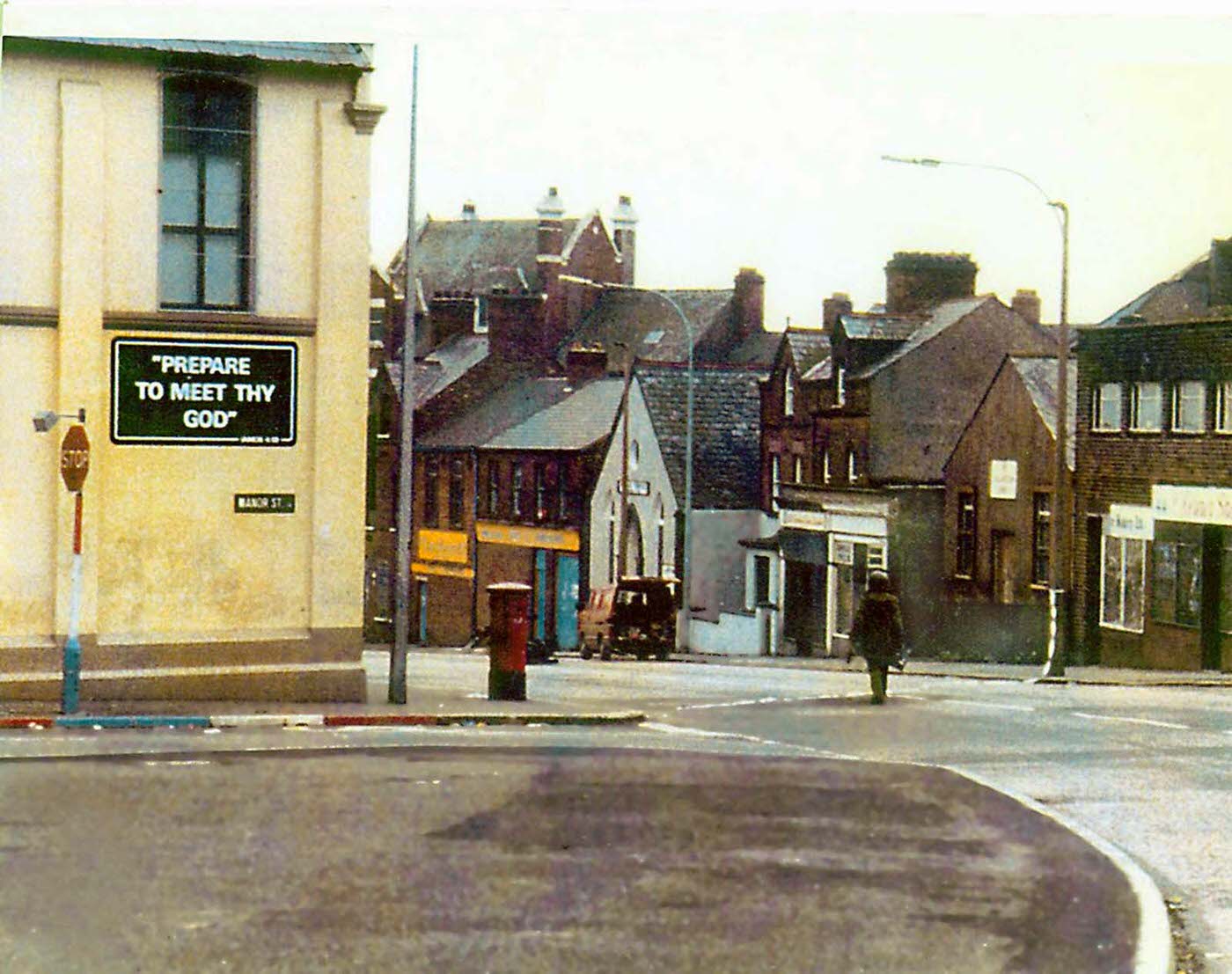
The Manor Street and Oldpark Road junction sat directly on the dividing line between Protestant and Catholic neighborhoods in north Belfast. During the Troubles — the decades-long conflict that tore through Northern Ireland from the late 1960s into the late 1990s — this kind of boundary was a flashpoint. Violence and tension were constants. Bombs planted along these lines were not random acts; they were deliberate, targeted, and often sophisticated.
The Provisional Irish Republican Army (PIRA) was the primary group responsible for the bombing campaign that EOD teams faced throughout this period. The PIRA’s arsenal ranged from simple pipe bombs to complex victim-triggered devices and infrared switches. Roadside bombs became a core tactic from the early 1970s onward. Over time, the devices grew more advanced — new triggering mechanisms, more powerful explosives, and designs specifically meant to defeat the countermeasures that disposal teams had learned. It was an ongoing technical arms race, and the men walking toward these devices were on the front line of it.
The Ammunition Technicians of the Royal Logistic Corps were the specialists responsible for dealing with this threat. Their training was rigorous, built on years of hard-won experience. They learned not only how to identify and disable devices but also how to read a scene — spotting secondary devices placed to kill the responders, recognizing when a bomb had been designed to look disarmed while still being live. Every approach was a calculated risk, not a reckless one. But calculated risk is still risk, and the consequences of getting it wrong were final.
In the incident captured in this photograph, the bomb did not detonate. The technician completed his approach, dealt with the device, and walked away. That outcome was never guaranteed. Across the full span of the bombing campaign in Northern Ireland, 23 bomb disposal specialists were killed attempting to disable improvised explosive devices. Each of those deaths came in a moment that looked, from the outside, much like the one frozen in this photograph.
What makes the image so striking is not just the danger — it’s the combination of the danger with that painted message. The technician is mid-stride, moving forward, with “Prepare to Meet Thy God” directly in frame. Whether the slogan was painted there as a religious statement by a local resident or as a deliberate taunt aimed at security forces, its effect in this context is the same. It transforms an already high-stakes scene into something almost cinematic in its weight. Except it is entirely real.
The EOD officers who worked Belfast during the Troubles did not operate in a vacuum. Every call-out drew a crowd, drew eyes from windows, drew the attention of people who may or may not have planted the device in the first place. Working in that environment — knowing you were being watched, knowing the area, knowing the history of the street beneath your feet — required a particular kind of steadiness that went beyond technical skill.
The photograph endures because it compresses all of that into a single frame. One man, one bomb, one wall, one sentence. The job that day was the same job it was every day: move forward, assess the device, and do the work. The sign on the wall was not going to change that.