When the Japanese military swept through the Philippines in 1941, most civilians faced a brutal choice: flee, comply, or fight back. Nieves Fernandez chose to fight. A schoolteacher from Ormoc City on the island of Leyte, she put down her chalk and picked up a blade — and became the only known female guerrilla commander in the Philippines during World War II.
Fernandez did not wait for someone to organize a resistance. She joined immediately after the Japanese invasion, enlisting alongside her brothers and other family members. Her drive and ability to lead stood out quickly. She rose through the guerrilla ranks fast and eventually commanded her own unit. That was no small thing in a country where women were not expected to take up arms, let alone lead fighters into combat.
Her unit carried out direct attacks on Japanese patrols and hit their supply lines hard. They operated in the rugged terrain of Leyte, using speed and local knowledge to strike and vanish before the enemy could respond. But it was one specific tactic that made Fernandez especially feared — and famous.
Fernandez used a long knife to kill Japanese soldiers silently while they slept. The method required getting close without making a sound, then striking before the target could react. It was a high-risk, close-quarters technique that left no room for error. She used it repeatedly and taught it to her fighters as part of their guerrilla training. On November 7, 1944, photographer Stanley Troutman captured a now-iconic moment in Mabuhay Las Piñas on Leyte Island, where Fernandez demonstrated exactly how she performed this kill technique.
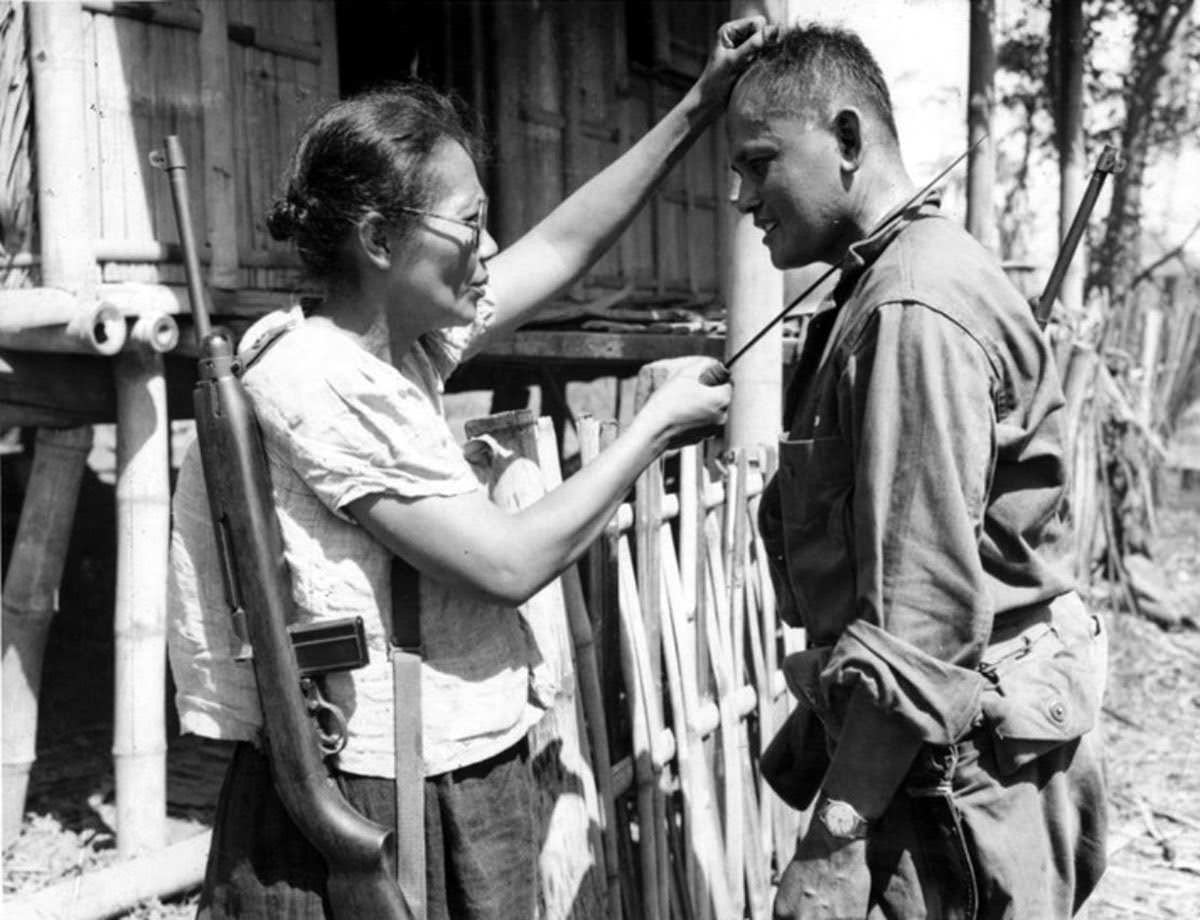
In the photo, Fernandez is shown demonstrating her knife technique to US Army Private Andrew Lupiba. Her posture is direct and instructional — this was not a posed gesture for the camera. She was showing a trained soldier how she had been eliminating enemy troops for years. The image traveled widely and cemented her reputation as a genuinely dangerous resistance fighter, not a symbol or a figurehead.
In a 1998 interview with the Philippine Star, Fernandez explained her mindset during the occupation plainly: “I did not think of myself as a woman. I thought of myself as a fighter. I was fighting for my country.” That statement lines up with how she operated throughout the war — she made decisions based on military necessity, not on what was expected of her gender or her background as a teacher.
The US Army formally recognized her service and awarded her the Medal of Freedom in 1945. She also received the Philippine Medal of Valor, the highest military honor the Philippine government awards. Both recognitions confirmed what her fellow guerrillas already knew — Fernandez was not just a participant in the resistance. She was one of its most effective commanders.
Her guerrilla unit’s work on Leyte was part of a larger resistance network that kept pressure on Japanese forces across the island throughout the occupation. When General Douglas MacArthur made his famous return to the Philippines in October 1944, American forces landing on Leyte had guerrilla units already operating there — units like Fernandez’s that had spent years gathering intelligence, disrupting enemy logistics, and keeping the spirit of resistance alive among local civilians.
After the war ended, Fernandez went back to what she had been doing before the Japanese arrived. She returned to the classroom, eventually becoming a school principal. She remained active in veterans’ organizations and pushed for better rights and recognition for those who had fought in the guerrilla resistance. Many Filipino guerrillas struggled for years to receive the same acknowledgment as regular military veterans, and Fernandez used her public profile to advocate for them.
She also mentored women in her community, pushing them toward education and leadership. The same qualities that made her effective as a guerrilla commander — clarity of purpose, willingness to act, refusal to accept limitations placed on her — shaped the way she engaged with her community long after the guns went silent.
In 2017, the Philippine Army named a military camp after her in Ormoc City, her hometown. The camp serves as the home base of the 78th Infantry Battalion, the unit responsible for protecting Ormoc and the surrounding region. For a woman who once crept through the dark with a long knife to protect that same land from foreign occupation, the honor was fitting.