When World War I broke out in 1914, France was one of the most powerful nations on earth. Its territory extended far beyond mainland Europe, covering more than 10.5 million square kilometers and home to over 55.5 million people across its colonies. The war that followed devastated the country. By the time the fighting ended, more than one million French soldiers had been killed in action.
What sets the photographic record of this war apart from earlier conflicts is color. For the first time in history, photographers on the front lines used a process called autochrome to capture full-color images. Invented by the Lumière brothers and introduced commercially in 1907, autochrome worked by coating glass plates with microscopic grains of dyed potato starch that filtered light into color. The process was slow and expensive, but it produced photographs unlike anything the world had seen from a war zone. The images below were almost entirely taken in 1917, one of the bloodiest years of the entire conflict.

Behind every battle line, soldiers performed hard physical labor just to keep the war machine moving. Bridges had to be built or repaired, roads cleared, and supplies moved forward under constant threat of artillery fire. Along the Aisne River, which saw some of the most intense fighting of 1917, engineering units worked in the open with whatever tools and materials they could find.


Maintenance and repair work continued even in buildings wrecked by shellfire. Blacksmiths kept forges running in the ruins of damaged structures, repairing weapons, horseshoes, and equipment that the army depended on daily. These men were not on the front line, but their work was just as essential to keeping units in the field.


Crossing rivers was a constant tactical challenge. Specialized engineering units constructed wooden bridges across the Aisne to allow troops, horses, and vehicles to move forward. Artillery had often destroyed existing crossings, making this kind of field construction urgently necessary and dangerously exposed.


The Abbey of Saint-Jean-des-Vignes in Soissons was a medieval structure already centuries old before the war began. Artillery reduced much of it to rubble, but soldiers still used its remaining walls and archways for shelter and storage. Horses were quartered there alongside men, a common practice when proper stables no longer existed.


Daily routines persisted even at war. Soldiers still needed haircuts, clean clothes, and hot meals. These small acts of normalcy helped maintain discipline and morale. Photographs of men doing laundry at a fountain or getting a shave in camp reveal the human texture of military life that official battle reports never captured.

France’s colonial empire meant its army was multinational. Soldiers from Senegal, Algeria, Indochina, and other territories served alongside mainland French troops on the Western Front. Senegalese soldiers, part of the Force Noire units, fought in some of the most brutal engagements of the war. Their presence in these autochrome photographs is a direct record of how far France’s wartime reach extended.


Workers from France’s colonial territories were brought to the mainland not just as soldiers but as laborers. Men from Algeria and Indochina worked in factories, on construction sites, and in the zones just behind the front. Their labor freed up French men for combat duty, and their faces, preserved here in color, represent a part of the war effort rarely discussed in mainstream histories.


Civilians did not always evacuate. In cities like Reims, some residents remained even as fighting raged nearby. Children appeared alongside military equipment and uniformed men in the streets. Meanwhile, infantry units like the 370th Regiment grabbed whatever food they could between engagements, eating soup in the field as the battle of the Aisne continued around them.


Reims, one of France’s most historically significant cities, suffered enormous damage during the war. German artillery repeatedly targeted the city, reducing entire neighborhoods to rubble. French soldiers dug through the wreckage to recover materials, clear routes, and search for anything still usable. The famous Reims Cathedral was also struck multiple times during the conflict.


Field hospitals like the one at Bourbourg operated close to the front, receiving casualties directly from the battlefield. Medical staff worked under extreme pressure with limited supplies. The 1917 autochrome images of these hospitals provide one of the few color records of wartime medical operations during the entire conflict.


The Alsace region, which had been German territory since the Franco-Prussian War of 1871, was a heavily contested stretch of the Western Front. French outposts here were dug in and heavily fortified. Villages like Hirtzbach and Balschwiller became military positions, their streets and fields occupied by French and colonial troops holding the line against German advances.


The 370mm railway gun was one of the largest weapons deployed by French forces. These massive guns were mounted on rail cars and moved along specially built tracks to reach firing positions. Hiding them from enemy aircraft required extensive camouflage work. Meanwhile, German bombers struck civilian targets like Dunkirk, forcing firefighters to battle blazes in the middle of an active war zone.


When soldiers were pulled back from the front for rest periods, they filled the time with ordinary activities. Reading newspapers at a kiosk in Rexpoede, near Calais, was one way men stayed connected to the outside world. News from home — and news from other parts of the front — mattered deeply to men who spent most of their days cut off from civilian life.


Narrow-gauge rail lines were critical to moving supplies across ground too torn up for normal vehicles. In West Flanders, where artillery had churned the landscape into a muddy wasteland, these light railways were often the only reliable way to get ammunition and food to forward positions. Soldiers stood on the flatcars in a terrain that no longer resembled any natural landscape.


The military cemetery at Moosch, photographed in full color, stands as one of the starkest images in this collection. Rows of grave markers on a hillside in Alsace document the cost of holding that stretch of the front. The wounded from places like Laffaux were brought back to hospitals in Soissons, but many did not survive their injuries.


Switzerland remained neutral throughout the war, and the border between France and Switzerland was a closely monitored boundary. French and Swiss soldiers faced each other across fences, standing watch on opposite sides of a line that separated a combatant nation from a neutral one. Behind the lines in France, some cultural activities continued — soldiers attended military theaters, and staff maintained even these small institutions.


Shelters ranged from reinforced dugouts to simple structures built from whatever materials soldiers could gather. Cooking outdoors was a standard part of camp life, with small fires and improvised stoves used to prepare meals in all weather conditions. These photographs capture how soldiers lived between battles — not in glory, but in muddy, cramped, and exhausting circumstances.


Belgium bore some of the heaviest fighting of the entire war. Ambulance vehicles lined up outside aid stations waiting to collect the wounded from nearby engagements. Nurses in uniform stood ready at city halls converted into medical centers. These images from Belgium show that the machinery of care ran parallel to the machinery of war at every step.


At Het Sas and Drie Grachten, French forces held positions in the Belgian lowlands where artillery had stripped trees bare and sandbags lined every exposed surface. Storm lamps and sheeted shelters marked the French lines in a landscape that had been completely transformed by years of shelling. The men photographed here were part of a front that stretched hundreds of kilometers without a clean break.


Observation was a constant task along the front. Watchmen at lockstations and observers in forward trenches monitored enemy movement and directed artillery fire. Missing enemy activity at the wrong moment could mean an entire position being overrun. These images show men at their observation posts, scanning no-man’s land with the patience the job demanded.


Chemical weapons were a defining feature of World War I. Three soldiers photographed on March 23, 1918, show the effects of gas exposure — conjunctivitis caused by chemical poisoning. These medical photographs were taken deliberately to document the effects of gas attacks on the human body. Phone stations protected by sandbags kept communications alive just behind the front, while soldiers nearby still found time to do their laundry.


Churches throughout northern France were damaged or destroyed by shellfire, their statues shattered and roofs collapsed. French soldiers nicknamed themselves “les poilus” — the hairy ones — a term of pride referring to their unkempt appearance from weeks in the field. These men are photographed at trench shelter entrances, wearing the look of soldiers who had been at the front for a long time.


Dunkirk was bombed repeatedly throughout 1917. The September bombardment required both military and civilian responders to fight fires caused by the German strikes. Fire hoses were run through streets still under potential attack. The poilus in their trenches also found brief moments of normalcy — including haircuts — even at the front line.


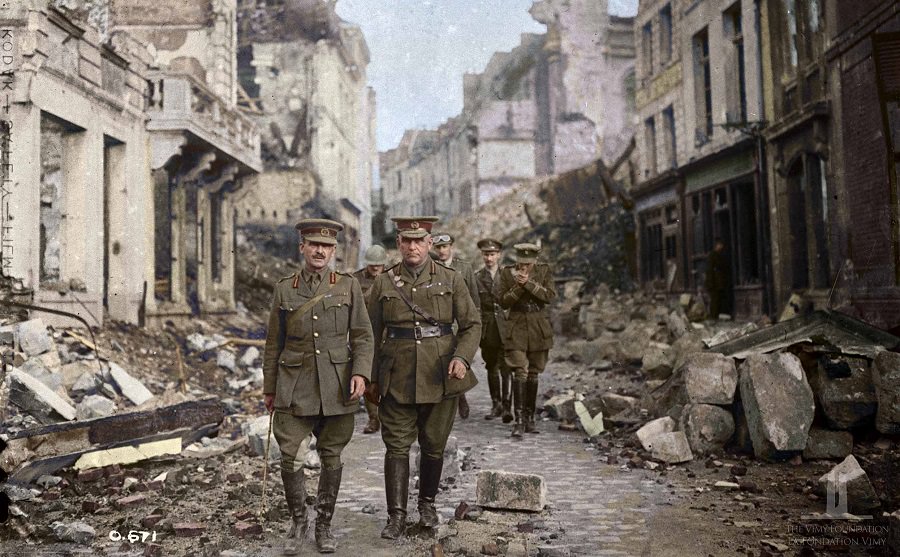
The commanders who directed the war are also captured in these autochrome photographs. General Antoine led the French First Army during a critical period of the conflict. Belgian General Michel, a former Minister of War, commanded the 4th Division. These portraits, taken in color at a time when color photography was still a rarity, give these senior officers a presence that black-and-white images rarely convey.


The headquarters of the French First Army was the nerve center for a massive and complex military operation. Orders moved from here out to divisions, regiments, and individual units spread across hundreds of kilometers of front. These images of the HQ, the border fences, and the resting Senegalese soldiers show how many different roles and nationalities were woven together inside the French war effort.


Three French soldiers crouched behind sandbags at a front-line observation post watched enemy lines for any sign of movement. These posts were among the most dangerous positions a soldier could occupy — close enough to the enemy that a single mistake or a moment of visibility could draw fire. Yet they were essential, providing the intelligence that artillery and infantry commanders needed to make decisions.


The air war was another dimension of the conflict captured in these photographs. French Captain Robert de Beauchamp, photographed alongside a British Sopwith fighter in 1916, represents the Allied coordination that took place in the skies as well as on the ground. Back on earth, soldiers continued the endless work of clearing the ruins that artillery left behind.


Rest periods were brief and soldiers used them fully. Along the Aisne, men sat on the grass eating lunch — a scene that could look peaceful if not for the context surrounding it. In Soissons, others waited their turn at an improvised barber’s chair under a tent. These photographs make clear that survival in this war meant maintaining structure and routine as much as it meant fighting.


Captured German equipment turned up all across the French lines. In Reims, a soldier stands next to a table holding German grenades and an aircraft propeller — trophies collected from the battlefield. Nearby, a young boy peers through a shop window with two soldiers, a reminder that Reims still had civilians living in its partially destroyed streets.


The French 75mm field gun was the most iconic artillery piece of the war. Fast-firing and accurate, it gave French forces a significant advantage in the early years of the conflict. Artillerymen photographed with their guns on the Western Front represent one of the most important branches of the French military. Behind the lines, smiths kept the army’s equipment functional even when working in bombed-out buildings.


The Battle of Verdun, fought in 1916, was one of the longest and deadliest battles in human history. French artillery played a central role in holding the line against a German assault designed to bleed France dry. The gun shown here, with French military personnel beside it, is a direct artifact of that ten-month battle. Verdun cost the French Army over 160,000 dead and left hundreds of thousands more wounded.

An Algerian soldier standing guard on a bridge in 1917 closes this collection the same way it opened — with a single man doing a specific job in the middle of an enormous war. These autochrome photographs, taken at significant expense and effort, preserve something that no black-and-white image could: the actual colors of uniforms, skin, sky, and rubble. They show the Great War not as a faded historical abstraction, but as something vivid, close, and real.