By the 1890s, Columbus, Ohio was moving fast. The city had been Ohio’s capital since the early 19th century, but this particular decade brought a kind of energy that set it apart from anything before. Growth wasn’t just happening — it was accelerating across every corner of the city, from the streets and railways to the schools and parks.
Columbus sat at a key junction of major railway lines, which made it a natural center for manufacturing and distribution. Factories turned out textiles, shoes, and farm equipment. The Columbus Buggy Company grew into a global name in horse-drawn carriages, drawing international attention to the city’s industrial output. Wealth was being made, and it showed in the buildings going up all over town.
Aerial view of downtown Columbus looking southwest across the Scioto River, late 1880s or early 1890s.
People poured into Columbus from across the United States and from Europe, all chasing opportunity. This wave of newcomers made the city more diverse and more dynamic. Neighborhoods filled in quickly, new businesses opened along major streets, and the demand for better city services grew with the population.
Broad Street, East from High Street, view of East Broad Street looking from High Street, 1890s
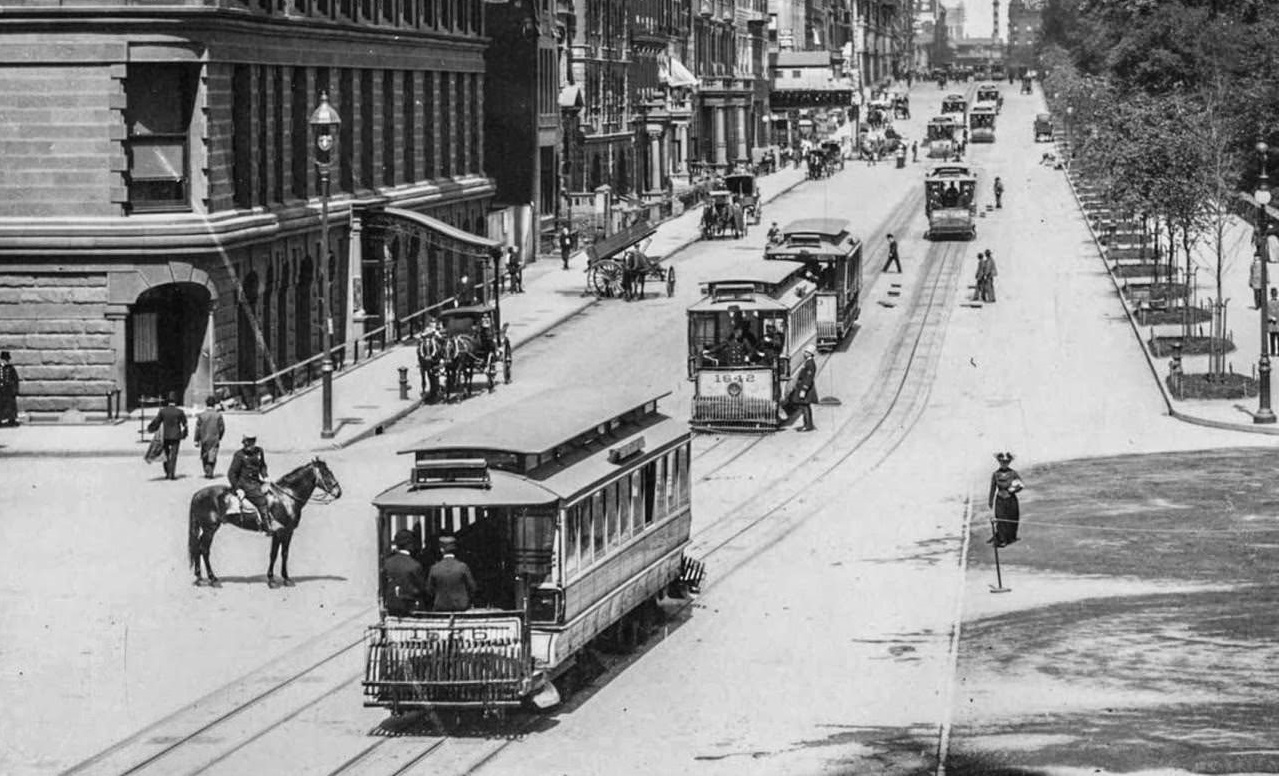
One of the biggest changes to daily life was the arrival of electric streetcars. Before them, getting across the city meant relying on horse-drawn transport. The new electric lines changed that entirely, allowing the city to expand outward and giving residents faster, more reliable travel. Construction of those lines was visible right in the heart of downtown.
First electric streetcar by Glenwood and Greenlawn Co. on West Broad Street, Columbus, 1891.Third Chittenden Hotel during construction of streetcar lines along High and Spring Streets, circa 1895.
High Street was the spine of Columbus in the 1890s. Hotels, banks, churches, and commercial buildings lined it in both directions from the Statehouse. The Chittenden Hotel alone had a dramatic history — two versions of it were destroyed by fire before the third opened in 1895. The street hummed with traffic, foot passengers, horse carriages, and the occasional circus parade.
Circus Parade on North High Street, passing Union Station, 1890sHigh Street, Columbus. Ohio’, circa 1897.
The Ohio Statehouse anchored the center of the city, surrounded by financial institutions and civic buildings. East Broad Street near the Statehouse featured landmarks like the Hayden Clinton National Bank and the Board of Trade, making the corridor one of the busiest and most photographed stretches in Columbus.
State Capitol, Columbus, circa 1897.East Broad Street near Ohio Statehouse with Hayden Clinton National Bank and Board of Trade, 1897.
Columbus Union Station, designed by the prominent architect Daniel Hudson Burnham, opened in 1897. It became an immediate landmark. Burnham was already famous for his work on the 1893 World’s Columbian Exposition in Chicago, and his touch gave Columbus a station worthy of a growing capital city.
Columbus Union Station, designed by Daniel Hudson Burnham, opened in 1897.
The city’s religious and residential architecture was equally impressive. Churches, mansions, and institutional buildings reflected a range of styles from Greek Revival to Queen Anne. The Alfred Kelley home, a fine example of Greek Revival design, later served as the Governor’s Mansion and housed Governor James E. Campbell from 1890 to 1892.
Governor’s Mansion, originally Alfred Kelley’s home, used by Governor James E. Campbell 1890-1892.Allen G. Thurman’s home, built around 1885, Queen Anne Style, 1892.
Ohio State University was growing steadily on the north side of the city. Hayes Hall, built in the Richardsonian Romanesque style by the firm Packard & Yost and completed in 1892, became the defining building on campus. Named for President Rutherford B. Hayes, it still stands today as the oldest building on the OSU campus.
Hayes Hall at The Ohio State University, built in 1893 in the Richardsonian Romanesque style by Packard & Yost.Agricultural Building on the campus of Ohio State University, Columbus, 1890s
Leisure and recreation were becoming part of city life in a more organized way. Olentangy Park, developed along the Olentangy River, offered residents boating, amusement rides, and green space. Photographs from the era show boaters pausing on the river and visitors taking in the park’s attractions. The boat house, developed by Robert Turner in 1880, was a popular gathering point.
Aerial view of Olentangy Park in Clintonville, Columbus, Ohio, showing amusement park features, 1890sBoat House on the Olentangy River at Olentangy Park, developed by Robert Turner in 1880, photograph from 1891.Boater on the Olentangy River, 1897
Commerce on the streets of Columbus was visible everywhere. Lazarus Department Store, which had been serving Columbus shoppers since the mid-19th century, displayed eye-catching window arrangements. Livery stables and buggy companies operated out of prominent corners. C. M. Hubbard’s livery at High and Cherry Streets occupied a building that had previously been the Swan Tavern — a structure that wouldn’t be demolished until October 27, 1912.
Lazarus Department Store window display featuring a horse car, 1890sC. M. Hubbard Livery on High and Cherry Streets, business location 1891-1896, photo showing Swan Tavern, later Franklin House, demolished October 27, 1912, Circa 1891
March 1898 brought one of the decade’s most dramatic events: a major flood. The Scioto River rose and swamped large sections of Columbus, particularly the west side. Aerial photographs taken from Mt. Carmel Hospital captured the scale of the disaster. Floodwaters reached Hartford Street off West Broad and submerged rail yards as far as Zanesville.
Aerial view of 1898 flood in Columbus, looking west from Mt. Carmel Hospital, March 1898.Flooding on Hartford Street off West Broad, Columbus, 1898.
The military presence in Columbus was also notable. Camp Bushnell served as a mobilization point, and in 1898, artillery units departed from Columbus to join the Spanish-American War. Earlier in the decade, in February 1891, the funeral train of General William T. Sherman passed through the city, drawing large crowds to mark the death of one of the Civil War’s most prominent commanders.
Departure of Artillery from Camp Bushnell to join Spanish American War, Columbus, 1898.Funeral train of General William T. Sherman, arriving in Columbus, February 21, 1891.
Columbus’s institutions for education, health, and public welfare were substantial. The Columbus State Hospital maintained extensive grounds with scenic drives and walking paths. The Institution for the Education of the Deaf and Dumb, completed in 1886, featured well-kept lawns and fountains. The Franklin County Children’s Home, opened in 1880, cared for the city’s most vulnerable residents.
Path alongside a body of water at the Columbus State Hospital, 1890sFountain and lawn at the Institution for the Education of the Deaf and Dumb, completed in 1886, Circa 1897.
Among the young people photographed in Columbus during the 1890s was a teenager who would go on to international fame. The 1899 Central High School baseball team included a young George Wesley Bellows, who later became one of America’s most celebrated painters, known for his raw, energetic depictions of urban life.
The 1899 Central High School baseball team, including a young George Wesley Bellows, 1899.
Looking at these photographs together, Columbus in the 1890s was a city being built in real time — block by block, institution by institution, bridge by bridge. The horse and carriage crossing Alum Creek’s Broad Street Bridge in 1897 captures something essential about the era: the old and new existed side by side, and the city was always moving forward.
A horse and carriage on Alum Creek’s Broad Street Bridge, 1897.Bird’s-eye view of Columbus, Ohio, panoramic view from a height on the north side of the capitol square looking east south east, 1890sAerial photograph of the 1898 flood on Columbus’s west side, 1898.Aerial view of East Broad and 3rd Streets, featuring the Rowland Building and Benjamin Brown Mansion, 1890sAdams County Courthouse with a horse in the foreground, 1890sAdena mound on the Pope Farm, an outstanding example of Adena mound construction, 1892.Alfred Kelley home, an example of Greek Revival architecture, later the Governor’s Mansion, 1898.Baker Art Gallery, prominent photography studio in Columbus, started in the 1860s, location opened in 1892.Bishop’s Residence at St Joseph’s Cathedral, built in 1848 by William G. Deshler, used as the Bishop’s residence until demolished in 1949, 1891.Boater on the Olentangy River, momentary pause for a photograph, 1890sC. M. Hubbard’s business at High and Cherry Streets, previously Swan Tavern, later Franklin House, demolished October 27, 1912, Circa 1892.Canal Boat Warehouse building, used for merchandise shipping in the 1830s, later Capital City Junk, 1898.Chemical House #1 on Oak Street, replaced by a new facility in 1898, served as Columbus Music Hall from 1988 to 2008, still stands today, 1894.Chittenden Hotel, transformation from business block to hotel in 1889-90, two stories added, first hotel destroyed by fire, rebuilt, second hotel also destroyed, third hotel opened in 1895, Circa 1892.Columbus City Prison, located on South Scioto Street and West Town Street, opened December 29, 1879, closed August 15, 1920, Circa 1897.Broad and High Streets, view of the Deshler Hotel construction, looking northwest, 1890sBroad Street Methodist Episcopal Church, photograph from 1897.Columbus Auditorium, opened June 24, 1897, collapsed under snow load on February 18, 1910, originally Park Roller Skating Rink in 1885, remodeled to auditorium by Yost and Packard, 1890sBuilding at Columbus Barracks, 1890sColumbus Centennial postcard, celebrating 100 years as Ohio’s capital city in 1912, featuring Railroad YMCA, Columbus Savings Bank, Troy Laundering, and Unique Theatre, 1890s
Columbus Pharmacal Company building, a medical equipment supplier, 1898.
Columbus Public School Library, originally a church, 1899
Columbus Public School Library building, formerly a church, photographed in 1897.Scenic drive on the Columbus State Hospital grounds, 1897.Conn Baker photographed by an old building in St. Augustine, Florida, May 17, 1896.Corner of City Park Ave and Lansing St, Columbus, in 1898Davidson Hotel at the intersection of High Street and Naghten, Columbus, 1898.Residential area at Dennison Avenue and Buttles Avenue, Columbus, photograph, 1897.East Broad Street traffic in Columbus, photograph, 1897.Residential district of East Town Street, 1897.Edward Leroy Hinman House, built in 1880. Circa 1892.First Garfield Elementary School, constructed in 1882 and demolished circa 1950, Circa 1892.Fish Stone Works at 200 W. Main Street on the canal, Columbus, 1898.Flooded Central Ohio Rail Road Company yard in Zanesville, Ohio, March 1898.Fourth Street south from Broad Street featuring Baldwyn Gwynne house and Lucretia Phelps English and Classical School, Columbus, 1897.Frank L. Hughes family home, Vice-President of Buckeye Buggy Company, 1890sFranklin County Children’s Home and grounds, opened in 1880, Circa 1897.Gay Street Engine House, original No. 1 House, built in 1854, used until 1892.George W. Foster house at Mound and High streets, demolished in the 1880s for business development, Circa 1898.Good Shepherd Convent Chapel, 1891Hanna Paint Company, James B. Hanna as president, Circa 1897.Harrison Elm and former Hawkes Hospital in Franklinton, 1892.Hayes Hall at The Ohio State University, named for President Rutherford B. Hayes, completed in 1892, Cirac 1897.Hayes Hall, the oldest building on The Ohio State University campus, built in 1893Hayes Hall at The Ohio State University, designed by architect Frank Packard, completed in 1892.High Street north from Fulton, featuring St Paul’s German Lutheran Church and Franklin County Courthouse, 1890sExterior of the Holy Cross Church Sisters Residence, 1891.Residence of the Holy Cross Church priests, 1891.Exterior of the Holy Family Church Priests Residence, 1891.Holy Family Roman Catholic Church, 1891.Holy Family Sisters residence exterior, 1891.Horse-drawn fire engine in action, 1890sHoster Building illustration, 1898.Hotel Hartman, Columbus, Ohio, 425 South 4th Street, 1890sHuntington National Bank, opened 1878, first location at 1 S High Street, 1890sWorld Museum Theatre site, later High Street Theatre, 1898
Kevin Clark is a historian and writer who is passionate about sharing the stories and significance behind historical photos. He loves to explore hidden histories and cultural contexts behind the images, providing a unique insight into the past.