Barbara Payton had everything Hollywood could offer — striking blue eyes, peroxide blonde hair, and a screen presence that turned heads. By the early 1950s, she was rubbing shoulders with major stars, landing film roles, and commanding attention wherever she went. But within a decade, that world had collapsed entirely. Her story is one of fast choices, dangerous habits, and a descent that shocked even those who had watched her rise.

Barbara’s path to Hollywood started with modeling. She hired a photographer herself to shoot her in fashionable outfits, and those images caught the eye of clothing designers. That early hustle paid off. By September 1947, she had signed with the Rita La Roy Agency in Hollywood and was working in print advertising, appearing in ads for Studebaker automobiles and in fashion magazines like Charm and Junior Bazaar.
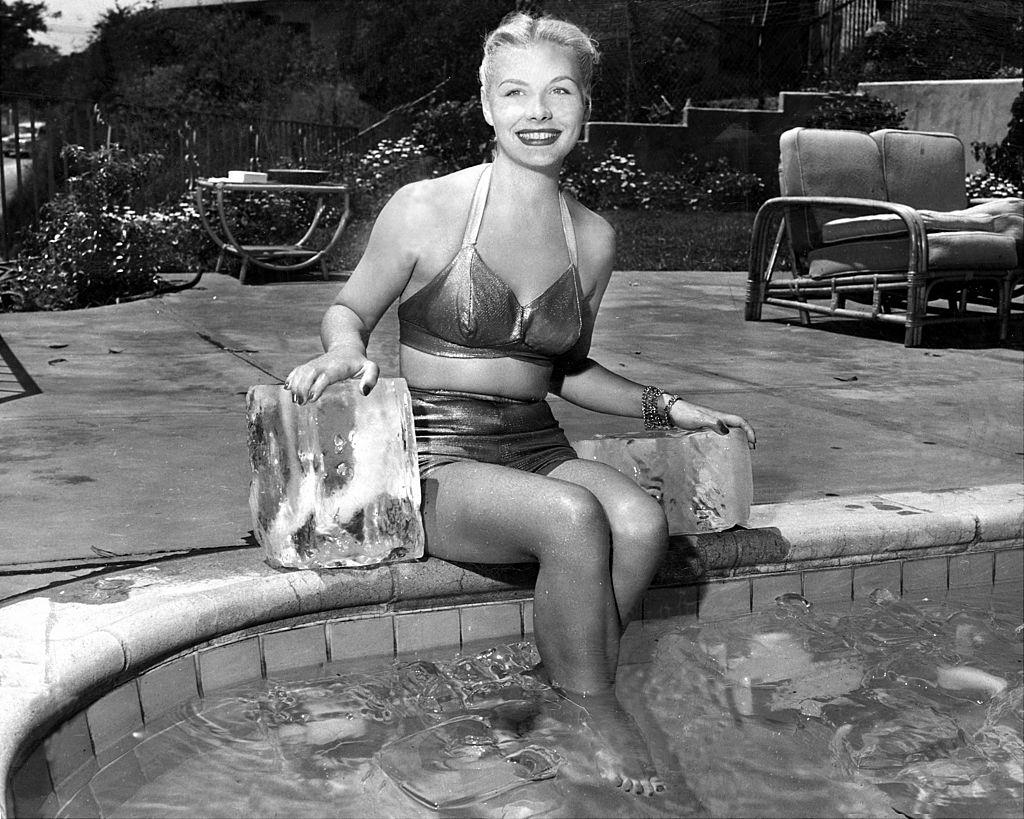
Her acting career began in 1949 with Silver Butte, followed quickly by Trapped, a semi-documentary focused on the U.S. Treasury Department. She made her biggest early impression in the violent noir thriller Kiss Tomorrow Goodbye (1950), a film about a criminal who escapes prison, murders his partner, and plunges back into a life of crime. The role showed she could handle dark material, and it put her on the map.

She followed that with Only the Valiant (1951), a western in which she played Cathy Eversham alongside Gregory Peck. The film kept her name in front of audiences and showed she could hold her own opposite established leading men. More roles followed throughout the early 1950s, including Run for the Hills (1953), The Great Jesse James Raid (1953), and The Flanagan Boy (1953). Her final notable screen credit came in 1955 with Murder is My Beat, directed by Edgar G. Ulmer, in which a woman is wrongly convicted of killing her boyfriend.

Barbara’s personal life was as turbulent as anything she played on screen. At sixteen, she eloped with her high school boyfriend, William Hodge. Her parents had the marriage annulled, and she dropped out of high school a few months later. In 1945, she married combat pilot John Payton, with whom she had a son. Life as a housewife felt confining, and she left him to pursue her career.

Her third marriage, to actor Franchot Tone in 1950, became tabloid fodder almost immediately. While still engaged to Tone, Barbara began an affair with B-movie actor Tom Neal. She moved between the two men publicly and without apology. The situation came to a head when Neal and Tone fought each other in a brutal brawl. Tone was hospitalized with a fractured cheekbone and a brain concussion. Despite the violence, Barbara married Tone — but the marriage was over by 1952.


Beyond Tone and Neal, Barbara had well-documented affairs with some of the most prominent men of the era — Howard Hughes, Bob Hope, George Raft, Steve Cochran, Guy Madison, Woody Strode, John Ireland, and Texas oilman Bob Neal, among others. Her romantic life was rarely quiet, and the press followed every twist of it. She married twice more after Tone: a furniture store executive named George Anthony Provas in 1957 (that marriage lasted one year), and finally Jess Rawley in 1962, who remained her husband until her death.


As the 1950s wore on, Barbara’s career dried up. The scandal surrounding the Tone-Neal fight had done real damage to her reputation in Hollywood. Studios grew wary. Roles became scarce. Alcohol had already become a fixture in her life, and drugs followed. The woman who had once been called the ‘new queen of clubs’ by a journalist was now spending lonely nights at dive bars on Sunset Boulevard, including a spot called the Coach and Horses, where she wrote poetry alone.


The financial collapse was just as severe. In May 1954, with money running low, she handed two fur coats to a bar owner to get him to tear up a $200 tab. She was beaten by a drug dealer and an extra in a dispute over rent. In 1962, a drunk stabbed her, leaving a wound that required 38 stitches. She lost teeth. She slept on bus benches. The woman who had appeared in magazine ads and on movie posters was living in conditions just steps from the clubs she had once dominated.


In the early 1960s, Barbara worked as a sex worker in Chicago, where she also became addicted to heroin. She worked alongside Lila Leeds, another actress whose career had been destroyed by scandal. By this point, Barbara bore little resemblance to the glamorous blonde who had lit up Hollywood just a decade earlier. Her autobiography, I Am Not Ashamed, was published during this period. She had one specific request for the ghostwriter, Leo Guild: she did not want to be paid in cash or by check. She asked for red wine instead, because creditors had claims on her money.


Barbara’s time in Britain in 1952 represented one of the last chapters of her working career. She traveled to London to film The Four Sided Triangle, a British science-fiction drama shot partly at Weymouth in Dorset. The production, handled by Michael Carreras and featuring Stephen Murray as her co-star, gave her one more chance at a steady film credit. Photos from that period show a still-glamorous Barbara on set and around London, but the roles were getting smaller and further apart.


The 1953 films — Run for the Hills, The Great Jesse James Raid, and The Flanagan Boy — kept her name on theater marquees for another year, but they were low-budget productions a long way from the studio system that had once courted her. Tom Neal, the man at the center of the Tone brawl, appeared alongside her in The Great Jesse James Raid. The two had remained entangled long after the scandal that had defined both of their careers.


Barbara Payton died on May 8, 1967. She was 39 years old. Near the end, she was found passed out beside trash cans in a Thrifty Drug Store parking lot on Sunset Boulevard. Her liver had deteriorated beyond recovery. She was taken to her parents’ home in San Diego, where she died. She was cremated and buried at the Cypress View Mausoleum and Crematory in San Diego, California. After her death, her story drew the attention of researchers and writers, leading to books like Kiss Tomorrow Goodbye: The Barbara Payton Story and LA Despair: A Landscape of Crimes and Bad Times, both of which documented a life that unraveled in full public view.