The 1920s were a dangerous decade on American streets. Criminal gangs operated openly across major cities, routinely exchanging gunfire with police. To protect themselves, many gunmen began wearing early body armor — thick vests built from layers of cotton padding and heavy cloth. These were far cheaper than military-grade gear and surprisingly effective. They stopped common handgun rounds including the .22 Long Rifle, .25 ACP, .32, and .38 Special at speeds up to 300 meters per second. Law enforcement agencies, including the FBI, were forced to respond by switching to more powerful cartridges like the .38 Super and later the .357 Magnum. That arms race created urgent demand for police body armor that could keep up.
W.H. Murphy, inventor and founder of the Protective Garment Corporation, had a solution. His company had developed a wearable bulletproof vest designed specifically for law enforcement. But convincing police departments to buy it required more than a sales pitch. Murphy knew the only argument that would work was a live one. In 1923, he organized a public demonstration at Washington D.C.’s city police headquarters, inviting officials to watch him stand in front of a loaded gun.
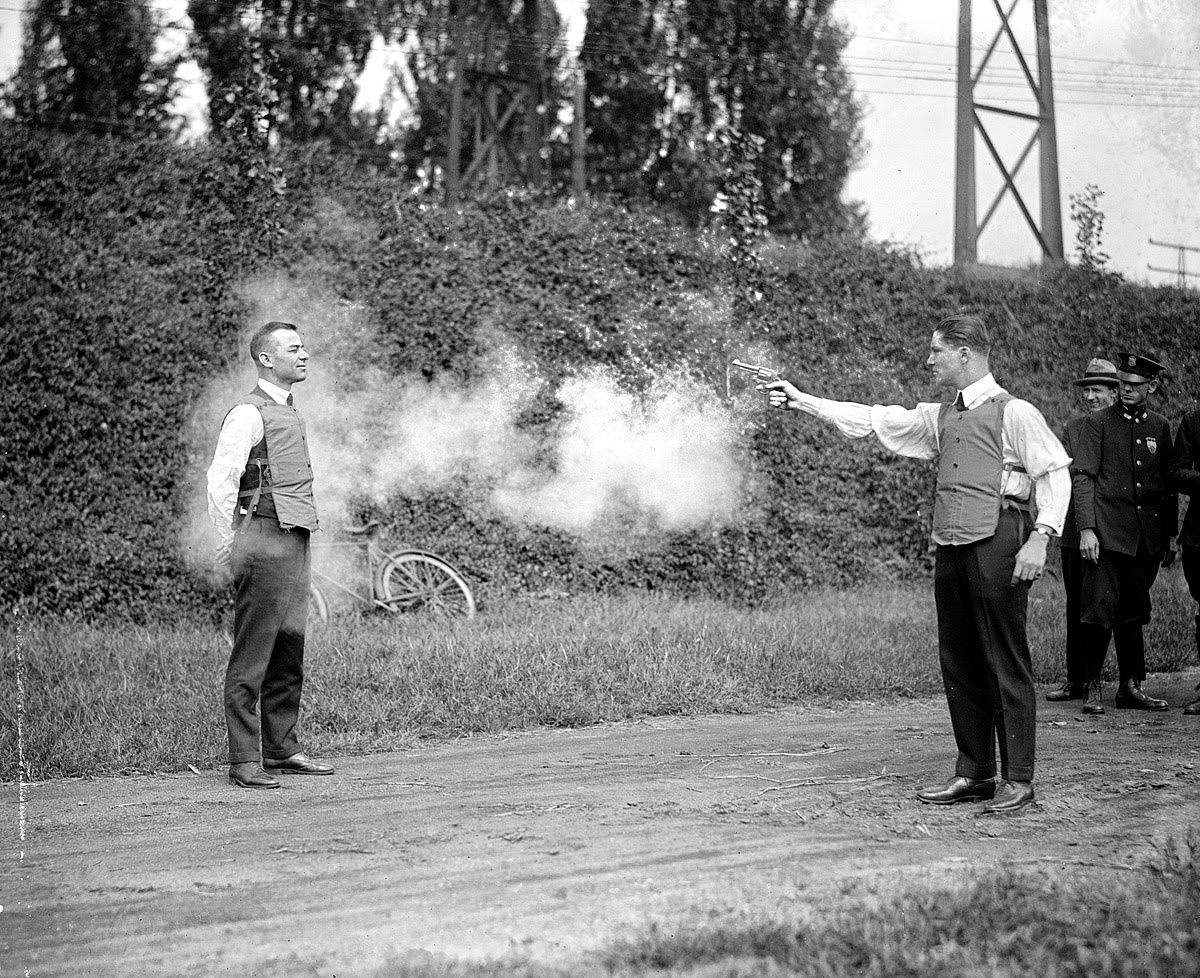
Murphy’s vest weighed 11 pounds and fit snugly against the body — a deliberate improvement over the bulky steel plates used in older designs. Officers who examined it noted that it allowed a full range of motion, something earlier armor made impossible. The vest’s construction relied on multiple layers of high-strength fabric working together to catch a bullet and spread its energy across a wider area, preventing it from breaking through at any single point. Murphy had designed it to manage the force of impact so effectively that the wearer would feel little more than a firm push.
The demonstration involved a Maryland deputy sheriff and officers from the Frederick County Police Department. Murphy stood less than ten feet from a S&W Model 10 Revolver — the most common service weapon in American policing at the time. The officer fired two consecutive .38 caliber rounds directly into Murphy’s chest. Eyewitnesses reported that Murphy did not move or flinch during either shot. When it was over, he calmly reached down, picked up one of the flattened slugs from the ground, and handed it to the officer as a souvenir.
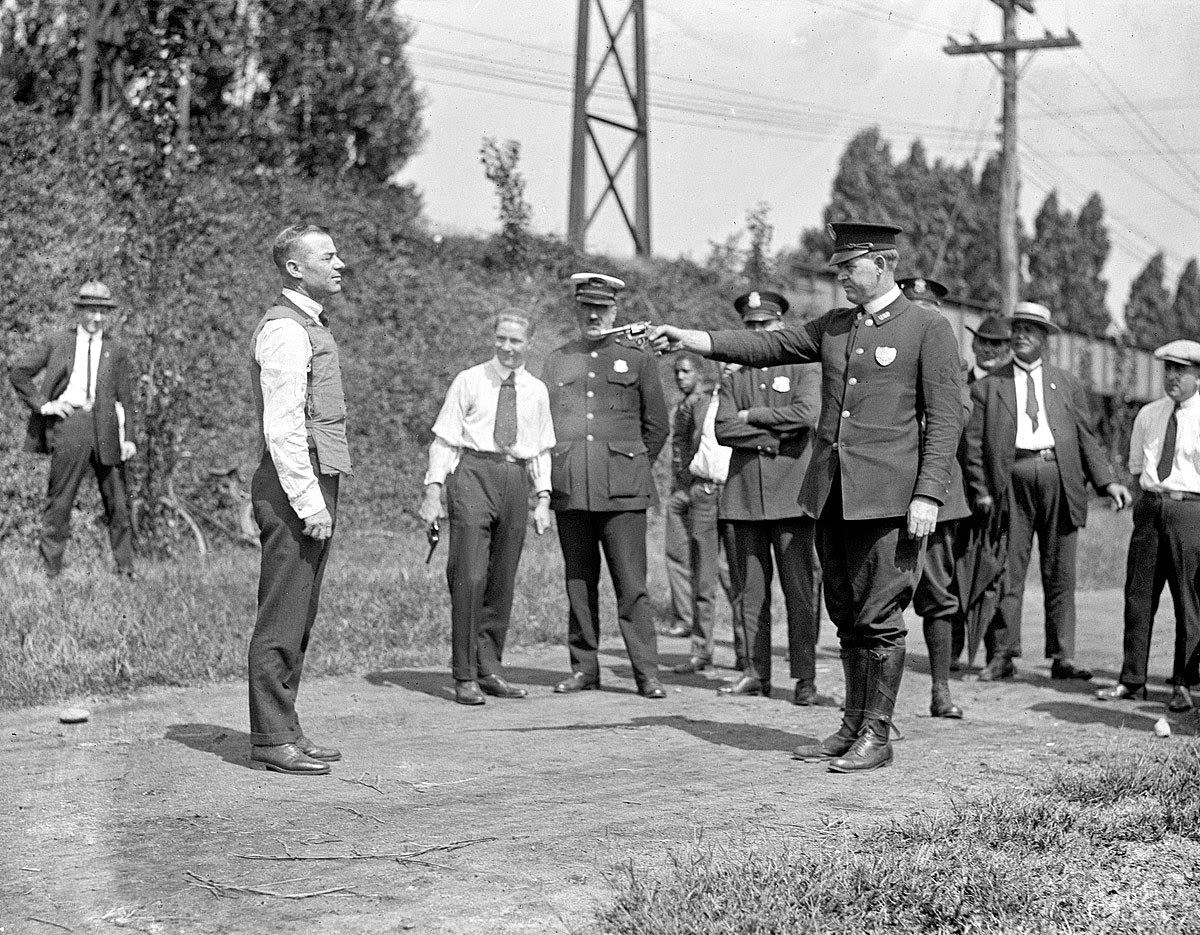
Murphy was not alone in this line of work. Leo Krause was another salesman who built his entire career around being shot. Over 27 years, Krause estimated he was shot more than 4,000 times during live demonstrations across the country and around the world. He treated each shot as a necessary cost of doing business. Krause held an unusual view of the danger involved. He argued that the shooter actually faced more pressure than the person wearing the vest — because the shooter had to hit the armor precisely to avoid a fatal accident. Krause saw himself as the safer man in the room.
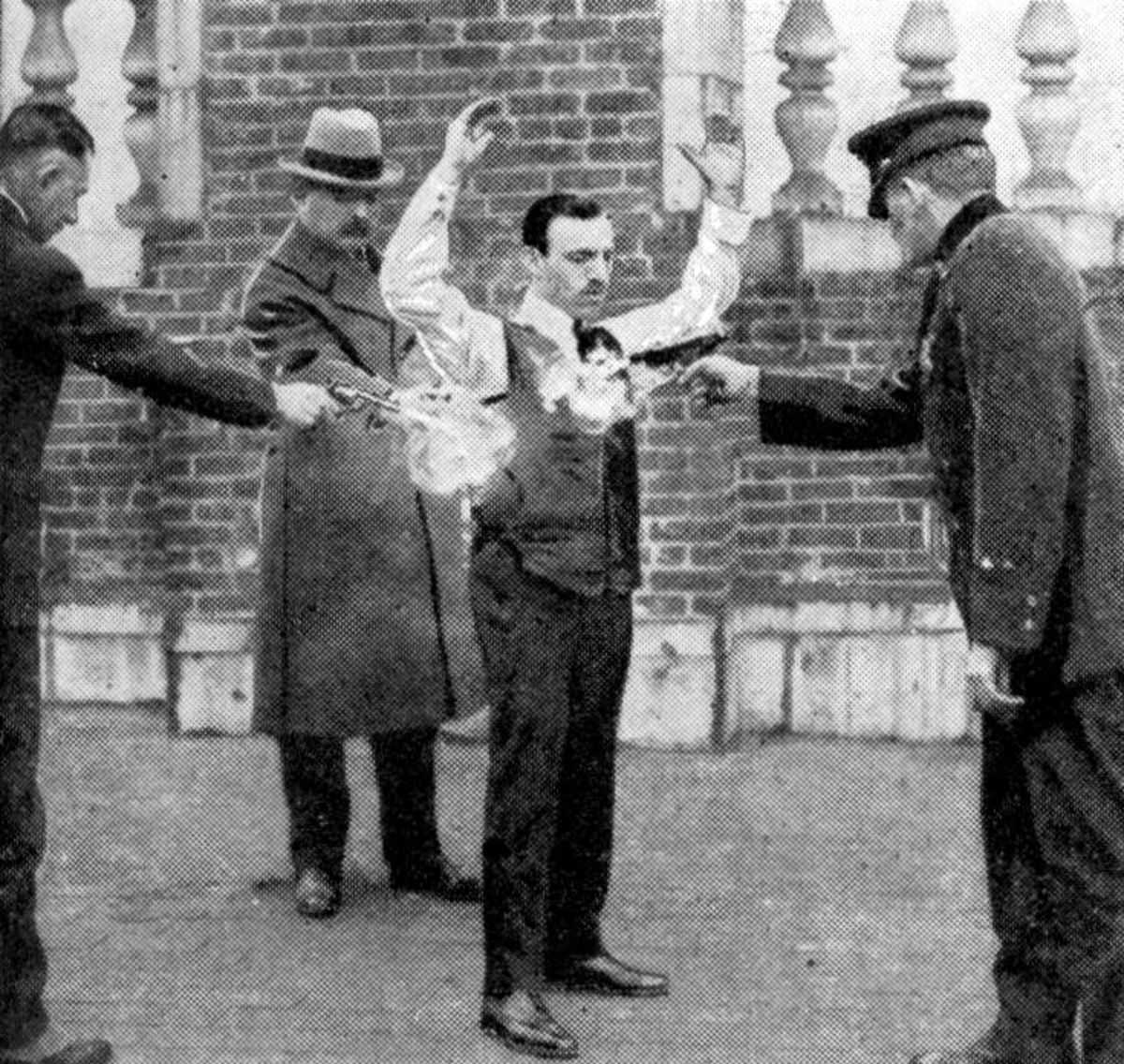
In May 1924, a news image published in Popular Mechanics captured one of Krause’s most dramatic demonstrations. He stood on a rooftop at 57th Street and 7th Avenue in New York City and allowed three police officers to fire at him simultaneously with .38 and .45 caliber pistols at close range. All three rounds flattened against the vest and fell to the ground. Krause, famously, was smoking a cigar throughout the entire test.
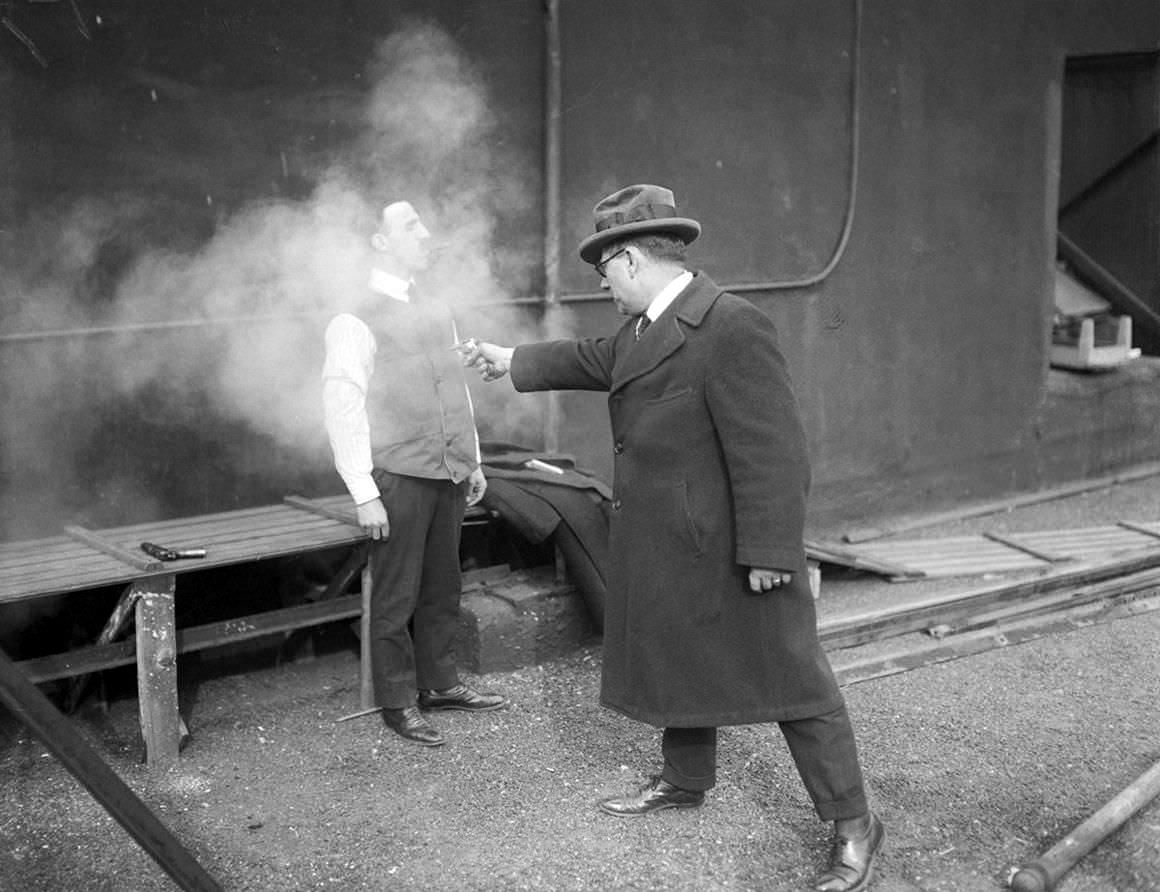
Krause used photographs from these tests as advertising material. Images of him standing calm and uninjured while bullets flattened against his chest were distributed to police departments to make the case for purchase. The visuals were designed to eliminate any remaining doubt. These were not controlled laboratory tests — there were no modern ballistics labs to rely on in this era. Human demonstrations were the standard method for quality assurance, and the salesmen understood that their own bodies were their most convincing sales tool.
As confidence in the technology grew, the demonstrations expanded to include other participants. Young women volunteered to wear the vests and serve as targets in front of large crowds and members of the press. The goal was to show that the vests were light enough and safe enough for anyone to wear, and that a stopped bullet would not cause serious internal injury from blunt force alone. Photographers captured the exact moment of impact — the dust kicking off the fabric, the visible force of the round hitting the vest — as proof that the armor held.
Police departments along the East Coast began placing orders for the 11-pound vests following successful demonstrations. The S&W Model 10 remained the weapon of choice for testing throughout the decade, simply because it was what most officers already carried. Every successful test produced a flattened souvenir bullet for the shooter and a new contract for the salesman. Murphy and Krause turned the act of being shot into a professional routine — one they performed weekly, city by city, in front of whoever needed convincing.