
By the time the 1930s arrived, St. Louis was a city of nearly 822,000 people — and it was struggling. The Great Depression hit hard. Between 1929 and 1933, the city’s manufacturing output dropped by 57 percent, slightly worse than the national average of 55 percent. By 1939, St. Louis industrial production had only climbed back to 70 percent of its 1929 level, while the rest of the nation had recovered to 84 percent. The city was falling behind, and the effects were visible on every street corner.
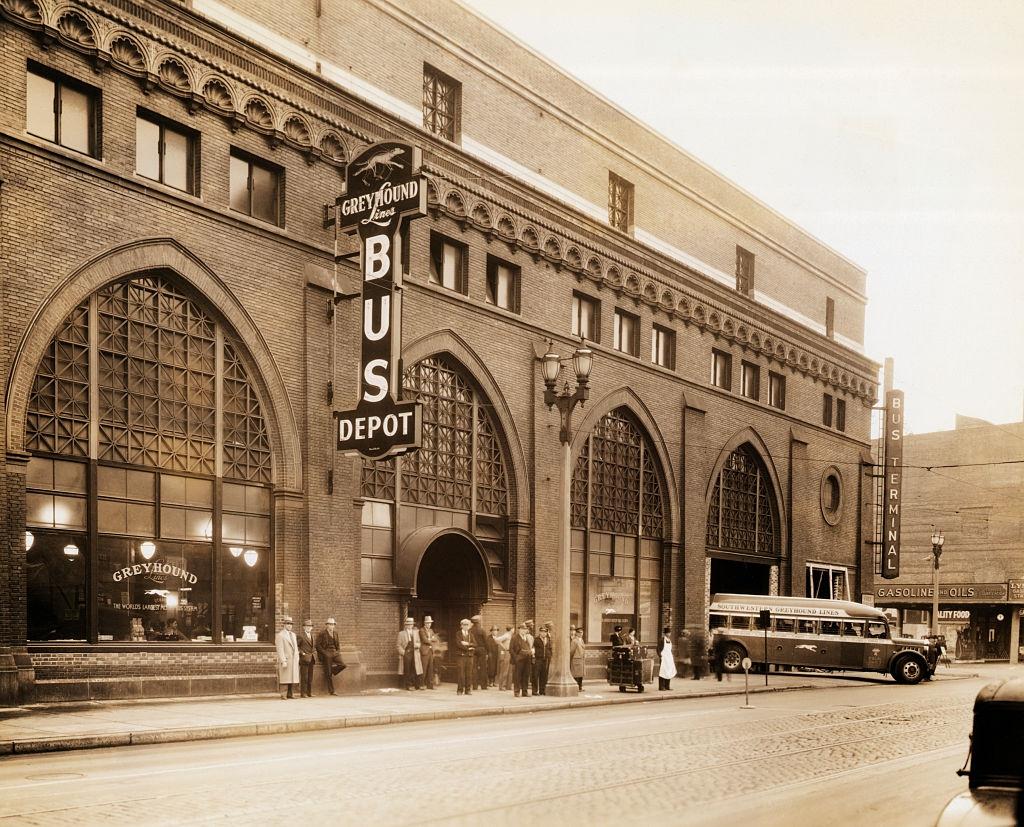
Transportation kept moving even as the economy stalled. Greyhound operated out of St. Louis, offering long-distance travel to those who still had somewhere to go and the means to get there. General Motors had just introduced its sleek new Streamliner bus, a modern design that stood in sharp contrast to the hardship surrounding it.
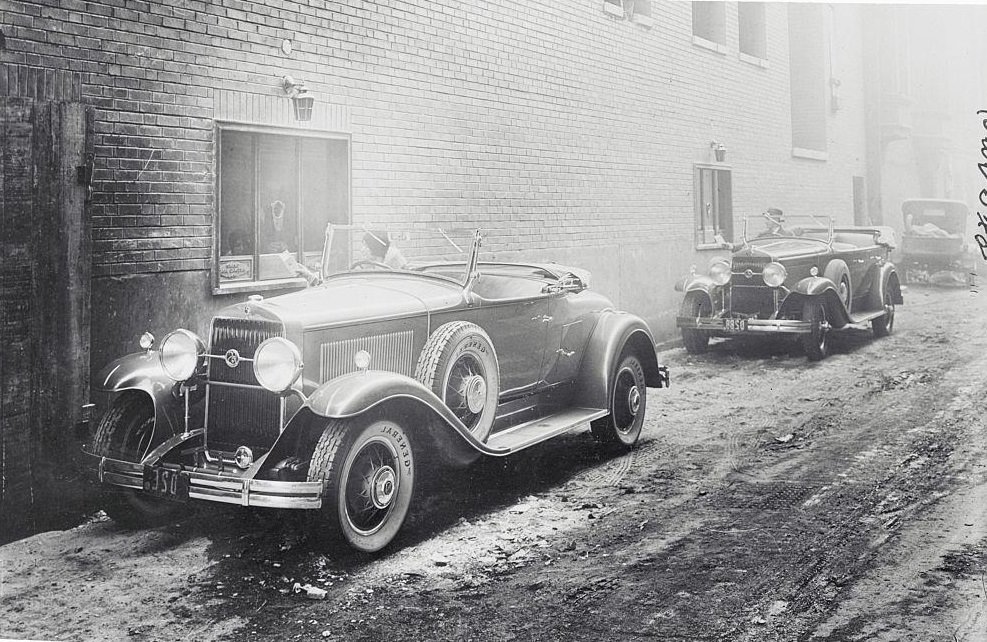
Even in difficult times, innovation found its way into the city. The Grand National Bank introduced curb service, letting depositors pull up to special windows along a private drive rather than park and walk inside. It was a small convenience, but one that spoke to how businesses were adapting to attract customers in a tight economy.
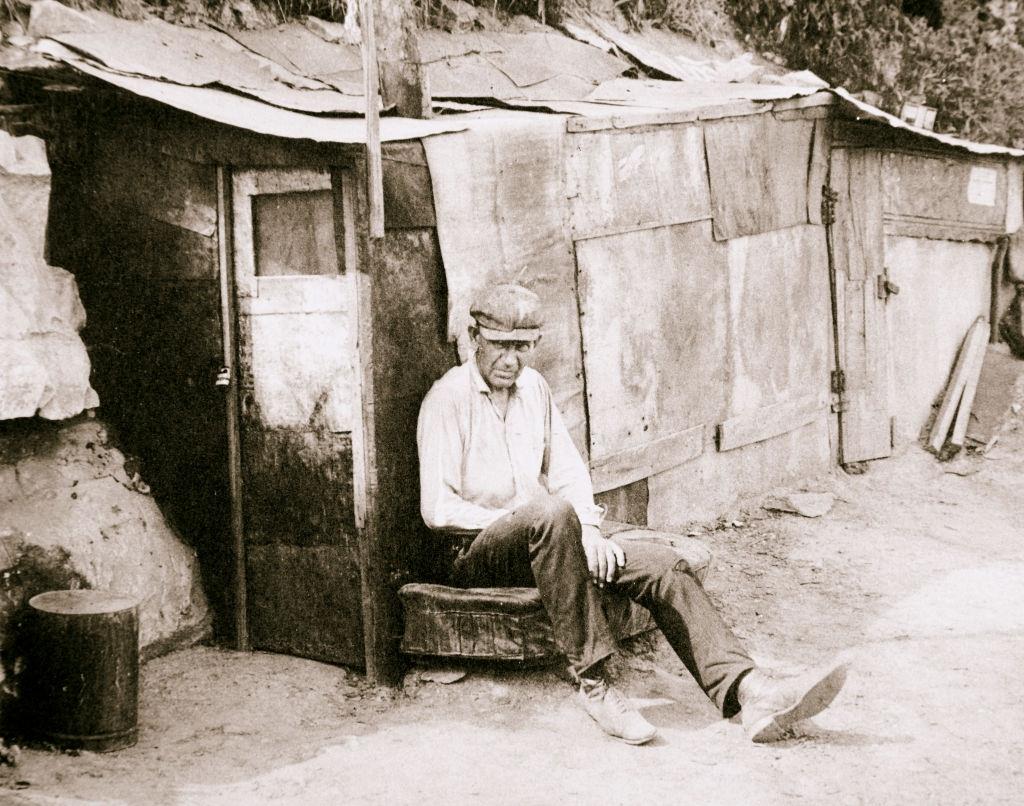
Not far from the city’s banks and bus depots, people were living in makeshift shelters built from whatever they could find. Structures cobbled together from barrels and tar paper appeared across St. Louis as unemployment climbed and families lost their homes. The city allocated $1.5 million in relief funds in the early years of the Depression, with $300,000 going to the Salvation Army and another $1 million to the St. Vincent de Paul Society.
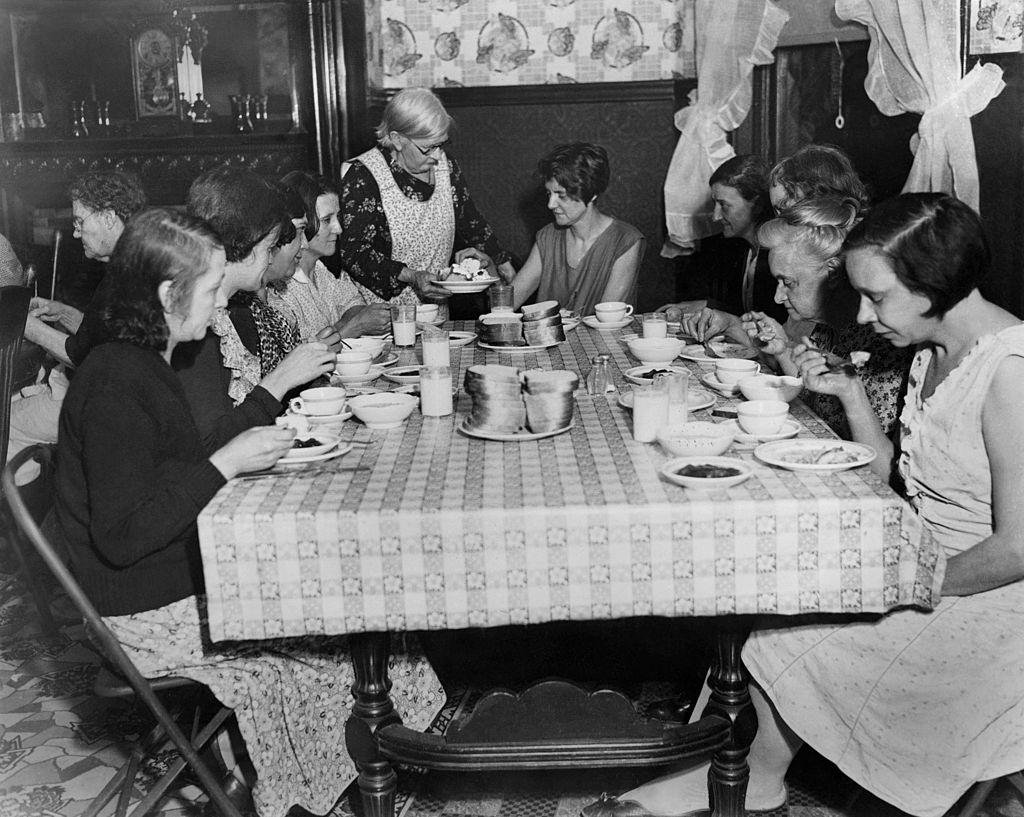
Women without homes had their own dedicated relief bureau by December 1932, a sign of just how widespread the crisis had become. That same year, St. Louis voters approved a $4.6 million bond issue to provide additional relief funds. The Board of Aldermen and Mayor Dickmann balanced the city budget in 1933 by cutting spending by 11 percent.
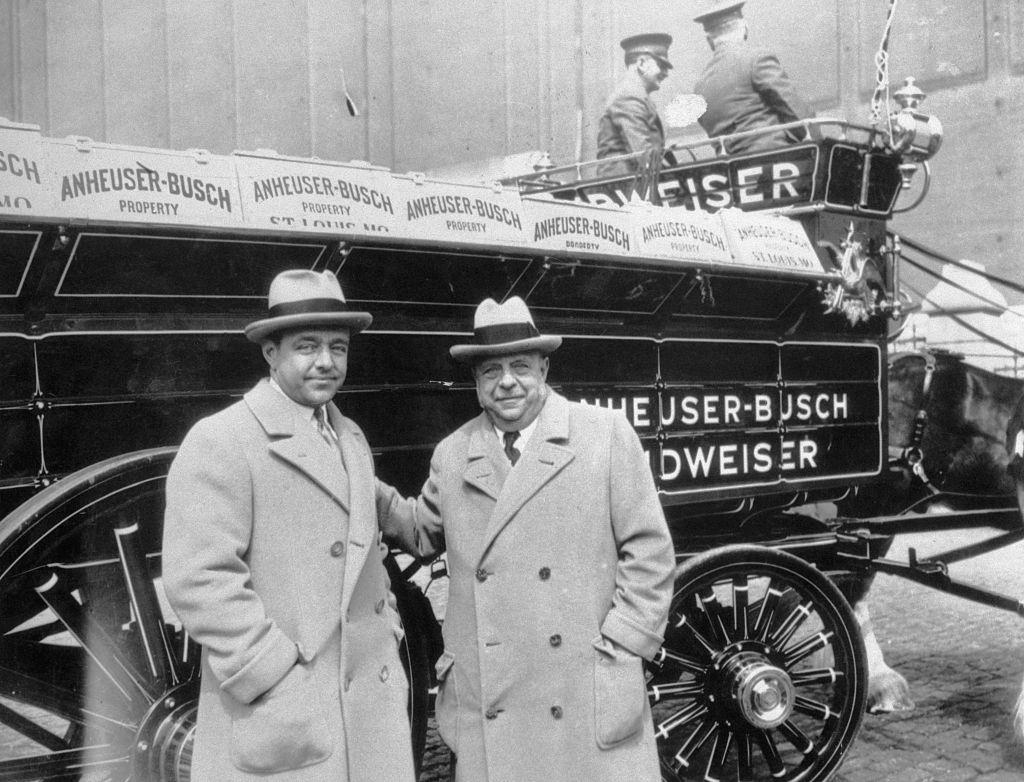
One bright spot came in 1933 when Prohibition was repealed. St. Louis had a deep brewing history, and the city’s breweries wasted no time getting back to work. Trucks loaded with beer rolled through the streets again, and the industry came back to life — though it was not enough on its own to make up for the broader collapse in industrial production.
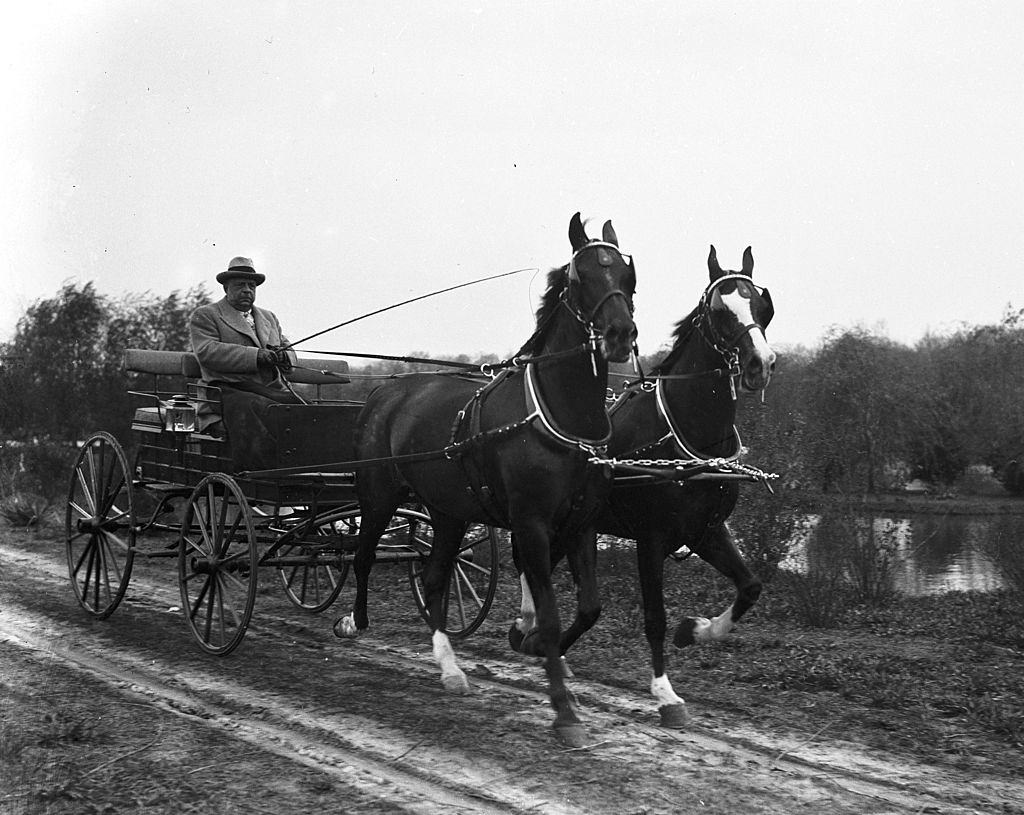
August Anheuser Busch Sr. was one of the most recognizable figures in St. Louis brewing. In April 1933, just as Prohibition ended, he was photographed driving a horse-drawn carriage — an image that mixed old-world tradition with the city’s renewed brewing energy. Anheuser-Busch would go on to anchor St. Louis’s recovery in the years that followed.
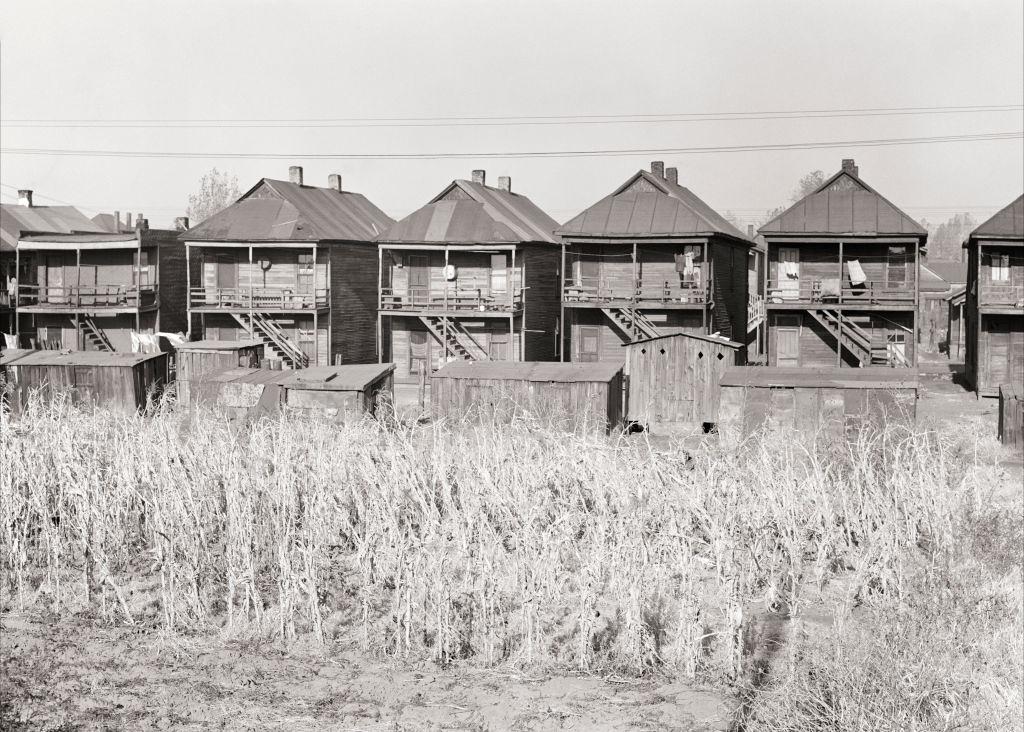
African American workers in St. Louis faced conditions far worse than their white counterparts. Mandatory minimum wage laws in the 1930s made it illegal for Black workers to hold the same jobs as white workers. Many were fired and replaced. In the domestic service industry, many Black workers received only room and board rather than wages. Skilled Black craftsmen were routinely excluded from local unions, cutting them off from construction jobs entirely. The settlement near the east St. Louis steel foundry shows the kind of cramped, industrial-edged communities that Black workers were pushed into.
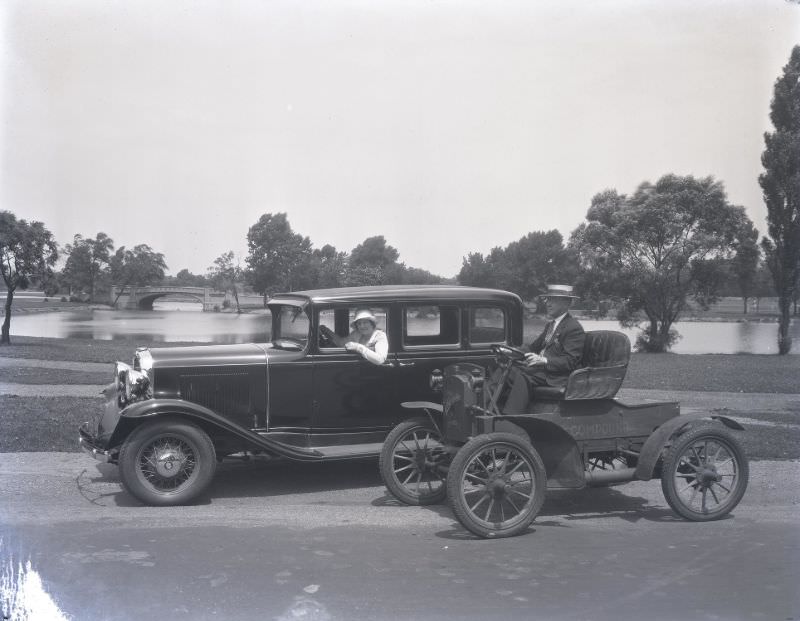
While daily life for many St. Louisans was defined by scarcity, the city still had moments of civic pride and curiosity. A side-by-side display of a 1897 Oldsmobile and its 1931 successor captured just how much had changed in a few decades. The contrast between the old horseless carriage and the modern automobile was striking enough to draw attention even during hard times.
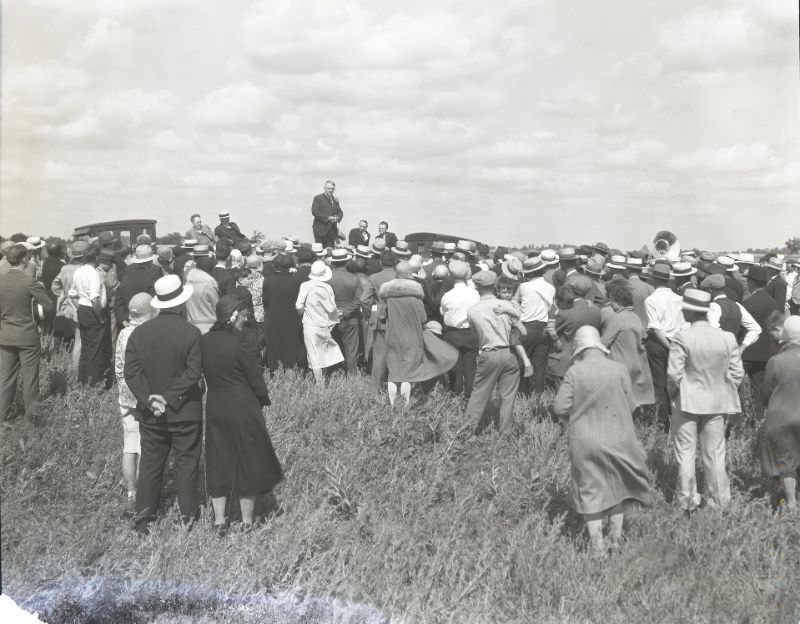
Even as the Depression tightened its grip, development continued in parts of the region. The dedication of the Castle Point subdivision in north St. Louis County drew a crowd in June 1931. New housing was still being built, particularly in the suburbs, where the seeds of future population shifts were already being planted.
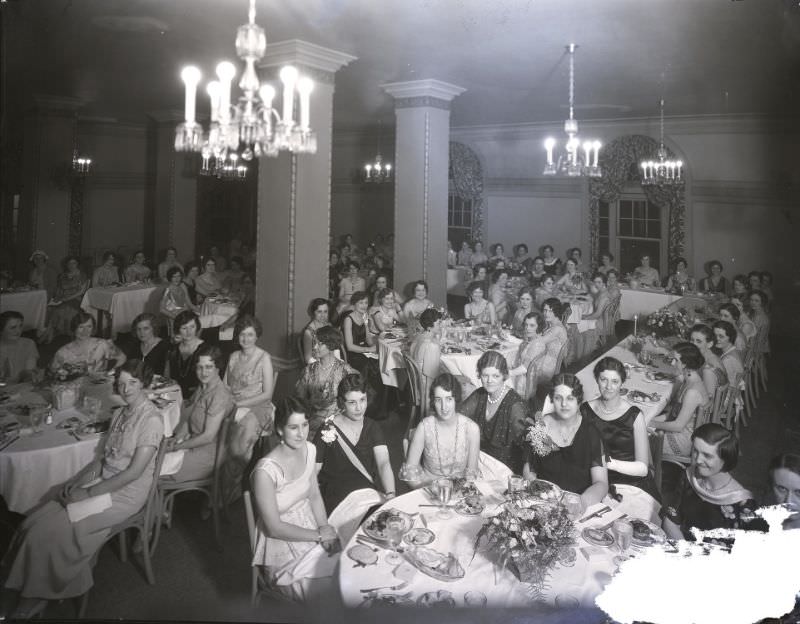
Social gatherings and professional events still filled the calendars of St. Louis institutions. Nurses from St. John’s Hospital came together for a formal banquet at the Forest Park Hotel in May 1931. Events like these offered a sense of continuity in a city under enormous economic pressure.
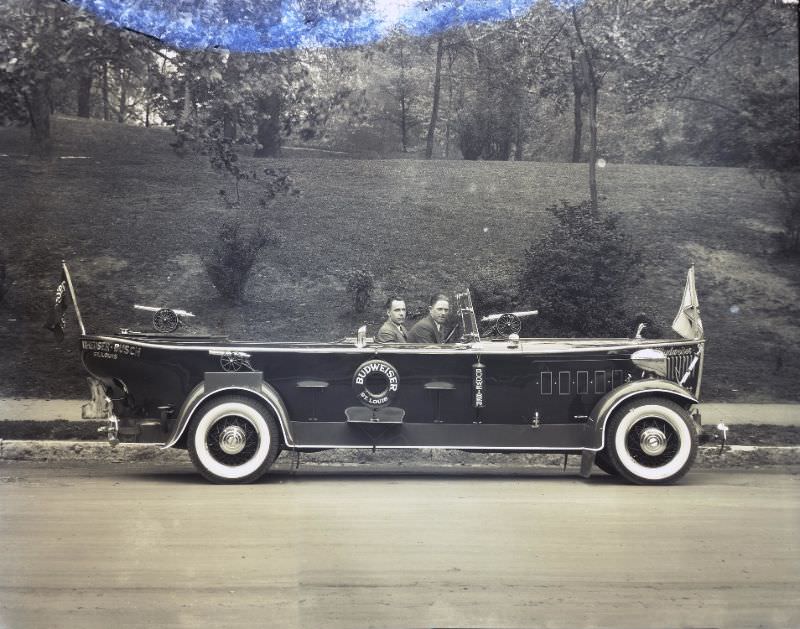
Anheuser-Busch was creative with its promotions even before Prohibition ended. A boat-shaped car was used to draw attention to the brand on St. Louis streets in May 1931, when the brewery was still waiting for the law to change. The company was clearly preparing for the return of legal beer.
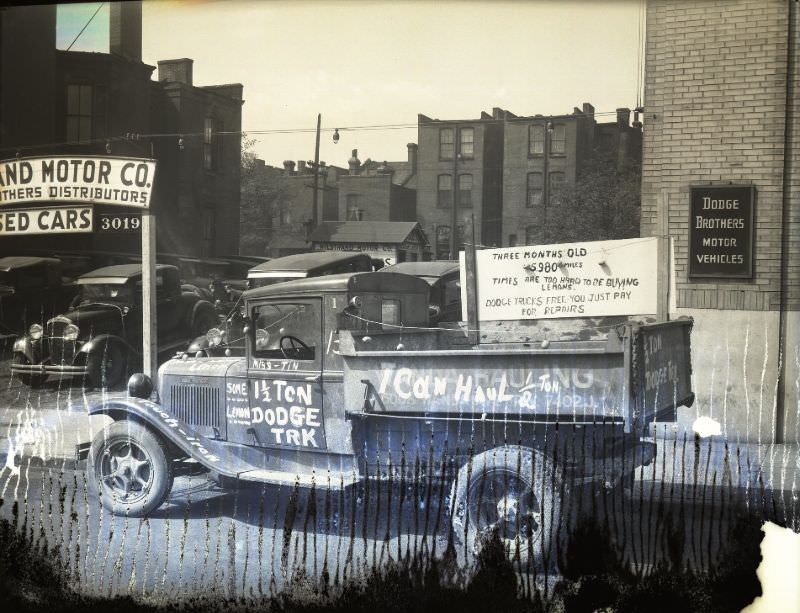
Not every vehicle on St. Louis streets was a point of pride. A Dodge half-ton truck was decorated with signs blasting its poor quality in May 1931 — a public grievance that turned a commercial vehicle into a moving protest. Whether this was a disgruntled owner or a competitor’s stunt, it made for a memorable image on city streets.
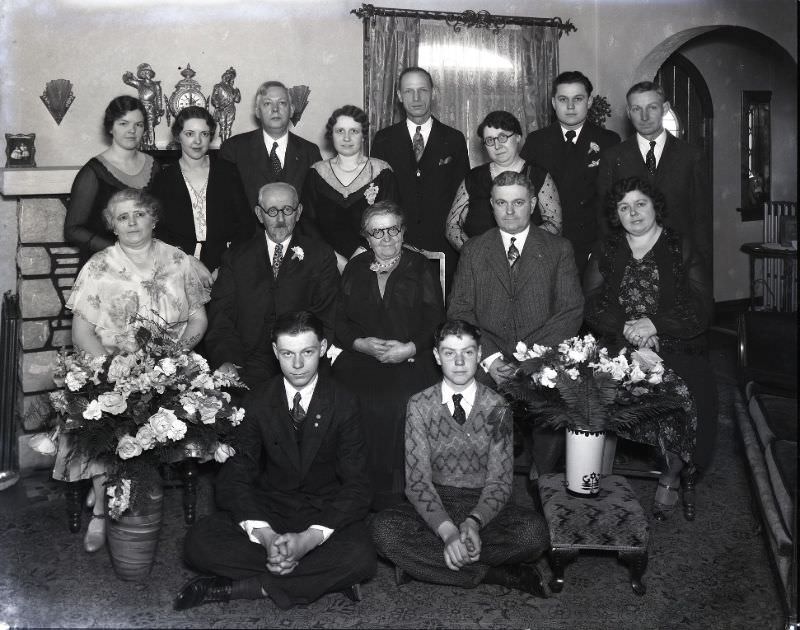
Family milestones continued to be marked across the city. The Kempf family gathered in March 1931 to celebrate Conrad G. and Augusta Kempf’s golden wedding anniversary at the home of their daughter Bertha Meyer and her husband Adolph E. Meyer on Mardel. These celebrations were a quiet anchor in the storm of the Depression years.
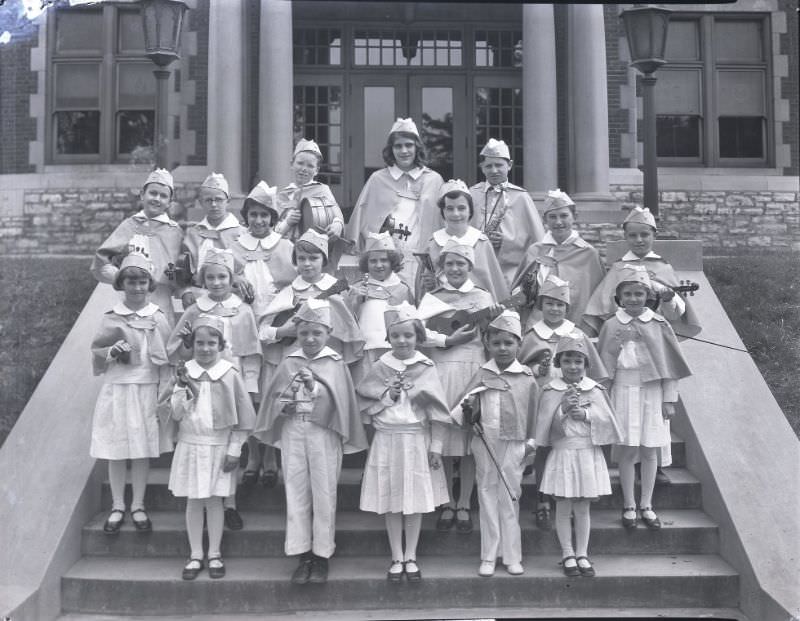
Schools across St. Louis kept their doors open and their programs running. Students at the Immaculate Conception parish school on Lafayette posed with their instruments in June 1931, a reminder that music and arts education continued even as city budgets were being slashed.
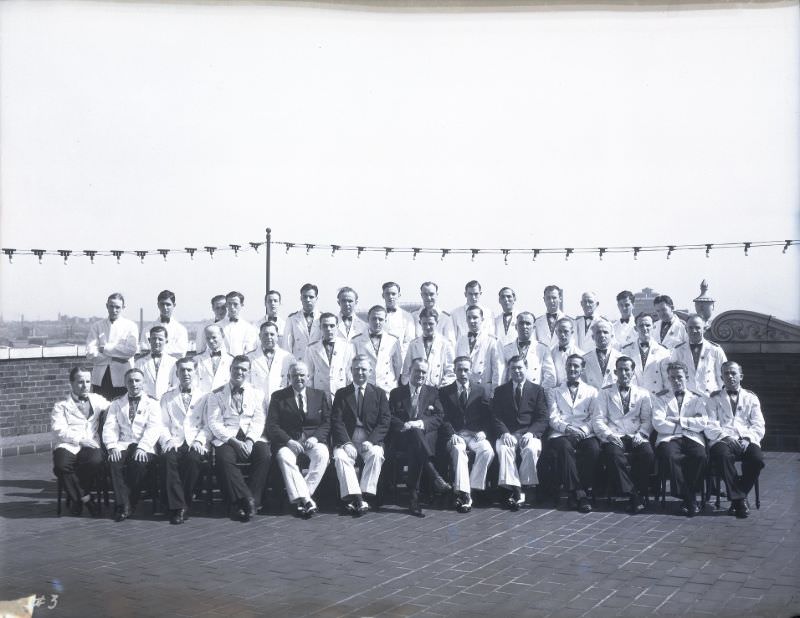
The Chase Hotel was one of St. Louis’s most prominent establishments, and its staff projected a professional image. Waiters posed for a group portrait on the hotel’s roof in May 1931, a confident display from a workforce that kept the city’s hospitality industry running even during lean years.
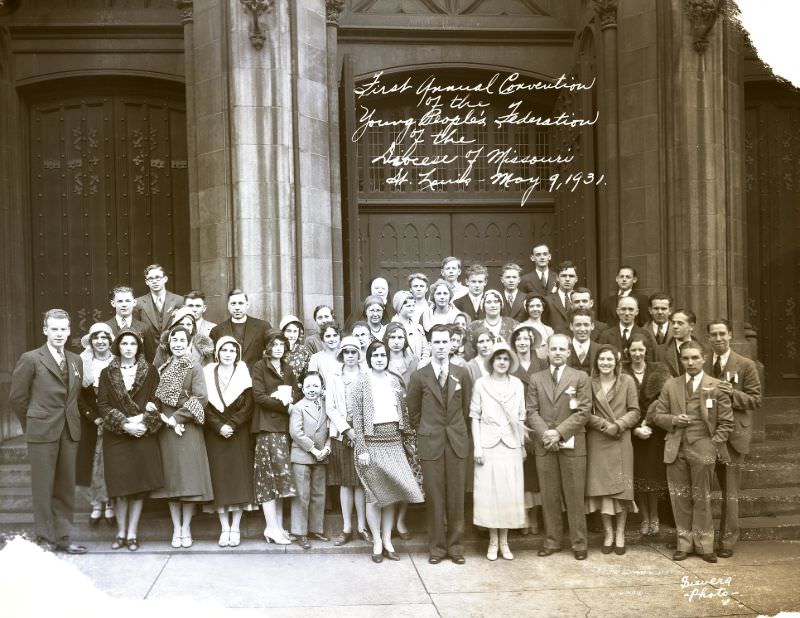
Religious and civic organizations stayed active throughout the Depression. The First Annual Convention of the Young People’s Federation of the Episcopal Diocese of Missouri brought together a large group on the steps of the Bishop Tuttle Memorial Building at Christ Church Cathedral in May 1931. These gatherings reinforced community bonds during a time when many felt the pressure of isolation and uncertainty.
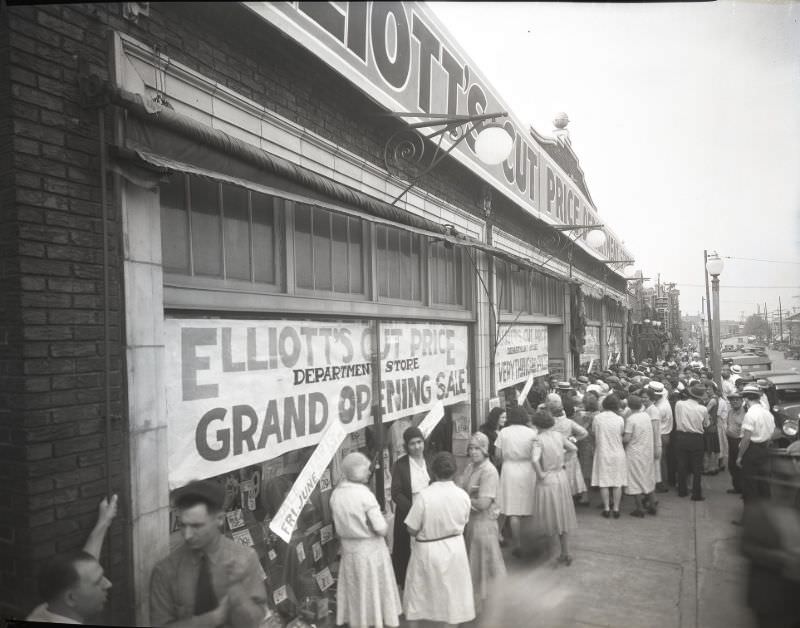
Discount retail was a natural fit for Depression-era St. Louis. When Elliott’s Cut Price Department Store opened at 5206 Gravois in June 1931, a large crowd lined up outside before the doors even opened. Shoppers were eager for low prices, and a new discount store was exactly the kind of event that drew a crowd in a tight economy.
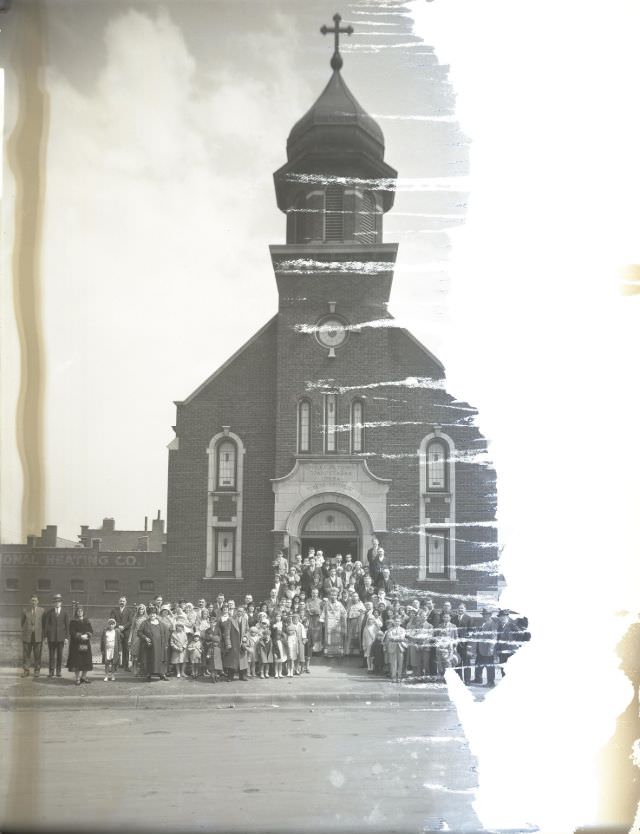
St. Louis was a city of immigrants and ethnic communities, each with their own institutions and traditions. The Holy Trinity Serbian Eastern Orthodox Church at Geyer and McNair was one such place, where a large congregation gathered around their clergy for a formal photograph in April 1931. These churches were more than places of worship — they were community anchors.
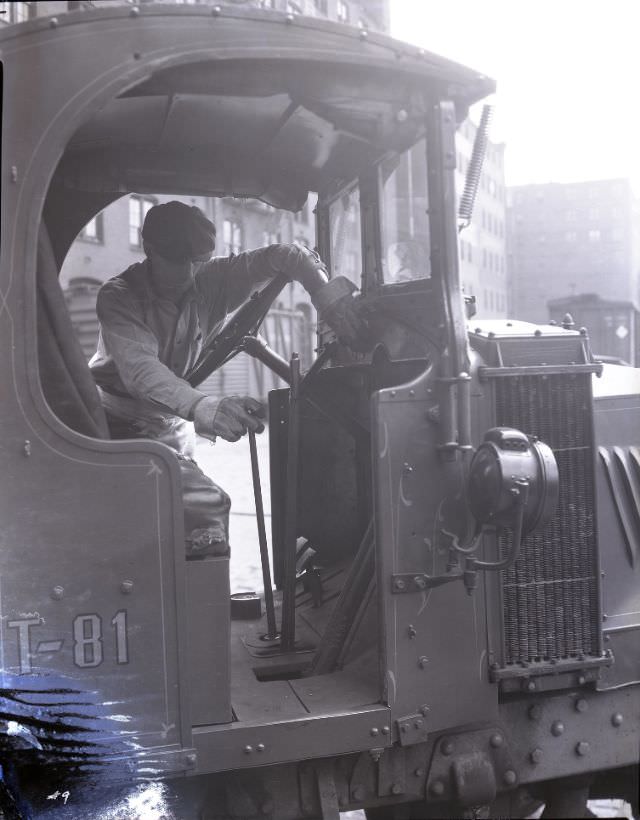
Commercial trucking was a vital part of St. Louis’s economy during the 1930s. The Columbia Terminal Company kept goods moving through the city even as industrial output fell. This portrait of a driver in his cab, captured by Sievers Studio in April 1931, is a glimpse into the working life of the men who kept St. Louis supplied.
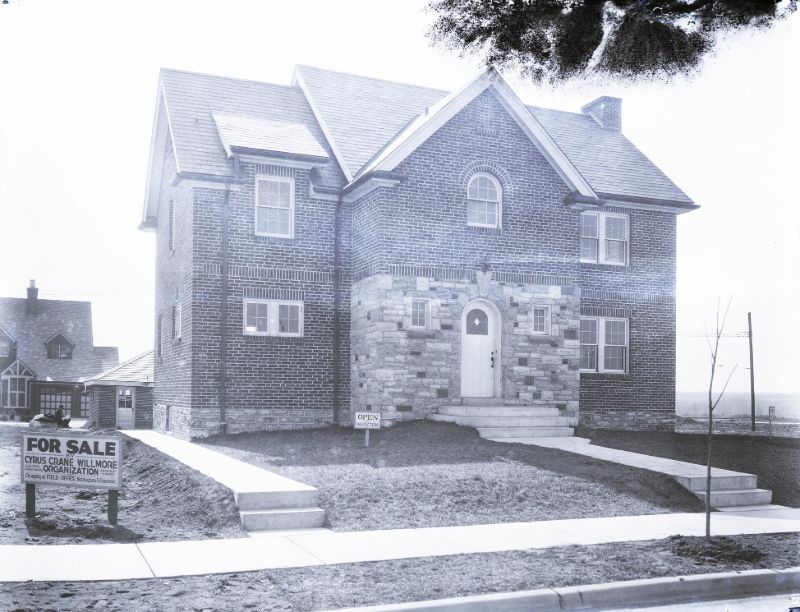
Suburban development pushed forward even in the early Depression years. The Cyrus Crane Willmore Organization built a model home, likely in St. Louis Hills, and marketed it with yard signs in February 1931. The growth happening on the city’s edges pointed toward the larger shift that would define St. Louis for the rest of the century, as white residents of European ancestry steadily moved to the suburbs.
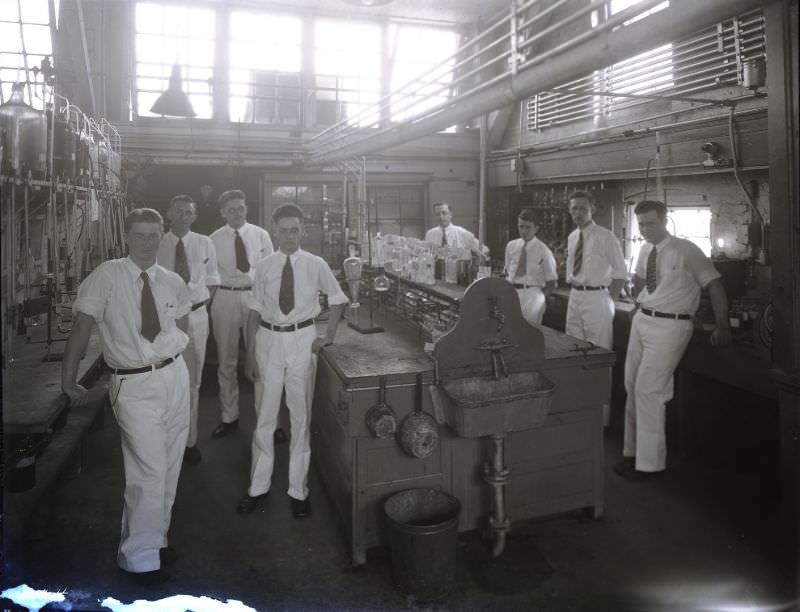
Industrial plants like Monsanto Chemical Works were part of the backbone of St. Louis manufacturing. Employees posed in a laboratory at the company’s plant at 2nd and Lafayette in June 1931. Even with manufacturing output down sharply across the city, operations at key plants like Monsanto continued.
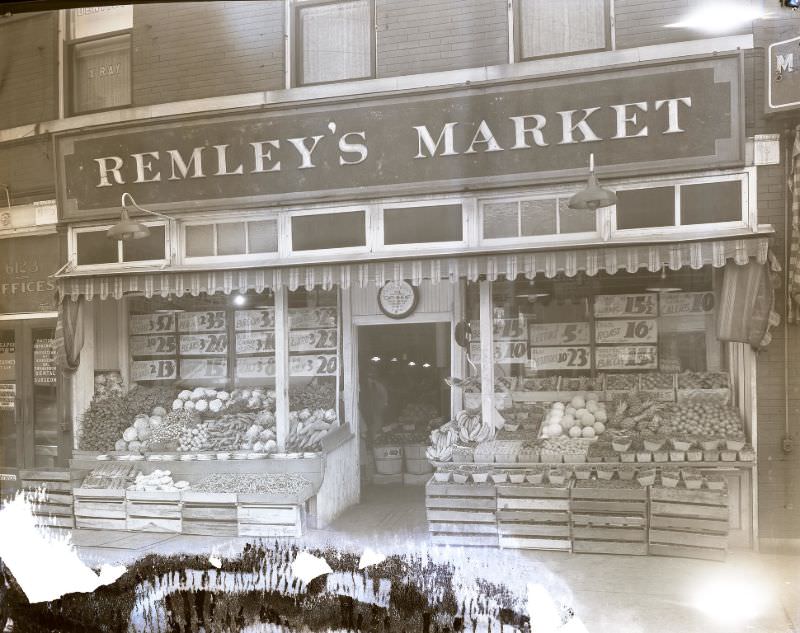
Neighborhood markets remained active throughout the Depression. Jim Remley’s Market at 6213 Easton in Wellston displayed its produce outside in June 1931, giving passersby a clear look at what was available. The street, later renamed Dr. Martin Luther King Drive, was a busy commercial corridor serving the surrounding community.
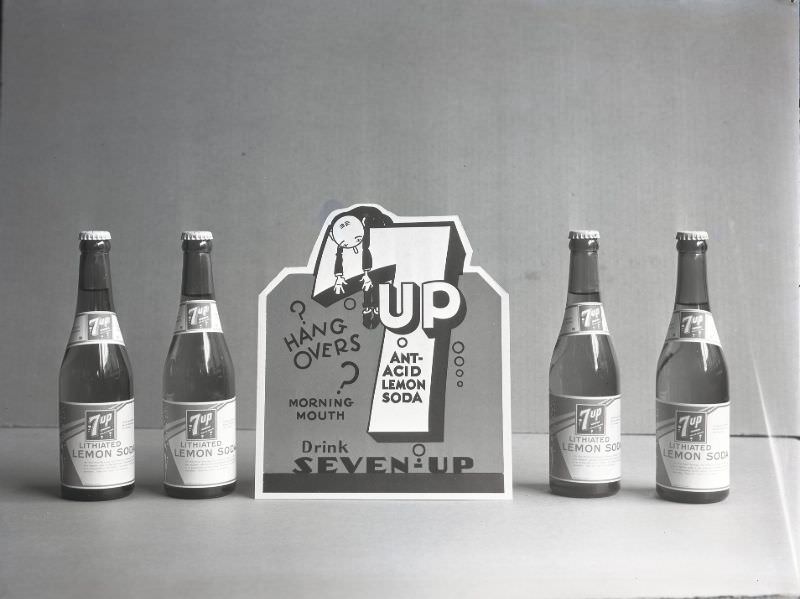
7UP was still a new product in 1931, having launched in 1929, and it was making its way onto store shelves across American cities, including St. Louis. A product display photographed in June 1931 shows the brand establishing itself just as the Depression was taking hold — a small piece of consumer culture pushing forward in difficult times.
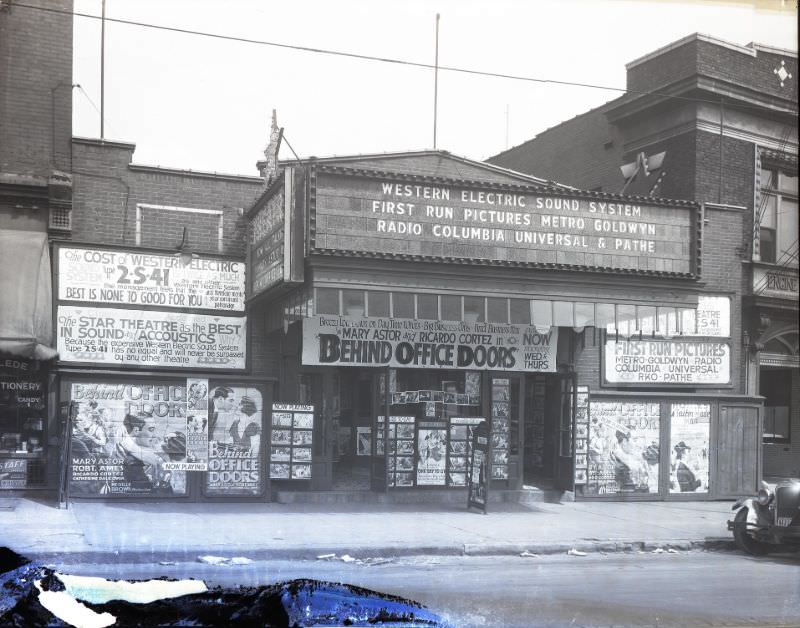
Movie theaters gave St. Louisans a few hours of escape from the hardships outside. The Star Theater at the corner of Market and Jefferson was one of the venues where residents could sit in the dark and forget about the Depression for a while. Film was one of the few industries that actually grew during the 1930s, and theaters like the Star stayed busy.
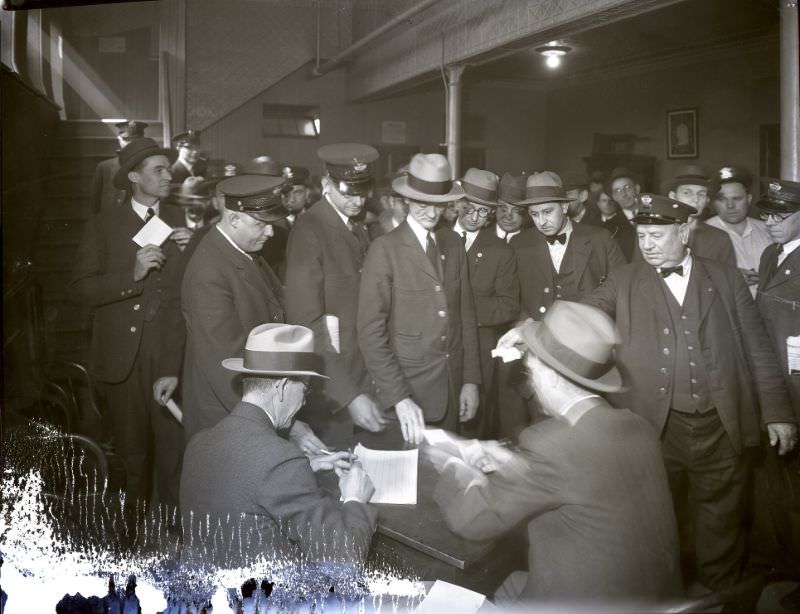
Labor tensions ran high across St. Louis during the Depression. Streetcar union members gathered at Unity Hall in May 1931 to vote on a potential strike, a sign of the friction between workers and employers during a period when wages and jobs were under constant pressure. The outcome of that vote would affect the daily commutes of thousands of St. Louisans.
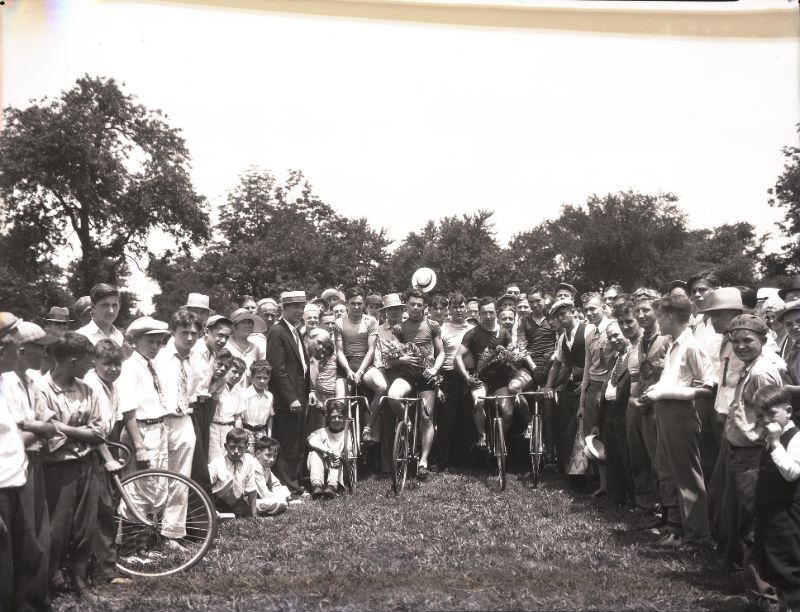
Sports and recreation offered relief from the grind of Depression life. O’Fallon Park hosted a marathon bicycle race in June 1931, with winners holding flowers after crossing the finish line. Public parks were free, and events like these drew participants and spectators who needed a reason to get outside.
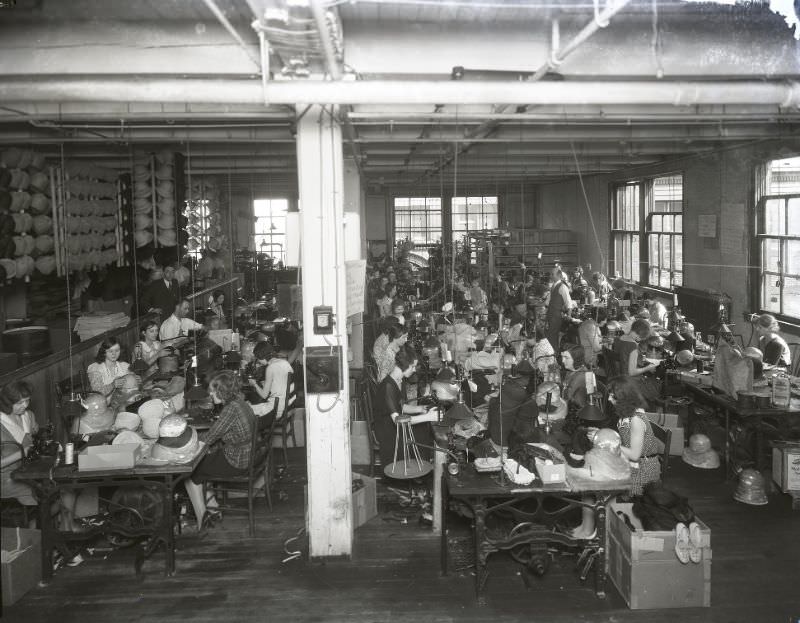
Small manufacturing operations like the Slavin Hat Company at 1117 Washington kept workers employed even as larger industries contracted. Workers posed at the factory in April 1931, part of the daily rhythm of production that continued in pockets of the city despite the broader economic collapse.
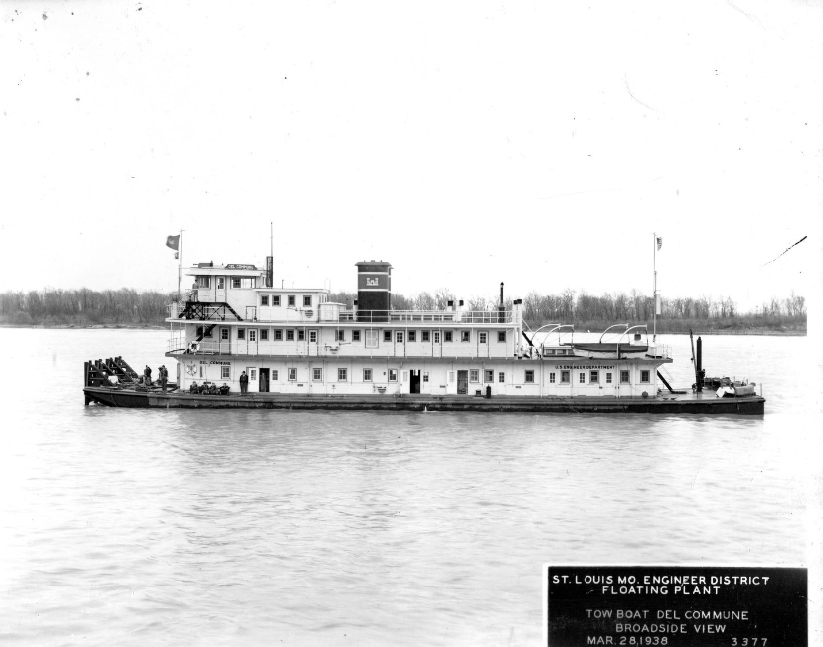
The streets and commercial districts of St. Louis carried the character of a city that had grown quickly in the decades before the Depression. Storefronts, signage, and street life filled the neighborhoods, creating a visual record of urban life in one of the Midwest’s largest cities during its most difficult decade.
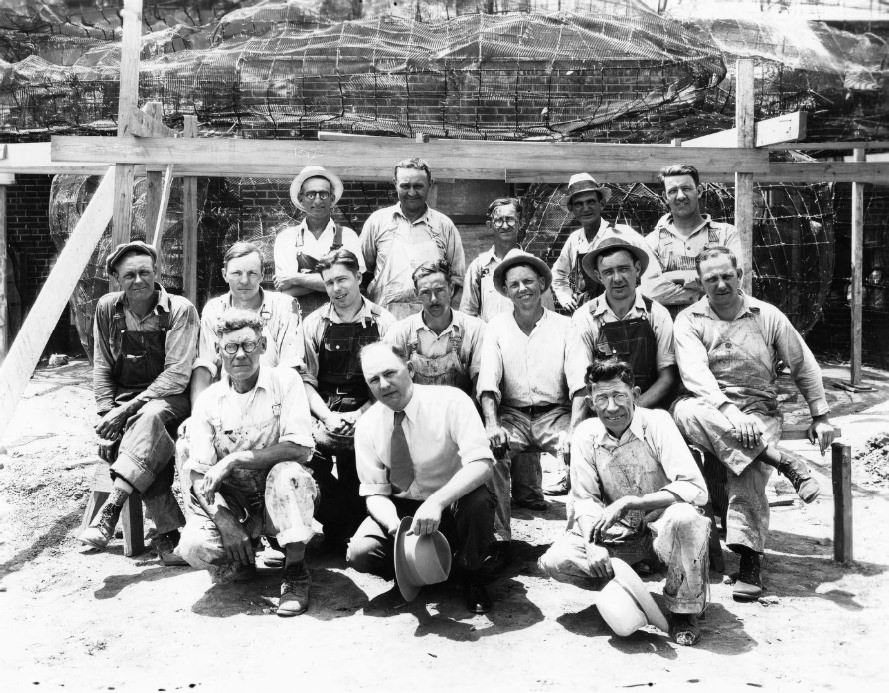
Trade unions in St. Louis had their own social traditions. Members of Metal Lathers Local 73 — including Harry Hagen, Herman Beermann, Henry Beerman, Brian Frederickson, Tom Frederickson, and Joe Cook — gathered for a photograph at the St. Louis Zoo in 1930. The photo was later donated to the St. Louis Mercantile Library by the Gymnastic Association Sokol.
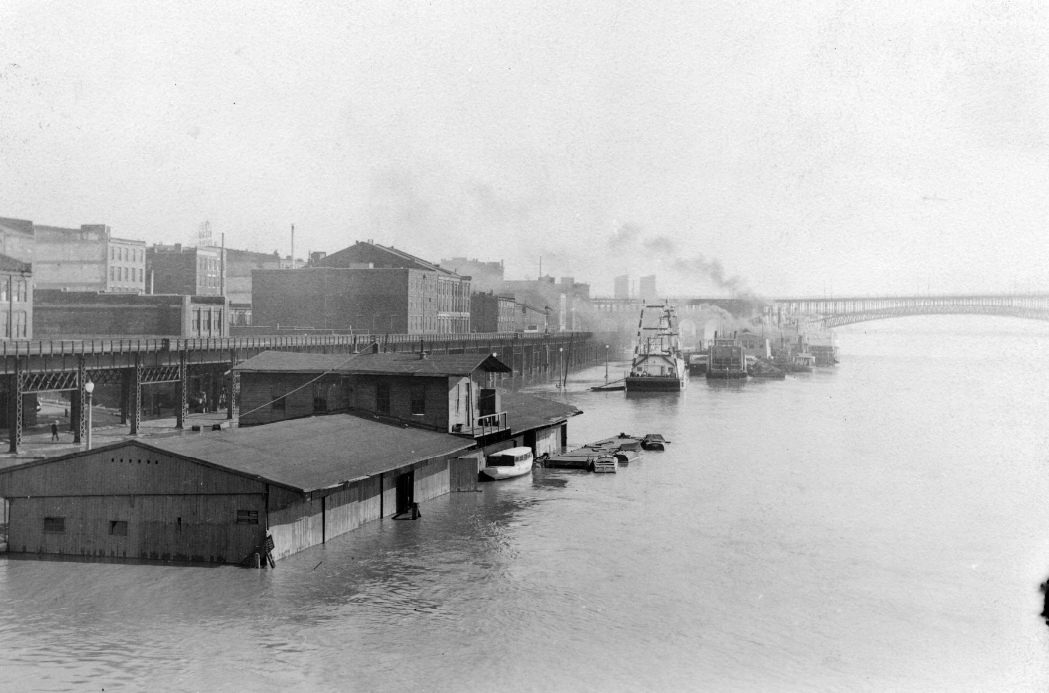
The St. Louis riverfront was the historical heart of the city. The Mississippi River had made St. Louis a major commercial hub, and the Eads Bridge — completed in 1874 — remained one of its most iconic landmarks. By the 1930s, the waterfront was still active with river traffic, though the economic slowdown was felt there too.
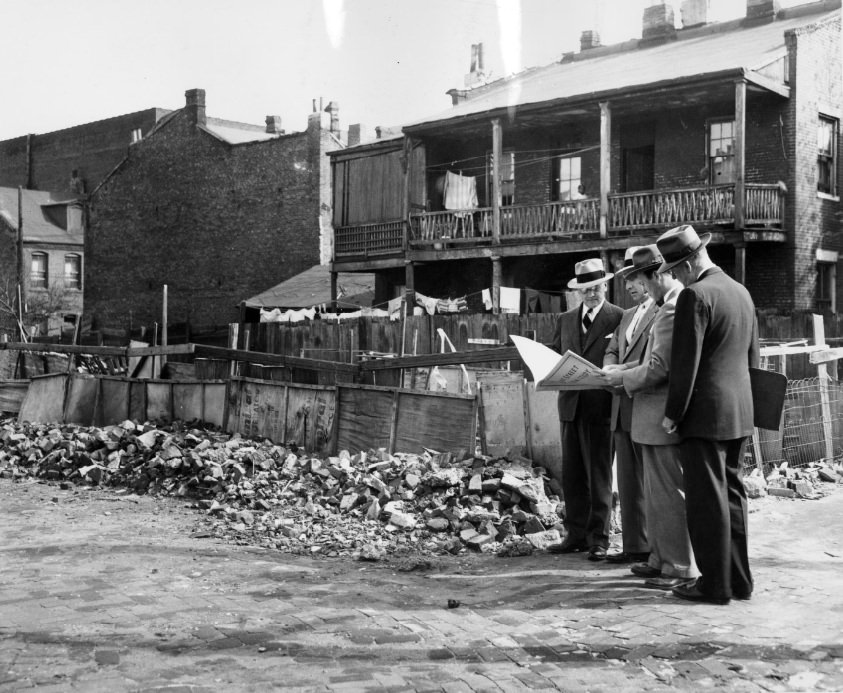
The intersection at Fourteenth and Carr streets became one of several areas examined for industrial redevelopment in the postwar era. A visit by Pittsburgh civic leader Arthur B. Van Buskirk captured the attention being paid to redevelopment planning, as officials from the City Plan Commission and civic organizations walked the site. Decisions made about these neighborhoods would reshape large portions of St. Louis for decades.
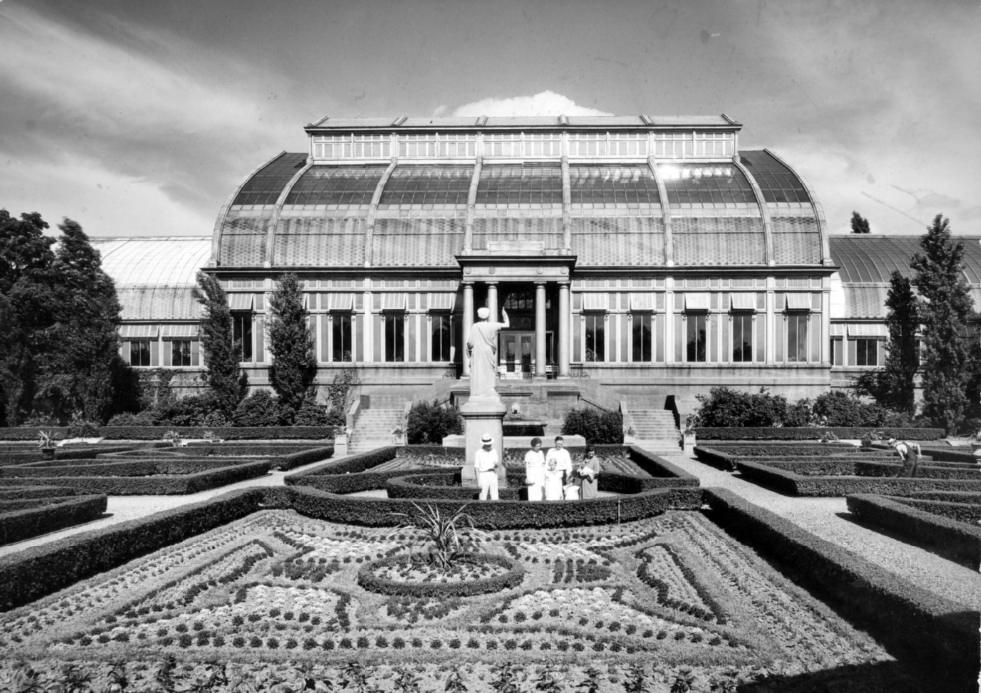
Known worldwide as Shaw’s Garden, the Missouri Botanical Gardens was one of St. Louis’s great civic treasures. Founded by Henry Shaw in 1859, it was the second-largest botanical garden in the world, behind only the famous Kew Gardens in London. Its greenhouses alone covered more than two acres, and its orchid collection was considered the finest in the world. The gardens provided free beauty to a city that badly needed it during the Depression.
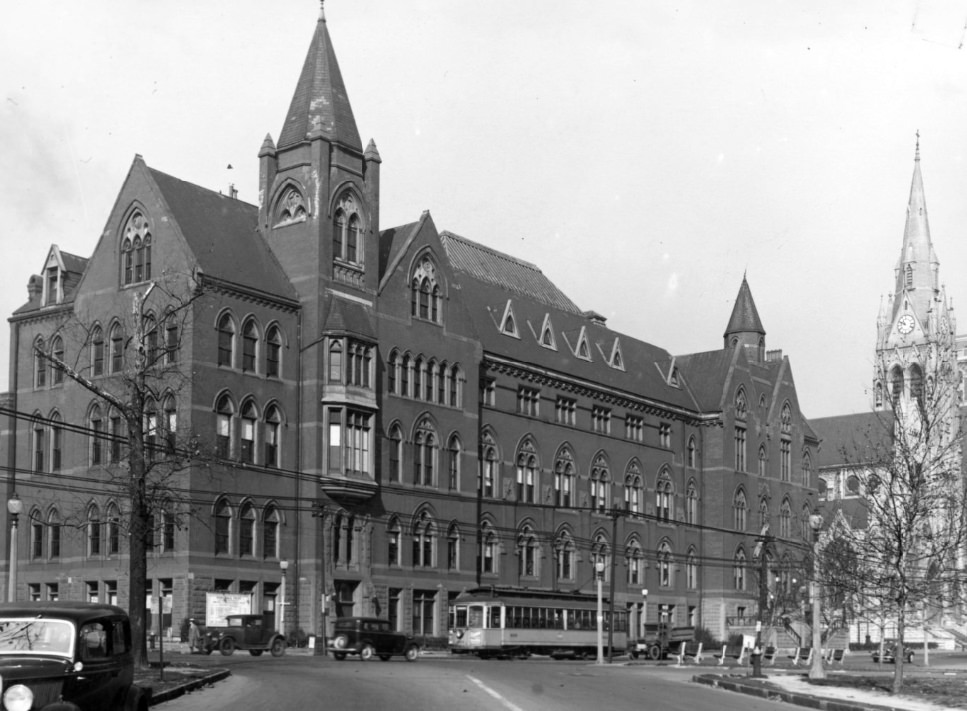
St. Louis University, one of the oldest universities west of the Mississippi, remained a fixture of the city’s educational landscape through the 1930s. Higher education continued, though many students and institutions felt the financial strain of the Depression years.
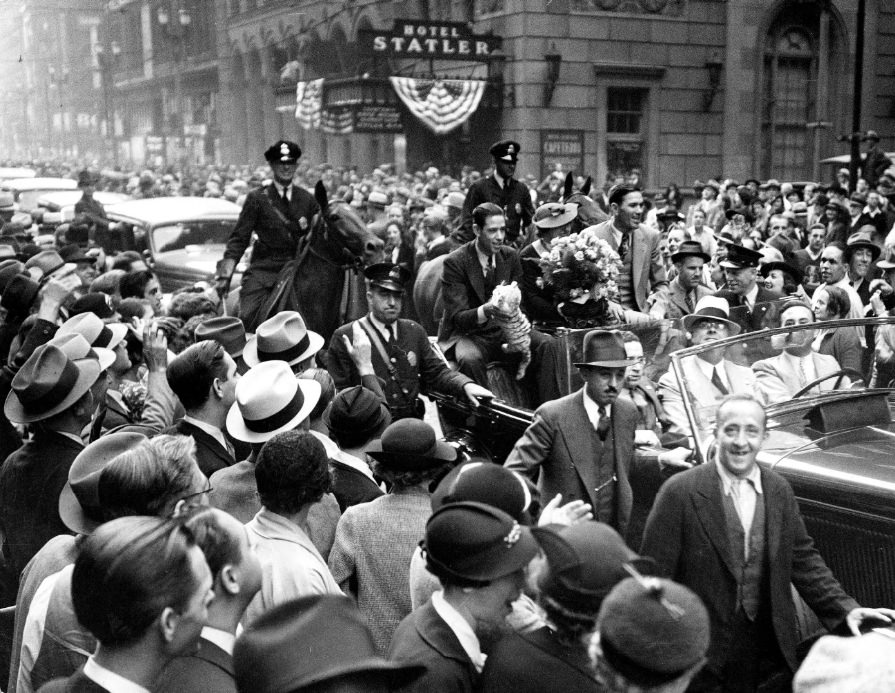
Baseball provided some of the city’s brightest moments during the darkest years of the Depression. The St. Louis Cardinals were a source of enormous civic pride. Dizzy Dean and his brother Paul Dean became household names in 1934, the year the Cardinals won the World Series. The Dean brothers posed together with Mrs. Dizzy Dean, capturing a moment of triumph for a city desperate for good news.
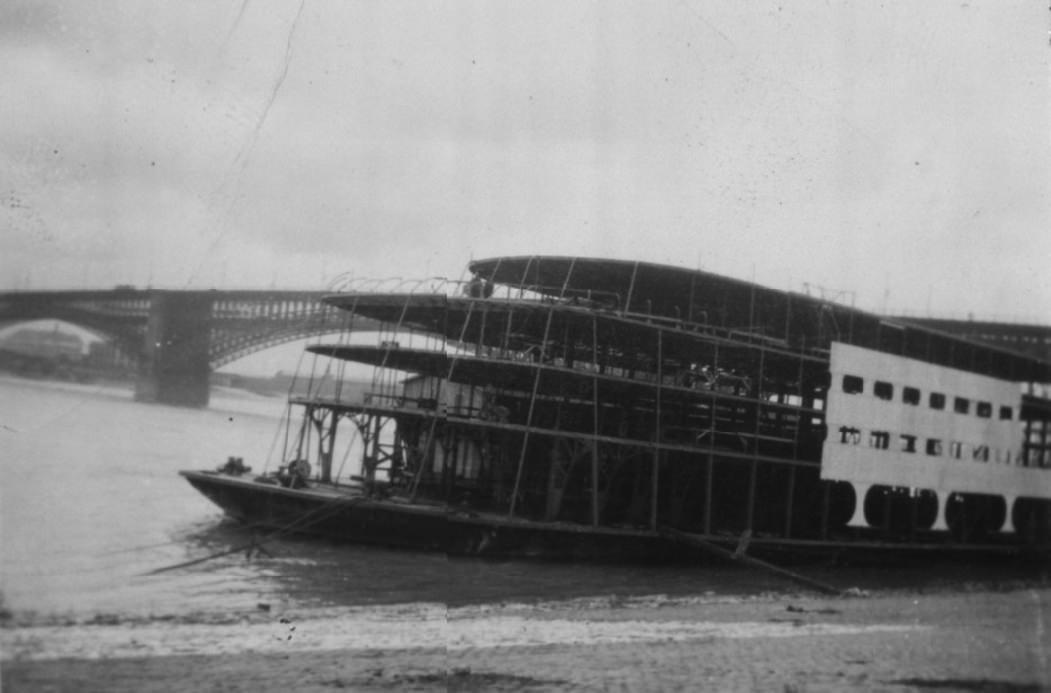
River life was making a comeback by the mid-1930s. The Streckfus Steamers company was building the Admiral, one of the most impressive excursion boats ever launched on the Mississippi. Construction began in earnest by 1937, promising a new era of river entertainment for St. Louis residents.
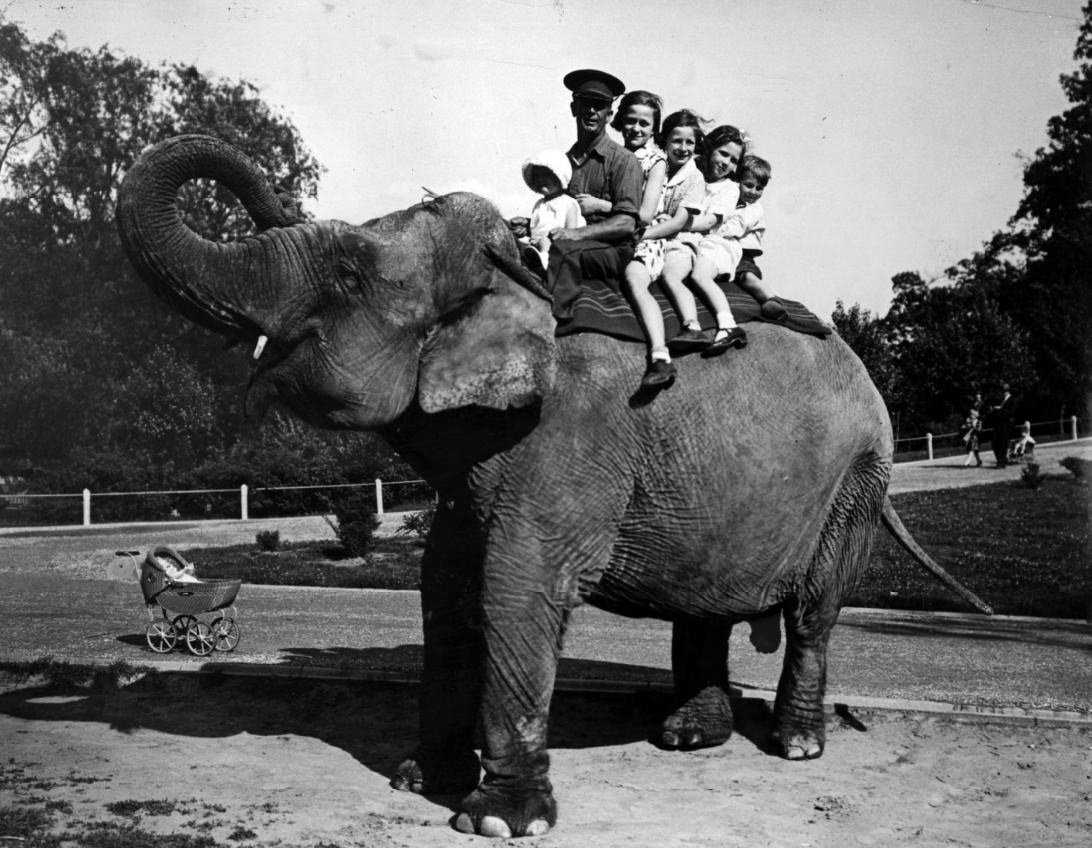
The St. Louis Zoo was a free attraction that offered families a place to spend a day without spending money they didn’t have. In 1932, children were given free rides by Miss Jim, an elephant, with her keeper Phil Rost. For many families struggling through the Depression, the zoo was one of the few outings they could still afford.
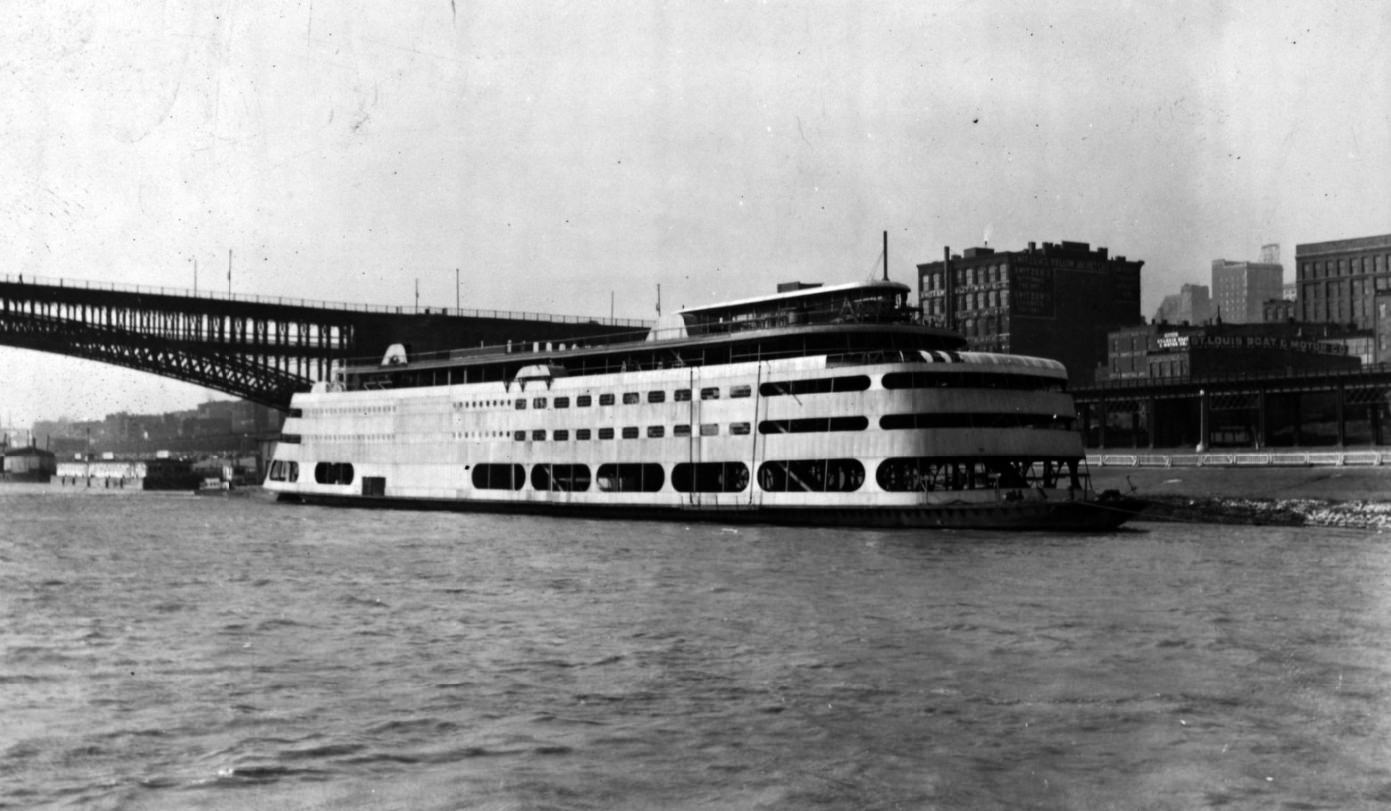
By 1938, construction on the Admiral was well advanced, with the St. Louis Boat and Motor Co. building visible in the background of photographs taken at the site. The boat was being built with serious ambitions — it would eventually carry thousands of passengers on excursions up and down the Mississippi.
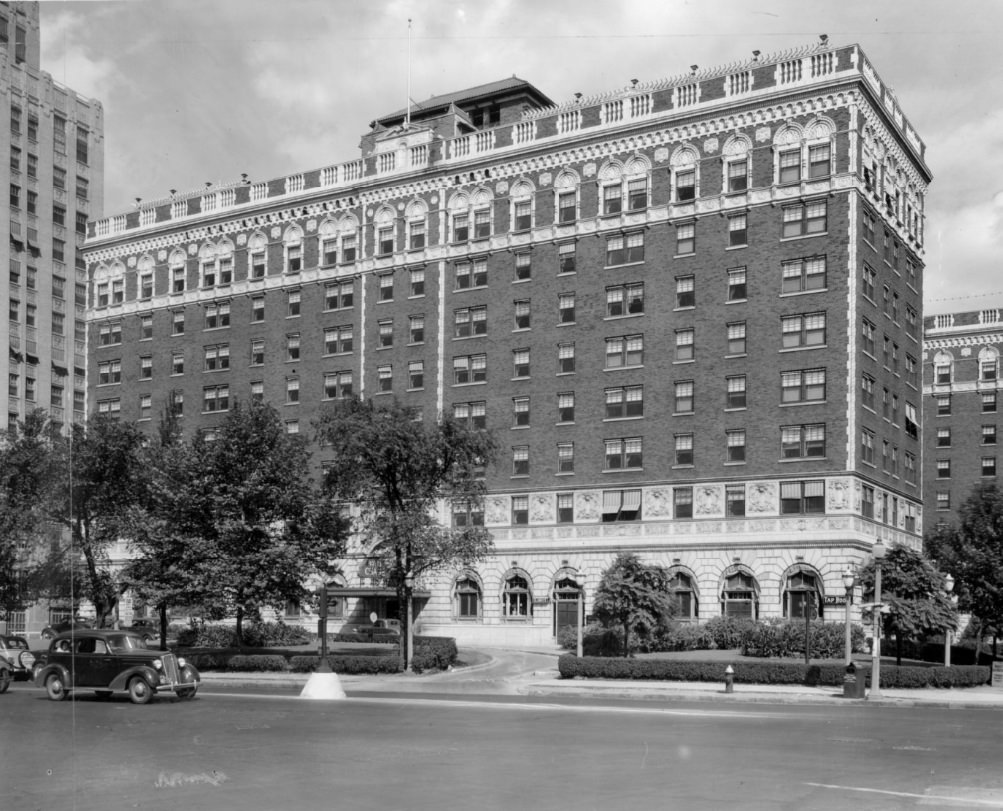
The Chase Park Plaza Hotel stood as one of the grandest addresses in St. Louis. In a city dealing with widespread poverty and unemployment, the Chase represented a world of formal dinners, traveling dignitaries, and city society events. It occupied a complicated space in Depression-era St. Louis — a monument to pre-Depression prosperity that continued to operate through the decade.
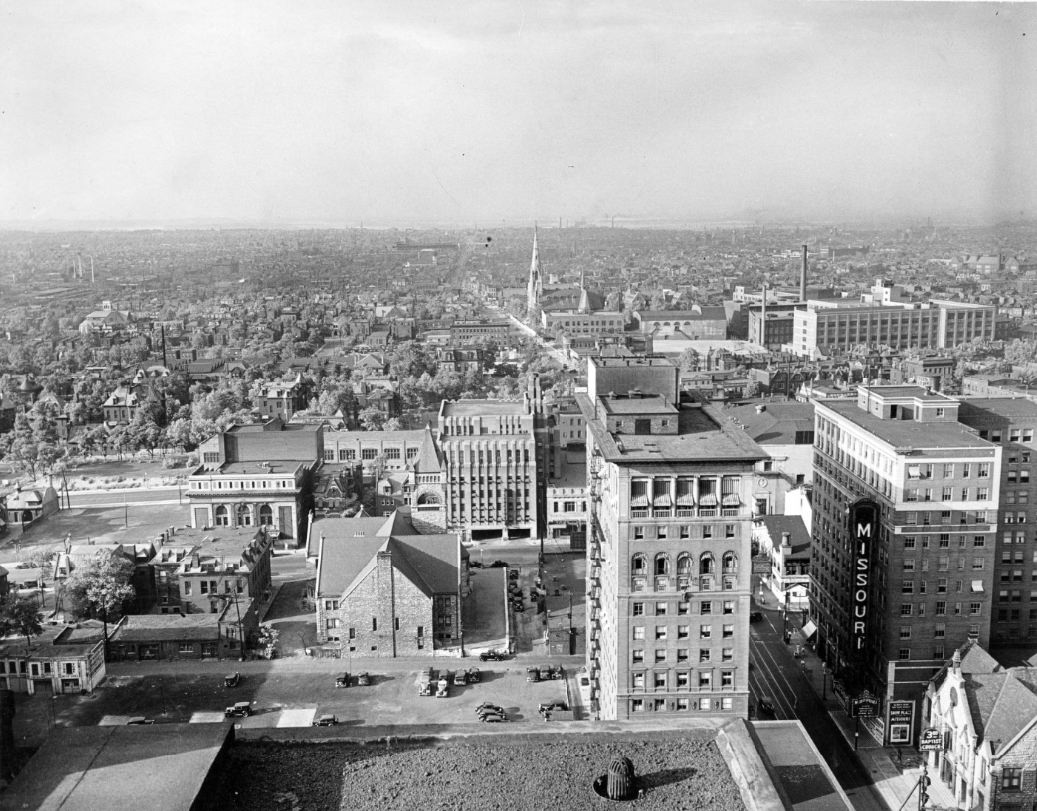
From the penthouse apartment of the Continental Life Building — once leased by Ed Mays for $12,000 a year — the view of north St. Louis stretched across a dense urban landscape. The rooftops of homes, commercial buildings, and factories packed the frame, showing how intensely developed the city had become before the Depression began pulling people toward the suburbs.
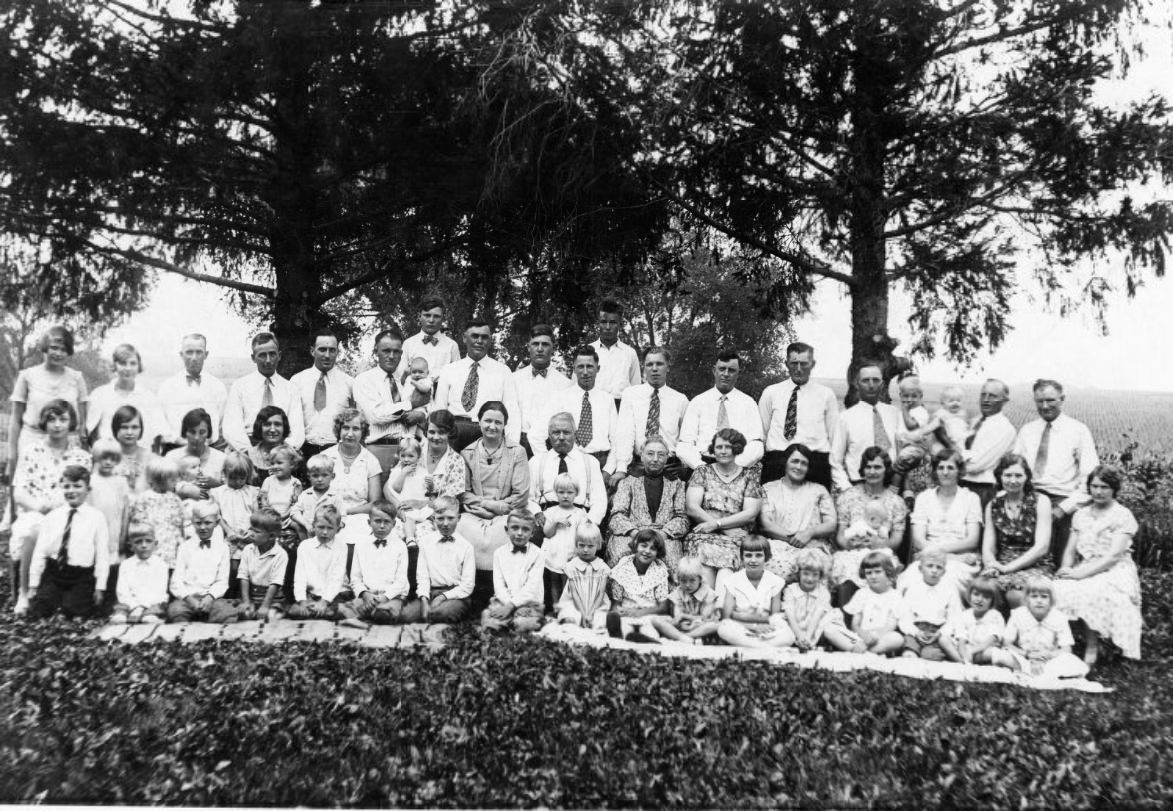
The four Knobbe brothers — Joseph, August, Clement, and Benedict — gathered their families for a reunion in 1932 at August’s residence. August owned Tower Grove Dairy, and all four brothers had immigrated from Germany. The reunion was a reminder that family ties and immigrant heritage remained central to life in 1930s St. Louis, even as economic pressures tested communities across the city.
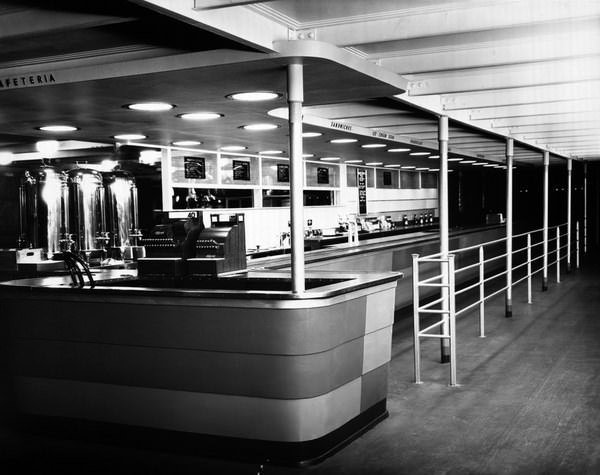
The President steamboat was one of the Streckfus company’s earlier excursion boats operating on the Mississippi. Its fourth deck cafeteria in 1933 offered passengers a place to eat while the river rolled by outside. River excursions provided affordable entertainment at a time when most forms of leisure had become luxuries.
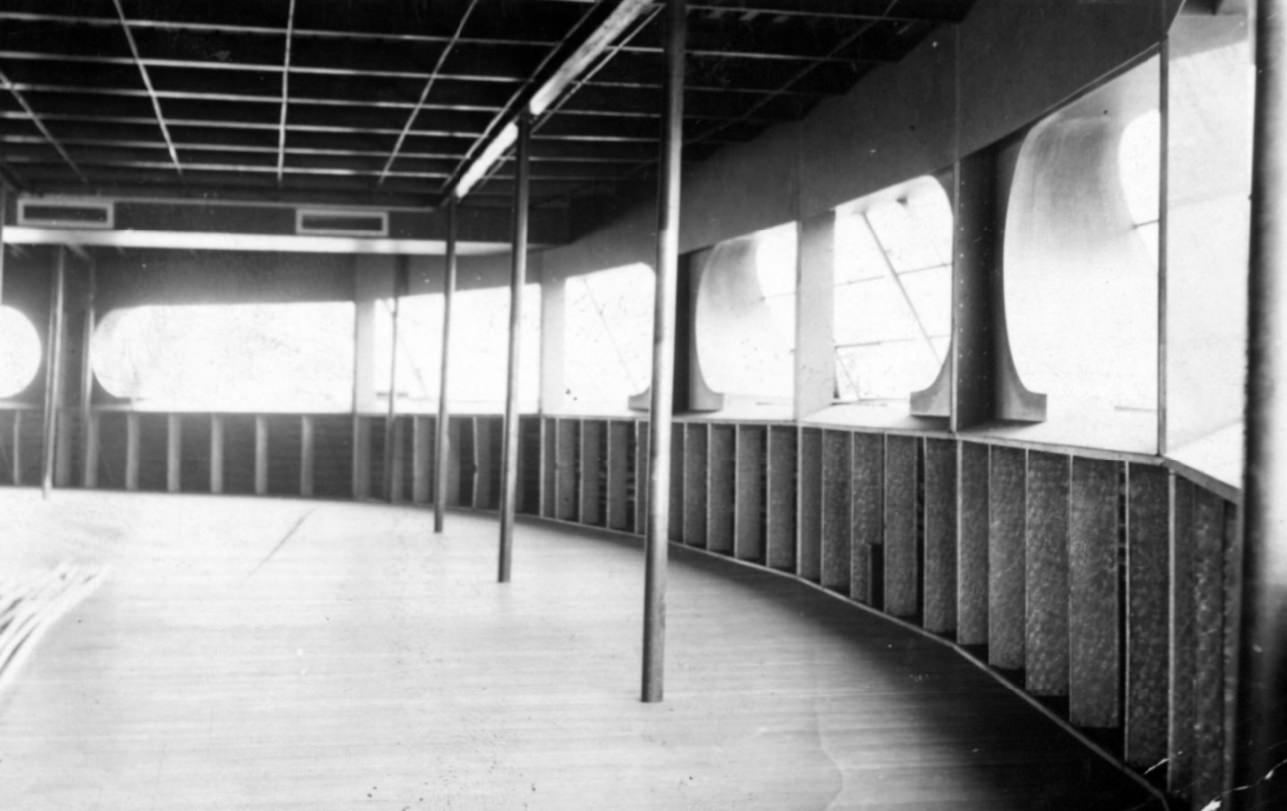
As the Admiral neared completion in 1939, photographs of its interior showed the scale of what was being built. The second deck was taking shape into a large, open entertainment space designed to hold crowds of passengers. The boat would eventually become one of the most famous vessels ever to operate on the Mississippi.
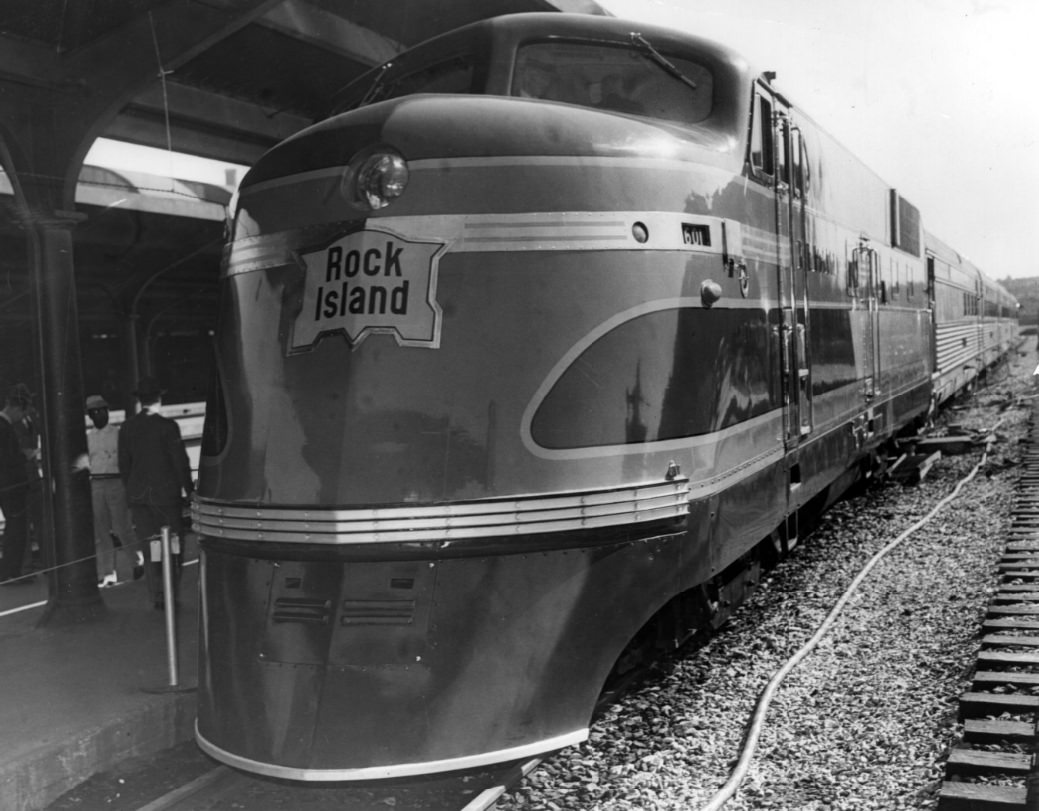
Rail travel remained a major part of life in St. Louis. Union Station was one of the busiest train stations in the country, and it drew attention whenever something new rolled through. The Rock Island Lines’ “Rocket” went on display at Union Station in 1937 before beginning its twice-daily round trips between Chicago and Peoria — a sleek, streamlined train that represented the future of American rail.
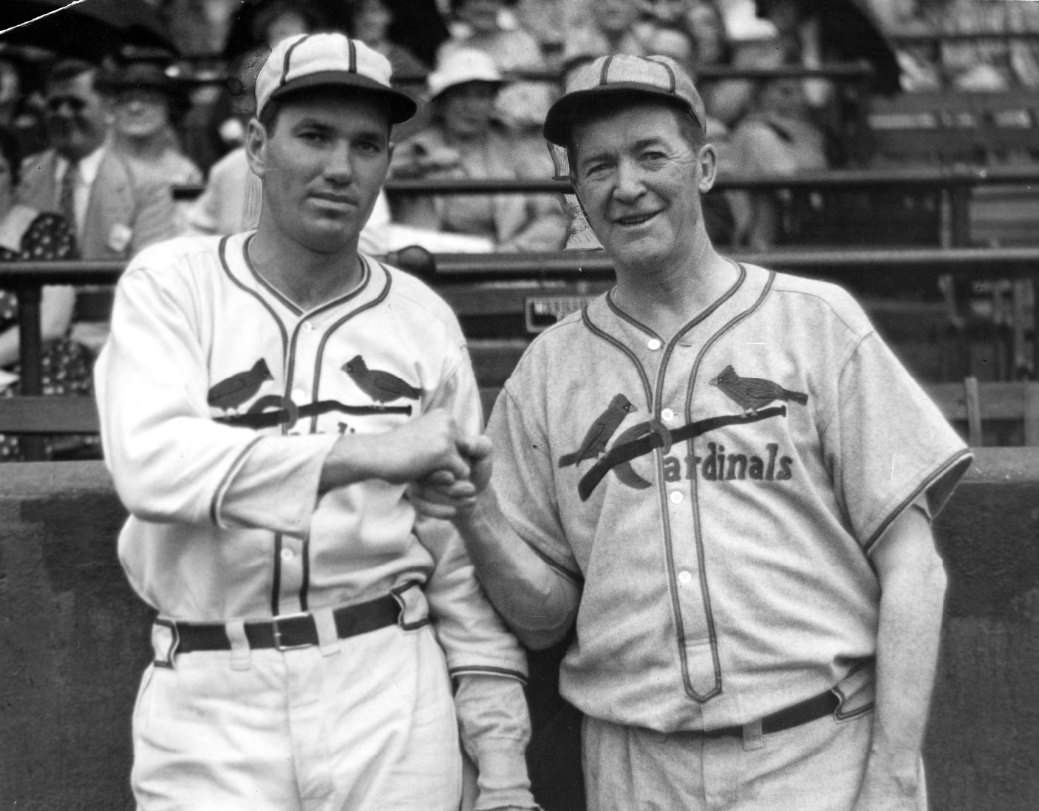
St. Louis had a deep baseball history, and moments where generations connected made the city proud. Dizzy Dean, the Cardinals’ ace pitcher and the dominant player of the early 1930s, stood alongside Grover Cleveland Alexander in 1936 — two of the most celebrated pitchers ever to wear a St. Louis uniform. These connections between eras kept baseball alive as a central part of the city’s identity.
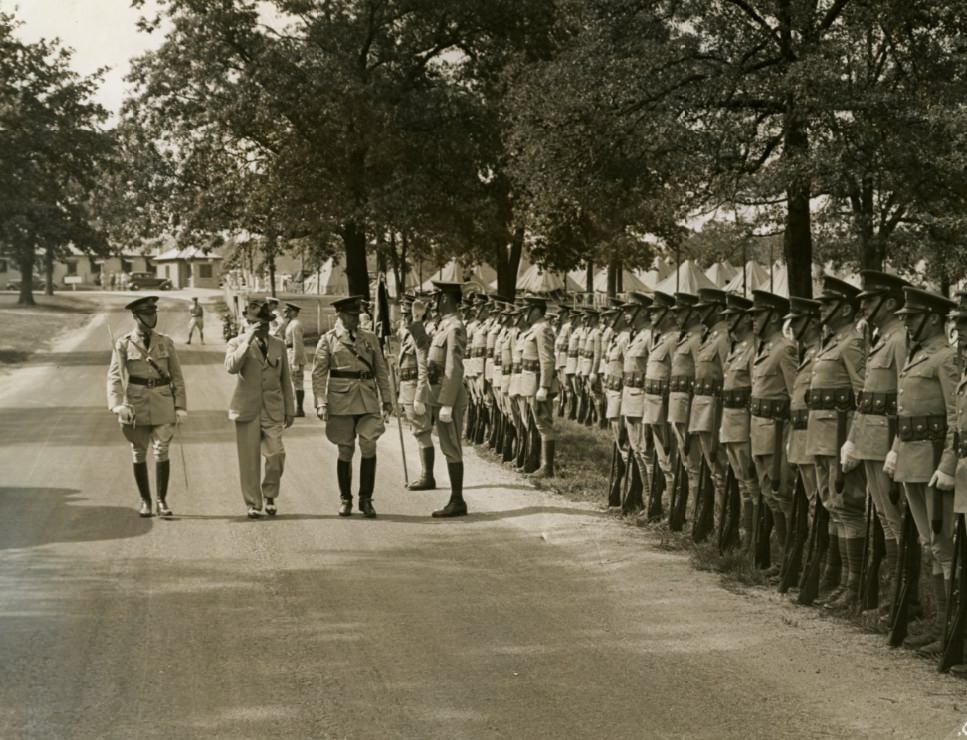
Jefferson Barracks, located just south of St. Louis, was one of the most important military installations in the country. The Sixty Infantry passed in review before its commanding officer, Colonel Joseph A. Atkins, after a post inspection by Major General Charles D. Harron of the Sixth Corps area. Military activity at Jefferson Barracks was intensifying as the decade went on, with Europe’s troubles pushing the United States toward greater military readiness.
By 1938, the pace of military activity at Jefferson Barracks was picking up. Soldiers drilled, trained, and prepared for possibilities that were becoming harder to ignore as events unfolded in Europe. The barracks served as both a training center and a processing station for recruits coming from across the Midwest.
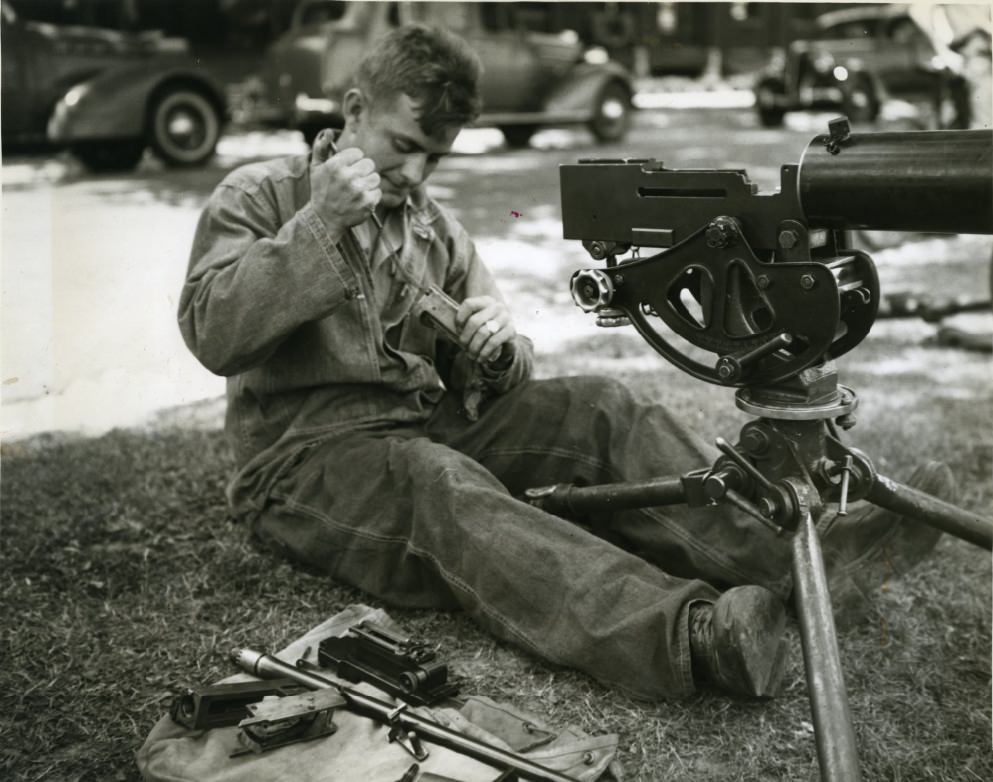
Not every moment at Jefferson Barracks was serious. Private Bredemeyer made the mistake of disassembling a machine gun out of curiosity, only to find himself unable to put it back together — a moment of levity captured by a photographer and turned into a lighthearted military news item in 1937.
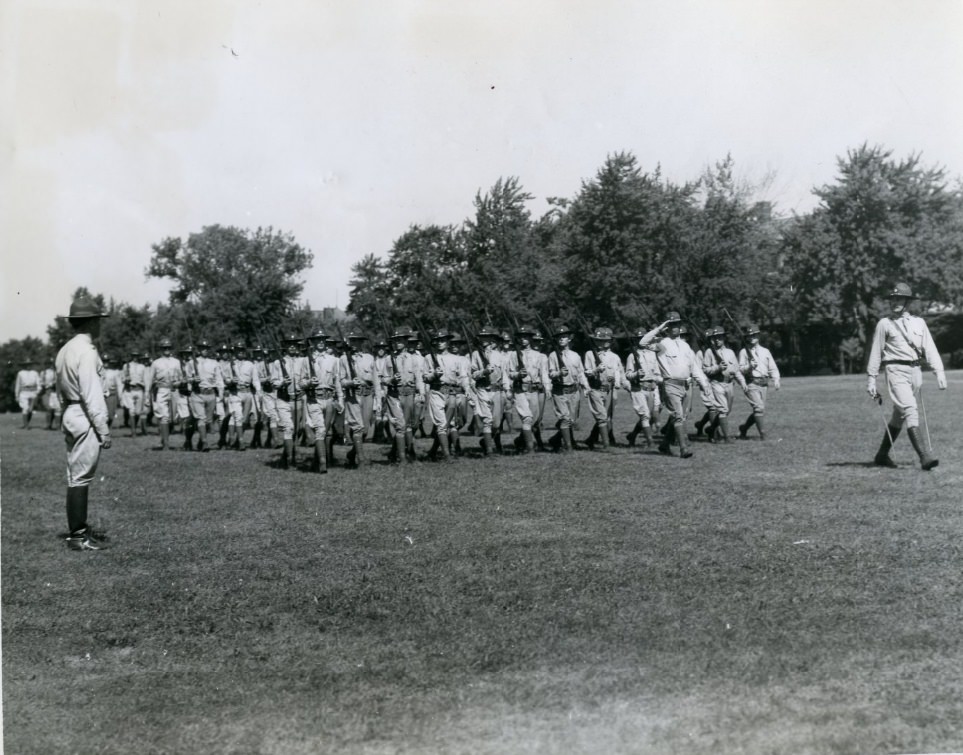
Fresh recruits at Jefferson Barracks went through a rapid training process that turned civilians into soldiers in a matter of weeks. In 1935, recruits who had been in the army for less than a month marched in review on the parade grounds. Lieutenant R.C. Huggins led them with drawn sword while Major Walter C. Philips reviewed the formation from the sidelines.
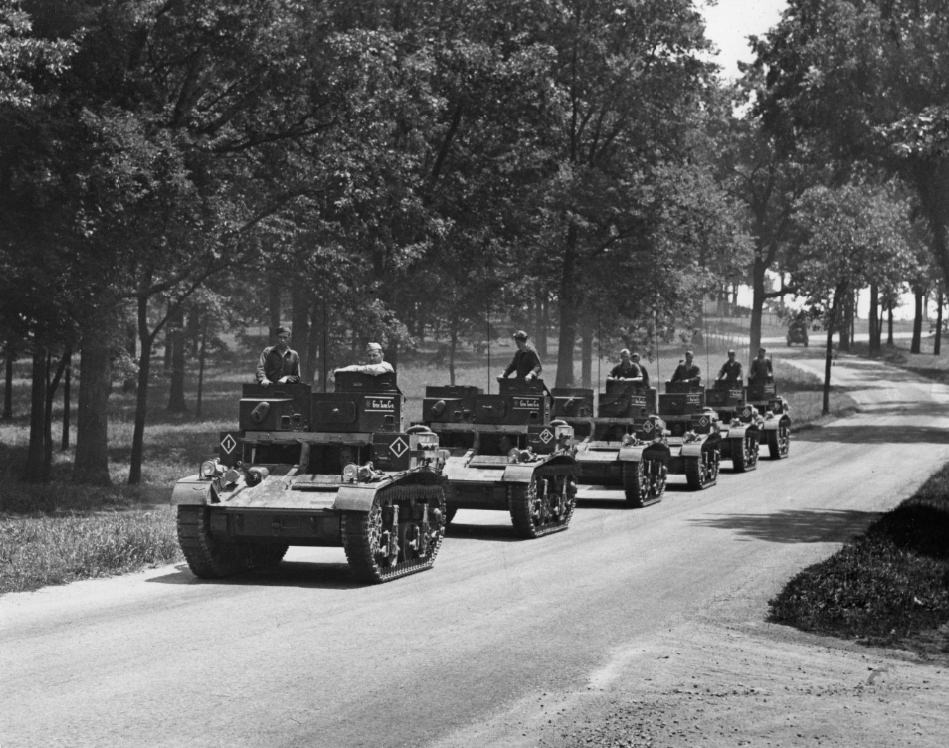
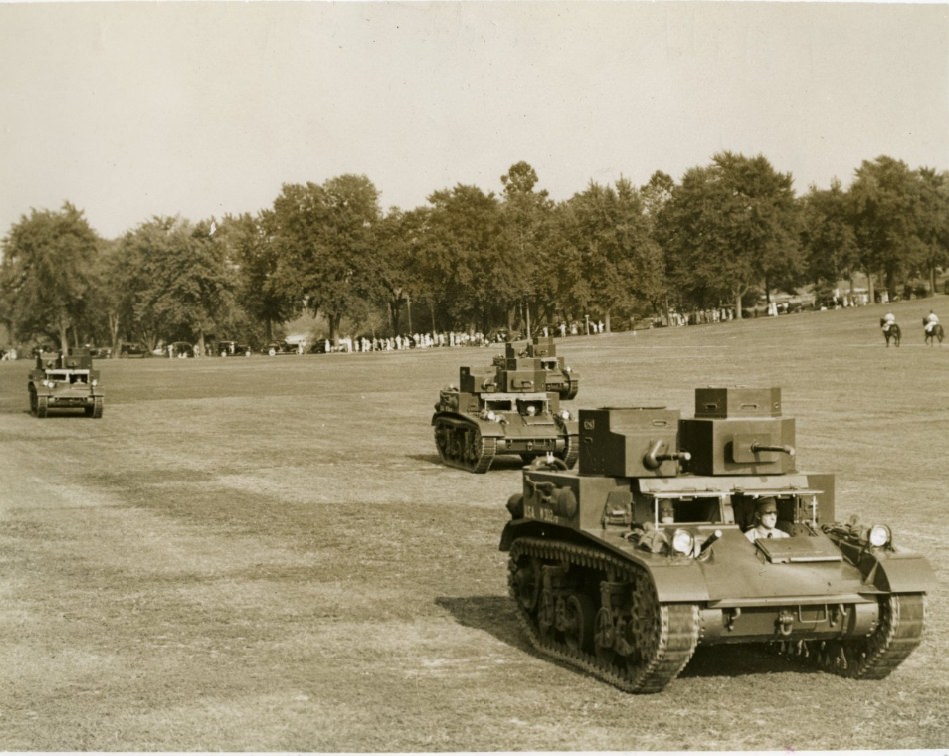
In 1939, the light tanks of the Sixth Tank Company at Jefferson Barracks departed for Arcadia, Missouri, under the command of Captain J.H. Gilbreth. Forty-one officers from the 420th Infantry Reserves were going through their final tank training for the season. The movement of armor through the Missouri countryside was becoming a more common sight as the military built up its capabilities.
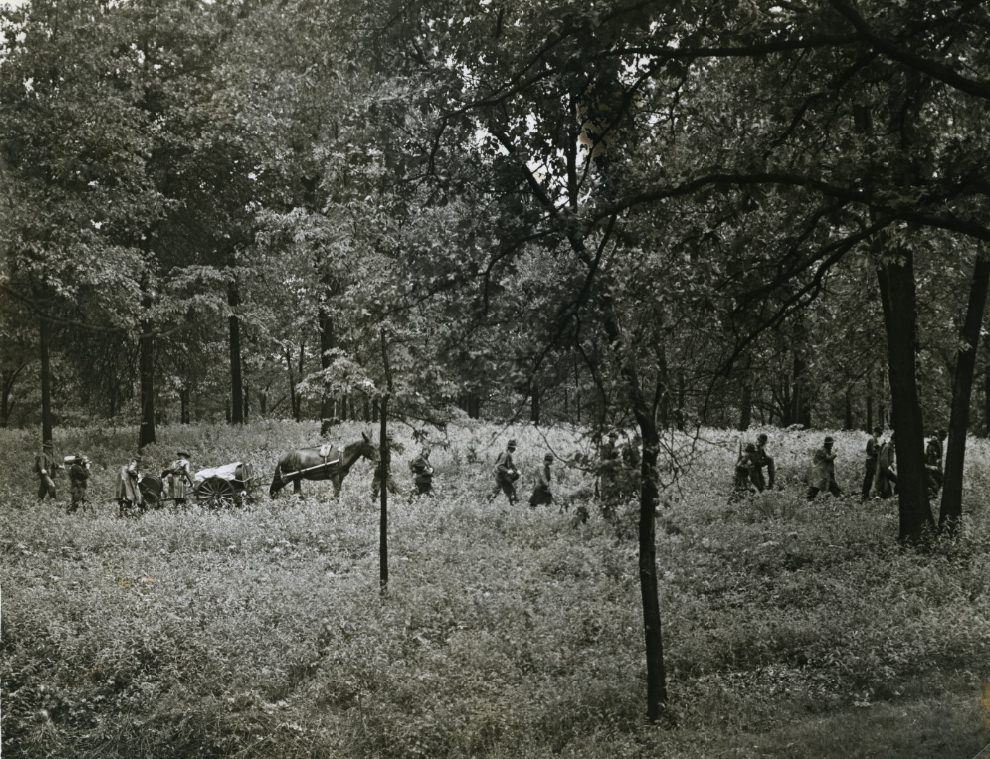
Field exercises pushed Jefferson Barracks soldiers into realistic training scenarios. A communications unit advancing through wooded terrain in 1938 was part of the expanded training that reflected military planners’ growing concern about the state of world affairs. These exercises prepared soldiers for the kind of coordinated operations that would soon be needed on a global scale.
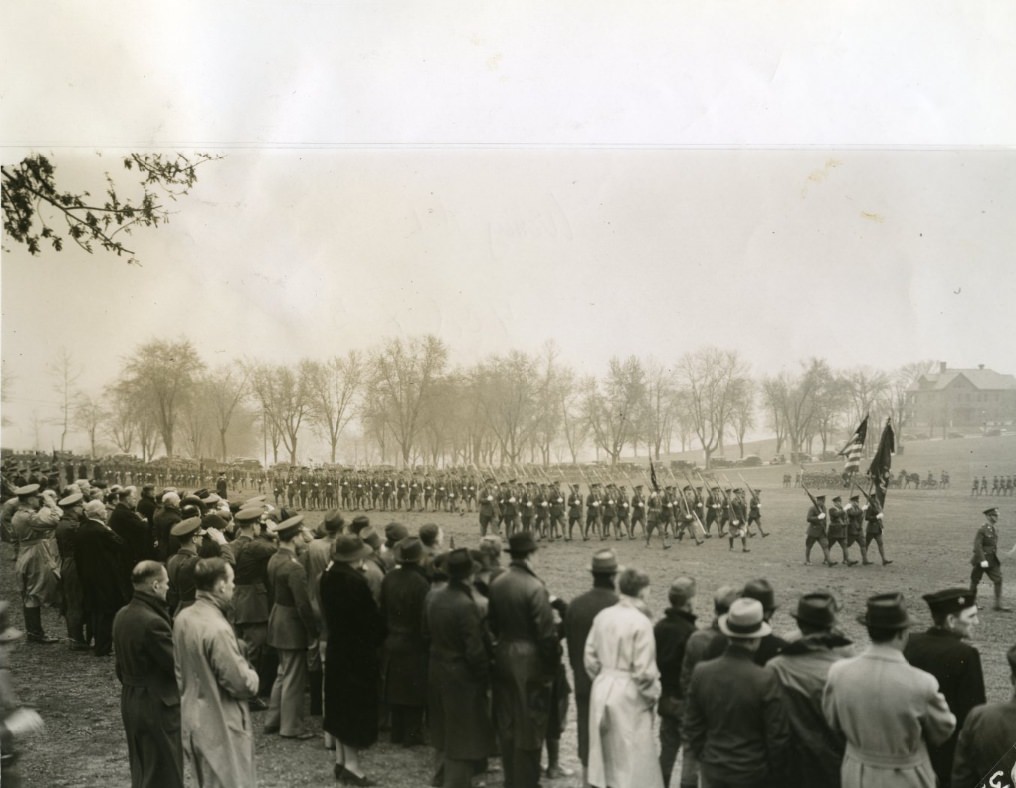
Military marches at Jefferson Barracks drew spectators from St. Louis and surrounding communities. Watching soldiers parade in formation was both a civic ritual and a display of military strength. By 1938, these events carried added weight as international tensions made the marches feel less ceremonial and more purposeful.
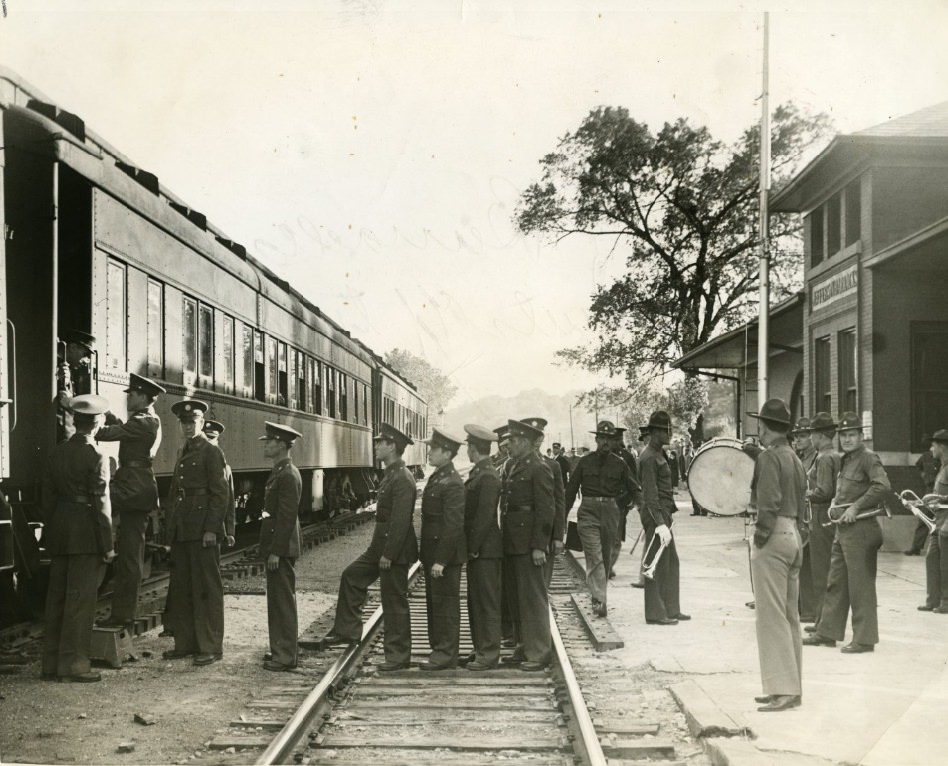
By 1939, recruits were being sent out from Jefferson Barracks to posts on the Pacific Coast. Soldiers heading west by train were part of a broader military expansion as the United States watched events in Europe and Asia with growing alarm. Jefferson Barracks served as a key transit point, processing and dispatching soldiers across the country.
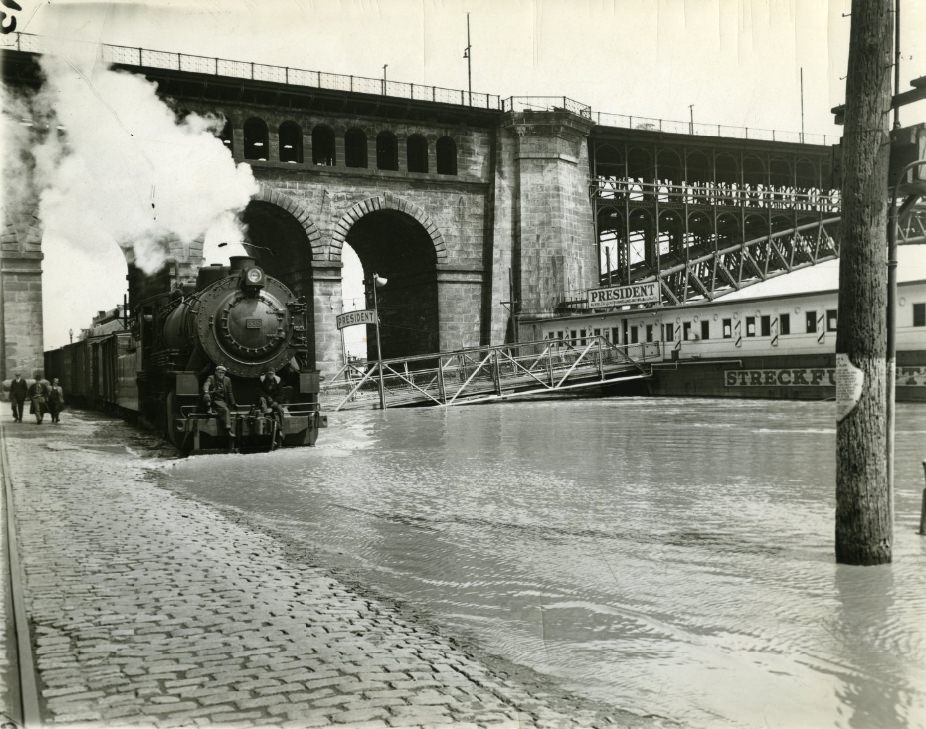
The Eads Bridge continued to carry rail and vehicle traffic across the Mississippi River throughout the 1930s. A train steaming through floodwaters at the bridge in 1939 showed the bridge’s durability and its continued importance to St. Louis commerce and transportation.
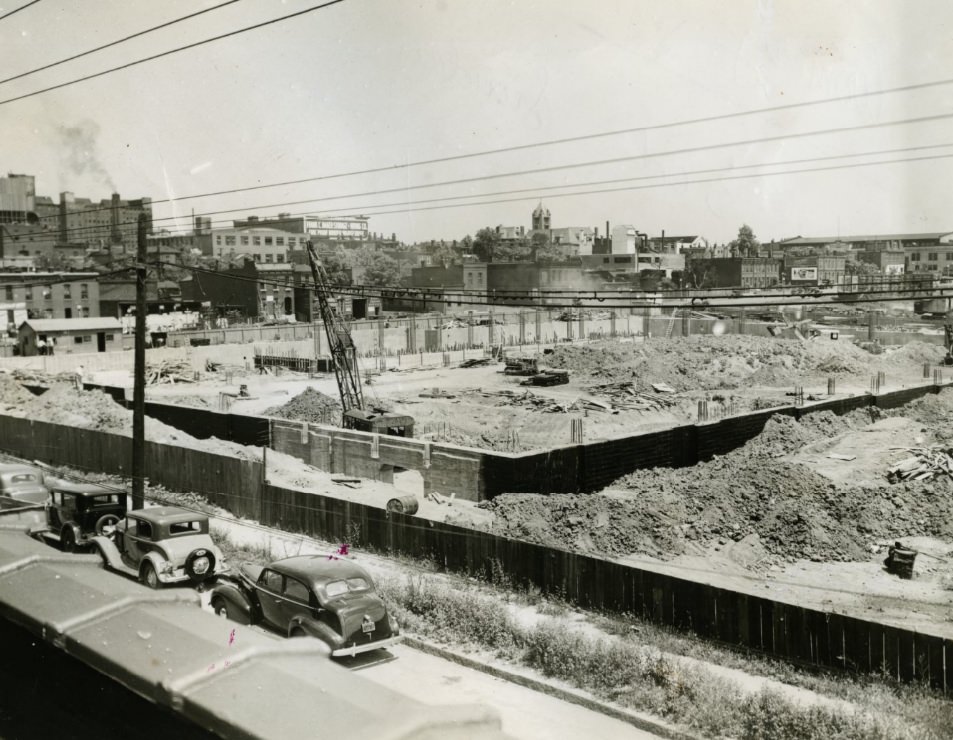
As military preparation became a national priority, St. Louis invested in its infrastructure. A new $1.25 million National Guard Armory was under rapid construction on the south side of Market Street just west of Grand Boulevard in 1937. The project was a significant public investment at a time when the city was still recovering from the economic damage of the Depression.
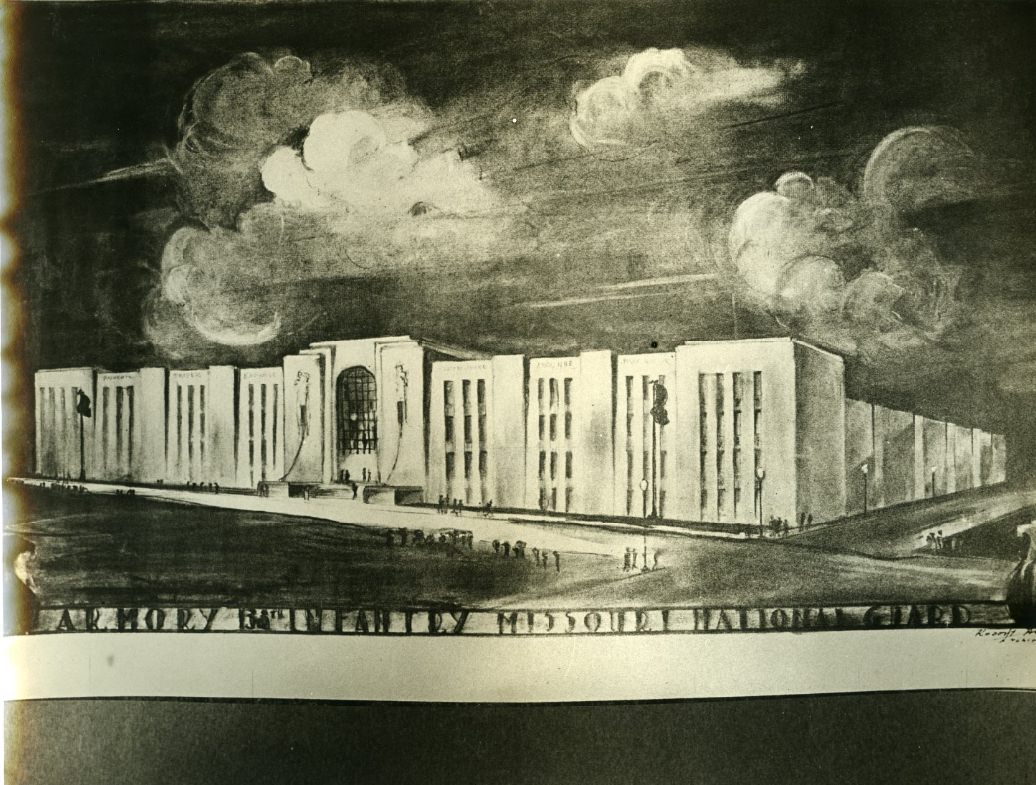
Before construction could begin, planners and artists worked out what the new armory for the 138th Infantry of the Missouri National Guard would look like. An artist’s sketch released in 1934 showed the proposed $1.2 million building, offering St. Louisans a preview of the facility that would serve the National Guard in the years ahead.
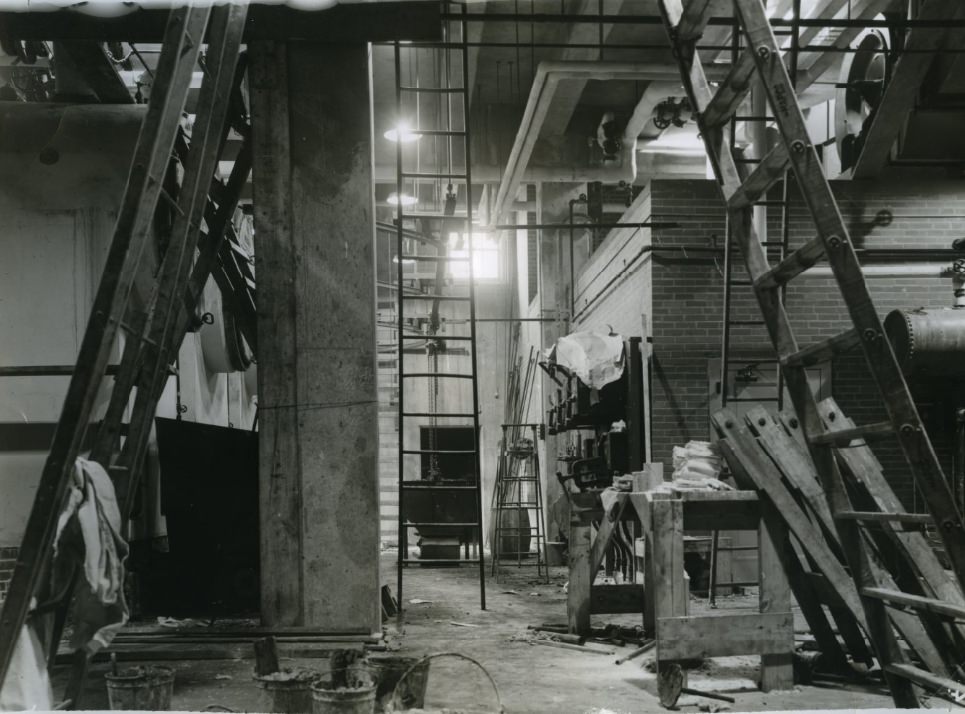
The technical details of the new armory’s construction revealed how modern the facility was designed to be. Automatic coal stokers feeding three large boilers would provide steam heat for the drill rooms — a practical solution to keeping soldiers comfortable during Missouri winters. The armory was built to last and to function efficiently.
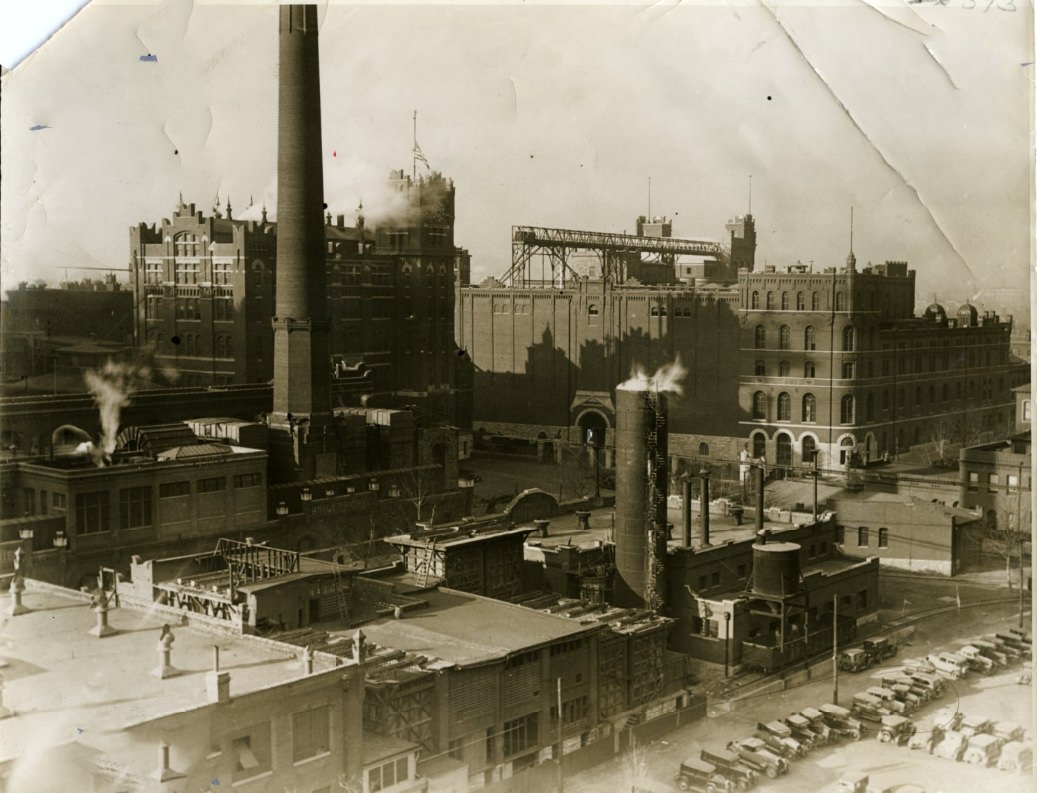
With Prohibition behind it, Anheuser-Busch was back in full production by 1934. The brewery was one of St. Louis’s largest employers, and its return to operation was a significant boost for the local economy. The plant on the south side of the city was a landmark, and its operations touched the lives of thousands of workers and their families.
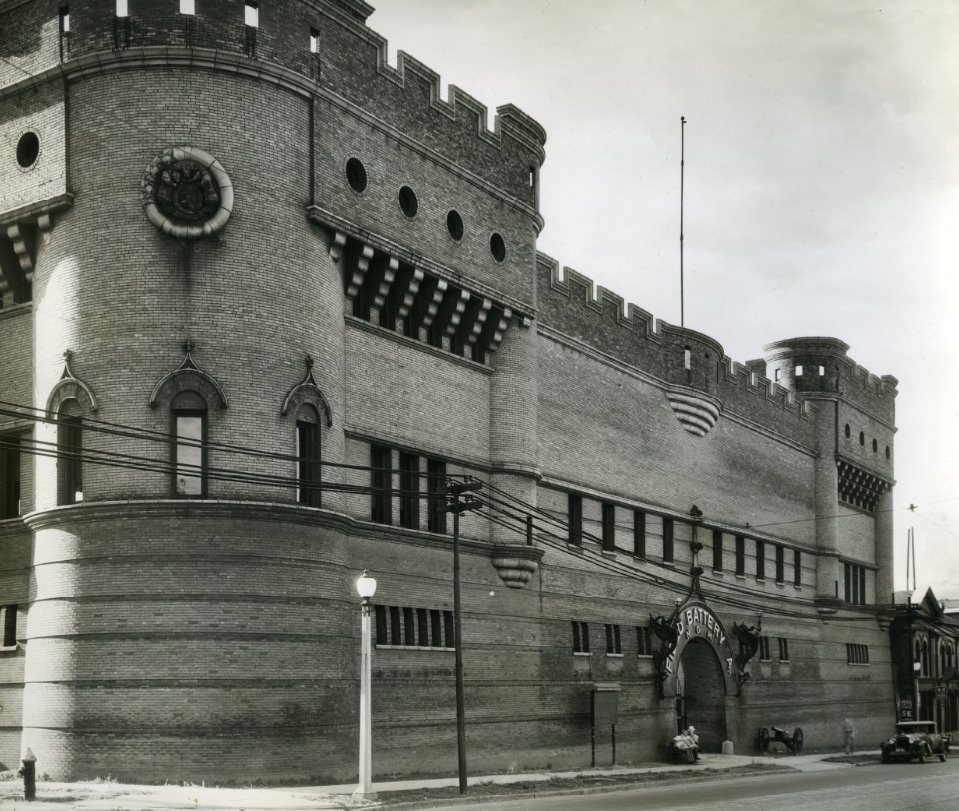
Jefferson Barracks had a history stretching back to the early years of the American Republic, and the military took opportunities to contrast conditions from past generations with the more modern accommodations of the 1930s. A century earlier, a militiaman slept on the ground. By 1938, the barracks offered bunks, mess halls, and organized training programs.
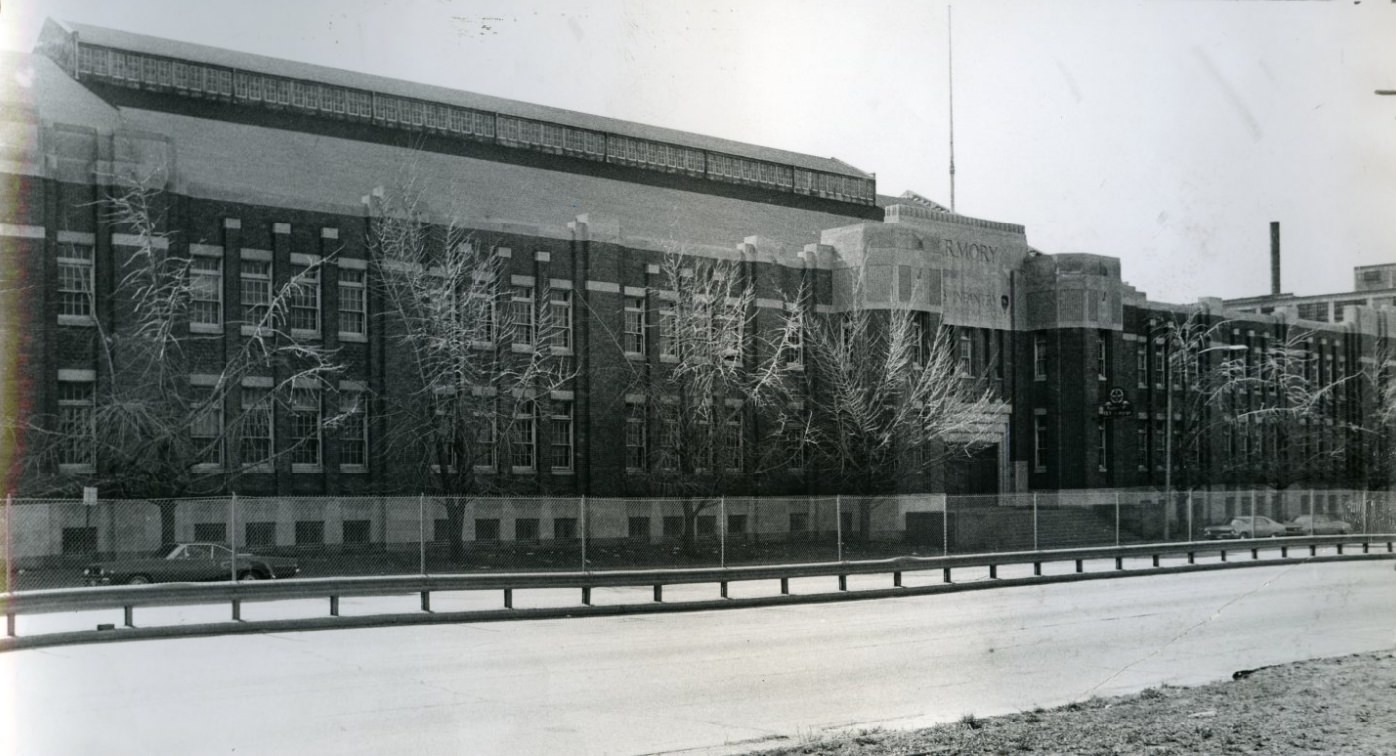
Comfort and hygiene had improved dramatically at Jefferson Barracks over the decades. While early Missouri militiamen swam in Mill Creek and the Mississippi, the soldiers of the 138th Infantry were getting a proper chlorinated swimming pool in 1938. These improvements were part of a broader push to modernize military facilities across the country.
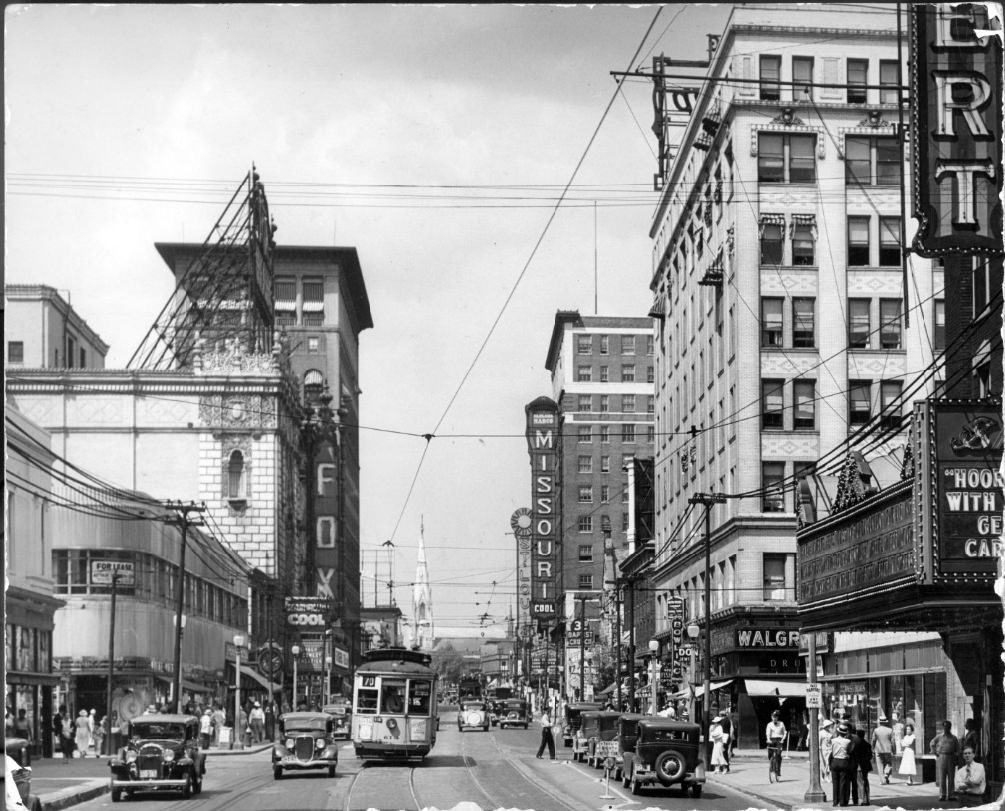
Grand Avenue was one of St. Louis’s busiest commercial streets. Looking north in 1935, the thoroughfare was lined with theaters and shops, drawing crowds from across the city. During World War I, soldiers stationed nearby had made Grand and Olive a central gathering point — a reputation the street carried long after the war ended.
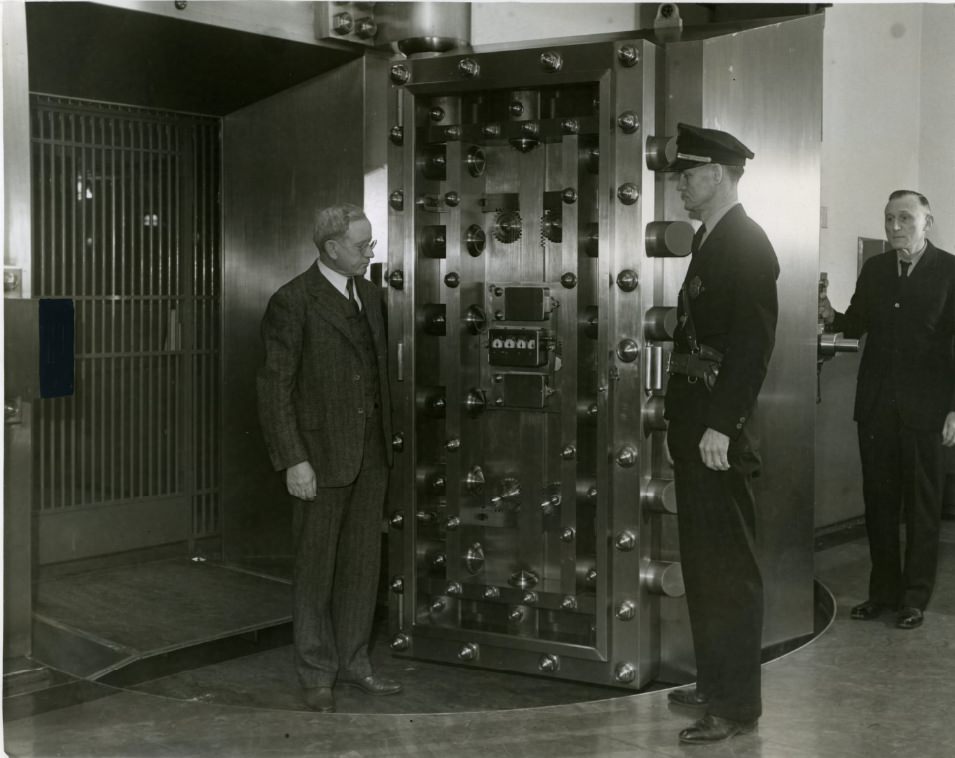
Banking remained a central part of St. Louis commercial life through the Depression, though the sector had been battered by bank failures across the country. The Mercantile Trust Company was one of the city’s major financial institutions, and the opening of its vault door was captured as a symbol of the trust and security that banks worked hard to project to nervous depositors.
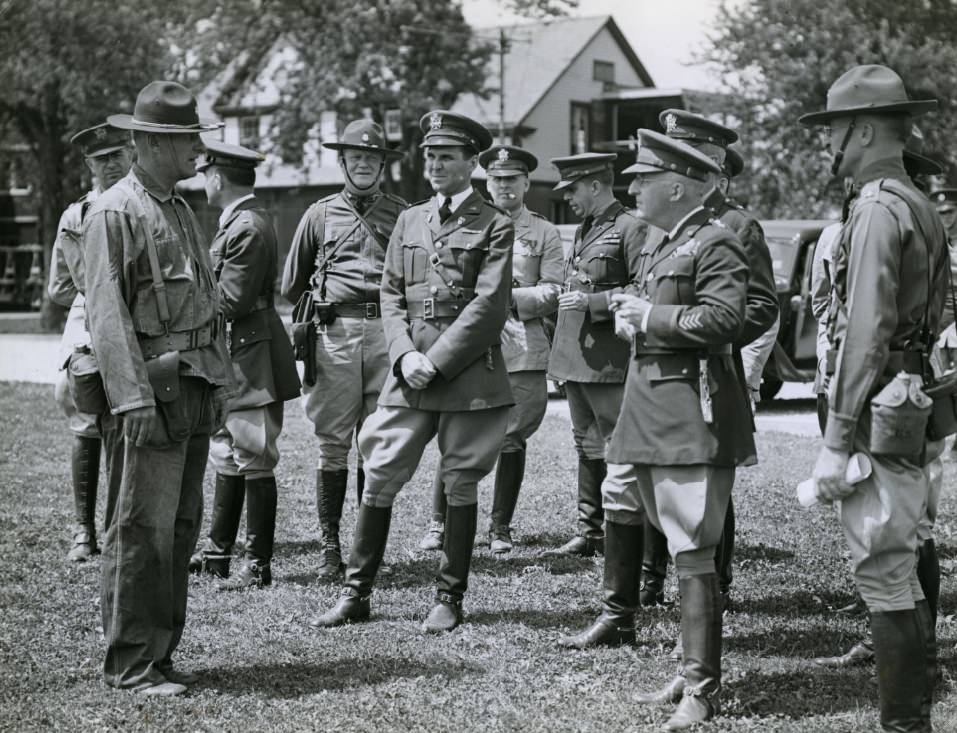
Military training at Jefferson Barracks included rigorous tactical exercises. Major General Drum challenged a non-commissioned officer with a real scenario: his men had just completed an attack formation in a column of squads, and now they faced a nearby building occupied by machine-gunners. How would he use his soldiers to take it? These exercises pushed officers and enlisted men to think and respond under pressure.
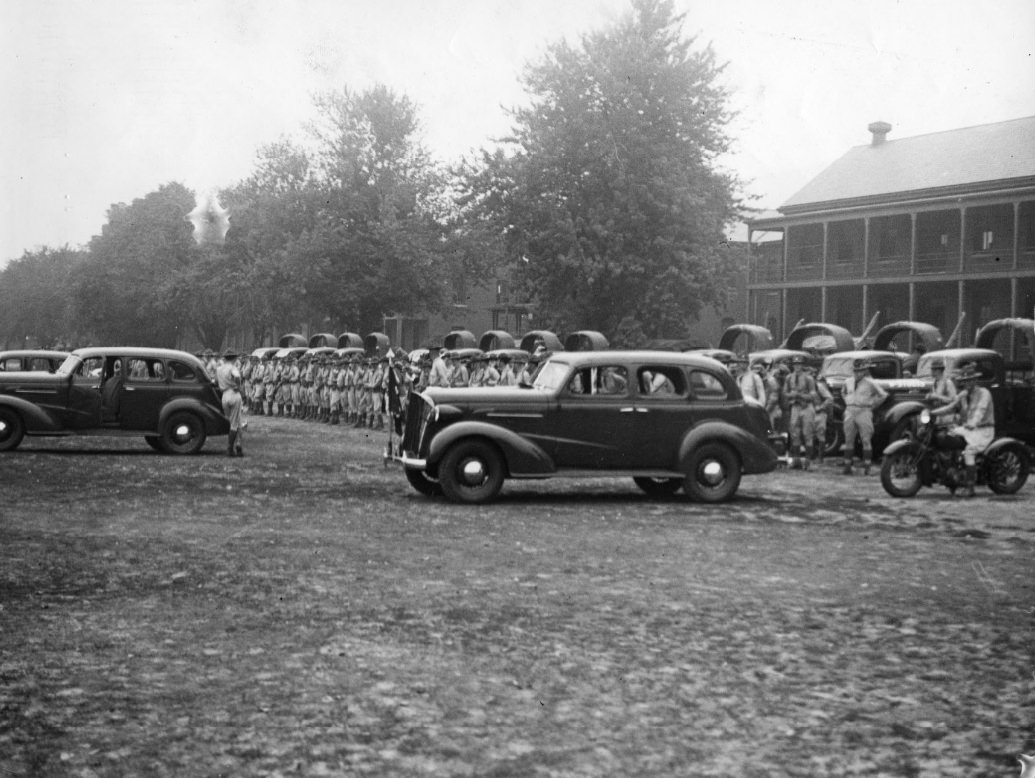
The Sixth Infantry at Jefferson Barracks regularly conducted motorized hikes to training sites in the Missouri countryside. A departure to Arcadia, Missouri, in 1937 was one of many such exercises that kept the regiment in fighting shape. The motorized component of these hikes reflected how the military was modernizing its movement capabilities.
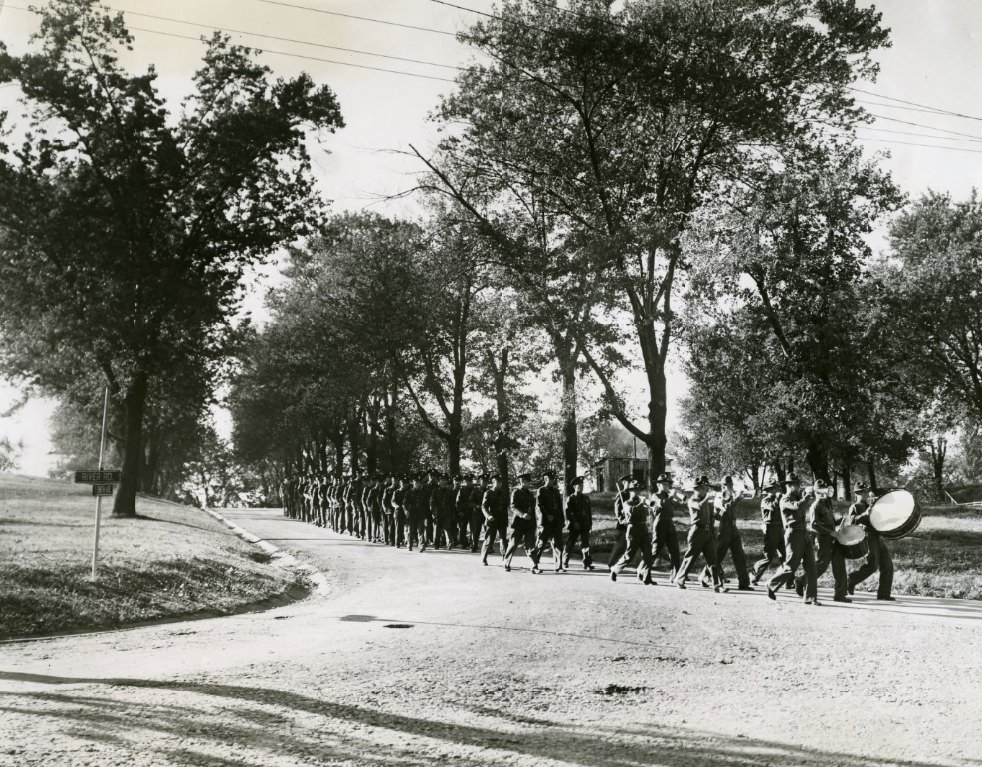
Military bands were a standard part of Jefferson Barracks life. Bass drummers led formations of soldiers through parades and reviews, setting the tempo for marches that were both practical training exercises and public displays of military readiness. By 1939, these parades had taken on a more solemn tone.
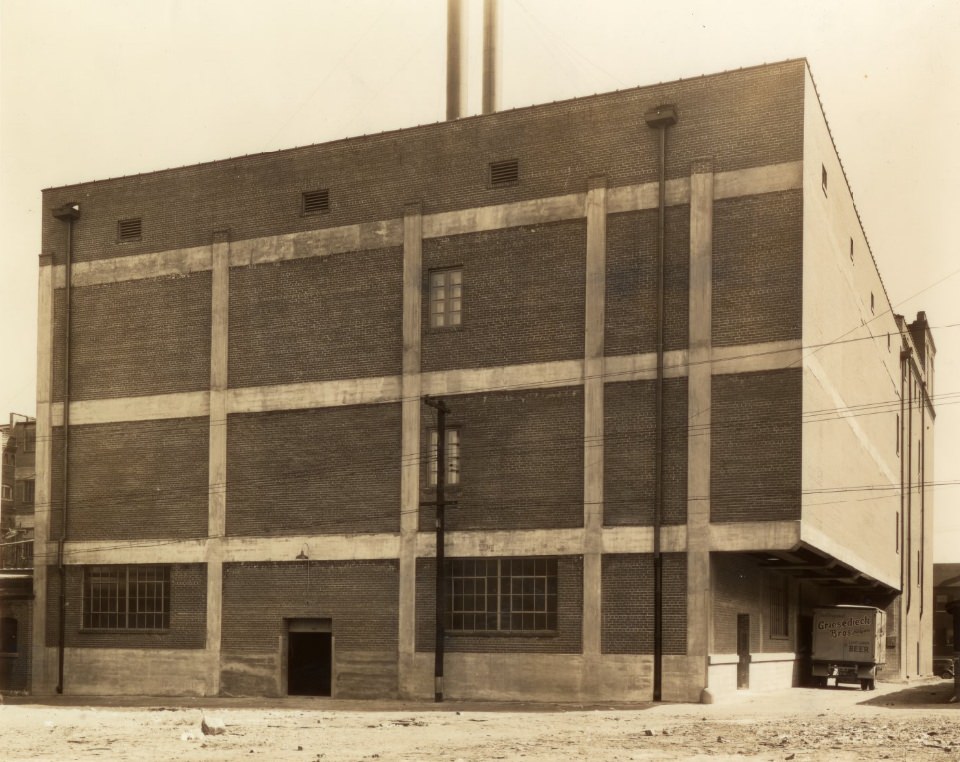
Anheuser-Busch wasn’t the only brewery operating in St. Louis. The Griesedieck Brothers Brewery was another significant local producer, and its storage cellars were filled with aging beer by 1937. The revival of the brewing industry after Prohibition gave St. Louis back a piece of its economic and cultural identity.
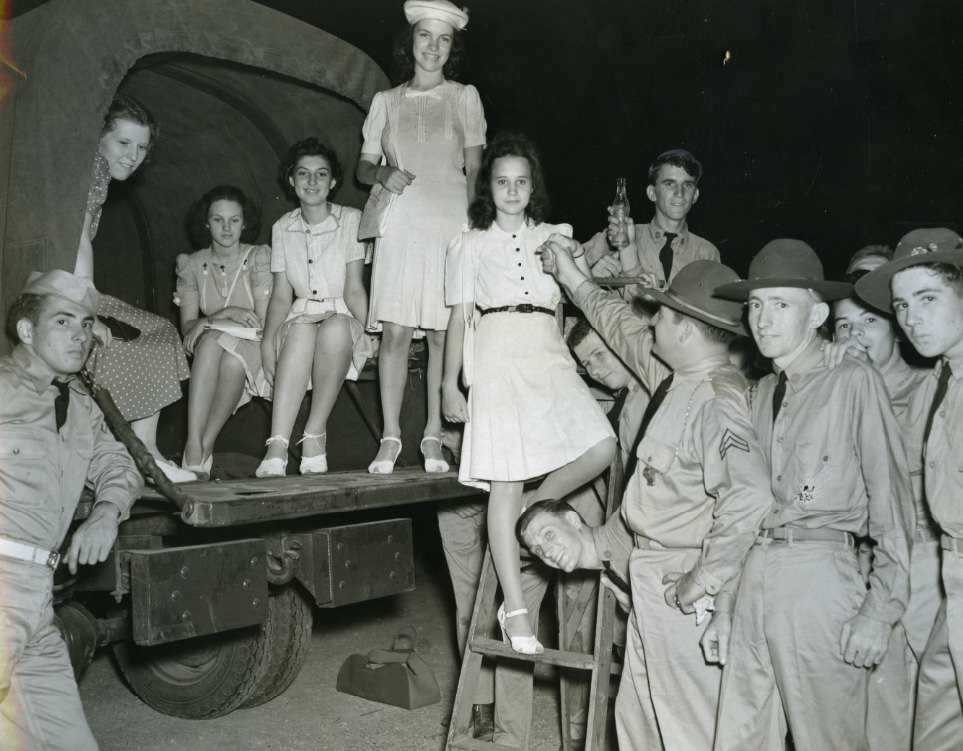
The Citizens’ Military Training Corps at Jefferson Barracks combined serious military training with social activities designed to build camaraderie. The opening of the social season in 1939 was marked with a dance — a tradition that gave young trainees something to look forward to beyond drills and inspections.
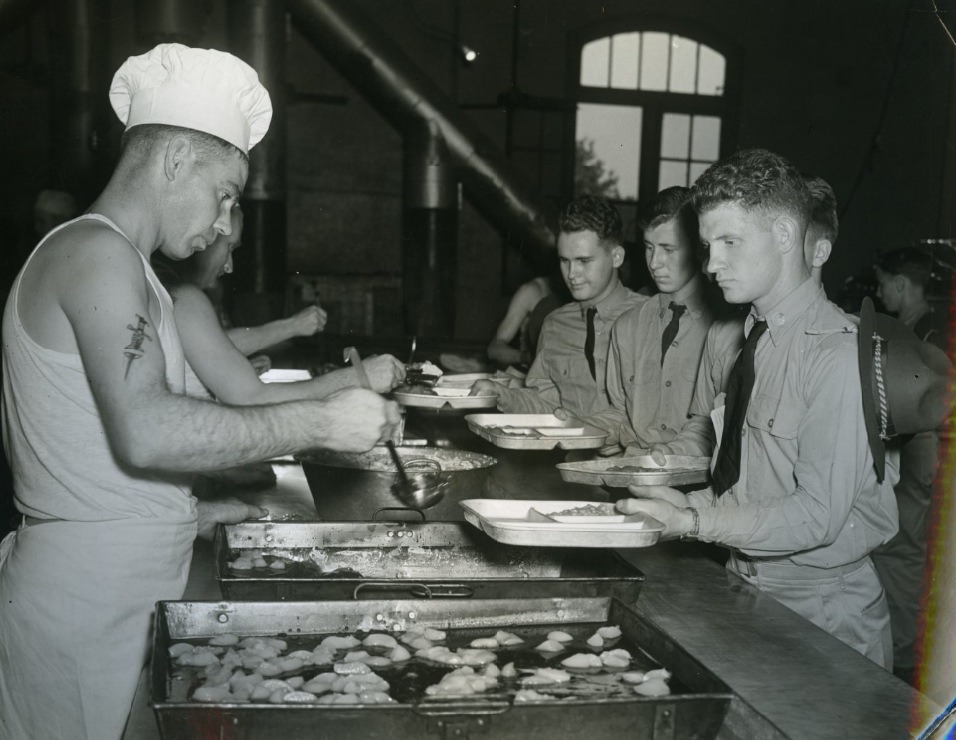
Keeping trainees fed was a logistical operation in itself. At Jefferson Barracks in 1939, noon mess consisted of baked beans, tomatoes, salad, bread, and apple butter, served cafeteria style to minimize the time spent away from training. For some recruits, especially those who came from poor Depression-era families, the military’s regular meals were better than what they had at home.
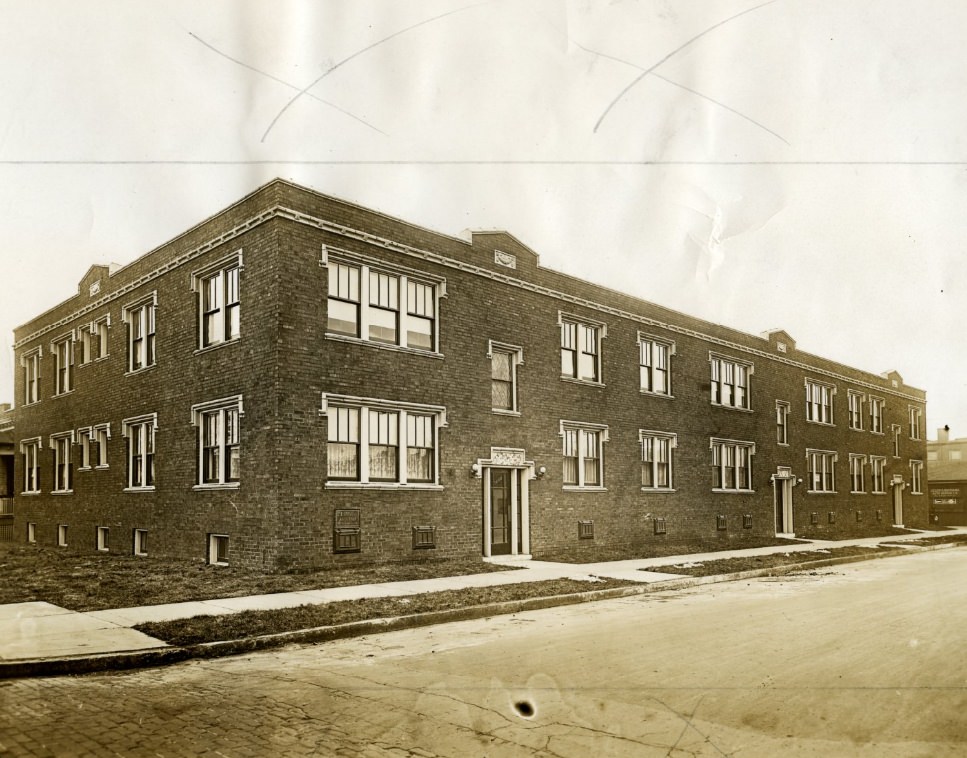
New residential construction in St. Louis at the start of the decade included a twelve-family apartment building completed at Delor Street and Alaska Avenue by the Art-Build Construction Company. Located at 5417 South Grand Boulevard, it represented the kind of dense housing that filled St. Louis’s neighborhoods during the years before the Depression’s full weight settled on the city.
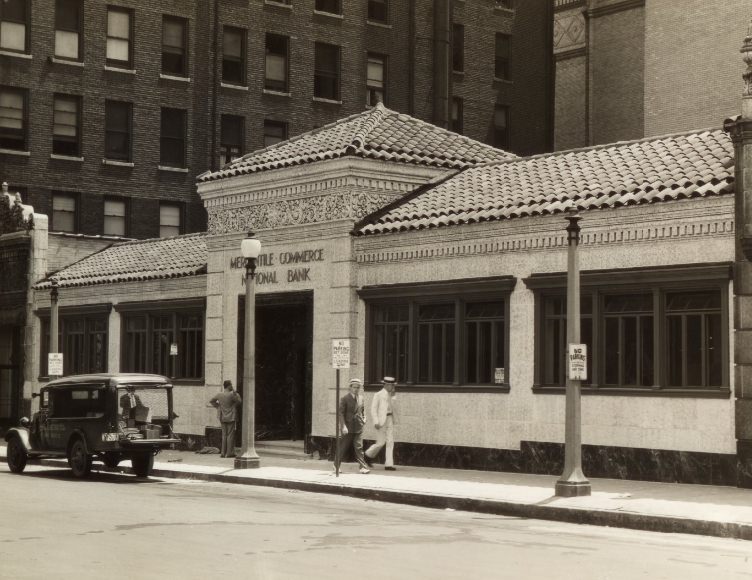
The Mercantile-Commerce National Bank opened new quarters at 3608–16 Washington Boulevard in 1935. Banks that survived the Depression’s worst years were slowly rebuilding public confidence, and new or renovated branch locations were part of that effort. Washington Boulevard was an important commercial corridor, and a bank presence there carried real weight.
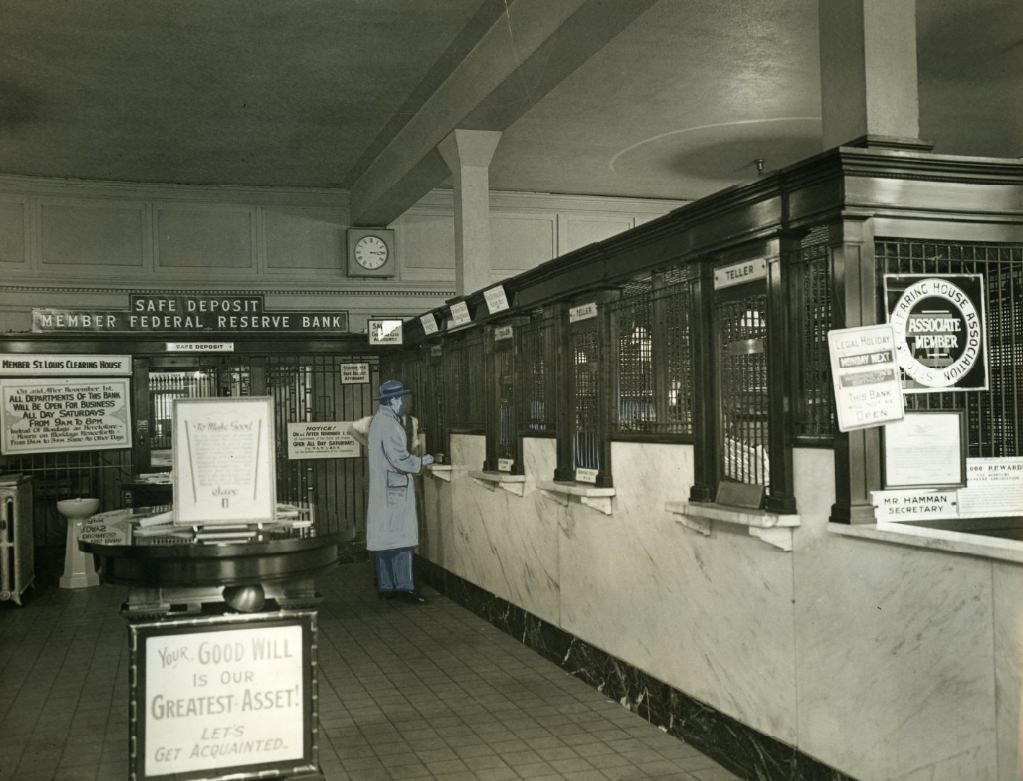
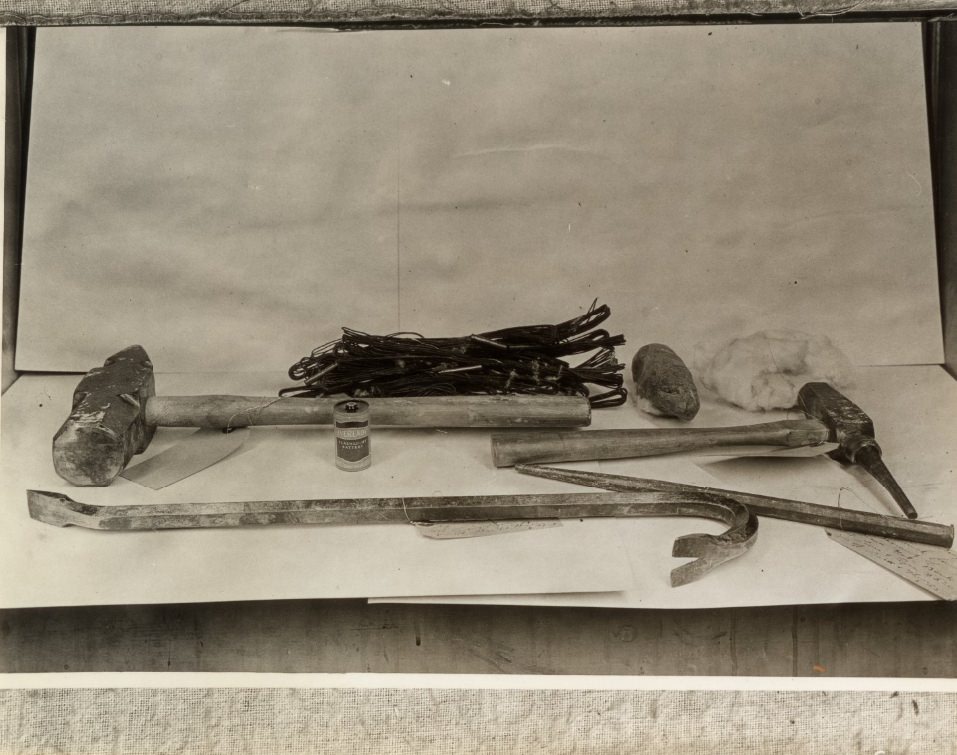
The Depression created desperate conditions that fueled a wave of bank robberies across the United States. St. Louis was not spared. A 1931 bank holdup scene, photographed with two victims visible, showed the violent reality of crime during the Depression years. Armed robberies of financial institutions were a recurring threat that kept banks on edge throughout the decade.
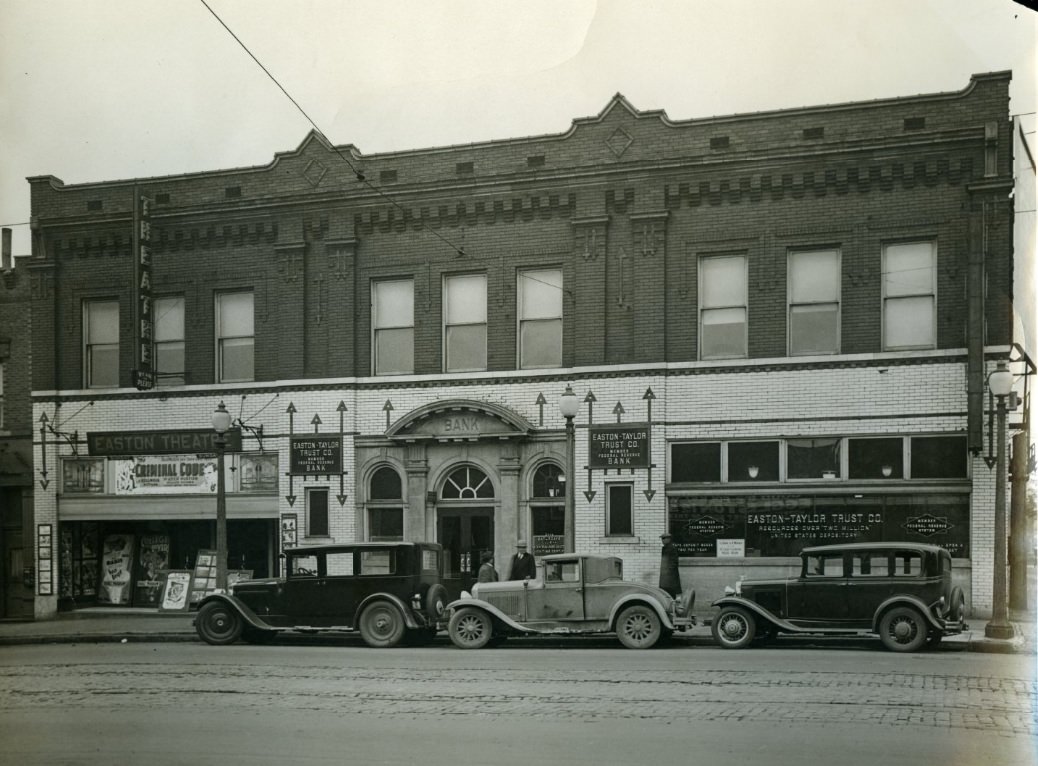
The Easton Taylor Trust Company was the scene of criminal activity in 1931. Photographs taken outside showed the aftermath — another St. Louis financial institution that had fallen victim to the kind of violent crime that was climbing across Depression-era America.
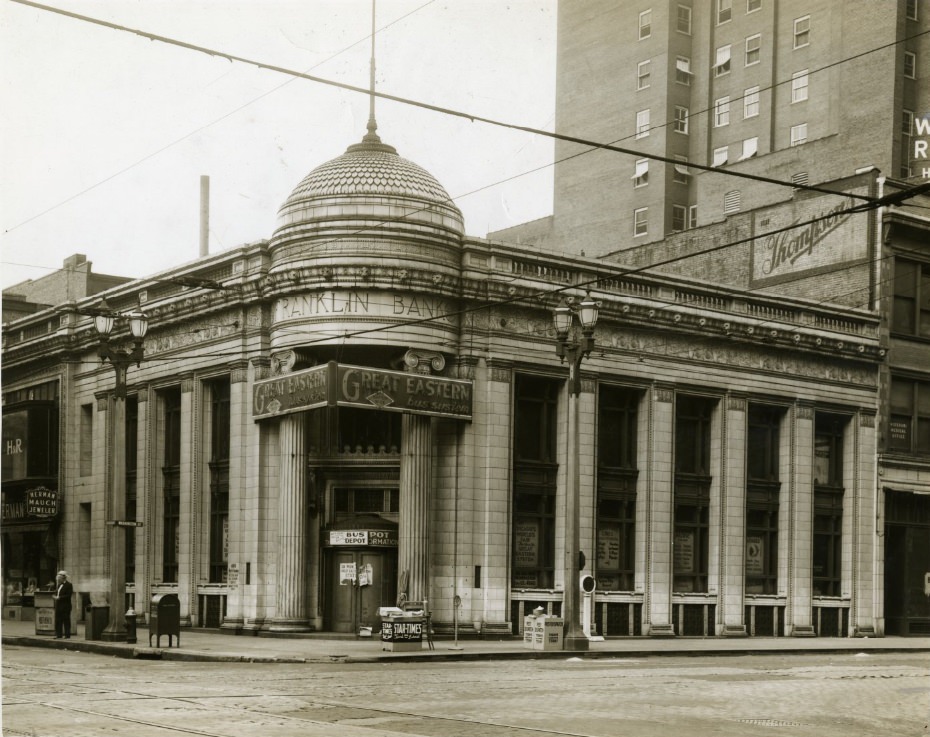
Bank consolidations and name changes were common during the Depression as institutions merged, failed, or restructured. The old Franklin Bank became the United Bank and Trust Company in 1935, one of many such transitions that reshaped the city’s financial landscape during the decade.
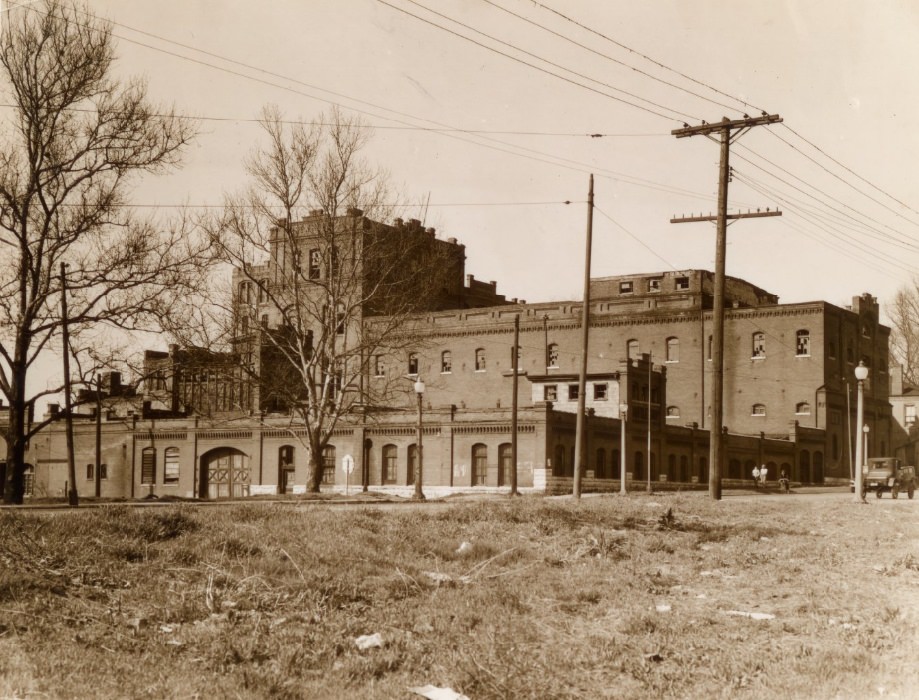
Not every brewery made it through Prohibition and back into operation. The old Klausmann Brewery at South Broadway and Loren Street — once one of the largest in St. Louis — was being torn down in 1937 to save on taxes. Prohibition had shuttered it, and the post-repeal market never gave it reason to reopen. The demolition of such a large structure was a quiet marker of how much the brewing landscape had changed.
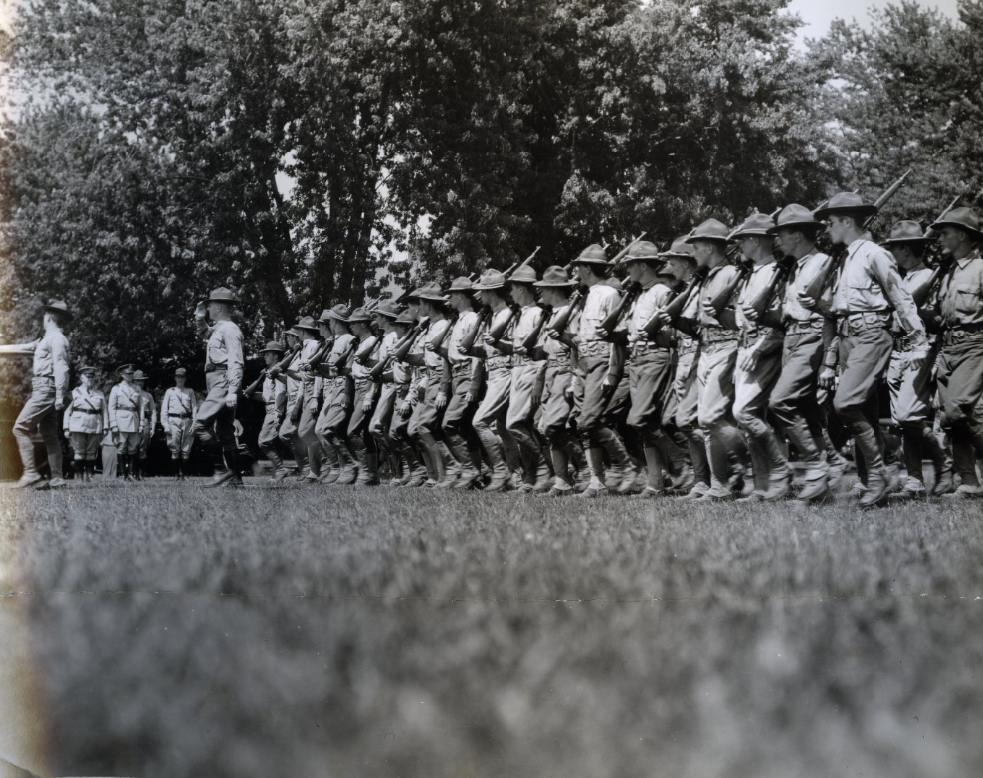
The Citizens’ Military Training Camp brought young men to Jefferson Barracks each summer for basic military instruction. The CMTC program had been running since the 1920s and continued through the 1930s, giving young civilians a taste of military life without a full enlistment. The recruits who first put on army hobnail shoes in July 1930 were still far from polished soldiers, but the program was designed to get them started.
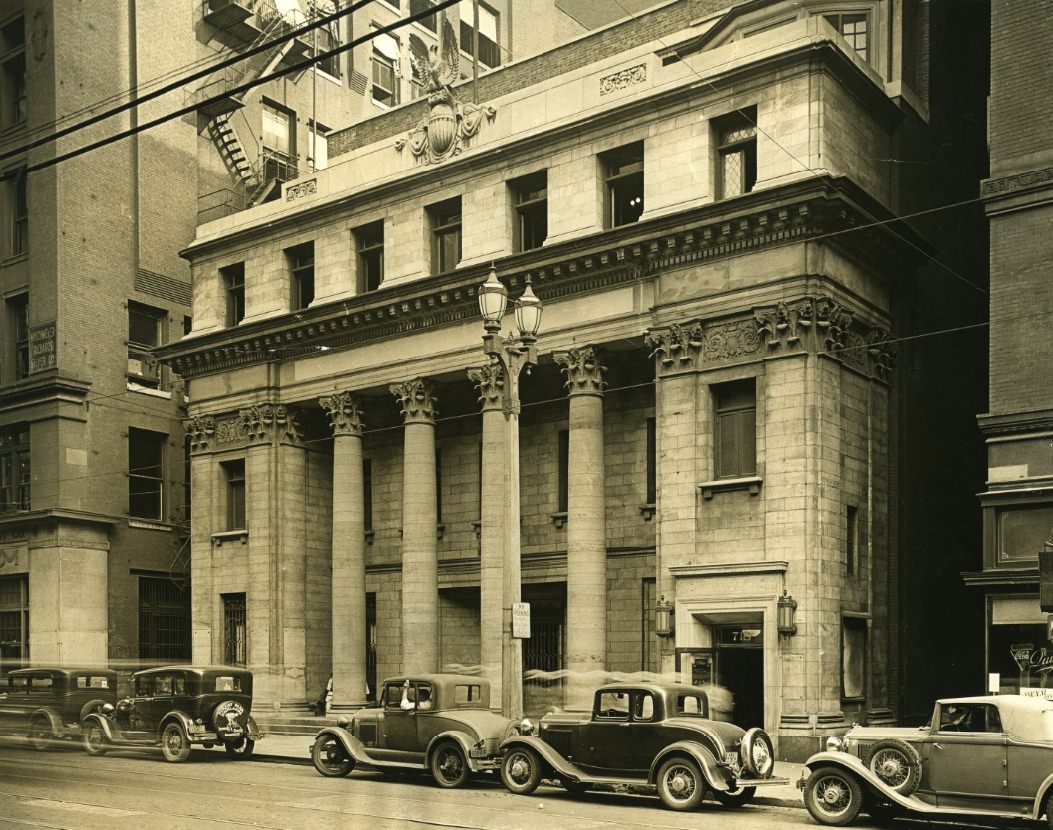
The former quarters of the Franklin-American Company at 716–18 Locust Street were acquired in 1933 by a new bank headed by Byron Moser, who had resigned as president of the Security National Bank Savings and Trust Company. The four-story building was taken over through a leasehold assignment, appraised at $155,000 for tax purposes. Plans called for removing the stone columns and bringing the entire front of the structure out to street level.
The Grand Avenue National Bank was one of the neighborhood banks that served the residents of Grand Avenue and its surrounding streets at the start of the decade. Like many local banks, it operated in a period of growing instability as the Depression deepened and bank runs threatened institutions across the country.
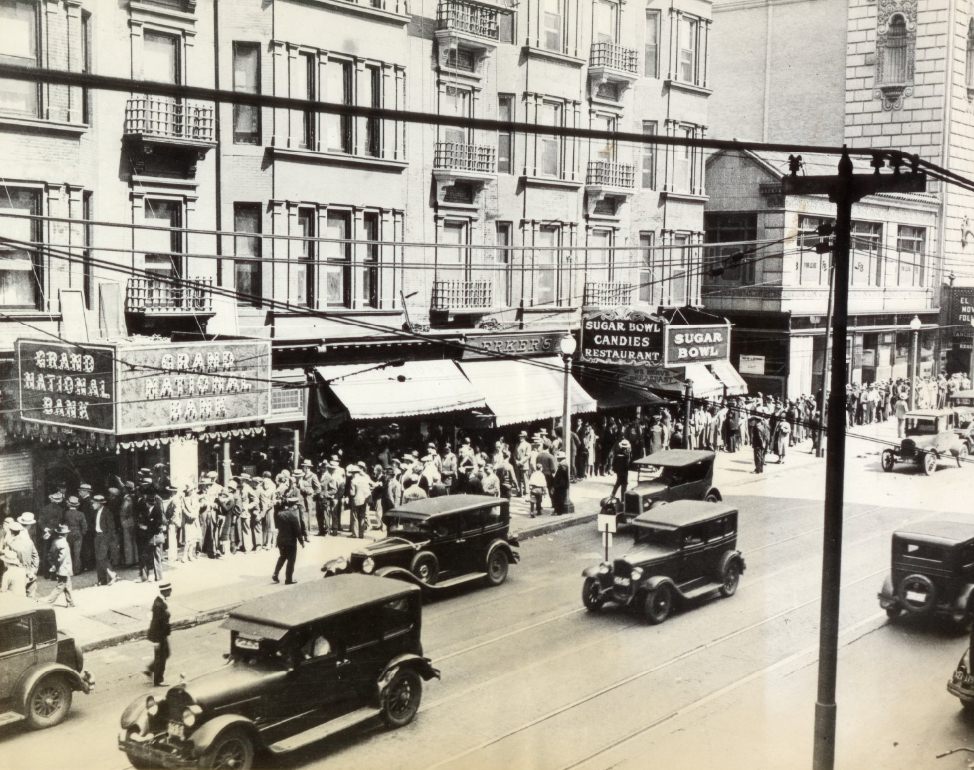
The Grand Avenue National Bank was hit by robbers in 1930, and photographs taken outside the building after the heist documented the scene. The robbery was one of several that struck St. Louis financial institutions in the early years of the Depression, when criminal gangs targeted banks with increasing boldness.
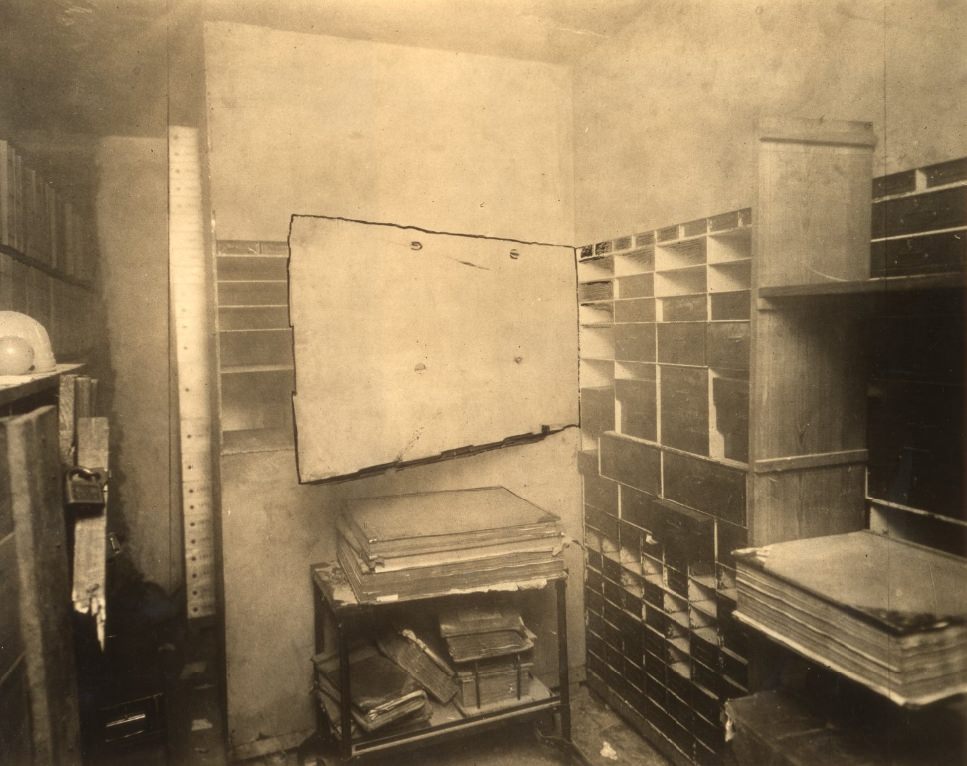
Inside the bank, deposit boxes had been forced open and rifled through during the robbery. The image of violated safe deposit boxes was a stark reminder of how vulnerable even established financial institutions were during this period. Depositors who kept valuables in these boxes faced real losses.
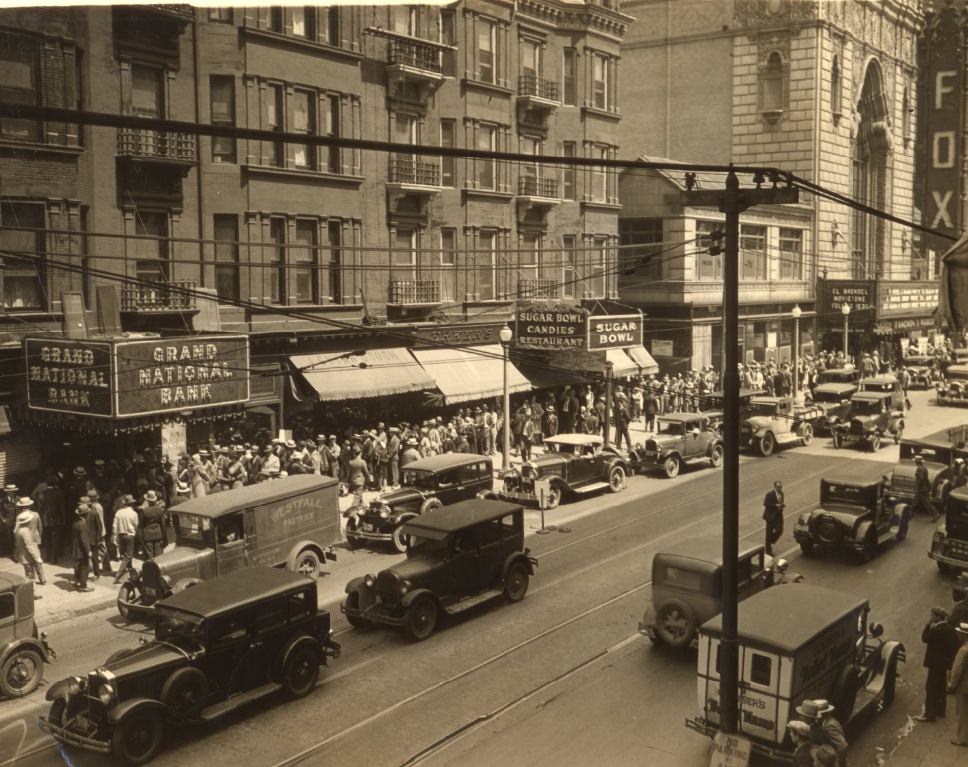
Multiple exterior photographs of the Grand Avenue National Bank after the robbery captured the building from different angles, documenting the crime scene for investigators and the press. Bank robberies in St. Louis were covered closely by local newspapers, and the images were part of that coverage.
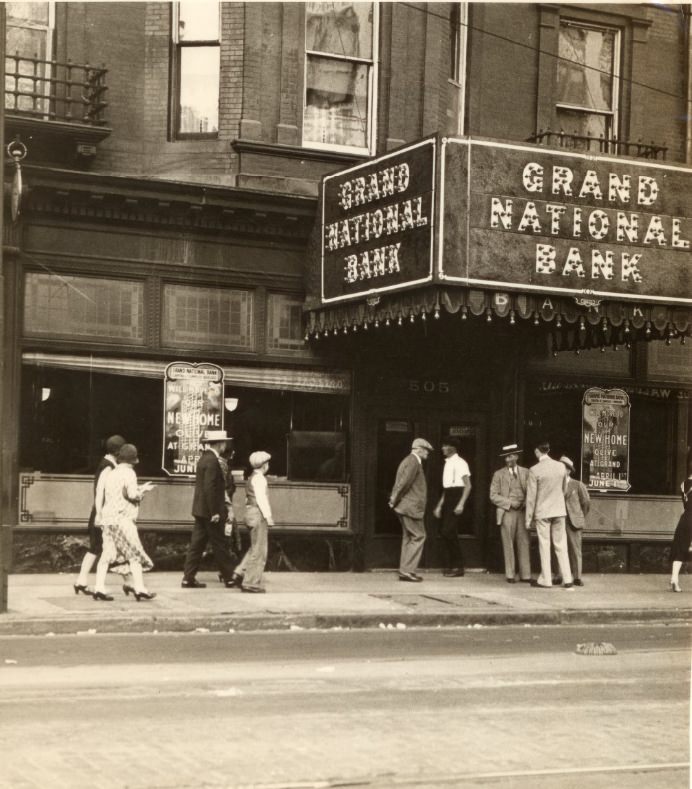
The Grand Avenue National Bank’s exterior presented a solid, professional facade to the neighborhood it served — the kind of imposing stone and brick architecture that banks used to project stability and trustworthiness. But that appearance offered no real protection against the armed robbers who struck in 1930.
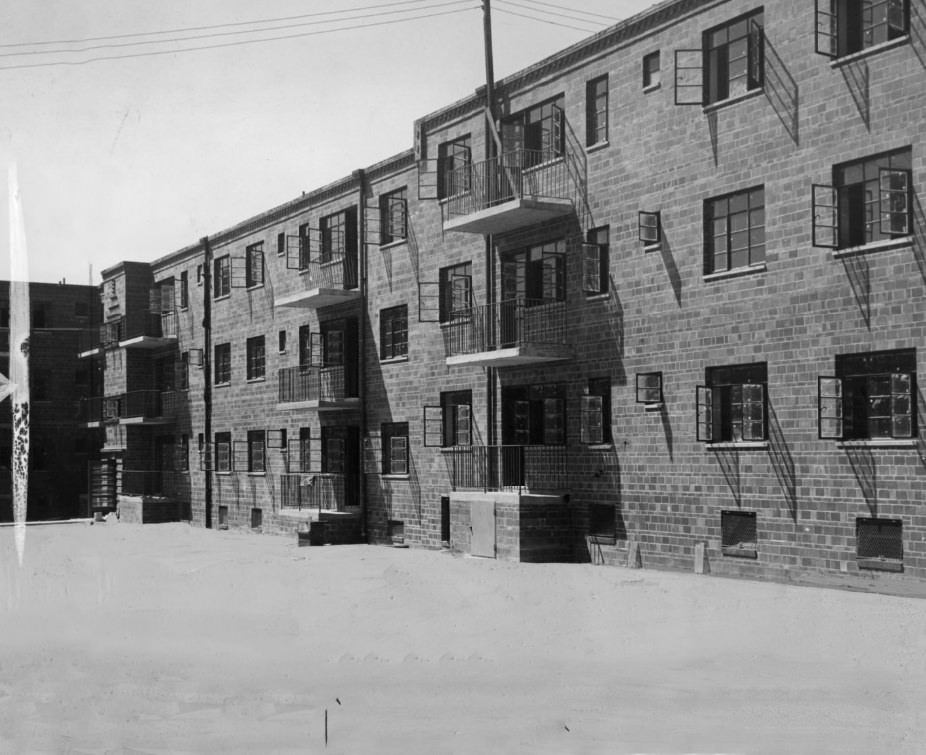
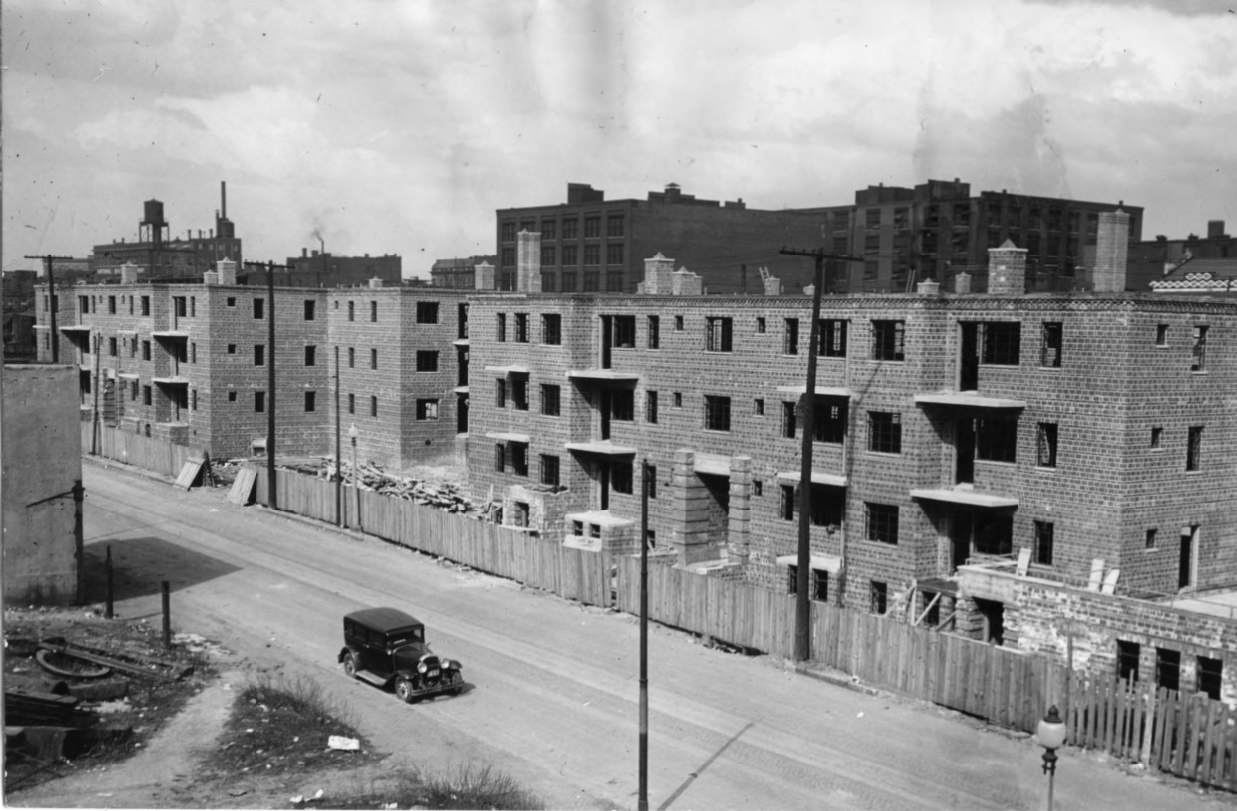
One of the most significant housing projects in Depression-era St. Louis was the Neighborhood Gardens development. Built in the block between Seventh, Eighth, Biddle, and O’Fallon Streets, it was funded in part by the Public Works Administration, which provided $640,000 of the total $742,000 cost. The three-story structures with basements were designed to house more than 1,000 people across 252 families, with rents ranging from $19.50 to $33 a month.
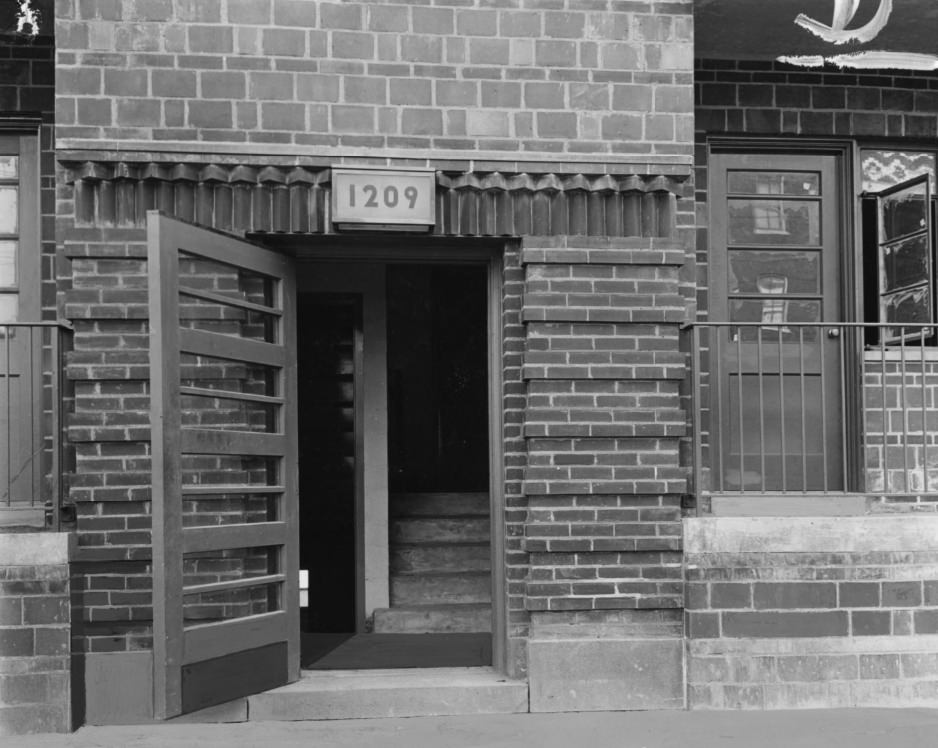
The main entrance to Neighborhood Gardens was designed to project a welcoming, orderly image — a contrast to the makeshift shacks and crowded tenements that many poor St. Louisans were living in during the Depression. The project was built by the architecture firm Hoener, Baum & Froese and aimed to provide decent, affordable housing as part of the New Deal’s broader relief effort.
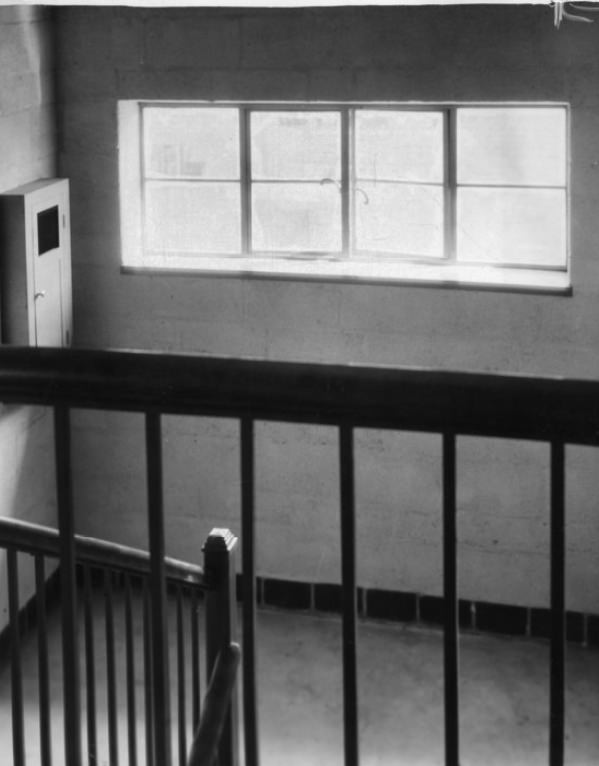
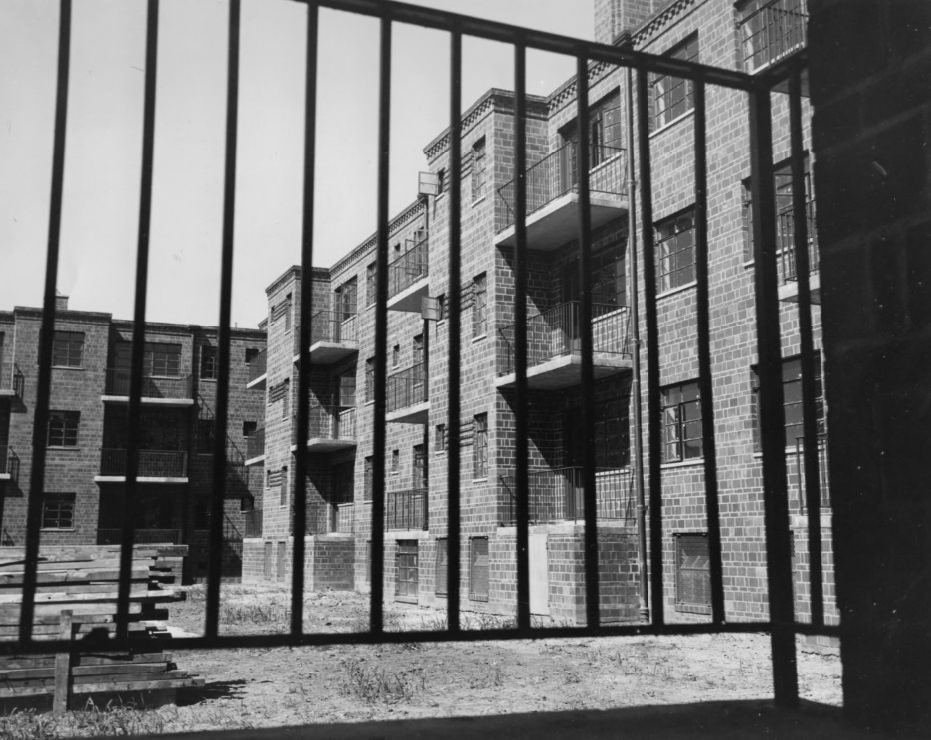
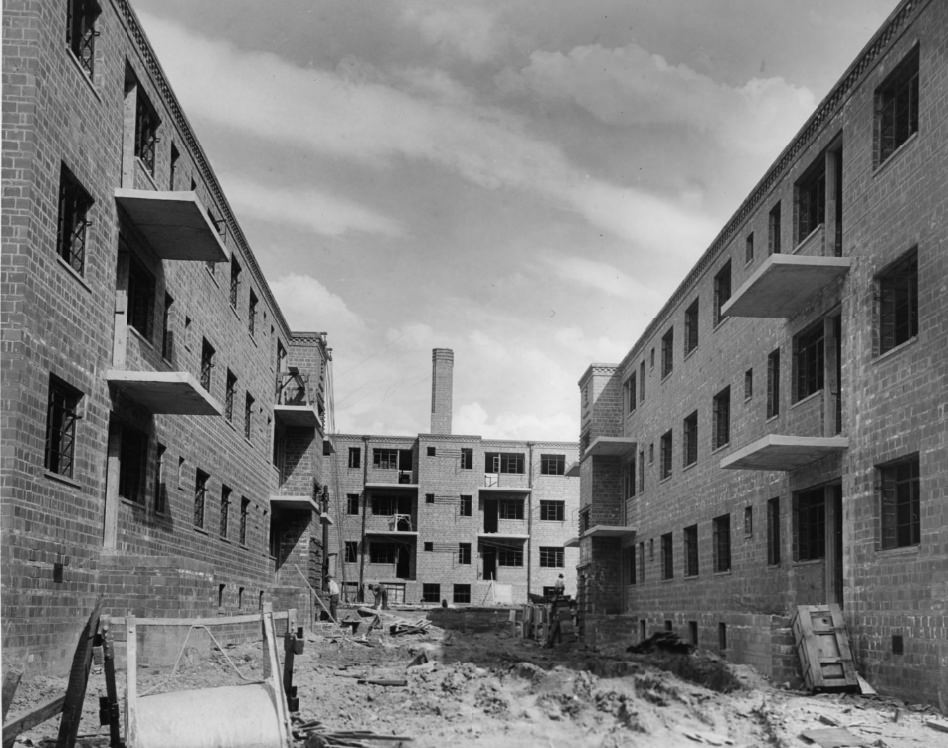
Interior details like the stairwells and balconies of Neighborhood Gardens showed that the project was built with care. The units included central heating, hot and cold running water, gas or electric cooking, baths, and basement laundry space assigned to each tenant. These were genuine improvements for families who had been living in substandard housing.
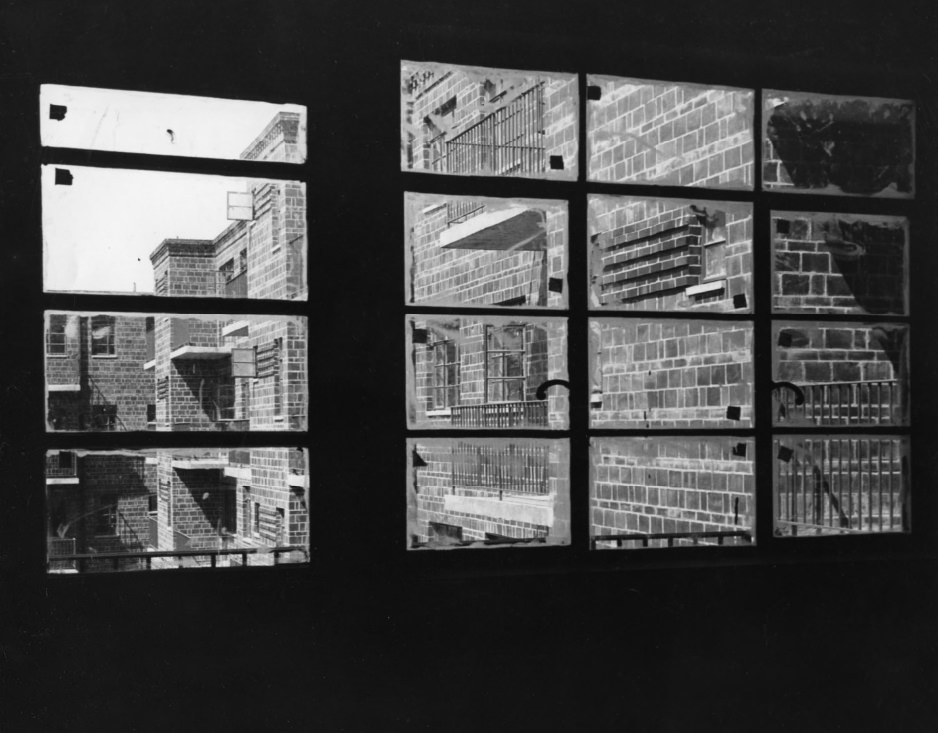
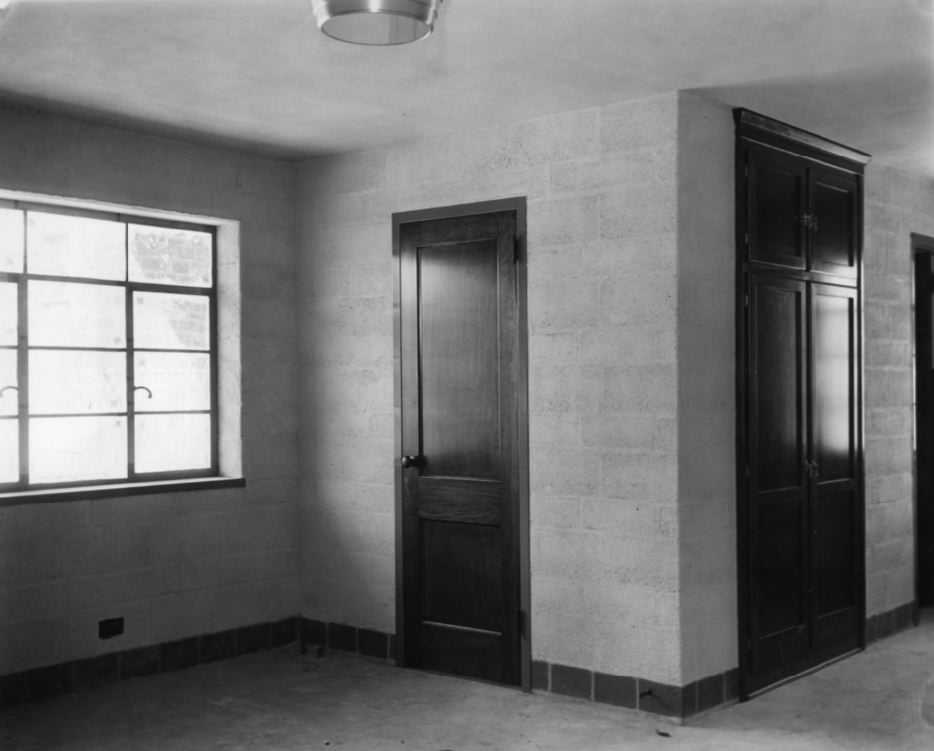
The interiors of Neighborhood Gardens were functional and clean. Rents for the eleven units within the three-story structures ranged from $18 a month for a one-room apartment to $38.50 for larger suites. When fully occupied, the complex housed more than 1,000 residents — a significant contribution to the city’s affordable housing stock during the Depression.
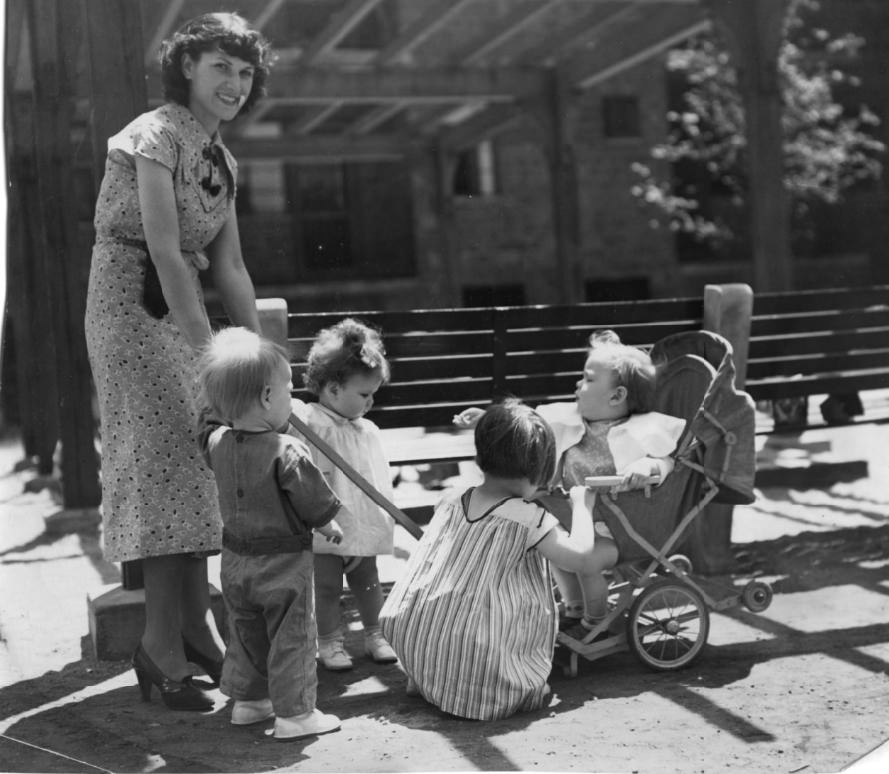
Neighborhood Gardens included a private playground for the children of its residents — an amenity that went beyond basic shelter to consider the quality of life for families. This kind of detail set the project apart from basic relief housing and reflected the New Deal’s broader vision of what affordable housing could look like.
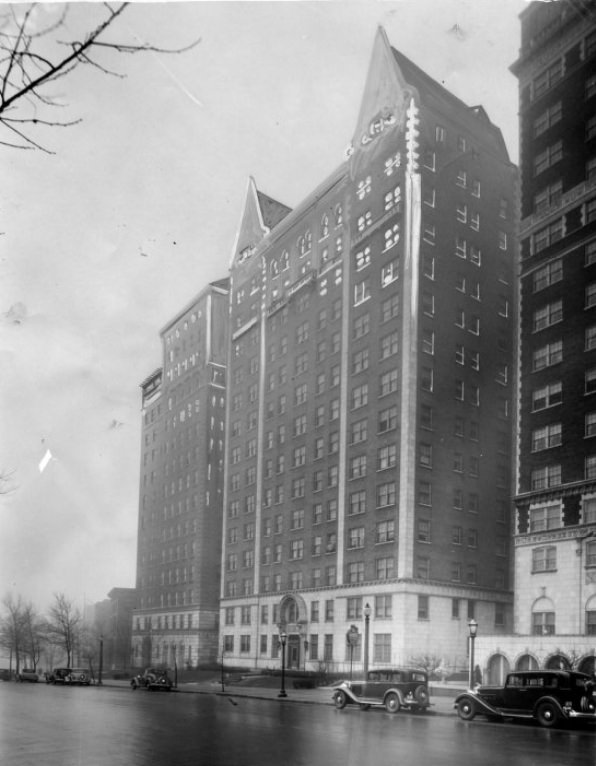
The Daniel Boone Apartments at 3733–45 Lindell Boulevard were among the properties caught up in the financial turmoil of the Depression. The building’s management was taken away from the insolvent Central States Life Insurance Company by the apartment’s bondholders. Lindell Tower stood nearby, and both structures were part of the city’s upscale residential corridor that struggled to maintain its footing as the economy collapsed.
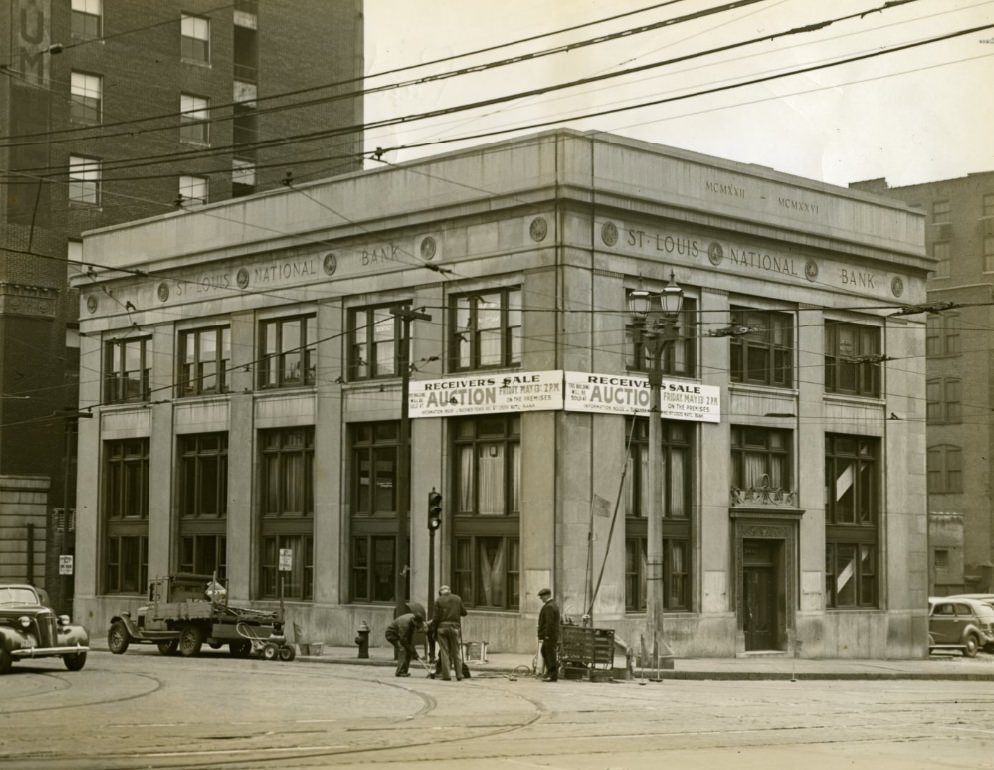
The old St. Louis National Bank Building at the southwest corner of Eighteenth and Olive Streets was sold at a receiver’s auction in 1938 for just $25,000. Conrad L. Schopp, a real estate man and painter, purchased the building and planned to convert it into a real estate office, private art gallery, and studio. The steep decline in the building’s value was a sign of how dramatically real estate had been affected by the Depression.
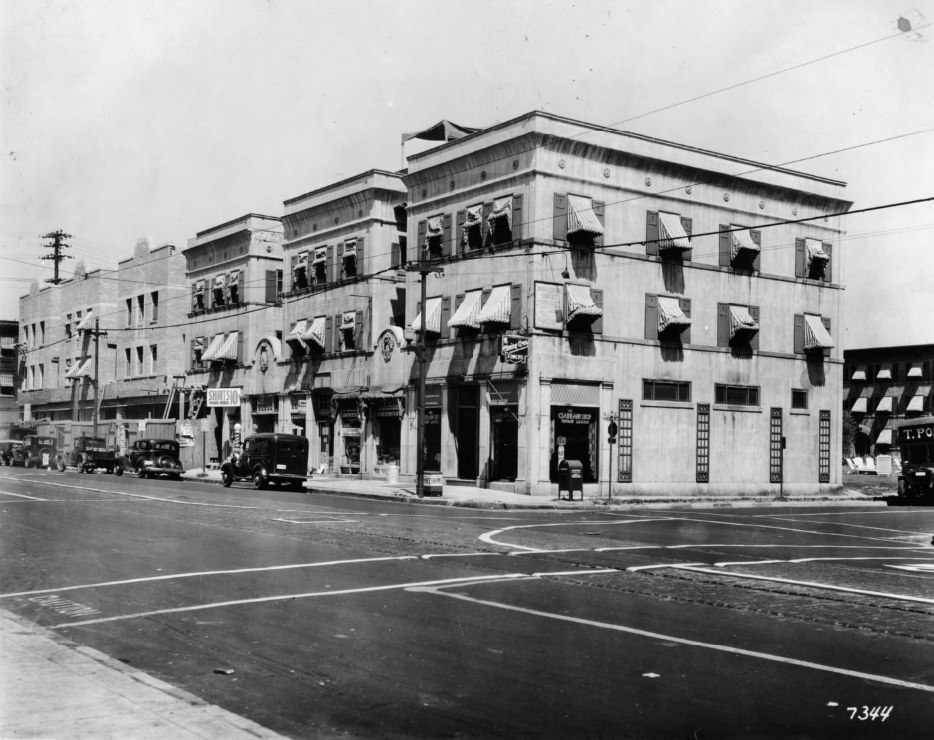
The Donaldson Court Apartment on the northwest corner of Westgate Avenue and Delmar Boulevard in University City underwent an extensive modernization program that turned its fortunes around. Before the renovation, the building’s outdated appearance and divided shop spaces had caused it to lose tenants and income.
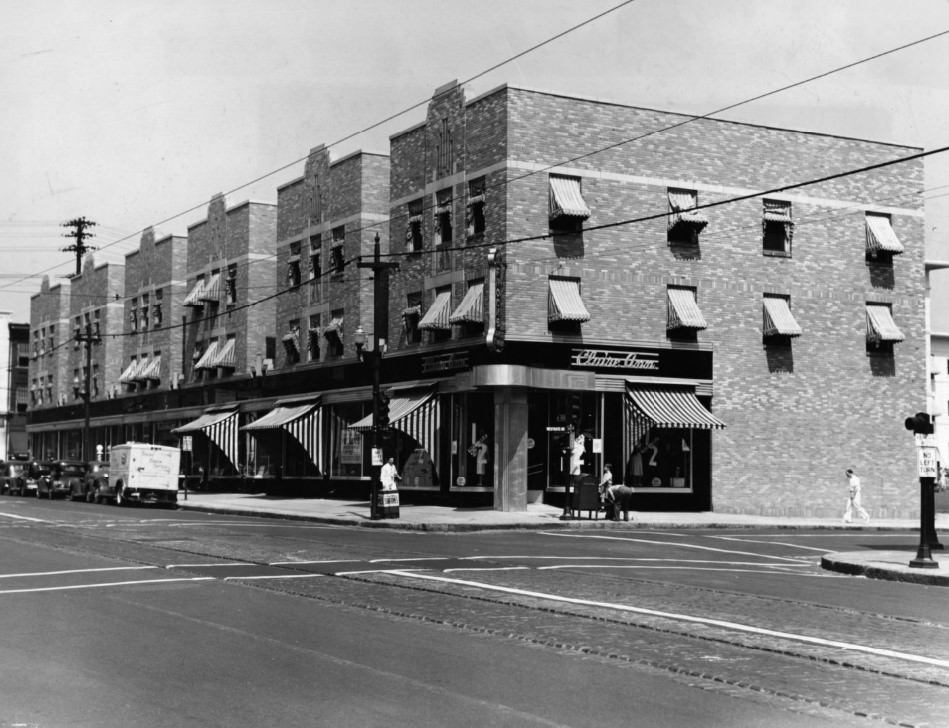
After the cement facade of Donaldson Court was removed and replaced with a modern structural glass front with ornamental brick and terra-cotta trim, the building quickly attracted new tenants for its shops. The transformation showed that strategic investment in modernization could turn around even a struggling property in the middle of the Depression.
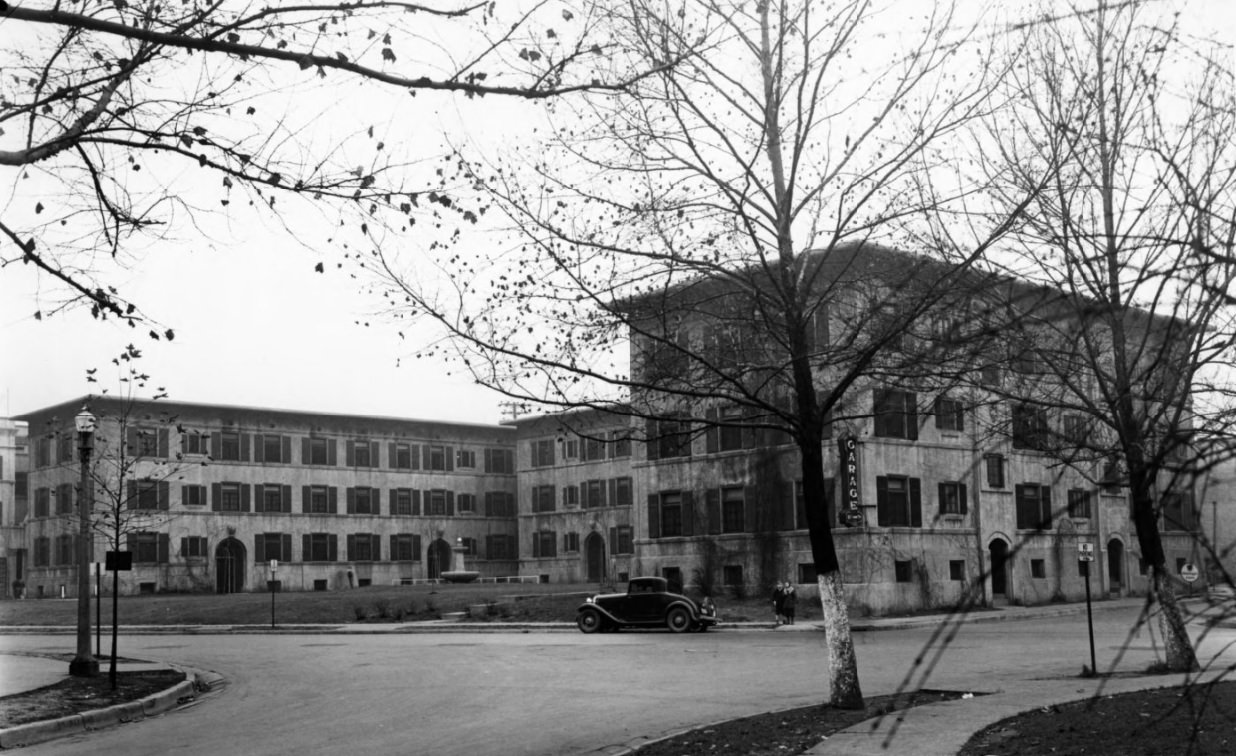
The Donaldson Court’s interior courtyard gave the building a sense of space and community that few apartment complexes could offer. A street view from 1935 showed the property before its renovation, when the courtyard was still one of its few appealing features. The building’s transformation after 1937 made it one of the more successful modernization stories of Depression-era St. Louis.
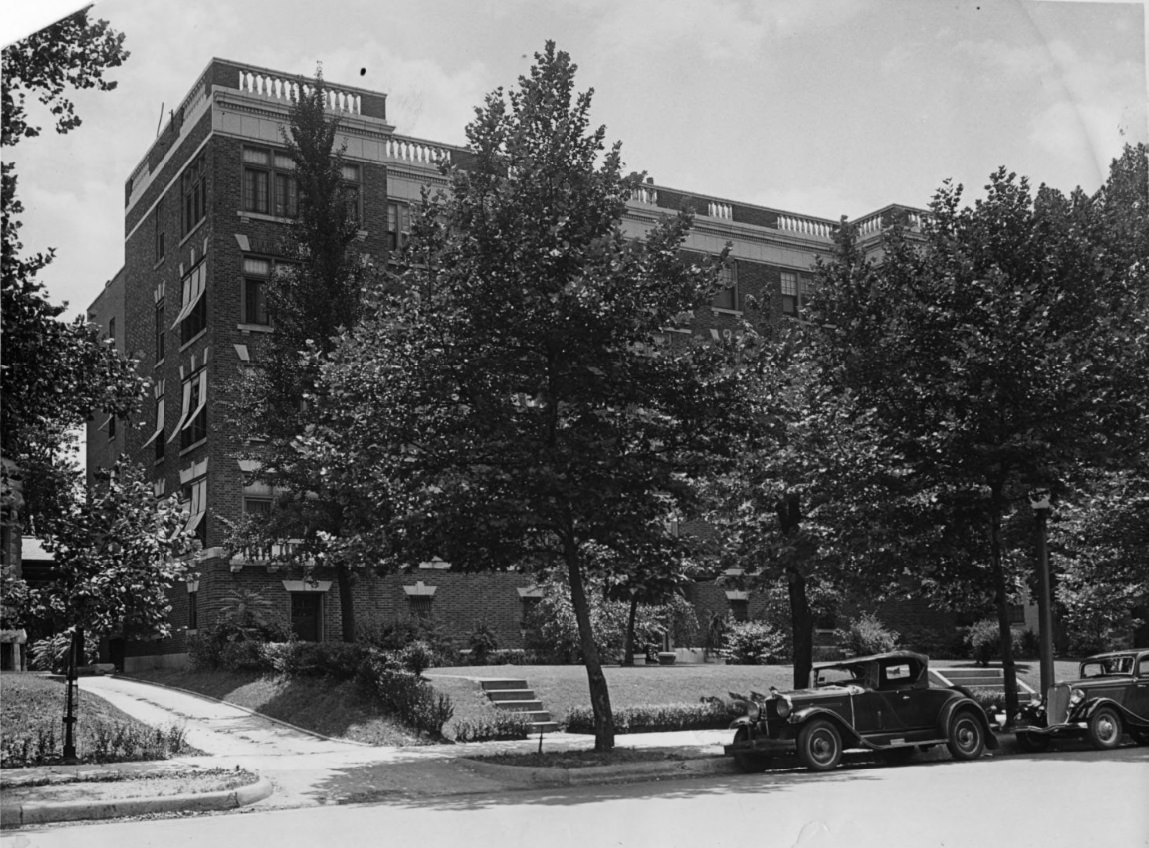
The Netherby Hall Apartments at 4540 Lindell Boulevard were acquired by the Missouri State Life Insurance Company in a trade with real estate speculator Samuel Ginstine, in which the insurance company gave up five smaller properties. The building contained eight apartments with nine rooms and three baths each — substantial units aimed at the upper end of the rental market.
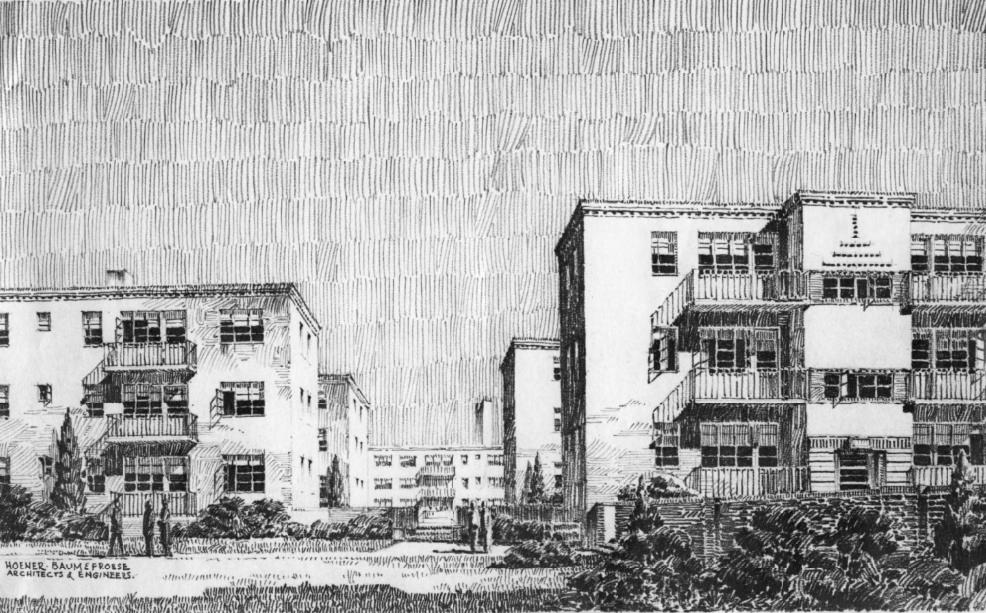
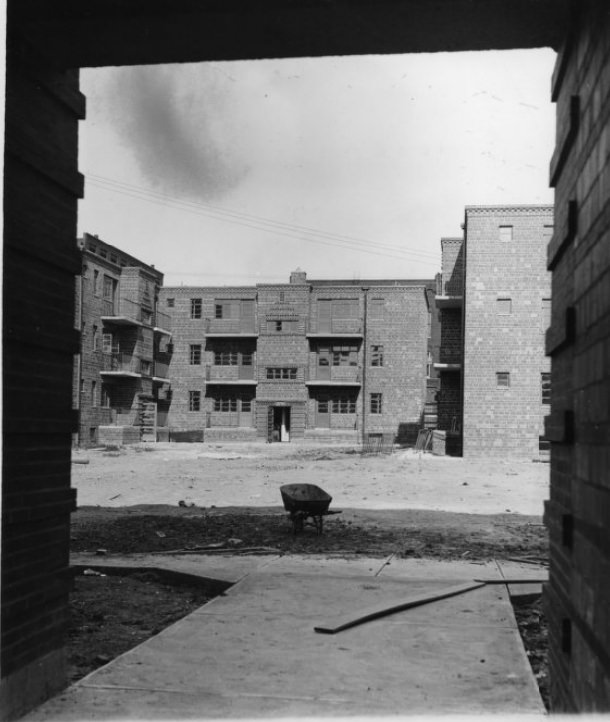
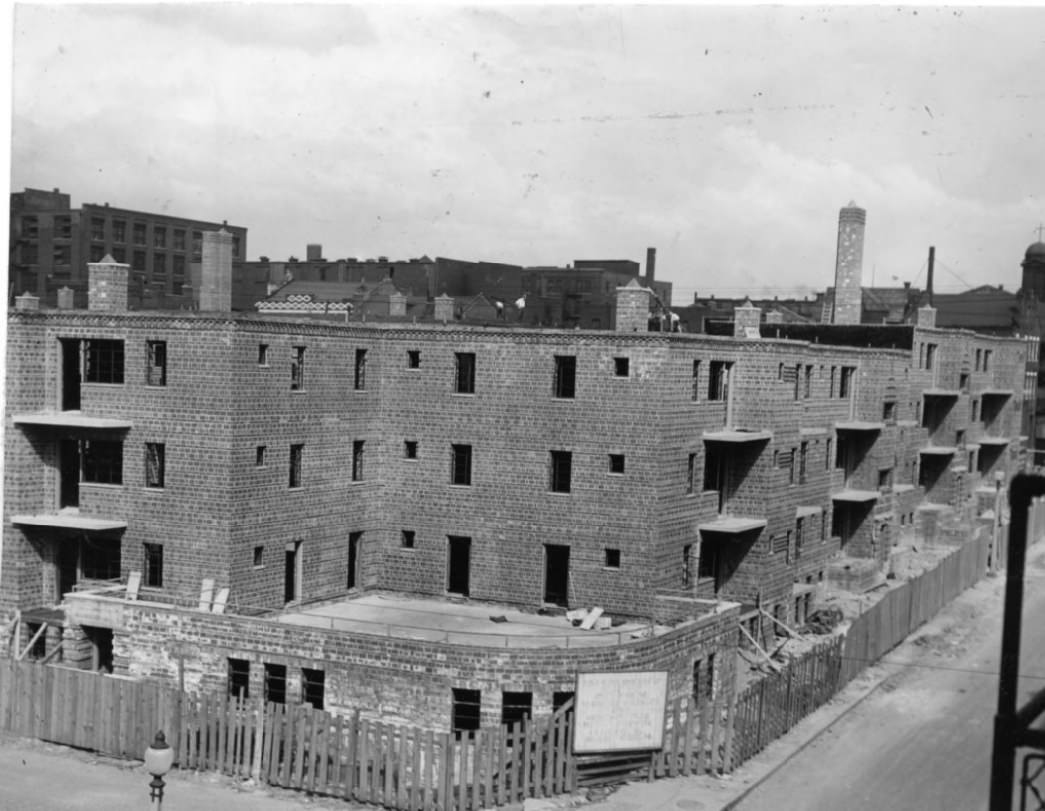
The architectural drawings and construction photographs of Neighborhood Gardens show the project from its earliest planning stages to near-completion. The 252-family development was a deliberate effort to address the city’s housing crisis with well-designed, government-backed construction. The Public Works Administration’s $640,000 contribution made the project possible at a time when private investment in affordable housing had dried up completely.
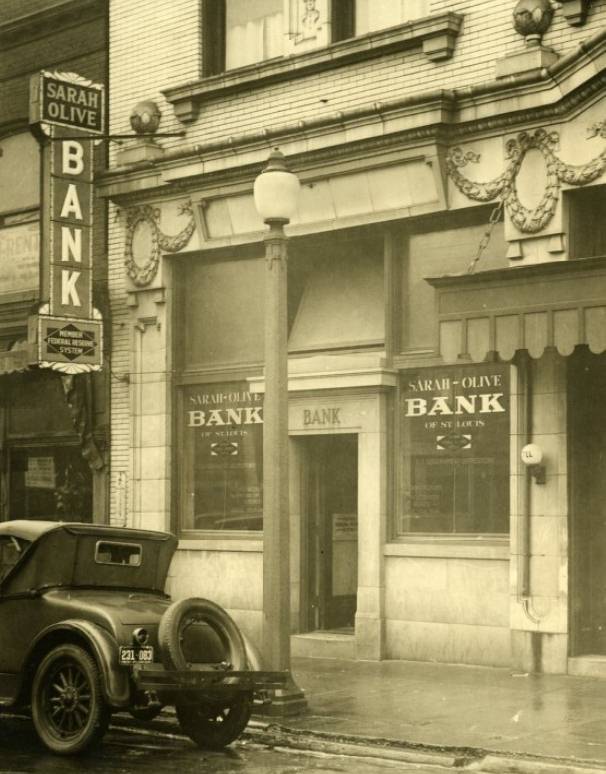
Bank robberies in St. Louis were brazen and frequent during the early 1930s. Three robbers walked into the Sarah-Olive Bank at 4055 Olive Street and left with $6,000 shortly after noon in 1931. The daylight timing showed how confident armed gangs had become, knowing that law enforcement was stretched thin and detection was difficult.
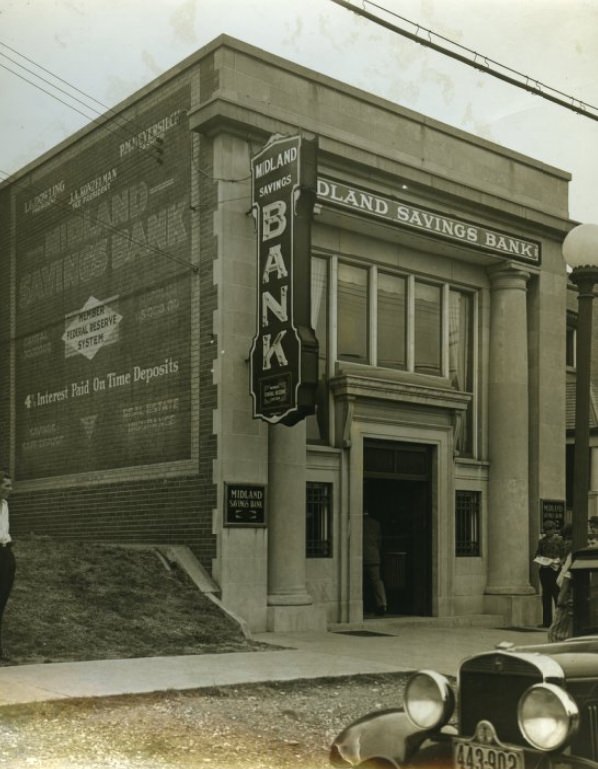
The Midland Savings Bank was one of many St. Louis financial institutions operating under pressure in 1931. Bank failures were happening across the country, and even institutions that survived faced skeptical depositors who had seen neighbors lose their savings. Maintaining public trust was the central challenge for every bank still open for business.
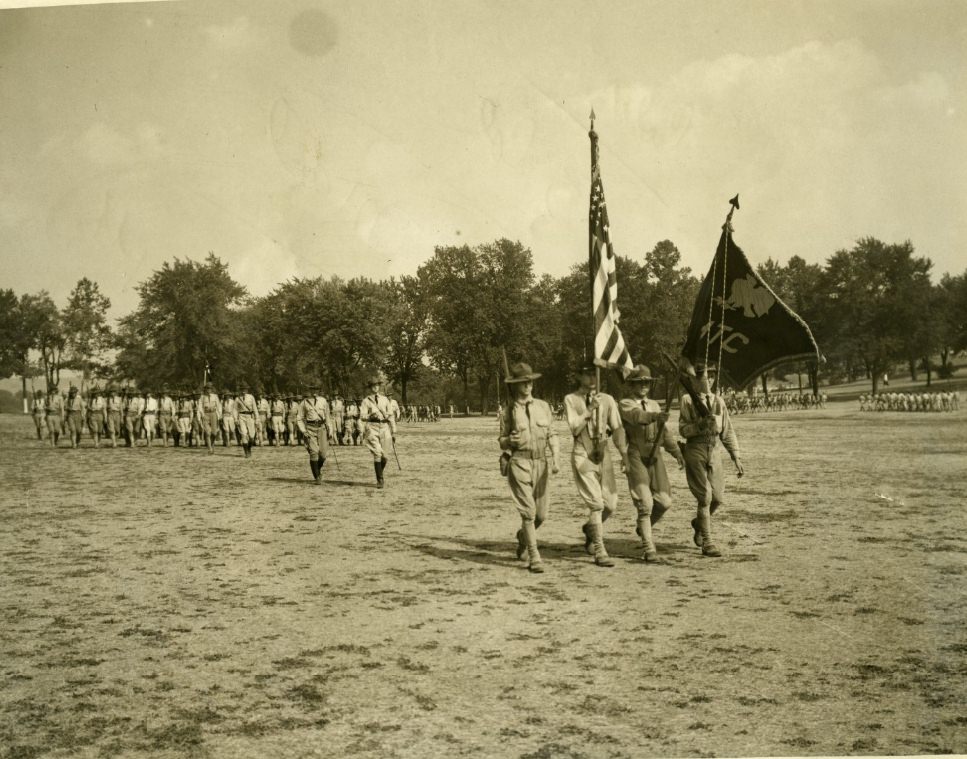
The Citizens’ Military Training Camp at Jefferson Barracks held a regimental parade in 1936 with 1,175 young men participating. The colors approached the reviewing officers as the assembled trainees — drawn from across Missouri and Illinois — demonstrated what weeks of military instruction had produced. The CMTC was one of the key pathways for young men to gain military experience before committing to full enlistment.
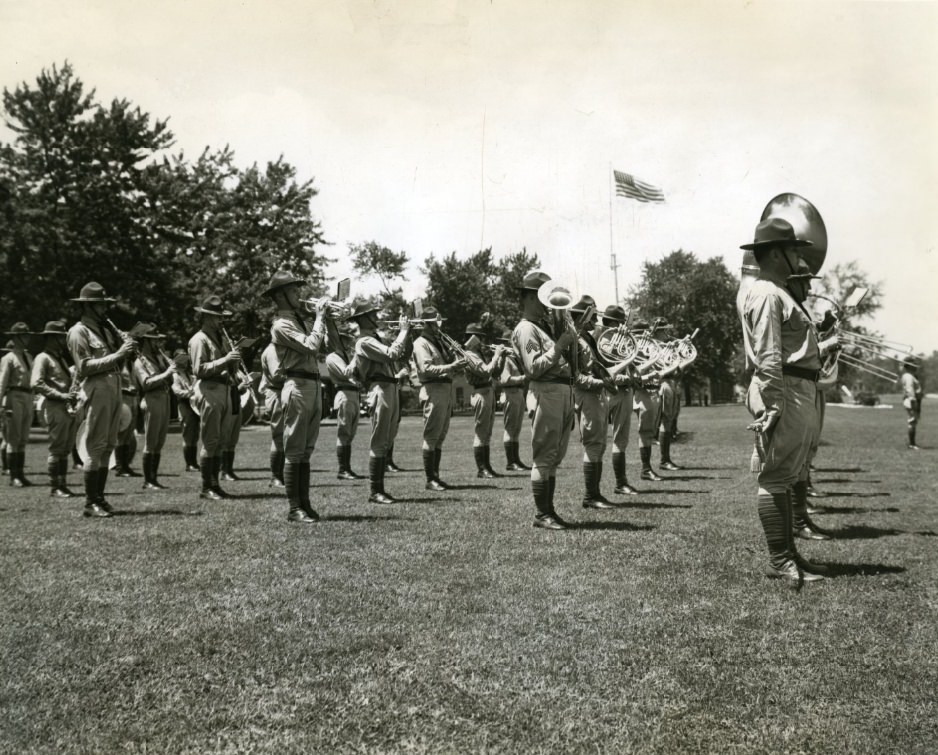
The changing of the guard at Jefferson Barracks was a formal military ceremony accompanied by a full band. The ritual reinforced discipline and tradition, marking the transfer of responsibility from one guard to the next with music and precision. These ceremonies were open to spectators and gave civilian visitors a view of military life.
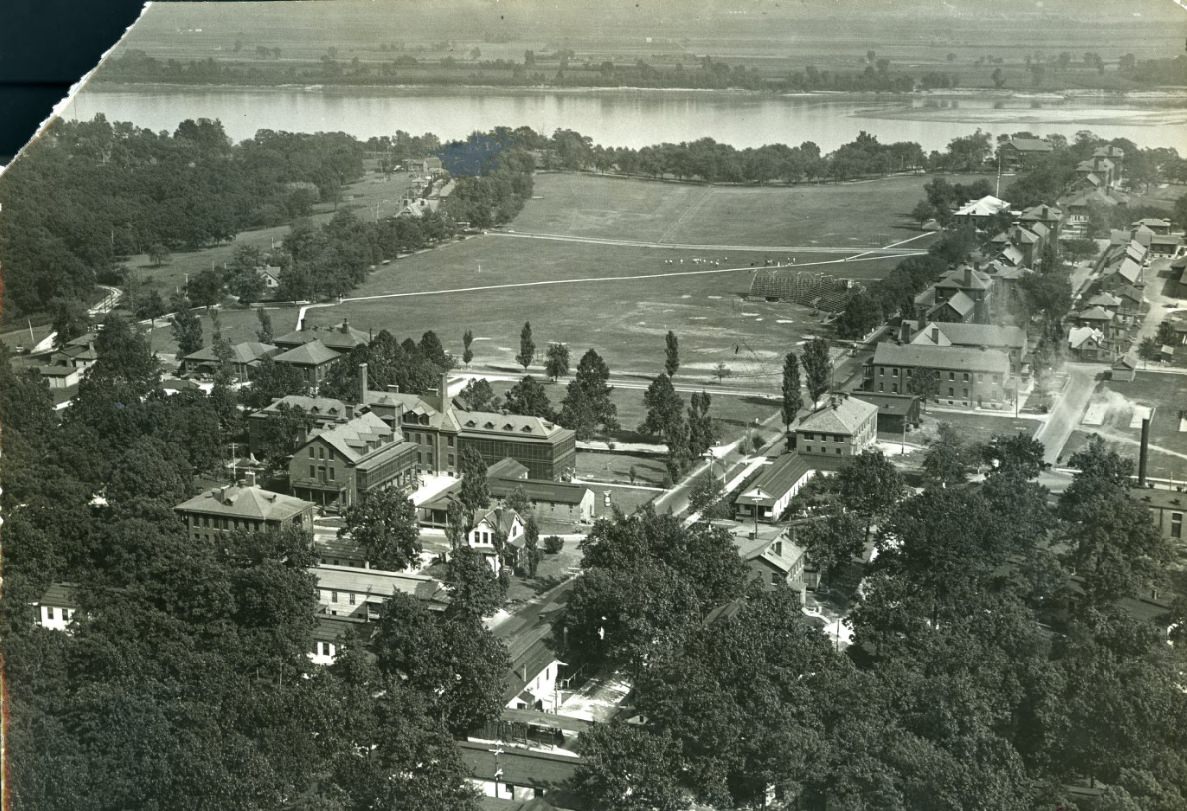
Jefferson Barracks had served as a major recruiting headquarters during World War I, and veterans from the Middle West who had passed through its gates during that conflict still remembered the place well. By 1935, the barracks had decades of American military history embedded in its grounds, buildings, and parade fields.
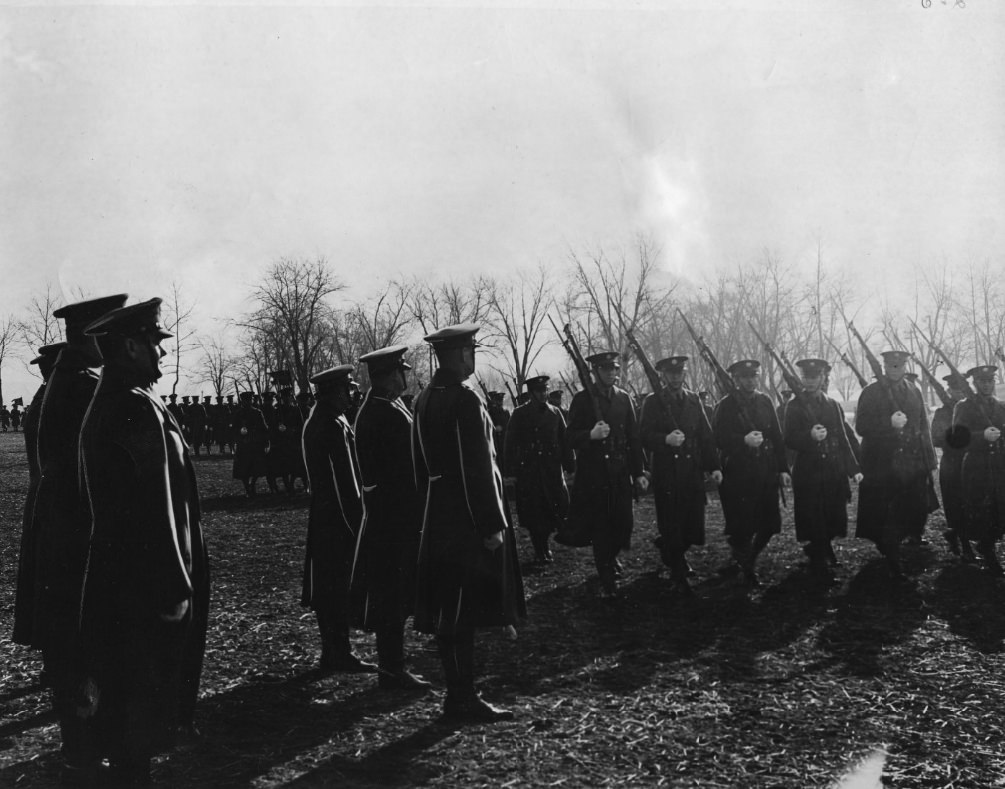
The Sixth Infantry Regiment marched in review at Jefferson Barracks in 1938 before Warrant Officer G.H. Bucholz, who was marking 35 years of service in the Army by announcing his retirement as regimental band leader. The parade was both a military exercise and a sendoff for an officer whose career had spanned the pre-World War I era through the height of the Depression.
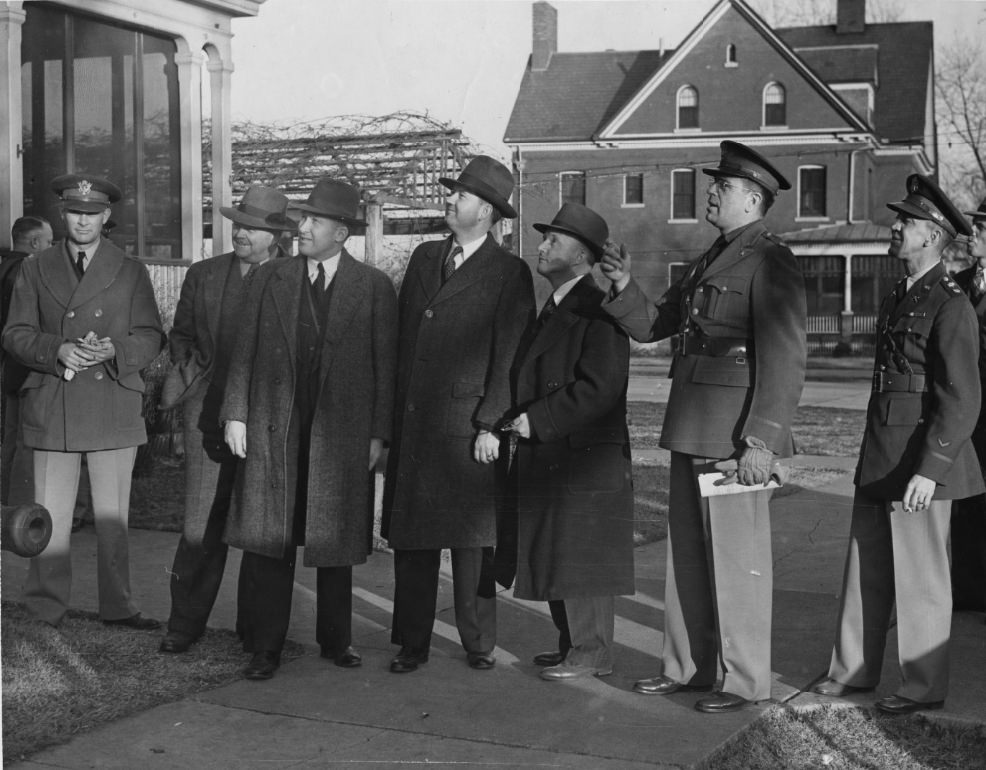
In 1939, members of a Congressional committee conducting a nationwide inspection of Army posts visited Jefferson Barracks. The visit reflected growing Congressional interest in the state of the nation’s military readiness as war in Europe drew closer. What they found at Jefferson Barracks was a post that had expanded significantly through the decade.
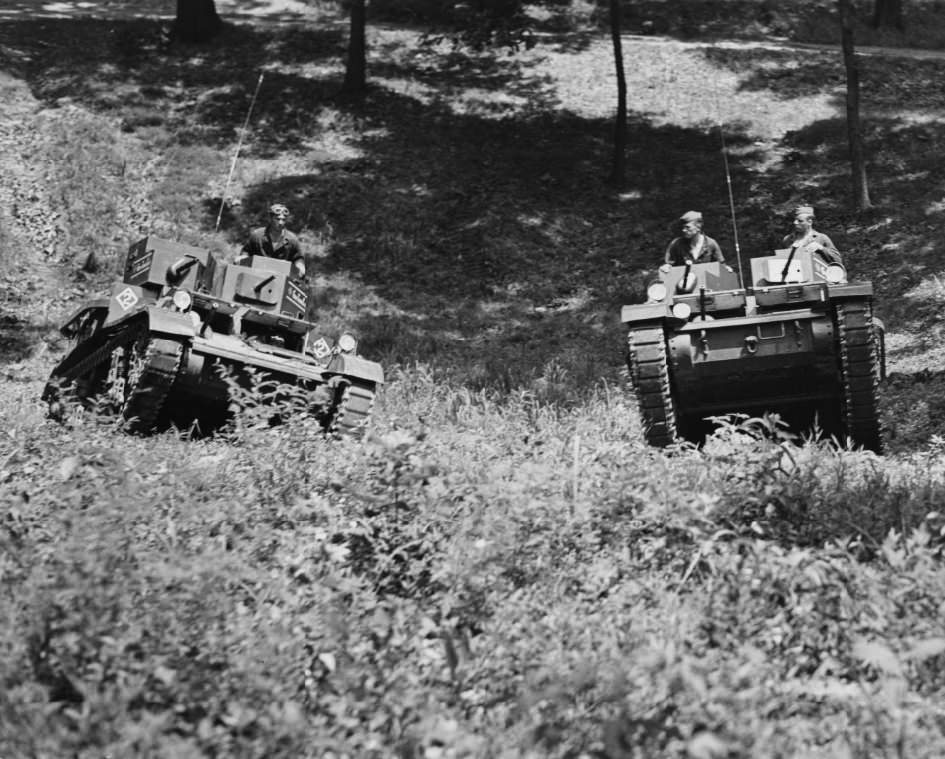
Tank training at Jefferson Barracks involved navigating rough terrain, and the light tanks of the Sixth Tank Company proved capable of pushing through bushes and smaller trees when the terrain demanded it. Field exercises in 1939 put both the machines and their crews through demanding conditions designed to prepare them for real combat scenarios.
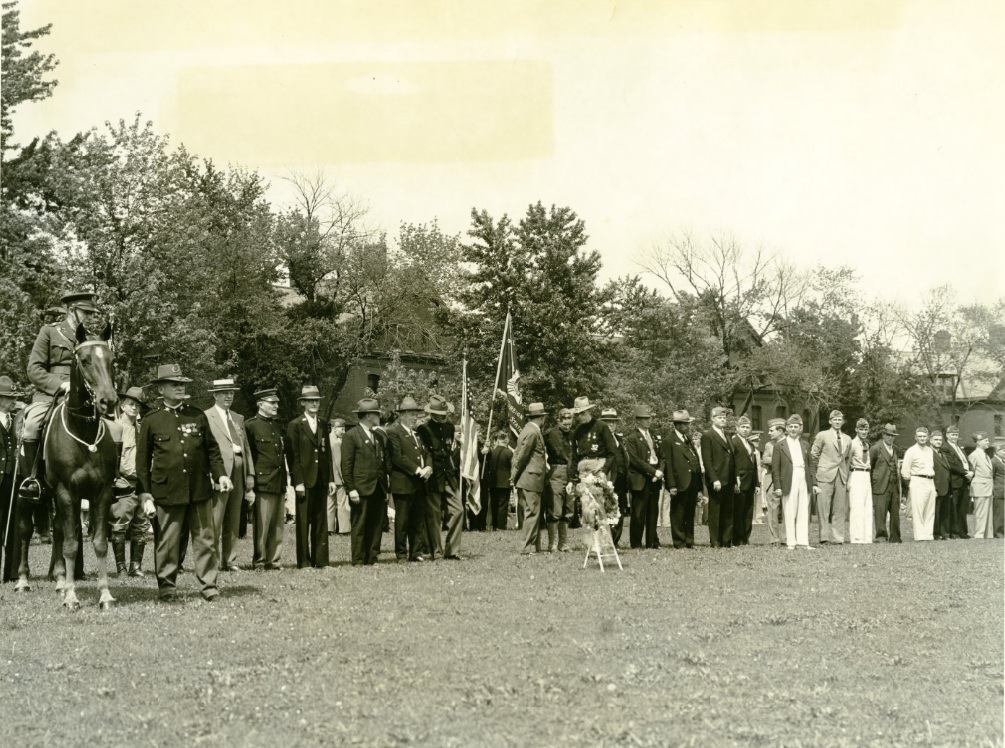
Memorial Day at Jefferson Barracks brought out veterans who watched the Sixth Infantry pass in review with the kind of attention that only men who had served could give. In 1935, with World War I still fresh in the memory of those who had fought it, the parade carried real weight for the spectators lining the route.
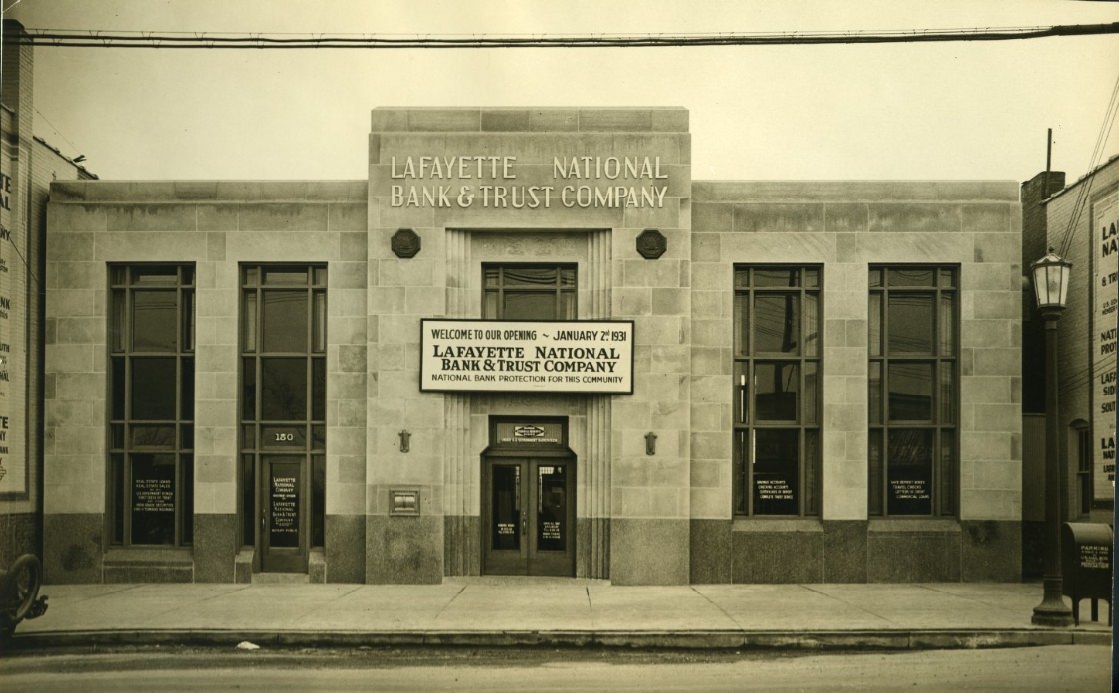
The Lafayette National Bank served the communities around Lafayette Square, one of St. Louis’s established neighborhoods. Like other neighborhood banks operating in 1931, it was navigating a period of enormous financial uncertainty while trying to maintain the confidence of its depositors.
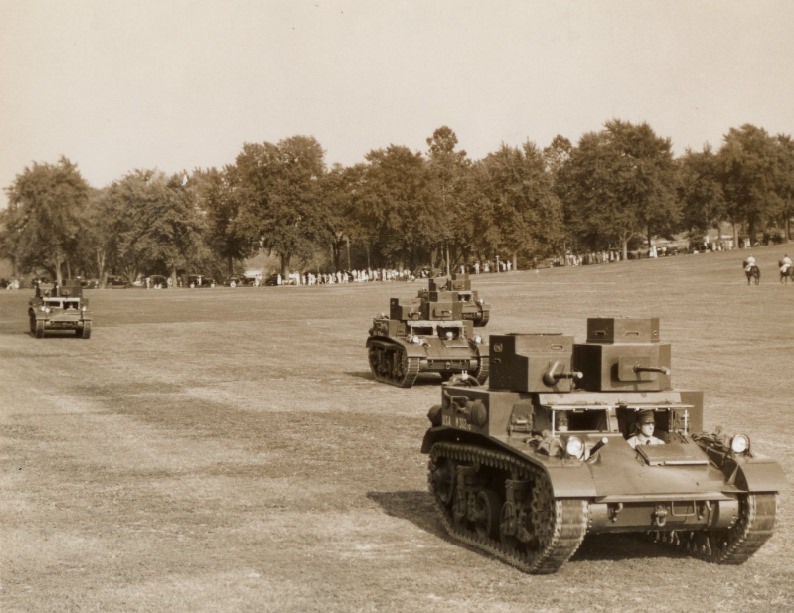
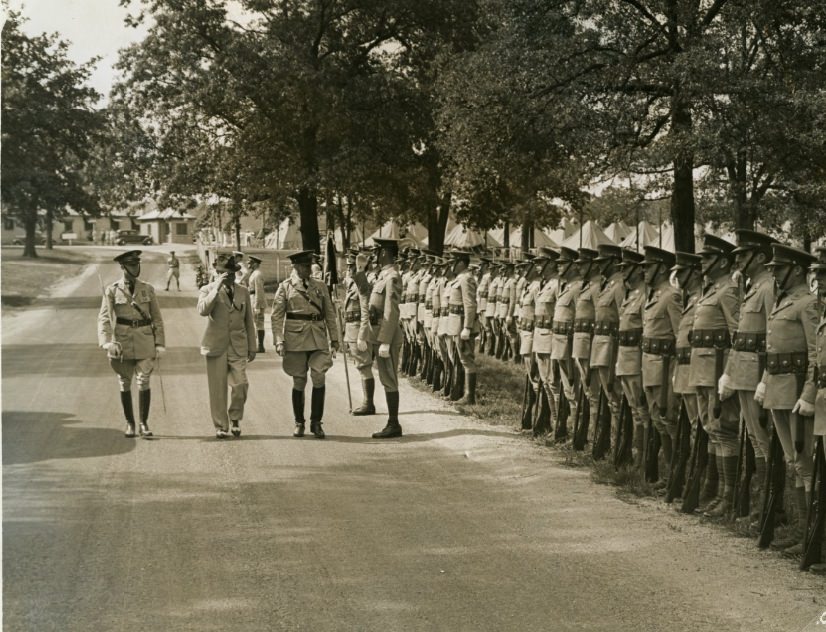
The Sixth Infantry Regiment was the primary unit stationed at Jefferson Barracks through the 1930s. Photographs from 1937 and 1938 show the regiment at different stages of its training cycle — formations on the parade ground, equipment inspections, and the orderly routines that turned recruits into disciplined soldiers. By the late 1930s, the regiment’s size and readiness had grown considerably.
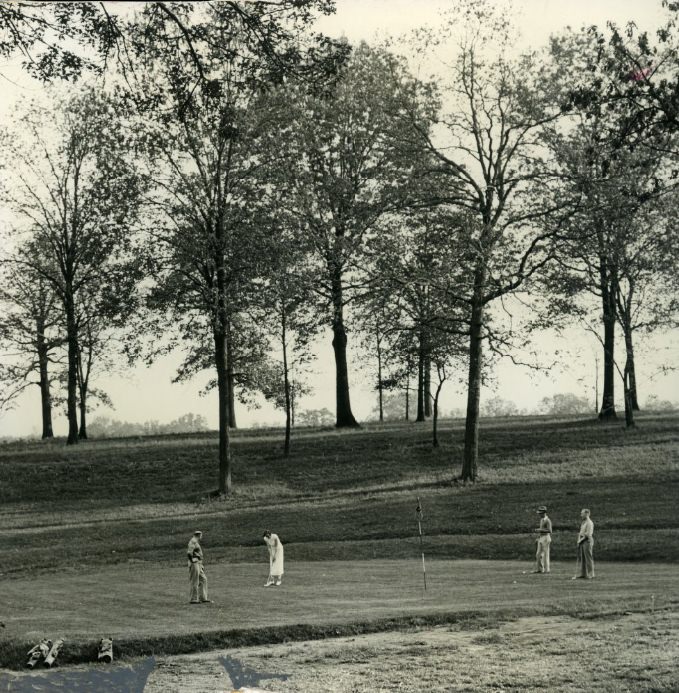
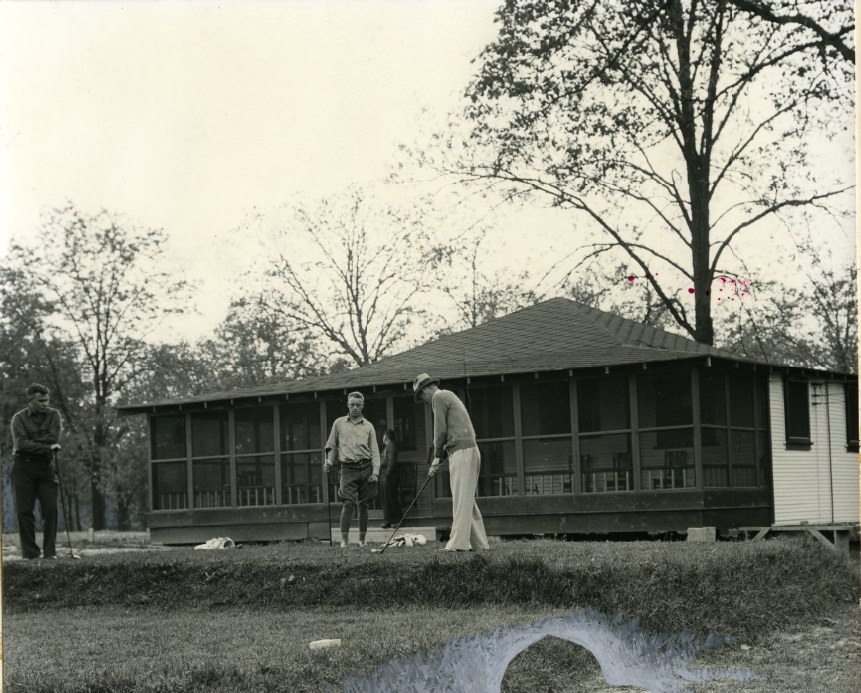
Life at Jefferson Barracks was not all drills and inspections. Officers had access to a golf course on the post in 1935, one of the amenities that made the barracks a relatively comfortable assignment by military standards. These recreational facilities were part of the Army’s effort to attract and retain career officers.
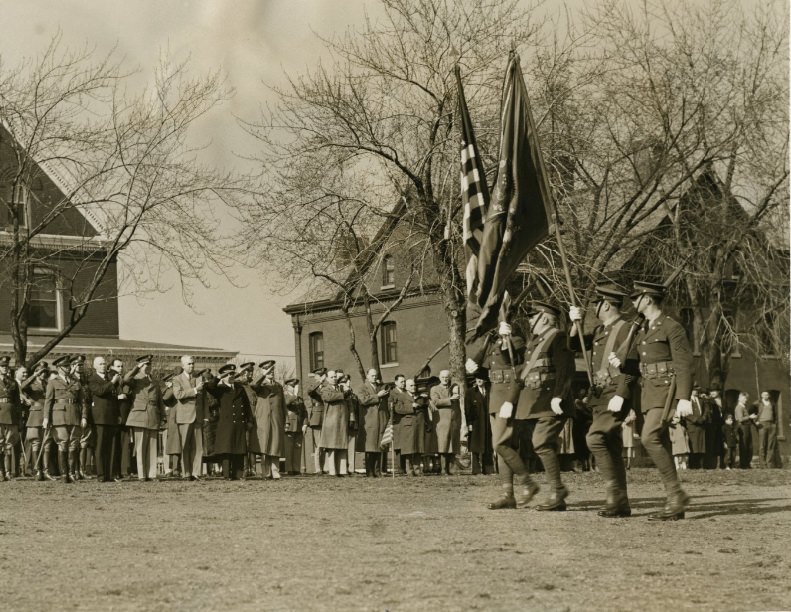
Army Day in 1937 was marked at Jefferson Barracks with a full parade by the Sixth Infantry. The colors passed in review before officers and a group of spectators, with the observance sponsored by the St. Louis Chapter of the Military Order of the World War. Army Day parades were public events designed to build civic support for military readiness.
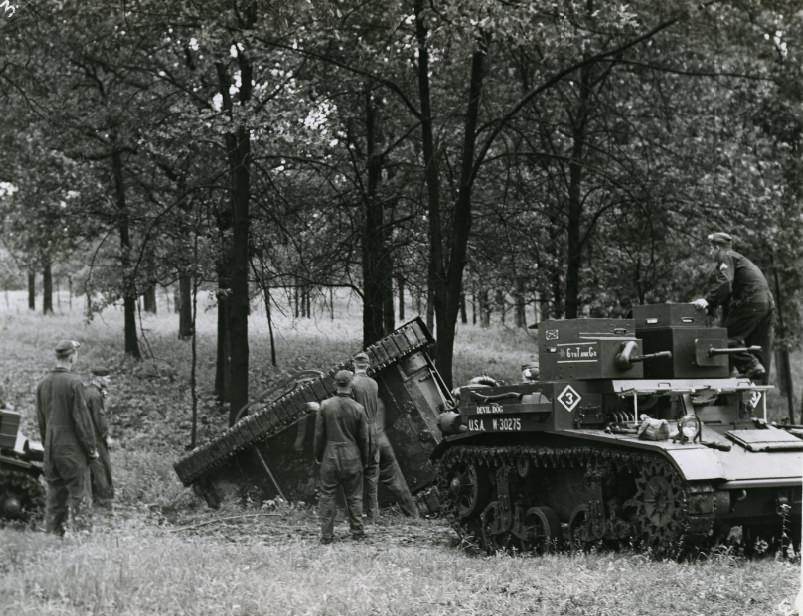
Tank training could go wrong even on a domestic post. An overturned tank at Jefferson Barracks in 1938 was described as the only ‘casualty’ of one particular exercise — a wry comment that acknowledged the mishap while noting that no one was seriously hurt. Overturned vehicles were an occupational hazard of armor training on rough terrain.
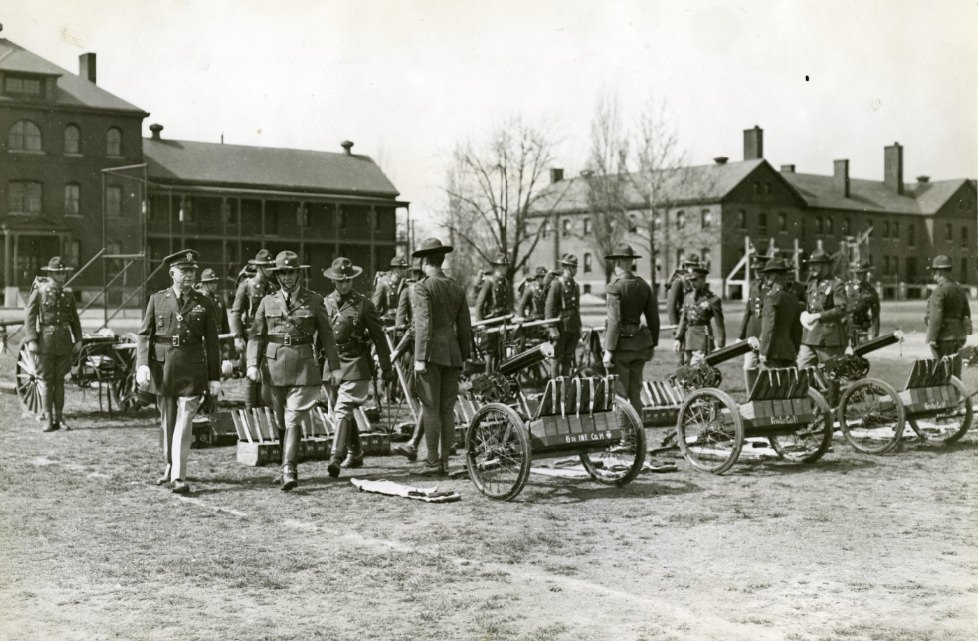
High-ranking generals regularly inspected Jefferson Barracks and its units during the 1930s. A 1937 inspection of the Sixth Infantry was part of the Army’s ongoing effort to assess the readiness of its forces at a time when international events were demanding greater military attention.
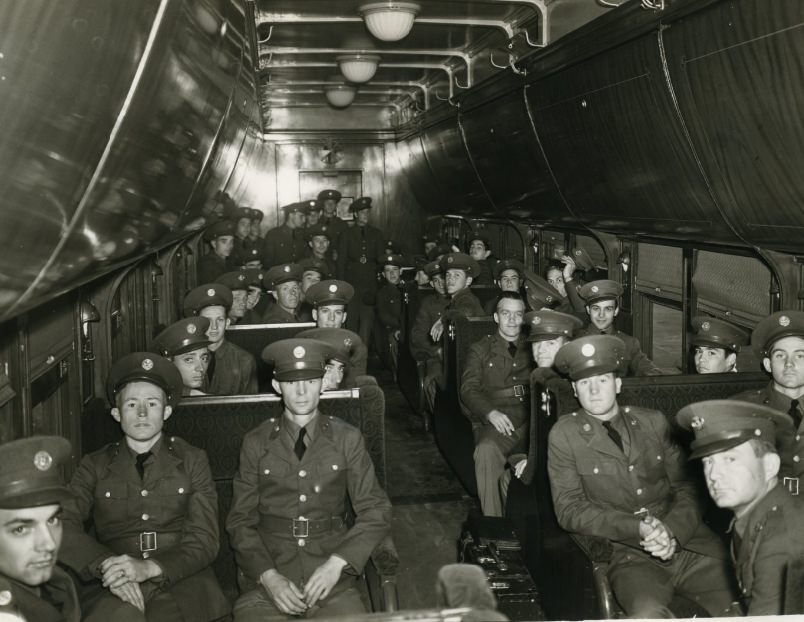
By 1939, the volume of recruits being processed through Jefferson Barracks and dispatched to other posts had increased sharply. Soldiers heading west by train to the Pacific Coast were part of a military buildup driven by events abroad. For many of these young men, the train ride was the start of a journey that would take them far from Missouri.
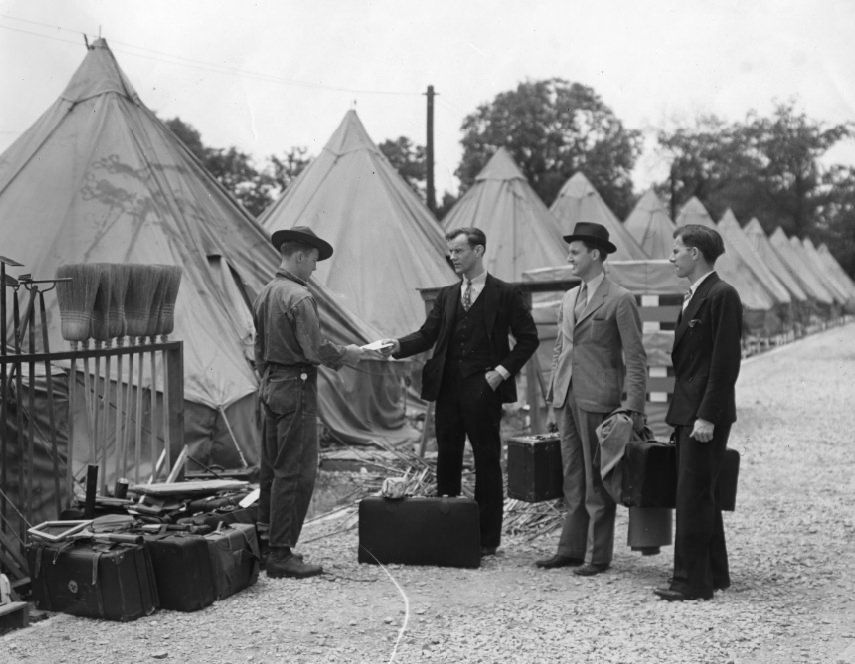
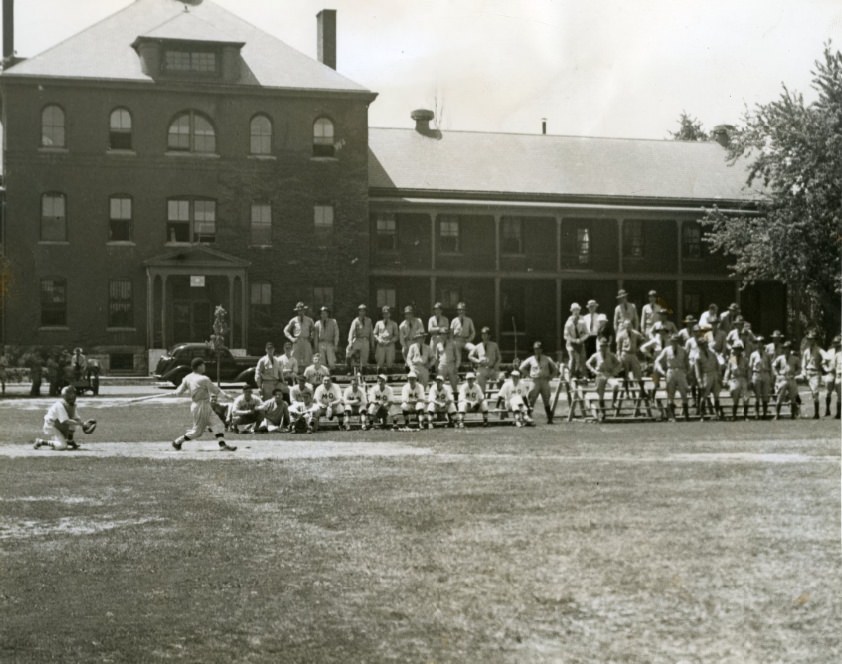
Everyday life at Jefferson Barracks produced candid moments that went beyond the formal parades and inspections. A lighthearted photograph of men in suits visiting a soldier with unusually long legs — or unusually short pants — captured the humor that existed alongside serious military training. These informal images offer a more personal look at barracks life in the 1930s.
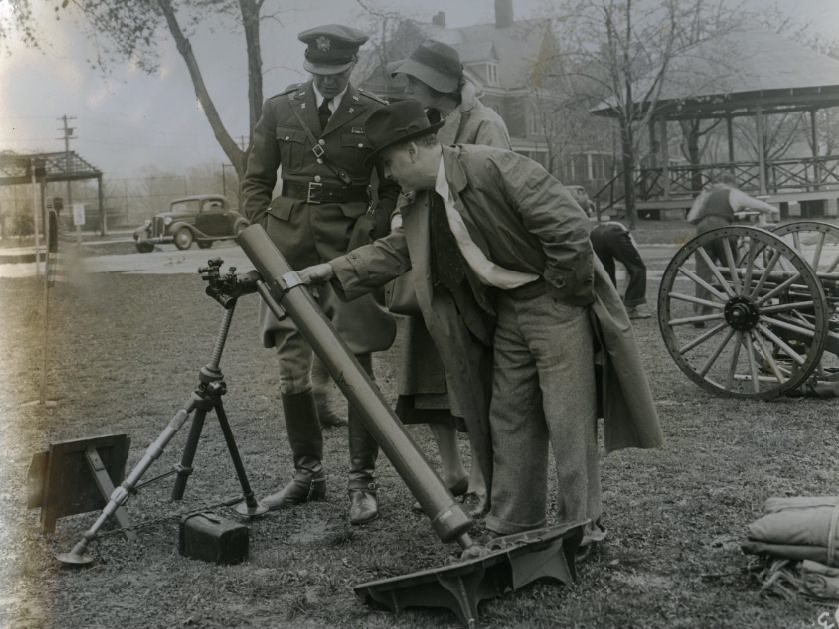
Army Day at Jefferson Barracks in 1938 was the regiment’s biggest public showcase of the year. The Sixth Infantry turned out in full dress, putting its best foot forward for civilian spectators and military observers alike. The annual event was an important opportunity for the Army to demonstrate its professionalism and readiness to the public.
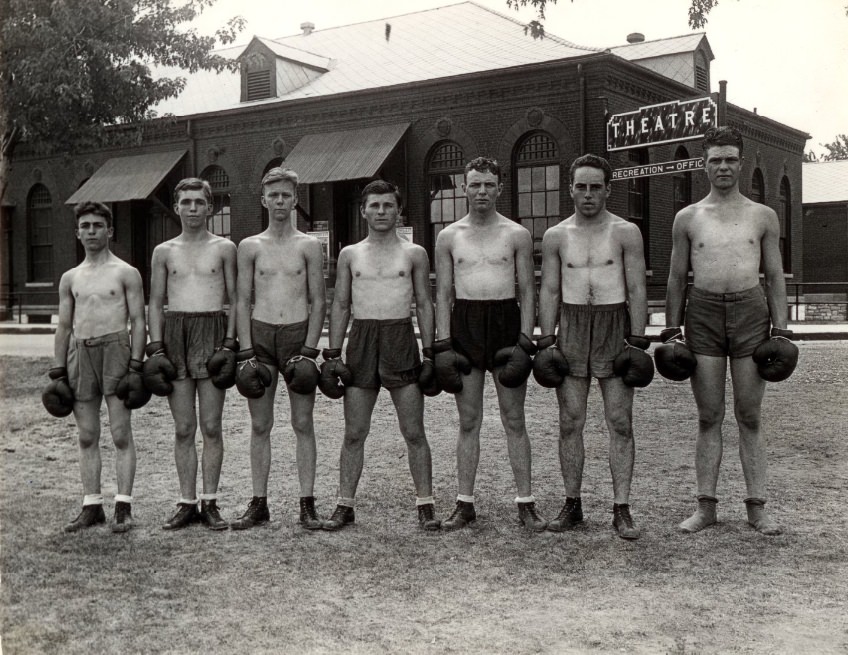
The training camp at Jefferson Barracks in 1931 operated during the early years of the Depression, when the Army was functioning on reduced budgets but still maintaining its training programs. Young men who came through the CMTC program in those years were getting their first exposure to military life at a time when few could have predicted how soon that training would matter.
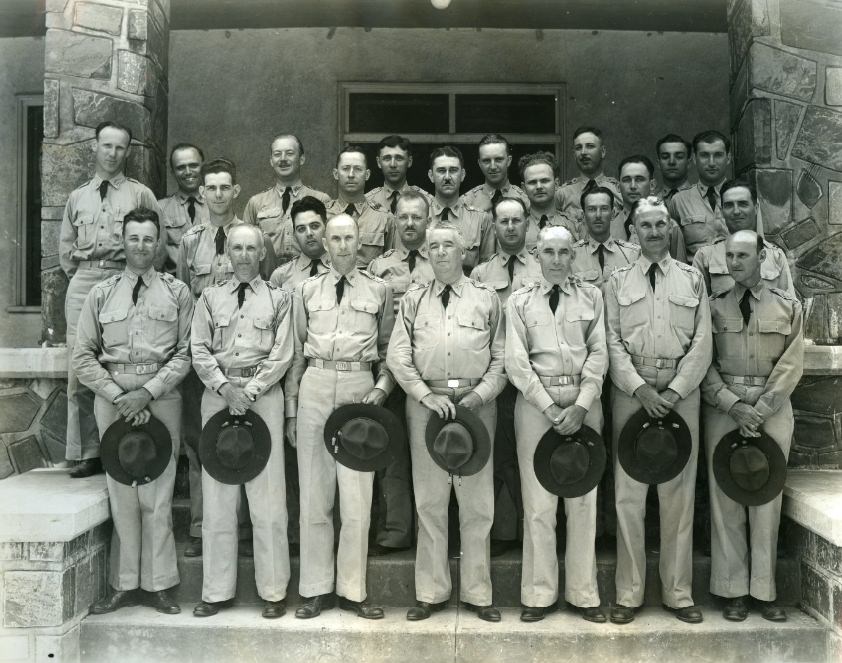
In 1939, St. Louis CMTC officer personnel completed a two-week training encampment at Camp Joseph T. Robinson in Arkansas. The formation was so well-disciplined that it resembled the 138th Infantry — a compliment that reflected how effective the training program had become by the final year of the decade.
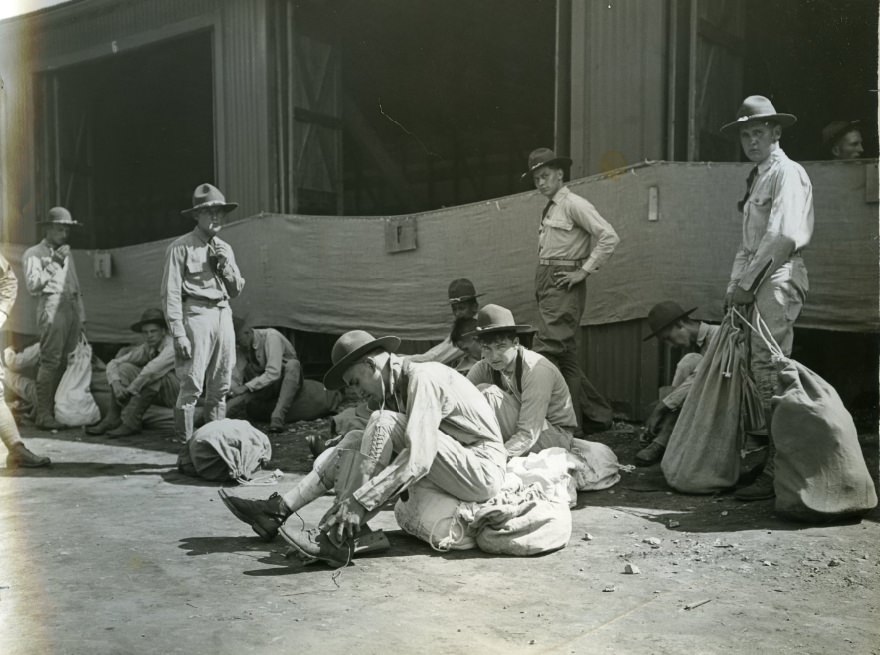
CMTC students at Jefferson Barracks put on campaign uniforms in 1932, a ritual that marked the transition from civilian to military identity — even if only for the duration of the summer training program. These moments of outfitting were also practical exercises in military dress and equipment procedures.
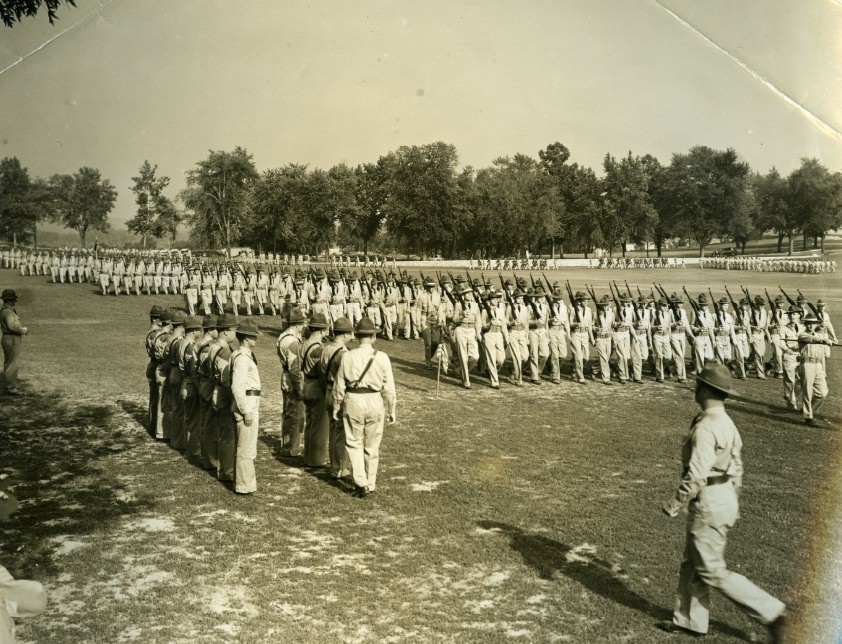
The first regimental parade of the Citizens’ Military Training Camp at Jefferson Barracks in 1939 drew a review of civilian soldiers moving with the kind of precision normally associated with veterans. The precision of their movement in this final year of the CMTC program was a testament to the effectiveness of the training they had received.
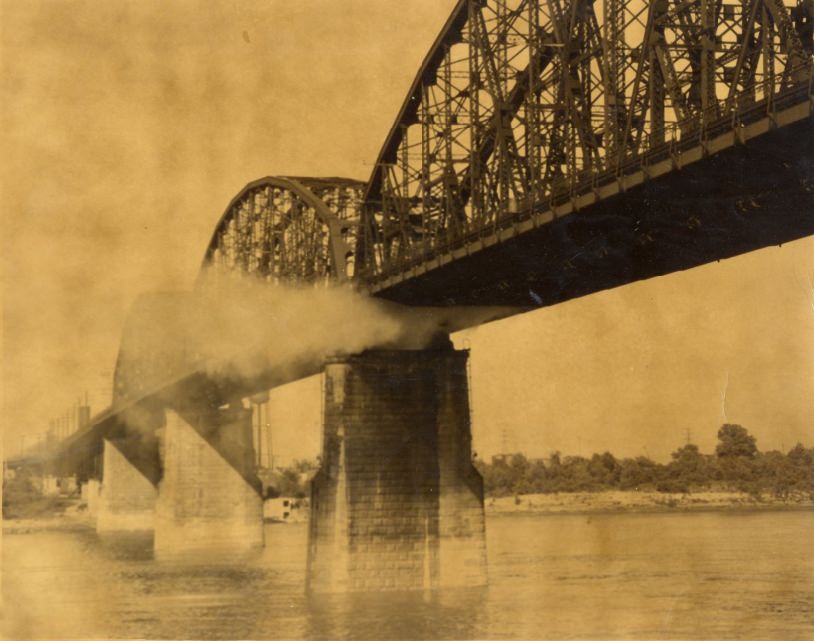
The McKinley Bridge’s wooden roadway caught fire in 1936, with about 100 feet of the underside of the north roadway scorching near the center span. The fire threatened to destroy the roadway of an otherwise fireproof bridge — a reminder that even solid infrastructure had vulnerabilities. The bridge was an important crossing between St. Louis and East St. Louis, and any damage to it affected commerce and commuters.
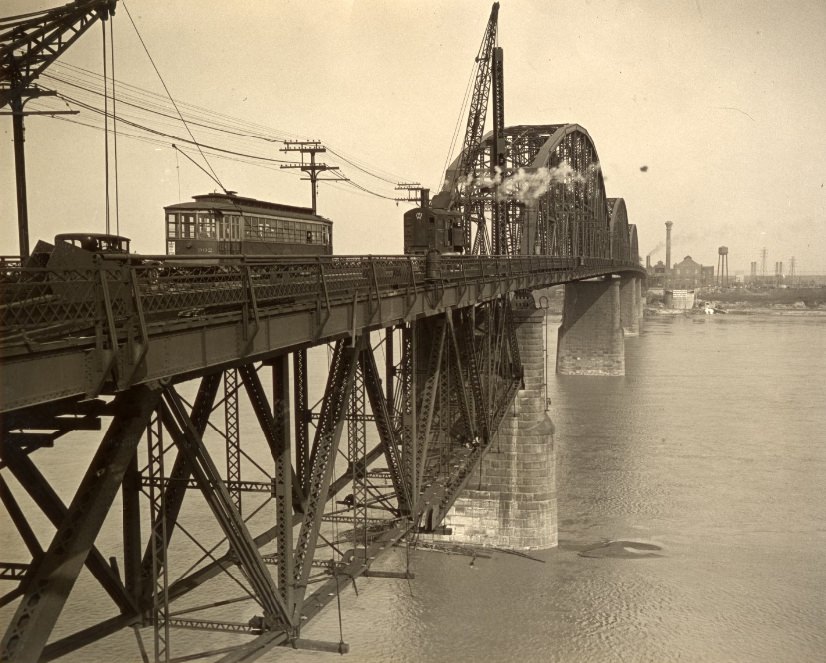
The McKinley Bridge carried both road traffic and rail lines across the Mississippi, making it one of the most important crossings in the region. Trains on the bridge’s track in 1931 were part of the continuous flow of freight and passengers moving between Missouri and Illinois. The bridge was a critical link in the regional transportation network throughout the decade.
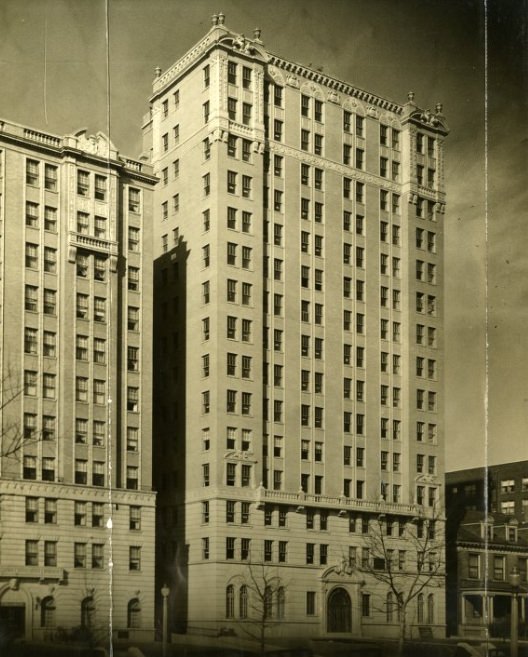
The Park Royal Apartments — also known as the President Apartments — rose fifteen stories at 4605 Lindell Boulevard and contained fifty-six large suites when completed in 1930. The building represented the high-end residential development that was still finishing construction even as the Depression was beginning. Within months of its completion, the economic climate that would define the decade had fully set in.
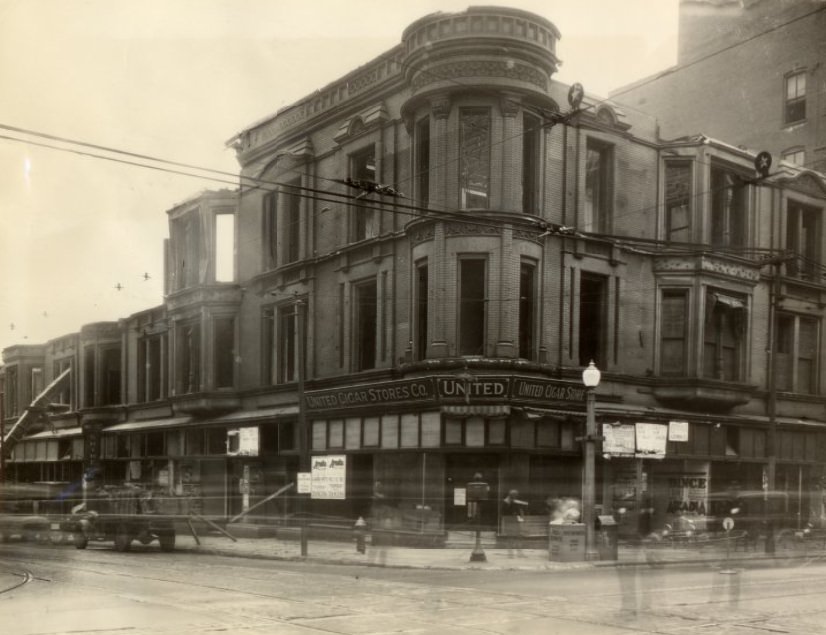
A three-story building that had stood at the corner of Grand Boulevard and Olive Street for nearly sixty years came down in 1933 to make way for new construction. The clearing of old buildings at important intersections was part of the constant physical evolution of the city, even during years when economic conditions made new construction a risky investment.
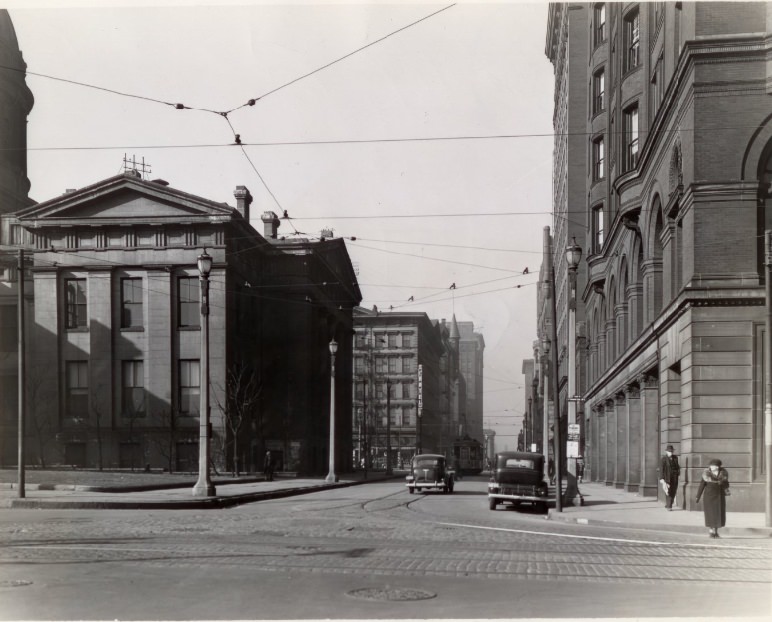
Fourth and Chestnut was part of the downtown commercial core that defined central St. Louis. By 1938, some of these older buildings were being evaluated for redevelopment as the city began planning the riverfront clearance that would eventually make way for the Jefferson National Expansion Memorial — the site of the future Gateway Arch.
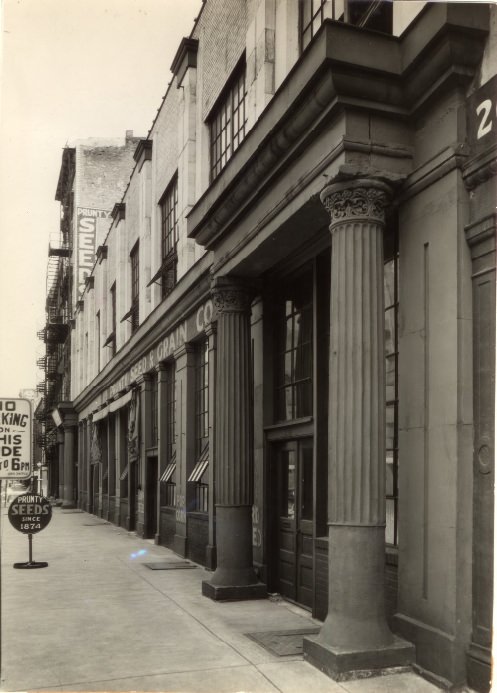
The building at 14–16 South First Street was a solid, old-fashioned structure near the riverfront, with two sets of stone pillars flanking its entrances. By 1935, buildings like this one were coming under increasing scrutiny as city planners considered what the riverfront should look like in the future. Many of these older structures would eventually be cleared.
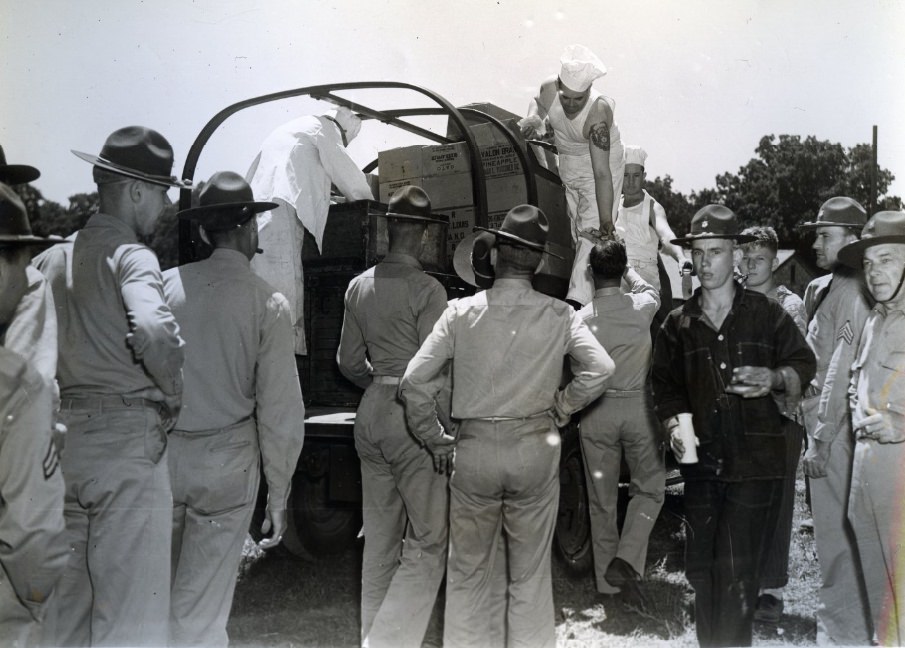
Feeding a large training camp required flexible logistics. At Jefferson Barracks in 1939, trainees who arrived too late for breakfast and couldn’t hold out until noon were given an in-between snack to tide them over. This kind of practical accommodation kept the training program moving smoothly without leaving hungry recruits unable to focus on instruction.
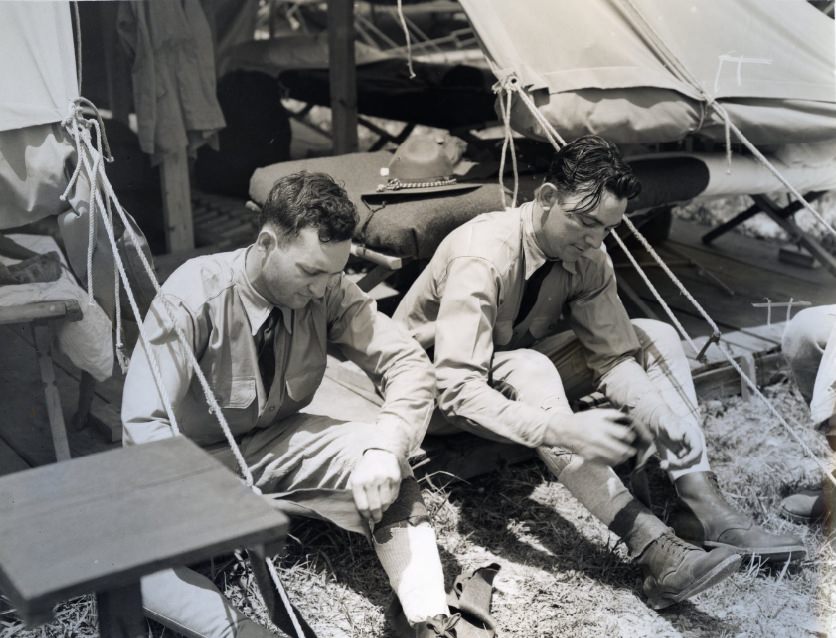
Five CMTC students at Jefferson Barracks posed for a photograph after being issued their equipment in 1935. For many of these young men, this was their first experience with military gear — rifles, packs, and uniforms that marked the beginning of their transformation from civilians into trained soldiers, even temporarily.
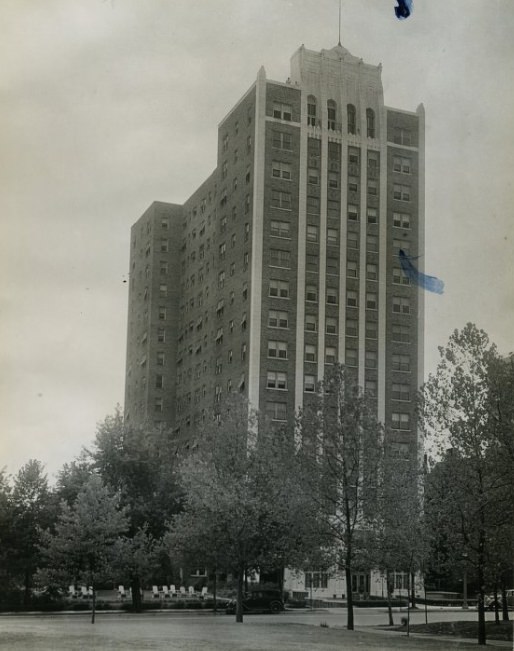
The Pierre Chouteau Apartments offered about 60 units, most with either six rooms and two baths or five rooms and one bath. In 1934, larger apartments like these were difficult to fill as families downsized in response to economic pressure, and many buildings in this category saw increased vacancies and declining rents during the Depression years.
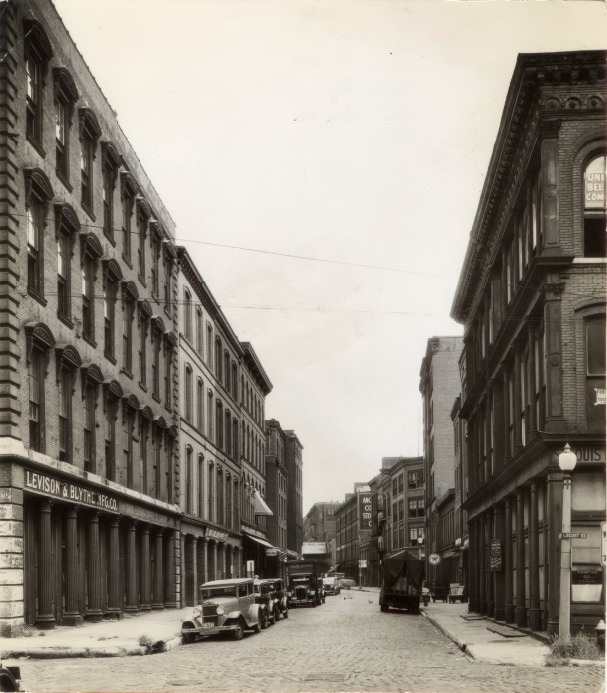
The buildings clustered near the St. Louis riverfront in 1935 were a mix of old commercial structures, warehouses, and historic buildings that had been part of the city’s landscape for generations. Many of these would be demolished later in the decade as planning began for the Jefferson National Expansion Memorial project.
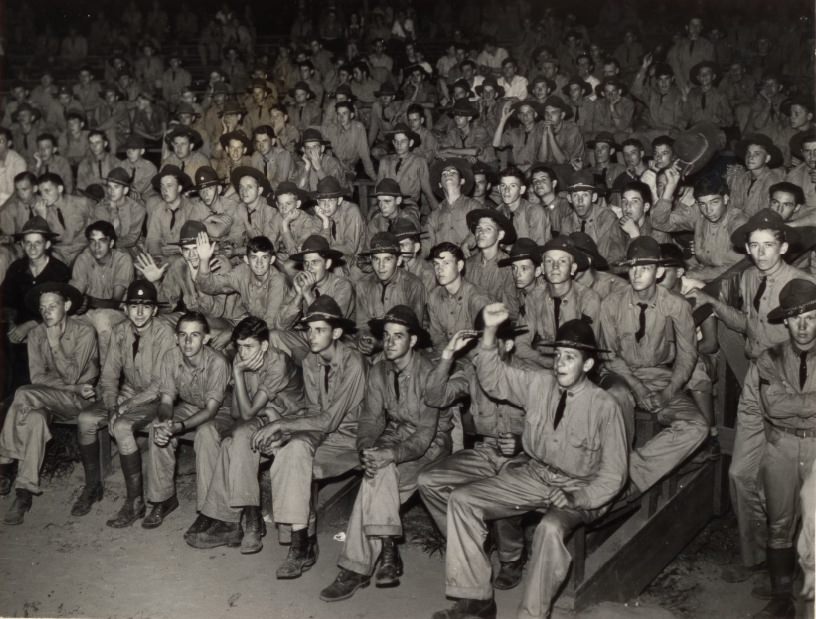
The CMTC amateur boxing tournament at Jefferson Barracks drew a crowd of 6,000 soldiers and civilians in 1937 for the second round of competition. Spectators from Missouri and Illinois cheered for fighters from their home states, creating real rivalry in the stands. Boxing was one of the most popular athletic competitions at military training camps across the country during the 1930s.
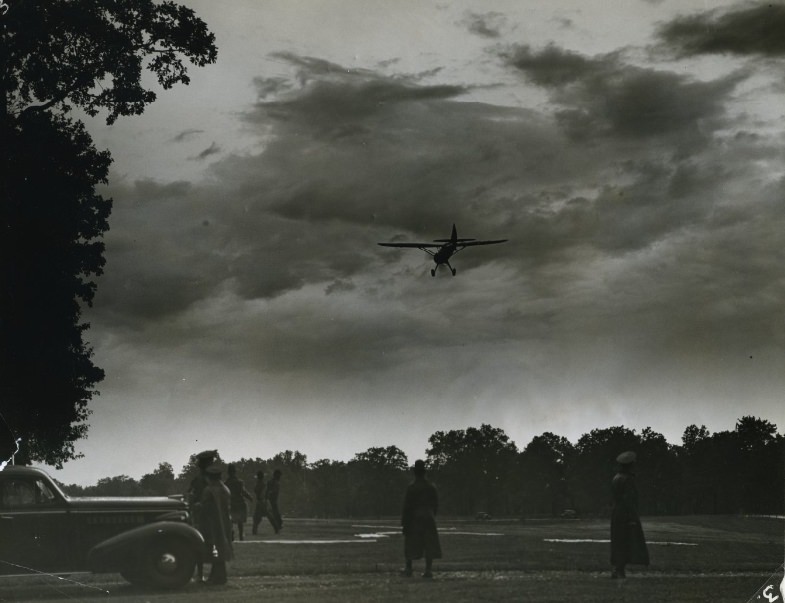
By 1938, the war maneuvers at Jefferson Barracks had taken on greater urgency. Field exercises simulated combat conditions, with units working through coordinated attack and defense problems. The training was no longer simply about building good soldiers for peacetime — it was preparation for a conflict that many military planners believed was coming.
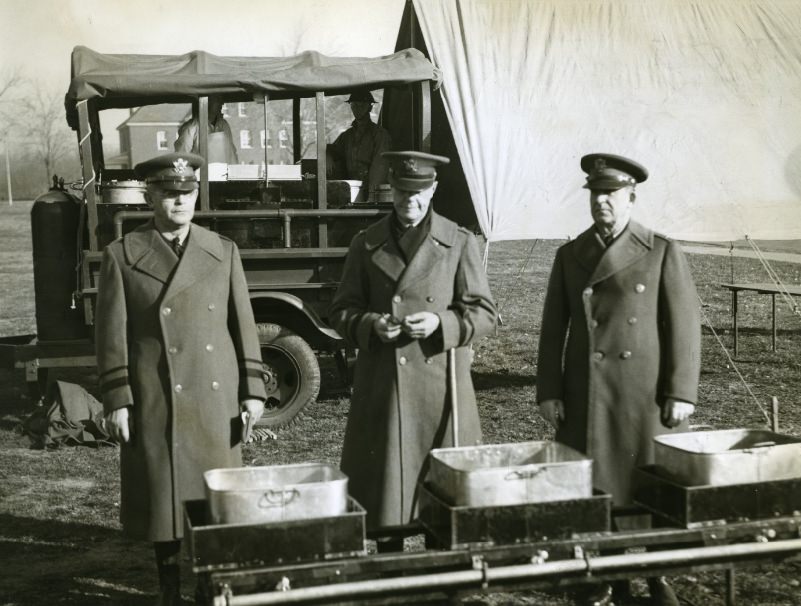
Jefferson Barracks was the testing ground for one of the Army’s first rolling kitchens in 1936. The mobile cooking unit was designed to follow troops into the field and provide hot meals during operations — a significant logistical improvement over earlier systems that required soldiers to carry their own food or go without hot meals during maneuvers.
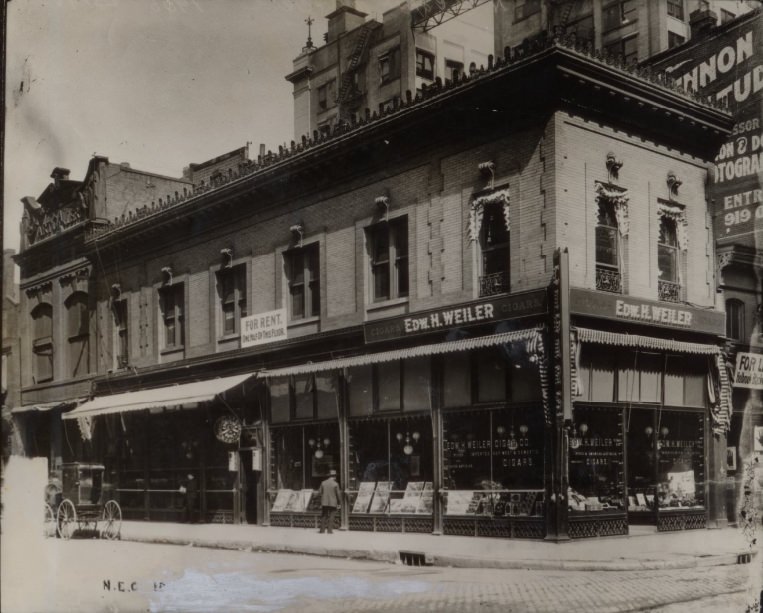
The corner of Tenth and Olive was part of downtown St. Louis, a busy intersection in the city’s commercial center. By 1939, the Depression’s worst years were giving way to modest recovery, and street scenes like this one showed a city that was still functioning, still moving, still alive with activity despite the hardships of the decade.
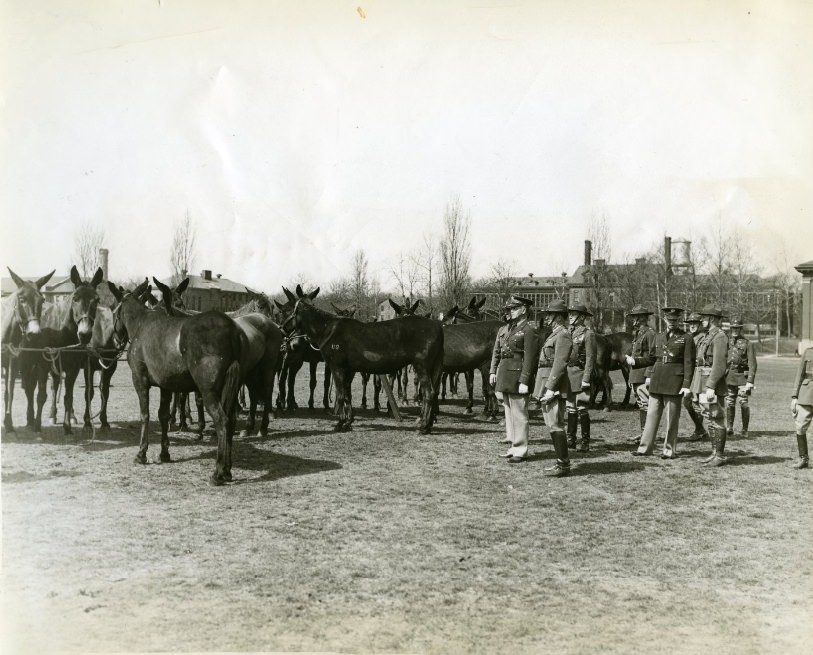
General officer inspections of Jefferson Barracks in 1937 tested every aspect of the post’s operations, from the condition of barracks buildings to the readiness of individual soldiers. These visits from senior commanders ensured that standards were maintained and gave post commanders the opportunity to demonstrate what their units had achieved.
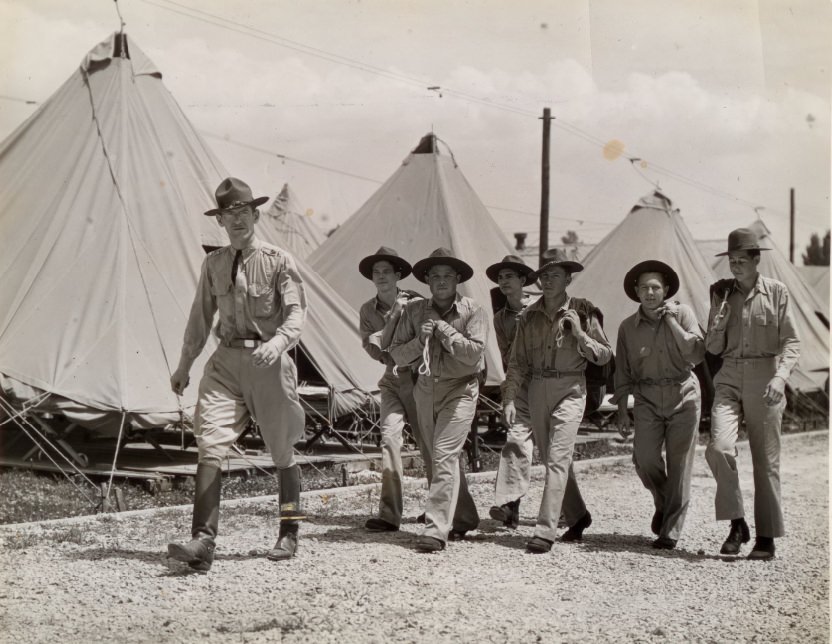
CMTC members who had completed registration, physical examinations, uniform issue, and initial instruction in 1938 were led to their company quarters to await further instruction in Army routine. The orderly process of induction turned a group of civilians into a military unit over the course of just a few days.
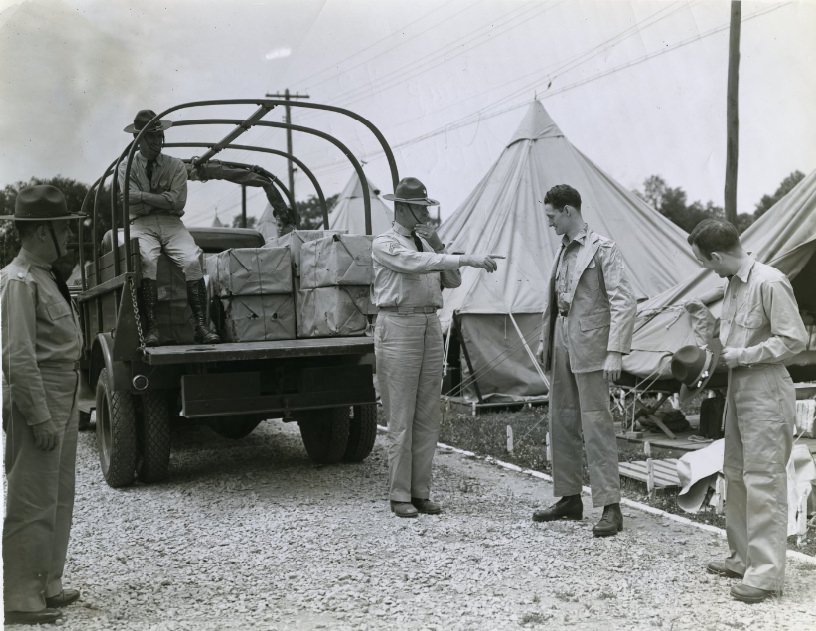
Getting CMTC students into properly fitted uniforms was one of the first steps in the training program at Jefferson Barracks. The fitting process in 1938 served both a practical and psychological purpose — once a trainee had a uniform that fit, the transition to military life felt more real.
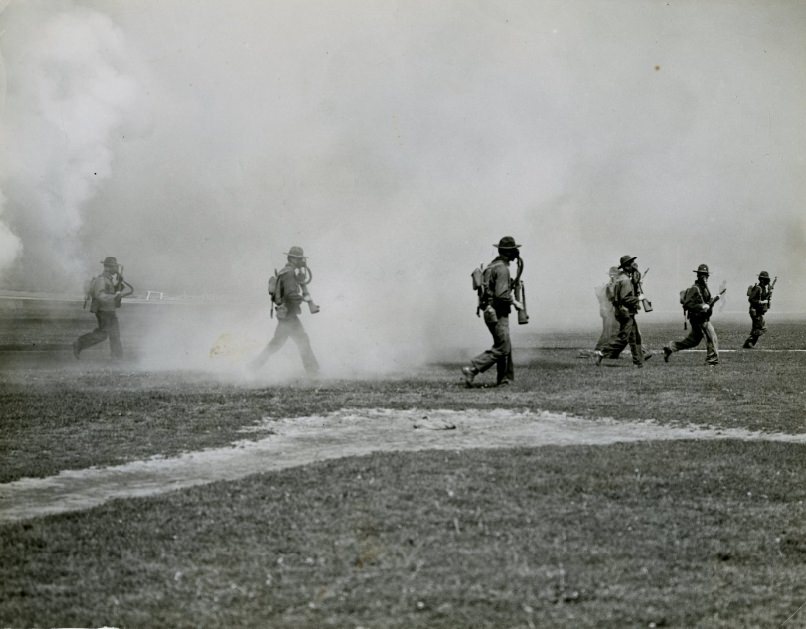
One of the more dramatic training exercises at Jefferson Barracks was the gas demonstration. A Sixth Infantry unit charged through a wall of gas with masks in place and rifles at the ready in 1938, with a strong wind complicating the exercise considerably. The demonstration took place on the barracks baseball diamond, with second base visible in the foreground. Gas training was a serious component of the curriculum, given the use of chemical weapons in the World War and the fear that they might be used again.
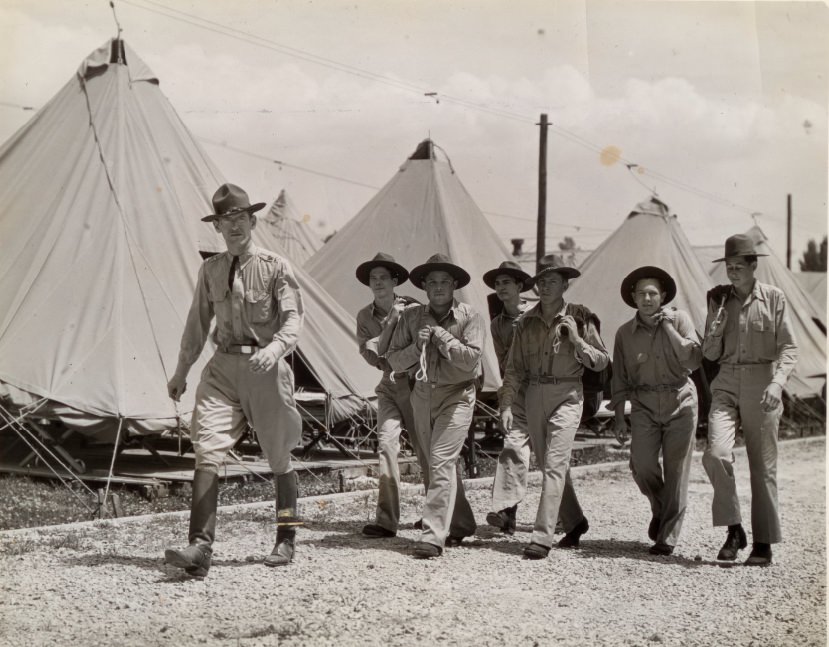
Newly registered trainees at Jefferson Barracks in 1939 sat in their assigned tents checking over the equipment they had just been issued. The process of inventorying gear was a routine military task that also helped soldiers become familiar with what they were responsible for. For men who had never handled military equipment before, the first equipment check was a formative experience.
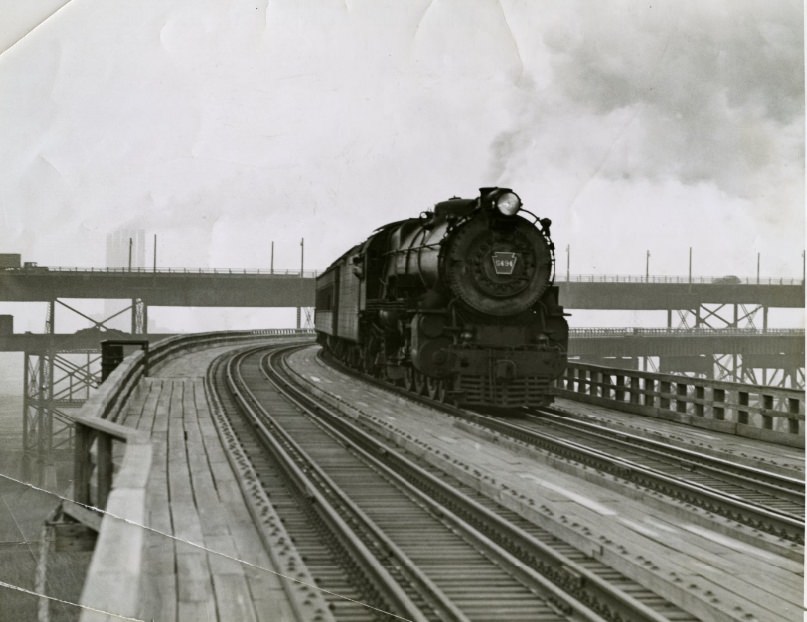
The MacArthur Bridge — known earlier as the St. Louis Municipal Bridge — carried rail traffic across the Mississippi River and was a key piece of the region’s freight infrastructure. Trains crossing the bridge in 1939 were part of the steady flow of goods and materials that kept St. Louis connected to the broader national economy.
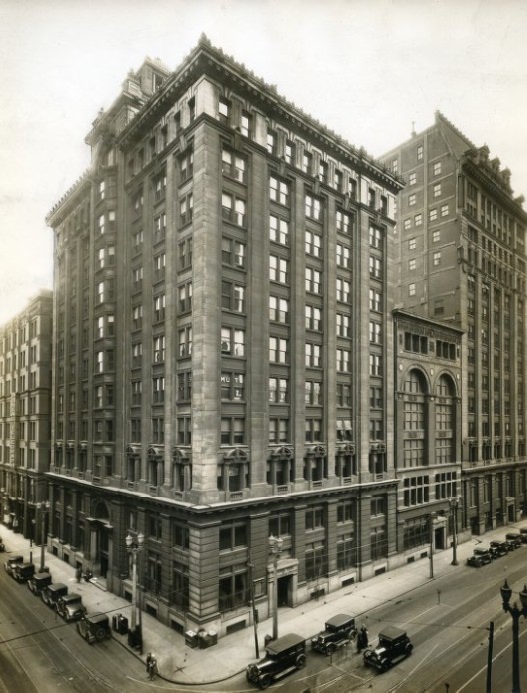
The Bank of Commerce was one of the financial institutions that defined St. Louis’s commercial center in the early 1930s. A wide-angle photograph from 1931 captured the building in its urban context, surrounded by the streets and structures that made up downtown St. Louis during one of the most difficult economic periods in the city’s history.
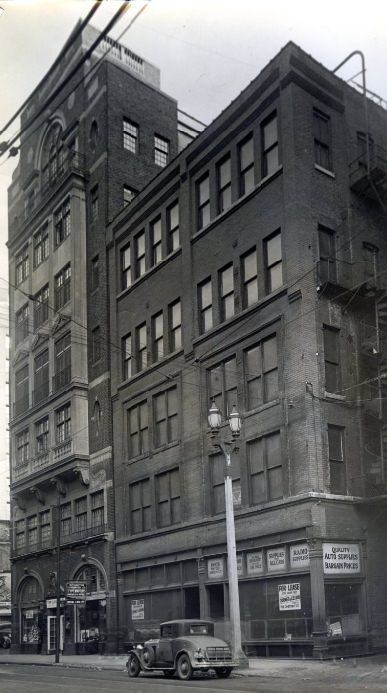
Commercial real estate in St. Louis was under significant pressure during the Depression. The five-story building at 1124–26 Locust Street was among the downtown properties being documented and evaluated during the mid-1930s, as property values declined and vacancy rates climbed across the city’s commercial corridors.
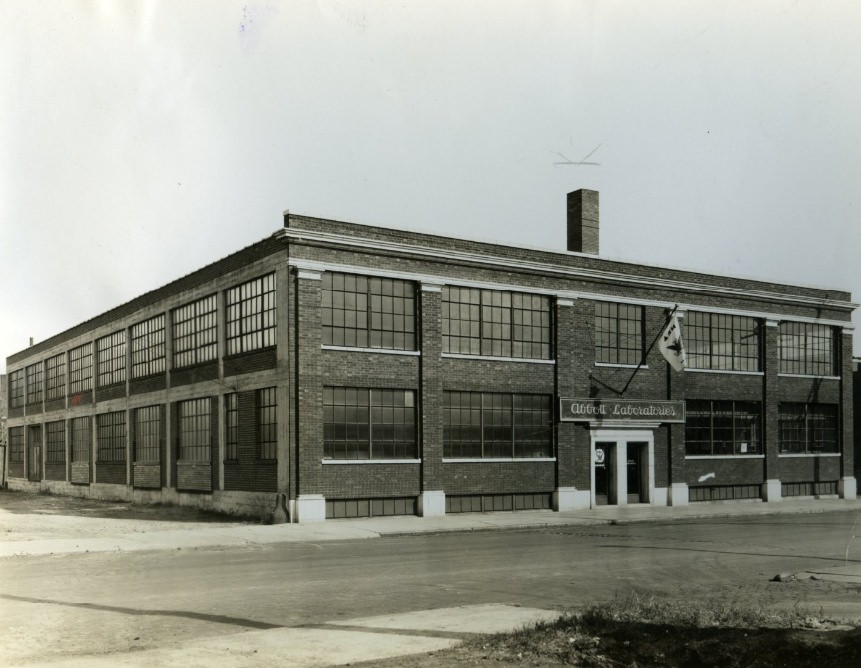
Smaller commercial and residential buildings like the two-story structure at 4455 Duncan Avenue were part of the fabric of St. Louis neighborhoods throughout the 1930s. These modest buildings housed small businesses and working-class families who bore the brunt of the Depression’s impact.
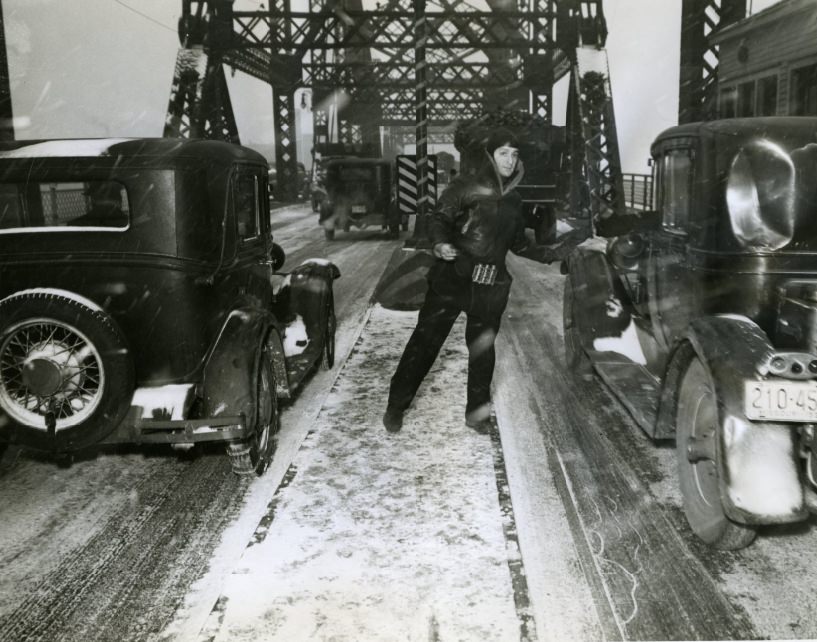
The MacArthur Bridge required staff to manage the flow of rail and road traffic crossing the Mississippi. A bridge attendant photographed in 1936 was part of the workforce that kept this vital crossing operating day and night. The bridge had been renamed from the St. Louis Municipal Bridge to the MacArthur Bridge, honoring General Arthur MacArthur Jr.
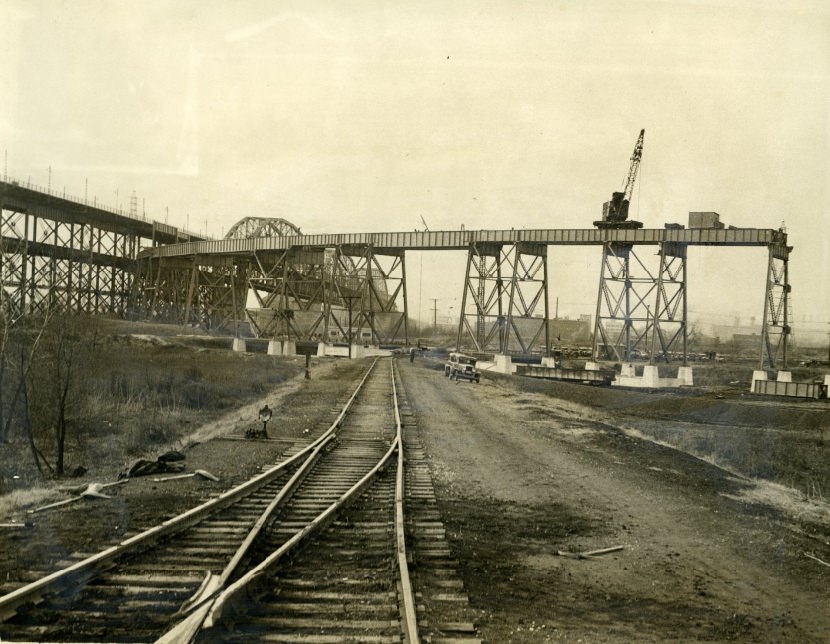
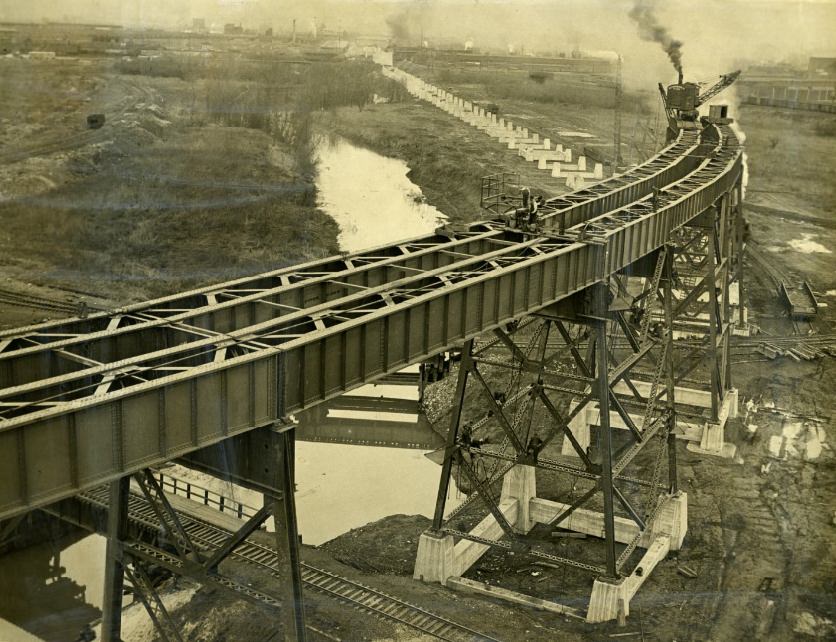
Construction of the new northeast approach to the St. Louis Municipal Bridge — later the MacArthur Bridge — was captured from multiple angles in 1932. The construction project provided jobs during the depths of the Depression and improved one of the region’s most important transportation links. Steel workers and engineers labored on the approaches while the river moved beneath them.
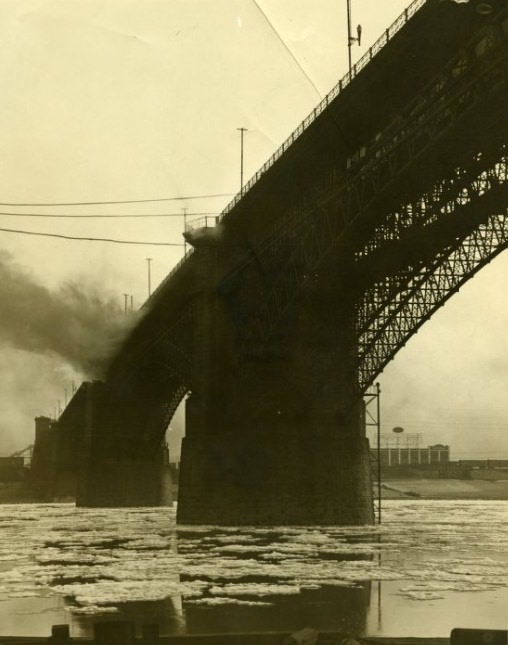
The Mississippi River froze partially in the winter of 1936, with the United States Weather Bureau reporting increased amounts of floating ice. The scene at Eads Bridge was a dramatic reminder of Missouri winters — great chunks of ice moving in the current below one of the country’s most celebrated engineering structures. The bridge, completed in 1874, had seen many such winters.
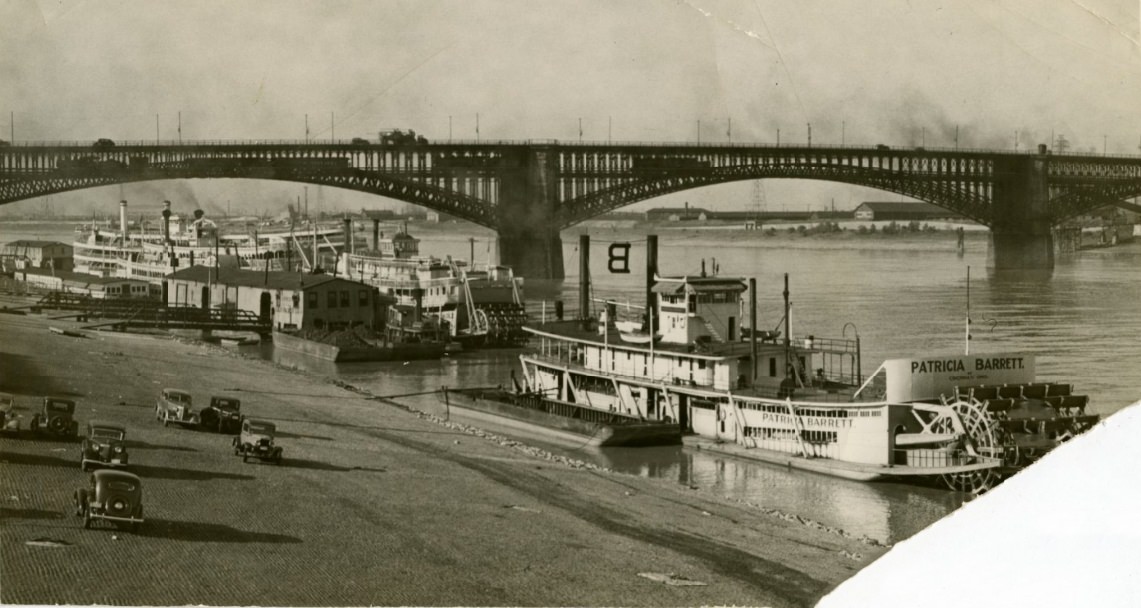
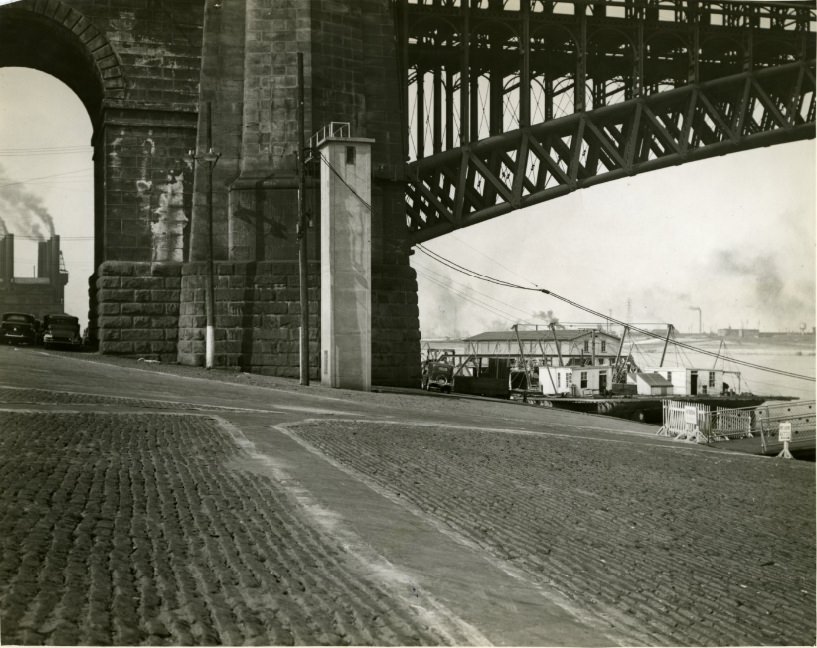
Multiple views of the Eads Bridge and the riverfront in 1936 captured the full scope of the waterfront in winter. The combination of the frozen river, the bridge’s massive stone piers, and the buildings of the old waterfront district produced images that document a stretch of St. Louis that would be dramatically transformed in the coming decades.
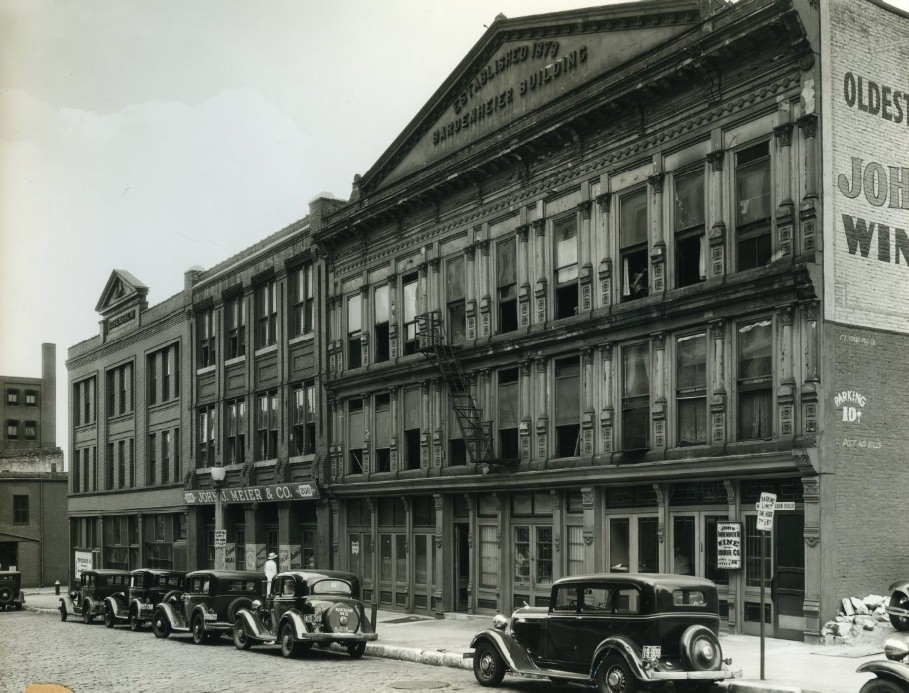
The Bardenheier Building at 214 Market Street was one of old St. Louis’s monuments to the wine and liquor trade. Built in 1873 by John Bardenheier, the building had housed stocks of wine and liquors across three floors and a commodious cellar. By 1935, it was an architectural reminder of a pre-Prohibition St. Louis that had been one of the country’s major centers of alcohol production and trade.
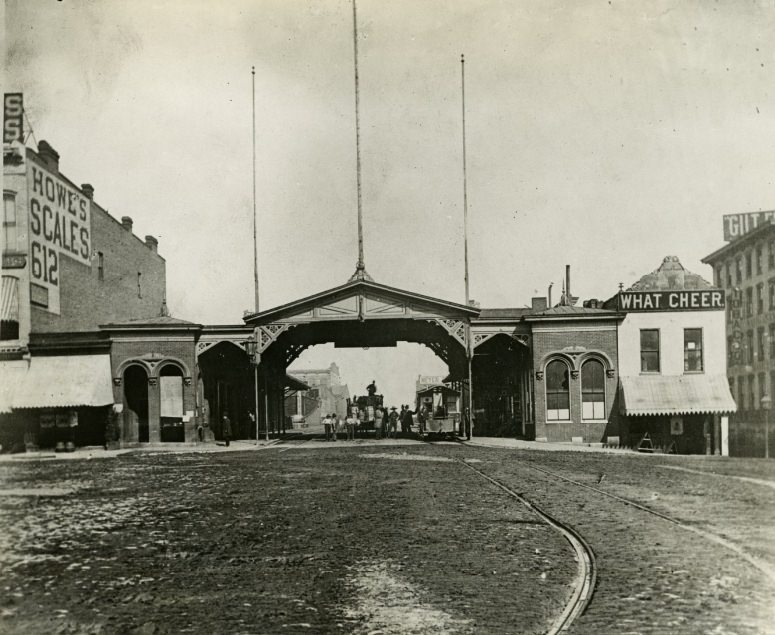
The opening of the west end gate of the Eads Bridge in 1934 was a moment of ceremony for one of St. Louis’s oldest and most important structures. The bridge’s gates controlled access to the approaches, and their opening or closing marked transitions in the bridge’s operational history.
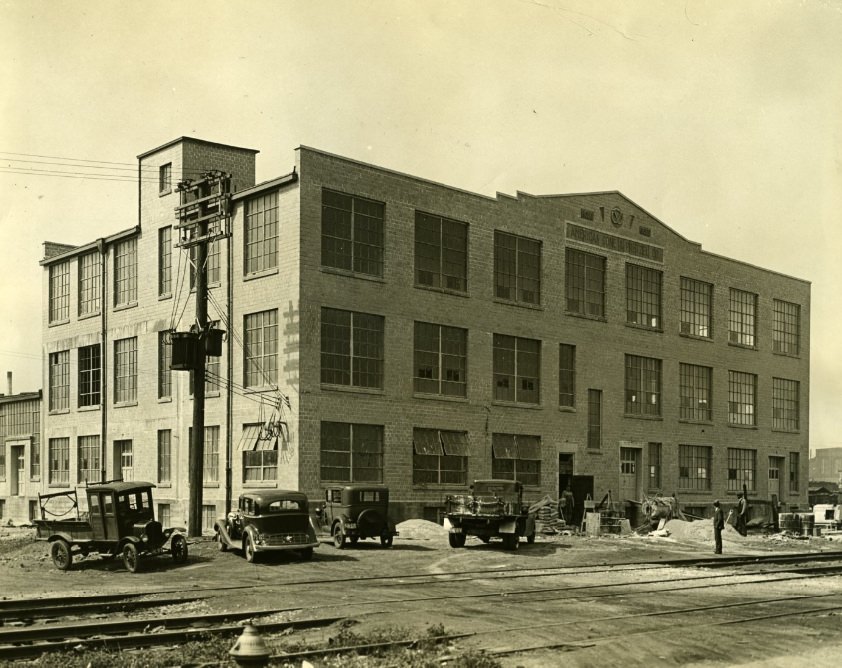
New industrial construction in St. Louis during the Depression was rare, but it did happen. The American Cone and Pretzel Company was building a new plant at 2436 South First Street in 1934, a sign that some industries found opportunity even in difficult economic conditions. Food manufacturing was one of the sectors that held up better than most during the Depression.
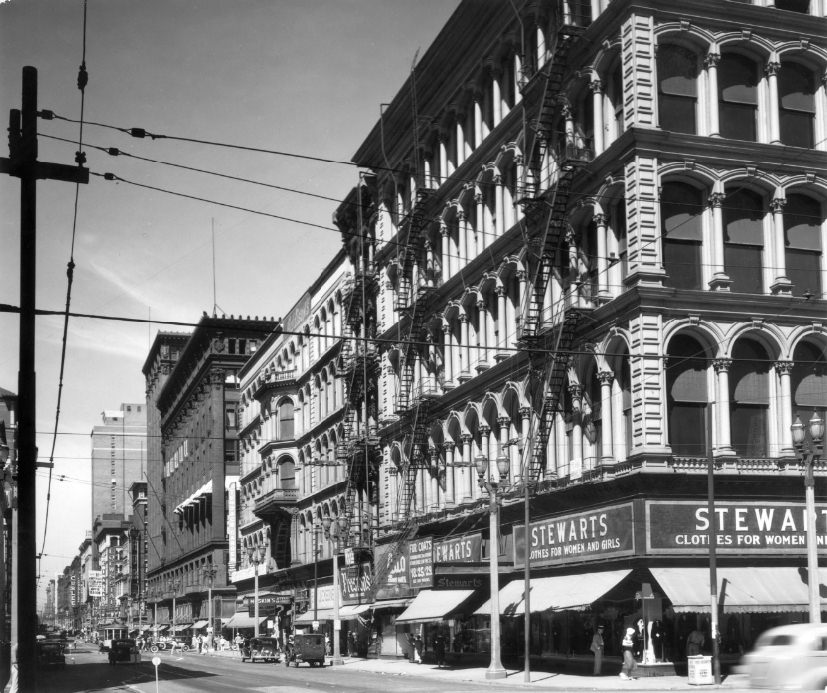
Washington Avenue was one of St. Louis’s important commercial streets, lined with wholesale businesses, clothing manufacturers, and retail establishments. A 1935 view shows the avenue in the middle of the decade, still active with commercial life despite the Depression’s ongoing drag on the city’s economy.
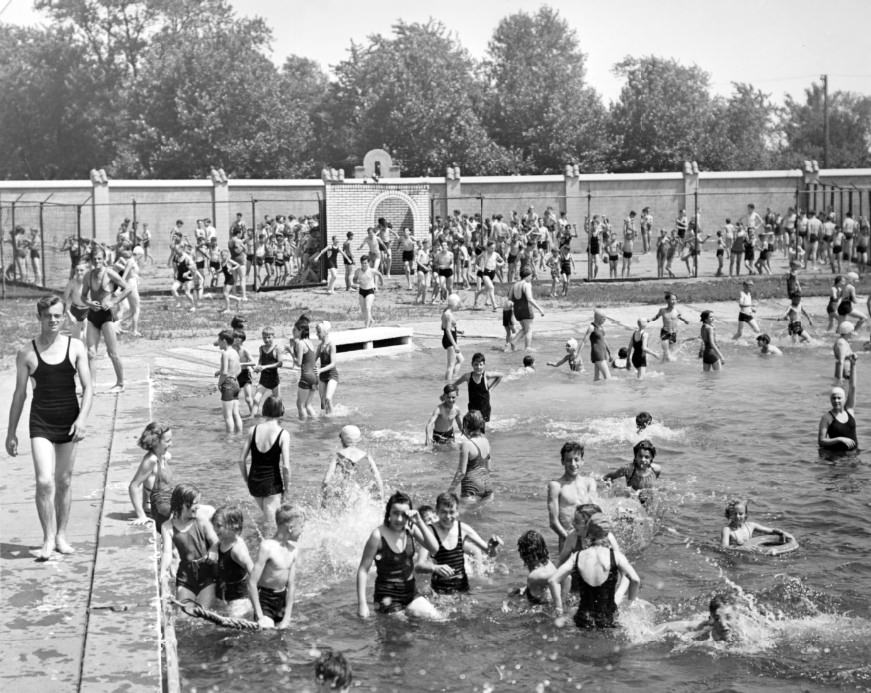
Fairgrounds Park in north St. Louis was a public green space that served the surrounding neighborhoods. By 1938, the park was one of the recreational resources available to residents who had little money for paid entertainment. Public parks across St. Louis saw heavy use during the Depression years, offering open space, sports facilities, and a place to spend time without spending money.
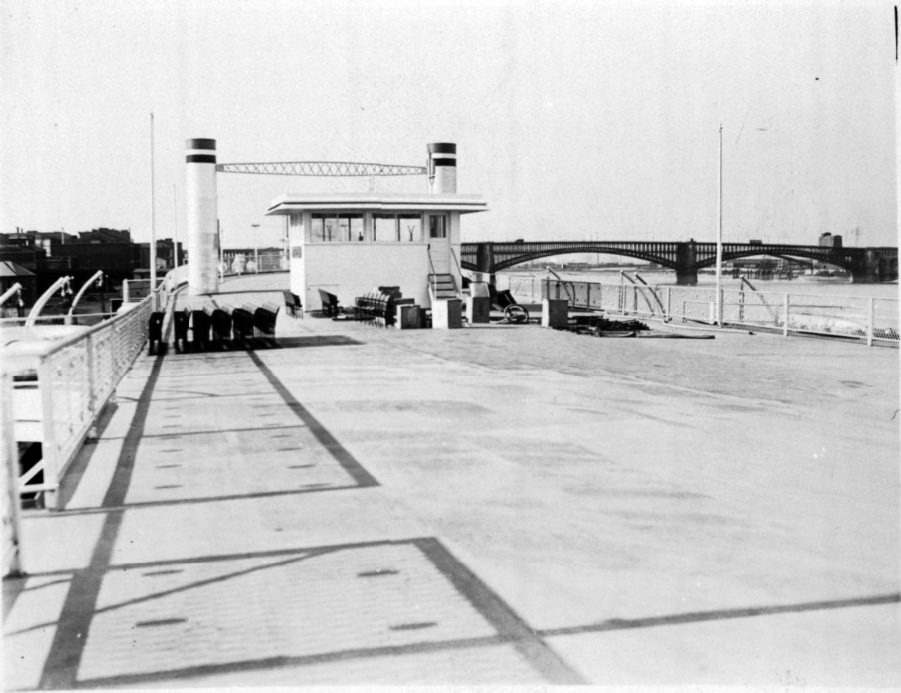
The President steamboat’s lido deck offered passengers open-air space on the Mississippi River in 1933. The Streckfus company’s excursion boats provided affordable entertainment on the river, and the lido deck was one of the most popular spots aboard — a place to take in the breeze and watch the river go by.
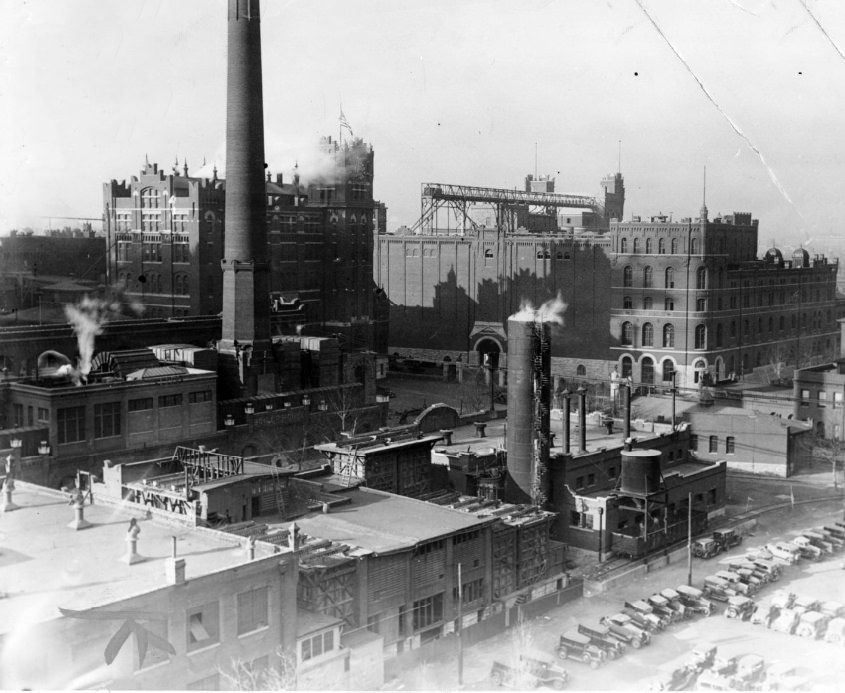
The Anheuser-Busch Brewery on the south side of St. Louis was back in full commercial operation by 1934, just a year after Prohibition’s repeal. The plant was one of the largest in the country, and its return to beer production injected significant economic activity back into the city. Workers who had been idled during Prohibition returned to jobs on the production lines.
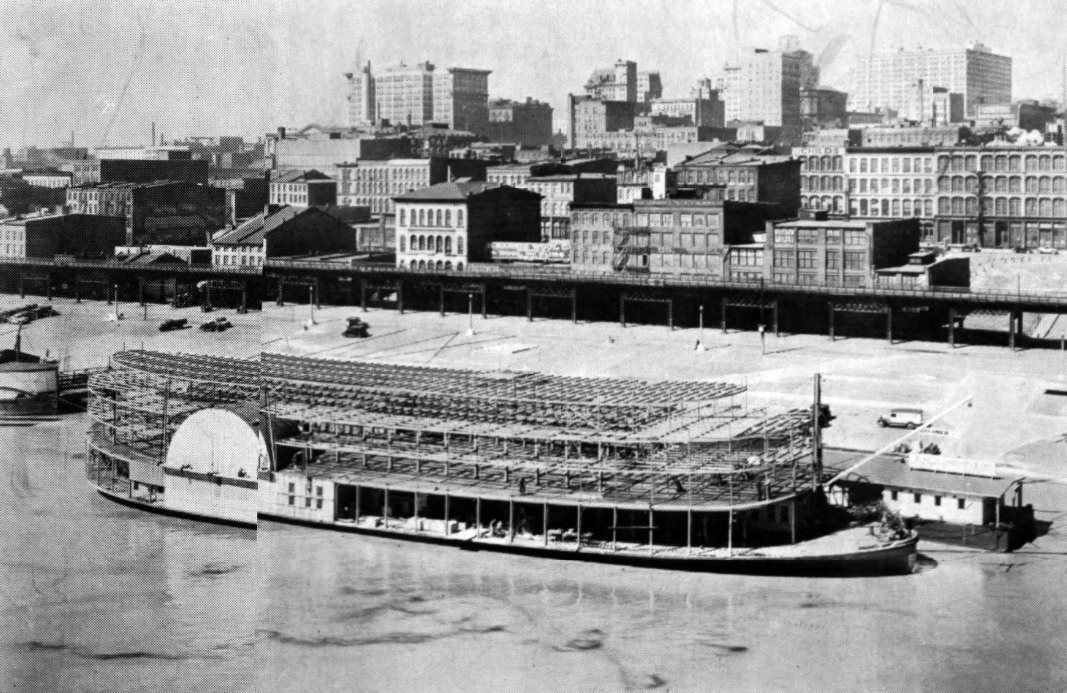
While the Admiral was still years from completion, the President steamboat was already in service by 1933. Photographs of its superstructure under construction show the scale of the Streckfus company’s investment in river entertainment. The President carried thousands of passengers on cruises up and down the Mississippi throughout the decade.
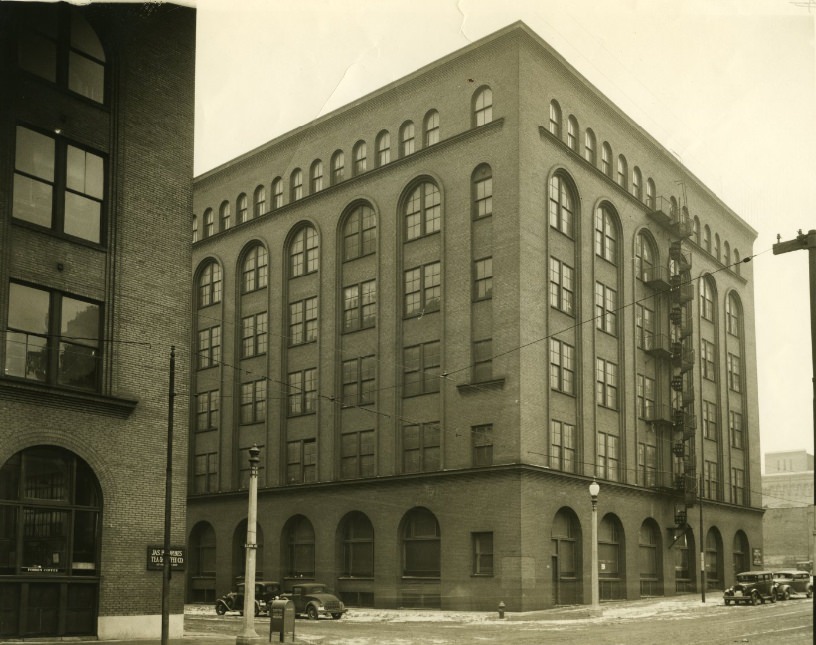
Commercial leasing activity near the St. Louis riverfront continued even as redevelopment planning began to reshape the area. The Beacon Paper Company’s lease of space at 301 North Second Street and Clark Avenue in 1936 reflected ongoing business activity in a district that was already being eyed for major transformation.
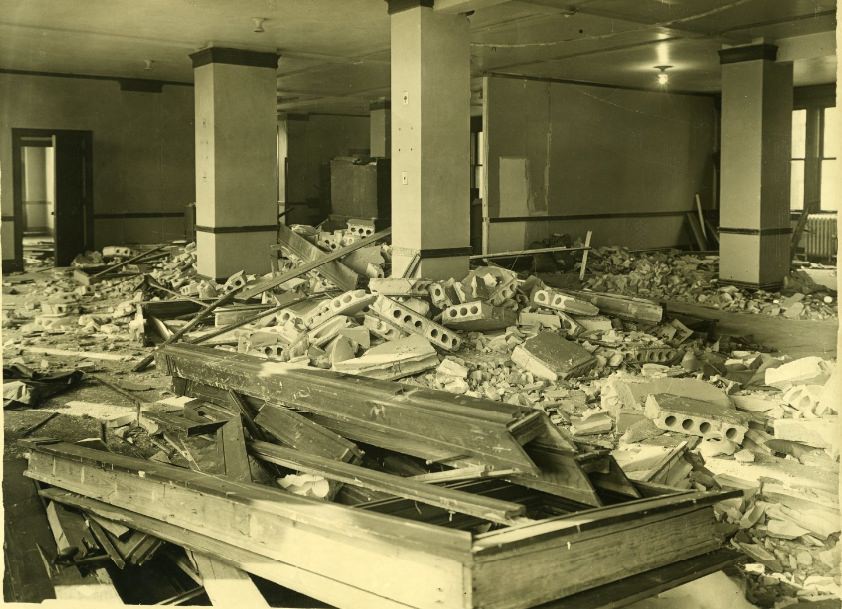
Violence in Depression-era St. Louis was not limited to bank robberies. The Buder Building was bombed in 1931, and photographs of the interior aftermath showed extensive damage. Bombings and organized crime violence were part of the city’s landscape during the Depression, when criminal activity of all kinds intensified alongside economic desperation.
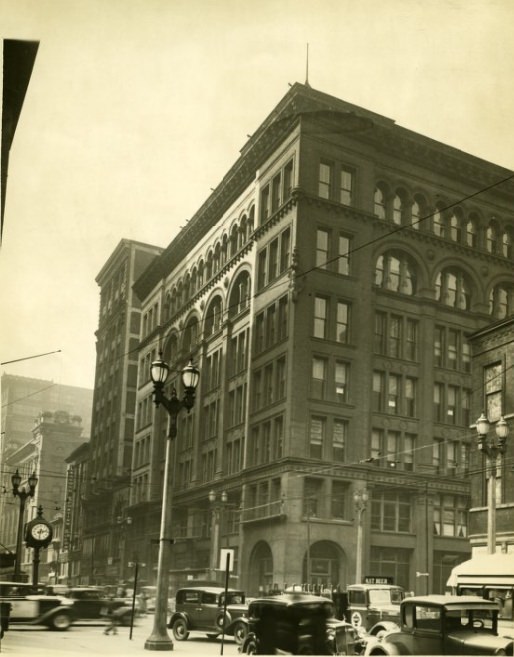
The St. Louis Board of Education operated from a central building that housed the administrative functions of the city’s public school system. In 1934, with the Depression forcing budget cuts across all city departments, the Board of Education faced difficult decisions about staffing, programs, and school operations.
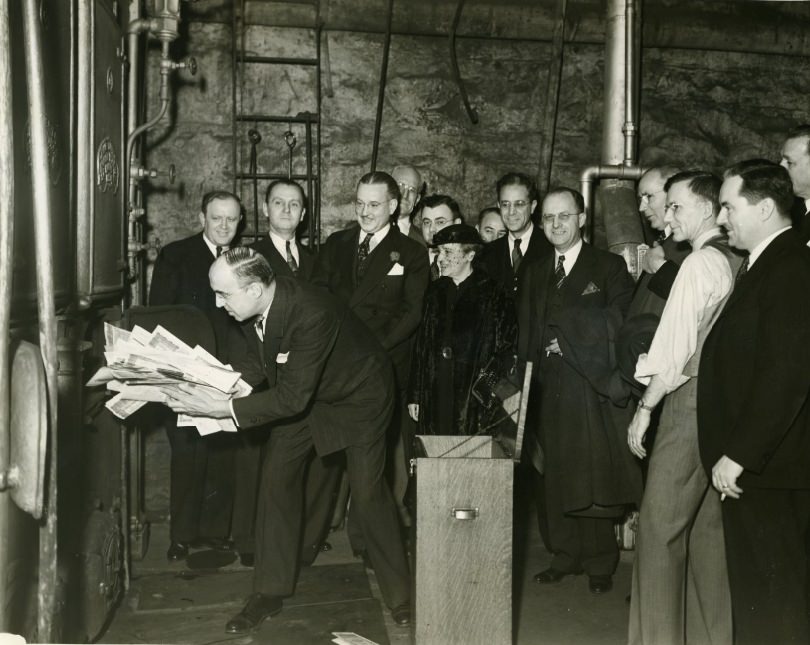
In 1938, Board of Education members gathered to watch as redeemed school bonds were ceremonially burned — a public demonstration that the city’s school debt obligations had been paid off. The burning of paid bonds was a formal financial ceremony that marked the retirement of debt and offered a moment of fiscal optimism during a difficult decade.
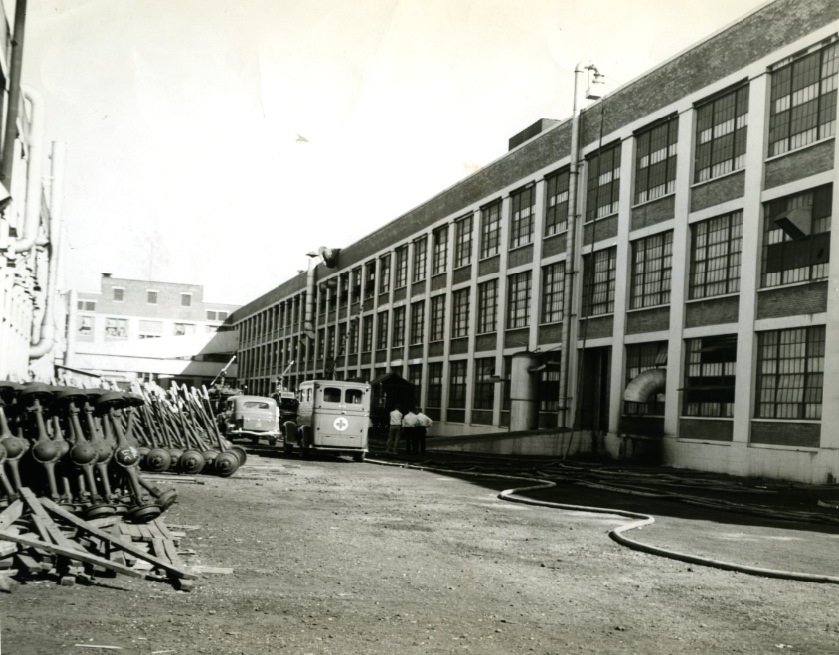
The Fisher Body Company plant at 3707 Union Boulevard was the site of a fire on August 2, 1935. Industrial fires were a regular hazard in St. Louis’s manufacturing districts, where large buildings full of machinery, paint, and raw materials were constant fire risks. The Fisher Body plant was part of the automotive supply chain that connected St. Louis to the national auto industry.
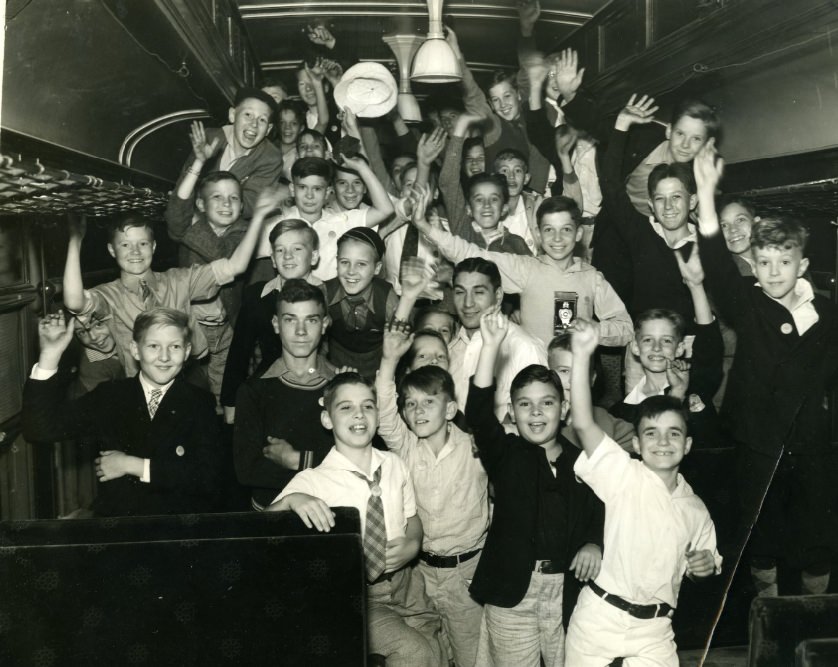
The St. Louis Globe-Democrat organized a Boys’ Outing Club that took young readers on supervised trips to points of interest around Missouri. In 1935, boys on a two-day outing to Bagnell Dam stopped in Jefferson City to inspect the train engine — a moment of hands-on curiosity that made the trip memorable. Programs like this gave working-class and Depression-era children experiences they might not otherwise have had.
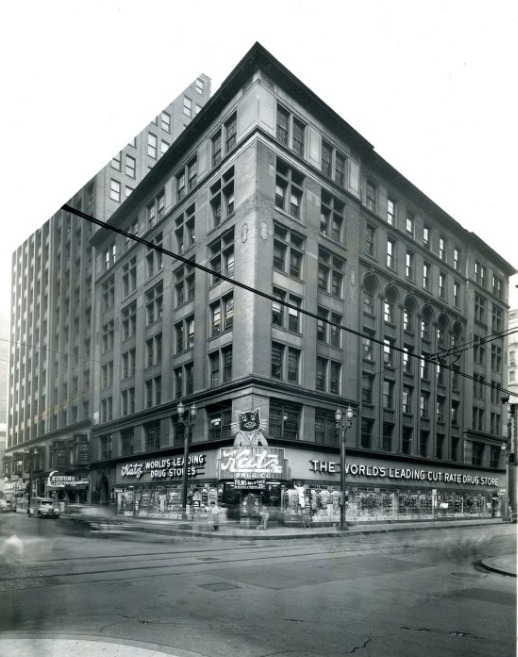
Architectural sketches and drawings were used throughout the 1930s to plan and promote new construction projects in St. Louis. An artist’s rendering of the Frank Building gave stakeholders a visual sense of what the finished structure would look like before construction began.
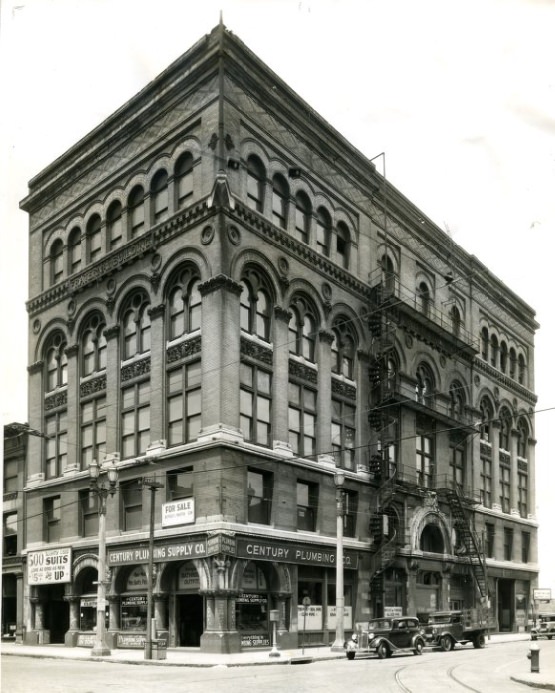
The Fraternal Building at the northwest corner of Eleventh Street and Franklin Avenue was purchased in 1934 by Jacob E. Lasky, president of the Franklin Furniture Company. Lasky planned to convert it into a modern store and loft building after extensive improvements. The structure’s commercial tenant signs at the time included a plumbing supply company and a used suit shop — a snapshot of Depression-era retail.
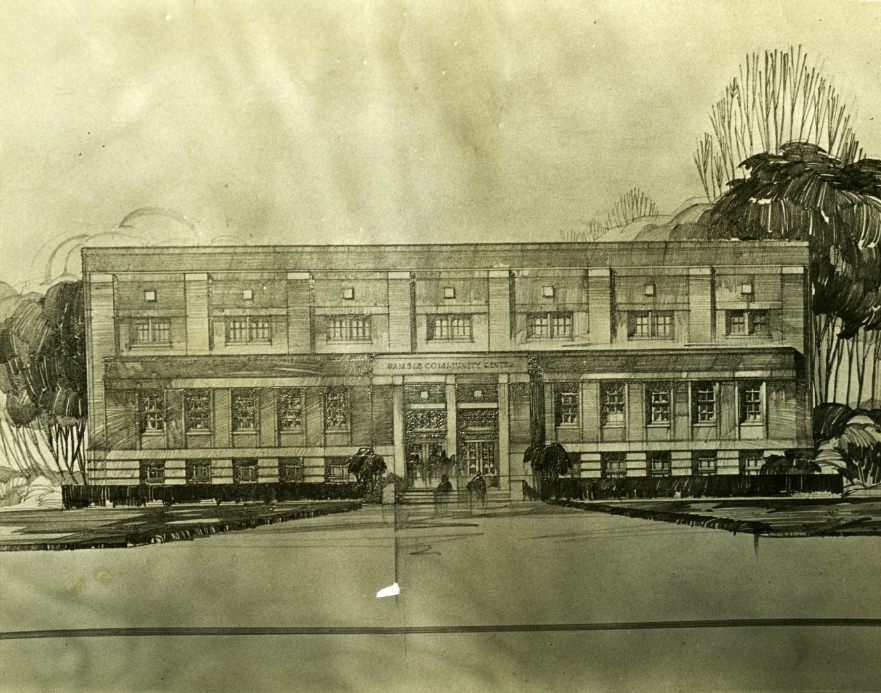
An $84,000 community center for African Americans was planned for the intersection of Gamble Street and Glasgow Avenue in 1938. The Gamble Community Center would include a gymnasium, meeting rooms, recreation quarters, and shower and locker facilities. About 30 percent of the cost came from Public Works Administration funds, with the remainder from city bond money. Construction was set to begin within two weeks of the announcement, with completion expected about eight months later.
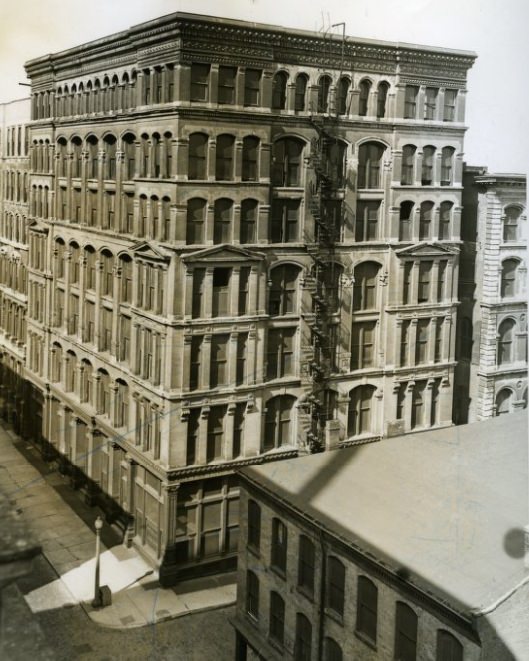
The old Gay Building at Third and Pine Streets had been considered one of the finest modern office buildings in St. Louis when it was built in the 1870s. By 1939, it was one of the old waterfront structures slated for demolition as the government began clearing land to make way for the Jefferson Memorial — the project that would eventually become the Gateway Arch grounds.
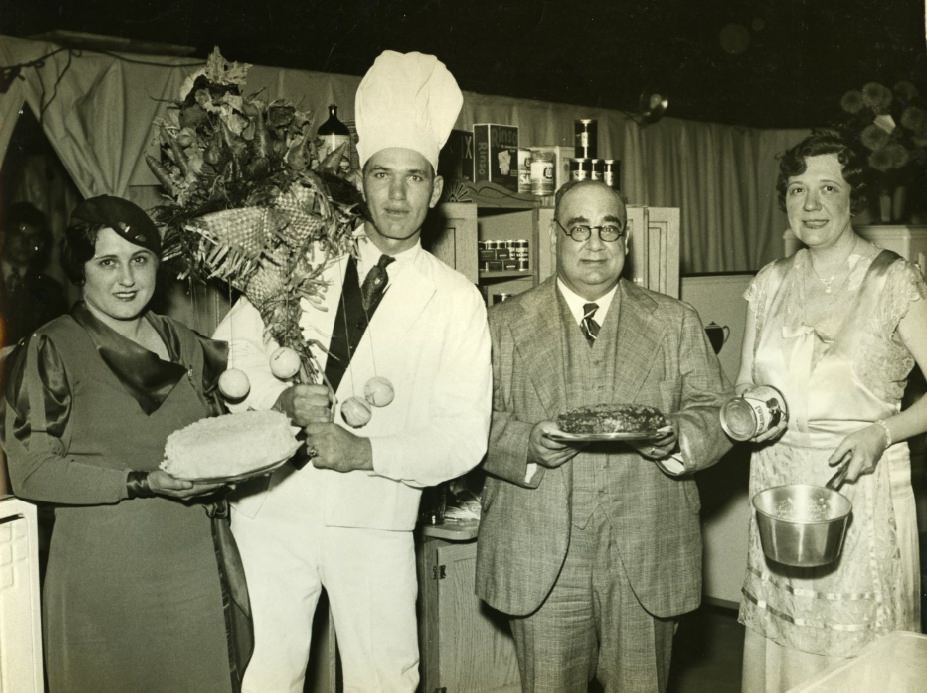
The Globe-Democrat’s cooking school events brought together local celebrities and the community around food and domestic education. In November 1933, Mrs. Dizzy Dean, Dizzy Dean himself, Lawrence McDaniel, and cooking school instructor Mrs. Jesse Marie DeBoth gathered to show off baked goods — a moment where St. Louis’s most famous baseball family crossed paths with the city’s domestic arts programming.
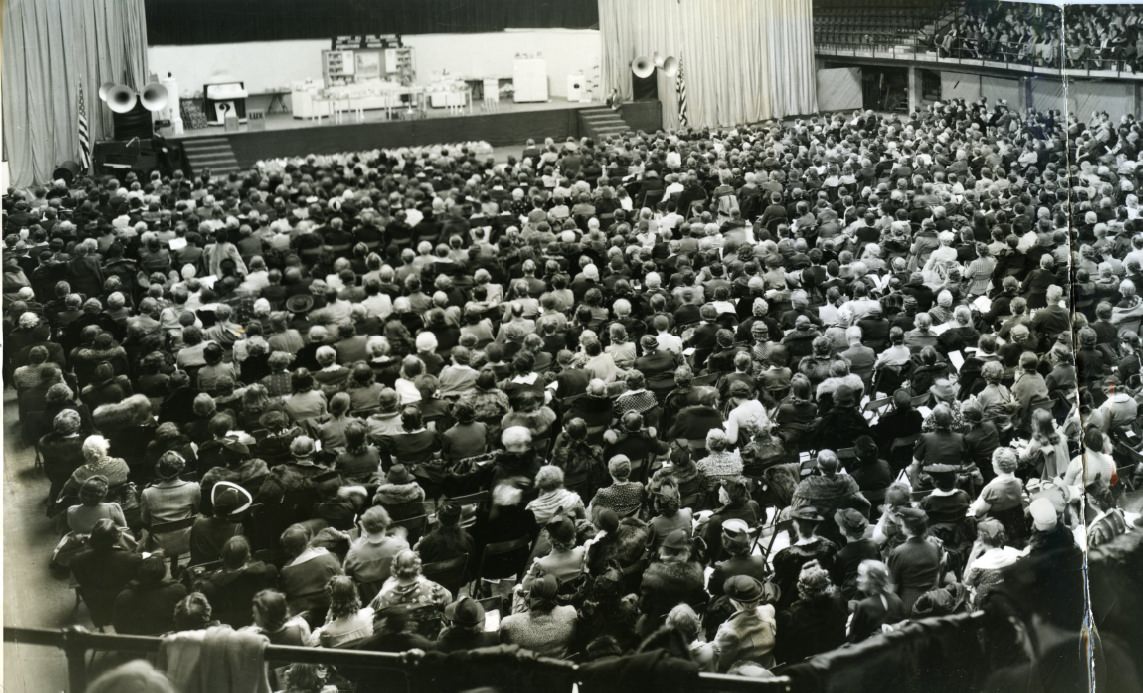
Jessie Marie DeBoth’s cooking schools continued to draw large audiences through the early 1940s. St. Louis homemakers crowded the second session of her 1942 school at Washington University’s Field House, focused on better nutrition for national defense. The cooking school had evolved from a Depression-era community event into part of the home front effort during World War II.
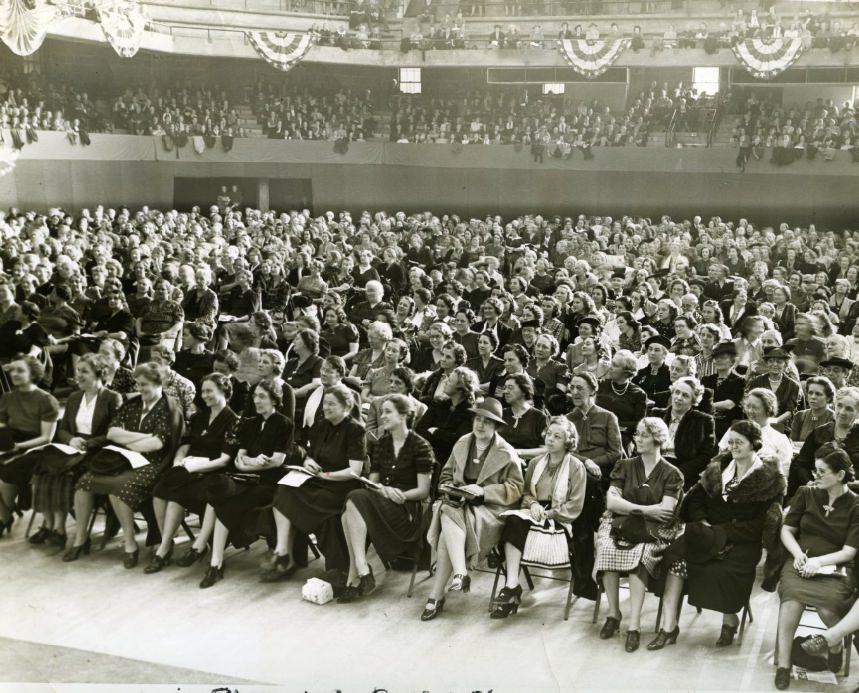
By 1939, Jessie Marie DeBoth’s Globe-Democrat cooking school was drawing capacity crowds to its opening programs. A bird’s-eye view of the audience showed just how many St. Louisans turned out to watch DeBoth demonstrate the latest recipes, with GE appliances, refrigerators, and prize displays filling the stage alongside the food.
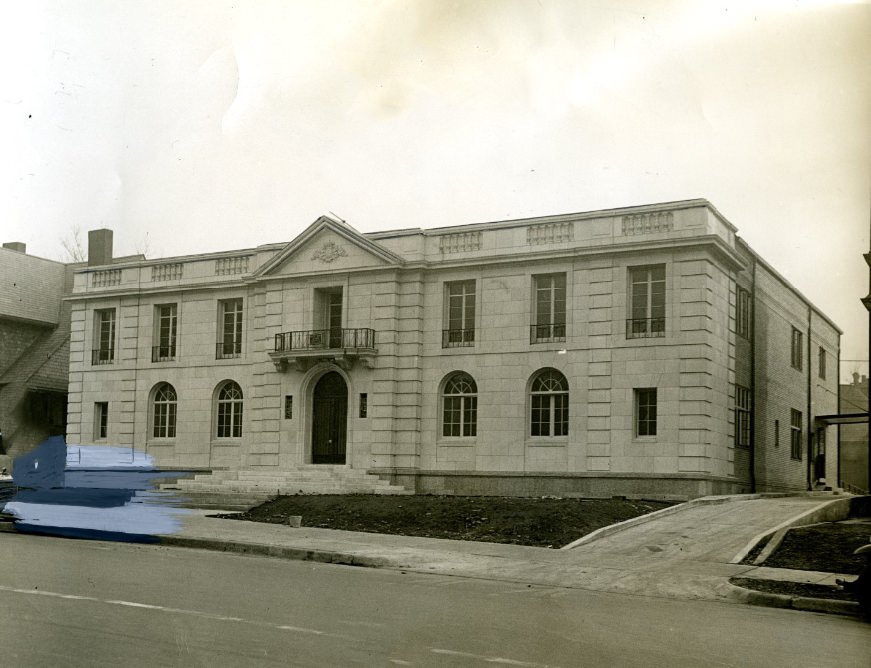
Even during the Depression, some businesses were expanding. The Arthur J. Donnelly Undertaking Company was nearing completion of a new building at 3840 Lindell Boulevard in 1932, located east of its existing establishment. Funeral homes were one category of business that remained busy regardless of economic conditions.
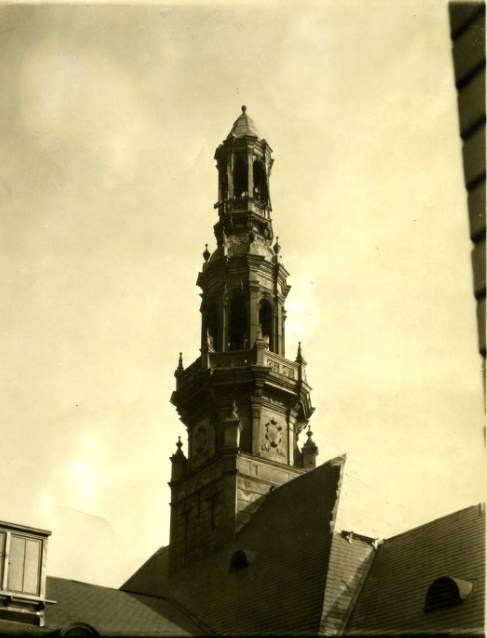
St. Louis City Hall lost its most distinctive architectural feature in 1936 when the main tower over the Twelfth Boulevard entrance was ordered torn down. Corrosion of the structural steel supports had made the tower dangerous, and city officials had no choice but to remove it. The demolition of the tower changed the silhouette of one of the city’s most important buildings.
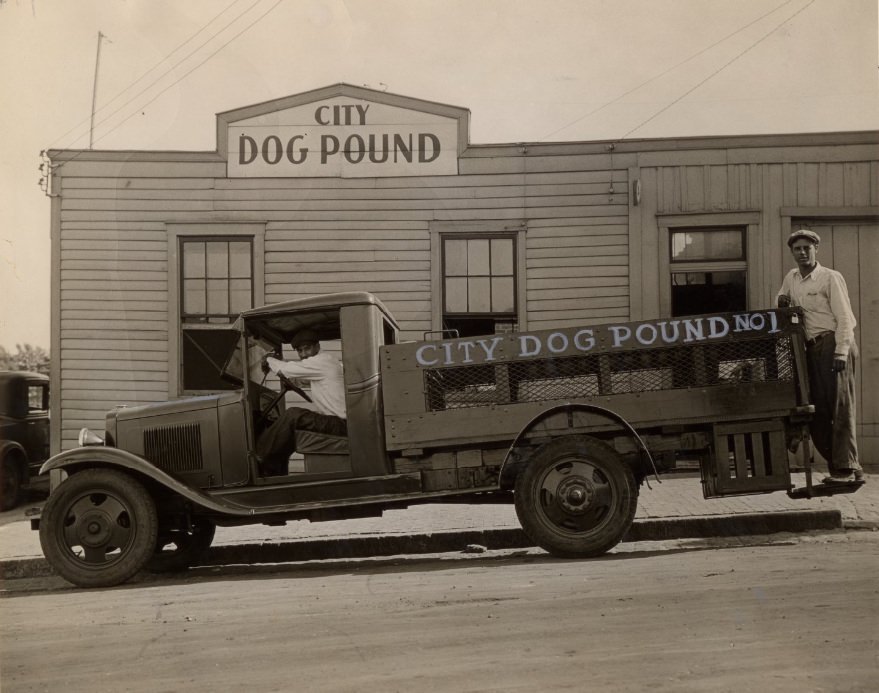
City services in St. Louis continued to operate through the Depression, even as budgets were cut. A veterinarian at the city dog pound in 1933 was part of the municipal workforce that kept basic services running. During the Depression, animal control was one of many city functions that received reduced resources while still being expected to function.
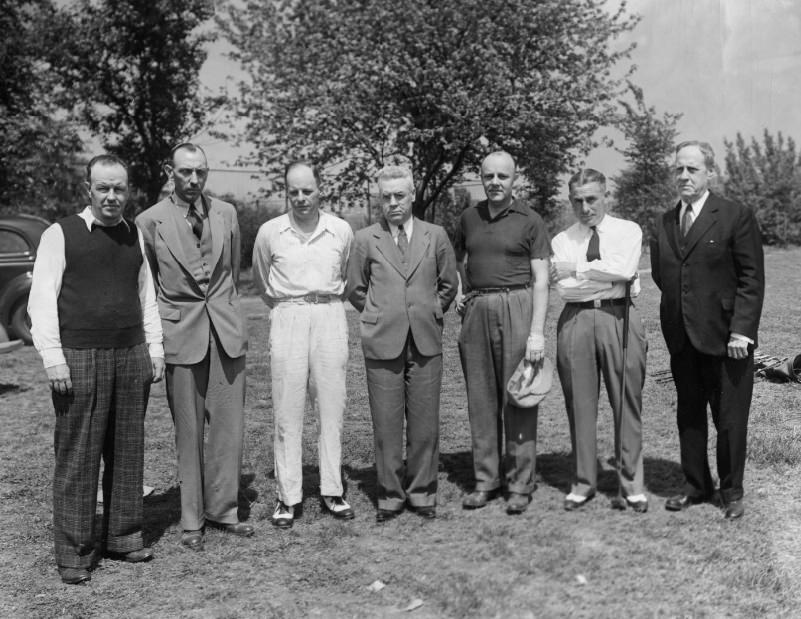
The Globe-Democrat’s Hole-in-One Golf Tournament was an annual event that brought together golfers from across the region. Officials for the 1938 tournament oversaw a competition that had become one of the city’s signature sporting events. Golf in the 1930s reached beyond the wealthy, and tournaments like this one drew participants from a broad cross-section of St. Louis society.
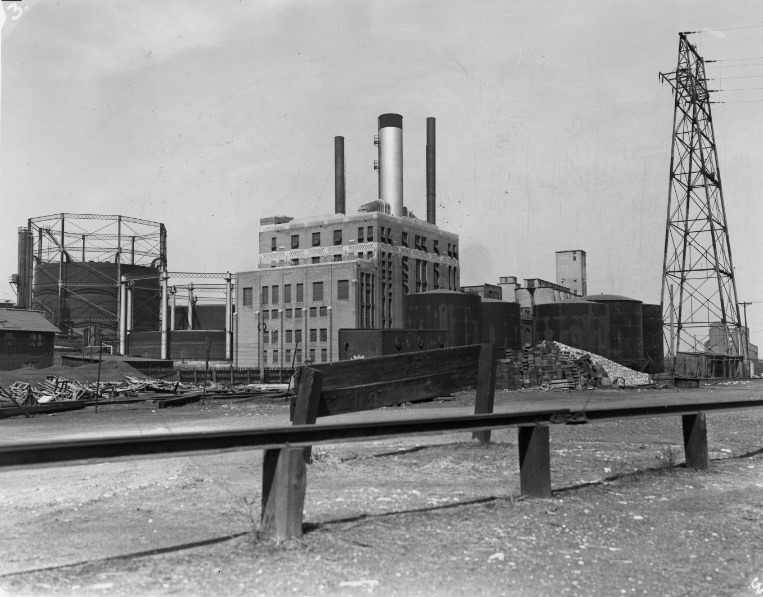
At the foot of Florida Street, the Walsh brothers had set up St. Louis’s first steam-powered mill in 1827. Farmers once parked their wagons against the mill and walked into the city while the millstones ground corn and wheat. By 1938, the smokestacks of Laclede Power & Light Company’s Station E pierced the same patch of sky where the mill’s stone chimney had once stood. The photograph captured that layering of history — one era of industrial St. Louis visible through the remnants of another.
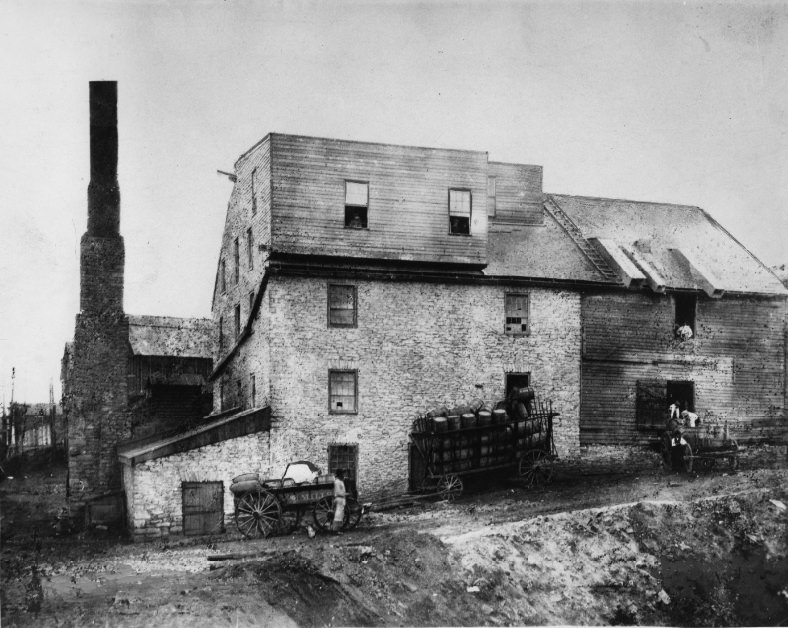
A second view of the original steam-powered mill site showed the contrast between the historic structure and the modern utility infrastructure that had grown up around it. These images were part of a broader effort by St. Louis publications to document the city’s history before further development erased the physical evidence of its past.
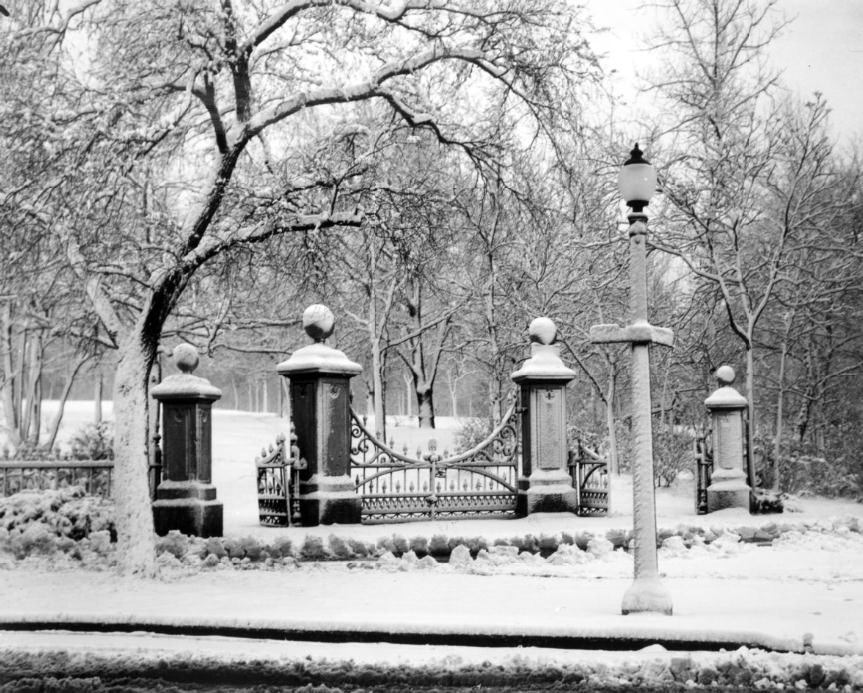
Lafayette Park in winter was a quiet, snow-covered corner of the city that offered a striking contrast to the busy commercial streets nearby. The park’s entrance gates in 1934 stood draped in snow, framing a view of the historic park that had been one of St. Louis’s first formal green spaces. Lafayette Park had been a fashionable address in the nineteenth century, and its surrounding neighborhood still retained much of that character.
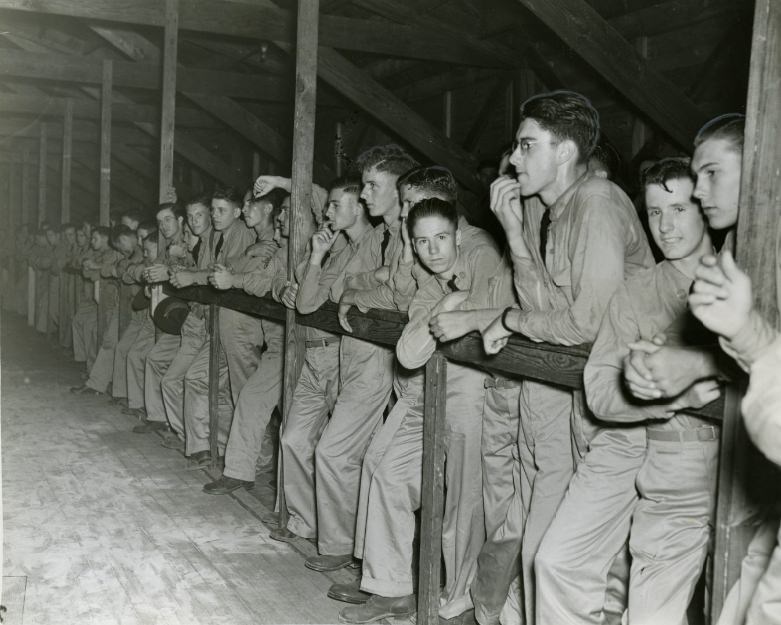
Social events in St. Louis toward the end of the decade reflected a city beginning to emerge from the Depression’s worst effects. A stag line at a 1939 event captured the social atmosphere of the time — young men dressed and ready, waiting on the sidelines of whatever came next.
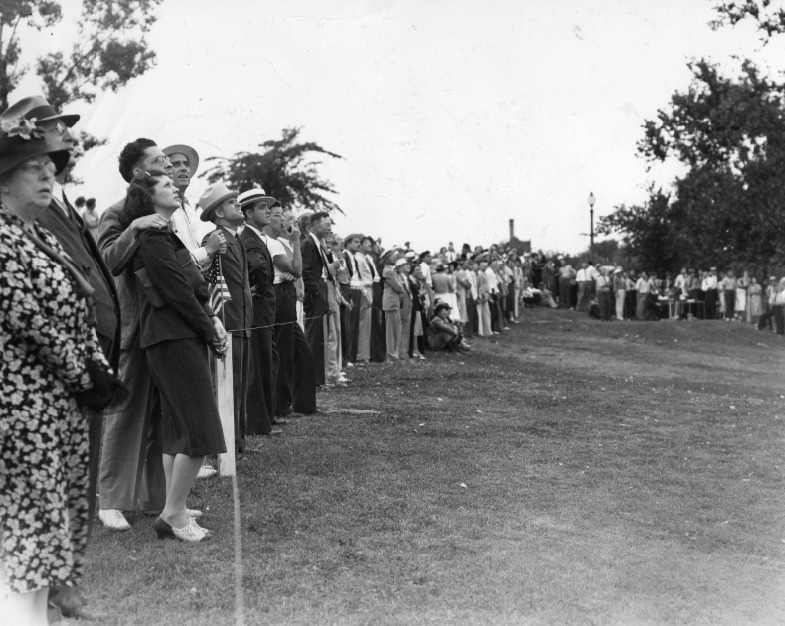
The 1939 Globe-Democrat Hole-in-One Tournament at Triple A brought out 470 golfers competing across four divisions. The winner received a trophy, with prizes going to leaders and runners-up in each division as well as the best male and female performers. The crowd at the event showed how popular the tournament had become as one of the city’s signature annual competitions.
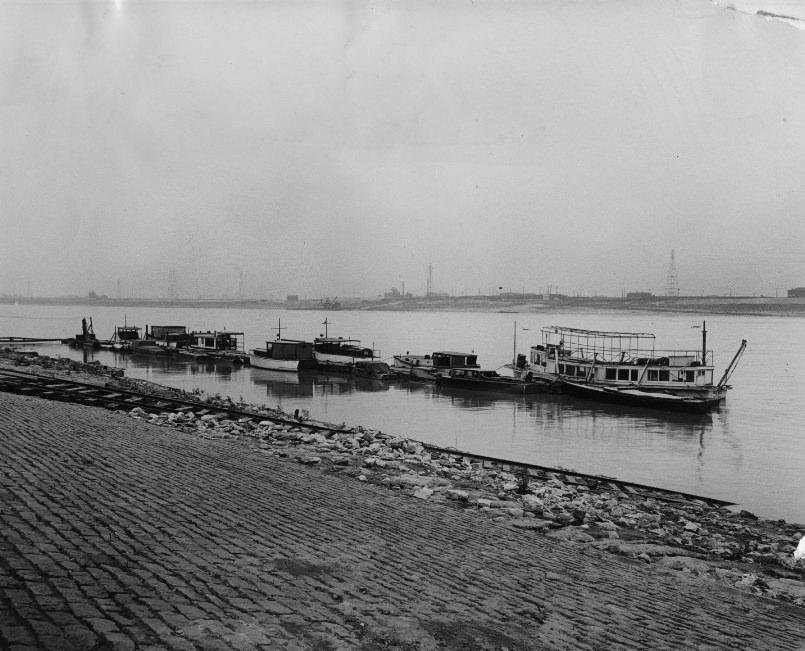
River craft moving on the Mississippi in 1931 were a constant presence in St. Louis life. The river had built the city, and its traffic — even reduced by economic depression — remained part of the city’s identity. Tugs, barges, and excursion boats moved up and down the river as they always had, carrying the cargo that kept commerce alive.
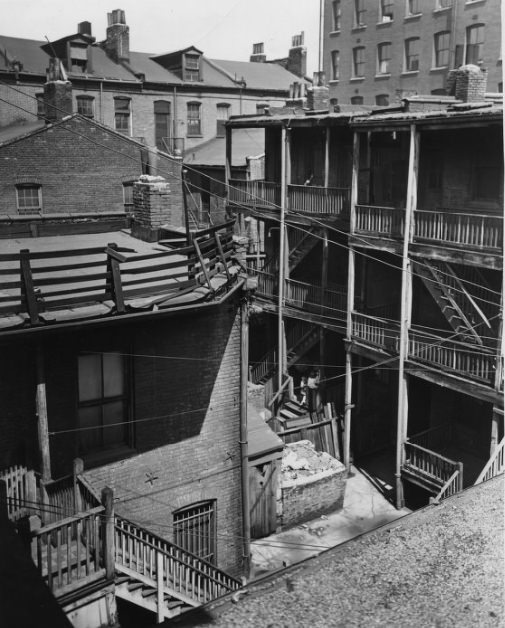
The layout of the St. Louis riverfront in 1938 was a mix of old commercial buildings, active wharves, and structures already slated for demolition. Planning for the Jefferson National Expansion Memorial was reshaping how the city thought about its waterfront, and the physical transformation of that area was already beginning to accelerate.
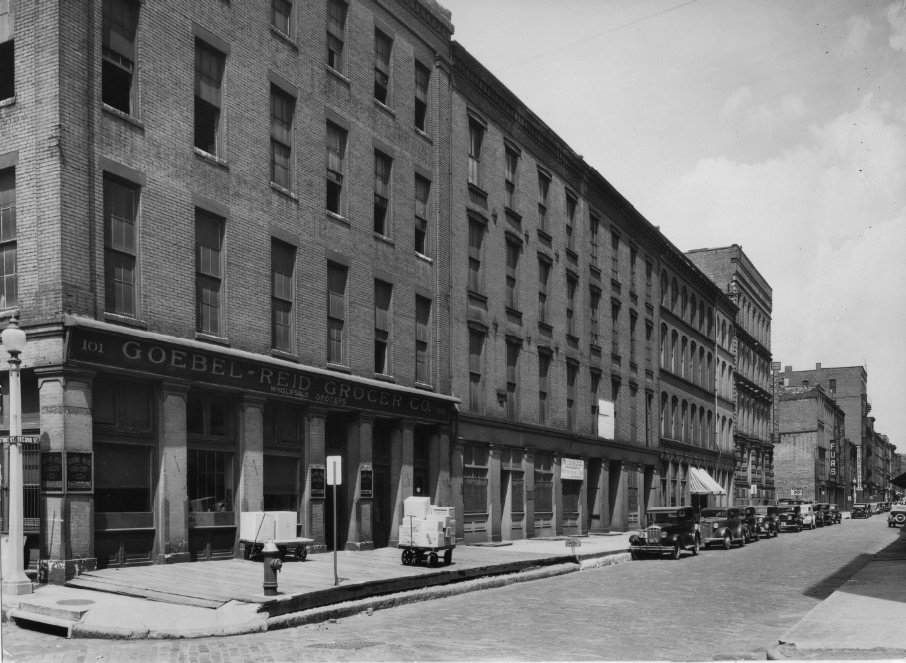
Properties along the St. Louis riverfront were changing hands frequently in the mid-1930s as the prospect of major redevelopment altered the value of buildings in the area. Building sales documented in 1935 were part of the process that would eventually clear the waterfront for the monument that would define the city’s image for the rest of the century.
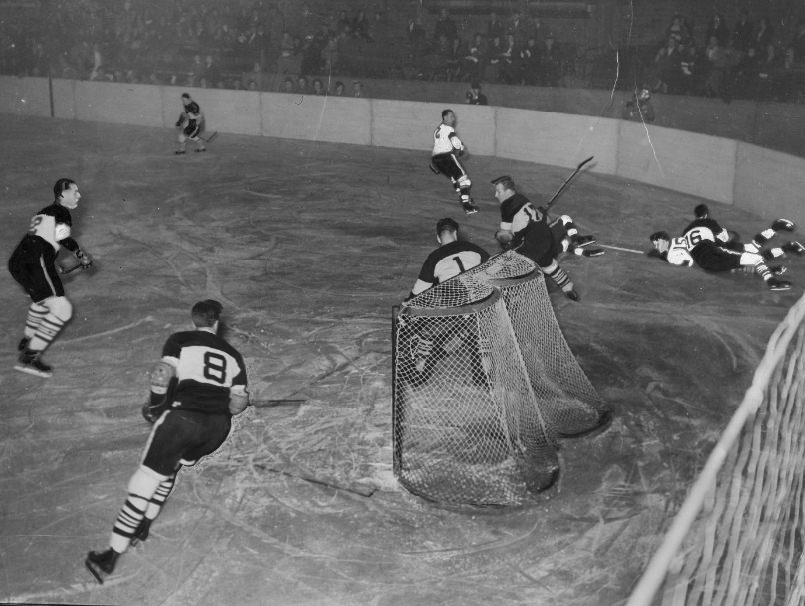
St. Louis had a professional hockey team in the 1930s. The St. Louis Eagles played in the National Hockey League during the 1934–35 season, and photographs of game action captured the intensity of the sport. Hockey gave St. Louis fans another professional sport to follow alongside baseball, and the Eagles drew crowds to the city’s indoor arena.
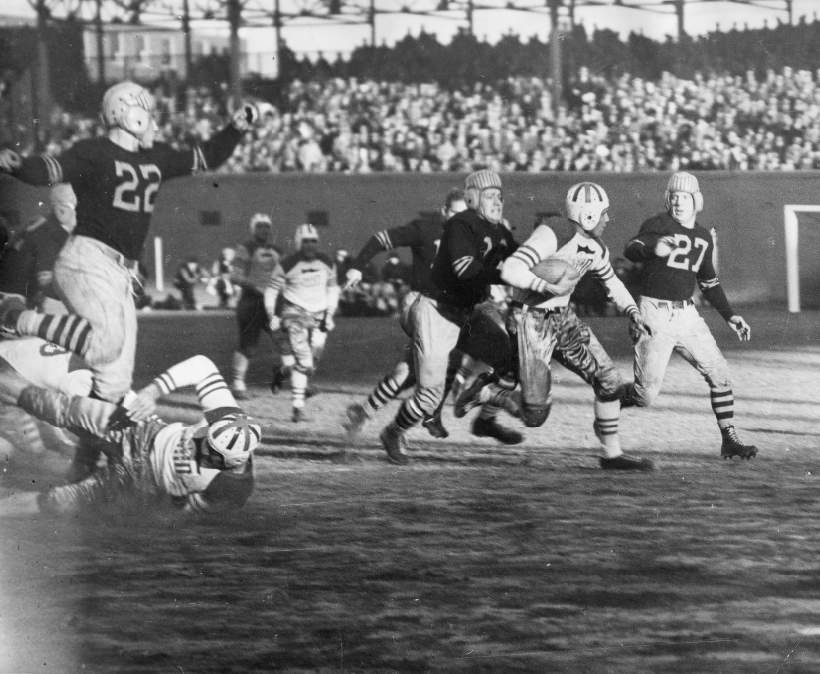
Professional football was also part of St. Louis’s sports scene in the 1930s. Gene Alford’s 10-yard gain against Pittsburgh in 1934 was captured in a game photograph that showed the athleticism of the sport’s early era. St. Louis football teams competed in a landscape dominated by the professional game’s formative years.
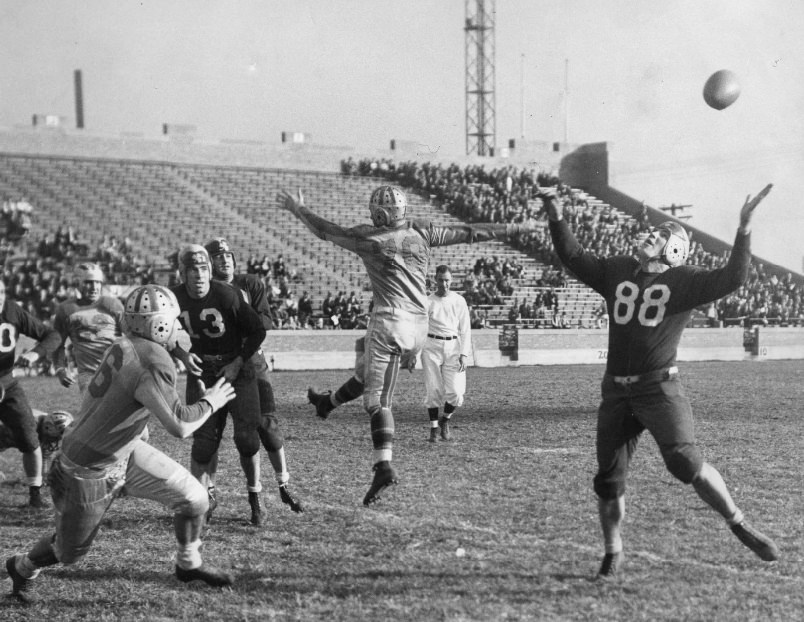
The St. Louis Gunners were a professional football team that competed in the American Football League. A 1938 game against the Boston Shamrocks at Walsh Stadium showed the Gunners displaying a varied attack that gave the Shamrocks significant trouble. Professional football in St. Louis during the 1930s occupied a different place in the city’s sports culture than baseball, but it drew its own loyal following.
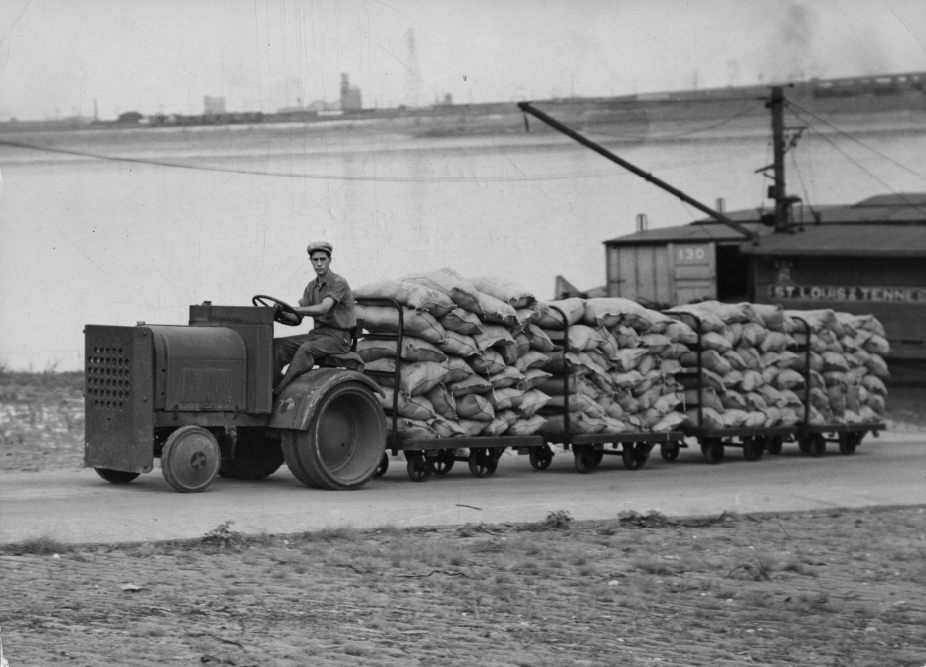
Mechanization was changing work on the St. Louis waterfront. By 1937, tractors were replacing the manual labor of stevedores who had previously loaded and unloaded cargo by hand. This shift had a significant impact on the workforce — fewer men were needed for the same work, a pattern that was playing out across American industry during the Depression era.
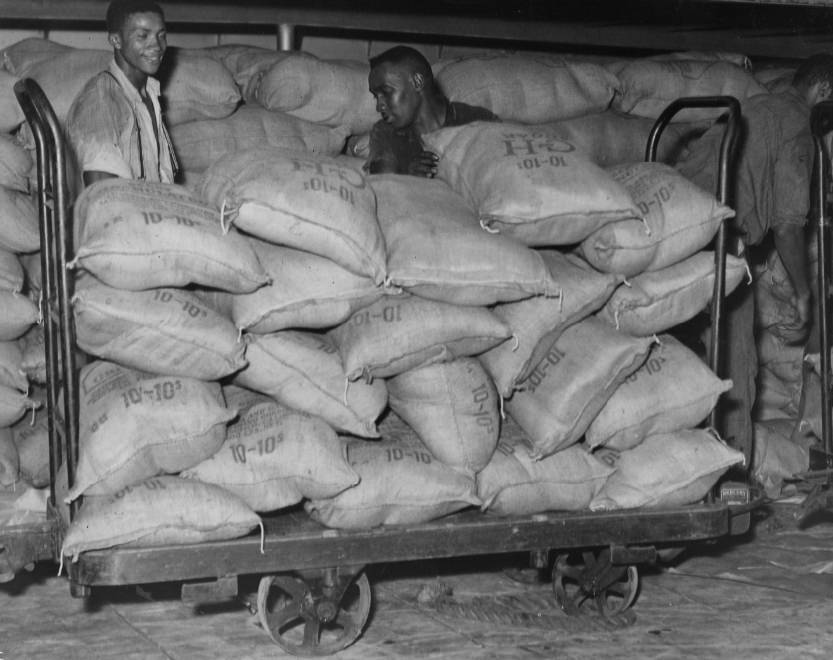
Sugar from California arrived at the St. Louis waterfront in 1937 by a route that never touched a railroad. The cargo traveled by ship through the Panama Canal to New Orleans, then up the Mississippi by barge. It was a demonstration of how river shipping had developed into a modern, efficient system capable of moving bulk cargo across long distances without rail connections.
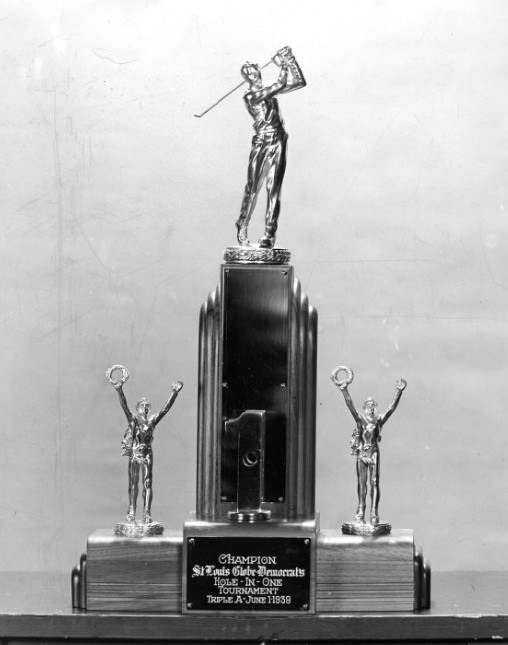
The trophies for the 1939 Globe-Democrat Hole-in-One Tournament were displayed ahead of the competition at Triple A. The fourth annual tournament drew 470 golfers across four divisions, with prizes going to the top performers in each category as well as the best single shots by a man and a woman. The tournament had grown into one of the most anticipated golf events in the St. Louis area.
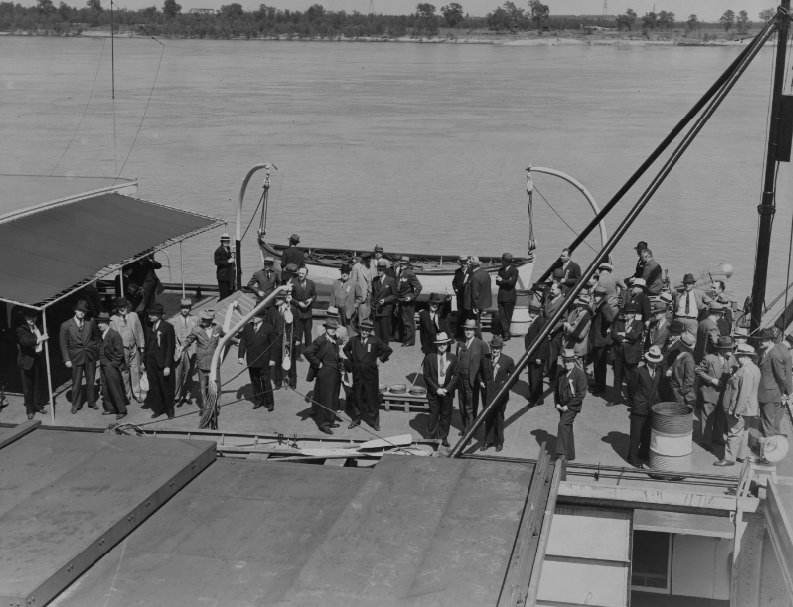
Old riverboats along the St. Louis waterfront in 1938 were a living connection to the city’s river trading past. Some of these vessels were still in active use; others were tied up and waiting for work that the Depression had reduced. The riverfront in the late 1930s was a place caught between its past and a future that planners were already drawing up.
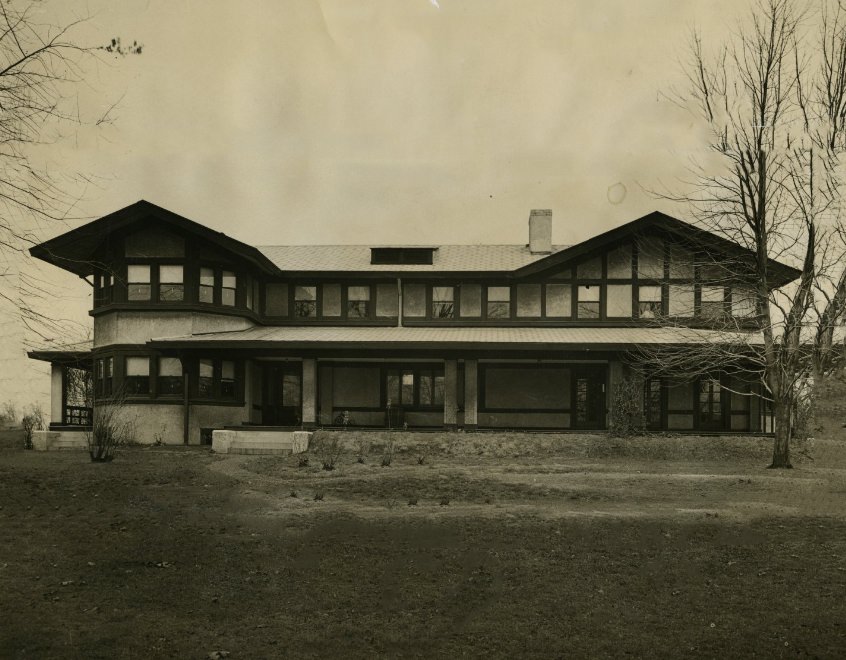
The Shelter, which had been in the possession of the Lucas heirs for 115 years, was sold to the Cenacle Sisters in 1930 for use as a retreat house. The religious community was set to take possession in the near future, converting a long-held private property into a place of spiritual retreat. The sale was one of many property transactions that reshaped St. Louis’s institutional landscape during the Depression decade.
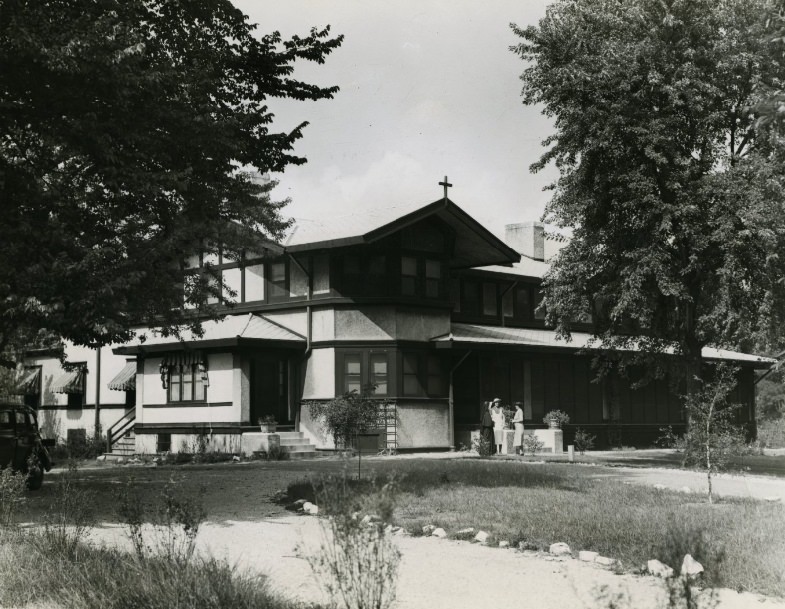
By 1937, the Cenacle Sisters had established their convent in St. Louis, and the main building served as the center of their community’s life and retreat ministry. Religious institutions like the Cenacle convent were stable presences in the city during the Depression, providing services and spiritual support to St. Louisans in need.
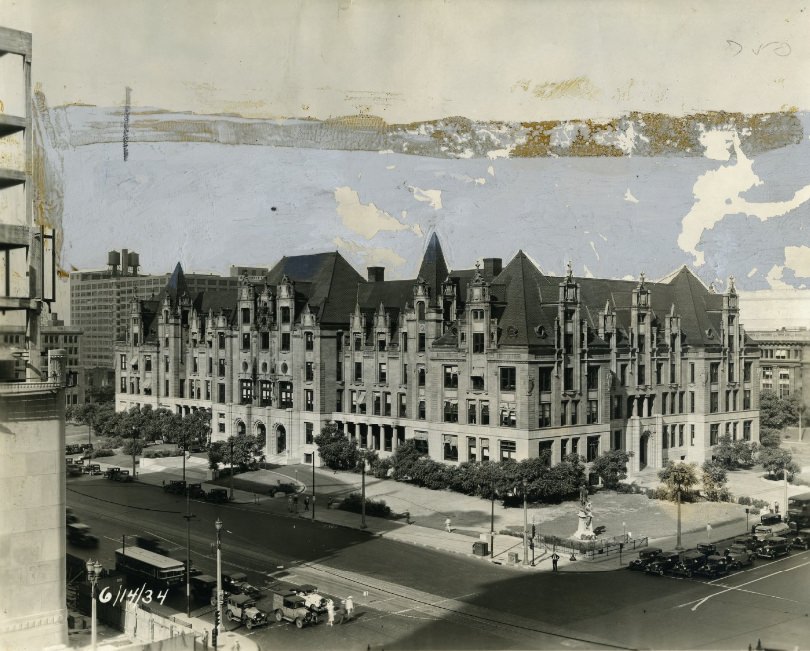
An artist’s rendering from 1934 showed what St. Louis City Hall would look like after the demolition of its main 80-foot tower and the cupolas of the two smaller towers on the Twelfth Boulevard side. Corrosion of the structural steel had made the towers unsafe, and city officials ordered them torn down. The image showed a City Hall reduced in silhouette but still imposing — a landmark that had lost some of its Victorian grandeur.
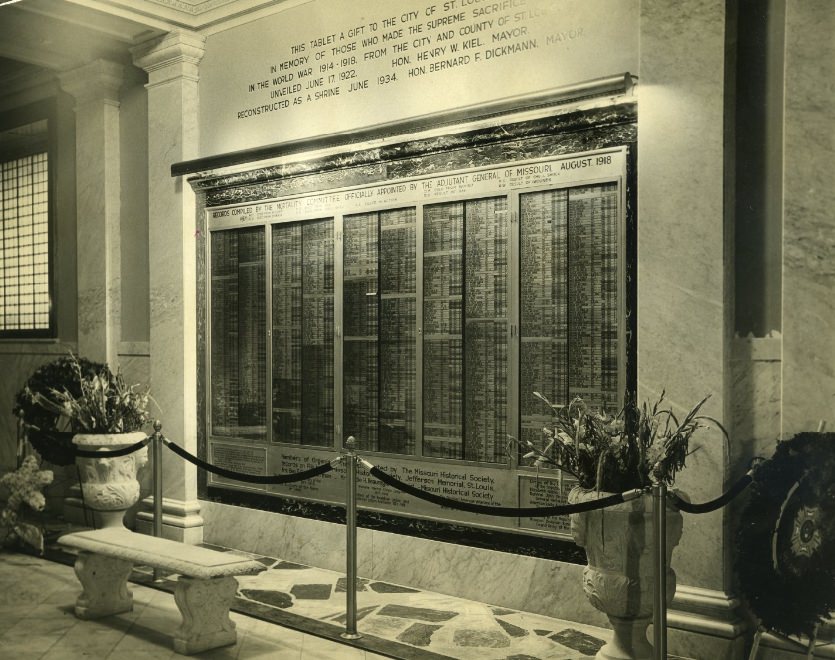
A tablet bearing the names of St. Louisans who died in World War I was moved to a new location at City Hall in 1934, where it was set up as a shrine. The tablet had been on the marble stairway since 1922, but was relocated to the southern end of the rotunda. The shrine cost $450, paid jointly by the American Legion and city officials, and formalized the memorial into a dedicated, visible tribute.
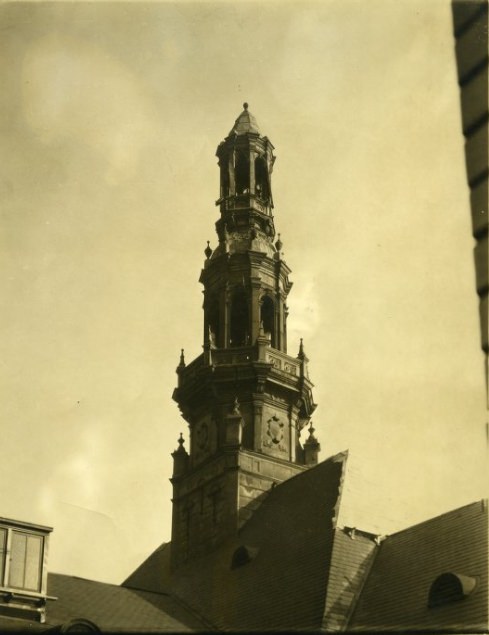
Before it came down, photographs were taken of the City Hall’s historic main tower from several angles. The tower over the Twelfth Boulevard entrance had been one of the most distinctive features of the building, and its removal in 1936 ended a chapter in the architectural history of one of St. Louis’s most important civic buildings.
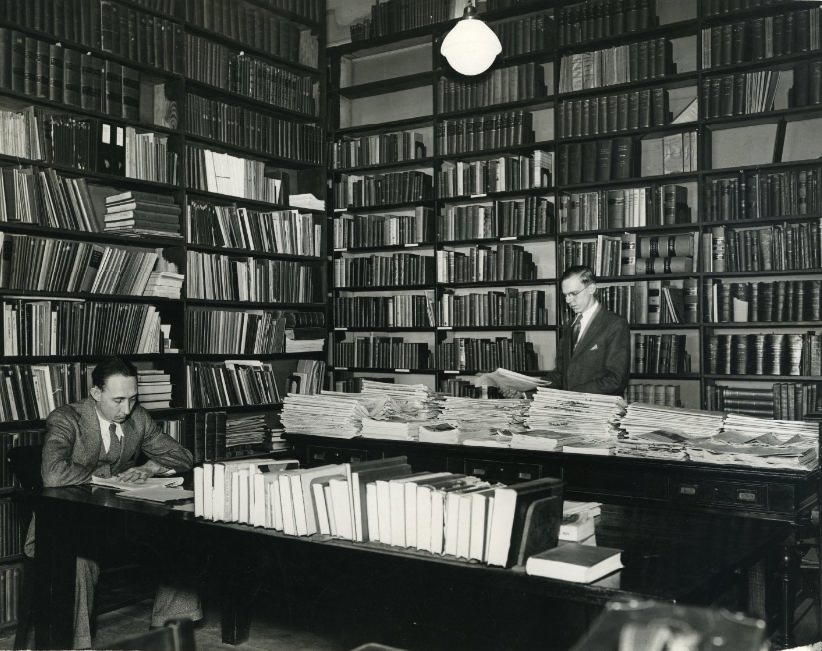
The reference library inside City Hall served city employees and researchers in 1932. In a period before widespread online access to government records, a well-maintained reference library was an essential resource for anyone navigating city regulations, historical records, or administrative documentation.
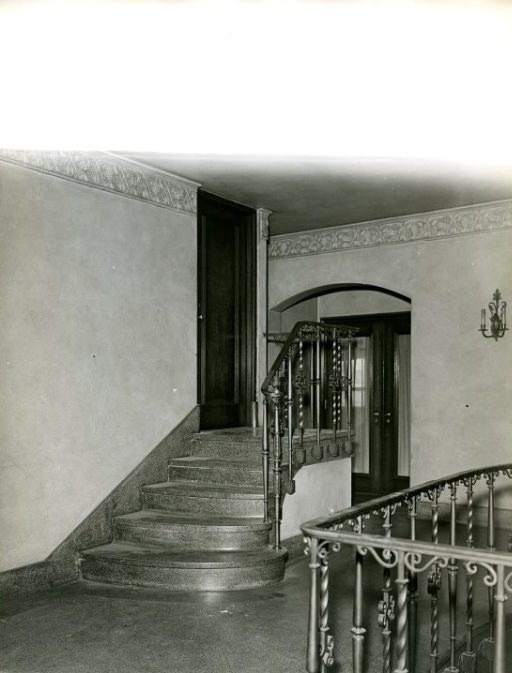
The penthouse apartment atop the Continental Life Building offered one of the most commanding views in all of St. Louis. Looking east down Olive Street in 1934, a viewer could make out the Civil Courthouse and other downtown landmarks in the distance. Ed Mays had leased the penthouse for $12,000 a year — a remarkable expense even by pre-Depression standards.
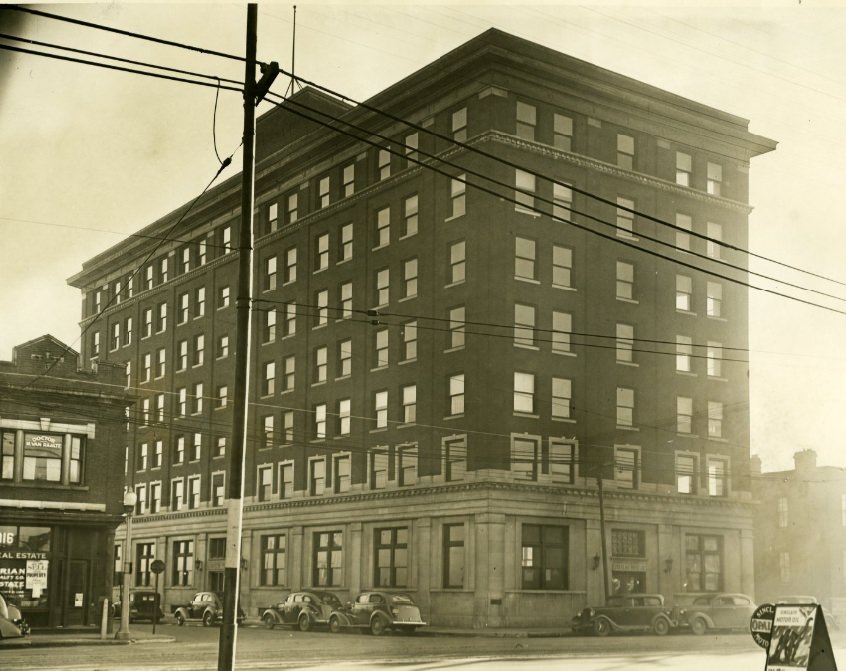
The Chouteau Trust Building at 4028–30 Chouteau Avenue was sold at a forced auction in 1938 to satisfy a mortgage. Forced sales of commercial properties were a regular feature of the Depression landscape, as owners who had borrowed against their buildings found they could no longer make payments. The building’s sale was documented as part of the ongoing financial restructuring that reshaped St. Louis real estate throughout the decade.
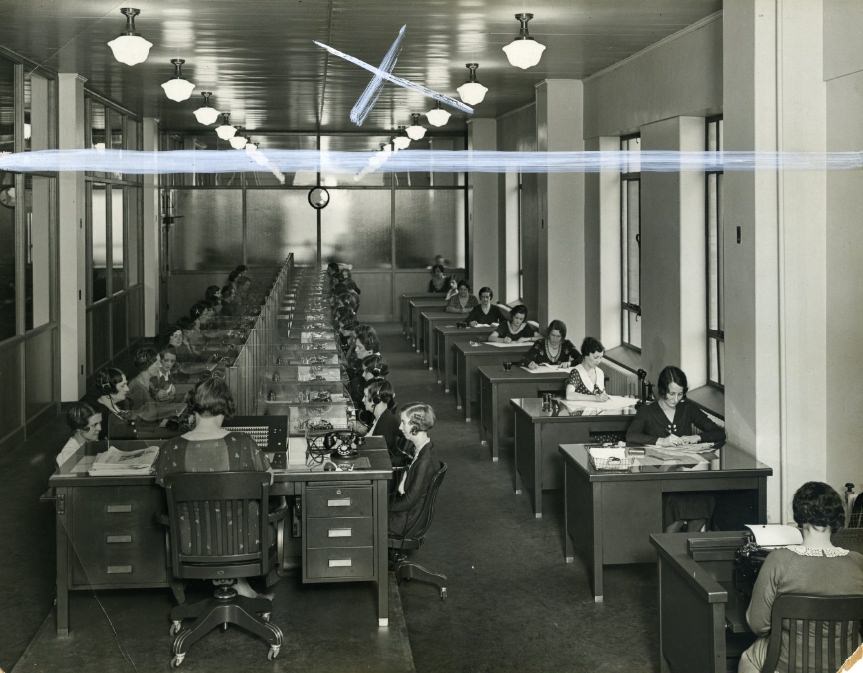
The St. Louis Globe-Democrat was one of the city’s major newspapers, and its newsroom was a busy place at the start of the decade. Women working at desks in 1930 were part of a workforce that would face increasing pressure as advertising revenues fell and the Depression hit newspaper finances hard.
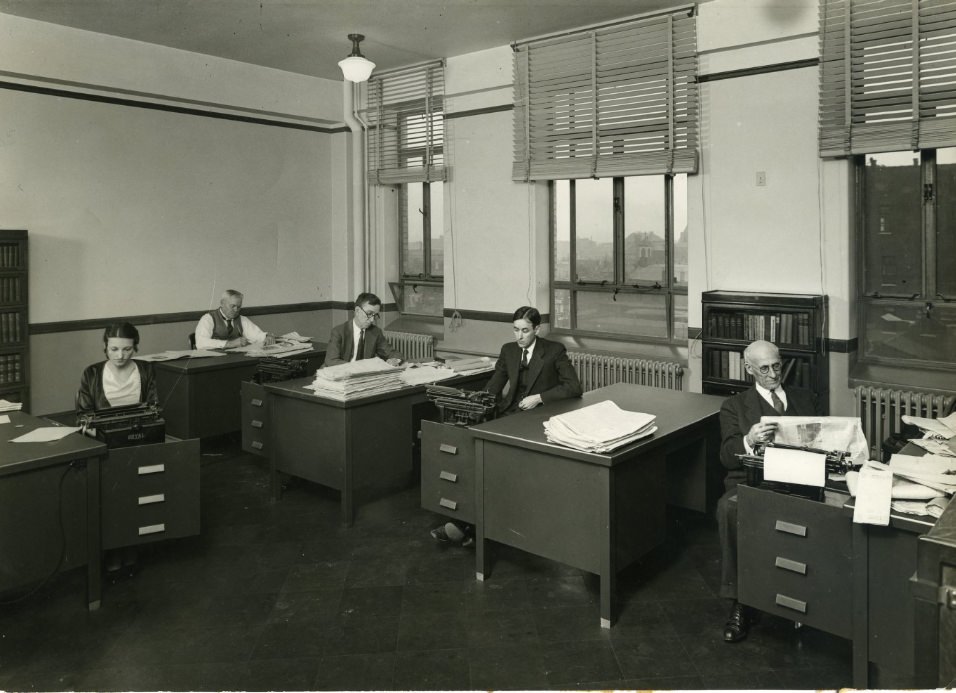
Globe-Democrat employees at their desks in 1930 were doing the work of documenting St. Louis for its readers — covering city government, sports, business, crime, and community life in a city that gave them no shortage of stories. The newspaper was a central institution in the city’s information ecosystem throughout the decade.
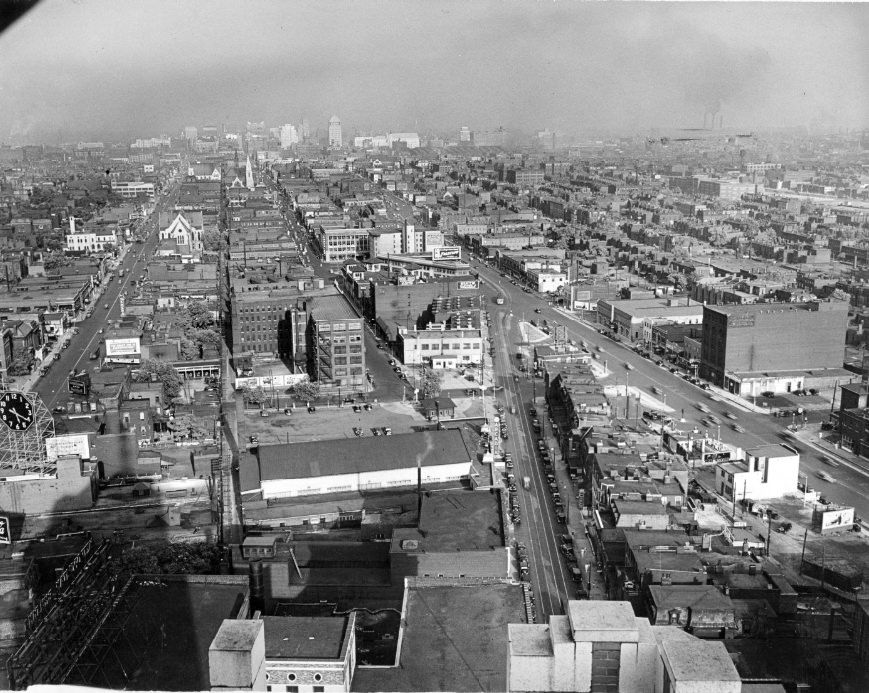
A 1934 aerial and skyline view of St. Louis looking east down Olive Street showed the scale of the city’s downtown. The Civil Courthouse and other major buildings marked the skyline, while the street grid below showed the density of urban development that had built up over decades. These views from height captured a city in transition between its industrial past and an uncertain future.
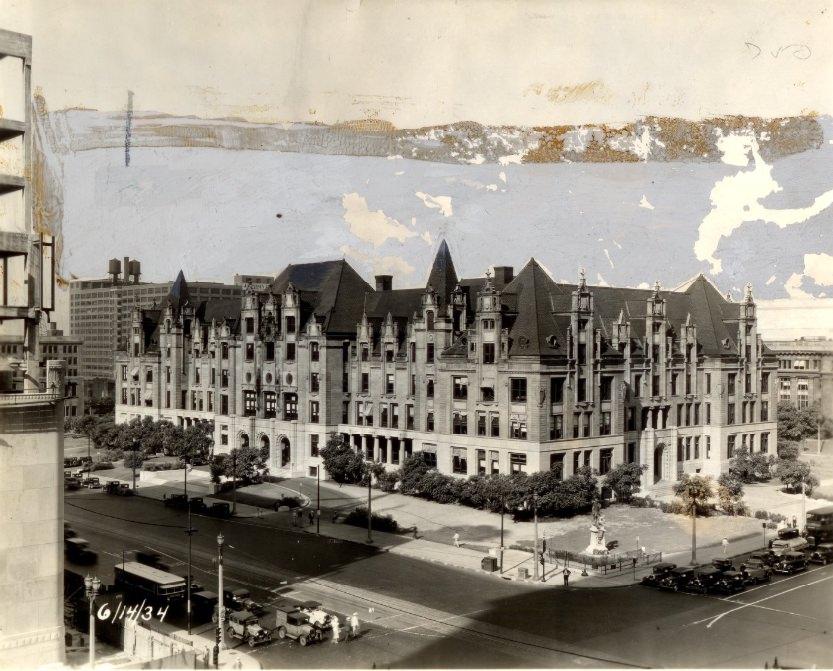
The modified City Hall of 1936 — towers removed, profile changed — represented a building adapted to physical necessity. While the demolition of the towers was driven purely by structural safety concerns, the result was a building that looked different from how St. Louisans had known it for decades. The changes were practical, not aesthetic, but they altered one of the city’s most recognizable buildings permanently.
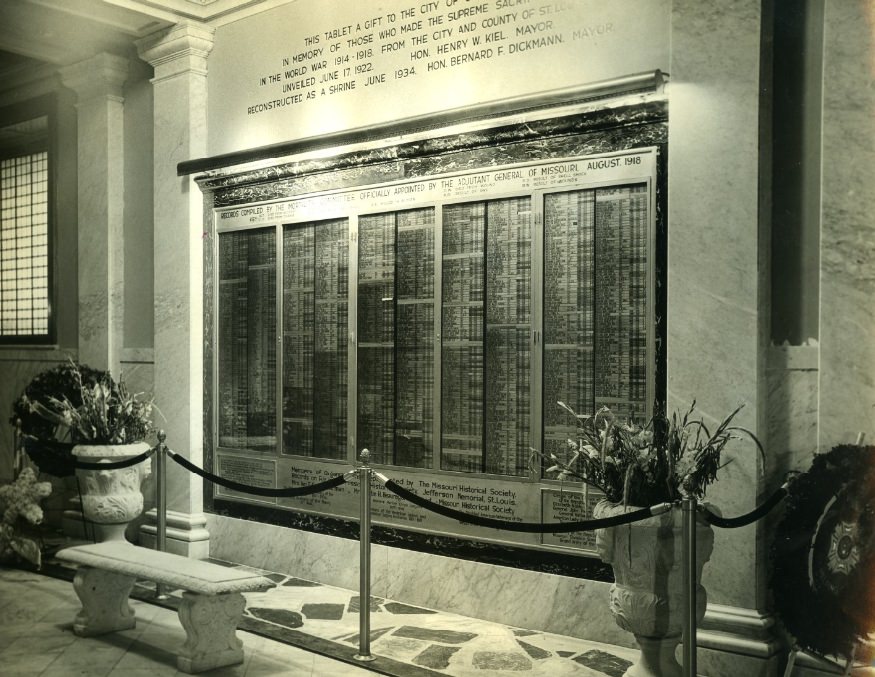
The World War I memorial tablet at City Hall carried the names of St. Louisans from both the city and St. Louis County who had died in the conflict. Its installation in the rotunda in 1934 gave it a more prominent location than the marble stairway where it had previously stood, turning it into a proper shrine where visitors could pay their respects.
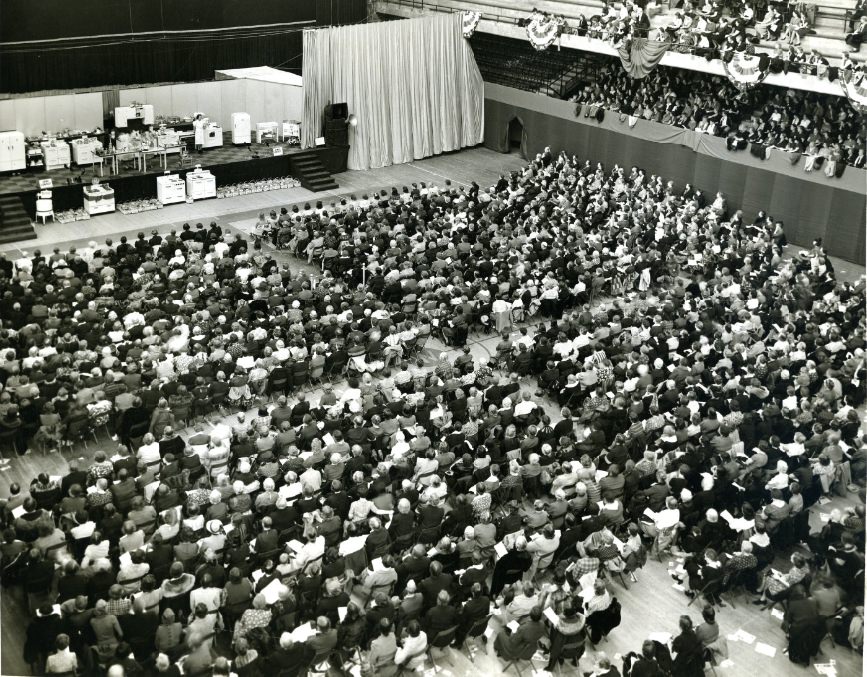
The 1939 Globe-Democrat cooking school was a full production. A bird’s-eye view of the stage showed Jessie Marie DeBoth demonstrating recipes with GE appliances arranged on the stage — stoves, washing machines, and refrigerators — while prize displays from Rinso and Spry contests and General Electric filled the wings. About 50 gift baskets of cleaning products and women’s shoes were among the prizes on offer for the audience.
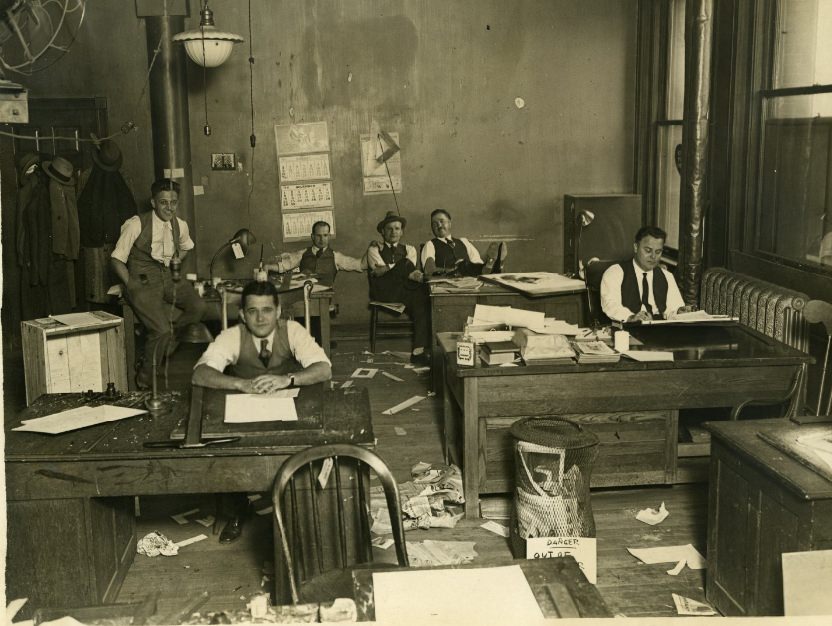
The Globe-Democrat’s art department in 1931 produced the illustrations, layout work, and visual elements that accompanied the newspaper’s reporting. Artists and designers working in this department created the visual language of one of St. Louis’s most important daily publications during the Depression years.
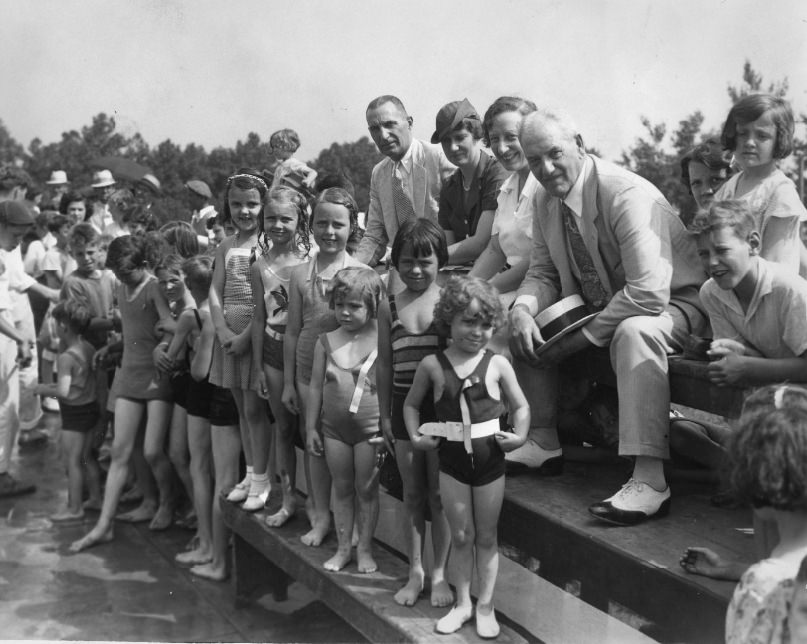
Sherman Park’s playground offered children in the surrounding neighborhood a place to play during the Depression years. Public playgrounds were among the few recreational resources that remained freely available to families who had lost income and could not afford paid entertainment. The city’s parks and playgrounds saw heavy use throughout the 1930s.
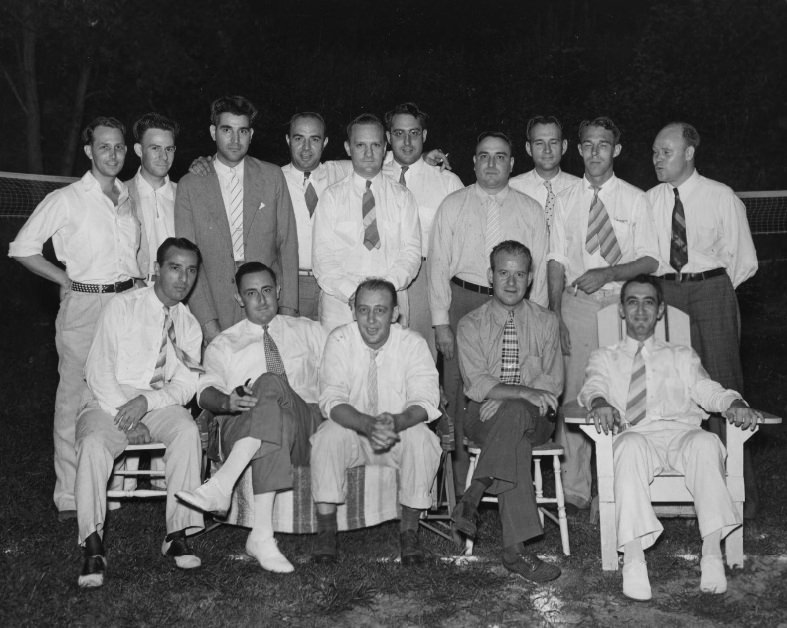
High school football was a major part of St. Louis’s sports culture, and schools like Soldan fielded competitive teams that drew community support. The 1937 Soldan High School football team was part of a city prep sports scene that gave students and neighborhoods a source of pride and entertainment during difficult times.
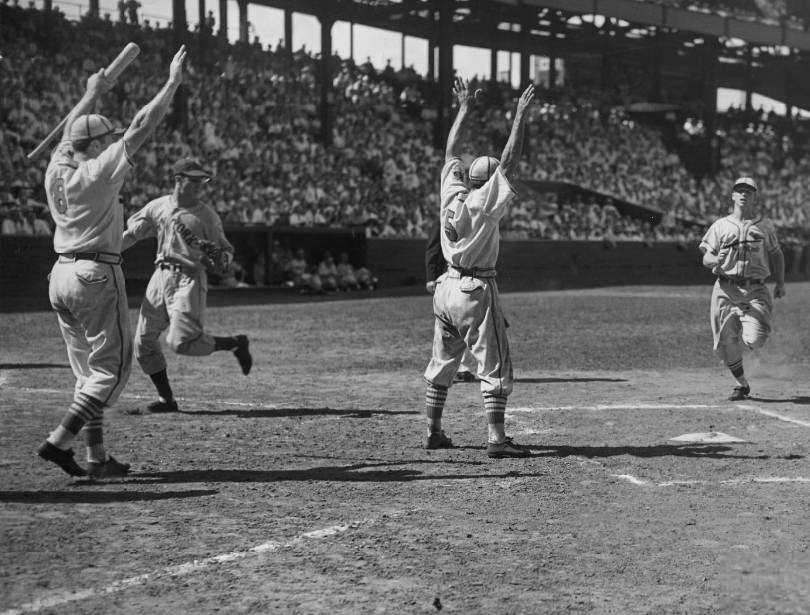
The St. Louis Cardinals played host to the New York Giants in 1939 at Sportsman’s Park. By the late 1930s, the Cardinals were still one of baseball’s marquee franchises, drawing large crowds to the ballpark. Baseball remained the most popular sport in Depression-era St. Louis, offering a reliable form of entertainment that connected the city to something larger than itself.
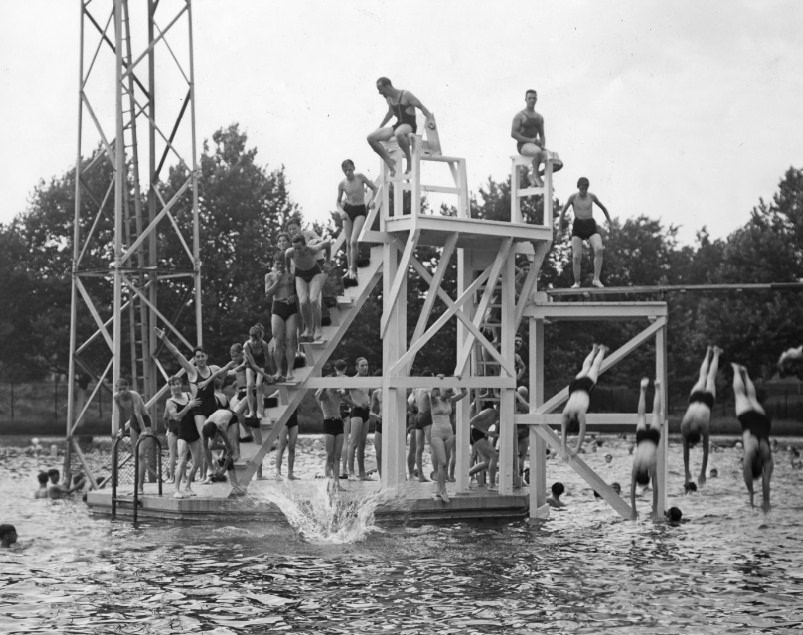
The Marquette Swimming Pool was one of the public pools that served St. Louis residents during the hot Missouri summers. In a city without widespread air conditioning, public swimming pools were essential community resources. Access to pools like this one was deeply valued — and, like many city resources, was segregated during the 1930s.
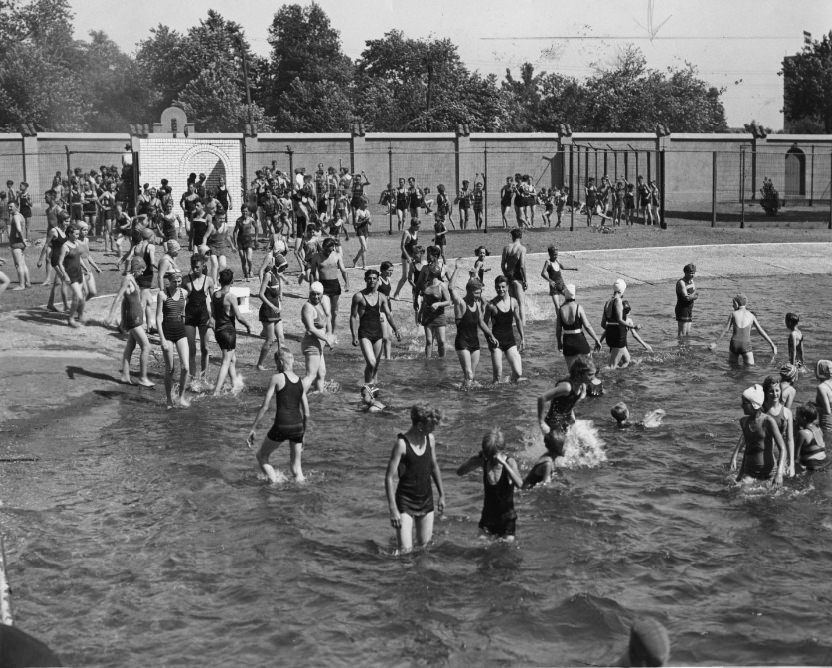
The Fairgrounds Park swimming pool in 1932 offered residents of north St. Louis a place to cool off during the summer. Public pools across the city operated under the racial segregation policies of the era, with Black residents excluded from most public facilities and directed to separate, often inferior, alternatives.
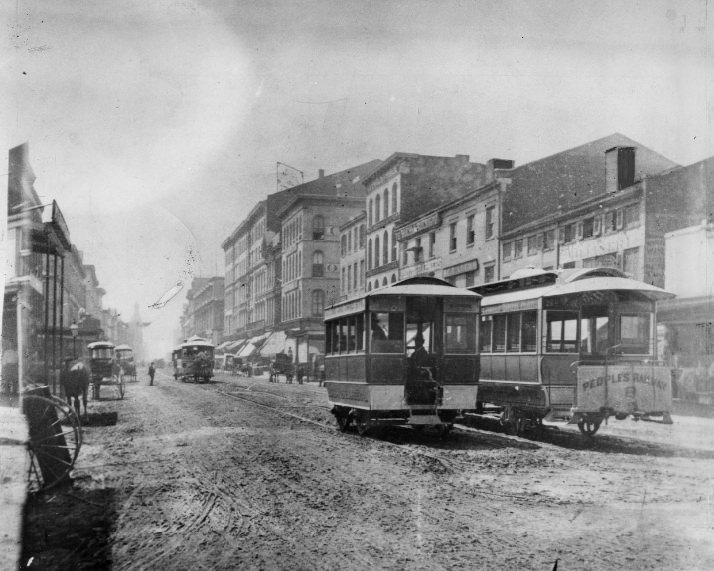
Fourth Street in downtown St. Louis in 1938 showed a city core that was still commercially active, with storefronts, pedestrians, and vehicles filling the frame. This was part of the same general area where redevelopment planning was beginning to take shape, and many of the buildings visible on Fourth Street would be cleared in the years ahead.
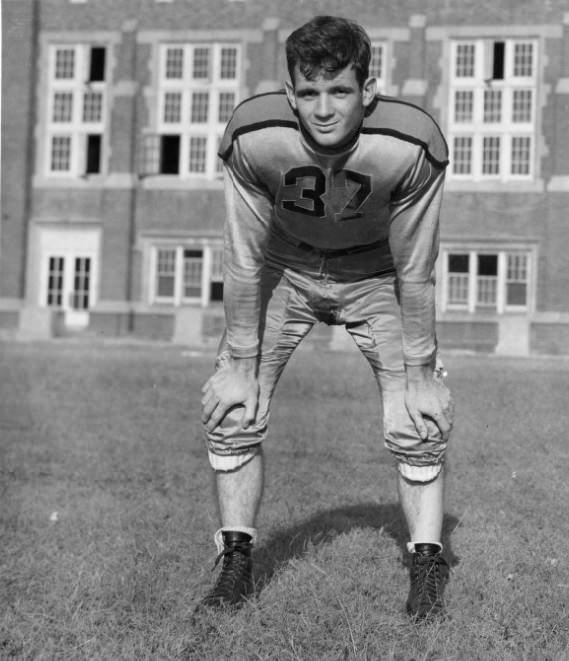
The Rolla School of Mines — later the Missouri University of Science and Technology — fielded a football team that competed against other regional schools throughout the 1930s. Individual player photographs like this one from 1939 were a standard part of sports coverage in the St. Louis press, which covered college football as closely as it followed the professional game.
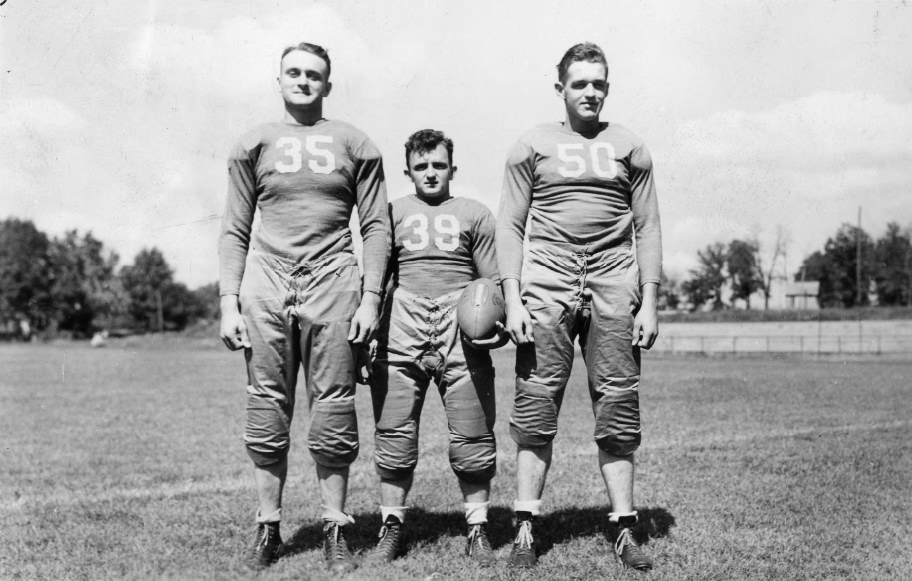
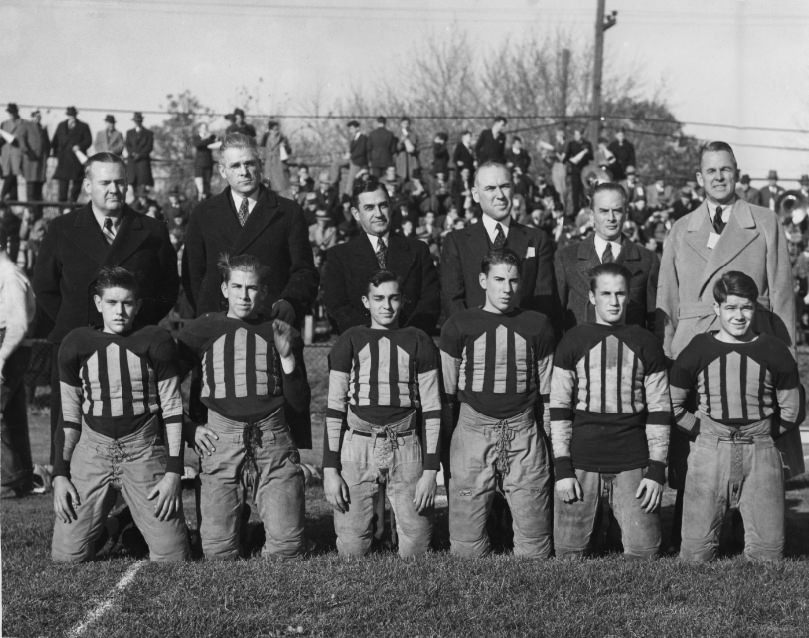
College football in and around St. Louis featured teams from several area institutions. The Rolla School of Mines squad in 1937 and the Principia Academy team in 1936 were both part of this regional sporting culture. Principia’s Dad’s Day game in 1936 ended in a 27–0 loss to a stronger Cadet team — a result that even the presence of fathers in the stands couldn’t prevent.
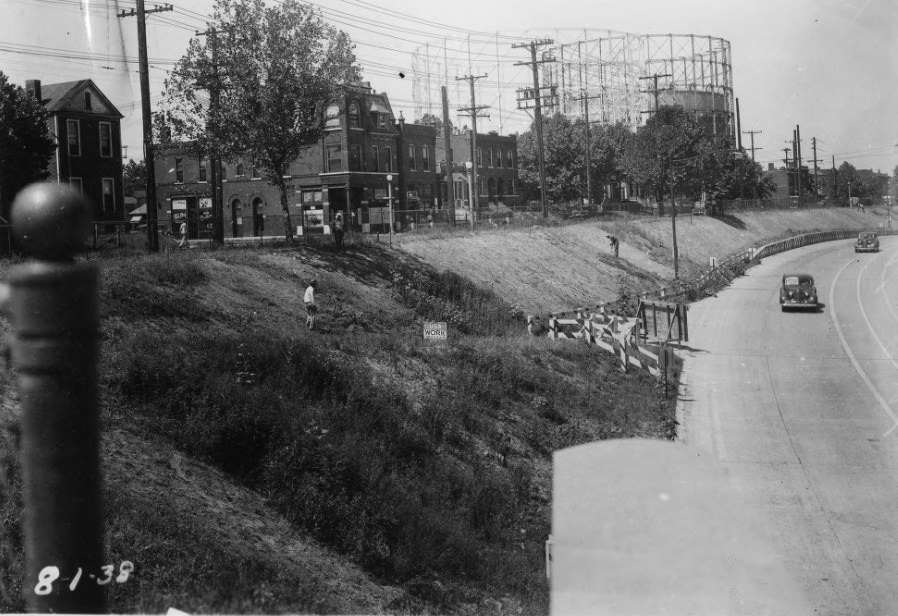
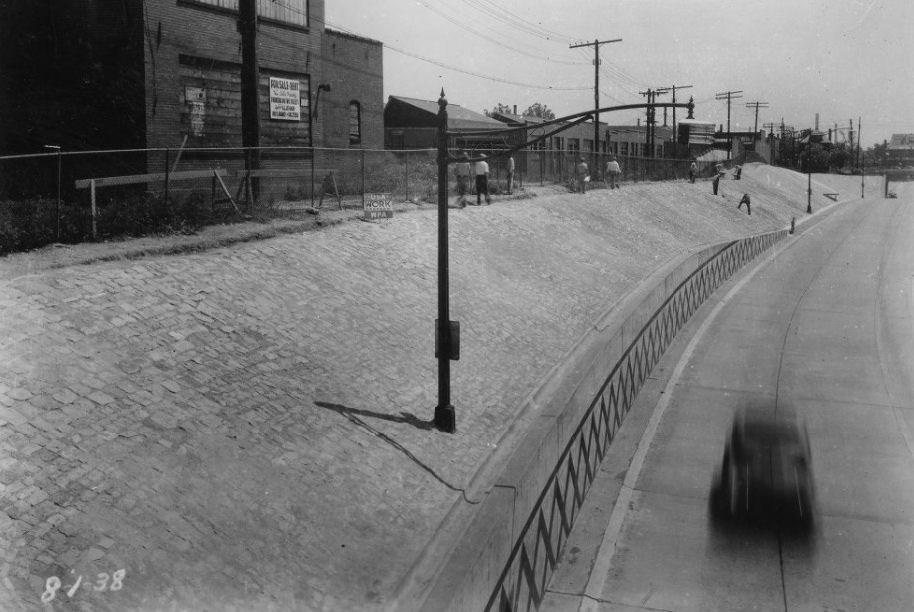
Highway construction in St. Louis was progressing unevenly in 1938. A finished section of highway on the north side between Taylor Avenue and points east stood in contrast to the unfinished section on the south side between Tower Grove and Newstead Avenue. These infrastructure projects were partly funded through New Deal programs and were essential to accommodating the growth of automobile travel.
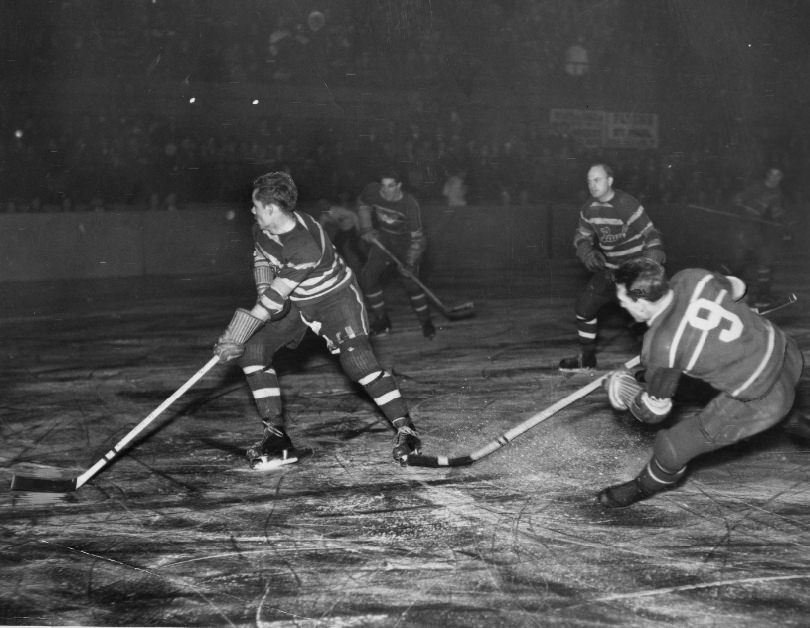
The St. Louis Flyers were a professional hockey team that played in the American Hockey Association during the 1930s. A 1936 matchup against the St. Paul Saints was part of a competitive season that gave St. Louis hockey fans a team to follow at the regional level after the NHL’s Eagles had folded.
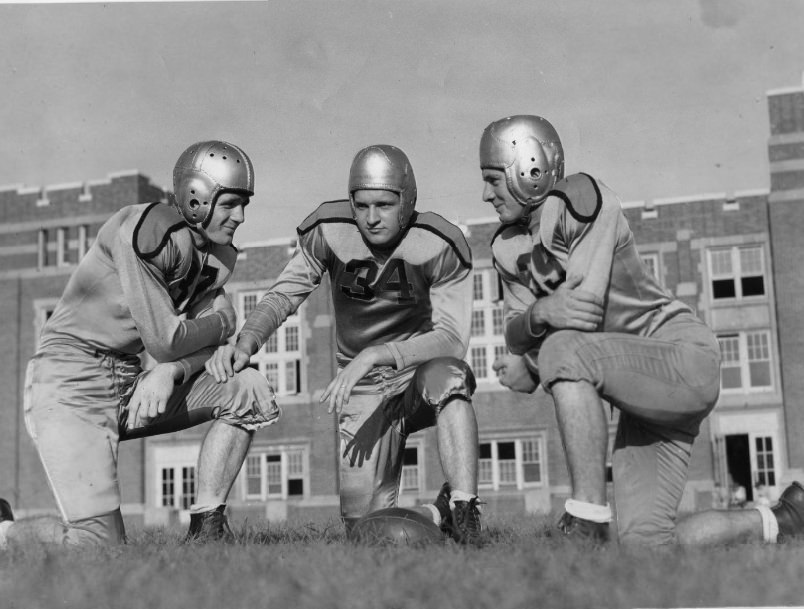
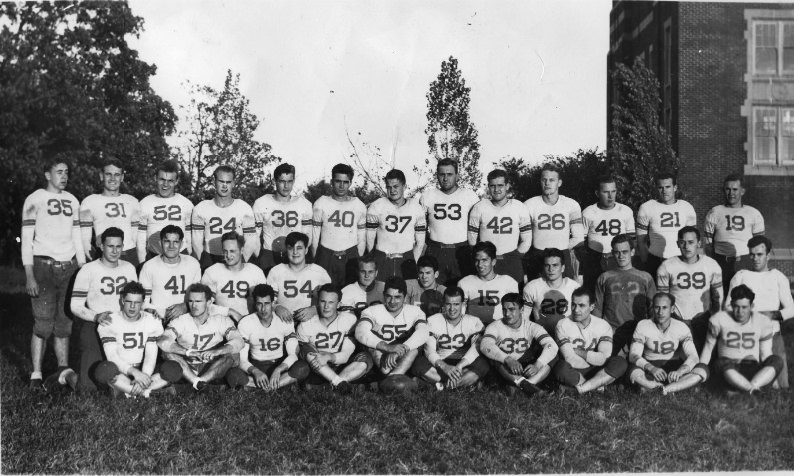
The Rolla School of Mines built a football program that spanned the decade, with team photographs from 1934 and 1939 showing the program’s continuity. Known as the Miners, the Rolla squad competed in Missouri Intercollegiate Athletic Association play and drew coverage from the St. Louis press throughout the 1930s.
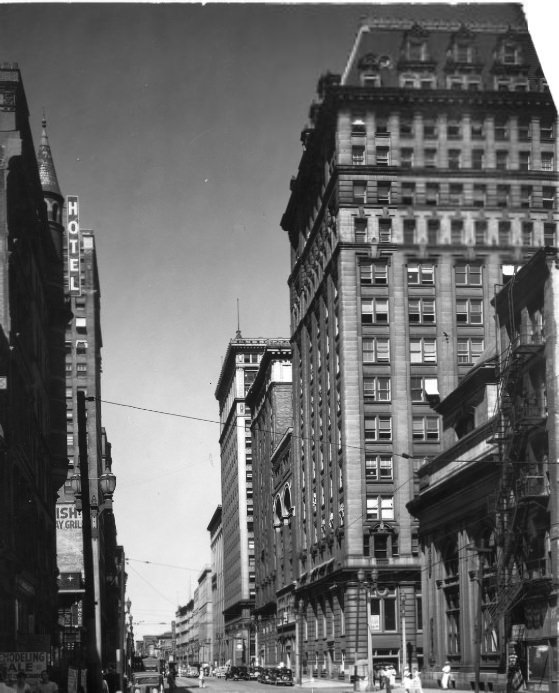
Broadway between Pine and Olive Streets was often called the Wall Street of St. Louis. Looking north from Pine Street in 1935, the block was lined with banking institutions and financial firms that concentrated the city’s commercial power on a single stretch of road. Despite the Depression’s devastation of the banking sector, this corridor remained the financial heart of St. Louis.
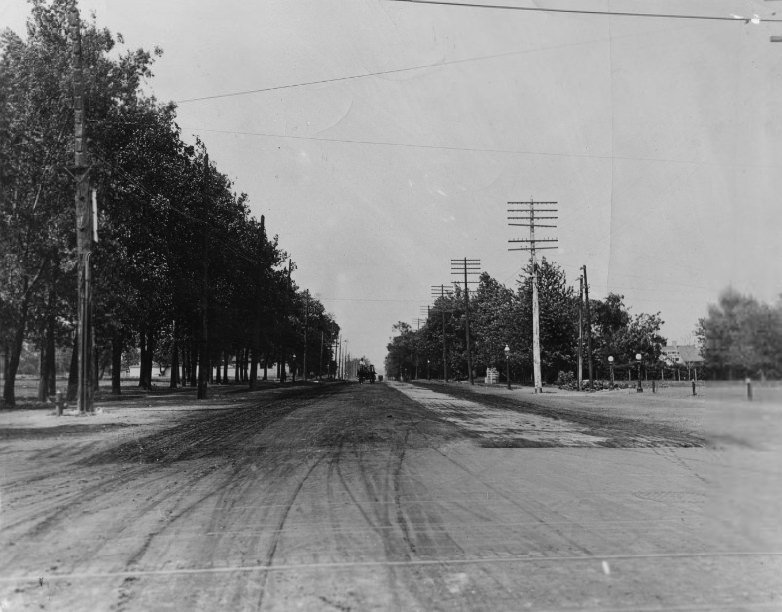
A 1939 photograph compared what Kingshighway had looked like roughly 25 years earlier — when it was still practically “out in the country” — with the busy city thoroughfare it had become. The image, shared by the City Plan Commission, showed how rapidly the city had expanded outward along its major roads. Kingshighway looking north from Easton was now one of the most traveled streets in St. Louis.
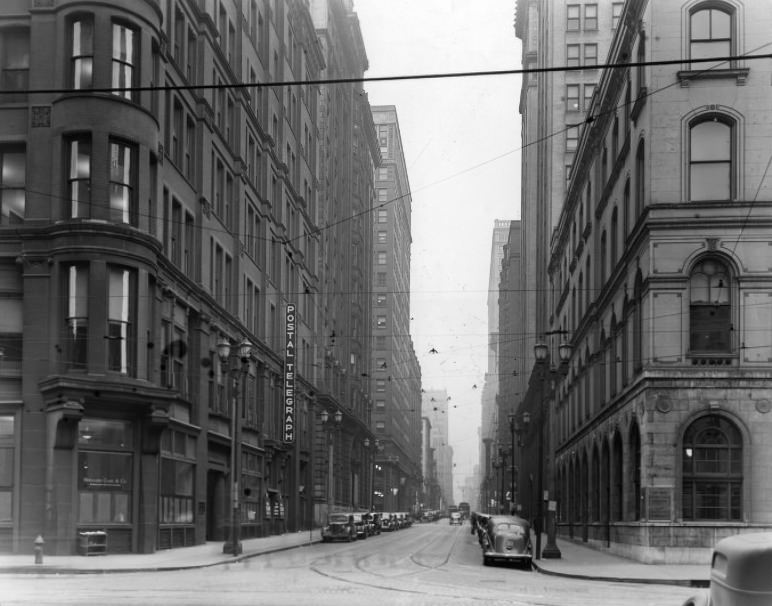
The intersection of Fourth and Olive was a central point in downtown St. Louis. Throughout the 1930s, this corner was surrounded by the commercial activity and institutional buildings that defined the city’s core. Street views from this era capture a downtown that was dense, active, and full of the detail of everyday urban life.
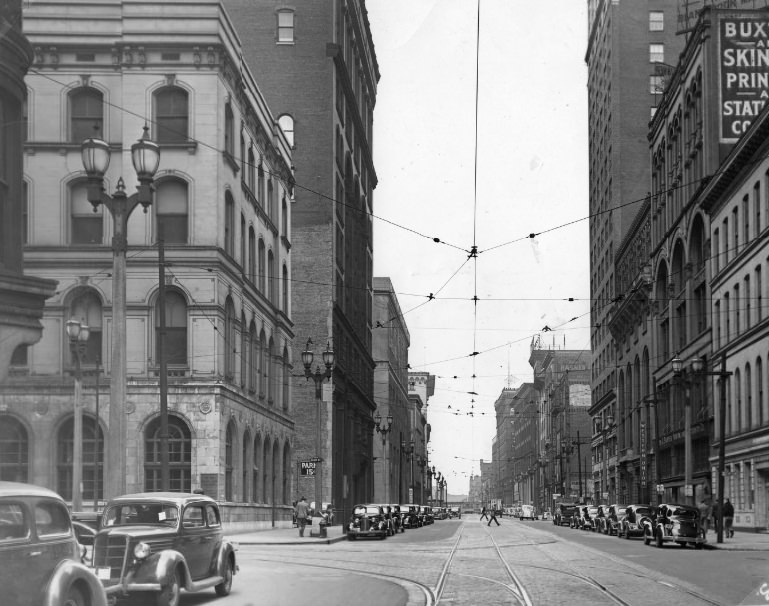
Rush hour in St. Louis during the 1930s meant streetcars, automobiles, and pedestrians competing for space on the city’s main streets. Despite the Depression, the city’s population remained close to 822,000 through the decade, and the daily movement of that population through the streets created the familiar pressure of urban rush hours.
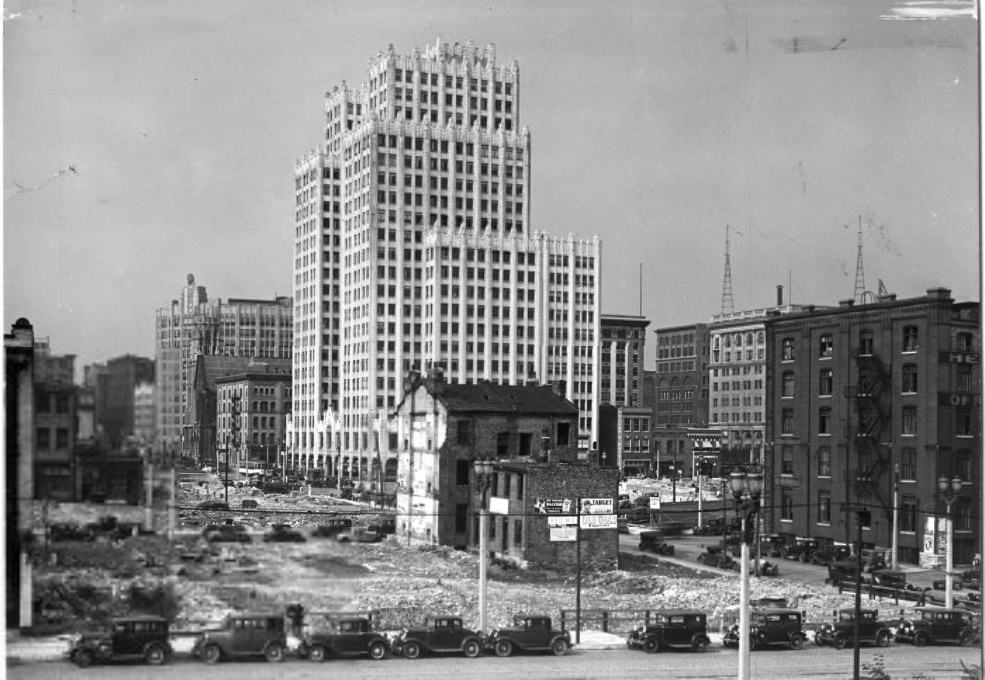
Looking north along Thirteenth Street from Market in 1932 showed a mid-depression St. Louis that was still standing, still moving, still populated. The street scene captured the texture of urban life — buildings of varying ages, vehicles, and the ordinary details of a city going about its business under very difficult circumstances.
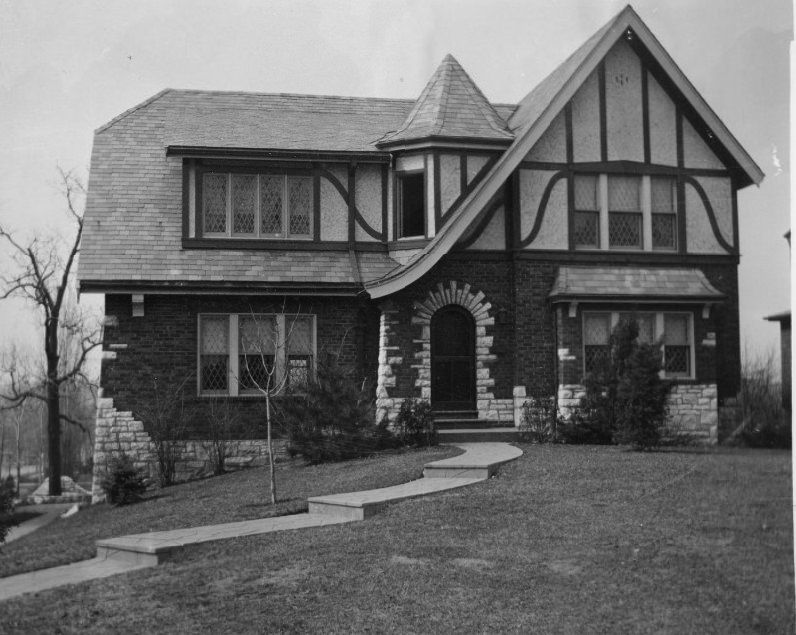
Delmar Street was a major east-west corridor running through St. Louis and into University City. By 1935, it was lined with businesses, apartments, and institutions that served the surrounding neighborhoods. Delmar was also a dividing line in the social geography of the metropolitan area, separating communities that would grow further apart in the decades to come.
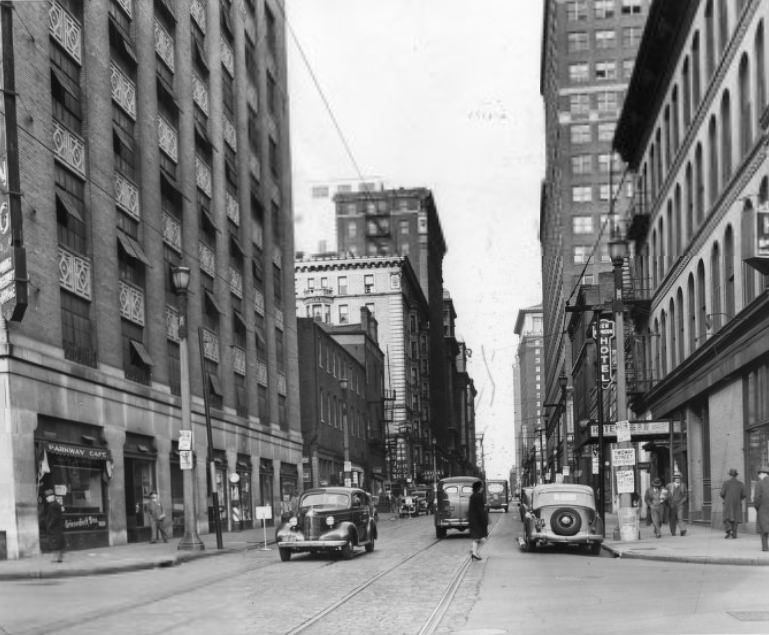
A view of Ninth Street in 1939 showed a downtown St. Louis that was beginning to stabilize after a decade of economic hardship. Storefronts, pedestrians, and the familiar mix of vehicles that filled Depression-era streets were all present, creating a street scene that documented the city as it approached the end of the 1930s.
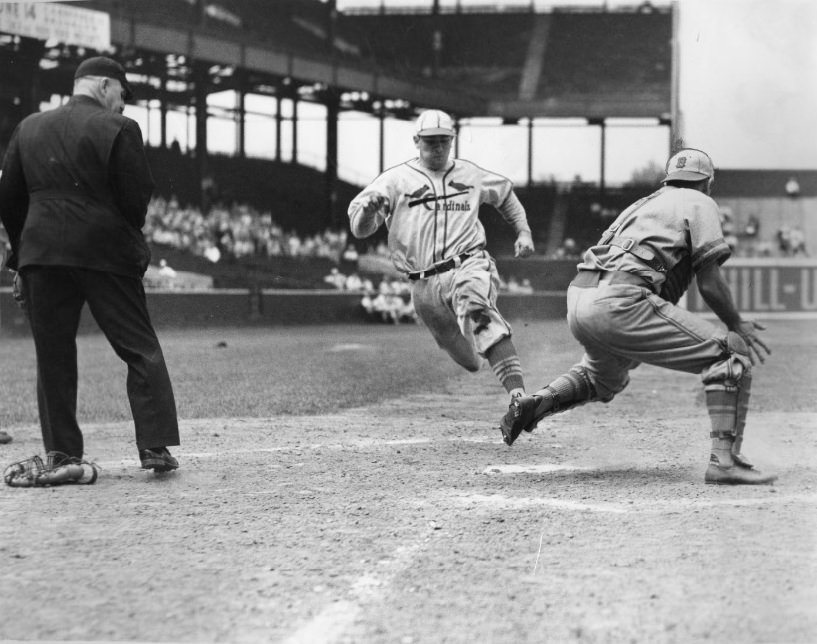
Mickey Owen was a catcher for the St. Louis Cardinals in the late 1930s. A 1939 action photograph of Owen running the bases captured the athletic dimension of a Cardinals team that was still one of the most competitive in the National League. Cardinals baseball continued to give St. Louis one of its strongest sources of civic pride during the Depression years.

Spring training and tryout photographs of Cardinals pitching and catching candidates in 1939 showed the constant renewal of the roster that kept the team competitive. The Cardinals’ pipeline of talent was one of the most effective in baseball during the 1930s, producing players who would carry the franchise through the next decade.
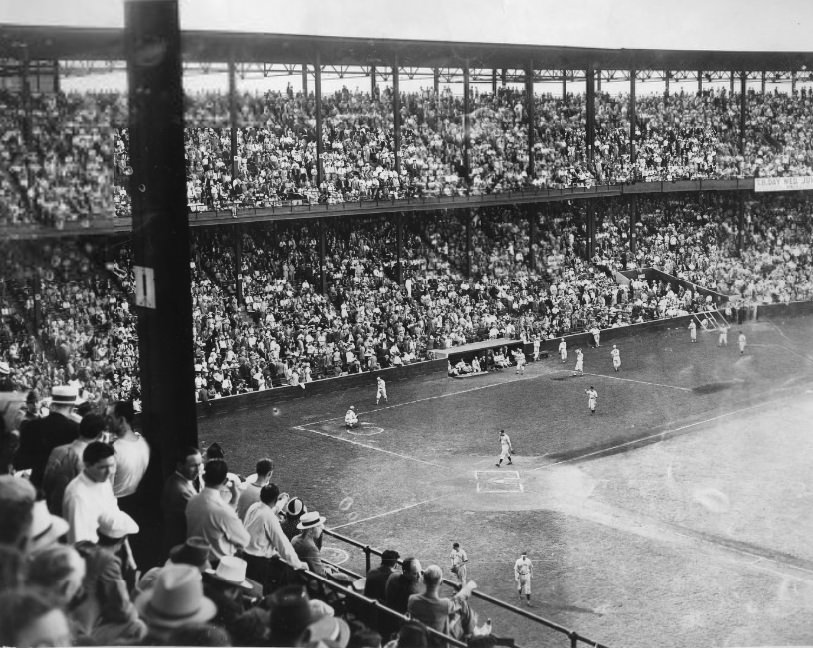
A Cardinals-Reds doubleheader at Sportsman’s Park in 1939 drew 33,538 fans — the largest crowd at a St. Louis baseball game since June 1937. The Cardinals won the opener 6 to 5 before dropping the nightcap 8 to 4. A photograph of the crowd during the intermission captured the scale of baseball’s popularity in St. Louis, where the sport was as much a community institution as any church or civic organization.
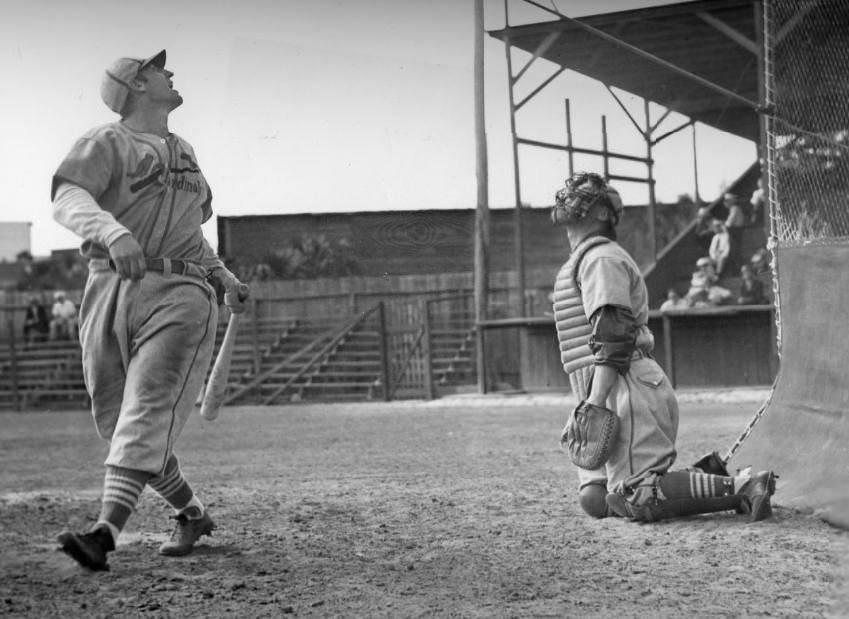
Pepper Martin was one of the most popular Cardinals players of the 1930s, a key member of the Gashouse Gang teams that won the World Series in 1934. By 1939, Martin was still active, and game photographs like this one of a foul ball shot continued to document his career for the St. Louis sporting press.
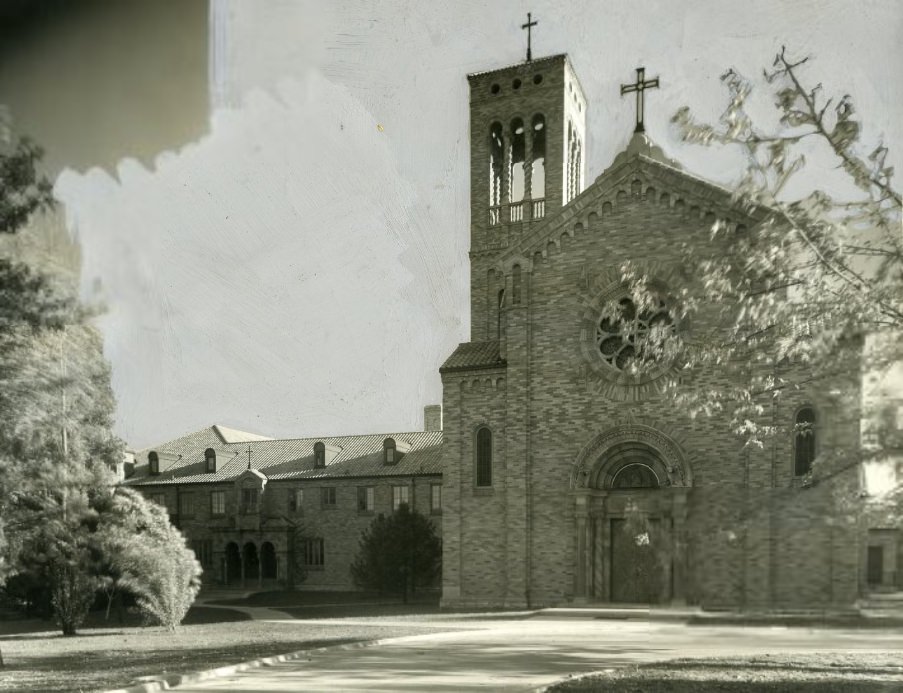
The Carmelite Monastery on Clayton Road was a significant religious institution in the St. Louis area. The facade of its public chapel, photographed in 1932, showed the architectural character of a contemplative religious community that maintained a public presence through its chapel while keeping the convent proper separate from the outside world.
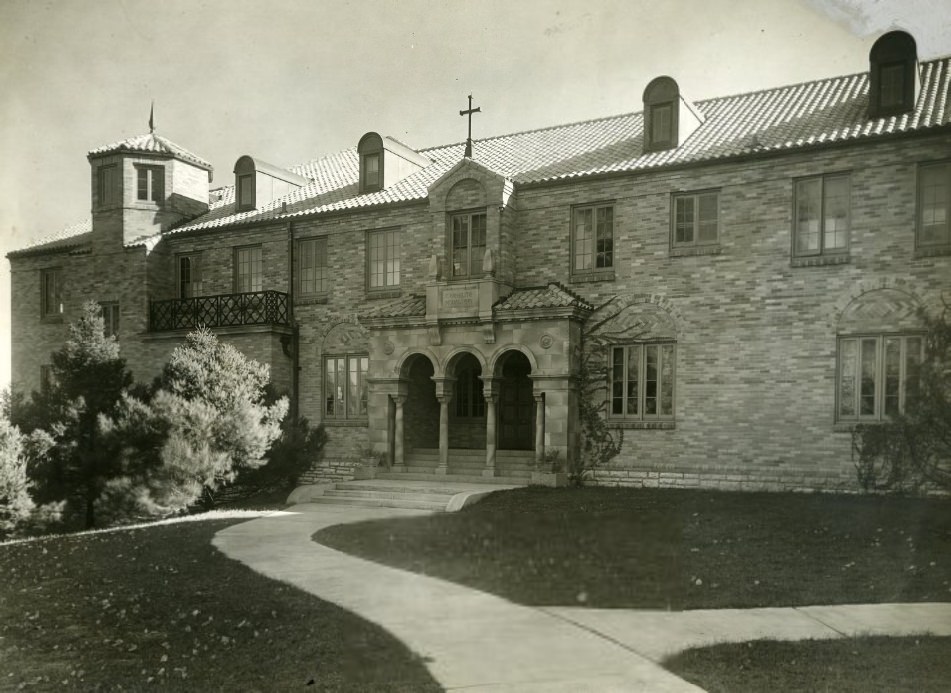
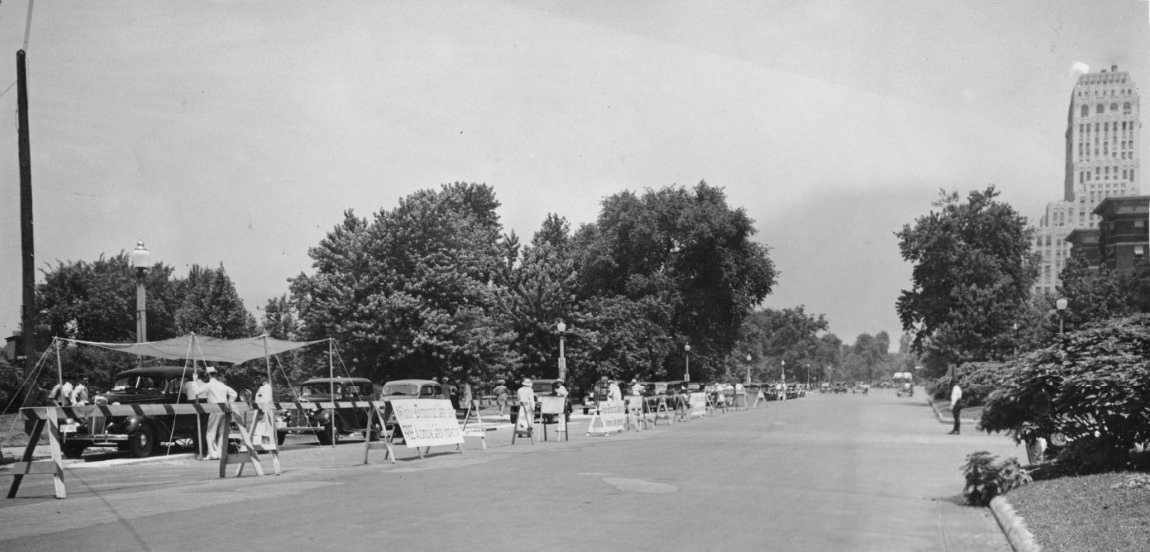
The Globe-Democrat’s Safety Lane in 1936 was one of the newspaper’s community service programs, designed to promote automobile safety at a time when traffic accidents were a growing public concern. As car ownership spread through St. Louis and the broader American population, newspapers like the Globe-Democrat took on an educational role in promoting safe driving practices. These programs reflected the civic engagement that made local newspapers central institutions in Depression-era American cities.




