Long before lane-departure warnings and eye-tracking cameras, a research team at Tufts College of Psychology built a device in 1948 designed to solve one of the most dangerous problems on the road: a driver falling asleep at the wheel. They called it the automatic “prodder,” and it worked exactly as the name suggests.
The core of the device was a headband fitted with electrodes. Drivers wore it while behind the wheel, and the electrodes continuously measured their level of alertness. The moment the readings indicated that drowsiness was setting in, the device triggered a warning buzzer that jolted the driver back to full attention. No gradual nudge — just an immediate, hard-to-ignore buzz.
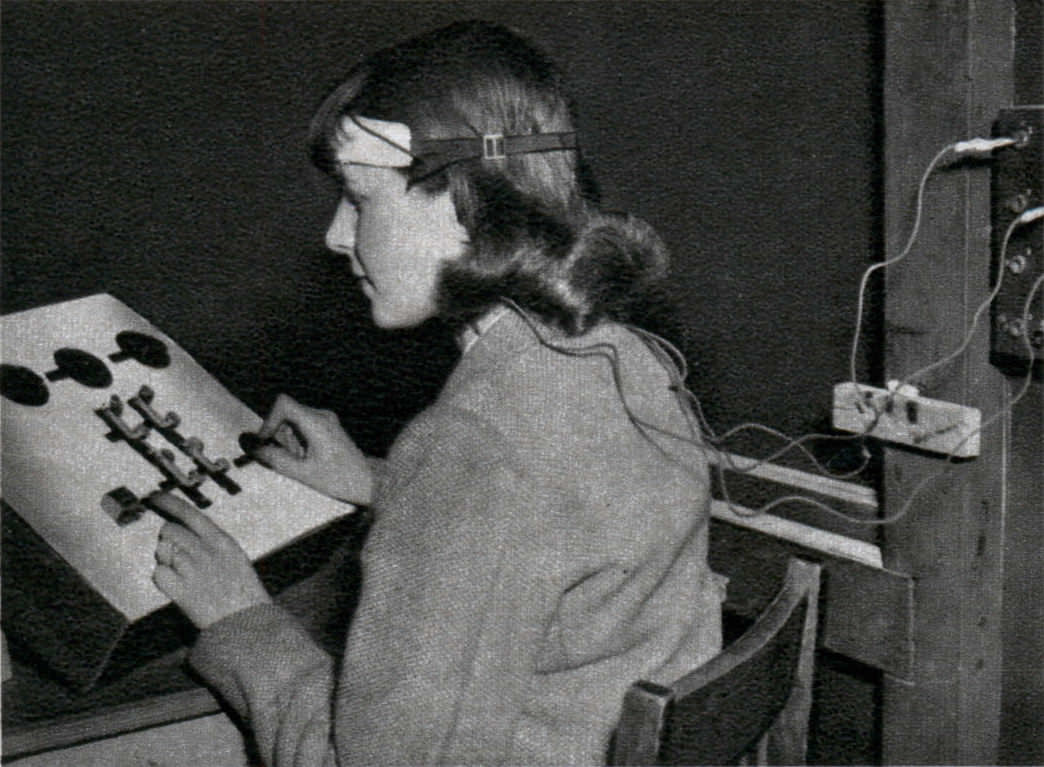
The science behind the prodder drew on established principles from psychology. Electrodes placed against the skin can detect changes in electrical activity that correspond to shifts in mental state. As a person transitions from alertness toward sleep, those signals change in measurable ways. The Tufts team used that data as the trigger point for the buzzer, making the device a direct link between the driver’s brain activity and an automatic physical warning.
The post-World War II period was a time of rapid change in American life. More families owned cars, roads were expanding, and long-distance driving was becoming more common. With that came a real and growing danger: driver fatigue. Drowsy driving caused crashes and deaths, and there was no reliable way to prevent a tired driver from nodding off. The prodder was a direct response to that problem.
What made the prodder stand out was its automatic nature. A driver couldn’t simply decide to stay awake — fatigue doesn’t work that way. The device removed the burden of self-monitoring. It watched for the warning signs so the driver didn’t have to, and it reacted the instant those signs appeared. That approach — taking the decision-making out of an impaired person’s hands — was genuinely forward-thinking for 1948.
The headband itself was a practical design choice. It sat comfortably against the forehead, kept the electrodes in consistent contact with the skin, and didn’t interfere with driving. For all its scientific sophistication, the device was meant to be usable by an ordinary driver on an ordinary trip, not just in a laboratory setting.
Tufts College of Psychology brought together two fields — engineering and behavioral science — to produce something neither discipline could have built alone. The engineers provided the circuitry and the buzzer mechanism. The psychologists identified the measurable signs of drowsiness and determined the threshold at which an intervention was needed. That collaboration was part of what made the prodder a notable achievement, not just a curiosity.
Drowsy driving remains one of the leading causes of fatal road accidents to this day. Modern vehicles address it through cameras that track eye movement, sensors that detect steering irregularities, and systems that monitor how long a driver has been on the road without a break. The technology has grown far more sophisticated, but the underlying goal is identical to what the Tufts team set out to achieve in 1948: keep the driver awake, and keep everyone on the road safe.
The automatic prodder never became a standard feature in production vehicles, but its existence shows that engineers and researchers recognized the danger of driver fatigue long before it became a mainstream safety concern. A simple headband, a set of electrodes, and a buzzer — built at a college psychology department — laid out the core logic of driver-alertness technology more than 75 years ago.