In 1954, something unusual started rolling through the sweet corn fields of California. At first glance, it looked like a tractor that had grown legs. Farmers and onlookers called it the “stilts” tractor, and despite its odd appearance, it solved one of the most stubborn problems in corn farming at the time: how to dust and detassel tall corn when the ground was soaked with rain.
The machine started life as a standard 21-horsepower crawler tractor. From there, the builder raised the entire chassis — engine, transmission, and all — high off the ground using a pair of extended side frames. These frames acted as the “stilts” that gave the tractor its nickname. To keep it moving reliably, additional sprockets and track links were fitted on each side. The result was a machine that stood 78 inches — exactly 6½ feet — off the ground at its lowest clearance point.
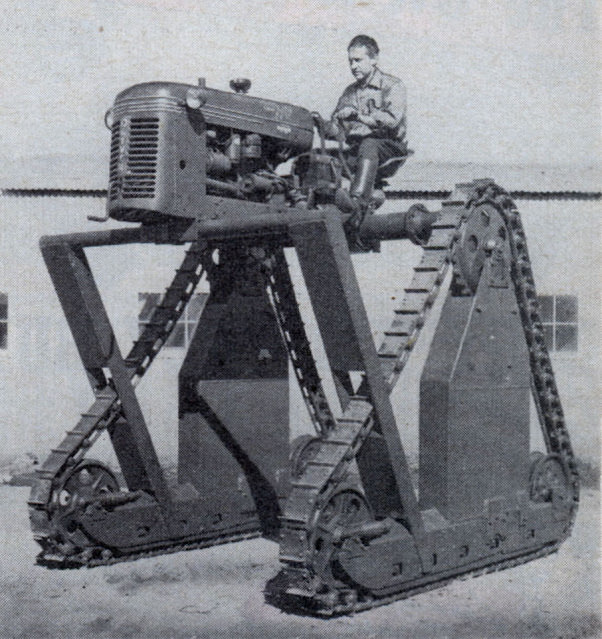
That height was not accidental. With 6½ feet of clearance beneath the frame, the tractor could straddle two full rows of corn at once without touching a single stalk. As it moved through the field, it dusted a total of 12 rows in a single pass. A framework mounted at the rear of the tractor held the dusting equipment in place, keeping it positioned precisely over the rows below.
Detasseling — the process of removing the pollen-producing tops of corn plants to control pollination — required workers on the ground, or close to it. The stilt tractor addressed this by fitting hangers along its sides. Workers rode these hangers down between the rows as the machine moved forward, putting them right at the level of the tassels. This meant a crew could detassel at the same time the machine dusted, turning two separate jobs into one continuous operation.
The real test came during wet weather. California’s corn-growing season regularly brought rain that turned field soil into thick, clinging mud. Conventional rubber-tired tractors bogged down under those conditions, sometimes stopping field work entirely for days. When dusting and detasseling are delayed, corn quality suffers and yields drop. The stilt tractor’s crawler tracks spread its weight over a much larger surface area than rubber tires, and its extreme height kept the heavy body of the machine well above the mud. It kept moving when everything else stopped.
The engineering behind it was straightforward but deliberate. Every modification — the raised chassis, the extended side frames, the extra track sections — served a specific purpose tied to the conditions in California’s corn fields. There was no wasted design. The machine was built to do one job extremely well: keep field operations running through the tall rows and wet ground that defeated standard equipment.
At a time when farm mechanization was rapidly changing what was possible in American agriculture, the stilt tractor stood out not because it was high-tech, but because it was practical. It took existing crawler technology and stretched it — literally — to meet a need that no off-the-shelf machine could handle. For California’s sweet corn growers in 1954, that difference between getting the job done and losing it to the weather was measured in exactly 78 inches of clearance.