

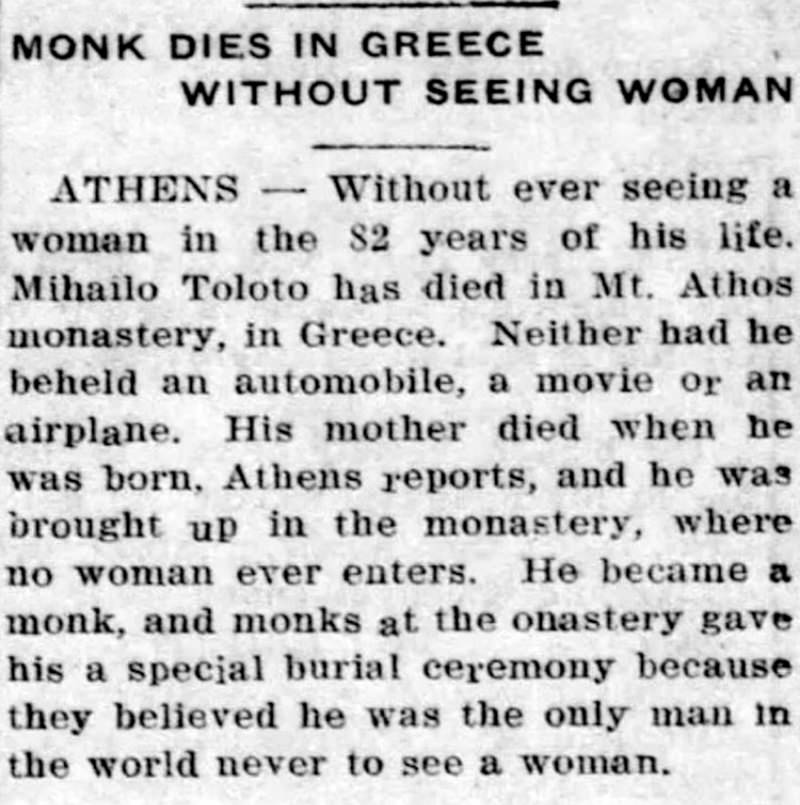
In 1856, a baby boy was left on the stone steps of a monastery on Mount Athos, Greece. His mother had died just four hours after giving birth to him. No family member came forward to claim the child. The monks who found him took him in, raised him, and gave him a name: Mihailo Tolotos. That name, roughly translated, means “the one who is entirely from Mount Athos.” It turned out to be a perfect fit. Mihailo would spend every single day of his 82-year life within that sacred mountain — and in all that time, he would never once see a woman.
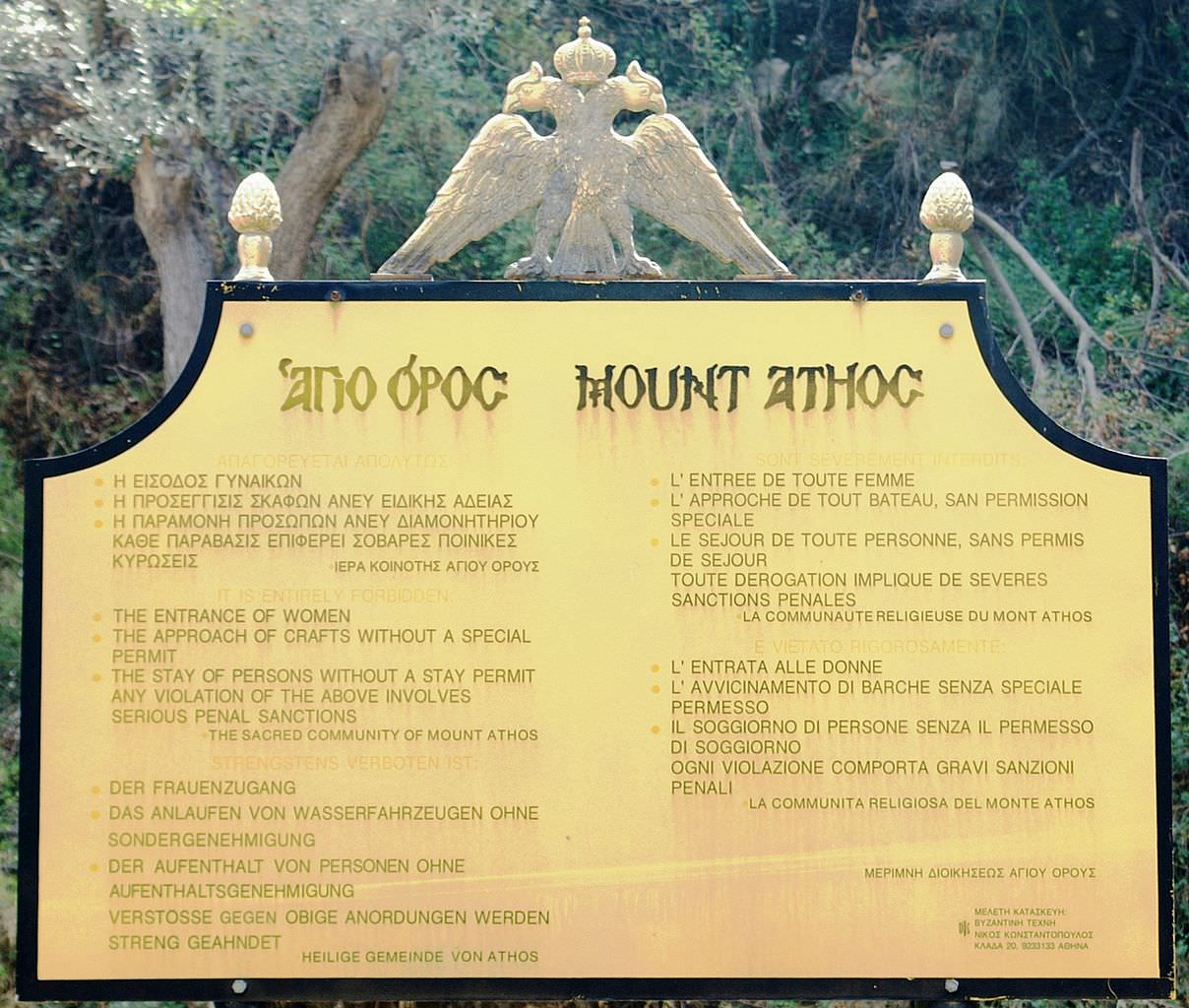
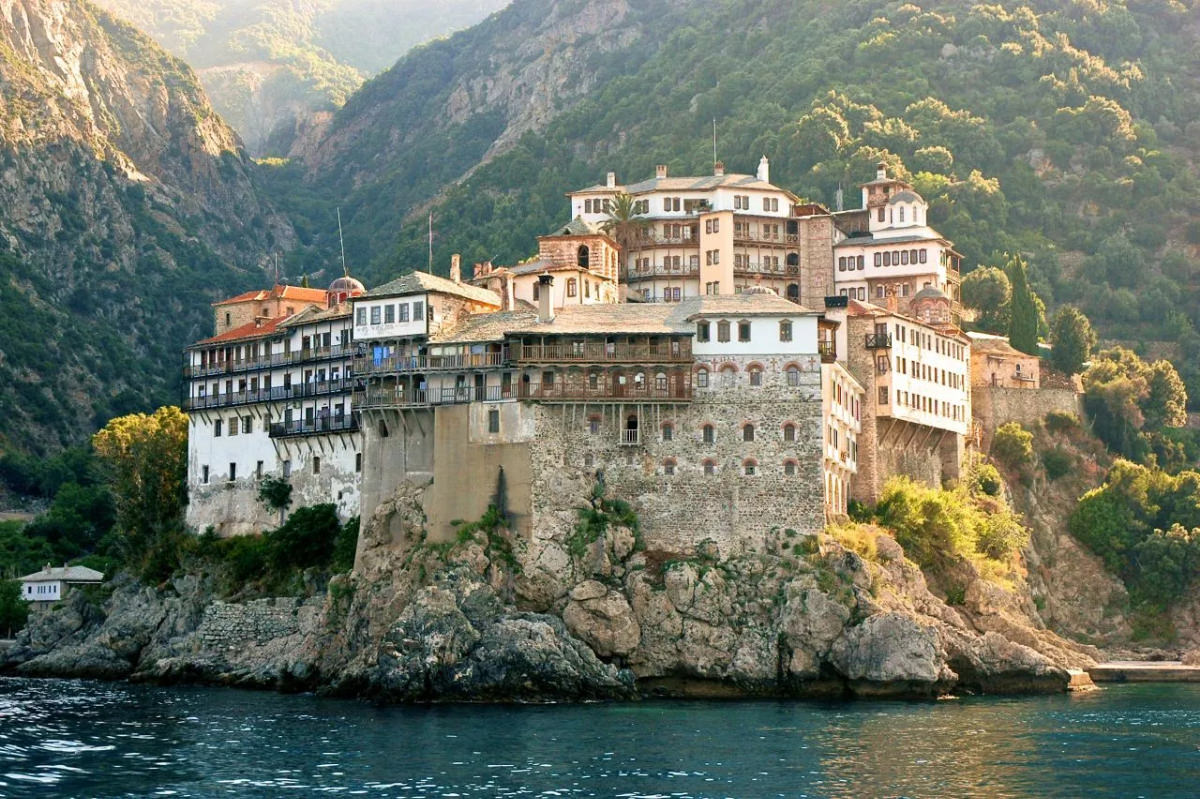
Mount Athos is a peninsula in northern Greece that juts into the Aegean Sea. It functions as an autonomous monastic republic, self-governed and deeply rooted in Eastern Orthodox Christian tradition. Monasteries have operated there for over a thousand years, making it one of the oldest continuously active centers of Christian monasticism in the world. Men from across the Orthodox world travel there as pilgrims or take up permanent residence as monks. Access is tightly controlled, and entry requires a special permit. But one rule above all others defines life on the mountain: no woman has ever been permitted to set foot there.
This rule is known as the avaton. It is not a modern regulation or a guideline that bends with time — it is an ancient prohibition that has been enforced for centuries. The avaton bars all females from entering Mount Athos, including female animals in some of the stricter monasteries. The rule is tied to a theological tradition that holds the Virgin Mary as the sole female presence on the mountain. Whatever one makes of the reasoning, the enforcement has been absolute. For Mihailo Tolotos, who arrived on the mountain as a newborn and never left, this meant that a woman was something he had heard about but never seen.
Growing up inside a monastery is not a typical childhood, but Mihailo’s life there was structured and purposeful. The monks who adopted him gave him an education grounded in Orthodox theology, scripture, and the rhythms of monastic life — prayer, fasting, work, and contemplation. These were not abstract practices to him. They were the full shape of his daily existence from the time he could walk. As he matured, he took on the role of a monk himself, committing formally to the vows of the Orthodox monastic tradition.
Mihailo was known among the community for his piety and his strict self-discipline. Asceticism — the practice of denying physical comforts in order to focus on spiritual development — was central to his character. He spent the bulk of his time in prayer and religious study, rarely going beyond the walls of the monastery. The life he led was deliberately narrow in its physical scope but deeply developed in its interior dimension. To the monks around him, he was not unusual. He was simply one of them, shaped entirely by the same traditions that had shaped generations of monks before him.
What made Mihailo’s story stand out, at least to the outside world, was the totality of his separation from half of humanity. Most monks on Mount Athos arrive as adults. They have lived in the world, they have known women — as mothers, sisters, neighbors, colleagues. They choose the mountain. Mihailo had no such choice. He was placed there before he had any awareness of the world beyond. The circumstances of his birth and abandonment meant that his entire frame of reference for human life was built without the experience of half the human population.
Mount Athos, for all its isolation, was never a truly silent or sealed-off place. Pilgrims traveled there regularly, monks arrived from other countries, and goods and communications passed in and out. Mihailo interacted with a wide range of people throughout his life — visiting clergy, other resident monks, and Orthodox Christians who made the journey to the holy mountain seeking spiritual guidance. His world was small geographically, but it was not without human contact. The mountain was, and remains, a living community.
Mihailo Tolotos died in 1938 at the age of 82. He had been born into extraordinary circumstances — motherless, unclaimed, and placed at the threshold of one of the world’s most unusual human communities. He left that community the same way he had entered it: completely. From birth to death, not a single day of his life had passed outside the borders of Mount Athos. And in all those years, in all those encounters with other monks and pilgrims, the female form remained something he never witnessed in person. His story is documented not because he sought fame, but because the facts of his life, taken together, formed something that had simply never happened before.
The avaton still stands today. Women attempting to enter Mount Athos face legal consequences under Greek law, which honors the autonomous status of the monastic republic. The rule has been challenged in European courts and debated by gender equality advocates, but the monastic community has held firm. For over a millennium, the mountain has kept to its tradition. Mihailo Tolotos lived and died inside that tradition, more completely than anyone before or since.