On April 8, 1994, an electrician named Gary Smith arrived at Kurt Cobain’s Seattle home to install security lighting. When he peered through the window of the small room above the garage, he saw a figure lying on the floor. He assumed it was a mannequin. Then he noticed the blood. Smith called the police, and when officers entered the room, they found the body of the most famous rock star in the world — along with a handwritten note, pressed into a flowerpot, written in red ink.
Kurt Cobain was born on February 20, 1967, in Aberdeen, Washington. His early childhood was stable until his parents divorced when he was seven. The split hit him hard. He moved between relatives, rarely felt settled, and developed a deep sense of not belonging. He turned to punk rock music and art as an outlet, spending his youth drawing and practicing guitar. By the late 1980s, he had formed Nirvana with bassist Krist Novoselic as part of Seattle’s underground music scene.
Nirvana’s second album, Nevermind, released in 1991, became a global phenomenon. The single “Smells Like Teen Spirit” pushed Cobain into a level of fame he was deeply uncomfortable with. He struggled to reconcile massive commercial success with his punk rock values. He used his platform to speak against bigotry and bullying, but the spotlight wore on him. He suffered from a chronic, undiagnosed stomach condition that caused him constant physical pain. To manage that pain alongside his deepening depression, he began using heroin.
In 1992, Cobain married Courtney Love. Their daughter, Frances Bean Cobain, was born that same year. Fatherhood brought him moments of genuine joy, but his addiction continued to worsen. In March 1994, while Nirvana was on tour in Europe, he took a large quantity of prescription pills in a Rome hotel room and fell into a coma. He survived, but his mental state remained fragile. When he returned to Seattle, those close to him feared another attempt was coming.
In late March, Courtney Love and several of Kurt’s friends staged an intervention. They gave him an ultimatum: enter rehab or they would walk away. He agreed and checked into Exodus Recovery Center in Los Angeles on March 30. He lasted two days. On April 1, he told staff he was stepping outside to smoke, climbed over a six-foot fence, and took a taxi to the airport. On the flight back to Seattle, he sat next to Duff McKagan of Guns N’ Roses. Once home, he disappeared. His mother filed a missing persons report on April 4. Courtney Love hired private investigator Tom Grant to track him down. Grant searched multiple locations but never found him.
On the morning of April 5, 1994, Cobain went into the room above his garage. He wrote a long letter in red ink, placed it in a flowerpot, and used a shotgun to end his life. He was 27 years old. His body remained there for three days before Gary Smith made the grim discovery on April 8.
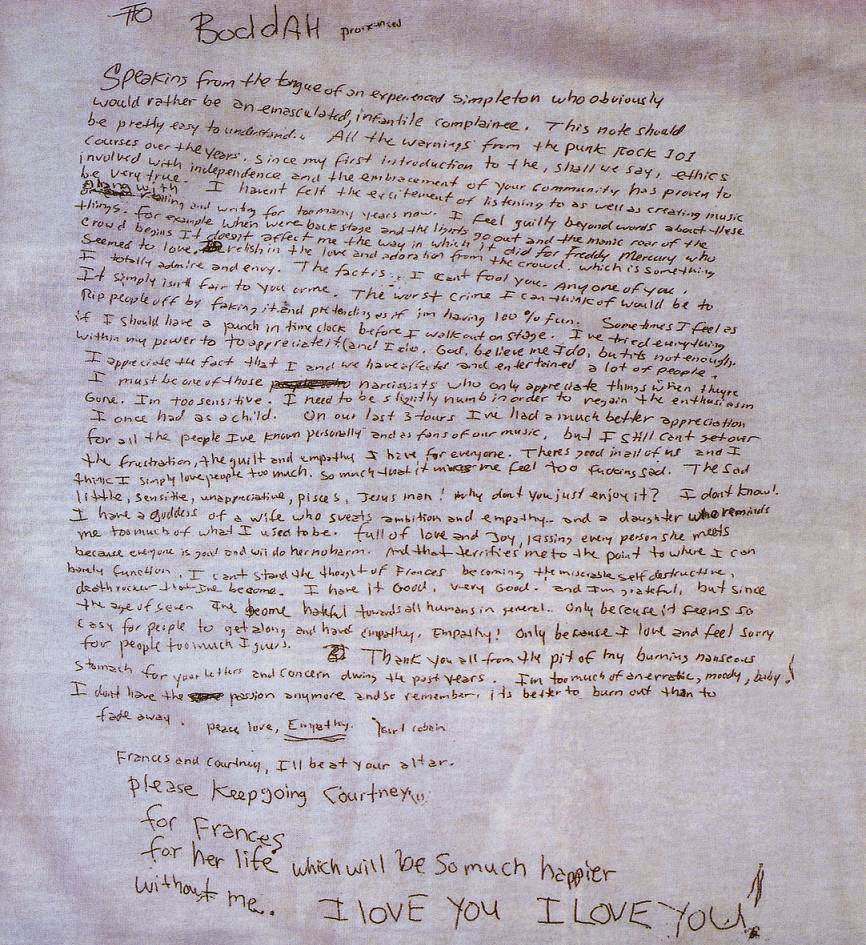
The note was addressed to “Boddah” — the name of Cobain’s imaginary childhood friend. It opened with: “Speaking from the tongue of an experienced simpleton who obviously would rather be an emasculated, infantile complain-ee.” From the start, the letter was self-aware and bleak. He wrote that he had not felt excitement from listening to or creating music for years. He described the moment before a performance — the lights going out, the crowd roaring — and said it no longer moved him. He compared himself to Freddie Mercury, who clearly thrived on the adoration of crowds, and wrote that he envied that quality in Mercury. Cobain felt he was faking enthusiasm, and he called faking it “the worst crime I can think of.”
He wrote about his daughter Frances with raw tenderness and terror in equal measure. He described her as “full of love and joy, kissing every person she meets because everyone is good and will do her no harm.” That innocence frightened him. He wrote that he could not stand the thought of her growing into the same “miserable, self-destructive, death rocker” he had become. He acknowledged that his life, by any objective measure, was good — “I have it good, very good, and I’m grateful” — but said he had been “hateful towards all humans in general” since the age of seven. He described feeling too much, loving people too deeply, and being made “too fucking sad” by it.
The note closed with the line: “It’s better to burn out than to fade away” — a lyric from Neil Young’s song “Hey Hey, My My.” The final lines, written in larger and messier handwriting, addressed Courtney and Frances directly. He told Courtney to keep going for Frances, wrote “her life will be so much happier without me,” and ended with “I LOVE YOU. I LOVE YOU!”
Tom Grant, the private investigator, studied the note after Cobain’s death. He obtained a photocopy and argued publicly that the main body of the letter was actually a retirement note — that Cobain was planning to quit music and leave Courtney Love, not to die. Grant pointed to the final lines, which were the only section referencing death, and suggested they were written by a different hand. The official police investigation disagreed. Handwriting experts examined the letter and concluded Cobain wrote every word. The shift in handwriting style at the bottom was consistent with a person under extreme stress or the influence of drugs. When Cobain’s personal journals were published in 2002, they confirmed that he regularly changed his handwriting style within a single page.
The toxicology report found an extremely high concentration of heroin in Cobain’s system at the time of his death. The door to the room was locked from the inside with a stool. There were no signs of a struggle, no unidentified fingerprints on the shotgun, and none on the pen used to write the note. The Seattle Police Department closed the case as a suicide. A public memorial drew thousands of fans to Seattle. At the gathering, Courtney Love played a recording of herself reading the note aloud to the crowd, interjecting with her own comments and anger throughout. The house became a gathering place where fans left flowers for years afterward.