By 1926, Hollywood was already building the mythology that would define it for the next century. Studios weren’t just making films — they were manufacturing stars, symbols, and spectacle at an industrial scale. Metro-Goldwyn-Mayer sat at the top of that machine. With its roaring lion mascot, its Latin motto “Ars Gratia Artis” (Art for Art’s Sake), and a roster of talent that few studios could match, MGM was the most powerful production company in Hollywood. That year, it added one more name to its ranks: Greta Garbo.
Garbo was 20 years old and had already made a name for herself in Swedish cinema before arriving in the United States. Born Greta Lovisa Gustafsson in Stockholm in 1905, she trained at the Royal Dramatic Theatre before catching the eye of Swedish director Mauritz Stiller. It was Stiller who brought her to Hollywood, and MGM who signed her. Studio head Louis B. Mayer initially had doubts about marketing a foreign actress to American audiences, but those doubts didn’t last long. Garbo’s screen presence was unlike anything audiences had seen.
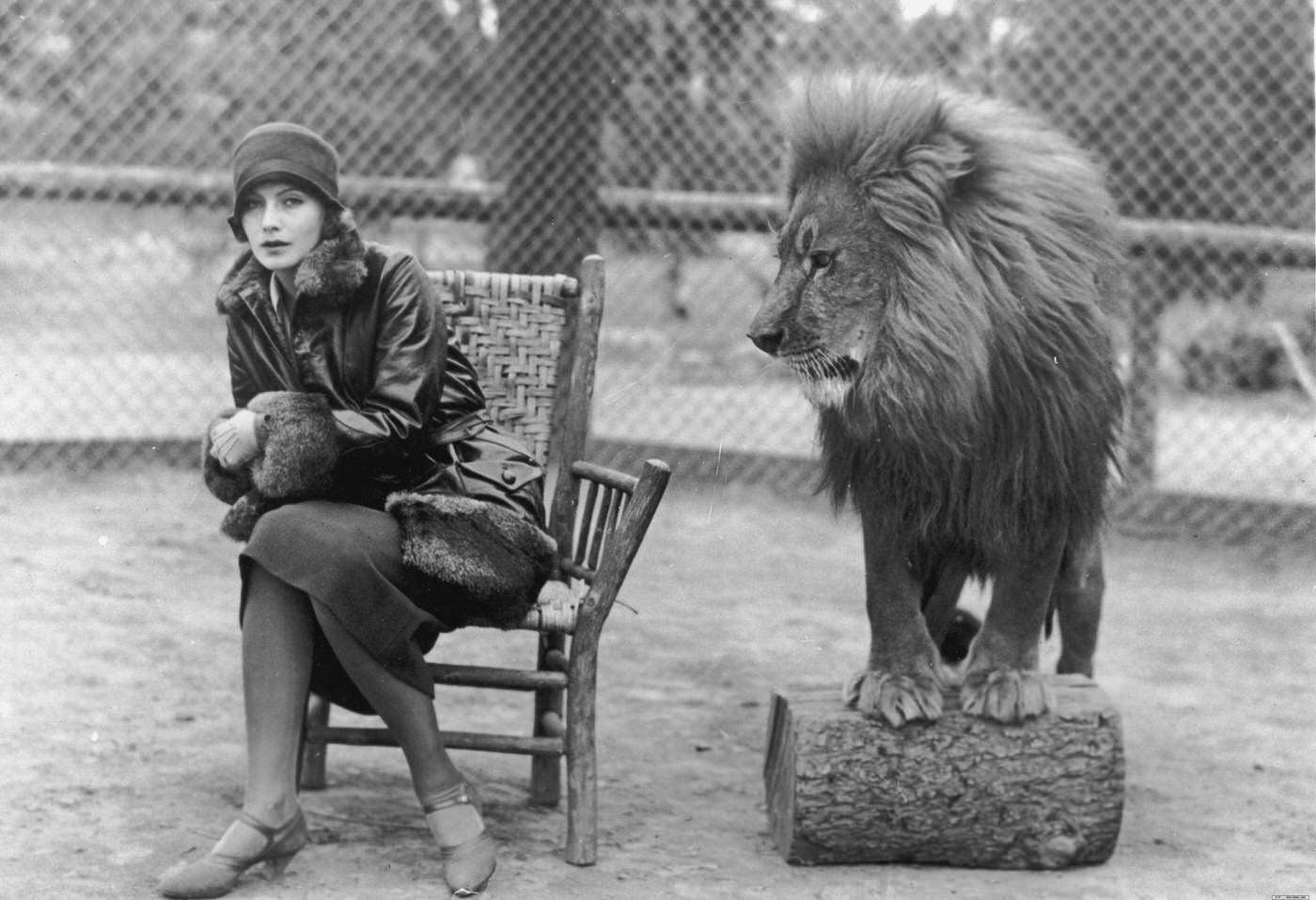
To mark the signing and introduce Garbo to the American public, MGM arranged a promotional photo session with the studio’s most recognizable symbol — Leo the Lion. The idea was straightforward in concept but bold in execution. Placing a new, relatively unknown actress next to a full-grown lion made for an image that no one would forget. It also said something deliberate about the studio: MGM didn’t just discover stars, it created them, and it wasn’t afraid to make a statement doing it.
The photographer behind the lens was Ruth Harriet Louise, MGM’s official portrait photographer and the first woman to hold that role at a major Hollywood studio. Louise had a gift for capturing her subjects in moments that felt both composed and alive. She worked closely with the studio’s biggest names throughout the late 1920s, and her portrait work helped shape the visual identity of MGM’s golden era. The Garbo-lion session was one of her most striking assignments.
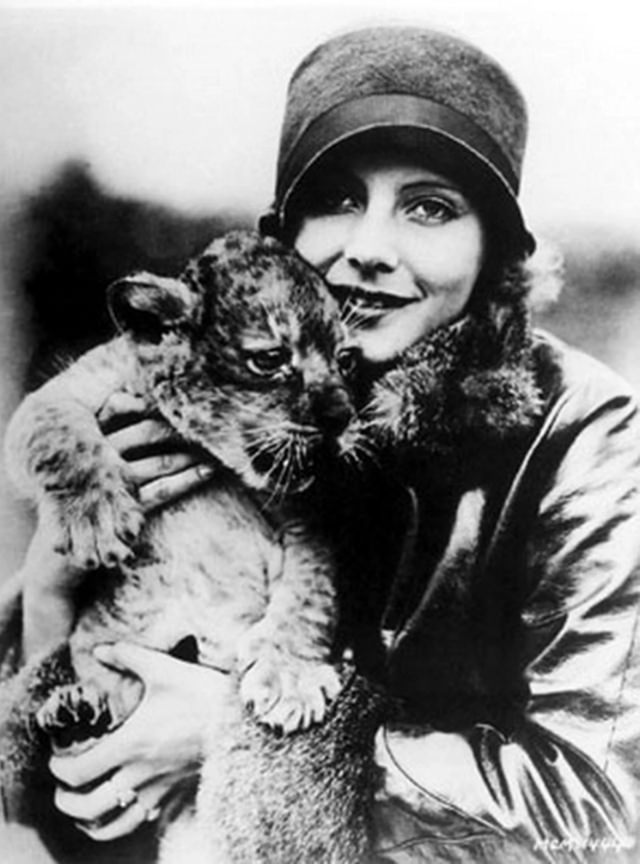
Garbo was not at ease during the shoot. She was hesitant to get close to the animal, and her nerves were visible. The lion used for the session was handled by trainer Mel Koontz, who worked with MGM’s lions regularly and vouched for the animal’s temperament. Koontz reassured Garbo that the lion was well-trained and calm, and she agreed to proceed. In the resulting photograph, Garbo holds the lion’s leash while dressed in an elegant gown, her gaze fixed on the camera with the composed intensity she would become famous for — even as the massive animal sat just inches away.
The tension in the image is real. Garbo’s unease wasn’t hidden or edited out — it’s part of what makes the photograph so compelling. There’s a stark contrast between her poised exterior and the sheer size and power of the lion beside her. That contrast, between the controlled glamour of a film star and the untamed force of a wild animal, gave the photo an energy that purely staged publicity shots rarely achieve.
Leo the Lion had been MGM’s mascot since the studio’s founding in 1924, though several different lions held the role over the years. The roaring lion bookending MGM films became one of the most recognized studio logos in cinema history. Using Leo in promotional material wasn’t unusual for MGM, but pairing him with a brand-new foreign actress — one the studio was actively betting on — gave the session a specific purpose. The message was that Garbo belonged in MGM’s top tier from day one.
Garbo’s first American film, “The Torrent,” was released in February 1926, just months before the photo session. Her second, “The Temptress,” followed later that year. Both were silent films, and both confirmed what MGM had gambled on — that American audiences would respond to her. Within a few years, she was one of the biggest stars in the world, appearing in films like “Flesh and the Devil” (1926), “Anna Christie” (1930), and “Grand Hotel” (1932). But in 1926, the photograph with Leo was one of the first major steps in introducing her to that audience.
Ruth Harriet Louise left MGM in 1930 and retired from photography shortly after marrying director Leigh Jason. She died in 1940 at just 35 years old. Despite her short career, her portrait work — including the Garbo-lion session — remains a defining visual record of Hollywood in its formative years. The 1926 photograph endures not just as a piece of studio promotion, but as a document of a specific moment: a young actress from Stockholm, a nervous expression she couldn’t quite hide, and a lion that had no idea it was making history.