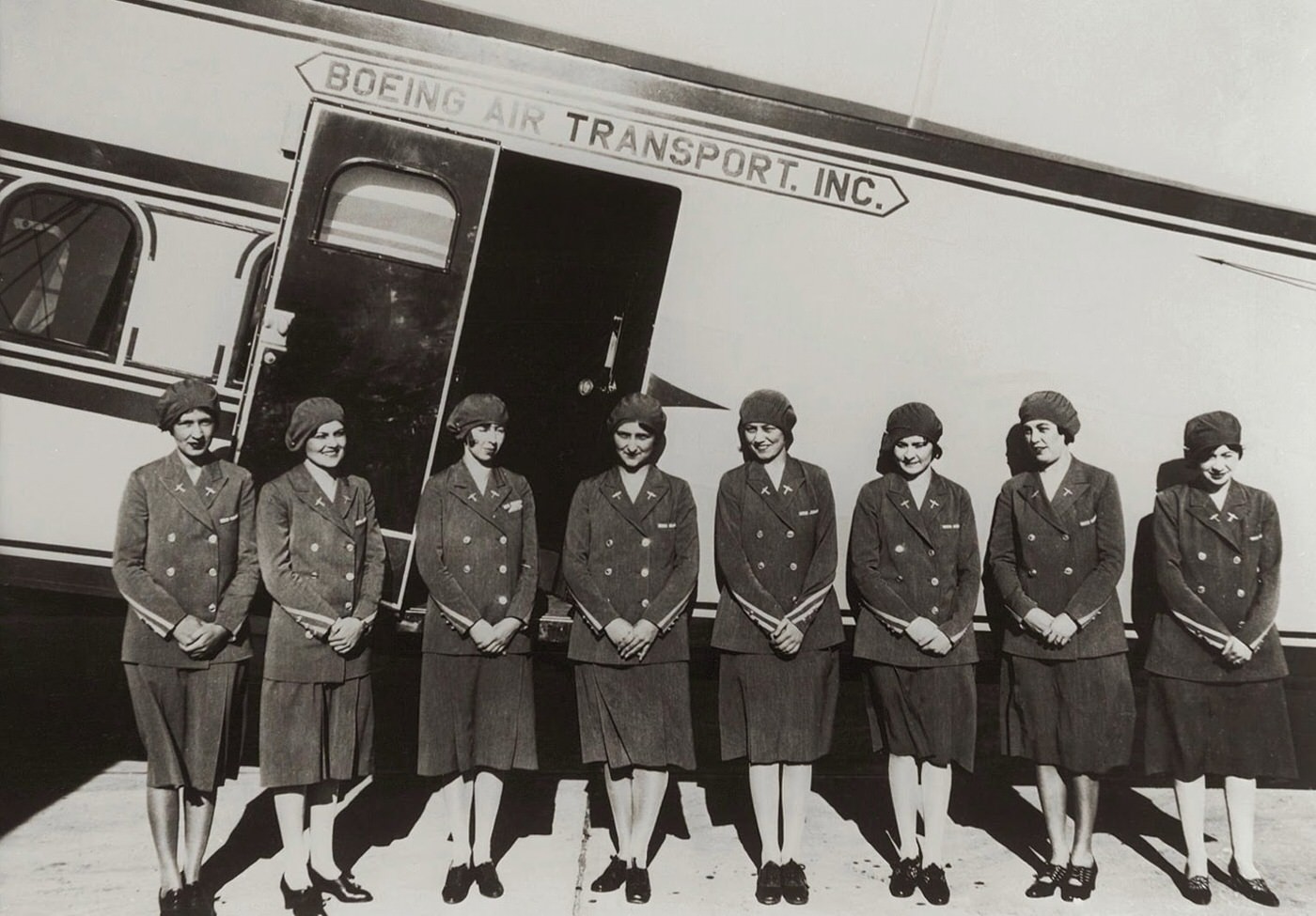
When commercial air travel began in the 1930s, airlines dressed their cabin crews with the same seriousness as a military outfit. Jackets were sharply tailored in navy or deep green wool, skirts fell well below the knee, and white gloves were non-negotiable. Every button was polished. Hats sat at a precise angle, pinned firmly in place. Airlines treated the uniform as a direct statement about safety and discipline — a signal to nervous passengers that everything was under control.
The airline industry’s first stewardesses ready for inspection for Boeing Air Transport, 1930.
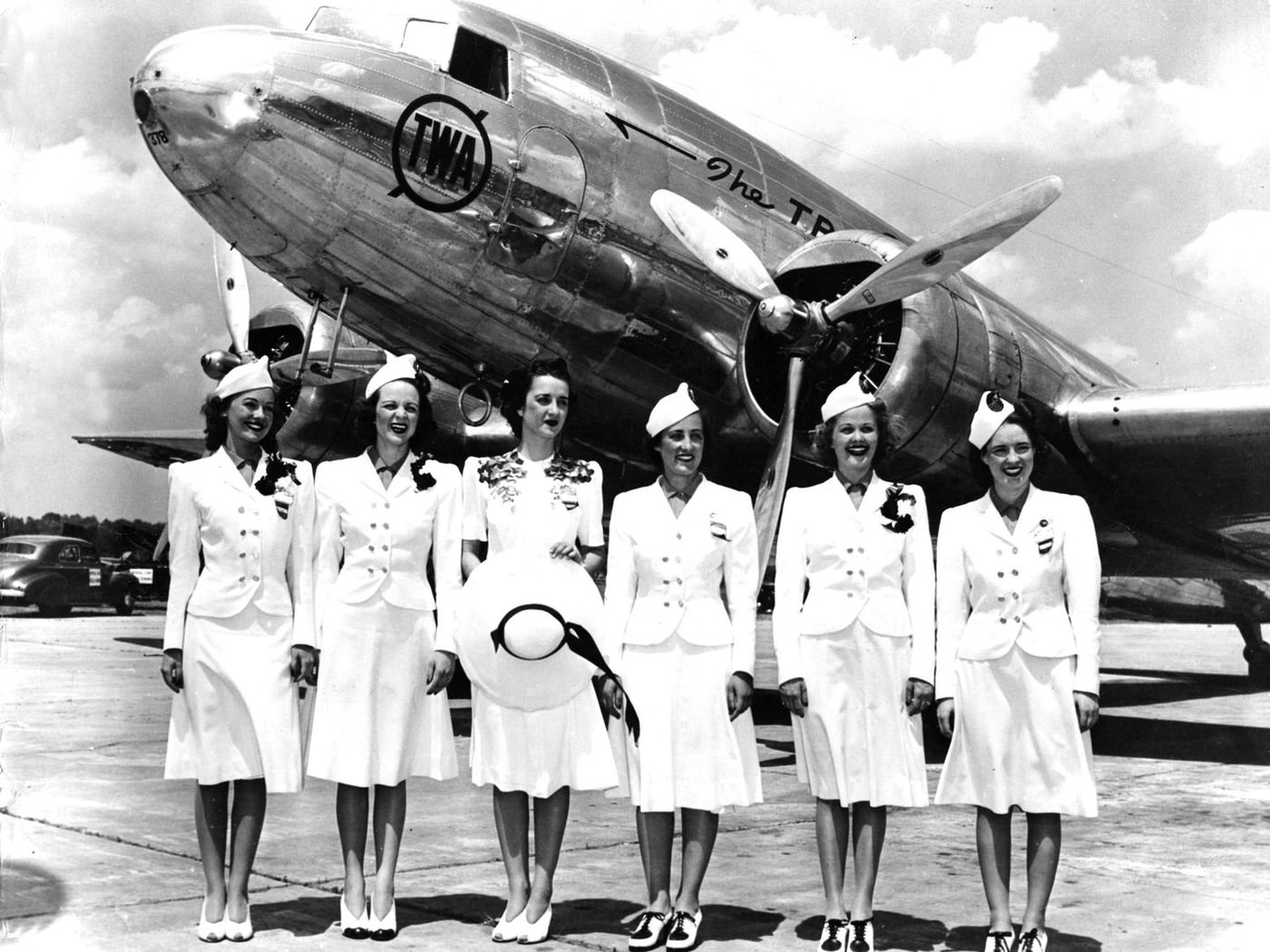
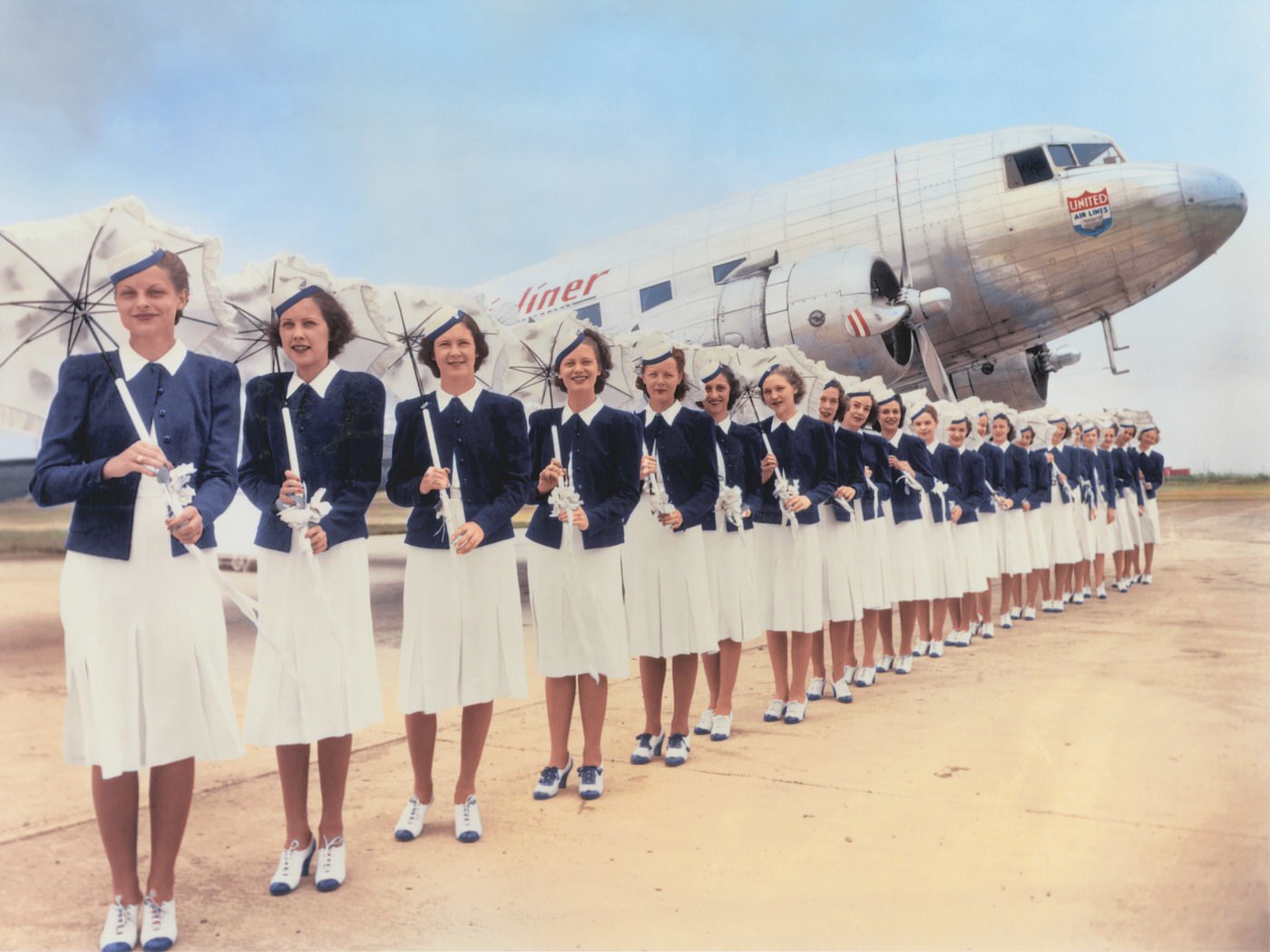
By the late 1930s, major American carriers had established their own distinct looks, turning the uniform into a recognizable brand element.
Transcontinental & Western Air (TWA) uniforms, 1939.United Airlines uniforms, 1939
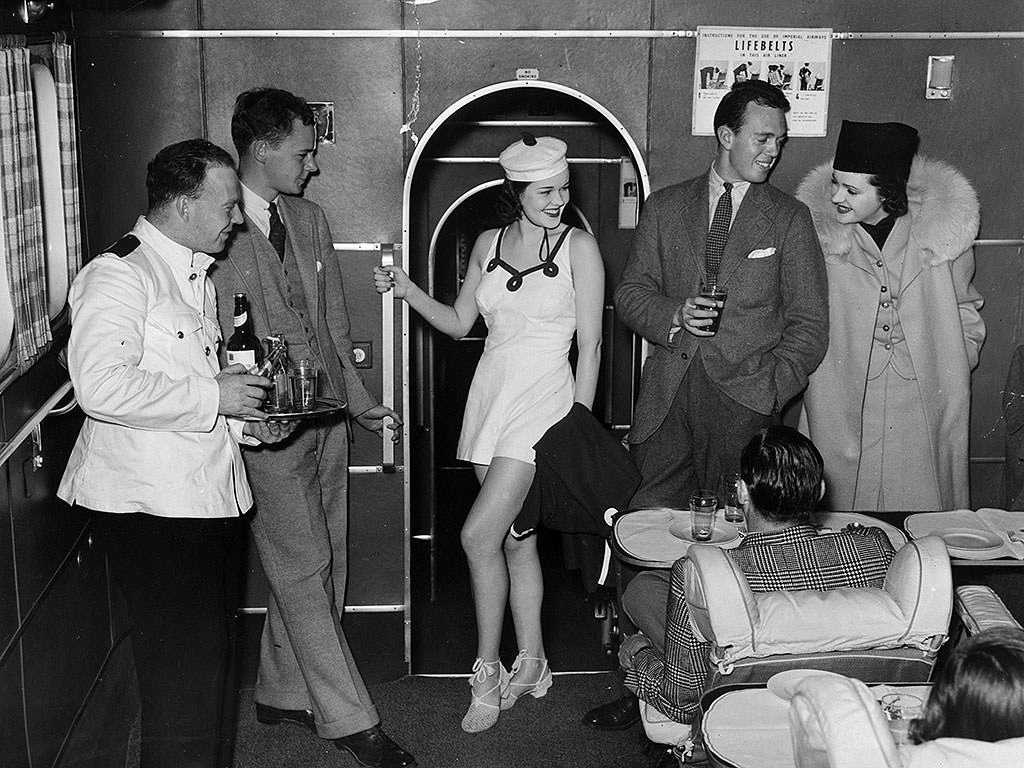
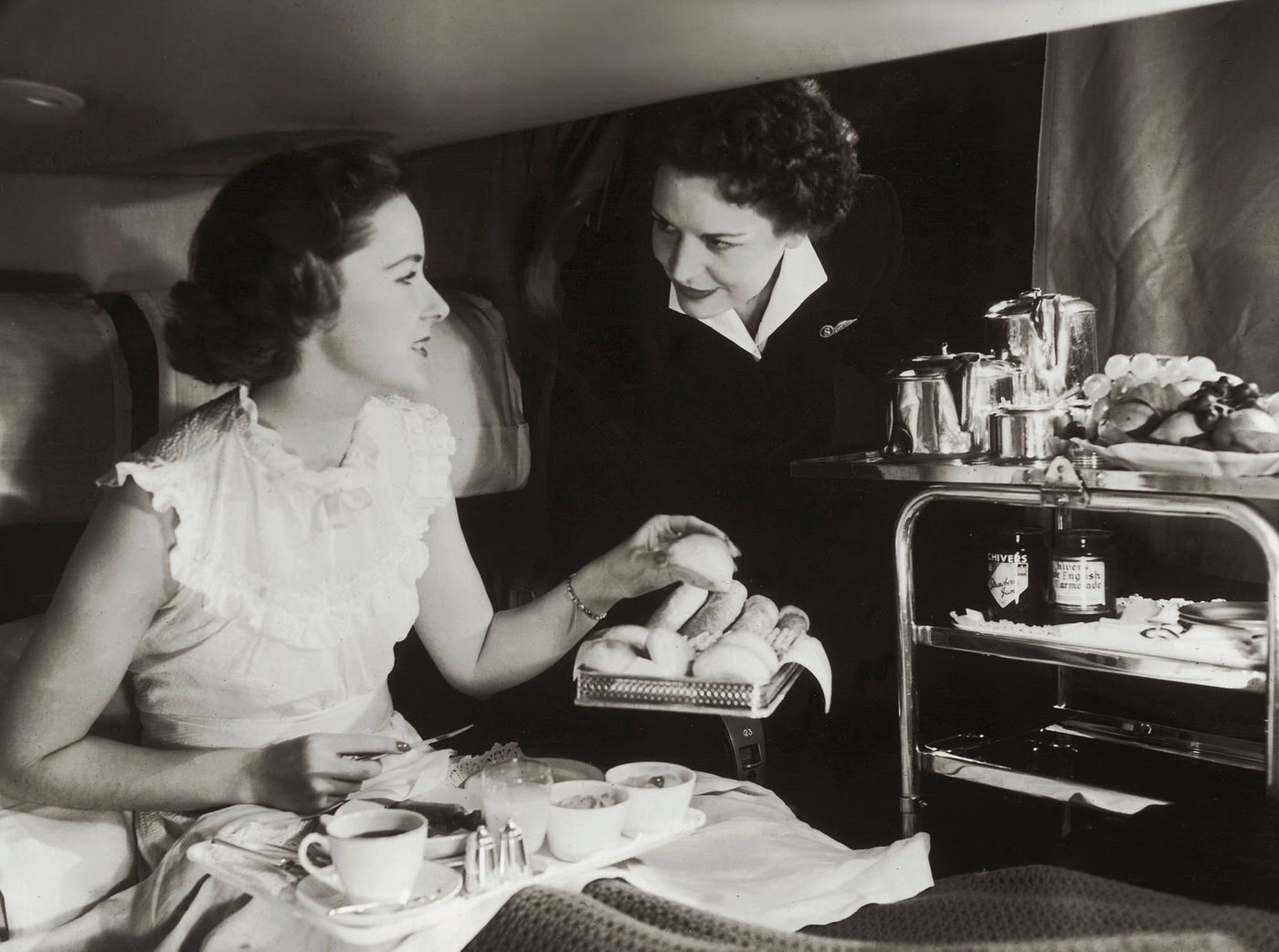
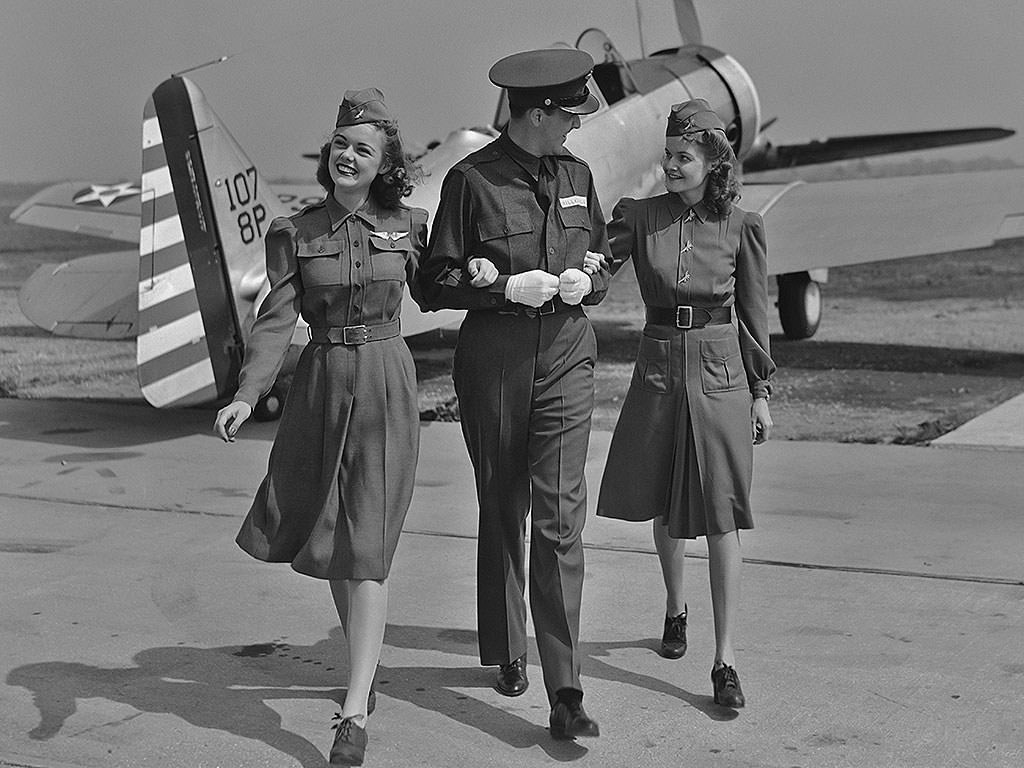
The 1940s brought wartime practicality into the cabin. Fabrics grew sturdier, colors shifted to muted blues and grays, and double-breasted jackets with structured shoulders became standard. Silk scarves in airline colors added a small but deliberate touch of softness. Shoes stayed low-heeled, built for long hours on their feet.
Stewards serving passengers on board an airplane, circa 1945.BOAC breakfast crockery, including egg cup, 1940s.A male flight attendant walks with his arms linked with two female flight attendants in front of a small plane in the 1940s.
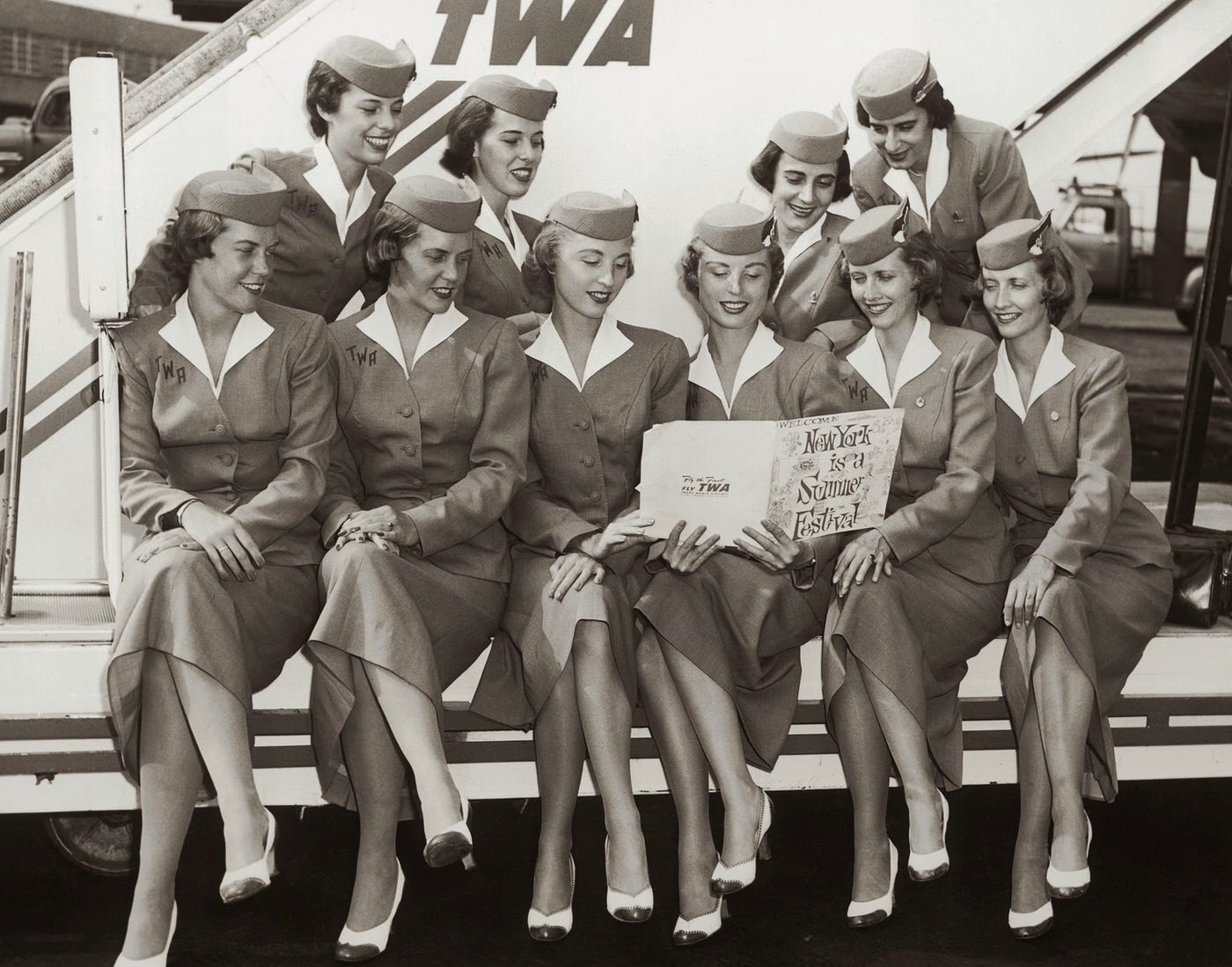
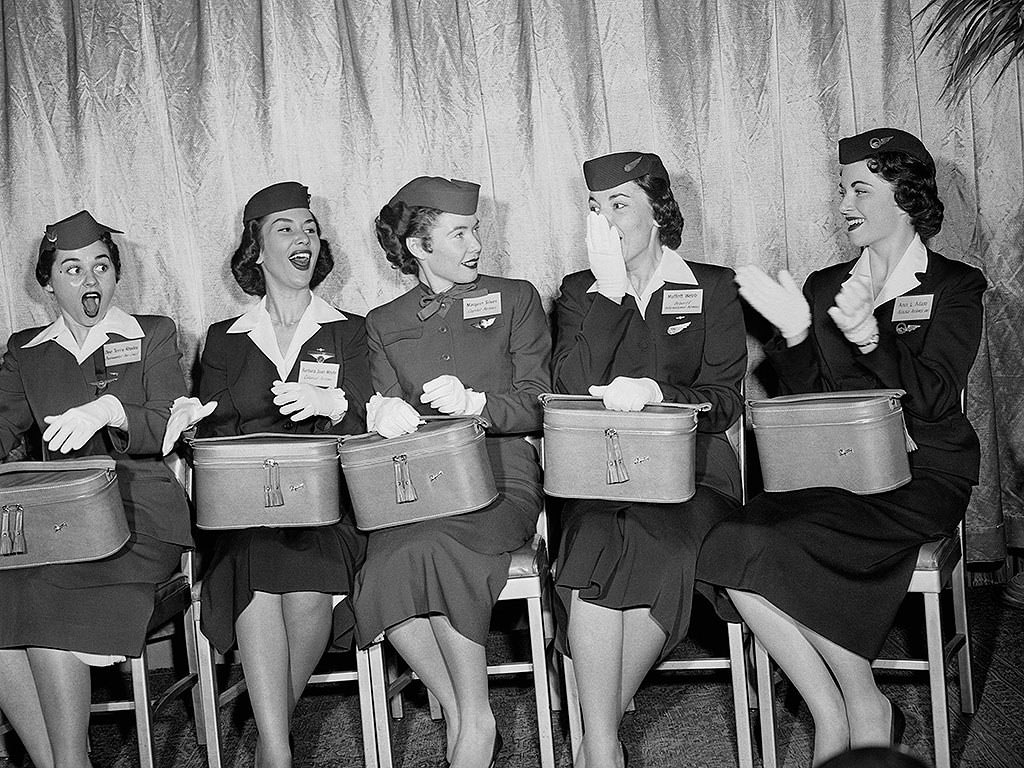
The 1950s arrived with jet travel and a new appetite for glamour. Skirts climbed to mid-calf, jackets were cut to emphasize the waist, and hats shrank into delicate pieces trimmed with short veils. Bright lipstick and neat hair were written into official grooming standards. Bold color accents — scarves in red, gold, or turquoise — tied everything back to airline branding.
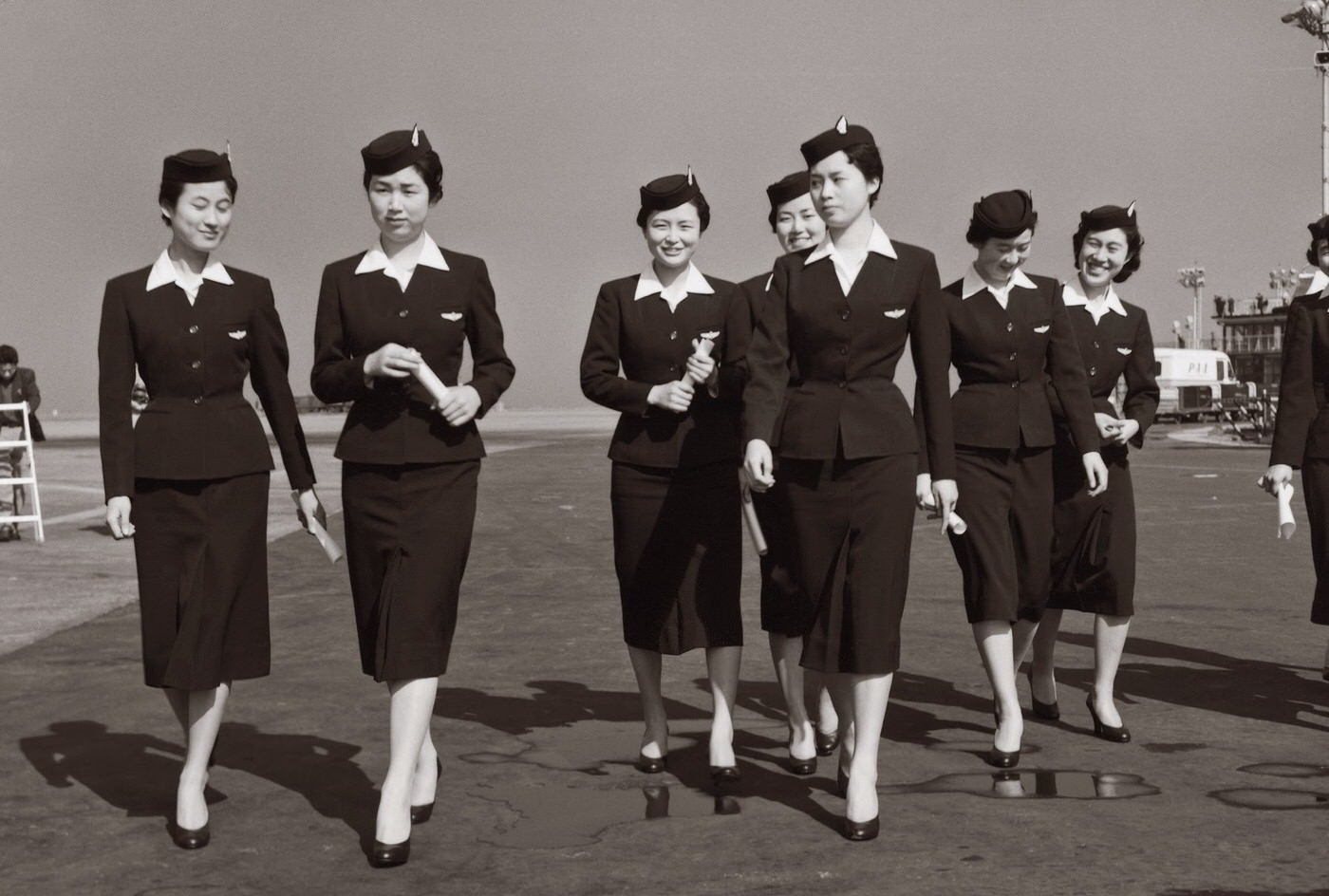
In 1956, five sets of stewardess twins make good publicity material for TWA. They are, front row from left to right, Jean and June Manby, Marilyn and Marlene Nagel, Phyllis and Mary Lous Jibbes and back row, Ruth and Pat Zimmerman and Rose and Victoria Lewis.In the ’50s, flight attendants donned crisp collars and white gloves, with perfect coifs under their caps, 1956.Japan Airlines stewardesses dressed in navy suits, c.1958, designed by Mohei Ito. In 1960, Ito shortened the skirts to just above the knee and added gold buttons.
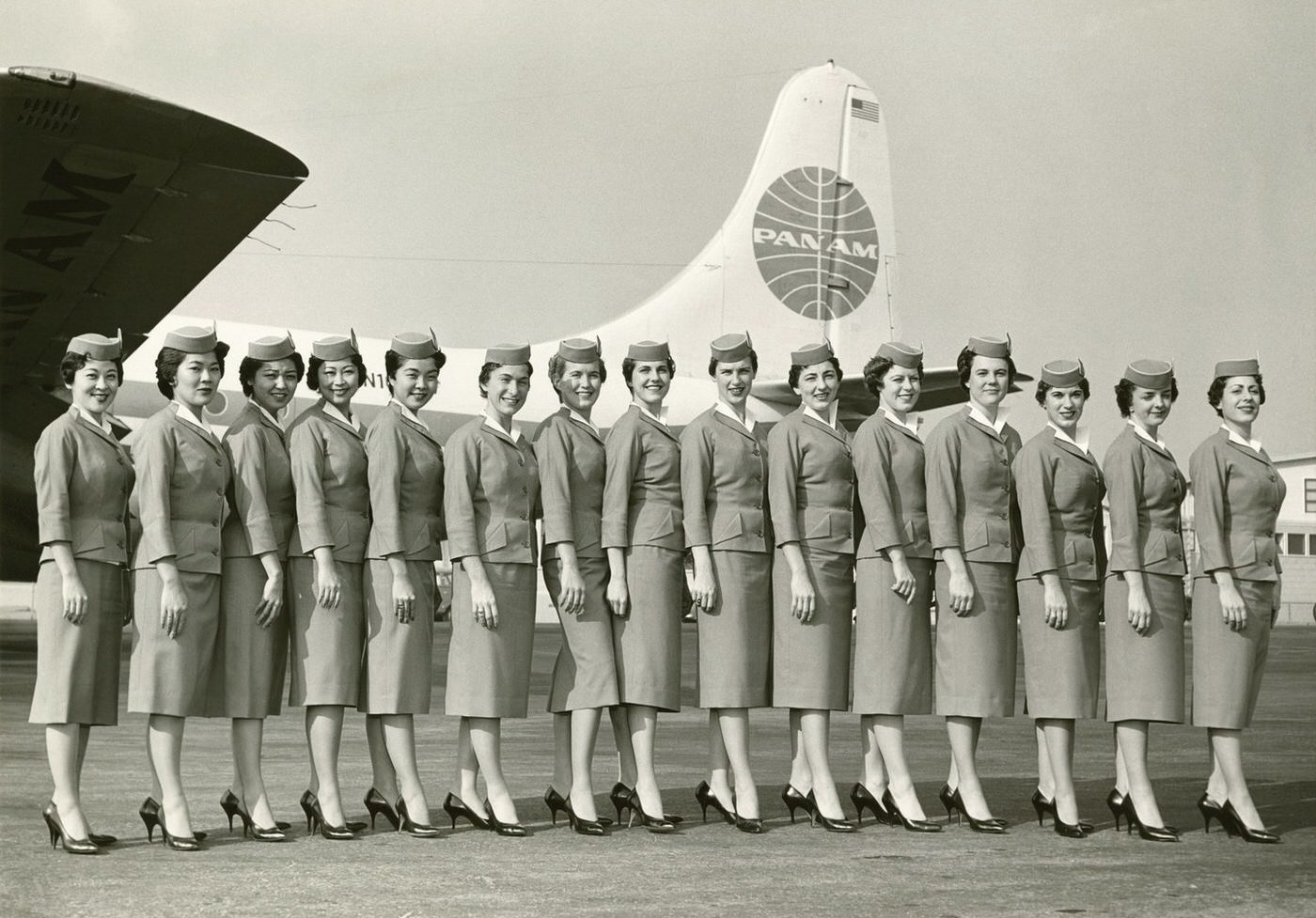
Pan American Airways leaned fully into elegance by the end of the decade, commissioning designer Don Loper to craft uniforms that presented flight attendants as the very picture of femininity — a deliberate choice that made their look one of the most sought-after in aviation history.
Pan American uniforms by Don Loper, 1959. Pan Am, as it was usually called, presented their flight attendants as examples of femininity and elegance. It’s no wonder the uniforms remain highly collectible even today.
The 1960s brought fashion designers directly into airline boardrooms. Hemlines moved above the knee, and mod-inspired cuts replaced the softer shapes of the previous decade. Oleg Cassini and Emilio Pucci were both hired by major carriers to produce uniforms with real fashion credentials.
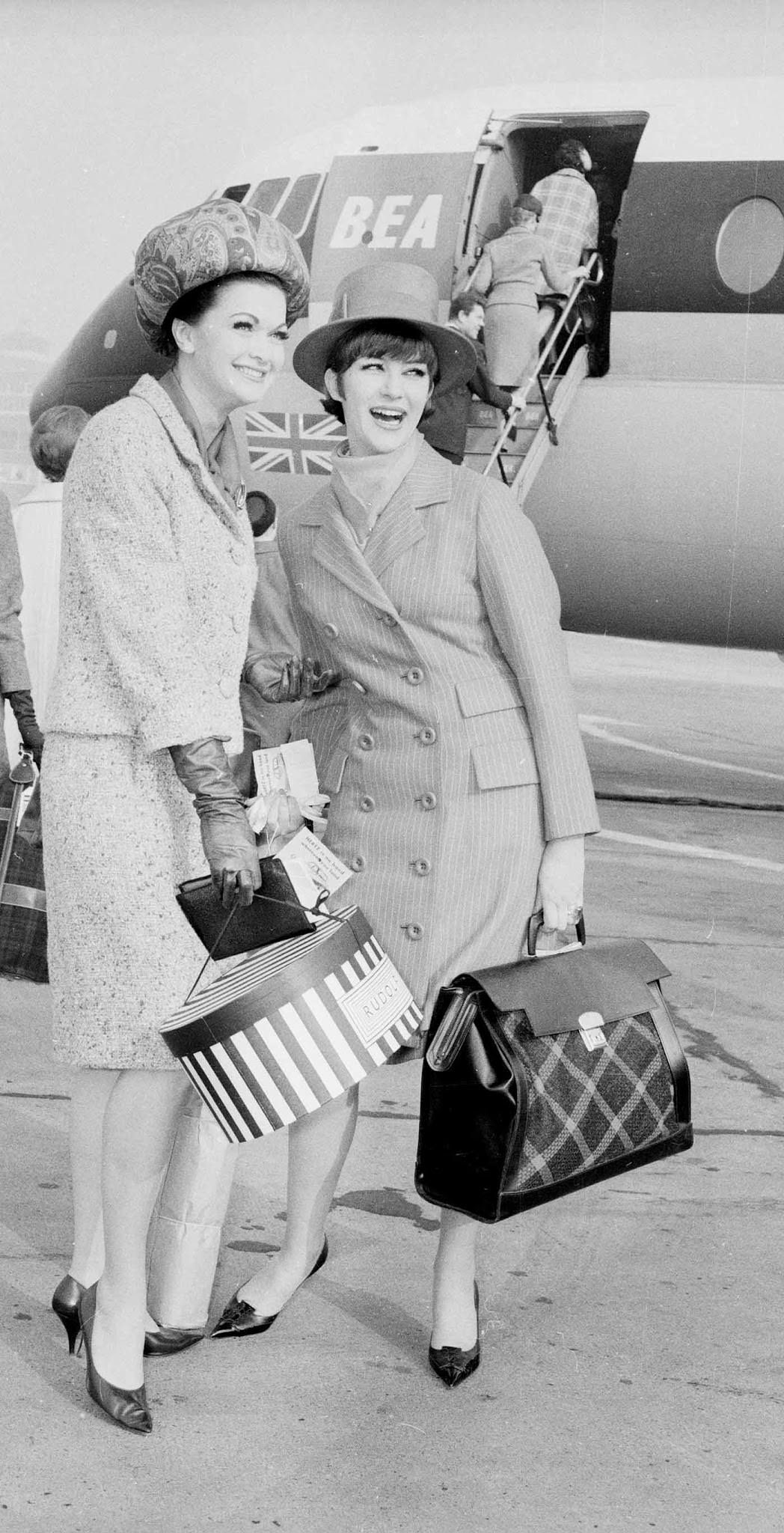
Air hostesses Penny Gillard and Jackie Bowyer prepare to board a BEA passenger plane for Paris, 1963.
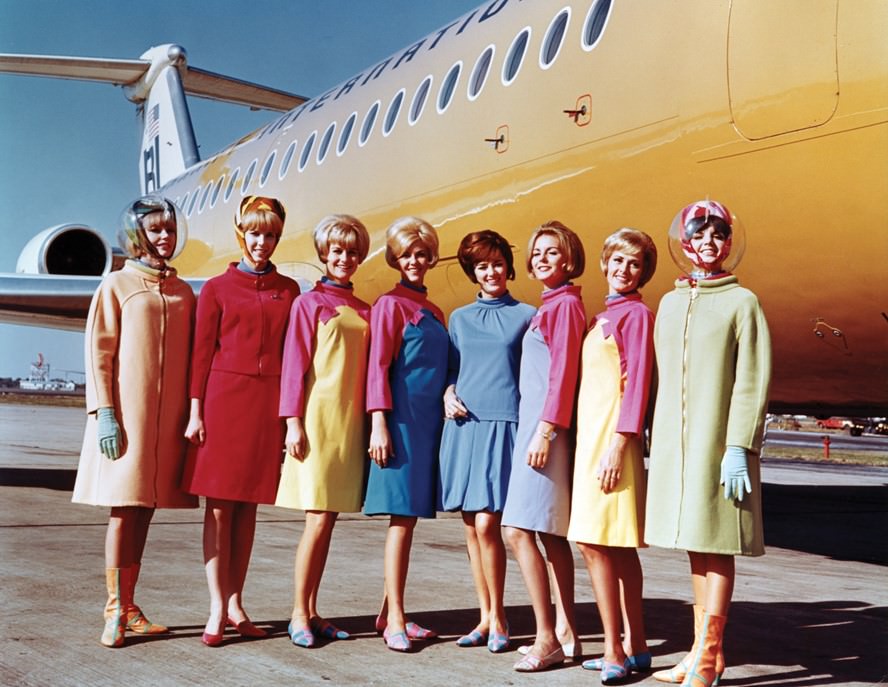
Pucci’s work for Braniff International was the most radical of the era — vibrant geometric patterns, coordinated boots and gloves, and a color palette that made the aircraft cabin feel like a runway.
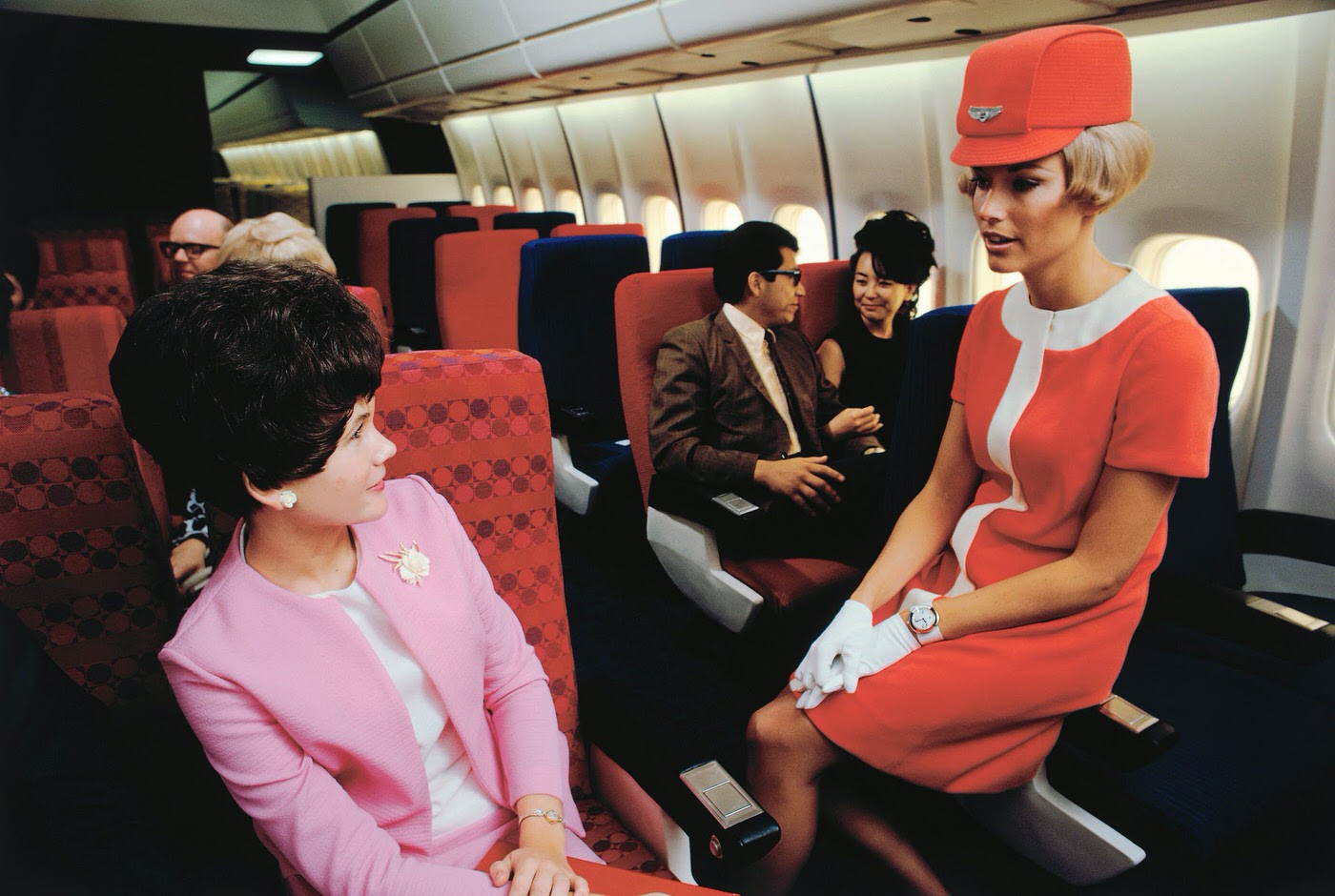
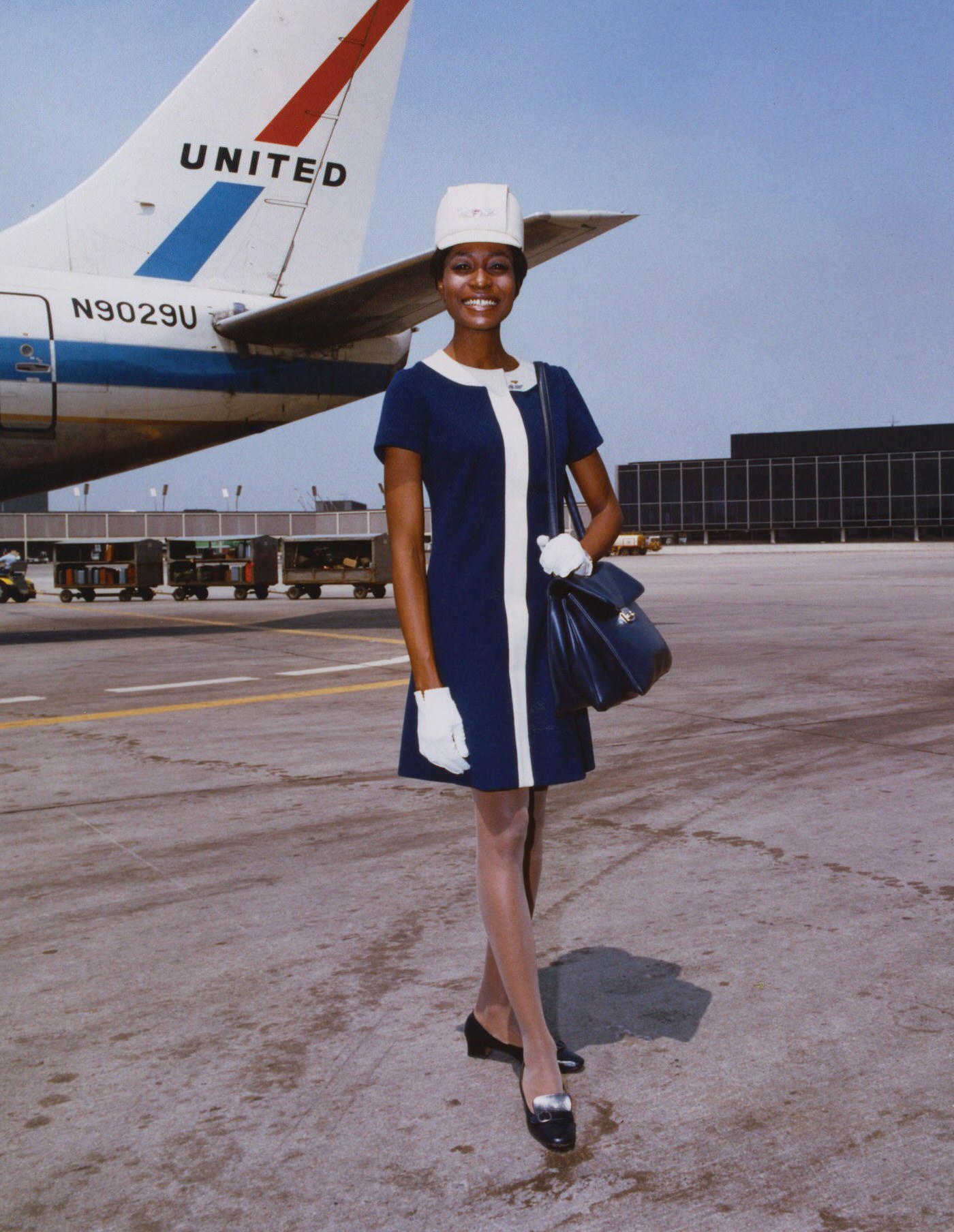
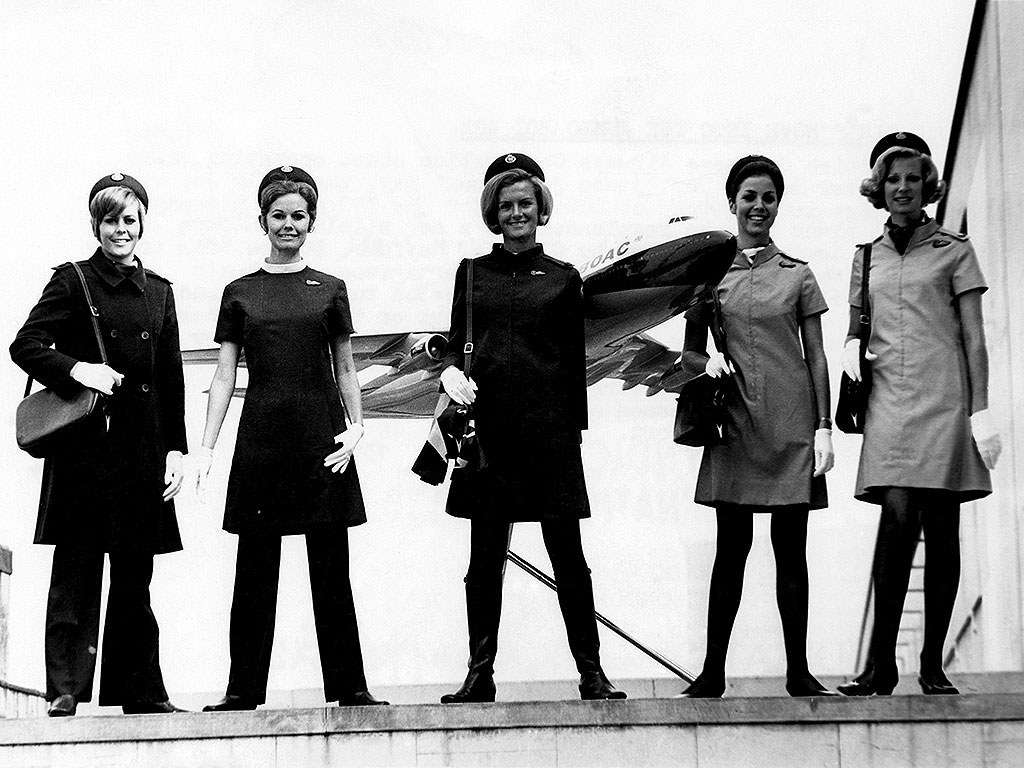
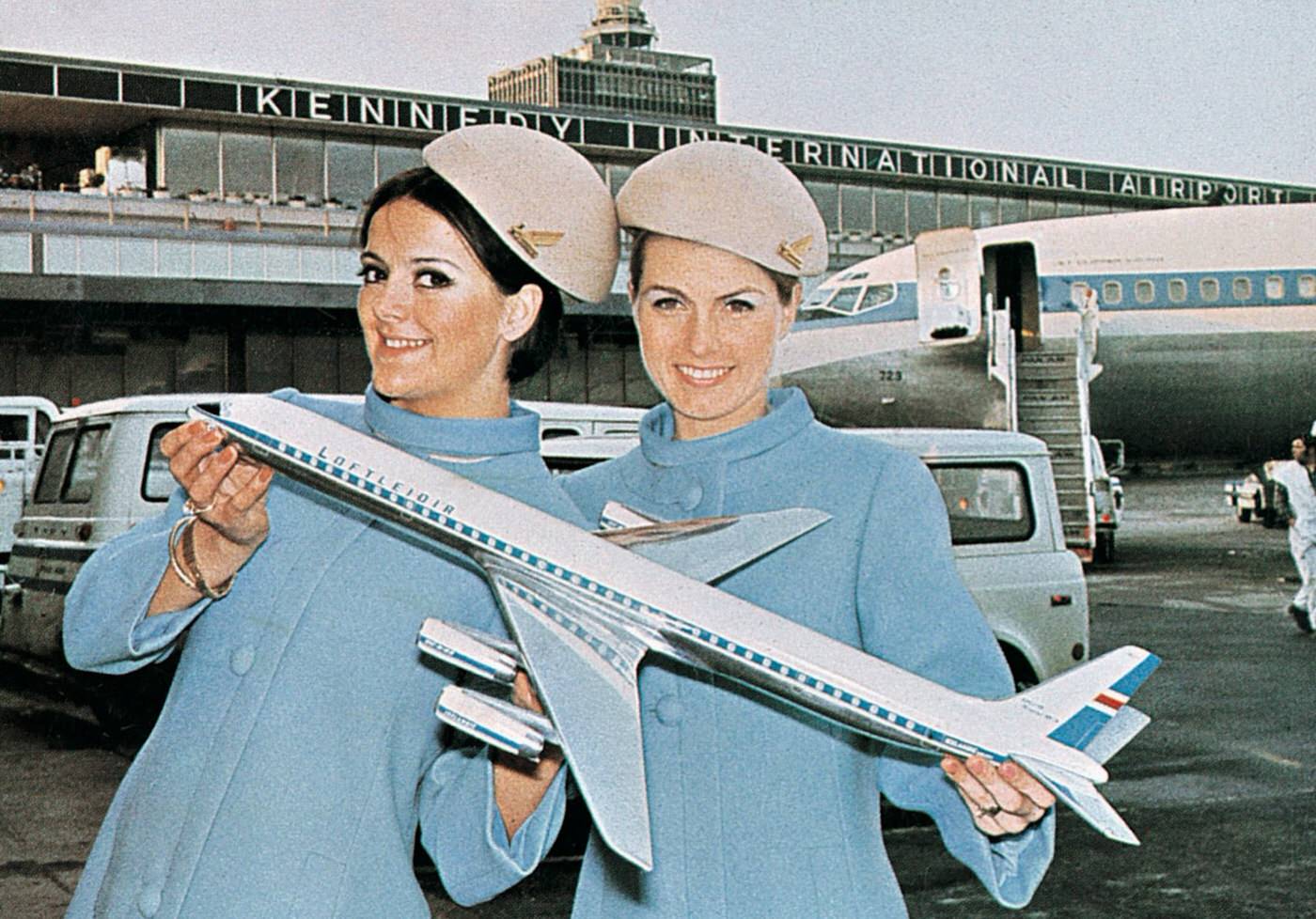
Braniff International uniforms by Emilio Pucci, 1965.A United Airlines stewardess chats to a passenger in a simulated cabin of a Douglas DC-10, 1968.United Airlines uniforms by Jean Louis, 1968.Air hostesses in shorter skirts at a London airport pose in 1969.Icelandic Air stewardesses pose with a model Douglas DC-8, 1960s.
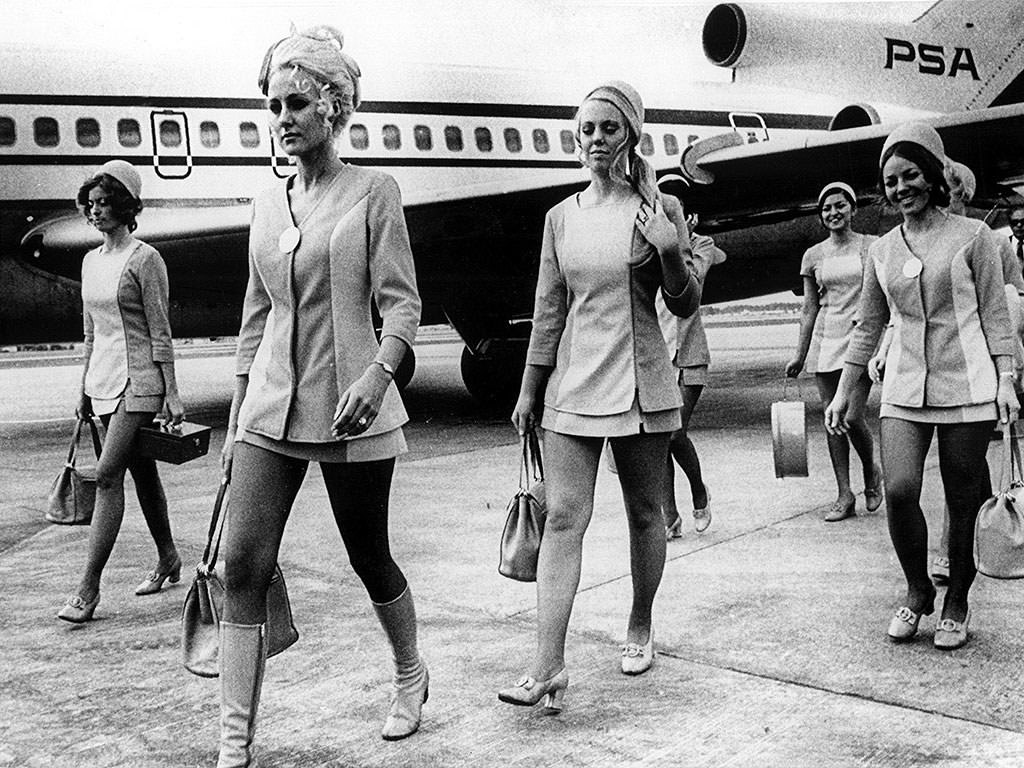
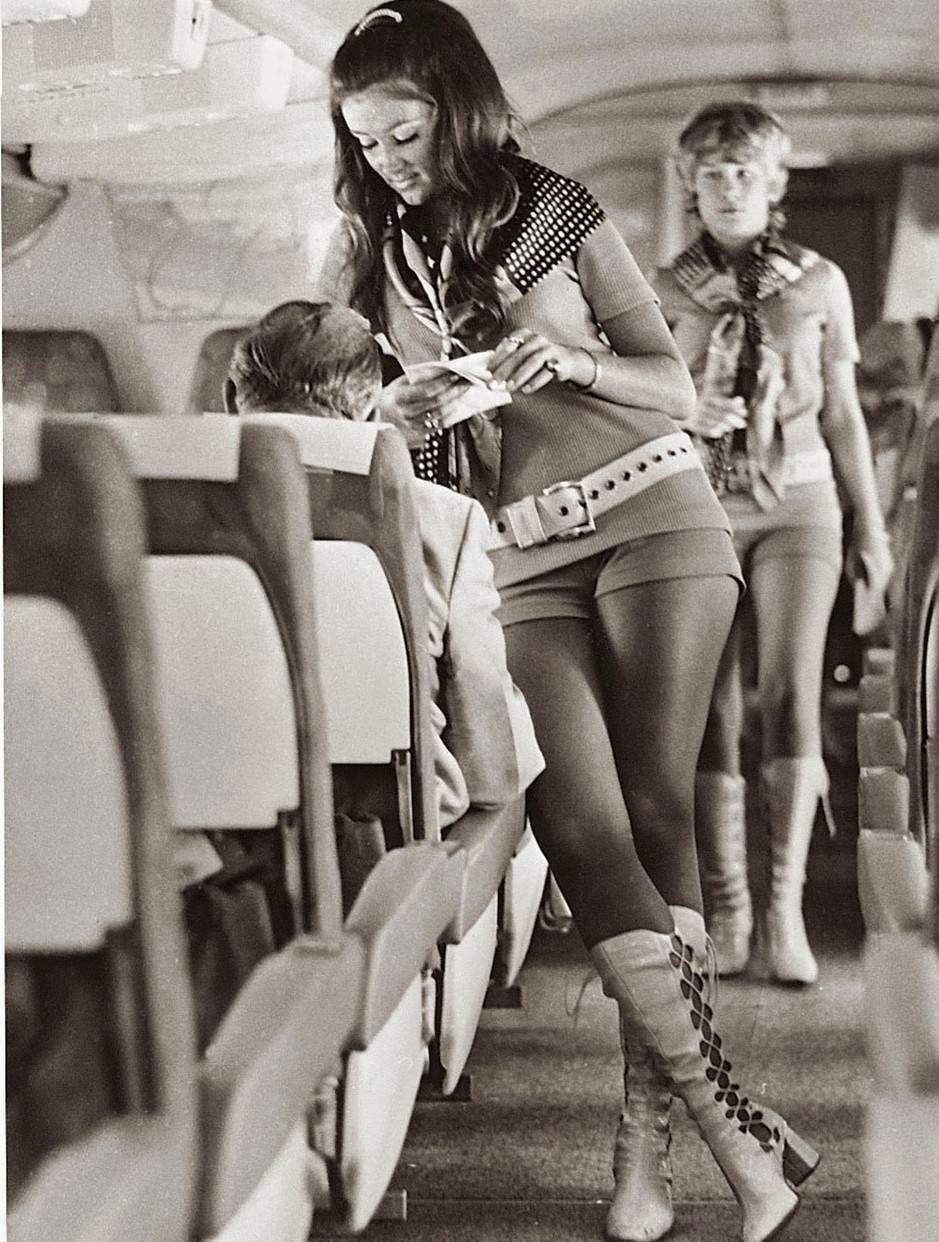
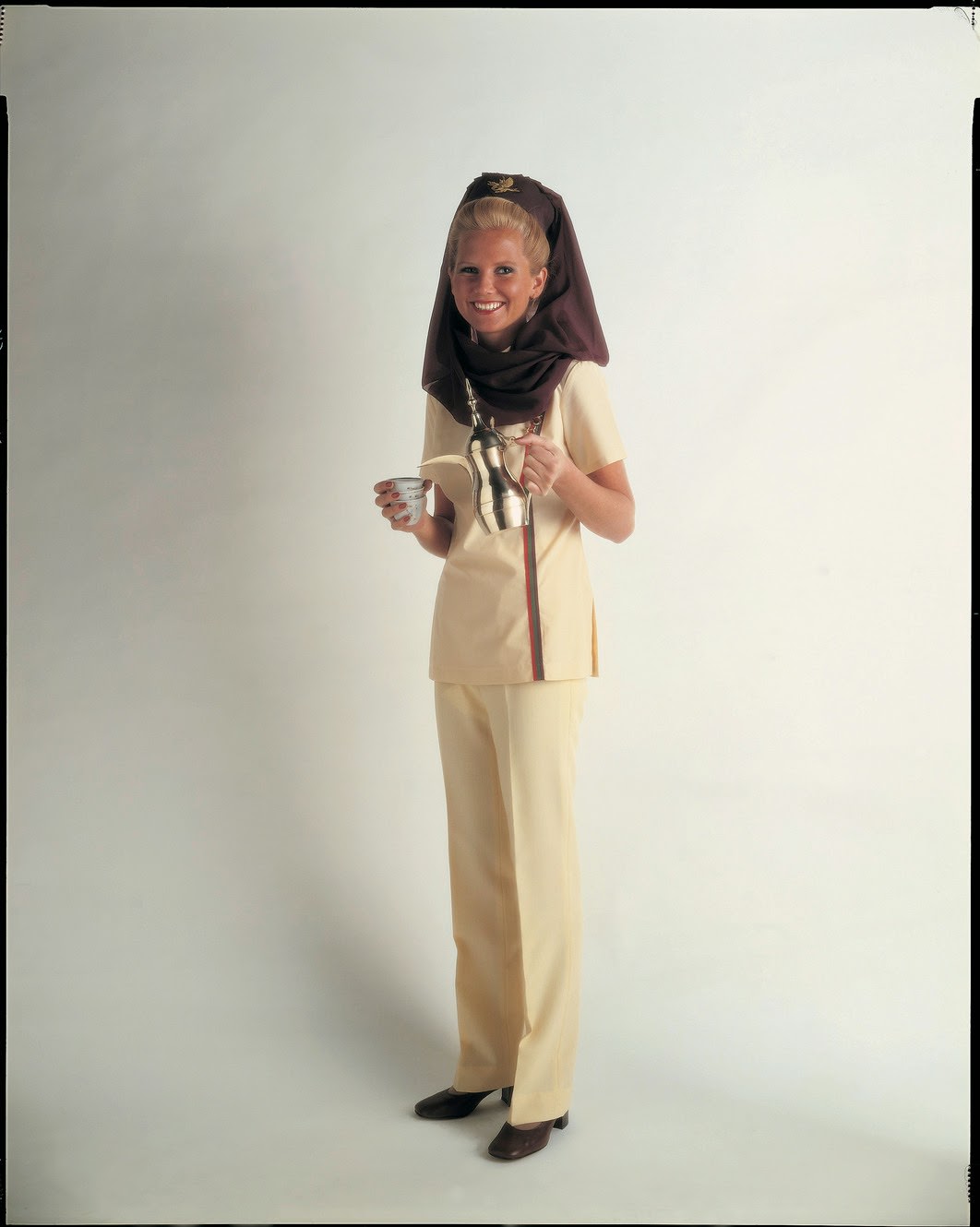
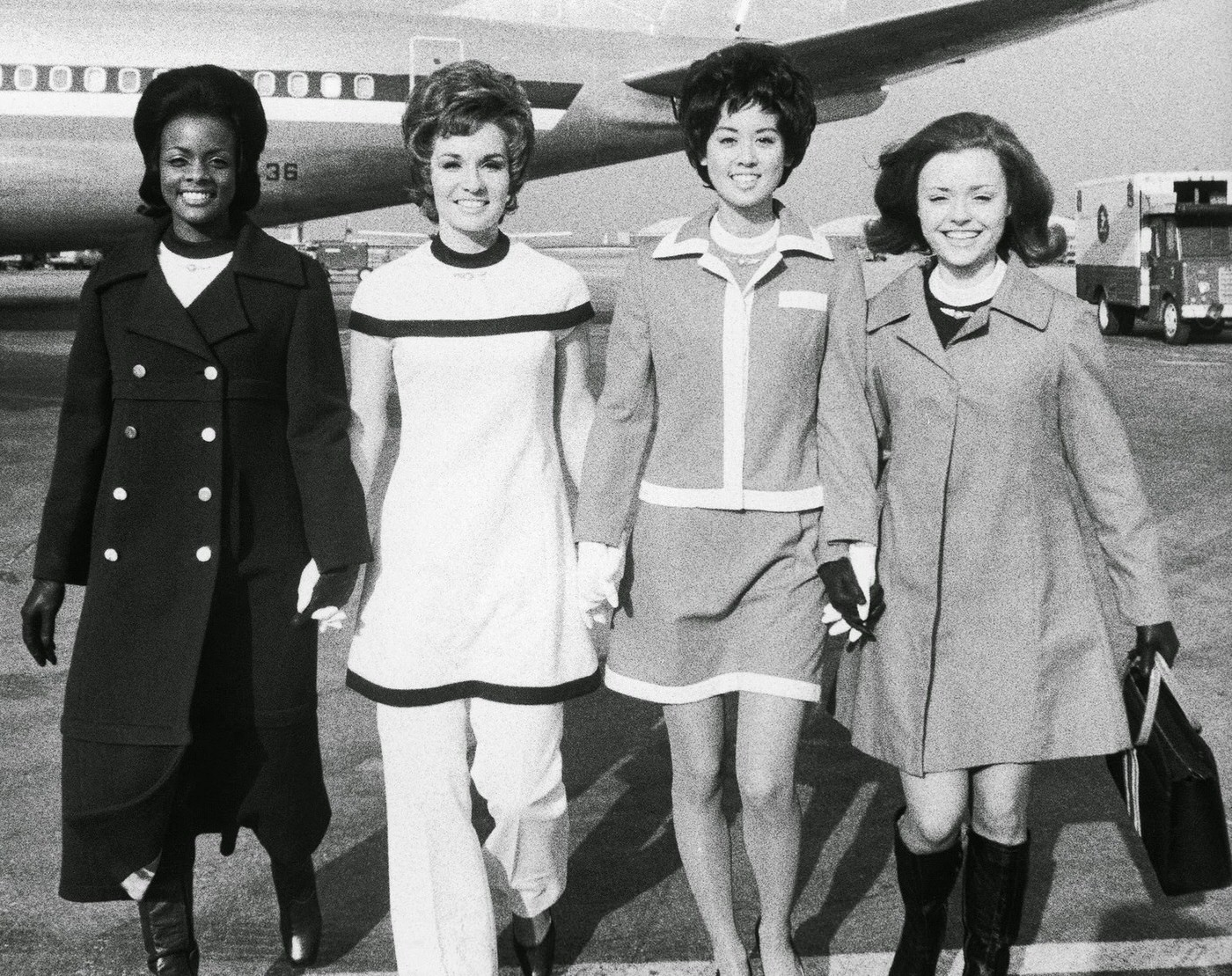
The 1970s pushed airline fashion to its boldest extreme. Bright synthetic fabrics replaced wool entirely. Southwest Airlines issued tan hot pants with go-go boots, while Pacific Southwest Airlines dressed crews in turtlenecks and coordinated vests. Jumpsuits, wide belts, and chunky jewelry turned the aisle into a statement. Not every airline went that route — some, like Gulf Air, adapted uniforms to reflect cultural identity, blending Islamic dress conventions with a sharp, modern silhouette.
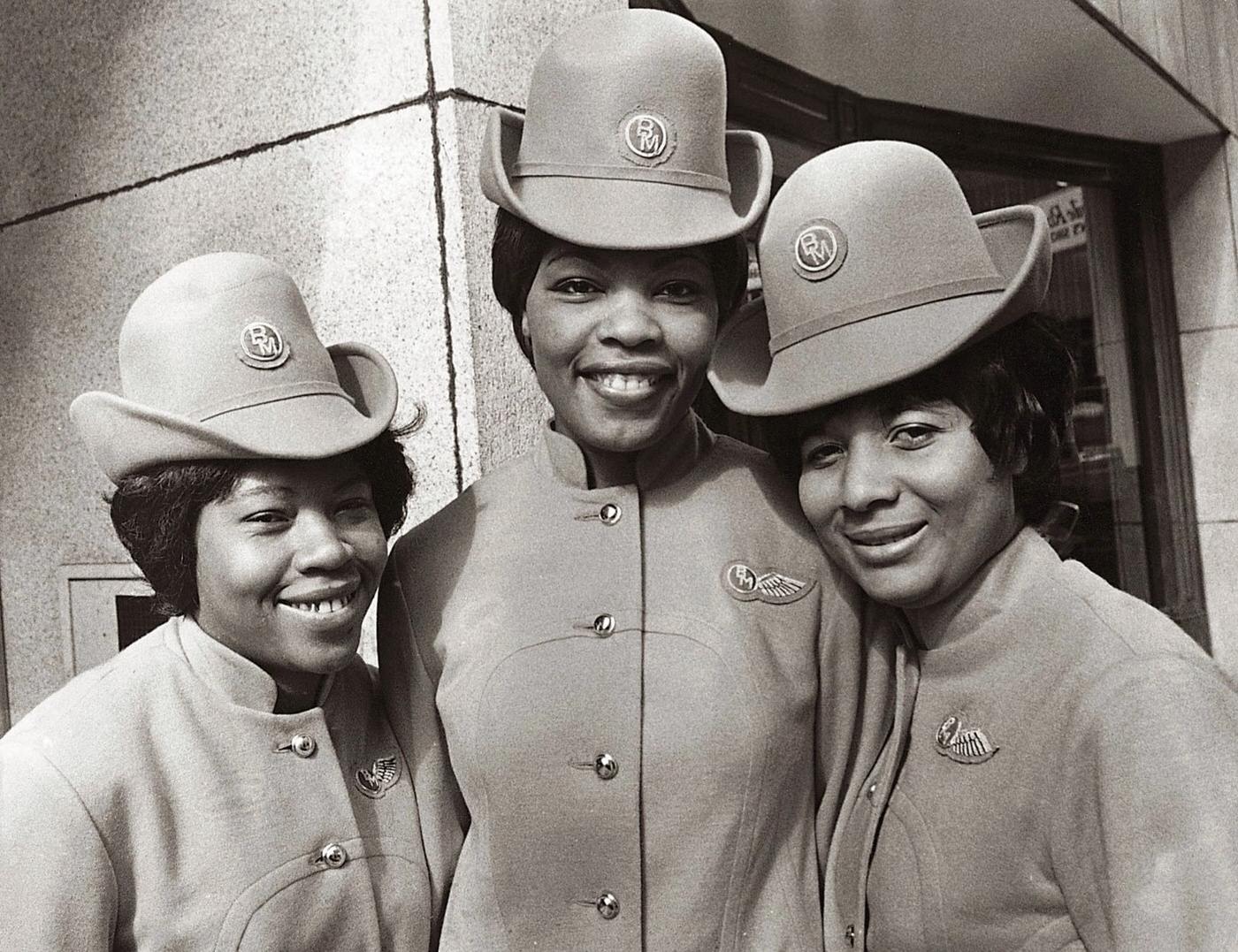
The first UK-based non-white stewardesses to be employed by an independent airline received their ‘wings’ at the London offices of British Midland Airways in 1970. From left: Innez Matthews, Irma Reid and Cindy Medford.
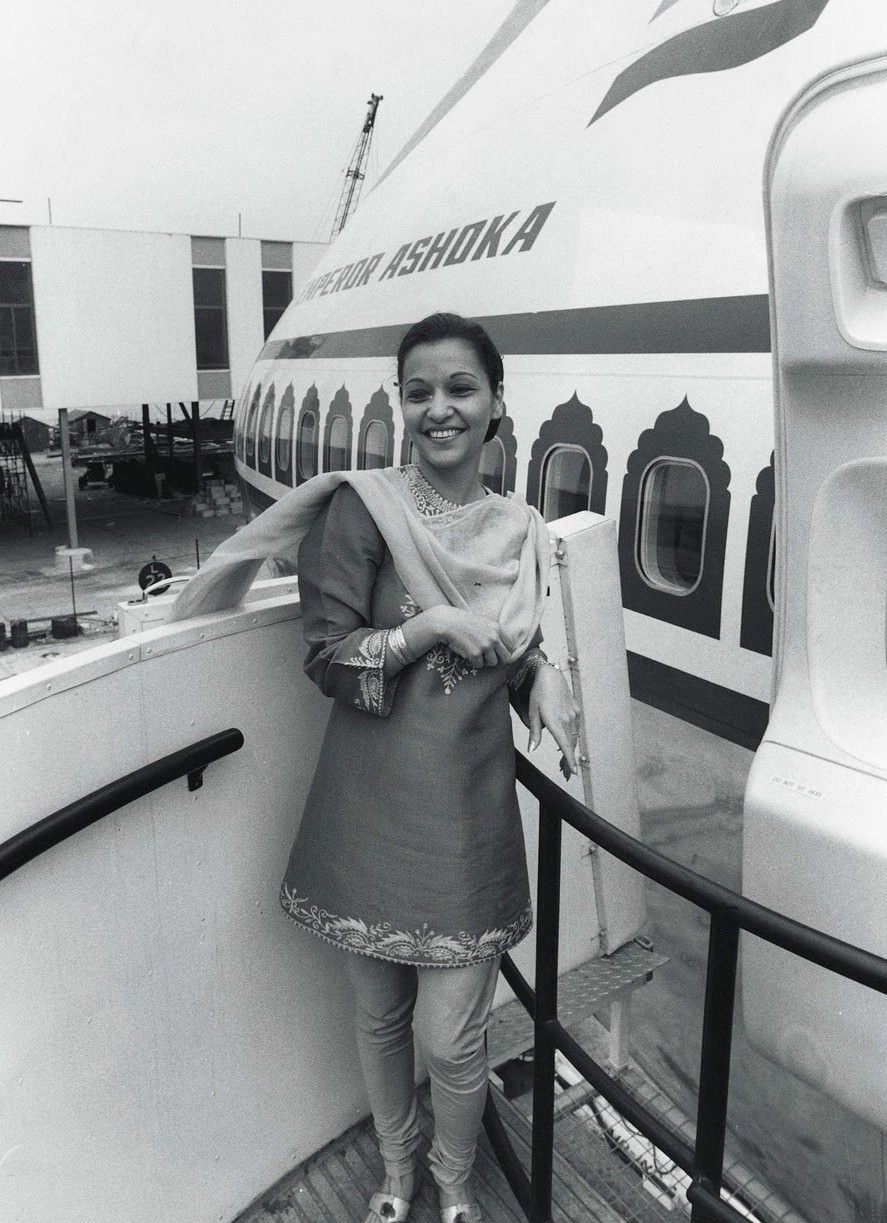
Stewardess Aban Mistry models the Air-India uniform next to the Taj Mahalian decor of an Air-India ‘Jumbo Jet’, 1971. The short salwar kameez was both culturally appropriate and practical for serving in the cabin. The elegant dupatta scarf added an extra flourish.
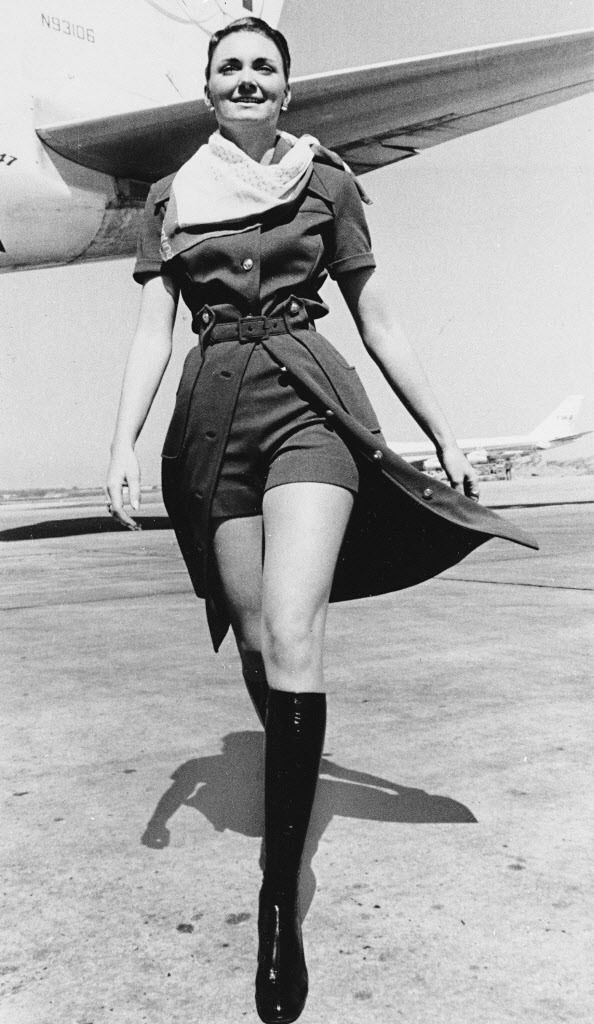
A uniform for TWA stewardesses from 1971 was made up of “mini-pants” worn with a safari shirt dress.
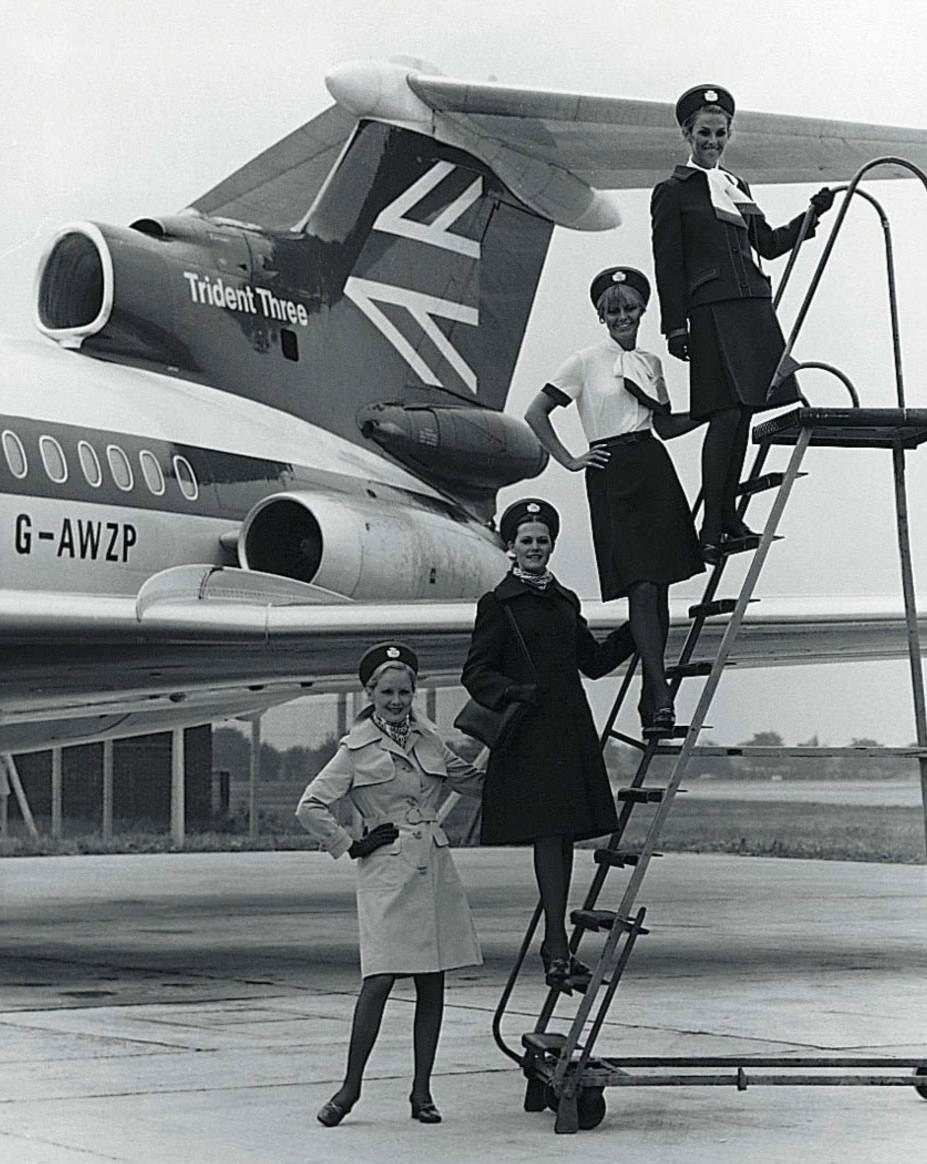
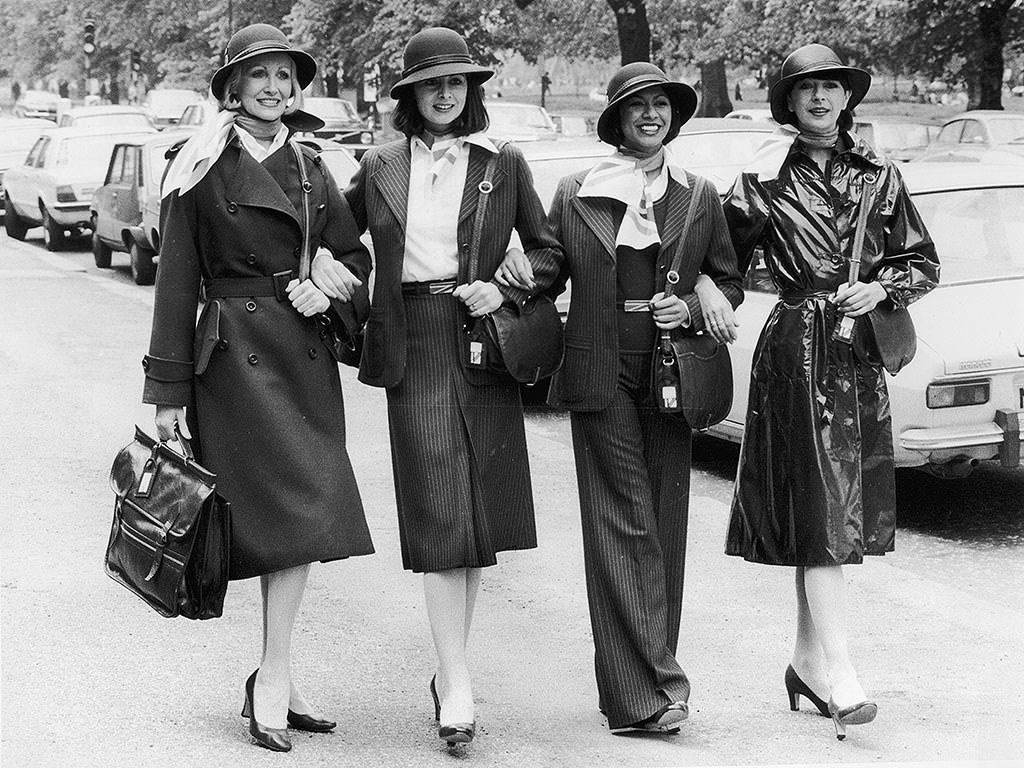
BEA’s popular uniforms, designed by Sir Hardy Amies, 1972.Stewardesses from a plane hijacked during a San Francisco-to-Los Angeles flight and forced to fly to Cuba on Jan. 8, 1972, left the plane as they arrived in Miami a day earlier.In stark contrast to the propriety (often to the point of prudishness) shown by most airlines to that date, in 1973 Southwest Airlines threw caution to the winds with its stewardess uniform. ‘The girls must be able to wear kinky leather boots and hot pants or they don’t get the job,’ said the airline’s male bosses.Models (from left) Myrtle Winston, Diane Edmunds, Sonia Pugin and Chris Harris modelling the various styles of new uniform for British Airways female staff, in London, England, United Kingdom, 25 May 1977.Middle East meets West in the 1970s with Gulf Air’s adaptation of the Muslim headdress; legs are covered by smart trousers. The uniform was originally designed by Joy Stokes.American Airlines stewardesses face the press in the mid-1970s.
Rachel Mitchell is a vintage fashion enthusiast with a passion for all things retro. She is interested vintage fashion styles, trends, and accessories, and provides tips and tricks for incorporating vintage pieces into modern wardrobes.