Hollywood has always been a place where the unexpected happens on a Tuesday afternoon. But even by the city’s own standards, 1957 produced one of its stranger and more memorable moments: Alfred Hitchcock, the undisputed master of suspense, sitting down for tea with Leo the Lion — MGM’s famous roaring mascot. No script, no dramatic score, just a cup of tea and one very large cat.
By 1957, Hitchcock was already one of the most recognized directors in the world. His stocky silhouette and deadpan British humor were as famous as the films themselves. He had given audiences “Rear Window” in 1954 and “The Man Who Knew Too Much” in 1956, and “Vertigo” was just a year away. His films were known for tight plotting, psychological tension, and a director who always seemed to be one step ahead of the viewer. Off set, Hitchcock was dry, precise, and quietly theatrical — a man who understood the power of an image better than almost anyone alive.
Leo the Lion had his own kind of fame. The roaring lion framed by the MGM banner first appeared in the studio’s opening credits in 1924, and over the decades he became one of the most recognized symbols in cinema. Several different lions filled the role across MGM’s history, each one trained and filmed at the studio to deliver that iconic roar. By the mid-1950s, the image of Leo was inseparable from Hollywood’s golden age — a symbol of the scale and ambition that MGM brought to its productions, from “Gone with the Wind” to “Singin’ in the Rain.”
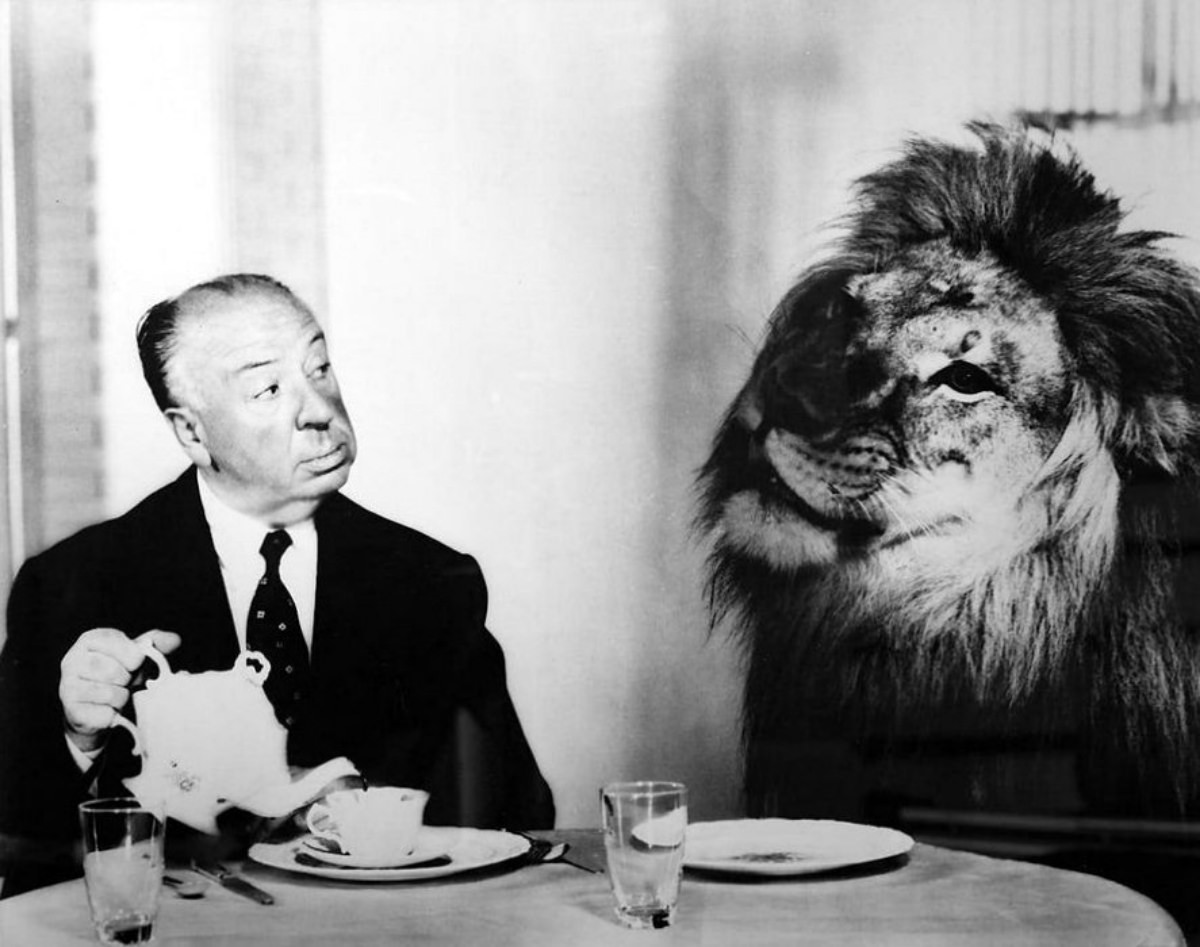
The photographs from this 1957 encounter show Hitchcock pouring tea near the massive open jaws of Leo, with an assistant carefully managing the scene close by. Leo is relaxed, jaw wide, while Hitchcock maintains his characteristic composure — unhurried, almost bored, as though sharing a moment with a 400-pound lion were simply part of an ordinary afternoon. The contrast is remarkable. Here is a man whose entire career was built on manufactured dread, sitting entirely unruffled next to one of the most powerful animals on earth.
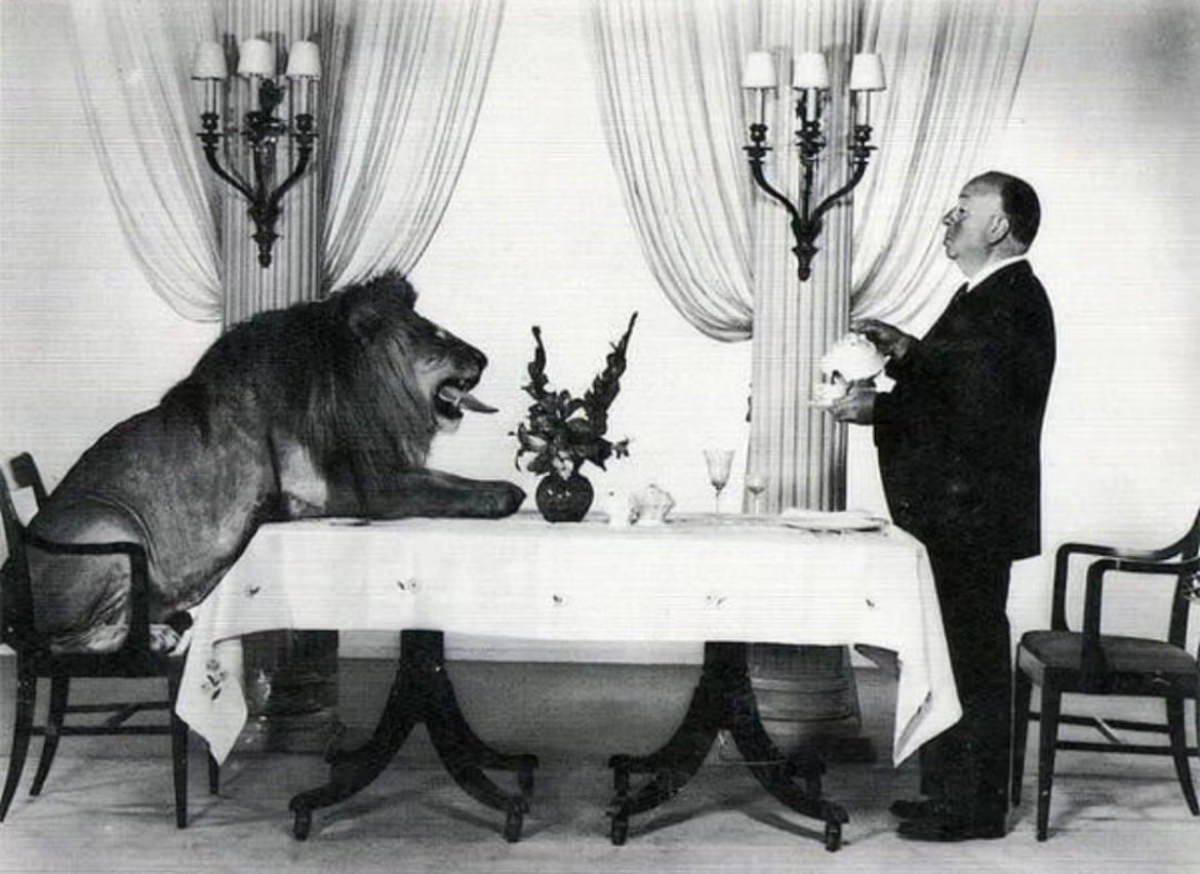
What brought them together is not fully documented. Whether the session was arranged by a studio publicist looking for a striking image, or whether it grew out of some more casual circumstance on the MGM lot, is not clear. What is clear is that both Hitchcock and the handlers managing Leo allowed the moment to play out with a relaxed, almost theatrical ease. Hitchcock leaning into the absurdity of the situation — deliberately presenting tea to a lion — is entirely consistent with his well-known sense of humor.
Hitchcock was often discussed in serious, even academic terms by critics of his era. His films dealt with voyeurism, guilt, paranoia, and the fragility of identity. But the man himself was famously mischievous. He made cameo appearances in his own films as a running joke. He once sent a friend a live sheep as a birthday gift. He cultivated a public persona that was wry and slightly unsettling, and he clearly enjoyed playing against expectations. The tea scene with Leo fits perfectly into that pattern.
Leo, for his part, was accustomed to controlled environments and human handlers. The lions used by MGM throughout the studio era were professionally trained animals that lived and worked on the lot under the care of experienced trainers. They were not domesticated, but they were managed. The calm visible in the 1957 photographs reflects that training — and the skill of the people working just outside the camera’s frame to keep the scene safe.
What makes the photographs so striking, decades later, is the collision of two very specific kinds of Hollywood power. Hitchcock represented intellectual authority — the director as the controlling mind behind every frame. Leo represented raw, physical presence — the animal force that studios like MGM used to signal their own dominance in the industry. Placing them side by side, with a teacup between them, punctures both images just enough to make you look twice. It is, in a way, a perfectly Hitchcockian scene: familiar elements arranged in just the wrong order to create a mild, lingering unease.