

Before Adolf Hitler became one of history’s most reviled figures, he was a struggling young man in Vienna with a sketchbook and an ambition to be a professional artist. He applied to the Academy of Fine Arts Vienna twice — in 1907 and 1908 — and was rejected both times. The admissions panel felt his figurative work was weak and suggested he might be better suited for architecture. That path was also closed to him, since he had never completed secondary school and lacked the required academic credentials.
By December 1909, Hitler’s money had run out entirely. He spent time in a homeless shelter in Vienna before eventually finding his footing as a self-taught street artist. From 1908 to 1913 — his Vienna years — he produced hundreds of watercolors and postcards, selling them individually to tourists, merchants, and dealers to survive. These were not gallery pieces. They were practical work made for income, and they covered subjects he returned to again and again: grand buildings, churches, castles, and quiet landscapes.


Hitler had a clear preference for architectural subjects. Streets, archways, courtyards, and stone facades appear throughout his body of work. His technique was precise when it came to buildings — lines were careful, proportions were studied — but art critics and historians have consistently noted that his paintings lack human presence. Figures rarely appear, and when they do, they are stiff and unconvincing. The buildings are the subjects; people are almost entirely absent.


Vienna left a clear mark on his painting subjects. Landmarks like St. Charles’s Church and St. Peter’s Church appear in his work, rendered with the kind of detail that shows he studied these buildings closely. He walked the city daily, and his paintings reflect that familiarity — the angles of specific streets, the texture of old stone, the way light falls on a Gothic spire.


His interest in castles and historic structures extended well beyond Vienna. Schloss Neuschwanstein, the famous Bavarian castle, appears among his works, as do various other fortifications, towers, and ruins. These subjects suited his style — they rewarded careful linework and didn’t require him to paint the human scenes he consistently avoided.

When World War I began, Hitler enlisted in the Bavarian Army and served as a dispatch runner on the Western Front. Even during the war, he continued to paint and draw. Stationed at army headquarters, he produced sketches and watercolors of the destroyed landscapes around him — bombed-out buildings, battlefield ruins, and the scarred terrain of the Western Front. These wartime works are notably different in subject from his Vienna pieces, though the style remains consistent.


His wartime paintings document the physical destruction of World War I with a detached, almost documentary quality. Smoking tanks, shattered walls, and roads through no man’s land are recorded in watercolor with the same steady hand he used on Viennese church facades. There is no dramatic emotion in these images — they read more like field records than expressions of horror or grief.


Not all of his wartime work focused on destruction. He also painted the quieter corners of occupied towns — a shelter in Fournes, a church in the Flemish village of Ardoye, ruins with intact archways, and roads cutting through devastated countryside. These images exist in stark contrast to the violence surrounding them, though they were produced in the middle of one of history’s deadliest conflicts.


Munich also features heavily in his paintings. The Hofbräuhaus, the Arch of Triumph, the Munich Opera House, and the old residency courtyard all appear in his catalog. Hitler spent formative years in Munich before and after the war, and the city’s grand civic architecture gave him the kind of material he was most comfortable painting.


Among the more unexpected works in his catalog are still-life studies. Flower paintings, a bottle and fruit arrangement, and botanical studies like “Flowers with Roots” and “White Orchids” show a different register entirely. These are quieter, more intimate subjects than the grand facades and ruined battlefields. They suggest Hitler experimented across different types of painting, even if architecture remained his dominant focus.


Interior scenes also appear in his work. A sitting room, a dining room painted in long view — these subjects required a different kind of spatial thinking than exterior architecture, and they are among the less commonly reproduced works in his catalog. Their everyday domestic quality makes them an unusual contrast to the castle battlements and war-torn streets that dominate his output.


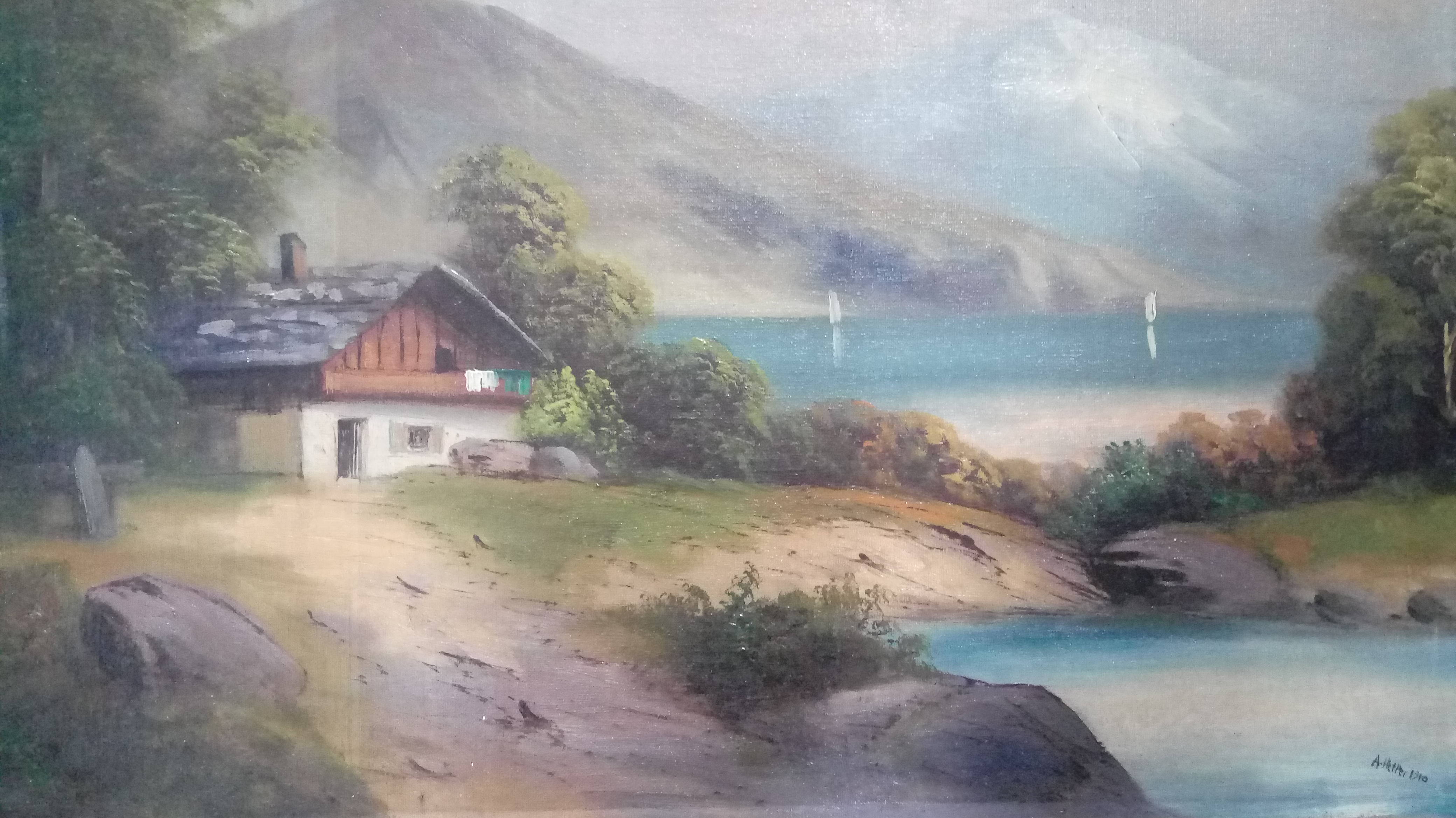
Landscapes without buildings also appear, though less frequently. Rolling hills, country roads, and rural scenes like the Linz Landscape and Hundswiese Farmhouse show that his eye wasn’t limited entirely to stone and mortar. These works tend to be looser in execution than his architectural pieces, with softer lines and less rigid structure.


After Hitler’s death in 1945, hundreds of his artworks surfaced across Europe. Many were recovered by U.S. Army forces and remain U.S. government property to this day. Others entered private hands and have since appeared at auction houses, often selling for tens of thousands — and in some cases, hundreds of thousands — of dollars. The buyers are typically private collectors, and the sales are consistently controversial, with debate over whether trading in such works is ethically appropriate.


