The 1950 FIFA World Cup was the first tournament held since 1938, delayed by World War II for twelve years. Brazil hosted the event from June 24 to July 16, constructing the massive Maracanã stadium in Rio de Janeiro to seat over 200,000 fans. Thirteen nations competed, but organizing those entries was no small task. Occupied Germany and Japan were banned, and several other countries withdrew during qualifying, citing travel costs or lack of experience.
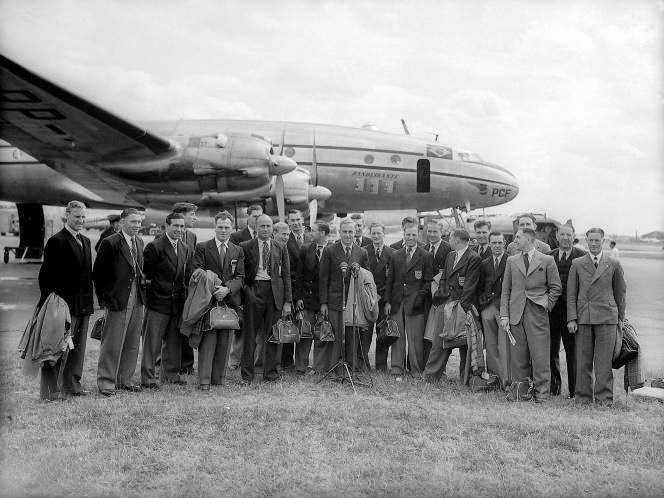
A major obstacle for FIFA proved to be organising the countries who would enter the tournament. Occupied Germany and Japan were both banned, while a number of countries from around the world pulled out of qualifying – citing reasons including travel costs to inexperience – though 15 teams from the Americas, Europe and Asia were eventually drawn into groups ahead of the competition. The England team (pictured), ready to make their World Cup debut, board a plane for Brazil.
Brazil opened the tournament against Mexico and won 4–0. Striker Ademir scored twice in that opener, beginning a run that would earn him the Golden Boot with eight goals total.
The tournament began with hosts Brazil taking on Mexico in the opening fixture – a comfortable 4-0 win for the Seleção. Striker Ademir scored twice, the first of the eight goals that eventually won him the tournament’s Golden Boot award.
Early upsets defined the group stage. Reigning two-time champions Italy arrived weakened after the 1939 Superga air disaster had killed several key players. Sweden knocked them out 3–2 in their first match, ending Italy’s perfect World Cup record.
Reigning champions Italy had never suffered defeat at the World Cup, winning the previous two tournaments without losing a match (they did not take part in the 1930 World Cup). However, the Azzurri – weakened by the loss of several players in the 1939 Superga air disaster – lost 3-2 in a shock defeat to eventual Group 3 winners Sweden in their opening fixture.
England’s debut World Cup ended in humiliation. After beating Chile in their opener, England were heavy favorites against a largely semi-professional United States side. Joe Gaetjens headed the only goal of the match, and the US won 1–0 in what became known as “The Miracle on Grass.”
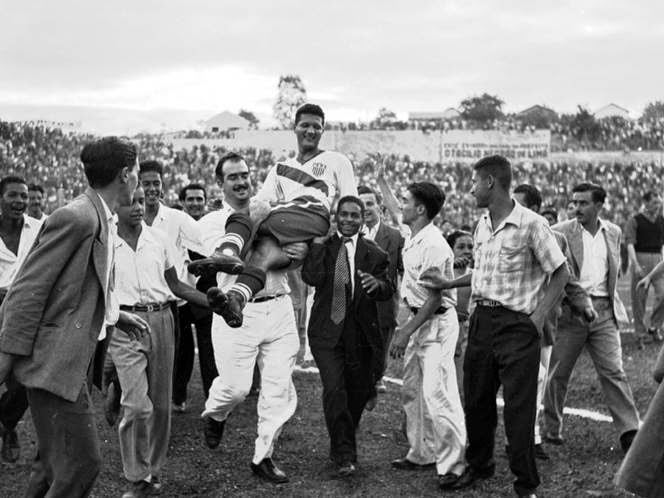
The surprises in Brazil would continue, as the US completed one of the most shocking victories in World Cup history by defeating England in their second group stage fixture. The star-studded England team had defeated Chile by two goals in their opening encounter and were heavy favourites against a US side containing several semi-professional players, which had had slipped to a 3-1 to Spain four days earlier. However, the match did not go according to form, as Joe Gaetjens – pictured being carried from the pitch after the game – headed the winning goal for the US in the first half to set up a victory later dubbed “The Miracle on Grass”.
Brazil recovered from a 2–2 draw mid-tournament to secure their group with a 2–0 win over Yugoslavia in front of 142,000 fans at the Maracanã.
The hosts had been held to a 2-2 draw in their second match, but secured first place in Group 1 and progression to the second group stage with a 2-0 defeat of Yugoslavia in front of a crowd of 142,000 at the Maracanã.
In Group 4, France withdrew before the tournament began, leaving Uruguay and Bolivia to play just one match. Uruguay, competing in their first World Cup since winning it in 1930, demolished Bolivia 8–0. Striker Óscar Míguez scored a hat trick.
Before the start of the tournament, France withdrew from Group 4, leaving remaining teams Uruguay and Bolivia to play in the pool’s only fixture. The Uruguayans – playing in their first World Cup since their victory in 1930 – won 8-0, thanks in part to striker Óscar Míguez’s hat trick, and progressed to the second group stage.
England could not rebound after the US defeat. Spain beat them 1–0 through Telmo Zarra’s goal and topped Group 2 to advance to the final round-robin stage.
England could not recover from their shock defeat to the US, and lost 1-0 to Spain thanks to Telmo Zarra’s goal. Spain finished top of Group 2 and progressed to the second group stage.
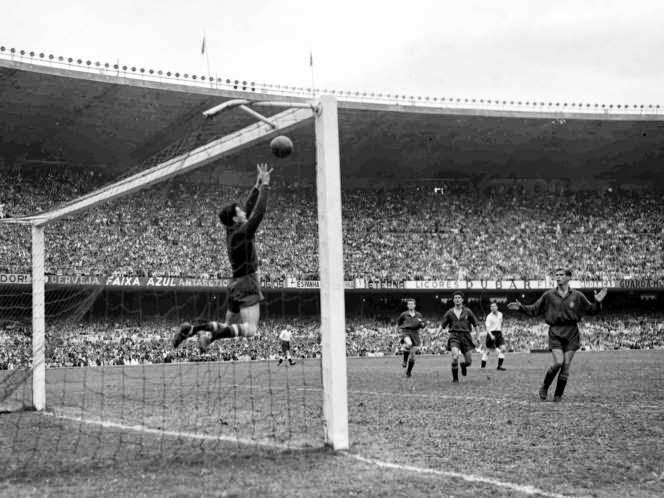
Unlike modern tournaments, the 1950 World Cup had no knockout final. The four group winners — Brazil, Uruguay, Sweden, and Spain — played a final round-robin, with the team finishing top crowned champions. Brazil destroyed Sweden 7–1 and Spain 6–1, entering the last match with an overwhelming lead in points. Uruguay trailed by just one point after a dramatic 3–2 comeback win over Sweden. Brazil needed only a draw to claim the title.
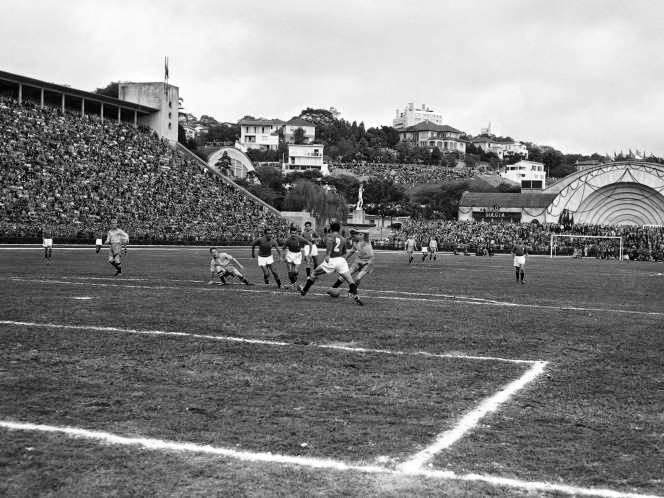
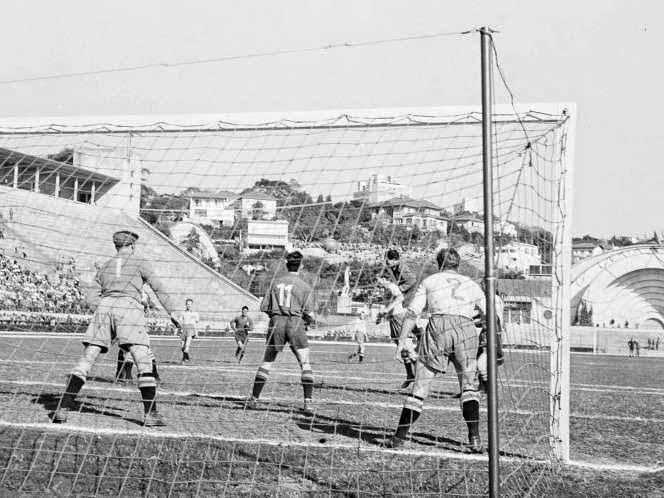
The four winners of each group then met in a final group, the winner of which would be crowned world champions. Brazil topped the table on four points going into the final round of fixtures, after heavy 7-1 and 6-1 defeats of Sweden (pictured) and Spain respectively. A point behind were Uruguay, who snatched a 3-2 victory over Sweden with two goals in the last 13 minutes to move into second with one game remaining.
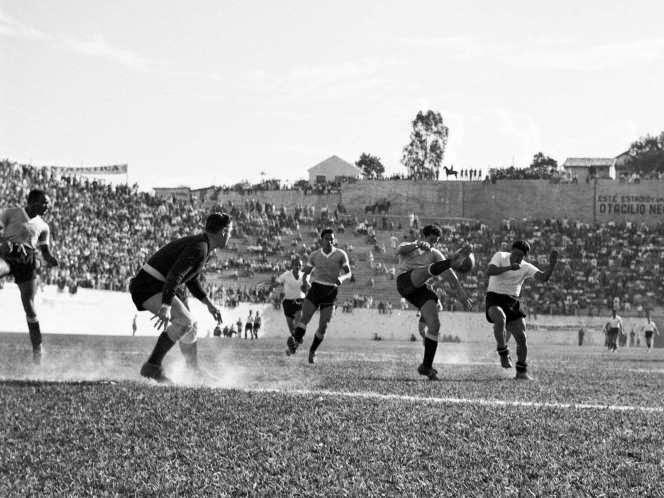
While the decisive match at the Maracanã approached, Sweden and Spain met simultaneously at the Estádio do Pacaembu in São Paulo. Sweden, starting at the bottom of the table, beat Spain 3–1 to claim third place.
On the same day as the Brazil-Uruguay fixture, Sweden faced Spain to decide the rest of the group. Despite beginning the game bottom of the table, Sweden claimed third place with a comfortable 3-1 victory at the Estádio do Pacaembu in São Paulo.
On July 16, over 200,000 spectators packed the Maracanã — with roughly only 100 Uruguayan supporters among them. Brazil’s attack, which had scored 21 goals across the tournament, made them overwhelming favorites. The atmosphere was less a football match and more a coronation.
Meanwhile, in front of a reported crowd of over 200,000 – about 100 of whom were Uruguayan – Brazil prepared to take on Uruguay (pictured) at the Maracanã. The Seleção, top scorers in the tournament with 21 goals and playing in front of their own fans began the game as favourites and needed either a draw or a win to be crowned world champions. Only victory would allow Uruguay to lift the World Cup.
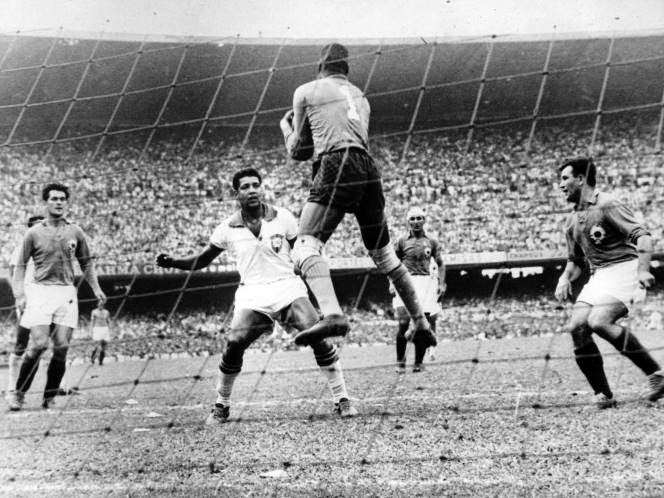
Brazil dominated the entire first half, firing 17 shots without scoring. Two minutes into the second half, forward Friača drove the ball low past the goalkeeper to make it 1–0. The stadium erupted.
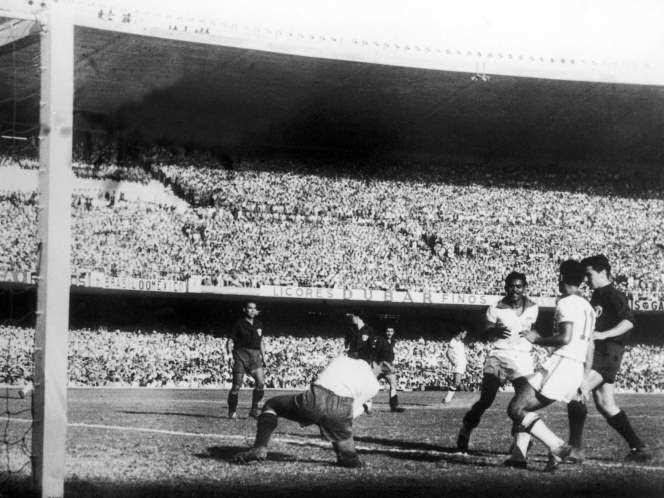
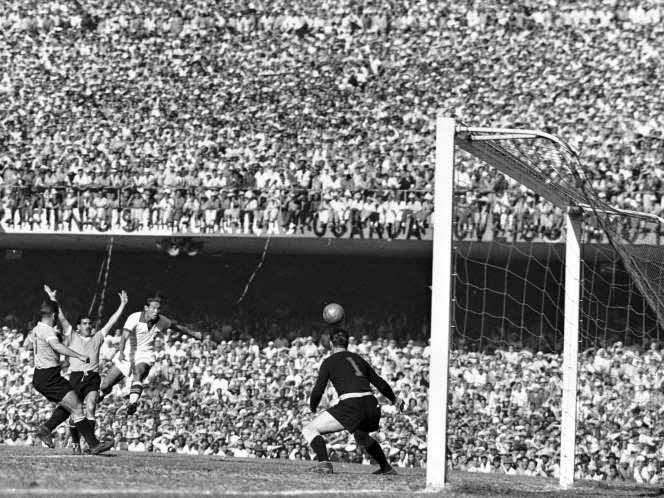
They played like favourites too, attacking the Uruguayan goal throughout the first half and hitting with 17 shots without reward. Above, Brazilian forward Francisco Aramburu unsuccessfully shoots at goal. However, the host’s luck would change two minutes into the second period, when forward Friača struck the ball low past the goalkeeper to open the scoring.
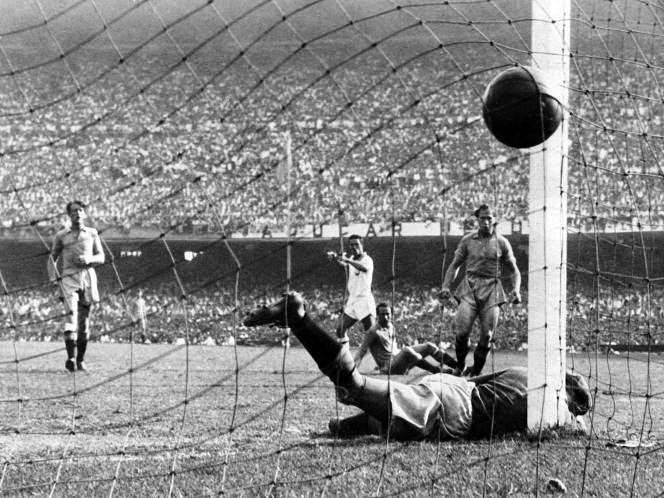
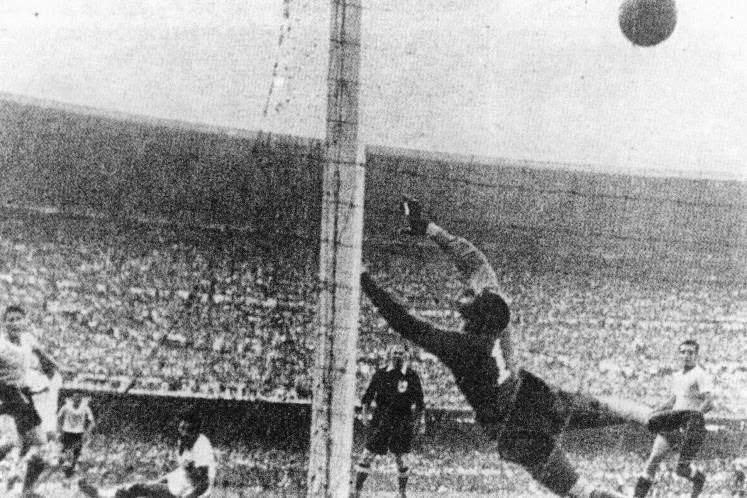
Uruguay’s captain Obdulio Varela deliberately stalled after the goal, arguing with the linesman to quiet the crowd and reset his team’s focus. On the 66th minute, Alcides Ghiggia crossed from the right and Juan Alberto Schiaffino smashed the ball into the top corner to level the score at 1–1.
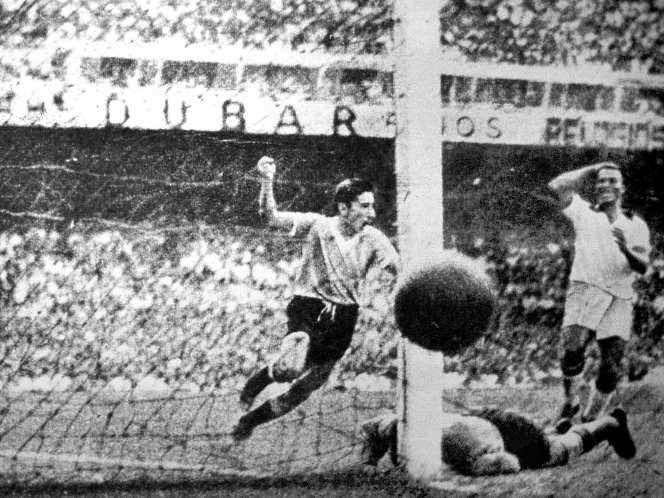
Despite taking the lead, Brazil were unable to capitalise on their advantage. Uruguay captain Obdulio Varela had helped subside the crowd’s celebrations by wasting time arguing with the linesman following the opening goal, and his side were level on 66 minutes through Juan Alberto Schiaffino, who smashed Alcides Ghiggia’s cross high in to the top corner (pictured).
With 11 minutes left, Ghiggia received the ball wide on the right and drove into the penalty area. Brazil’s goalkeeper Moacir Barbosa expected a cross. Instead, Ghiggia shot low and squeezed the ball under him. Uruguay led 2–1. The Maracanã fell silent. Uruguay held on, and the result became known as the Maracanazo — the “Maracanã Blow.” Ghiggia later said only three people had ever silenced the Maracanã: Frank Sinatra, the Pope, and himself.
The equalising goal changed the state of the game, as suddenly Uruguay were on top. Unlike their opponents, they were able to add a crucial second goal too. With just 11 minutes left to play, Ghiggia counterattacked from wide with the ball, driving into the penalty area before squeezing the ball under a Brazil goalkeeper expecting the winger to cross. Uruguay would hold on, Ghiggia’s goal proving to be decisive in claiming his country’s second World Cup win and leaving both Brazil players and fans in stunned silence.
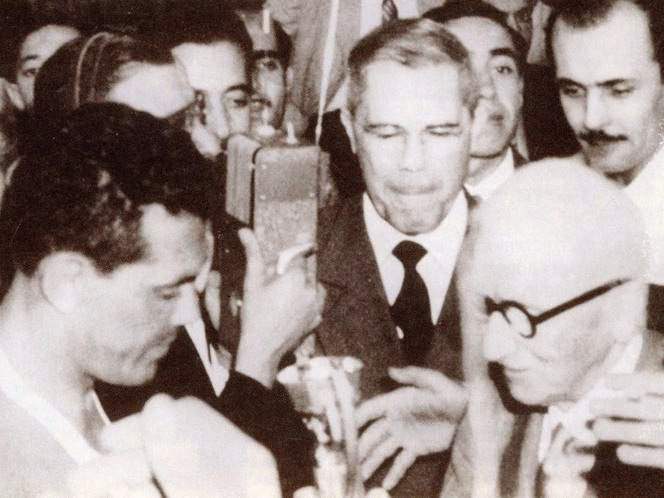
After the final whistle, 169 fans were treated for hysteria. The gold medals Brazil’s organizers had prepared went unused. The celebratory samba written for the occasion was never played. FIFA president Jules Rimet awarded the trophy to Uruguay captain Varela in a rushed ceremony on the pitch, surrounded by police and journalists.
Following the final whistle, there were reports of 169 cases of fans treated for hysteria after a completely unexpected Uruguayan victory. The organisers were left bewildered too: the gold medals they had prepared for Brazil team went unused, as did a purpose-written celebratory samba song. Captain and man-of-the-match Varela was awarded the World Cup trophy by Jules Rimet, FIFA president at that time, amidst a rush of policemen and journalists in the middle of the pitch (pictured).
The defeat scarred Brazil deeply. Players were publicly vilified, and most never represented their country again. The white shirts Brazil wore that day were deemed unlucky and retired permanently — replaced by the now-iconic yellow kit.
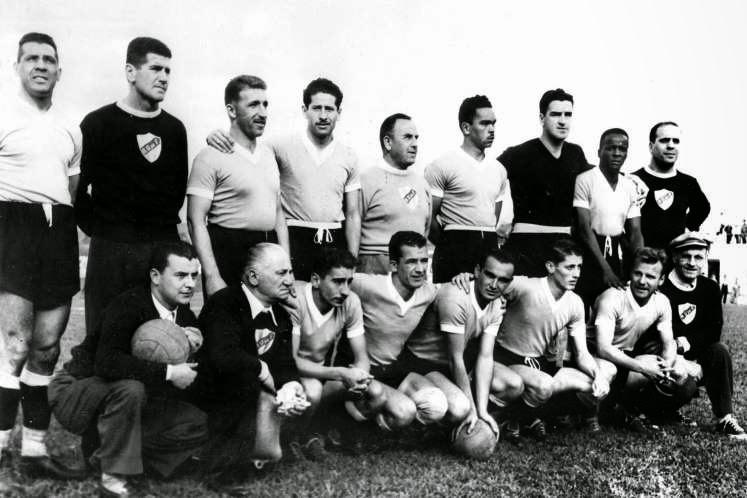
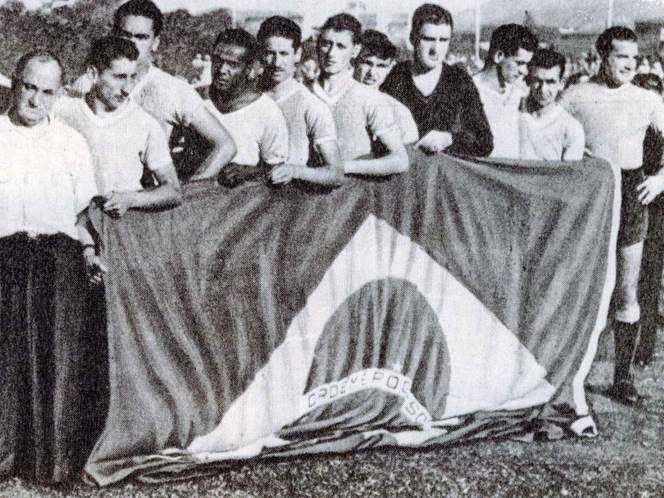
Victory also protected Uruguay’s unbeaten World Cup record, and ensured their players (pictured) would go down in Uruguayan football history. The repercussions for the Brazil team were much harsher: players were vilified and few ever played for their country again. The result did however give rise to Brazil’s now-famous yellow shirt, which replaced the white – considered to be unlucky – worn by the team in the final.
Andrew Thompson is an archaeologist and historian who specializes in the study of war and conflict. He writes about the brutal history of warfare, including the World Wars and other significant conflicts. Through his work, he aims to deepen our understanding of the human cost of conflict and inspire us to work towards a more peaceful future.