Hey There! Before You Go. 😧
Get the best vintage content straight into your inbox!

Don't worry, we don't spam

Incredible Colorized Photos of the Discovery of the Tutankhamun's Tomb in the 1920s

When Howard Carter and Lord Carnarvon broke through the sealed doorway of Tutankhamun’s tomb in November 1922, they stepped into a space that had been undisturbed for over 3,000 years. The Valley of the Kings had already given up many of its secrets by then, but nothing had prepared the archaeological world for what lay inside KV62. The sheer volume of objects — furniture, chariots, statues, jewelry, golden shrines — was staggering. To document every detail of the discovery, Carter brought in photographer Harry Burton, whose black and white images became the definitive visual record of the excavation. Decades later, the colorization studio Dynamichrome worked from original negatives and photographs held at the Griffith Institute, University of Oxford, to produce a digitally colorized selection of Burton’s work. The result brings the ancient tomb and the people who excavated it into sharp, almost startling focus.

Lord Carnarvon, the British aristocrat who funded Carter’s years of searching in the Valley of the Kings, was a constant presence during the early stages of the excavation. He was photographed at Carter’s home — known as “Castle Carter” — located at Elwat el-Dibbân on the Theban West Bank.
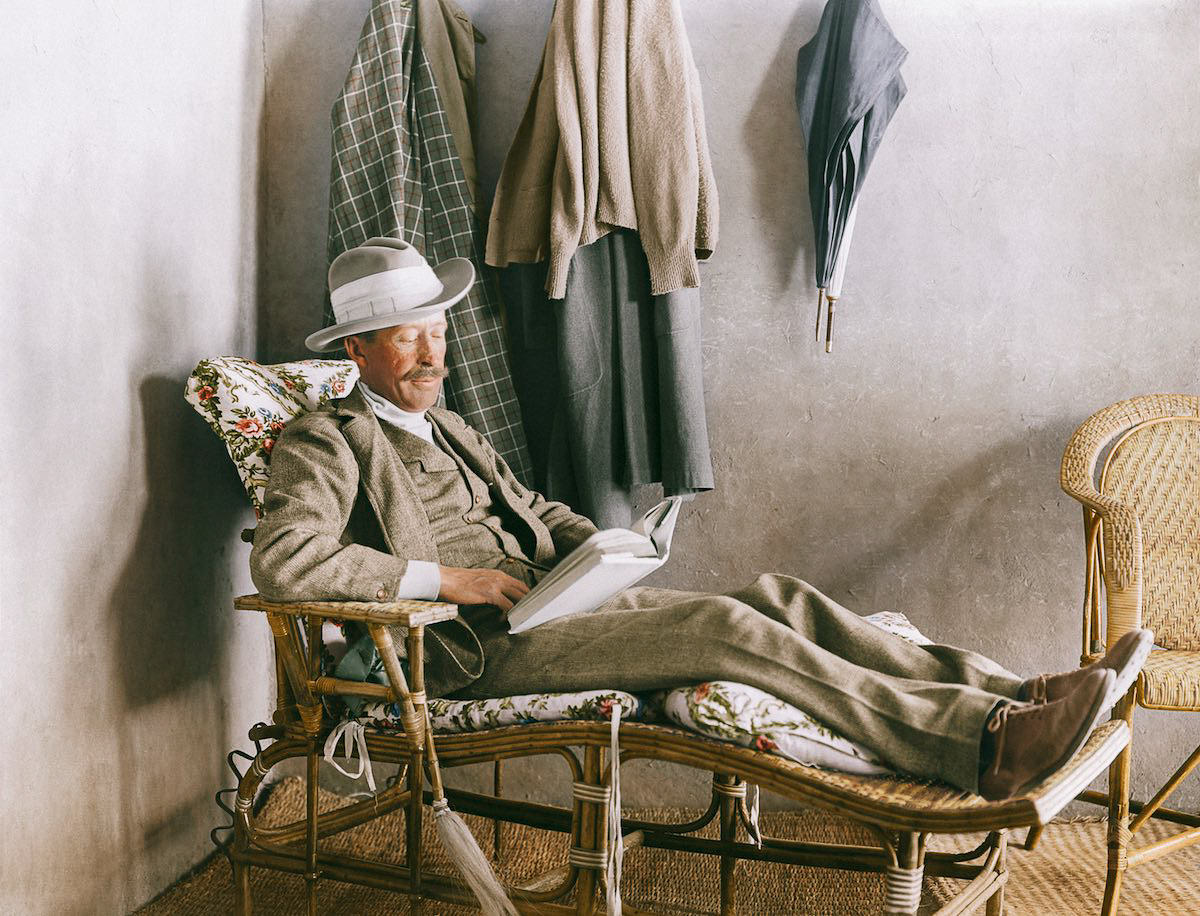
Herbert George Edward Stanhope Molyneux, 5th Earl of Carnarvon, reading on the verandah of 'Castle Carter', Carter's house at Elwat el-Dibbân on the Theban West Bank.
Herbert George Edward Stanhope Molyneux, 5th Earl of Carnarvon, reading on the verandah of ‘Castle Carter’, Carter’s house at Elwat el-Dibbân on the Theban West Bank.

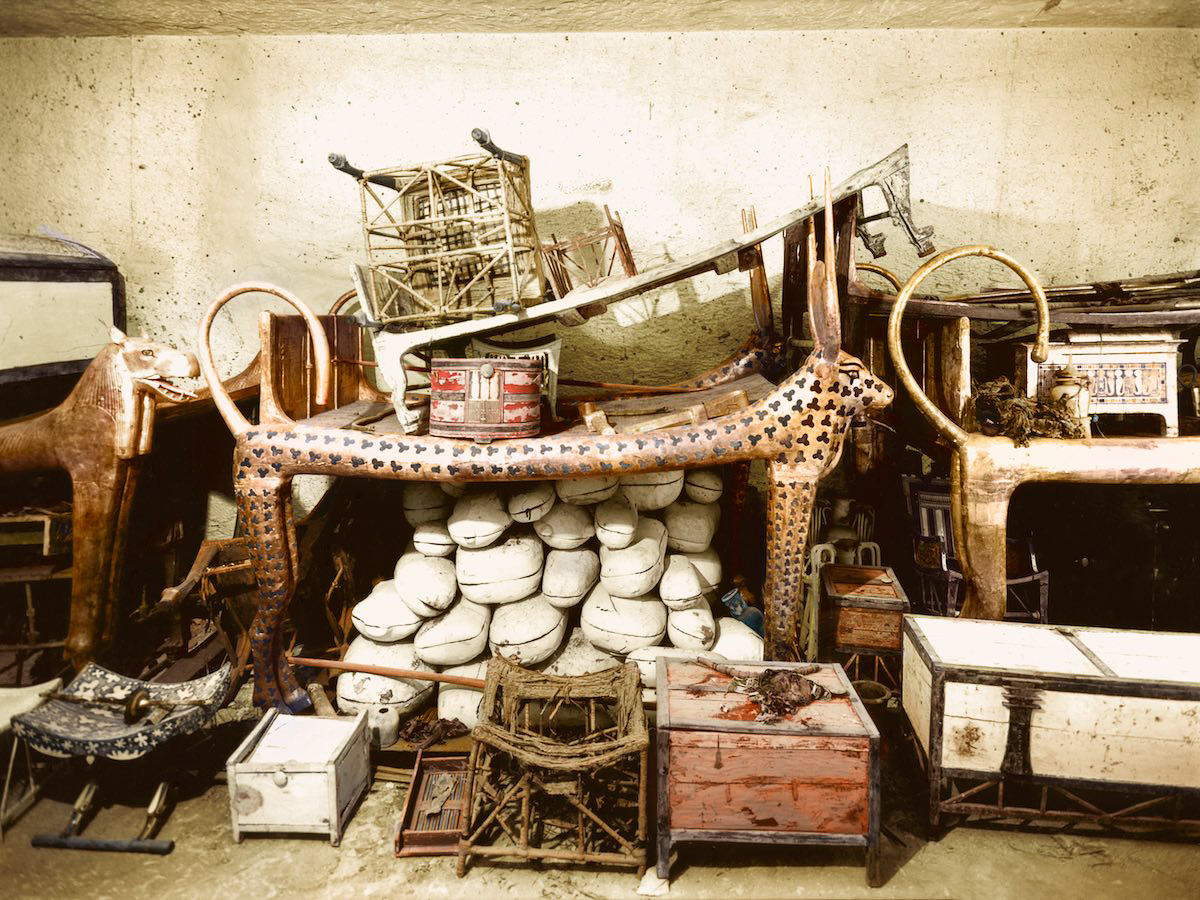
The first room excavators entered was the Antechamber — a rectangular space packed floor to ceiling with objects. Sealed alabaster vases sat between elaborately carved animal couches. Against the west wall, a cow-headed couch towered over boxes that still contained joints of meat. The room had been robbed in antiquity, and ancient officials had hastily restacked many of the items after the intrusion, creating a dense, chaotic jumble that Burton photographed methodically from every angle.
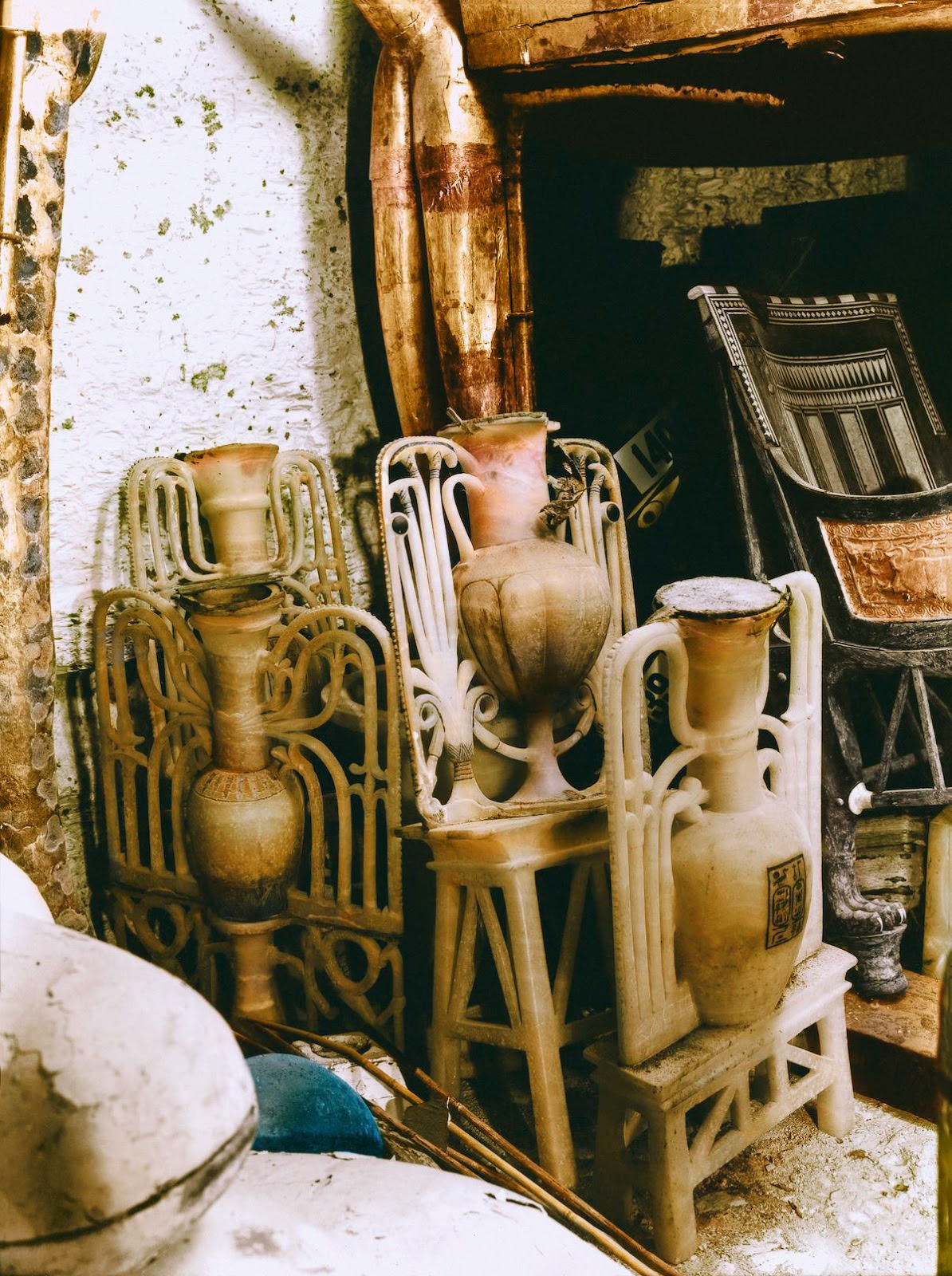
Sealed alabaster 'unguent' vases (Carter nos. 57, 58, 60 and 61) between the cow-headed (Carter no. 73) and lion (Carter no. 35) couches against the west wall of the Antechamber. Tutankhamun's Tomb, December 1922
Sealed alabaster ‘unguent’ vases (Carter nos. 57, 58, 60 and 61) between the cow-headed (Carter no. 73) and lion (Carter no. 35) couches against the west wall of the Antechamber. Tutankhamun’s Tomb, December 1922
Objects, including the cow-headed couch (Carter no. 73) and boxes containing joints of meat (Carter nos. 62a to 62vv) piled up against the west wall of the Antechamber. Tutankhamun's Tomb, December 1925
Objects, including the cow-headed couch (Carter no. 73) and boxes containing joints of meat (Carter nos. 62a to 62vv) piled up against the west wall of the Antechamber. Tutankhamun’s Tomb, December 1925

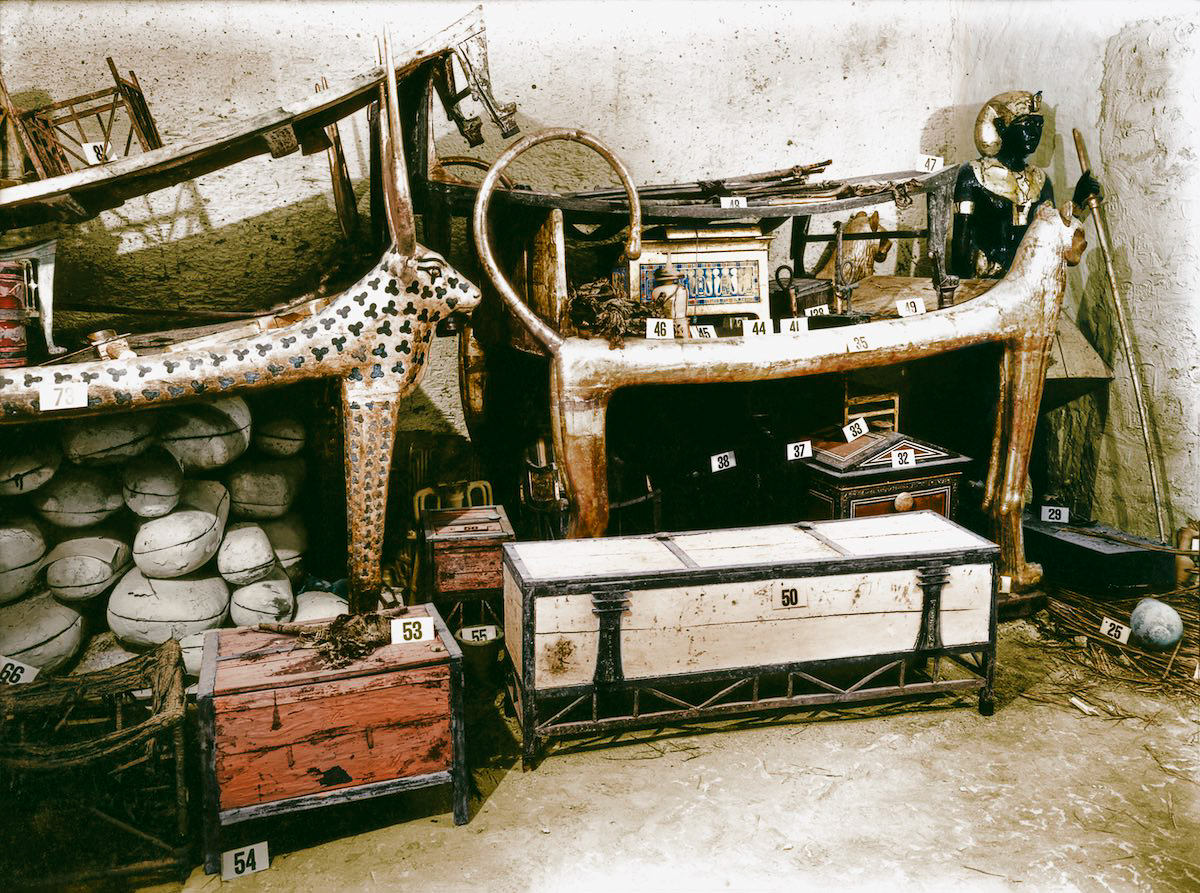
Beneath the lion couch, excavators found a remarkable collection of objects: an ivory and ebony chest, black shrine-shaped boxes, and a small ebony chair made for a child. In front of that same couch sat a large rectangular white box that held linen garments — shirts, shawls, and loin cloths — along with 18 sticks, 69 arrows, and a trumpet.
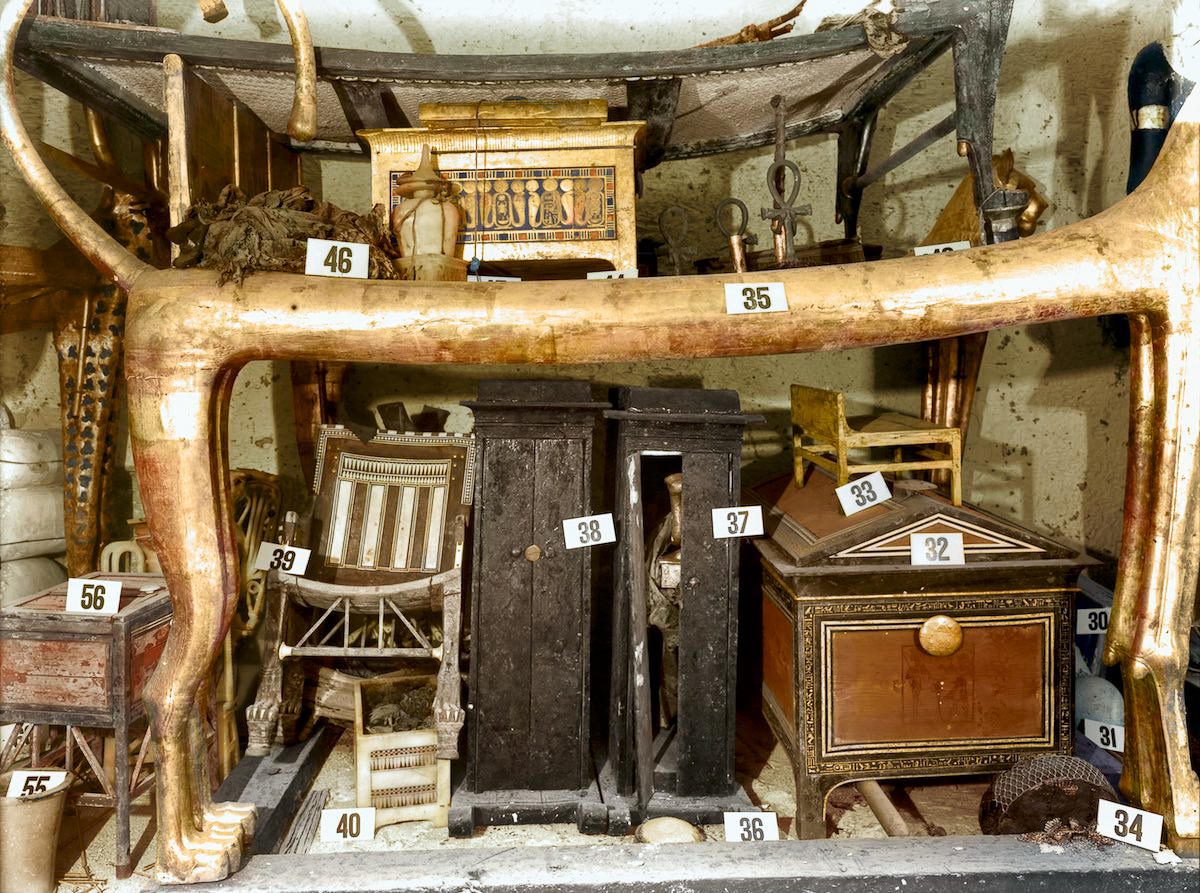
Objects stacked under the lion couch (Carter no. 35) against the west wall of the Antechamber. Tutankhamun's Tomb, December 1925
Objects stacked under the lion couch (Carter no. 35) against the west wall of the Antechamber. Tutankhamun’s Tomb, December 1925
The rectangular white box (Carter no. 50), in front of the lion couch (Carter no. 35) in the Antechamber. Tutankhamun's Tomb, December 1925
The rectangular white box (Carter no. 50), in front of the lion couch (Carter no. 35) in the Antechamber. Tutankhamun’s Tomb, December 1925

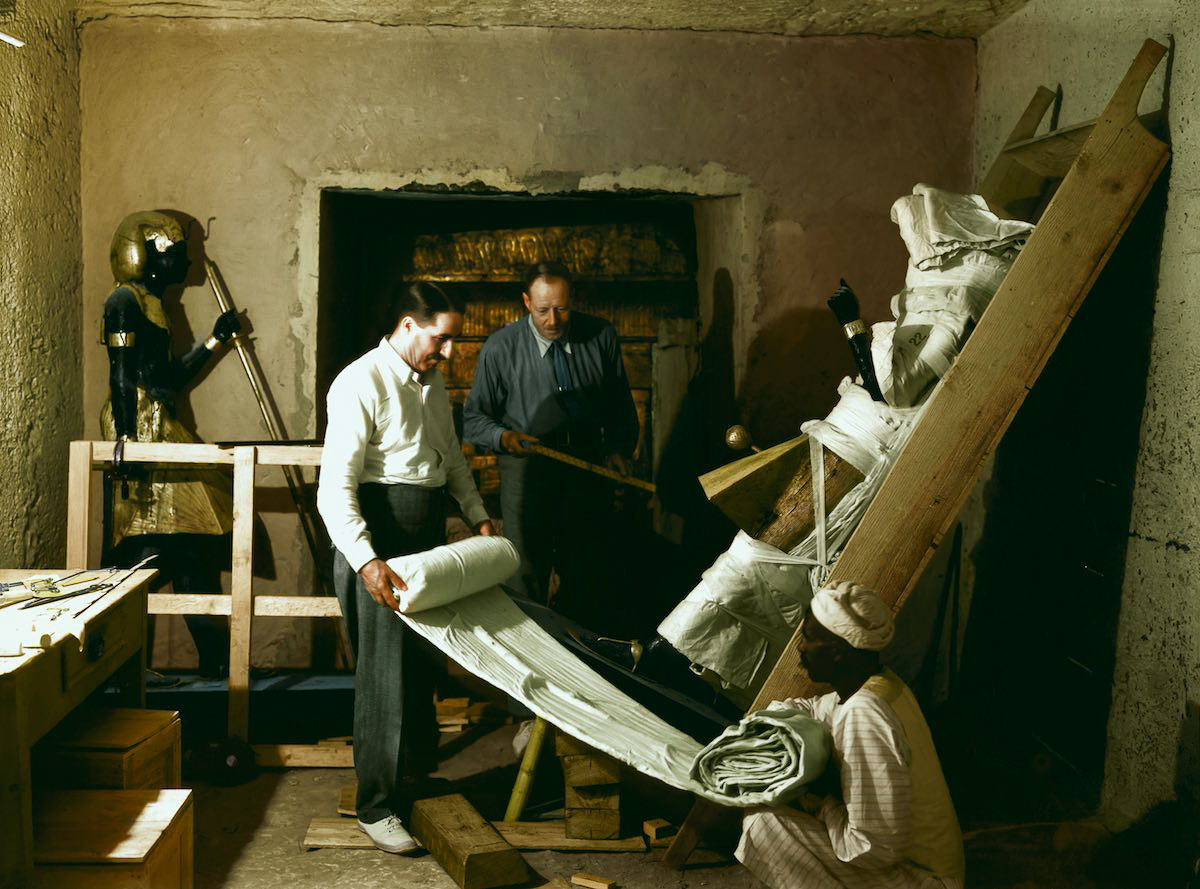
Standing guard at the sealed doorway leading to the Burial Chamber were two life-sized wooden statues of Tutankhamun, positioned one on each side of the entrance. Each figure showed the king wearing the nemes headdress, a kilt, and sandals, and carrying a mace and a staff. Before these statues could be moved to the makeshift conservation laboratory set up in the nearby tomb of Sethos II (KV 15), they had to be carefully wrapped for transport.
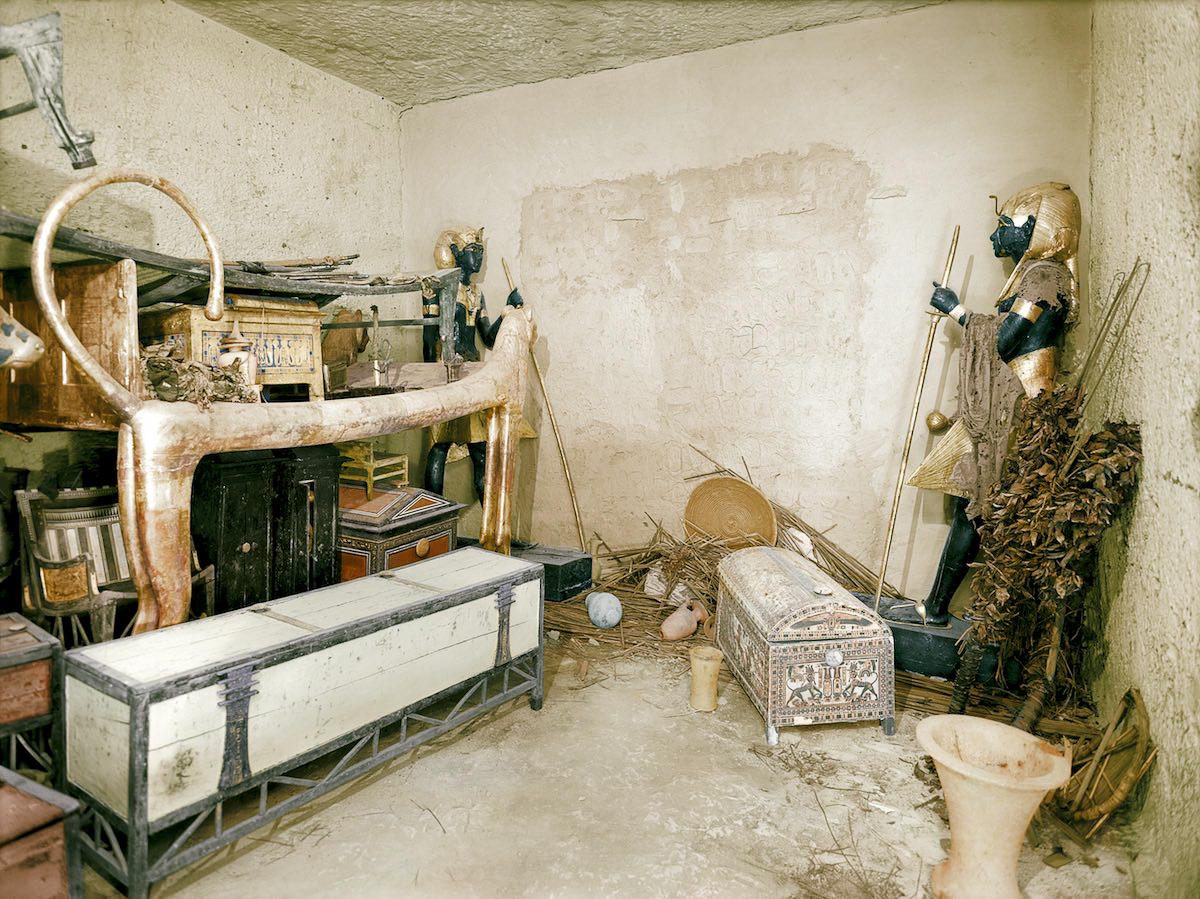
View of the northern wall of the Antechamber showing the sentinel statues (Carter nos. 22 & 29) guarding the sealed doorway leading to the King's Burial Chamber. Tutankhamun's Tomb, December 1925
View of the northern wall of the Antechamber showing the sentinel statues (Carter nos. 22 & 29) guarding the sealed doorway leading to the King’s Burial Chamber. Tutankhamun’s Tomb, December 1925
Howard Carter (on the left) working with his friend and colleague Arthur Callender on wrapping one of two sentinel statues of Tutankhamun (Carter no. 22) found in the Antechamber. Tutankhamun's Tomb, December 1925
Howard Carter (on the left) working with his friend and colleague Arthur Callender on wrapping one of two sentinel statues of Tutankhamun (Carter no. 22) found in the Antechamber. Tutankhamun’s Tomb, December 1925

Once at KV 15, conservators Arthur Mace and Alfred Lucas took over the painstaking work of stabilizing and cleaning the objects. Among the items they worked on were the two sentinel statues and several state chariots recovered from the Antechamber. These chariots had been dismantled in ancient times to fit through the tomb’s narrow doorways, and their gilded surfaces required careful treatment before any further study could take place.
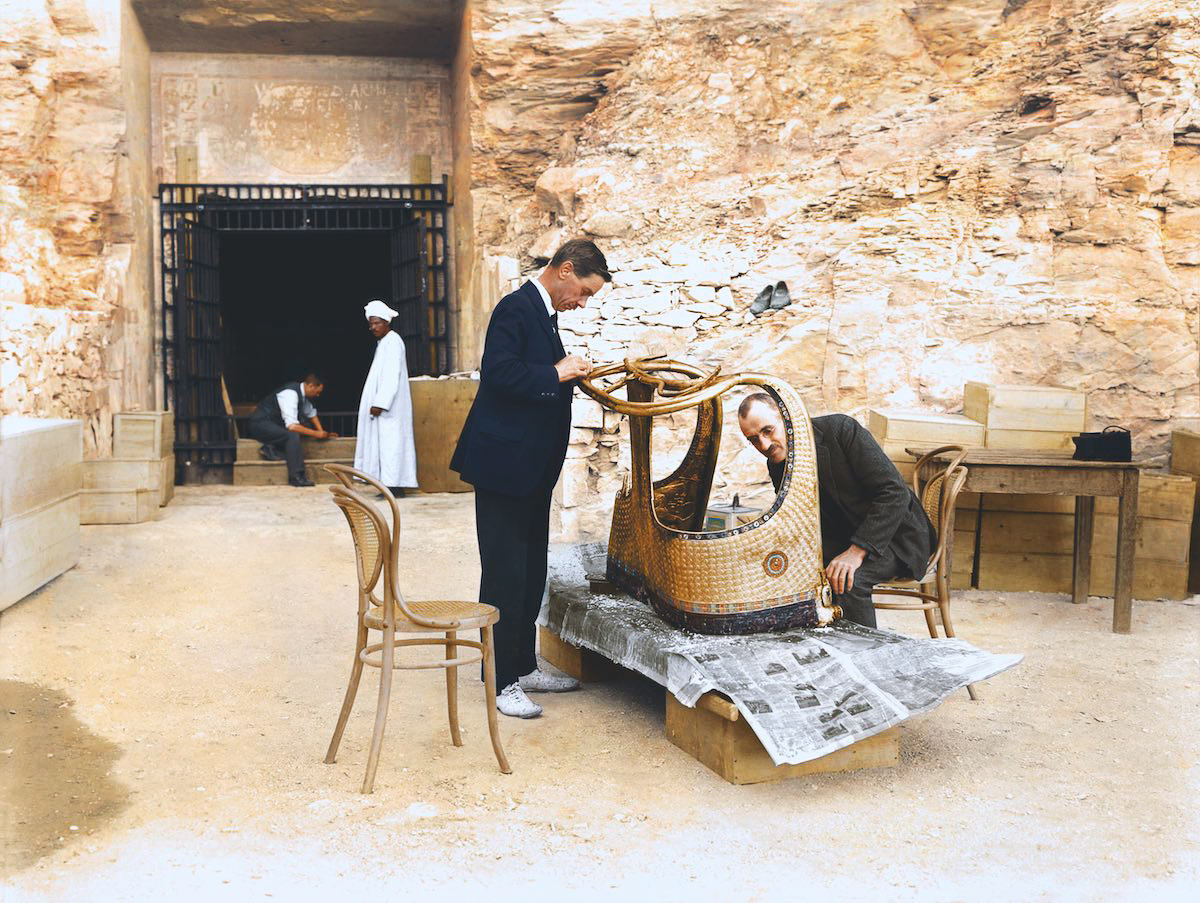
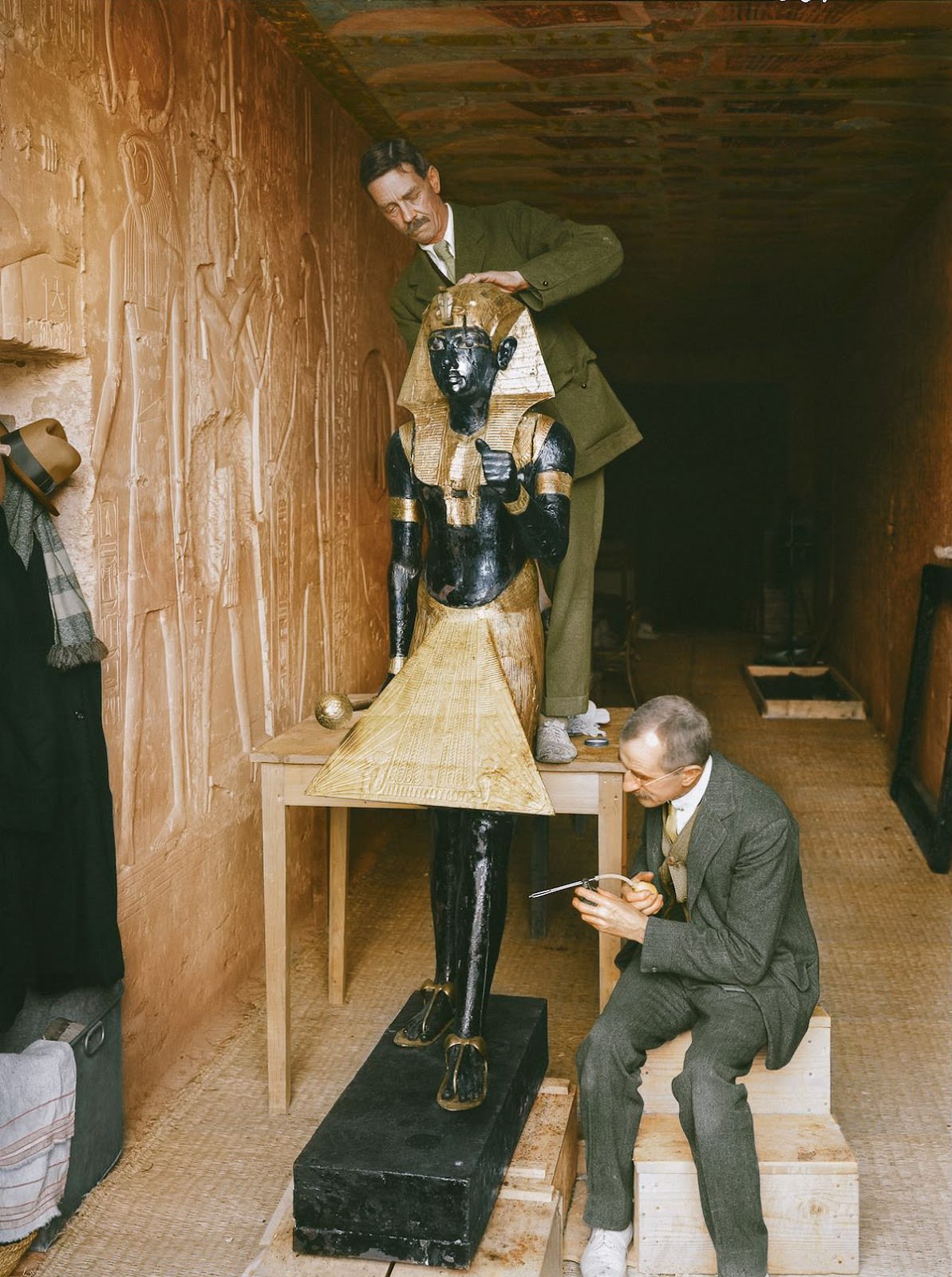
Arthur Mace (left) and Alfred Lucas working outside the 'laboratory' set up in the tomb of Sethos II (KV 15), stabilizing the surface of one of the state chariots (Carter no. 120) found in the Antechamber.
Arthur Mace (left) and Alfred Lucas working outside the ‘laboratory’ set up in the tomb of Sethos II (KV 15), stabilizing the surface of one of the state chariots (Carter no. 120) found in the Antechamber.
Arthur Mace (standing) and Alfred Lucas (sitting) working inside the makeshift 'laboratory' (set up in KV 15, the tomb of Sethos II) on the conservation of one of the two sentinel statues from the Antechamber (Carter no. 22). Sethos II's Tomb, 4th January 1923
Arthur Mace (standing) and Alfred Lucas (sitting) working inside the makeshift ‘laboratory’ (set up in KV 15, the tomb of Sethos II) on the conservation of one of the two sentinel statues from the Antechamber (Carter no. 22). Sethos II’s Tomb, 4th January 1923

Behind the Antechamber lay the Burial Chamber, where the focus shifted to the four enormous gilded wooden shrines that nested one inside another around the sarcophagus. In December 1923, Carter and his team began the enormous task of removing the wall between the Antechamber and the Burial Chamber to create enough space to dismantle the shrines. The outermost shrine alone was built from twenty separate oak sections and shaped like a sed festival pavilion, with a double sloping roof.
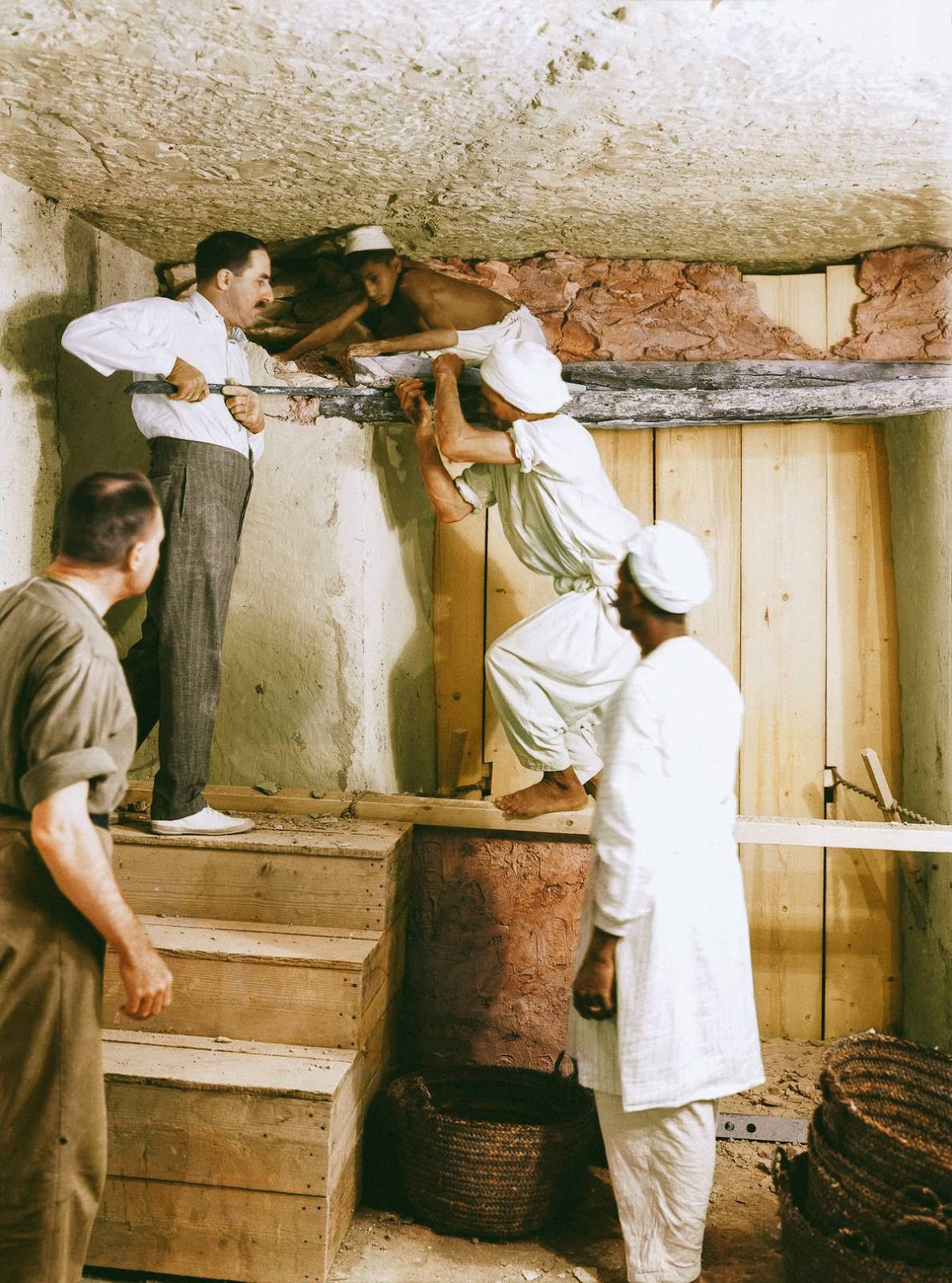
Howard Carter (at the top of the stairs), Arthur Callender and Egyptian workmen removing the wall between the Antechamber and the Burial Chamber to enable the dismantling of the four golden shrines enclosing the sarcophagus. Tutankhamun's Tomb, 2nd December 1923
Howard Carter (at the top of the stairs), Arthur Callender and Egyptian workmen removing the wall between the Antechamber and the Burial Chamber to enable the dismantling of the four golden shrines enclosing the sarcophagus. Tutankhamun’s Tomb, 2nd December 1923

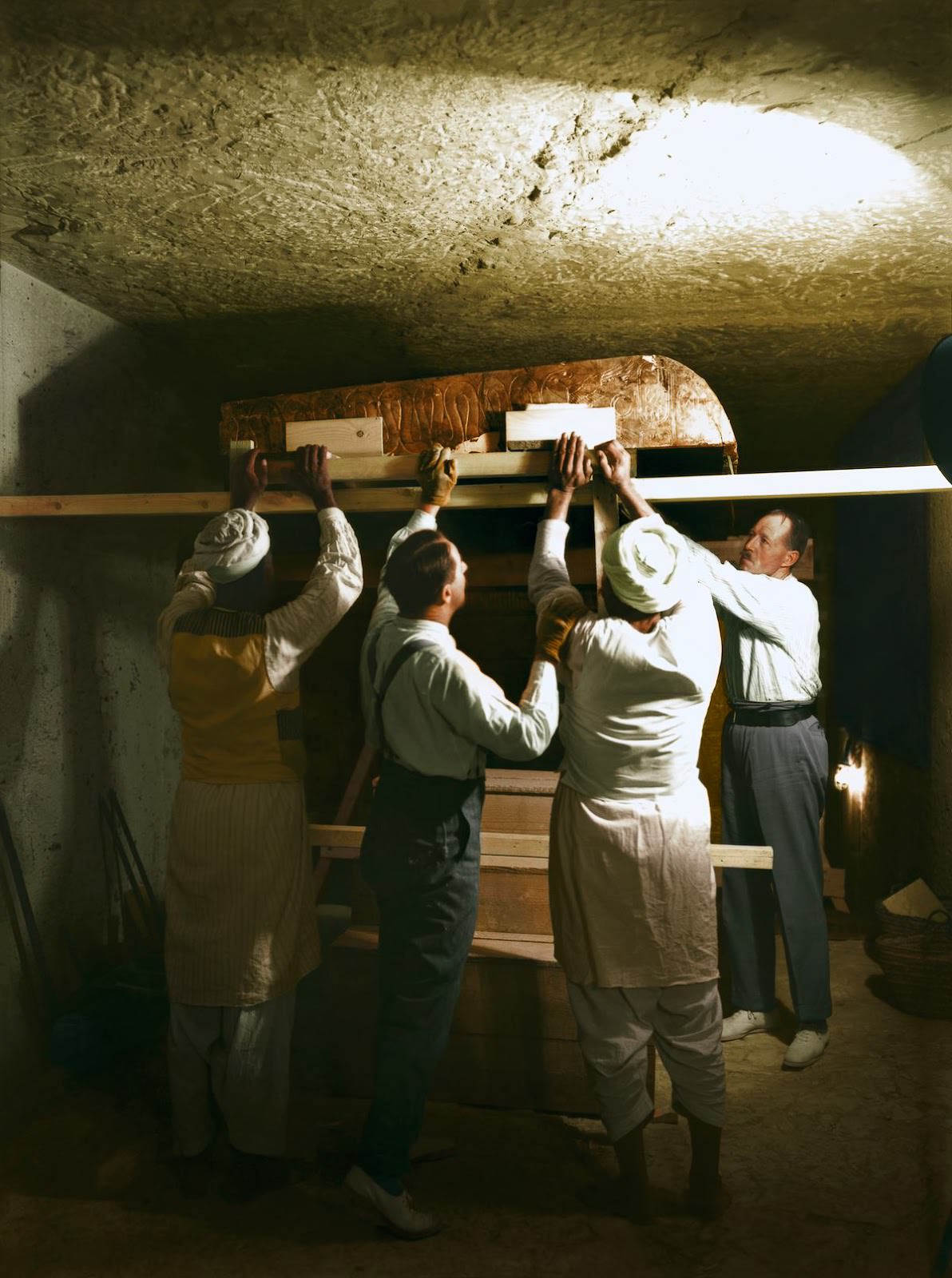
Stretched between the first and second shrines hung a linen pall studded with bronze rosettes. On December 30, 1923, Carter, Mace, and an Egyptian workman climbed scaffolding to carefully roll the fragile fabric back. Lifting the roof sections of the outermost shrine required the combined effort of Carter, Arthur Callender, and a team of workmen.
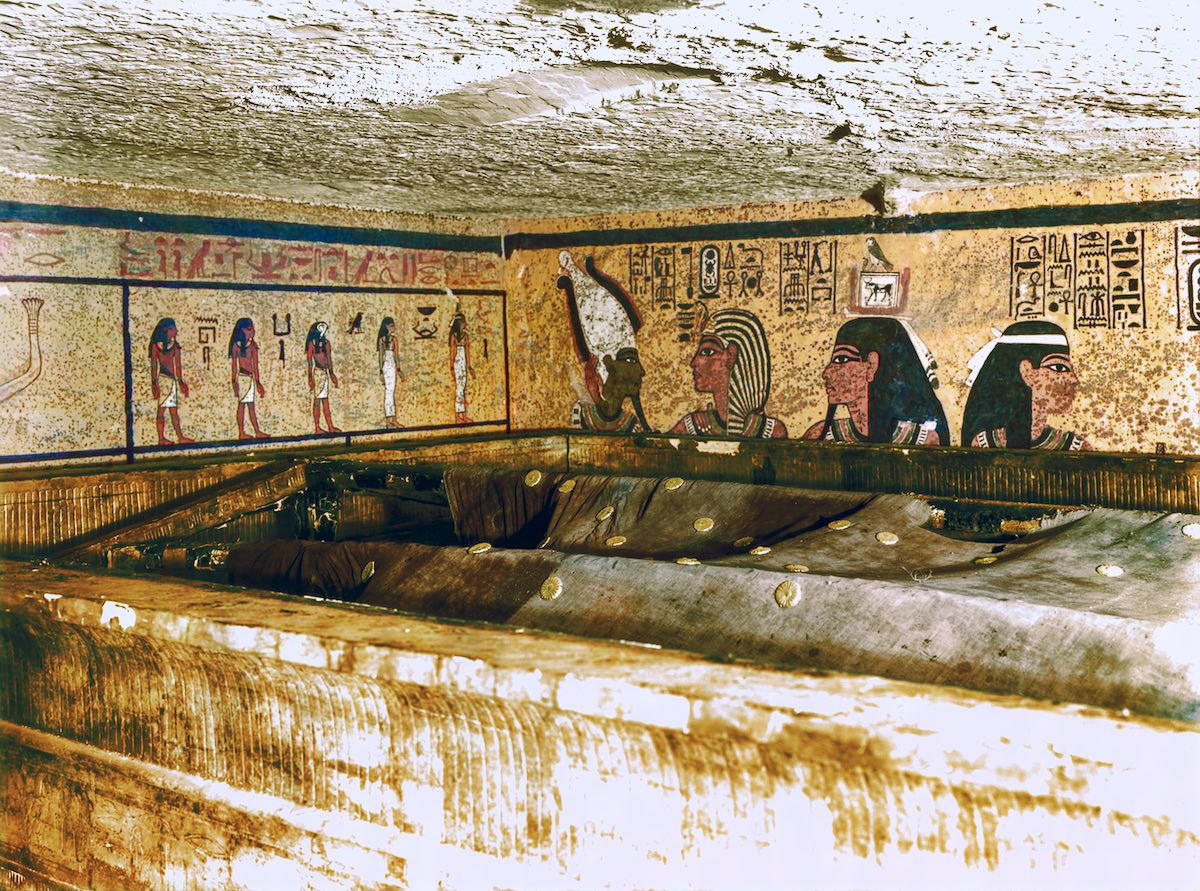
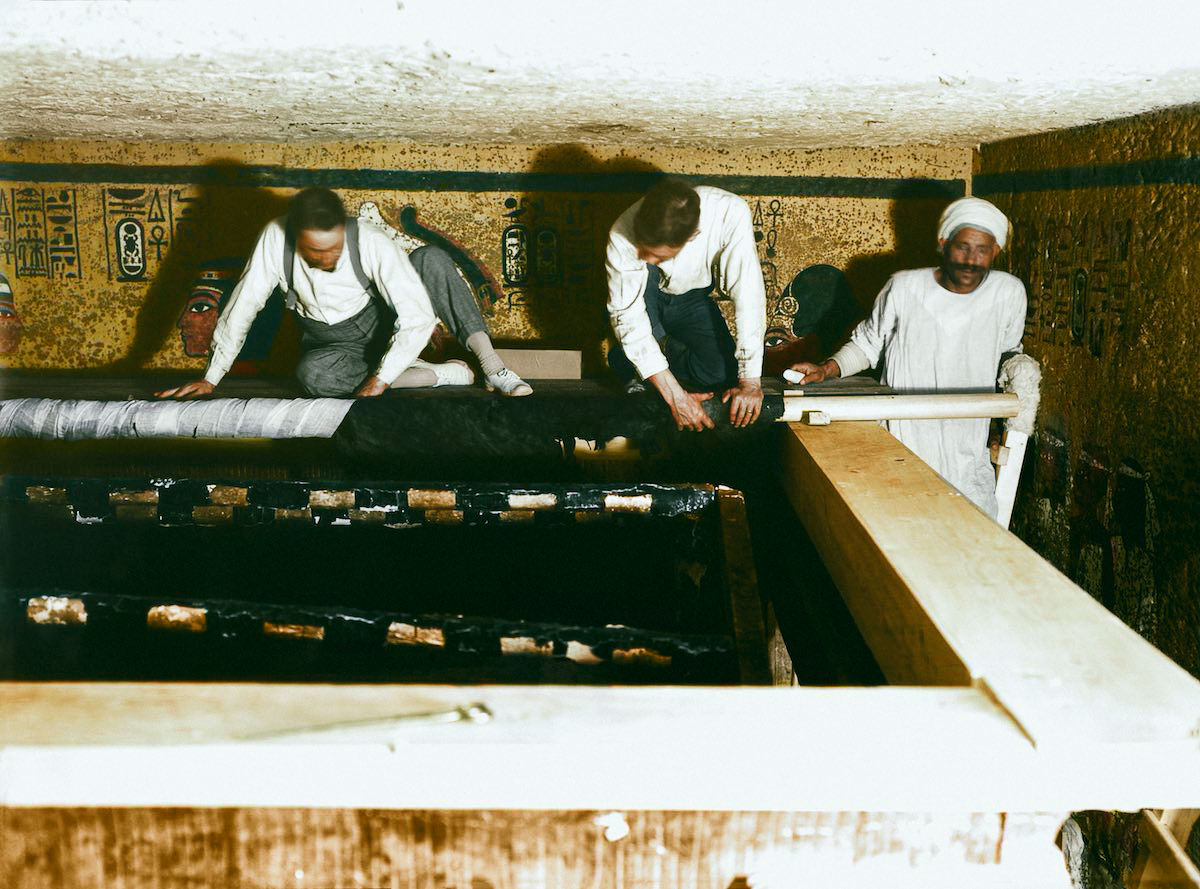
The linen pall, decorated with bronze 'rosettes' (Carter no. 209) inside the walls of the first (outermost) golden shrine (Carter no. 207) in the north west corner of the Burial Chamber. Tutankhamun's Tomb, December 1923
The linen pall, decorated with bronze ‘rosettes’ (Carter no. 209) inside the walls of the first (outermost) golden shrine (Carter no. 207) in the north west corner of the Burial Chamber. Tutankhamun’s Tomb, December 1923
Howard Carter (left), Arthur Mace and an Egyptian workman standing on scaffolding, roll back the linen pall (Carter no. 209). Tutankhamun's Tomb, 30th December 1923
Howard Carter (left), Arthur Mace and an Egyptian workman standing on scaffolding, roll back the linen pall (Carter no. 209). Tutankhamun’s Tomb, 30th December 1923
Howard Carter (centre), Arthur Callender and two Egyptian workmen lifting one roof section from the first, outermost shrine (Carter no. 207). Tutankhamun's Tomb, December 1923
Howard Carter (centre), Arthur Callender and two Egyptian workmen lifting one roof section from the first, outermost shrine (Carter no. 207). Tutankhamun’s Tomb, December 1923

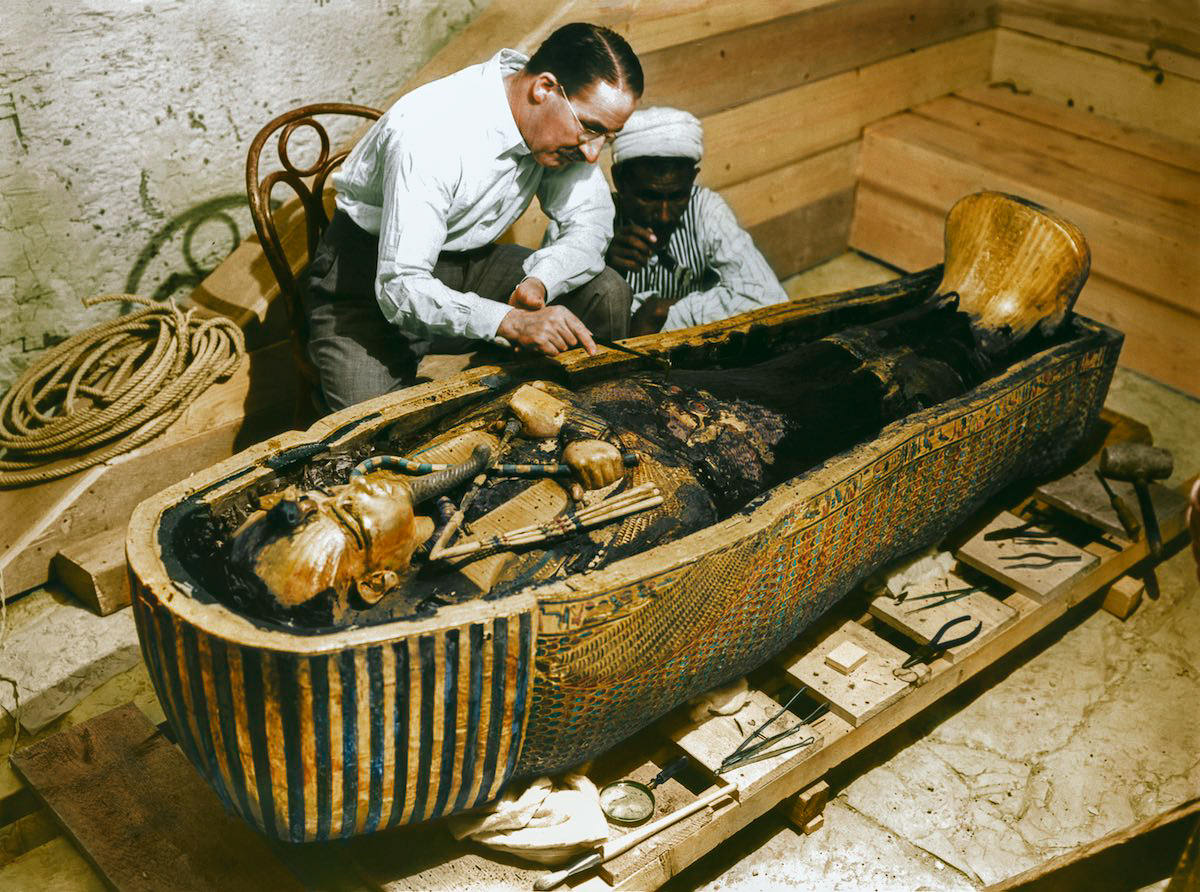
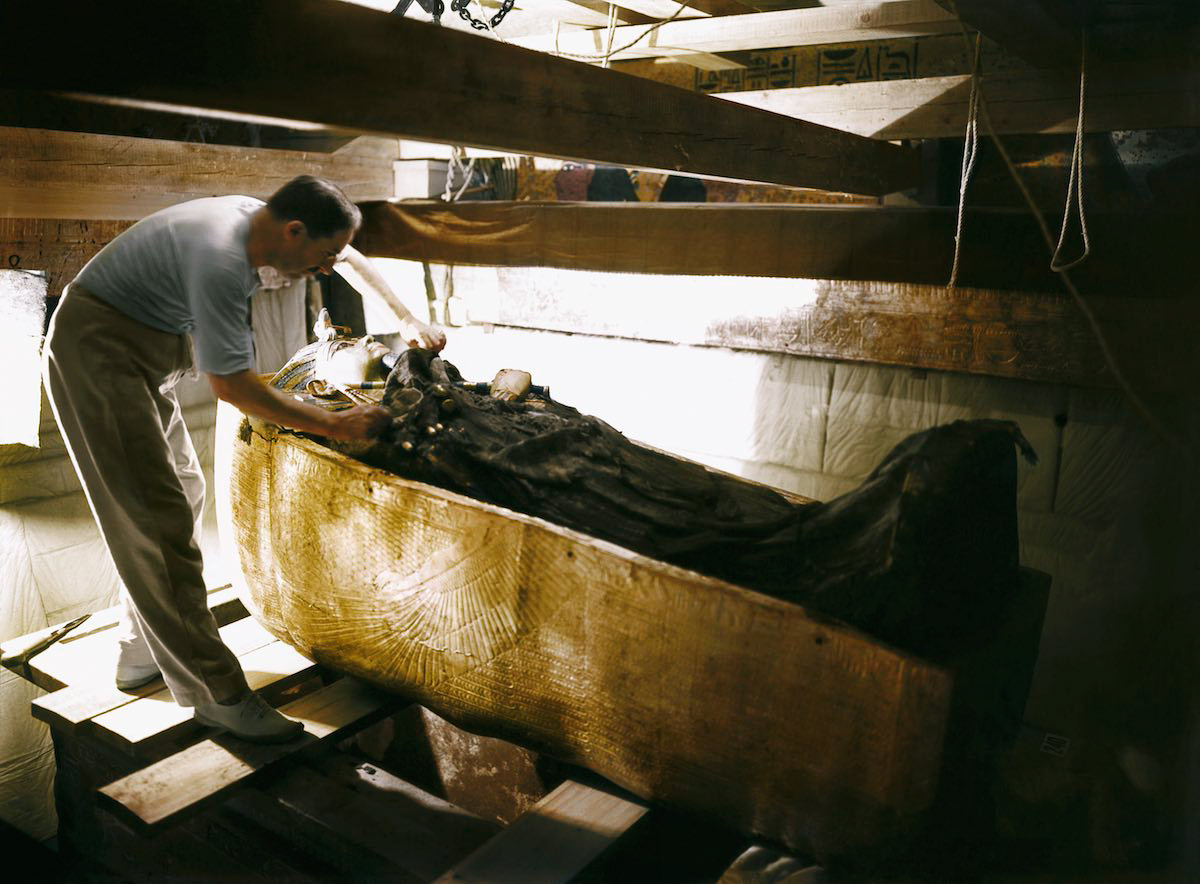
Once the shrines were dismantled and their doors opened, the team could see through to the quartzite sarcophagus at the center of the chamber. Inside the sarcophagus rested a set of nested coffins. Carter worked on the second coffin in October 1925, carefully separating it from the outermost case. The innermost coffin, which he examined alongside an Egyptian workman, was made entirely of solid gold.
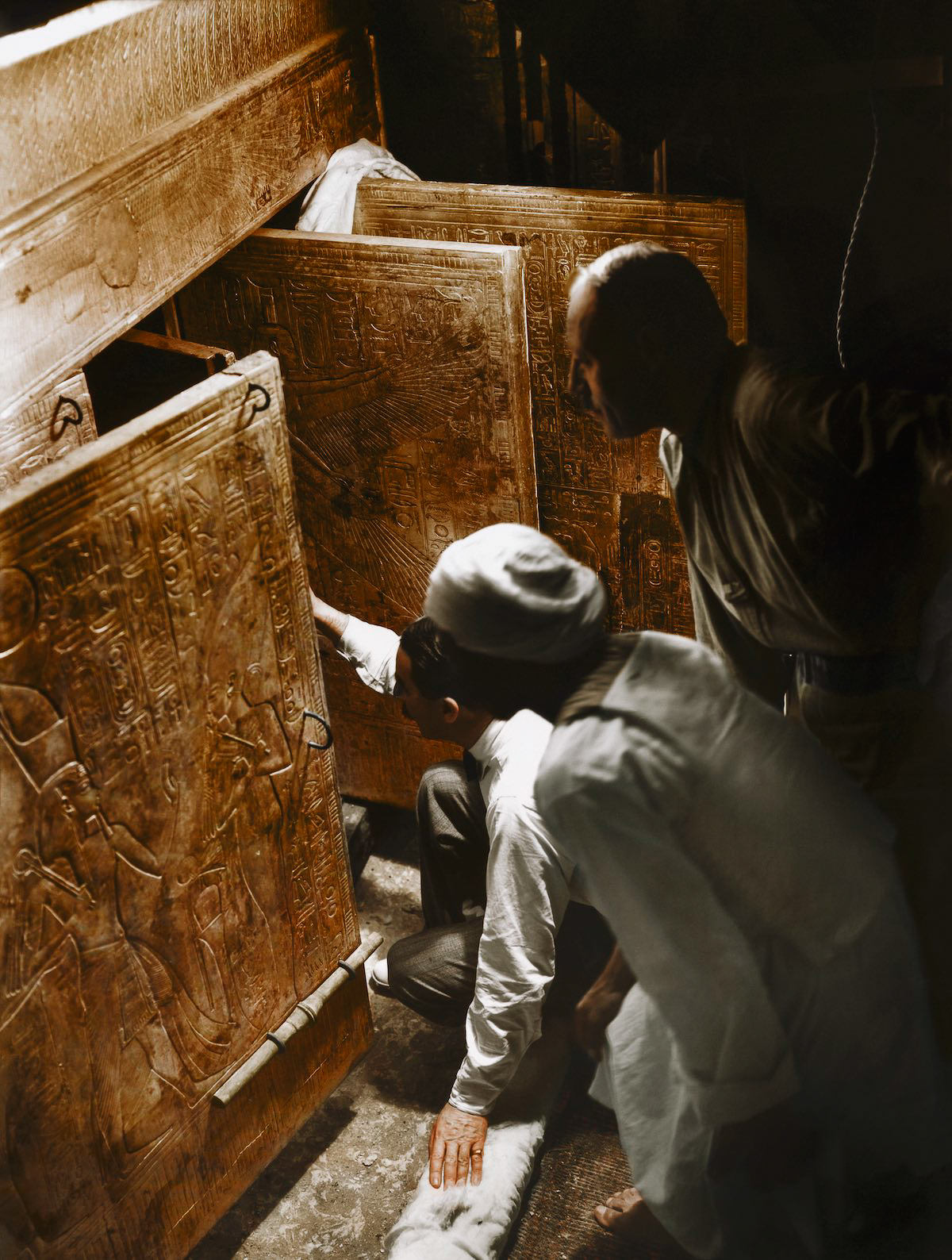
Howard Carter (kneeling), Arthur Callender and an Egyptian workman in the Burial Chamber, looking through the open doors of the four gilded shrines towards the quartzite sarcophagus. Tutankhamun's Tomb, October 1926
Howard Carter (kneeling), Arthur Callender and an Egyptian workman in the Burial Chamber, looking through the open doors of the four gilded shrines towards the quartzite sarcophagus. Tutankhamun’s Tomb, October 1926
Howard Carter working on the lid of the second (middle) coffin, still nestled within the case of the first (outermost) coffin in the Burial Chamber. Tutankhamun's Tomb, October 1925
Howard Carter working on the lid of the second (middle) coffin, still nestled within the case of the first (outermost) coffin in the Burial Chamber. Tutankhamun’s Tomb, October 1925
Carter and an Egyptian workman examine the third (innermost) coffin (Carter no. 255) made of solid gold, inside the case of the second coffin. Tutankhamun's Tomb, 30th October 1925
Carter and an Egyptian workman examine the third (innermost) coffin (Carter no. 255) made of solid gold, inside the case of the second coffin. Tutankhamun’s Tomb, 30th October 1925

Inside the solid gold coffin, the king’s mummy lay wearing the now-iconic gold mask. Burton photographed the mask on October 30, 1925, still resting in place on the mummy’s face inside the innermost coffin — exactly as it had been placed by ancient embalmers more than three thousand years earlier.
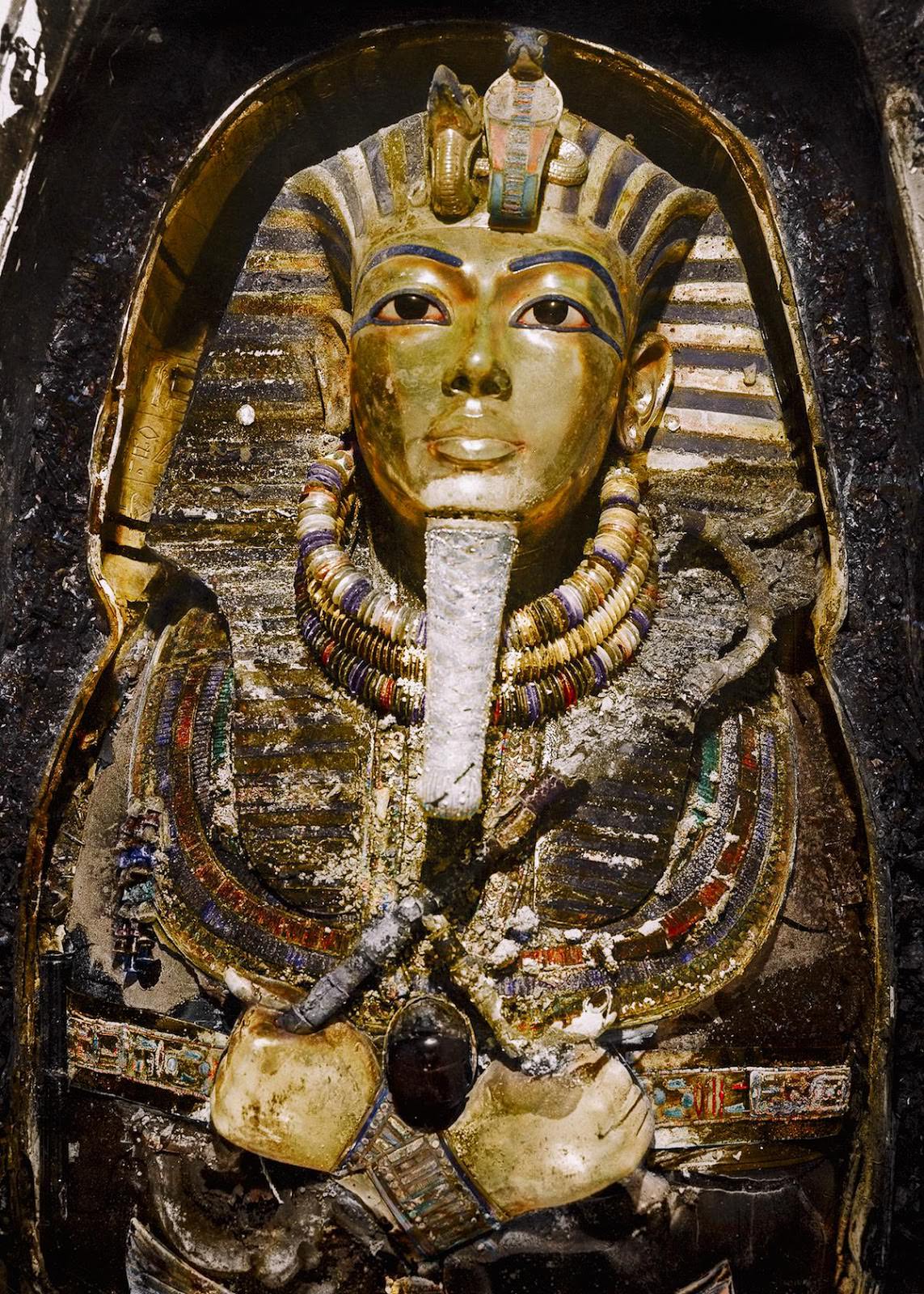
The gold mask (Carter no. 256a) in situ on the mummy of the King, still inside the third (innermost) solid gold coffin (Carter no. 255). Tutankhamun's Tomb, 30th October 1925
The gold mask (Carter no. 256a) in situ on the mummy of the King, still inside the third (innermost) solid gold coffin (Carter no. 255). Tutankhamun’s Tomb, 30th October 1925

Adjacent to the Burial Chamber was the Treasury, a smaller room that held some of the most sacred objects in the tomb. At the entrance stood the Anubis shrine — a crouching jackal figure draped in a linen shirt inscribed with the cartouche of Akhenaten. Beyond it, a line of chests ran down the center of the room, ending with the canopic chest, which housed the king’s linen-wrapped stomach, intestines, liver, and lungs, each stored in a miniature gold coffin inside an alabaster canopic box.
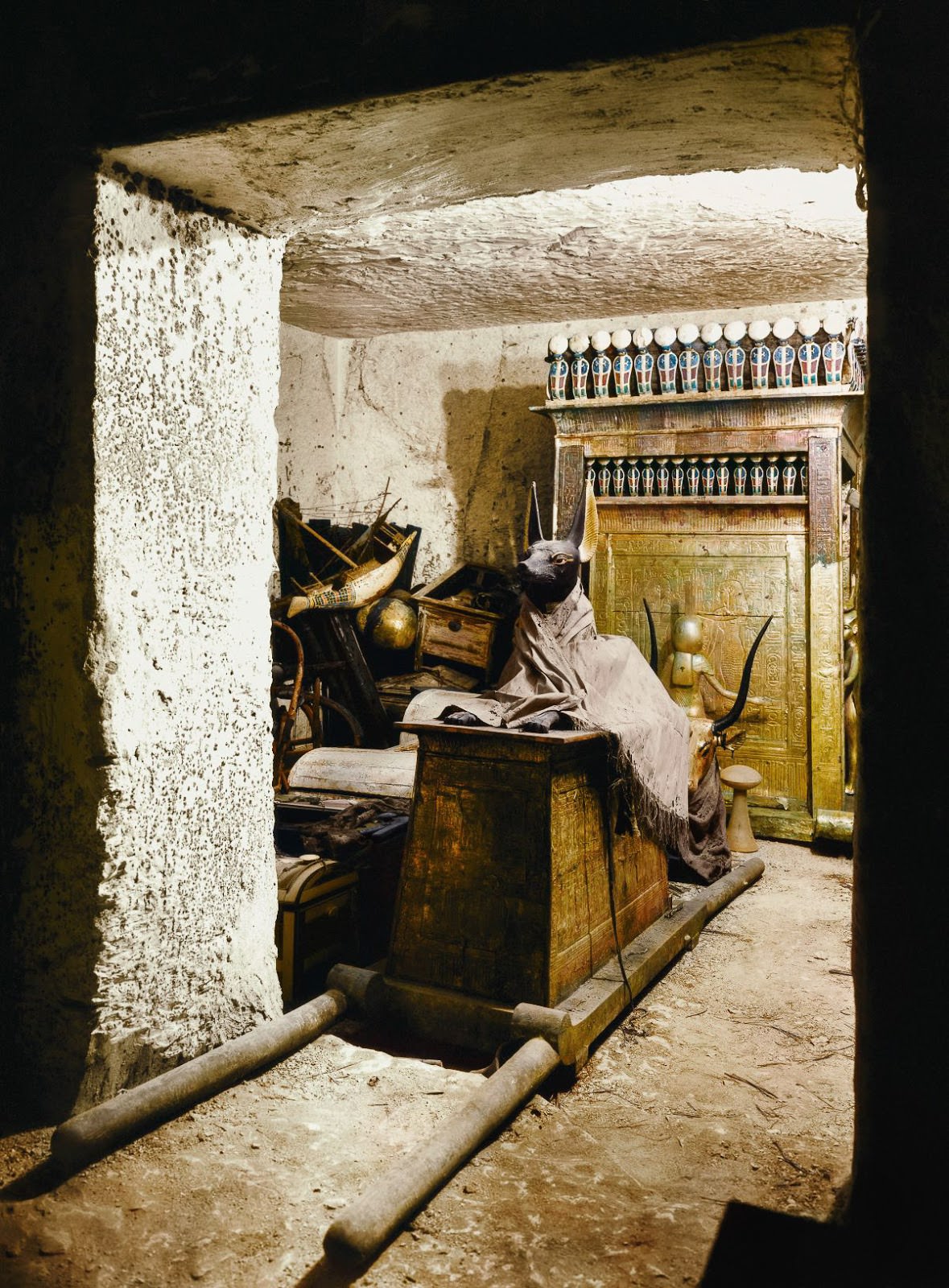
The Anubis shrine (Carter no. 261) on the threshold of the Treasury viewed from the Burial Chamber.
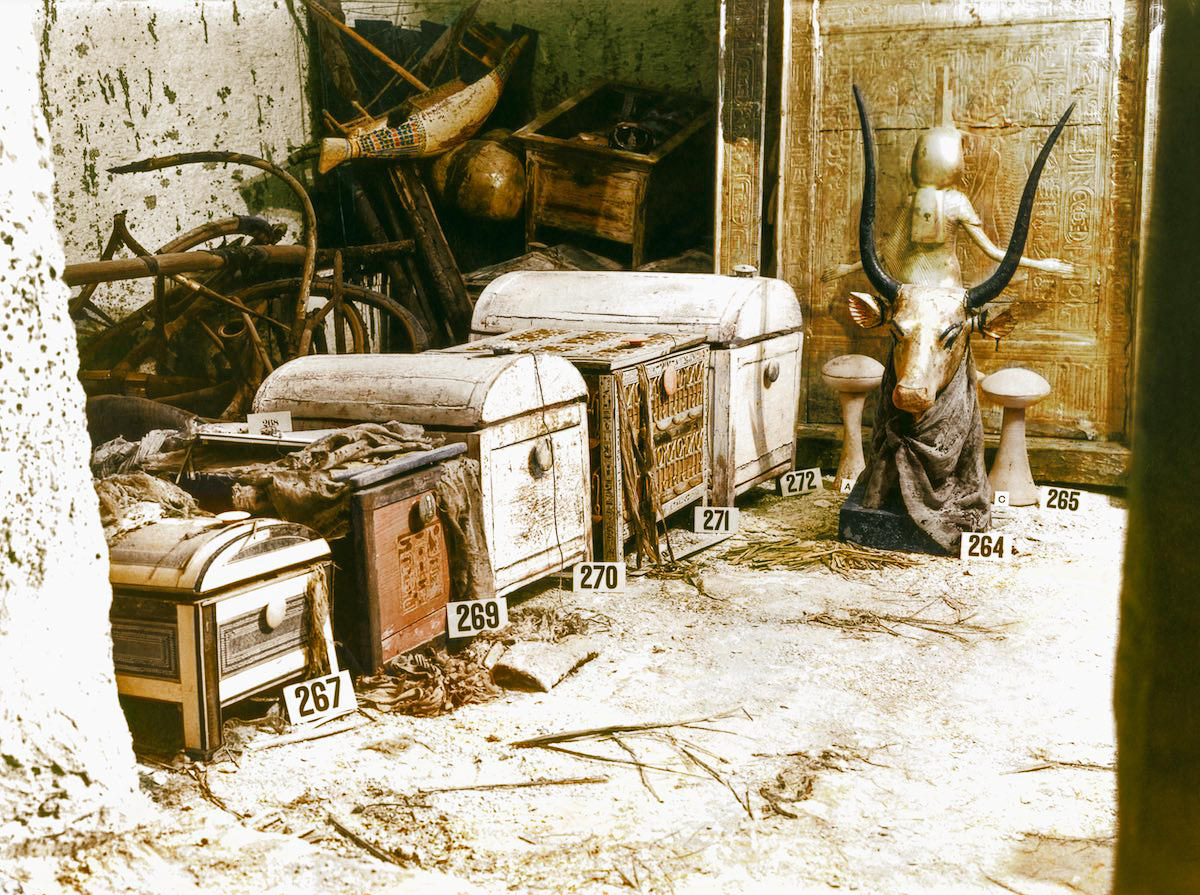
A line of chests down the centre of the Treasury, ending with the canopic chest (Carter no. 266). Tutankhamun's Tomb, October 1926
A line of chests down the centre of the Treasury, ending with the canopic chest (Carter no. 266). Tutankhamun’s Tomb, October 1926

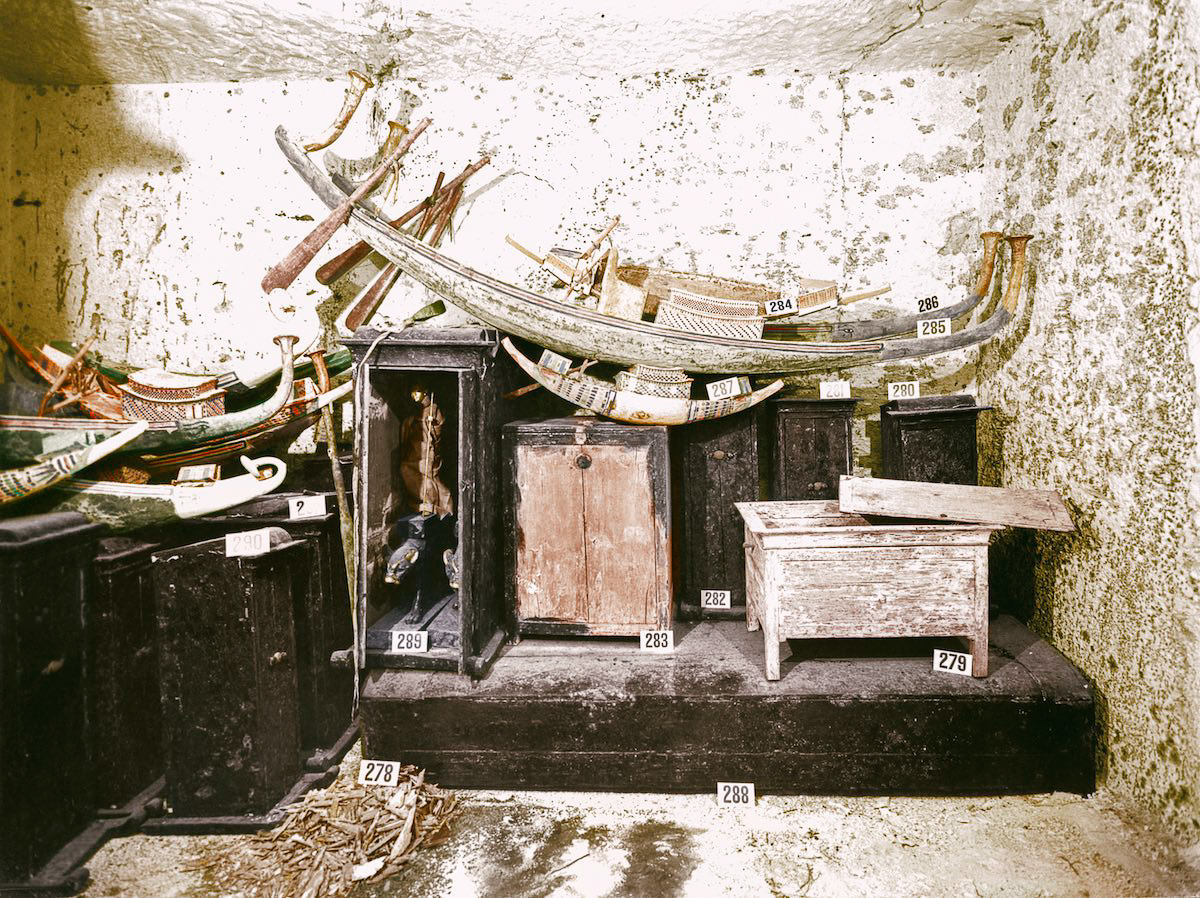
Three wooden chests on the Treasury floor — one shaped like a cartouche — held earrings, sandals, and a wax model of a heron. Along the southern wall, numerous model boats were stacked together, part of the extensive funerary equipment intended to serve the king in the afterlife.
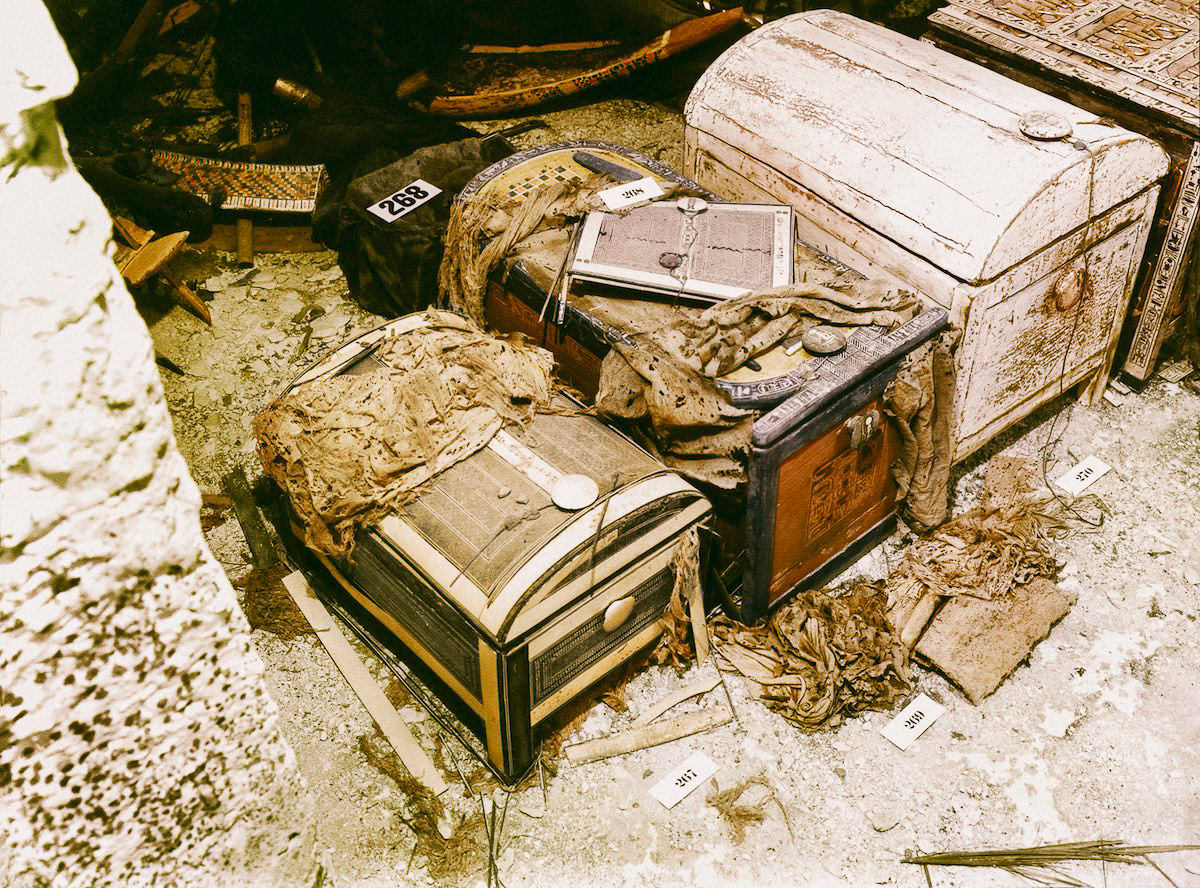
Three wooden chests (the middle one in the shape of a cartouche) on the floor of the Treasury (Carter nos. 267, 269 and 270). Tutankhamun's Tomb, October 1926
Three wooden chests (the middle one in the shape of a cartouche) on the floor of the Treasury (Carter nos. 267, 269 and 270). Tutankhamun’s Tomb, October 1926
Objects, including numerous model boats (Carter nos. 284 to 287), stacked against the southern wall of the Treasury. Tutankhamun's Tomb, November 1926
Objects, including numerous model boats (Carter nos. 284 to 287), stacked against the southern wall of the Treasury. Tutankhamun’s Tomb, November 1926

Burton’s original photographs gave the world its first look at the contents of the tomb. His systematic approach — room by room, object by object — created a visual archive that researchers still rely on today. The colorized versions produced by Dynamichrome from the original negatives at the Griffith Institute, University of Oxford, add a new dimension to that archive. Colors that had been locked inside black and white tones for a century are now visible, pulling the 1920s excavation and the ancient Egyptian world it uncovered into a clarity that feels immediate and real.

Enjoyed this post? Get new ones in your inbox.

Leave a Comment

Your email address will not be published. Required fields are marked *

Share this Post 🥺

Please take a moment to share this content. Your support is greatly appreciated! 🙌🙏

Share this Post 🥺

Please take a moment to share this content. Your support is greatly appreciated! 🙌🙏
Scroll to Top
 
Hey Friend, Before You Go.. Please like & follow for more interesting content