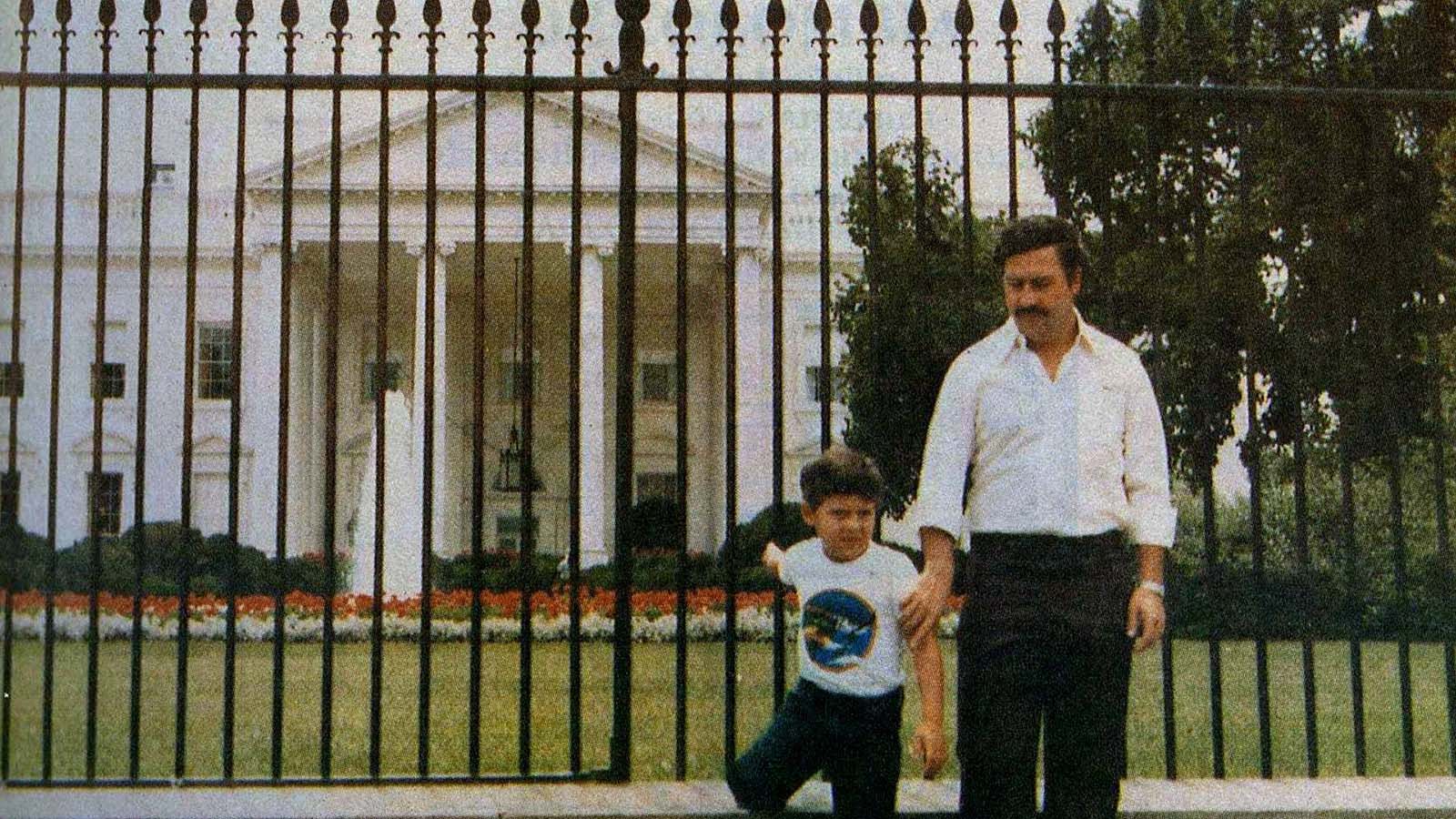
In 1981, a photograph was taken inside the White House that would later become one of the most jarring images in the history of American drug policy. Standing in front of the presidential seal was Pablo Escobar — at the time a rapidly rising figure in the international cocaine trade — along with several of his associates from the Medellín Cartel. The image was not staged as a joke or a stunt. It was real, and the circumstances behind it reveal just how deeply the drug trade had woven itself into the fabric of American society by the early 1980s.
Escobar and the other Medellín Cartel members had traveled to the United States for a series of meetings with American drug traffickers. During that visit, they were brought to the White House, where they met with Vice President George H.W. Bush. At this point in his criminal career, Escobar was already responsible for a significant portion of the cocaine being smuggled into the United States. He was not a low-level dealer — he was one of the primary architects of a supply chain that flooded American cities with drugs.
The meeting raises a direct and uncomfortable question: how much did U.S. officials actually know about Escobar’s operations at the time? By 1981, American law enforcement agencies had been tracking the growth of Colombian cocaine trafficking for years. The Medellín Cartel was not operating in complete secrecy. Drug Enforcement Administration reports from the late 1970s and early 1980s documented the cartel’s expanding reach across the United States, naming key figures and distribution networks. Escobar’s name was not unknown to federal agencies.
Yet there he stood, inside the White House. The visit points to a broader pattern that defined parts of the early war on drugs — one where intelligence gathering sometimes meant engaging with the very people the government was supposed to be fighting. Officials at various levels made deals, looked the other way, or gathered information by maintaining contact with criminal networks. These were not isolated incidents of corruption but rather a reflection of the chaotic and often contradictory strategies being used to address the drug crisis.
George H.W. Bush was serving as Vice President under Ronald Reagan at the time, and he was also heavily involved in the administration’s anti-drug efforts. Reagan’s presidency marked a dramatic escalation of the war on drugs, with increased funding for enforcement, stricter sentencing laws, and a more aggressive international approach to targeting drug-producing countries. The fact that a senior figure in that same administration met with Escobar and his cartel associates shows how blurred the lines were in those early years.
Escobar’s operation was not merely a law enforcement problem — it was a geopolitical one. The Medellín Cartel had financial resources and political connections that allowed it to operate across borders with relative ease. In Colombia, Escobar bribed judges, politicians, and police officers on a massive scale. In the United States, his cocaine moved through distribution networks that spanned dozens of cities. The White House visit, whether it was the result of a deliberate intelligence strategy or a stunning failure of vetting, demonstrated just how far the cartel’s reach extended.
The photo itself has been circulated widely in the decades since it was taken. It shows Escobar and his associates dressed in suits, standing calmly in one of the most powerful buildings in the world. There is nothing about the image that looks out of place on the surface — which is precisely what makes it so striking. These were not men who appeared to be on the fringes of society. They carried themselves with the confidence of people who believed they belonged in rooms like that one.
By the time the full scale of Escobar’s crimes became undeniable — bombings, assassinations of presidential candidates, judges, and police officers, and the deaths of thousands of civilians in Colombia — the 1981 White House visit had already happened. The U.S. government would eventually play a direct role in the hunt for Escobar, providing intelligence and technical support to Colombian forces. He was killed in Medellín on December 2, 1993, the day after his 44th birthday, shot by Colombian National Police during a rooftop confrontation.
The story behind this photograph is not about a single reckless decision. It is about a period in American history when the mechanisms built to fight the drug trade were struggling to keep up with the speed and sophistication of the traffickers themselves. Escobar walked into the White House in 1981 not because the system had completely failed, but because the system had not yet fully understood what it was dealing with.