By the mid-1950s, Americans were obsessed with speed, engines, and the open road. Car culture was everywhere — but one inventor from Lincoln Park, Michigan thought personal transportation could go much further than four wheels. Antonio Pirrello believed it could go all the way down to your feet.
Pirrello founded the Motorized Roller Skate Company in Detroit in 1955. By 1956, the company was already producing skates unlike anything the public had seen. These weren’t toys. They were gas-powered machines strapped to your feet, built for real speed on real streets.
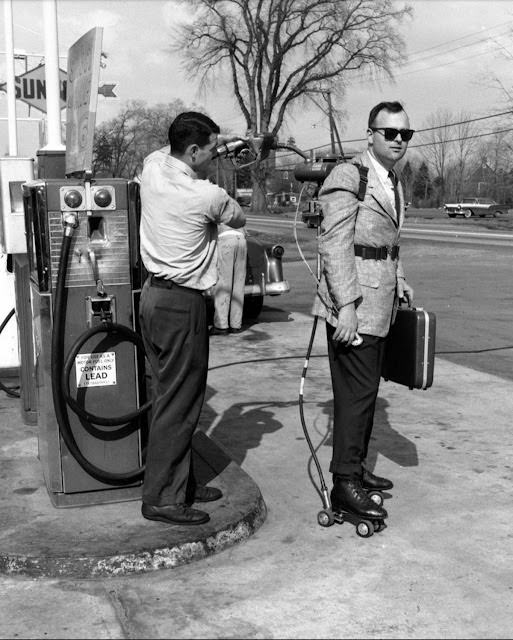
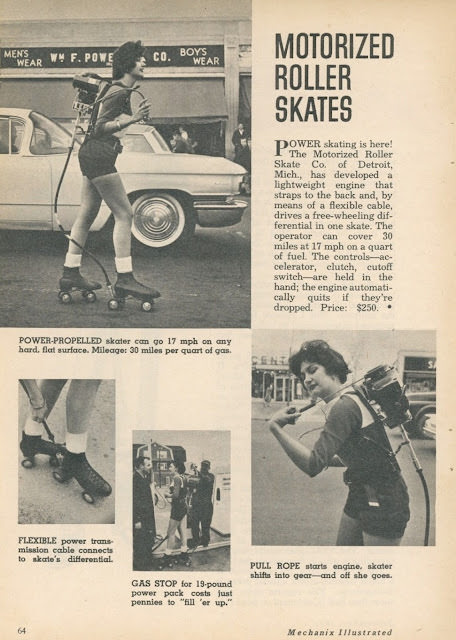
The engineering behind the skates was both clever and bold. A 19-pound gasoline motor was worn on the skater’s back like a backpack. From there, a cable connected the motor directly to the right skate, which drove the propulsion. The left foot extended forward and functioned as a steering guide — a simple but surprisingly effective system. A second cable ran from the backpack to the skater’s hand, acting as a clutch to control speed. Lean into it, and the skates would accelerate. Back off, and you’d slow down.
That top speed was no small number. The motorized skates could reach 40 miles per hour — on roller skates. To put that in context, a recreational cyclist typically tops out around 12 to 15 mph. Pirrello’s invention was more than three times faster, with nothing between the rider and the pavement but a pair of boot-mounted wheels.
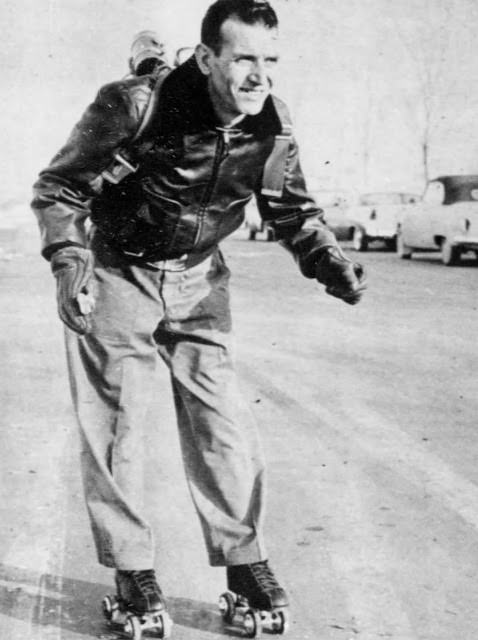
The price tag matched the ambition. At $250 retail, these skates were a serious investment in the 1950s economy — the equivalent of roughly $2,300 today. That put them firmly in luxury territory, well out of reach for the average American family. They weren’t marketed as a practical commuter tool so much as a statement: a gleaming, roaring piece of personal freedom for those who could afford the ride.
The media took notice fast. Life magazine and Popular Mechanics both featured Pirrello’s invention, placing it alongside other symbols of American ingenuity and postwar optimism. These weren’t small mentions buried in the back pages — the skates were treated as genuine news, a peek at what personal transportation might look like in the future.
Television brought the skates to an even wider audience. Pirrello appeared on “You Asked for It” and “The Today Show,” demonstrating his invention to viewers across the country. Watching someone strap a gas motor to their back and shoot down a street at 40 mph was exactly the kind of spectacle that stopped people in front of their sets. The coverage wasn’t just publicity — it made motorized roller skates a genuine cultural moment.
What made Pirrello’s skates stand out wasn’t just the speed or the motor. It was the sheer audacity of the concept. In an era when American inventors were pushing boundaries in aviation, automotive design, and consumer electronics, the idea of a personal motorized skate fit right into the national mood. People wanted more — more speed, more freedom, more ways to move through the world on their own terms. Pirrello gave them exactly that, one gas-powered glide at a time.