The 1920s were a golden age of aviation daring. Crowds gathered at airfields across America to watch stunt flyers push the limits of what a human body — and a biplane — could handle. Among those flyers, one name stood apart: Gladys Ingle. Born on March 28, 1899, she became one of the most fearless aerial performers of her era, a woman who did things in the sky that most men would refuse to attempt on the ground.
Ingle’s path into aviation started with balloons, not airplanes. She and her sister Ann performed parachute jumps as part of the C.P.O. Aerial Circus, dropping from great heights for crowds below. By 1922, the sisters had moved on to airplane-based acts, including mid-air parachute races with each other. These early experiences gave Ingle a foundation that most pilots never had — a deep, firsthand familiarity with the open air, the wind, and the constant threat of a fall.
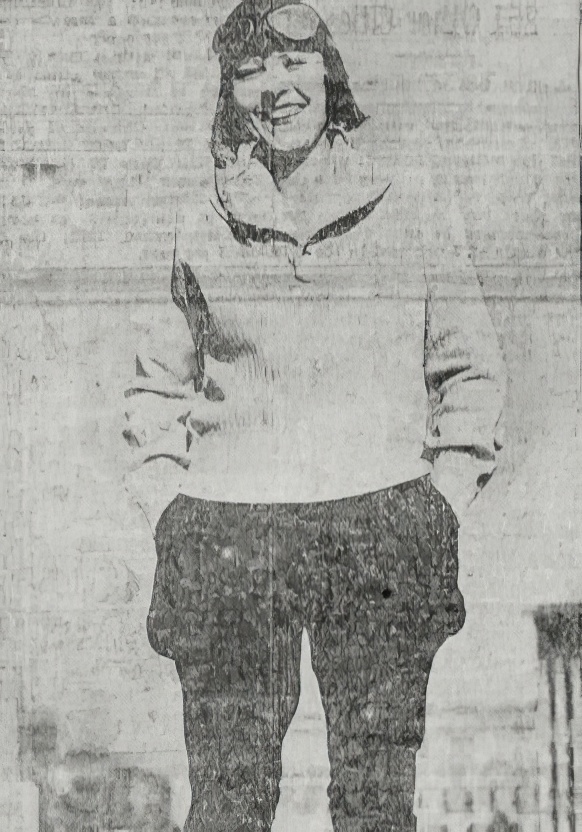
Her skills and nerve earned her a spot with the 13 Black Cats, one of the most well-known aerial stunt teams in the country. The group was famous for performing acts that bordered on suicidal — plane-to-plane mid-air transfers, low passes under bridges with passengers riding on the wings, and other feats designed to shock audiences. Ingle was the only woman on the team. In a field dominated entirely by men, she didn’t just hold her own; she became one of the team’s most recognized performers. She completed plane-to-plane transfers in open air and rode atop wings as aircraft skimmed below bridge structures. Each act required precise timing, physical strength, and total control over fear.
But the stunt that cemented her place in aviation history happened in January 1926. It was filmed, which means the footage still exists as direct proof of what she did. The act involved two Curtiss JN-4 biplanes — the classic “Jenny” used widely after World War I — and a plan that combined wing walking with on-the-spot mechanical work, hundreds of feet above the ground.
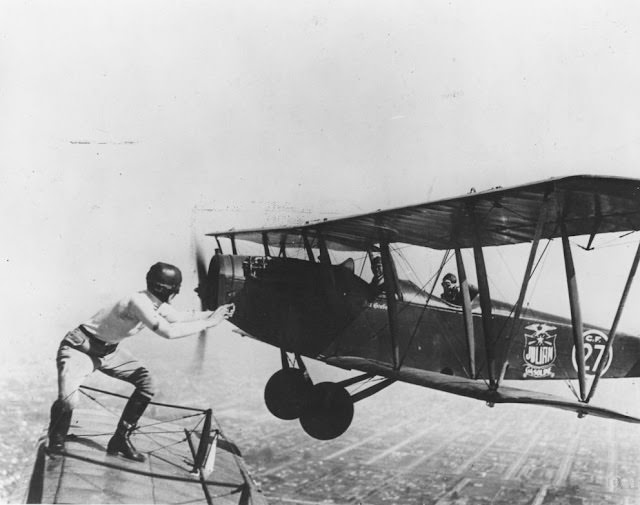
The setup was this: Ingle boarded Bon McDougall’s plane with a spare tire strapped to her back. Art Goebel flew the second plane alongside, this one having “lost” a wheel as part of the planned stunt. Once both aircraft were airborne, Ingle climbed up to the top wing of McDougall’s Jenny. From there, she transferred herself to the bottom wing of Goebel’s plane — moving between two aircraft in open flight with nothing beneath her but sky and farmland. She then worked her way down to the landing gear and installed the spare wheel, doing the job of a ground mechanic while the plane flew through the air at altitude.
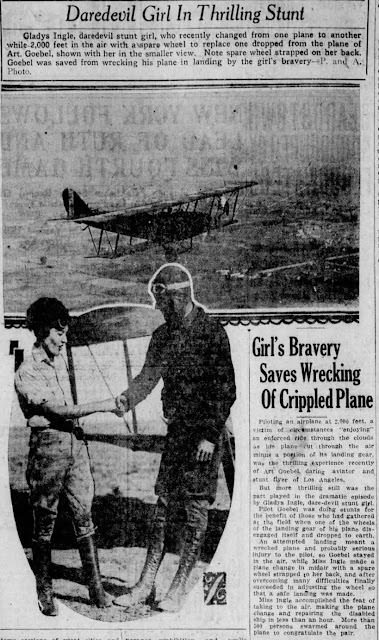
The physical demands of this act were extraordinary. The wind resistance at flight speed makes every movement a fight. Gripping the struts and wires of a biplane while carrying a tire on your back, then transferring to a second moving aircraft, requires both upper-body strength and precise spatial awareness. Installing the wheel on the landing gear meant working with her hands while the plane pitched and vibrated around her, with no harness, no safety net, and no second chance if she lost her grip. Ingle completed every step without incident.
The filmed record of the stunt made it more than a single crowd performance. It became something people could watch and re-watch, and the footage spread Ingle’s reputation far beyond the airfields where she usually performed. The 13 Black Cats were already well known, but this particular act — a woman changing a wheel on a flying airplane — was the kind of thing that didn’t fit neatly into what most people believed was possible, let alone what a woman in 1926 was expected to be doing.
Gladys Ingle operated in an era before safety standards, before aviation regulations caught up with the stunt flying world, and before the public had grown used to the idea of women as skilled mechanical and athletic performers. She did what the job required — climbed, transferred, gripped, worked — and the camera was there to record it.