Martha Jane Cannary, known to the world as Calamity Jane, was one of the most recognizable figures to ever come out of the American frontier. She worked as a scout for the U.S. Army, performed in Buffalo Bill’s Wild West Show, and built a reputation that stretched far beyond the plains she roamed. She dressed in men’s clothing, could shoot and ride as well as most men of her era, and rarely shied away from danger. But her life was also marked by poverty, heavy drinking, and long stretches of hardship that her legend often overshadowed.
By the time she reached her early fifties, the fame that had once followed her had faded. She was living in Terry, South Dakota, far from the spotlight that had briefly made her a household name. On August 1, 1903, Calamity Jane died at the age of 51. The cause of death was pneumonia, compounded by the physical toll of long-term alcoholism. Her final days were spent in near-total obscurity, a stark contrast to the adventurous life she had lived for decades.
Shortly after her death, a photograph was taken of Jane lying in her coffin. That image would go on to become one of the most recognized postmortem photographs in American frontier history. Postmortem photography — the practice of photographing the recently deceased — was common in the 19th and early 20th centuries. Families and communities used these images as a final record of the dead, especially for notable individuals. In Jane’s case, the photograph served as the world’s last look at a woman who had defined an era.
The photograph shows Jane lying in a simple wooden coffin, her hands folded across her chest and her eyes closed. She is dressed in a plain white dress — a sharp departure from the buckskin and trousers she wore throughout most of her life. Two unidentified men appear in the image alongside her. No records survive to confirm who they were or what their relationship to Jane was. Some historians believe they were friends or associates who arranged for the photograph to be taken. Others have suggested they were members of the press who were present to document her death for their publications.
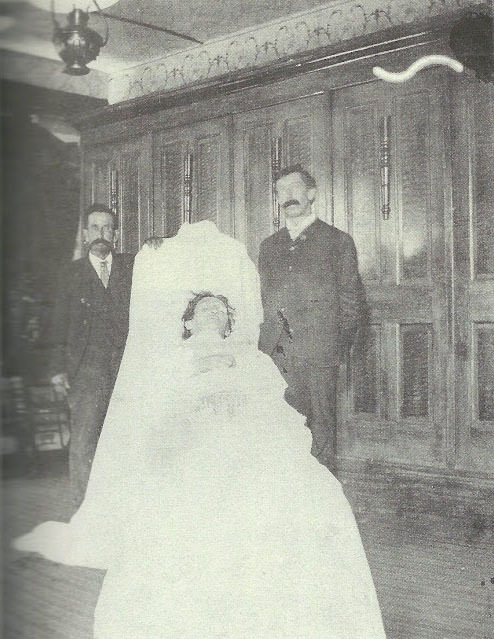
The origins of the photograph itself are equally unclear. It is not known with certainty who held the camera. One theory is that a local photographer was hired by people close to Jane to create a final record of her. Another is that a reporter or press photographer happened to be on the scene and captured the image independently. What is known is that the photo spread quickly. Newspapers across the country printed it, and physical copies were sold as souvenirs in South Dakota. For many Americans, it was the final chapter in a story they had been following for years.
Calamity Jane had always attracted public attention, though not always for flattering reasons. She was loud, unconventional, and deeply resistant to the social expectations placed on women of her time. She claimed to have been a friend of Wild Bill Hickok, and she often told stories about her past that blurred the line between fact and embellishment. But behind the bravado, people who knew her described a woman who was genuinely generous — someone who nursed the sick during outbreaks of smallpox in Deadwood and gave what little she had to those who needed it.
Her years with Buffalo Bill’s Wild West Show had given her a taste of national fame in the early 1890s, but the show circuit was unstable, and her drinking made steady work difficult to maintain. By the late 1890s and into the early 1900s, she was drifting between towns, often broke, and largely forgotten by the broader public. The version of Calamity Jane that appeared in dime novels and on promotional posters bore little resemblance to the aging, struggling woman who died in Terry in 1903.
Per her own request, Calamity Jane was buried next to Wild Bill Hickok in Deadwood, South Dakota. Hickok had been shot and killed there in 1876, and Jane had long expressed a wish to be laid to rest beside him. Whether the two shared the close bond she often described is debated among historians, but her burial wish was honored. Thousands attended her funeral, far more than had paid attention to her in her final years of life.
The death photograph taken in Terry captured something that words alone struggle to convey — the physical reality of a life that had been hard-lived and was now over. Jane lay still in white linen, surrounded by wooden planks, attended by two men whose names history never recorded. The image circulated as a news item and a curiosity, but it also functioned as a kind of document. It preserved the final physical appearance of a woman who had spent her life in motion, and it gave the public something concrete to hold onto at the close of her story.
Today the photograph is held as a significant historical artifact. It sits at the intersection of frontier history, early American press photography, and the cultural mythology of the Wild West. For historians, it is a primary source. For the general public, it remains a striking and sobering image — the last look at Calamity Jane, dressed in white, at rest for the first time in a very long life.