
Old photographs have a way of pulling you in. They show how people lived, what they feared, and what they found acceptable — sometimes in ways that feel deeply wrong by today’s standards. Some of these images capture genuine historical horrors: crime scenes, medical experiments, and war. Others are simply strange products of their era. Together, they form a collection that is hard to look away from — and harder to forget. Below are over 50 vintage photos that range from historically disturbing to flat-out eerie.
One of the most well-known macabre landmarks in Europe sits beneath the streets of Rome. The Capuchin Crypt, built between 1631 and 1870, contains the bones of approximately 3,700 Capuchin friars. The monks arranged the skeletal remains of their brothers into elaborate decorative patterns — chandeliers, archways, and wall mosaics, all made from human bones. By 1900, the crypt had become a popular tourist destination, drawing visitors who wanted to witness its grim artistry firsthand.

The practice of head shrinking — known as tsantsa — was carried out by the Shuar and Achuar peoples of Ecuador and Peru. Shrunken heads were taken from enemies in battle and prepared through a specific process of removing the skull, boiling the skin, and filling it with hot stones. By the 19th century, Western collectors and anthropologists had developed a strong demand for them, which led to a grim trade in authentic and counterfeit specimens.

French inventors in the 18th century built extraordinarily lifelike mechanical figures called automata. These were not simple toys — they were precision-engineered machines capable of writing, drawing, and playing musical instruments. The most famous, built by Jacques de Vaucanson and later the Jaquet-Droz family, could mimic human movement so convincingly that audiences genuinely struggled to distinguish them from living children.

Krampus is a horned, demonic figure rooted in Alpine folklore, traditionally said to punish naughty children during the Christmas season. While St. Nicholas rewarded good behavior, Krampus beat badly behaved children with birch branches and, in some tellings, dragged them away in a sack. Krampus greeting cards and photographs featuring the creature alongside children were popular in central Europe around 1900, treated with far less alarm than modern viewers might expect.


Sideshow performers were a major part of American entertainment culture from the mid-1800s through the early 20th century. One of the most recognized was Stephan Bibrowski, known professionally as “Lionel the Lion-Faced Boy.” Born in 1891 in Poland, Bibrowski had hypertrichosis — a condition causing long hair to grow across his entire face and body. He performed across Europe and the United States, and at the height of his fame in 1907 was one of the most talked-about performers in the world.

Silent film actor Lon Chaney was known as “The Man of a Thousand Faces” for his ability to transform himself through elaborate makeup. In the 1924 MGM film He Who Gets Slapped, he played a circus clown — a role that leaned heavily into the unsettling duality of the character. His clown makeup, designed to evoke both comedy and sadness, remains one of the more disturbing images from the silent film era.

Coney Island in Brooklyn was home to a sprawling amusement culture that included sideshows running well into the mid-20th century. These performances often featured optical illusions and stage tricks designed to shock audiences. One recurring act was the “headless woman” illusion — a performer who appeared to sit without a head, achieved through mirrors, lighting, and careful staging. Photographs from these acts, like this one from 1945, look far more disturbing out of context.

On the night of November 11, 1974, Ronald DeFeo Jr. shot and killed six members of his family while they slept in their home at 112 Ocean Avenue in Amityville, New York. The crime scene photographs taken that night are deeply disturbing documents of one of Long Island’s most infamous mass murders. The house and the murders later became the basis for the 1977 book and subsequent film The Amityville Horror.


William Heirens terrorized Chicago between 1945 and 1946, killing at least three people. He became known as the “Lipstick Killer” after writing a desperate message on a victim’s wall using her lipstick. The message — “For heavens sake catch me before I kill more. I cannot control myself” — was written in a childlike scrawl that stood in stark contrast to the violence of the crimes. Heirens was arrested in 1946, convicted, and spent the rest of his life in prison.

On July 16, 1952, Coast Guard photographer Shell Alpert captured four bright, unidentified objects glowing in the sky over Salem, Massachusetts. The photograph was taken at 9:35 a.m. and was submitted to military investigators. It remains one of the most widely studied UFO photographs from the 1952 wave of sightings — a period during which the U.S. Air Force received a record number of UFO reports.

When Reactor No. 4 at the Chernobyl Nuclear Power Plant exploded on April 26, 1986, it released radioactive material across much of Europe. In the months and years that followed, scientists and engineers had to physically enter the ruins of the reactor building to assess the damage. This photograph shows one of those scientists descending alone into the dark, heavily contaminated interior — a task that carried serious long-term health consequences.

Spiritualism — the belief that the living could communicate with the dead — was a major cultural movement in the late 19th and early 20th centuries. Mediums held séances and claimed to produce physical evidence of spirits, including ectoplasm, a substance they said materialized from their bodies. Eva Carrière, known as Eva C., was one of the most photographed mediums of her era. This image from May 17, 1912, shows her appearing to produce an apparition between her hands during a controlled session.


Glass eyes were a genuine medical necessity for patients who had lost an eye to injury or disease. In the 19th and early 20th centuries, highly skilled craftsmen produced custom prosthetic eyes from hand-blown glass. Traveling salesmen carried sample cases filled with dozens of eyes in varying shades and sizes to match each patient. Photographs of these collections, like this one from around 1900, are unsettling in a way that the original owners likely never intended.

The mass production of dolls in the late 19th and early 20th centuries involved factories that manufactured heads separately before attaching them to bodies. The doll heads — often made from bisque porcelain or composition material — were hung or dipped during the painting and drying process. Photos from these factories, showing rows of disembodied heads dripping from hooks, were never meant to be disturbing. They simply documented industrial work.


In 1856, French neurologist Guillaume-Benjamin-Amand Duchenne de Boulogne published Mécanisme de la Physionomie Humaine, a study of facial expressions produced by electrical stimulation. Duchenne attached electrodes to his subjects’ faces and triggered muscle contractions to produce specific expressions. The resulting photographs — faces contorted into involuntary grimaces and smiles — were intended as a scientific record of human emotion, but they look far closer to torture.


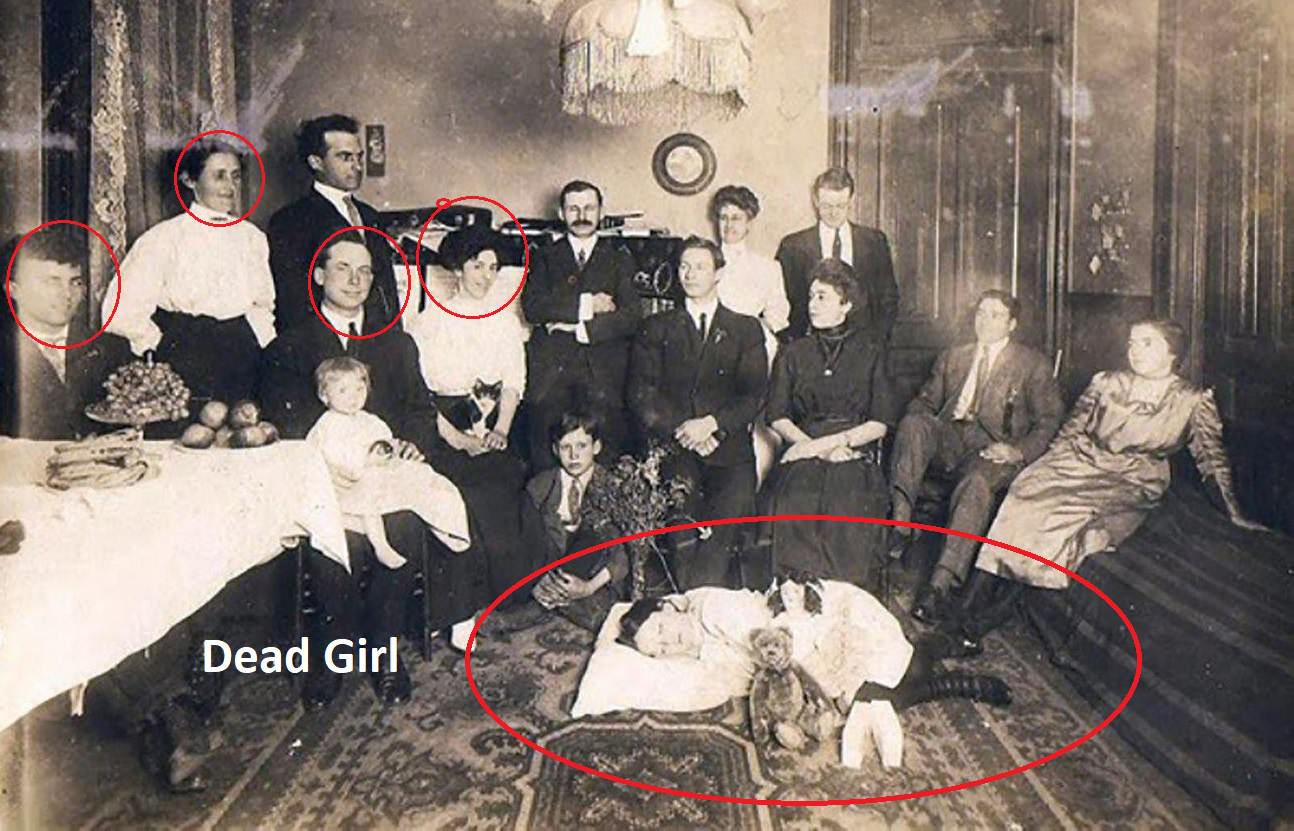
Postmortem photography — photographing the deceased — was common throughout the 19th century, particularly for children, who had high mortality rates. Families often had no other photograph of a lost child, making these images their only lasting record. Some postmortem portraits posed the deceased as if sleeping or sitting upright, surrounded by family members. The practice was treated as a normal and meaningful act of remembrance.

On March 18, 1925, a fire broke out at Madame Tussauds wax museum in London. The heat was intense enough to melt many of the museum’s figures, including its most historically significant ones. The aftermath left a scene of warped, half-melted faces and collapsed bodies — recognizable enough to be disturbing, but destroyed enough to be unidentifiable. The museum rebuilt its collection, but photographs from the fire remain among the stranger images in London’s history.

Soviet scientist Vladimir Demikhov conducted a series of surgical experiments in the 1950s aimed at advancing the science of organ transplantation. In 1954, he successfully grafted the head and forelimbs of a smaller dog onto the body of a larger one, creating a two-headed animal that survived for several days. Demikhov repeated the experiment over 20 times. His work, while deeply disturbing, directly influenced later developments in heart and lung transplant surgery.


Disney animatronics — lifelike robotic figures used in theme park attractions — were a marvel of engineering when first introduced in the 1960s. But photographs taken during maintenance or construction, when the figures are partially assembled or missing facial components, reveal just how unsettling the technology looks up close. The human-shaped bodies with exposed mechanisms and blank expressions create an effect that engineers call the “uncanny valley” — close enough to human to be disturbing.

The original Ronald McDonald appeared on a Washington D.C. television program in 1963, performed by Willard Scott — who later became famous as a Today Show weatherman. The costume was far removed from the polished, friendly mascot that McDonald’s would later develop. With a cup for a nose, a food tray hat, and a wide painted grin, the original Ronald was the kind of clown that kept children at a distance rather than drawing them in.

Myrtle Corbin was born in 1868 in Lincoln County, Tennessee, with a condition called dipygus — she had two separate pelvises and four legs, though two of the legs were smaller and less developed. She joined the sideshow circuit as a teenager and became one of the most recognized performers in the country. Corbin married and had five children, and lived until 1928.


Katharina Detzel was a patient at a psychiatric institution in Germany in the early 1900s. During her time there, she constructed a life-sized male figure out of the straw from her bed mattress. This 1910 photograph shows Detzel standing beside her creation — an act that doctors at the time documented as evidence of her mental state, but which also stands as a striking example of self-expression under confinement.

Paris in the 1920s had a taste for macabre novelty. Hell’s Café — also known as Cabaret de l’Enfer — was a restaurant and cabaret on the Boulevard de Clichy that decorated its entire interior as a vision of hell. Waitstaff dressed as demons, the entrance was designed as a giant gaping mouth, and patrons ate surrounded by fire imagery and satanic figures. The establishment had operated since the 1890s and remained a popular tourist attraction well into the 1930s.


Medical schools in the late 19th and early 20th centuries regularly used cadavers for anatomy instruction, and it was not uncommon for students and faculty to be photographed with the bodies they dissected. These photographs were taken as class records and personal keepsakes — treated with the same casualness as any group portrait. This image from 1901 shows an anatomy class posed around a dissection table with a cadaver at its center.


19th and early 20th-century psychiatric treatment involved practices that would now be considered torture. In Germany in 1890, one documented method for treating certain mental conditions involved restraining patients in a crucifix-like pose — arms outstretched, body fixed in place — for extended periods. Photographs taken to document these treatments show patients in obvious distress, their suffering recorded as a clinical procedure.


In 1948, psychologist David Lévy photographed children at a residence for emotionally disturbed youth in France. Among them was a girl who had grown up inside a Nazi concentration camp. When asked to draw a picture of “home,” she drew the only home she had ever known — the camp. The drawing, rendered in the flat, simple lines of a child’s hand, depicts barracks and fences where other children might have drawn houses with gardens.

Andersonville, formally known as Camp Sumter, was a Confederate prisoner-of-war camp that operated in Georgia during the final fourteen months of the Civil War. Of the roughly 45,000 Union soldiers imprisoned there, nearly 13,000 died from starvation, disease, and exposure. Photographs taken of survivors after their release document the severe physical effects of their imprisonment — many men were reduced to skeletal frames.

On December 5, 1966, 67-year-old John Irving Bentley was found dead in his bathroom in Coudersport, Pennsylvania. Only his lower right leg and foot remained intact — the rest of his body had been almost entirely incinerated, leaving a hole burned through the floor. The case was officially listed as spontaneous human combustion, and the photograph of Bentley’s leg beside the burn hole became one of the most widely referenced images in the history of that phenomenon.


Robert Ben Rhoades was a long-haul truck driver who used his rig as a mobile torture chamber, abducting victims across the United States throughout the 1980s. He is known to have murdered at least three people, though investigators believe the number is higher. Among the evidence found after his 1990 arrest was a photograph he took of 14-year-old Regina Kay Walters, showing her in a black dress and heels in an abandoned Illinois barn shortly before he killed her.



A large chunk are Photoshops. Interesting nonetheless.