
Fresno, California began as a Central Pacific Railroad station in 1872 and grew rapidly into a major agricultural and economic hub in the San Joaquin Valley. The city became the seat of Fresno County in 1874, introduced one of California’s first irrigation systems for farmers in 1876, and experienced its first major building boom in 1889. The photos below offer a rare look at what Fresno looked like during the late 19th century.
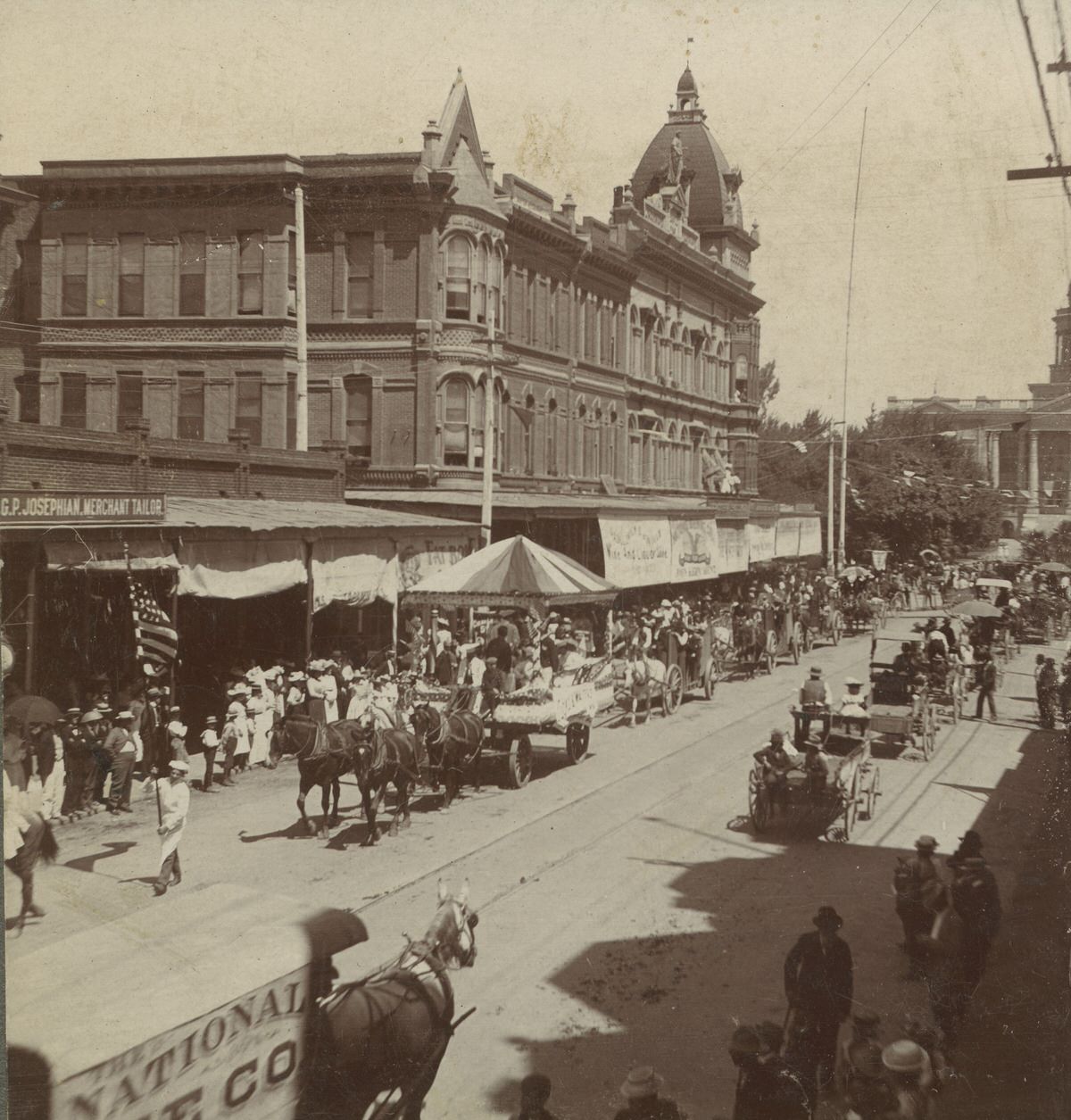
View of the parade along Mariposa Street in Fresno. Horse-drawn wagons and carriages are seen in the parade.
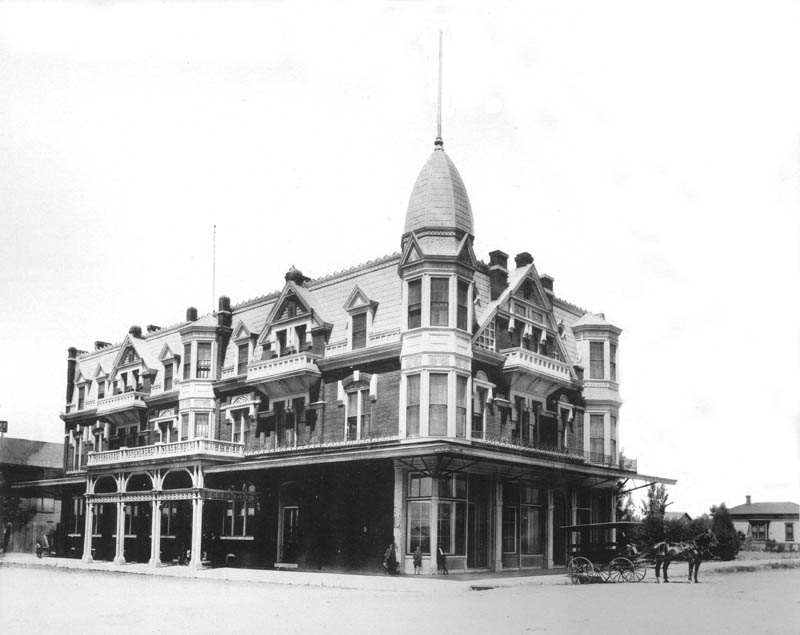
Located at the corner of I (later, Broadway) and Merced streets, built in 1889. Constructed in brick, Victorian style, with three stories and a corner tower. Later known as the California Hotel, and was eventually remodeled to become a part of the White Theater complex, which T.C. White, a Fresno businessman, owned.
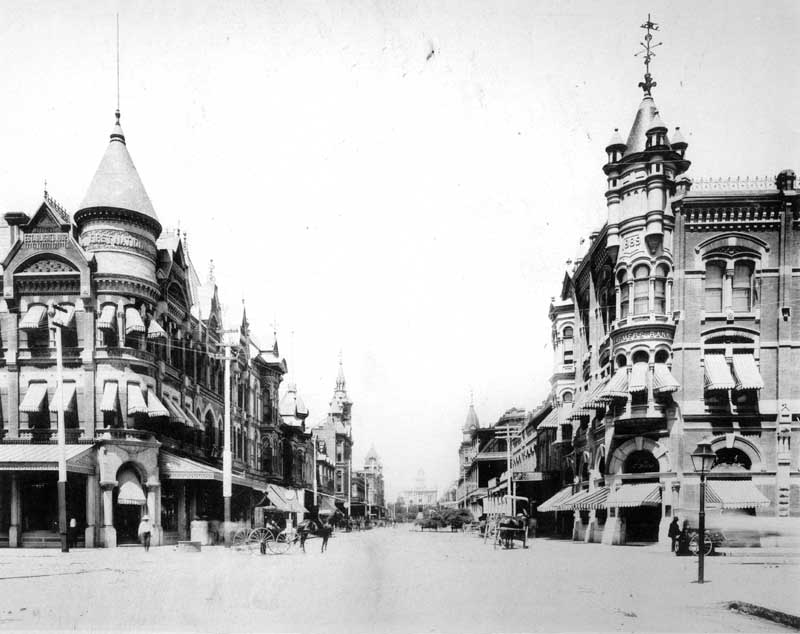
Looking northeast toward Fresno County Courthouse, built in 1874–1875. First National Bank building on the left and Fresno National Bank building on the right. The first tower in the distance on the left-hand side of the image is the Fiske Block, and the tower behind it is the Temple Bar Building. The first tower on the right-hand side of the image is the Fresno Loan and Savings Bank. All significant structures shown in the picture were built during Fresno’s first major boom, in 1889, except for the Fresno Loan and Savings Bank, which was enlarged from a smaller structure in that year.
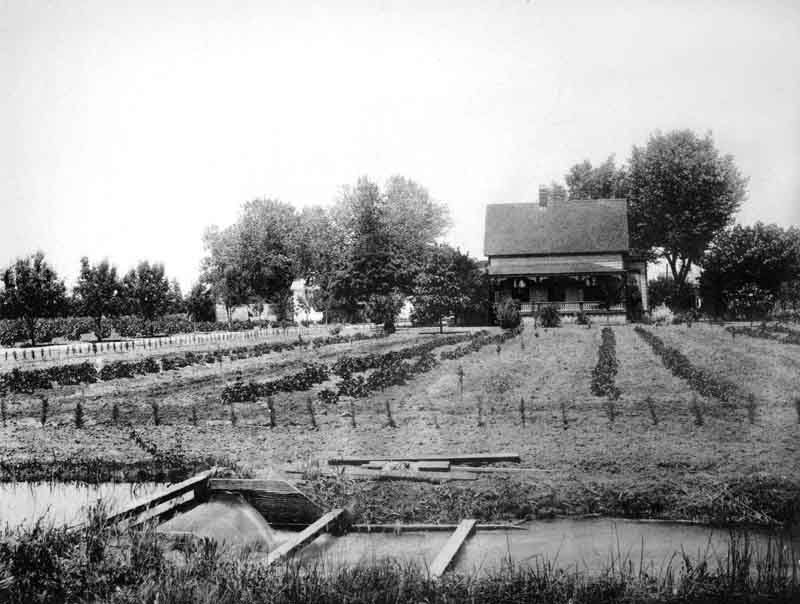
A farm in Fresno County, with an irrigating ditch and drop in the foreground, a young vineyard in the middle ground, and a residence with trees in the background.
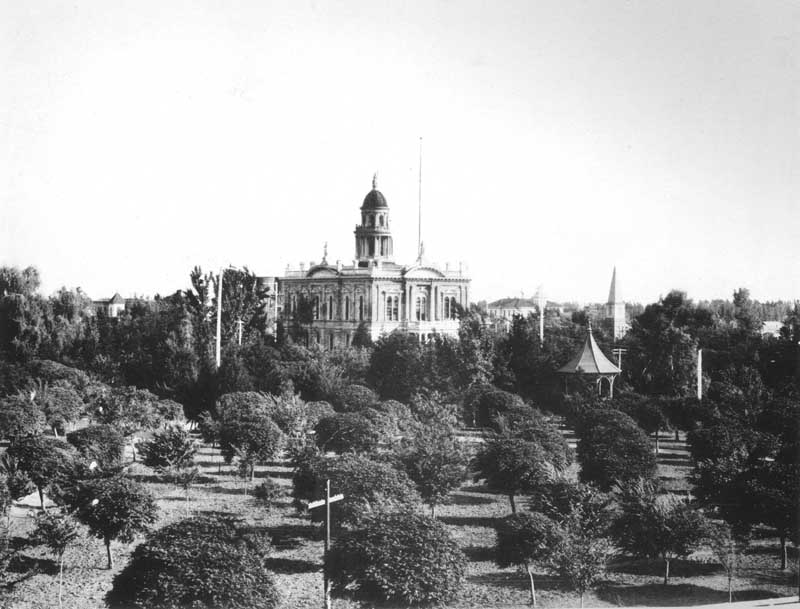
Located in a block bounded by K (later, Van Ness), Fresno, M, and Tulare streets and constructed in 1874–1875 by California Bridge and Building Co. of Oakland for $56,370. Original building dimensions were 60 x 97 feet and were substantially increased in later years. The view looks north, with Fresno Christian Church tower (built 1887) visible in the middle right. The Central (later known as the Hawthorne or White) Grammar School sits between the church and the Courthouse, and opened in 1879. The Courthouse was demolished in 1965–1966.
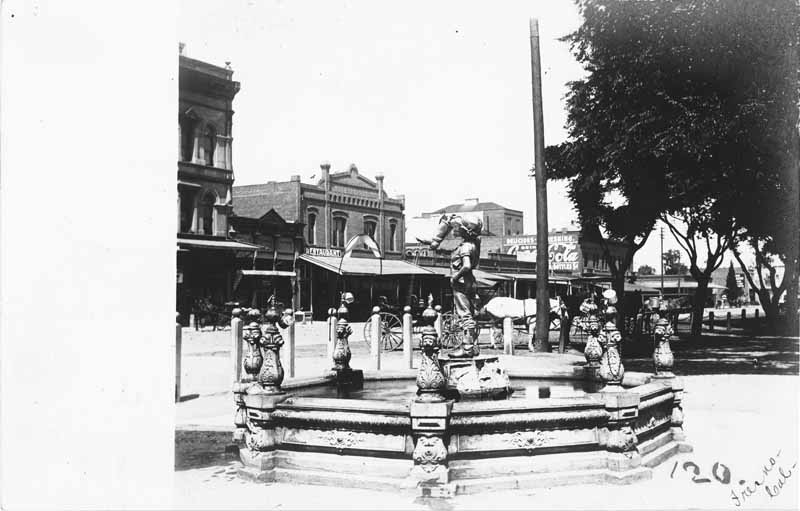
The statue was initially cast from pewter and placed in Courthouse Park in August 1895. It was known as “Iron Johnny,” depicting a boy holding up one of his leaking boots, constantly draining water. It served as a combination statue and communal drinking fountain cooled by daily deliveries of ice.
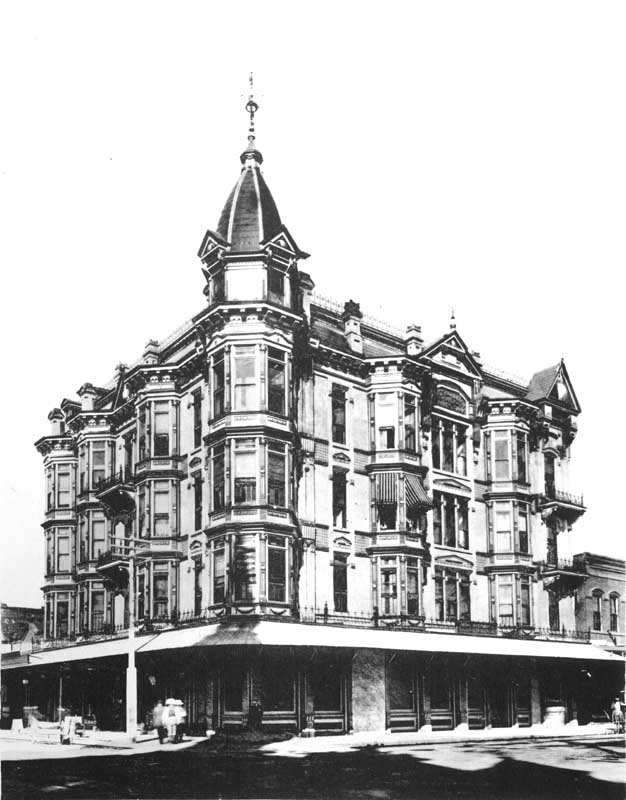
First constructed as the two-story Hutchinson Building in 1885 and remodeled extensively in 1889 by the Fresno Loan and Savings Bank, with two additional stories and an elevator.
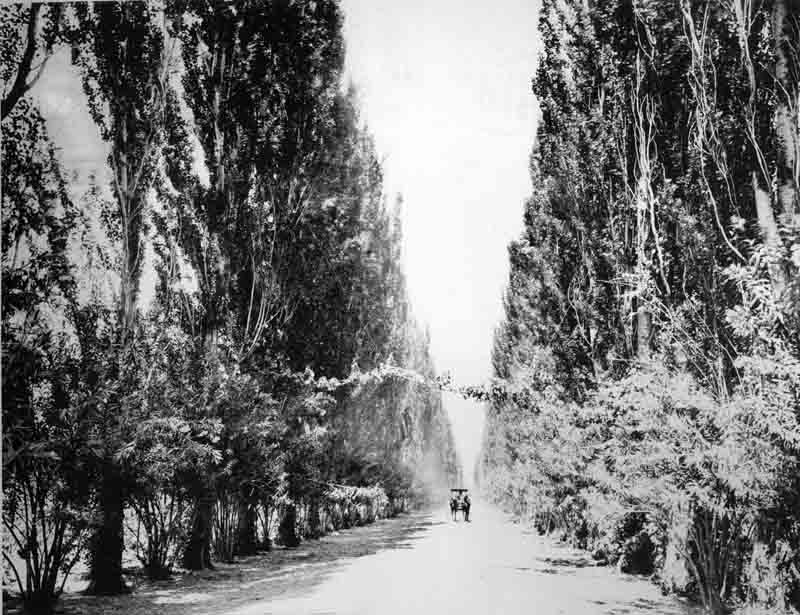
Depicts a lane of poplar trees within the vineyard. One of the earliest agricultural enterprises in Fresno County, founded in 1872 by Francis T. and Gustavus A. Eisen, immigrant brothers from Sweden. The vineyard consisted of 640 acres planted in various grape varieties, including muscats, Malagas, and Tokays, and it also included many ornamental horticultural plantings and landscapes. The first raisins produced commercially in Fresno County came from this vineyard. It was later managed by Augustine Eisen, son of Francis, and ceased operations during the 1920s.
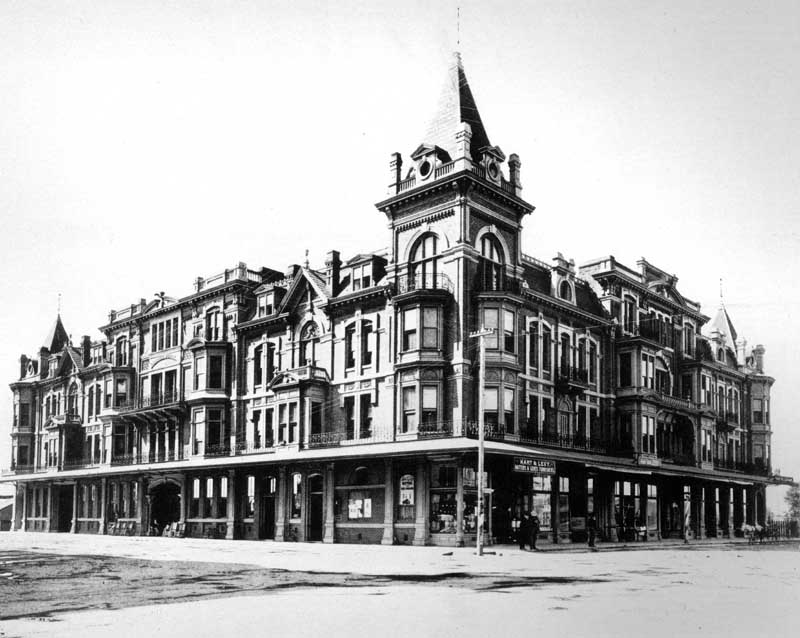
It was located at the corner of I (later, Broadway) and Tulare streets, Fresno, and erected in 1887 in Victorian architectural style by a local real estate developer, Thomas E. Hughes, at a total cost of $300,000. It consisted of a four-story brick structure finished in a sandstone color. At its completion, the Hughes was the largest hotel between San Francisco and Los Angeles. It was the first building in Fresno to have an elevator and the first Fresno hotel to have electric lights, a telephone in each room, and a neon sign in front. An arson fire destroyed it in 1953.
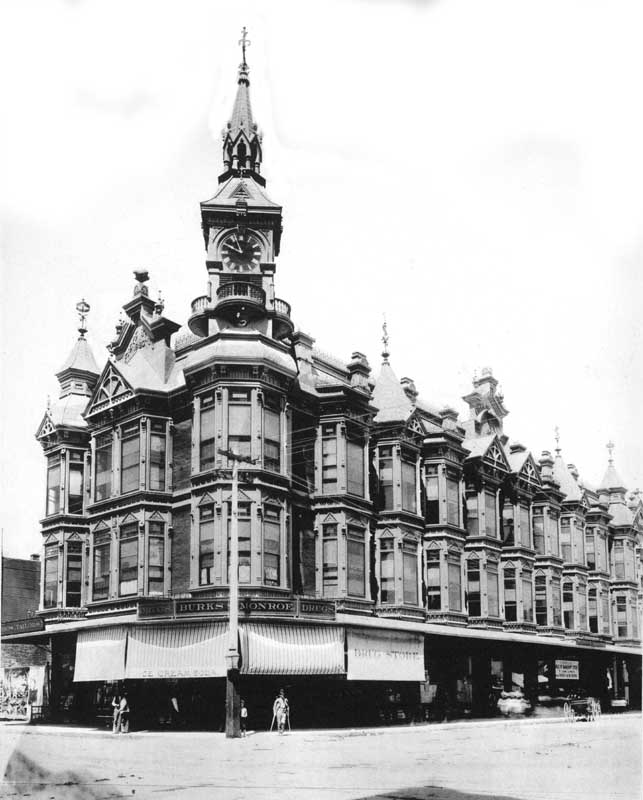
Located at the corner of Mariposa and J (Fulton) streets, Fresno. It was erected in 1889–1890 by John D. Fiske at a total cost of $100,000. The Victorian-style brick structure consisted of three stories with a basement and occupied a 50′ x 150′ footprint. When completed, its clock tower was the tallest point in Fresno and housed a six-foot Seth Thomas movement that cost $1,200. Fiske was shot to death in 1891 by a man who claimed Fiske had defrauded him, and S.N. Griffith subsequently acquired the building. In 1914, the Fiske Block was demolished and the Griffith-McKenzie building was erected in its place.
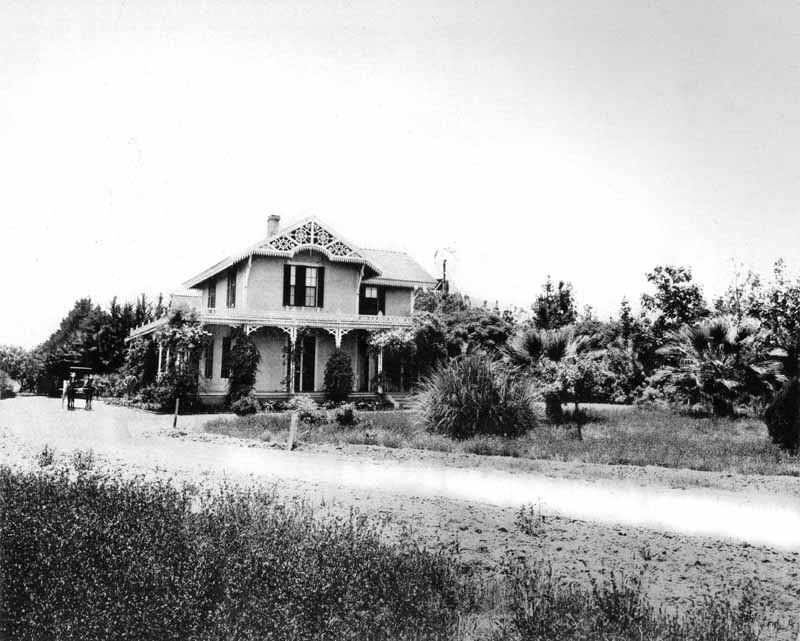
It was located approximately four miles east of Fresno. Built as a two-story folk Victorian structure in 1881, with adobe walls plastered with cement on the exterior. A 16-foot-wide porch surrounded the building on three sides. It contained eight rooms, including a parlor and sitting room on the lower floor and bedrooms on the upper floor. The Fresno Vineyard Co. was organized in 1880 and located on acreage purchased from the Easterby Rancho, Fresno County’s first significant farming enterprise. Founders of the Fresno Vineyard Co. included L.P. Drexler, Joseph Brandstein, and M. Theodore Kearney. The company ceased operations in 1914.
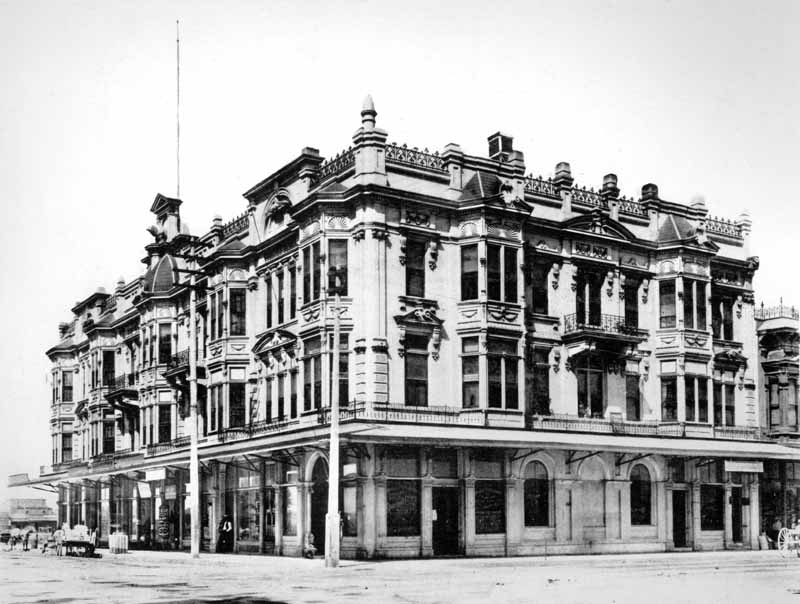
Located at the N.W. corner of Tulare and I (later, Broadway) streets, built in Renaissance Revival style, a three-story brick building. Constructed in 1887 by James M. Sadler, an architect from San Francisco.
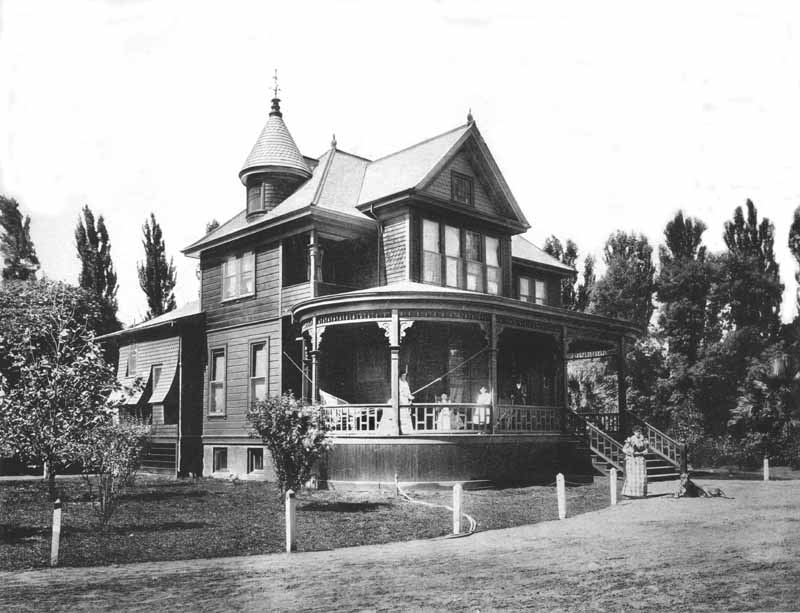
Located at the Forsyth Vineyard property, 3½ miles N.E. of Fresno. Forsyth (1850–1910), a native of Toronto, Canada, arrived in California in 1875 and became a prominent hotelier in Sacramento. He purchased and first planted the Fresno vineyard property in 1883 and eventually left the hotel business to pursue strictly agricultural interests, including a sizeable fruit-packing house in Fresno. His first raisin crop was produced in 1887. Forsyth’s vineyard was one of the most productive in California, and his residence was one of the most beautiful in Fresno County. After Forsyth’s death, his vineyard business was disbanded, and the fate of his home is unknown.
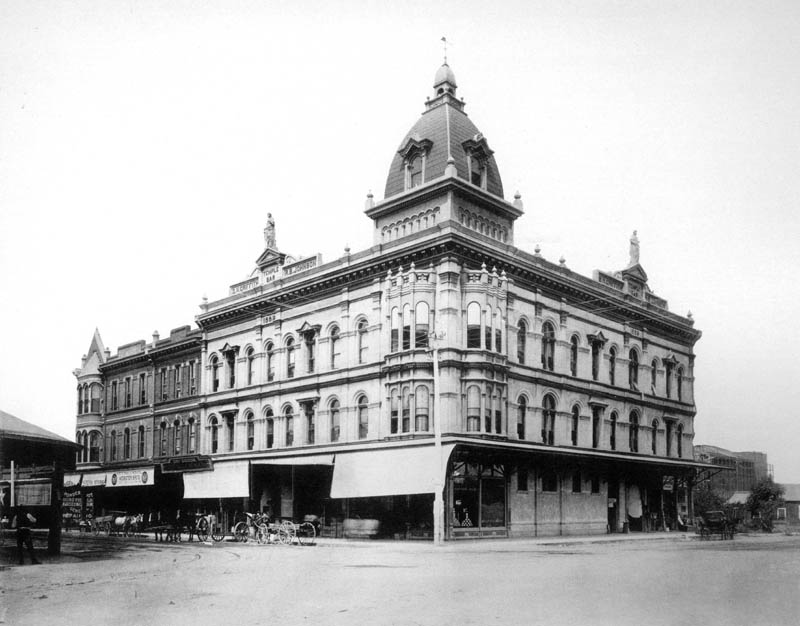
It was located at the corner of K (Van Ness) and Mariposa streets, Fresno, built in 1889 by S.N. Griffith and R.B. Johnson. A three-story Victorian architectural style with brick and plaster construction with corner towers. Initially, the building had offices on its first and second floors, with a boarding house on the third floor. Due to its proximity to the county courthouse, many of Fresno’s most prominent attorneys had their offices in the building. Eventually, its two upper floors were removed, and the entire structure was demolished in 1962.
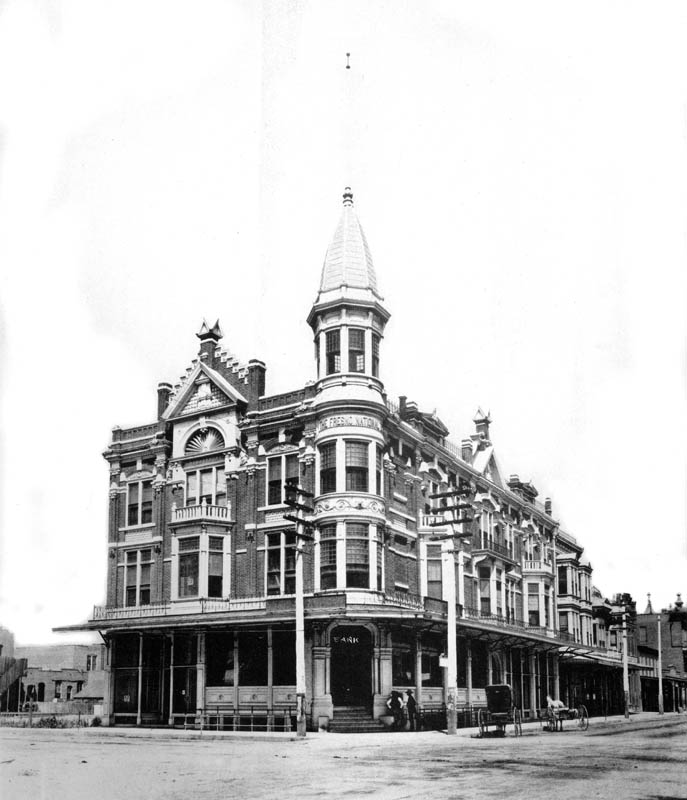
It was located on the N.E. corner of Tulare and J (later, Fulton) streets and built in 1889 to house the bank, which had been formed the previous year. The building featured Renaissance Revival details and cost $70,000 to erect. The bank was purchased by the Bank of Italy (later, Bank of America) in 1916, and the building was demolished in 1917. A replacement eight-story structure housing the Bank of Italy rose on the site in 1918.
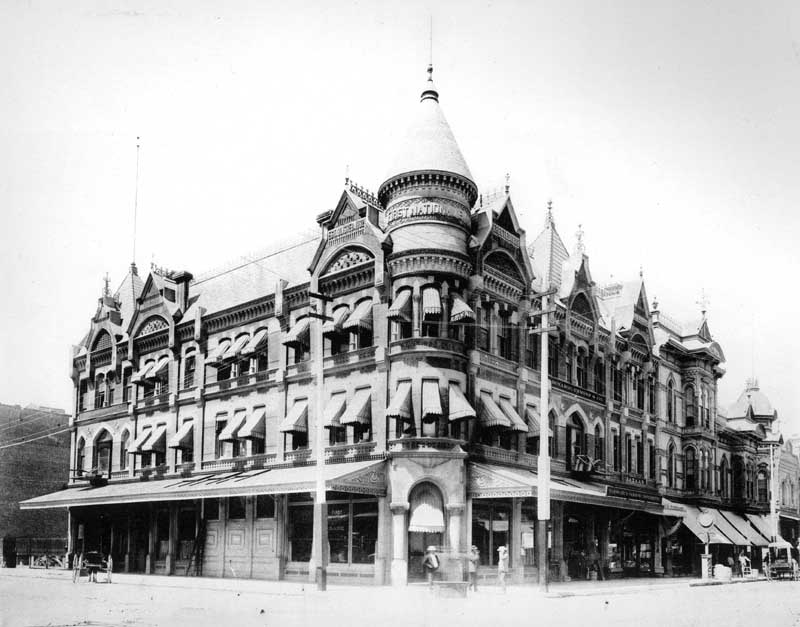
It is located at the N.E. corner of Mariposa and I (Broadway) streets. Constructed in 1889 in Gothic-Romanesque style to house the Fresno County Bank, created in 1881. In 1885, the bank changed its name to the First National Bank. The building was constructed by C.K. Kirby & Son at a cost of $28,789. It was made of brick with sandstone trimmings and pillars of Scotch granite. The Bank of Italy (later, Bank of America) purchased the First National Bank in 1921, and the building was eventually demolished to make space for a parking lot.
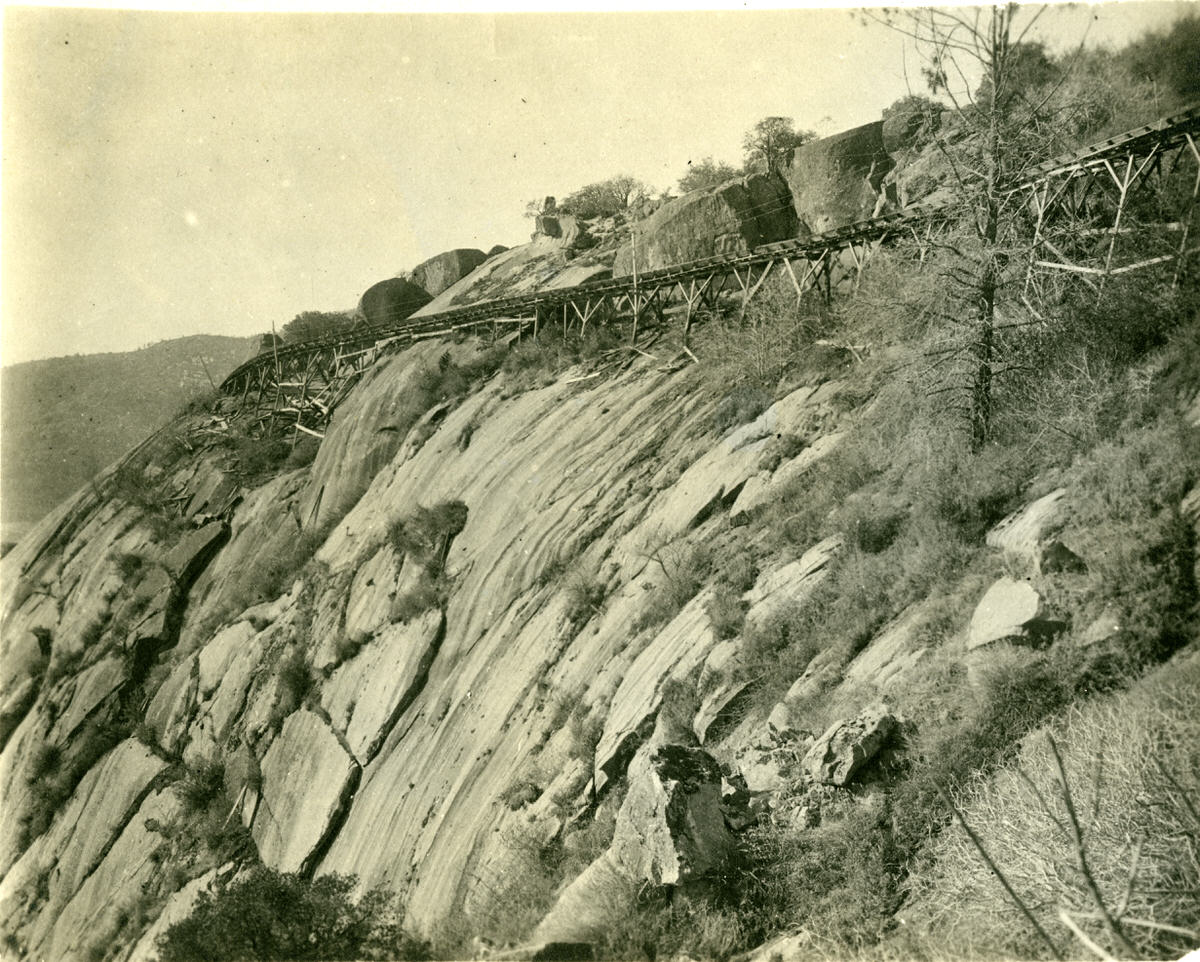
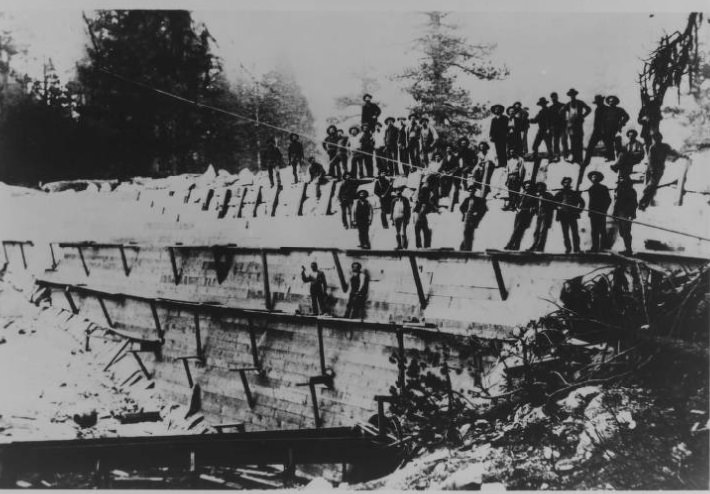
Lumber flume at Flume Point near Tollhouse (located 7 miles southwest of Shaver Lake).
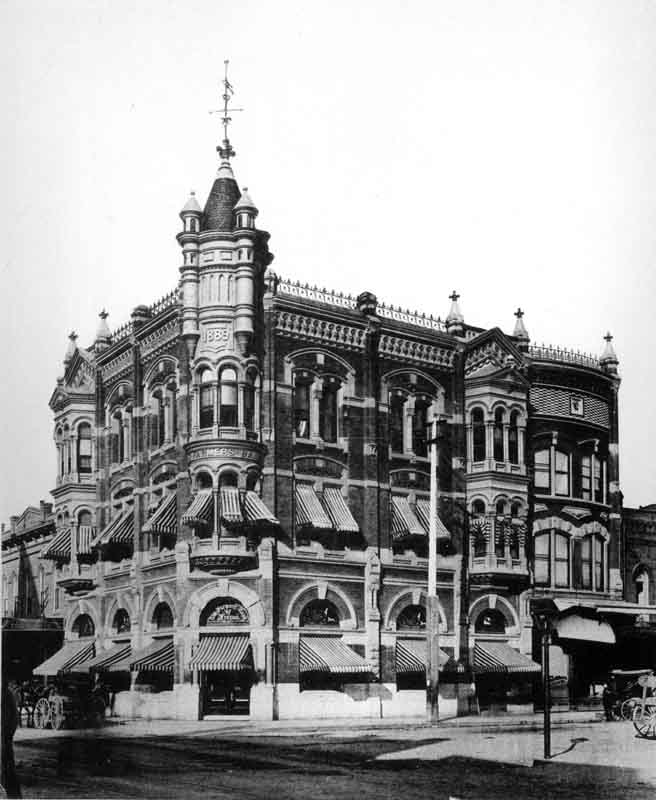
Located at the S.E. corner of Mariposa and I (later, Broadway) streets and constructed in 1889 in Gothic-Romanesque style to house the bank founded in 1882. Construction materials were pressed brick with stone trimmings. The bank later merged with the Bank and Trust Company of Central California to become the Fidelity Trust and Savings Bank, which later merged with the Security-First Bank of Los Angeles. The bank building was demolished in 1920 and replaced by an automobile service station.
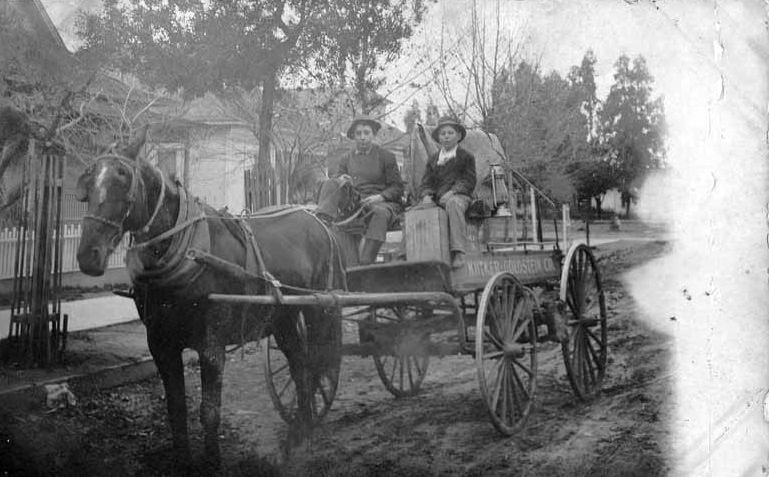
Two boys riding on a Kutner-Goldstein delivery wagon. During the 1890s, general stores and grocery stores became more numerous in Fresno. One of the better-known was Kutner-Goldstein & Company, whose main store was on the corner of Mariposa and H streets, offering shoppers dry goods, carpets, curtains, and wallpaper.
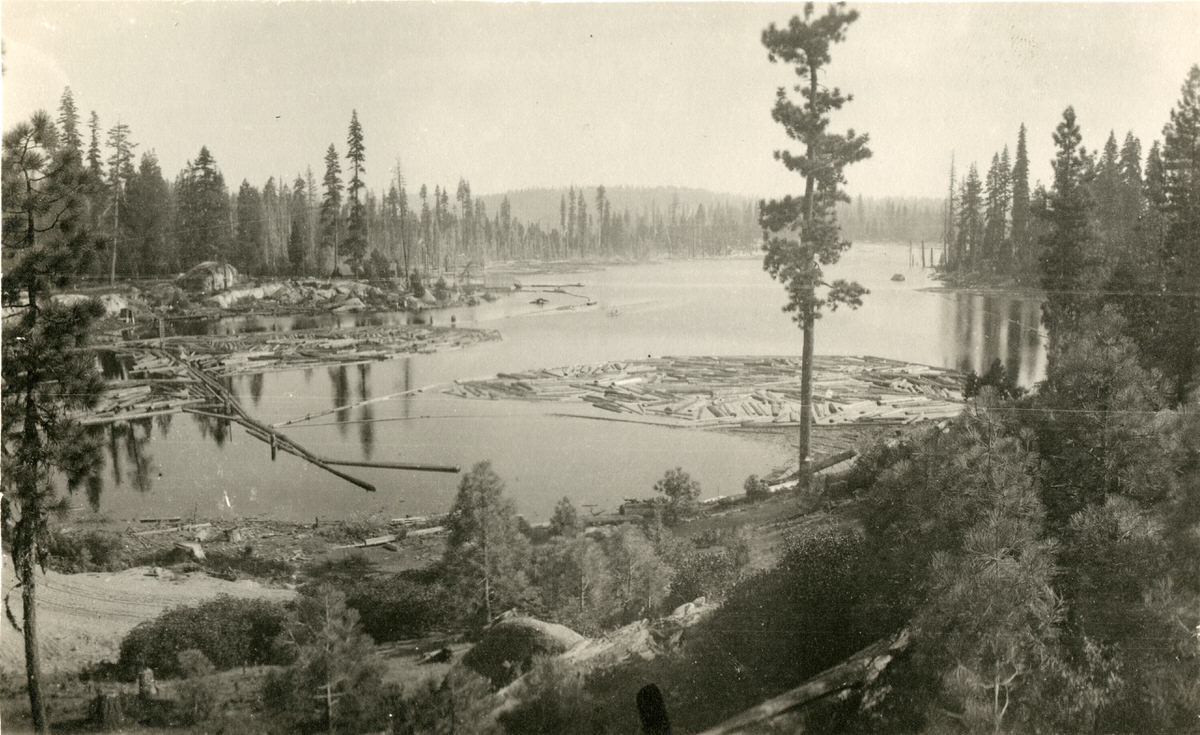
Log boom at Shaver Lake. C.B. Swift and Charles B. Shaver owned the Fresno Flume and Irrigation Company, built a dam on Stevenson Creek forming Shaver Lake, built two mills and a flume to transport lumber from Shaver Lake to Clovis (where they had planing mills, a box factory, and dry kilns). Manley Freeman White was born March 25, 1882, in York County, Nebraska, to Joseph Freeman White and Hattie Monroe (both from Canada). The family arrived in Fresno between 1885 and 1900. Between 1900 and 1920, he resided in Fresno. The 1920 census listed Manley as being in Merced Falls; the 1930 census listed him as being in Hilt, Siskiyou County; by 1940, he was in Klamath, Oregon. He worked as a millhand in the lumber industry. While in Fresno, he worked seasonally at Shaver Lake for the Fresno Flume and Irrigation Company (owned by C.B. Swift and Charles B. Shaver).
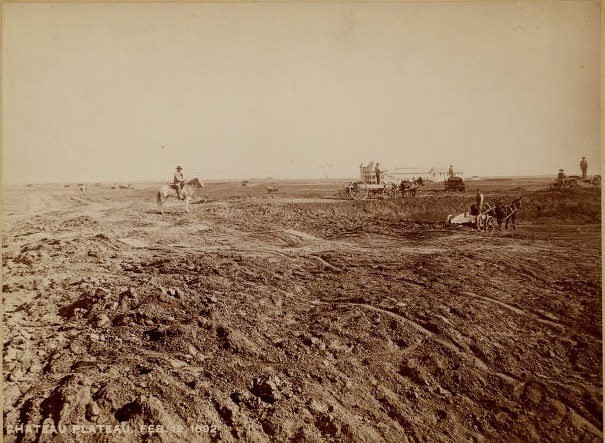
Workers, horses, wagons, and equipment on open ranch land on the Fruit Vale Estate developed by Martin Theodore Kearney in Fresno County, California. Kearney’s massive “Chateau Fresno Park” residence is in the distance.
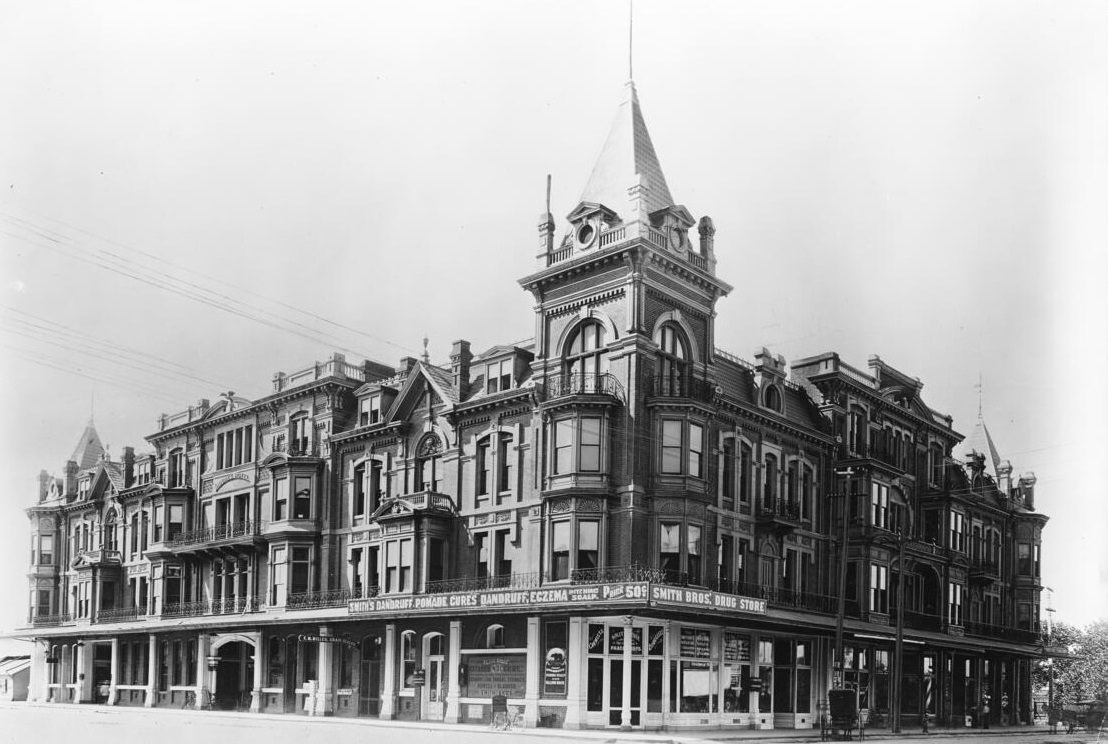
A large Victorian-style block building occupies the entire section between two cross streets, its tallest peak visible at the corner right of center. Below, commercial interests advertise via sign, including a drug store and grain dealer.
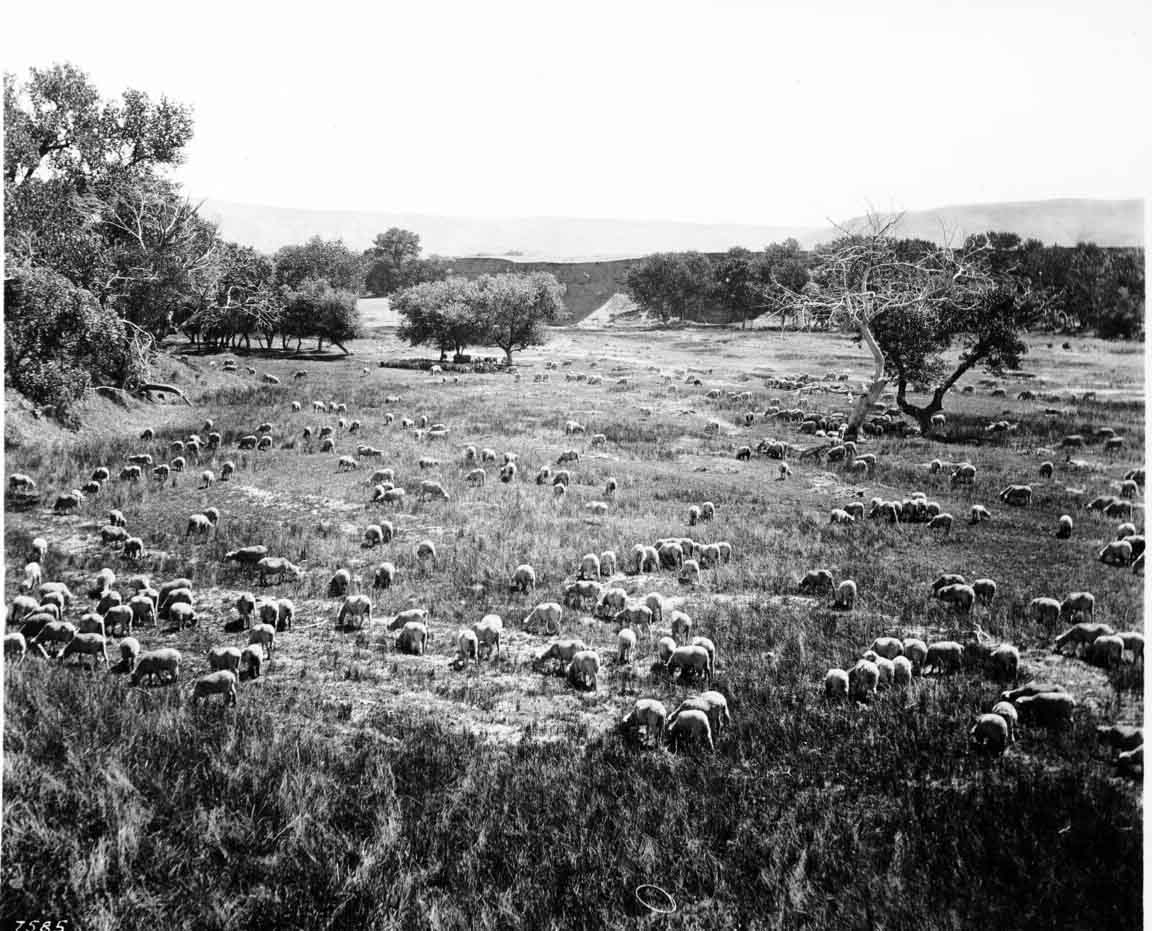
Photograph of a flock of sheep grazing in Pinoche Valley, Fresno, ca. 1900. Mountains are visible in the background as hundreds of sheep spread out across the grassland, feeding. A leafless tree is visible in front of a second tree to the right, with a second tree line visible farther in the left distance.
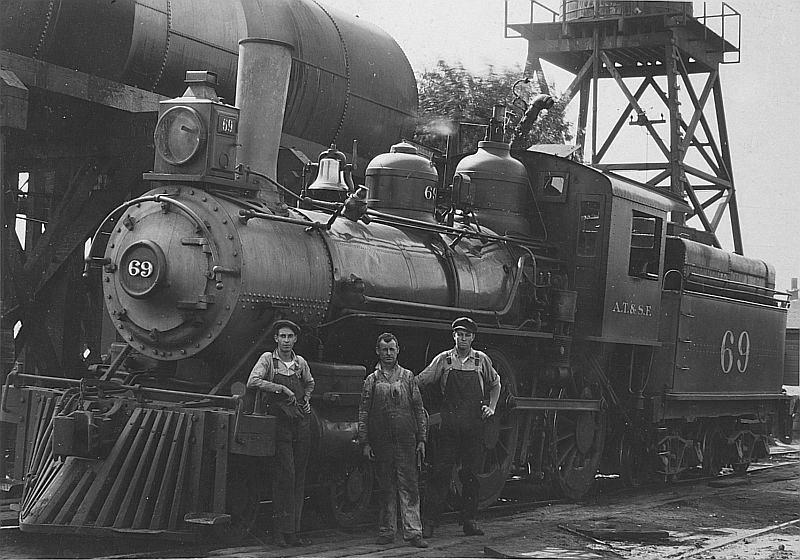
Arch Turner of Fresno, CA, was the fireman and engineer of this Santa Fe Railroad engine.
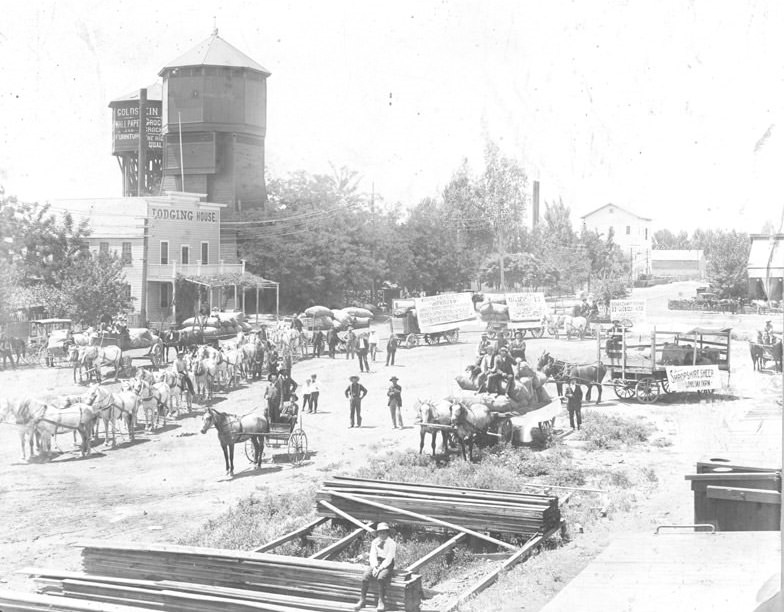
Group of wagons loaded with wool. One wagon has sheep. A lodging house and water tower are in the background.
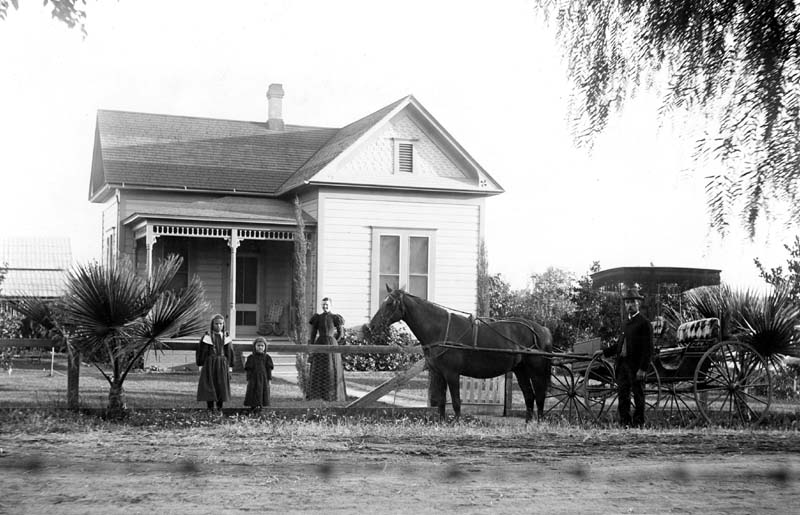
Ed Smith was standing next to his horse and buggy in front of his home. Mrs. Smith and the children were standing in front of their home.
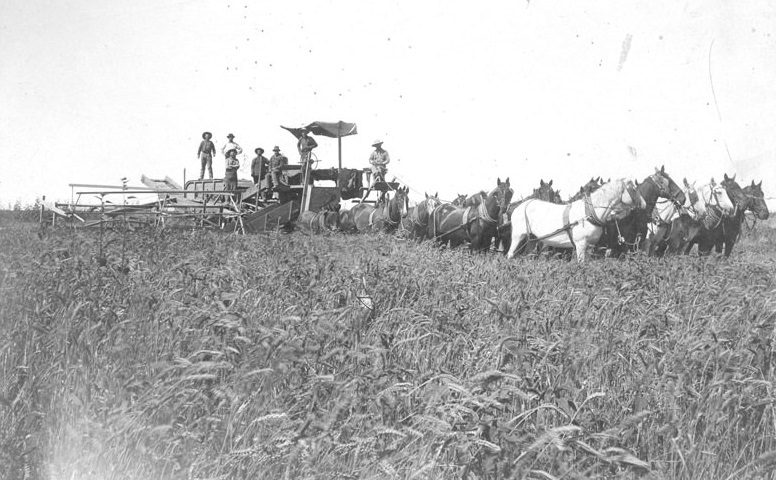
Crew standing on the horse-drawn harvester.
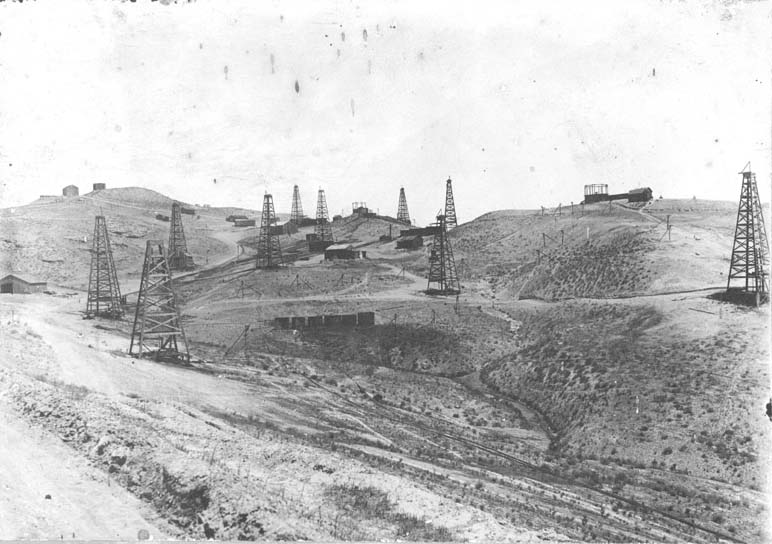
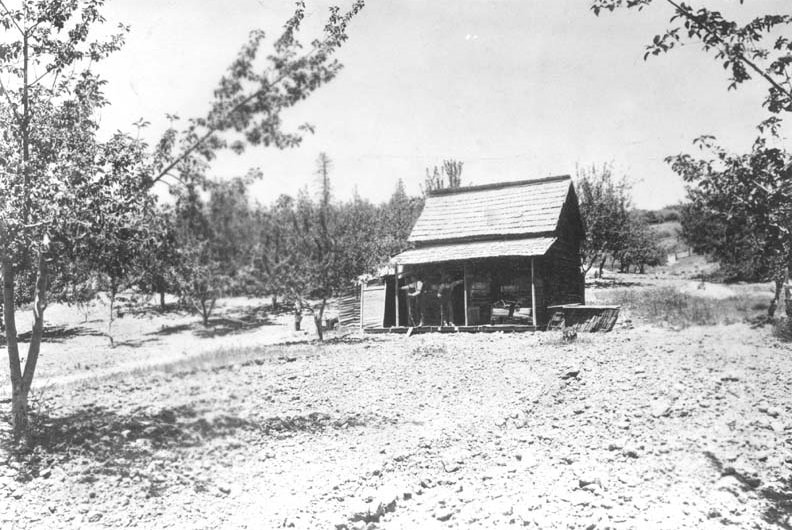
Young’s Cabin with men standing in the doorway. Sontag and Evans held off a posse here in September 1892.
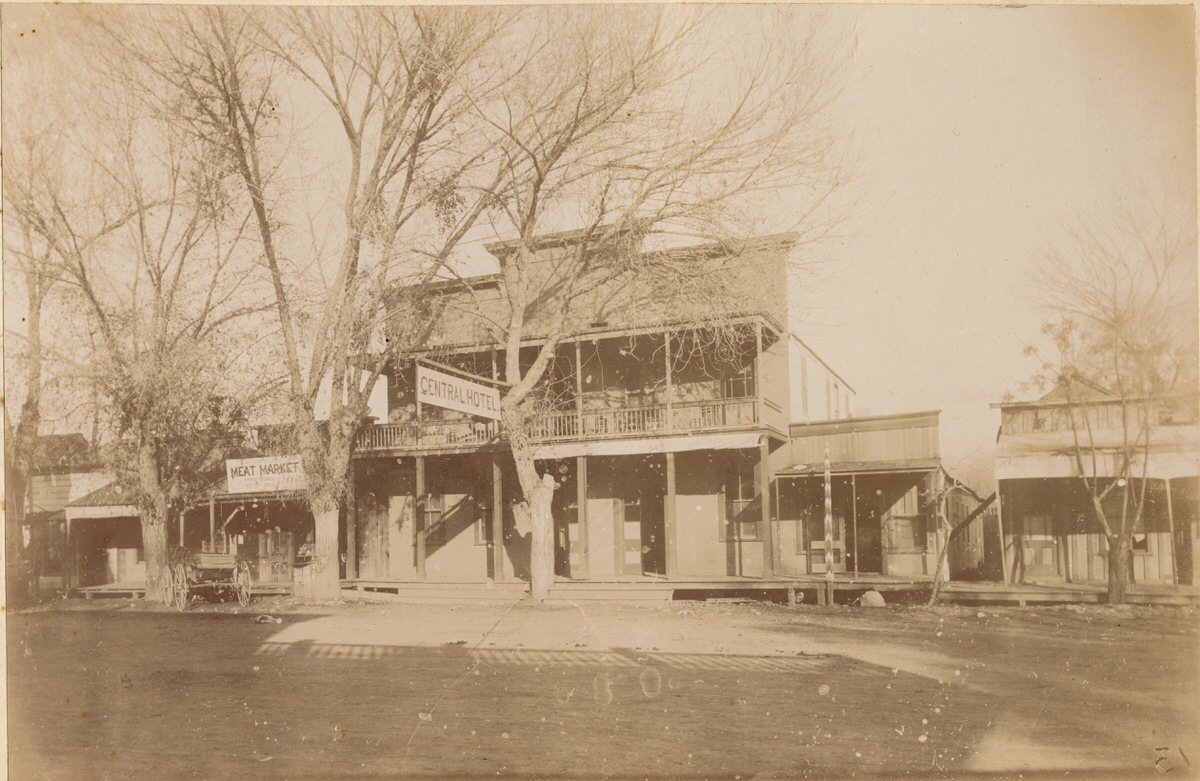
View of the two-story Central Hotel (center), a wooden building with covered porches at the first and second stories; single-story buildings on both sides of the hotel, with a meat market on the left; wooden sidewalks and trees in front of the buildings; a horse and buggy parked in front of the meat market.
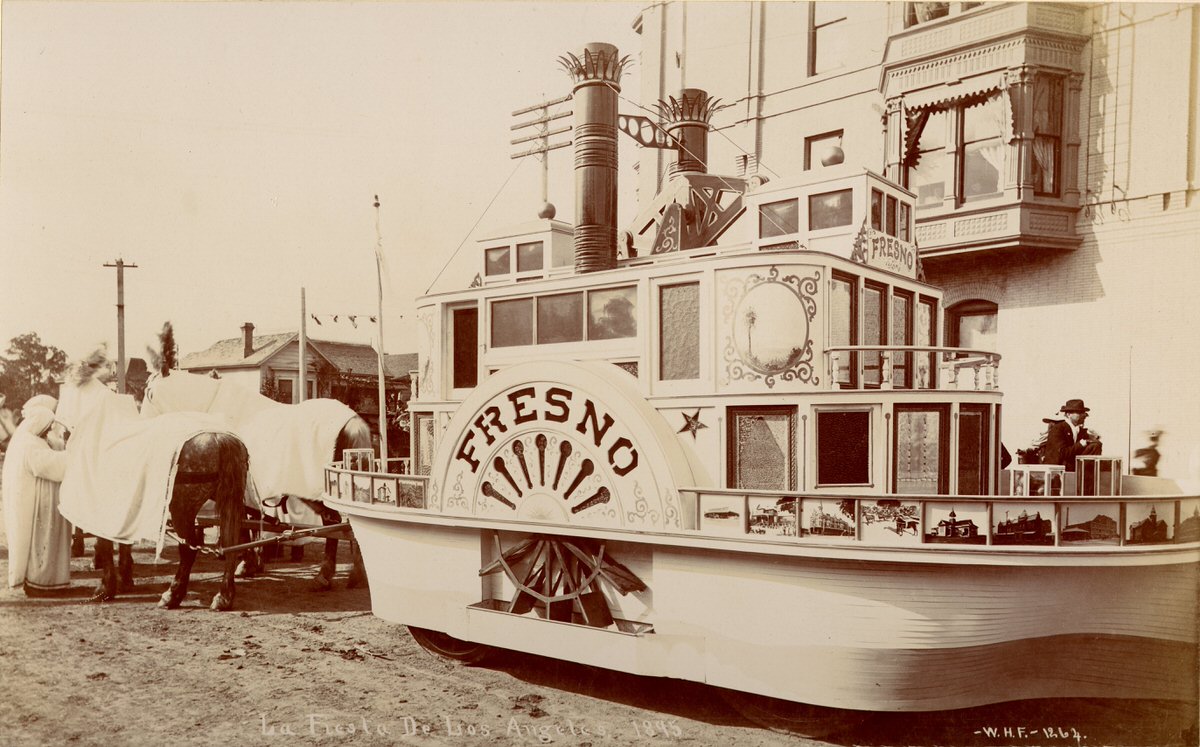
View of a horse-drawn float decorated like the steamboat Fresno. Two horses were draped with white cloths.
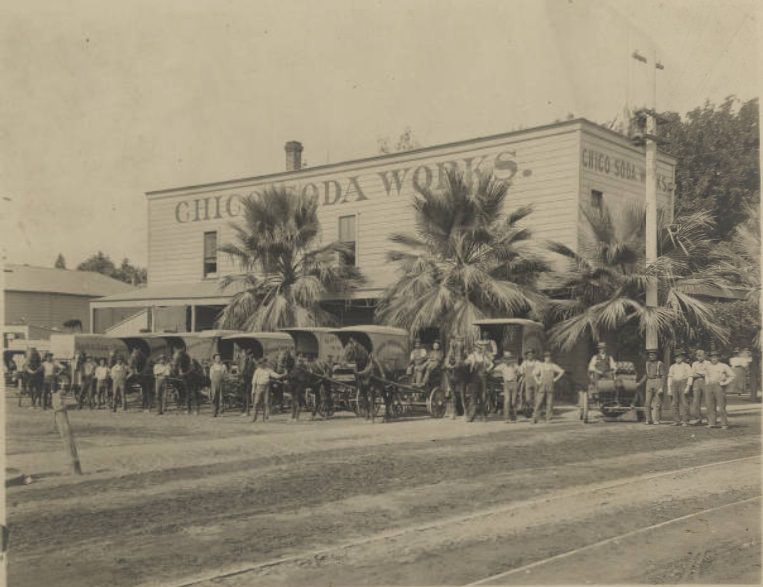
Chico Soda Works building in the background with several horses and carriages. Chico Soda Works was located on the corner of Ivy and West Fifth Streets, Chico, California. The Chico Soda Works was started by a man named A.F. Blood and was first located on Seventh and Broadway. Blood sold it to A.G. Eames, who moved it to the Ivy Street location. The home visible behind the Chico Soda Works is the Eames’ residence.
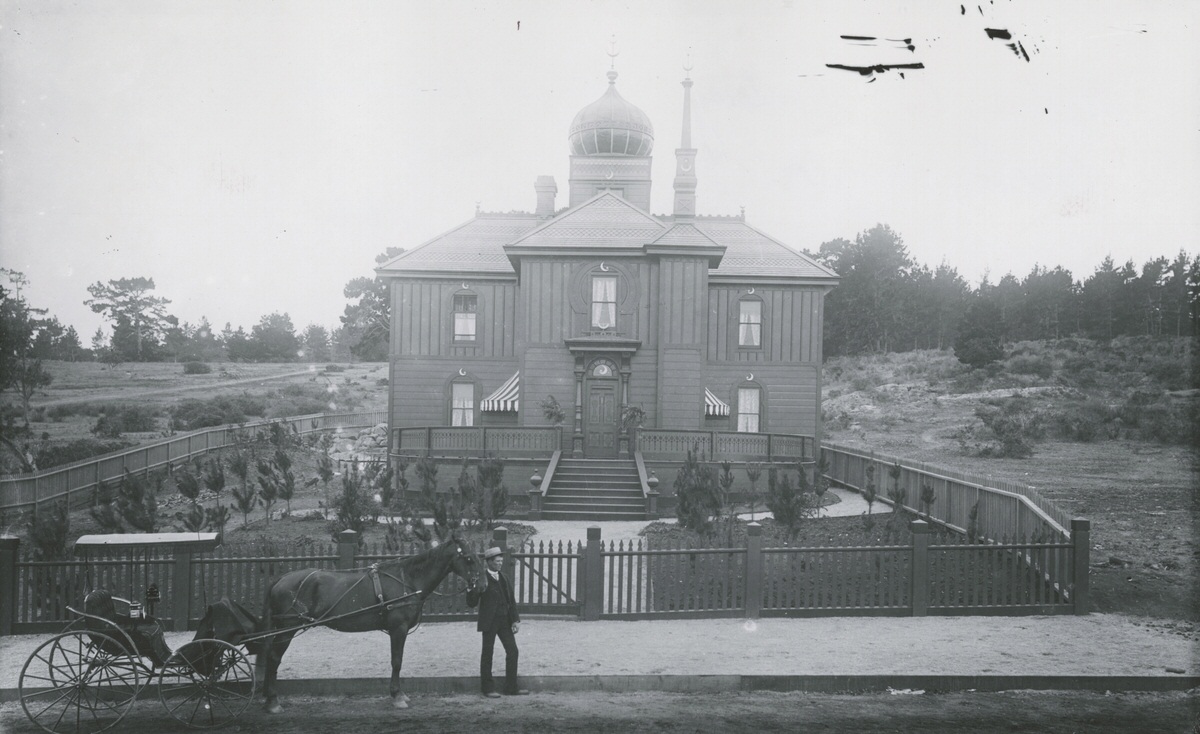
Harry Ashland Greene was born in San Francisco in 1852 and worked in San Francisco as a broker on the stock exchange. In 1886 he moved to Monterey, where he was active in real estate, owned several hotels (Hotel San Carlos, Hotel Monterey), and was involved in the Monterey & Fresno Railroad and the Monterey & Pacific Grove Street Railroad, and the Bank of Monterey. He married Arabella Little. He died in 1933.
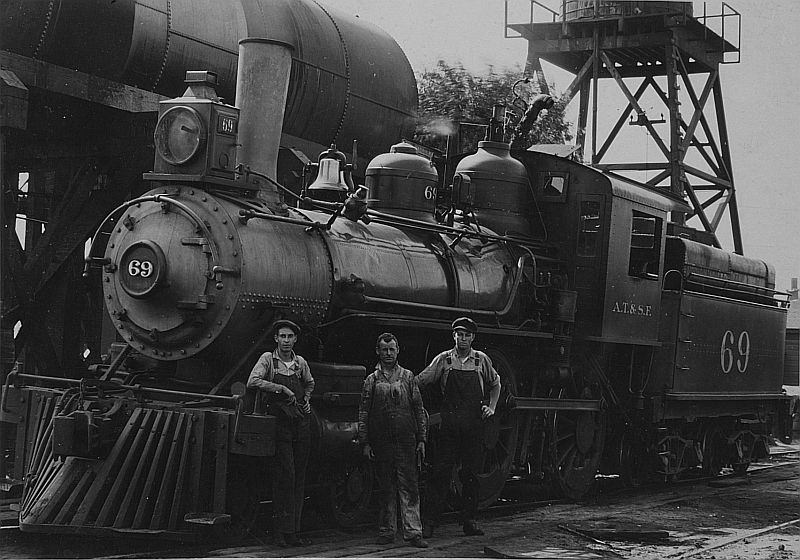
Arch Turner of Fresno, CA, was the fireman and engineer of this Santa Fe Railroad engine.
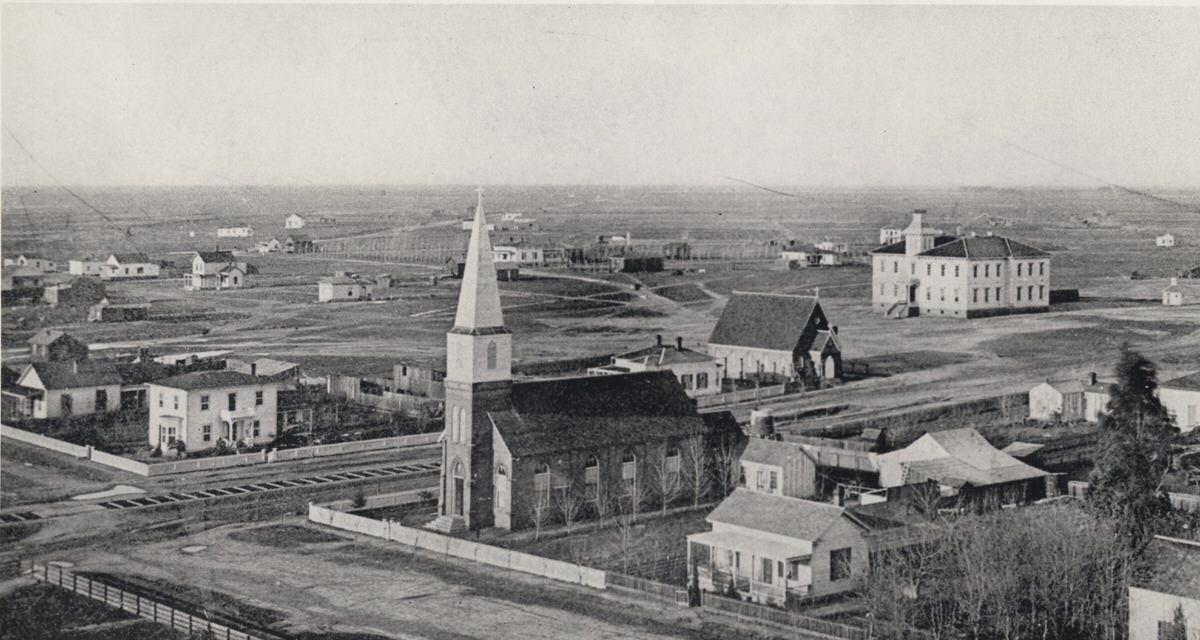
Shows a view of Fresno, looking north from the Courthouse. Visible in the picture is the old flour mill on the extreme right; Hawthorne School (Fresno’s 2nd schoolhouse) is directly opposite. The church is in the center.
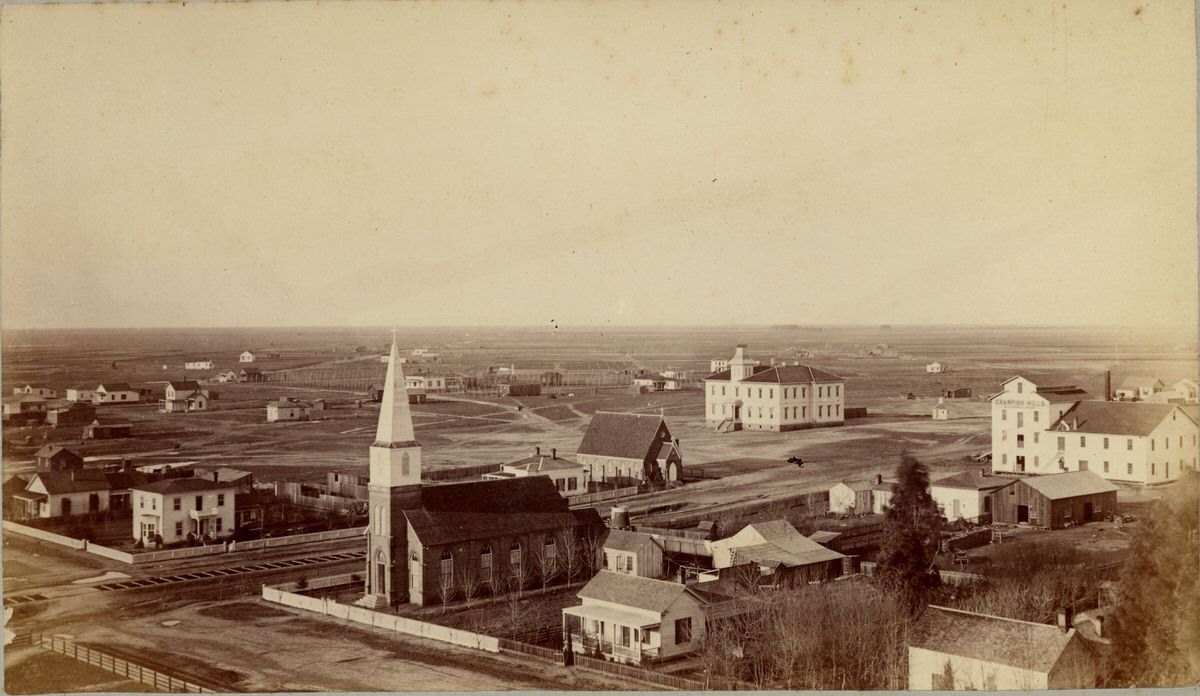
View of Fresno from the top of the Courthouse; shows St. John’s Catholic Church at center, St. James Episcopal Church behind it, Central Grammar School (center, slightly to the right), and the Champion Mills building at the right.
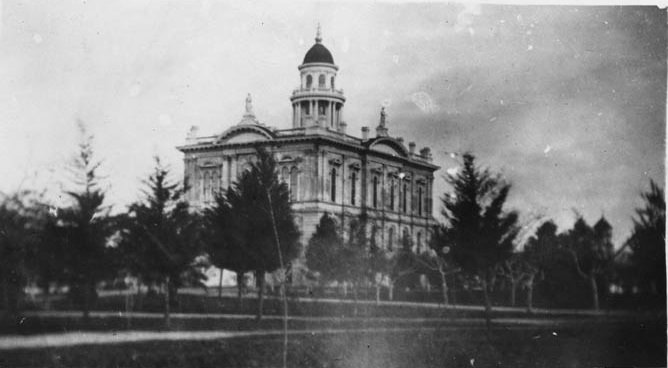
View of the Fresno County Courthouse. Foundation work started on October 1, 1874, and was completed on August 19, 1875. The Board of Supervisors met here for the first time on September 6, 1875. In 1878, about four acres of land around the Courthouse were landscaped with the first planting of trees. Landscaping was completed in 1888. The building was demolished in 1966.
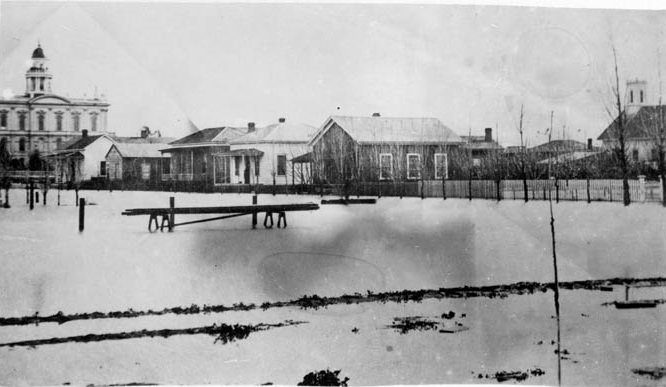
Photo depicting the situation on M Street when the Flood of 1884 covered every street in Fresno. The Fresno County Courthouse is seen in the background to the left. The church seen to the right is the Southern Methodist Church at L and Fresno streets. Floods threatened to wipe out Fresno every winter due to its position as the sink of four creeks: Dry Creek, Red Banks, Dog Creek, and Fancher Creek.
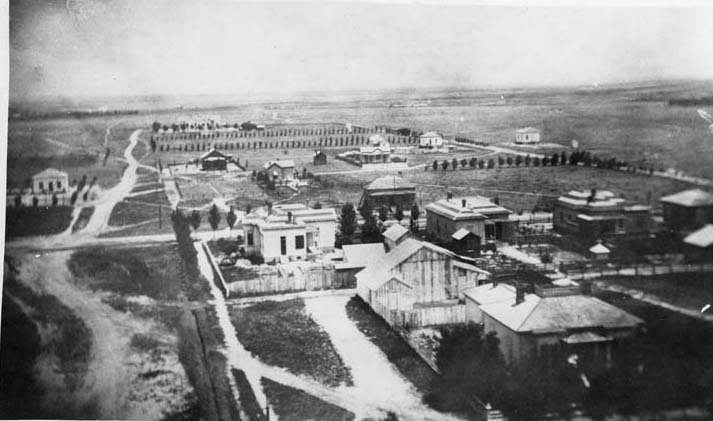
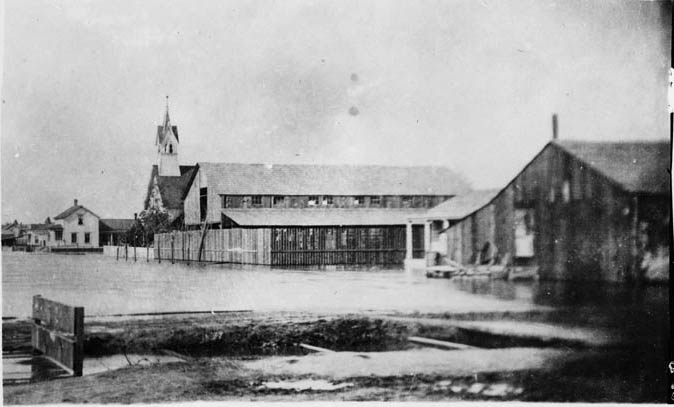
On February 16, 1884, floodwaters covered every street in Fresno. Floods threatened to wipe out Fresno every winter because Fresno was located in the sink of four creeks: Dry Creek ran just to the north of town; Red Banks and Dog Creek merged in the flatlands to the east; and Fancher Creek ran nearby, with the center of Fresno as the confluent point. This photo depicts the situation on K Street, with the photographer looking north from Fresno Street. The Mill Ditch is visible in the foreground on Fresno Street. This irrigation ditch was built in 1878 by Moses J. Church to power his Champion Flour Mill at the corner of Fresno and N Streets. Several narrow plank bridges are seen spanning the ditch. The first building on the right is the J. Williams Blacksmith and Wagon Shop. The following structure is the F. Banta Eureka Planing Mill. The steeple of the Methodist Church can be seen in the distance.
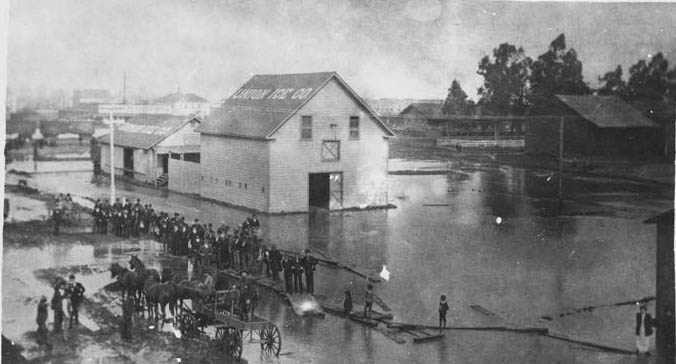
The flooded Union Ice Company warehouse is located just south of the Southern Pacific Railroad tracks. The photographer was on G Street, looking northeast towards Kern. The sign in the background says “Planing Mill,” probably Madary’s Planing Mill located on H Street and Kern. Floods threatened to wipe out Fresno every winter owing to its location as the sink of four creeks: Dry Creek, Red Banks, Dog Creek, and Fancher Creek.
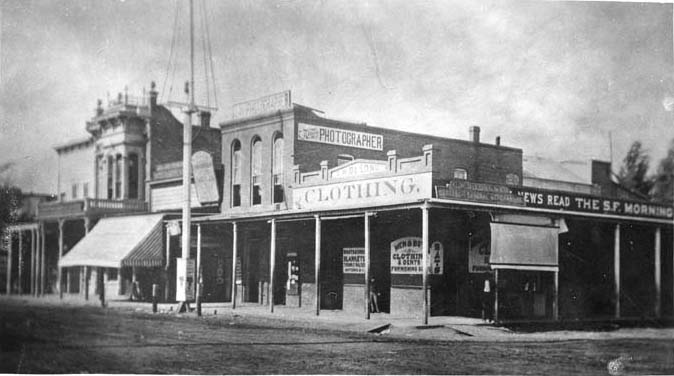
The crossing of I and Mariposa streets was for many years a leading intersection of Fresno. Charles W. DeLong, Fresno’s second postmaster and Fresno’s first clothier, built this store on the intersection’s northwest corner.
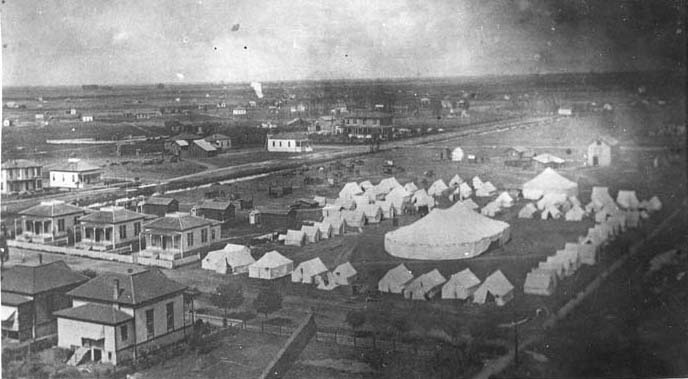
Adventist camp meeting on the northwest corner of P and Mariposa streets. The Seventh-day Adventist church formally organized in Fresno in 1888 after sporadic meetings in and around the area. Moses J. Church, a convert to the religion, built a $40,000 church for the congregation with a seating capacity of 800. The church was located on the northeast corner of O Street and Mariposa.
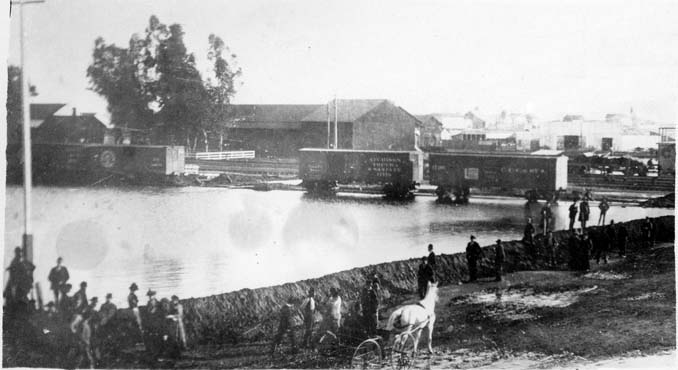
Picture of the flooded railroad yard taken from H Street looking west towards Kern Street. Floods threatened to wipe out Fresno every winter because of its location between four creeks.
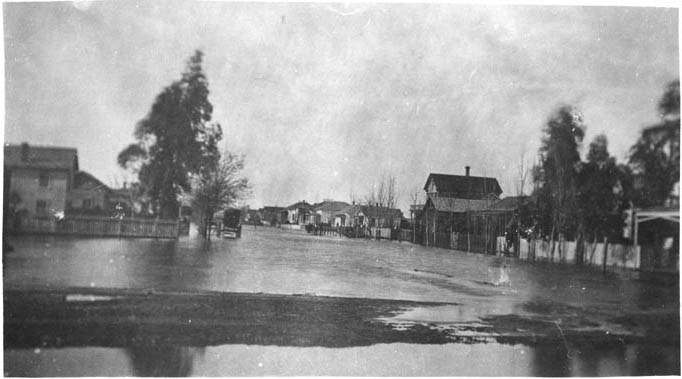
On February 16, 1884, floodwaters covered every street in Fresno. All basements and ground floors were flooded. The only means of transportation within the city was by boat. This photo depicts the situation on J Street, looking northwest from Fresno Street. Floods threatened to wipe out Fresno every winter because Fresno was located in the sink of four creeks. Dry Creek ran just to the north of town, Red Banks and Dog Creek merged in the flatlands to the east, and Fancher Creek ran nearby, with the center of Fresno as the confluent point.
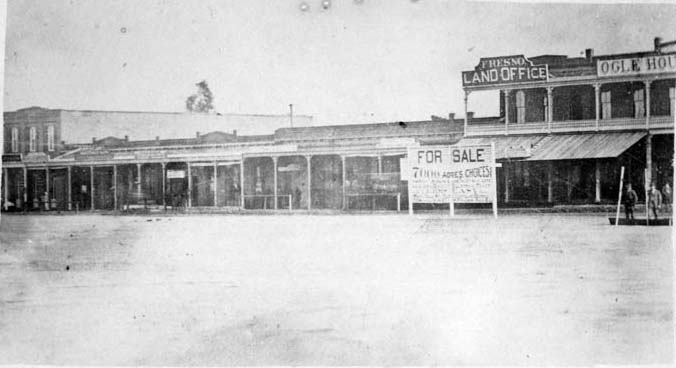
View of H Street looking north between Tulare Street off to the right and Mariposa Street to the left. The Ogle Hotel is seen on the far right, with Louis Einstein’s Pioneer Store visible on the far left of the photo. Einstein’s Store on the corner of H Street and Mariposa was erected in 1875 and was the third brick building in the city.
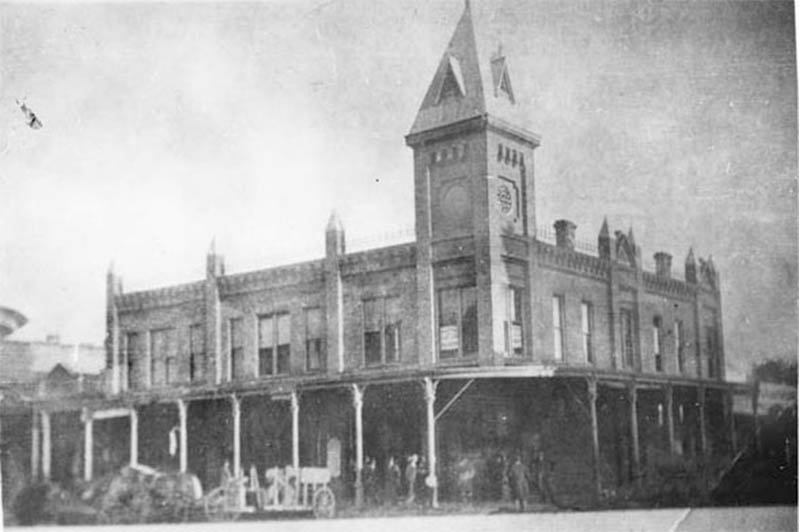
Post Office in Fresno, located in the two-story Hutchinson Block, currently the location of the Security Bank Building at Mariposa and Fulton Streets. The Hutchinson Block was built by Charles G. Hutchinson, a San Francisco capitalist, as part of a surge of “block” building, with most structures named for their builders. Construction began in 1883 and was completed in 1885. Adjoining property owners started the practice of subsidizing the post office to attract business up Mariposa Street. The post office had been farther west toward the Southern Pacific Railroad station. Property owners paid the rent for the post office in the new Hutchinson Building for several years. This building was extensively remodeled in 1889 by the Fresno Loan and Savings Bank, with two additional stories and an elevator. The bank became insolvent in 1895, and the building was demolished in 1923 to make way for the Pacific Southwest (later, Security Bank) Building.
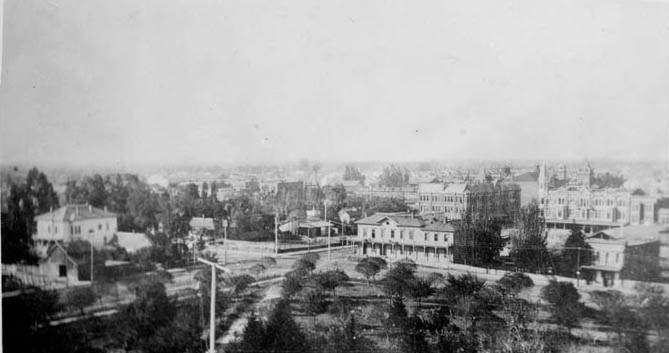
The intersection of K (now Van Ness) and Tulare streets in 1888, seen from atop the Court House. A map of the period indicates the two-story building on the corner is the Southern Pacific Hotel.
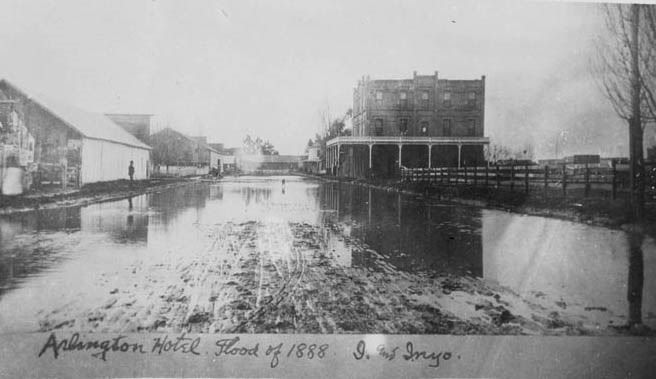
An 1888 flood scene showing the damage along Inyo Street. The Arlington Hotel is seen on the right at the intersection of Inyo and J streets. In the distance is a freight warehouse of the Southern Pacific Railroad.
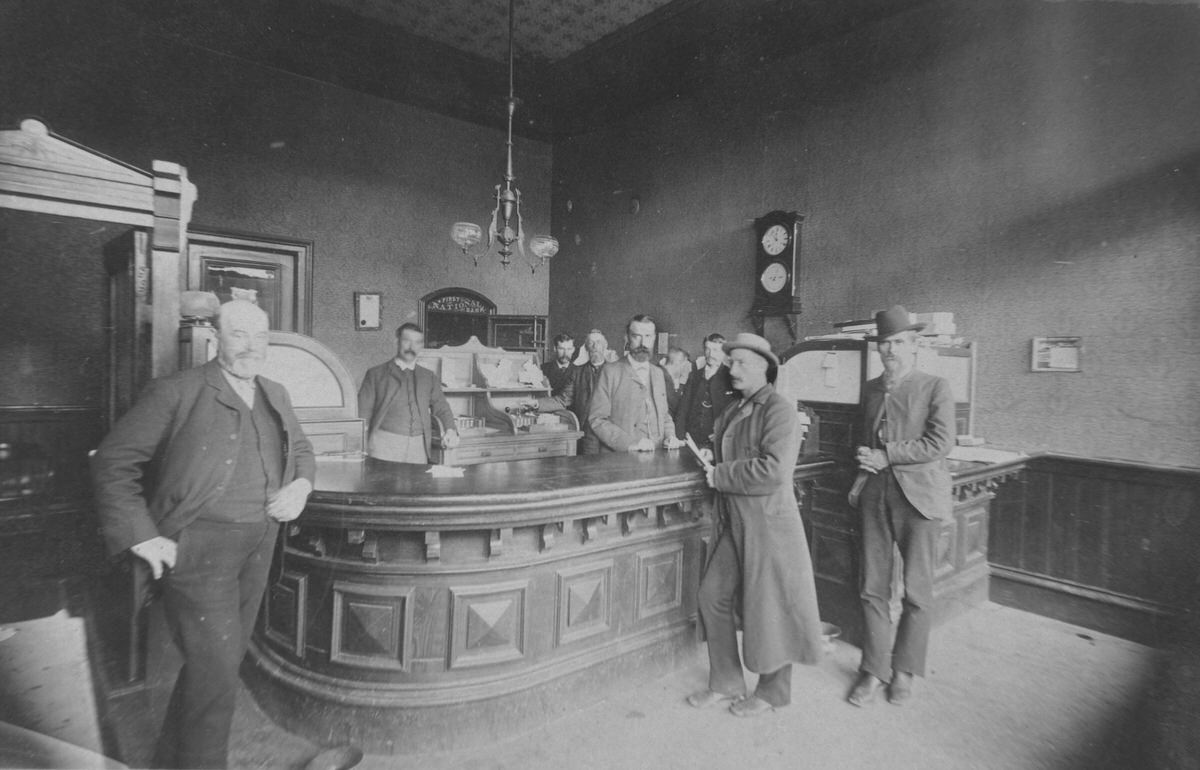
Interior of First National Bank, Mariposa and I St. (Broadway).
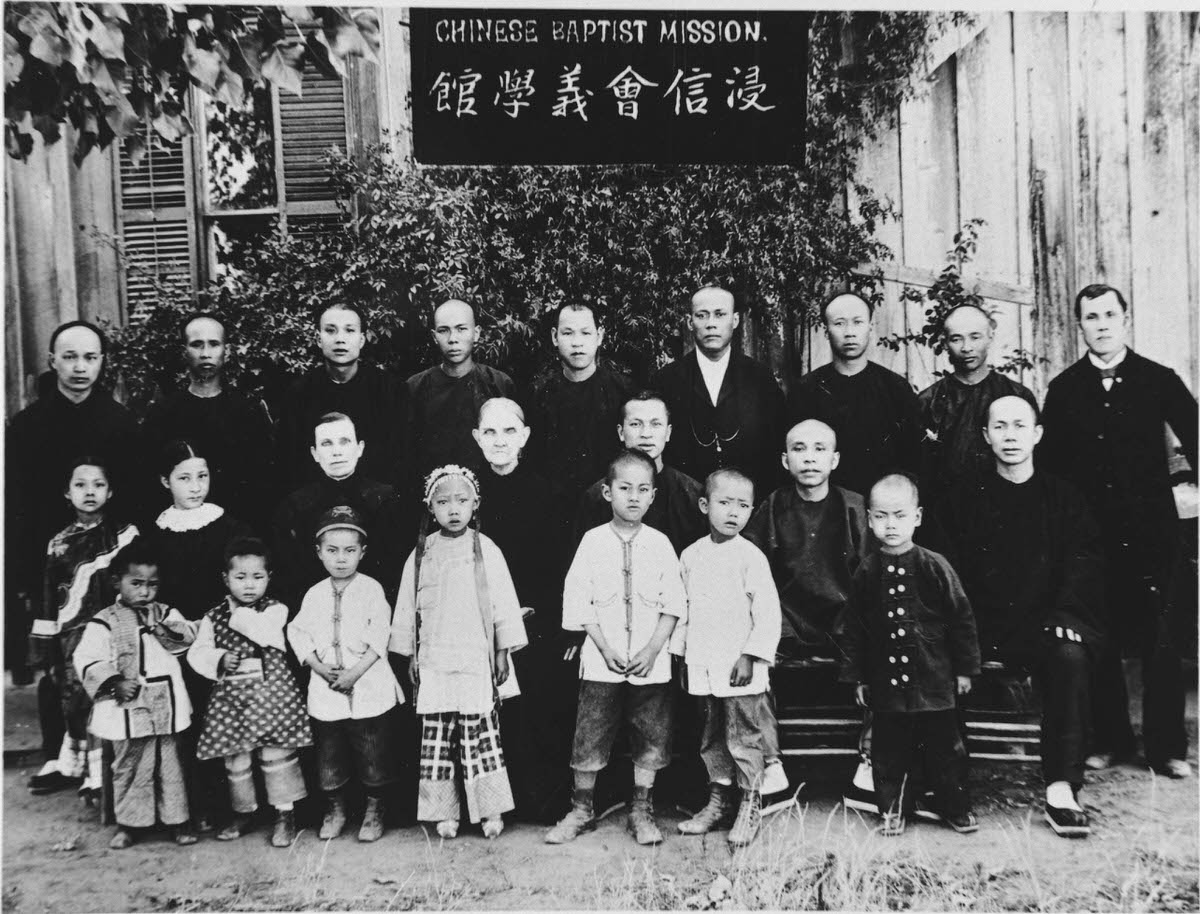
Chinese Baptist Mission, group photo with small children in traditional dress.
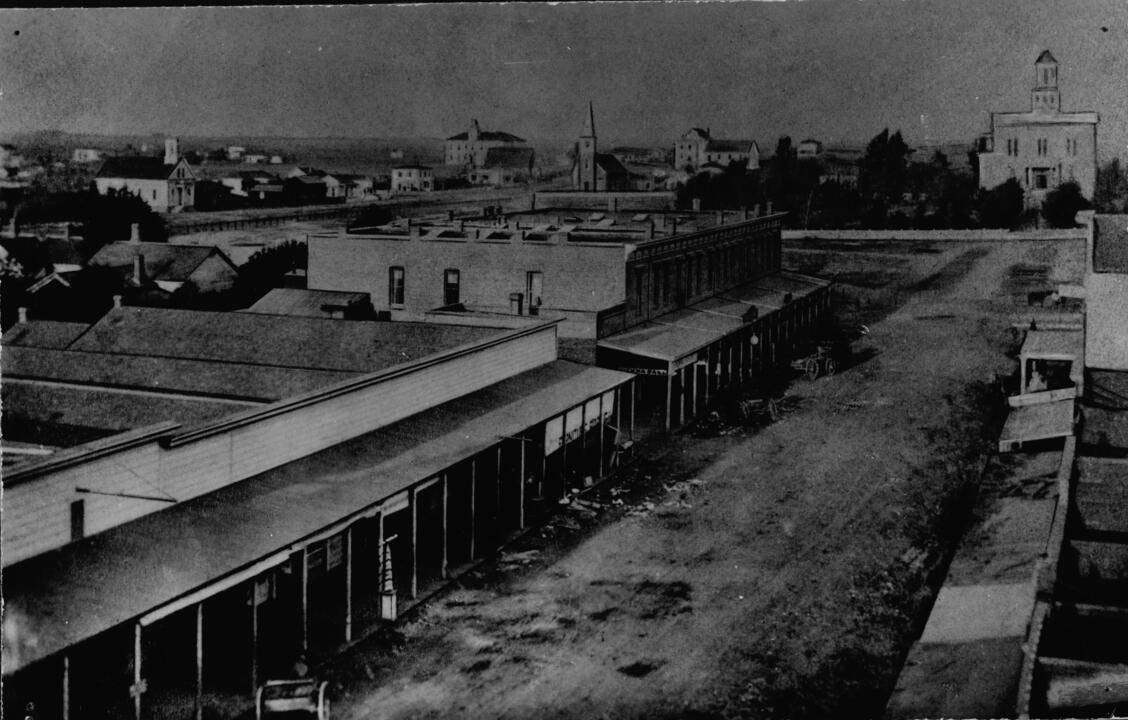
Mariposa Street is a wide dirt road that runs from the foreground at center to the base of the Courthouse in the distance at right. The road is lined with low wooden buildings that have covered porches across their entire storefronts. In the background at left, several more buildings are visible, including a church with a tall steeple. The Courthouse is a three-story building with a tall cupola on its flat roof.
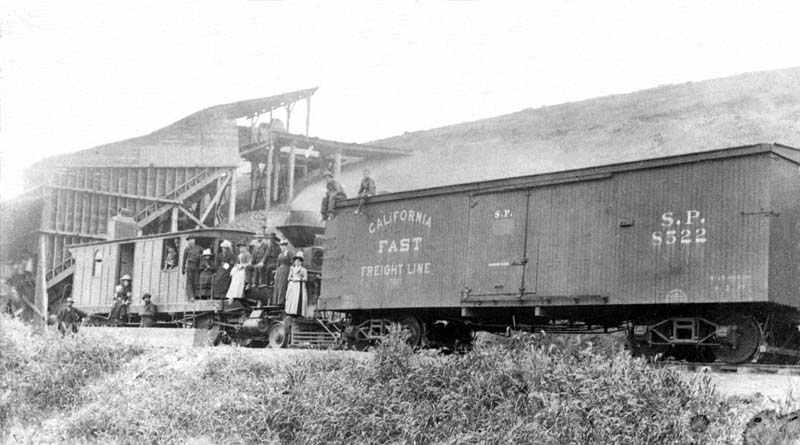
Coal train at a coal mine outside of Coalinga. People are standing and sitting on the train. Some are Fearons who worked the mine.
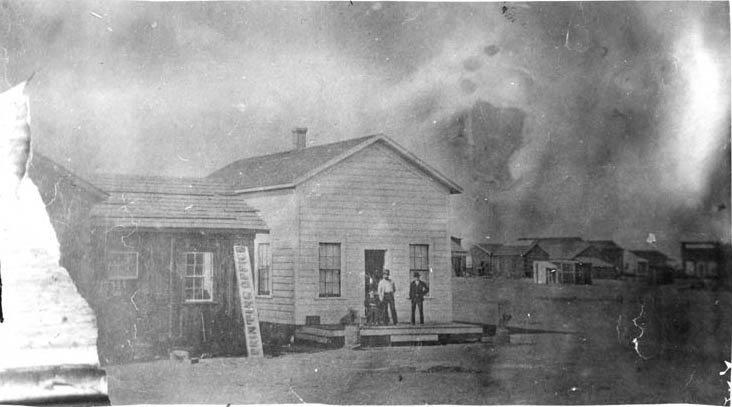
The Fresno Weekly Expositor newspaper first appeared in Millerton, California, on April 27, 1870, founded by J.W. Ferguson, who acted as both editor and owner. It moved to Fresno in 1874 along with the county seat, located on J (Fulton) Street near the corner of Tulare. It became a daily paper in 1881 and moved into a new two-story building in 1888. After numerous ownership changes, a syndicate called the Fresno Publishing Company took over the newspaper in 1897, but financial difficulties forced the paper to close on September 1, 1898.
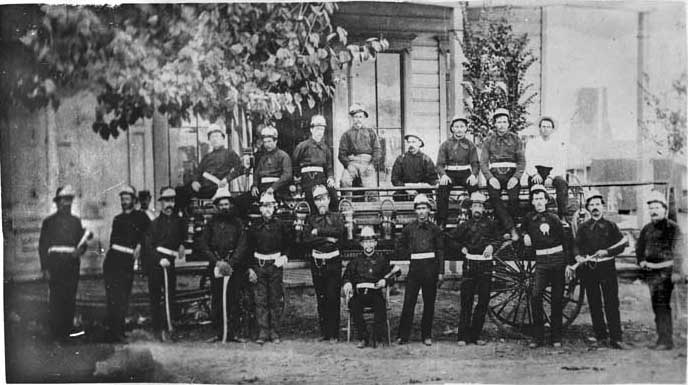
The Fresno Hook and Ladder Company was organized on February 24, 1877. Mr. Leopold (Lee) Gundelfinger was the fire chief and is seated in the center of the front row of this photograph. The other firefighters, starting in the back row left to right, are Charles Wainwright, John Elam, Lephonso Burks, Harry Rea, Charles DeLong, Louis Einstein, Charles Overholzer, and N.D. Gilbert. The front row, from left to right, is Fred Kramer, George Strine, Frank Tadlock, Steve Spano, John Dwyer, Wm. Lawrenson, Lee Gundelfinger (Chief), Will Silvers, John Welsh, Wm. H. McKenzie, Andrew Basso, and John Boyle.
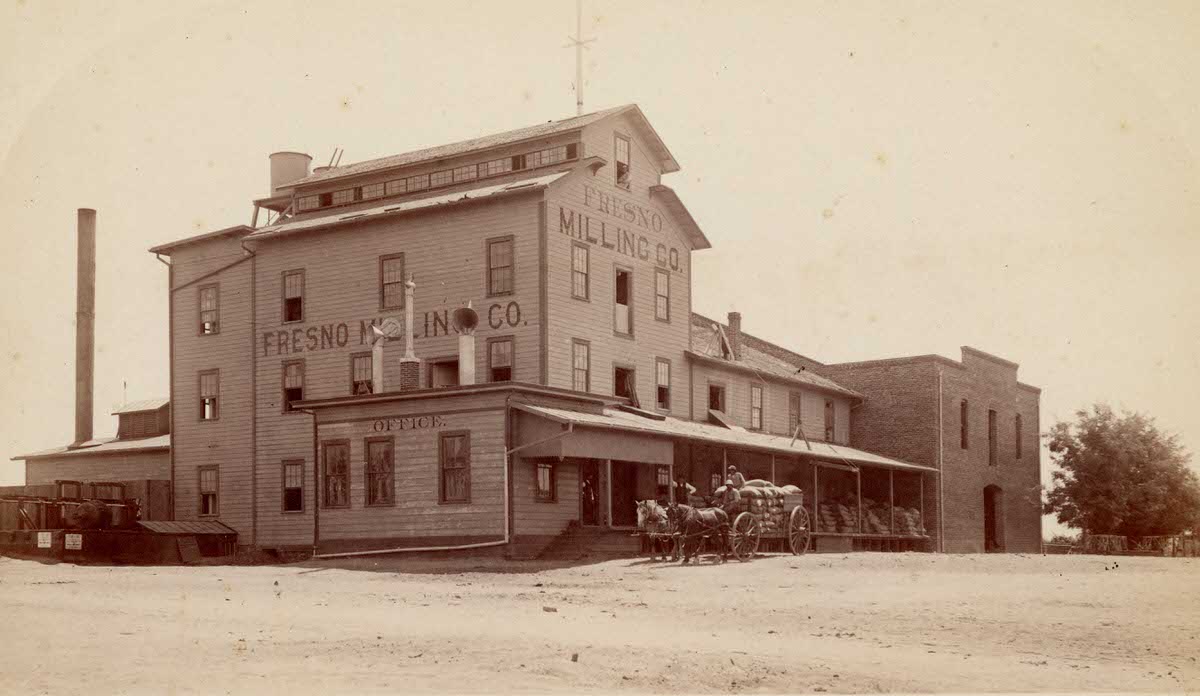
View of the wooden and brick mill building, with the office to the right, a horse-drawn wagon loaded with sacks in front, sacks on the covered porch in front, and a brick building to the right.





The old courthouse would be a better option than that ugly brick structure from the 1960s.
This is cool! Thanks for sharing!
So, any relation to Goldstein’s?
So many beautiful structures. Too bad they no longer exist. It’s like the developers in the 1900s wanted fresno to be ugly lol
I agree. It became depressing trying to get through all the photos. So many beautiful buildings, all burned or demolished. What a shame.
Just spit out my coffee
Fresno has a history of redlining Armenians. At one point Armenians who wanted to own property would whitewash their names.
KPFA Fresno on 88.1 FM did a great interview last summer and they some scholar on to talk about it. I like to think of your 8 downvotes as 8 people who can’t accept even our beautiful lovely perfect city had/has its flaws.
The other possibility is they have no sense of humor.