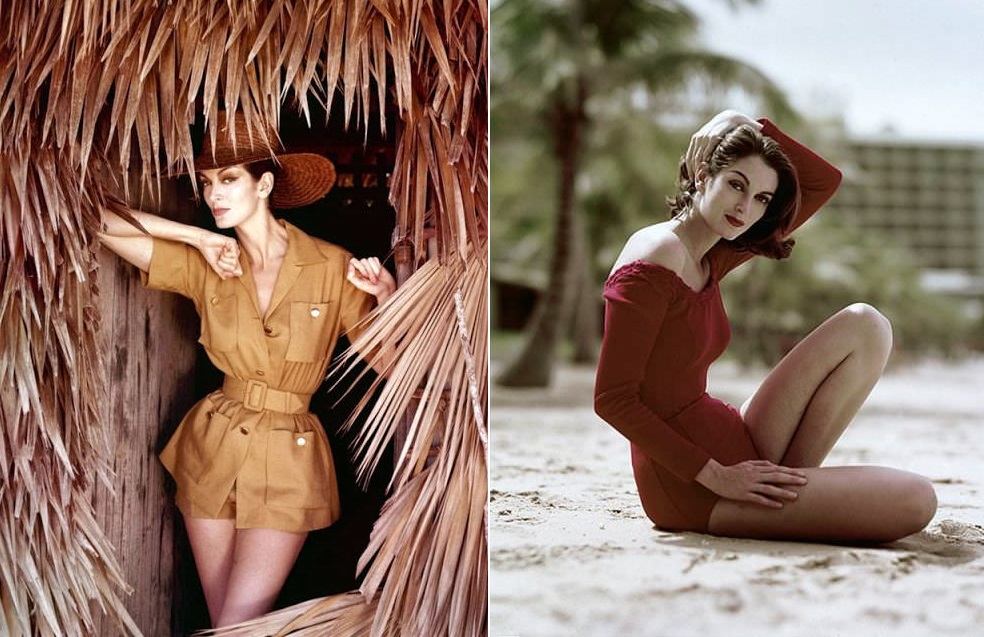
The 1950s and 1960s were two of the most visually exciting decades in fashion history. Silhouettes shifted dramatically, colors grew bolder, and new fabrics made styles that had never existed before suddenly possible. Women’s fashion in the 1950s centered on the full, billowy skirt — often paired with a natural waistline, half sleeves, and a V-neckline. It was feminine, structured, and deliberately glamorous. Then in 1954, Christian Dior introduced the pencil skirt, and the fashion world took notice almost immediately. Slim and tailored, it became the go-to look for office wear throughout the decade.

By the early 1960s, the mood had shifted again. Drainpipe jeans and capri pants took over as casual staples, largely thanks to Audrey Hepburn, who wore them with effortless style. Fashion magazines like Vogue, Harper’s Bazaar, and Charm were fueling the fire, bringing designer looks into everyday households through glossy pages packed with advertising. Beauty and cosmetics moved in lockstep with clothing, and the two industries reinforced each other season after season.

One of the most important photographers capturing all of this was Lionel Kazan. His relationship with the camera began at age twelve, when filmmaker Marc Allégret gave him his first camera. That single gift set the course of his life. Kazan went on to shoot 92 cover photographs for ELLE magazine between 1953 and 1965, a record that speaks for itself. He also worked regularly for Vogue and Harper’s Bazaar, two of the most prestigious fashion publications in the world.

Kazan photographed some of the most celebrated models and personalities of the era. Bettina Graziani, one of France’s most iconic models of the 1950s, appeared in front of his lens multiple times. His early 1954 work with her along the quai de Béthune in Paris showed the kind of natural elegance he brought to every shoot — real locations, real light, real movement.


His 1955 work for ELLE showed the full range of what mid-decade fashion looked like. Structured silhouettes, embroidered details, and carefully chosen accessories defined the editorial spreads he contributed to. These weren’t just clothing advertisements — they were fully composed images with a strong point of view.


Kazan worked with a wide roster of models throughout the decade. Paule Rizzo and Sophie Malgat both appeared in his ELLE work during 1955, each shoot reflecting the particular mood of the season — confident women in polished looks, photographed with a clarity that made every detail count.


In 1956, Kazan traveled to Greece for ELLE shoots featuring Barbara Mullen. One of those images showed Mullen in a striped hooded top and pants by Christian Dior Boutique — casual and chic at the same time. Another from that same Greece trip captured her in a different look entirely, the Mediterranean backdrop adding an airy quality to the images.


By 1958, American fashion had fully embraced print fabrics and party dresses. Kazan photographed Lucinda Hollingsworth in a full-skirt party dress featuring a chrysanthemum print on a red background, made from silk surah by Rappi. The same year, he shot a model in a nasturtium print dress on white by Kasper of Arnold & Fox, topped with a straw hat by John Frederics Charmer — the kind of coordinated, accessory-forward styling that defined late-1950s American fashion editorial.


As the 1960s arrived, Kazan’s portfolio expanded to include more international editorial work. He photographed Dolores Hawkins extensively in 1960, including a white two-piece that appeared in Glamour’s July issue and a cover shot for the Greek magazine Oheaypoe. Hawkins appeared in multiple images from that period, showing the kind of versatility Kazan drew from his subjects.


Evening wear in 1960 reached a level of opulence that is hard to overstate. Kazan photographed a model in a jet-spangled lace and burgundy velvet evening dress by Samuel Winston, paired with diamond jewelry by Harry Winston and opera pumps by Andrew Geller. That same year, he shot Pia Kazan in a satin gown with a bead-embroidered bodice by Sophie for Saks Fifth Avenue, and later in a silk chiffon dress in two layers of black over forest green with a deep V-back, designed by Scaasi — who also designed the earrings — for Vogue.


Into the mid-1960s, Kazan’s commercial work expanded beyond editorial fashion. He photographed Gudrun Bjarnadottir for a Juvena beauty products advertisement in 1963, capturing the growing crossover between fashion photography and beauty advertising that defined the era. It was the kind of work that required as much attention to skin, light, and expression as to clothing.


His October 1964 work for ELLE featured a model named Mickey in two dramatic evening looks — a midnight blue velvet skirt with a tapestry jacket and large satin bow, and a peacock blue and gold brocade evening coat. Both shots showed how rich, theatrical eveningwear had become by the mid-1960s. That same year, he shot model Tamara Nyman for the cover of Novella magazine, a portrait that showed his range beyond the fashion editorial format.


By 1965, color and boldness were everywhere in fashion. Kazan photographed Agneta Frieberg wearing Germaine Monteil makeup alongside an orange dress by Sloat with a matching headband — the full-look coordination that had become standard in high-end editorial. Glamour fashion editor Frances Patiky Stein also appeared in front of his lens that year, dressed in white cotton duck trousers and a black organdy shirt, a look that felt modern and clean.


Kazan’s 1966 work for Marie Claire brought him into the world of French cinema as well. He photographed actress Anna Karina, Françoise Dorléac, Marie Laforêt, and Monica Vitti for the magazine — all major figures in European film at the time. These weren’t standard model shoots. Each subject brought her own established public persona, and Kazan photographed them with a directness that suited both editorial and portraiture.


Also in 1966, Kazan photographed model Pia Rossilli Kazan in lingerie by Vanity Fair — two separate images that showed the decade’s growing openness in fashion advertising. The year 1964 also included a sharp editorial shot of a model in a red and white checked blouse worn over a navy shift, a pairing that captured the graphic, high-contrast aesthetic that defined mid-decade American style.


His final years in the collection also included celebrity portraiture. Shirley MacLaine appeared in the January 1967 issue of Marie Claire, and Mireille Darc was photographed for the same magazine in 1968. Gudrun Bjarnadottir returned in 1967, showing that Kazan maintained long working relationships with many of his subjects across years.


Looking back at his earlier 1950s work, Kazan’s range becomes even clearer. Shots of Bettina Graziani from the 1950s, Dorian Leigh and Enid Boulting together in ensembles by Givenchy and Lanvin-Castillo from 1955, and Enid Boulting separately in a Givenchy suit and a velvet dress by Jacques Fath from 1956 all show a photographer who understood how to make clothing the subject without losing the person wearing it. Dorian Leigh’s cover of ELLE from July 26, 1954, and a simple shot of a model in a polka-dot scarf from that same year further demonstrate the breadth of what his lens could do.