Hey There! Before You Go. 😧
Get the best vintage content straight into your inbox!

Don't worry, we don't spam

World War I: 50+ Striking Colorized Photographs Of Canadian Soldiers During The Great War

When war broke out in August 1914, Canada’s population was fewer than eight million people. The country was pulled into the conflict not by a vote in Ottawa, but by a declaration made at Westminster in London. Before it was over, more than 60,000 Canadians were dead. The scale of sacrifice was enormous for a nation so young and so small.

Between 1916 and 1918, Canada employed three official photographers to document its soldiers at war: Captain Harry Knobel, Captain William Ivor Castle, and Lieutenant William Rider-Rider. Together, they produced over 4,000 photographs. Those images were printed in newspapers, sold as souvenirs, and displayed in public exhibitions. They gave civilians at home a window into a world most would never see firsthand.

A little french paper boy selling papers in Canadian line, June 1917

The Vimy Foundation has colorized a selection of these photographs, drawn from the vast archival collection at Library and Archives Canada. Additional images came from local archives across the country, including the City of Toronto Archives, the Glenbow Museum and Archives, the City of Vancouver, archives in Newfoundland, and the Nova Scotia Archives. Colorization brings these moments closer — the faces, the mud, the exhaustion, and the quiet moments in between the fighting all become more immediate.

On sentry duty on a front line trench, September 1916

Life in the trenches was grinding and relentless. Soldiers stood watch for hours, slept in cramped dugouts, and moved through narrow communication trenches under constant threat. The front line was not a single moment of battle — it was weeks and months of waiting, working, and enduring.

Gen Sir sam hughes and party looking at ruins in arras, August 1916
Communication trench, September 1916

Death was a constant presence. Officers and enlisted men alike were buried on or near the battlefield, their funerals carried out with whatever ceremony the front allowed.

A Burial Service At the Front Funeral of major el knight Eaton Motor Machine gun battery ,October 1916

Chemical weapons made World War I unlike any conflict before it. Gas attacks forced soldiers to rely on masks, and regular drills were held to make sure those masks actually worked when needed.

Canadian testing their gas masks after heavy work in the trenches. September 1917

Behind the front lines, Canadian pioneers kept the war machine moving. They built roads, cleared timber, and laid the groundwork for every advance. Near Vimy Ridge, that work was especially critical — the terrain had been torn apart by years of shellfire.

Canadian pioneers at work in a wood near vimy ridge, August 1917

Communication on the battlefield took many forms. Telephone lines were run between posts and tested regularly. Carrier pigeons were still used to deliver messages when other methods failed — dispatched directly from the trenches by dedicated riders.

Despatch Rider For His majesty pigeon service leaving with birds for the trench, November 1917
Telephone testing station at the front operators at their posts, October 1916

The wounded were treated at advanced dressing stations positioned as close to the action as safely possible. In October 1918, east of Arras, Canadian wounded sat together drinking tea while the fighting continued nearby. German prisoners were put to work carrying Canadian casualties from the battlefield.

Canadian wounded enjoying a cup of tea at advanced dressing station during the advance East of Arras, October1918
German prisoners carrying Canadian wounded advance east of Arras, August 1918

The Battle of Passchendaele in the fall of 1917 became synonymous with mud. The terrain was so destroyed by shelling and rain that men and horses sank into the ground. Canadian pioneers hauled trench mats across the landscape just to move. In at least one documented case, Canadian and German wounded helped each other through the mud after the fighting stopped.

Canadian pioneers carrying trench mats with wounded and prisoners in background during the battle of Passchendaele
Canadian and German wounded help one another through the mud during the captured of passchendaele, November  1917
Canadian and German wounded help one another through the mud during the captured of passchendaele, November 1917
Wounded Canadian taking cover Behind Pill Box Battle of Passchendeale, November 1917

The Battle of Amiens in August 1918 was one of the most significant Canadian operations of the entire war. Tanks advanced alongside infantry, and prisoners streamed back from the front, some of them wearing gas masks. Soldiers paused to fill water bottles and, later in the push, to collect free coffee at distribution points east of Arras.

Battle of amiens Tanks Advancing . prisoners bring in wounded wearing gas masks, August 1918
Canadian Filling their water Bottles ,etc Amiens, August 1918
Canadian soldiers advance behind a Mark II heavy tank during the battle.

General Arthur Currie, commander of the Canadian Corps, became one of the most respected officers of the war. In July 1918, he briefed Canadian journalists at the front, explaining in detail how Vimy Ridge had been taken the year before — a battle that had become central to Canadian national identity.

Gen Currie telling now vimy ridge was taken Visit of Canadian journalists to the front, July 1918
Gen. Currie telling now Vimy Ridge was taken, July 1918
Canadian soldiers returning from Vimy Ridge

Soldiers captured at Hill 70 in August 1917 occupied German trenches that had been taken just days before. The battle for Hill 70, fought just north of Lens, France, cost thousands of lives on both sides but was a clear Canadian tactical success.

Canadian In captured trenches on hill 70, August 1917
Canadian soldiers survey a destroyed German bunker during the battle of Passchendaele.

Not all of the photographs show combat. Soldiers wrote letters home from the line, had their tunics tailored before going on leave, and read the Canadian Daily Record in the trenches near Lens. Nova Scotians returned to camp after baseball games. These moments were just as real as the battles — and the photographers captured them all.

Canadian Writing home from the line, May 1917
Canadians Interested in Canadian Daily Record In Trenches near lens, February 1918
Nova Scotians Returning to camp after a game of baseball, February 1918
Baseball game with bats in foreground and crowd of CEF Members in background watching . Sept 1917

Among the soldiers photographed was Tom Longboat, the famous Onondaga long-distance runner from Six Nations of the Grand River. He served as a dispatch runner for the Canadian Expeditionary Force and was photographed in June 1917 buying a paper from a French newsboy — the same boy who appears selling papers to Canadian troops in the line.

Tom Longboat the Indian long distance runner buying a paper from a little french newspaper boy, jun 1917
Highlander cleaning his rifle, June 1961

Women played essential roles throughout the war. Nursing sisters staffed Canadian hospitals in Britain and France, and at least one — Nursing Sister G.M.M. Wake — died from wounds received in a German air raid. Her funeral was photographed and preserved. Other nurses voted in the 1917 Canadian federal election directly from their hospital postings, one of the first times Canadian women were able to cast ballots.

Left to right nursing sister Mowat, Mcnichol and Guilbert
Nursing Sister at a Canadian hospital voting in the Canadian federal Election
Funeral of nursing sister G.MM wake who died of wounds received in a German air raid

Female ambulance drivers also served at the front. Voluntary Aid Detachment drivers transported the wounded under dangerous conditions, often close to active fighting. Their work was unglamorous and vital.

A Canadian V.A.D Ambulance Driver At the Front, May 1917

Back in Canada, the war effort extended deep into civilian life. Munitions factories ran around the clock. The Assembly Department of the British Munitions Supply Co. Ltd. in Verdun, Quebec, was one of many facilities supplying the front. Veterans returning from the war with injuries learned new trades through the Department of Soldiers’ Civil Re-establishment.

Assembly Department British munitions supply co.Ltd , Verdun, PQ
First world war veterans learning handicrafts under the department of soldiers civil re establishment 1918

Pack horses moved ammunition to artillery batteries across difficult terrain. The 20th Battery of the Canadian Field Artillery relied on this system in April 1917, just as the Vimy offensive was getting underway. Canadian officers also took note of the French military’s large rail-mounted guns during the same period.

Pack horses transporting ammunition to the 20th battery Canadian field artillery April 1917
Canadian officers interested in a large French gun mounted on railroad, October 1917
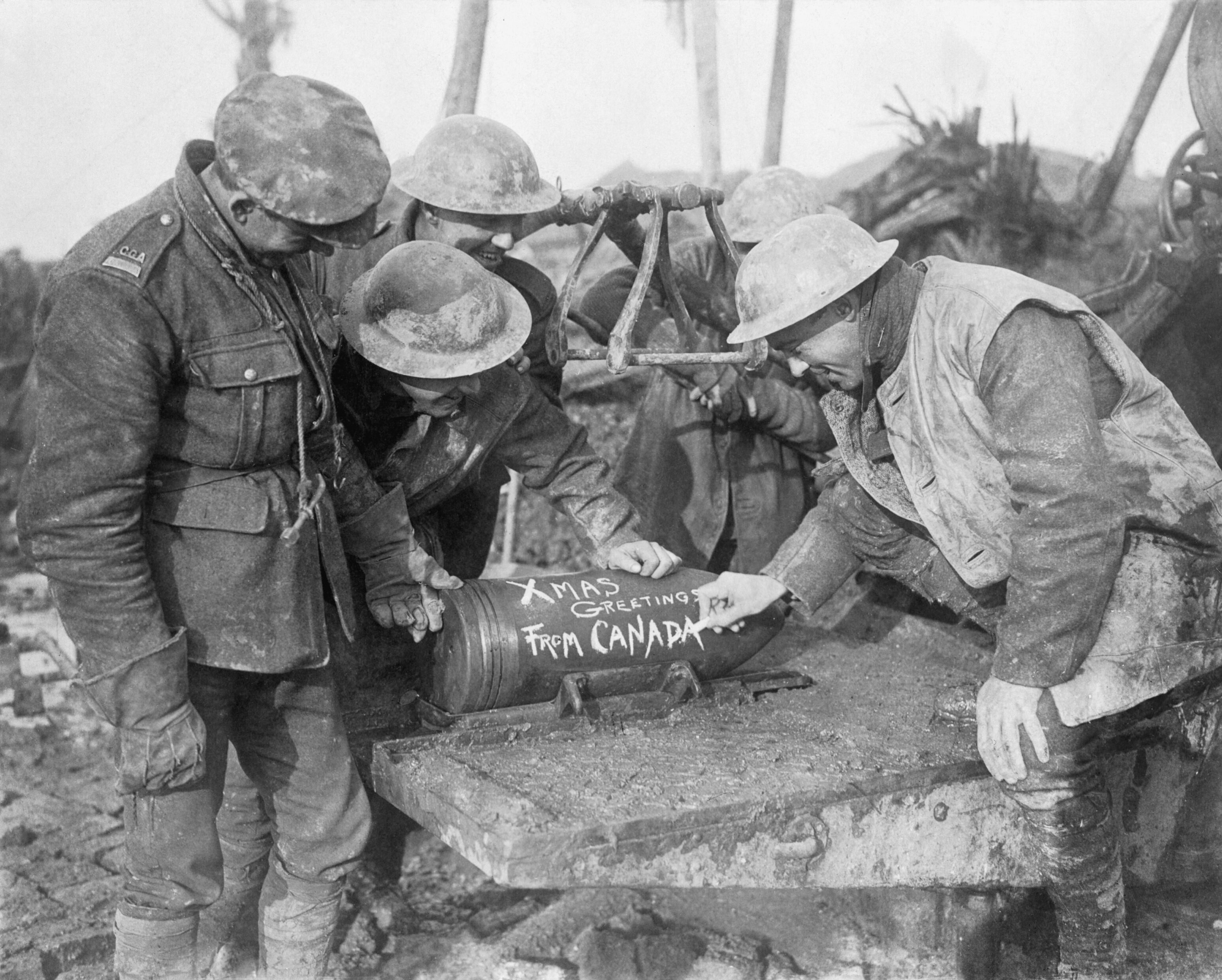
Canadian artillerymen with seasonal messages on an artillery shell during the Battle of the Somme.

Some photographs capture the humanity of individual departures. A Canadian soldier photographed in 1914 holds his young daughter before leaving for war. That single image — a father and child — stands against the full weight of what was coming.

Canadian soldier kisses his daughter goodbye before going off to war, 1914.

Troops returning to camp were met by local vendors selling oranges. Soldiers adopted a dog and brought it out of the trenches, presenting it to a nurse in October 1916. Canadian forestry men took time to skate. These images sit alongside photographs of burial services and gas mask drills — all part of the same war, all preserved by the same cameras.

Women Selling oranges to Canadian troops on their return to camp, June 1917
Some Wounded Canadian Present a nurse with a dog brought out of the trenches with them, October 1916
Canadian Forestry men heaving a skate
Canadian forestry men having a skate

Military demonstrations were held at Shorncliffe, the major Canadian training base on the English coast. The Mayor of Toronto formally welcomed home the 53rd Battery of the Canadian Field Artillery after their training at Kingston. These moments of ceremony bookended the war’s violence — marking both the sending off and the return.

Military demonstration Shorncliffe Sept 1917
mayor of Toronto welcoming 53rd battery C.F.A after their training at Kingston

Christmas at the Duchess of Connaught Red Cross Hospital in Taplow, England was photographed in 1917. Wounded soldiers and staff gathered, their faces visible in color a century later. Three Canadian soldiers settled into a captured German dugout east of Arras. A messenger, unable to ride his motorcycle through the August mud, carried the machine on his shoulders.

Views Taken on Christmas day 1917 at duchess of Connaught red cross hospital Taplow
Three Canadian Soldiers In A German dug out captured during the Canadian advance east of arras
unable to ride his cycle through the mud caused by the recent storm a Canadian messenger carries his horse, August 1917
To the Free Coffee at Canadian Advance East Of Arras Sept 1918
A Canadian About to go on leave taking his tunic to the tailor's shop for, September 1917
A Canadian About to go on leave taking his tunic to the tailor’s shop for, September 1917
Canadian and Dutch soldiers in field of 'wild cabbage
Canadian and Dutch soldiers in field of ‘wild cabbage
Canadian soldiers making selection of apples under Italian sun.
Enjoyed this post? Get new ones in your inbox.

Leave a Comment

Your email address will not be published. Required fields are marked *

Share this Post 🥺

Please take a moment to share this content. Your support is greatly appreciated! 🙌🙏

Share this Post 🥺

Please take a moment to share this content. Your support is greatly appreciated! 🙌🙏
Scroll to Top
 
Hey Friend, Before You Go.. Please like & follow for more interesting content