Three years before Buzz Aldrin set foot on the Moon, he did something far more unexpected 185 miles above Earth. On November 12, 1966, during the Gemini 12 mission, Aldrin pointed a camera at himself and snapped a photograph. It was the first selfie ever taken in space.
NASA launched Gemini 12 on November 11, 1966, with Aldrin and commander James Lovell aboard. It was the final mission of the Gemini program, and it carried a serious set of goals. The crew needed to demonstrate reliable docking with an unmanned Agena target vehicle and prove that astronauts could perform useful work during extravehicular activity, better known as an EVA or spacewalk. NASA needed these skills confirmed before committing to a Moon landing attempt.
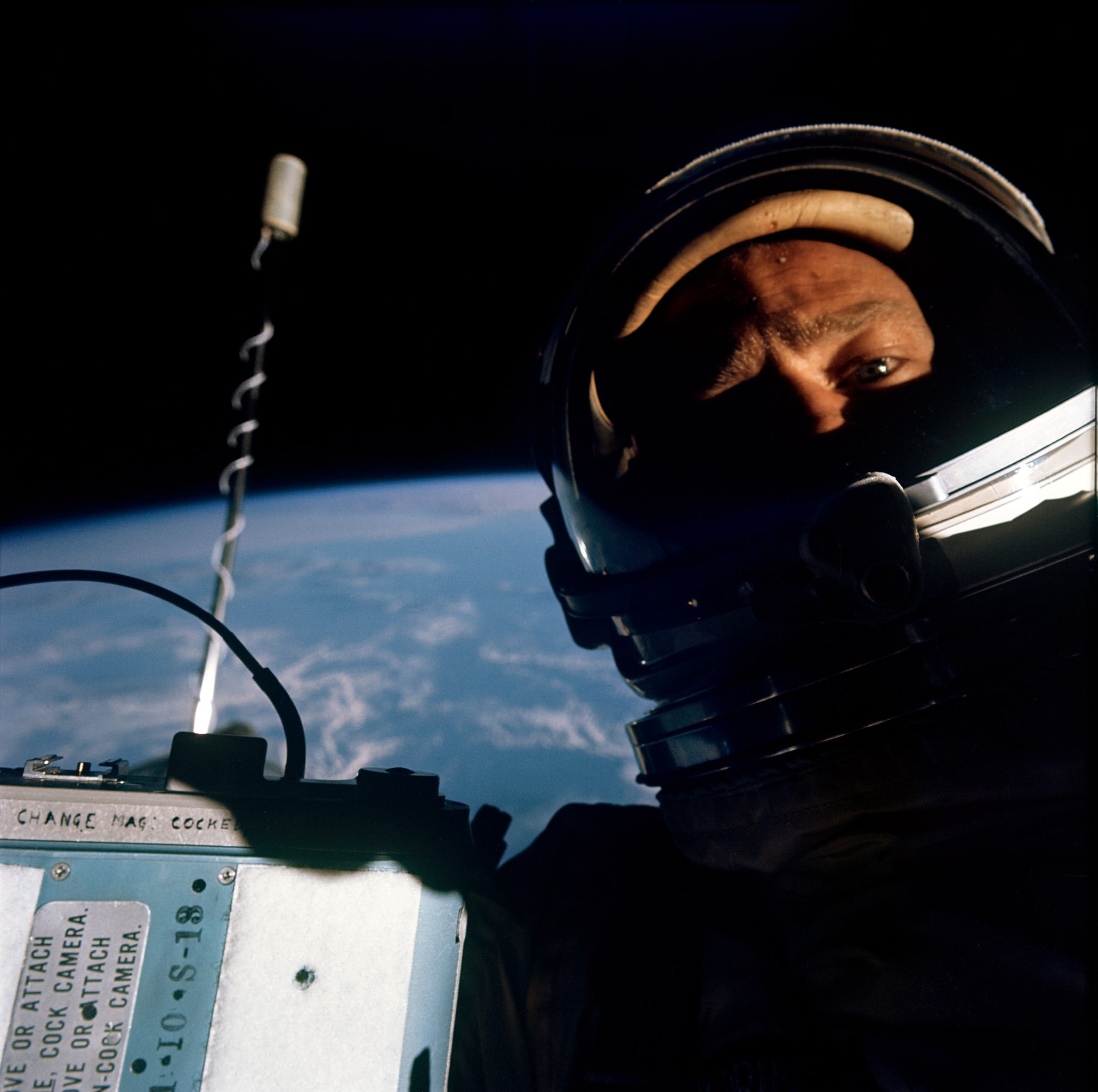
Aldrin’s first task outside the spacecraft was a stand-up EVA, where he stood upright in the open hatch rather than floating free in space. His job was to photograph landmarks on Earth’s surface using a hand-held camera. It was during this moment, with his upper body exposed to the vacuum of space and Earth scrolling below him, that he decided to do something unscripted. He set the camera on the edge of the hatch, angled it toward himself, and took the shot. He lifted his helmet visor so his face would actually be visible in the frame.
Getting that photograph right was not simple. Aldrin was wearing a pressurized spacesuit with thick gloves that made fine motor tasks difficult. There was no fixed surface to brace against in a zero-gravity environment. He had to judge the camera angle by feel and position his head so that both his face and the Earth appeared in the same frame. The visor lift mattered — without it, the reflective gold coating would have obscured his face entirely, and the image would have shown only the helmet.
The camera itself was built for the punishing conditions of space. It had to function across enormous temperature swings, from scorching sunlight to the deep freeze of shadow, all while operating in a vacuum with zero atmospheric pressure. The design accounted for the limitations of an astronaut in a pressurized suit — the controls were large enough to be operated with gloved hands, and the camera could be secured to the suit so it wouldn’t drift away.
Aldrin went on to complete three EVA sessions during Gemini 12, spending a total of over five hours outside the spacecraft. He performed tasks at various points along the exterior of the vehicle, demonstrating that spacewalking could be productive and controlled — something earlier Gemini missions had struggled to prove. His work on Gemini 12 directly validated the EVA techniques that would be used on the Apollo missions.
The concept Aldrin introduced in 1966 did not stay unique for long. In January 2003, astronaut Donald Pettit photographed himself during Expedition 6 aboard the International Space Station. In August 2005, Stephen Robinson did the same during the STS-114 Space Shuttle mission. Each image added to a growing tradition of astronauts documenting themselves in the act of spaceflight.
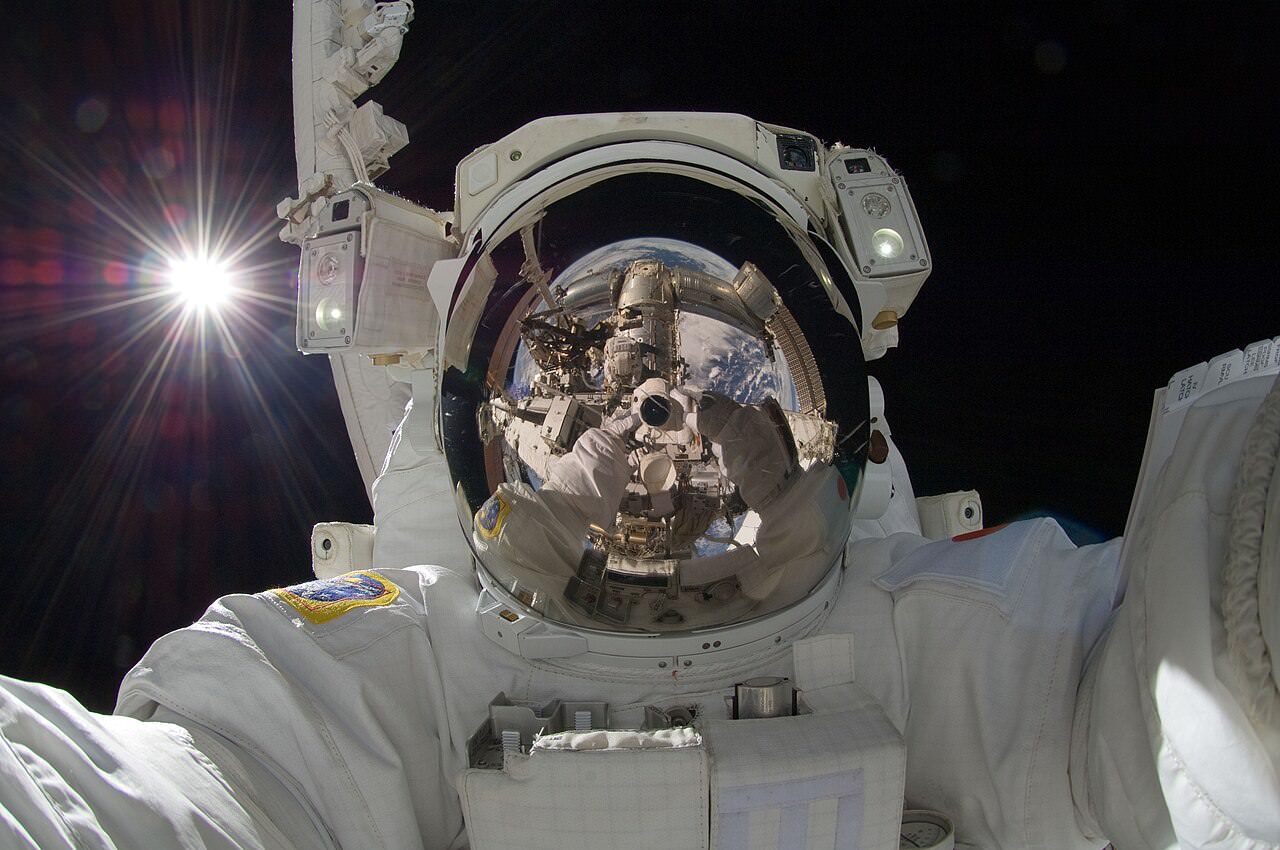
The most widely seen space selfie came on September 5, 2012, when Japanese astronaut Akihiko Hoshide photographed himself during a spacewalk on Expedition 32. In the image, the Sun reflects sharply off his visor while Earth and the blackness of space fill the background. Commander Chris Hadfield shared the photo on social media, and it spread rapidly online. The timing was notable — the word “selfie” was named Oxford Dictionaries’ word of the year in 2013, and Hoshide’s photograph fit perfectly into that cultural moment.
What Aldrin captured in 1966 was fundamentally different from any other space photograph taken up to that point. Previous mission photography focused outward — at Earth, at stars, at docking targets, at equipment. His selfie turned the camera on the human being doing the exploring. It placed a recognizable face inside the vastness of space, making the experience personal in a way that technical imagery never could. That shift in perspective, from documenting the mission to documenting the person on the mission, started with a camera balanced on the edge of a hatch, somewhere above the Pacific Ocean, in the last days of 1966.