
Spain in the late 19th century was a country carrying centuries of history in its stones. Moorish palaces, Gothic cathedrals, Roman bridges, and royal plazas filled its cities — each one a record of the many civilizations that had shaped the peninsula. The country was also living through a turbulent era. Liberal revolutions, power struggles, and political instability marked much of the 1800s, and the pressures building during this period would eventually lead to a devastating civil war in 1936. But in the 1890s, Spain’s streets, monuments, and landmarks still stood in remarkable form — and a new photographic technology was capturing them in vivid color.
The images in this collection were produced using the photochrom process. A Swiss printer developed this technique in the 1880s, and it quickly became one of the most widely used methods for creating colorized photographs. The process involved transferring a photographic negative onto lithographic printing stones, which were then used to layer color onto the final print. The results were striking — detailed scenes of real places rendered in warm, lifelike tones that black-and-white photography simply could not offer. These photochroms were sold as postcards and collectibles across Europe and the United States, giving people far from Spain their first colorized look at its cities and monuments.
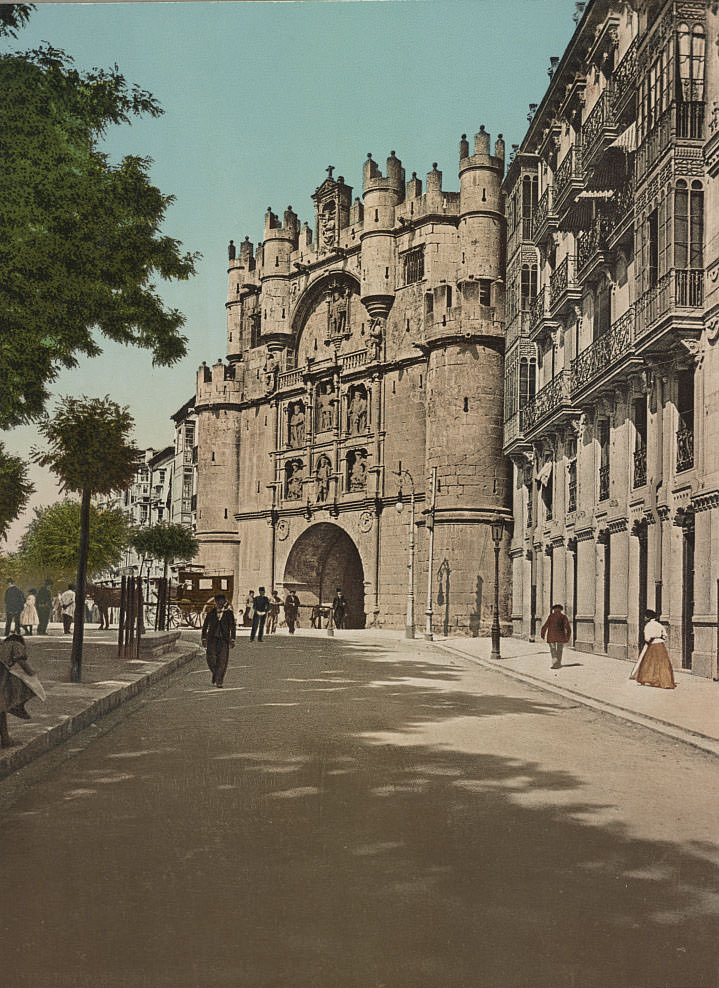
The city of Burgos, in northern Spain, appears in several of these images. One of its most recognized landmarks is the Arco de Santa María, a fortified medieval gate that stands at the edge of the old city and opens toward the Arlanzón River.
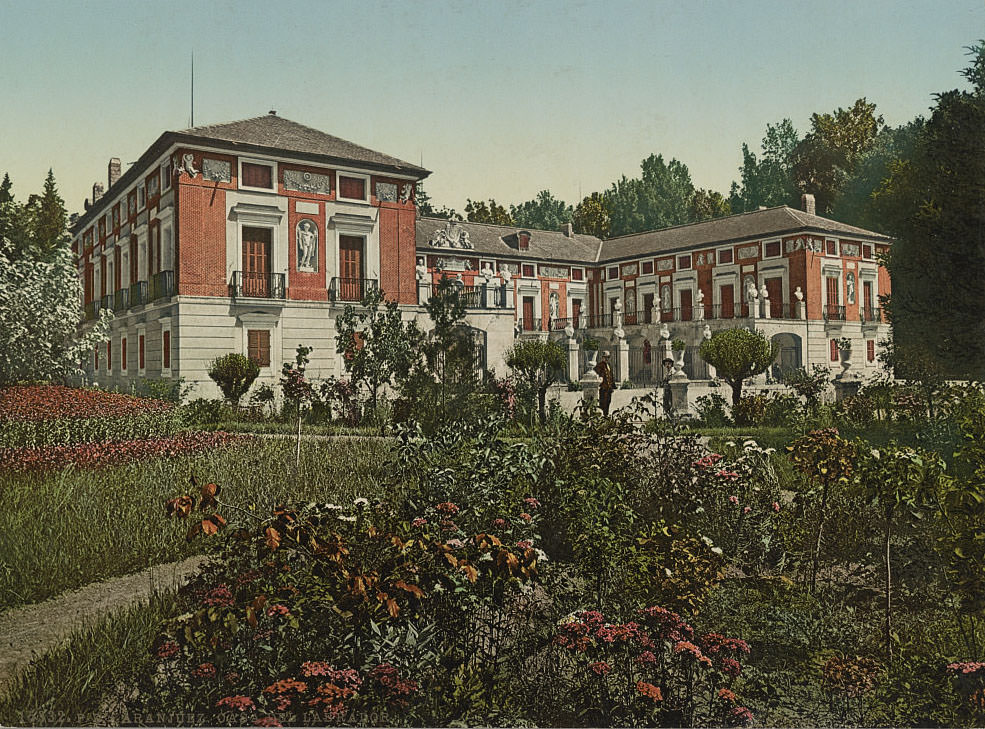
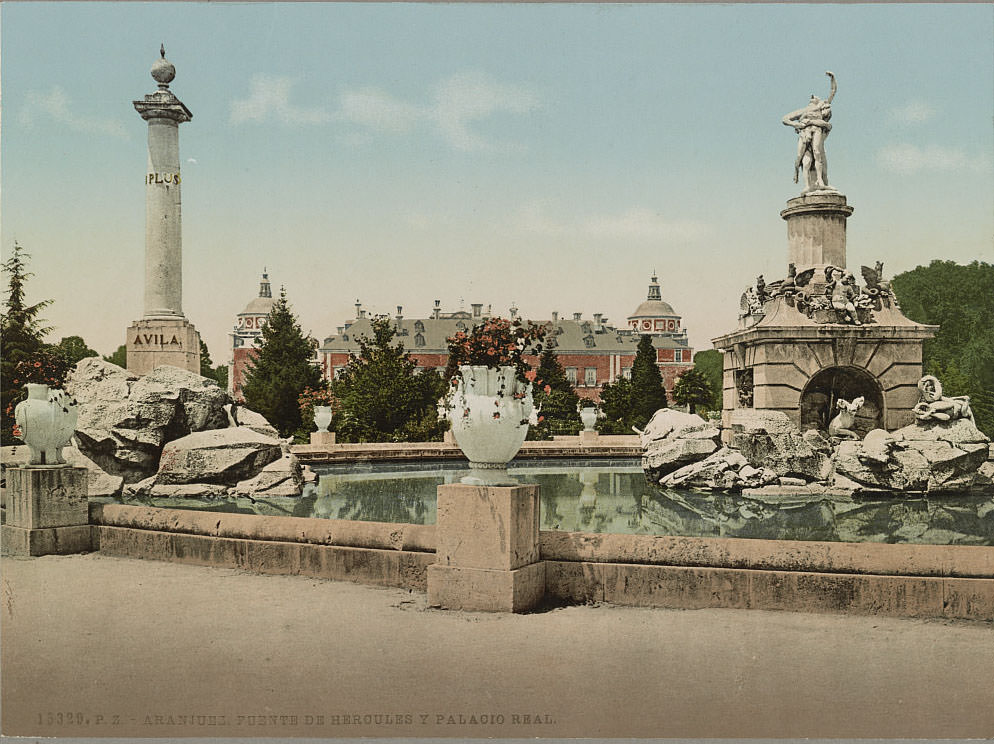
South of Madrid, the royal town of Aranjuez held two of the crown’s most prized properties. The Casa del Labrador — literally the “Laborer’s House” — was a small but lavishly decorated royal retreat built in the late 18th century, filled with silk walls, marble floors, and ornate clocks. Nearby, the Fuente de Hércules stood in front of the Royal Palace, its fountain and formal gardens reflecting the grandeur the Spanish monarchy projected even in its secondary residences.
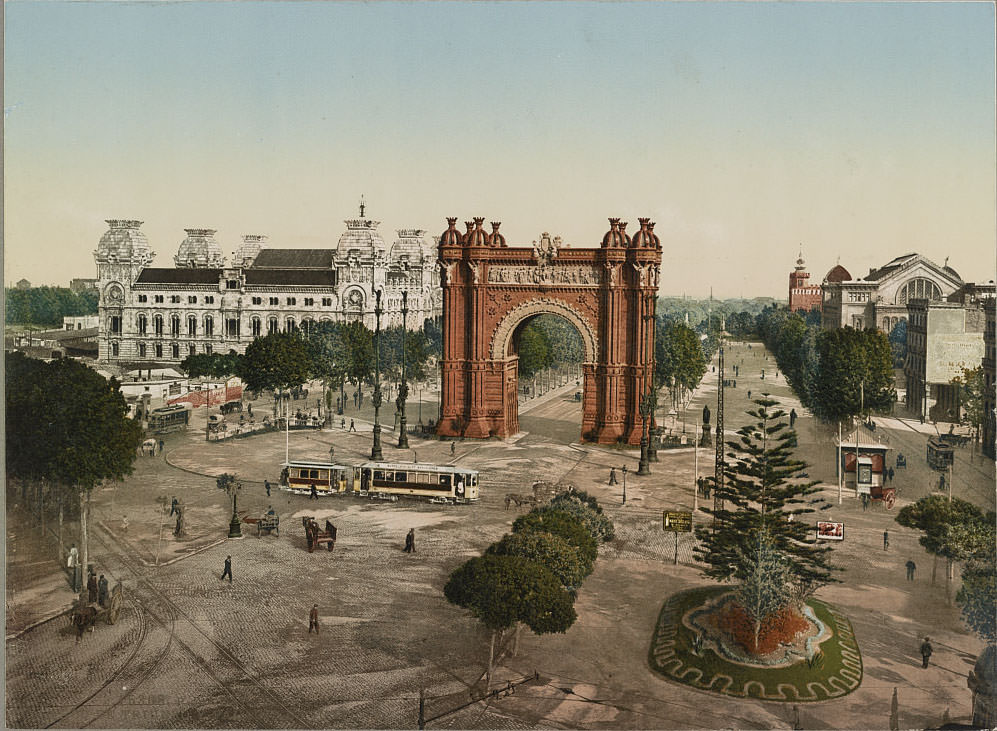
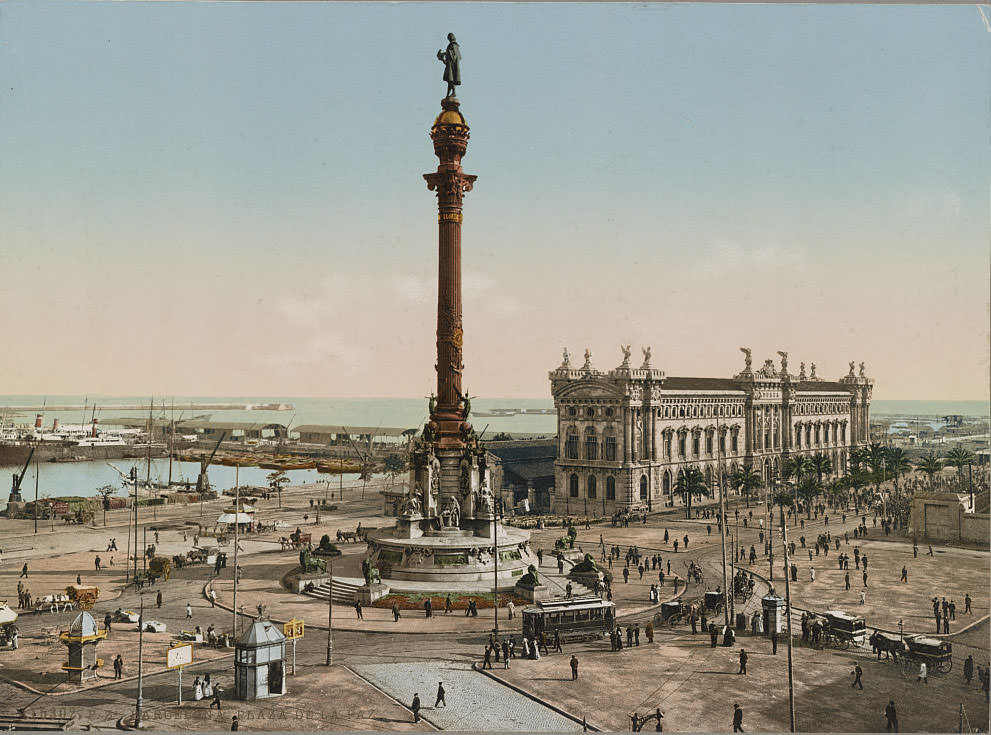
Barcelona in the 1890s was a city in the middle of rapid growth. The Arc de Triomf had just been built in 1888 as the main entrance gate to the Universal Exposition — a world’s fair that put Barcelona on the international map. The arch’s red brick façade and neomudéjar detailing made it one of the most distinctive structures in the city. Not far from it, the Palau de Justícia served as the city’s courthouse, and the busy Plaza de la Paz anchored daily life in the older quarters of the city.
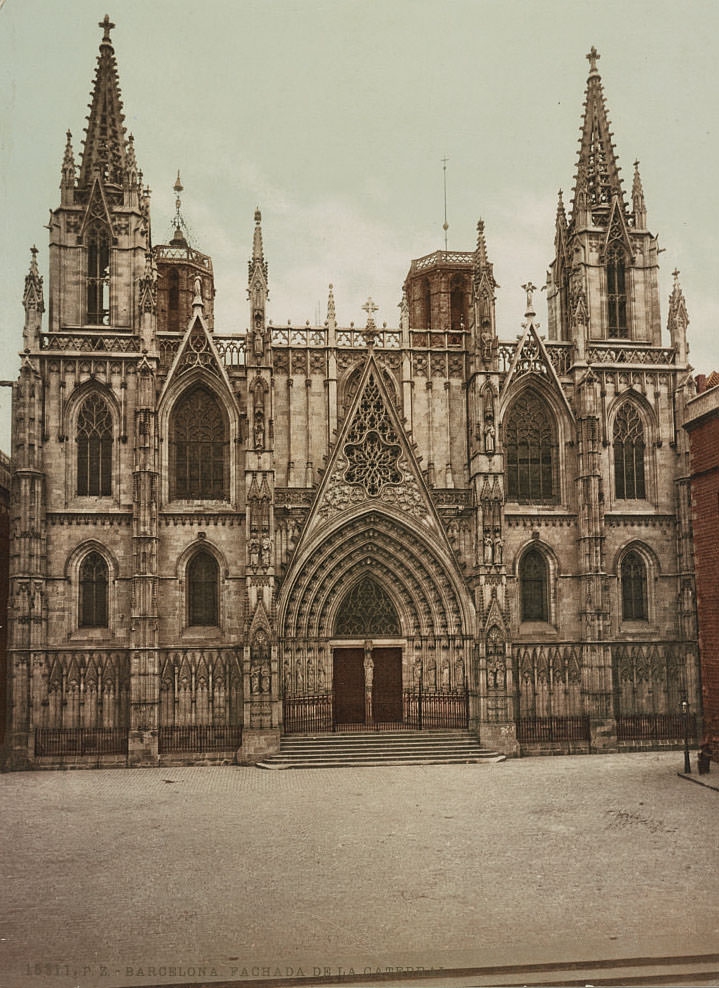
Barcelona’s Gothic cathedral, the Catedral de la Santa Creu i Santa Eulàlia, dominates another image from the collection. Construction on the cathedral had stretched across several centuries, and its façade — completed only in the late 19th century — was still relatively new when this photochrom was taken.
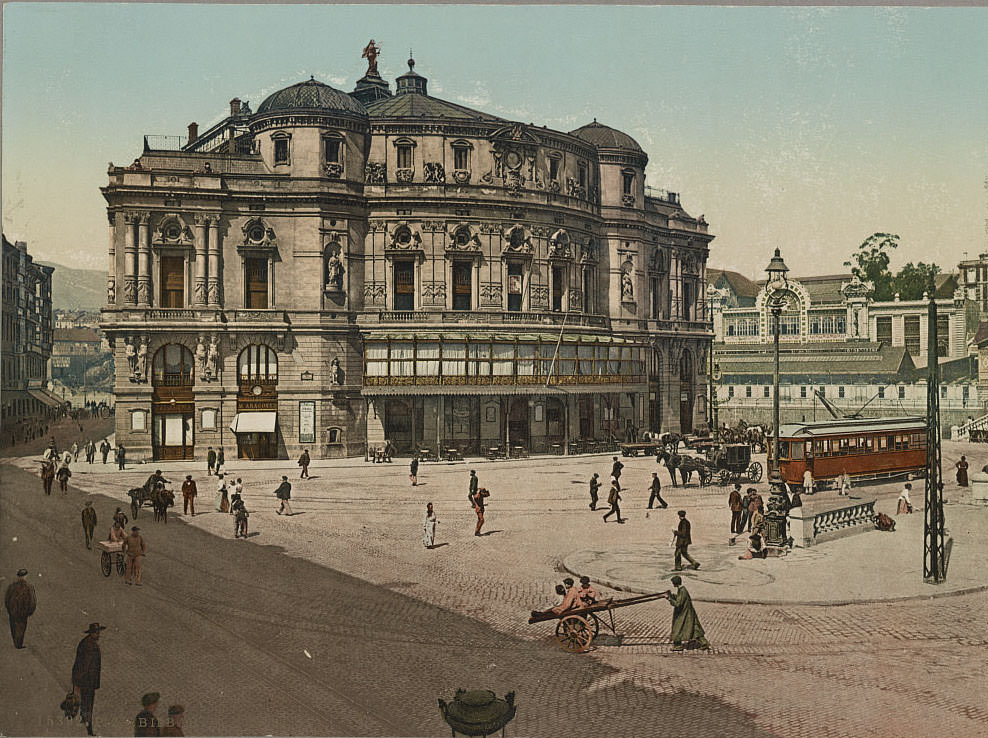
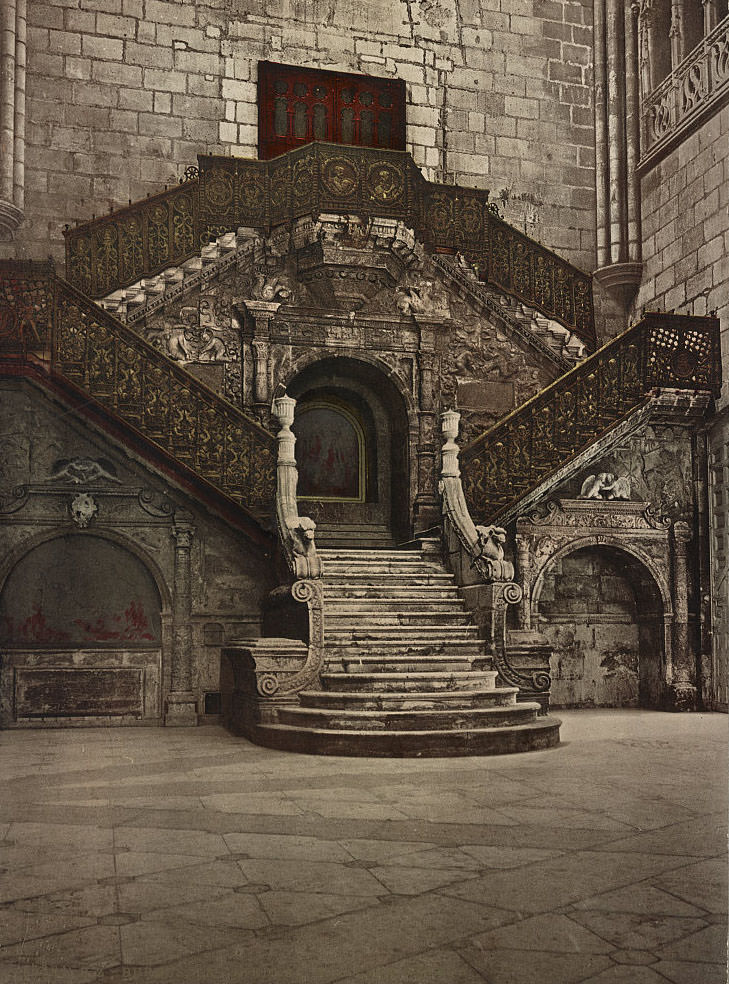
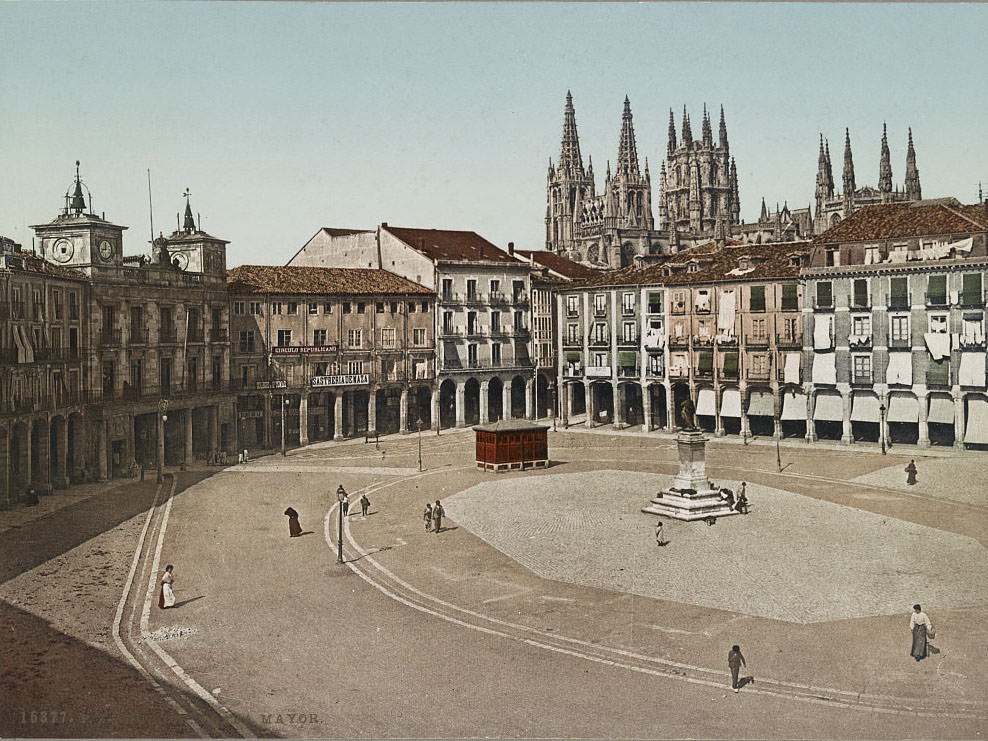
Bilbao, in the Basque Country, contributed a quieter image to the collection — its main theater, a cultural hub for the city’s growing urban population. Burgos also appears again with two more views: the golden staircase inside its cathedral, the Escalera Dorada, designed by Diego de Siloé in the 16th century, and the Plaza Mayor at the city’s heart.
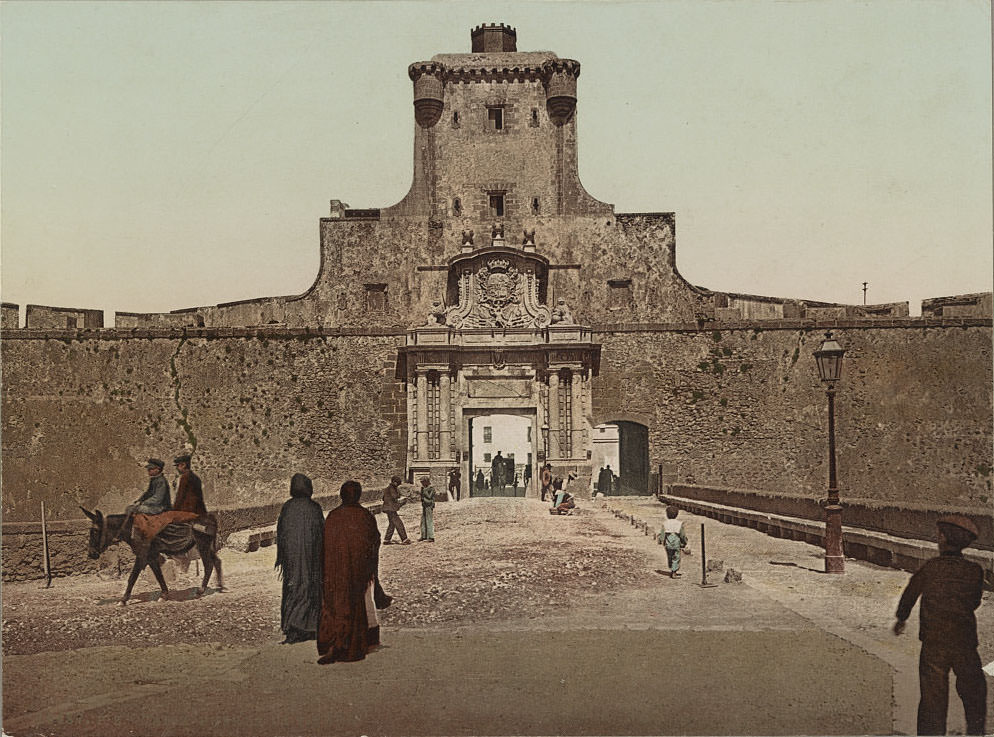
On Spain’s southwestern Atlantic coast, the city of Cádiz shows up through its Puerta de Tierra — the Land Gate — the main entrance through the city walls that separated Cádiz from the mainland. Cádiz is one of the oldest continuously inhabited cities in Western Europe, and its fortifications had been built and rebuilt over centuries of warfare, trade, and colonial commerce.
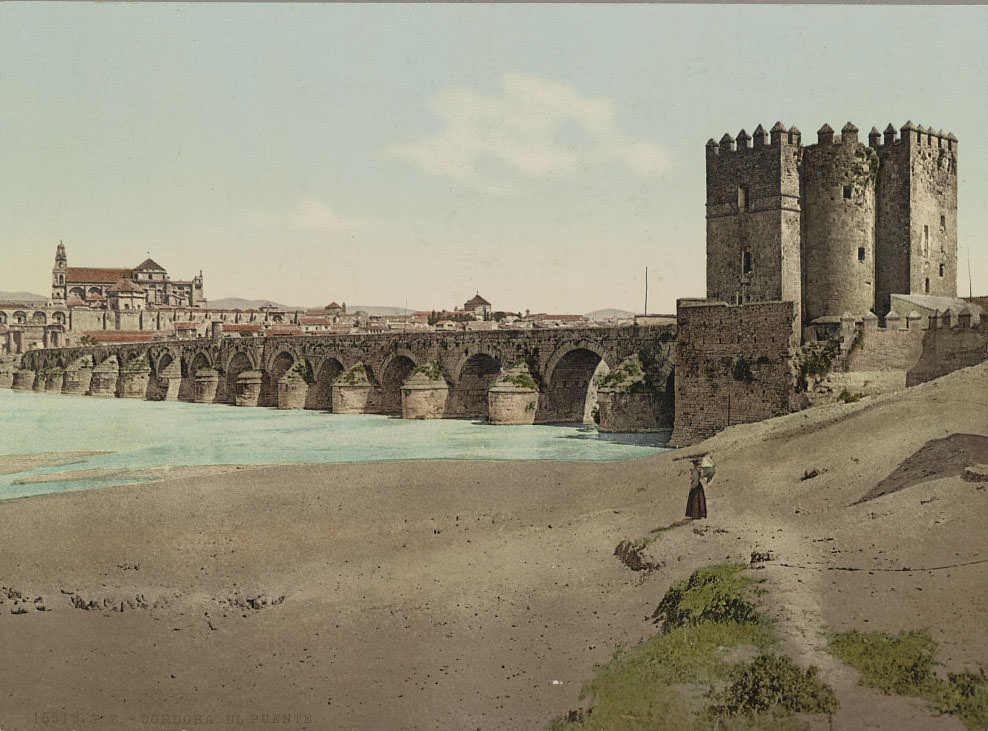
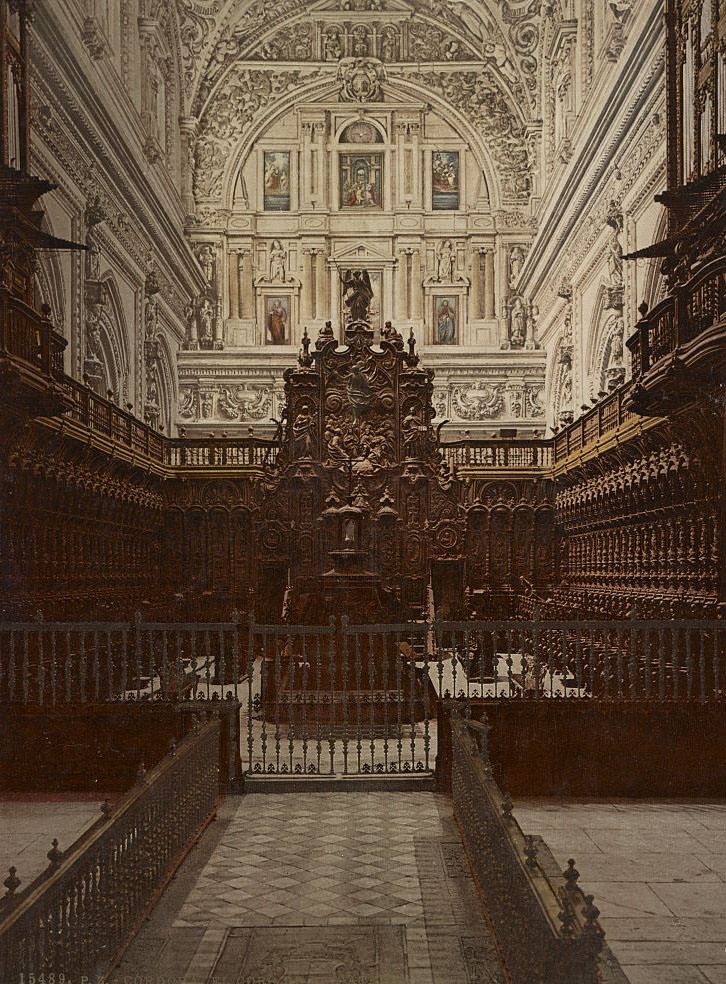
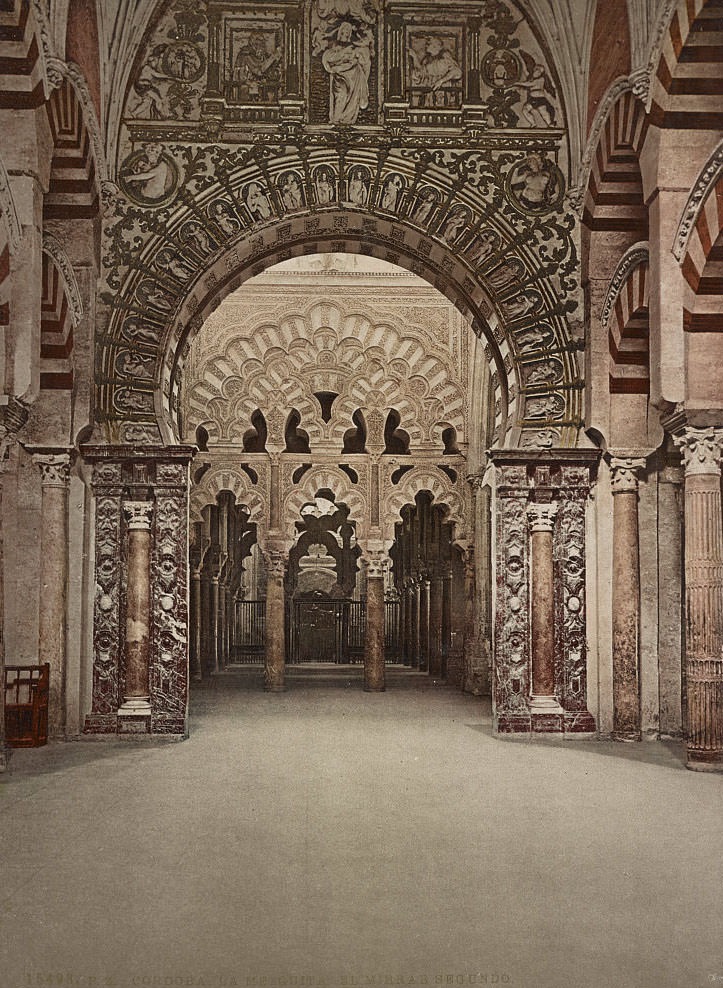
Córdoba, once the capital of the Umayyad Caliphate in al-Andalus, preserves some of the most extraordinary Islamic and early Christian architecture in the world. The Roman Bridge crossing the Guadalquivir River had stood for over a thousand years by the time this photograph was taken. The city’s cathedral, built inside the walls of the Great Mosque, features a choir — the Coro — that was inserted into the mosque’s prayer hall in the 16th century.
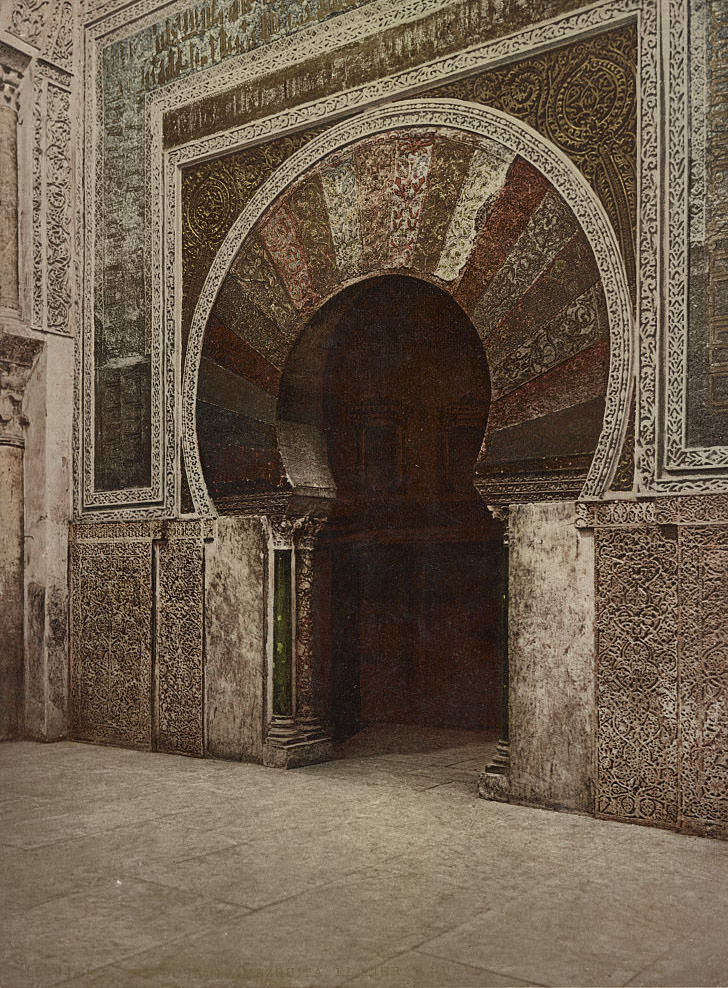
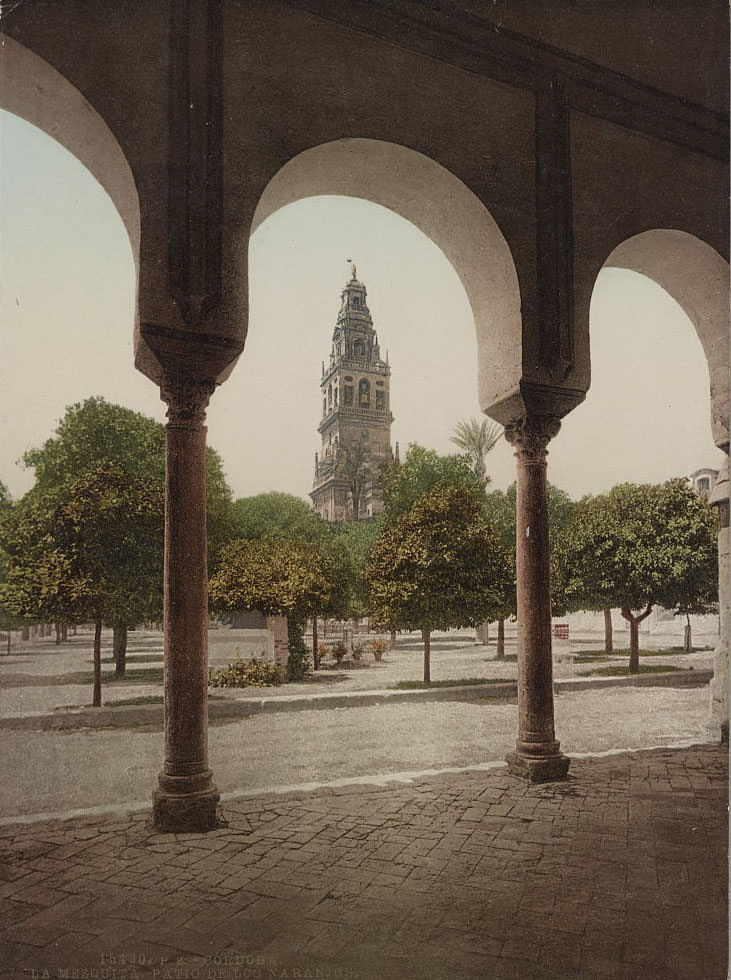
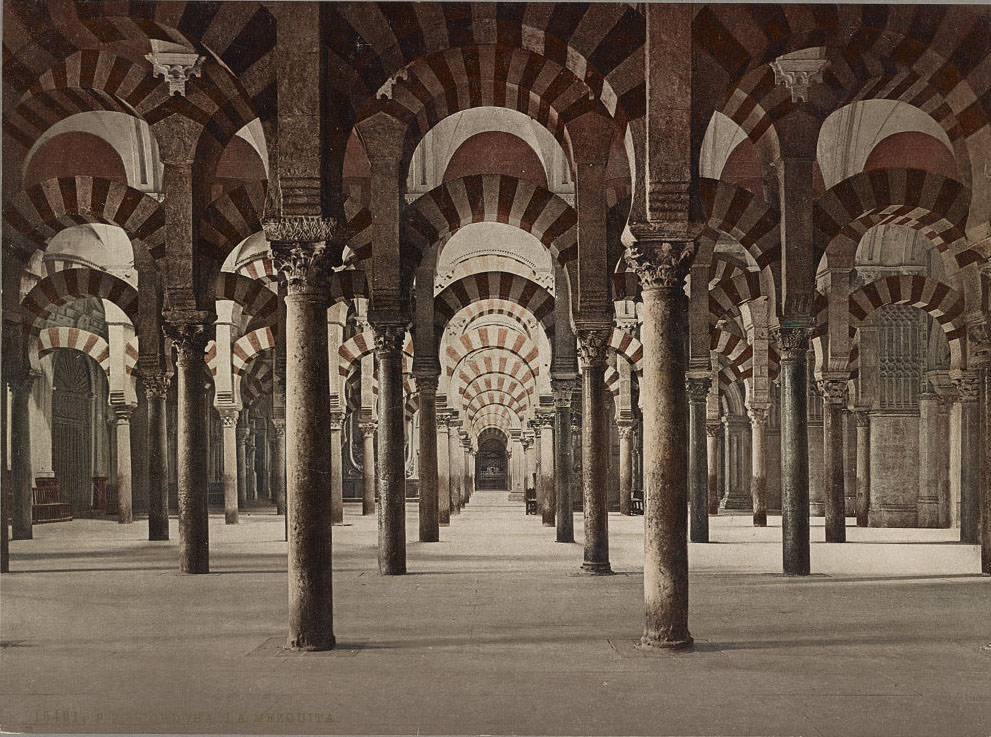
The Mezquita — the Great Mosque of Córdoba — receives more attention than almost any other single building in this collection, and deservedly so. Its mihrab, the ornately decorated prayer niche indicating the direction of Mecca, is considered one of the finest examples of Moorish craftsmanship anywhere in the world. The Patio de los Naranjos, or Courtyard of the Orange Trees, was the mosque’s original outdoor ablution area, planted with neat rows of orange trees that still stand today. The forest of columns and horseshoe arches inside the mosque’s main hall remains one of the most iconic interiors in European architecture.
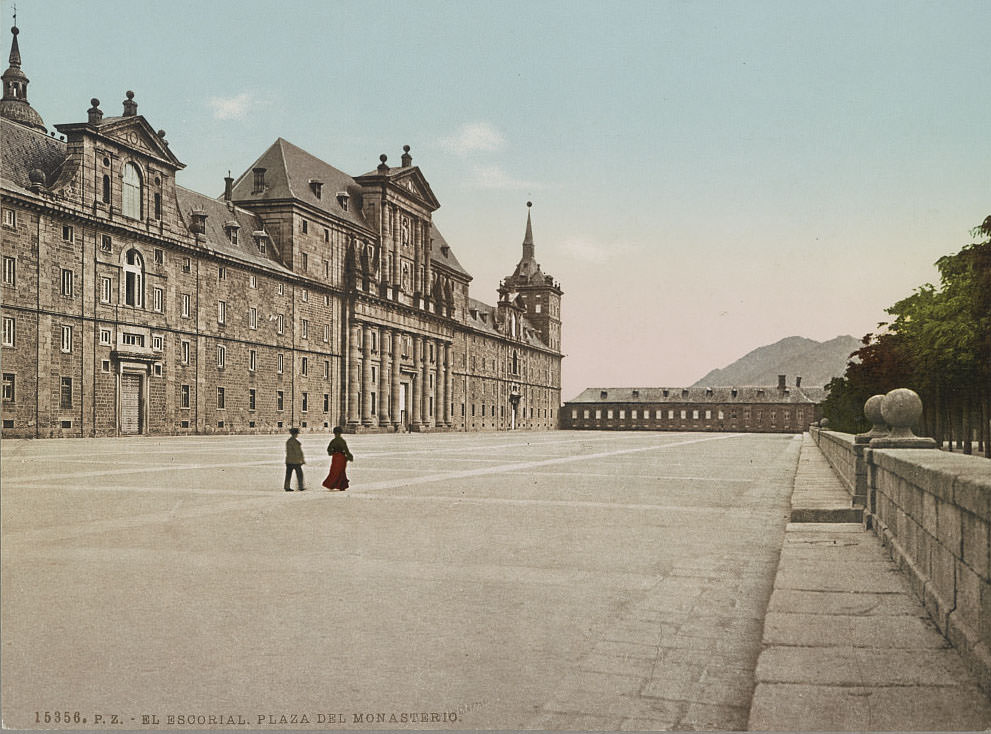
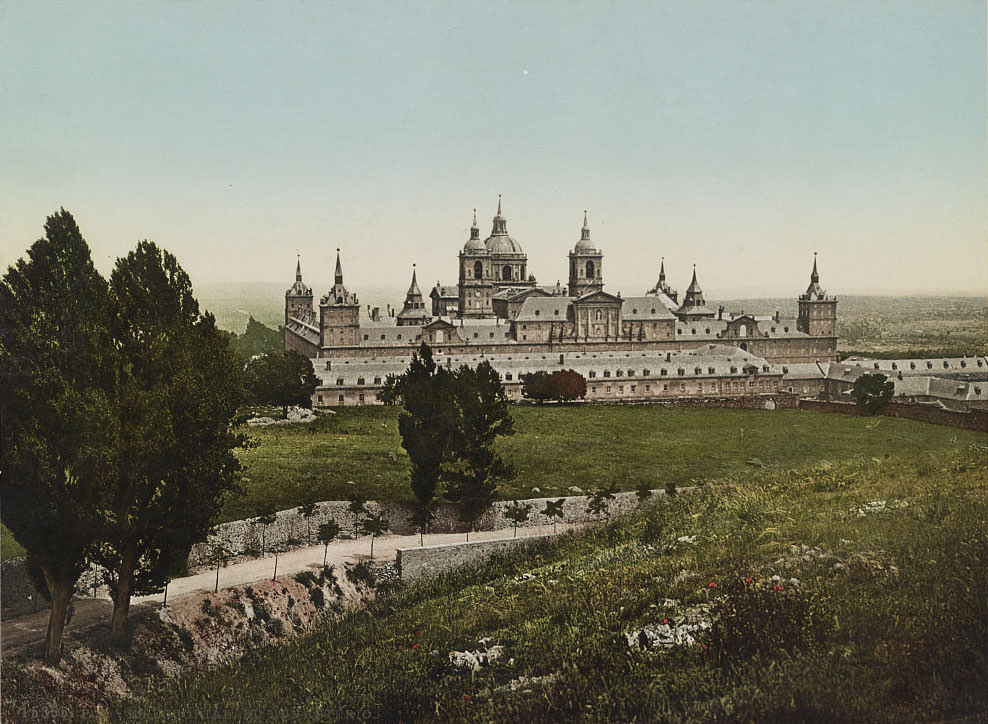
Northwest of Madrid, the monastery complex of El Escorial stands as one of the most ambitious building projects in Spanish history. King Philip II commissioned it in the 16th century, and it served simultaneously as a royal palace, a monastery, a library, and a royal mausoleum. Its severe, grid-like design in grey granite gave it a solemn presence that matched its role as the symbolic center of the Spanish Empire.
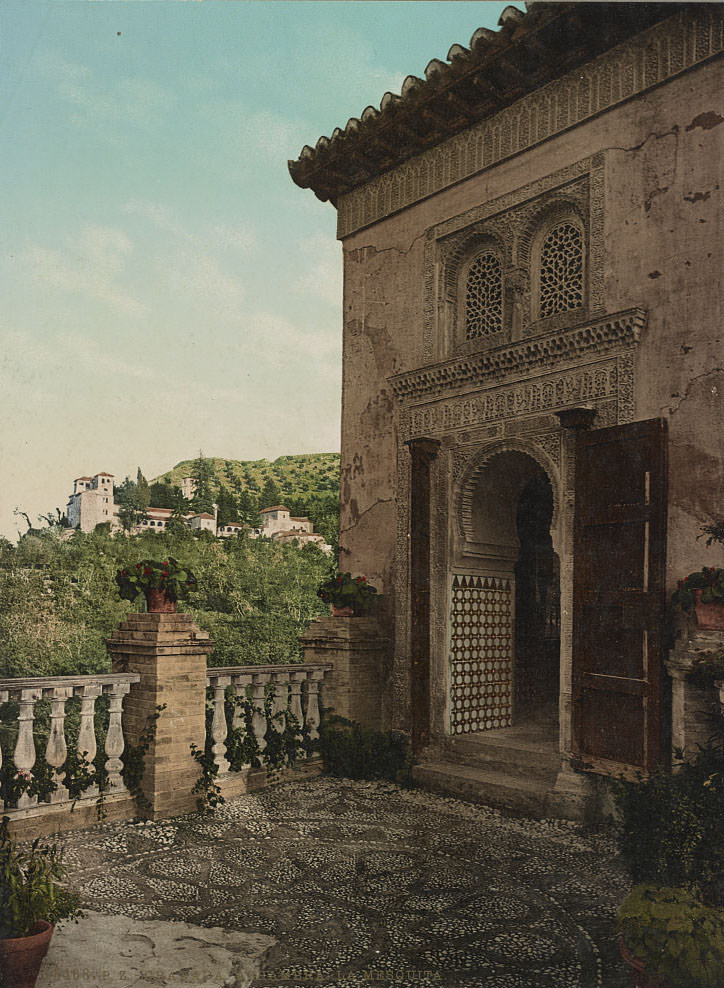
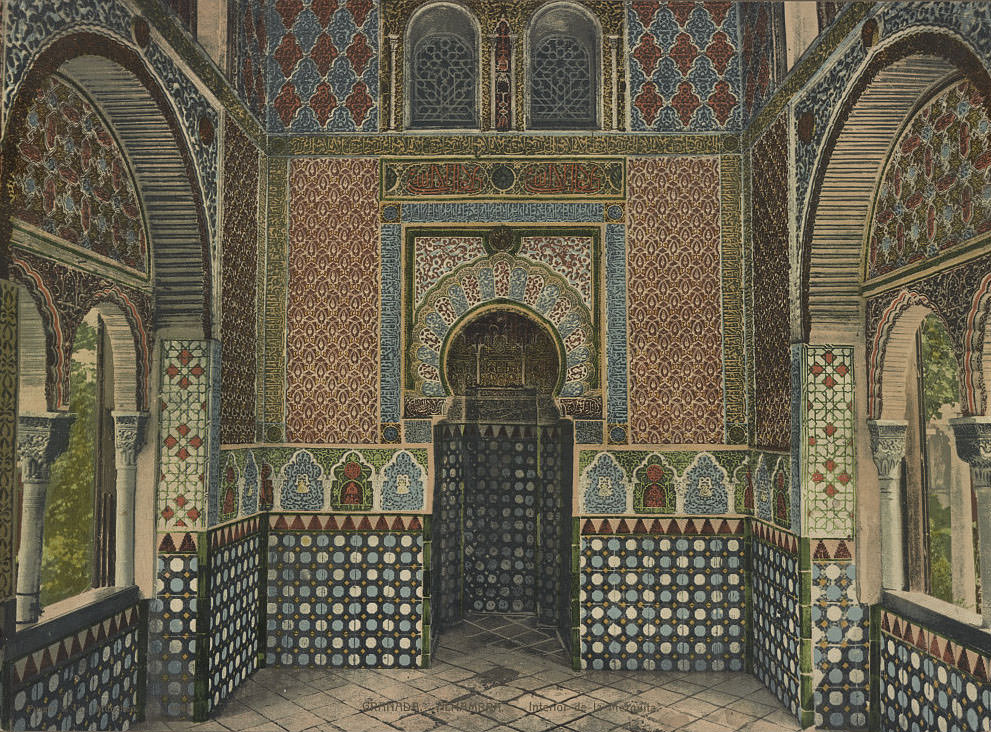
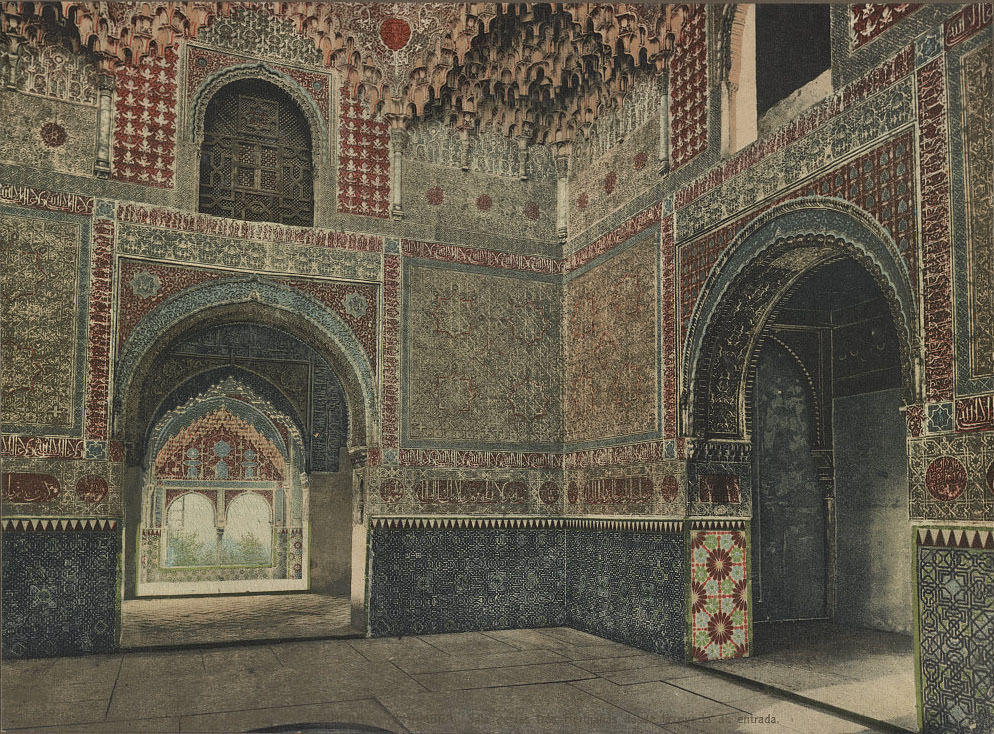
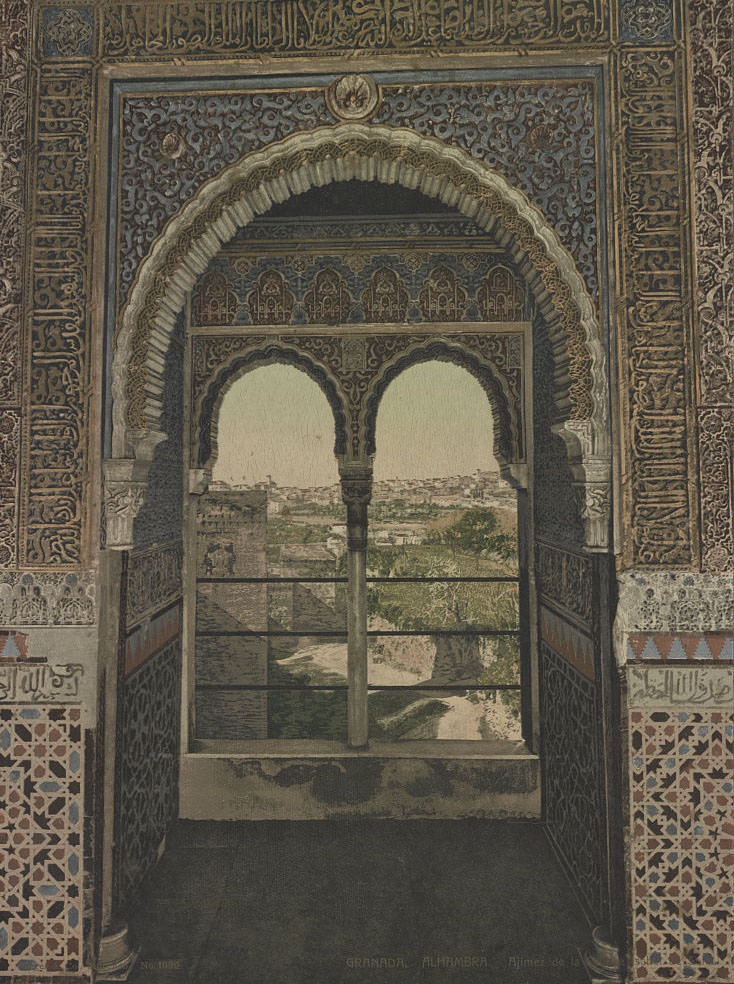
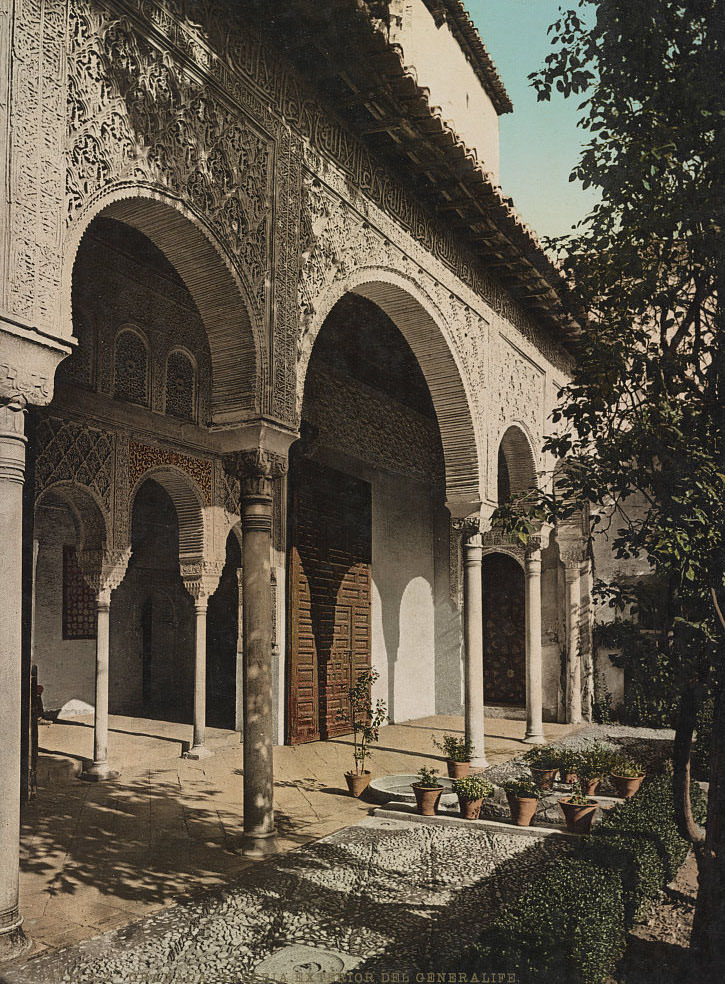
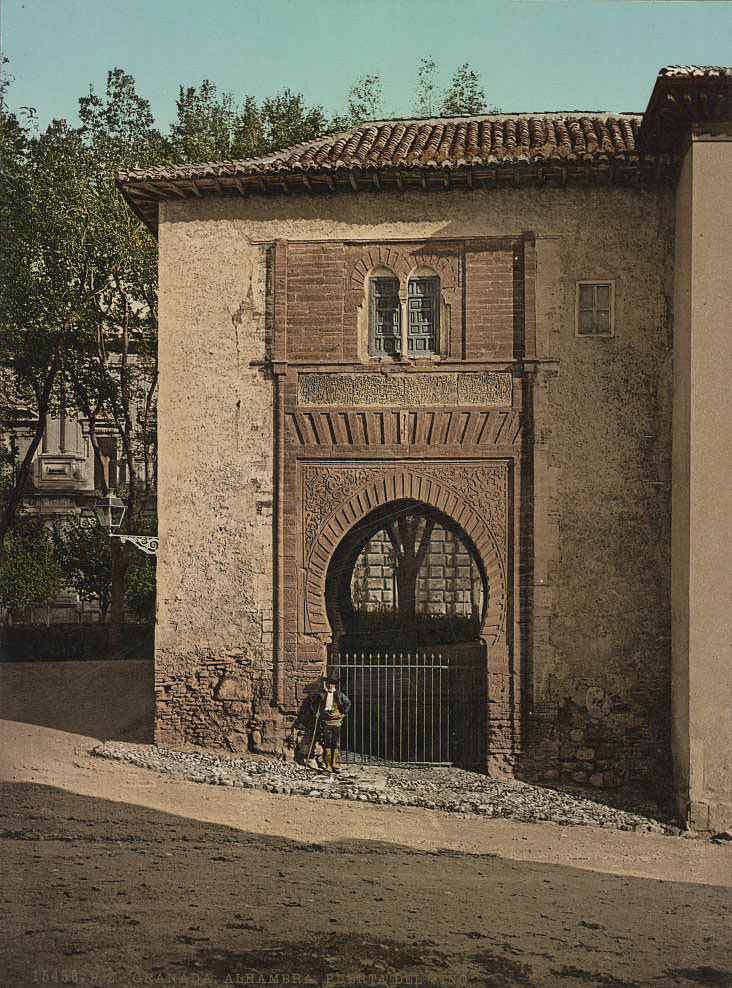
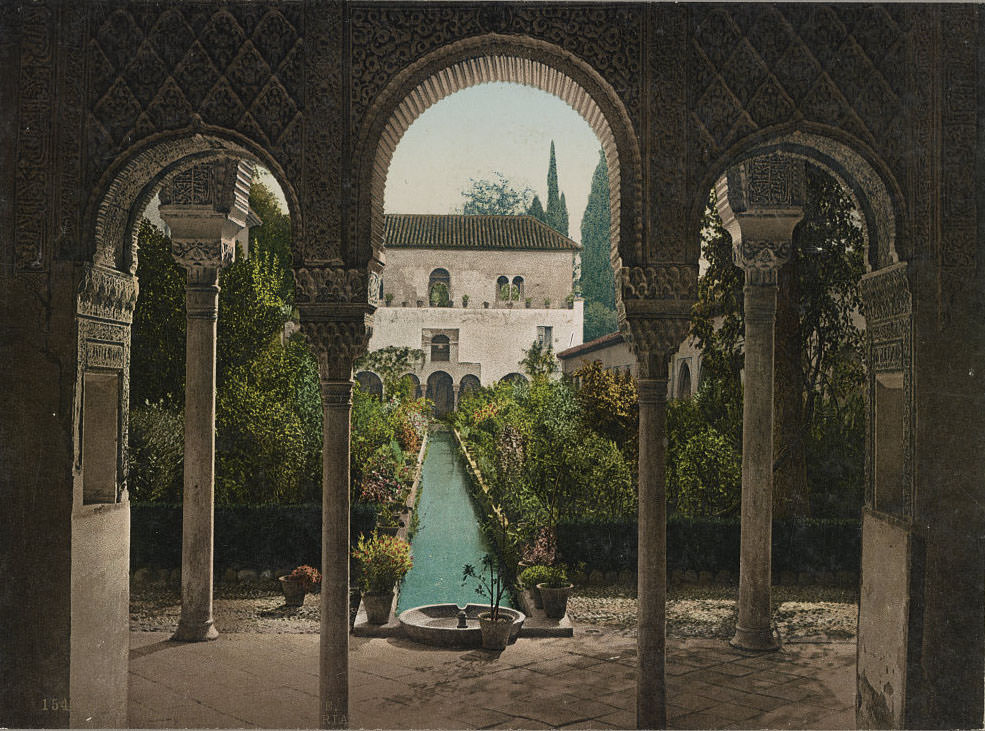
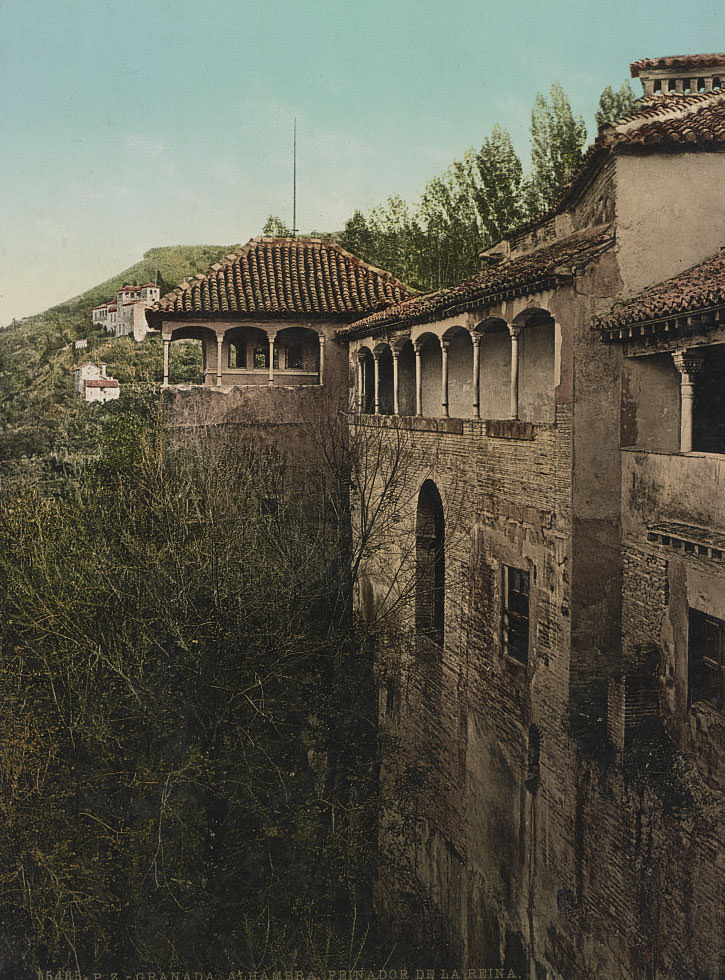
Granada holds the largest number of images in this collection, almost all of them focused on the Alhambra — the sprawling palace-fortress complex built by the Nasrid dynasty between the 13th and 15th centuries. The Generalife, the summer palace and gardens above the main fortress, appears in several views, its long water channels and arcaded galleries offering a picture of royal leisure from seven centuries ago.
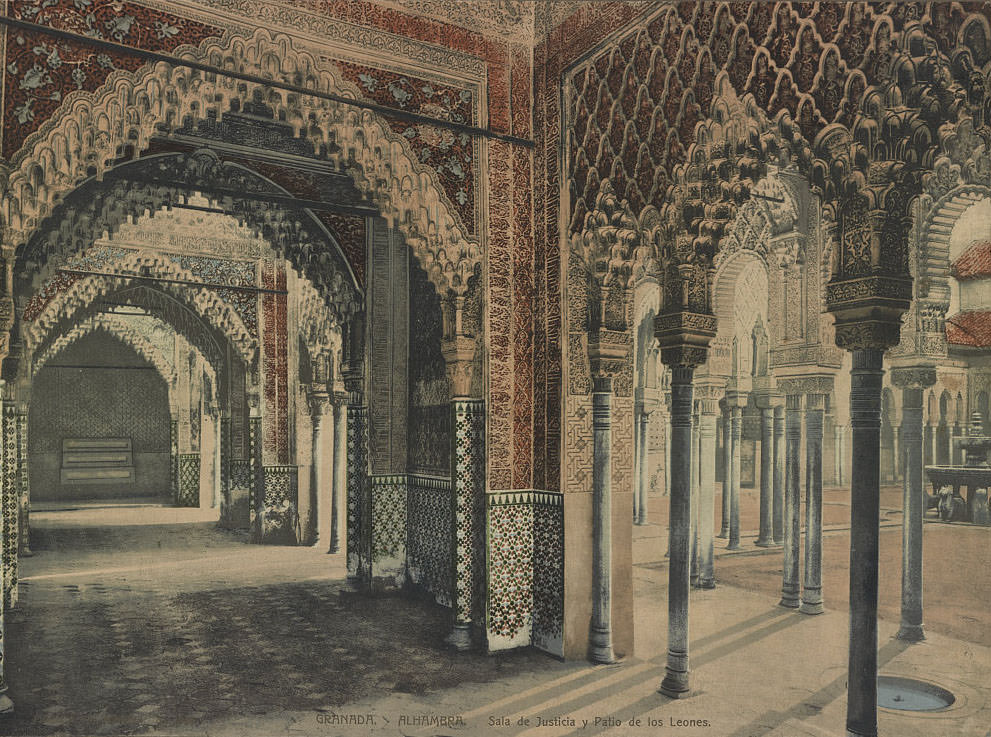
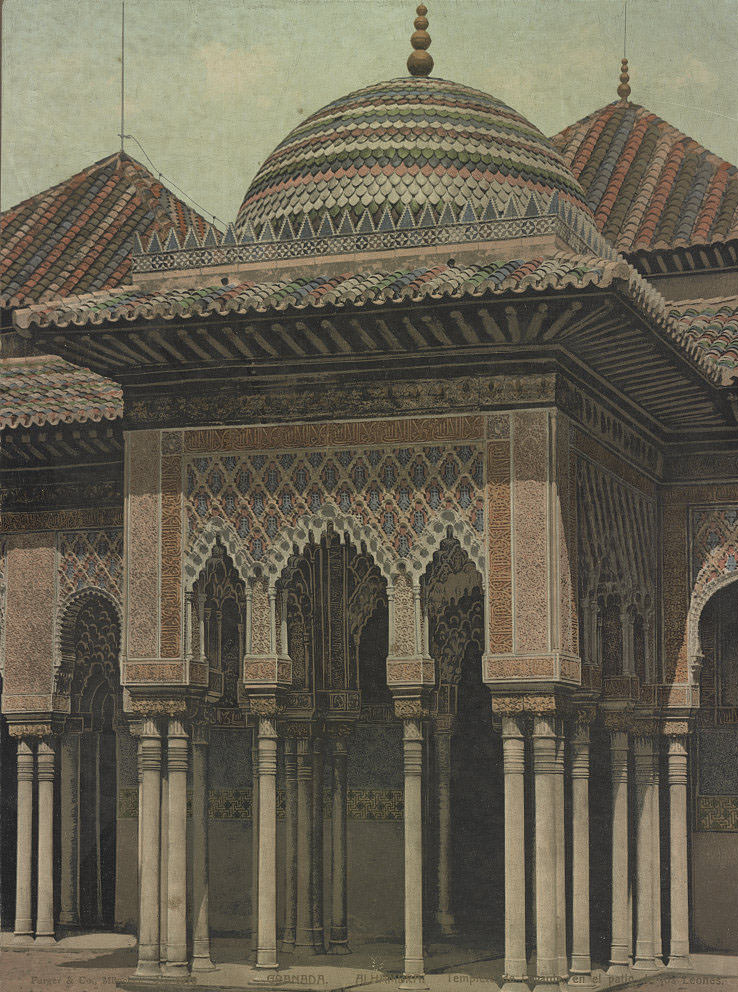
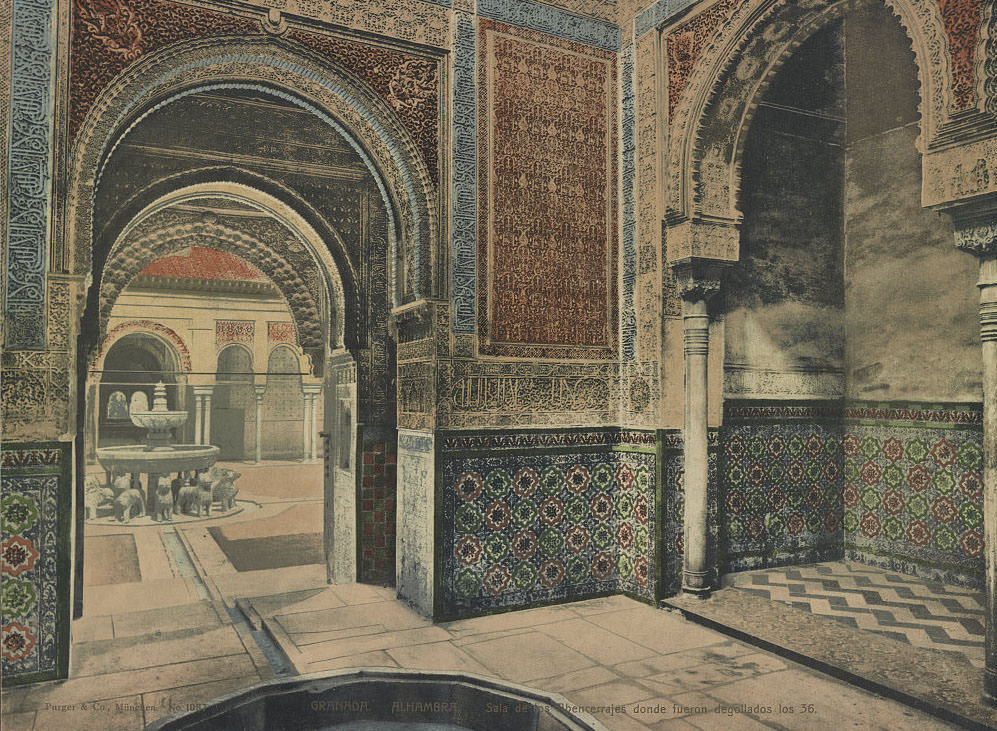
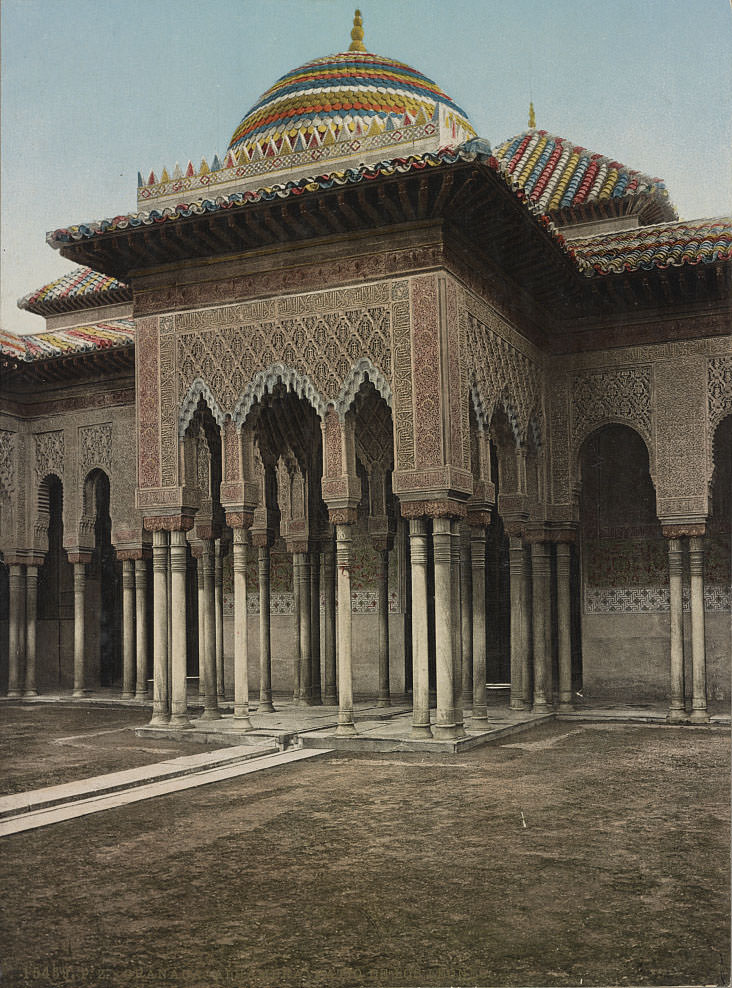
The Patio de los Leones — Court of the Lions — is the Alhambra’s most photographed space. Its central fountain, supported by twelve carved marble lions, sits at the crossing of two water channels that divide the courtyard into quadrants. The surrounding arcades of slender columns and intricate stucco work represent the peak of Nasrid artistic achievement. The Sala de los Abencerrajes, off one side of this courtyard, carries a darker history: according to legend, thirty-six members of the Abencerraje noble family were executed here by the sultan, their blood staining the marble basin of the room’s central fountain.
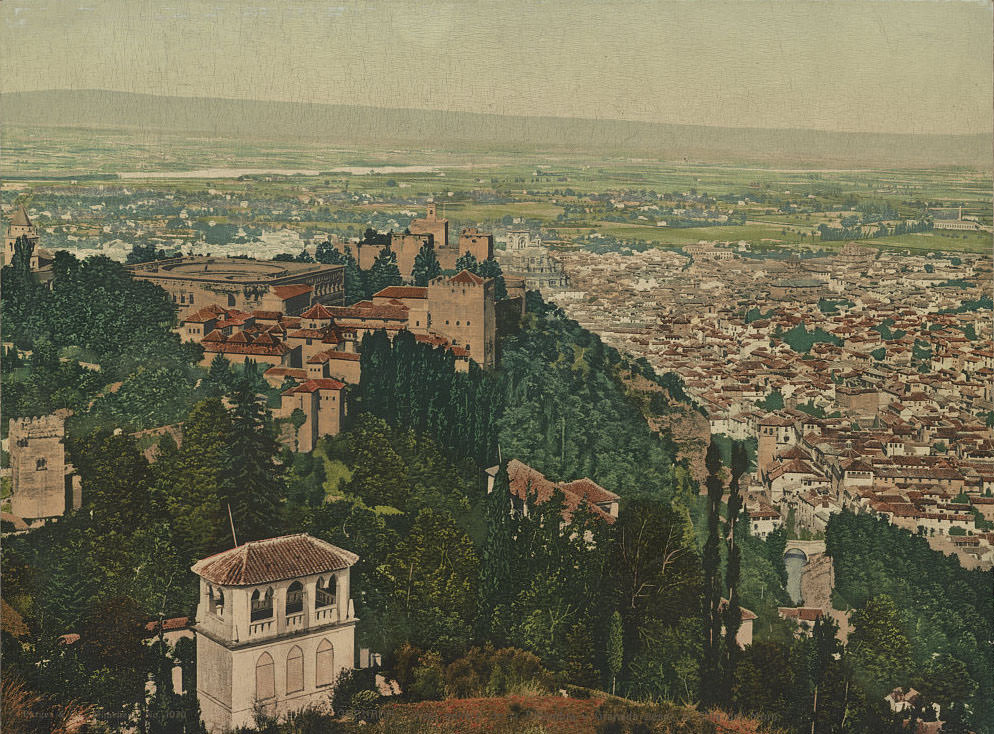
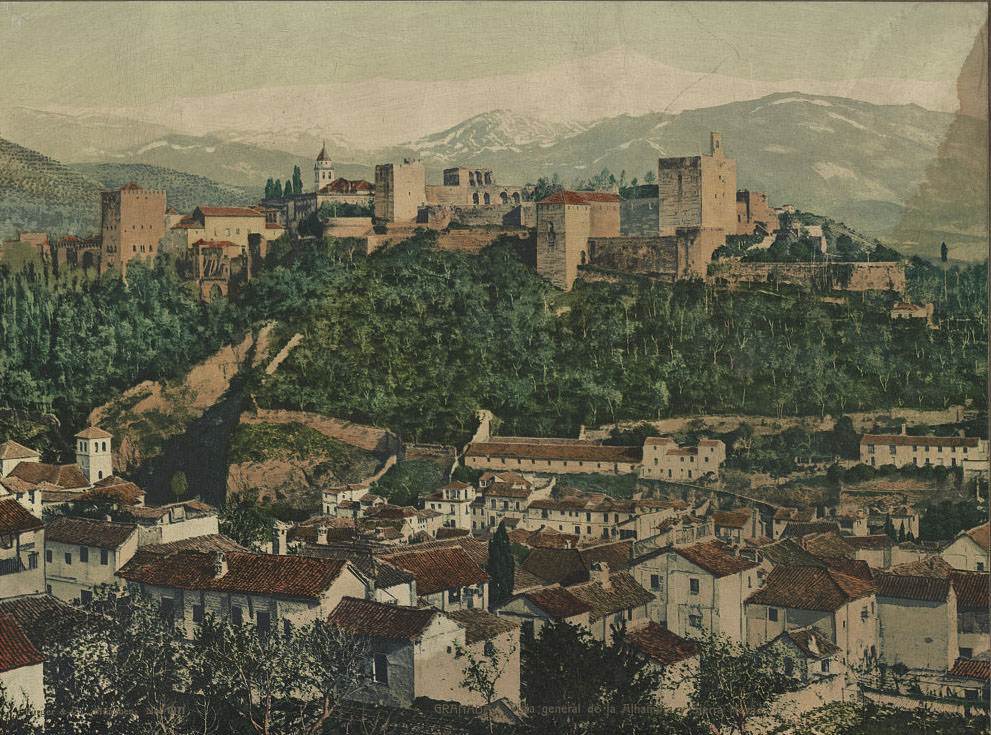
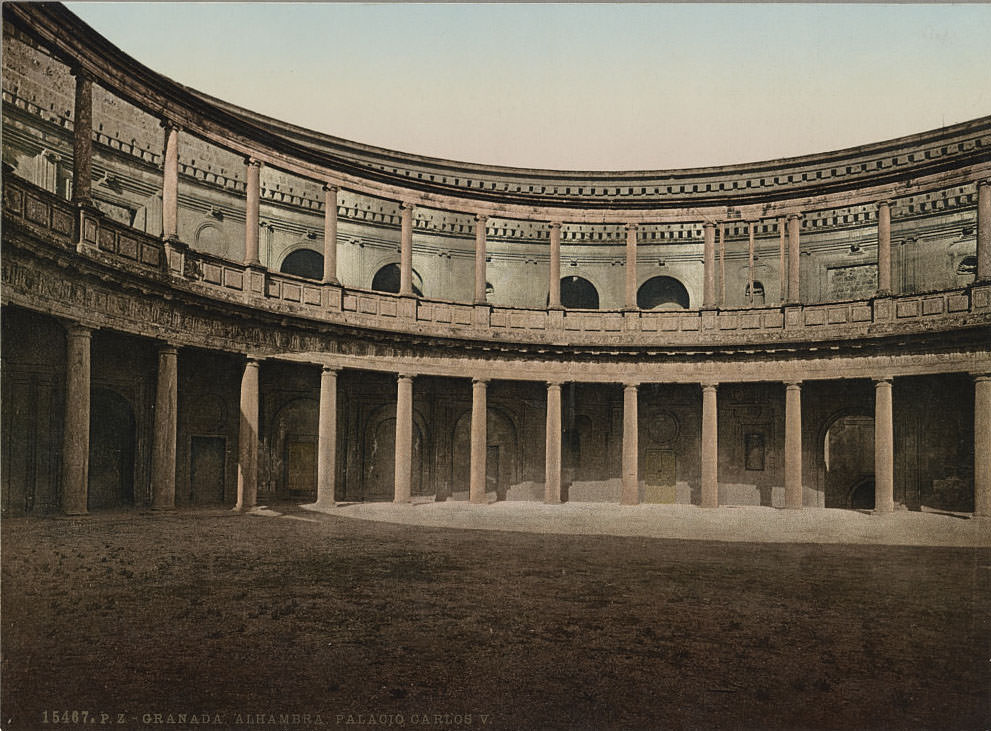
Wide panoramic views of the Alhambra from across the Darro valley, taken from the hilltop vantage point called the Silla del Moro, show the full scale of the fortress set against the Sierra Nevada mountains. The Palace of Charles V — a large Renaissance-style circular building constructed inside the Alhambra complex after the Christian reconquest — appears in stark contrast to the delicate Moorish structures surrounding it.
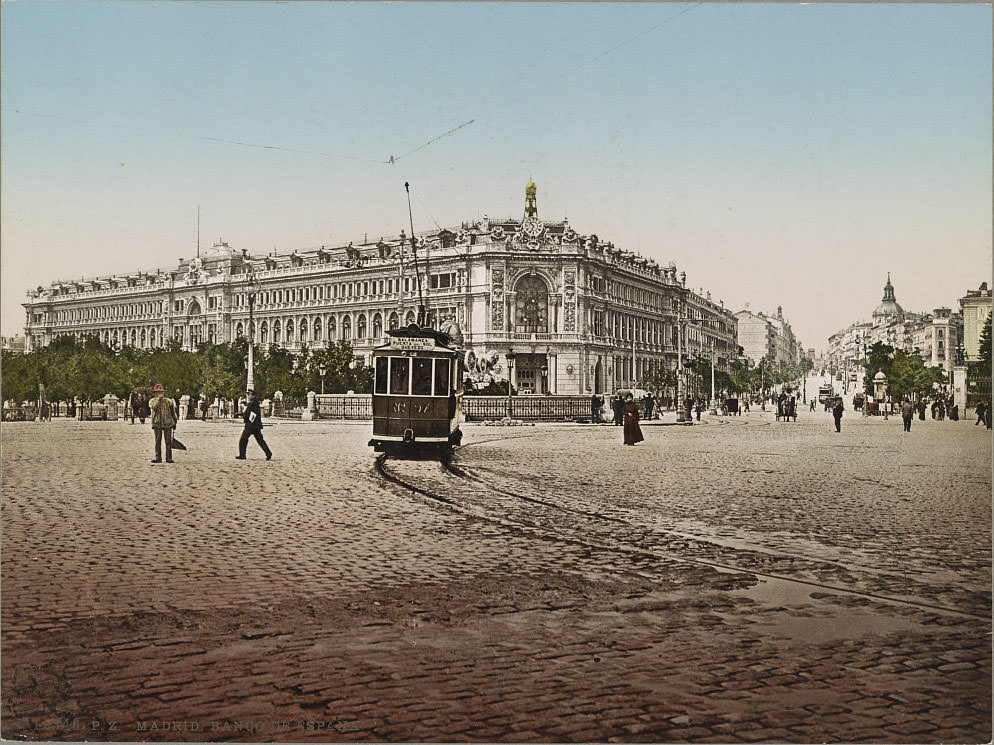
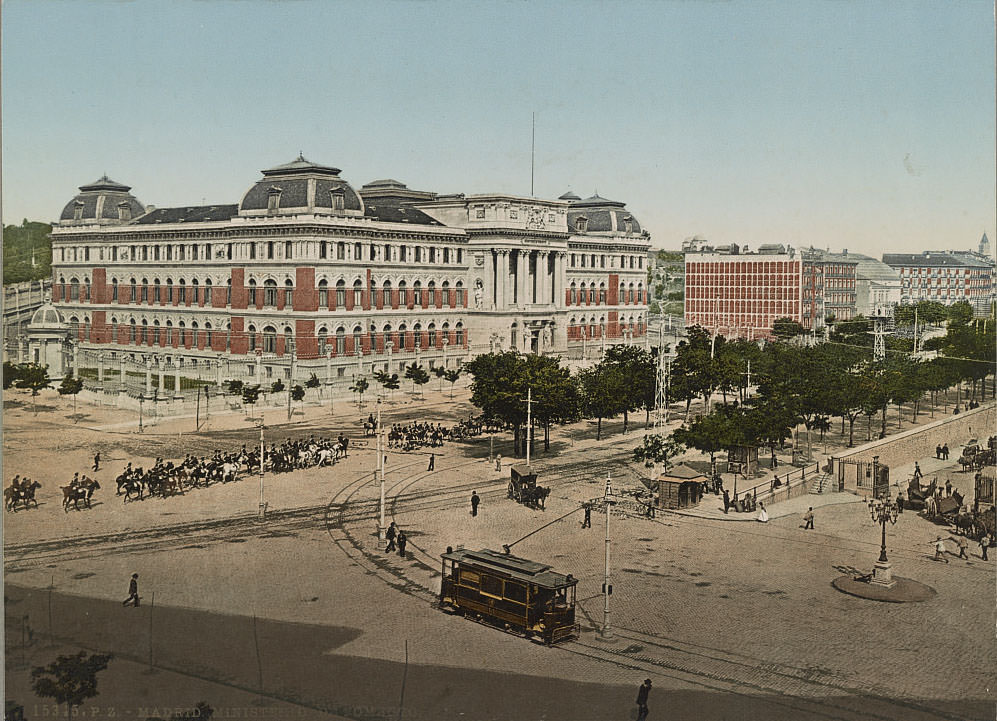
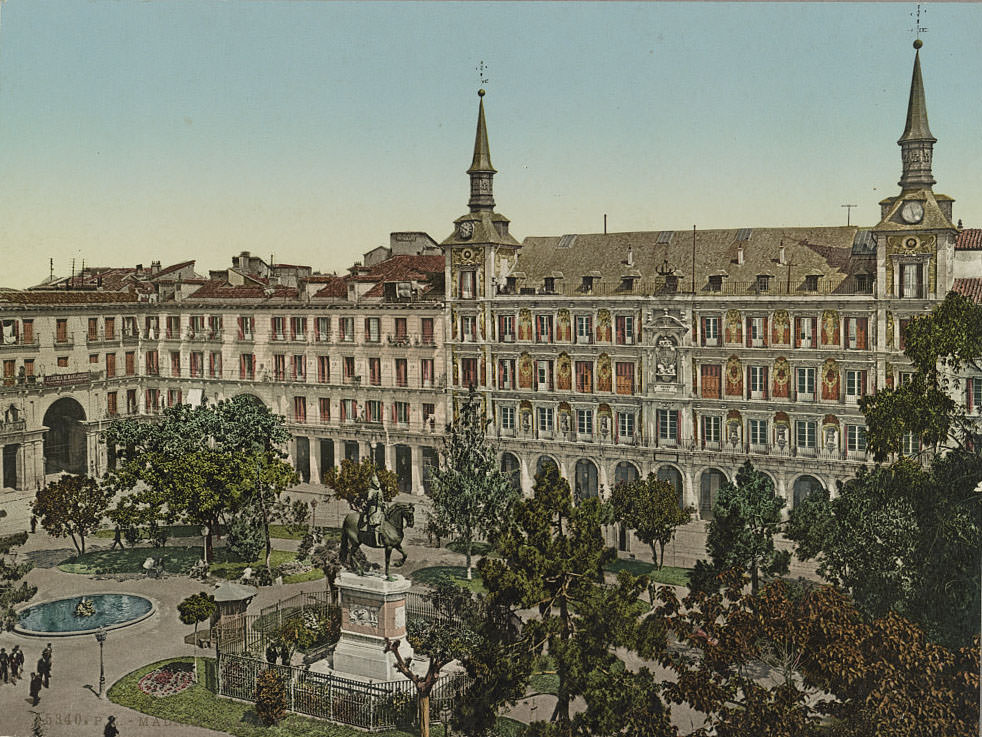
Madrid, Spain’s capital, appears through a series of its most prominent public buildings. The Banco de España, the country’s central bank, had only recently been completed in its current form by the 1890s. The Ministry of War and the Ministry of Public Works — known by its Spanish name, Fomento — stood as symbols of the state’s administrative reach. The Plaza Mayor, the grand arcaded square at the city’s historic center, had served as a venue for markets, royal celebrations, and public executions over the previous three centuries.
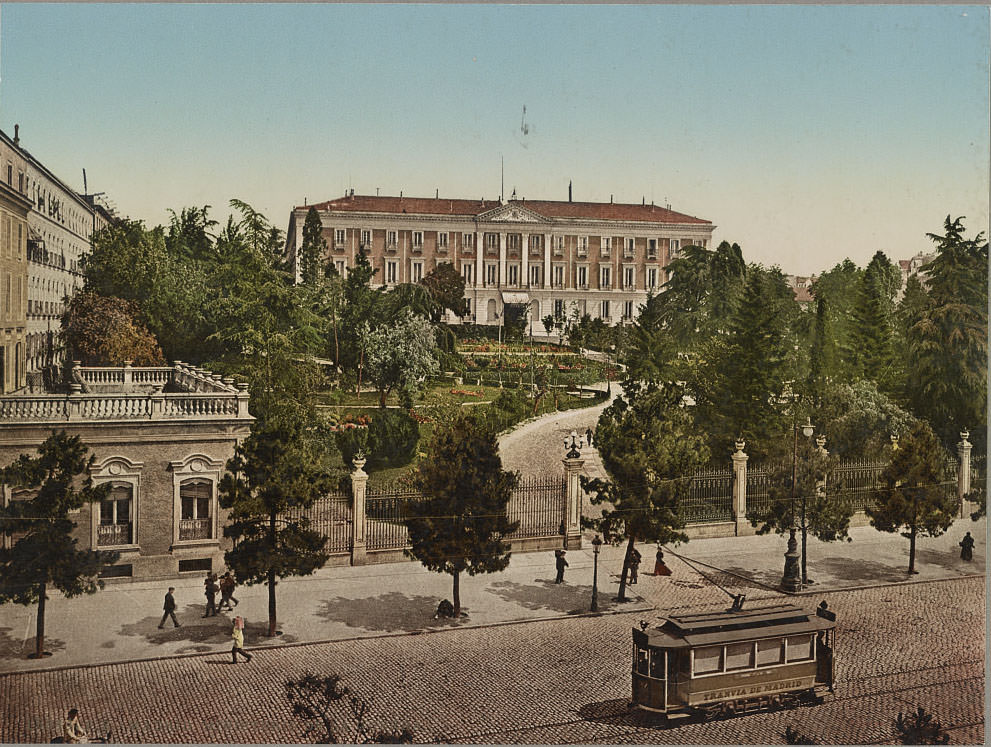
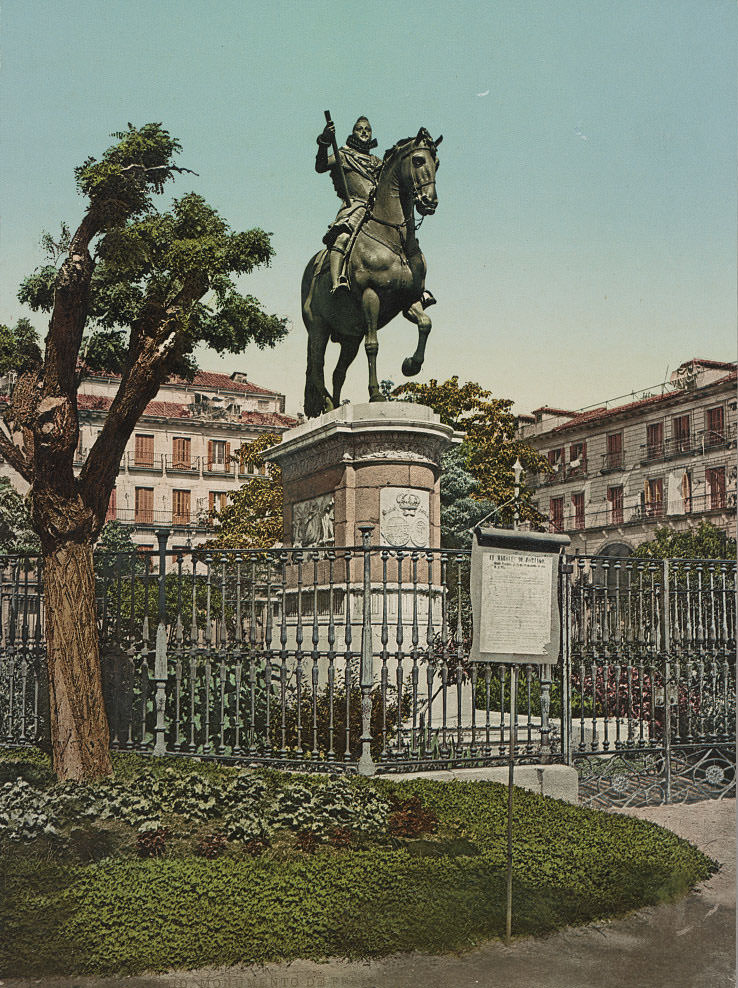
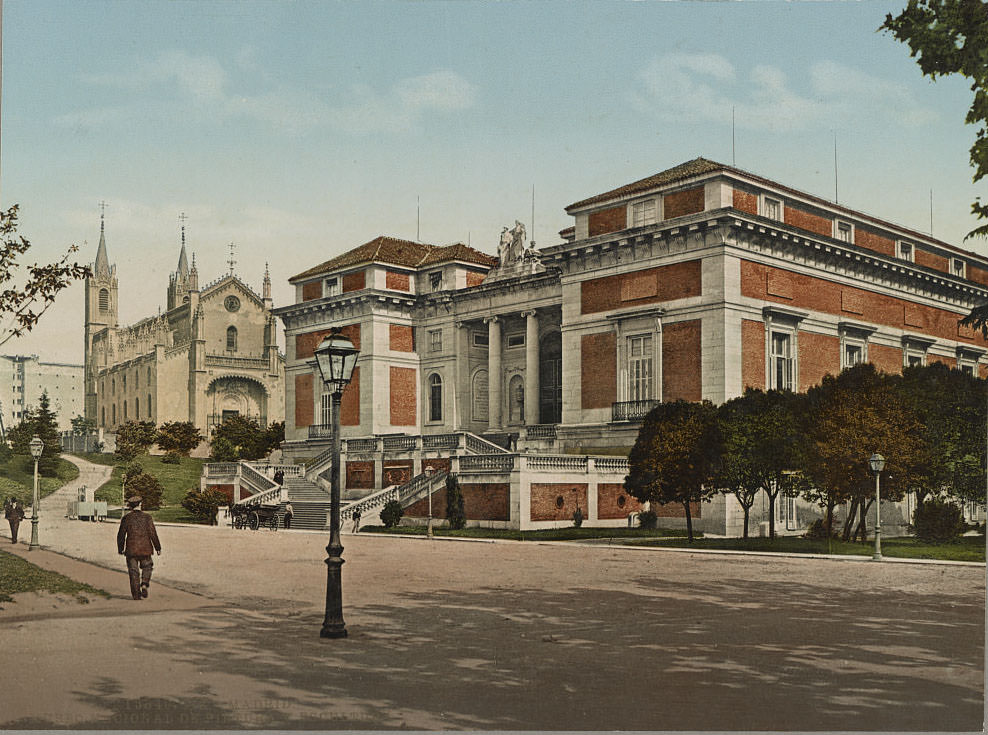
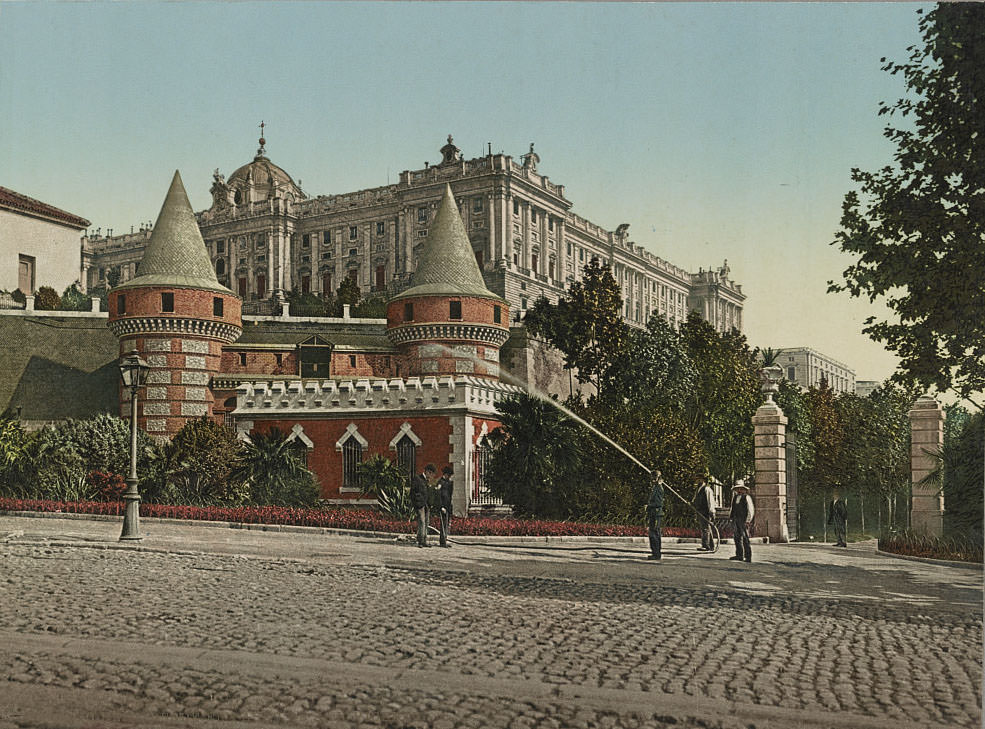
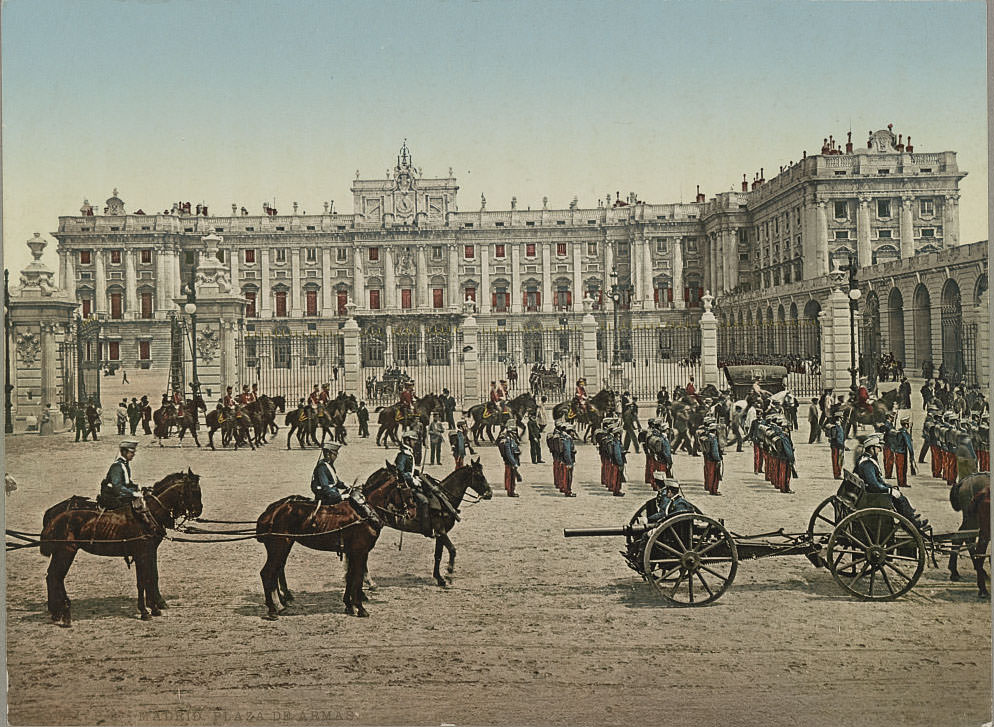
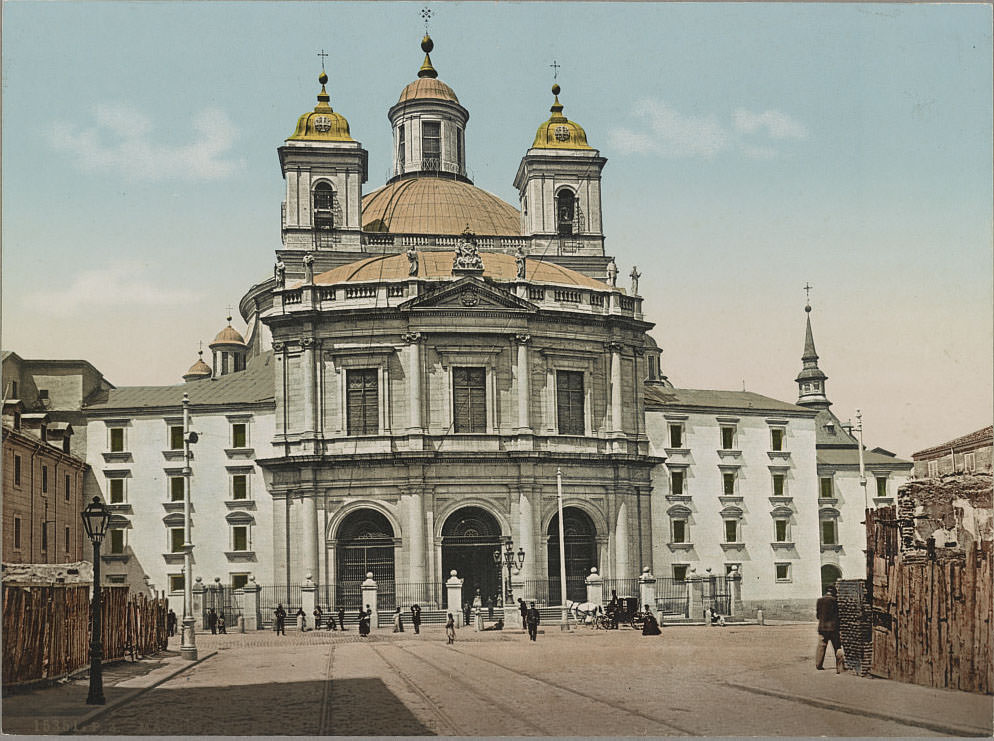
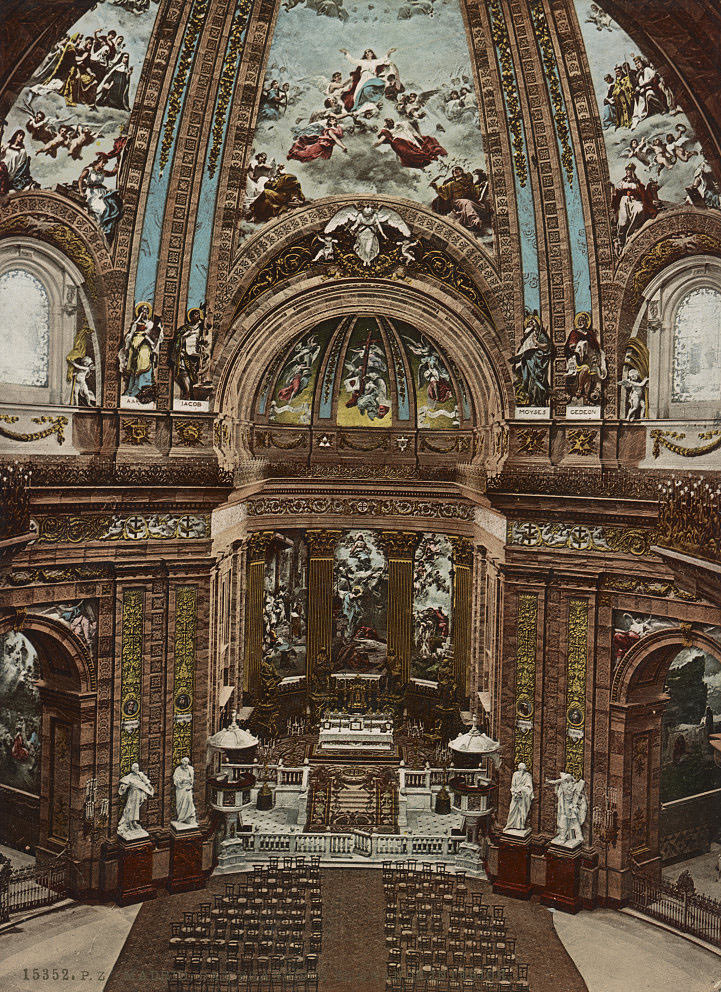
The Museo Nacional de Pintura y Escultura — today known as the Prado Museum — housed one of the greatest art collections in the world by the late 19th century, including works by Velázquez, Goya, and El Greco. The Royal Palace, seen from the Paseo de San Vicente, anchored Madrid’s western edge above the Manzanares River. San Francisco el Grande, a massive basilica with one of the largest domes in Europe, fills two images — one of its exterior and one of its richly decorated interior.
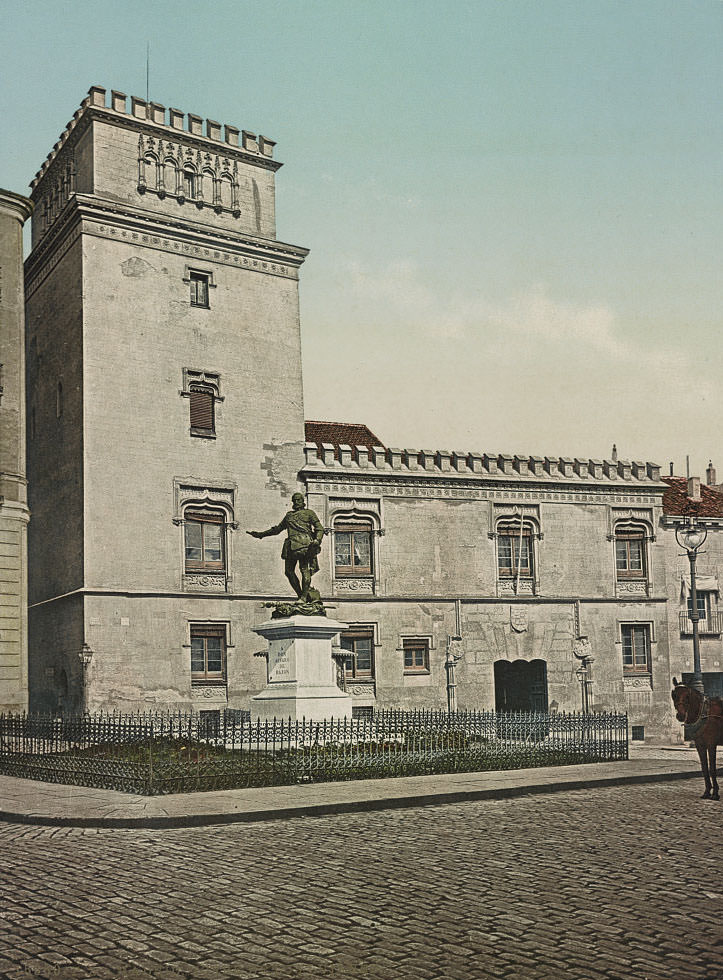
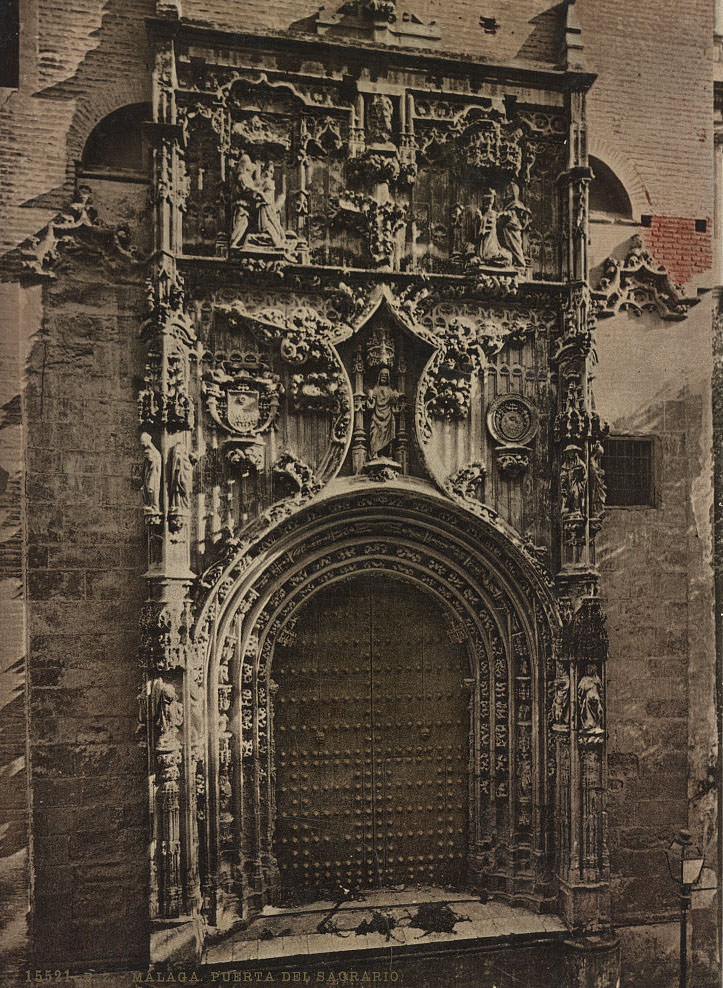
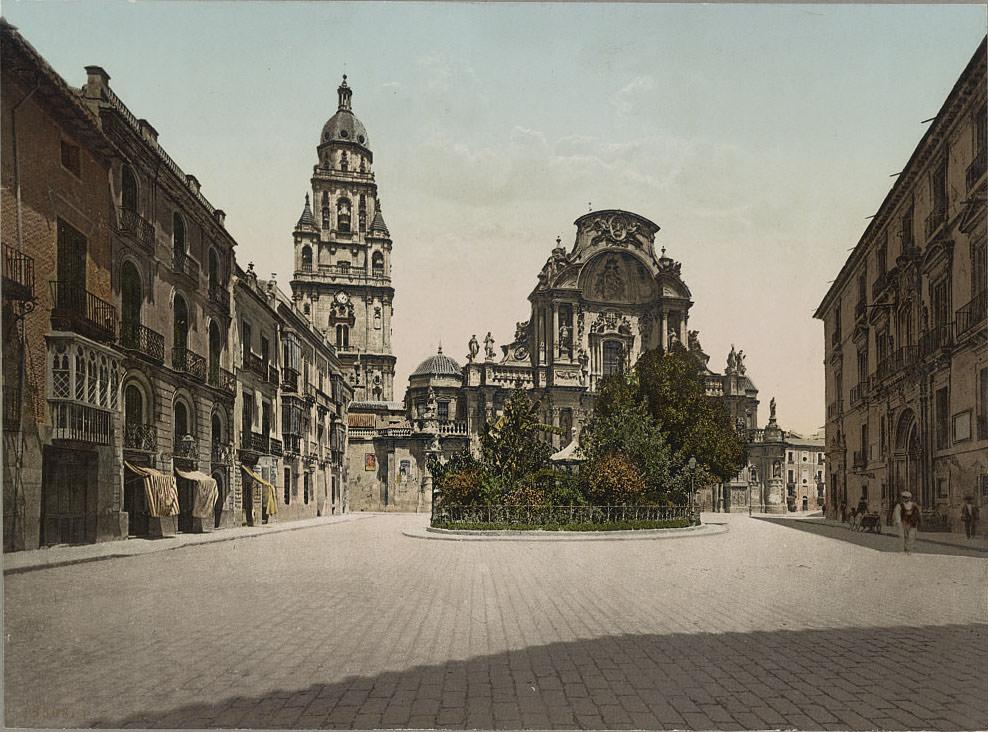
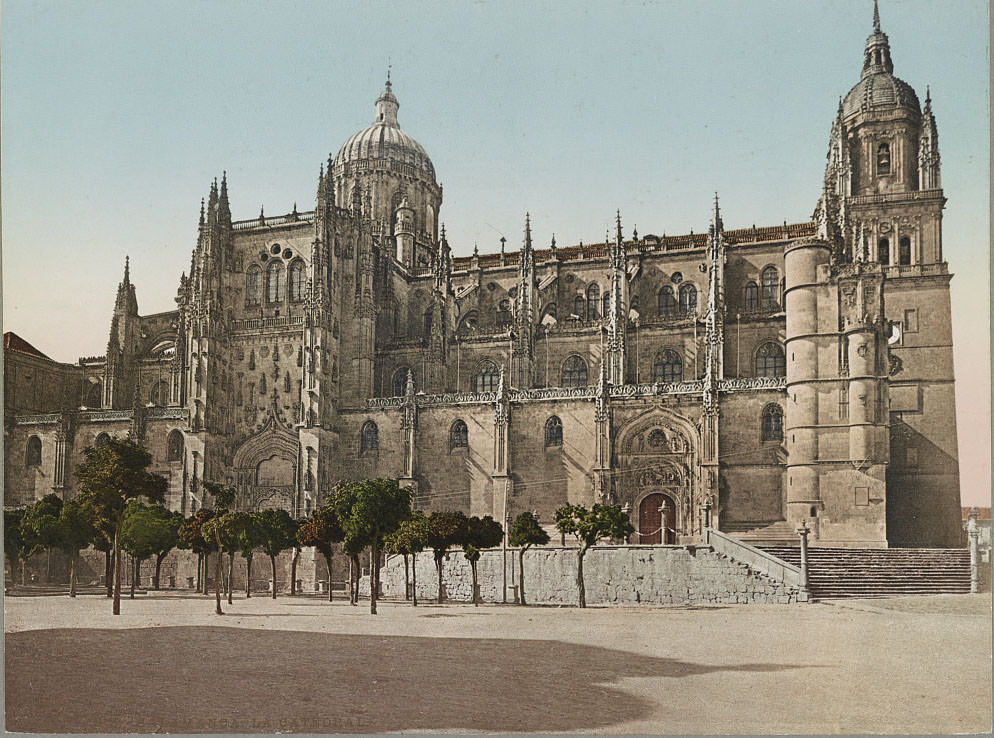
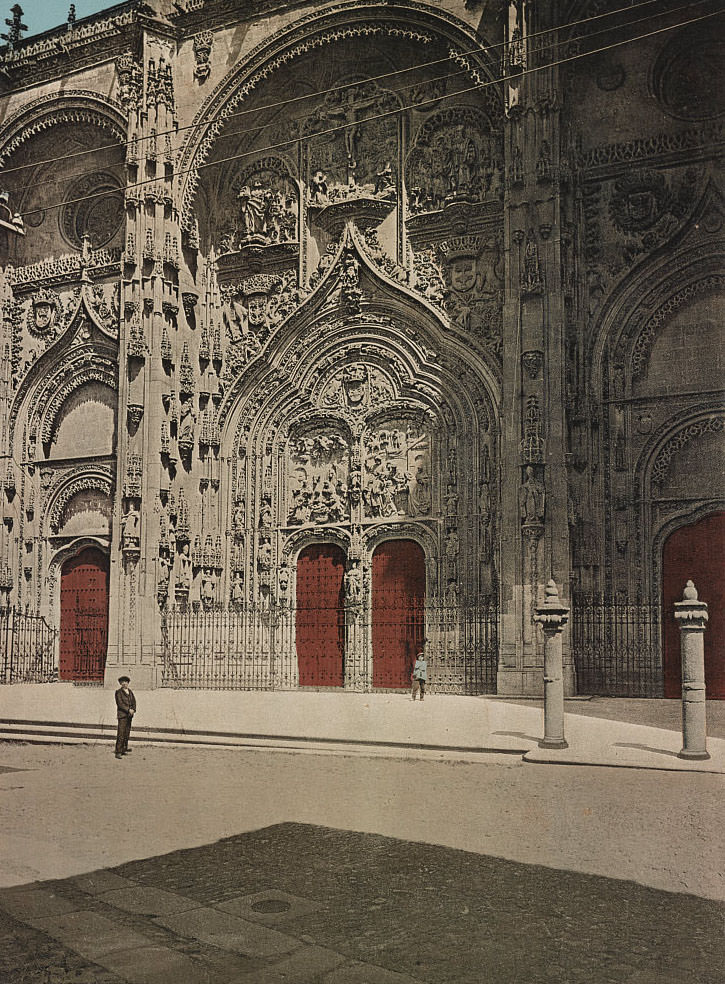
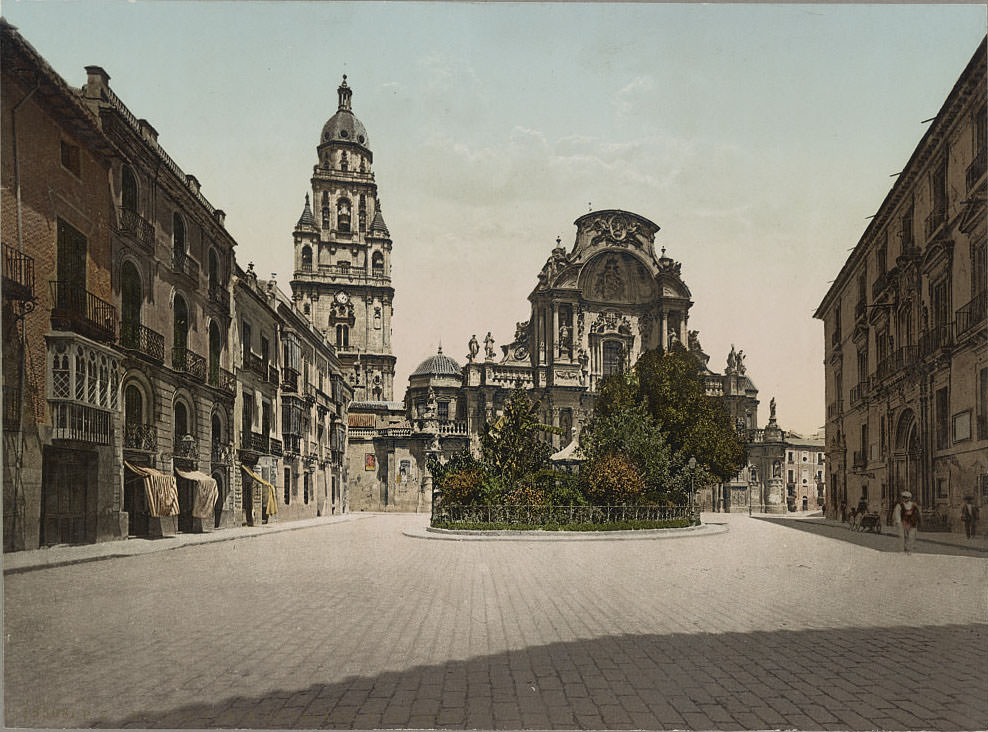
Outside Madrid, the collection moves through several more Spanish cities. Málaga shows the Puerta del Sagrario, a doorway attached to its cathedral. Murcia’s cathedral, one of Spain’s most elaborate baroque façades, stands in its own image. Salamanca contributes the richest variety — its massive cathedral, the ornate plateresque front of the University of Salamanca (one of the oldest universities in Europe, founded in 1218), the church of San Esteban, the central Plaza Mayor, and the courtyard of the Casa de la Salina all appear in the collection.
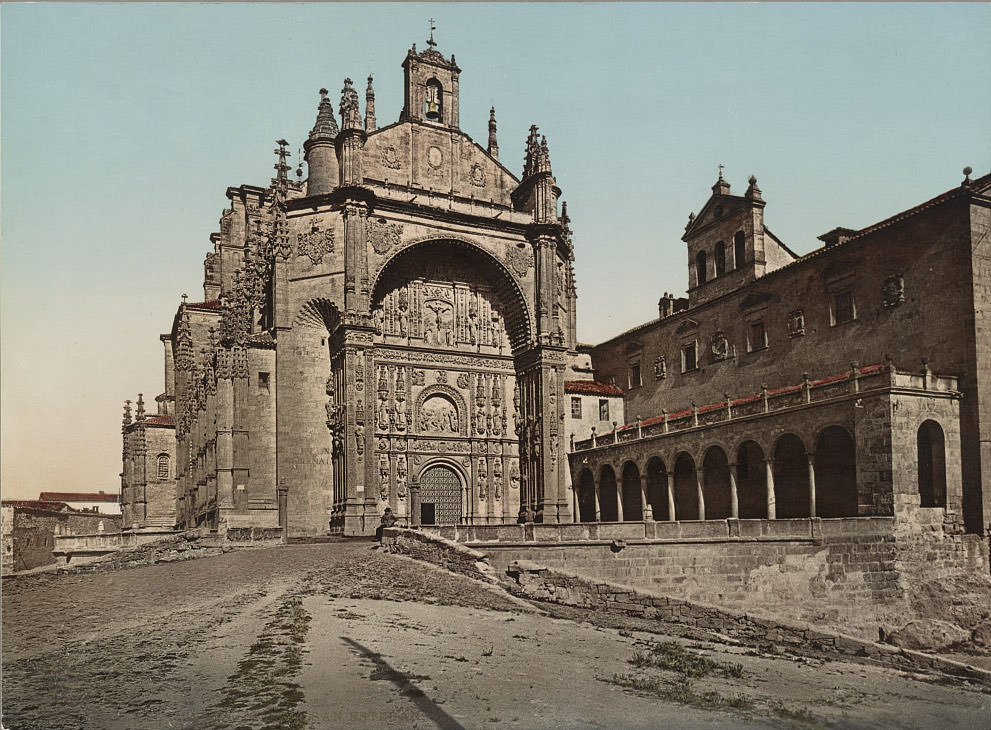
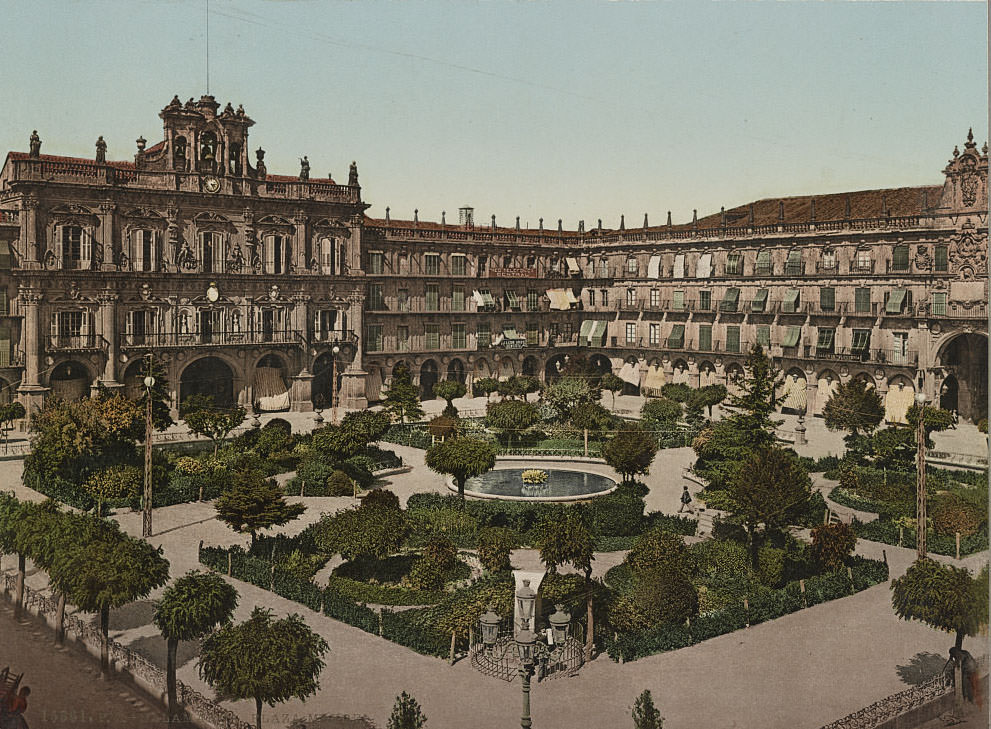
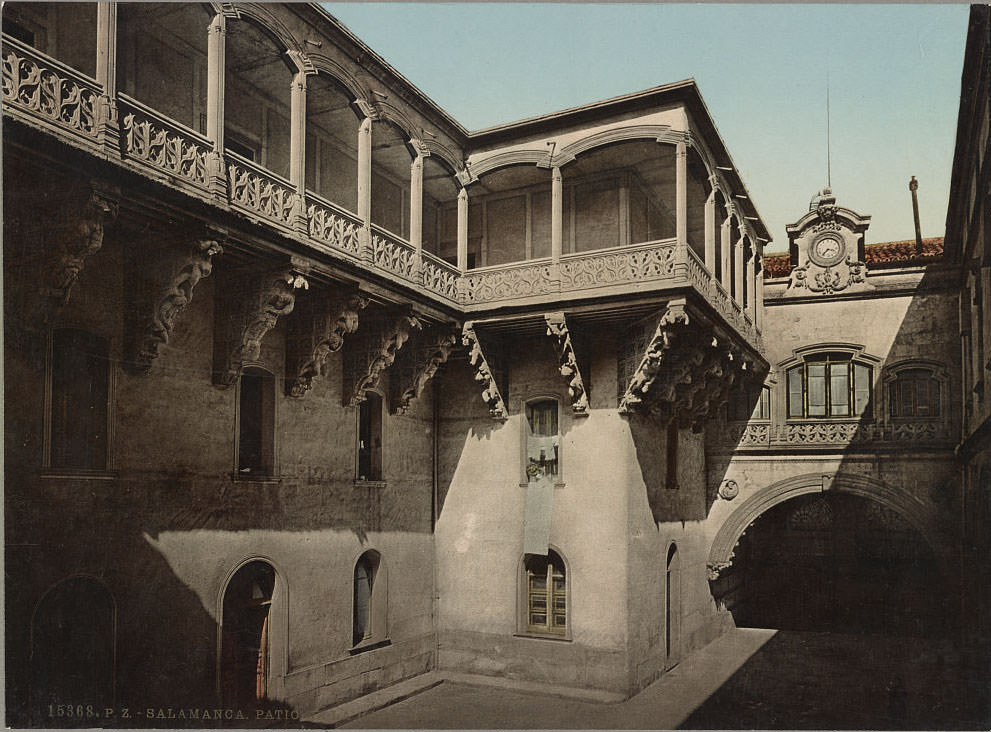
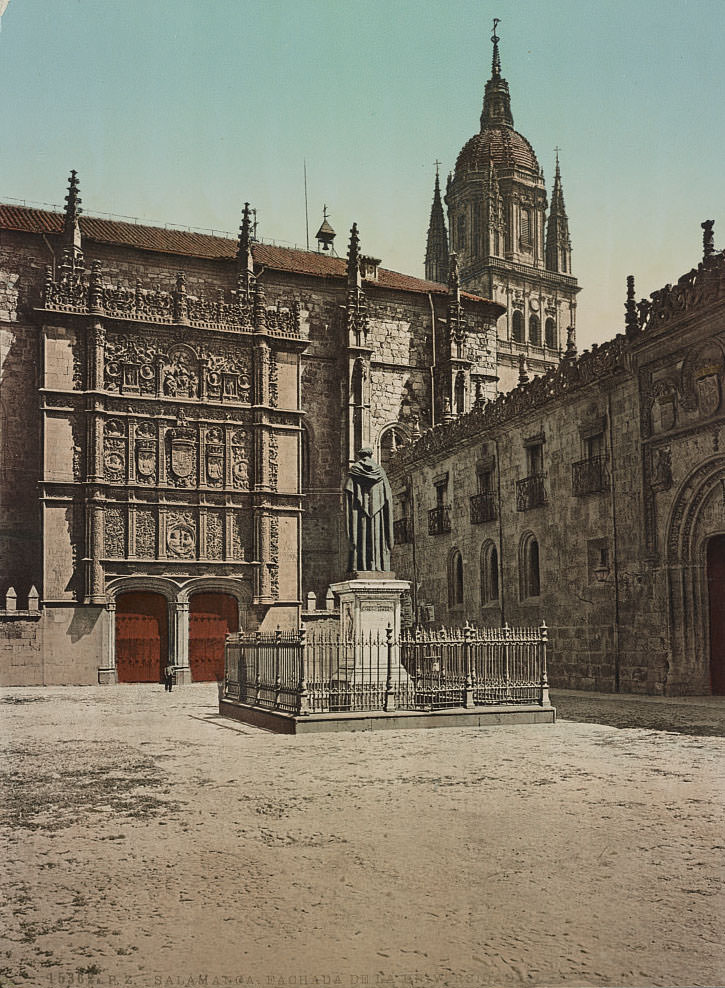
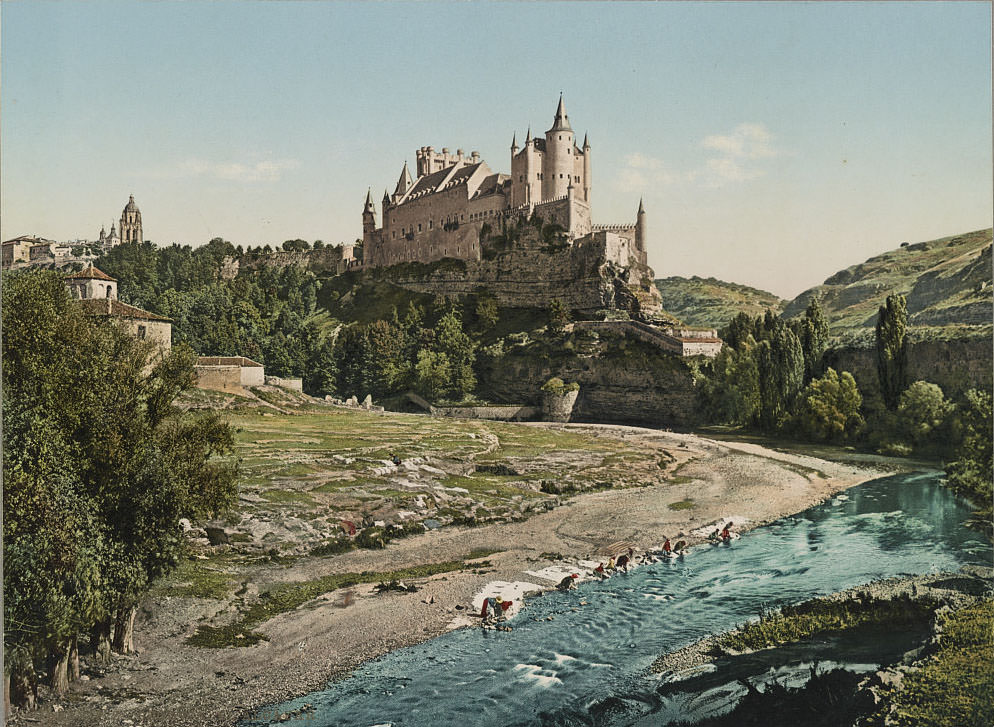
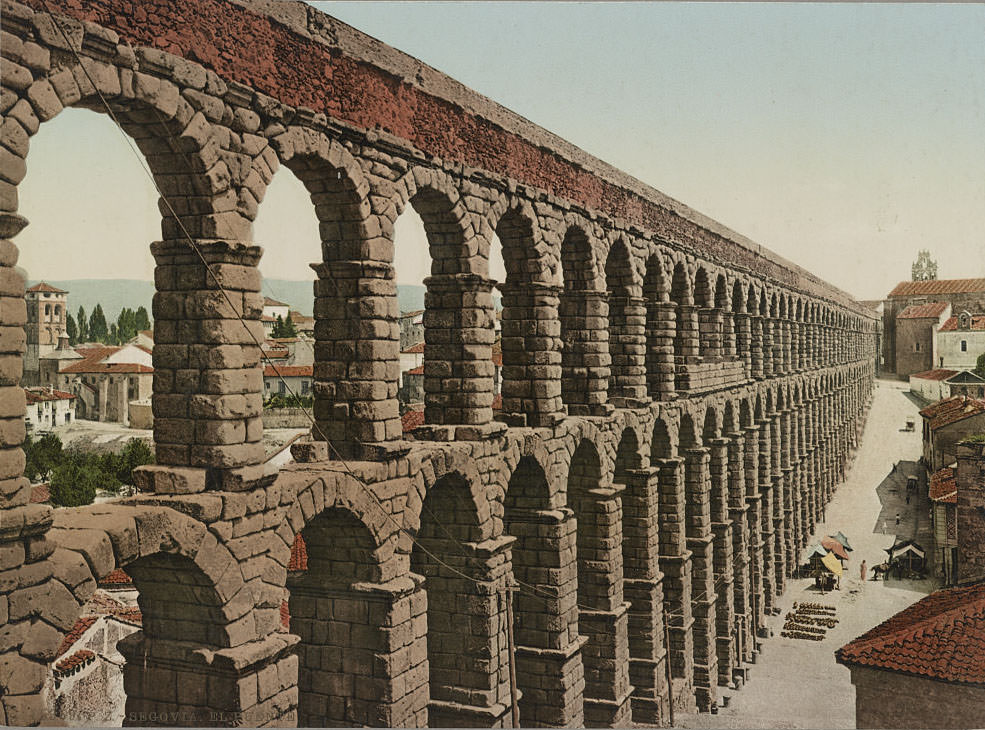
Segovia offers two of the collection’s most dramatic images. The Alcázar of Segovia — a castle with a distinctive ship’s prow shape jutting from a rocky cliff — was one of the most important royal residences in medieval Castile and later served as a state prison and a military academy. Below the city, the Roman aqueduct of Segovia, built in the 1st or 2nd century AD with no mortar holding its stones together, still stood fully intact in the 1890s.
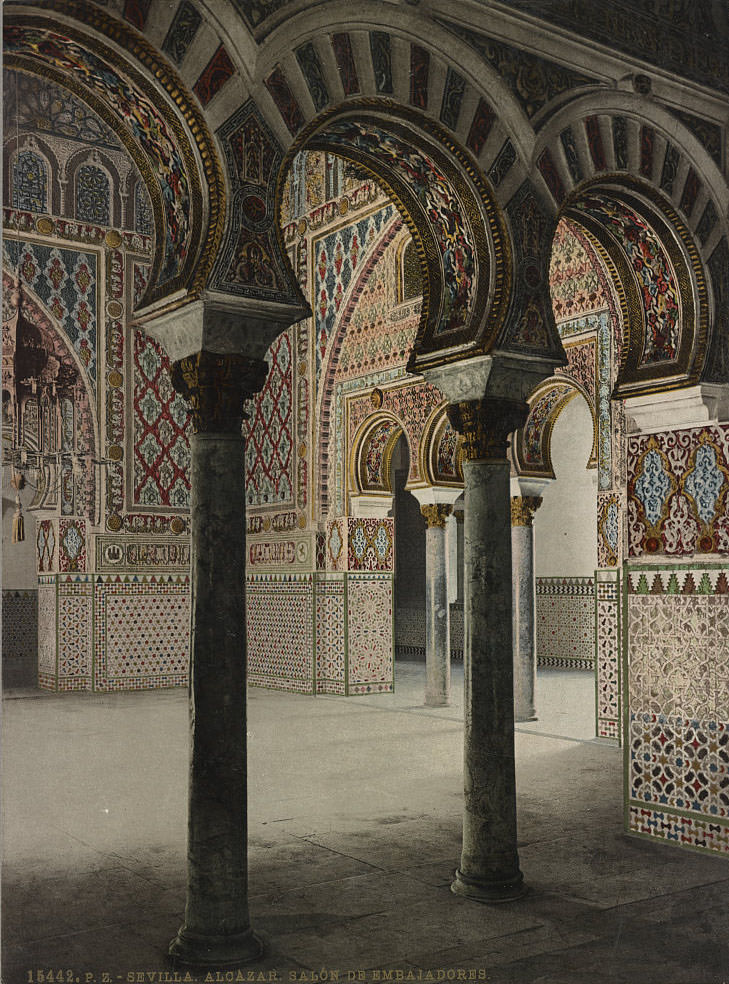
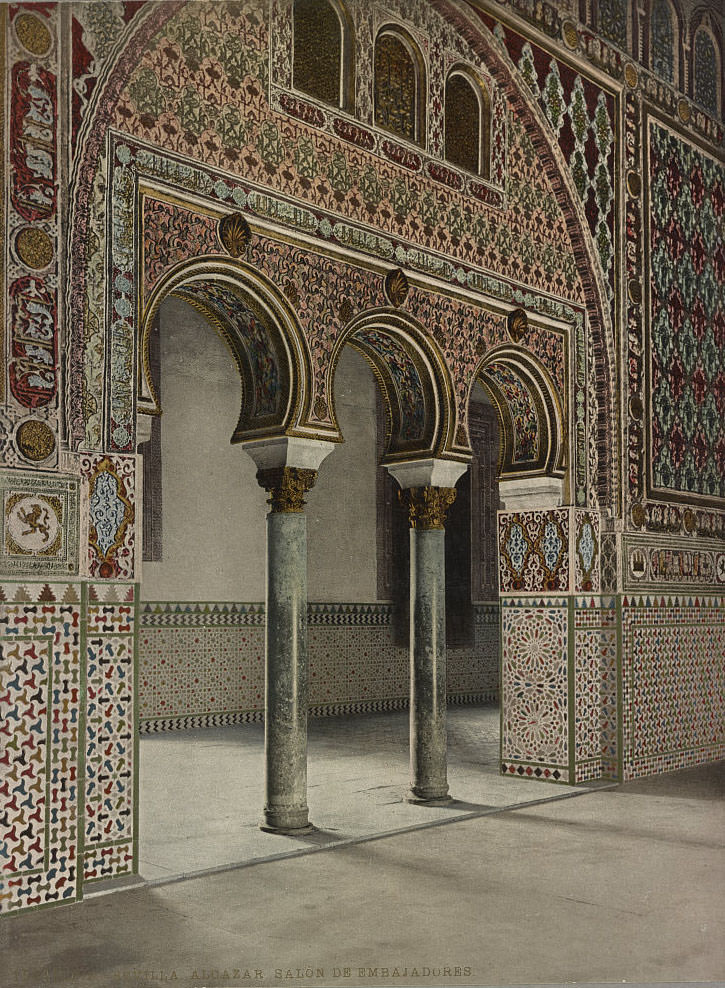
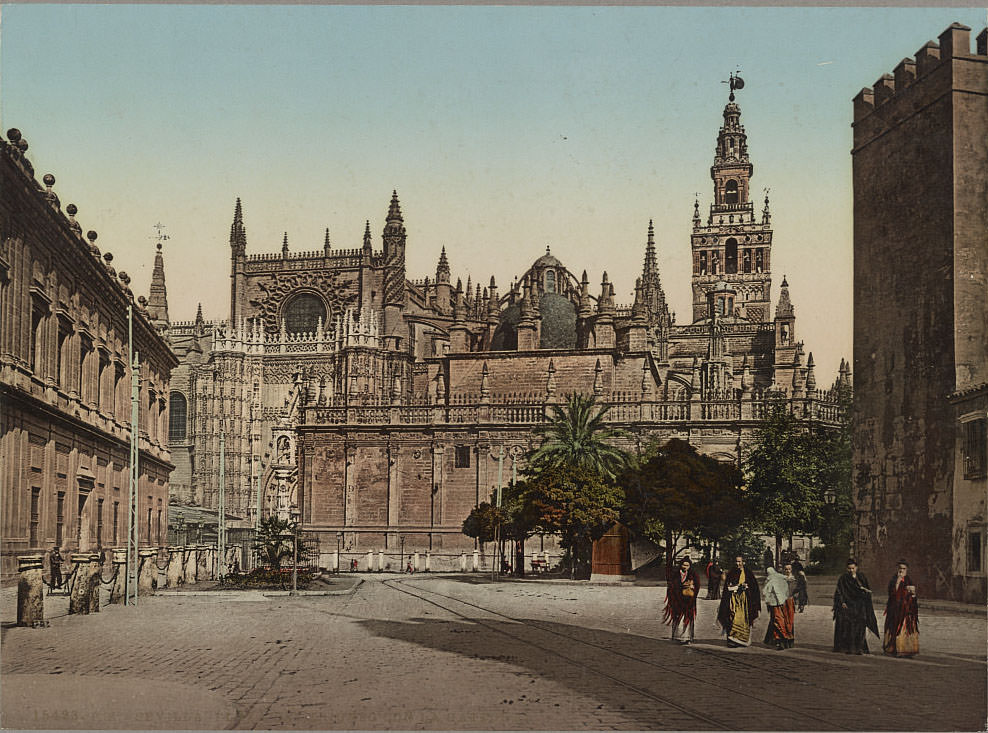
Seville holds the second-largest group of images in this collection, centered on two historic sites: the Real Alcázar and the Cathedral. The Alcázar’s Salón de Embajadores — Hall of Ambassadors — is one of the finest rooms in Spain, its half-dome ceiling covered in gilded interlocking star patterns commissioned by King Pedro I in the 14th century. The Patio de las Doncellas and the Patio de las Muñecas offer further views into the palace’s layered Islamic and Christian decorative traditions.
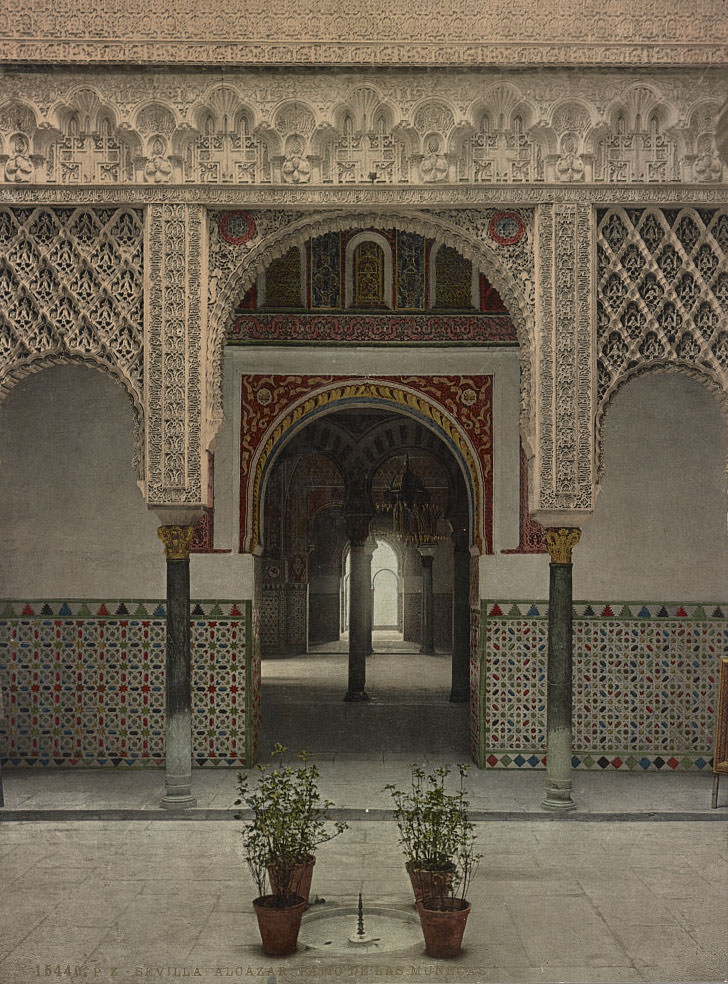
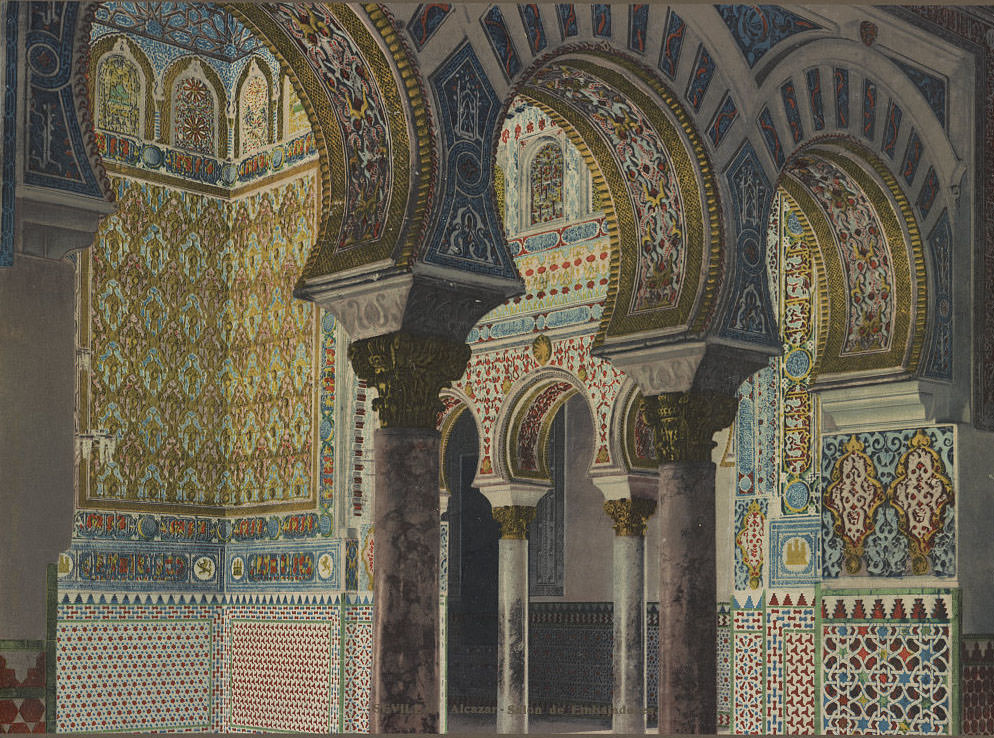
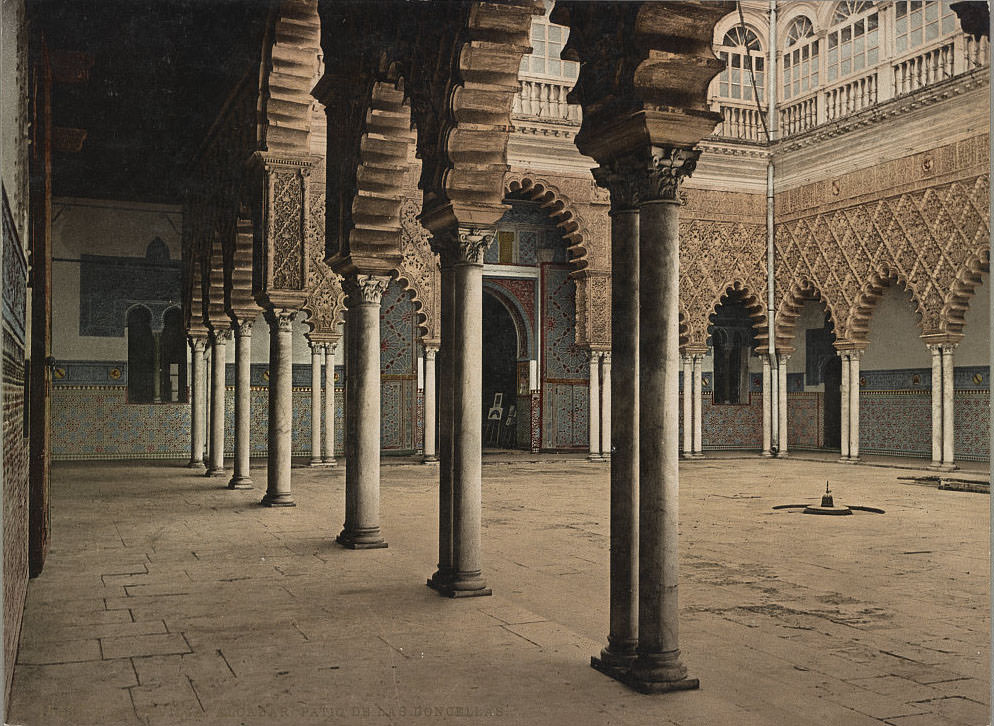
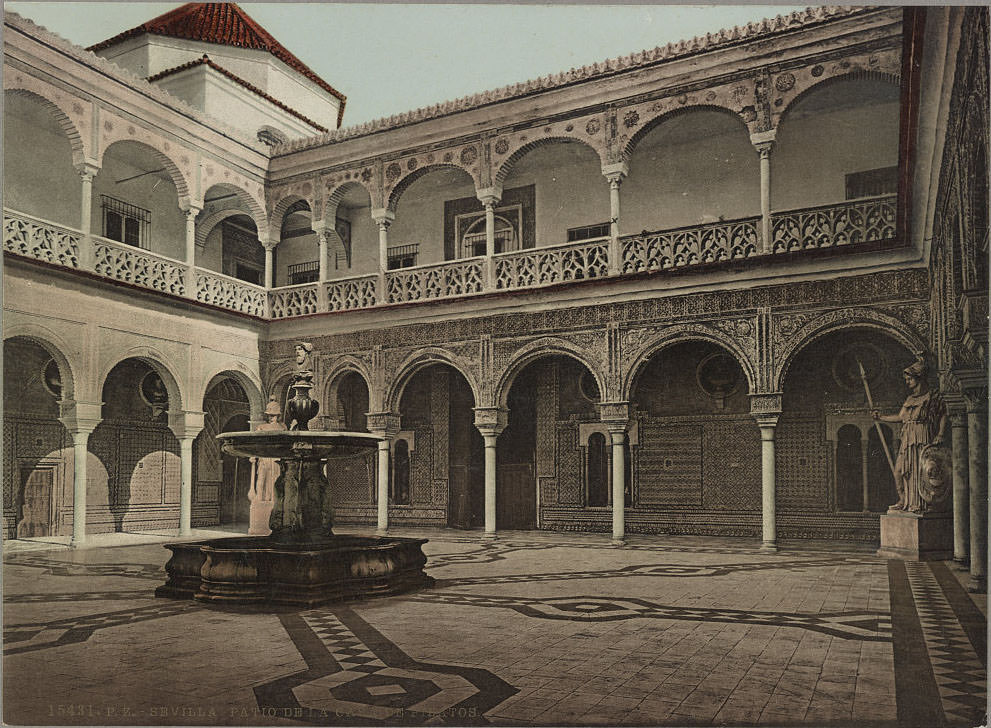
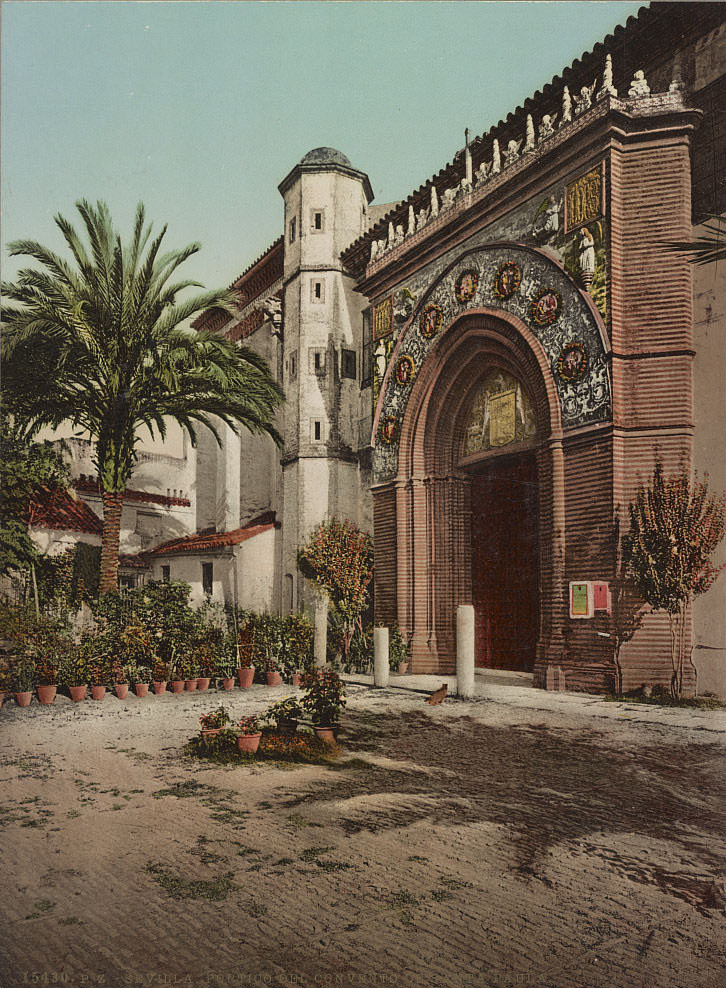
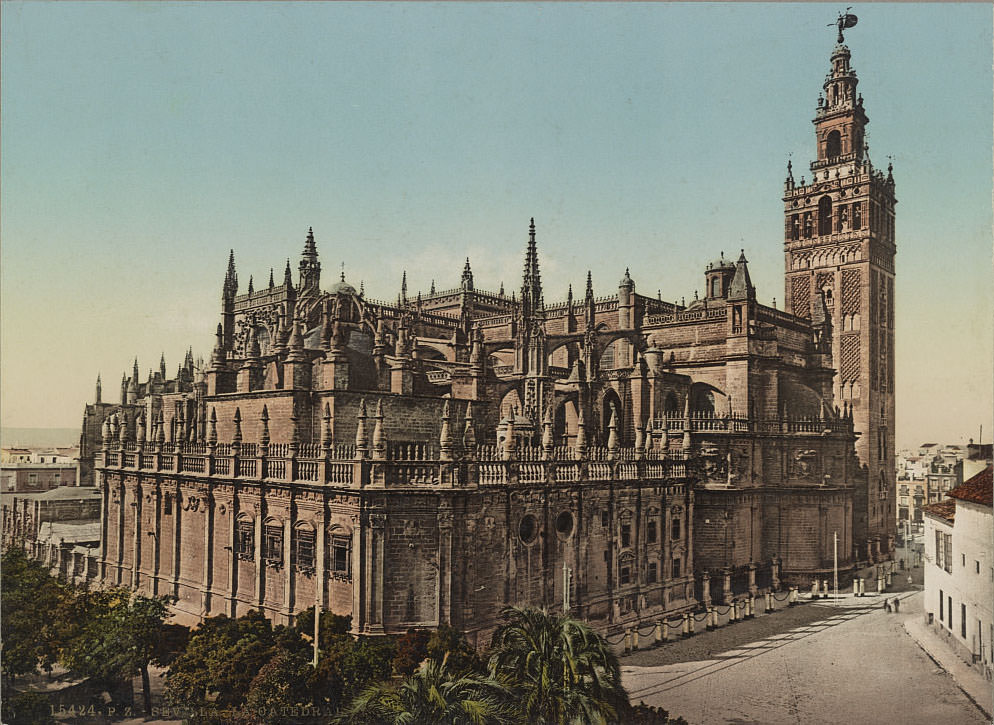
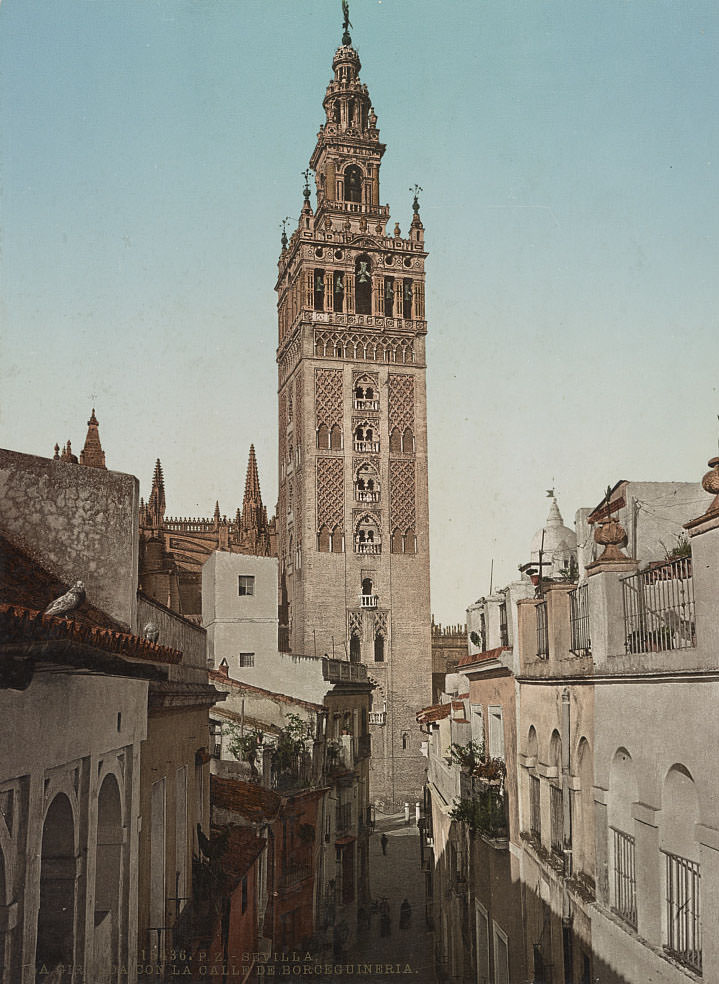
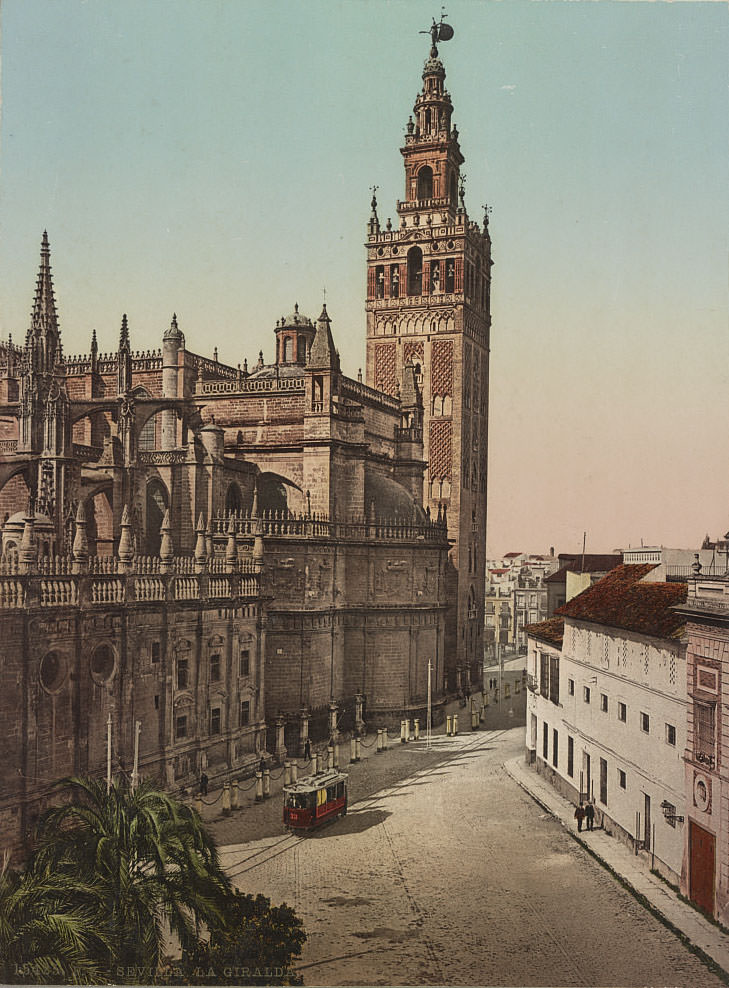
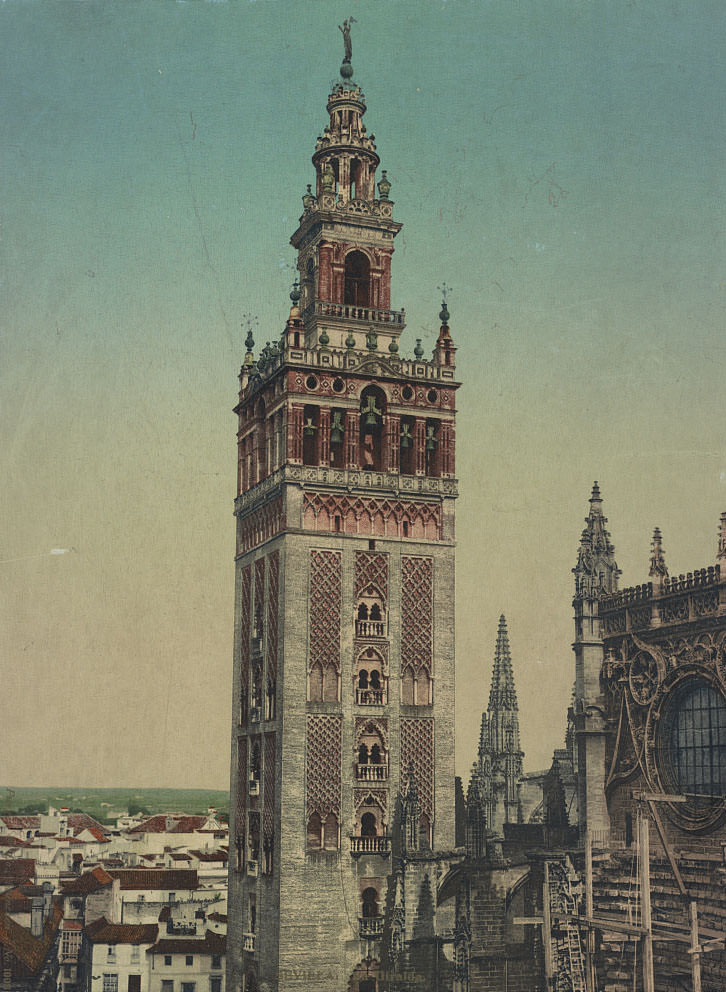
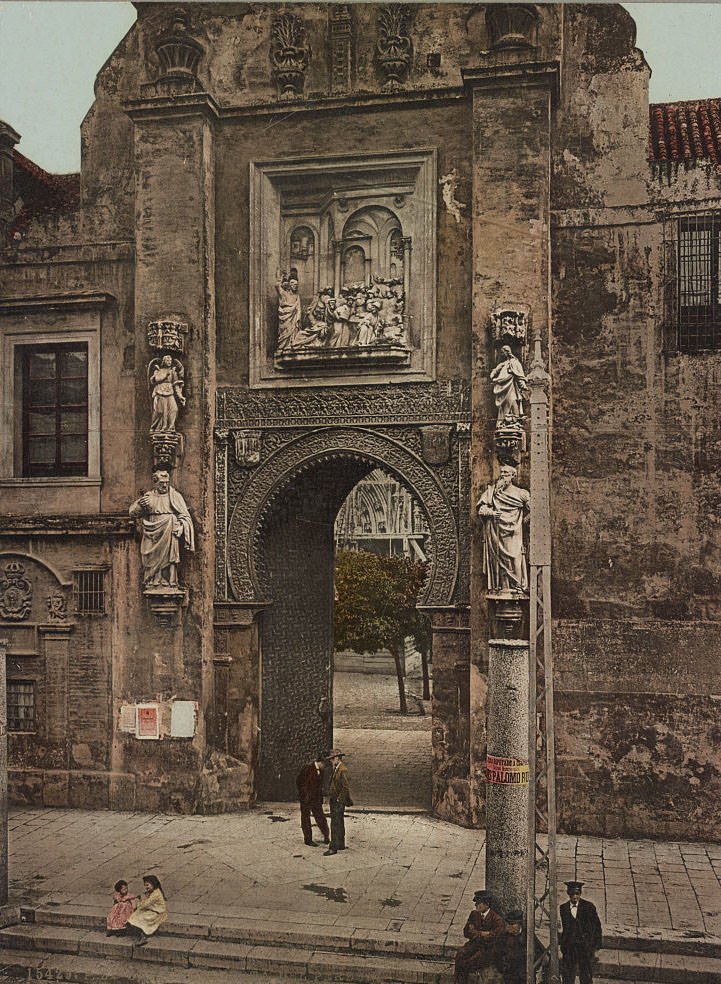
The Casa de Pilatos in Seville was a private palace blending mudéjar, Gothic, and Renaissance styles, owned by the Dukes of Medinaceli. The Convento de Santa Paula displayed its own elaborately tiled portico. The Cathedral of Seville — the largest Gothic cathedral in the world — looms in multiple images, its bulk visible from the surrounding plazas. The Giralda, the former minaret of the mosque that once stood on the cathedral’s site, appears in three separate views, including one looking down the Calle de Borceguinería.
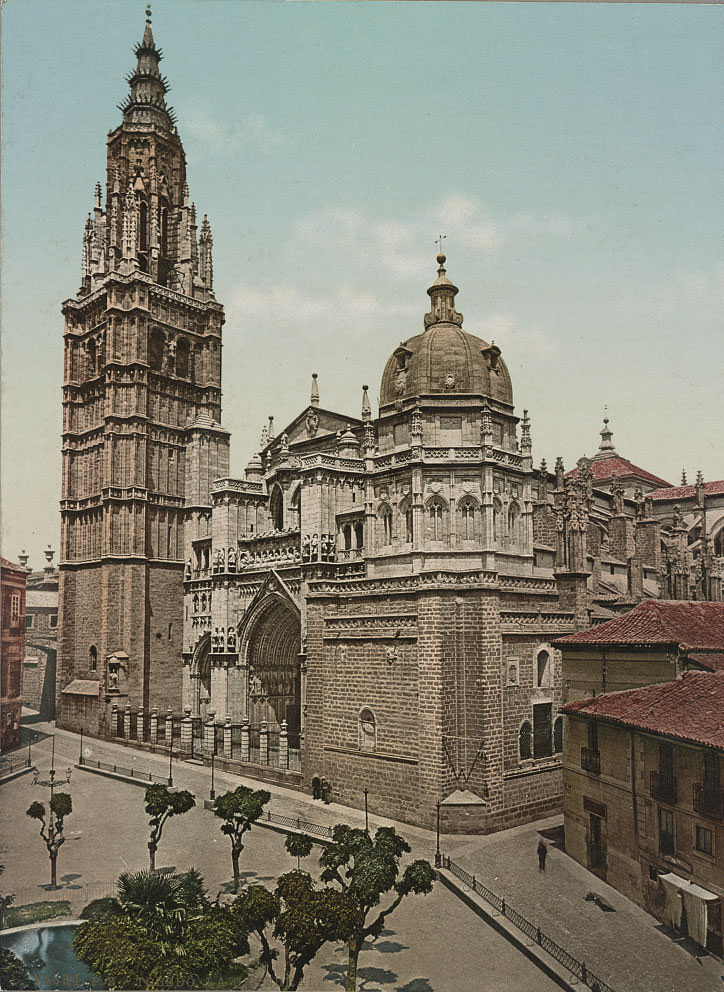
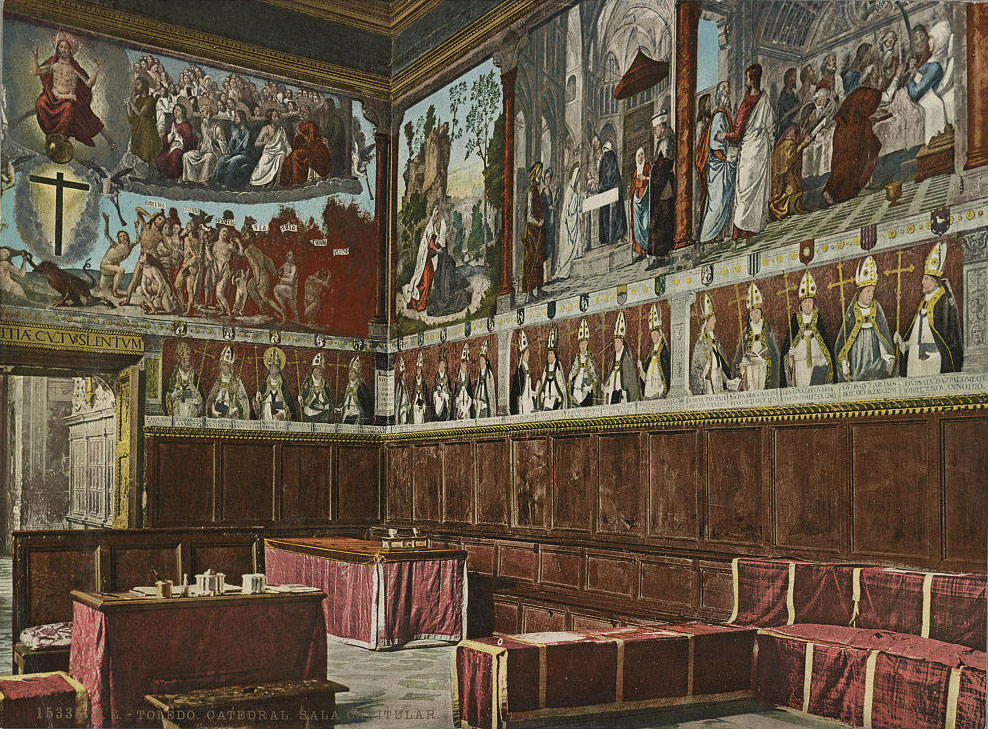
Toledo, the former imperial capital of Spain, contributes two images — its cathedral interior and the chapter house, the Sala Capitular, whose ceiling is painted with portraits of every archbishop of Toledo from the earliest medieval period onward. Toledo’s cathedral took over 250 years to build and contains works by El Greco, Caravaggio, and Goya within its walls.
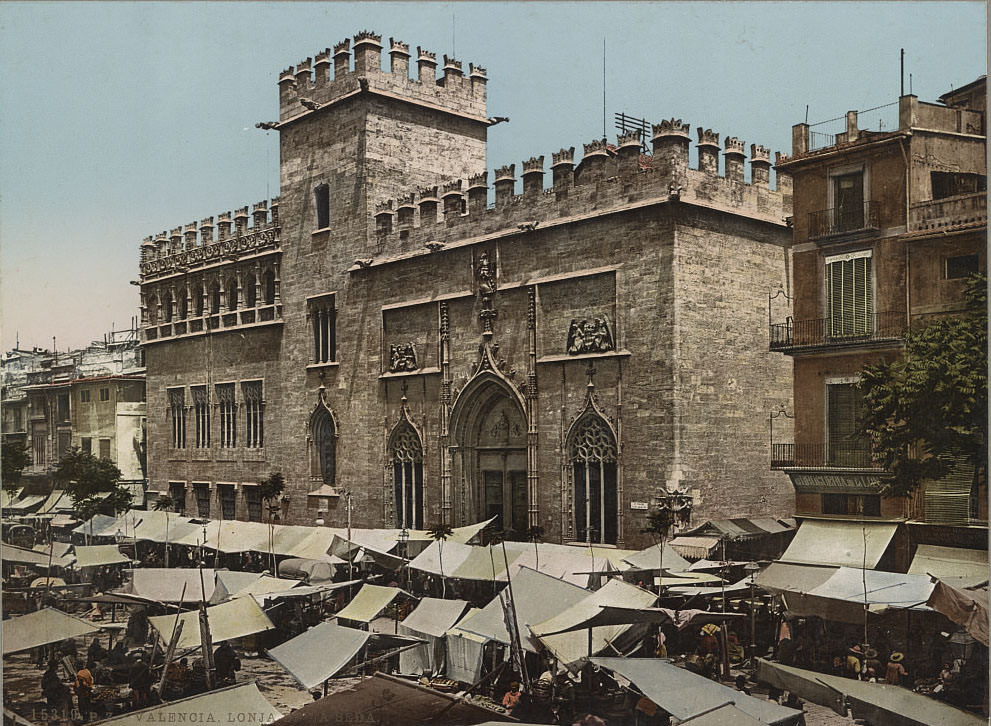
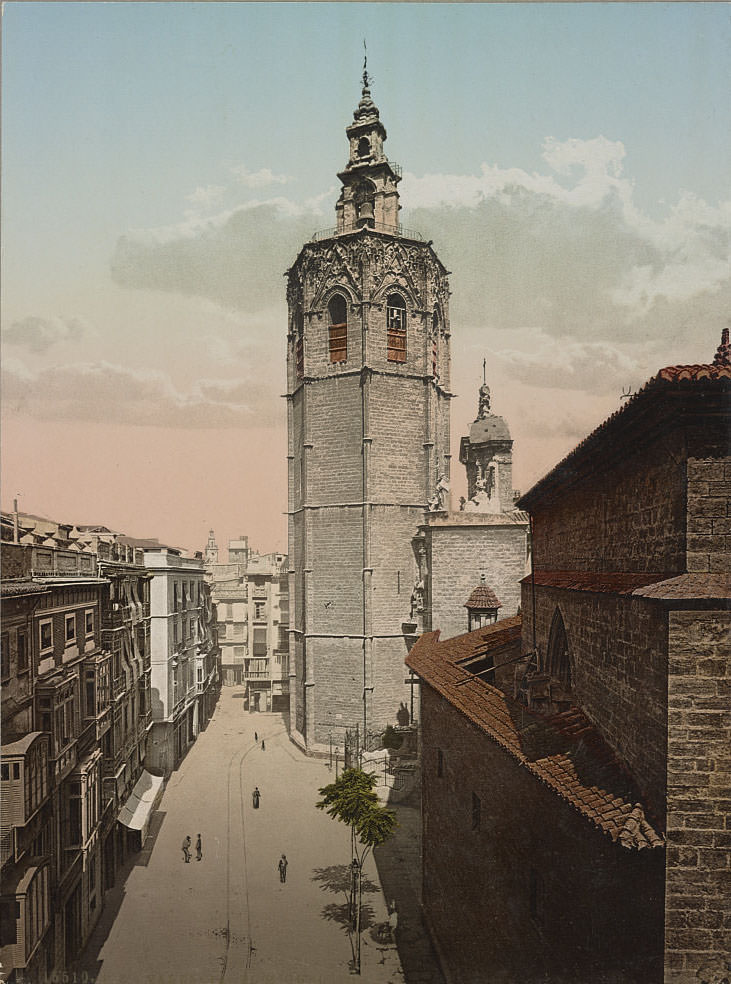
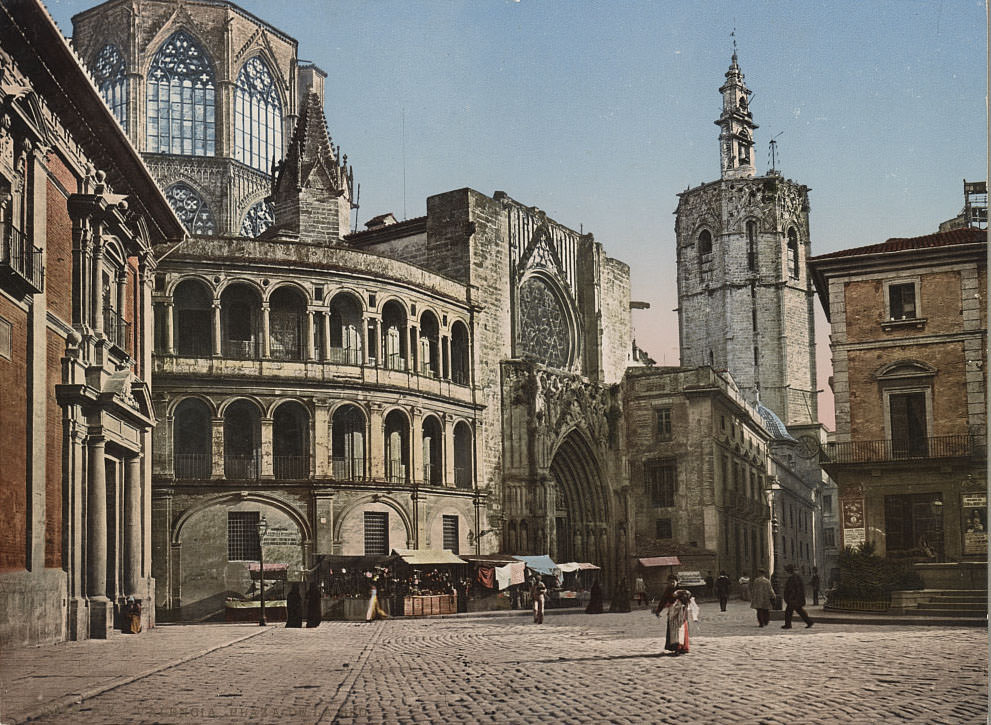
Valencia closes out most of the collection with three landmarks. The Lonja de la Seda — the Silk Exchange — was a UNESCO World Heritage Site built in the 15th century as a trading hall for the city’s powerful silk merchants. El Miguelete, the octagonal bell tower of Valencia’s cathedral, rises above the surrounding buildings just as it had for five centuries. The Plaza de la Seo, the open square in front of the cathedral, gave Valencians a gathering place at the city’s religious center.
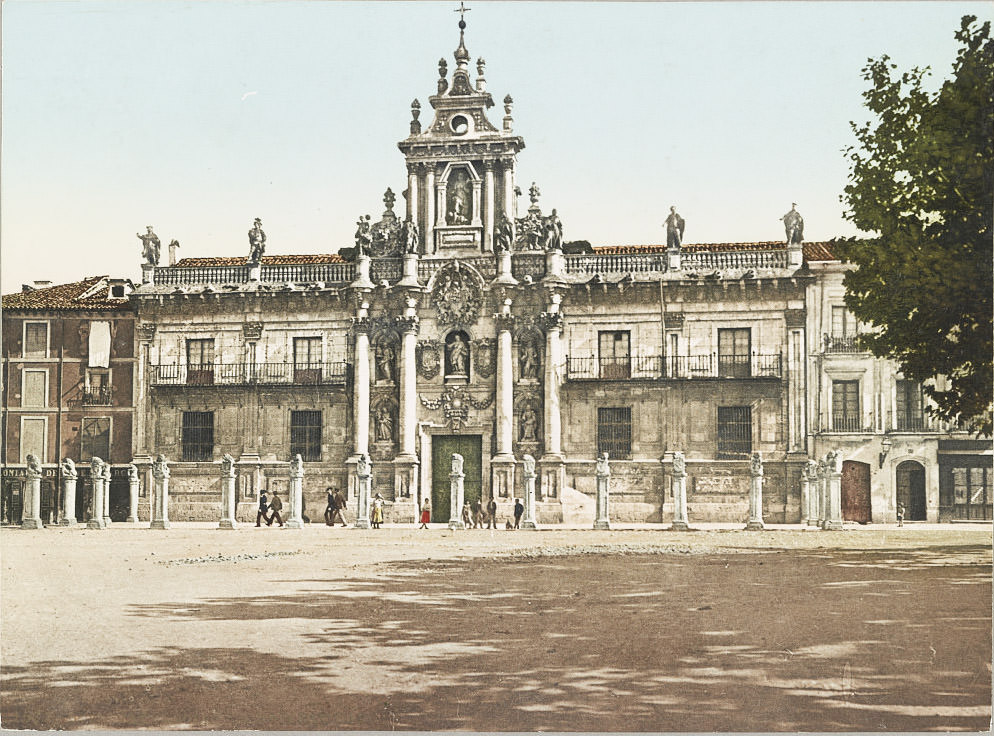
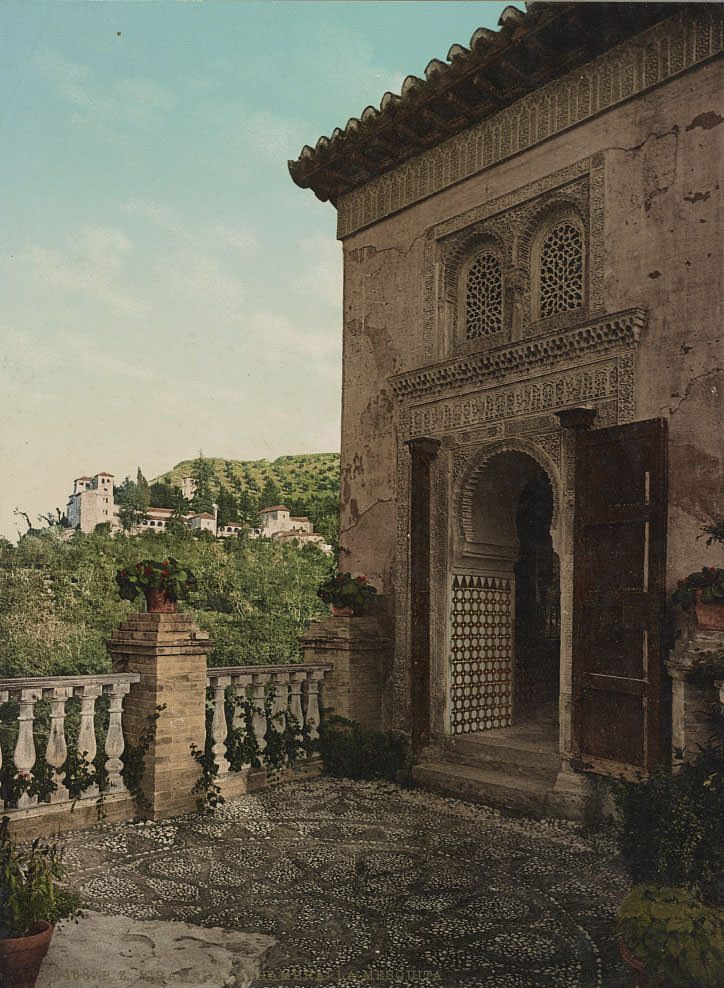
The University of Valladolid, with its elaborate baroque stone façade, appears as a standalone image — one of Spain’s historic centers of learning, founded in the 13th century. The final images return to Granada and Madrid, closing the collection with more views of the Alhambra’s mosque interior and the Plaza de Palacio with its adjacent cathedral in the capital.





All of its cities are beautiful. Spain is my favorite country. I’m not Spanish:
It looks like this now, just add some cars.
Historic
As if nothing has changed
Although everything looks the same, there is also a hint of exoticism. A bit like Spain or France, but it’s not.
Thanks for sharing; that was interesting