Recruitment posters were a driving force in bringing in more than a million new soldiers during World War I. The Canadian, British, and US governments used these posters to entice men to join the armed forces, telling them it was their duty to enlist and that they would feel proud if they did — and guilty or embarrassed if they didn’t. In a world without radio or television, and with newspapers lacking color printing, posters provided the color, power, and size needed to deliver simple messages to a mass audience. The imagery, style, and graphics came directly from the advertising industry, drawing on themes like patriotism, nationalism, comradeship, revenge, the desire to protect loved ones, and the fear of being seen as a coward.
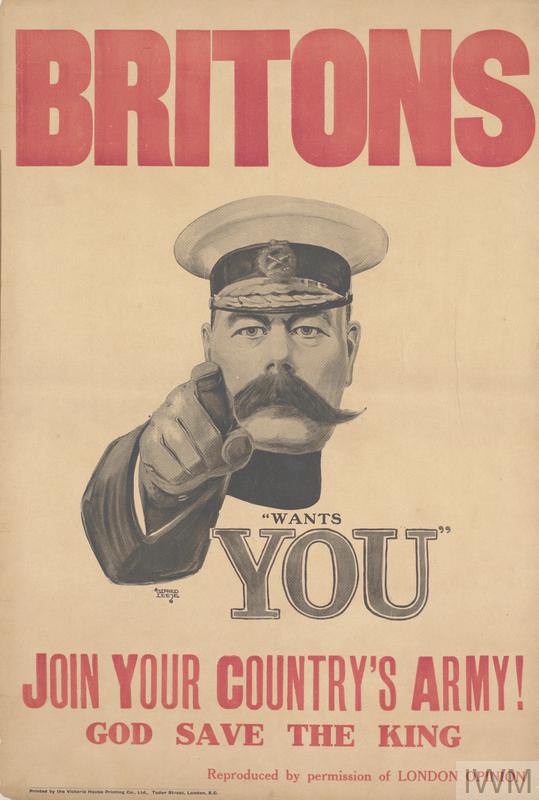
The poster shows Lord Kitchener appealing to the British public to join the British army. A version of the poster was produced in 1914, but it became a truly iconic image after the war, when it was not widely spread outside of London. This striking visual appeal was picked up by other artists, including in the USA, where Uncle Sam replaced Kitchener.
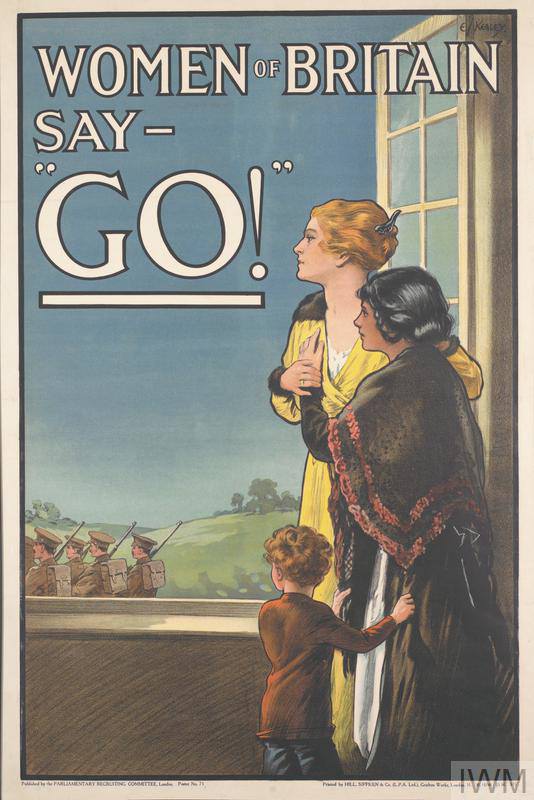
A poster advertising the British army clearly demonstrates how commercial advertising techniques are being applied to the campaign aimed at enticing more men to join the armed forces, while showing that women and children should be protected. Despite this, women had more paid jobs and more jobs to choose from after the First World War.
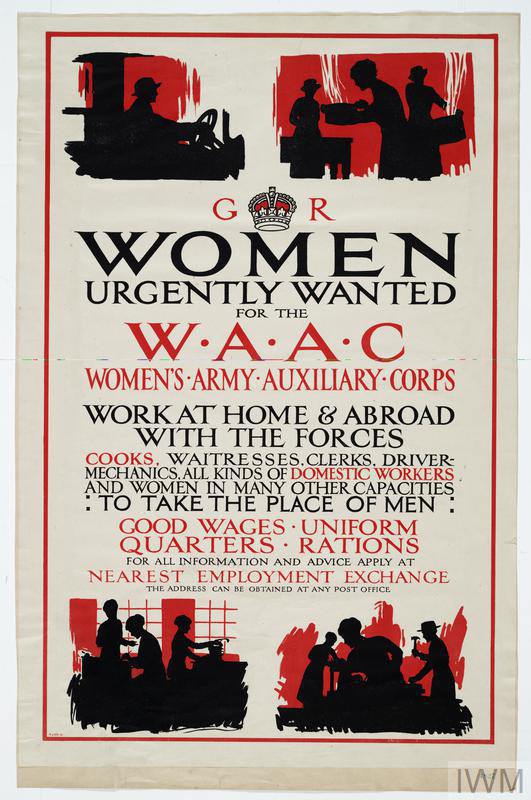
The Women’s Army Auxiliary Corps (WAAC) was established in December 1916. In France, many women joined the Corps to perform non-combatant tasks, allowing more men to serve on the front lines. The first group of 14 women arrived on the Western Front on 31 March 1917. Ultimately, 9,000 women served with the unit in France.
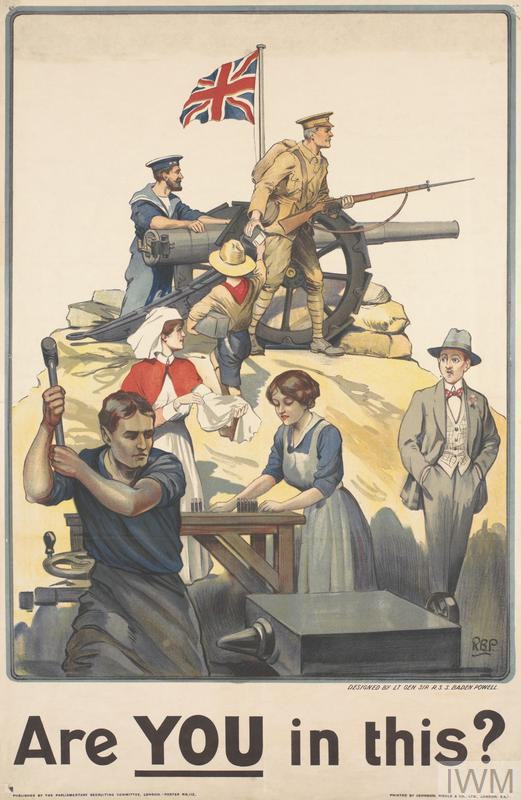
Robert Baden-Powell, who founded the Scouting movement, designed this poster. There is a scout among the many people shown assisting the war effort. A man who is not yet involved is shown on the sidelines with his hands in his pockets, smoking a cigarette.
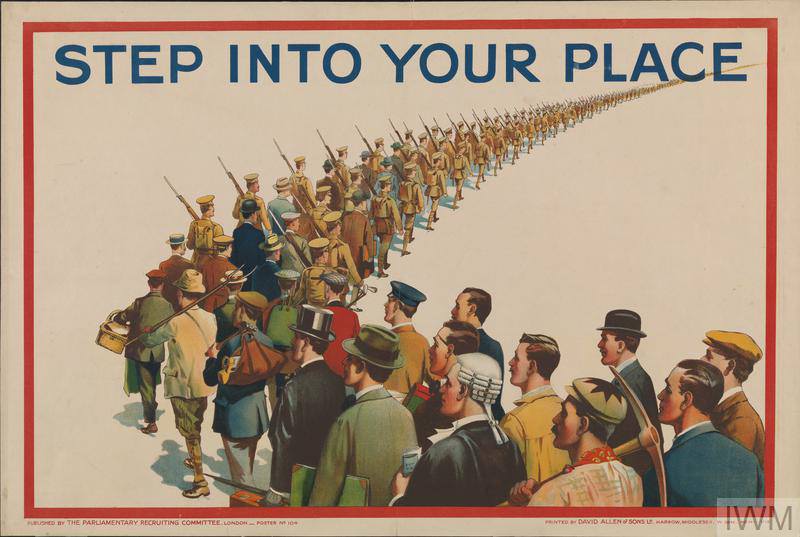
In this poster, all members of society go to war together in a united Britain. Civilians gradually turn into British infantrymen while carrying the tools of their profession.
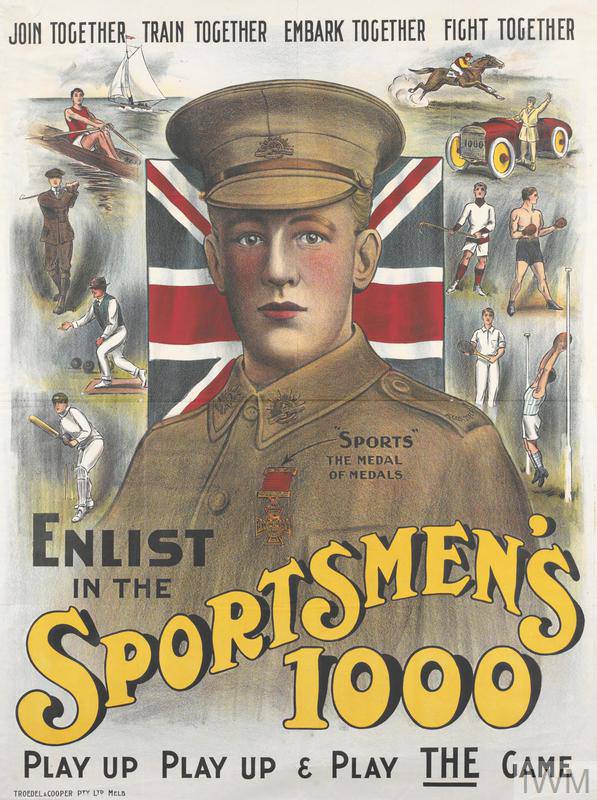
In Britain and its empire, team sports were widely believed to be excellent preparation for war. This Australian poster plays on the nation’s growing sense of identity and its sporting pride by combining the concept of team spirit with patriotism.
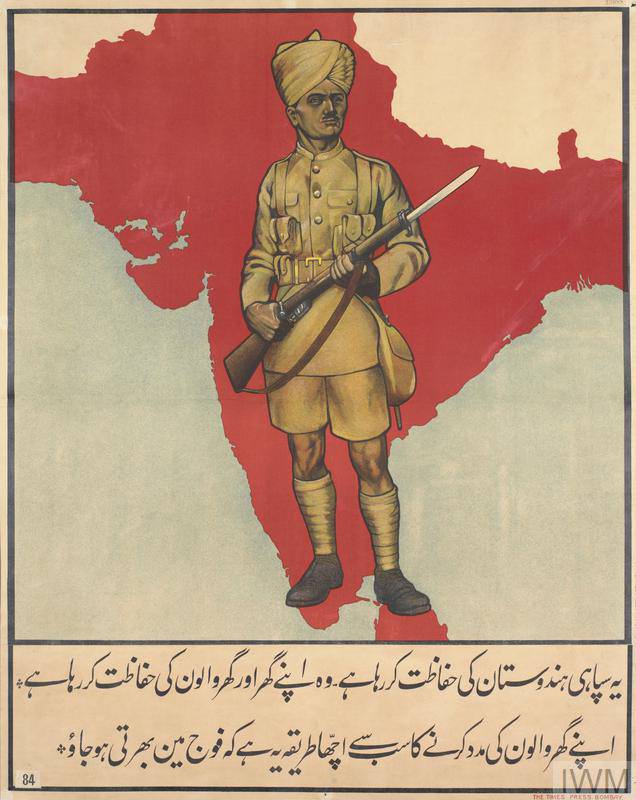
Each region could add text in its own language to the bottom of this Indian recruitment poster. Adapting it to meet the needs of the area where the poster was distributed made it very flexible. In India, where recruitment campaigns were conducted differently, recruitment posters were less common. During that period, India was still largely a rural society, and poster campaigns were more common in urban areas.
![? [The Question Mark]](https://www.bygonely.com/wp-content/uploads/2021/07/World_War_I_Recruiting_posters_8.jpg)
During the First World War, the Government of Australia conducted this recruitment campaign as its last recruitment drive. The painting depicts an ape-like monster wearing a German helmet, or pickelhaube, a symbol of German militarism. The graphic imagery in the poster was particularly forceful and very different from that used in British posters, and it was part of a sophisticated campaign.
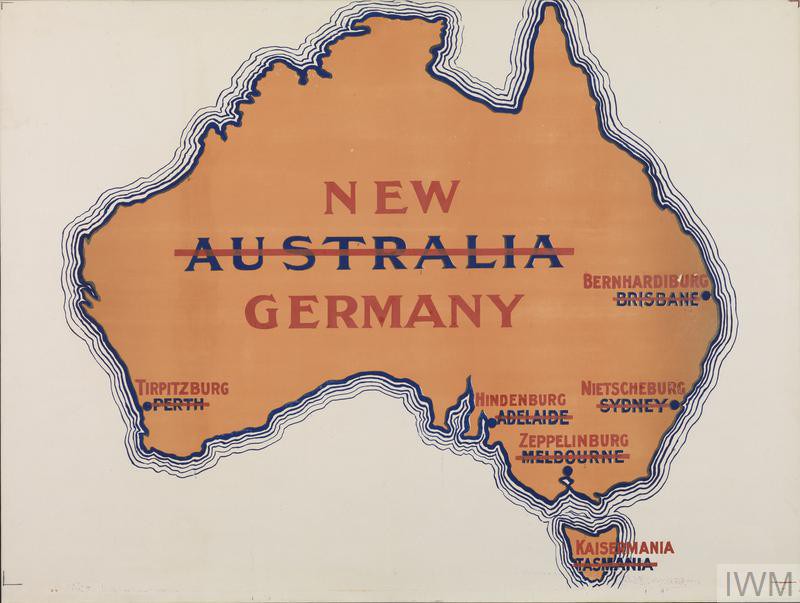
Germany occupies and takes over Australia in this striking poster. The Australian people never had a realistic fear of Germany, but rather reacted to the perception that Germany would dominate the world and impose values they opposed.
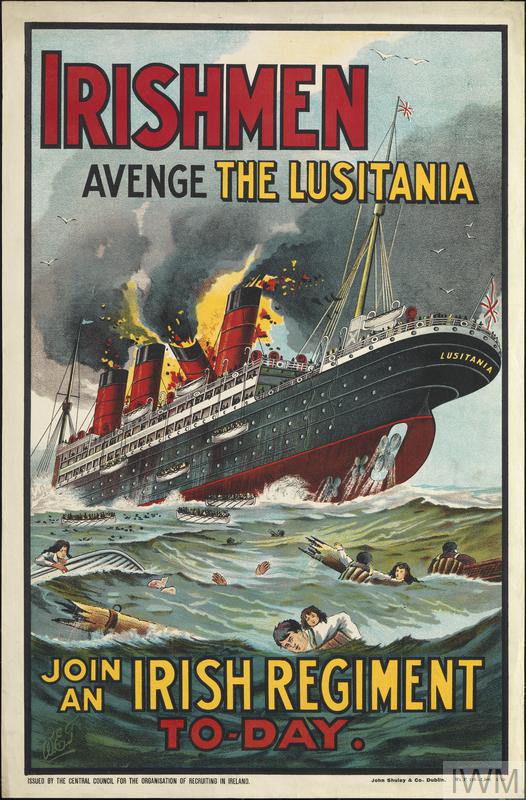
In May 1915, a German U-boat torpedoed and sank the passenger liner RMS Lusitania. Despite the fact that the ship was carrying military supplies, over 1,000 passengers lost their lives in the incident, which became one of the most controversial acts of the war. In this poster, the incident is used to encourage Irish men to enlist in order to avenge the sinking of the ship.
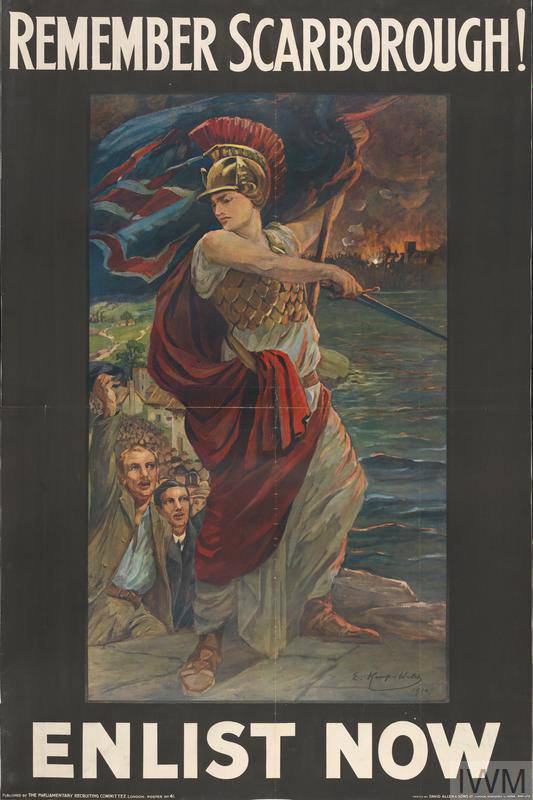
On the morning of 16 December 1914, the North Sea ports of Hartlepool, West Hartlepool, Whitby, and Scarborough were bombarded by the German First High Seas Fleet Scouting Group. 137 people lost their lives and 592 were wounded. This poster uses the incident to encourage people to enlist, though the British public and newspapers were also outraged at the Royal Navy for failing to protect the towns.
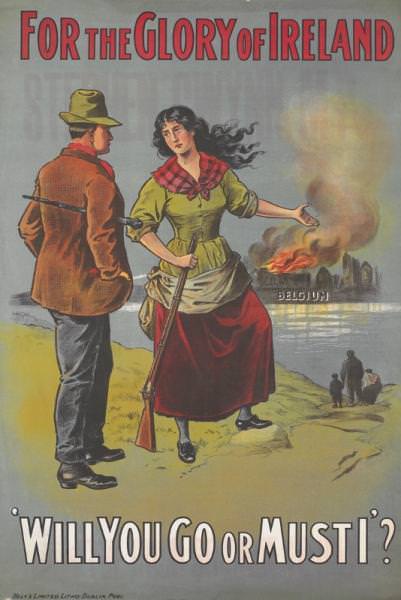
This Irish recruiting poster uses the German invasion of Belgium as a recruiting tool. It appeals specifically to the Catholic population of Ireland, which at this time was still part of the United Kingdom, to defend Belgium, which was also a Catholic country.
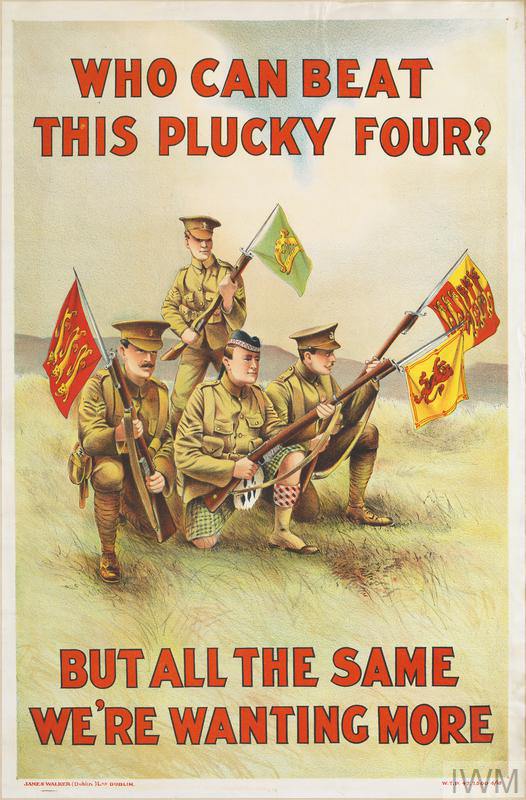
An Irish soldier stands behind English, Scottish, and Welsh troops in this poster from 1915. Men in Ireland were encouraged to enlist and join the war effort with this poster, which was especially aimed at Protestants and those who supported unionism, at a time when Ireland was pursuing independence.
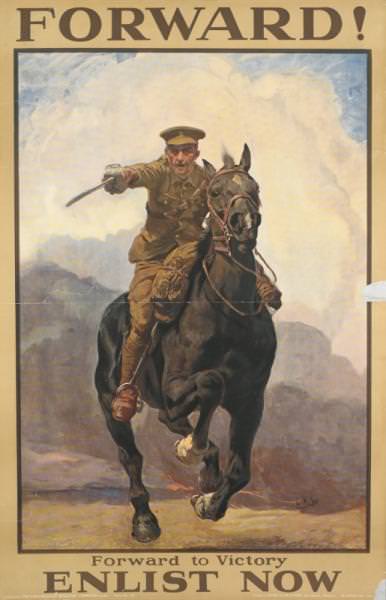
During the recruitment campaign, this poster was the last to use an image and was produced in September 1915. By the time it was produced, the introduction of conscription had become inevitable. Nonetheless, posters like this were still used to encourage people to enlist before they became conscripts.
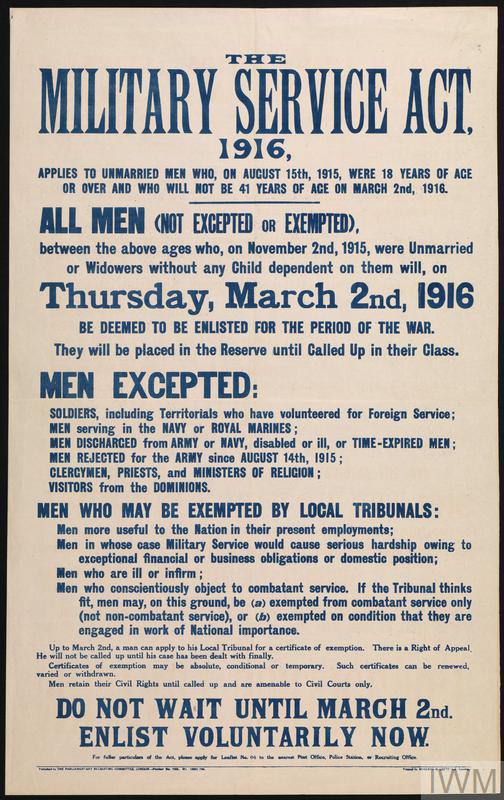
Conscription became mandatory for military-age men in 1916, as this poster indicates. Under the new law, men were encouraged to enlist before 2 March, when the act came into effect. Since the introduction of the act, posters became more focused on providing information than on trying to be persuasive.
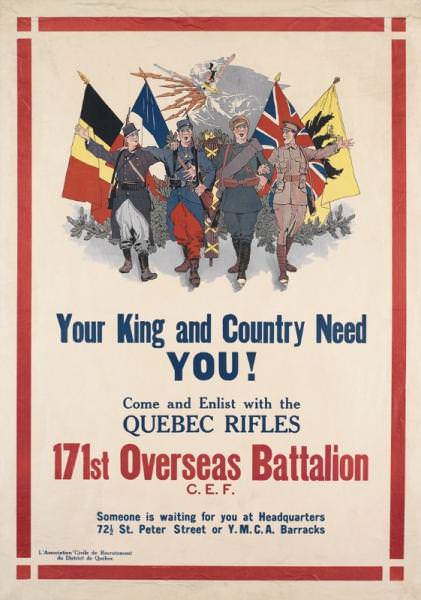
In this poster, members of the Canadian Expeditionary Force are encouraged to enlist with the Quebec Rifles. It depicts Belgium, France, Russia, and Britain as allies in the war effort, although the poster’s title suggests otherwise. The poster encourages people to fight for universal values and causes.
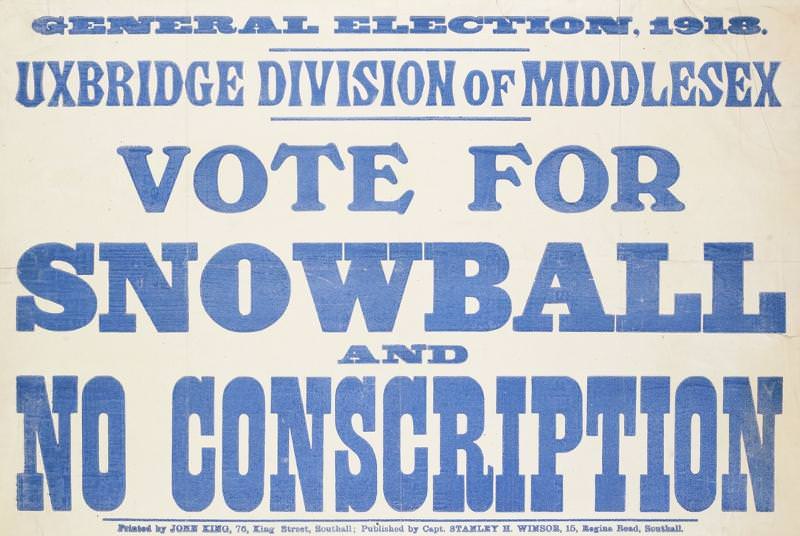
The British introduced conscription in 1916, but it remained unpopular throughout the war. This poster, which dates from the 1918 general election, shows that people were still unhappy about being forced into the armed forces.