
In the summer of 1948, a photograph taken on a Chicago doorstep stopped the nation cold. It showed four small children sitting on a stoop with a handwritten sign in front of them that read, in plain terms, that they were for sale. The image traveled fast — through newspapers, across radio broadcasts, and into living rooms — and the family behind it, the Chalifoux family, became a symbol of just how far poverty could push a person.
Ray Chalifoux had been working as a coal truck driver, but by 1948 he had lost that job. With no income and an eviction looming at their Chicago apartment, Ray and his wife Lucille saw no clear path forward. Faced with the prospect of being put out on the street with four children under the age of seven, they made a decision that would define how the world remembered them: they offered their children for sale.
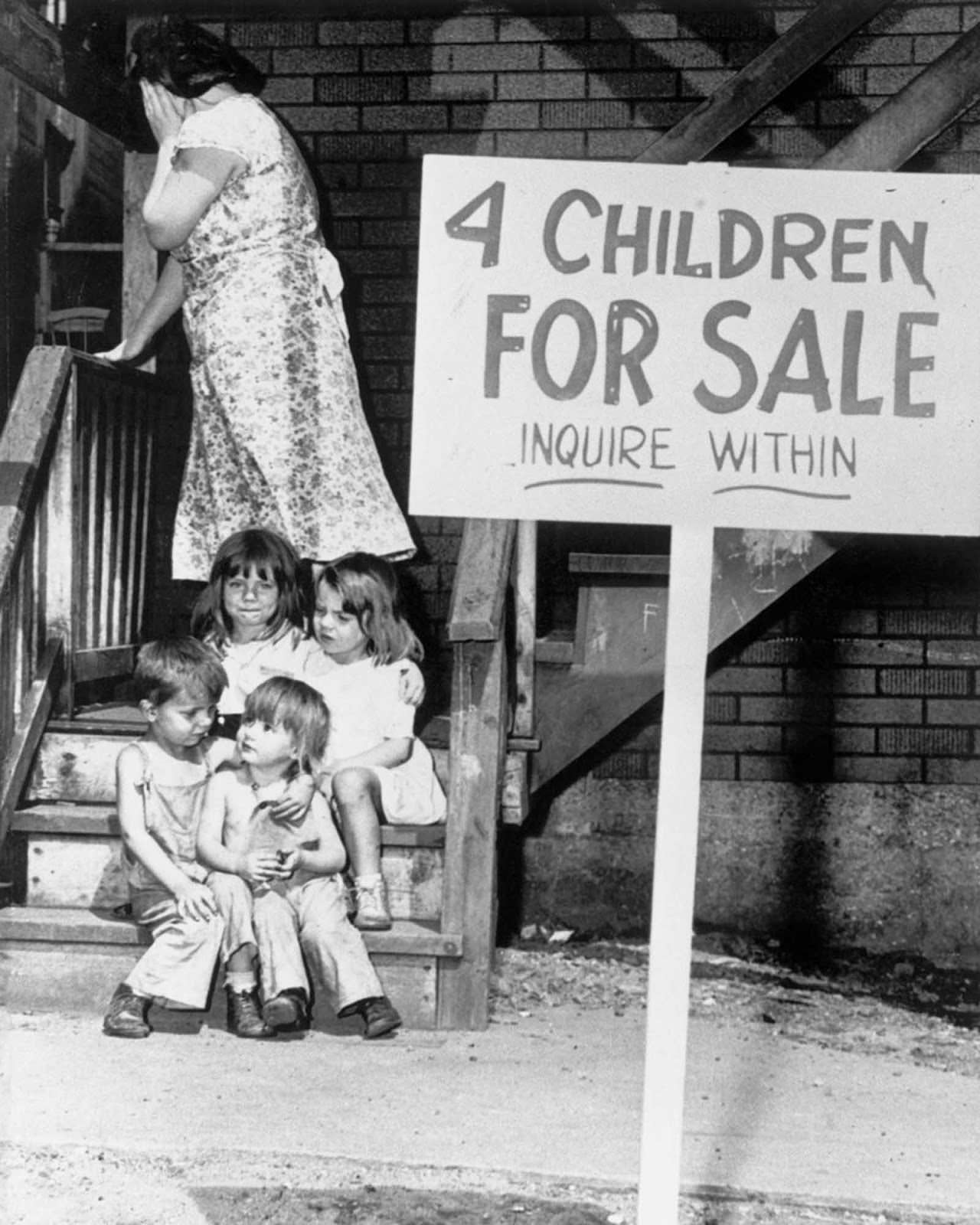
The photograph itself was taken by a photographer working for the Detroit News, who came across the family while reporting on poverty conditions in the city. The image was originally meant to be one piece of a broader story on homelessness and economic hardship. Instead, it became the entire story. Editors ran it prominently, and the public responded with immediate shock.
In the photo, the four Chalifoux children are arranged on the front steps of the stoop. Lana, age 6, and Rae, age 5, sit on the top step. Below them are Milton, age 4, and Sue Ellen, just 2 years old. Their faces carry a mixture of confusion and uneasy calm — they are too young to fully understand what is happening, but old enough to know that something is wrong. Their mother, Lucille, stands in the doorway behind them with her face turned away from the camera. Whether she turned away from shame, grief, or simply could not bear to look, the result is one of the most striking details in the image.
The Chalifoux family was not an isolated case. The post-World War II period brought economic hardship to millions of American families. Jobs were unstable, housing was scarce, and social safety nets were thin. For families without steady income, the gap between survival and destitution was narrow. The Chalifoux story cut through because the photograph made that reality impossible to look away from.
Public reaction was swift and intense. Letters, donations, and offers of help poured in from across the country. The Chalifoux family appeared on radio and television programs, and the story generated sustained national news coverage for weeks. Among the most immediate responses was intervention from the Travelers Aid Society, a local organization that stepped in to help the family find stable housing and financial support. The children were not sold. The family was kept together, at least for a time.
Despite the public outpouring of support, the years that followed remained hard for the Chalifoux family. Ray struggled to find consistent work, and the family moved frequently as he searched for employment. The media attention faded, and the structural problems that had pushed them to that doorstep in 1948 did not disappear. The children grew up under difficult circumstances, and for some of them, those early years cast long shadows.
Milton, the youngest boy in the photograph, died at 18 years old from complications related to alcoholism. Rae, the second-oldest girl sitting on the top step in the photograph, died at 29 from illness. Their deaths were quiet, largely unnoticed by the press that had once put their faces on front pages across the country. Lana and Sue Ellen both survived into adulthood. Sue Ellen, the youngest child — the two-year-old in the photograph — lived the longest. She died in 2016 at the age of 70, the last surviving member of her immediate family.
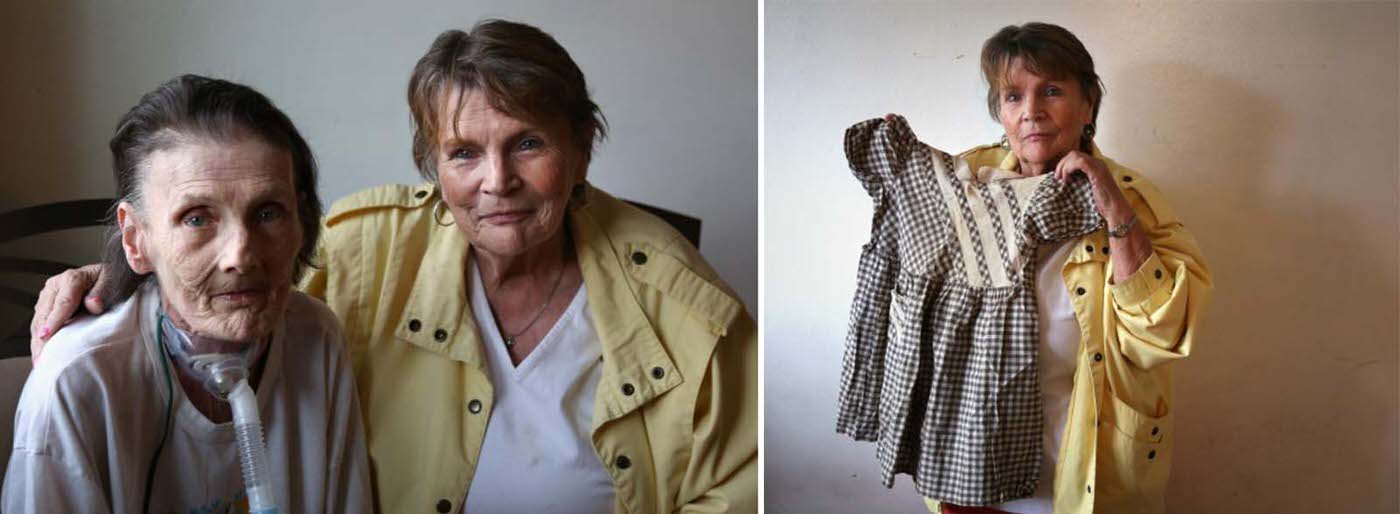
In 2013, decades after the photograph was first published, a family reunion of sorts took place that shed new light on what had happened to the children. It emerged that Rae — known in adulthood as RaeAnn Mills — and her brother Milton had actually been given to another family, the Zoetermans, during the period following the photograph. RaeAnn kept one physical item from that time: the dress she had been wearing when she was handed over. It was the only tangible connection she had to her birth mother and to those early years.
The 2013 reunion brought Sue Ellen and RaeAnn together at what was described as the Chalifoux home in Hammond. Photographs from that meeting show two elderly women — one of them holding a small, worn child’s dress. The contrast between that small dress and the women holding it speaks to the full weight of what the photograph from 1948 had captured: not a single desperate moment, but the beginning of lives shaped by it.
The photographer who took the original image did not set out to create an iconic document. He was doing routine assignment work, covering poverty as a news story. What he found on that Chicago stoop was something the public had not yet been asked to confront so directly — a family at the absolute edge, with a sign spelling out what that edge looked like. The image required no caption to explain itself. The sign said everything.
What makes the photograph endure is its specificity. These are not anonymous figures standing in for a concept. They are Lana, Rae, Milton, and Sue Ellen — real children with names, with futures, with the worn expressions of kids who had already learned that home was not a certain thing. Their mother’s turned face is just as specific: a woman who could not meet the camera’s eye at the moment she tried to give away what she loved most. The photograph does not generalize. It documents one family, on one day, in one city — and that precision is exactly why it still registers as something more than a historical footnote.

Uh this article says Rae lived (think Lana died) and yes all 4 were sold including the one in her stomach, so 5, just 2 years later. She went on to remarry and have 4 more children. Also the one that died was in 1998 and she would have been 56, not 29.