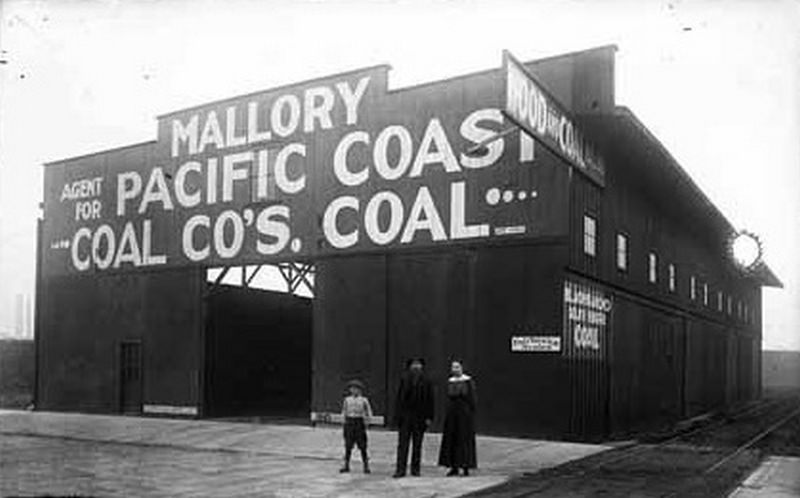
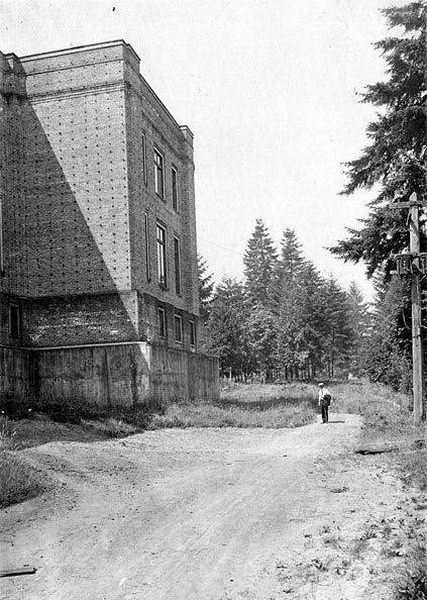
Olympia, Washington looked very different in the 1910s. These historical photos capture the capital city during a decade of major change, when the legislature approved the construction of a new Capitol Group of buildings, designed by the firm Wilder and White and landscaped by the Olmsted Brothers of Brookline, Massachusetts. The Temple of Justice was the first of these buildings to be completed, in 1912, followed by the Insurance Building in 1920 and the Legislative Building in 1928.
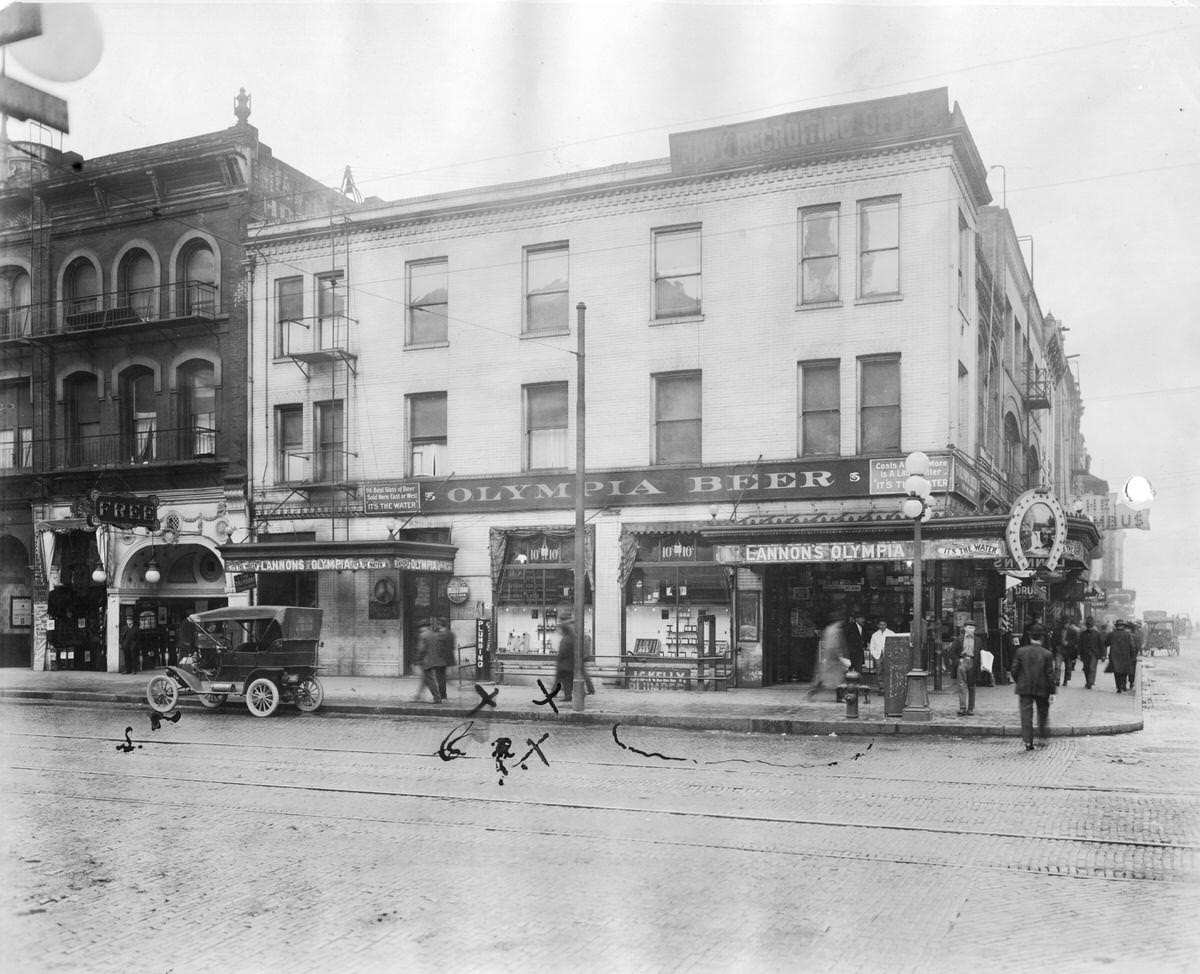
Signs read “The Best Glass of Beer Sold here East or West, ‘It’s the water'” and “Costs A Little More Is a Little Better”. Above the building is a sign for a “Navy Recruiting Office”. Buildings on the other side of the street have signs that read “Pacific Coast Medical Institute” and “The original Billy’s mug”. This is likely Seattle.
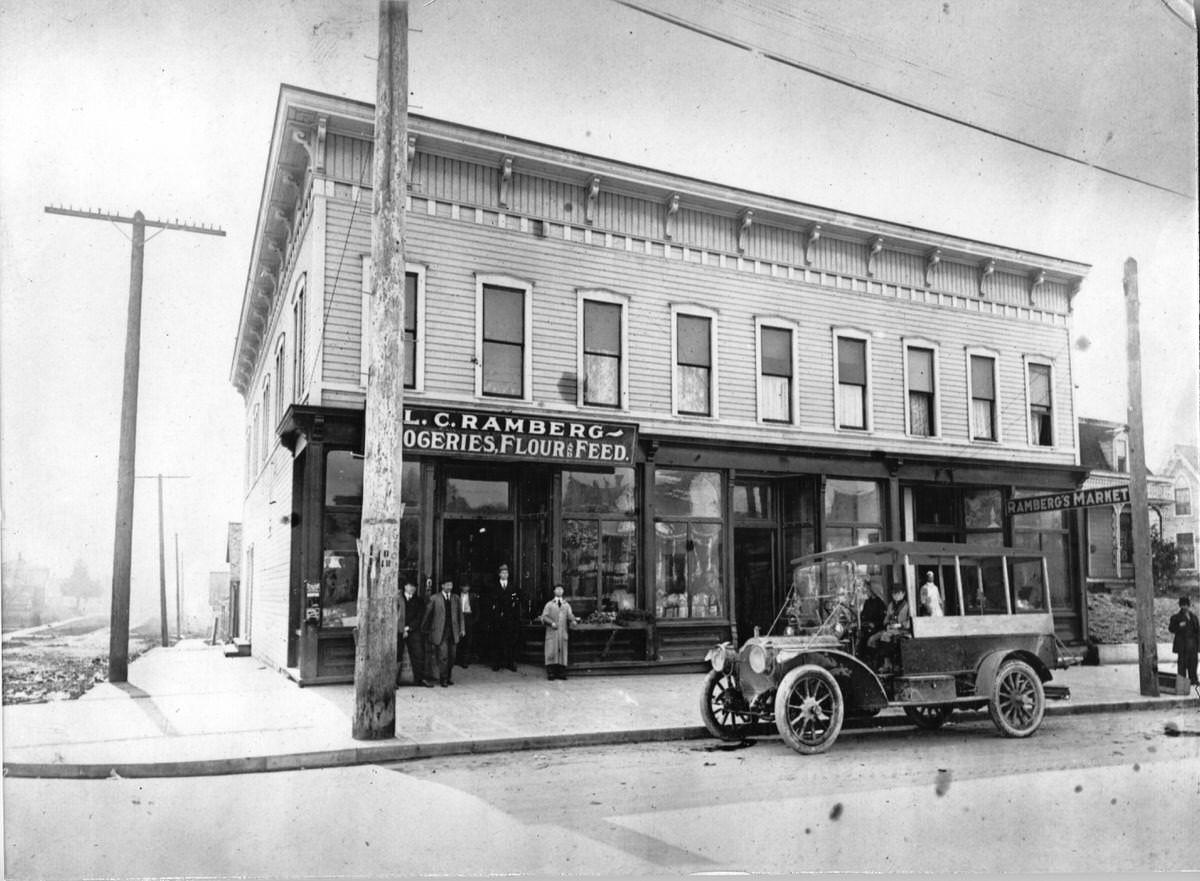
Five men stand at the entrance to the shop, and a car is parked near the entryway. A sign at the main entrance reads “L.C. Ramberg, groceries, flour, and feed.”
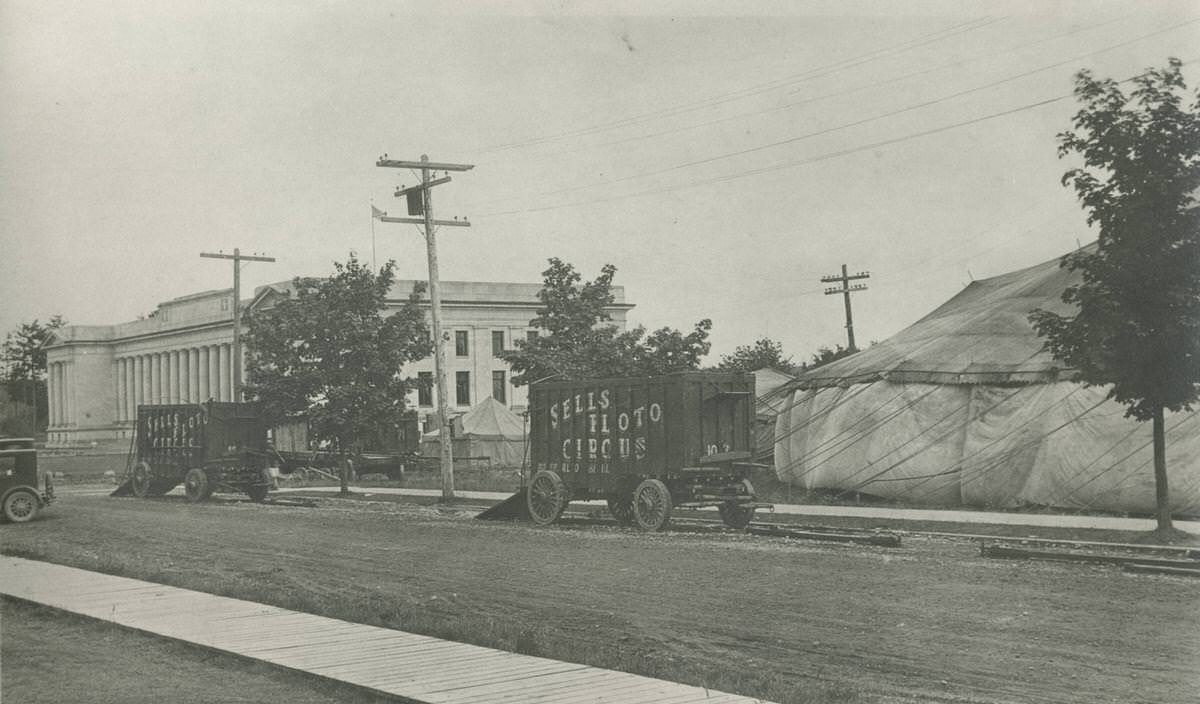
In the middle ground are tents, and lining the street are Sells Floto Circus wagons.
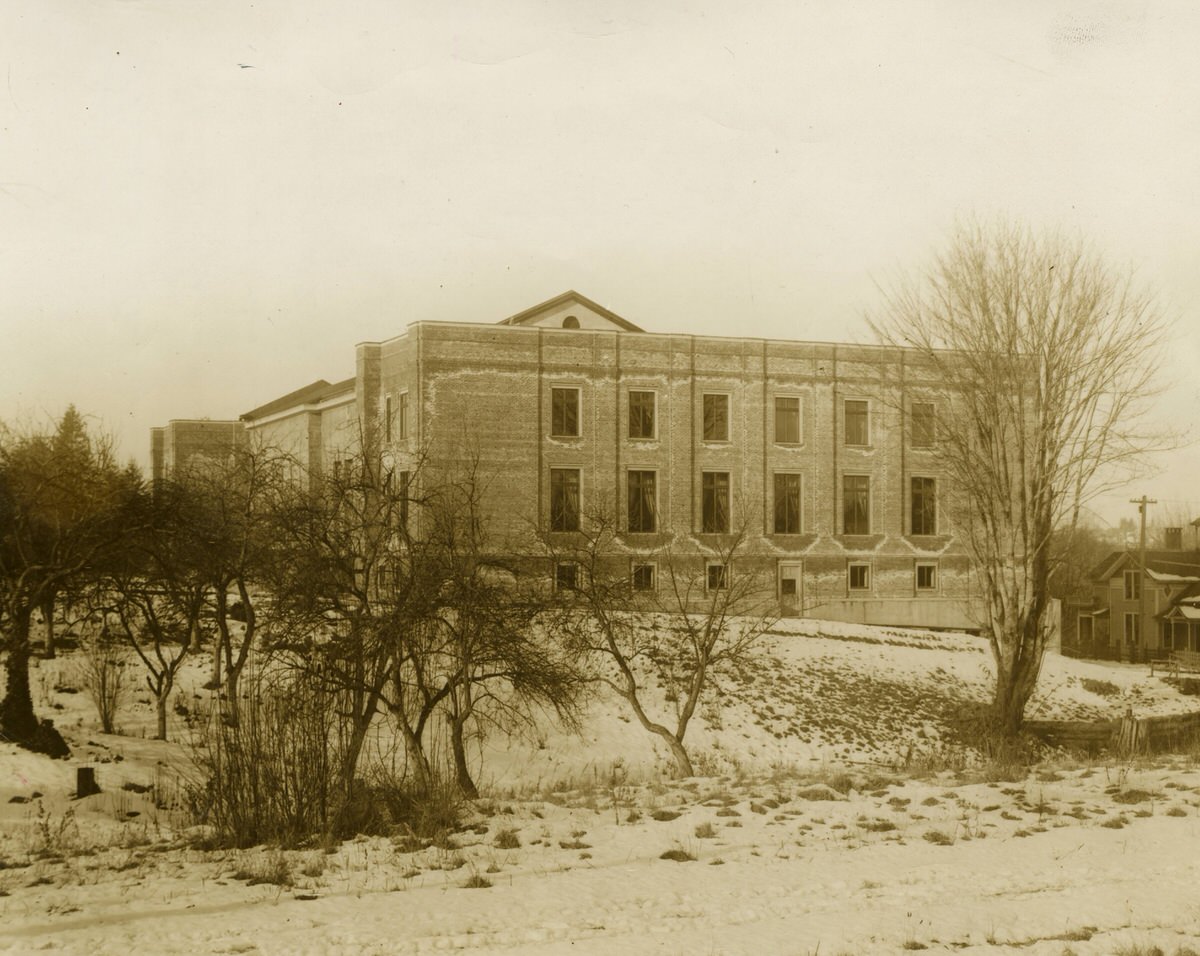
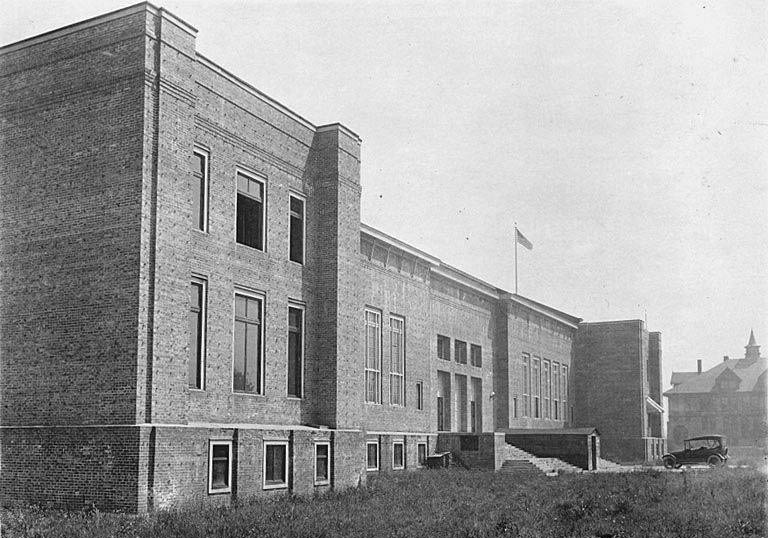
The building’s brick walls are exposed. A two-story Queen Anne/Italianate home is partially visible at the right-hand side of the image.
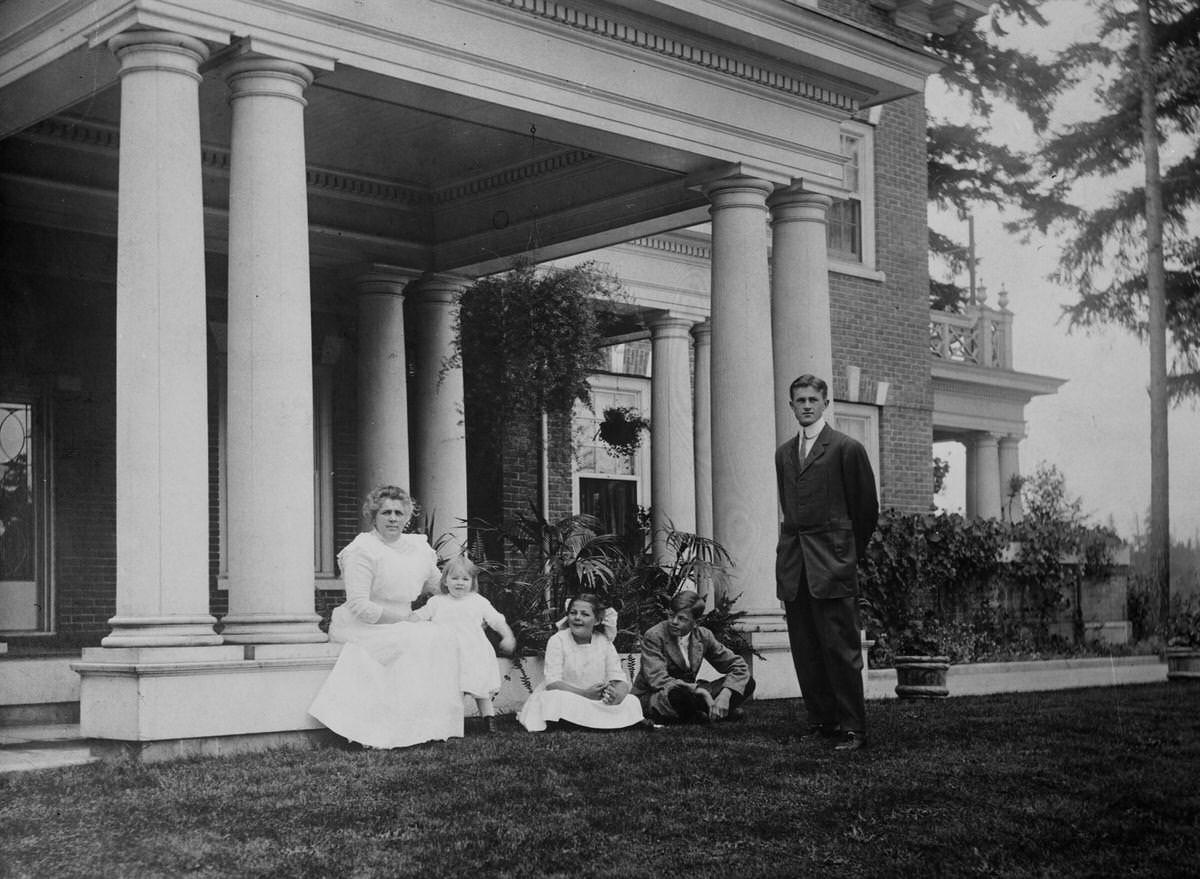
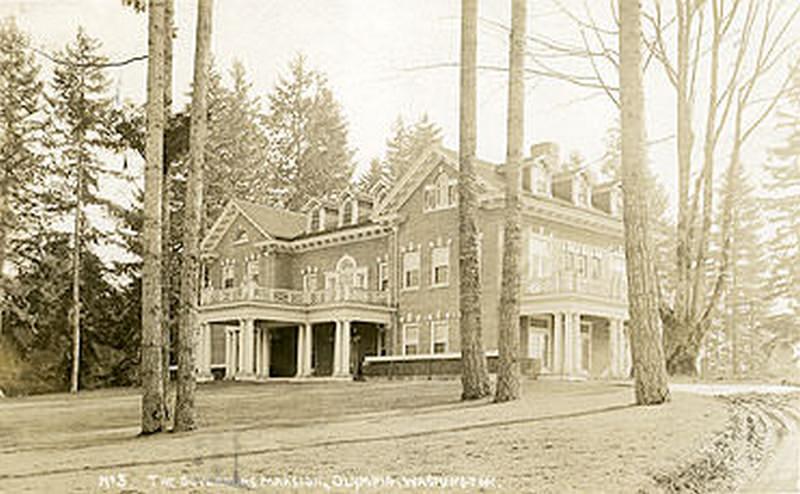
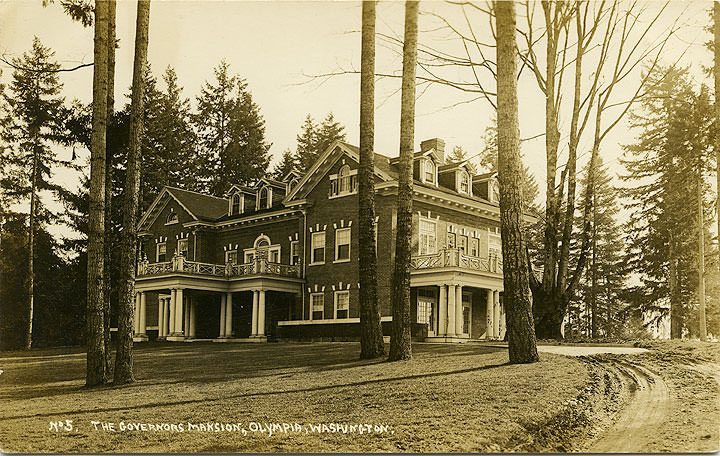
Shows Lizzie Hay, two young men, and two girls in front of the Governor’s Mansion. The girls are Catherine and Margaret Hay, and the young men are Rance and Bruce Hay.
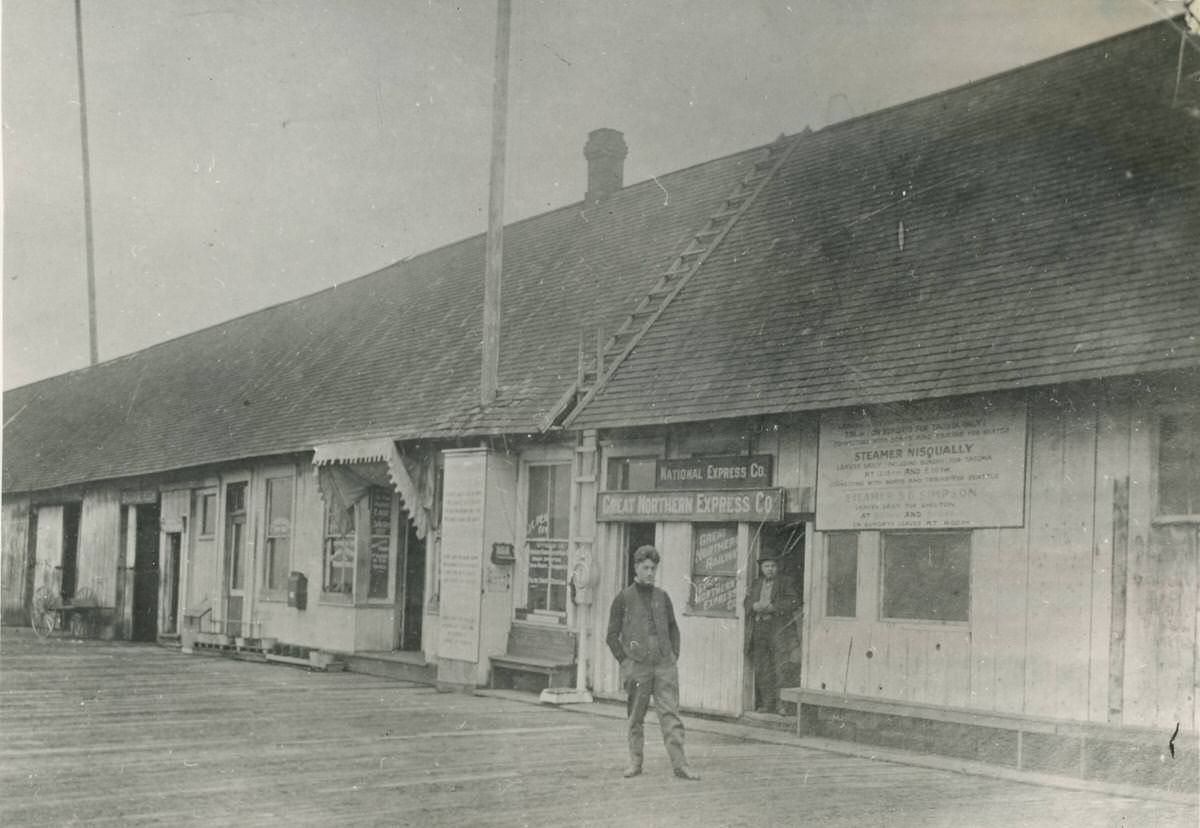
Shows Percival’s Dock and Great Northern Express Co. Includes a sign showing the schedule for Steamer Nisqually and Steamer SG Simpson. John Percival stands in the foreground. An older man stands in the office doorway.
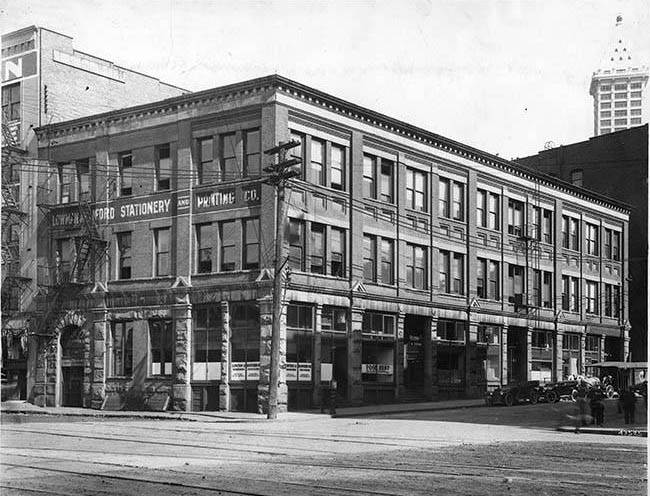
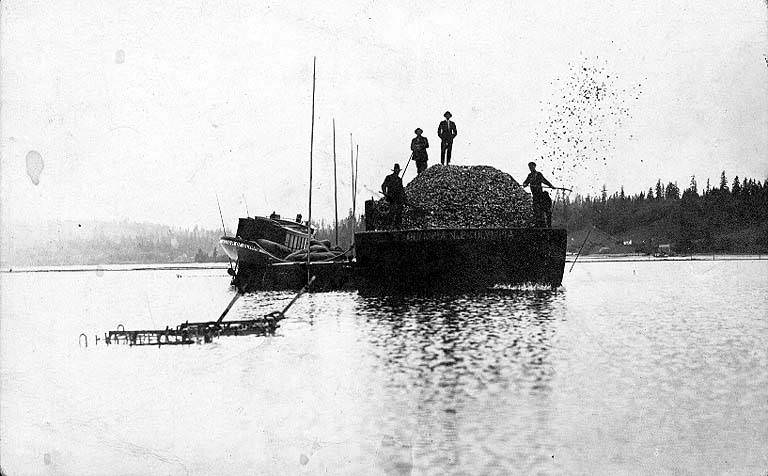
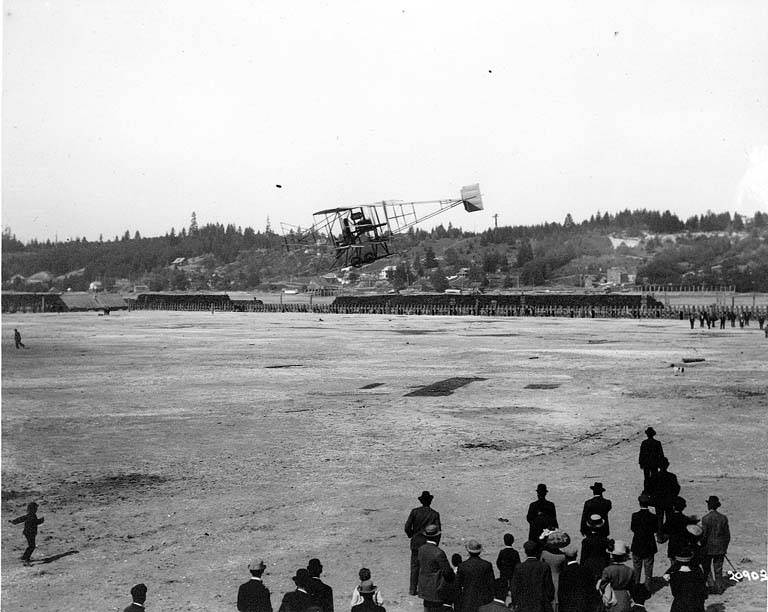
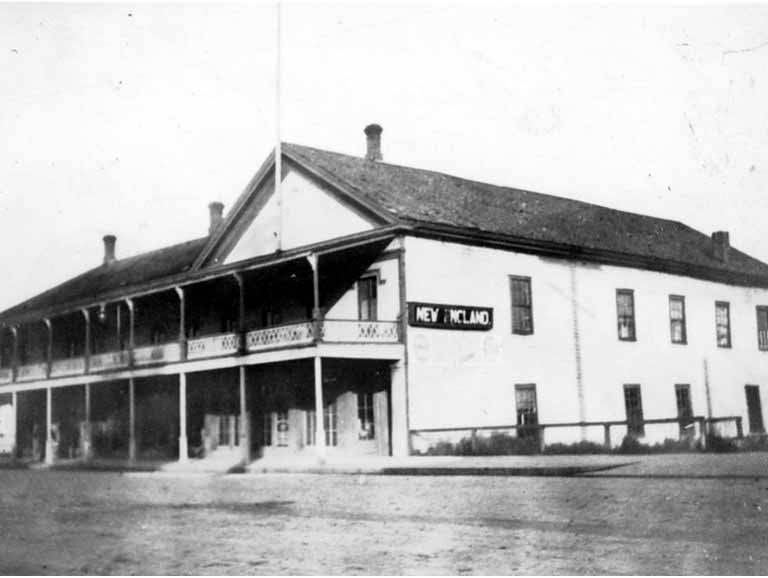
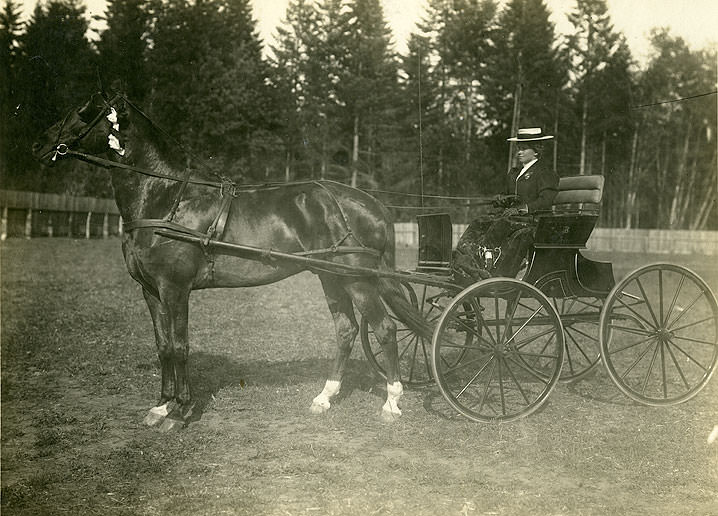
She is identified as Minnie Blass, wife of John Blass, owner of the Olympia Oyster Company. The location is identified as the Carlyon Racetrack in Olympia, WA, Thurston County. The carriage is a one-person racing carriage with large wooden spoked wheels. The horse’s mane is trimmed with white ribbon. Minnie is wearing a dark suit with a light-colored straw hat with a wide brim. At Minnie’s feet is a trophy.
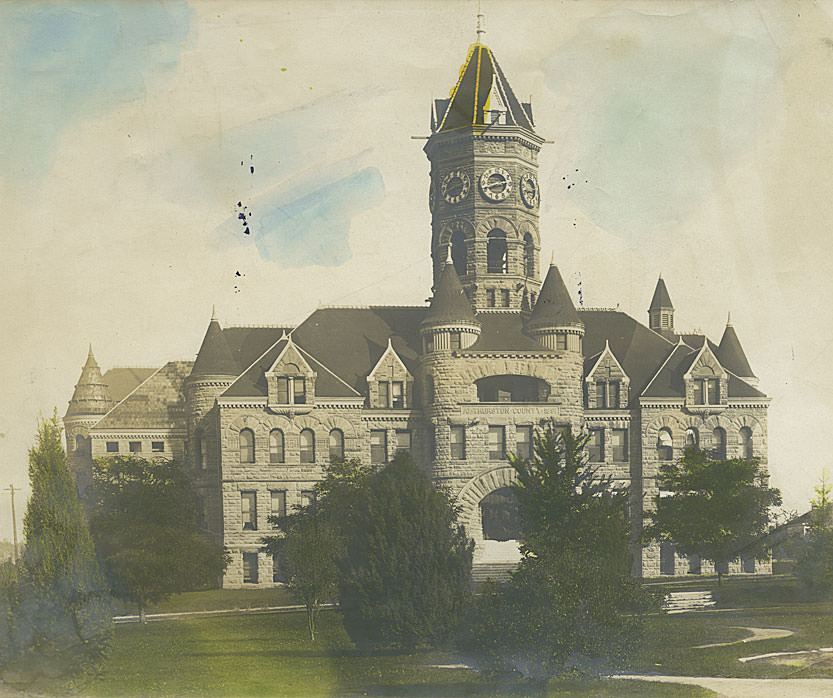
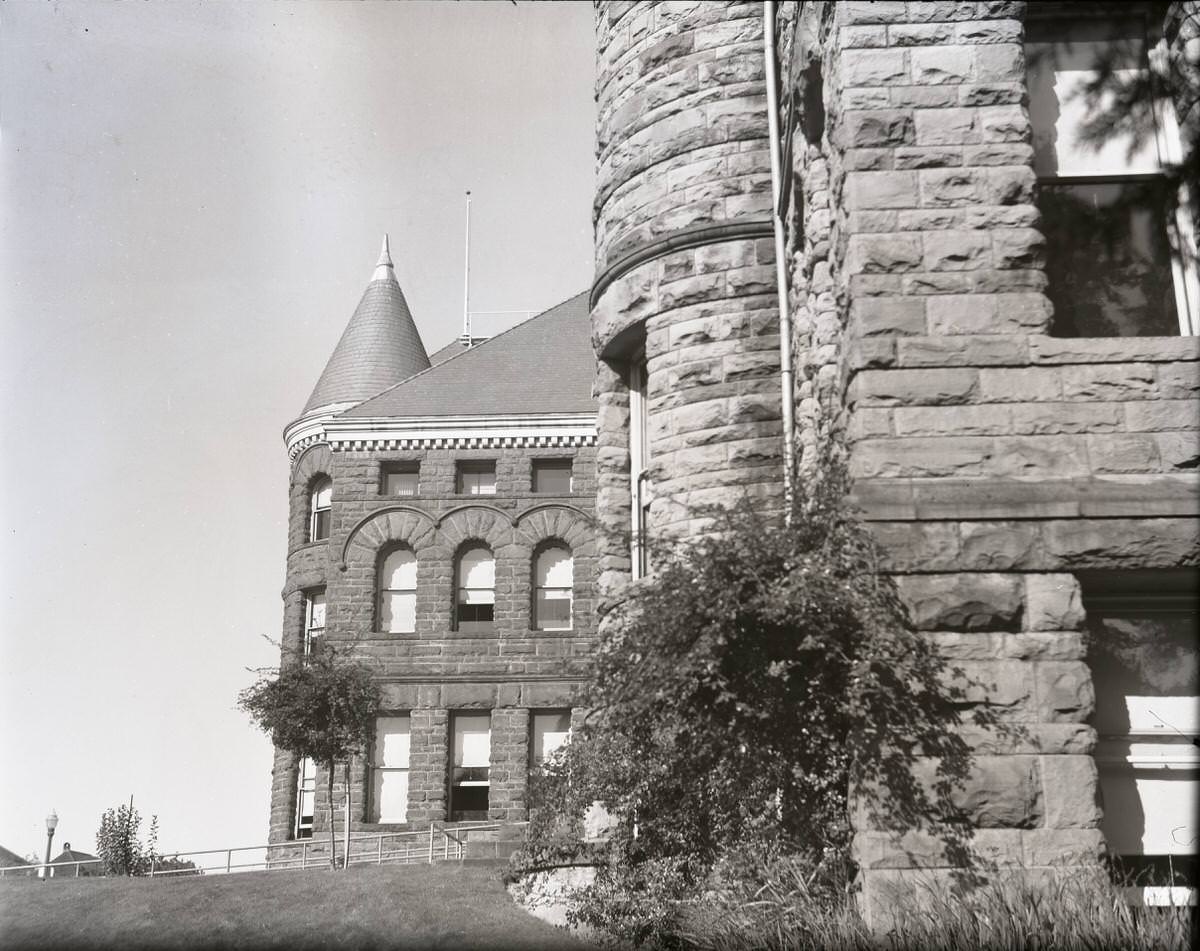
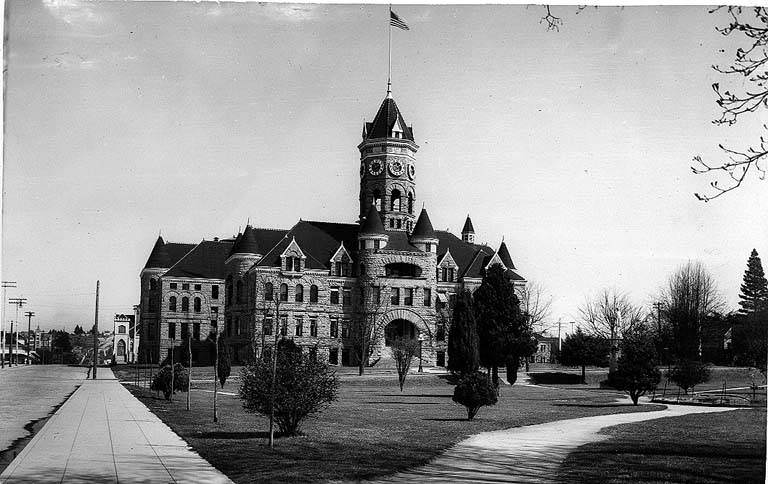
It is a Richardson Romanesque structure with multiple gables and turrets. A clock tower extends several stories from the center. In the foreground is Sylvester Park.
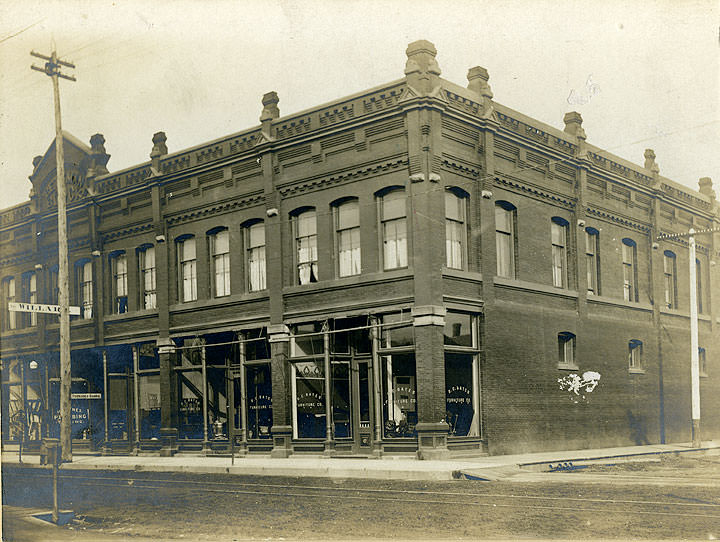
It is a two-story brick building with decorative features at the roofline. In the center of the roofline the words “Bettman Block” are carved into stone in a decorative superstructure. At the second story, sashed windows line both visible sides. On the ground floor are several businesses, including the D.C. Bates Furniture Company and the Jones Plumbing Company. There is a sign extending from the second story reading “Willard Hotel,” which was located on the second story.
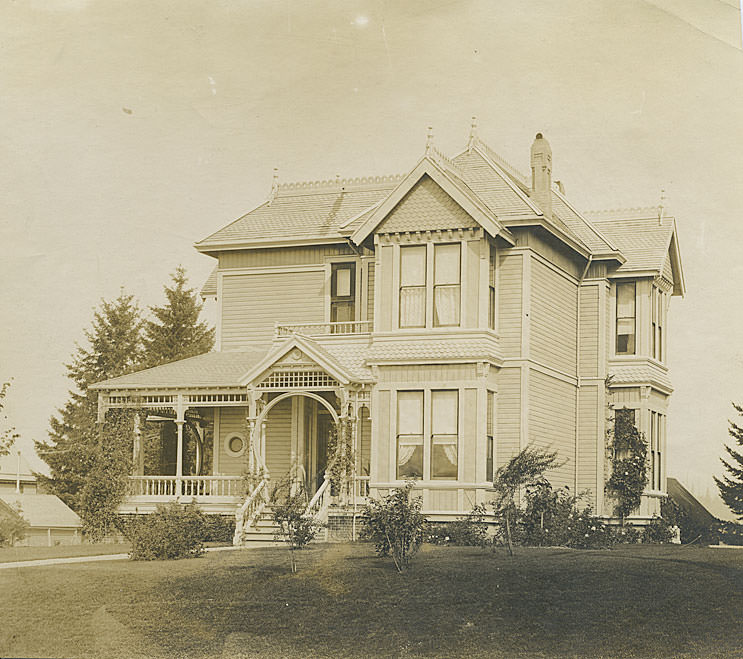
It is a two-story home with two-story bay windows on two visible sides, ornamental shingling, a small balcony on the second story, and a wrap-around porch. A paved sidewalk leads to the entrance. To its left another structure is visible. This home was located at 11th Avenue between Capitol Way and Washington Street. Another Phillips home was located on what is now Capitol Campus.
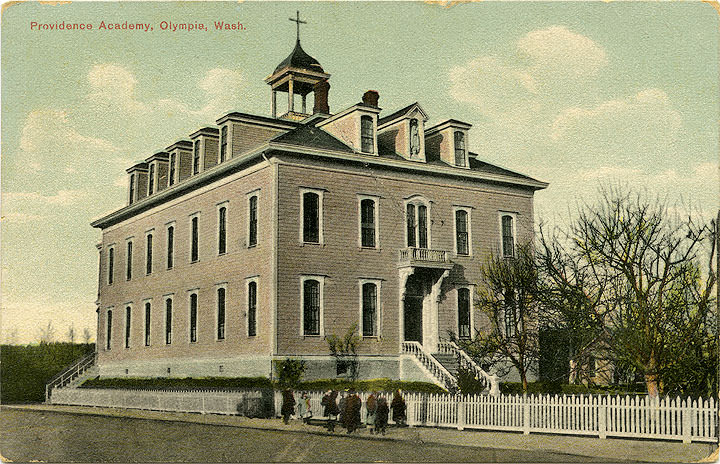
It is a two-story brick building with gables and a cupola. A fence runs along the sidewalk in front of the building, and figures are featured in front of the fence. Lynch/White collection.
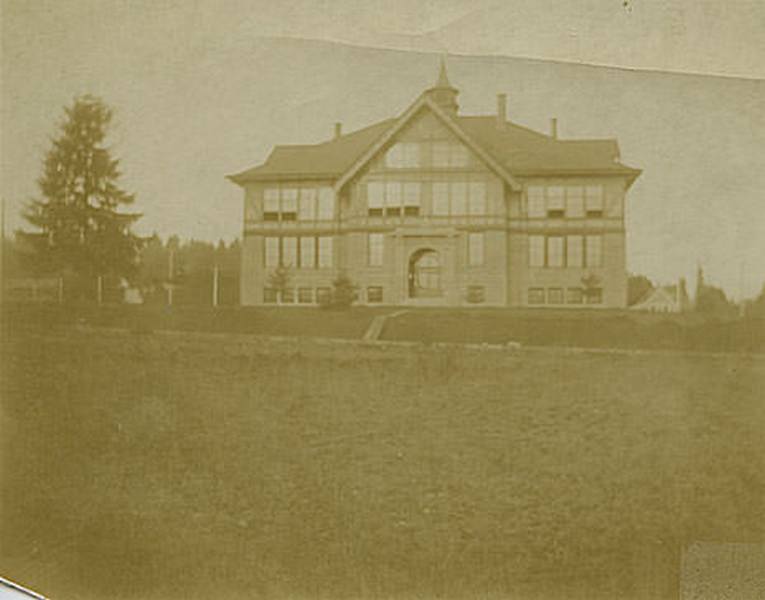
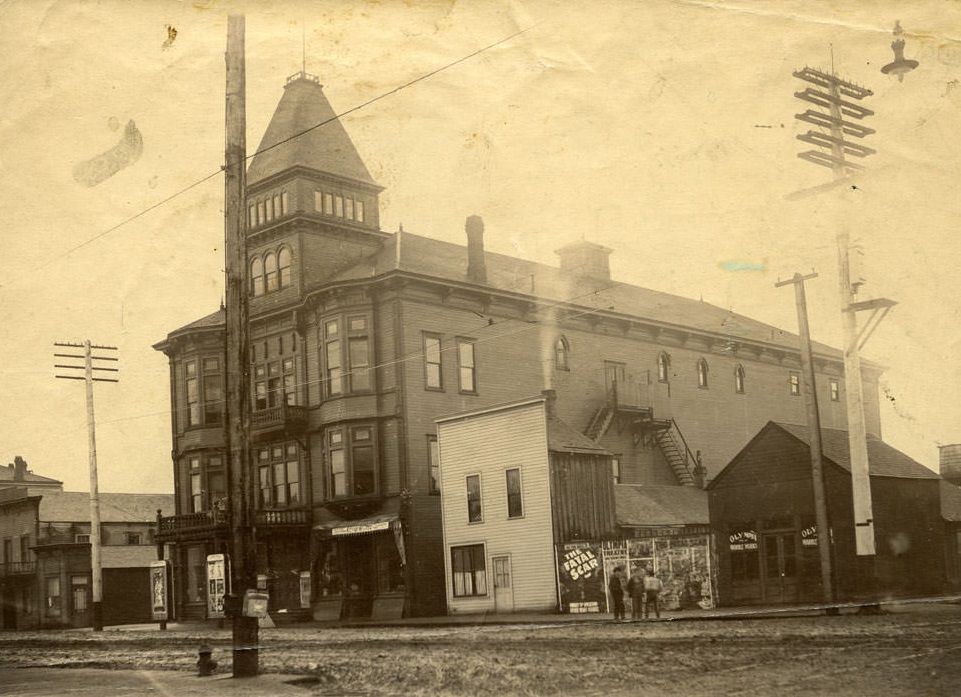
The building is also known as the Olympia Opera House. Other businesses on the sides include a saloon and the Olympia Marble Works. A wooden fence along the sidewalk advertises movies, including “The Fatal Scar.” Three men stand in front of the fence. There are sidewalks along both sides of the wide unpaved road. There are utility poles and a fire hydrant, with a post box affixed to one of the utility poles. The building was built by John Miller Murphy.
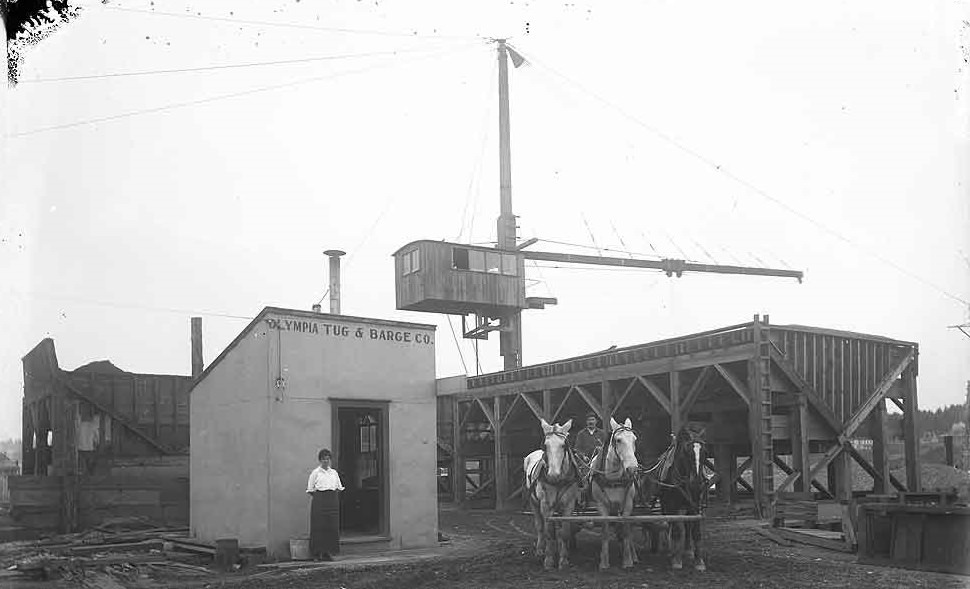
A small concrete office building is dwarfed by large wooden structures behind it, including a crane with wooden housing. The waterfront is barely visible in the background. A young woman stands in front of the office building, which is painted with the words “Olympia Tug & Barge Co.” A man is sitting on a cart being pulled by three horses.
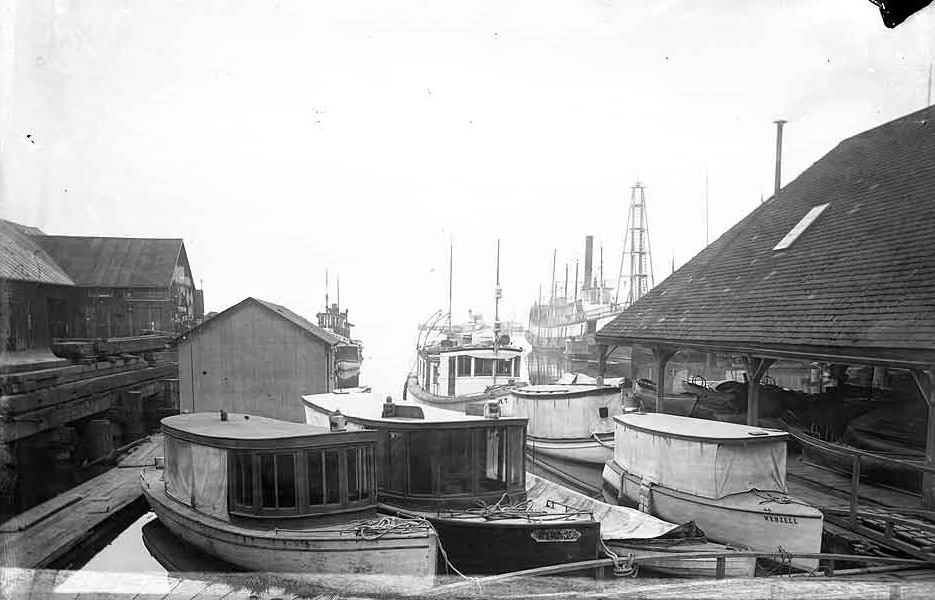
Most are small cabin boats, some with canvas coverings. One boat is the “Wenzel” and may be named after Wenzell Cusack Jeffers, a member of a prominent Olympia family. To the right of the Wenzell is a covered moorage area. In the distance is a steam ferry and other larger vessels.
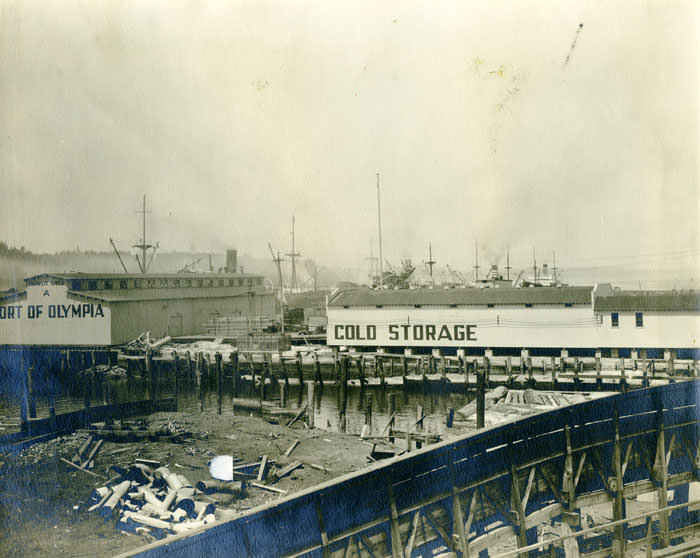
Behind this is a waterway or estuary. Debris of pipes and lumber are scattered on a mud flat. A long dock extends into the water. At the right of the dock is a Cold Storage Building, and at the left is a building labeled Transit Shed “A” Port of Olympia. Behind these, the tops of several ships are visible. All have masts and smokestacks, and are likely members of the Puget Sound Mosquito Fleet.
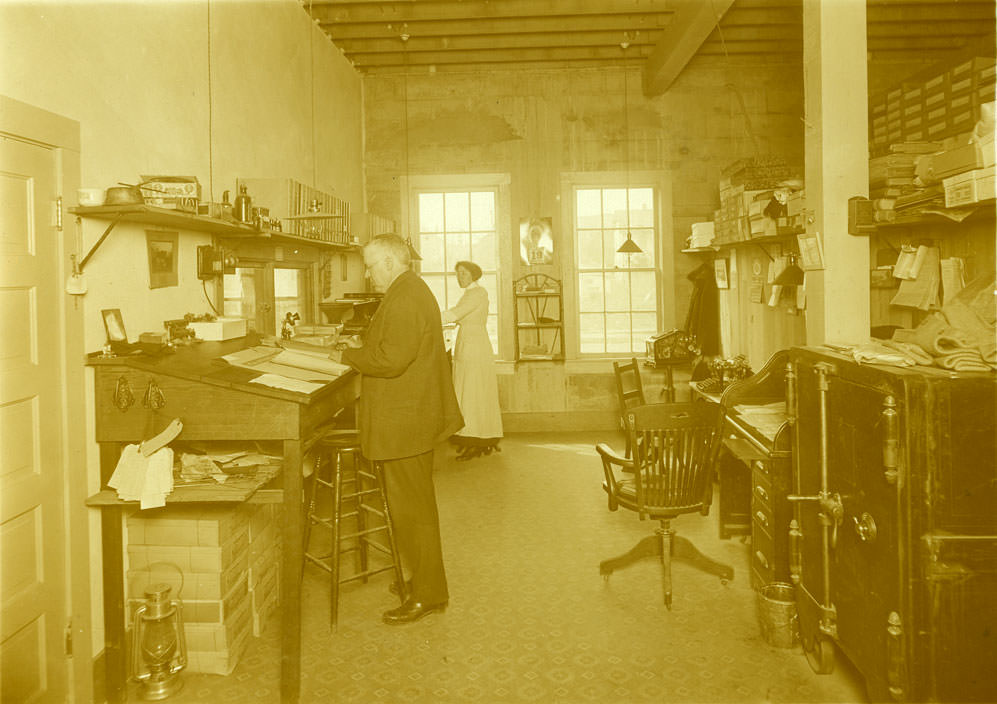
There are several desks and a large safe. A man stands at a desk in the foreground and a woman stands near a window in the back of the room. Handwritten on image back: “Office at Olympia Knitting Mills. Mr. Maynard. Olga Hartman.”
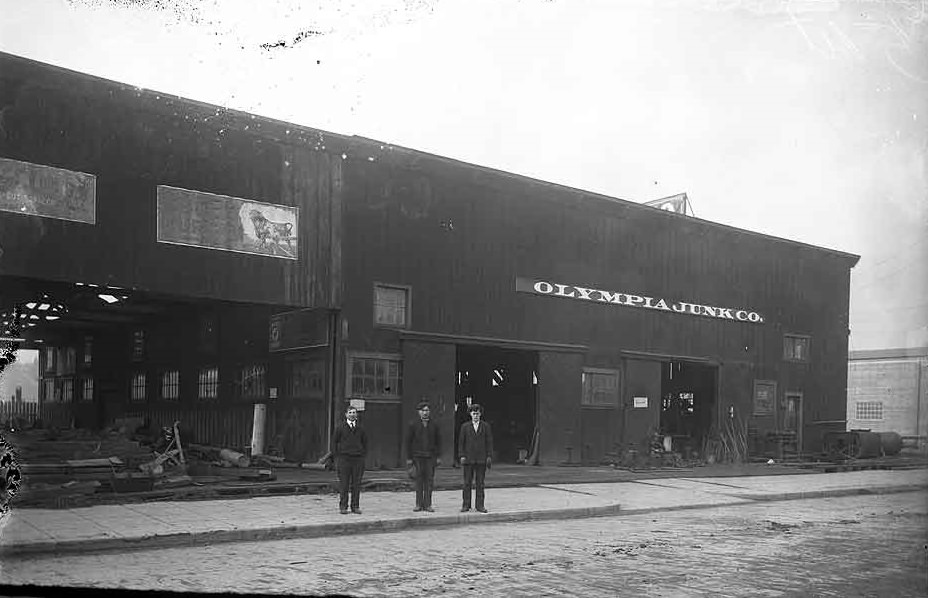
It is a long two-story wooden building. An open bay takes up about half of the building’s width and has miscellaneous debris scattered over the floor. To the right are two additional bay openings with sliding doors. More junk is piled up in front of those doorways. The words “Olympia Junk Co” are painted over the doorways. There are also signs for tobacco companies (Bull Durham) over the large open bay. Standing on the paved sidewalk in front of the building are three men. From left to right: a young man with a sweater and dark trousers with a cigar in his mouth; a young man holding a hat; and a young man wearing a hat. The street in front is paved.
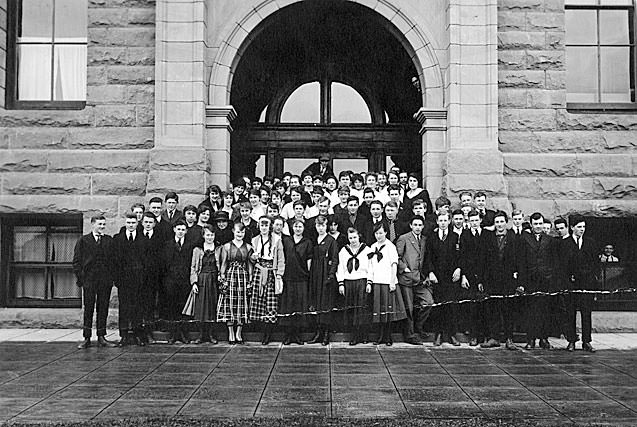
The girls are dressed in calf-length skirts and tops, some in middy tops. The boys are dressed in dark suits with white shirts and ties. One boy in a cap is being held or propped up above the others at the rear of the group, and another boy or man is peering out from behind the archway near the top of the entrance. They are standing at the entrance to the high school, which has a tall stone archway.
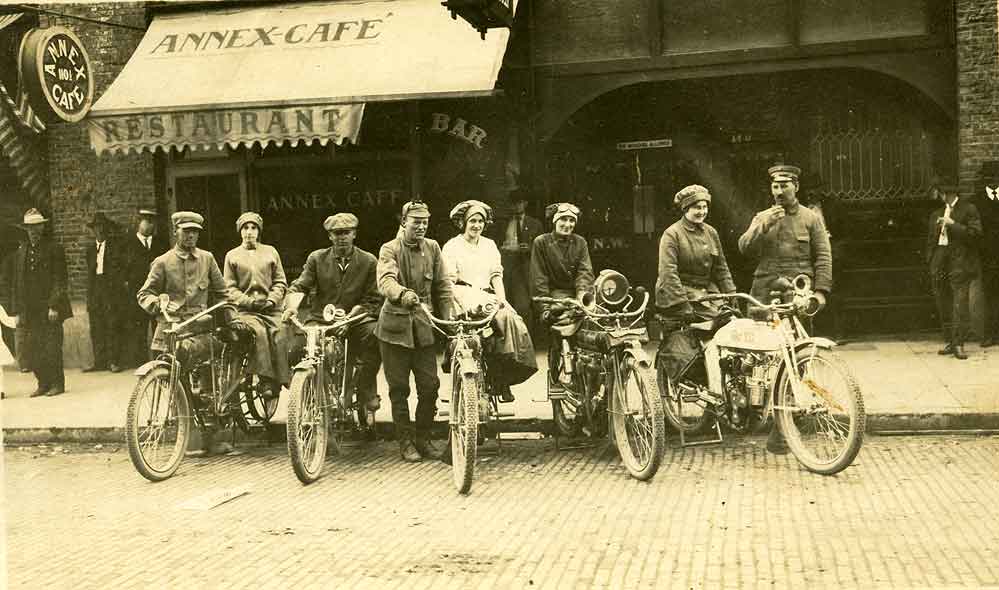
Three men stand next to motorcycles with young women sitting on the rear seat. Another man is sitting alone on his cycle, and a fourth woman is sitting on the rear of a fifth motorcycle. The women are dressed in long skirts and caps, and the men in motoring jackets and caps. One woman wears goggles pushed up onto her forehead. There are five spectators standing on the sidewalk behind them.
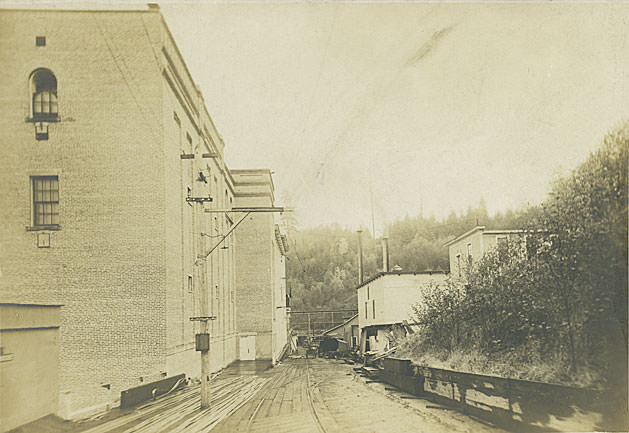
The brick brewhouse is at the left. A set of tracks approaches the facility. To its right is another structure with two slender smokestacks.
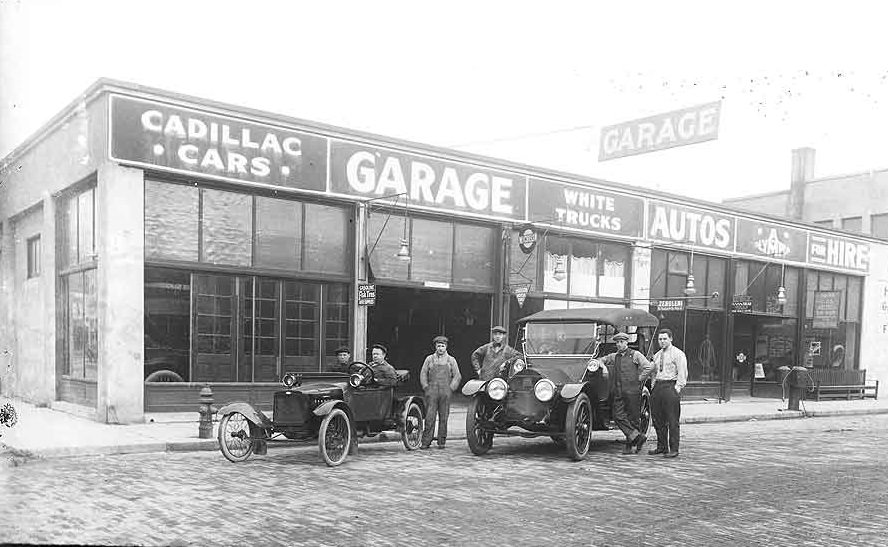
It is a long, one-story building. An automobile is visible behind a wide display window that is partly obscured by sliding doors. There is a wide open bay between display windows. Over the windows and doorways are painted signs reading “Cadillac Cars, Garage, White Trucks, Autos, Olympia, For Hire.” In front of the building are two automobiles: one smaller roadster with an open top, and one touring car with a canvas top. Six men are with the vehicles. Two are in the roadster and wear working clothes and caps. A third man in working clothes stands between the two cars. The other three are standing next to or leaning on the touring car. Two are in working clothes and the last is in a shirt and tie with his hands in his pockets. On the sidewalk are a fire hydrant and a bench.
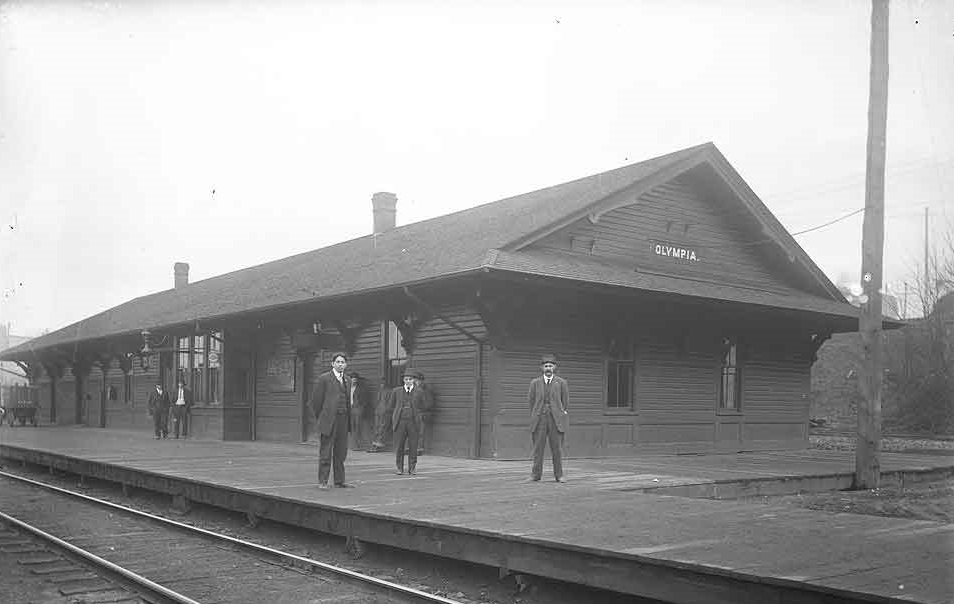
It is a long, one-story clapboard building. At the near end the word “Olympia” is painted under the eave. Seven men stand between the building and the track, looking at the photographer. One is wearing a conductor’s cap. A cart can be seen at the far end of the building. A single set of tracks is visible in the foreground.
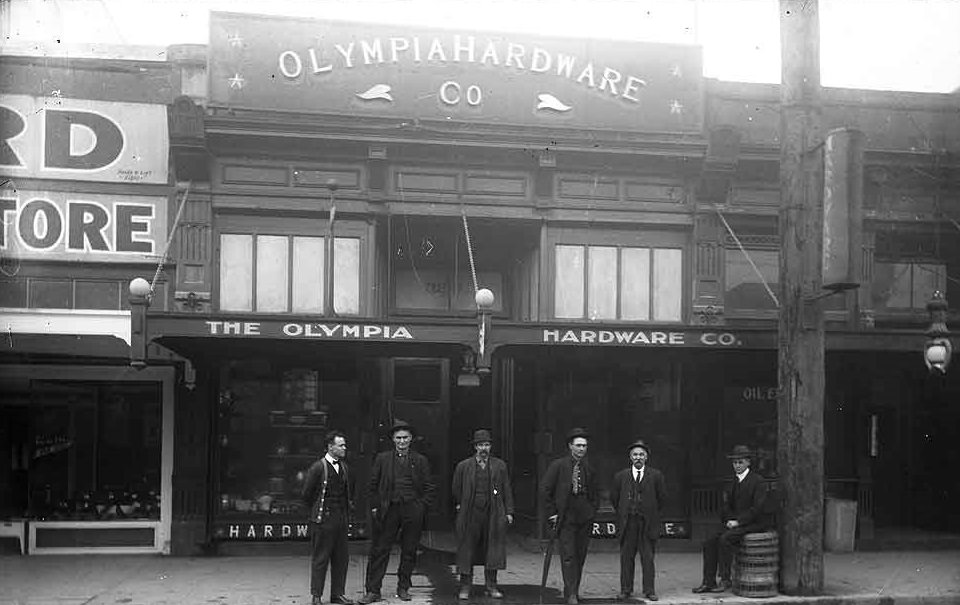
It is a two-story masonry building in the middle of a commercial block. At the roofline is a sign reading “Olympia Hardware Co.,” which is also painted on a fixed awning over the storefront. Clerestory windows are above the awning. Items for sale are displayed in the storefront. Six men are posing outside the building on the wide paved sidewalk. From left to right: a younger man in dark trousers, vest, bowtie, and a sweater; a man in a dark suit and hat with hands in pockets; a man in an overcoat, bowler hat, and a mustache; a younger man in a dark suit, leaning on his umbrella; an older man with white hair and mustache and hat, hands behind his back; and a younger man sitting on a barrel, wearing a dark suit and hat. A utility pole is on the sidewalk to the right of the store, with a sign reading “Hardware” hanging from it.
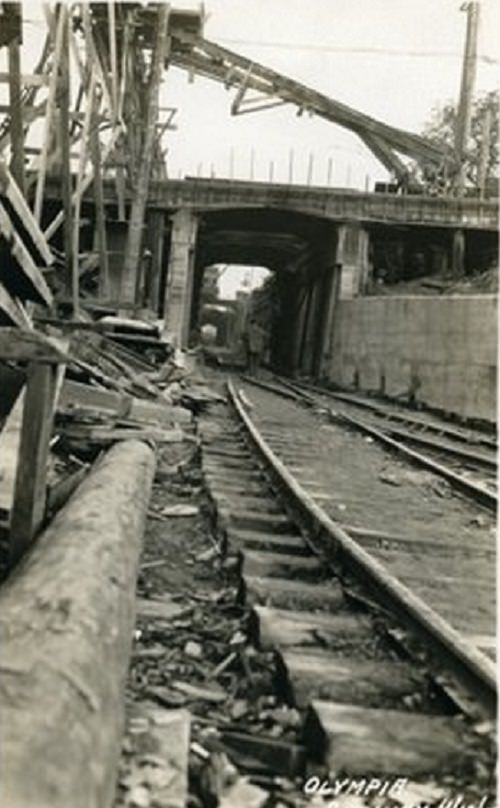
The construction of the expansion of the Olympia Subway, also known as the 7th Avenue Tunnel. A set of tracks leads through three underpasses. The area in between each underpass is open to the sky. Scaffolding is erected to the left of the tunnel construction. A large conduit runs along the left of the tracks. A man is standing on the tracks next to the first underpass.
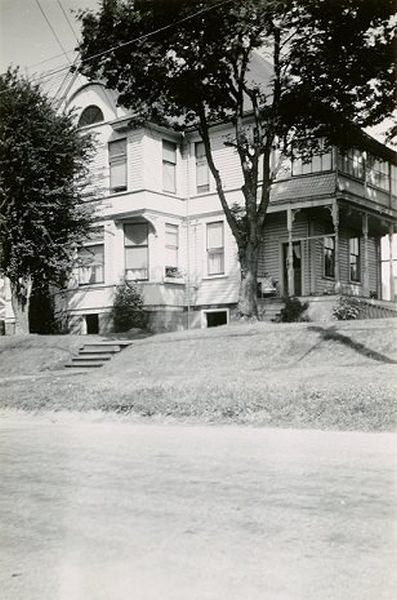
It is a two-story clapboard structure with a truncated steeple. An enclosed entryway faces the unpaved street. Sashed windows run along the front on both levels, and tall sashed windows run along the long side. To the right of this church is the second Methodist Church building, which was erected in 1901. A corner of that building and part of its circular stained-glass window are visible.
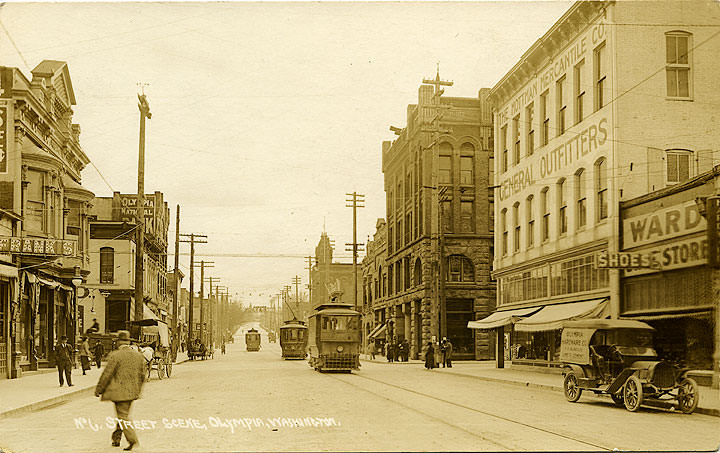
The street is wide and paved. Running up and down it are three trolley cars. A pedestrian is crossing the street in the foreground. A delivery van for the Olympia Hardware Company is parked in front of the Ward Shoe Store. Beyond it, on the right, are the Mottman Mercantile, the McKenny Block, and then the Odd Fellows building. On the left-hand side of the street are the Chambers Block and the Turner Block. A horse-drawn cart is parked in front of the Chambers Block and another in front of the Turner Block. A few pedestrians are on the sidewalks.
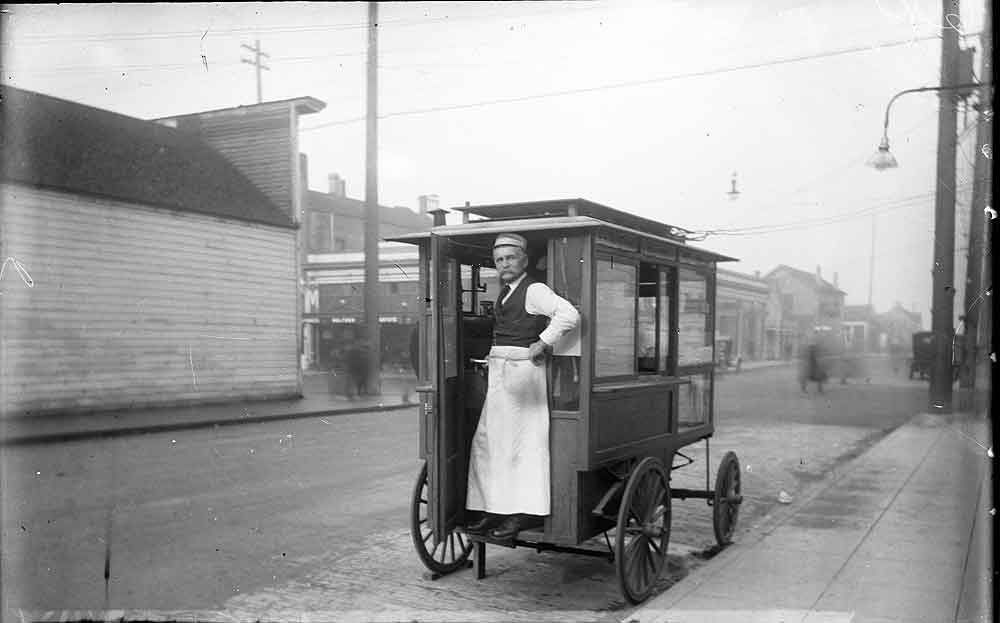
The vendor is standing inside a vending cart that has spoked wheels and no visible means of locomotion. A door to the cart is open. It is stabilized with blocks of wood next to one wheel and below the cart. It is not clear from the photograph what food items he is selling. The man has a long white apron, a cap, vest, and shirtsleeves. His hand is on his hip. Across the street is a clapboard building with a false front, along with other commercial buildings. To the right is a paved sidewalk. The street is partly brick-paved. Utility poles, street lights, and wires are also visible. Robert Esterly, photographer.
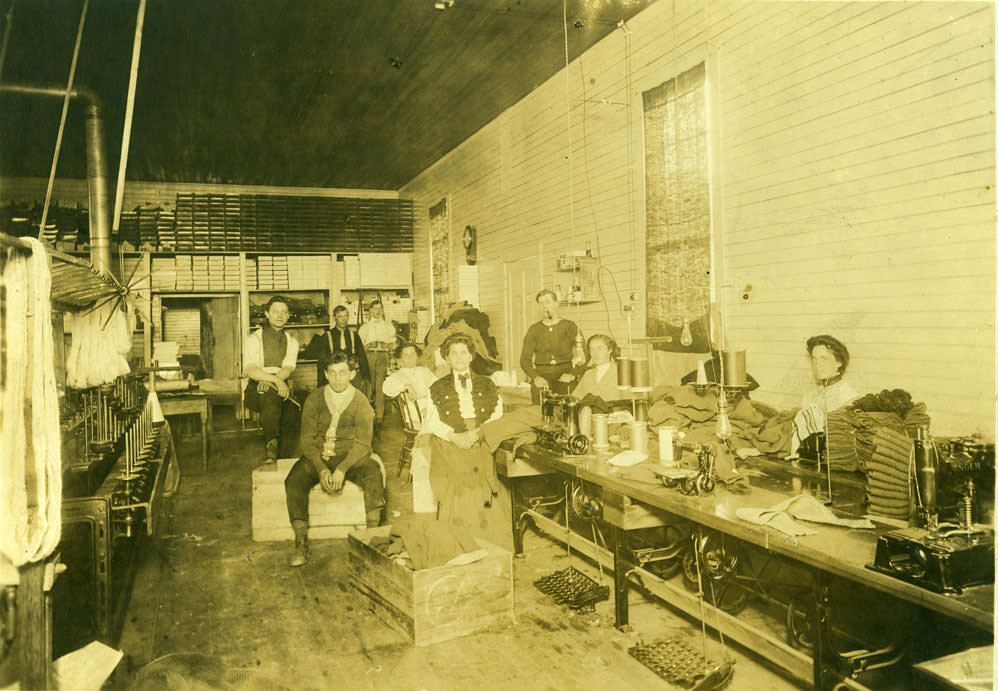
Several workers stand and sit around tables in a large workroom. Piles of garments lay on the tables and in boxes. The accession record describes them as the finishing crew. Handwritten on image back: “Olympia Knitting Mill workers. Elizabeth Yoder, Retta Rambo, Harvey June. Mrs. Flysick, Lillian Phillips, Everett Maynard, Sol Myers, Clay Buchanan, Fred Lang.”
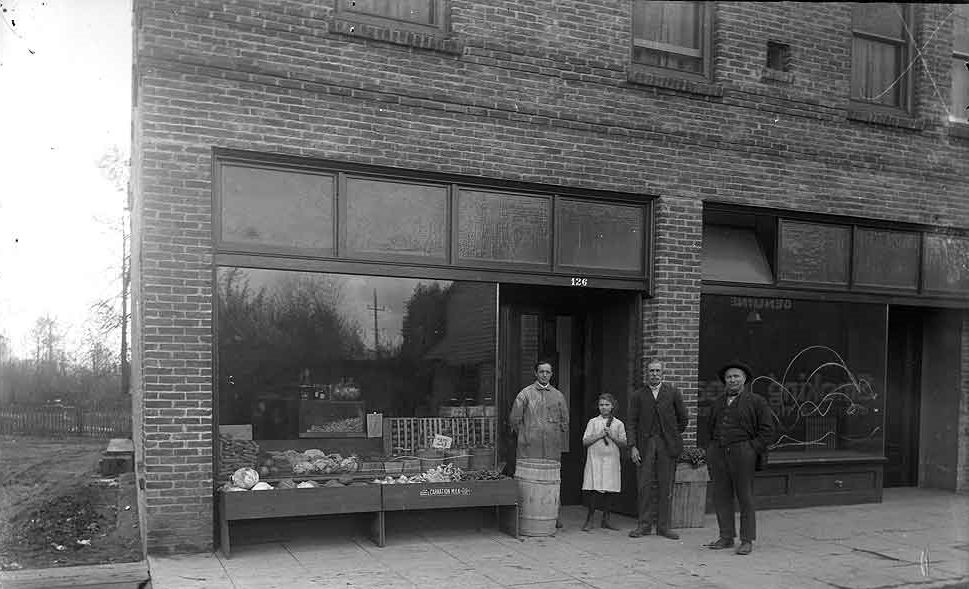
It is in a two-story brick building with sashed windows at the second story. There are clerestory windows over the entryway. Over the entrance is the number 126. A display window is to the left of the entrance. Produce is piled in bins in front of the building and inside the window. A wooden barrel is next to the bins. Four figures are in front of the building. From left to right: a young man in a smock; a girl in a knee-length white dress, high shoes, and a single braid; an older man with a white mustache and suit; and a portly older man with a mustache, vest, and hat.
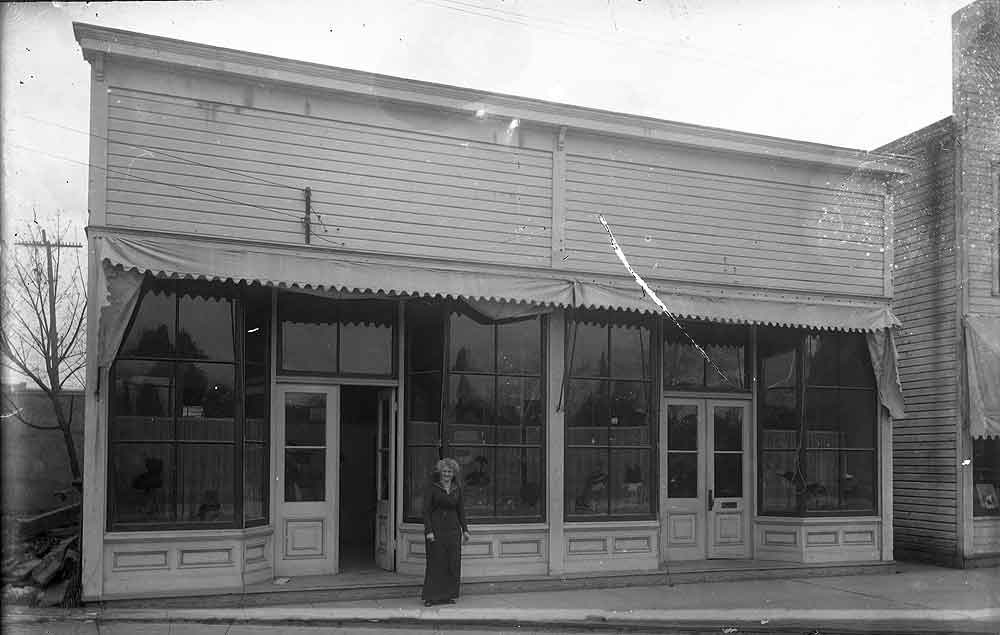
It is in a one-story clapboard building with decorative features at the base, corners, and cornices. There are two sets of storefront windows flanking entrances. A retractable awning is over both entrances. A woman, identified as Katherine Musgrove, stands on a paved sidewalk in front of the building. She has gray hair and is wearing a dark dress, narrowly cut with wide piped lapels. She is not wearing a hat. To the left of the building there appears to be a construction site with debris. To its right is another clapboard building.
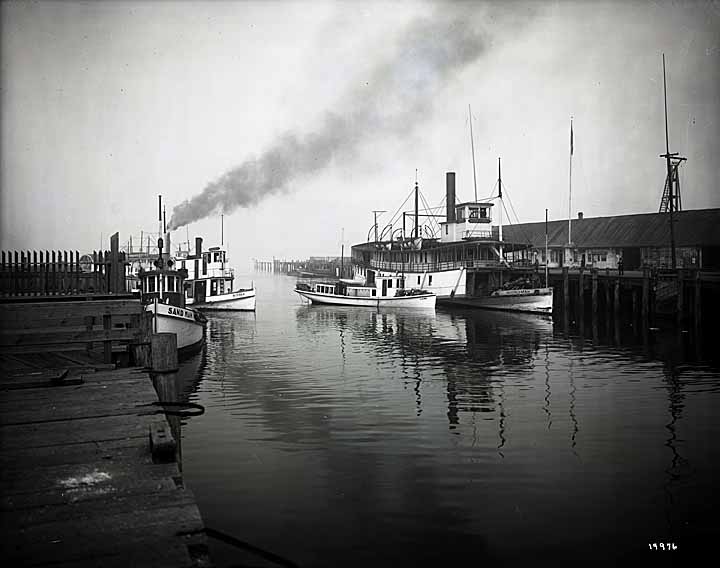
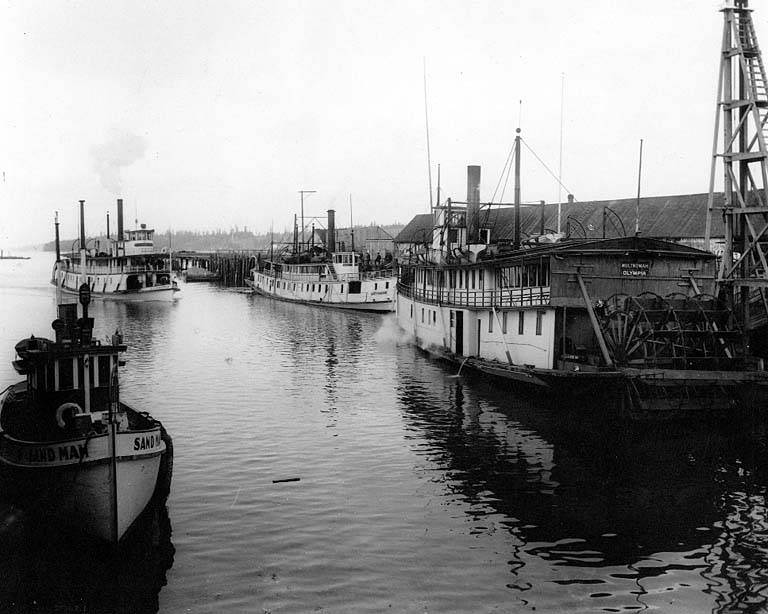
Several tugboats and a steamer are moored in the harbor. Piers extend into the water on either side and a long warehouse is visible on the right pier. The tugs are, from left to right: Sand Man, Mizpah, and Lark.
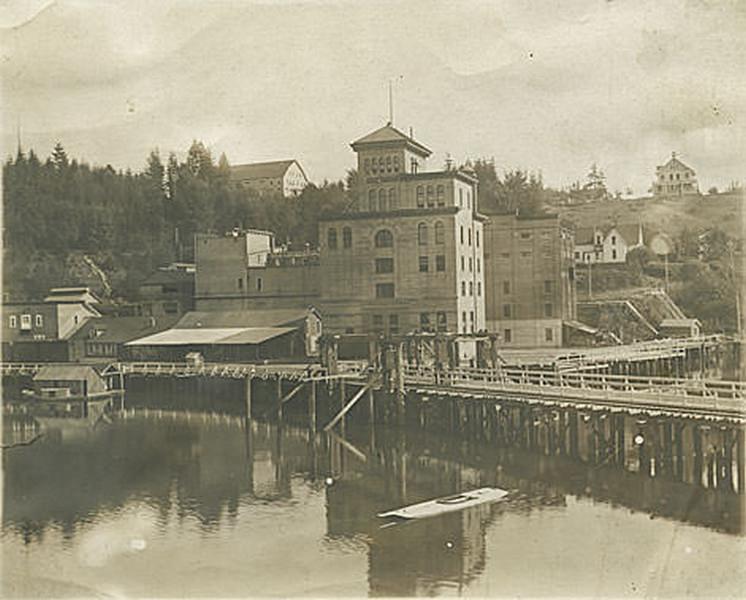
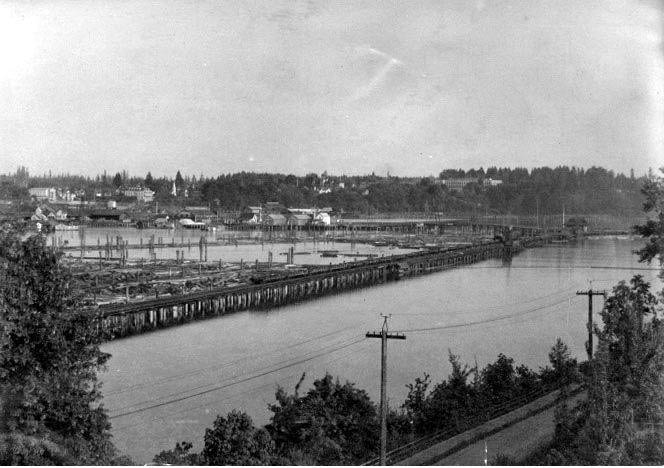
In the foreground is the Deschutes Estuary at high tide. A small boat sits in the water, tethered to a long narrow-gauge railroad bridge that extends over the water. Behind them is the multi-story brick brewhouse, with a tower topped by a roof cap. Additional commercial buildings are to the left of the large brewhouse. A float house sits on the water below them, with a small boat with a superstructure pulled up to it. A hillside rises behind the brewhouse. The Schmidt Mansion sits on its own at the top of the hill. Another large commercial or industrial structure is also at the top of the hill.
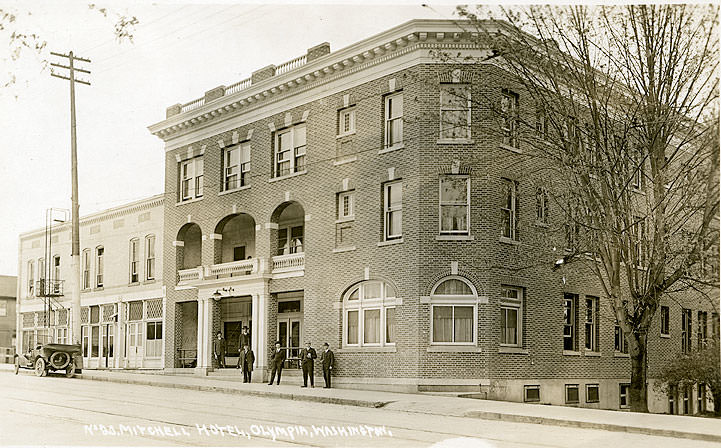
It is a three-story brick building. At the second level there are three archways with a balcony. The lower level has an entryway flanked by columns. Six men stand outside the building. To its left is a two-story building with storefronts. To its right is a vacant area with a mature tree. An automobile is parked on the street. Trolley tracks run down its paved center, Capitol Way.
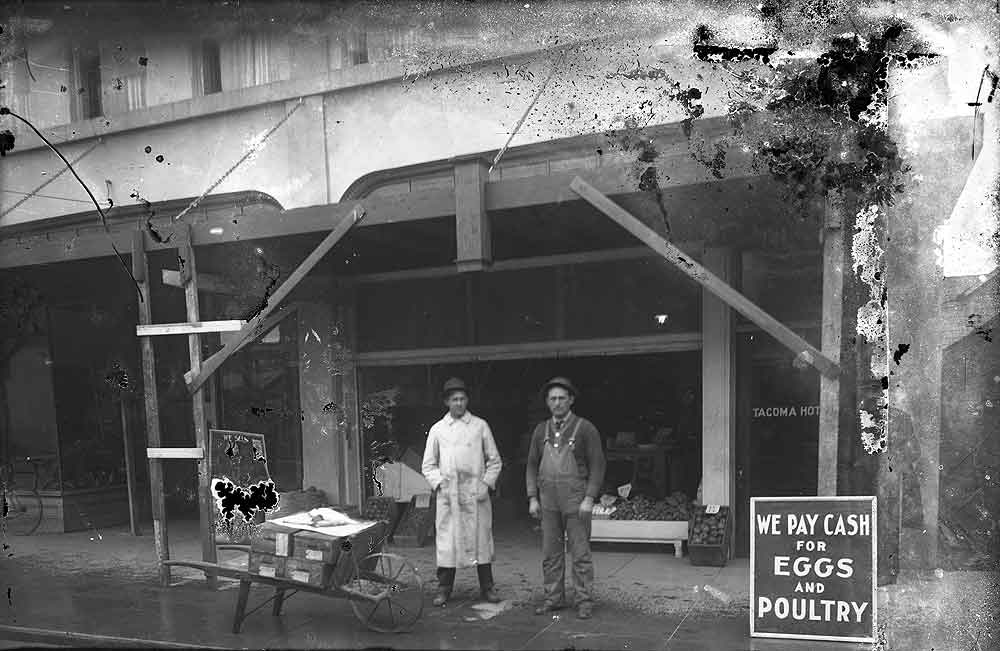
It is in a masonry building with a second story visible above. There is a fixed awning over the door. There appears to be some kind of scaffolding erected to the side of the building and attached to the awning. The storefront is open and potatoes and other produce are stacked in bins at the entrance. A one-wheeled handcart is propped along the paved sidewalk, stacked with cartons. A sign propped on the sidewalk reads “We Pay Cash for Eggs and Poultry.” Two men stand in front on the paved, rainy sidewalk. One is dressed in a dirty white smock, the other in overalls. Both are wearing hats.
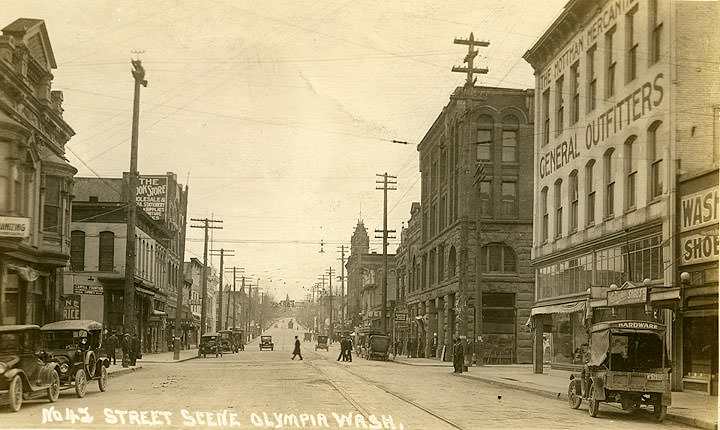
The photograph is taken from approximately Columbia Avenue. Buildings on the right side include Mottman Mercantile, the McKenny Building, and the Odd Fellows Hall. Buildings on the left include the Chambers Block, the Turner Block, and the Pacific Building. The street is paved, with a trolley track running down its center. Automobiles line both sides of the street, mostly Model Ts. There are pedestrians on the sidewalks with a few crossing the street.
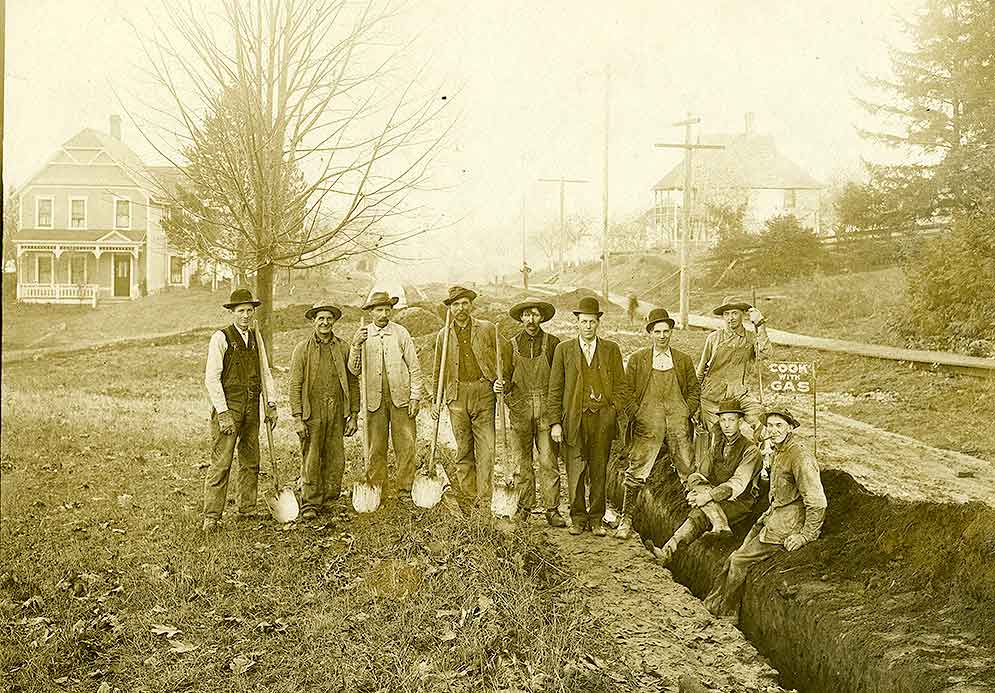
Ten men stand next to the trench. Five of them are holding shovels, and all but one are wearing workers’ clothes: jackets, hat, shirt, and trousers or overalls. One man is wearing a suit with a bowler hat. The trench is being extended down the middle of an unpaved street that has been torn up for the project. Sidewalks and utility poles extend along the sides of the street, and two large Queen Anne style homes are visible to either side of the street behind the men. A small sign reading “Cook with Gas” has been erected alongside the trench.
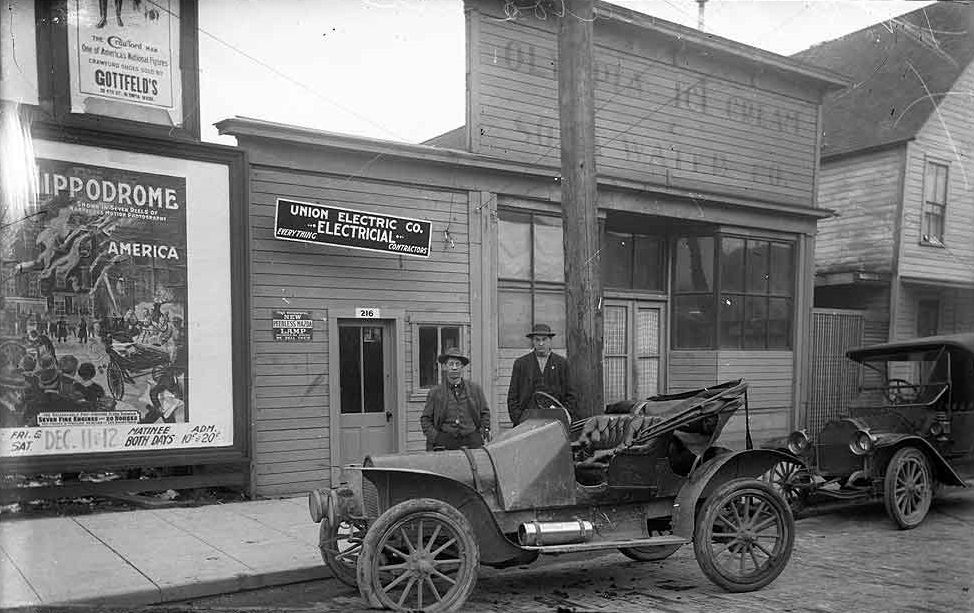
The electric company is in the left end of a small clapboard building. There is a narrow doorway with a narrow sashed window. In front of the electric company is a roadster automobile with its top turned down. Its front left wheel is partly sunk into mud at the edge of the pavement. Two men stand behind the car: one a shorter, possibly Asian man with glasses, a hat, and sweater vest; and another taller young man who is leaning on a utility pole. To the right of the electric company is another business in the same building, the Olympia Ice Cream & Soda Water Co., painted on its false front. Its doorway is curtained. An automobile touring car is parked alongside. A separate clapboard building is visible to the right.
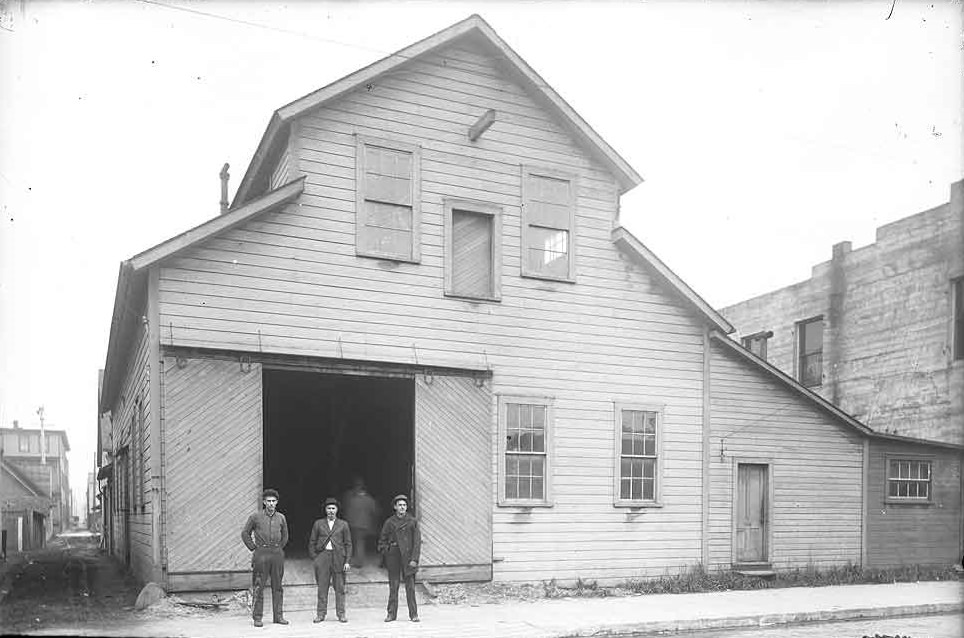
There is no sign or other clue to the name of the business, other than a second-story loft opening indicating this may be a feed store or livery. A wide entryway with sliding doors is on the ground level. Three men stand in front of the building, all in work clothes. One has a cap, shirt, and trousers, with his hands behind his back. The middle person has one hand in a pocket and is wearing a jacket and hat. The third man, wearing a cap with an overcoat, also has his hand in his pocket. A fourth figure is out of focus in the background. On the second story there are two sashed windows and an opening for stowing hay or other materials in a loft, with a horizontal beam to which a hoist can be attached.
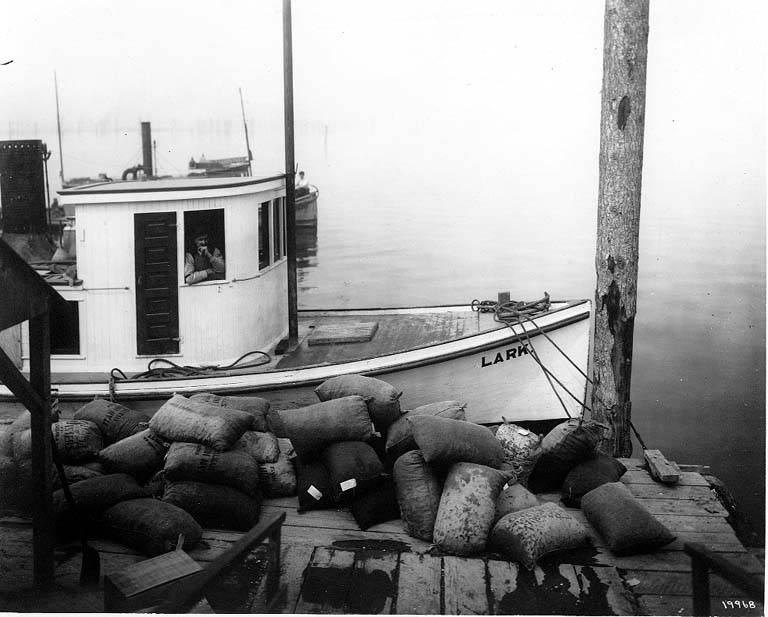
![Launch [Lark] Delivering Oysters at the J.J. Brenner Plant-Olympia, 1910](https://www.bygonely.com/wp-content/uploads/2022/02/olympia_historical_photos_526.jpg)
The image shows the launch Lark tied to a dock. A man with a mustache, dark cap, vest, and light-colored shirt looks out from the cabin of the launch. On the dock in front of him are several burlap sacks filled with oysters. A shovel leans against the post of a structure on the left. An additional launch with a man sitting on the bow is visible in the distance.
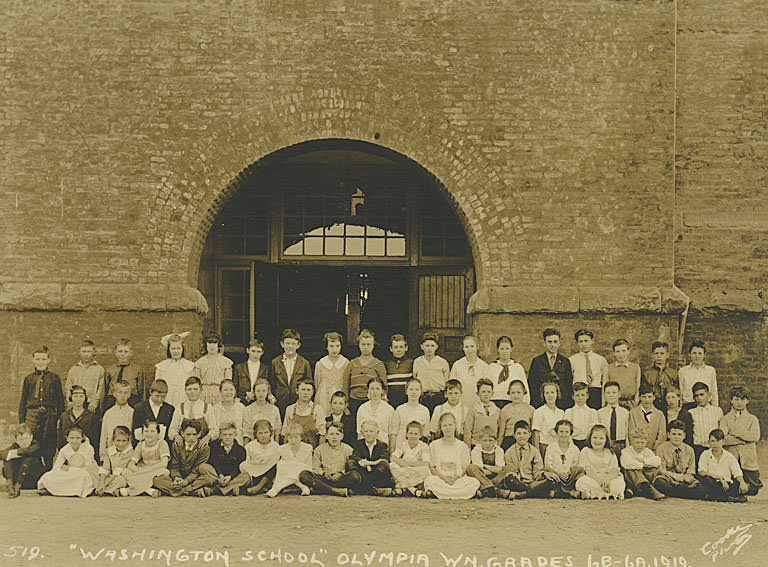
The children are in three rows: the first row seated on the ground, the second apparently kneeling, and the third standing. The children are dressed in a variety of clothing ranging from suits and ties to overalls. They are posing outside the front entrance of the school, which has an arched doorway topped by clerestory windows and a brick facade unbroken by windows.
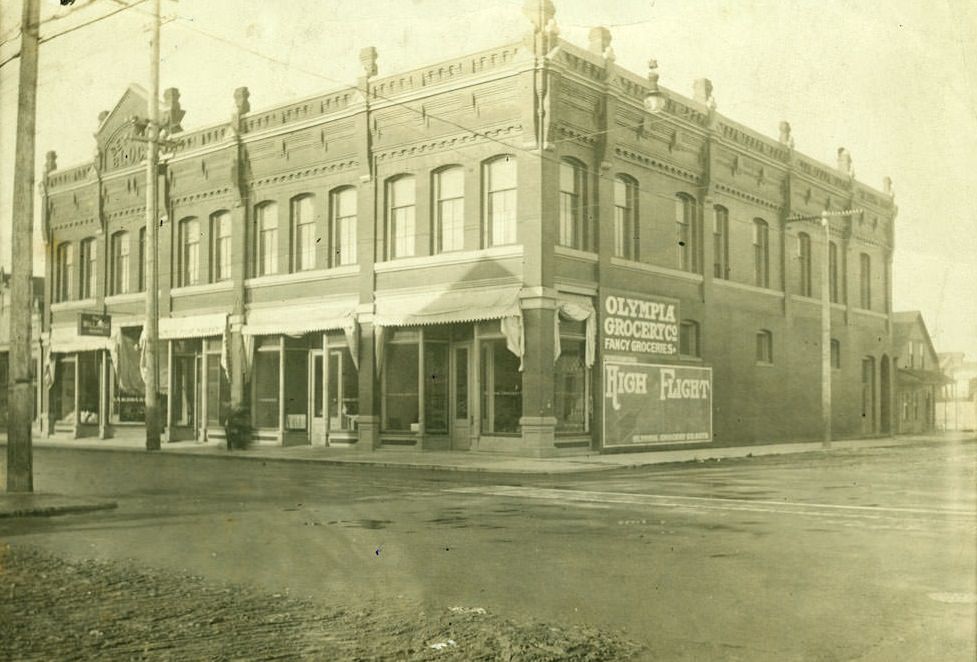
The foreground is a wide intersection with a torn-up surface in the lower left corner. The building is a large two-story brick building with a superstructure on which is engraved “Bettman Block.” On the side of the building are two large signs reading “Olympia Grocery Co Fancy Groceries” and “High Flight.” Three utility poles are visible. There are 12 second-story windows on the front of the hotel and 8 on the side. At the ground level are four thin columns supporting awnings, flanking glass-paned door fronts. To either side of each set of columns are floor-to-ceiling glass display windows. A small sign jutting out vertically from the building reads “The Willard Hotel.” At ground level on the side of the building are three small windows and a side entrance.
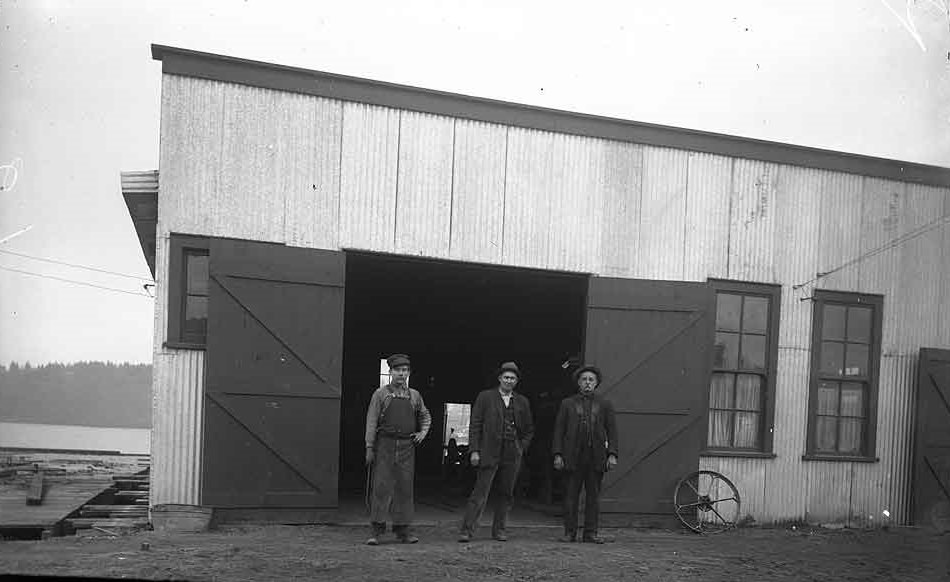
Sashed windows flank the doorways. Three men are standing facing the photographer. From left to right: a man in a leather apron and worker’s cap with his hand on his hip; a man with a suit and hand in pocket; and an older man with white hair and mustache wearing a suit. They are standing on a dirt road or entrance area. A spoked wheel is propped against that opening. To the left of this building is a wooden walkway with a waterway visible in the rear. This appears to be Budd Bay or the Deschutes River; this business is possibly one of those built on the Fourth Avenue Bridge.
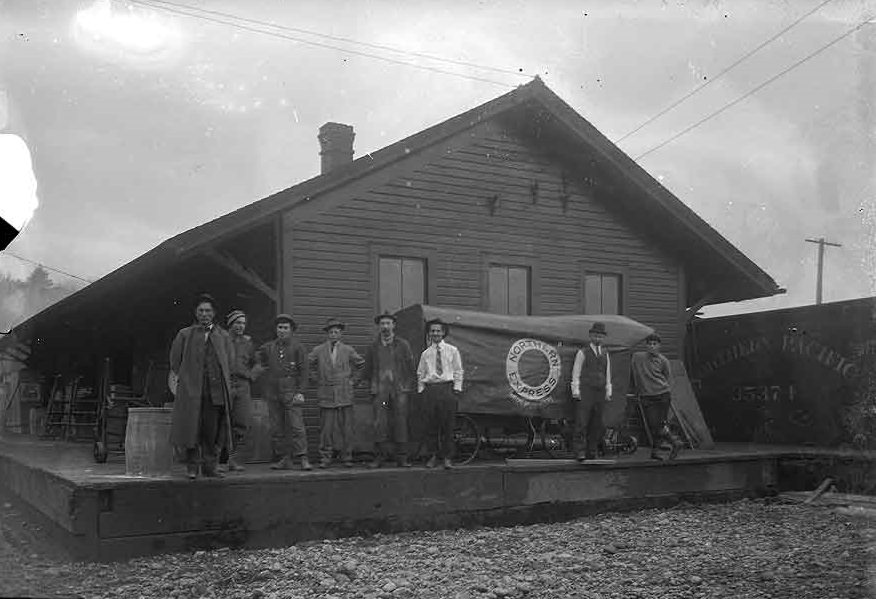
It is a long, one-story clapboard building. The southern end of the depot is visible. A cart or car covered with canvas is parked on the end of the platform, with the words “Northern Express/Northern Pacific Ry.” painted on it. A Northern Pacific car or engine with the words “Northern Pacific 35371” painted on it is visible behind the station. On the platform to the left of the image are dollies and other railroad paraphernalia. Eight men stand at the near end of the platform facing the photographer. From left to right: a young man in an overcoat, suit, and hat; two men in working clothes and caps; a man in a suit and hat; a man in overalls and jacket; a man in shirtsleeves and a tie; a man in vest and bowler hat; and a young man in trousers, sweater, and tall boots.
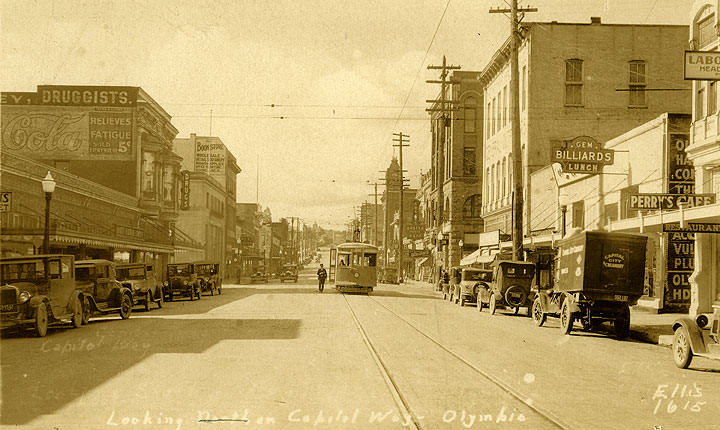
Trolley tracks run down its center, and there is a trolley car about halfway down the image, with a conductor standing beside it. Automobiles and vans line both sides of the street, including a Capital City Creamery van. Commercial buildings are on both sides of the street.
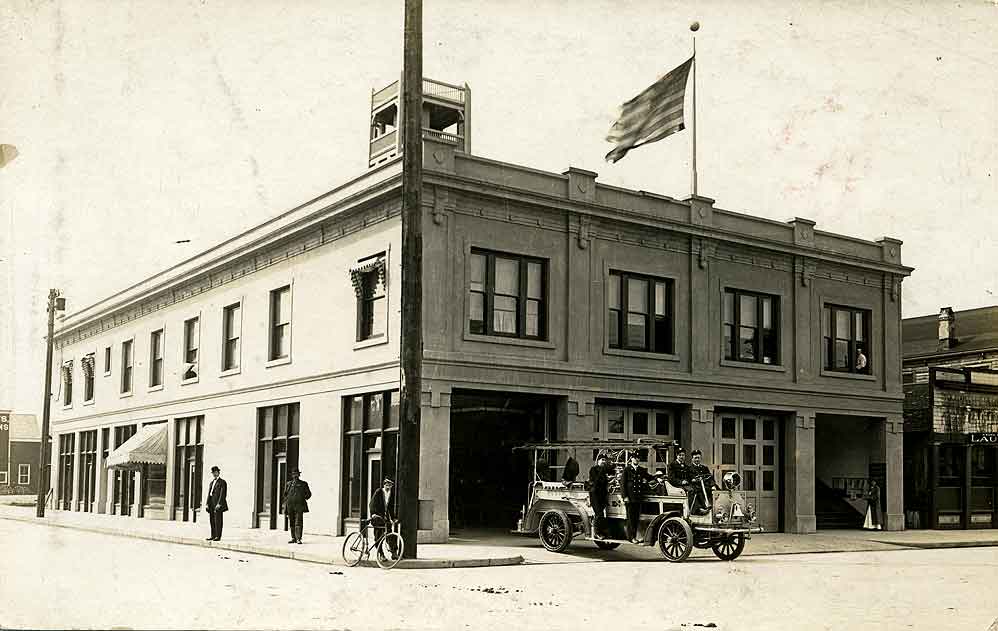
Several firemen stand on the truck. There is a flag flying from the top of the building. Several men stand on the sidewalk, one with a bicycle.
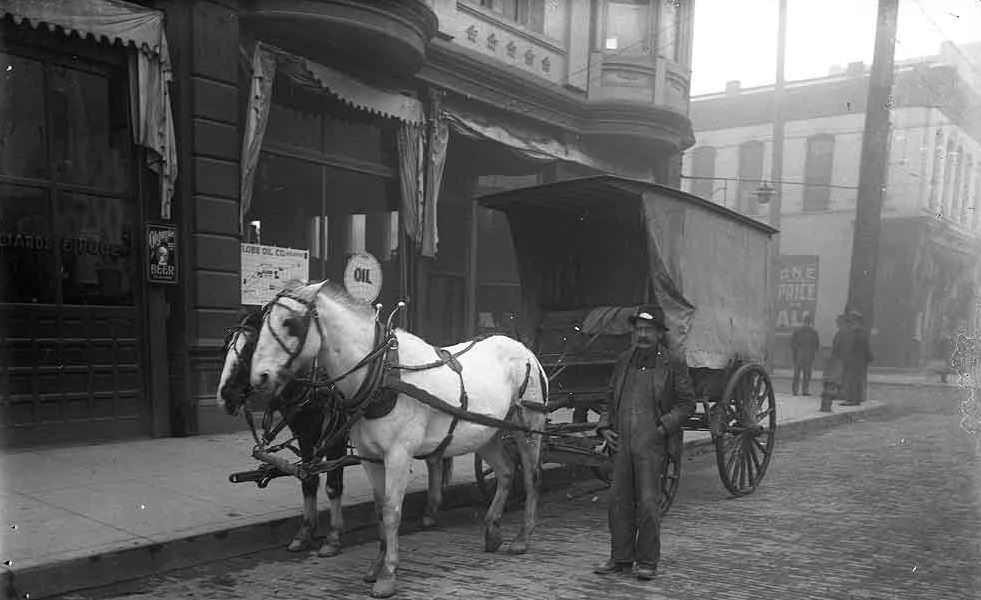
The carriage has removable cloth sides. A man in overalls is standing next to it. The building behind him is the Chambers Building. Across the street is the Mottman Building, Fourth and Main. In the window of the Chambers Building is a placard advertising the Globe Oil Co. Another sign reads “Olympia Beer.”
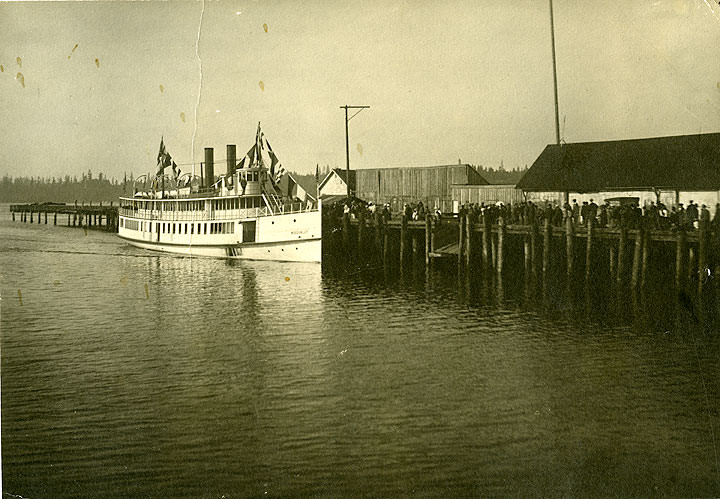
The ship is pulled up to the wharf. It has two passenger levels: one enclosed below and an upper deck with both interior and exterior accommodations. The ship is draped with flags. A large crowd is standing on the wharf. Behind them are long warehouses. The Long Wharf of Olympia extends out into Budd Inlet behind them.
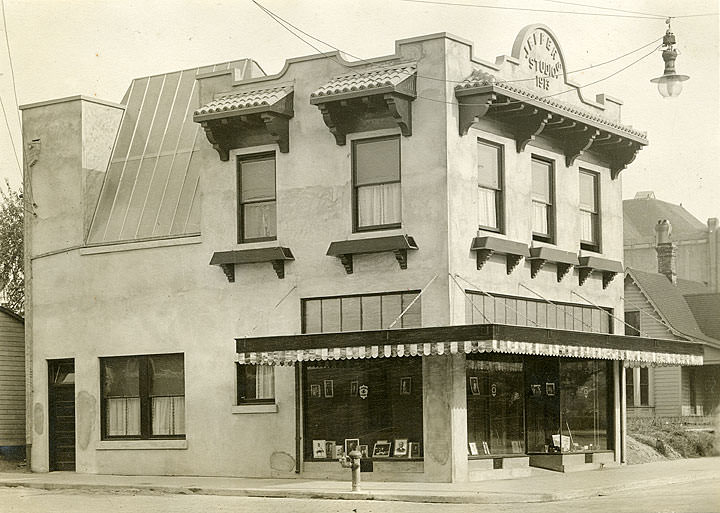
It is a two-story Mission style building, designed by Olympia architect Joseph Wohleb. It is on a corner. Sashed windows with window boxes are at the second floor. There are eaves over them with decorative tile. At the ground floor are plate-glass windows with a fixed awning over them on both visible sides. At the roofline is a decorative feature with the words “Jeffers Studio 1913” on it.
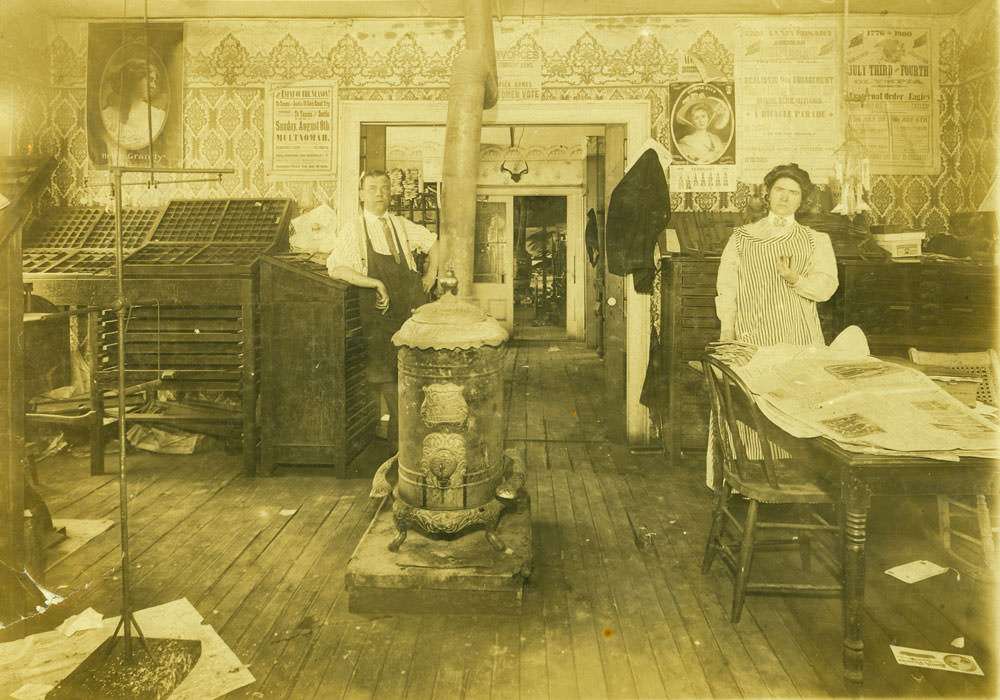
The front room has a cast iron stove in the center. It is wallpapered and prints, posters, and calendars are on the wall. An Olympia Brewery calendar identifies the month as February 1910. The editor, Frank Murphy, stands near a set of types, and a woman identified as Henry Murphy’s widow Cora stands behind a table wearing a striped apron. On the table is a large newspaper. A coat is hanging on a hanger on the wall.
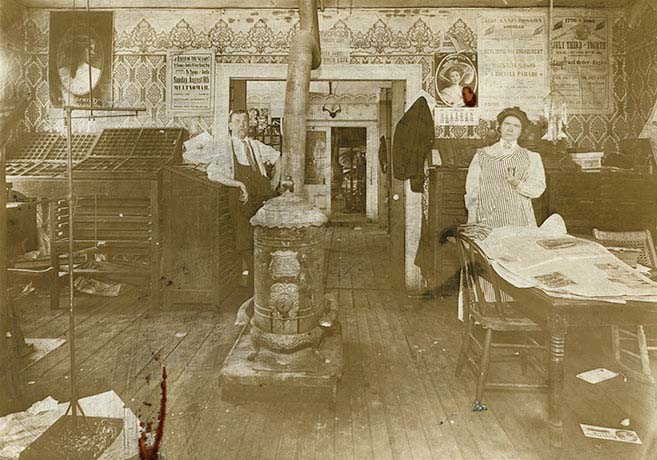
The front room has a cast iron stove in the center. It is wallpapered and prints, posters, and calendars are on the wall. An Olympia Brewery calendar identifies the month as February 1910. The editor, Frank Murphy, stands near a set of types, and a woman identified as Henry Murphy’s widow Cora stands behind a table wearing a striped apron. On the table is a large newspaper. A coat is hanging on a hanger on the wall. Printing paraphernalia are seen on the left of the photo. In the background are two further rooms. A women’s suffrage poster is over the doorway.
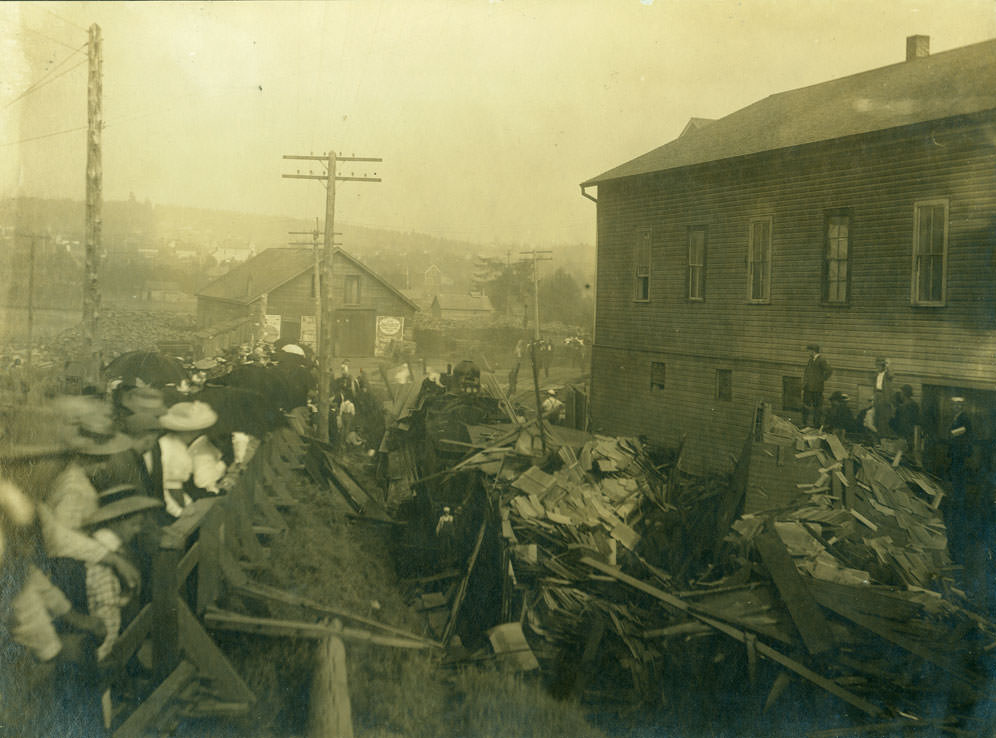
There is a large two-story building next to the track and another beyond a curve in the track. The city is visible in the distance. Crowds of people are standing next to a fence looking down at the wreck. Others are standing on part of the wreckage.
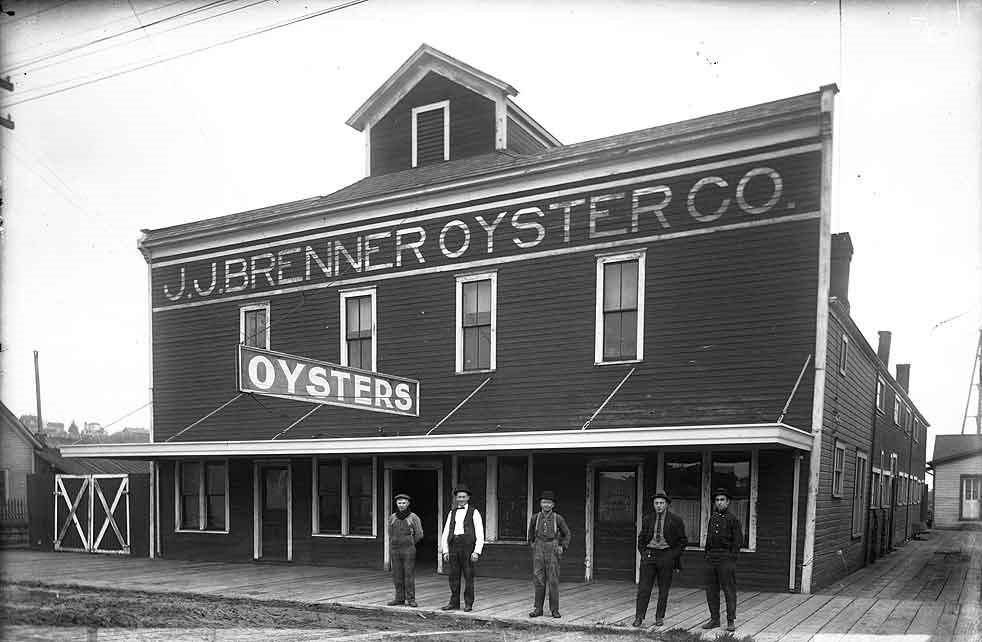
The building has a false front with a cupola. There are sashed windows on both levels. There are three doorways on the ground level and a broad street/bridge in front of the building. To the side of the building, a walkway leads to a back building or wharf. At the top of the building are painted the words “J.J. Brenner Oyster Co.” Another sign reads “Oysters.” In the distance, at the left of the image, are residences on a hillside above Olympia. Five men stand on the board sidewalk in front of the building. From left to right: a man in overalls and a cap; a man in dark trousers, a bowler hat, and a vest; a man in trousers with suspenders; a man in a dark suit with dark shirt; and a man in dark shirt and trousers.
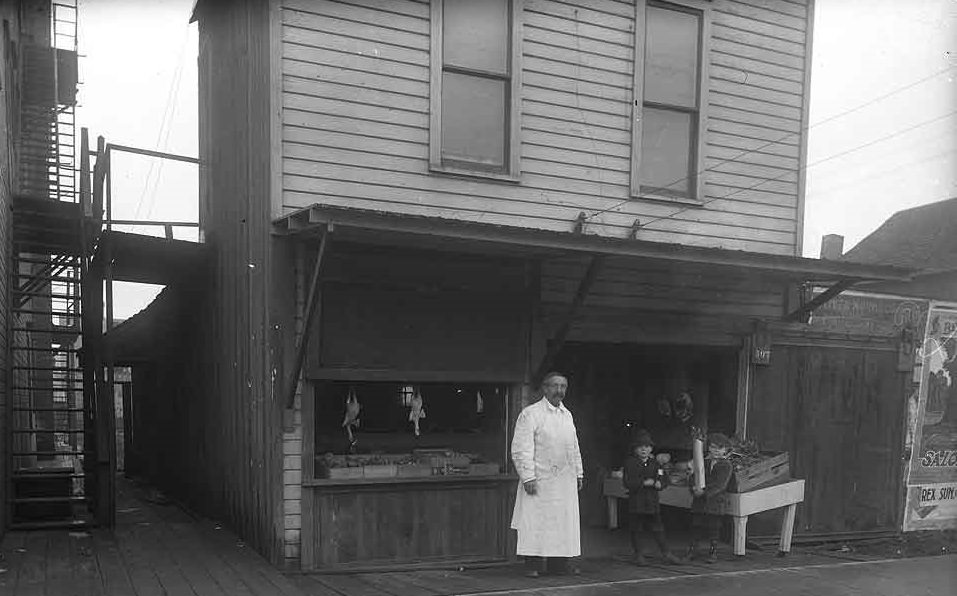
It is a narrow two-story clapboard building with sashed windows at the second level. There is a fixed awning over the storefront. In the window, there are two fowl hanging upside down, with boxes of produce on the window ledge. In the wide entryway is a display table stacked with produce. A middle-aged man is standing in front of the entryway on the board sidewalk, presumably the proprietor C.F. Kaler. He is wearing a white shirt and long white apron and has a mustache. Two small boys stand next to him. They are both wearing jackets, one with a hat and one with a cap. One of the boys is holding a long narrow parcel with what appears to be greenery sticking out of the top. There is an open sliding door with the number 507 on it.
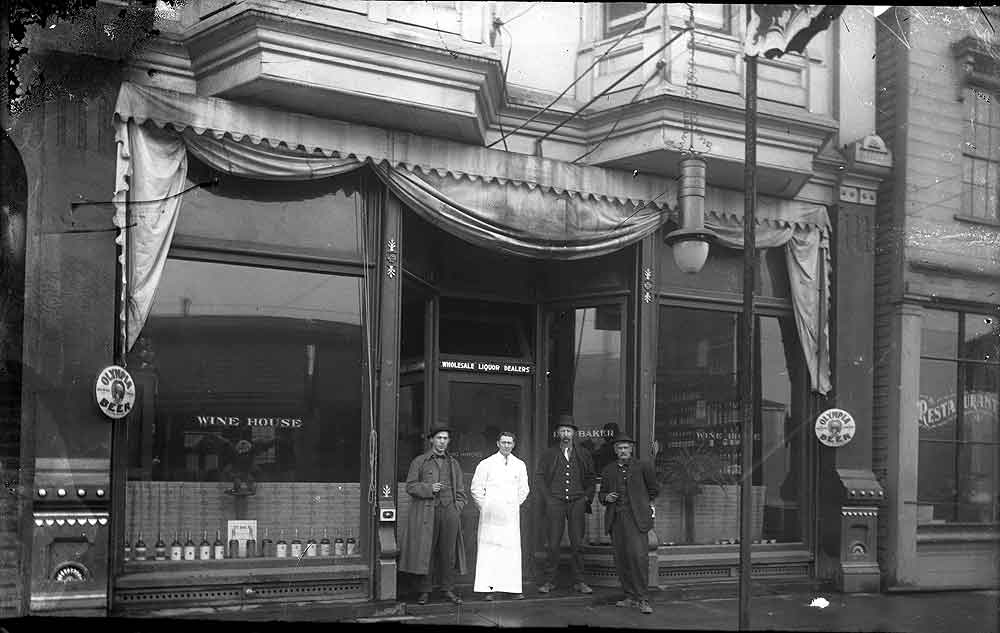
It is in a tall masonry building with bay windows visible at the second story (the Woodruff building, also known as the Labor Temple). Pediments are ornamental and painted with contrasting colors. A retractable awning is over the door. A central doorway flanks the storefront window. Bottles are displayed all along the front of the left-hand window. Shelves of bottles are visible inside. Painted on the windows and over the doorway are the words: “Wine House/Wholesale Liquor Dealers/L[ee] Baker/Wine House.” “No Minors” is painted on the door. Signs for Olympia beer are affixed to the columns flanking the building. Four men stand in the doorway. From left to right: a young man wearing a hat, overcoat, and suit, holding a cigar; a man in a long white apron; a man with a dark suit and vest with white buttons and a hat and mustache, hands in pockets; and an older man in a dark suit and hat, holding a cigar.
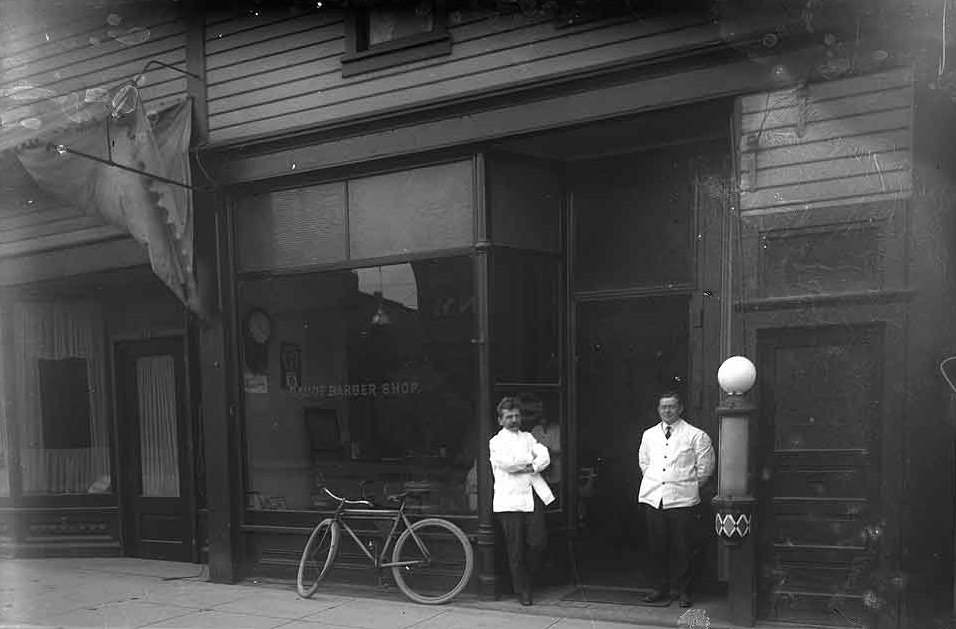
It is in a two-story clapboard building. The display window is to the left of the entryway. The words “Baude Barber Shop” are painted on the window. A bicycle is leaning against the window. To the right of the entrance is a barber pole. Two men, the barbers, stand in the entrance. One has a flamboyant hairdo and a mustache and is wearing a white jacket. The other man also has a white jacket; his hairstyle is more conservative.
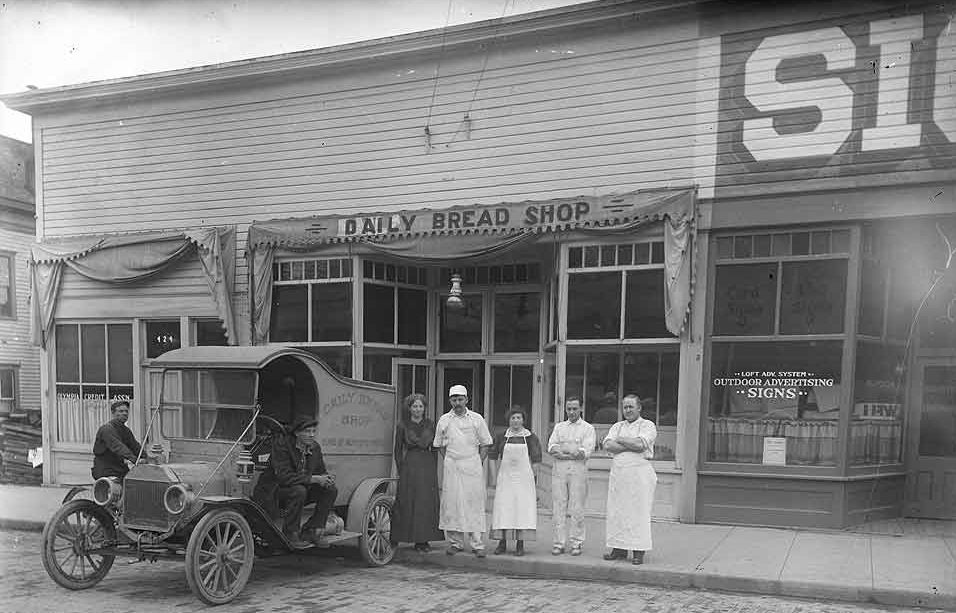
To the right of the bread shop is the Loft Sign shop. Its storefront has painted signs reading “Sign, Card Signs, Loft Adv. System, Outdoor Advertising Signs.” In front of the bread shop are two women, five men, and an automobile. Two men and one woman are wearing white aprons. A third man is dressed in white, and the other woman is wearing a dark dress. One man is sitting on the edge of the automobile. He is wearing working clothes and a cap. The car is painted with the words “Daily Bread Shop, Home of Mother’s Bread.” The last man is behind the automobile and appears to be on a bicycle.
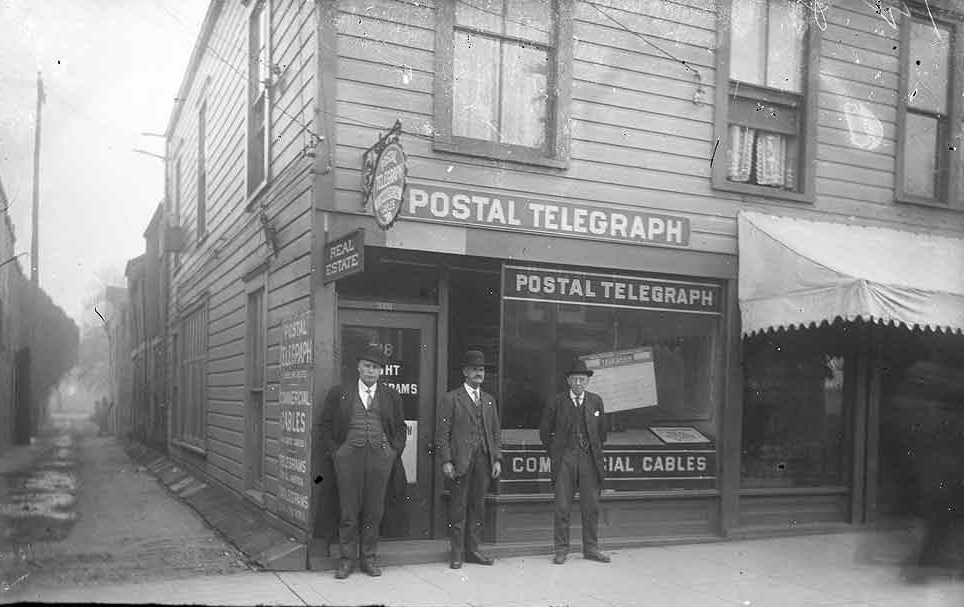
The storefront is on the corner of the building and its alleyway. There are sashed and curtained windows at the second story. Signs on the building read “Postal Telegraph, Real Estate, Commercial Cables, Telegrams.” Three men stand in front of the store.
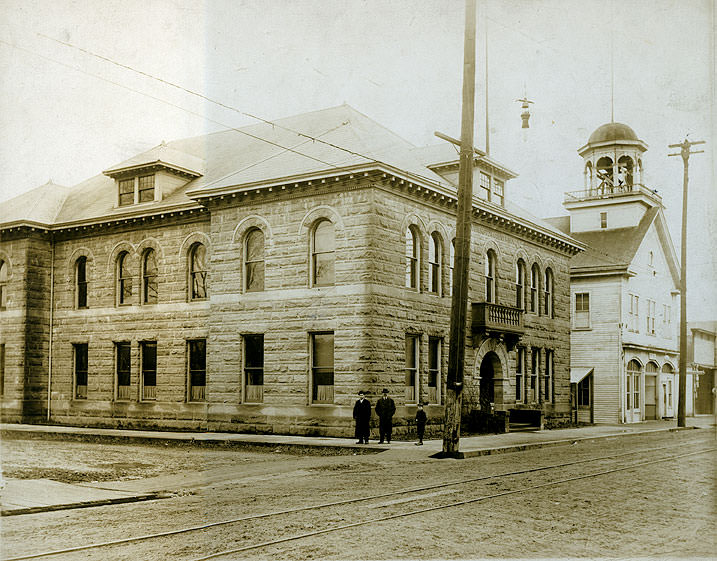
It is a two-story stone masonry building with gables at the roofline and a small balcony over the front entrance. At the top of the building, under the eaves, is a stone carved with the words “Thurston Courthouse 1901.” To its right is Columbia Hall, with its bell tower and adjacent fire station. Fourth Avenue in front of the buildings appears unpaved. A trolley track runs in front of it. Two men and a boy stand in front of the courthouse.
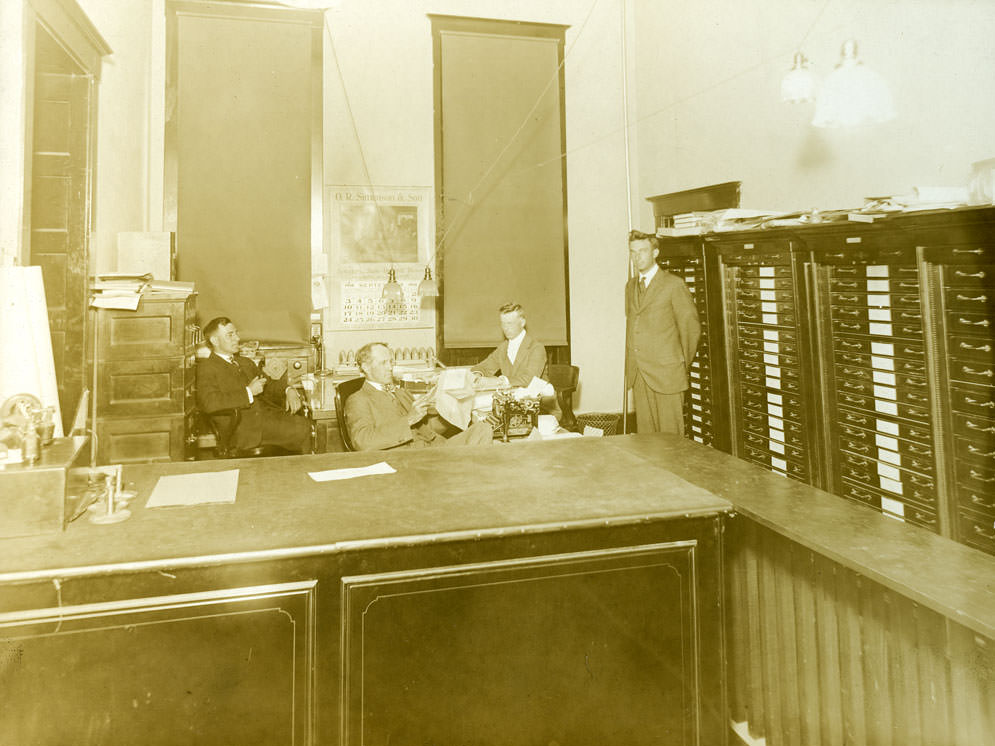
There is a large counter and table in the foreground and a row of map cases along one wall. The men are in an office area with a desk and file cabinets.
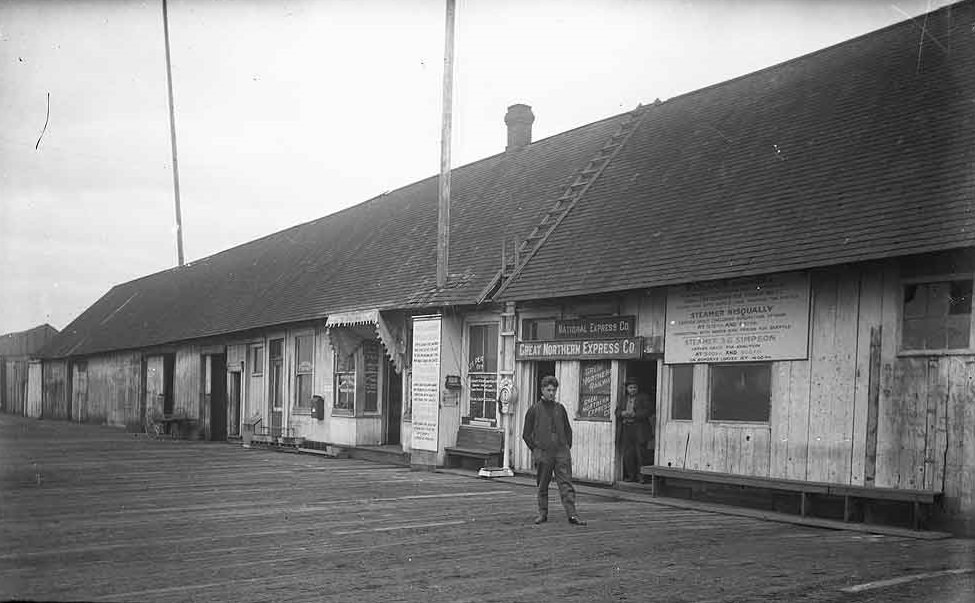
A very long, one-story building is fronted by a wide boardwalk (the landing). The ticket and shipping office for several railways and ships is in the foreground, including the Great Northern Express Co., the Great Northern Railway, the Steamer Nisqually, the Steamer S.G. Simpson, and other steamers. A young man, John C. Percival, wearing a sweater vest, stands on the boardwalk. An older man stands in the doorway to the office.
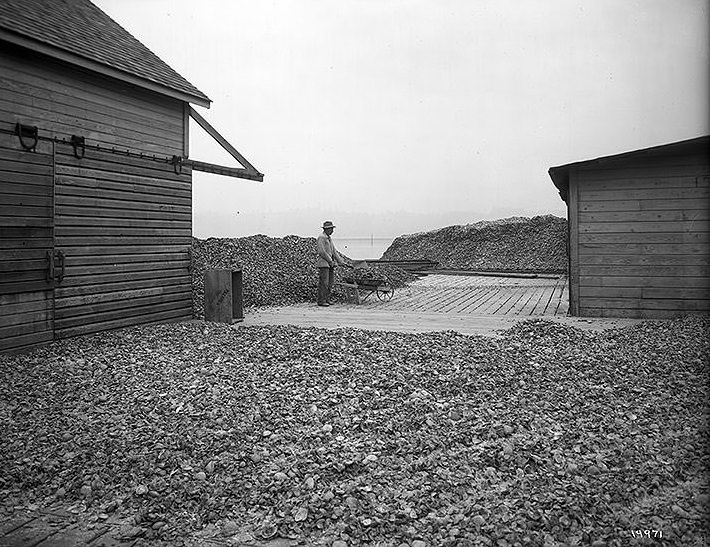
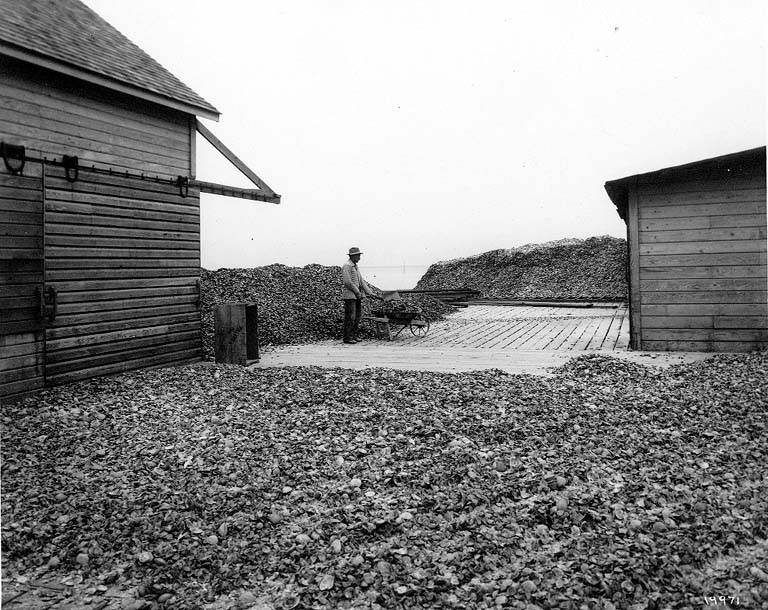
A man in the center of the image is shoveling oyster shells into a wheelbarrow from a large pile at his side. Another pile of shells is in the right background. Parts of wooden buildings are visible at both the right and left edges. Asahel Curtis.
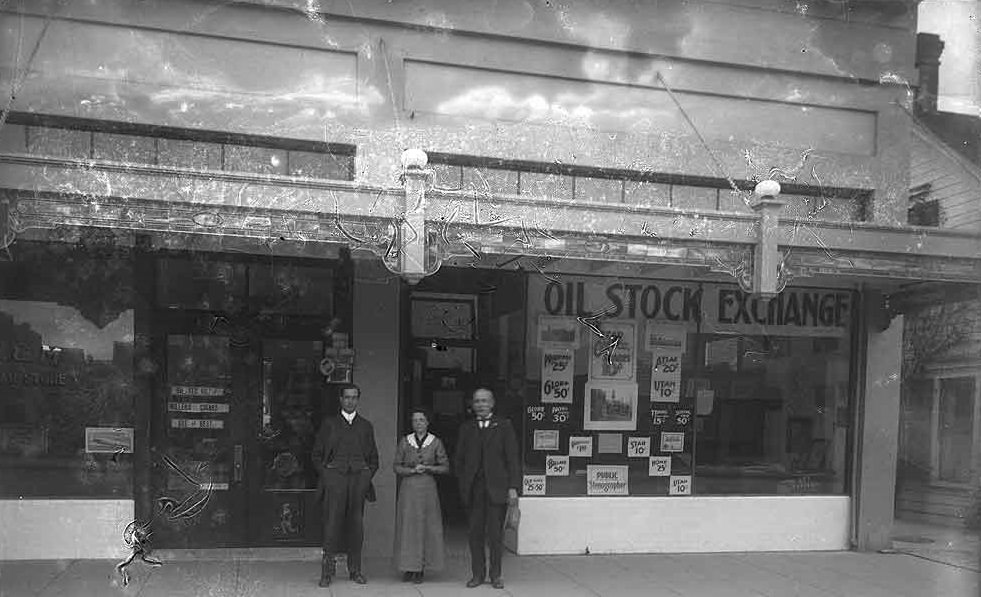
Affixed to the window are placards advertising the price of shares of stock from various oil companies, as well as offering the services of a stenographer. Two men and a woman stand in front. The men have dark suits, and the woman is wearing a dress with a white collar. There is a fixed awning over both the Stock Exchange and the adjacent cigar store.
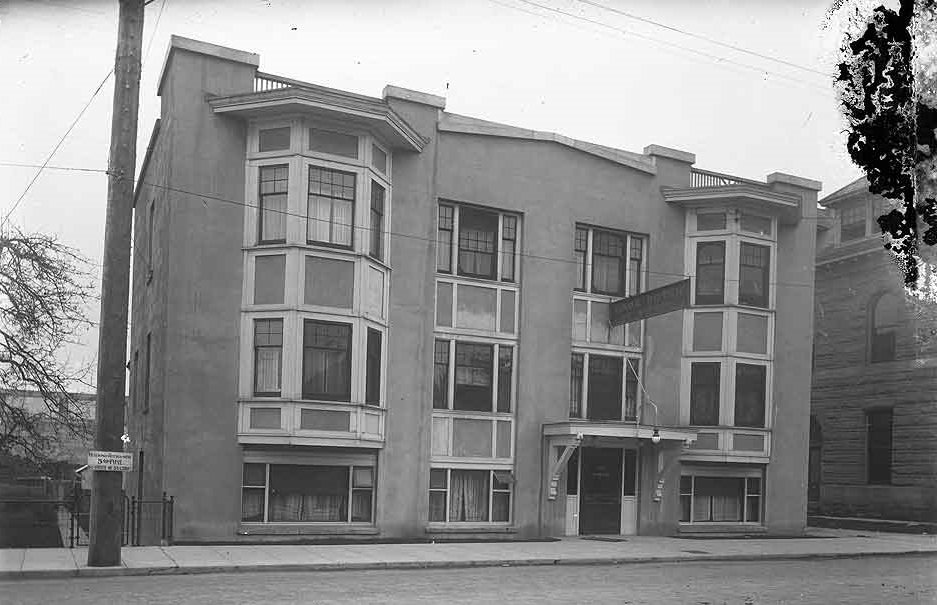
A sign reads “Knox Hotel/Apartments.” A sign on the door reads “The Knox.” A paved sidewalk and a paved road run in front of the building. There are basement apartments with curtains and small windows. To the side of the building is a gate with a walkway to a lower level. To the right of the building is a sandstone building, the then-Thurston County Courthouse.
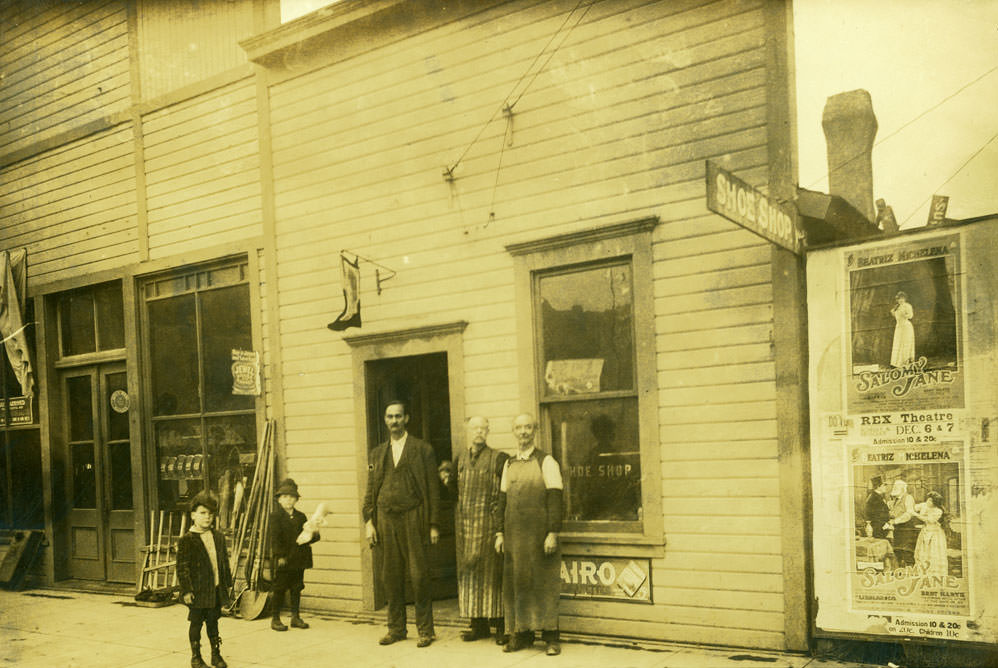
The structure to the right has two posters for “Salome Jane” playing at the Rex Theatre. The building to the left has shovels and other tools in front of the display case. Over the doorway of the shoe shop is a boot-shaped sign. A poster advertising Cairo Cigarettes is below the sashed window. Two of the men wear full-length aprons. The third man wears trousers, a vest, white shirt, and jacket. The boys are in knickers and high shoes.
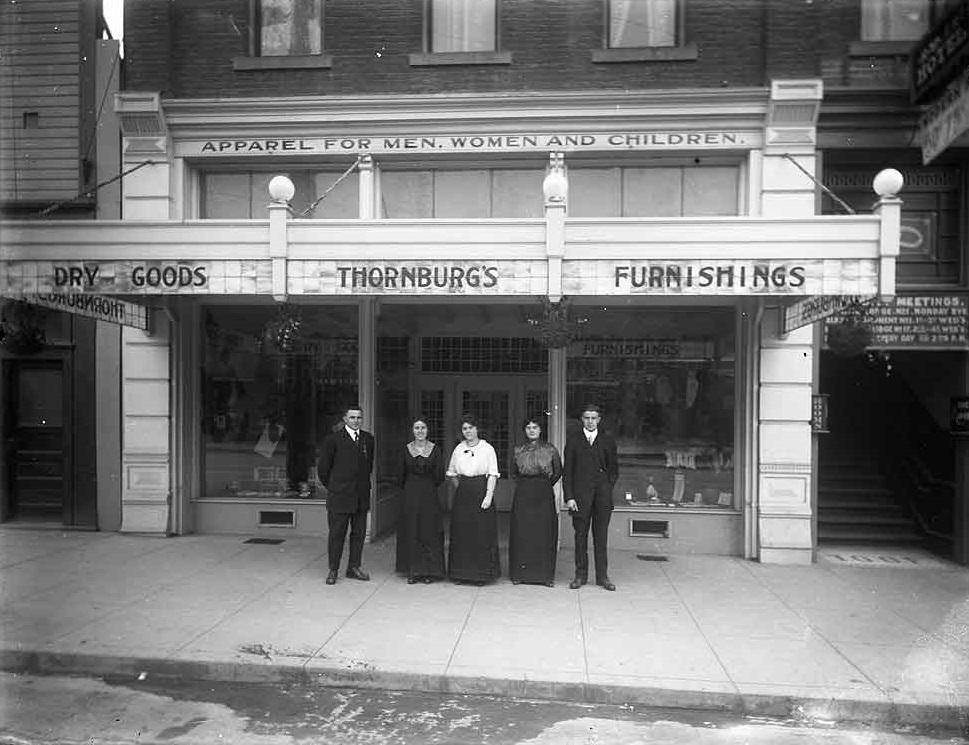
The store is located in a brick building at least two stories tall with what appears to be terra cotta tile decoration. There are picture windows on each side of the central entryway, and a fixed awning reading “Dry Goods, Thornburg’s, Furnishings,” with an additional sign above it reading “Apparel for Men, Women and Children.” Three women and two men stand in front of the store. The women have long dark skirts and blouses. The men have dark jackets. Miscellaneous items are displayed in the window. To the right of the building is a set of stairs leading to the I.O.O.F. hall. A sign over the door describes the meeting hall’s name and meeting times.
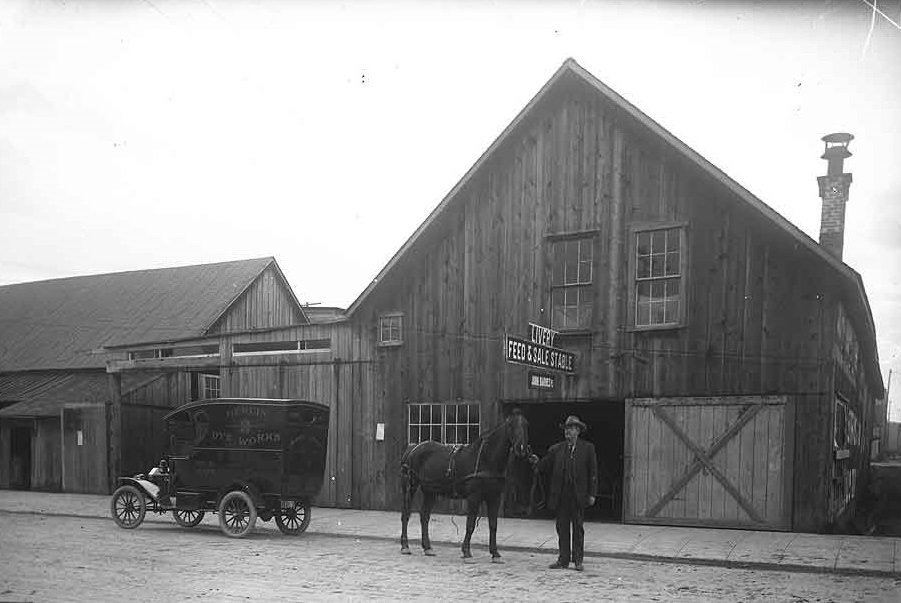
A two-story wooden building with a pitched roof has a wide bay with sliding door and sashed windows on both levels. A sign reading “Livery/Feed & Sale Stable/John Barnes V.S.” hangs over the bay. A paved sidewalk and street run in front of the building. Standing in the street, holding a dark horse by the bridle, is a man dressed in a suit and cowboy-style hat with a mustache. To his left, parked along the curb, is a motorized van with the words “Berlin Dye Works” painted on it. To the left of the stable is another wooden building, and an alley runs along the right of the stable.
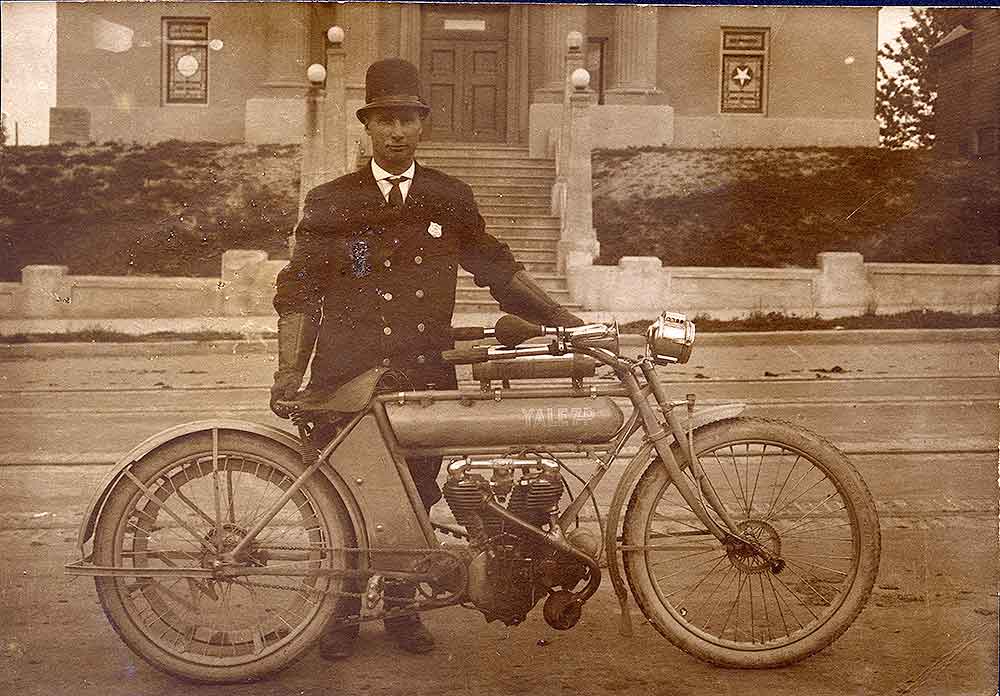
It has narrow tires and a small engine mounted underneath the frame, with a tubular gas tank mounted in front of the seat and above the engine. A klaxon horn is mounted on the handlebars. Officer Koepke is wearing a uniform consisting of a long coat with a double row of buttons and a tall rounded hat. He has a metal badge on his lapel.
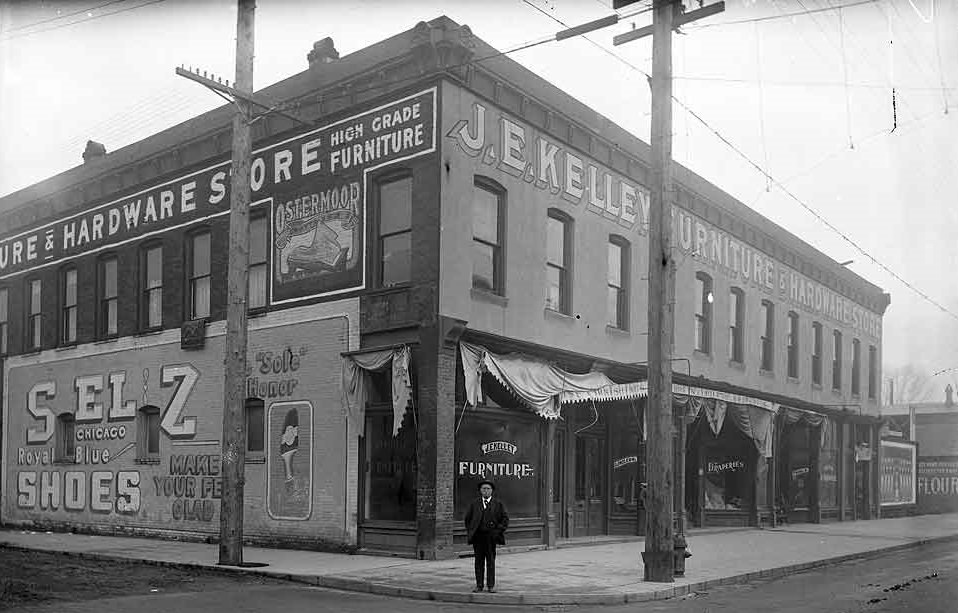
The man is presumably John E. Kelley. He has a white mustache and is wearing a dark suit with a hat. His hands are in his pockets and he is standing at the curbside. The store is a two-story brick building. In addition to the name of the store painted along the top below the cornices, other painted signs on the building read “Ostermoor,” “Selz Royal Blue Shoes,” and “Draperies.” There is a wide sidewalk in front of the building, with utility poles along both visible sides. There is also a fire hydrant. The street in front is paved, and there is a scattering of manure on the street.
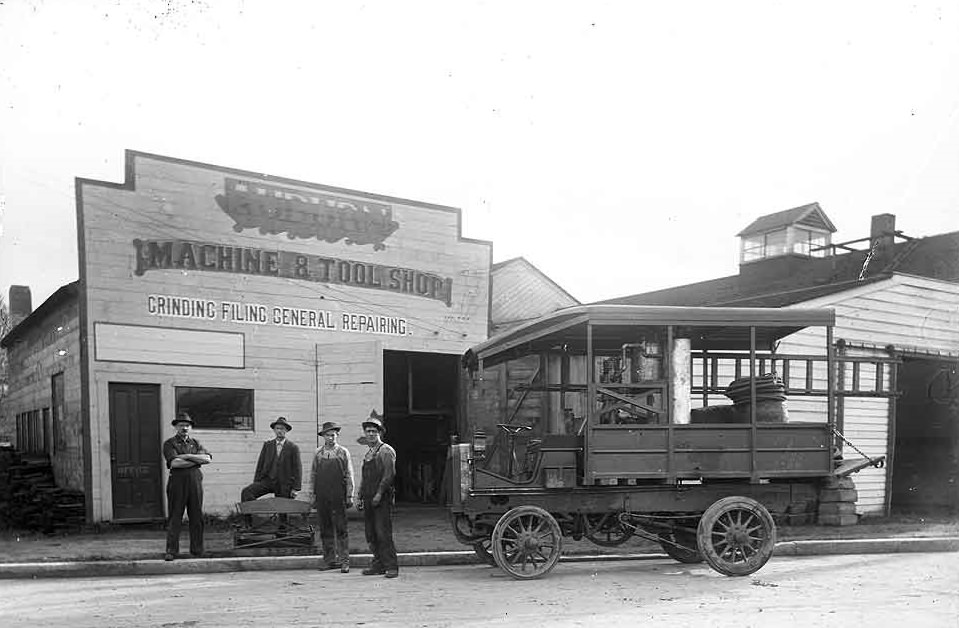
It is a one-story clapboard building with a false front. Painted on the false front are the words “Auburn Machine & Tool Shop/Grinding Filing General Repairing.” There is a wide bay to the right of the building. At the left is a doorway with the word “Office” painted on it. Four men are standing in front of the building. Two are wearing overalls and hats, one is wearing a dark shirt and trousers and a hat, and the fourth is wearing a suit with a hat. They are standing around an unidentified piece of machinery. Parked alongside the building is a large motorized truck. It appears to have a donkey engine mounted inside it and is half-paneled. To the right of the building is another clapboard building with a wide bay.
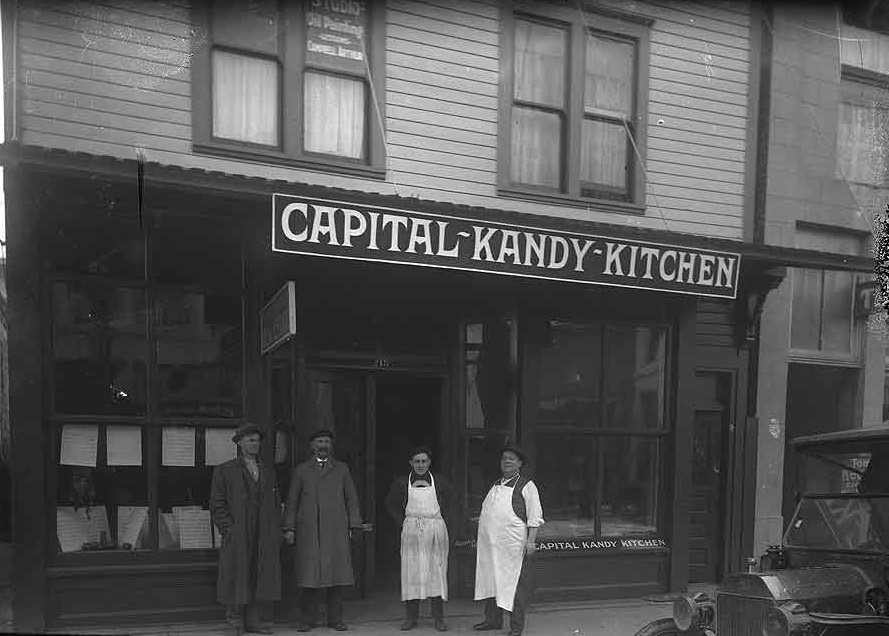
It is a two-story clapboard building with sashed and curtained windows at the second story. Storefront windows flank a central entrance with the number 215 painted over the door. The window on the left is plastered with sheets of paper with writing on them. Over the entrance is a sign reading “Capital Kandy Kitchen,” which is also painted on the base of the window. Four men stand on the paved sidewalk in front of the entrance. Two wear hats and overcoats, one with a mustache and one without. The other two men are wearing white aprons. An automobile is parked in front, visible in the foreground.
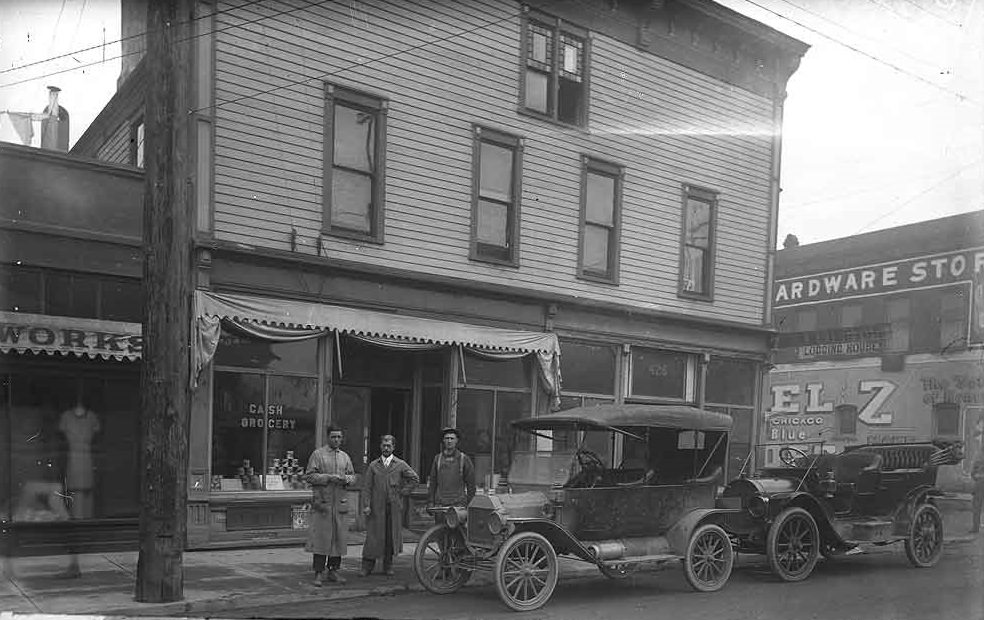
It is in a two-and-a-half-story clapboard building with a false front. Sashed windows are at the upper two levels. At ground level is the storefront. Display windows flank the central entryway. Cans of goods are stacked in the window. The words “Cash Grocery” are painted on the window. There is a retractable awning over the storefront. Three men stand on the paved sidewalk in front. From left to right: a man in a long light-colored overcoat or smock; a man in a long overcoat; and a man in overalls and a hat. Two automobiles are parked in front, one with a canvas top and one with no cover. To the left of the store is what appears to be a millinery store; laundry is hanging from a line on the roof above it.
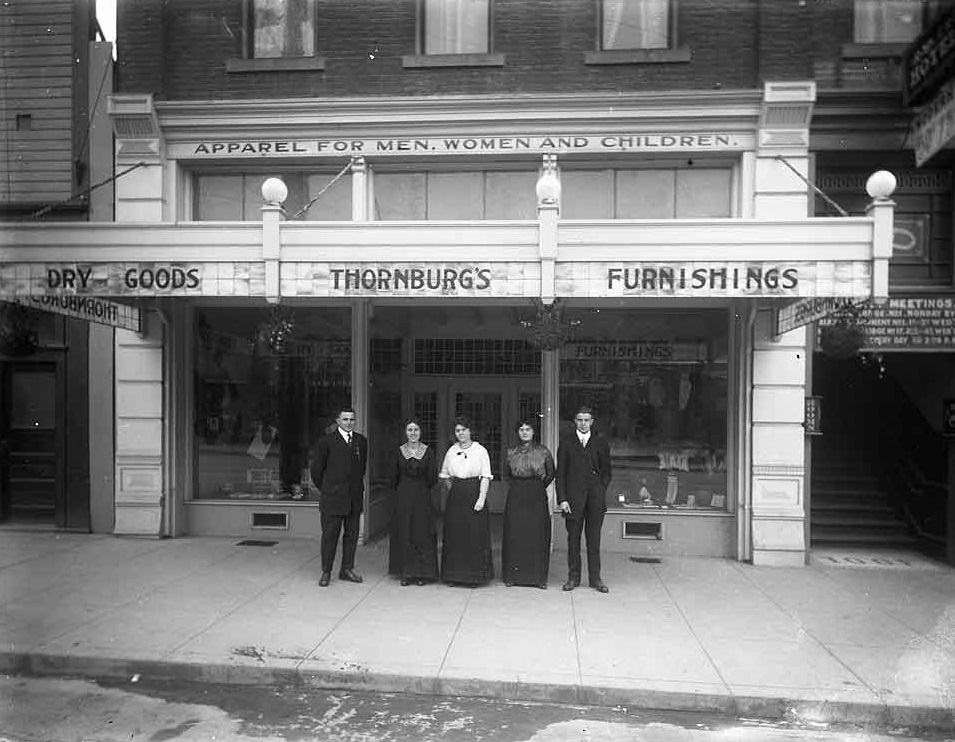
The store is located in a brick building at least two stories tall with what appears to be terra cotta tile decoration. There are picture windows on each side of the central entryway, and a fixed awning reading “Dry Goods, Thornburg’s, Furnishings,” with an additional sign above it reading “Apparel for Men, Women and Children.” Three women and two men stand in front of the store. The women have long dark skirts and blouses. The men have dark jackets. Miscellaneous items are displayed in the window. To the right of the building is a set of stairs leading to the I.O.O.F. hall. A sign over the door describes the meeting hall’s name and meeting times.
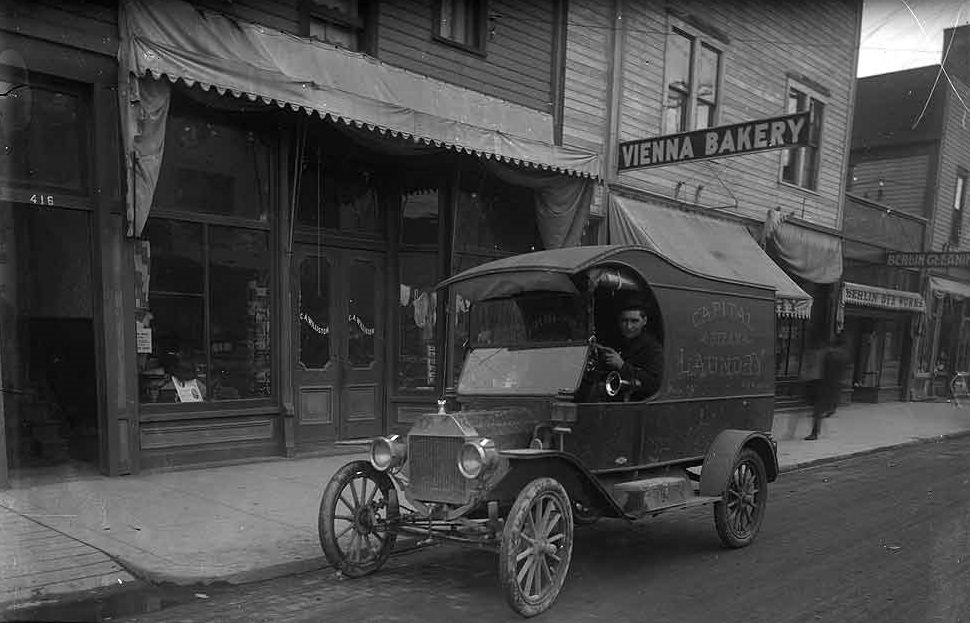
The Williston store is in a two-story clapboard building with sashed windows at the second story. It has a central doorway flanked by storefront windows. Merchandise is visible inside. The words “C.A. Williston” are painted on the doors. There is a retractable awning over the building. To the left of the store is an entrance, presumably to the upper story, with the number 416 painted on it. To the right of the Williston store is the Vienna Bakery. It has an awning over it and is also in a two-story clapboard building with sashed windows at the second story.
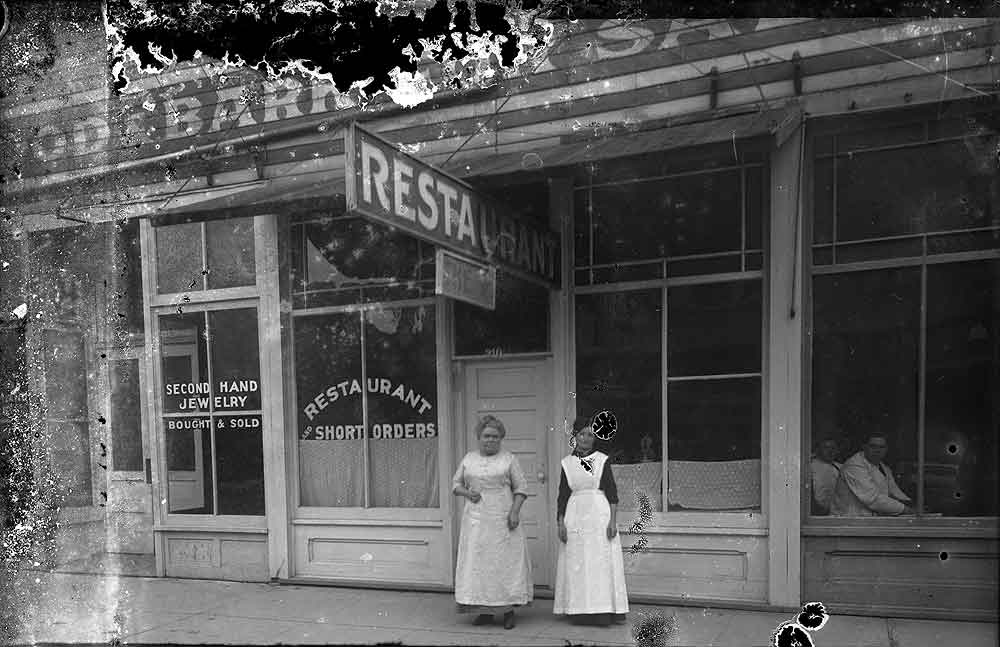
The restaurant has a central doorway flanked by tall windows with half-curtains. Over the restaurant is a sign reading “Restaurant/The [Star symbol].” Painted on one of the windows are the words “Restaurant/and Short orders.” Two women are standing on the paved sidewalk outside. One, an older stout woman, has her gray hair in a bun. She is wearing a white apron over a white dress. The other, a younger woman, is wearing a dark dress with a waitress apron over it. To the right of the restaurant is another commercial establishment, name and business unknown.
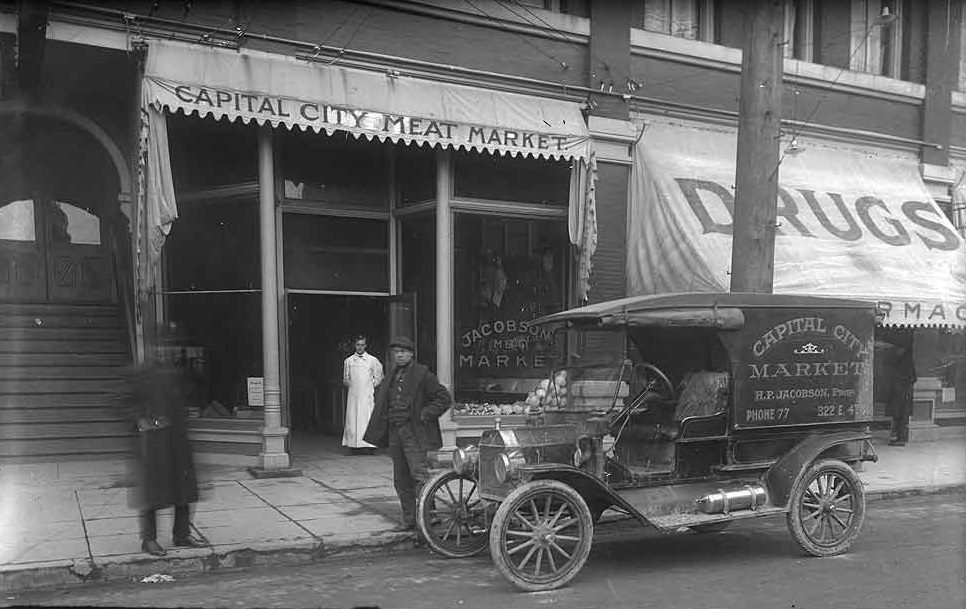
It is in a two-story brick building with windows visible at the second story. There is a retractable awning over the store. A wide central entryway is flanked by display windows with decorative columns at their corners. The words “Jacobson Meat Market” are painted on one window, and “Capital City Meat Market” is painted on the awning.
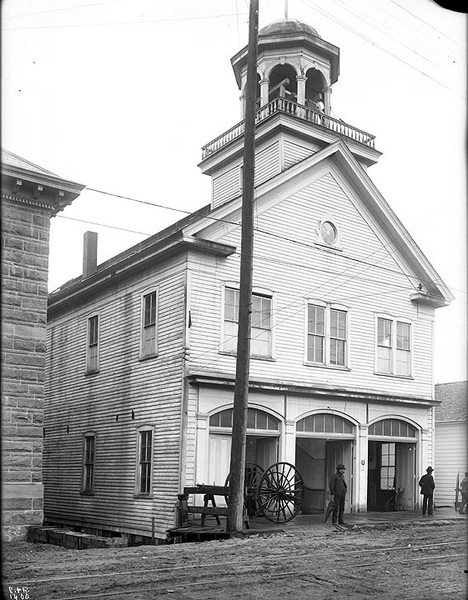
On the ground floor are three arched entrances for fire engines. Each entrance is topped by an arched clerestory window. Between the middle and right-hand entrance, a horseshoe is mounted on the wall. A fire caisson with tall wooden wheels rests on a fence adjacent to the left-hand entrance. Two men are standing outside the building. One is holding an umbrella; the other faces away. On the second story of the building are three pairs of sashed windows. Above them is a pediment with a circular window in the center.
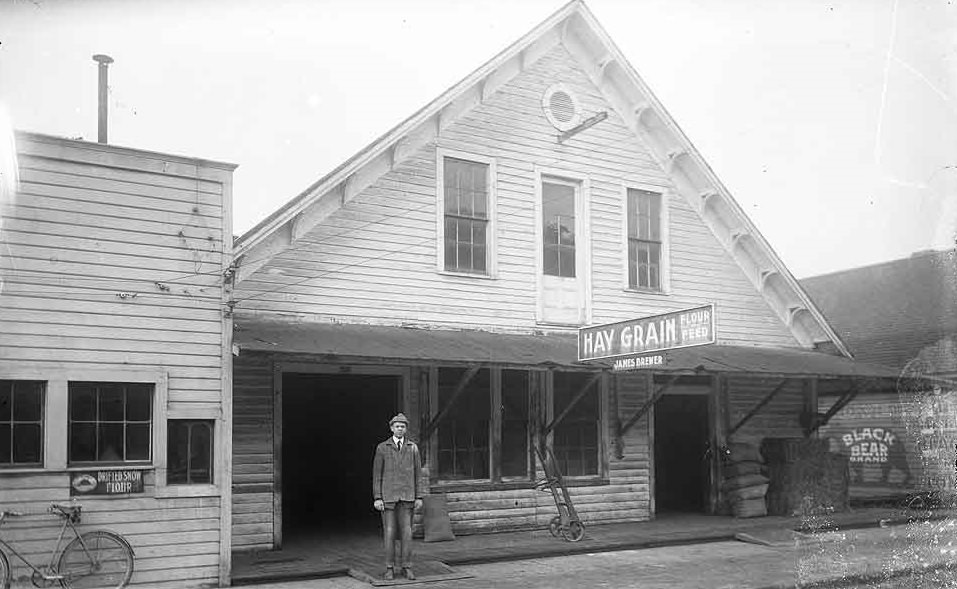
At street level there is a wide entryway, three sashed windows, and a doorway. A man, presumably James Brewer, is standing on a ramp leading to the entryway. He is wearing a knitted cap, a jacket with white shirt and tie, and trousers with rolled-up cuffs. A dolly is propped on end beneath a sign reading “Hay Grain Flour Feed/James Brewer.” Stacked to the right of the doorway are bags and bales of hay. At the second level, under the eaves, are two sashed windows and a doorway, possibly a hayloft. A circular window is just under the peak of the roof.
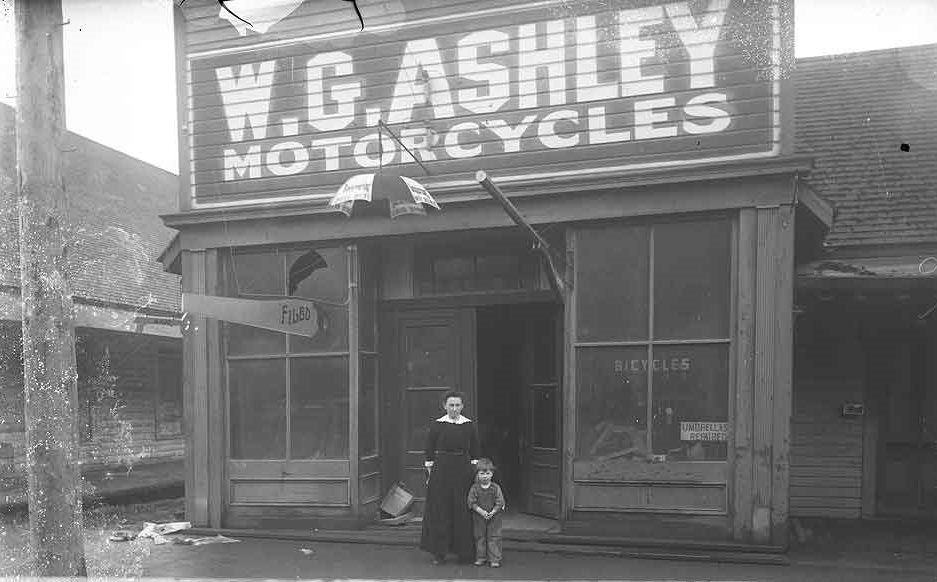
The right and left corners of the building are decorated with carved pieces representing columns. On the false front are painted the words “W.G. Ashley Motorcycles.” There are two storefront windows flanking a central doorway. A pane of the left window appears to be broken. Painted on the other storefront window is the word “Bicycles,” and a hand-lettered sign reads “Umbrellas Repaired.” Hanging from the front of the store are three signs with words painted on them describing the type of repair or service being offered. One, in the shape of a key, reads “Made”; the second, in the shape of a saw, reads “Filed”; and the third is in the shape of a gun with the word illegible due to its angle to the photo. Paper and cardboard boxes of debris are scattered on the sidewalk and in the doorway.
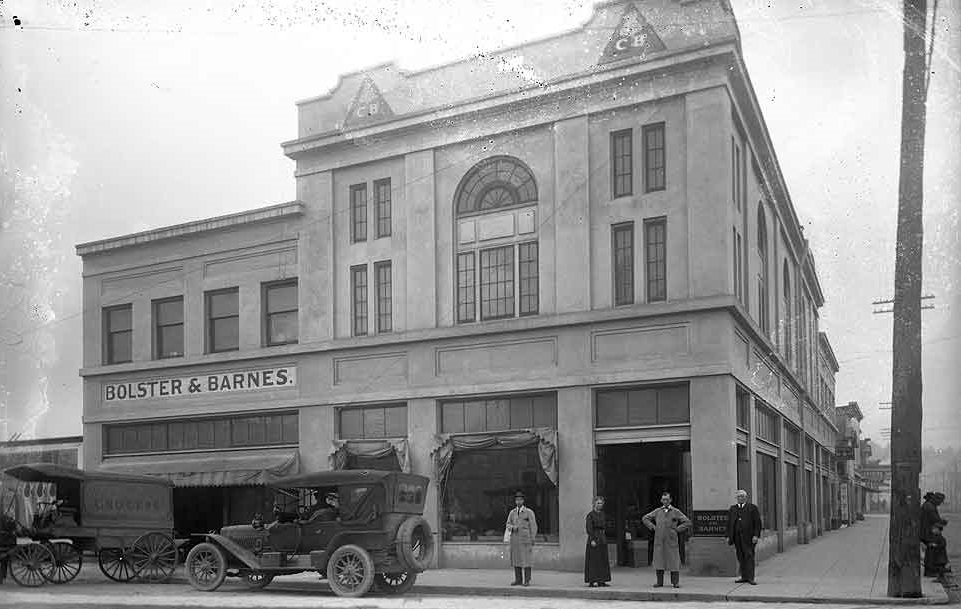
At the roofline are cornices with “C.B.” painted on them. The words “Bolster and Barnes” are painted on the front facing the photograph. Another sign affixed to the building reads “Bolster and Barnes.” Standing in front of the building are three men and a woman. Two of the men may be the proprietors, John Bolster and John Barnes. Two men are wearing overcoats, the third man a suit, and the woman a dark dress. Three other figures are standing at curbside: two men and a small child only dimly visible. Also parked in front of the store are an automobile and a delivery cart. A man is seated at the right-hand driver’s seat of the automobile.
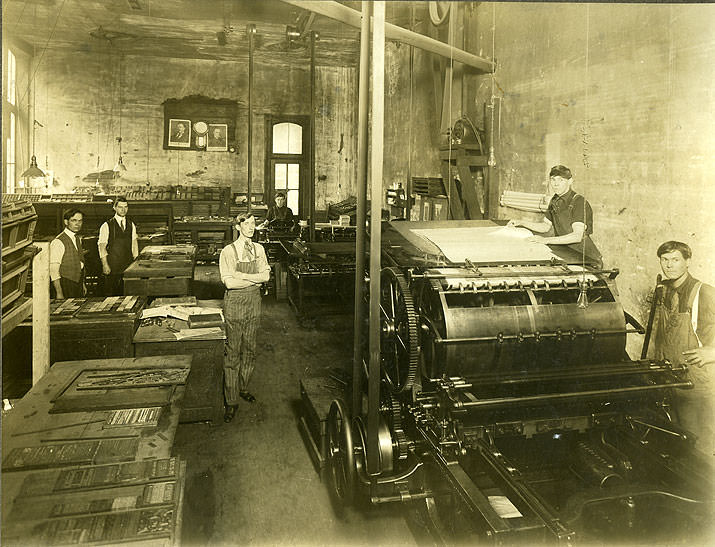
Along the right side of the room is a cylinder press machine. It is a large machine with a drum operated by a set of gears and belt. A young man identified as Al Galloway is feeding a sheet of newsprint into the press. Another man identified as Dave Hume is helping. Both are wearing bib overalls. Standing in the center of the room is another young man with his arms crossed, wearing striped bib overalls, shirtsleeves, and a striped bow tie. A fourth young man is sitting at a job press, identified as (Frank?) Steele. Two other men wearing white shirtsleeves with vests and ties are standing at the left of the image. One of the men is identified as Bob Yantis, foreman of the press room. To the left of the image are several tables and desks piled with trays of slugs, books, and paper. Another long array of slugs and type is along the rear of the room. Light fixtures hang low from the ceiling.
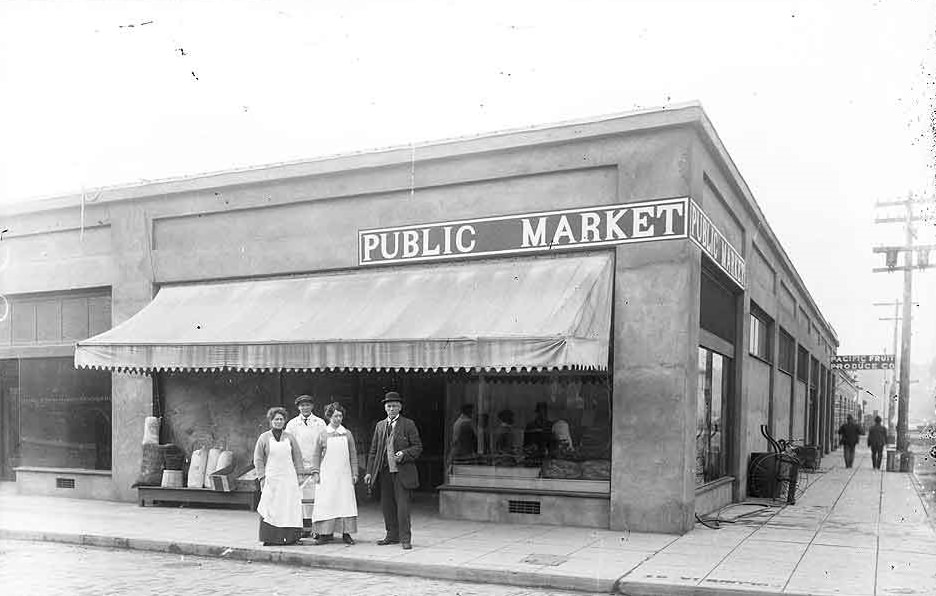
The building is unadorned; a sign below roof level reads “Public Market.” Two men and two women stand in front on the paved sidewalk. The women are wearing long skirts, sweaters, and long aprons. The older man has white hair, is wearing a homburg hat and suit with contrasting vest, and is holding a pair of glasses in his right hand. The other man is standing between the women. He is also wearing an apron and has a cap. Behind them are the storefronts of the store, with items just visible in the windows and shadowy customers inside. To the left, outside, are bags of goods on a short, long bench. The sidewalk is inlaid with the words “Columbia Street” at the corner.
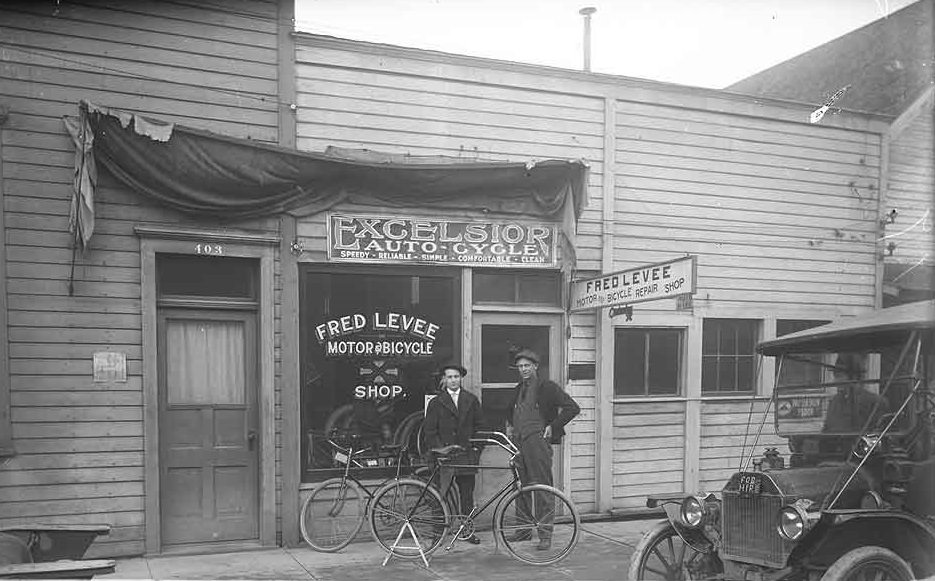
The shop is a one-story clapboard building with a storefront. The storefront window is painted with the words “Fred Levee Motor & Bicycle Shop.” Other signs read “Fred Levee Motor Bicycle Repair Shop,” “Excelsior Auto-Cycle/Speedy-Reliable-Simple-Comfortable-Clean,” and “Auto Hire.” Two men stand outside the shop next to two bicycles. One man has a cap, jacket, trousers, and vest with his hands in his pockets. The other man is wearing a homburg hat and an overcoat. One bicycle is leaning against the building, and the other is propped on a stand. To the right of the photo is an automobile, with a third figure visible behind it. The front of the automobile has a small sign reading “For Hire” hanging on its grille. A sign reading “Drifted Snow Flour” is hanging on the building. To the left of the bicycle building is a two-story clapboard building.
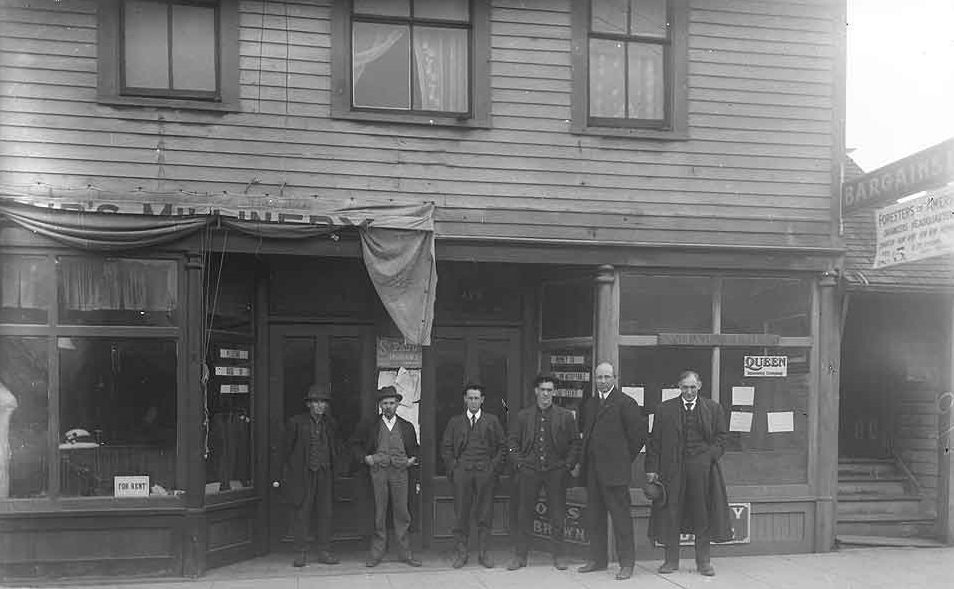
It is in a two-story clapboard building with sashed and curtained windows at the second floor. There is a storefront window with an entryway to its left. Signs in the window read “Queen Insurance Company,” “St. Paul Insurance,” and “Otis & Brown.” Other signs are illegible, many on pieces of paper affixed to the window or tacked on a board next to the entry.
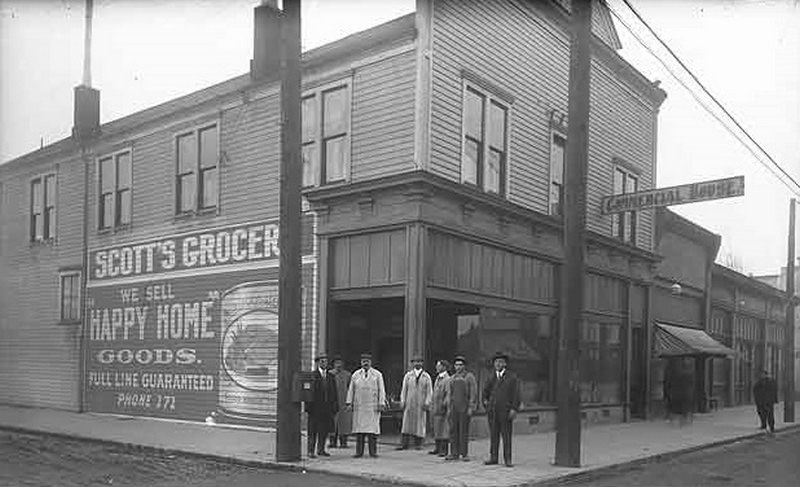
The doorway is at the corner of the building. There are decorative columns and capitals over the doorway and windows. Sashed windows are on the second floor, with a false front along the Fourth Avenue side of the building. Painted on the other side of the building is an advertisement reading “Scott’s Grocery/We Sell ‘Happy Home’ Goods/Full Line Guaranteed/Phone 171,” with a logo of a can of Happy Home sliced Hawaiian Pineapple. Standing in front of the grocery are seven men. From left to right: a man in a dark overcoat and hat with white shirt and tie; a man with a long duster and hat; a man in a white grocer’s smock and cap; a man in a grocer’s smock and hat; a man standing in profile with an overcoat; a man in a cap and overalls; and a man in a suit with vest and hat. To the right of the grocery store is another establishment in the same building, the Commercial House, 327 Fourth Avenue, with a narrow entryway presumably leading to the second floor.
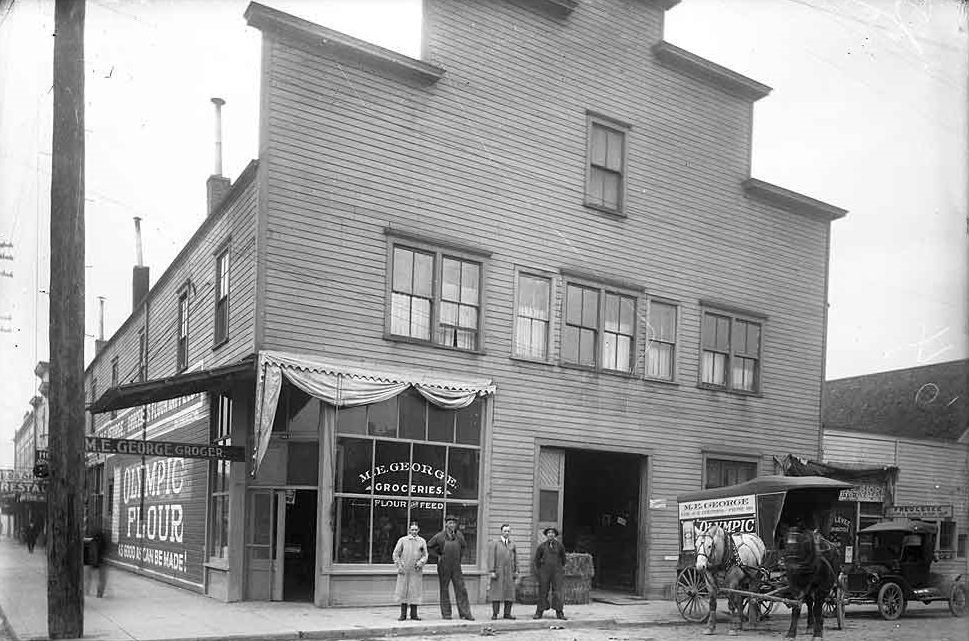
At street level is a storefront with a corner entryway. To the right of the entryway is a wide open bay with a sliding door. Bales of hay are stacked in front of the bay. Painted on the storefront window are the words “M.E. George/Groceries/Flour and Feed.” Another sign hung on the wall reads “M.E. George Grocer.” A third large sign is painted on the side of the building, reading “M.E. George, Grocers Flour and Feed/Olympic Flour/As Good as Can be Made!” Four men are standing in front of the building. From left to right: a young man with no hat and hair parted in the middle, wearing a long smock; a man in overalls and a cap; a man in an overcoat with no hat; and a man in overalls with hands in pockets.
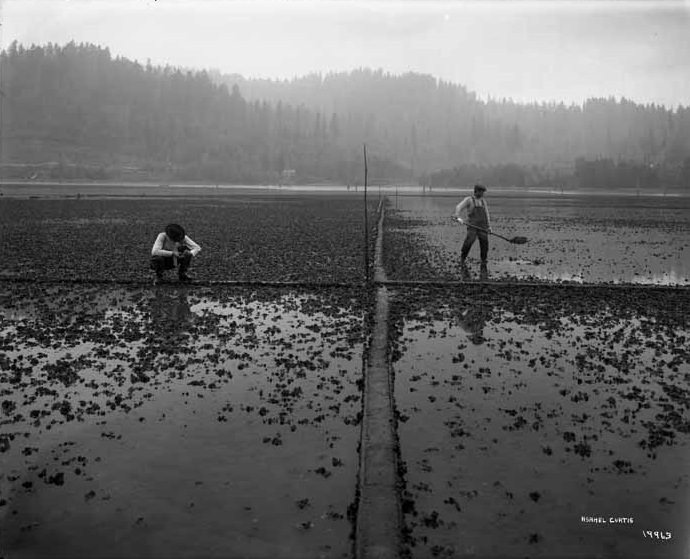
One of the men stands holding a shovel or rake, and the other worker bends down adjacent to an oyster bed. The workers wear protective boots and bib overalls and stand in shallow water.
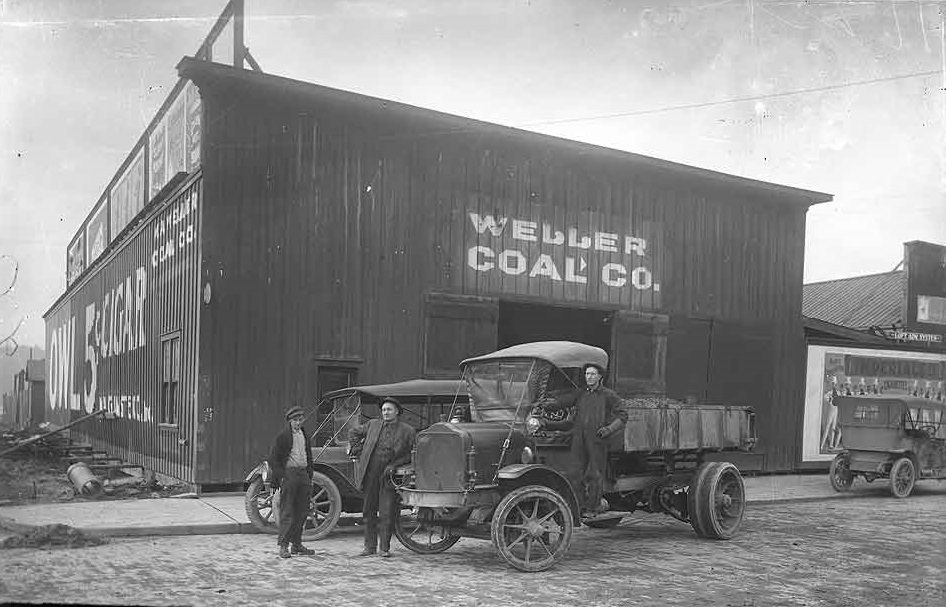
To the side of the building is a billboard for Imperial cigarettes. In front of the building are a truck and a car. The truck has a bed loaded with coal. A man in overalls is standing on the sideboard. Another man is leaning against the front of the truck. A young man is standing to his right with his hands in his pockets. A third vehicle is parked in front of the cigarette billboard.
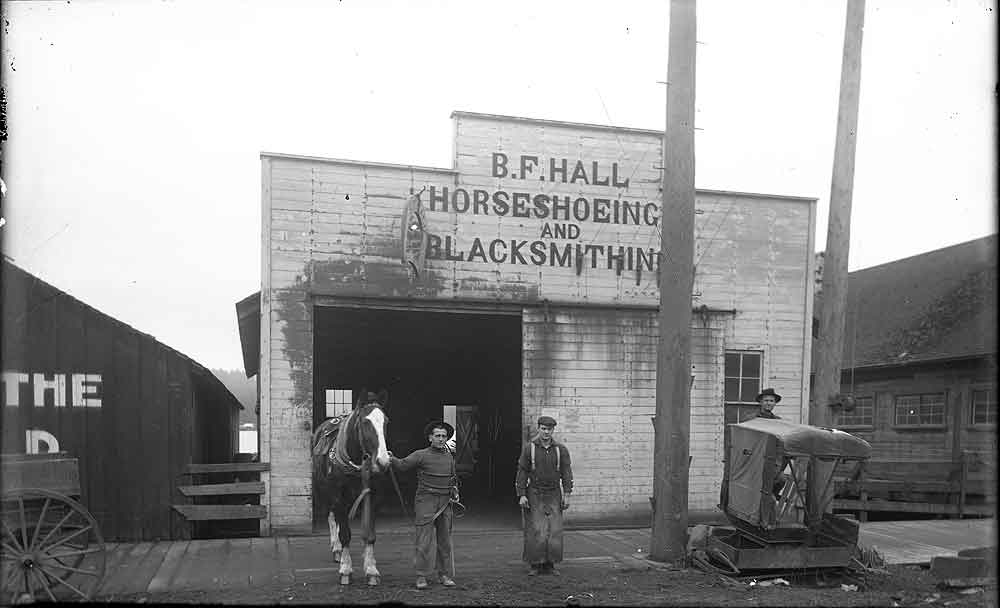
It is a one-story wooden building with a false front, next door to the Blake & Riggs stable. Budd Inlet is visible to its rear. A wide door is open. Three men stand in front. One short man, wearing a turtleneck sweater, is holding a horse by its bridle. Another man is wearing a blacksmith’s apron and a cap. A third man is standing behind what appears to be a disassembled cart or some kind of protective device.
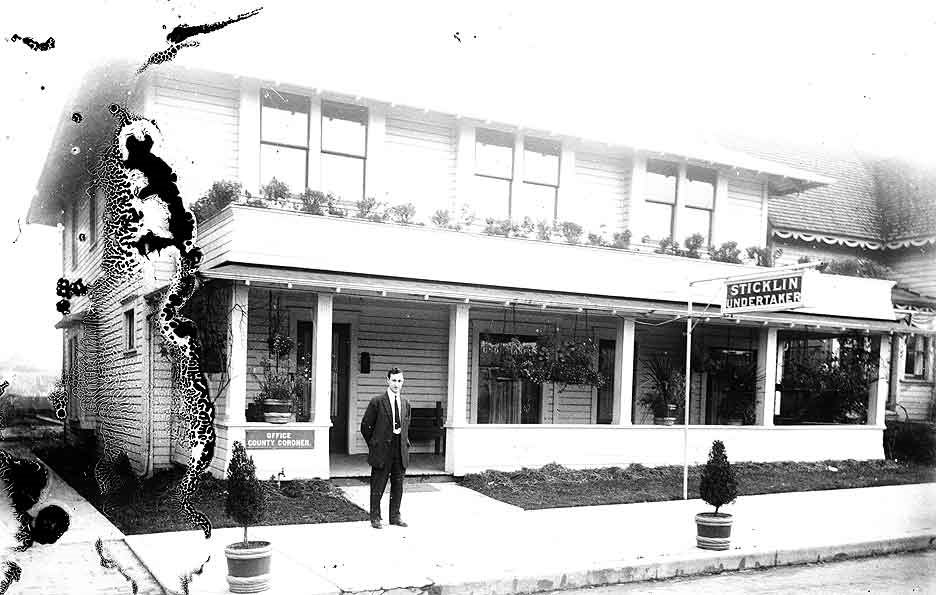
It has a wide porch with columns that extends the full width of the building. On the second floor are sashed windows and a balcony decorated with window boxes. The porch is also strung with hanging plants and ferns, with potted shrubs at curbside. A sign affixed to the building reads “Sticklin Undertaker.” Another sign affixed to the building reads “Office County Coroner.” A young man, presumably the proprietor Louis Sticklin, stands out front. He is wearing a suit with a narrow tie.
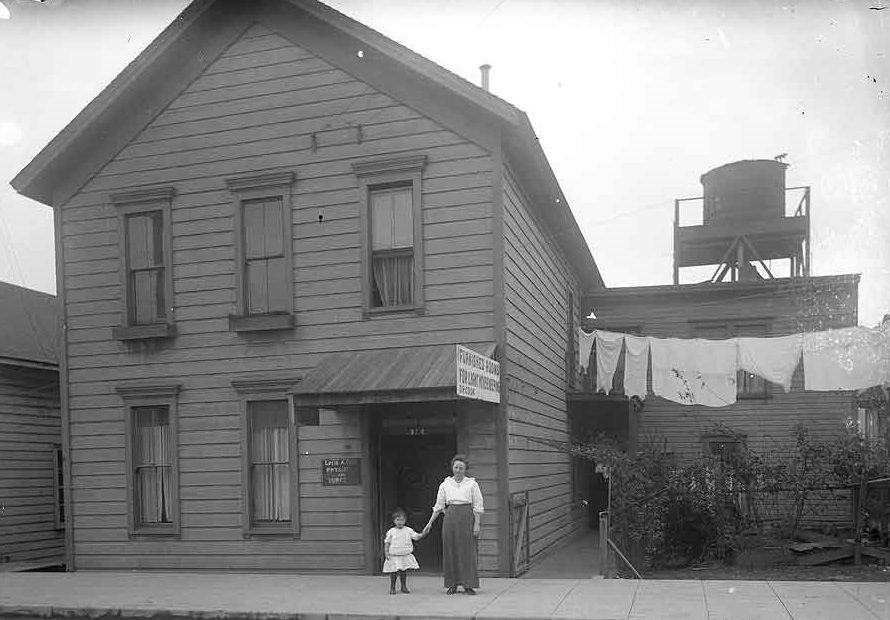
The house has sashed windows at both levels. There is an ell with a walkway leading to it and a garden in front. On top of the ell, or behind it, is a water tower. Laundry is hanging on the line over the garden and across the front of the ell. Signs over the entryway and affixed to the building read “Furnished Rooms/For Light Housekeeping/Dr. Cook” and “Lucie A. Cook/Physician and Surgeon.” In front of the building, on the paved sidewalk, is a woman, presumably Dr. Cook, wearing a white blouse and dark skirt.
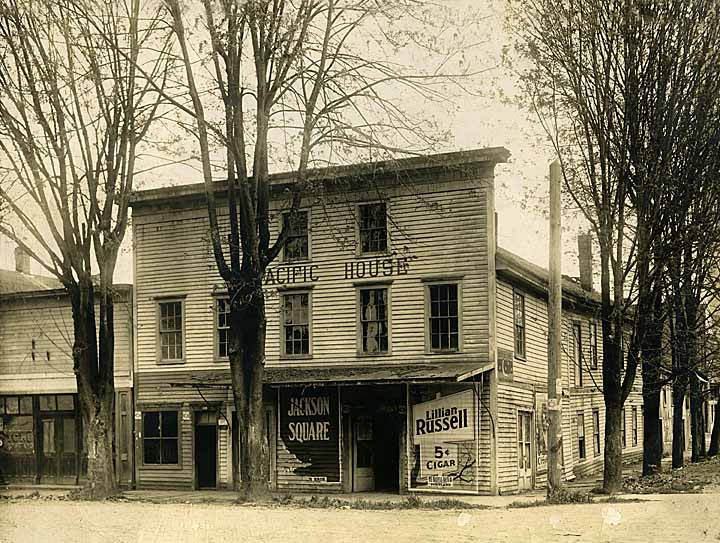
It is a two-story clapboard building with a false front covering a gable at roof level. A fixed wooden awning hangs over the ground level, which has two doors. Sashed windows are at the second story and at the gable. Painted signs on the ground level advertise Jackson Square and Lillian Russell. The words “Pacific House” are painted on the clapboard siding. Tall trees are in front and on the side of the house. At the time this photograph was taken, the Pacific House was in disrepair or closed.
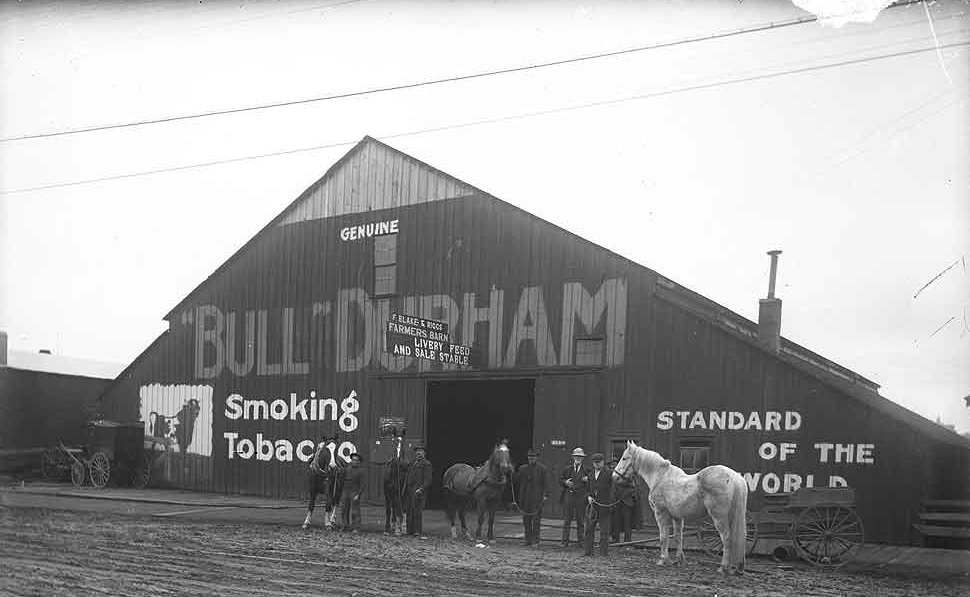
It is a large barn with a long sloping roof, vertically clapboarded. A sign reads “F. Blake & Riggs/Farmers Barn/Livery Feed/and Sale Stable.” There is an advertisement for Bull Durham tobacco painted on the barn. A covered carriage and an open cart are both parked alongside, unhitched. In front of the barn, standing on a muddy wide dirt street, are six men. Four men are holding four horses. A fifth man, wearing a white hat and suit, is standing between two women.
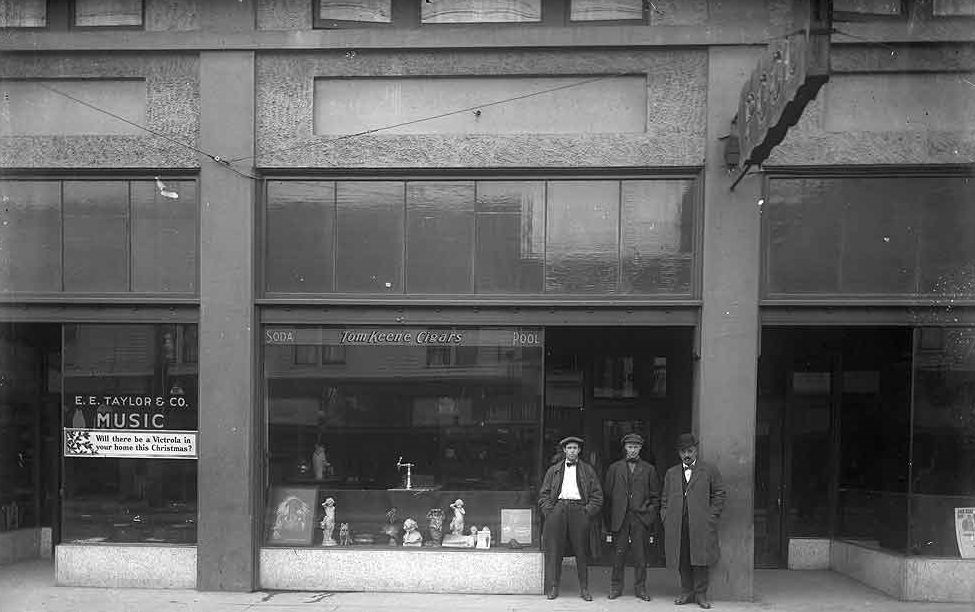
The music store has a picture window with the words “E.E. Taylor & Co/Music” painted on it, and a sign reading “Will there be a Victrola in your home this Christmas?” The pool hall also has a picture window with various figurines in the window. Above the window are painted the words “Soda, Tom Keene Cigars, Pool.” There is a neon street sign reading “Pool.” In front of the pool hall are three men. Two wear caps and the third a bowler hat.
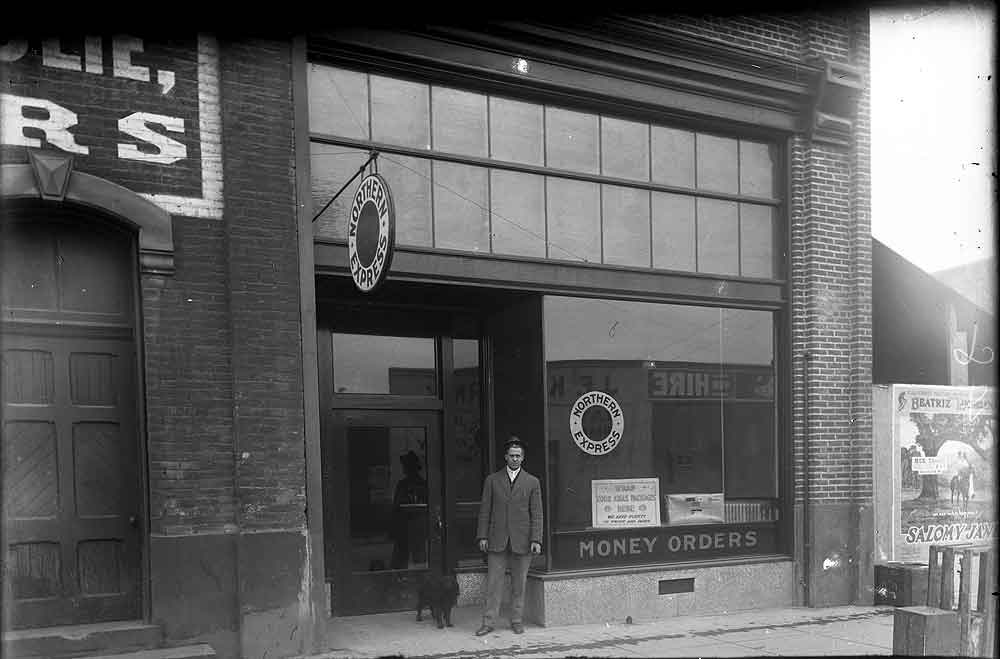
Over the entryway is a sign reading “Northern Express.” The same Northern Pacific Railway logo is painted on the storefront window. There is also a printed sign reading “Wrap Your Xmas Packages Here/We have plenty of twine and paper.” At the foot of the storefront window is another sign reading “Money Orders.” A man stands at the entrance. He is wearing a suit jacket, hat, and trousers. A black dog is near his feet. To the right of the building is a sign advertising the movie “Salomy Jane.”
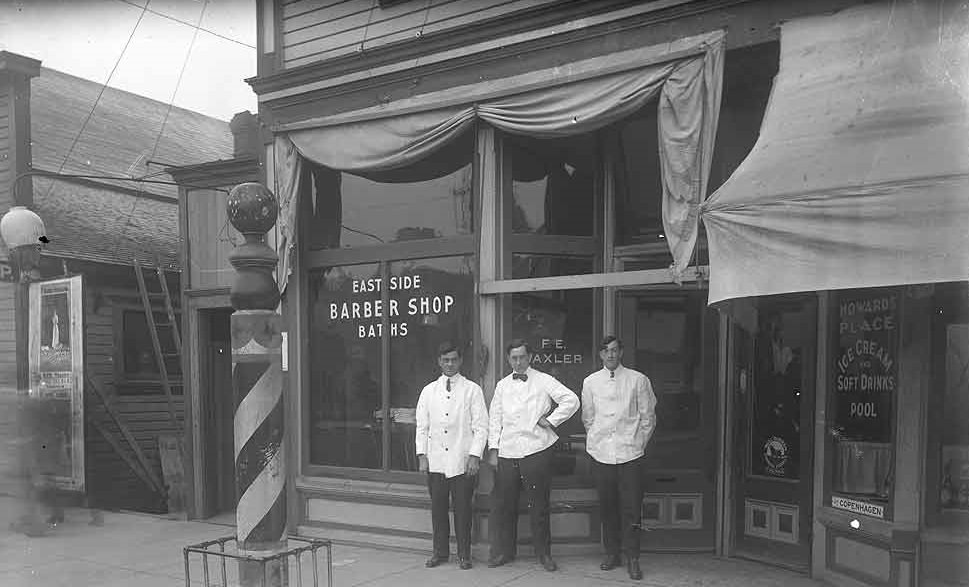
Both stores have retractable awnings over their storefronts. The barbershop has the words “Eastside Barbershop/Baths/F.E. Waxler” painted on the display windows. There is a barber pole on the paved sidewalk. Three men, one of them presumably Mr. Waxler, stand in front. They all have white jackets and dark pants. The adjacent storefront has the words “Howards Place/Ice Cream and Soft Drinks/Pool” painted on the storefront.