Hey There! Before You Go. 😧
Get the best vintage content straight into your inbox!

Don't worry, we don't spam

Spectacular Vintage Photos Show What Minneapolis Looked Like in the 1930s

Minneapolis in the 1930s was a city under enormous pressure. The Great Depression had arrived with full force, squeezing workers, shuttering businesses, and pushing thousands of residents into poverty. The flour milling industry — once the backbone of the city’s economy — was in steep decline, with mills along the Mississippi River slowly going quiet. What these vintage photos capture is a city that was gritty, resilient, and complicated in equal measure.

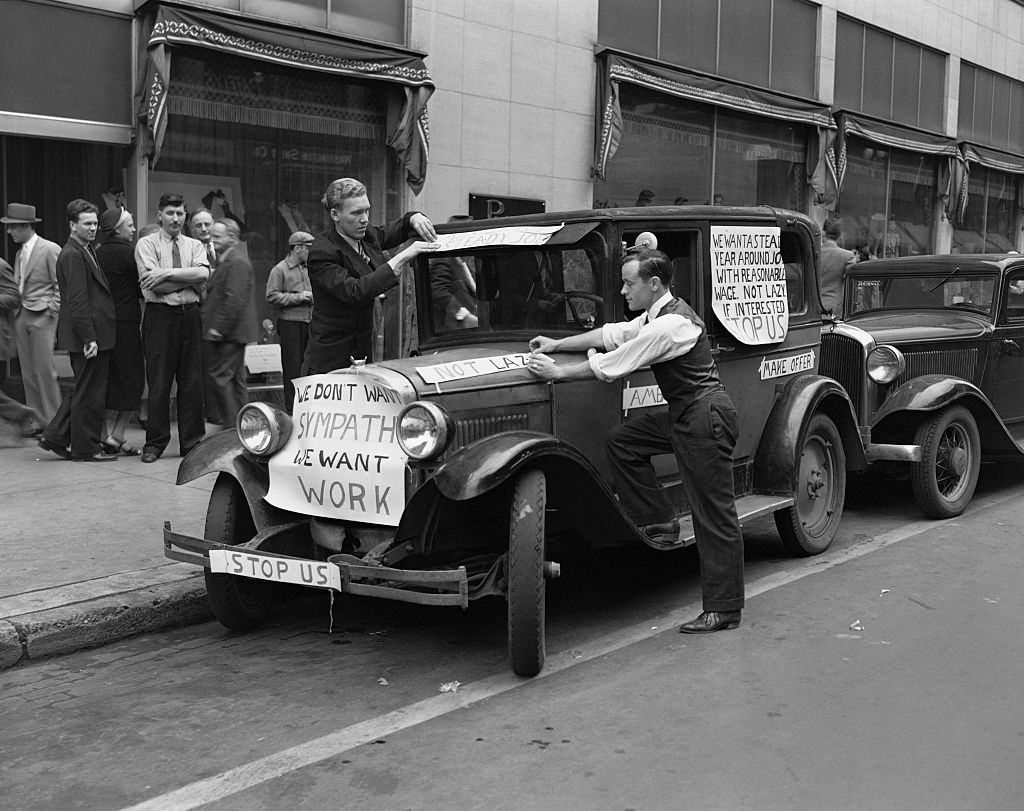
Job seekers during the Great Depression have put signs on their car expressing their wish to work. Minneapolis, 1930.

Unemployment forced many residents to get creative. Men drove through city streets with hand-painted signs on their cars, advertising their willingness to do any available work. The desperation behind those signs was real — this was a city where finding steady employment had become a daily struggle. At the same time, pockets of wealth and leisure still existed, often just blocks away from scenes of hardship.

Interlachen club, Minneapolis, 1930.
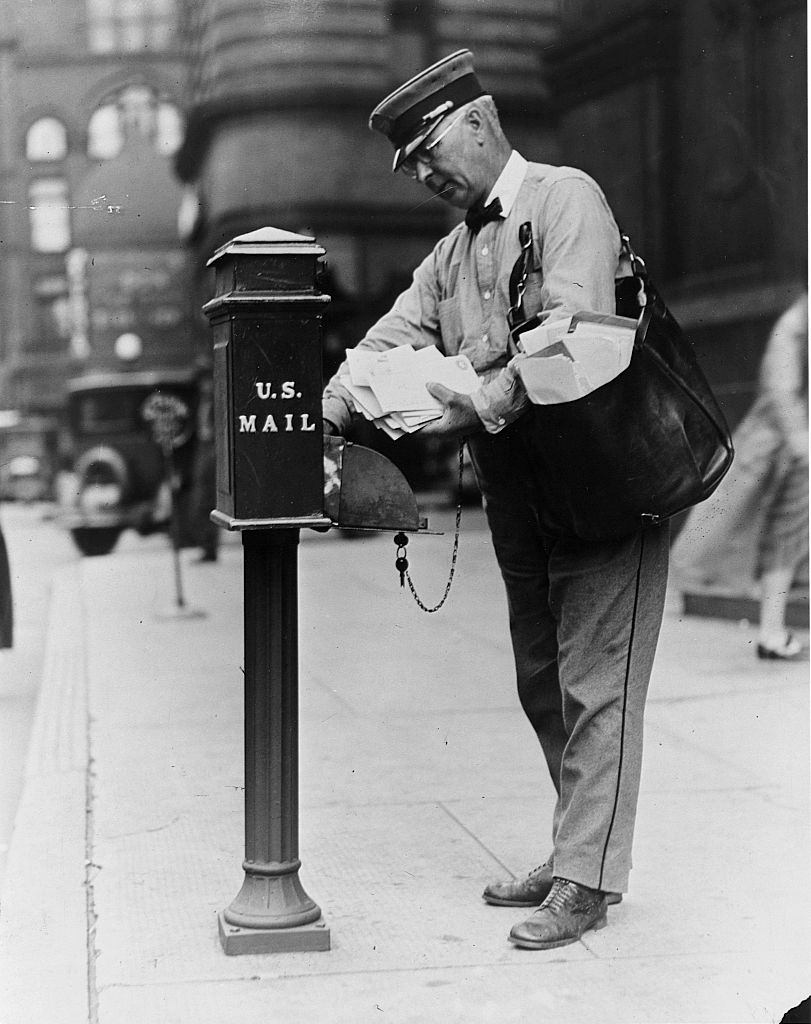
Postal carrier Albert S. Dilley empties a mailbox on his downtown route. Minneapolis, Minnesota, 1930.

Day-to-day city services continued operating through the Depression years. Postal carriers like Albert S. Dilley still walked their downtown routes, emptying mailboxes as the city moved around them. Universities kept their doors open too, training the next generation of professionals even as the job market tightened.

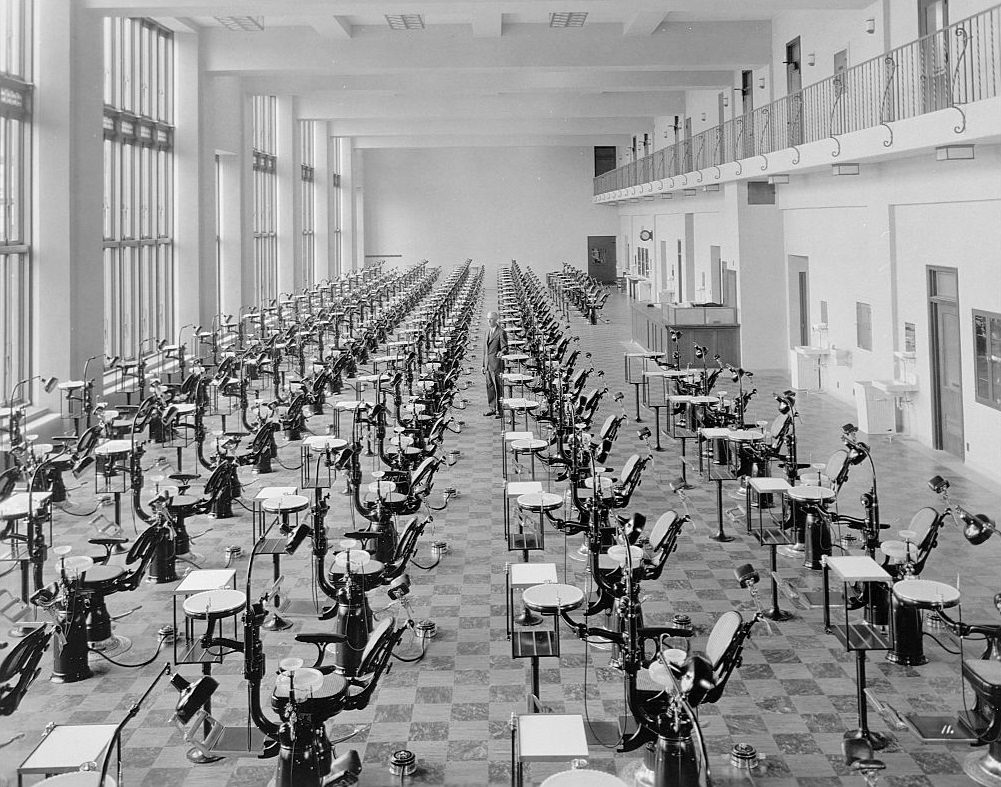
Rows of chairs at the School of Dentistry at the University of Minnesota, 1930.
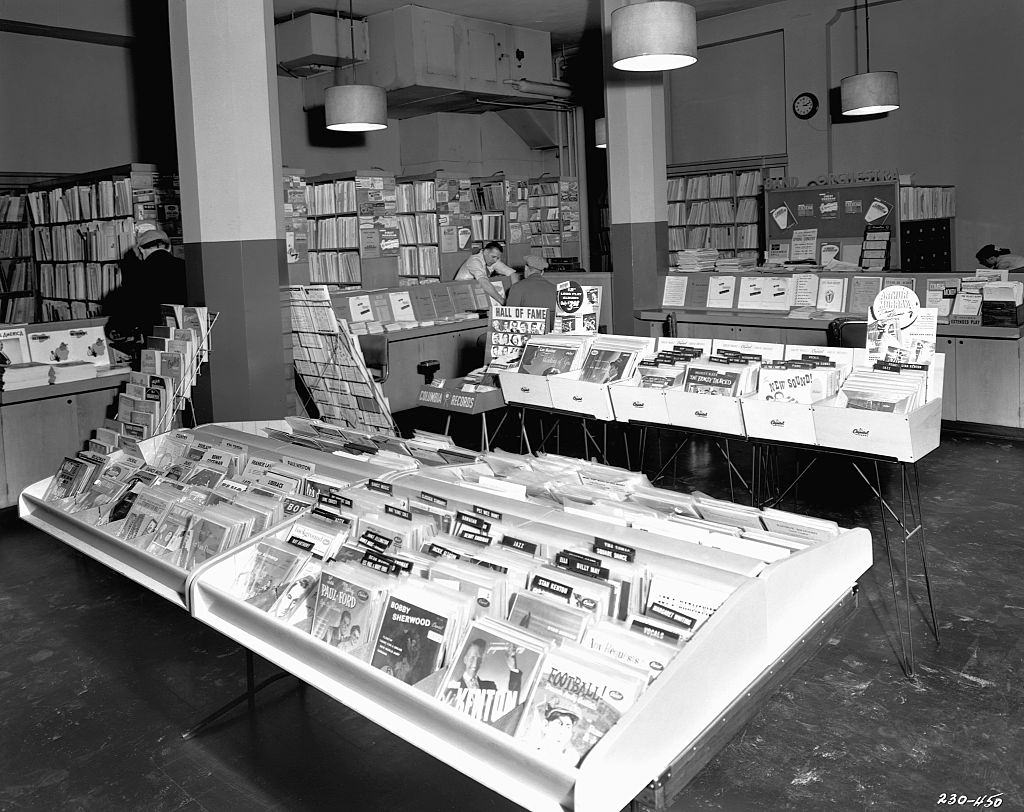
78 and 33 rpm records fill the sales bins at a music store in Minneapolis, 1930.

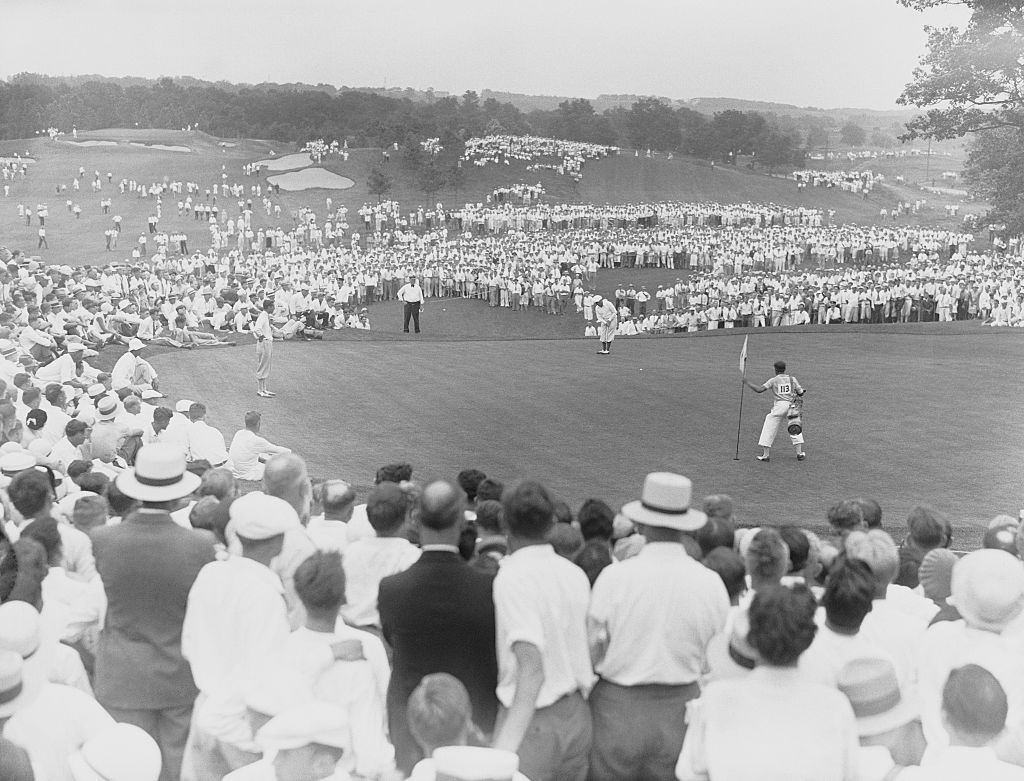
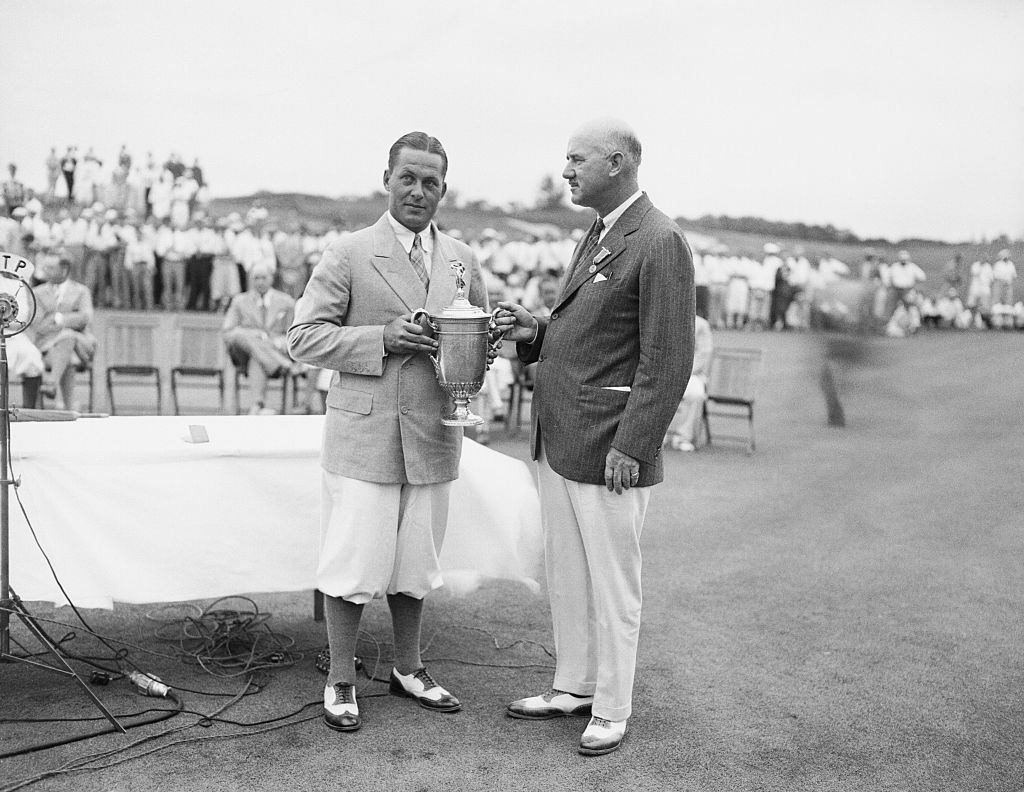
Music stores, parades, and sporting events gave residents moments of relief from economic anxiety. The Interlachen Country Club hosted major golf tournaments, drawing crowds of spectators eager for something to celebrate. In 1930, legendary golfer Bobby Jones competed at the National Open at Interlachen, with Jock Hutchinson watching closely during the second round of play.

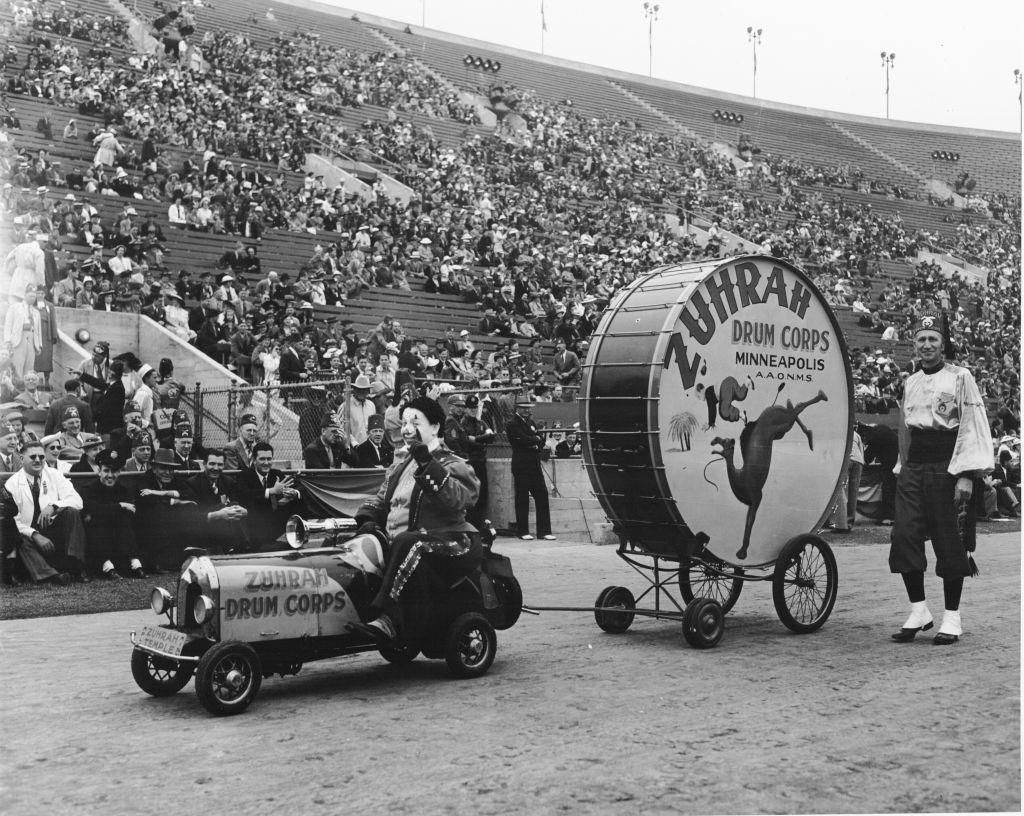
Shriner's parade inside Coliseum featuring clown and drum from Zuhrah Drum Corps. Minneapolis, Minnesota, 1930.
Shriner’s parade inside Coliseum featuring clown and drum from Zuhrah Drum Corps. Minneapolis, Minnesota, 1930.
Spectators watching a Golf Tournament. Minneapolis, Minnesota, 1930.

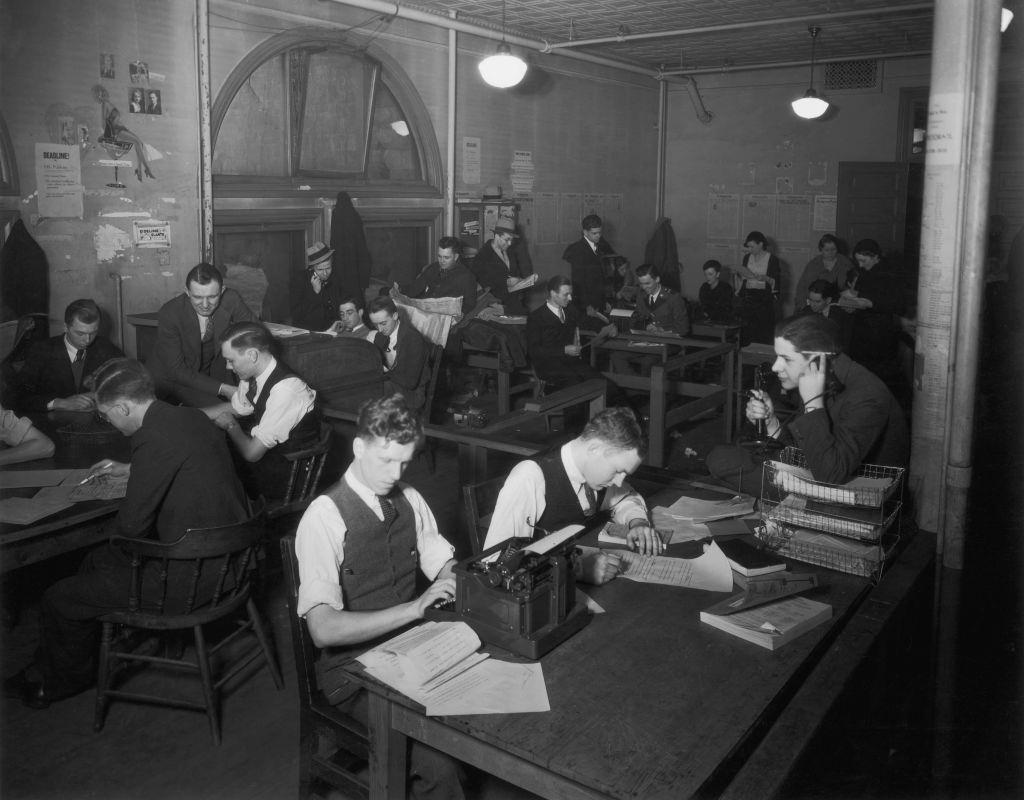
Campus life at the University of Minnesota carried on throughout the decade. Student journalists put out the Minnesota Daily, and young people trained for careers in business, home economics, and the trades. These institutions gave a sense of forward momentum, even when the broader economy offered little.

Students at work in the offices of the 'Minnesota Daily', the campus newspaper of the University of Minnesota, 1932.
Students at work in the offices of the ‘Minnesota Daily’, the campus newspaper of the University of Minnesota, 1932.
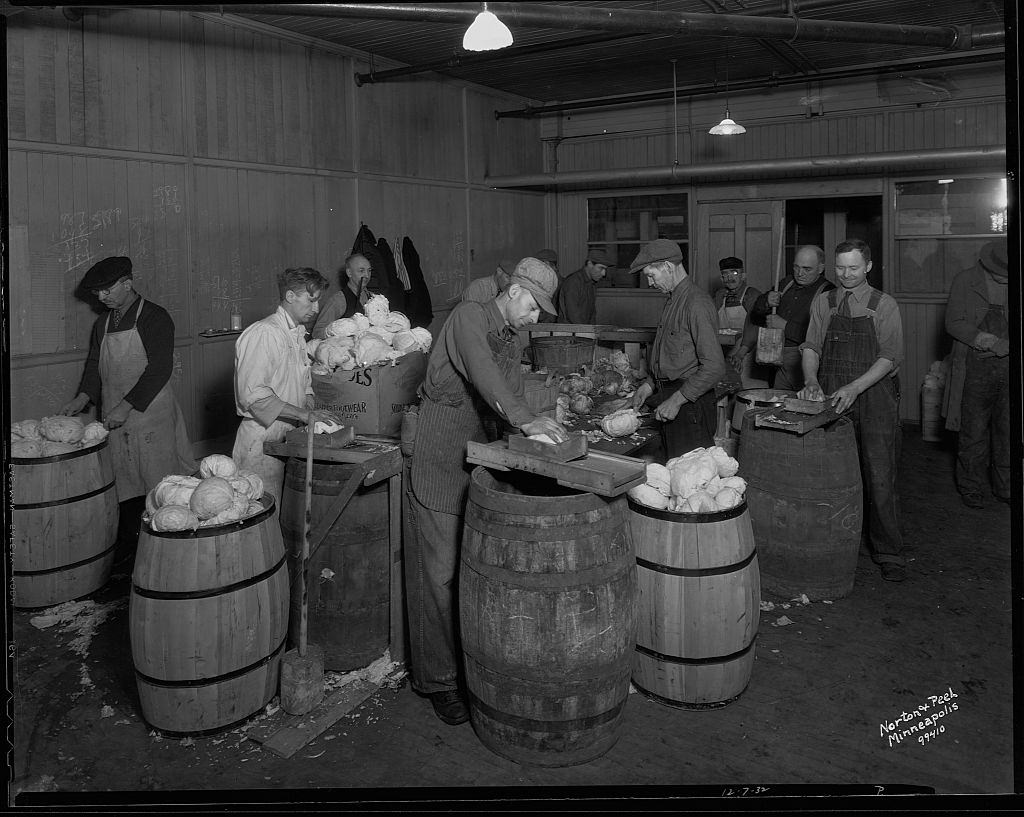
Men Making Sauerkraut in Minneapolis, 1932.

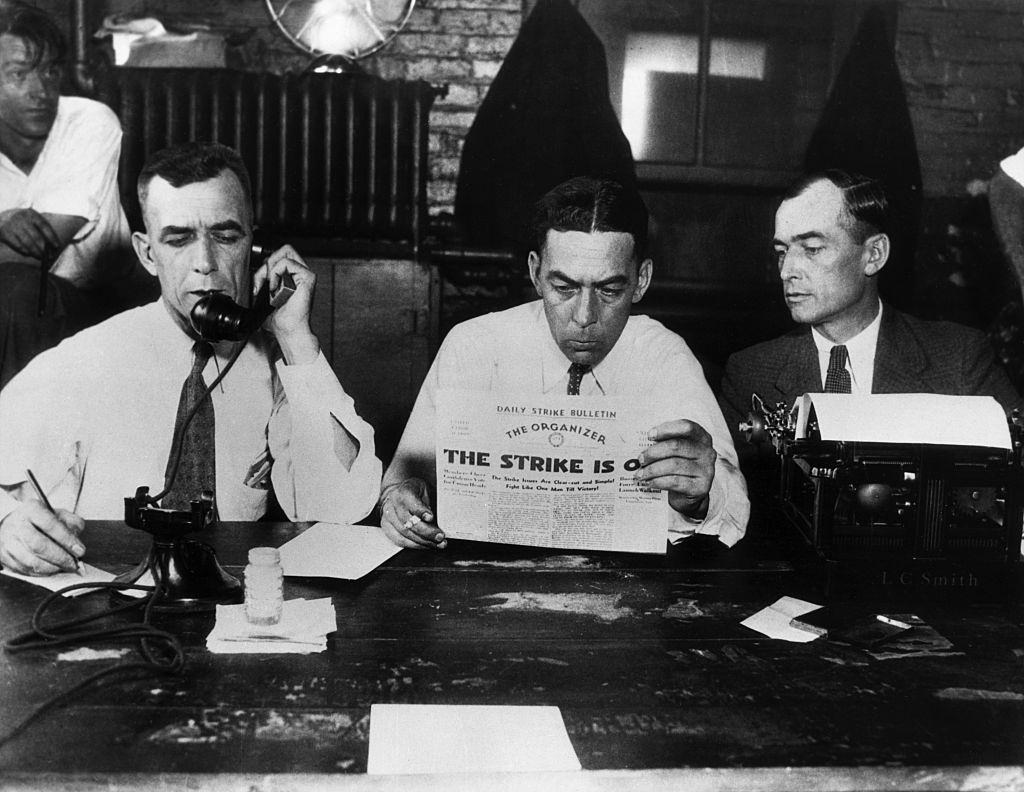
The tension between workers and employers had been building for years, and in 1934 it erupted. The Teamsters Strike of that year became one of the most violent labor conflicts in American history. The Dunne brothers — Ray, Grant, and Myles — were central figures in organizing Minneapolis truck drivers. Myles served as Secretary of the Truck Drivers Union, and the three brothers led workers through weeks of brutal confrontations on the city’s streets.

Three Dunne brothers work during Labor Strike in Minneapolis, 1934.

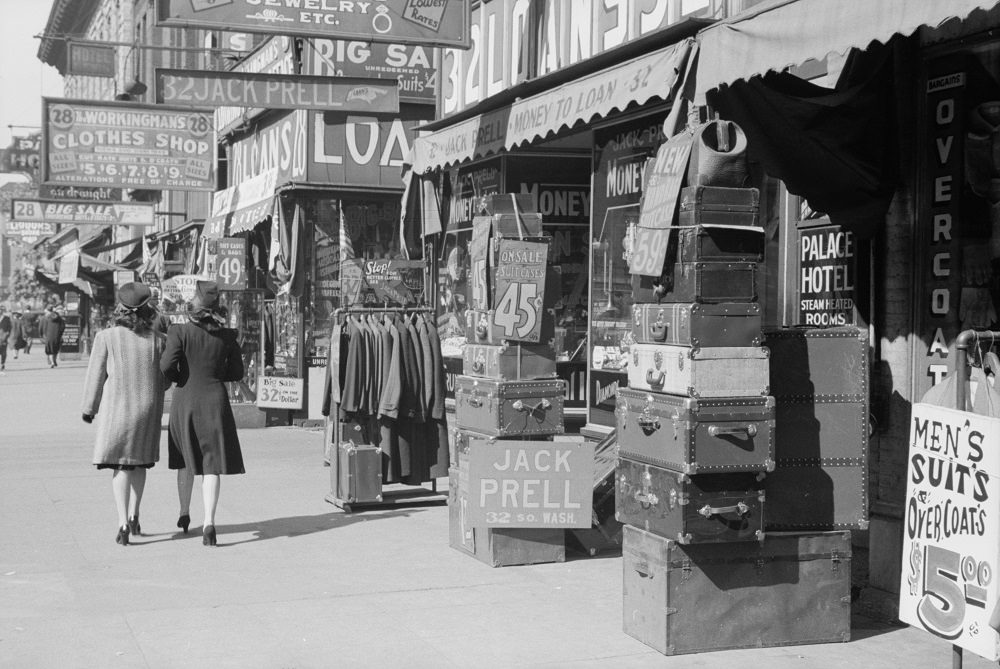
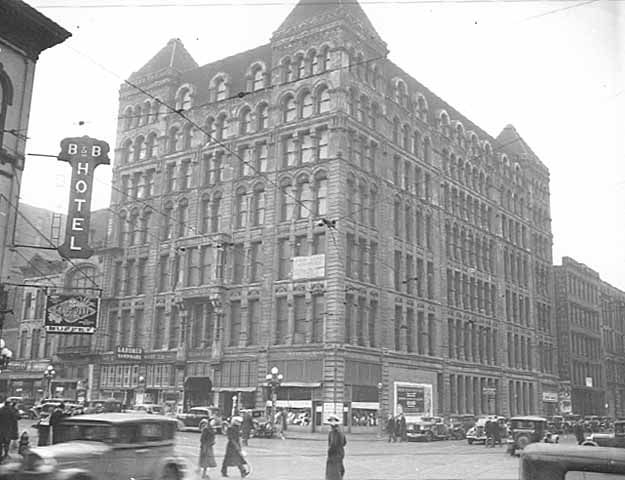
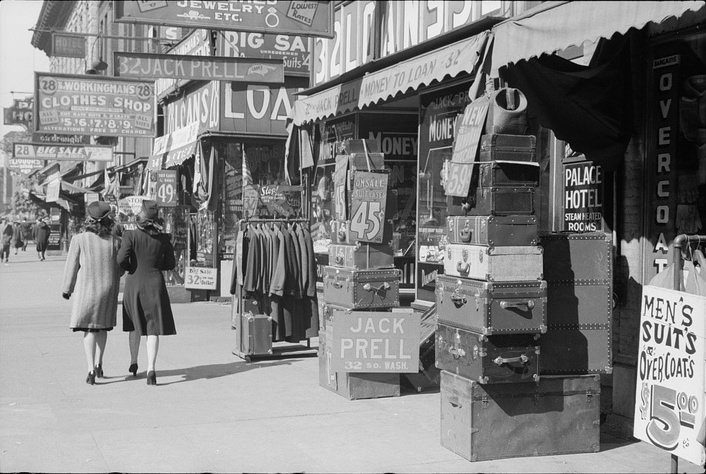
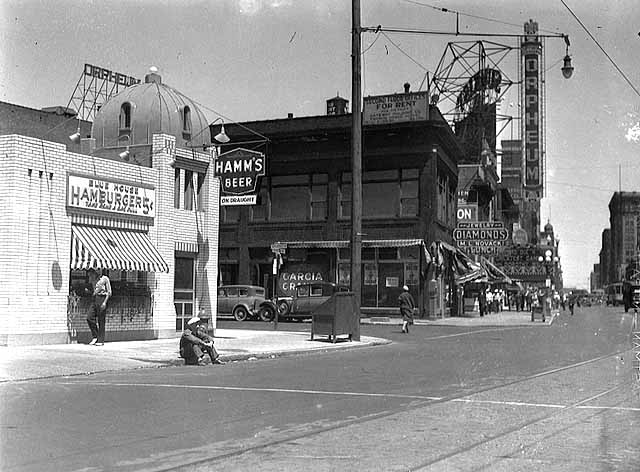
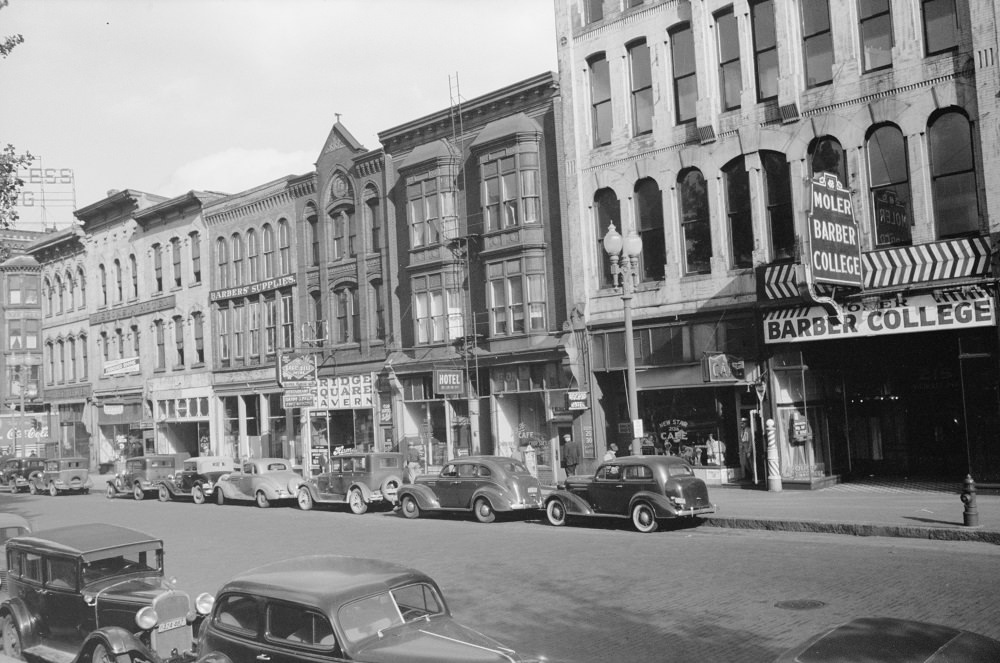
The Gateway District sat at the center of Minneapolis street life throughout the 1930s. Stretching along Washington Avenue and the blocks nearby, it was filled with pawnshops, secondhand stores, coffeehouses, cheap hotels, and barber colleges. It was a place where men with nowhere else to go could sit, eat cheaply, and find temporary shelter. Many of the original buildings in the Gateway District were later demolished in the 1950s during urban renewal efforts, making these photographs the only record of what those streets once looked like.

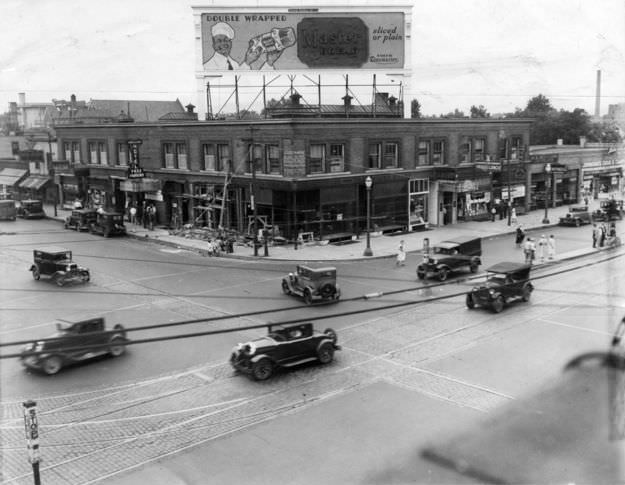
Gateway District, Minneapolis, 1930.
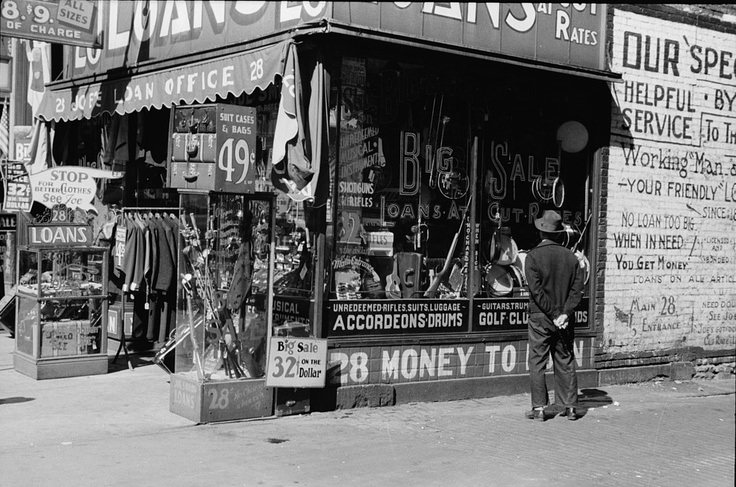
Pawnshops and secondhand stores in Gateway District, Minneapolis, 1930s.
Coffe shops, cafes and hotels in Gateway District, Minneapolis, 1930s.
Barber College in Gateway District, Minneapolis, 1930s.

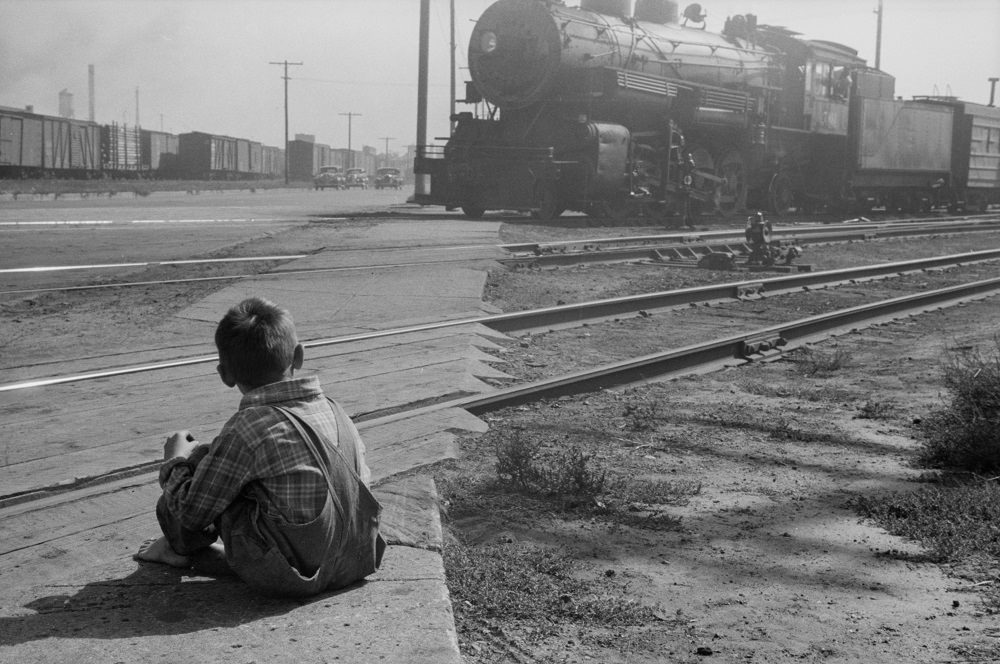
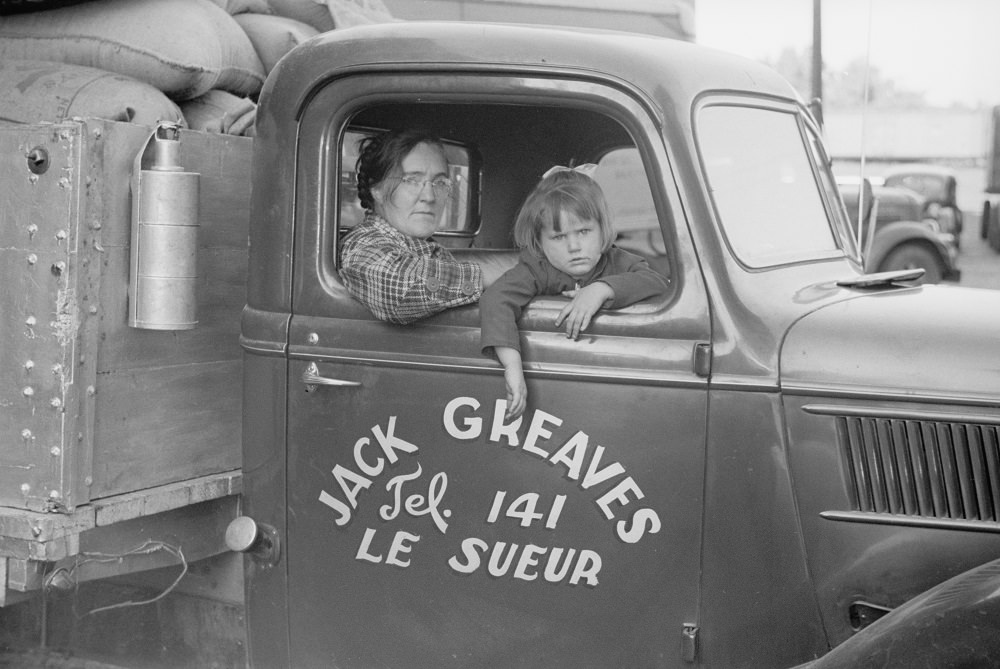
The Depression hit children and families hard. Kids growing up in poorer neighborhoods lived in conditions that were stark and often dangerous, while working families waited at loading docks and truck yards for jobs to begin or end.

Child who lives on the other side of the tracks, Minneapolis, 1930s.
Family of trucker waiting while truck is being loaded, Minneapolis, 1930s.

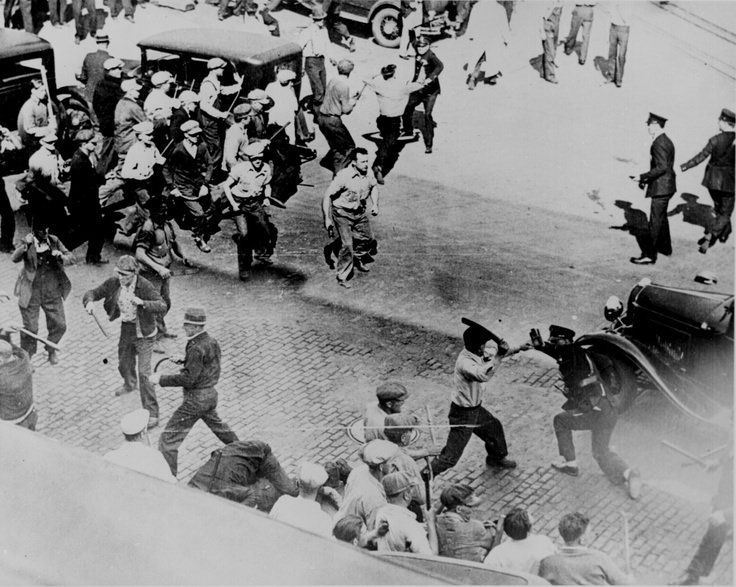
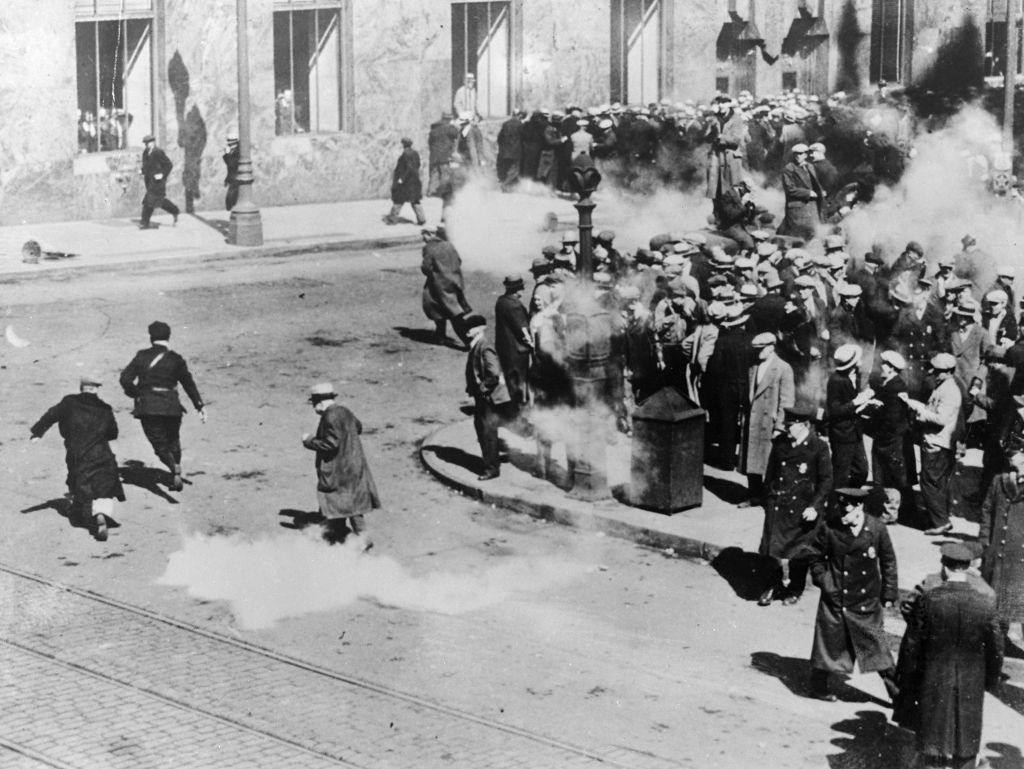
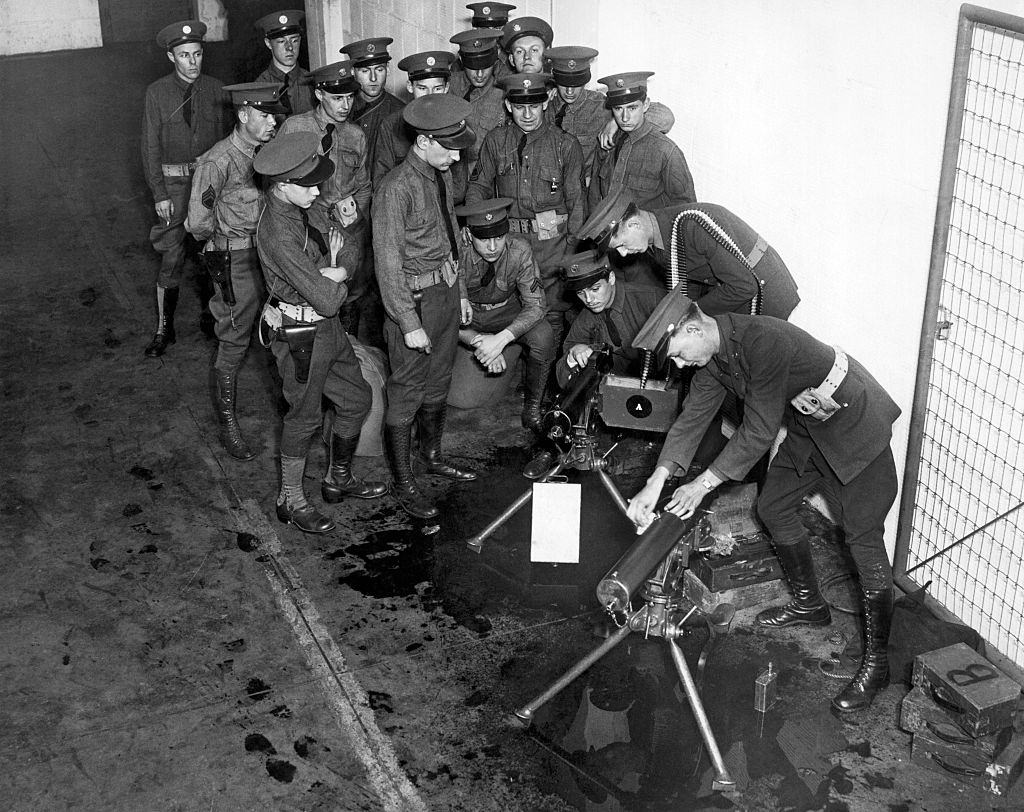
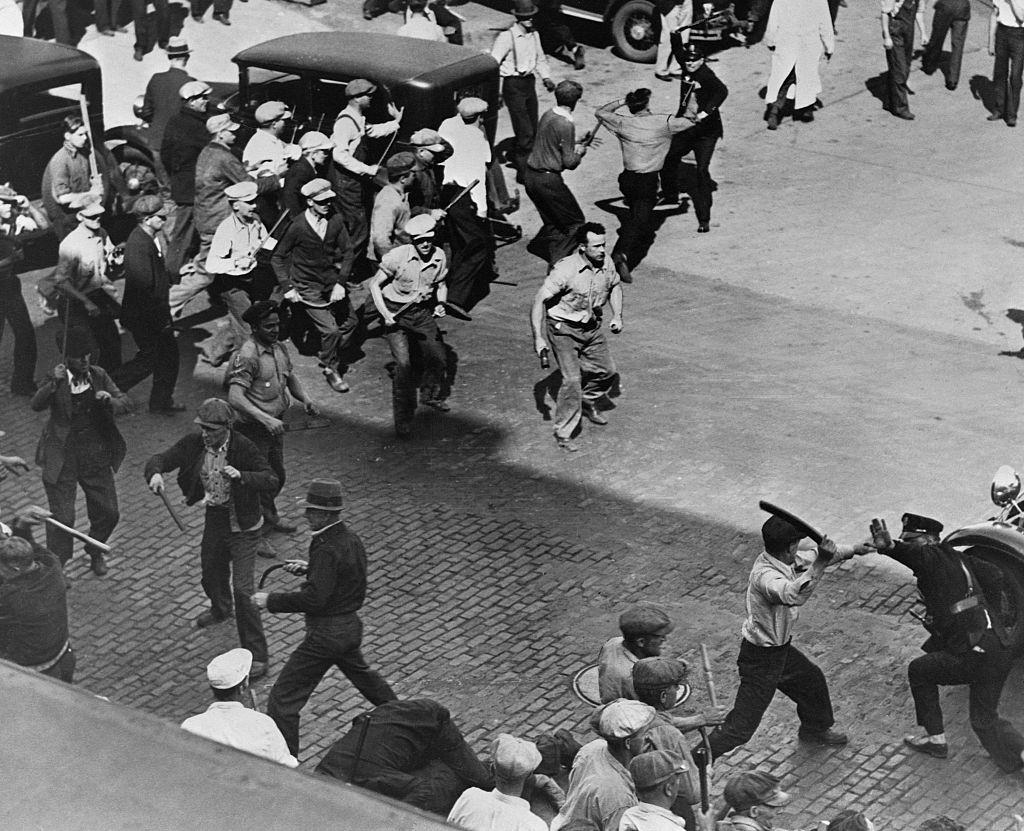
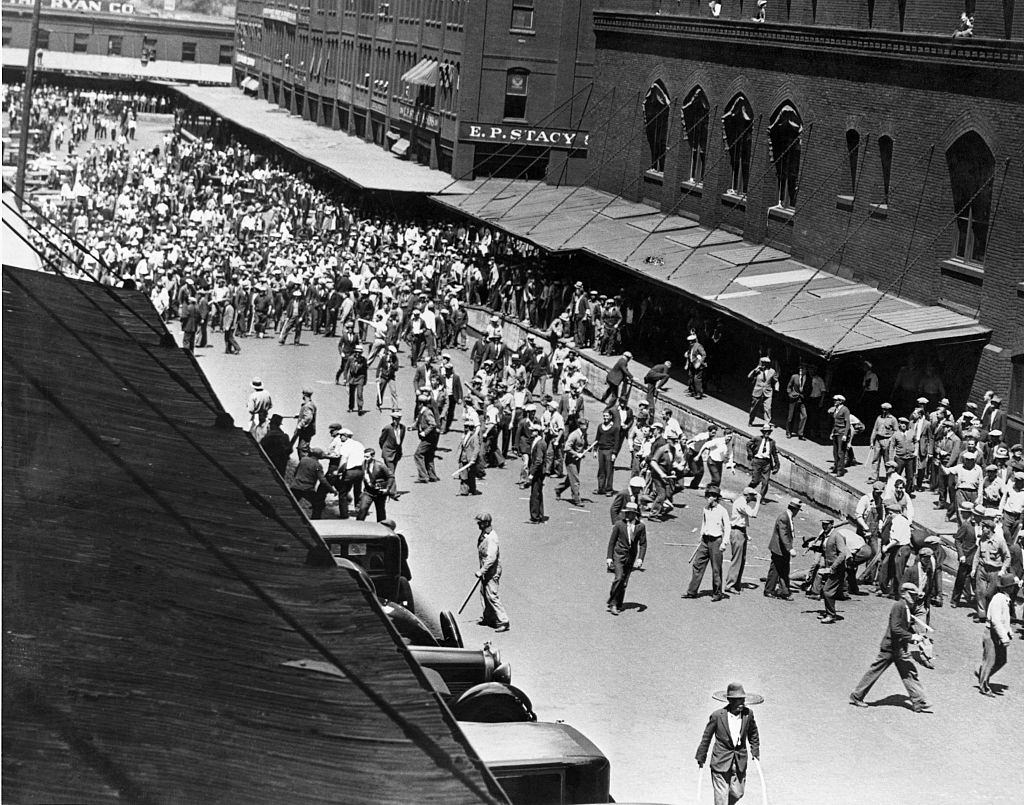
The 1934 Teamsters Strike produced some of the most dramatic scenes in Minneapolis history. On May 21, 1934, a clash between striking truckers and a citizen’s army at the Minneapolis City Market turned into a full-scale riot. Police intervened, brawls spread through the streets, and National Guardsmen were deployed to clean and oil machine guns in preparation for further unrest. The strike finally ended on August 22, 1934, and its aftermath led directly to new laws recognizing workers’ rights to organize.

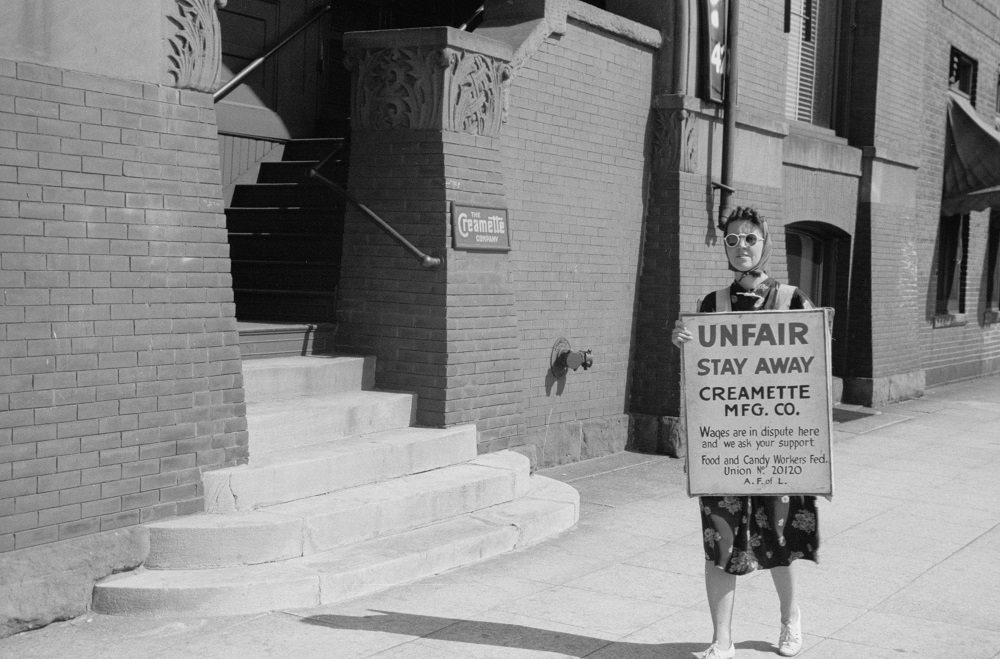
Picketing, Minneapolis, 1930s.
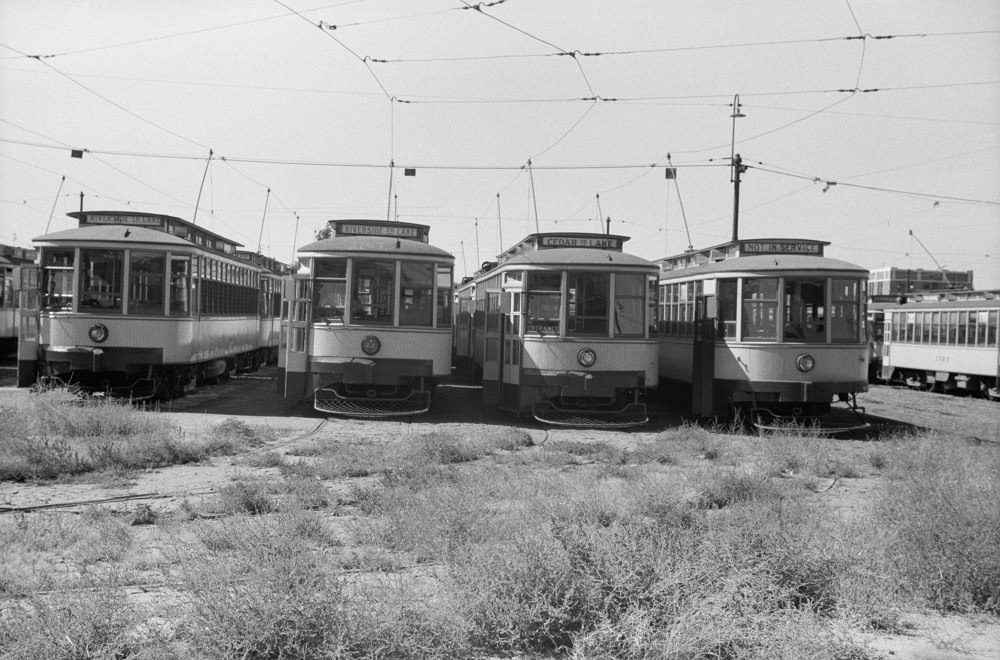
Streetcars in car yard, Minneapolis, 1930s.

While workers marched in the streets, the city’s criminal underworld was also at work. North Minneapolis was dominated by Isadore Blumenfield, known widely as Kid Cann. Blumenfield was connected to assassinations, political bribery, money laundering, and is linked to the deliberate destruction of the Minneapolis streetcar system. The streetcar network, once a fixture of daily life across the city, was systematically dismantled.

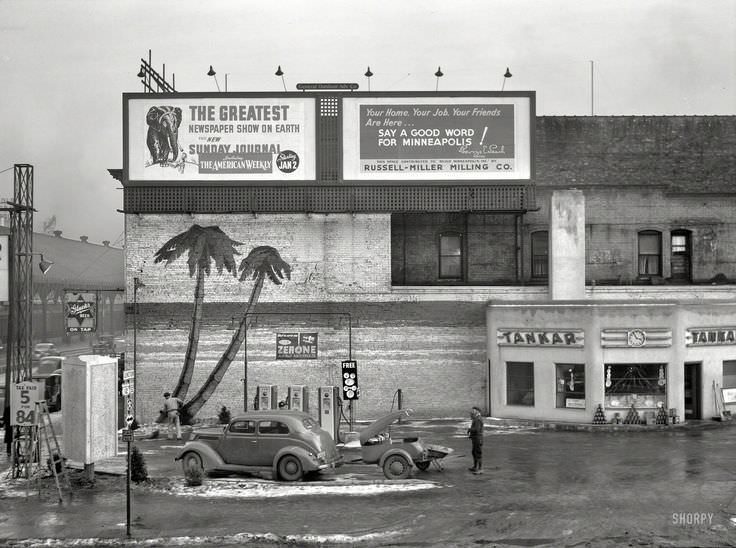
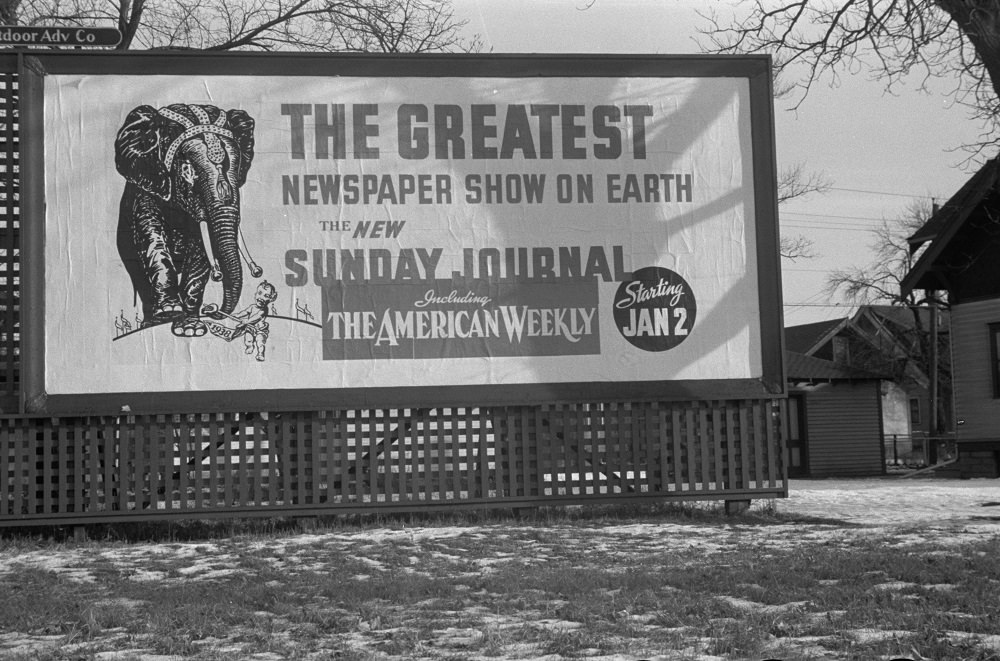
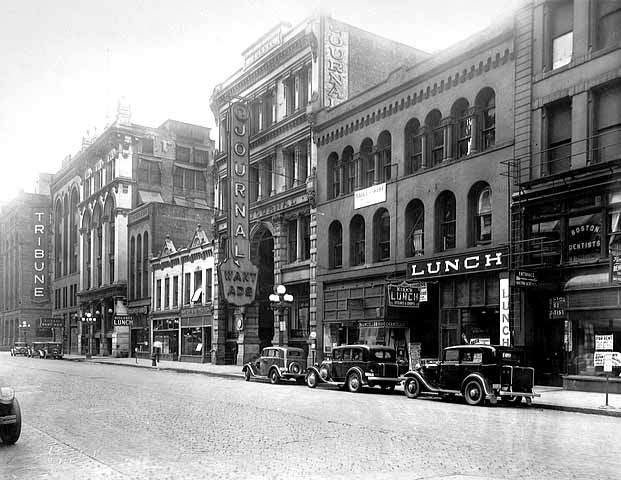
This billboard from 1937 advertises for the Minneapolis Journal newspaper.
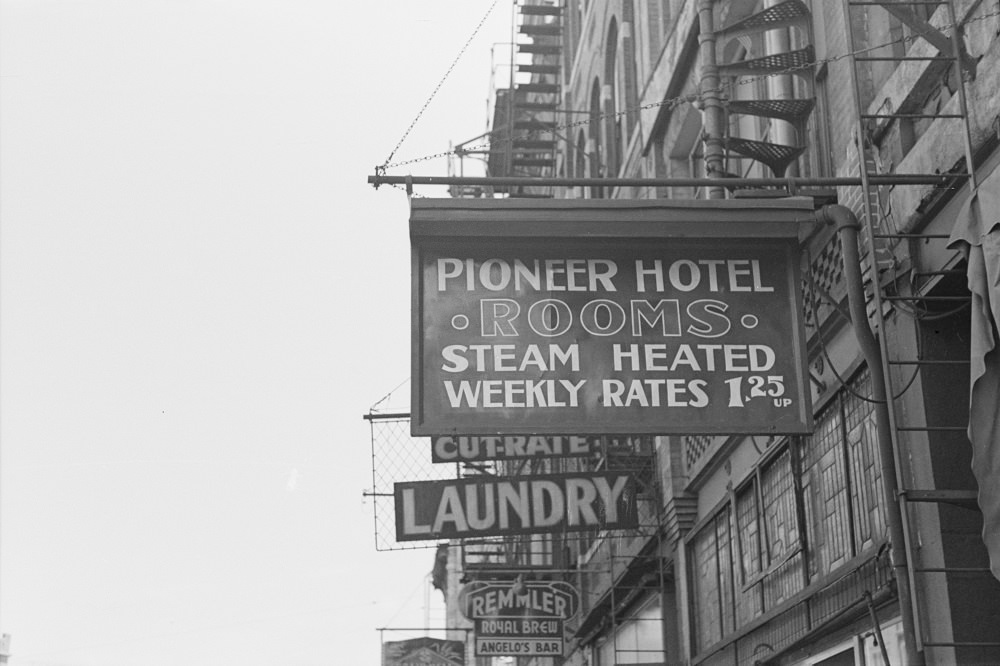
Signs in the Gateway District, Minneapolis, 1937.
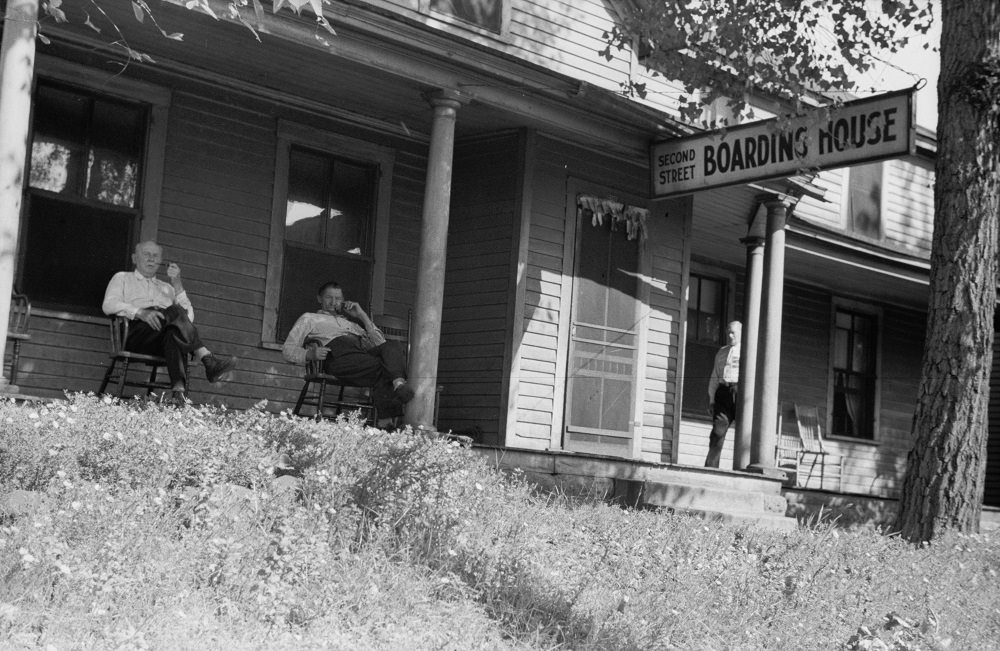
Second Street boardinghouse, Minneapolis, 1930s.

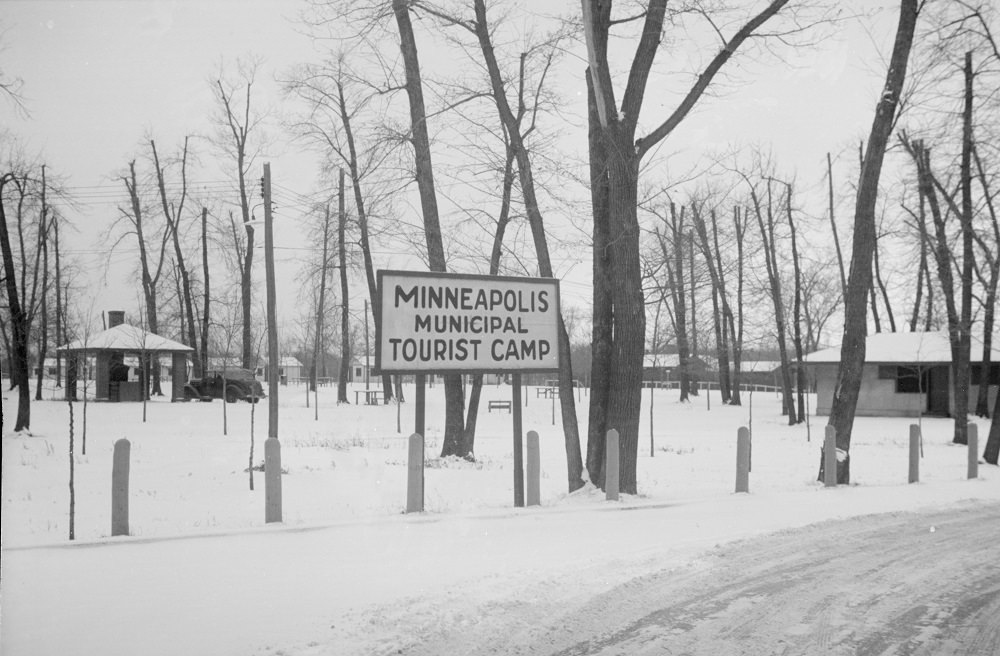
Housing options for those with little money ranged from cheap boardinghouses to roadside tourist camps. Tourist camps offered either a basic room rental — similar to early motels — or just a spot to pull over and camp for the night. In winter, these camps became particularly harsh places to stay.

Tourist camp in winter, Minneapolis, 1930s.

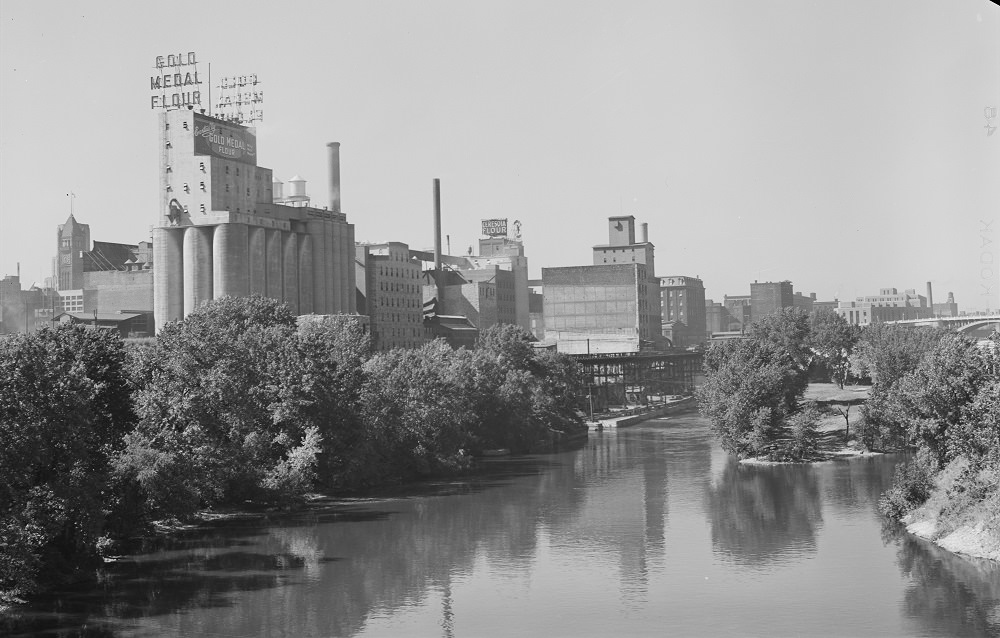
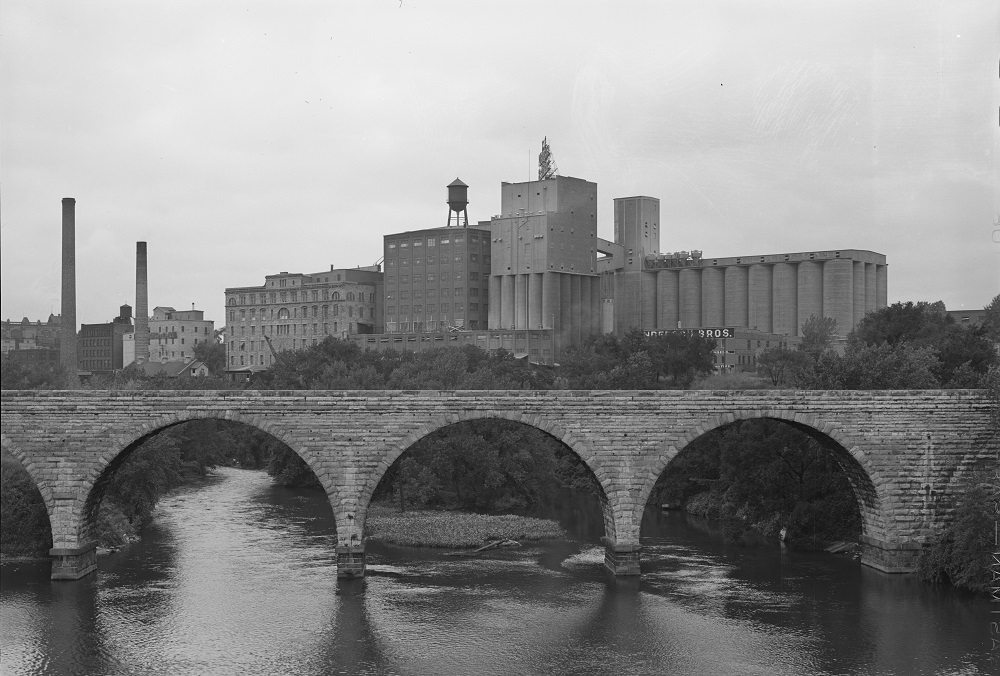
Minneapolis had built its reputation as a city on the back of its flour milling industry. Massive mills lined the banks of the Mississippi River, processing and shipping enormous volumes of flour to markets across the country. By the 1930s, however, that industry was contracting. Mills that had operated at full capacity for decades began to scale back or shut down entirely.

Flour mills along the Mississippi River. Minneapolis, 1930s.
Flour mills along the river. Minneapolis, 1930s.

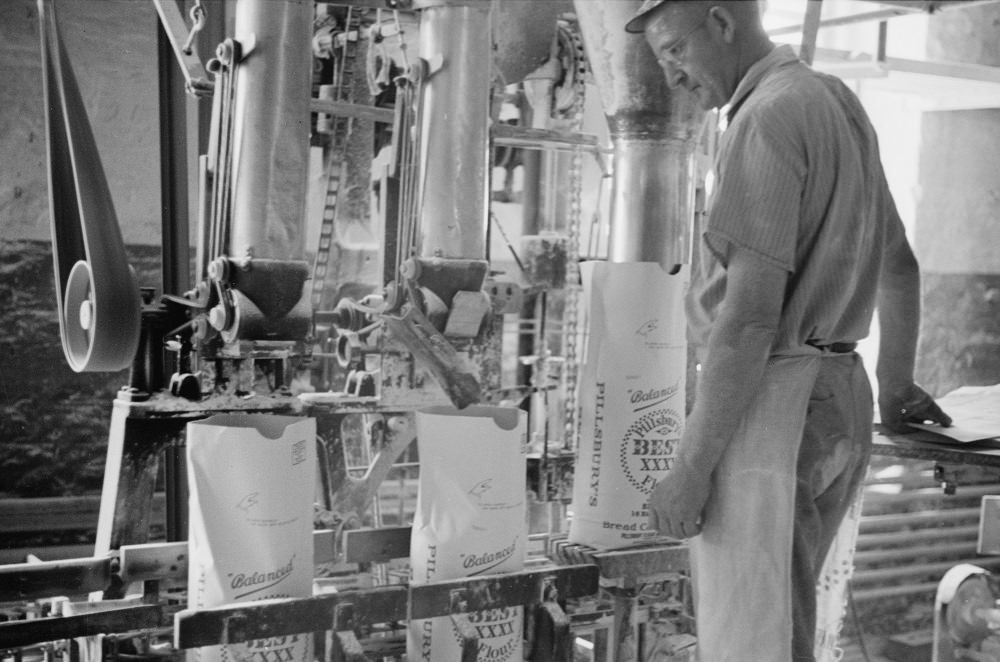
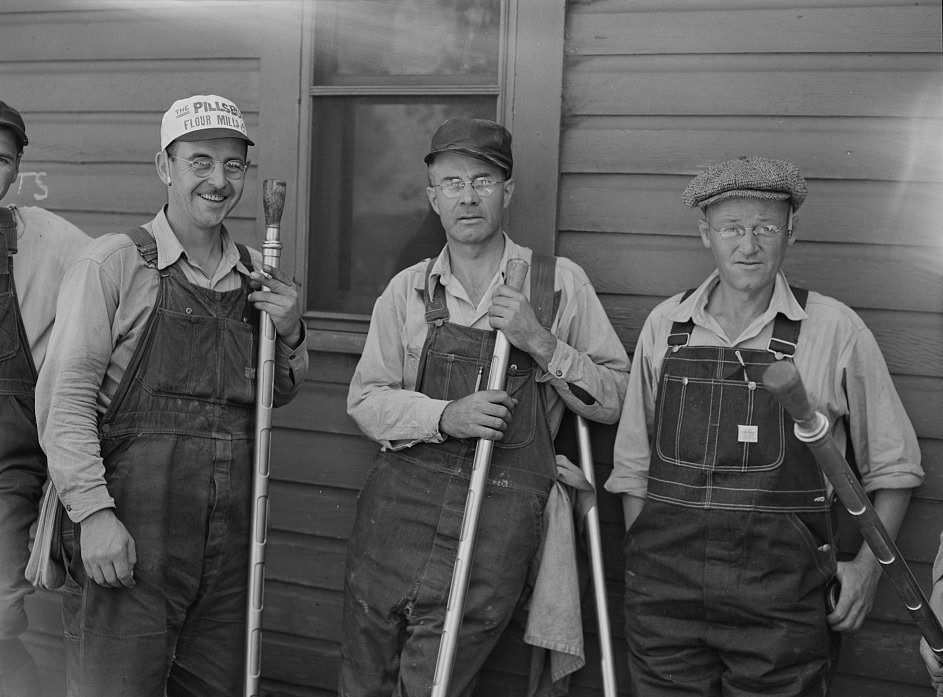
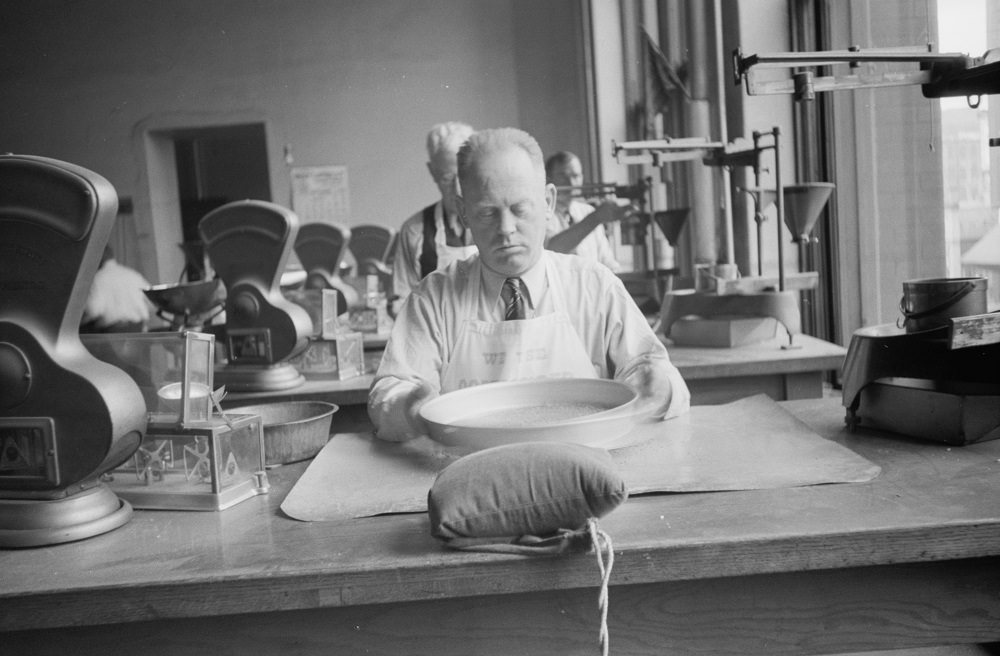
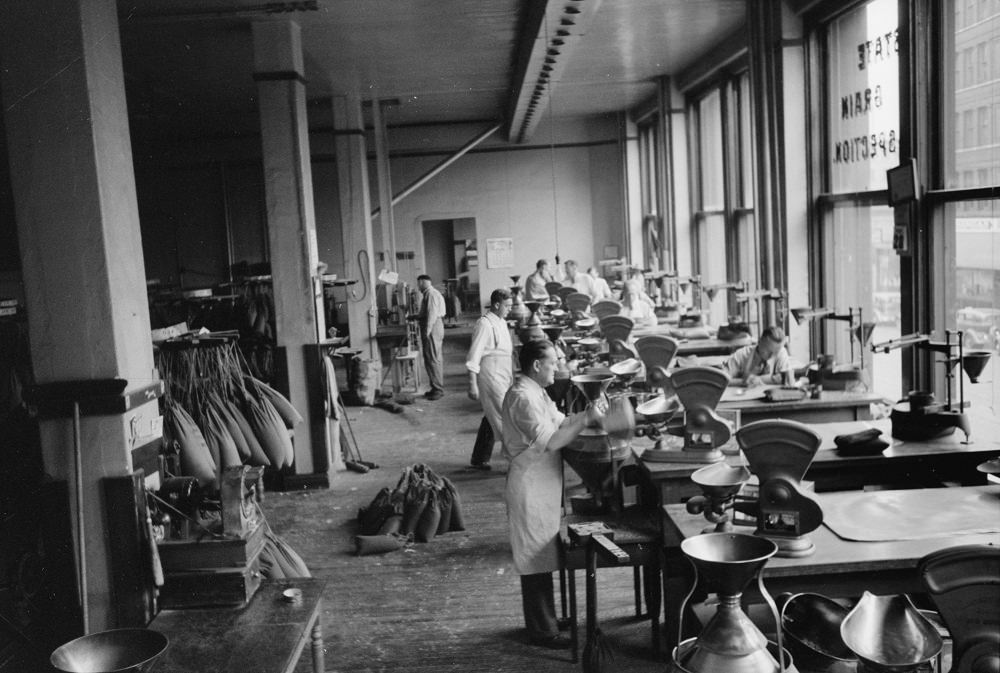
The Pillsbury Mill was among the largest operations in the city. Inside, workers managed packing and filling lines in long, noisy production rooms. Nearby, the Minnesota Grain Inspection Department kept close watch on both imported and exported grain, running products through teams of samplers and inspectors to ensure quality standards were met. Grain was central to the state’s economic identity, and the Twin Cities maintained large inspection departments to protect that trade.

Packing flour at Pillsbury mill, Minneapolis, 1930s.
Grain samplers, Minnesota Grain Inspection Department. Minneapolis, 1930s
Grain inspector at state grain inspection deptartment, Minneapolis, 1930s.
Minnesota state grain inspection department, Minneapolis, 1930s.

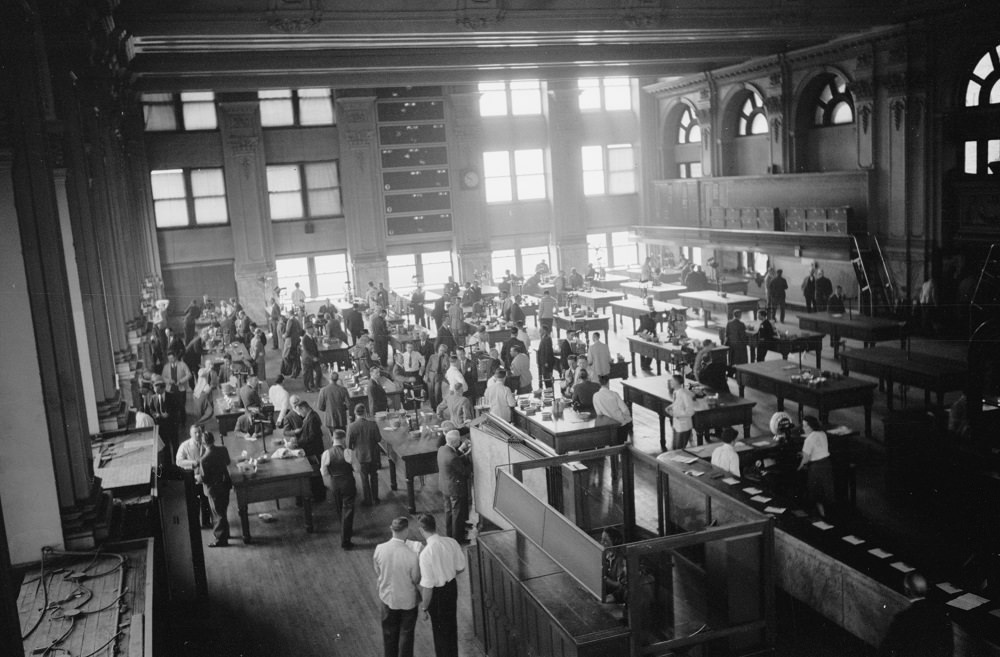
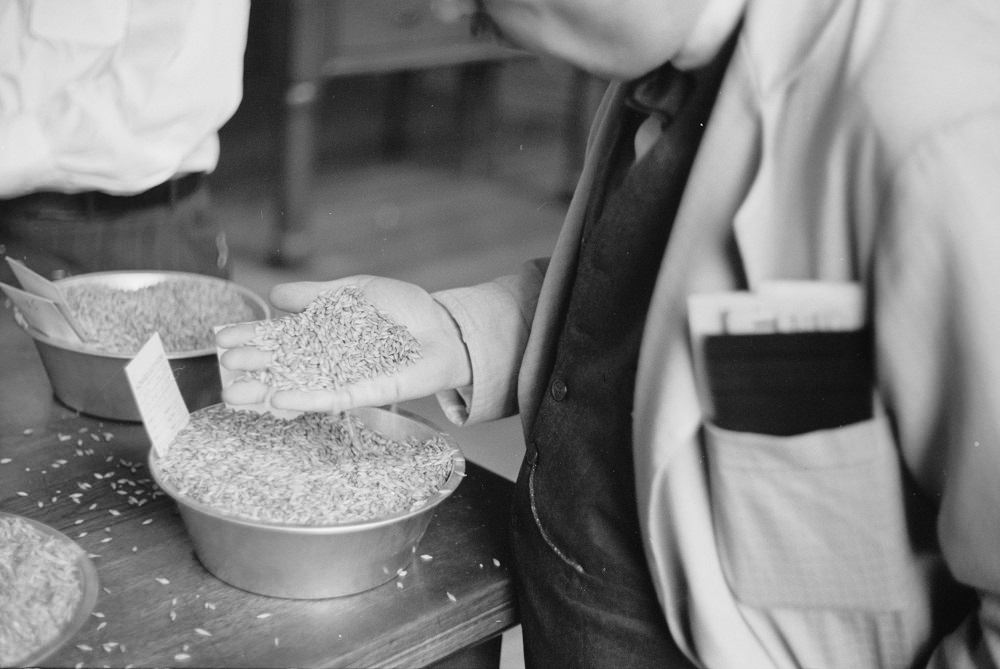
The Minneapolis Grain Exchange operated as an open market where farmers brought their products to sell and buyers examined samples before purchasing. Oats, wheat, and other crops changed hands on the exchange floor, connecting regional agriculture to national and international markets.

Open grain market, Minneapolis Grain Exchange, Minneapolis, 1930s.
Buyer examining sample of oats at open market, Minneapolis Grain Exchange, Minnesota, 1939.

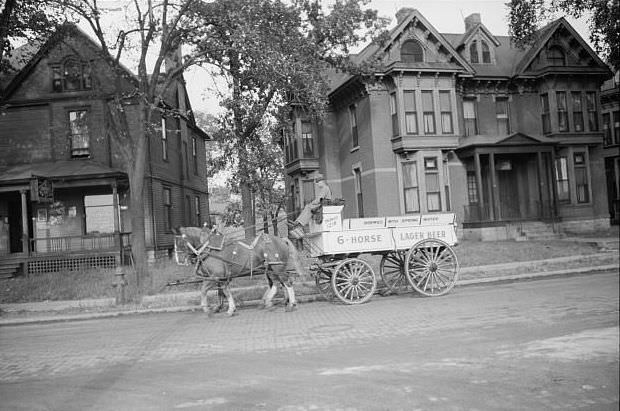
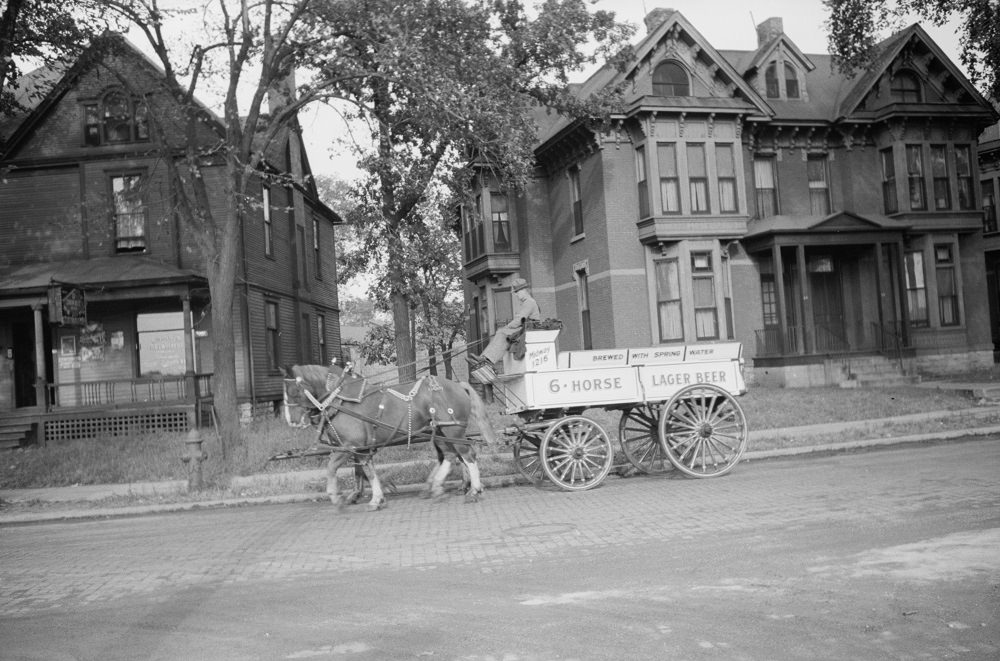
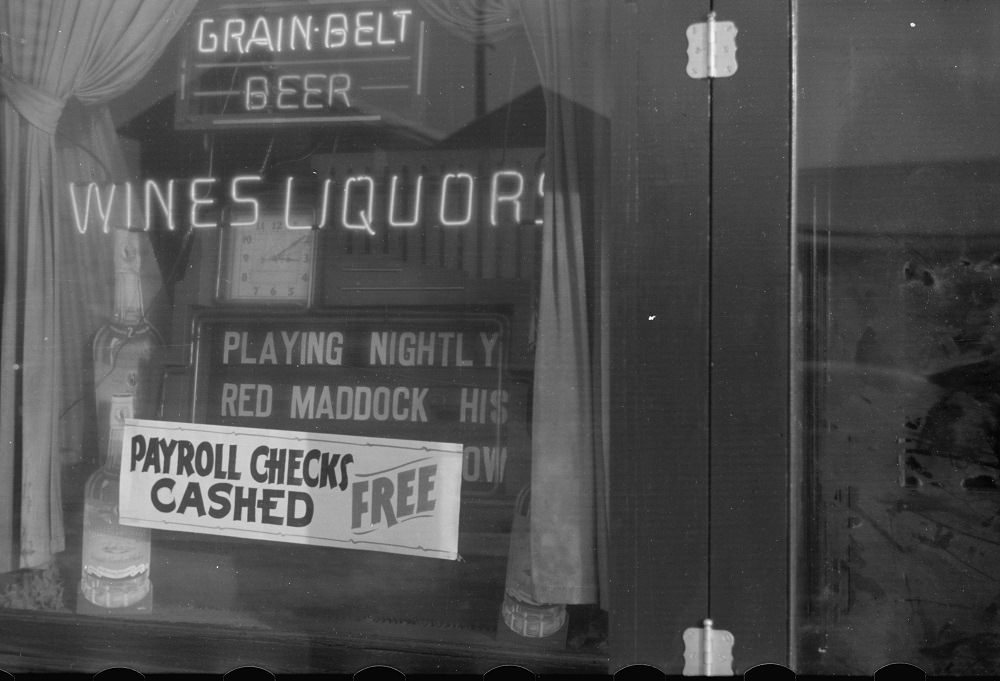
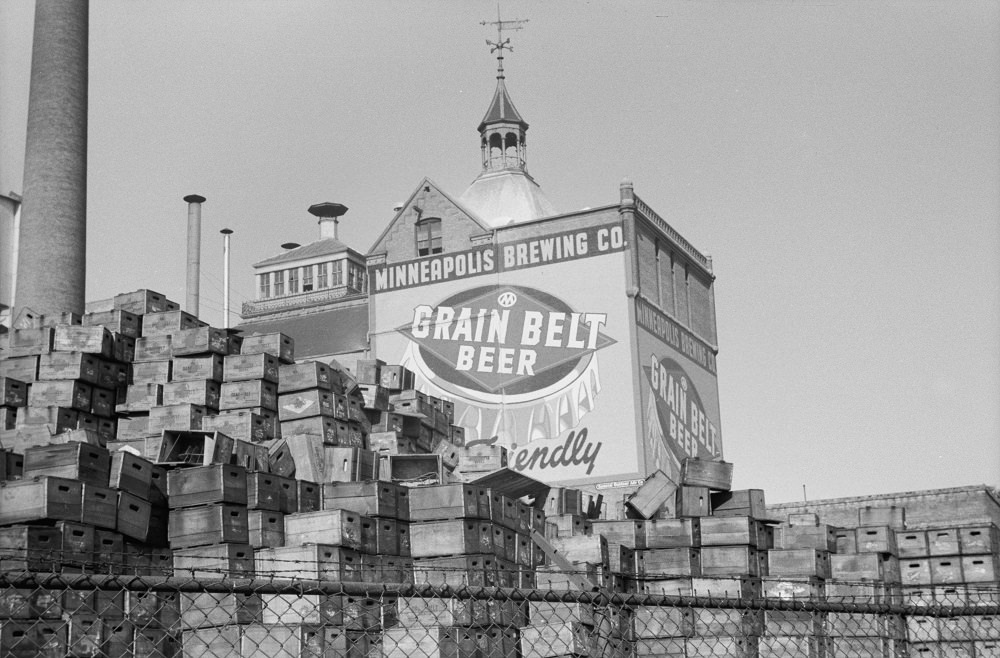
The mill district had its own social ecosystem. Saloons near the mills served workers at the end of long shifts. Horse-drawn beer wagons made regular deliveries to businesses across the city well into the late 1930s. Grain Belt Brewery, established in 1893, had survived Prohibition by producing near-beer and sodas, and was back to full brewing operations by the time these photos were taken.

Saloon in mill district, Minneapolis, 1939.
Beer wagon, Minneapolis, 1930s.
Brewery, Minneapolis, 1930s.

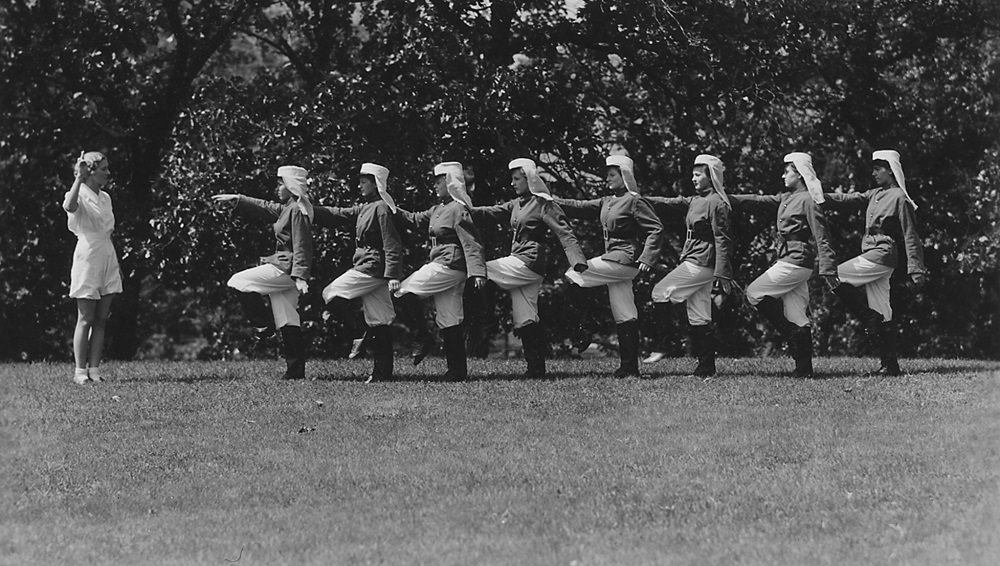
The federal government responded to mass unemployment with a range of relief programs. Starting in 1933, the Federal Emergency Relief Administration opened Camps for Unemployed Women — also called She-She-She Camps — modeled after the Civilian Conservation Corps programs already running for men. These camps gave women access to housing, meals, and job training during the worst years of the Depression.

Camp for Unemployed women in Minneapolis, 1930s.

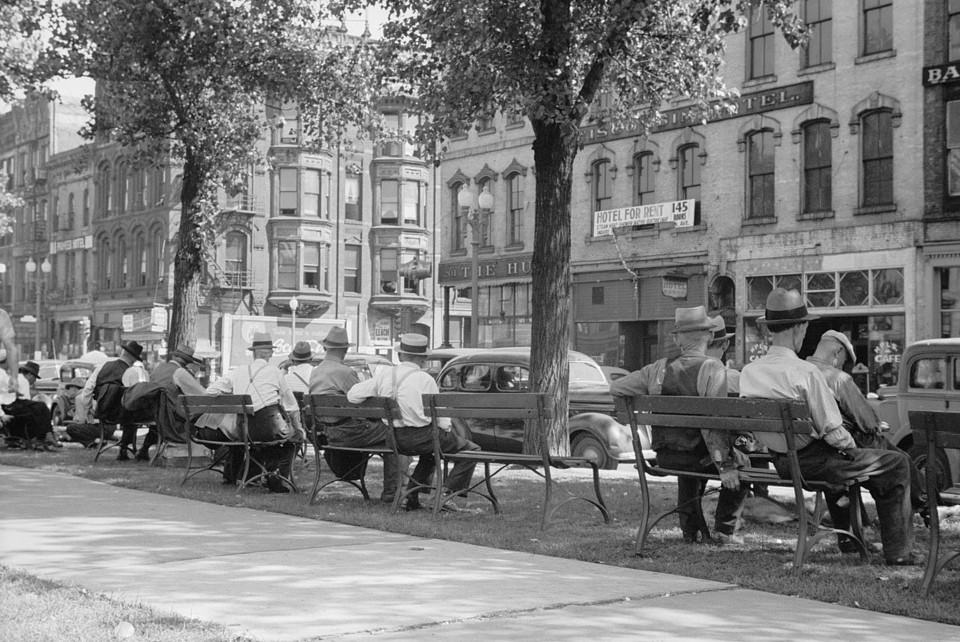
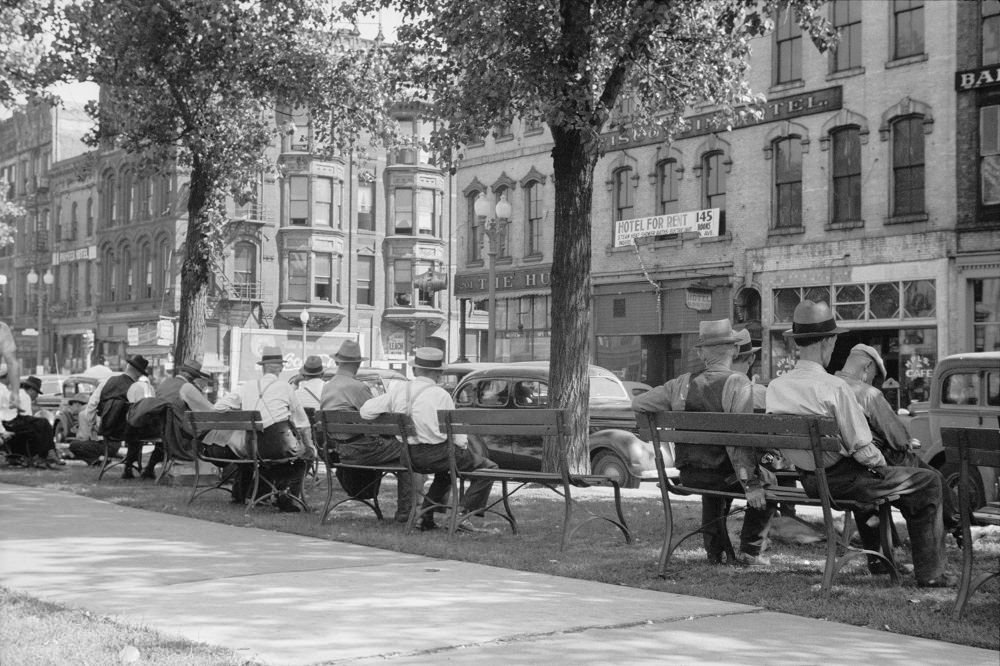
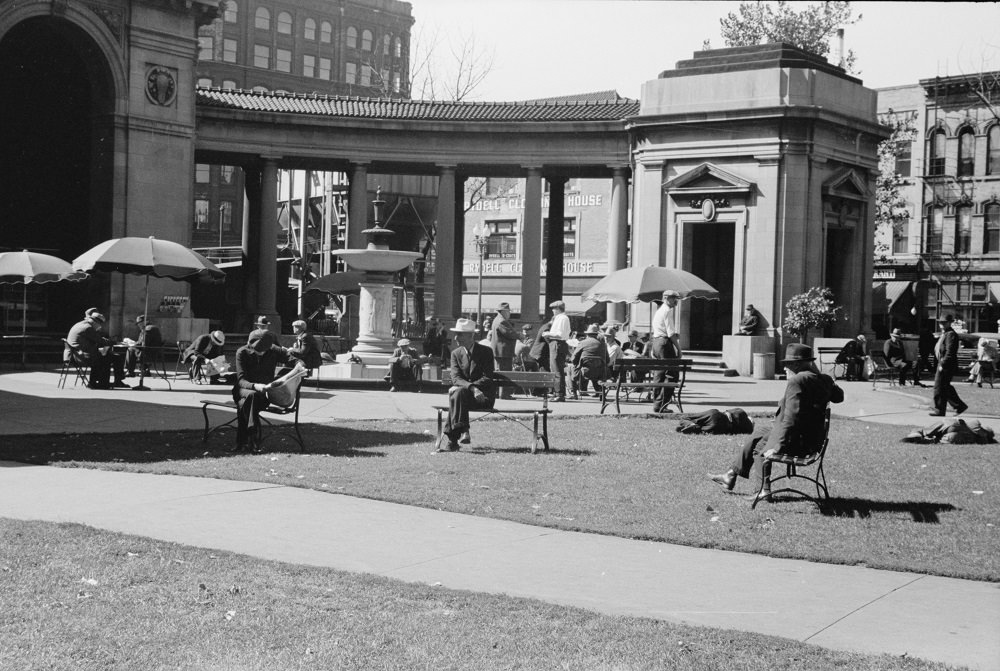
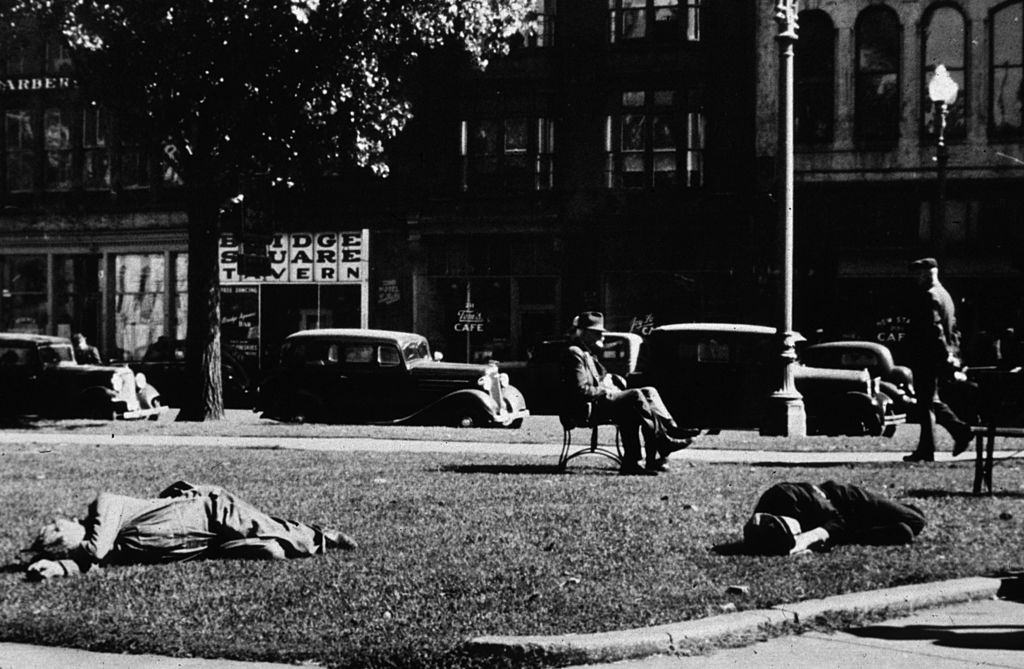
Gateway Park became a gathering place for unemployed men who spent their days outdoors, sitting on benches or playing games. Despite being known as the heart of skid row, the park offered a kind of communal relief — a place where men in similar circumstances could simply be together without spending money they didn’t have.

Men sitting in the park, Gateway District, Minneapolis, 1930s.
Gateway District, Minneapolis, 1930s.
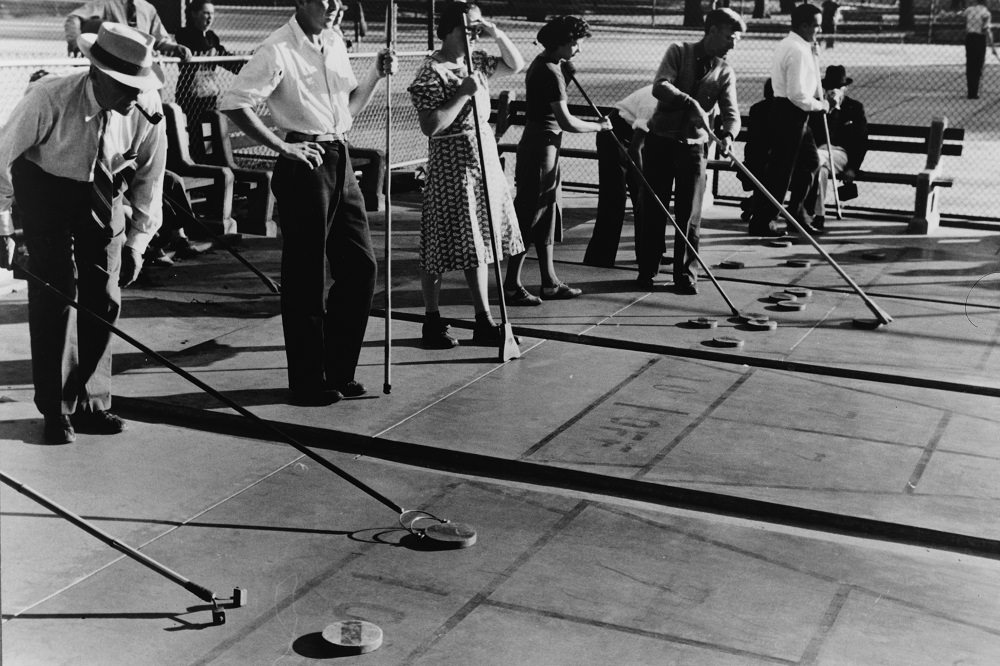
Playing shuffleboard in the park, Minneapolis, 1930s.
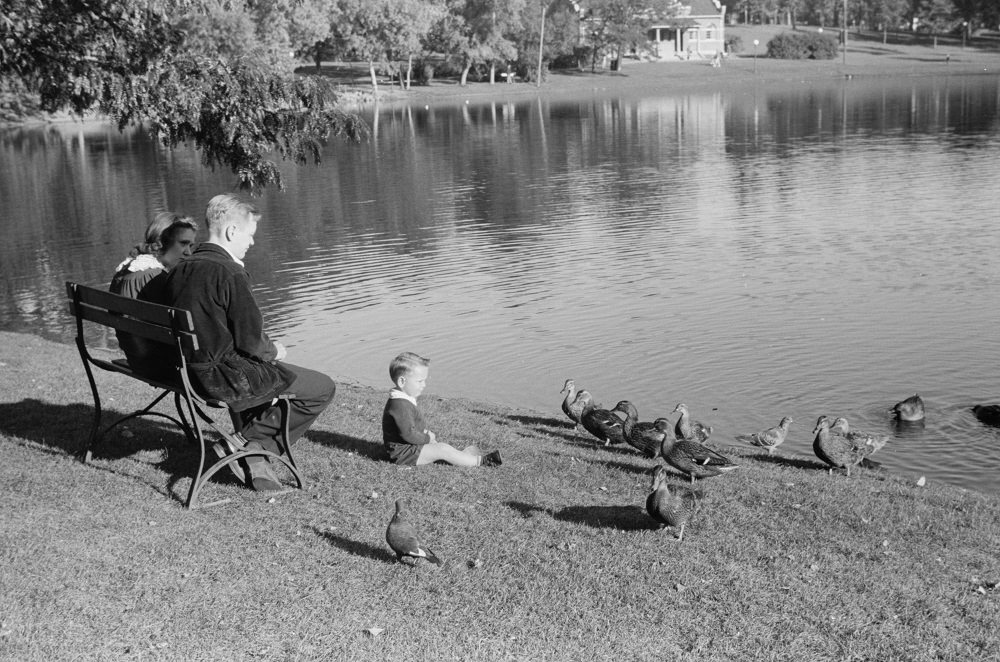
A family feeding ducks in park on Saturday afternoon, Minneapolis, 1930s.

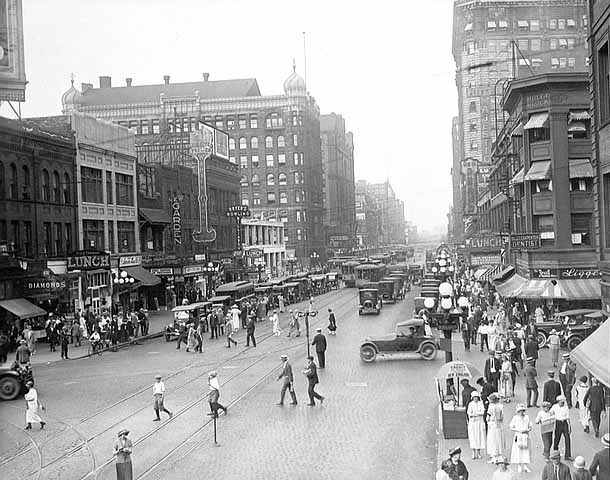
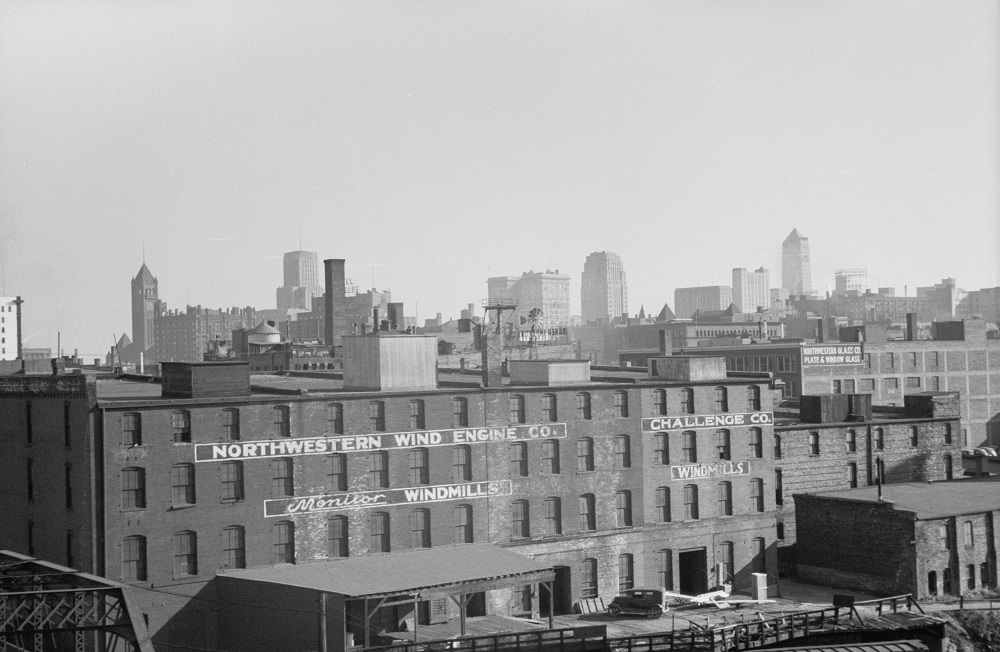
The Minneapolis skyline of the 1930s looked nothing like it does today. Low industrial buildings, windmill companies, and warehouse structures dominated the view. Streets were busy with a mix of streetcars, early automobiles, horse-drawn wagons, and pedestrians navigating the same blocks at once.

Skyline with windmill company in foreground, Minneapolis, 1930s.
Brawls between the unemployed and the police, in Minneapolis, Minnesota, 1934.
National Guardsmen as they oil and clean machines guns, Minneapolis, 1934.

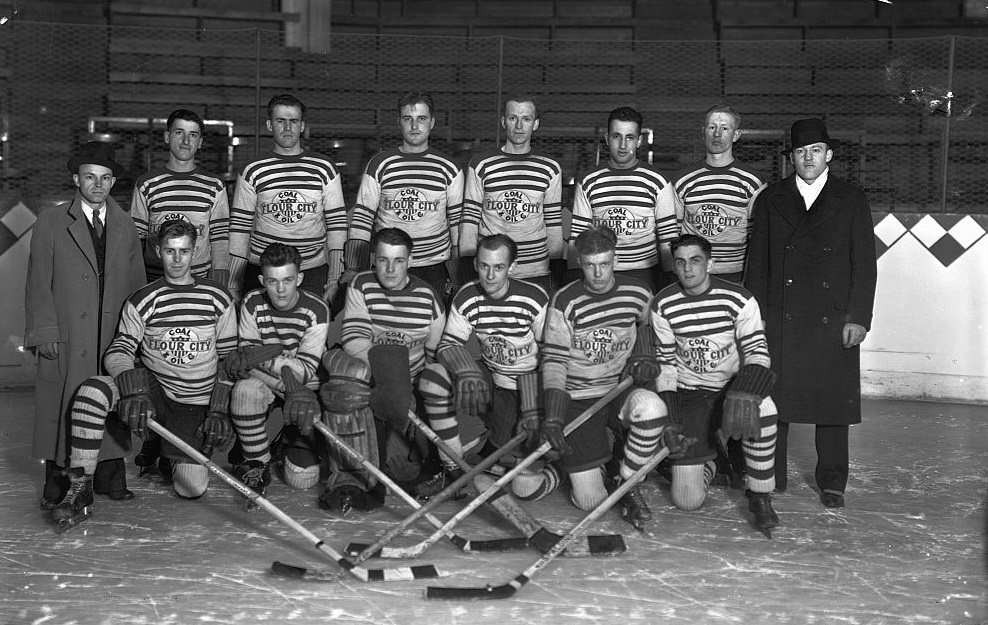
Not every gathering in 1934 Minneapolis was a protest or a riot. Local sports teams, amateur leagues, and community organizations continued to operate. The Flour City Coal and Oil Company fielded an amateur hockey team that season, posing on the ice alongside their coaches for a team photograph.

The amateur hockey team from the Flour City Coal and Oil company pose on the ice with their coaches in 1934.
Police intervene in a clash between striking truckers and the citizen's army. Minneapolis.  Minnesota. May 21st, 1934
Police intervene in a clash between striking truckers and the citizen’s army. Minneapolis. Minnesota. May 21st, 1934
A truck driver's strike turns into a riot on May 21, 1934 at the Minneapolis City Market.
A truck driver’s strike turns into a riot on May 21, 1934 at the Minneapolis City Market.

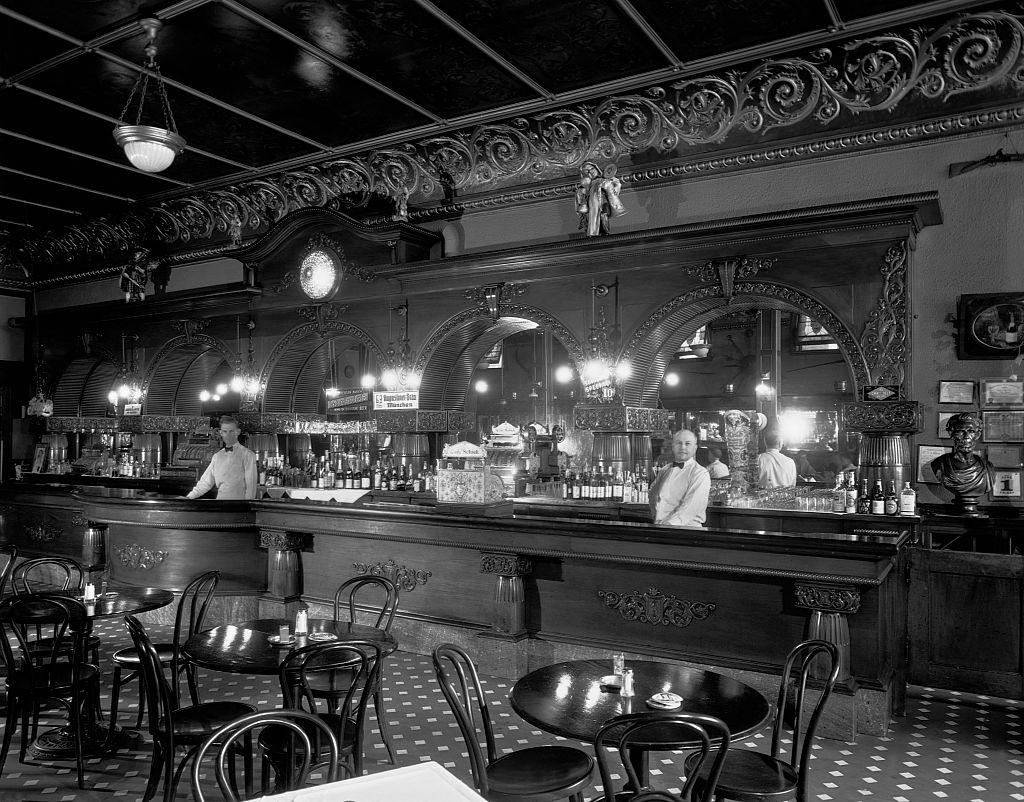
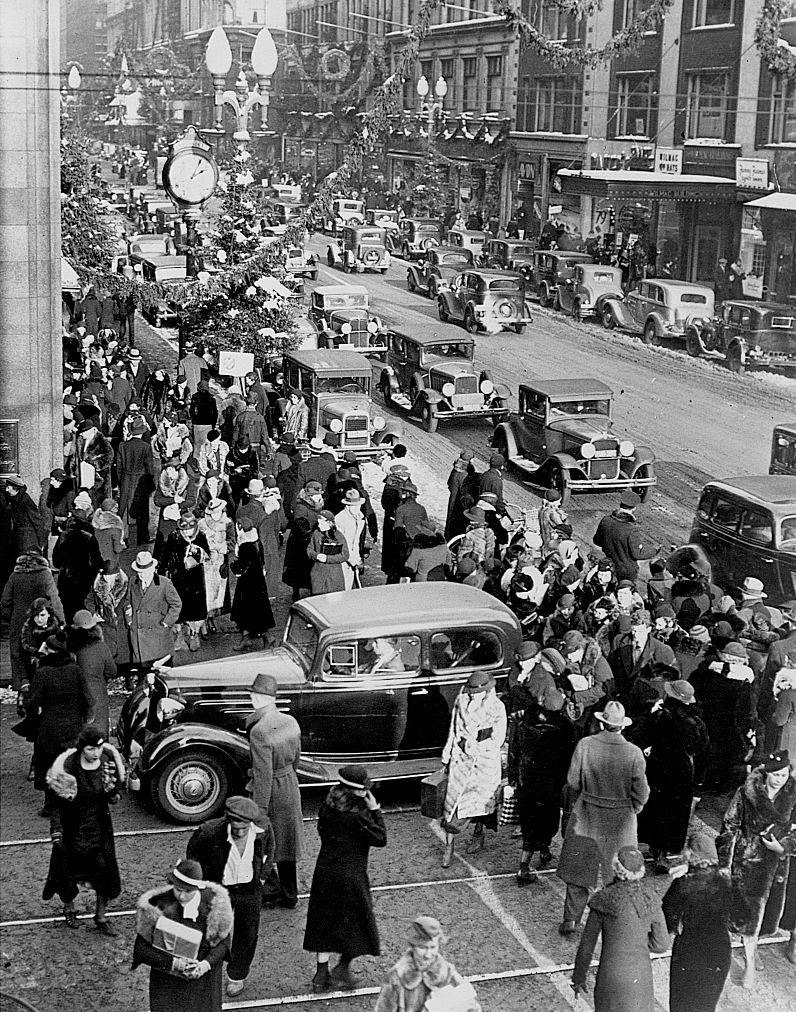
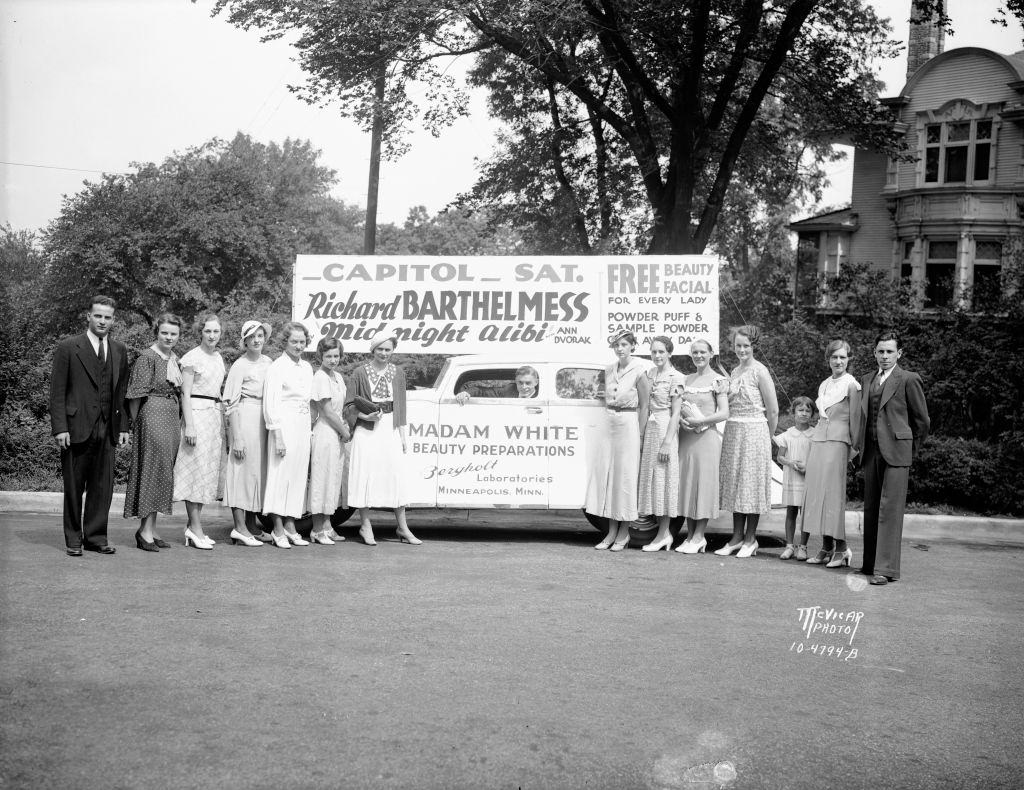
Between the strikes and the hardship, the city still had businesses running and people trying to make a living. Bars like Schiek’s Cafe stayed open, their bartenders working behind polished counters. Cosmetics companies like Madame White organized events at downtown theaters like the Capitol. Nicollet Avenue stayed busy even in the coldest winter months, with Christmas shoppers filling the sidewalks as the city decorated its main commercial strips.

Two men stand behind the bar at Schiek's Cafe in Minneapolis, Minnesota. June 1, 1934.
Two men stand behind the bar at Schiek’s Cafe in Minneapolis, Minnesota. June 1, 1934.
Group portrait of 'Madame White' cosmetics sales staff with car and signage for an event at the Capitol Theatre in Minneapolis, 1934.
Group portrait of ‘Madame White’ cosmetics sales staff with car and signage for an event at the Capitol Theatre in Minneapolis, 1934.
Christmas shoppers crowd Nicollet Avenue at Eighth Street in the 1930s.

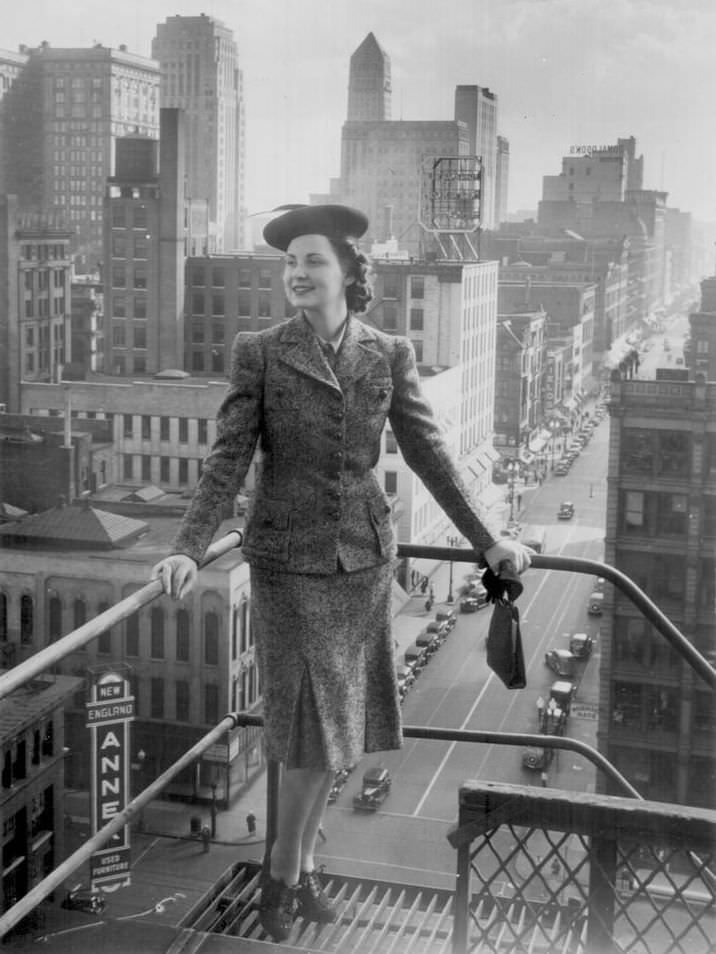
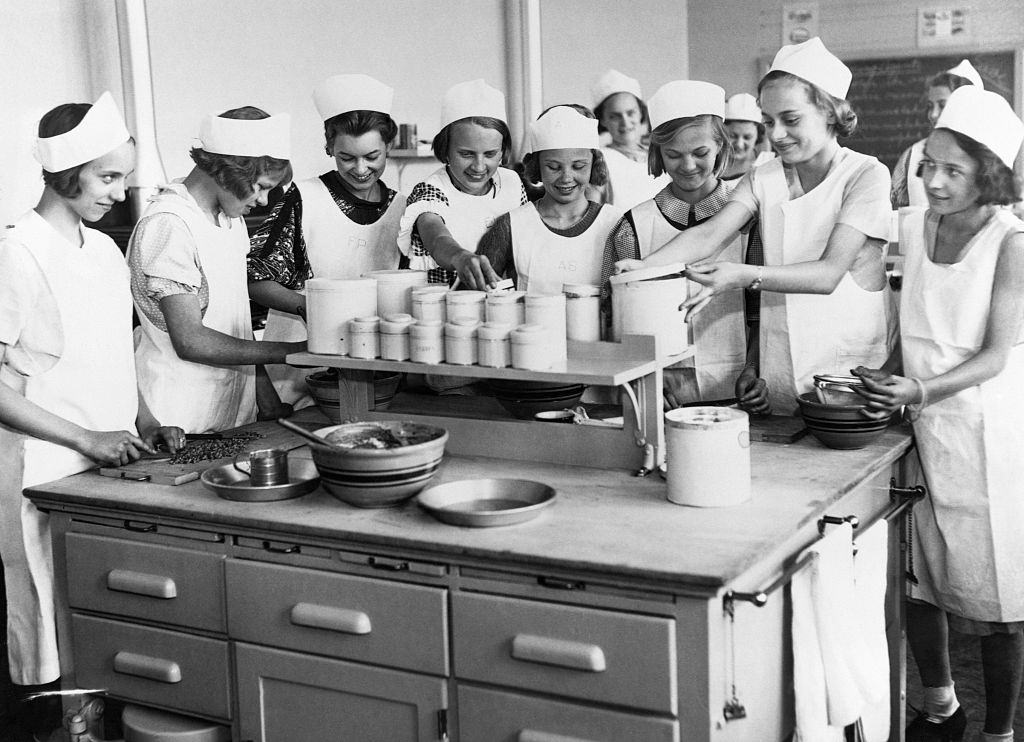
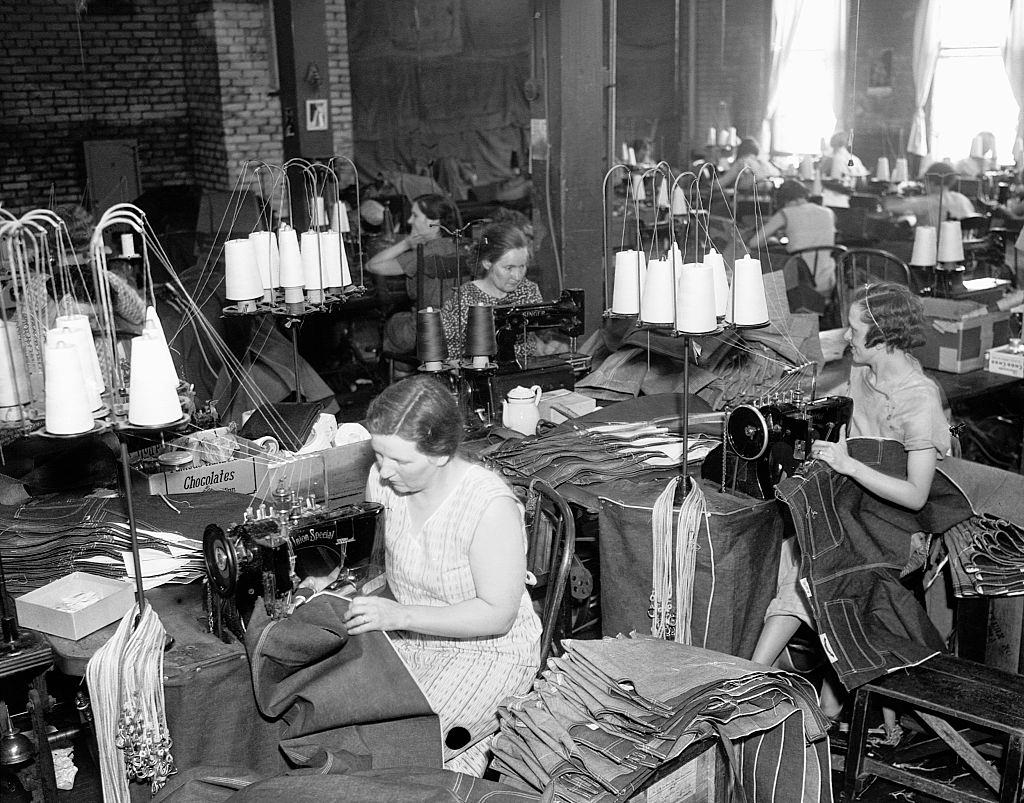
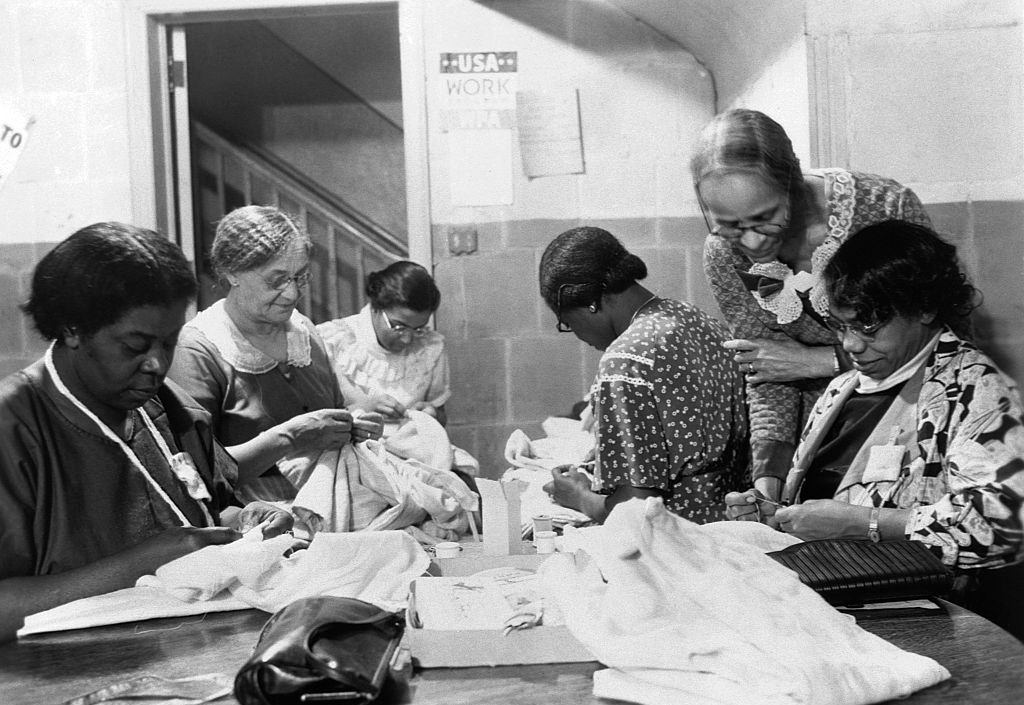
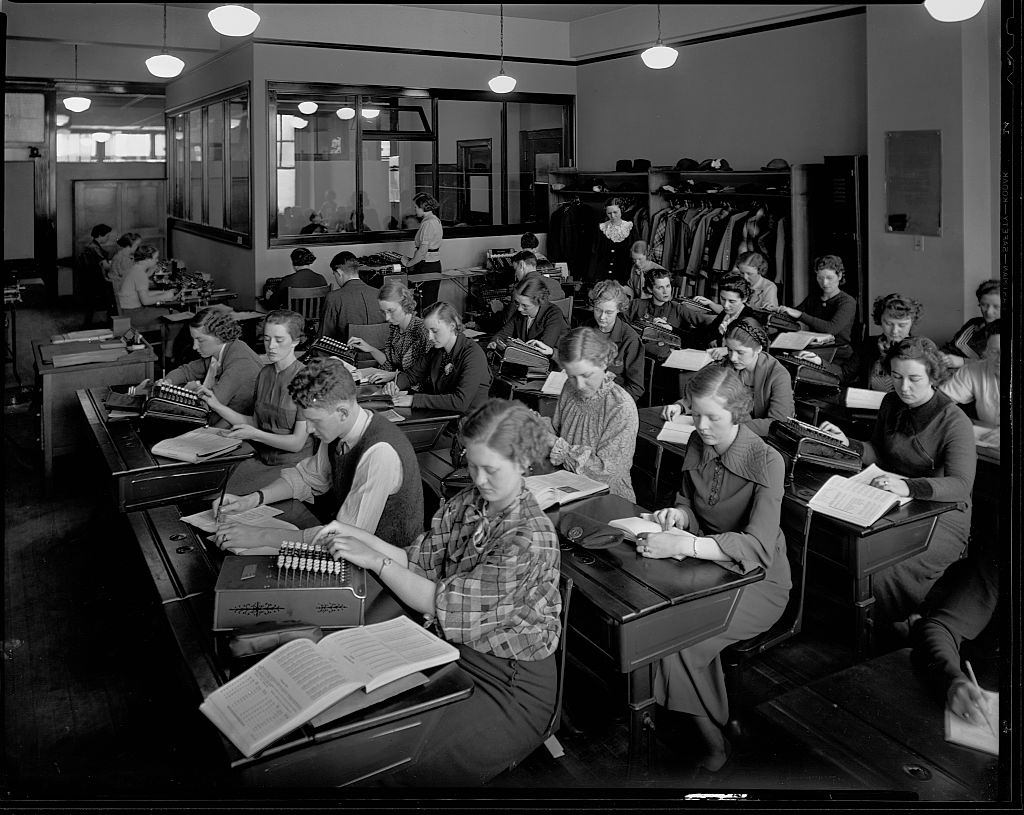
Fashion, education, and skilled trades all had a presence in Depression-era Minneapolis. Department stores remained active on Hennepin Avenue and Nicollet. Young women trained in business colleges for clerical careers, and factories like the Lee Work Clothes plant kept seamstresses employed sewing denim overalls. Community organizations like the Phyllis Wheatley Settlement House offered space and programming for residents who needed support.

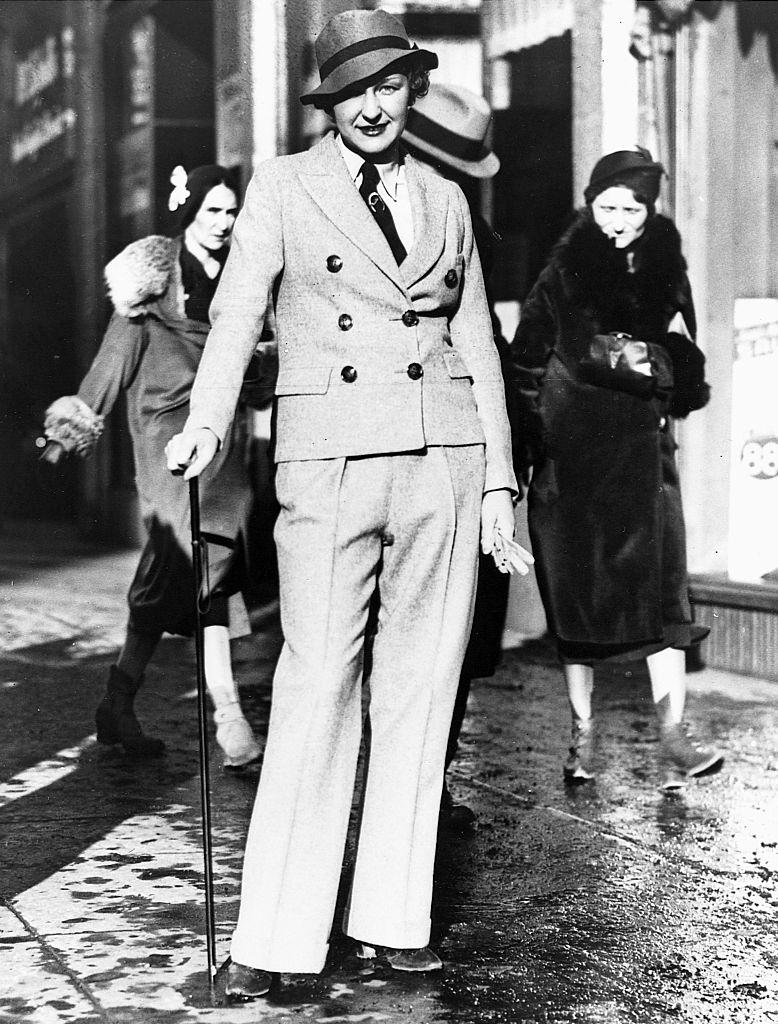
Kay Palmquist models a trousers suit in downtown Minneapolis, 1935.
Students work on a cooking project in a Home Economics class in a Junior High School, 1935.
Women sew denim overalls in the Lee Work Clothes factory in Minneapolis, 1935.
A group of elderly women work on projects at the Phyllis Wheatley Settlement House in Minneapolis, 1936.

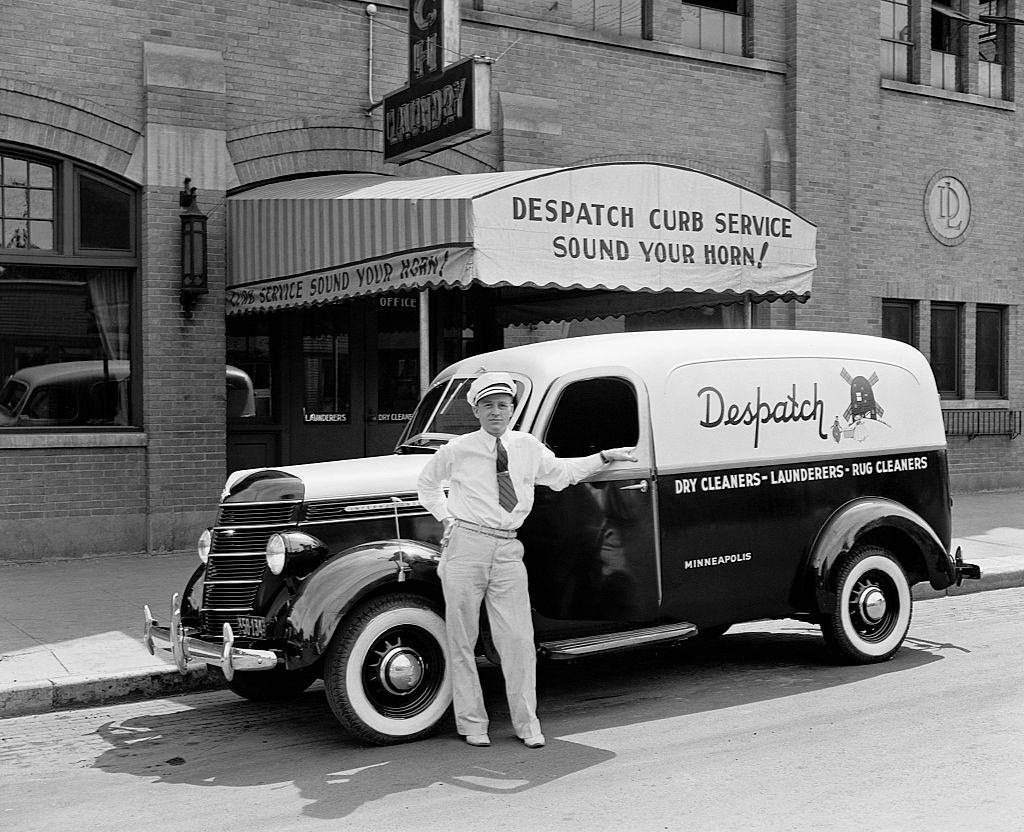
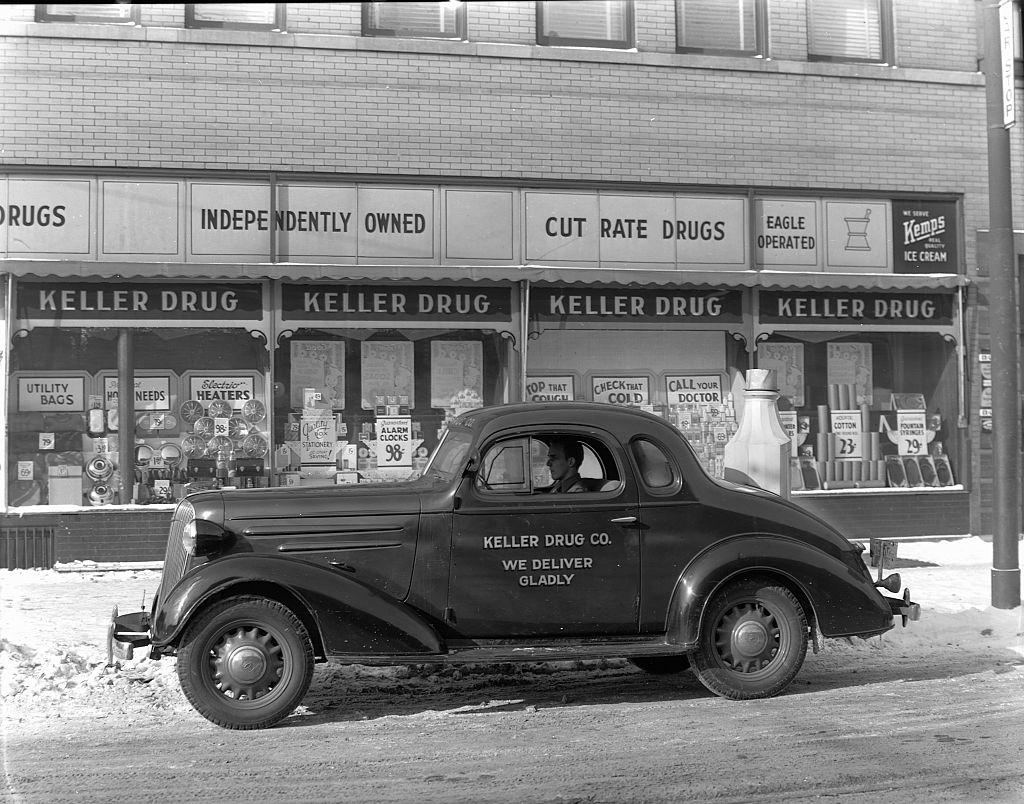
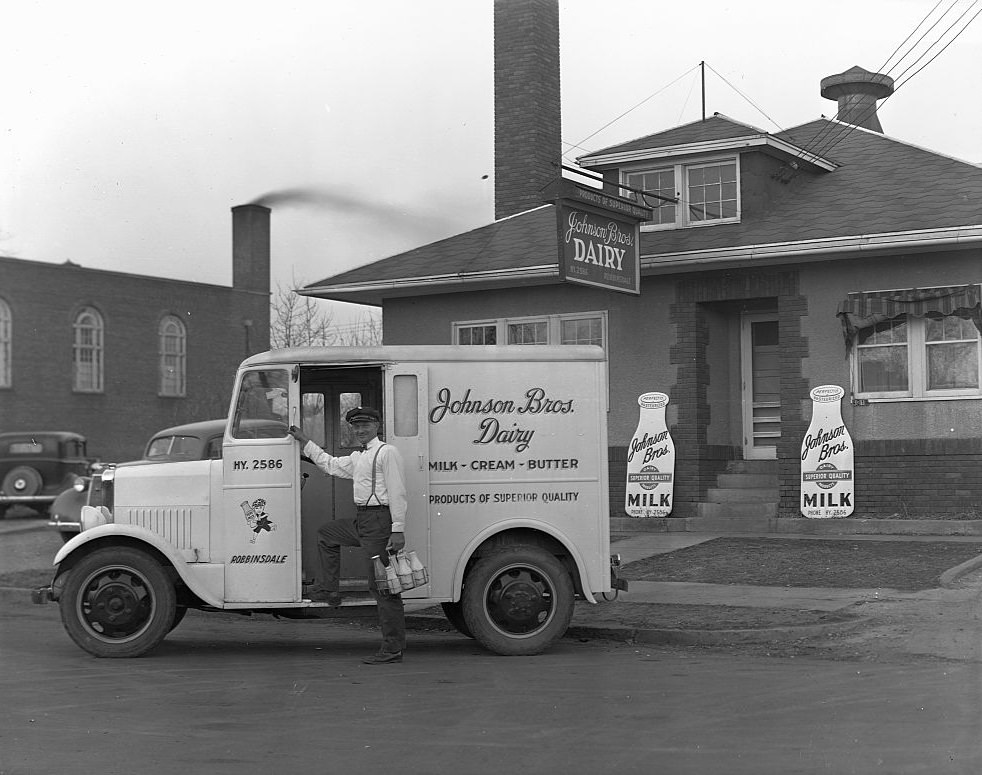
Delivery services kept the city’s commercial rhythm going. Drugstores like Keller Drug ran their own delivery cars. Laundry services like Despatch Laundry sent drivers and vans out across neighborhoods. Milkmen from companies like Johnson Bros. made morning rounds, dropping off glass bottles at doorsteps throughout Minneapolis.

Keller Drug and Delivery Car in Minneapolis, 1936.
Young men and women practice clerical skills in a classroom at the Minnesota Business College in May 1936.
A milkman from the Johnson Bros in Minneapolis, 1936.
The driver and delivery van for Despatch Laundry in Minneapolis, 1937

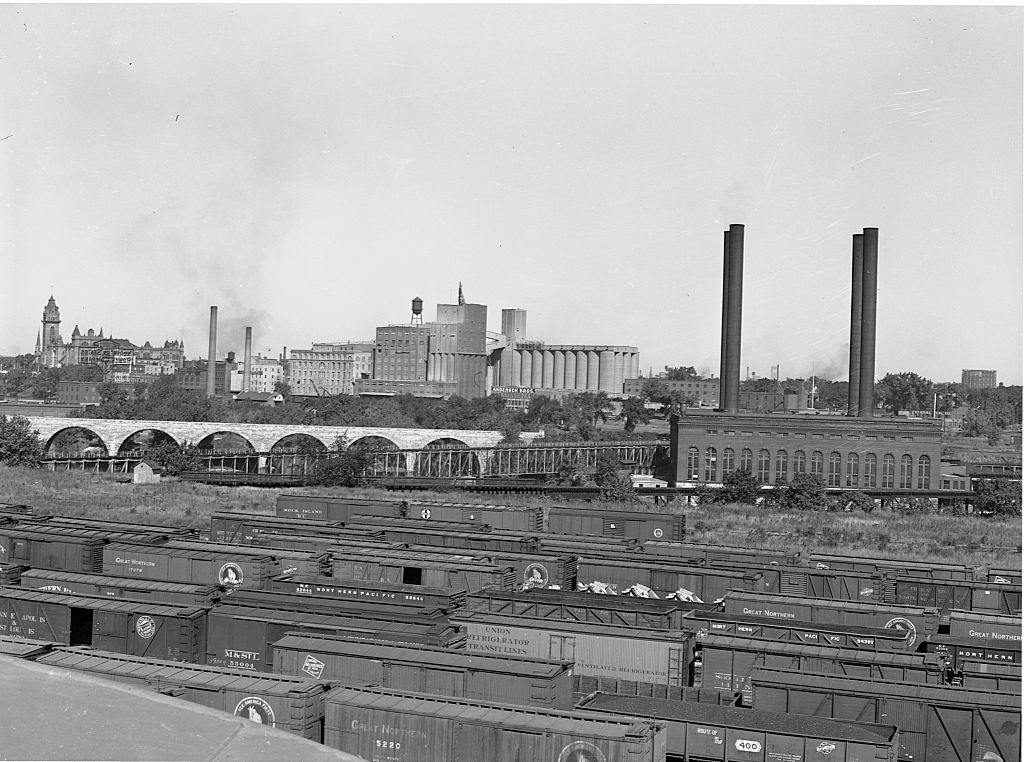
By the late 1930s, unemployment in the Gateway District remained severe. Men clustered in the area’s parks and streets, still waiting for the economy to turn around. Freight cars sat idle in the flour mill district’s rail yards, a visible sign of how much the milling trade had contracted. The Gateway area’s pawnshops and secondhand stores continued doing steady business as residents sold off what they had.

Unemployed men in the gateway area of Minneapolis, 1939.
Freightcars waiting in a train yard in the flour mill district of Minneapolis, 1939.
Beer wagon, Minneapolis, Minnesota, 1939

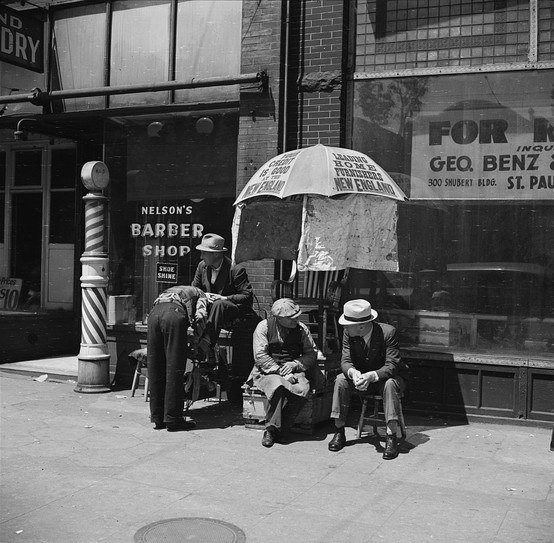
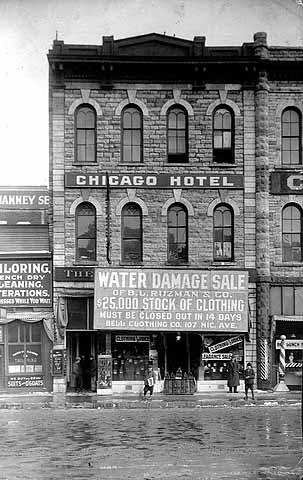
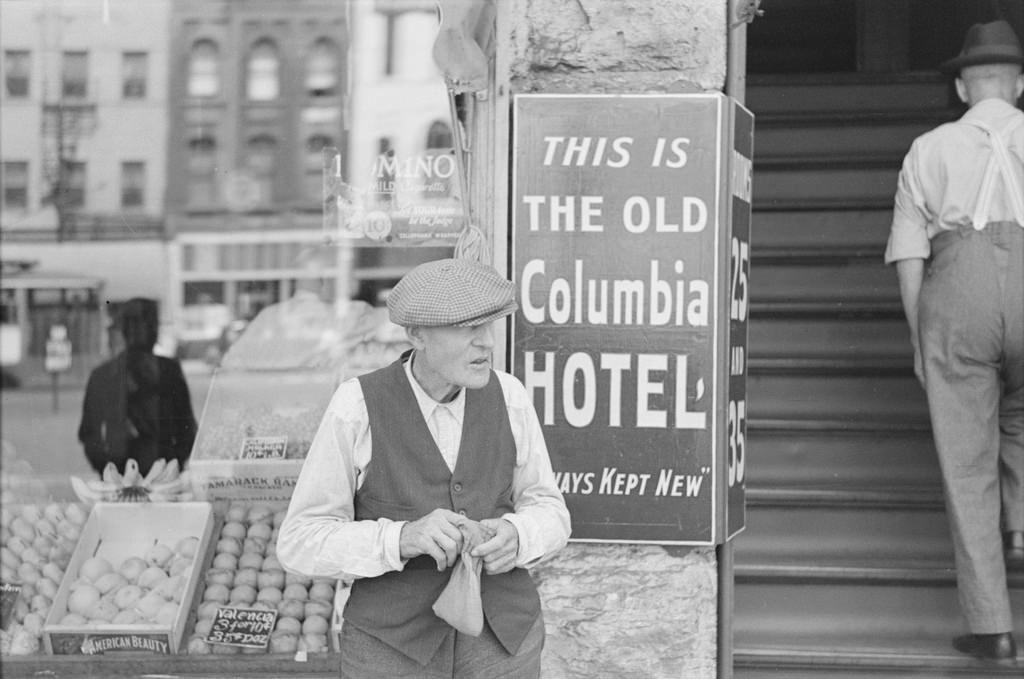
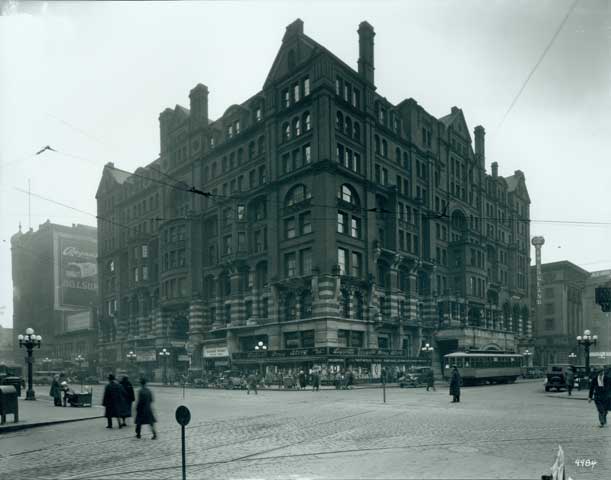
The streets of Minneapolis in the 1930s were full of small businesses competing for customers who had very little to spend. Bootblack stands offered shoe shines for a few cents. Large department stores like the Boston Block at 300 Hennepin Avenue and Dayton’s on Nicollet Avenue drew shoppers looking for deals. Hotels like the Chicago Hotel and the West Hotel served travelers and long-term residents alike.

Bootblack's stand, Minneapolis, Minnesota, 1937
Bootblack’s stand, Minneapolis, Minnesota, 1937
Boston Block Department Store, 300 Hennepin Avenue, Minneapolis, 27 December 1936
Chicago Hotel in Minneapolis, 1920

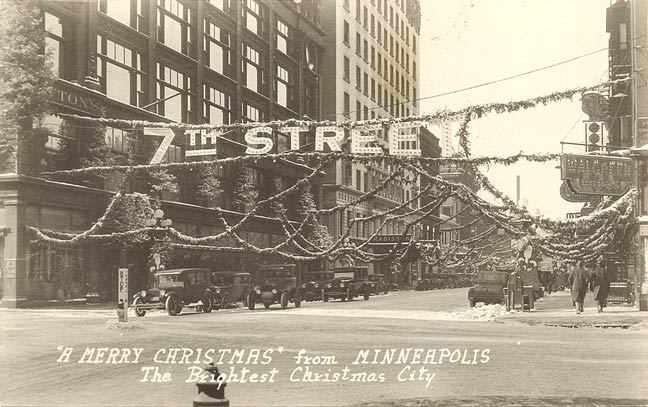
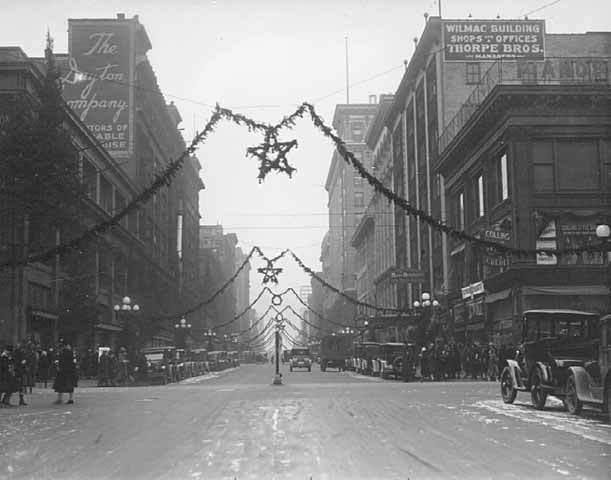
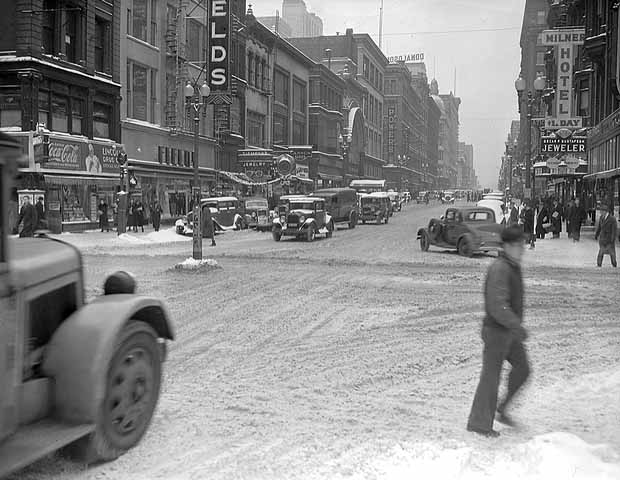
Downtown Minneapolis dressed up for the holidays each year, with Christmas lights and decorations stretching along Nicollet Avenue and 7th Street. The Dayton department store anchored one of the busiest corners in the city, drawing crowds of shoppers even during the leanest years of the Depression.

Christmas decorations at 7th Street and Nicollet Avenue. Dayton department store on left, 1930s
Christmas decorations at Nicollet Avenue, Minneapolis, 1930s

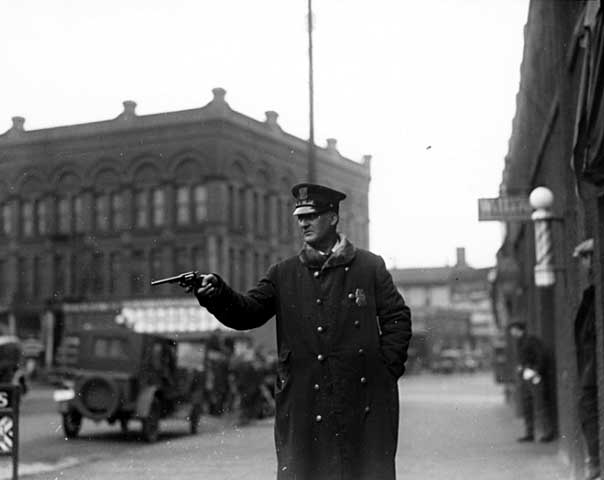
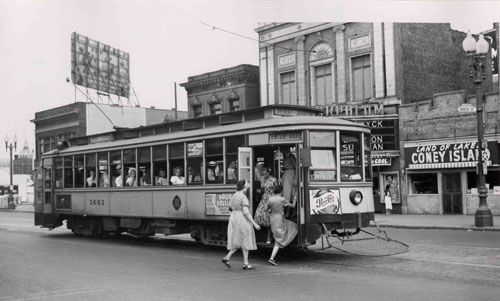
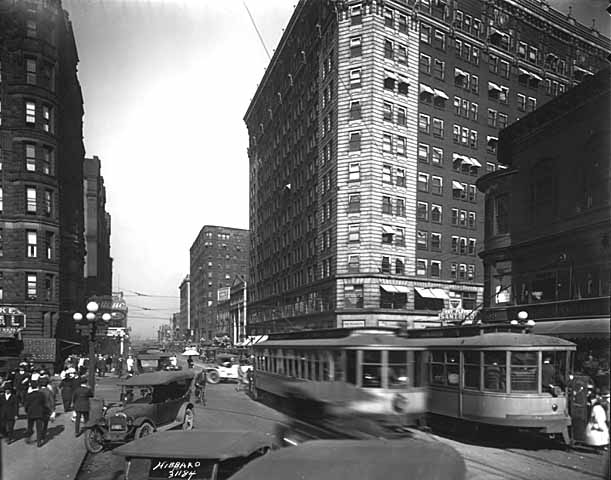
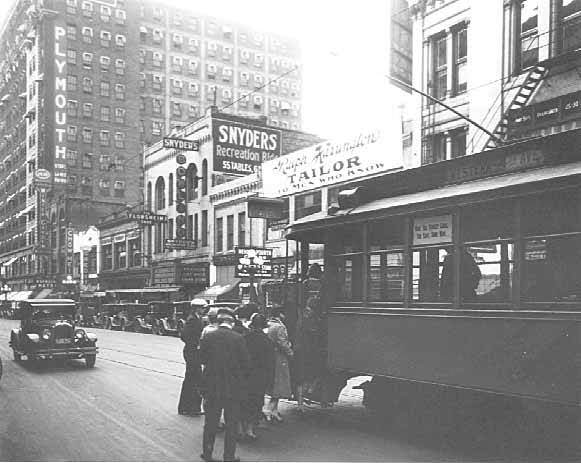
Traffic management was already a challenge on Minneapolis streets in the 1930s. Officers directed cars and pedestrians at busy intersections, while the city’s streetcar lines wove through downtown corridors on Hennepin and Nicollet avenues. Passengers boarded streetcars at stops like Hennepin and 9th, heading to work, shopping, or home.

Directing traffic the Minneapolis way, 1930s
Fight between teamsters and police, Minneapolis, June 1934
Gas station in Minneapolis, December 1937

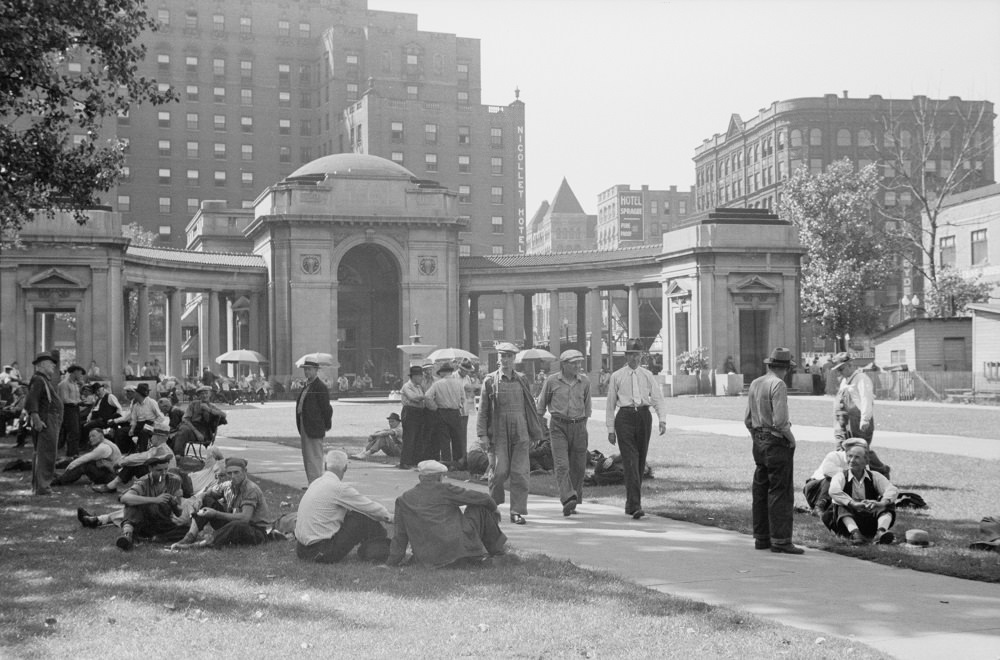
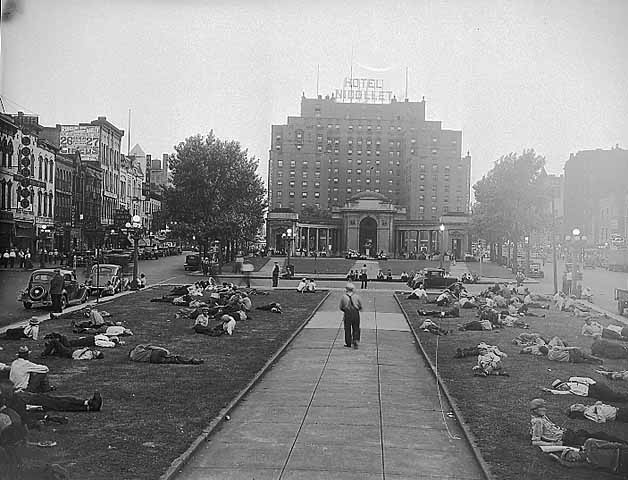
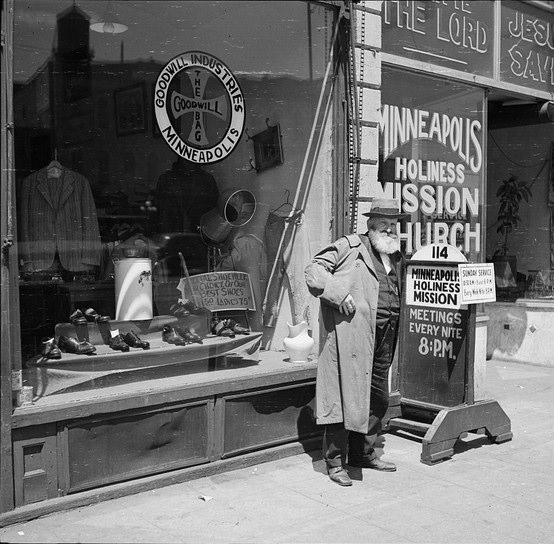
Gateway Park earned the nickname the heart of skid row because of the large numbers of homeless and unemployed men who gathered there year-round. Missions, Goodwill stores, and church-run services operated nearby, offering meals and basic supplies to those with nothing.

Gateway Park, the heart of skid row, Minneapolis, September 1939
Gateway Park, the heart of skid row; Minneapolis, Minnesota, 6 July 1937
Goodwill store and Mission church, Minneapolis, Minnesota, 1937

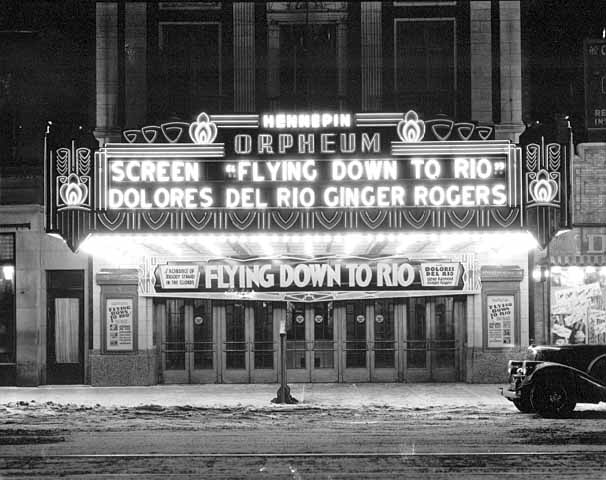
Hennepin Avenue was the city’s main commercial artery, running north through downtown past theaters, bars, restaurants, and shops. The Orpheum Theater at 910 Hennepin Avenue was a landmark entertainment venue that pulled in crowds throughout the decade. Looking north from 6th Street, the avenue stretched out as a dense line of storefronts and electric signs.

Hennepin Avenue at South Tenth Street, Minneapolis, 1934
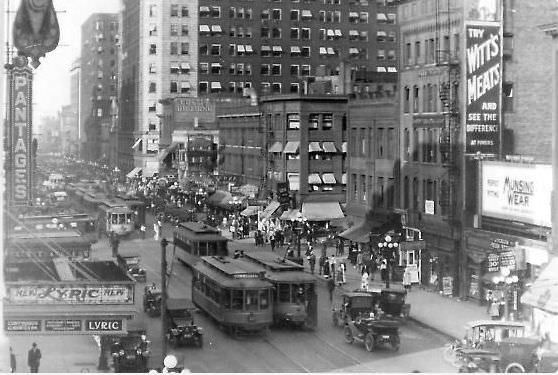
Hennepin Avenue from Sixth Street looking north, Minneapolis, 1930s
Hennepin Avenue, Minneapolis, 1930s

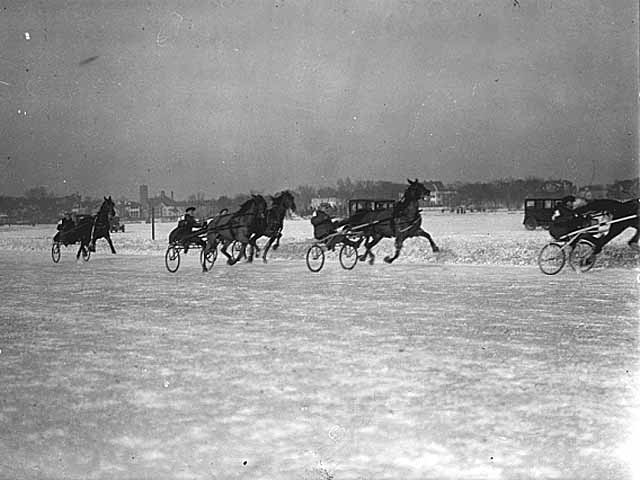
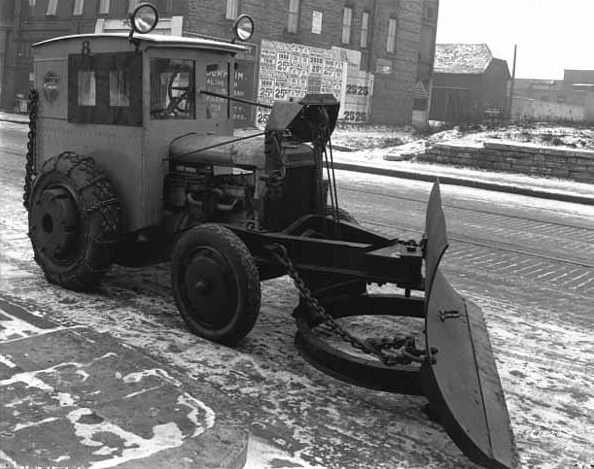
Winter in Minneapolis brought its own spectacles. Horse racing on the frozen surface of Lake of the Isles drew crowds willing to brave the cold. Snowplows owned by companies like the Jefferson Transportation Company cleared roads so the city could keep moving through Minnesota’s brutal winters.

Horse racing on lake of the Isles, Minneapolis, 1930s
Looking up Nicollet from Fourth Street south, Minneapolis, Minnesota, 14 January 1937

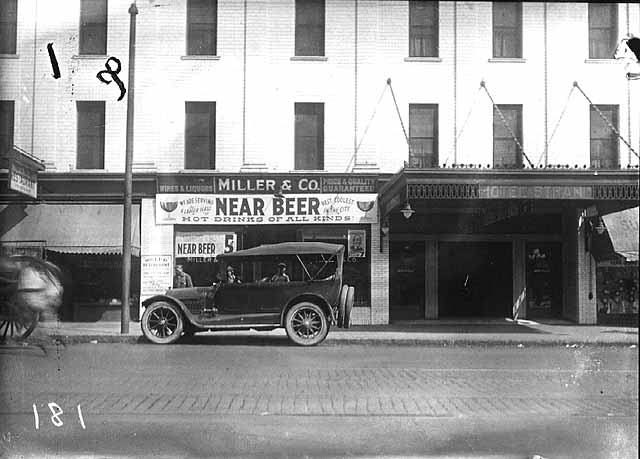
Restaurants along Washington Avenue and the downtown core served cheap meals to workers and the unemployed. Miller’s Restaurant at 126 Washington Avenue South was one such spot where a person could get a hot meal without spending much. Nearby newspaper offices on Fourth Street near Nicollet Avenue kept the public informed through papers sold on the street and at newsstands.

Miller's restaurant, 126 Washington Avenue south, Minneapolis, 1930s
Miller’s restaurant, 126 Washington Avenue south, Minneapolis, 1930s
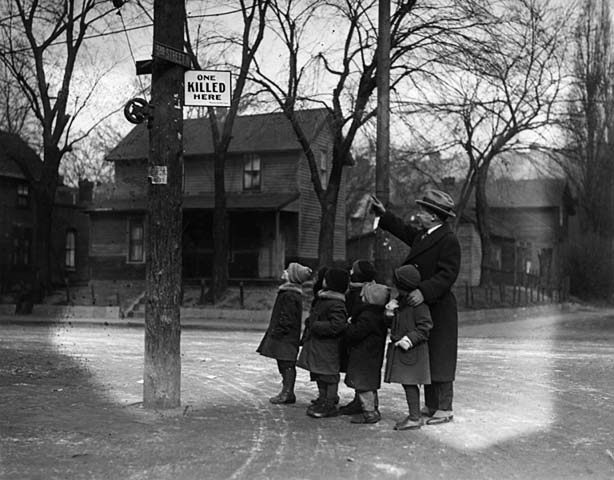
Minneapolis Mayor George E. Leach points out a good place to get run down by a car, Minneapolis, Minnesota, 1930s

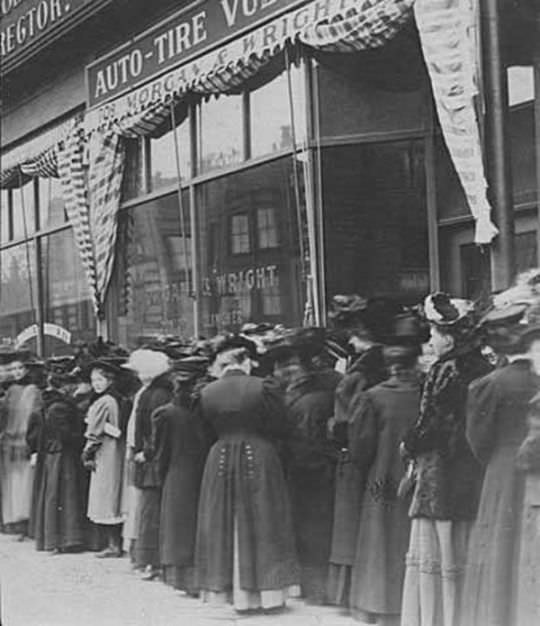
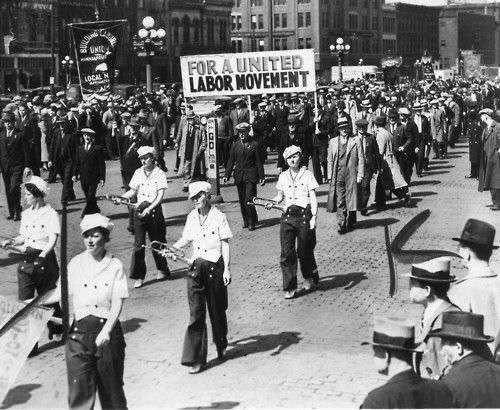
Political and civic life continued through the Depression years. Women lined up to vote in presidential elections, exercising rights that had only been guaranteed since 1920. City officials like Mayor George E. Leach made public appearances across Minneapolis. Workers marched through the downtown loop each May Day, chanting as they moved through the city’s main streets.

Minneapolis women lining up to vote for the first time in a presidential election, 1930s
Minneapolis, Minnesota, 1930s
Miss Minnesota over Nicollet Mall, 1938
Newspaper row, Fourth Street south near Nicollet Avenue, Minneapolis, Minnesota, 1930s
Orpheum Theater (still very much in use), 910 Hennepin Avenue, Minneapolis, Minnesota, USA, 1933
Passengers boarding a street car at Hennepin and 9th, Minneapolis, 1930s

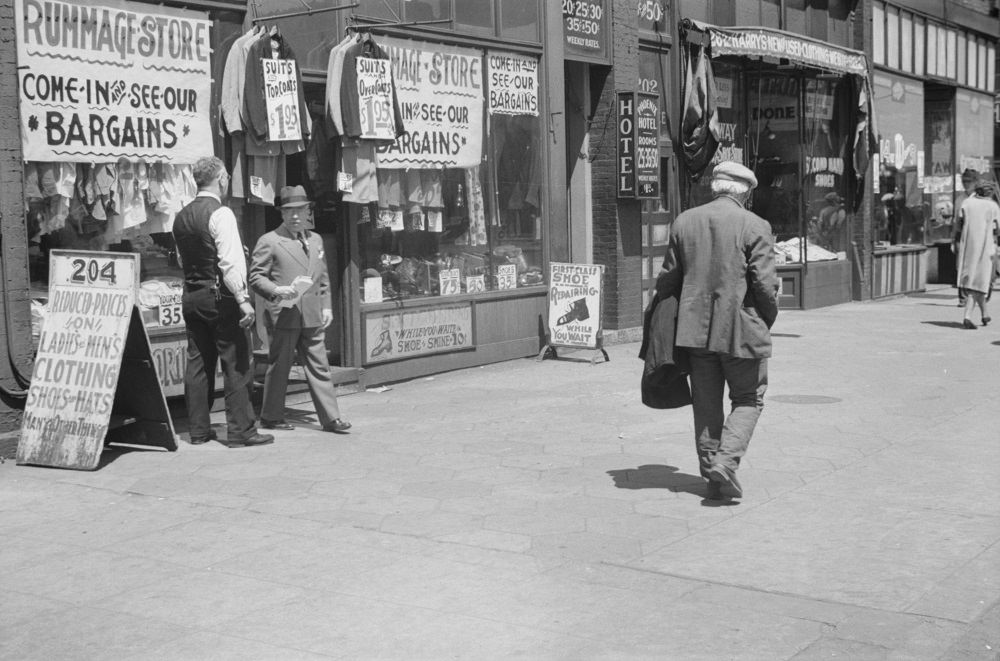
Pawnshops remained constants throughout the decade. By September 1939, Gateway District pawnshops were still doing brisk business as the Depression’s long tail continued to affect residents. Secondhand stores along the same blocks offered clothes, tools, and household goods to people who could not afford to buy new.

Pawnshop in Gateway District, Minneapolis, Minnesota, September 1939
Pawnshops and secondhand stores, Minneapolis, 1939
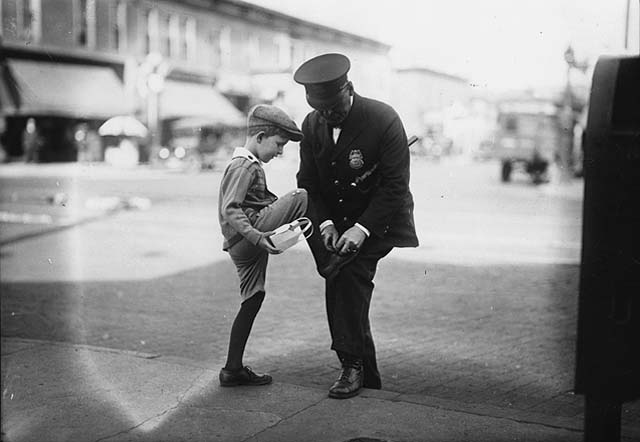
Policeman with boy at Thirty-Sixth Street and Nicollet Avenue, Minneapolis, Minnesota, 1930s
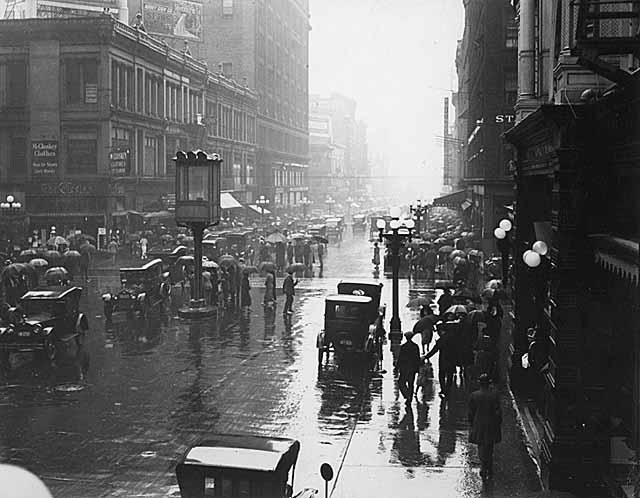
Sixth and Nicollet in the rain, Minneapolis, Minnesota, 1930s
Skid row, Minneapolis, August 1937
Snowplow owned by Jefferson Transportation Company, Minneapolis, 1930s
South Sixth Street, near Hennepin Avenue, Minneapolis, 1930s
Southwest corner of Snelling and University, St. Paul, Minneapolis, 1932
The heart of downtown, Seventh and Hennepin, Minneapolis, Minnesota, 1930s
West hotel, Minneapolis, 1930s
Workers marching through Minneapolis Loop in observance of May Day chanting, 1937
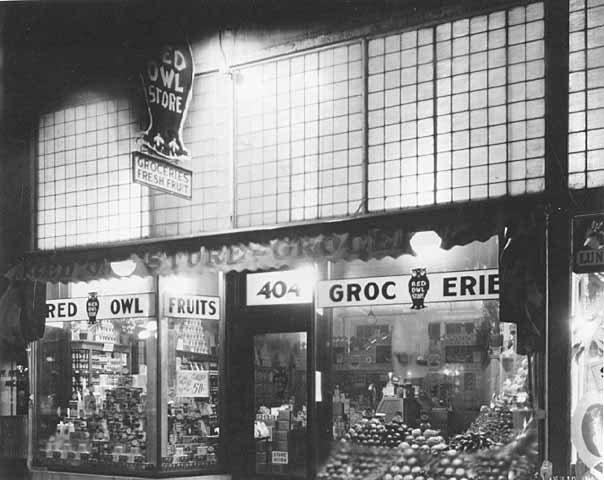
404 Hennepin Avenue, Minneapolis, Minnesota, 1931
Enjoyed this post? Get new ones in your inbox.

10 thoughts on “Spectacular Vintage Photos Show What Minneapolis Looked Like in the 1930s”

  1. I really like these. Thank you for posting the link. Wolverhampton is my hometown, so most of these happened during my lifetime. I have forwarded them to my Dad, who I know will also appreciate them. Thanks a lot

  2. What a great collection of photos! I really love seeing the ones of the cities during the Great Depression of the 1930s. Those are very sharp and high-quality photos, sad to see so many lost gorgeous buildings. Thanks for sharing.

Leave a Comment

Your email address will not be published. Required fields are marked *

Share this Post 🥺

Please take a moment to share this content. Your support is greatly appreciated! 🙌🙏

Share this Post 🥺

Please take a moment to share this content. Your support is greatly appreciated! 🙌🙏
Scroll to Top
 
Hey Friend, Before You Go.. Please like & follow for more interesting content