On December 8, 1980, Mark David Chapman shot and killed John Lennon outside the Dakota apartment building on Manhattan’s Upper West Side. The murder stunned the world instantly. But just two days before that night, Lennon was at the Hit Factory recording studio in New York City — relaxed, engaged, and by all appearances, at peace with his life.
Lennon had spent much of the late 1970s away from the public. After the Beatles dissolved in 1970, he released a string of acclaimed solo records, including the 1971 album Imagine, then pulled back from music almost entirely to raise his son Sean, born in 1975. By 1980, he was ready to return. He and Yoko Ono had just finished recording Double Fantasy, their joint album released on November 17, 1980 — only three weeks before his death.
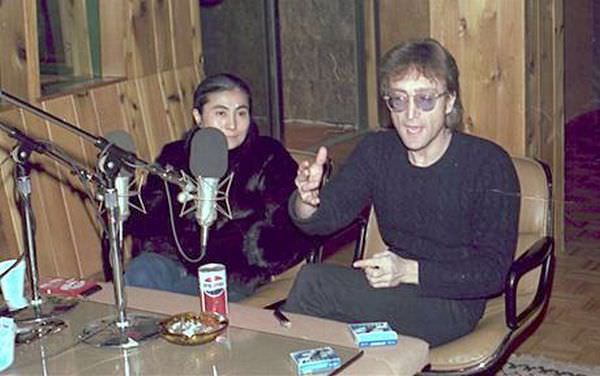
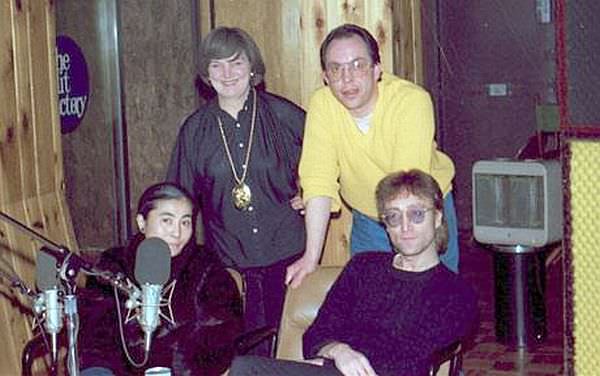
The photos from December 6, 1980, were taken during a BBC Radio One interview at the Hit Factory. The interviewer was DJ Andy Peebles, who had flown in from London specifically to sit down with Lennon. The session lasted several hours. Peebles later described Lennon as open, funny, and deeply reflective — a man who seemed genuinely excited about the new record and what came next.
In the photographs from that session, Lennon wears his signature round glasses and a casual blue jumper. He is photographed alongside Yoko Ono, smiling warmly. In other frames, he is mid-conversation with Peebles, his expression focused and at ease. There is nothing guarded about him. He looks like someone who has found his footing again after years out of the spotlight.
Lennon was born on October 9, 1940, in Liverpool, England. He co-founded the Beatles in 1960 alongside Paul McCartney, George Harrison, and Ringo Starr. The band became the most commercially successful and critically praised act in the history of popular music. Lennon’s songwriting partnership with McCartney produced some of the most recognized songs ever written — “A Hard Day’s Night,” “In My Life,” “Come Together,” and dozens more.
After the Beatles broke up, Lennon channeled his energy into both music and activism. He and Yoko Ono staged their famous “Bed-Ins for Peace” in 1969, a protest against the Vietnam War conducted entirely from hotel rooms in Amsterdam and Montreal. The U.S. government, under President Nixon, attempted to deport Lennon in 1972 specifically because of his anti-war stance. He fought the case for four years and was granted a green card in 1976.
Yoko Ono had been central to Lennon’s life since they met in 1966 at an art gallery in London. She was already an established avant-garde artist. Their relationship drew intense public scrutiny — she was blamed by many Beatles fans for the band’s breakup, a claim that historians have largely dismissed. The photos from the Hit Factory show them together, close and comfortable, the same way they had been photographed throughout their twelve years as a couple.
That same evening on December 8, after returning home from a separate recording session, Lennon was shot four times in the back by Chapman, who had actually approached Lennon earlier that day and received an autograph. Lennon was rushed to Roosevelt Hospital but was pronounced dead on arrival. He was 40 years old.
Chapman had been carrying a copy of J.D. Salinger’s novel The Catcher in the Rye. He did not flee the scene. When police arrived, he was sitting on the curb, reading. He was arrested without resistance and later pleaded guilty to second-degree murder. He received a sentence of 20 years to life and has been denied parole at every hearing since.
Following his death, Lennon was cremated. Yoko Ono scattered his ashes in Central Park, near the apartment where they had lived together. In 1985, the city of New York dedicated a section of Central Park near the Dakota as Strawberry Fields, named after the Beatles song “Strawberry Fields Forever.” The memorial draws visitors from around the world to this day. The BBC interview recorded by Andy Peebles on December 6 aired shortly after Lennon’s death. It remains one of the last extended conversations he ever gave on record.