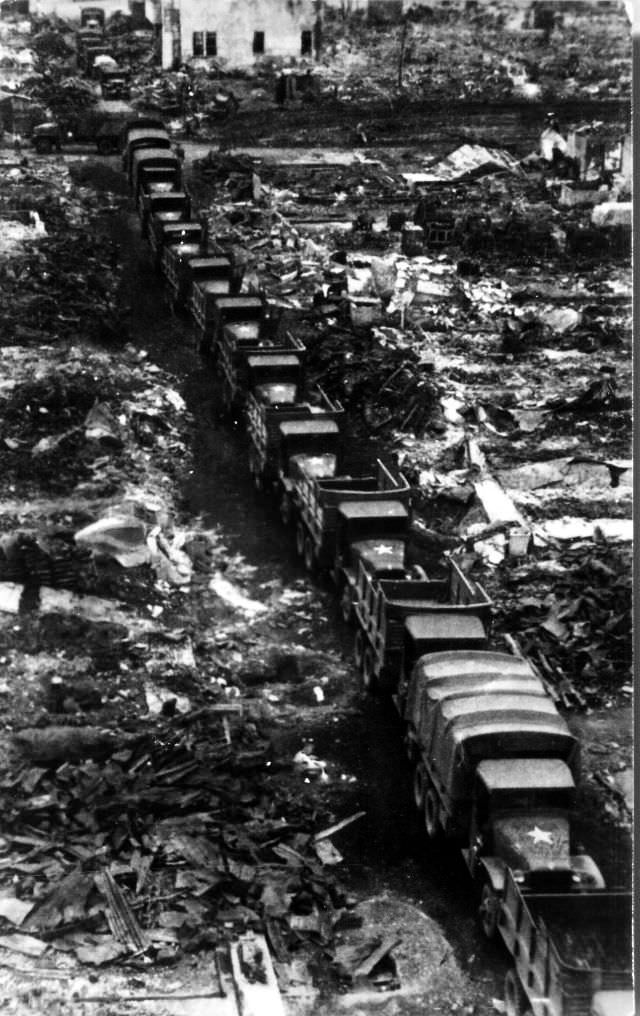
By the time World War II ended in August 1945, Tokyo was barely recognizable. American firebombing raids — most devastatingly the March 1945 Operation Meetinghouse — had burned out roughly 16 square miles of the city. Hundreds of thousands of homes were gone. Entire neighborhoods existed only as fields of ash and twisted steel. The people who had survived the war now faced the task of living in what remained.
Destruction in Tokyo, 1940s.
Survivors emerged from shelters and rubble to begin rebuilding immediately. Food was scarce. Clean water and electricity were unreliable or simply absent in many areas. People salvaged timber, sheet metal, and anything else they could find from the wreckage to patch together homes and workshops. The sound of hammering and sawing filled Tokyo’s streets in those first months — not construction in any grand sense, but the desperate, methodical work of people trying to survive.
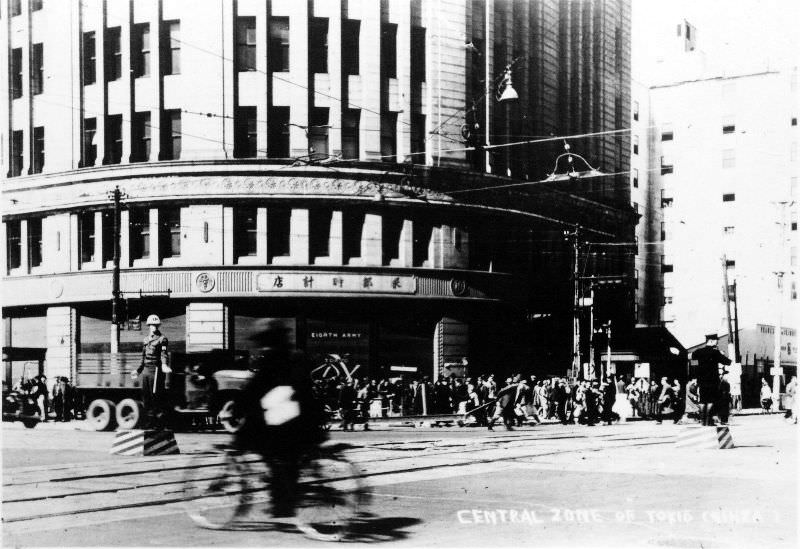
Central Zone of Tokyo, 1940s.
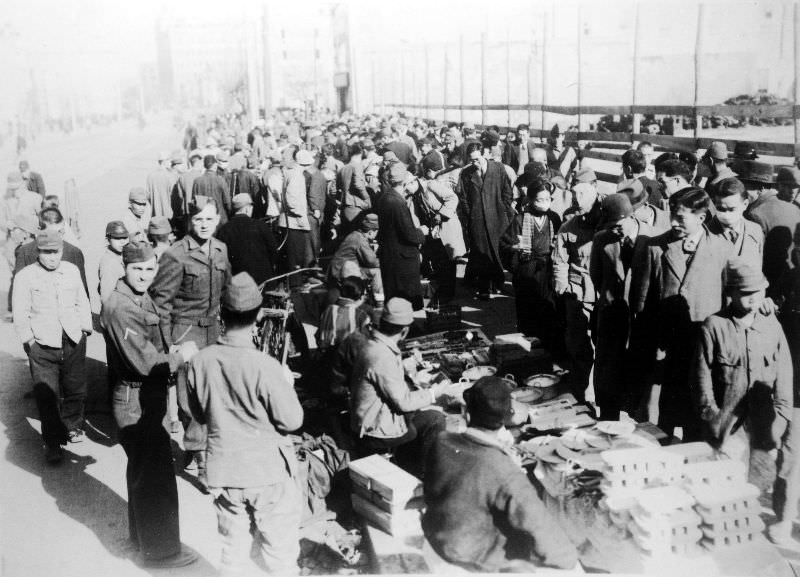
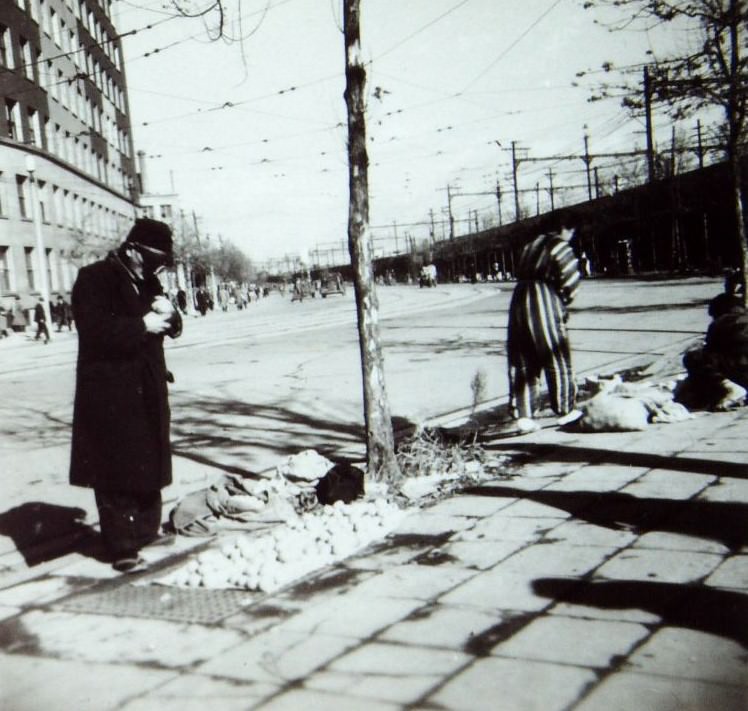
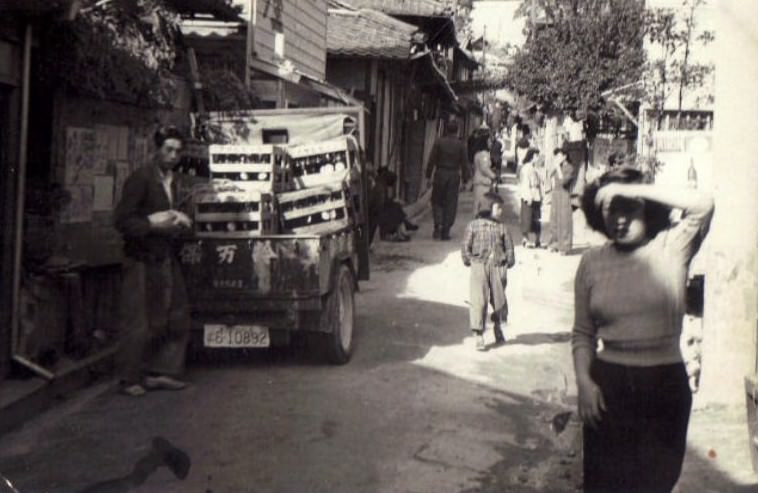
The official economy had collapsed. Ration systems were overwhelmed and often unreliable. In their place, black markets spread across the city. Open-air stalls appeared near major train stations and along main streets, selling salvaged goods, smuggled food, clothing, and handmade items. Bartering was common. A bag of rice might be traded for a pair of shoes. These informal markets kept people fed and clothed when the formal system could not.
An open-air market in Tokyo, 1940s.Ginza market, 1940s.
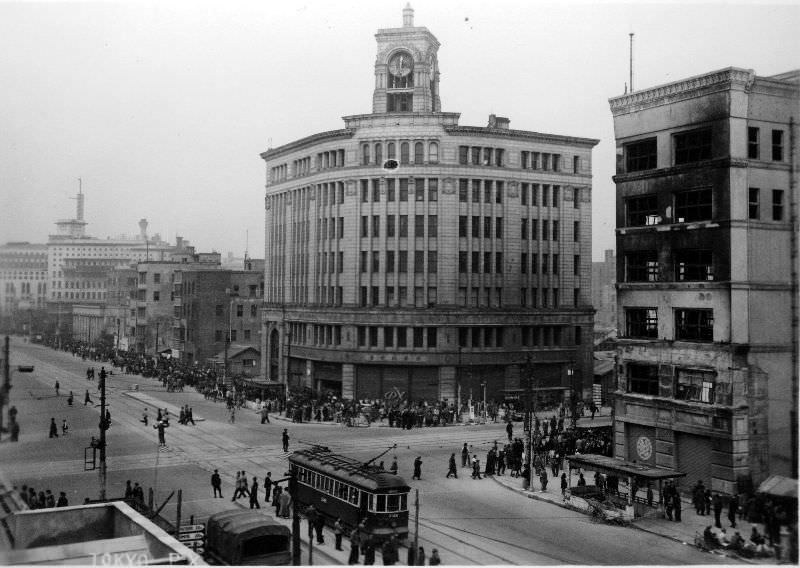
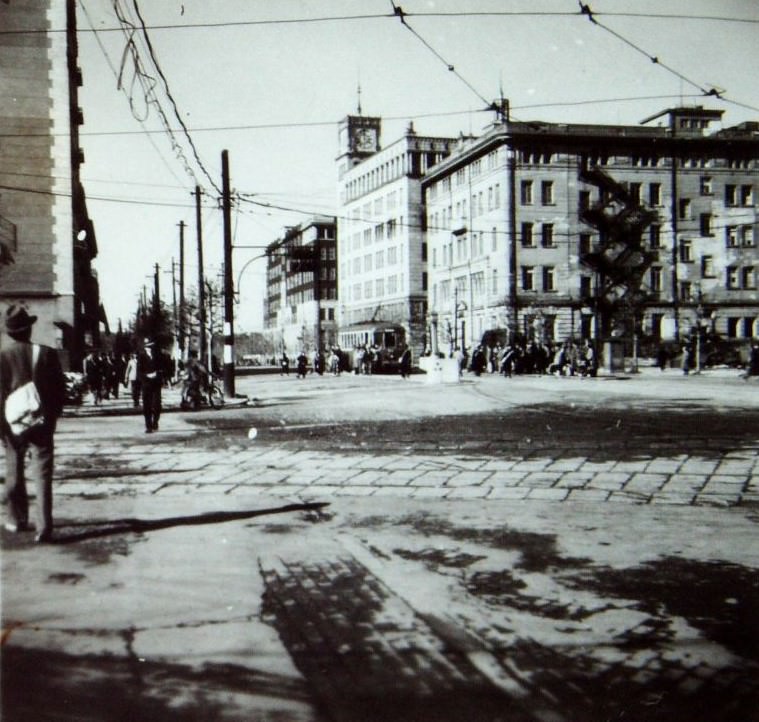
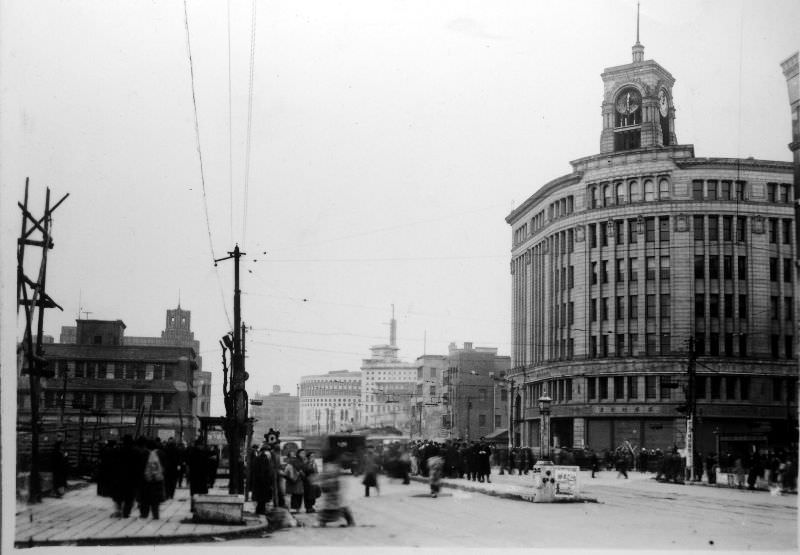
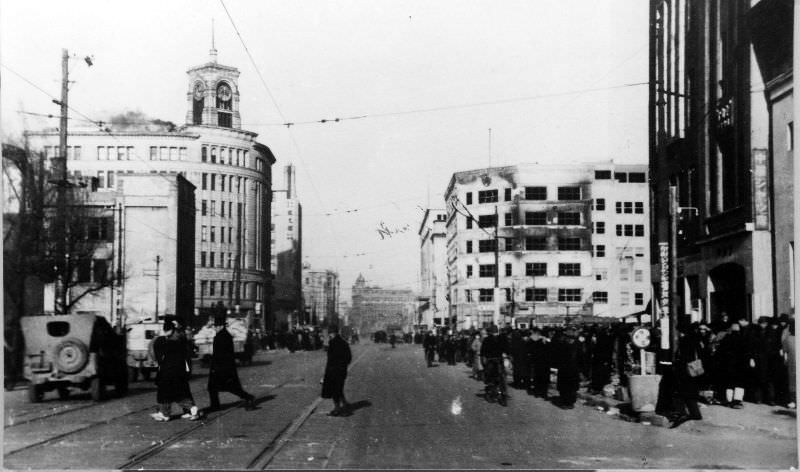
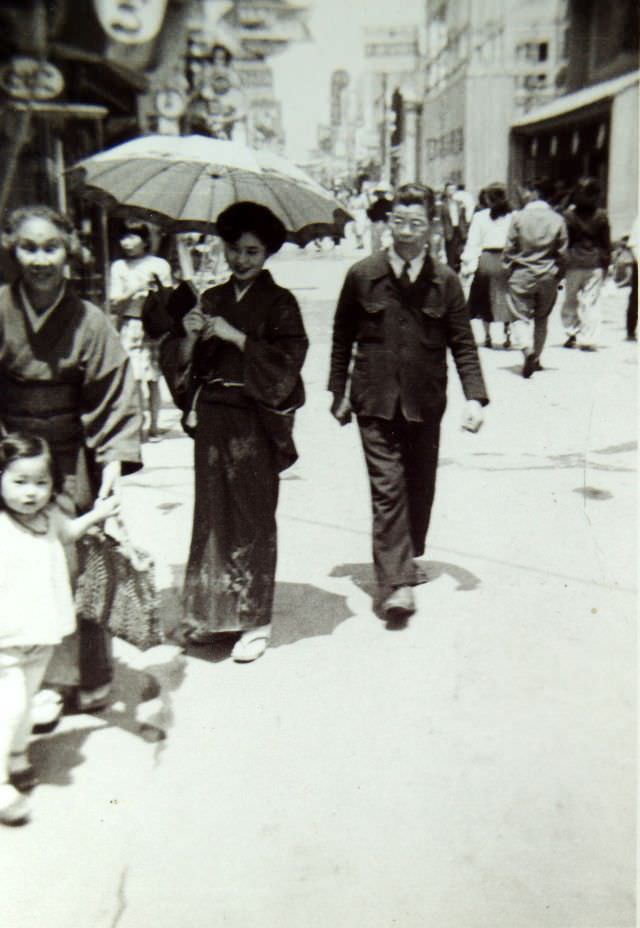
The Ginza district, once Tokyo’s most fashionable commercial strip, was among the areas that gradually came back to life. Market stalls and small shops filled in the gaps left by bombed-out buildings. Crowds returned to the streets, and the area became a symbol of Tokyo’s stubborn recovery. Theaters, department stores, and cinemas slowly reopened, offering people something beyond bare survival.
Ginza, Tokyo, 1940s.Ginza, Tokyo, 1940s.Street scenes of Ginza, 1940s.Street scenes of Ginza, 1940s.
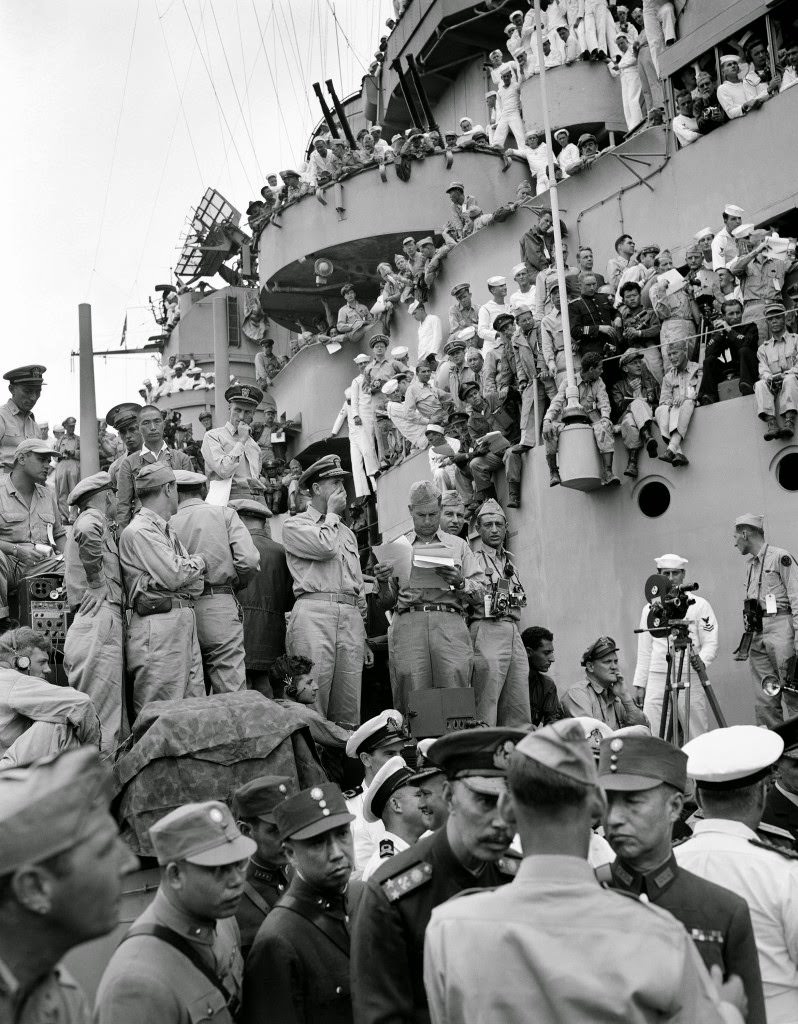
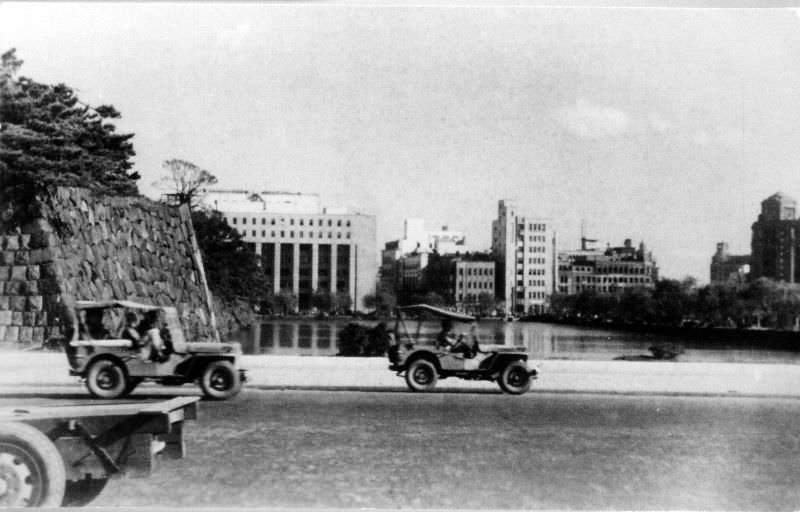
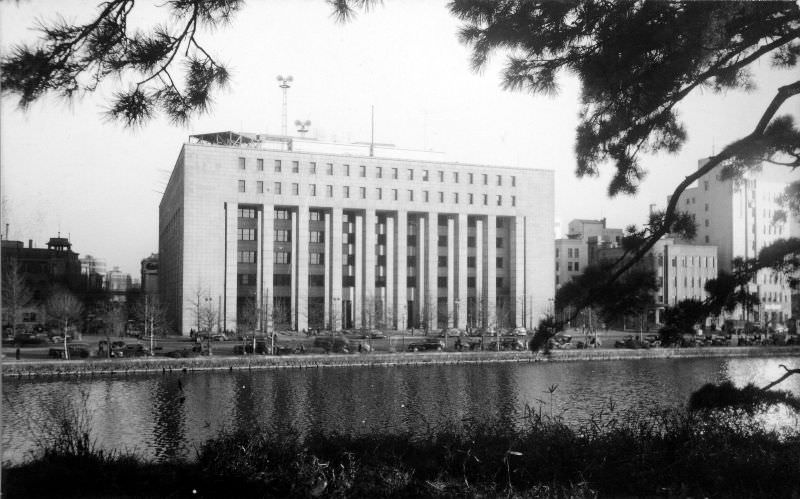
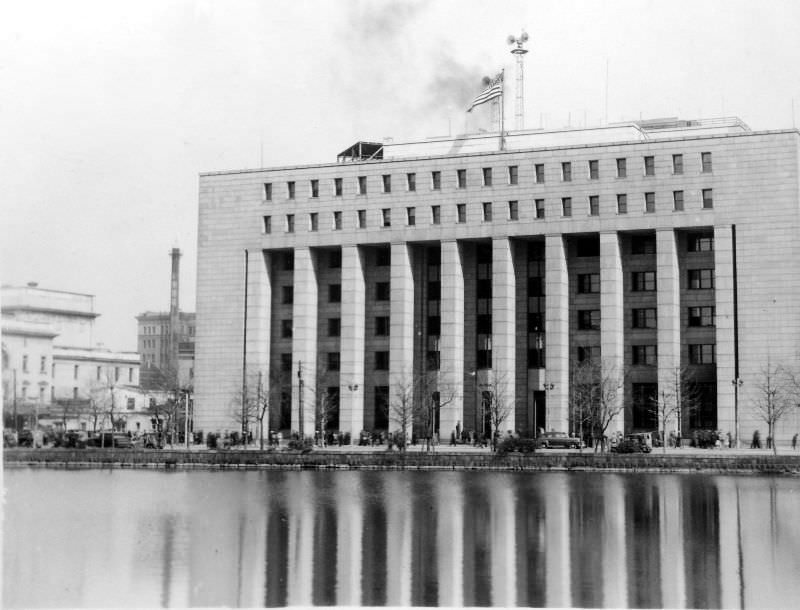
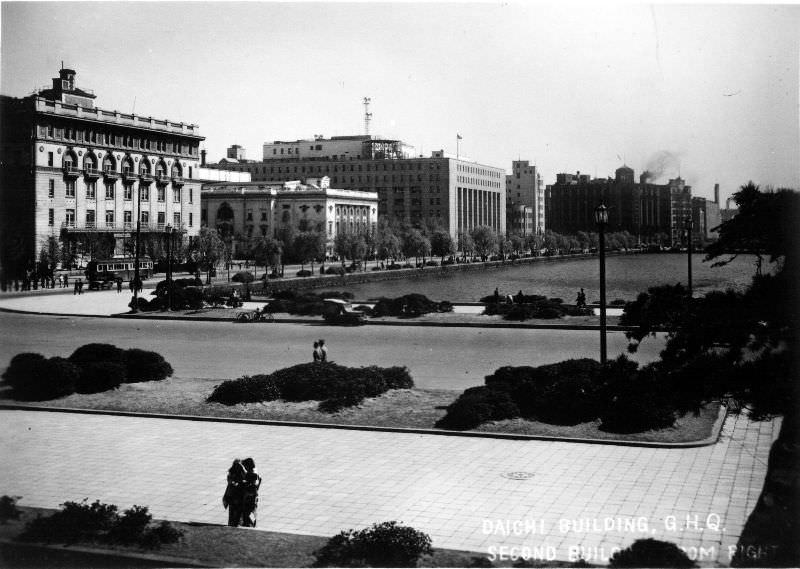
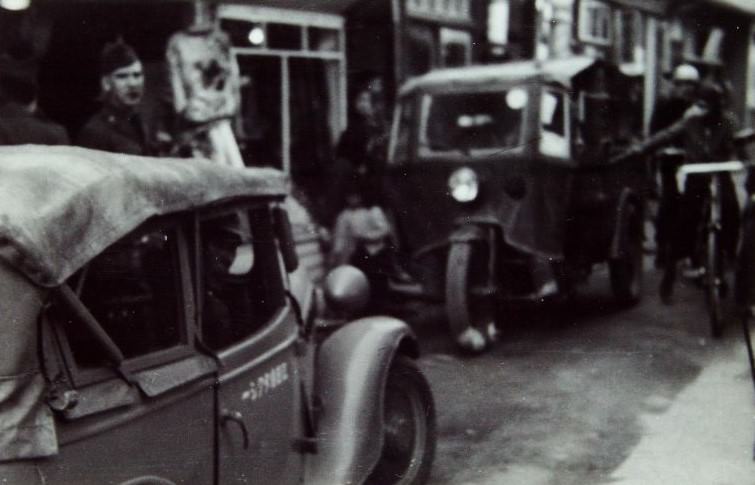
On September 2, 1945, Japan formally surrendered aboard the USS Missouri in Tokyo Bay, ending the war and beginning the Allied Occupation. General Douglas MacArthur, appointed Supreme Commander for the Allied Powers, set up his headquarters in the Dai-Ichi Building — a Western-style office block that faced the Imperial Palace across a wide plaza. American military jeeps became a fixture of downtown Tokyo’s streets almost overnight.
Spectators and correspondents from all over the world watch the formal Japanese surrender ceremony marking the end of World War II on the deck of the USS Missouri, in Tokyo Bay, 1945.
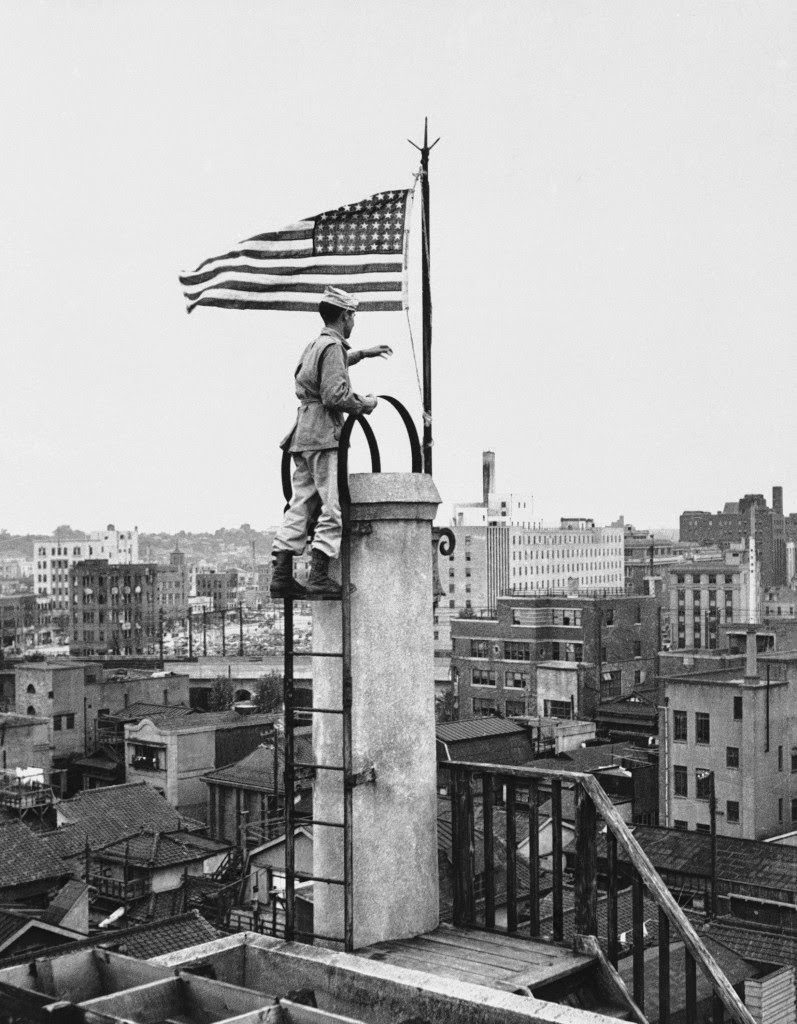
The American flag, first to fly over Tokyo since the Japanese surrender, is raised over the Nippon News building in downtown Tokyo by Lt. Bud Stapleton of Syracuse, New York, 1945.
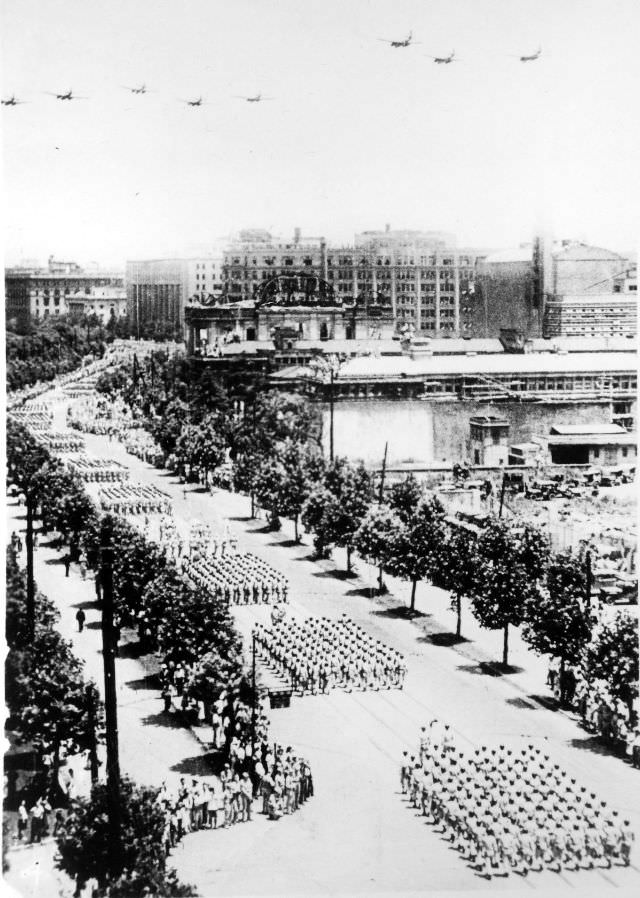
Jeeps in front of the Dai-Ichi Building, 1940s.The Dai-Ichi Building, 1940s.The Dai-Ichi Building, 1940s.The Dai-Ichi Building, 1940s.The soldiers are passing in front of the Dai-Ichi Building, 1940s.
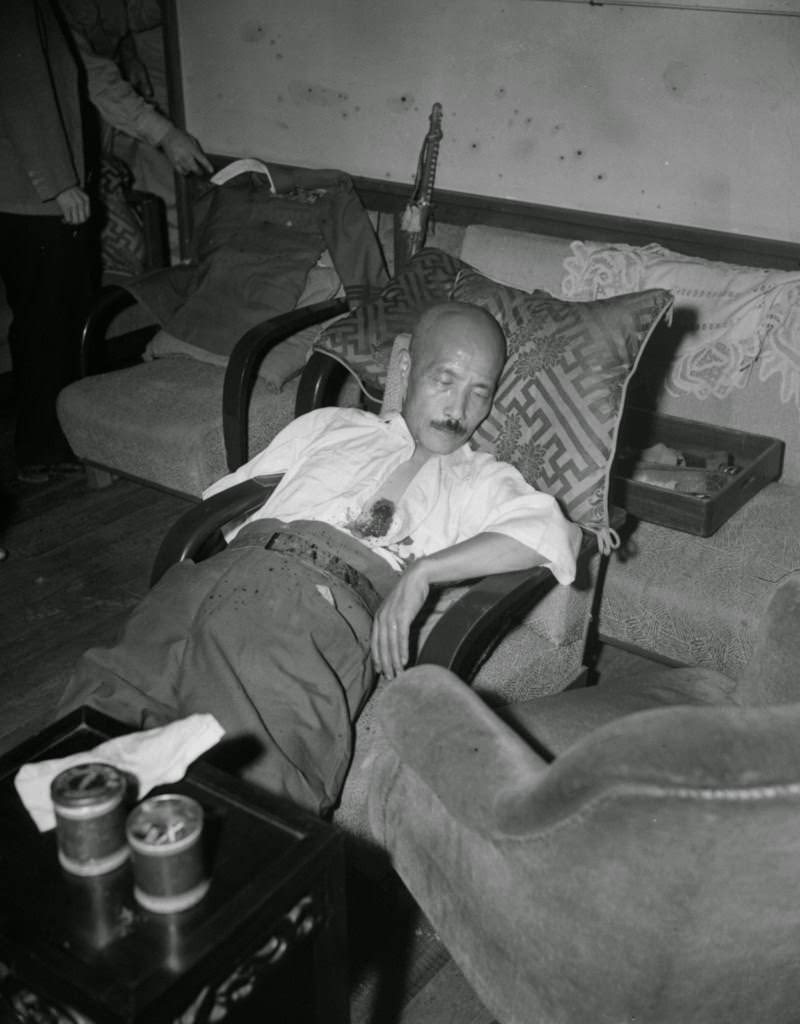
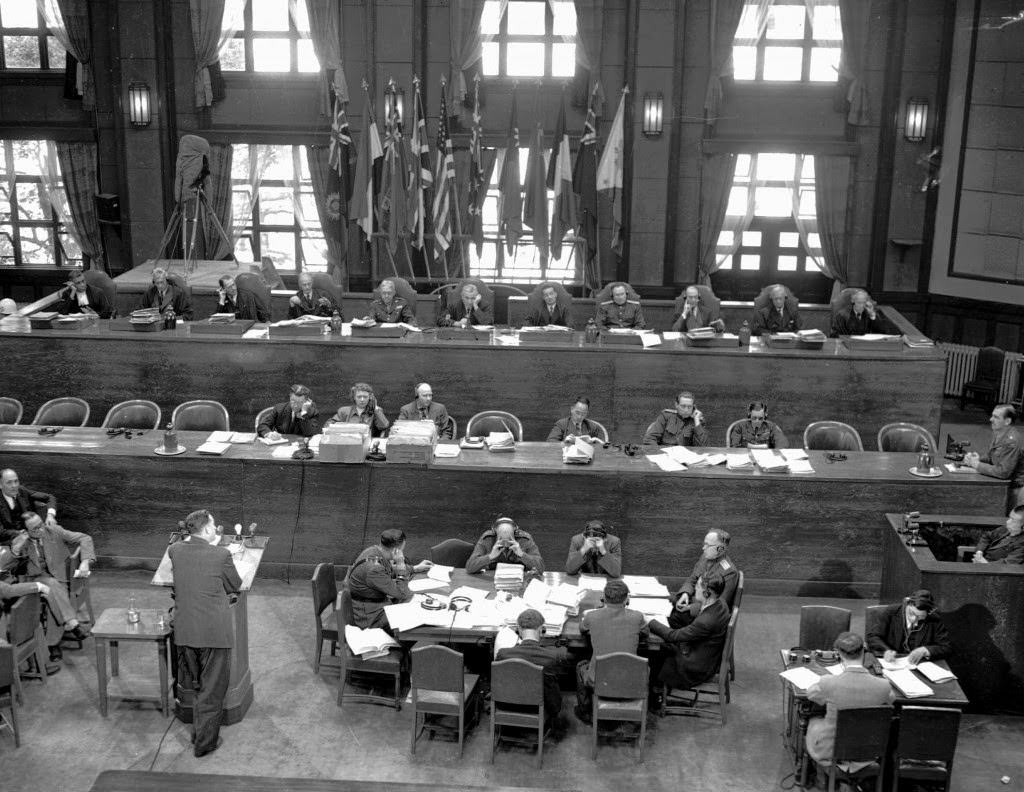
One of the most dramatic moments of the early occupation involved former Prime Minister General Hideki Tojo. When American military police arrived at his home to arrest him on September 11, 1945, Tojo shot himself in the chest with a pistol. He survived. After recovering, he stood trial before the International Military Tribunal for the Far East — the Tokyo War Crimes Trials — alongside 27 other Japanese civilian and military leaders. The trials began in 1946 and lasted over two years.
Gen. Hideki Tojo, former Japanese premier, lies semi-conscious in a chair after he shot himself, 1945.A general view of the International Military Tribunal for the Far East meeting in Tokyo, 1947. The Allies began the trial of 28 Japanese civilian and military leaders for war crimes in 1946.
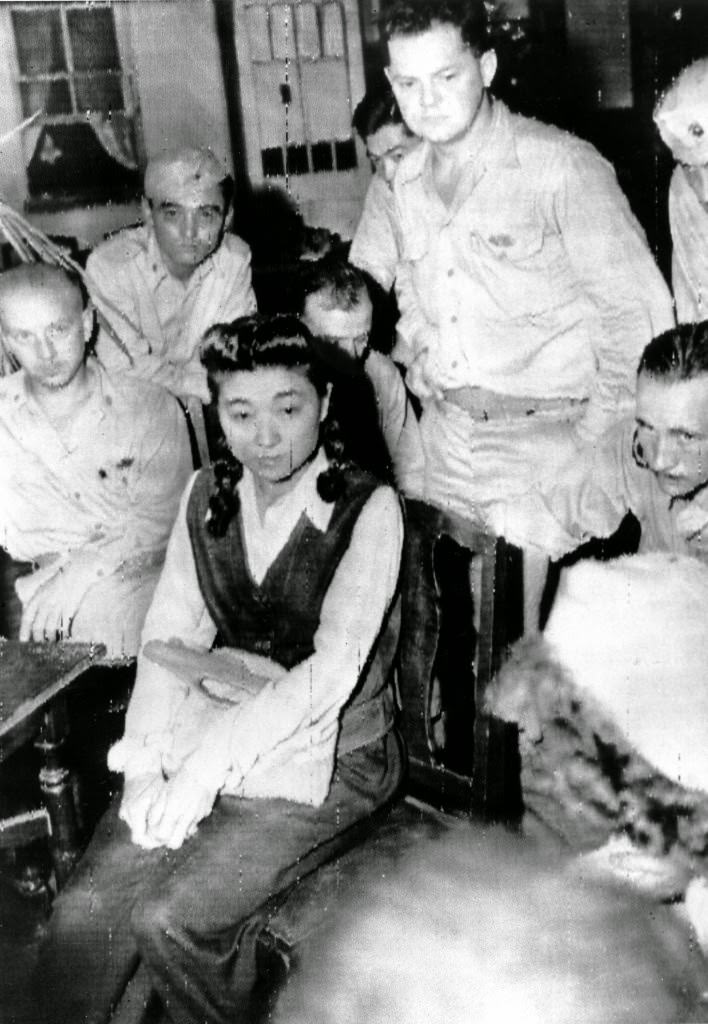
The occupation also brought other high-profile cases. Iva Toguri D’Aquino, an American-born woman of Japanese descent who had been stranded in Japan during the war, was arrested in Yokohama in 1945. She was one of several women known collectively as “Tokyo Rose” — a nickname used by Allied troops for female Japanese radio broadcasters whose program “Zero Hour” mixed music with propaganda aimed at lowering Allied morale.
Iva Toguri D’Aquino is interviewed by American journalists in Yokohama, Japan shortly before she is held in detention. She is known as Tokyo Rose, a radio personality whose program “Zero Hour” broadcast Japanese propaganda to the Allied troops during World War II, 1945.
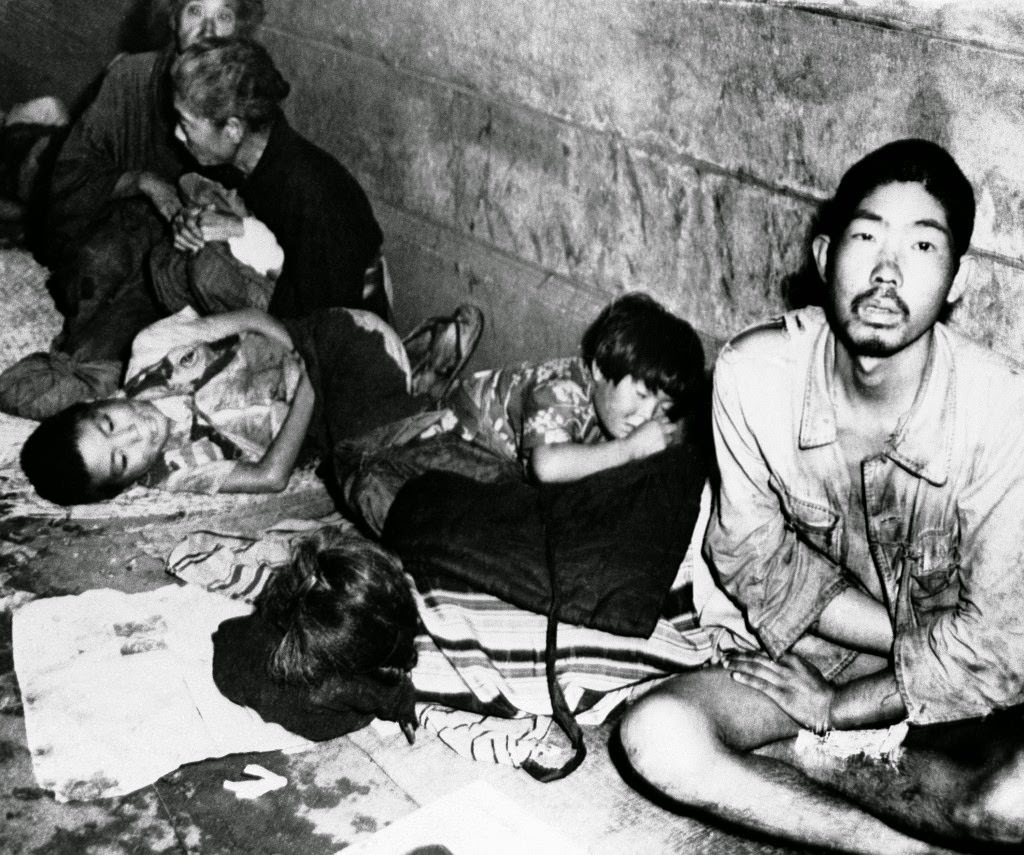
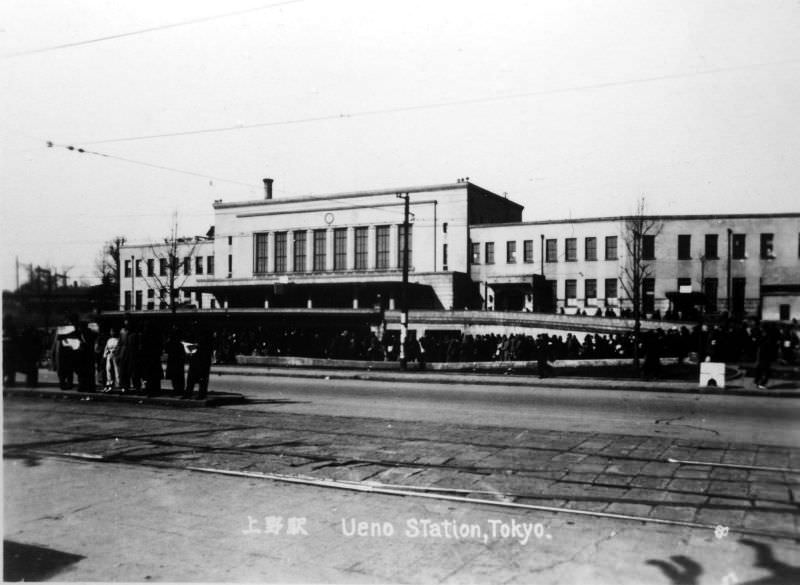
Ueno Station, in the northeast of the city, became one of the most loaded symbols of postwar Tokyo. Hundreds of thousands of people poured through it — soldiers returning from overseas, refugees from bombed cities, and families searching for lost relatives. Orphaned children lived in and around the station. The crowds at Ueno were so dense that the station became a reference point for the scale of human displacement the war had caused.
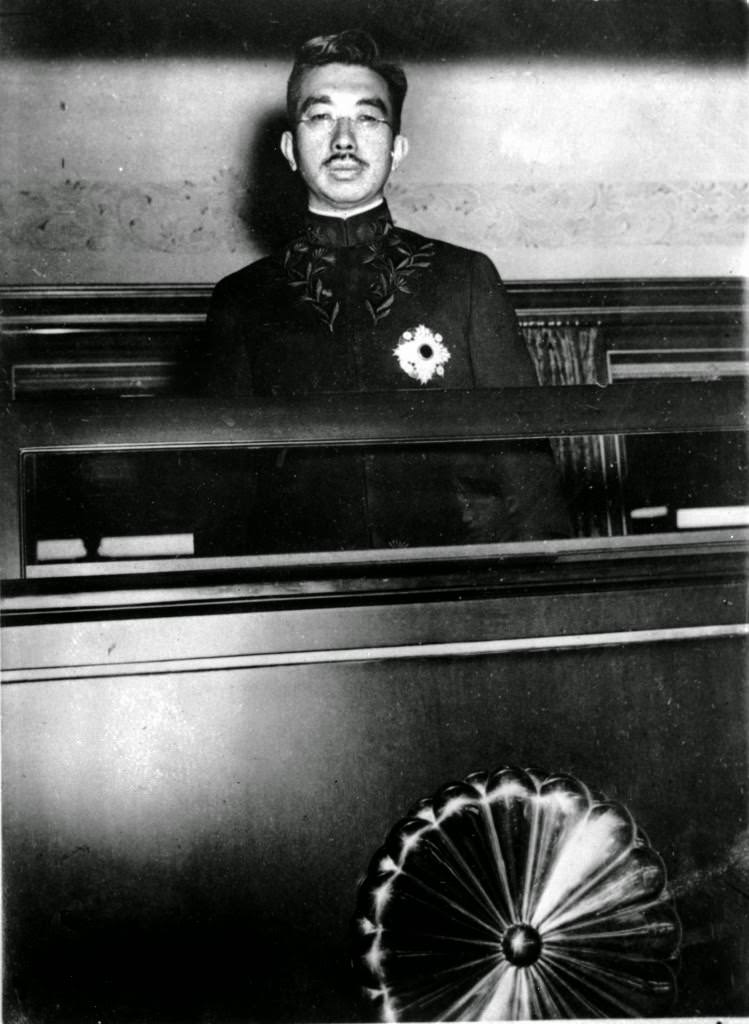
Hundreds of Japanese jam the Ueno railway station in Northeast Tokyo, 1945.Ueno Station, 1940s.Japanese Emperor Hirohito peers from a window of his special railway car in Tokyo, 1945.
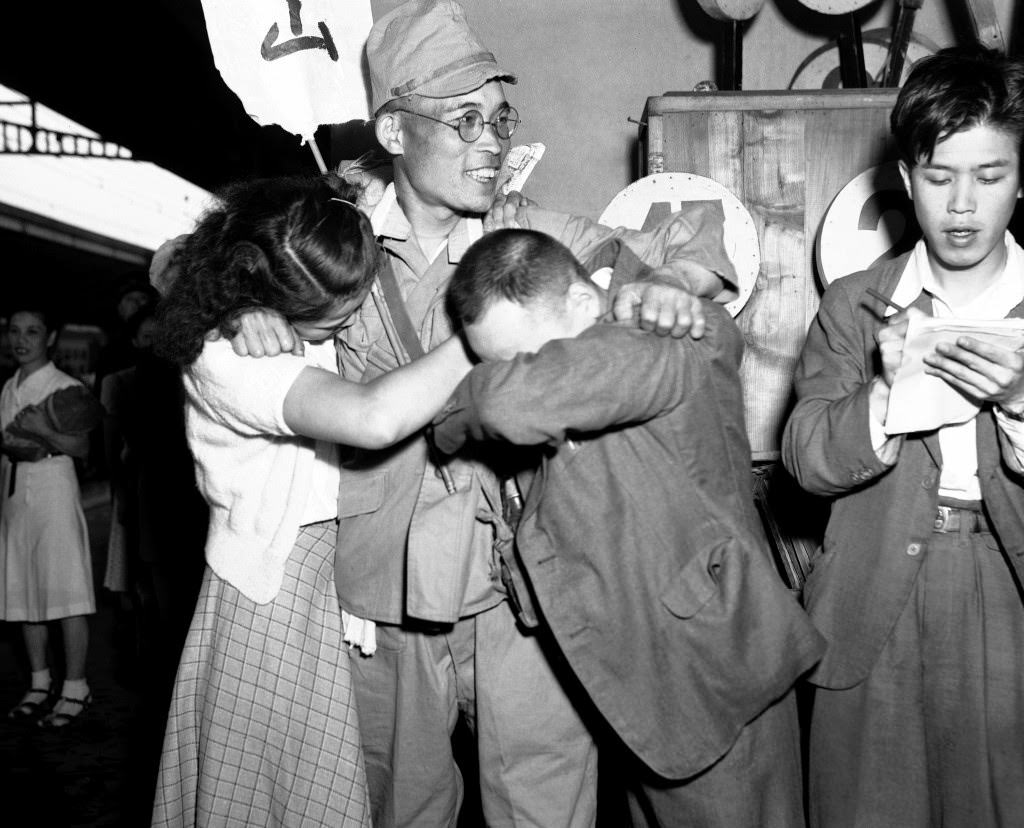
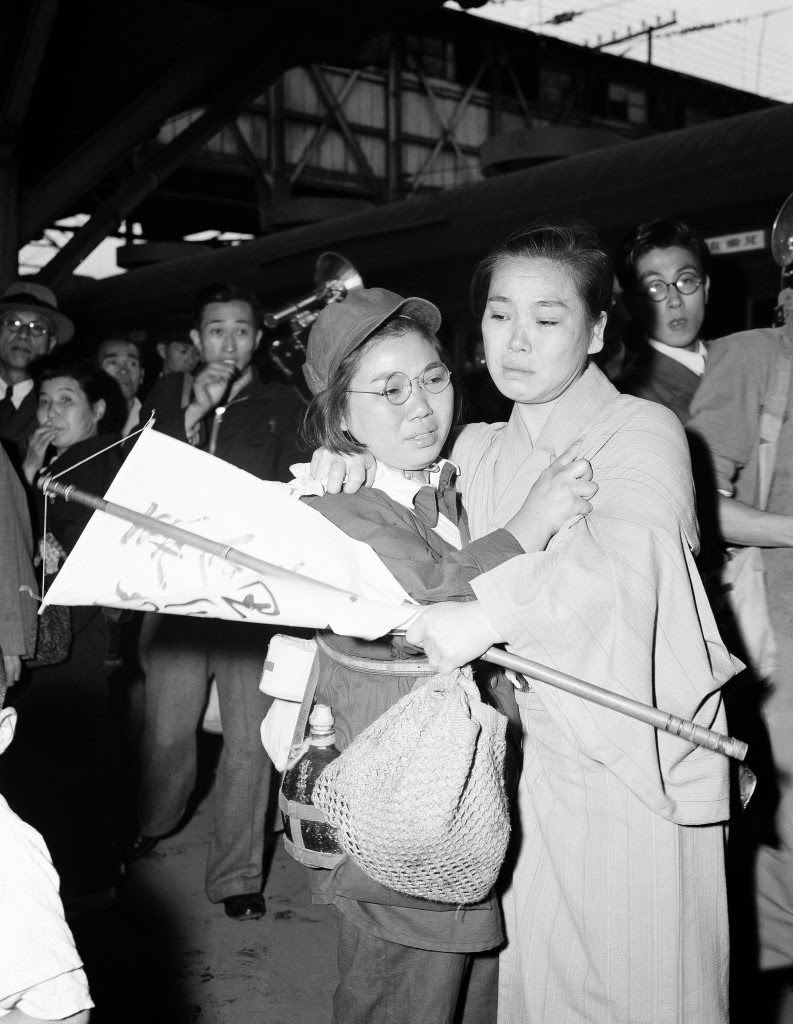
Repatriation was a slow, painful process that stretched across years. Hundreds of thousands of Japanese soldiers, workers, and civilians were held in Soviet-controlled territories after the war. The first groups did not begin returning until the late 1940s. When they finally arrived at stations like Shinagawa, the reunions were intense. Families separated for years — sometimes a decade — came together on station platforms. A photograph from 1949 shows a mother and daughter reuniting at Tokyo Station after ten years apart.
Family members greet each other as a small group of the first batch of repatriates from Russian held territory who arrived back in Japan aboard the Takasago Maru arrived at Shinagawa station a few miles from Tokyo, 1949.A mother and daughter meet after ten years of separation at Tokyo station, 1949.
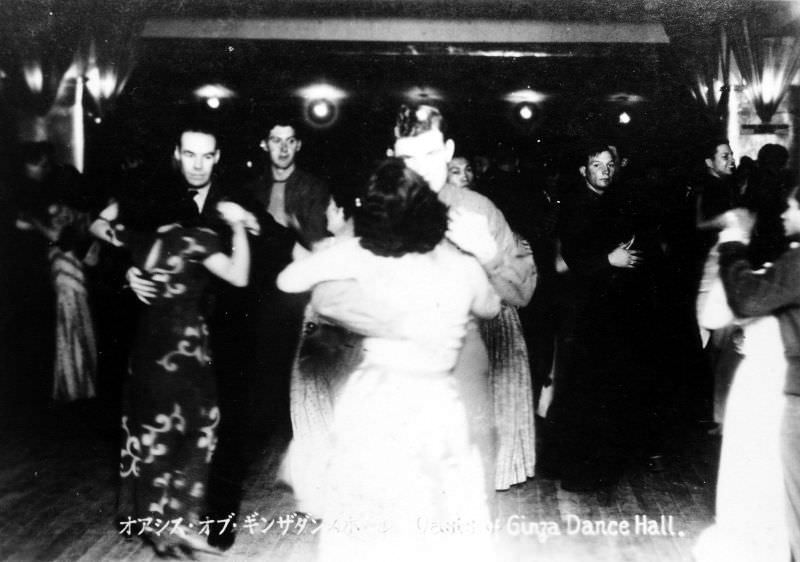
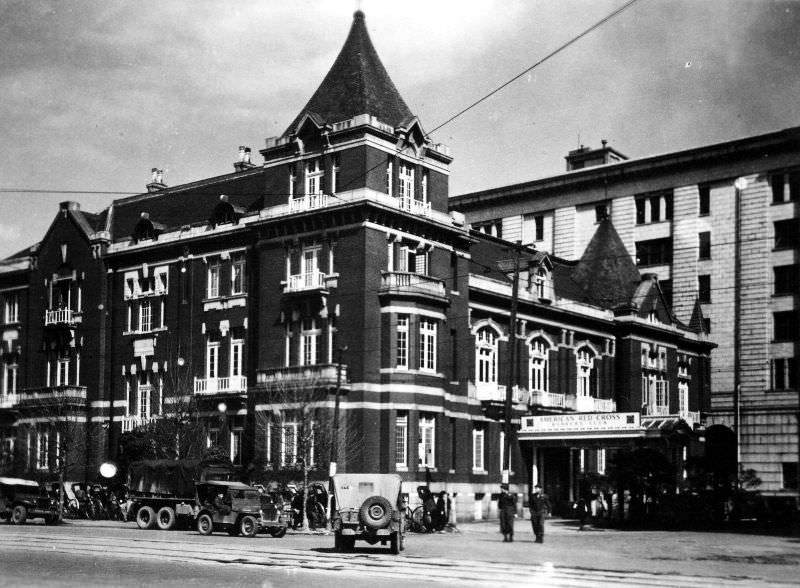
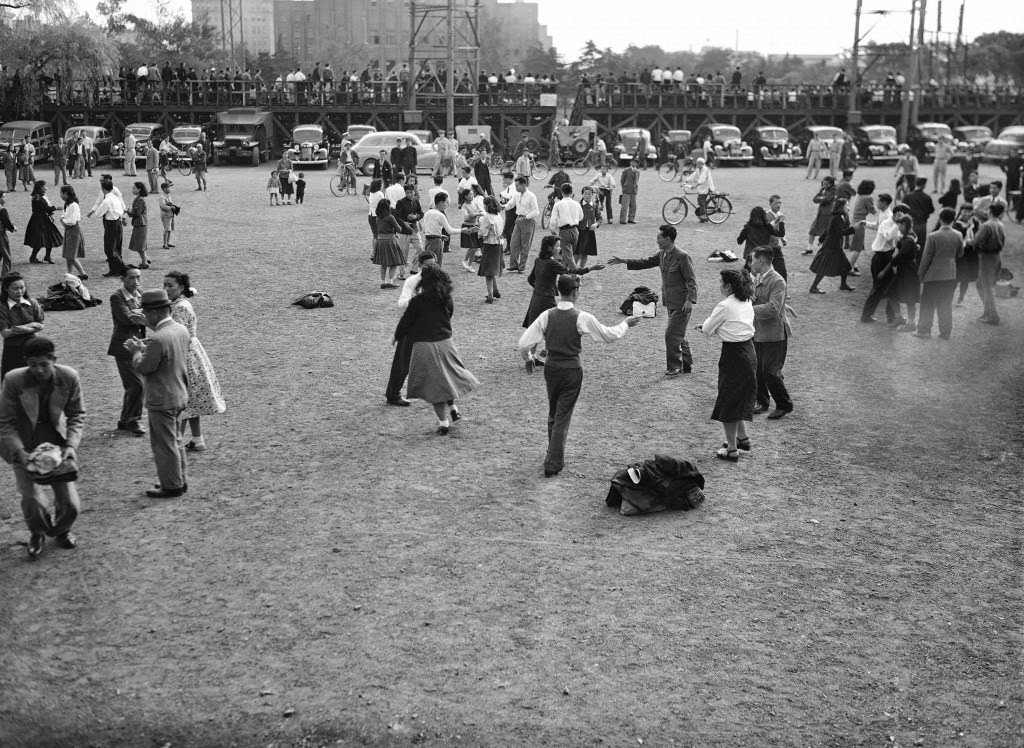
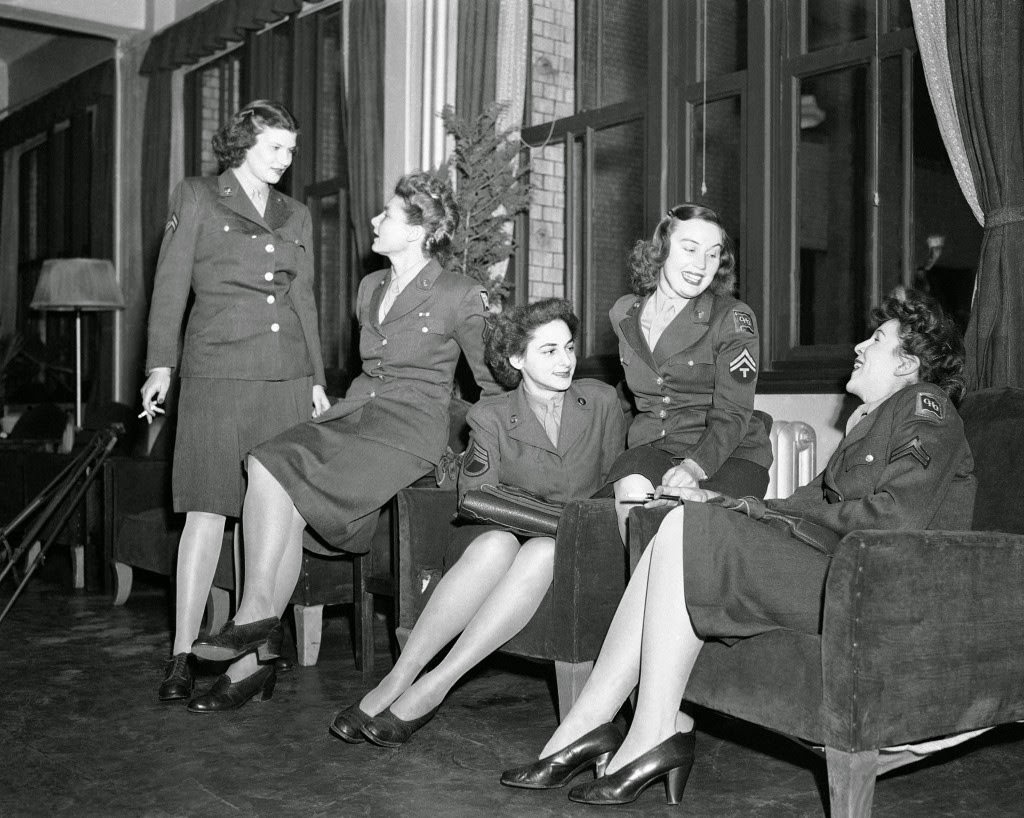
Daily life in Tokyo during the occupation was a mix of the familiar and the entirely new. American cultural influences spread rapidly. Dance halls opened downtown, and new dances like the Virginia reel were taught in public parks. American Red Cross clubs operated in the city. WACs — Women’s Army Corps members — were stationed in Tokyo. Japanese girls attended dances at American venues. The cultural crossover was visible everywhere, from fashion to music to sport.
An American dance hall in downtown Tokyo with Japanese girls, 1940s.The American Red Cross club in Tokyo, 1940s.The Virginia reel, a favorite American folk dance, is something new for the Japanese, dancing in Hibiya Park, Tokyo, 1949.Group of WACs pose in a Tokyo lounge, 1947.
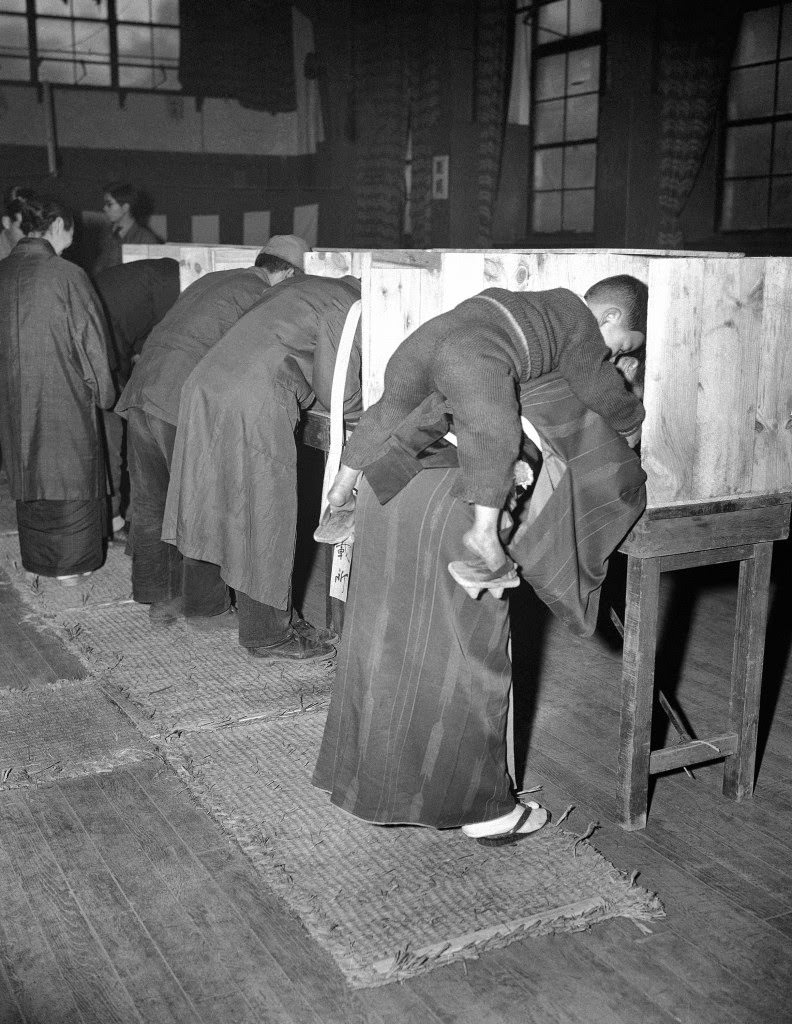
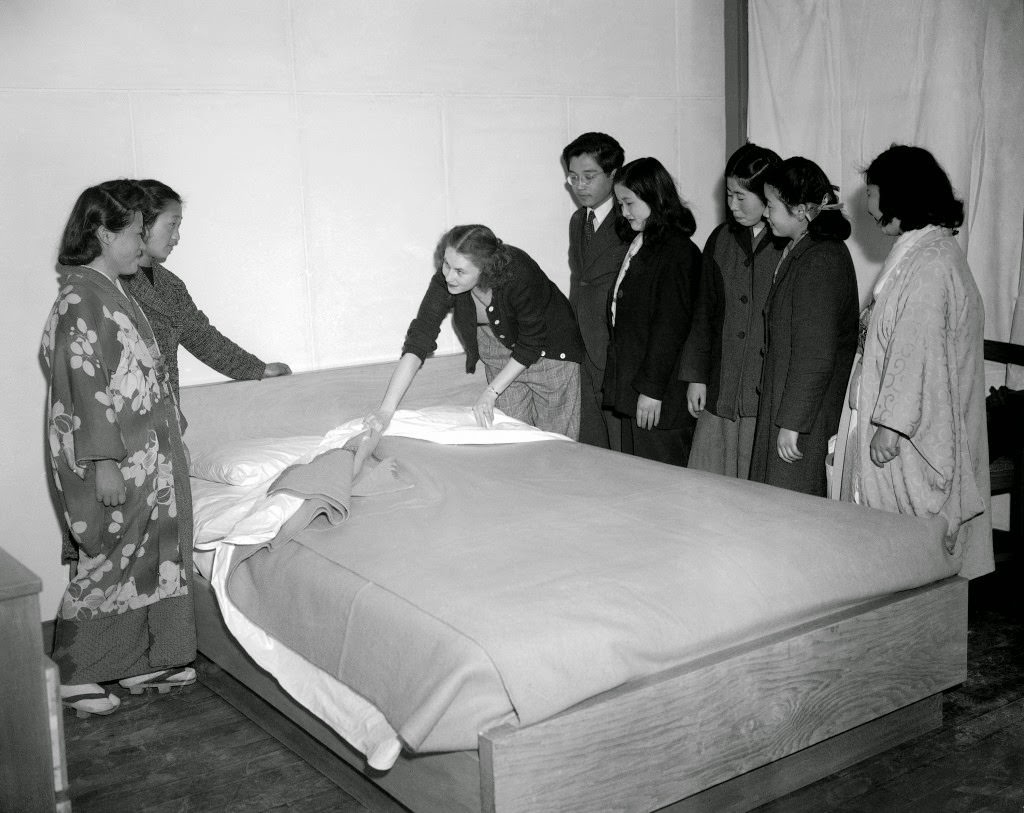
Women’s lives changed visibly in this period. The 1946 elections were the first in Japan in which women could vote. A photograph from that year shows a woman casting her ballot with her young son strapped to her back — an image that captures the overlap of old routines and new political rights. Occupation authorities also promoted new domestic and social practices. American advisors demonstrated things as specific as how to make a bed in the Western style.
A Japanese woman carries her son on her back as she marks her ballot in Tokyo, 1946.Although given preliminary instructions the girls are a bit vague about the proper making of a bed. Mrs. Anderson, with the help of an interpreter attached to the liaison section for the housing development, demonstrates the American way of bed making in Tokyo, 1947.
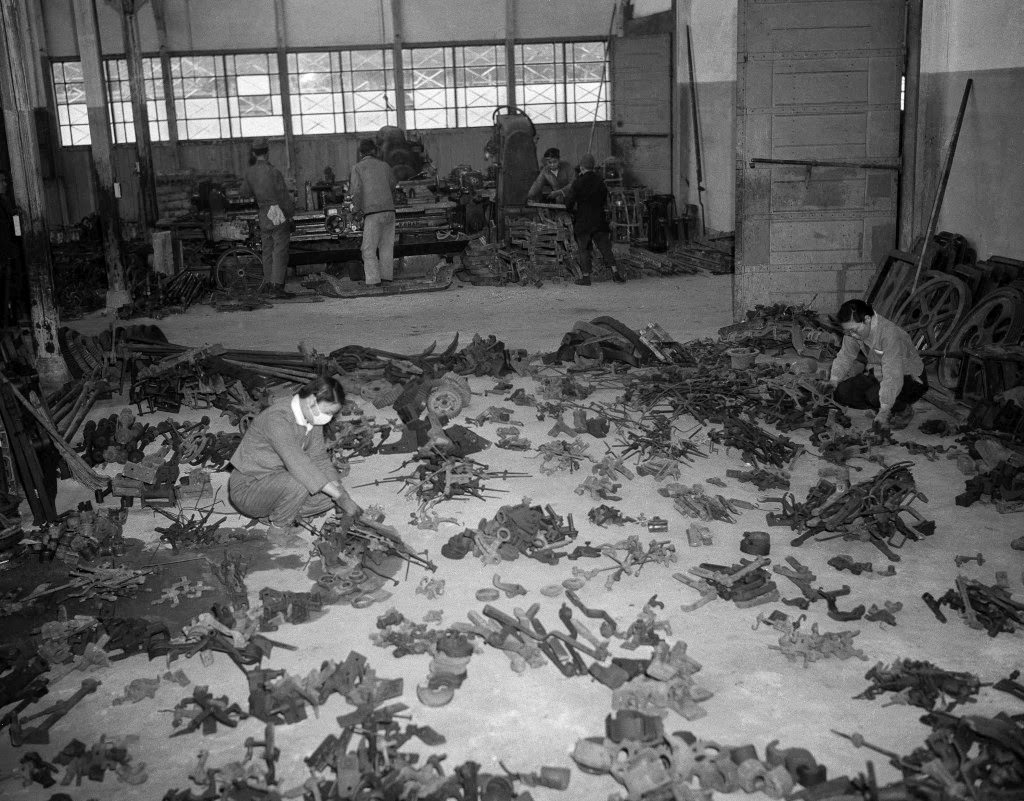
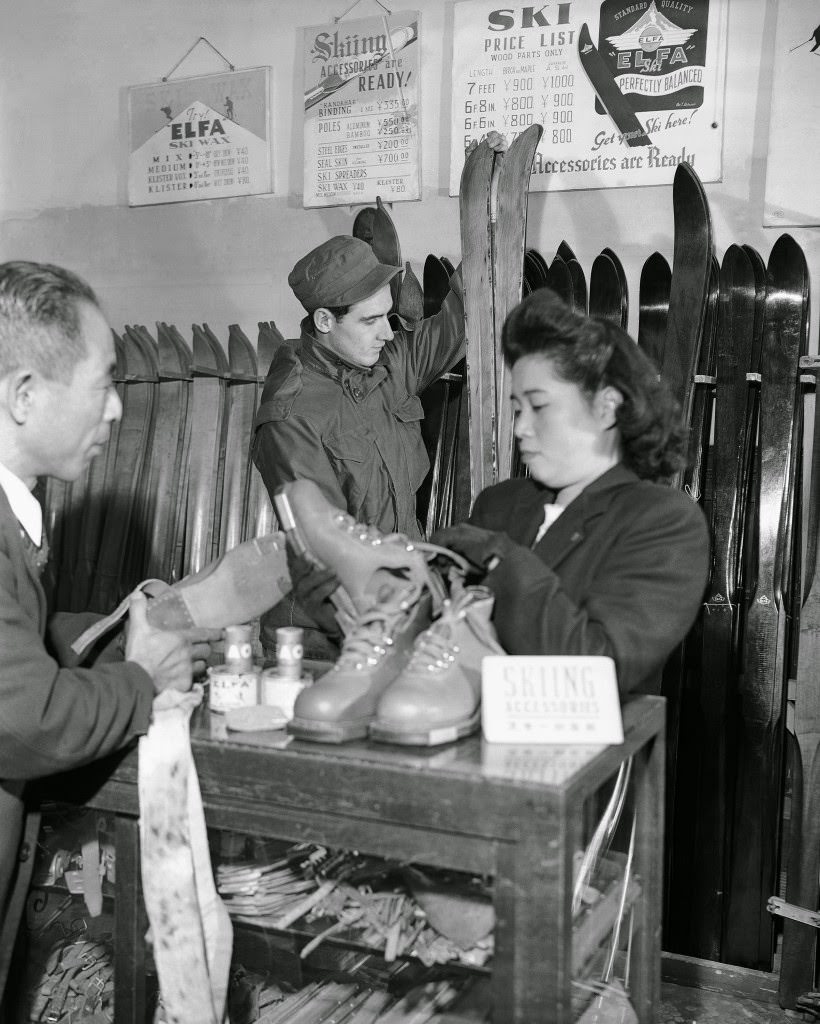
Industry began its slow recovery by repurposing wartime materials. Aluminum that had been allocated for military aircraft production was redirected to manufacturers making skis and sporting equipment. Scrap metal from destroyed war plants was melted down and turned into machine tools. Women workers sorted salvaged materials at warehouses. The shift from war production to civilian manufacturing was deliberate and resourceful, driven by necessity as much as policy.
Machine tools and parts for machinery are being made with metal melted down from scrap salvaged from the wreckage of former war plants. Girl employees check salvaged material at a warehouse in Tokyo, 1946.Using aluminum which had been earmarked for the production of Japanese war planes, Japanese ski manufacturers have been allocated the material to turn out sporting articles, skis and parts riding the slopes instead of the clouds. Looking over the first shipment in Tokyo, 1947.
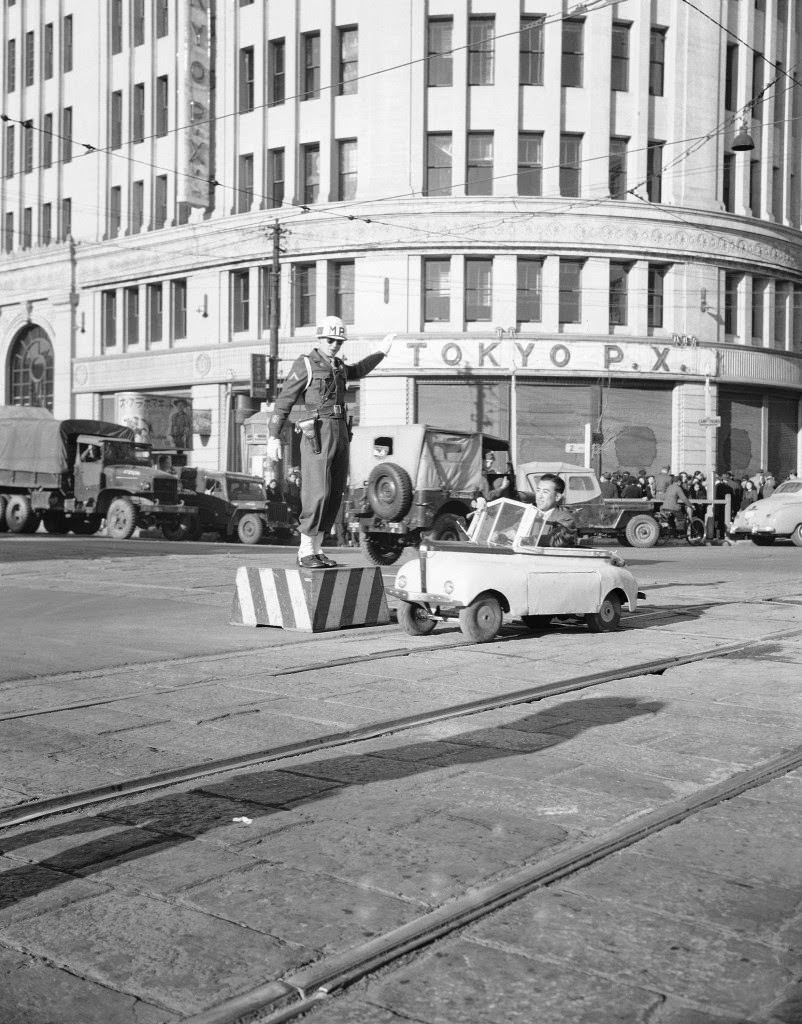
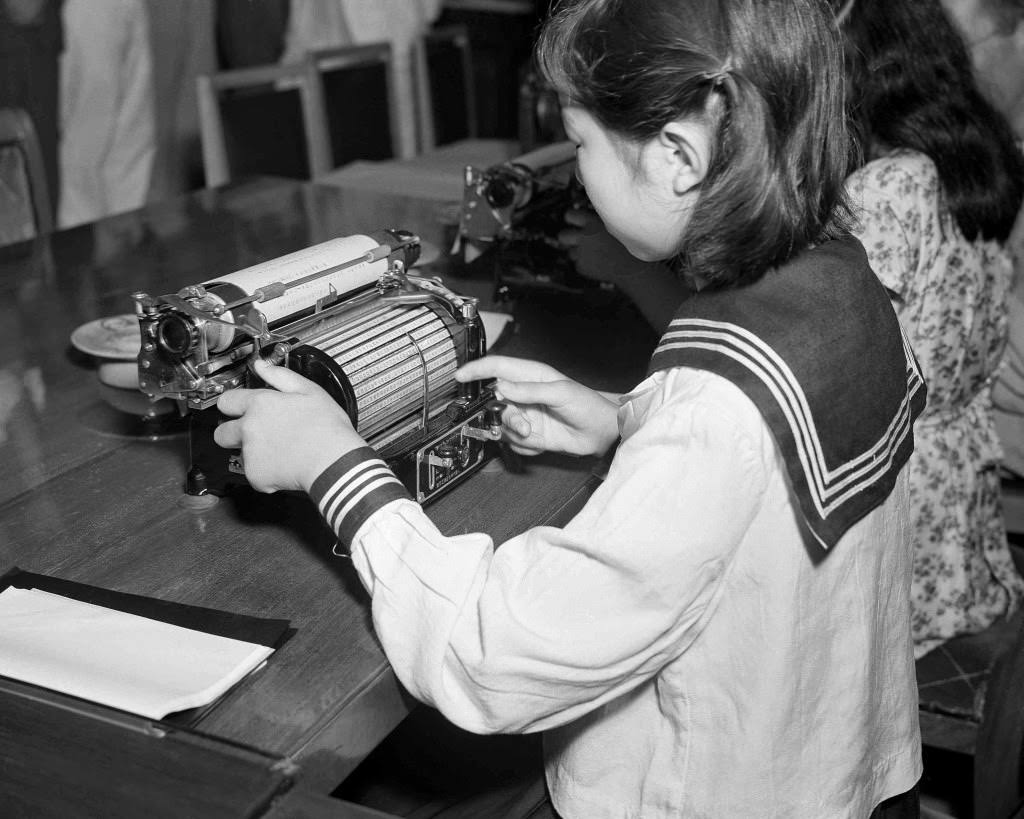
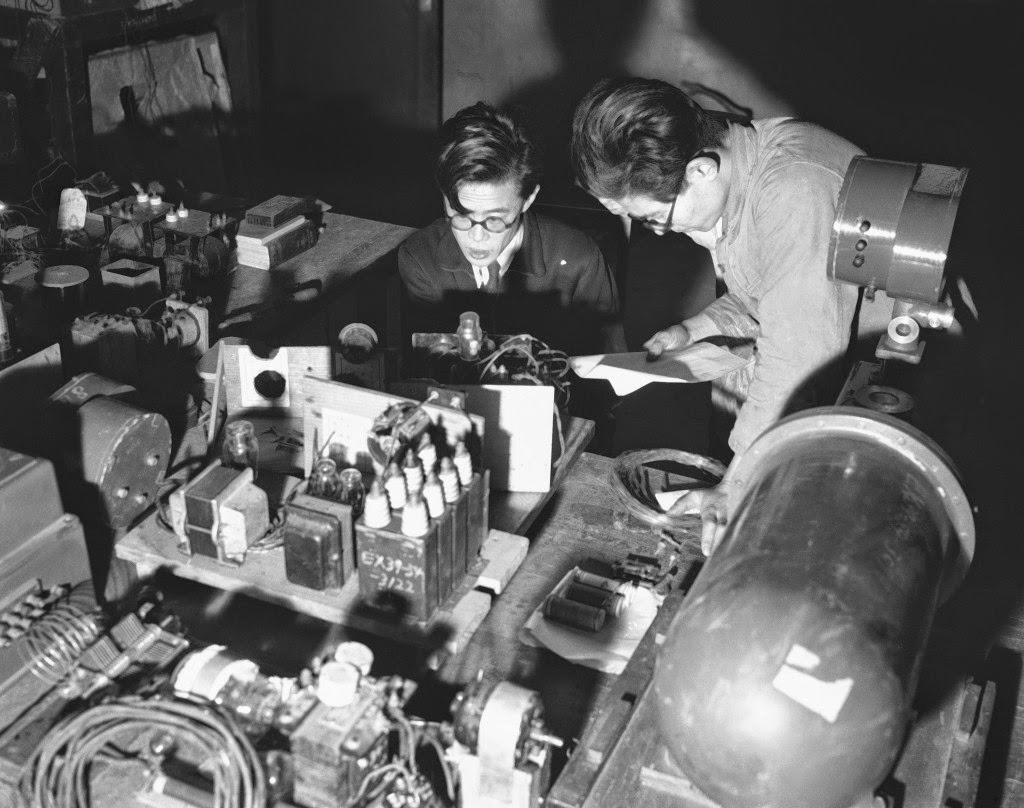
Innovation continued even amid the wreckage. In 1947, a former kamikaze pilot designed a battery-powered miniature automobile that was photographed passing through Ginza’s main intersection. In 1949, inventor Kotaro Kataoka of the Tokyo Electric Company demonstrated a new Japanese typewriter. Dr. Yoshio Nishina led a team of scientists measuring cosmic ray intensity and studying the mass of the meson — fundamental physics research carried out in a city still rebuilding its basic infrastructure.
The brainchild of a former kamikaze pilot, this midget auto gets its power from a 30-volt battery. It is shown passing the main intersection of the Ginza Street in Tokyo, 1947.A new Japanese typewriter invented by Kotaro Kataoka, an employee of the Tokyo Electric Company, was demonstrated by a school student in Tokyo, 1949.A group of Japanese scientist under the leadership of Dr. Yoshio Nishina is working on the continuous measurement of cosmic ray intensity, measuring the mass of the meson, one of the elementary particles of atomic nucleus. Assistant checks over the Geiger-Muller counter at laboratory in Tokyo, 1949.
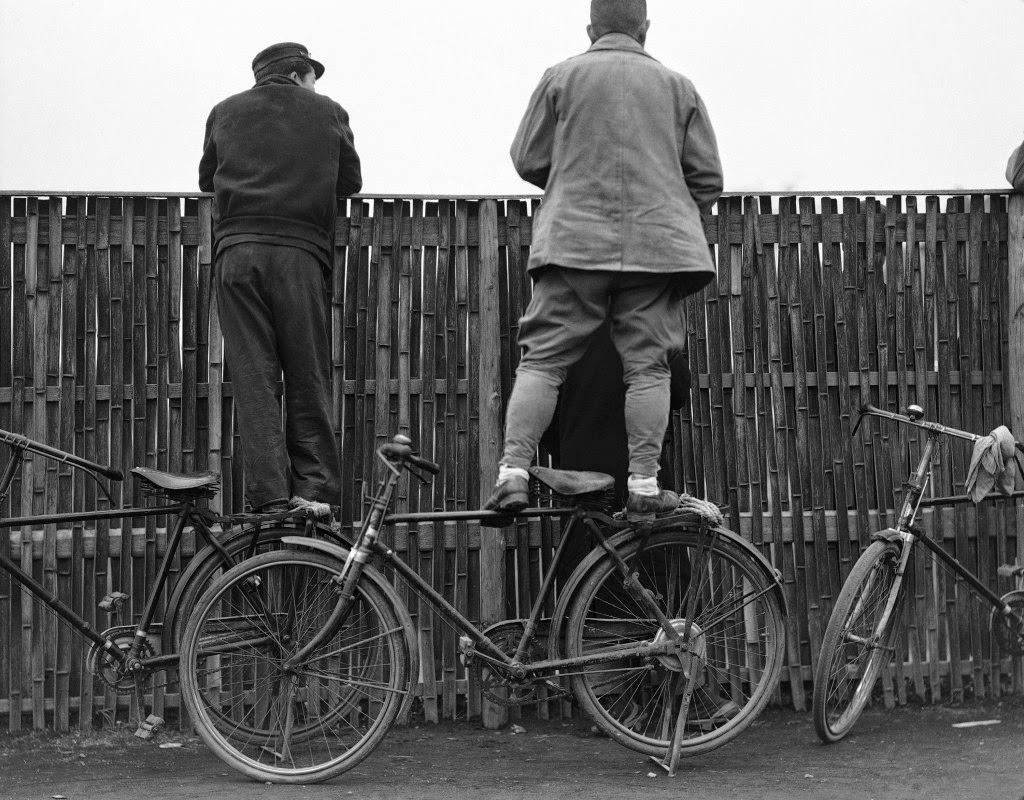
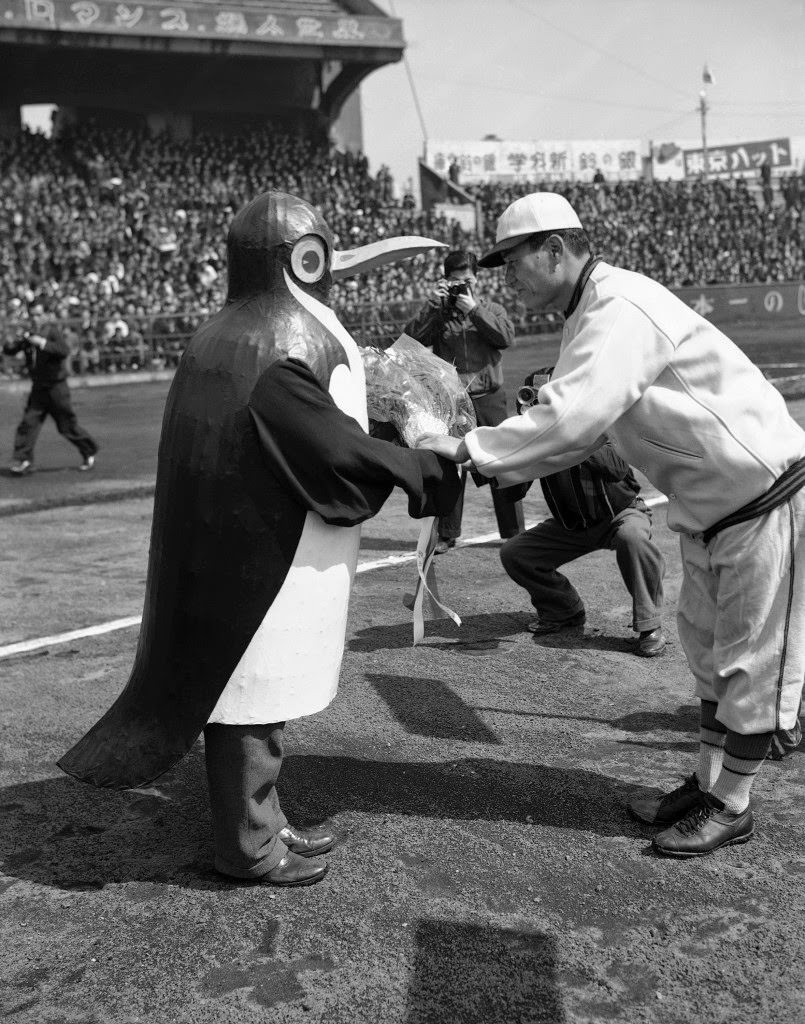
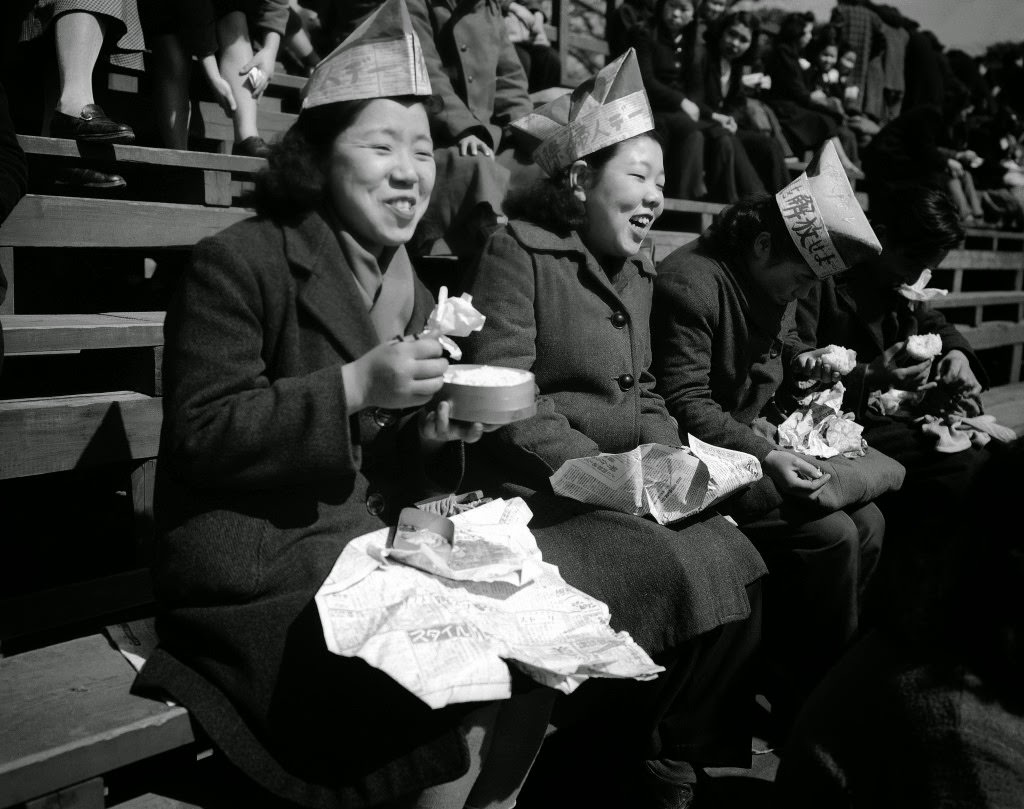
Baseball, already popular before the war, returned with force. By 1949, eight teams competed in a formal league. Stadiums filled with fans watching pre-game practice. Opening day ceremonies featured costumed attendants presenting flowers to team managers. The sport became one of the most visible signs of normalcy returning to Tokyo — a routine that existed regardless of politics, reconstruction, or occupation policy.
These fans are watching a pre-game practice session of ball players in Tokyo, 1949.As the baseball season opened in Japan, a penguin-costumed attendant presents flowers to the manager of one of the eight teams in the league in Tokyo, 1949.
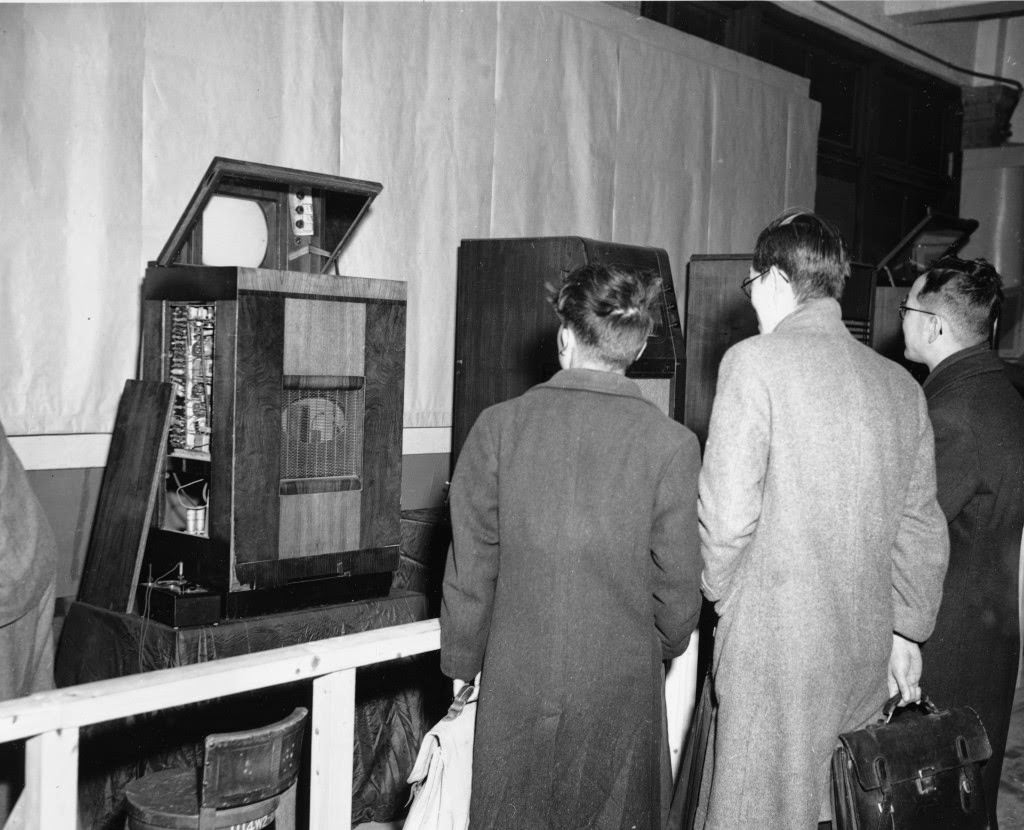
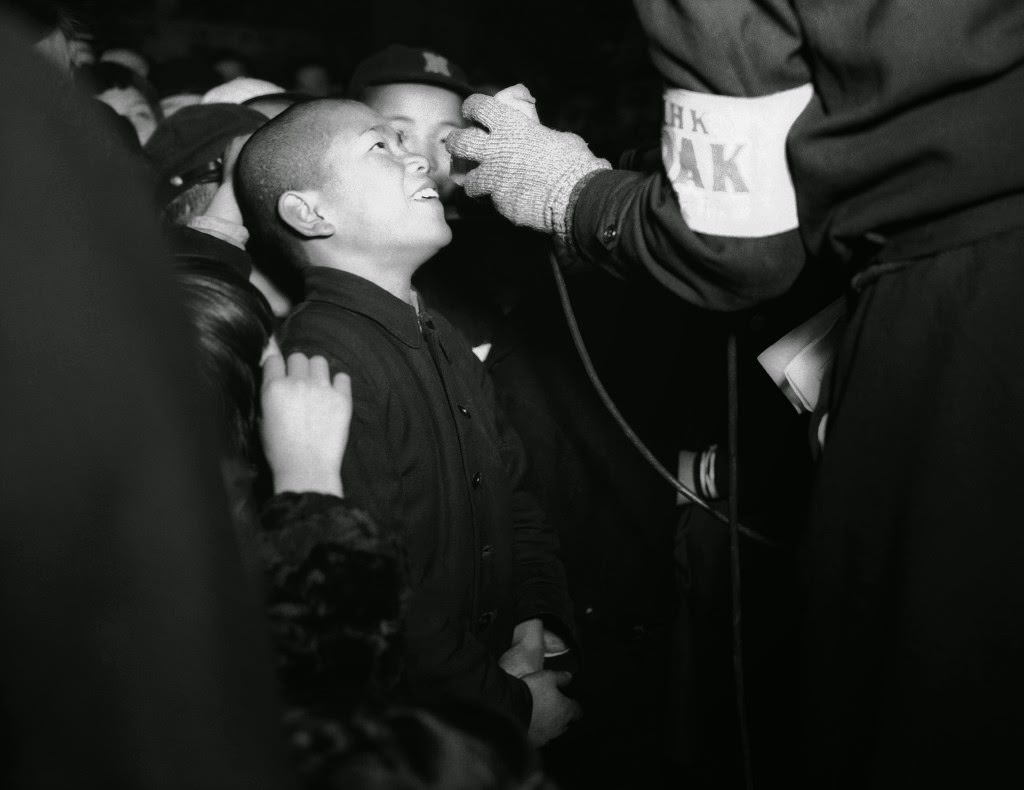
Television was still an experimental curiosity. In 1949, the Japanese Broadcasting Company held a public demonstration at its Tokyo studios, inviting visitors to watch a broadcast on a receiver — many of them seeing a television set for the first time. The same year, radio broadcaster JOAK sent announcers into the streets to ask Tokyo’s young people what they expected from Japan’s future. The answers were broadcast to the city.
Visitors to the television demonstration at the studios of the Japanese Broadcasting Company wait for the show to appear on the screen of one on the receivers, in Tokyo, 1949.Adding a new twist to the
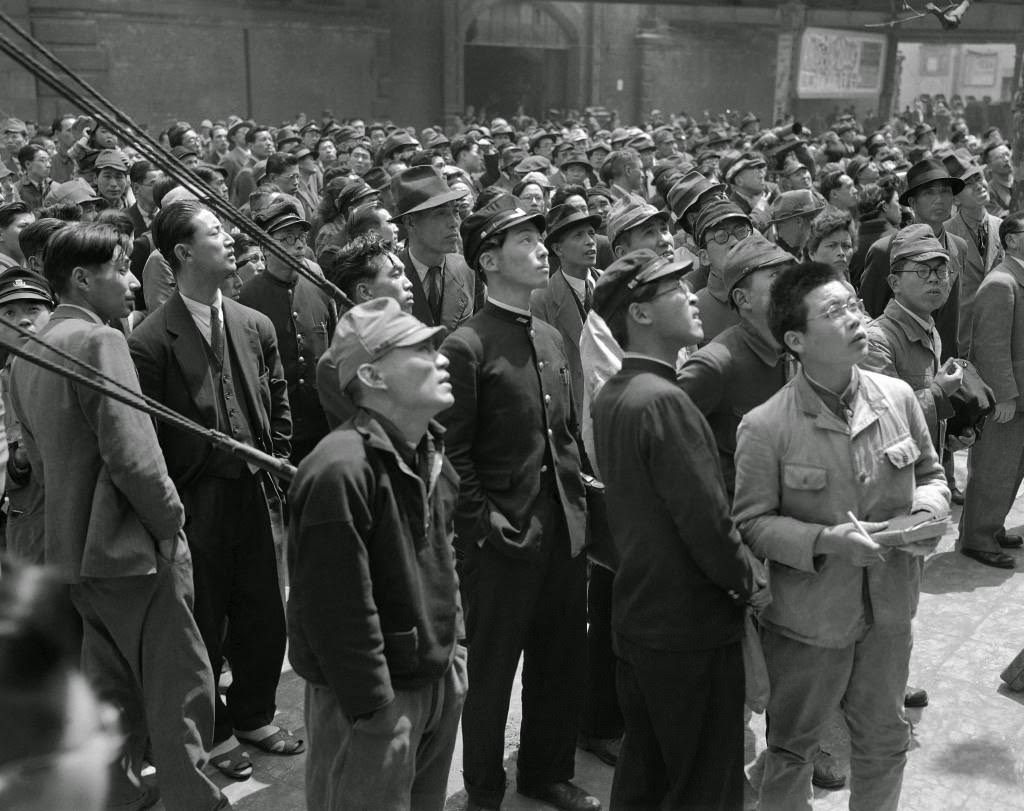
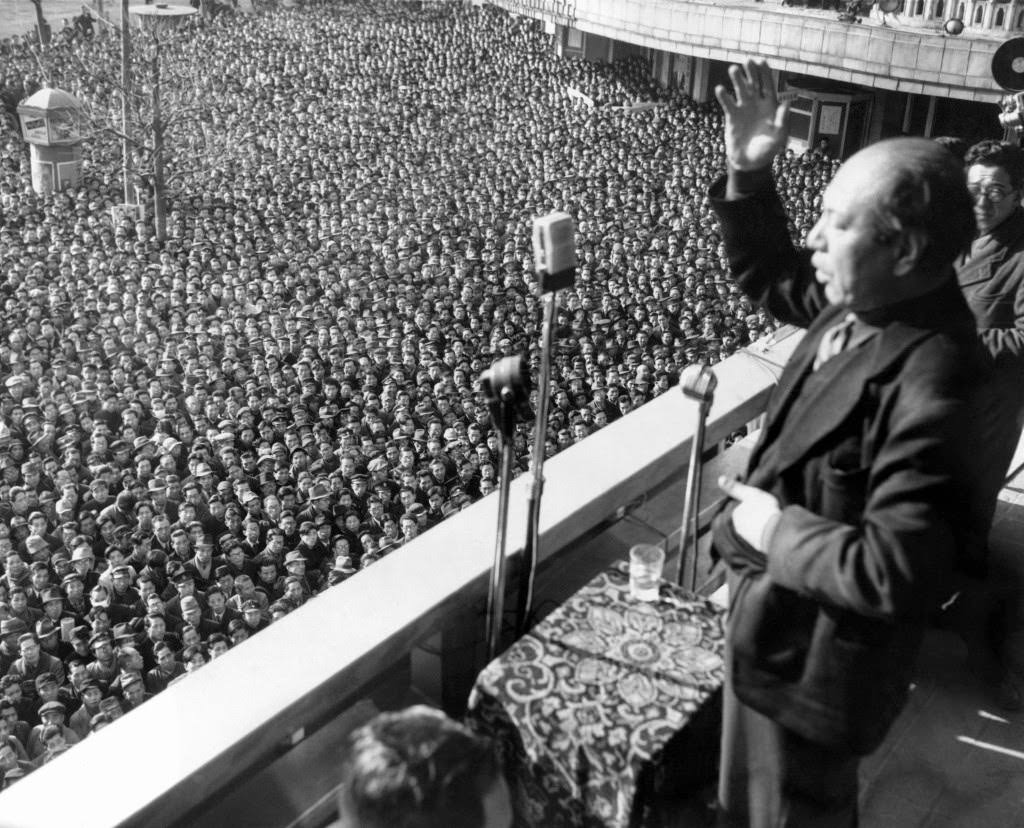
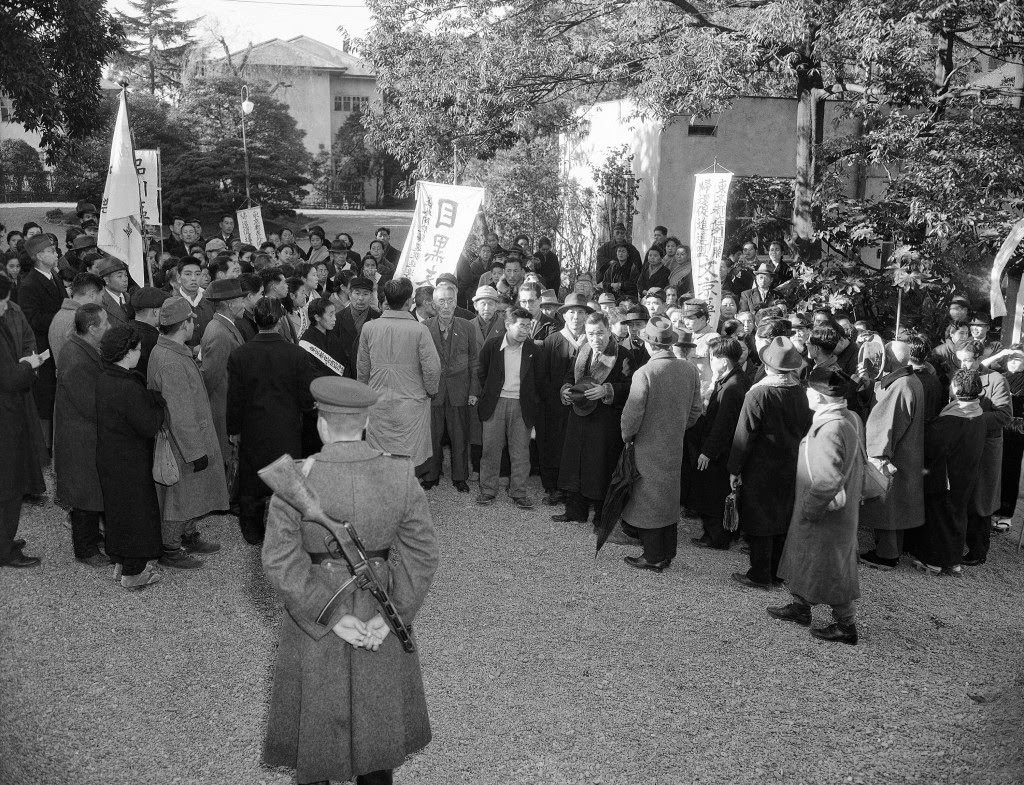
Political life was turbulent. Japan’s first postwar elections drew large crowds to bulletin boards outside newspaper offices, where results were posted as they came in. The Communist Party held visible public events, including a 1949 International Women’s Day rally in Tokyo and a large outdoor gathering outside the Asahi newspaper building where party Secretary General Kyuichi Tokuda addressed supporters. Russian soldiers stood guard outside the Soviet Embassy as Japanese citizens sought to petition the mission about repatriation.
Tokyo citizens turn out to watch the bulletin boards announcing the election results for the candidates for the diet in front of the Asahi Newspaper office in Tokyo, 1947.Kyuichi Tokuda, Secretary General of the Communist Party in Tokyo, gestures as he thanks the huge crowd which gathered outside the Asahi newspaper office in Tokyo, 1949.It’s lunchtime for ladies attending the Communist-sponsored International Women’s Day rally in Tokyo, 1949.Russian soldier with tommy gun stands guard outside the Russian Embassy as the members of the “Repatriation Association of Japan” await an answer to present their case to this head of the mission in person, in Tokyo, 1949.
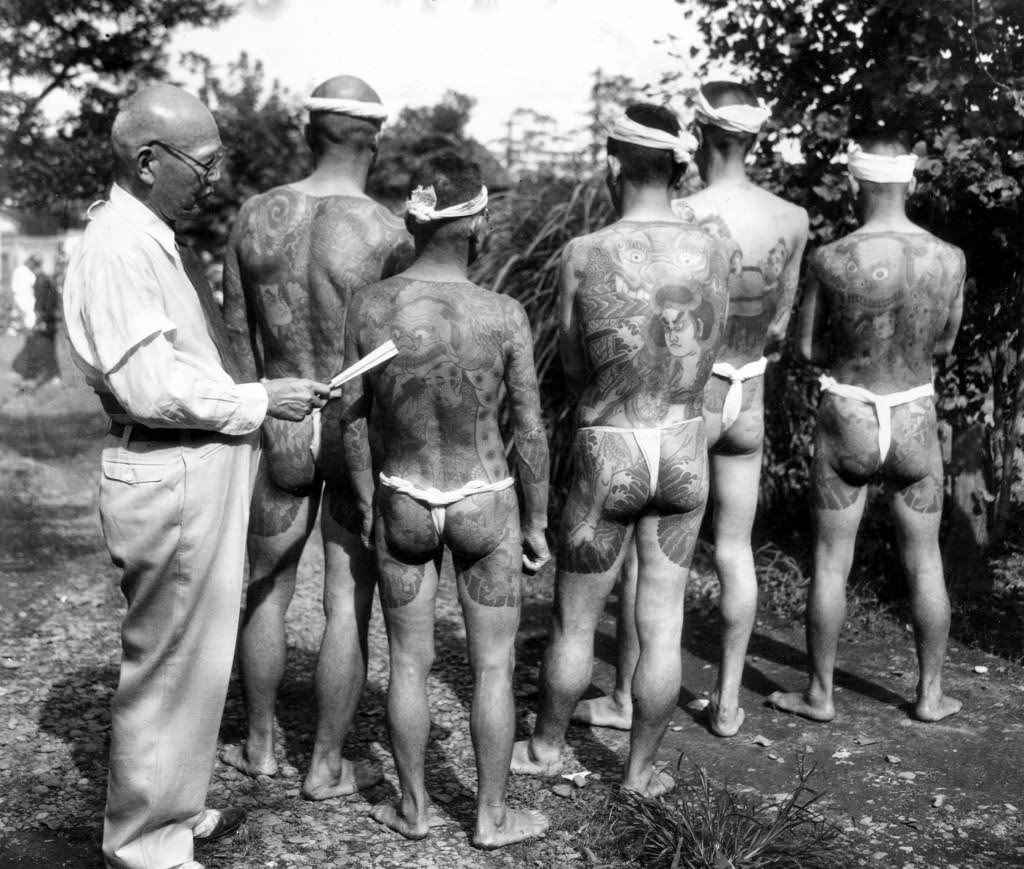
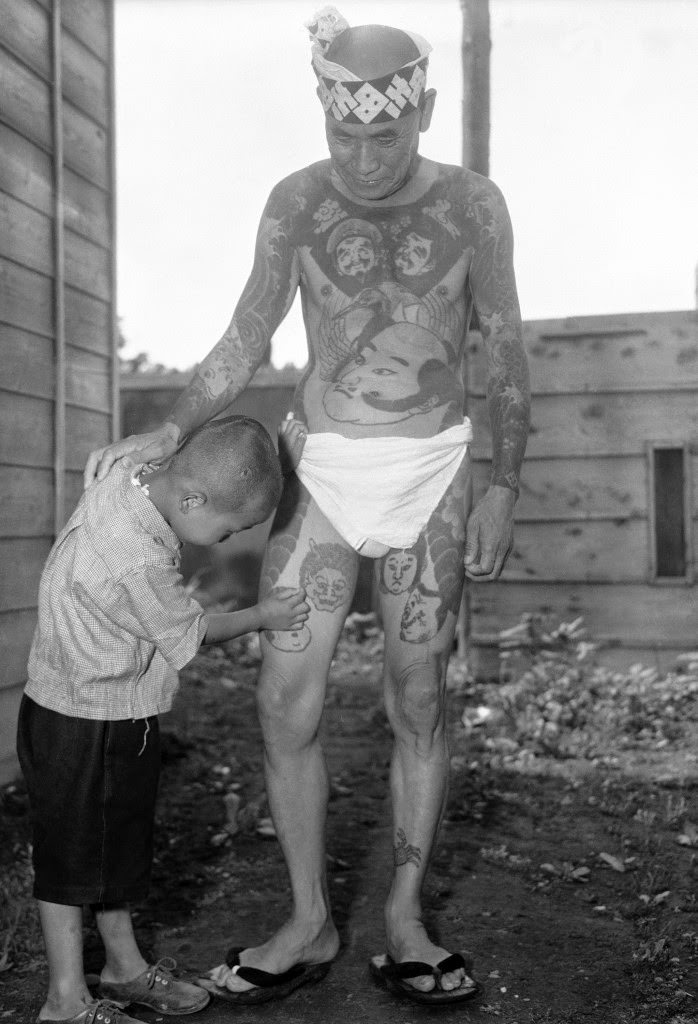
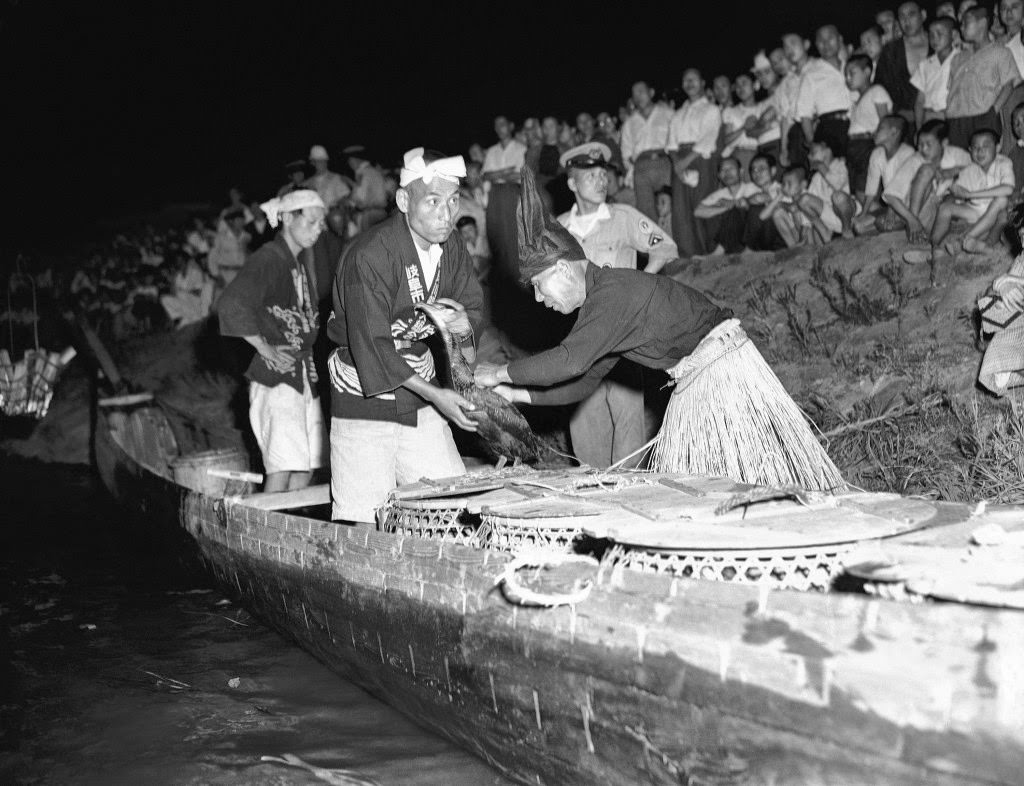
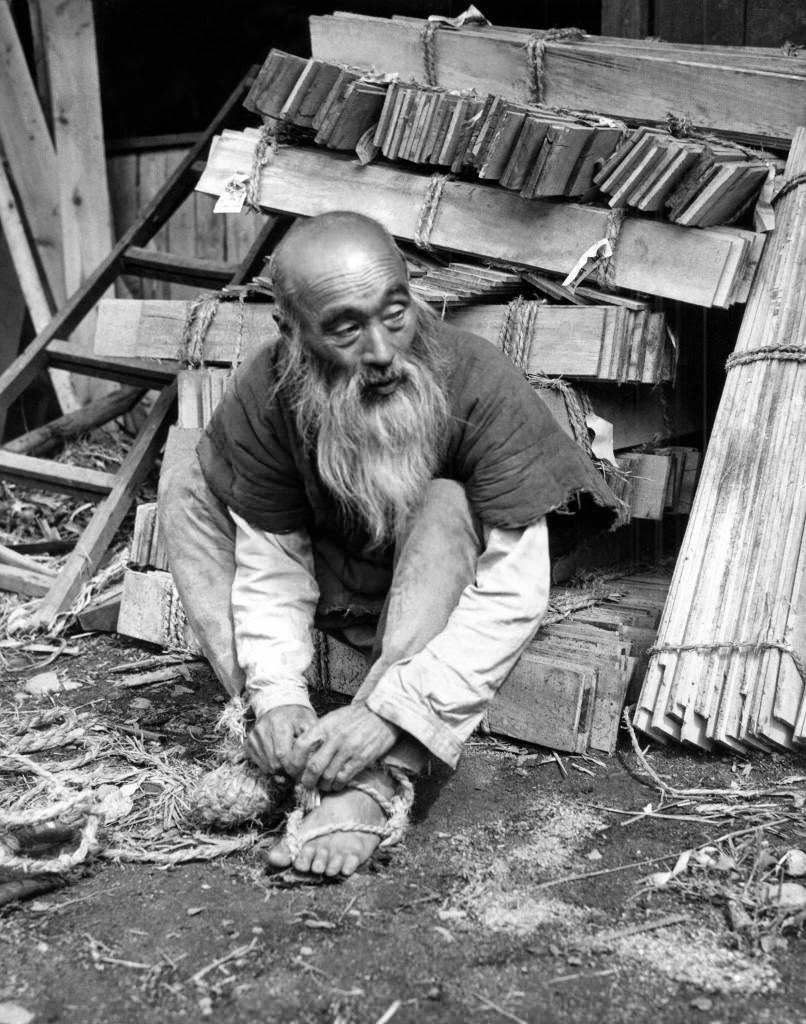
Traditional culture persisted alongside all of this change. In 1948, tattoo artist Ginjiro Susuki, 72 years old, exhibited his work at the Hard Skin Club convention — a gathering of tattooed men and women held in Tokyo. Bird fishermen in traditional costume demonstrated cormorant fishing techniques to Tokyo crowds in 1949. Festivals continued in city districts. A 63-year-old farmer and long-distance runner named Hikosaku Sakamoto ran 125 miles from Shirakawa to Tokyo in 1946 to advertise his hometown’s shrine festival.
Japanese tattoo artist Ginjiro Susuki, 72, exhibits some of his tattoo designs at the Hard Skin Club convention of tattooed men and women held in Tokyo, 1948.At the “Hard Skin Club” convention of tattooed men and women in Tokyo, a little boy examines a design on his father’s leg, 1948.In traditional costume, bird fishermen demonstrate to a Tokyo crowd how to make the birds give up their catch of fish, 1949.Hikosaku Sakamoto, a 63-year-old Japanese farmer, who doubles as a long distance runner and weight-lifter once each year to advertise the shrine festival in his hometown, Shirakawa, Japan, removes his straw sandals after running 125 miles from Shirakawa to Tokyo, 1946.
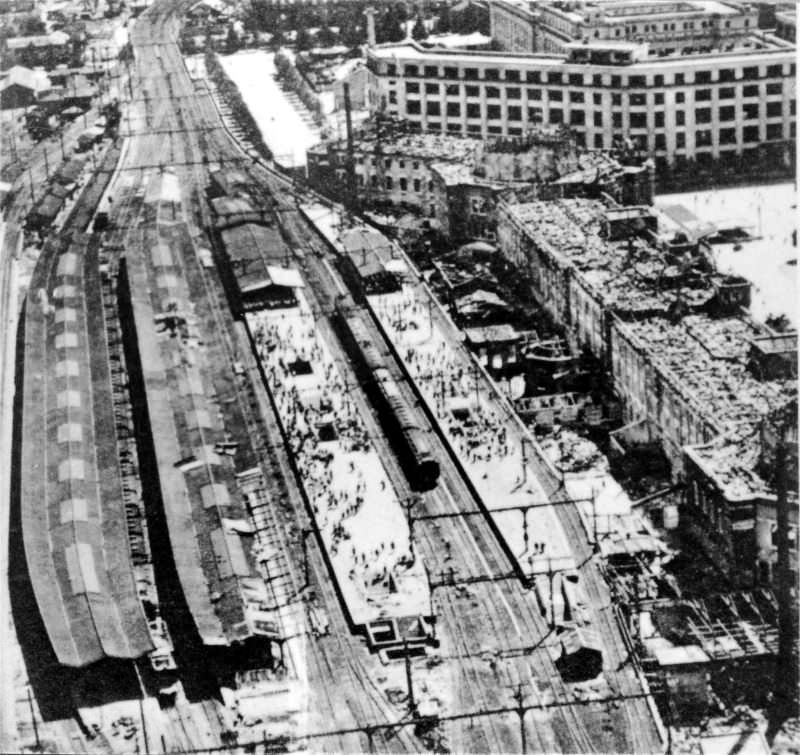
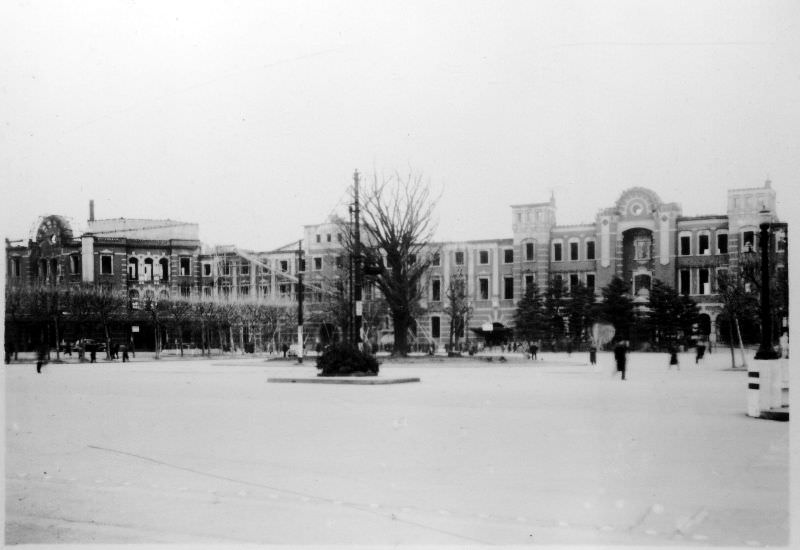
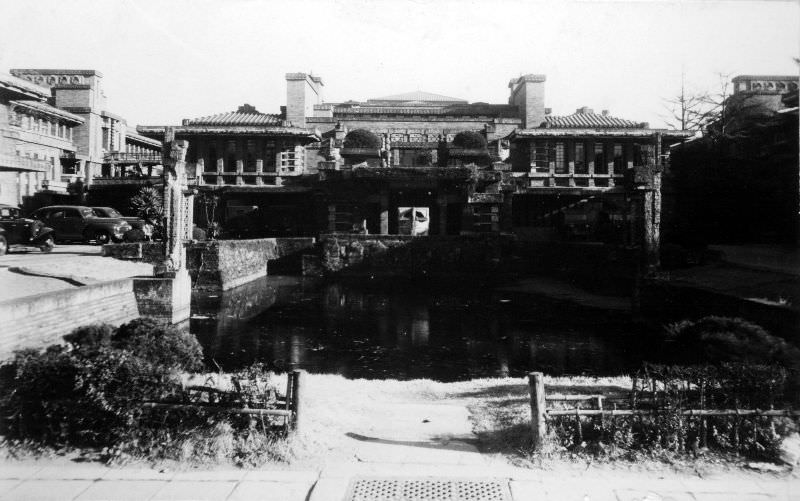
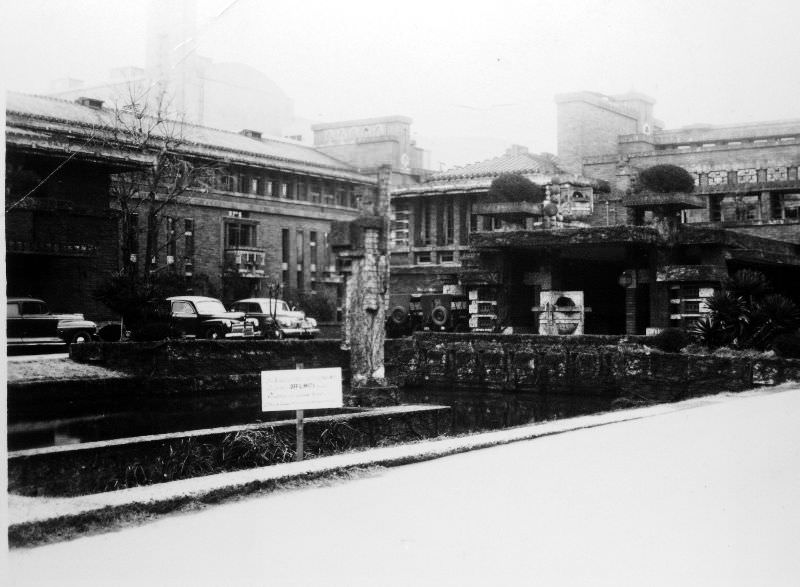
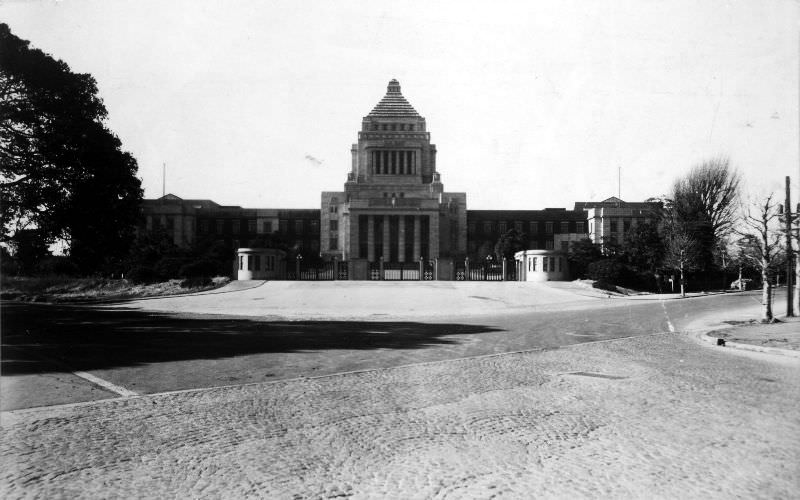
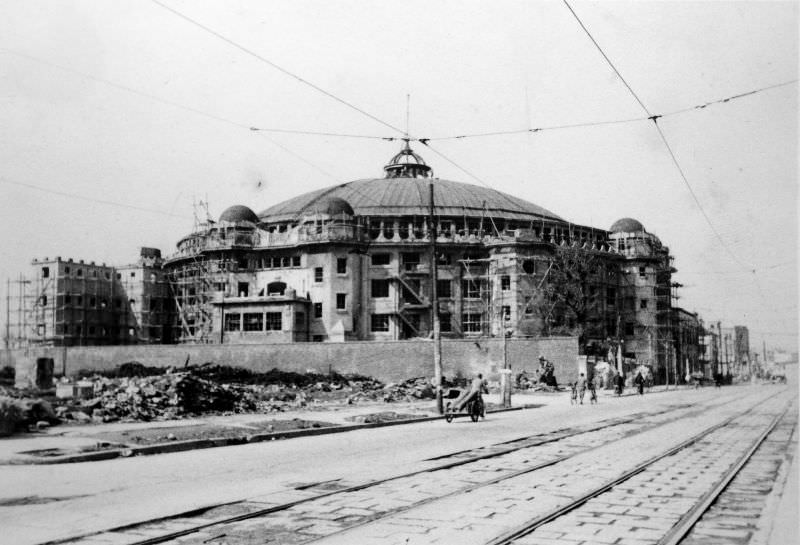
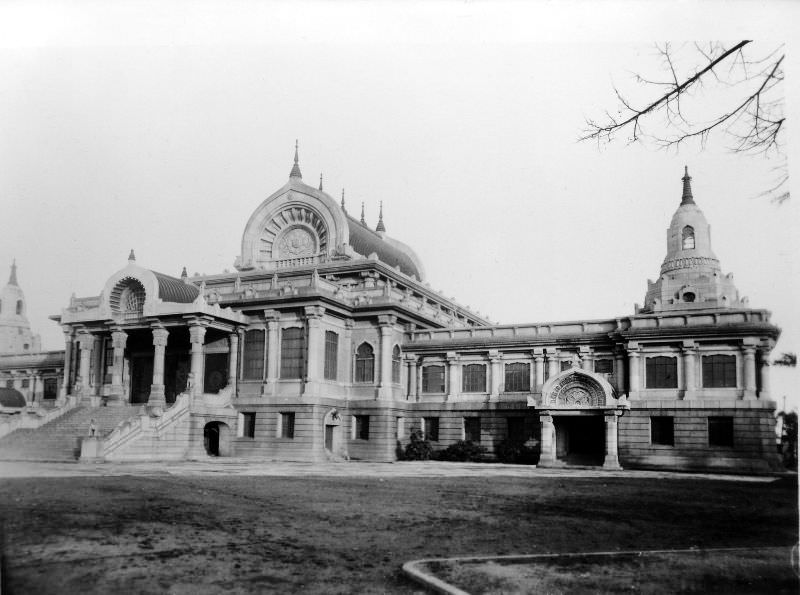
Landmarks that had survived the bombing became anchors of the recovering city. Tokyo Station, the Imperial Hotel, the National Diet Building, the Kokugikan sumo hall, and temples like the Tsukiji Honganji provided physical continuity — proof that not everything had been erased. The streets around them filled again with people, vehicles, and commerce, stitching together a city that had, only a few years before, been reduced to rubble.
Tokyo Station, 1940s.Tokyo Station, 1940s.Imperial Hotel, 1940s.Imperial Hotel, 1940s.The National Diet Building, 1940s.Kokugikan (Sumo Hall), 1940s.The Tsukiji Honganji temple, 1940s.
The photographs taken across these four years — from the formal surrender in Tokyo Bay to the crowds filling Ginza in 1949 — document a city in motion. Not triumphant, not finished, but persistently alive. Families going to work, children riding toy jeeps in department stores, scientists checking instruments in laboratories, women getting their hair styled at Ginza salons. Tokyo between 1945 and 1949 was a place where catastrophe and ordinary life existed on the same streets, often at the same time.
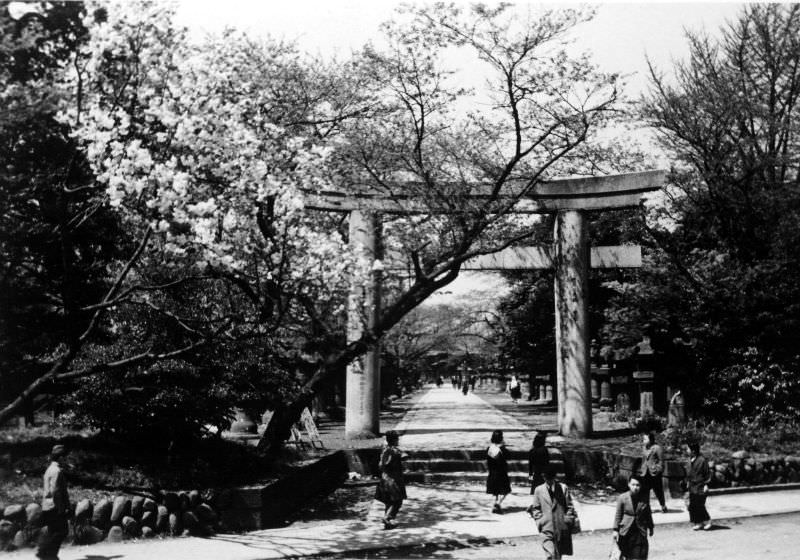
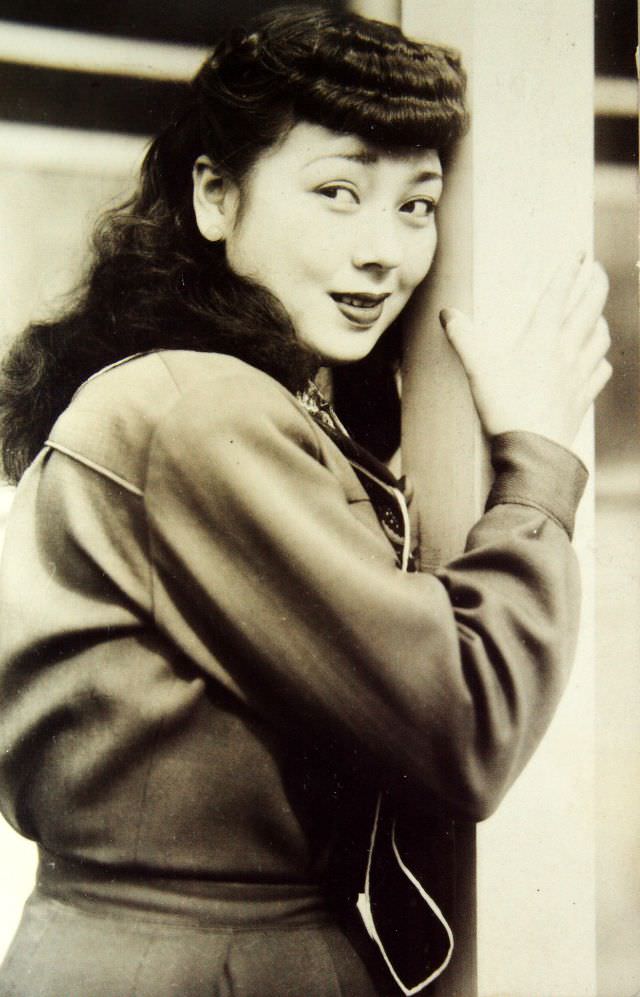
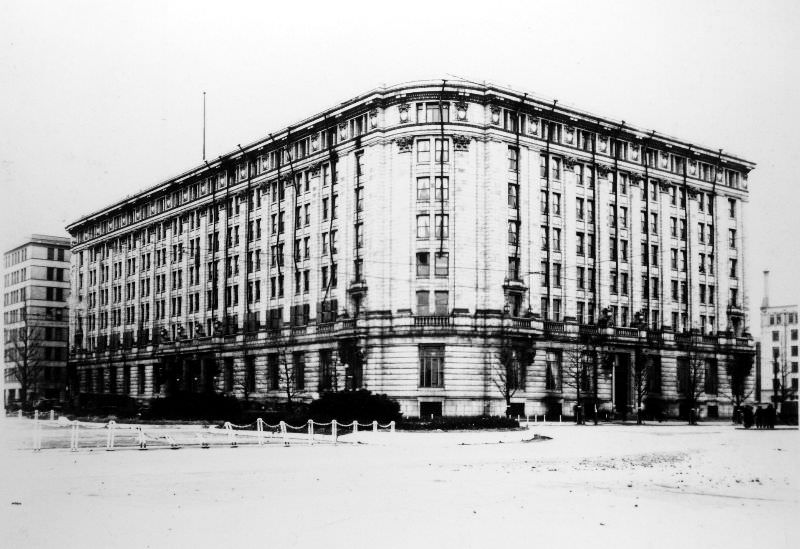
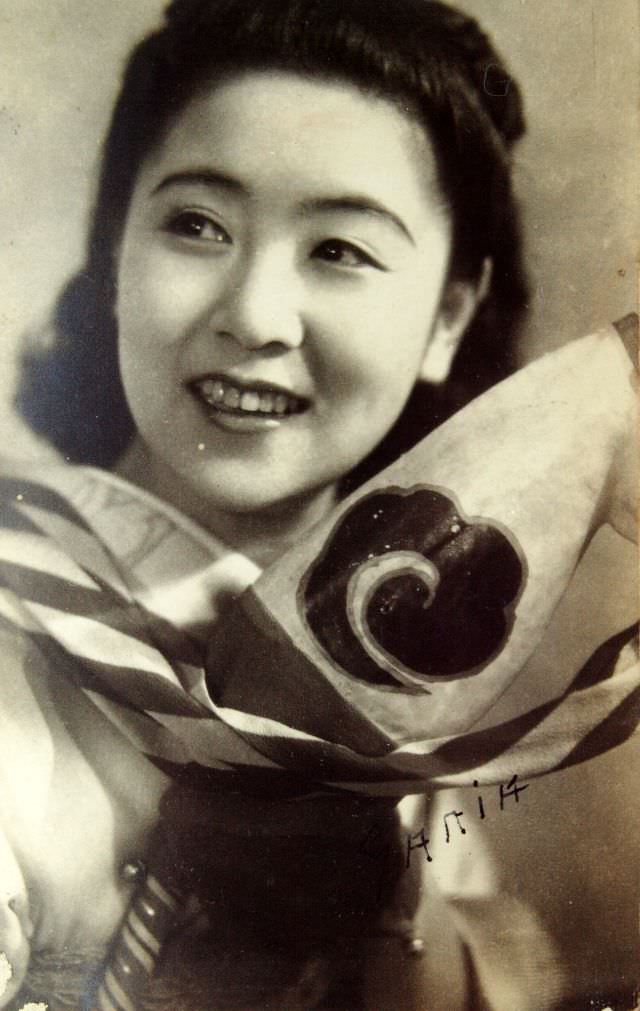
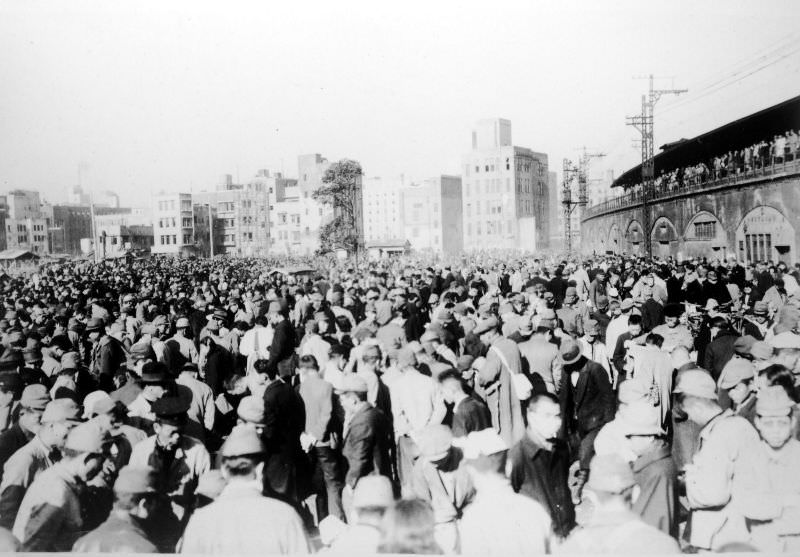
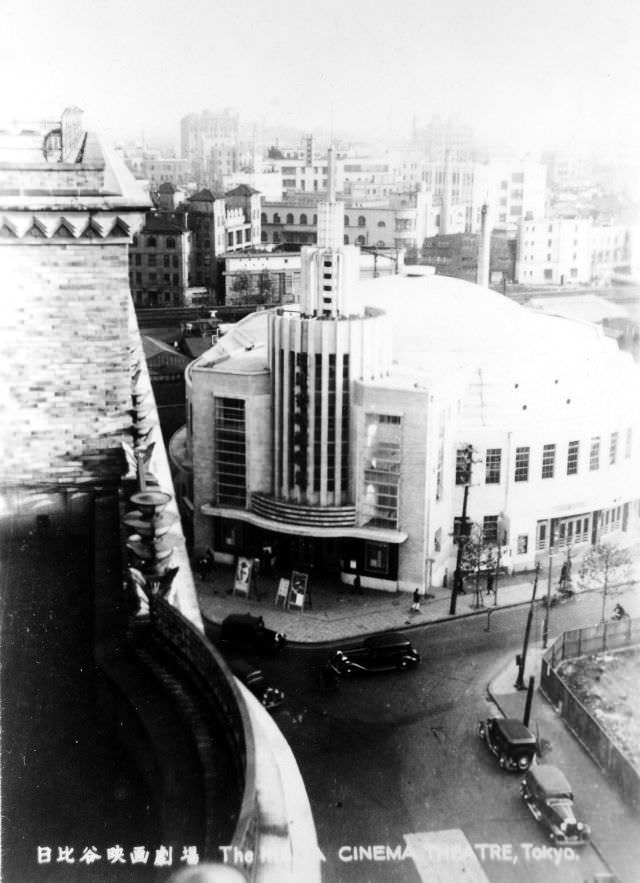
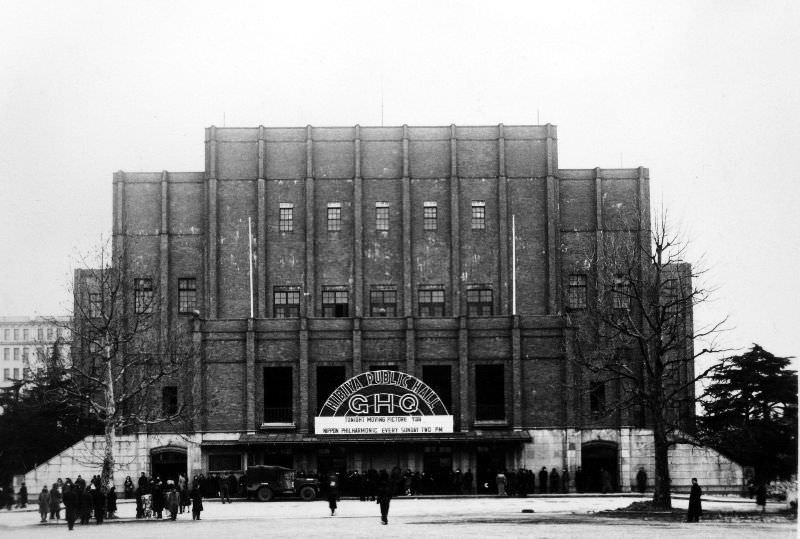
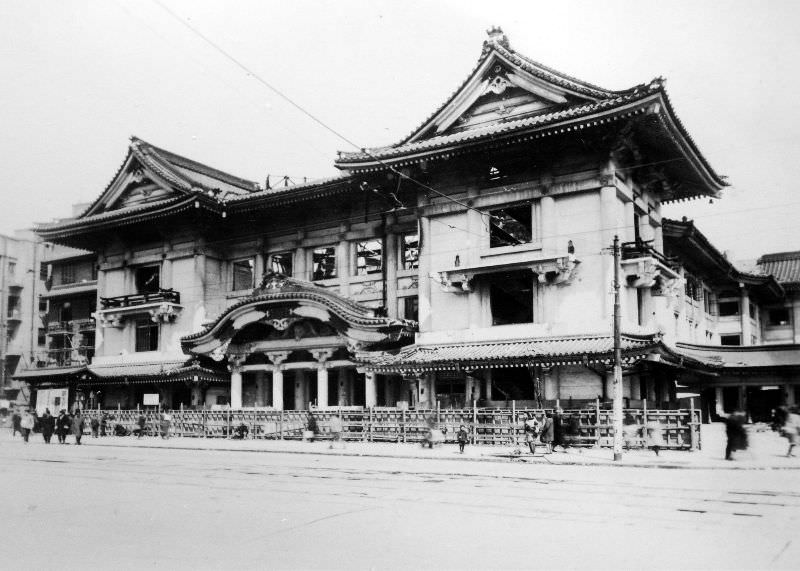
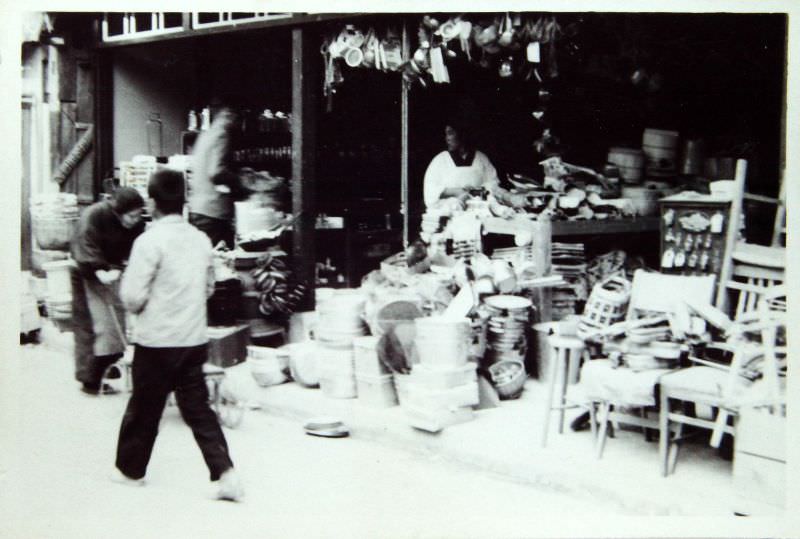
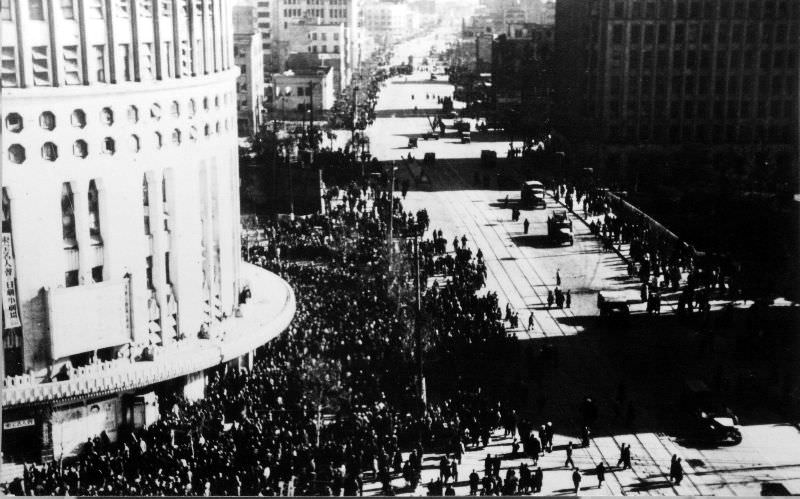
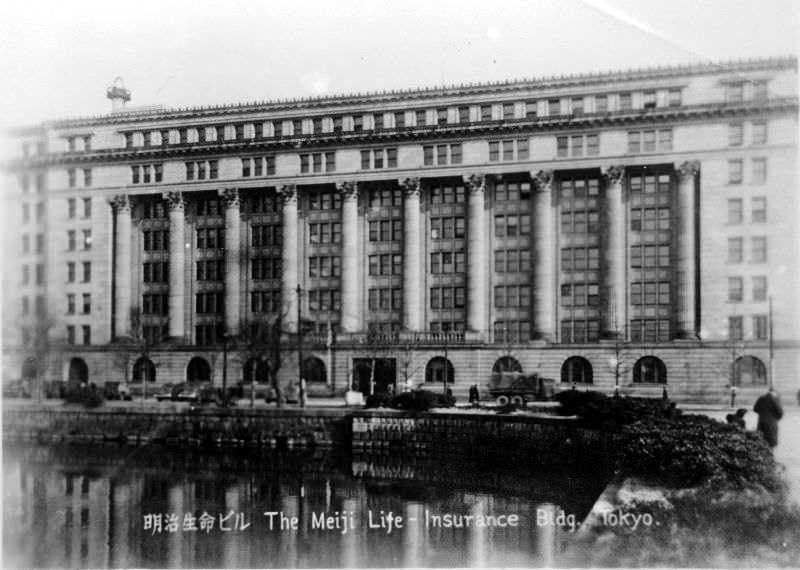
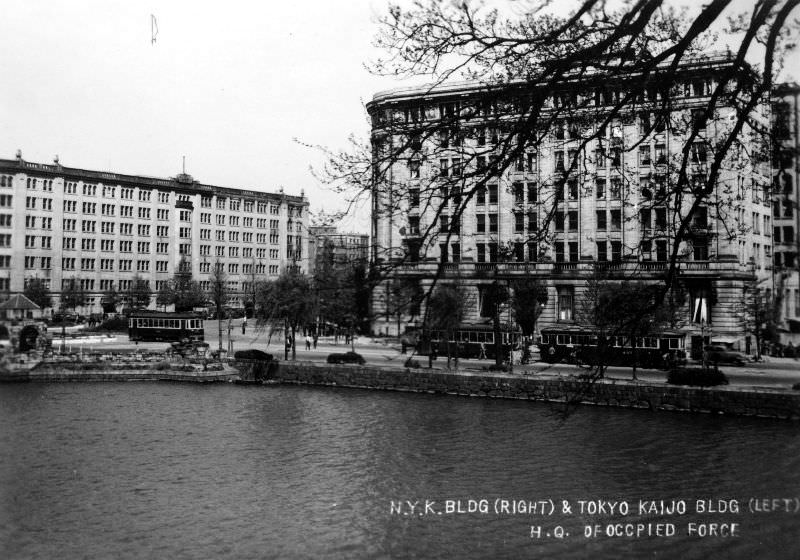
Tokyo street scene, 1940s.Tokyo street scene, 1940s.Traffic jam, 1940s.Ueno Toshogu Torii, 1940s.Young Japanese beauty, 1940s.Yusen Building, Marunouchi, 1940s.Classic beauty, the writing may say ‘Maria’, 1940s.Crowd in Tokyo, 1940s.Hibiya Cinema Theatre, 1940s.Hibiya Hall, 1940s.Kabuki-Za, Ginza, 1940s.Local hardware store at a market, 1940s.Massive crowds of people on the streets of Ginza near the Nichigeki Theatre, 1940s.Meiji Life Insurance Building, 1940s.NYK Building (right), and Tokyo Kaijo Building (left), 1940s.
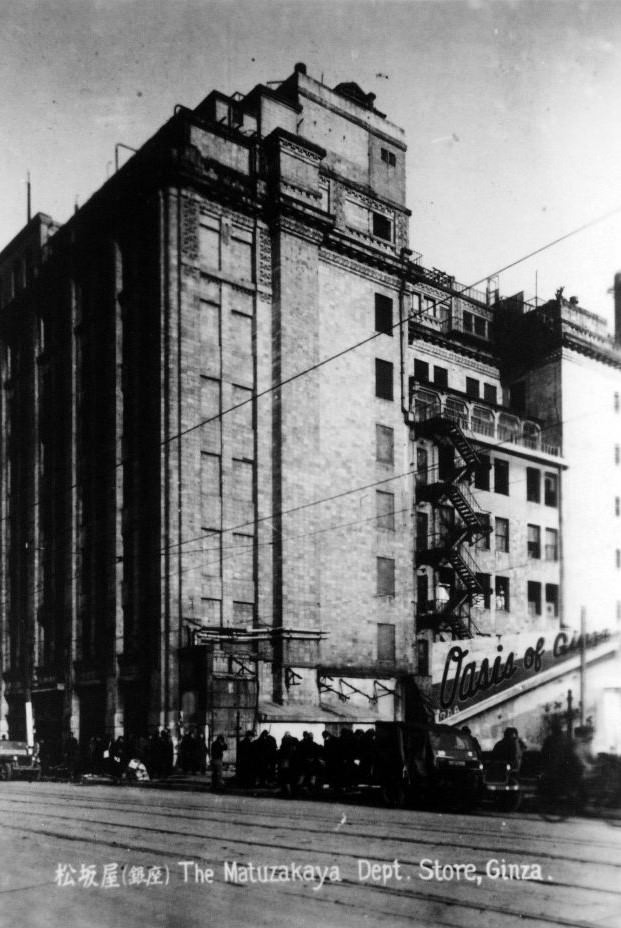
Oasis of Ginza, 1940s.
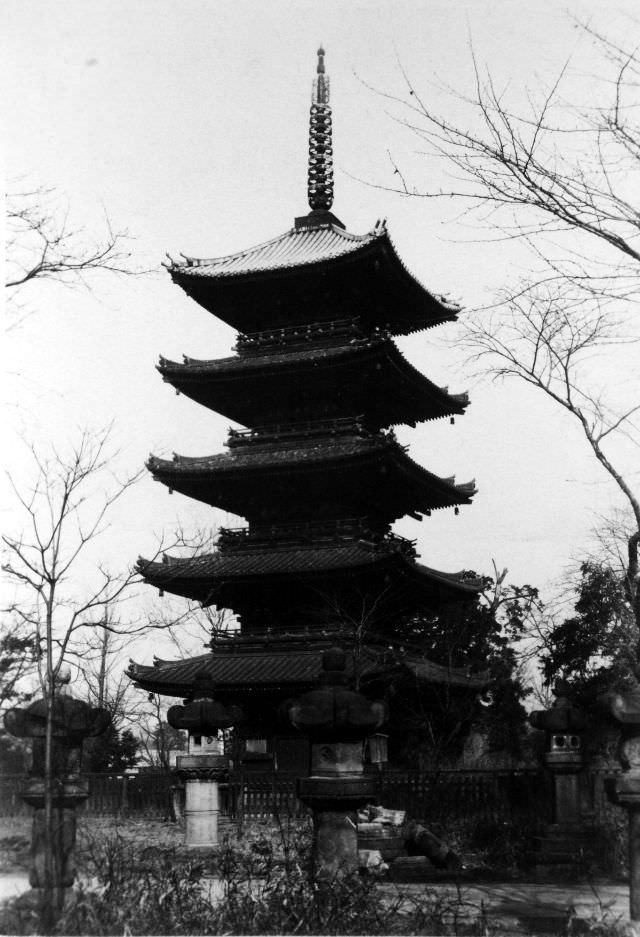
Pagoda in Ueno Park, 1940s.
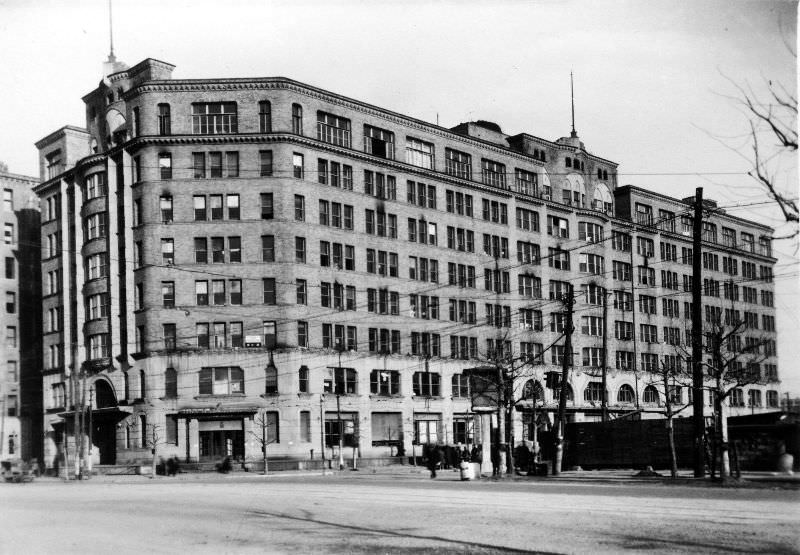
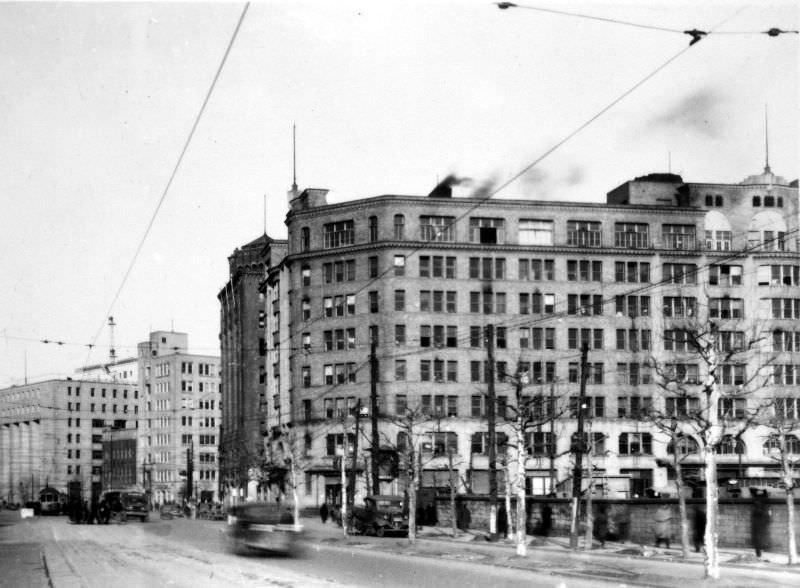
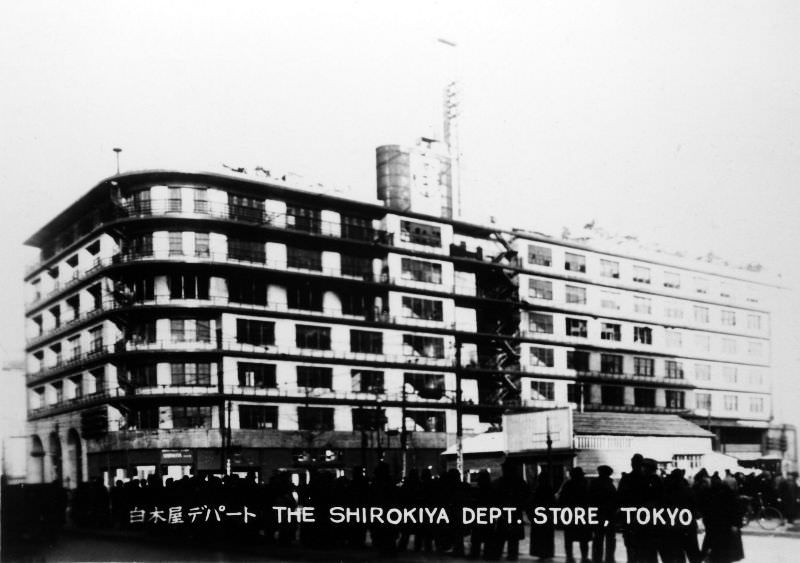
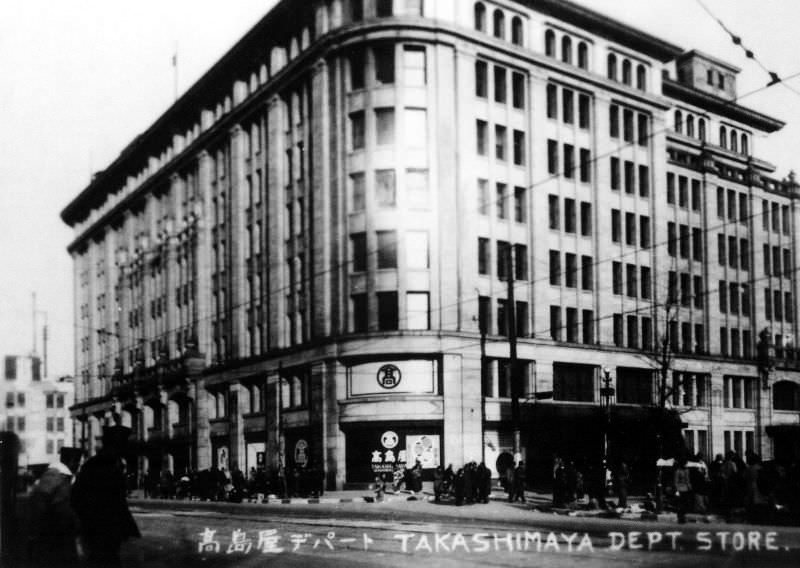
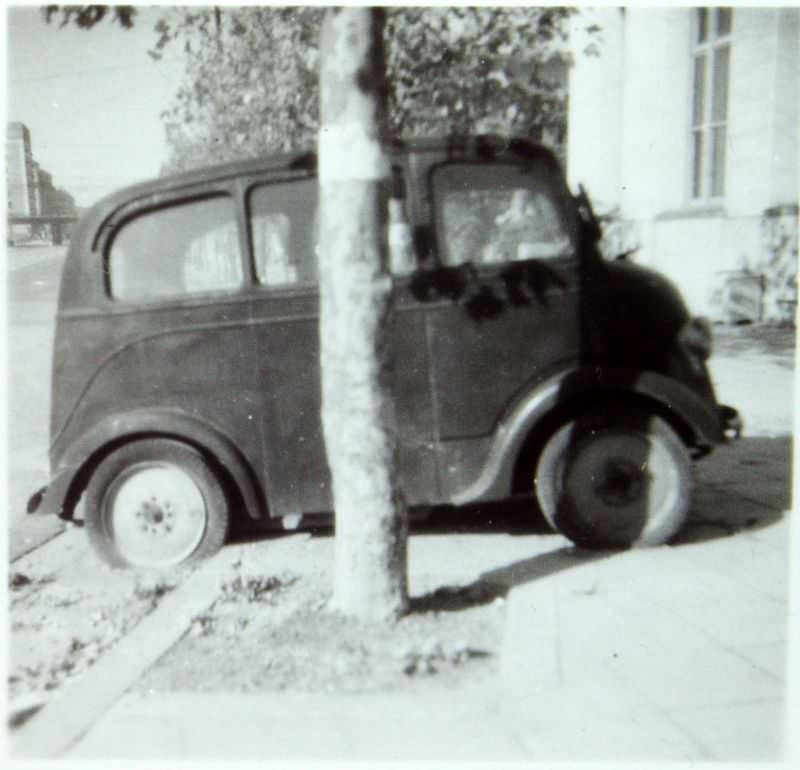
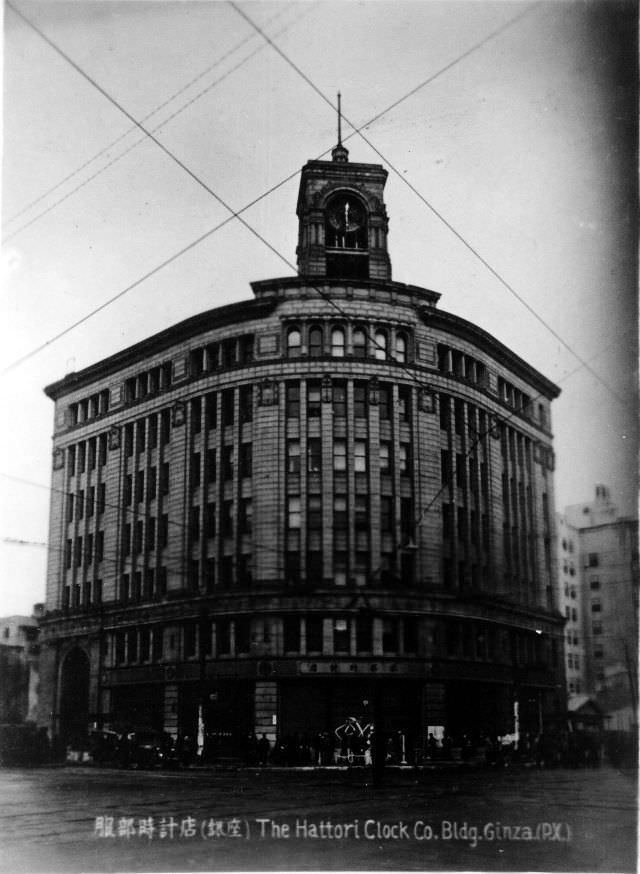
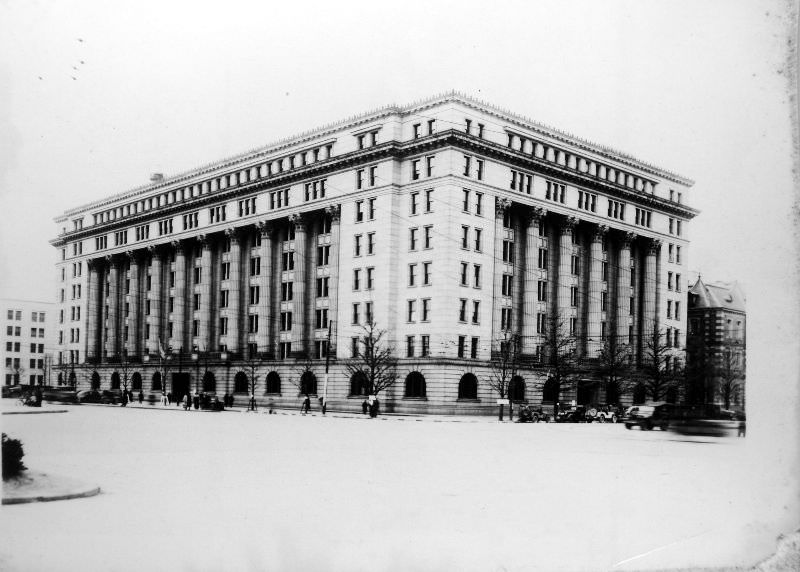
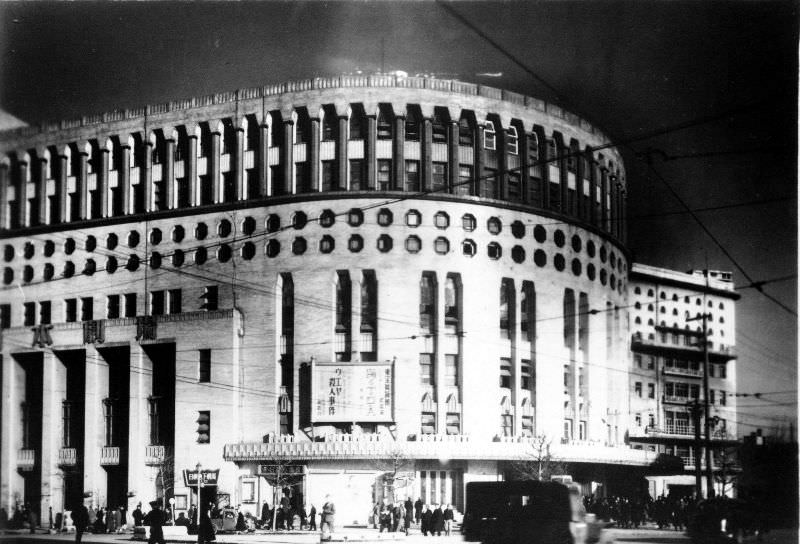
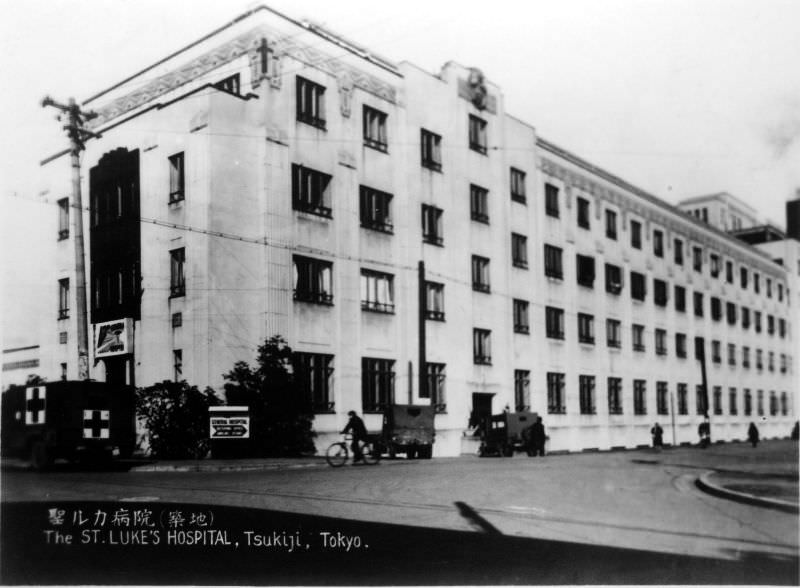
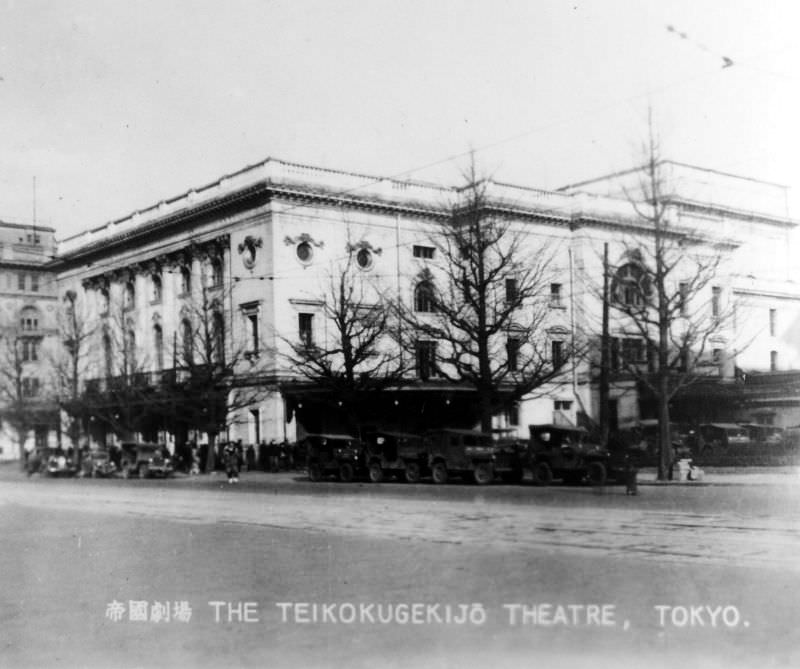
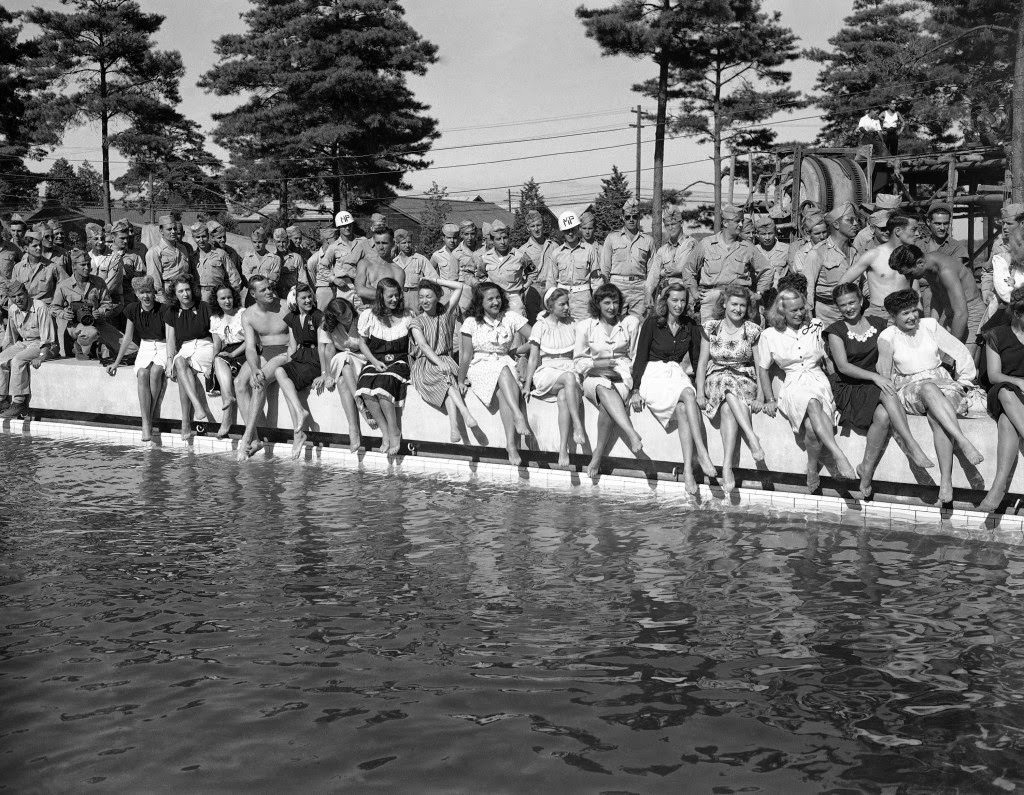
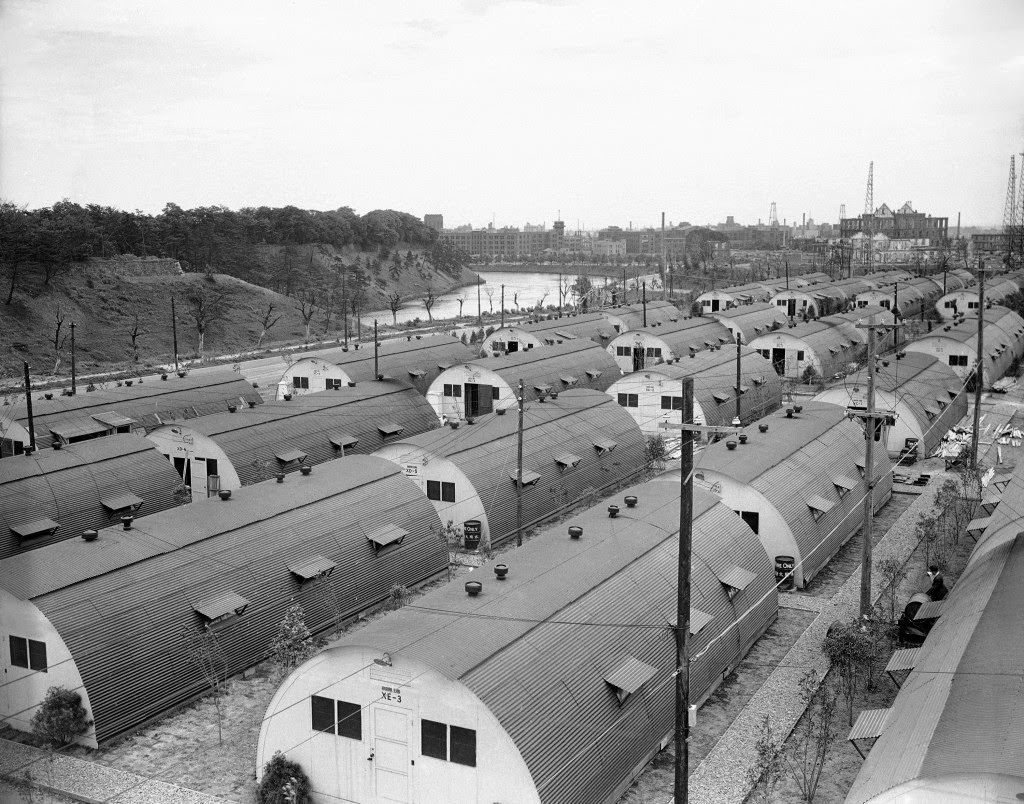
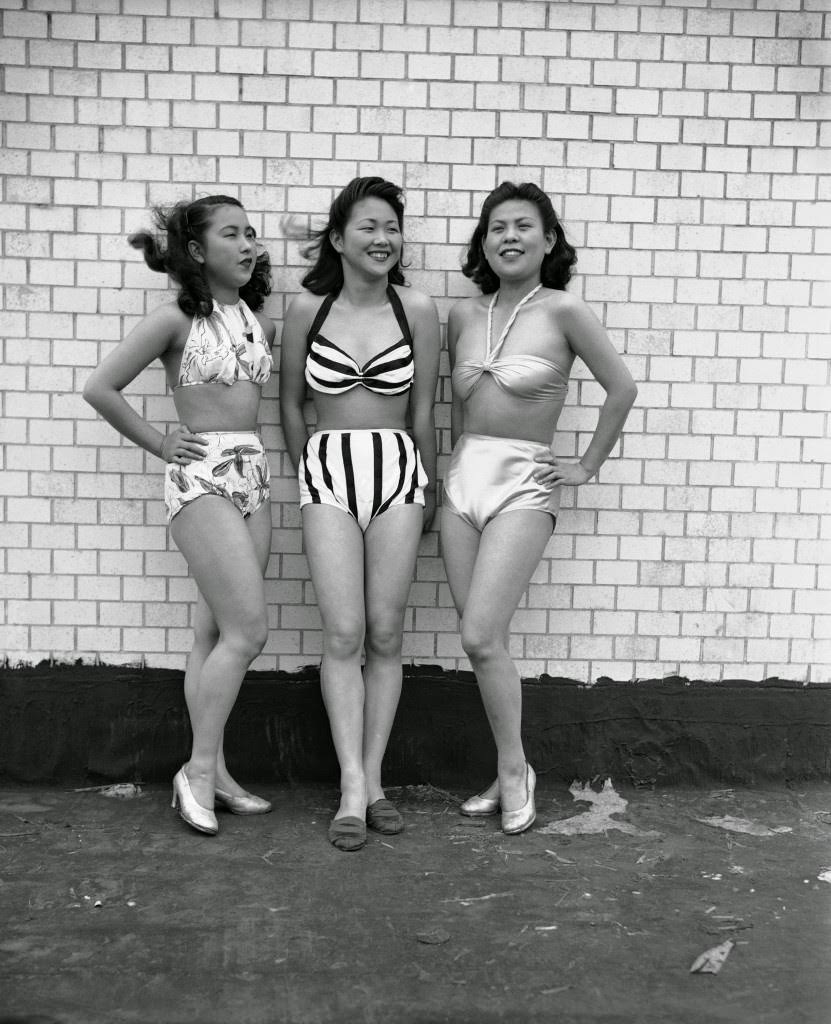
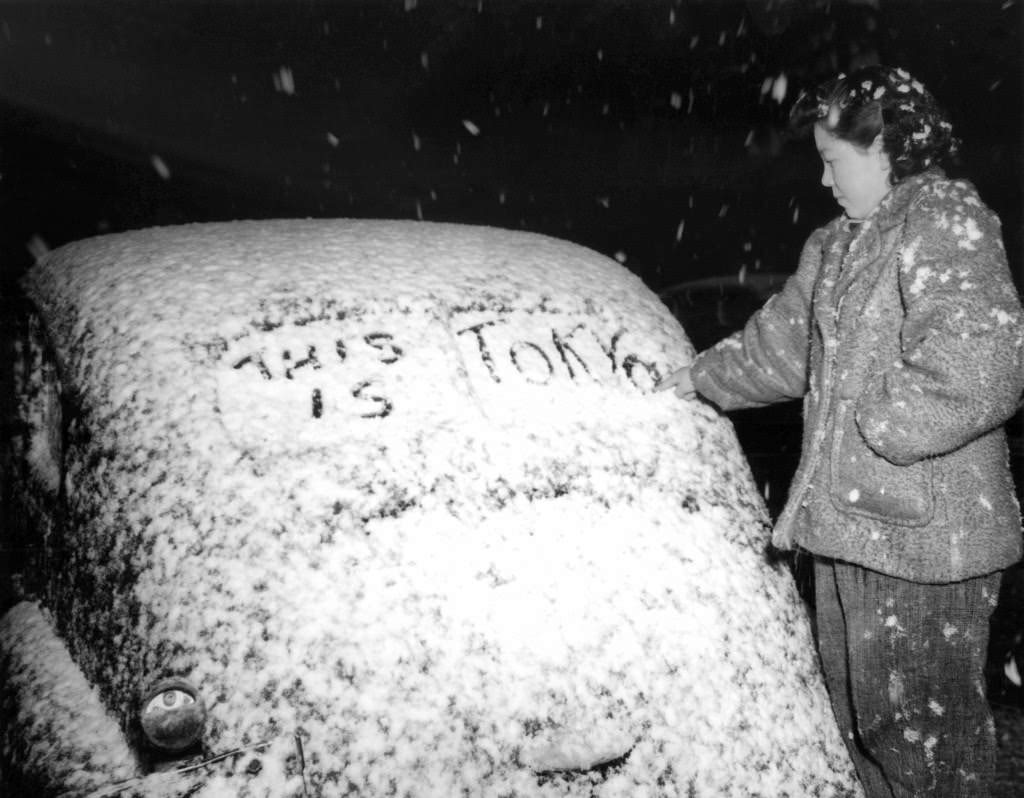
SanShin Building, Hibiya, 1940s.SanShin Building, Hibiya, 1940s.Shirokiya Department Store, 1940s.Takashimaya Department Store, 1940s.Most cars in Tokyo are this size, 1940s.The Hattori Clock Company Building, 1940s.The Meiji Seimei Kan Life Insurance Building on Hibiya Dori in Marunouchi, 1940s.The Nichigeki theatre, Ginza, 1940s.The St. Luke’s Hospital, Tsukiji, 1940s.The Teikokugekijo Theatre, 1940s.Show girls from the Mikado theater in Tokyo pose on the side of a swimming pool at a new American air base at Yokota, Japan, 1946.A general view of Palace Heights looking towards downtown Tokyo, 1946.Three dancing girls at the Imperial Theater in Tokyo model new 1946 style Japanese bathing suits, known as “Democratic suits,” 1946.Usheeko Sato, a resident of Tokyo, Japan writes on the snow-covered rear window of an automobile, 1946.
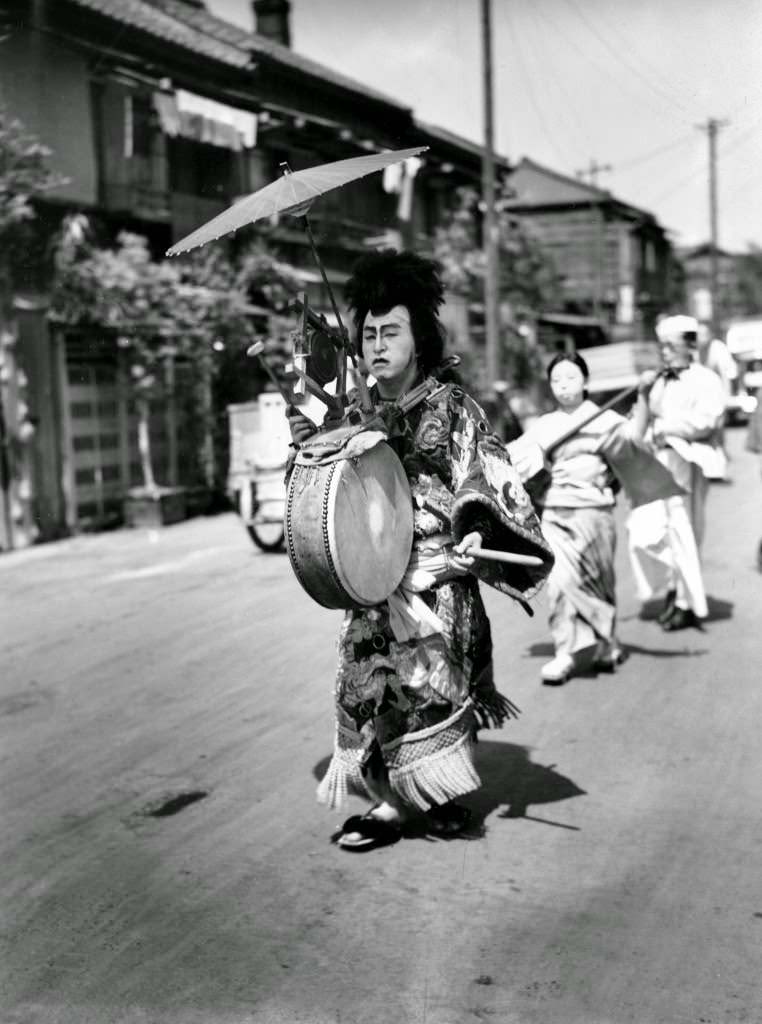
A Japanese man in costume beats the drum as he leads a musical parade of men and women who are walking advertisements featuring placards for restaurants through the streets of Tokyo, 1947.
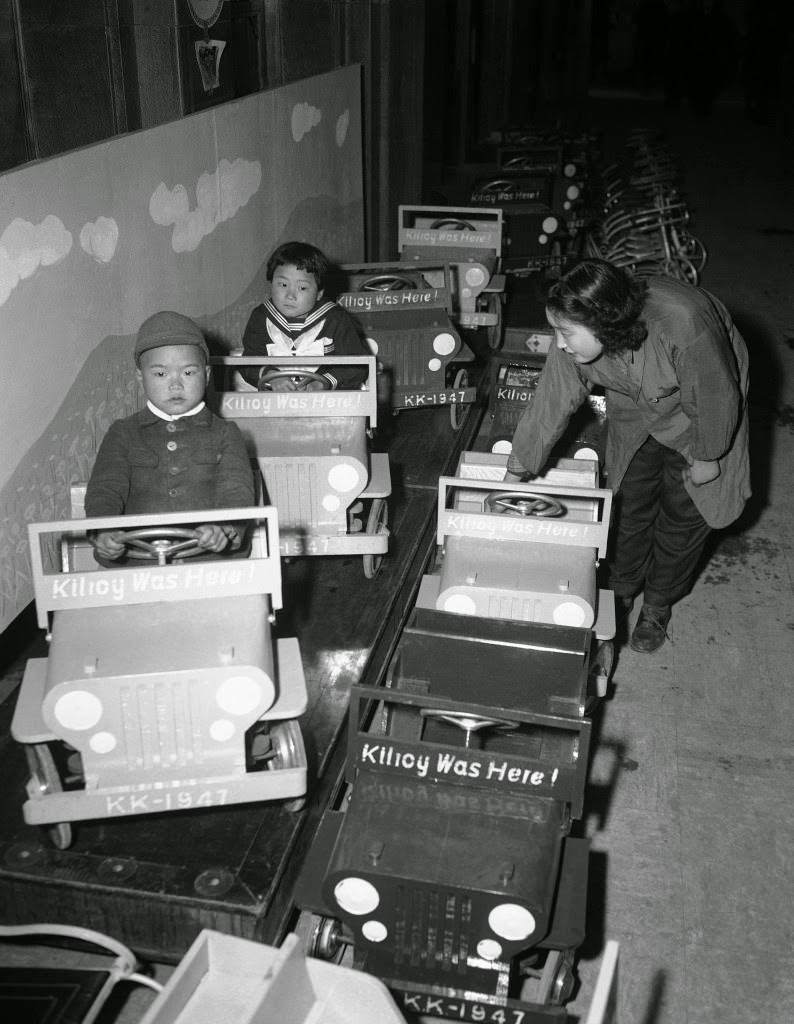
Japanese children, visiting a Tokyo department store, try out toy jeeps bearing the slogan, “Kilroy was here,” 1947.
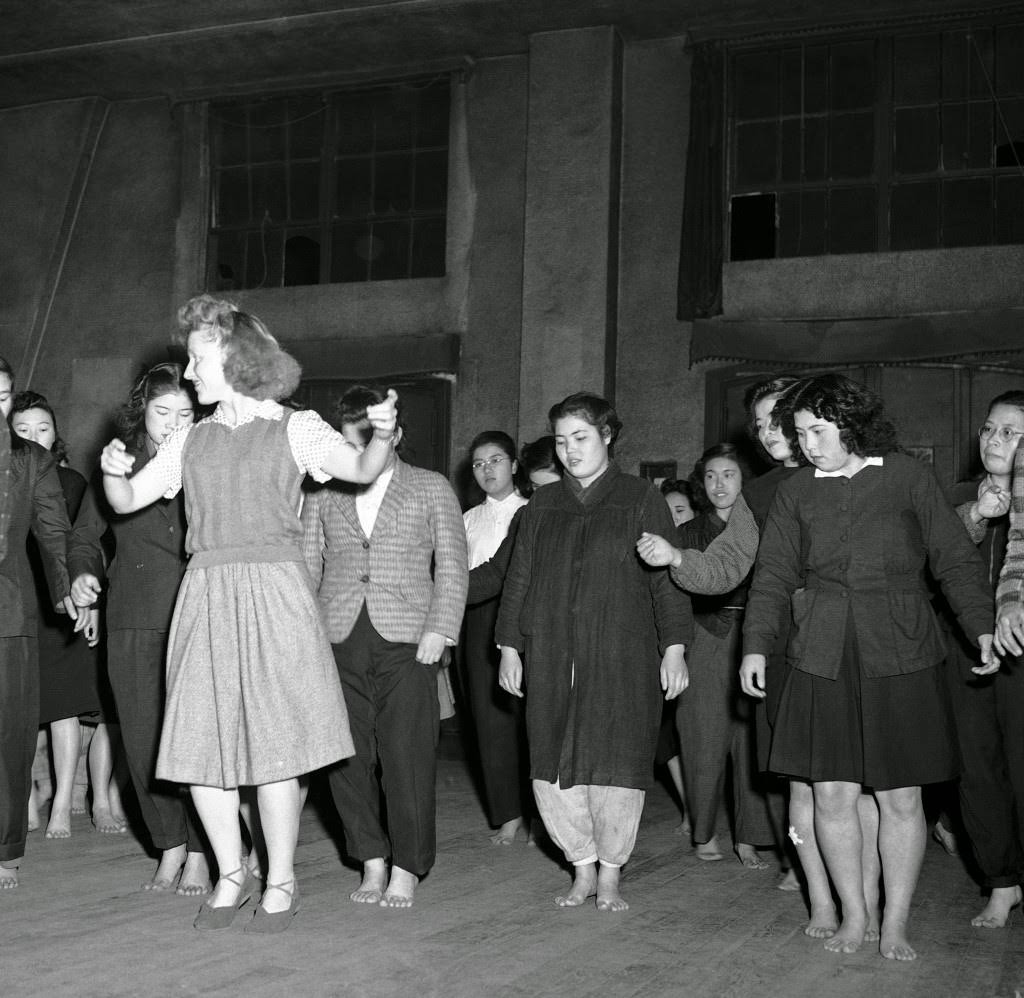
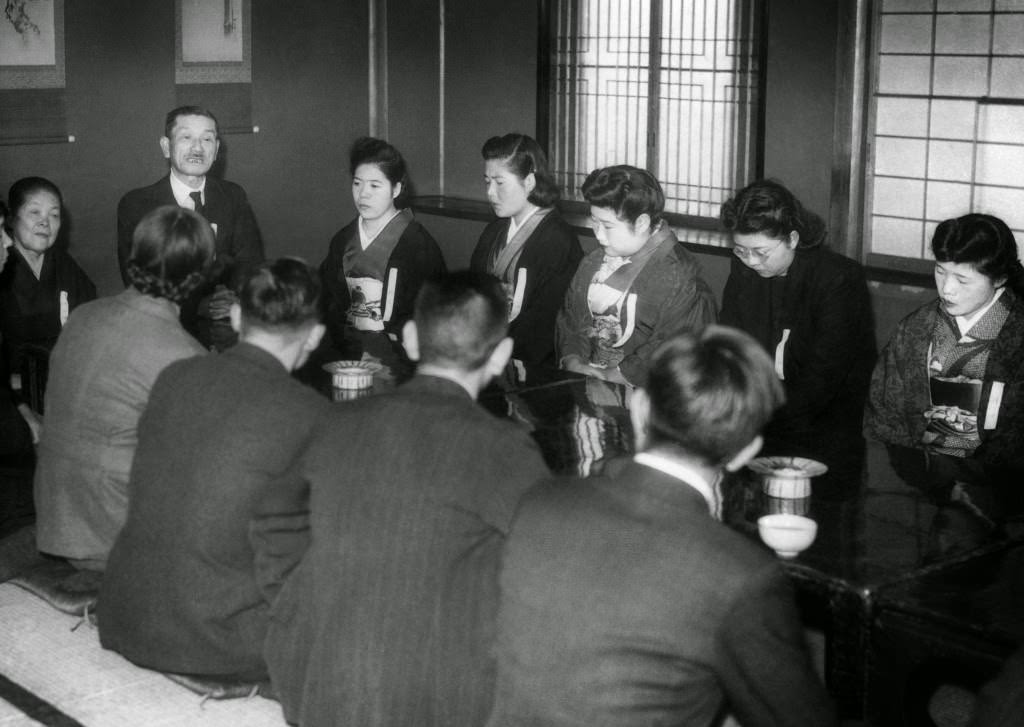
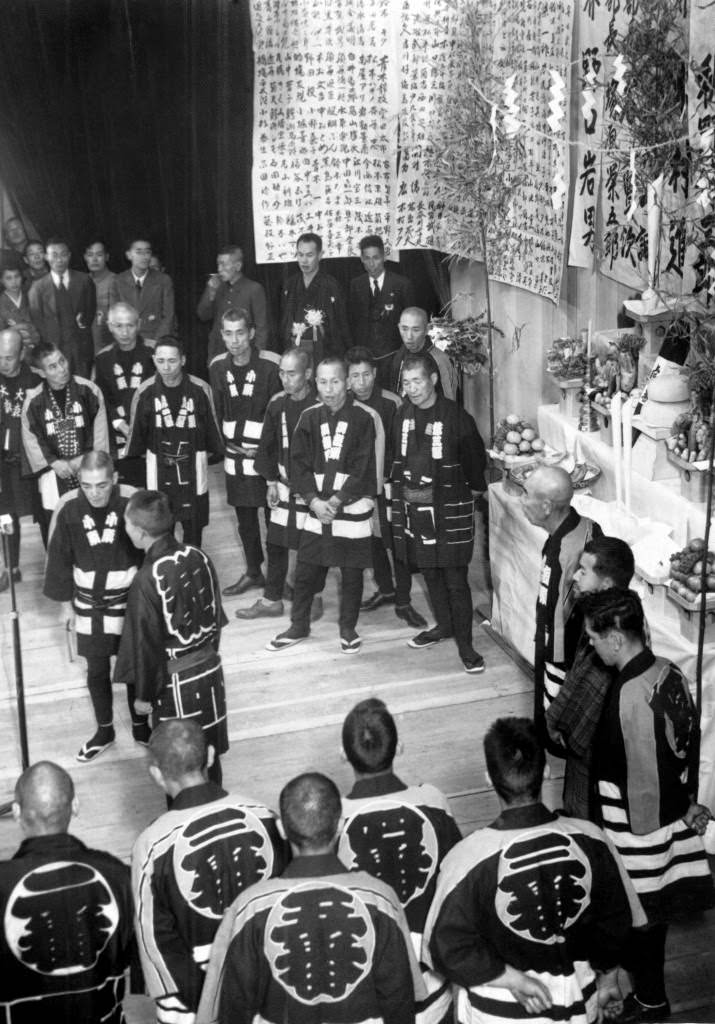
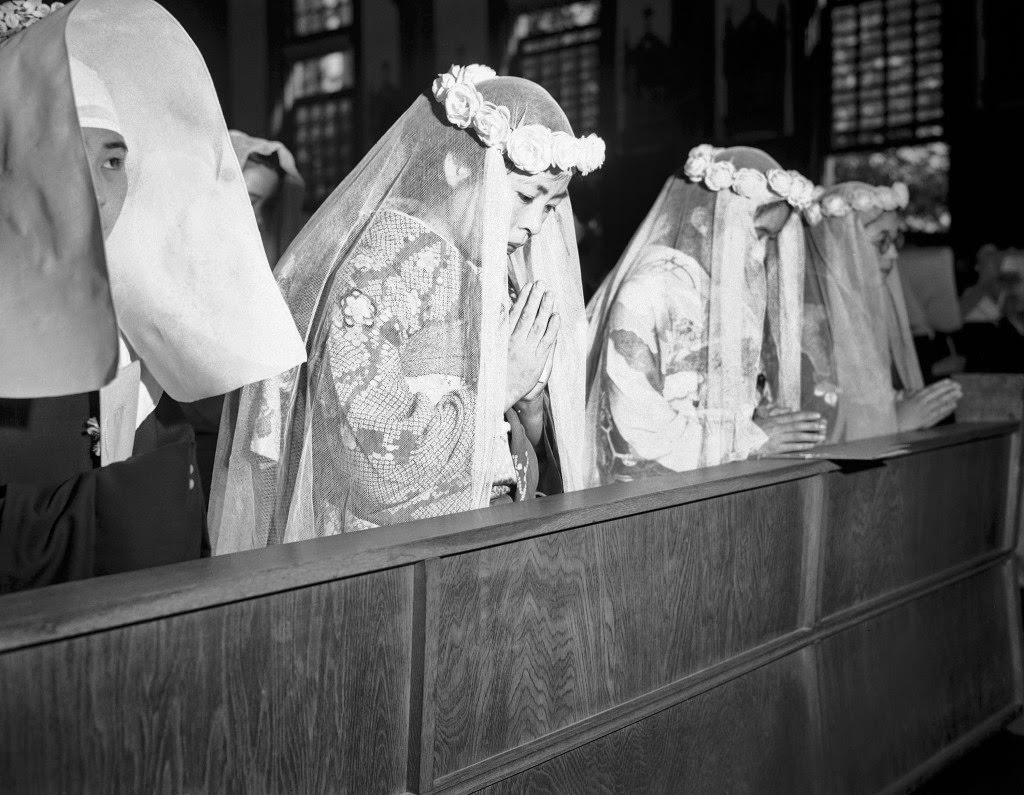
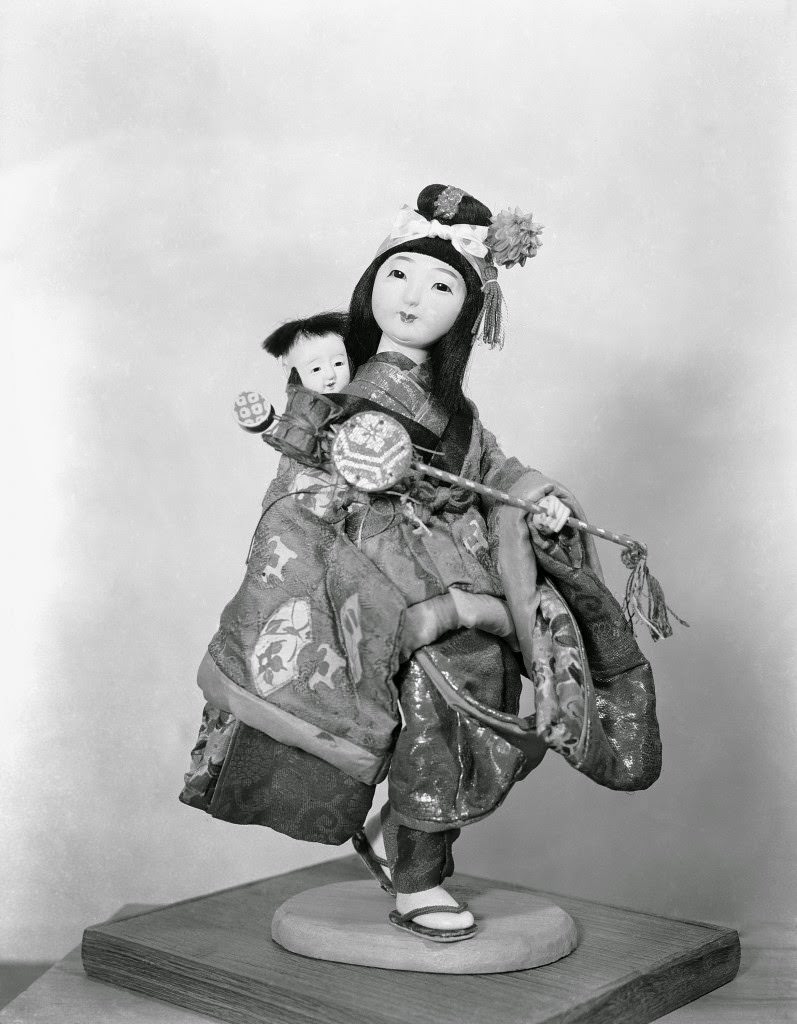
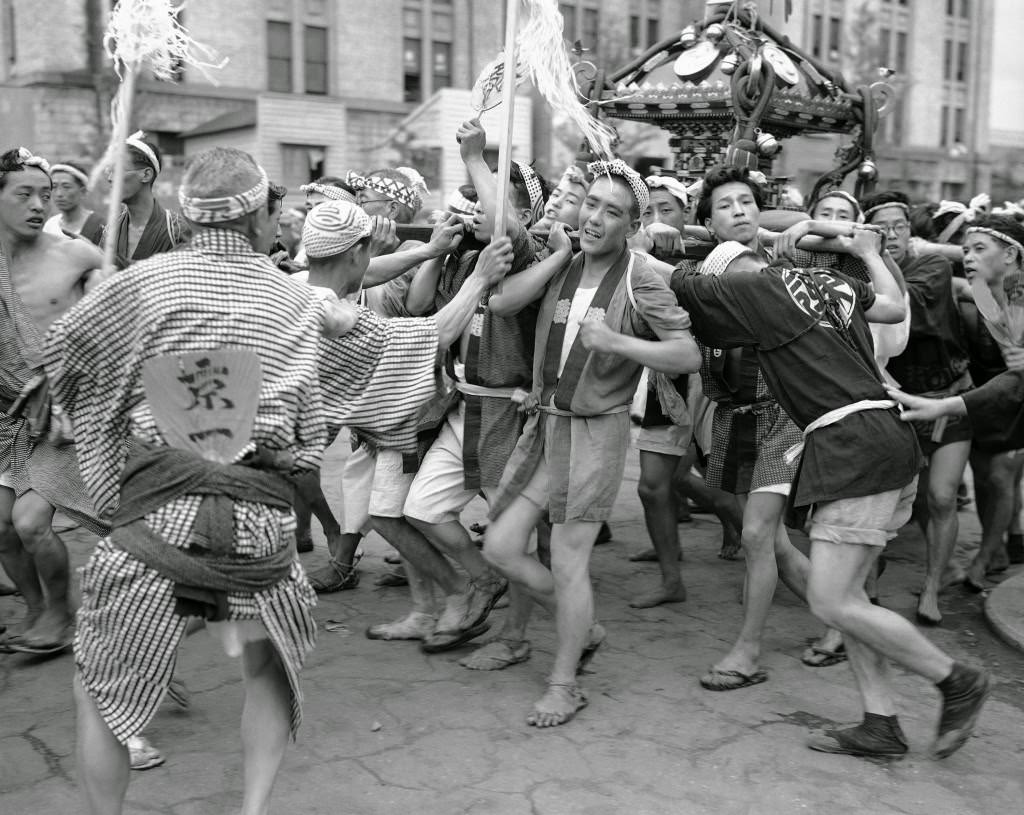
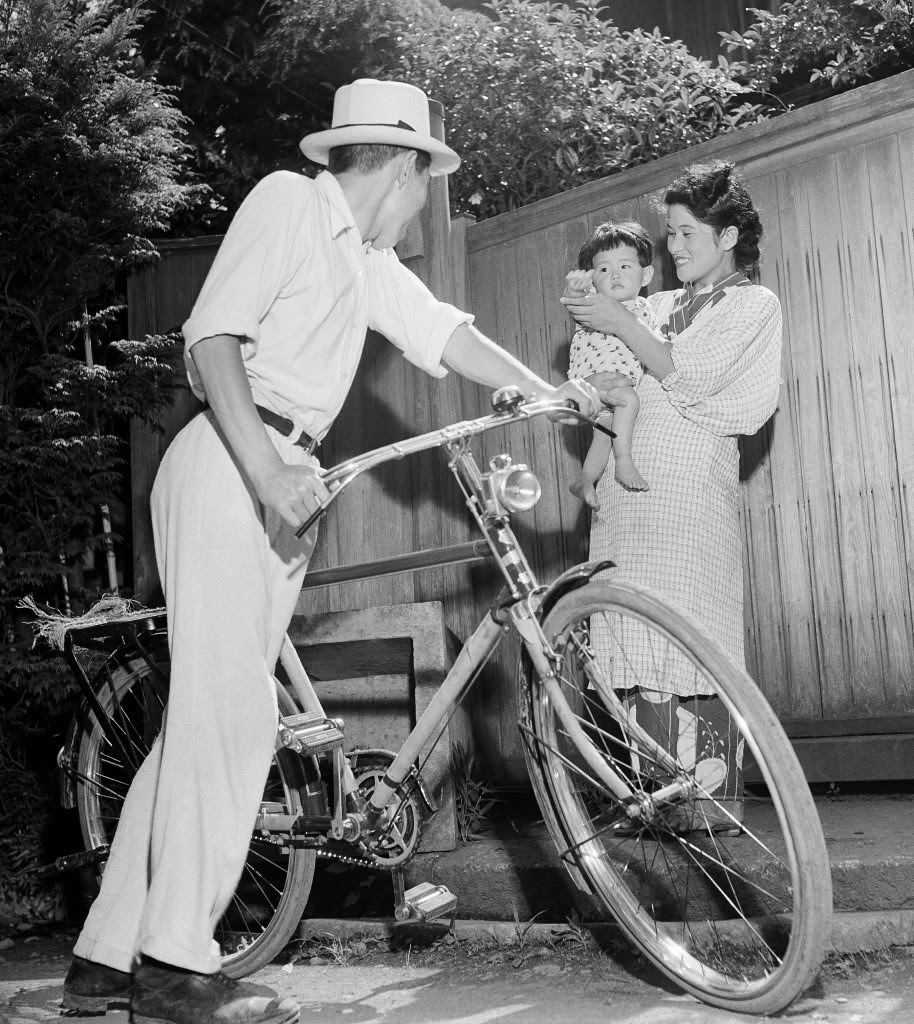
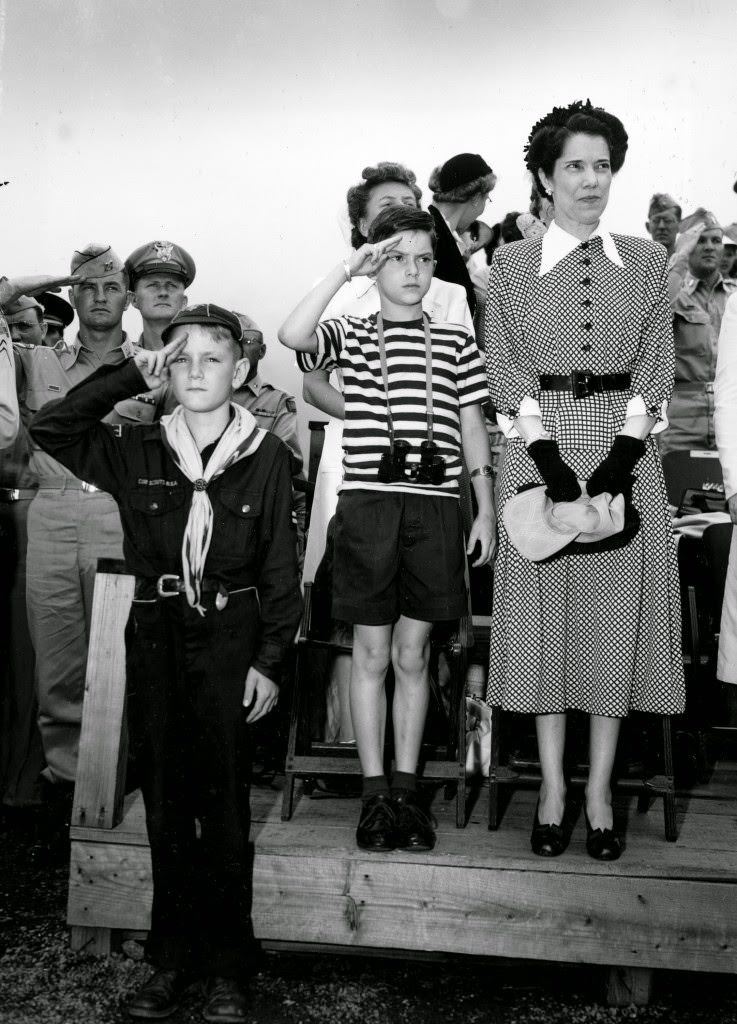
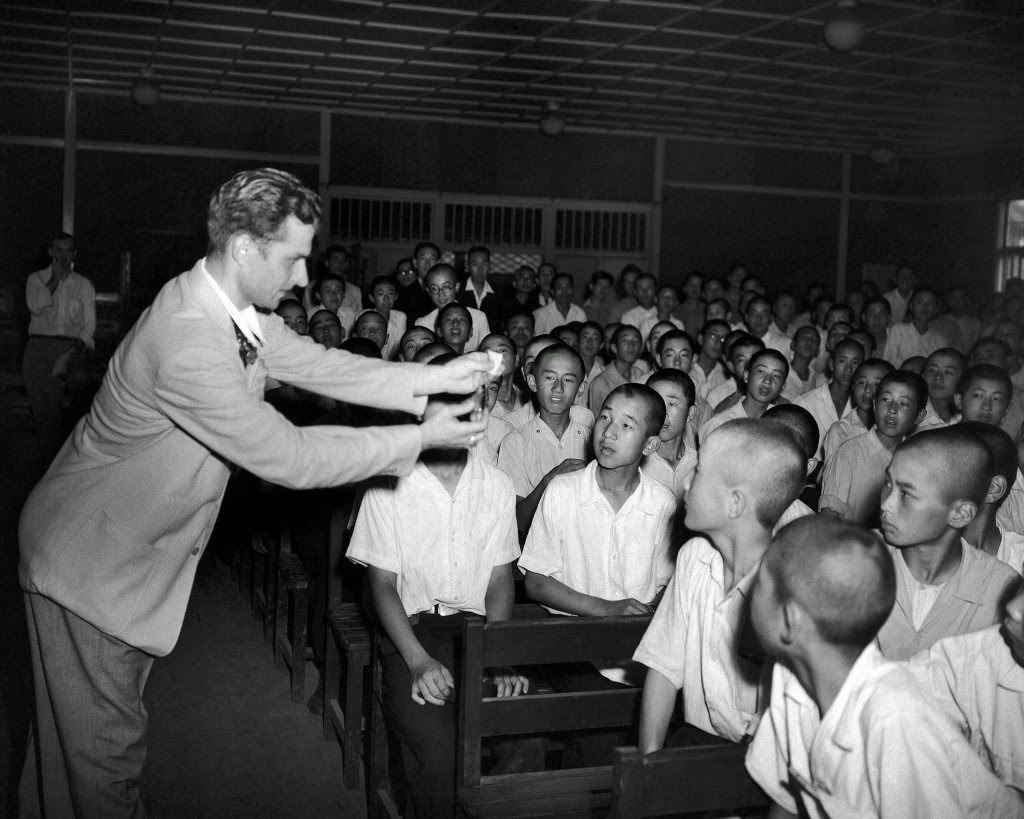
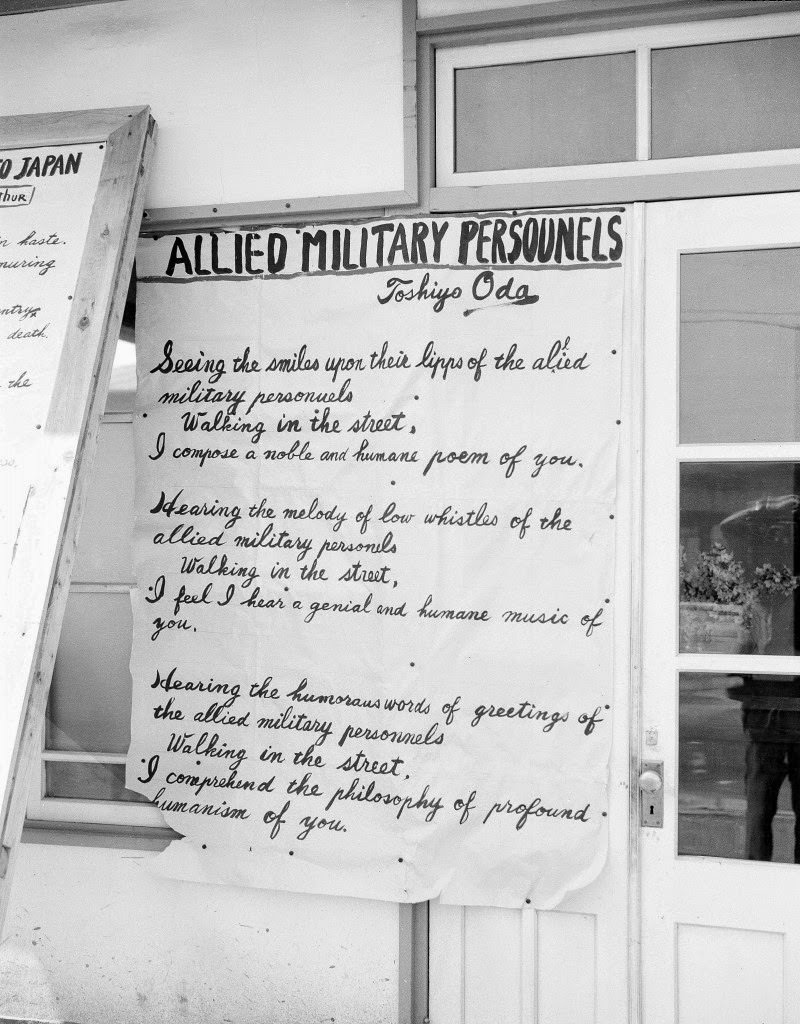
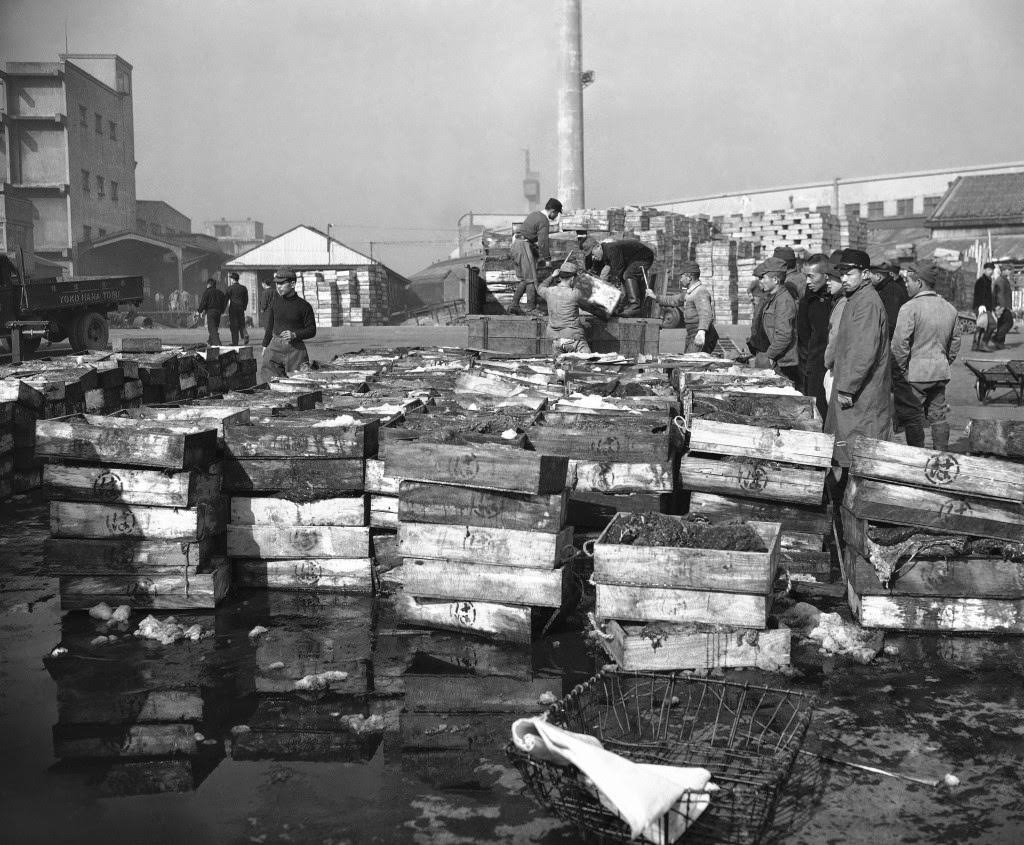
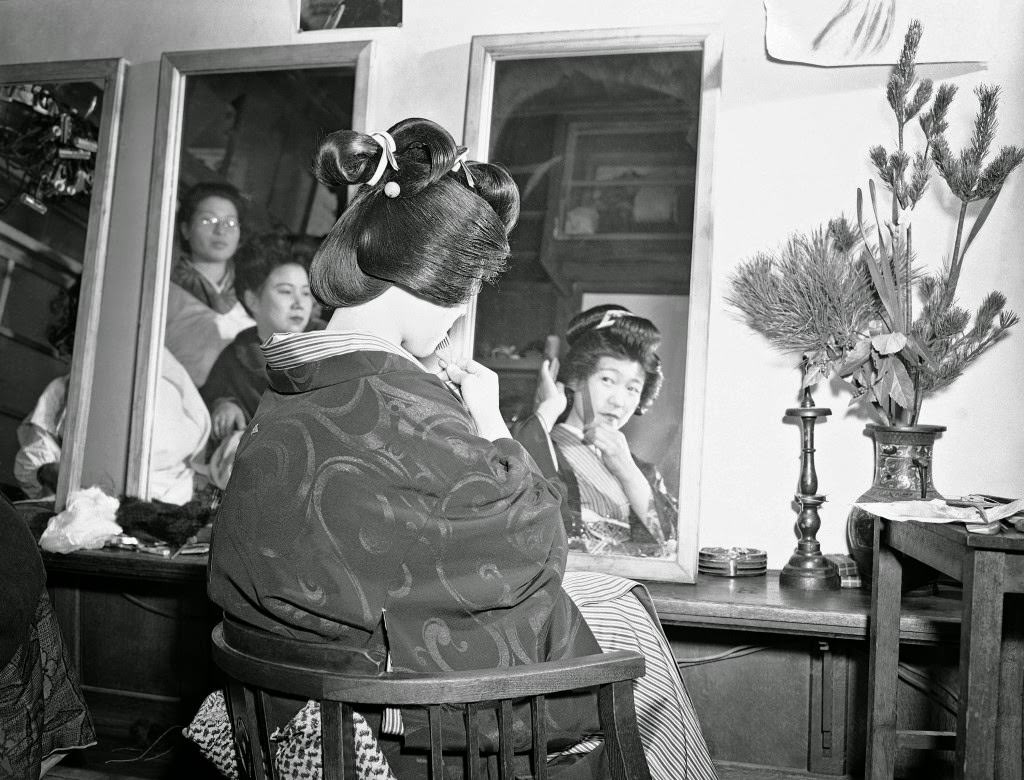
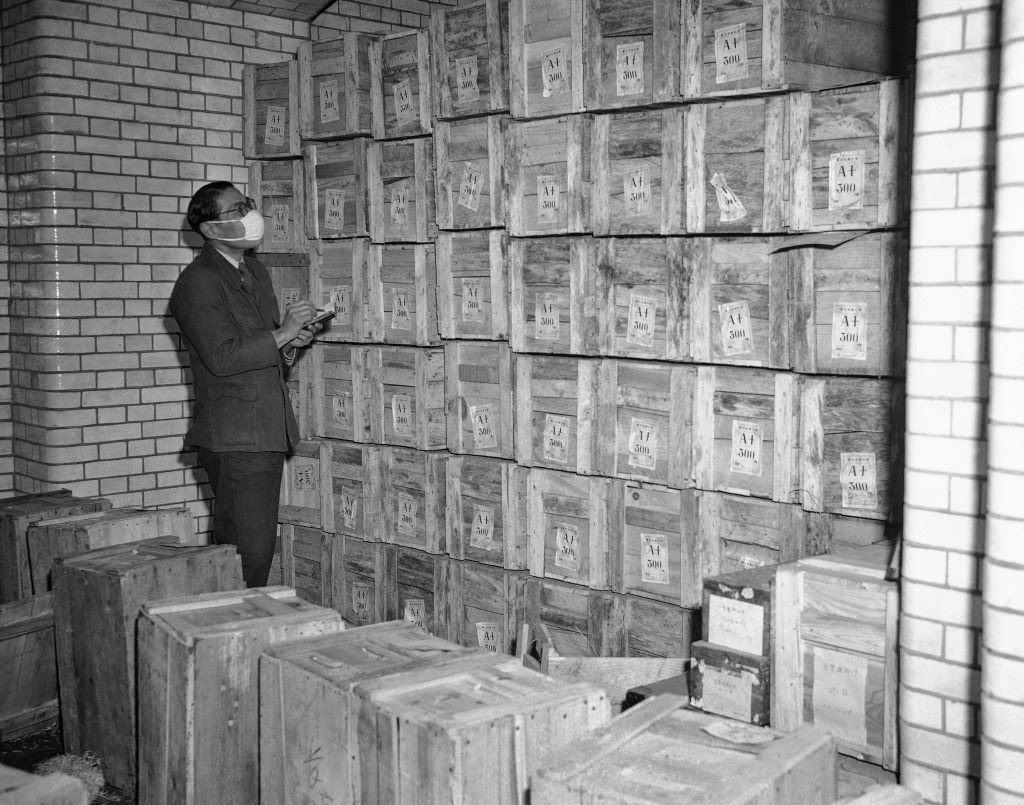
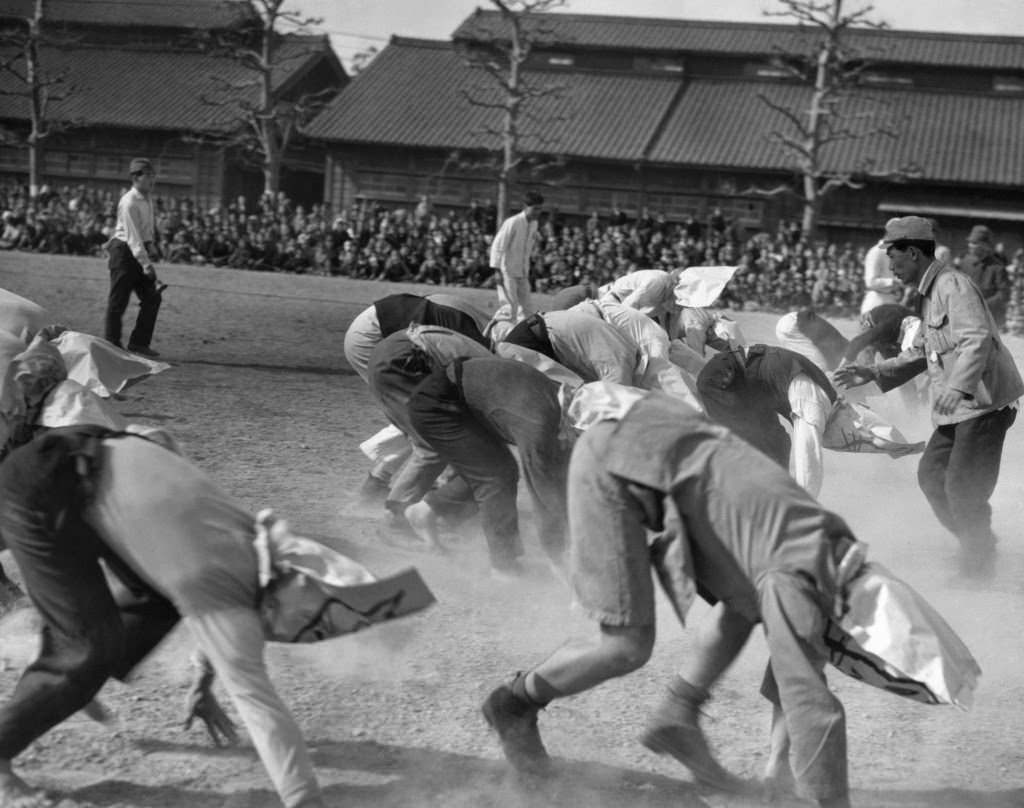
Barbara McBride teaches Russian-style Korobotchka dance to her Japanese students at the YWCA in Tokyo, 1946.Eight girls and four men met with matrimony as the object at the Myogetsu-En, behind the Ueno Art Museum in Tokyo, 1947.Gangsters, “Japanese style,” at ceremony inducting the new ‘”boss'” as head man of all the different factions in Tokyo, 1946.The girls offer up prayers a few minutes before they took their first vow in their first step towards sisterhood, at the altar in Tokyo, 1946.One of 20 dolls donated by Japanese manufactures for the United Nations International Children’s Emergency Fund in Japan, 1949.These excited young men are taking part in a festival in the Konda district of the city of Tokyo, 1949.Baby Misuko, held by her mother Umeko, waves goodbye to papa-san as he goes to work on his bicycle, from their home in Tokyo, 1948.Arthur MacArthur, son of Allied Supreme Commander in Japan, General Douglas MacArthur, salutes a military parade past the Imperial Palace Plaza in Tokyo, 1948.Students at the Peers’ School in Tokyo are mystified as Jacob Tropp of Brooklyn, New York, amateur magician, makes a 50 cent piece, wrapped in tissue paper, disappear in a burst of flame, 1948.Shown are some of the signs displayed by Toshiyo Oda, a Tokyo contractor who has been running a one man campaign, “MacArthur For President,” to attract attention to himself and his organization from the Allied personnel in Tokyo, 1948.Whale meat is piled on the wharves as the Banshu-Maru is unloaded after its return from the Antarctic in Tokyo, 1948.During the first weeks of the New Year, Japanese girls flock to the beauty parlors to have their hair made up in traditional Japanese style. One hopeful getting her hair done shows her coiffure almost finished at the shop on the Ginza in Tokyo, 1948.View inside the vaults in the Bank of Japan in Tokyo, 1947, as new yen is stored in boxes until called into circulation by the government.The Potato Race is underway as the contestants, employees of the Imperial household, race toward the finish line in Tokyo, 1947.
Kevin Clark is a historian and writer who is passionate about sharing the stories and significance behind historical photos. He loves to explore hidden histories and cultural contexts behind the images, providing a unique insight into the past.