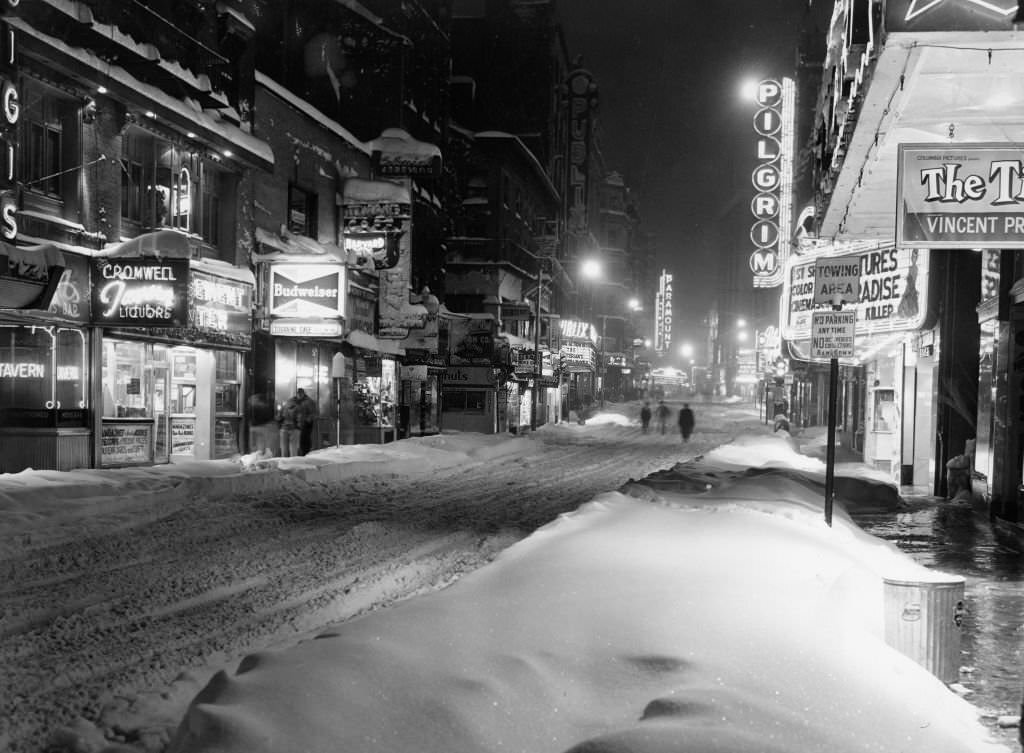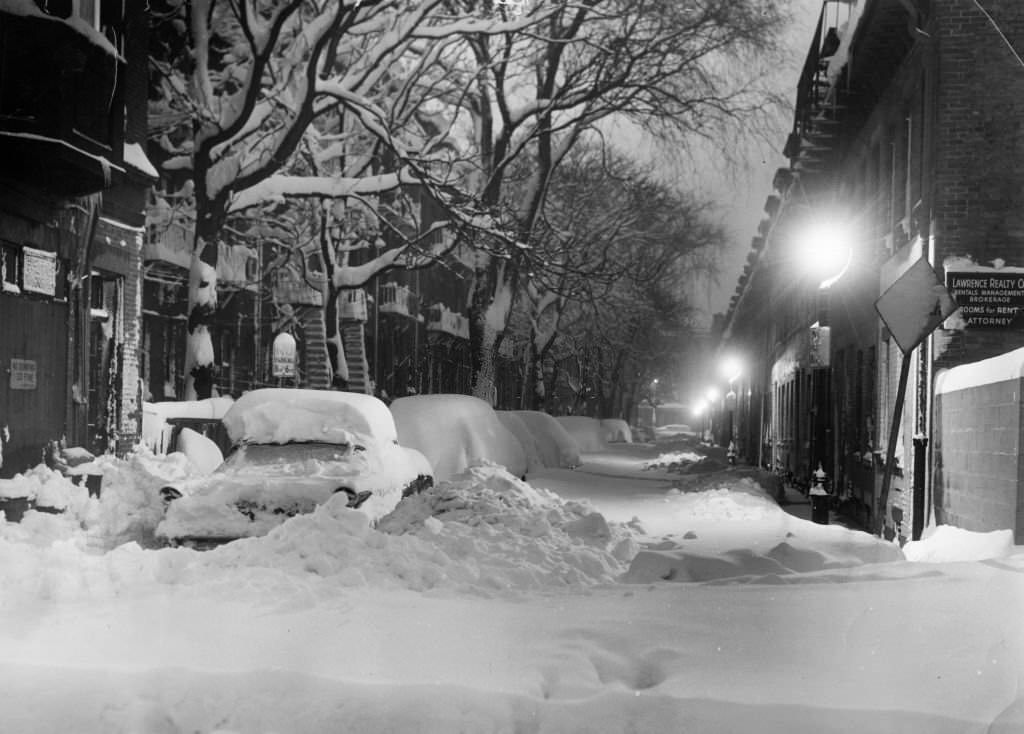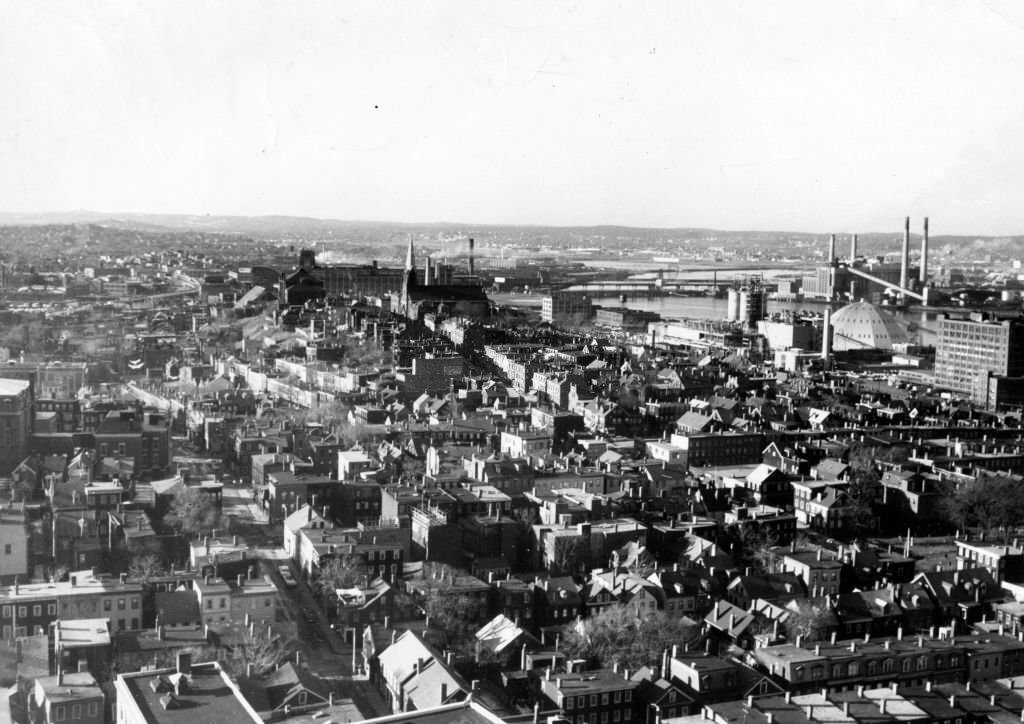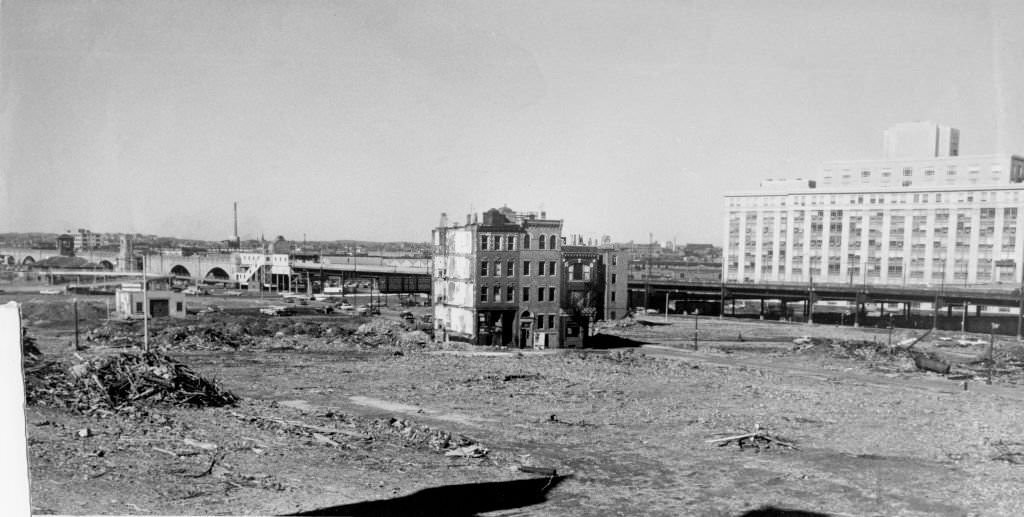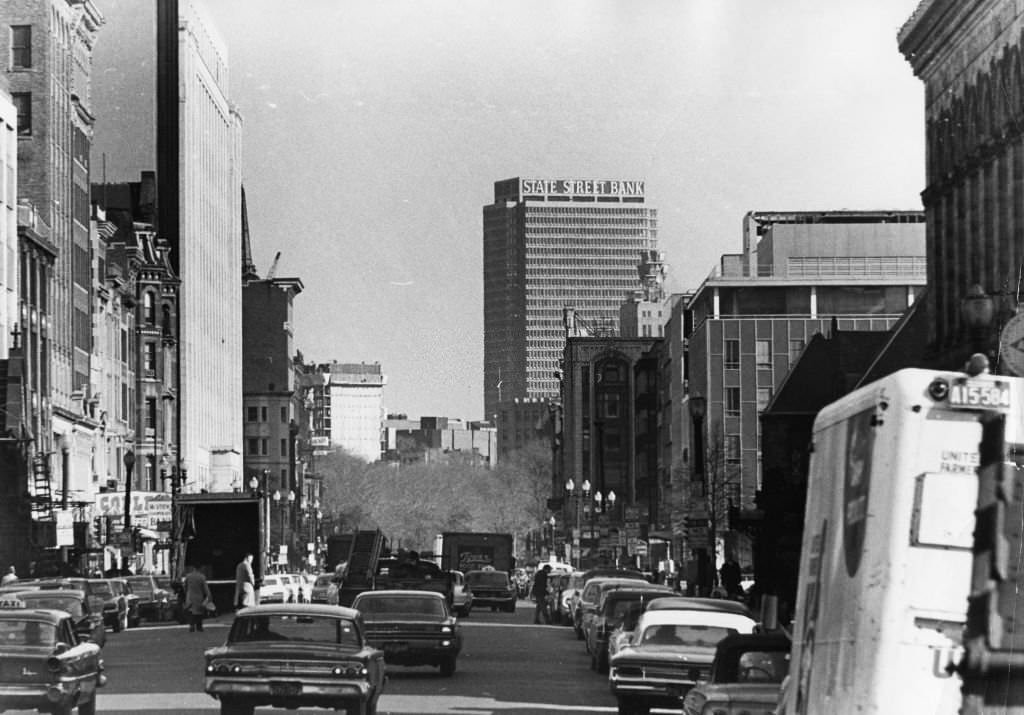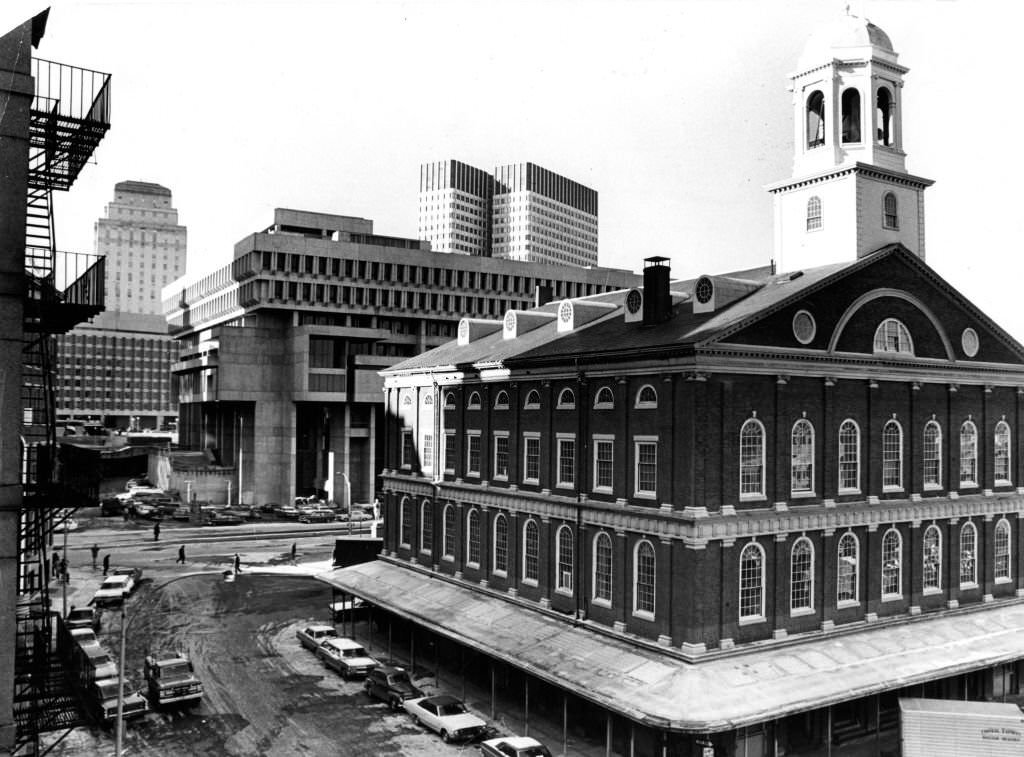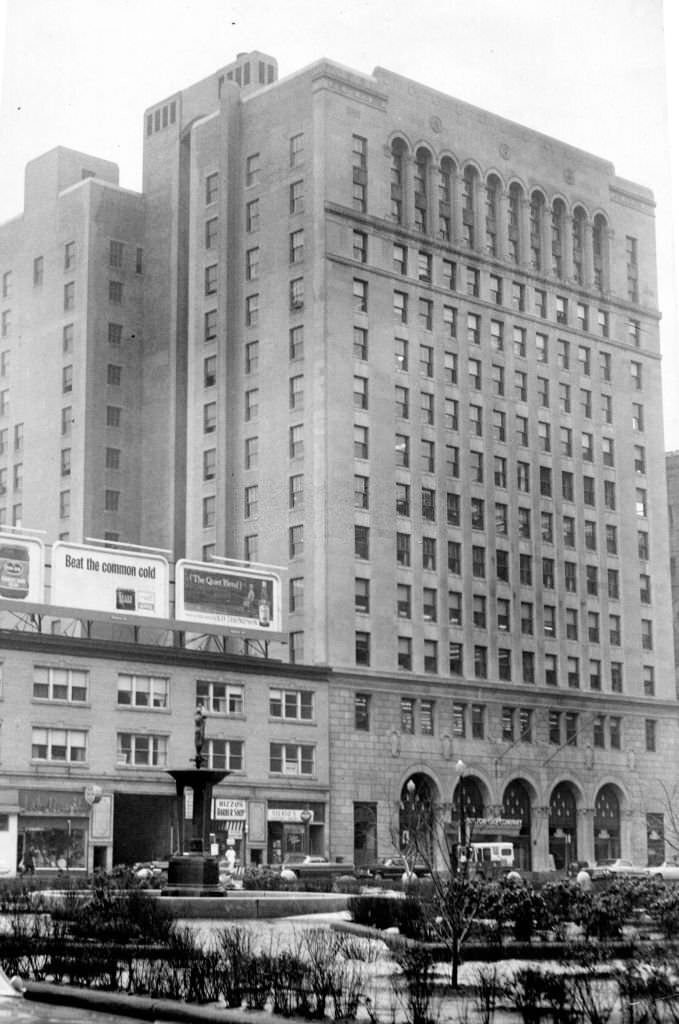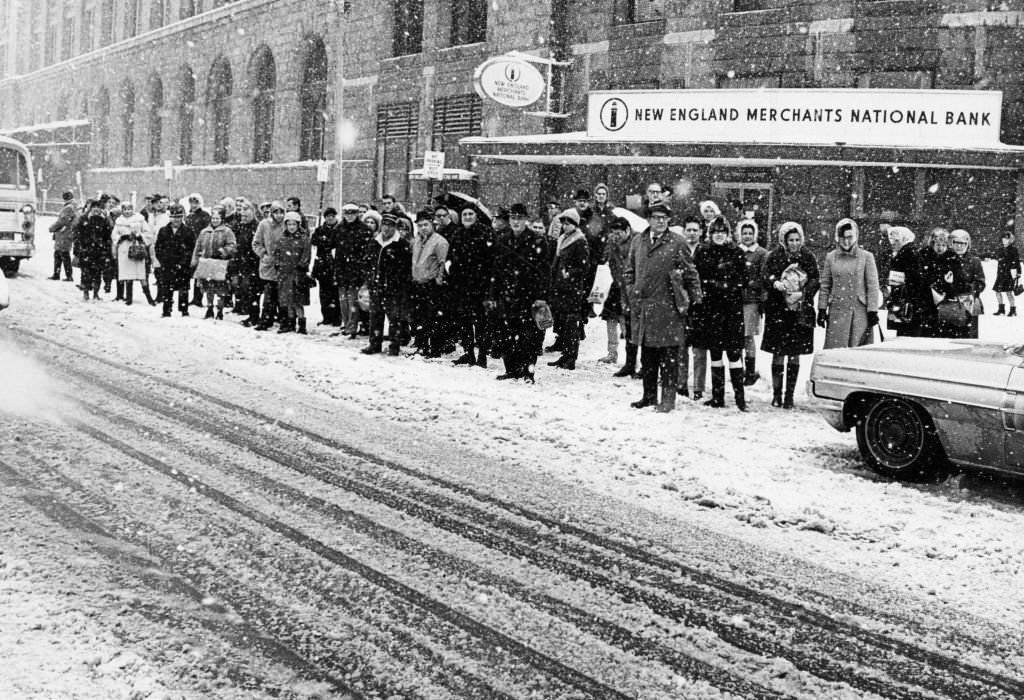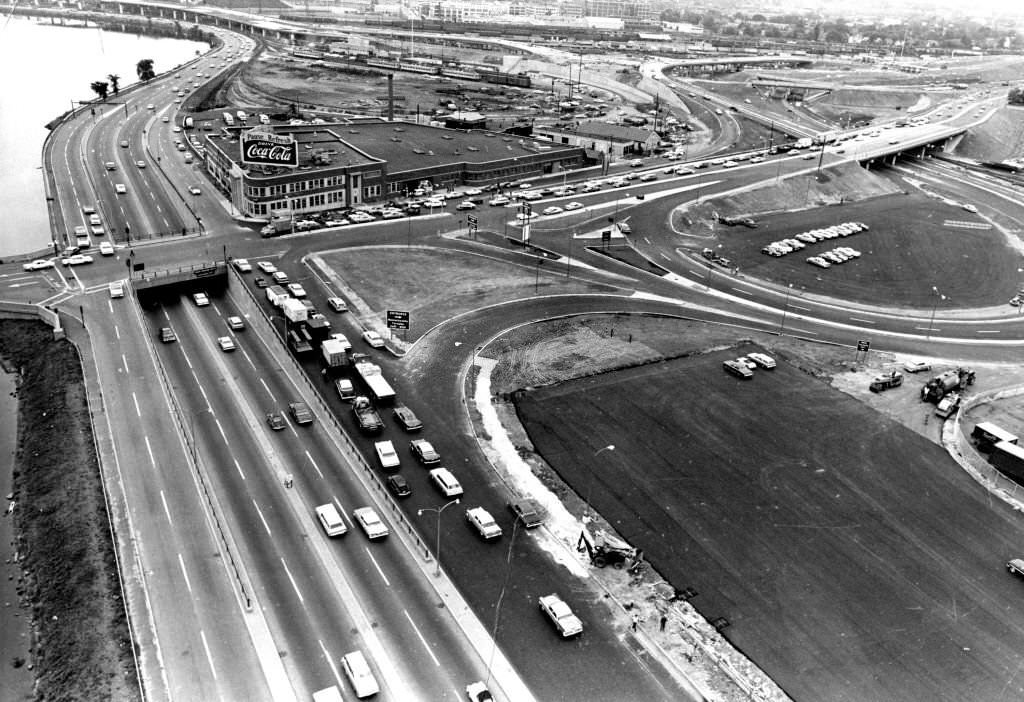

Boston in the 1960s was a city caught between two worlds. On one hand, state and federal money poured in, private investment surged, and cranes dominated the skyline. On the other, the population shrank by 13% across the decade as residents left for the suburbs. Old buildings came down. New ones rose in their place. And beneath the construction dust, serious tensions over race, housing, and civil rights were building just as fast as any skyscraper.
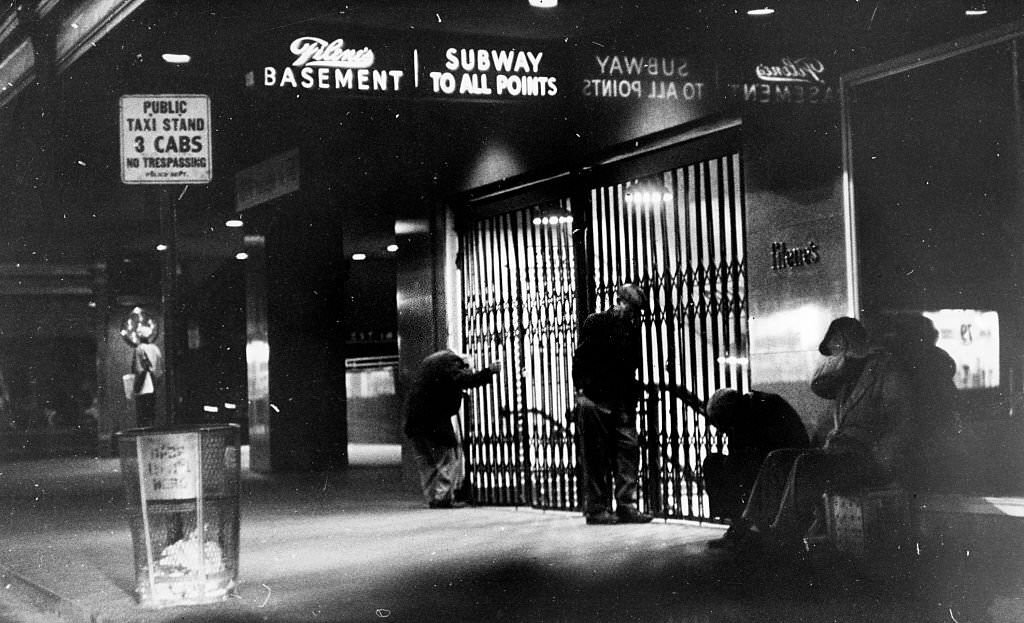
The streets told the story best. Late nights near Downtown Crossing showed a harder side of the city, where men with nowhere to go gathered near shuttered subway entrances while the rest of Boston slept.
Homeless people stand around a closed entrance to a subway station under Filene’s Basement in Downtown Crossing in Boston at night, September 1962.
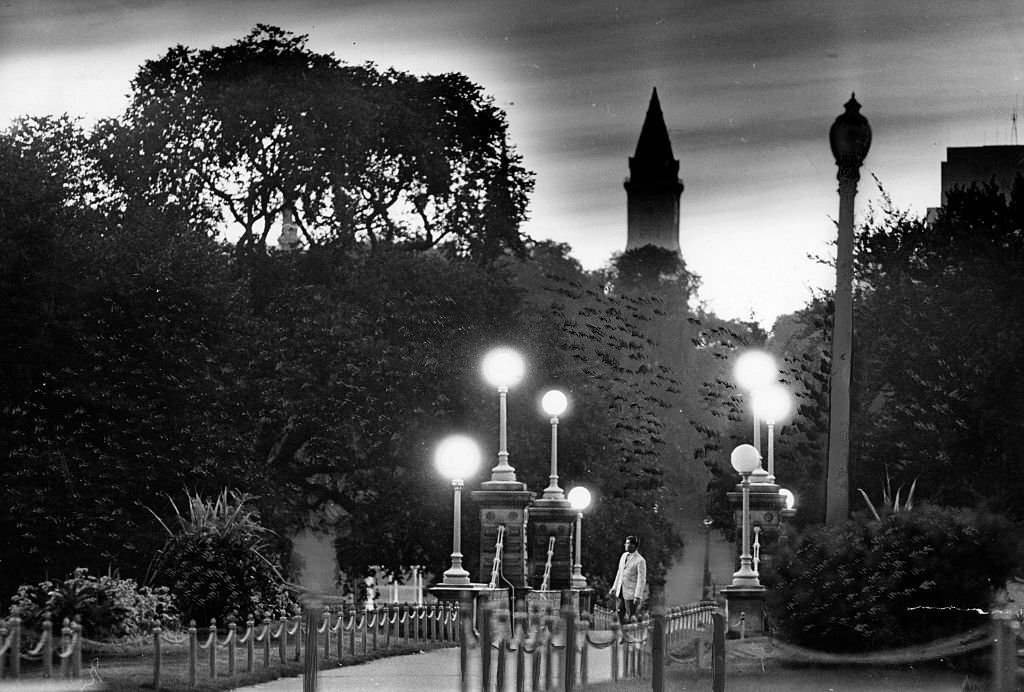
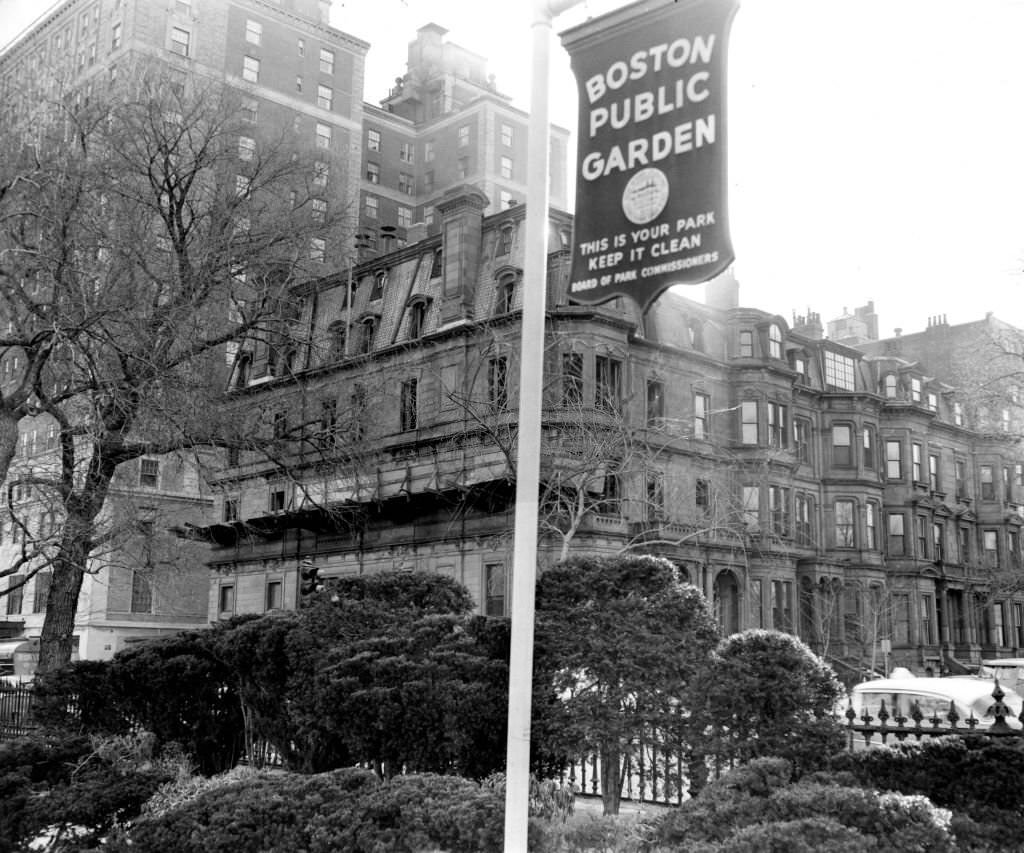
Just a short walk away, the Public Garden offered a very different kind of quiet. Early risers could find the city at its most peaceful before the workday crowds arrived.
A man on a walk watches dawn from a bridge at the Public Garden in Boston, September 1962.
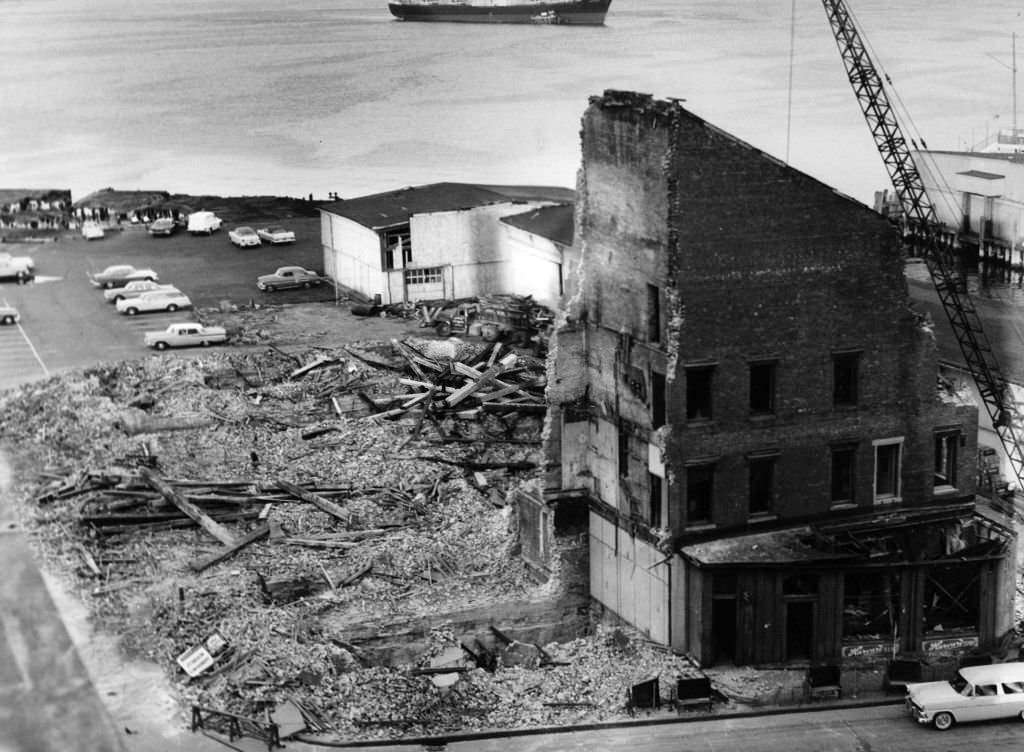
The waterfront was also changing fast. India Wharf, once a hub of Boston’s maritime trade, was being torn down in 1962 to make way for new development. Demolition crews were a common sight across the city as planners cleared space for what they envisioned as a modern Boston.
A building is torn down on the India Wharf in Boston, July 1962.
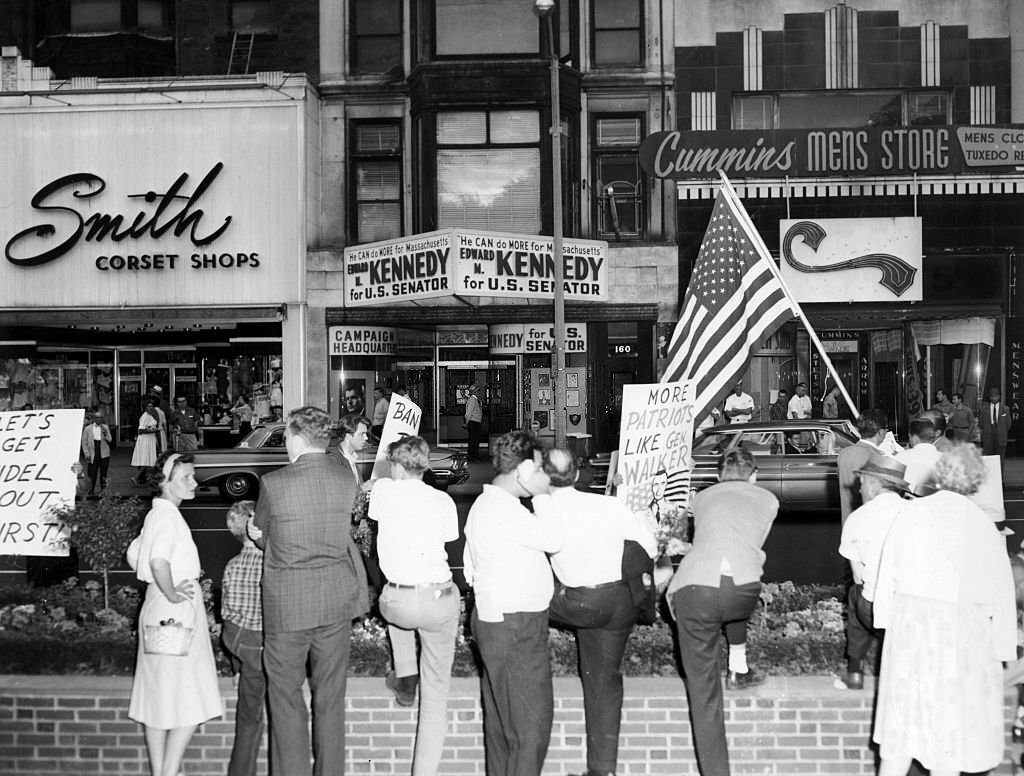
Politics ran hot on the streets too. In June 1962, members of the Nationalist Party picketed outside Edward M. Kennedy’s campaign headquarters on Tremont Street. Kennedy was making his first run for the U.S. Senate, and not everyone was welcoming the idea.
Members of the Nationalist Party picket outside Edward M. Kennedy’s campaign headquarters on Tremont Street in Boston on June 30, 1962.
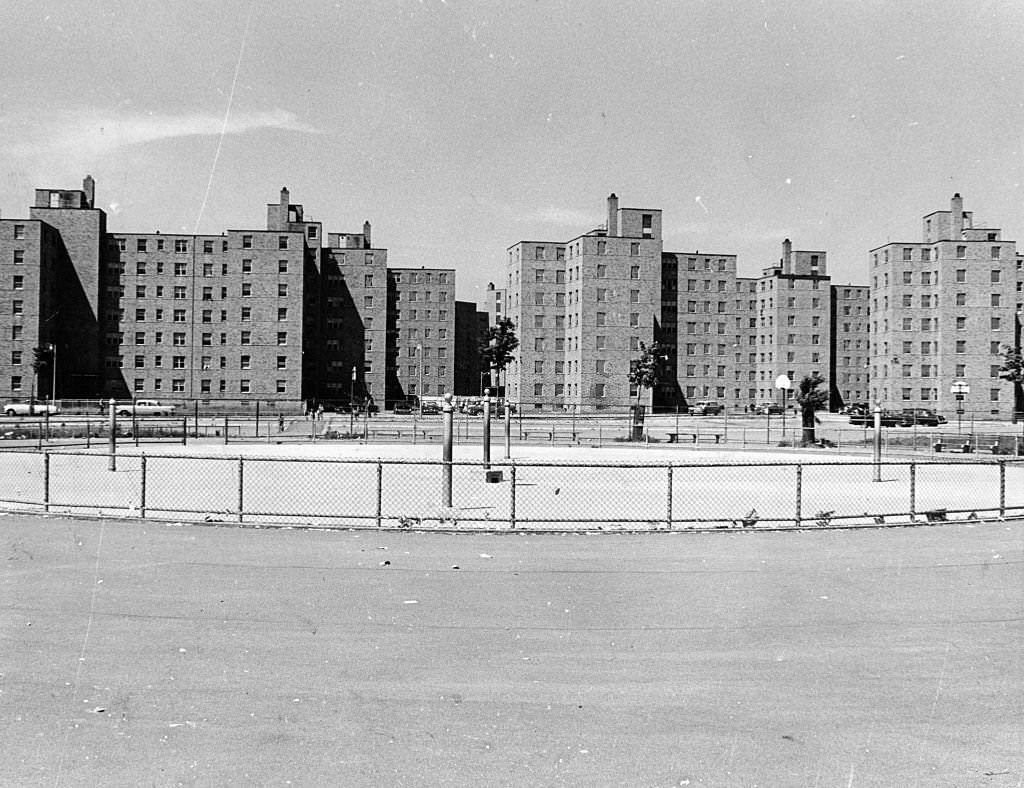
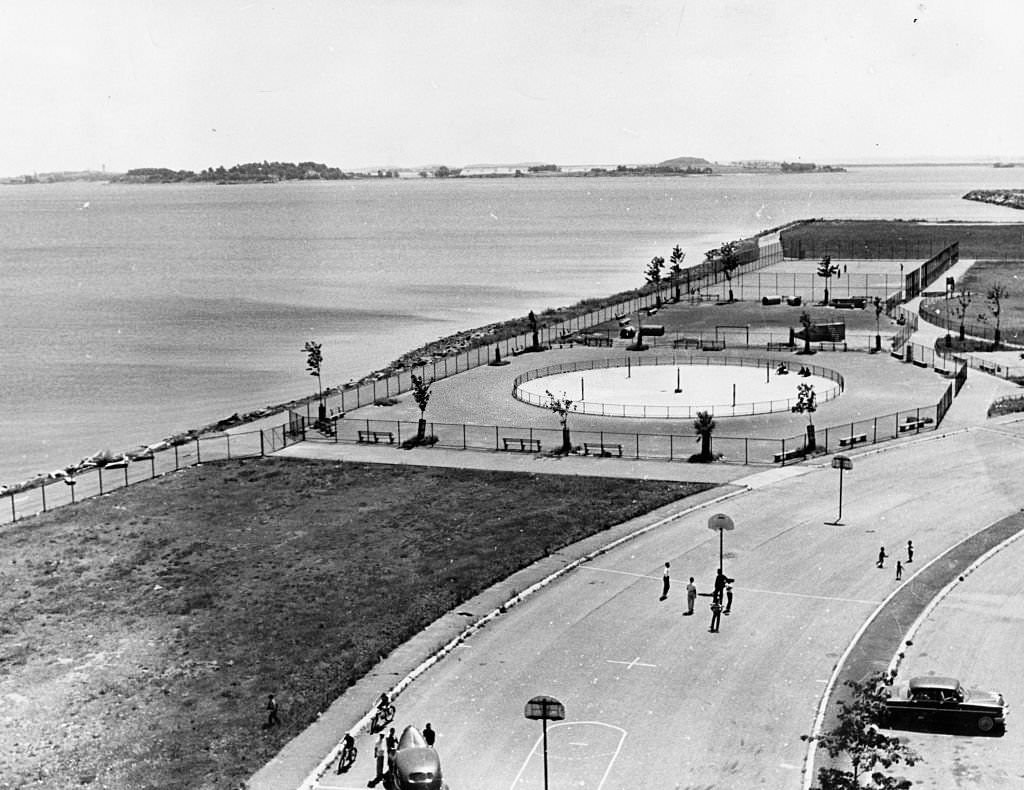
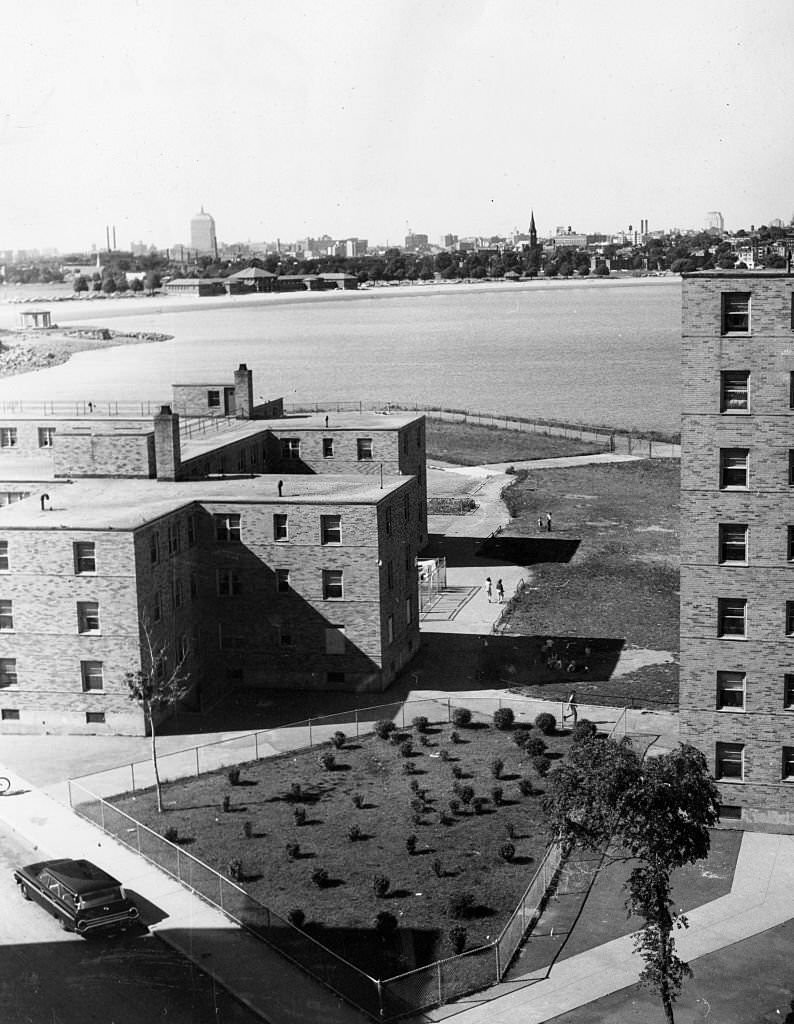
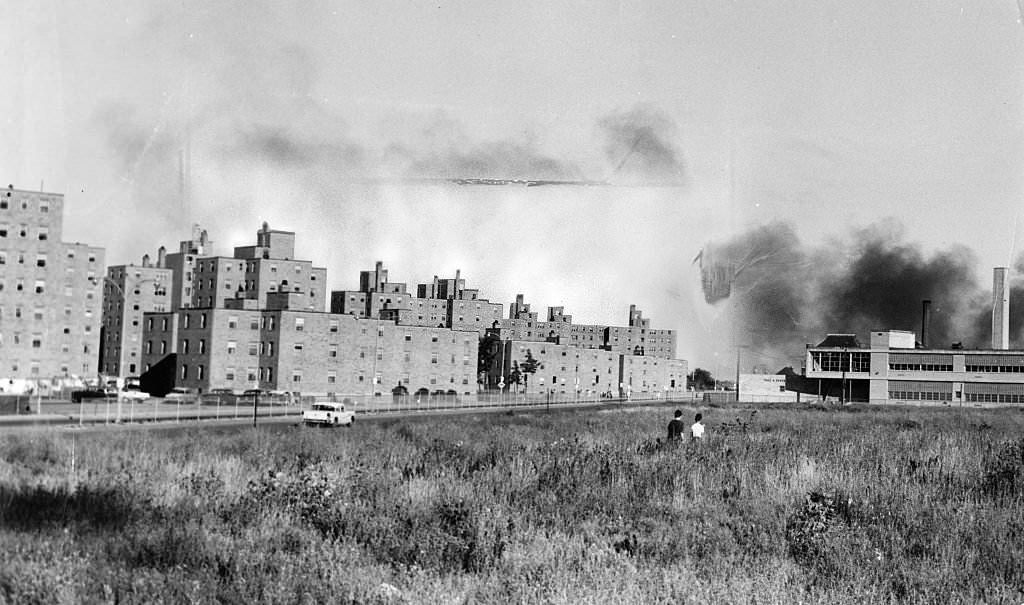
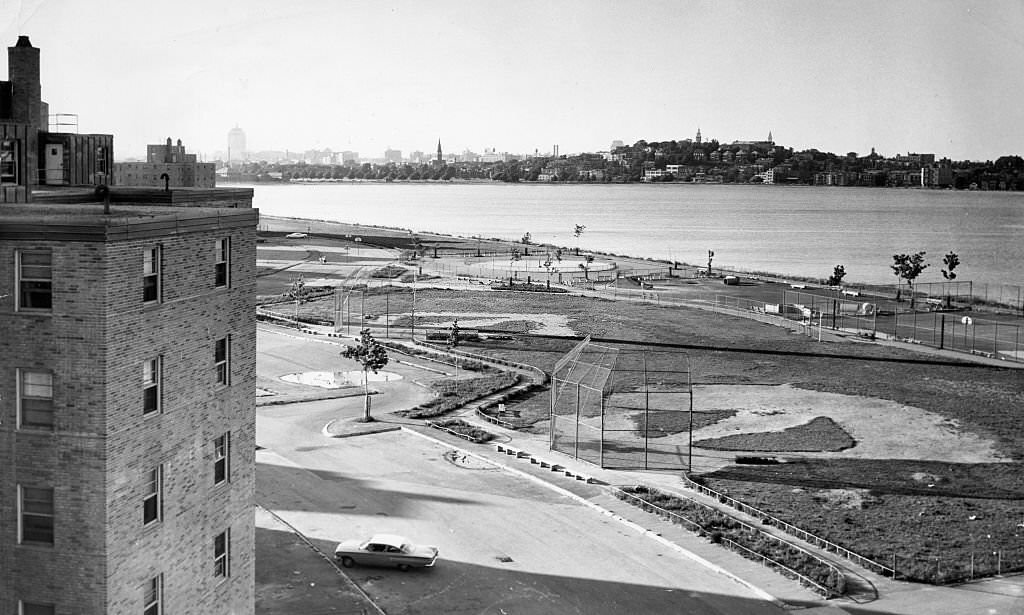
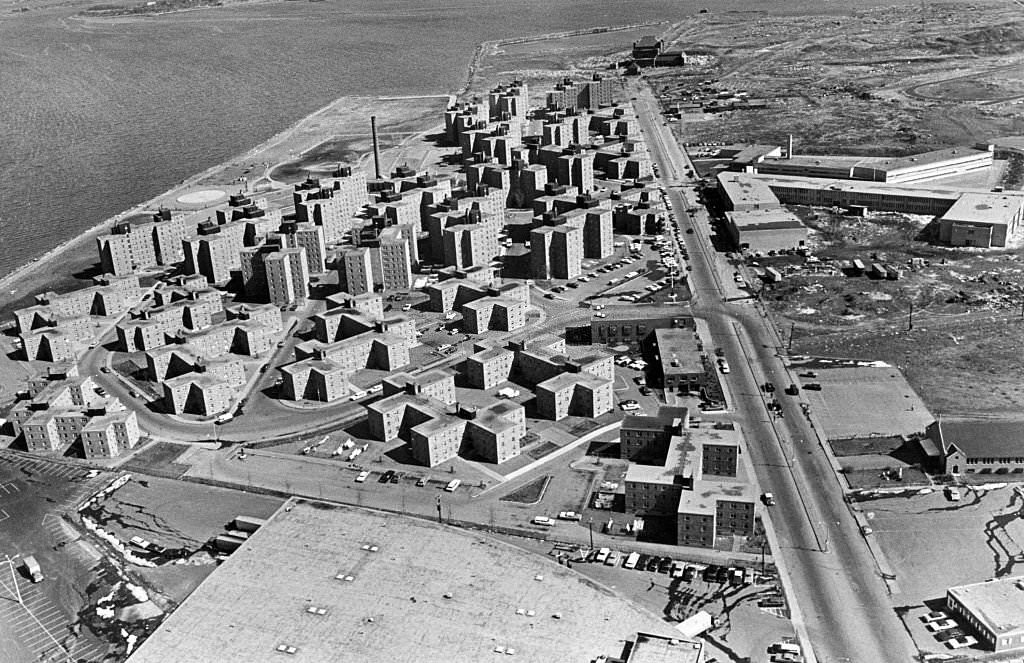
Columbia Point was one of the city’s most talked-about housing projects in the early 1960s. Built on a peninsula in Dorchester Bay, it housed thousands of Boston residents — but it was also isolated from the rest of the city and underfunded. The Columbia Point Health Center, which opened there in 1966, became the first community health center in the United States.
The Columbia Point housing project in Boston, June 28, 1962.The recreation area of the Columbia Point housing project in Boston, June 28, 1962.
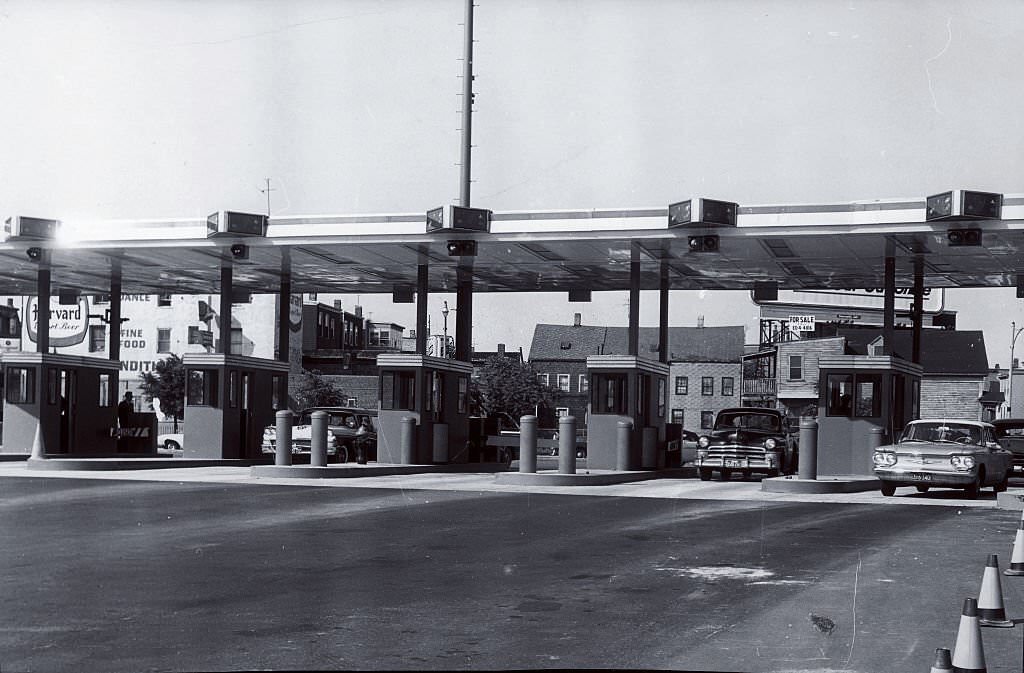
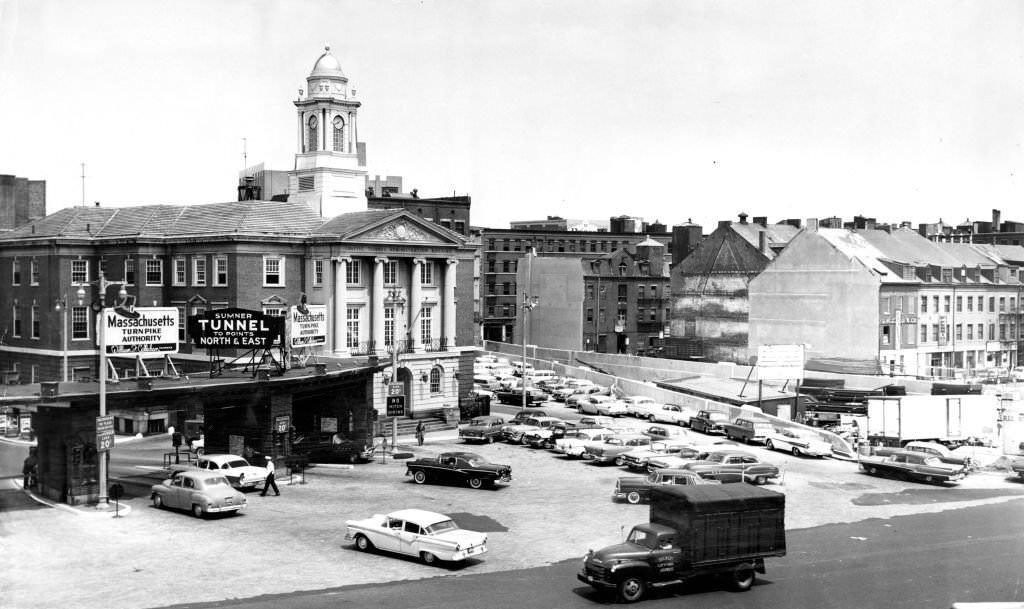
The Sumner Tunnel connected Boston to East Boston under the harbor, and rush hour traffic was a daily reality for commuters crossing beneath the water. On a busy summer day in 1962, the toll booths processed a steady stream of cars.
Rush hour at the East Boston toll booth to the Sumner Tunnel on June 21, 1962, with no traffic tie up s to be seen.The exterior of the Bowdoin Square Fire House in Boston, May 26, 1962.
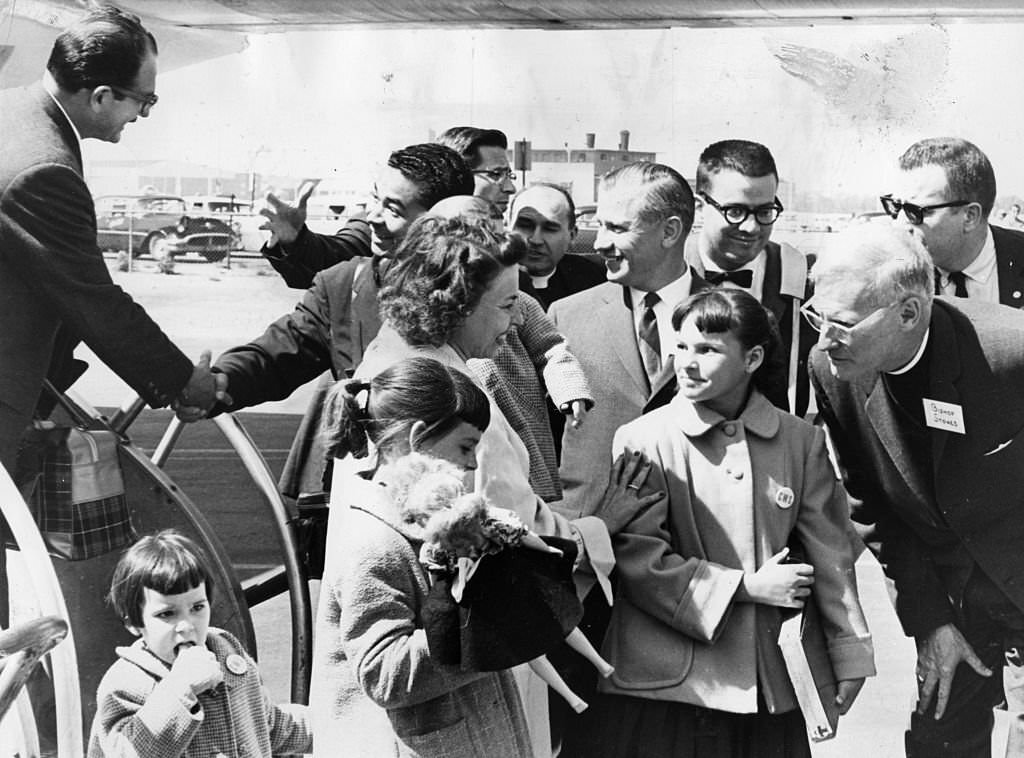
Boston’s connection to world events was visible at Logan Airport. In May 1962, 86 Cuban refugees landed in Boston after fleeing to Miami, sponsored for resettlement by Episcopalians and Congregationalists. The Right Reverend Anson Phelps Stokes, Bishop of the Protestant Episcopal Diocese of Massachusetts, and Governor John A. Volpe were both on hand to greet them.
Rt. Rev. Anson Phelps Stokes, Bishop of the Protestant Episcopal Diocess of Massachusetts, left, and Gov. John A.
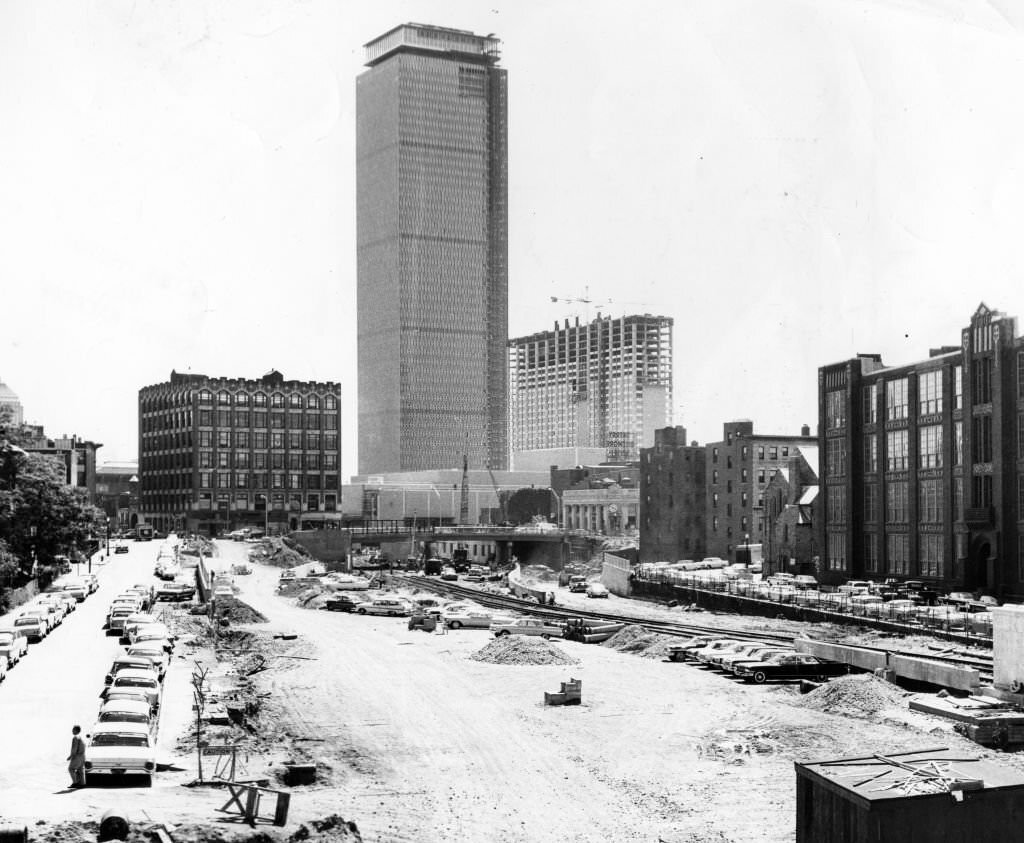
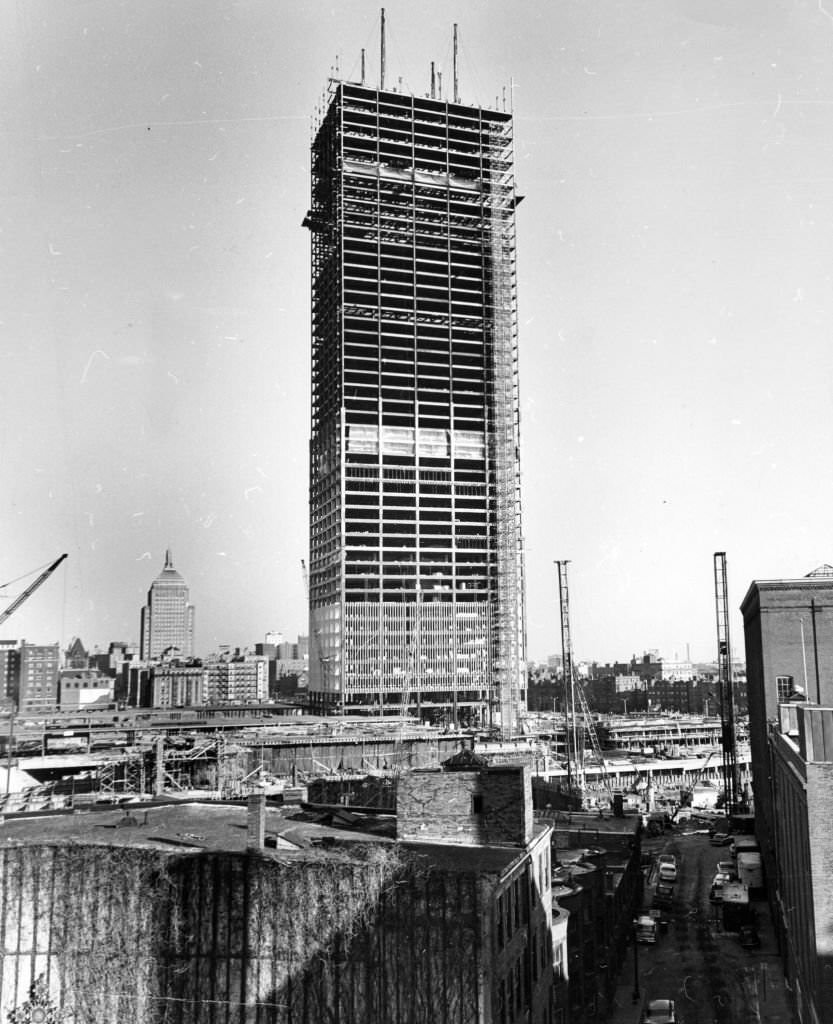
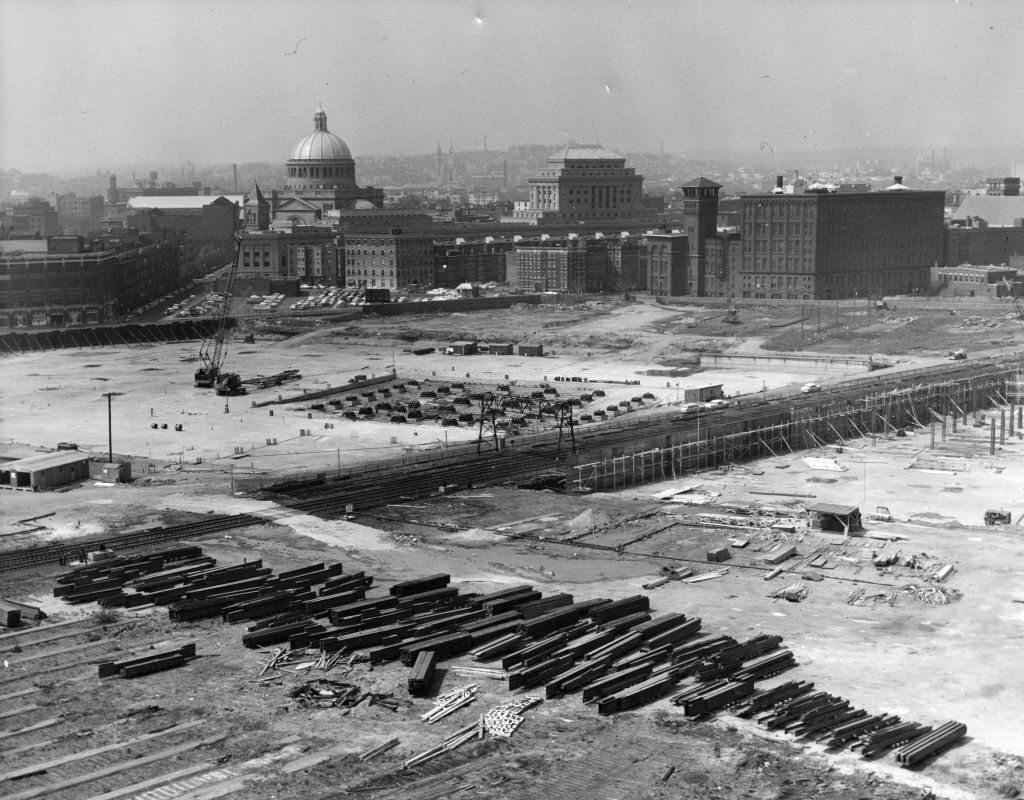
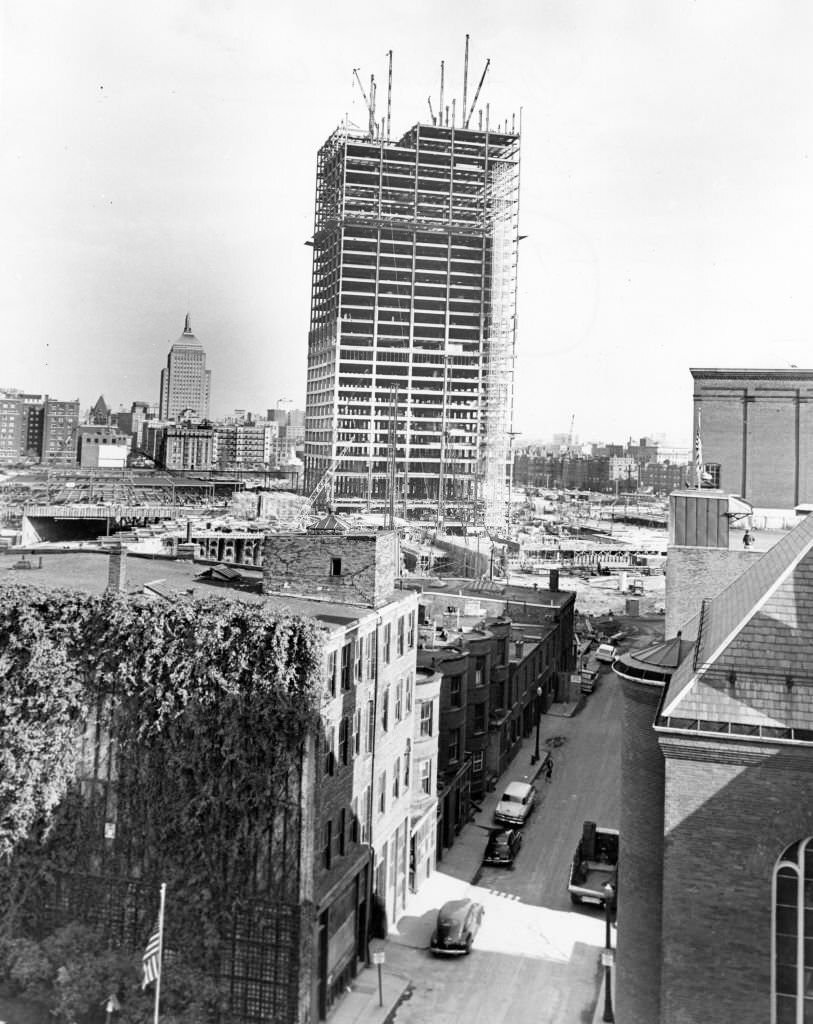
Few construction projects defined 1960s Boston as much as the Prudential Center. Rising in the Back Bay on the site of old rail yards, the Pru was the tallest building in New England when it topped out in 1964. In 1962, it was still climbing skyward, with the Christian Science complex visible nearby.
Early construction is under way on the Prudential Center in Boston’s Back Bay, May 20, 1962. The Christian Science building can be seen in the background.
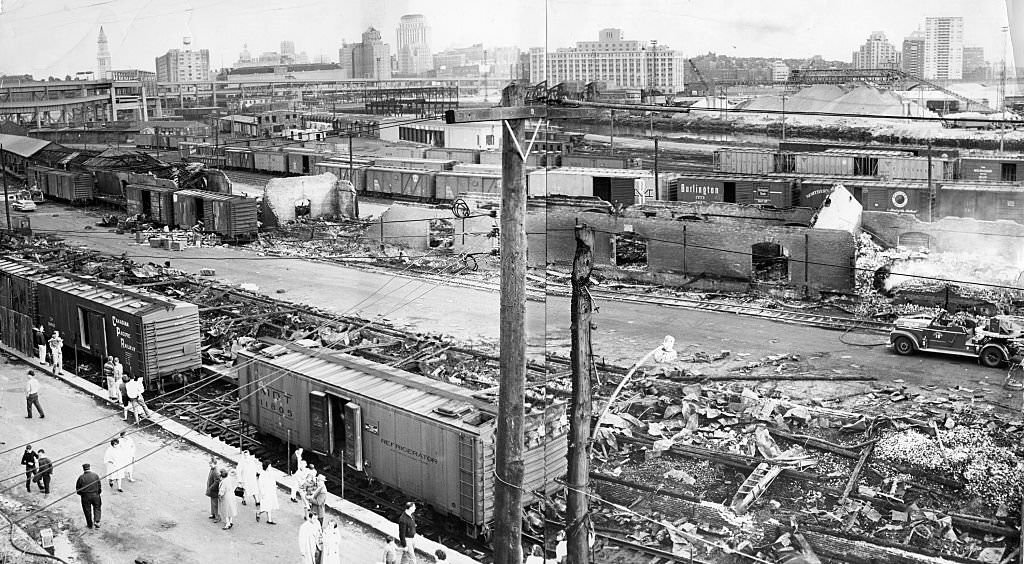
Fire was a constant threat in Boston’s older neighborhoods. In May 1962, a 10-alarm fire ripped through Charlestown, causing $2.5 million in damage. The charred aftermath left blocks of the historic neighborhood in ruins.
The aftermath of a 10-alarm fire in Charlestown, May 11, 1962. The first did $2.5 million in damage.
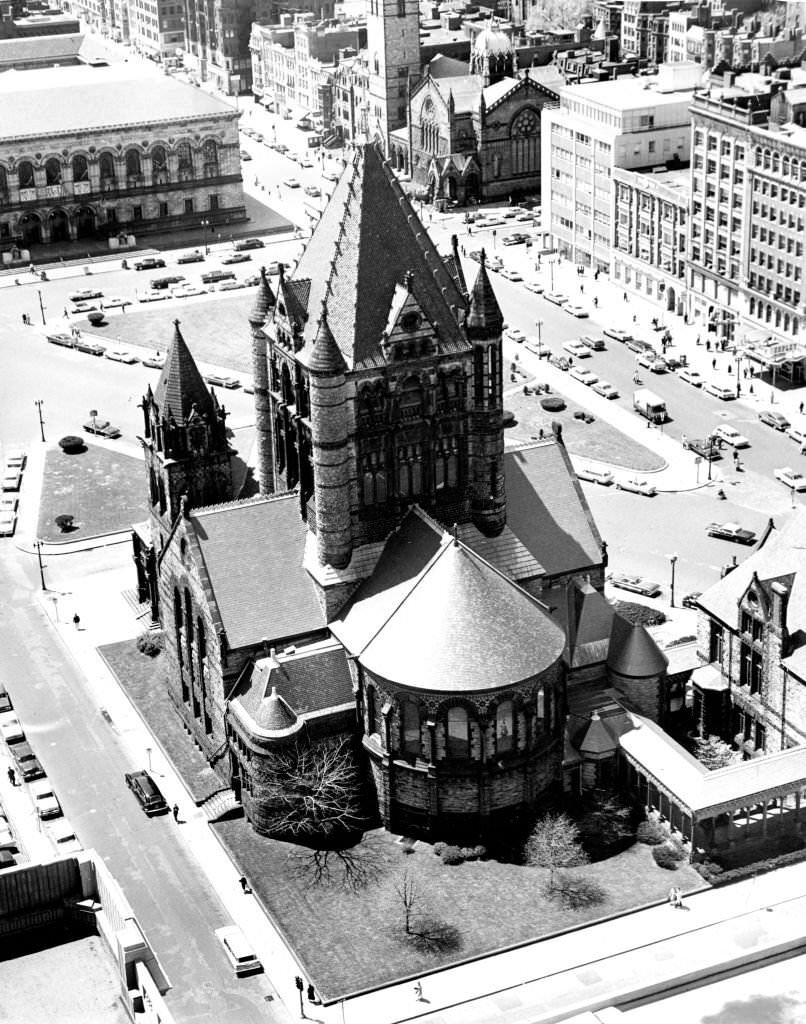
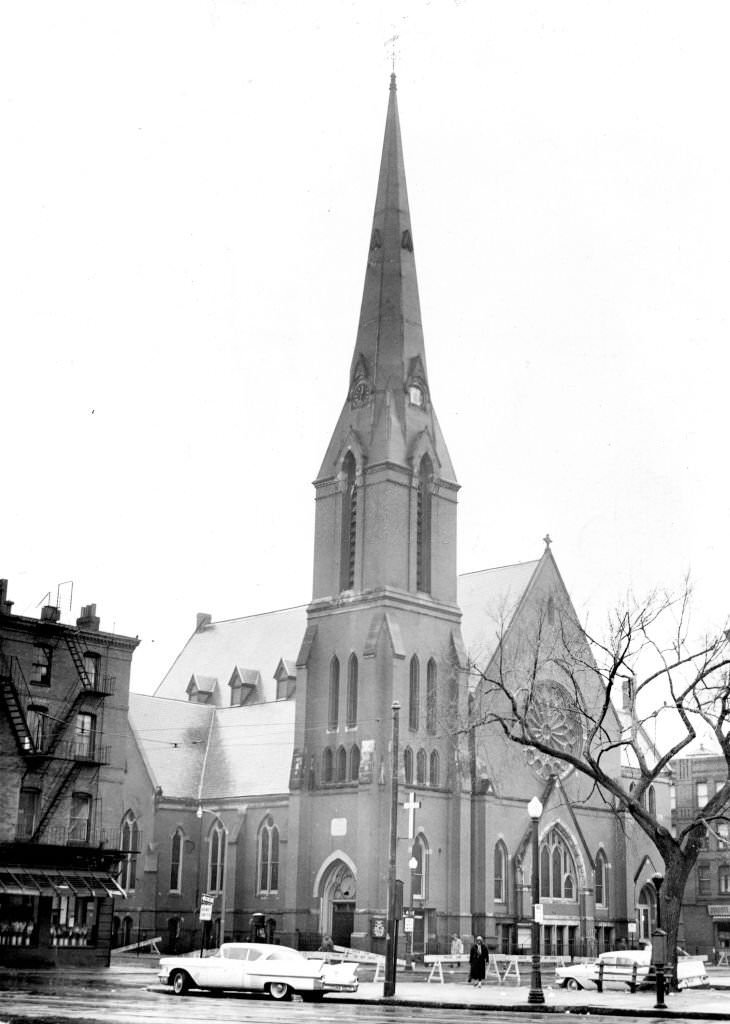
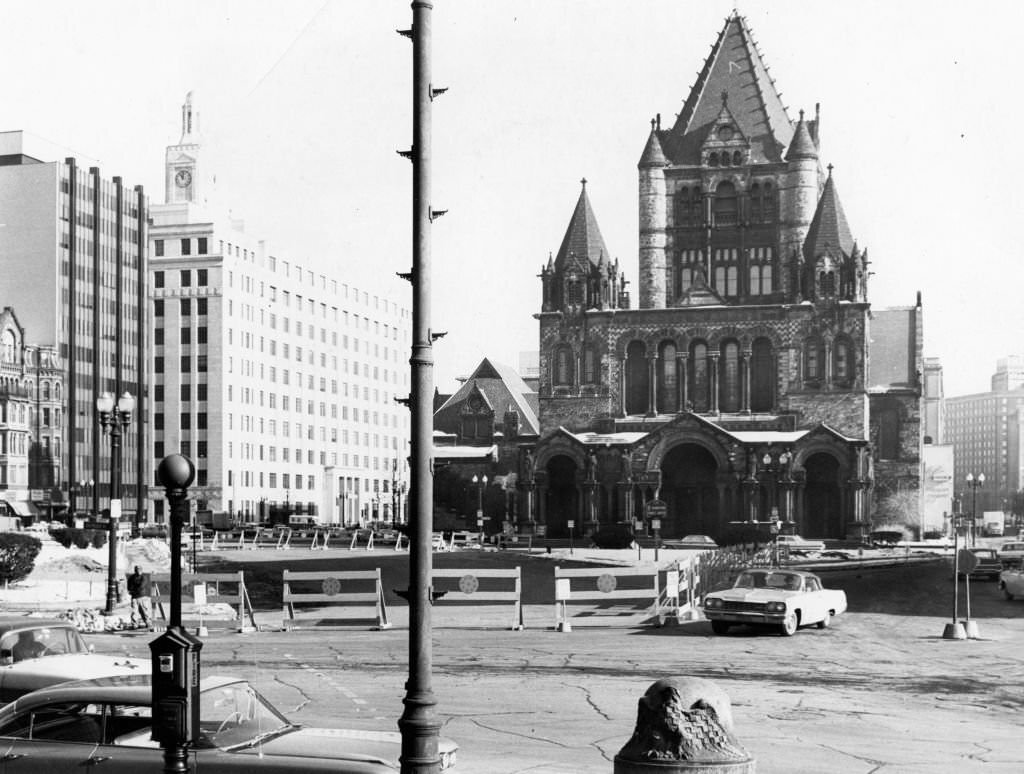
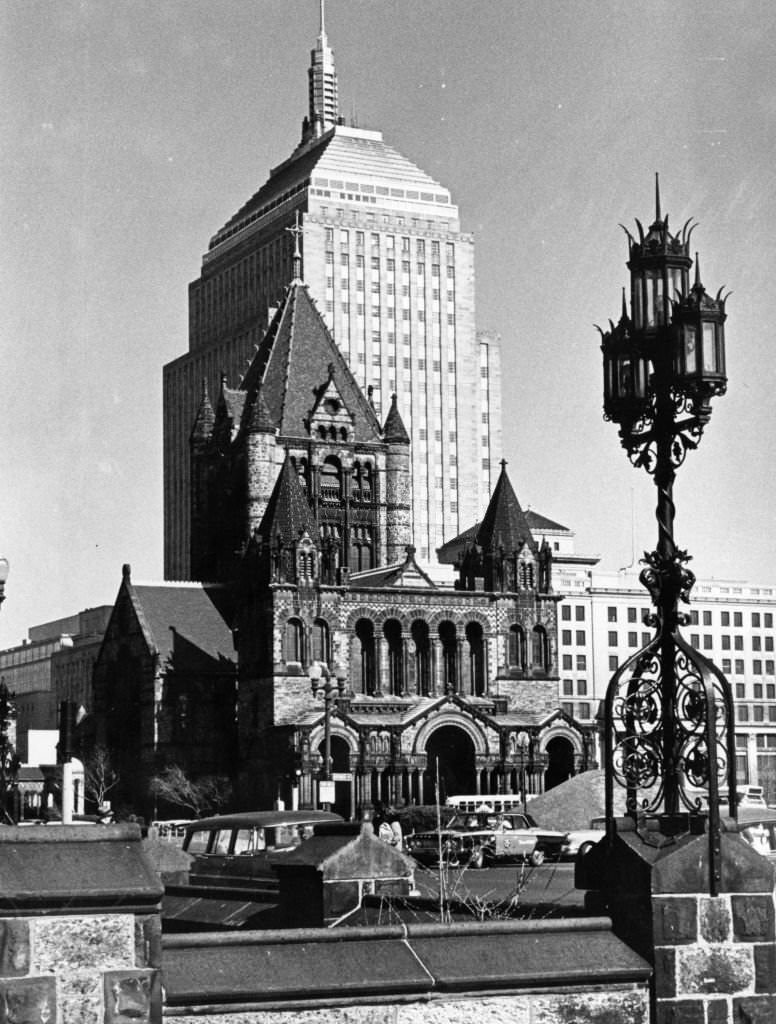
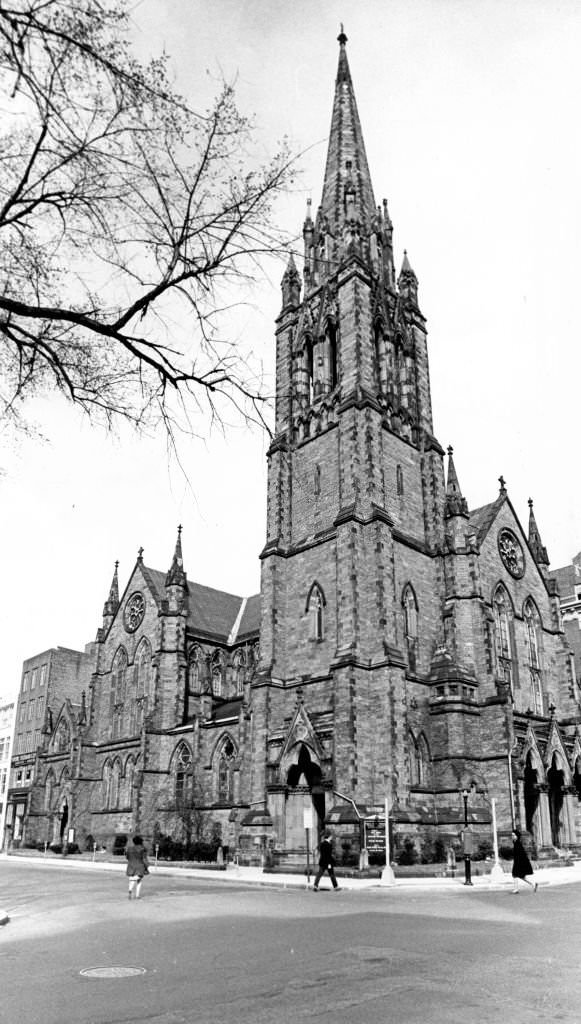
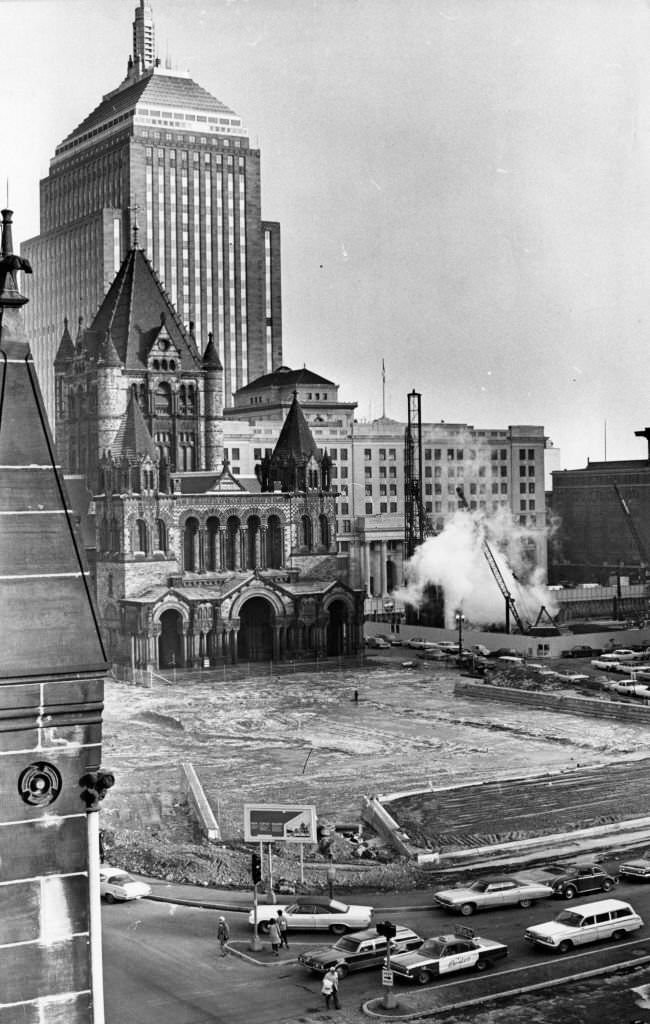
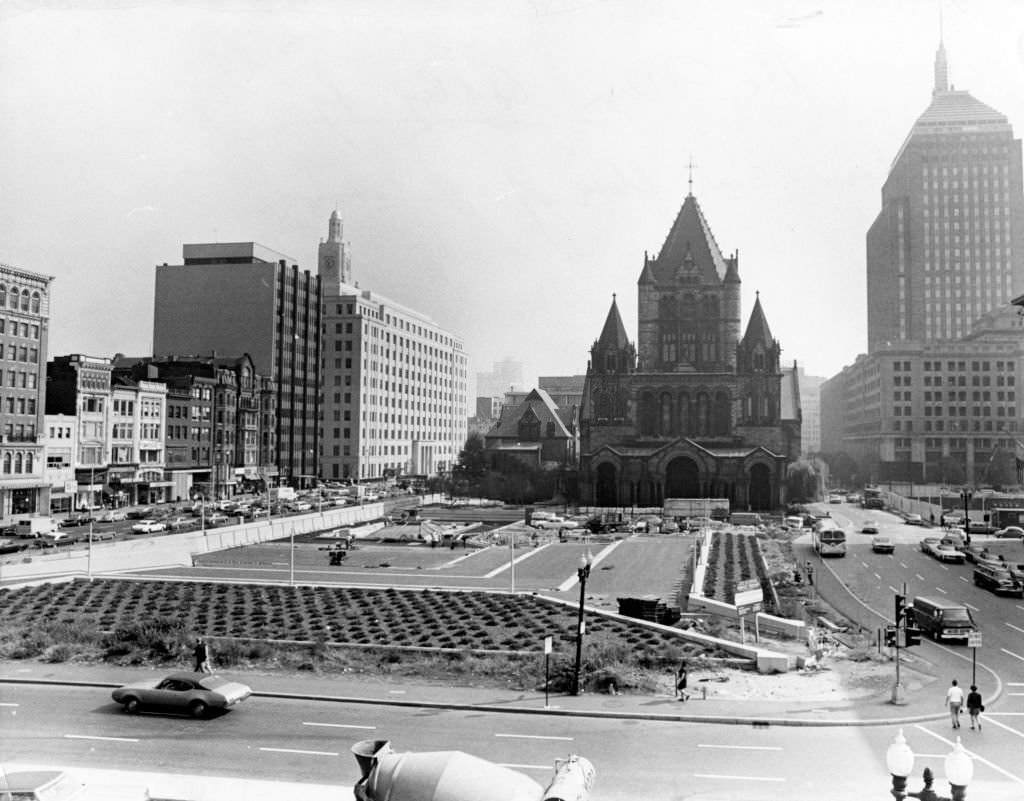
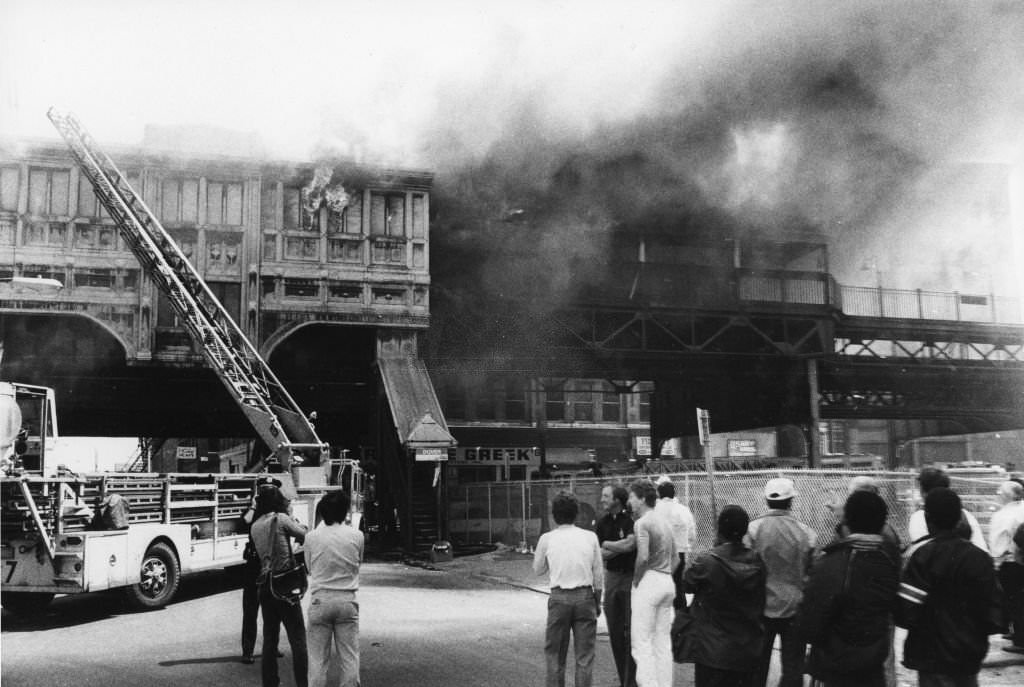
Among Boston’s most enduring landmarks, Trinity Church in Copley Square stood as a reminder of the city’s architectural heritage, even as cranes reshaped the skyline around it.
Trinity Church in Copley Square on May 7, 1962.People watch a three-alarm fire at the MBTA Station on Dover Street in the South End of Boston, May 6, 1962.
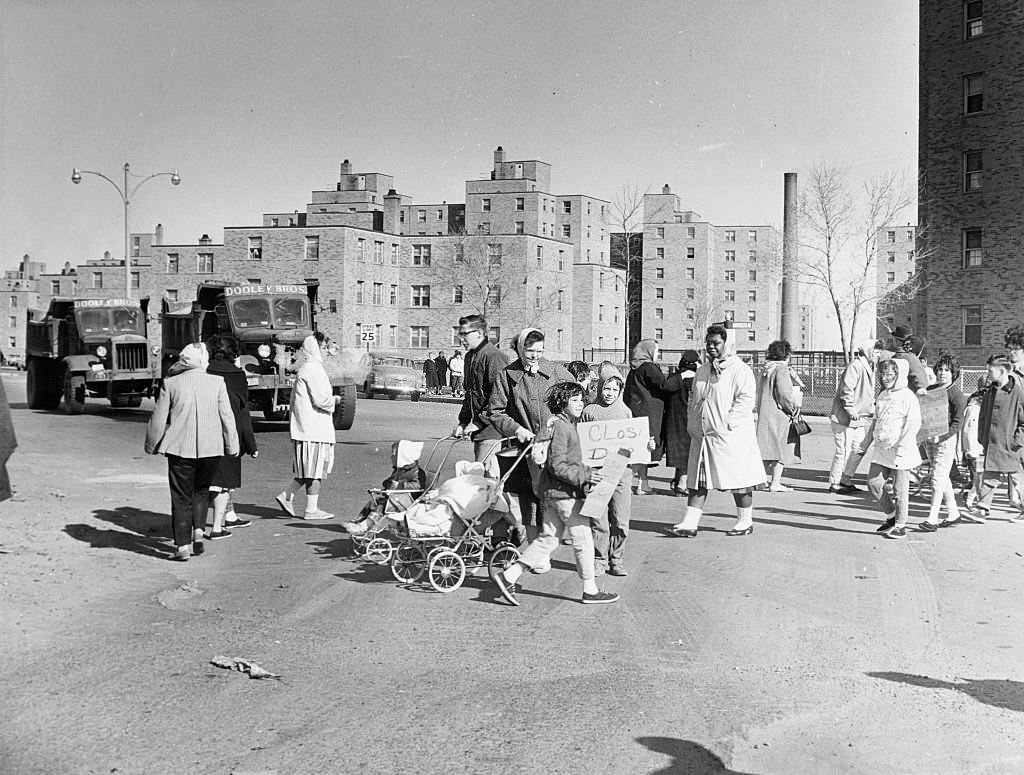
Residents of Columbia Point had their own fight to wage. In April 1962, project residents picketed to have nearby city and Mile Road Corporation dumps closed. Two days before the demonstration, a city dump truck had killed a 6-year-old girl in the project, setting off the protests.
A group of residents from Columbia Point housing project in Boston picket to have the the nearby city and Mile Road Corp.
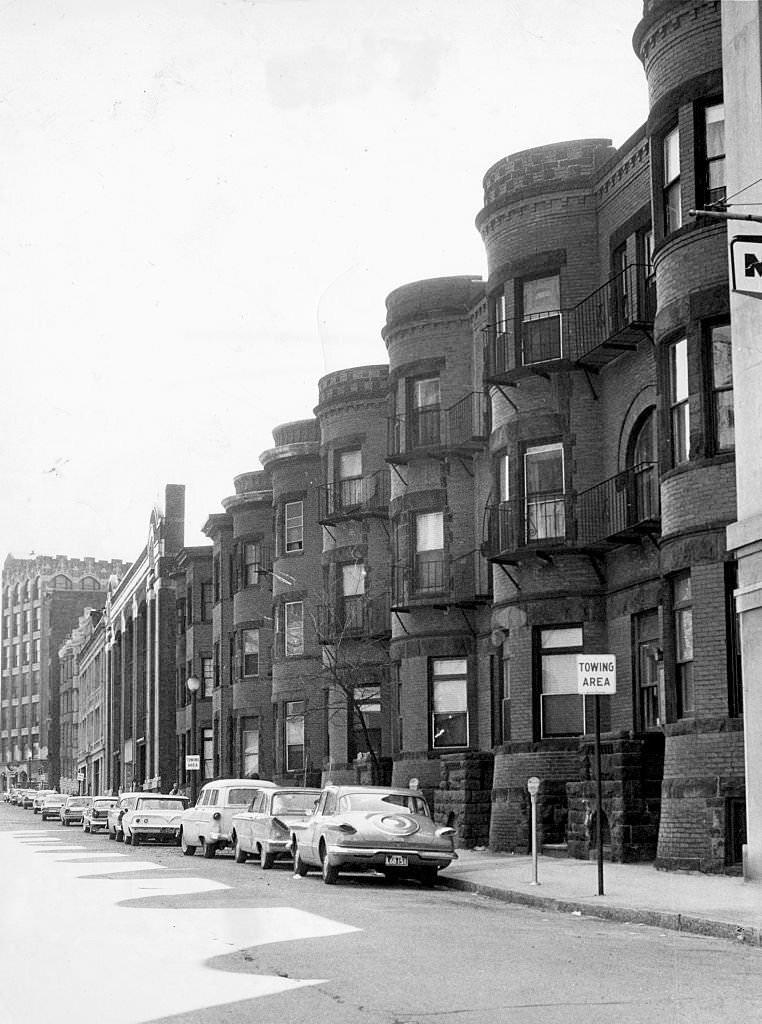
Urban renewal reshaped Boston’s Back Bay in ways residents often felt powerless to stop. The Massachusetts Turnpike Authority seized more than 34 properties along Newbury Street and surrounding areas to push the Mass. Turnpike extension through. One of the first stretches claimed ran between Massachusetts Avenue and Charlesgate East.
Newbury Street in Boston’s Back Bay on April 18, 1962.
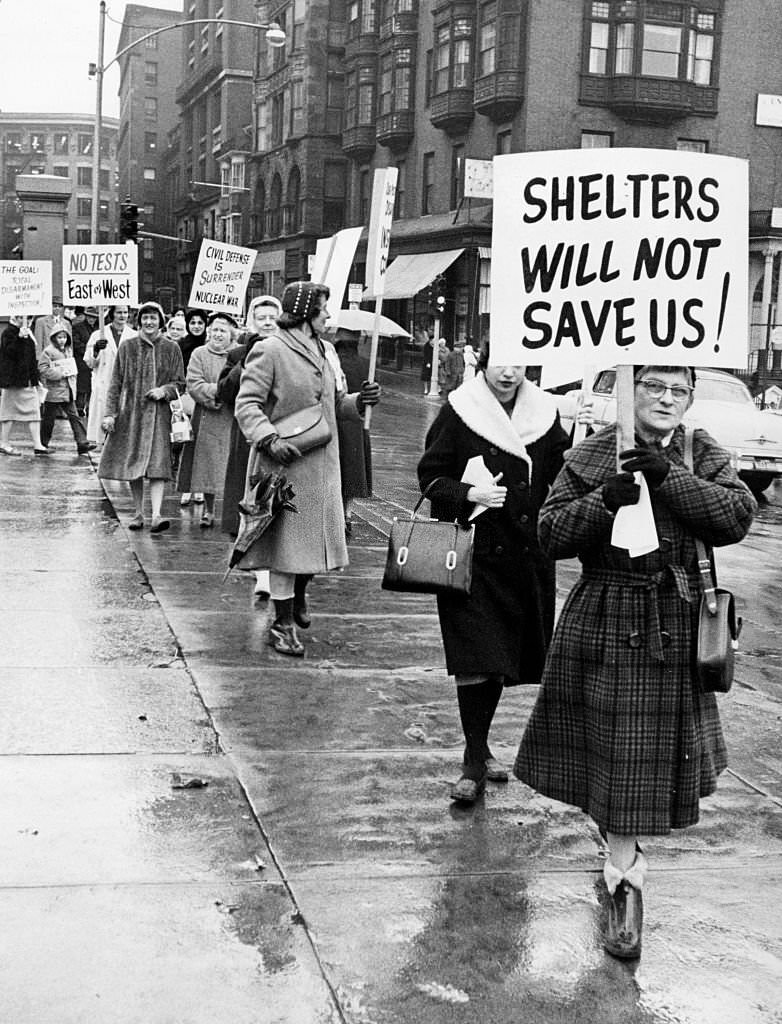
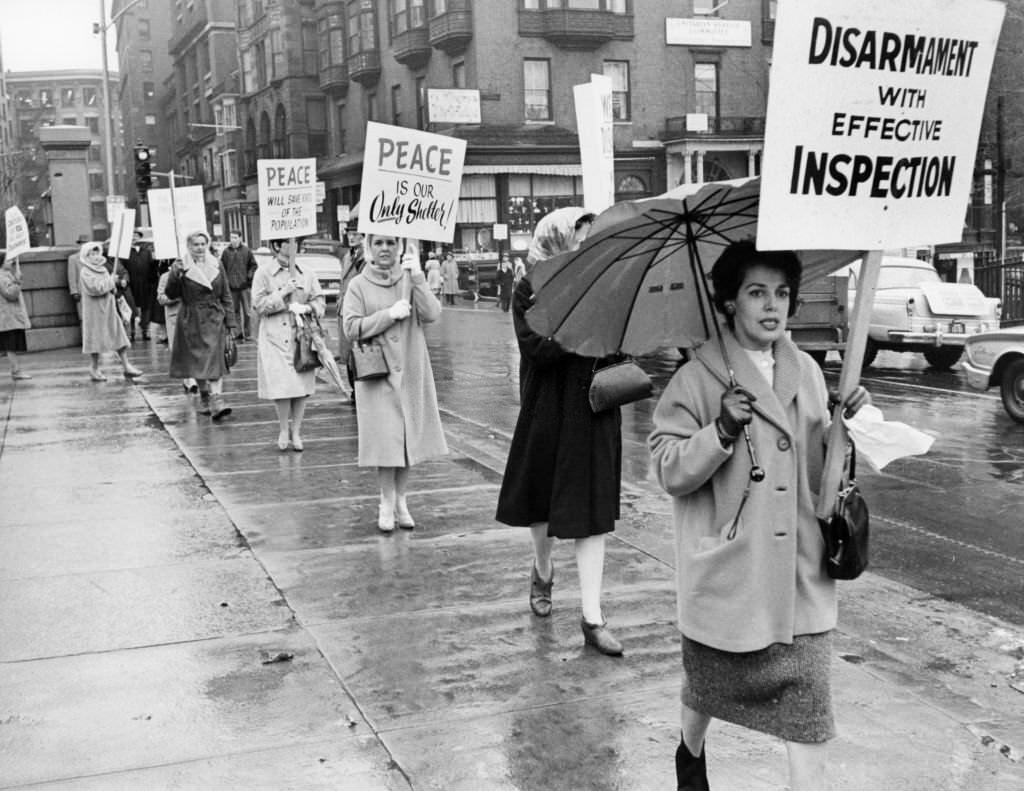
On January 15, 1962, Boston’s State House became the backdrop for an international peace movement. Women marched as part of the “Women’s Strike for Peace,” a demonstration that took place across multiple cities on the same day.
Women picket for peace in front of the Mass. State House in Boston on Jan. 15, 1962.Picketing women march in front of the Massachusetts State House as part of an international demonstration, “Women’s Strike for Peace,” in Boston, Jan. 15, 1962.
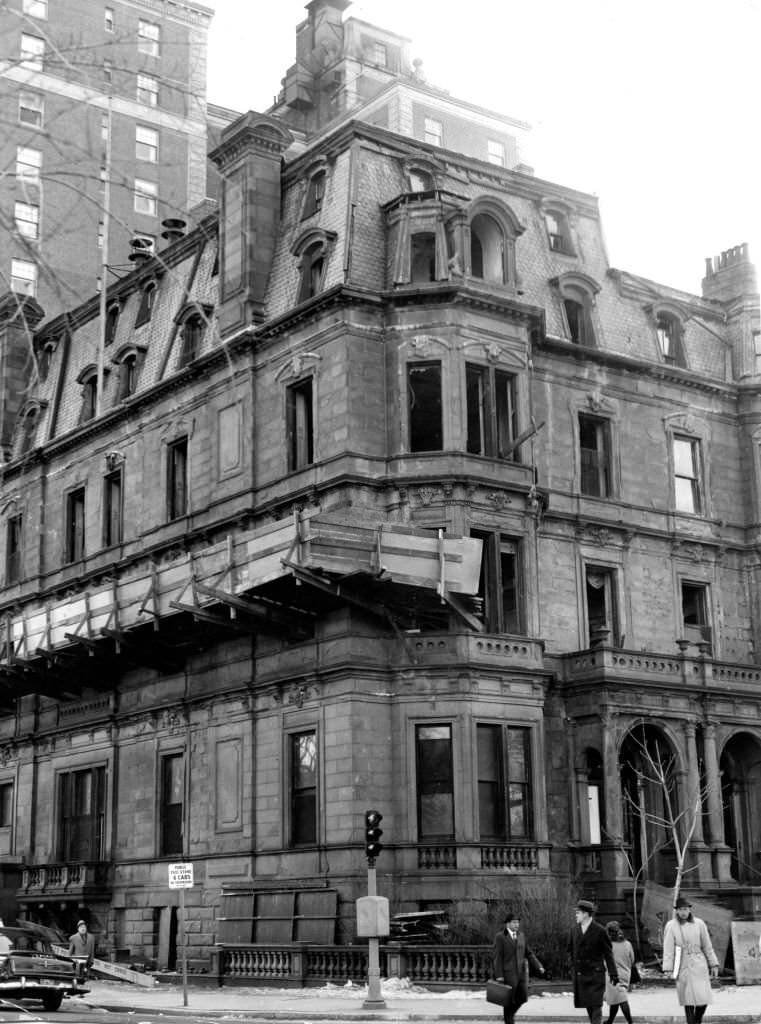
The former Engineers Club at the corner of Commonwealth Avenue and Arlington Street was slated for demolition in early 1962, one of many grand old buildings that fell to the wrecker’s ball during the decade.
The former Engineers Club at Commonwealth Avenue and Arlington Street, which is set for demolition, Jan. 11, 1962.The former Engineers Club at Commonwealth Avenue and Arlington Street, which is set for demolition, 1962.
High above Berkeley Street, the weather beacon on the Old John Hancock Building flashed its famous color-coded forecasts for Bostonians who knew to look up. The building was a fixture in the city’s skyline long before the glass tower that now bears the Hancock name was built.
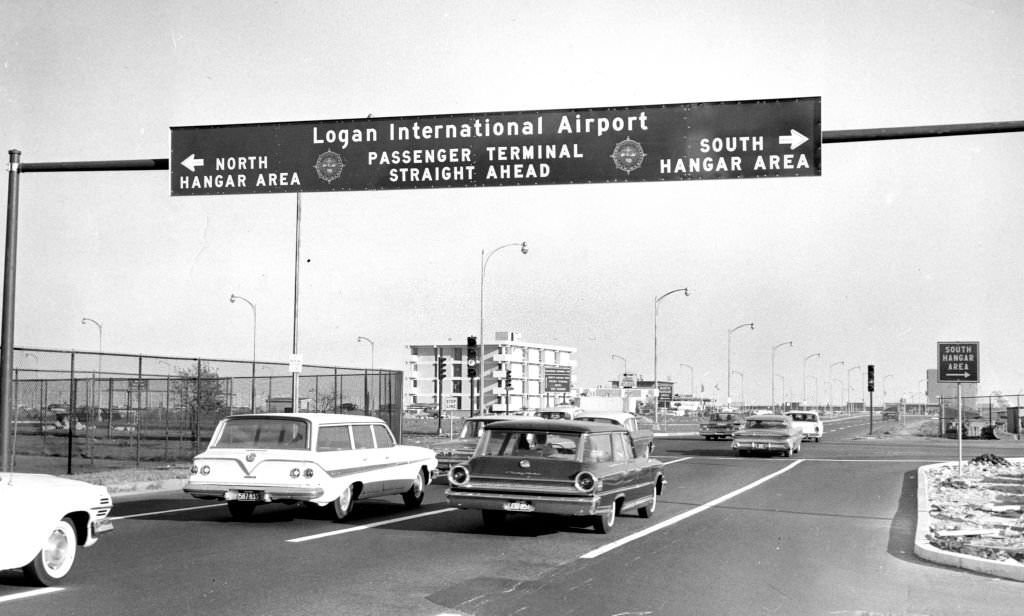
The weather beacon atop the Old John Hancock Building at 200 Berkeley Street in Boston, in 1962.A new sign for Logan Airport in Boston, 1962.
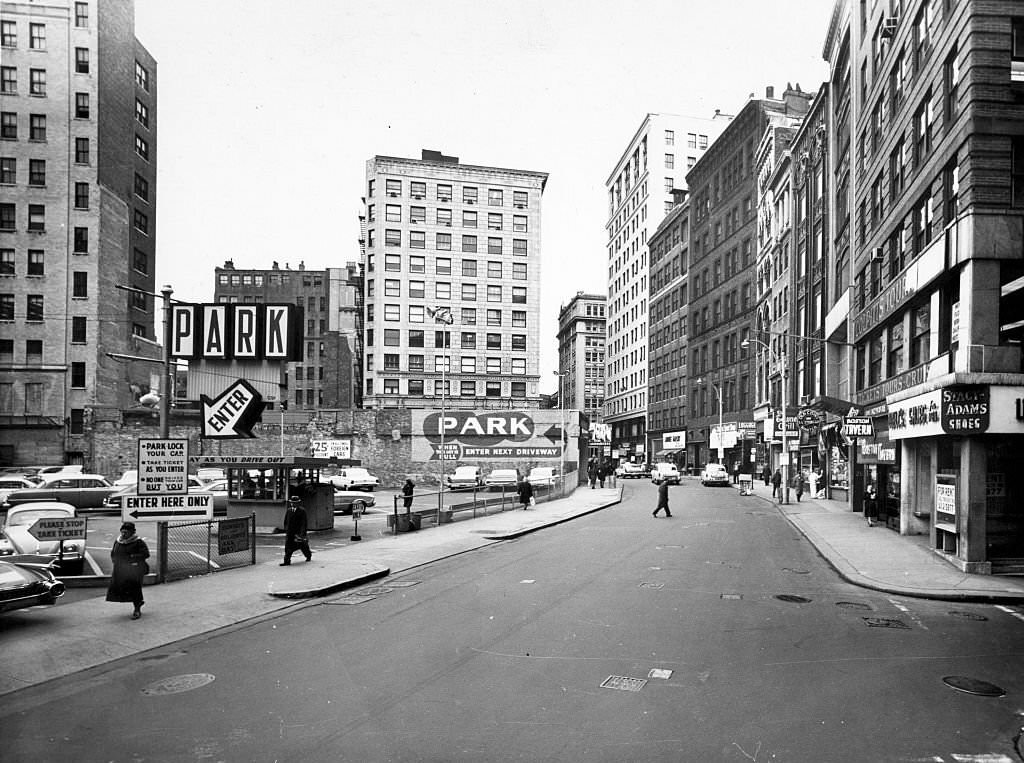
Washington Street near Downtown Crossing had once been famous as “Newspaper Row” — a stretch where eight major newspapers operated within blocks of each other. By 1961, all of them were gone. The Boston Globe, the last to leave, had moved to Morrissey Boulevard in 1958.
Pedestrians walk around the former “Newspaper Row” on Boston’s Washington Street on Nov. 29, 1961.
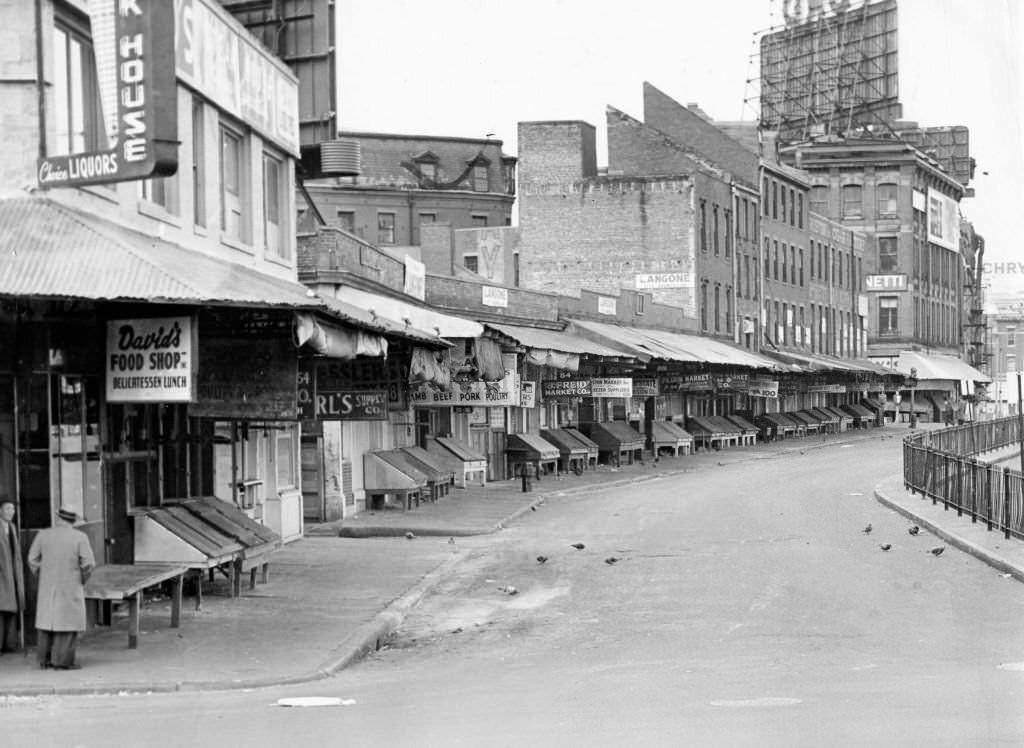
Haymarket, the open-air produce market that had served Boston shoppers for generations, was still going strong in November 1961. Vendors hawked fruits and vegetables as shoppers filled the stalls.
Shoppers at Haymarket in Boston on Nov. 11, 1961.First Baptist Church in the Charlestown neighborhood of Boston, 1961.
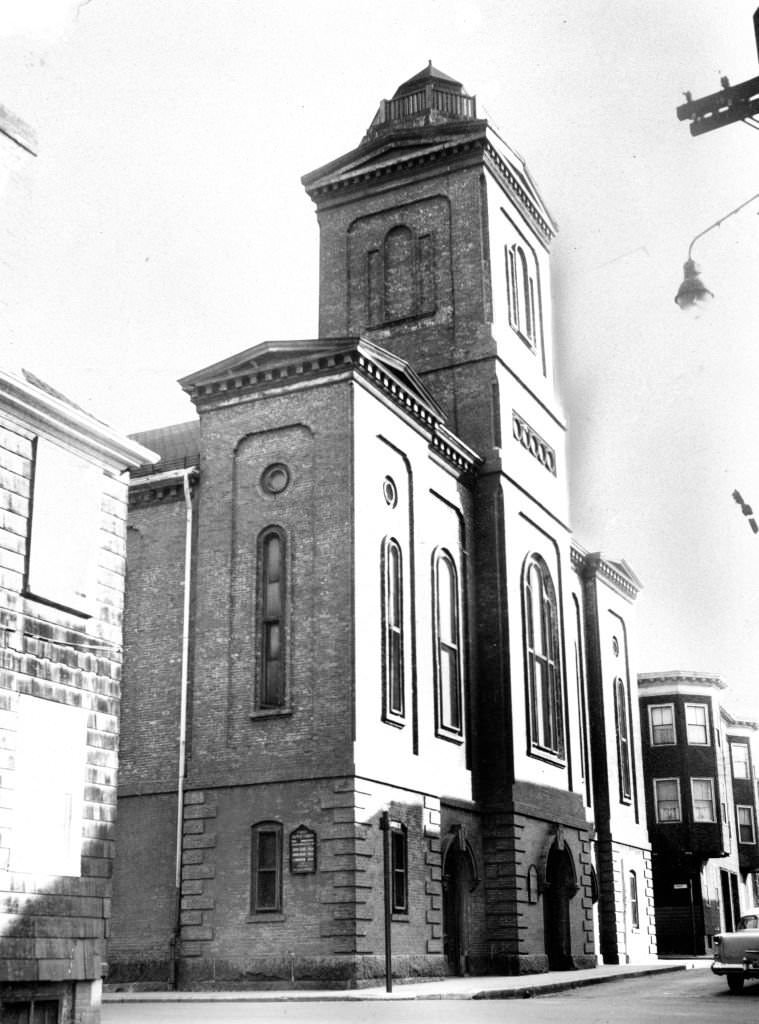
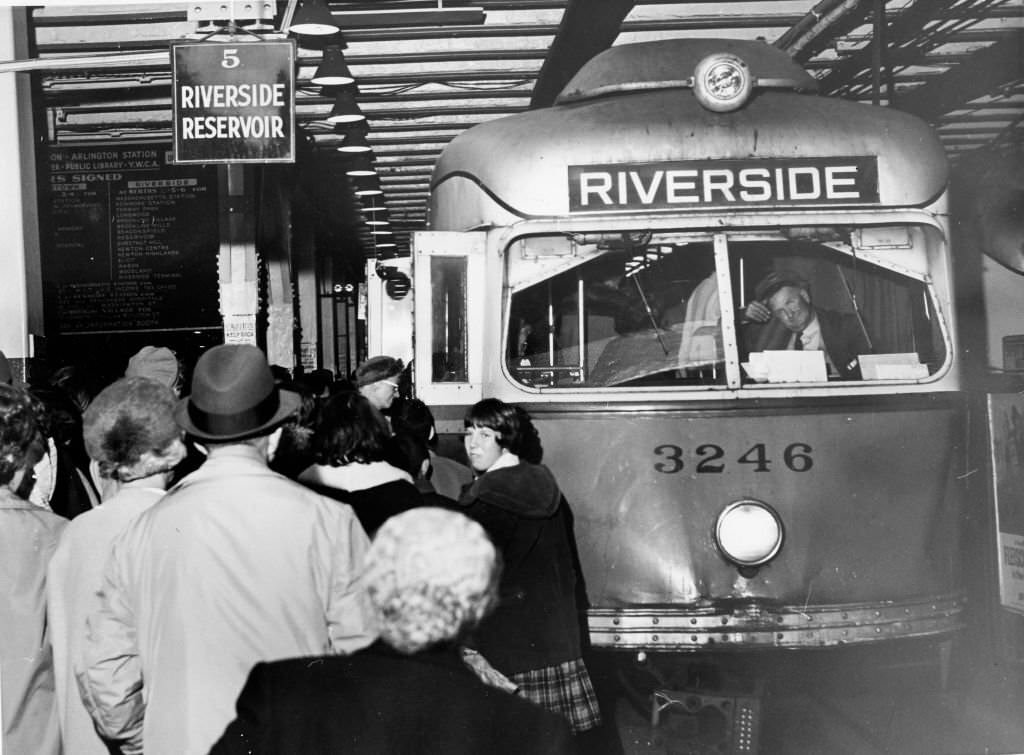
Public transit was the lifeblood of daily commuting. The MTA’s Highland Branch line drew crowds at Park Street Station, with riders packing into cars as the morning rush swept through one of the system’s busiest hubs.
Riders of the MTA’s Highland Branch line crowd aboard a car at Park Street Station in Boston on Oct. 28, 1961.The East Boston entrance to the Lieutenant William F. Callahan Tunnel, Nov. 6, 1961.
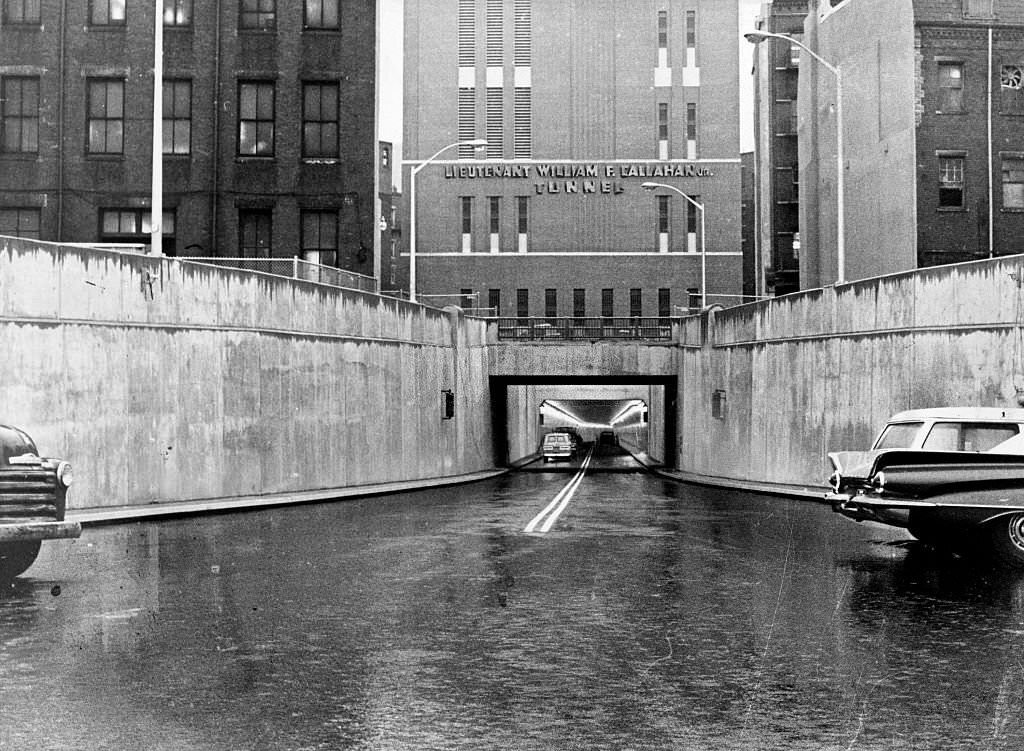
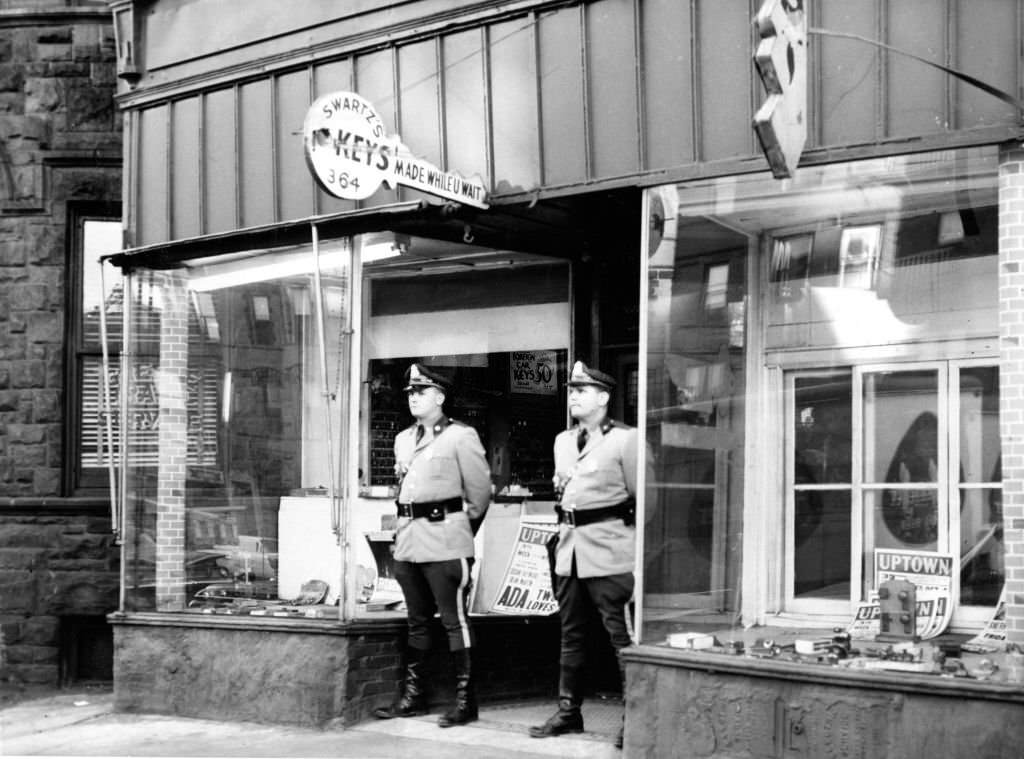
Law enforcement made headlines in October 1961 when Massachusetts State Troopers raided a gambling operation at the Swartz Lock Shop on Massachusetts Avenue. Troopers John Riordan and Kenneth Maurais stood guard outside after the bust.
Massachusetts State Troopers John Riordan and Kenneth Maurais stand outside of the Swartz Lock Shop at 364 Massachusetts Ave. in Boston following a gambling raid on Oct. 26, 1961.The Old North Church in Boston, 1961.
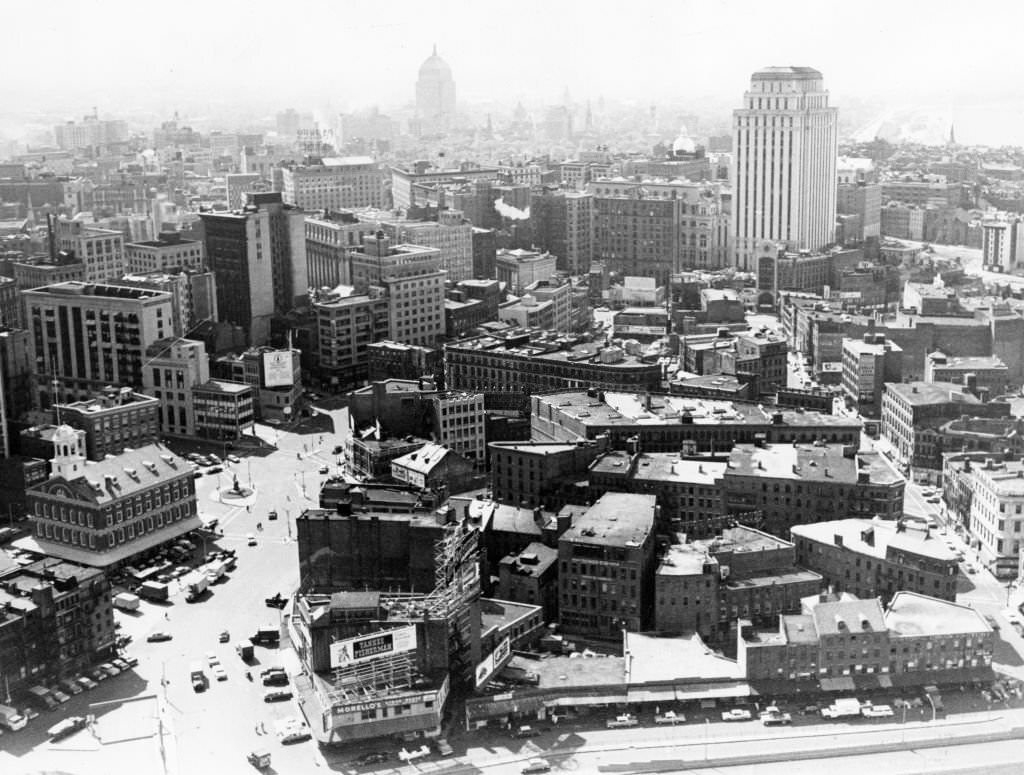
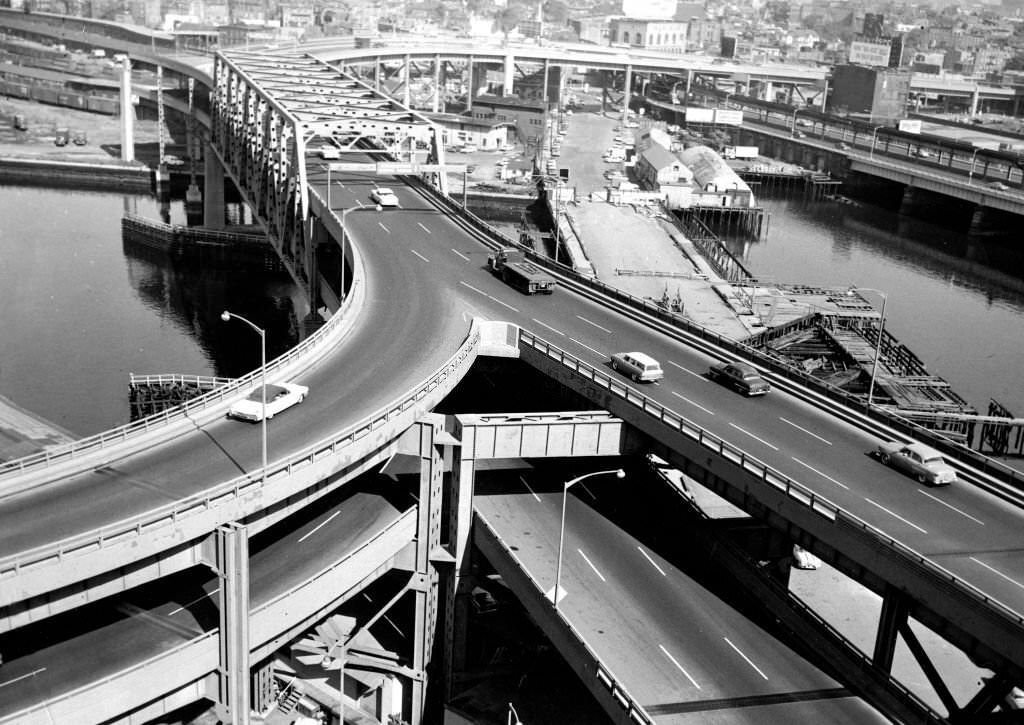
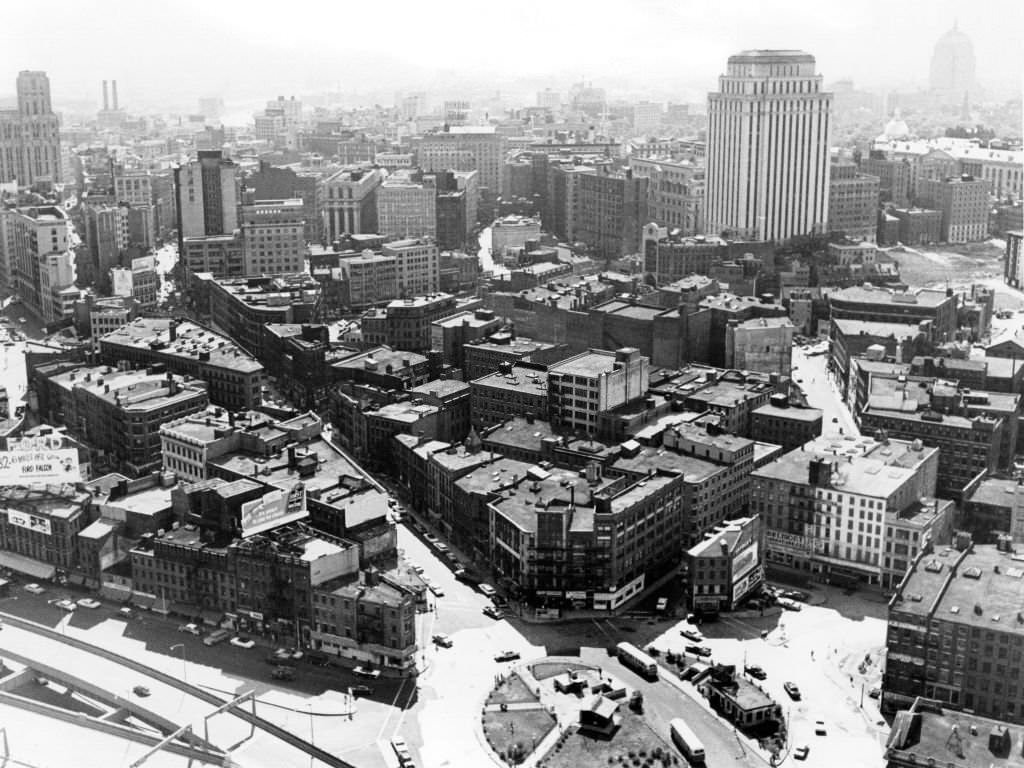
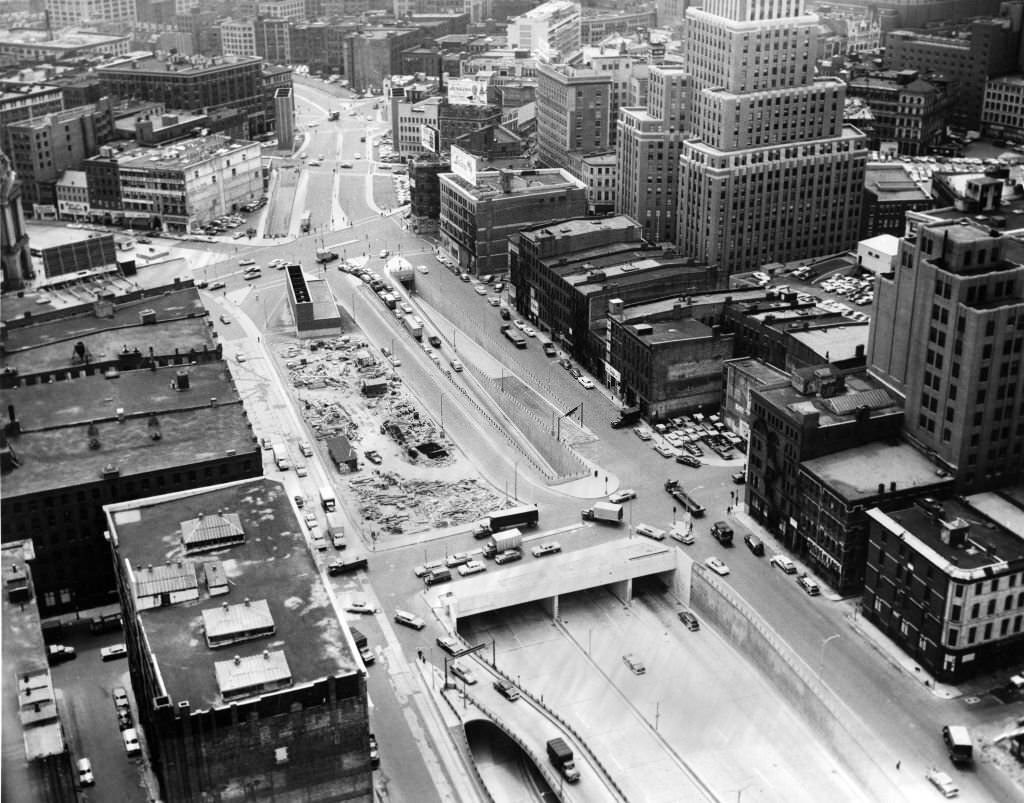
The Government Center project was one of the decade’s most sweeping urban renewal efforts. Aerial views from 1961 show the scale of what was planned — and what was already being cleared — in the heart of downtown Boston.
An aerial view of the Government Center area of Boston, 1961.An aerial view of the central artery from where the ramp from Storrow Drive joins it in Boston, Sept. 28, 1961.An aerial view of the Government Center area of Boston, Sept. 26, 1961.The Arlington Street Church in Boston, 1961.
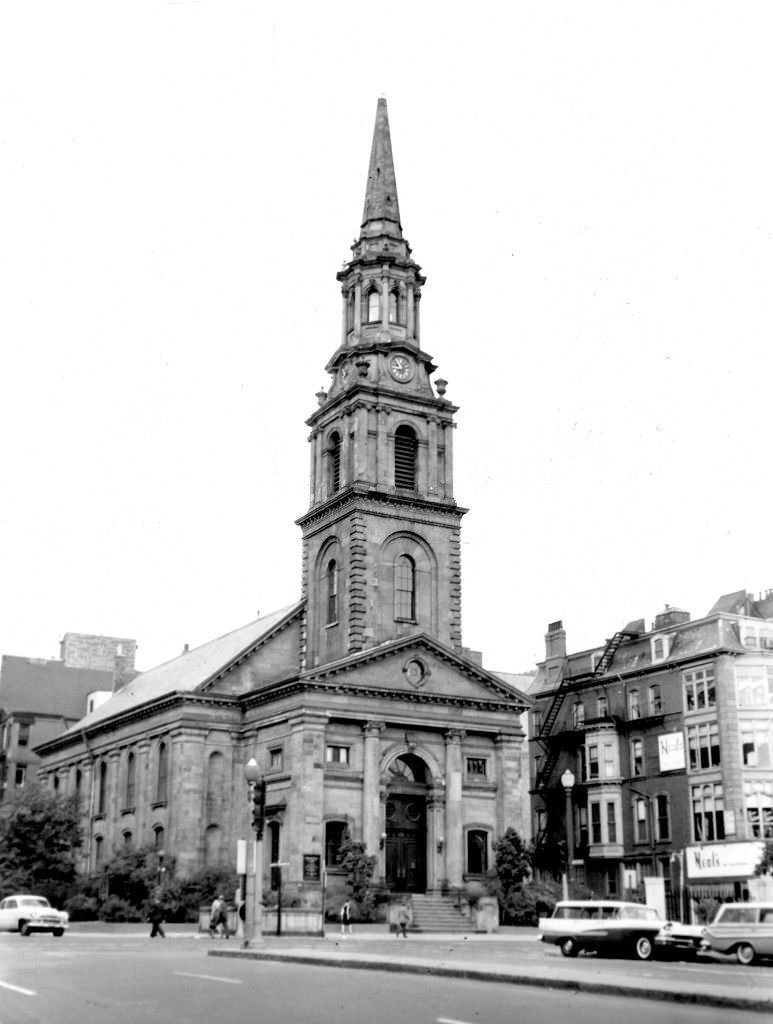
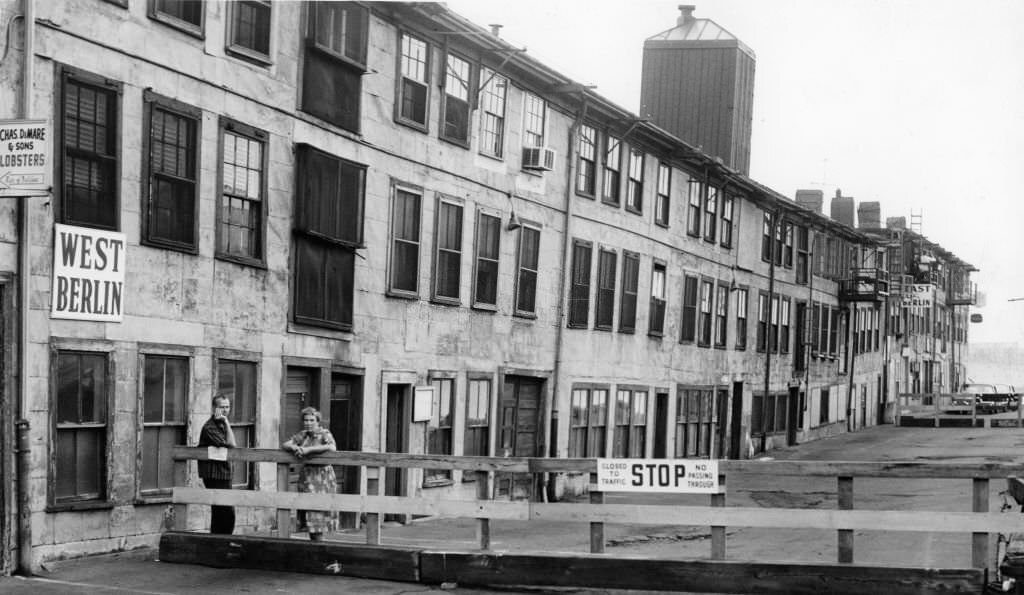
T Wharf, a historic pier on the Boston waterfront, was also changing in 1961. A new fence had gone up, and residents were adjusting to the latest round of changes along the harbor.
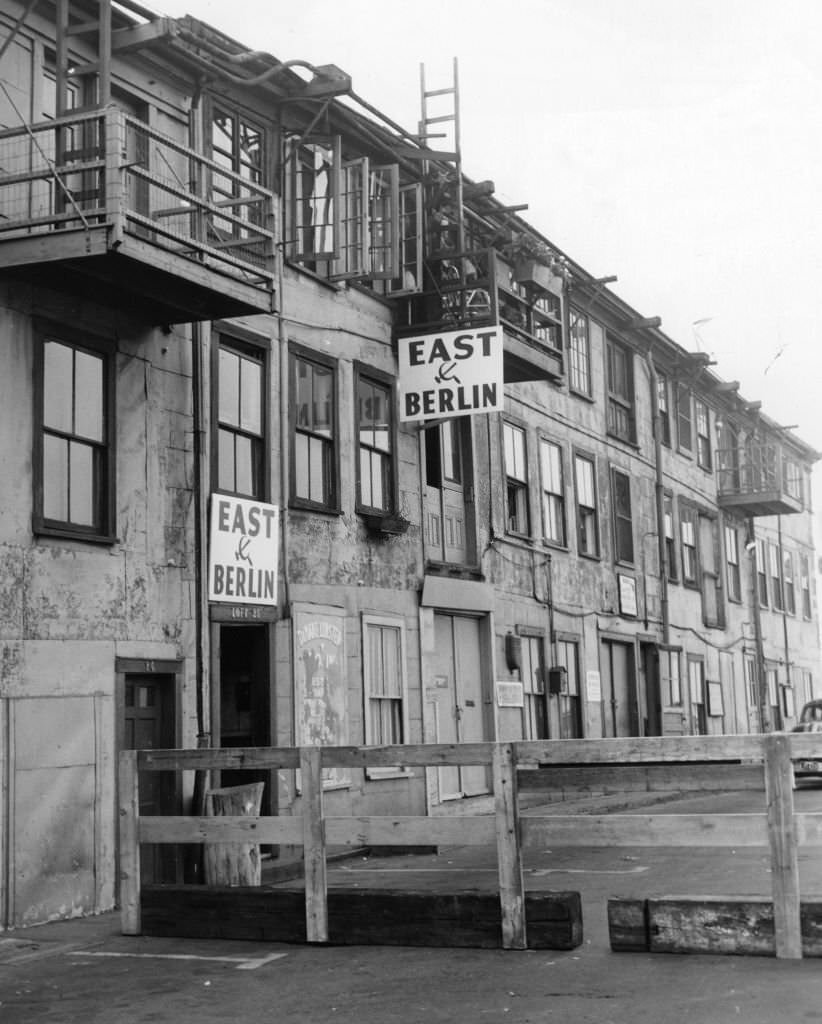
J.W.S. Cox, left, and Ms. Helen Sherman, right, lean on a new fence put up at the T Wharf in Boston, Sept. 5, 1961.Signs hang on buildings in the T Wharf in Boston, Sept. 1, 1961.
In Boston’s South End, building inspectors condemned Our Lady of Cedars of Lebanon Church on Shawmut Avenue in August 1961. Workers were called in to raze the upper portion of the structure. During the reconstruction period, Syro-Maronite services moved to the Cathedral of Holy Cross. When the work was complete, the church would operate as a one-story building using the existing lower chapel.
Workmen raze the upper portion of Our Lady of Cedars of Lebanon Church on Shawmut Avenue in Boston’s South End after it wads condemned by building inspectors on Aug. 29, 1961.
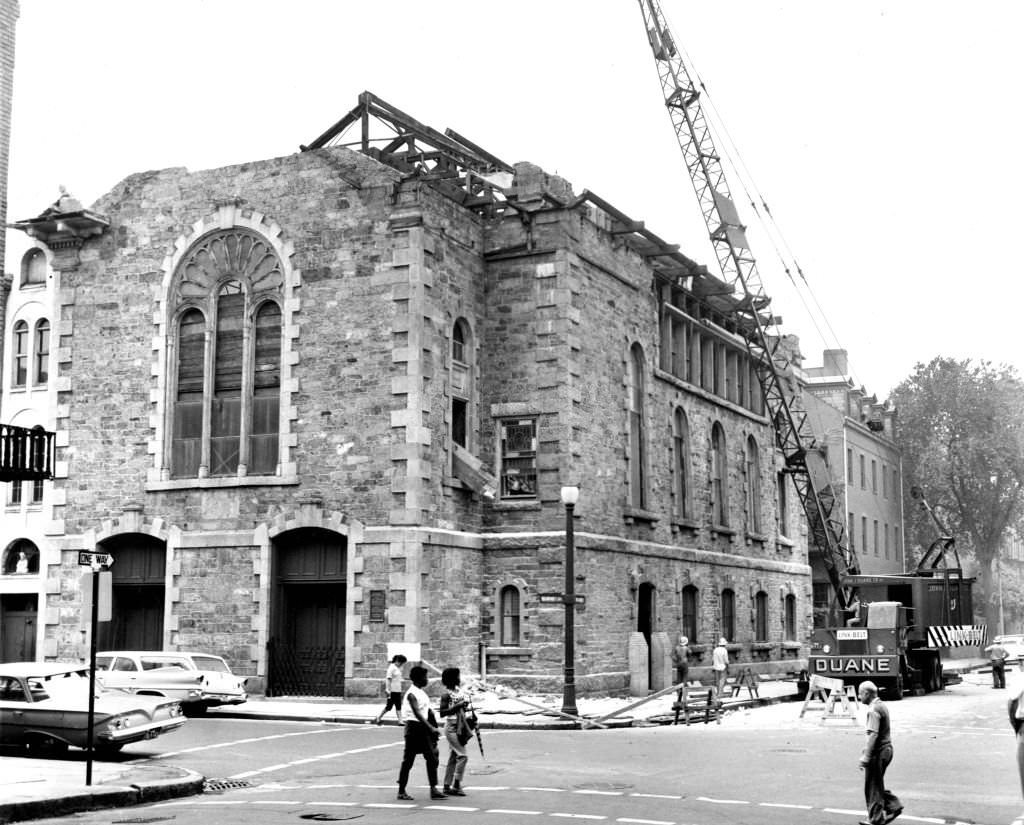
The West End, once a dense working-class neighborhood, was largely demolished in the late 1950s to make way for urban renewal. By August 1961, the Charles River Park apartment complex was rising from its ruins.
The Charles River Park apartment complex in Boston’s West End under construction in August 1961.The entrance to the Sumner Tunnel in Boston, 1961.
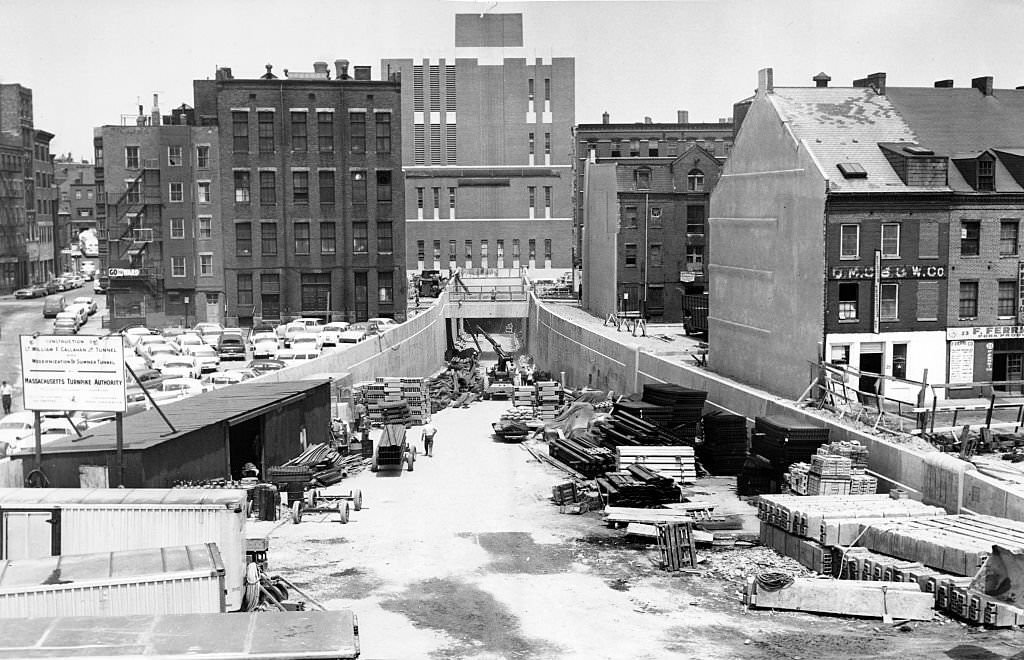
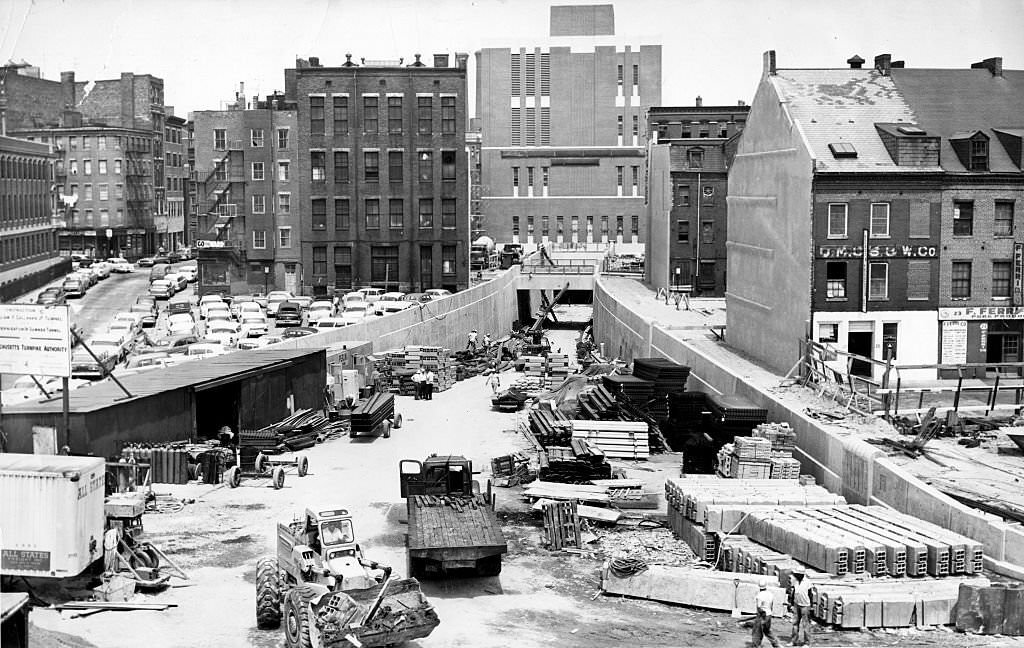
The Callahan Tunnel, the second vehicular tunnel under the harbor, was finished in November 1961. Before it opened, construction crews worked around the ramp approach from Cross Street, with a new 118-foot-tall red brick ventilation building towering over the tunnel portal.
Construction surrounds the Boston approach to the second East Boston tunnel, later known as the Lieutenant William F. Callahan Jr. Tunnel, on July 13, 1961.Men, machines, and material clutter the ramp leading to the new under-harbor crossing, the Callahan Tunnel, seen from Cross Street in Boston on July 13, 1961.The intersection of Commonwealth Avenue and Chestnut Hill Avenue in Brighton, June 30, 1961.
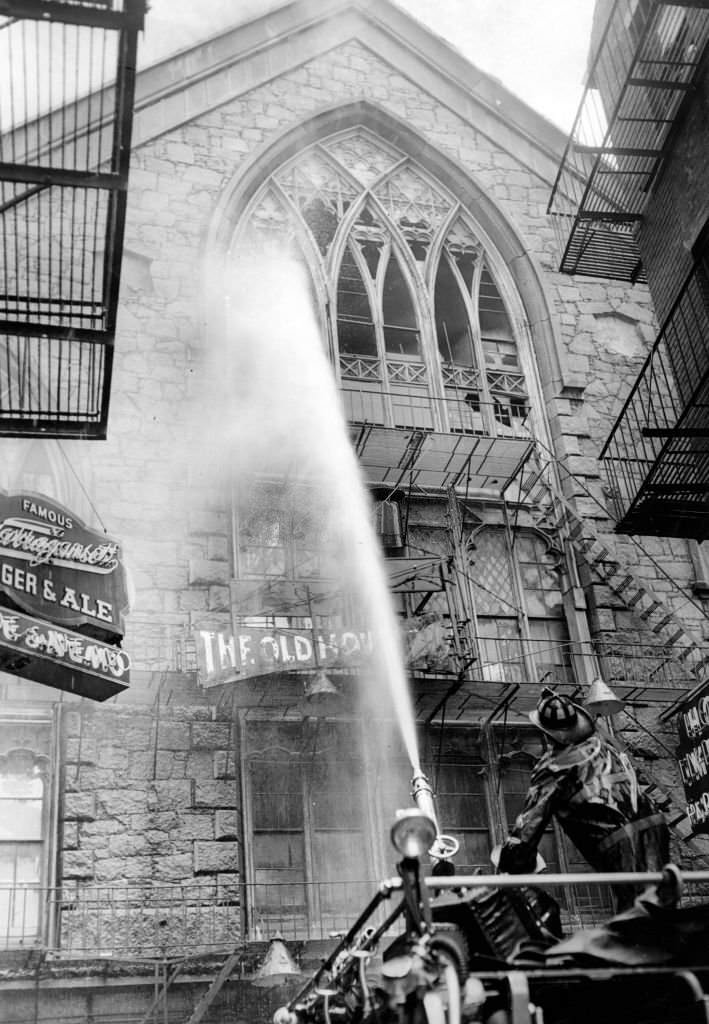
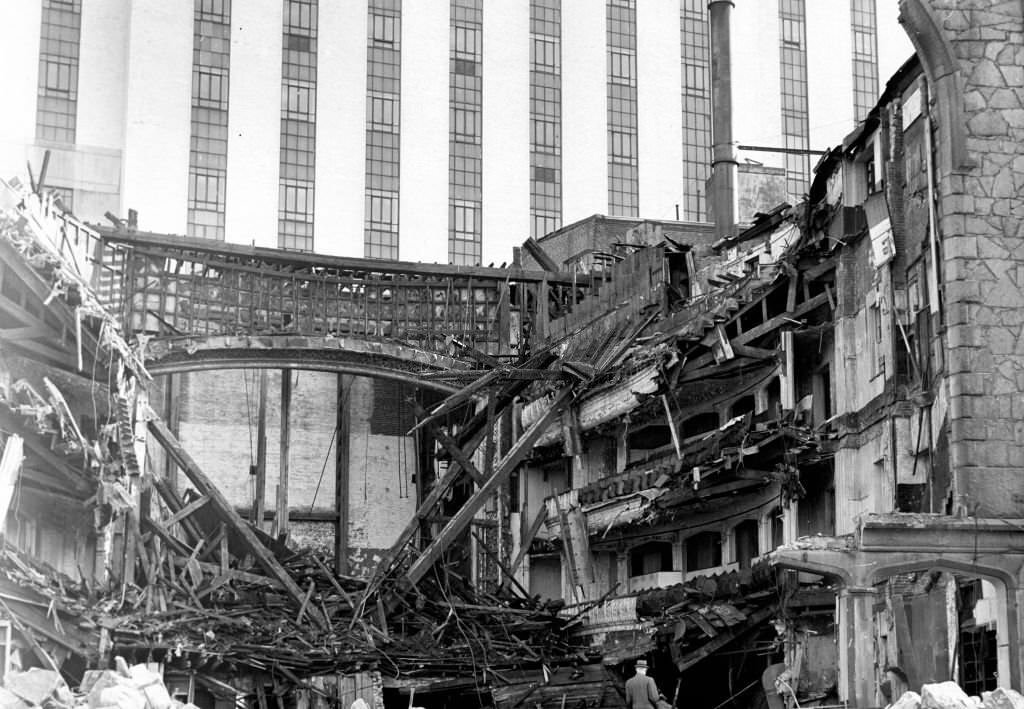
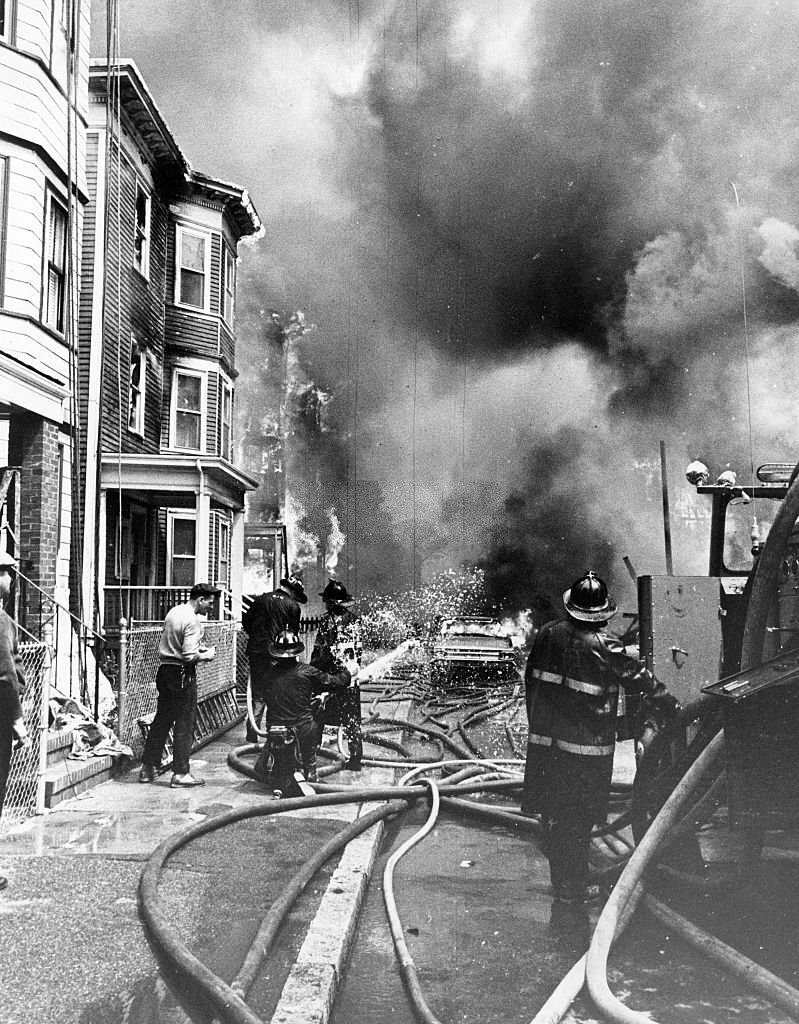
The Old Howard Theatre in Boston’s Scollay Square had been shuttered for years before it caught fire in June 1961. Firefighters battled a blaze through the night, and afterward city officials ordered the remains of the structure demolished.
Firefighters battle a blaze at the shuttered Old Howard Theatre in Boston on June 20, 1961.The burned remains of the Old Howard Theatre in Boston, June 1961.
The Clarendon Street Baptist Church in the South End faced its own crisis in 1961. City officials ordered the building closed until its 150-foot steeple could be brought down — building inspectors said the masonry was bulging and the steeple was at risk of toppling onto the street.
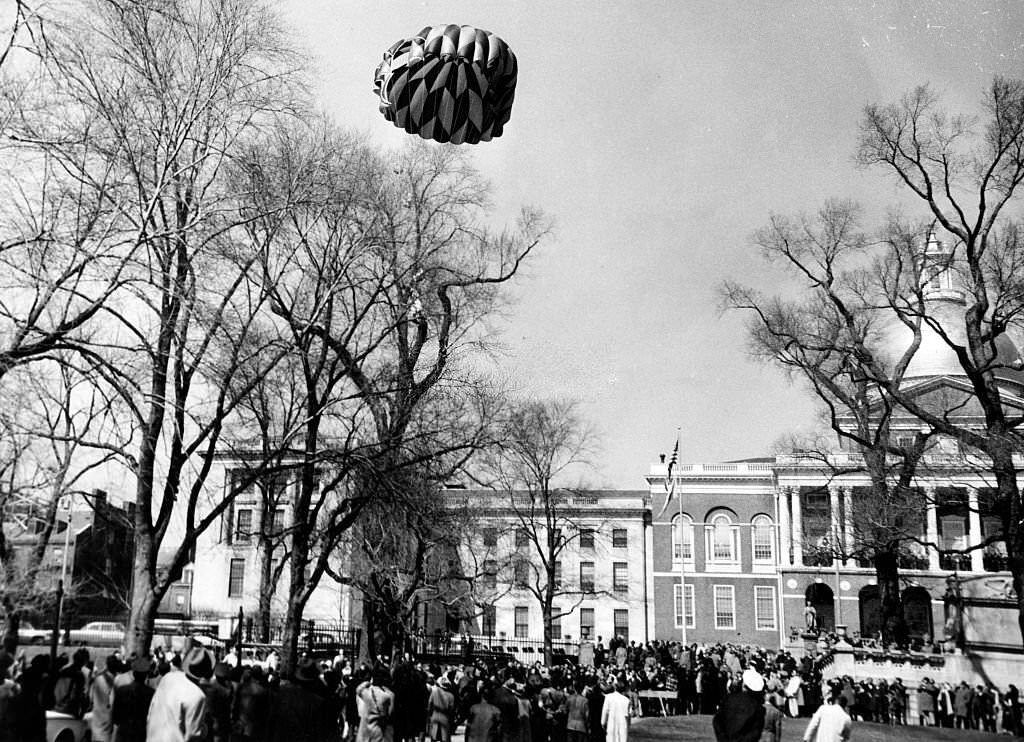
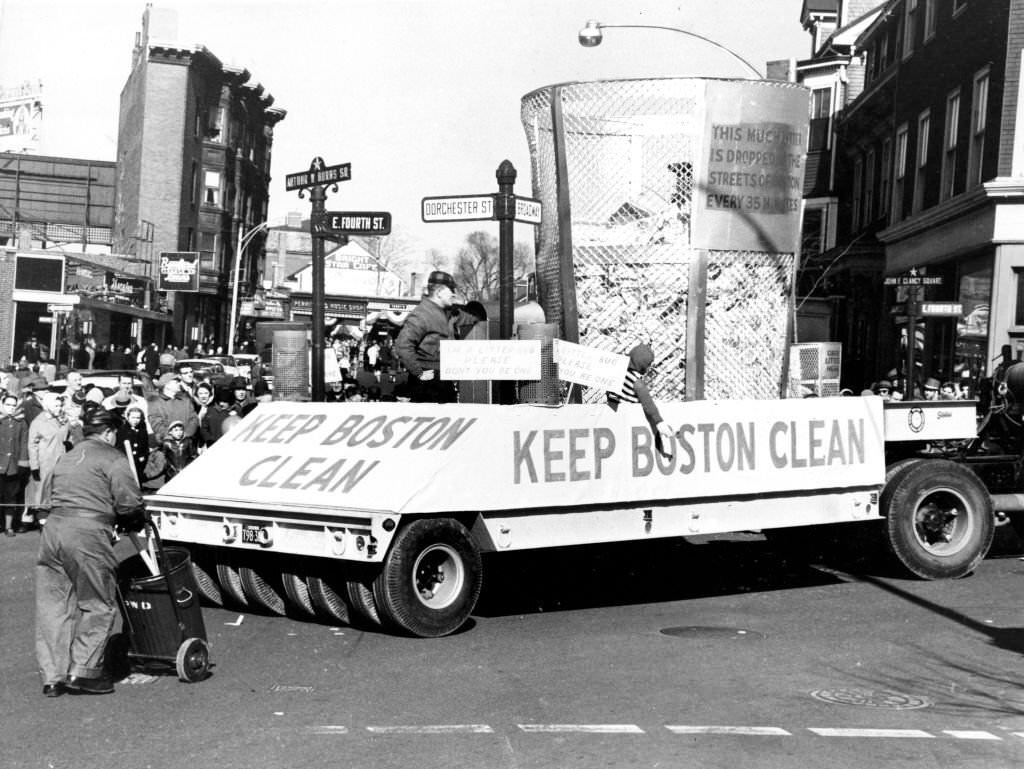
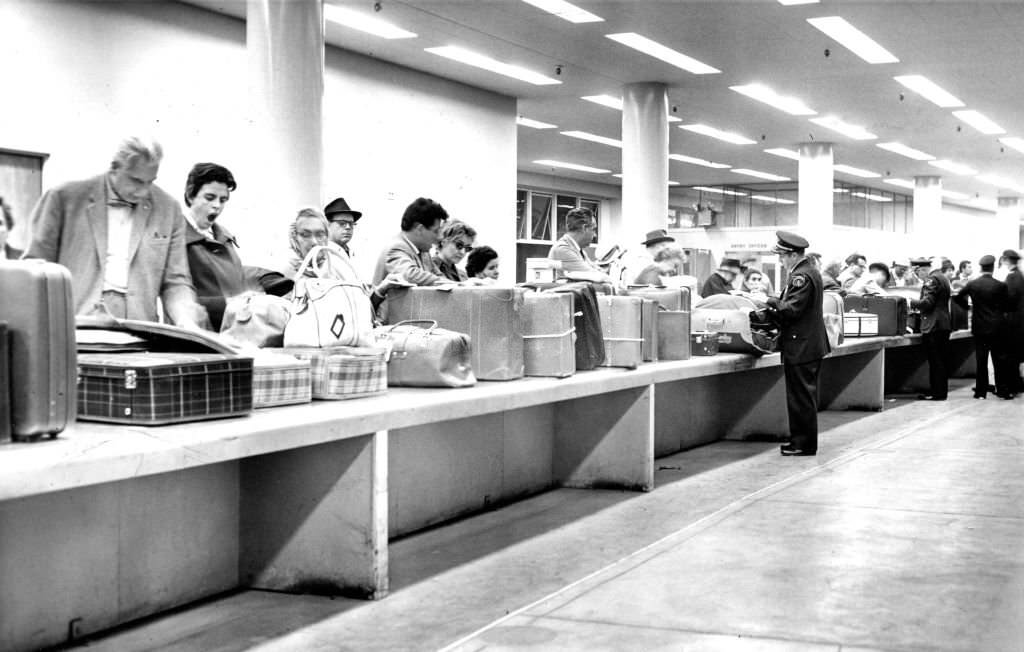
The Clarendon Street Baptist Church in Boston’s South End, 1961.A Department of Public Works “Keep Boston Clean” float in the St. Patrick’s Day parade on Mar. 17, 1961.A parachutist floats down after jumping from an airplane over Boston Common on March 21, 1961.Airline passengers from overseas wait to be cleared by the U.S. Customs Department at Logan Airport in Boston on May 1, 1961.
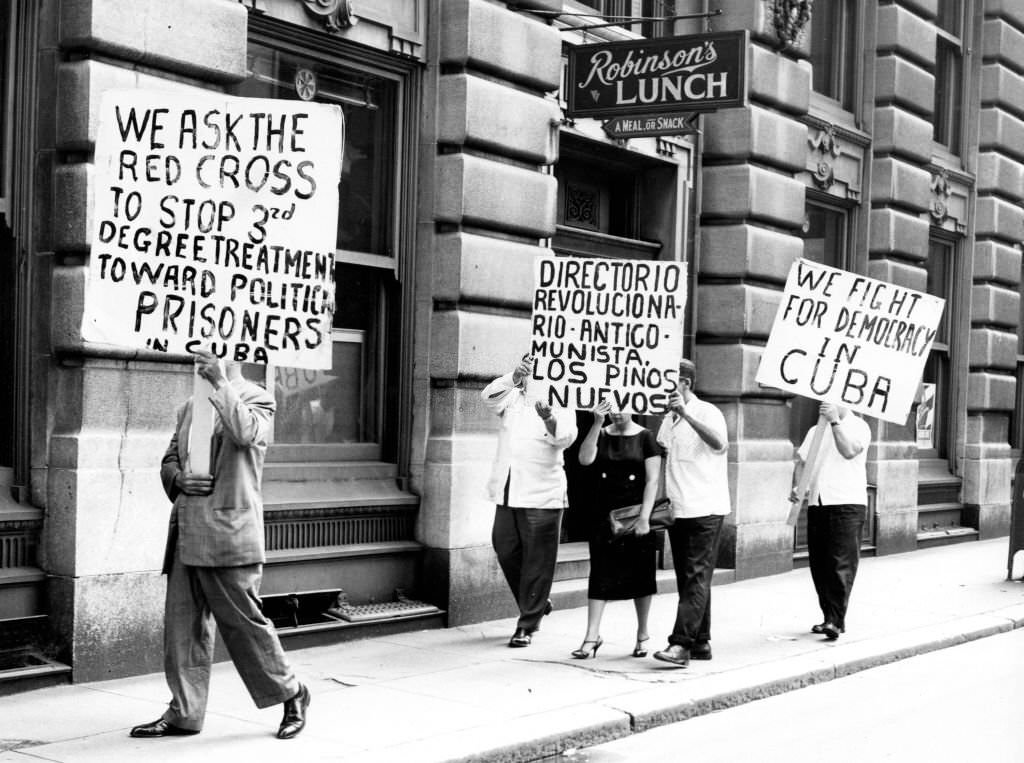
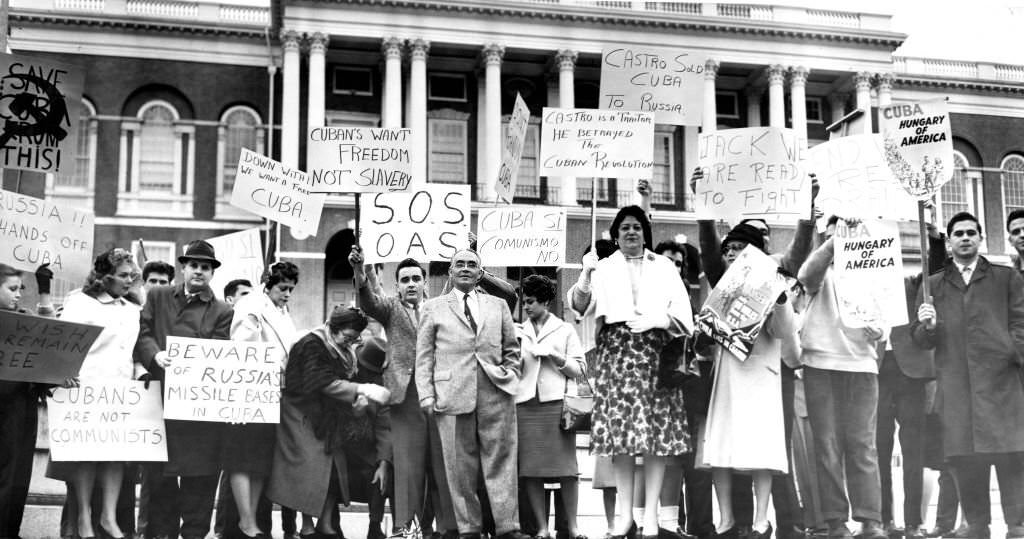
Cuba loomed large in Boston’s public life throughout the early 1960s. In April 1961, demonstrators gathered in front of the State House to protest Cuban Prime Minister Fidel Castro, just days after the failed Bay of Pigs invasion.
Demonstrators hold signs during a protest against Cuban Prime Minister Fidel Castro in front of the Massachusetts State House in Boston on April 23, 1961.
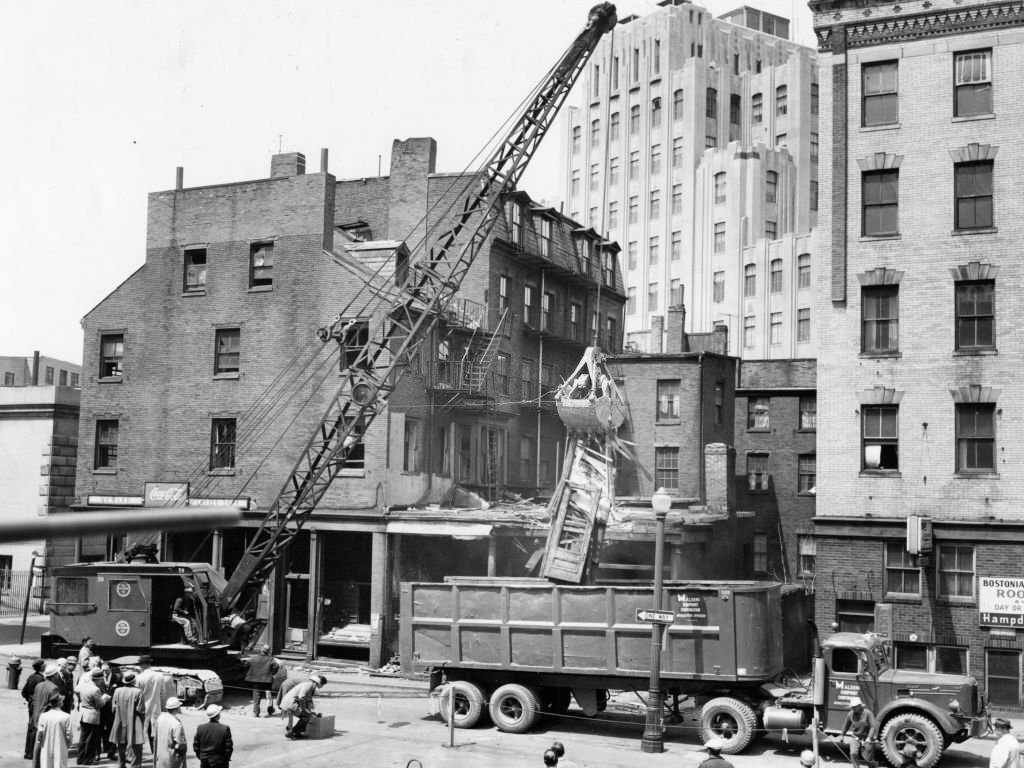
The Government Center project required tearing down entire blocks of old Boston. Buildings on Howard Street came down in May 1961 to clear the land, a process that displaced businesses and erased streets that had existed for over a century.
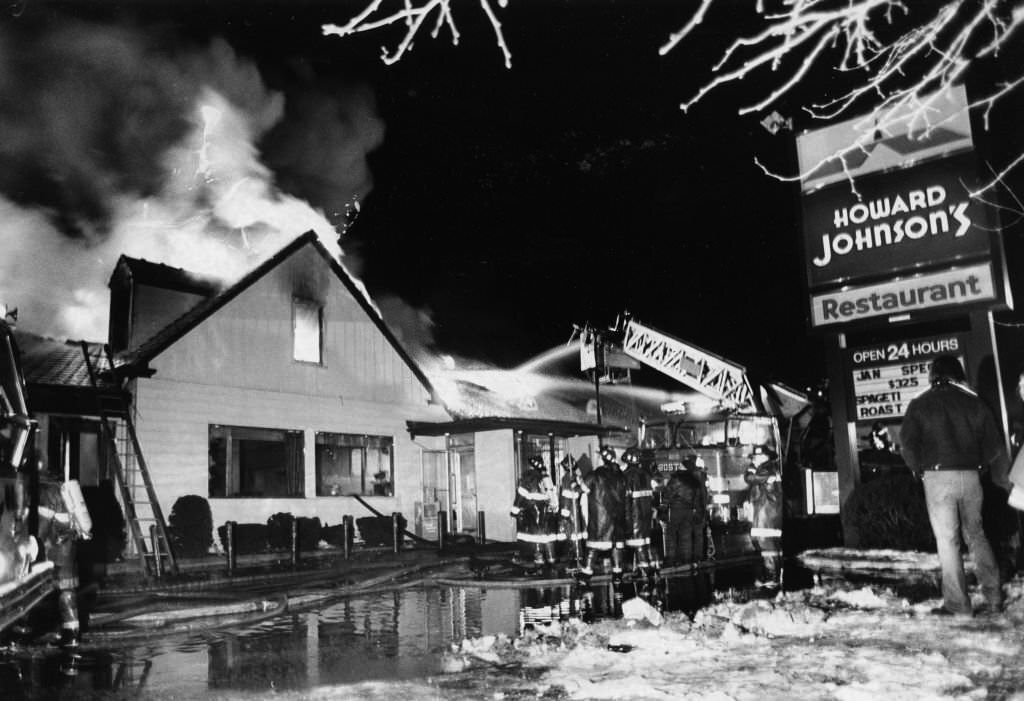
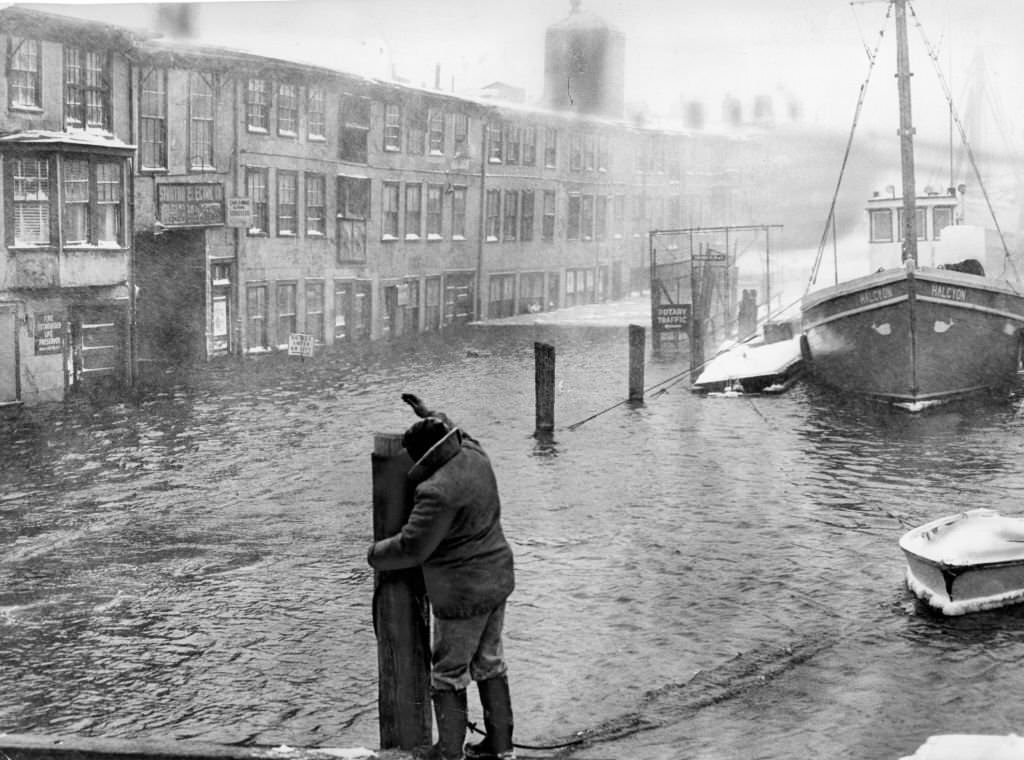
Buildings on Howard Street are demolished to make room for Government Center in Boston on May 11, 1961.Snow on Chestnut Street in Boston on Feb. 6, 1961.Firefighters battle a three-alarm fire at the Howard Johnson’s hotel on Morrissey Boulevard in Boston, Jan. 25, 1961.Few people shop on Boston’s Washington Street on Jan. 21, 1961. (Photo by William Ennis/The Boston Globe via Getty Images)A fisherman secures a boat at T Wharf in Boston as tidal waters flood nearby houses on Jan. 20, 1961.
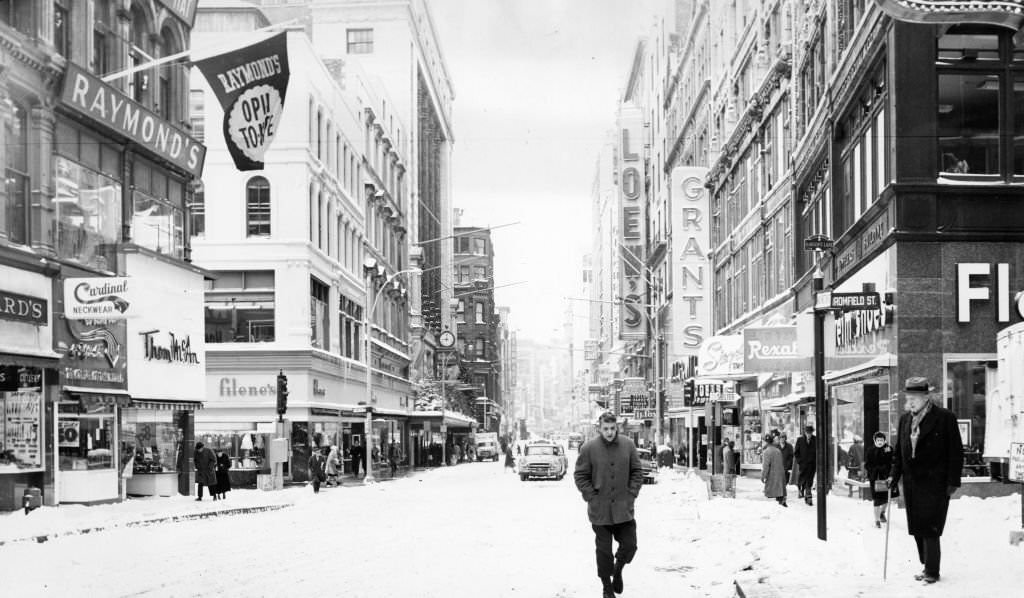
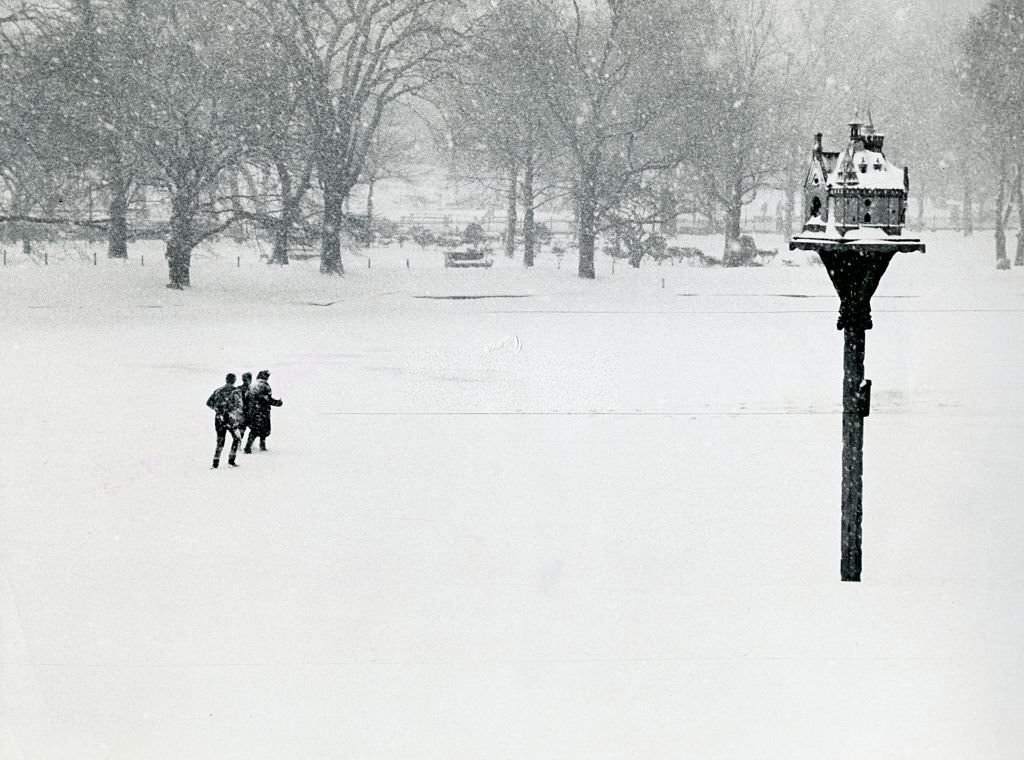
January 1961 brought heavy snowfall to Boston. A near-record 12.2 inches fell, burying Tremont Street and pushing city crews to work around the clock to clear key shopping and transit corridors.
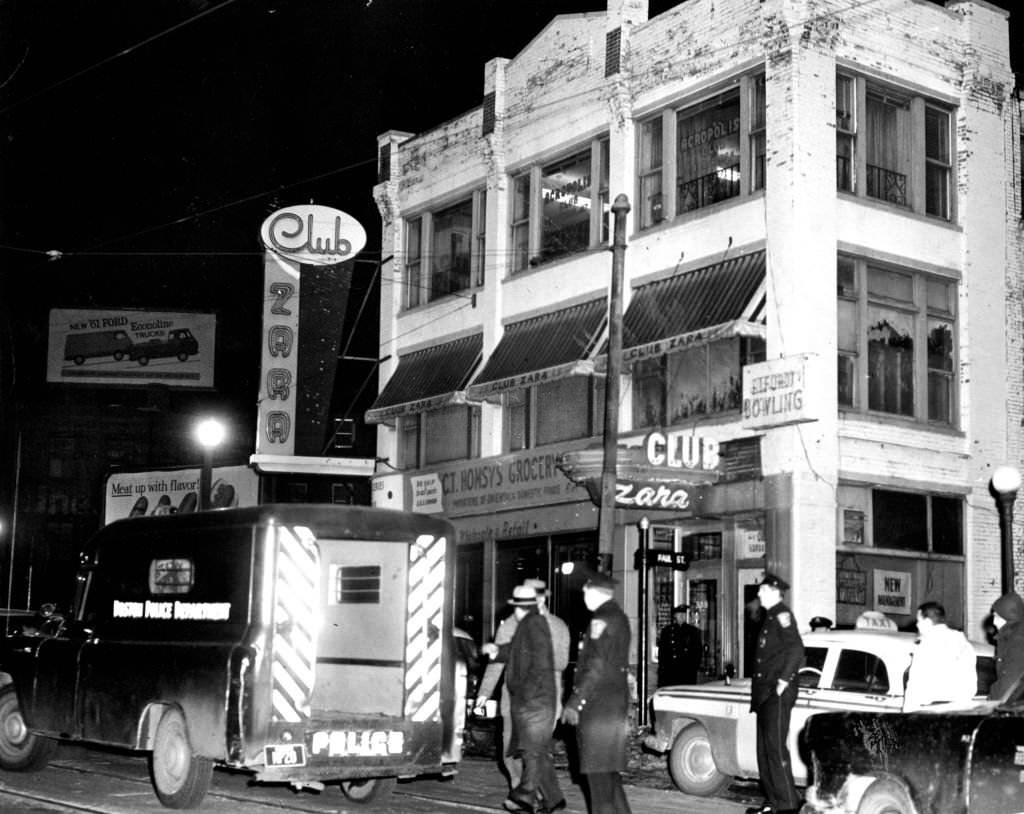
Tremont Street is covered in snow after a near-record 12.2 inches covered Boston on Jan. 19, 1961.The scene outside of a gambling raid at Club Zara on Tremont Street in Boston, 1961.People walk over the frozen lagoon in the Public Garden in Boston, 1961.
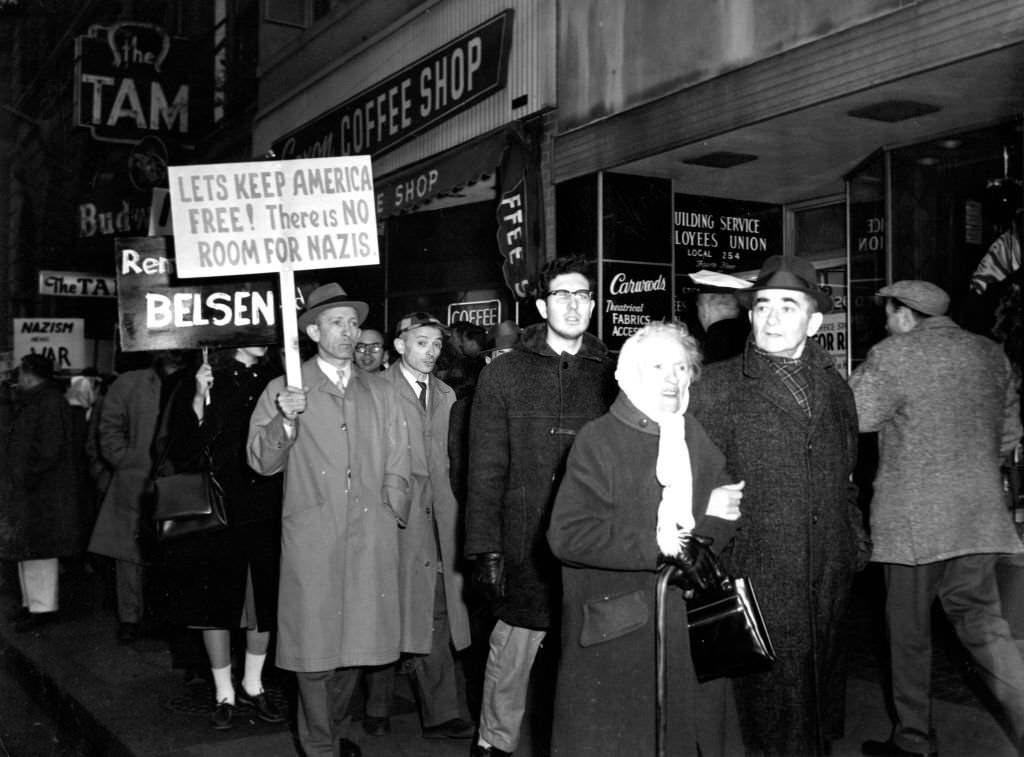
In 1961, Tremont Street was also the site of an anti-Nazi demonstration. The protesters were counter-demonstrating against American Nazi leader George Rockwell, who had organized a protest against the film “Exodus” playing at the Saxon Theater.
An anti-Nazi demonstration takes place on Tremont Street in Boston, 1961.
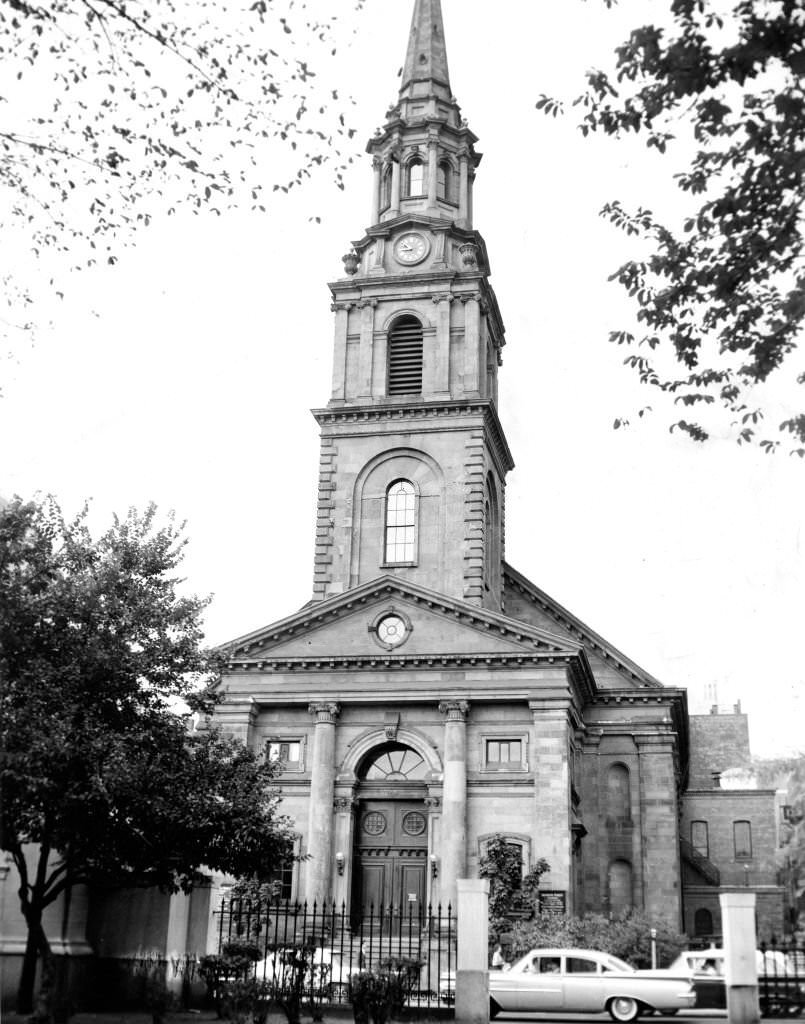
The Arlington Street Church in Boston, 1961.
State House in Boston, 1961.
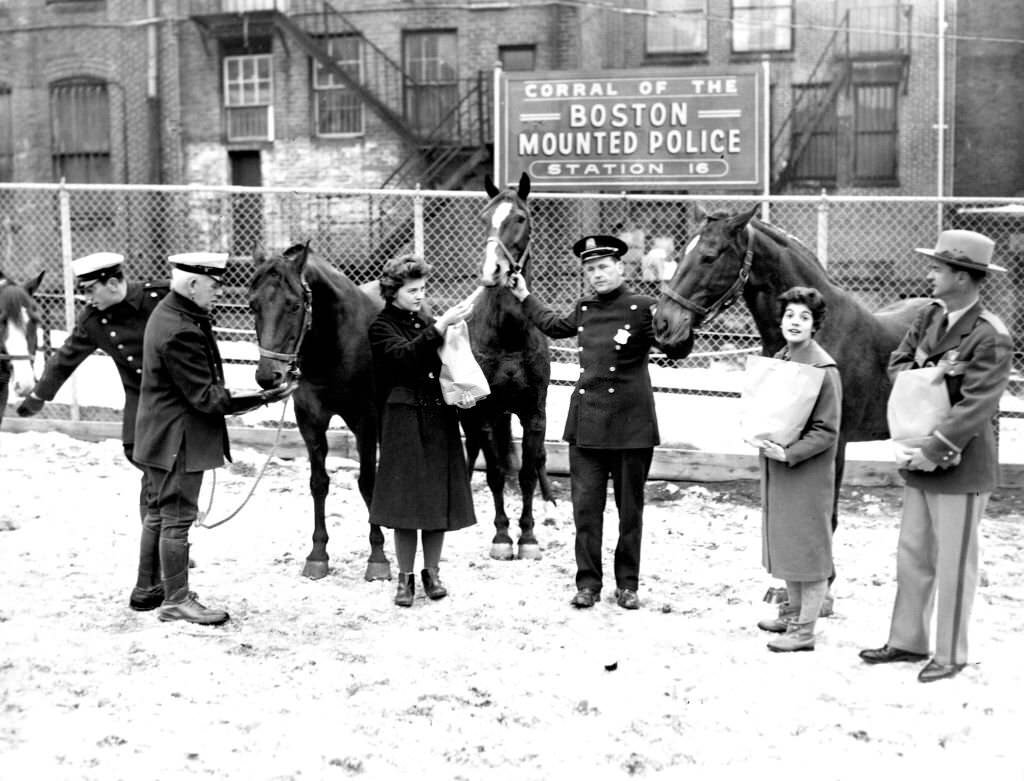
Boston’s police horses were well cared for in December 1960, when members of the Massachusetts Society for the Prevention of Cruelty to Animals paid a visit to Station 16. Officers Paul Simnotti and William B. Dooley, along with Sergeant John Lynch, met with MSPCA receptionists Collette Callanan and Diana DiMatteo and uniformed MSPCA officer Carl Bragner.
Members of the MSPCA visit Boston Police horses at Station 16 on Dec. 18, 1960.
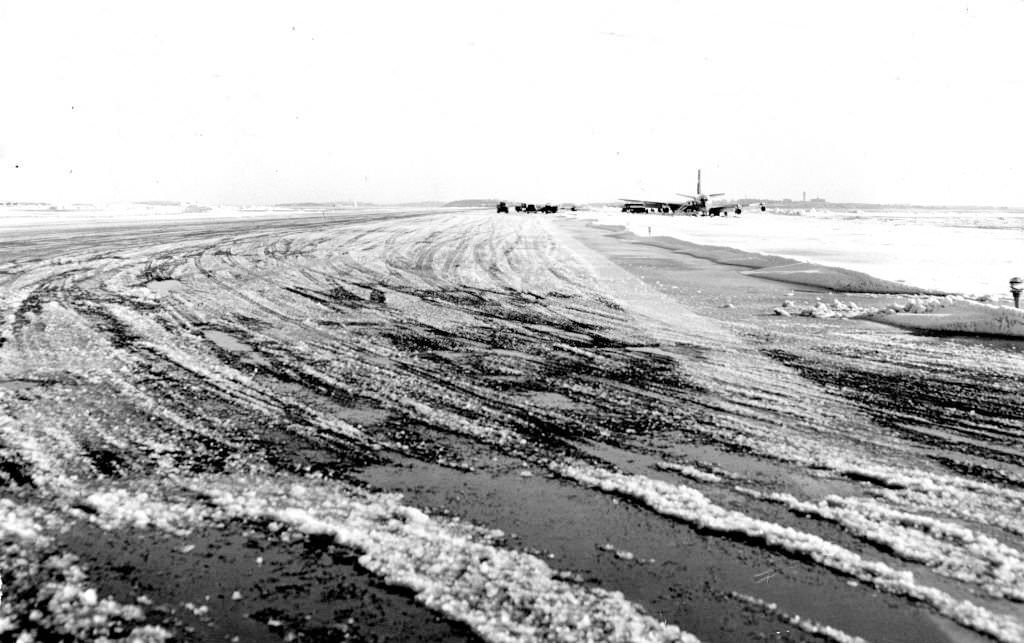
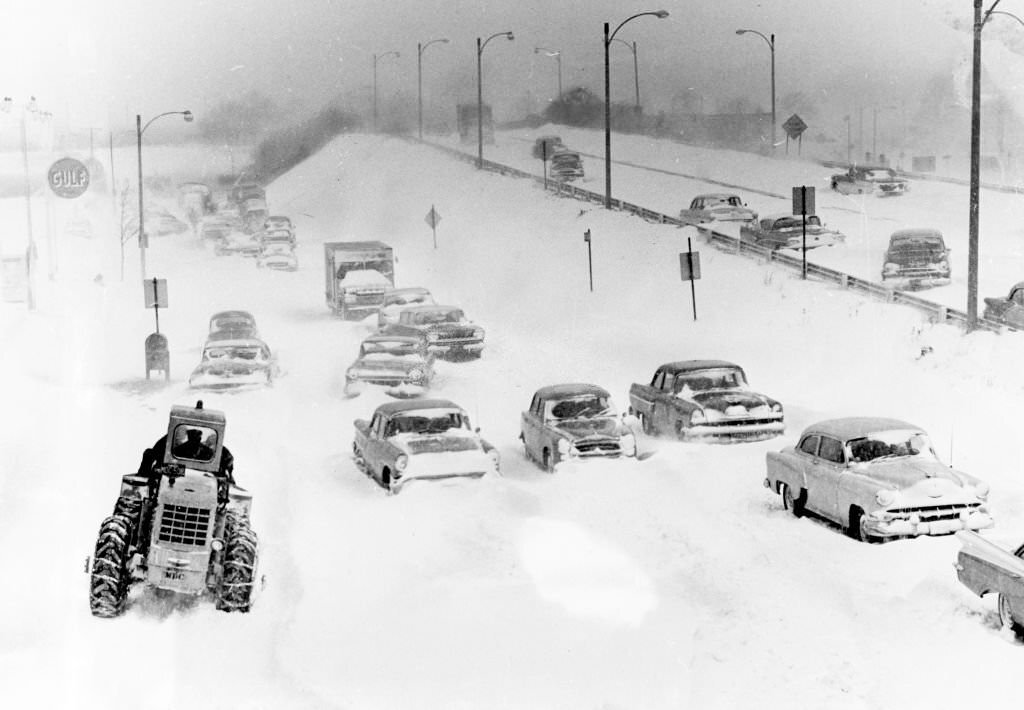
Logan Airport had its own winter drama in December 1960 when a jetliner veered off a snow-covered runway. Emergency crews moved in immediately to dig the plane out as onlookers watched from a distance.
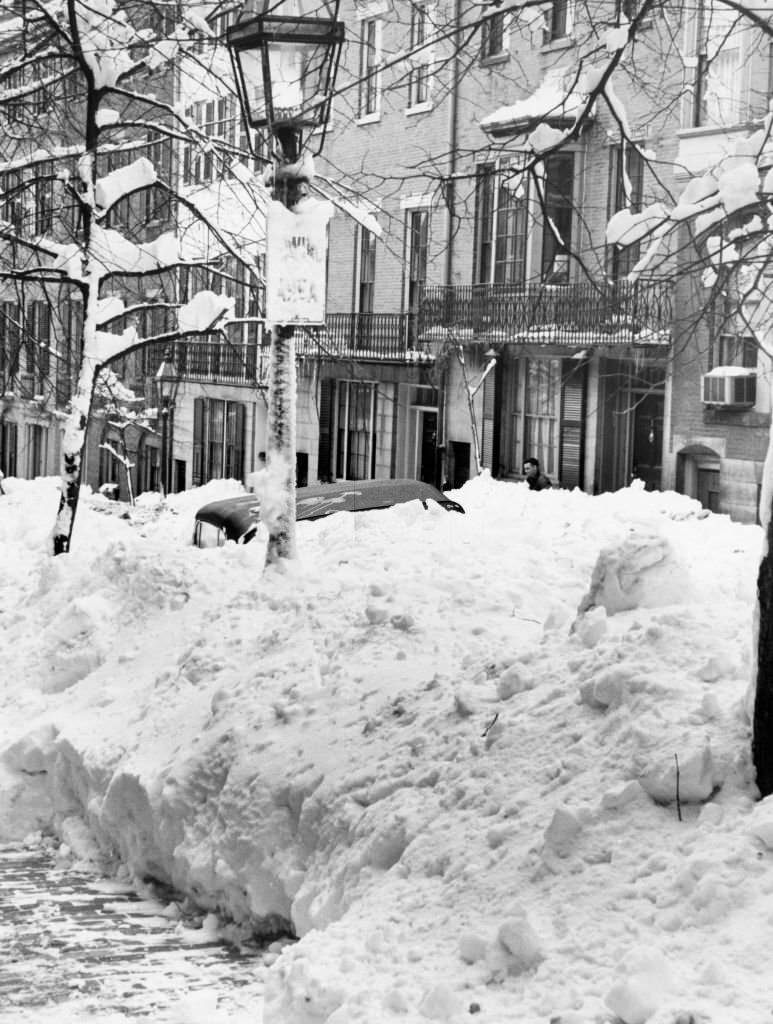
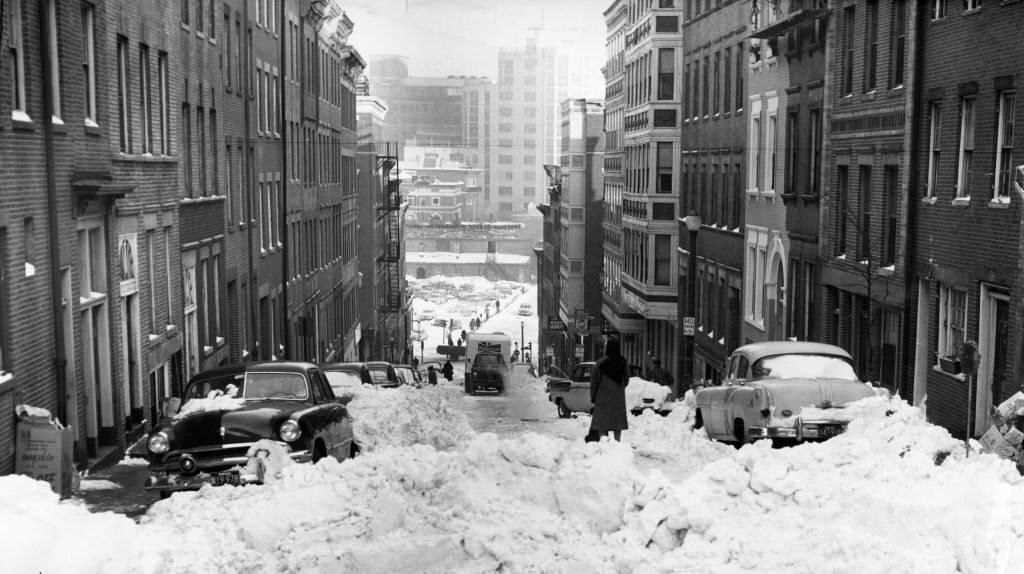
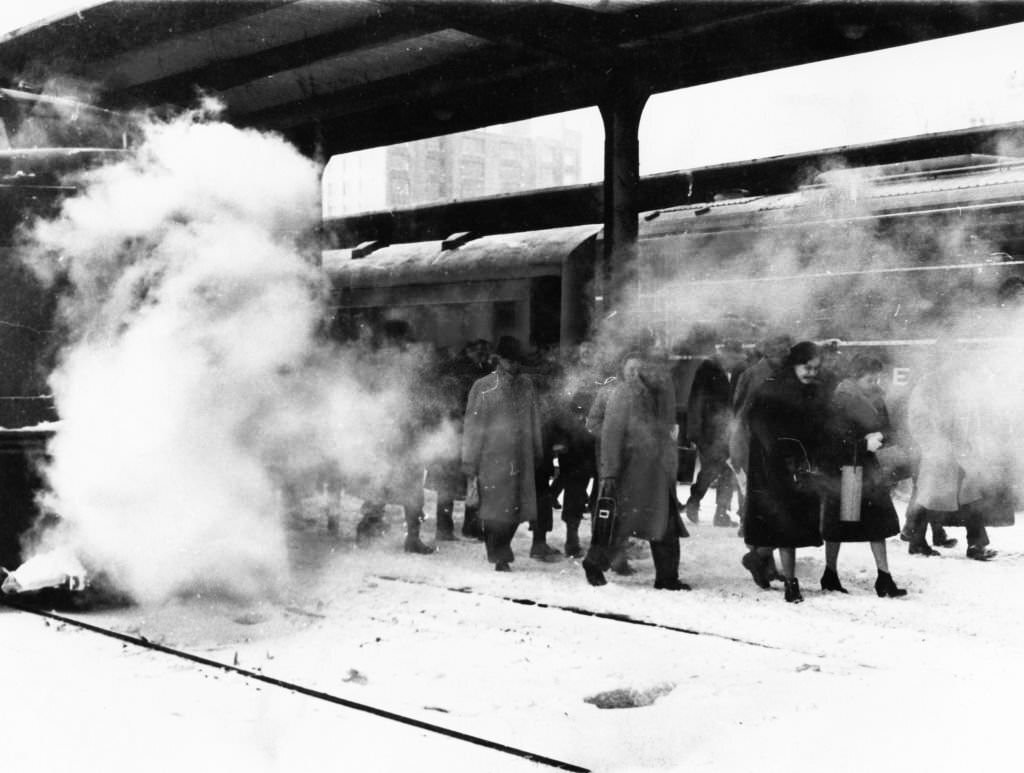
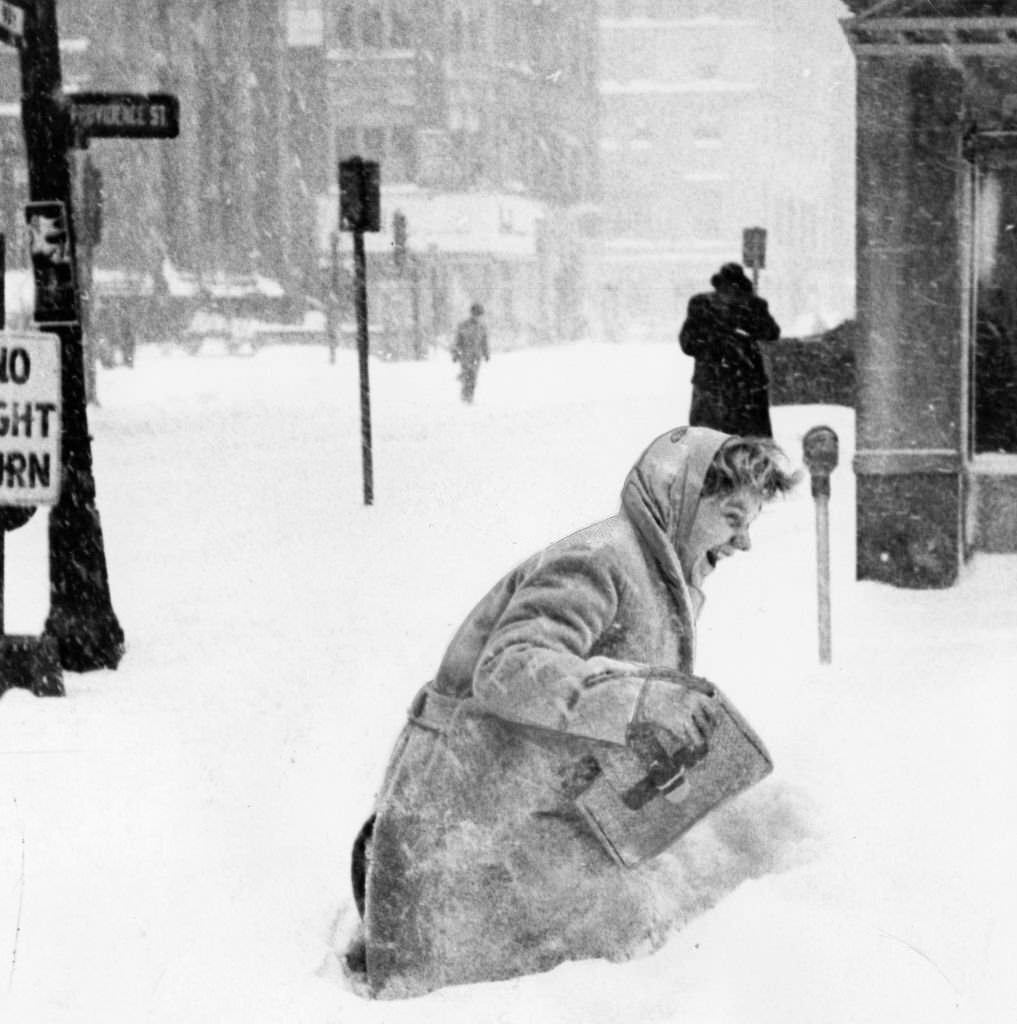
A snowy runway that a jetliner veered off of at Logan Airport in Boston on Dec. 17, 1960, as emergency crews work to shovel the plane out of the snow in background.Grove Street in Beacon Hill is covered in snow on Dec. 15, 1960.People on a train from Needham arrive at South Station in Boston on Dec. 13, 1960.People walk down a snow covered Washington Street in Boston on Dec. 13, 1960. Snow removal crews worked all night to make it easy to move through the shopping area.A girl wades through a snow drift in Park Square in Boston, 1960.Cars abandoned in the snow block the entrance to Morrissey Boulevard from Kosciuszko Circle in Boston at 3 p.m., 1960.
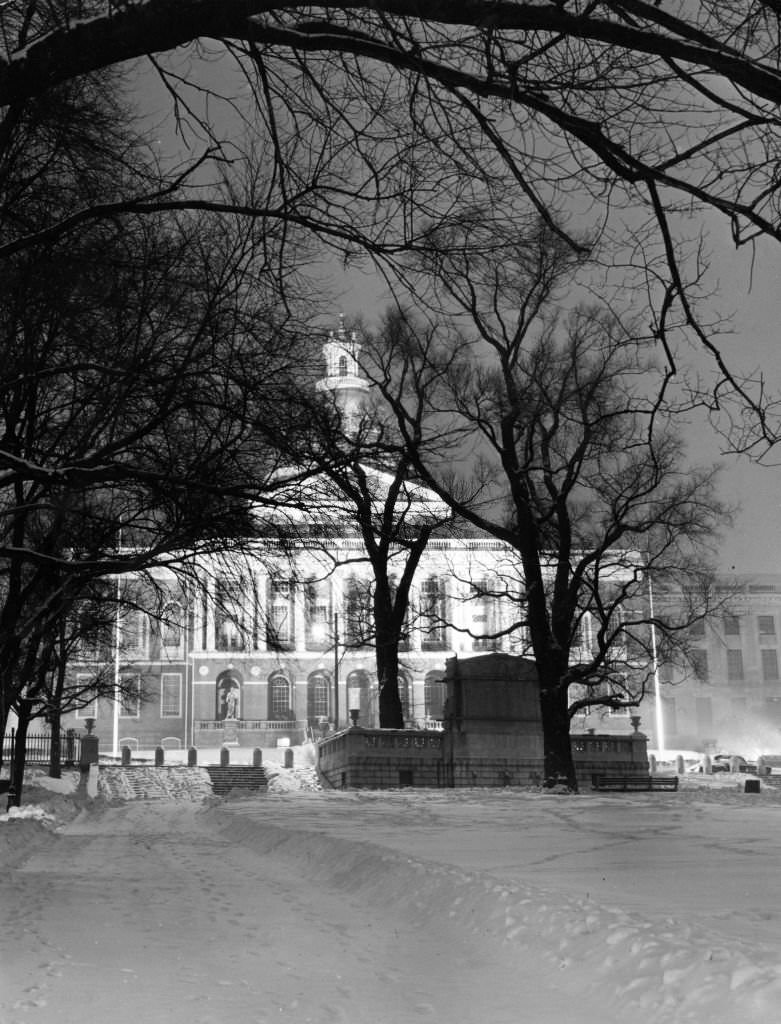
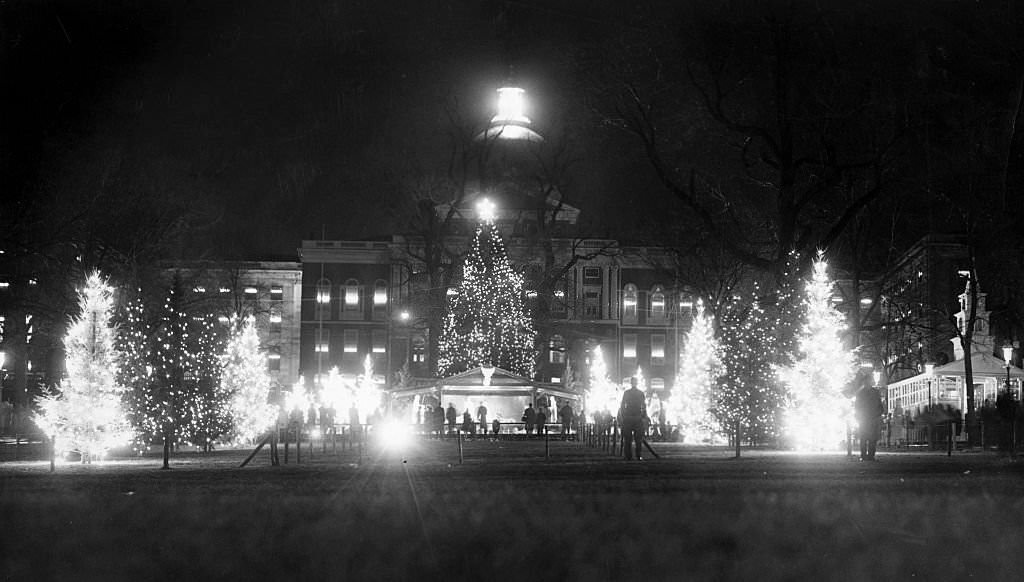
As the holidays approached in late November 1960, Boston Common glowed with Christmas festival lights strung through the trees, casting a bright backdrop against the gold dome of the State House.
Trees decorated with Christmas festival lights on Boston Common provide a fairyland foreground for the Mass. State House on Nov. 25, 1960. (Photo by Edmund Kelley/The Boston Globe via Getty Images)
In November 1960, the city launched a campaign to clear illegally parked cars in Beacon Hill. Joy Street, normally lined bumper-to-bumper, was empty for once — a rare sight in one of the city’s most densely packed neighborhoods.
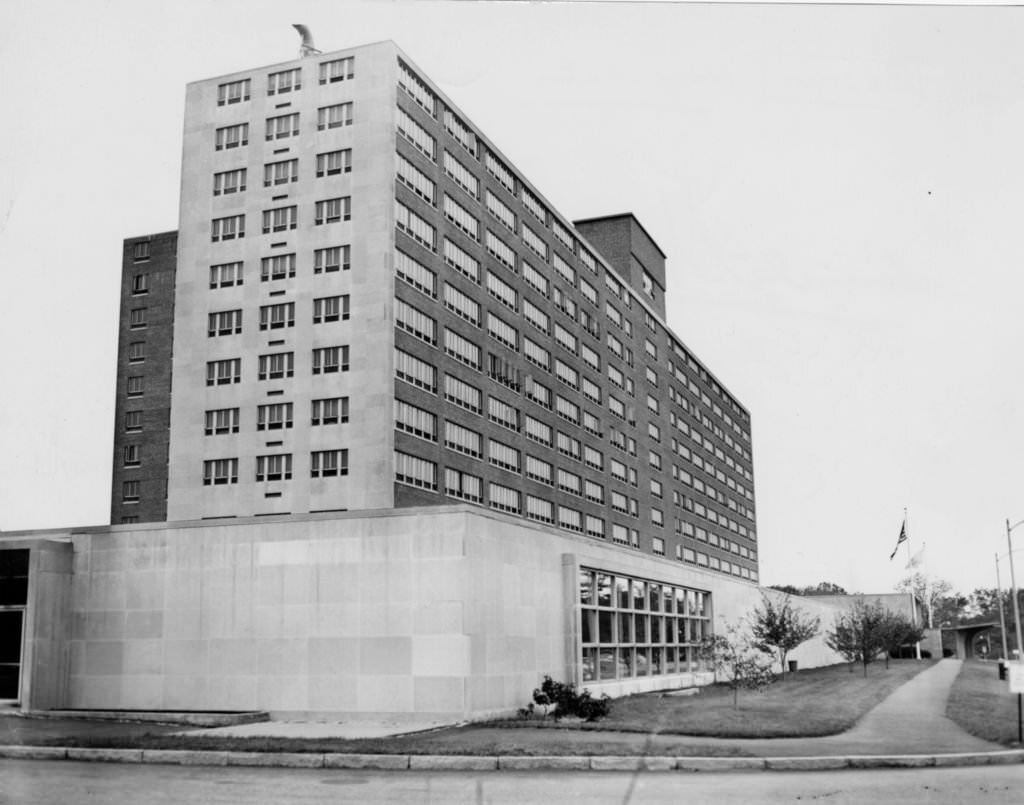
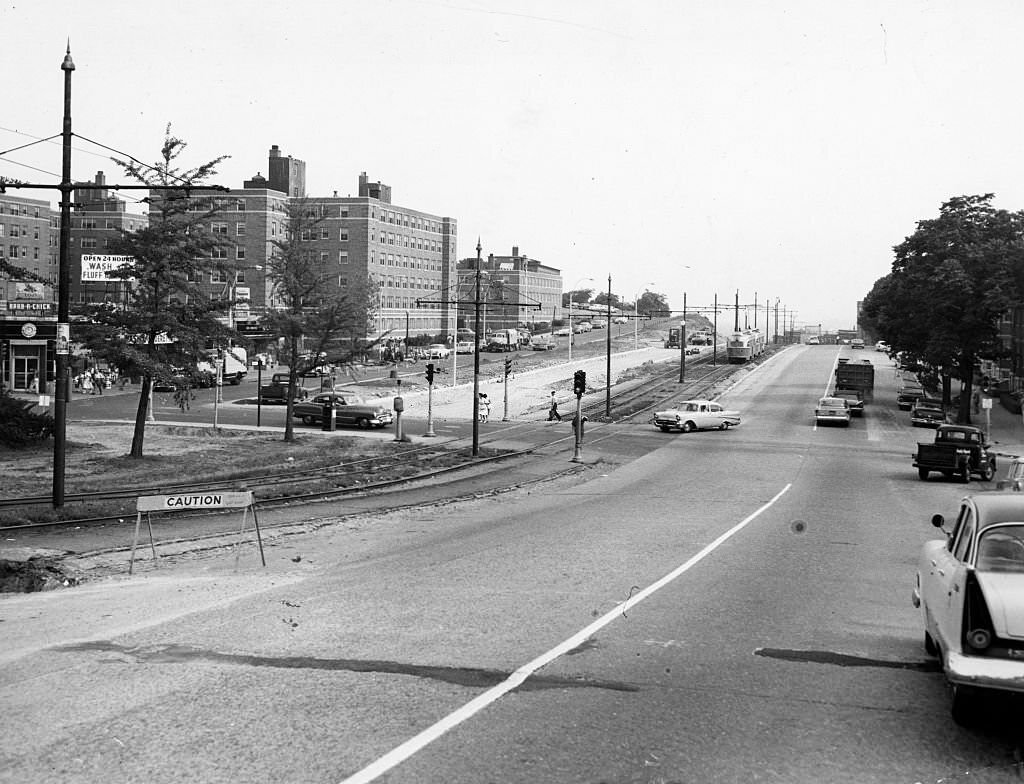
Joy Street in the Beacon Hill neighborhood of Boston free of parked cars in November 1960.The exterior of Lemuel Shattuck Memorial Hospital in Bostons Jamaica Plain on Oct. 10, 1960.Commonwealth Avenue in Boston, Aug. 31, 1960.
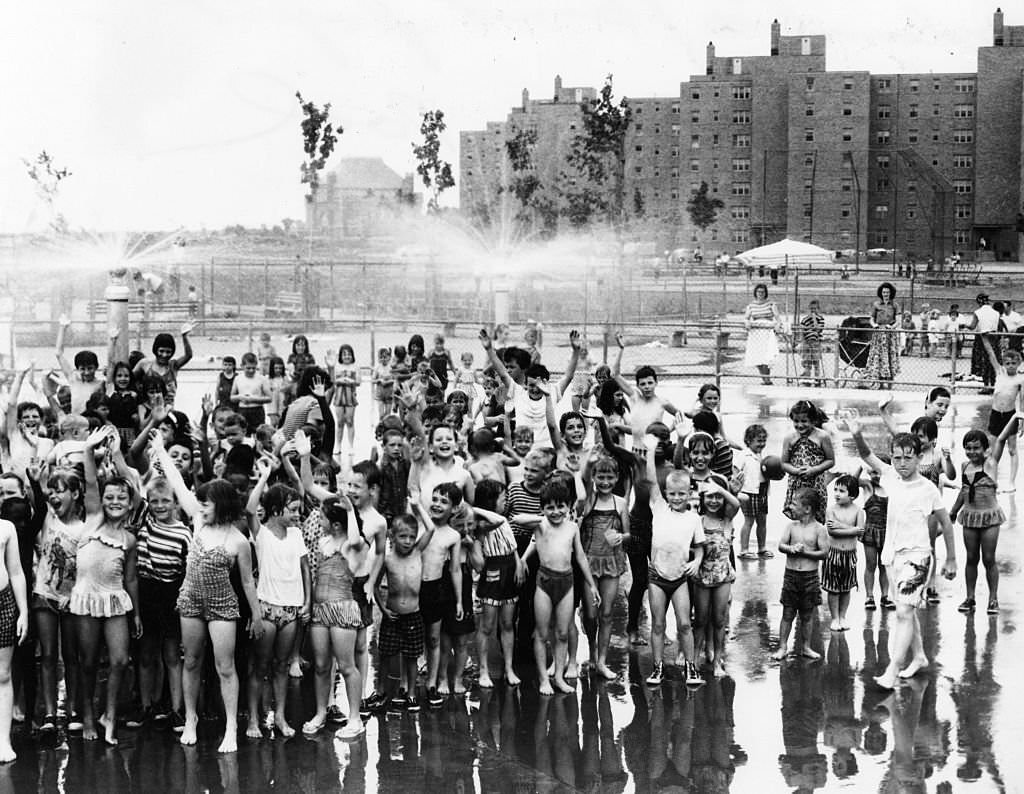
Life at Columbia Point in the summer of 1960 centered on the small pleasures available to residents. Children played in the spray pool, a concrete patch of relief during the warm months, while adults made do in a housing complex that sat far from the city’s resources.
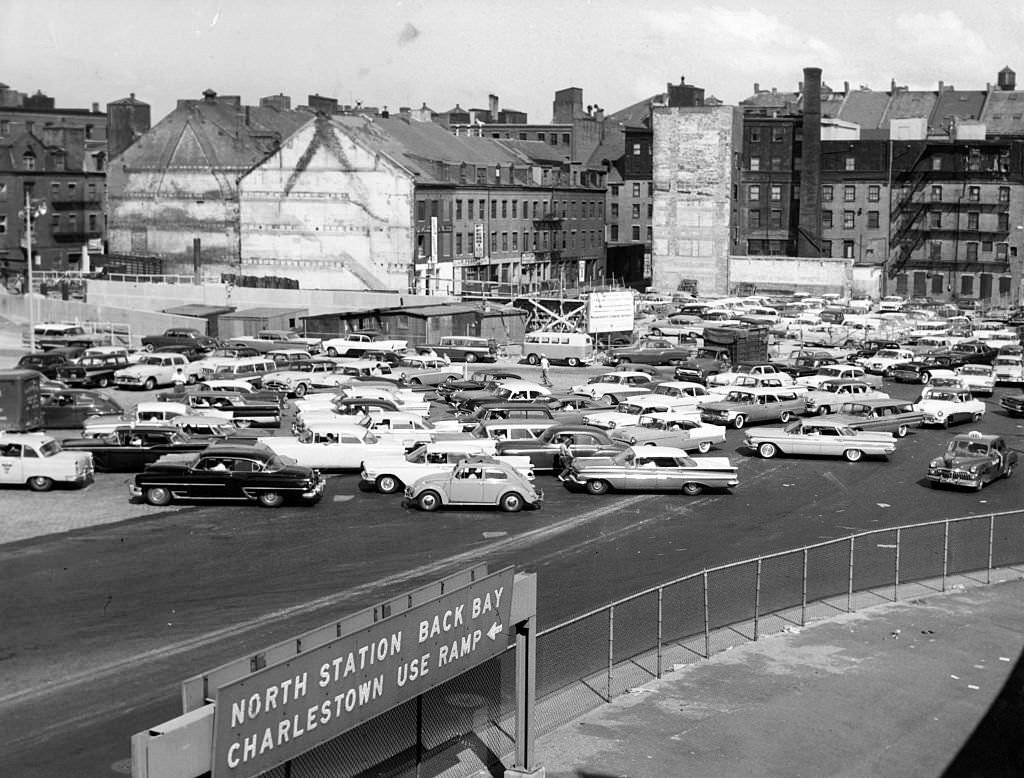
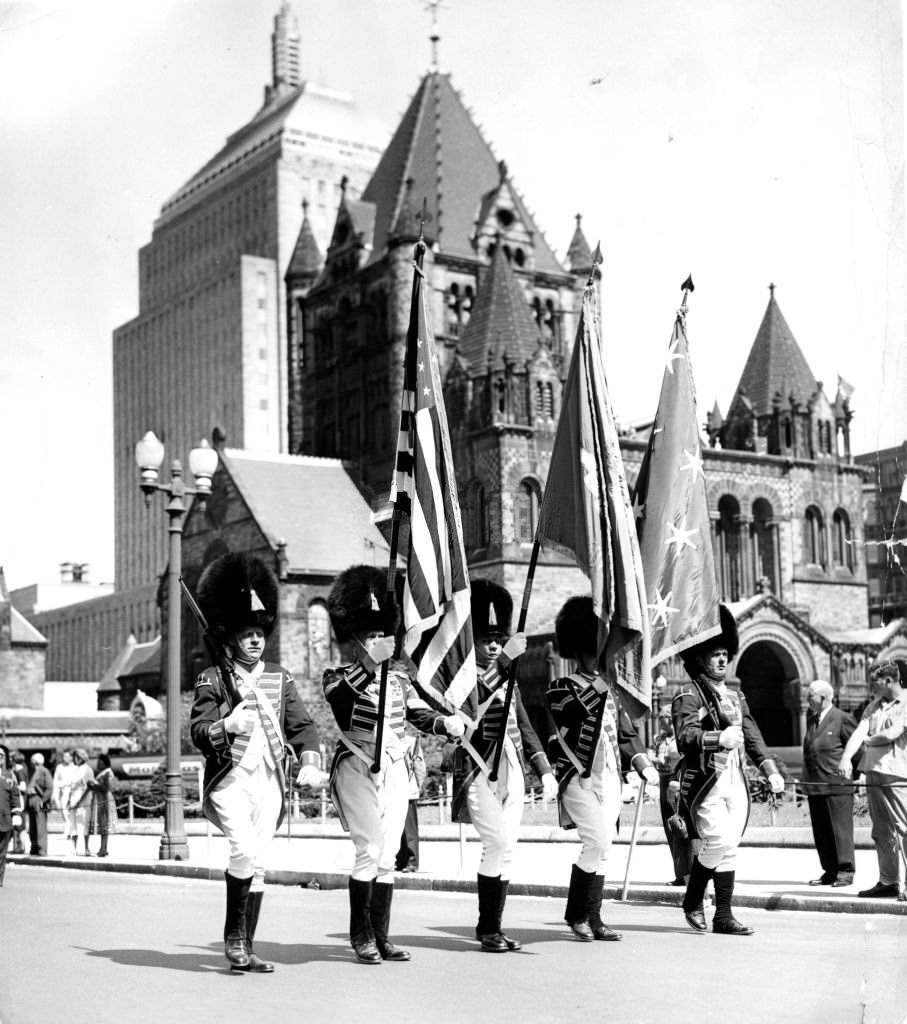
Children play in the spray pool at the Columbia Point housing project in Boston on June 30, 1960.Traffic backs up as cars wait to enter the Sumner Tunnel in Boston on June 29, 1960. (Photo by Dan Goshtigian/The Boston Globe via Getty Images)The color guard of the Ancient and Honorable Artillery Company of Boston parades on Boylston Street in front of Trinity Church in Copley Square in Boston on Jun. 6, 1960.
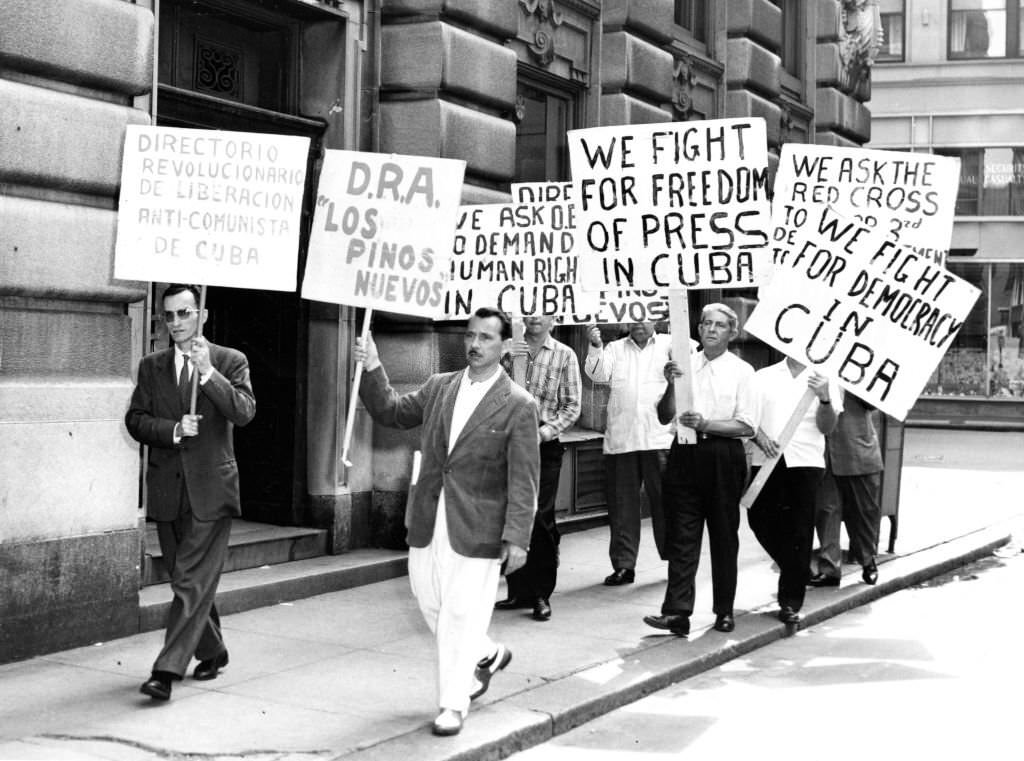
The Cuban government’s relationship with the United States was already collapsing by June 1960. Bostonians took to the streets in front of the Cuban consulate on June 5, 1960, to protest Fidel Castro — more than a year before the Bay of Pigs.
Demonstrators hold signs while marching in front of the Cuban consulate in Boston in protest of Cuban Prime Minister FIdel Castro on June 5, 1960.Demonstrators hold signs while marching in front of the Cuban consulate in Boston in protest of Cuban Prime Minister Fidel Castro on June 5, 1960.Christ Church in the Jamaica Plain neighborhood of Boston on May 26, 1960.
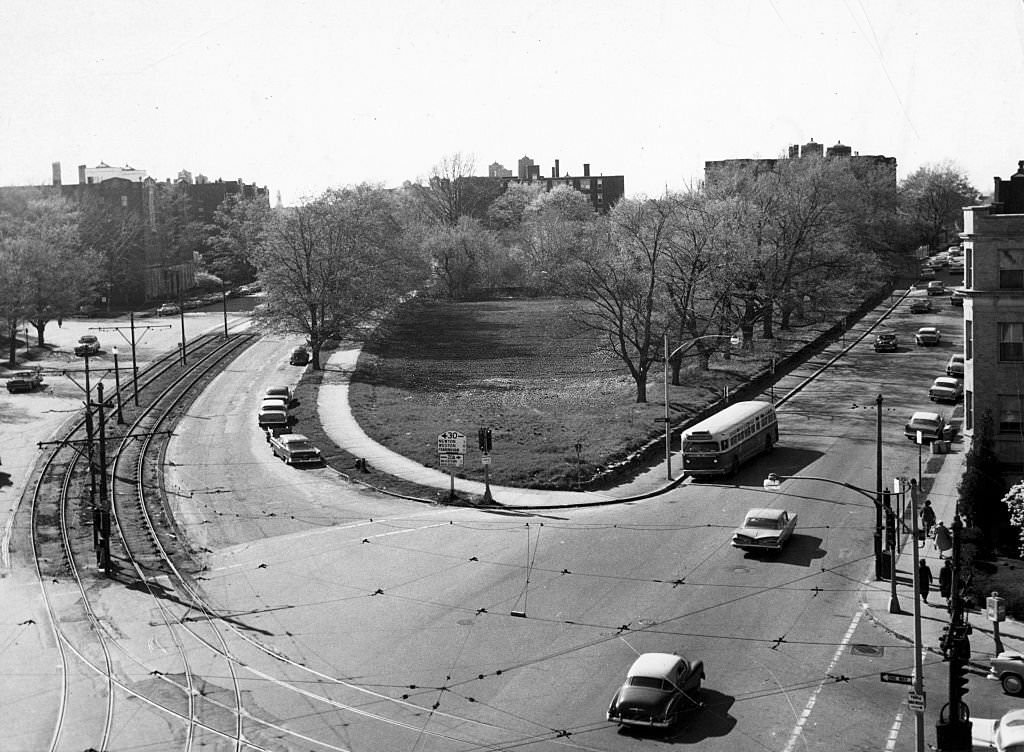
A triangular parcel of Park Department land at Commonwealth and Chestnut Hill Avenues was sold to a private firm in 1960 to make way for a 17-story, $3 million building — a sign of the private investment flooding into the city.
The triangular-shaped parcel of Park Department land at Commonwealth and Chestnut Hill Avenues in Boston, seen here on May 2, 1960, will be sold to a private firm for the construction of a 17-story, $3 million building.
The famous Swan Boats returned to the Public Garden in April 1960. Swan Boat crewmen Gil McIntyre and Kevin Sullivan powered through the lagoon as Bostonians welcomed another spring season in one of the city’s most beloved green spaces.
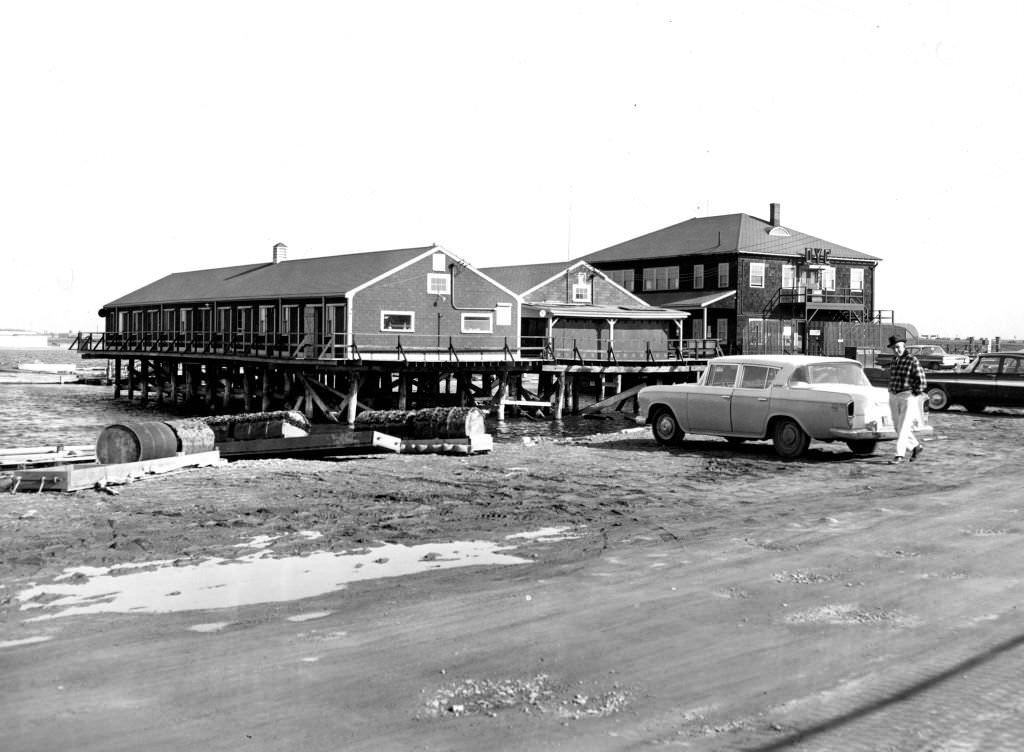
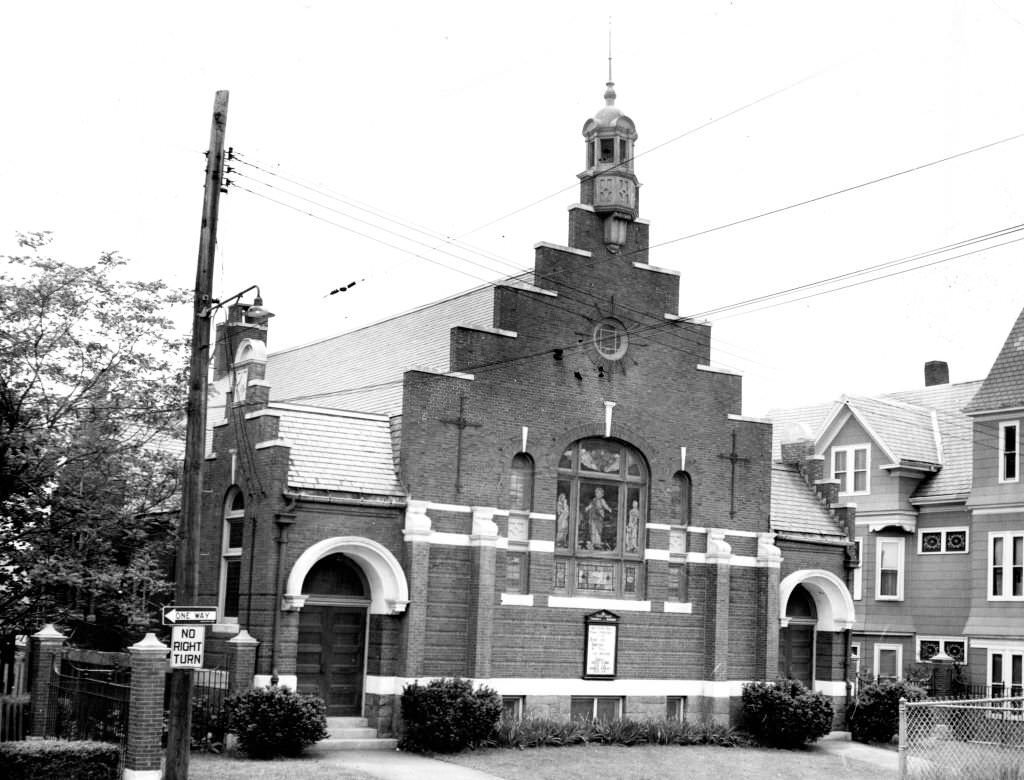
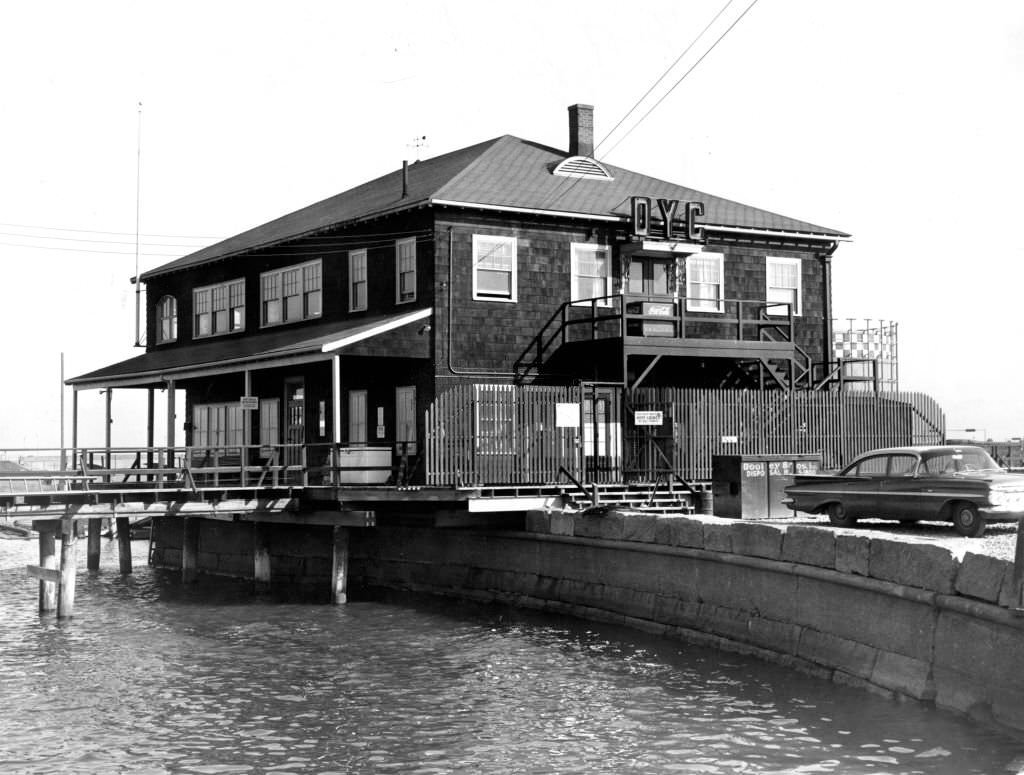
Swan Boat crewmen Gil McIntyre, of Brighton, and Kevin Sullivan, of West Roxbury, row through Boston’s Public Garden on April 21, 1960,The Dorchester Yacht Club in Boston on Apr. 2, 1960.The Dorchester Yacht Club in Boston, 1960.
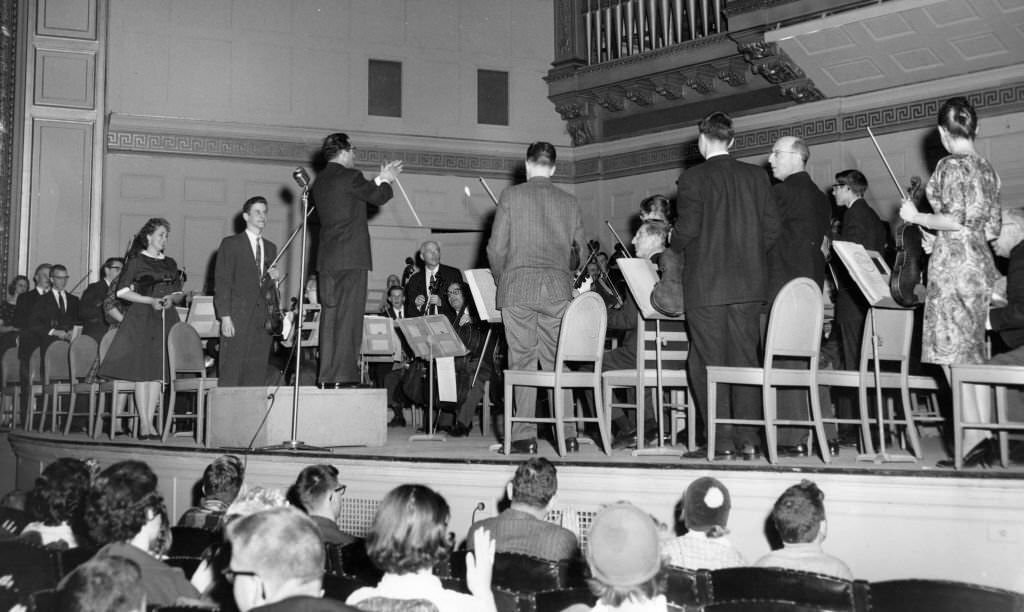
At Symphony Hall in March 1960, conductor Harry Ellis Dickson of the Boston Symphony Orchestra led a special performance alongside Massachusetts high school students. Dickson applauded the young musicians at the end of the program, one of the most celebrated orchestral venues in the country.
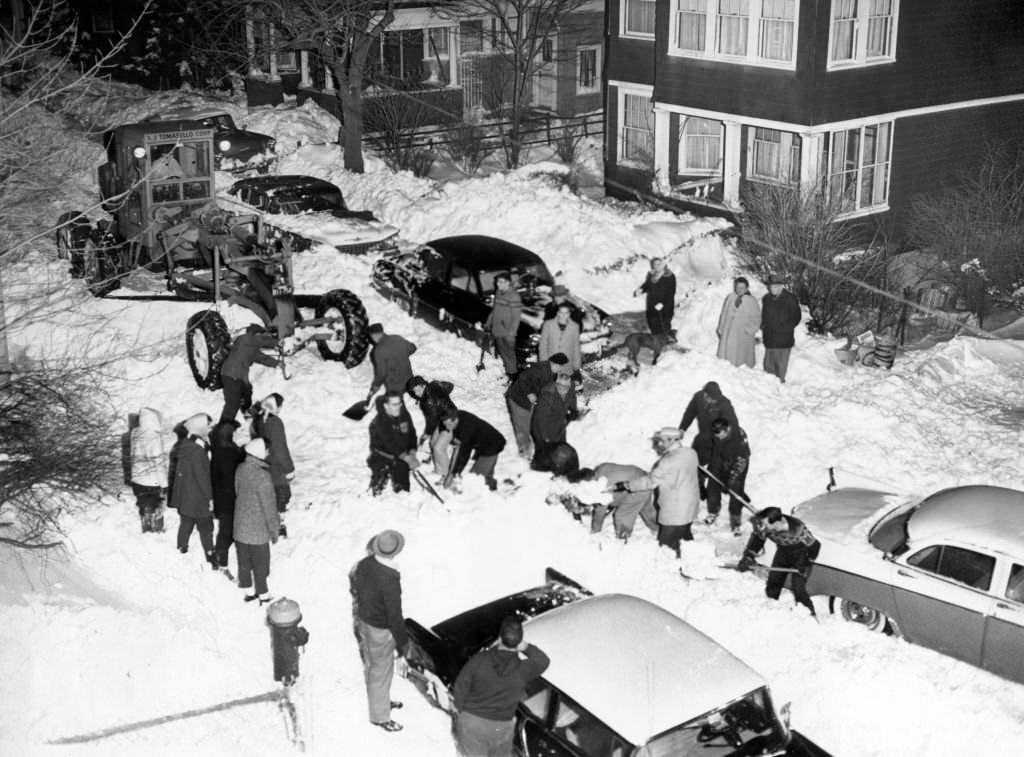
Conductor Harry Ellis Dickson of the Boston Symphony Orchestra applauds Massachusetts high school students who played alongside members of the world-famed orchestra in Symphony Hall in Boston on March 12, 1960.People shovel snow on Everett Street in Dorchester in Boston on March 5, 1960, after a snowstorm.Washington Street in downtown Boston is covered in snow during a snow storm on March 3, 1960.Snow covers a street in the South End of Boston on March 3, 1960.Looking toward Arlington, Medford, and Somerville from the top of Bunker Hill Monument, Feb. 5, 1960.Fire Alarm Operators take in sounding alarms in Boston, Jan. 7, 1960.
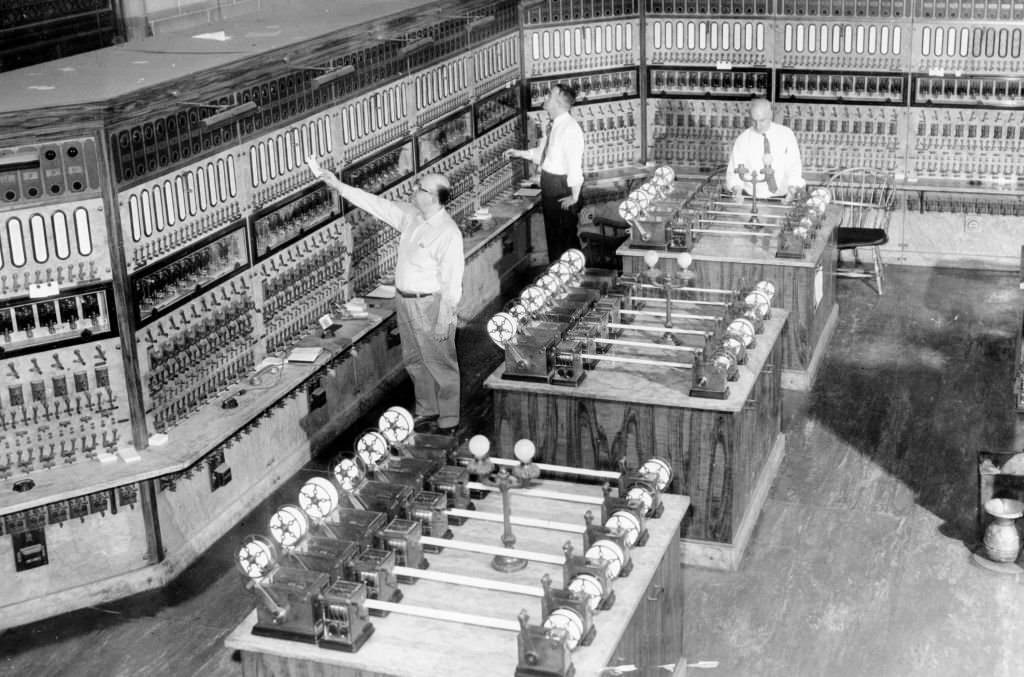
Boston’s West End neighborhood — once home to thousands of working-class and immigrant families — was still being cleared in early 1960. Demolition crews knocked down block after block in a redevelopment effort that displaced an estimated 7,000 residents.
Destruction of Boston’s West End for redevelopment on Feb. 16, 1960.The Blue Cross-Blue Shield building at 133 Federal Street in Boston. Jan. 7, 1960.An aerial view of a Harvard vs. Yale game in Boston, 1960.
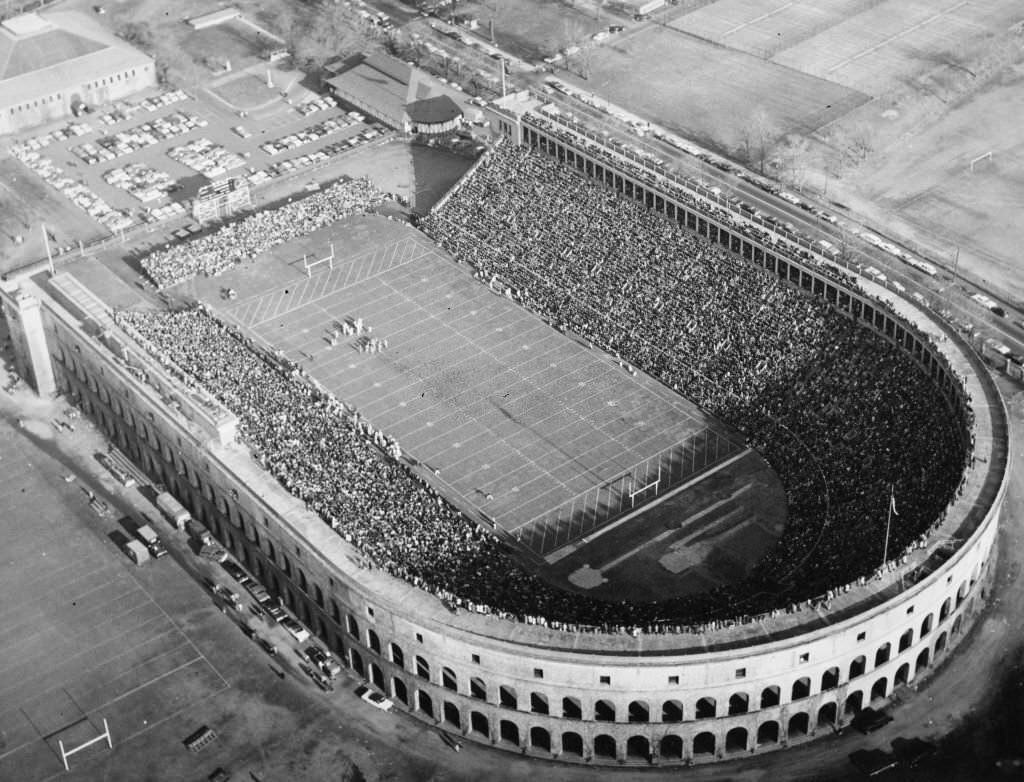
One of the city’s most iconic landmarks was the steam-powered teapot sign above the Oriental Tea Company. The giant sign puffed real steam day and night, a quirky piece of Boston commercial history that has hung above the street since 1873.
Active steam rises from the teapot signpost for the Oriental Tea Co. in Boston in the 1960s.
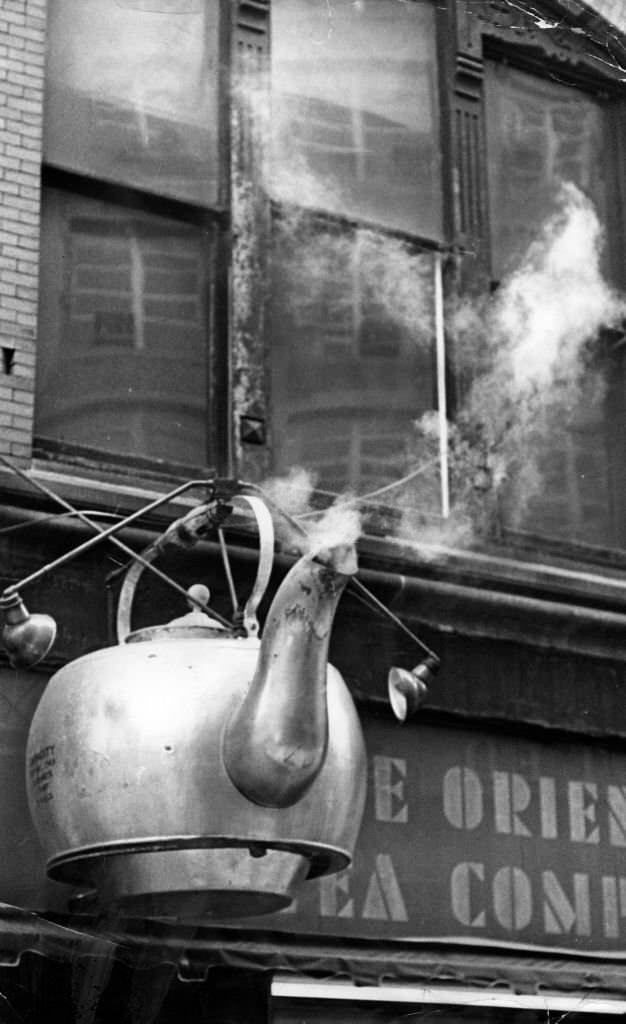
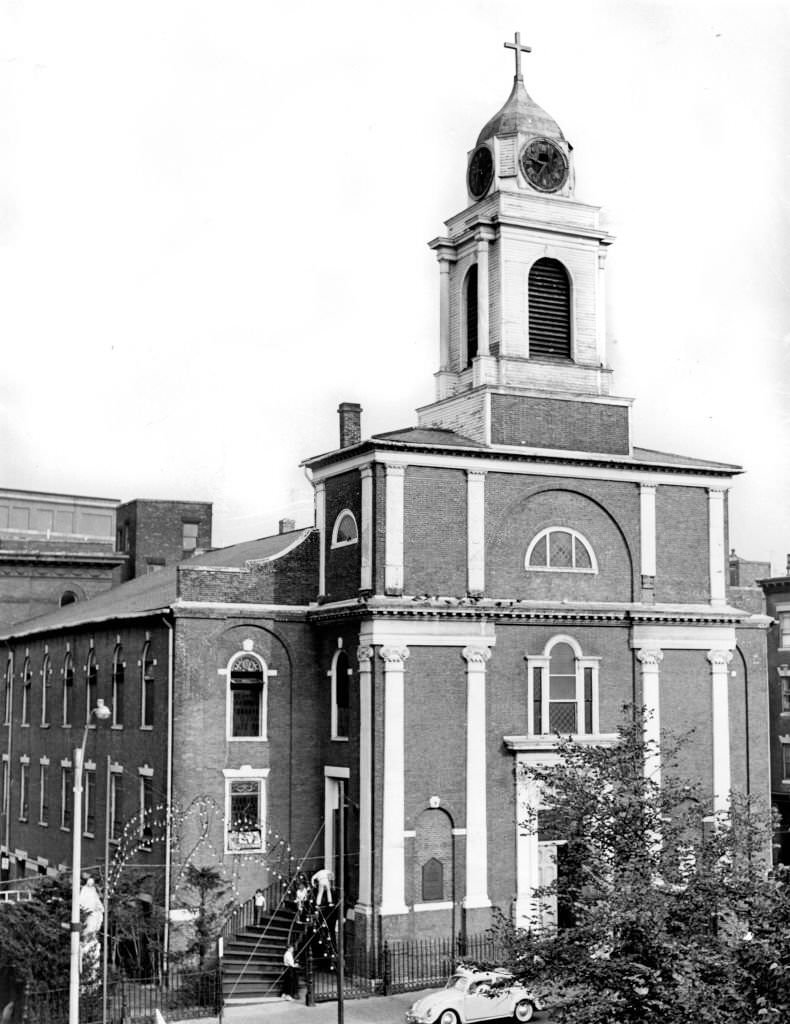
Boston’s North End skyline took on a different look in September 1964 when workers began restoring the steeple of St. Stephen’s Church on Hanover Street. Cardinal O’Connell had actually remodeled the church in 1897, and this later restoration was part of a longer effort to preserve one of Charles Bulfinch’s original designs.
Restoration takes place on the steeple of St. Stephen’s Church on Hanover Street in Boston’s North End on Sep. 18, 1964.
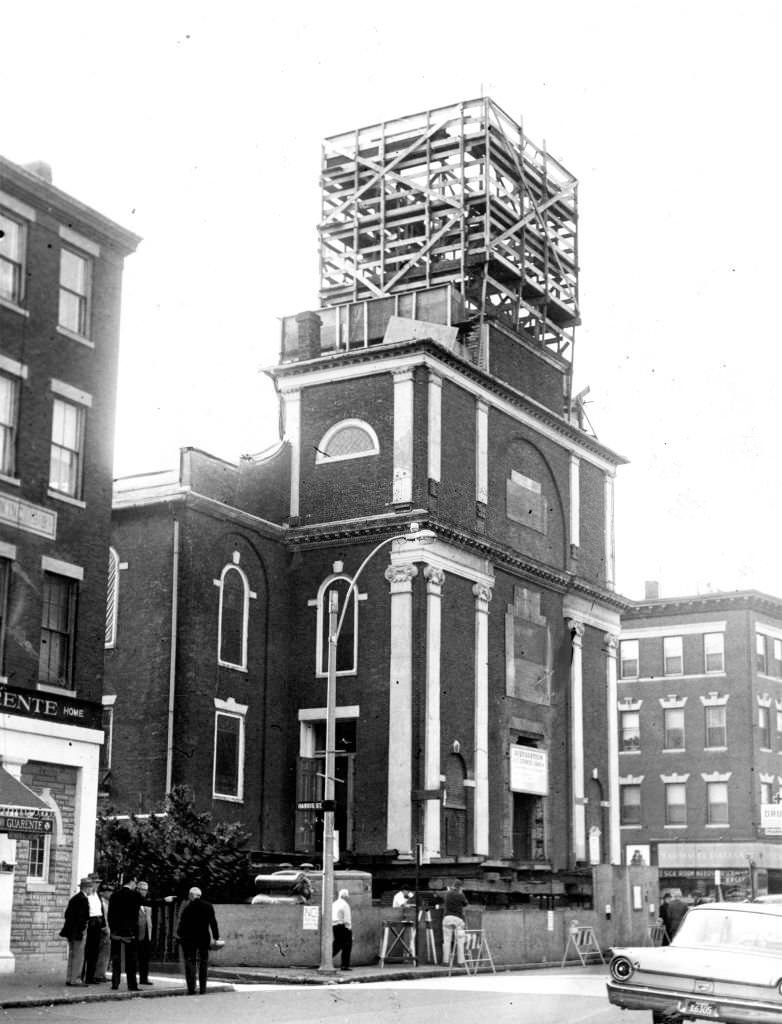
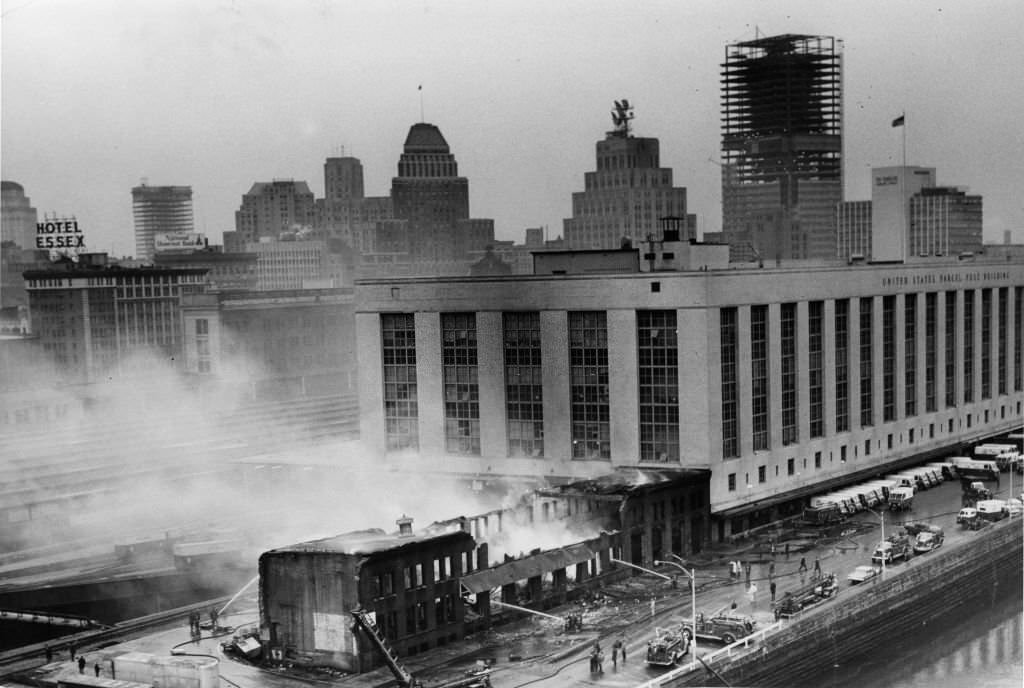
In January 1965, a major fire broke out at the South Postal Annex. An aerial view after the blaze revealed the scale of the destruction in the building that handled a significant portion of Boston’s mail.
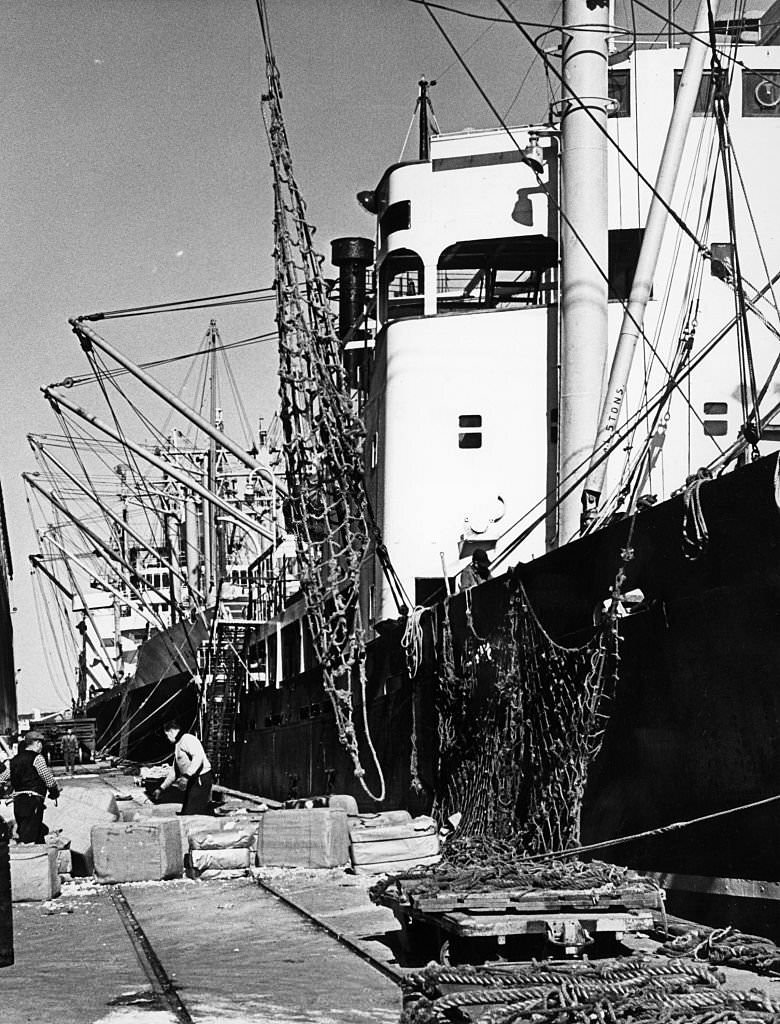
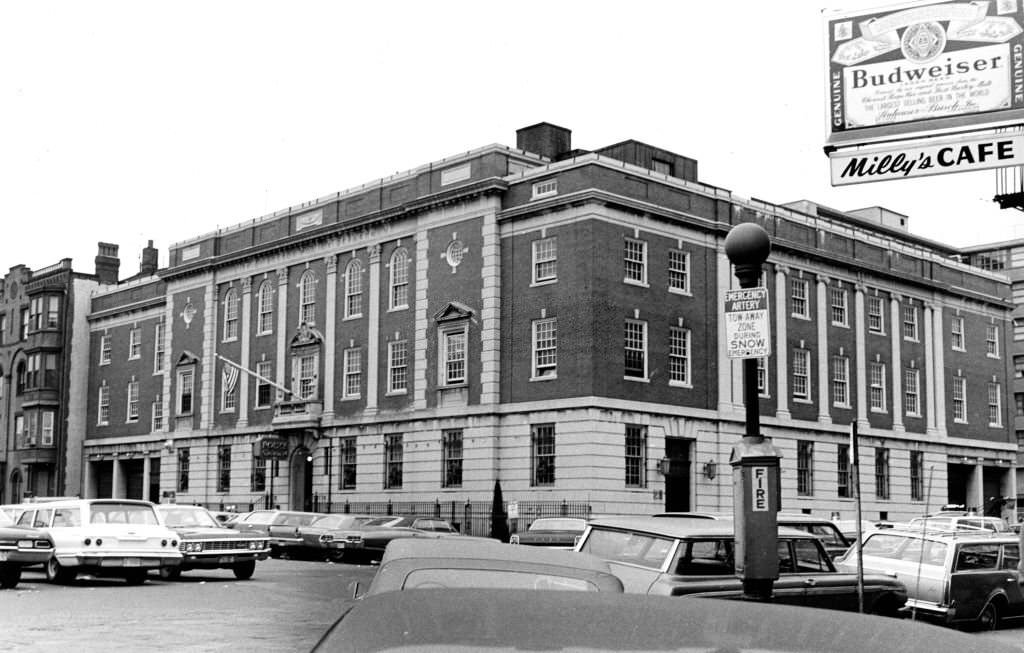
An aerial view of the South Postal Annex after a fire in Boston, Jan. 8, 1965.Copley Square in Boston, Jan. 22, 1965. Trinity Church is in the background.Two ships are unloaded at Commonwealth Pier in Boston on March 2, 1965.Boston Police Headquarters on Berkeley Street in Boston, 1965.
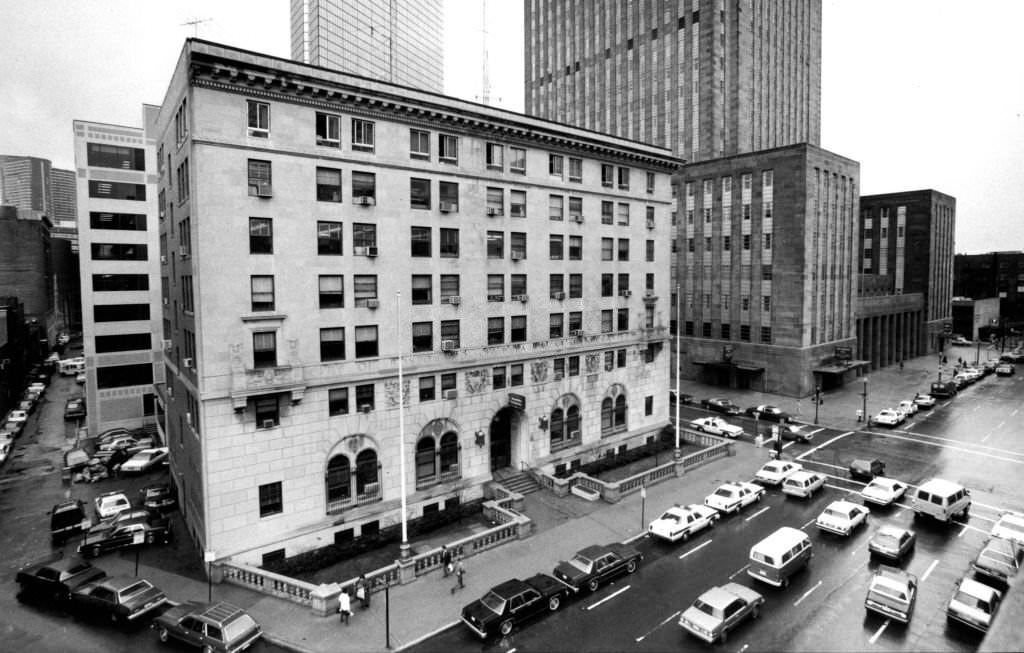
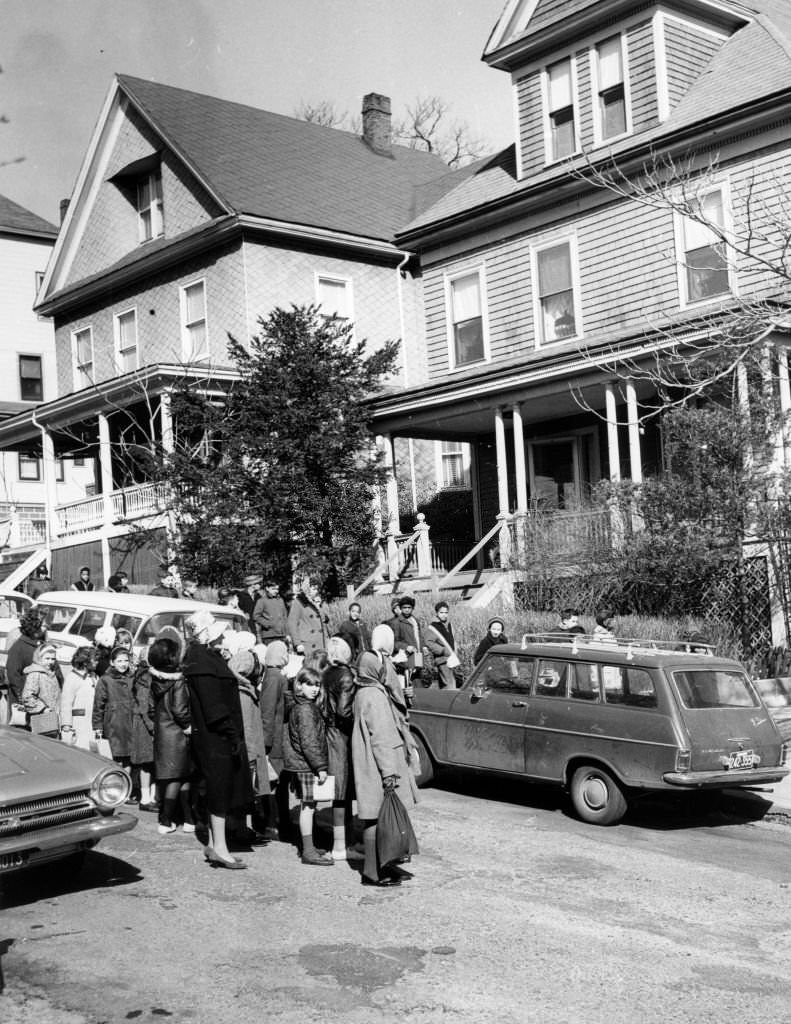
March 1965 brought tragedy to Boston. Reverend James J. Reeb, a Unitarian minister from the Dorchester neighborhood, traveled to Selma, Alabama, to join civil rights marchers. White segregationists beat him there, and he died from his injuries. Schoolchildren from the Benedict Fenwick School paused outside his home on March 12, 1965, to offer prayers.
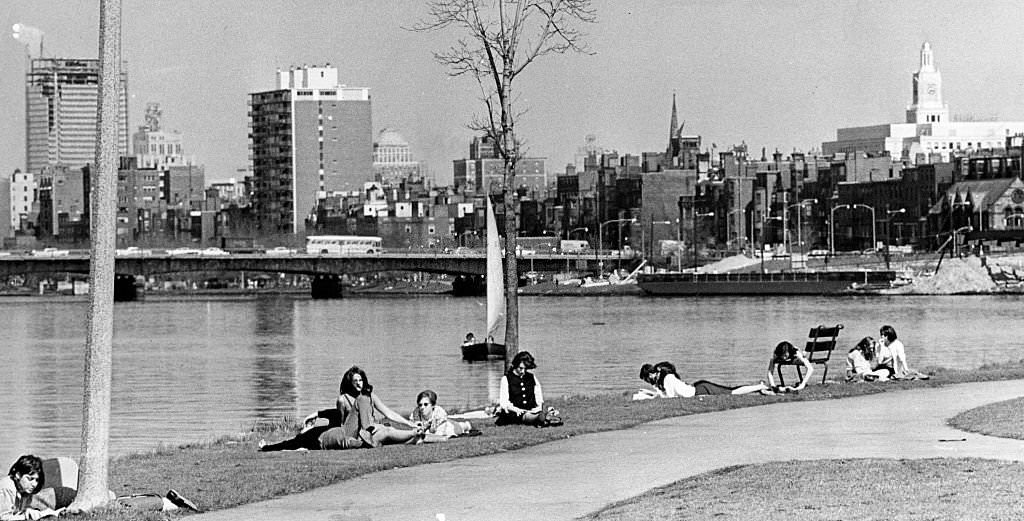
Schoolchildren from the Benedict Fenwick School pause to offer prayers outside the home of Reverend James J. Reeb.People sit along the Charles River on the Esplanade near Storrow Drive in Boston, 1965.
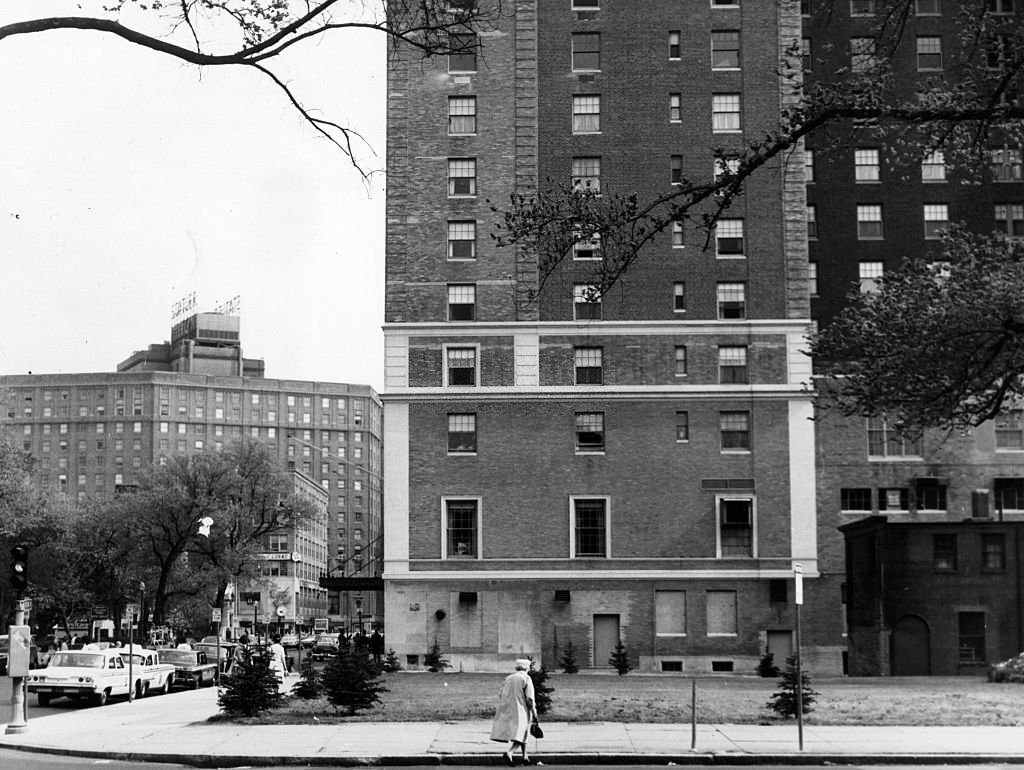
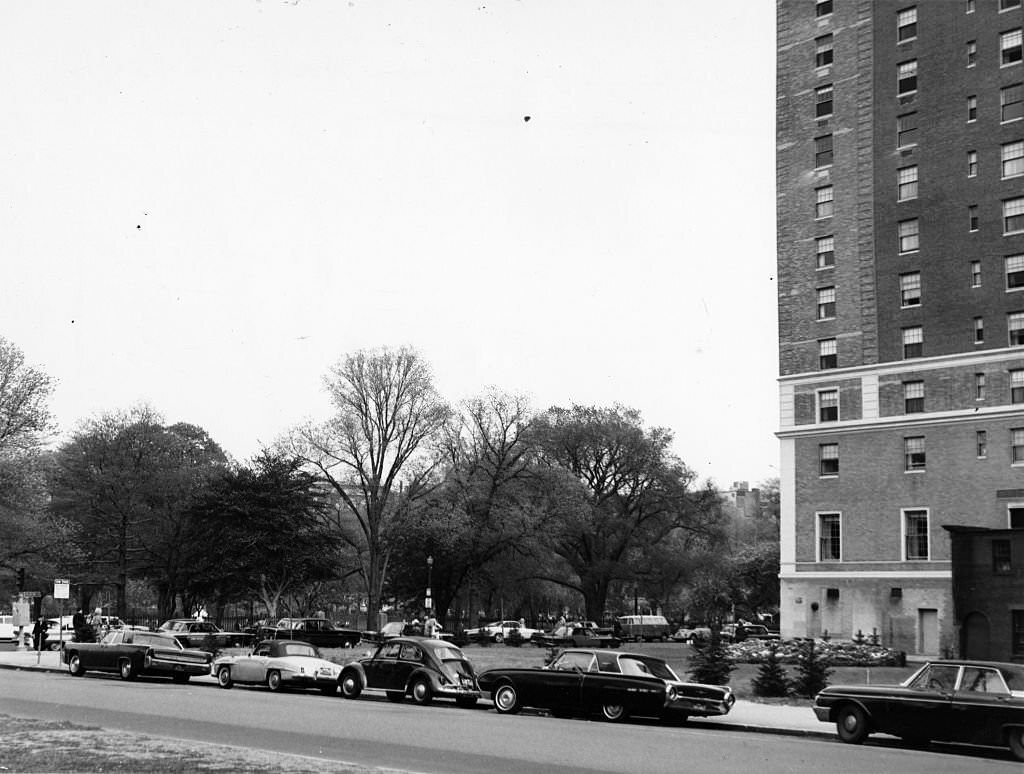
As Back Bay grew denser, neighborhood residents pushed back against large new developments. A proposed 324-foot luxury apartment building next to the Ritz-Carlton Hotel on Commonwealth Avenue and Arlington Street faced resistance from the surrounding community when plans were announced in 1965.
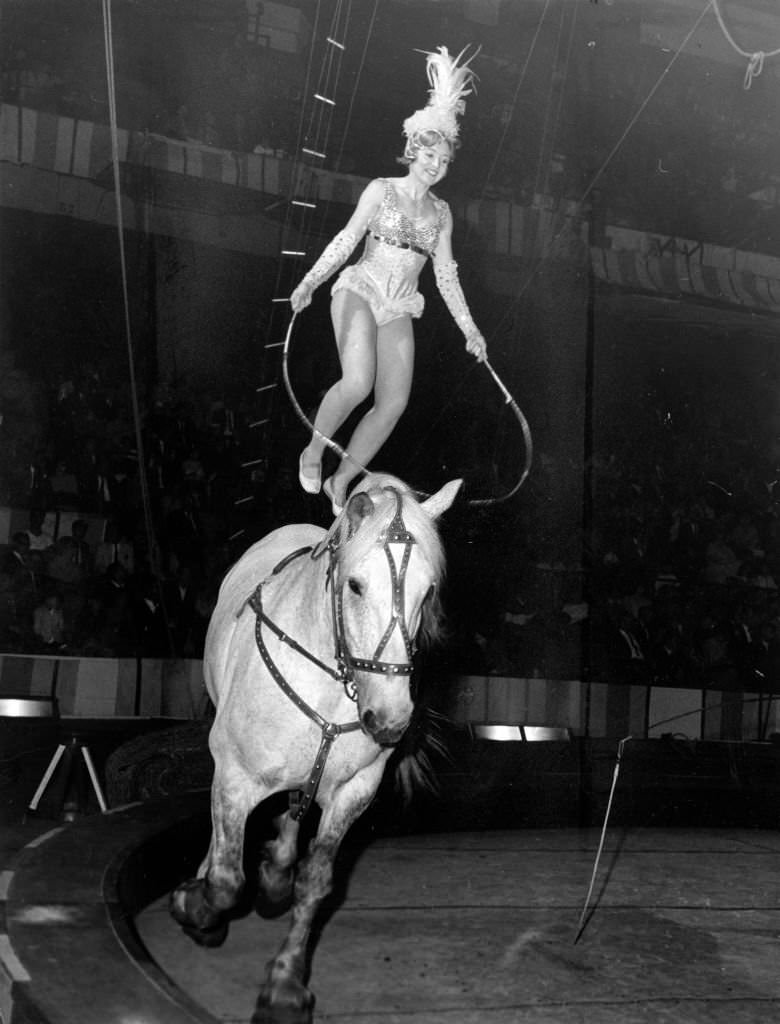
A new high-rise luxury apartment building is proposed for the lot next to the Ritz-Carlton Hotel on the corner of Commonwealth Avenue and Arlington Street in Boston’s Back Bay, seen here May 11, 1965.A new high-rise luxury apartment building is proposed for the lot next to the Ritz-Carlton Hotel on the corner of Commonwealth Avenue and Arlington Street in Boston’s Back Bay, seen here May 11, 1965.A performer jumps rope on a horse’s back during the opening of the Ringling Bros. and Barnum & Bailey Circus at Boston Garden, May 15, 1965,
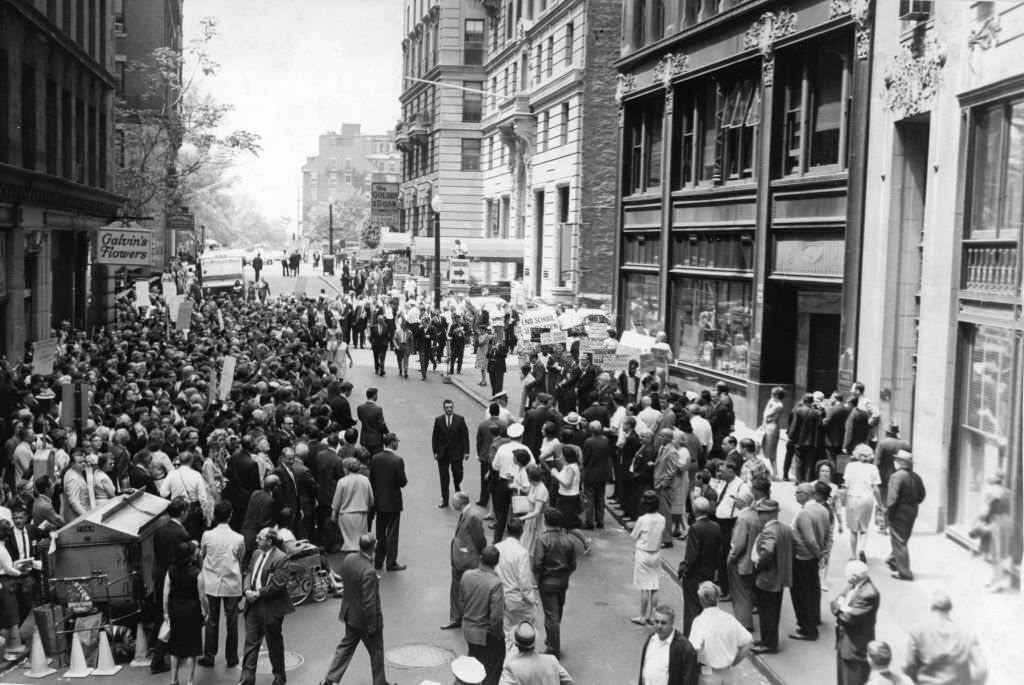
The fight for school equality was already underway in Boston long before the 1974 court-ordered busing. In May 1965, roughly 1,000 delegates to the Unitarian Universalist General Assembly gathered in silent vigil outside the Boston School Committee’s office to demand action on school segregation.
Roughly 1,000 delegates to the Unitarian Universalist General Assembly in session in Boston gather in silent vigil outside the office of the Boston School Committee on May 25, 1965.
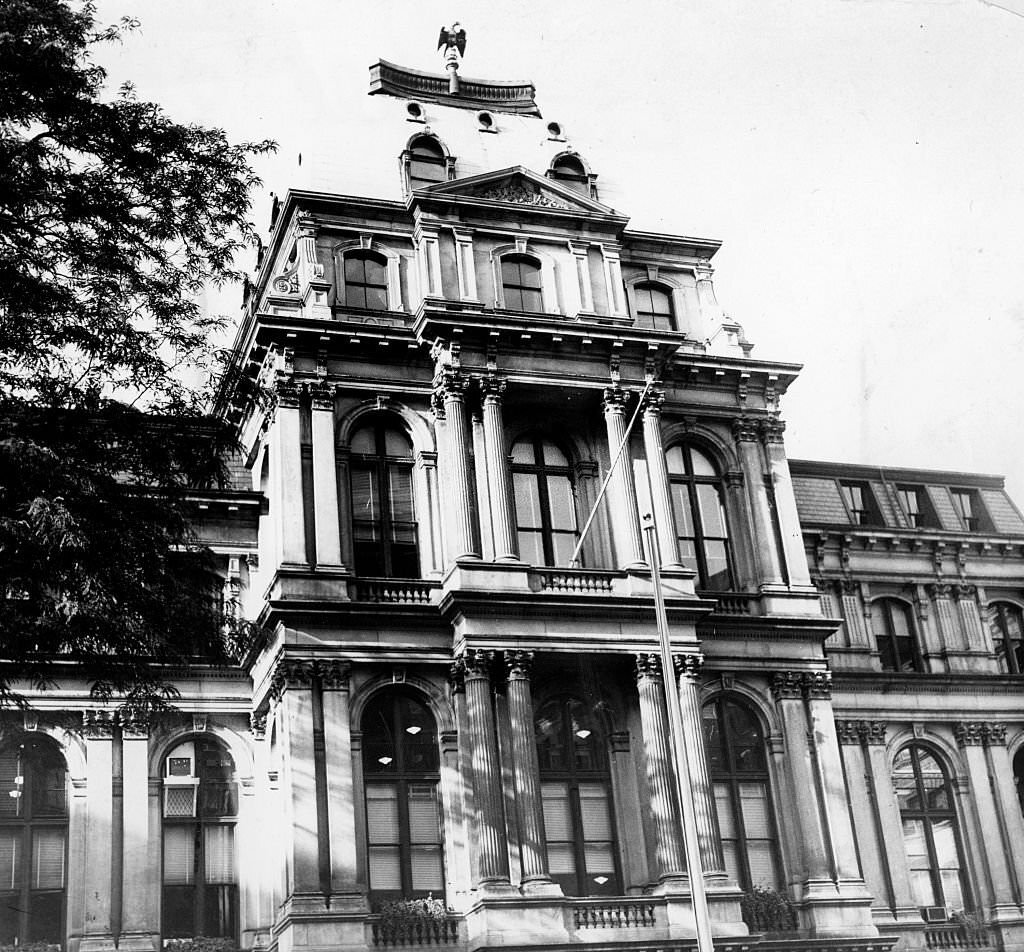
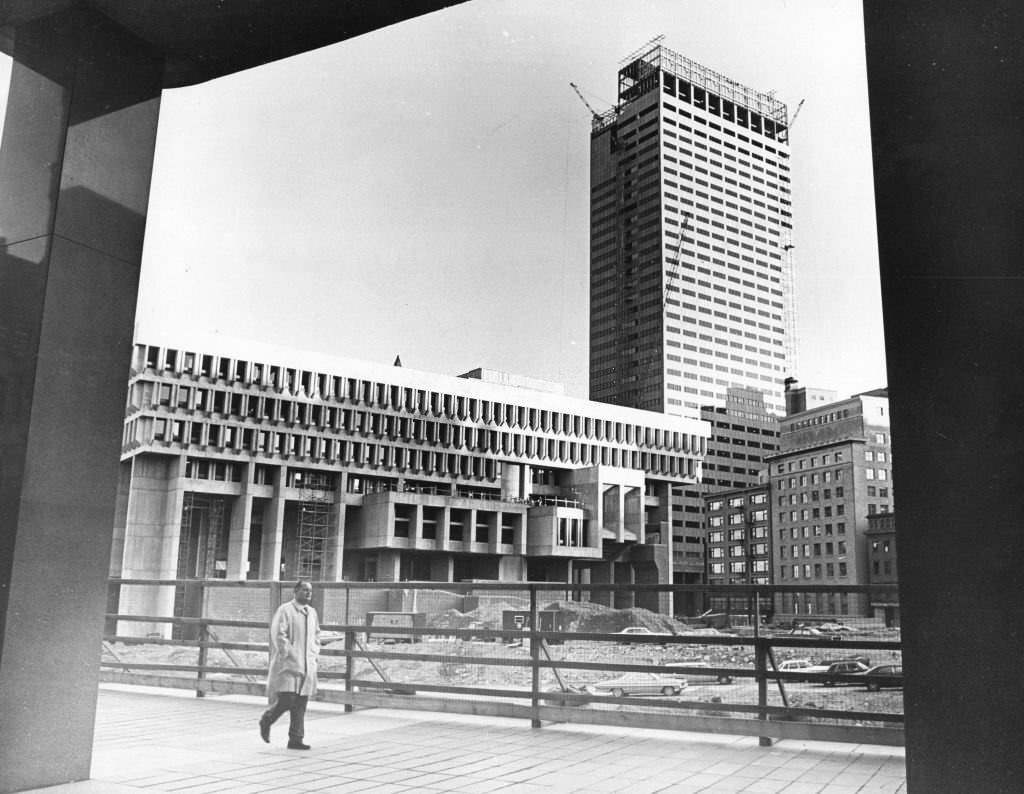
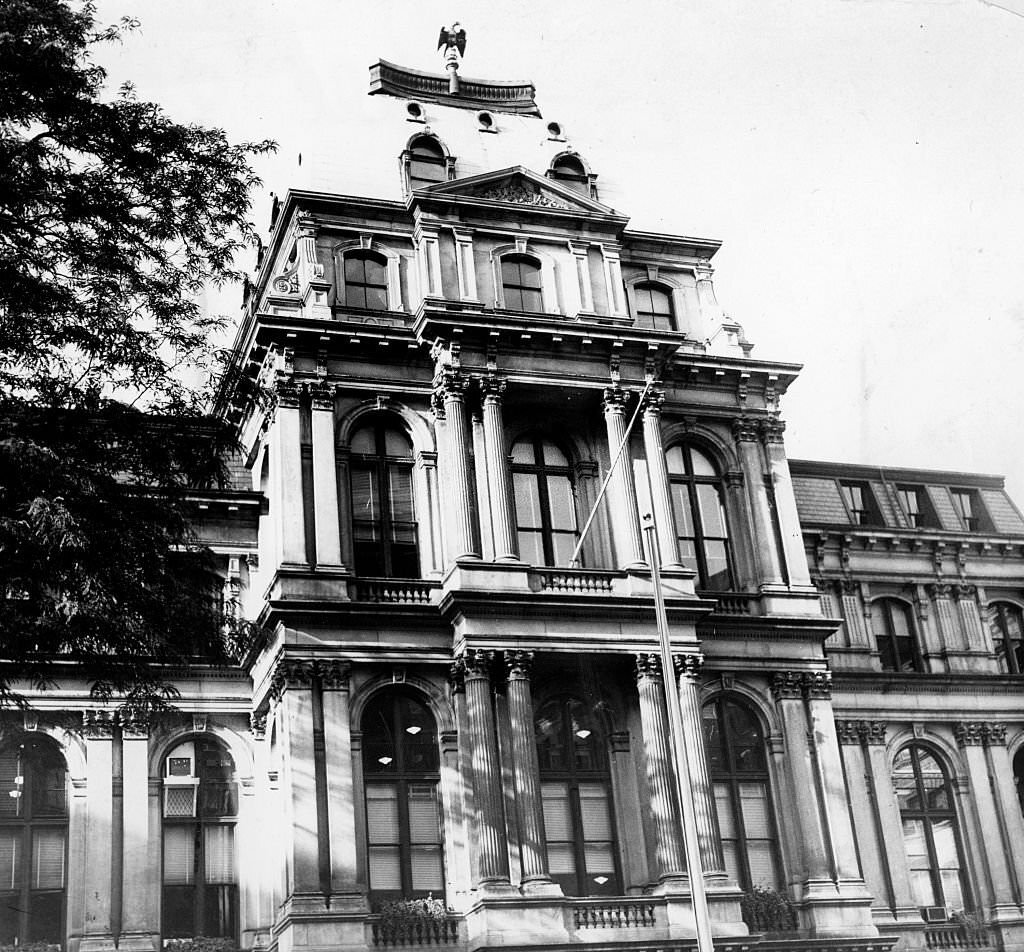
Boston’s old City Hall on School Street — which served as the city’s seat of government from 1841 until 1968 — was still in active use in June 1965, even as the new City Hall at Government Center was under construction nearby.
The front of Boston City Hall on June 13, 1965. This building was City Hall from 1841 to 1968.The front of Boston City Hall on June 13, 1965.
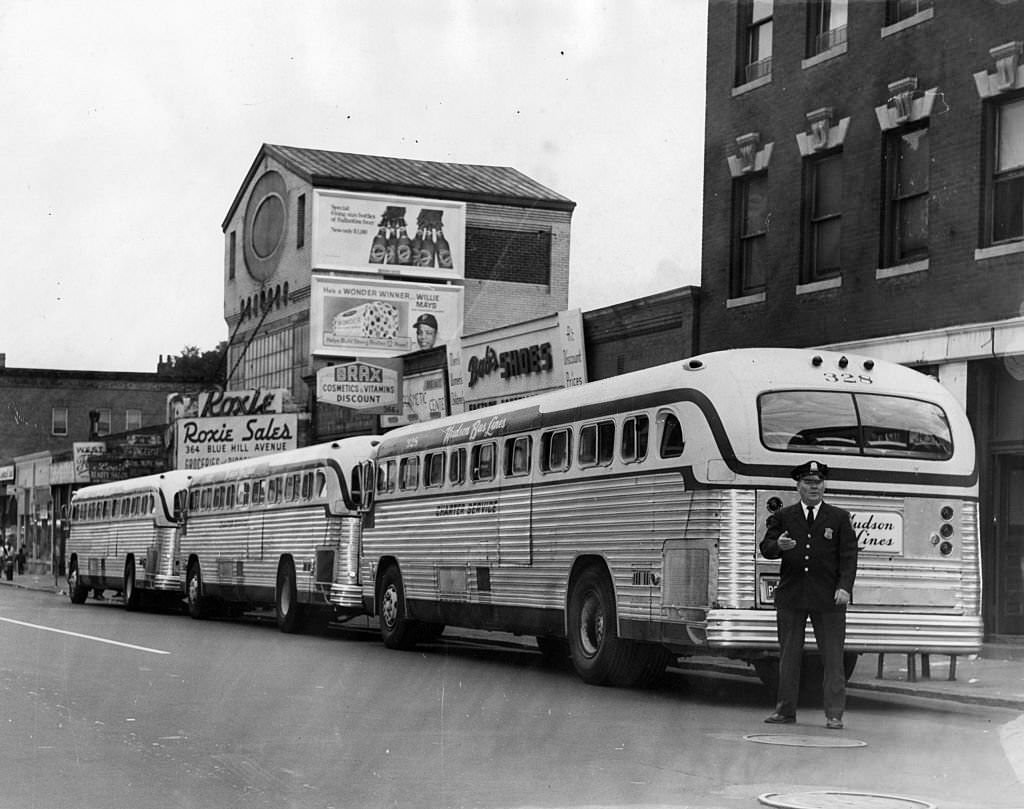
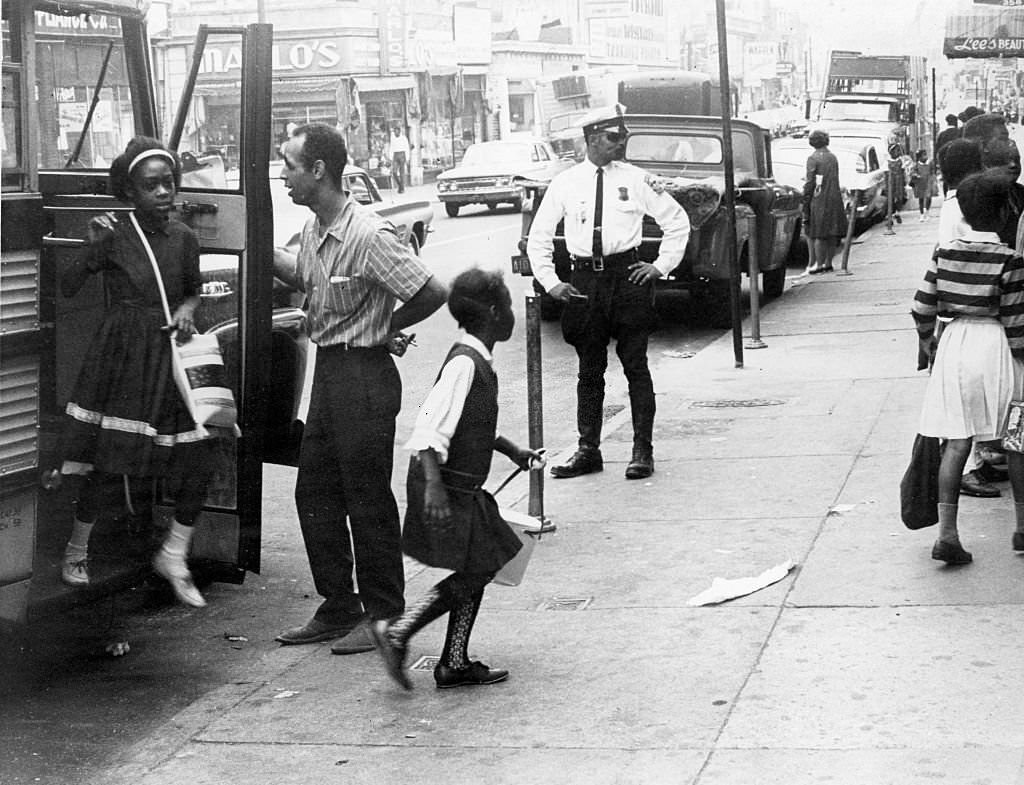
Operation Exodus launched in September 1965 as a voluntary busing program organized by Roxbury parents. Buses lined up at 366 Blue Hill Avenue to carry children from overcrowded schools in predominantly Black neighborhoods to schools in predominantly white neighborhoods that had empty seats. The program was a direct response to a Boston School Committee that refused to acknowledge or address racial imbalance in the public schools.
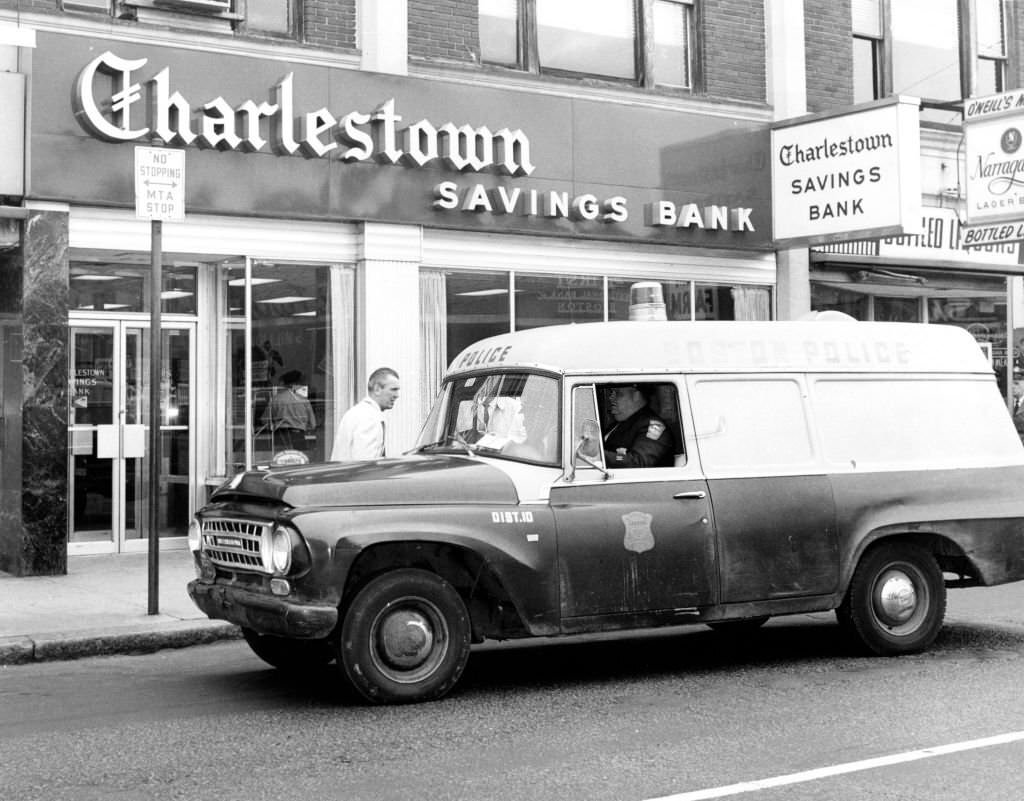
Buses are lined up in front of 366 Blue Hill Ave. in Boston to take children to schools outside their districts in Boston on Sept. 13, 1965.Cars and trucks drive on Northern Avenue in Boston, 1965.Students get off the bus from a suburban school at the end of the school day in Boston, 1965.The Charlestown Savings Bank on Tremont Street in Boston, 1965.
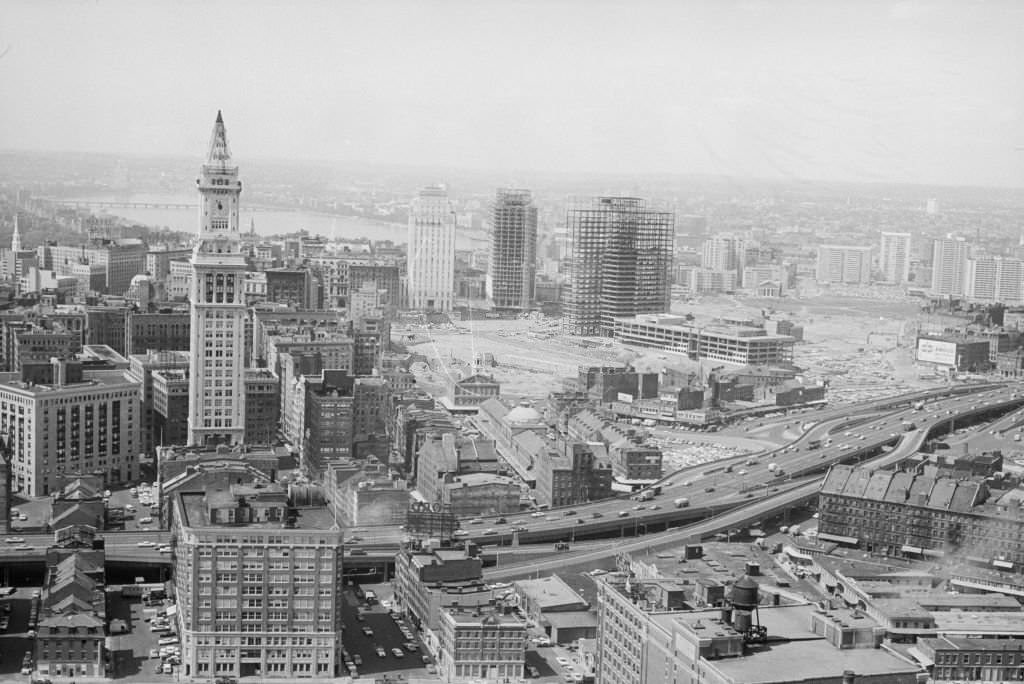
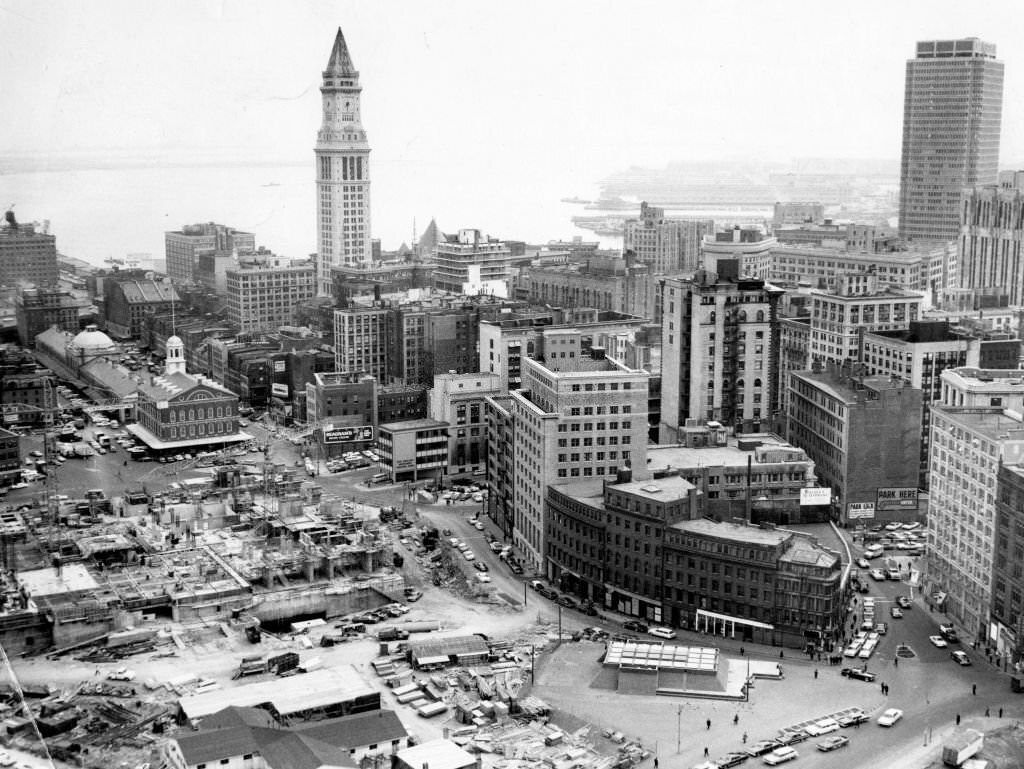
By 1965, downtown Boston was deep into transformation. Aerial photographs captured the construction site of the new City Hall alongside Faneuil Hall and the Custom House, showing just how dramatically the city center was being rebuilt from scratch.
An aerial view of downtown Boston, looking over construction site of the new City Hall, Faneuil Hall, and the Custom House to Boston Harbor, 1965.
Urban renewal did not go unchallenged. In November 1965, residents of the Brighton neighborhood took to the streets on Hefferan Street to protest housing redevelopment. Boston had officially launched its urban renewal program in 1964, targeting lower-income areas — but many residents saw it as an attack on their communities.
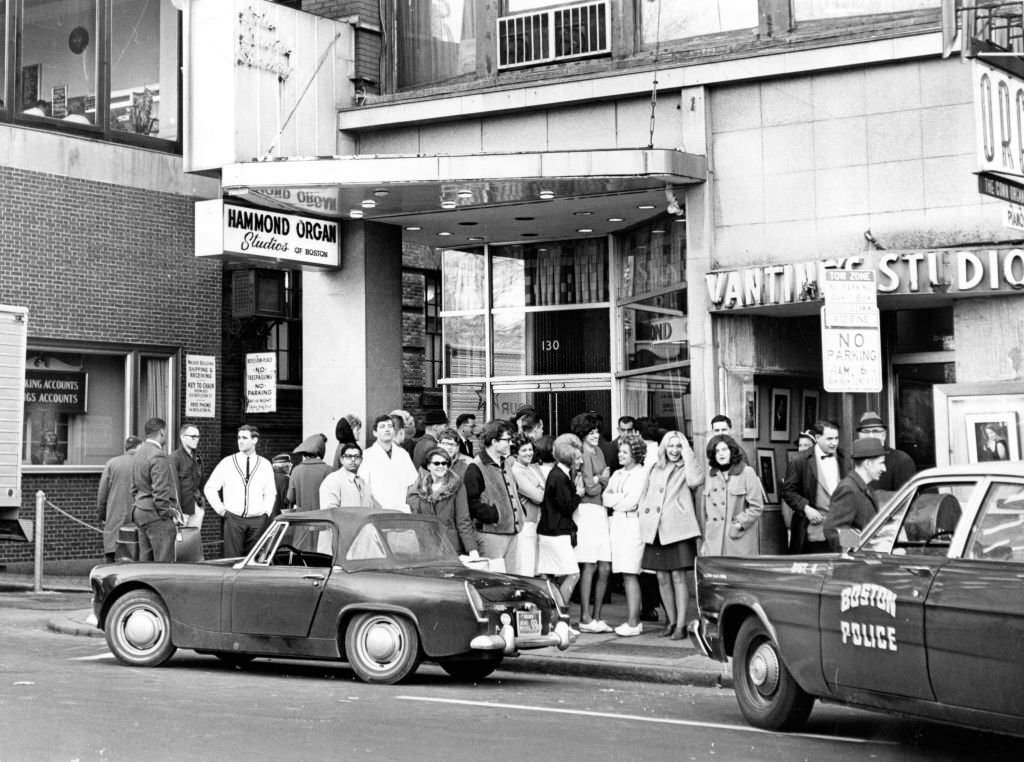
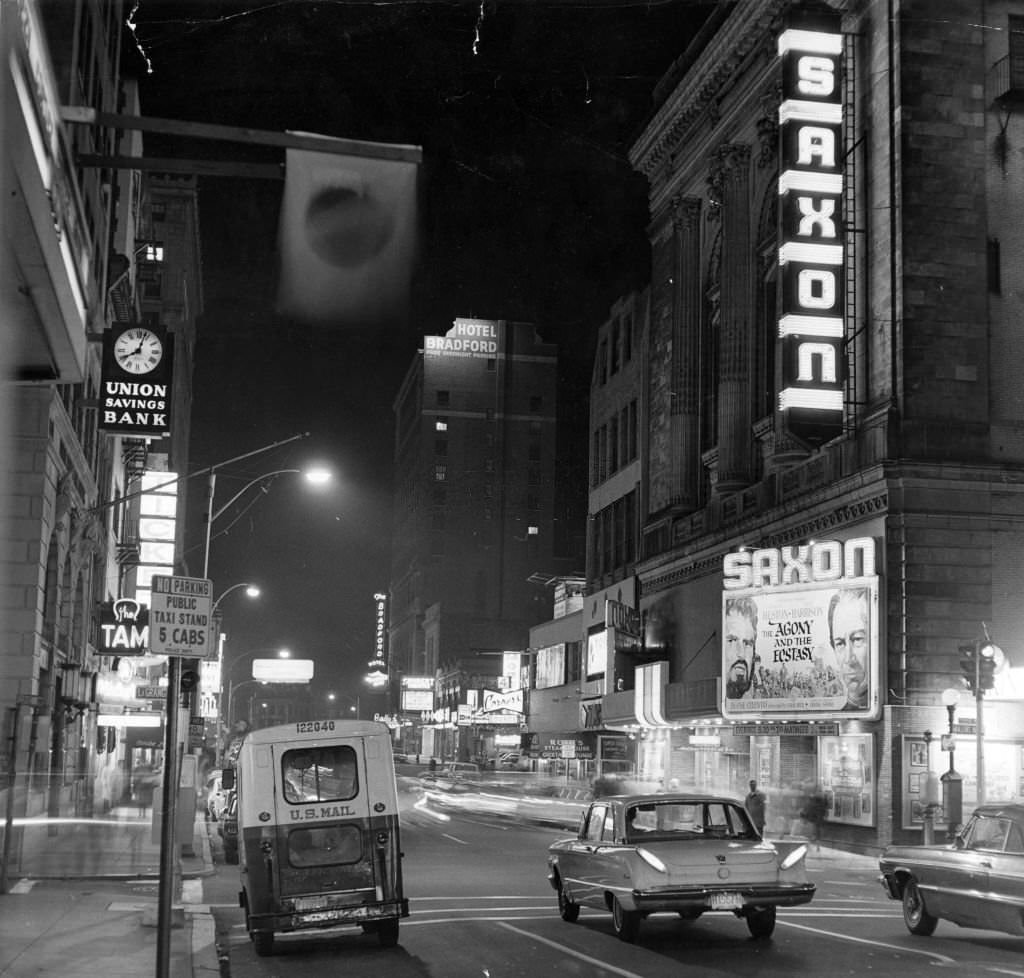
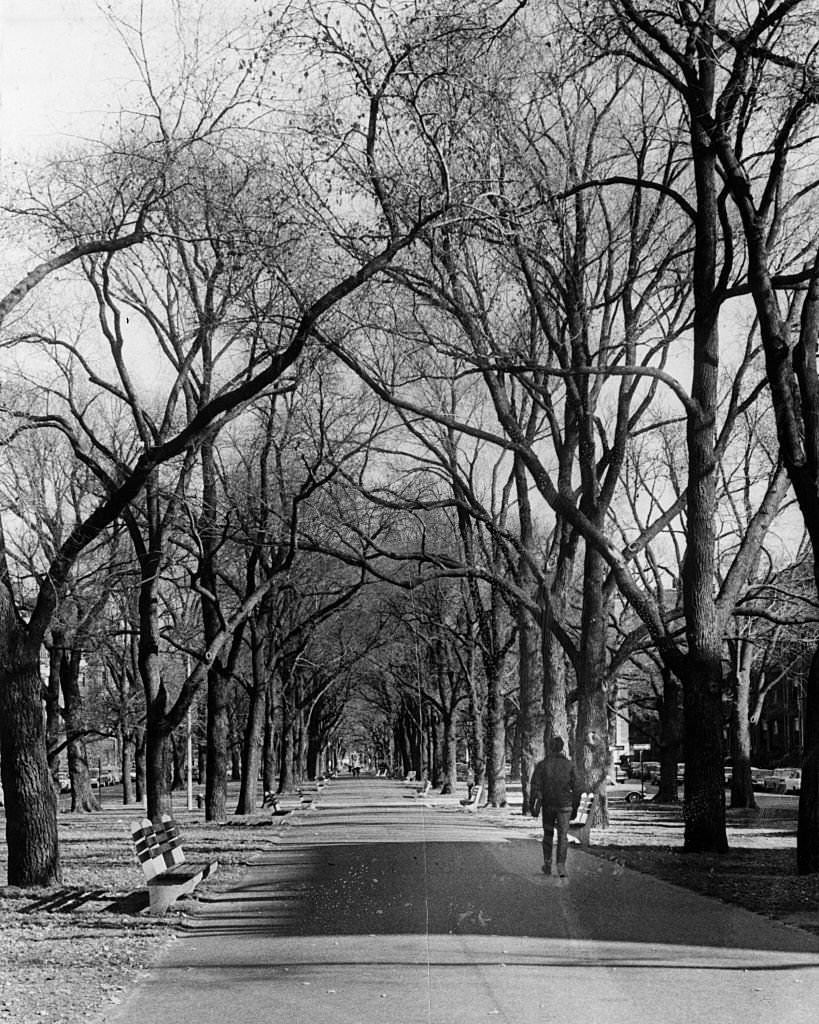
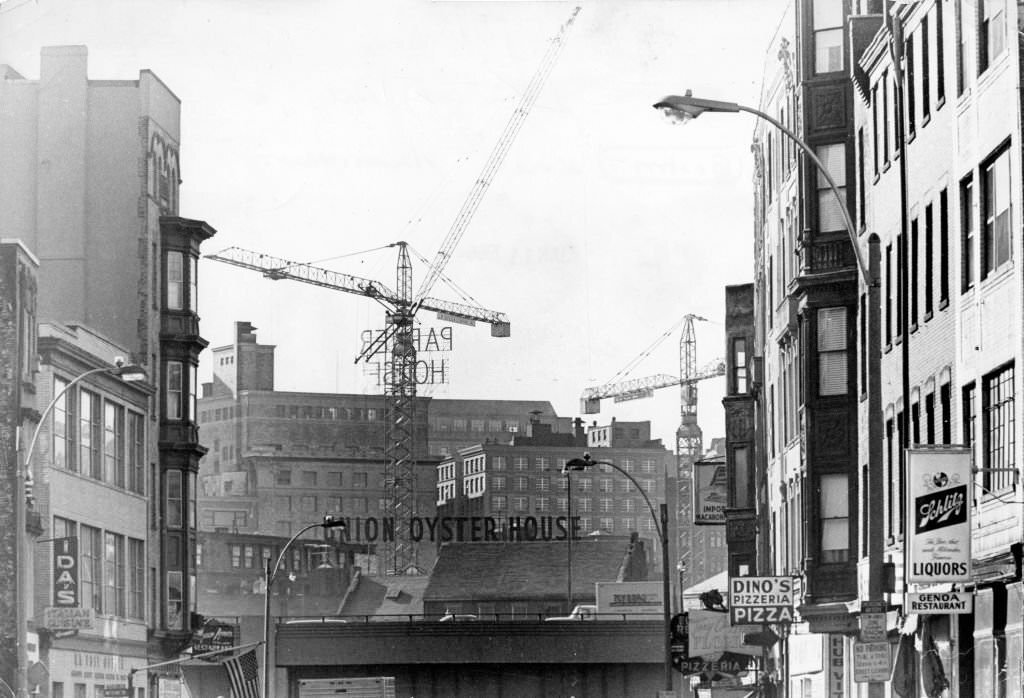
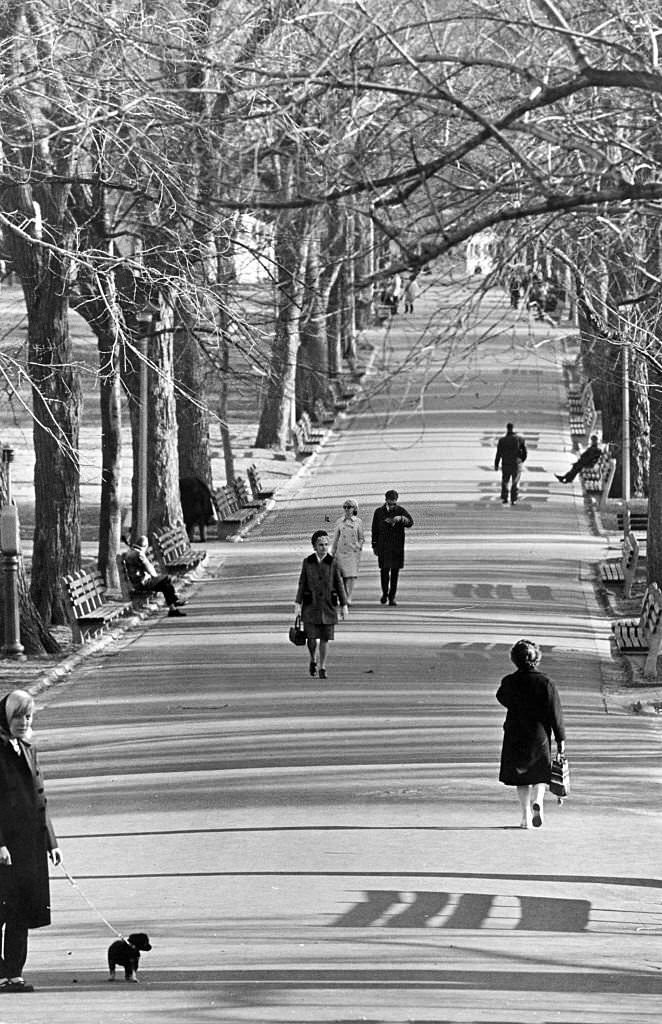
People protest housing redevelopment on Hefferan Street in the Brighton area of Boston in November 1965.The scene at 130 Boylston St. in Boston following a holdup at the Hammond Organ store, 1965.Washington Street in Boston at night, Nov. 10, 1965. Saxon Theatre is on right, Union Savings Bank on left. (Photo by Phil Preston/The Boston Globe via Getty Images)A pedestrian walks through the Commonwealth Avenue Mall in Boston, 1965.A view toward the site of the new Boston City Hall from Hanover Street in the North End, 1965.Looking down Boylston Street in Boston, 1965.Pedestrians and cars make their way down Boston’s Washington Street the night, 1965.People walk through Boston Common on March 21, 1966.
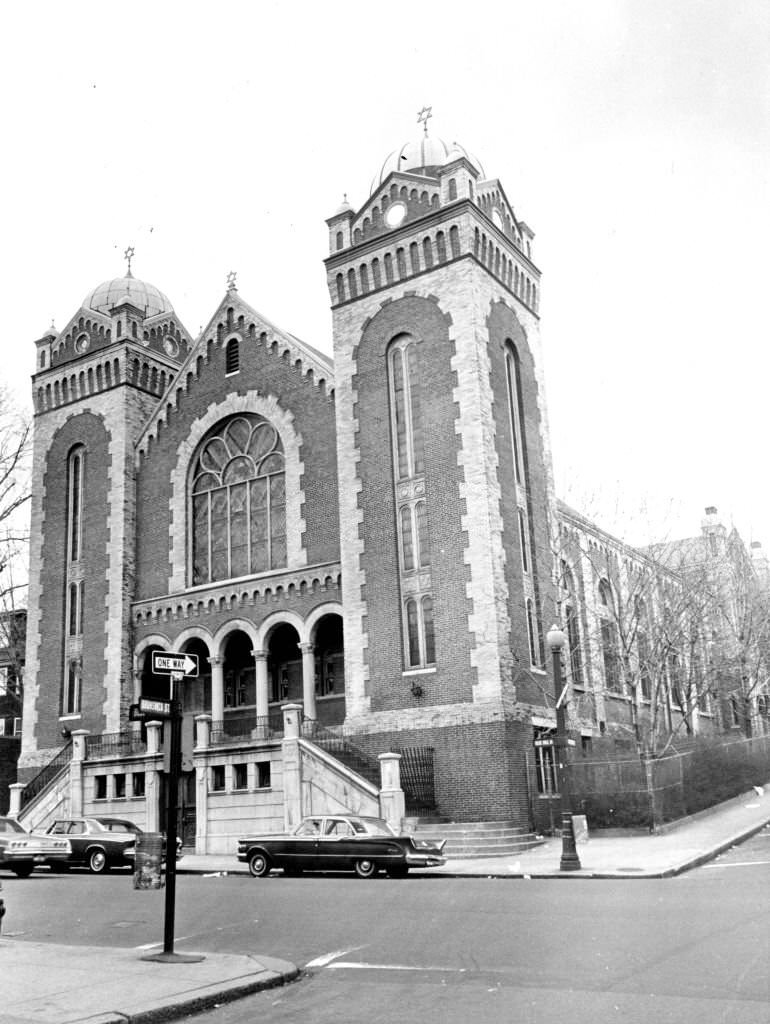
Roxbury’s Congregation Adath Jeshurun synagogue represented a longer history of Jewish community life in the neighborhood that was shifting rapidly by 1966 as demographics changed and residents relocated to other parts of Greater Boston.
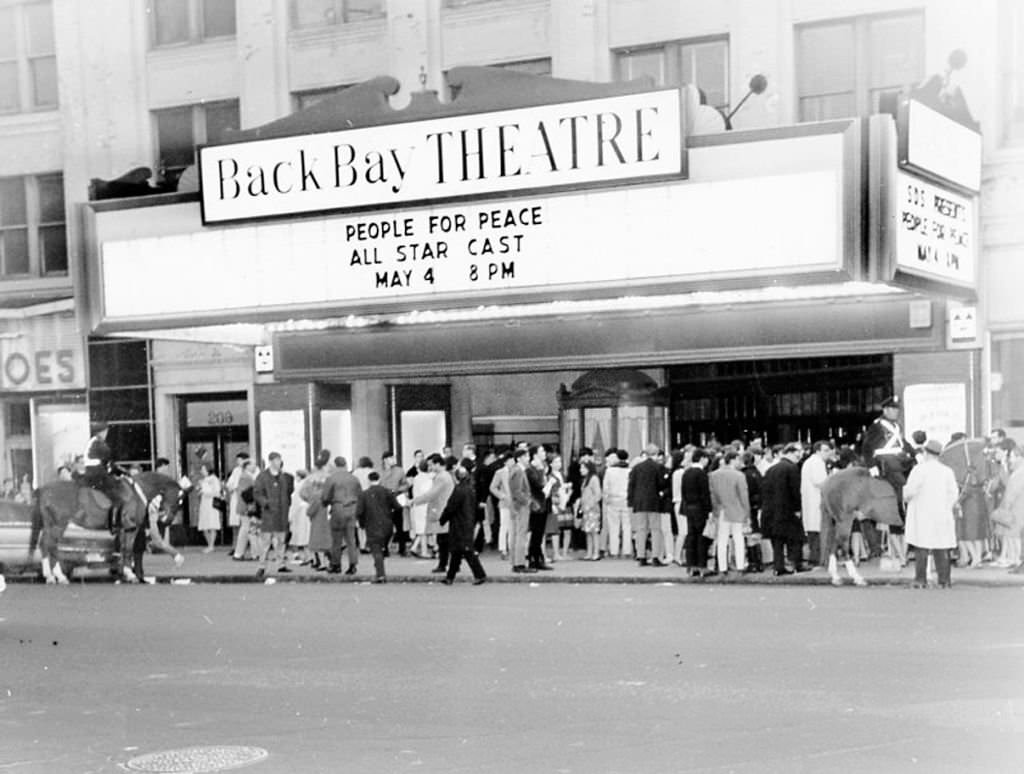
The Congregation Adath Jeshurun synagogue in the Roxbury neighborhood of Boston, 1966.The sign out Back Bay Theatre in Boston, May 4, 1966.
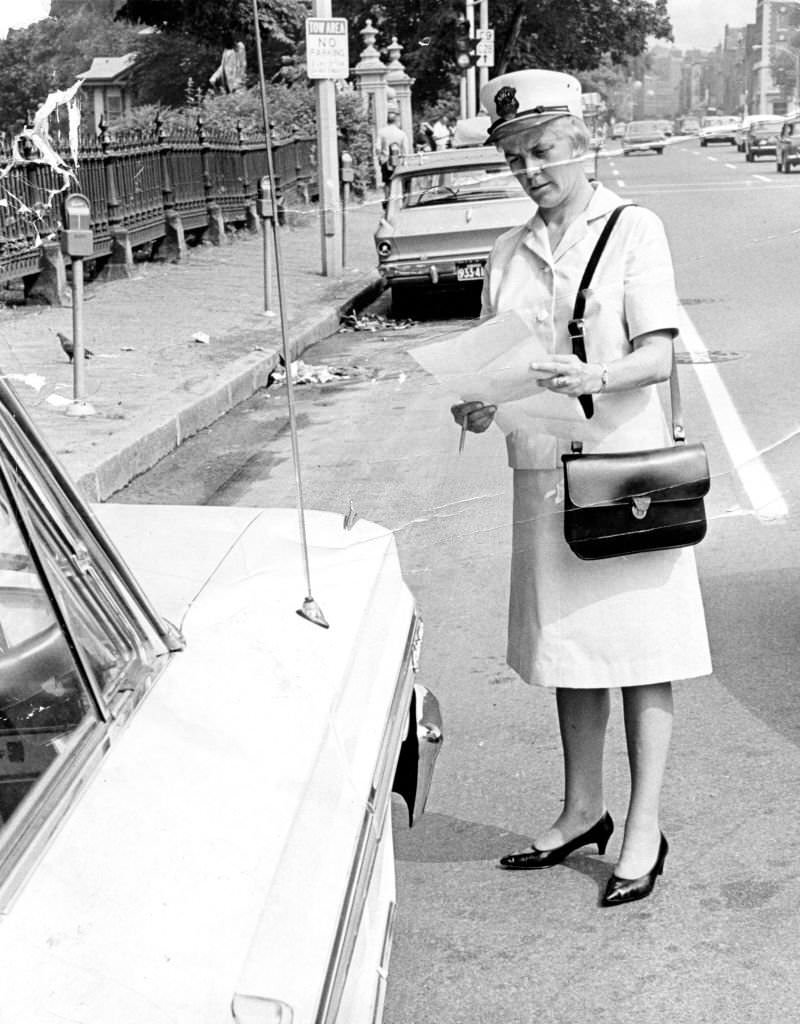
Meter maid Mary Martin makes her rounds in Boston on Jul. 7, 1966.
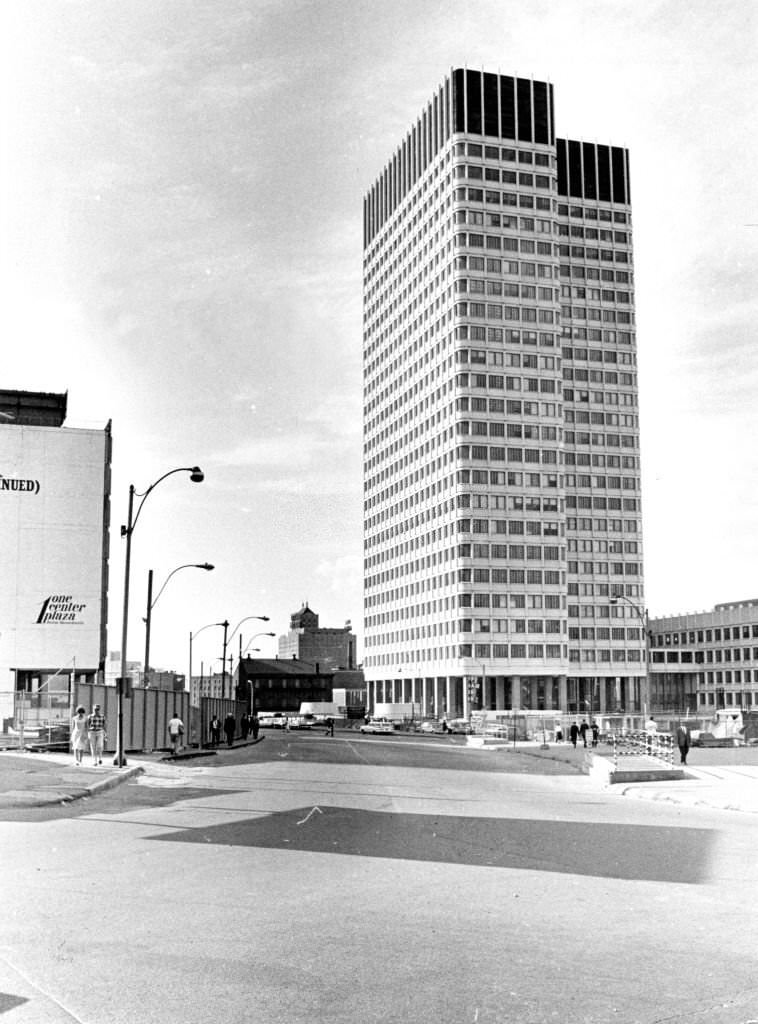
The mostly deserted Government Center area of downtown Boston around 6 p.m. on July 11, 1966.
Castle Island in South Boston was not immune to neglect. By July 1966, Fort Independence showed boarded-up windows where vandals had ripped out toilet facilities two years prior. Two bathrooms were briefly repaired for mentally disabled children using the facility, but had to be closed due to a lack of water pressure in the building’s pipes.
Inside Castle Island’s Fort Independence shows boarded-up windows where vandals tore out toilet facilities two years before, seen here on July 12, 1966.Looking down on the construction of the new underground tunnel at Government Center in Boston on July 12, 1966.The Custom House tower stands behind a busy Faneuil Hall marketplace in Boston on July 16, 1966.
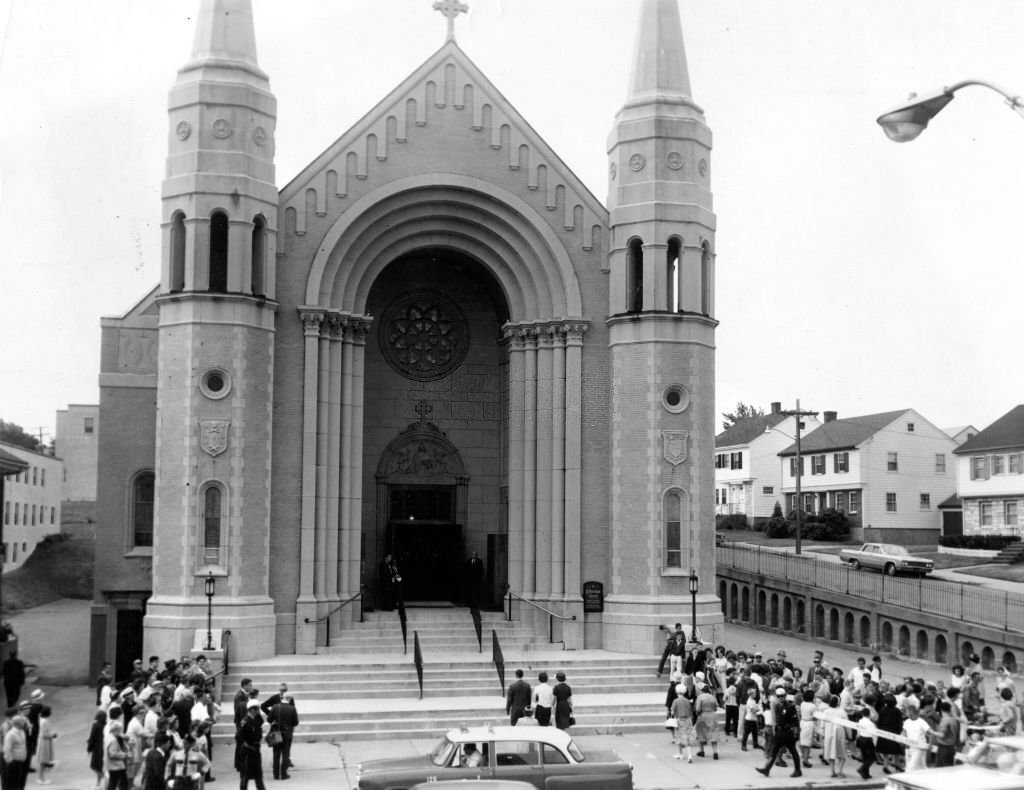
On August 11, 1964, a crowd gathered outside St. Brendan’s Church in Dorchester for the funeral of Mrs. Mary J. Fitzgerald — wife of former Boston Mayor John F. Fitzgerald and grandmother of President John F. Kennedy, who had been assassinated the previous November.
A crowd gathers outside St. Brendan’s Church in the Dorchester neighborhood of Boston.
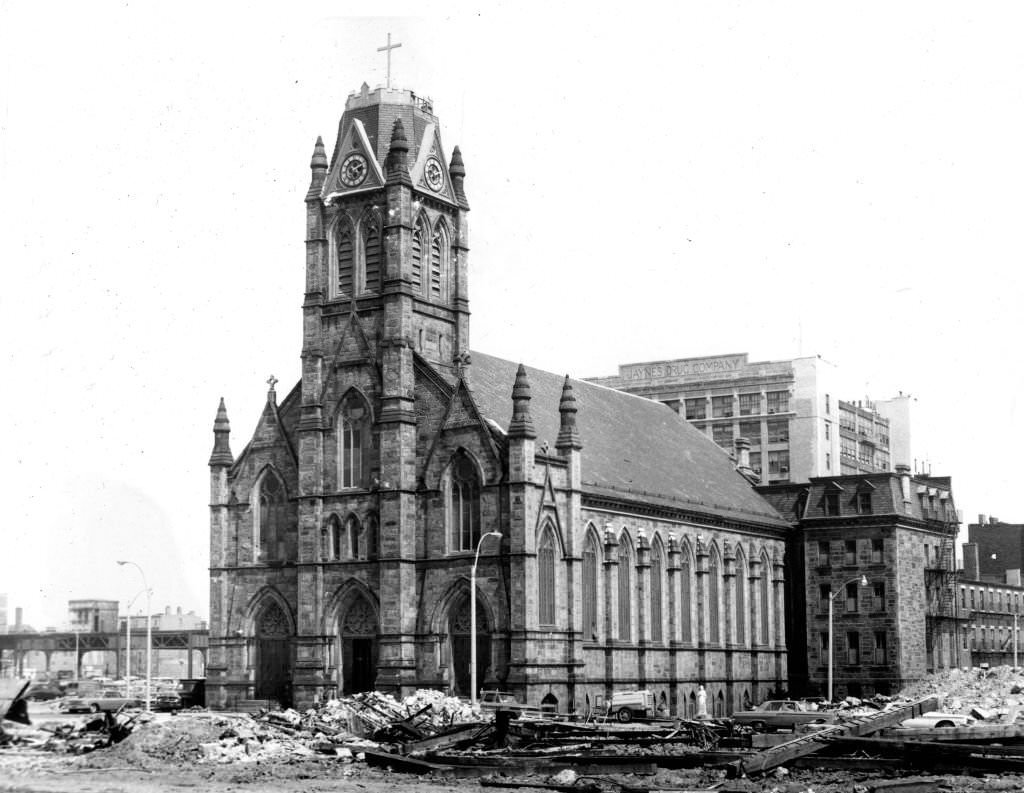
Redevelopment in the South End left Holy Trinity Church surrounded by rubble in August 1964. Brick tenement buildings that had stood for decades were knocked down as part of the city’s urban renewal push, leaving the church as an isolated structure amid the cleared land.
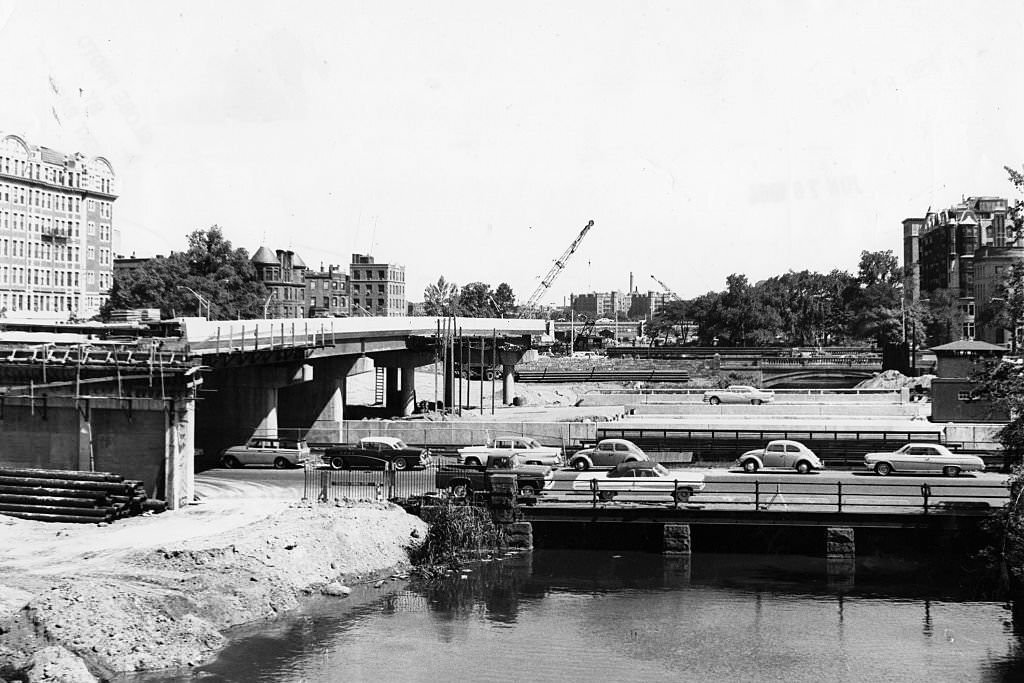
The Holy Trinity Church in Boston’s South End Aug. 7, 1964, surrounded by rubble from brick tenement buildings demolished amid area redevelopment.Construction continues on the toll road between Charlesgate East and West in Boston, blocking in part of the Muddy River, on June 15, 1964.The toll road construction looking towards Mass. Ave from Charlesgate East, which shows the Prudential Center in the background in Boston, June 15, 1964.Firefighters battle a large fire on Bellflower Street in Dorchester in Boston on May 22, 1964.
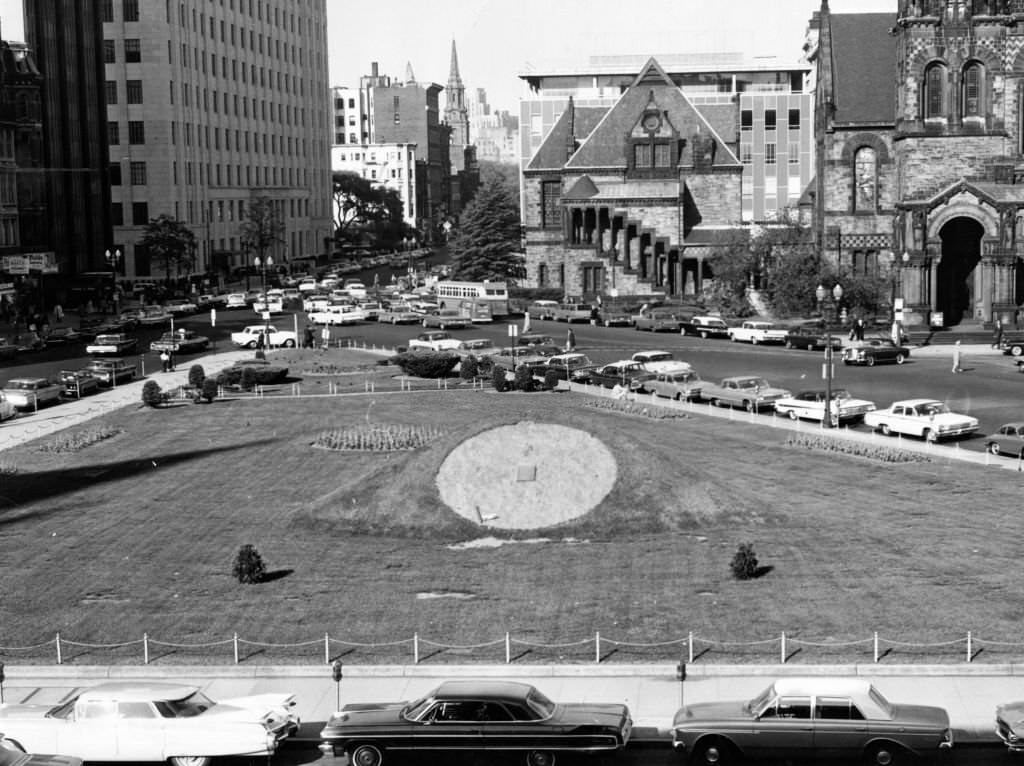
Copley Square had a unique attraction in May 1964 — a flower clock 25 feet in diameter, modeled after a famous clock in Geneva, Switzerland. It was planted in bloom and drew considerable attention from passersby.
The flower clock in Copley Square in Boston, May 21, 1964. The clock is a replica of a clock in Geneva, Switzerland. It is 25 feet in diameter.Worcester Square in Boston on May 7, 1964.
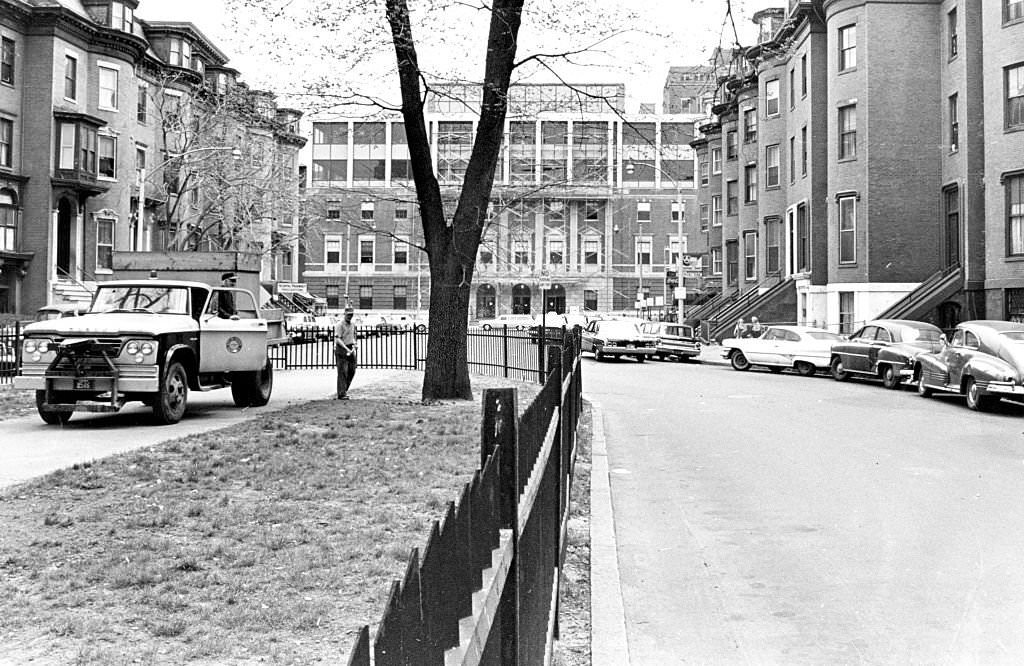
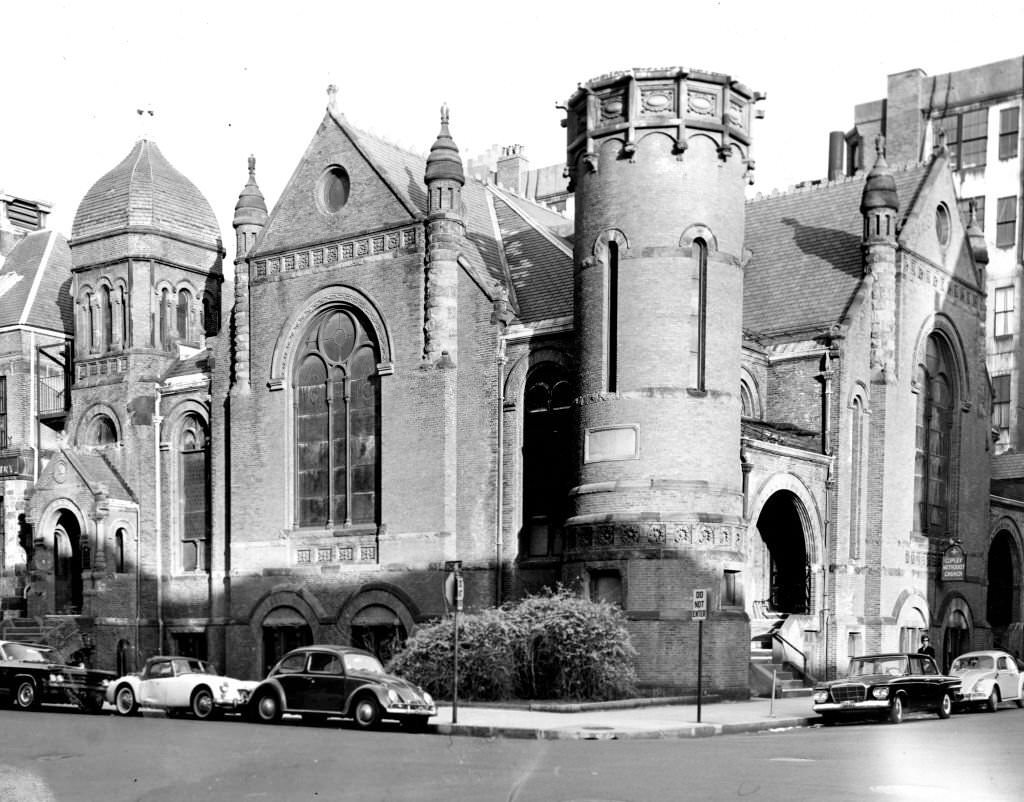
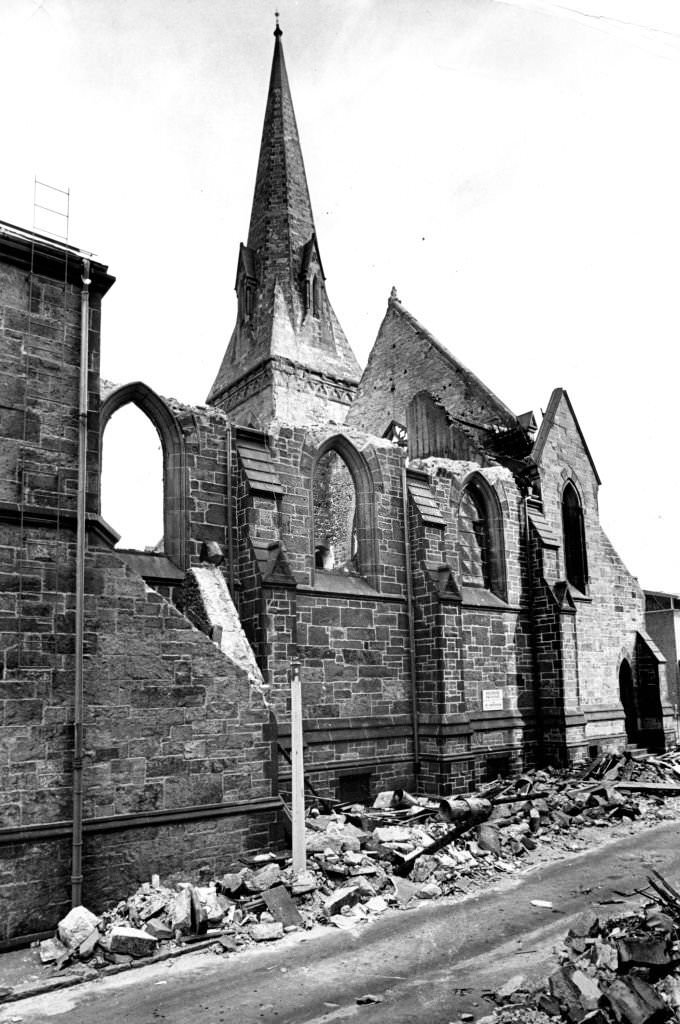
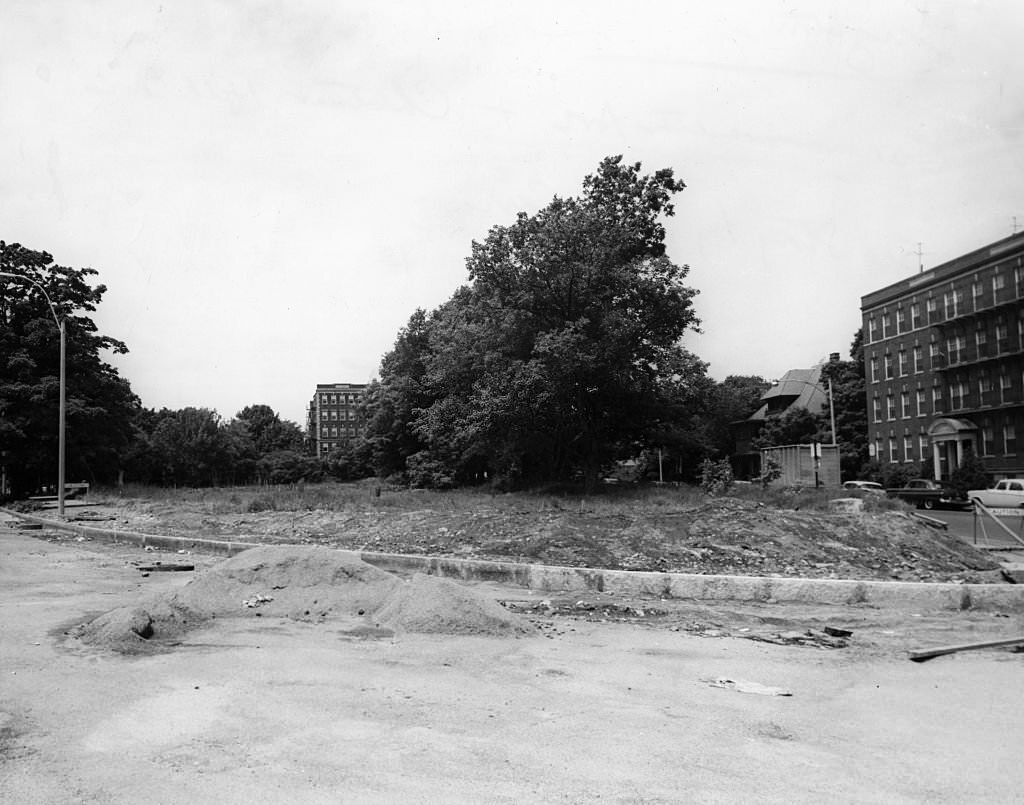
The Copley Methodist Church at the corner of Newbury and Exeter Streets was condemned by 1964 and set for demolition, another historic building lost to the city’s drive to clear and rebuild.
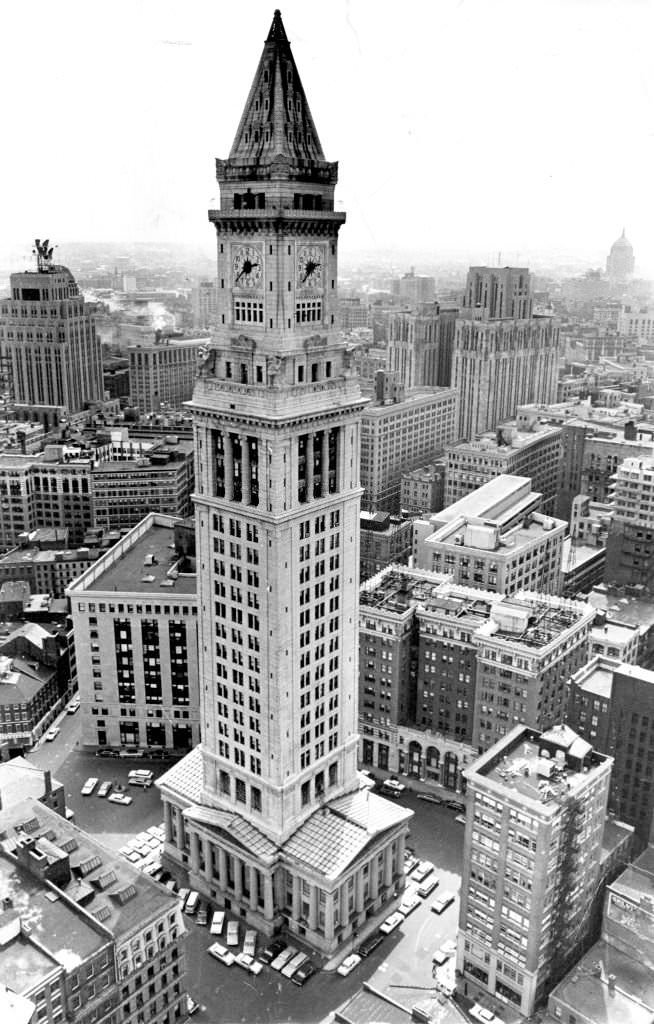
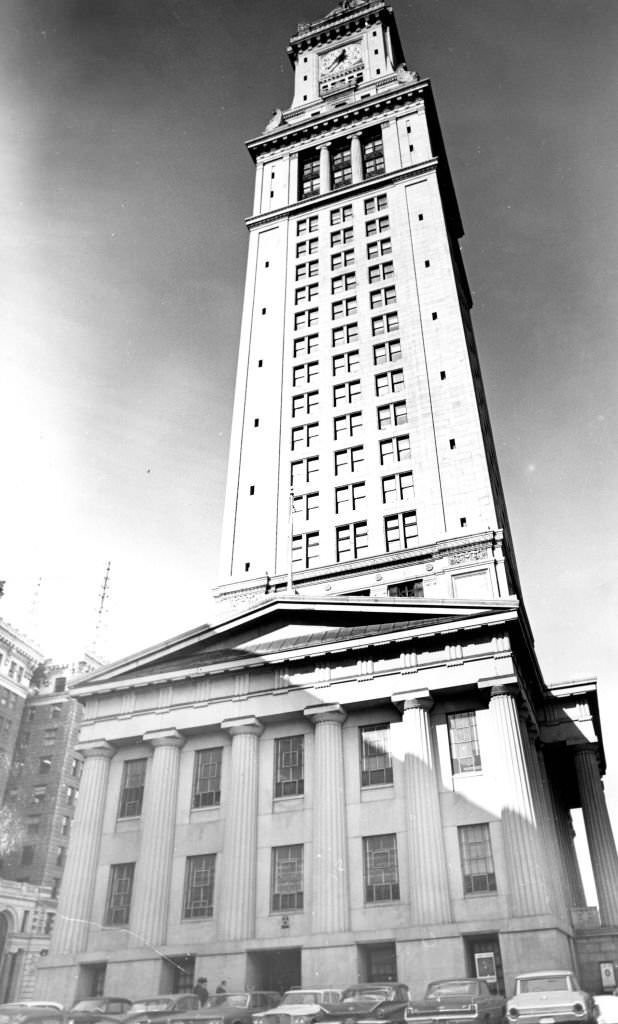
Copley Methodist Church at the corner of Newbury and Exeter Streets in Boston, May 3, 1964.Trinity Church and the old John Hancock Building in Copley Square in Boston on April 4, 1964.Trucks sit along an empty Blackstone Street in Boston on April 10, 1964.The Custom House Tower in Boston, 1964.Aerial view of downtown Boston, Massachusetts, 1964.A pedestrian walks through the snow in the Public Garden in Boston at 4 a.m. on Dec. 28, 1963. (
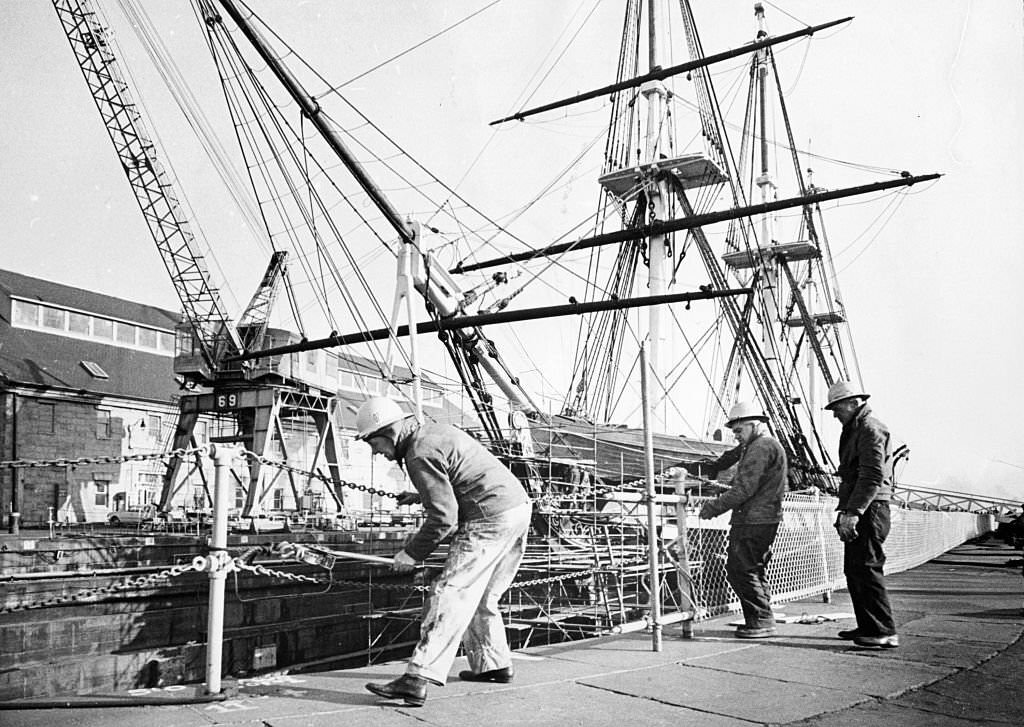
The USS Constitution, the storied Navy frigate docked at the Charlestown Navy Yard, went into dry dock for her fifth overhaul in December 1963. Workers erected a fence around the yard to protect visitors while repairs were underway. The ship remained open to the public on weekends and national holidays throughout the process.
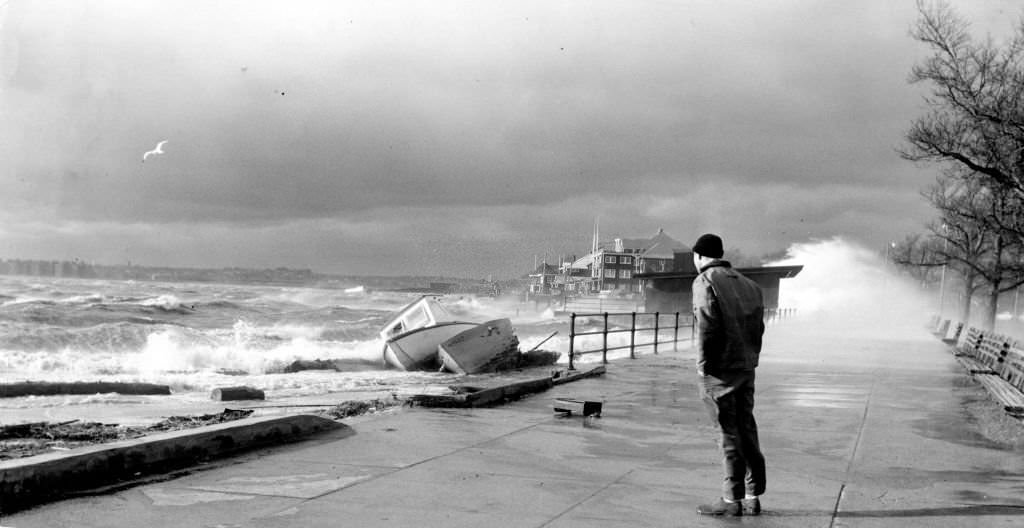
Workers erect fence around the Charlestown Navy Yard in Boston to protect visitors while the USS Constitution is in dry dock undergoing repairs on December 10, 1963.An observer watches waves crashing on the beach near Kelly’s Landing restaurant in the City Point neighborhood of South Boston, 1963.A railroad bridge spanning the Neponset River in the Dorchester neighborhood of Boston, 1963.Irvington Street (foreground) fronting where the Irvington Street Armory was formerly located, next to the Back Bay railroad depot, Oct. 4, 1963.
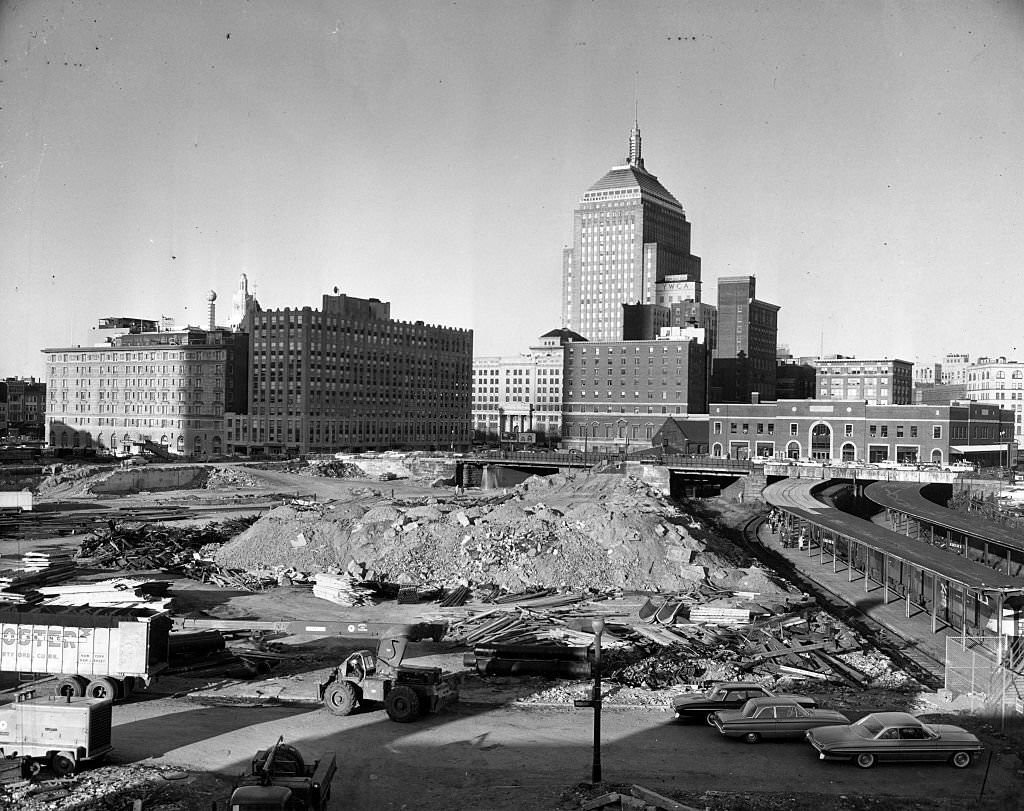
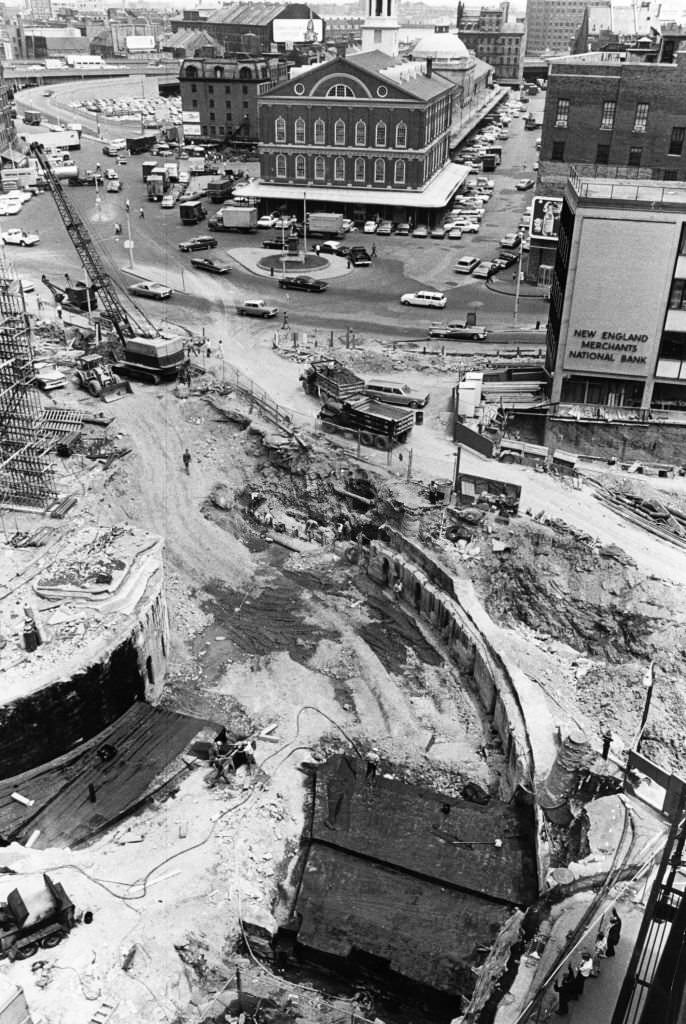
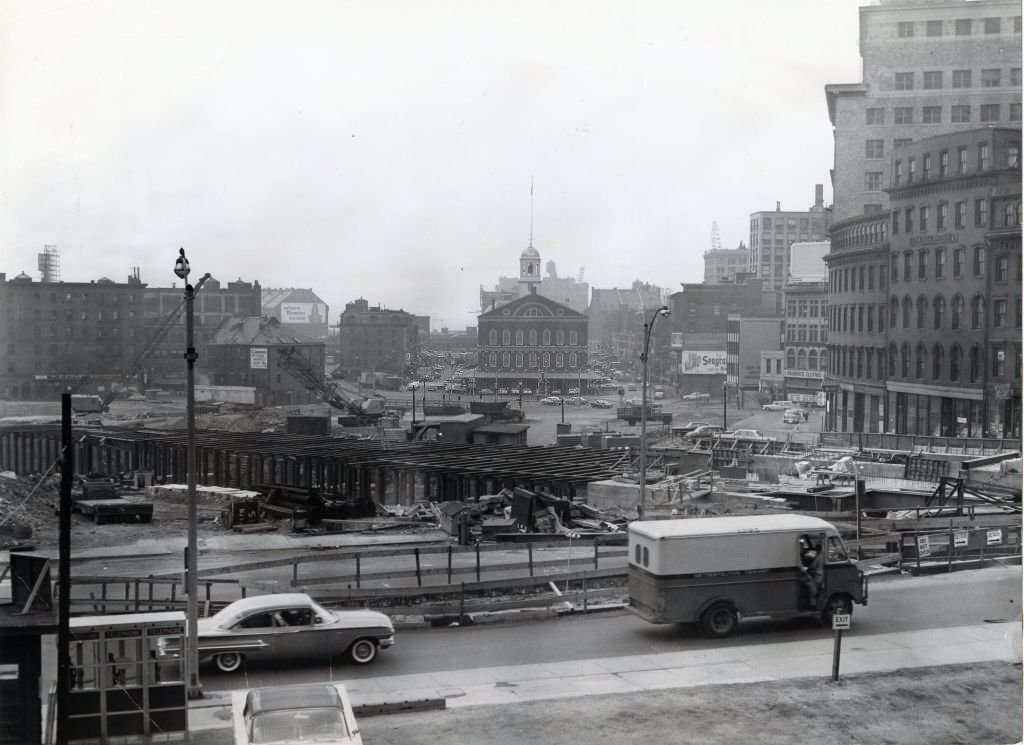
By August 1963, Scollay Square was being torn apart to make way for Government Center. Construction on the subway extension was visible from Faneuil Hall as crews pushed forward on one of the decade’s most ambitious infrastructure projects.
The Scollay Square subway extension construction is seen in Boston on Aug. 17, 1963. Faneuil Hall is int he background.St. Stephen’s Church on Hanover Street in Boston’s North End, 1963.The Old West Church in Boston’s West End, 1963.
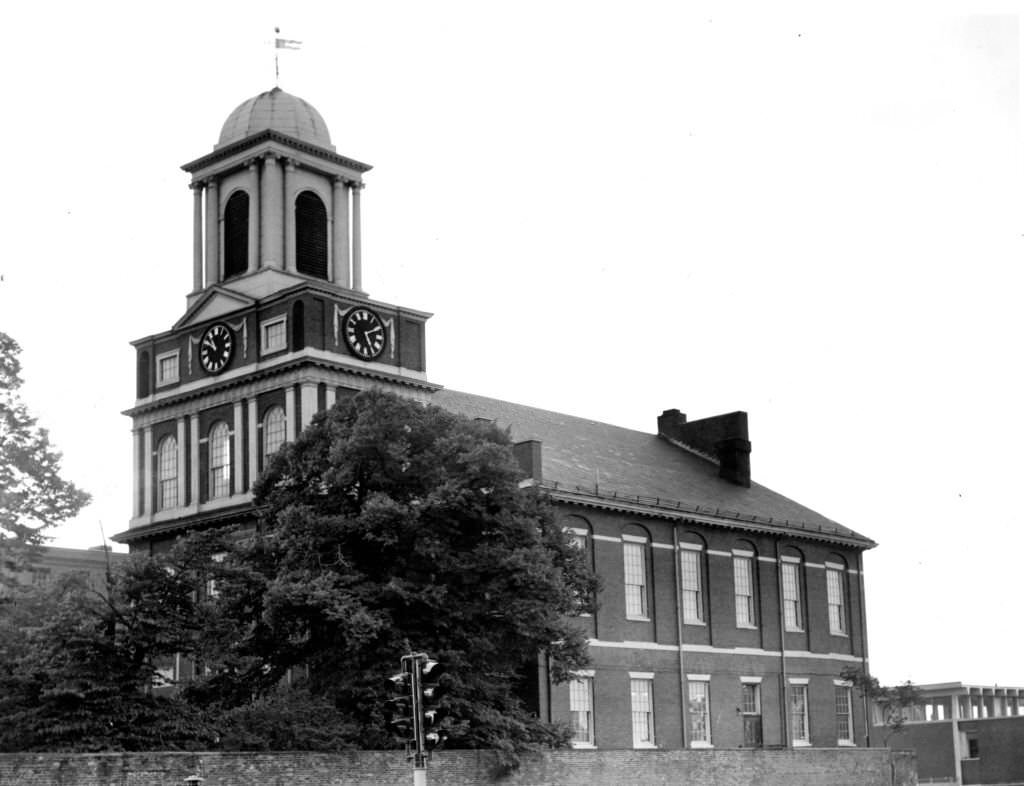
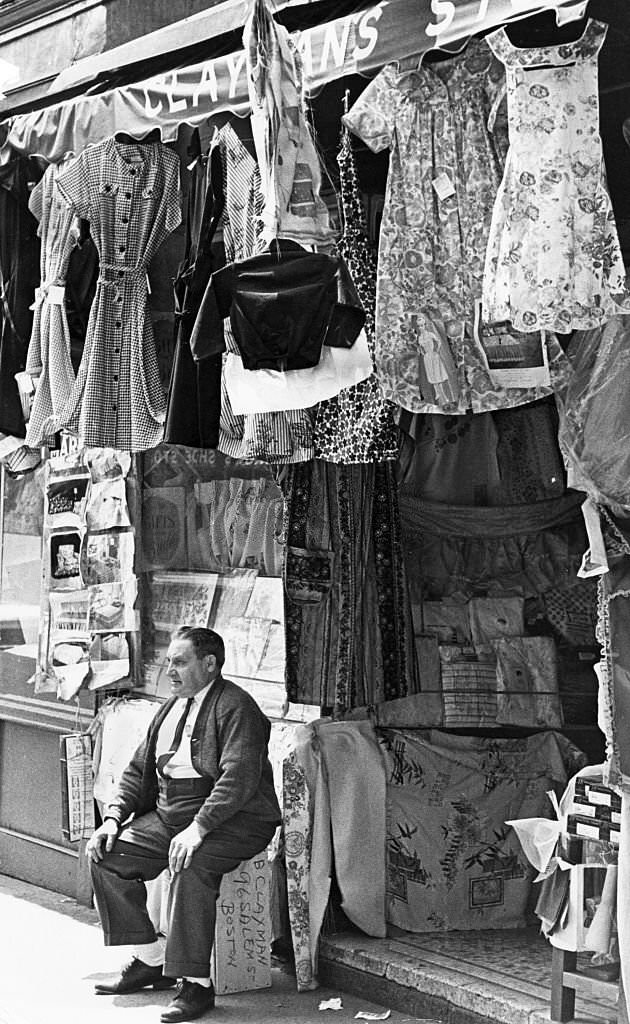
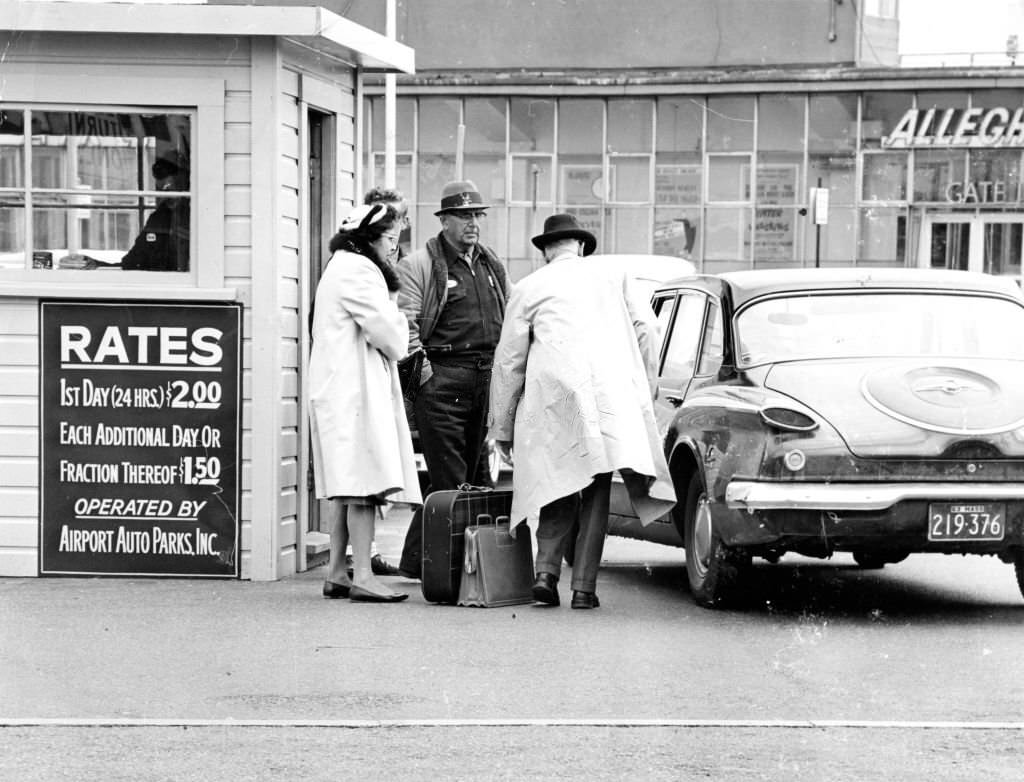
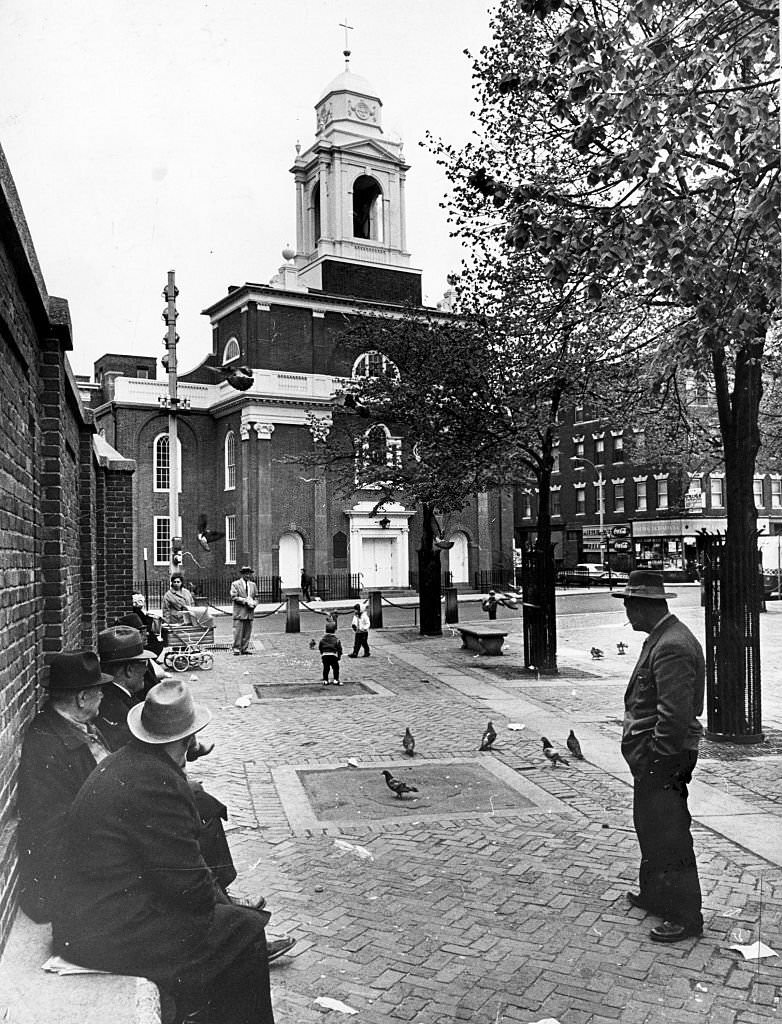
The North End remained a tight-knit Italian-American neighborhood throughout the decade. Benjamin Clayman sat outside his dry goods store at 96 Salem Street in May 1963, running a business he had operated for 45 years. A short distance away, residents gathered at Paul Revere Park to chat and play cards on a sunny afternoon.
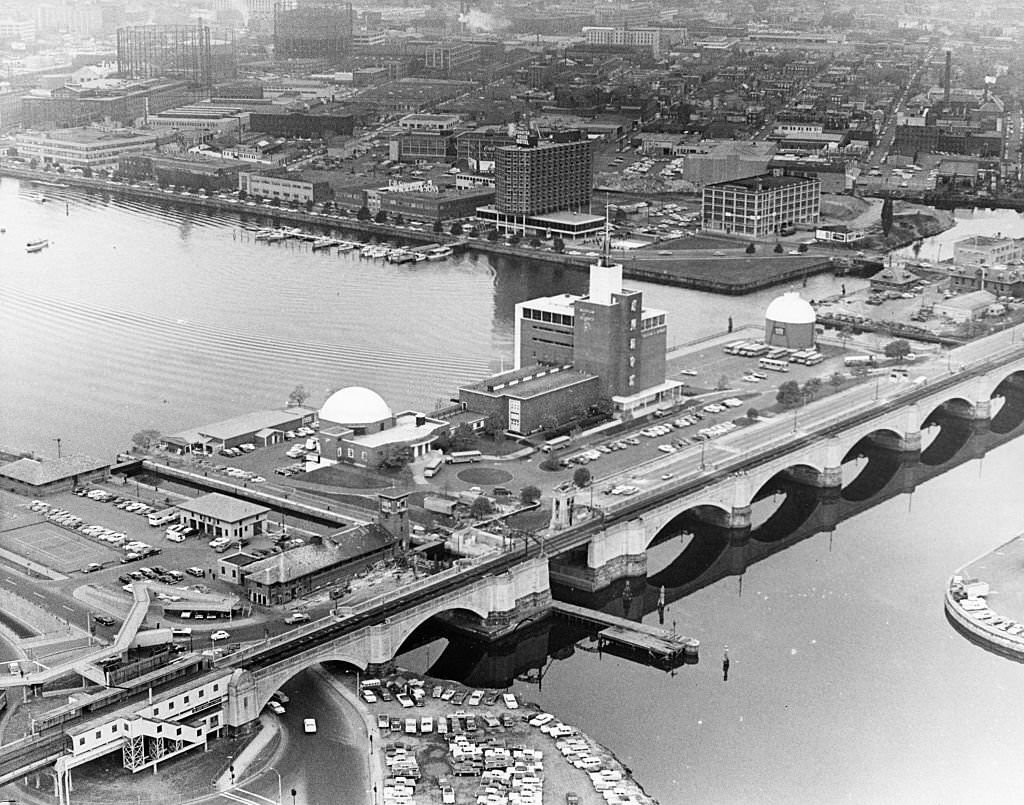
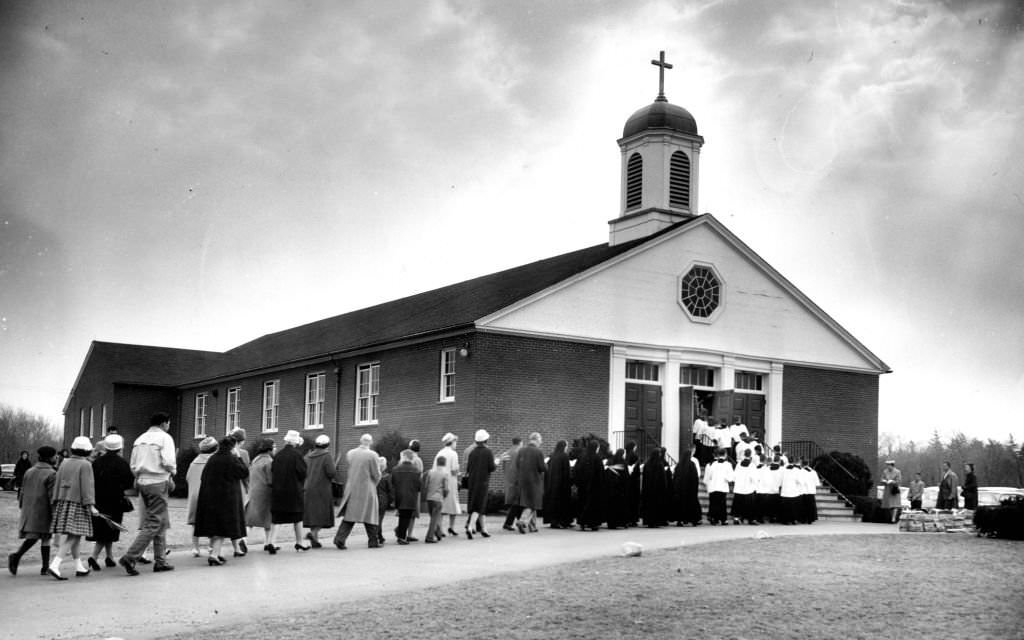
Benjamin Clayman sits outside his 45-year-old dry goods store at 96 Salem St. in Boston’s North End on May 21, 1963.Residents chat and play cards at Boston’s Paul Revere Park in the North End on a sunny May 21, 1963.The Museum of Science in Boston, seen from the air, May 9, 1963.Customers take advantage of valet parking service at Logan Airport in Boston on Apr. 24, 1963.A Palm Sunday processional enters St. Pius X Church in the Hyde Park neighborhood of Boston on April 7, 1963.
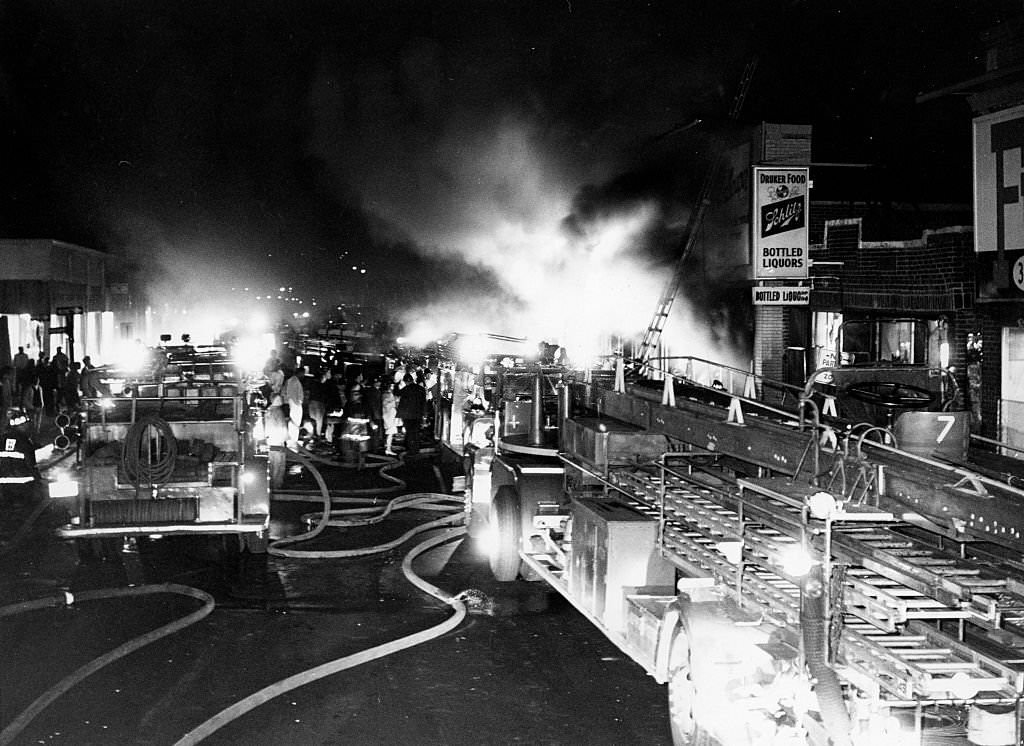
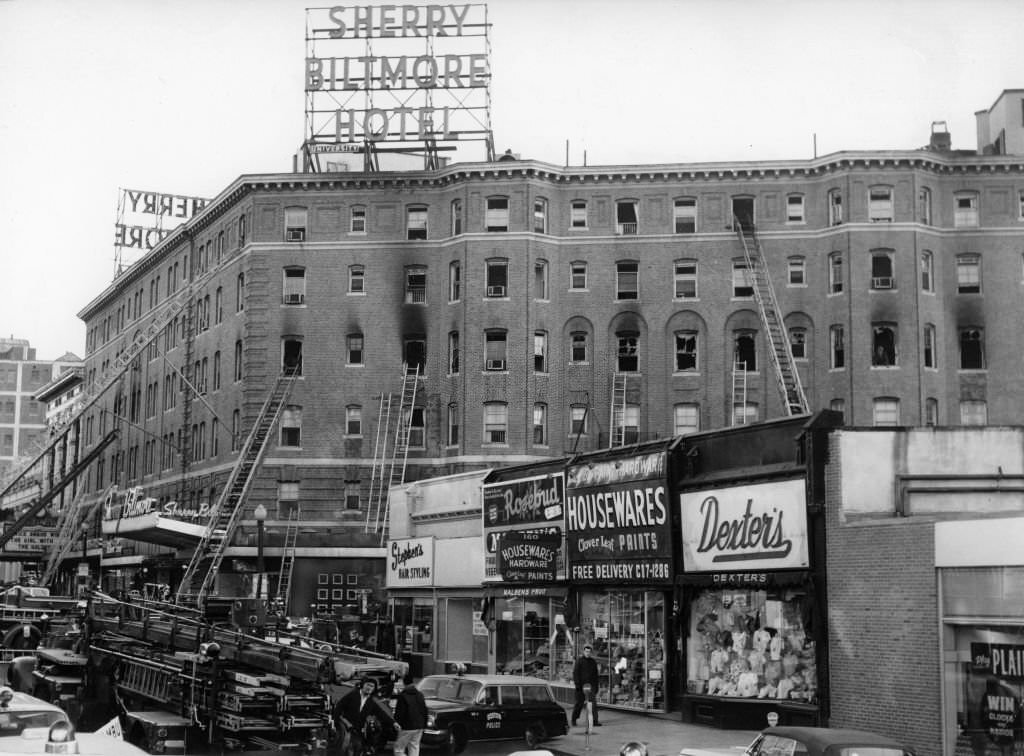
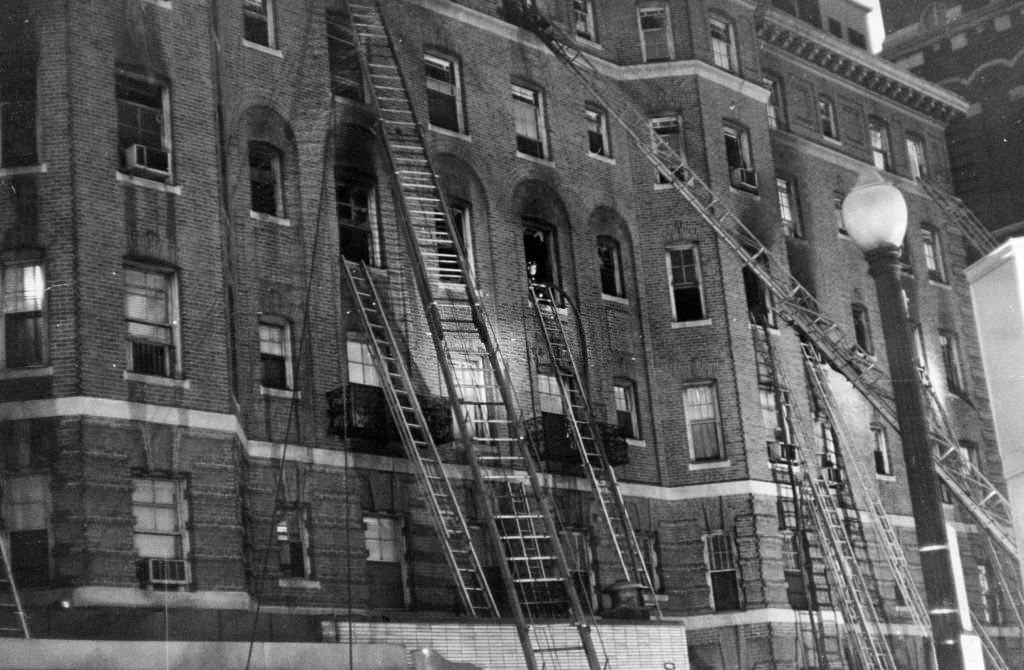
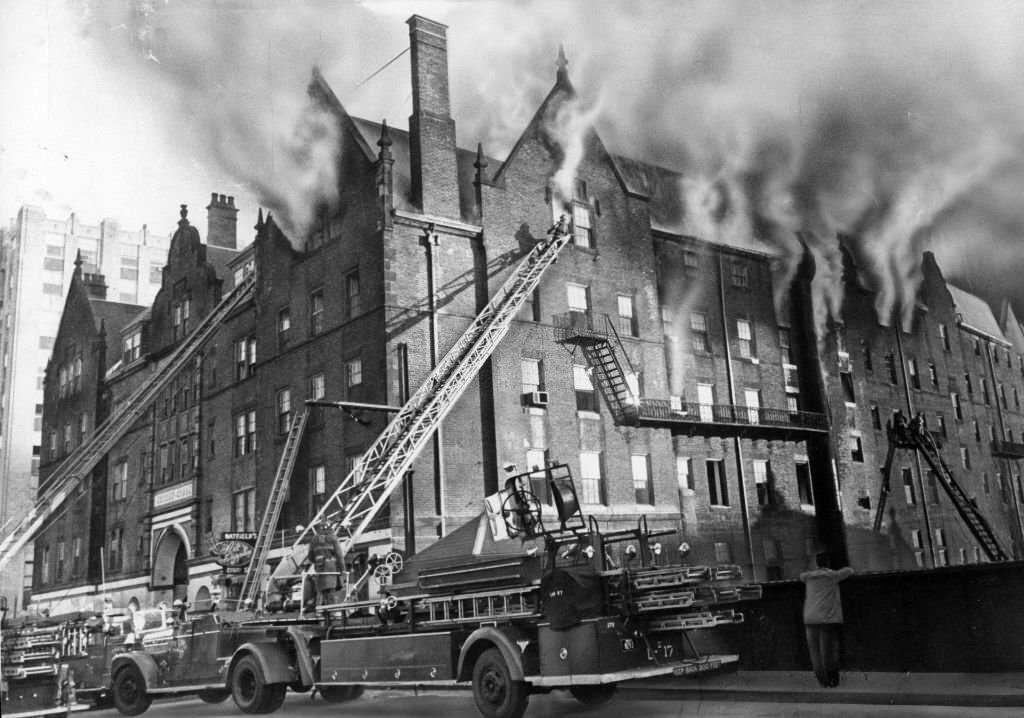
The Sherry Biltmore Hotel was the scene of a dramatic five-alarm fire in March 1963. Firefighters worked through the blaze with ladders raised against the building’s exterior as flames tore through the structure.
Firefighters work to extinguish a five-alarm fire at the Sherry Biltmore Hotel in Boston, March 29, 1963.Ladders lean on the side of the Sherry Biltmore Hotel after a five-alarm fire in Boston, March 29, 1963.The Custom House Tower in Boston on Feb. 25, 1963.Firefighters battle a two-alarm fire at old Trinity Court on 175 Dartmouth St. in Boston, Feb. 17, 1963.
High above Boston, construction workers assembled the Prudential Center floor by floor. By January 1963, they had reached the 48th floor — a remarkable vantage point over the city below.
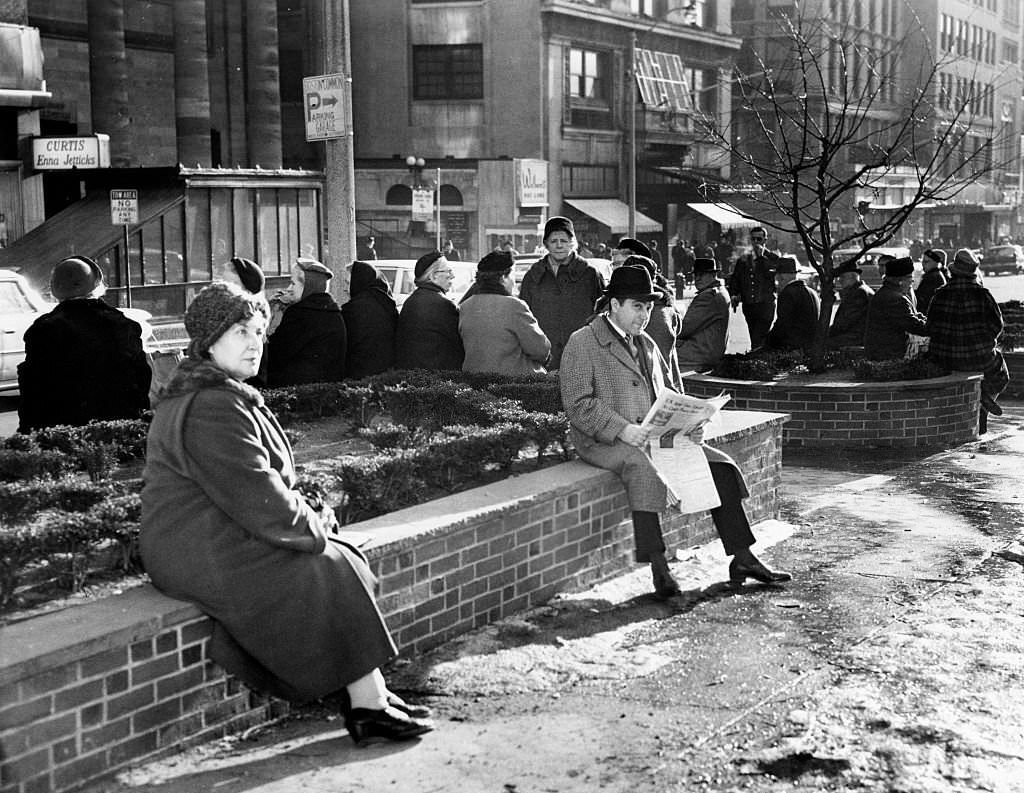
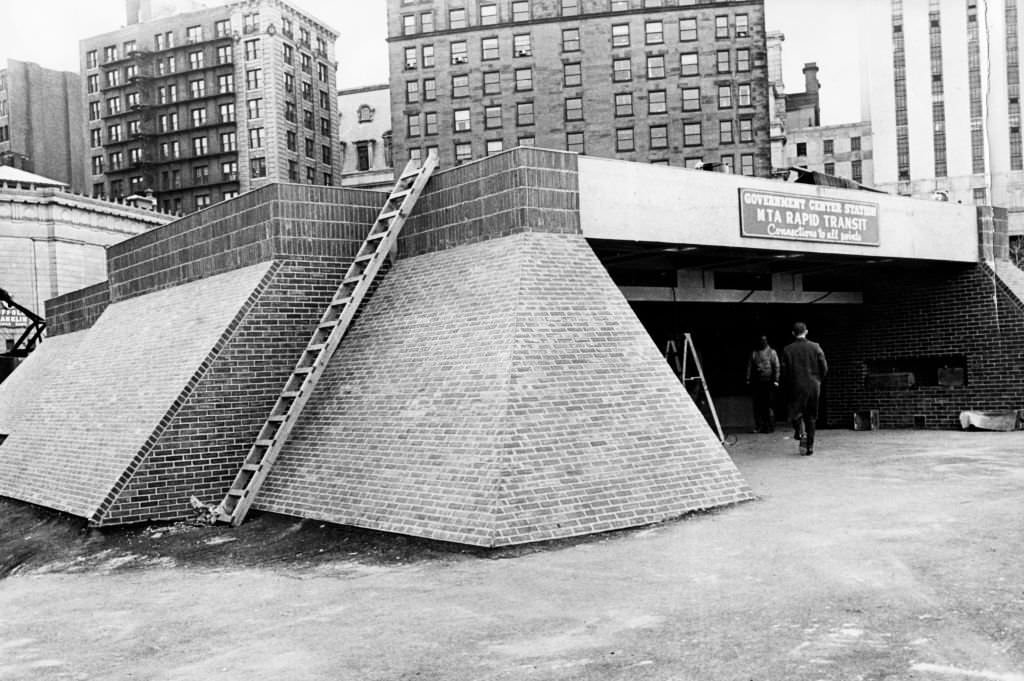
The 48th floor of the Prudential Center under construction in Boston, Jan. 23, 1963.People sit on the planters on the Tremont Street Mall near Park Street in Boston, enjoying a warm spring sun in the middle of winter, Jan. 10, 1963.The exterior of the Government Center MBTA stop in Boston on Jan. 2, 1963.The interior of Commonwealth Pier Number 5 in Boston is deserted at 7:30 a.m. on Dec. 24, 1962.Boston Police officers search for a boat which sank after a fire near the Savin Hill Yacht Club in Boston’s Dorchester, 1962.The exterior of the Cathedral Church of St. Paul in Boston, Dec. 13, 1962.The Old John Hancock Building stands on Berkeley Street in Boston on Dec. 12, 1962.
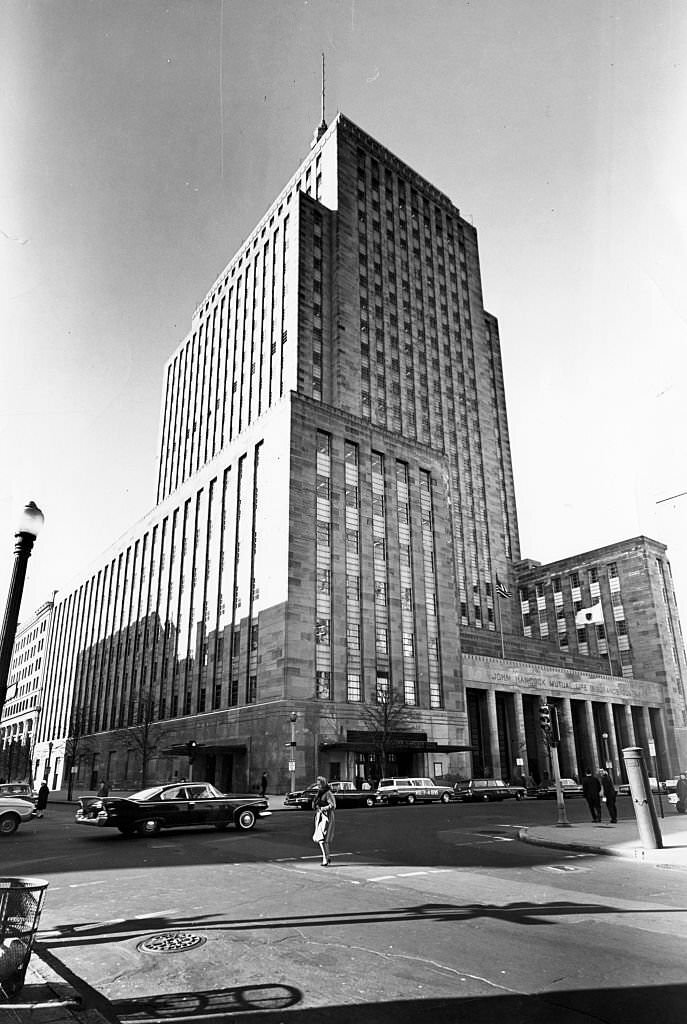
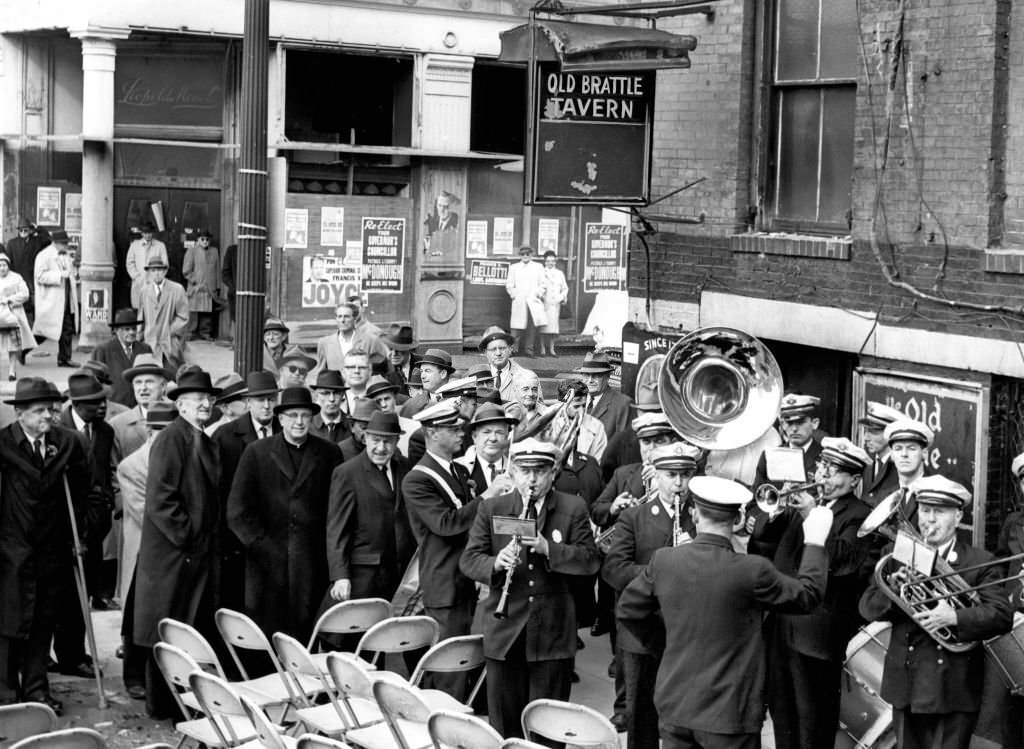
On November 1, 1962, more than 200 people gathered outside the Brattle Tavern in Boston to honor poet John Boyle O’Reilly. The ceremonies marked the spot where, in 1875, O’Reilly had negotiated the purchase of a whaling vessel used to rescue six Irish political prisoners from Australia. The tavern itself was slated for demolition to make room for Government Center.
Ceremonies honoring Boston poet John Boyle O’Reilly take place outside the Brattle Tavern in Boston on Nov. 1, 1962.The house at the corner of School and Summer Streets in the Charlestown neighborhood of Boston, Oct. 31, 1962.
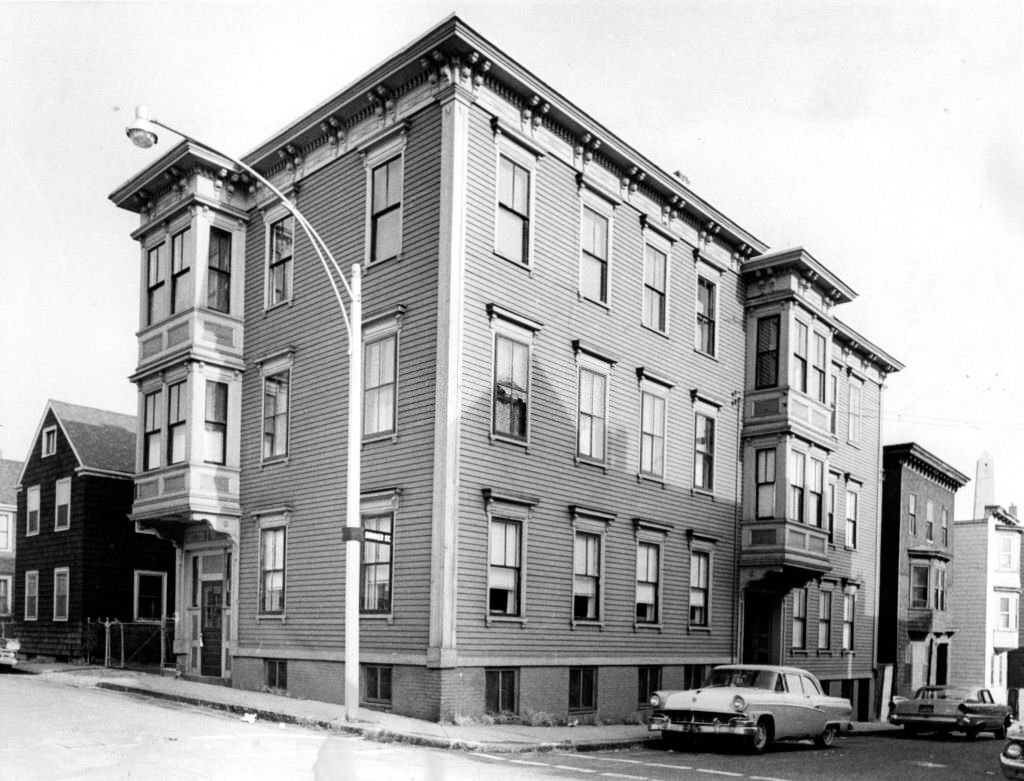
The homes at 25-28 Monument Sq. in the Charlestown neighborhood of Boston, Oct. 31, 1962.
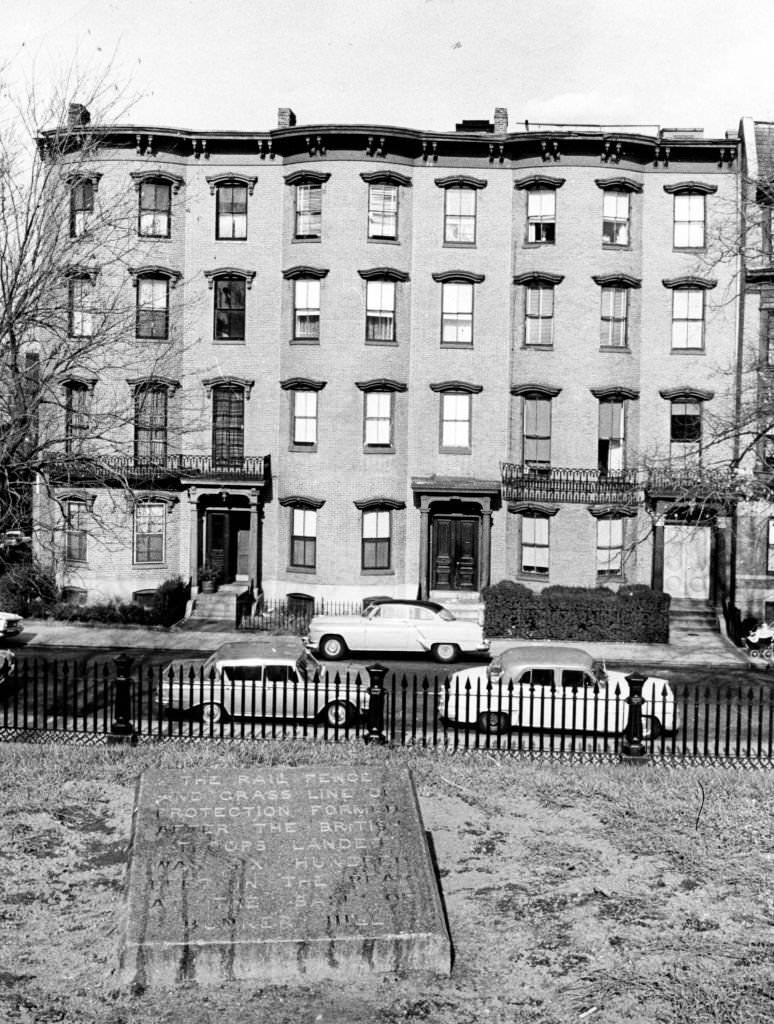
The houses at 37-39 High St. in the Charlestown neighborhood of Boston, Oct. 31, 1962.
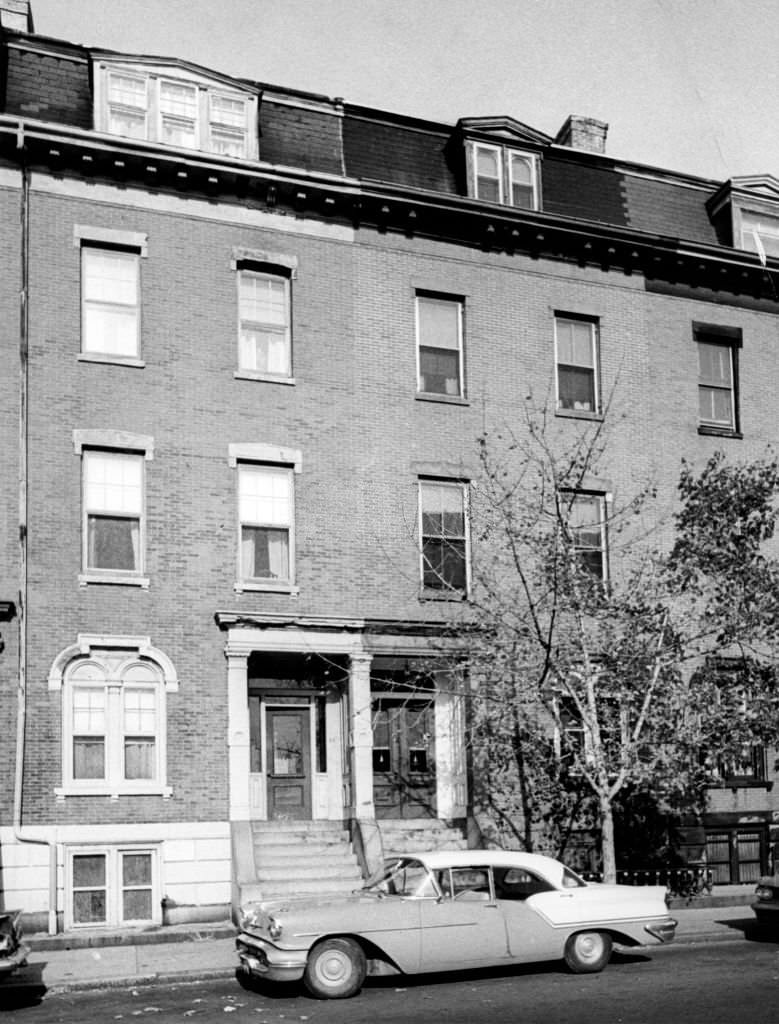
The 29th floor of the Prudential Center under construction in Boston, Oct. 30, 1962.
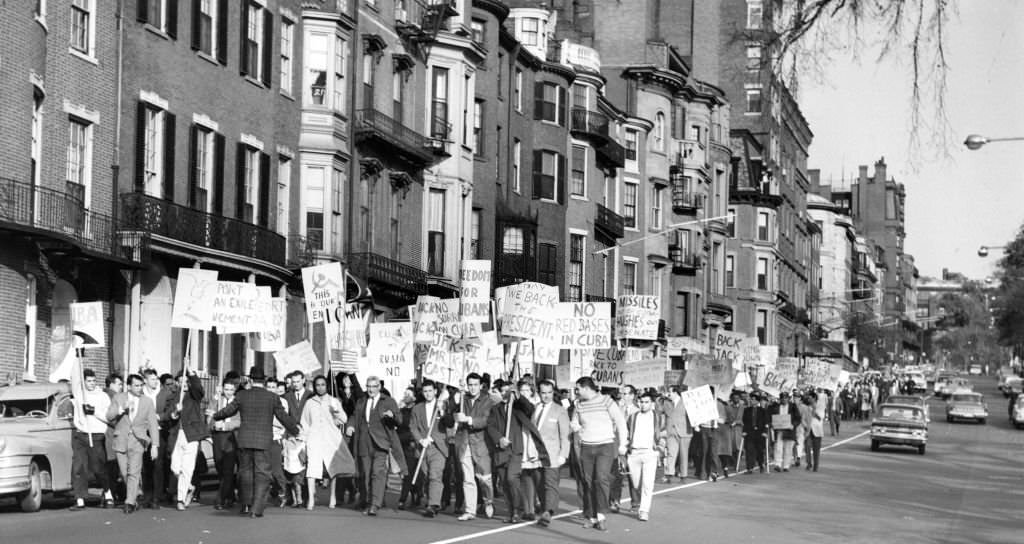
The Cuban Missile Crisis gripped the country in October 1962, and Bostonians felt it. Cuban refugees and their supporters marched down Beacon Street on October 28, 1962 — the same day Soviet ships turned back from the naval blockade — to show their support for the U.S. government’s position.
Cuban refugees and their supporters march down Beacon Street in Boston during a demonstration to display their support of the U.S. government in the crisis in Cuba on Oct. 28, 1962.
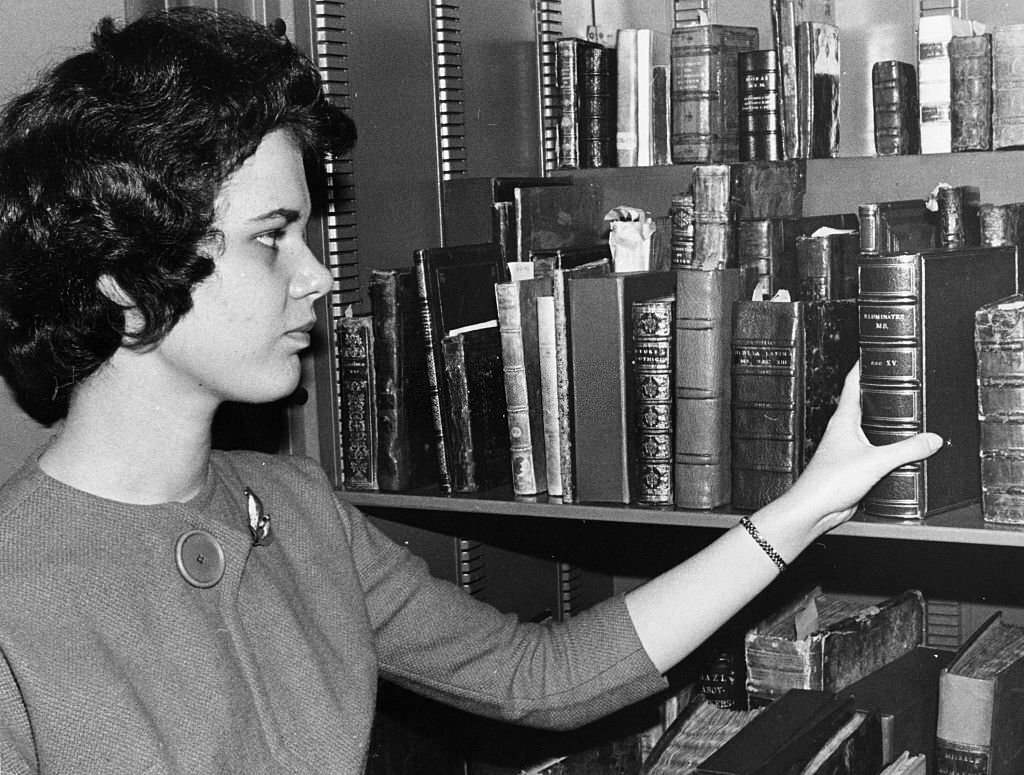
Inside the Boston Public Library, a different kind of crisis was quietly brewing. Millions of dollars’ worth of rare books in the library’s collection were being stored improperly, as librarian Janice Maniscalco of the rare books department showed in October 1962.
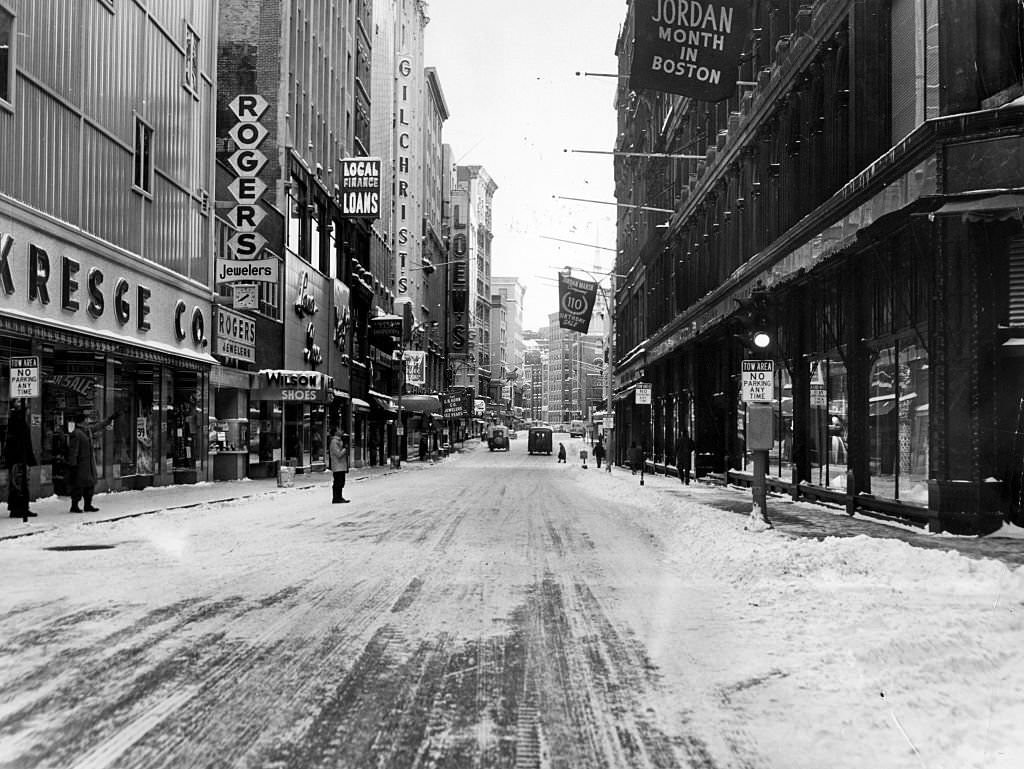
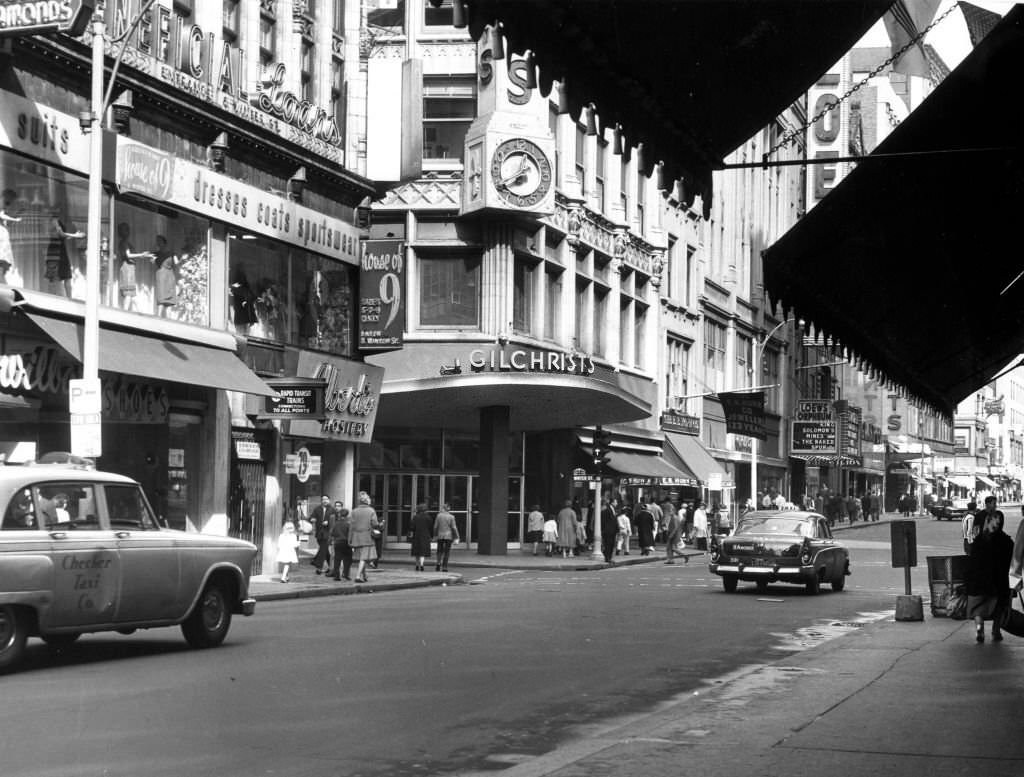
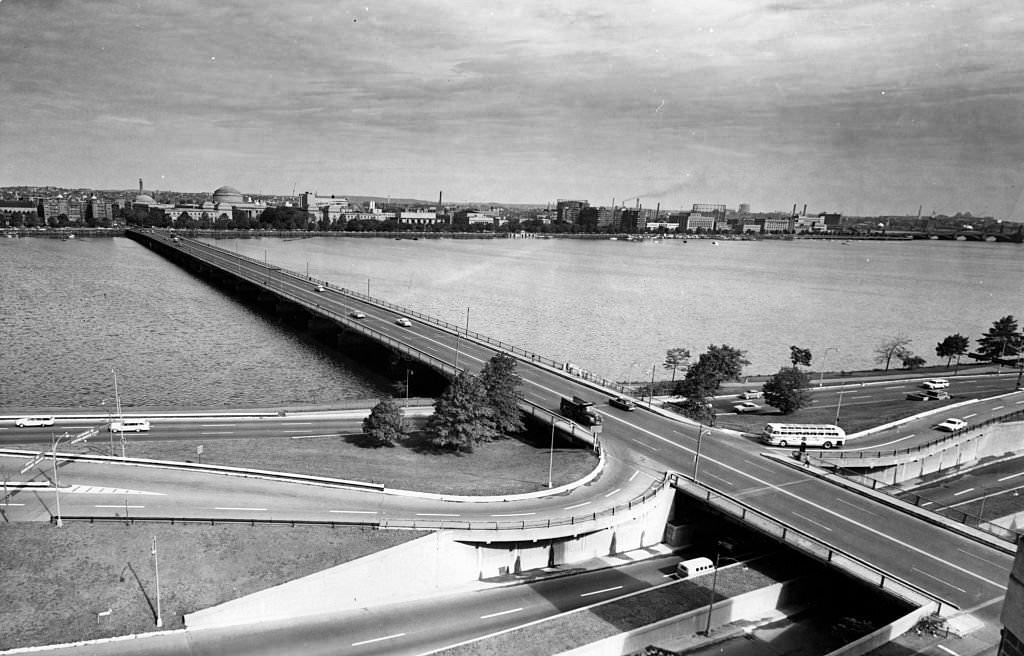
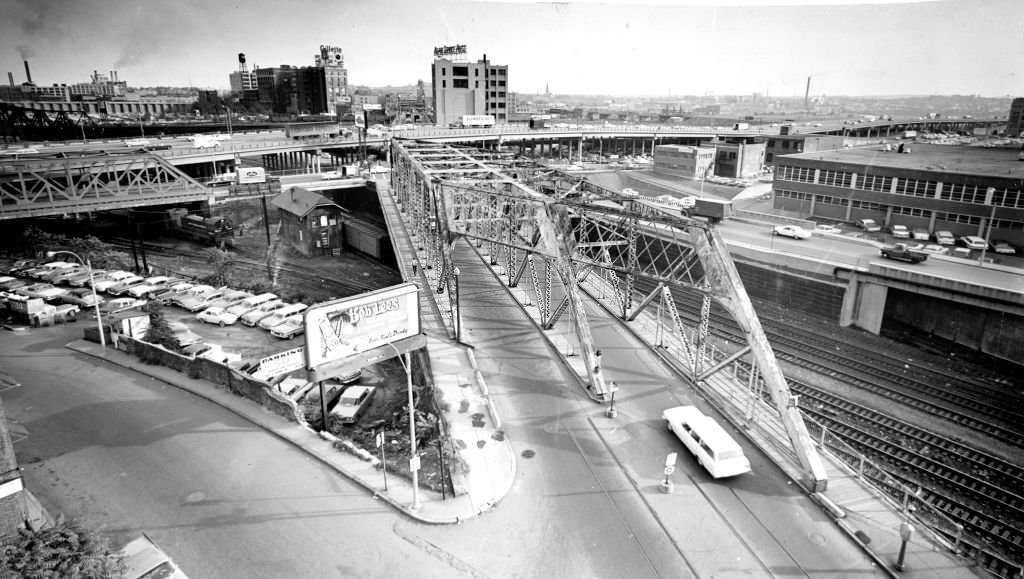
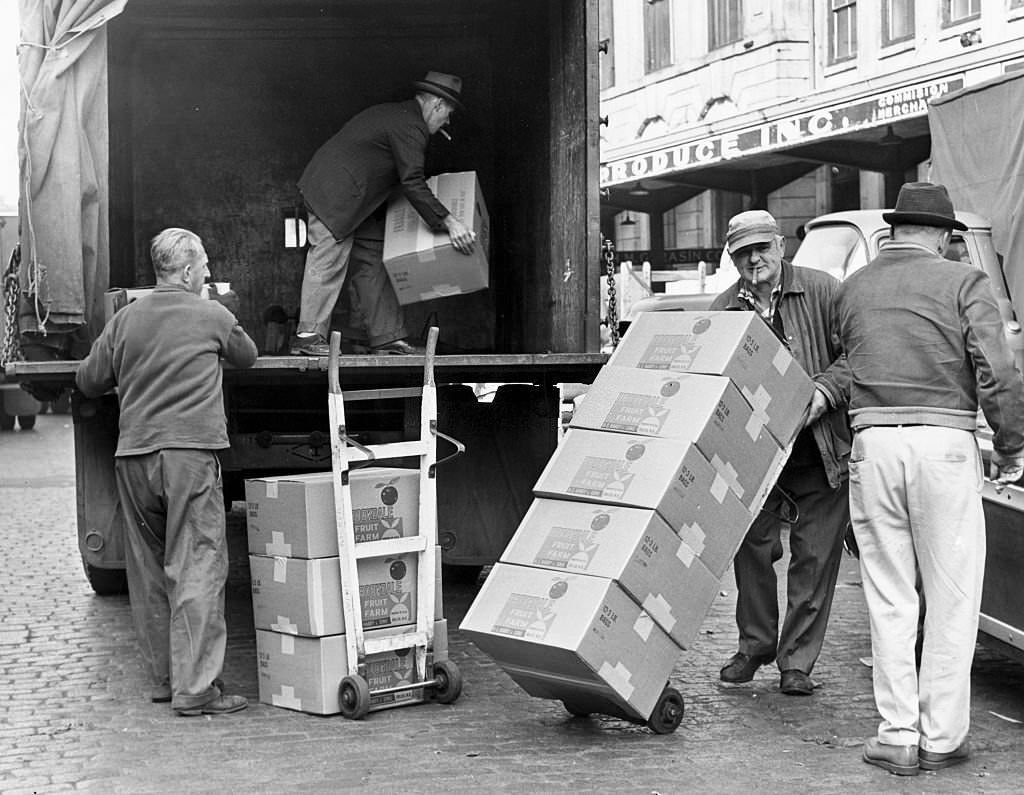
Janice Maniscalco, of the Boston Public Library’s rare books department, reaches for a book in the library’s rare book vault on Oct. 16, 1962.Gilchrist’s department store at the corner of Washington and Winter Streets in Boston’s Downtown Crossing on Oct. 12, 1962.Cars drive over the Harvard Bridge, looking towards Cambridge from Boston, on Oct. 8, 1962.The Broadway bridge to Boston’s South End, October 1962.St. Joseph’s Catholic Church in Boston’s West End, Sep. 28, 1962.Men load boxes into a truck at the Faneuil Hall market on Sept. 25, 1962.
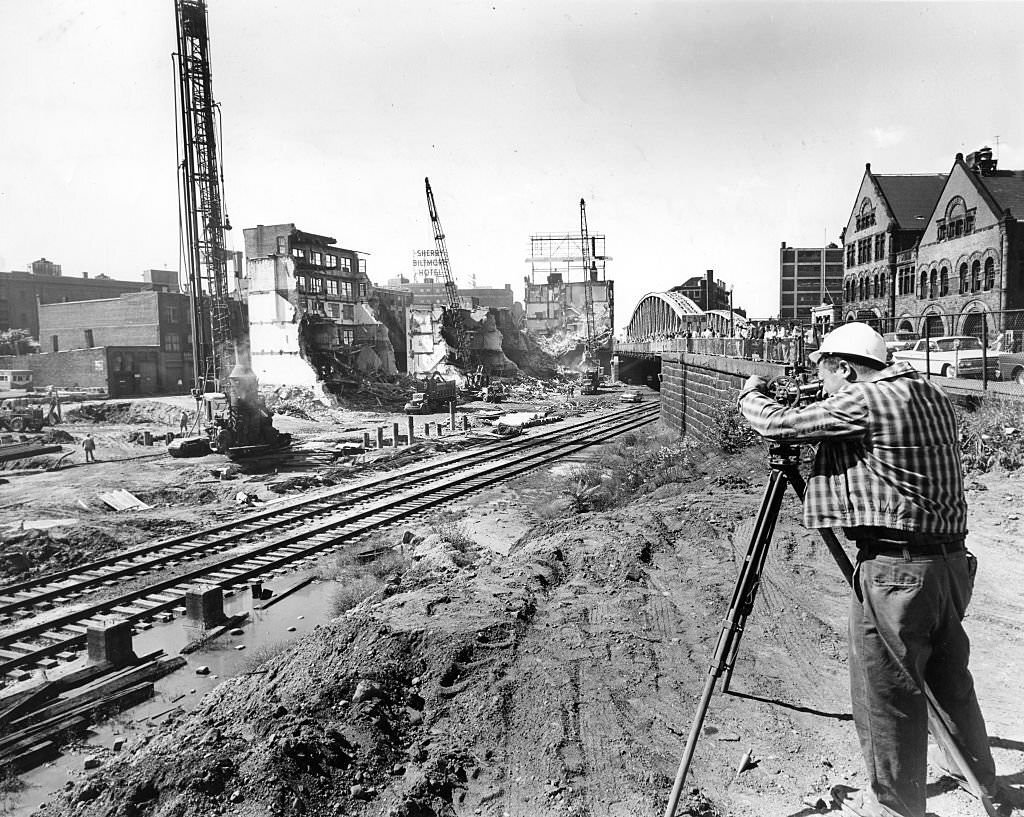
Near the Prudential Center construction site, a pile driver was breaking ground for a new city auditorium in September 1962. Behind it, demolition was underway on the site where the toll road would connect to the Pru. The fire station on Boylston Street stood to the right, watching the transformation from its long-familiar corner.
A pile driver starts piles for the new city auditorium, Sept. 21, 1962.
From Columbia Point, residents had a clear view of the Boston skyline. The project housed thousands of people while sitting largely cut off from the rest of the city, with few services, poor transit connections, and a waterfront location that offered scenic views but little practical benefit.
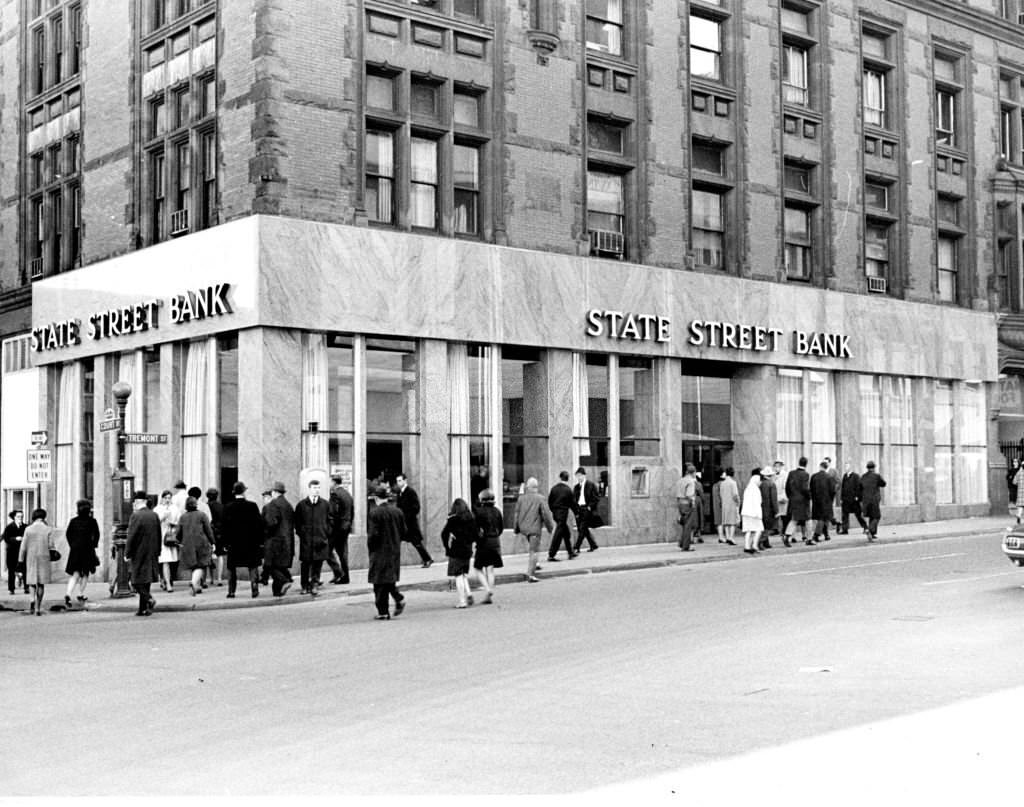
The Boston skyline is visible from the Columbia Point housing project, Sept. 8, 1962.The Columbia Point housing project in Boston, Sept. 8, 1962.South Boston and the downtown skyline are visible from the Columbia Point housing project, Sept. 8, 1962.The exterior of a State Street Bank branch on Tremont Street in Boston, Nov. 4, 1966.
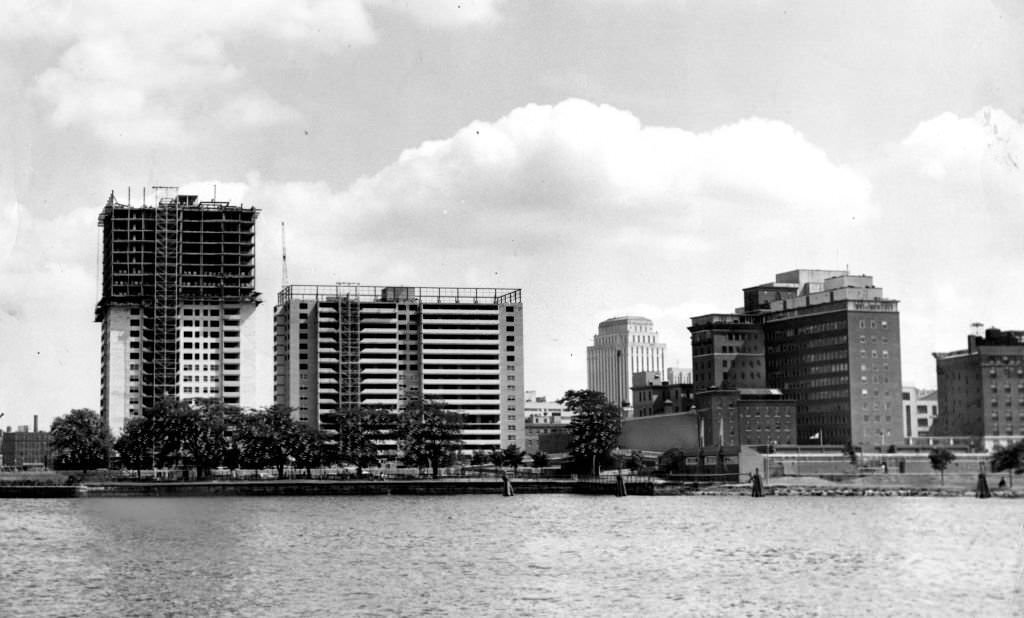
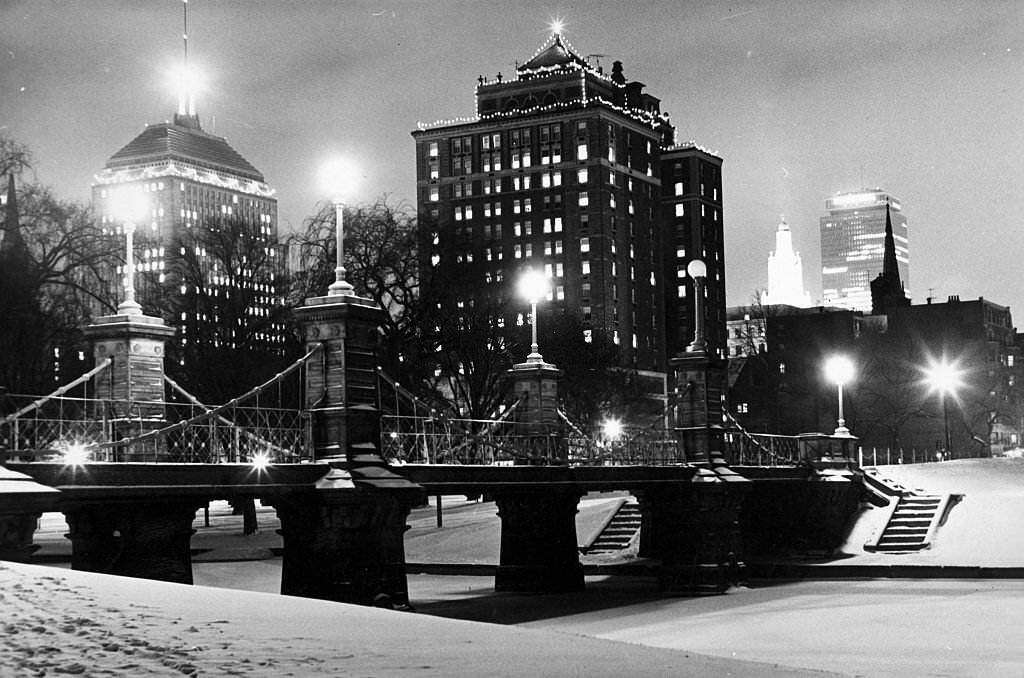
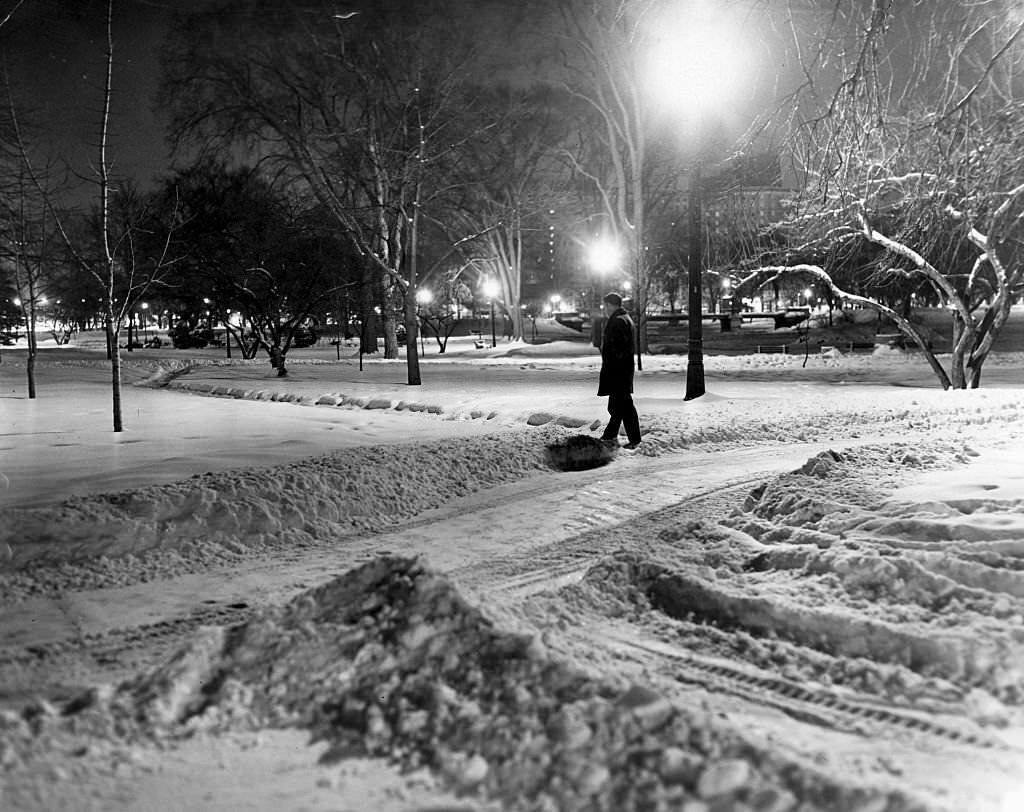
As 1966 drew to a close, the first snow of December blanketed the Public Garden at night. The Berkeley Building and the newly completed Prudential Tower rose above the white-covered trees — a striking image of the old and new Boston side by side.
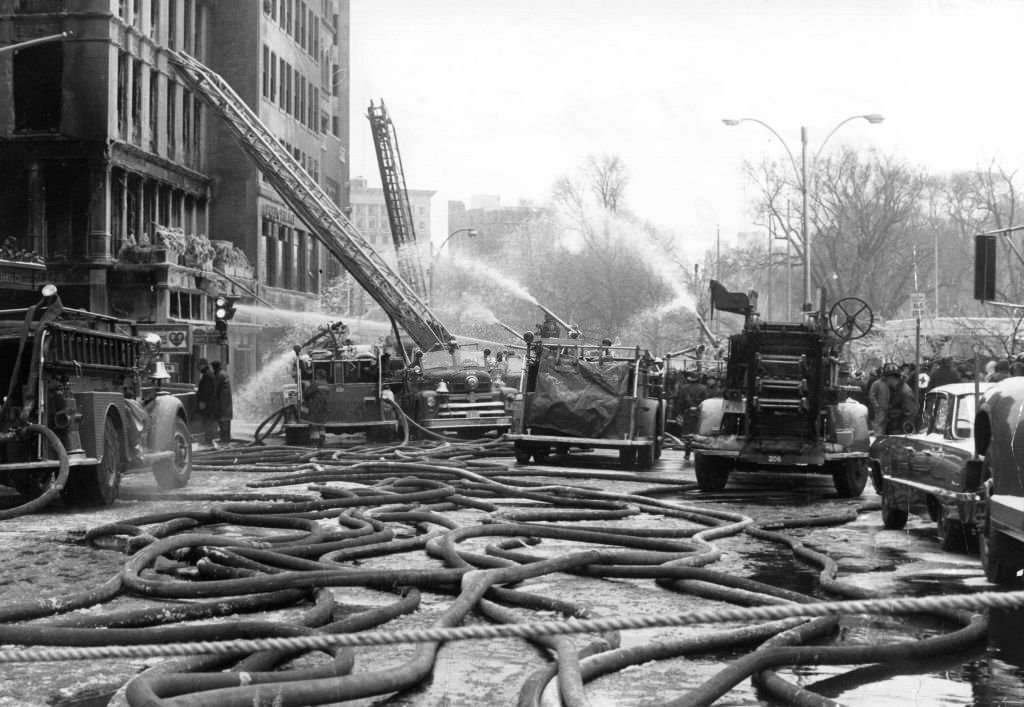
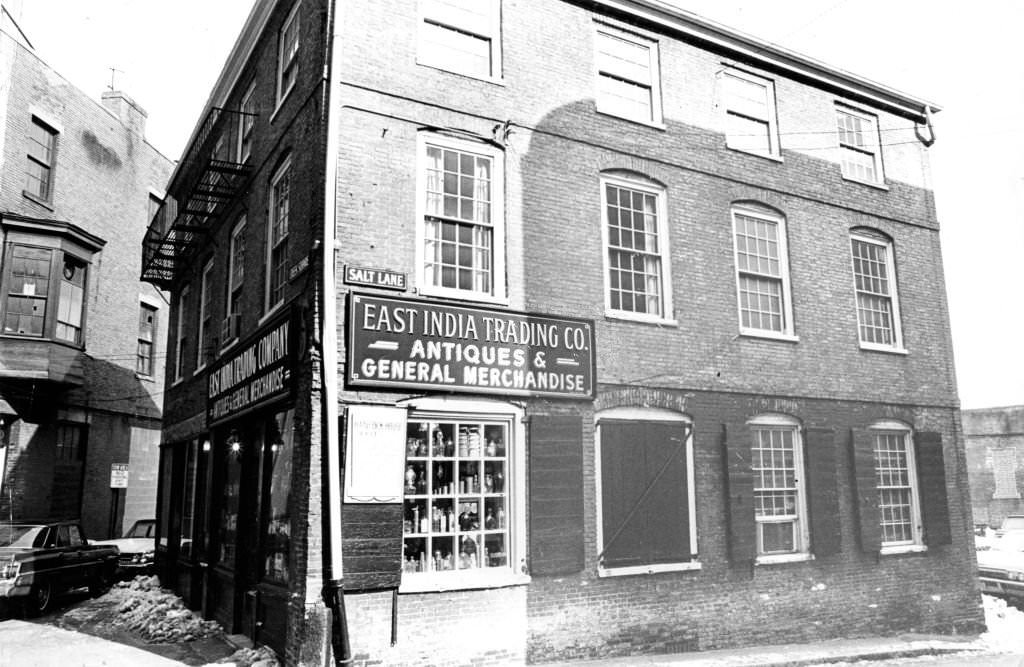
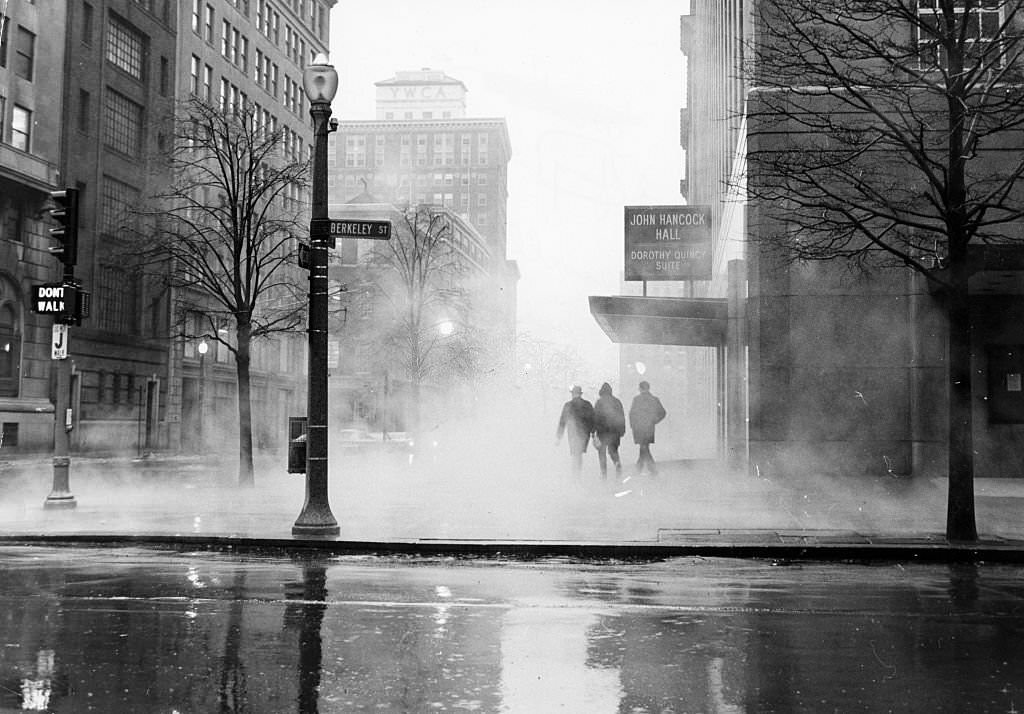
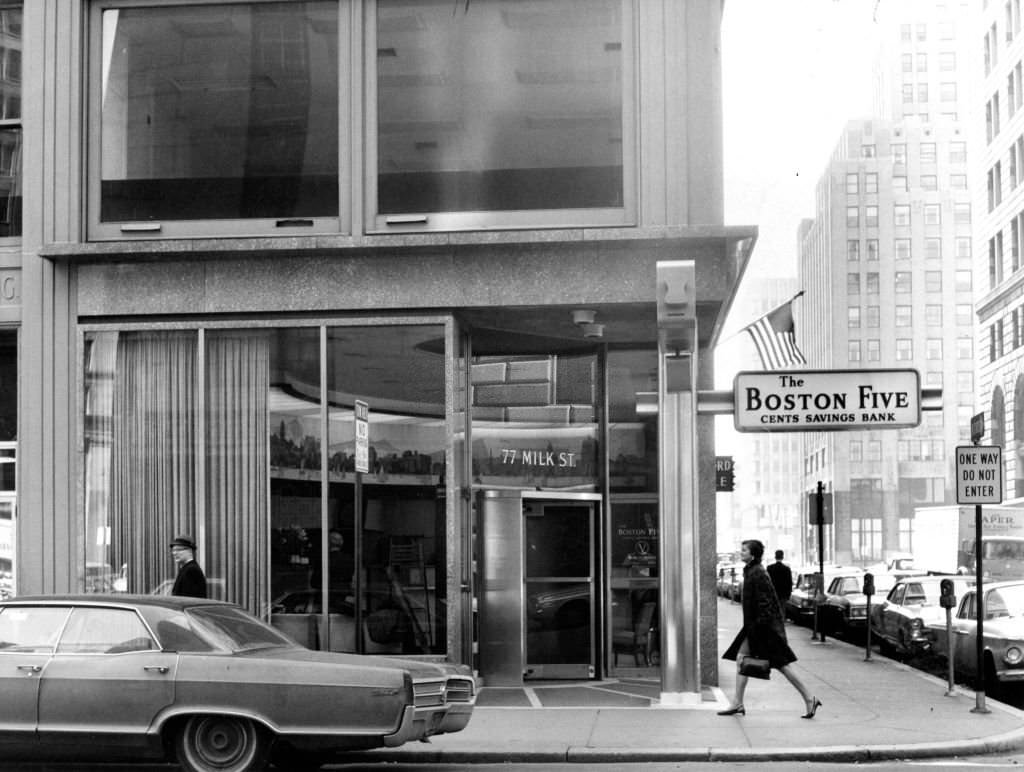
Snow covers the Public Garden in Boston at night on Dec. 1,1966. The Berkeley Building and Prudential Tower can be seen in the background.Firefighters work to extinguish a general alarm fire on Tremont Street in Boston, Feb. 18, 1967.The exterior of 10A Marshall St. in Boston, currently housing the East India Trading Co. and once owned by John Hancock, on March 1, 1967.Ground fog swells up around three pedestrians walking past the entrance to John Hancock Hall and the Dorothy Quincy Suite at Stuart and Berkeley Streets in Boston at 6:30 a.m. on March 5, 1967.The Boston Five Cents Savings Bank at the corner of Federal and Milk Streets in Boston, Mar. 13, 1967.
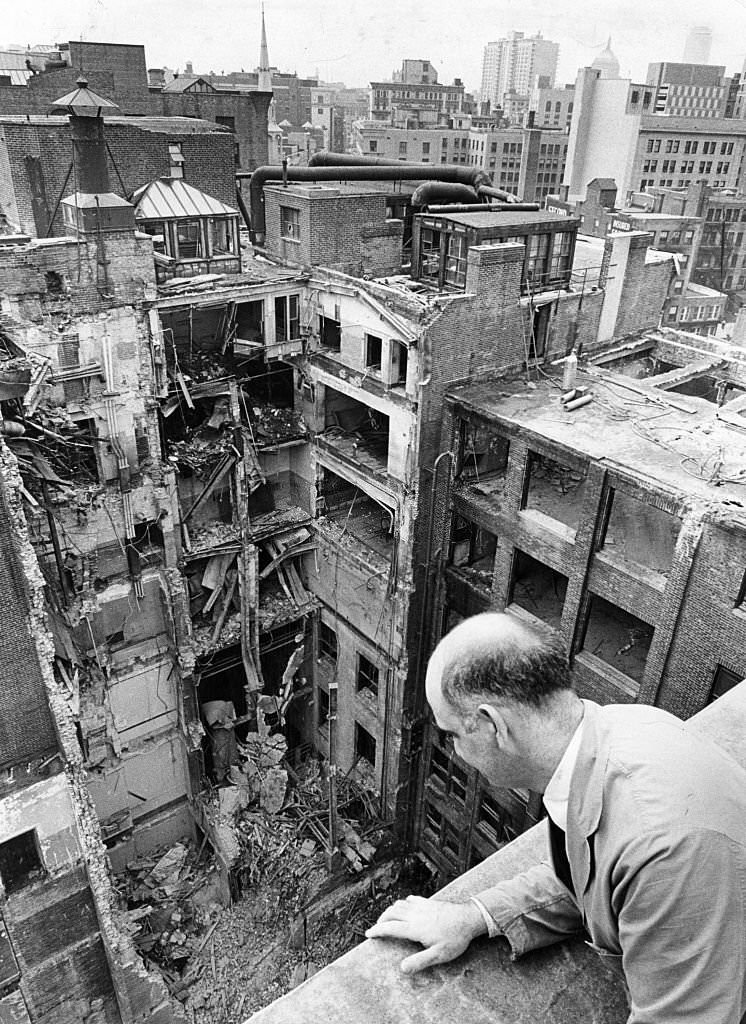
By April 1967, the old Boston Globe building on Washington Street was in the middle of demolition. The paper had left Newspaper Row in 1958, moving to a new plant on Morrissey Boulevard — the last of many newspapers to abandon the block that had once been the center of Boston’s press.
Al Debonise views what remains of the old Boston Globe building on Washington Street in Boston from a neighboring rooftop, April 1967.
By April 1967, Columbia Point was expanding its services. An aerial view showed a shopping center open at the bottom of the peninsula, and the Paul A. Dever Elementary School for grades four through eight was scheduled to open in September, serving the project’s 6,000 residents.
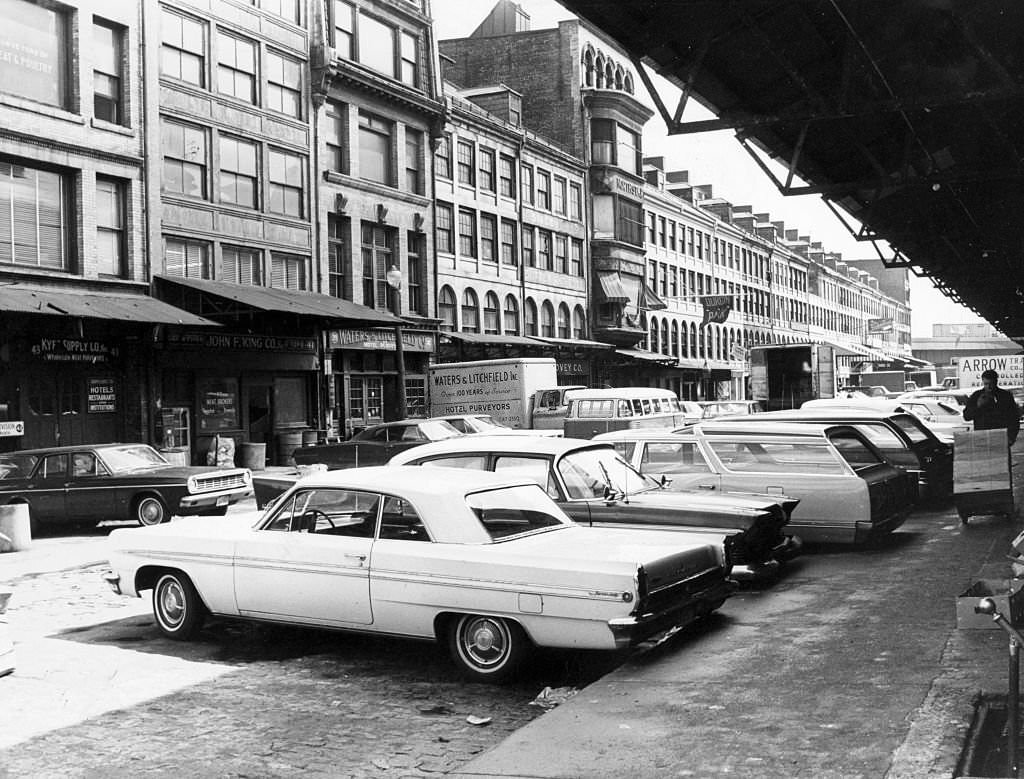
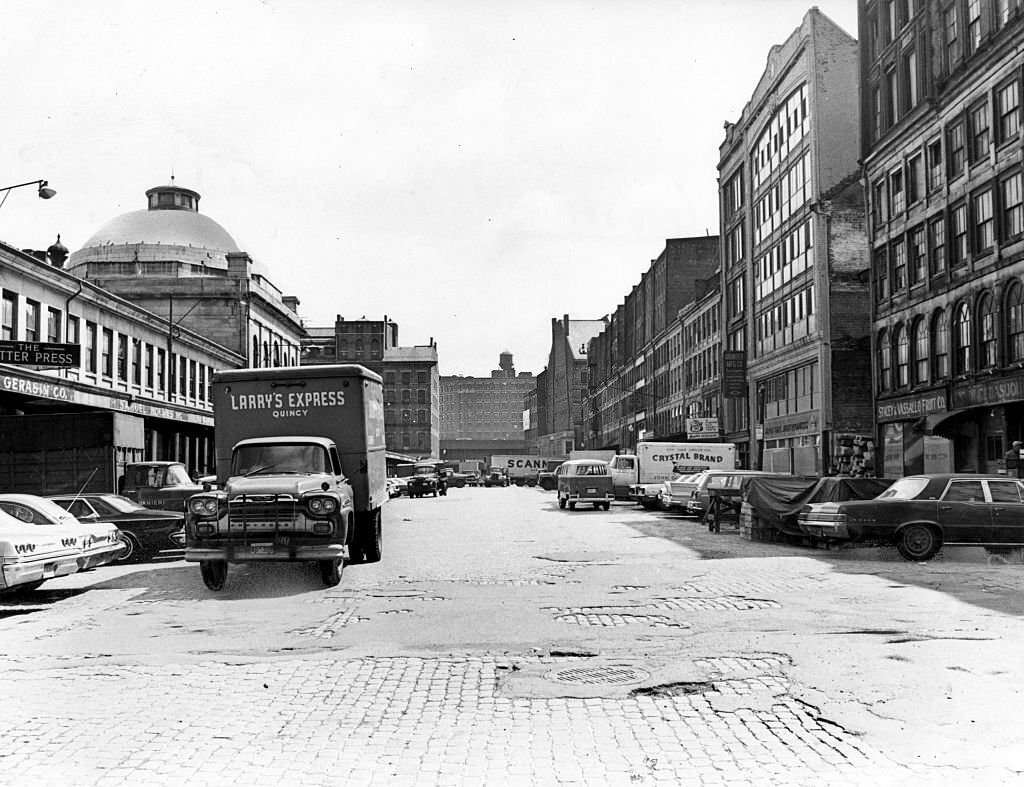
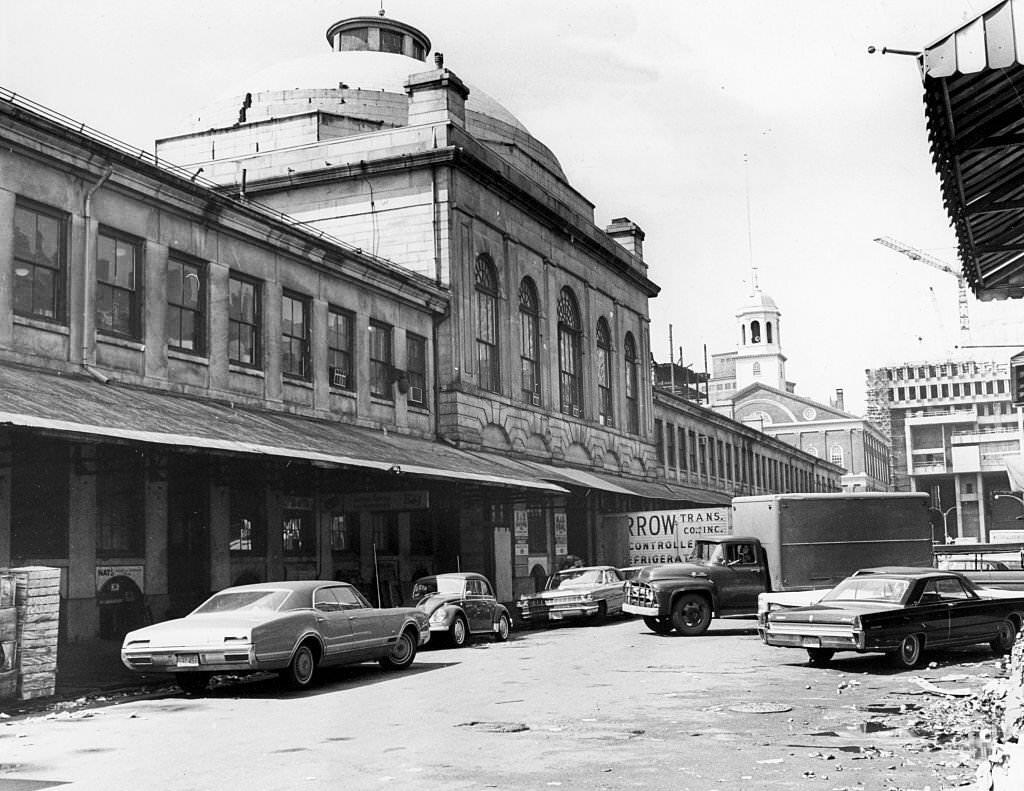
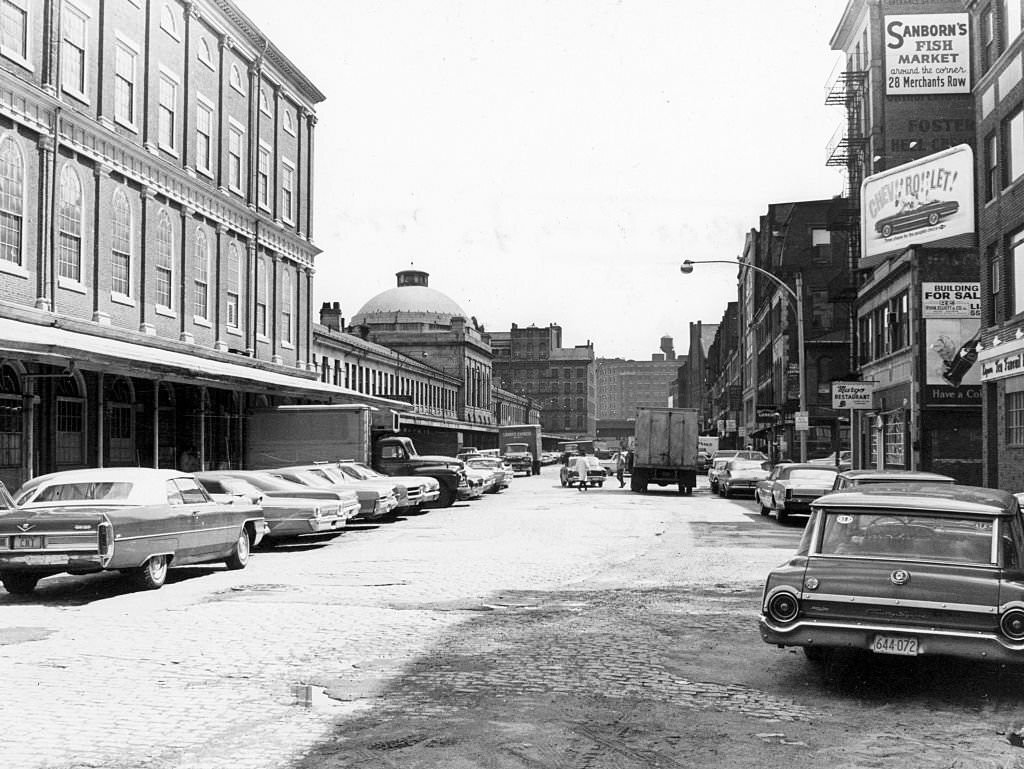
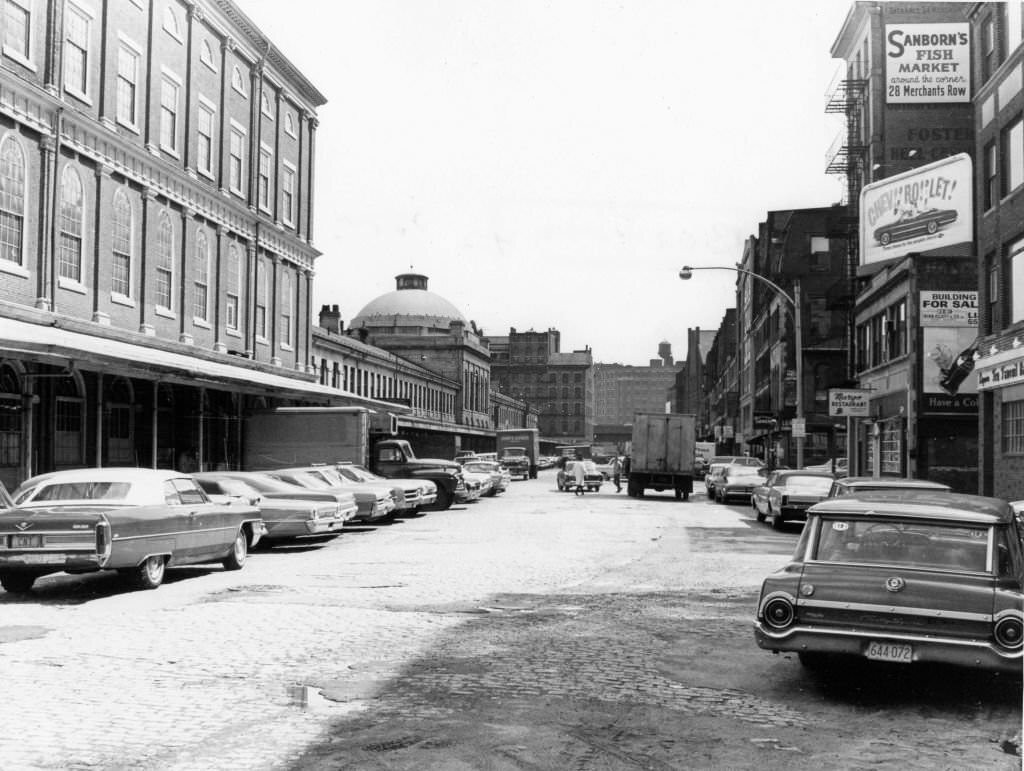
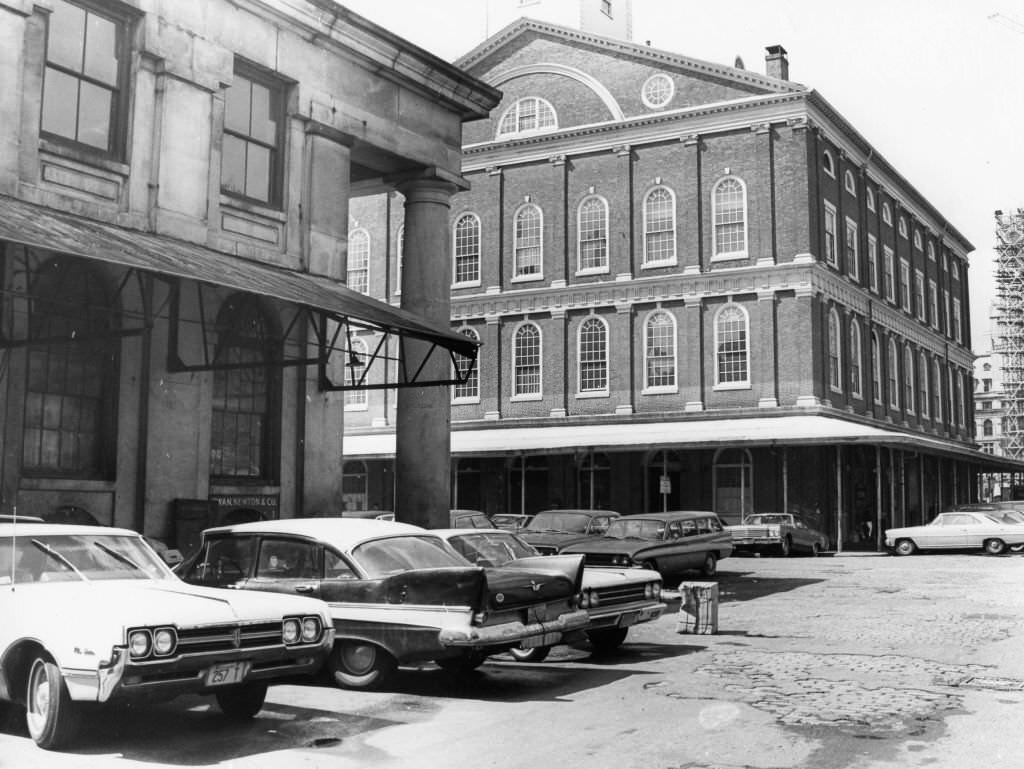
The Columbia Point housing project in Boston, seen in an aerial in April 1967.Cars are parked along the sidewalk on North Market Street in Boston on May 3, 1967.A street in Boston’s Market District is nearly empty on May 3, 1967.Cars are parked along a street near Faneuil Hall in Boston, May 3, 1967.Cars are parked near the Faneuil Hall market area in Boston on May 3, 1967.Haymarket in Boston on May 3, 1967.Cars in downtown Boston, May 3, 1967.
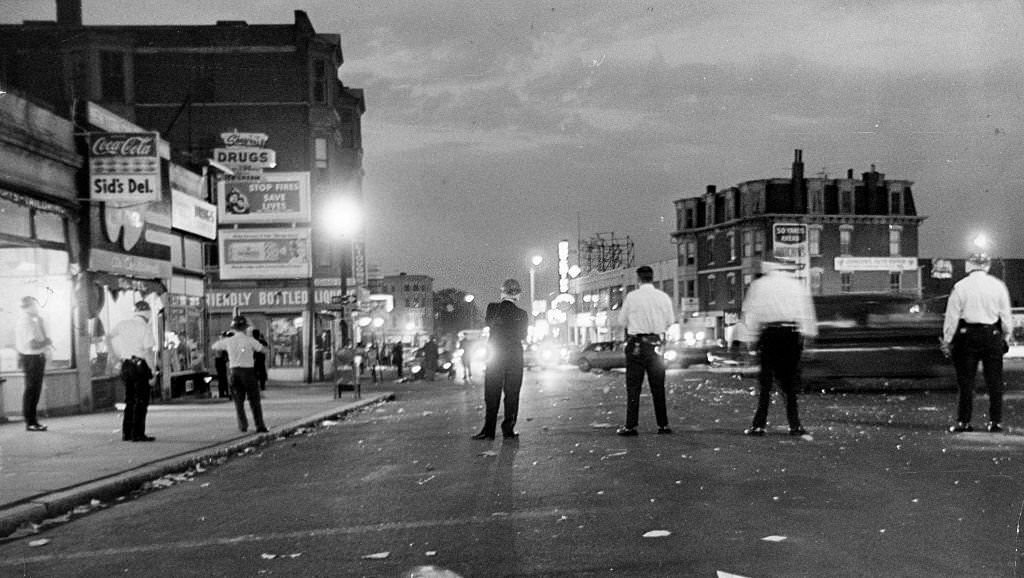
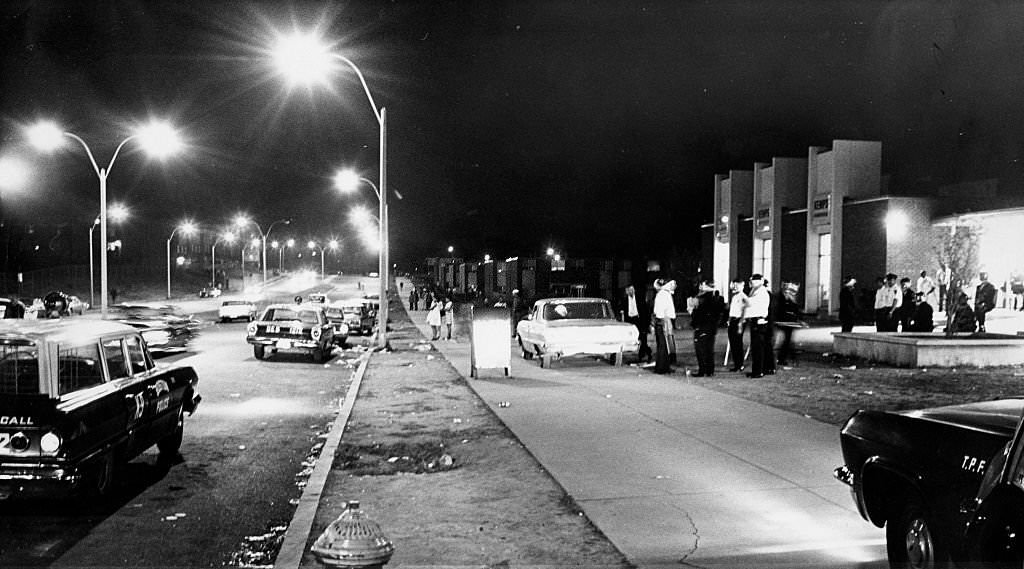
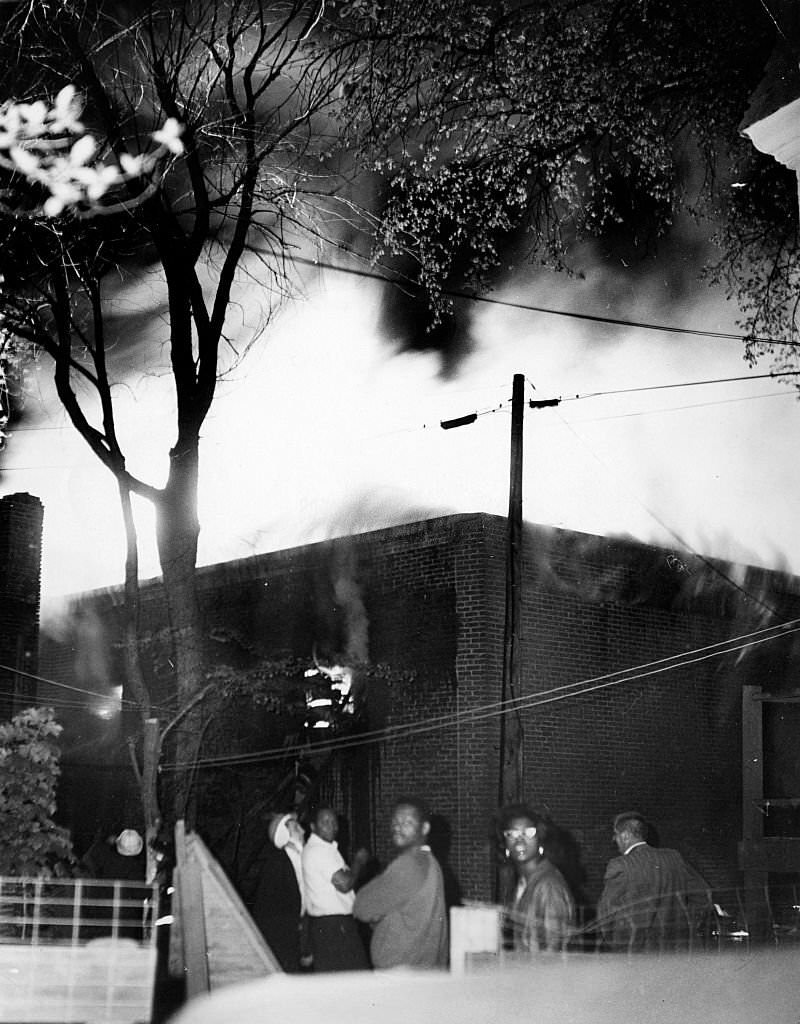
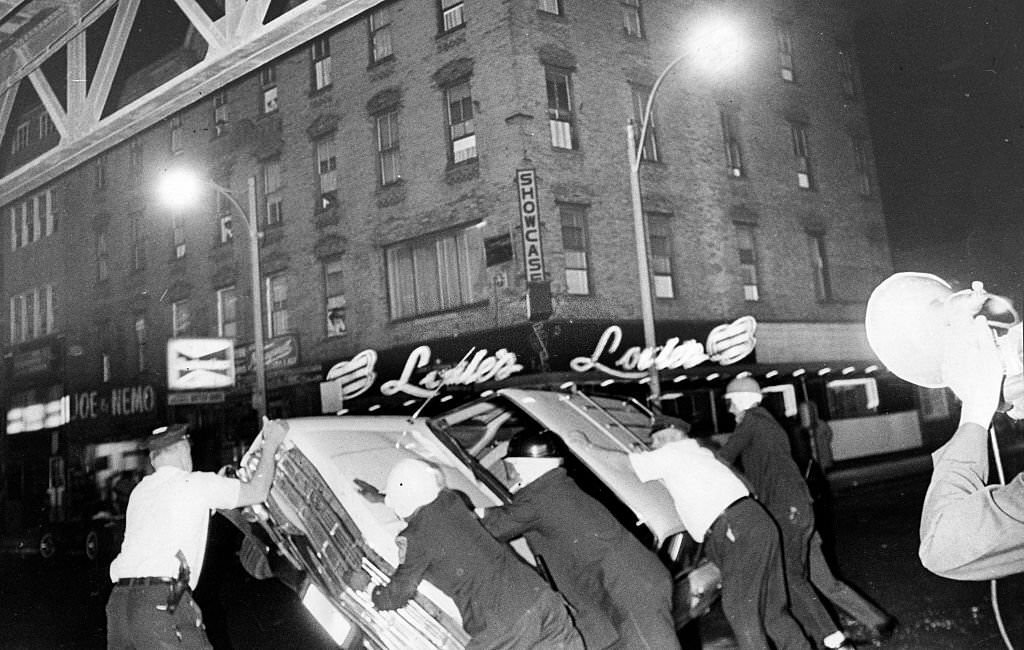
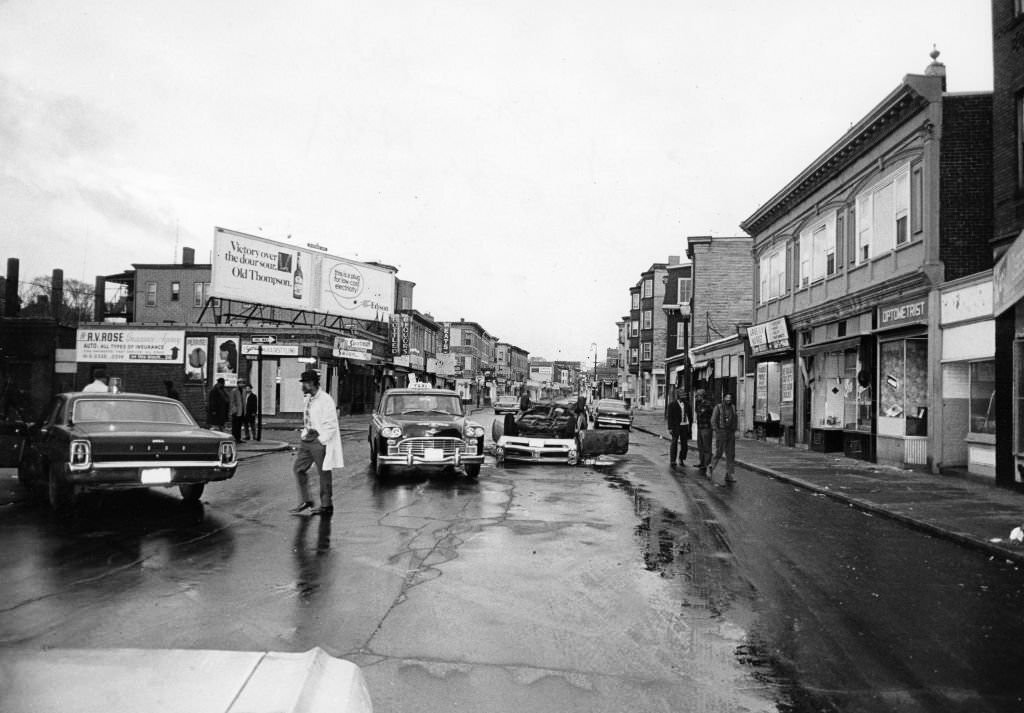
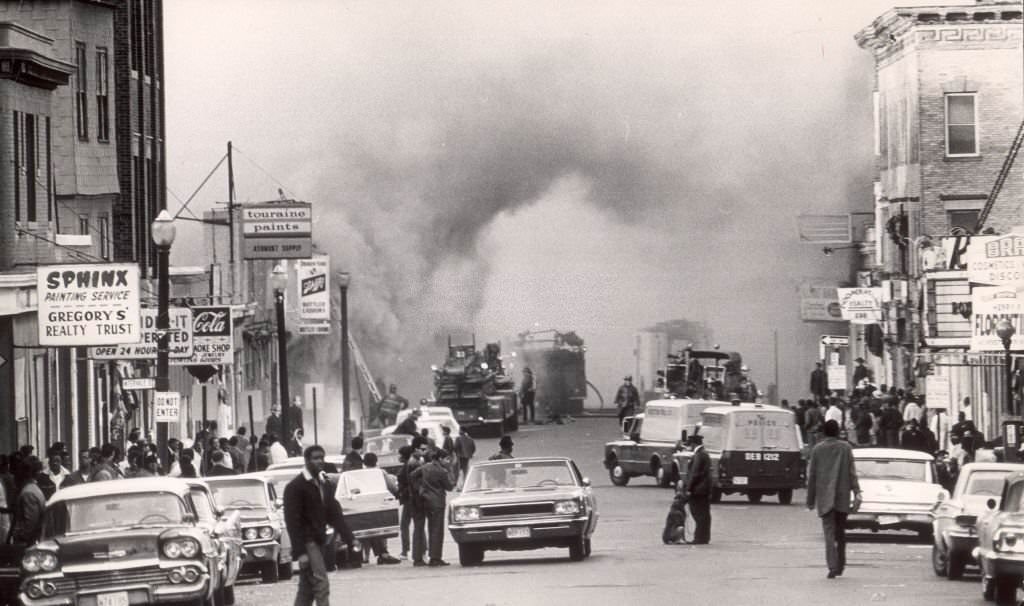
June 1967 brought riots to Roxbury. Police flooded Blue Hill Avenue and surrounding streets as unrest spread through the neighborhood. The tensions were rooted in years of frustration over racial discrimination in housing, jobs, and education. A three-alarm fire broke out at a paint store on Blue Hill Avenue on June 3rd, and police were still working to restore order days later when a car was overturned at Washington and Northampton Streets.
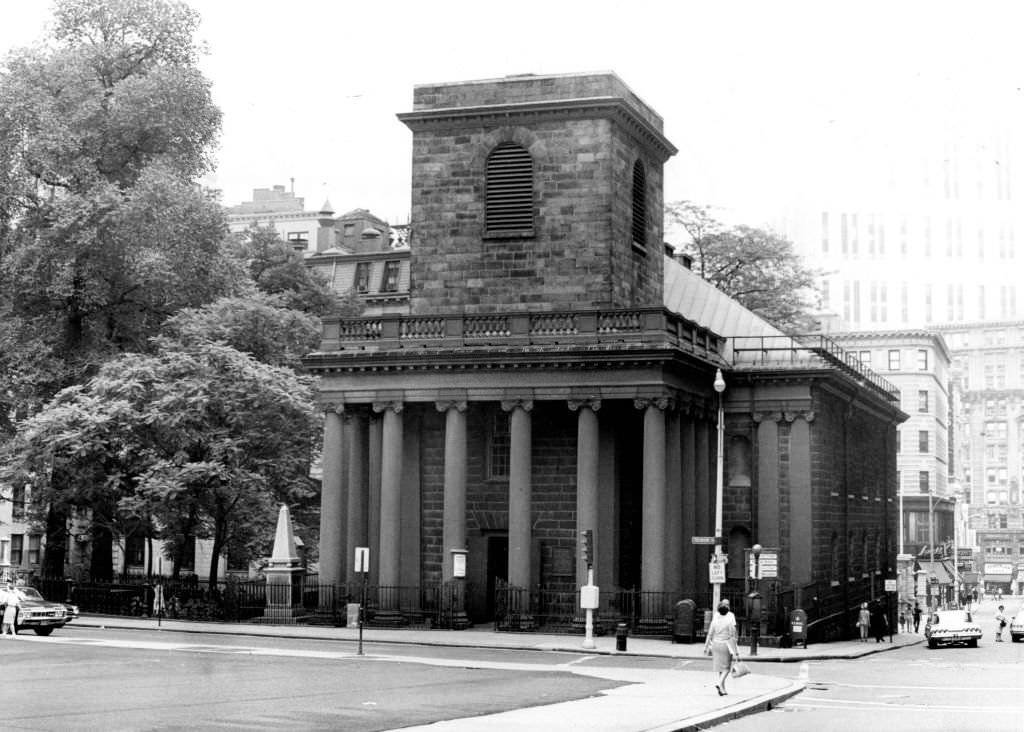
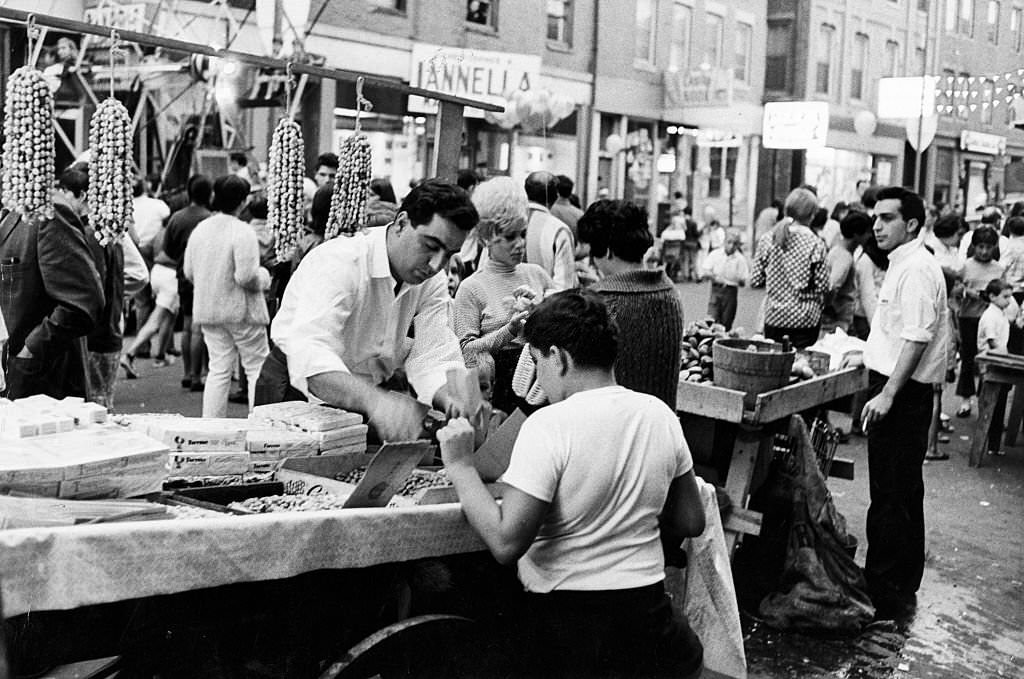
Workers clean up Blue Hill Avenue after riots on the street in the Roxbury neighborhood in Boston, June 1967.Police stand in the street during a riot in the Roxbury neighborhood of Boston on June 1, 1967.The scene at Washington Park in Boston on June 3, 1967.A three-alarm fire burns in a paint store on Blue Hill Avenue in the Roxbury neighborhood in Boston on June 3, 1967.People watch as a three-alarm fire burns in a paint store on Blue Hill Avenue in the Roxbury neighborhood in Boston on June 3, 1967.Police right a car overturned by rioters at corner of Washington and Northampton Streets in Boston on June 4, 1967.Paul Revere Park and St. Stephen’s Church in Boston’s North End in August 1967.King’s Chapel in Boston, 1967.A vendor sells a boy peanuts at the Hanover Street Market in Boston’s North End on Aug. 11, 1967.
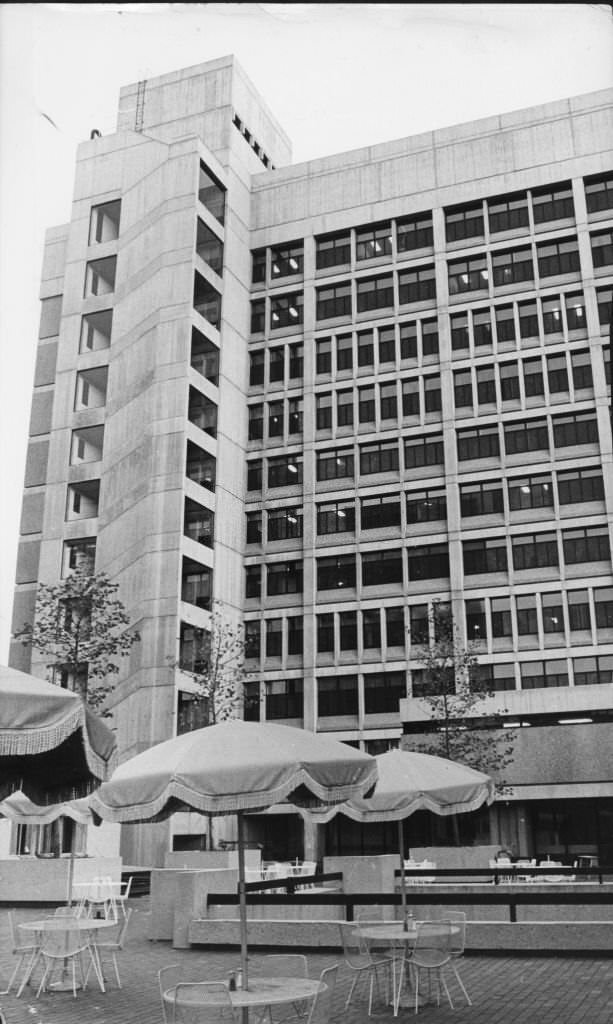
The 12-story outpatient building at Boston Children’s Hospital on Aug. 11, 1967.
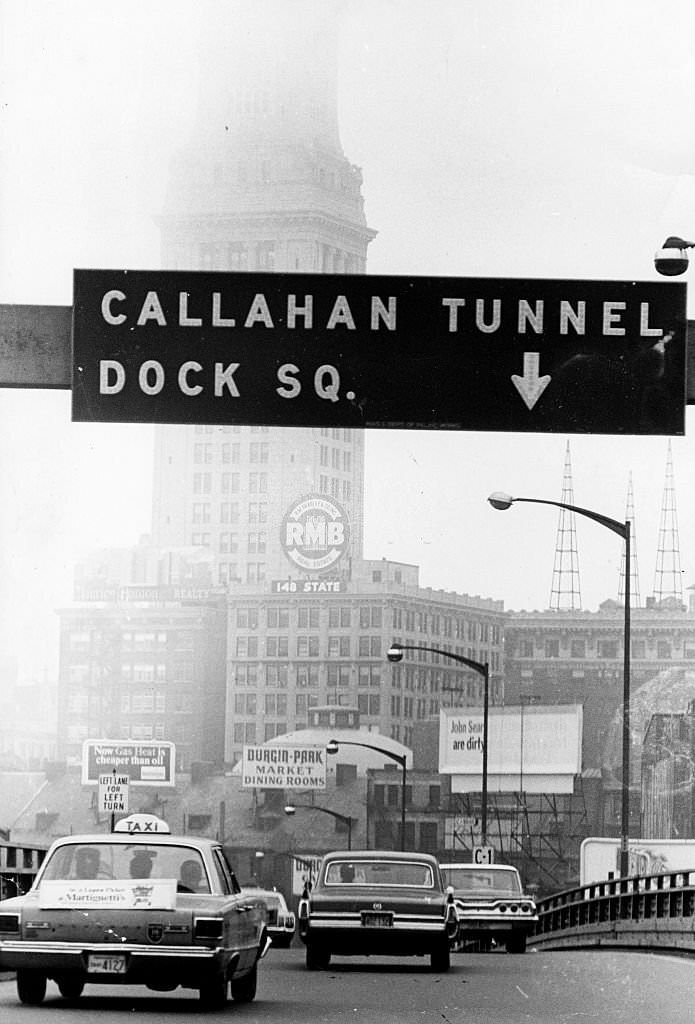
Cars exit the Southeast Expressway for the Callahan Tunnel in Boston on Oct. 10, 1967. The Custom House rises into the mist above the road.
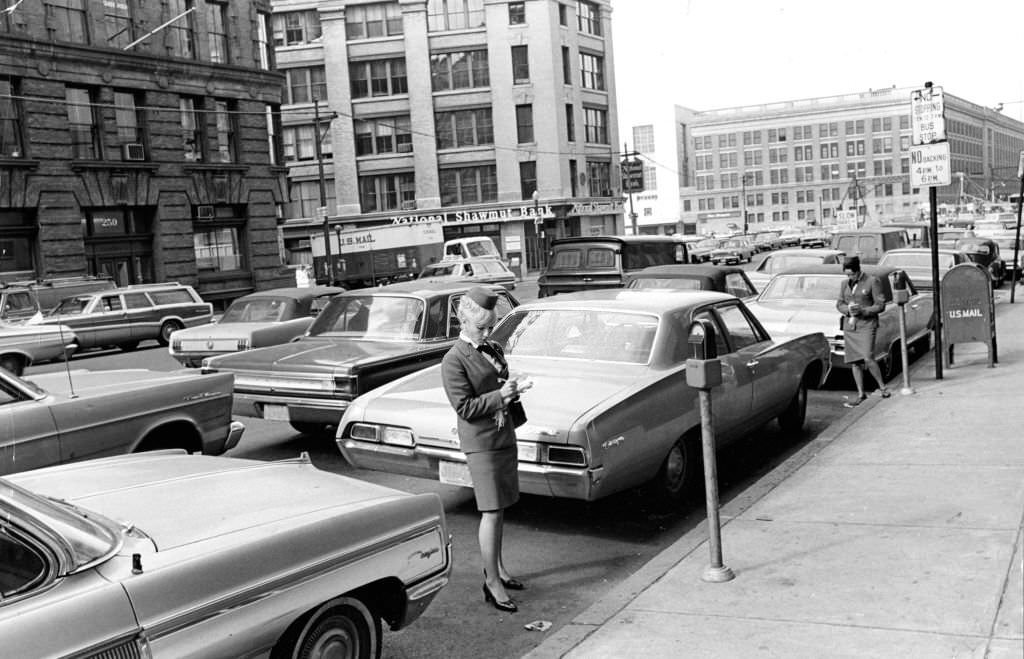
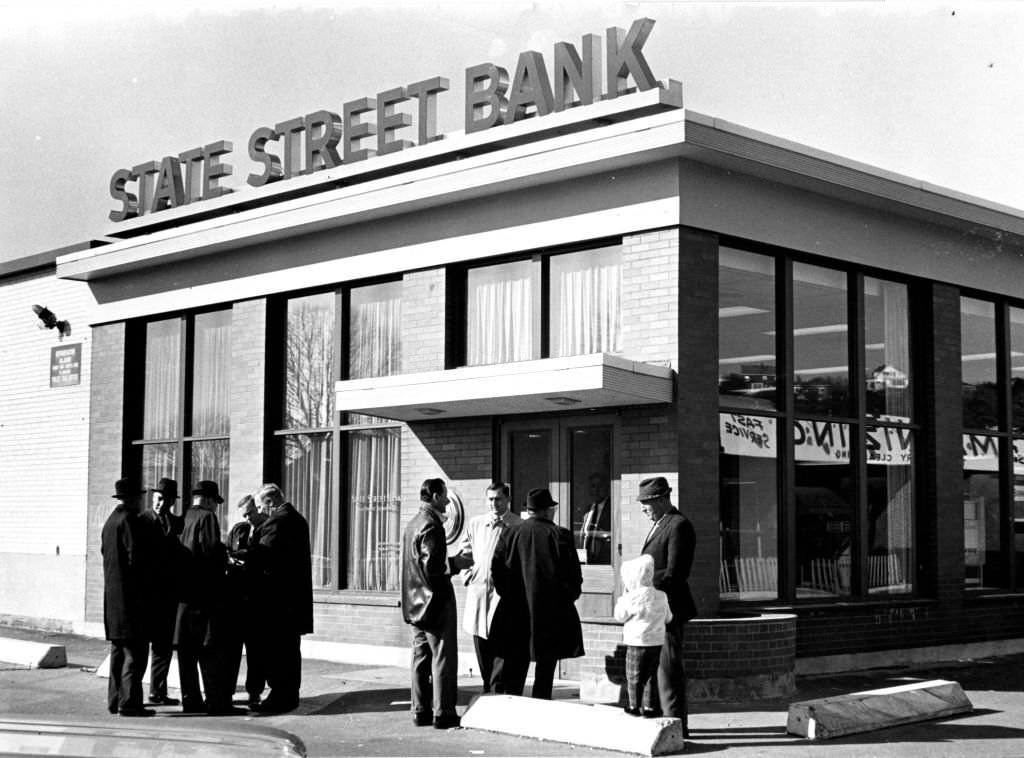
Meter maids Carol DeMarinis, left, and Kathleen Moccia make their rounds in Boston on Oct. 19, 1967.The exterior of a State Street Bank branch on Bennington Street in East Boston on Nov. 6, 1967.
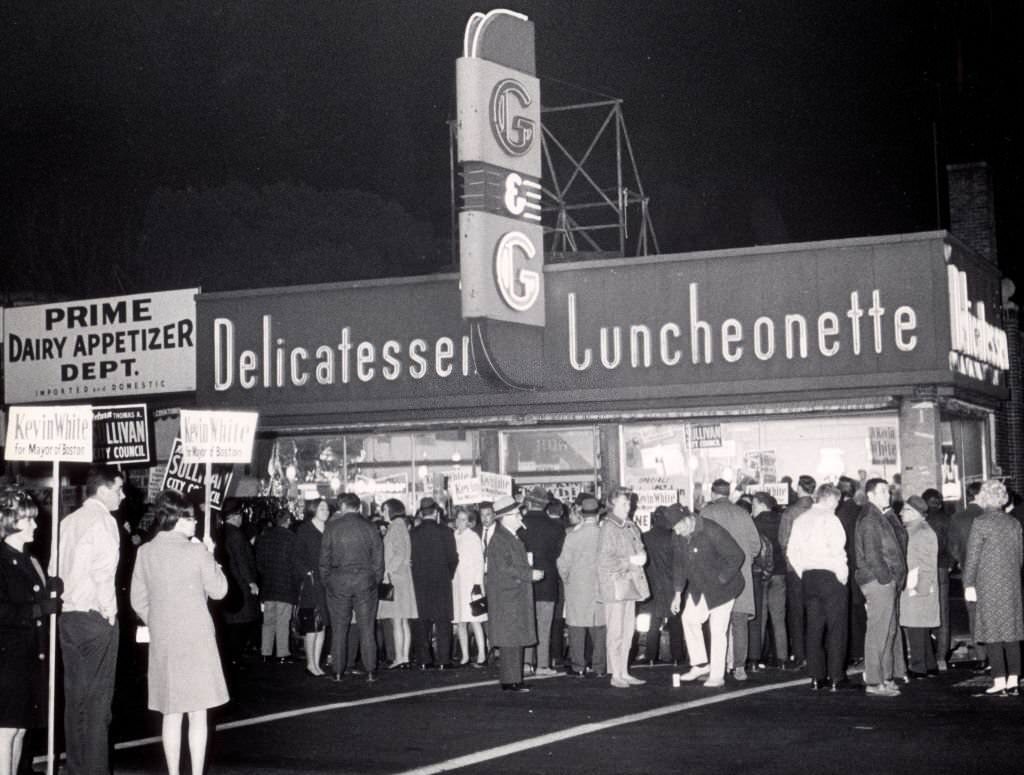
On November 6, 1967, supporters of Kevin White rallied at the G&G Delicatessen in Boston as election returns came in. White won the mayoral race that night, defeating Louise Day Hicks in a campaign that had been heavily shaped by the city’s school desegregation battles.
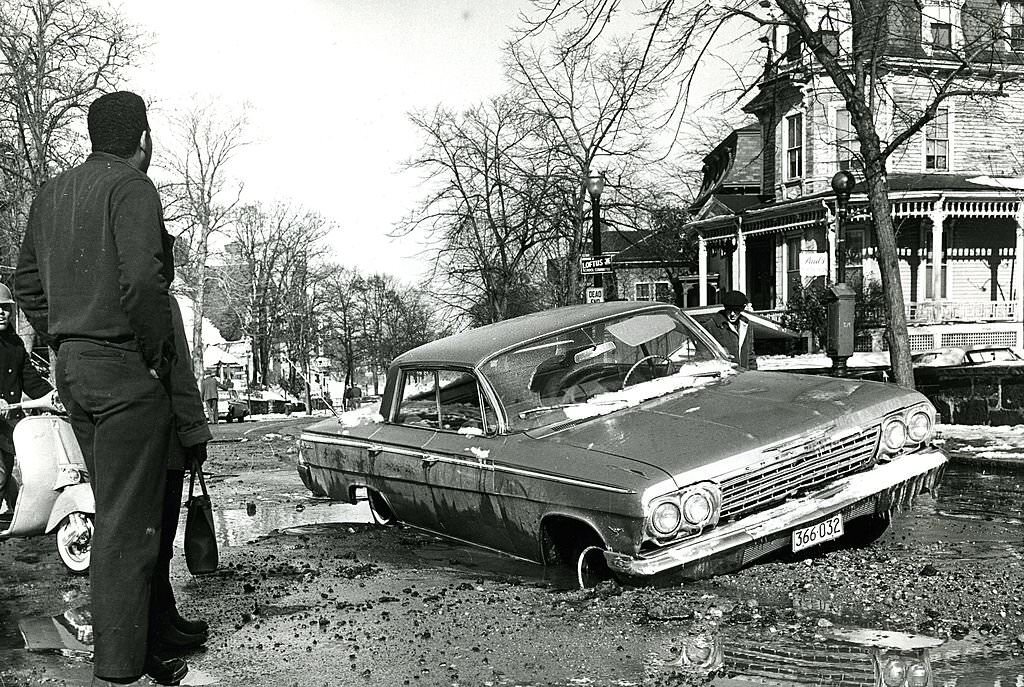
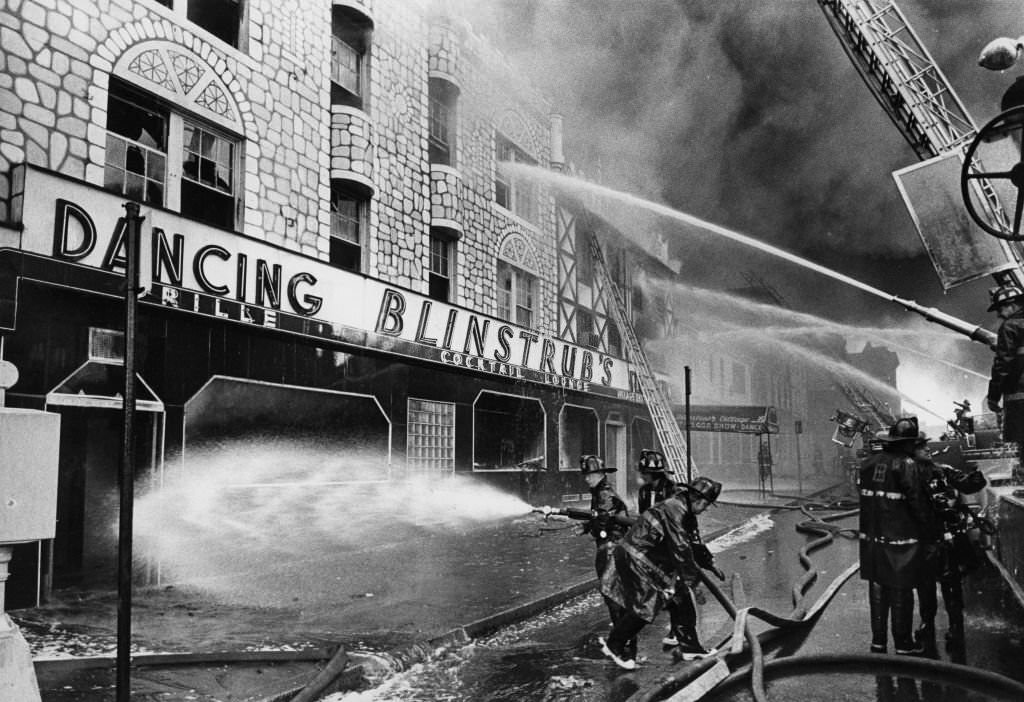
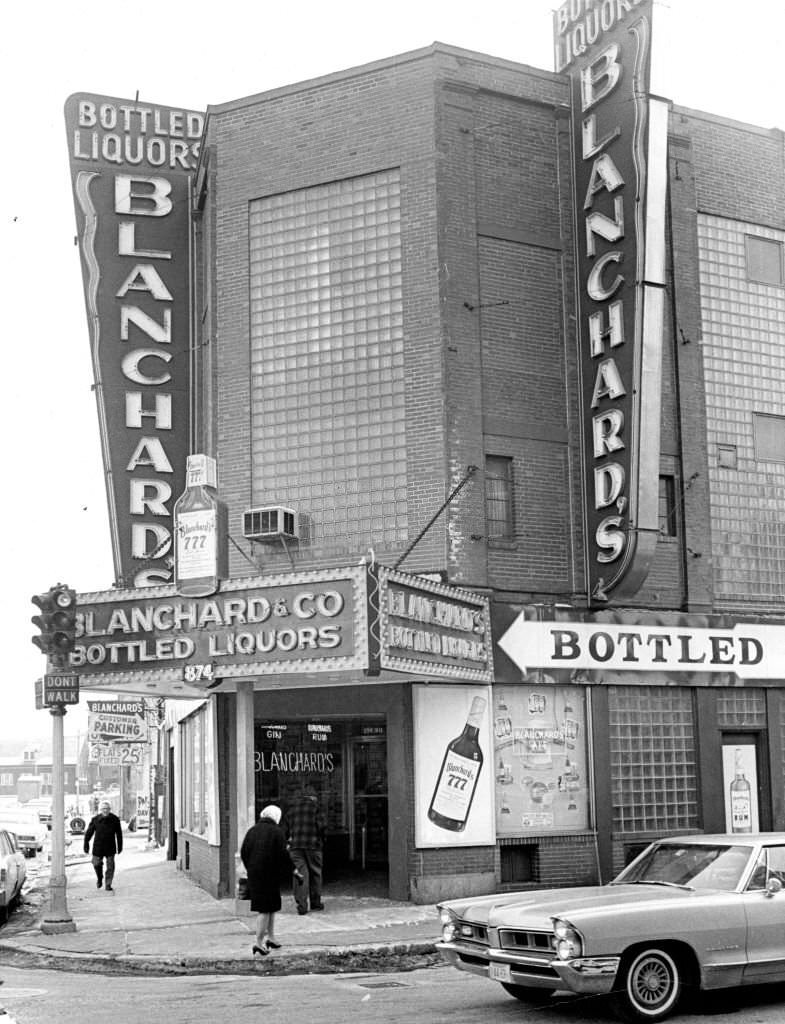
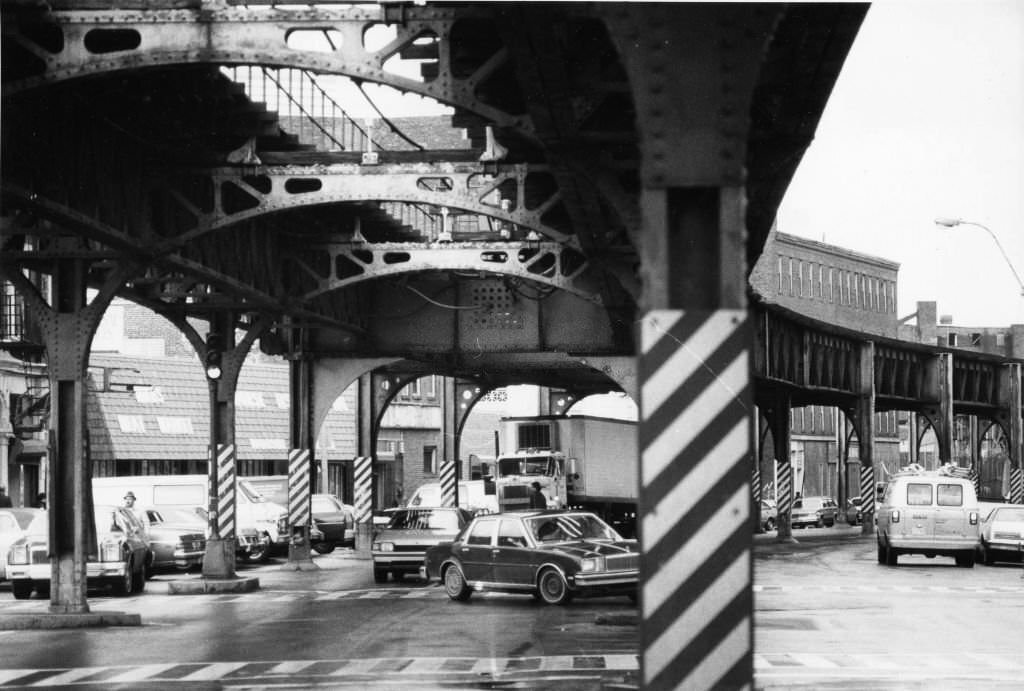
People rally for the election of former Boston Mayor Kevin White on Nov. 6, 1967 at G&G Delicatessen in Boston.This car was half-buried about a foot deep in this pothole in front of 516 Warren St. in Boston.Vehicles are seen parked outside Boston Police Department Station 4 on Warren Avenue in Boston’s South End on Dec. 19, 1967.A view of Boston City Hall, Dec. 21, 1967.Firefighters work to extinguish a fire at Blinstrub’s, a South Boston nightclub, Feb. 7, 1968.The Blanchard’s Liquor Store in Boston’s South End, where two gunmen made off with $43,500 in cash in a holdup earlier in the day, on Mar. 4, 1968.Cars drive under the MBTA Orange Line elevated tracks on Washington Street in Boston on March 11, 1986.
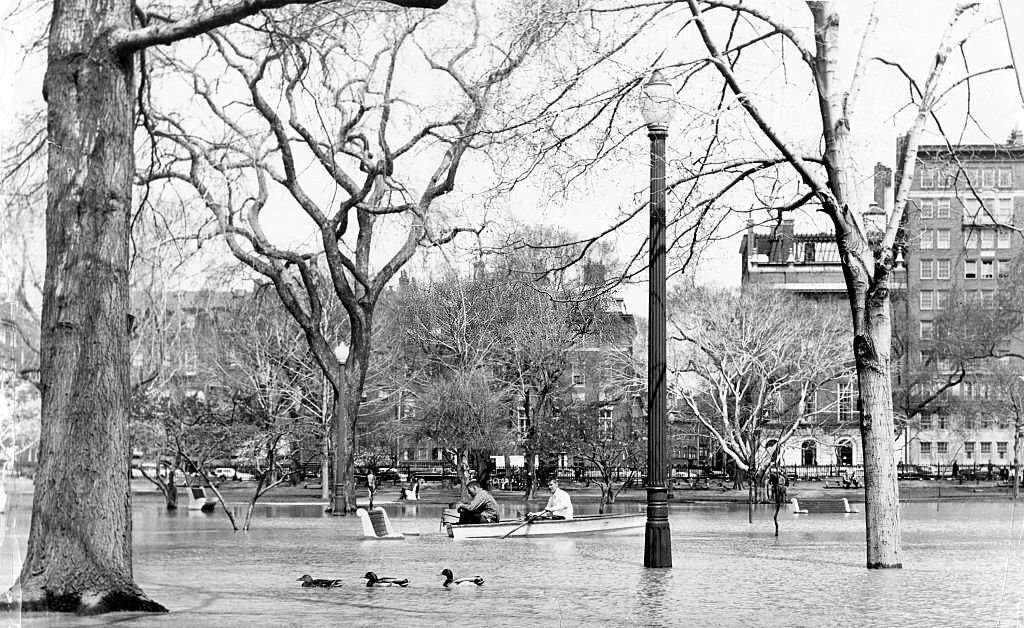
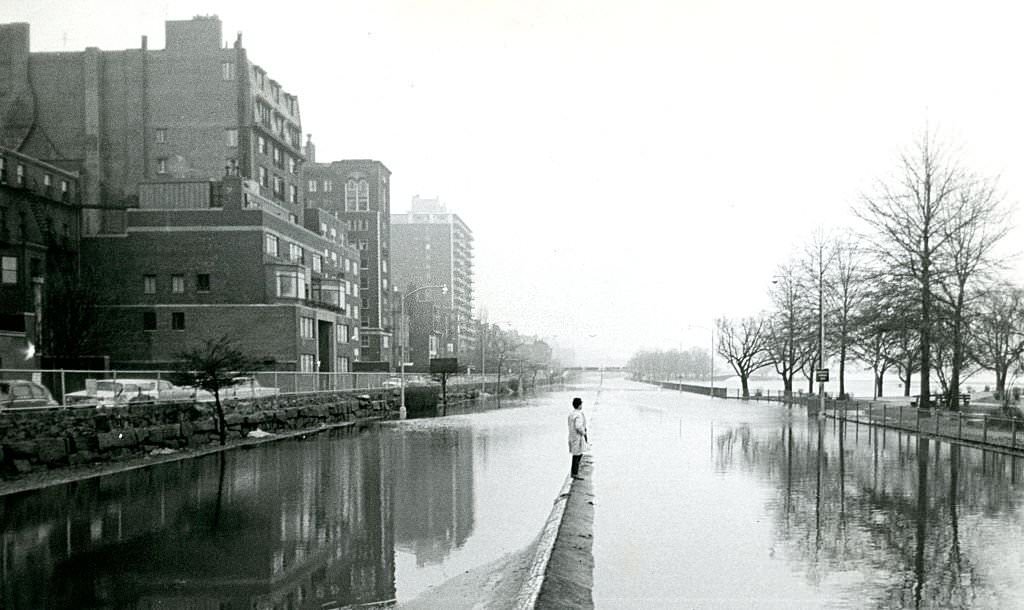
A spring flood in March 1968 caught Boston off guard. A surprise rain event combined with snowmelt caused the worst flooding since Hurricane Diane in 1955. The Charles River overflowed its banks, forcing MDC police to close Storrow Drive at 3 a.m. Pedestrians in the streets faced water too deep to cross comfortably.
This man has no good choices for crossing the street on March 19, 1968, as a surprise spring deluge causes major flooding throughout eastern Massachusetts.
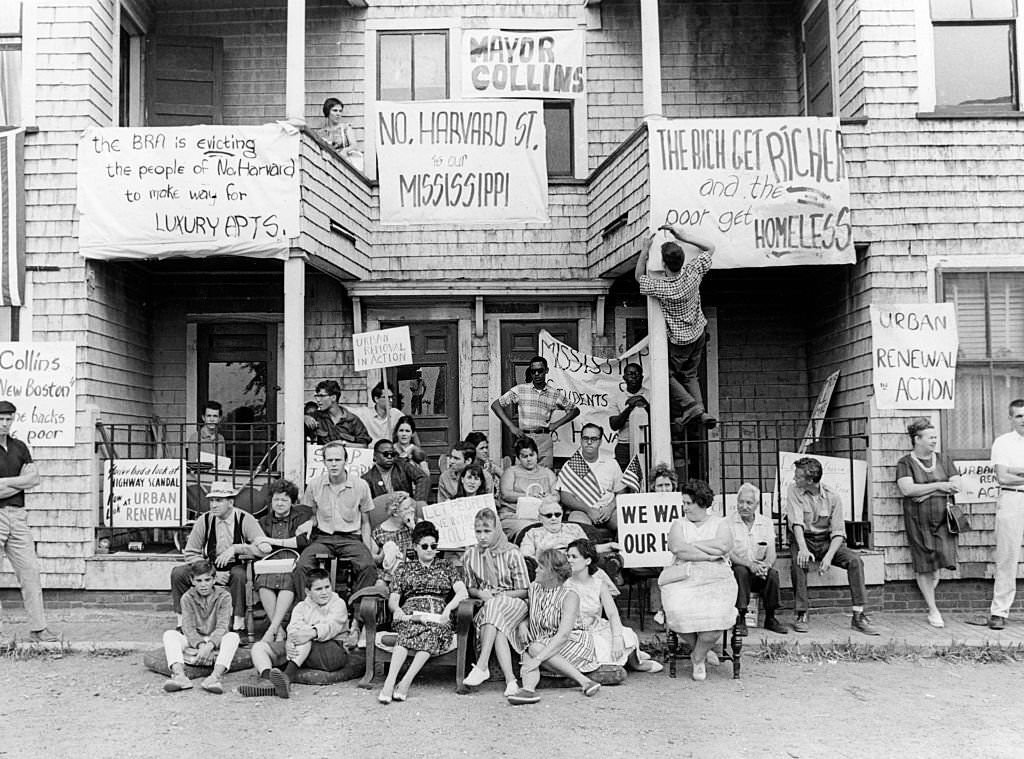
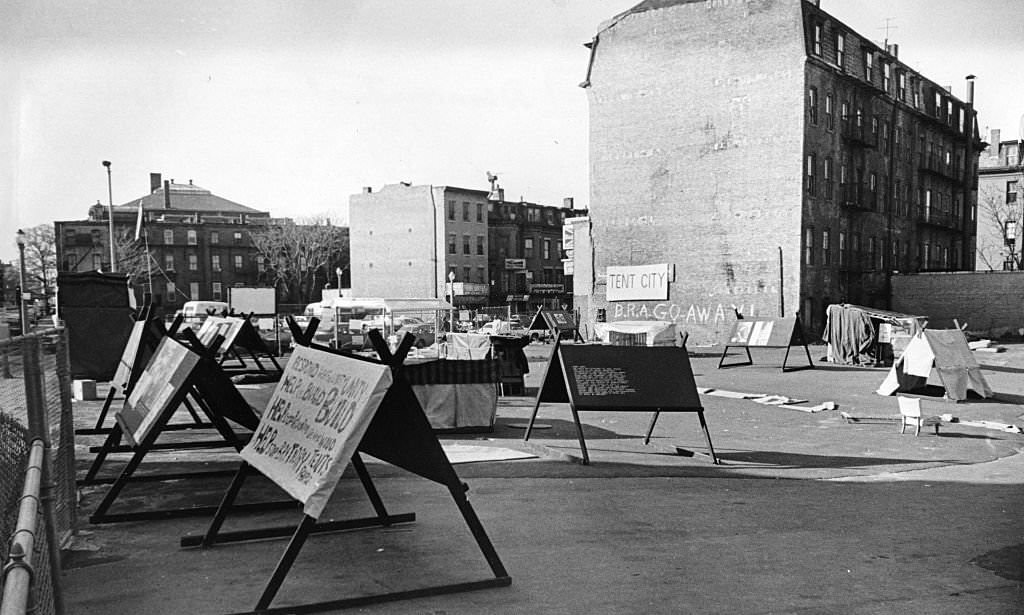
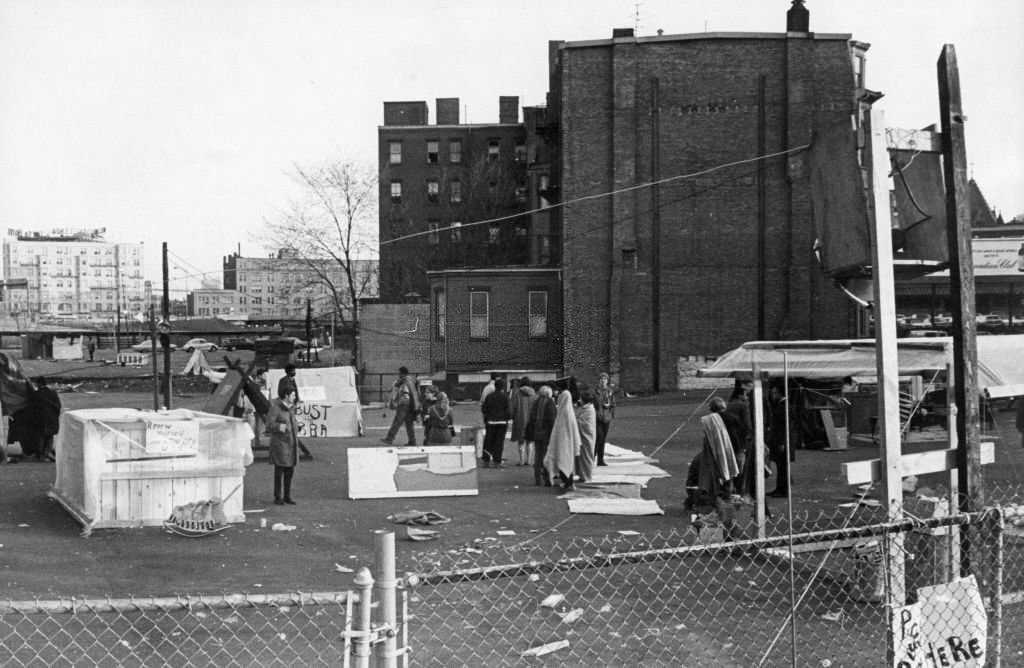
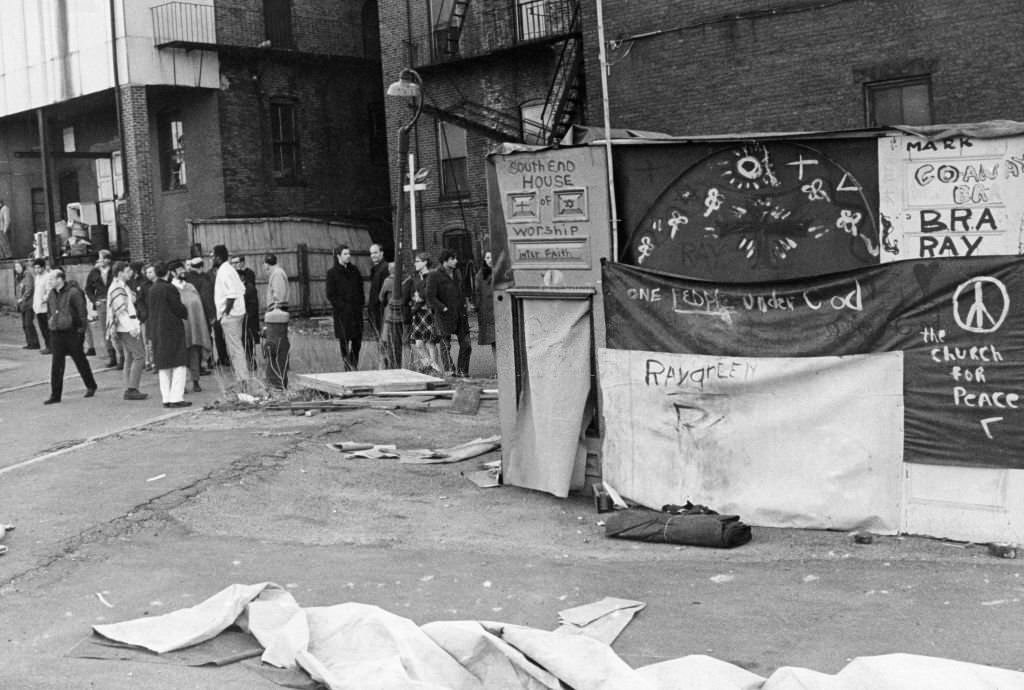
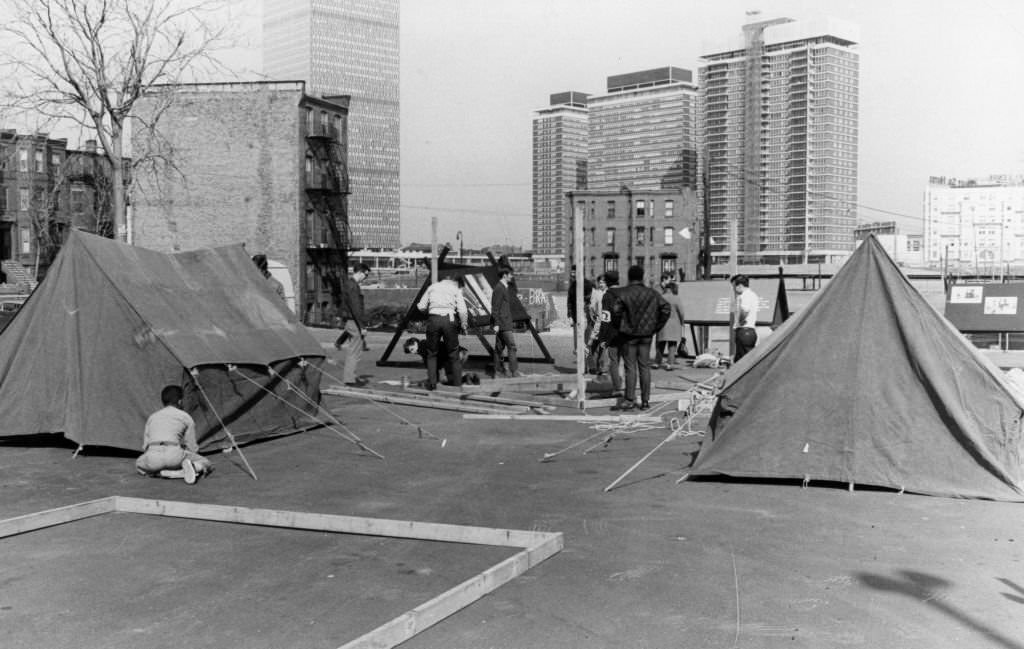
In April 1968, South End residents set up a “tent city” camp in a Dartmouth Street parking lot to protest urban renewal. The city’s redevelopment program had been demolishing buildings in lower-income neighborhoods since 1964, and many residents were pushing back. The encampment drew national attention.
Anti-urban renewal protesters set up a “tent city” camp with signs in a parking lot in the South End of Boston, April 1968.Anti-urban renewal protesters pitch tents and hold signs in a Dartmouth Street parking lot in the South End of Boston, April 1968.Anti-urban renewal protesters pitch tents in a Dartmouth Street parking lot in the South End of Boston, April 1968.
The assassination of the Reverend Martin Luther King Jr. on April 4, 1968, set off demonstrations across Boston. Blue Hill Avenue saw unrest and vandalism in the days that followed. James Brown performed a concert at Boston Garden the next night in an event credited with keeping the city calmer than many other American cities.
A view of Blue Hill Avenue after protests of Martin Luther King Jr.’s assassination in Boston, April 5, 1968.Outrage at the assassination of the Rev. Martin Luther King Jr. resulted in unrest in many US cities, including Boston.
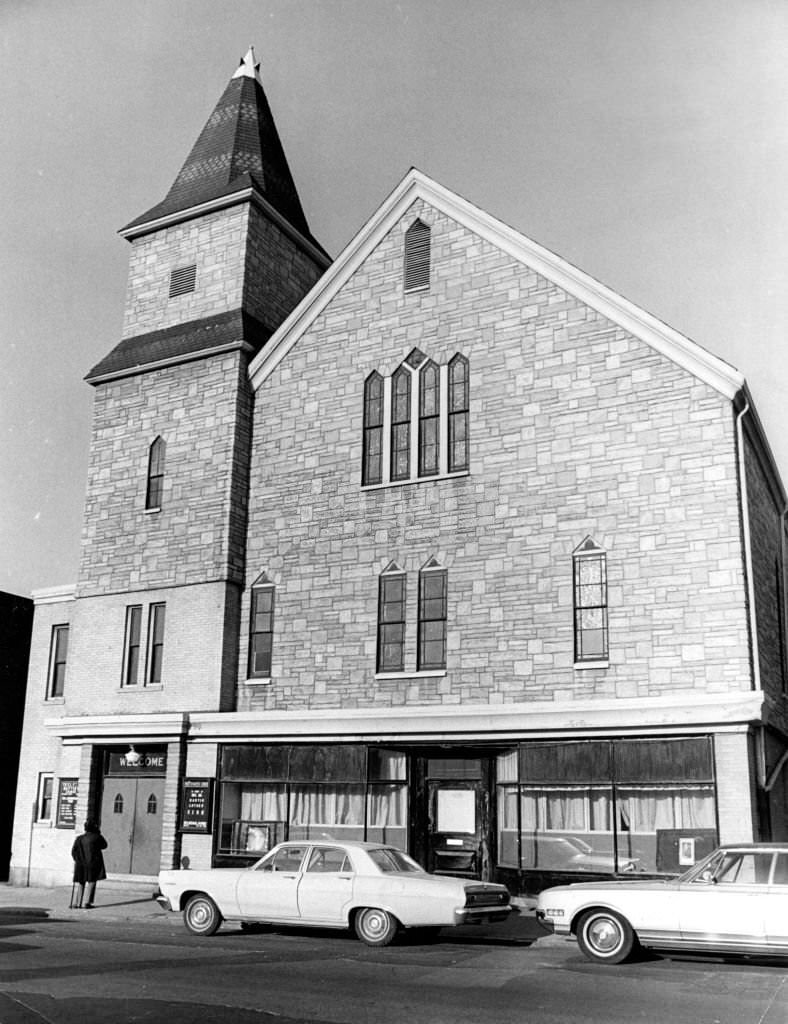
The Twelfth Baptist Church at 160 Warren St. in the Roxbury neighborhood of Boston on April 6, 1968.
The Church of the Covenant on Newbury Street in Boston on April 10, 1968.
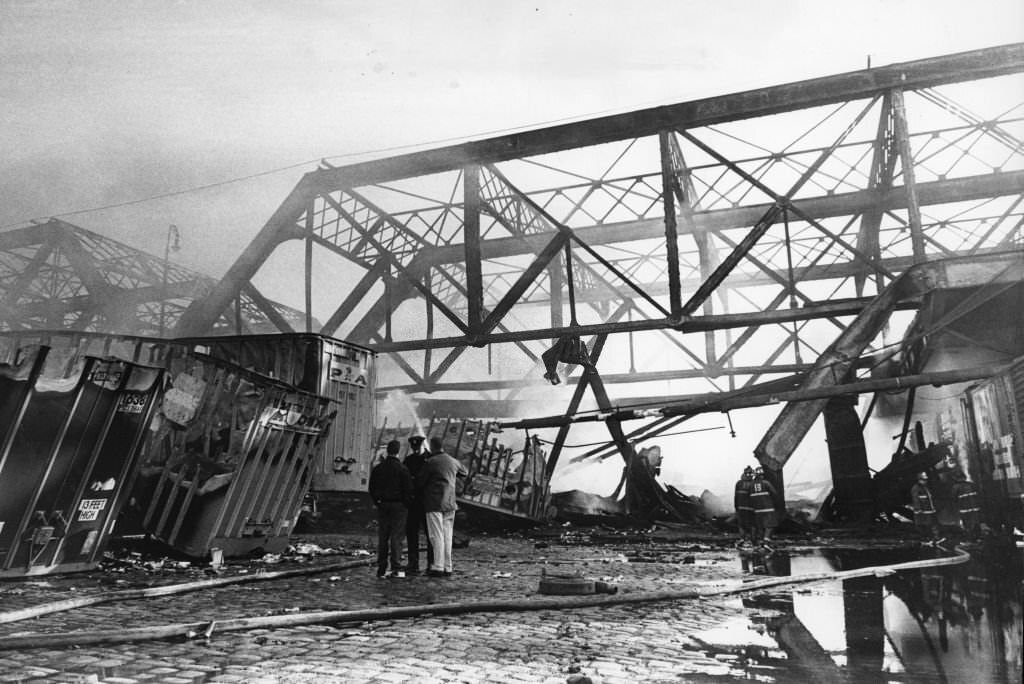
The fire-damaged First Church on Marlborough Street in Boston, April 10, 1968.Anti-urban renewal protesters pitch tents in a Dartmouth Street parking lot in the South End of Boston, April 28, 1968.Firefighters work to extinguish a five-alarm fire on the Summer Street Bridge in Boston, May 15, 1968.
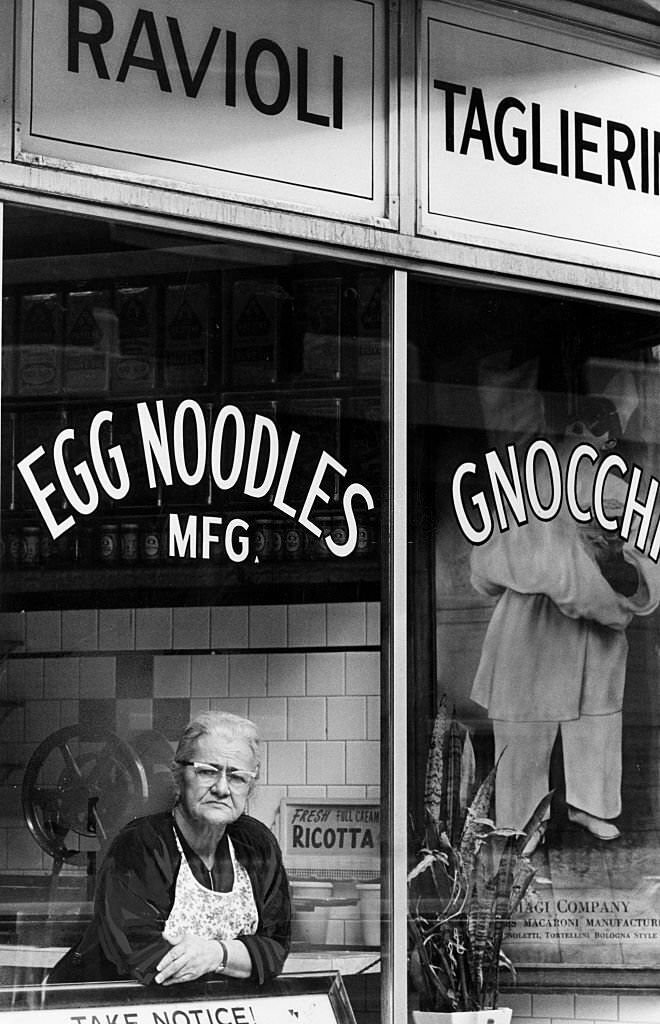
The North End’s Mrs. Amalia Biagi had been making extruded dough from her shop window for 42 years by June 1968 — an unbroken thread of neighborhood life that persisted through all the upheaval around it.
Mrs. Amalia Biagi in the window of her shop in Boston’s North End on June 1, 1968.
In Roxbury, the opening of Unity Bank & Trust Co. on June 20, 1968, was a significant moment. The bank was created specifically to serve the African American community at a time when residents faced documented discrimination in access to credit and financial services.
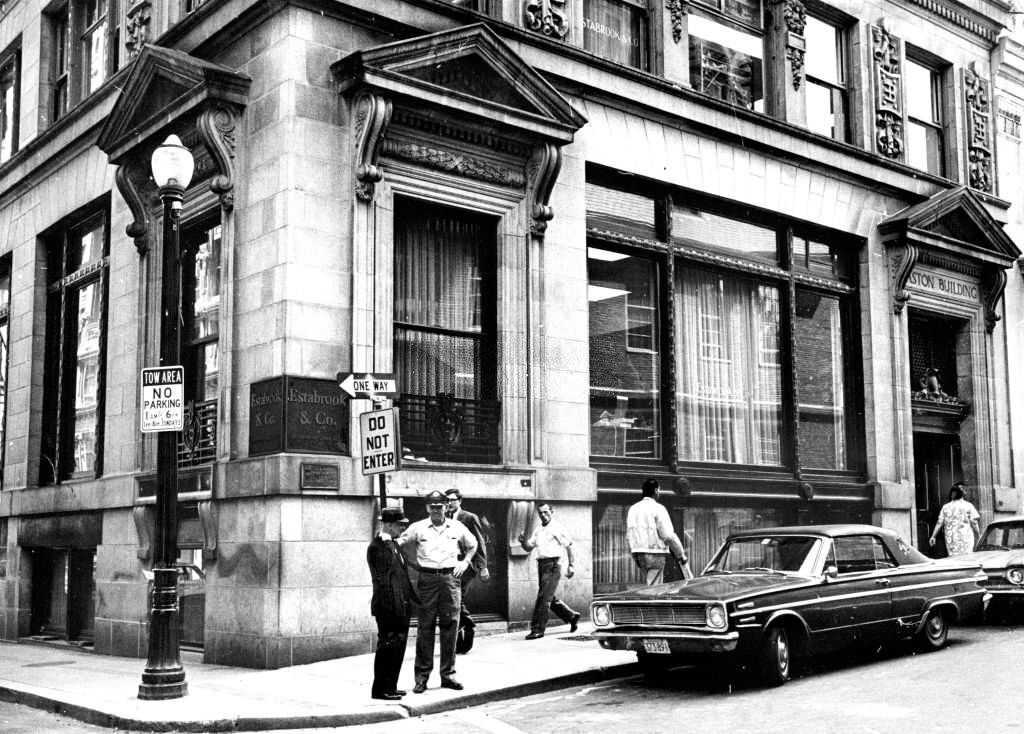
The scene outside the opening of Unity Bank & Trust Co. in the Roxbury neighborhood of Boston on Jun. 20, 1968.Estabrook & Co. in the Easton Building at 15 State St. in Boston, July 26, 1968.
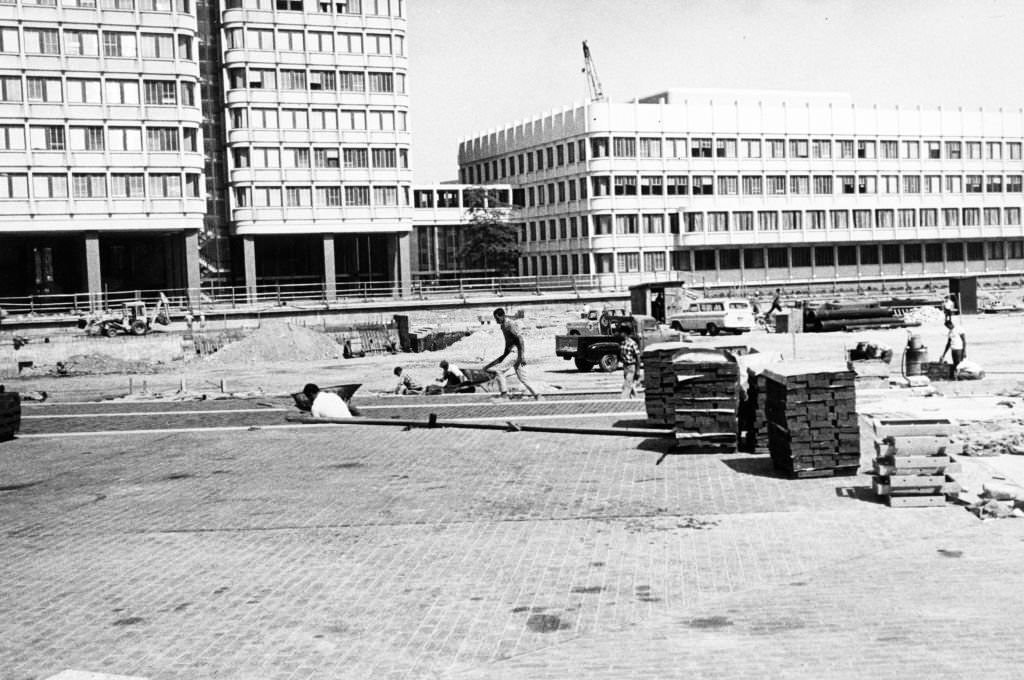
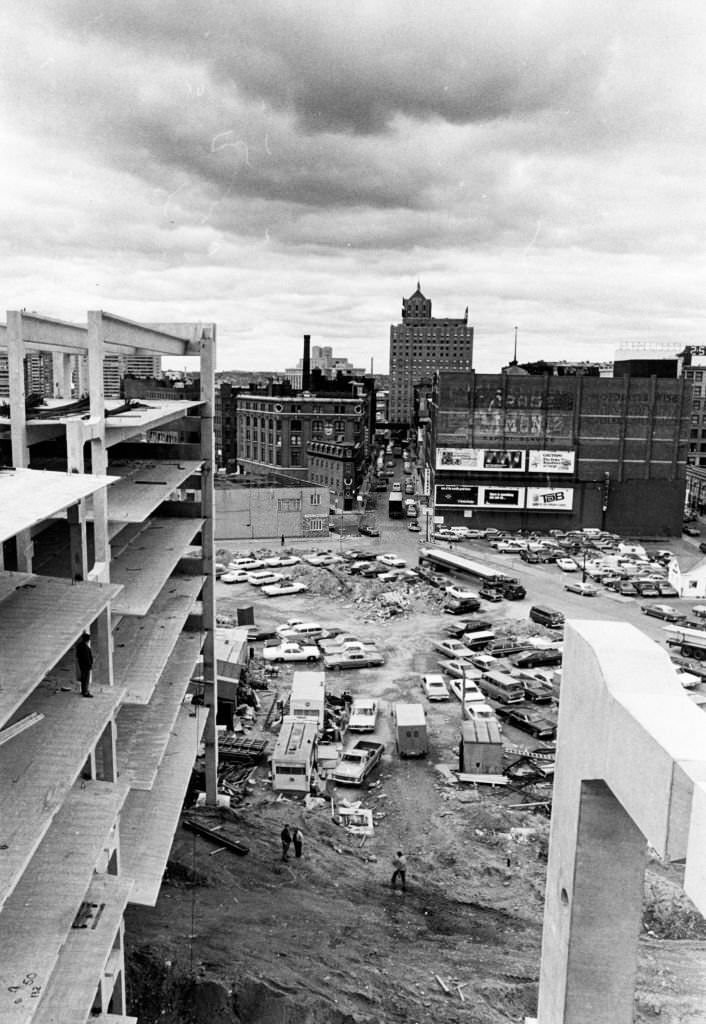
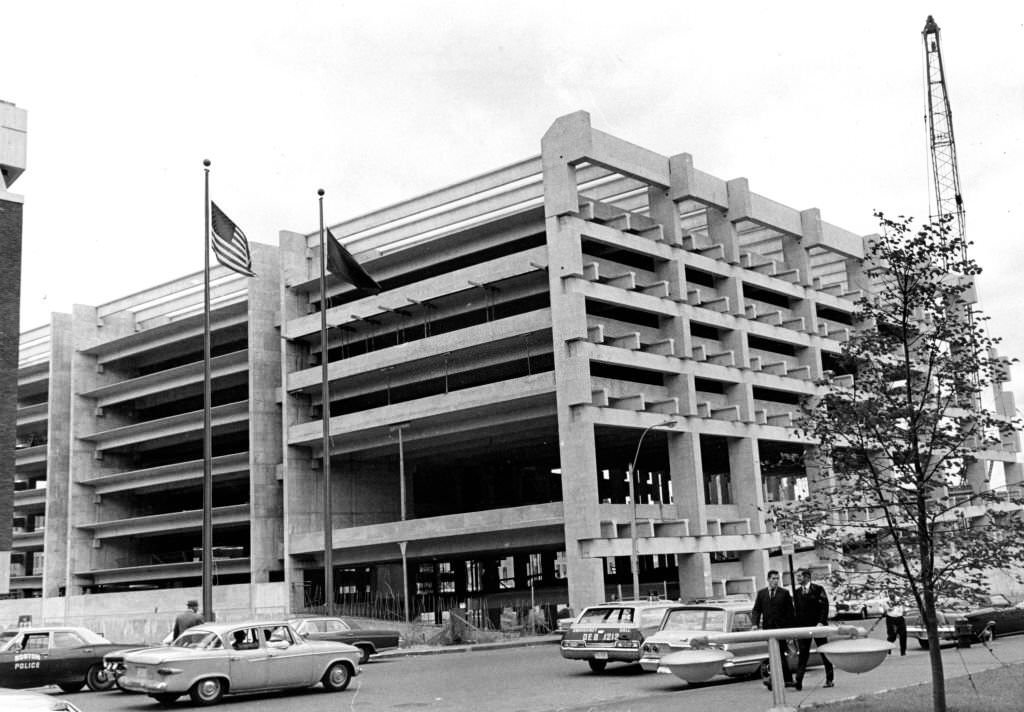
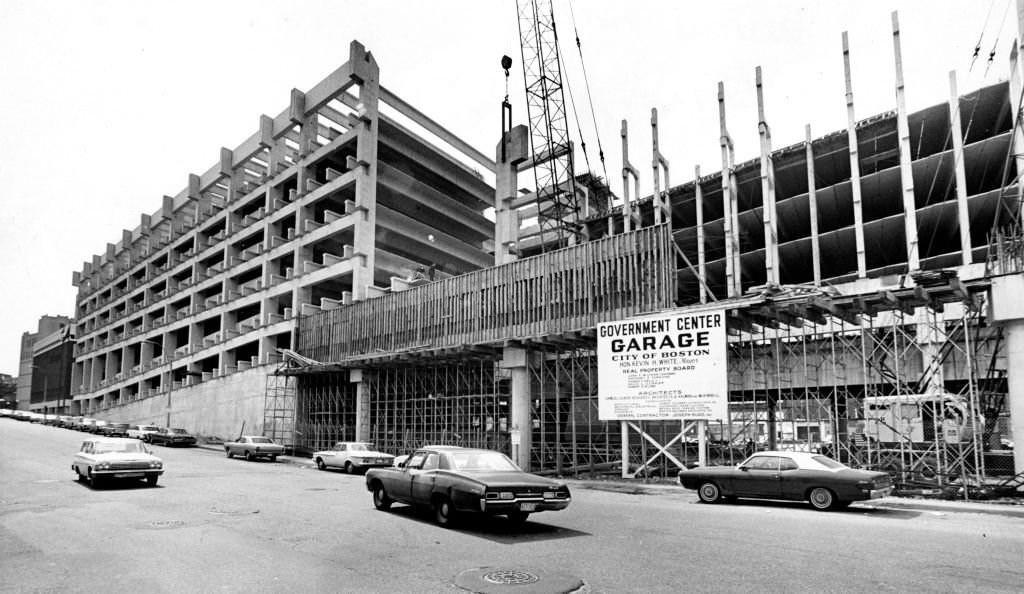
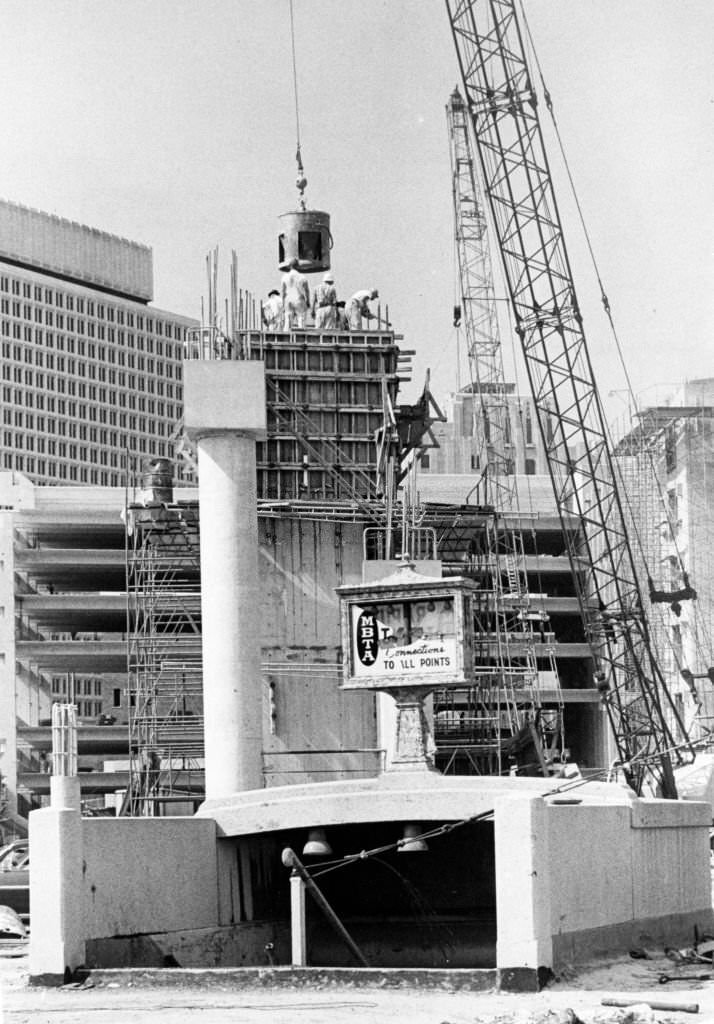
Government Center continued to grow through 1968. In August, the massive Government Center Garage was rising above the old Haymarket Square MBTA entrance, which sat unused in the foreground as construction surrounded it.
The new Government Center garage is under construction in Boston, August 1968.The Maverick Square Little City Hall in East Boston, August 1968.Stage One in the Government Center Plaza construction in Boston on Aug. 22, 1968.Construction takes place at the corner of Washington and Court Streets in Boston on Aug. 22, 1968.The building of the Government Center garage in Boston on Sept. 12, 1968.The Government Center Garage in downtown Boston under construction on Sep. 12, 1968.
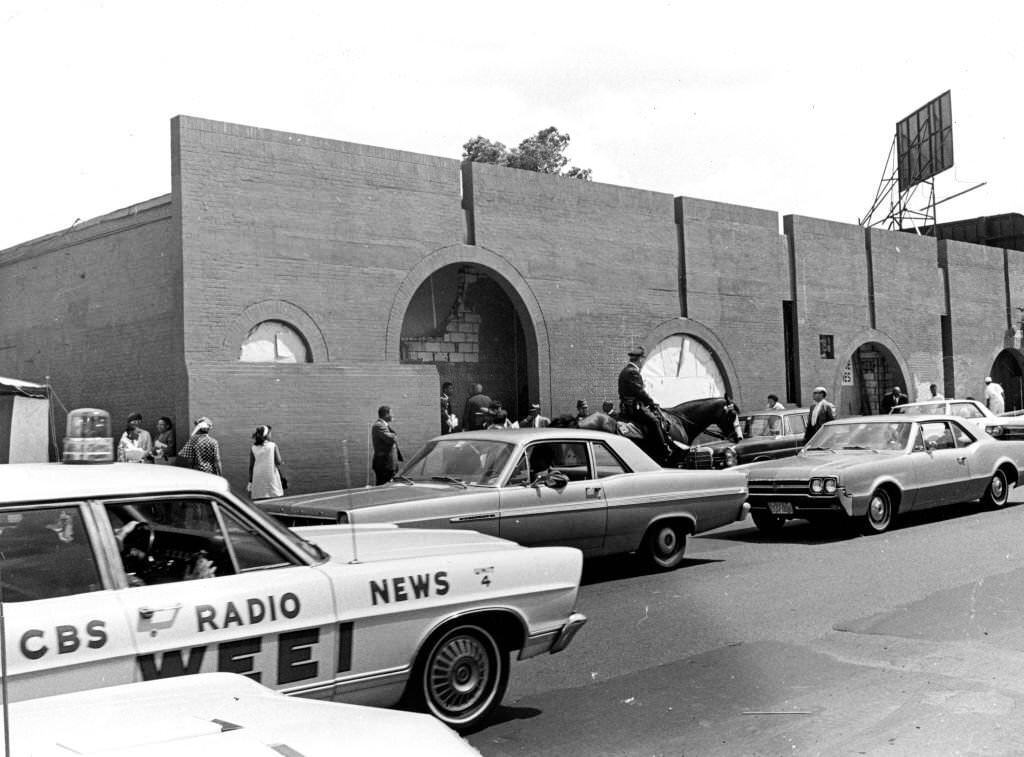
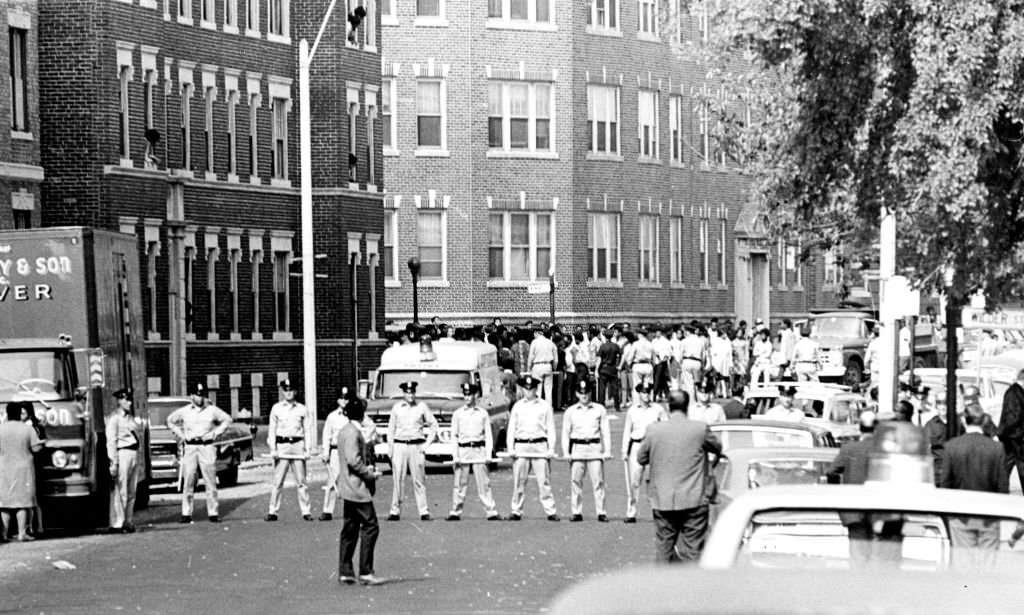
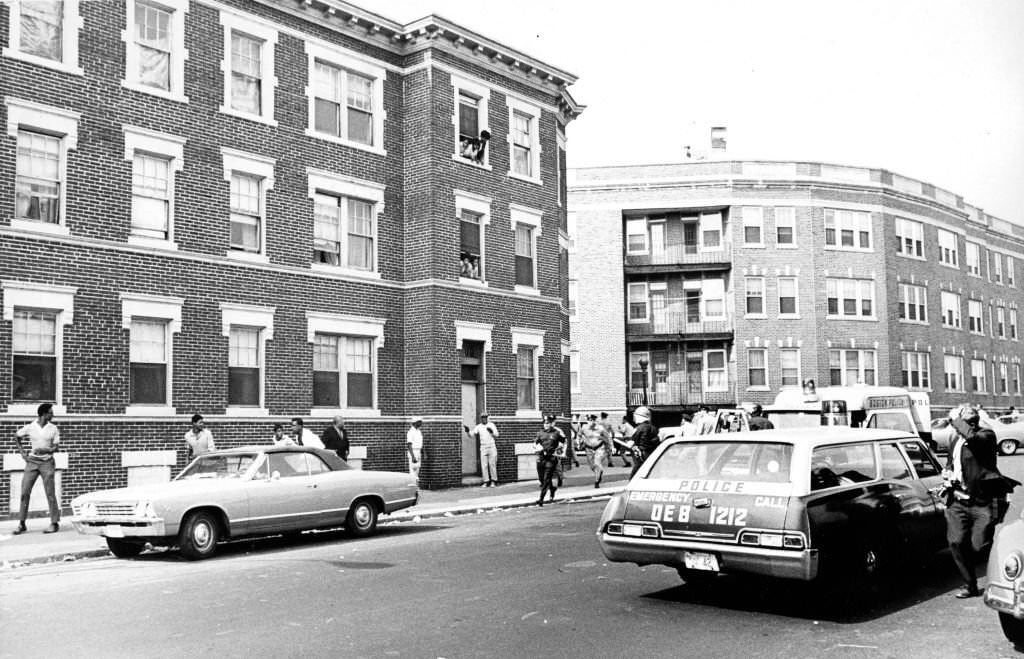
In September 1968, racial tensions flared at Jeremiah Burke High School in Dorchester. A rally there grew out of a controversy over Black students wearing African clothing and their demand for a Black student union. Boston Police lined Washington Street and moved in as the situation escalated.
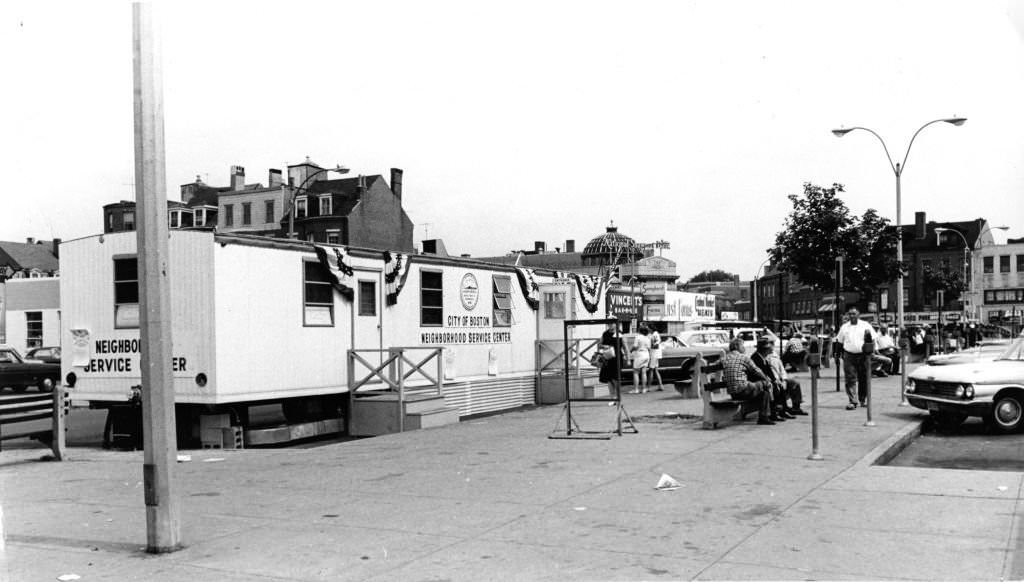
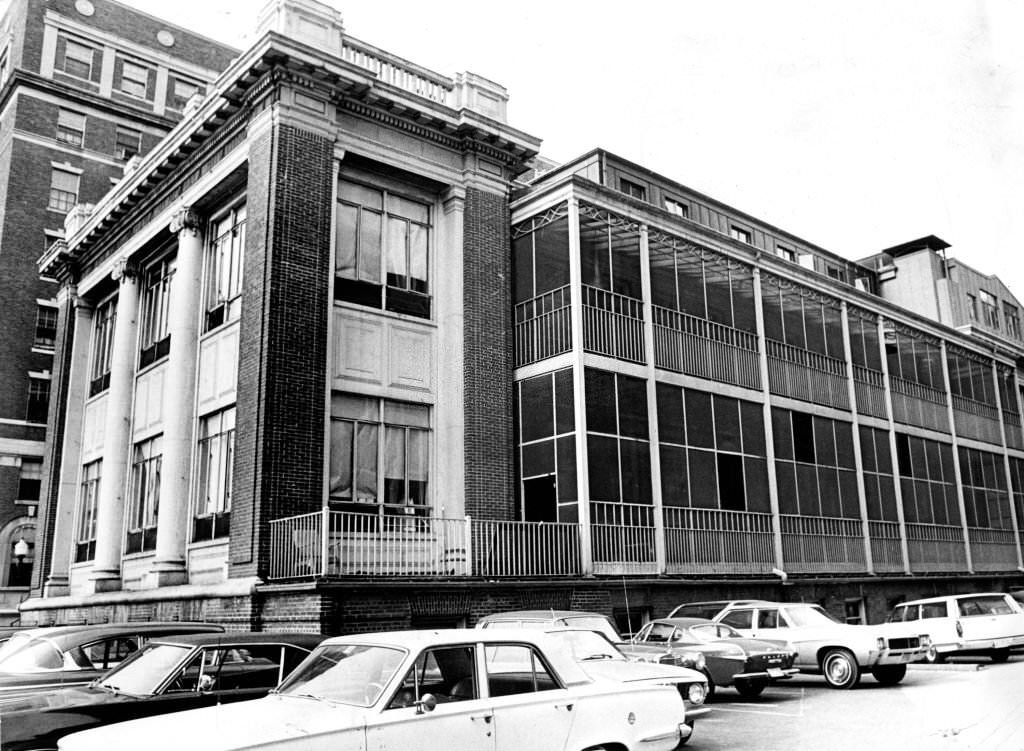
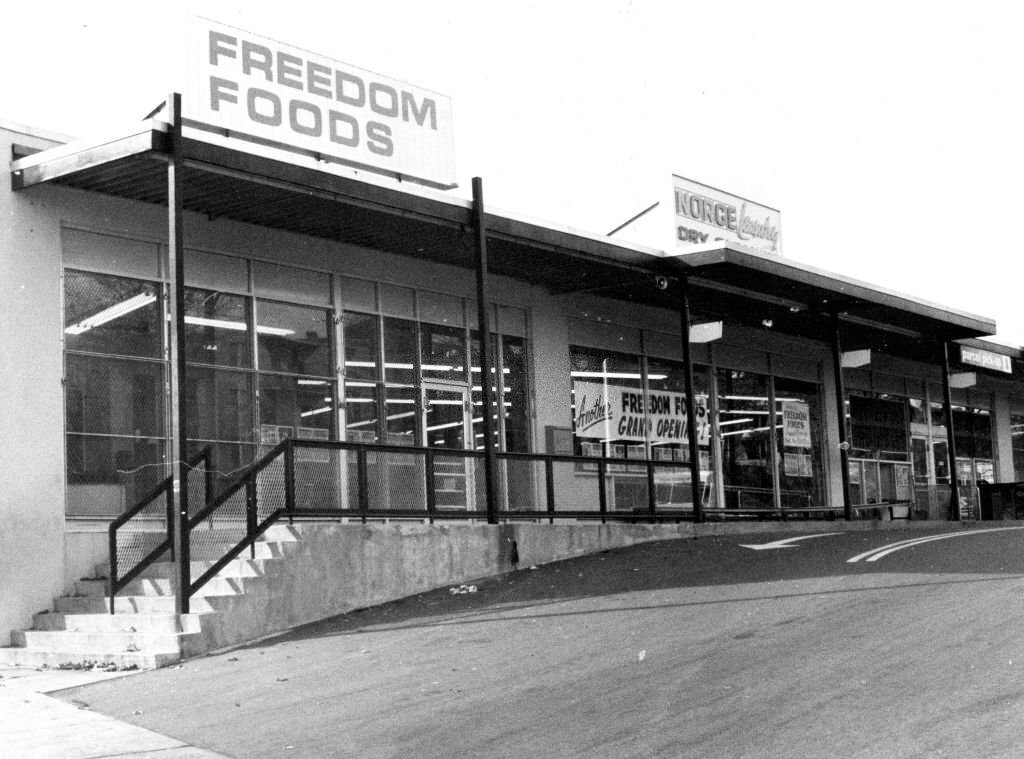
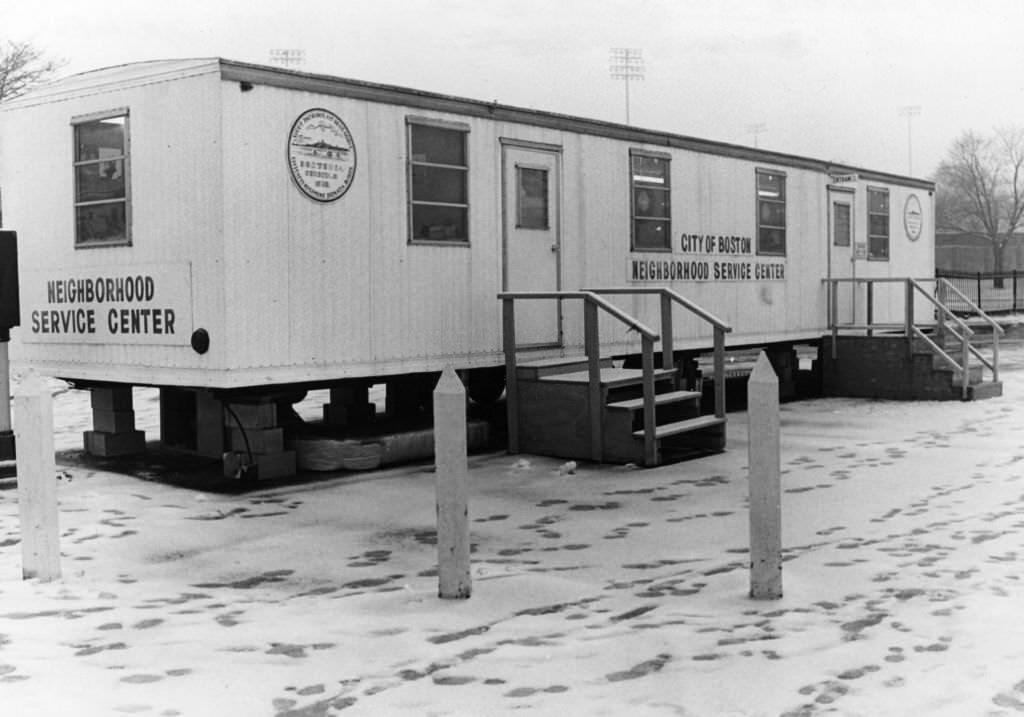
Boston Police officers line up on Washington Street in the Dorchester neighborhood of Boston on Sep. 25, 1968 during a disturbance near the Jeremiah Burke High School.Boston Police officers race toward a disturbance near the Jeremiah Burke High School on Washington Street in the Dorchester neighborhood of Boston on Sep. 25, 1968.Cars block Newbury Street in Boston’s Back Bay from being cleaned on Oct. 3, 1968.The Peabody Building at Boston City Hospital on Oct. 3, 1968.Freedom Foods at 264 Columbia Rd. in the Dorchester neighborhood of Boston on Nov. 20, 1968.The exterior of the neighborhood service center, or “Little City Hall,” at Dorchester Avenue and Park Street in Boston, Dec. 28, 1968.Faneuil Hall in Boston on Jan. 2, 1969.
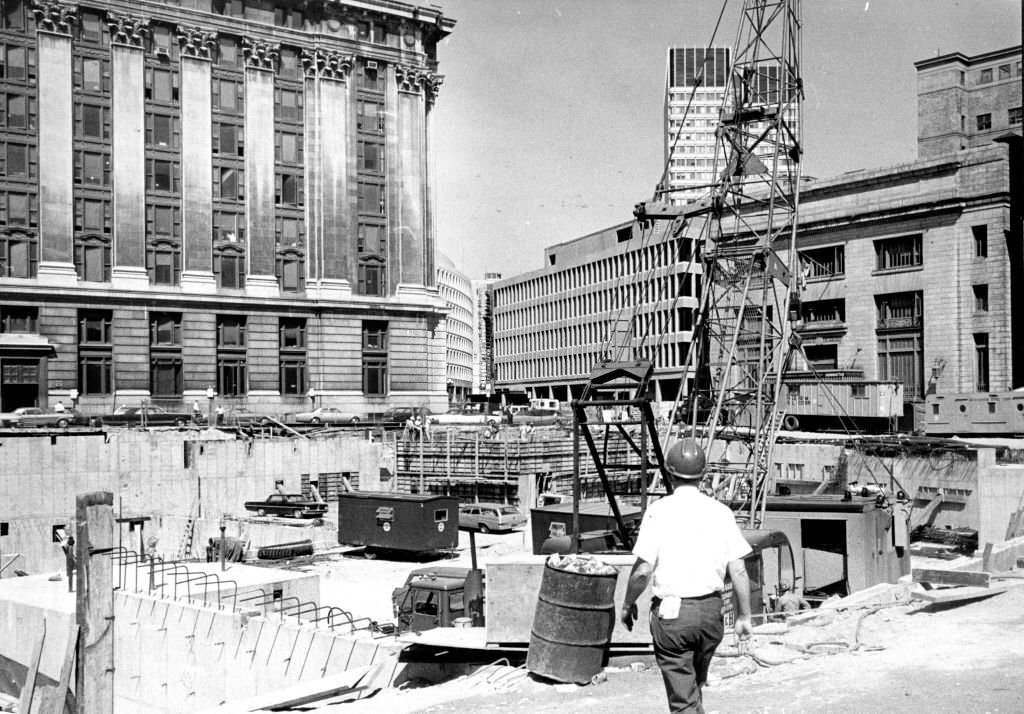
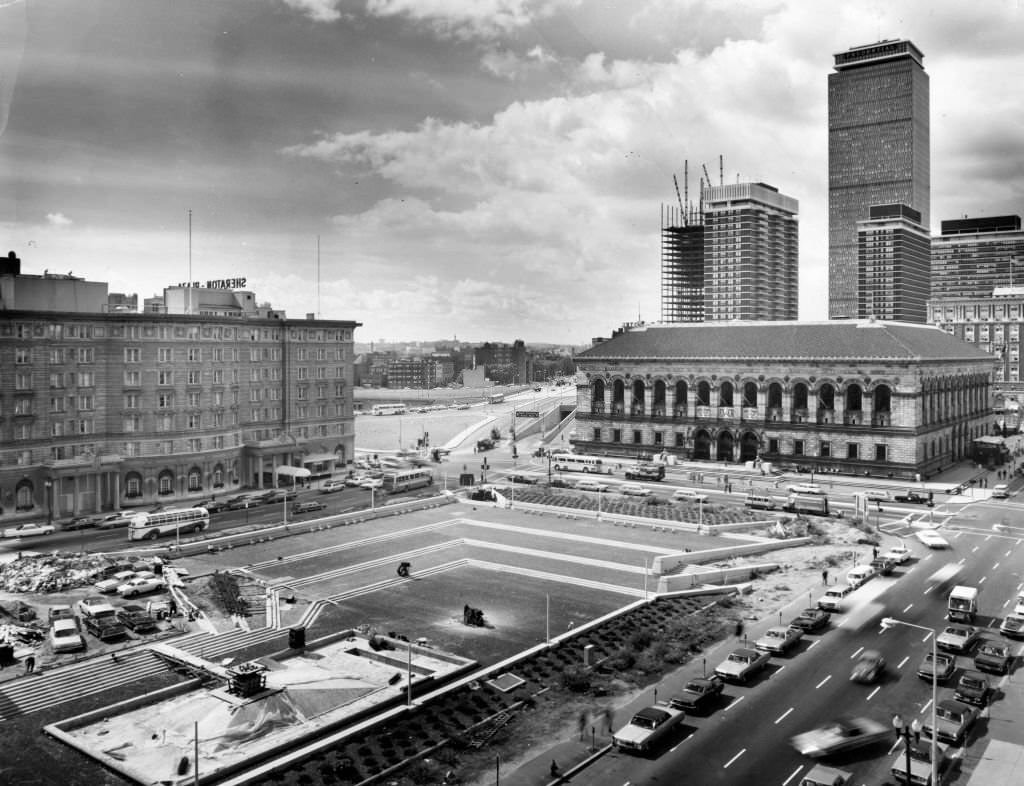
Construction in Copley Square stretched into 1969. Viewed from the second floor of the Boston Public Library, the square was a sea of activity with Trinity Church and the John Hancock Building rising behind the scaffolding.
Construction in Copley Square, seen from Old South Church, in Boston on Jan. 6, 1969. Trinity Church and the John Hancock Building is in the background.
The Boston Gas Company Building at Stuart and Arlington Streets in Boston on Feb. 8, 1969.
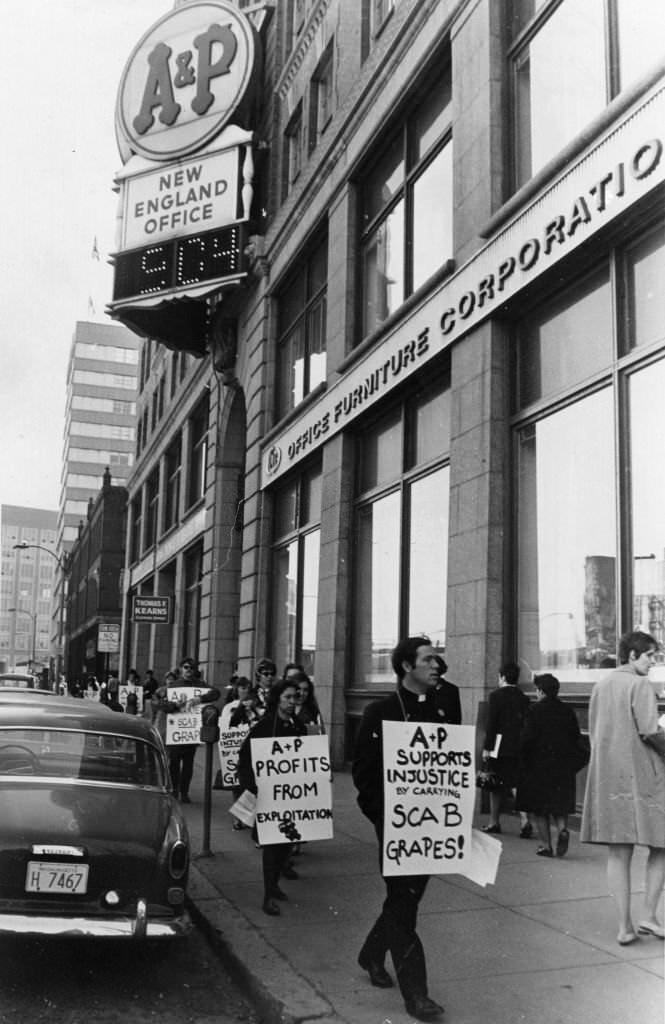
Commuters wait in the snow outside South Station in Boston on March 2, 1969.People protest the working condition of grape workers in front of A&P’s corporate office in Boston, March 5, 1969.
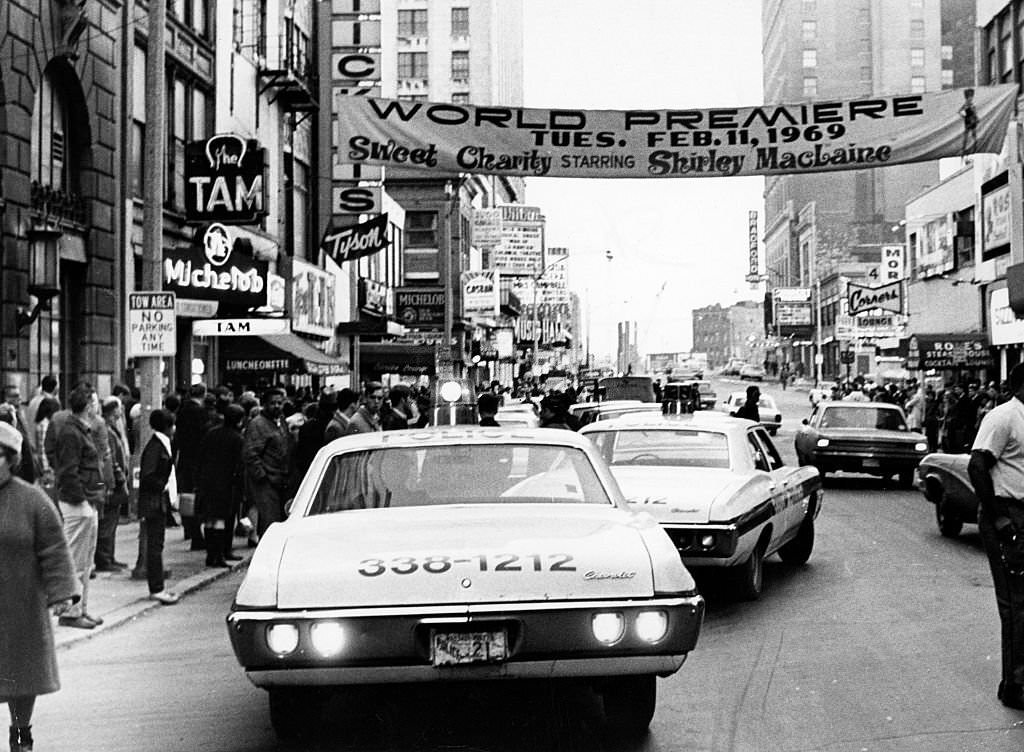
A shooting outside Tam Cafe on Tremont Street on March 17, 1969, turned the St. Patrick’s Day scene grim. A police officer was killed and two men were seriously injured in the attack, drawing a large response from both police and bystanders.
Police and bystanders gather outside of Tam Cafe at 222 Tremont St. in Boston after a shooting on March 17, 1969.
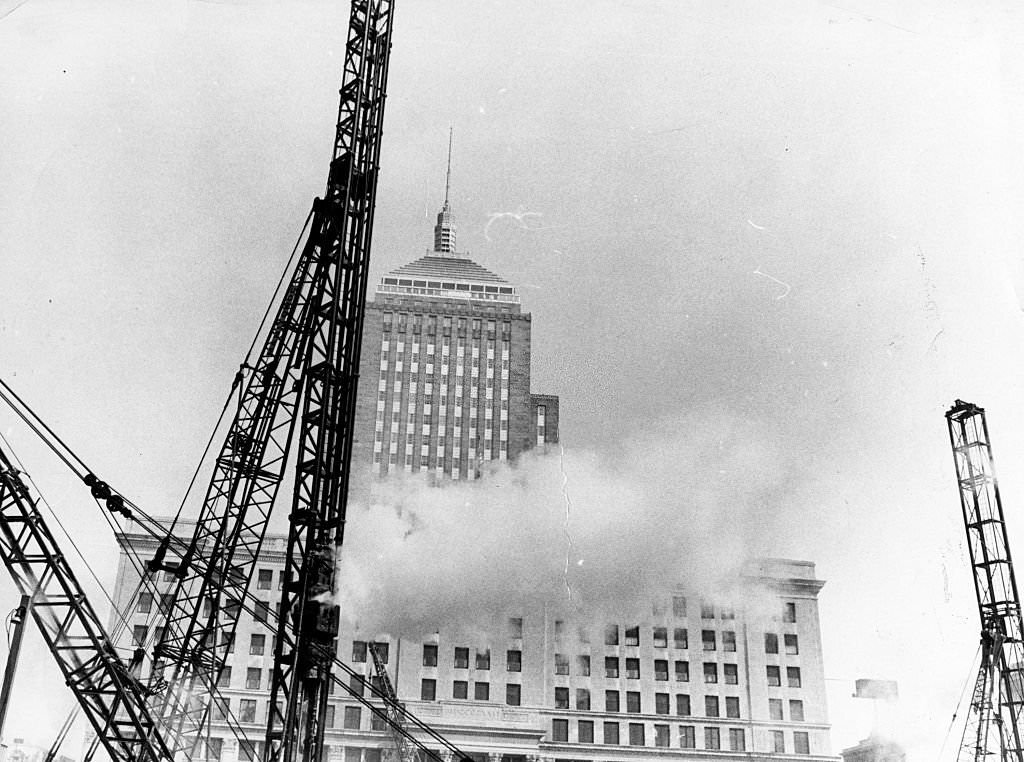
By March 1969, the new John Hancock Tower was beginning to take shape in Copley Square. The old John Hancock Building — still standing nearby — offered a direct contrast between the architectural styles of two different eras.
Construction is underway for the new John Hancock Tower in Boston on March 18, 1969.
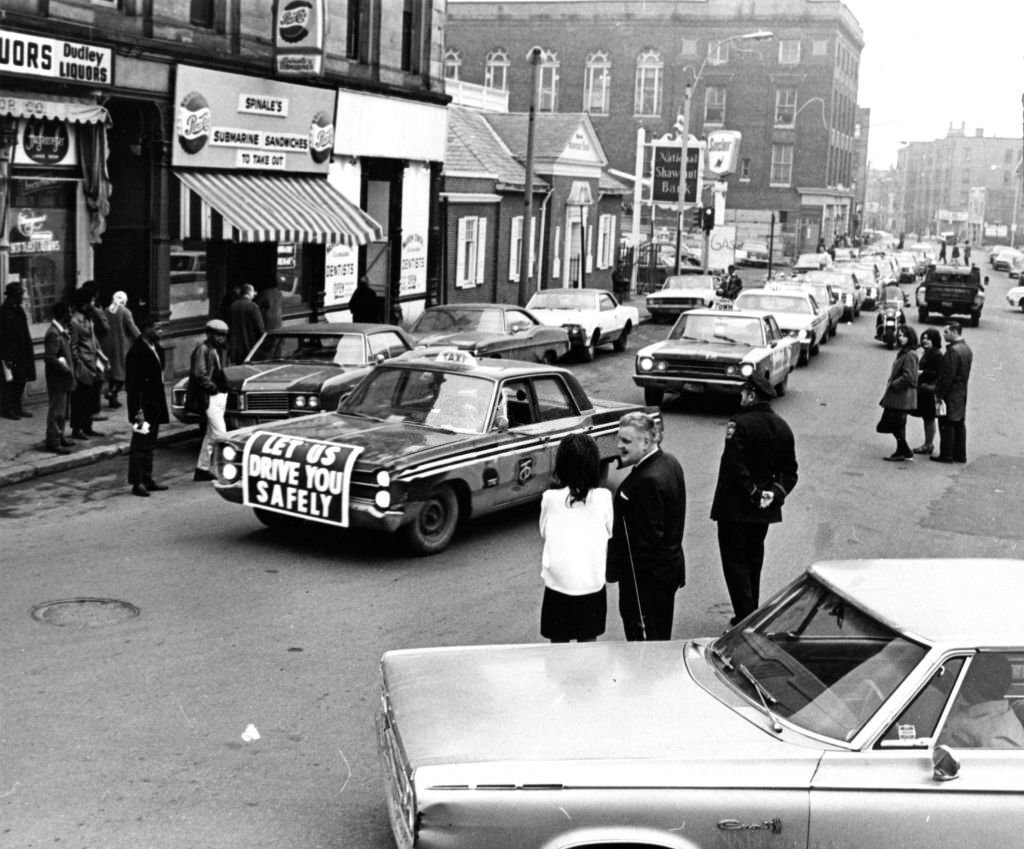
On March 20, 1969, about 200 Boston cab drivers formed a motorcade through the city in tribute to Carl W. Zwicker, a fellow driver who had been shot and killed the week before. The procession wound through the Grove Hall section of Dorchester.
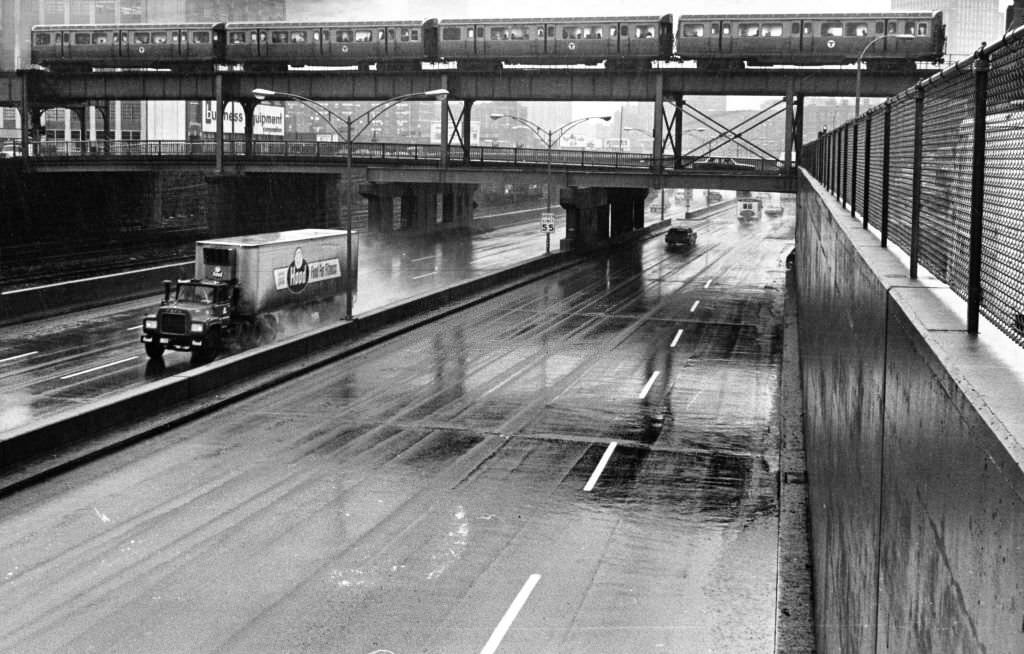
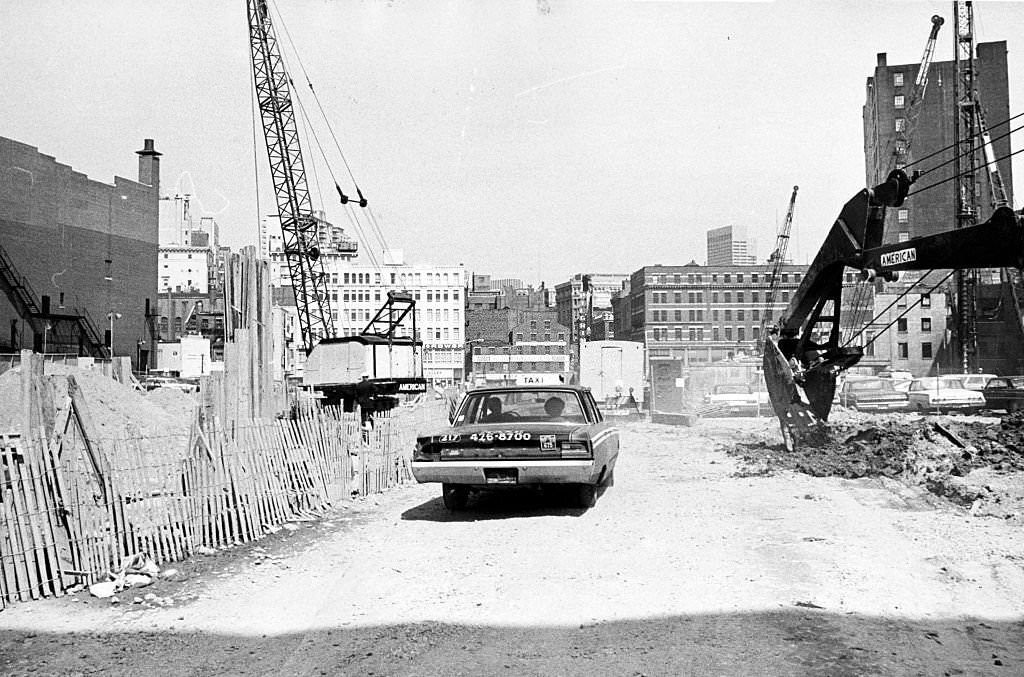
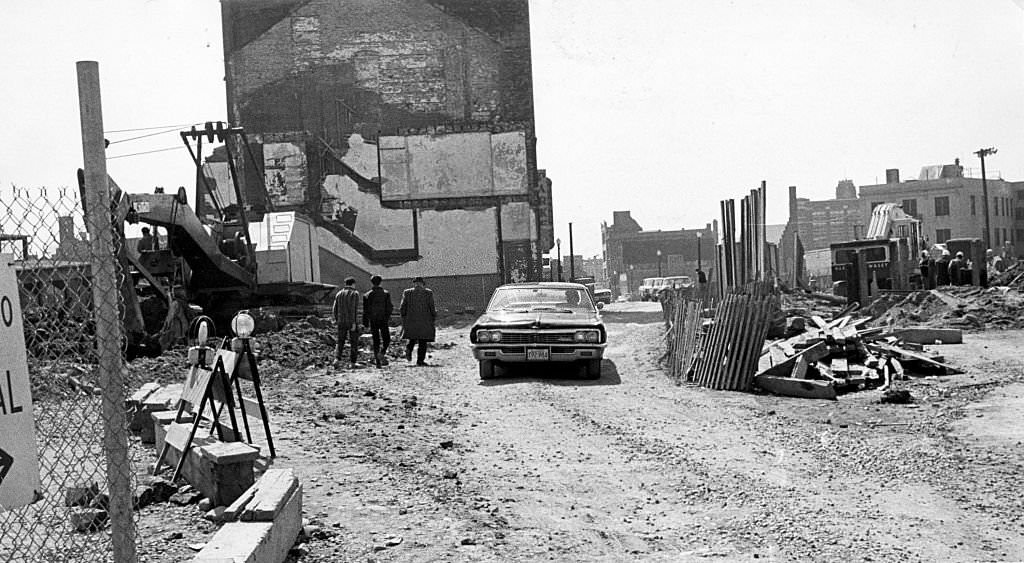
A motorcade of taxi cabs proceeds through Boston as about 200 Boston taxi drivers stages a tribute to a slain fellow driver on March 20, 1969.A motorcade of taxi cabs proceeds through the Grove Hall section of Dorchester in Boston as about 200 Boston taxi drivers stages a tribute to a slain fellow driver on March 20, 1969.An elevated MBTA train runs never the Mass. Pike and the Washington Street in Boston on March 25, 1969.A taxi at a construction site on Boston’s Washington Street, near Kneeland Street and Broadway, on April 4, 1969.A construction site on Boston’s Washington Street, between Kneeland Street and Broadway, on April 4, 1969.
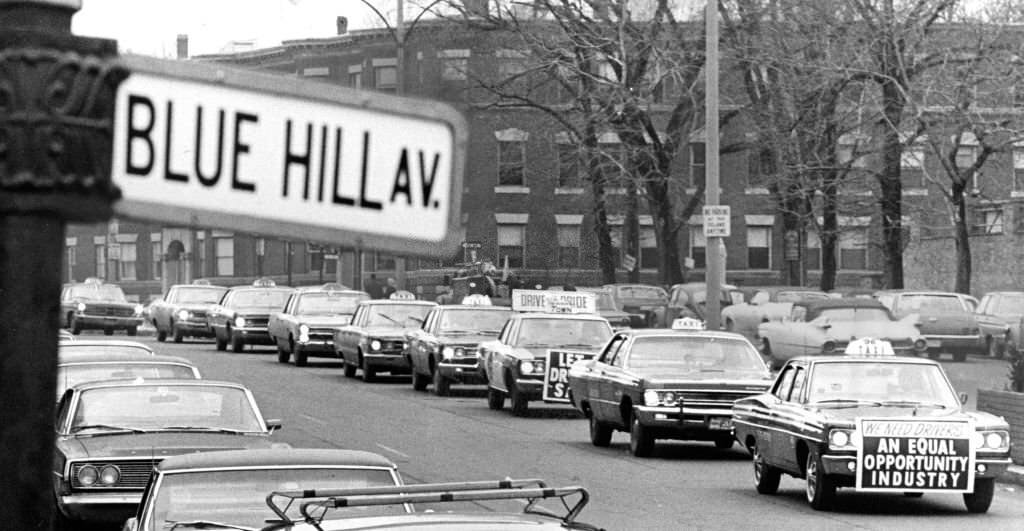
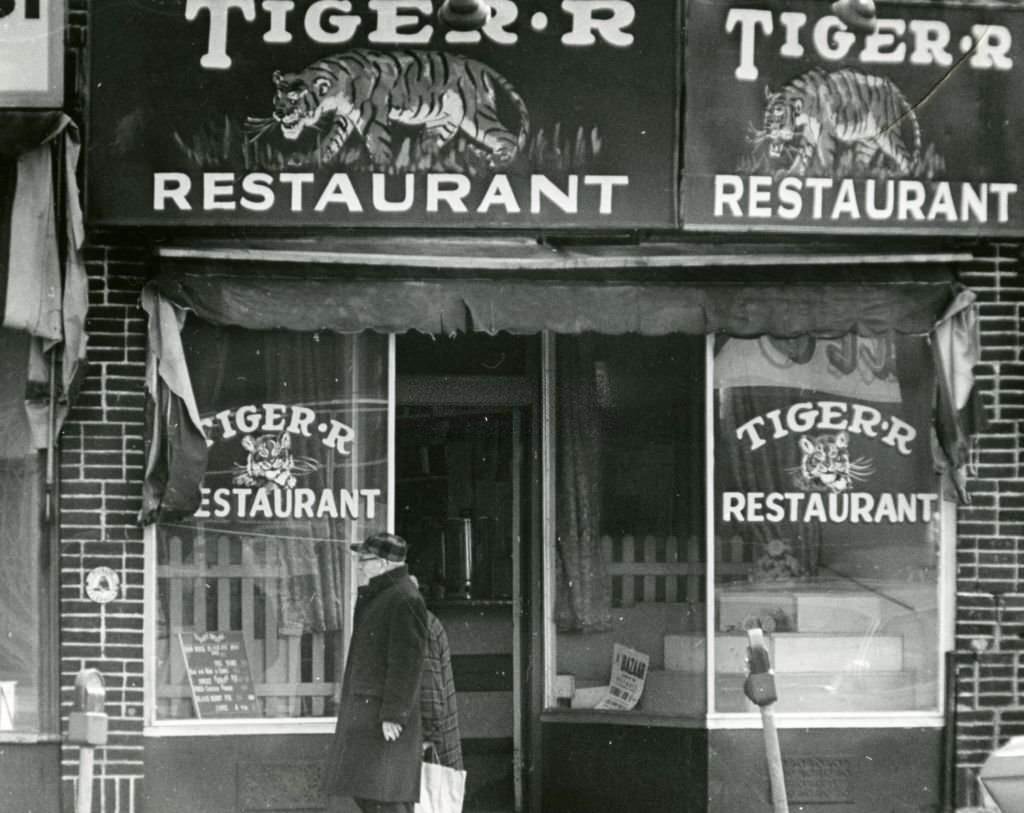
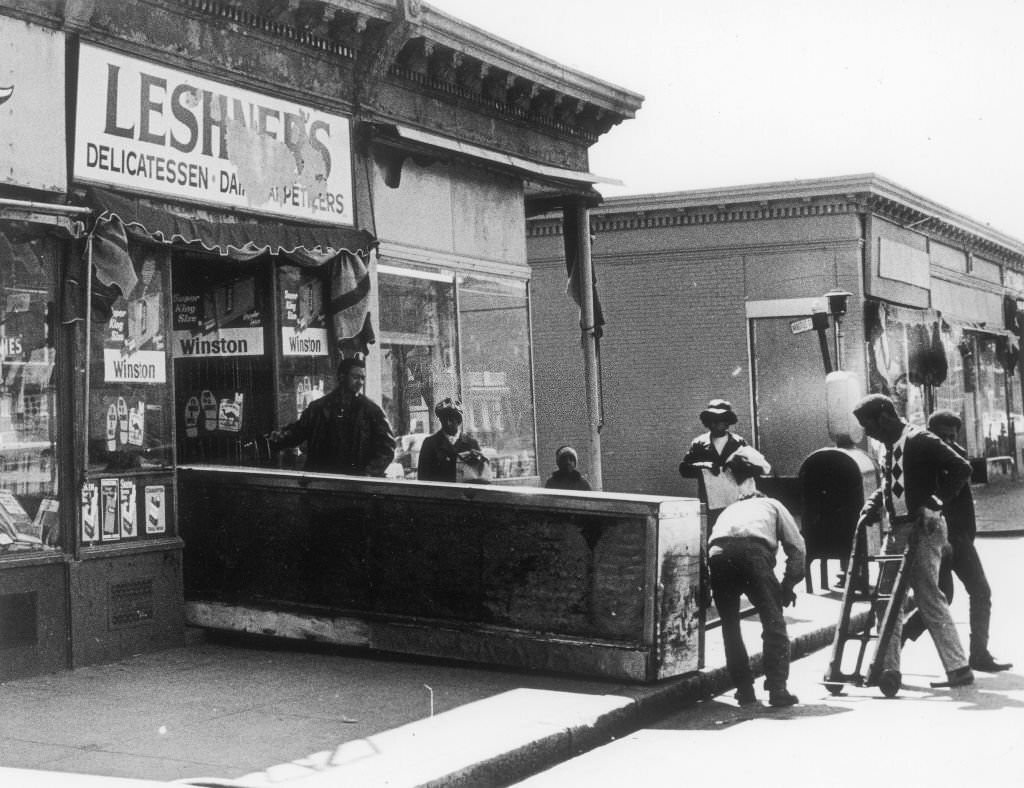
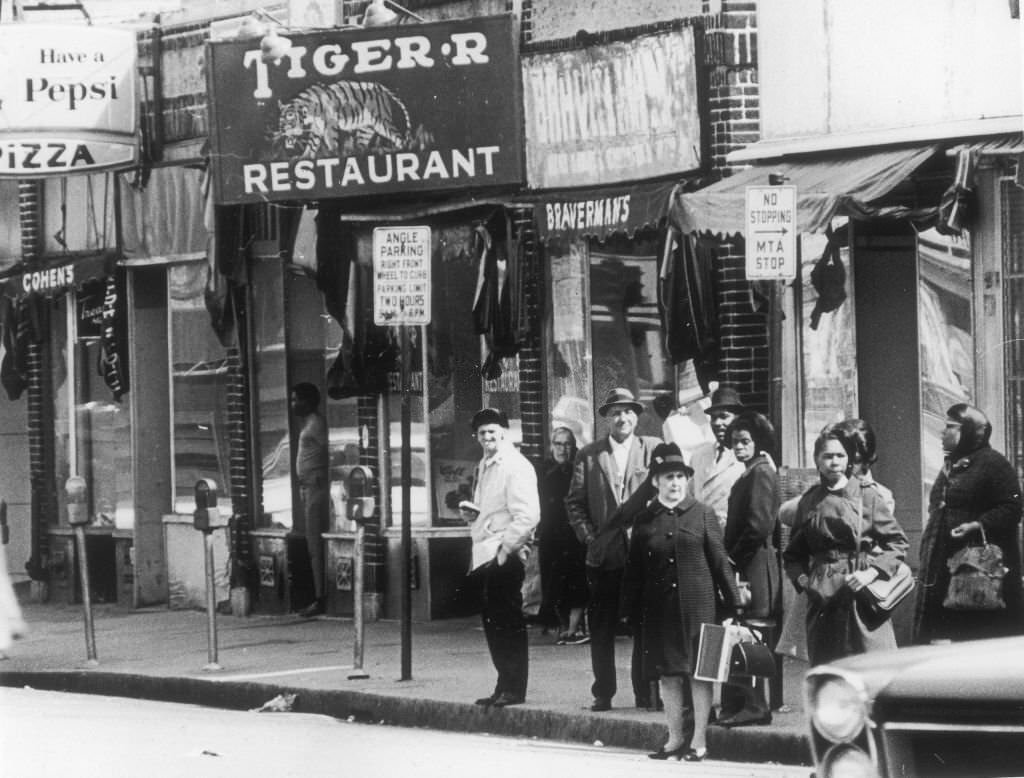
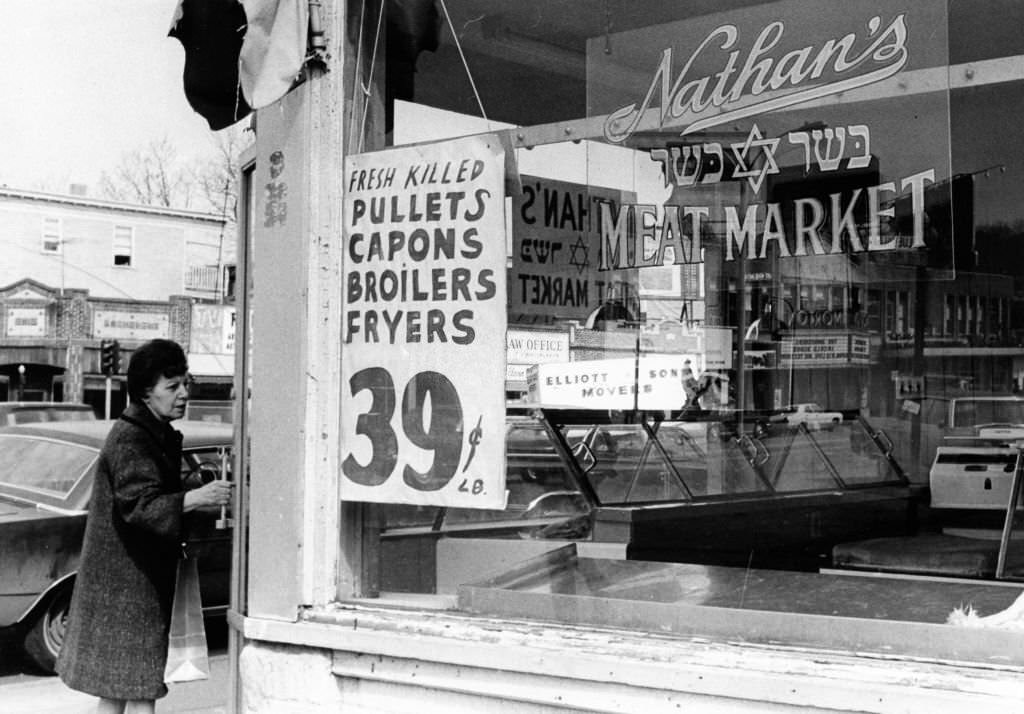
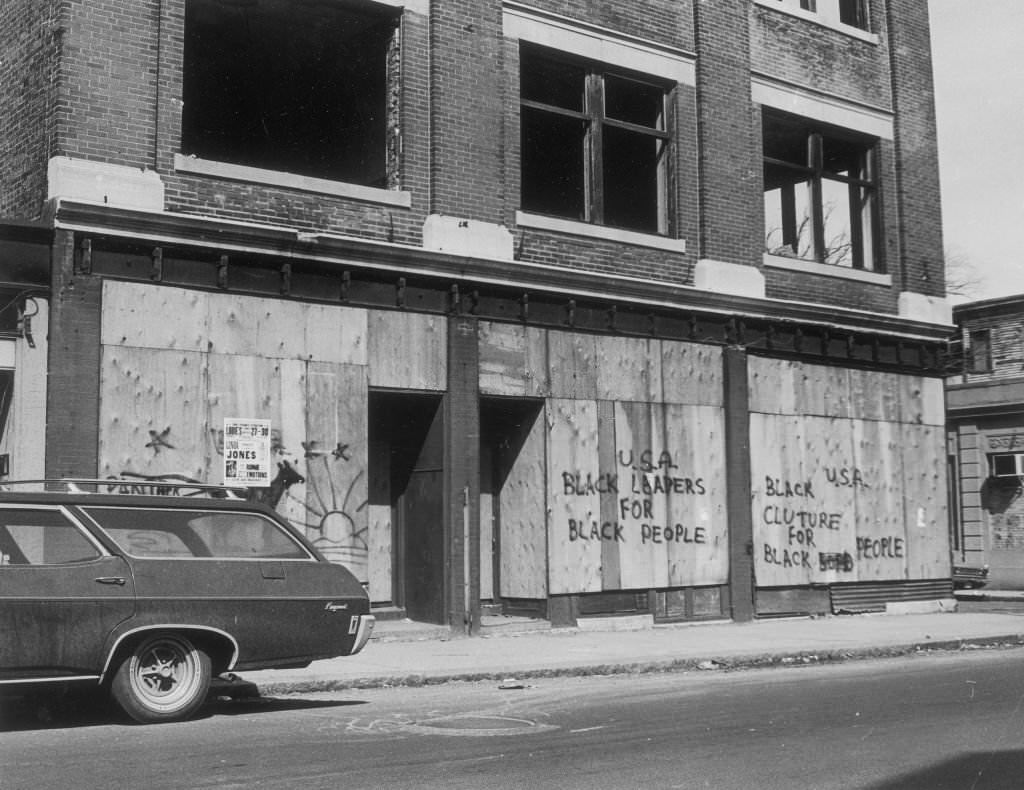
By May 1969, Blue Hill Avenue in Roxbury was still showing the marks of the 1967 riots. Graffiti on boarded-up buildings read “U.S.A.: Black leaders for Black people, Black culture for Black people.” Nearby, businesses like Tiger’s Restaurant and the kosher Nathan’s Meat Market continued their daily operations alongside stores being rebuilt.
Tigers Restaurant on Blue Hill Avenue in Boston on May 4, 1969.Graffiti reading U.S.A.: Black leaders for Black people, Black culture for Black people, on boarded up buildings along Blue Hill Avenue in Boston on May 4, 1969.Workers move a new counter into a store called Leshners Delicatessen on Blue Hill Avenue in Boston on May 4, 1969.People wait for the bus at an MTA stop next to the Tiger Restaurant on Blue Hill Avenue in Boston on May 4, 1969.The kosher Nathans Meat Market on Blue Hill Avenue in Boston on May 4, 1969.An aerial view of Storrow Drive and the Massachusetts Turnpike entrance in the Allston neighborhood of Boston on May 12, 1969.The Government Center Garage in downtown Boston is under construction on May 12, 1969.
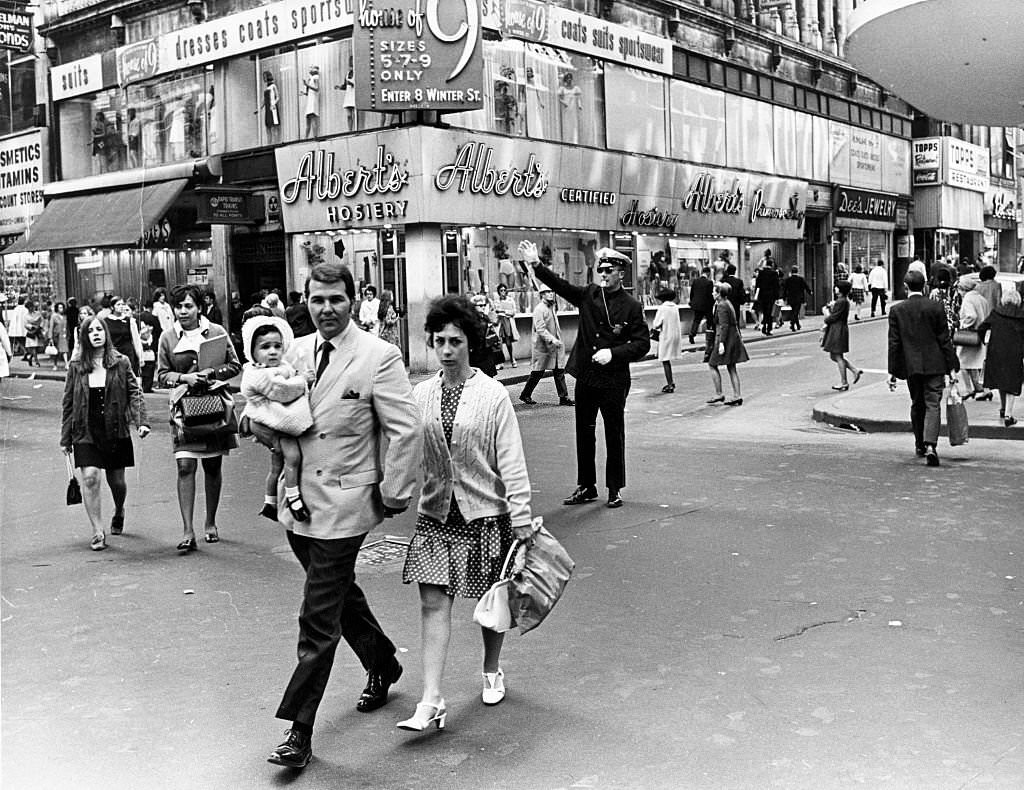
Jaywalking was a persistent problem in downtown Boston. A police officer worked to manage foot traffic at Washington and Summer Streets in May 1969, years after the city had tried and failed to curb the habit with a jaywalking ordinance in 1966.
A police officer tries to direct foot traffic at the intersection of Washington Street and Summer Street in Boston on May 13, 1969.Aerial view of Dewey Square under construction, June 11, 1969.St. Mark Congregational Church in the Roxbury neighborhood of Boston on June 12, 1969.
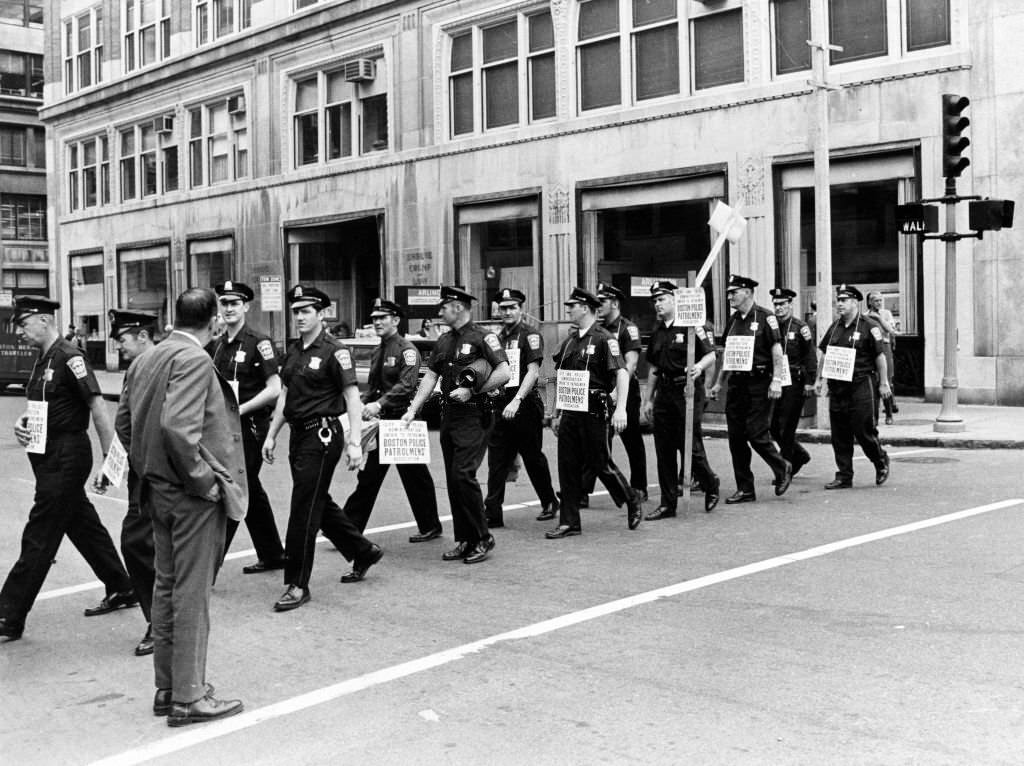
In June 1969, Boston’s police officers went on strike, picketing along Boylston Street at Arlington Street. The action was part of a broader labor dispute over pay and working conditions that brought the city’s law enforcement into direct conflict with city leadership.
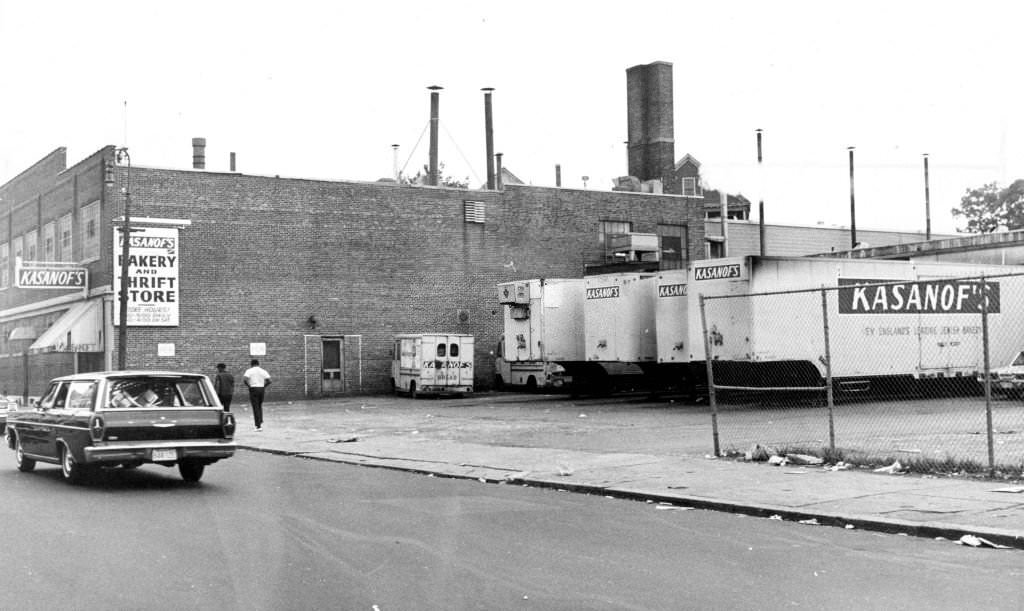
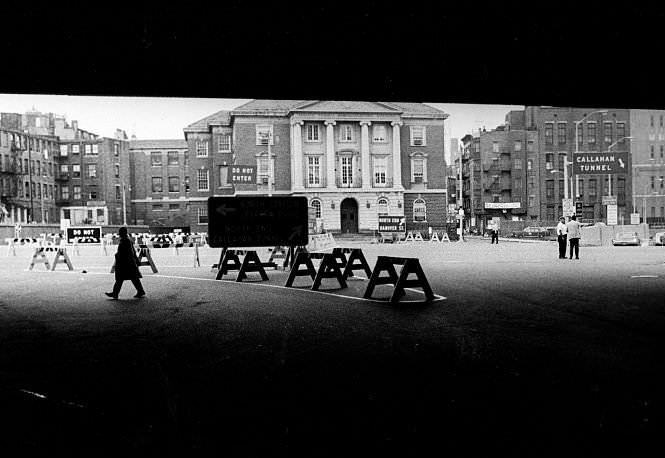
Boston police officers picket along Boylston Street at Arlington Street in Boston, June 16, 1969.The exterior of Kasanof’s Bakery and Thrift Store in Boston on July 4, 1969.There is a new traffic pattern at the entrance to the Lieutenant William F. Callahan Tunnel in East Boston, seen here on Aug. 4, 1969.
Dorchester and Mattapan’s Jewish communities were also shifting by 1969. Synagogues like Temple Beth El on Bradshaw Street and Temple Beth Hillel on Morton Street were still serving their congregations, but demographic change was already accelerating in both neighborhoods.
Temple Beth El on Bradshaw Street in the Dorchester neighborhood of Boston on Aug. 20, 1969.Temple Beth Hillel at 800 Morton Street in the Mattapan neighborhood of Boston on Aug. 20, 1969.
Copley Square was still being redesigned in September 1969. Viewed from the upper floors of the Boston Public Library, Trinity Church and the John Hancock Building dominated the background while construction equipment filled the foreground.
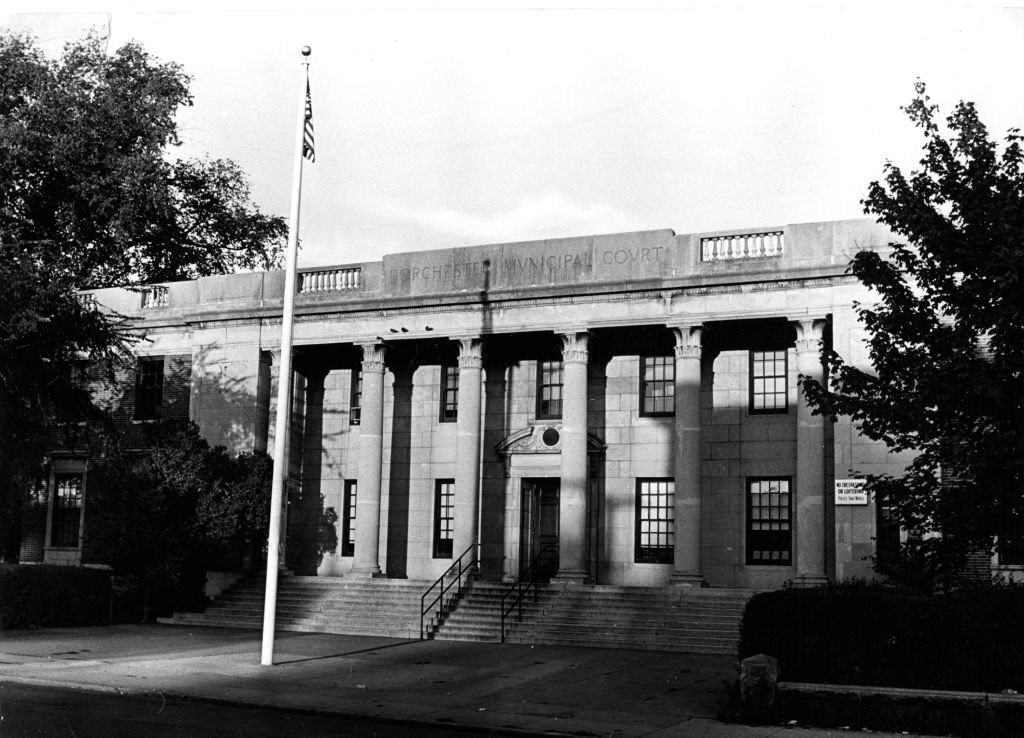
Copley Square, from the second floor of the Boston Public Library, in Boston on Sept. 15, 1969.Construction continues at Copley Square in Boston in Sept. 20, 1969.St. William’s Church in the Dorchester neighborhood of Boston on Sep. 25, 1969.Dorchester District Court on Washington St. in the Dorchester neighborhood of Boston on Oct. 1, 1969.
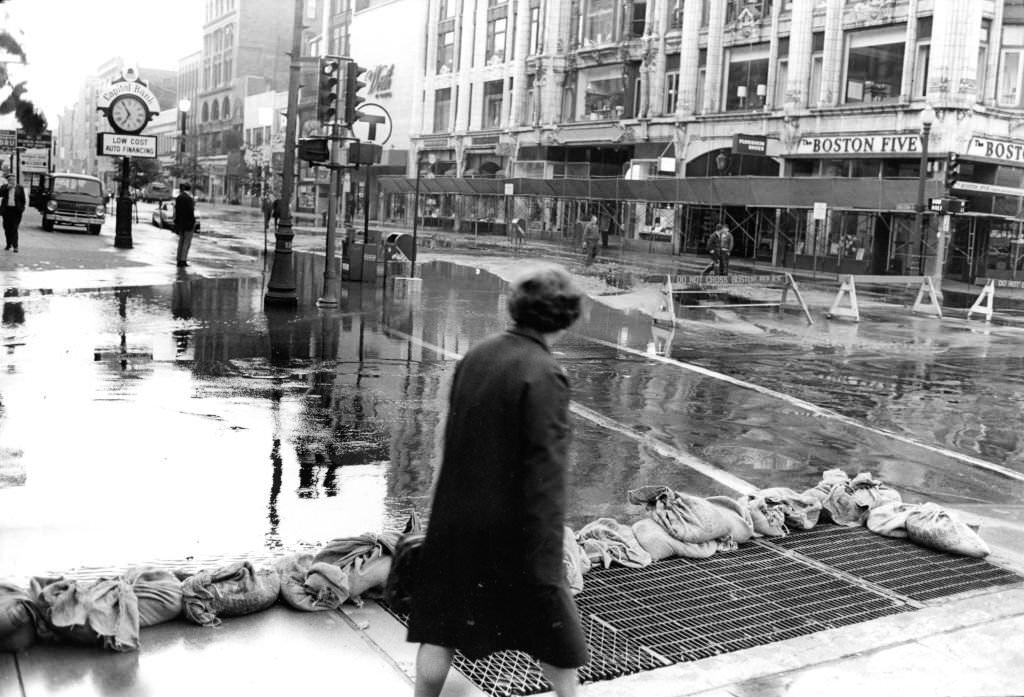
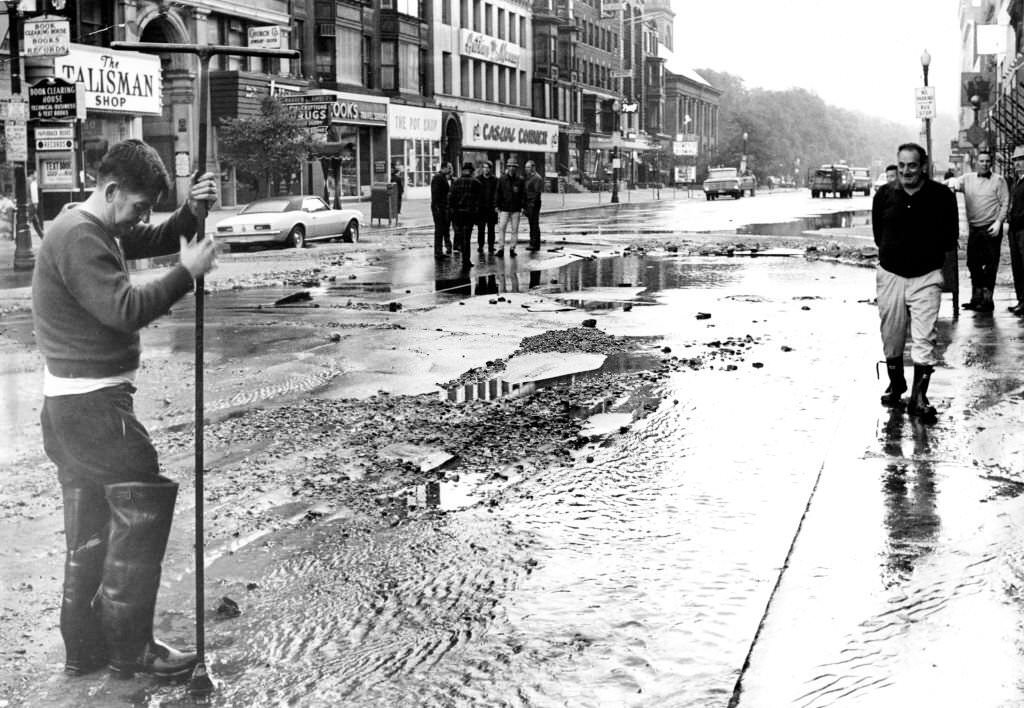
On October 7, 1969, a water main break on Boylston Street flooded the intersection at Berkeley Street and caused thousands of dollars in damage to Back Bay specialty shops. The morning rush hour was thrown into chaos as water poured through the street.
The flooded corner of Boylston and Berkeley Streets in Boston on Oct. 7, 1969.A flooded Boylston Street on Oct. 7, 1969.
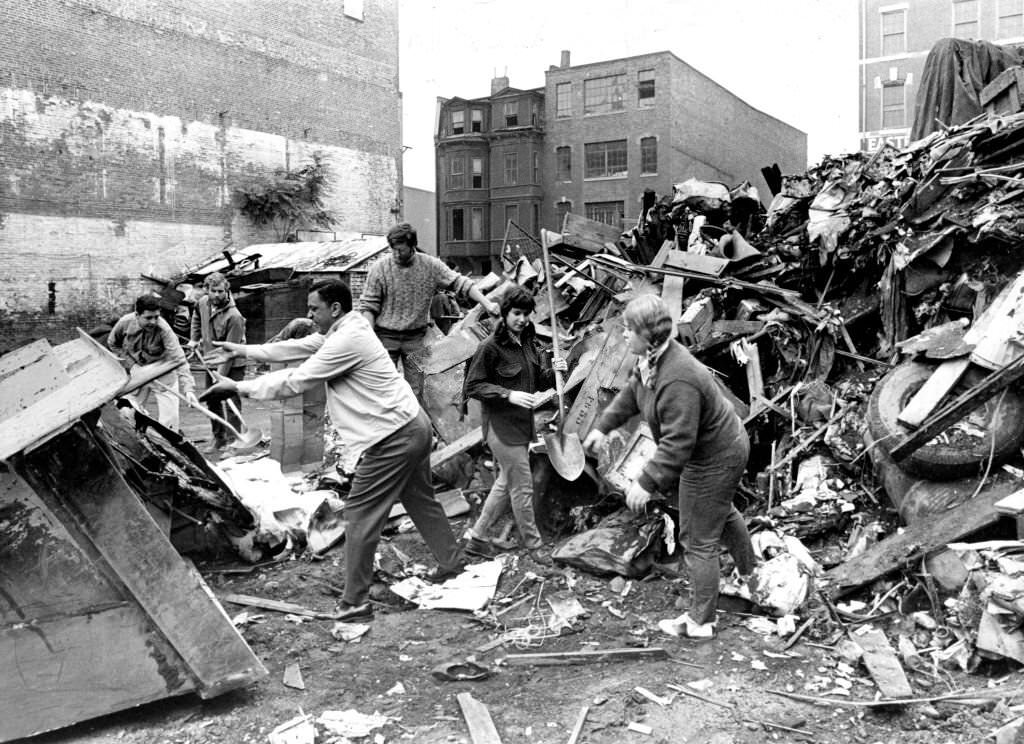
In October 1969, volunteers from local community youth agencies cleaned up a vacant lot at 114 West Brookline Street in the South End. The lot had been used by a private junk dealer and had become a neighborhood health hazard. Residents hoped to turn it into a recreation area.
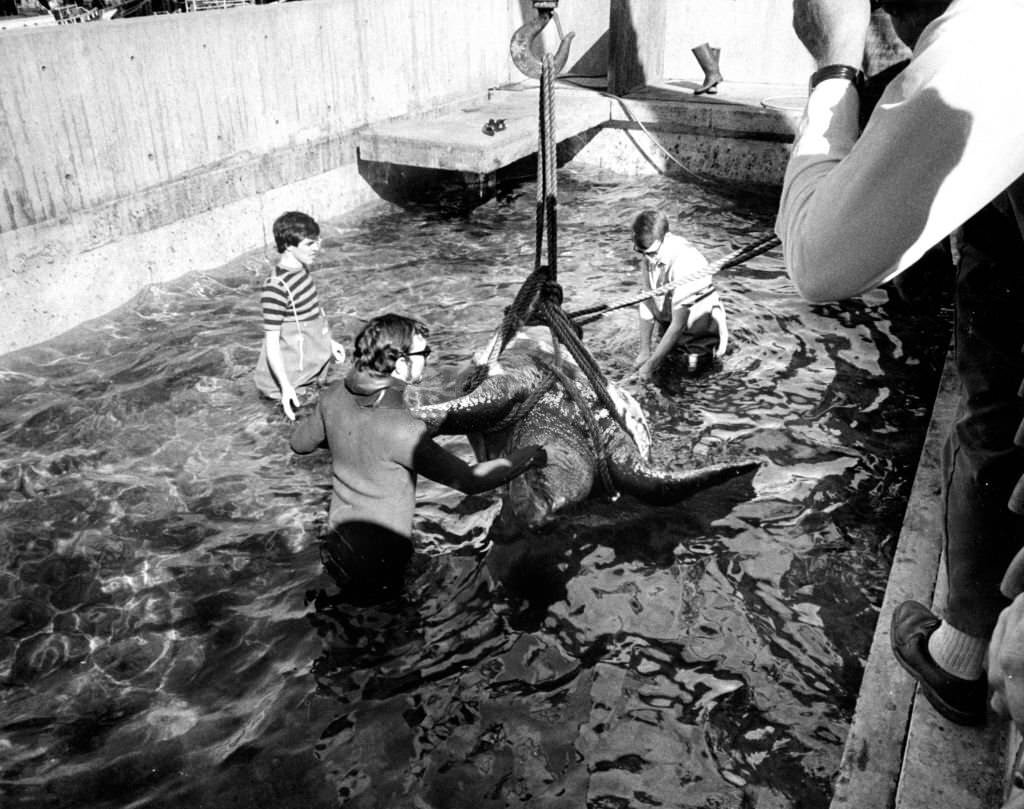
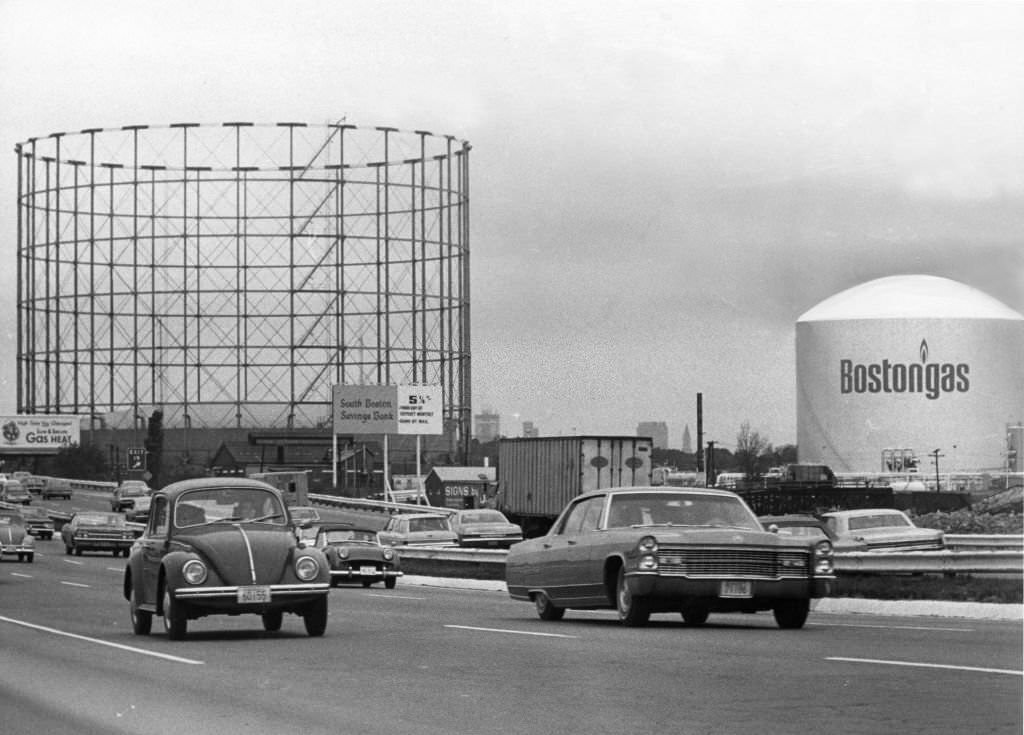
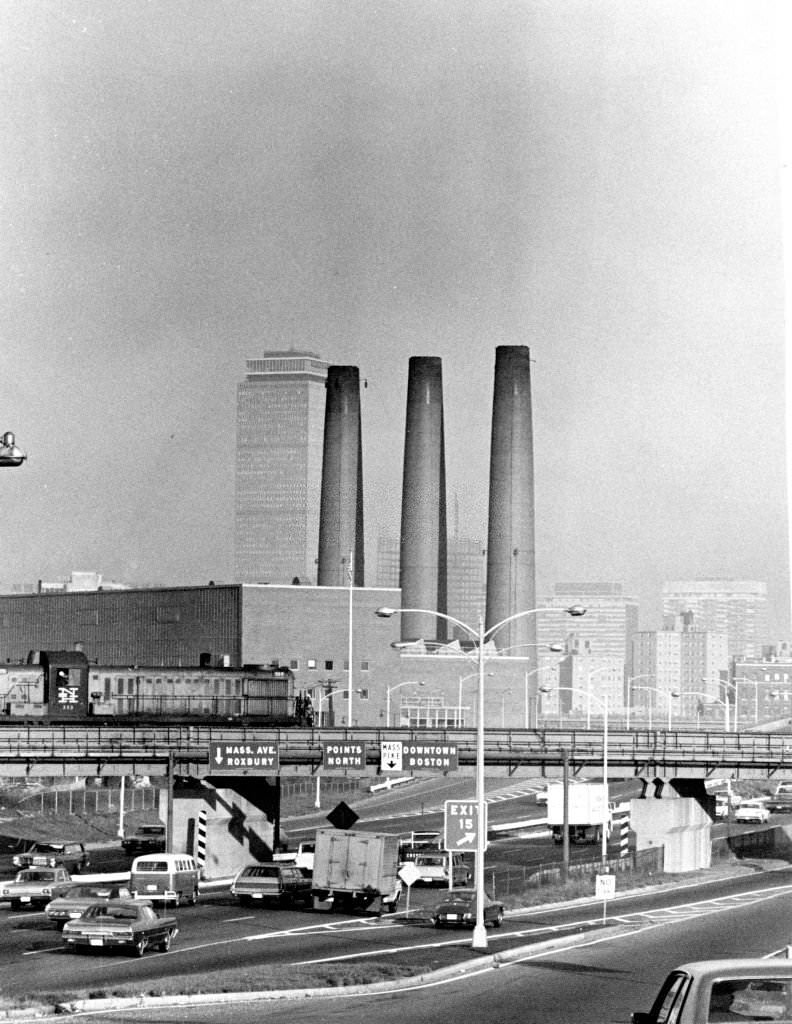
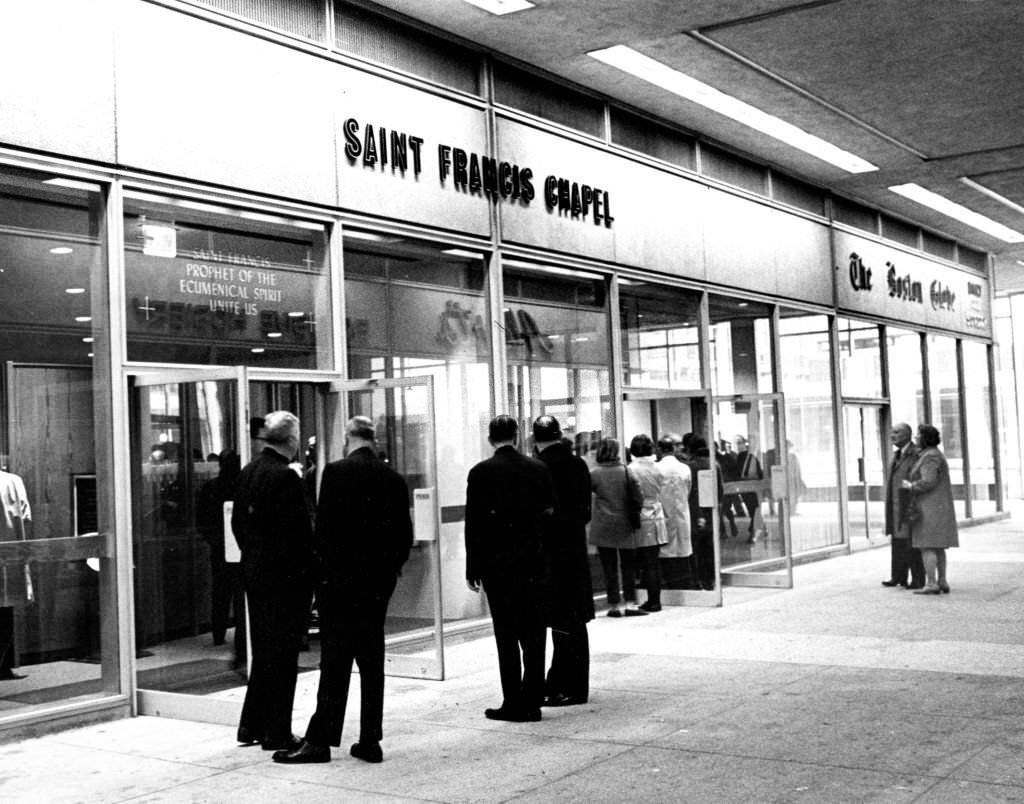
A group of volunteers from local community youth agencies work to clean up a vacant lot at 114 West Brookline St. in Boston’s South End on Oct. 11, 1969.A sea turtle is hoisted into a tank at the New England Aquarium in Boston on Oct. 9, 1969.The Boston Gas Tank is lowered in the Dorchester neighborhood of Boston, Oct. 14, 1969.Smog over Boston on Oct. 16, 1969.The entrance to the Saint Francis Chapel at the Prudential Building in Boston, next to the entrance to the Boston Globe offices, Nov. 11, 1969.
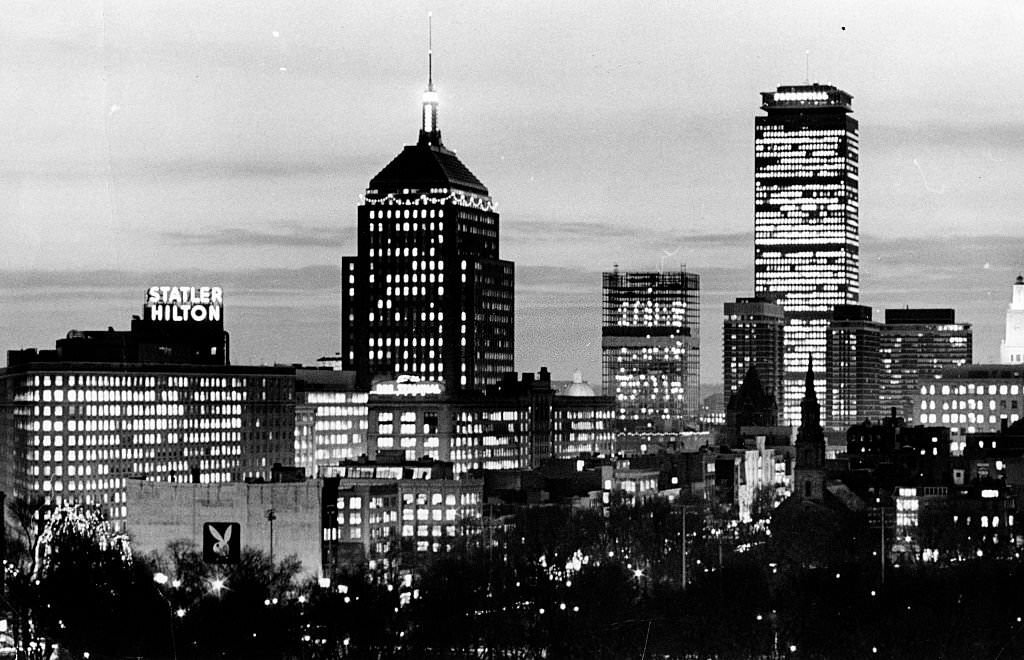
As 1969 drew to a close, the Boston skyline had changed dramatically from the one that existed at the decade’s start. The Prudential Tower stood tall on the right, with the Old John Hancock Tower — now known as the Berkeley Tower — to its left. Government Center was finished. New tunnels, highways, and apartment complexes had altered the map of the city permanently.
The Boston skyline at night on Dec. 4, 1969.
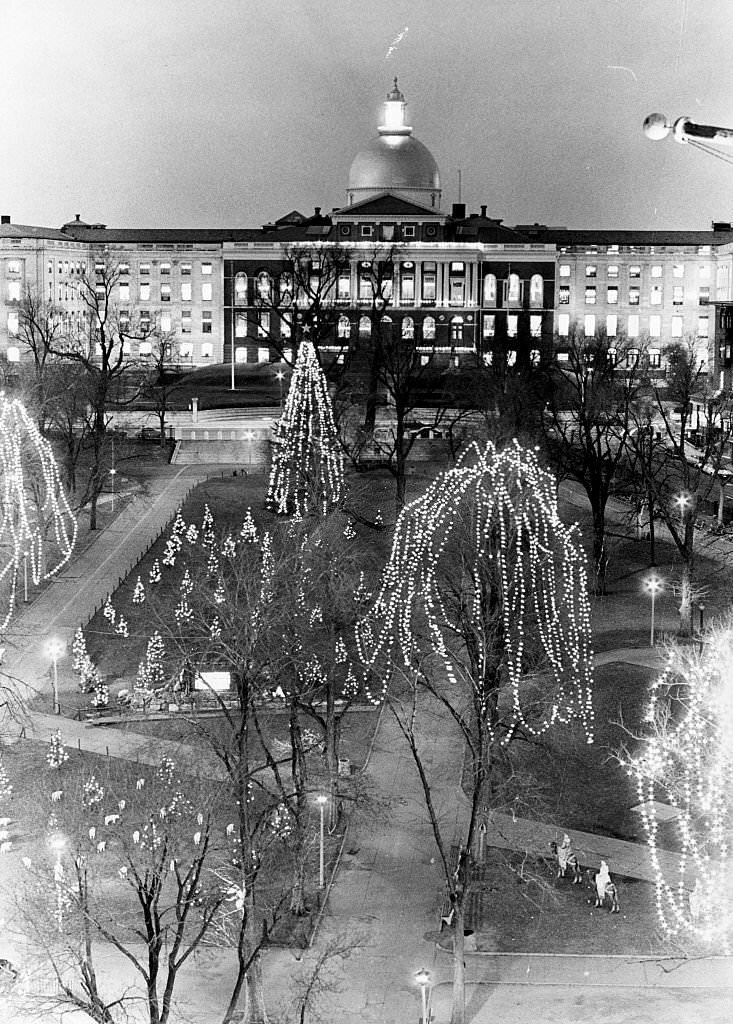
Boston Common trees in front of the Mass. State House are decorated for the holidays on Dec. 4, 1969.
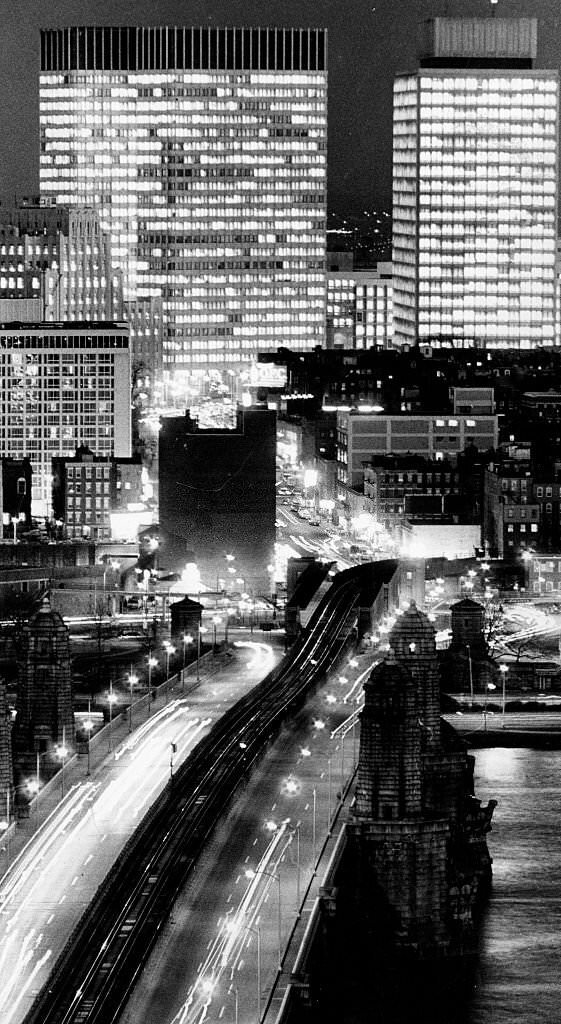
Government Center in Boston is seen in an unusual view from the Cambridge side of the Charles River near the Longfellow Bridge at night on Dec. 5, 1969.
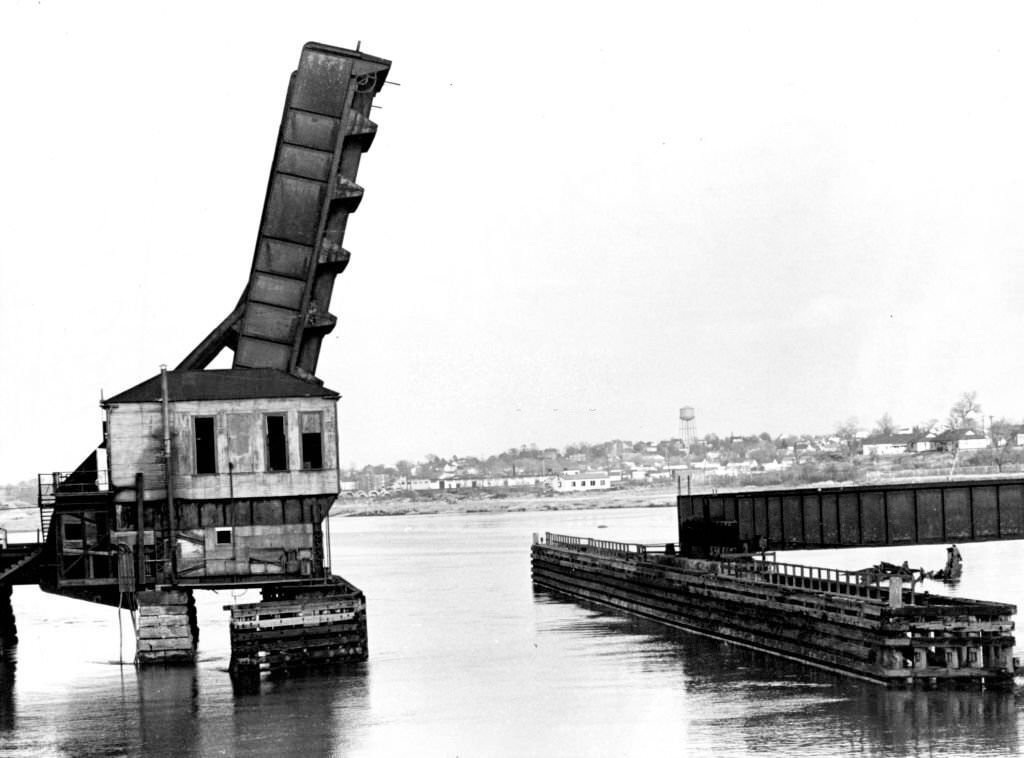
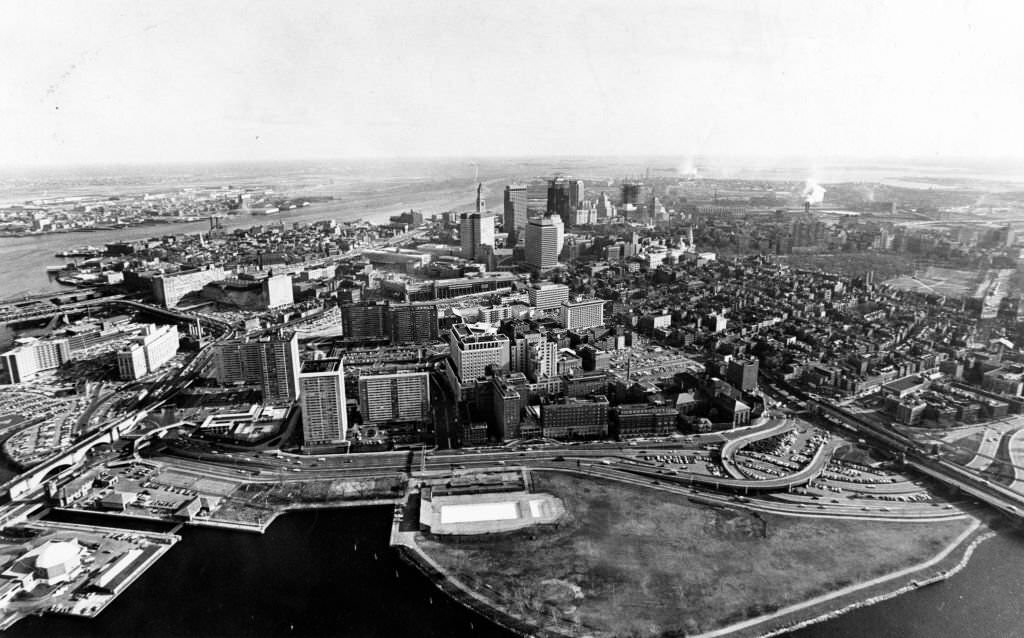
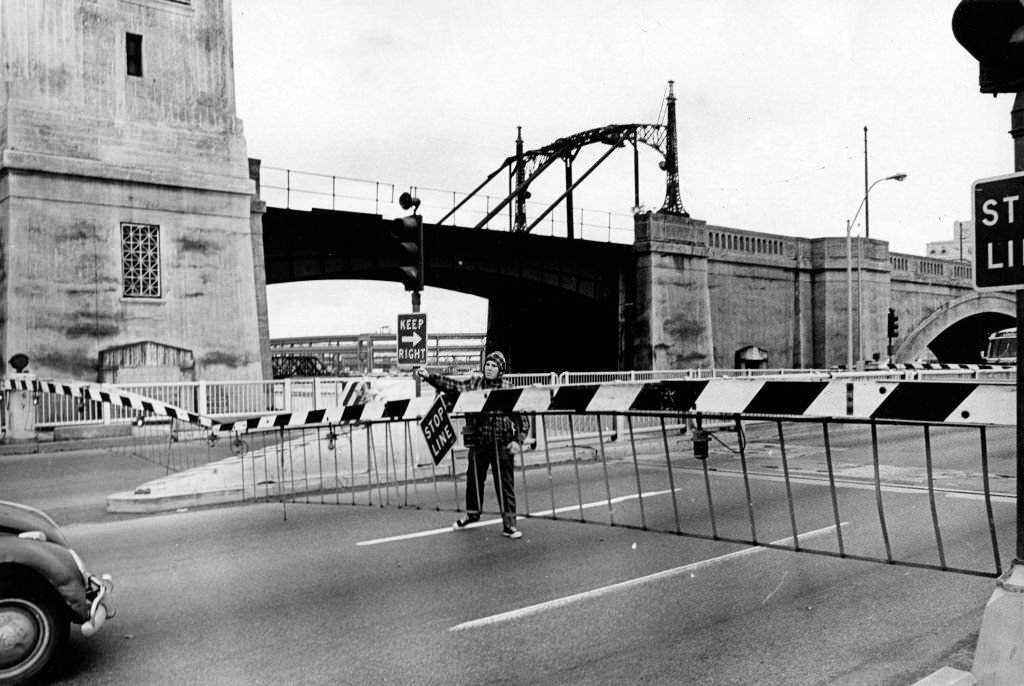
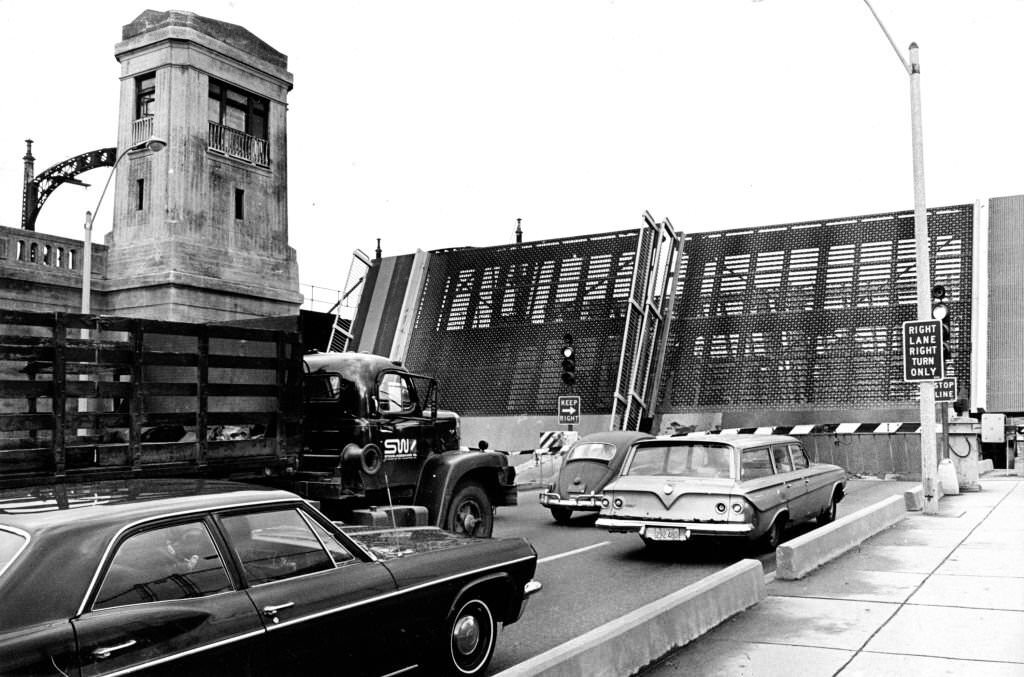
An aerial view of the Boston skyline, with Lederman Park on the Charles River in the foreground, Dec. 5, 1969.The “stop line” ahead of the Northern Artery drawbridge in Boston on Dec. 10, 1969.Vehicles pause as the Northern Artery drawbridge in Boston is raised on Dec. 10, 1969.
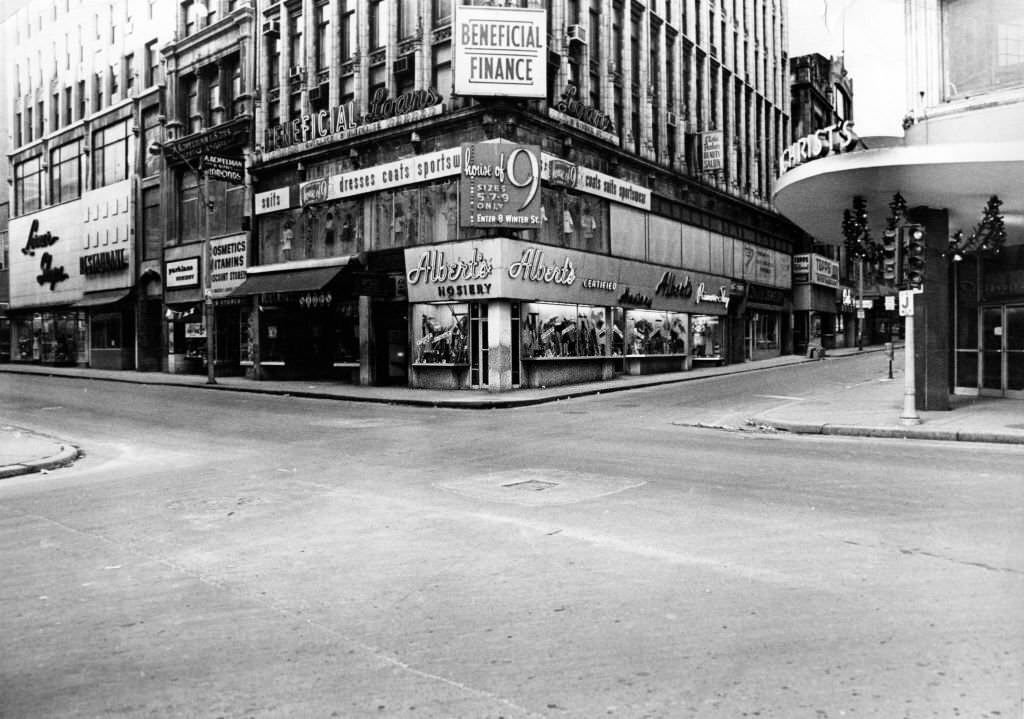
On Christmas Day 1969, the intersection of Summer, Winter, and Washington Streets in downtown Boston stood completely empty. The day before, the same corner had been packed with last-minute shoppers. The city, for one quiet morning, belonged entirely to itself.
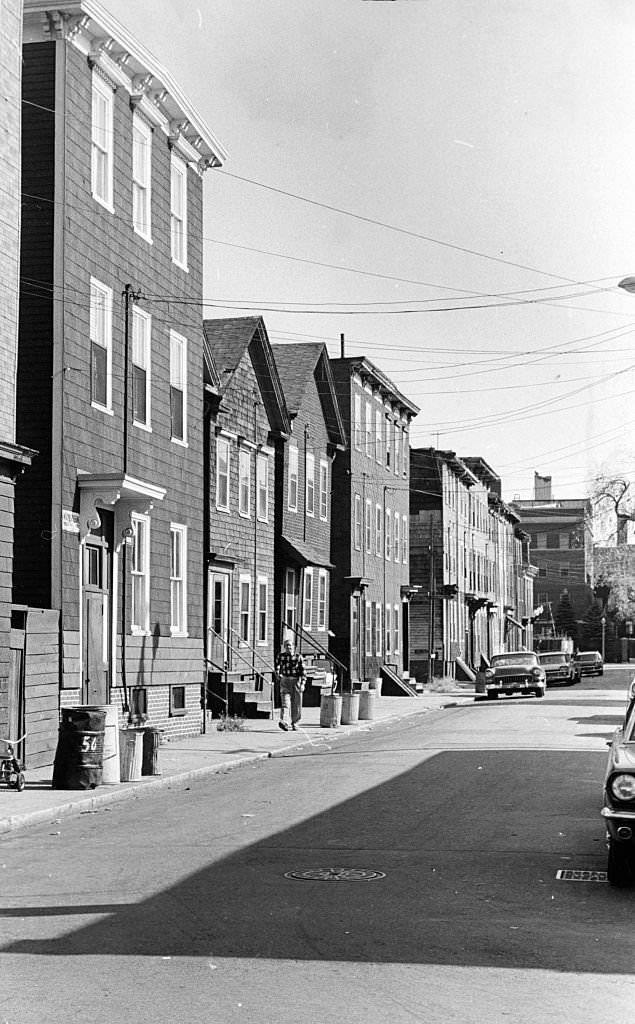
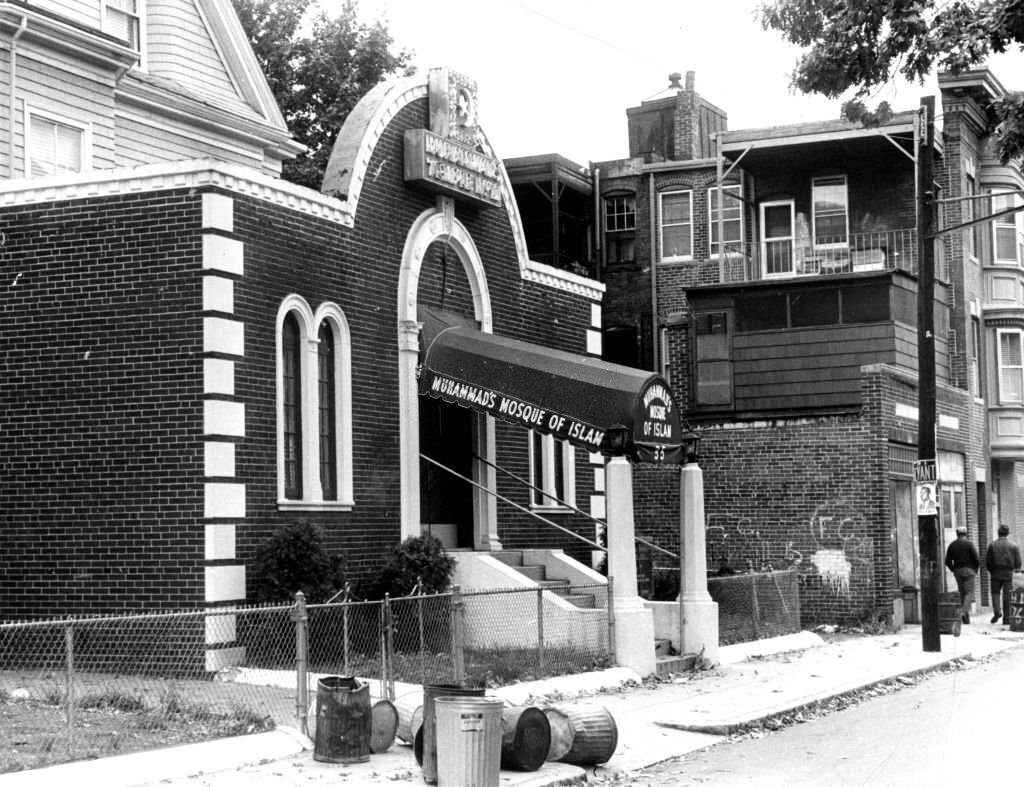
The intersection of Summer, Winter and Washington Streets in downtown Boston on Christmas Day, Dec. 25, 1969.A street in the South Boston neighborhood of Boston, Oct. 15, 1966.Muhammad’s Mosque of Islam at 35 Intervale St. in Boston on Oct. 11, 1966.
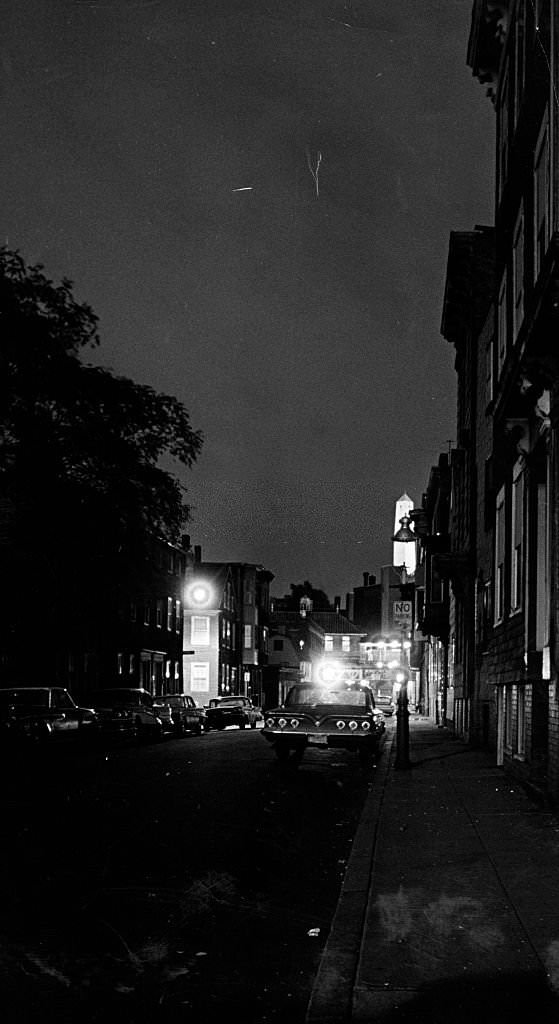
A street in Boston at night on Sept. 27, 1966.
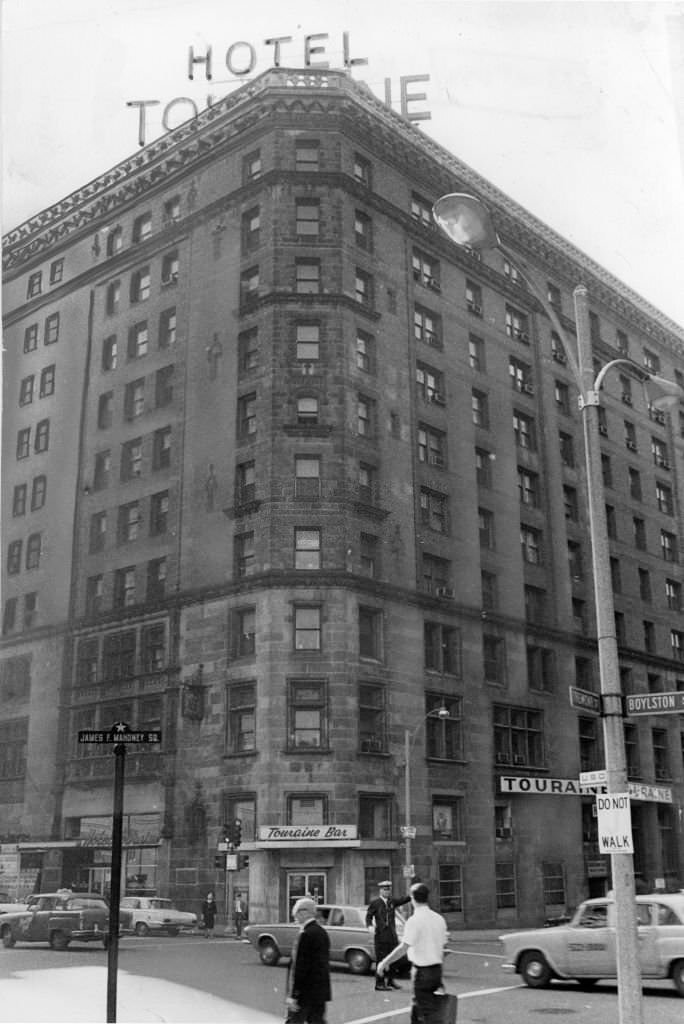
Hotel Touraine in Boston, Sept. 19, 1966.
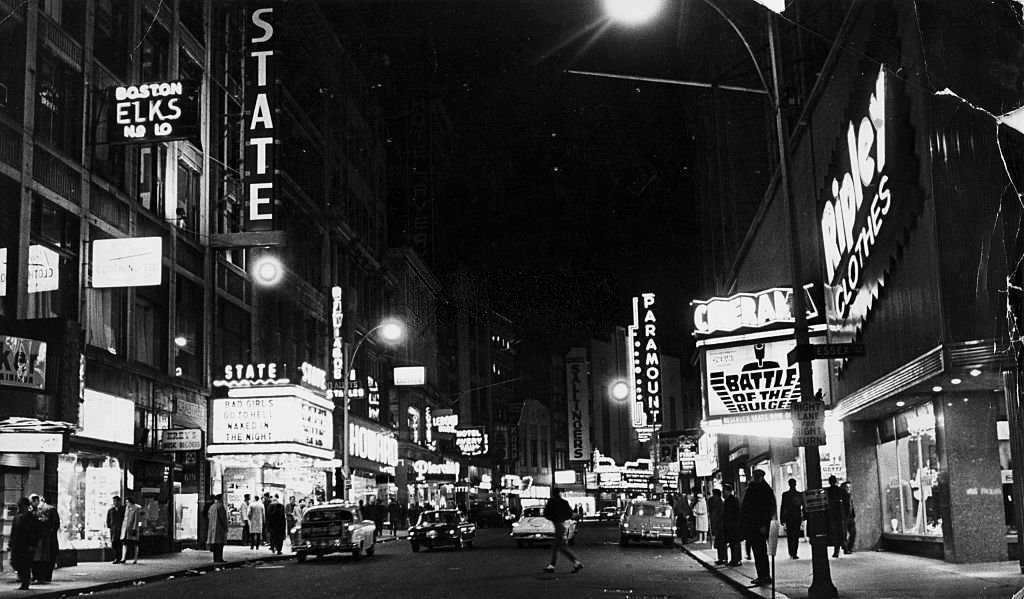
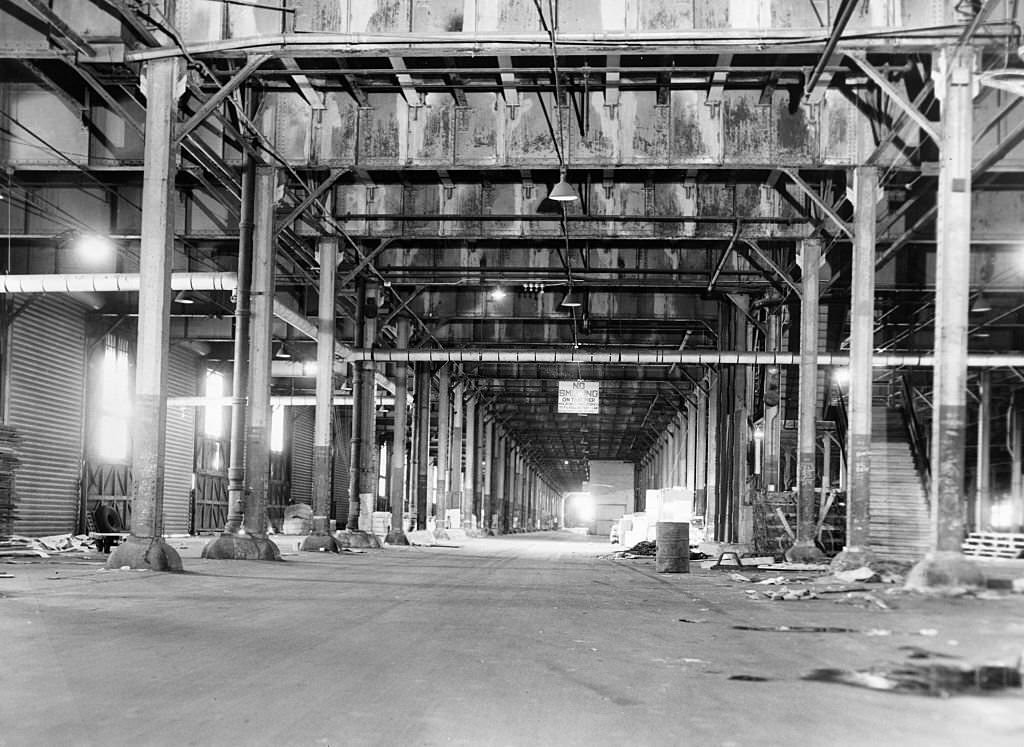
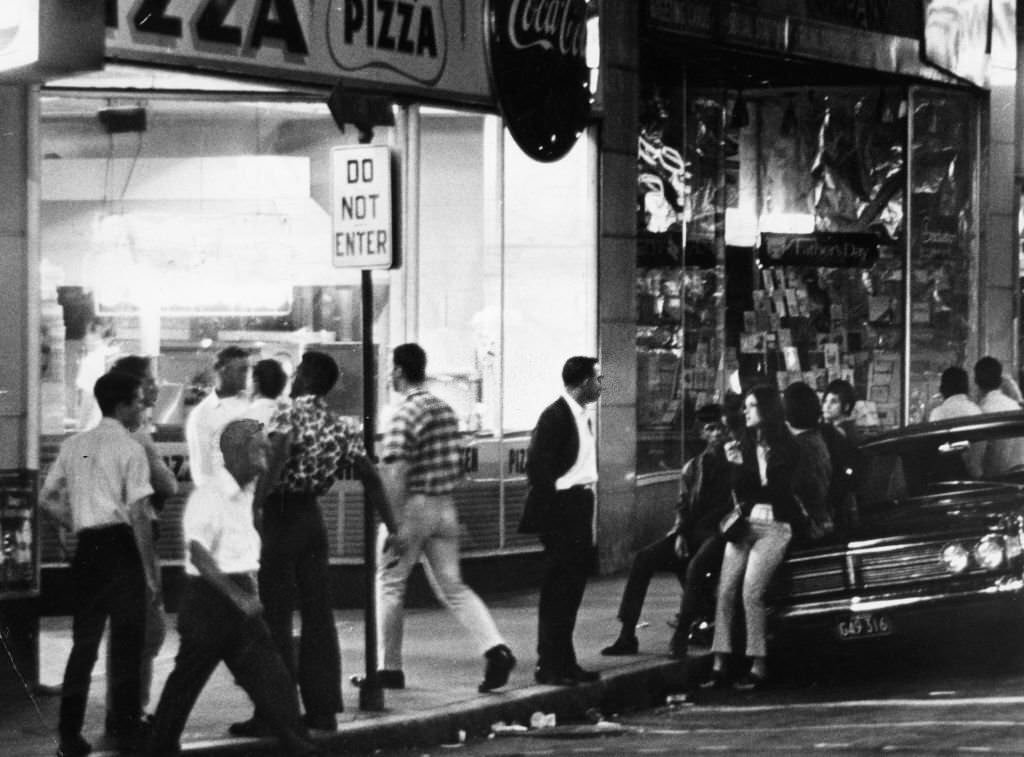
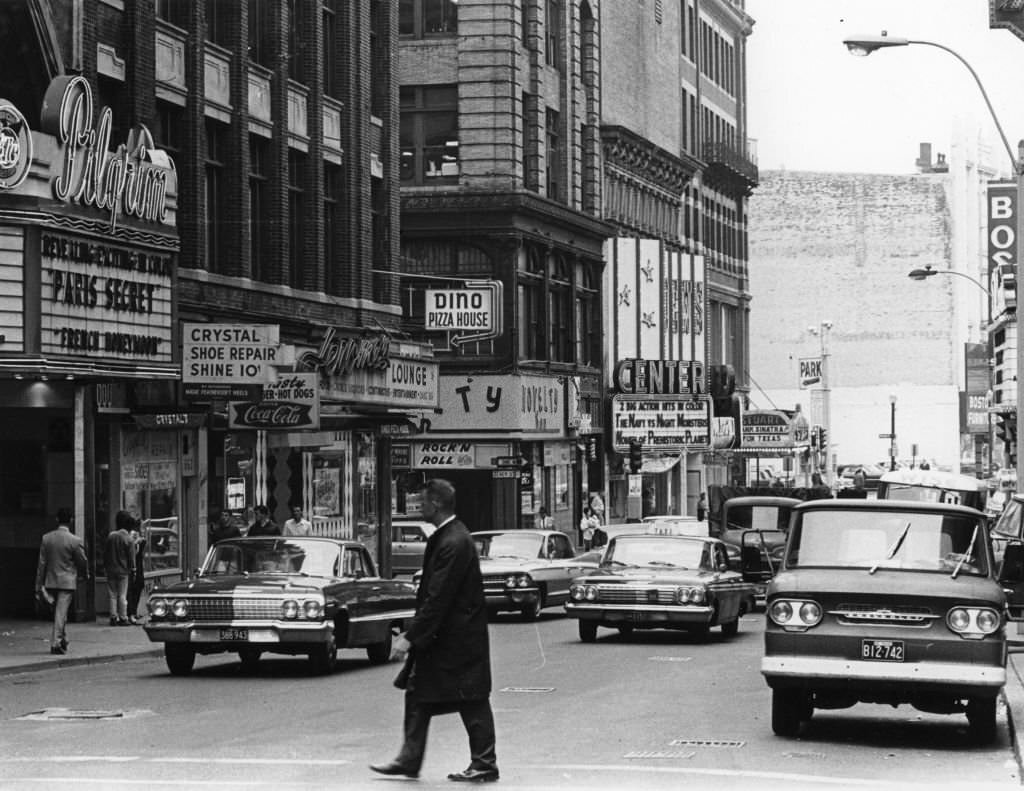
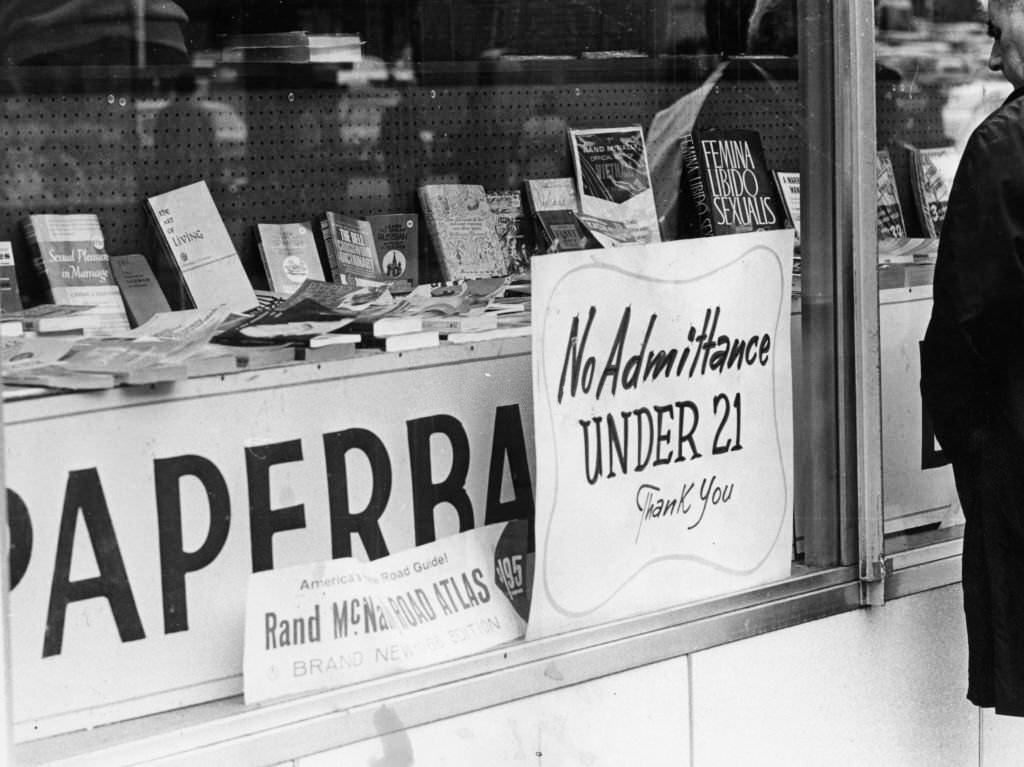
The Combat Zone — Boston’s red-light district centered on lower Washington Street — was in full operation in September 1966. The area’s adult theaters, bars, and clubs made it one of the city’s most recognizable and controversial blocks.
The Combat Zone in Boston, September 1966.Huntington Avenue, looking towards Copley Square, in Boston on Sept. 2, 1966.The Combat Zone in Boston, September 1966.A man crosses Washington Street in the Combat Zone section of Boston circa September 1966.
14 is striking considering that you can’t see the Custom house from the Public Garden these days.