
These are mugshots of Australian criminals from the 1920s, taken mostly in the cells at Central Police Station in Sydney. Australia’s Justice & Police Museum released these images, which show murderers, bigamists, bootleggers, prostitutes, and many other criminals from the early 20th century. The men and women photographed are dressed neatly in ties and hats, but behind their tidy appearances are records of murder, robbery, burglary, and other crimes. The photographs are of excellent quality and, in many cases, are quite artistic.
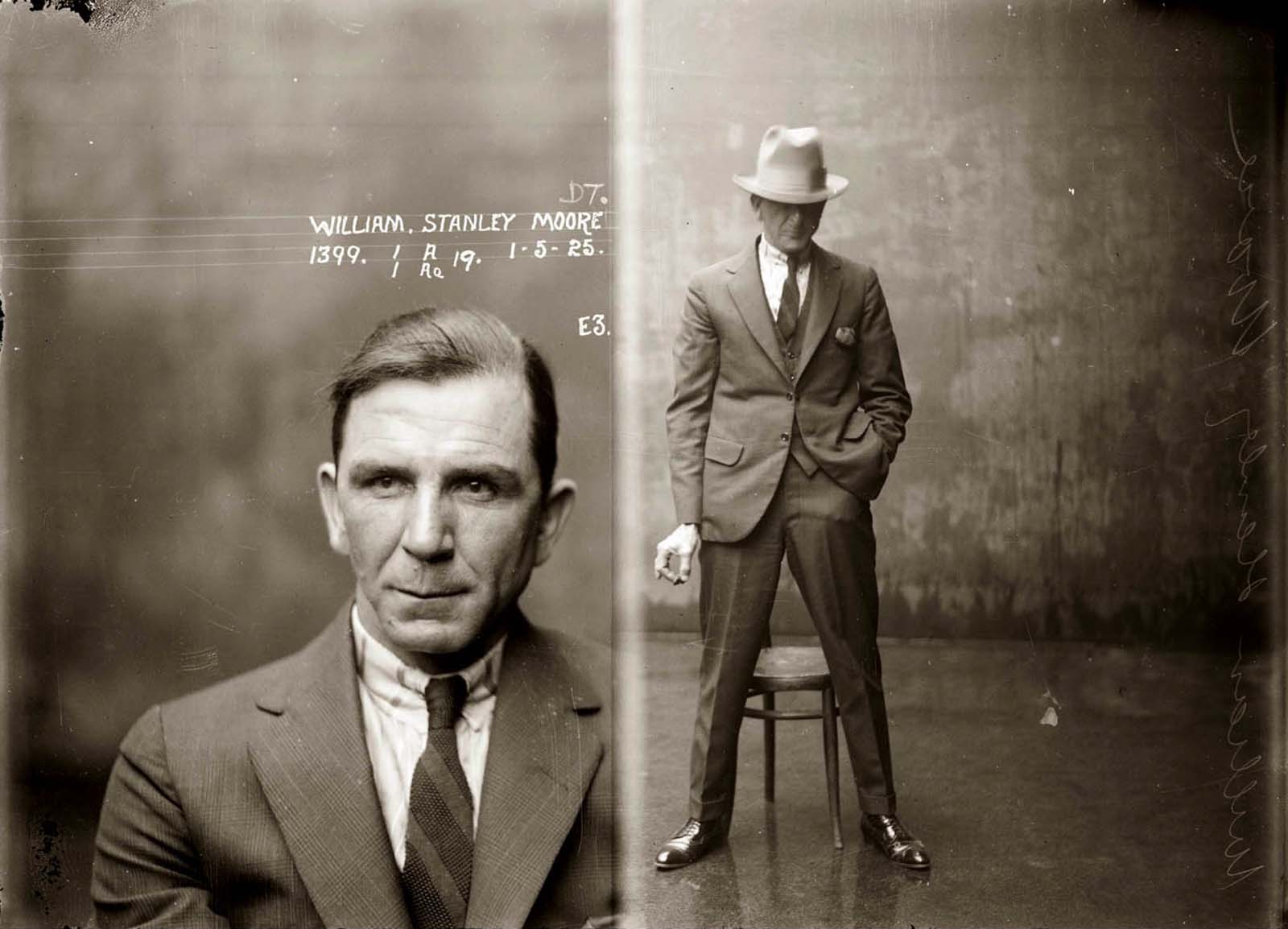
He was an opium dealer who operated with large quantities of faked opium and cocaine. He was a wharf laborer who associated with waterfront thieves and drug traders.
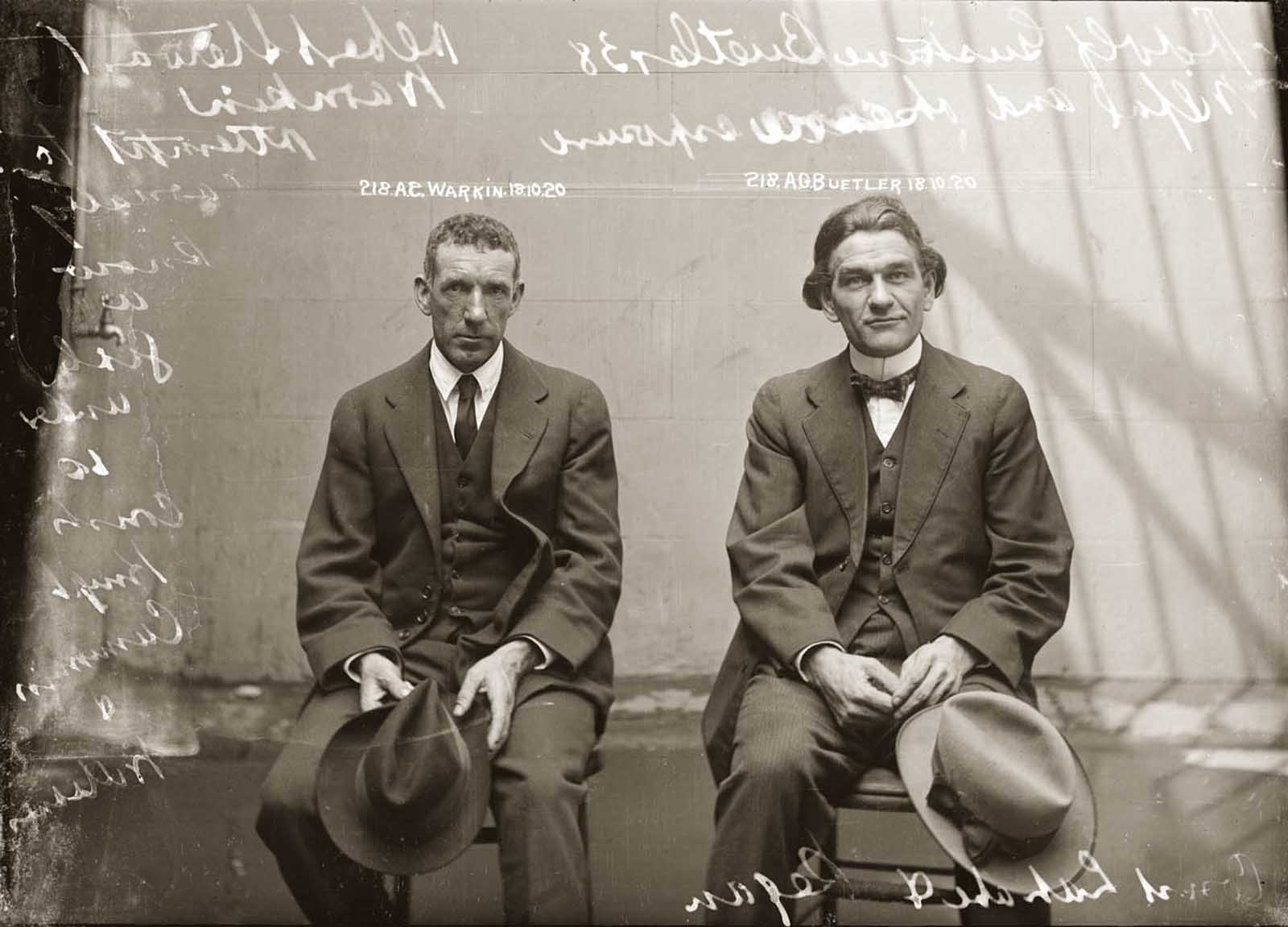
Albert Stewart Warnkin is listed in the NSW Police Gazette of 10 November 1920, as charged with attempting to carnally know a girl eight years old. No entry is found for Beutler, whose picture is inscribed ‘willful and obscene exposure.’
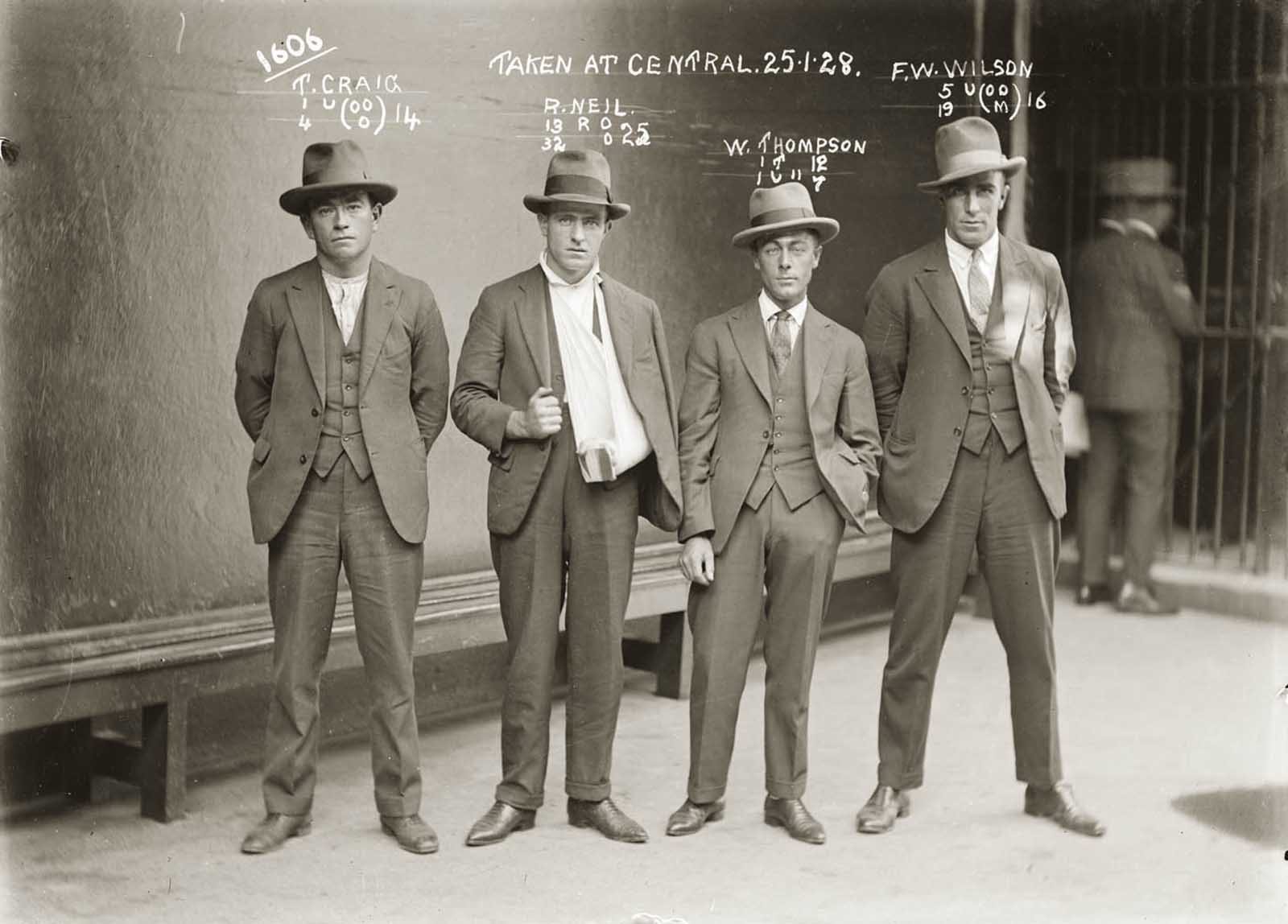
This photograph was apparently taken in the aftermath of a raid led by Chief Bill Mackay — later to be Commissioner of Police — on a house at 74 Riley Street, ‘lower Darlinghurst’. Numerous charges were heard against the 15 men and women arrested. It was a house frequented by ‘reputed thieves.’
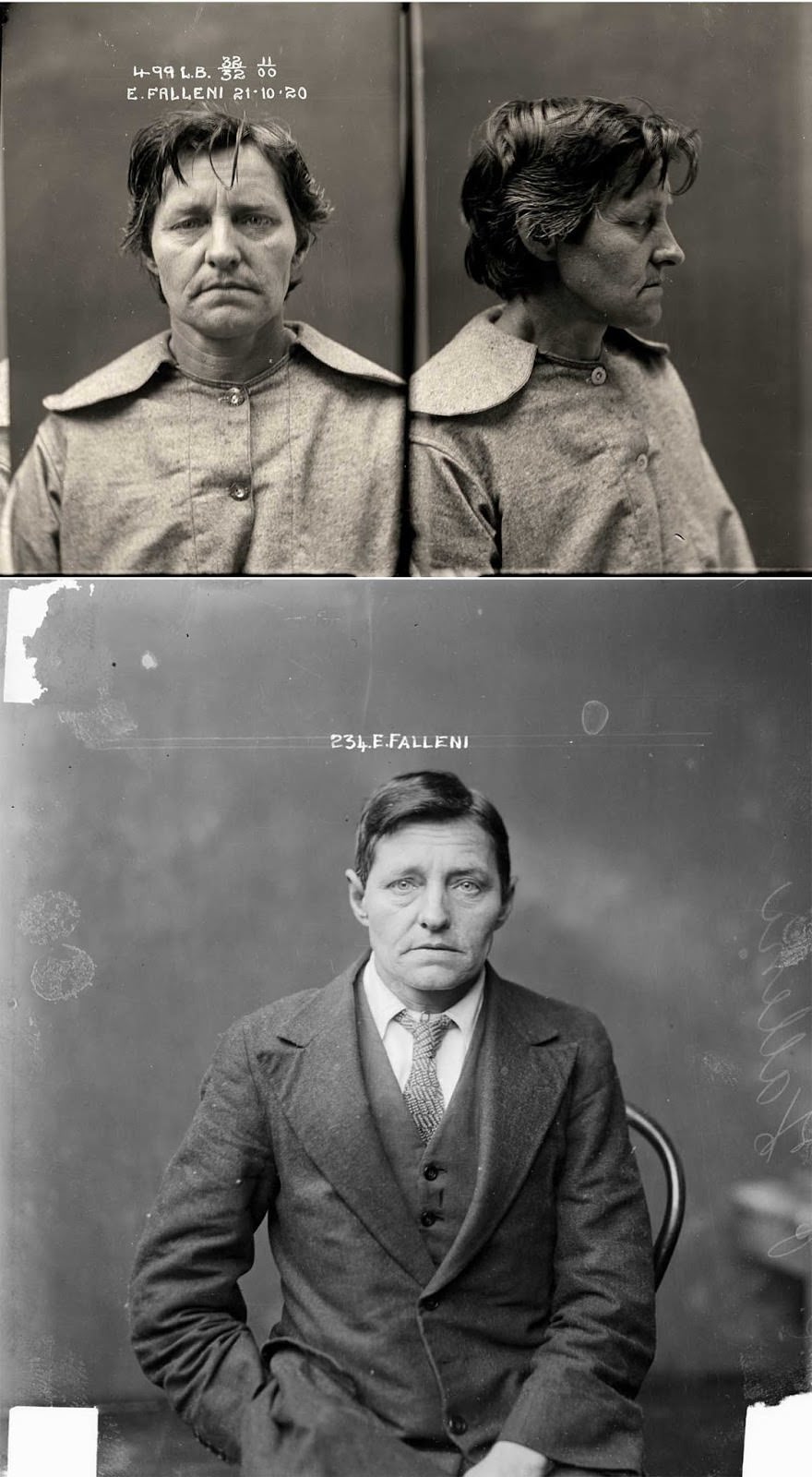
Crime: murder. Eugenia Falleni spent most of her life masquerading as a man. In 1913 Falleni married a widow, Annie Birkett, whom she later murdered. The case whipped the public into a frenzy as they clamored for details of the ‘man-woman’ murderer. Aged approximately 35.
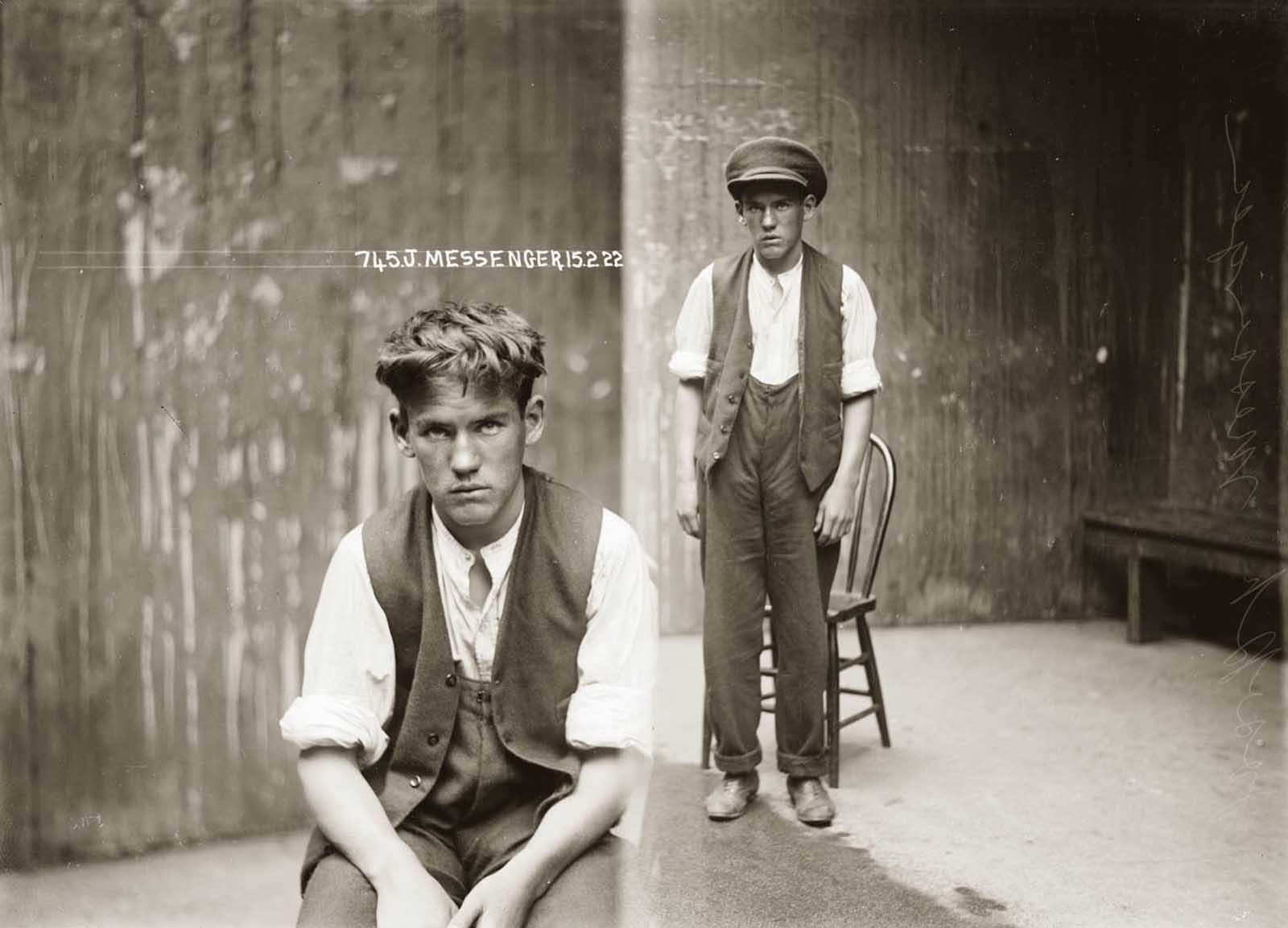
Joseph Messenger and Valerie Lowe were arrested in 1921 for breaking into an army warehouse and stealing boots and overcoats to the value of 29 pounds 3 shillings. The following year, when this photograph was taken, they were charged with breaking and entering a dwelling. Those charges were eventually dropped, but they were arrested again later that year for stealing a saddle and bridle from Rosebery Racecourse. As an adult, Messenger was active in the inner-Sydney underworld through the 1920s, and he appears in the NSW Criminal Register (16 July 1930, entry No. 171) as a seasoned criminal and gang affiliate. The description of his modus operandi includes, ‘Violently [resists] arrest … frequents wine saloons, billiard rooms, and racecourses … consorts with prostitutes.’ This photograph shows Messenger at age 18.
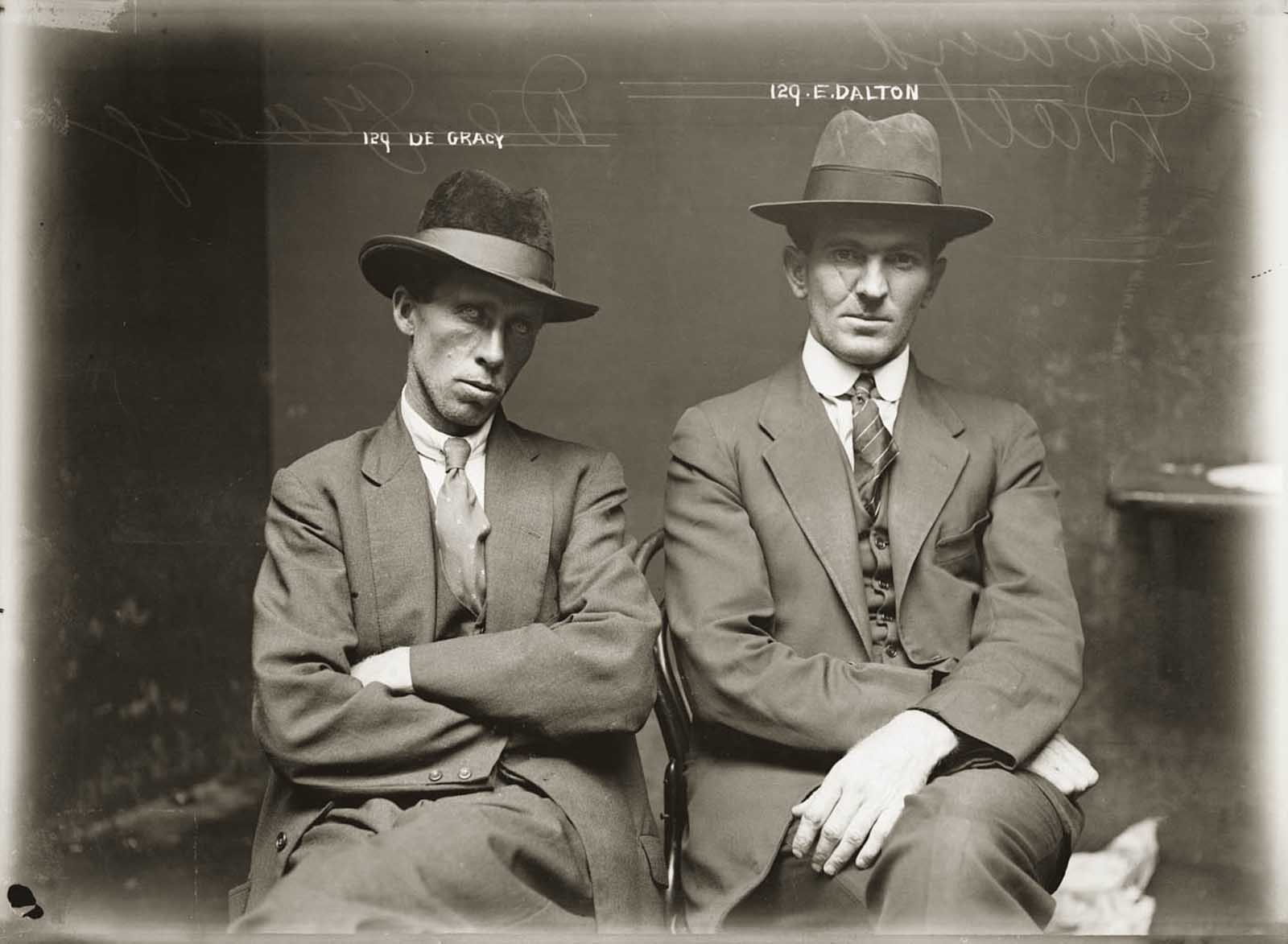
A cropped print of this photograph appears in a police photo book from the 1920s, annotated in pencil ‘magsmen’, with no further information offered.
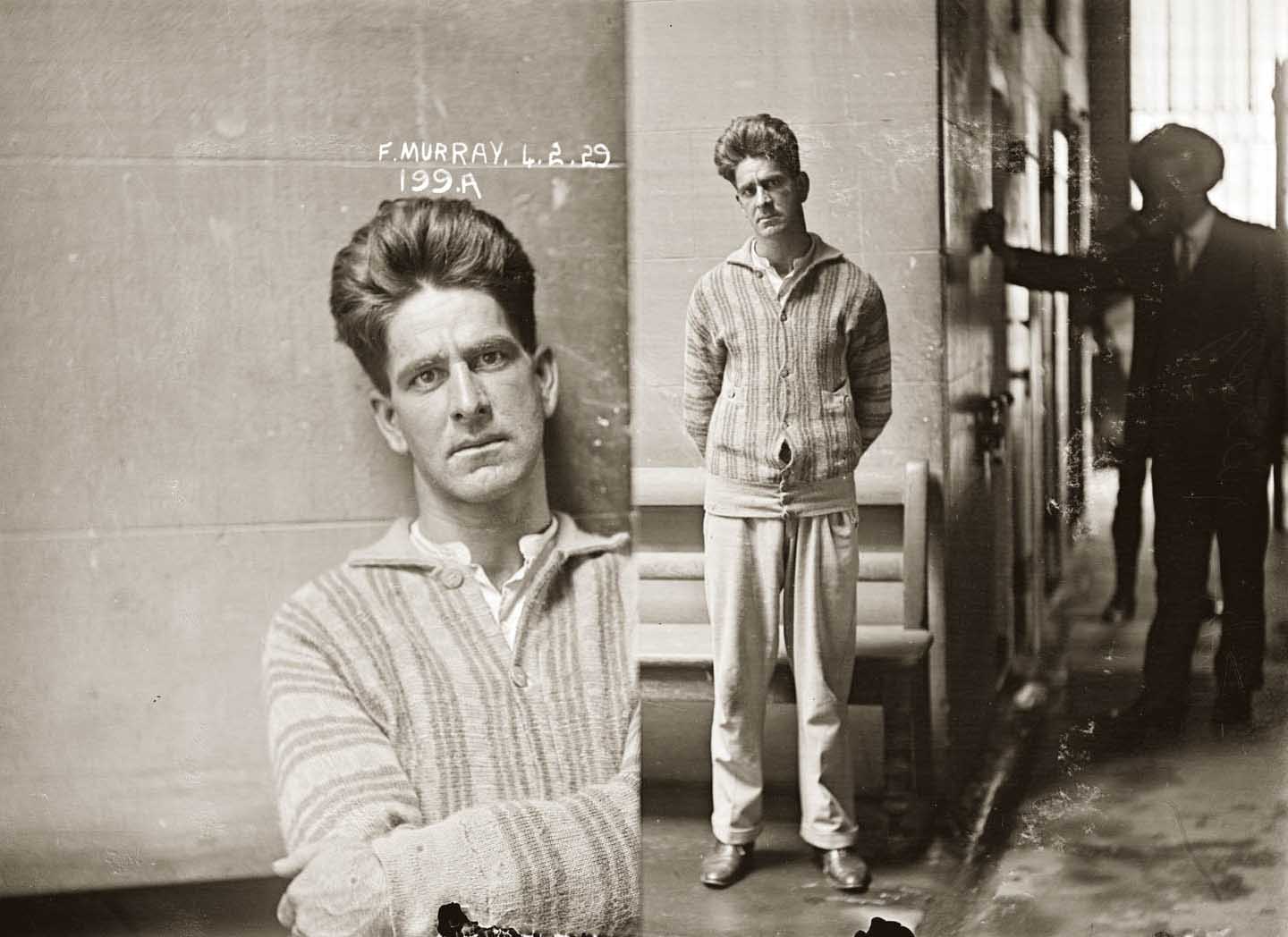
Harry Williams was sentenced to 12 months’ hard labor in March 1929 for breaking, entering, and stealing. Murray/Williams’ entry in the NSW Criminal Register, April 30, 1930, describes him as a housebreaker and thief whose MO includes ‘[breaking] lead-lighted doors or windows or [forcing] the fanlights of dwelling houses during the absence of tenants.’ He ‘disposes of stolen property to patrons of hotel bars or to persons in the street … professing to be a second-hand dealer.’ Although he ‘consorts with prostitutes’ and ‘frequents hotels and wine bars in the vicinity of the Haymarket,’ he is described as being of ‘quiet disposition.’
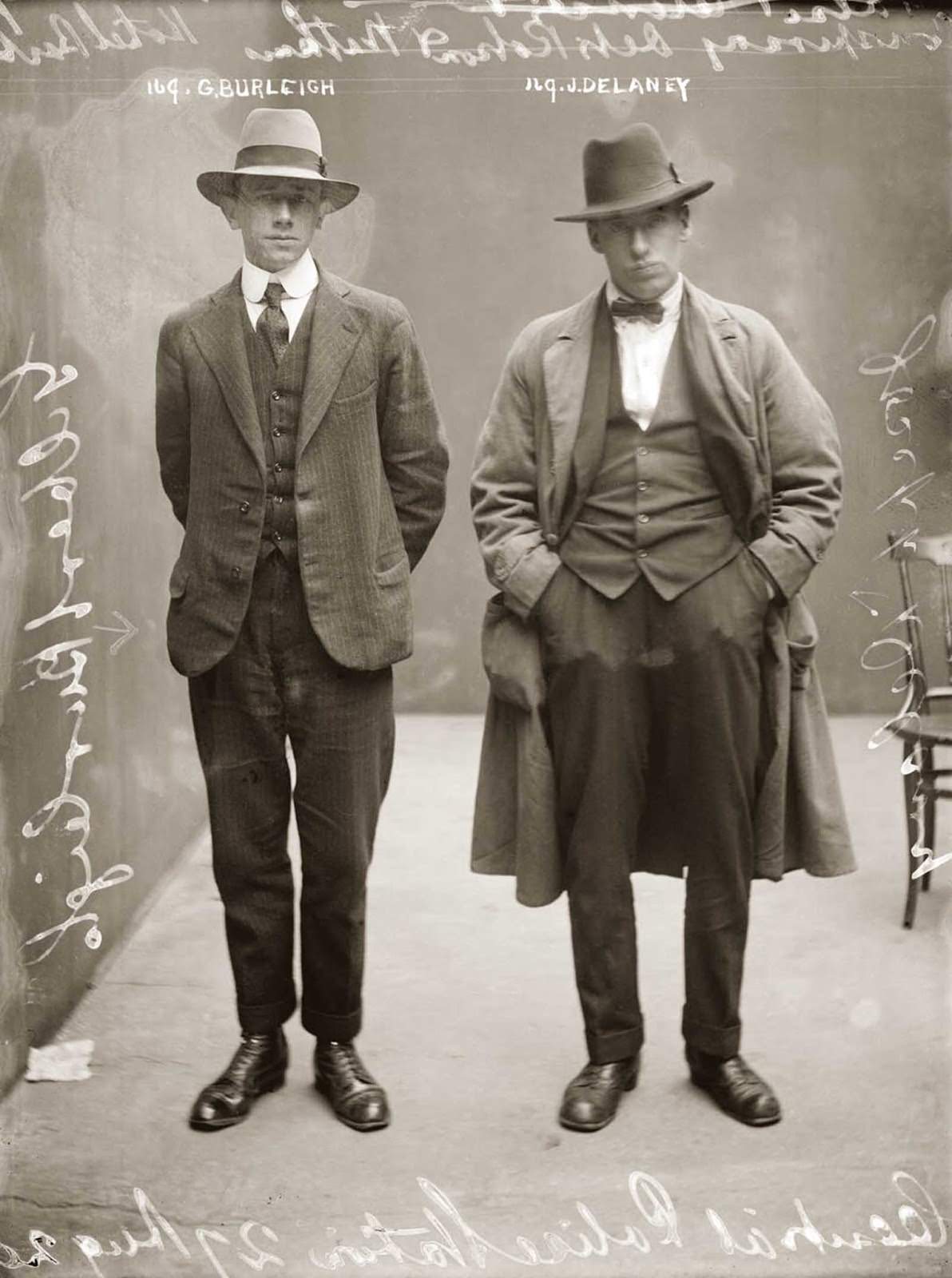
Gilbert Burleigh on the left is identified as a ‘hotel barber’, and Delaney’s picture is labeled ‘false pretenses & conspiracy.’ A companion photograph makes it clear that in fact Delaney was the hotel barber — meaning one who books into a hotel, boarding house, or residential and robs (or ‘snips’) fellow patrons, usually in the dead of night. In this instance Delaney was charged with stealing a cigarette case, a hairbrush, a clock, and a quantity of clothing from a dwelling house. A month later he was further charged with ‘being about to abscond from bail.’ He is described as ‘a fireman and a returned soldier.’
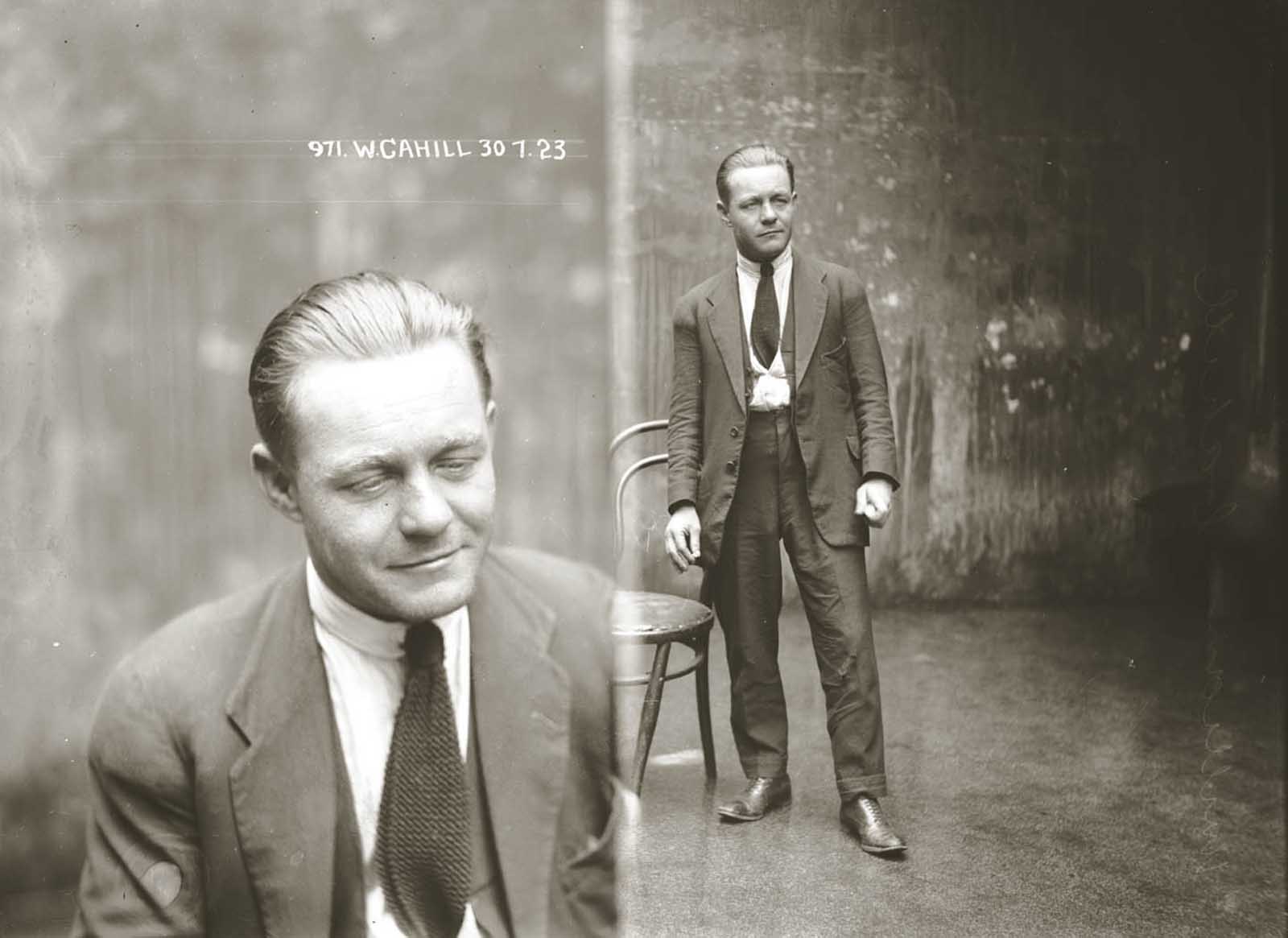
Mugshots of William Cahill, 30 July 1923, Central Police Station, Sydney. Details unknown.
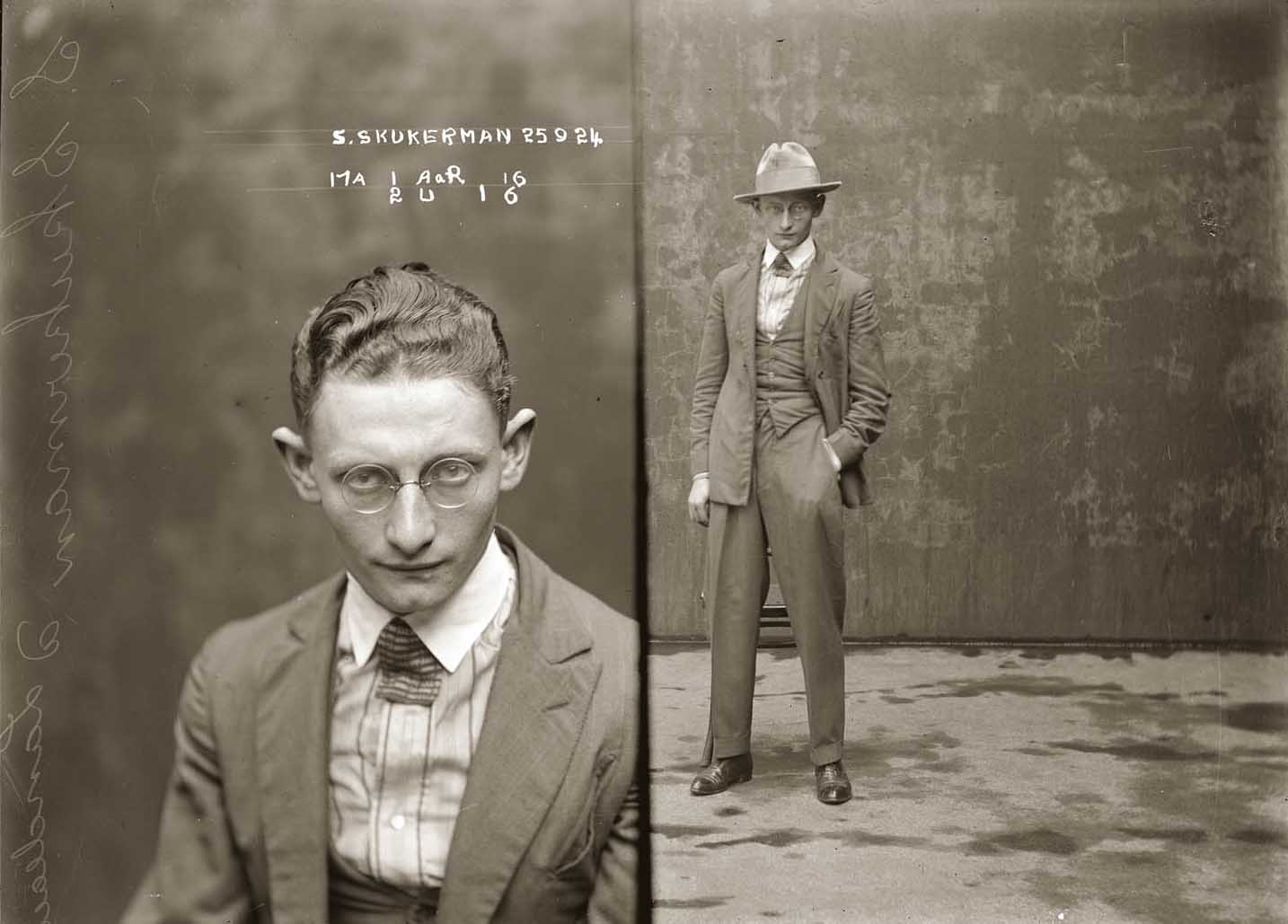
An entry in the Supplement to the NSW Police Gazette Sydney for Skukerman (alias Kukarman, alias Cecil Landan) is captioned ‘obtains goods from warehousemen by falsely representing that he is in business.’
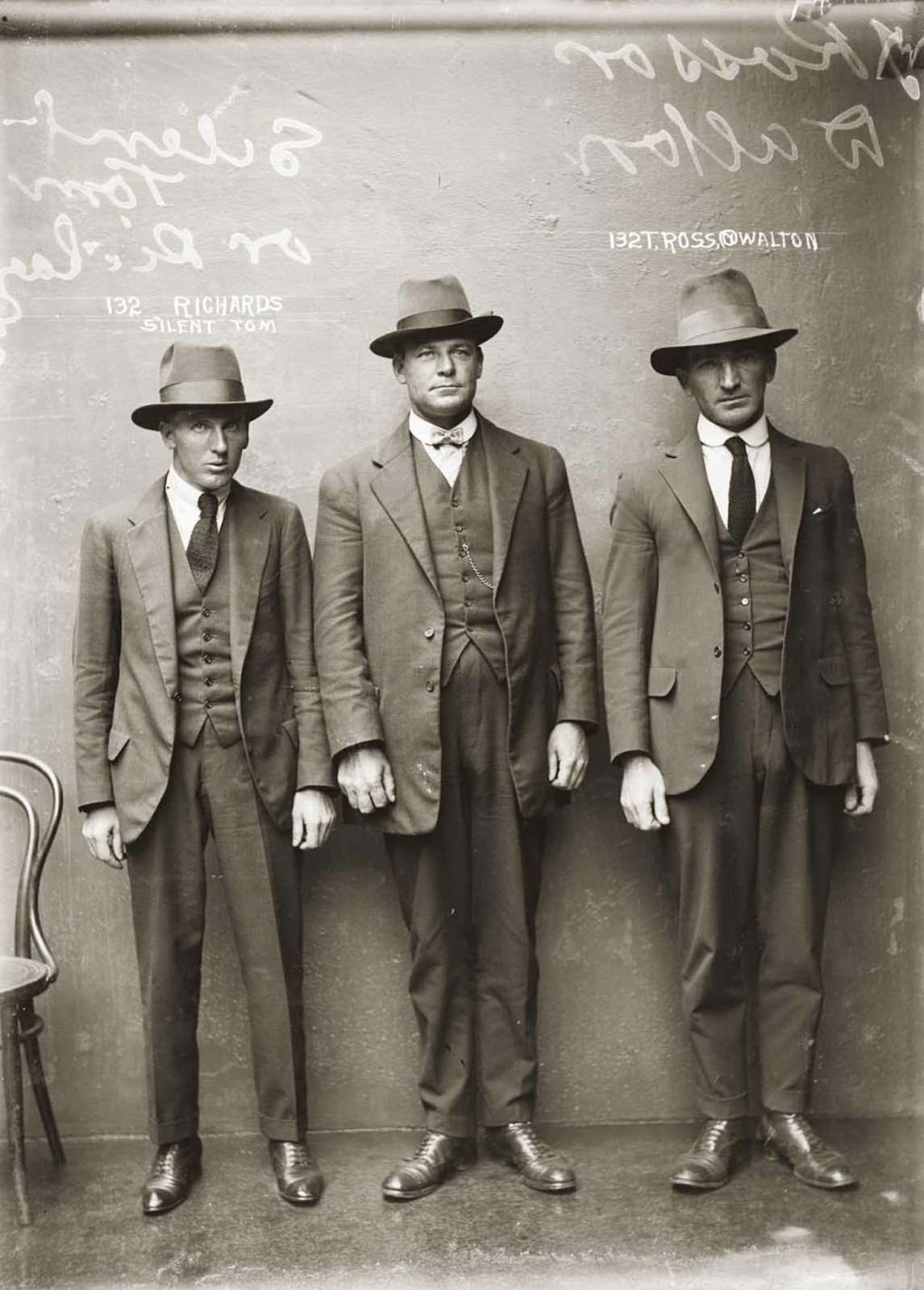
Mugshot of “Silent Tom” Richards and T. Ross, alias Walton, 12 April 1920, presumably Central Police Station, Sydney.
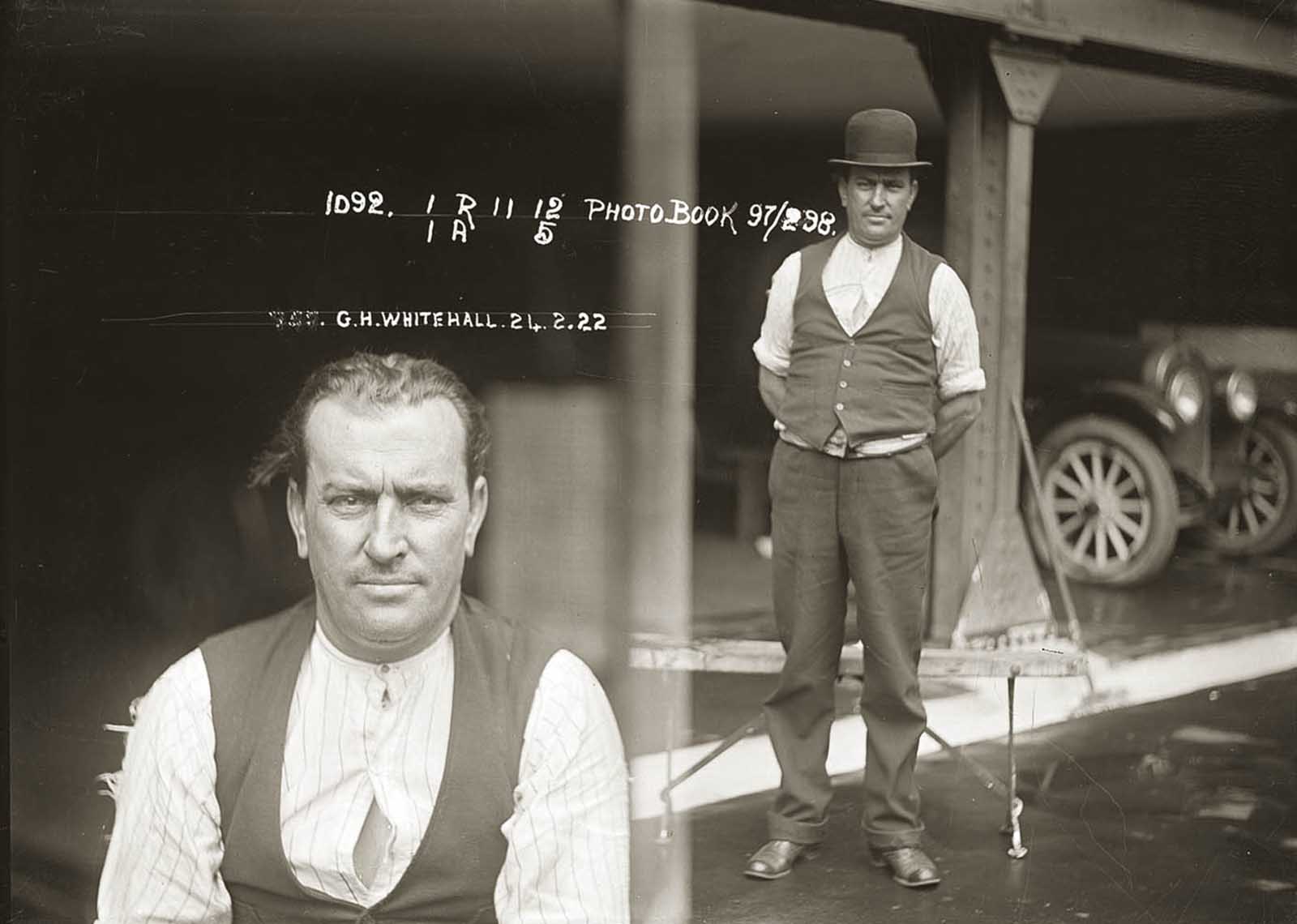
George Whitehall, a carpenter, handed himself into Newtown police after hacking to death his common-law wife, Ida Parker, on Tuesday afternoon, 21 February 1922, at their home in Pleasant Avenue, Erskineville. This photo was apparently taken the following morning at Newtown Police Station.
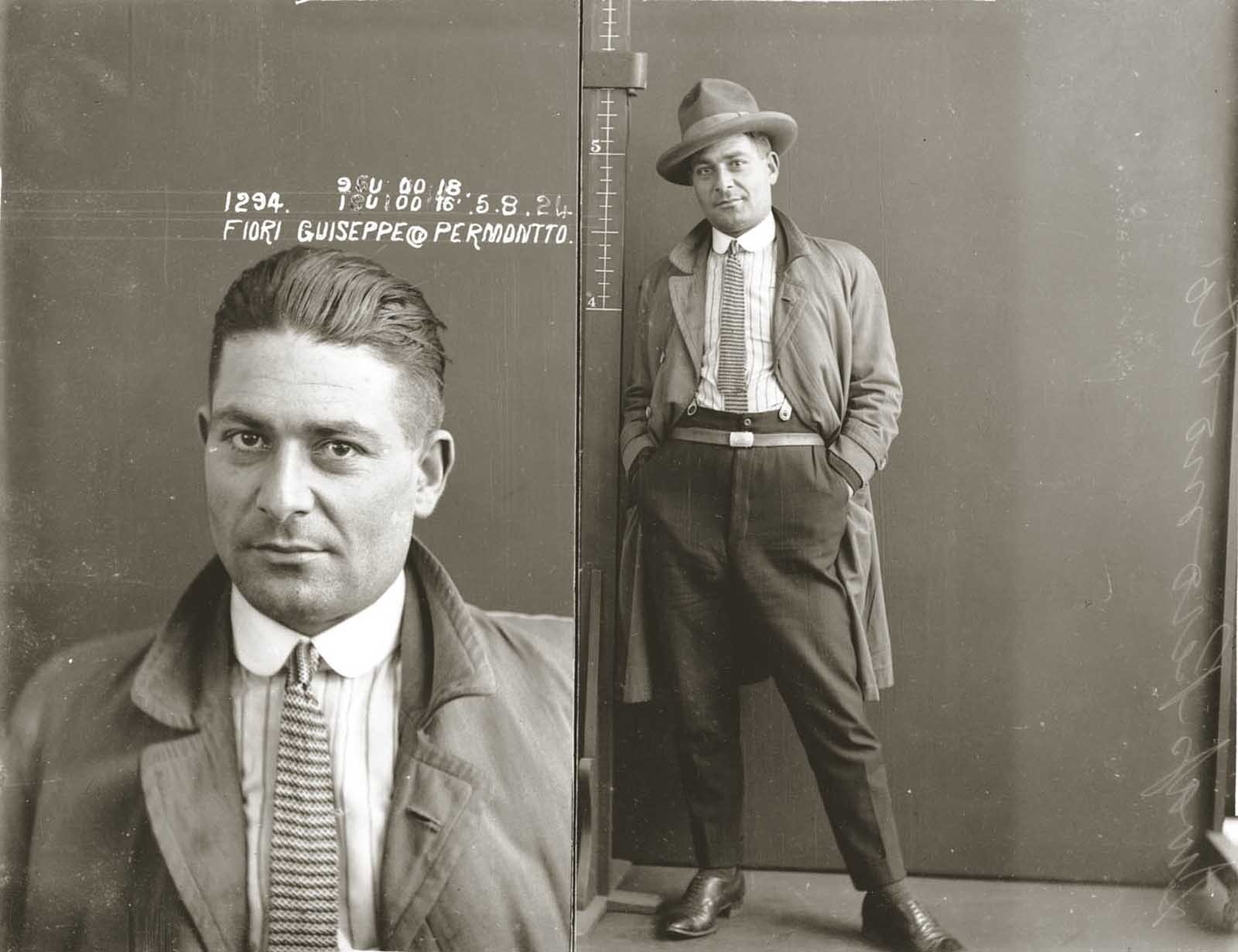
No entry for Fiori/Permontto is found in the NSW Police Gazette for 1924, although this photo appears in a later photo supplement in which Fiori is described as a safe-breaker.
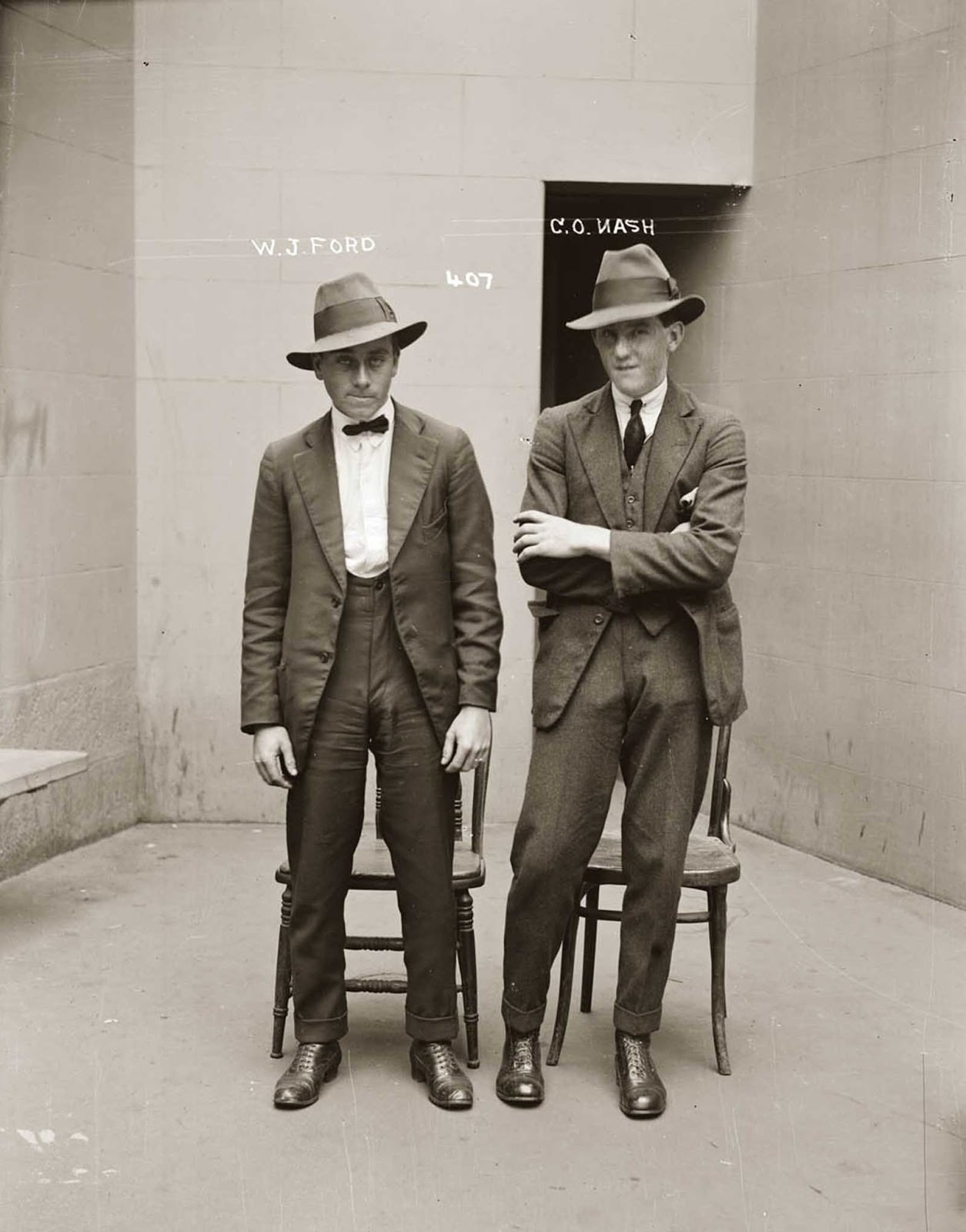
Mugshot of John Walter Ford and Oswald Clive Nash, June 1921.
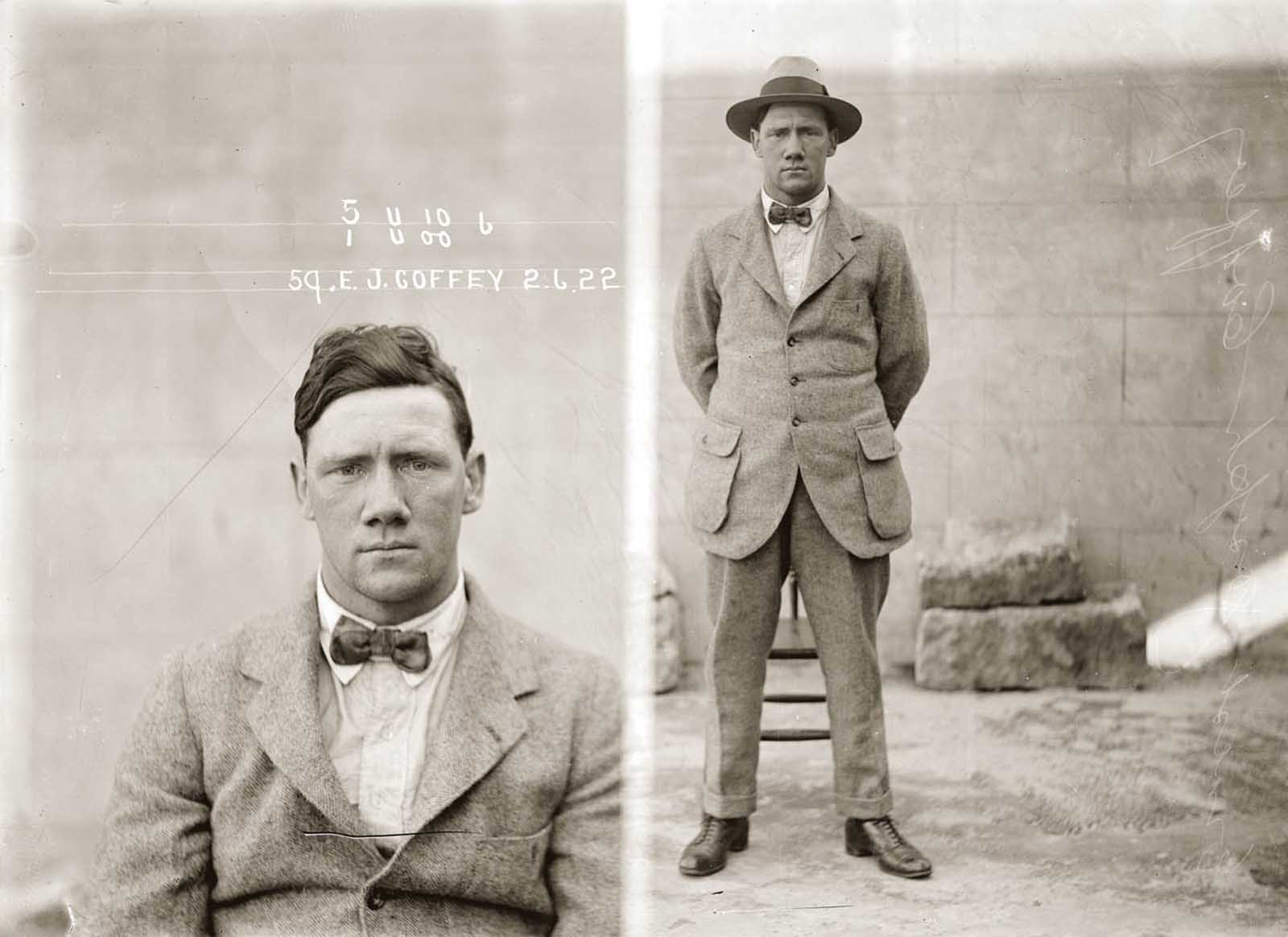
Mugshots of Ernest Joseph Coffey, 2 June 1922, location unknown.
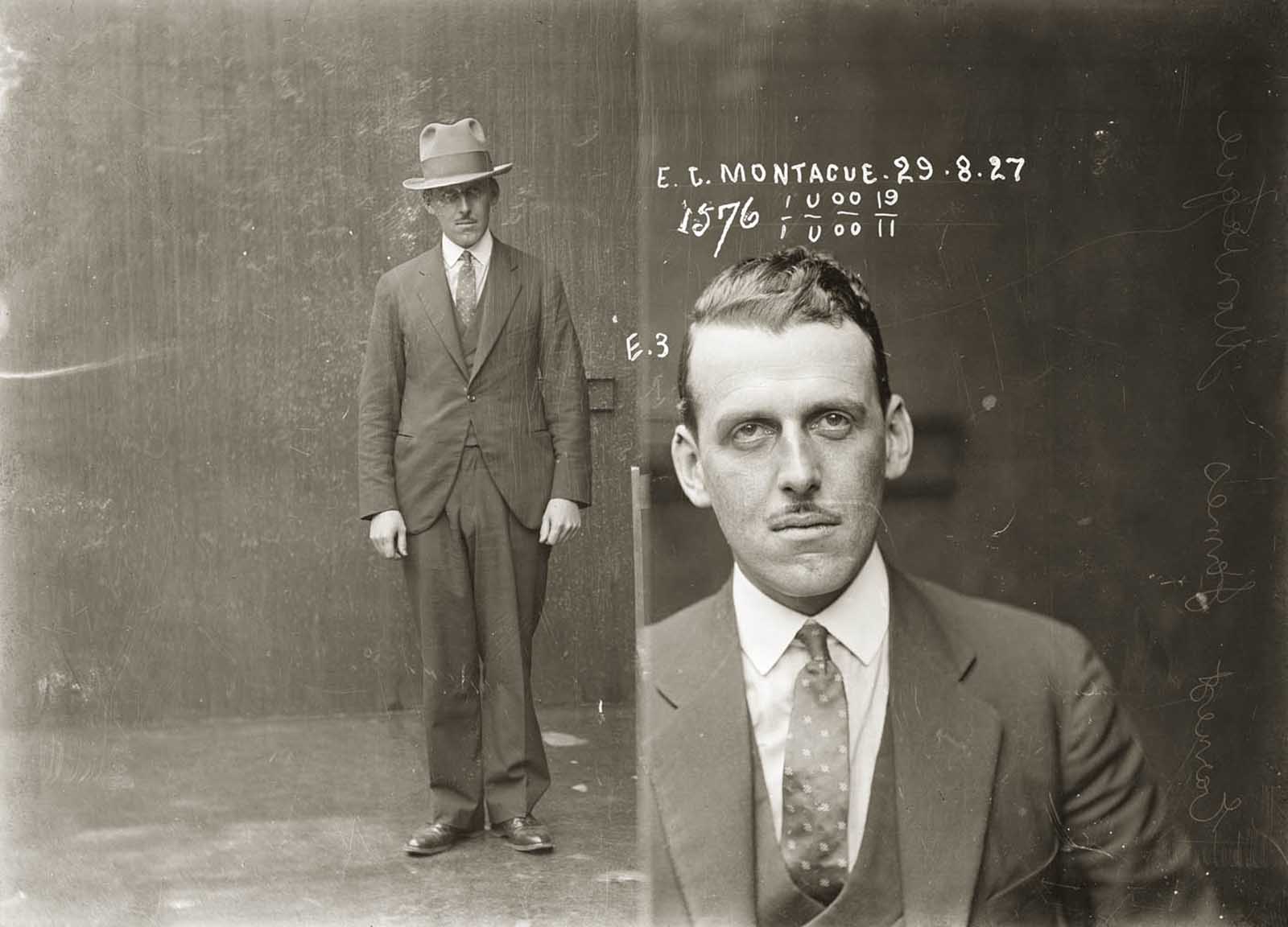
Mugshots of Ernest James Montague, 29 August 1927, Central Police Station, Sydney.
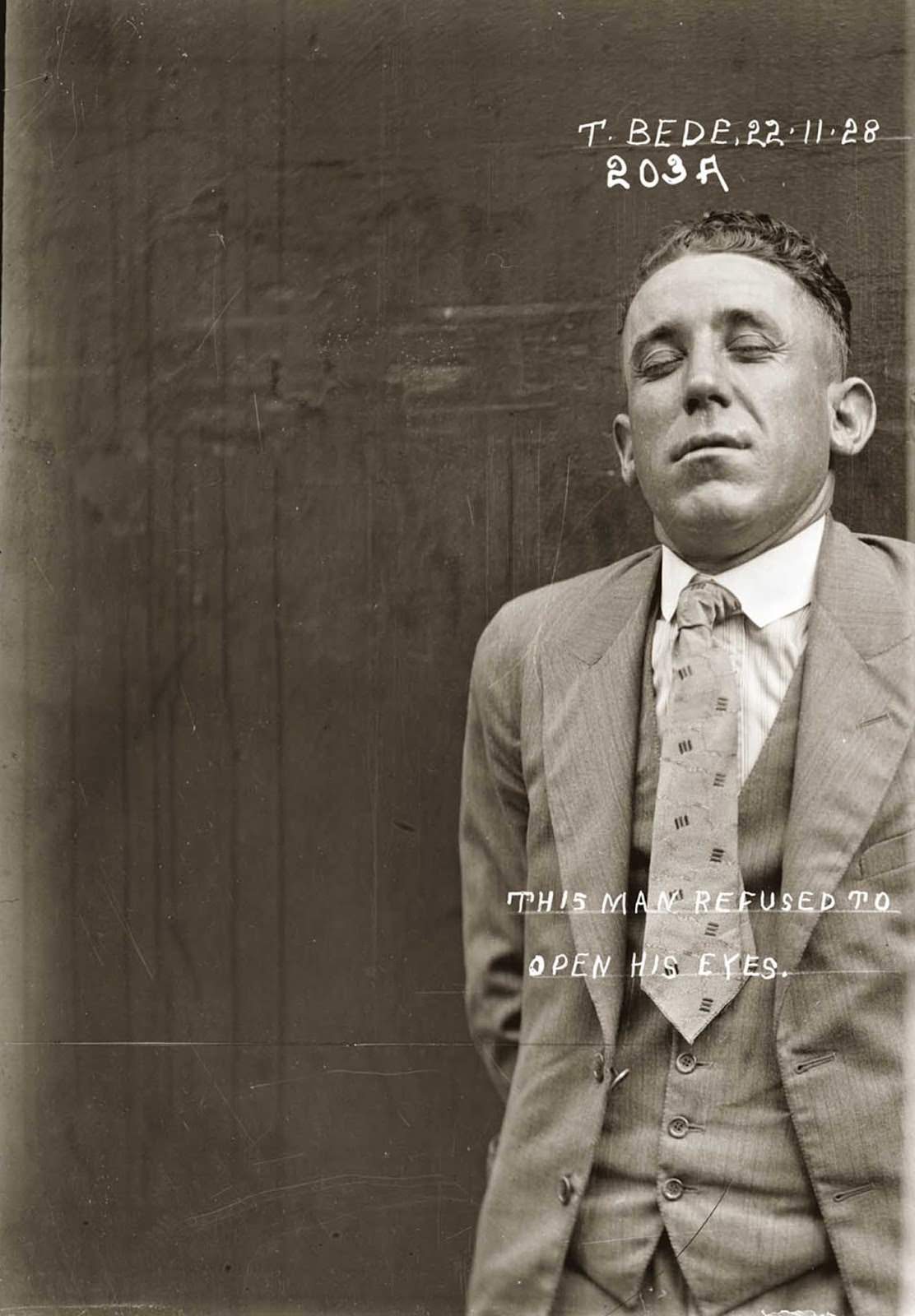
Mugshots of Thomas Bede, 22 November 1928. Captioned: ‘This man refused to open his eyes.’
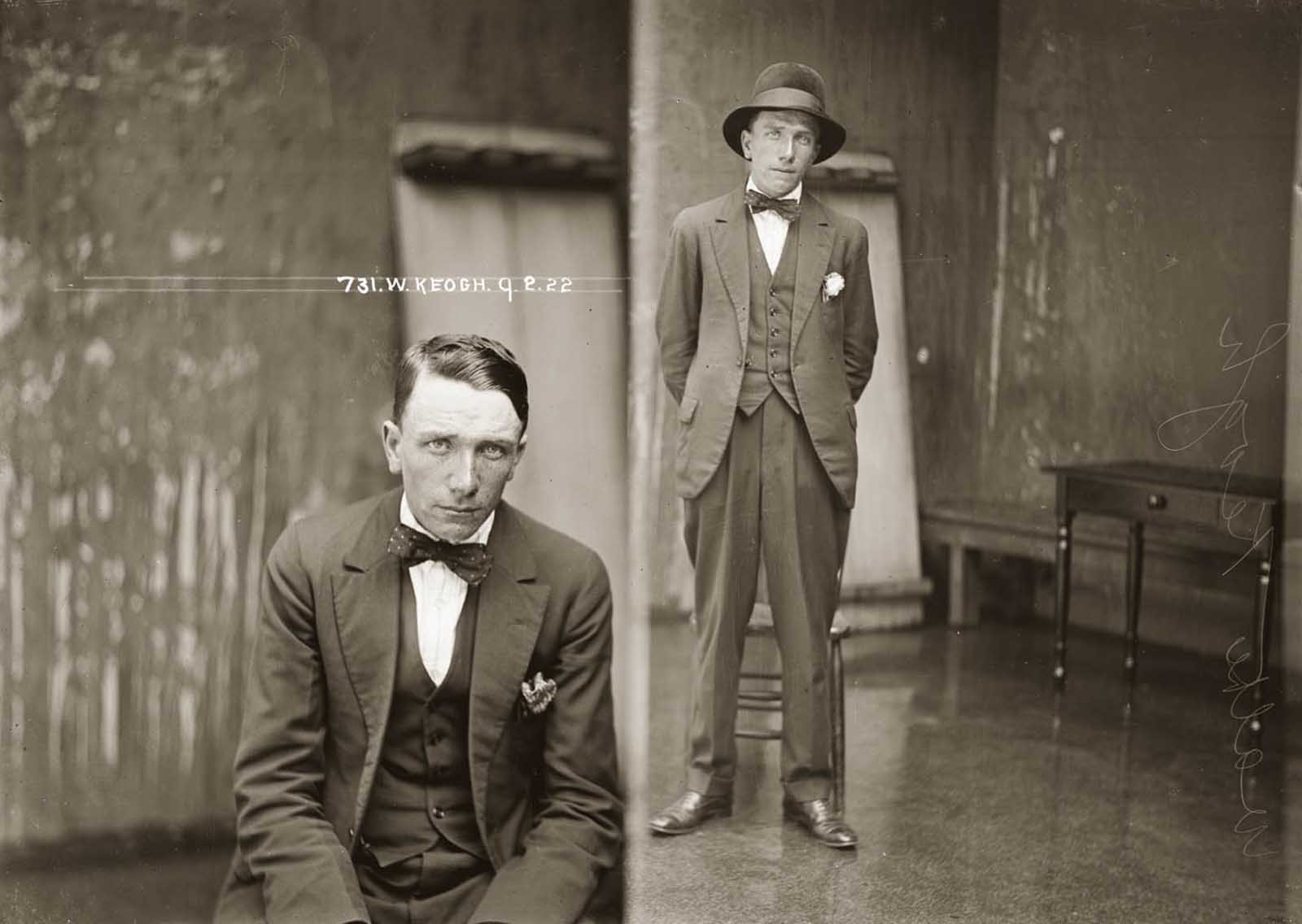
Walter Keogh appears in the Photo Supplement to the 1923 NSW Police Gazette (7 February, Group 1, p. 4) identified as a pickpocket, and later in 1928 (26 December, Group 4, p. 15) as a ‘suspected person and bogus land salesman.’ Keogh was also profiled in exposés in the newspaper Truth in 1928 as a ‘go-getter’ — that is, a con man who sells suburban building blocks at grossly inflated prices by falsely leading buyers to believe the lots can be promptly resold for a huge profit.
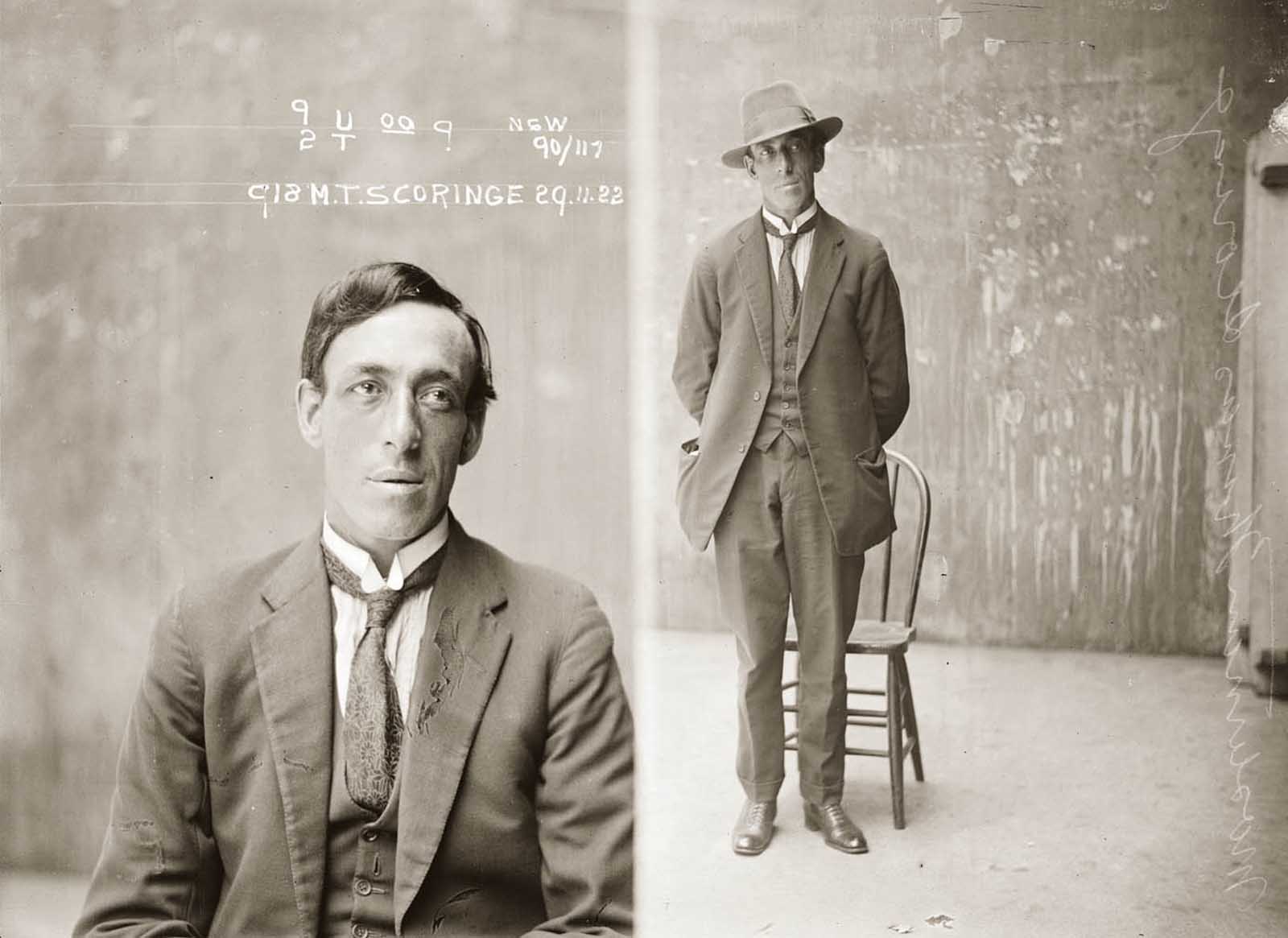
Mugshots of Masterman Thomas Scoringe, 29 November 1922, Central Police Station, Sydney.
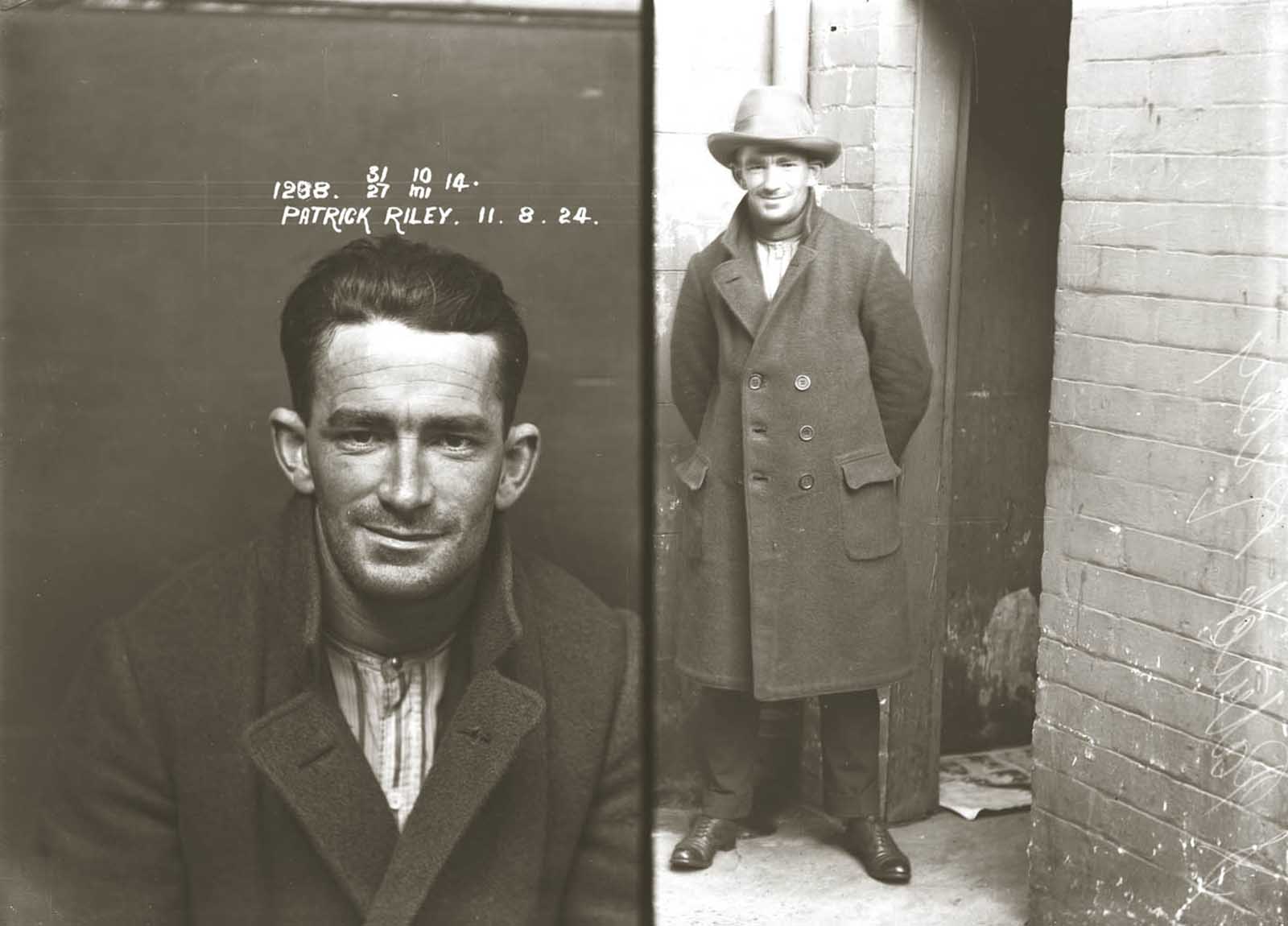
Patrick Riley (alias Matthew Edward Riley) was convicted in October 1924 of making counterfeit coins and of having a coining instrument (i.e., a mold) in his possession, for which he was sentenced to two years’ imprisonment with hard labor.
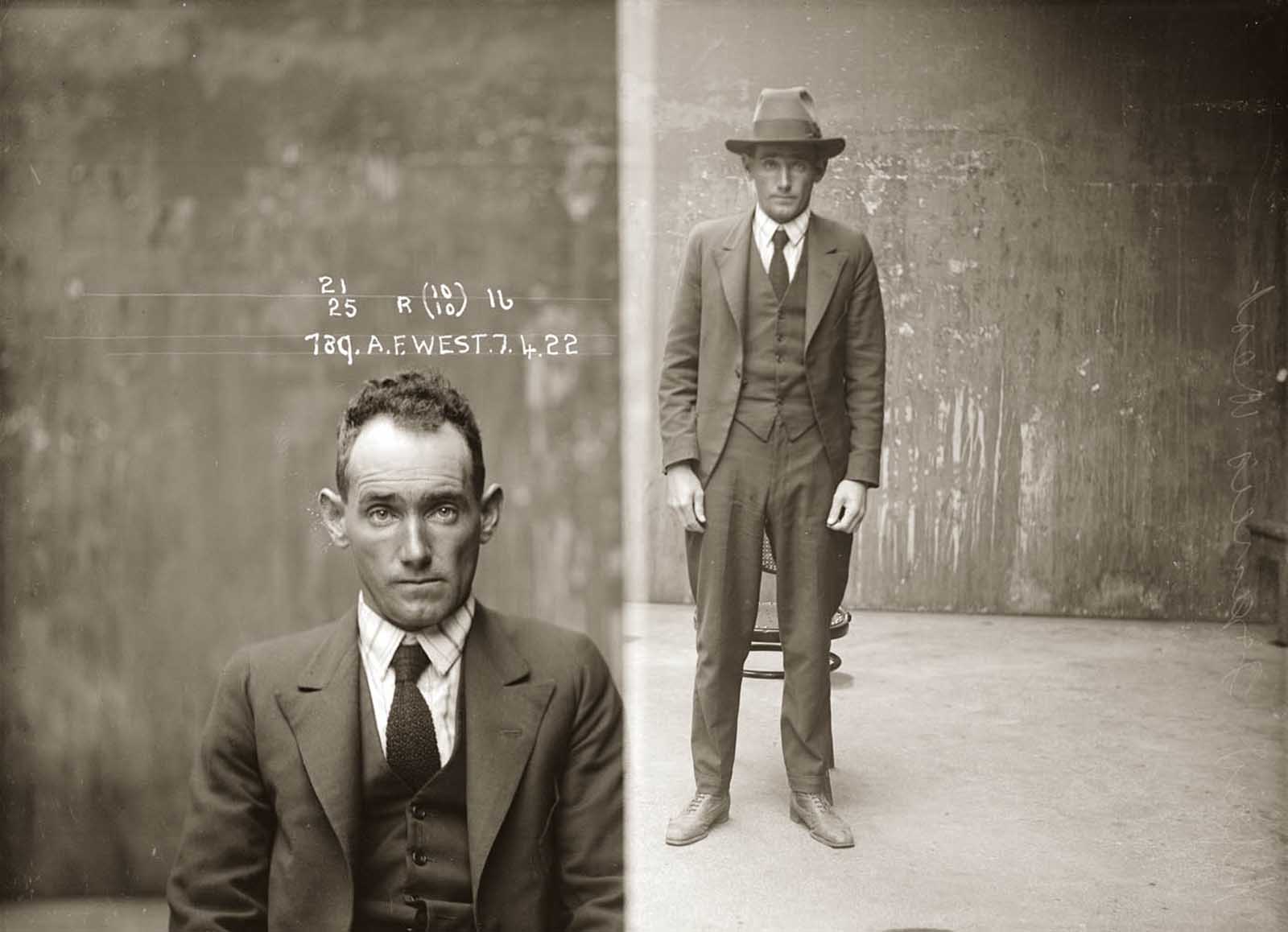
West is mentioned in the NSW Criminal Register as a ‘pickpocket and spieler.’
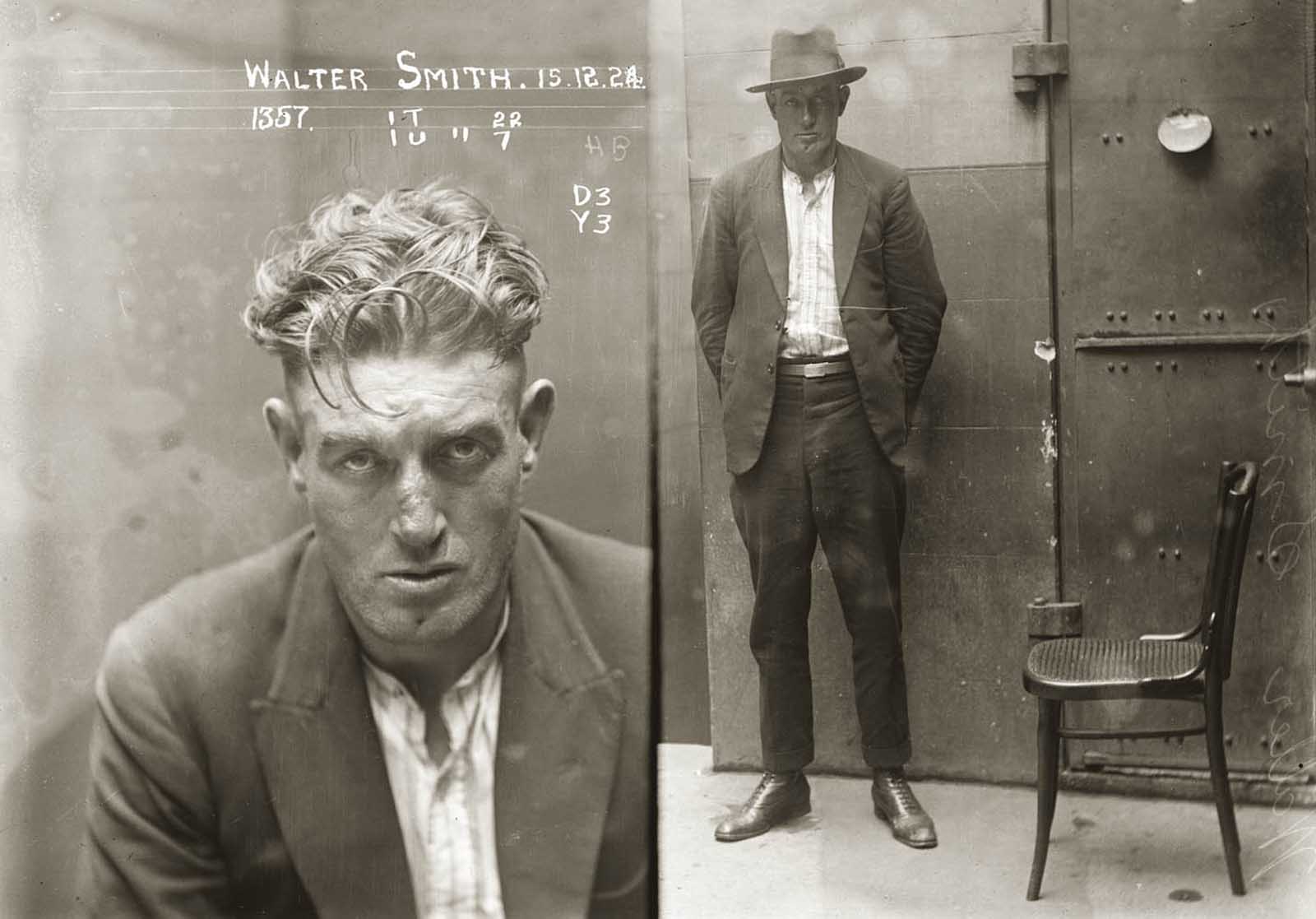
Walter Smith is listed in the NSW Police Gazette, 24 December 1924, as ‘charged with breaking and entering the dwelling house of Edward Mulligan and stealing blinds with a value of 20 pounds (part recovered)’, and with ‘stealing clothing, a value of 26 pounds (recovered) in the dwelling house of Ernest Leslie Mortimer.’ Sentenced to 6 months’ hard labor.
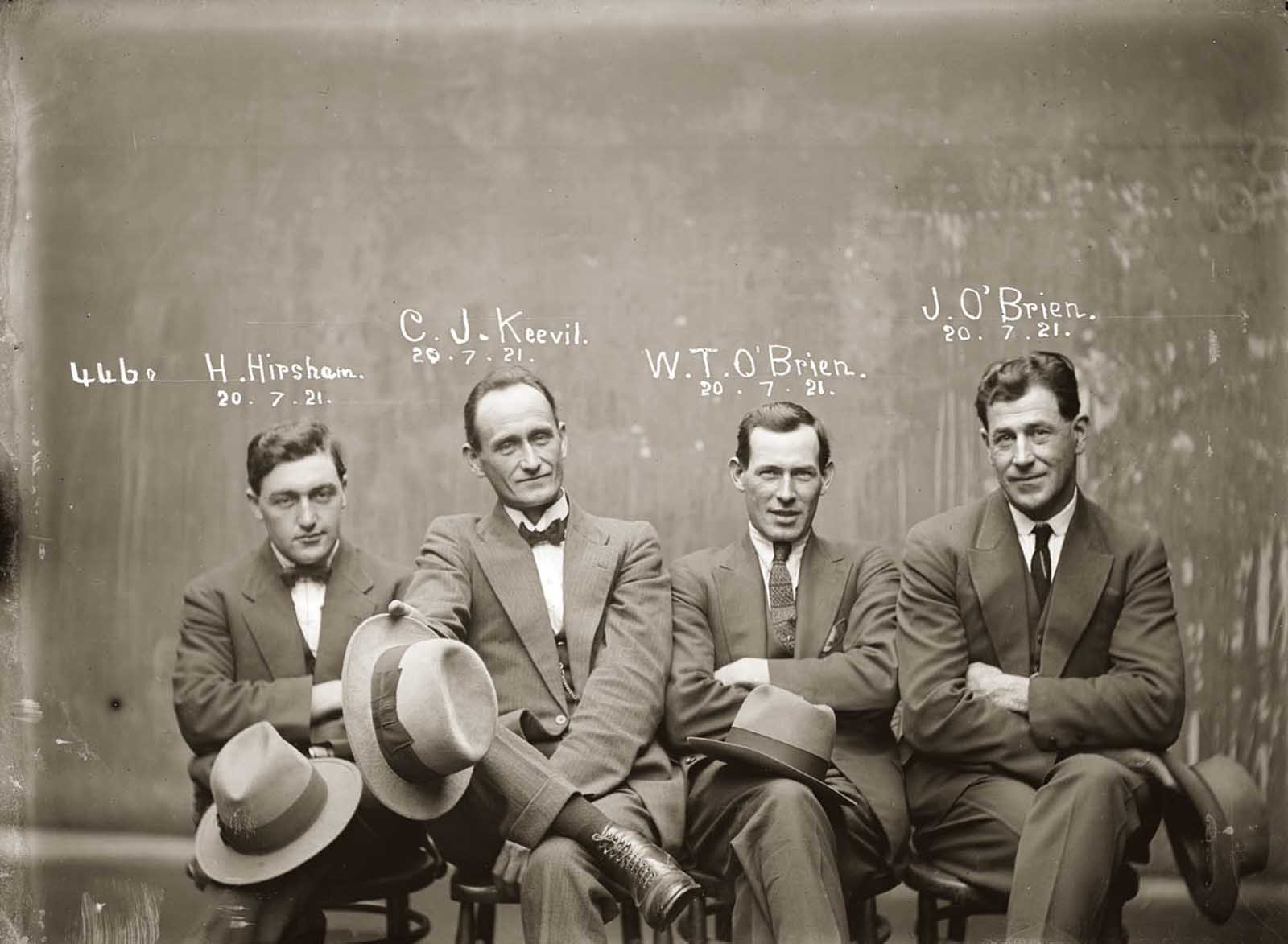
The four men pictured were arrested over a robbery at the home of bookmaker Reginald Catton, of Todman Avenue, Kensington, on 21 April 1921. The Crown did not proceed against Thomas O’Brien, but the other three were convicted and received sentences of fifteen months each.
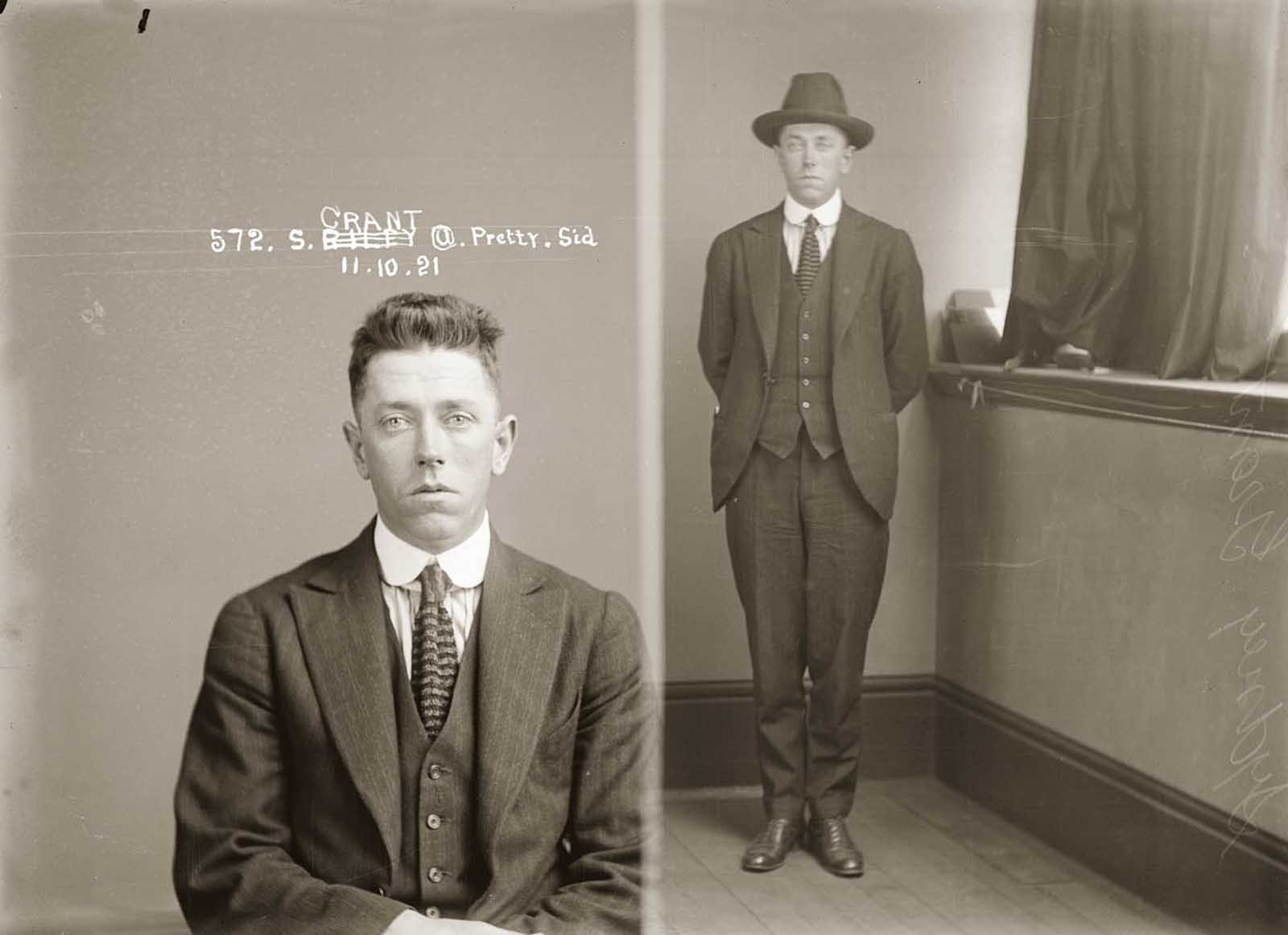
A picture of Sidney Grant (alias ‘Pretty Sid’) appears in the ‘Criminal Photographs’ section of the New South Wales Police Gazette, 2 May 1923, captioned ‘Confidence man (notes for gold).’ In his landmark sociological work, The Big Con (first published in 1940), David Maurer describes a con trick known as “the hot seat”, then being practiced in Europe by “such masters of their profession as Pretty Sid, Snowy T-, Kangaroo John, Melbourne Murray, Devil’s Island Eddie, Slab B[rennan]…” It was not unusual for the most accomplished Australian con artists to seek fresh fields in Britain, Europe (especially France), and North America, where their skills were held in high regard by fellow professionals.
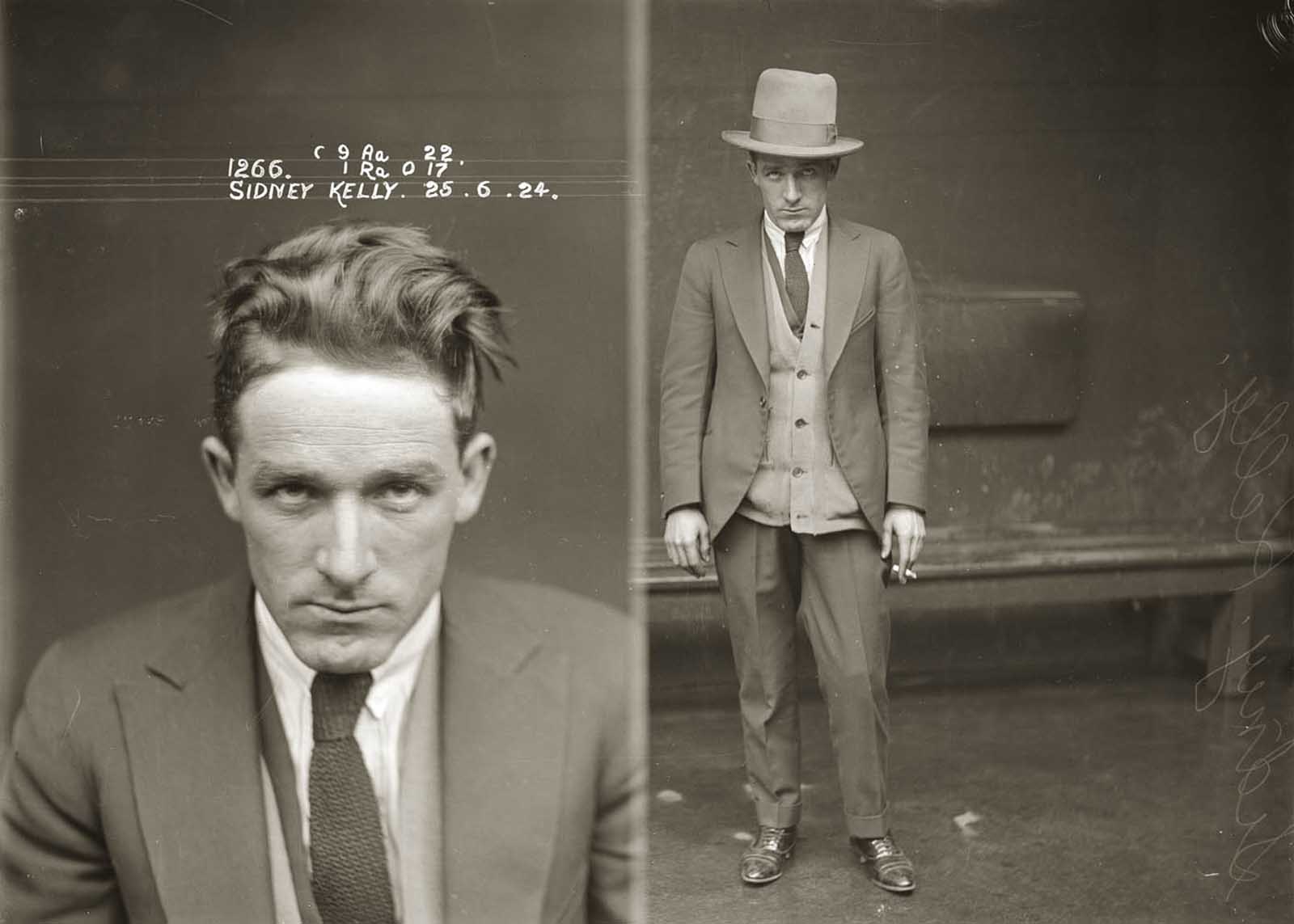
Details surrounding this particular photograph are unknown, but Sidney Kelly was arrested many times and written about extensively in newspapers during the 1920s, 30s, and 40s. He was charged with numerous offenses including shooting and assault, and in the 1940s was a pioneer of illegal baccarat gaming in Sydney. This image appears in the Photo Supplement to the NSW Police Gazette, 26 July 1926, p. 6, captioned, “Illicit drug trader. Drives his own motor car, and dresses well. Associates with criminals and prostitutes.”
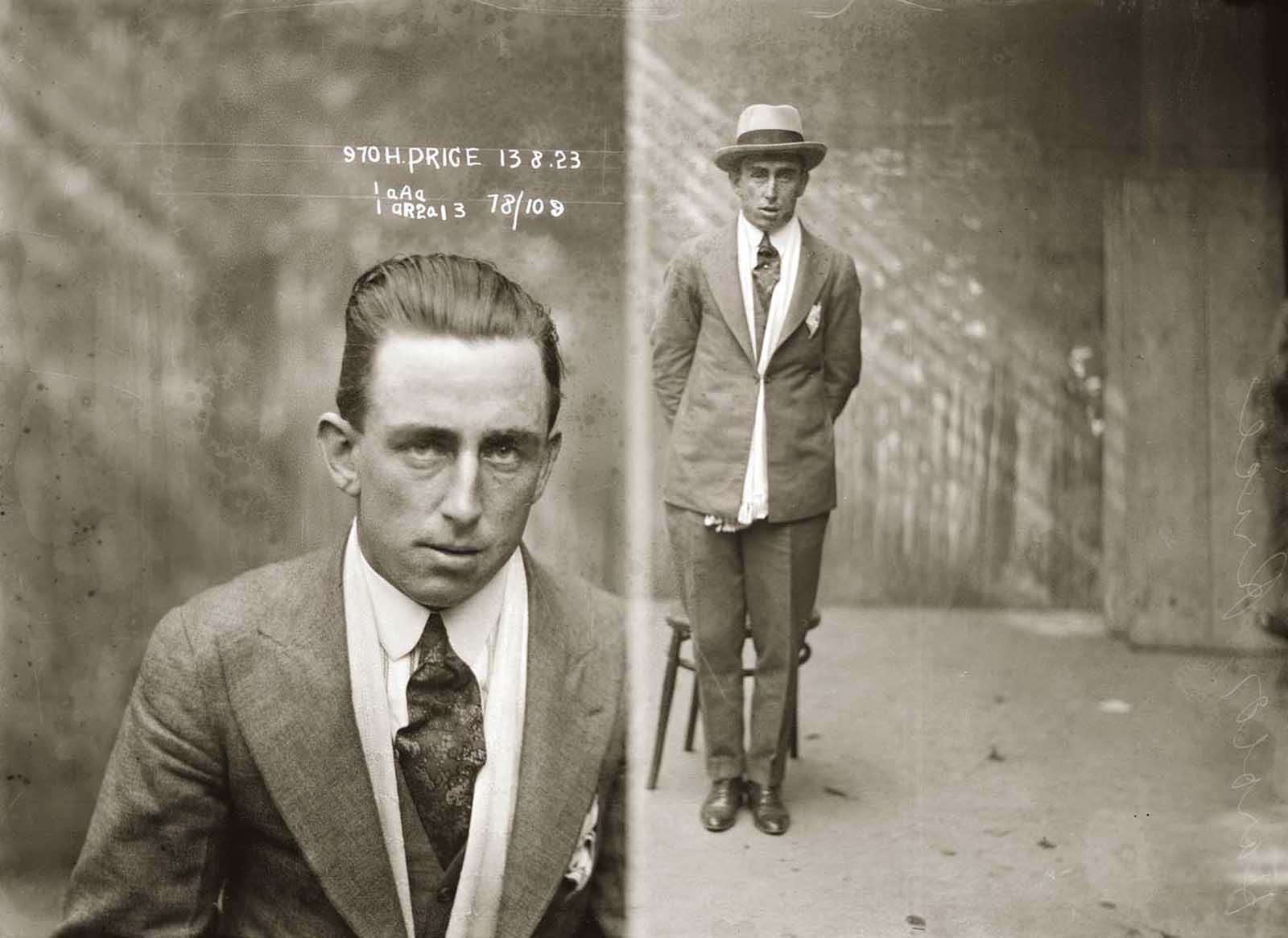
Harold Price was a thief and gunman. This photograph was taken after he was arrested and charged with committing robbery under arms at a house in Randwick, Sydney, for which he was sentenced to two years’ hard labor.
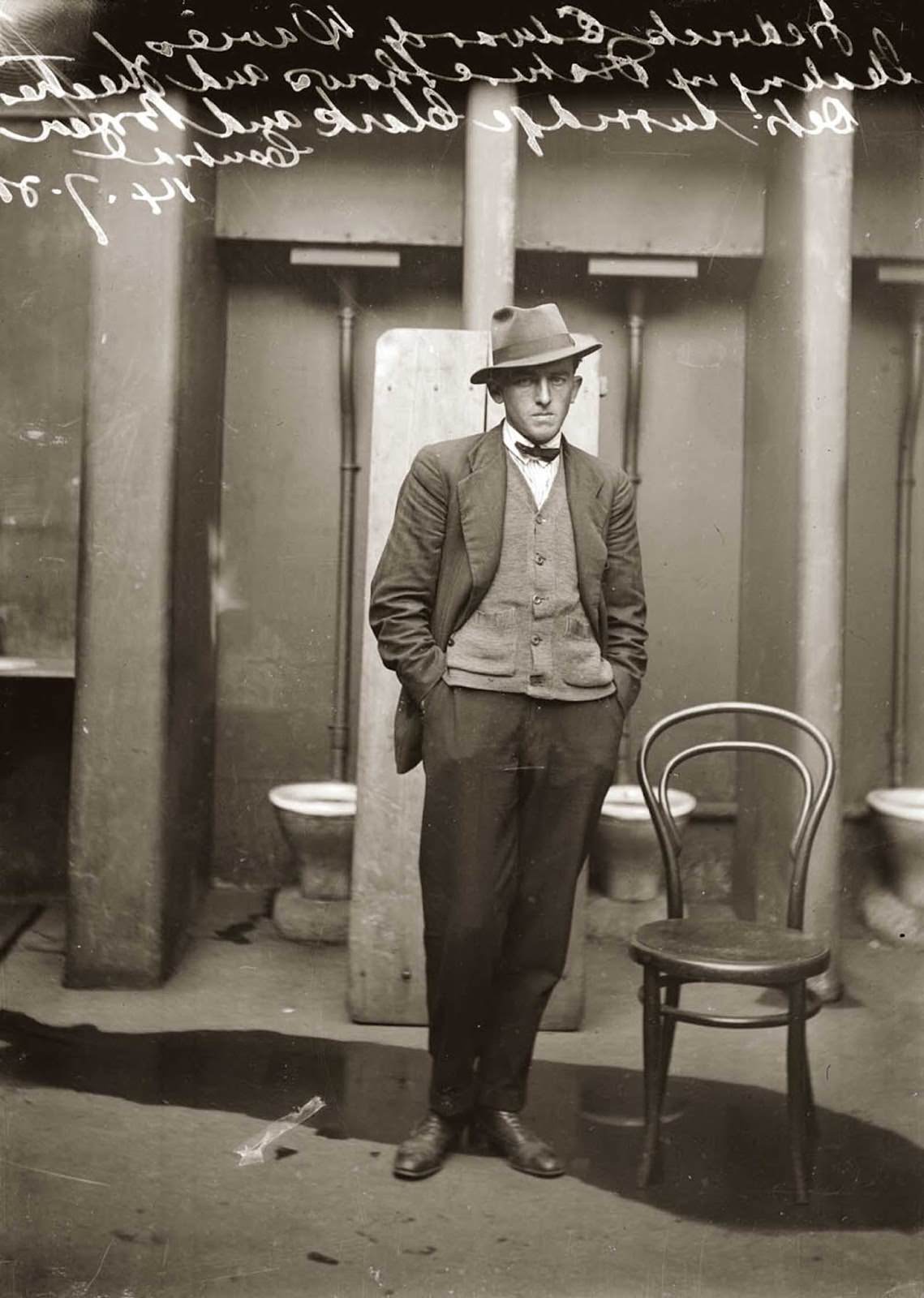
The handwritten inscription on this unnumbered Special Photograph reads, ‘Frederick Edward Davies stealing in picture shows and theaters Dets Surridge Clark and Breen Central 14-7-21.’ Police held sneak thieves in particularly low regard, which may account for the decision to photograph Davies in front of the police station’s toilet stalls.
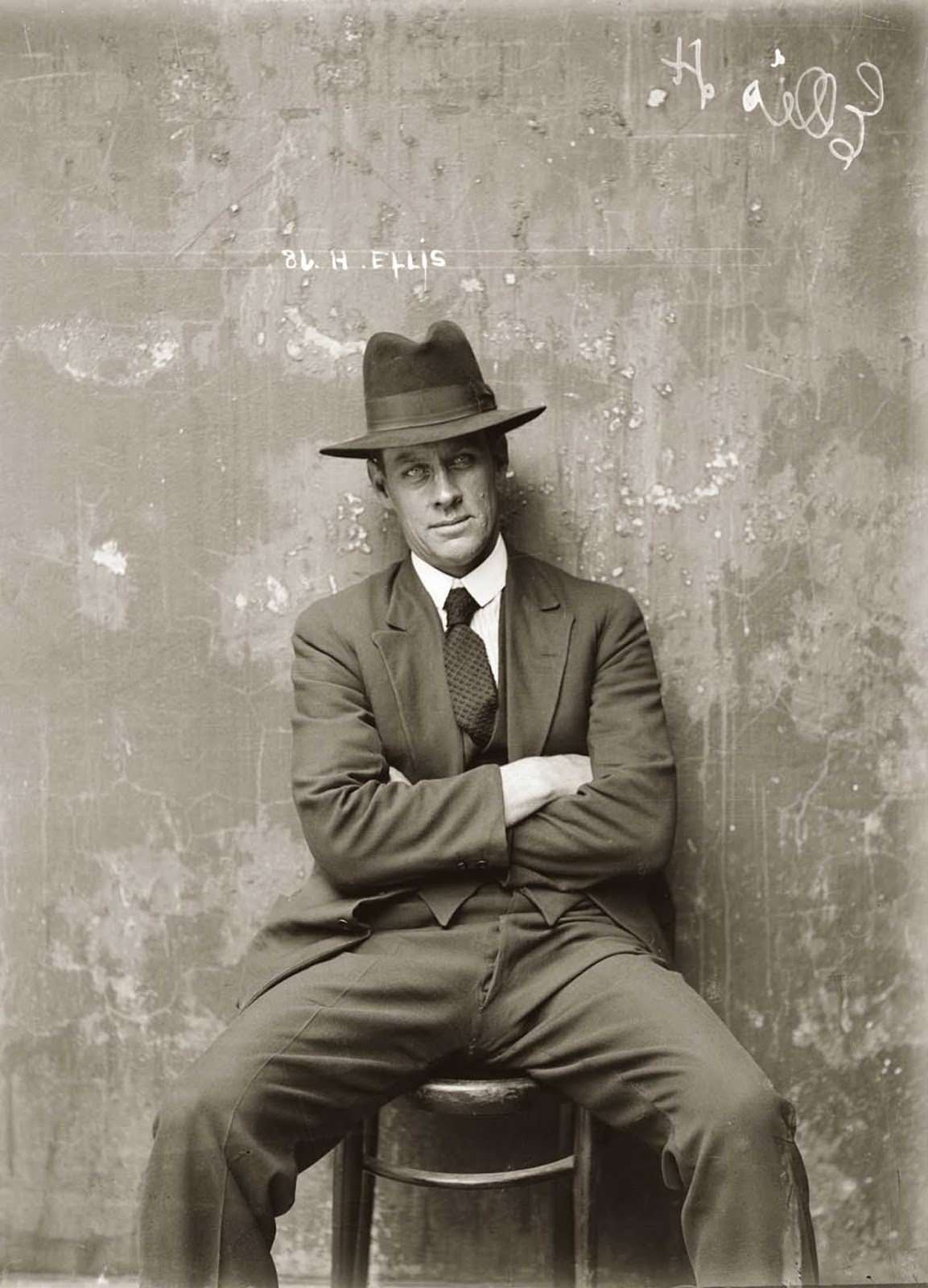
The precise circumstances surrounding this picture are unknown, but Ellis is found in numerous police records of the 1910s, 20s, and 30s. He is variously listed as a housebreaker, a shop breaker, a safe breaker, a receiver, and a suspected person. A considerably less self-assured Ellis appears in the NSW Criminal Register of 29 August 1934 (No. 206). His convictions by then include ‘goods in custody, indecent language, stealing, receiving, and throwing a missile.’
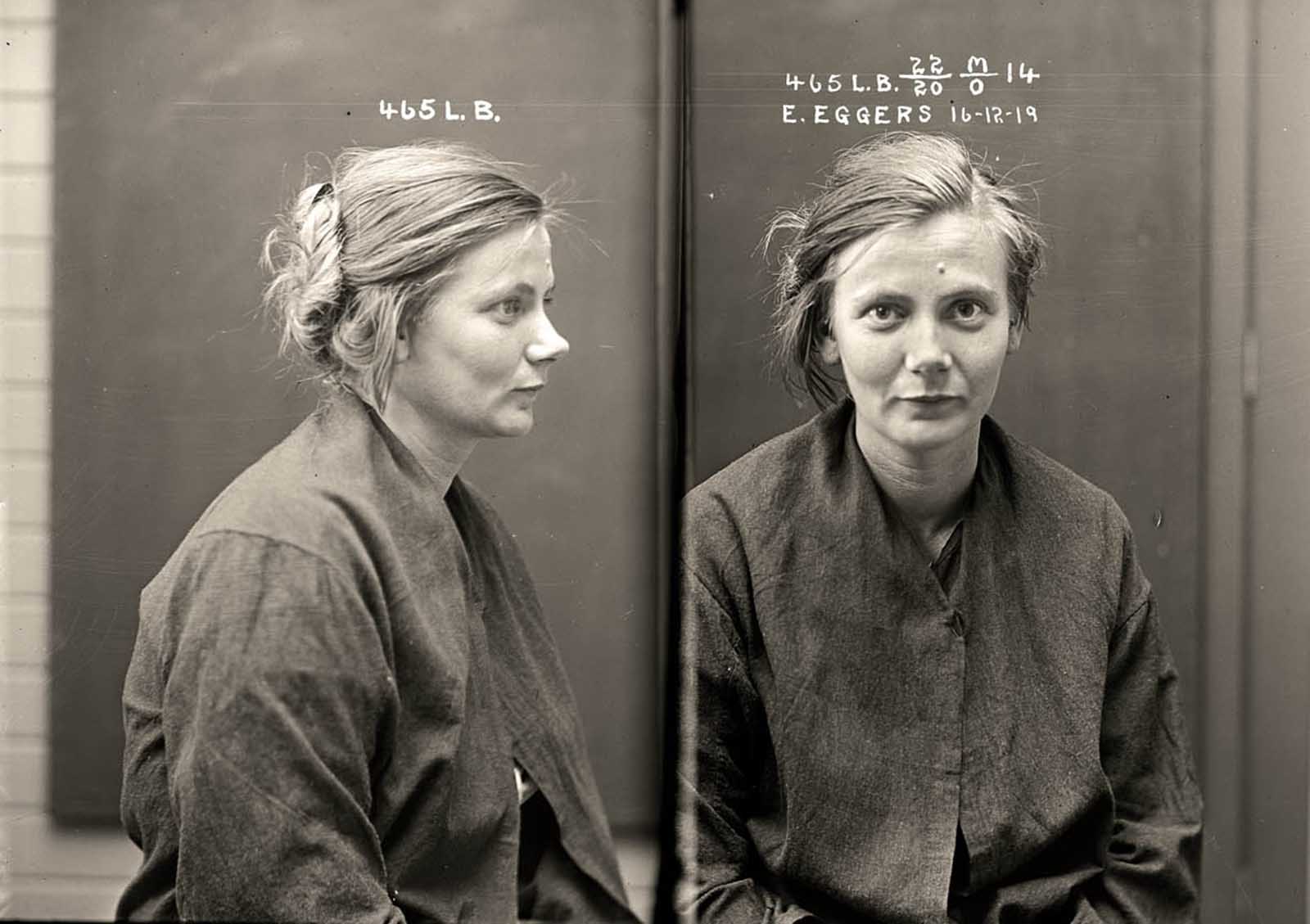
Crime: malicious injury to property and wounding with intent to do grievous bodily harm. When a police officer arrived to arrest Esther Eggers for malicious damage, she attacked him, causing serious injury. Eggers was sentenced to 12 months’ prison. Aged 22.




Criminals dressed very lovelily back then.
They are now too, but you don’t get the mug shots taken if you dress well enough.
Read the bios. Most of them were convicted of stealing clothes.
Same as now. A lot of shoplifting by fashion-conscious people.
My god, William Stanley Moore knows how to pose
And those mad hairstyles!
I love how even when they are next to the height chart, they still (mostly) have a hat on.
Esther Eggers…some parents were borderline malicious naming their kids even back then!
They set her up for being either a superhero or a supervillain by naming her that. They probably figured it was a 50/50 shot, so they took the risk.
Their pants are similar to modern cuts
Some pretty snappy dressers.
Every single one of the men here dresses significantly better than I do
Back then, clothing wasn’t as “disposable” today. The few items of clothing you owned had to be both rugged and fashionable.
I can almost smell musty mothballs
These pics made me think of a fitting title for a book or play, “Crimson Suits”. A play on words and crimes.
The days of the razor gangs.