Hey There! Before You Go. 😧
Get the best vintage content straight into your inbox!

Don't worry, we don't spam

The Trains That Moved a Nation: American Locomotives and Their Vital Role in the 1940s in Vivid Colors

In the 1940s, American railroads were the backbone of the nation. Steam locomotives dominated the tracks — massive machines built from steel, iron, and brass. They burned coal or oil in a firebox to heat water in a giant boiler, creating high-pressure steam that drove pistons connected to large driving wheels. The result was raw, mechanical power on an enormous scale. A working steam engine was hard to ignore: thick smoke rose from the smokestack, steam hissed from valves, and a deep whistle carried for miles. The rhythmic chuffing sound grew faster as the engine gained speed.
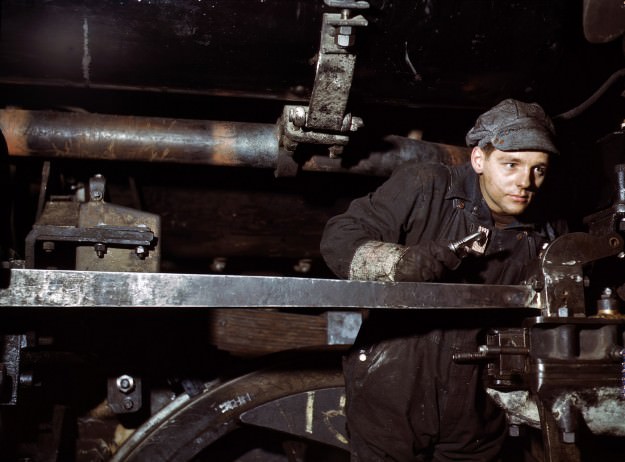
December 1942. A young worker at the Chicago & North Western 40th Street shops. 4×5 Kodachrome transparency by Jack Delano.

Companies like Baldwin, Alco, and Lima built steam locomotives in many sizes for different jobs. Heavy freight engines hauled coal, ore, lumber, and manufactured goods across mountains and plains, relying on many large driving wheels for grip and pulling power. Faster, lighter passenger engines were designed to move people quickly between cities. Smaller switching locomotives maneuvered cars around busy rail yards. Each type had a specific role, and railroads ordered them accordingly.
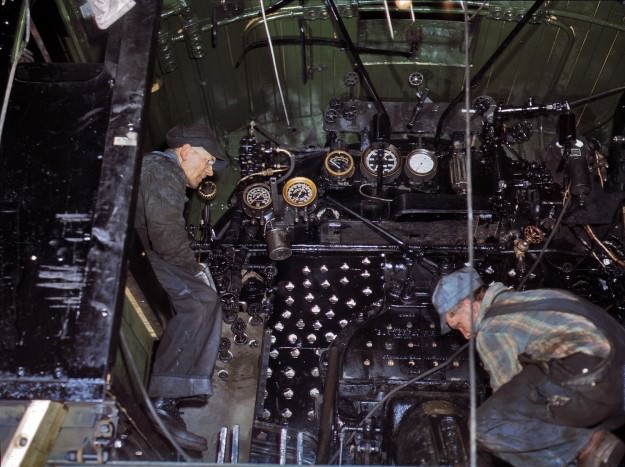
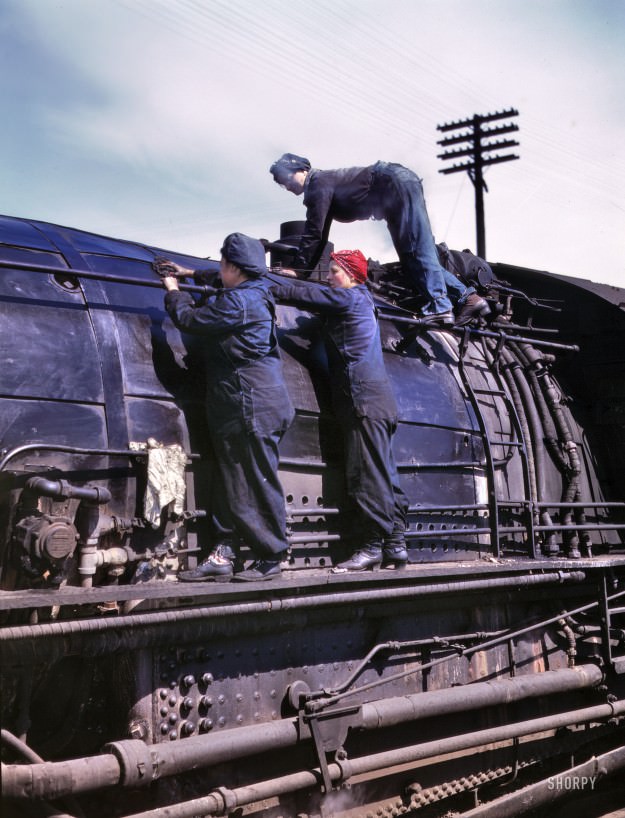
Working on the cab of a locomotive brought in for repairs at the Chicago & North Western 40th Street shops, Chicago. December 1942. 4×5 Kodachrome transparency by Jack Delano.

World War II put the entire railroad system under intense pressure. Locomotives ran around the clock moving millions of troops to training camps and ports. Freight trains carried tanks, artillery, ammunition, and raw materials like steel and coal from factories to where they were needed most. The railroads never stopped — the war effort depended on them.
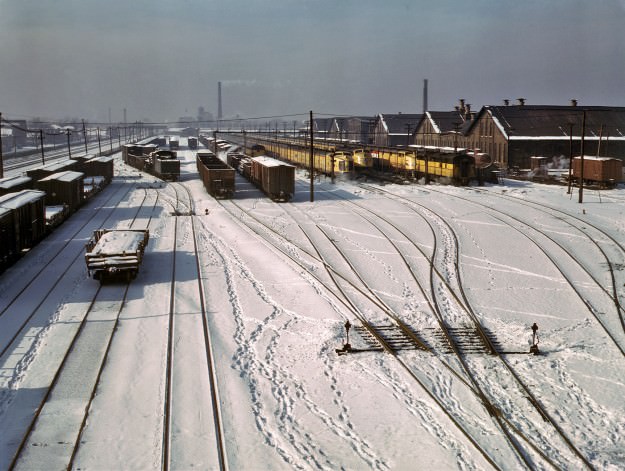
December 1942. Three West Coast streamliners in the Chicago & North Western yards at Chicago. 4×5 Kodachrome transparency by Jack Delano.
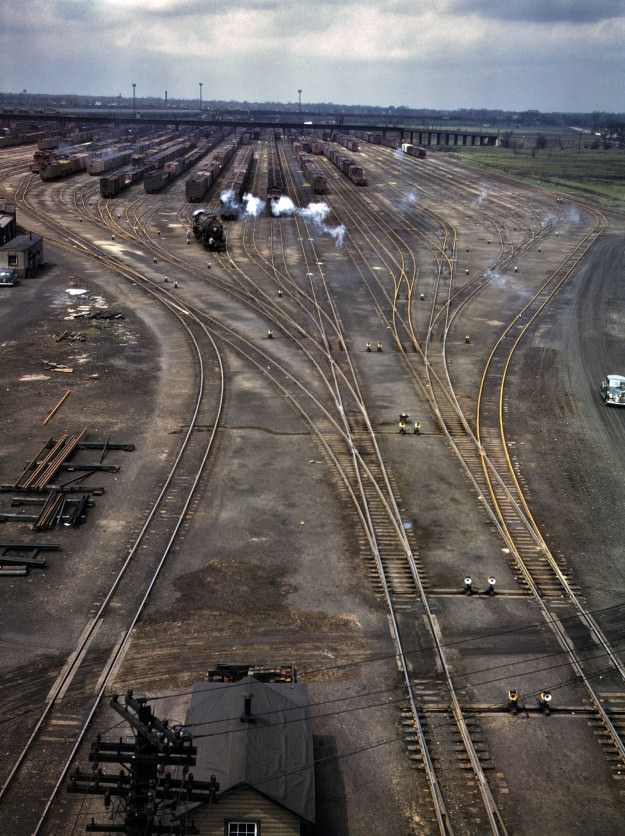
Chicago, April 1943. More of those yellow Proviso rails. "General view of one of the departure yards at Chicago & North Western RR's Proviso Yard." 4×5 Kodachrome transparency by Jack Delano for the OWI.
Chicago, April 1943. More of those yellow Proviso rails. “General view of one of the departure yards at Chicago & North Western RR’s Proviso Yard.” 4×5 Kodachrome transparency by Jack Delano for the OWI.

The men who kept these machines running worked long, demanding shifts in roundhouses and repair shops. Veteran workers like William London — 25 years on the railroad — maintained the locomotives that kept wartime freight moving. The roundhouse was where engines came in for fuel, water, and repairs before heading back out onto the main line.
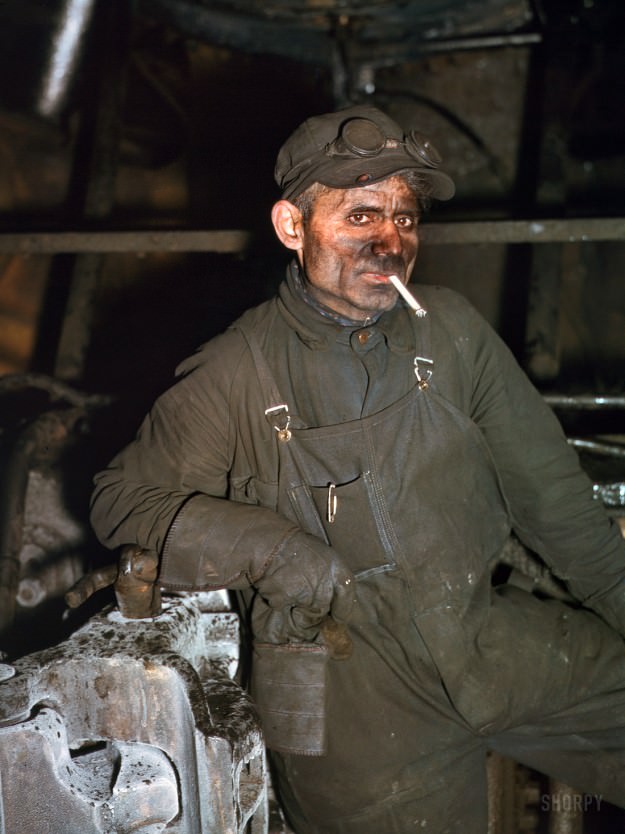
December 1942. Melrose Park, Illinois. "Chicago & North Western RR. William London has been a railroad worker 25 years — now working at the roundhouse at the Proviso yards." 4×5 Kodachrome transparency by Jack Delano for the Office of War Information.
December 1942. Melrose Park, Illinois. “Chicago & North Western RR. William London has been a railroad worker 25 years — now working at the roundhouse at the Proviso yards.” 4×5 Kodachrome transparency by Jack Delano for the Office of War Information.
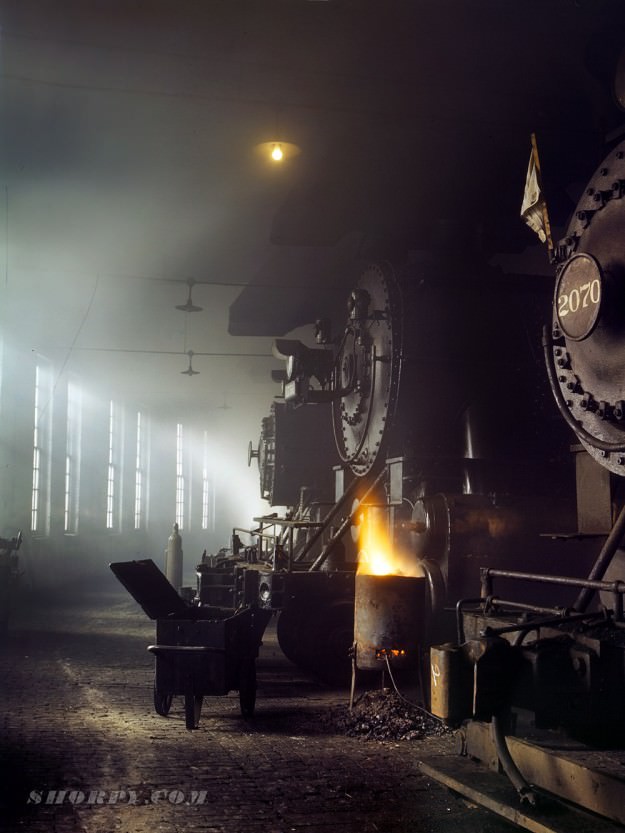
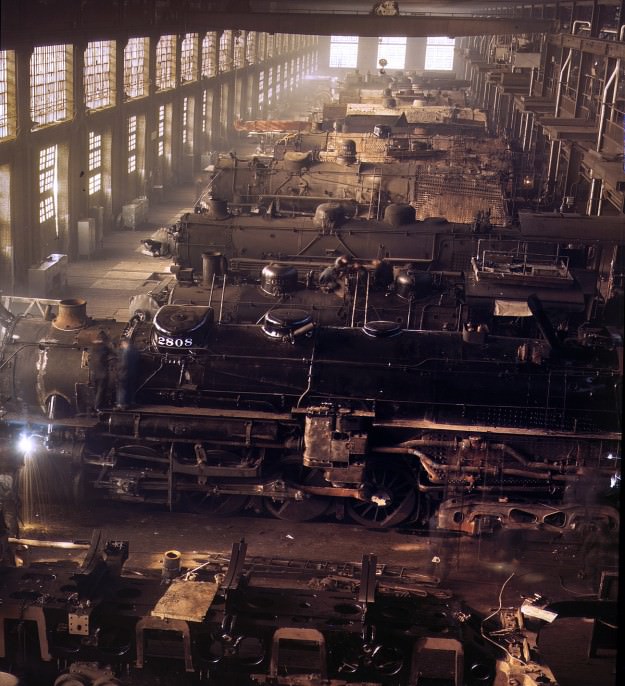
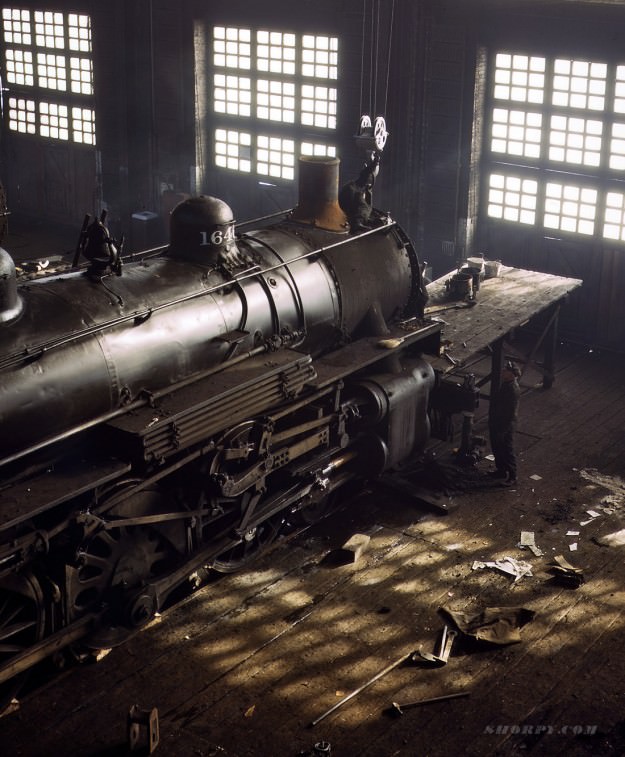
Chicago & North Western railroad locomotive shops at Chicago. December 1942. 4×5 Kodachrome transparency by Jack Delano.
Roundhouse at the Chicago and Northwestern Railroad yard, Chicago. December 1942. 4×5 Kodachrome transparency by Jack Delano.

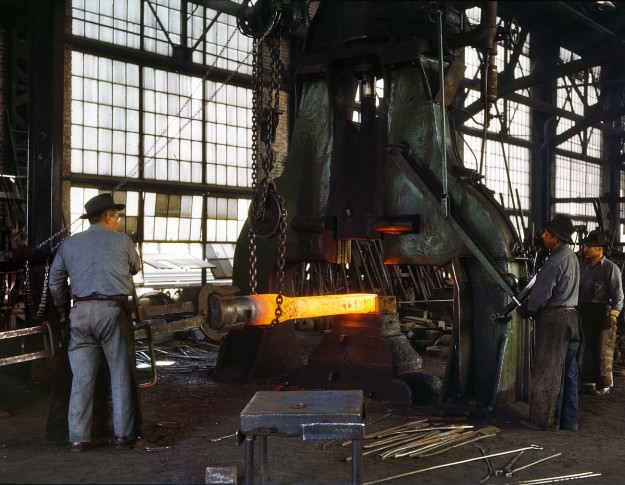
Inside the shops, repairs were done with basic tools — hammers, wrenches, and muscle. The blacksmith’s craft was still very much alive in these wartime facilities, shaping and forging metal parts that kept locomotives on the rails.
40th Street Shop, Chicago & Northwestern R.R. December 1942. 4×5 Kodachrome transparency by Jack Delano. Back to the days of the blacksmith: The only tools seen here are two hammers, a wrench and a broom.

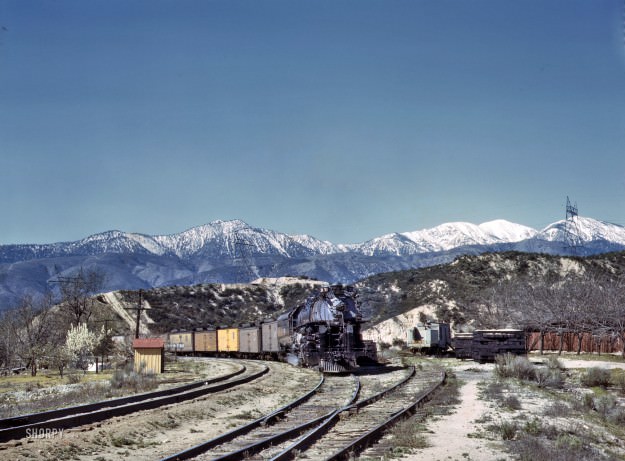
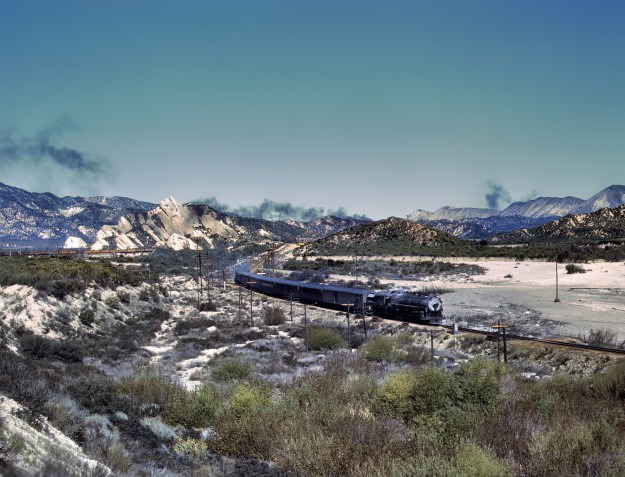
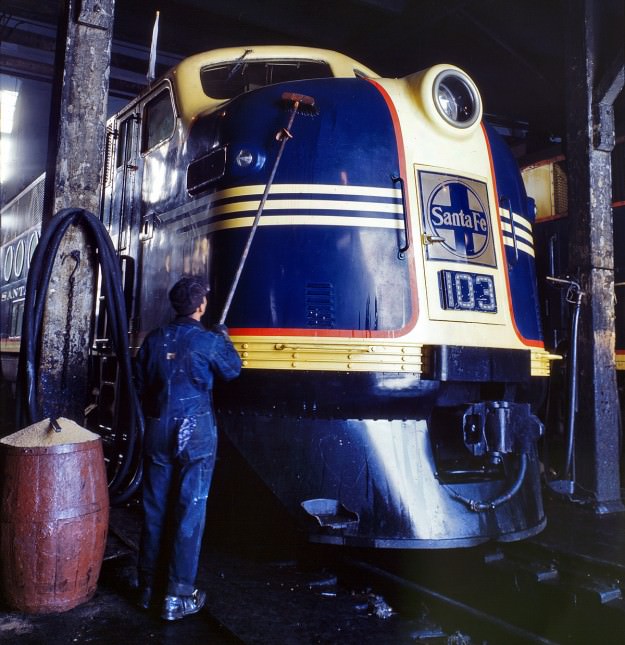
The Santa Fe Railroad was one of the most important lines in the country, connecting Chicago to California. Its shops in Topeka, Kansas, and Albuquerque, New Mexico, serviced both steam and diesel locomotives. At Argentine, Kansas, workers washed 5,400-horsepower diesel freight locomotives — machines that represented the future of railroading. Out on the line, Santa Fe freights navigated long sidings and mountain passes like Cajon Pass in the San Bernardino Mountains.
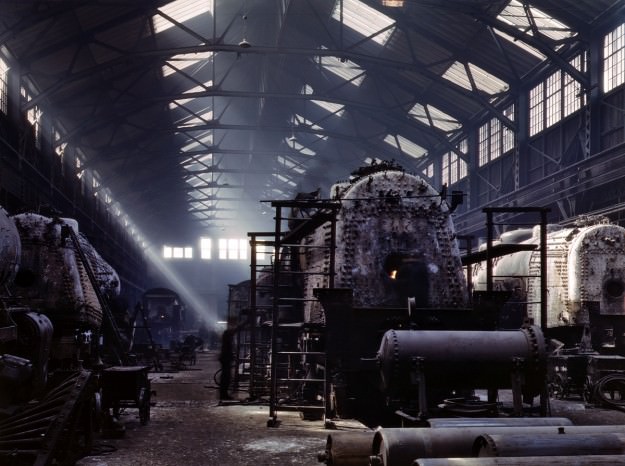
Santa Fe R.R. locomotive shops, Topeka, Kansas. March 1943. 4×5 Kodachrome transparency by Jack Delano.
March 1943. Washing one of the Santa Fe R.R. 5,400-horsepower diesel freight locomotives in the roundhouse at Argentine, Kansas. 4×5 Kodachrome transparency by Jack Delano.
March 1943.
March 1943.
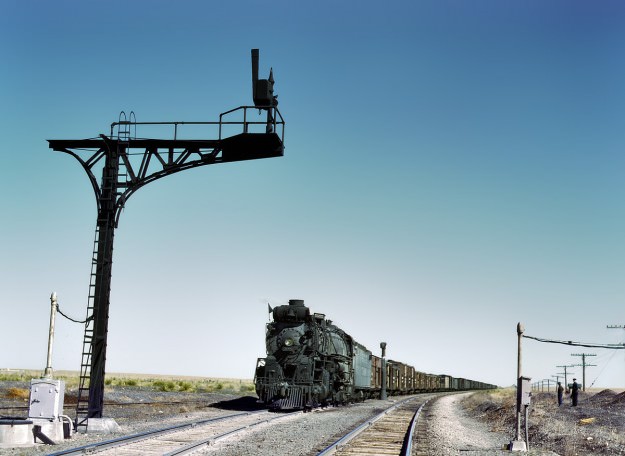
March 1943. Westbound Santa Fe freight on a siding at Ricardo, New Mexico, waiting for the eastbound train to pass. 4×5 Kodachrome transparency by Jack Delano. FSA/Office of War Information archive.
March 1943.
March 1943.
March 1943. Santa Fe trip from Chicago to California. Trains on the Santa Fe tracks through Cajon Pass in the San Bernardino Mountains. 4×5 Kodachrome transparency by Jack Delano for the Office of War Information.
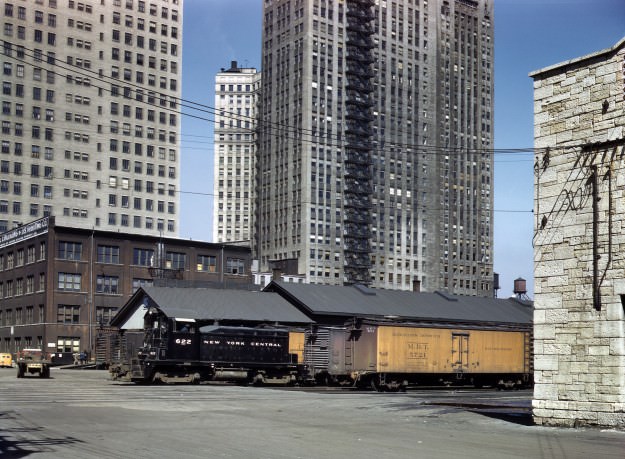
Diesel locomotives were appearing more frequently in 1943, particularly for switching work at large urban freight depots. At the South Water Street terminal in Chicago, a New York Central diesel switch engine moved freight cars with a precision that steam engines found difficult in tight yard spaces. Diesel-electric locomotives used a diesel engine to power a generator, which then sent electricity to motors on each axle — a fundamentally different system from the steam piston.
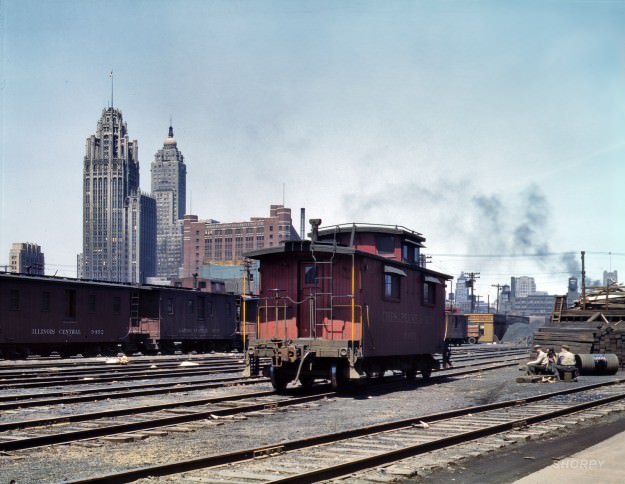
Chicago, April 1943. "General view of part of the South Water street freight depot of the Illinois Central Railroad. Chesapeake & Ohio R.R. caboose." 4×5 Kodachrome transparency by Jack Delano for the OWI.
Chicago, April 1943. “General view of part of the South Water street freight depot of the Illinois Central Railroad. Chesapeake & Ohio R.R. caboose.” 4×5 Kodachrome transparency by Jack Delano for the OWI.
Chicago, April 1943. "New York Central diesel switch engine moving freight cars at the South Water Street terminal of the Illinois Central R.R." 4×5 Kodachrome transparency by Jack Delano for the Office of War Information.
Chicago, April 1943. “New York Central diesel switch engine moving freight cars at the South Water Street terminal of the Illinois Central R.R.” 4×5 Kodachrome transparency by Jack Delano for the Office of War Information.

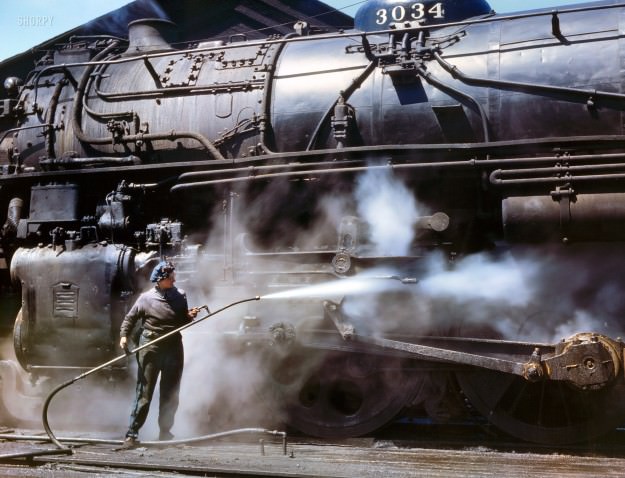
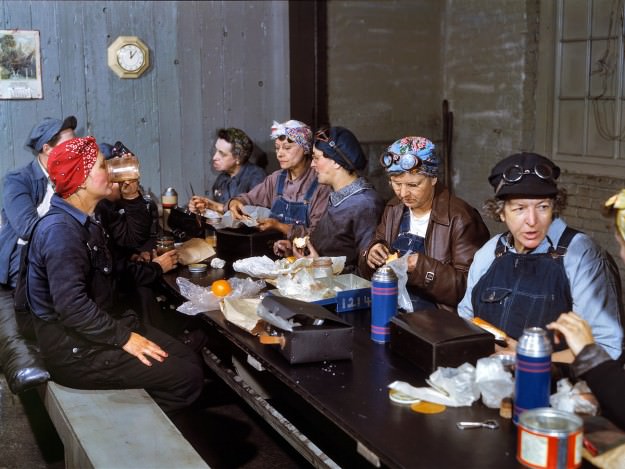
With so many men away at war, women and workers who had previously been excluded from railroad jobs filled critical roles. At the Rock Island Railroad roundhouse in Blue Island, Illinois, Thomas Madrigal greased locomotives to keep them running. At the Chicago & North Western roundhouse in Clinton, Iowa, women worked as wipers — cleaning and maintaining the giant H-class locomotives. Marcella Hart, a mother of three, was among them. Viola Sievers used live steam to clean the exterior of the massive engines. These workers kept trains moving through some of the busiest years in American railroad history.
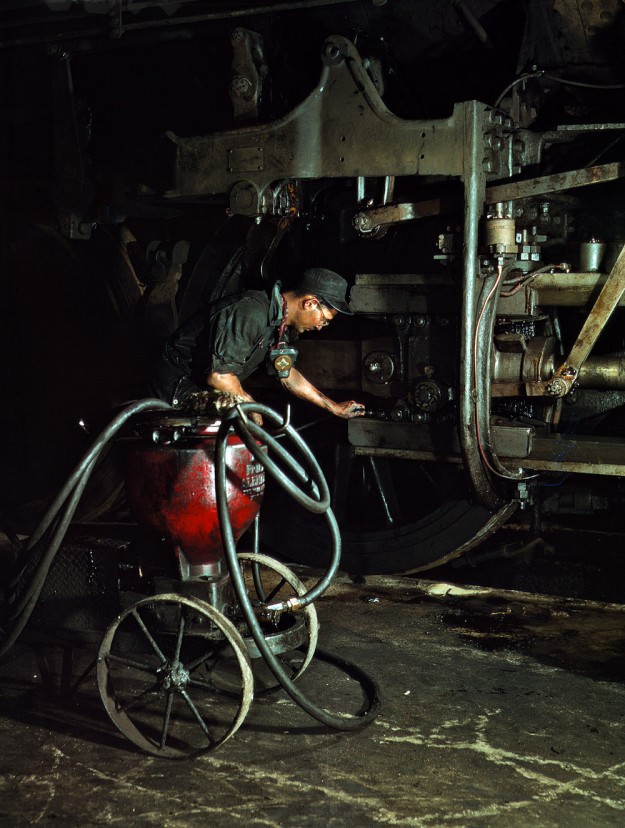
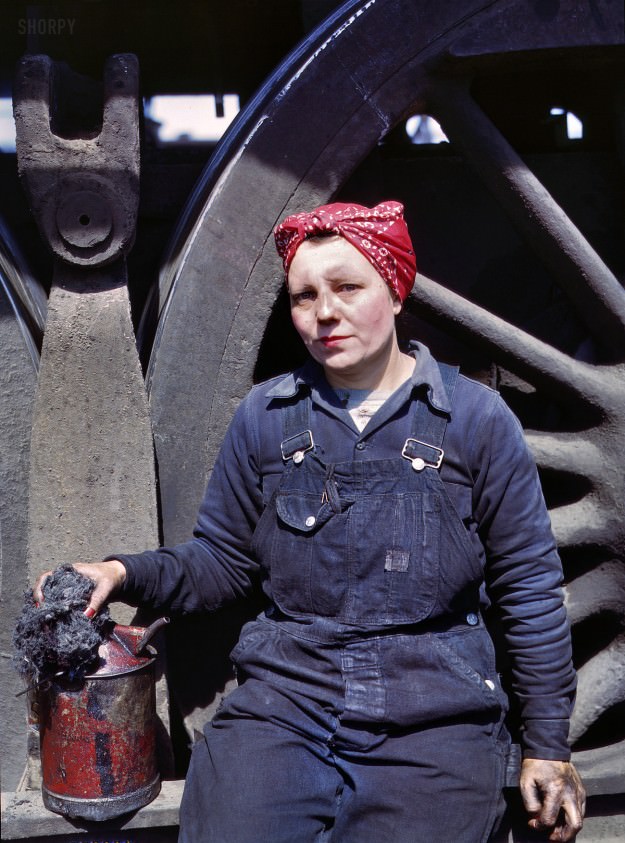
Thomas Madrigal greasing a locomotive in the roundhouse, Rock Island R.R., Blue Island, Ill. April 1943. 4×5 Kodachrome transparency by Jack Delano for the Office of War Information.
April 1943. Clinton, Iowa.
Clinton, Iowa. April 1943. "Chicago & North Western Railroad. Women wipers at the roundhouse cleaning one of the giant H-class locomotives." In the red bandanna: Marcella Hart, seen here in a few other posts. 4×5 Kodachrome transparency by Jack Delano for the Office of War Information.
Clinton, Iowa. April 1943. “Chicago & North Western Railroad. Women wipers at the roundhouse cleaning one of the giant H-class locomotives.” In the red bandanna: Marcella Hart, seen here in a few other posts. 4×5 Kodachrome transparency by Jack Delano for the Office of War Information.
April 1943.
April 1943.
Women employed as roundhouse wipers having lunch, Chicago & North Western Railroad, Clinton, Iowa. Marcella Hart is at left, Mrs. Elibia Siematter at right. April 1943. 4×5 Kodachrome transparency by Jack Delano.

Large classification yards like the Bensenville yard of the Chicago, Milwaukee, St. Paul and Pacific Railroad handled the constant sorting and movement of freight cars feeding the war economy. Track repair and roundhouse maintenance went on continuously, keeping the infrastructure capable of handling the enormous wartime volume.
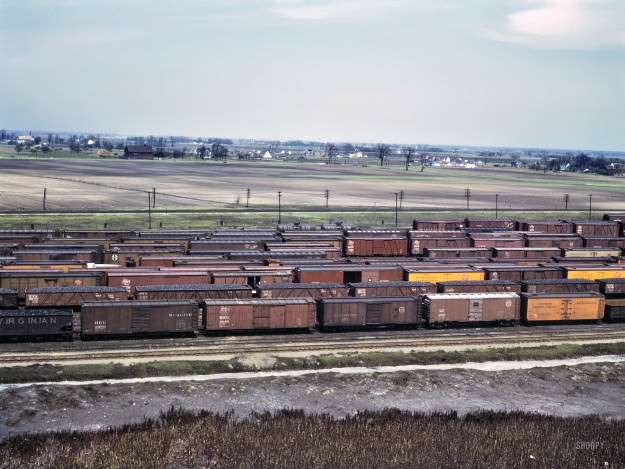
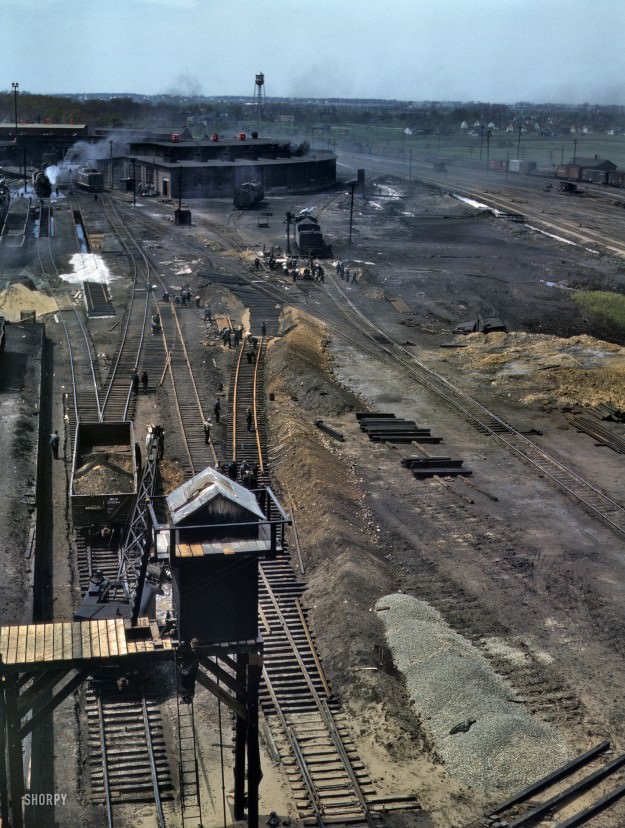
May 1943. Bensenville, Illinois.
Enjoyed this post? Get new ones in your inbox.

Leave a Comment

Your email address will not be published. Required fields are marked *

Share this Post 🥺

Please take a moment to share this content. Your support is greatly appreciated! 🙌🙏

Share this Post 🥺

Please take a moment to share this content. Your support is greatly appreciated! 🙌🙏
Scroll to Top
 
Hey Friend, Before You Go.. Please like & follow for more interesting content