
In 1906, a young Filipino girl was put on display at Luna Park in Coney Island, New York. She sat on a wooden bench inside an enclosure while crowds of strangers walked past and stared. She was far from home, dressed in traditional clothing, and given no say in what was being done to her. Her name was never recorded. To the organizers of the exhibit, that detail did not matter.
The exhibit was called “The World in Miniature.” It was one of several attractions at Luna Park that claimed to offer visitors a look at cultures from around the globe. In practice, it was a staged display of indigenous and colonized people, pulled from their homelands and placed in artificial settings for paying audiences. The Filipino girl was one of these displays.
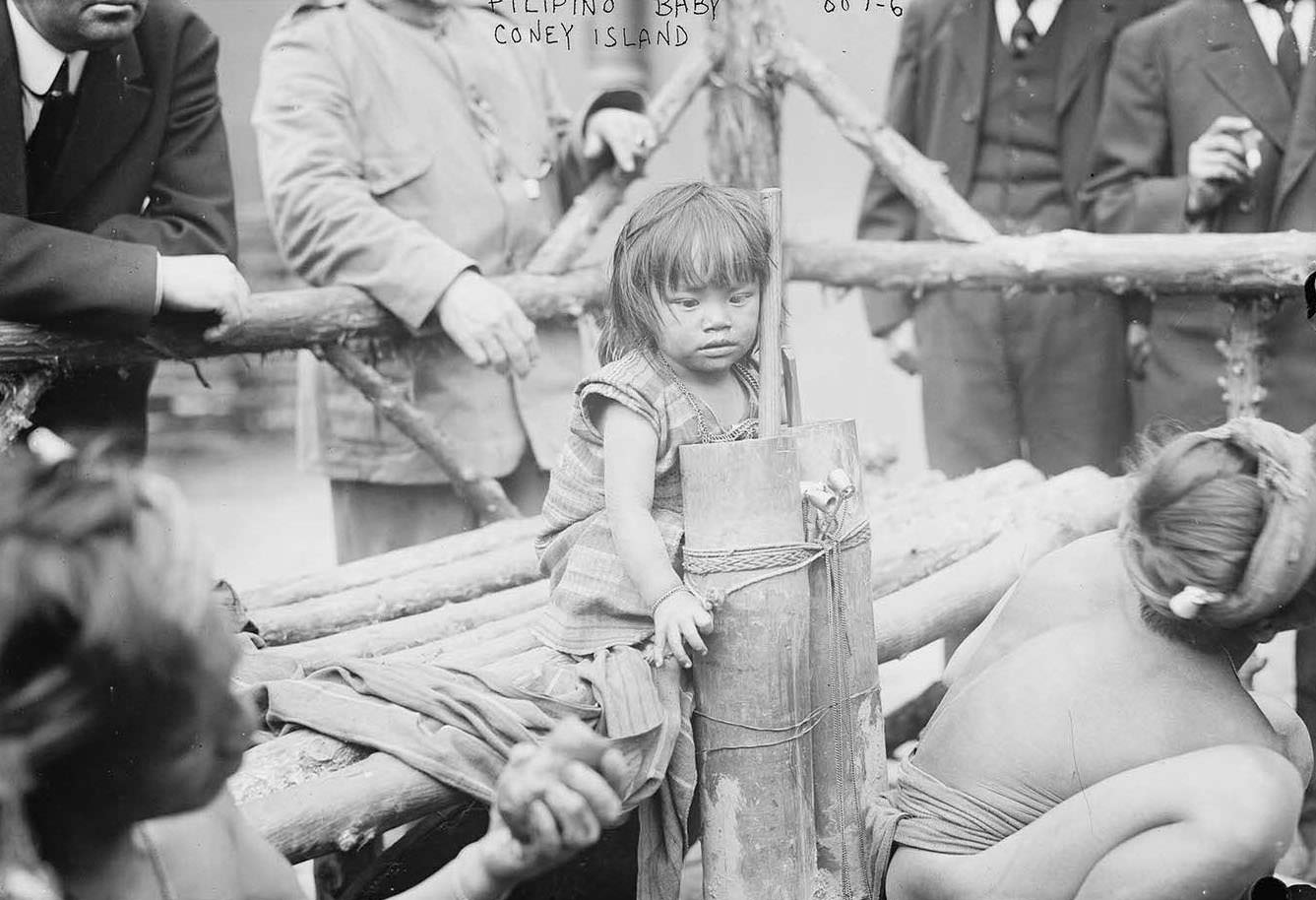
This photograph documents one of the most disturbing aspects of early 20th-century American entertainment: a young Filipino girl seated on a wooden bench inside an enclosure at Coney Island, New York, presented to the public as a living exhibit in 1906.
The broader practice that produced scenes like this one had a name: the human zoo. These were public exhibitions where people from colonized or so-called “exotic” regions were put on display for Western audiences. They ran from the late 1800s through the early decades of the 1900s, appearing across the United States and throughout Europe. Promoters advertised them as “ethnological shows,” using scientific-sounding language to justify what was, at its core, the public display of human beings as curiosities.
The people displayed in these exhibits were treated as objects. They were made to perform daily routines, wear traditional dress, and remain in their enclosures for hours at a time. Their actual cultures were rarely represented accurately. Organizers shaped the displays to match what white Western audiences expected to see — something foreign, primitive, and safely distant from their own lives. The real traditions, histories, and identities of the people on display were irrelevant to the show.
The physical conditions inside these exhibits were often brutal. People were subjected to weather extremes, poor sanitation, and inadequate food. They had no real medical care. Many of the people brought from tropical regions to perform in European or American cities were completely unprepared for the cold, the crowds, or the stress of constant public exposure. Illness spread easily, and a significant number of these individuals died during or shortly after their time on display.
The Filipino girl at Coney Island was part of a much larger pattern tied directly to American colonial expansion. The United States had taken control of the Philippines following the Spanish-American War in 1898, and Filipino people became particularly visible in American exhibitions during the years that followed. The 1904 World’s Fair in St. Louis had featured a large Filipino village display involving over a thousand people brought from the archipelago. Human exhibition was used, in part, as a tool to justify colonialism — to present colonized peoples as less developed and therefore in need of Western governance.
Luna Park itself was one of the most popular entertainment destinations in the country at the time. Opened in 1903, it drew enormous crowds with its electric lights, rides, and spectacle-driven attractions. “The World in Miniature” fit neatly into that framework. The goal was spectacle and profit. The people on display were the product being sold.
The young girl on the bench had no framework for understanding what was happening around her. She would not have spoken the language of the crowd. She had no family nearby, no familiar surroundings, and no means of leaving. Whatever she understood of her situation, she had no power to change it. Visitors bought tickets, watched her, and moved on. For her, the experience did not end when the crowd thinned.
Exhibits like the one at Luna Park did not operate in secret. They were advertised in newspapers, promoted with posters, and reviewed by critics. The mainstream press often covered them without challenge, using dehumanizing language to describe the people on display. Public figures attended and endorsed them. The practice was not fringe — it was accepted entertainment, backed by institutions, and rooted in widely held racial beliefs of the era.
Human zoos persisted in various forms until around the mid-20th century, with some exhibitions in Europe continuing as late as the 1950s. The Filipino girl photographed at Coney Island in 1906 represents thousands of individuals whose names were never written down, whose experiences were never asked about, and whose suffering was treated as a backdrop for someone else’s afternoon out.

Zoos around the world, all located in western world.. Belgium says hi