
By the late 19th century, Warsaw was one of the most dynamic cities in the Russian Empire. In 1897, 626,000 people called it home, making it the third-largest city in the Empire behind only St. Petersburg and Moscow. That number didn’t happen overnight. Between 1850 and 1882, Warsaw’s population grew by 134%, driven by waves of Masovian villagers leaving the countryside in search of factory work and city wages. The photochrome prints in this collection, produced using an early color printing process applied to black-and-white photographs, capture the city at the peak of this transformation.
Much of Warsaw’s modernization during this era happened under Mayor Sokrates Starynkiewicz. His tenure brought the city its first water and sewer systems, expanded its tram network, and improved street lighting and gas infrastructure. The city was actively rebuilding itself from the ground up. Nowhere was this more visible than in the western district of Wola, which shifted almost entirely from a rural landscape of small farms and windmills into a dense industrial zone. Metal, textile, and glassware factories lined the western skyline. The Młynów neighborhood, whose name derives from the Polish word for windmill, is a direct reminder of what that land once was.
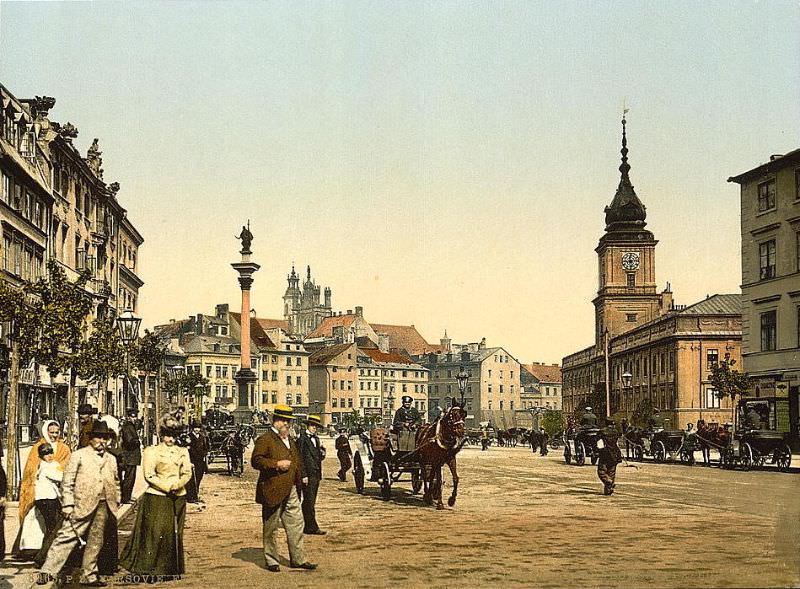
Warsaw’s rapid growth reshuffled its population along economic lines. Wealthier residents claimed the inner suburbs, pushing poorer workers outward to neighborhoods across the Vistula River — Praga, Powiśle, and Solec. Jewish minorities, along with other religious and ethnic groups, settled in the dense northern quarters of the city, particularly in Muranów. The pattern mirrored what was happening in London at the same time, where the poor were concentrated in the East End and Docklands while the wealthy occupied more central districts.
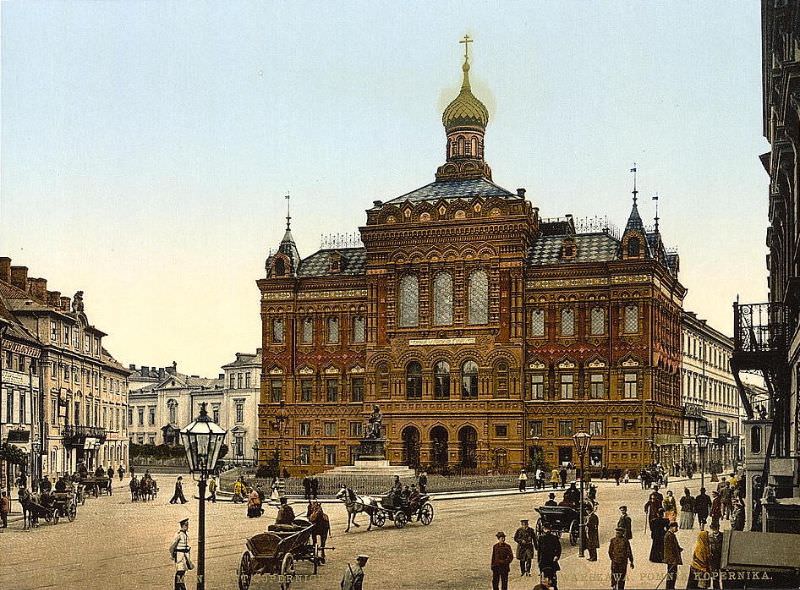
Warsaw’s city center, meanwhile, was filling up with grand architecture. The Warsaw Philharmonic, the Church of the Holiest Saviour, and the elegant tenement buildings lining Marszałkowska Street all reflected the ambitions of a city that saw itself as a major European capital. Public monuments were a key part of that identity. The Copernicus Monument, honoring the Polish astronomer Nicolaus Copernicus, stood as one of the most prominent sculptures in the city.
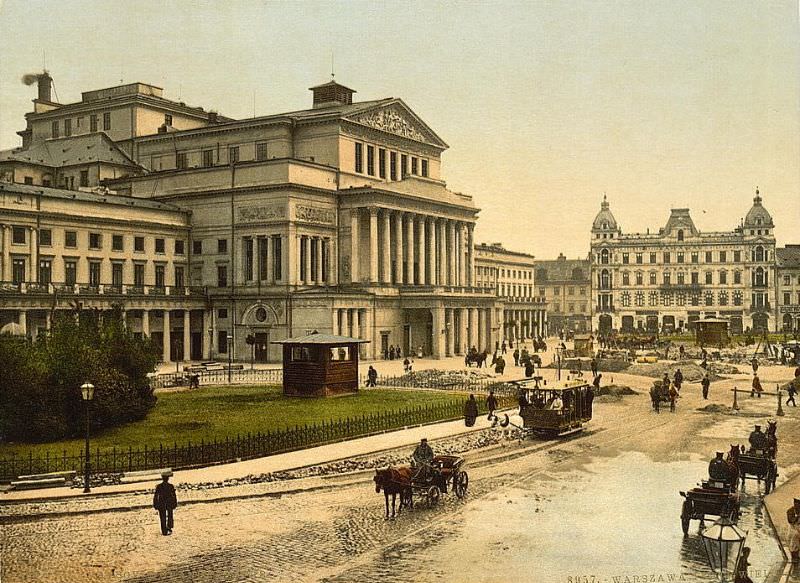
The Grand Theatre was one of Warsaw’s most imposing civic buildings. Built in the neoclassical style, it anchored the cultural life of the city and seated thousands. Its massive colonnade and broad facade made it one of the largest theater buildings in Europe at the time.
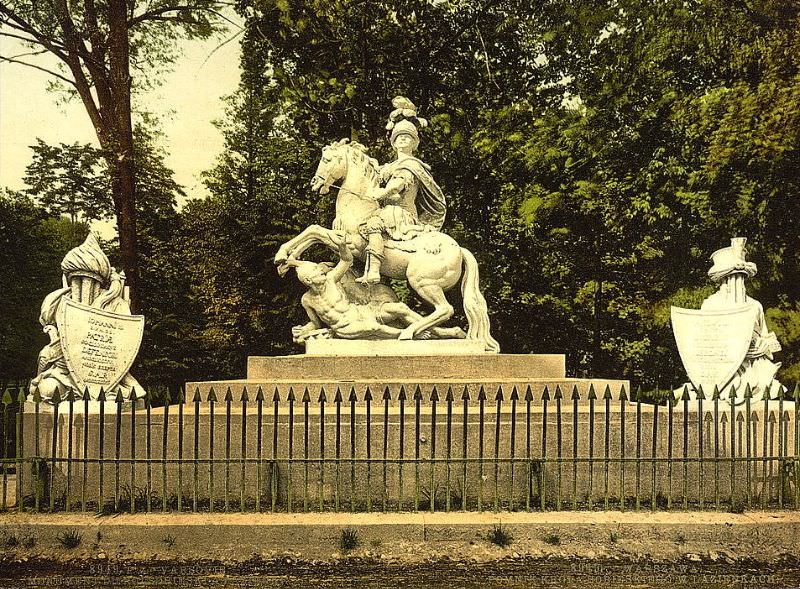
Łazienki Park was the city’s most celebrated green space, and it held some of Warsaw’s finest monuments and architecture. The monument to King John III Sobieski, the Polish king who famously led the relief forces at the Battle of Vienna in 1683, stood in the park as a symbol of national pride during a period when Poland had no independent state of its own — the country was partitioned between Russia, Prussia, and Austria.
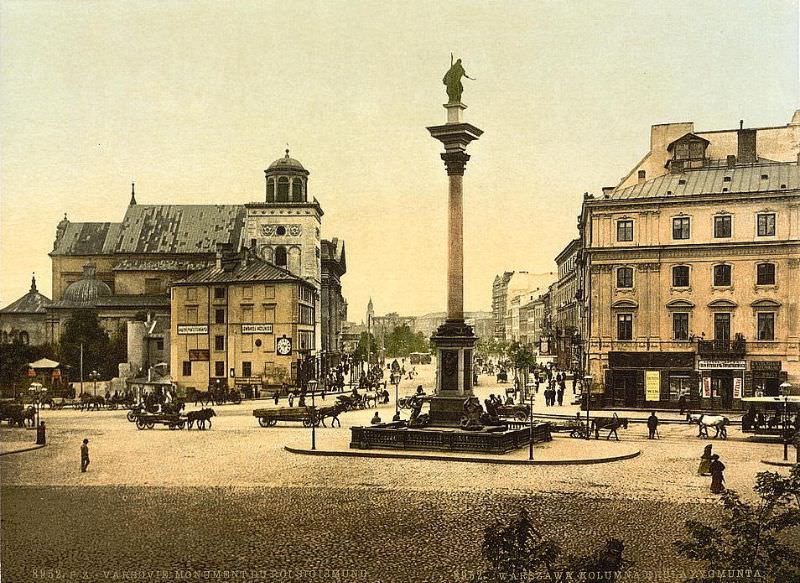
King Sigismund’s Column, erected in 1644, was one of the oldest secular monuments in Warsaw and one of the most recognizable landmarks in the entire city. Sitting at the entrance to the Royal Castle, the column honored King Sigismund III Vasa, who moved Poland’s capital from Kraków to Warsaw in 1596. By the late 19th century, it had become a defining feature of the city’s skyline.
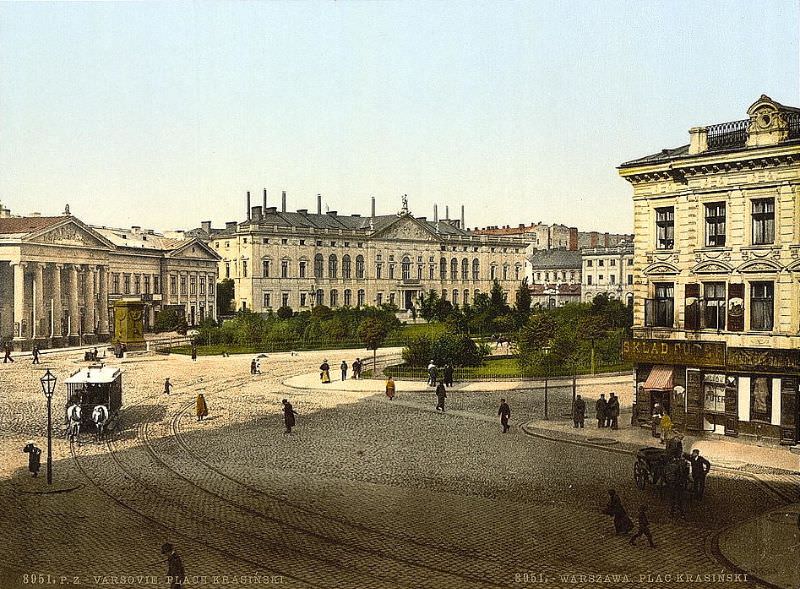
Krasiński Place was one of the notable public squares in Warsaw’s northern districts. It sat near the Krasiński Palace, a baroque building that served as the Supreme Court during the late imperial period. The square and its surroundings represented one of the older, more historic layers of Warsaw that survived alongside the newer developments reshaping the rest of the city.
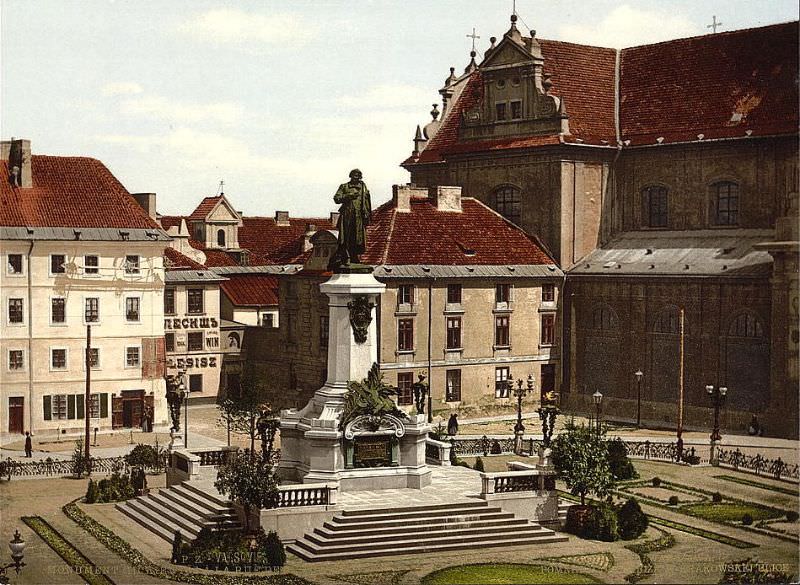
The monument to Adam Mickiewicz, Poland’s most celebrated Romantic poet, held deep significance for Warsaw’s residents. Mickiewicz had died in 1855, and his work remained a touchstone of Polish national identity through the years of partition. Public monuments like this one served a political function as much as a cultural one — they were quiet assertions of Polish identity in a city administered by the Russian Empire.
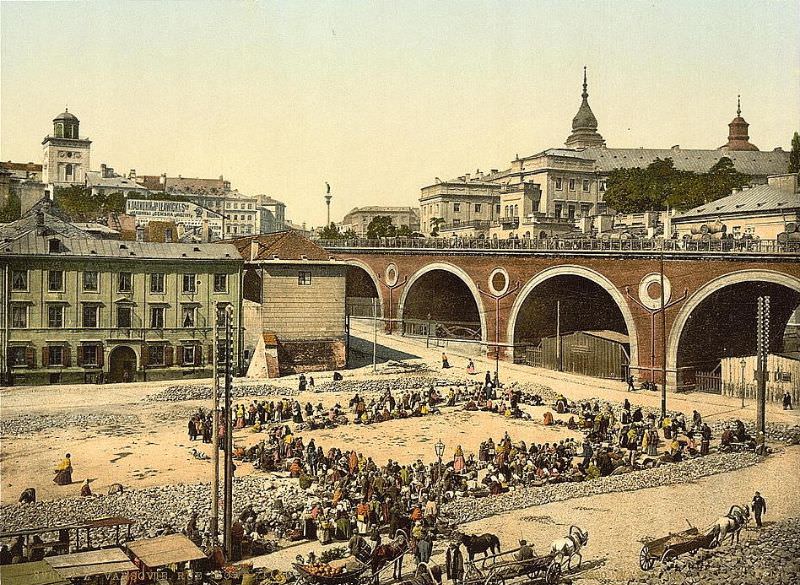
Nowy Zjazd Street ran along the escarpment connecting the upper city to the lower riverbank district of Powiśle. It was one of the key arteries linking Warsaw’s elevated Old Town area with the Vistula River below. The road cut through a steep slope, and the photochrome print shows the dramatic change in elevation that defined this part of the city.
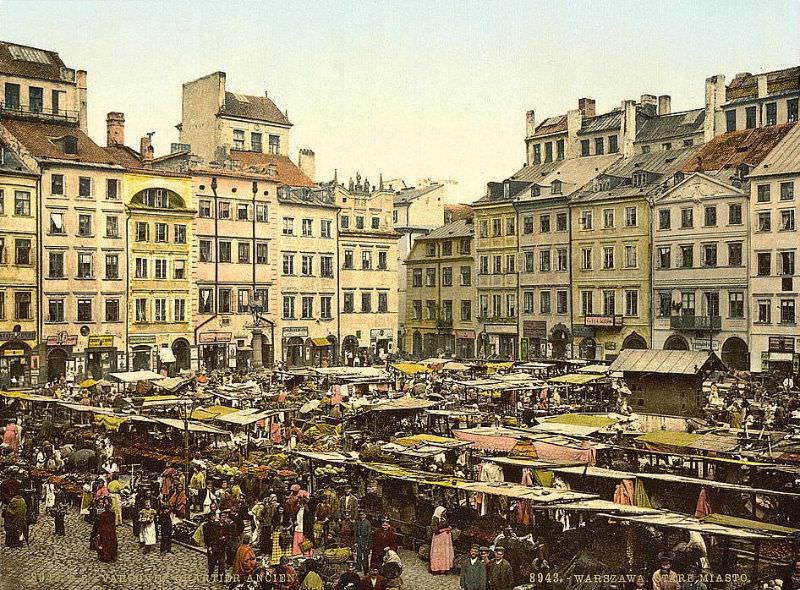
Warsaw’s Old Town was the original core of the city, dating back to the 13th and 14th centuries. By the late 19th century, it retained much of its medieval street layout and older architecture, sitting in contrast to the newer, grander boulevards being constructed elsewhere in the city. The narrow streets and dense buildings of the Old Town had housed generations of Warsaw residents and remained a busy, lived-in part of the city.
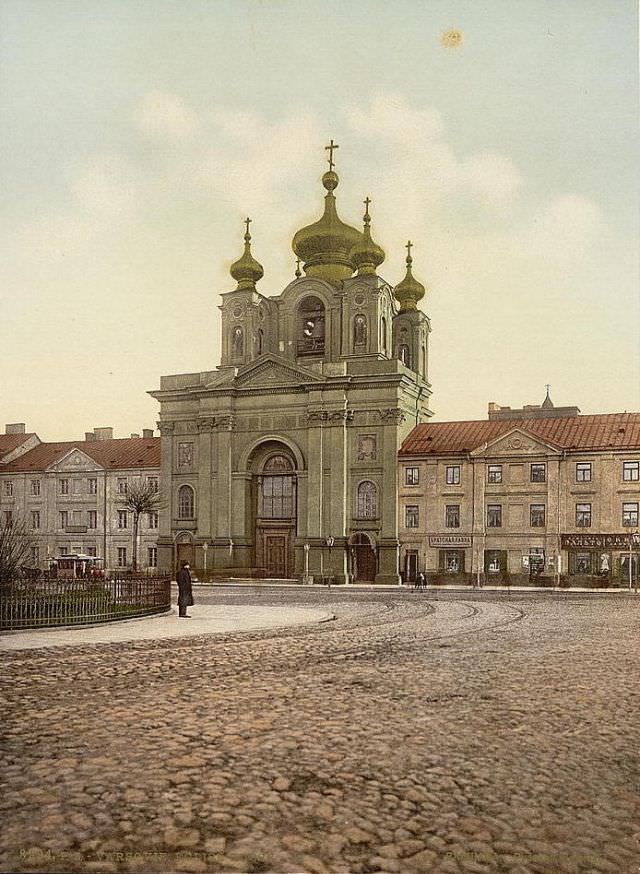
Warsaw’s status as part of the Russian Empire was written into its religious landscape. The Russian Orthodox church seen in these prints was one of several built by the imperial administration to serve the Russian military and civilian population stationed in the city. These structures stood as visible markers of Russian authority in a predominantly Catholic city.
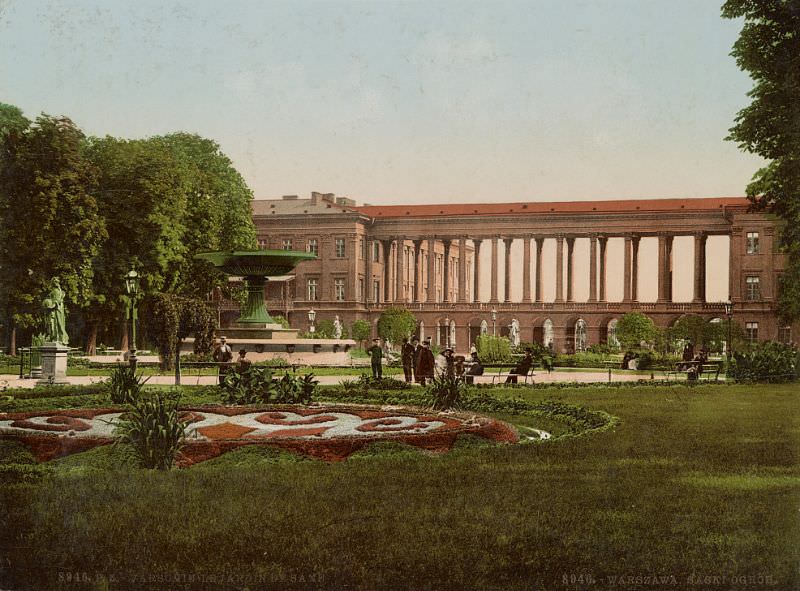
The Saxon Garden was Warsaw’s oldest public park, opened to the public in 1727. By the late 19th century, it was a well-established gathering place for city residents, featuring formal garden layouts, fountains, and tree-lined walkways. It sat adjacent to the Saxon Palace, which had served as a royal residence in earlier centuries.
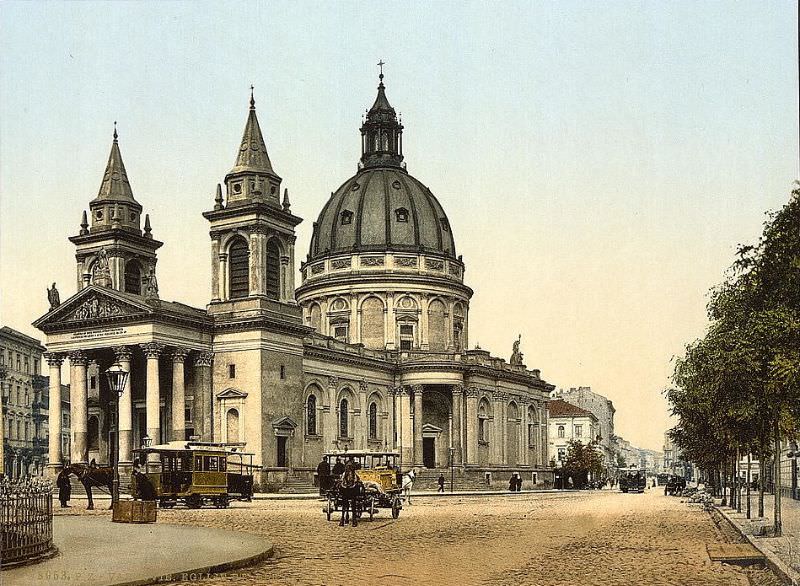
St. Alexander’s Church stood at Three Crosses Square, one of Warsaw’s key intersections. The neoclassical church, modeled loosely on the Pantheon in Rome, was built in the early 19th century and expanded later in the century to accommodate a growing congregation. The square it anchored was a central node in the city’s road network.
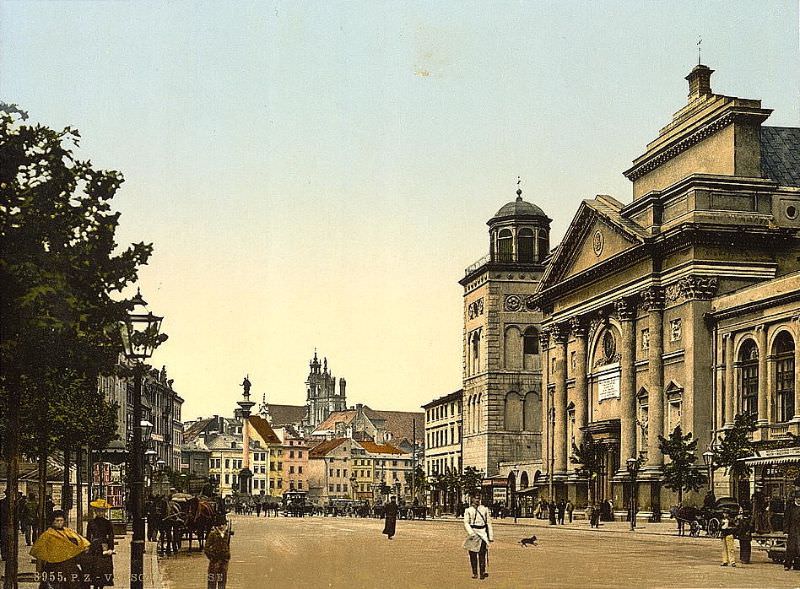
St. Anna’s Church, located near the Royal Castle at the edge of the Old Town, was one of Warsaw’s oldest and most prominent Catholic churches. Its baroque facade faced the main route leading down to the river, making it a landmark visible to anyone entering or leaving the historic city center. The church had been rebuilt and expanded several times over its history and remained an active parish throughout the 19th century.
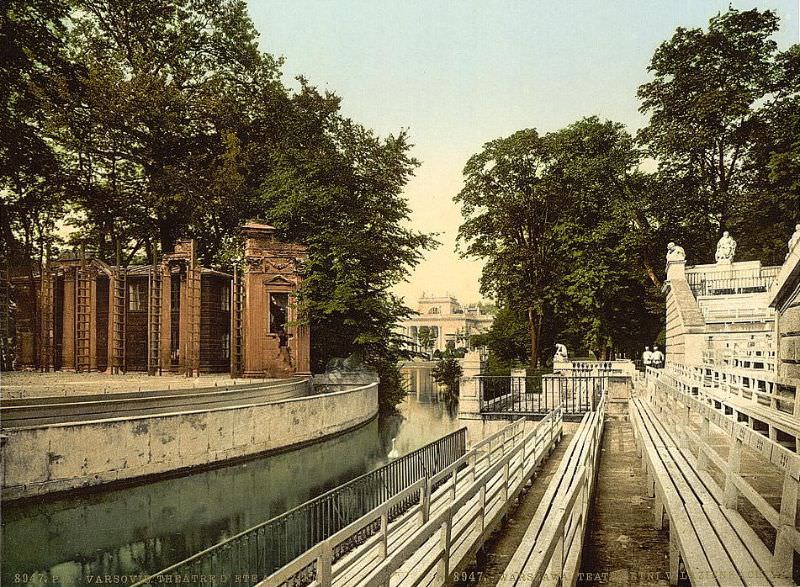
Within Łazienki Park sat the Summer Theatre, an open-air amphitheater built on an island in the park’s lake. The stage stood on one bank while the audience sat on the opposite side, separated by water. It was modeled on ancient Roman theaters and used for performances during the warmer months, making it one of the most unusual and visually striking performance venues in the city.
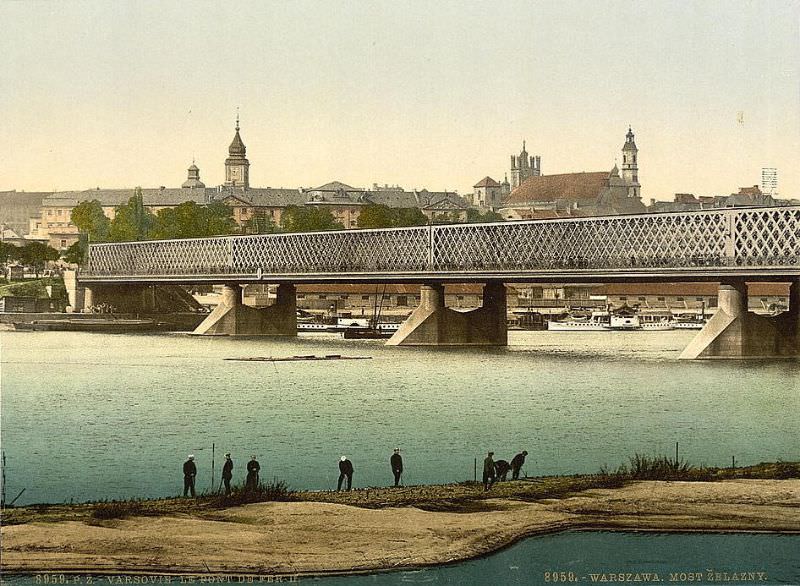
The Iron Bridge, also known as the Kierbedź Bridge, was Warsaw’s first permanent bridge across the Vistula River. Completed in 1864, it was an engineering achievement for its time, constructed from cast iron and spanning the wide river that divided Warsaw proper from the Praga district on the eastern bank. Before its construction, crossings depended on pontoon bridges that were dismantled each winter when the river froze.
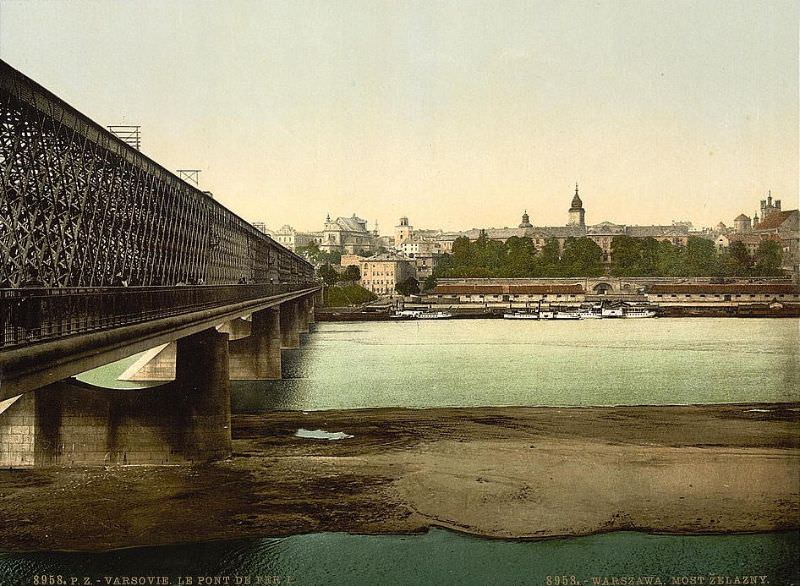
A second photochrome view of the Iron Bridge captures the structure from a different angle, showing the full length of its iron spans and the busy river traffic below. The Vistula was a working river, used for transporting goods, timber, and people, and the bridge sat at the center of that activity.
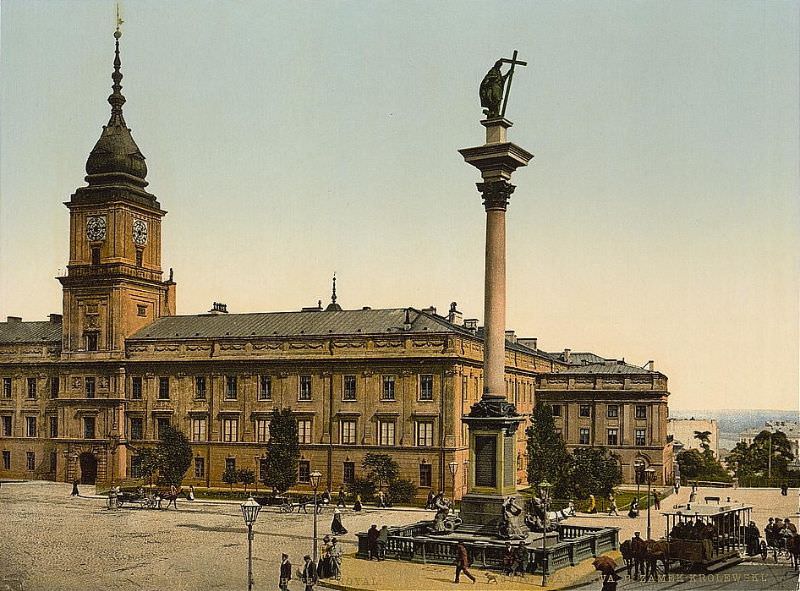
The Royal Castle had served as the official residence of Polish kings and the seat of the Polish parliament for centuries. By the late 19th century, with Poland fully under Russian rule, the castle was no longer a royal seat but remained one of the most architecturally significant buildings in the city. Its red brick exterior and position overlooking the Vistula made it the visual anchor of Warsaw’s Old Town.
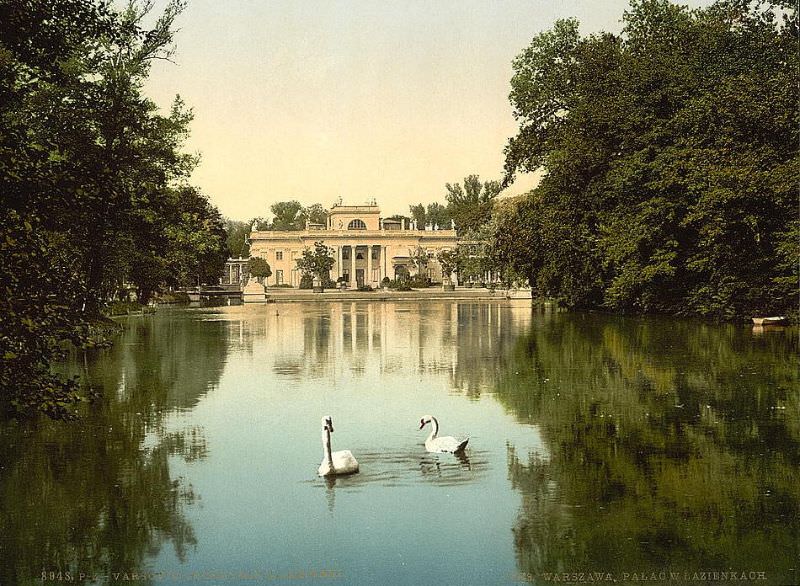
The Palace on the Isle in Łazienki Park was the former summer residence of Stanisław August Poniatowski, the last King of Poland. Set on a small island in an artificial lake, the neoclassical palace was surrounded by water on all sides, giving it an appearance unlike any other building in the city. By the late 19th century it was one of the most visited sites in Warsaw.
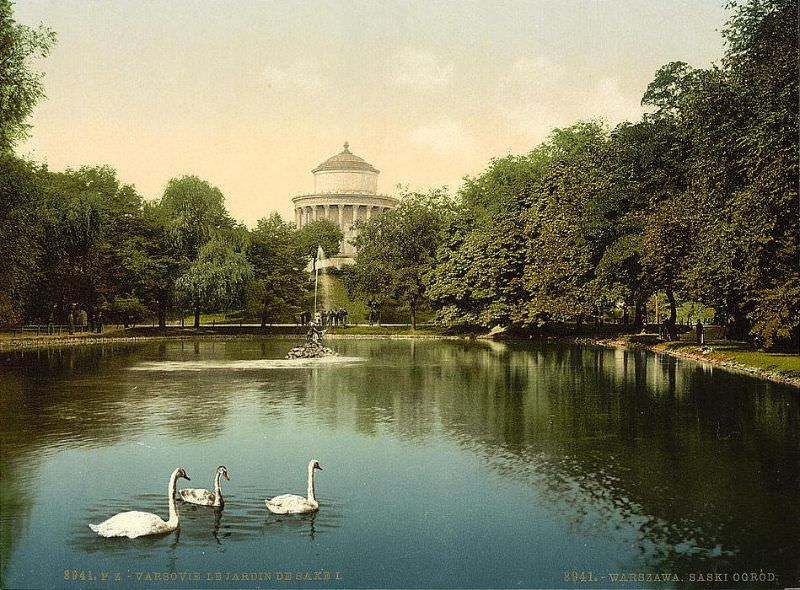
This second view of the Saxon Garden shows a different section of the park, with its characteristic formal planting and wide pedestrian paths. The garden was a place where Warsaw’s residents of all classes came to walk and socialize, one of the few true public spaces in the city during an era when most green areas were attached to private estates or restricted to certain residents.
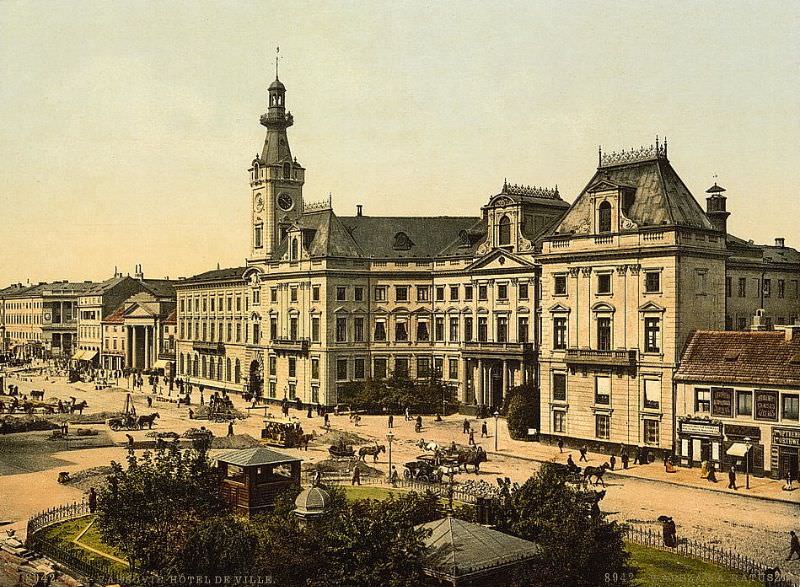
Warsaw’s Town Hall was the administrative center of city government. The building handled the day-to-day governance of a rapidly expanding urban population, managing everything from public works contracts under Mayor Starynkiewicz to civil registration records for a city whose population was growing by tens of thousands each decade.
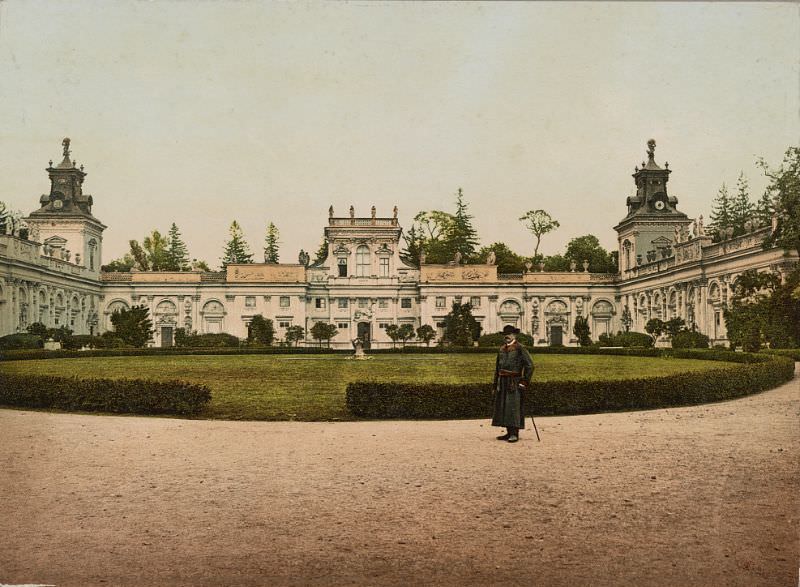
Wilanów Palace, located south of central Warsaw, was built as a royal summer residence for King John III Sobieski in the late 17th century. It was one of the finest examples of baroque architecture in Poland, set within extensive formal gardens. By the late 19th century it functioned as a museum and was one of the destinations Varsovians visited on excursions out of the city.
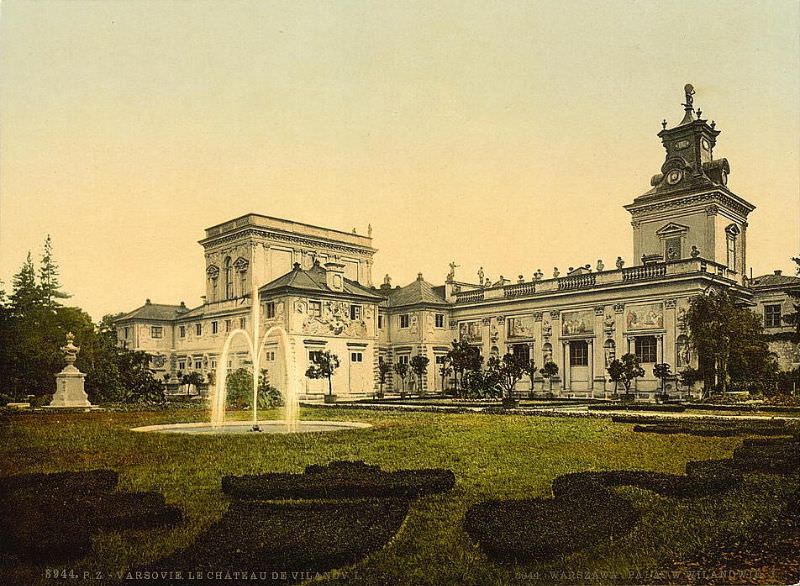
This second photochrome view of Wilanów Palace captures the building’s ornate facade and surrounding grounds in detail. The palace’s yellow and white exterior, adorned with sculptures and decorative friezes, presented a striking contrast to the industrial skyline that was beginning to define other parts of Warsaw by this period. Together, these 22 photochrome prints offer a rare and vivid look at a city simultaneously rooted in centuries of royal history and charging headlong into the modern age.




