Hey There! Before You Go. 😧
Get the best vintage content straight into your inbox!

Don't worry, we don't spam

The Gathering Storm: Tiananmen Square in Photos Before the Tragic Crackdown of 1989

On April 15, 1989, former Communist Party General Secretary Hu Yaobang died of a heart attack. Hu had been a champion of political reform before being forced out of office in 1987. His death lit a fire. Within days, students in Beijing began gathering to mourn him — and then to demand the changes he had stood for. What started as candlelight vigils quickly became one of the most significant protest movements in modern Chinese history.

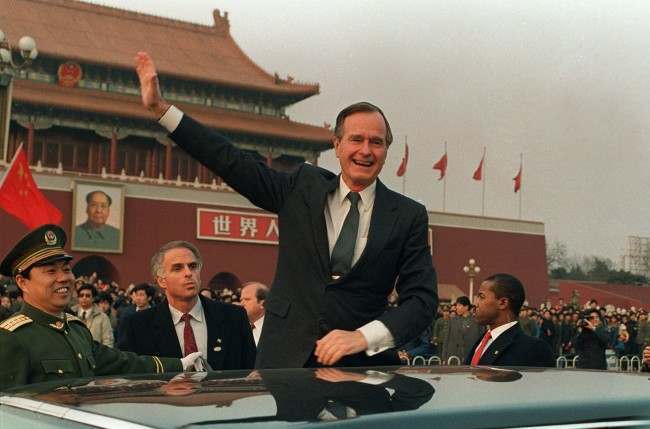
Just weeks before the protests erupted, U.S. President George H.W. Bush had visited Beijing. He waved to crowds from the roof of his car as he passed through Tiananmen Square, with the iconic portrait of Mao Zedong watching over the entrance to the Forbidden City behind him. At that moment, the square was calm. That would not last long.

President Bush stands on his car and waves in Tiananmen Square in Beijing during a visit to China in this Feb. 25, 1989 photo.

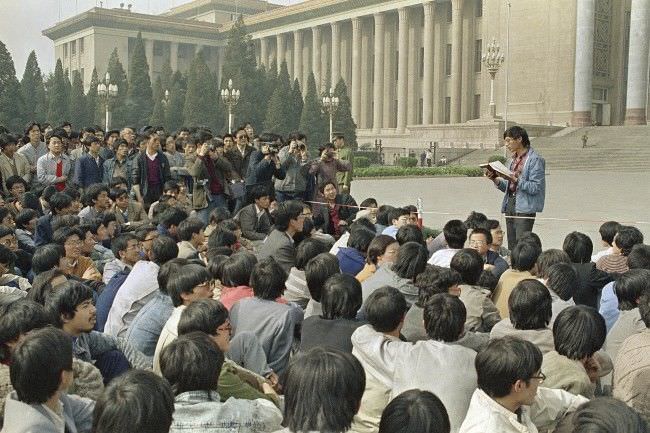
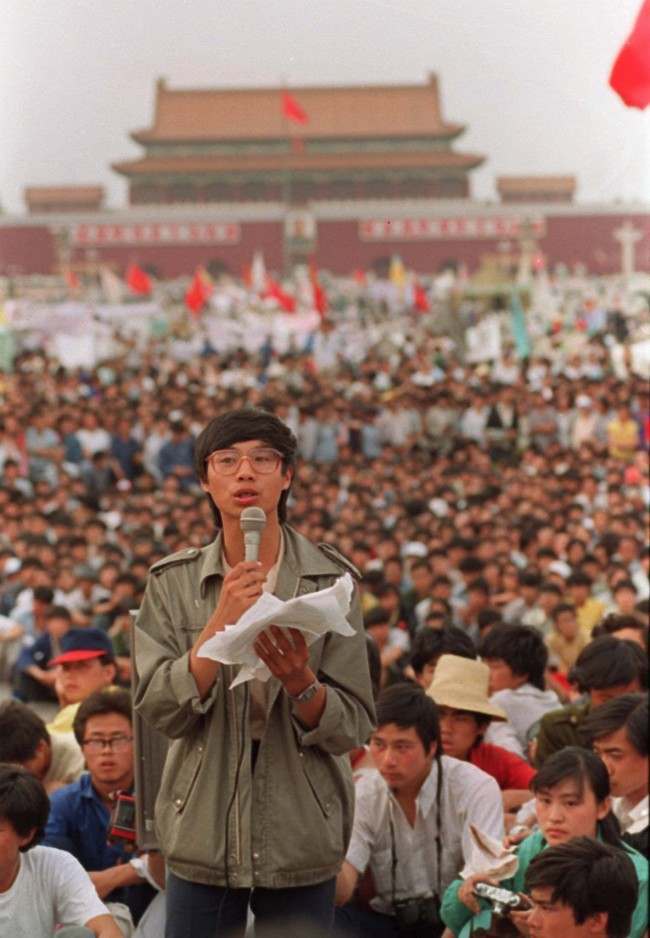
By April 18, students had moved from mourning to demanding. Crowds staged sit-ins in front of the Great Hall of the People, with student leaders reading aloud lists of political demands. They called for press freedom, dialogue with government officials, and an end to official corruption. The government refused to meet them.

In this April 18, 1989 file photo, a Chinese student leader reads a list of demands to students staging a sit-in in front of Beijing's Great Hall of the People.
In this April 18, 1989 file photo, a Chinese student leader reads a list of demands to students staging a sit-in in front of Beijing’s Great Hall of the People.

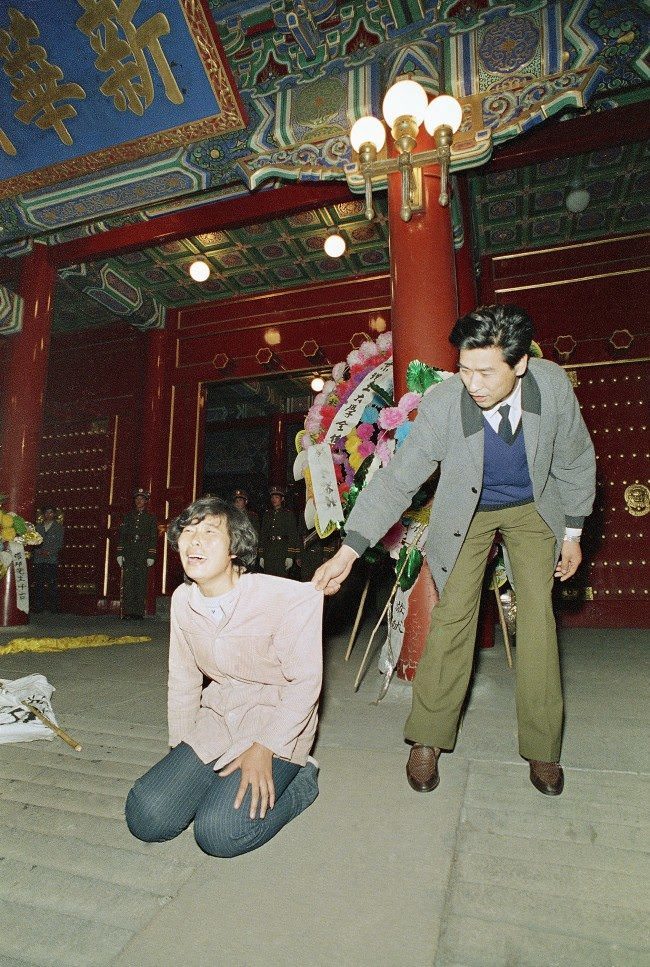
The night of April 18 into April 19 saw the tension jump sharply. Students marched from Tiananmen Square to Zhongnanhai — the heavily guarded compound that serves as Communist Party headquarters. Some attempted to storm the gate and were pushed back by security forces. At the gate, a young woman was seen weeping as guards gently but firmly tried to move her away.

A Chinese security guard gently tries to move a weeping young woman away from the ornate entrance to the Chinese Communist Party headquarters, Zhongnanhai, early on Wednesday, April 19, 1989 in Beijing. University students converged on Zhongnanhai after demonstrating in Tiananmen Square all day on Tuesday. The students tried to storm the gate, but were fought back by Chinese security.
A student leader tries in vain to settle down a crowd of Beijing University students who converged on the Chinese Communist Party headquarters at Zhongnanhai early on Wednesday, April 19, 1989 in Beijing after demonstrating in Tiananmen Square all day on Tuesday. The students later tried to storm the gate, but were fought by Chinese security.

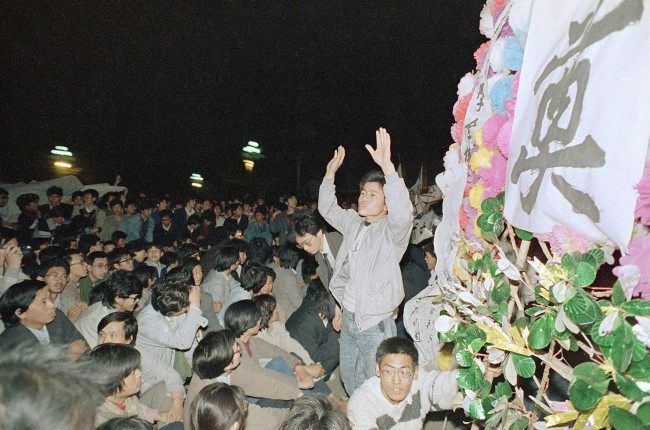
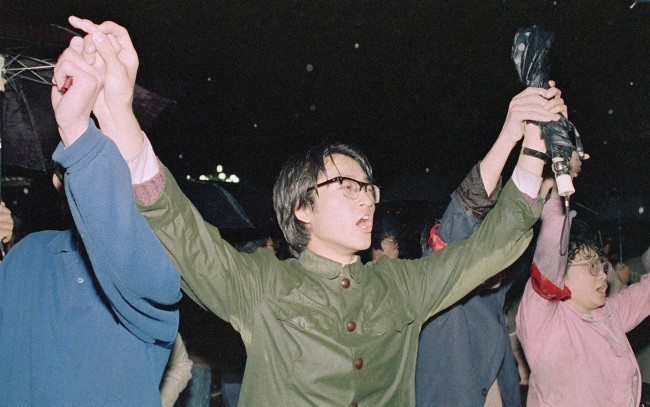
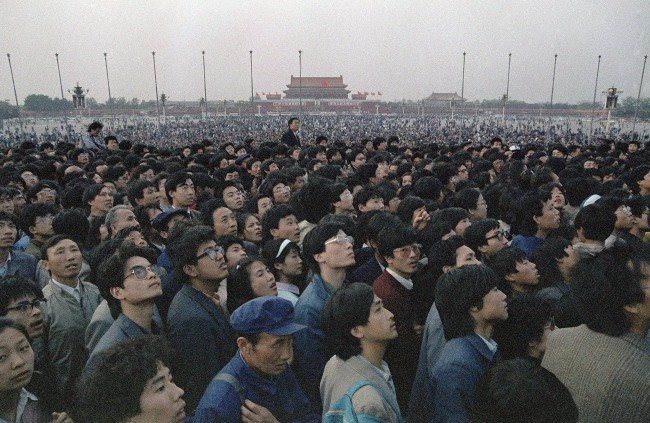
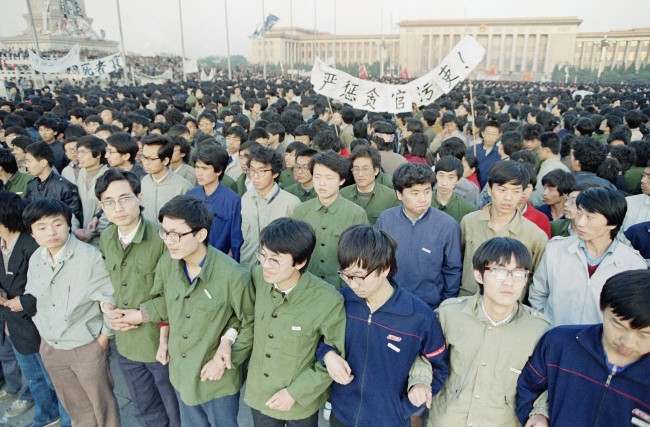
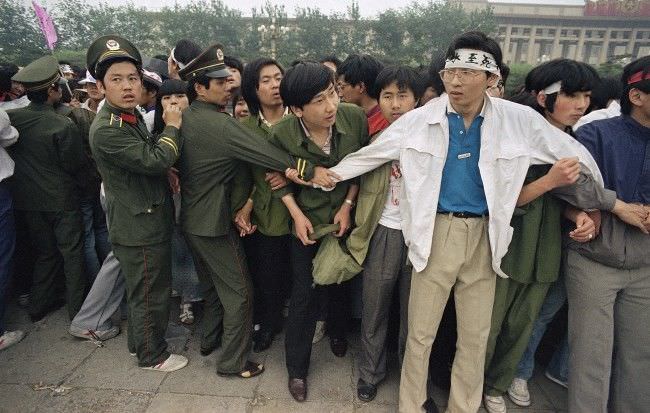
As April 21 arrived, the square filled to a level that stunned observers. Tens of thousands of students and ordinary citizens packed around the Monument to the People’s Heroes. The following morning, students who had stayed overnight linked arms at dawn, defying government warnings against demonstrations. They were there to be present for Hu Yaobang’s state funeral, held inside the Great Hall of the People on April 22.

University students hold hands as they sing the Chinese National Anthem during a protest, April 21, 1989 in Beijing's Tiananmen Square.
University students hold hands as they sing the Chinese National Anthem during a protest, April 21, 1989 in Beijing’s Tiananmen Square.
Tens of thousands of students and citizens crowd at the Martyr's Monument at Beijing's Tiananmen Square, April 21, 1989.
Tens of thousands of students and citizens crowd at the Martyr’s Monument at Beijing’s Tiananmen Square, April 21, 1989.
Chinese students link arms in solidarity at dawn on Saturday, April 22, 1989 in Beijing's Tiananmen Square after spending the night there in order to be on hand for memorial services for the late purged party chief Hu Yaobang.
Chinese students link arms in solidarity at dawn on Saturday, April 22, 1989 in Beijing’s Tiananmen Square after spending the night there in order to be on hand for memorial services for the late purged party chief Hu Yaobang.

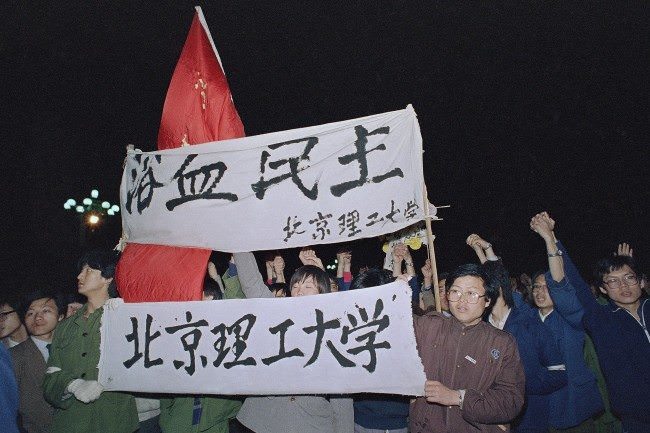
Students marching into the square on April 22 carried banners with blunt, striking messages. One banner from Beijing University of Engineering read “Democracy, Bathed in Blood” — a phrase that, in hindsight, carried an awful weight. After the funeral, the protests did not wind down. They intensified.

Students from Beijing University of Engineering carry a banner, top, reading 'Democracy, Bathed in Blood,' as they march into Beijing's Tiananmen Square to join tens of thousands of other students early on Saturday, April 22, 1989. The students plan to spend the night in the square and wait for the funeral of Hu Yaobang later in the day.
Students from Beijing University of Engineering carry a banner, top, reading ‘Democracy, Bathed in Blood,’ as they march into Beijing’s Tiananmen Square to join tens of thousands of other students early on Saturday, April 22, 1989. The students plan to spend the night in the square and wait for the funeral of Hu Yaobang later in the day.

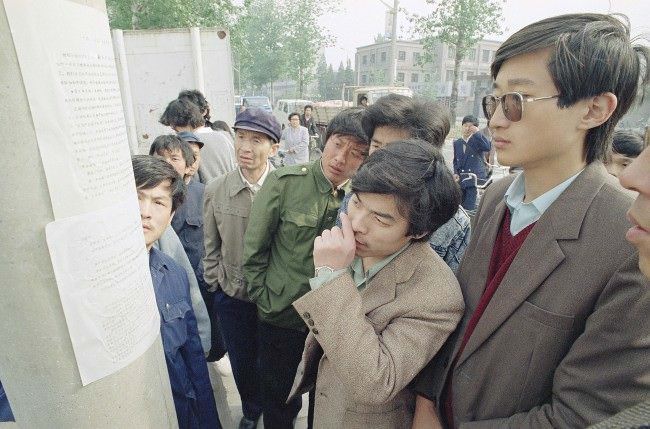
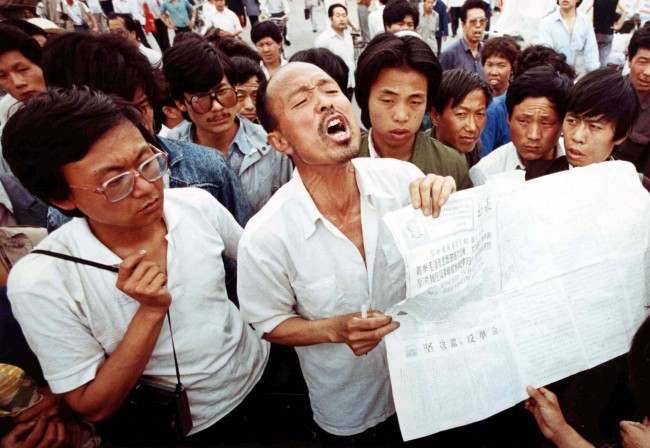
By late April, students were running their own printing operations and posting news sheets on street poles near university campuses. Residents stopped to read them, hungry for information that official state media was suppressing. On April 26, the Communist Party’s official newspaper, the People’s Daily, published an editorial calling the protests “turmoil” and a threat to stability. Rather than scattering the students, the editorial drove them back into the streets.

Beijing residents read a copy of a newspaper printed by students and placed on a streetlight pole near the Beijing University campus describing the student demonstrations on Friday and Saturday at Tiananmen Square, April 24, 1989.
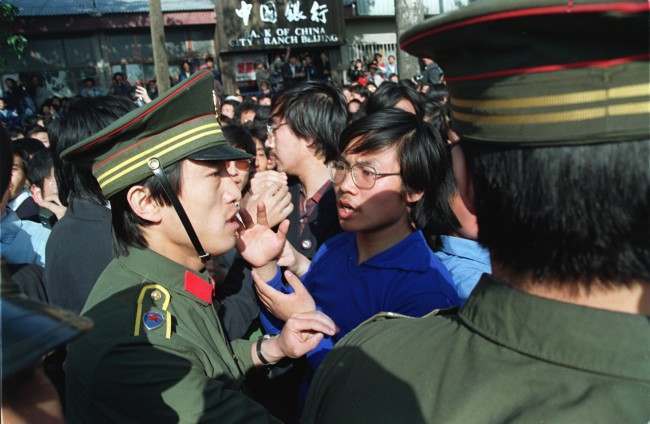
A Beijing University student leader argues with a policeman about the students' right to march as they are told not to march when emerging from their campus. Students from more than forty universities march to Tiananmen Square in protest of the April 26 editorial in the Communist Party newspaper despite warnings of violent suppression.
A Beijing University student leader argues with a policeman about the students’ right to march as they are told not to march when emerging from their campus. Students from more than forty universities march to Tiananmen Square in protest of the April 26 editorial in the Communist Party newspaper despite warnings of violent suppression.

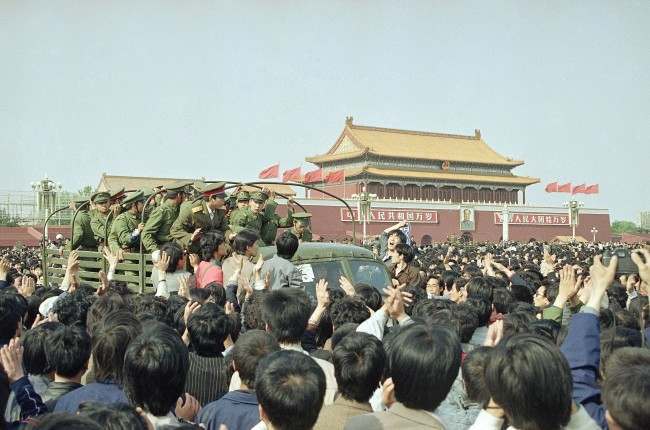
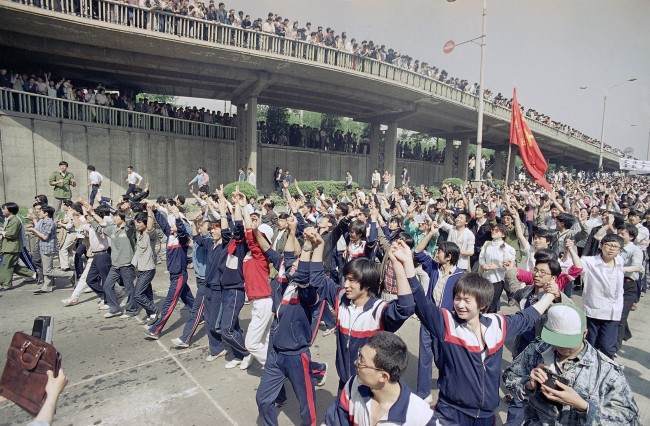
On April 27, students from dozens of Beijing universities marched toward Tiananmen Square in direct defiance of the government ban. Police tried to hold them back, but the marchers pushed through blockade after blockade. When they reached the square, some jubilant protesters surrounded and stopped army trucks. The mood was triumphant. Students believed they had won a battle.

Chinese marchers are jubilant as they surround and stop an army truck at Tiananmen Square, April 27, 1989 in Beijing.
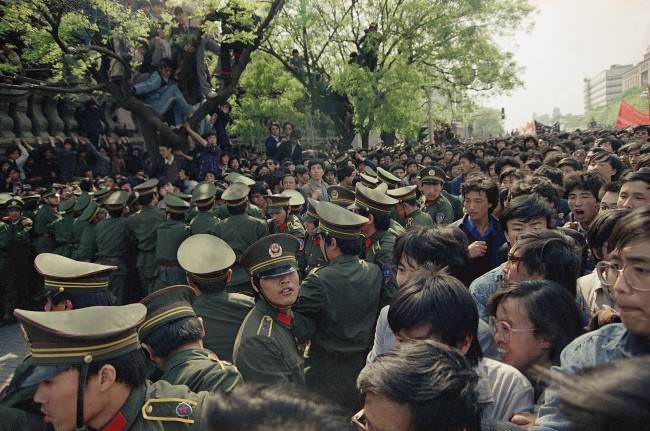
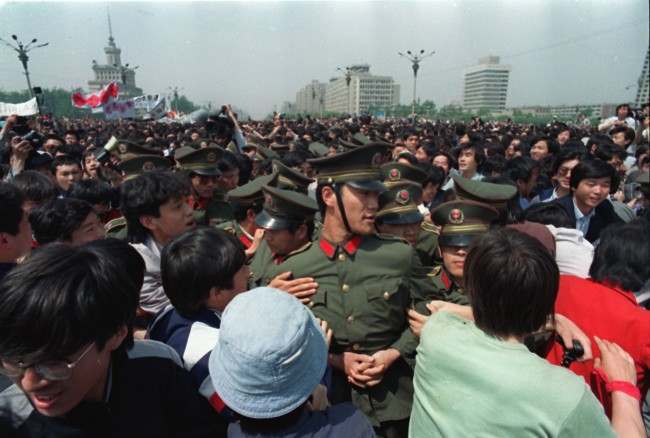
Students demonstrators scuffle with police as they try to break the guard line to march to the Tiananmen Square on Thursday, April 27, 1989 in Beijing.
Chinese police try in vain to convince students from Beijing University not to march as they emerged from their campus on Thursday, April 27, 1989 in Beijing.
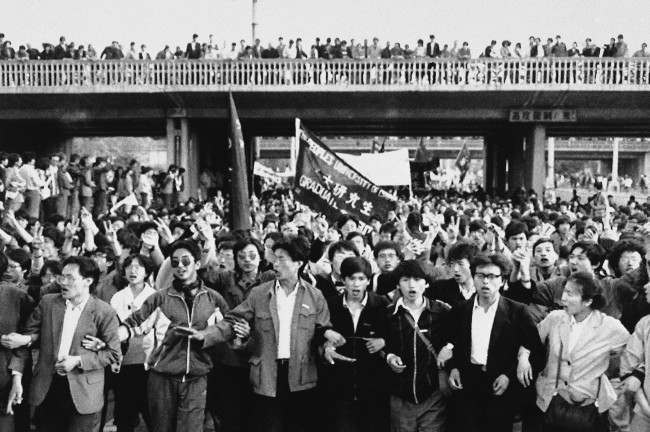
Jubilant student marchers, arms lined, pass under a bridge lined with local supporters, Thursday, April 27, 1989, Beijing, China. Students in the ten of thousands from several Beijing schools demonstrated in defiance of a government ban.
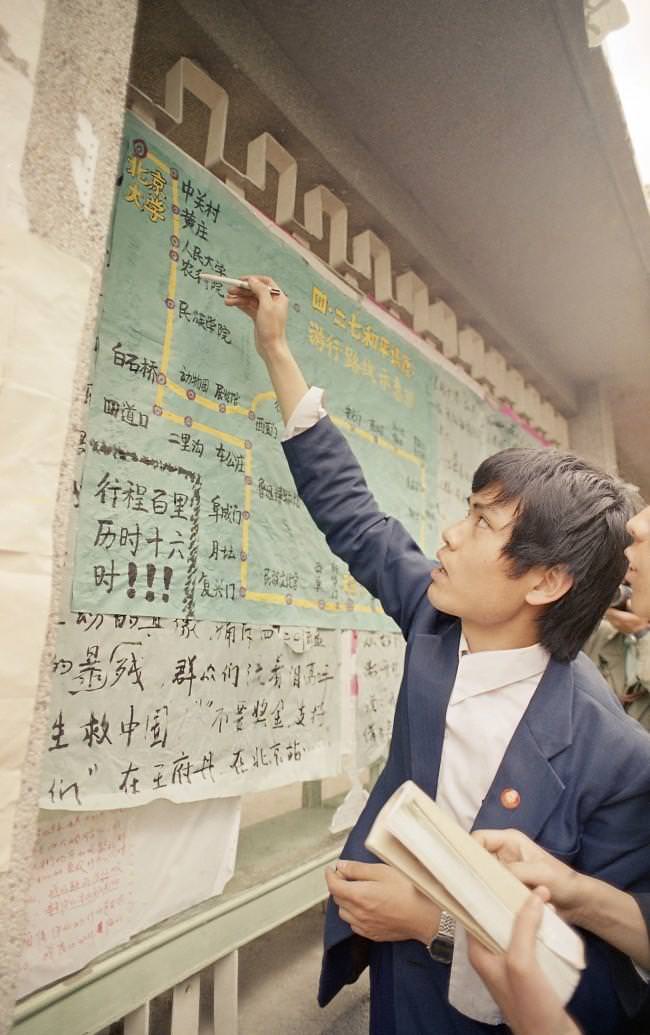
A student at Beijing University points to a map of the march route on a poster up on campus as he recounts a tale of how marchers pushed through police lines on their way to Tiananmen Square, April 28, 1989.

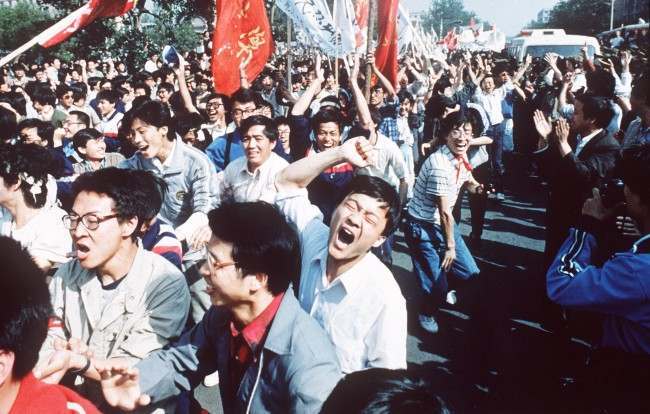
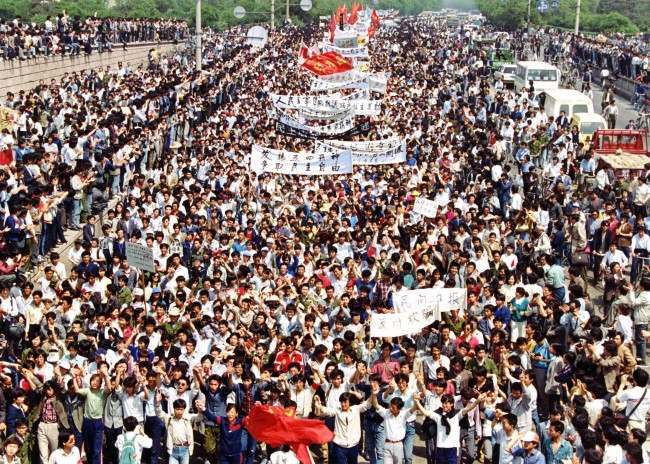
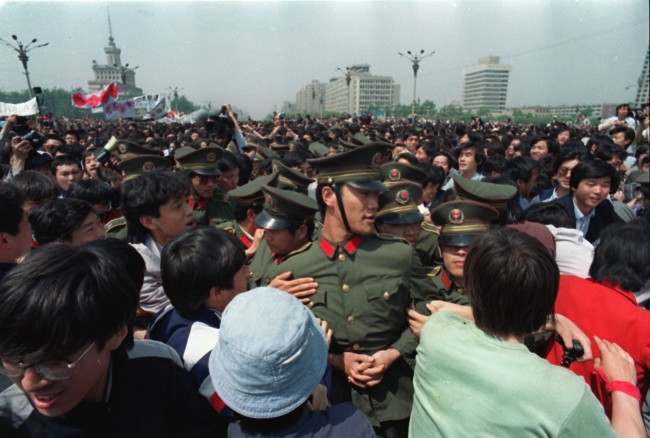
May 4 marked the 70th anniversary of China’s original May Fourth Movement of 1919 — a historic wave of student nationalism. The 1989 students were keenly aware of the symbolism. On that date, approximately 100,000 students and workers marched toward Tiananmen Square. Police were overwhelmed. Students shouted slogans as they broke through police lines, while crowds of ordinary Beijing residents cheered from the sides of the road.

Chinese students shout after breaking through a police blockade during a pro-democracy march to Tiananmen Square, Bejing, May 4 1989.
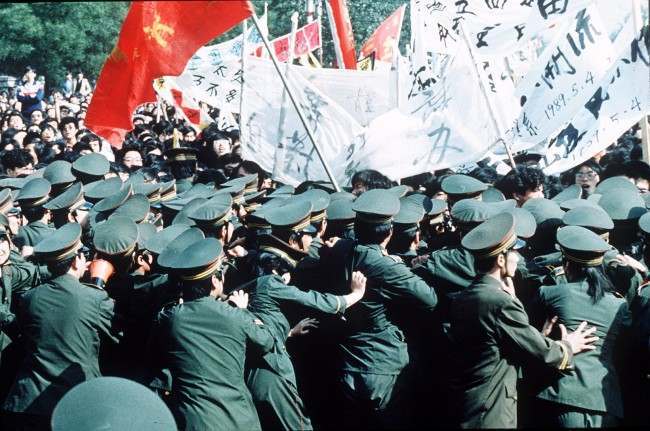
Chinese police try in vain to contain a huge crowd of student marchers during a pro-reform demonstration in Beijing, China, May 4 1989.
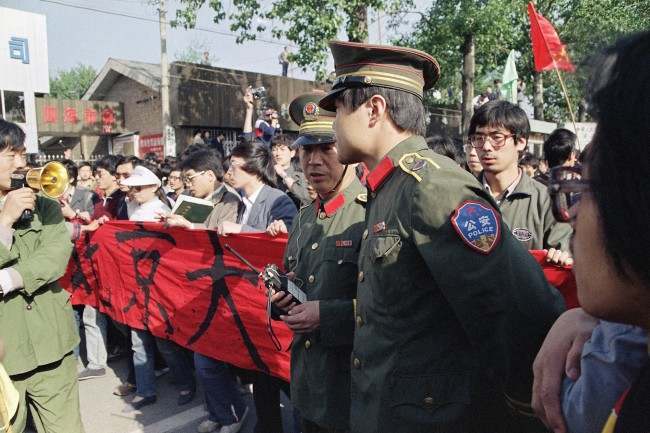
Calling for freedom and democracy, demonstrating students surround policemen near Tiananmen Square in Beijing, China, Thursday afternoon on May 4, 1989. Approximately 100,000 students and workers marched toward the square demanding democratic reforms.
More than seven thousand students from local colleges and universities march to Tiananmen Square, Beijing, May 4, 1989, to demonstrate for government reform.
Students of Teachers University raise their hands to appeal to supporting citizens near Tiananmen Square, Thursday, May 4, 1989 in Beijing.

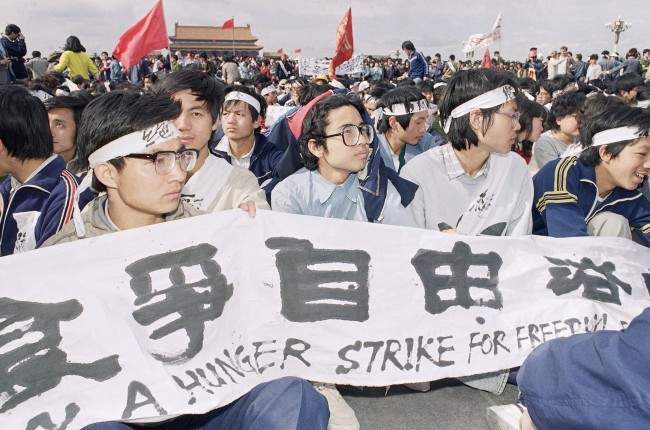
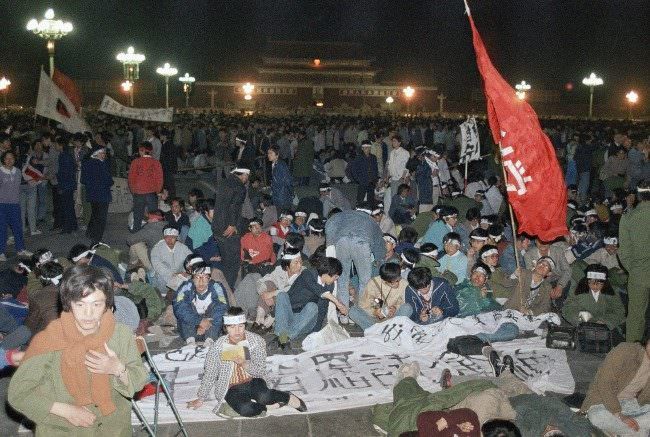
On May 13, students escalated with a hunger strike. Thousands sat in the square, refusing to eat until the government agreed to meaningful dialogue. The hunger strikers vowed to remain until Soviet leader Mikhail Gorbachev arrived in Beijing for a historic state visit on May 15 — the first Sino-Soviet summit in thirty years. The timing was deliberate. Students knew the world’s press would be watching.

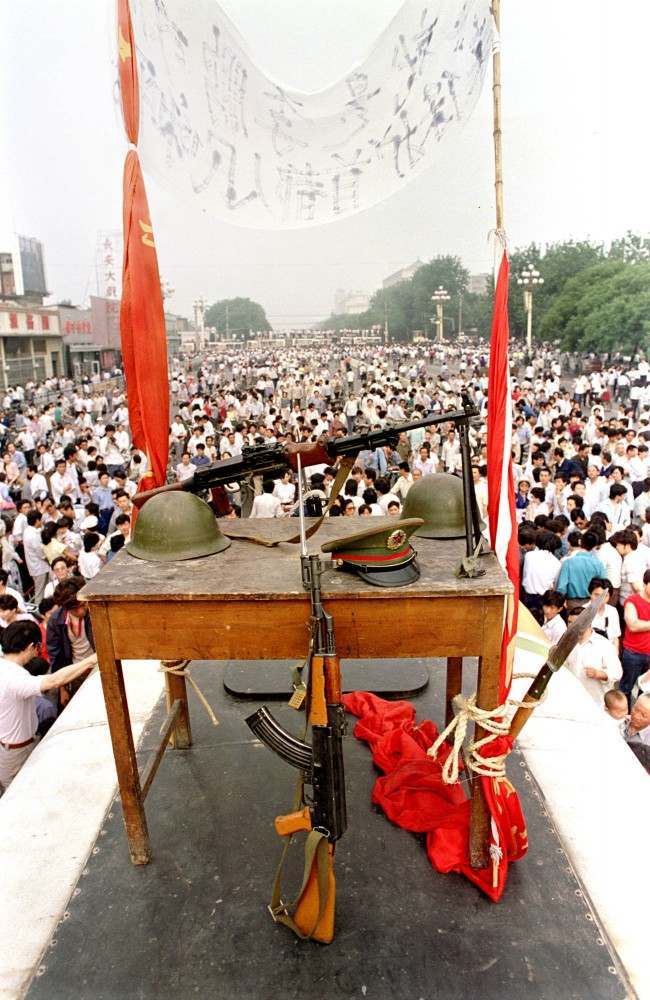
Chinese military items, including rifles, helmets, and a hat, are displayed during the pro-democracy demonstration that lasted from mid-April to early June 1989 on Beijing's Tiananmen Square. The demonstration ended with a government crackdown on June 4, 1989, leaving hundreds dead.
Chinese military items, including rifles, helmets, and a hat, are displayed during the pro-democracy demonstration that lasted from mid-April to early June 1989 on Beijing’s Tiananmen Square. The demonstration ended with a government crackdown on June 4, 1989, leaving hundreds dead.
Calling for freedom and democracy, demonstrating students surround policemen near Tiananmen Square in Beijing, China, Thursday afternoon on May 4, 1989. Approximately 100,000 students and workers marched toward the square demanding democratic reforms.
University students sit in Tiananmen Square on Saturday, May 13, 1989 in Beijing on a hunger strike for freedom and democracy. The students vow to sit until the arrival of Soviet leader Mikhail Gorbachev on Monday.
About 3,500 university students from more then a dozen school demand democracy and freedom keep on hunger strike at night, Saturday, May 14, 1989 in Beijing at Tiananmen Square.
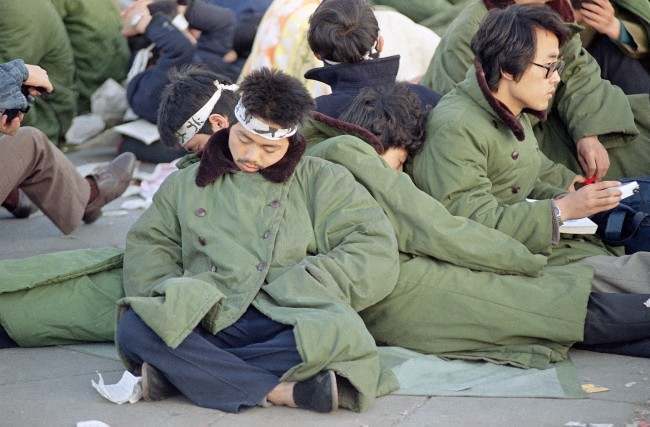
Student protesters in Beijing's Tiananmen Square sleep leaning on one another at sunrise, Sunday, May 14, 1989 in Beijing. The protesters, some of them on a hunger strike, plan to remain in the square for the official welcoming ceremony for Soviet leader Mikhail Gorbachev on Monday.
Student protesters in Beijing’s Tiananmen Square sleep leaning on one another at sunrise, Sunday, May 14, 1989 in Beijing. The protesters, some of them on a hunger strike, plan to remain in the square for the official welcoming ceremony for Soviet leader Mikhail Gorbachev on Monday.

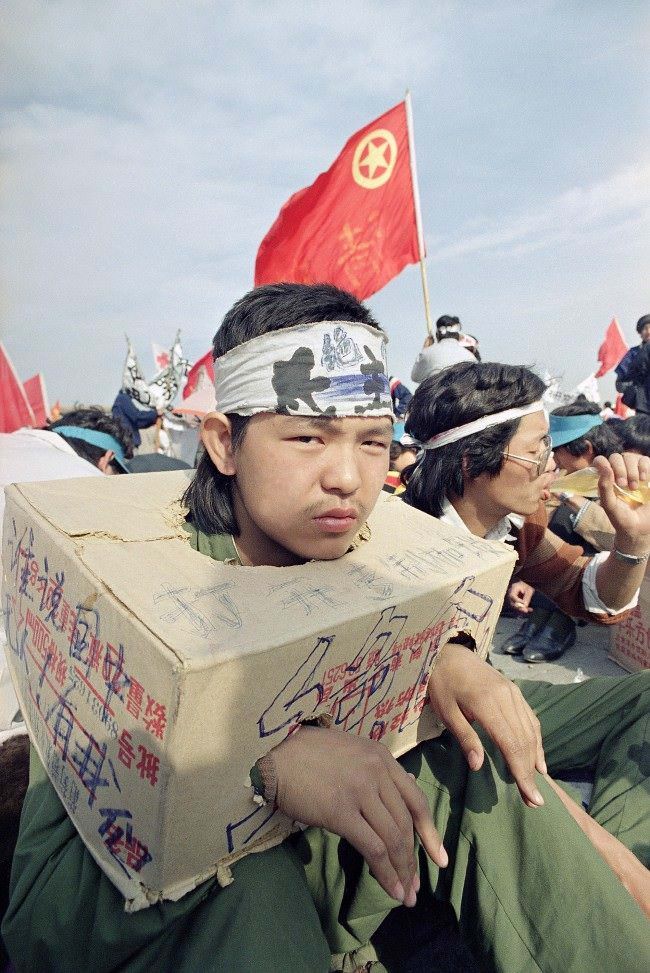
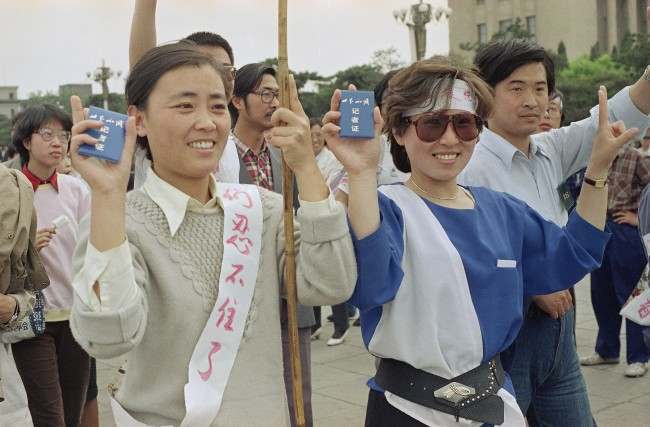
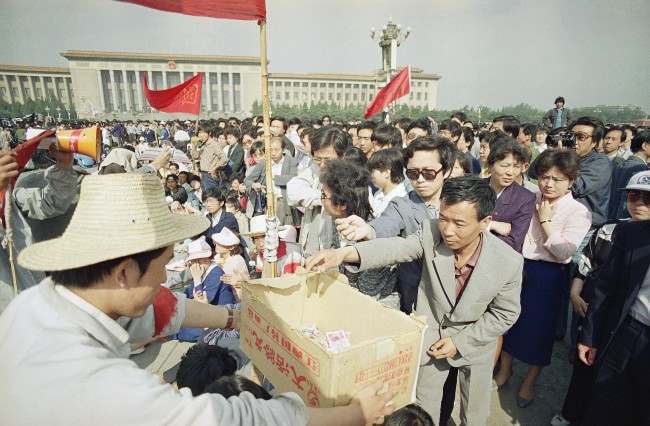
By May 16, the hunger strike was in its fourth day. Some students symbolically bound themselves in cardboard boxes to show they were unable to eat. Central China Television employees showed up in the square that night, flashing their press credentials as they joined the protesters — a sign that even state media workers were breaking with the official line. Passersby handed money through fences to help sustain the strikers.

A Beijing university student sits bound in a cardboard box as the strike for democracy continues for the third day in Beijing's Tiananmen Square, Tuesday, May 16, 1989. The box indicates he cannot use his hands so he cannot eat.
A Beijing university student sits bound in a cardboard box as the strike for democracy continues for the third day in Beijing’s Tiananmen Square, Tuesday, May 16, 1989. The box indicates he cannot use his hands so he cannot eat.
Employees of CCTV, Central China Television, flash their press cards as they join student strikers for democracy in Beijing's Tiananmen Square at night, Tuesday, May 16, 1989.
Employees of CCTV, Central China Television, flash their press cards as they join student strikers for democracy in Beijing’s Tiananmen Square at night, Tuesday, May 16, 1989.
A Beijing University student collects contributions to support the hunger strike from passers by in Beijing's Tiananmen Square, Tuesday, May 16, 1989. The strike is now is its fourth day.
A Beijing University student collects contributions to support the hunger strike from passers by in Beijing’s Tiananmen Square, Tuesday, May 16, 1989. The strike is now is its fourth day.

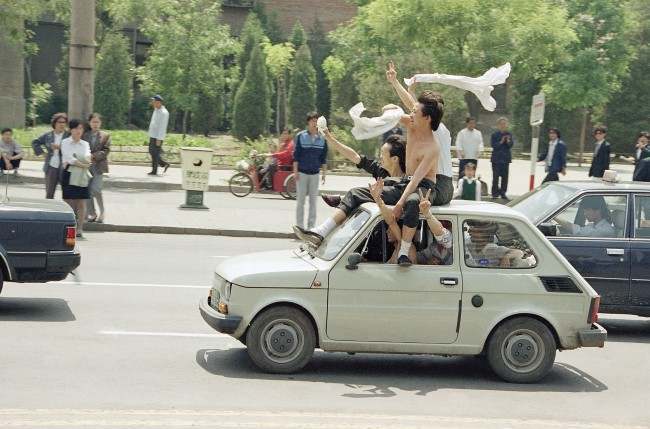
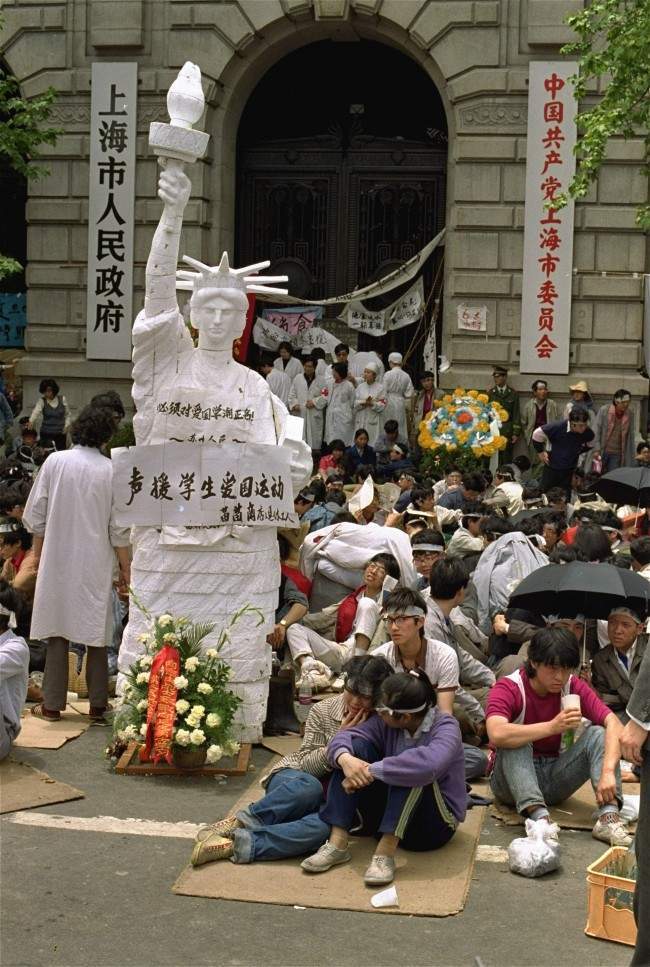
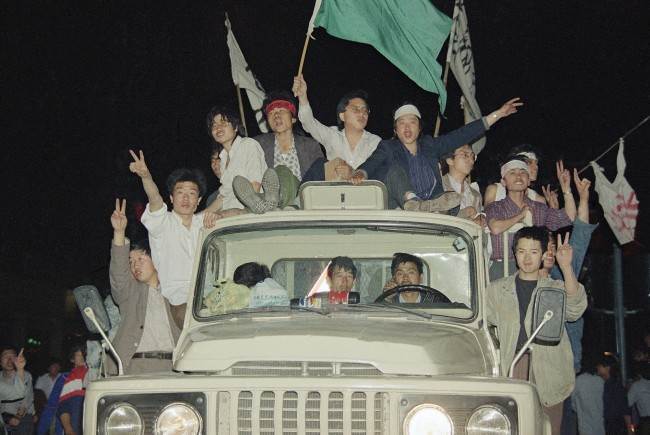
On May 17, up to a million people flooded the streets of Beijing in one of the largest demonstrations China had ever seen. Youth rode on car rooftops heading toward the square. Elsewhere in China, protests were spreading — in Shanghai, demonstrators raised an effigy of the Statue of Liberty in front of city government offices. The movement had grown far beyond the campuses.

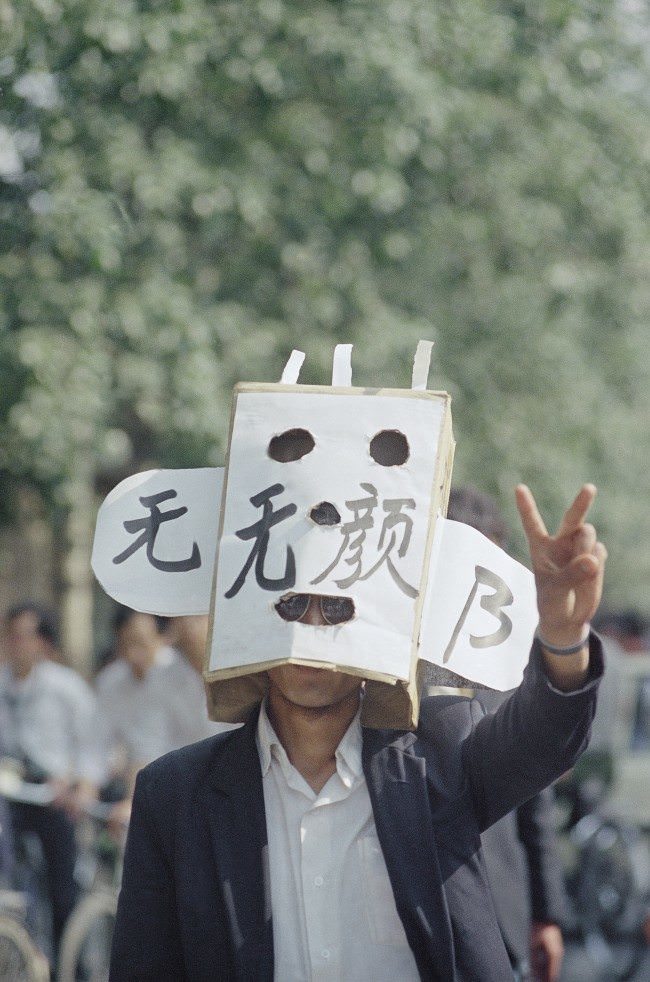
A student protestor flashes a victory sign during a demonstration in Tiananmen Square, Wednesday, May 17, 1989, Beijing, China.
Beijing youths ride atop a car as they parade to Tiananmen Square for a freedom rally, Wednesday, May 17, 1989 in Beijing.
An effigy of the Statue of Liberty stands in front of the Shanghai city government offices as demonstrators rally for democratic reform May 20, 1989.

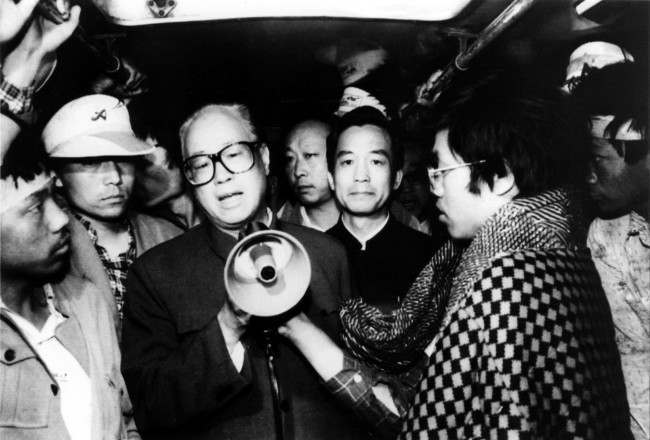
On May 18, police and students worked side by side to manage the enormous crowds pouring toward the square. The following day, Communist Party General Secretary Zhao Ziyang made a personal visit to the hunger strikers, speaking directly to them in an emotional appeal to end the strike. “We came too late,” he told them. It was his last public appearance. Zhao was removed from power shortly after and placed under house arrest, where he would remain until his death in 2005.

Students and police link area to keep crowd of people, many of the relatives of strikers, from Tiananmen Square, where students have been on hunger strike since Saturday, Thursday, May 18, 1989, Beijing, China.
A Beijing policeman encourages university students demonstrating for democratic reforms on Friday, May 19, 1989 in Beijing's Tiananmen Square.
A Beijing policeman encourages university students demonstrating for democratic reforms on Friday, May 19, 1989 in Beijing’s Tiananmen Square.
Communist Party General Secretary Zhao Ziyang speaks with fasting university students in Beijing's Tiananmen Square to urge them to call off their hunger strike. The strike is in its sixth day.
Communist Party General Secretary Zhao Ziyang speaks with fasting university students in Beijing’s Tiananmen Square to urge them to call off their hunger strike. The strike is in its sixth day.
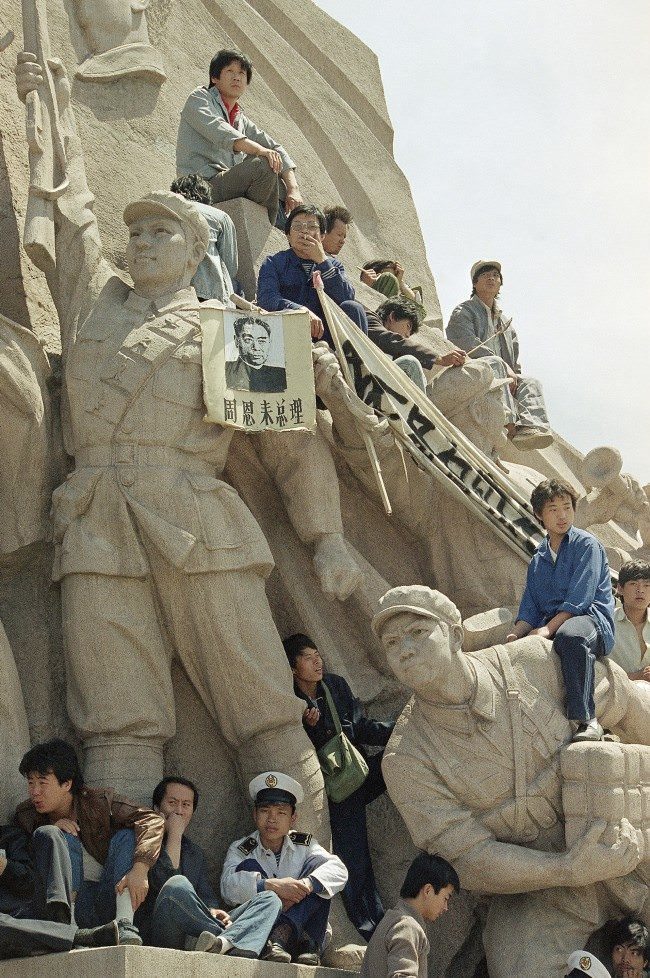
Beijing University students use a monument to the late chairman Mao Tse-Tung at his tomb in Tiananmen Square to press their case for democratic reforms in Beijing, Friday, May 19, 1989. The picture hanging on the statue is the late Premier Chou En-Lai.

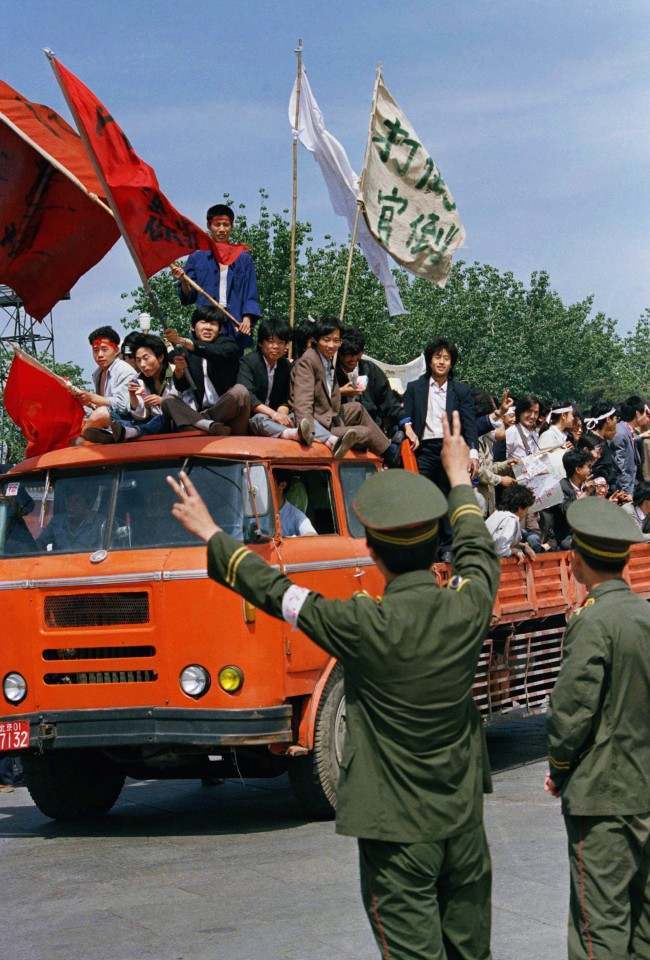
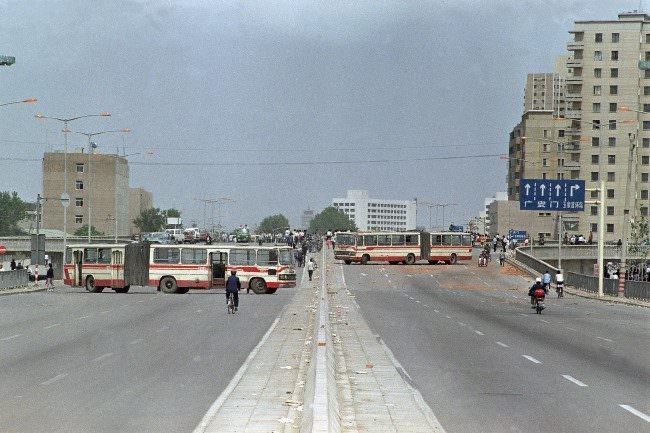
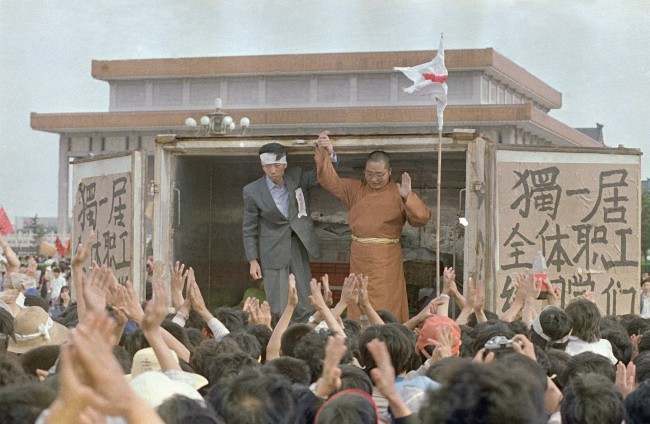
The government declared martial law on May 20. Troops began moving toward Beijing. Residents and students flooded into the streets to block them. On May 21, a massive convoy of People’s Liberation Army soldiers was stopped cold when protesters used a bus to barricade the road. Citizens surrounded the convoy. Meanwhile, back in the square, donations poured in — a restaurant owner and a Buddhist monk together contributed over $53,000 worth of food to the protesters.

Demonstrators showing victory signs head to Tiananmen Square, Saturday, May 20, 1989, Beijing, China.
A convey of soldiers from the Peoples' Liberation Army is completely engulfed by demonstrators who stopped the Tiananmen Square bound troops by blocking the road with the bus in the foreground, May 21, 1989, Beijing, China.
A convey of soldiers from the Peoples’ Liberation Army is completely engulfed by demonstrators who stopped the Tiananmen Square bound troops by blocking the road with the bus in the foreground, May 21, 1989, Beijing, China.
Li Nan, left, of Du Yiju Restaurant, and Yuan Chi, a monk with the China Buddhist Association, receive cheers from students in Tiananmen Square, Sunday, May 21, 1989, Beijing, China. They have donated over $53,000 worth of food to the protestors in the square.

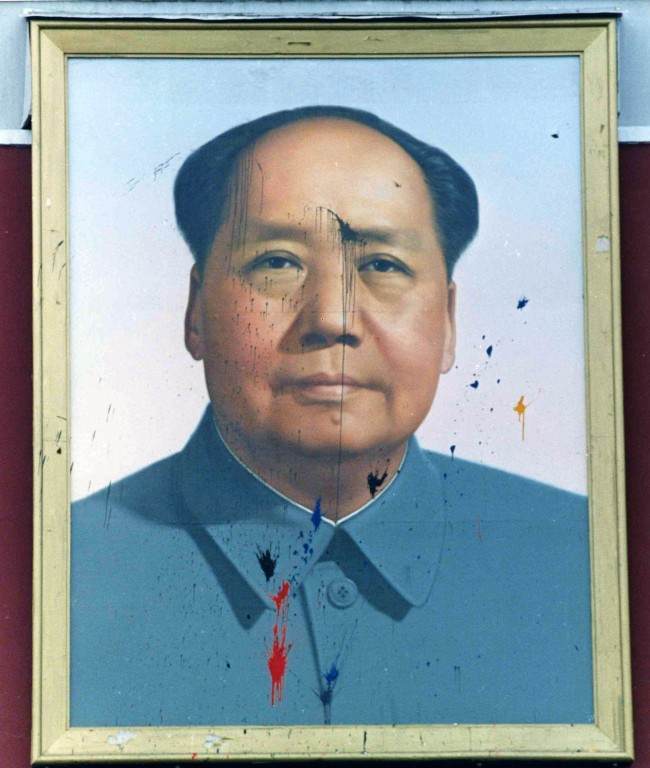
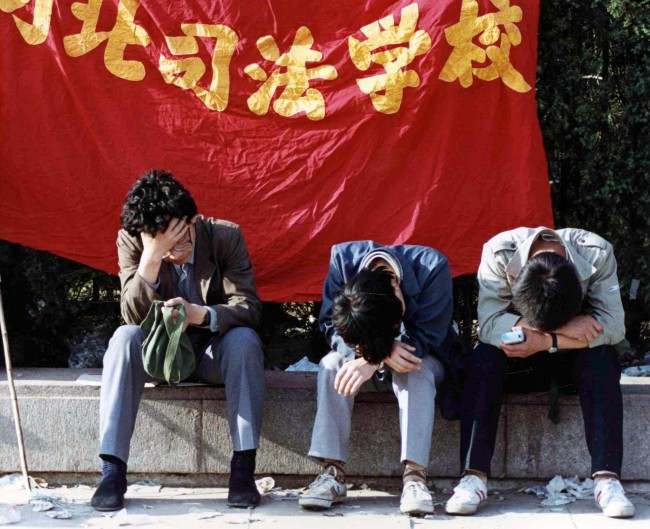
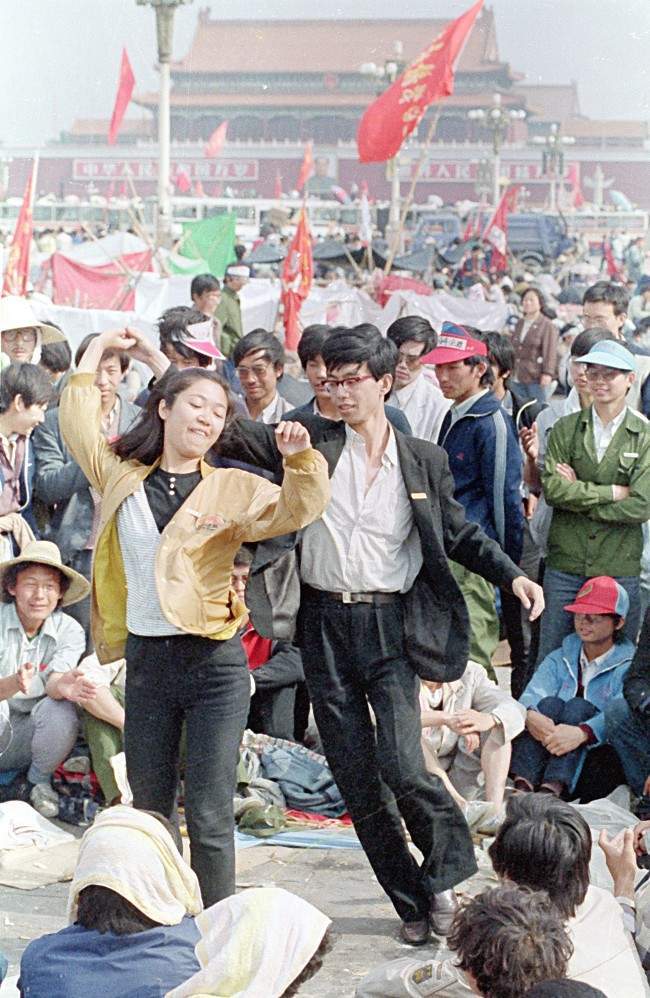
By late May, the protest camp showed signs of strain. Tents were tattered. Students who had been in the square for weeks looked exhausted, sleeping in piles on the pavement. On May 22, a young couple danced together in the morning hours — a brief, almost surreal moment of lightness amid the tension. On May 23, three men splattered paint across the famous portrait of Mao Zedong that hangs above the entrance to the Forbidden City. Student leaders, fearing the act would harm their cause, handed the men over to police.

A young unidentified couple, two out of thousands of university students who are holding Tiananmen Square occupied for nine days, pass the time with a lively dance on Monday morning, May 22, 1989 in Beijing, China.
The famous portrait of Chairman Mao looking out over Tiananmen Square, Beijing, from the Forbidden City, May 23, 1989, was spattered with paint during the continuing demonstration in the square.
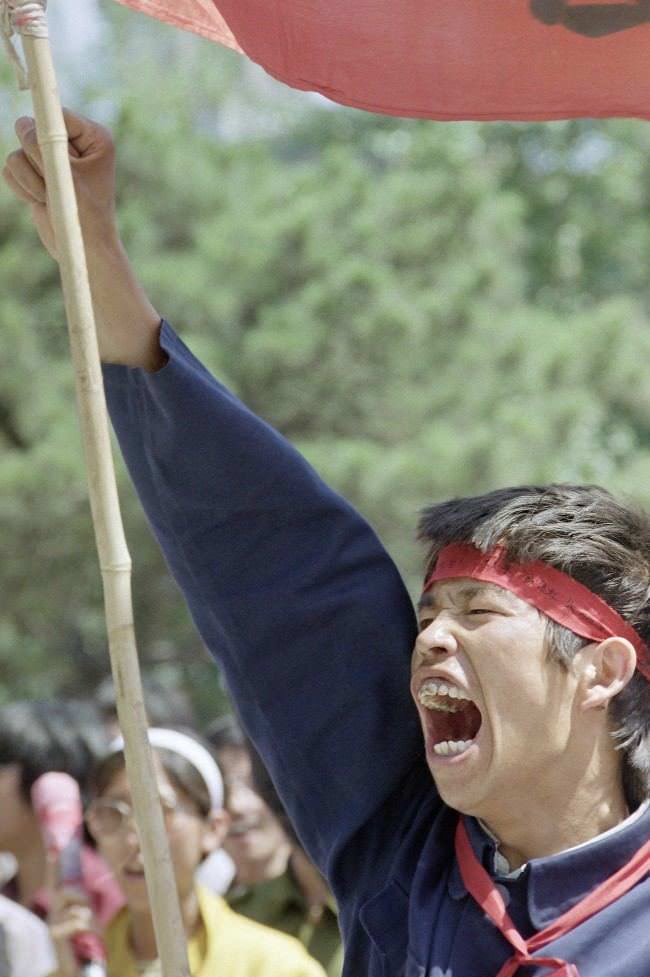
A Beijing University student sounds off during a rally, Thursday, May 25, 1989 in Beijing in Tiananmen Square.
University students rest in Tainanmen Square, Beijing, on May 26, 1989, wher their strike for government reforms is in its 13th day.

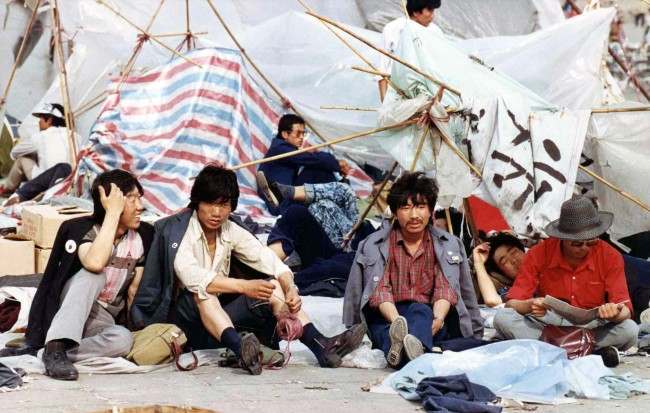
Student leader Wang Dan — one of the most recognizable faces of the movement — was still calling for marches on May 27. A former political prisoner visited the square the following day, telling his story directly to the remaining students. Numbers in the square were falling. Some students had returned to their classrooms. Others stayed, sleeping under torn canopies and on open ground, determined to hold the square.

This is a May 27, 1989 photo of student leader Wang Dan in Tiananmen Square Beijing calling for a city wide march.
A group of students rest before their tattered tents in Tiananmen Square, Beijing, on May 27, 1989, where thousands of students continue their sit-in protest to press the government for political reforms.
A man who identified himself as a former political prisoner relates his experiences to striking students in Tiananmen Square, Beijing, on May 28, 1989. Students have held the square in a democracy demonstration for more than two weeks.
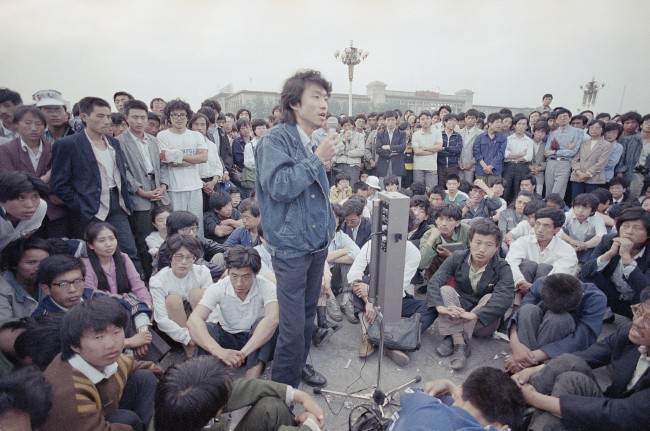
Beijing University students listen as a strike spokesman details plans for a rally in Tiananmen Square, which they have occupied for the last two weeks, Sunday, May 28, 1989, Beijing, China.
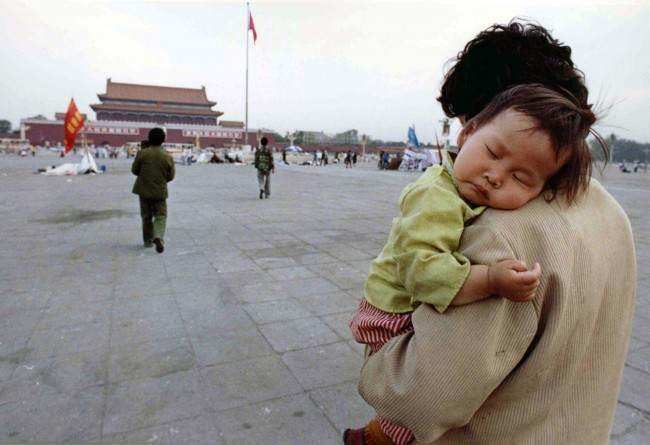
A child sleeps on his mother's shoulder as she crosses Tiananmen Square, Beijing, on May 29, 1989. Many students have tired and returned to their classes following three weeks of pro-democratic rallies.
A child sleeps on his mother’s shoulder as she crosses Tiananmen Square, Beijing, on May 29, 1989. Many students have tired and returned to their classes following three weeks of pro-democratic rallies.

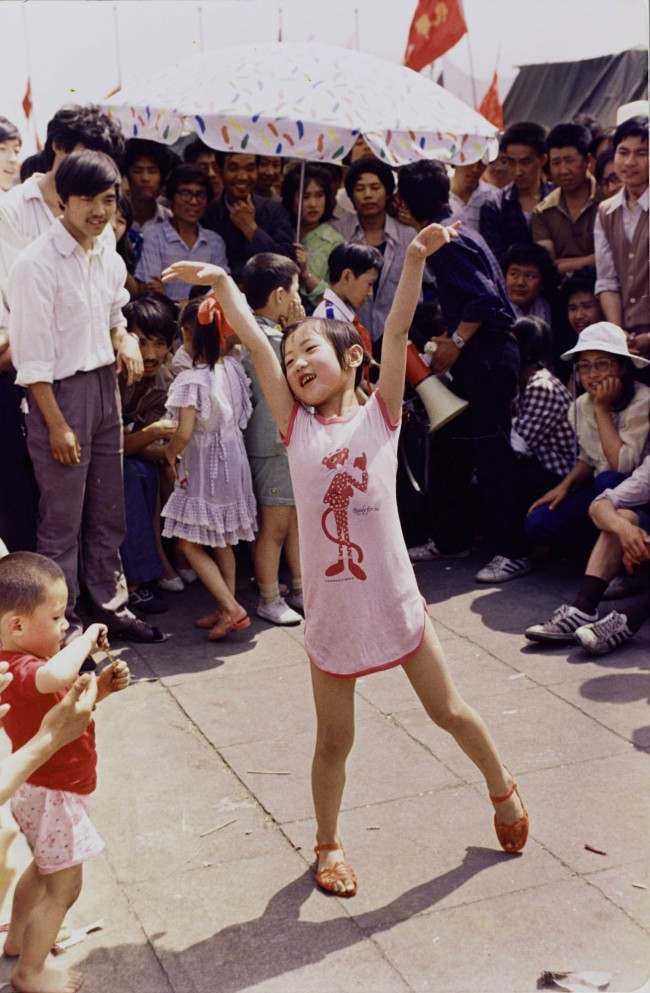
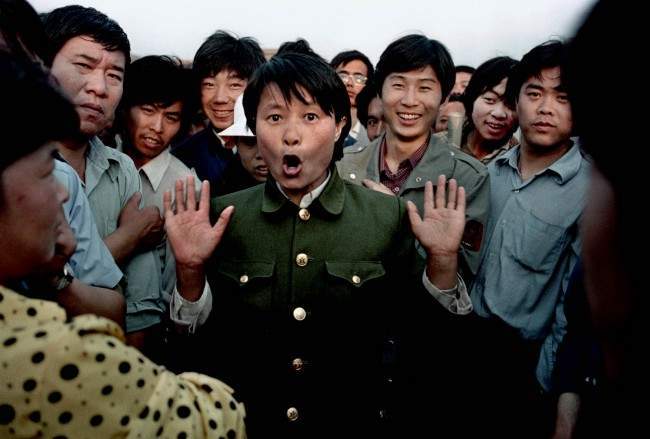
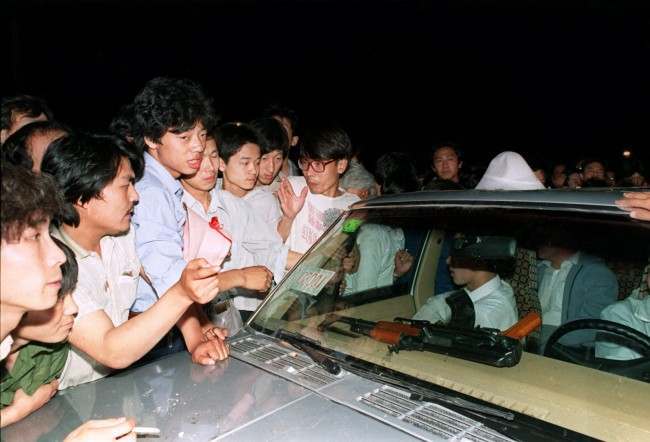
In the first days of June, a fragile, almost eerie calm settled over the square. Children danced. A woman soldier moved among the protesters, singing. Police and military personnel mixed into the crowd in an apparent attempt to keep things from escalating. But outside the square, the situation was different. On June 3, residents and students moved to block soldiers advancing toward Tiananmen. Citizens surrounded military vehicles and confronted troops directly, demanding to know what they planned to do with the weapons on board.

A young Chinese girl dances on Tiananmen Square about June 1, 1989, as pro-democracy protesters continued to occupy the square. Hundreds were killed a few days later in violent clashes between the demonstrators and government troops.
A woman soldier sings among pro-democracy protesters occupying Beijing's Tiananmen Square, about June 2, 1989. Police and military would occasionally mix with protesters in an attempt to keep the demonstration peaceful. In the early morning hours of June 4, 1989, soldiers overran the square, leaving hundreds dead overnight.
A woman soldier sings among pro-democracy protesters occupying Beijing’s Tiananmen Square, about June 2, 1989. Police and military would occasionally mix with protesters in an attempt to keep the demonstration peaceful. In the early morning hours of June 4, 1989, soldiers overran the square, leaving hundreds dead overnight.
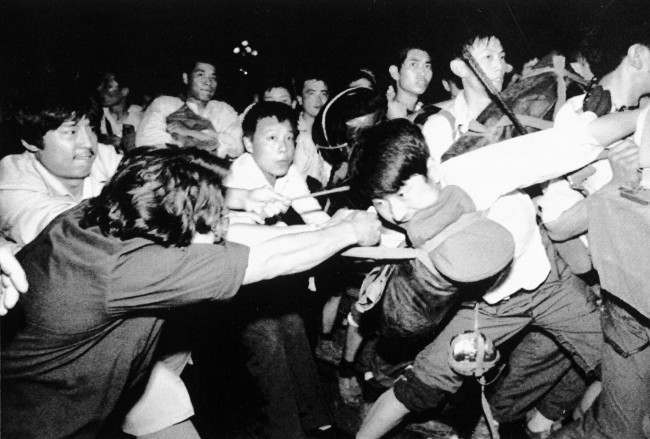
A man tries to pull a Chinese soldier away from his comrades as thousands of Beijing's citizens turned out to block thousands of troops on their way towards Tiananmen Square early Saturday morning, June 3, 1989.
A man tries to pull a Chinese soldier away from his comrades as thousands of Beijing’s citizens turned out to block thousands of troops on their way towards Tiananmen Square early Saturday morning, June 3, 1989.
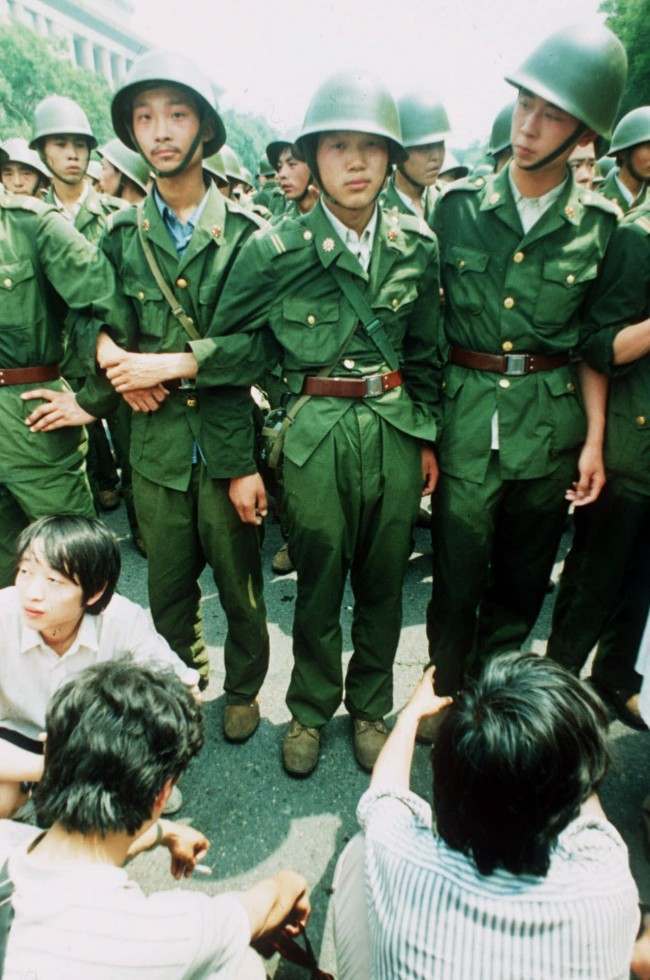
PLA soldiers locked in arms try to march past a human blockade of students outside of the Great Hall of People in this June 3, 1989 photo. Soldiers were reported to resort to teargas and amunitions.
Beijing residents ask soldiers what they were going to do with the machine gun on their dashboard as they surround and stop a carload of chinese soldiers on their way towards to Tiananmen Square in this June 3, 1989 photo.
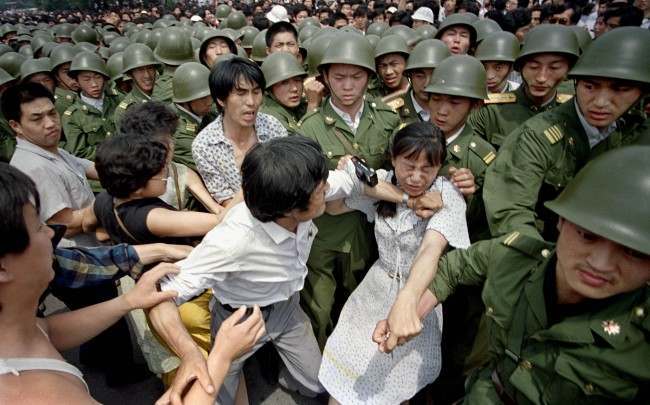
A young woman is caught between civilians and Chinese soldiers, who were trying to remove her from an assembly near the Great Hall of the People in Beijing, June 3, 1989. Pro-democracy protesters had been occupying Tiananmen Square for weeks.

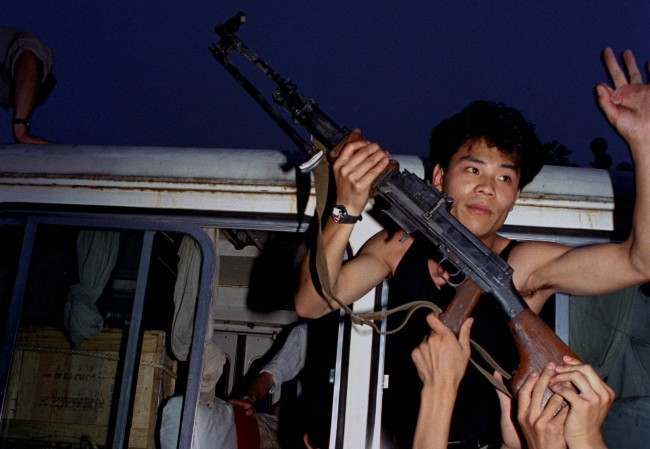
Late on the night of June 3, the Chinese military moved with live ammunition through the streets of Beijing toward Tiananmen Square. Troops shot through residential neighborhoods, killing people in the streets and in their homes. By dawn on June 4, soldiers had retaken the square. Hundreds died. The exact number has never been confirmed by the Chinese government, which has suppressed all public discussion of the event ever since. The photos taken in those final hours — a PLA soldier sitting alone with his weapons after his convoy was stopped, protesters gripping rifles taken from soldiers — show how completely the situation had transformed from protest to confrontation.

An anti-government protester in Beijing holds a rifle in a bus window, June 3, 1989. Pro-democracy protesters had been occupying Tiananmen Square for weeks; hundreds died that night and the following morning in clashes with Chinese troops.
A People's Liberation Army Soldier sits alone with his weapons Sunday after his convoy was stopped by demonstrators seen in the background.
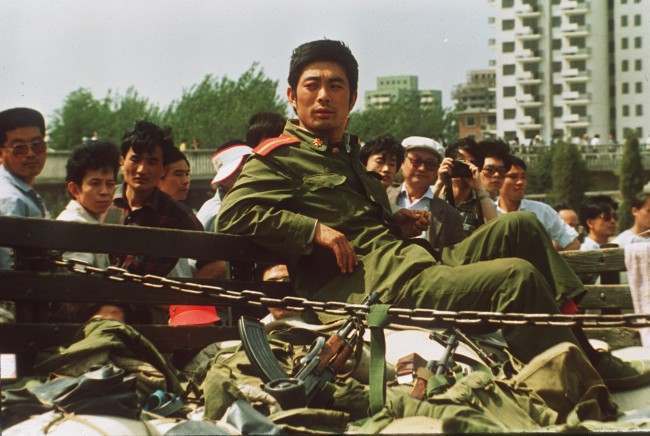
A People’s Liberation Army Soldier sits alone with his weapons Sunday after his convoy was stopped by demonstrators seen in the background.
Enjoyed this post? Get new ones in your inbox.

Leave a Comment

Your email address will not be published. Required fields are marked *

Share this Post 🥺

Please take a moment to share this content. Your support is greatly appreciated! 🙌🙏

Share this Post 🥺

Please take a moment to share this content. Your support is greatly appreciated! 🙌🙏
Scroll to Top
 
Hey Friend, Before You Go.. Please like & follow for more interesting content