Hey There! Before You Go. 😧
Get the best vintage content straight into your inbox!

Don't worry, we don't spam

50+ Fascinating Then And Now Photos Of Different Cities During WWII And Now
World War II killed an estimated 70 million people — soldiers and civilians combined. It was the deadliest conflict in human history, fought across six years of ground battles and relentless airstrikes that flattened entire city centers. Roads, churches, homes, government buildings, and cultural landmarks were reduced to rubble in countries across Europe and beyond. Families were torn apart, children were orphaned, and communities were wiped from the map. The scale of destruction was unlike anything the modern world had seen before.

Photographers have since created a striking series of then-and-now composite images, placing wartime photographs directly over modern shots taken from the exact same angle and location. The results are haunting. Ruins and ash become busy streets and restored buildings. The comparisons force the viewer to see both moments at once — what was lost, and what eventually replaced it. Dresden is one of the most dramatic examples of this transformation.
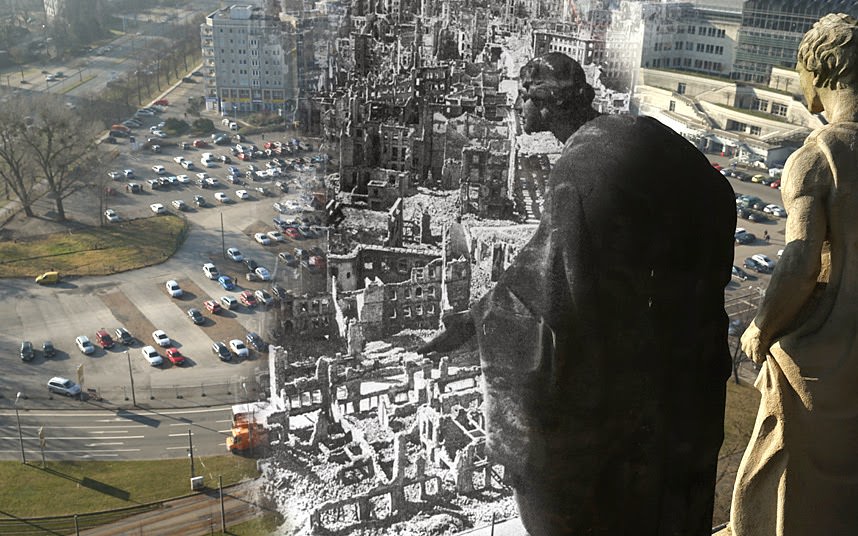
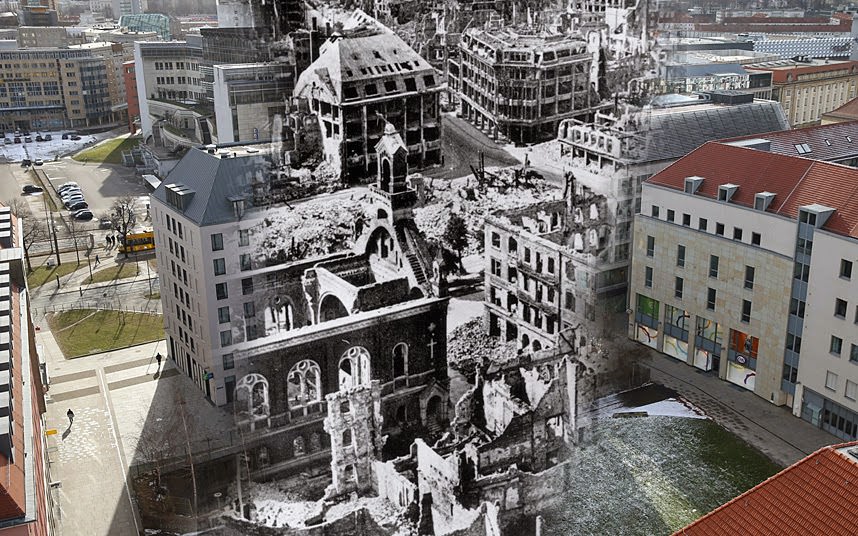
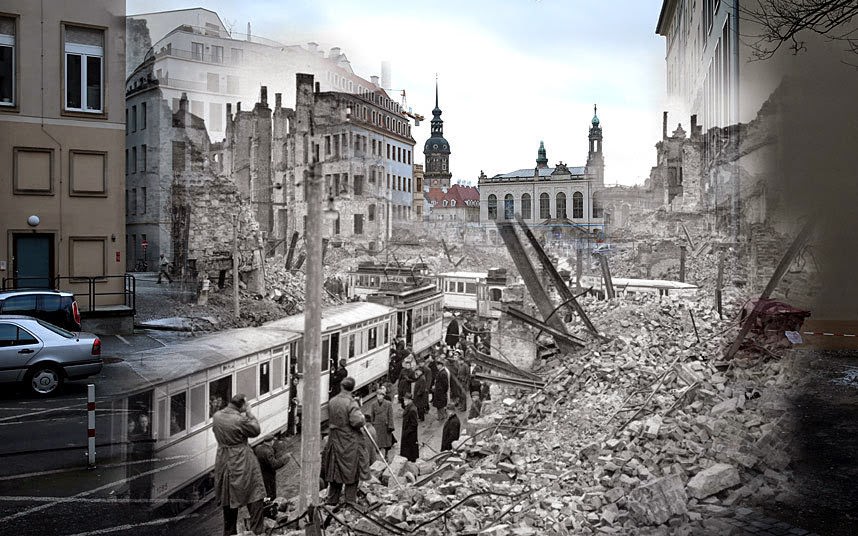
Dresden, Germany was heavily bombed in February 1945. The city center was almost entirely destroyed. By 1946, photographers captured a landscape of hollow walls, broken fountains, and empty pedestals where statues once stood.
THEN: A statue on the tower of City Hall looking down at the ruins of the city centre. NOW: the same scene on 12 February 2015.
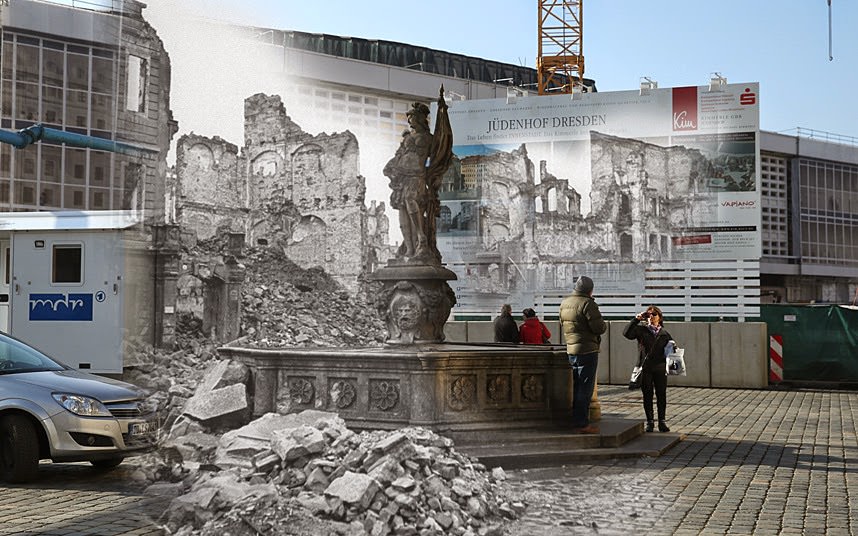
THEN: Moritzstrasse and the Juedenhof palace in 1946 NOW: the same area on 7 February 2015.

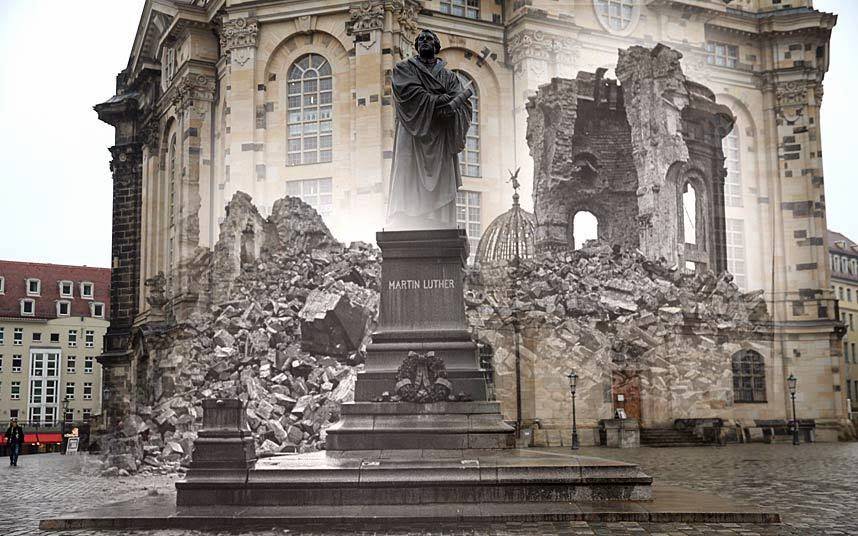
The Frauenkirche church was one of Dresden’s most beloved landmarks. Its ruins sat untouched for decades during the Cold War as a deliberate war memorial. After German reunification, a major reconstruction effort began, and the church was fully restored by 2005. The statue of Martin Luther, missing from its pedestal in 1946 photos, was also returned.

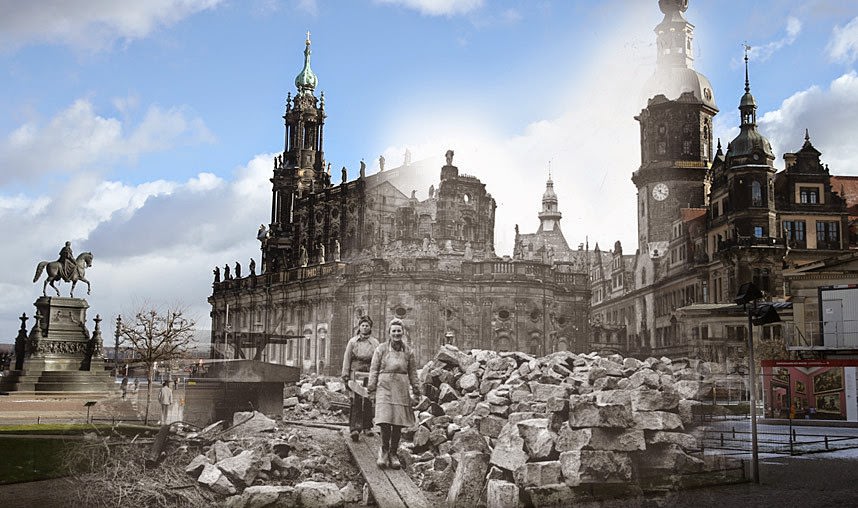
THEN: The ruins at Theaterplatz square in 1946. NOW: Residenzschloss Dresden palace , 2015
THEN: The ruins of the Frauenkirche church and the empty pedestal for a statue of Martin Luther in 1946. NOW: The reconstructed church and statue, 2015.

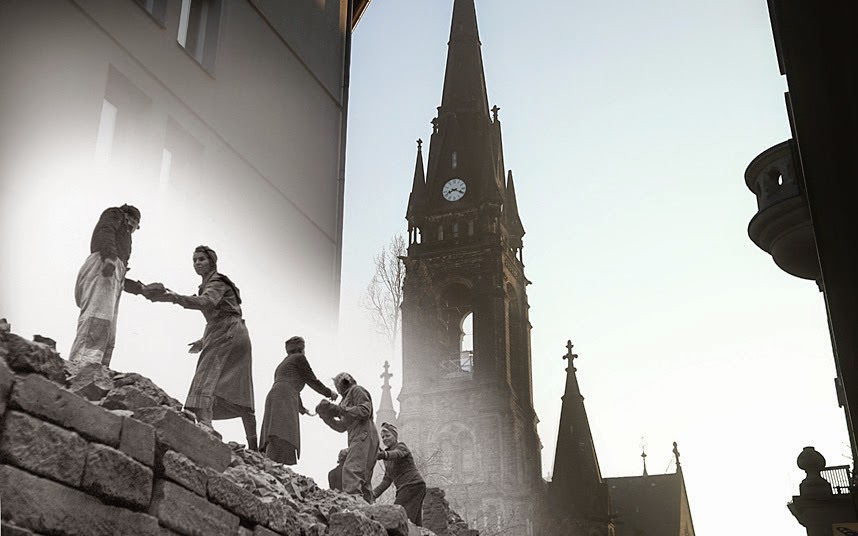
Across the city, ordinary people were already at work in 1946. Women carried bricks through ruined streets, clearing debris and beginning the long process of rebuilding. City officials posed outside a damaged City Hall. The Zwinger art museum, one of Germany’s most important baroque structures, sat partially intact but heavily damaged.

THEN: The ruins of the city centre, including Prager Strasse NOW: The same view on 7 February 2015.
THEN: Women in 1946 carrying bricks outside the Martin Luther church  NOW: Same area on 12 February 2015.
THEN: Women in 1946 carrying bricks outside the Martin Luther church NOW: Same area on 12 February 2015.
THEN: Ruins of buildings around Neumarkt square and a fountain with a statue in 1946  NOW The same scene on 22 January 2015.
THEN: Ruins of buildings around Neumarkt square and a fountain with a statue in 1946 NOW The same scene on 22 January 2015.
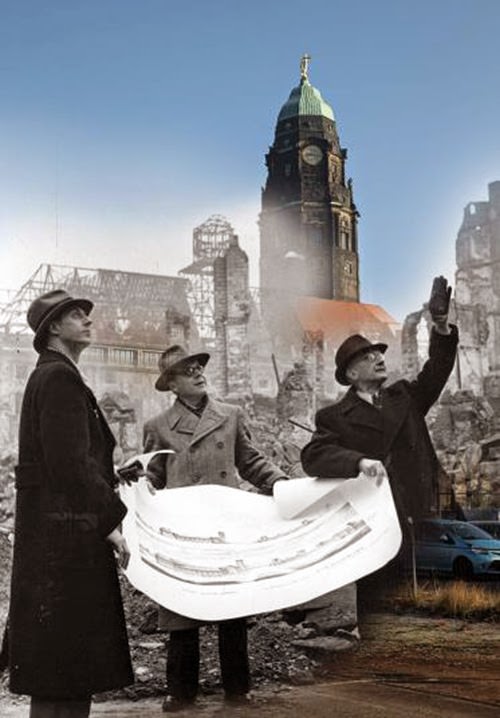
THEN: From left, propaganda director Heinz Grunewald, Dresden mayor Walter Weidauer and town architect Dr C Herbert in March 1946 outside City Hall  NOW: The same setting on 12 February 2015.
THEN: From left, propaganda director Heinz Grunewald, Dresden mayor Walter Weidauer and town architect Dr C Herbert in March 1946 outside City Hall NOW: The same setting on 12 February 2015.
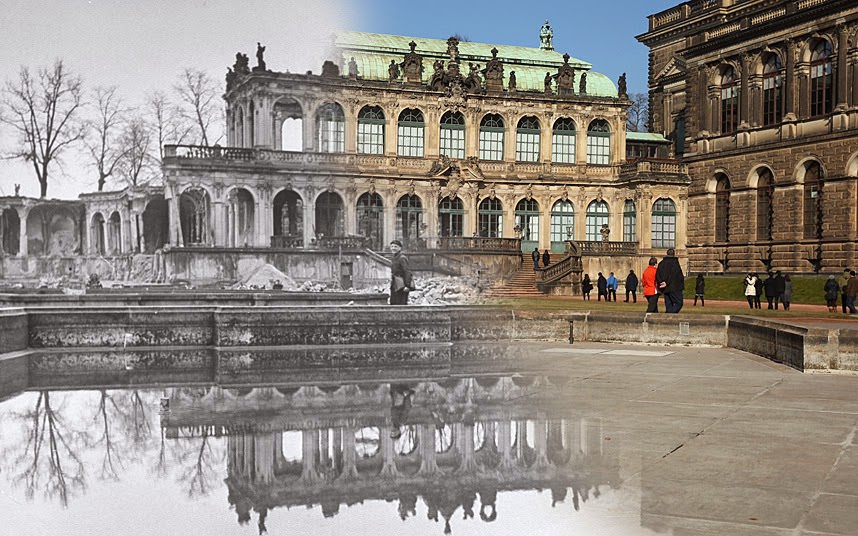
THEN: A portion of the Zwinger art museum in 1946. NOW: The same location in 2015.

London endured its own sustained campaign of destruction. The Blitz — Germany’s bombing offensive against Britain — ran from September 1940 through May 1941. Night after night, German aircraft dropped bombs on the city, targeting docks, railways, and residential neighborhoods. Over 43,000 civilians were killed across Britain during the Blitz, with London bearing the heaviest toll. Fires burned along the Thames, craters opened in the middle of busy streets, and Tube stations became emergency shelters for thousands of Londoners.

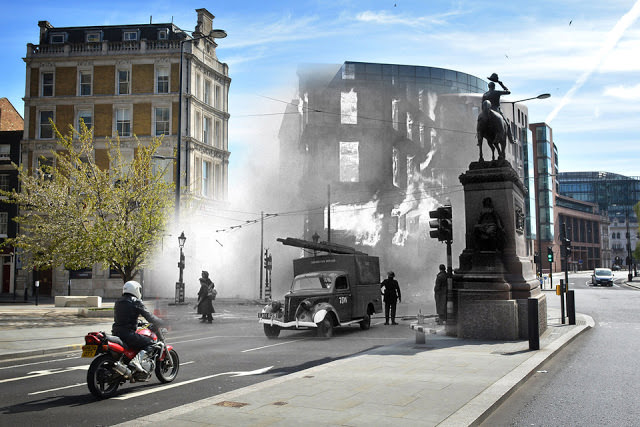
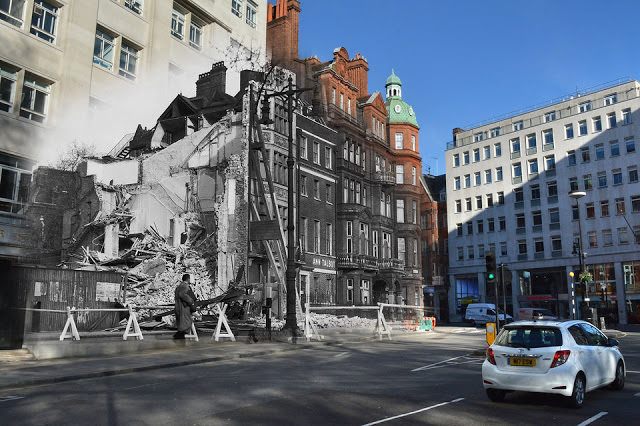
THEN: A blaze in the Negretti and Zambra building at Holborn Circus, London, after a German bombing raid. NOW: A street scene at Holborn Circus on May 1, 2016 in London, England.
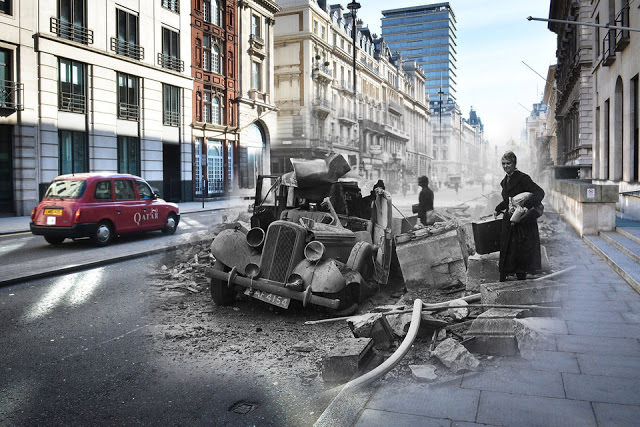
THEN: A wrecked Humber car on Pall Mall, London after an air raid during the London Blitz, 15th October 1940. NOW: A street scene at Pall Mall in Piccadilly on May 1, 2016 in London, England.

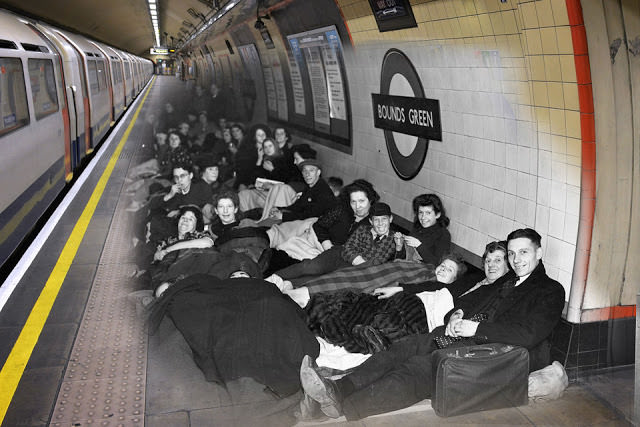
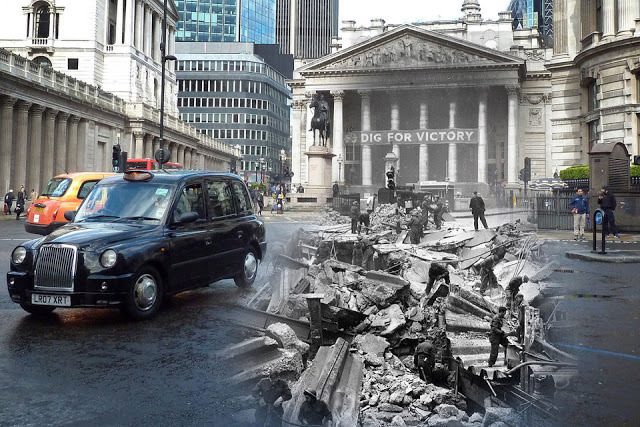
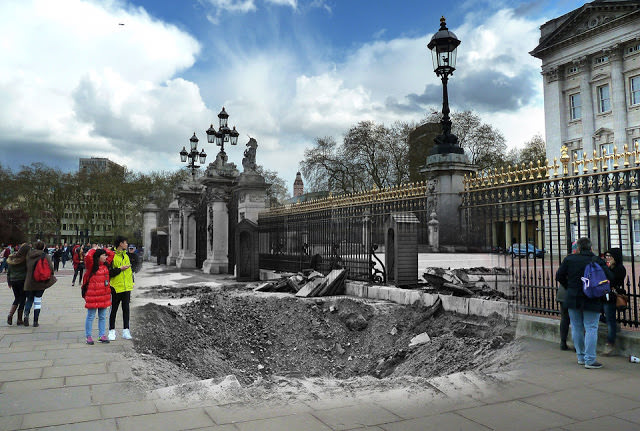
Underground stations like Bounds Green became nightly refuges. Civilians slept on platforms and in tunnels while bombs fell above them. Even Buckingham Palace was struck — a crater was left outside its gates after a German raid. Westminster Abbey suffered interior damage. Bank Underground Station took a direct hit, killing many of the people sheltering inside.

THEN: Londoners sheltering on a platform at Bounds Green tube station during an air raid in The Blitz.NOW: A platform at Bounds Green underground station on May 1, 2016 in London, England.
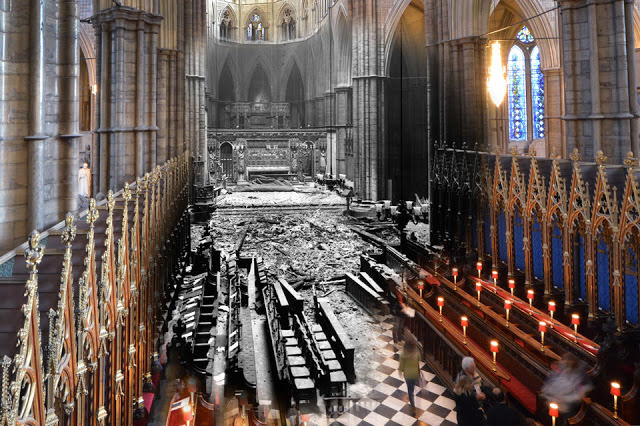
THEN: The interior of Westminster Abbey after a German bombing raid. NOW: A view of the choir and altar of Westminster Abbey, on January 13, 2015 in London, England.
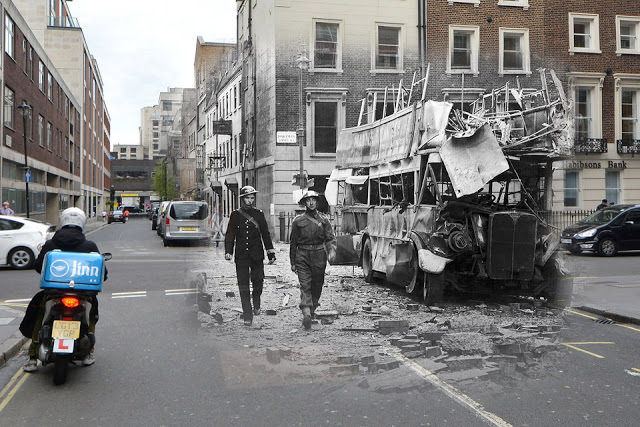
THEN: A police officer and a soldier inspecting the aftermath of a German air raid, Portman Street, London, 19th September 1940. NOW: A street scene at Portman Sreet near Marble Arch, on April 21, 2016 in London, England.
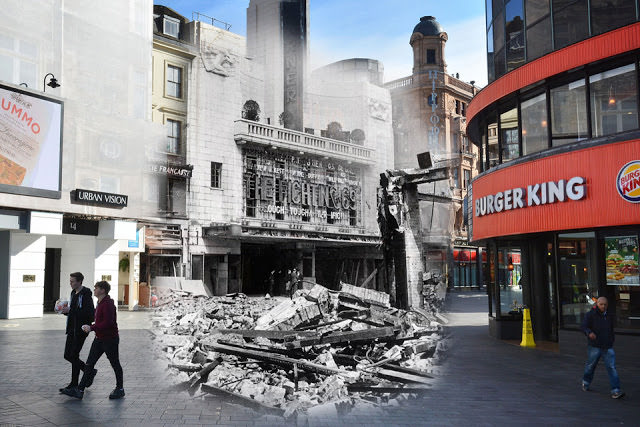
THEN: Bomb damage in London's Leicester Square caused by German air raids during the Blitz, 1941. NOW: A view of the Vue cinema in Leicester Square on May 1, 2016 in London, England.
THEN: Bomb damage in London’s Leicester Square caused by German air raids during the Blitz, 1941. NOW: A view of the Vue cinema in Leicester Square on May 1, 2016 in London, England.
THEN: Soldiers help to clear the debris of Bank Underground Station, in front of The Royal Exchange, London, the morning after receiving a direct hit during the Blitz. NOW: A street scene at Bank junction in front of the Royal Exchange on April 25, 2016 in London, England.
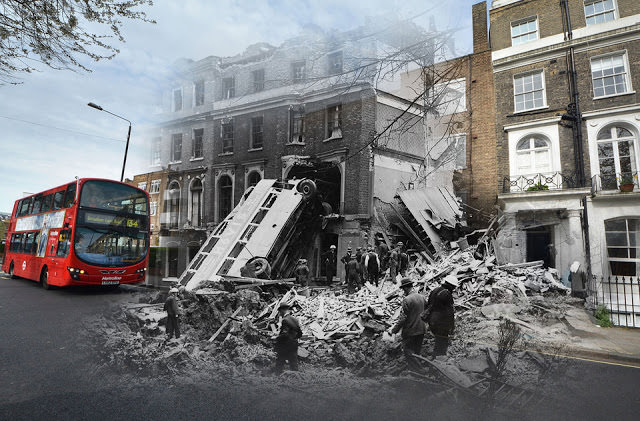
THEN: A bus is left leaning against the side of a terrace in Harrington Square, Mornington Crescent, in the aftermath of a German bombing raid on London in the first days of the Blitz, 9th September 1940. NOW: A view of modern social housing near Mornington Crescent on April 21, 2016 in London.
THEN: A crater and damaged railings outside Buckingham Palace, London, after the explosion of a German bomb dropped in an air raid the previous day. NOW: Tourists gather outside Buckingham Palace on April 26, 2016 in London, England.
THEN: Bomb damage caused by a World War II air raid on Berkeley Square, London, 29th April 1942. NOW: A street scene in Berkeley Square, Mayfair on May 1, 2016 in London, England.
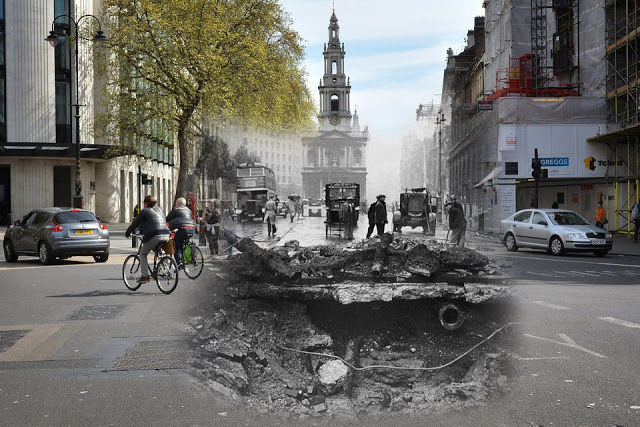
THEN: A huge hole in the Strand, where a bomb was dropped during an air raid over central London. NOW: A street scene looking down the Strand towards St.Mary-le-Strand church, on May 1, 2016 in London, England.
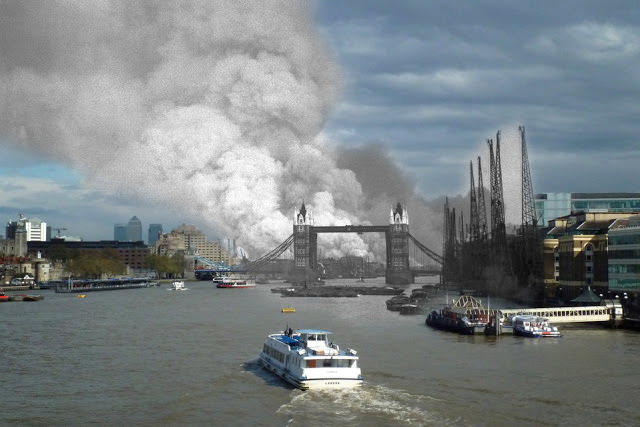
THEN: A view east down the Thames towards smoke rising from fires in Surrey docks, following the first German air raid of the London Blitz, 7th September 1940. NOW: A view of Tower Bridge on the River Thames on April 25, 2016 in London, England.
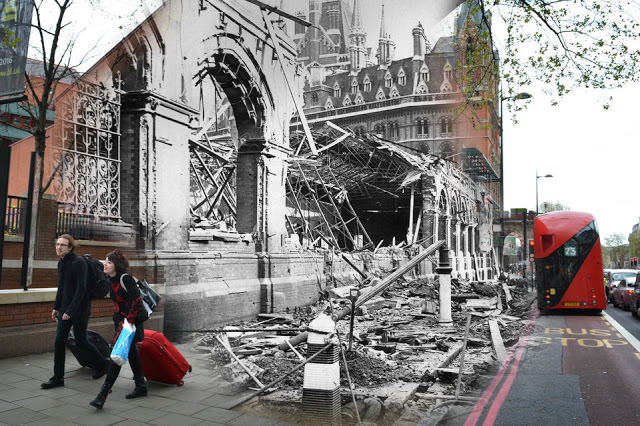
THEN: An area near St Pancras Station in London showing the damage caused by a German air raid during the London blitz in World War II. NOW: A view of the British Library beside St Pancras hotel on May 3, 2016 in London, England.

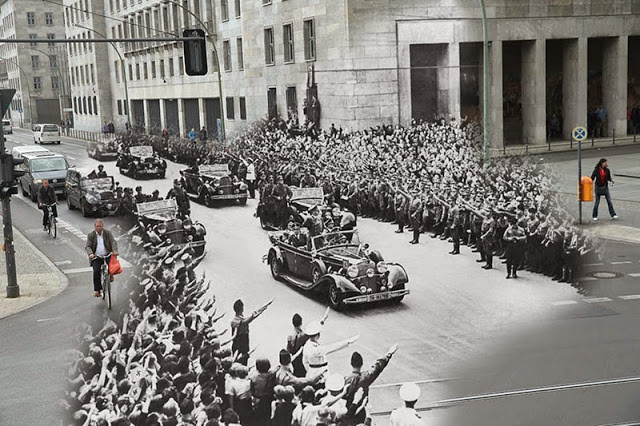
Berlin, the capital of Nazi Germany, saw some of the war’s most brutal final fighting. By May 1945, Soviet forces had fought street by street through the city. Landmarks like the Reichstag and the Brandenburg Gate stood riddled with shell damage. Adolf Hitler had held power in the city since the 1930s — crowds once lined the streets to salute him as his motorcade passed. By the war’s end, those same streets were ruins.

THEN: Crowds saluting to Adolf Hitler passing by in a motorcade on October 2, 1938. NOW: A view from approximately the same perspective along on April 30, 2015 in Berlin, Germany.
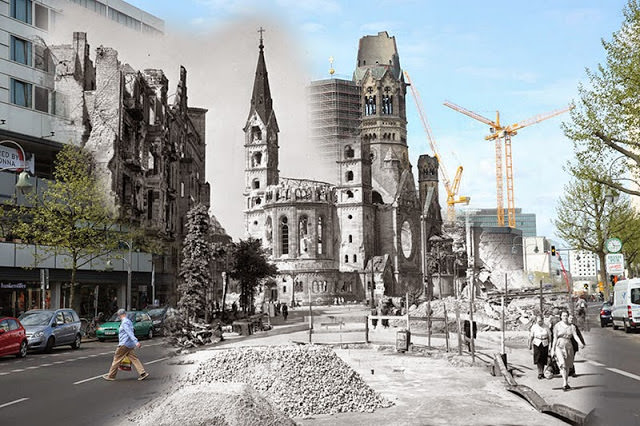
THEN: People walking past the ruins of the Kaiser Wilhelm Memorial Church on July, 20, 1945. NOW: A view from the same perspective along Budapester Strasse on May 2, 2015 in Berlin, Germany.
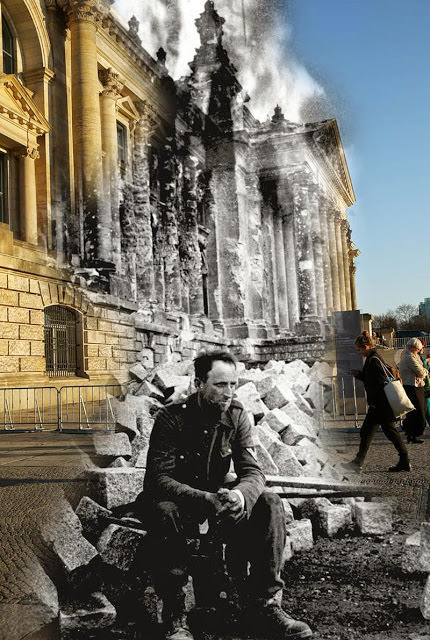
THEN: A German soldier sitting in front of the ruins of the Reichstag at the end of Worl War II on May 9, 1945. NOW: A view from the same perspective on March 18, 2015 in Berlin, Germany.
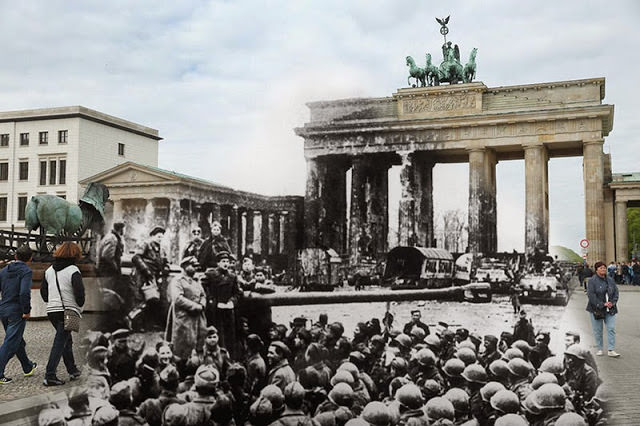
THEN: Russian and U.S. troops in front of the ruins of the Brandenburg Gate at the end of World War II in 1945. NOW: A view from the same perspective on May 2, 2015 in Berlin, Germany.
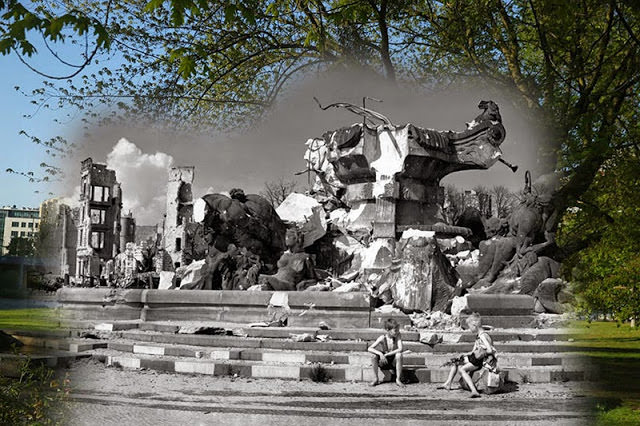
THEN: Two boys sitting at thr ruins of the Hercules fountain at Luetzowplatz after World War II in 1945 in Berlin. A view from the same perspective on April 29, 2015 in Berlin, Germany.
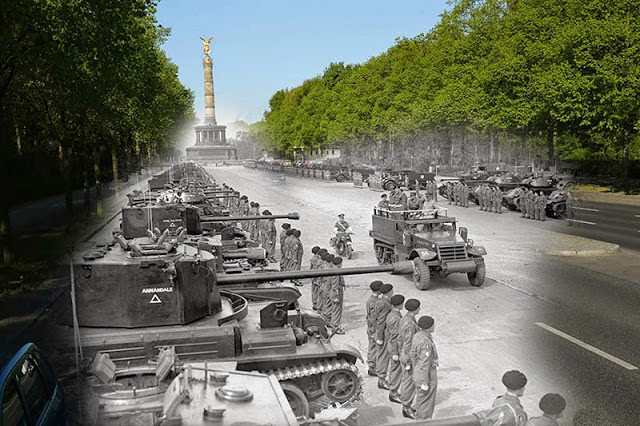
THEN: British Field Marshall Bernard Montgomery addressing Allied troops near Tiergarten park after World War II in 1945 in Berlin, Germany. NOW: A view from the same perspective on April 29, 2015 in Berlin, Germany.
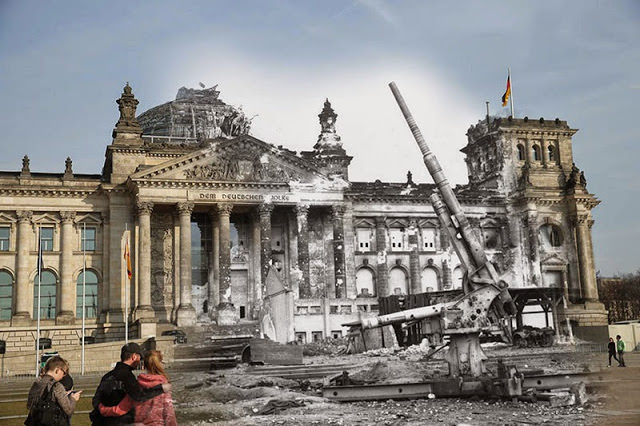
THEN: A German artillery gun standing in front of the ruins of the Reichstag after World War II in July, 1945 in Berlin, Germany. NOW: A view from the same perspective on March 20, 2015 in Berlin, Germany.

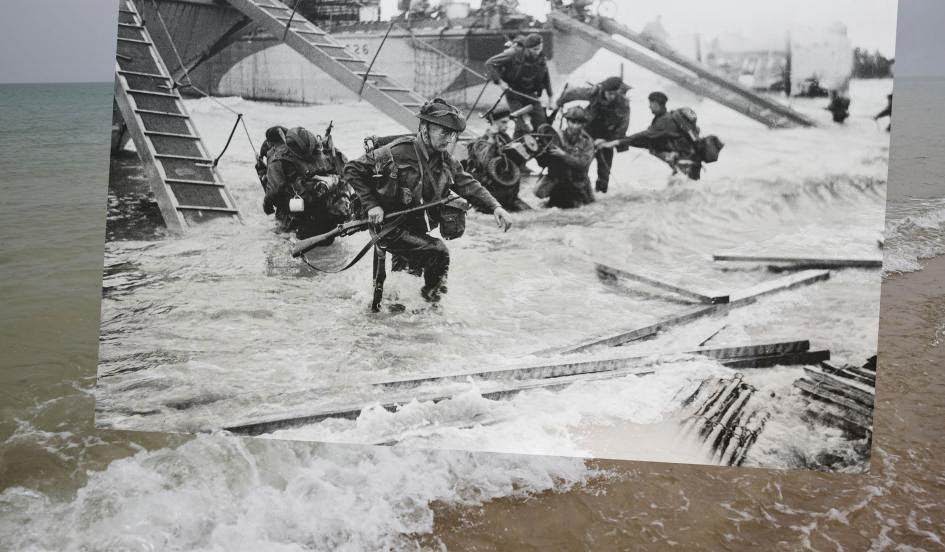
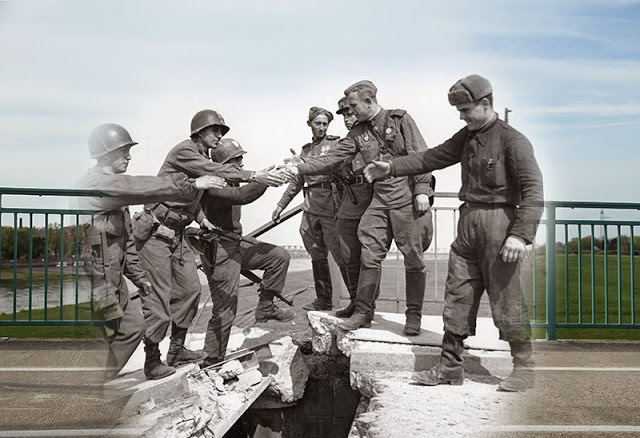
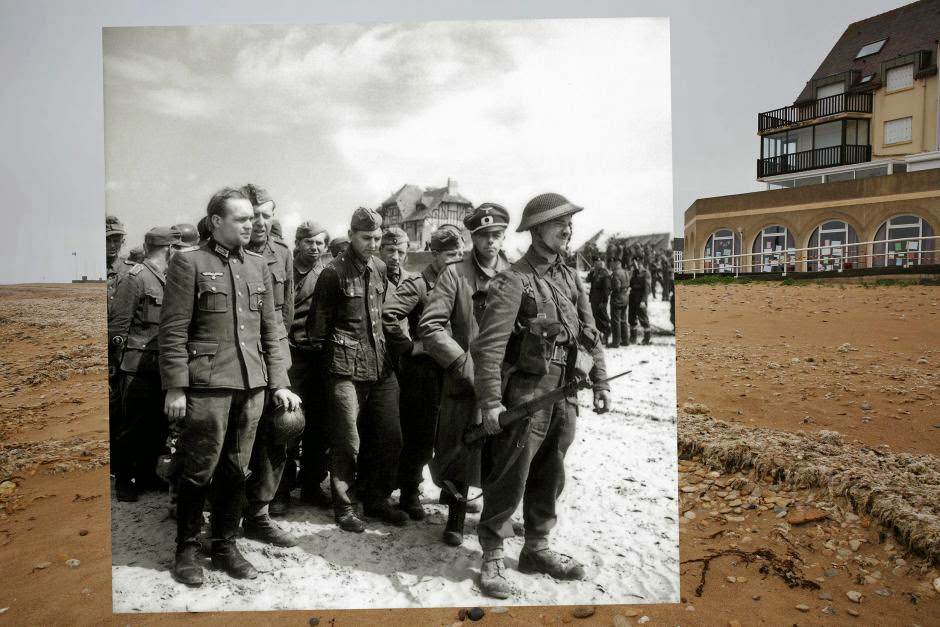
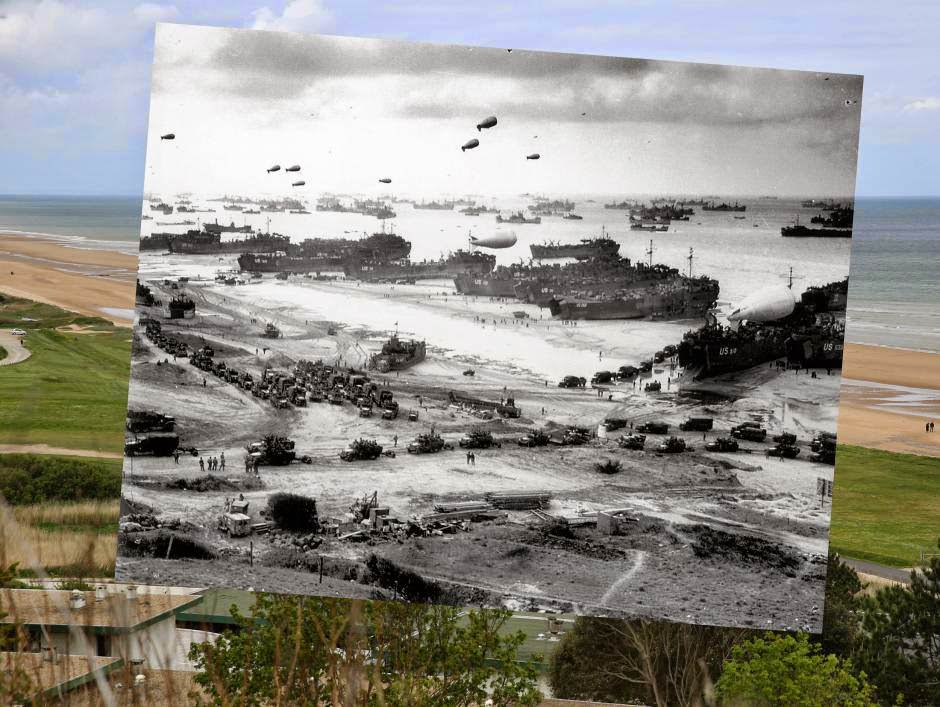
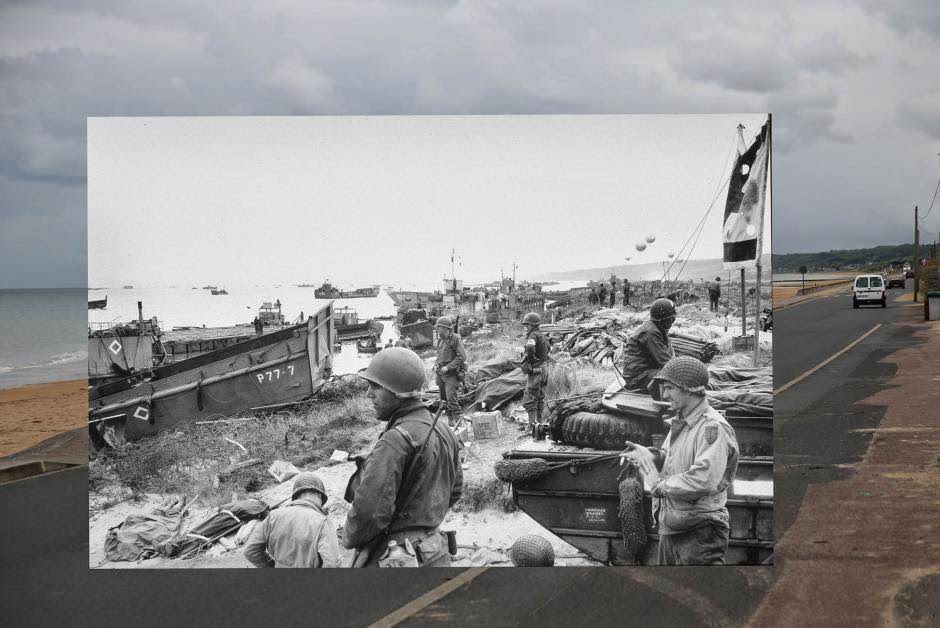
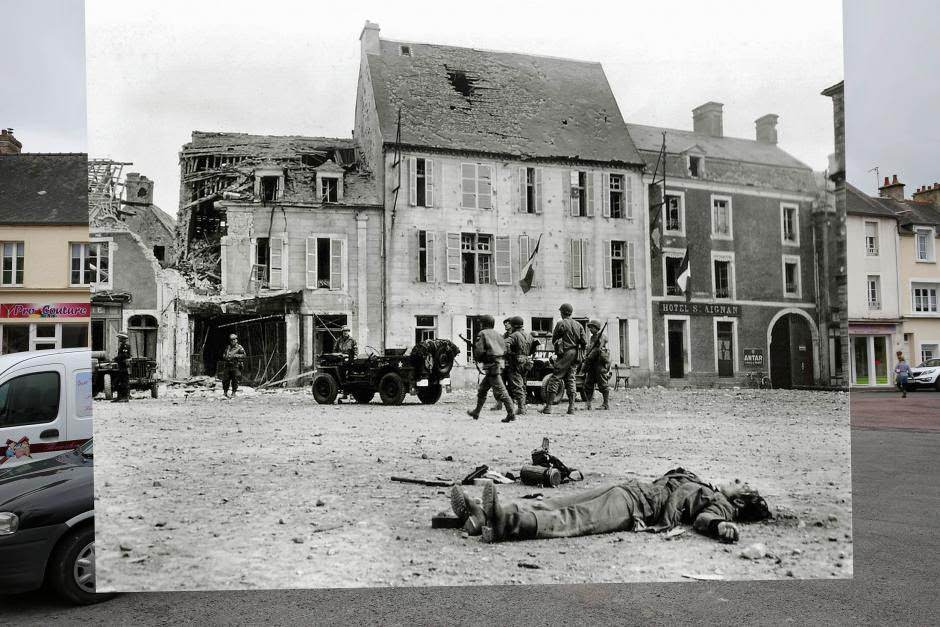
The war’s western front reached its decisive moment on June 6, 1944 — D-Day. Allied forces landed on the beaches of Normandy, France, in the largest seaborne invasion in history. Juno, Omaha, and the surrounding beaches became scenes of mass combat and mass death. German prisoners were gathered on the sand at Bernières-sur-Mer. Dead soldiers lay in village streets. An American armada stretched across the horizon off Omaha Beach. On April 25, 1945, U.S. and Soviet troops met on a damaged bridge over the Elbe River at Torgau, Germany — a moment that symbolized the closing of the war in Europe from both sides.

THEN: U.S. (L) and Soviet troops greeting one another on a damaged bridge over the Elbe River towards the end of World War II on April 26, 1945 in Torgau, Germany. NOW: A view on the same bridge from the same perspective on April 29.
THEN: The view of Juno beach on June 6, 1944 and in 2004. The British 2nd Army: Royal Marine Commandos of Headquarters, 4th Special Service Brigade made landfall on French soil. NOW: The Same Location.
THEN: German prisoners were gathered at the beach of Bernières-sur-Mer, France. NOW: The Same Location.
THEN: An American armada gathered off of Omaha Beach, Normandy, in 1944.  NOW: The same beach Today.
THEN: An American armada gathered off of Omaha Beach, Normandy, in 1944. NOW: The same beach Today.
THEN: American troops on Omaha Beach. NOW: The same beach today.
THEN: A dead Germany soldier in Trevieres, France, on June 15, 1944. NOW: The the same village today.
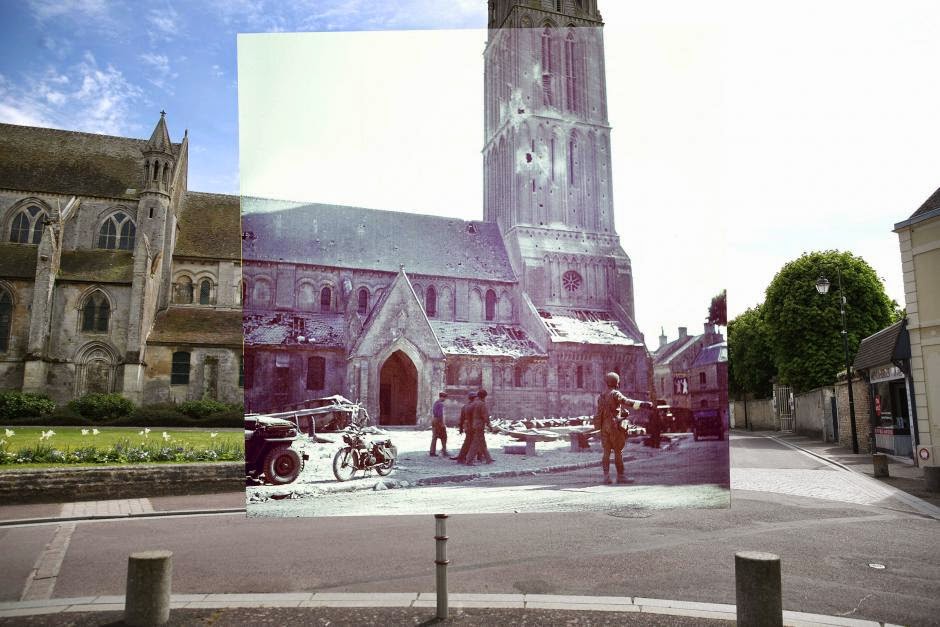
THEN: A Canadian soldier directs traffic after the Normandy invasion in Bernieres-sur-Mer. NOW: The same street today.
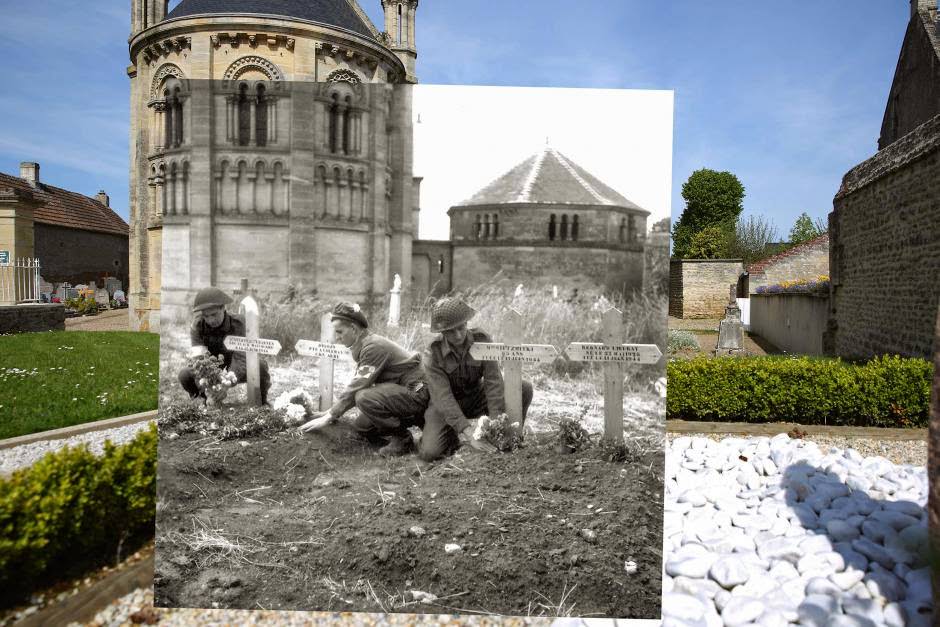
THEN: Three soldiers of the 23rd Field Ambulance of the 3rd Canadian Infantry Division place flowers on graves in June 1944.  NOW: The graveyard today.
THEN: Three soldiers of the 23rd Field Ambulance of the 3rd Canadian Infantry Division place flowers on graves in June 1944. NOW: The graveyard today.
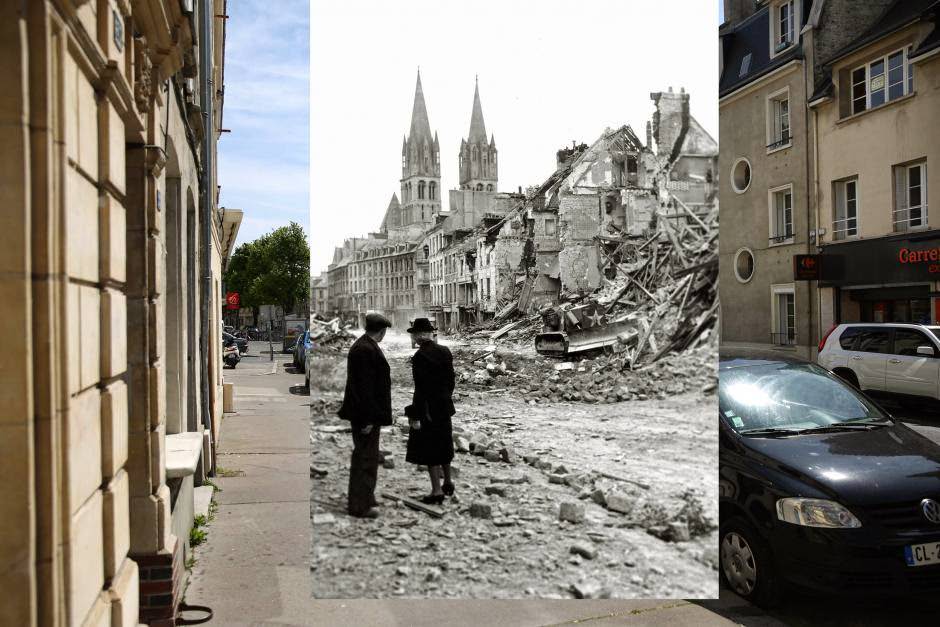
THEN: An older couple watch a Canadian soldier with a bulldozer working in the ruins of a house in the rue de Bayeux on July 10, 1944.  NOW: The same place.
THEN: An older couple watch a Canadian soldier with a bulldozer working in the ruins of a house in the rue de Bayeux on July 10, 1944. NOW: The same place.

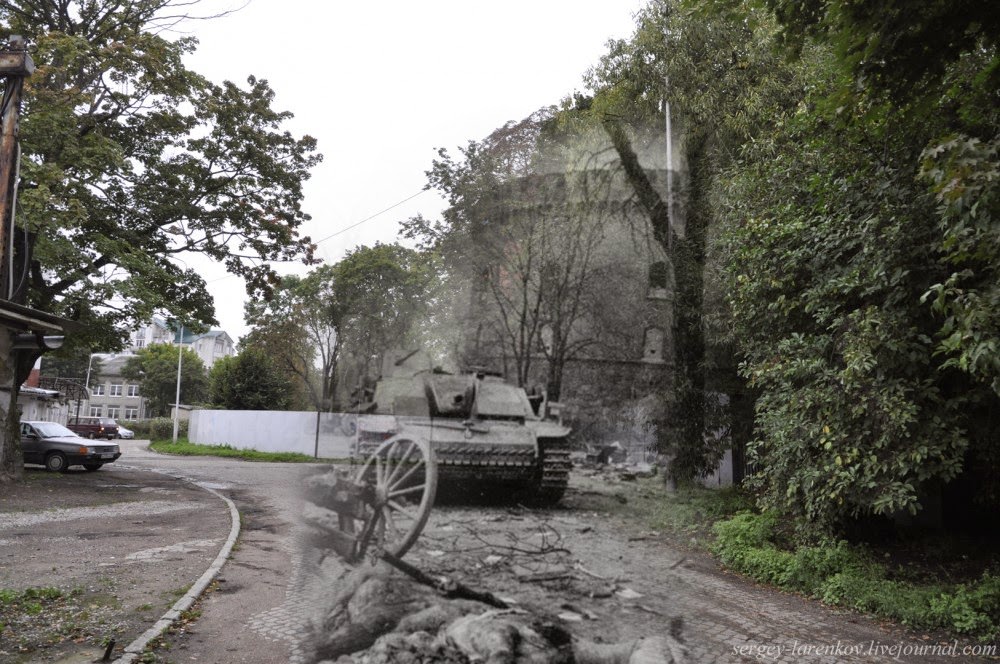
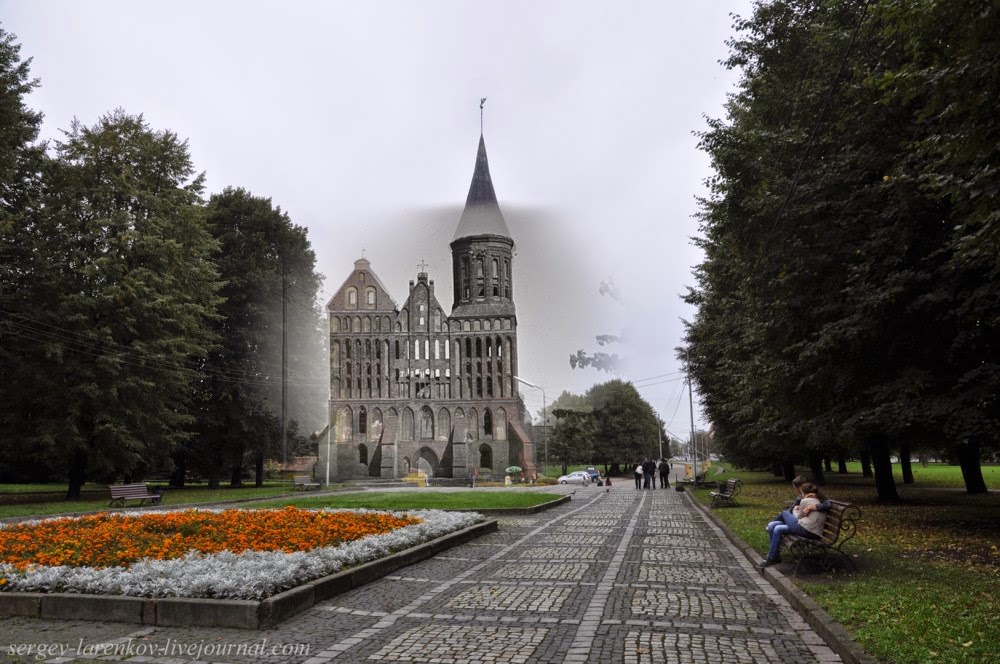
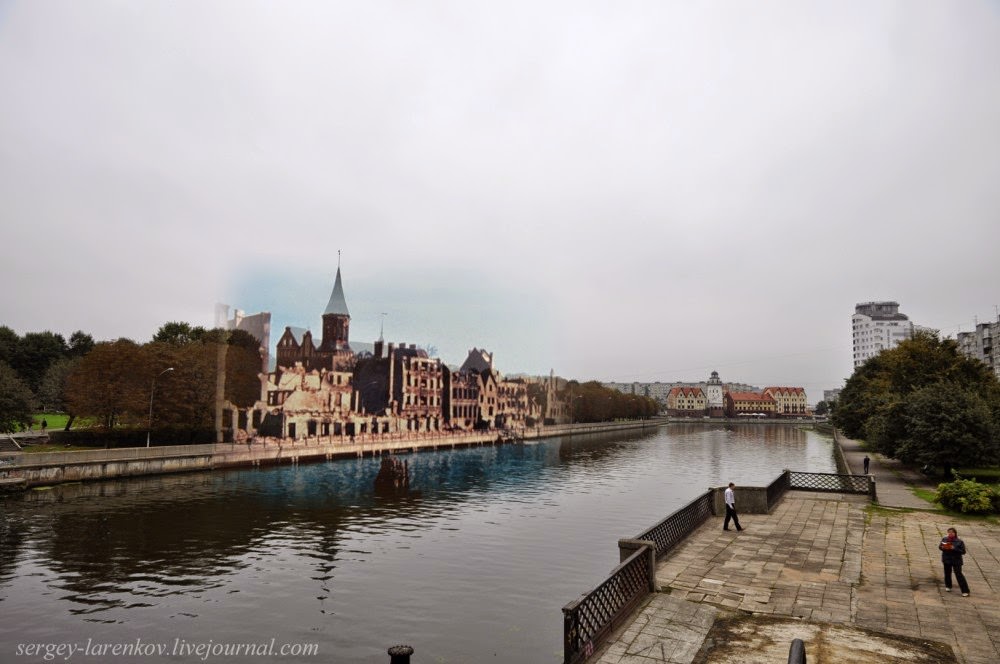
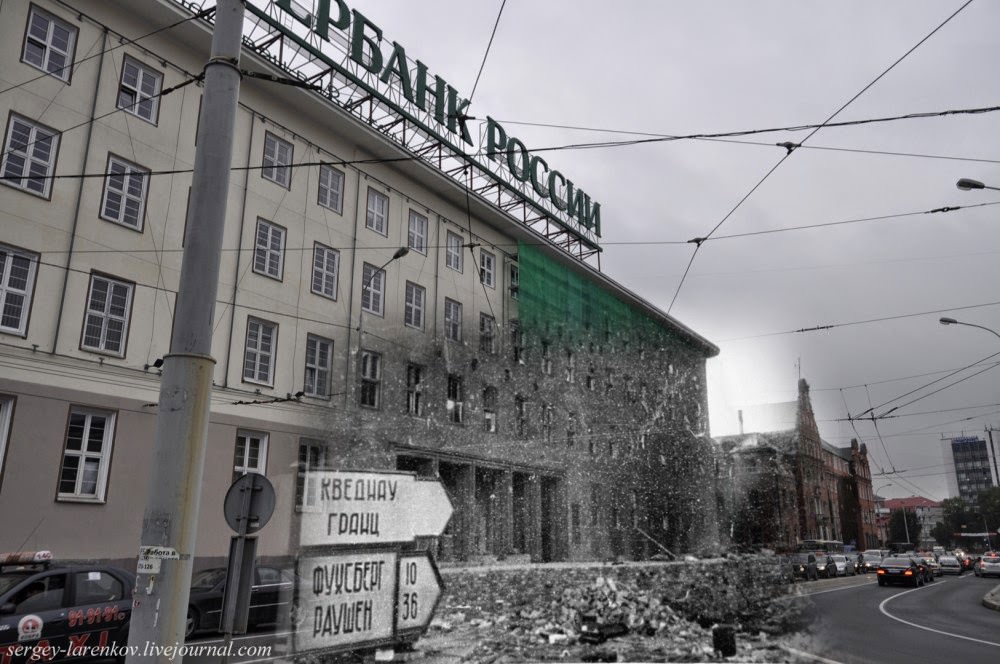
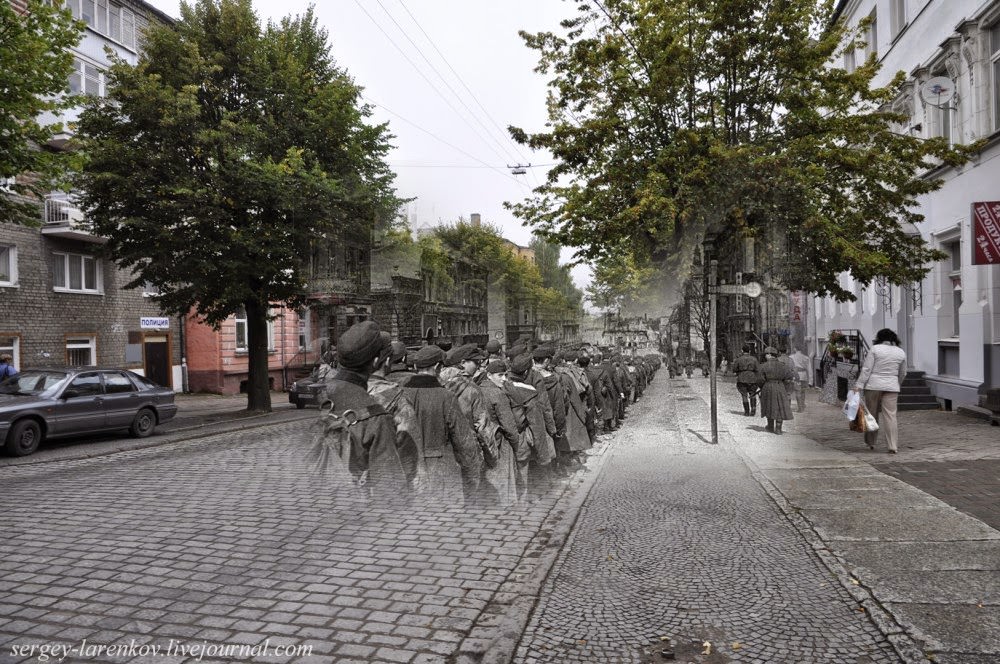
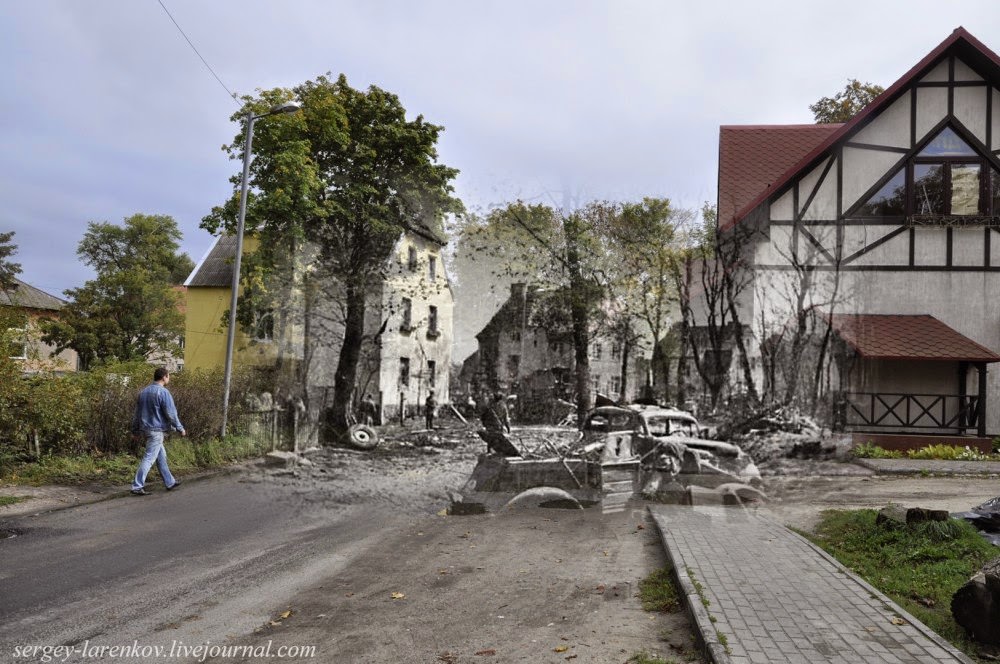
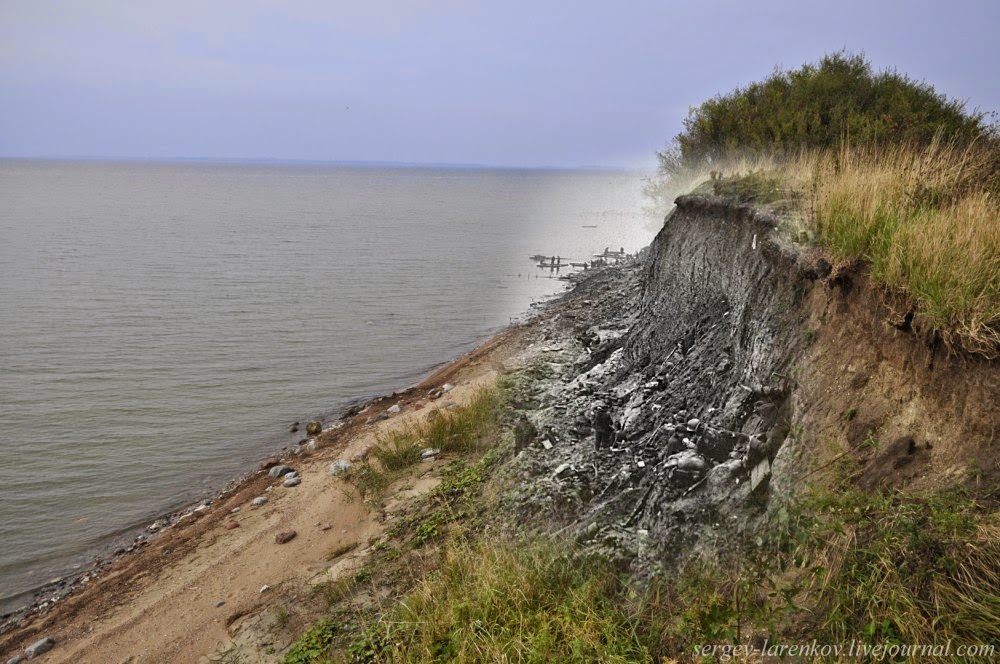
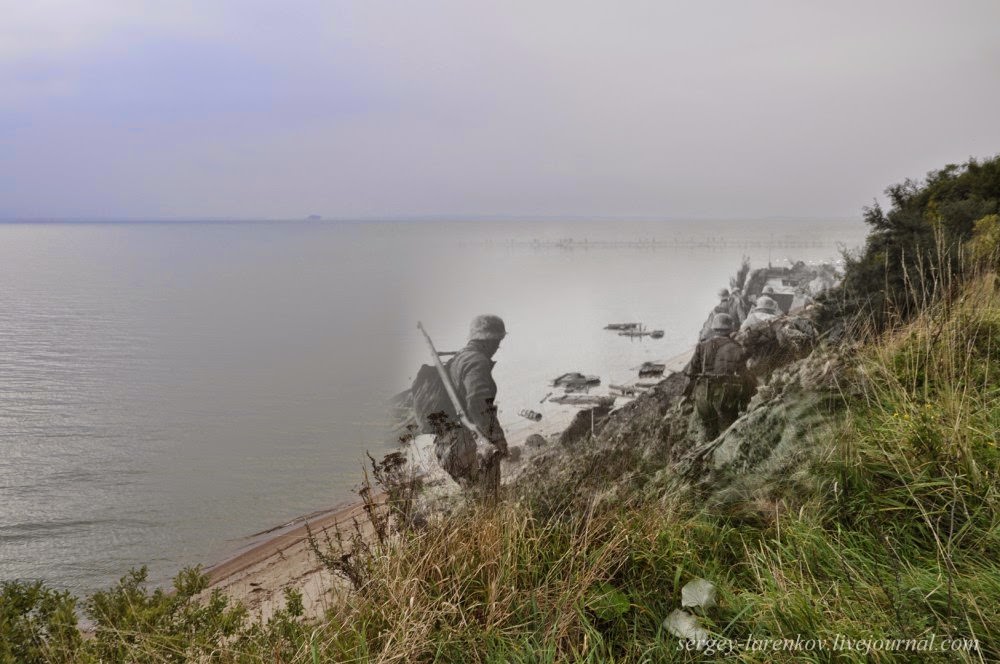
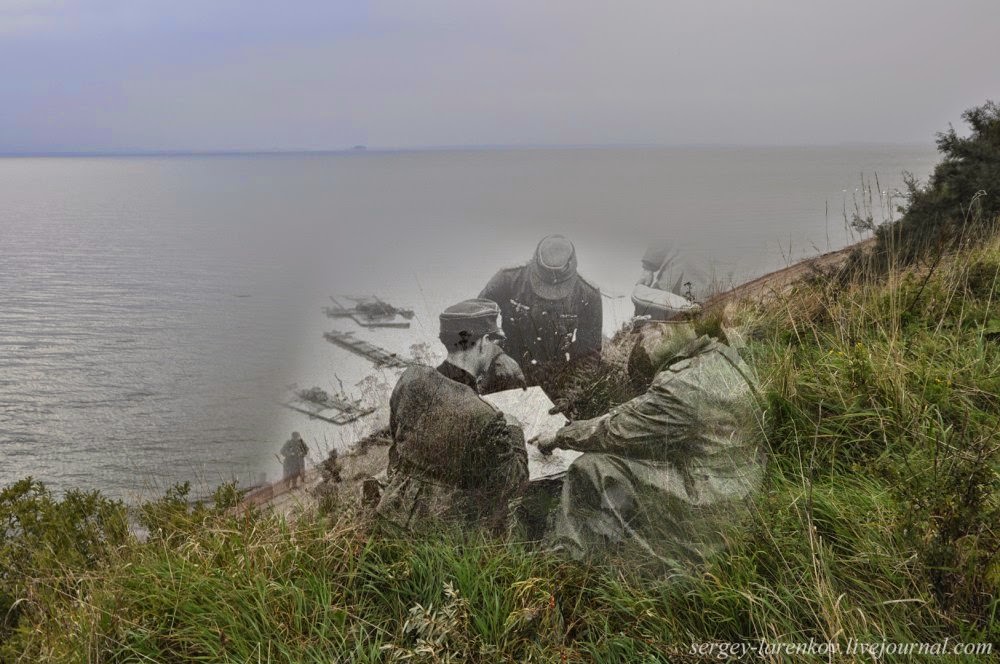
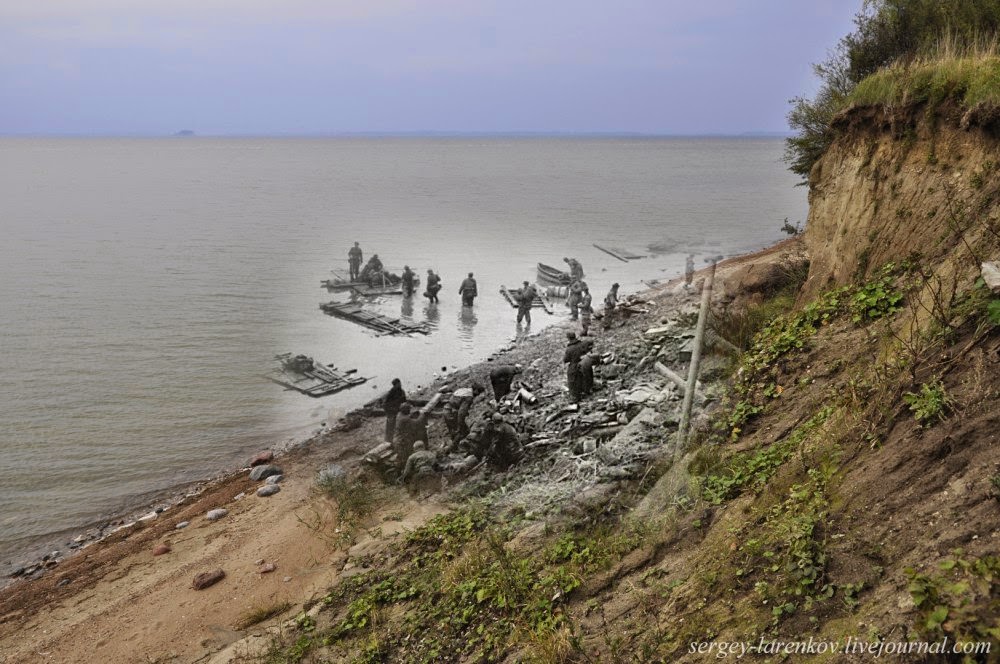
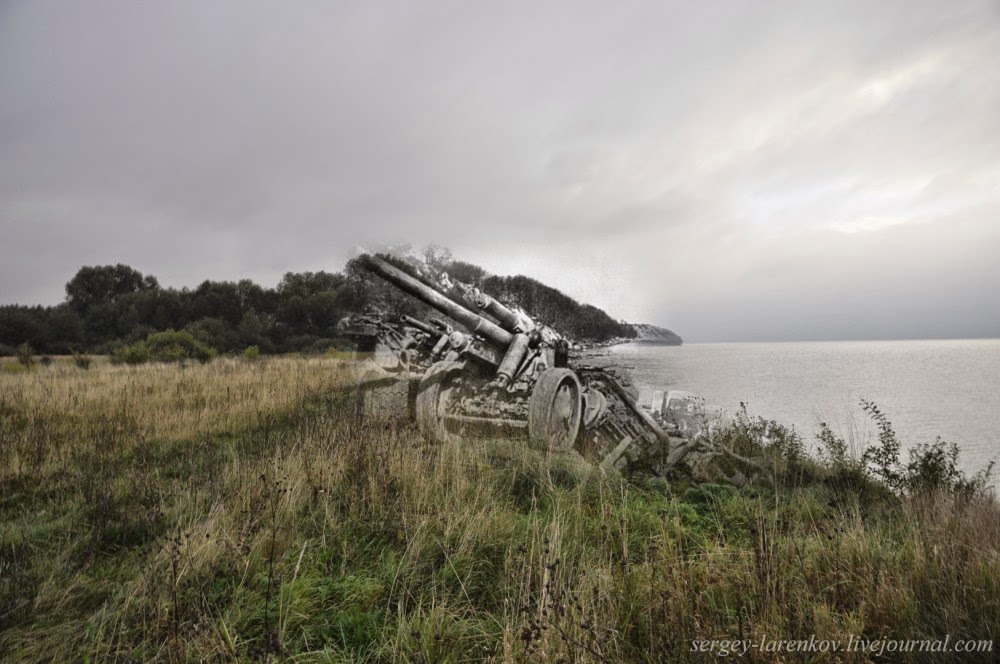
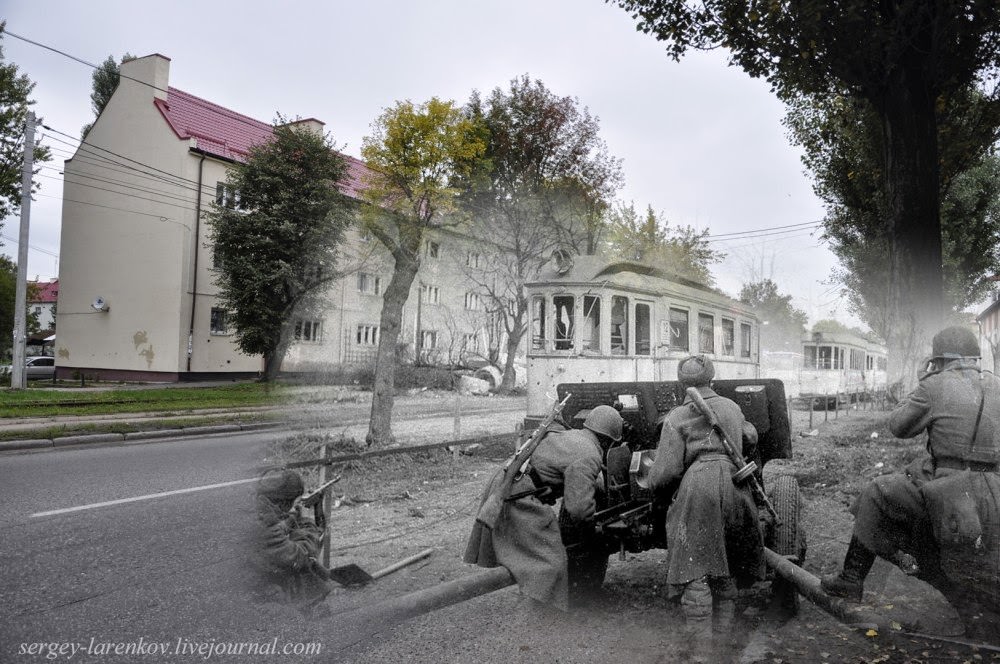
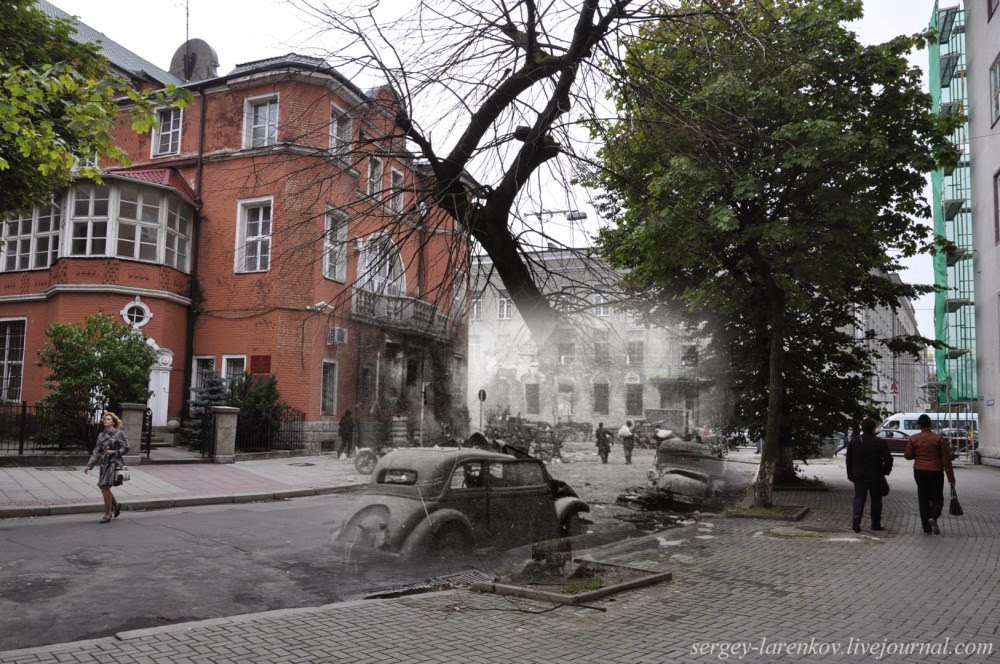
Kaliningrad — known as Königsberg before the war — was a major Prussian city that was nearly completely destroyed during the Soviet assault in April 1945. The battle lasted four days and resulted in German surrender. The city was transferred to the Soviet Union after the war, renamed, and repopulated with Soviet citizens. Its German-era architecture was largely demolished or left to decay. The then-and-now comparisons from Kaliningrad show some of the starkest contrasts in the entire collection, with wartime ruins replaced by Soviet-era construction that bears little resemblance to what stood before.

Kaliningrad: THEN & NOW

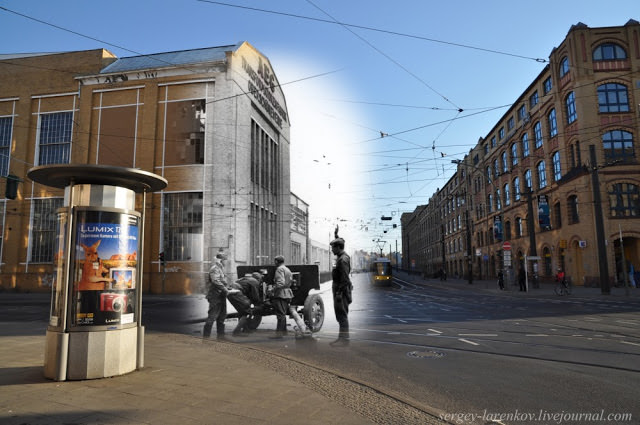
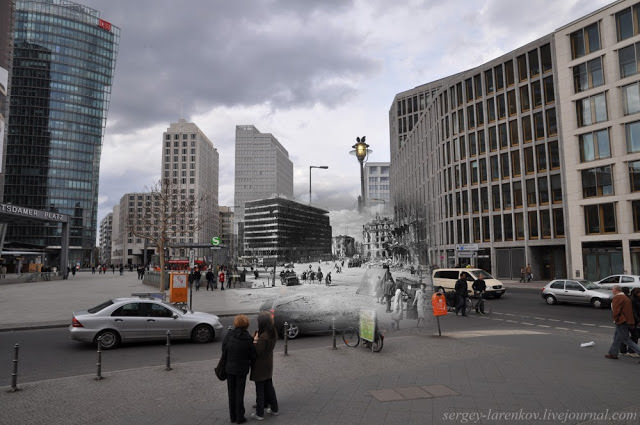
Berlin’s transformation from a bombed-out ruin into a modern capital took decades and two very different political systems. West Berlin rebuilt quickly under Western investment. East Berlin, under Soviet control, followed a different path. The divided city reunified in 1990, and major restoration projects continued well into the 2000s. These final comparisons show how thoroughly the city has been rebuilt — though the wartime images make clear just how total the destruction once was.

Berlin: THEN & NOW
Berlin: THEN & NOW
Berlin: THEN & NOW
Berlin: THEN & NOW
Enjoyed this post? Get new ones in your inbox.

Share this Post 🥺

Please take a moment to share this content. Your support is greatly appreciated! 🙌🙏

Share this Post 🥺

Please take a moment to share this content. Your support is greatly appreciated! 🙌🙏
Scroll to Top
 
Hey Friend, Before You Go.. Please like & follow for more interesting content