Her real name was Annemarie Margot Elfreda, but the world knew her as Sunny Harnett. In the 1950s, she was one of the most in-demand fashion models working in the United States. Her face appeared on the pages of Vogue, Harper’s Bazaar, and nearly every other major fashion publication of the era. She graced the cover of Vogue multiple times, a feat that placed her among a very small group of women who defined what glamour looked like in postwar America.

Harnett’s look was polished and precise. With her ash blonde hair and sharp, composed features, she carried clothes in a way that felt effortless. Fashion editors trusted her to make any garment look like it belonged on a pedestal. That reliability kept her booked throughout the decade and made her one of the most recognized faces in the business.


Outside of modeling, Harnett made one notable on-screen appearance. She appeared in the 1957 musical film “Funny Face,” starring alongside Audrey Hepburn and Fred Astaire. The film was set in the world of high fashion, making Harnett a natural fit. Her ash blonde hair was part of her look in the film, and her presence added authenticity to a story built around the magazine industry she knew so well.


The 1950s were a defining decade for American fashion. Women’s clothing leaned heavily into structured silhouettes — nipped waists, full skirts, tailored suits, and elegant evening wear. Harnett moved through all of these looks with equal confidence. Whether she was wearing a crisp daytime suit or a floor-length gown, she brought the same level of control to every frame.


Vogue in the 1950s was the ultimate destination for fashion photography, and appearing on its cover was the clearest measure of a model’s standing. Harnett appeared there more than once, which tells you exactly where she ranked. The photographers she worked with, the designers whose clothes she wore, and the editors who placed her on those covers were the most influential people in the industry.


Harper’s Bazaar was equally prestigious, and Harnett worked for that publication regularly as well. The magazine was known for taking more artistic risks with its photography, and Harnett adapted to whatever each shoot demanded. Some images placed her in dramatic, high-contrast settings. Others relied on clean, simple composition that put the focus entirely on the clothing and the model wearing it.


After stepping back from modeling, Harnett moved into the business side of the fashion world. She became an assistant to Eileen Ford at Ford Models, one of the most powerful modeling agencies in the world. Ford had built her agency into a machine that represented the top talent in the industry, and working there gave Harnett a front-row seat to how the business operated behind the scenes. She eventually left that role as well, stepping away from the industry altogether.


Beyond modeling and her time at Ford Models, Harnett also worked as a casting director, adding another layer to a career that stretched across multiple parts of the entertainment and fashion industries. She understood the business from several different angles — as a model in front of the camera, as an agent identifying talent, and as a casting director shaping productions.


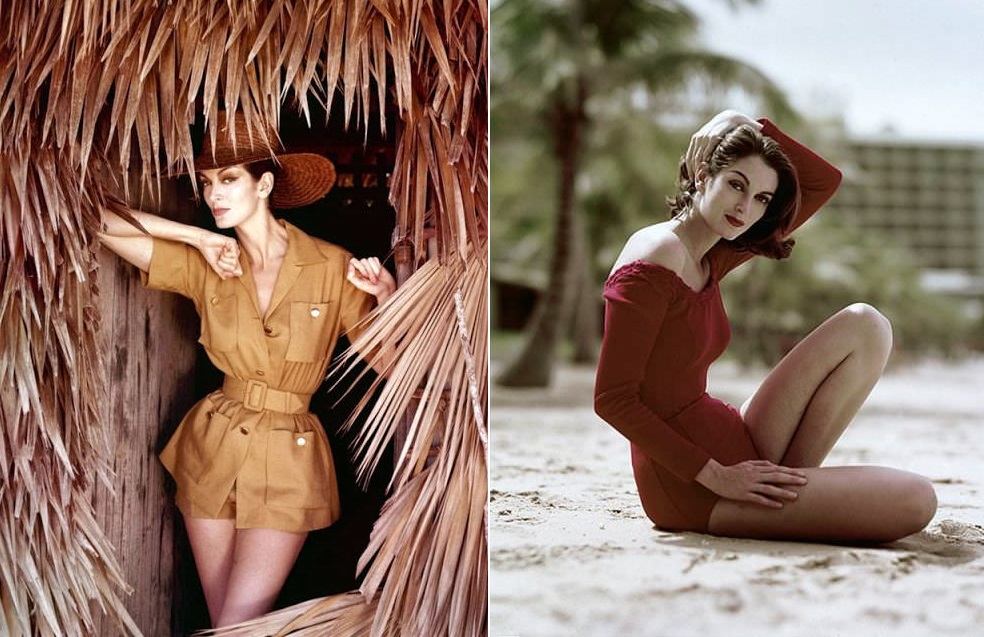
The photographs from her modeling years capture a very specific moment in fashion history. The styling, the poses, the lighting, and the settings all reflect how the industry presented women and clothing in the years following World War II. Harnett is a constant in these images — her expression rarely gives away too much, and her posture is always controlled. That discipline was part of what made her so effective in front of the camera.


Looking through these photos, the range of her work becomes clear. She wasn’t tied to a single type of shoot or a single kind of fashion. Casual wear, formal wear, swimwear, eveningwear — she handled it all. That versatility was rare, and it kept her relevant across the full stretch of the decade.


Sunny Harnett died in 1987 at the age of 63, several days after suffering severe burns from a fire at her home. Her death came decades after her peak years in fashion, but the archive she left behind remains a detailed record of one of the most stylish eras in American fashion history.