The 1920s were a decade when speed felt like destiny. Across Europe and America, engineers, pilots, and inventors were chasing records on land, in water, and in the air. Germany was no exception. At Tempelhof Airport in Berlin, one man was pushing that obsession further than almost anyone else — not with a roaring aircraft or a racing car, but with a bicycle strapped to a rocket engine.
Max Wiedenhöft was a German airplane designer who ran his own aircraft company at Tempelhof. He was a serious figure in German aviation, known for experimenting with the limits of flight and propulsion. But in the mid-1920s, he turned his attention to something that seemed to straddle the line between engineering ambition and outright madness: a rocket-powered bicycle. His goal was to reach 400 kilometers per hour on the machine — a speed that would have shattered every land speed record of the era.
Wiedenhöft’s actual work on the rocket bicycle was conducted on a rooftop at Tempelhof Airport. He was photographed there in the weeks before the project became famous, preparing the machine and testing its components. The bicycle itself was fitted with a rocket propulsion unit at the rear, designed to generate enough thrust to send the rider hurtling forward at extraordinary velocity. Whether the machine ever achieved a meaningful test run under rocket power remains unclear, but the photographs of Wiedenhöft with his creation were very real.
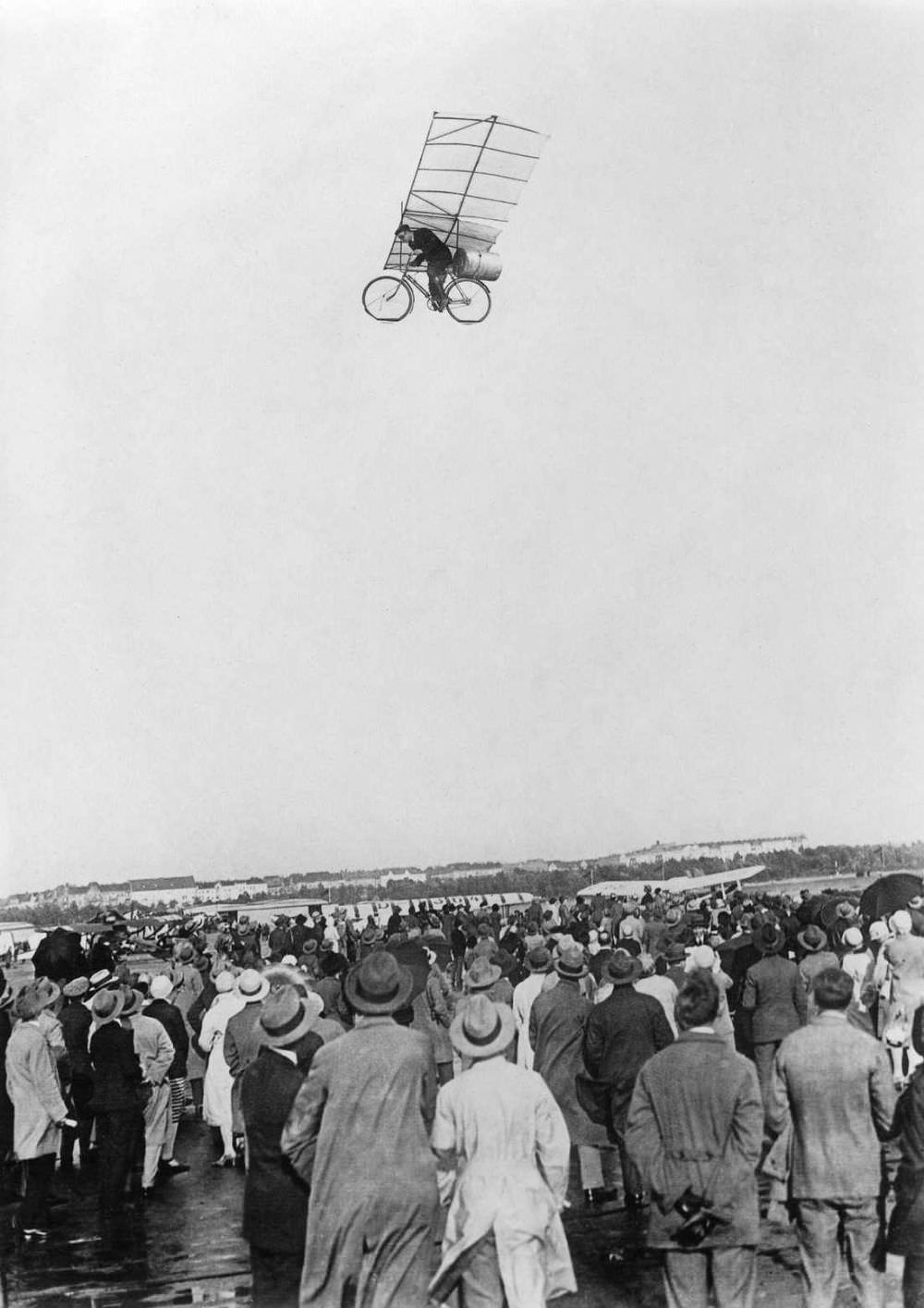
What turned those real images into something far more famous was a decision made by a German newspaper on April 1st. An editor took one of the photographs of Wiedenhöft from the previous month and used it to create a photomontage — a manipulated image that showed him riding the rocket bicycle high above Tempelhof Airport, as if the machine had actually taken flight. The image was published as an April Fool’s Day joke, and it spread quickly.
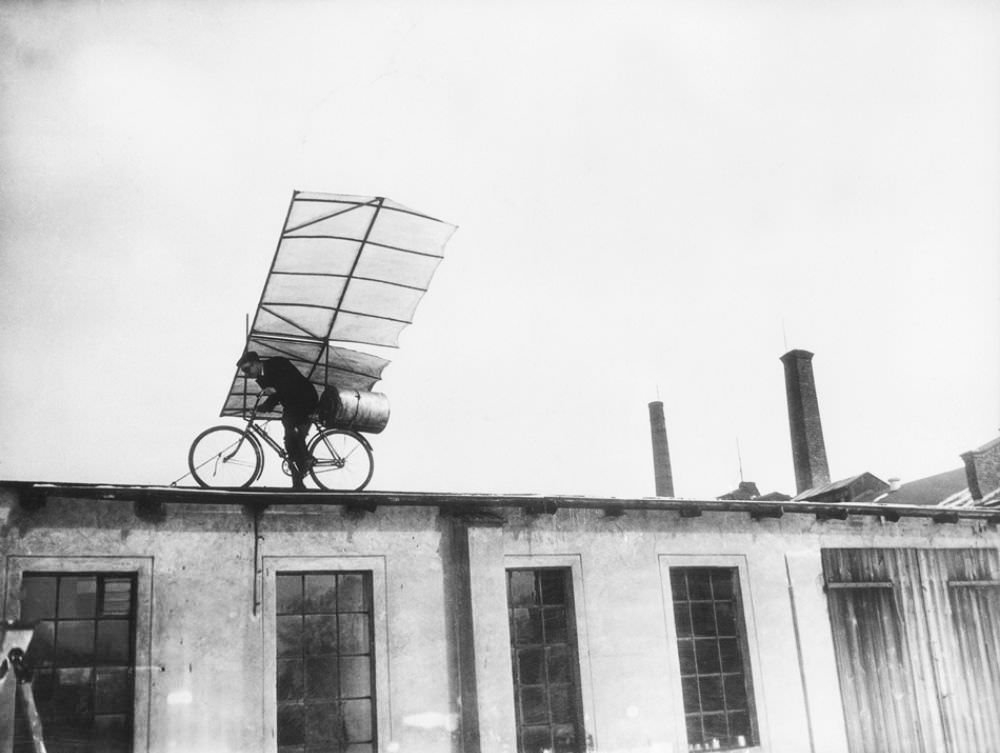
Photomontage as a medium was already well established in Germany by this point. Artists and political satirists had been using it for years to create striking, sometimes surreal images. Turning a photograph of a man on a rooftop into a scene of him soaring over an airfield required skill, but it was entirely within the technical reach of a competent darkroom technician of the period. The result was convincing enough to delight readers and blur the line between the plausible and the absurd.
The joke landed because it wasn’t entirely unbelievable. Rocket-powered experiments were genuinely happening across Germany in the 1920s. Fritz von Opel would famously test a rocket-powered car in 1928, and rocket sleds and rail vehicles were being seriously explored as the decade progressed. A rocket bicycle, while extreme, fit neatly into the public’s growing appetite for speed-related spectacle. Wiedenhöft’s real project gave the hoax its credibility.
Wiedenhöft himself was aiming for something that engineers of the time genuinely believed was achievable with the right propulsion system. At 400 km/h, a rider would have faced enormous aerodynamic forces — far beyond what any conventional bicycle frame or human body could withstand without serious engineering modifications. Whether his design accounted for those challenges, or whether the project was more of a publicity-driven experiment than a serious speed attempt, is part of what makes the story so compelling. The line between genuine innovation and theatrical spectacle in the 1920s was often very thin.
The photograph that emerged from the April Fool’s stunt became one of the more recognizable images associated with 1920s German aviation folklore. It shows a confident Wiedenhöft, seemingly at ease on his improbable machine, with the Tempelhof landscape spread out below him. The image carries the visual language of the era — bold, optimistic, and slightly larger than life. It was exactly the kind of picture that defined how the decade saw itself: as a time when the rules were being rewritten and the impossible was merely the next thing on the list.
Max Wiedenhöft’s rocket bicycle project took place at Tempelhof Airport in Berlin during the mid-1920s. The April Fool’s Day photomontage was created from a genuine photograph taken of Wiedenhöft during preparations for testing his rocket-propelled bicycle on a rooftop at the airport. The manipulated image was published in a German newspaper on April 1st, depicting Wiedenhöft as if he were flying over Tempelhof on the machine.